WO2022113706A1 - ラベルおよびラベルの製造方法 - Google Patents
ラベルおよびラベルの製造方法 Download PDFInfo
- Publication number
- WO2022113706A1 WO2022113706A1 PCT/JP2021/040908 JP2021040908W WO2022113706A1 WO 2022113706 A1 WO2022113706 A1 WO 2022113706A1 JP 2021040908 W JP2021040908 W JP 2021040908W WO 2022113706 A1 WO2022113706 A1 WO 2022113706A1
- Authority
- WO
- WIPO (PCT)
- Prior art keywords
- layer
- label
- intermediate layer
- color
- developing
- Prior art date
- Legal status (The legal status is an assumption and is not a legal conclusion. Google has not performed a legal analysis and makes no representation as to the accuracy of the status listed.)
- Ceased
Links
Images
Classifications
-
- B—PERFORMING OPERATIONS; TRANSPORTING
- B32—LAYERED PRODUCTS
- B32B—LAYERED PRODUCTS, i.e. PRODUCTS BUILT-UP OF STRATA OF FLAT OR NON-FLAT, e.g. CELLULAR OR HONEYCOMB, FORM
- B32B7/00—Layered products characterised by the relation between layers; Layered products characterised by the relative orientation of features between layers, or by the relative values of a measurable parameter between layers, i.e. products comprising layers having different physical, chemical or physicochemical properties; Layered products characterised by the interconnection of layers
- B32B7/02—Physical, chemical or physicochemical properties
- B32B7/023—Optical properties
-
- B—PERFORMING OPERATIONS; TRANSPORTING
- B41—PRINTING; LINING MACHINES; TYPEWRITERS; STAMPS
- B41M—PRINTING, DUPLICATING, MARKING, OR COPYING PROCESSES; COLOUR PRINTING
- B41M5/00—Duplicating or marking methods; Sheet materials for use therein
- B41M5/26—Thermography ; Marking by high energetic means, e.g. laser otherwise than by burning, and characterised by the material used
-
- G—PHYSICS
- G09—EDUCATION; CRYPTOGRAPHY; DISPLAY; ADVERTISING; SEALS
- G09F—DISPLAYING; ADVERTISING; SIGNS; LABELS OR NAME-PLATES; SEALS
- G09F3/00—Labels, tag tickets, or similar identification or indication means; Seals; Postage or like stamps
-
- G—PHYSICS
- G09—EDUCATION; CRYPTOGRAPHY; DISPLAY; ADVERTISING; SEALS
- G09F—DISPLAYING; ADVERTISING; SIGNS; LABELS OR NAME-PLATES; SEALS
- G09F3/00—Labels, tag tickets, or similar identification or indication means; Seals; Postage or like stamps
- G09F3/02—Forms or constructions
Definitions
- This disclosure relates to labels and labels manufacturing methods.
- the method of printing the ink on the surface of the label base material by a method such as an inkjet printer or a thermal printer is the mainstream.
- the print may disappear due to the rubbing of the ink on the label during transportation of the product with the label attached.
- laser printing can be provided on the outer surface of the label by irradiating the laser beam from the outside of the label.
- laser printing on the inner surface of the label by irradiating the laser beam from the inside of the label to shield the laser printing on the inside of the label from the outside of the label.
- Patent Document 1 discloses a laminated film for laser printing in which a white ink layer, a printing agent layer, a printing pattern layer, and a plastic film are laminated in this order from the side irradiated with the laser beam.
- the laser printing provided on the inner printing agent layer may be seen through from the plastic film on the outer side of the laminated film.
- the base material is provided with a base material, a first intermediate layer on the base material, a second intermediate layer on the first intermediate layer, and a coloring layer on the second intermediate layer.
- the color-developing layer can exhibit a color-developing display by irradiation with a laser beam
- the first intermediate layer can shield the color-developing display in the color-developing layer from the substrate side
- the second intermediate layer is in the color-developing layer from the color-developing layer side. It is possible to provide a label capable of enhancing the visibility of the color display.
- a step of forming a first intermediate layer on a base material, a step of forming a second intermediate layer on the first intermediate layer, and a color-developing layer on the second intermediate layer are provided.
- the first intermediate layer can shield the color development display in the color development layer from the substrate side, and includes a step of forming and a step of expressing the color development display by irradiating the color development layer with a laser beam.
- the intermediate layer can provide a method for manufacturing a label capable of enhancing the visibility of the color development display in the color development layer from the color development layer side.
- the laser printing on the inside of the label can be shielded from the outside of the label, and the laser printing can be clearly confirmed from the inside of the label.
- a manufacturing method can be provided.
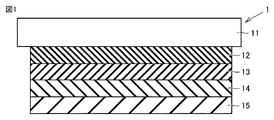
- FIG. 3 is a schematic cross-sectional view of an example of a label of an embodiment.
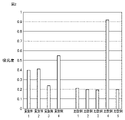
- 6 is a histogram showing the absorbance of the labels of Examples 1 to 10.
- FIG. 1 shows a schematic cross-sectional view of an example of a label of an embodiment.
- Label 1 of the embodiment shown in FIG. 1 includes a base material 11, a design layer 12 on the base material 11, a first intermediate layer 13 on the design layer 12, and a second intermediate layer on the first intermediate layer 13. 14 and a color-developing layer 15 on the second intermediate layer 14.
- the base material 11 side is the outside and the coloring layer 15 is the inside.
- the base material 11 is a plastic film containing at least a resin capable of supporting the first intermediate layer 13, the second intermediate layer 14, and the coloring layer 15.
- the plastic film constituting the base material 11 can be transparent.
- the total light transmittance of the base material 11 is preferably 70% or more, more preferably 80% or more, still more preferably 90% or more. Total light transmittance is measured by JIS K 7105 (optical property test method for plastics).
- polyester resin polyethylene terephthalate, polyethylene naphthalate, polylactic acid, etc.
- polystyrene resin polystyrene, styrene-butadiene copolymer, etc.
- polyolefin resin polyolefin resin.
- Resins polyethylene, polypropylene, etc.
- polyvinyl chloride resins polyamide resins, aramid resins, polyimide resins, polyphenylene sulfide resins, acrylic resins and the like can be used.
- the plastic film constituting the base material 11 may contain one kind of these resins, or may contain two or more kinds of these resins.
- the base material 11 may be, for example, a heat-shrinkable plastic film (shrink film).
- shrink film heat-shrinkable plastic film
- the label 1 can be attached to the container by heat-shrinking the base material 11 after covering the container with the label 1.
- the base material 11 may be, for example, a non-heat shrinkable plastic film.
- a non-heat shrinkable plastic film for example, a wrapping label that can be wrapped around the outer surface of the container, a tack label that can be attached to the outer surface of the container, or a flat bag, a gusset bag, or a bag.
- Label 1 can be used as a flexible packaging bag such as a bag or a pouch.
- the base material 11 may be a single-layer film composed of one layer or a multilayer film composed of two or more layers. Further, the thickness of the base material 11 can be, for example, 5 ⁇ m or more and 100 ⁇ m or less.
- the first intermediate layer 13 is a layer capable of shielding the color development display in the color development layer 15 from the base material 11 side.
- the color display in the color layer from the base material side can be shielded means that the color display is actually formed even if the color display (laser printing) is not actually formed in the color layer. Assuming, it means that the color display of the color-developing layer cannot be recognized visually from the substrate side.
- an ink coating film containing a coloring pigment can be used as the first intermediate layer 13, for example.
- a coloring pigment of the ink coating film constituting the first intermediate layer 13 for example, indigo, crimson, yellow, black, dark grass, silver, gold or gray may be used as a single color or a combination of a plurality of colors. Can be done.
- the components other than the coloring pigment contained in the ink coating film constituting the first intermediate layer 13 include a binder resin and the like.
- the first intermediate layer 13 is an ink coating film containing a coloring pigment having a relatively low transmittance of visible light incident from the base material 11 side and a relatively small absorbance of laser light incident from the color developing layer 15 side. It is preferable to use. As such a coloring pigment, it is preferable to use a silver, gold, or gray coloring pigment, and it is more preferable to use a silver or gray coloring pigment. In this case, the first intermediate layer 13 can shield the color development display on the color development layer 15 from the base material 11 side, and absorbs the laser light emitted from the color development layer 15 side to some extent to generate heat and develop color. It is possible to assist in forming a color display (laser printing) on the layer 15 side.
- a coloring pigment it is preferable to use a silver, gold, or gray coloring pigment, and it is more preferable to use a silver or gray coloring pigment.
- the first intermediate layer 13 can shield the color development display on the color development layer 15 from the base material 11 side, and absorbs the laser light emitted from
- the transmittance of visible light emitted from the base material 11 side of the first intermediate layer 13 is too high, it may not be possible to sufficiently shield the color development display in the color development layer 15 from the base material 11 side. If the absorptivity of the laser light emitted from the color-developing layer 15 side of the first intermediate layer 13 is too high, the amount of the laser light absorbed by the first intermediate layer 13 becomes too large, and the label 1 is deteriorated by heat. Alternatively, the label 1 may be melted to form holes in the label 1.
- the absorbance of the laser light of Label 1 (light having a wavelength of 950 nm or more and a wavelength of 1400 nm or less) is preferably larger than 0.22, more preferably 0.24 or more, and more preferably 0.40 or more. Especially preferable.
- the absorbance of the laser beam of the label 1 is larger than 0.22, more preferably 0.24 or more, and particularly preferably 0.40 or more, the color-developing layer 15 from the base material 11 side.
- the color development display can be shielded, and the color development layer 15 can be heated to a temperature suitable for expressing the color development display in the color development layer 15 by heating by irradiation with a laser beam.
- the absorbance of the laser beam of Label 1 (wavelength 950 nm or more and wavelength 1400 nm or less) is preferably less than 0.92, more preferably 0.6 or less, and particularly preferably 0.55 or less. In these cases, it is possible to shield the color development display on the color development layer 15 from the base material 11 side, and the temperature of the first intermediate layer 13 becomes too high due to heating by irradiation with a laser beam, so that the label 1 can be melted. The sex can be reduced.
- the first intermediate layer 13 may have a function of reflecting laser light emitted from the color developing layer 15 side.
- the laser light emitted from the color-developing layer 15 side and transmitted through the color-developing layer 15 and the second intermediate layer 14 can be reflected by the first intermediate layer 13 and returned to the color-developing layer 15.
- the color-developing layer 15 can absorb the reflected light of the laser beam to generate heat again, so that the color-developing display can be expressed more clearly.
- the second intermediate layer 14 is a layer capable of enhancing the visibility of the color development display in the color development layer 15.
- "it is possible to improve the visibility of the color development display in the color development layer from the color development layer side” means that the label is provided with the second intermediate layer and the label is provided with the second intermediate layer.
- the label is provided with the second intermediate layer, the color display formed on the color-developing layer can be more clearly recognized visually from the color-developing layer side of the label, as compared with the case where the label is not provided. Means to have.
- an ink coating film containing a coloring pigment can be used as the second intermediate layer 14.
- a coloring pigment of the ink coating film constituting the second intermediate layer 14 for example, a light color such as light yellow or light red or white or the like can be used.
- the components other than the coloring pigment contained in the ink coating film constituting the second intermediate layer 14 include a binder resin and the like.
- the second intermediate layer 14 it is preferable to use an ink coating film containing a coloring pigment capable of enhancing the visibility of the color development display on the color development layer 15 from the color development layer 15 side.
- a white solid ink layer can be used.
- the second intermediate layer 14 is a white solid ink layer.
- the color-developing layer 15 is a layer capable of exhibiting a color-developing display by irradiation with a laser beam.
- the color display can be expressed by irradiating the laser light is assumed that the color-developing layer 15 is actually irradiated with the laser light even if the color-developing layer 15 is not actually irradiated with the laser light. In some cases, it means that the portion irradiated with the laser beam has a property of being able to generate a color (discoloration).
- a color-developing coating film capable of exhibiting color development by irradiation with laser light can be used without particular limitation.
- a color-developing coating film constituting the color-developing layer 15 a color-developing coating film containing a leuco dye that enables color change by irradiation with a laser beam can be used.
- a layer that is transparent before irradiation with a laser beam, the portion irradiated with the laser beam is heated to become black, and the blackened portion becomes a color-developing display can be used.
- the design layer 12 is a layer having a design that can be visually recognized from the base material 11 side.
- the design layer 12 can be located between the base material 11 of the label 1 and the first intermediate layer 13, as shown in FIG. 1, for example, but is not limited thereto. Further, the label 1 does not have to include the design layer 12.
- the design layer 12 can be a layer capable of suppressing heat generation due to irradiation with laser light.
- the design layer 12 is a layer capable of suppressing heat generation due to irradiation with laser light, the possibility of melting of the label 1 due to the design layer 12 absorbing the laser light and generating heat can be reduced.
- the design layer 12 contains a pigment capable of suppressing absorption of laser light.
- a pigment capable of suppressing absorption of laser light.
- the design layer 12 may generate too much heat due to irradiation with laser light, so that the design layer 12 may be replaced with carbon black. It is preferable to mix black with a pigment (for example, yellow, indigo, red, etc.) that absorbs less in the wavelength range of the laser light.
- Label 1 may further include other layers.
- the positions and materials of the other layers are not particularly limited, but for example, the color ink layer, the outside of the base material 11 (the side opposite to the side where the first intermediate layer 13 is located), or the inside of the coloring layer 15 (the first). 2
- a protective layer such as medium for protecting the label 1 from external factors can be mentioned.
- Label 1 of the embodiment can be manufactured, for example, as follows. First, a step of preparing the base material 11 is performed. The step of preparing the base material 11 is, for example, by molding a plastic film by a method such as an extrusion method or a calender method, and if necessary, further applying a stretching treatment to the plastic film. It can be carried out.
- the ink resin composition for the first intermediate layer which is a precursor of the ink coating film constituting the first intermediate layer 13 is applied onto the surface of the base material 11 and then dried. It can be done by letting it.
- a step of forming the design layer 12 on the surface of the base material 11 is performed.
- the step of forming the design layer 12 can be performed, for example, by gravure printing, flexographic printing, inkjet printing, screen printing, or offset printing of the ink resin composition that is the precursor of the design layer 12.
- the ink resin composition for the second intermediate layer which is a precursor of the ink coating film constituting the second intermediate layer 14 is applied onto the surface of the base material 11 and then dried. It can be done by letting it.
- a step of forming the color-developing layer 15 on the surface of the second intermediate layer 14 is performed.
- the step of forming the color-developing layer 15 is performed, for example, by applying a resin composition for a color-developing coating film, which is a precursor of the color-developing coating film constituting the color-developing layer 15, onto the surface of the second intermediate layer 14 and then drying the resin composition. be able to.
- the label 1 of the embodiment can be manufactured.
- the label 1 of the embodiment includes a first intermediate layer 13 capable of shielding the color development display in the color development layer 15 from the base material 11 side between the base material 11 and the color development layer 15. Therefore, in the label 1 of the embodiment, the color development display on the color development layer 15 from the base material 11 side cannot be shielded, that is, visually confirmed.
- the label 1 of the embodiment has a second intermediate layer 14 between the first intermediate layer 13 and the color-developing layer 15 which can enhance the visibility of the color-developing display in the color-developing layer 15 from the color-developing layer 15 side. I have. Therefore, in the label 1 of the embodiment, the color development display on the color development layer 15 from the color development layer 15 side can be clearly confirmed visually.
- the label 1 of the embodiment it is possible to shield the laser printing inside the label 1 from the outside of the label 1, and the laser printing can be clearly confirmed from the inside of the label 1.
- a substrate made of a transparent polystyrene film having a thickness of 45 ⁇ m was prepared.
- an ink resin composition for a first intermediate layer containing a silver coloring pigment on one surface of the substrate is applied onto one surface of the substrate and then dried to obtain a silver color having a thickness of 3 to 5 ⁇ m.
- the first intermediate layer of the above was formed.
- an ink resin composition for a second intermediate layer containing a white coloring pigment is applied onto one surface of the substrate and then dried on the surface of the side on which the substrate of the first intermediate layer is not formed.
- a white second intermediate layer having a thickness of 3 to 5 ⁇ m composed of a white solid ink layer was formed.
- a resin composition for a color-developing coating film which is a precursor of the color-developing coating film constituting the color-developing layer, is applied onto the surface of the second intermediate layer on the side where the first intermediate layer is not formed, and then dried.
- a transparent coloring layer was formed.
- Example 1 was prepared by applying a transparent medium on the surface on the side where the second intermediate layer of the coloring layer was not formed.
- Example 2 ⁇ Preparation of Label of Example 2> Under the same method and conditions as in Example 1 except that an indigo color ink layer having a thickness of 3 to 5 ⁇ m was formed between the base material and the first intermediate layer and the first intermediate layer was made silver. The label of Example 2 was prepared.
- Example 3 ⁇ Preparation of Label of Example 3> The label of Example 3 was prepared by the same method and under the same conditions as in Example 1 except that the first intermediate layer was colored gold.
- Example 4 ⁇ Preparation of Label of Example 4> The label of Example 4 was prepared by the same method and under the same conditions as in Example 1 except that the first intermediate layer was grayed out.
- the label of Comparative Example 1 was prepared by the same method and under the same conditions as in Example 1 except that the first intermediate layer was indigo.
- the label of Comparative Example 4 was prepared by the same method and under the same conditions as in Example 1 except that the first intermediate layer was made black. As the material of the black first intermediate layer, black ink using carbon black was used.
- Laser printing is formed by irradiating the coloring layer of each label with near infrared rays having a wavelength of 950 nm from the coloring layer side of the labels of Examples 1 to 4 and Comparative Examples 1 to 5, and then laser printing from the coloring layer side of the label.
- the visibility of the above was visually evaluated according to the following criteria A to C.
- the results are shown in Tables 1 and 2.
- "A” in the "Laser printing visibility” column of Tables 1 and 2 indicates that the laser printing (black) could be clearly seen sufficiently by the contrast (white) with the second intermediate layer, and "B".
- "" Indicates that the laser printing could be visually recognized by the contrast with the second intermediate layer
- "C” indicates that the laser printing could not be sufficiently visually recognized even with the contrast with the second intermediate layer.
- the labels of Examples 1 to 4 having an absorbance greater than 0.22 and 0.55 or less, particularly 0.24 or more and 0.55 or less, are labels of Comparative Examples 1 to 5 having an absorbance of 0.22 or less. It was also confirmed that both the shielding property of the laser printing by the first intermediate layer and the visibility of the laser printing by the second intermediate layer can be improved as compared with the above.
- the labels of Examples 1, 2 and 4 having an absorbance of 0.40 or more and 0.55 or less have a shielding of laser printing by the first intermediate layer as compared with the label of Example 3 having an absorbance of 0.24. It was also confirmed that both the sex and the visibility of the laser printing by the second intermediate layer can be improved.
Landscapes
- Physics & Mathematics (AREA)
- General Physics & Mathematics (AREA)
- Engineering & Computer Science (AREA)
- Theoretical Computer Science (AREA)
- Optics & Photonics (AREA)
- Thermal Transfer Or Thermal Recording In General (AREA)
- Laminated Bodies (AREA)
Priority Applications (1)
| Application Number | Priority Date | Filing Date | Title |
|---|---|---|---|
| JP2022565190A JP7814321B2 (ja) | 2020-11-24 | 2021-11-08 | ラベルおよびラベルの製造方法 |
Applications Claiming Priority (2)
| Application Number | Priority Date | Filing Date | Title |
|---|---|---|---|
| JP2020-194416 | 2020-11-24 | ||
| JP2020194416 | 2020-11-24 |
Publications (1)
| Publication Number | Publication Date |
|---|---|
| WO2022113706A1 true WO2022113706A1 (ja) | 2022-06-02 |
Family
ID=81754417
Family Applications (1)
| Application Number | Title | Priority Date | Filing Date |
|---|---|---|---|
| PCT/JP2021/040908 Ceased WO2022113706A1 (ja) | 2020-11-24 | 2021-11-08 | ラベルおよびラベルの製造方法 |
Country Status (2)
| Country | Link |
|---|---|
| JP (1) | JP7814321B2 (https=) |
| WO (1) | WO2022113706A1 (https=) |
Citations (4)
| Publication number | Priority date | Publication date | Assignee | Title |
|---|---|---|---|---|
| JP2001228801A (ja) * | 1999-12-10 | 2001-08-24 | Fuji Seal Inc | 筒状ラベル、長尺筒状体及びその製造方法並びに筒状ラベル付容器 |
| JP2009507670A (ja) * | 2005-08-29 | 2009-02-26 | シンクレア システムズ インターナショナル エルエルシー | 光印字可能な多層媒体およびその使用方法並びに装置 |
| JP2009120205A (ja) * | 2007-11-12 | 2009-06-04 | Toppan Printing Co Ltd | 隠蔽層を有する包装袋と該包装袋に使用する包装材料 |
| US20110121557A1 (en) * | 2008-05-15 | 2011-05-26 | Pingfan Wu | Multilayer articles capable of forming color images |
Family Cites Families (5)
| Publication number | Priority date | Publication date | Assignee | Title |
|---|---|---|---|---|
| JPH0490581U (https=) * | 1990-12-25 | 1992-08-06 | ||
| JP2001319318A (ja) | 2000-05-12 | 2001-11-16 | Dainippon Printing Co Ltd | 磁気記録媒体 |
| JP5428492B2 (ja) | 2009-04-23 | 2014-02-26 | 大日本印刷株式会社 | 印字情報付き包装材 |
| JP2020102553A (ja) | 2018-12-21 | 2020-07-02 | 日東電工株式会社 | 半導体背面密着フィルム |
| JP2020107373A (ja) | 2018-12-26 | 2020-07-09 | 共同印刷株式会社 | 磁気記録媒体 |
-
2021
- 2021-11-08 WO PCT/JP2021/040908 patent/WO2022113706A1/ja not_active Ceased
- 2021-11-08 JP JP2022565190A patent/JP7814321B2/ja active Active
Patent Citations (4)
| Publication number | Priority date | Publication date | Assignee | Title |
|---|---|---|---|---|
| JP2001228801A (ja) * | 1999-12-10 | 2001-08-24 | Fuji Seal Inc | 筒状ラベル、長尺筒状体及びその製造方法並びに筒状ラベル付容器 |
| JP2009507670A (ja) * | 2005-08-29 | 2009-02-26 | シンクレア システムズ インターナショナル エルエルシー | 光印字可能な多層媒体およびその使用方法並びに装置 |
| JP2009120205A (ja) * | 2007-11-12 | 2009-06-04 | Toppan Printing Co Ltd | 隠蔽層を有する包装袋と該包装袋に使用する包装材料 |
| US20110121557A1 (en) * | 2008-05-15 | 2011-05-26 | Pingfan Wu | Multilayer articles capable of forming color images |
Also Published As
| Publication number | Publication date |
|---|---|
| JP7814321B2 (ja) | 2026-02-16 |
| JPWO2022113706A1 (https=) | 2022-06-02 |
Similar Documents
| Publication | Publication Date | Title |
|---|---|---|
| US6617094B2 (en) | Laser-marking laminated structure and laser-marked laminated structure | |
| JP2015182793A (ja) | ラベル付き容器の製造方法 | |
| US8054323B2 (en) | Reveal substrates and methods of using same | |
| JP6483198B2 (ja) | レーザーマーキング用インキ組成物及び包装材 | |
| TWI757464B (zh) | 多層膜製造方法和多層膜以及防偽元件和防偽文件 | |
| ES2311747T3 (es) | Procedimiento de marcado con laser. | |
| JP6342042B1 (ja) | レーザーマーキング用積層体及び包装材 | |
| JPWO2014092187A1 (ja) | 情報書き込みフィルムおよび試料収納体 | |
| JP2000105328A (ja) | 繊維光ケ―ブル部材の照射マ―キング | |
| JP6781715B2 (ja) | スリーブを施した製品の製造方法 | |
| JP2009507670A (ja) | 光印字可能な多層媒体およびその使用方法並びに装置 | |
| JP6461610B2 (ja) | 印刷層付き熱収縮性フィルムの製造方法、印刷層付き熱収縮性フィルム、包装体及び包装体の製造方法 | |
| WO2022113706A1 (ja) | ラベルおよびラベルの製造方法 | |
| JP5965602B2 (ja) | ラベル、粘着ラベル及び印刷物 | |
| JP5936316B2 (ja) | Ptp包装体用の蓋材の製造方法 | |
| JP5699611B2 (ja) | 情報管理方法及び情報管理用媒体 | |
| EP3354477A1 (en) | Printing process for a beverage container | |
| JP7063897B2 (ja) | ラベル及びラベルの製造方法 | |
| JP7837198B2 (ja) | 積層体の製造方法 | |
| JPH11152117A (ja) | レーザー印字可能な包装材 | |
| JP7262957B2 (ja) | ラベル基材及びラベル | |
| JP2018167541A (ja) | 多色レーザマーキング用シート及びマーキングされた多色レーザマーキングシート並びに多色レーザマーキングシートの製造方法 | |
| JP7024789B2 (ja) | 立体構造物 | |
| ES2926642T3 (es) | Un material de envasado laminado para productos alimenticios líquidos, un método para la elaboración del mismo, un método para la impresión sobre el mismo y un envase elaborado a partir del mismo | |
| US8646888B2 (en) | Cartridge and printing apparatus |
Legal Events
| Date | Code | Title | Description |
|---|---|---|---|
| 121 | Ep: the epo has been informed by wipo that ep was designated in this application |
Ref document number: 21897681 Country of ref document: EP Kind code of ref document: A1 |
|
| ENP | Entry into the national phase |
Ref document number: 2022565190 Country of ref document: JP Kind code of ref document: A |
|
| NENP | Non-entry into the national phase |
Ref country code: DE |
|
| 122 | Ep: pct application non-entry in european phase |
Ref document number: 21897681 Country of ref document: EP Kind code of ref document: A1 |