WO2022108979A1 - Timestamp smoothing to remove jitter - Google Patents
Timestamp smoothing to remove jitter Download PDFInfo
- Publication number
- WO2022108979A1 WO2022108979A1 PCT/US2021/059637 US2021059637W WO2022108979A1 WO 2022108979 A1 WO2022108979 A1 WO 2022108979A1 US 2021059637 W US2021059637 W US 2021059637W WO 2022108979 A1 WO2022108979 A1 WO 2022108979A1
- Authority
- WO
- WIPO (PCT)
- Prior art keywords
- timestamp
- variance
- initial
- clock skew
- estimated
- Prior art date
- Legal status (The legal status is an assumption and is not a legal conclusion. Google has not performed a legal analysis and makes no representation as to the accuracy of the status listed.)
- Ceased
Links
Classifications
-
- H—ELECTRICITY
- H04—ELECTRIC COMMUNICATION TECHNIQUE
- H04L—TRANSMISSION OF DIGITAL INFORMATION, e.g. TELEGRAPHIC COMMUNICATION
- H04L43/00—Arrangements for monitoring or testing data switching networks
- H04L43/08—Monitoring or testing based on specific metrics, e.g. QoS, energy consumption or environmental parameters
- H04L43/0852—Delays
- H04L43/087—Jitter
-
- H—ELECTRICITY
- H04—ELECTRIC COMMUNICATION TECHNIQUE
- H04L—TRANSMISSION OF DIGITAL INFORMATION, e.g. TELEGRAPHIC COMMUNICATION
- H04L41/00—Arrangements for maintenance, administration or management of data switching networks, e.g. of packet switching networks
- H04L41/14—Network analysis or design
- H04L41/147—Network analysis or design for predicting network behaviour
-
- H—ELECTRICITY
- H04—ELECTRIC COMMUNICATION TECHNIQUE
- H04L—TRANSMISSION OF DIGITAL INFORMATION, e.g. TELEGRAPHIC COMMUNICATION
- H04L41/00—Arrangements for maintenance, administration or management of data switching networks, e.g. of packet switching networks
- H04L41/14—Network analysis or design
- H04L41/149—Network analysis or design for prediction of maintenance
-
- H—ELECTRICITY
- H04—ELECTRIC COMMUNICATION TECHNIQUE
- H04L—TRANSMISSION OF DIGITAL INFORMATION, e.g. TELEGRAPHIC COMMUNICATION
- H04L43/00—Arrangements for monitoring or testing data switching networks
- H04L43/10—Active monitoring, e.g. heartbeat, ping or trace-route
- H04L43/106—Active monitoring, e.g. heartbeat, ping or trace-route using time related information in packets, e.g. by adding timestamps
-
- H—ELECTRICITY
- H04—ELECTRIC COMMUNICATION TECHNIQUE
- H04J—MULTIPLEX COMMUNICATION
- H04J3/00—Time-division multiplex systems
- H04J3/02—Details
- H04J3/06—Synchronising arrangements
- H04J3/062—Synchronisation of signals having the same nominal but fluctuating bit rates, e.g. using buffers
- H04J3/0632—Synchronisation of packets and cells, e.g. transmission of voice via a packet network, circuit emulation service [CES]
-
- H—ELECTRICITY
- H04—ELECTRIC COMMUNICATION TECHNIQUE
- H04L—TRANSMISSION OF DIGITAL INFORMATION, e.g. TELEGRAPHIC COMMUNICATION
- H04L43/00—Arrangements for monitoring or testing data switching networks
- H04L43/02—Capturing of monitoring data
- H04L43/022—Capturing of monitoring data by sampling
-
- H—ELECTRICITY
- H04—ELECTRIC COMMUNICATION TECHNIQUE
- H04L—TRANSMISSION OF DIGITAL INFORMATION, e.g. TELEGRAPHIC COMMUNICATION
- H04L43/00—Arrangements for monitoring or testing data switching networks
- H04L43/16—Threshold monitoring
-
- H—ELECTRICITY
- H04—ELECTRIC COMMUNICATION TECHNIQUE
- H04L—TRANSMISSION OF DIGITAL INFORMATION, e.g. TELEGRAPHIC COMMUNICATION
- H04L47/00—Traffic control in data switching networks
- H04L47/10—Flow control; Congestion control
- H04L47/28—Flow control; Congestion control in relation to timing considerations
- H04L47/283—Flow control; Congestion control in relation to timing considerations in response to processing delays, e.g. caused by jitter or round trip time [RTT]
Definitions
- T his disclosure relates generally to audio signal processing.
- a real-time audio processing system will typically receive audio in packets or blocks.
- time information hereinafter, “timestamps”
- This time information may be used by the audio processing system for a variety of applications, including but not limited to: latency estimation, audio alignment, discontinuity detection, detection of latency changes or misalignment and echo cancellation, suppression and management.
- the timestamps may be unreliable.
- estimating an initial timestamp further comprises: calculating, iteratively, an estimated initial timestamp based on the series of input timestamps, their respective packet lengths, the sample time and an initial time in which a current instability in the series of input timestamps is detected; storing each estimated initial timestamp in a rolling history array of length N s ; sorting the rolling history array; determining a new estimate of the initial timestamp based on the sorted rolling history array; calculating a mean and variance of the new estimated initial timestamp; determining whether a future predicted timestamp will be stable based on the variance; stopping the iterative calculating if future prediction timestamp is determined to be stable; and setting the estimated initial timestamp to a last value of the mean prior to stopping the iterative calculating.
- the length N$ is chosen as a compromise between latency and an amount of sm oothness of the current tim estamp.
- determining whether a future predicted timestamp will be accurate and stable based on the variance further comprises: determining that a current variance is less than a previous variance and the current variance is also less than a parameter determined by a variance of an audio clock used to process the audio packets.
- the iterative calculating resumes in response to a detection of a possible discontinuity in the predicted timestamp.
- a possible discontinuity is detected based on an estimated clock skew between clocks of communication end points or between a virtual nominal clock and a true hardware clock, a clock skew corrected difference between the predicted timestamp and the input timestamp, and a corrected block length of the clock skew.
- the method further comprises: tracking a number of times that a possible discontinuity has occurred; and determining that a discontinuity has occurred if the number of times exceeds a specified threshold.
- the tracking a number of times that a possible discontinuity has occurred further comprises: incrementing a counter after each discontinuity is detected; and resetting the counter when the clock skew corrected difference between the predicted timestamp and the input timestamp is greater than a factor times the clock skew corrected block length.
- the method further comprises: determining whether the predicted timestamp is stable; determining whether a possible discontinuity in the predicted timestamp is detected; and in accordance with the predicted time stamp being stable and no possible discontinuity being detected, estimating the clock skew.
- the method comprises: correcting the predicted timestamp based on the estimated clock skew 7 to obtain the smoothed timestamp.
- a system comprises one or more processors and a computer-readable medium storing instructions that when executed by the one or more processors causes the one or more processors to perform any of the preceding methods.
- the disclosed embodiments take as input a timestamp associated with a current audio packet and a packet length in units of time. From this information, the disclosed embodiments estimate a timestamp (hereinafter also referred to as “timestamp smoothing”), and generate flags that indicate whether the estimated timestamp is stable and whether a discontinuity in the timestamp was detected. .Additionally, the disclosed embodiments are adaptive which allow for improved timestamp estimation over time. DESCRIPTION OF DRAWINGS
- FIG. 2 is a block diagram of a timestamp smoothing unit, according to some embodiments.
- FIG. 3 illustrates variability of timestep, according to some embodiments.
- FIG. 5 is a flow diagram or a process of timestamp smoothing, according to some embodiments.
- FIG. 1 is a block diagram of a system 100 including audio processing system 101 and timestamp smoothing unit 201, according to some embodiments.
- Audio processing system 101 can be any real-time audio processing system.
- each packet is associated with a timestamp that is extracted from the packet or from a separate metadata transport stream, and input into timestamp smoothing unit 201.
- Timestamp smoothing unit 201 is configured to estimate/ smooth a timestamp that is more accurate than the raw timestamp received, as described in further detail in reference to FIG. 2.
- FIG. 2 is a block diagram of timestamp smoothing unit 201 shown in in FIG. I .
- Timestamp smoothing unit 101 includes initial timestamp calculator unit 202, timestamp predictor unit 203, discontinuity detector unit 204, clock skew calculator unit 205 and clock skew correction unit 206.
- the timestamp smoothing process shown in FIG. 2 is adaptive and thus the smoothed timestamp it provides improves over time.
- the notation [1, z' : J in FIG. 2 conveys that the current output of a particular unit will be used in a next iteration of the timestamp smoothing process.
- the current output of the time predictor unit 203 will be used in the next iteration of the time predictor unit 203
- the current output of clock skew calculator unit 205 will be used in the next iteration of discontinuity detector unit 204.
- t is the estimated initial timestamp
- t is the raw timestamp
- b(k) is the length of the audio packet
- n is a time index
- T s is the sample time
- 0 is the initial time in which a current instability has started.
- Initial timestamp calculator unit 202 stores the estimated initial time step tj into a rolling history array H (n, x) with length N s such that
- Initial timestamp calculator unit 202 computes a sorted version of the history array which is denoted as x) . From the initial timestamp calculator unit 202 determines a new estimate for the initial timestamp, , using Equation [3] :
- initial timestamp calculation unit 202 calculates mean and variance estimates as follows: where:
- I m is the estimated mean of the initial time stamp, is the instantaneous estimated variance of the initial timestamp,
- I v is the estimated variance of the initial timestamp
- initial timestamp calculator unit 202 determines both the initial estimated timestamp and whether the initial estimated timestamp is stable by testing for the following conditions:
- 5 the value of is determined by J analyzing the variance of the particular system receiving the timestamps and also considering the fact that the initial timestamp estimation will vary by the typical imprecision of the true audio clock. In some cases, ' .
- a reset occurs when discontinuity detector unit 204 determines that a discontinuity in the estimated timestamp has occurred, in which case ⁇ p is set to that point in time where the discontinuity occurred, S is set to 0 and initial timestamp calculator unit 202 starts iterating.
- Timestamp predictor unit 203 After the initial estimated timestamp is determined, timestamp predictor unit 203 generates a prediction of the current estimated timestamp. Timestamp predictor unit 203 performs different calculations based on whether the estimated timestamp is stable by initial timestamp calculator unit 202, which occurs when the conditions of Equation [10] are met:
- the discontinuity detector unit 204 determines if a discontinuity in the estimated timestamp occurred. A few quantities are first computed:
- c is the clock skew calculated by clock skew calculator unit 205
- d 1 is the clock skew corrected difference between predicted timestamp and raw timestamp
- b c is the clock skew corrected block length.
- Discontinuity detection unit 204 tracks the number of times that the discontinuity detector unit 204 detects a possible discontinuity in the estimated timestamp.
- discontinuity detector unit 204 initializes a counter with the value of 1 at the first instance that the following condition is true:
- discontinuity detector unit 204 determines that the condition in Equation [13] is not true, the counter is reset to 0. If the condition specified in Equation [13] is true and the counter is greater than or equal to 1, discontinuity detector unit 204 computes the following:
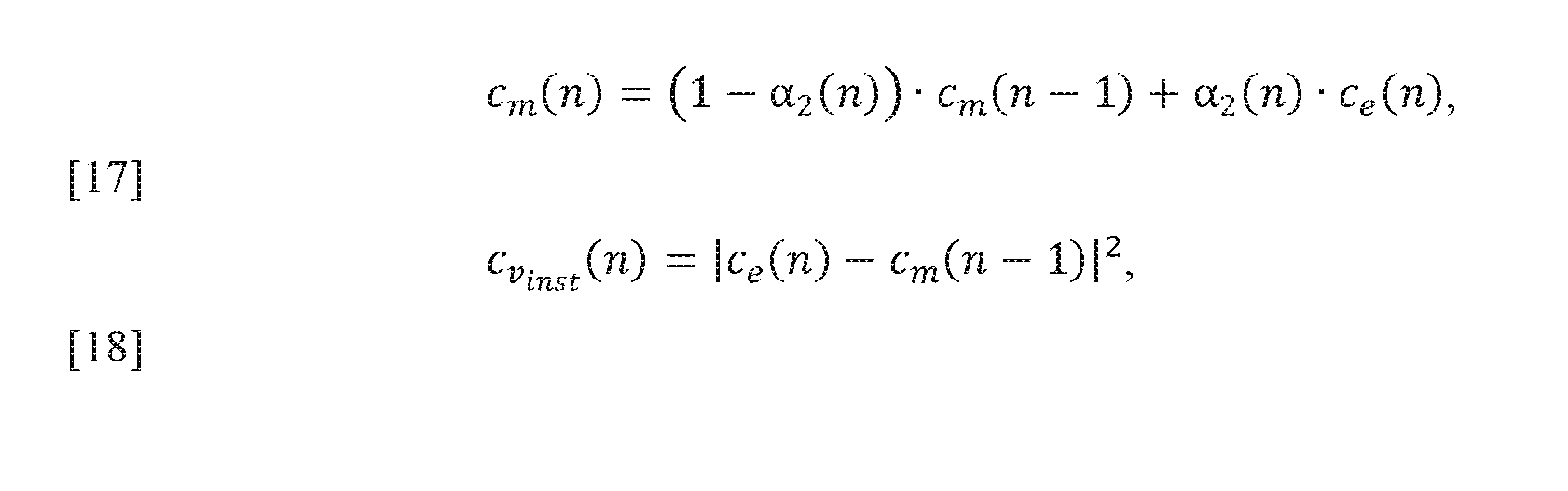
- Clock skew calculator unit 205 computes an estimate of the m ean and variance modified by a heuristic on the actual ⁇ 2 and ⁇ 2 values used:
- c m is the estimated mean of the initial clock skew estimate
- c leisure. is the instantaneous estimated variance of the initial clock skew estimate
- c v is the estimated variance of the initial clock skew estimate
- vf is the “variance factor”, flag used to determine the values for a 2 and fi 2 , a 2 factor used in estimating the mean
- clock skew calculator unit 205 smoothes the estimated clock skew only if the variance is small. That is when:
- clock skew correction unit 206 corrects the predicted timestamp computed by timestamp predictor unit 203.
- the final smooth estimated timestamp provided as an output of timestamp smoothing unit 101 is given by t s (n): [24]
- Also output of timestamp smoothing unit 101 is a stable flag, a discontinuity flag and clock skew which are provided to the particular audio processing system receiving the audio packets (e.g., system 101 in FIG. 1).
- FIG. 3 illustrates variability of packet timestamps, according to some embodiments.
- the variability is the difference between successive timestamps, i.e., the timestep.
- the vertical axis is variability in the timestep and the horizontal axis is time.
- the timestep should be a constant value, but in practice the timestep jitters.
- the time of origin and the point at which the timestamp is computed include a signifi cant and variable delay, which may be depend on computer’s workload. This delay is shown in FIG.3 as a large spike in variability at about 1.88 milliseconds.
- FIG. 5 is a flow diagram of a process 500, according to some embodiments.
- Process 400 can be implemented using system 600 shown in FIG. 6.
- Process 500 comprises receiving a series of input timestamps for audio packets and their respective packet lengths (501), estimating an initial timestamp based on the series of input timestamps, the packet lengths and a sample time (502), predicting a current timestamp based on the estimated initial timestamp (503) and smoothing the current timestamp (504).
- the system 600 includes a central processing unit (CPU) 601 which is capable of performing various processes in accordance with a program stored in, for example, a read only memory (ROM) 602 or a program loaded from, for example, a storage unit 608 to a random access memory (RAM) 603.
- ROM read only memory
- RAM random access memory
- the data required when the CPU 601 performs the various processes is also stored, as required.
- the CPU 601, the ROM 602 and the RAM 603 are connected to one another via a bus 609.
- An input/output (I/O) interface 605 is also connected to the bus 604.
- the input unit 606 includes one or more microphones in different positions (depending on the host device) enabling capture of audio signals in various formats (e.g., mono, stereo, spatial, immersive, and other suitable formats).
- various formats e.g., mono, stereo, spatial, immersive, and other suitable formats.
- the output unit 607 include systems with various number of speakers. As illustrated in FIG. 6, the output unit 607 (depending on the capabilities of the host device) can render audio signals in various formats (e.g., mono, stereo, immersive, binaural, and other suitable formats).
- various formats e.g., mono, stereo, immersive, binaural, and other suitable formats.
- the communication unit 609 is configured to communicate with other devices (e.g., via a network).
- a drive 610 is also connected to the I/O interface 605, as required.
- a removable medium 611 such as a magnetic disk, an optical disk, a magneto-optical disk, a flash drive or another suitable removable medium is mounted on the drive 610, so that a computer program read therefrom is installed into the storage unit 608, as required.
- EEE1 An audio processor configured to provide a smoothed accurate timestamp estimation for audio frames, which is not sensitive to jittering caused by jittering on a communication link or software /hardware process scheduling.
- EEE4 An audio processor of EEE1 that detects and accounts for discontinuity in the audio.
- EEE5 An audio processor of EEE4 that detects discontinuity when a delta between a predicted and an estimated timestamp (taking into account clock skew) is sufficiently large for a given period of time.
- EEE6 An audio processor of EEE1 that identifies stability in incoming audio packets.
- EEE7 An audio processor of EEE6 that determines an estimate initial timestamp by using a trimmed mean filter on a rolling history and identifying stability based on thresholding the variance of the initial timestamp estimations.
- EEE8 An audio processor that combines EEE2, EEE4 and EEE6.
- EEE9 An audio processor of EEE8 that uses the methods as per EEE3, EEE5 and EEE7.
- EEE10 A system where a discontinuity flag output of a module be used by the system (be informed and take action based on this information)
- EEE11 - A system where a stability flag output of the module can be used by the system (be informed and take action based on this information)
- control circuitry e.g., a CPU in combination with other components of FIG. 6
- control circuitry e.g., a CPU in combination with other components of FIG. 6
- the control circuitry may be performing the actions described in this disclosure.
- Some aspects may be implemented in hardware, while other aspects may be implemented in firmware or software which may be executed by a controller, microprocessor or other computing device (e.g., control circuitry).
- various blocks shown in the flowcharts may be viewed as method steps, and/or as operations that result from operation of computer program code, and/or as a plurality of coupled logic circuit elements constructed to cany out the associated function(s).
- embodiments of the present disclosure include a computer program product including a computer program tangibly embodied on a machine readable medium, the computer program containing program codes configured to cany out the methods as described above.
- a machine readable medium may be any tangible medium that may contain, or store a program for use by or in connection wdth an instruction execution system, apparatus, or device.
- the machine readable medium may be a machine readable signal medium or a machine readable storage medium.
- a machine readable medium may be non-transitory and may include but not limited to an electronic, magnetic. optical, electromagnetic, infrared, or semiconductor system, apparatus, or device, or any suitable combination of the foregoing.
- machine readable storage medium More specific examples of the machine readable storage medium would include an electrical connection having one or more wires, a portable computer diskette, a hard disk, a random access memory (RAM), a read-only memory (ROM), an erasable programmable read-only memory (EPROM or Flash memory), an optical fiber, a portable compact disc read-only memory (CD-ROM), an optical storage device, a magnetic storage device, or any suitable combination of the foregoing.
- RAM random access memory
- ROM read-only memory
- EPROM or Flash memory erasable programmable read-only memory
- CD-ROM portable compact disc read-only memory
- magnetic storage device or any suitable combination of the foregoing.
- Computer program code for carrying out methods of the present disclosure may be written in any combination of one or more programming languages. These computer program codes may be provided to a processor of a general purpose computer, special purpose computer, or other programmable data processing apparatus that has control circuitry, such that the program codes, when executed by the processor of the computer or other programmable data processing apparatus, cause the functions/operations specified in the flowcharts and/or block diagrams to be implemented.
- the program code may execute entirely on a computer, partly on the computer, as a stand-alone software package, partly on the computer and partly on a remote computer or entirely on the remote computer or server or distributed over one or more remote computers and/or servers.
Landscapes
- Engineering & Computer Science (AREA)
- Computer Networks & Wireless Communication (AREA)
- Signal Processing (AREA)
- Health & Medical Sciences (AREA)
- Cardiology (AREA)
- General Health & Medical Sciences (AREA)
- Environmental & Geological Engineering (AREA)
- Synchronisation In Digital Transmission Systems (AREA)
- Data Exchanges In Wide-Area Networks (AREA)
- Communication Control (AREA)
Abstract
Description




Claims
Priority Applications (2)
| Application Number | Priority Date | Filing Date | Title |
|---|---|---|---|
| CN202180077106.XA CN116458136A (en) | 2020-11-17 | 2021-11-17 | Timestamp smoothing for jitter cancellation |
| US18/252,998 US12513090B2 (en) | 2020-11-17 | 2021-11-17 | Timestamp smoothing to remove jitter |
Applications Claiming Priority (4)
| Application Number | Priority Date | Filing Date | Title |
|---|---|---|---|
| US202063114577P | 2020-11-17 | 2020-11-17 | |
| US63/114,577 | 2020-11-17 | ||
| US202163169599P | 2021-04-01 | 2021-04-01 | |
| US63/169,599 | 2021-04-01 |
Publications (1)
| Publication Number | Publication Date |
|---|---|
| WO2022108979A1 true WO2022108979A1 (en) | 2022-05-27 |
Family
ID=79185708
Family Applications (1)
| Application Number | Title | Priority Date | Filing Date |
|---|---|---|---|
| PCT/US2021/059637 Ceased WO2022108979A1 (en) | 2020-11-17 | 2021-11-17 | Timestamp smoothing to remove jitter |
Country Status (2)
| Country | Link |
|---|---|
| US (1) | US12513090B2 (en) |
| WO (1) | WO2022108979A1 (en) |
Families Citing this family (3)
| Publication number | Priority date | Publication date | Assignee | Title |
|---|---|---|---|---|
| US12395417B2 (en) * | 2022-07-28 | 2025-08-19 | Marvell Asia Pte Ltd | Circuit and method for timestamp filtering with RLS filter |
| US12267222B2 (en) | 2022-07-28 | 2025-04-01 | Marvell Asia Pte Ltd | Circuit and method for timestamp filtering with input/output format conversion |
| US12363018B2 (en) | 2022-07-28 | 2025-07-15 | Marvell Asia Pte Ltd | Circuit and method for timestamp jitter reduction |
Citations (2)
| Publication number | Priority date | Publication date | Assignee | Title |
|---|---|---|---|---|
| US7173945B1 (en) * | 2002-03-11 | 2007-02-06 | Cisco Technology, Inc. | Removing jitter by adaptive slope tracking |
| US20080270800A1 (en) * | 2007-04-24 | 2008-10-30 | Microsoft Corporation | Adjustment of clock approximations |
Family Cites Families (15)
| Publication number | Priority date | Publication date | Assignee | Title |
|---|---|---|---|---|
| US7675946B2 (en) * | 2005-08-22 | 2010-03-09 | Infosys Technologies, Ltd. | System and method for managing playout time in packet communication network |
| US9042366B2 (en) | 2010-09-30 | 2015-05-26 | Vitesse Semiconductor Corporation | Timestamp predictor for packets over a synchronous protocol |
| US8792380B2 (en) | 2012-08-24 | 2014-07-29 | Accedian Networks Inc. | System for establishing and maintaining a clock reference indicating one-way latency in a data network |
| WO2014154822A1 (en) | 2013-03-27 | 2014-10-02 | Jacoti Bvba | Method and device for latency adjustment |
| MY170699A (en) | 2013-06-21 | 2019-08-26 | Fraunhofer Ges Forschung | Jitter buffer control, audio decoder, method and computer program |
| US10142088B2 (en) | 2014-01-31 | 2018-11-27 | University Of North Dakota | Network clock skew estimation and calibration |
| US10582461B2 (en) | 2014-02-21 | 2020-03-03 | Summit Wireless Technologies, Inc. | Software based audio timing and synchronization |
| US10013229B2 (en) | 2015-04-30 | 2018-07-03 | Intel Corporation | Signal synchronization and latency jitter compensation for audio transmission systems |
| FR3059186A1 (en) * | 2016-11-24 | 2018-05-25 | Belledonne Communications | ADAPTIVE JIG BUFFER |
| US10616123B2 (en) | 2017-07-07 | 2020-04-07 | Qualcomm Incorporated | Apparatus and method for adaptive de-jitter buffer |
| US11586413B2 (en) | 2018-10-05 | 2023-02-21 | Google Llc | Synchronous sounds for audio assistant on devices |
| US10701124B1 (en) * | 2018-12-11 | 2020-06-30 | Microsoft Technology Licensing, Llc | Handling timestamp inaccuracies for streaming network protocols |
| US11064228B2 (en) | 2019-04-02 | 2021-07-13 | Qualcomm Incorporated | Audio playback timing adjustment |
| US11477328B2 (en) | 2019-05-12 | 2022-10-18 | Plantronics, Inc. | PTP-based audio clock synchronization and alignment for acoustic echo cancellation in a conferencing system with IP-connected cameras, microphones and speakers |
| US11496353B2 (en) * | 2019-05-30 | 2022-11-08 | Samsung Electronics Co., Ltd. | Root cause analysis and automation using machine learning |
-
2021
- 2021-11-17 US US18/252,998 patent/US12513090B2/en active Active
- 2021-11-17 WO PCT/US2021/059637 patent/WO2022108979A1/en not_active Ceased
Patent Citations (2)
| Publication number | Priority date | Publication date | Assignee | Title |
|---|---|---|---|---|
| US7173945B1 (en) * | 2002-03-11 | 2007-02-06 | Cisco Technology, Inc. | Removing jitter by adaptive slope tracking |
| US20080270800A1 (en) * | 2007-04-24 | 2008-10-30 | Microsoft Corporation | Adjustment of clock approximations |
Also Published As
| Publication number | Publication date |
|---|---|
| US20230421507A1 (en) | 2023-12-28 |
| US12513090B2 (en) | 2025-12-30 |
Similar Documents
| Publication | Publication Date | Title |
|---|---|---|
| US12513090B2 (en) | Timestamp smoothing to remove jitter | |
| US9628499B1 (en) | Statistics-based anomaly detection | |
| CN113127305A (en) | Abnormality detection method and apparatus | |
| US20210176174A1 (en) | Load balancing device and method for an edge computing network | |
| WO2014194641A1 (en) | Audio playback method, apparatus and system | |
| CN110083475B (en) | Abnormal data detection method and device | |
| EP4170561A1 (en) | Method and device for improving performance of data processing model, storage medium and electronic device | |
| CN112948614B (en) | Image processing method, device, electronic equipment and storage medium | |
| US20170185464A1 (en) | Detecting flapping in resource measurements | |
| US9069629B2 (en) | Bidirectional counting of dual outcome events | |
| CN115249043A (en) | Data analysis method and device, electronic equipment and storage medium | |
| CN116132371B (en) | Current limiting methods, devices, equipment, media and products | |
| CN112994980A (en) | Time delay testing method and device, electronic equipment and storage medium | |
| CN112528927A (en) | Confidence determination method based on trajectory analysis, roadside equipment and cloud control platform | |
| US20160344537A1 (en) | Communication apparatus, communication method, and computer readable medium | |
| US20160034321A1 (en) | Tracking a relative arrival order of events being stored in multiple queues using a counter using most significant bit values | |
| CN117579766A (en) | Video frame extraction method and related equipment, abnormal scene early warning method and related equipment | |
| CN112468452B (en) | Flow detection method and device, electronic device, computer-readable storage medium | |
| EP3598247A1 (en) | Network timing method and device | |
| CN109993767B (en) | Image processing method and system | |
| CN116458136A (en) | Timestamp smoothing for jitter cancellation | |
| CN115220946A (en) | Abnormal data detection method, device, equipment and storage medium | |
| CN109597745B (en) | Abnormal data processing method and device | |
| CN112187870B (en) | A kind of bandwidth smoothing method and device | |
| US10126956B2 (en) | Information processing device and information processing method |
Legal Events
| Date | Code | Title | Description |
|---|---|---|---|
| 121 | Ep: the epo has been informed by wipo that ep was designated in this application |
Ref document number: 21835896 Country of ref document: EP Kind code of ref document: A1 |
|
| WWE | Wipo information: entry into national phase |
Ref document number: 18252998 Country of ref document: US |
|
| WWE | Wipo information: entry into national phase |
Ref document number: 202180077106.X Country of ref document: CN |
|
| NENP | Non-entry into the national phase |
Ref country code: DE |
|
| 122 | Ep: pct application non-entry in european phase |
Ref document number: 21835896 Country of ref document: EP Kind code of ref document: A1 |
|
| WWG | Wipo information: grant in national office |
Ref document number: 18252998 Country of ref document: US |