WO2022103804A1 - Selective cyclocarbonylative coupling of 2-iodophenols with terminal alkynes catalyzed by bridged bis(nhc)pd(ii)br2 catalysts - Google Patents
Selective cyclocarbonylative coupling of 2-iodophenols with terminal alkynes catalyzed by bridged bis(nhc)pd(ii)br2 catalysts Download PDFInfo
- Publication number
- WO2022103804A1 WO2022103804A1 PCT/US2021/058733 US2021058733W WO2022103804A1 WO 2022103804 A1 WO2022103804 A1 WO 2022103804A1 US 2021058733 W US2021058733 W US 2021058733W WO 2022103804 A1 WO2022103804 A1 WO 2022103804A1
- Authority
- WO
- WIPO (PCT)
- Prior art keywords
- reacting
- iodophenol
- alkyl
- alkyne
- palladium
- Prior art date
- Legal status (The legal status is an assumption and is not a legal conclusion. Google has not performed a legal analysis and makes no representation as to the accuracy of the status listed.)
- Ceased
Links
Classifications
-
- C—CHEMISTRY; METALLURGY
- C07—ORGANIC CHEMISTRY
- C07F—ACYCLIC, CARBOCYCLIC OR HETEROCYCLIC COMPOUNDS CONTAINING ELEMENTS OTHER THAN CARBON, HYDROGEN, HALOGEN, OXYGEN, NITROGEN, SULFUR, SELENIUM OR TELLURIUM
- C07F15/00—Compounds containing elements of Groups 8, 9, 10 or 18 of the Periodic Table
- C07F15/0006—Compounds containing elements of Groups 8, 9, 10 or 18 of the Periodic Table compounds of the platinum group
- C07F15/006—Palladium compounds
-
- B—PERFORMING OPERATIONS; TRANSPORTING
- B01—PHYSICAL OR CHEMICAL PROCESSES OR APPARATUS IN GENERAL
- B01J—CHEMICAL OR PHYSICAL PROCESSES, e.g. CATALYSIS OR COLLOID CHEMISTRY; THEIR RELEVANT APPARATUS
- B01J31/00—Catalysts comprising hydrides, coordination complexes or organic compounds
- B01J31/16—Catalysts comprising hydrides, coordination complexes or organic compounds containing coordination complexes
- B01J31/22—Organic complexes
- B01J31/2265—Carbenes or carbynes, i.e.(image)
- B01J31/2269—Heterocyclic carbenes
- B01J31/2273—Heterocyclic carbenes with only nitrogen as heteroatomic ring members, e.g. 1,3-diarylimidazoline-2-ylidenes
-
- B—PERFORMING OPERATIONS; TRANSPORTING
- B01—PHYSICAL OR CHEMICAL PROCESSES OR APPARATUS IN GENERAL
- B01J—CHEMICAL OR PHYSICAL PROCESSES, e.g. CATALYSIS OR COLLOID CHEMISTRY; THEIR RELEVANT APPARATUS
- B01J31/00—Catalysts comprising hydrides, coordination complexes or organic compounds
- B01J31/26—Catalysts comprising hydrides, coordination complexes or organic compounds containing in addition, inorganic metal compounds not provided for in groups B01J31/02 - B01J31/24
- B01J31/28—Catalysts comprising hydrides, coordination complexes or organic compounds containing in addition, inorganic metal compounds not provided for in groups B01J31/02 - B01J31/24 of the platinum group metals, iron group metals or copper
- B01J31/30—Halides
-
- B—PERFORMING OPERATIONS; TRANSPORTING
- B01—PHYSICAL OR CHEMICAL PROCESSES OR APPARATUS IN GENERAL
- B01J—CHEMICAL OR PHYSICAL PROCESSES, e.g. CATALYSIS OR COLLOID CHEMISTRY; THEIR RELEVANT APPARATUS
- B01J37/00—Processes, in general, for preparing catalysts; Processes, in general, for activation of catalysts
- B01J37/22—Halogenating
-
- C—CHEMISTRY; METALLURGY
- C07—ORGANIC CHEMISTRY
- C07D—HETEROCYCLIC COMPOUNDS
- C07D307/00—Heterocyclic compounds containing five-membered rings having one oxygen atom as the only ring hetero atom
- C07D307/77—Heterocyclic compounds containing five-membered rings having one oxygen atom as the only ring hetero atom ortho- or peri-condensed with carbocyclic rings or ring systems
- C07D307/78—Benzo [b] furans; Hydrogenated benzo [b] furans
- C07D307/82—Benzo [b] furans; Hydrogenated benzo [b] furans with hetero atoms or with carbon atoms having three bonds to hetero atoms with at the most one bond to halogen, e.g. ester or nitrile radicals, directly attached to carbon atoms of the hetero ring
- C07D307/83—Oxygen atoms
-
- C—CHEMISTRY; METALLURGY
- C07—ORGANIC CHEMISTRY
- C07D—HETEROCYCLIC COMPOUNDS
- C07D311/00—Heterocyclic compounds containing six-membered rings having one oxygen atom as the only hetero atom, condensed with other rings
- C07D311/02—Heterocyclic compounds containing six-membered rings having one oxygen atom as the only hetero atom, condensed with other rings ortho- or peri-condensed with carbocyclic rings or ring systems
- C07D311/04—Benzo[b]pyrans, not hydrogenated in the carbocyclic ring
- C07D311/22—Benzo[b]pyrans, not hydrogenated in the carbocyclic ring with oxygen or sulfur atoms directly attached in position 4
-
- B—PERFORMING OPERATIONS; TRANSPORTING
- B01—PHYSICAL OR CHEMICAL PROCESSES OR APPARATUS IN GENERAL
- B01J—CHEMICAL OR PHYSICAL PROCESSES, e.g. CATALYSIS OR COLLOID CHEMISTRY; THEIR RELEVANT APPARATUS
- B01J2231/00—Catalytic reactions performed with catalysts classified in B01J31/00
- B01J2231/30—Addition reactions at carbon centres, i.e. to either C-C or C-X multiple bonds
- B01J2231/32—Addition reactions to C=C or C-C triple bonds
- B01J2231/324—Cyclisations via conversion of C-C multiple to single or less multiple bonds, e.g. cycloadditions
- B01J2231/328—Cycloadditions involving more than 2 components or moieties, e.g. intra-/intermolecualar [2+2+2] or [2+2+1], e.g. Pauson-Khand type
-
- B—PERFORMING OPERATIONS; TRANSPORTING
- B01—PHYSICAL OR CHEMICAL PROCESSES OR APPARATUS IN GENERAL
- B01J—CHEMICAL OR PHYSICAL PROCESSES, e.g. CATALYSIS OR COLLOID CHEMISTRY; THEIR RELEVANT APPARATUS
- B01J2231/00—Catalytic reactions performed with catalysts classified in B01J31/00
- B01J2231/40—Substitution reactions at carbon centres, e.g. C-C or C-X, i.e. carbon-hetero atom, cross-coupling, C-H activation or ring-opening reactions
- B01J2231/42—Catalytic cross-coupling, i.e. connection of previously not connected C-atoms or C- and X-atoms without rearrangement
- B01J2231/4205—C-C cross-coupling, e.g. metal catalyzed or Friedel-Crafts type
- B01J2231/4266—Sonogashira-type, i.e. RY + HC-CR' triple bonds, in which R=aryl, alkenyl, alkyl and R'=H, alkyl or aryl
-
- B—PERFORMING OPERATIONS; TRANSPORTING
- B01—PHYSICAL OR CHEMICAL PROCESSES OR APPARATUS IN GENERAL
- B01J—CHEMICAL OR PHYSICAL PROCESSES, e.g. CATALYSIS OR COLLOID CHEMISTRY; THEIR RELEVANT APPARATUS
- B01J2531/00—Additional information regarding catalytic systems classified in B01J31/00
- B01J2531/80—Complexes comprising metals of Group VIII as the central metal
- B01J2531/82—Metals of the platinum group
- B01J2531/824—Palladium
Definitions
- This document relates to palladium-carbenes complexes and cyclocarbonylative Sonogashira cross-coupling reactions.
- Chromones and aurones are useful precursors to pharmacological compounds, and new and efficient methods and catalysts for producing chromones and aurones are needed.
- This disclosure describes palladium catalysts, methods of synthesizing palladium-carbene catalysts, and methods of producing chromones and aurones using palladium-N-heterocyclic carbene (NHC) catalysts.
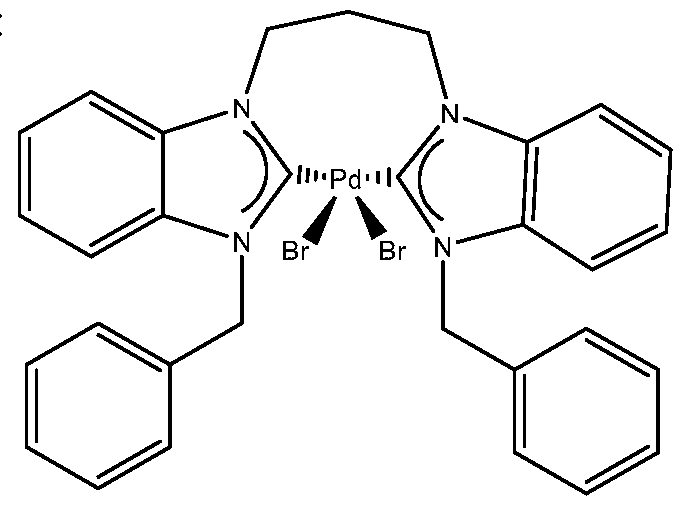
- a compound of Formula C3 has the following structure: [006]
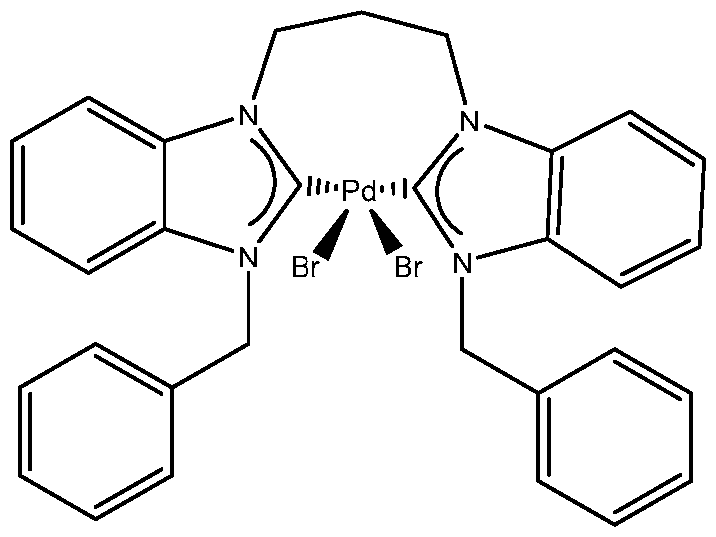
- a method of synthesizing a palladium catalyst includes reacting a benzimidazole with a halogenated hydrocarbon in the presence of a base and acetonitrile to produce an alkyl-7H-benzo[d]imidazole, reacting the alkyl- 7H-benzo[d] imidazole with a halogenated crosslinking chain to produce a bridged N- heterocyclic carbene salt precursor, and reacting the bridged N-heterocyclic carbene with palladium acetate.
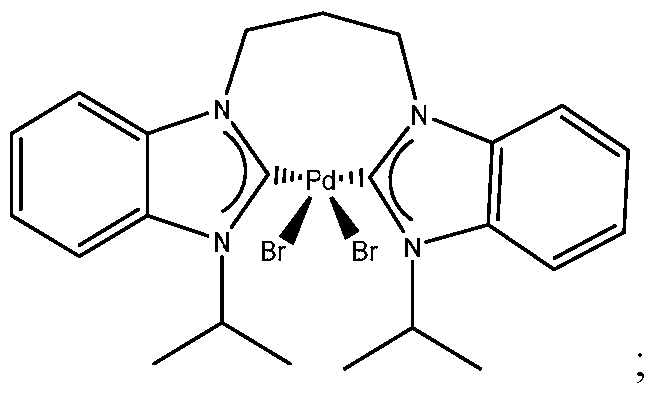
- a method of synthesizing chromones or aurones includes reacting a 2-iodophenol and an aryl alkyne in the presence of a palladium catalyst, wherein the palladium catalyst includes at least one of Formula Cl, Formula C2, or Formula C3, where Formula Cl has the structure
- a method of synthesizing chromones or aurones includes reacting a 2-iodophenol and an alkyl alkyne in the presence of a palladium catalyst, wherein the palladium catalyst includes at least one of Formula Cl, Formula
- FIG. 1 shows an example of Sonogashira cross-coupling reaction.
- FIG. 2 shows an example of carbonylative Sonogashira cross-coupling reaction.
- FIG. 3 shows an example of cyclocarbonylative Sonogashira cross-coupling reaction.
- FIG. 4 shows examples of chromones.
- FIG. 5 shows a bridged bis(N-Heterocyclic Carbene) palladium(II) [bis(NHC)Pd(II)] catalyst.
- FIG. 6 shows the structure of three bis(NHC)Pd(II)Br2 catalysts.
- FIG. 7 is a flow chart of an example method of synthesizing a palladium bridged bis(NHCs) catalyst.
- FIG. 8 is a flow chart of an example method of synthesizing chromones or aurones.
- FIG. 9 is a flow chart of a second example method of synthesizing chromones or aurones.
- FIG. 10 shows an example of a reaction between a benzimidazole and an alkyl halide.
- FIG. 11 shows an example of a reaction between a 1 -alkyl benzimidazole produced in FIG. 10 and a halogenated crosslinking alkyl chain.
- FIG. 12 shows an example reaction of a bridged NHC salt precursor with palladium acetate.
- FIG. 13 shows an example ORTEP diagram of the molecular structure of complex C 1.
- FIG. 14 shows an example ORTEP diagram of the molecular structure of complex C3.
- FIG. 15 shows an example reaction between a substituted 2-iodophenol and an aryl alkyne.
- FIG. 16 shows an example reaction between a substituted 2-iodophenol and an alkyl alkyne.
- a catalyst containing palladium is complexed with one or more N-heterocyclic carbenes (NHC).
- NHS N-heterocyclic carbenes
- palladium can be complexed with benzimidazole.
- the palladium-NHC complex can be used to catalyze Sonogashira reactions.
- Sonogashira reactions can be exemplified by three types of reactions.
- a first type of Sonogashira cross-coupling reaction a carbon-carbon bond is formed between a terminal alkyne and an aryl or vinyl halide, resulting in an aryl alkyne.
- This type of reaction uses both a palladium catalyst and a copper catalyst.
- FIG. 1 shows an example of this type of a Sonogashira cross-coupling reaction.
- a carbonylative Sonogashira cross-coupling reaction a carbonyl -carbon bond is formed between a terminal alkyne and an aryl halide under carbon monoxide, resulting in an alkynone.
- Alkynones are known to be bioactive.
- Carbonylative Sonogashira cross-coupling reactions employ a palladium catalyst and a copper cocatalyst in the presence of carbon monoxide (CO).
- FIG. 2 shows an example of a carbonylative Sonogashira cross-coupling reaction.
- FIG. 3 shows an example of a cyclocarbonylative Sonogashira cross-coupling reaction that yields an aurone or a chromone.
- Chromones and aurones have industrial and pharmaceutical applications, for example as precursor compounds.
- FIG. 4 illustrates a number of different chromones, which have uses in anticancer, anti-microbial, anti-inflammatory, and anti-viral applications, among others. Accordingly, there is a need for new chromones and new methods of producing chromones.
- Pd-NHC complexes can be used for Sonogashira cross-coupling and carbonylative Sonogashira cross-coupling reactions.
- bridged bis(NHC)Pd(II)Br2 complexes that include N-heterocyclic carbenes (NHCs) have not previously been used for cyclocarbonylative Sonogashira cross-coupling reactions.
- the bridged bis(NHC)Pd(II)Br2 catalysts described herein can be used in a cyclocarbonylative Sonogashira cross-coupling reaction to yield chromones and aurones.
- these catalysts can be used for cyclocarbonylative Sonogashira cross-coupling reactions in the absence of phosphines or any other ligands or co-catalysts.
- the catalyst for cyclocarbonylative Sonogashira cross-coupling reaction is a bridged palladium complex shown in FIG. 5.
- the catalyst contains a bridged palladium with specific stereochemistry.
- the Pd(II) complexes shown in FIG. 5 can have distorted square planar geometries around the center palladium atom.
- the alkyl bridge between N-heterocyclic carbene units can vary in length.
- the alkyl bridge is shown in FIG. 5 with n number of repeating methylene units. In some implementations, n is 1, 2, or 3.
- the N-heterocyclic carbenes can be functionalized with a functional group R.
- R is a straight or branched alkyl group, for example - CH(CH 3 )2.
- R includes a carbon ring structure or aromatic group, for example -CFEPh.
- the functional group R can alter the steric hindrance around the palladium center and alter the functionality of the catalyst.
- FIG. 6 shows the structure of three palladium catalysts Cl, C2, and C3, which were used in cyclocarbonylative Sonogashira cross-coupling reactions. The synthesis of these catalysts is discussed in Examples 1-3.
- Catalysts Cl, C2, and C3 are stable complexes.
- Cl, C2, and C3 are stable at temperatures as high as 120°C. These catalysts are efficient and selective.
- the catalysts have low loading requirements, wide substrate applications, and high yields.
- the geometry and configuration of Cl, C2, and C3 yields a specific catalytic activity that is advantageous for cyclocarbonylative Sonogashira cross-coupling reactions.
- the regioselectivity of the catalysts can be controlled using specific solvents and a base, for example dimethyl formamide (DMF) as a solvent and diethylamine (Et2NH) as a base.
- DMF dimethyl formamide
- Et2NH diethylamine
- FIG. 7 is a flow chart of an example method 700 of synthesizing palladium catalysts Cl, C2, and C3.
- a benzimidazole is reacted with a halogenated hydrocarbon to produce an alkyl-7H-benzo[d] imidazole.
- the alkyl -1H- benzo[d] imidazole is reacted with a halogenated crosslinking chain to produce a bridged N-heterocyclic carbene salt precursor.
- the bridged N-heterocyclic carbene salt precursor is reacted with acetylated palladium.
- FIG. 8 is a flow chart of an example method 800 of synthesizing chromones or aurones.
- a 2-iodophenol is reacted with an aryl alkyne in the presence of a palladium catalyst Cl, C2, or C3.
- FIG. 9 is a flow chart of a second example method 900 of synthesizing chromones or aurones.
- a 2-iodophenol is reacted with an alkyl alkyne in the presence of a palladium catalyst Cl, C2, or C3.
- FIG. 10 shows an example of a reaction between a benzimidazole with a halogenated alkyl group in the presence of base and acetonitrile to generate alkyl-7H-benzo[d]imidazoles.
- the functional group R can include branched alkyl or aromatic groups.
- R can be -CH(CH3)2 or -CFEPh.
- benzimidazole (10.0 mmol), excess amount of alkyl bromide (12.2 mmol), an appropriate base (20.0 mmol), and 1.00 mmol of tetrabutylammonium bromide (TBAB).
- TBAB tetrabutylammonium bromide
- the alkyl bromide is 2-bromopropane and the base is potassium hydroxide.
- the alkyl bromide is benzyl bromide and the base is cesium carbonate.
- FIG. 11 shows an example reaction between the benzimidazole produced in FIG. 10 and a halogenated crosslinking alkyl chain to yield a bridged NHC salt precursor.
- the alkyl chain can vary in length.
- the alkyl chain can include n number of repeating methylene units, for example where n is 1, 2, or 3.
- NHC salts are precursors LI, L2, and L3 for the palladium catalysts Cl, C2, and C3.
- FIG. 12 shows an example reaction of an NHC salt precursor with palladium acetate to yield the bis-NHC-Pd(II) complexes Cl, C2, and C3.
- ORTEP3 software was used for molecular graphics.
- the molecular structures of complexes Cl and C3 are depicted in example ORTEP diagrams in FIG. 13 and FIG. 14, respectively. All hydrogen atoms were included at calculated positions using a riding model.
- the crystal data and refinement details for Cl and C3 are given in Table 1. Selected bond lengths and bond angles are given in Table 2.
- the former is 1.997(3) A in Cl and in the range of (1.964(8) A - 1.985(8) A) in C3 while the latter is 2.4906(4) A in Cl and in the range of (2.4659(11) A - 2.4704(11) A) in C3.
- the chelate C-Pd-C bite angle values are 88.66(17)° and (87.4(3)°, 87.7(3)°) in Cl and C3, respectively.
- the larger bond distances in C 1 are consistent with the larger steric hindrance of the isopropyl group opposing the formation of the chelate complex.
- Example 5 Cyclocarbonylative Sonogashira cross-coupling reaction with bis(NHC)Pd(II)Br2 complexes Cl, C2, or C3
- the bis(NHC)Pd(II)Br2 complexes Cl, C2, and C3 can catalyze a reaction between 2- iodophenols and aryl alkynes.
- FIG. 15 shows an example reaction between a functionalized 2-iodophenol, for example functionalized 4’ -hydroxy-3 ’-iodoaryl, and an aryl alkyne.
- the functional groups Ri and R2 can be electron withdrawing or electron donating functional groups, for example methoxy, hydrogen, nitro, methyl, tertiary butyl, phenyl or acetyl functional groups.
- the catalysts Cl, C2, and C3 can be used with as little as 0.5 mol% in the reaction.
- the catalyzed reactions between a functionalized 2-iodophenol and an aryl alkyne were conducted with 0.50 mmol of functionalized 2-iodophenol, 0.55 mmol of an aryl alkyne, 1.00 mmol of diethylamine (Et2NH), 3 mL of dimethylformamide (DMF), and 0.50 mol% of complex Cl, C2, or C3.
- the reactants were added to a 45 mL stainless steel autoclave equipped with a glass liner, gas inlet valve and pressure gauge. The reaction was run for 16 hours at 100 °C under 100 psi of carbon monoxide gas. After the reaction, the autoclave was cooled to room temperature and excess carbon monoxide gas was discharged.
- reaction products were extracted three times with 5 mL of distilled water and 10 mL of ethyl acetate.
- the ethyl acetate extracts were combined and concentrated in a rotary evaporator under reduced pressure. Flash chromatography was used to purify the reaction mixture using silica gel and an eluent (pentane-ethyl acetate in a 7: 1 v/v ratio).
- Chromones and flavones (a type of aurone) were produced at high yields, between 86-91% isolated yield by mass percent.
- Table 3 shows example reactants and products for cyclocarbonylative Sonogashira coupling reactions catalyzed by complex Cl, and the percent yield for these reactions.
- J H NMR spectra were taken at 300 MHz in CDCh at 24°C. 13 C ⁇ 1 H ⁇ spectra were taken at 75 MHz in CDCh at 24°C.
- the bis(NHC)Pd(II)Br2 complexes Cl, C2, and C3 can each catalyze the reaction between 2-iodophenols and an alkyl alkyne.
- FIG. 16 shows an example reaction between a functionalized 2-iodophenol and an alkyl alkyne.
- the functional groups Ri and R can be electron withdrawing or electron donating functional groups, for example methoxy, hydrogen, nitro, methyl, tertiary butyl, phenyl or acetyl functional groups.
- the catalysts Cl, C2, and C3 can be used with as little as 0.5 mol% in the reaction.
- the catalyzed reactions between a functionalized 2-iodophenol and an alkyl alkyne were conducted with 0.50 mmol of functionalized 2-iodophenol, 0.60 mmol of an alkyl alkyne, 1.00 mmol of Et2NH, 2.5 mL of DMF, and 0.50 mol% of complex Cl.
- the reactants were added to a 45 mL stainless steel autoclave equipped with a glass liner, gas inlet valve and pressure gauge. The reaction was run for 24 hours at 110 °C under 100 psi of carbon monoxide. After the reaction, the autoclave was cooled to room temperature and excess carbon monoxide gas was discharged.
- reaction products were extracted three times with 5 mL of distilled water and 10 mL of ethyl acetate.
- the ethyl acetate extracts were combined and concentrated in a rotary evaporator under reduced pressure. Flash chromatography was used to purify the reaction mixture using silica gel and an eluent (pentane-ethyl acetate in a 7: 1 v/v ratio ). Chromones and flavones were produced at high yields, between 53-90% by mass.
- Table 4 shows example reactants and products for cyclocarbonylative Sonogashira coupling reactions catalyzed by complex Cl, and the percent yield for these reactions.
- Table 4 Cyclocarbonylative Sonogashira coupling reactions of 4'-hydroxy-3'-iodoaryls with alkyl alkynes catalyzed by complex Cl.
- Cyclocarbonylative Sonogashira coupling reactions of a 2-iodophenol with phenylacetylene can illustrate the selectivity of the complexes Cl, C2, and C3.
- An example reaction of 2-iodophenol (compound la) and phenylacetylene (compound 2a) under carbon monoxide in the presence of a catalytic amount of Cl was analyzed (Eq. 1). Table 5 shows the selectivity of the complexes under these conditions.
- a compound of Formula C3 has the following structure:
- a method of synthesizing a palladium catalyst includes reacting a benzimidazole with a halogenated hydrocarbon in the presence of a base and acetonitrile to produce an alkyl-777-benzo[d]imidazole, reacting the alkyl- 1H- benzo[d] imidazole with a halogenated crosslinking chain to produce a bridged N- heterocyclic carbene salt precursor, and reacting the bridged N-heterocyclic carbene with palladium acetate.
- Reacting a benzimidazole with a halogenated hydrocarbon includes reacting at 80 °C for 24 hours.
- Reacting the alkyl-//7-benzo[d]imidazole with a halogenated crosslinking chain includes reacting at 103 °C for 24 hours in 1,4-dioxane.
- Reacting the N-heterocyclic carbene with palladium acetate includes reacting at 70 °C for 24 hours in dimethyl sulfoxide.
- the halogenated hydrocarbon is a branched halogenated alkyl group.
- the branched halogenated alkyl group is isopropyl bromide.
- the halogenated hydrocarbon is benzyl bromide.
- the halogenated crosslinking chain is a di-halido unbranched alkyl chain.
- the di-halido unbranched alkyl chain is 1,3-dibromopropane, 1,4- dibromobutane, or 1,5-dibromopentane.
- a method of synthesizing chromones or aurones includes reacting a 2-iodophenol and an aryl alkyne in the presence of a palladium catalyst, wherein the palladium catalyst includes at least one of Formula Cl, Formula C2, [090]
- This aspect taken alone or combinable with any other aspect, can include the following features. Reacting the 2-iodophenol and the aryl alkyne in the presence of a palladium catalyst includes reacting the 2-iodophenol and the aryl alkyne in the presence of 0.5 mol% of the palladium catalyst.
- Reacting the 2-iodophenol and the aryl alkyne in the presence of a palladium catalyst includes reacting the 2-iodophenol and the aryl alkyne with 2 equivalents diethylamine in dimethylformamide, and the reaction takes place under carbon monoxide at 100 psi for 16 hours at 100 °C.
- the 2-iodophenol is functionalized with an electron withdrawing group.
- the aryl alkyne is functionalized with an electron withdrawing group.
- a method of synthesizing chromones or aurones includes reacting a 2-iodophenol and an alkyl alkyne in the presence of a palladium catalyst, wherein the palladium catalyst includes at least one of Formula Cl, Formula C2, or Formula C3, where Formula Cl is
- Reacting the 2-iodophenol and the alkyl alkyne in the presence of a palladium catalyst includes reacting the 2-iodophenol and the alkyl alkyne in the presence of 0.5 mol% of the palladium catalyst.
- Reacting the 2-iodophenol and the alkyl alkyne in the presence of a palladium catalyst includes reacting the 2-iodophenol and the alkyl alkyne with 2 equivalents diethylamine in dimethylformamide, and wherein the reaction takes place under carbon monoxide at 100 psi for 24 hours at 110 °C.
- the 2-iodophenol is functionalized with an electron withdrawing group.
- the alkyl alkyne is functionalized with an electron withdrawing group.
- solvent refers to a liquid that can dissolve a solid, another liquid, or a gas to form a solution.
- solvents are silicones, organic compounds, water, alcohols, ionic liquids, and supercritical fluids.
- weight percent (wt %) can be considered a mass fraction or a mass ratio of a substance to the total mixture or composition. Weight percent can be a weight-to-weight ratio or mass-to-mass ratio, unless indicated otherwise.
Landscapes
- Chemical & Material Sciences (AREA)
- Organic Chemistry (AREA)
- Engineering & Computer Science (AREA)
- Materials Engineering (AREA)
- Chemical Kinetics & Catalysis (AREA)
- Inorganic Chemistry (AREA)
- Organic Low-Molecular-Weight Compounds And Preparation Thereof (AREA)
- Catalysts (AREA)
- Low-Molecular Organic Synthesis Reactions Using Catalysts (AREA)
Abstract
Description





Claims


Applications Claiming Priority (2)
| Application Number | Priority Date | Filing Date | Title |
|---|---|---|---|
| US17/094,140 US11236118B1 (en) | 2020-11-10 | 2020-11-10 | Selective cyclocarbonylative coupling of 2-iodophenols with terminal alkynes catalyzed by bridged bis(NHC)Pd(II)Br2 catalysts |
| US17/094,140 | 2020-11-10 |
Publications (1)
| Publication Number | Publication Date |
|---|---|
| WO2022103804A1 true WO2022103804A1 (en) | 2022-05-19 |
Family
ID=78821453
Family Applications (1)
| Application Number | Title | Priority Date | Filing Date |
|---|---|---|---|
| PCT/US2021/058733 Ceased WO2022103804A1 (en) | 2020-11-10 | 2021-11-10 | Selective cyclocarbonylative coupling of 2-iodophenols with terminal alkynes catalyzed by bridged bis(nhc)pd(ii)br2 catalysts |
Country Status (2)
| Country | Link |
|---|---|
| US (1) | US11236118B1 (en) |
| WO (1) | WO2022103804A1 (en) |
Cited By (1)
| Publication number | Priority date | Publication date | Assignee | Title |
|---|---|---|---|---|
| CN116003360A (en) * | 2022-11-28 | 2023-04-25 | 湖南工程学院 | Preparation method for synthesizing orange compounds from carbon dioxide and alkyne |
Families Citing this family (2)
| Publication number | Priority date | Publication date | Assignee | Title |
|---|---|---|---|---|
| US11192912B1 (en) * | 2020-10-15 | 2021-12-07 | King Fahd University Of Petroleum & Minerals | Synthesis of biaryl ketones and biaryl diketones via carbonylative Suzuki-Miyaura coupling reactions catalyzed by bridged bis(N-heterocyclic carbene)palladium(II) catalysts |
| CN118638088B (en) * | 2024-08-16 | 2024-11-22 | 湖南工程学院 | A preparation method for synthesizing flavonoid compounds based on carbon dioxide and alkyne |
Family Cites Families (4)
| Publication number | Priority date | Publication date | Assignee | Title |
|---|---|---|---|---|
| US7250510B2 (en) | 2005-08-24 | 2007-07-31 | Total Synthesis, Ltd. | Transition metal complexes of N-heterocyclic carbenes, method of preparation and use in transition metal catalyzed organic transformations |
| KR101430774B1 (en) | 2006-06-26 | 2014-08-18 | 바스프 에스이 | Use of pt- and pd-bis- and tetra-carbene complexes with bridged carbene ligands in oleds |
| EP3339313A1 (en) | 2016-12-22 | 2018-06-27 | Umicore Ag & Co. Kg | Metal organic compounds |
| US11084839B2 (en) | 2017-07-14 | 2021-08-10 | Mississippi State University | Symmetrical CCC-NHC pincer metal complexes and symmetrical bimetallic complexes: bio-activity, and applications to organic transformations and energy-related catalytic methods |
-
2020
- 2020-11-10 US US17/094,140 patent/US11236118B1/en active Active
-
2021
- 2021-11-10 WO PCT/US2021/058733 patent/WO2022103804A1/en not_active Ceased
Non-Patent Citations (4)
| Title |
|---|
| GUPTA SUMANTA ET AL: "Benzimidazole-based palladium-N-heterocyclic carbene: a useful catalyst for C-C cross-coupling reaction at ambient condition", TETRAHEDRON, vol. 69, no. 1, 1 January 2013 (2013-01-01), AMSTERDAM, NL, pages 122 - 128, XP055885088, ISSN: 0040-4020, DOI: 10.1016/j.tet.2012.10.055 * |
| KALOGLU MURAT ET AL: "The first used butylene linked bis(N-heterocyclic carbene)-palladium-PEPPSI complexes in the direct arylation of furan and pyrrole", JOURNAL OF ORGANOMETALLIC CHEMISTRY, vol. 915, 19 March 2020 (2020-03-19), AMSTERDAM, NL, pages 121236, XP055885062, ISSN: 0022-328X, DOI: 10.1016/j.jorganchem.2020.121236 * |
| LIU QING-XIANG ET AL: "NHC Pd II Complex Bearing 1,6-Hexylene Linker: Synthesis and Catalytic Activity in the Suzuki-Miyaura and Heck-Mizoroki Reactions : Applications of NHC Pd II Complex Bearing 1,6-Hexylene Linker", EUROPEAN JOURNAL OF ORGANIC CHEMISTRY, vol. 2013, no. 7, 21 January 2013 (2013-01-21), DE, pages 1253 - 1261, XP055885090, ISSN: 1434-193X, DOI: 10.1002/ejoc.201200954 * |
| YADAV SEEMA ET AL: "Well-Defined N-Heterocyclic Carbene-Palladium Complexes as Efficient Catalysts for Domino Sonogashira Coupling/Cyclization Reaction and C-H bond Arylation of Benzothiazole", APPLIED ORGANOMETALLIC CHEMISTRY, vol. 33, no. 7, 8 May 2019 (2019-05-08), XP055884933, ISSN: 0268-2605, Retrieved from the Internet <URL:https://onlinelibrary.wiley.com/doi/full-xml/10.1002/aoc.4936> DOI: 10.1002/aoc.4936 * |
Cited By (2)
| Publication number | Priority date | Publication date | Assignee | Title |
|---|---|---|---|---|
| CN116003360A (en) * | 2022-11-28 | 2023-04-25 | 湖南工程学院 | Preparation method for synthesizing orange compounds from carbon dioxide and alkyne |
| CN116003360B (en) * | 2022-11-28 | 2024-01-23 | 湖南工程学院 | A preparation method for synthesizing orange ketone compounds from carbon dioxide and alkynes |
Also Published As
| Publication number | Publication date |
|---|---|
| US11236118B1 (en) | 2022-02-01 |
Similar Documents
| Publication | Publication Date | Title |
|---|---|---|
| WO2022103804A1 (en) | Selective cyclocarbonylative coupling of 2-iodophenols with terminal alkynes catalyzed by bridged bis(nhc)pd(ii)br2 catalysts | |
| JP7318871B2 (en) | Method for producing ammonia, molybdenum complex and benzimidazole compound | |
| US9440965B2 (en) | Process for the synthesis of benzothiadiazole compounds | |
| CN103772297B (en) | Chirality six-membered heterocycle carbene precursor compound and its preparation method and application | |
| EP1027316A1 (en) | Synthesis of aryl ethers, methods and reagents related thereto | |
| Karataş et al. | N-heterocyclic carbene palladium complexes with different N-coordinated ligands: Comparison of their catalytic activities in Suzuki-Miyaura and Mizoroki-Heck reactions | |
| Ball et al. | Synthesis and reactivity of palladium (II) fluoride complexes containing nitrogen-donor ligands | |
| Schneider et al. | Chiral, bridged bis (imidazolin-2-ylidene) complexes of palladium | |
| CN108752338A (en) | A kind of preparation method of 1,2,3 full substitution Indoli zine derivatives | |
| Guo et al. | Synthesis of multi-imidazolium salt ligands containing calixarene fragments and their N-heterocyclic carbene Ag (I) macrocyclic complexes | |
| KR101614887B1 (en) | Method for preparation of amide and imide from alcohol and nitrogen Containing Compound | |
| CN115724891B (en) | A manganese complex Mn-L and its preparation method and application | |
| CN108430962A (en) | Intermolecular Reaction of Propargyl Ether with Dimethylfuran in the Presence of Gold(I) Complex | |
| CN102206226B (en) | Trimethylbenzene-connected nitrogen heterocyclic carbene metal complex and preparation method thereof | |
| Muniyappan et al. | Synthesis, structure and characterization of picolyl and benzyl linked biphenyl nickel NHC complexes and their catalytic activity in Suzuki-Miyaura cross-coupling reactions | |
| CN113372279B (en) | Synthetic method of 4, 5-dicyanoimidazole derivative | |
| JP6461942B2 (en) | Monoarylation of aromatic amines. | |
| KR101653532B1 (en) | Synthesis of Benzimidazoles bearing borionic acid functionality via metal-free aerobic oxidation | |
| CN102295662A (en) | Synthetic method of ferrocenyl oxygen bridged bicycle heptenyl compound | |
| CN102153483A (en) | Axial chirality vicinal diamine compound and preparation method thereof | |
| CN120058800B (en) | Five-membered ring P-chiral phosphine oxide compound containing alkynyl or triazole functional groups, and preparation method and application thereof | |
| US8394979B2 (en) | Process for preparing cycloplatinated platinum complexes, platinum complexes prepared by this process and the use thereof | |
| CN108456172B (en) | Chiral N-heterocyclic carbene precursor compound with benzimidazole skeleton and preparation method and application thereof | |
| KR102051920B1 (en) | Catalyst comprising Diimine-Transitional Metal Complex for Carbon-Hydrogen Arylation and Carbon-Carbon Coupling | |
| CN117362142B (en) | Asymmetric catalytic hydrogenation method for cyclohexene derivatives |
Legal Events
| Date | Code | Title | Description |
|---|---|---|---|
| 121 | Ep: the epo has been informed by wipo that ep was designated in this application |
Ref document number: 21819670 Country of ref document: EP Kind code of ref document: A1 |
|
| NENP | Non-entry into the national phase |
Ref country code: DE |
|
| WWE | Wipo information: entry into national phase |
Ref document number: 523440673 Country of ref document: SA |
|
| 32PN | Ep: public notification in the ep bulletin as address of the adressee cannot be established |
Free format text: NOTING OF LOSS OF RIGHTS PURSUANT TO RULE 112(1) EPC (EPO FORM 1205A DATED 11/08/2023) |
|
| 122 | Ep: pct application non-entry in european phase |
Ref document number: 21819670 Country of ref document: EP Kind code of ref document: A1 |
|
| WWE | Wipo information: entry into national phase |
Ref document number: 523440673 Country of ref document: SA |
|
| WWE | Wipo information: entry into national phase |
Ref document number: 523440673 Country of ref document: SA |
|
| WWG | Wipo information: grant in national office |
Ref document number: 523440673 Country of ref document: SA |