WO2022102474A1 - Idカードの認証システム、認証方法、及び認証プログラム - Google Patents
Idカードの認証システム、認証方法、及び認証プログラム Download PDFInfo
- Publication number
- WO2022102474A1 WO2022102474A1 PCT/JP2021/040423 JP2021040423W WO2022102474A1 WO 2022102474 A1 WO2022102474 A1 WO 2022102474A1 JP 2021040423 W JP2021040423 W JP 2021040423W WO 2022102474 A1 WO2022102474 A1 WO 2022102474A1
- Authority
- WO
- WIPO (PCT)
- Prior art keywords
- authentication
- card
- image
- authenticity
- captured image
- Prior art date
- Legal status (The legal status is an assumption and is not a legal conclusion. Google has not performed a legal analysis and makes no representation as to the accuracy of the status listed.)
- Ceased
Links
Images








Classifications
-
- H—ELECTRICITY
- H04—ELECTRIC COMMUNICATION TECHNIQUE
- H04N—PICTORIAL COMMUNICATION, e.g. TELEVISION
- H04N1/00—Scanning, transmission or reproduction of documents or the like, e.g. facsimile transmission; Details thereof
- H04N1/32—Circuits or arrangements for control or supervision between transmitter and receiver or between image input and image output device, e.g. between a still-image camera and its memory or between a still-image camera and a printer device
- H04N1/32101—Display, printing, storage or transmission of additional information, e.g. ID code, date and time or title
- H04N1/32144—Display, printing, storage or transmission of additional information, e.g. ID code, date and time or title embedded in the image data, i.e. enclosed or integrated in the image, e.g. watermark, super-imposed logo or stamp
-
- G—PHYSICS
- G06—COMPUTING OR CALCULATING; COUNTING
- G06F—ELECTRIC DIGITAL DATA PROCESSING
- G06F21/00—Security arrangements for protecting computers, components thereof, programs or data against unauthorised activity
- G06F21/30—Authentication, i.e. establishing the identity or authorisation of security principals
- G06F21/31—User authentication
- G06F21/32—User authentication using biometric data, e.g. fingerprints, iris scans or voiceprints
-
- G—PHYSICS
- G06—COMPUTING OR CALCULATING; COUNTING
- G06F—ELECTRIC DIGITAL DATA PROCESSING
- G06F21/00—Security arrangements for protecting computers, components thereof, programs or data against unauthorised activity
- G06F21/30—Authentication, i.e. establishing the identity or authorisation of security principals
- G06F21/31—User authentication
- G06F21/34—User authentication involving the use of external additional devices, e.g. dongles or smart cards
-
- G—PHYSICS
- G06—COMPUTING OR CALCULATING; COUNTING
- G06F—ELECTRIC DIGITAL DATA PROCESSING
- G06F21/00—Security arrangements for protecting computers, components thereof, programs or data against unauthorised activity
- G06F21/60—Protecting data
- G06F21/64—Protecting data integrity, e.g. using checksums, certificates or signatures
-
- G—PHYSICS
- G06—COMPUTING OR CALCULATING; COUNTING
- G06T—IMAGE DATA PROCESSING OR GENERATION, IN GENERAL
- G06T1/00—General purpose image data processing
- G06T1/0021—Image watermarking
- G06T1/0028—Adaptive watermarking, e.g. Human Visual System [HVS]-based watermarking
-
- G—PHYSICS
- G06—COMPUTING OR CALCULATING; COUNTING
- G06T—IMAGE DATA PROCESSING OR GENERATION, IN GENERAL
- G06T5/00—Image enhancement or restoration
- G06T5/50—Image enhancement or restoration using two or more images, e.g. averaging or subtraction
-
- G—PHYSICS
- G06—COMPUTING OR CALCULATING; COUNTING
- G06T—IMAGE DATA PROCESSING OR GENERATION, IN GENERAL
- G06T7/00—Image analysis
- G06T7/10—Segmentation; Edge detection
- G06T7/11—Region-based segmentation
-
- G—PHYSICS
- G06—COMPUTING OR CALCULATING; COUNTING
- G06T—IMAGE DATA PROCESSING OR GENERATION, IN GENERAL
- G06T7/00—Image analysis
- G06T7/30—Determination of transform parameters for the alignment of images, i.e. image registration
-
- G—PHYSICS
- G06—COMPUTING OR CALCULATING; COUNTING
- G06T—IMAGE DATA PROCESSING OR GENERATION, IN GENERAL
- G06T7/00—Image analysis
- G06T7/90—Determination of colour characteristics
-
- G—PHYSICS
- G06—COMPUTING OR CALCULATING; COUNTING
- G06V—IMAGE OR VIDEO RECOGNITION OR UNDERSTANDING
- G06V10/00—Arrangements for image or video recognition or understanding
- G06V10/10—Image acquisition
- G06V10/12—Details of acquisition arrangements; Constructional details thereof
- G06V10/14—Optical characteristics of the device performing the acquisition or on the illumination arrangements
- G06V10/143—Sensing or illuminating at different wavelengths
-
- G—PHYSICS
- G06—COMPUTING OR CALCULATING; COUNTING
- G06V—IMAGE OR VIDEO RECOGNITION OR UNDERSTANDING
- G06V10/00—Arrangements for image or video recognition or understanding
- G06V10/70—Arrangements for image or video recognition or understanding using pattern recognition or machine learning
- G06V10/74—Image or video pattern matching; Proximity measures in feature spaces
- G06V10/75—Organisation of the matching processes, e.g. simultaneous or sequential comparisons of image or video features; Coarse-fine approaches, e.g. multi-scale approaches; using context analysis; Selection of dictionaries
- G06V10/751—Comparing pixel values or logical combinations thereof, or feature values having positional relevance, e.g. template matching
-
- G—PHYSICS
- G06—COMPUTING OR CALCULATING; COUNTING
- G06V—IMAGE OR VIDEO RECOGNITION OR UNDERSTANDING
- G06V10/00—Arrangements for image or video recognition or understanding
- G06V10/70—Arrangements for image or video recognition or understanding using pattern recognition or machine learning
- G06V10/74—Image or video pattern matching; Proximity measures in feature spaces
- G06V10/75—Organisation of the matching processes, e.g. simultaneous or sequential comparisons of image or video features; Coarse-fine approaches, e.g. multi-scale approaches; using context analysis; Selection of dictionaries
- G06V10/759—Region-based matching
-
- G—PHYSICS
- G06—COMPUTING OR CALCULATING; COUNTING
- G06V—IMAGE OR VIDEO RECOGNITION OR UNDERSTANDING
- G06V10/00—Arrangements for image or video recognition or understanding
- G06V10/70—Arrangements for image or video recognition or understanding using pattern recognition or machine learning
- G06V10/82—Arrangements for image or video recognition or understanding using pattern recognition or machine learning using neural networks
-
- G—PHYSICS
- G06—COMPUTING OR CALCULATING; COUNTING
- G06V—IMAGE OR VIDEO RECOGNITION OR UNDERSTANDING
- G06V20/00—Scenes; Scene-specific elements
- G06V20/95—Pattern authentication; Markers therefor; Forgery detection
-
- G—PHYSICS
- G06—COMPUTING OR CALCULATING; COUNTING
- G06V—IMAGE OR VIDEO RECOGNITION OR UNDERSTANDING
- G06V40/00—Recognition of biometric, human-related or animal-related patterns in image or video data
- G06V40/10—Human or animal bodies, e.g. vehicle occupants or pedestrians; Body parts, e.g. hands
- G06V40/16—Human faces, e.g. facial parts, sketches or expressions
- G06V40/168—Feature extraction; Face representation
-
- G—PHYSICS
- G06—COMPUTING OR CALCULATING; COUNTING
- G06V—IMAGE OR VIDEO RECOGNITION OR UNDERSTANDING
- G06V40/00—Recognition of biometric, human-related or animal-related patterns in image or video data
- G06V40/10—Human or animal bodies, e.g. vehicle occupants or pedestrians; Body parts, e.g. hands
- G06V40/16—Human faces, e.g. facial parts, sketches or expressions
- G06V40/168—Feature extraction; Face representation
- G06V40/169—Holistic features and representations, i.e. based on the facial image taken as a whole
-
- G—PHYSICS
- G06—COMPUTING OR CALCULATING; COUNTING
- G06V—IMAGE OR VIDEO RECOGNITION OR UNDERSTANDING
- G06V40/00—Recognition of biometric, human-related or animal-related patterns in image or video data
- G06V40/10—Human or animal bodies, e.g. vehicle occupants or pedestrians; Body parts, e.g. hands
- G06V40/16—Human faces, e.g. facial parts, sketches or expressions
- G06V40/172—Classification, e.g. identification
-
- H—ELECTRICITY
- H04—ELECTRIC COMMUNICATION TECHNIQUE
- H04N—PICTORIAL COMMUNICATION, e.g. TELEVISION
- H04N1/00—Scanning, transmission or reproduction of documents or the like, e.g. facsimile transmission; Details thereof
- H04N1/40—Picture signal circuits
- H04N1/407—Control or modification of tonal gradation or of extreme levels, e.g. background level
-
- G—PHYSICS
- G06—COMPUTING OR CALCULATING; COUNTING
- G06T—IMAGE DATA PROCESSING OR GENERATION, IN GENERAL
- G06T2207/00—Indexing scheme for image analysis or image enhancement
- G06T2207/10—Image acquisition modality
- G06T2207/10024—Color image
-
- G—PHYSICS
- G06—COMPUTING OR CALCULATING; COUNTING
- G06T—IMAGE DATA PROCESSING OR GENERATION, IN GENERAL
- G06T2207/00—Indexing scheme for image analysis or image enhancement
- G06T2207/20—Special algorithmic details
- G06T2207/20021—Dividing image into blocks, subimages or windows
-
- G—PHYSICS
- G06—COMPUTING OR CALCULATING; COUNTING
- G06T—IMAGE DATA PROCESSING OR GENERATION, IN GENERAL
- G06T2207/00—Indexing scheme for image analysis or image enhancement
- G06T2207/30—Subject of image; Context of image processing
- G06T2207/30196—Human being; Person
- G06T2207/30201—Face
-
- H—ELECTRICITY
- H04—ELECTRIC COMMUNICATION TECHNIQUE
- H04N—PICTORIAL COMMUNICATION, e.g. TELEVISION
- H04N2201/00—Indexing scheme relating to scanning, transmission or reproduction of documents or the like, and to details thereof
- H04N2201/32—Circuits or arrangements for control or supervision between transmitter and receiver or between image input and image output device, e.g. between a still-image camera and its memory or between a still-image camera and a printer device
- H04N2201/3201—Display, printing, storage or transmission of additional information, e.g. ID code, date and time or title
- H04N2201/3225—Display, printing, storage or transmission of additional information, e.g. ID code, date and time or title of data relating to an image, a page or a document
- H04N2201/3233—Display, printing, storage or transmission of additional information, e.g. ID code, date and time or title of data relating to an image, a page or a document of authentication information, e.g. digital signature, watermark
-
- H—ELECTRICITY
- H04—ELECTRIC COMMUNICATION TECHNIQUE
- H04N—PICTORIAL COMMUNICATION, e.g. TELEVISION
- H04N2201/00—Indexing scheme relating to scanning, transmission or reproduction of documents or the like, and to details thereof
- H04N2201/32—Circuits or arrangements for control or supervision between transmitter and receiver or between image input and image output device, e.g. between a still-image camera and its memory or between a still-image camera and a printer device
- H04N2201/3201—Display, printing, storage or transmission of additional information, e.g. ID code, date and time or title
- H04N2201/3269—Display, printing, storage or transmission of additional information, e.g. ID code, date and time or title of machine readable codes or marks, e.g. bar codes or glyphs
-
- H—ELECTRICITY
- H04—ELECTRIC COMMUNICATION TECHNIQUE
- H04N—PICTORIAL COMMUNICATION, e.g. TELEVISION
- H04N2201/00—Indexing scheme relating to scanning, transmission or reproduction of documents or the like, and to details thereof
- H04N2201/32—Circuits or arrangements for control or supervision between transmitter and receiver or between image input and image output device, e.g. between a still-image camera and its memory or between a still-image camera and a printer device
- H04N2201/3201—Display, printing, storage or transmission of additional information, e.g. ID code, date and time or title
- H04N2201/3274—Storage or retrieval of prestored additional information
- H04N2201/3276—Storage or retrieval of prestored additional information of a customised additional information profile, e.g. a profile specific to a user ID
Definitions
- the technology of this disclosure relates to an ID card authentication system, an authentication method, and an authentication program.
- Japanese Patent Application Laid-Open No. 2002-007977 discloses a legitimacy authentication system for authenticating the legitimacy of ID (Identification Data) cards such as employee ID cards and student ID cards.
- the ID card described in JP-A-2002-007977 has an IC (Integrated Circuit) memory, and an identifier, a face photograph, and an authentication image are recorded in the IC memory.
- the authentication image is a face photograph in which digital watermark information such as a random number is embedded.
- the database stores a combination of the identifier and the digital watermark information. In the authentication process, this ID card is valid when the combination of the identifier recorded on the ID card and the digital watermark information extracted from the authentication image matches the combination of the identifier stored in the database and the digital watermark information. Is determined to be.
- the authentication information such as the identifier and the authentication image recorded on the ID card is collated with the authentication information stored in the database in advance by collating the authentication information. It authenticates the legitimacy that indicates that the information recorded on the ID card is legitimate.
- the face photograph is recorded on the ID card, it is possible to perform personal authentication to confirm whether or not the owner of the ID card is the person by visual confirmation or the like.
- ID cards with IC memory take a long time to issue and the cost simply increases.
- ID cards are not limited to those that are used for a long period of time, such as employee ID cards and student ID cards, but some ID cards are short-term, such as ID cards that are used as visitor ID cards at events such as exhibitions. Some ID cards are supposed to be used. With ID cards that are expected to be used for such a short period of time, in addition to the restrictions on issuance costs, there is also the need to issue them immediately at the venue on the day of the event, so the issuance procedure is required to be simple and quick. ..
- the technique of the present disclosure can issue an ID card capable of personal authentication and legitimacy authentication at low cost and easily and quickly as compared with the conventional technique, and the authenticity of the ID card with a simple configuration. It is an object of the present invention to provide an authentication system, an authentication method, and an authentication program for an ID card capable of performing authentication.
- the ID card authentication system of the present disclosure is an authentication system including an issuing device for issuing an ID card and an authentication device for authenticating the ID card.
- the issuing device includes a first processor, which acquires a first face image of a person's face and includes an authentication including the first face image and authentication information for authenticating the validity.
- An authentication image is output to a printer that issues an ID card by printing the image on a card-shaped recording medium, and the first captured image obtained by capturing the authentication image printed on the ID card by a camera is stored in the memory. ..
- the authentication device includes a second processor, which acquires an image obtained by capturing an authentication image printed on an ID card to be authenticated by a camera as a second captured image from a memory. The authenticity of the ID card to be authenticated is authenticated by comparing the density characteristics of the acquired first captured image and the second captured image acquired from the camera.
- the second processor uses the uncertainty of the color density, which is different for each print, to determine the authenticity of the ID card to be authenticated. It is preferable to authenticate.
- the second processor authenticates the authenticity of the ID card to be authenticated by utilizing the fact that the frequency characteristics of the color density of the image are different for each printing even when the same image is printed on the same type of recording medium. Is preferable.
- the second processor authenticates the authenticity of the ID card to be authenticated by comparing the density characteristics after taking into consideration the change with time of the color development density of the authentication image printed on the ID card to be authenticated. ..
- a part of the authenticated image includes a collating unit used for comparing the density characteristics, and the second processor compares the density characteristics of each collating unit of the first captured image and the second captured image. It is preferable to authenticate the authenticity of the ID card to be authenticated.
- the collation unit is preferably a solid pattern composed of a solid color.
- the printer is preferably a density modulation type printer.
- the printer is preferably an instant photo printer that uses an instant film that develops color with a photosensitive material containing silver salt as a recording medium.
- the second processor acquires the face of the person who owns the ID card to be authenticated as the second face image, and uses the facial features extracted from the first face image included in the second captured image and the second face image. It is preferable to authenticate that the owner of the ID card to be authenticated is the person himself / herself by comparing with the extracted facial feature amount.
- the first processor embeds the facial features extracted from the first face image in the authentication image
- the second processor uses the facial features extracted from the authentication image included in the second captured image and the second face image. It is preferable to authenticate that the person is the owner of the ID card by comparing with the extracted facial features.
- the authentication information and the feature amount of the face are embedded in the authentication image as a digital watermark.
- the first processor and the printer are built in one housing.
- the housing has a built-in camera that acquires the first captured image.
- the first captured image and the second captured image are acquired by a camera having the same imaging performance.
- the second processor corrects the second captured image based on the difference in imaging performance between the camera that acquires the first captured image and the camera that acquires the second captured image, and uses the corrected second captured image. , It is preferable to authenticate the authenticity of the ID card to be authenticated.
- the ID card authentication method using the ID card issuing device and the ID card authentication device of the present disclosure includes a first face image acquisition step of acquiring a first face image of a person's face and a first face image. And the output step of outputting the authentication image to the printer that issues the ID card by printing the authentication image including the authentication information for authenticating the validity on the card-shaped recording medium, and printing on the ID card.
- the first operation of storing the captured image captured by the camera in the memory is executed by the ID card issuing device, and the certified image printed on the ID card to be authenticated is captured by the camera.
- the authenticity of the ID card to be authenticated is authenticated by comparing the density characteristics of the second captured image acquisition step acquired as the captured image and the density characteristics of the first captured image acquired from the memory and the second captured image acquired from the camera. Let the ID card authentication device execute the authentication step to be performed.
- the ID card authentication program of the present disclosure is an ID card authentication program for operating an ID card authentication system including a first computer for issuing an ID card and a second computer for authenticating the ID card.
- the authentication program records a card-shaped authentication image including a first face image acquisition unit that acquires a first face image of a person's face, the first face image, and authentication information for authenticating the validity.
- As an output unit that outputs an authentication image to a printer that issues an ID card by printing on a medium, and a storage unit that stores the first captured image obtained by capturing the authentication image printed on the ID card by a camera in a memory.
- the second image acquisition unit that operates the first computer and acquires the authentication image printed on the ID card to be authenticated by the camera as the second image, and the first image acquisition that is acquired from the memory.
- This is an ID card authentication program for operating the second computer as an authentication unit that authenticates the authenticity of the ID card to be authenticated by comparing the density characteristics of the image and the second captured image acquired from the camera. ..
- an ID card capable of personal authentication and authenticity authentication at low cost and easily and quickly as compared with the conventional technique, and the ID card can be issued with a simple configuration. It is possible to provide an ID card authentication system, an authentication method, and an authentication program capable of performing authenticity authentication.
- the ID card authentication system 2 includes an issuing device 4 for issuing an ID card 14 and an authentication device 6 for authenticating the ID card 14.
- the authentication system 2 is used, for example, in an outdoor or indoor event venue where a plurality of stores 16 are exhibiting.
- the ID card 14 is issued to the event participants 11, for example, in exchange for the admission fee to the event venue. It is used to prove that Participant 11 is a legitimate visitor to the event.
- the ID card 14 is a participant ID card for identifying the participant 11. As an example, by authenticating the ID card 14 at key points such as each store 16 in the event venue, it is possible to eliminate unauthorized participants 11 in the event venue.
- the ID card 14 also functions as a prepaid card in the event venue. Participant 11 can use the ID card 14 for payment of food and drink and / or product sales at each store 16. The payment information 30 such as the service used by the participant 11 is managed through the ID card 14.
- the authentication system 2 is an example of the "authentication system” according to the technique of the present disclosure.
- the issuing device 4 is an example of the “issuing device” according to the technique of the present disclosure.
- the authentication device 6 is an example of the "authentication device” according to the technique of the present disclosure.
- the ID card 14 is an example of an "ID card” according to the technique of the present disclosure.
- the participant 11 uses his / her own smart device 8 to issue the ID card 14 as follows.
- the issuing device 4 and the authentication device 6 are installed in the management booth 12 provided in the event venue. Participant 11 who participates in the event first stops at the management booth 12.
- the participant 11 uses his / her own smart device 8 to access the website for issuing an ID card.
- the URL Uniform Resource Locator
- the participant 11 captures the face of the participant 11 by operating the smart device 8 according to the instructions described on the website, and the ID card including the image 10 including the face of the participant 11 obtained by the imaging.
- the issuance request 18 is transmitted from the smart device 8 to the issuing device 4.
- the image 10 including this face is hereinafter referred to as an original image 10 in order to distinguish it from the face image described later.
- the issuing device 4 receives the ID card issuance request 18 and performs an ID card issuance process in response to the received ID card issuance request 18.
- the smart device 8 owned by the participant 11 is used, and the participant 11 takes an image of his / her own face and sends an ID issuance request 18 from the smart device 8.
- This is an example of the transmission form of the ID card issuance request 18, and in the technique of the present disclosure, a reception device with a camera arranged in the management booth 12 participates instead of the smart device 8 owned by the participant 11.
- the image of the face of the person 11 and the transmission of the ID card issuance request 18 may be performed.
- the reception staff in the event venue may use the smart device to image the face of the participant 11, and the reception staff may send the ID card issuance request 18 from the smart device.
- the issuing device 4 has a built-in printer 20 (see FIG. 2) capable of printing an image on the instant film 15.
- the issuing device 4 generates the authentication image 21 based on the original image 10 included in the ID card issuance request 18, and prints the authentication image 21 on the instant film 15 using the printer 20.
- the instant film 15 is a self-developing photofilm that can be developed within a few minutes after the image is exposed.
- a well-known mono-sheet type is used, and a well-known mono-sheet type instant such as a photosensitive sheet, an image receiving sheet, a developing pod containing a developing solution, and a trap portion for absorbing excess developing solution is used. It has the basic components of the film.
- the photosensitive sheet has a photosensitive material containing a silver salt, and develops color when the photosensitive material is exposed. More specifically, in the instant film 15, a latent image is photochemically formed by exposure to a photosensitive sheet. After the latent image is formed, the positive image is transferred to the image receiving sheet by pressurizing both sheets while developing the developing solution between the photosensitive sheet and the image receiving sheet in a state of being overlapped with each other. To.
- the characters "Tokyo XX Festival" indicating the event name are pre-printed in the margin other than the exposed area where the image is exposed, indicating that the instant film 15 is used in the event.
- the mark is displayed.
- the printer 20 issues the ID card 14 by printing the authentication image 21 on the instant film 15.
- the printer 20 is an example of a "printer” according to the technique of the present disclosure.
- the authentication image 21 is an example of the "authentication image” according to the technique of the present disclosure.
- the instant film 15 is an example of a "card-shaped recording medium” according to the technique of the present disclosure.
- the participant 11 can charge the ID card 14 with an arbitrary amount. Participant 11 can charge the issued ID card 14 with an arbitrary amount by using, for example, a charging device (not shown) installed in the management booth 12.
- Participant 11 uses the ID card 14 to shop at the event venue.
- the authentication request 22 is POS (point) of each store 16 by the operation of the treasurer 17. of sale) It is transmitted from the terminal 19 to the authentication device 6.
- the authentication device 6 receives the authentication request 22 and performs the authentication process according to the received authentication request 22.
- the authentication process is a personal authentication process for authenticating that the owner of the ID card 14 to be authenticated is the creator of the ID card 14, and the ID card 14 to be authenticated is legitimate to the authentication system 2. It includes a legitimacy authentication process for authenticating that the card has an access right and an authenticity authentication process for authenticating that the ID card 14 to be authenticated is not a counterfeit card.
- the authentication device 6 authenticates the ID card 14 to be authenticated through the authentication process, the payment information 30 of the participant 11 is transmitted to the authentication device 6.
- the payment information 30 is data including the store name of the store 16 and the payment amount. As a result, the settlement amount is deducted from the charge balance 28 charged in the ID card 14 to be authenticated. If the authentication device 6 does not authenticate the ID card 14 to be authenticated, the payment information 30 is not transmitted and the charge balance 28 is not deducted.
- the issuing device 4 and the authentication device 6 are connected to the database 24.
- Participant data 26 is stored in the database 24.
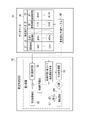
- the participant data 26 was transmitted from the reference number 27 assigned to each participant 11, the original image 10 included in the ID card issuance request 18, the charge balance 28 charged in the ID card 14, and the store 16.
- the payment information 30 is stored for each participant 11. Every time the payment information 30 is transmitted from the POS terminal 19 to the authentication device 6, the transmitted payment information 30 is stored in the database 24, and the charge balance 28 of the participant 11 is deducted from the amount corresponding to the payment information 30. Will be updated. Instead of charging the ID card 14 with an arbitrary amount, the participant 11 may pay the total amount of the payment amount later according to the payment information 30 stored in the database 24.
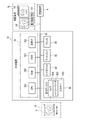
- the issuing device 4 includes a computer 32, a camera 34, and a printer 20.
- the computer 32, the camera 34, and the printer 20 are contained in one housing.
- the computer 32 includes a CPU (Central Processing Unit) 32A, an NVM (Non-Volatile Memory) 32B, a RAM (Random Access Memory) 32C, and a communication I / F (interface) 32D.
- the CPU 32A, NVM 32B, RAM 32C, communication I / F 32D, camera 34, and printer 20 are connected to each other via a bus 36.
- the CPU 32A controls the entire issuing device 4.
- the NVM 32B is a non-volatile memory.
- EEPROM electrically erasable programmable read-only memory
- the RAM 32C is a volatile memory. The RAM 32C is used as a working memory by the CPU 32A.
- Communication I / F32D is realized by, for example, a device having an FPGA (field-programmable gate array).
- the communication I / F 32D is connected to the database 24 and controls the exchange of various information between the CPU 32A and the database 24.
- the communication I / F32D is connected to the smart device 8 of the participant 11 via a communication network such as a wireless LAN (Local Area Network) or a wireless WAN (Wide Area Network), and is connected to the CPU 32A and the smart device 8. It controls the exchange of various information between.
- a communication network such as a wireless LAN (Local Area Network) or a wireless WAN (Wide Area Network)
- the printer 20 is an instant photo printer that uses the instant film 15 as a recording medium.
- the printer 20 includes, for example, an LCD (Liquid Crystal Display) or the like as an exposure device.
- the exposure apparatus is arranged so that the image display surface for displaying an image faces the photosensitive surface of the instant film 15.
- the printer 20 exposes the photosensitive material of the instant film 15 by displaying an image to be printed on the exposure apparatus.
- the instant film 15 is a film that develops color by a photosensitive material containing a silver salt.
- the printer 20 uses the instant film 15 as the recording medium, it is, of course, a density modulation type printer that forms an image by changing the color development density of the photosensitive material according to the exposure amount.
- the printer 20 prints the authentication image 21 generated based on the original image 10 included in the ID card issuance request 18 on the instant film 15 (see FIG. 1), and prints the printed instant film 15. It is output as an ID card 14 (see FIG. 1).
- the camera 34 acquires the first captured image 46 (see FIG. 5) by imaging the ID card 14 output from the printer 20.
- the camera 34 is an example of a "camera” according to the technique of the present disclosure.
- the first captured image 46 is an example of the “first captured image” according to the technique of the present disclosure.
- the ID card issuing program 38 is stored in the NVM32B.
- the CPU 32A reads the ID card issuing program 38 from the NVM 32B and executes the read ID card issuing program 38 on the RAM 32C to serve as an authentication image generation unit 40, an ID card output unit 42, and a first frequency characteristic acquisition unit 44. Operate.
- the authentication image generation unit 40, the ID card output unit 42, and the first frequency characteristic acquisition unit 44 cooperate to perform the ID card issuance process.
- the authentication image generation unit 40, the ID card output unit 42, and the first frequency characteristic acquisition unit 44 are examples of the "first processor" according to the technique of the present disclosure.
- the authentication image generation unit 40 uses a well-known face recognition technique to display a person from the original image 10.
- the first face image 45 showing a face is extracted.
- contour extraction is performed by performing a process such as edge detection on the original image 10, and the contour of the face is specified by pattern matching from the extracted contours, and the specified face is specified.
- a known face recognition technique such as a method of extracting a region within the contour of the face image and a method using machine learning can be used.
- the first face image 45 is an example of the "first face image" according to the technique of the present disclosure.
- the authentication image generation unit 40 acquires the reference number 27 and the legitimacy authentication information 48.
- the reference number 27 is, for example, an identification number of the participant 11 assigned to each participant 11 in the order of registration of the participant 11. In the example shown in FIG. 3, a four-digit number "0001" to "0101" is assigned to the participant 11. Further, in FIG. 3, the reference number 27 "0101" surrounded by a dotted circle is the reference number 27 assigned to the participant 11 who has transmitted the latest ID card issuance request 18 in FIG. ..
- the legitimacy authentication information 48 is, for example, a random number assigned to each participant 11 and functions as a password for accessing the authentication device 6.
- the legitimacy authentication information 48 is data used for the legitimacy authentication process described later. In the example shown in FIG. 3, the combination of the characters and numbers "oi3fzq" is assigned as the legitimacy authentication information 48 to the participant 11 whose reference number 27 is "0101".
- the authentication image generation unit 40 associates the acquired reference number 27 and the legitimacy authentication information 48 with the original image 10 and the extracted first face image 45, and stores them in the database 24 as participant data 26.
- the legitimacy authentication information 48 is an example of "authentication information" related to the technique of the present disclosure.
- the authentication image generation unit 40 extracts the first face feature amount 47 (see FIG. 4) indicating the feature amount of the first face image 45 by image analysis of the first face image 45.
- the feature amount of the face image used for the first face feature amount 47 and the like include a Har-like feature amount, a HOG (Histograms of Oriented Grandients) feature amount, a SIFT (Scale Invariant Feature Transition Form), and an LBP (Lonline).
- a known feature amount such as a feature amount can be appropriately used.
- a method for extracting a feature amount for example, a known method using a trained model in which a feature amount is learned in advance so as to be output by a face image for learning, the face image is input, and the feature amount is output is known.
- Feature extraction techniques can be used.
- the first facial feature amount 47 is data used for the personal authentication process described later.
- the first facial feature amount 47 is an example of the "face feature amount" according to the technique of the present disclosure.
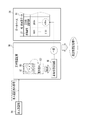
- the authentication image generation unit 40 generates a digital watermark embedded image 49 (see FIG. 4) by digitally watermarking the first face feature amount 47 and the validity authentication information 48 and embedding them in the original image 10.
- the authentication image generation unit 40 further generates an authentication image 21 by synthesizing the authenticity verification pattern 50 and the area mark 51 read from the database 24 with the digital watermark embedded image 49.
- the authenticity verification pattern 50 and the area mark 51 may be stored in the NVM 32B as incidental information of the ID card issuing program 38 instead of the database 24.
- the authentication image generation unit 40 makes it impossible to visually recognize the first face feature amount 47 and the legitimacy authentication information 48 by a calculation using a specific algorithm.
- a digital watermark embedded image 49 embedded in the original image 10 is generated.
- the first face feature amount 47 and the validity authentication information 48 are embedded in the digital watermark embedded image 49 as the digital watermark 52.
- the digital watermark 52 is data that cannot be visually recognized, but can be detected by performing a specific arithmetic process on the digital watermark embedded image 49 using detection software or the like.
- the authentication image generation unit 40 reads the authenticity verification pattern 50 and the area mark 51 from the database 24.
- the authenticity matching pattern 50 is, for example, a solid color solid pattern having a square having a side of several mm (millimeters).
- the area mark 51 is a cross-shaped mark having a size of several mm to a dozen mm. As will be described in detail later, the area mark 51 is a mark for indicating where in the authentication image 21 the digital watermark 52 and the authenticity verification pattern 50 are recorded.
- the authentication image generation unit 40 superimposes the authenticity verification pattern 50 on the lower right corner of the digital watermark embedded image 49, and superimposes the four area marks 51 on the four corners of the digital watermark embedded image 49 to generate the authentication image 21. Generate. In this example, since the digital watermark 52 and the authentication image 21 have almost the same size, the four corners of the digital watermark 52 are shown by arranging the area marks 51 at the four corners of the digital watermark embedded image 49. Can be done. The four area marks 51 indicate the recording position of the digital watermark 52. Further, since the authenticity collation pattern 50 is arranged at the lower right corner of the digital watermark embedded image 49, the recording position of the authenticity collation pattern 50 is indicated by the area mark 51 at the lower right corner.
- the authentication image 21 is captured by the camera 34, but the area mark 51 is a digital watermark embedded image 49 from the first captured image 46 which is the authentication image 21 captured by the camera 34. It is also used as a mark to indicate the cutout area.
- the authentication image generation unit 40 outputs the generated authentication image 21 to the printer 20.
- the ID card output unit 42 controls the printer 20 built in the issuing device 4 to print the authentication image 21 input from the authentication image generation unit 40.
- the printer 20 prints the authentication image 21 on the instant film 15 under the control of the ID card output unit 42.
- the printed instant film 15 is ejected from the printer 20.
- the portion corresponding to the authenticity matching pattern 50 is referred to as the authenticity matching image 57 in order to distinguish it from the authenticity matching pattern 50.
- the authenticity matching image 57 is an image showing a part of the first captured image 46, and is an image obtained by printing the authenticity matching pattern 50 included in the authentication image 21 with the printer 20. That is, the authenticity verification pattern 50 is image data constituting a part of the authentication image 21 when the authentication image 21 exists as image data, and the authenticity verification image 57 is printed on the instant film 15 and used as a print image. It is an image which constitutes a part of the authentication image 21 of.
- the authenticity authentication of the ID card 14 is performed by utilizing the fact that the density characteristic of the authenticity verification image 57 changes for each print.
- the authenticity collation pattern 50 is image data, the density characteristics do not change for each print.
- the authenticity collation image 57 and the authenticity collation pattern 50 have a difference between the printed image and the image data, and it is necessary to distinguish between them in order to explain the principle of authenticity authentication. Here, the two will be described separately.
- the authenticated image 21 of the ejected instant film 15 is arranged within the shooting range of the camera 34.
- the instant film 15 may be arranged automatically or by a person such as a staff member.
- a method of installing the camera 34 so that the instant film 15 discharged from the printer 20 falls within the shooting range or a method of transporting the discharged instant film 15 to the position of the camera 34 by a transport mechanism. There is a way to do it.
- the ID card output unit 42 controls the camera 34 to capture the authentication image 21 printed on the instant film 15. Specifically, the ID card output unit 42 captures the instant film 15 by operating the camera 34, and detects the area marks 51 arranged at the four corners of the authentication image 21 from the image obtained by the imaging. .. The ID card output unit 42 cuts out a region surrounded by the area mark 51 from the image obtained by imaging, and acquires the cut out image as the first captured image 46. As described above, in the authentication image 21, the area surrounded by the four area marks 51 includes the digital watermark 52 and the authenticity matching image 57 corresponding to the authenticity matching pattern 50. Therefore, the first captured image 46 also includes the digital watermark 52 and the authenticity matching image 57 (see also FIG. 6).
- the ID card output unit 42 sets the acquired first captured image 46 and the first captured time 54, which is the time when the instant film 15 is captured by the camera 34, with reference number 27, validity authentication information 48, and original image 10. And stored in the database 24 in association with the first face image 45. After the image is taken by the camera 34, the instant film 15 on which the authentication image 21 is printed is discharged to the outside from the issuing device 4 as the ID card 14.
- the first frequency characteristic acquisition unit 44 reads the first captured image 46 from the database 24, and extracts the authenticity matching image 57 located at the lower right corner of the read first captured image 46. ..
- the recording position of the authenticity matching image 57 is specified by detecting the area mark 51 at the lower right corner.
- the authenticity collation image 57 is used for the authenticity collation process described later.
- the authenticity collation image 57 is an example of a "verification unit" according to the technique of the present disclosure.
- the first frequency characteristic acquisition unit 44 acquires the first frequency characteristic 56 from the extracted authenticity matching image 57.
- the first frequency characteristic 56 is a frequency characteristic indicating the density characteristic in the authenticity matching image 57.
- the uncertainty of the color development density means that even when the same image is printed on the same type of recording medium, the occurrence of density unevenness differs from print to print. For example, even when a solid solid pattern of a solid color is recorded on a recording medium of the same type, uneven density occurs in the printed image.
- the technique of the present disclosure authenticates the authenticity of the ID card 14 by utilizing the uncertainty of the color development density.
- the reason why the color density is uncertain in the instant film 15 is that the distribution of the developer developed on the recording surface in the developing process is not uniform over the entire recording surface. Another reason is that the distribution of the photosensitive material, which is a coloring material that develops color, also becomes non-uniform over the entire recording surface. As described above, even with one instant film 15, non-uniformity of the developer, the photosensitive material, and the like occurs on the recording surface.
- FIG. 7 even when the authenticity matching images 57A, 57B, 57C, and 57D are provided at four locations based on one authenticity matching pattern 50 in the instant film 15, four authenticity matching images are provided.
- Images 57A, 57B, 57C, 57D show different concentration characteristics.
- the graph shown in FIG. 8 is a graph of the first frequency characteristics 56A, 56B, 56C, 56D showing the density characteristics of the four authenticity matching images 57A, 57B, 57C, and 57D, respectively.
- the first frequency characteristics 56A, 56B, 56C, 56D are derived by Fourier analysis of the authenticity matching images 57A, 57B, 57C, 57D.
- FIG. 8 is a graph of the first frequency characteristics 56A, 56B, 56C, 56D showing the density characteristics of the four authenticity matching images 57A, 57B, 57C, and 57D, respectively.
- the first frequency characteristics 56A, 56B, 56C, 56D are derived by Fourier analysis
- the horizontal axis is frequency and the vertical axis is power
- the first frequency characteristics 56A, 56B, 56C, 56D are frequency spectra showing how much density unevenness occurs for each frequency. As a whole, the density unevenness in the low frequency region tends to be relatively large, and the density unevenness in the high frequency region tends to be relatively small. ing.
- the technique of the present disclosure utilizes the uncertainties of the color development density in which the occurrence of density unevenness differs for each printing even when the same image is printed on the same type of recording medium, thereby authenticating the ID card 14. Authenticate sex. Then, the state of occurrence of density unevenness appears as a frequency characteristic of the color development density of the image. Therefore, the technique of the present disclosure authenticates the authenticity of the ID card 14 by utilizing the fact that the frequency characteristics of the color development density of the image are different for each printing even when the same image is printed on the same type of recording medium. ..
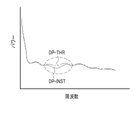
- FIG. 9 shows an instant frequency characteristic DP-INST using the instant film 15 and an inkjet frequency characteristic DP-INK for recording an image by injecting ink onto plain paper.
- the instant type frequency characteristic DP-INST has more density unevenness in the low frequency region and less concentration unevenness in the high frequency region than the inkjet type frequency characteristic DP-INK. ..
- the instant method is a density modulation method
- the inkjet method is an area modulation method in which the gradation is changed according to the density of dots.
- the fact that the inkjet method has a relatively large density unevenness in the high frequency region indicates that the image recorded by the inkjet method has a relatively stronger feeling of roughness.
- FIG. 10 is a graph showing the frequency characteristic DP-INST of the instant method and the frequency characteristic DP-THR of the sublimation type thermal transfer method.
- the sublimation type thermal transfer method is a method in which the sublimation dye ink applied to the ink ribbon is heated by a thermal head to transfer the molten ink to, for example, a special coated paper coated with a polyester resin.
- Both the instant method and the sublimation type thermal transfer method are concentration modulation methods. However, as shown in FIG. 10, there is a difference in the concentration characteristics between the two, and the concentration unevenness in the frequency region surrounded by the broken line circle is larger in the sublimation type thermal transfer method than in the instant method.
- the first frequency characteristic acquisition unit 44 acquires the occurrence state of the density unevenness of the authenticity matching image 57 as the first frequency characteristic 56, and associates the acquired first frequency characteristic 56 with the first captured image 46 in the database 24.
- the acquired first frequency characteristic 56 shows a waveform peculiar to each instant film 15.
- the first frequency characteristic 56 is used in the authenticity authentication process described later.
- the authentication device 6 includes a computer 60, a reception device 70, and a display 72.
- the computer 60 includes a CPU 60A, an NVM 60B, a RAM 60C, and a communication I / F 60D.
- the CPU 60A, NVM 60B, RAM 60C, communication I / F 60D, reception device 70, and display 72 are connected to each other via a bus 74.
- the CPU 60A controls the entire authentication device 6.
- the NVM60B is a non-volatile memory.
- EEPROM is adopted as an example of the NVM 32B, but the present invention is not limited to this, and a flash memory or the like may be used, or a combination of a plurality of non-volatile memories may be used.
- the RAM 60C is a volatile memory. The RAM 60C is used as a working memory by the CPU 60A.
- Communication I / F60D is realized by, for example, a device having an FPGA.
- the communication I / F60D is connected to the database 24 by wire, and controls the exchange of various information between the CPU 60A and the database 24. Further, the communication I / F60D is connected to a plurality of POS terminals 19 via a LAN cable or the like, and controls the exchange of various information between the CPU 60A and the POS terminal 19.
- the reception device 70 includes a keyboard and a mouse.
- the keyboard and mouse receive instructions to the authentication device 6 in response to operations by the staff.
- the display 72 is used to display various information under the control of the CPU 60A.
- the authentication program 62 is stored in the NVM60B.
- the CPU 60A reads the authentication program 62 from the NVM 60B and executes the read authentication program 62 on the RAM 60C to operate as the personal authentication unit 64, the authenticity authentication unit 66, and the authenticity authentication unit 68.
- the personal authentication unit 64, the authenticity authentication unit 66, and the authenticity authentication unit 68 cooperate to perform the authentication process.
- the authentication process is a process executed when the authentication device 6 receives the authentication request 76 from at least one of the plurality of POS terminals 19.
- the personal authentication unit 64, the authenticity authentication unit 66, and the authenticity authentication unit 68 are examples of the "second processor" according to the technique of the present disclosure.
- the POS terminal 19 includes a computer 78, a reception device 86, a video camera 80, a display 82, and a printer 84.
- the computer 78 includes a CPU 78A, an NVM 78B, a RAM 78C, and a communication I / F 78D.
- the CPU 78A, NVM78B, RAM78C, communication I / F78D, reception device 86, video camera 80, display 82, and printer 84 are connected to each other via a bus 85.
- the CPU 78A controls the entire POS terminal 19.
- the NVM78B is a non-volatile memory.
- EEPROM is adopted as an example of NVM78B, but the present invention is not limited to this, and a flash memory or the like may be used, or a combination of a plurality of non-volatile memories may be used.
- the NVM 78B stores sales data processed by the POS terminal 19.
- the RAM 78C is a volatile memory.
- the RAM 78C is used as a working memory by the CPU 78A.
- the communication I / F 78D controls the exchange of various information between the CPU 78A and the authentication device 6.
- the reception device 86 includes a camera 86A, a barcode reader 86B, and an input key 86C.
- the camera 86A has the same image pickup performance as the camera 34 built in the issuing device 4, that is, the lens performance, the filter performance, and the image pickup element performance.
- the camera 86A captures the authentication image 21 included in the ID card 14 to be authenticated.
- the barcode reader 86B reads a barcode attached to each product in advance.
- the barcode contains information about the product name, price, etc. of each product.
- the input key 86C is a key that includes a numeric keypad and can manually input information and the like related to each product to the POS terminal 19.
- the camera 86A is an example of a "camera" according to the technique of the present disclosure.
- the display 82 is used to present the purchase amount to the participant 11 under the control of the CPU 78A.
- the printer 84 prints a receipt showing the contents of the shopping.
- the treasurer 17 of the store 16 causes the barcode reader 86B to read the barcode attached to the product purchased by the participant 11.
- the CPU 78A calculates the shopping amount based on the product information included in the barcode read by the barcode reader 86B.
- Participant 11 presents the ID card 14 possessed by the participant 11 at the time of accounting at the store 16, that is, the ID card 14 to be authenticated to the accounting clerk 17.
- the camera 86A captures the authentication image 21 included in the ID card 14 to be authenticated under the control of the CPU 78A.
- the CPU 78A detects the area marks 51 arranged at the four corners of the authentication image 21 from the image obtained by the image taken by the camera 86A, cuts out the area surrounded by the area marks 51, and acquires it as the second captured image 88. ..
- the video camera 80 acquires a moving image 90 including frame images for several tens of frames by capturing the participant 11 in front of the POS terminal 19 for 1 to several seconds under the control of the CPU 78A.
- the POS terminal 19 transmits an authentication request 76 including a second image pickup time 89 indicating the time when the second image pickup image 88, the moving image 90, and the camera 86A imaged the authentication image 21 included in the ID card 14 to the authentication device 6. ..
- the second captured image 88 is an example of the "second captured image" according to the technique of the present disclosure.
- the personal authentication unit 64 performs the personal authentication process when the authentication request 76 is received from the POS terminal 19. Specifically, the personal authentication unit 64 acquires the second captured image 88 included in the authentication request 76. The personal authentication unit 64 extracts the first facial feature amount 47 embedded as a digital watermark 52 in the authentication image 21 from the second captured image 88 by performing a specific arithmetic process on the acquired second captured image 88. do.
- the personal authentication unit 64 extracts a second face image 92 showing a person's face from the frame image included in the moving image 90.
- a known face recognition technique similar to the above-mentioned extraction method for the first face image 45 can be used.
- the personal authentication unit 64 extracts, for example, the face of the person first extracted from the faces of the person extracted from the plurality of frame images included in the moving image 90 as the second face image 92.
- the personal authentication unit 64 extracts the second face feature amount 94 from the extracted second face image 92.
- the second face feature amount 94 is the same as the first face feature amount 47, and can be extracted by using the same known feature amount extraction technique as the first face feature amount 47.
- the personal authentication unit 64 compares the first face feature amount 47 extracted from the second captured image 88 with the second face feature amount 94 extracted from the second face image 92 included in the moving image 90. When the difference between the first face feature amount 47 and the second face feature amount 94 is within the predetermined range, the personal authentication unit 64 has the person shown in the authentication image 21 of the ID card 14 to be authenticated and the POS terminal 19. It is determined that the person in front of is the same person. In this case, the personal authentication unit 64 outputs a signal indicating that the personal authentication has been completed (hereinafter referred to as “personal authentication completed signal”) to the legitimacy authentication unit 66.
- the second face image 92 is an example of the "second face image" according to the technique of the present disclosure.
- the first face feature amount 47 is an example of the "face feature amount extracted from the first face image" according to the technique of the present disclosure
- the second face feature amount 94 is the “second face feature amount” according to the technique of the present disclosure. This is an example of "facial features extracted from images”.
- the legitimacy authentication unit 66 performs the legitimacy authentication process when the personal authentication completed signal is received from the personal authentication unit 64. Specifically, the legitimacy authentication unit 66 performs a specific arithmetic process on the second captured image 88, so that the legitimacy authentication information 48 embedded as an electronic watermark 52 in the authentication image 21 from the second captured image 88. To extract. The legitimacy authentication unit 66 searches the participant data 26 stored in the database 24 for whether or not the legitimacy authentication information 48 that matches the legitimacy authentication information 48 extracted from the second captured image 88 exists. .. When the legitimacy authentication information 48 matching the legitimacy authentication information 48 extracted from the second captured image 88 exists in the participant data 26, the legitimacy authentication unit 66 indicates that the ID card 14 is legitimate to the authentication system 2. It is determined that the card has access rights. In this case, the legitimacy authentication unit 66 outputs a signal indicating that the legitimacy authentication has been completed (hereinafter, referred to as a “validity authentication completed signal”) to the authenticity authentication unit 68.
- a validity authentication completed signal indicating that the legitimacy authentication has been completed
- the authenticity authentication unit 68 performs the authenticity authentication process when receiving the authenticity authentication completed signal from the authenticity authentication unit 66.
- the authenticity authentication process is the first process of authenticating the authenticity by using the uncertainty of the color development density of the authenticity matching image 57, and the authenticity by using the time course of the color development density of the authenticity matching image 57. Includes a second process to authenticate.
- the authenticity authentication unit 68 acquires the second captured image 88 included in the authentication request 76.
- the authenticity authentication unit 68 extracts the authenticity matching image 57 from the acquired second captured image 88 by using, for example, pattern matching.
- the authenticity authentication unit 68 optically scans the extracted authenticity collation image 57 to acquire the color density characteristic of the authenticity collation image 57, that is, the second frequency characteristic 96 indicating the density unevenness.
- the authenticity authentication unit 68 stores the first frequency characteristic 56 stored in the participant data 26 in association with the legitimacy authentication information 48 searched by the legitimacy authentication unit 66 in the legitimacy authentication process shown in FIG. 14 in the database 24. Read from. That is, in the example shown in FIG. 15, the authenticity authentication unit 68 has the first frequency characteristic 56 stored in the participant data 26 in association with the legitimacy authentication information 48 “oi3fzq” searched by the legitimacy authentication unit 66. Read "A0101" from the database 24.
- the authenticity authentication unit 68 compares the first frequency characteristic 56 read from the database 24 with the second frequency characteristic 96 of the authenticity matching image 57 extracted from the second captured image 88. When the difference between the first frequency characteristic 56 and the second frequency characteristic 96 is within the predetermined range, the authenticity authentication unit 68 executes the second process.
- the authenticity authentication unit 68 authenticates the authenticity by comparing the color development density characteristics after taking into consideration the time-dependent change in the color development density of the authenticity verification image 57.
- FIG. 16 shows, for example, the time course of the color development density of the authenticity matching image 57 from the first imaging time 54.
- 0 minutes indicates the time when the authentication image 21 is printed on the instant film 15 by the printer 20
- the first imaging time 54 indicates the time when the authentication image 21 printed on the instant film 15 is captured by the camera 34. Indicates the time.
- the first imaging time 54 is a time in which several seconds to several tens of seconds have elapsed from the time when the authentication image 21 is printed on the instant film 15.
- the vertical axis is the luminance value, and the higher the luminance value is, the lower the density is, and the lower the luminance value is, the higher the density is.
- color development rapidly progresses in a short time (about 3 minutes) immediately after printing, so that the density increase (decrease in luminance value) during this period is rapid. Subsequent increase in concentration is gradual. Since the change over time in the color development density of the instant film 15 shows the tendency as shown in FIG. 16, it is possible to predict the color development density of the instant film 15 at that time from the elapsed time after printing.
- the database 24 stores in advance a density change table 98 showing changes over time in the color development density of the authenticity matching image 57.
- the change over time in the color development density is a value derived by, for example, a test using an actual machine and / or a computer simulation.
- an arithmetic expression may be used in which the elapsed time from the first imaging time 54 is used as an independent variable and the color development density is used as a dependent variable.
- the authenticity authentication unit 68 associates the participant data with the legitimacy authentication information 48 searched by the legitimacy authentication unit 66 in the legitimacy authentication process shown in FIG.
- the first imaging time 54 stored in 26 is read from the database 24.
- the authenticity authentication unit 68 calculates the elapsed time from the first imaging time 54 to the second imaging time 89 by taking the difference between the second imaging time 89 and the first imaging time 54 included in the authentication request 76. ..
- the authenticity authentication unit 68 derives a predicted color development density 99, which is a predicted value of the color development density of the authenticity matching image 57, based on the elapsed time, using the density change table 98.
- the authenticity authentication unit 68 measures the color development density 100 of the authenticity verification image 57 extracted from the second captured image 88.
- the color development density 100 is a luminance value of the authenticity matching image 57.
- the authenticity authentication unit 68 compares the color development density 100 of the authenticity matching image 57 obtained by the measurement with the predicted color development density 99 derived using the density change table 98. When the difference between the predicted color development density 99 and the color development density 100 is within the predetermined range, the authenticity authentication unit 68 determines that the ID card 14 is not forged. In this case, the authenticity authentication unit 68 transmits an authentication signal indicating that the ID card 14 has been authenticated to the POS terminal 19.
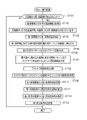
- the ID card issuing process shown in FIG. 18 is realized by the CPU 32A of the issuing device 4 executing the ID card issuing program 38.
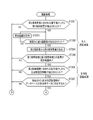
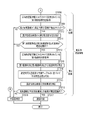
- the authentication process shown in FIGS. 19 to 20 is realized by the CPU 60A of the authentication device 6 executing the authentication program 62.
- the ID card issuance process shown in FIG. 18 is started when the authentication image generation unit 40 receives the ID card issuance request 18 from the smart device 8.
- the authentication image generation unit 40 extracts the first face image 45 from the original image 10 included in the received ID card issuance request 18.
- step ST101 the authentication image generation unit 40 determines whether or not the first face image 45 has been extracted from the original image 10.
- the determination is affirmed, and the ID card issuance process proceeds to step ST102. If the first face image 45 is not extracted, the determination is denied and the ID card issuance process ends.
- step ST102 the authentication image generation unit 40 acquires a new reference number 27 and validity authentication information 48 corresponding to the received ID card issuance request 18. After that, the ID card issuance process proceeds to step ST103.
- step ST103 the authentication image generation unit 40 stores the acquired reference number 27 and the validity authentication information 48 in the database 24 in association with the original image 10 and the first face image 45. After that, the ID card issuance process proceeds to step ST104.
- step ST104 the authentication image generation unit 40 extracts the first face feature amount 47 from the first face image 45. After that, the ID card issuance process proceeds to step ST105.
- step ST105 the authentication image generation unit 40 generates a digital watermark embedded image 49 by digitally watermarking the extracted first face feature amount 47 and the acquired validity authentication information 48 and embedding it in the original image 10. After that, the ID card issuance process proceeds to step ST106.
- step ST106 the authentication image generation unit 40 reads the authenticity verification pattern 50 and the area mark 51 from the database 24. After that, the ID card issuance process proceeds to step ST107.
- step ST107 the authentication image generation unit 40 generates the authentication image 21 by synthesizing the read authenticity verification pattern 50 and the area mark 51 with the generated digital watermark embedded image 49.
- the authentication image generation unit 40 outputs the generated authentication image 21 to the printer 20.
- the ID card issuance process proceeds to step ST108.
- step ST108 the ID card output unit 42 controls the printer 20 to print the authentication image 21 input from the authentication image generation unit 40. As a result, the printer 20 prints the authentication image 21 on the instant film 15. After that, the ID card issuance process proceeds to step ST109.
- step ST109 the ID card output unit 42 controls the camera 34 to take an image of the instant film 15 on which the authentication image 21 is printed.
- the camera 34 captures the authentication image 21 printed on the instant film 15, and the ID card output unit 42 acquires the image captured by the camera 34 as the first captured image 46.
- the instant film 15 on which the authentication image 21 is printed is discharged to the outside of the issuing device 4 as the ID card 14.
- the ID card issuance process proceeds to step ST110.
- step ST110 the ID card output unit 42 sets the acquired first captured image 46 and the first captured time 54 indicating the time when the first captured image 46 is captured as reference number 27, validity authentication information 48, and It is stored in the database 24 in association with the original image 10 and the first face image 45. After that, the ID card issuance process proceeds to step ST111.
- step ST111 the first frequency characteristic acquisition unit 44 extracts the authenticity matching image 57 located at the lower right corner of the first captured image 46 from the first captured image 46. After that, the ID card issuance process proceeds to step ST112.
- step ST112 the first frequency characteristic acquisition unit 44 acquires the first frequency characteristic 56 indicating the density unevenness in the authenticity collation image 57 from the extracted authenticity collation image 57. After that, the ID card issuance process proceeds to step ST113.
- step ST113 the first frequency characteristic acquisition unit 44 stores the acquired first frequency characteristic 56 in association with the first captured image 46 in the database 24. After this, the ID card issuance process ends.
- the authentication process shown in FIGS. 19 to 20 is started when the personal authentication unit 64 receives the authentication request 76 from the POS terminal 19.
- the authentication process includes the personal authentication process shown in steps ST201 to ST205, the legitimacy authentication process shown in steps ST206 to ST207, and the authenticity authentication process shown in steps ST208 to ST216. Further, the authenticity authentication process is roughly classified into a first process shown in steps ST208 to ST211 and a second process shown in steps ST212 to ST216.
- the personal authentication unit 64 extracts the first facial feature amount 47 embedded as a digital watermark 52 from the second captured image 88 included in the received authentication request 76.
- the personal authentication unit 64 determines whether or not the first facial feature amount 47 has been extracted from the digital watermark 52 included in the second captured image 88. If the first facial feature amount 47 is extracted in step ST201, the determination is affirmed, and the personal authentication process proceeds to step ST202. If the first facial feature amount 47 is not extracted, the determination is denied and the authentication process proceeds to step ST218.
- the personal authentication unit 64 extracts the second face image 92 from the moving image 90 included in the authentication request 76.
- step ST202 the personal authentication unit 64 determines whether or not the second face image 92 has been extracted from the moving image 90. When the second face image 92 is extracted in step ST202, the determination is affirmed, and the personal authentication process proceeds to step ST204. If the second face image 92 is not extracted, the determination is denied and the personal authentication process proceeds to step ST203.
- step ST203 the personal authentication unit 64 operates the video camera 80 on the CPU 78A of the POS terminal 19 and re-images the moving image 90 obtained by the video camera 80. Send it. After that, the personal authentication process proceeds to step ST202.
- step ST204 the personal authentication unit 64 extracts the second face feature amount 94 from the second face image 92. After that, the personal authentication process proceeds to step ST205.
- step ST205 the personal authentication unit 64 determines whether or not the difference between the extracted first face feature amount 47 and the second face feature amount 94 is within the predetermined range.
- step ST205 when the difference between the first face feature amount 47 and the second face feature amount 94 is within the predetermined range, the determination is affirmed, and the personal authentication process is the legitimacy authentication process shown in steps ST206 to ST207. Move to. If the difference between the first face feature amount 47 and the second face feature amount 94 is not within the predetermined range, the determination is denied and the authentication process proceeds to step ST218.
- the legitimacy authentication unit 66 extracts the legitimacy authentication information 48 from the digital watermark 52 included in the second captured image 88.
- the legitimacy authentication unit 66 determines whether or not the legitimacy authentication information 48 is extracted from the digital watermark 52 included in the second captured image 88. If the legitimacy authentication information 48 is extracted in step ST206, the determination is affirmed, and the legitimacy authentication process proceeds to step ST207. If the validity authentication information 48 is not extracted, the determination is denied and the authentication process proceeds to step ST218.
- the legitimacy authentication unit 66 searches the extracted legitimacy authentication information 48 in the participant data 26 of the database 24. In step ST207, the legitimacy authentication unit 66 determines whether or not the extracted legitimacy authentication information 48 exists in the participant data 26 of the database 24. In step ST207, when the legitimacy authentication information 48 exists in the participant data 26, the determination is affirmed, and the legitimacy authentication process shifts to the authenticity authentication process shown in steps ST208 to ST216. If the validity authentication information 48 does not exist in the participant data 26, the determination is denied and the authentication process proceeds to step ST218.
- step ST208 the authenticity authentication unit 68 is stored in the participant data 26 in association with the legitimacy authentication information 48 extracted by the legitimacy authentication process. 1 Acquire frequency characteristic 56. After that, the authenticity authentication process proceeds to step ST209.
- the authenticity authentication unit 68 extracts the authenticity verification image 57 from the second captured image 88.
- step ST209 the authenticity authentication unit 68 determines whether or not the authenticity matching image 57 has been extracted from the second captured image 88. If the authenticity matching image 57 is extracted in step ST209, the determination is affirmed, and the authenticity authentication process proceeds to step ST210. If the authenticity matching image 57 is not extracted, the determination is denied and the authentication process proceeds to step ST218.
- step ST210 the authenticity authentication unit 68 extracts the second frequency characteristic 96 from the authenticity verification image 57. After that, the authenticity authentication process proceeds to step ST211.
- step ST211th the authenticity authentication unit 68 determines whether or not the difference between the first frequency characteristic 56 and the second frequency characteristic 96 is within the predetermined range. In step ST211 if the difference between the first frequency characteristic 56 and the second frequency characteristic 96 is within the predetermined range, the determination is affirmed and the authenticity authentication process shifts to the second process shown in steps ST212 to ST216. do. If the difference between the first frequency characteristic 56 and the second frequency characteristic 96 is not within the predetermined range, the determination is denied and the authentication process proceeds to step ST218.
- step ST212 the authenticity authentication unit 68 is stored in the participant data 26 of the database 24 in association with the legitimacy authentication information 48 extracted by the legitimacy authentication process.
- the first imaging time 54 is acquired. After that, the authenticity authentication process proceeds to step ST213.
- step ST213 the authenticity authentication unit 68 obtains the difference between the first imaging time 54 acquired from the database 24 and the second imaging time 89 included in the authentication request 76, so that the first imaging time 54 to the second image is obtained. The elapsed time until the imaging time 89 is derived. After that, the authenticity authentication process proceeds to step ST214.
- step ST214 the authenticity authentication unit 68 derives the predicted color development density 99 based on the derived elapsed time and the density change table 98 stored in the database 24. After that, the authenticity authentication process proceeds to step ST215.
- step ST215 the authenticity authentication unit 68 measures the color density 100 of the authenticity matching image 57 extracted from the second captured image 88. After that, the authenticity authentication process proceeds to step ST216.
- step ST216 the authenticity authentication unit 68 determines whether or not the difference between the measured color development density 100 and the derived predicted color development density 99 is within the predetermined range. If the difference between the color development density 100 and the predicted color development density 99 is within the predetermined range in step ST216, the determination is affirmed and the authentication process proceeds to step ST217. If the difference between the color development density 100 and the predicted color development density 99 is not within the predetermined range, the determination is denied and the authentication process proceeds to step ST218.
- step ST217 the CPU 60A of the authentication device 6 requests authentication from the authentication device 6 to indicate that the ID card 14 to be authenticated has been authenticated by the personal authentication process, the legitimacy authentication process, and the authenticity authentication process. It is transmitted to the POS terminal 19 which is the source of the 76. After this, the authentication process ends.
- step ST218 the CPU 60A of the authentication device 6 authenticates an unauthenticated signal indicating that the ID card 14 to be authenticated has not been authenticated by any of the personal authentication process, the legitimacy authentication process, and the authenticity authentication process. It is transmitted from the device 6 to the POS terminal 19 which is the source of the authentication request 76. After this, the authentication process ends.
- the authentication system 2 includes an issuing device 4 for issuing an ID card 14 and an authentication device 6 for authenticating the ID card 14.
- the authentication image generation unit 40 of the issuing device 4 acquires the first face image 45 from the original image 10 that captures the face of the participant 11.
- the authentication image generation unit 40 generates an authentication image 21 including the first face image 45 and the legitimacy authentication information 48, and outputs the generated authentication image 21 to the printer 20 built in the issuing device 4.
- the ID card output unit 42 of the issuing device 4 causes the printer 20 to print the authentication image 21 output from the authentication image generation unit 40 on the instant film 15.
- the ID card output unit 42 acquires the first captured image 46 by causing the camera 34 to capture the authentication image 21 printed on the instant film 15, and stores the acquired first captured image 46 in the database 24. .. After that, the ID card output unit 42 discharges the instant film 15 on which the authentication image 21 is printed as the ID card 14 to the outside.
- the ID card 14 can be created by printing the authentication image 21 on the instant film 15. Further, the authenticity authentication unit 68 of the authentication device 6 acquires an image obtained by capturing the authentication image 21 printed on the ID card 14 to be authenticated by the camera 86A as the second captured image 88. The authenticity authentication unit 68 authenticates the authenticity of the ID card 14 to be authenticated by comparing the density characteristics of the first captured image 46 acquired from the database 24 and the second captured image 88. In the field of image processing, comparison of image density characteristics is a relatively general-purpose technique.
- an authentication system 2 capable of issuing an ID card 14 capable of performing authentication and performing authenticity authentication of the ID card 14 with a simple configuration.
- the authenticity authentication unit 68 utilizes the uncertainty of the color development density in which the occurrence state of density unevenness differs for each printing even when the same image is printed on the same type of instant film 15. This authenticates the authenticity of the ID card 14. Therefore, according to this configuration, the authenticity authentication of the ID card 14 is performed with a simple configuration and low cost by using a relatively general-purpose technique in the image processing field of comparing the difference in density unevenness between images. be able to.
- the authenticity authentication unit 68 utilizes the fact that even when the same image is printed on the same type of instant film 15, the frequency characteristic of the color development density of the image is different for each printing.
- the authenticity of the ID card 14 to be authenticated is authenticated. Therefore, according to this configuration, the authenticity of the ID card 14 can be achieved with a simple configuration and low cost by using a relatively general-purpose technique in the image processing field of comparing the difference in frequency characteristics of the color development densities between images. Authentication can be performed.
- the authenticity authentication unit 68 considers the change over time in the color development density 100 of the authentication image 21 printed on the ID card 14 to be authenticated, and compares the density characteristics. Authenticate the authenticity of the ID card 14. Therefore, according to this configuration, even when the color development density 100 of the ID card 14 to be authenticated changes with time, more accurate authenticity authentication can be performed as compared with the case where the change with time is not taken into consideration.
- a part of the authentication image 21 includes an authenticity matching pattern 50 used for comparison of density characteristics.
- the authenticity authentication unit 68 includes an authenticity matching image 57 showing the authenticity matching pattern 50 in the first captured image 46 and an authenticity matching image 57 showing the authenticity matching pattern 50 in the second captured image 88.
- the authenticity of the ID card 14 is authenticated by comparing the concentration characteristics of the ID card 14. Therefore, according to this configuration, only the authenticity matching image 57 is compared as compared with the case where the overall density characteristics of the first captured image 46 and the second captured image 88 are compared, which is necessary for authenticity authentication.
- the processing load of the authentication device 6 can be reduced.
- the authenticity matching pattern 50 is a solid pattern composed of a solid color. Therefore, according to this configuration, the density characteristic in the authenticity matching image 57 can be easily obtained between the first captured image 46 and the second captured image 88 as compared with the case of using the matching pattern including a plurality of colors. Can be compared.
- the printer 20 is a density modulation type printer.
- An image printed using a density modulation printer has different frequency characteristics and color reproducibility from an image printed using an area modulation printer typified by an inkjet printer. Therefore, according to this configuration, when the ID card 14 is forged by using the area modulation type printer by utilizing the difference in frequency characteristics and color reproducibility from the area modulation type printer, the forgery can be easily determined.
- a possible authentication system 2 can be provided.
- the printer 20 is an instant photo printer that uses an instant film 15 that develops color with a photosensitive material containing a silver salt as a recording medium. Therefore, according to this configuration, by using the instant photo printer as the printer 20, the ID card 14 can be issued immediately. Further, the instant film 15 has non-uniformity of the photosensitive material and non-uniformity of the developing solution on the recording surface. Therefore, even if the same image is recorded in the same place in each of the plurality of instant films 15, the density characteristics are different. By utilizing these characteristics of the instant film 15, even if the ID card 14 is forged using the same type of instant film 15 as the legitimate ID card 14, the authenticity authentication of the ID card 14 can be performed by comparing the concentration characteristics. It can be carried out.
- the personal authentication unit 64 acquires the face of the owner of the ID card 14 to be authenticated as the second face image 92.
- the personal authentication unit 64 authenticates by comparing the first face feature amount 47 extracted from the first face image 45 included in the second captured image 88 with the second face feature amount 94 extracted from the second face image 92. It is authenticated that the owner of the target ID card 14 is the creator of the ID card 14. Therefore, according to this configuration, the administrator performing the comparison is compared with the case where the first face image 45 included in the ID card 14 to be authenticated and the face of the owner of the ID card 14 to be authenticated are visually compared. It becomes unnecessary and the accuracy of personal authentication is improved.
- the authentication image generation unit 40 embeds the first face feature amount 47 extracted from the first face image 45 in the authentication image 21.
- the personal authentication unit 64 extracted from the first face feature amount 47 extracted from the authentication image 21 included in the second captured image 88 obtained by imaging the ID card 14 to be authenticated, and from the second face image 92.
- the first face feature amount 47 is embedded in the authentication image 21, and the person is authenticated based on the first face feature amount 47 extracted from the authentication image 21.
- the processing load for the person authentication in the authentication system 2 is reduced and the processing time is shortened.
- the legitimacy authentication information 48 and the first facial feature amount 47 are embedded in the authentication image 21 as a digital watermark 52. Therefore, according to this configuration, it is difficult to forge the legitimacy authentication information 48 and the first face feature amount 47 as compared with the case where the legitimacy authentication information 48 and the first face feature amount 47 are directly embedded in the authentication image 21. Therefore, it is possible to provide a highly secure ID card 14.
- the authentication image generation unit 40, the ID card output unit 42, the first frequency characteristic acquisition unit 44, and the printer 20 are built in one housing. Therefore, according to this configuration, the authentication system 2 is space-saving as compared with the case where the authentication image generation unit 40, the ID card output unit 42, the first frequency characteristic acquisition unit 44, and the printer 20 have separate housings. Can be placed in.
- a camera 34 for acquiring the first captured image 46 is built in the housing. Therefore, according to this configuration, the authentication system is compared with the case where the authentication image generation unit 40, the ID card output unit 42, the first frequency characteristic acquisition unit 44, the printer 20, and the camera 34 have separate housings. 2 can be arranged in a space-saving manner.
- the first captured image 46 and the second captured image 88 are acquired by the cameras 34 and 86A having the same imaging performance, respectively. Therefore, according to this configuration, the influence of the density characteristic due to the difference in the imaging performance of the cameras 34 and 86A is reduced, so that the first captured image 46 and the second captured image 88 are acquired by the cameras having different imaging performance. It is easier to compare the density characteristics of the first captured image 46 and the second captured image 88.
- the technique of the present disclosure is the same. Not limited to.
- the camera 34 that acquires the first captured image 46 and the camera 86A that acquires the second captured image 88 may have different imaging performances.
- the authenticity authentication unit 68 corrects the second captured image 88 based on the difference in the imaging performance between the camera 34 and the camera 86A, and the corrected second captured image 88. May be used to authenticate the authenticity of the ID card 14. Therefore, according to this configuration, the authenticity authentication accuracy can be improved as compared with the case where the second captured image 88 acquired by the camera 86A having an imaging performance different from that of the camera 34 is used as it is for the authenticity authentication. can.
- the printer 20 may be, for example, the above-mentioned sublimation type thermal transfer type sublimation type printer. Further, the sublimation printer can use a plastic card as a recording medium instead of the dedicated coated paper.
- the ID card 14 may be created by printing the authentication image 21 on a plastic card.
- the printer 20 may be an inkjet printer of an inkjet method. As shown in FIGS. 9 and 10, the density characteristics differ depending on the printing method. Therefore, even when a printer other than the instant photo printer is used, it is possible to authenticate the authenticity of the ID card 14 forged by a printer having a different printing method.
- sublimation printers other than instant photo printers when the same image is printed on the same type of recording medium, the occurrence of density unevenness differs from print to print, and the color density is uncertain. Sex does not occur a little.
- thermal fluctuations occur due to heat generation and heat storage of the thermal head, so that even when the same image is printed on the same type of recording medium, density unevenness occurs for each print.
- density unevenness occurs for each printing. Therefore, even when a sublimation printer or the like other than the instant photo printer is used, it is possible to authenticate the authenticity of the forged ID card 14 by using the same type of printer.
- the ID card 14 is issued by the instant photo printer rather than the ID card 14 by the sublimation printer and the inkjet printer. It is easier to utilize the uncertainty of the color density in the authentication of authenticity. Therefore, as the printer 20, an instant photo printer is preferable to a sublimation printer and an inkjet printer.
- the instant film 15 is a subtractive color mixing type that uses a photosensitive material that develops colors in B (blue), G (green), and R (red), and is also a Y (yellow), M (magenta), and C (cyan).
- the instant photo printer and the sublimation printer are density modulation printers
- the inkjet printer is an area modulation printer.
- the density modulation type printer has a larger uncertainty of color density. This is because the density unevenness of the inkjet printer is caused by the fluctuation of the landing position of the dots, but the landing position of the dots is controlled by the mechanical position control of the inkjet head.
- the cause of the density unevenness in the density modulation method is the non-uniformity between the photosensitive material and the developing solution in the case of an instant photographic printer, and the heat fluctuation due to heat generation and heat storage in the sublimation printer. This is because it is more difficult to control the non-uniformity between the photosensitive material and the developing solution or the thermal fluctuation of the thermal head as compared with the mechanical position control of the inkjet head.
- the printer used in the technique of the present disclosure utilizes the uncertainty of the color density of the printer for authenticity authentication, it is preferable for the printer used in the technique of the present disclosure to have a larger uncertainty of the color density. Therefore, a density gradation printer such as an instant photo printer and a sublimation printer is preferable to an area gradation printer such as an inkjet printer.
- an instant photo printer having a larger uncertainty of color density is preferable as compared with a sublimation type printer.
- the printer 20 When a sublimation printer and an inkjet printer are used as the printer 20, it is preferable to increase the reading resolution for reading the authenticity collation image 57 as compared with the case where the instant photo printer is used. This is because the sublimation printer has the same density modulation method as the instant photo printer, but the uncertainty of the color density is smaller than that of the instant film 15, so that more accurate reading is required. Further, as shown in FIG. 9, the inkjet printer has more density unevenness in the high frequency region than the instant photo printer, so that high-precision reading is still required.
- the issuing device 4 incorporates the camera 34 and the printer 20 has been described, but the technique of the present disclosure is not limited to this, and the camera 34 and / or the printer 20 is the issuing device 4. It may have another housing.
- the issuing device 4, the authentication device 6, and the database 24 have different housings
- the issuing device 4, the authentication device 6, and the database 24 may be built in the same housing, or at least two of the issuing device 4, the authentication device 6, and the database 24 are built in the same housing. You may.
- a single computer may function as the computer 32 and the computer 60.
- the embodiment in which the authentication system 2 is used in an event of eating, drinking and / or selling goods has been described, but the technique of the present disclosure is not limited to this, and the authentication system 2 is, for example, shopping. It may be used in a commercial facility where payment is made at a plurality of places including a mall, a shopping district, a hotel, an inn, and the like. Further, in the above embodiment, the embodiment in which the authentication system 2 manages the payment information 30 for each participant 11 has been described, but the technique of the present disclosure is not limited to this, and the authentication system 2 is, for example, confidential. It may be used to control the entry and exit of Participant 11 in high-end facilities, membership facilities, and private events such as weddings.
- the authentication process is performed in the order of the person authentication process, the legitimacy authentication process, and the authenticity authentication process has been described, but the technique of the present disclosure is not limited to this, and the person authentication process is not limited to this.
- the order in which the authenticity authentication process and the authenticity authentication process are executed can be changed as appropriate. Further, the personal authentication process, the authenticity authentication process, and the authenticity authentication process may be performed in parallel.
- the authenticity authentication process is a first process using the uncertainty of the color development density of the authenticity matching image 57 and a second process using the time course of the color development density of the authenticity matching image 57.
- the authenticity authentication process may include at least one of the first process and the second process. Further, the order in which the first process and the second process are executed may be changed, or may be performed in parallel.
- the embodiment in which the authenticity verification pattern 50 is arranged in the lower right corner of the authentication image 21 has been described, but the technique of the present disclosure is not limited to this, and the authenticity verification pattern 50 is the authentication image 21. It may be placed in any of the above locations. Further, the authenticity matching pattern 50 may be arranged at a place other than the digital watermark embedded image 49. Further, the number of authenticity matching patterns 50 is not limited to one, and a plurality of authenticity matching patterns 50 may be arranged.
- the example shown in FIG. 22 is an example in which the authenticity matching image 57 corresponding to the authenticity matching pattern 50 is printed in a plurality of places on the ID card 14.
- the authentication image 21 is the entire area of the ID card 14 including the digital watermark embedded image 49.
- the authenticity matching image 57 is printed at the four corners of the digital watermark embedded image 49.
- the authenticity matching image 57 is also printed in an area other than the digital watermark embedded image 49.
- the authenticity authentication processing is performed as compared with the case where the authenticity authentication processing is performed using one authenticity matching image 57.
- the accuracy can be improved. This is because the number of comparison targets for concentration characteristics increases.
- This effect is particularly remarkable when the instant film 15 is used. This is because, as shown in FIGS. 7 and 8, the instant film 15 causes non-uniformity of the photosensitive material and the developing solution on the recording surface. In this case, the density characteristics of the plurality of authenticity matching images 57 printed on one instant film 15 using the same authenticity matching pattern 50 are likely to change depending on the location. Therefore, in the instant film 15, as the number of authenticity matching images 57 increases, the number of comparison targets having different density characteristics increases.
- the resistance to reading errors of the authenticity collation image 57 caused by disturbance such as stains is increased, and the robustness is improved.
- a two-dimensional code such as a QR (Quick Response) code (registered trademark) may be used. Since a two-dimensional code such as a QR code (registered trademark) is composed of a block of a solid pattern of several millimeters square as an element, a part of the two-dimensional code is used as an authenticity matching pattern 50 and an authenticity matching image 57. It is possible to do. Further, by using the two-dimensional code, it is easy to divert existing software such as a two-dimensional code reader to read the authenticity verification image 57.
- QR Quick Response
- the authenticity verification image 57 may be a solid pattern other than a solid color of a solid color, or a stripe pattern of two or more colors.
- the shape does not have to be a square, and may be another shape such as a circle, a polygon, a rectangle, and a strip.
- the size of the authenticity verification image 57 may be as large as several millimeters square. This is because if there is such a size, the density characteristics required for comparison can be obtained by reading at a resolution of, for example, about 600 dpi (dot per inch). Since the authenticity verification image 57 is relatively small as described above, it is easy to provide a plurality of authenticity verification images 57 in the ID card 14.
- voice may be used in addition to the image.
- the voice of the participant 11 is also acquired by using the recording function of the smart device 8. Then, the acquired voice information is registered in the database 24. A URL or the like that can access the voice information is recorded on the ID card 14. The voice information registered in this way is used as authentication information for personal authentication or authenticity authentication.
- computers 32, 60, and 78 have been exemplified, but the technique of the present disclosure is not limited thereto.
- a device including an ASIC (application specific integrated circuit), an FPGA, and / or a PLD (programmable logic device) may be applied.
- a combination of hardware configuration and software configuration may be used.
- the technique of the present disclosure is not limited to this.
- a GPU graphics processing unit
- a plurality of CPUs may be adopted.
- various processes may be executed by one processor or a plurality of physically separated processors.
- the technique of the present disclosure is not limited to this.
- a GPU graphics processing unit
- a plurality of CPUs may be adopted.
- various processes may be executed by one processor or a plurality of physically separated processors.
- the ID card issuing program 38 may be stored in the storage medium 200 of the above.
- the storage medium 200 is a non-temporary storage medium. Examples of the storage medium 200 include SSD and USB memory.
- the ID card issuing program 38 stored in the storage medium 200 is installed in the computer 32, and the CPU 32A executes the ID card issuing process according to the installed ID card issuing program 38.
- the ID card issuing program 38 is stored in the program memory of another computer or server device connected to the computer 32 via the communication network (not shown), and the ID card is issued in response to the request of the issuing device 4.
- the program 38 may be downloaded to the issuing device 4.
- the ID card issuance process based on the downloaded ID card issuance program 38 is executed by the CPU 32A of the computer 32.
- the authentication program 62 may be stored in the medium 201.
- the storage medium 201 is a non-temporary storage medium. Examples of the storage medium 201 include SSD, USB memory, and the like.
- the authentication program 62 stored in the storage medium 201 is installed in the computer 60, and the CPU 60A executes the authentication process according to the installed authentication program 62.
- the authentication program 62 is stored in the program memory of another computer or server device connected to the computer 60 via the communication network (not shown), and the authentication program 62 authenticates in response to the request of the authentication device 6. It may be downloaded to the device 6. In this case, the authentication process based on the downloaded authentication program 62 is executed by the CPU 60A of the computer 60.
- processors can be used as hardware resources for executing the ID card issuance process and the authentication process.
- Examples of the processor include, as described above, software, that is, a CPU, which is a general-purpose processor that functions as a hardware resource for executing data processing according to a program.
- a dedicated electric circuit which is a processor having a circuit configuration specially designed for executing a specific process such as FPGA, PLD, or ASIC can be mentioned.
- a memory is built in or connected to any processor, and each processor executes data processing by using the memory.
- the hardware resource that performs data processing may consist of one of these various processors, or a combination of two or more processors of the same type or dissimilarity (eg, a combination of multiple FPGAs, or a CPU). And FPGA). Further, the hardware resource for executing data processing may be one processor.
- one processor is configured by a combination of one or more CPUs and software, and this processor processes data.
- this processor processes data.
- SoC system-on-a-chip
- a processor that realizes the functions of the entire system including multiple hardware resources for executing data processing with one IC chip is used.
- the data processing is realized by using one or more of the above-mentioned various processors as a hardware resource.
- a and / or B is synonymous with "at least one of A and B". That is, “A and / or B” means that it may be only A, it may be only B, or it may be a combination of A and B. Further, in the present specification, when three or more matters are connected and expressed by "and / or", the same concept as “A and / or B" is applied.
Landscapes
- Engineering & Computer Science (AREA)
- Theoretical Computer Science (AREA)
- General Physics & Mathematics (AREA)
- Physics & Mathematics (AREA)
- Multimedia (AREA)
- Health & Medical Sciences (AREA)
- Computer Vision & Pattern Recognition (AREA)
- Computer Security & Cryptography (AREA)
- General Health & Medical Sciences (AREA)
- Oral & Maxillofacial Surgery (AREA)
- Software Systems (AREA)
- Human Computer Interaction (AREA)
- Computer Hardware Design (AREA)
- General Engineering & Computer Science (AREA)
- Evolutionary Computation (AREA)
- Signal Processing (AREA)
- Medical Informatics (AREA)
- Databases & Information Systems (AREA)
- Computing Systems (AREA)
- Artificial Intelligence (AREA)
- Bioethics (AREA)
- Credit Cards Or The Like (AREA)
- Collating Specific Patterns (AREA)
- Image Analysis (AREA)
Priority Applications (5)
| Application Number | Priority Date | Filing Date | Title |
|---|---|---|---|
| JP2022561842A JP7697965B2 (ja) | 2020-11-11 | 2021-11-02 | Idカードの認証システム及び認証プログラム |
| CN202180072294.7A CN116348872A (zh) | 2020-11-11 | 2021-11-02 | Id卡的认证系统、认证方法及认证程序 |
| US18/310,535 US12541995B2 (en) | 2020-11-11 | 2023-05-02 | Verification system, verification method, and verification program of id card |
| JP2025098618A JP2025131822A (ja) | 2020-11-11 | 2025-06-12 | 認証装置、認証方法、及び認証プログラム |
| US19/386,103 US20260064821A1 (en) | 2020-11-11 | 2025-11-11 | Verification system, verification method, and verification program of id card |
Applications Claiming Priority (2)
| Application Number | Priority Date | Filing Date | Title |
|---|---|---|---|
| JP2020188314 | 2020-11-11 | ||
| JP2020-188314 | 2020-11-11 |
Related Child Applications (1)
| Application Number | Title | Priority Date | Filing Date |
|---|---|---|---|
| US18/310,535 Continuation US12541995B2 (en) | 2020-11-11 | 2023-05-02 | Verification system, verification method, and verification program of id card |
Publications (1)
| Publication Number | Publication Date |
|---|---|
| WO2022102474A1 true WO2022102474A1 (ja) | 2022-05-19 |
Family
ID=81601196
Family Applications (1)
| Application Number | Title | Priority Date | Filing Date |
|---|---|---|---|
| PCT/JP2021/040423 Ceased WO2022102474A1 (ja) | 2020-11-11 | 2021-11-02 | Idカードの認証システム、認証方法、及び認証プログラム |
Country Status (4)
| Country | Link |
|---|---|
| US (2) | US12541995B2 (https=) |
| JP (2) | JP7697965B2 (https=) |
| CN (1) | CN116348872A (https=) |
| WO (1) | WO2022102474A1 (https=) |
Families Citing this family (3)
| Publication number | Priority date | Publication date | Assignee | Title |
|---|---|---|---|---|
| CN111030810B (zh) * | 2019-11-29 | 2022-08-05 | 童勤业 | 基于图像局部随机变换技术的防伪加密方法 |
| WO2022154093A1 (ja) * | 2021-01-14 | 2022-07-21 | 富士フイルム株式会社 | 真正性照合システム及び真正性照合方法 |
| US12518331B2 (en) * | 2021-01-21 | 2026-01-06 | Veritable Data Solutions, Inc | Document fraud prevention server and system |
Citations (5)
| Publication number | Priority date | Publication date | Assignee | Title |
|---|---|---|---|---|
| JP2001052142A (ja) * | 1999-08-06 | 2001-02-23 | Toshiba Corp | Idカード、idカード発行装置ならびにidカード認証装置 |
| JP2001160118A (ja) * | 1999-12-02 | 2001-06-12 | Konica Corp | Idカード発行システム |
| JP2005063077A (ja) * | 2003-08-08 | 2005-03-10 | R & D Associates:Kk | 個人認証方法、個人認証装置及びコネクタ |
| JP2006201997A (ja) * | 2005-01-20 | 2006-08-03 | Dainippon Printing Co Ltd | チケット発行システム |
| JP2006293972A (ja) * | 2005-03-15 | 2006-10-26 | National Printing Bureau | 隠蔽画像又は隠蔽情報の認証方法及びその認証システム |
Family Cites Families (11)
| Publication number | Priority date | Publication date | Assignee | Title |
|---|---|---|---|---|
| US7770013B2 (en) * | 1995-07-27 | 2010-08-03 | Digimarc Corporation | Digital authentication with digital and analog documents |
| JP4103056B2 (ja) * | 1998-03-27 | 2008-06-18 | リコーソフトウエア株式会社 | 画像識別のための特徴量の利用方法およびそのプログラムを格納した記録媒体 |
| US20020129255A1 (en) * | 1998-08-31 | 2002-09-12 | Chikako Tsuchiyama | Digital signature or electronic seal authentication system and recognized mark management program |
| JP4554771B2 (ja) | 2000-06-20 | 2010-09-29 | パナソニック株式会社 | 正当性認証システム、個人証発行システム及び個人証 |
| JP4478350B2 (ja) * | 2001-03-16 | 2010-06-09 | 大日本印刷株式会社 | 中間転写記録媒体及びその製造方法と画像形成方法 |
| JP2005053077A (ja) * | 2003-08-04 | 2005-03-03 | Canon Inc | 画像形成装置及び該装置における制御方法 |
| KR20070121181A (ko) * | 2006-06-21 | 2007-12-27 | 삼성전자주식회사 | 프린트 데이터의 컬러 조정 시스템 및 방법 |
| JP6151063B2 (ja) * | 2013-04-01 | 2017-06-21 | 株式会社東芝 | 印刷物検査装置 |
| JP6390182B2 (ja) * | 2014-06-11 | 2018-09-19 | 富士ゼロックス株式会社 | 情報処理装置及びプログラム |
| SE1851630A1 (en) * | 2018-12-20 | 2020-06-21 | Precise Biometrics Ab | Methods for biometrics verification using a mobile device |
| WO2022154093A1 (ja) * | 2021-01-14 | 2022-07-21 | 富士フイルム株式会社 | 真正性照合システム及び真正性照合方法 |
-
2021
- 2021-11-02 JP JP2022561842A patent/JP7697965B2/ja active Active
- 2021-11-02 WO PCT/JP2021/040423 patent/WO2022102474A1/ja not_active Ceased
- 2021-11-02 CN CN202180072294.7A patent/CN116348872A/zh active Pending
-
2023
- 2023-05-02 US US18/310,535 patent/US12541995B2/en active Active
-
2025
- 2025-06-12 JP JP2025098618A patent/JP2025131822A/ja active Pending
- 2025-11-11 US US19/386,103 patent/US20260064821A1/en active Pending
Patent Citations (5)
| Publication number | Priority date | Publication date | Assignee | Title |
|---|---|---|---|---|
| JP2001052142A (ja) * | 1999-08-06 | 2001-02-23 | Toshiba Corp | Idカード、idカード発行装置ならびにidカード認証装置 |
| JP2001160118A (ja) * | 1999-12-02 | 2001-06-12 | Konica Corp | Idカード発行システム |
| JP2005063077A (ja) * | 2003-08-08 | 2005-03-10 | R & D Associates:Kk | 個人認証方法、個人認証装置及びコネクタ |
| JP2006201997A (ja) * | 2005-01-20 | 2006-08-03 | Dainippon Printing Co Ltd | チケット発行システム |
| JP2006293972A (ja) * | 2005-03-15 | 2006-10-26 | National Printing Bureau | 隠蔽画像又は隠蔽情報の認証方法及びその認証システム |
Also Published As
| Publication number | Publication date |
|---|---|
| US12541995B2 (en) | 2026-02-03 |
| CN116348872A (zh) | 2023-06-27 |
| US20260064821A1 (en) | 2026-03-05 |
| JPWO2022102474A1 (https=) | 2022-05-19 |
| JP2025131822A (ja) | 2025-09-09 |
| JP7697965B2 (ja) | 2025-06-24 |
| US20230274576A1 (en) | 2023-08-31 |
Similar Documents
| Publication | Publication Date | Title |
|---|---|---|
| EP3869395B1 (en) | Identity and liveness verification | |
| US12541995B2 (en) | Verification system, verification method, and verification program of id card | |
| JP6513866B1 (ja) | 本人認証装置およびプログラム | |
| JP7555377B2 (ja) | チケット発券システム、およびプログラム | |
| JP2013206232A (ja) | 自動販売機システム | |
| US20160196509A1 (en) | Ticket authorisation | |
| JP6779397B1 (ja) | 本人確認装置およびプログラム | |
| KR101849633B1 (ko) | 증명사진 위변조 방지 방법 및 시스템 | |
| JP2019152993A (ja) | 指紋認証を用いたチケット販売システムおよびその応用 | |
| JP6428212B2 (ja) | チケット発行装置及びチケット発行システム | |
| JPWO2022102474A5 (https=) | ||
| US20250392673A1 (en) | Authenticity collation system and authenticity collation method | |
| JP2021111263A (ja) | キャンペーン運営システム、およびキャンペーン運営方法 | |
| JP4117675B2 (ja) | 顔写真付カード用データの作成方法及び作成プログラム | |
| JP6939248B2 (ja) | 会員管理システム | |
| EP4227881A1 (en) | Information processing device, method for operating information processing device, program for operating information processing device, and information management system | |
| JP7163573B2 (ja) | 登録システム | |
| KR20200142834A (ko) | 암호화되어 인쇄된 암호화 이미지의 진위 여부 판정 어플리케이션 시스템 및 암호화 이미지 판독 방법 | |
| JP6492964B2 (ja) | Idカード作成装置及びidカード作成システム | |
| JP6881127B2 (ja) | Idカード作成システム、idカード作成方法、及び印画物作成装置 | |
| JP2005122395A (ja) | 証明用媒体、証明用媒体発行装置および顔照合装置 | |
| KR102708290B1 (ko) | 셀프-서비스 단말기 사용자에 대한 데이터 취득 및 후속 생성 방법 | |
| JP2007094837A (ja) | プリント装置、プリントシステム、記録装置、および印画紙 | |
| KR102490515B1 (ko) | 이미지정보를 기반으로 하는 비가시적인 데이터 코드를 처리하기 위한 방법, 시스템 및 컴퓨터 판독 가능한 기록 매체 | |
| JP2023077808A (ja) | 画像販売システム |
Legal Events
| Date | Code | Title | Description |
|---|---|---|---|
| 121 | Ep: the epo has been informed by wipo that ep was designated in this application |
Ref document number: 21891721 Country of ref document: EP Kind code of ref document: A1 |
|
| ENP | Entry into the national phase |
Ref document number: 2022561842 Country of ref document: JP Kind code of ref document: A |
|
| NENP | Non-entry into the national phase |
Ref country code: DE |
|
| 122 | Ep: pct application non-entry in european phase |
Ref document number: 21891721 Country of ref document: EP Kind code of ref document: A1 |