WO2022086371A1 - Способ приготовления анодной пасты для литий-ионной батареи - Google Patents
Способ приготовления анодной пасты для литий-ионной батареи Download PDFInfo
- Publication number
- WO2022086371A1 WO2022086371A1 PCT/RU2021/050237 RU2021050237W WO2022086371A1 WO 2022086371 A1 WO2022086371 A1 WO 2022086371A1 RU 2021050237 W RU2021050237 W RU 2021050237W WO 2022086371 A1 WO2022086371 A1 WO 2022086371A1
- Authority
- WO
- WIPO (PCT)
- Prior art keywords
- anode
- carbon nanotubes
- suspension
- composition
- silicon
- Prior art date
- Legal status (The legal status is an assumption and is not a legal conclusion. Google has not performed a legal analysis and makes no representation as to the accuracy of the status listed.)
- Ceased
Links
Images





Classifications
-
- C—CHEMISTRY; METALLURGY
- C01—INORGANIC CHEMISTRY
- C01B—NON-METALLIC ELEMENTS; COMPOUNDS THEREOF; METALLOIDS OR COMPOUNDS THEREOF NOT COVERED BY SUBCLASS C01C
- C01B32/00—Carbon; Compounds thereof
- C01B32/15—Nano-sized carbon materials
- C01B32/158—Carbon nanotubes
-
- C—CHEMISTRY; METALLURGY
- C01—INORGANIC CHEMISTRY
- C01B—NON-METALLIC ELEMENTS; COMPOUNDS THEREOF; METALLOIDS OR COMPOUNDS THEREOF NOT COVERED BY SUBCLASS C01C
- C01B32/00—Carbon; Compounds thereof
- C01B32/15—Nano-sized carbon materials
- C01B32/158—Carbon nanotubes
- C01B32/168—After-treatment
- C01B32/174—Derivatisation; Solubilisation; Dispersion in solvents
-
- H—ELECTRICITY
- H01—ELECTRIC ELEMENTS
- H01M—PROCESSES OR MEANS, e.g. BATTERIES, FOR THE DIRECT CONVERSION OF CHEMICAL ENERGY INTO ELECTRICAL ENERGY
- H01M4/00—Electrodes
- H01M4/02—Electrodes composed of, or comprising, active material
- H01M4/13—Electrodes for accumulators with non-aqueous electrolyte, e.g. for lithium-accumulators; Processes of manufacture thereof
- H01M4/139—Processes of manufacture
- H01M4/1395—Processes of manufacture of electrodes based on metals, Si or alloys
-
- C—CHEMISTRY; METALLURGY
- C01—INORGANIC CHEMISTRY
- C01B—NON-METALLIC ELEMENTS; COMPOUNDS THEREOF; METALLOIDS OR COMPOUNDS THEREOF NOT COVERED BY SUBCLASS C01C
- C01B32/00—Carbon; Compounds thereof
- C01B32/15—Nano-sized carbon materials
- C01B32/158—Carbon nanotubes
- C01B32/159—Carbon nanotubes single-walled
-
- H—ELECTRICITY
- H01—ELECTRIC ELEMENTS
- H01M—PROCESSES OR MEANS, e.g. BATTERIES, FOR THE DIRECT CONVERSION OF CHEMICAL ENERGY INTO ELECTRICAL ENERGY
- H01M10/00—Secondary cells; Manufacture thereof
- H01M10/05—Accumulators with non-aqueous electrolyte
- H01M10/052—Li-accumulators
- H01M10/0525—Rocking-chair batteries, i.e. batteries with lithium insertion or intercalation in both electrodes; Lithium-ion batteries
-
- H—ELECTRICITY
- H01—ELECTRIC ELEMENTS
- H01M—PROCESSES OR MEANS, e.g. BATTERIES, FOR THE DIRECT CONVERSION OF CHEMICAL ENERGY INTO ELECTRICAL ENERGY
- H01M4/00—Electrodes
- H01M4/02—Electrodes composed of, or comprising, active material
-
- H—ELECTRICITY
- H01—ELECTRIC ELEMENTS
- H01M—PROCESSES OR MEANS, e.g. BATTERIES, FOR THE DIRECT CONVERSION OF CHEMICAL ENERGY INTO ELECTRICAL ENERGY
- H01M4/00—Electrodes
- H01M4/02—Electrodes composed of, or comprising, active material
- H01M4/04—Processes of manufacture in general
-
- H—ELECTRICITY
- H01—ELECTRIC ELEMENTS
- H01M—PROCESSES OR MEANS, e.g. BATTERIES, FOR THE DIRECT CONVERSION OF CHEMICAL ENERGY INTO ELECTRICAL ENERGY
- H01M4/00—Electrodes
- H01M4/02—Electrodes composed of, or comprising, active material
- H01M4/04—Processes of manufacture in general
- H01M4/0402—Methods of deposition of the material
- H01M4/0404—Methods of deposition of the material by coating on electrode collectors
-
- H—ELECTRICITY
- H01—ELECTRIC ELEMENTS
- H01M—PROCESSES OR MEANS, e.g. BATTERIES, FOR THE DIRECT CONVERSION OF CHEMICAL ENERGY INTO ELECTRICAL ENERGY
- H01M4/00—Electrodes
- H01M4/02—Electrodes composed of, or comprising, active material
- H01M4/13—Electrodes for accumulators with non-aqueous electrolyte, e.g. for lithium-accumulators; Processes of manufacture thereof
-
- H—ELECTRICITY
- H01—ELECTRIC ELEMENTS
- H01M—PROCESSES OR MEANS, e.g. BATTERIES, FOR THE DIRECT CONVERSION OF CHEMICAL ENERGY INTO ELECTRICAL ENERGY
- H01M4/00—Electrodes
- H01M4/02—Electrodes composed of, or comprising, active material
- H01M4/13—Electrodes for accumulators with non-aqueous electrolyte, e.g. for lithium-accumulators; Processes of manufacture thereof
- H01M4/131—Electrodes based on mixed oxides or hydroxides, or on mixtures of oxides or hydroxides, e.g. LiCoOx
-
- H—ELECTRICITY
- H01—ELECTRIC ELEMENTS
- H01M—PROCESSES OR MEANS, e.g. BATTERIES, FOR THE DIRECT CONVERSION OF CHEMICAL ENERGY INTO ELECTRICAL ENERGY
- H01M4/00—Electrodes
- H01M4/02—Electrodes composed of, or comprising, active material
- H01M4/13—Electrodes for accumulators with non-aqueous electrolyte, e.g. for lithium-accumulators; Processes of manufacture thereof
- H01M4/133—Electrodes based on carbonaceous material, e.g. graphite-intercalation compounds or CFx
-
- H—ELECTRICITY
- H01—ELECTRIC ELEMENTS
- H01M—PROCESSES OR MEANS, e.g. BATTERIES, FOR THE DIRECT CONVERSION OF CHEMICAL ENERGY INTO ELECTRICAL ENERGY
- H01M4/00—Electrodes
- H01M4/02—Electrodes composed of, or comprising, active material
- H01M4/13—Electrodes for accumulators with non-aqueous electrolyte, e.g. for lithium-accumulators; Processes of manufacture thereof
- H01M4/134—Electrodes based on metals, Si or alloys
-
- H—ELECTRICITY
- H01—ELECTRIC ELEMENTS
- H01M—PROCESSES OR MEANS, e.g. BATTERIES, FOR THE DIRECT CONVERSION OF CHEMICAL ENERGY INTO ELECTRICAL ENERGY
- H01M4/00—Electrodes
- H01M4/02—Electrodes composed of, or comprising, active material
- H01M4/13—Electrodes for accumulators with non-aqueous electrolyte, e.g. for lithium-accumulators; Processes of manufacture thereof
- H01M4/139—Processes of manufacture
-
- H—ELECTRICITY
- H01—ELECTRIC ELEMENTS
- H01M—PROCESSES OR MEANS, e.g. BATTERIES, FOR THE DIRECT CONVERSION OF CHEMICAL ENERGY INTO ELECTRICAL ENERGY
- H01M4/00—Electrodes
- H01M4/02—Electrodes composed of, or comprising, active material
- H01M4/13—Electrodes for accumulators with non-aqueous electrolyte, e.g. for lithium-accumulators; Processes of manufacture thereof
- H01M4/139—Processes of manufacture
- H01M4/1391—Processes of manufacture of electrodes based on mixed oxides or hydroxides, or on mixtures of oxides or hydroxides, e.g. LiCoOx
-
- H—ELECTRICITY
- H01—ELECTRIC ELEMENTS
- H01M—PROCESSES OR MEANS, e.g. BATTERIES, FOR THE DIRECT CONVERSION OF CHEMICAL ENERGY INTO ELECTRICAL ENERGY
- H01M4/00—Electrodes
- H01M4/02—Electrodes composed of, or comprising, active material
- H01M4/36—Selection of substances as active materials, active masses, active liquids
- H01M4/362—Composites
- H01M4/364—Composites as mixtures
-
- H—ELECTRICITY
- H01—ELECTRIC ELEMENTS
- H01M—PROCESSES OR MEANS, e.g. BATTERIES, FOR THE DIRECT CONVERSION OF CHEMICAL ENERGY INTO ELECTRICAL ENERGY
- H01M4/00—Electrodes
- H01M4/02—Electrodes composed of, or comprising, active material
- H01M4/36—Selection of substances as active materials, active masses, active liquids
- H01M4/362—Composites
- H01M4/366—Composites as layered products
-
- H—ELECTRICITY
- H01—ELECTRIC ELEMENTS
- H01M—PROCESSES OR MEANS, e.g. BATTERIES, FOR THE DIRECT CONVERSION OF CHEMICAL ENERGY INTO ELECTRICAL ENERGY
- H01M4/00—Electrodes
- H01M4/02—Electrodes composed of, or comprising, active material
- H01M4/36—Selection of substances as active materials, active masses, active liquids
- H01M4/38—Selection of substances as active materials, active masses, active liquids of elements or alloys
- H01M4/386—Silicon or alloys based on silicon
-
- H—ELECTRICITY
- H01—ELECTRIC ELEMENTS
- H01M—PROCESSES OR MEANS, e.g. BATTERIES, FOR THE DIRECT CONVERSION OF CHEMICAL ENERGY INTO ELECTRICAL ENERGY
- H01M4/00—Electrodes
- H01M4/02—Electrodes composed of, or comprising, active material
- H01M4/36—Selection of substances as active materials, active masses, active liquids
- H01M4/48—Selection of substances as active materials, active masses, active liquids of inorganic oxides or hydroxides
- H01M4/483—Selection of substances as active materials, active masses, active liquids of inorganic oxides or hydroxides for non-aqueous cells
-
- H—ELECTRICITY
- H01—ELECTRIC ELEMENTS
- H01M—PROCESSES OR MEANS, e.g. BATTERIES, FOR THE DIRECT CONVERSION OF CHEMICAL ENERGY INTO ELECTRICAL ENERGY
- H01M4/00—Electrodes
- H01M4/02—Electrodes composed of, or comprising, active material
- H01M4/36—Selection of substances as active materials, active masses, active liquids
- H01M4/58—Selection of substances as active materials, active masses, active liquids of inorganic compounds other than oxides or hydroxides, e.g. sulfides, selenides, tellurides, halogenides or LiCoFy; of polyanionic structures, e.g. phosphates, silicates or borates
- H01M4/583—Carbonaceous material, e.g. graphite-intercalation compounds or CFx
- H01M4/587—Carbonaceous material, e.g. graphite-intercalation compounds or CFx for inserting or intercalating light metals
-
- H—ELECTRICITY
- H01—ELECTRIC ELEMENTS
- H01M—PROCESSES OR MEANS, e.g. BATTERIES, FOR THE DIRECT CONVERSION OF CHEMICAL ENERGY INTO ELECTRICAL ENERGY
- H01M4/00—Electrodes
- H01M4/02—Electrodes composed of, or comprising, active material
- H01M4/62—Selection of inactive substances as ingredients for active masses, e.g. binders, fillers
-
- H—ELECTRICITY
- H01—ELECTRIC ELEMENTS
- H01M—PROCESSES OR MEANS, e.g. BATTERIES, FOR THE DIRECT CONVERSION OF CHEMICAL ENERGY INTO ELECTRICAL ENERGY
- H01M4/00—Electrodes
- H01M4/02—Electrodes composed of, or comprising, active material
- H01M4/62—Selection of inactive substances as ingredients for active masses, e.g. binders, fillers
- H01M4/624—Electric conductive fillers
- H01M4/625—Carbon or graphite
-
- C—CHEMISTRY; METALLURGY
- C01—INORGANIC CHEMISTRY
- C01B—NON-METALLIC ELEMENTS; COMPOUNDS THEREOF; METALLOIDS OR COMPOUNDS THEREOF NOT COVERED BY SUBCLASS C01C
- C01B2202/00—Structure or properties of carbon nanotubes
- C01B2202/02—Single-walled nanotubes
-
- C—CHEMISTRY; METALLURGY
- C01—INORGANIC CHEMISTRY
- C01B—NON-METALLIC ELEMENTS; COMPOUNDS THEREOF; METALLOIDS OR COMPOUNDS THEREOF NOT COVERED BY SUBCLASS C01C
- C01B2202/00—Structure or properties of carbon nanotubes
- C01B2202/04—Nanotubes with a specific amount of walls
-
- C—CHEMISTRY; METALLURGY
- C01—INORGANIC CHEMISTRY
- C01B—NON-METALLIC ELEMENTS; COMPOUNDS THEREOF; METALLOIDS OR COMPOUNDS THEREOF NOT COVERED BY SUBCLASS C01C
- C01B2202/00—Structure or properties of carbon nanotubes
- C01B2202/08—Aligned nanotubes
-
- C—CHEMISTRY; METALLURGY
- C01—INORGANIC CHEMISTRY
- C01B—NON-METALLIC ELEMENTS; COMPOUNDS THEREOF; METALLOIDS OR COMPOUNDS THEREOF NOT COVERED BY SUBCLASS C01C
- C01B2202/00—Structure or properties of carbon nanotubes
- C01B2202/20—Nanotubes characterized by their properties
- C01B2202/22—Electronic properties
-
- C—CHEMISTRY; METALLURGY
- C01—INORGANIC CHEMISTRY
- C01B—NON-METALLIC ELEMENTS; COMPOUNDS THEREOF; METALLOIDS OR COMPOUNDS THEREOF NOT COVERED BY SUBCLASS C01C
- C01B2202/00—Structure or properties of carbon nanotubes
- C01B2202/20—Nanotubes characterized by their properties
- C01B2202/28—Solid content in solvents
-
- C—CHEMISTRY; METALLURGY
- C01—INORGANIC CHEMISTRY
- C01B—NON-METALLIC ELEMENTS; COMPOUNDS THEREOF; METALLOIDS OR COMPOUNDS THEREOF NOT COVERED BY SUBCLASS C01C
- C01B2202/00—Structure or properties of carbon nanotubes
- C01B2202/20—Nanotubes characterized by their properties
- C01B2202/30—Purity
-
- H—ELECTRICITY
- H01—ELECTRIC ELEMENTS
- H01M—PROCESSES OR MEANS, e.g. BATTERIES, FOR THE DIRECT CONVERSION OF CHEMICAL ENERGY INTO ELECTRICAL ENERGY
- H01M4/00—Electrodes
- H01M4/02—Electrodes composed of, or comprising, active material
- H01M2004/021—Physical characteristics, e.g. porosity, surface area
-
- H—ELECTRICITY
- H01—ELECTRIC ELEMENTS
- H01M—PROCESSES OR MEANS, e.g. BATTERIES, FOR THE DIRECT CONVERSION OF CHEMICAL ENERGY INTO ELECTRICAL ENERGY
- H01M4/00—Electrodes
- H01M4/02—Electrodes composed of, or comprising, active material
- H01M2004/026—Electrodes composed of, or comprising, active material characterised by the polarity
- H01M2004/027—Negative electrodes
-
- H—ELECTRICITY
- H01—ELECTRIC ELEMENTS
- H01M—PROCESSES OR MEANS, e.g. BATTERIES, FOR THE DIRECT CONVERSION OF CHEMICAL ENERGY INTO ELECTRICAL ENERGY
- H01M4/00—Electrodes
- H01M4/02—Electrodes composed of, or comprising, active material
- H01M4/62—Selection of inactive substances as ingredients for active masses, e.g. binders, fillers
- H01M4/621—Binders
-
- H—ELECTRICITY
- H01—ELECTRIC ELEMENTS
- H01M—PROCESSES OR MEANS, e.g. BATTERIES, FOR THE DIRECT CONVERSION OF CHEMICAL ENERGY INTO ELECTRICAL ENERGY
- H01M4/00—Electrodes
- H01M4/02—Electrodes composed of, or comprising, active material
- H01M4/62—Selection of inactive substances as ingredients for active masses, e.g. binders, fillers
- H01M4/621—Binders
- H01M4/622—Binders being polymers
-
- Y—GENERAL TAGGING OF NEW TECHNOLOGICAL DEVELOPMENTS; GENERAL TAGGING OF CROSS-SECTIONAL TECHNOLOGIES SPANNING OVER SEVERAL SECTIONS OF THE IPC; TECHNICAL SUBJECTS COVERED BY FORMER USPC CROSS-REFERENCE ART COLLECTIONS [XRACs] AND DIGESTS
- Y02—TECHNOLOGIES OR APPLICATIONS FOR MITIGATION OR ADAPTATION AGAINST CLIMATE CHANGE
- Y02E—REDUCTION OF GREENHOUSE GAS [GHG] EMISSIONS, RELATED TO ENERGY GENERATION, TRANSMISSION OR DISTRIBUTION
- Y02E60/00—Enabling technologies; Technologies with a potential or indirect contribution to GHG emissions mitigation
- Y02E60/10—Energy storage using batteries
Definitions
- the invention relates to the electrical industry, in particular to lithium-ion batteries, in particular to lithium-ion batteries with a silicon-containing negative electrode (anode), as well as to anodes of lithium-ion batteries.
- Silicon-containing negative electrodes have a number of advantages when used in lithium-ion batteries, the main of which is their high specific capacity, theoretically reaching 4200 mA . h/g
- such materials usually have a shorter service life, that is, the number of charge-discharge cycles during which they retain their capacity, when compared with anodes based on carbon materials. This is due to the fact that during the interaction of silicon (density 2.33 g / cm 3 ) with lithium and the formation of the Li 22 Si 5 phase (density 0.96 g / cm 3 , mass fraction of silicon 48% wt.) during battery charging the volume of particles of the active component is increased by 400% (5 times).
- silicon-containing anodes In order for silicon-containing anodes to be effective for a sufficiently large number of charge-discharge cycles of a lithium-ion battery, it is necessary to simultaneously ensure the integrity of silicon-containing anodes and high electrical conductivity of the material.
- anode material hereinafter refers to the composite material of the anode without a current collector.
- active anode material hereinafter refers to the totality of substances in the anode that chemically react with lithium during battery charging, for example: graphite, silicon, silicon oxide SiO and others.
- Another proposed solution is to pre-create a porous structure in the silicon-containing anode material so that the resulting lithium silicide fills these pores. This makes it possible to maintain the integrity of composite aggregates during several tens of charge-discharge cycles.
- the invention also proposes a method for preparing such a composite, including mixing an alkali or alkaline earth metal with a nanocomposite of silicon oxide with crystalline or amorphous carbon, thermally treating this composite to reduce the silicon oxide and forming an oxide of an alkali or alkaline earth metal, and thermally treating the resulting composite in acid to removal of alkali or alkaline earth metal oxide.
- the anode material according to the cited inventions has a capacity at the first discharge of 847-855 mA . h / g and retains 73-78% of the initial capacity after 50 cycles.
- the discussed solution has two main disadvantages: (1) the complexity of the method for obtaining an anode material and its subsequent application to the anode current collector, which requires a significant change in the existing technological process for the production of lithium-ion batteries and (2) an insufficient increase in the service life of the anode material, which still remains low. compared with graphite anode materials due to the recrystallization of silicon in the composition of the Si/C composite and the gradual destruction of the created porous structure.
- Another solution for obtaining an anode active material with a high resource is to introduce fibrous carbon particles into the composition of the silicon-containing anode material as not only a conductive, but also a strengthening additive. It is known that the strengthening of composite materials can be achieved by introducing additives with their own high strength, and it is preferable to use elongated particles, for example, fibers, and the greater the length:thickness ratio, the lower the volume fraction of the additive is to achieve a strengthening effect.
- the invention [EP2755263B1, LG CHEM, 01/03/2018, IPC B82Y30/00, C04B35/14, H01M4/13] proposes an anode active material containing a porous silicon oxide-carbon material composite that contains porous silicon oxide and a "linear-like » a carbon material deposited on the surface, in the pores or both on the surface and in the pores of porous silicon oxide, characterized in that the linear-like material is carbon nanofibers, carbon nanotubes or a mixture thereof, the average pore diameter of the porous silicon oxide is in the range from 10 nm to 1000 nm, as measured by the diameter over the surface of the porous silicon oxide, the average diameter of the linear-like carbon material in the range of 5 nm to 200 nm, and its average length in the range of 100 nm to 5 ⁇ m.
- the disadvantages of the solution proposed in the invention include a weak mechanical connection and low electrical conductivity between the aggregates (grains) of the composite material, and therefore, in order to achieve the required performance of the anode material, in addition to the porous composite "silicon oxide - carbon material", it is necessary to introduce into the anode paste a significant amount of an electrically conductive component and a binder (in the examples of the invention, their content is 20% wt.). The introduction of such a significant amount of substances inert with respect to the chemical process of lithiation reduces the specific capacity of the anode.
- the anode active material according to the invention [EP2755263B1] is closest to the Anode paste and Anode material of the present invention, and the invention [EP2755263B1] in the present invention is taken as a prototype with respect to the Anode paste and Anode.
- the solution closest to the present invention in relation to the Anode paste preparation method and the Anode production method is the invention [US8697286, SAMSUNG ELECTRONICS, 04/15/2014, IPC H01M4/13], which proposes a method including: grinding non-carbon material and hollow carbon nanofibers in an organic solvent to forming a mixture, drying the mixture to prepare an anode active material containing secondary particles of agglomerated primary nanoparticles, where the primary nanoparticles contain hollow carbon fibers attached to a non-carbon material; mixing the anode active material with a polymeric binder having an electron donor group and a solvent to prepare the anode active material composition, applying the anode active material composition to the current collector, and drying the applied anode active material composition to form an anode, characterized in that the average particle size of the non-carbon material is in range from about 10 nm to about 50 nm and the secondary particles have a maximum particle size of about 50 microns, and where the hollow carbon nanofibers are single-
- Example 1 In Example 1 and on of the cited invention, it is indicated that the anode prepared in this way has an initial capacity of 850 mA . h/g, which is reduced to 710 mA . h / g (83% of the initial capacity) for 20 charge-discharge cycles.
- Example 2 In Example 2 and on of the cited invention, it is indicated that the anode prepared in this way has an initial capacity of 1130 mA . h/g, which is reduced to 800 mA . h / g (70% of the initial capacity) for 20 charge-discharge cycles.
- the material prepared in this way has the same disadvantage as the material according to the invention [EP2755263B1] - nanocarbon nanofibers are part of the primary nanoparticles and thus affect the strength and integrity of the primary nanoparticles and, possibly, secondary particles with a size less than 50 ⁇ m, however, the bond between the secondary particles in the anode material is weak and during the charge-discharge cycles the anode material is destroyed along the boundaries between the secondary particles, which reduces the effective number of charge-discharge cycles, during which the anode retains more than 80% of the initial capacity.
- the invention [US8697286] in the present invention is taken as a prototype in relation to the Anode paste preparation method and the Anode production method.
- the present invention provides an anode paste preparation method, an anode paste, a lithium ion battery anode preparation method, a lithium ion battery anode, and a lithium ion battery with a high initial specific capacity and a long charge-discharge cycle life, during which at least 80% from the initial capacity of the battery.
- the technical result of the proposed invention is the initial specific capacitance of the anode is more than 500 mA . h / g and the preservation of the anode and lithium-ion battery more than 80% of the initial capacity for at least 500 charge-discharge cycles at charge and discharge currents of at least 1 C.
- An important technical result of the proposed invention is also the simplicity of the technological process and the possibility of industrial application proposed methods in standard technologies for the production of lithium-ion batteries.
- the anode material of the lithium-ion battery contains a high concentration, for example, more than 50% of the mass. silicon-containing active material containing phases of silicon and/or silicon oxide SiO x . To achieve this technical result, it is also necessary that the secondary agglomerates of nanoparticles or domains of silicon and/or silicon oxide SiO x in the anode material retain their integrity during a large number of charge-discharge cycles.
- Long bundles of single-walled and/or double-walled carbon nanotubes with a length of more than 10 ⁇ m ensure the preservation of the integrity of the anode material as a whole, the preservation of the mechanical bond between secondary agglomerates of silicon nanoparticles and/or silicon oxide SiO x during lithiation and delithiation during charge-discharge cycles, as well as provide electrical conductivity throughout the anode layer.
- a suspension of carbon nanotubes is used, containing a significant amount of bundles of single-walled and/or double-walled carbon nanotubes with a length less than the characteristic size of active material agglomerates and, at the same time, a significant amount of bundles of single-walled and/or double-walled carbon nanotubes with length is much larger than the characteristic size of active material agglomerates, and to mix the active material with this suspension by methods in which shear forces are insufficient to destroy carbon nanotubes and their bundles.
- the distribution of the number of suspended particles (for example, bundles of carbon nanotubes) according to their size is usually determined by the method of dynamic light scattering (DLS).
- the method of dynamic light scattering makes it possible to determine the diffusion coefficient of suspended particles D diff , which is related to the effective hydrodynamic diameter D h according to the well-known Stokes-Einstein relation (1),
- the silicon-containing active ingredient with this slurry does not destroy single-walled and/or double-walled carbon nanotube bundles and does not change their length.
- the distribution of the number of carbon nanotube bundles along the length will be characterized by a mode of less than 5 ⁇ m, and more than 5% of the mass.
- carbon nanotubes from the total content of carbon nanotubes in the anode material will be single-walled or double-walled and will be combined into bundles with a length of more than 10 microns.
- the distribution of the number of agglomerates (beams) of carbon nanotubes over the hydrodynamic diameter in suspension be bimodal, for example, with a smaller mode of less than 500 nm and a larger mode of more than 2 ⁇ m, however, the technical result can be achieved in the case of a unimodal, but broadened to a region of large sizes of agglomerates, distribution.
- single-walled and double-walled carbon nanotubes are capable of agglomerating with the formation of bundles in which nanotubes are connected to each other by van der Waals forces (p-p interaction). MWCNTs do not form such bundles and are prone to the formation of coil-like agglomerates, which do not provide the required advantages in ensuring the integrity of the anode material.
- the more nanotubes combined into a bundle the greater its length.
- single-walled and/or double-walled carbon nanotubes are dispersed in a suspension of water or an organic solvent, the beams are destroyed and their beam sizes decrease. The greater the amount of input energy (mechanical shear or ultrasonic treatment), the smaller the size of the carbon nanotube bundles.
- the problem of obtaining a suspension of single-walled and/or double-walled carbon nanotubes with a mode of distribution of agglomerates (bundles) of carbon nanotubes over a hydrodynamic diameter of less than 500 nm, in which a significant amount, for example, more than 5 wt. carbon nanotubes in the composition of beams with a length of more than 10 ⁇ m, can be solved in various ways.
- One of the possible ways is to prepare two or more suspensions with different degrees of dispersion of bundles of single-walled and/or double-walled carbon nanotubes and then mix them. Methods for preparing such a suspension are not the subject of the present invention.
- the present invention proposes a method for the preparation of anode paste, the dry matter of which contains a high concentration of more than 50 wt%. and less than 99.9% of the mass.
- the active component which is a phase of silicon or phases of silicon oxides, SiO x , where x is a positive number less than or equal to 2, or a combination of phases of silicon and silicon oxide SiO x with a total atomic ratio of the content of elements oxygen:silicon in the composition of the anode material is greater than 0 and less than 1.8, and contains more than 0.1% of the mass. and less than 20% wt. carbon nanotubes, characterized in that it includes a sequence of stages:
- carbon nanotubes from the total content of carbon nanotubes in suspension (C) are single-walled and/or double-walled and combined into bundles with a length of more than 10 ⁇ m and the mode of distribution of the number of carbon nanotube bundles in suspension (C) over the hydrodynamic diameter is less than 500 nm and
- a composition (K) containing a combination of phases of silicon and silicon oxide, SiO x , into a suspension (C) containing carbon nanotubes can carry out the introduction of graphite and/or binder additives and/or dispersants and/or solvent.
- the introduction of graphite and/or binders and/or dispersants and/or solvent can be carried out not simultaneously with the introduction of the composition (K) into the suspension (C), but in a separate stage or in several stages of the technological process. The sequence of application of binders and/or dispersants and/or solvent most often does not affect the achieved technical result.
- Composition (K) is the active component of the anode material, which is part of the anode paste, that is, the component that chemically reacts with lithium during charging, is a phase of silicon and / or phases of silicon oxides, SiO x , where x is a positive number less than or equal to 2, or a combination of phases of silicon and silicon oxide SiO x with a total atomic ratio of the content of the elements oxygen : silicon in the composition of the anode material is greater than 0 and less than 1.8.
- the phases of silicon oxides, SiO x mean both stoichiometric silicon oxide SiO 2 and non-stoichiometric silicon oxides.
- Particles and domains with uniform chemical composition and coherent crystal structure in the active component are agglomerated into agglomerates, often referred to in the literature as “secondary agglomerates” or “secondary particles”.
- the size of domains with a coherent crystal structure also called the size of the coherent scattering region (CSR) for silicon phases and silicon oxides, be less than 10 nm.
- the composition (K) contains well-crystallized phases, for example, with a CSR size of more than 100 nm, and even when mechanically crushed single-crystal silicon is used.
- the size of the agglomerates into which particles and domains of silicon and silicon oxides are combined be distributed in diameter with a distribution median D50 of more than 5 ⁇ m.
- the active component of the anode material also contains carbon coating the surface of the silicon and/or silicon oxide agglomerates and that the mass ratio C:Si in the composition (K) is more than 0.01 and less than 0.1.
- Such a composition can be prepared by various methods known from the state of the art, for example, CVD deposition of carbon on the surface of pre-milled silicon and/or silicon oxide, without being limited to the above example.
- the main technical result can also be achieved using the composition (K), in which carbon is absent.
- the surface of silicon and/or silicon oxide agglomerates will be coated with carbon material during the anode paste preparation process: when composition (K) is mixed with suspension (C), short bundles of single-walled and/or double-walled carbon nanotubes with a beam length of less than 5 ⁇ m cover the surface of silicon agglomerates and /or silicon oxide.
- the carbon nanotubes in the suspension should include single-walled carbon nanotubes and/or double-walled carbon nanotubes.
- Carbon nanotubes in the composition of the suspension may also include nanotubes with more than 2 graphene layers in the wall: multi-walled and/or low-walled carbon nanotubes, as well as other nanofibrous forms of carbon.
- it is essential that the mass fraction of single-walled or double-walled carbon nanotubes combined into bundles with a length of more than 10 microns is at least 5% of the total content of carbon nanotubes in the suspension.
- the distribution mode of the number of carbon nanotube bundles in the suspension (C) along the hydrodynamic diameter is less than 500 nm. It is preferable that single-walled and double-walled carbon nanotubes contain few structural defects.
- the defectiveness or ideality of the structure of single-walled and double-walled carbon nanotubes can be quantitatively expressed by the ratio of the G and D lines in the Raman spectrum (RS) of light. It is preferable that the intensity ratio of the G/D lines in the 532 nm Raman spectrum is greater than 5. It is most preferable that the intensity ratio of the G/D lines in the 532 nm Raman spectrum is greater than 50.
- the best technical result is achieved if the surface of carbon nanotubes in the composition of the composite material contains functional groups containing elements with Pauling electronegativity higher than carbon, for example: hydroxyl, carboxyl, chlorine-containing: -Cl, -O- Cl, fluorine-containing, not limited to the above examples.
- functional groups containing elements with Pauling electronegativity higher than carbon, for example: hydroxyl, carboxyl, chlorine-containing: -Cl, -O- Cl, fluorine-containing, not limited to the above examples.
- Functional groups can be obtained on the surface of carbon nanotubes by various methods known from the state of the art.
- carboxyl functional groups can be obtained on the surface of carbon nanotubes by heat treatment in a solution of nitric acid, and chlorine-containing functional groups can be obtained using one of the methods described in the invention [RU2717516C2; MCD TECH, 23-03-2020; IPC: C01B32/174, B82B3/00, B82B1/00], without being limited to the examples given. Methods for the functionalization of carbon nanotubes are not the subject of the present invention.
- the best technical result is achieved if the suspension (C) contains more than 0.01 wt. and less than 5% of the mass. carbon nanotubes in water.
- the suspension may additionally contain a dispersant or surfactant used in the preparation of this suspension, for example, Na-carboxymethylcellulose, but not limited to the above example.
- the best technical result is achieved if the suspension (C) contains more than 0.01% wt. and less than 5% of the mass. carbon nanotubes in a polar organic solvent with a dipole moment greater than 1.5 D.
- the polar organic solvent in which the carbon nanotubes are suspended is n-methylpyrrolidone (NMP)
- NMP n-methylpyrrolidone
- the main technical result can be achieved by using a suspension of carbon nanotubes in another polar organic solvent, such as dimethylacetamide or dimethyl sulfoxide, not limited to the examples given.
- the suspension in a polar organic solvent may additionally contain a dispersant or surfactant used in the preparation of this suspension, for example, polyvinylpyrrolidone or polyvinylidene fluoride, but not limited to the examples given.
- the present invention also offers an anode paste, the dry matter of which contains more than 50% of the mass. and less than 99.9% of the mass.
- the active component which is a phase of silicon or phases of silicon oxides, SiO x , where x is a positive number less than or equal to 2, or a combination of phases of silicon and silicon oxide SiO x with a total atomic ratio of the content of elements oxygen : silicon in the composition of the anode material is greater than 0 and less than 1.8, and more than 0.1% of the mass. and less than 20% wt. carbon nanotubes, characterized in that more than 5 wt.
- carbon nanotubes from the total content of carbon nanotubes in the anode paste are single-walled and/or double-walled and combined into bundles with a length of more than 10 ⁇ m, and the mode of distribution of the number of carbon nanotube bundles in the anode paste along the length of the beams is less than 5 ⁇ m.
- the anode paste additionally contains one or more polymer binders from the series: polyvinylidene fluoride, carboxymethyl cellulose or its Li-salt or its Na-salt, polyacrylic acid or its Li-salt or its Na-salt, styrene-butadiene rubber or its latex, fluoroelastomer or its latex.
- the anode paste may also additionally contain one or more dispersants from the series: carboxymethyl cellulose or its Li-salt or its Na-salt, polyacrylic acid or its Li-salt or its Na-salt and polyvinylpyrrolidone.
- the anode paste additionally contains one or more conductive additives that differ in composition and structure from carbon nanotubes, such as carbon black, graphite, metals of groups 8-11 of the Periodic Table, such as iron, nickel, copper, silver, not limited to the above examples.
- Metals of groups 8-11 of the Periodic Table can also be introduced into the anode paste as impurities present in the suspension of carbon nanotubes and due to the method of obtaining these nanotubes.
- the present invention also provides a method for preparing an anode of a lithium-ion battery, characterized in that it includes a sequence of steps (1) introducing a composition (K) containing a silicon phase or silicon oxide phases, SiO x , where x is a positive number less than or equal to 2, or a set of these phases with a total atomic ratio of the content of oxygen:silicon elements in the composition of the specified set of phases greater than 0 and less than 1.8, into a suspension in the liquid phase (C) containing from 0.01 to 5% carbon nanotubes, moreover, more than 5% mass.
- K composition containing a silicon phase or silicon oxide phases, SiO x , where x is a positive number less than or equal to 2, or a set of these phases with a total atomic ratio of the content of oxygen:silicon elements in the composition of the specified set of phases greater than 0 and less than 1.8
- carbon nanotubes from the total content of carbon nanotubes in suspension (C) are single-walled and/or double-walled and combined into bundles with a length of more than 10 ⁇ m and the mode of distribution of the number of carbon nanotube bundles in suspension (C) along the hydrodynamic diameter is less than 500 nm; (2) mixing the mixture of composition (K) in suspension (C) to a homogeneous paste; (3) applying the resulting paste to the current collector; (4) drying the applied paste to form an anode; and (5) compacting the anode to the desired density.
- the present invention also provides a method for preparing an anode of a lithium ion battery, characterized in that it includes the following steps: (1) applying the above-described anode paste to a current collector; (2) drying the applied paste to form an anode; and (3) compacting the anode to the desired density.
- the present invention also provides a lithium ion battery anode, characterized in that it is prepared by any of the above methods.
- the present invention also proposes an anode of a lithium-ion battery, the anode material of which contains a high concentration of more than 50 wt%. and less than 99.9% of the mass.
- the active component which is a phase of silicon or phases of silicon oxides, SiO x , where x is a positive number less than or equal to 2, or a combination of phases of silicon and silicon oxide SiO x with a total atomic ratio of the content of elements oxygen : silicon in the composition of the anode material is greater than 0 and less than 1.8, and contains more than 0.1% of the mass. and less than 20% wt. carbon nanotubes, characterized in that more than 5% wt.
- carbon nanotubes from the total content of carbon nanotubes in the anode material are single-walled or double-walled and combined into bundles with a length of more than 10 ⁇ m, and the mode of distribution of the number of carbon nanotube bundles in the anode along the length of the bundles is less than 5 ⁇ m.
- the present invention also proposes a lithium-ion battery, the anode material of which contains a high concentration of more than 50% of the mass. and less than 99.9% of the mass.
- the active component which is a phase of silicon or phases of silicon oxides, SiO x , where x is a positive number less than or equal to 2, or a combination of phases of silicon and silicon oxide SiO x with a total atomic ratio of the content of elements oxygen:silicon in the composition of the anode material is greater than 0 and less than 1.8, and contains more than 0.1% of the mass. and less than 20% wt. carbon nanotubes, characterized in that more than 5 wt.
- EDS Energy Dispersive Spectroscopy
- composition (K) containing a silicon phase and a silicon oxide phase coated with a layer of amorphous carbon was used.
- Particle size analysis of the composition (K) shows that the median diameter of the powder particles is 6.2 ⁇ m.
- the X-ray diffraction pattern of the composition is shown in . Based on these data, it can be argued that the composition contains Si phases (Powder Diffraction File 27-1402) with a coherent scattering region size of 5.0 nm and amorphous SiO x (a wide maximum in the region of 20-23 o is the most intense diffraction line of the structure cristobalite, SiO 2 ) with the size of the coherent scattering region of 1.5 nm.
- an aqueous suspension (C) of single-walled carbon nanotubes (SWCNTs) Tuball ® with diameters from 1.2 to 2.1 nm and an average diameter of 1.6 nm was used (the diameter was determined by TEM methods of the dry residue of the suspension, as well as by positions absorption bands S 1-1 in the optical absorption spectrum of the suspension).
- Raman spectroscopy at a wavelength of 532 nm shows the presence of a strong G band at 1580 cm -1 characteristic of single wall carbon nanotubes and a D band at ca. 1330 cm -1 characteristic of other allotropic forms of carbon and defects in single-walled carbon nanotubes.
- the intensity ratio of the G/D bands is 75.
- the SWCNT concentration in the suspension is 0.4% wt.
- the suspension also contains 0.6% wt. Na-carboxymethylcellulose (CMC) as a dispersant.
- CMC Na-carboxymethylcellulose
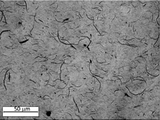
- the proportion of carbon nanotubes contained in beams longer than 10 ⁇ m was determined by comparing the optical density at a wavelength of 500 nm of suspension (C) and suspension after removal of long beams from it by sedimentation during centrifugation at 8000 g for 1 hour. A micrograph of the suspension deposited between the slides is shown in . The micrograph clearly shows long bundles of carbon nanotubes up to 2 ⁇ m thick and 10 to 50 ⁇ m long.
- the suspension was diluted with water to a SWCNT concentration in the suspension of 0.001% wt. (400 times). Before sedimentation, the suspension was diluted with water to a concentration of SWCNTs in the suspension of 0.01% wt.
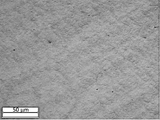
- a micrograph of the suspension after sedimentation by centrifugation is shown in .
- the micrograph does not show long bundles of carbon nanotubes.
- the optical density of the suspension (C), diluted 400 times, with an optical path length of 10 mm is 0.56, which corresponds to the SWCNT concentration in the suspension (C) of 0.38% wt.
- the optical density of the suspension (C) diluted by 40 times, subjected to sedimentation and diluted by another 10 times, is 0.45, which corresponds to the SWCNT concentration in the suspension (C) of 0.31% wt.
- the proportion of carbon nanotubes included in long bundles of carbon nanotubes with a length of more than 10 ⁇ m is 19 wt%. of the total amount of carbon nanotubes in suspension.
- the distribution of the number of carbon nanotube bundles by their size was determined by the method of dynamic light scattering (DLS) diluted to a SWCNT concentration of 0.001% wt. suspension (C).
- DLS dynamic light scattering
- C 0.001% wt. suspension
- the size distribution of the number of nanotube bundles is bimodal with hydrodynamic diameters in the ranges of 100–700 nm and 4–6 ⁇ m.
- the second distribution mode corresponds to nanotube bundles with a length of more than 10 ⁇ m, the mass fraction of which was determined as described above, about 19% wt.
- carbon nanotubes in the composition of the resulting paste are single-walled carbon nanotubes combined into bundles with a length of more than 10 microns. Beams of single-walled carbon nanotubes are bimodally distributed along the length of the beam with a more intense mode at a length of 4 ⁇ m.
- the resulting anode paste was applied to copper foil with a doctor blade, dried at 40 ° C. for 1 hour, and compacted on a calender with a force of 5 tons to an anode material density of 1.2 g/cm 3 .
- the loading of active material on the anode is 2.2 mg/cm2.
- an anode with an area of 17.5 cm 2 was cut out and a nickel lead was welded to it. No carbon nanotubes were added to the anode, except for those introduced as part of the anode paste. Thus, 19% of the mass.
- carbon nanotubes in the composition of the anode are single-walled carbon nanotubes combined into bundles with a length of more than 10 microns. Bundles of single-walled carbon nanotubes are bimodally distributed along the beam length with a more intense distribution mode at a beam length of less than 4 ⁇ m.
- a cell was assembled with a Li cathode and a Li reference electrode and an electrolyte, which is a 1 M solution of LiPF 6 in a mixture of solvents propylene carbonate: ethyl methyl carbonate: dimethyl carbonate in a volume ratio of 1: 1: 1 with the addition of 5% vol. vinyl carbonate.
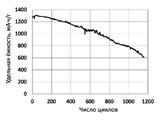
- the initial specific capacitance of the anode at a charge current of 2 A/g of anode material is 1296 mA . h/g anode material.
- the dependence of the specific capacity on the number of charge-discharge cycles (charge current 2 A/g, discharge current 1 A/g) is shown in .
- the anode does not lose its specific capacity (1318 mA h/g) .
- the specific capacitance of the anode is 1050 mA . h/g, i.e. more than 80% of the initial specific capacity.
- a lithium ion battery was assembled from the obtained anode and a cathode whose active material is nickel-cobalt-manganese oxide (NCM) with an atomic ratio of Ni:Co:Mn 6:2:2 with a loading of 16 mg/cm2.
- NCM nickel-cobalt-manganese oxide
- a 10 ⁇ m lithium foil was placed on the anode to increase the Coulomb efficiency of the first cycle.
- a 25 ⁇ m thick polypropylene separator was used.
- As an electrolyte a 1 M solution of LiPF 6 was used in a mixture of solvents propylene carbonate: ethyl methyl carbonate: dimethyl carbonate in a volume ratio of 1: 1: 1 with the addition of 5% vol. vinyl carbonate.
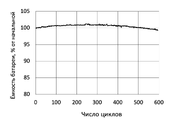
- the initial battery capacity at a discharge current of 0.1 C was 46.5 mAh.
- the dependence of the capacity related to the initial capacity on the number of charge-discharge cycles (charge current 46 mA, discharge current 46 mA) is shown in .
- the battery does not lose its capacity (99.6%).
- the battery capacity is 39 mA . h, i.e. more than 83.5% of the initial capacity.
- the powder composition (K) was used as in Example 1.
- a suspension (C) of Tuball ® single-walled carbon nanotubes (SWCNTs) in n-methylpyrrolidone with a BYK-LP N24710 dispersant was used.
- the SWCNT diameter is distributed in the range from 1.2 to 2.1 nm and an average diameter of 1.49 nm (the diameter was determined by TEM methods of the dry residue of the suspension, as well as by the positions of the absorption bands S 1-1 in the optical absorption spectrum of the suspension).
- Raman spectroscopy at a wavelength of 532 nm shows the presence of a strong G band at 1580 cm -1 characteristic of single wall carbon nanotubes and a D band at ca. 1330 cm -1 characteristic of other allotropic forms of carbon and defects in single-walled carbon nanotubes.
- the intensity ratio of the G/D bands is 64.
- the SWCNT concentration in the suspension is 0.4% wt.
- the concentration of the dispersant BYK-LP N24710 is 0.8% wt.
- the proportion of carbon nanotubes contained in beams with a length of more than 10 ⁇ m was determined by comparing the optical density at a wavelength of 500 nm of the suspension (C) and the suspension after removal of long beams from it by sedimentation during centrifugation at 8000 g for 1 hour.
- a micrograph of the suspension deposited between the slides is shown in . The micrograph clearly shows long bundles of carbon nanotubes up to 2 ⁇ m thick and 10 to 50 ⁇ m long.
- the suspension was diluted with n-methylpyrrolidone to a SWCNT concentration in the suspension of 0.001% wt. (400 times).
- the suspension was diluted with n-methylpyrrolidone to a SWNT concentration in the suspension of 0.01 wt %. (40 times).
- a micrograph of the suspension after sedimentation by centrifugation is shown in .
- the micrograph does not show long bundles of carbon nanotubes.
- the optical density of the suspension (C), diluted 400 times, in a cell 10 mm thick is 0.56, which corresponds to the SWCNT concentration in the suspension (C) of 0.38% wt.
- the optical density of the suspension (C) diluted 40 times and subjected to sedimentation and then further diluted 10 times is 0.30, which corresponds to the SWCNT concentration in the suspension (C) of 0.21% wt.
- the proportion of carbon nanotubes included in long bundles of carbon nanotubes with a length of more than 10 ⁇ m is about 54 wt%. of the total amount of carbon nanotubes in suspension.
- the size distribution of the number of carbon nanotube bundles was determined by dynamic light scattering (DLS) of a 400-fold diluted suspension (C).
- DLS dynamic light scattering
- C 400-fold diluted suspension
- the size distribution of the number of nanotube bundles is bimodal with hydrodynamic diameters in the ranges of 100–700 nm and 4–8 ⁇ m.
- the second distribution mode corresponds to nanotube bundles with a length of more than 10 ⁇ m, the mass fraction of which was determined as described above, about 54% wt.
- composition (K) 400 g was added and mixed using an overhead stirrer with a disk impeller at an impeller speed of 2000 rpm for 30 minutes. After that, 0.53 g of polyvinylidene fluoride powder was added, mixed under the same conditions for 2 hours, after which a homogeneous anode paste was obtained.
- the dry matter of the anode paste contains 90% wt. active component, 3% wt. carbon nanotubes, 6% wt. dispersant BYK-LP N24710 and 1% wt. polyvinylidene fluoride. 60% wt.
- carbon nanotubes in the composition of the resulting paste are single-walled carbon nanotubes combined into bundles with a length of more than 10 microns. Bundles of single-walled carbon nanotubes are bimodally distributed along the beam length with a more intense mode at a length of less than 3.7 ⁇ m.
- the resulting anode paste was applied to copper foil using a doctor blade, dried at 110 ° C. for 1 hour, and compacted on a calender with a force of 5 tons to an anode material density of 1.3 g/cm 3 .
- the loading of active material on the anode is 2.4 mg/cm2.
- an anode with an area of 17.5 cm 2 was cut out and a nickel lead was welded to it. No carbon nanotubes were added to the anode, except for those introduced as part of the anode paste. Thus, 54% of the mass.
- carbon nanotubes in the composition of the anode are single-walled carbon nanotubes combined into bundles with a length of more than 10 microns. Bundles of single-walled carbon nanotubes are bimodally distributed along the beam length with a more intense distribution mode at a beam length of less than 3.7 ⁇ m.
- a cell was assembled with a Li cathode and a Li reference electrode and an electrolyte, which is a 1 M solution of LiPF 6 in a mixture of solvents propylene carbonate: ethyl methyl carbonate: dimethyl carbonate in a volume ratio of 1: 1: 1 with the addition of 5% vol. vinyl carbonate.
- the initial specific capacitance of the anode at a charge current of 2 A/g of the anode material is 1079 mA . h/g anode material.
- the dependence of the specific capacity on the number of charge-discharge cycles (charge current 2 A/g, discharge current 1 A/g) is shown in .
- the anode does not lose its specific capacity (1116 mA h/g) .
- the specific capacitance of the anode is 868 mA . h/g, i.e. more than 80% of the initial specific capacity.
- the anode paste was prepared analogously to Example 1, however, dispersed silicon powder with a CSR size of 60 nm and a median mass distribution of powder particles over a diameter of 2.5 ⁇ m was used as composition (K), and simultaneously with composition (K), a solvent was added to suspension (C), water, and a dispersant, Na-carboxymethylcellulose. Composition (K) was wetted before being added to (C) with a solution of Na-carboxymethylcellulose to avoid the ingress of dispersed silicon dust into the air of the working area. According to the change in the weight of the composition sample (K) in thermally programmed oxidation in a stream of oxygen with increasing temperature, the used silicon powder is partially oxidized and contains X-ray amorphous silicon oxide.
- the oxygen deficiency with respect to the stoichiometry of SiO 2 is 104 wt%. from the initial weight of the composition (K) (mass gain in the temperature range from 200 to 1400 o C). Accordingly, the total atomic ratio of the content of elements oxygen:silicon in the composition of the specified set of phases is 0.09.
- the anode was prepared from the obtained anode paste as in Example 1.
- the initial specific capacity of the anode at a charge current of 2 A/g of anode material is 1160 mAh/g of anode material.
- the anode specific capacity is 1115 mAh/g.
- the specific capacity of the anode is 970 mAh/g, i.e. more than 83% of the initial specific capacity.
- carbon nanotubes in the composition of the anode are single-walled carbon nanotubes combined into bundles with a length of more than 10 microns. Bundles of single-walled carbon nanotubes are bimodally distributed along the beam length with a more intense distribution mode at a beam length of less than 4 ⁇ m.
- a lithium-ion battery was made using the obtained anode similarly to Example 1.
- the initial capacity of the battery at a discharge current of 0.1 C was 44.8 mA . h.
- charge current 45 mA, discharge current 45 mA the battery does not lose its capacity (99.0%).
- the battery capacity is 37 mA . h, i.e. more than 82.5% of the initial capacity.
- the anode paste was prepared analogously to Example 1, however, as suspension (C), an aqueous suspension of a mixture of single-walled and double-walled carbon nanotubes with diameters from 1.2 to 2.8 nm and an average diameter of 1.8 nm was used (the diameter was determined by TEM methods of the dry residue of the suspension , as well as by the positions of the respiratory mode bands in the Raman spectra) and after the stage of introducing composition K into suspension (C), styrene-butadiene rubber latex was added to the resulting mixture, after which the resulting mixture was stirred until a homogeneous paste.
- the intensity ratio of the G/D bands in the Raman spectrum is 34.
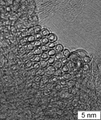
- the presence of double-walled carbon nanotubes bundled together with single-walled carbon nanotubes is confirmed by electron micrographs shown in Fig. .
- the concentration of carbon nanotubes in an aqueous suspension (C) is 0.05% wt.
- the suspension also contains 0.1% wt.
- Li-carboxymethylcellulose (Li-CMC) as a dispersant.
- the proportion of carbon nanotubes included in long bundles of carbon nanotubes with a length of more than 10 ⁇ m is 12 wt%. of the total amount of carbon nanotubes in suspension.
- carbon nanotube beams are distributed bimodally with modes at hydrodynamic diameters of 360 nm and about 6 ⁇ m (the second maximum is very weak).
- composition (K) 2.0 g of composition (K) and at the same time 0.3 g of 20% wt. were added to 30 g of suspension (C).
- suspension (C) styrene-butadiene rubber latex and mixed until a homogeneous paste is obtained.
- the dry matter of the obtained anode paste contains 94.9% wt. active component, 2.9% styrene-butadiene rubber, 1.47% Li-carboxymethylcellulose and 0.73% wt. carbon nanotubes.
- 12% wt. carbon nanotubes in the resulting paste are single-walled and double-walled carbon nanotubes combined into bundles with a length of more than 10 microns. Beams of single-walled and double-walled carbon nanotubes are bimodally distributed along the length of the beam with a more intense distribution mode at a length of less than 3.6 ⁇ m.
- the anode was prepared from the obtained anode paste similarly to Example 1.
- the initial specific capacitance of the anode at a charge current of 2 A/g of the anode material is 1481 mA . h/g anode material.
- the anode specific capacity is 1284 mA . h/g
- the specific capacitance of the anode is 1193 mA . h/g, i.e. more than 80% of the initial specific capacity.
- 12% wt. carbon nanotubes in the composition of the anode are single-walled and double-walled carbon nanotubes combined into bundles with a length of more than 10 microns. Beams of single-walled and double-walled carbon nanotubes are bimodally distributed along the length of the beam with a more intense distribution mode at a beam length of less than 3.6 ⁇ m.
- the anode paste was prepared similarly to Example 2, however, a suspension in n-methylpyrrolidone (NMP) of a mixture of single-walled and multi-walled carbon nanotubes was used as suspension (C), and simultaneously with the introduction of composition K into suspension (C), a solution of Li-salt of polyacrylic acid was added to it in NMP, after which the resulting mixture was stirred until a homogeneous paste.
- NMP n-methylpyrrolidone
- C n-methylpyrrolidone
- a solution of Li-salt of polyacrylic acid was added to it in NMP, after which the resulting mixture was stirred until a homogeneous paste.
- the concentration of single-walled carbon nanotubes in suspension (C) is 0.4% wt.
- the concentration of multi-walled carbon nanotubes is 3.0% wt.
- the average diameter of single-walled carbon nanotubes is 1.6 nm
- the average diameter of multi-walled carbon nanotubes is 10 nm (the diameter was determined by TEM methods of the dry residue of the suspension, and for single-walled carbon nanotubes, also by the positions of the respiratory mode bands in the Raman spectra).
- the intensity ratio of the G/D bands in the Raman spectrum of the dry residue of the suspension is 7.
- the suspension also contains 1.0% wt. polyvinylpyrrolidone (PVP) as a dispersant.
- particles in suspension have a wide asymmetric unimodal distribution with a mode at a hydrodynamic diameter of 300 nm.
- the anode was prepared from the obtained anode paste similarly to Example 2.
- the initial specific capacitance of the anode at a charge current of 2 A/g of the anode material is 963 mA . h/g anode material.
- the anode specific capacity is 928 mA . h/g
- the specific capacitance of the anode is 795 mA . h/g, i.e. more than 82% of the initial specific capacity.
- 6% wt. carbon nanotubes in the composition of the anode are single-walled carbon nanotubes combined into bundles with a length of more than 10 microns. Beams of carbon nanotubes in the anode are distributed along the length with a mode at a beam length of less than 3 ⁇ m.
- the anode paste was prepared similarly to Example 2, however, as a suspension (C), a suspension of single-walled carbon nanotubes was used, the surface of which contains functional groups containing chlorine and functional groups containing oxygen, in dimethylacetamide (DMAA) and after the stage of introducing the composition (K) into the suspension (C), a dispersant - polyvinylpyrrolidone was added to the resulting mixture, after which the resulting mixture was stirred until a homogeneous paste.
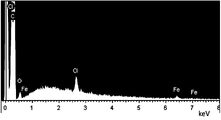
- the suspension contains 0.6% single-walled carbon nanotubes in n-methylpyrrolidone. According to the results of elemental analysis by energy dispersive spectroscopy (EDS), the dry residue of the suspension contains 97.1% wt. carbon; 2.2% wt.
- the surface of carbon nanotubes in suspension (C) contains more than 0.47 wt. functional groups containing chlorine and more than 2.2% wt. functional groups containing oxygen.
- the ratio of the integral intensities of the G-mode and D-mode is 97.
- Single-walled carbon nanotubes are distributed in diameter in the range from 1.2 to 2.8 nm with an average diameter of 1.6 nm (the diameter was determined by TEM methods of the dry residue of the suspension, as well as by the positions of the respiratory mode bands in the Raman spectra)
- carbon nanotube bundles are bimodally distributed over the hydrodynamic diameter with modes at 420 nm (more intense) and 6.5 ⁇ m (less intense).
- composition (K) 2.0 g was added to 30 g of suspension (C) and mixed, after which 1.5 g of 5% wt. a solution of polyvinylpyrrolidone in DMAA and the resulting mixture was stirred until a homogeneous paste was obtained.
- the dry matter of the obtained anode paste contains 88.4% wt. active component, 3.4% polyvinylpyrrolidone and 8.2% wt. single-walled carbon nanotubes. 28% wt. carbon nanotubes in the composition of the resulting paste are single-walled carbon nanotubes combined into bundles with a length of more than 10 microns. Beams of single-walled carbon nanotubes in the anode paste are distributed along the length of the beam bimodally with a more intense mode at a length of less than 4.2 ⁇ m.
- the anode was prepared from the obtained anode paste as in Example 2.
- the initial specific capacitance of the anode at a charge current of 2 A/g of the anode material is 1122 mA . h/g anode material.
- the anode specific capacity is 1081 mA . h/g
- the specific capacitance of the anode is 931 mA . h/g, i.e. more than 83% of the initial specific capacity. 28% wt.
- carbon nanotubes in the composition of the resulting paste are single-walled carbon nanotubes combined into bundles with a length of more than 10 microns.
- the bundles of single-walled carbon nanotubes in the anode are bimodally distributed along the bundle length with a more intense mode at a length of less than 4.2 ⁇ m.
- the anode paste was prepared similarly to Example 2, however, a suspension of 0.25 wt. % was used as suspension (C).
- suspension a suspension of 0.25 wt. % was used as suspension (C).
- single-walled carbon nanotubes modified with fluorine in n-methylpyrrolidone after mixing (C) with composition (K), polyvinylidene fluoride (PVDF) powder was added to the resulting mixture.
- Single-walled carbon nanotubes in the composition of the suspension were modified with fluorine.
- carbon nanotubes in suspension are single-walled with an average diameter of 1.5 nm, which is also confirmed by data on the position of absorption bands S 1-1 in the optical absorption spectrum.
- the mass fraction of fluorine in the composition of carbon nanotubes is 14%, the mass fraction of oxygen is 7%, and the rest is carbon.
- the G/D ratio in the spectrum of Raman scattering of light with a wavelength of 532 nm is 2.4. Such a low value of G/D also confirms the high degree of functionalization of the SWCNT surface by fluorine-containing functional groups.
- a micrograph of the suspension (C) is shown in .
- carbon nanotube bundles are bimodally distributed over the hydrodynamic diameter with modes at 370 nm (more intense) and 4.8 ⁇ m (less intense).
- suspension (C) 30 g was placed in a beaker with a volume of 100 cm 3 , after which 2.375 g of composition (K) was added to it and mixed using an overhead mixer with a disk impeller at an impeller rotation speed of 2000 rpm for 0.5 hour, after which 50 mg of polyvinylidene fluoride powder was added and stirred under the same conditions for another 2 hours until a homogeneous anode paste was obtained.
- the dry matter of the obtained anode paste contains 95% wt. active component, 3% wt. Carbon nanotubes, 2% wt. polyvinylidene fluoride. 9% wt.
- carbon nanotubes in the composition of the resulting paste are single-walled carbon nanotubes combined into bundles with a length of more than 10 microns.
- Single-walled carbon nanotube bundles are bimodally distributed along the beam length with a smaller beam length mode of less than 3.7 ⁇ m.
- the anode was prepared from the obtained anode paste in the same way as in Example 2.
- the loading of the active material on the anode is 2.4 mg/cm2.
- an anode with an area of 17.5 cm 2 was cut out and a nickel lead was welded to it.
- No carbon nanotubes were added to the anode, except for those introduced as part of the anode paste.
- carbon nanotubes in the composition of the resulting paste are single-walled carbon nanotubes combined into bundles with a length of more than 10 microns.
- Single-walled carbon nanotube bundles are bimodally distributed along the beam length with a smaller beam length mode of less than 3.7 ⁇ m.
- a cell was assembled with a Li cathode and a Li reference electrode and an electrolyte, which is a 1 M solution of LiPF 6 in a mixture of solvents propylene carbonate: ethyl methyl carbonate: dimethyl carbonate in a volume ratio of 1: 1: 1 with the addition of 5% vol. fluoroethylene carbotate.
- the initial specific capacitance of the anode at a charge current of 2 A/g of the anode material is 1257 mA . h/g anode material.
- the dependence of the specific capacity on the number of charge-discharge cycles (charge current 2 A/g, discharge current 1 A/g) is shown in .
- the specific capacitance of the anode increases from 1257 to 1302 mA . h/g After 500 cycles, the specific capacitance of the anode is 1117 mA . h/g, i.e. more than 88% of the initial specific capacity.
- a lithium-ion battery was assembled from the obtained anode and a cathode whose active material is lithium iron phosphate, LiFePO 4 , (LFP) with a loading of 14 mg/cm2.
- a 10 ⁇ m lithium foil was placed on the anode to increase the Coulomb efficiency of the first cycle.
- a 25 ⁇ m thick polypropylene separator was used.
- As an electrolyte a 1 M solution of LiPF 6 was used in a mixture of solvents propylene carbonate: ethyl methyl carbonate: dimethyl carbonate in a volume ratio of 1: 1: 1 with the addition of 5% vol. fluoroethylene carbonate.
- the initial battery capacity at a discharge current of 0.1 C was 37.5 mA . h.
- the dependence of the capacity, referred to the initial capacity, on the number of charge-discharge cycles (charge and discharge current 37.5 mA) is shown in .
- the battery increases its capacity somewhat.
- the battery capacity is 37.5 mA . h i.e. 100% of the initial capacity.
- the anode paste was prepared similarly to Example 1, however, after the composition (K) was added to the suspension (C) and mixed, graphite was additionally added to it, mixed and styrene-butadiene latex was additionally added, after which it was mixed to a homogeneous paste.
- composition (K) 225 g was placed in a beaker with a volume of 400 cm 3 , after which 13.5 g of composition (K) was added to it and mixed using an overhead mixer with a disk impeller at an impeller rotation speed of 2000 rpm for 0.5 h; then added 13.5 g of graphite with a BET specific surface of 3 m 2 /g, stirred for 2 h; added 3.5 g of 20% wt. styrene-butadiene latex and stirred under the same conditions for another 2 hours until a homogeneous anode paste was obtained.
- the dry matter of the obtained anode paste contains 50.1% wt. compositions (K), 3% wt. carbon nanotubes, 40% wt.
- carbon nanotubes in the composition of the resulting paste are single-walled carbon nanotubes combined into bundles with a length of more than 10 microns. Bundles of single-walled carbon nanotubes are bimodally distributed along the beam length with a more intense mode at a length of less than 4 ⁇ m.
- the resulting anode paste was applied to copper foil using a doctor blade, dried at 50 ° C. for 1 hour, and compacted on a calender with a force of 7 tons to an anode material density of 1.4 g/cm 3 .
- the loading of active material on the anode is 3.2 mg/cm2.
- an anode with an area of 17.5 cm 2 was cut out and a nickel lead was welded to it. No carbon nanotubes were added to the anode, except for those introduced as part of the anode paste. Thus, 19% of the mass.
- carbon nanotubes in the composition of the anode are single-walled carbon nanotubes combined into bundles with a length of more than 10 microns.
- the beams of single-walled carbon nanotubes in the anode are bimodally distributed along the length of the beam with a more intense mode at a length of less than 4 ⁇ m.
- a cell was assembled with a Li cathode and a Li reference electrode and an electrolyte, which is a 1 M solution of LiPF 6 in a mixture of solvents propylene carbonate: ethyl methyl carbonate: dimethyl carbonate in a volume ratio of 1: 1: 1 with the addition of 3% vol. vinyl carbonate.
- the initial specific capacitance of the anode at a charge current of 2 A/g of the anode material is 634 mA . h/g anode material.
- the dependence of the specific capacity on the number of charge-discharge cycles (charge current 2 A/g, discharge current 1 A/g) is shown in .
- the specific capacitance of the anode grows to 670-690 mA . h/g
- the specific capacitance of the anode is 581 mA . h/g, i.e. more than 91% of the initial specific capacity.
- the anode paste was prepared analogously to Example 1, but an aqueous suspension (C) of single-walled carbon nanotubes (SWCNTs) Tuball ® was used for preparation, practically not containing long beams of single-walled carbon nanotubes with a length of more than 10 ⁇ m.
- C aqueous suspension
- SWCNTs single-walled carbon nanotubes
- the proportion of carbon nanotubes contained in beams with a length of more than 10 ⁇ m was determined by comparing the optical density at a wavelength of 500 nm of suspension (C) and suspension after removal of long beams from it by sedimentation during centrifugation similar to Example 1.
- the optical density of suspension (C) diluted in 400 times, in a cell with an optical path length of 10 mm is 0.58, which corresponds to the SWCNT concentration in the suspension (C) of 0.39% wt.
- the optical density of the suspension (C) diluted 400 times and subjected to sedimentation is 0.56, which corresponds to the SWCNT concentration in the suspension (C) of 0.38 wt%.
- the proportion of carbon nanotubes included in long bundles of carbon nanotubes with a length of more than 10 ⁇ m is less than 3 wt%. of the total amount of carbon nanotubes in suspension.
- the intensity ratio of the bands G/D for the dry residue of this suspension (C) is 87.
- concentration of SWCNTs in the suspension is 0.4% of the mass. and the suspension also contains 0.6% wt. Na-carboxymethylcellulose (CMC) as a dispersant.
- CMC Na-carboxymethylcellulose
- the dry matter of the obtained anode paste contains 90% of the mass. active component, 3% wt. carbon nanotubes, 4.5% of the mass. Na-CMC and 2.5% wt. styrene butadiene rubber.
- the procedures for manufacturing the anode and assembling the cell for its testing were carried out similarly to Example 1.
- the initial specific capacitance of the anode at a charge current of 2 A/g of the anode material is 1241 mA . h/g of the anode material, which is very close to the capacity of the anode according to Example 1.
- the specific capacity of the anode drops to 1056 mA . h/g
- the specific capacitance of the anode is 712 mA . h/g, i.e. less than 58% of the initial specific capacity.
- suspension (C) the absence of long bundles of carbon nanotubes in the suspension (C) negatively affects the number of cycles that the anode can withstand before losing 20% of the initial capacity.
- the presence in suspension (C) of carbon nanotube bundles with a length of more than 10 ⁇ m is necessary to achieve the claimed technical result.
- the present invention can be used in the electrical industry, in particular in the production of lithium-ion batteries, lithium-ion batteries with a silicon-containing negative electrode (anode), as well as in the production of lithium-ion battery anodes.
Landscapes
- Chemical & Material Sciences (AREA)
- Engineering & Computer Science (AREA)
- Chemical Kinetics & Catalysis (AREA)
- Electrochemistry (AREA)
- General Chemical & Material Sciences (AREA)
- Materials Engineering (AREA)
- Manufacturing & Machinery (AREA)
- Nanotechnology (AREA)
- Organic Chemistry (AREA)
- Inorganic Chemistry (AREA)
- Composite Materials (AREA)
- Battery Electrode And Active Subsutance (AREA)
Priority Applications (5)
| Application Number | Priority Date | Filing Date | Title |
|---|---|---|---|
| CN202180008319.7A CN114929617B (zh) | 2020-10-19 | 2021-07-23 | 用于生产锂离子电池的阳极浆料的方法 |
| KR1020227046114A KR20230092833A (ko) | 2020-10-19 | 2021-07-23 | 리튬 이온 배터리용 애노드 슬러리의 제조방법 |
| JP2022559495A JP2023545227A (ja) | 2020-10-19 | 2021-07-23 | リチウムイオン電池用の負極ペーストを作製するための方法 |
| US17/927,484 US12562371B2 (en) | 2020-10-19 | 2021-07-23 | Method for producing anode paste for lithium-ion battery |
| EP21883393.7A EP4230581A4 (en) | 2020-10-19 | 2021-07-23 | PROCESS FOR PRODUCING ANODIC PASTE FOR LITHIUM ION BATTERY |
Applications Claiming Priority (2)
| Application Number | Priority Date | Filing Date | Title |
|---|---|---|---|
| RU2020134119 | 2020-10-19 | ||
| RU2020134119A RU2749904C1 (ru) | 2020-10-19 | 2020-10-19 | Способ приготовления анодной пасты для литий-ионной батареи, анодная паста, способ изготовления анода (варианты), анод (варианты) и литий-ионная батарея (варианты) |
Publications (1)
| Publication Number | Publication Date |
|---|---|
| WO2022086371A1 true WO2022086371A1 (ru) | 2022-04-28 |
Family
ID=76377326
Family Applications (1)
| Application Number | Title | Priority Date | Filing Date |
|---|---|---|---|
| PCT/RU2021/050237 Ceased WO2022086371A1 (ru) | 2020-10-19 | 2021-07-23 | Способ приготовления анодной пасты для литий-ионной батареи |
Country Status (7)
| Country | Link |
|---|---|
| US (1) | US12562371B2 (https=) |
| EP (1) | EP4230581A4 (https=) |
| JP (1) | JP2023545227A (https=) |
| KR (1) | KR20230092833A (https=) |
| CN (1) | CN114929617B (https=) |
| RU (1) | RU2749904C1 (https=) |
| WO (1) | WO2022086371A1 (https=) |
Cited By (3)
| Publication number | Priority date | Publication date | Assignee | Title |
|---|---|---|---|---|
| EP4386890A1 (en) * | 2022-12-13 | 2024-06-19 | Prime Planet Energy & Solutions, Inc. | Negative electrode for non-aqueous electrolyte secondary battery, and method of producing the same |
| WO2024171952A1 (ja) * | 2023-02-15 | 2024-08-22 | 日本ゼオン株式会社 | 非水系二次電池用負極および非水系二次電池 |
| WO2024171953A1 (ja) * | 2023-02-15 | 2024-08-22 | 日本ゼオン株式会社 | 非水系二次電池用負極および非水系二次電池 |
Families Citing this family (5)
| Publication number | Priority date | Publication date | Assignee | Title |
|---|---|---|---|---|
| CN118476050A (zh) | 2021-12-29 | 2024-08-09 | Mcd技术有限公司 | 碳纳米管水性分散体、浆料、阴极和阳极 |
| US20240376289A1 (en) * | 2021-12-29 | 2024-11-14 | Mcd Technologies S.A R.L. | Carbon nanotube dispersion, cathode paste and cathode |
| JP2025501317A (ja) * | 2022-10-21 | 2025-01-17 | エルジー エナジー ソリューション リミテッド | 負極組成物、これを含むリチウム二次電池用負極、および負極を含むリチウム二次電池 |
| WO2024168473A1 (zh) * | 2023-02-13 | 2024-08-22 | 宁德时代新能源科技股份有限公司 | 二次电池及用电装置 |
| WO2025237655A1 (en) | 2024-05-15 | 2025-11-20 | MCD Technologies S.à r.l. | An additive to an electrode paste and a method to prepare the additive |
Citations (10)
| Publication number | Priority date | Publication date | Assignee | Title |
|---|---|---|---|---|
| US8263265B2 (en) | 2007-07-27 | 2012-09-11 | Samsung Sdi Co., Ltd. | Si/C composite, anode active materials, and lithium battery including the same |
| CN102891017A (zh) * | 2012-10-19 | 2013-01-23 | 东风汽车有限公司 | 碳纳米管复合的混合型超级电容器正极极片及其制作方法 |
| US8697286B2 (en) | 2008-12-02 | 2014-04-15 | Samsung Electronics Co., Ltd. | Anode active material, anode including the anode active material, method of manufacturing the anode, and lithium battery including the anode |
| CN107331440A (zh) * | 2017-06-29 | 2017-11-07 | 奇瑞汽车股份有限公司 | 一种碳纳米管导电浆、正极材料的制备方法及锂电池 |
| EP2755263B1 (en) | 2012-11-30 | 2018-01-03 | LG Chem, Ltd. | Anode active material comprising porous silicon oxide-carbon material complex and method for preparing same |
| CN108390027A (zh) * | 2018-01-23 | 2018-08-10 | 柔电(武汉)科技有限公司 | 一种电极浆料、柔性极片及其制备方法、柔性电池 |
| CN110085866A (zh) * | 2019-05-14 | 2019-08-02 | 哈尔滨万鑫石墨谷科技有限公司 | 一种碳纳米管导电浆料及其制备方法和用途 |
| RU2696479C1 (ru) * | 2018-10-08 | 2019-08-02 | Федеральное государственное бюджетное образовательное учреждение высшего образования "Московский авиационный институт (национальный исследовательский университет)" | Способ изготовления электродов химического источника тока |
| RU2717516C2 (ru) | 2018-04-23 | 2020-03-23 | МСД Текнолоджис С.а.р.л. | Способ получения углеродного материала, модифицированного хлором, и углеродный материал, модифицированный хлором, способ получения композиционного электропроводящего материала и электропроводящий композиционный материал |
| RU2731884C1 (ru) * | 2020-01-29 | 2020-09-08 | Автономная некоммерческая образовательная организация высшего образования "Сколковский институт науки и технологий" | Анод для калий-ионных аккумуляторов |
Family Cites Families (15)
| Publication number | Priority date | Publication date | Assignee | Title |
|---|---|---|---|---|
| FR2866028B1 (fr) | 2004-02-11 | 2006-03-24 | Michelin Soc Tech | Systeme plastifiant pour composition de caoutchouc |
| CN101439972B (zh) * | 2007-11-21 | 2013-01-09 | 比亚迪股份有限公司 | 硅碳复合材料及其制备方法以及电池负极和锂离子电池 |
| WO2013085498A1 (en) * | 2011-12-06 | 2013-06-13 | CNano Technology Limited | Carbon nanotube based pastes |
| DE102013213273A1 (de) * | 2013-02-22 | 2014-08-28 | Bayer Materialscience Aktiengesellschaft | Kohlenstoffnanoröhren-haltige Dispersion und ihre Verwendung in der Herstellung von Elektroden |
| JP6599106B2 (ja) | 2014-02-12 | 2019-10-30 | 大阪瓦斯株式会社 | リチウム二次電池用負極材料及びその製造方法、並びに該負極材料を用いたリチウム二次電池用の負極活物質層用組成物、リチウム二次電池用負極及びリチウム二次電池 |
| JP6319564B2 (ja) * | 2014-03-31 | 2018-05-09 | 戸田工業株式会社 | カーボンナノチューブ分散液および非水電解質二次電池 |
| JP6871167B2 (ja) * | 2015-10-05 | 2021-05-12 | 積水化学工業株式会社 | 負極材、負極及びリチウムイオン二次電池 |
| KR102590425B1 (ko) * | 2018-10-24 | 2023-10-18 | 주식회사 엘지에너지솔루션 | 입경이 상이한 흑연 및 실리콘계 소재를 포함하는 음극 및 이를 포함하는 리튬 이차전지 |
| JP7196597B2 (ja) * | 2018-12-27 | 2022-12-27 | 東洋インキScホールディングス株式会社 | カーボンナノチューブ分散液およびその利用 |
| CN109694507A (zh) | 2018-12-29 | 2019-04-30 | 山东毅狮迈特种轮胎股份有限公司 | 一种导静电实心胎面胶配方及其制备方法 |
| EP3680961A1 (en) * | 2019-01-09 | 2020-07-15 | The Provost, Fellows, Scholars and other Members of Board of Trinity College Dublin | Highly efficient electrodes enabled by segregated networks |
| EP3916846A4 (en) * | 2019-03-08 | 2022-03-23 | Lg Energy Solution, Ltd. | ANODE AND SECONDARY BATTERY WITH THE ANODE |
| WO2020197672A1 (en) * | 2019-03-22 | 2020-10-01 | Cabot Corporation | Anode electrode compositions and aqueous dispersions for battery applications |
| KR102764103B1 (ko) * | 2019-08-05 | 2025-02-10 | 주식회사 엘지에너지솔루션 | 음극, 이의 제조방법 및 이를 포함하는 이차전지 |
| RU2731635C9 (ru) | 2019-11-05 | 2020-11-12 | МСД Текнолоджис С.а.р.л. | Электропроводящая резиновая композиция для сплошных шин и не оставляющая следов сплошная шина |
-
2020
- 2020-10-19 RU RU2020134119A patent/RU2749904C1/ru active
-
2021
- 2021-07-23 JP JP2022559495A patent/JP2023545227A/ja active Pending
- 2021-07-23 CN CN202180008319.7A patent/CN114929617B/zh active Active
- 2021-07-23 US US17/927,484 patent/US12562371B2/en active Active
- 2021-07-23 EP EP21883393.7A patent/EP4230581A4/en active Pending
- 2021-07-23 KR KR1020227046114A patent/KR20230092833A/ko active Pending
- 2021-07-23 WO PCT/RU2021/050237 patent/WO2022086371A1/ru not_active Ceased
Patent Citations (11)
| Publication number | Priority date | Publication date | Assignee | Title |
|---|---|---|---|---|
| US8263265B2 (en) | 2007-07-27 | 2012-09-11 | Samsung Sdi Co., Ltd. | Si/C composite, anode active materials, and lithium battery including the same |
| US8617746B2 (en) | 2007-07-27 | 2013-12-31 | Samsung Sdi Co., Ltd. | Si/C composite, anode active materials, and lithium battery including the same |
| US8697286B2 (en) | 2008-12-02 | 2014-04-15 | Samsung Electronics Co., Ltd. | Anode active material, anode including the anode active material, method of manufacturing the anode, and lithium battery including the anode |
| CN102891017A (zh) * | 2012-10-19 | 2013-01-23 | 东风汽车有限公司 | 碳纳米管复合的混合型超级电容器正极极片及其制作方法 |
| EP2755263B1 (en) | 2012-11-30 | 2018-01-03 | LG Chem, Ltd. | Anode active material comprising porous silicon oxide-carbon material complex and method for preparing same |
| CN107331440A (zh) * | 2017-06-29 | 2017-11-07 | 奇瑞汽车股份有限公司 | 一种碳纳米管导电浆、正极材料的制备方法及锂电池 |
| CN108390027A (zh) * | 2018-01-23 | 2018-08-10 | 柔电(武汉)科技有限公司 | 一种电极浆料、柔性极片及其制备方法、柔性电池 |
| RU2717516C2 (ru) | 2018-04-23 | 2020-03-23 | МСД Текнолоджис С.а.р.л. | Способ получения углеродного материала, модифицированного хлором, и углеродный материал, модифицированный хлором, способ получения композиционного электропроводящего материала и электропроводящий композиционный материал |
| RU2696479C1 (ru) * | 2018-10-08 | 2019-08-02 | Федеральное государственное бюджетное образовательное учреждение высшего образования "Московский авиационный институт (национальный исследовательский университет)" | Способ изготовления электродов химического источника тока |
| CN110085866A (zh) * | 2019-05-14 | 2019-08-02 | 哈尔滨万鑫石墨谷科技有限公司 | 一种碳纳米管导电浆料及其制备方法和用途 |
| RU2731884C1 (ru) * | 2020-01-29 | 2020-09-08 | Автономная некоммерческая образовательная организация высшего образования "Сколковский институт науки и технологий" | Анод для калий-ионных аккумуляторов |
Non-Patent Citations (4)
| Title |
|---|
| J. GIGAULTI. LE HECHOS. DUBASCOUXM. POTIN-GAUTIER, G: "Lespes Single-walled carbon nanotube length determination by asymmetrical-flow field-flow fractionation hyphenated to multi-angle laser-light scattering", J. CHROMATOGR. A, vol. 1217, 2010, pages 7891 - 7897, XP027503791, DOI: 10.1016/j.chroma.2010.10.042 |
| J. GIGAULTI. LE HECHOS. DUBASCOUXM. POTIN-GAUTIER: "G. Lespes Single-walled carbon nanotube length determination by asymmetrical-flow field-flow fractionation hyphenated to multi-angle laser-light scattering", J. CHROMATOGR. A, vol. 1217, 2010, pages 7891 - 7897, XP027503791, DOI: 10.1016/j.chroma.2010.10.042 |
| N. NAIRW. KIMR.D. BRAATZM.S. STRANO: "Dynamics of Surfactant-Suspended single-walled Carbon Nanotubes in a Centrifugal Field", LANGMUIR, vol. 24, 2008, pages 1790 - 1795, XP002594161, DOI: 10.1021/la702516u |
| See also references of EP4230581A4 |
Cited By (3)
| Publication number | Priority date | Publication date | Assignee | Title |
|---|---|---|---|---|
| EP4386890A1 (en) * | 2022-12-13 | 2024-06-19 | Prime Planet Energy & Solutions, Inc. | Negative electrode for non-aqueous electrolyte secondary battery, and method of producing the same |
| WO2024171952A1 (ja) * | 2023-02-15 | 2024-08-22 | 日本ゼオン株式会社 | 非水系二次電池用負極および非水系二次電池 |
| WO2024171953A1 (ja) * | 2023-02-15 | 2024-08-22 | 日本ゼオン株式会社 | 非水系二次電池用負極および非水系二次電池 |
Also Published As
| Publication number | Publication date |
|---|---|
| RU2749904C1 (ru) | 2021-06-18 |
| EP4230581A4 (en) | 2025-07-30 |
| CN114929617B (zh) | 2023-10-24 |
| JP2023545227A (ja) | 2023-10-27 |
| US20230246166A1 (en) | 2023-08-03 |
| US12562371B2 (en) | 2026-02-24 |
| CN114929617A (zh) | 2022-08-19 |
| EP4230581A1 (en) | 2023-08-23 |
| KR20230092833A (ko) | 2023-06-26 |
Similar Documents
| Publication | Publication Date | Title |
|---|---|---|
| RU2749904C1 (ru) | Способ приготовления анодной пасты для литий-ионной батареи, анодная паста, способ изготовления анода (варианты), анод (варианты) и литий-ионная батарея (варианты) | |
| JP7507086B2 (ja) | 炭素被覆酸化ケイ素/黒鉛複合粒子、製造方法、及びその用途 | |
| KR101594533B1 (ko) | 복합 전극 물질 | |
| CN105340109B (zh) | 电极材料及其在锂离子电池中的用途 | |
| CN108602679A (zh) | 含碳材料及其使用方法 | |
| JP6621663B2 (ja) | 導電性カーボンの製造方法、このカーボンを含む電極材料の製造方法、この電極材料を用いた電極の製造方法及びこの電極を備えた蓄電デバイスの製造方法 | |
| JP6760512B1 (ja) | 二次電池用電極および二次電池 | |
| WO2020090704A1 (ja) | グラフェン分散液およびその製造方法ならびに二次電池用電極 | |
| JPWO2015056760A1 (ja) | 導電性カーボン、このカーボンを含む電極材料、この電極材料を用いた電極及びこの電極を備えた蓄電デバイス | |
| JP2019061932A (ja) | リチウムイオン二次電池用正極材料、リチウムイオン二次電池用正極、リチウムイオン二次電池 | |
| Bubulinca et al. | Fabrication of a flexible binder-free lithium manganese oxide cathode for secondary Li-Ion batteries | |
| Ambalkar et al. | Facile synthesis of SnO 2@ carbon nanocomposites for lithium-ion batteries | |
| WO2015133583A1 (ja) | 導電性カーボン、この導電性カーボンを含む電極材料及びこの電極材料を用いた電極 | |
| JP6760097B2 (ja) | リチウム二次電池用正極およびその製造方法 | |
| JP4495531B2 (ja) | 粒状複合炭素材料およびその製造方法、ならびにリチウムイオン二次電池用負極材料、リチウムイオン二次電池用負極およびリチウムイオン二次電池 | |
| JP2023156006A (ja) | 負極、非水電解質二次電池及び負極の製造方法 | |
| HK40071131A (en) | Method for producing anode paste for a lithium-ion battery | |
| US20230307613A1 (en) | Novel composites for anode electrodes | |
| JP2026509365A (ja) | 電池用電極 | |
| WO2025183133A1 (ja) | 導電助剤、導電助剤分散液、負極合剤スラリー、負極合剤層、負極、及びリチウムイオン電池 | |
| CN120883378A (zh) | 能量存储装置 | |
| CN118402092A (zh) | 锂硫电池用正极和具有高能量密度的锂硫电池 | |
| CN117410460A (zh) | 复合粒子、正极、全固体电池及复合粒子的制造方法 | |
| Seraia et al. | Composite Cathode Based on Lfp and Swcnts Dispersion in Polyacrylonitrile Solution in Dimethylformamide for Lithium-Ion Batteries |
Legal Events
| Date | Code | Title | Description |
|---|---|---|---|
| WWE | Wipo information: entry into national phase |
Ref document number: 2022559495 Country of ref document: JP |
|
| NENP | Non-entry into the national phase |
Ref country code: DE |
|
| ENP | Entry into the national phase |
Ref document number: 2021883393 Country of ref document: EP Effective date: 20230519 |
|
| WWG | Wipo information: grant in national office |
Ref document number: 17927484 Country of ref document: US |