WO2022080413A1 - ベータコロナウイルス低温馴化株及びワクチン - Google Patents
ベータコロナウイルス低温馴化株及びワクチン Download PDFInfo
- Publication number
- WO2022080413A1 WO2022080413A1 PCT/JP2021/037902 JP2021037902W WO2022080413A1 WO 2022080413 A1 WO2022080413 A1 WO 2022080413A1 JP 2021037902 W JP2021037902 W JP 2021037902W WO 2022080413 A1 WO2022080413 A1 WO 2022080413A1
- Authority
- WO
- WIPO (PCT)
- Prior art keywords
- mutation
- amino acid
- seq
- strain
- acid sequence
- Prior art date
- Legal status (The legal status is an assumption and is not a legal conclusion. Google has not performed a legal analysis and makes no representation as to the accuracy of the status listed.)
- Ceased
Links
Images











Classifications
-
- A—HUMAN NECESSITIES
- A61—MEDICAL OR VETERINARY SCIENCE; HYGIENE
- A61P—SPECIFIC THERAPEUTIC ACTIVITY OF CHEMICAL COMPOUNDS OR MEDICINAL PREPARATIONS
- A61P31/00—Antiinfectives, i.e. antibiotics, antiseptics, chemotherapeutics
- A61P31/12—Antivirals
-
- A—HUMAN NECESSITIES
- A61—MEDICAL OR VETERINARY SCIENCE; HYGIENE
- A61K—PREPARATIONS FOR MEDICAL, DENTAL OR TOILETRY PURPOSES
- A61K39/00—Medicinal preparations containing antigens or antibodies
- A61K39/12—Viral antigens
-
- A—HUMAN NECESSITIES
- A61—MEDICAL OR VETERINARY SCIENCE; HYGIENE
- A61K—PREPARATIONS FOR MEDICAL, DENTAL OR TOILETRY PURPOSES
- A61K39/00—Medicinal preparations containing antigens or antibodies
- A61K39/12—Viral antigens
- A61K39/215—Coronaviridae, e.g. avian infectious bronchitis virus
-
- A—HUMAN NECESSITIES
- A61—MEDICAL OR VETERINARY SCIENCE; HYGIENE
- A61P—SPECIFIC THERAPEUTIC ACTIVITY OF CHEMICAL COMPOUNDS OR MEDICINAL PREPARATIONS
- A61P31/00—Antiinfectives, i.e. antibiotics, antiseptics, chemotherapeutics
- A61P31/12—Antivirals
- A61P31/14—Antivirals for RNA viruses
-
- C—CHEMISTRY; METALLURGY
- C07—ORGANIC CHEMISTRY
- C07K—PEPTIDES
- C07K14/00—Peptides having more than 20 amino acids; Gastrins; Somatostatins; Melanotropins; Derivatives thereof
- C07K14/005—Peptides having more than 20 amino acids; Gastrins; Somatostatins; Melanotropins; Derivatives thereof from viruses
-
- C—CHEMISTRY; METALLURGY
- C07—ORGANIC CHEMISTRY
- C07K—PEPTIDES
- C07K14/00—Peptides having more than 20 amino acids; Gastrins; Somatostatins; Melanotropins; Derivatives thereof
- C07K14/005—Peptides having more than 20 amino acids; Gastrins; Somatostatins; Melanotropins; Derivatives thereof from viruses
- C07K14/08—RNA viruses
- C07K14/165—Coronaviridae, e.g. avian infectious bronchitis virus
-
- C—CHEMISTRY; METALLURGY
- C12—BIOCHEMISTRY; BEER; SPIRITS; WINE; VINEGAR; MICROBIOLOGY; ENZYMOLOGY; MUTATION OR GENETIC ENGINEERING
- C12N—MICROORGANISMS OR ENZYMES; COMPOSITIONS THEREOF; PROPAGATING, PRESERVING, OR MAINTAINING MICROORGANISMS; MUTATION OR GENETIC ENGINEERING; CULTURE MEDIA
- C12N7/00—Viruses; Bacteriophages; Compositions thereof; Preparation or purification thereof
-
- C—CHEMISTRY; METALLURGY
- C12—BIOCHEMISTRY; BEER; SPIRITS; WINE; VINEGAR; MICROBIOLOGY; ENZYMOLOGY; MUTATION OR GENETIC ENGINEERING
- C12N—MICROORGANISMS OR ENZYMES; COMPOSITIONS THEREOF; PROPAGATING, PRESERVING, OR MAINTAINING MICROORGANISMS; MUTATION OR GENETIC ENGINEERING; CULTURE MEDIA
- C12N9/00—Enzymes; Proenzymes; Compositions thereof; Processes for preparing, activating, inhibiting, separating or purifying enzymes
- C12N9/10—Transferases (2.)
- C12N9/1003—Transferases (2.) transferring one-carbon groups (2.1)
- C12N9/1007—Methyltransferases (general) (2.1.1.)
-
- C—CHEMISTRY; METALLURGY
- C12—BIOCHEMISTRY; BEER; SPIRITS; WINE; VINEGAR; MICROBIOLOGY; ENZYMOLOGY; MUTATION OR GENETIC ENGINEERING
- C12N—MICROORGANISMS OR ENZYMES; COMPOSITIONS THEREOF; PROPAGATING, PRESERVING, OR MAINTAINING MICROORGANISMS; MUTATION OR GENETIC ENGINEERING; CULTURE MEDIA
- C12N9/00—Enzymes; Proenzymes; Compositions thereof; Processes for preparing, activating, inhibiting, separating or purifying enzymes
- C12N9/14—Hydrolases (3)
- C12N9/16—Hydrolases (3) acting on ester bonds (3.1)
-
- C—CHEMISTRY; METALLURGY
- C12—BIOCHEMISTRY; BEER; SPIRITS; WINE; VINEGAR; MICROBIOLOGY; ENZYMOLOGY; MUTATION OR GENETIC ENGINEERING
- C12Y—ENZYMES
- C12Y201/00—Transferases transferring one-carbon groups (2.1)
- C12Y201/01—Methyltransferases (2.1.1)
- C12Y201/01056—Methyltransferases (2.1.1) mRNA (guanine-N7-)-methyltransferase (2.1.1.56)
-
- C—CHEMISTRY; METALLURGY
- C12—BIOCHEMISTRY; BEER; SPIRITS; WINE; VINEGAR; MICROBIOLOGY; ENZYMOLOGY; MUTATION OR GENETIC ENGINEERING
- C12Y—ENZYMES
- C12Y201/00—Transferases transferring one-carbon groups (2.1)
- C12Y201/01—Methyltransferases (2.1.1)
- C12Y201/01057—Methyltransferases (2.1.1) mRNA (nucleoside-2'-O-)-methyltransferase (2.1.1.57)
-
- C—CHEMISTRY; METALLURGY
- C12—BIOCHEMISTRY; BEER; SPIRITS; WINE; VINEGAR; MICROBIOLOGY; ENZYMOLOGY; MUTATION OR GENETIC ENGINEERING
- C12Y—ENZYMES
- C12Y301/00—Hydrolases acting on ester bonds (3.1)
- C12Y301/03—Phosphoric monoester hydrolases (3.1.3)
- C12Y301/03084—ADP-ribose 1''-phosphate phosphatase (3.1.3.84)
-
- A—HUMAN NECESSITIES
- A61—MEDICAL OR VETERINARY SCIENCE; HYGIENE
- A61K—PREPARATIONS FOR MEDICAL, DENTAL OR TOILETRY PURPOSES
- A61K39/00—Medicinal preparations containing antigens or antibodies
- A61K2039/51—Medicinal preparations containing antigens or antibodies comprising whole cells, viruses or DNA/RNA
- A61K2039/525—Virus
- A61K2039/5254—Virus avirulent or attenuated
-
- A—HUMAN NECESSITIES
- A61—MEDICAL OR VETERINARY SCIENCE; HYGIENE
- A61K—PREPARATIONS FOR MEDICAL, DENTAL OR TOILETRY PURPOSES
- A61K39/00—Medicinal preparations containing antigens or antibodies
- A61K2039/51—Medicinal preparations containing antigens or antibodies comprising whole cells, viruses or DNA/RNA
- A61K2039/53—DNA (RNA) vaccination
-
- A—HUMAN NECESSITIES
- A61—MEDICAL OR VETERINARY SCIENCE; HYGIENE
- A61K—PREPARATIONS FOR MEDICAL, DENTAL OR TOILETRY PURPOSES
- A61K39/00—Medicinal preparations containing antigens or antibodies
- A61K2039/54—Medicinal preparations containing antigens or antibodies characterised by the route of administration
-
- A—HUMAN NECESSITIES
- A61—MEDICAL OR VETERINARY SCIENCE; HYGIENE
- A61K—PREPARATIONS FOR MEDICAL, DENTAL OR TOILETRY PURPOSES
- A61K39/00—Medicinal preparations containing antigens or antibodies
- A61K2039/54—Medicinal preparations containing antigens or antibodies characterised by the route of administration
- A61K2039/541—Mucosal route
- A61K2039/543—Mucosal route intranasal
-
- A—HUMAN NECESSITIES
- A61—MEDICAL OR VETERINARY SCIENCE; HYGIENE
- A61K—PREPARATIONS FOR MEDICAL, DENTAL OR TOILETRY PURPOSES
- A61K39/00—Medicinal preparations containing antigens or antibodies
- A61K2039/545—Medicinal preparations containing antigens or antibodies characterised by the dose, timing or administration schedule
-
- A—HUMAN NECESSITIES
- A61—MEDICAL OR VETERINARY SCIENCE; HYGIENE
- A61K—PREPARATIONS FOR MEDICAL, DENTAL OR TOILETRY PURPOSES
- A61K39/00—Medicinal preparations containing antigens or antibodies
- A61K2039/57—Medicinal preparations containing antigens or antibodies characterised by the type of response, e.g. Th1, Th2
- A61K2039/575—Medicinal preparations containing antigens or antibodies characterised by the type of response, e.g. Th1, Th2 humoral response
-
- C—CHEMISTRY; METALLURGY
- C12—BIOCHEMISTRY; BEER; SPIRITS; WINE; VINEGAR; MICROBIOLOGY; ENZYMOLOGY; MUTATION OR GENETIC ENGINEERING
- C12N—MICROORGANISMS OR ENZYMES; COMPOSITIONS THEREOF; PROPAGATING, PRESERVING, OR MAINTAINING MICROORGANISMS; MUTATION OR GENETIC ENGINEERING; CULTURE MEDIA
- C12N2770/00—MICROORGANISMS OR ENZYMES; COMPOSITIONS THEREOF; PROPAGATING, PRESERVING, OR MAINTAINING MICROORGANISMS; MUTATION OR GENETIC ENGINEERING; CULTURE MEDIA ssRNA viruses positive-sense
- C12N2770/00011—Details
- C12N2770/20011—Coronaviridae
- C12N2770/20021—Viruses as such, e.g. new isolates, mutants or their genomic sequences
-
- C—CHEMISTRY; METALLURGY
- C12—BIOCHEMISTRY; BEER; SPIRITS; WINE; VINEGAR; MICROBIOLOGY; ENZYMOLOGY; MUTATION OR GENETIC ENGINEERING
- C12N—MICROORGANISMS OR ENZYMES; COMPOSITIONS THEREOF; PROPAGATING, PRESERVING, OR MAINTAINING MICROORGANISMS; MUTATION OR GENETIC ENGINEERING; CULTURE MEDIA
- C12N2770/00—MICROORGANISMS OR ENZYMES; COMPOSITIONS THEREOF; PROPAGATING, PRESERVING, OR MAINTAINING MICROORGANISMS; MUTATION OR GENETIC ENGINEERING; CULTURE MEDIA ssRNA viruses positive-sense
- C12N2770/00011—Details
- C12N2770/20011—Coronaviridae
- C12N2770/20022—New viral proteins or individual genes, new structural or functional aspects of known viral proteins or genes
-
- C—CHEMISTRY; METALLURGY
- C12—BIOCHEMISTRY; BEER; SPIRITS; WINE; VINEGAR; MICROBIOLOGY; ENZYMOLOGY; MUTATION OR GENETIC ENGINEERING
- C12N—MICROORGANISMS OR ENZYMES; COMPOSITIONS THEREOF; PROPAGATING, PRESERVING, OR MAINTAINING MICROORGANISMS; MUTATION OR GENETIC ENGINEERING; CULTURE MEDIA
- C12N2770/00—MICROORGANISMS OR ENZYMES; COMPOSITIONS THEREOF; PROPAGATING, PRESERVING, OR MAINTAINING MICROORGANISMS; MUTATION OR GENETIC ENGINEERING; CULTURE MEDIA ssRNA viruses positive-sense
- C12N2770/00011—Details
- C12N2770/20011—Coronaviridae
- C12N2770/20034—Use of virus or viral component as vaccine, e.g. live-attenuated or inactivated virus, VLP, viral protein
-
- C—CHEMISTRY; METALLURGY
- C12—BIOCHEMISTRY; BEER; SPIRITS; WINE; VINEGAR; MICROBIOLOGY; ENZYMOLOGY; MUTATION OR GENETIC ENGINEERING
- C12N—MICROORGANISMS OR ENZYMES; COMPOSITIONS THEREOF; PROPAGATING, PRESERVING, OR MAINTAINING MICROORGANISMS; MUTATION OR GENETIC ENGINEERING; CULTURE MEDIA
- C12N2770/00—MICROORGANISMS OR ENZYMES; COMPOSITIONS THEREOF; PROPAGATING, PRESERVING, OR MAINTAINING MICROORGANISMS; MUTATION OR GENETIC ENGINEERING; CULTURE MEDIA ssRNA viruses positive-sense
- C12N2770/00011—Details
- C12N2770/20011—Coronaviridae
- C12N2770/20061—Methods of inactivation or attenuation
- C12N2770/20062—Methods of inactivation or attenuation by genetic engineering
-
- C—CHEMISTRY; METALLURGY
- C12—BIOCHEMISTRY; BEER; SPIRITS; WINE; VINEGAR; MICROBIOLOGY; ENZYMOLOGY; MUTATION OR GENETIC ENGINEERING
- C12N—MICROORGANISMS OR ENZYMES; COMPOSITIONS THEREOF; PROPAGATING, PRESERVING, OR MAINTAINING MICROORGANISMS; MUTATION OR GENETIC ENGINEERING; CULTURE MEDIA
- C12N2770/00—MICROORGANISMS OR ENZYMES; COMPOSITIONS THEREOF; PROPAGATING, PRESERVING, OR MAINTAINING MICROORGANISMS; MUTATION OR GENETIC ENGINEERING; CULTURE MEDIA ssRNA viruses positive-sense
- C12N2770/00011—Details
- C12N2770/20011—Coronaviridae
- C12N2770/20071—Demonstrated in vivo effect
-
- C—CHEMISTRY; METALLURGY
- C12—BIOCHEMISTRY; BEER; SPIRITS; WINE; VINEGAR; MICROBIOLOGY; ENZYMOLOGY; MUTATION OR GENETIC ENGINEERING
- C12Q—MEASURING OR TESTING PROCESSES INVOLVING ENZYMES, NUCLEIC ACIDS OR MICROORGANISMS; COMPOSITIONS OR TEST PAPERS THEREFOR; PROCESSES OF PREPARING SUCH COMPOSITIONS; CONDITION-RESPONSIVE CONTROL IN MICROBIOLOGICAL OR ENZYMOLOGICAL PROCESSES
- C12Q1/00—Measuring or testing processes involving enzymes, nucleic acids or microorganisms; Compositions therefor; Processes of preparing such compositions
- C12Q1/70—Measuring or testing processes involving enzymes, nucleic acids or microorganisms; Compositions therefor; Processes of preparing such compositions involving virus or bacteriophage
- C12Q1/701—Specific hybridization probes
-
- C—CHEMISTRY; METALLURGY
- C12—BIOCHEMISTRY; BEER; SPIRITS; WINE; VINEGAR; MICROBIOLOGY; ENZYMOLOGY; MUTATION OR GENETIC ENGINEERING
- C12Q—MEASURING OR TESTING PROCESSES INVOLVING ENZYMES, NUCLEIC ACIDS OR MICROORGANISMS; COMPOSITIONS OR TEST PAPERS THEREFOR; PROCESSES OF PREPARING SUCH COMPOSITIONS; CONDITION-RESPONSIVE CONTROL IN MICROBIOLOGICAL OR ENZYMOLOGICAL PROCESSES
- C12Q2600/00—Oligonucleotides characterized by their use
- C12Q2600/156—Polymorphic or mutational markers
-
- Y—GENERAL TAGGING OF NEW TECHNOLOGICAL DEVELOPMENTS; GENERAL TAGGING OF CROSS-SECTIONAL TECHNOLOGIES SPANNING OVER SEVERAL SECTIONS OF THE IPC; TECHNICAL SUBJECTS COVERED BY FORMER USPC CROSS-REFERENCE ART COLLECTIONS [XRACs] AND DIGESTS
- Y02—TECHNOLOGIES OR APPLICATIONS FOR MITIGATION OR ADAPTATION AGAINST CLIMATE CHANGE
- Y02A—TECHNOLOGIES FOR ADAPTATION TO CLIMATE CHANGE
- Y02A50/00—TECHNOLOGIES FOR ADAPTATION TO CLIMATE CHANGE in human health protection, e.g. against extreme weather
- Y02A50/30—Against vector-borne diseases, e.g. mosquito-borne, fly-borne, tick-borne or waterborne diseases whose impact is exacerbated by climate change
Definitions
- the present invention relates to a temperature-sensitive (low temperature acclimation) strain of betacoronavirus and a vaccine using the same.
- Non-Patent Document 1 An infectious disease (COVID-19) caused by the new coronavirus (SARS-CoV-2) that occurred in Wuhan, China in 2019 has caused a pandemic all over the world and has become a major social problem. For this reason, vaccine development against SARS-CoV-2 is rapidly progressing all over the world. As of October 2020, the only vaccine approved in Russia is Sputnik V (Non-Patent Document 1).
- the present invention is an object of the present invention to provide at least a strain effective as an active ingredient of a vaccine against SARS-CoV-2 virus.
- beta coronaviruses such as SARS-CoV-2 virus include viruses that may exist in addition to SARS-CoV-2 virus
- the present invention is an active ingredient of a vaccine against beta coronavirus in general. The purpose is to provide a valid strain as a virus.
- the present inventor has found that the SARS-CoV-2 virus having a predetermined mutation has decreased proliferation at human body temperature (so-called lower respiratory tract temperature), and the predetermined mutation is found to be. It has been found that beta coronavirus in general can cause a decrease in proliferation at human body temperature (so-called lower respiratory tract temperature).
- the present invention is an invention completed by further studies based on this finding.
- the term "low temperature acclimatization" is used in the sense of acquiring the property of having a growth ability specific to a low temperature (that is, the temperature of the upper respiratory tract of a human), and the actual condition thereof is specific to the low temperature.
- a strain that has been "temperature sensitive” is referred to as a "temperature sensitive strain”. That is, the present invention provides the inventions of the following aspects.
- Betacoronavirus temperature sensitive (low temperature acclimation) strains comprising structural proteins and / or nonstructural proteins having at least one of the following mutations (a) to (m): (A) Mutation of the amino acid residue corresponding to valine at position 404 of the amino acid sequence shown in SEQ ID NO: 1 in NSP3. (B) Mutation of the amino acid residue corresponding to leucine at position 445 of the amino acid sequence shown in SEQ ID NO: 1 in NSP3. (C) Mutation of the amino acid residue corresponding to lysine at position 1792 of the amino acid sequence shown in SEQ ID NO: 1 in NSP3.
- a polypeptide consisting of an amino acid sequence having at least one of the mutations in the aspartic acid (d'), (I-2) In the amino acid sequence shown in SEQ ID NO: 2, at least one of a mutation at position 248 glycine (e'), a mutation at position 416 glycine (f'), and a mutation at position 504 alanine (g').
- Polypeptide (NSP14) consisting of an amino acid sequence having the mutation, (I-3) In the amino acid sequence shown in SEQ ID NO: 3, a polypeptide (NSP16) consisting of an amino acid sequence having a mutation (h') at position 67 valine, (I-4) In the amino acid sequence shown in SEQ ID NO: 4, at least one of a mutation at position 54 leucine (i'), a mutation at position 739 threonine (j'), and a mutation at position 879 alanine (k').
- Item 2. The virus temperature-sensitive (low temperature acclimation) strain according to Item 1, wherein the betacoronavirus is a SARS-CoV-2 virus.
- Item 3. Item 1 The growth ability of humans at lower respiratory tract temperature is lower than that of betacoronavirus containing structural and non-structural proteins having no mutations in (a) to (m) above. Or the virus temperature sensitive (low temperature acclimatization) strain according to 2.
- Item 3. The virus temperature sensitive (low temperature acclimation) strain according to Item 3, wherein the human lower respiratory tract temperature is 36 to 38 ° C.
- the mutation (a) is a substitution for alanine
- the mutation (b) is a substitution for phenylalanine
- the mutation (c) is a substitution for arginine
- the mutation (d) is asparagine.
- the mutation in (e) is a substitution for valine
- the mutation in (f) is a substitution for serine
- the mutation in (g) is a substitution for valine.
- the mutation in h) is a substitution for isoleucine
- the mutation in (i) is a substitution for tryptophan
- / or the mutation in (j) is a substitution for lysine
- the mutation in (k) is said.
- Item 4. Virus temperature sensitive (low temperature acclimatization) strain.
- the NSP3 having the mutation of (a), the mutation of (b), the mutation of (c), and / or the mutation of (d).
- the NSP14 which has the mutation of (e), the mutation of (f), and / or the mutation of (g) in the amino acid sequence shown in SEQ ID NO: 2.
- NSP16 which has the mutation of (h) in the amino acid sequence shown in SEQ ID NO: 3.
- a spike having the mutation of (i), the mutation of (j), and / or the mutation of (k).
- Item 1 to 6 which has the above-mentioned (e) mutation, the above-mentioned (f) mutation, the above-mentioned (g) mutation, the above-mentioned (k) mutation, the above-mentioned (l) mutation, and the above-mentioned (m) mutation.
- Item 8. Item 6. The virus temperature sensitive (low temperature acclimation) strain according to any one of Items 1 to 6, which has the mutation of (a), the mutation of (d), the mutation of (h), and the mutation of (j).
- Item 14. Item 12.
- Item 15. A beta coronavirus gene vaccine comprising a gene encoding a structural protein and / or a nonstructural protein having at least one of the following mutations (a) to (m): (A) Mutation of the amino acid residue corresponding to valine at position 404 of the amino acid sequence shown in SEQ ID NO: 1 in NSP3. (B) Mutation of the amino acid residue corresponding to leucine at position 445 of the amino acid sequence shown in SEQ ID NO: 1 in NSP3.
- a strain effective as an active ingredient of a vaccine against betacoronavirus is provided.
- the temperature sensitization (low temperature acclimation) method of SARS-CoV-2 is shown.
- the confirmation result (CPE image) of the temperature sensitivity (low temperature acclimation) of SARS-CoV-2 is shown.
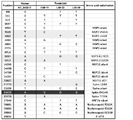
- the mutation analysis result of each virus strain is shown.
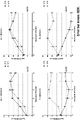
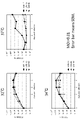
- the proliferative analysis result of the temperature sensitive strain (low temperature conditioned strain) (A50-18) is shown.
- the proliferative analysis result of the temperature sensitive strain (low temperature conditioned strain) (A50-18) is shown.
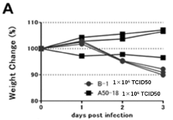
- the weight fluctuation of SARS-CoV-2 infected hamster is shown.
- the weight fluctuation of SARS-CoV-2 infected hamster is shown. Indicates the viral load in the lungs or nasal lavage fluid.
- a lung image of a SARS-CoV-2 infected hamster is shown.
- the results of lung histological analysis of SARS-CoV-2 infected hamsters are shown.
- Pulmonary histological analysis (HE staining and IHC staining) of SARS-CoV-2 infected hamsters is shown.
- the weight fluctuation of the SARS-CoV-2 re-infected hamster is shown.
- the body weight fluctuation of hamsters after SARS-CoV-2 infection is shown.
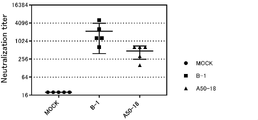
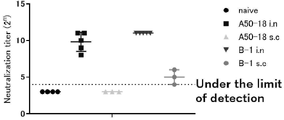
- the neutralizing antibody titer of the hamster serum recovered after SARS-CoV-2 infection is shown.
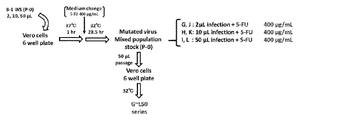
- the temperature sensitization (low temperature acclimation) method (G to L50 series) of SARS-CoV-2 is shown.
- the confirmation result (CPE image) of the temperature sensitivity (low temperature acclimation) of SARS-CoV-2 is shown.
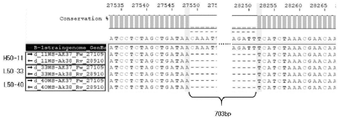
- the mutation analysis result of the additional isolate is shown. It shows the deletion of the base sequence found in relation to the temperature sensitive strain (low temperature acclimatized strain) (H50-11, L50-33, L50-40).
- the schematic diagram of the deletion of the base sequence shown in FIG. 17 and the deletion of the amino acid sequence encoded by the deletion is shown.
- the proliferation analysis result of the temperature sensitive strain (low temperature acclimatization strain) (H50-11, L50-33, L50-40) is shown.
- the weight fluctuation of SARS-CoV-2 infected hamster is shown.
- the lung weight of a SARS-CoV-2 infected hamster is shown.
- the weight fluctuation of the SARS-CoV-2 re-infected hamster is shown.
- the neutralizing antibody titer of hamster serum after SARS-CoV-2 infection is shown.
- the evaluation of the neutralizing activity of the temperature-sensitive strain (low temperature acclimatized strain) against the SARS-CoV-2 mutant strain is shown.
- the comparison of the immunity-inducing ability by the administration route of the temperature sensitive strain (low temperature acclimation strain) is shown.
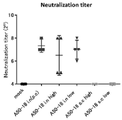
- the comparison of the immunity-inducing ability by the dose of the temperature sensitive strain is shown.
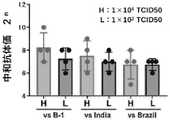
- the evaluation of the neutralizing activity of the temperature-sensitive strain (low temperature acclimatized strain) against the SARS-CoV-2 mutant strain is shown.
- the evaluation of the neutralizing activity of the temperature-sensitive strain (low temperature acclimatized strain) against the SARS-CoV-2 mutant strain is shown.
- Betacoronavirus temperature sensitive strain (low temperature acclimation strain)
- the beta coronavirus temperature-sensitive strain (low temperature acclimatized strain) of the present invention is a beta coronavirus containing a structural protein and / or a non-structural protein having a predetermined mutation, and is characterized by being temperature sensitive.
- the coronavirus is spherical with a diameter of about 100 to 200 nm and has protrusions on the surface.
- Coronavirus is virologically classified into Nidovirales, Coronaviridae, and Coronaviridae.
- Inside the envelope of the lipid double membrane is the genome of a plus-stranded single-stranded RNA wrapped around a nucleocapsid protein (also referred to as nucleocapsid), and on the surface of the envelope is a spike protein (hereinafter also referred to as "spikes”).
- Envelope protein (hereinafter also referred to as "envelope"
- the size of the viral genome is about 30 kb, which is the longest among RNA viruses.
- Coronavirus is classified into alpha, beta, gamma, and delta groups based on their genetic characteristics. There are four types of coronavirus that infect humans: human coronavirus 229E, OC43, NL63, and HKU-1 as the causative virus of colds, and severe acute respiratory syndrome (SARS) that occurred in 2002 that causes severe pneumonia. ) Coronavirus and the 2012 Middle East Respiratory Syndrome (MERS) coronavirus are known. The genus Alphacoronavirus is classified into human coronavirus 229E and NL63, and the genus Betacoronavirus is classified into human coronavirus OC43, HKU-1, SARS coronavirus and MERS coronavirus.
- SARS-CoV-2 which is classified as SARS coronavirus, has been isolated and identified as the causative virus of the new coronavirus infection that occurred in Wuhan in 2019.
- SARS-CoV-2 has been repeatedly mutated from the early Wuhan strain, and mutant strains such as a strain detected in the United Kingdom, a strain detected in South Africa, and a strain detected in India have been found. It is possible that mutant strains that have not yet been detected and new mutant strains may occur in the future.
- the virus contained in the genus Beta coronavirus is not limited to the above SARS-CoV-2 strain, and all other beta coronaviruses (other SARS-CoV- newly detected in the future). 2 mutant strains and beta coronaviruses other than SARS-CoV-2) are also included.
- the predetermined variation of the betacoronavirus temperature-sensitive strain (low temperature acclimatized strain) of the present invention will be described with reference to Table 1 below.
- the "mutation” shown in Table 1 refers to a mutation for acquiring temperature sensitivity (low temperature acclimation) ability. Further, in Table 1, the items shown in "Mutant amino acid” and “In the case of SARS-CoV-2 mutant of NC # 045512 (NCBI)" are examples.
- the predetermined mutation possessed by the betacoronavirus temperature-sensitive strain (cold-conditioned strain) of the present invention is at least one of the following mutations (a) to (m).
- C Mutation of the amino acid residue corresponding to lysine at position 1792 of the amino acid sequence shown in SEQ ID NO: 1 in NSP3.
- SEQ ID NO: 1 is the amino acid sequence of NSP3 in SARS-CoV-2 of NC_045512 (NCBI);
- SEQ ID NO: 2 is the amino acid sequence of NSP14 in SARS-CoV-2 of NC_045512 (NCBI);
- SEQ ID NO: 3 is. , NC_045512 (NCBI) in SARS-CoV-2;
- SEQ ID NO: 4 is the spike amino acid sequence in NC_045512 (NCBI) SARS-CoV-2;
- SEQ ID NO: 5 is NC_045512 (NCBI).
- SEQ ID NO: 6 is the amino acid sequence of nucleocapsid in SARS-CoV-2 of NC_045512 (NCBI).
- corresponding is used in the amino acid sequences of SEQ ID NOs: 1 to 6 when the beta coronavirus temperature-sensitive strain (low temperature acclimatized strain) of the present invention is a mutant strain of SARS-CoV-2 of NC_045512 (NCBI). If the beta coronavirus temperature-sensitive strain (low temperature acclimatized strain) of the present invention is a beta coronavirus mutant strain other than the above mutant strain, the beta coronavirus mutation is present. It means that there is a mutation in the position corresponding to the predetermined position in the amino acid sequence corresponding to the above SEQ ID NOs: 1 to 6 of the polypeptide possessed by the strain.
- the corresponding positions are the alignment of the amino acid sequences for the proteins of SARS-CoV-2 SEQ ID NOs: 1-6 of NC_045512 (NCBI) and the proteins of other beta coronavirus variants corresponding to the proteins of SEQ ID NOs: 1-6. Can be specified by performing.
- the virus temperature-sensitive strain (low temperature acclimatized strain) of the present invention is listed in NC_045512 (NCBI) as long as the amino acid residue corresponding to the predetermined position in the amino acid sequences of SEQ ID NOs: 1 to 6 is mutated. Not limited to a specific SARS-CoV-2 variant, but included in other beta coronavirus variants (ie, any other SARS-CoV-2 variant and beta coronavirus genus). A mutant strain of a virus other than CoV-2) is included.
- the specific SARS-CoV-2 mutant strain listed in NC_045512 is at least one of the above-mentioned predetermined positions in the amino acid sequence represented by SEQ ID NOs: 1 to 6 in the specific SARS-CoV-2.
- a mutant strain in which the amino acid residue is mutated, and the other beta coronavirus mutant strain is a mutant strain of any other SARS-CoV-2 (that is, the above sequence in any other SARS-CoV-2).
- amino acid sequences corresponding to SEQ ID NOs: 1 to 6 in other beta coronavirus mutant strains differ from the amino acid sequences shown in SEQ ID NOs: 1 to 6 as long as they do not significantly affect the characteristics of the polypeptide. Will be done.
- the term "does not significantly affect the properties of a polypeptide” means a state in which the functions of the respective structural proteins and / or nonstructural proteins are maintained. Specifically, differences from SEQ ID NOs: 1 to 6 are allowed at sites other than the amino acid residues corresponding to the mutations in SEQ ID NOs: 1 to 6 above (hereinafter, also referred to as "arbitrary difference sites"). To.
- the permissible differences may be one type of difference selected from substitutions, additions, insertions, and deletions (eg, substitutions), or two or more differences (eg, substitutions and insertions). It may be included.
- the sequence identity calculated by comparing only the arbitrary difference sites between the amino acid sequences corresponding to the above SEQ ID NOs: 1 to 6 in any other SARS-CoV-2 and the amino acid sequences shown in SEQ ID NOs: 1 to 6 is used. , 50% or more may be used. In any other SARS-CoV-2, the sequence identity is preferably 60% or more or 70% or more, more preferably 80% or more, still more preferably 85% or more or 90% or more, still more preferably.
- sequence identity is preferably 60% or higher.
- sequence identity is defined as BLASTPACKAGE [sgi32 bit edition, Version 2.0.12; available from National Center for Biotechnology Information (NCBI)] bl2sequaT. The value of the identity of the amino acid sequence obtained by Microbiol. Lett., Vol. 174, p247? 250, 1999) is shown. The parameters may be set to Gap insertion Cost value: 11 and Gap extension Cost value: 1.
- a polypeptide consisting of an amino acid sequence having at least one of the mutations in the aspartic acid (d'), (I-2) In the amino acid sequence shown in SEQ ID NO: 2, at least one of a mutation at position 248 glycine (e'), a mutation at position 416 glycine (f'), and a mutation at position 504 alanine (g').
- Polypeptide (NSP14) consisting of an amino acid sequence having the mutation, (I-3) In the amino acid sequence shown in SEQ ID NO: 3, a polypeptide (NSP16) consisting of an amino acid sequence having a mutation (h') at position 67 valine, (I-4) In the amino acid sequence shown in SEQ ID NO: 4, at least one of a mutation at position 54 leucine (i'), a mutation at position 739 threonine (j'), and a mutation at position 879 alanine (k').
- the mutations (a') to (m') above refer to mutations in the case where the mutations (a) to (m) are specifically present in the amino acid sequences of SEQ ID NOs: 1 to 6, respectively. That is, the above-mentioned polypeptides (I-1) to (I-6) are mutated (a') into a polypeptide consisting of the amino acid sequences of SEQ ID NOs: 1 to 6 possessed by SARS-CoV-2 of NC_045512 (NCBI). At least one of the mutations of ... (m') has been introduced.
- polypeptides (II) and (III) described above are the above-mentioned mutations (a) to (m) in the polypeptide consisting of the amino acid sequence corresponding to the amino acid sequences of SEQ ID NOs: 1 to 6 possessed by other beta coronaviruses. ) Is introduced with at least one of the mutations.
- the preferred range of sequence identity of the polypeptides (II) and (III) above is as described above.
- the virus temperature sensitive strain (low temperature acclimatized strain) of the present invention has a growth ability at a human lower respiratory tract temperature at least lower than that at a temperature lower than the human lower respiratory tract temperature, and is preferably human. It does not have the ability to grow at lower respiratory tract temperatures.
- a typical example of the human lower respiratory tract temperature is about 37 ° C., specifically, a temperature higher than the upper respiratory tract temperature described later, preferably 36 to 38 ° C., more preferably 36.5 to 37.5 ° C. or 37. ⁇ 38 ° C. is mentioned.
- the virus temperature-sensitive strain (low temperature acclimatized strain) of the present invention may have a proliferation ability at a temperature lower than the human lower respiratory tract temperature.
- the temperature lower than the human lower respiratory tract temperature may include, for example, the human upper respiratory tract temperature (specifically, about 32 ° C. to 35.5 ° C.).
- the above mutations (a) to (m) are not present on the receptor binding domain of the spike protein present on the surface of the virus, which is important when the virus infects cells. Therefore, by introducing at least one of the above mutations (a) to (m) not only in the specific SARS-CoV-2 listed in NC_045512 (NCBI) but also in other betacoronaviruses. It is reasonably expected that it can be temperature sensitive. That is, even when a mutation that changes the immunogenicity of the virus occurs due to the epidemic of infectious diseases worldwide, the mutant virus is further subjected to at least one of the above-mentioned mutations (a) to (m). By introducing it, it is reasonably expected that temperature sensitivity can be imparted to the mutant virus.
- the mutation of the above (a) may be a substitution with an amino acid residue other than valine, and the mutation of the above (b) may be a substitution with an amino acid residue other than leucine, and the mutation of the above (c) may be used.
- the mutation in (d) above may be a substitution with an amino acid residue other than aspartic acid
- the mutation in (e) above may be an amino acid residue other than glycine
- the mutation of (f) above may be a substitution with an amino acid residue other than glycine
- the mutation of (g) above may be a substitution with an amino acid residue other than alanine.
- the mutation of (h) above may be a substitution with an amino acid residue other than valine
- the mutation of (i) above may be a substitution with an amino acid residue other than leucine
- the mutation of (j) above may be a threonine.
- Substitution with an amino acid residue other than that may be sufficient
- the mutation in (k) above may be a substitution with an amino acid residue other than alanin
- the mutation in (l) above may be a substitution with an amino acid residue other than leucine.
- the mutation in (m) above may be a substitution with an amino acid residue other than serine.
- the mutation (a) is a substitution with alanine
- the mutation (b) is a substitution with phenylalanine
- the above (c) The mutation of (e) is a substitution with arginine
- the mutation of (d) is a substitution with asparagine
- the mutation of (e) is a substitution with valine
- the mutation of (f) is a substitution with serine.
- the mutation in (g) is a substitution for valine
- the mutation in (h) is a substitution for isoleucine
- the mutation in (i) is a substitution for tryptophan
- the mutation in (j) is said.
- the mutation in (k) above is a substitution for valine
- the mutation in (l) above is a substitution for proline
- / or the mutation in (m) above is for phenylalanine. It is a replacement.
- the substitution may be a so-called conservative substitution.
- Substitution with an amino acid having similar structure and / or characteristics For example, as an example of conservative substitution, if the amino acid before substitution is a non-polar amino acid, it is replaced with another non-polar amino acid, and the amino acid before substitution is replaced with another non-polar amino acid. If it is an uncharged amino acid, replace it with another uncharged amino acid, if the amino acid before substitution is an acidic amino acid, replace it with another acidic amino acid, and if the amino acid before substitution is a basic amino acid, another basic amino acid. Can be replaced with.
- non-polar amino acids include alanine, valine, leucine, isoleucine, proline, methionine, phenylalanine, and tryptophan
- non-charged amino acids include glycine, serine, threonine, and cysteine. Includes tyrosine, asparagine, and glutamine, “acidic amino acids” include aspartic acid and glutamic acid, and “basic amino acids” include lysine, arginine, and histidine.
- a more preferable example of the virus temperature-sensitive strain (low temperature acclimatized strain) of the present invention is a mutant strain of SARS-CoV-2 listed in NC_045512 (NCBI), which is a variant of (a) above (that is, (a). ') Is the substitution of valine at position 404 of the amino acid sequence set forth in SEQ ID NO: 1 with alanine (V404A) in NSP3; the mutation of (b) above (ie, the mutation of (b')).
- the amino acid sequence shown in 1 is a substitution of lysine at position 1792 with arginine (K1792R);
- the mutation in (d) above (that is, the mutation in (d')) is the amino acid sequence shown in SEQ ID NO: 1 in NSP3.
- the substitution of aspartic acid at position 1832 with asparagine (D1832N); the mutation in (e) above (ie, the mutation in (e')) is the glycine at position 248 of the amino acid sequence set forth in SEQ ID NO: 2 in NSP14.
- the mutation in (f) above is the substitution of glycine at position 416 of the amino acid sequence shown in SEQ ID NO: 2 in NSP14 with serine.
- the mutation in (g) is the substitution of alanin at position 504 of the amino acid sequence shown in SEQ ID NO: 2 with valine (A504V) in NSP14;
- the mutation in (h) is the substitution of valine at position 67 of the amino acid sequence set forth in SEQ ID NO: 3 with isoleucine (V67I) in NSP16; the mutation in (i) above (i).
- (i') mutation is the substitution (L54W) of leucine at position 54 of the amino acid sequence shown in SEQ ID NO: 4 with tryptophan in the spike;
- the mutation is the substitution of threonine at position 739 of the amino acid sequence set forth in SEQ ID NO: 4 with lysine (T739K) in the spike;
- the mutation in (k) above ie, the mutation in (k')
- the mutation in (l) above (ie, the mutation in (l')) is shown in SEQ ID NO: 5 in the envelope.
- the beta coronavirus temperature-sensitive (low temperature acclimation) strain of the present invention may further lack the amino acid sequence encoded by the base sequence shown in SEQ ID NO: 7.
- the nucleotide sequence shown in SEQ ID NO: 7 is part of the open reading frame of SARS-CoV-2 of NC_045512 (NCBI).
- virus temperature-sensitive strain (low temperature acclimation strain) of the present invention include the following strains.
- the mutation of (e) preferably the mutation of (e') and / or G248V
- the mutation of (f) preferably the mutation of (f') and / or G416S
- the mutation of (g). Preferred (g') mutation and / or A504V), said (k) mutation (preferably (k') mutation and / or A879V), said (l) mutation (preferably (l') mutation.
- a strain having the mutation of the above (m) preferably the mutation of (m') and / or S2F) and the mutation of the above (a) (preferably the mutation of (a') and / or V404A.
- the mutation of (d) preferably the mutation of (d') and / or D1832N
- the mutation of (h) preferably the mutation of (h') and / or V67I
- the above (j) A strain having a mutation (preferably a mutation of (j') and / or T739K); or a strain having a deletion of the amino acid sequence encoded by the base sequence shown in SEQ ID NO: 7; a mutation of the above (b) (preferably).
- Strains with deletion of amino acid sequence-Mutation of (b) above (preferably mutation of (b') and / or L445F), mutation of (c) above (preferably mutation of (c') and / or K1792R) preferably mutation of (c') and / or K1792R)
- the strain having the mutation of (i) preferably the mutation of (i') and / or L54W
- Beta coronavirus temperature sensitive strain (low temperature acclimatized strain) described in "1. Beta coronavirus temperature sensitive strain (low temperature acclimatized strain)" is at a temperature lower than the human lower respiratory tract temperature. However, since it can only grow efficiently, it cannot grow efficiently at least in the deep part of the living body, especially in the lower respiratory tract including the lungs that cause serious damage, and it can be expected that the pathogenicity is significantly reduced. Therefore, the virus temperature-sensitive strain (low temperature conditioned strain) can be used as a live attenuated vaccine by infecting a living body as an attenuated virus itself.
- the present invention also provides a vaccine containing the above-mentioned betacoronavirus temperature-sensitive strain (cold-conditioned strain) as an active ingredient.
- the details of the active ingredient are as described in "1.
- Betacoronavirus temperature sensitive strain low temperature acclimatized strain
- Beta coronavirus temperature sensitive strain low temperature acclimation strain
- a predetermined mutation contributes to the impartation of temperature sensitive (low temperature acclimation) ability. Therefore, the present invention also provides a beta coronavirus gene vaccine comprising a gene encoding a structural protein and / or a nonstructural protein having at least one of the above-mentioned mutations (a) to (m) as an active ingredient. The details of the mutation contained in the active ingredient are as described in "1. Betacoronavirus temperature sensitive strain (low temperature acclimatized strain)”.
- the vaccine of the present invention is not only the early Wuhan strain of SARS-CoV-2 virus, but also the mutant strain detected in the United Kingdom in September 2020, South Africa in October 2020, and others. It is also effective against a wide range of SARS-CoV-2 virus-related strains and viruses other than SARS-CoV-2 contained in the genus Betacoronavirus, including known mutant strains of SARS-CoV-2 and other unknown mutant strains that have not yet been detected. It can be reasonably expected that there will be. Therefore, the vaccine of the present invention targets betacoronavirus.
- the vaccine of the present invention includes adjuvants, buffers, tonicity agents, soothing agents, preservatives, antioxidants, odorants, etc., depending on the purpose and use. It can contain other ingredients such as light absorbing pigments, stabilizers, carbohydrates, casein digests, various vitamins and the like.
- the adjuvant examples include animal oils (squalene, etc.) or their cured oils; vegetable oils (palm oil, castor oil, etc.) or their cured oils; mannitol oleic acid anhydride, liquid paraffin, polybutene, capric acid, oleic acid, etc.
- PCPP saponin
- buffer agent examples include buffer solutions such as phosphates, acetates, carbonates and citrates.
- isotonic agents include sodium chloride, glycerin, D-mannitol and the like.
- soothing agent examples include benzyl alcohol and the like.
- preservatives include thimerosal, paraoxybenzoic acid esters, phenoxyethanol, chlorobutanol, benzyl alcohol, phenethyl alcohol, dehydroacetic acid, sorbic acid, antibiotics, synthetic antibacterial agents and the like.
- antioxidants include sulfites, ascorbic acid and the like.
- Examples of light-absorbing dyes include riboflavin, adenine, adenosine and the like.
- stabilizers include chelating agents, reducing agents and the like.
- Examples of carbohydrates include sorbitol, lactose, mannitol, starch, sucrose, glucose, dextran and the like.
- the vaccine of the present invention may include one or more other vaccines against a virus or bacterium that develops a disease other than beta coronavirus infection such as COVID-19. That is, the vaccine of the present invention may be prepared as a combination vaccine containing other vaccines.
- the dosage form of the vaccine of the present invention is not particularly limited and can be appropriately determined based on the administration method, storage conditions and the like.
- Specific examples of the dosage form include liquid preparations and solid preparations, and more specifically, oral administrations such as tablets, capsules, powders, granules, pills, liquids and syrups; injections, Examples thereof include parenteral administration agents such as sprays.
- the administration method of the vaccine of the present invention is not particularly limited, and may be any of injection administration such as muscle, intraperitoneal, intradermal and subcutaneous, inhalation administration through the nasal cavity and oral cavity, oral administration and the like.
- injection administration such as muscle, intraperitoneal, intradermal and subcutaneous, inhalation administration through the nasal cavity and oral cavity, oral administration and the like.
- intramuscular, intradermal and subcutaneous injection administration intramuscular administration, intradermal administration and subcutaneous administration
- intranasal inhalation administration nasal administration
- nasal administration preferably nasal administration. ..
- Target of application The target of application of the vaccine of the present invention is not particularly limited as long as it is a target that can cause various symptoms due to beta coronavirus infection (preferably a target that can cause COVID-19 symptoms due to SARS-CoV-2 virus infection). Examples thereof include mammals, and more specifically, humans; pet animals such as dogs and cats; experimental animals such as mice, mice, and hamsters.
- the dose of the vaccine of the present invention is not particularly limited, and can be appropriately determined according to the type of active ingredient, administration method, administration target (conditions such as age, body weight, sex, presence or absence of underlying disease).
- the dose to humans may be 1 ⁇ 10 10 TCID 50 / kg or less, preferably 1 ⁇ 10 8 TCID 50 / kg or less.
- the method for producing the beta coronavirus temperature sensitive strain (low temperature acclimatized strain) of the present invention is not particularly limited, and a person skilled in the art based on the above-mentioned amino acid sequence information. It can be decided as appropriate. For example, from the viewpoint of producing a vaccine that is relatively inexpensive and has a small lot difference, a CPER using an artificial chromosome such as a bacterial artificial chromosome (BAC) or an yeast artificial chromosome (YAC), or a genomic fragment of beta coronavirus is preferable. A reverse genetics method using a method or the like can be mentioned.
- BAC bacterial artificial chromosome
- YAC yeast artificial chromosome
- the genome of the beta coronavirus temperature-sensitive strain (low-temperature acclimatized strain), which does not have any of the mutations (a) to (m), is cloned. do.
- the parent strain used at this time may be betacoronavirus, specifically, the specific SARS-CoV-2 listed in NC_045512 (NCBI) described above, or any other SARS-CoV described above. -2, and can be selected from the group consisting of viruses other than SARS-CoV-2 contained in the genus Betacoronavirus.
- the full-length DNA of the virus genome is cloned into BAC DNA or YAC DNA, and a transcription promoter sequence for eukaryotic cells is inserted upstream of the virus sequence.
- the promoter sequence include a CMV promoter and a CAG promoter.
- a ribozyme sequence and a poly A sequence are inserted downstream of the virus sequence. Examples of the ribozyme sequence include hepatitis D virus ribozyme and hammerhead ribozyme.
- the poly A sequence include poly A of Simian 40 virus.
- the full-length DNA of the viral genome is divided into a plurality of fragments and cloned.
- Fragments Examples of the method for obtaining a fragment include an artificial synthesis method of nucleic acid, a PCR method using the above-mentioned artificial chromosome or a plasmid obtained by cloning a fragment fragment as a template, and the like.
- the artificial chromosome into which the mutation has been introduced is transfected into the host cell to reconstruct the recombinant virus.
- the recombinant virus is reconstructed by ligating the mutated fragment by a reaction using DNA polymerase and then transfecting the host cell.
- the transfection method is not particularly limited, and a known method can be used.
- the host is not particularly limited, and known cells can be used.
- the reconstructed recombinant virus is added to the cultured cells, and the recombinant virus is subcultured.
- the cultured cells used at that time are not particularly limited, but for example, Vero cells, VeroE6 cells, Vero cells supplemented with the expression of TMPRESS2, VeroE6 cells supplemented with the expression of TMPRESS2, Calu-3 cells, and ACE2 are supplemented. 293T cells, BHK cells, 104C1 cells, mouse neuroblastoma-derived NA cells and the like can be mentioned.
- the virus can be recovered by a known method such as centrifugation and membrane filtration. Further, by further adding the recovered virus to the cultured cells, mass production of the recombinant virus becomes possible.
- Test Example 1 Separation of temperature-sensitive strain (low temperature acclimatized strain) A50-18 strain of SARS-CoV-2 A clinical isolate of SARS-CoV-2 (hereinafter referred to as B-1) based on the method shown in FIG. A to F50 series and A to F50 series acclimatized at 32 ° C. by adding two kinds of mutation inducers 5-fluorouracil (hereinafter, 5-FU) and 5-azacitidine (hereinafter, 5-AZA) to the strain. A virus population of A to F500 series was acquired. Furthermore, each virus population was subcultured multiple times, and among the 406 candidate strains obtained, a virus strain (A50-18 strain) capable of multiplying at 32 ° C. but significantly reduced in proliferation at 37 ° C. In the following, it may be referred to as Ts strain.) Was found, separated and selected (FIG. 2).
- Test Example 1-2 Analysis of temperature-sensitive strain (low temperature acclimatized strain) A50-18 strain by next-generation sequence (1-2-1) Mutation analysis of each virus strain The following virus strains are used using the next-generation sequencer. Mutation analysis was performed. The analysis was performed by extracting RNA from the culture supernatant of Vero cells infected with SARS-CoV-2. As a reference, Wuhan-Hu-1 (NC045512), which is a clinical isolate from Wuhan, was used.
- B-1 Wild strain (clinical isolate) A50-18: Temperature sensitive strain (low temperature acclimatized strain) F50-37: Non-temperature sensitive strain C500-1: Non-temperature sensitive strain F500-53: Non-temperature sensitive strain F500-40: Non-temperature sensitive strain F500-2: Non-temperature sensitive strain Virus)
- the analysis result of FIG. 3 was obtained from the mutation (1-2-1) of the temperature-sensitive strain (low temperature conditioned strain). Since the point mutation of D614G is also found in the B-1 strain, it is not a point mutation characteristic of the temperature-sensitive strain (low temperature conditioned strain), but on the other hand, it is characteristic of the temperature sensitive strain (low temperature conditioned strain) (A50-18). As point mutations, G248V, G416S, A504V of NSP14, A879V of Spike, L28P of Envelope, and S2F of Nucleocapisid were found.
- HE staining also referred to as Immunohistochemistry (IHC) staining
- Rabbit anti-spike polyclonal antibody (Sinobiological: 40589-T62) was used for immunochemical staining.
- the HE-stained image and the immunochemical-stained image are shown in FIG. Similar to (1-4-3), erythrocyte infiltration and alveolar structure disruption were observed in B-1 strain-infected hamsters, and spiked protein was detected extensively by immunochemical staining.
- naive hamsters were observed to lose weight due to infection with the B-1 strain, while hamsters once infected with the B-1 strain or the A50-18 strain did not lose weight. rice field. From this, it was clarified that not only the wild strain B-1 but also the less pathogenic A50-18 strain can induce immunity that contributes to infection protection.
- each virus population was subcultured multiple times, and among the 253 strains obtained, a virus strain (H50-11 strain, H50-11 strain, which was able to grow at 32 ° C. but whose proliferation was significantly reduced at 37 ° C. L50-33 strain, L50-40 strain) were found, separated and selected (FIG. 15).
- FIG. 16 The analysis result of FIG. 16 was obtained from the mutation analysis result (2-2-1) of the temperature-sensitive strain (low temperature acclimation strain).
- As characteristic point mutations in the H50-11 strain V404A and D1832N of NSP3, V67I of NSP16, and T739K of Spike were found. Further, L445F and K1792R of NSP3 were found as characteristic point mutations of the L50-33 strain, and L445F, K1792R and L54W of NSP3 were found as characteristic point mutations of the L50-40 strain.
- FIG. 18 shows a schematic diagram of the deletion of the base sequence at positions 27549 to 28251 and the deletion of the amino acid sequence encoded by the deletion.
- ORF7a is a base sequence at positions 27394 to 27759
- ORF7b is a base sequence at positions 27756 to 27887
- ORF8 is a base sequence at positions 27894 to 28259.
- the base sequence (SEQ ID NO: 7) region at positions 27549 to 28251 corresponds to a part of ORF7a (the amino acid sequence from the 53rd position to the end; the same applies hereinafter), the entire ORF7b, and most of the amino acid sequences of ORF8. .. Since the deletion of this region is accompanied by a frame shift, a protein is produced by fusing the 1-52nd amino acid sequence of ORF7a with the 3'end 8 bases of ORF8 and the amino acid sequence encoded by the intergenic region and the base sequence of nucleocapsid. It is thought that it will be done. In addition, ORF7b is deleted entirely, and the original sequence of ORF8 is also deleted entirely.
- the lungs of the hamster were removed, the lung weight was measured, the right lung was crushed, suspended with 1 mL of D-MEM, and the supernatant was recovered as a lung crushed solution by centrifugation.
- the lung weight per total body weight of the hamster is shown in FIG.
- the results of evaluating the amount of virus in these nasal lavage fluid and lung crushed fluid by a plaque formation assay using Vero cells are shown in FIG. 22.
- each temperature-sensitive strain-infected hamster had a significantly lower amount of virus in the lung than the B-1 strain-infected hamster. From these results, it was inferred that each temperature-sensitive strain was an attenuated strain that could not grow in the lower respiratory tract like the A50-18 strain in Test Example 1.
- FIG. i. n is nasal administration
- S. C indicates subcutaneous administration.
- Nasal administration of B-1 strain and A50-18 strain was able to induce neutralizing antibody against live virus.
- subcutaneous administration almost no neutralizing antibody could be induced at the tested dose, but in view of the results of nasal administration, it was considered that increasing the dose could also induce neutralizing antibody.
- Partial blood sampling was performed from hamsters 3 weeks after infection, and the obtained serum was used to neutralize the live virus of the SARS-CoV-2 Brazilian mutant strain (hCoV-19 / Japan / TY7-503 / 2021 strain).
- the result of the measurement is shown in FIG. 27.
- i. n nasal administration
- S. C indicates subcutaneous administration.
- As the method for measuring the neutralizing activity the same method as in (1-5-2) was used. Similar to (7-1), an increase in neutralizing antibody titer was observed in the low dose group of 1x10 2 TCID 50/10 ⁇ L by nasal administration. This suggests that the temperature-sensitive strain may be able to induce sufficient immunity even with a small amount of nasal administration.
- subcutaneous administration almost no neutralizing antibody could be induced at the tested dose, but in view of the results of nasal administration, it was considered that increasing the dose could also induce neutralizing antibody.
Landscapes
- Health & Medical Sciences (AREA)
- Life Sciences & Earth Sciences (AREA)
- Chemical & Material Sciences (AREA)
- Organic Chemistry (AREA)
- Virology (AREA)
- General Health & Medical Sciences (AREA)
- Genetics & Genomics (AREA)
- Medicinal Chemistry (AREA)
- Wood Science & Technology (AREA)
- Engineering & Computer Science (AREA)
- Zoology (AREA)
- Bioinformatics & Cheminformatics (AREA)
- Biochemistry (AREA)
- Molecular Biology (AREA)
- General Engineering & Computer Science (AREA)
- Microbiology (AREA)
- Communicable Diseases (AREA)
- Veterinary Medicine (AREA)
- Public Health (AREA)
- Pharmacology & Pharmacy (AREA)
- Animal Behavior & Ethology (AREA)
- Immunology (AREA)
- Biomedical Technology (AREA)
- Biotechnology (AREA)
- Chemical Kinetics & Catalysis (AREA)
- General Chemical & Material Sciences (AREA)
- Nuclear Medicine, Radiotherapy & Molecular Imaging (AREA)
- Oncology (AREA)
- Gastroenterology & Hepatology (AREA)
- Proteomics, Peptides & Aminoacids (AREA)
- Biophysics (AREA)
- Epidemiology (AREA)
- Mycology (AREA)
- Pulmonology (AREA)
- Micro-Organisms Or Cultivation Processes Thereof (AREA)
- Peptides Or Proteins (AREA)
- Medicines Containing Antibodies Or Antigens For Use As Internal Diagnostic Agents (AREA)
Priority Applications (6)
| Application Number | Priority Date | Filing Date | Title |
|---|---|---|---|
| US18/031,599 US20230374469A1 (en) | 2020-10-14 | 2021-10-13 | Beta coronavirus cold acclimatized strain and vaccine |
| AU2021362585A AU2021362585A1 (en) | 2020-10-14 | 2021-10-13 | Beta coronavirus cold acclimatized strain and vaccine |
| JP2022557045A JPWO2022080413A1 (https=) | 2020-10-14 | 2021-10-13 | |
| EP21880151.2A EP4230741A4 (en) | 2020-10-14 | 2021-10-13 | Beta coronavirus cold acclimatized strain and vaccine |
| KR1020237012671A KR20230084180A (ko) | 2020-10-14 | 2021-10-13 | 베타 코로나바이러스 저온순화 주 및 백신 |
| CN202180070448.9A CN116635069A (zh) | 2020-10-14 | 2021-10-13 | β冠状病毒低温驯化株和疫苗 |
Applications Claiming Priority (10)
| Application Number | Priority Date | Filing Date | Title |
|---|---|---|---|
| JP2020-173494 | 2020-10-14 | ||
| JP2020173494 | 2020-10-14 | ||
| JP2020-180524 | 2020-10-28 | ||
| JP2020180524 | 2020-10-28 | ||
| JP2020210564 | 2020-12-18 | ||
| JP2020-210564 | 2020-12-18 | ||
| JP2021-017633 | 2021-02-05 | ||
| JP2021017633 | 2021-02-05 | ||
| JP2021051107 | 2021-03-25 | ||
| JP2021-051107 | 2021-03-25 |
Publications (1)
| Publication Number | Publication Date |
|---|---|
| WO2022080413A1 true WO2022080413A1 (ja) | 2022-04-21 |
Family
ID=81209182
Family Applications (2)
| Application Number | Title | Priority Date | Filing Date |
|---|---|---|---|
| PCT/JP2021/037902 Ceased WO2022080413A1 (ja) | 2020-10-14 | 2021-10-13 | ベータコロナウイルス低温馴化株及びワクチン |
| PCT/JP2021/037903 Ceased WO2022080414A1 (ja) | 2020-10-14 | 2021-10-13 | ベータコロナウイルス温度感受性株及びワクチン |
Family Applications After (1)
| Application Number | Title | Priority Date | Filing Date |
|---|---|---|---|
| PCT/JP2021/037903 Ceased WO2022080414A1 (ja) | 2020-10-14 | 2021-10-13 | ベータコロナウイルス温度感受性株及びワクチン |
Country Status (7)
| Country | Link |
|---|---|
| US (2) | US20230381296A1 (https=) |
| EP (2) | EP4230742A4 (https=) |
| JP (2) | JPWO2022080414A1 (https=) |
| KR (2) | KR20230084180A (https=) |
| AU (2) | AU2021362585A1 (https=) |
| TW (2) | TW202227619A (https=) |
| WO (2) | WO2022080413A1 (https=) |
Cited By (3)
| Publication number | Priority date | Publication date | Assignee | Title |
|---|---|---|---|---|
| CN115353552A (zh) * | 2022-08-19 | 2022-11-18 | 山东大学 | 一种降低蛋白质变性温度的方法及其突变体与应用 |
| WO2023080246A1 (ja) * | 2021-11-08 | 2023-05-11 | 一般財団法人阪大微生物病研究会 | ベータコロナウイルス弱毒株 |
| WO2024167071A1 (ko) * | 2023-02-08 | 2024-08-15 | (주)파이어니어백신 | 신규한 저온-적응성 약독화 중동호흡기증후군 코로나바이러스 |
Families Citing this family (1)
| Publication number | Priority date | Publication date | Assignee | Title |
|---|---|---|---|---|
| KR20230084180A (ko) * | 2020-10-14 | 2023-06-12 | 잇판사이단호진한다이비세이부쯔뵤우겐큐우카이 | 베타 코로나바이러스 저온순화 주 및 백신 |
Citations (1)
| Publication number | Priority date | Publication date | Assignee | Title |
|---|---|---|---|---|
| WO2004092360A2 (en) * | 2003-04-10 | 2004-10-28 | Chiron Corporation | The severe acute respiratory syndrome coronavirus |
Family Cites Families (1)
| Publication number | Priority date | Publication date | Assignee | Title |
|---|---|---|---|---|
| KR20230084180A (ko) * | 2020-10-14 | 2023-06-12 | 잇판사이단호진한다이비세이부쯔뵤우겐큐우카이 | 베타 코로나바이러스 저온순화 주 및 백신 |
-
2021
- 2021-10-13 KR KR1020237012671A patent/KR20230084180A/ko active Pending
- 2021-10-13 WO PCT/JP2021/037902 patent/WO2022080413A1/ja not_active Ceased
- 2021-10-13 KR KR1020237012672A patent/KR20230084513A/ko active Pending
- 2021-10-13 US US18/031,570 patent/US20230381296A1/en active Pending
- 2021-10-13 EP EP21880152.0A patent/EP4230742A4/en active Pending
- 2021-10-13 EP EP21880151.2A patent/EP4230741A4/en not_active Withdrawn
- 2021-10-13 WO PCT/JP2021/037903 patent/WO2022080414A1/ja not_active Ceased
- 2021-10-13 AU AU2021362585A patent/AU2021362585A1/en not_active Abandoned
- 2021-10-13 AU AU2021361384A patent/AU2021361384A1/en active Pending
- 2021-10-13 JP JP2022557046A patent/JPWO2022080414A1/ja active Pending
- 2021-10-13 JP JP2022557045A patent/JPWO2022080413A1/ja not_active Withdrawn
- 2021-10-13 US US18/031,599 patent/US20230374469A1/en active Pending
- 2021-10-14 TW TW110138222A patent/TW202227619A/zh unknown
- 2021-10-14 TW TW110138223A patent/TWI905295B/zh active
Patent Citations (1)
| Publication number | Priority date | Publication date | Assignee | Title |
|---|---|---|---|---|
| WO2004092360A2 (en) * | 2003-04-10 | 2004-10-28 | Chiron Corporation | The severe acute respiratory syndrome coronavirus |
Non-Patent Citations (6)
| Title |
|---|
| DENG XUFANG, METTELMAN ROBERT, OBRIEN AMORNRAT, THOMPSON JOHN, OBRIEN TIMOTHY, BAKER SUSAN, PFEIFFER JULIE: "Analysis of Coronavirus Temperature-Sensitive Mutants Reveals an Interplay between the Macrodomain and Papain-Like Protease Impacting Replication and Pathogenesis", JOURNAL OF VIROLOGY, THE AMERICAN SOCIETY FOR MICROBIOLOGY, US, vol. 93, no. 12, 15 June 2019 (2019-06-15), US , XP055921265, ISSN: 0022-538X, DOI: 10.1128/JVI.02140-18 * |
| SAWICKI STANLEY G, SAWICKI DOROTHEA L, YOUNKER DIANE, MEYER YVONNE, THIEL VOLKER, STOKES HELEN, SIDDELL STUART G: "Functional and Genetic Analysis of Coronavirus Replicase-Transcriptase Proteins", PLOS PATHOGENS, vol. 1, no. 4, 9 December 2005 (2005-12-09), pages e39 - 13, XP055921267, DOI: 10.1371/journal.ppat.0010039 * |
| See also references of EP4230741A4 |
| SEO SANG HEUI, JANG YUNYUENG: "Cold-Adapted Live Attenuated SARS-Cov-2 Vaccine Completely Protects Human ACE2 Transgenic Mice from SARS-Cov-2 Infection", VACCINES, M D P I AG, CH, vol. 8, no. 4, 1 December 2020 (2020-12-01), CH , pages 584 - 17,1-79, XP055921261, ISSN: 2076-393X, DOI: 10.3390/vaccines8040584 * |
| TATIANA A. TATSUSOVATHOMAS L. MADDEN, FEMS MICROBIOL. LETT., vol. 174, 1999 |
| THE LANCET, vol. 396, 26 September 2020 (2020-09-26), pages 887 - 897 |
Cited By (4)
| Publication number | Priority date | Publication date | Assignee | Title |
|---|---|---|---|---|
| WO2023080246A1 (ja) * | 2021-11-08 | 2023-05-11 | 一般財団法人阪大微生物病研究会 | ベータコロナウイルス弱毒株 |
| CN115353552A (zh) * | 2022-08-19 | 2022-11-18 | 山东大学 | 一种降低蛋白质变性温度的方法及其突变体与应用 |
| CN115353552B (zh) * | 2022-08-19 | 2023-07-18 | 山东大学 | 一种降低蛋白质变性温度的方法及其突变体与应用 |
| WO2024167071A1 (ko) * | 2023-02-08 | 2024-08-15 | (주)파이어니어백신 | 신규한 저온-적응성 약독화 중동호흡기증후군 코로나바이러스 |
Also Published As
| Publication number | Publication date |
|---|---|
| KR20230084180A (ko) | 2023-06-12 |
| EP4230742A1 (en) | 2023-08-23 |
| AU2021361384A1 (en) | 2023-06-01 |
| WO2022080414A1 (ja) | 2022-04-21 |
| AU2021362585A1 (en) | 2023-06-01 |
| EP4230741A4 (en) | 2025-03-26 |
| TW202227619A (zh) | 2022-07-16 |
| TWI905295B (zh) | 2025-11-21 |
| AU2021361384A9 (en) | 2024-09-12 |
| EP4230741A1 (en) | 2023-08-23 |
| EP4230742A4 (en) | 2025-06-18 |
| US20230381296A1 (en) | 2023-11-30 |
| JPWO2022080413A1 (https=) | 2022-04-21 |
| US20230374469A1 (en) | 2023-11-23 |
| KR20230084513A (ko) | 2023-06-13 |
| TW202227620A (zh) | 2022-07-16 |
| JPWO2022080414A1 (https=) | 2022-04-21 |
Similar Documents
| Publication | Publication Date | Title |
|---|---|---|
| JP6368725B2 (ja) | 豚ヘルペスウイルス遺伝子欠失株、ワクチン組成物及びその製造方法と応用 | |
| Netland et al. | Immunization with an attenuated severe acute respiratory syndrome coronavirus deleted in E protein protects against lethal respiratory disease | |
| US8728487B2 (en) | Attenuated live vaccine for prevention of porcine reproductive and respiratory syndrome | |
| WO2022080413A1 (ja) | ベータコロナウイルス低温馴化株及びワクチン | |
| CN103923884B (zh) | 一种猪伪狂犬病病毒基因缺失株、疫苗组合物及其制备方法和应用 | |
| CN109310750B (zh) | 编码传染性喉气管炎病毒和传染性法氏囊病病毒抗原的重组非致病性马立克氏病病毒构建体 | |
| US20200330585A1 (en) | Swine influenza a virus vaccine | |
| WO2024197167A1 (en) | A cold-adapted, live attenuated sars-cov-2 vaccine | |
| KR20110090711A (ko) | 신규한 돼지 써코바이러스 타입 2 및 그의 용도 | |
| TWI704225B (zh) | 豬繁殖與呼吸綜合症疫苗病毒 | |
| JP2025005450A (ja) | ベータコロナウイルス弱毒株 | |
| CN107635579A (zh) | 非天然发生的猪生殖和呼吸综合征病毒(prrsv)和使用方法 | |
| WO2025027551A2 (en) | Ibv vaccine with heterologous dmv/1639 spike protein | |
| Yu et al. | Generation and biological assessment of recombinant avian metapneumovirus subgroup C (aMPV-C) viruses containing different length of the G gene | |
| CN116583604A (zh) | β冠状病毒温度敏感性株和疫苗 | |
| CN118660957A (zh) | β冠状病毒减毒株 | |
| JP2023070661A (ja) | ベータコロナウイルスの不活化抗原 | |
| US20240285748A1 (en) | Veterinary viral vector | |
| RU2787596C2 (ru) | Вакцина к вирусу свиного гриппа a | |
| RU2787596C9 (ru) | Вакцина к вирусу свиного гриппа a |
Legal Events
| Date | Code | Title | Description |
|---|---|---|---|
| 121 | Ep: the epo has been informed by wipo that ep was designated in this application |
Ref document number: 21880151 Country of ref document: EP Kind code of ref document: A1 |
|
| ENP | Entry into the national phase |
Ref document number: 2022557045 Country of ref document: JP Kind code of ref document: A |
|
| ENP | Entry into the national phase |
Ref document number: 20237012671 Country of ref document: KR Kind code of ref document: A |
|
| WWE | Wipo information: entry into national phase |
Ref document number: 202180070448.9 Country of ref document: CN |
|
| WWE | Wipo information: entry into national phase |
Ref document number: 202317031822 Country of ref document: IN |
|
| NENP | Non-entry into the national phase |
Ref country code: DE |
|
| ENP | Entry into the national phase |
Ref document number: 2021880151 Country of ref document: EP Effective date: 20230515 |
|
| ENP | Entry into the national phase |
Ref document number: 2021362585 Country of ref document: AU Date of ref document: 20211013 Kind code of ref document: A |
|
| WWW | Wipo information: withdrawn in national office |
Ref document number: 2021880151 Country of ref document: EP |