WO2022072975A1 - Compositions and methods of treatment for sars-cov-2 through papain protease inhibition - Google Patents
Compositions and methods of treatment for sars-cov-2 through papain protease inhibition Download PDFInfo
- Publication number
- WO2022072975A1 WO2022072975A1 PCT/US2021/071439 US2021071439W WO2022072975A1 WO 2022072975 A1 WO2022072975 A1 WO 2022072975A1 US 2021071439 W US2021071439 W US 2021071439W WO 2022072975 A1 WO2022072975 A1 WO 2022072975A1
- Authority
- WO
- WIPO (PCT)
- Prior art keywords
- compound
- substituted
- group
- cov
- compounds
- Prior art date
- Legal status (The legal status is an assumption and is not a legal conclusion. Google has not performed a legal analysis and makes no representation as to the accuracy of the status listed.)
- Ceased
Links
Classifications
-
- C—CHEMISTRY; METALLURGY
- C07—ORGANIC CHEMISTRY
- C07D—HETEROCYCLIC COMPOUNDS
- C07D205/00—Heterocyclic compounds containing four-membered rings with one nitrogen atom as the only ring hetero atom
- C07D205/02—Heterocyclic compounds containing four-membered rings with one nitrogen atom as the only ring hetero atom not condensed with other rings
- C07D205/04—Heterocyclic compounds containing four-membered rings with one nitrogen atom as the only ring hetero atom not condensed with other rings having no double bonds between ring members or between ring members and non-ring members
-
- C—CHEMISTRY; METALLURGY
- C07—ORGANIC CHEMISTRY
- C07D—HETEROCYCLIC COMPOUNDS
- C07D205/00—Heterocyclic compounds containing four-membered rings with one nitrogen atom as the only ring hetero atom
- C07D205/12—Heterocyclic compounds containing four-membered rings with one nitrogen atom as the only ring hetero atom condensed with carbocyclic rings or ring systems
-
- C—CHEMISTRY; METALLURGY
- C07—ORGANIC CHEMISTRY
- C07D—HETEROCYCLIC COMPOUNDS
- C07D211/00—Heterocyclic compounds containing hydrogenated pyridine rings, not condensed with other rings
- C07D211/04—Heterocyclic compounds containing hydrogenated pyridine rings, not condensed with other rings with only hydrogen or carbon atoms directly attached to the ring nitrogen atom
- C07D211/06—Heterocyclic compounds containing hydrogenated pyridine rings, not condensed with other rings with only hydrogen or carbon atoms directly attached to the ring nitrogen atom having no double bonds between ring members or between ring members and non-ring members
- C07D211/36—Heterocyclic compounds containing hydrogenated pyridine rings, not condensed with other rings with only hydrogen or carbon atoms directly attached to the ring nitrogen atom having no double bonds between ring members or between ring members and non-ring members with hetero atoms or with carbon atoms having three bonds to hetero atoms with at the most one bond to halogen, e.g. ester or nitrile radicals, directly attached to ring carbon atoms
- C07D211/60—Carbon atoms having three bonds to hetero atoms with at the most one bond to halogen, e.g. ester or nitrile radicals
- C07D211/62—Carbon atoms having three bonds to hetero atoms with at the most one bond to halogen, e.g. ester or nitrile radicals attached in position 4
-
- C—CHEMISTRY; METALLURGY
- C07—ORGANIC CHEMISTRY
- C07D—HETEROCYCLIC COMPOUNDS
- C07D265/00—Heterocyclic compounds containing six-membered rings having one nitrogen atom and one oxygen atom as the only ring hetero atoms
- C07D265/02—1,2-Oxazines; Hydrogenated 1,2-oxazines
-
- C—CHEMISTRY; METALLURGY
- C07—ORGANIC CHEMISTRY
- C07D—HETEROCYCLIC COMPOUNDS
- C07D271/00—Heterocyclic compounds containing five-membered rings having two nitrogen atoms and one oxygen atom as the only ring hetero atoms
- C07D271/02—Heterocyclic compounds containing five-membered rings having two nitrogen atoms and one oxygen atom as the only ring hetero atoms not condensed with other rings
- C07D271/10—1,3,4-Oxadiazoles; Hydrogenated 1,3,4-oxadiazoles
- C07D271/113—1,3,4-Oxadiazoles; Hydrogenated 1,3,4-oxadiazoles with oxygen, sulfur or nitrogen atoms, directly attached to ring carbon atoms, the nitrogen atoms not forming part of a nitro radical
-
- C—CHEMISTRY; METALLURGY
- C07—ORGANIC CHEMISTRY
- C07D—HETEROCYCLIC COMPOUNDS
- C07D401/00—Heterocyclic compounds containing two or more hetero rings, having nitrogen atoms as the only ring hetero atoms, at least one ring being a six-membered ring with only one nitrogen atom
- C07D401/02—Heterocyclic compounds containing two or more hetero rings, having nitrogen atoms as the only ring hetero atoms, at least one ring being a six-membered ring with only one nitrogen atom containing two hetero rings
- C07D401/12—Heterocyclic compounds containing two or more hetero rings, having nitrogen atoms as the only ring hetero atoms, at least one ring being a six-membered ring with only one nitrogen atom containing two hetero rings linked by a chain containing hetero atoms as chain links
-
- C—CHEMISTRY; METALLURGY
- C07—ORGANIC CHEMISTRY
- C07D—HETEROCYCLIC COMPOUNDS
- C07D405/00—Heterocyclic compounds containing both one or more hetero rings having oxygen atoms as the only ring hetero atoms, and one or more rings having nitrogen as the only ring hetero atom
- C07D405/02—Heterocyclic compounds containing both one or more hetero rings having oxygen atoms as the only ring hetero atoms, and one or more rings having nitrogen as the only ring hetero atom containing two hetero rings
- C07D405/12—Heterocyclic compounds containing both one or more hetero rings having oxygen atoms as the only ring hetero atoms, and one or more rings having nitrogen as the only ring hetero atom containing two hetero rings linked by a chain containing hetero atoms as chain links
-
- C—CHEMISTRY; METALLURGY
- C07—ORGANIC CHEMISTRY
- C07D—HETEROCYCLIC COMPOUNDS
- C07D413/00—Heterocyclic compounds containing two or more hetero rings, at least one ring having nitrogen and oxygen atoms as the only ring hetero atoms
- C07D413/02—Heterocyclic compounds containing two or more hetero rings, at least one ring having nitrogen and oxygen atoms as the only ring hetero atoms containing two hetero rings
- C07D413/12—Heterocyclic compounds containing two or more hetero rings, at least one ring having nitrogen and oxygen atoms as the only ring hetero atoms containing two hetero rings linked by a chain containing hetero atoms as chain links
-
- C—CHEMISTRY; METALLURGY
- C07—ORGANIC CHEMISTRY
- C07D—HETEROCYCLIC COMPOUNDS
- C07D487/00—Heterocyclic compounds containing nitrogen atoms as the only ring hetero atoms in the condensed system, not provided for by groups C07D451/00 - C07D477/00
- C07D487/02—Heterocyclic compounds containing nitrogen atoms as the only ring hetero atoms in the condensed system, not provided for by groups C07D451/00 - C07D477/00 in which the condensed system contains two hetero rings
- C07D487/10—Spiro-condensed systems
-
- C—CHEMISTRY; METALLURGY
- C07—ORGANIC CHEMISTRY
- C07D—HETEROCYCLIC COMPOUNDS
- C07D491/00—Heterocyclic compounds containing in the condensed ring system both one or more rings having oxygen atoms as the only ring hetero atoms and one or more rings having nitrogen atoms as the only ring hetero atoms, not provided for by groups C07D451/00 - C07D459/00, C07D463/00, C07D477/00 or C07D489/00
- C07D491/02—Heterocyclic compounds containing in the condensed ring system both one or more rings having oxygen atoms as the only ring hetero atoms and one or more rings having nitrogen atoms as the only ring hetero atoms, not provided for by groups C07D451/00 - C07D459/00, C07D463/00, C07D477/00 or C07D489/00 in which the condensed system contains two hetero rings
- C07D491/10—Spiro-condensed systems
- C07D491/113—Spiro-condensed systems with two or more oxygen atoms as ring hetero atoms in the oxygen-containing ring
Definitions
- sequence identifier numbers (SEQ ID NO).
- SEQ ID NOs correspond numerically to the sequence identifiers ⁇ 400>1 , ⁇ 400>2, etc.
- the Sequence Listing in written computer readable format (CRF), is incorporated by reference in its entirety.
- betacoronaviruses have spilled over from animals to cause disease outbreaks in humans on multiple occasions with often deleterious outcomes. Coronaviruses can be divided into four branches, and betacoronaviruses can be further broken down into four subgroups, 2a-2d. In 2015, it was found that subgroup 2b contained not only the 2003 pandemic causing SARS-CoV-1 but a cluster of 15 SARS-like coronaviruses. Many of these SARS-like viruses are prevalent among Chinese horseshoe bats but also have been shown to infect a range of diverse hosts. Additionally, these viruses were found to be similar enough that merely replacing their spike protein with that of SARS-CoV-1 enabled them to productively infect primary human airway cells.
- betacoronaviruses upon infection translate two polypeptides pp1a and pplab, which are cleaved into 16 nonstructural proteins (Nsp1 to Nsp16).
- Nsp1-16 form the virus's membrane bound replicase complex, which is necessary to transcribe the viral RNA genome prior to translation.
- CoVs encode two proteases that process the polyproteins into their functional units.
- the 3C-like protease also known as the main protease, cleaves Nsp4-Nsp16.
- the papain-like protease (PLpro) cleaves Nsp1-3.
- the genomes of coronaviruses can contain up to two PLPs. However, the genomes of group 2b viruses mirror that of Middle East respiratory syndrome (MERS) CoV, a subgroup 2c virus by encoding only one PLpro.
- MERS Middle East respiratory syndrome
- PLpros as well as papain-like protease 2 (PLP2) in two papain-like proteases, have demonstrated immunosuppressive effects on host organisms by reversing post-translational modification by ubiquitin (Ub) and interferon-stimulated gene product 15 (ISG15).
- Ub post-translational modification
- ISG15 interferon-stimulated gene product 15
- Post- translational modification with Ub and ISG15 has a profound impact on host type-l IFN and NFKB inflammatory responses, as well as upregulating the production of cytokines, chemokines, and other ISGs.
- Ub-like protein (Ubl) modifiers have been shown to facilitate inhibition, sequestration, or proteasomal degradation of marked proteins.
- Ubl Ub-like protein
- viral encoded PLpros can allow critical viral proteins to remain intact, active, and suppress an anti-viral immune state until the virus is able to replicate.
- BtSCoV-Rf1 BtSCoV-Rf1.2004 is a group 2b virus isolated from greater horseshoe bats, and of the currently identified 2b viruses it is the most distantly related to SARS- CoV-1 other than SARS-CoV-2 (FIGs. 1A-1B).
- the effective inhibitors can be categorized into two sets: series I compounds, which typically utilize an amide backbone, and series II compounds such as 6577871 , which commonly have a piperidine scaffold. Both categories have proven effective in inhibiting PLpros from SARS-CoV-1 and SARS-CoV-2 but are not fully optimized in backbone structure or arene ring decoration. Additionally, it remains unknown whether these inhibitors would be effective against a wider array of coronavirus group 2b PLpros.
- Protease inhibitors have a long history of being used as a basis for antiviral therapy, the most salient examples being HIV and Hepatitis C. Within coronaviruses themselves, main protease inhibitors have been shown to reverse the progression of fatal coronavirus infection. With no therapeutics available for the treatment of those infected by SARS-CoV-2, and with virus variants emerging against which existing vaccines may not be fully effective, there is an overwhelming need to identify lead compounds that are effective against proposed viral drug targets with SARS-CoV-2. The lead compounds would ideally have low cellular toxicity in multiple cell lines and be metabolically stable. These needs and other needs are satisfied by the present disclosure.
- the disclosure in one aspect, relates to viral papain protease inhibitors, methods of making the same, pharmaceutical compositions comprising the same, and methods of treating and/or preventing COVID-19 and other coronavirus diseases using the same.
- the papain protease inhibitors have a core or linker structure featuring at least one nitrogen atom and substituted or unsubstituted cycloalkyl, aromatic, or heteroaromatic groups on either side of the core structure.
- the papain protease inhibitors are capable of ablating viral deubiquitination and/or delSGase activity.
- FIGs. 1A-1B show a sequence alignment of PLPs from SARS family coronaviruses including conserved structural features. Sequences shown are for BtSCoV-Rf1 .2004 (SEQ ID NO. 1), SARS-CoV-2 (accession number SEQ ID NO. 2), SARS-CoV-1 SEQ ID NO. 3), SZ16 (SEQ ID NO. 4), HKU3.2 (SEQ ID NO. 5), Rm1.2004 (SEQ ID NO. 6), MERS-CoV (SEQ ID NO. 7), and NL63 (SEQ ID NO. 8). The secondary structure shown is the predicted by DSSP for BtSCoV-Rf 1.2004 PLpro. Similarity and alignment calculations were performed using ClustalW.
- Residue positions that are fully conserved are marked in gray with white text, with those being highly conserved marked in gray with black text.
- Residues that form the zinc finger motif are marked with stars at positions 191 and 194, while other residues forming the catalytic triad are marked with black stars at other positions.
- Residues forming interactions between the Ubl domain and thumb domain of PLpros are marked in light gray stars.
- the BL2 loop is boxed in gray (final row of FIG. 1B).
- FIG. 2A shows a surface rendering of a SARS-CoV-2 PLpro homology model highlighting its differences with SARS-CoV-1 PLpro.
- the SARS-CoV-2 PLpro is shown in gray, with the proximal ubiquitin binding site in dark gray (left front region) and the distal ubiquitin binding site in dark gray (top center region near “thumb domain” label). Amino acid sites where PLpro differs between SARS-CoV-2 and SARS-CoV are labeled.
- FIG. 2B shows the opposite face of the model.
- FIG. 3A shows activity of BtSCoV-Rf1 .2004 PLpro for different linkages of poly-Ub.
- FIG. 3A At 37 °C, 10 ⁇ M each of M1 , K6, K11 , K27, K29, K33, K48, and K63 linked di-Ub were incubated with 20 nM BtSCoV-Rf1 .2004 PLpro. Samples were taken from the reaction tube at indicated time points.
- FIG. 3B Under similar reaction conditions 13.65 ⁇ M each of K48 and K63 linked tetra-Ub was incubated with 23 nM PLpro for 3 hours with samples taken at given time points.
- FIG. 4 shows activity of BtSCoV-Rf 1.2004 PLpro for prolSG15 from multiple species.
- BtSCoV-Rf 1.2004 PLpro was evaluated for the cleavage of prolSG15s from the following species (NCBI accession numbers following species names): human (Homo sapiens, AAH09507.1), cow (Bos taurus; NP_776791.1), vesper bat (Myotis davidir, ELK23605.1), Egyptian fruit bat (Rousettus aegyptiacus ⁇ XP_015999857.1), pig (Sus scrota, ACB87600.1), hedgehog (Erinaceus europaeus: XP_007525810.2), mouse (Mus musculus: AAB02697.1), dromedary camel (Camelus dromedarius: XP_010997700.1), sheep (Ovis aries: AF152103.1), northern
- each ISG15 was incubated with 20 nM of SARS-CoV-2 PLpro for at least 1 hr with samples taken at the time points indicated.
- the summary of the prolSG15 cleavage assays for BtSCoV-Rf1 .2004 PLpro is presented as a heat map where a lower number of squares indicates low or no cleavage and a higher number of squares indicates relatively robust cleavage.
- FIGs. 5A-5C show tertiary Structure of group 2b PLpros
- FIG. 5A Cartoon representation of BtSCoV-Rf1 .2004 PLpro secondary structure with helix and sheet labels corresponding to FIG. 1 dssp calculations
- FIG. 5B Overlaid cartoon representations of BtSCoV-Rf1 .2004 PLpro, SARS- CoV-1 PLpro (PDB 3E9S), and SARS-CoV-2 PLpro (PDB 7JIR). The four PLpro domains are labeled and boxed with gray shaded regions, from left to right as pictured: Fingers, Palm, Thumb, Ubl.
- FIG. 5C Overlaid cartoon representations of BtSCoV-Rf1.2004 PLpro, MERS-CoV PLpro (PDB 5W8T), and MHV PLP (5WFI) with their Ubl domains represented by ribbons.
- FIGs. 6A-6C show inhibitor binding pocket of three group 2b viruses.
- FIG. 6A A Fo-Fc electron density map is shown contoured at 1o (mesh), with GRL0617 shown in light gray and BtSCoV-Rf1 PLpro shown in dark gray.
- FIG. 6B Stereoview of GRL0617 (stick structure) bound to BtSCoV-Rf1 PLpro overlaid with SARS-CoV-2 (white surface and dark areas) showing a possible path to active site for future inhibitors.
- FIG. 6C Stereoview overlay of GRL0167 bound to three different SARS-CoV PLpros: BtSCoV-Rf1 , SARS-CoV-1 , and SARS-CoV-2.
- FIG. 7 shows crystal contacts affecting PLpro conformation Zinc finger loops of the two domains differ due to a crystal contact being made by chain B.
- GRL0617 of chain B is shifted in the binding pocket due to a crystal contact with chain B V226.
- FIGs. 8A-8B show BtSCoV-Rf1 PLpro in complex with DC12.
- FIG. 8A A 2Fo-Fc electron density map is shown contoured at 1o (mesh) with DC12 and BtSCoV-Rf1 PLpro.
- FIG. 8B Overlay of DC37 (dark gray stick structures) bound to SARS-CoV-2 PLpro (light gray stick structures).
- FIG. 9A shows key hydrophobic and hydrogen bonding interactions of series I inhibitor GRL0617.
- FIG. 9B shows ley hydrophobic and hydrogen bonding interactions of a series II inhibitor.
- papain protease inhibitors useful for the treatment of SARS-CoV-2 and other human and animal coronaviruses.
- the papain protease inhibitors have a structure of Formula I:
- L forms a scaffold, linker, or central core of the compounds
- V, W, and R 1 form a “Western” element as referred to elsewhere herein
- X, Y, Z, and R 2 form an “Eastern” element as referred to elsewhere herein.
- V can be selected from an aryl group, a fused aryl group, a cycloalkyl group, or a fused cycloalkyl group.
- exemplary substituents in this position include, but are not limited to, the following:
- W can be N or CH.
- R 1 can be hydrogen or a substituted or unsubstituted alkyl group such as, for example, methyl or aminomethyl.
- L can be selected from the following:
- R 3 is hydrogen.
- Y can be CH or N or can be absent.
- R 2 can be selected from hydrogen, alkyl, arylalkyl, heteroarylalkyl, -CH 2 OH, -CH 2 NH 2 , -CH 2 CHOHCH 2 OH, -CH 2 CHOHCH 2 NH 2 , -CH 2 CHNH 2 CH 2 OH, -CH 2 CH 2 OH, and -CH 2 CH 2 NH 2 .
- R 2 is hydrogen.
- Z can be a substituted or unsubstituted aryl or heteroaryl group.
- the substituted or unsubstituted aryl group can include one or more of a C1-C4 alkyl substituent, an amino substituent, a C1-C4 alkoxy substituent, a substituted or unsubstituted amide substituent, a nitro group, a halogen such as, for example, -Cl, -Br, -F, or -I, a dioxolane fused to the aryl or heteroaryl group, or any combination thereof.
- Z can be selected from the following:
- Z when Y is absent, Z can be covalently bonded to X. In a further aspect, when X and Y are both absent, Z can be covalently bonded to L.
- V is selected from a fused aryl group having 3 or 4 rings, a fused cycloalkane, a bridged cycloalkane, or a polycyclic alkane
- W, R 1 , X, Y, R 2 , and Z are defined as described above, and L can be selected from
- V can be selected from
- the papain protease inhibitor has Formula II, Formula III, Formula IV, Formula V, or Formula VI:
- the papain protease inhibitors disclosed herein can have one or more stereocenters.
- the stereocenters can have an R configuration, an S configuration, a scalemic mixture of R and S configurations, and/or a racemic mixture of R and S configurations.
- the papain protease inhibitors can be synthesized from enantiomerically or diastereomerically pure starting materials and retain the absolute configuration of the starting materials in the final product.
- chirality can be introduced during synthesis of the papain protease inhibitors. Further in this aspect, an enantiomeric excess of R or S compound can be synthesized based on reaction conditions, or a racemic mixture can result.
- stereoisomers such as, for example, column chromatography with a chiral stationary phase, can be employed to separate a desired enantiomer or diastereomer from the mixed-stereochemistry reaction product.
- stereoisomers are not separated.
- reagents for step (i) can include, but are not limited to, acetic acid, and sodium cyanoborohydride in methanol solvent.
- step (i) can be conducted at about room temperature for from 12 to 48 hours.
- reagents for step (ii) can include, but are not limited to, lithium hydroxide monohydrate in tetra hydrofuran and water (5:1 THF:H 2 O, V/V). Further in this aspect, step (ii) can be conducted at about room temperature for from about 30 min to about 3 h.
- reagents for step (iii) can include, but are not limited to, 1-ethyl-3-(3-dimethylaminopropyl)carbodiimide (EDC, EDAC, or EDCI), hydroxybenzotriazole (HOBT), and N,N-diisopropylethylamine (DIEA or DIPEA) in dimethylformamide (DMF).
- step (iii) can be conducted at about room temperature for from about 6 h to about 24 h.
- m and n can independently be 1 , 2, or 3.
- V, Z, and R 1 can be defined as above.
- the cyclic amine starting material can be a spiro, bridged, or fused compound or include a spiro, bridged, or fused element such as, for example, a substituted 2- azaspiro[3.3]heptane.
- further modifications known in the art can be used to change, add, or remove functional groups (e.g. catalytic hydrogenation to convert a nitro group to a primary amine, or protection/deprotection of a reactive group).
- functional groups e.g. catalytic hydrogenation to convert a nitro group to a primary amine, or protection/deprotection of a reactive group.
- Other exemplary synthetic schemes are provided in the Examples.
- ratios, concentrations, amounts, and other numerical data can be expressed herein in a range format. It will be further understood that the endpoints of each of the ranges are significant both in relation to the other endpoint, and independently of the other endpoint. It is also understood that there are a number of values disclosed herein, and that each value is also herein disclosed as “about” that particular value in addition to the value itself. For example, if the value “10” is disclosed, then “about 10” is also disclosed. Ranges can be expressed herein as from “about” one particular value, and/or to “about” another particular value. Similarly, when values are expressed as approximations, by use of the antecedent “about,” it will be understood that the particular value forms a further aspect. For example, if the value “about 10” is disclosed, then “10” is also disclosed.
- a further aspect includes from the one particular value and/or to the other particular value.
- ranges excluding either or both of those included limits are also included in the disclosure, e.g. the phrase “x to y” includes the range from ‘x' to ‘y' as well as the range greater than ‘x' and less than ‘y'.
- the range can also be expressed as an upper limit, e.g. ‘about x, y, z, or less' and should be interpreted to include the specific ranges of ‘about x', ‘about y', and ‘about z' as well as the ranges of ‘less than x', less than y', and ‘less than z'.
- the phrase ‘about x, y, z, or greater' should be interpreted to include the specific ranges of ‘about x', ‘about y', and ‘about z' as well as the ranges of ‘greater than x', greater than y', and ‘greater than z'.
- the phrase “about ‘x' to ‘y'”, where ‘x' and ‘y' are numerical values, includes “about ‘x' to about ‘y'”.
- a numerical range of “about 0.1% to 5%” should be interpreted to include not only the explicitly recited values of about 0.1 % to about 5%, but also include individual values (e.g., about 1 %, about 2%, about 3%, and about 4%) and the sub-ranges (e.g., about 0.5% to about 1.1 %; about 5% to about 2.4%; about 0.5% to about 3.2%, and about 0.5% to about 4.4%, and other possible sub-ranges) within the indicated range.
- the terms “about,” “approximate,” “at or about,” and “substantially” mean that the amount or value in question can be the exact value or a value that provides equivalent results or effects as recited in the claims or taught herein. That is, it is understood that amounts, sizes, formulations, parameters, and other quantities and characteristics are not and need not be exact, but may be approximate and/or larger or smaller, as desired, reflecting tolerances, conversion factors, rounding off, measurement error and the like, and other factors known to those of skill in the art such that equivalent results or effects are obtained. In some circumstances, the value that provides equivalent results or effects cannot be reasonably determined.
- an “effective amount” refers to an amount that is sufficient to achieve the desired modification of a physical property of the composition or material.
- an “effective amount” of a filler in a pharmaceutical composition refers to an amount that is sufficient to achieve the desired improvement in the property modulated by the formulation component, e.g. achieving the desired size or volume for a pharmaceutical dosage form.
- the specific level in terms of wt% in a composition required as an effective amount will depend upon a variety of factors including the active ingredient, dosage, presence of other therapeutic agents in the dosage form, and intended method of administration of the pharmaceutical composition.
- temperatures referred to herein are based on atmospheric pressure (i.e. one atmosphere).
- Described herein are coronavirus papain protease inhibitors that have therapeutic or clinical utility. Also described herein are methods of synthesizing the papain protease inhibitors. Also described herein are methods of administering the papain protease inhibitors to a subject in need thereof. In some aspects, the subject can have COVID-19 or another coronavirus-related disease.
- Other compositions, compounds, methods, features, and advantages of the present disclosure will be or become apparent to one having ordinary skill in the art upon examination of the following drawings, detailed description, and examples. It is intended that all such additional compositions, compounds, methods, features, and advantages be included within this description, and be within the scope of the present disclosure.
- a residue of a chemical species refers to the moiety that is the resulting product of the chemical species in a particular reaction scheme or subsequent formulation or chemical product, regardless of whether the moiety is actually obtained from the chemical species.
- an ethylene glycol residue in a polyester refers to one or more -OCH 2 CH 2 O- units in the polyester, regardless of whether ethylene glycol was used to prepare the polyester.
- a sebacic acid residue in a polyester refers to one or more - CO(CH 2 ) 8 CO- moieties in the polyester, regardless of whether the residue is obtained by reacting sebacic acid or an ester thereof to obtain the polyester.
- the term “substituted” is contemplated to include all permissible substituents of organic compounds.
- the permissible substituents include acyclic and cyclic, branched and unbranched, carbocyclic and heterocyclic, and aromatic and nonaromatic substituents of organic compounds.
- Illustrative substituents include, for example, those described below.
- the permissible substituents can be one or more and the same or different for appropriate organic compounds.
- the heteroatoms, such as nitrogen can have hydrogen substituents and/or any permissible substituents of organic compounds described herein which satisfy the valences of the heteroatoms.
- substitution or “substituted with” include the implicit proviso that such substitution is in accordance with permitted valence of the substituted atom and the substituent, and that the substitution results in a stable compound, e.g., a compound that does not spontaneously undergo transformation such as by rearrangement, cyclization, elimination, etc. It is also contemplated that, in certain aspects, unless expressly indicated to the contrary, individual substituents can be further optionally substituted (i.e., further substituted or unsubstituted).
- a 1 ,” “A 2 ,” “A 3 ,” and “A 4 ” are used herein as generic symbols to represent various specific substituents. These symbols can be any substituent, not limited to those disclosed herein, and when they are defined to be certain substituents in one instance, they can, in another instance, be defined as some other substituents.
- aliphatic or “aliphatic group,” as used herein, denotes a hydrocarbon moiety that may be straight-chain (/.e., unbranched), branched, or cyclic (including fused, bridging, and spirofused polycyclic) and may be completely saturated or may contain one or more units of unsaturation, but which is not aromatic. Unless otherwise specified, aliphatic groups contain 1-20 carbon atoms. Aliphatic groups include, but are not limited to, linear or branched, alkyl, alkenyl, and alkynyl groups, and hybrids thereof such as (cycloalkyl)alkyl, (cycloalkenyl)alkyl or (cycloalkyl)alkenyl.
- alkyl as used herein is a branched or unbranched saturated hydrocarbon group of 1 to 24 carbon atoms, such as methyl, ethyl, n-propyl, isopropyl, n-butyl, isobutyl, s-butyl, t- butyl, n-pentyl, isopentyl, s-pentyl, neopentyl, hexyl, heptyl, octyl, nonyl, decyl, dodecyl, tetradecyl, hexadecyl, eicosyl, tetracosyl, and the like.
- the alkyl group can be cyclic or acyclic.
- the alkyl group can be branched or unbranched.
- the alkyl group can also be substituted or unsubstituted.
- the alkyl group can be substituted with one or more groups including, but not limited to, alkyl, cycloalkyl, alkoxy, amino, ether, halide, hydroxy, nitro, silyl, sulfo-oxo, or thiol, as described herein.
- a “lower alkyl” group is an alkyl group containing from one to six (e.g., from one to four) carbon atoms.
- alkyl group can also be a C1 alkyl, C1-C2 alkyl, C1-C3 alkyl, C1-C4 alkyl, C1-C5 alkyl, C1-C6 alkyl, C1-C7 alkyl, C1-C8 alkyl, C1-C9 alkyl, C1-C10 alkyl, and the like up to and including a C1-C24 alkyl.
- alkyl is generally used to refer to both unsubstituted alkyl groups and substituted alkyl groups; however, substituted alkyl groups are also specifically referred to herein by identifying the specific substituent(s) on the alkyl group.
- halogenated alkyl or “haloalkyl” specifically refers to an alkyl group that is substituted with one or more halide, e.g., fluorine, chlorine, bromine, or iodine.
- the term “monohaloalkyl” specifically refers to an alkyl group that is substituted with a single halide, e.g. fluorine, chlorine, bromine, or iodine.
- polyhaloalkyl specifically refers to an alkyl group that is independently substituted with two or more halides, i.e. each halide substituent need not be the same halide as another halide substituent, nor do the multiple instances of a halide substituent need to be on the same carbon.
- alkoxyalkyl specifically refers to an alkyl group that is substituted with one or more alkoxy groups, as described below.
- aminoalkyl specifically refers to an alkyl group that is substituted with one or more amino groups.
- hydroxyalkyl specifically refers to an alkyl group that is substituted with one or more hydroxy groups.
- cycloalkyl refers to both unsubstituted and substituted cycloalkyl moieties
- the substituted moieties can, in addition, be specifically identified herein; for example, a particular substituted cycloalkyl can be referred to as, e.g., an “alkylcycloalkyl.”
- a substituted alkoxy can be specifically referred to as, e.g., a “halogenated alkoxy”
- a particular substituted alkenyl can be, e.g., an “alkenylalcohol,” and the like.
- the practice of using a general term, such as “cycloalkyl,” and a specific term, such as “alkylcycloalkyl,” is not meant to imply that the general term does not also include the specific term.
- cycloalkyl as used herein is a non-aromatic carbon-based ring composed of at least three carbon atoms.
- examples of cycloalkyl groups include, but are not limited to, cyclopropyl, cyclobutyl, cyclopentyl, cyclohexyl, norbornyl, and the like.
- heterocycloalkyl is a type of cycloalkyl group as defined above, and is included within the meaning of the term “cycloalkyl,” where at least one of the carbon atoms of the ring is replaced with a heteroatom such as, but not limited to, nitrogen, oxygen, sulfur, or phosphorus.
- the cycloalkyl group and heterocycloalkyl group can be substituted or unsubstituted.
- the cycloalkyl group and heterocycloalkyl group can be substituted with one or more groups including, but not limited to, alkyl, cycloalkyl, alkoxy, amino, ether, halide, hydroxy, nitro, silyl, sulfo-oxo, or thiol as described herein.
- alkanediyl refers to a divalent saturated aliphatic group, with one or two saturated carbon atom(s) as the point(s) of attachment, a linear or branched, cyclo, cyclic or acyclic structure, no carbon-carbon double or triple bonds, and no atoms other than carbon and hydrogen.
- the groups, — CH 2 — (methylene), — CH 2 CH 2 — , — CH 2 C(CH3)2CH 2 — , and — CH 2 CH 2 CH 2 — are non-limiting examples of alkanediyl groups.
- Alkoxy also includes polymers of alkoxy groups as just described; that is, an alkoxy can be a polyether such as — OA 1 — OA 2 or — OA 1 — (OA 2 ) a — OA 3 , where “a” is an integer of from 1 to 200 and A 1 , A 2 , and A 3 are alkyl and/or cycloalkyl groups.
- alkenyl as used herein is a hydrocarbon group of from 2 to 24 carbon atoms with a structural formula containing at least one carbon-carbon double bond.
- the alkenyl group can be substituted with one or more groups including, but not limited to, alkyl, cycloalkyl, alkoxy, alkenyl, cycloalkenyl, alkynyl, cycloalkynyl, aryl, heteroaryl, aldehyde, amino, carboxylic acid, ester, ether, halide, hydroxy, ketone, azide, nitro, silyl, sulfo-oxo, or thiol, as described herein.
- groups including, but not limited to, alkyl, cycloalkyl, alkoxy, alkenyl, cycloalkenyl, alkynyl, cycloalkynyl, aryl, heteroaryl, aldehyde, amino, carboxylic acid, ester, ether, halide, hydroxy, ketone, azide, nitro, silyl, sulfo-oxo, or thiol, as described here
- Examples of cycloalkenyl groups include, but are not limited to, cyclopropenyl, cyclobutenyl, cyclopentenyl, cyclopentadienyl, cyclohexenyl, cyclohexadienyl, norbornenyl, and the like.
- heterocycloalkenyl is a type of cycloalkenyl group as defined above, and is included within the meaning of the term “cycloalkenyl,” where at least one of the carbon atoms of the ring is replaced with a heteroatom such as, but not limited to, nitrogen, oxygen, sulfur, or phosphorus.
- the cycloalkenyl group and heterocycloalkenyl group can be substituted or unsubstituted.
- the cycloalkenyl group and heterocycloalkenyl group can be substituted with one or more groups including, but not limited to, alkyl, cycloalkyl, alkoxy, alkenyl, cycloalkenyl, alkynyl, cycloalkynyl, aryl, heteroaryl, aldehyde, amino, carboxylic acid, ester, ether, halide, hydroxy, ketone, azide, nitro, silyl, sulfo-oxo, or thiol as described herein.
- alkynyl as used herein is a hydrocarbon group of 2 to 24 carbon atoms with a structural formula containing at least one carbon-carbon triple bond.
- the alkynyl group can be unsubstituted or substituted with one or more groups including, but not limited to, alkyl, cycloalkyl, alkoxy, alkenyl, cycloalkenyl, alkynyl, cycloalkynyl, aryl, heteroaryl, aldehyde, amino, carboxylic acid, ester, ether, halide, hydroxy, ketone, azide, nitro, silyl, sulfo-oxo, or thiol, as described herein.
- cycloalkynyl as used herein is a non-aromatic carbon-based ring composed of at least seven carbon atoms and containing at least one carbon-carbon triple bound.
- cycloalkynyl groups include, but are not limited to, cycloheptynyl, cyclooctynyl, cyclononynyl, and the like.
- heterocycloalkynyl is a type of cycloalkenyl group as defined above, and is included within the meaning of the term “cycloalkynyl,” where at least one of the carbon atoms of the ring is replaced with a heteroatom such as, but not limited to, nitrogen, oxygen, sulfur, or phosphorus.
- the cycloalkynyl group and heterocycloalkynyl group can be substituted or unsubstituted.
- the cycloalkynyl group and heterocycloalkynyl group can be substituted with one or more groups including, but not limited to, alkyl, cycloalkyl, alkoxy, alkenyl, cycloalkenyl, alkynyl, cycloalkynyl, aryl, heteroaryl, aldehyde, amino, carboxylic acid, ester, ether, halide, hydroxy, ketone, azide, nitro, silyl, sulfo-oxo, or thiol as described herein.
- aromatic group refers to a ring structure having cyclic clouds of delocalized TT electrons above and below the plane of the molecule, where the TT clouds contain (4n+2) TT electrons.
- aryl as used herein is a group that contains any carbon-based aromatic group including, but not limited to, benzene, naphthalene, phenyl, biphenyl, anthracene, and the like.
- the aryl group can be substituted or unsubstituted.
- the aryl group can be substituted with one or more groups including, but not limited to, alkyl, cycloalkyl, alkoxy, alkenyl, cycloalkenyl, alkynyl, cycloalkynyl, aryl, heteroaryl, aldehyde, — NH 2 , carboxylic acid, ester, ether, halide, hydroxy, ketone, azide, nitro, silyl, sulfo-oxo, or thiol as described herein.
- biasing is a specific type of aryl group and is included in the definition of “aryl.”
- the aryl group can be a single ring structure or can contain multiple ring structures that are either fused ring structures or attached via one or more bridging groups such as a carbon-carbon bond.
- biaryl to two aryl groups that are bound together via a fused ring structure, as in naphthalene, or are attached via one or more carbon-carbon bonds, as in biphenyl.
- amine or “amino” as used herein are represented by the formula — NA 1 A 2 , where A 1 and A 2 can be, independently, hydrogen or alkyl, cycloalkyl, alkenyl, cycloalkenyl, alkynyl, cycloalkynyl, aryl, or heteroaryl group as described herein.
- a specific example of amino is -NH 2 .
- alkylamino as used herein is represented by the formula — NH(-alkyl) and — N(-alkyl) 2 , where alkyl is a described herein.
- Representative examples include, but are not limited to, methylamino group, ethylamino group, propylamino group, isopropylamino group, butylamino group, isobutylamino group, (sec-butyl)amino group, (tert-butyl)amino group, pentylamino group, isopentylamino group, (tert-pentyl)amino group, hexylamino group, dimethylamino group, diethylamino group, dipropylamino group, diisopropylamino group, dibutylamino group, diisobutylamino group, di(sec-butyl)amino group, di(tert-butyl)amino
- esters as used herein is represented by the formula — OC(O)A 1 or — C(O)OA 1 , where A 1 can be alkyl, cycloalkyl, alkenyl, cycloalkenyl, alkynyl, cycloalkynyl, aryl, or heteroaryl group as described herein.
- polyester as used herein is represented by the formula — (A 1 O(O)C-A 2 -C(O)O) a — or — (A 1 O(O)C-A 2 -OC(O)) a — , where A 1 and A 2 can be, independently, an alkyl, cycloalkyl, alkenyl, cycloalkenyl, alkynyl, cycloalkynyl, aryl, or heteroaryl group described herein and “a” is an integer from 1 to 500. “Polyester” is as the term used to describe a group that is produced by the reaction between a compound having at least two carboxylic acid groups with a compound having at least two hydroxyl groups.
- ether as used herein is represented by the formula A 1 OA 2 , where A 1 and A 2 can be, independently, an alkyl, cycloalkyl, alkenyl, cycloalkenyl, alkynyl, cycloalkynyl, aryl, or heteroaryl group described herein.
- polyether as used herein is represented by the formula — (A 1 O-A 2 O) a — , where A 1 and A 2 can be, independently, an alkyl, cycloalkyl, alkenyl, cycloalkenyl, alkynyl, cycloalkynyl, aryl, or heteroaryl group described herein and “a” is an integer of from 1 to 500.
- Examples of polyether groups include polyethylene oxide, polypropylene oxide, and polybutylene oxide.
- halo halogen
- halide halogen or halide
- pseudohalide pseudohalogen or “pseudohalo,” as used herein can be used interchangeably and refer to functional groups that behave substantially similar to halides.
- Such functional groups include, by way of example, cyano, thiocyanato, azido, trifluoromethyl, trifluoromethoxy, perfluoroalkyl, and perfluoroalkoxy groups.
- heteroalkyl refers to an alkyl group containing at least one heteroatom. Suitable heteroatoms include, but are not limited to, O, N, Si, P and S, wherein the nitrogen, phosphorous and sulfur atoms are optionally oxidized, and the nitrogen heteroatom is optionally quaternized. Heteroalkyls can be substituted as defined above for alkyl groups.
- heteroaryl refers to an aromatic group that has at least one heteroatom incorporated within the ring of the aromatic group.
- heteroatoms include, but are not limited to, nitrogen, oxygen, sulfur, and phosphorus, where N-oxides, sulfur oxides, and dioxides are permissible heteroatom substitutions.
- the heteroaryl group can be substituted or unsubstituted.
- the heteroaryl group can be substituted with one or more groups including, but not limited to, alkyl, cycloalkyl, alkoxy, amino, ether, halide, hydroxy, nitro, silyl, sulfo-oxo, or thiol as described herein.
- Heteroaryl groups can be monocyclic, or alternatively fused ring systems. Heteroaryl groups include, but are not limited to, furyl, imidazolyl, pyrimidinyl, tetrazolyl, thienyl, pyridinyl, pyrrolyl, N-methylpyrrolyl, quinolinyl, isoquinolinyl, pyrazolyl, triazolyl, thiazolyl, oxazolyl, isoxazolyl, oxadiazolyl, thiadiazolyl, isothiazolyl, pyridazinyl, pyrazinyl, benzofuranyl, benzodioxolyl, benzothiophenyl, indolyl, indazolyl, benzimidazolyl, imidazopyridinyl, pyrazolopyridinyl, and pyrazolopyrimidinyl.
- heteroaryl groups include pyridinyl, pyridazinyl, pyrimidinyl, pyrazinyl, thiophenyl, pyrazolyl, imidazolyl, benzo[c/]oxazolyl, benzo[c/]thiazolyl, quinolinyl, quinazolinyl, indazolyl, imidazo[1 ,2-b]pyridazinyl, imidazo[1 ,2-a]pyrazinyl, benzo[c][1 ,2,5]thiadiazolyl, benzo[c][1 ,2,5]oxadiazolyl, and pyrido[2,3- b] pyrazinyl.
- heterocycle or “heterocyclyl,” as used herein can be used interchangeably and refer to single and multi-cyclic aromatic or non-aromatic ring systems in which at least one of the ring members is other than carbon.
- Heterocycle includes pyridine, pyrimidine, furan, thiophene, pyrrole, isoxazole, isothiazole, pyrazole, oxazole, thiazole, imidazole, oxazole, including, 1 ,2,3-oxadiazole, 1 ,2,5-oxadiazole and 1 ,3,4-oxadiazole, thiadiazole, including, 1 ,2,3-thiadiazole, 1 ,2,5-thiadiazole, and 1 ,3,4-thiadiazole, triazole, including, 1 ,2,3-triazole, 1 ,3,4-triazole, tetrazole, including 1 ,2,3,4-tetrazole and 1 ,2,4,5-tetrazole, pyr
- heterocyclyl group can also be a C2 heterocyclyl, C2-C3 heterocyclyl, C2-C4 heterocyclyl, C2-C5 heterocyclyl, C2-C6 heterocyclyl, C2-C7 heterocyclyl, C2-C8 heterocyclyl, C2-C9 heterocyclyl, C2-C10 heterocyclyl, C2-C11 heterocyclyl, and the like up to and including a C2-C18 heterocyclyl.
- a C2 heterocyclyl includes a group which has two carbon atoms and at least one heteroatom, including, but not limited to, aziridinyl, diazetidinyl, dihydrodiazetyl, oxiranyl, thiiranyl, and the like.
- a C5 heterocyclyl includes a group which has five carbon atoms and at least one heteroatom, including, but not limited to, piperidinyl, tetrahydropyranyl, tetrahydrothiopyranyl, diazepanyl, pyridinyl, and the like. It is understood that a heterocyclyl group may be bound either through a heteroatom in the ring, where chemically possible, or one of carbons comprising the heterocyclyl ring.
- bicyclic heterocycle or “bicyclic heterocyclyl” as used herein refers to a ring system in which at least one of the ring members is other than carbon.
- Bicyclic heterocyclyl encompasses ring systems wherein an aromatic ring is fused with another aromatic ring, or wherein an aromatic ring is fused with a non-aromatic ring.
- Bicyclic heterocyclyl encompasses ring systems wherein a benzene ring is fused to a 5- or a 6-membered ring containing 1 , 2 or 3 ring heteroatoms or wherein a pyridine ring is fused to a 5- or a 6-membered ring containing 1 , 2 or 3 ring heteroatoms.
- Bicyclic heterocyclic groups include, but are not limited to, indolyl, indazolyl, pyrazolo[1 ,5-a]pyridinyl, benzofuranyl, quinolinyl, quinoxalinyl, 1 ,3-benzodioxolyl, 2,3-dihydro- 1 ,4-benzodioxinyl, 3,4-dihydro-2H-chromenyl, 1 H-pyrazolo[4,3-c]pyridin-3-yl; 1 H-pyrrolo[3,2- b]pyridin-3-yl; and 1 H-pyrazolo[3,2-b]pyridin-3-yl.
- heterocycloalkyl refers to an aliphatic, partially unsaturated or fully saturated, 3- to 14-membered ring system, including single rings of 3 to 8 atoms and bi- and tricyclic ring systems.
- the heterocycloalkyl ring-systems include one to four heteroatoms independently selected from oxygen, nitrogen, and sulfur, wherein a nitrogen and sulfur heteroatom optionally can be oxidized and a nitrogen heteroatom optionally can be substituted.
- heterocycloalkyl groups include, but are not limited to, pyrrolidinyl, pyrazolinyl, pyrazolidinyl, imidazolinyl, imidazolidinyl, piperidinyl, piperazinyl, oxazolidinyl, isoxazolidinyl, morpholinyl, thiazolidinyl, isothiazolidinyl, and tetra hydrofury I.
- hydroxyl or “hydroxy” as used herein is represented by the formula — OH.
- ketone as used herein is represented by the formula A 1 C(O)A 2 , where A 1 and A 2 can be, independently, an alkyl, cycloalkyl, alkenyl, cycloalkenyl, alkynyl, cycloalkynyl, aryl, or heteroaryl group as described herein.
- nitro as used herein is represented by the formula — NO 2 .
- nitrile or “cyano” as used herein is represented by the formula — CN.
- sil as used herein is represented by the formula — SiA 1 A 2 A 3 , where A 1 , A 2 , and A 3 can be, independently, hydrogen or an alkyl, cycloalkyl, alkoxy, alkenyl, cycloalkenyl, alkynyl, cycloalkynyl, aryl, or heteroaryl group as described herein.
- sulfo-oxo is represented by the formulas — S(O)A 1 , — S(O) 2 A 1 , — OS(O) 2 A 1 , or — OS(O) 2 OA 1 , where A 1 can be hydrogen or an alkyl, cycloalkyl, alkenyl, cycloalkenyl, alkynyl, cycloalkynyl, aryl, or heteroaryl group as described herein.
- sulfonyl is used herein to refer to the sulfo-oxo group represented by the formula — S(O) 2 A 1 , where A 1 can be hydrogen or an alkyl, cycloalkyl, alkenyl, cycloalkenyl, alkynyl, cycloalkynyl, aryl, or heteroaryl group as described herein.
- sulfone as used herein is represented by the formula A 1 S(O) 2 A 2 , where A 1 and A 2 can be, independently, an alkyl, cycloalkyl, alkenyl, cycloalkenyl, alkynyl, cycloalkynyl, aryl, or heteroaryl group as described herein.
- sulfoxide as used herein is represented by the formula A 1 S(O)A 2 , where A 1 and A 2 can be, independently, an alkyl, cycloalkyl, alkenyl, cycloalkenyl, alkynyl, cycloalkynyl, aryl, or heteroaryl group as described herein.
- thiol as used herein is represented by the formula — SH.
- R 1 ,” “R 2 ,” “R 3 ,”... “R n ,” where n is an integer, as used herein can, independently, possess one or more of the groups listed above.
- R 1 is a straight chain alkyl group
- one of the hydrogen atoms of the alkyl group can optionally be substituted with a hydroxyl group, an alkoxy group, an alkyl group, a halide, and the like.
- a first group can be incorporated within second group or, alternatively, the first group can be pendant (/.e., attached) to the second group.
- an alkyl group comprising an amino group the amino group can be incorporated within the backbone of the alkyl group.
- the amino group can be attached to the backbone of the alkyl group.
- the nature of the group(s) that is (are) selected will determine if the first group is embedded or attached to the second group.
- the disclosed compounds can contain “optionally substituted” moieties.
- substituted whether preceded by the term “optionally” or not, means that one or more hydrogens of the designated moiety are replaced with a suitable substituent.
- an “optionally substituted” group may have a suitable substituent at each substitutable position of the group, and when more than one position in any given structure may be substituted with more than one substituent selected from a specified group, the substituent may be either the same or different at every position.
- Combinations of substituents envisioned by this disclosure are preferably those that result in the formation of stable or chemically feasible compounds.
- individual substituents can be further optionally substituted (i.e., further substituted or unsubstituted).
- stable refers to compounds that are not substantially altered when subjected to conditions to allow for their production, detection, and, in certain aspects, their recovery, purification, and use for one or more of the purposes disclosed herein.
- each R° may be substituted as defined below and is independently hydrogen, C1-6 aliphatic, -CH 2 Ph, -O(CH 2 ) 0 - iPh, -CH 2 -(5-6 membered heteroaryl ring), or a 5-6-membered saturated, partially unsaturated, or aryl ring having 0-4 heteroatoms independently selected from nitrogen, oxygen, or sulfur, or, notwithstanding the definition above, two independent occurrences of R°, taken together with their intervening atom(s), form a 3-12-membered saturated, partially unsaturated, or
- Suitable monovalent substituents on R° are independently halogen, -(CH 2 ) 0-2 R ⁇ , -(haloR ⁇ ), -(CH 2 ) 0-2 OH, -(CH 2 ) 0-2 OR ⁇ , -(CH 2 ) 0-2 CH(OR ⁇ ) 2 ; -O(haloR ⁇ ), -CN, -N 3 , -(CH 2 ) 0 _ 2 C(O)R ⁇ , -(CH 2 ) 0-2 C(O)OH, -(CH 2 ) 0-2 C(O)OR ⁇ , -(CH 2 ) 0-2 SR ⁇ , -(CH 2 ) 0-2 SH, -(CH 2 ) 0-2 NH 2 , - (CH 2 ) 0-2 NHR ⁇ ,
- Suitable divalent substituents that are bound to vicinal substitutable carbons of an “optionally substituted” group include: -O(CR* 2 ) 2-3 O-, wherein each independent occurrence of R* is selected from hydrogen, C1-6 aliphatic which may be substituted as defined below, or an unsubstituted 5-6-membered saturated, partially unsaturated, or aryl ring having 0-4 heteroatoms independently selected from nitrogen, oxygen, or sulfur.
- Suitable substituents on the aliphatic group of R* include halogen, -R e , -(haloR ⁇ ), -OH, - OR ⁇ , -O(haloR’), -ON, -C(O)OH, -C(O)OR ⁇ , -NH 2 , -NHR ⁇ , -NR ⁇ 2 , or -NO 2 , wherein each R ⁇ is unsubstituted or where preceded by “halo” is substituted only with one or more halogens, and is independently C 1-4 aliphatic, -CH 2 Ph, -O(CH 2 ) 0-1 Ph, or a 5-6-membered saturated, partially unsaturated, or aryl ring having 0-4 heteroatoms independently selected from nitrogen, oxygen, or sulfur.
- Suitable substituents on a substitutable nitrogen of an “optionally substituted” group include -Rt, -NR ⁇ , -C(O)Rt, -C(O)ORt, -C(O)C(O)Rt, -C(O)CH 2 C(O)Rt - S(O) 2 Rt, -S(O) 2 NRT 2I -C(S)NRt 2 , -C(NH)NRt 2 , or -N(R t )S(O) 2 R t ; wherein each R* is independently hydrogen, C 1-6 aliphatic which may be substituted as defined below, unsubstituted -OPh, or an unsubstituted 5-6-membered saturated, partially unsaturated, or aryl ring having 0- 4 heteroatoms independently selected from nitrogen, oxygen, or sulfur, or, notwithstanding the definition above, two independent occurrences of R t , taken together with their intervening atom(s) form
- Suitable substituents on the aliphatic group of R 1- are independently halogen, - R ⁇ , -(haloR ⁇ ), -OH, -OR ⁇ , -O(haloR’), -ON, -C(O)OH, -C(O)OR ⁇ , -NH 2 , -NHR ⁇ , -NR ⁇ 2 , or - NO 2 , wherein each R ⁇ is unsubstituted or where preceded by “halo” is substituted only with one or more halogens, and is independently Ci ⁇ aliphatic, -CH 2 Ph, -O(CH 2 ) 0-1 Ph, or a 5-6- membered saturated, partially unsaturated, or aryl ring having 0-4 heteroatoms independently selected from nitrogen, oxygen, or sulfur.
- leaving group refers to an atom (or a group of atoms) with electron withdrawing ability that can be displaced as a stable species, taking with it the bonding electrons.
- suitable leaving groups include halides and sulfonate esters, including, but not limited to, triflate, mesylate, tosylate, and brosylate.
- hydrolysable group and “hydrolysable moiety” refer to a functional group capable of undergoing hydrolysis, e.g., under basic or acidic conditions.
- hydrolysable residues include, without limitation, acid halides, activated carboxylic acids, and various protecting groups known in the art (see, for example, “Protective Groups in Organic Synthesis,” T. W. Greene, P. G. M. Wuts, Wiley-lnterscience, 1999).
- organic residue defines a carbon containing residue, i.e., a residue comprising at least one carbon atom, and includes but is not limited to the carbon-containing groups, residues, or radicals defined hereinabove.
- Organic residues can contain various heteroatoms, or be bonded to another molecule through a heteroatom, including oxygen, nitrogen, sulfur, phosphorus, or the like. Examples of organic residues include but are not limited alkyl or substituted alkyls, alkoxy or substituted alkoxy, mono or di-substituted amino, amide groups, etc.
- Organic residues can preferably include 1 to 18 carbon atoms, 1 to 15, carbon atoms, 1 to 12 carbon atoms, 1 to 8 carbon atoms, 1 to 6 carbon atoms, or 1 to 4 carbon atoms.
- an organic residue can include 2 to 18 carbon atoms, 2 to 15, carbon atoms, 2 to 12 carbon atoms, 2 to 8 carbon atoms, 2 to 4 carbon atoms, or 2 to 4 carbon atoms.
- a very close synonym of the term “residue” is the term “radical,” which as used in the specification and concluding claims, refers to a fragment, group, or substructure of a molecule described herein, regardless of how the molecule is prepared.
- a 2,4- thiazolidinedione radical in a particular compound has the structure: regardless of whether thiazolidinedione is used to prepare the compound.
- the radical for example an alkyl
- the number of atoms in a given radical is not critical to the presently disclosed compounds unless it is indicated to the contrary elsewhere herein.
- Organic radicals contain one or more carbon atoms.
- An organic radical can have, for example, 1-26 carbon atoms, 1-18 carbon atoms, 1-12 carbon atoms, 1-8 carbon atoms, 1-6 carbon atoms, or 1-4 carbon atoms.
- an organic radical can have 2-26 carbon atoms, 2-18 carbon atoms, 2-12 carbon atoms, 2-8 carbon atoms, 2-6 carbon atoms, or 2-4 carbon atoms.
- Organic radicals often have hydrogen bound to at least some of the carbon atoms of the organic radical.
- an organic radical that includes no inorganic atoms is a 5, 6, 7, 8-tetrahydro-2-naphthyl radical.
- an organic radical can contain 1-10 inorganic heteroatoms bound thereto or therein, including halogens, oxygen, sulfur, nitrogen, phosphorus, and the like.
- organic radicals include but are not limited to an alkyl, substituted alkyl, cycloalkyl, substituted cycloalkyl, mono- substituted amino, di-substituted amino, acyloxy, cyano, carboxy, carboalkoxy, alkylcarboxamide, substituted alkylcarboxamide, dialkylcarboxamide, substituted dialkylcarboxamide, alkylsulfonyl, alkylsulfinyl, thioalkyl, thiohaloalkyl, alkoxy, substituted alkoxy, haloalkyl, haloalkoxy, aryl, substituted aryl, heteroaryl, heterocyclic, or substituted heterocyclic radicals, wherein the terms are defined elsewhere herein.
- organic radicals that include heteroatoms include alkoxy radicals, trifluoromethoxy radicals, acetoxy radicals, dimethylamino radicals and the like.
- Inorganic radicals contain no carbon atoms and therefore include only atoms other than carbon.
- Inorganic radicals include bonded combinations of atoms selected from hydrogen, nitrogen, oxygen, silicon, phosphorus, sulfur, selenium, and halogens such as fluorine, chlorine, bromine, and iodine, which can be present individually or bonded together in their chemically stable combinations.
- Inorganic radicals have 10 or fewer, or preferably one to six or one to four inorganic atoms as listed above bonded together.
- inorganic radicals include, but not limited to, amino, hydroxy, halogens, nitro, thiol, sulfate, phosphate, and like commonly known inorganic radicals.
- the inorganic radicals do not have bonded therein the metallic elements of the periodic table (such as the alkali metals, alkaline earth metals, transition metals, lanthanide metals, or actinide metals), although such metal ions can sometimes serve as a pharmaceutically acceptable cation for anionic inorganic radicals such as a sulfate, phosphate, or like anionic inorganic radical.
- Inorganic radicals do not include metalloids elements such as boron, aluminum, gallium, germanium, arsenic, tin, lead, or tellurium, or the noble gas elements, unless otherwise specifically indicated elsewhere herein.
- a formula with chemical bonds shown only as solid lines and not as wedges or dashed lines contemplates each possible isomer, e.g., each enantiomer and diastereomer, and a mixture of isomers, such as a racemic or scalemic mixture.
- Compounds described herein can contain one or more asymmetric centers and, thus, potentially give rise to diastereomers and optical isomers.
- the present disclosure includes all such possible diastereomers as well as their racemic mixtures, their substantially pure resolved enantiomers, all possible geometric isomers, and pharmaceutically acceptable salts thereof. Mixtures of stereoisomers, as well as isolated specific stereoisomers, are also included.
- the products of such procedures can be a mixture of stereoisomers.
- a specific stereoisomer can also be referred to as an enantiomer, and a mixture of such isomers is often called an enantiomeric mixture.
- a 50:50 mixture of enantiomers is referred to as a racemic mixture.
- Many of the compounds described herein can have one or more chiral centers and therefore can exist in different enantiomeric forms. If desired, a chiral carbon can be designated with an asterisk (*). When bonds to the chiral carbon are depicted as straight lines in the disclosed formulas, it is understood that both the (R) and (S) configurations of the chiral carbon, and hence both enantiomers and mixtures thereof, are embraced within the formula.
- one of the bonds to the chiral carbon can be depicted as a wedge (bonds to atoms above the plane) and the other can be depicted as a series or wedge of short parallel lines is (bonds to atoms below the plane).
- the Cahn-lngold-Prelog system can be used to assign the (R) or (S) configuration to a chiral carbon.
- Compounds described herein include atoms in both their natural isotopic abundance and in non-natural abundance.
- the disclosed compounds can be isotopically-labeled or isotopically- substituted compounds identical to those described, but for the fact that one or more atoms are replaced by an atom having an atomic mass or mass number different from the atomic mass or mass number typically found in nature.
- isotopes that can be incorporated into the disclosed compounds include isotopes of hydrogen, carbon, nitrogen, oxygen, sulfur, fluorine and chlorine, such as 2 H, 3 H, 13 C, 14 C, 15 N, 18 O, 17 O, 35 S, 18 F, and 36 CI, respectively.
- Compounds further include prodrugs thereof and pharmaceutically acceptable salts of said compounds or of said prodrugs which contain the aforementioned isotopes and/or other isotopes of other atoms are within the scope of this disclosure.
- Certain isotopically-labeled compounds of the present disclosure for example those into which radioactive isotopes such as 3 H and 14 C are incorporated, are useful in drug and/or substrate tissue distribution assays. Tritiated, i.e., 3 H, and carbon-14, i.e., 14 C, isotopes are particularly preferred for their ease of preparation and detectability.
- isotopically labeled compounds of the present disclosure and prodrugs thereof can generally be prepared by carrying out the procedures below, by substituting a readily available isotopically labeled reagent for a non- isotopically labeled reagent.
- the disclosed compounds can be present as solvates.
- the solvent used to prepare the solvate is an aqueous solution, and the solvate is then often referred to as a hydrate.
- the compounds can be present as a hydrate, which can be obtained, for example, by crystallization from a solvent or from aqueous solution.
- one, two, three or any arbitrary number of solvent or water molecules can combine with the compounds according to the disclosure to form solvates and hydrates. Unless stated to the contrary, the disclosure includes all such possible solvates.
- co-crystal means a physical association of two or more molecules which owe their stability through non-covalent interaction.
- One or more components of this molecular complex provide a stable framework in the crystalline lattice.
- the guest molecules are incorporated in the crystalline lattice as anhydrates or solvates, see e.g. “Crystal Engineering of the Composition of Pharmaceutical Phases. Do Pharmaceutical Co-crystals Represent a New Path to Improved Medicines?” Almarasson, O., et al., The Royal Society of Chemistry, 1889-1896, 2004.
- Examples of co-crystals include p-toluenesulfonic acid and benzenesulfonic acid.
- ketones with an a-hydrogen can exist in an equilibrium of the keto form and the enol form.
- amides with an N-hydrogen can exist in an equilibrium of the amide form and the imidic acid form. Unless stated to the contrary, the disclosure includes all such possible tautomers.
- polymorphic forms or modifications It is known that chemical substances form solids which are present in different states of order which are termed polymorphic forms or modifications.
- the different modifications of a polymorphic substance can differ greatly in their physical properties.
- the compounds according to the disclosure can be present in different polymorphic forms, with it being possible for particular modifications to be metastable. Unless stated to the contrary, the disclosure includes all such possible polymorphic forms.
- a structure of a compound can be represented by a formula:
- n is typically an integer. That is, R n is understood to represent five independent substituents, R n(a) , R n(b) , R n(c) , R n(d) , and R n(e) .
- independent substituents it is meant that each R substituent can be independently defined. For example, if in one instance R n(a) is halogen, then R n(b) is not necessarily halogen in that instance.
- Certain materials, compounds, compositions, and components disclosed herein can be obtained commercially or readily synthesized using techniques generally known to those of skill in the art.
- the starting materials and reagents used in preparing the disclosed compounds and compositions are either available from commercial suppliers such as Aldrich Chemical Co., (Milwaukee, Wis.), Acros Organics (Morris Plains, N.J.), Fisher Scientific (Pittsburgh, Pa.), or Sigma (St.
- compositions of the disclosure Disclosed are the components to be used to prepare the compositions of the disclosure as well as the compositions themselves to be used within the methods disclosed herein. These and other materials are disclosed herein, and it is understood that when combinations, subsets, interactions, groups, etc. of these materials are disclosed that while specific reference of each various individual and collective combinations and permutation of these compounds cannot be explicitly disclosed, each is specifically contemplated and described herein. For example, if a particular compound is disclosed and discussed and a number of modifications that can be made to a number of molecules including the compounds are discussed, specifically contemplated is each and every combination and permutation of the compound and the modifications that are possible unless specifically indicated to the contrary.
- compositions disclosed herein have certain functions. Disclosed herein are certain structural requirements for performing the disclosed functions, and it is understood that there are a variety of structures that can perform the same function that are related to the disclosed structures, and that these structures will typically achieve the same result.
- the disclosed compounds can possess at least one center of asymmetry, they can be present in the form of their racemates, in the form of the pure enantiomers and/or diastereomers or in the form of mixtures of these enantiomers and/or diastereomers. The stereoisomers can be present in the mixtures in any arbitrary proportions. In some aspects, provided this is possible, the disclosed compounds can be present in the form of the tautomers.
- the disclosed compounds can be used in the form of salts derived from inorganic or organic acids.
- Pharmaceutically acceptable salts include salts of acidic or basic groups present in the disclosed compounds.
- Suitable pharmaceutically acceptable salts include base addition salts, including alkali metal salts, e.g., sodium or potassium salts; alkaline earth metal salts, e.g., calcium or magnesium salts; and salts formed with suitable organic ligands, e.g., quaternary ammonium salts, which may be similarly prepared by reacting the drug compound with a suitable pharmaceutically acceptable base.
- the salts can be prepared in situ during the final isolation and purification of the compounds of the present disclosure; or following final isolation by reacting a free base function, such as a secondary or tertiary amine, of a disclosed compound with a suitable inorganic or organic acid; or reacting a free acid function, such as a carboxylic acid, of a disclosed compound with a suitable inorganic or organic base.
- a free base function such as a secondary or tertiary amine
- a free acid function such as a carboxylic acid
- Acidic addition salts can be prepared in situ during the final isolation and purification of a disclosed compound, or separately by reacting moieties comprising one or more nitrogen groups with a suitable acid.
- acids which may be employed to form pharmaceutically acceptable acid addition salts include such inorganic acids as hydrochloric acid, sulfuric acid and phosphoric acid and such organic acids as oxalic acid, maleic acid, succinic acid and citric acid.
- salts further include, but are not limited, to the following: hydrochloride, hydrobromide, hydroiodide, nitrate, sulfate, bisulfate, phosphate, acid phosphate, isonicotinate, acetate, lactate, salicylate, citrate, tartrate, pantothenate, bitartrate, ascorbate, succinate, maleate, gentisinate, fumarate, gluconate, glucaronate, saccharate, formate, benzoate, glutamate, methanesulfonate, ethanesulfonate, benzensulfonate, p-toluenesulfonate, butyrate, camphorate, camphorsulfonate, digluconate, glycerophosphate, hemisulfate, heptanoate, hexanoate, fumarate, hydrochloride, 2-hydroxyethanesulfonate (iseth)
- basic nitrogen- containing groups can be quaternized with such agents as lower alkyl halides, such as methyl, ethyl, propyl, and butyl chloride, bromides, and iodides; dialkyl sulfates like dimethyl, diethyl, dibutyl, and diamyl sulfates, long chain halides such as decyl, lauryl, myristyl and stearyl chlorides, bromides and iodides, aralkyl halides like benzyl and phenethyl bromides, and others.
- lower alkyl halides such as methyl, ethyl, propyl, and butyl chloride, bromides, and iodides
- dialkyl sulfates like dimethyl, diethyl, dibutyl, and diamyl sulfates
- long chain halides such as decyl, lauryl, myristyl
- Basic addition salts can be prepared in situ during the final isolation and purification of a disclosed compound, or separately by reacting carboxylic acid moieties with a suitable base such as the hydroxide, carbonate or bicarbonate of a pharmaceutical acceptable metal cation or with ammonia, or an organic primary, secondary or tertiary amine.
- a suitable base such as the hydroxide, carbonate or bicarbonate of a pharmaceutical acceptable metal cation or with ammonia, or an organic primary, secondary or tertiary amine.
- Pharmaceutical acceptable salts include, but are not limited to, cations based on the alkali and alkaline earth metals, such as sodium, lithium, potassium, calcium, magnesium, aluminum salts and the like, as well as nontoxic ammonium, quaternary ammonium, and amine cations, including, but not limited to ammonium, tetramethylammonium, tetraethylammonium, methylamine, dimethylamine, trimethylamine, triethylamine, ethylamine, and the like.
- Other representative organic amines useful for the formation of base addition salts include diethylamine, ethylenediamine, ethanolamine, diethanolamine, piperazine and the like.
- bases which may be used in the preparation of pharmaceutically acceptable salts include the following: ammonia, L-arginine, benethamine, benzathine, calcium hydroxide, choline, deanol, diethanolamine, diethylamine, 2- (diethylamino)-ethanol, ethanolamine, ethylenediamine, N-methyl-glucamine, hydrabamine, 1 H- imidazole, L-lysine, magnesium hydroxide, 4-(2-hydroxyethyl)-morpholine, piperazine, potassium hydroxide, 1-(2-hydroxyethyl)-pyrrolidine, secondary amine, sodium hydroxide, triethanolamine, tromethamine and zinc hydroxide.
- IC 50 is intended to refer to the concentration of a substance (e.g., a compound or a drug) that is required for 50% inhibition of a biological process, or component of a process.
- IC 50 refers to the half maximal (50%) inhibitory concentration (IC) of a substance as determined in a suitable assay.
- EC 50 is intended to refer to the concentration of a substance (e.g., a compound or a drug) that is required for 50% activation or enhancement of a biological process, or component of a process.
- an EC 50 for a disclosed compound can be determined in an in vitro or cell-based assay system.
- Such in vitro assay systems frequently utilize a cell line that either expresses endogenously a target of interest, or has been infected with a coronavirus, or has been transfected with a suitable expression vector that directs expression of a recombinant form of the target such as the SARS-CoV-2 papain protease.
- administering can refer to an administration that is oral, topical, intravenous, subcutaneous, transcutaneous, transdermal, intramuscular, intra-joint, parenteral, intra-arteriole, intradermal, intraventricular, intraosseous, intraocular, intracranial, intraperitoneal, intralesional, intranasal, intracardiac, intraarticular, intracavernous, intrathecal, intravitreal, intracerebral, and intracerebroventricular, intratympanic, intracochlear, rectal, vaginal, by inhalation, by catheters, stents or via an implanted reservoir or other device that administers, either actively or passively (e.g.
- a composition the perivascular space and adventitia can contain a composition or formulation disposed on its surface, which can then dissolve or be otherwise distributed to the surrounding tissue and cells.
- parenteral can include subcutaneous, intravenous, intramuscular, intra-articular, intra-synovial, intrasternal, intrathecal, intrahepatic, intralesional, and intracranial injections or infusion techniques. Administration can be continuous or intermittent.
- a preparation can be administered therapeutically; that is, administered to treat an existing disease or condition.
- a preparation can be administered prophylactically; that is, administered for prevention of a disease or condition.
- therapeutic agent can refer to any substance, compound, molecule, and the like, which can be biologically active or otherwise can induce a pharmacologic, immunogenic, biologic and/or physiologic effect on a subject to which it is administered to by local and/or systemic action.
- a therapeutic agent can be a primary active agent, or in other words, the component(s) of a composition to which the whole or part of the effect of the composition is attributed.
- a therapeutic agent can be a secondary therapeutic agent, or in other words, the component(s) of a composition to which an additional part and/or other effect of the composition is attributed.
- the term therefore encompasses those compounds or chemicals traditionally regarded as drugs, vaccines, and biopharmaceuticals including molecules such as proteins, peptides, hormones, nucleic acids, gene constructs and the like.
- therapeutic agents are described in well-known literature references such as the Merck Index (14th edition), the Physicians' Desk Reference (64th edition), and The Pharmacological Basis of Therapeutics (12th edition), and they include, without limitation, medicaments; vitamins; mineral supplements; substances used for the treatment, prevention, diagnosis, cure or mitigation of a disease or illness; substances that affect the structure or function of the body, or pro-drugs, which become biologically active or more active after they have been placed in a physiological environment.
- the term “therapeutic agent” includes compounds or compositions for use in all of the major therapeutic areas including, but not limited to, adjuvants; anti-infectives such as antibiotics and antiviral agents; analgesics and analgesic combinations, anorexics, anti-inflammatory agents, anti-epileptics, local and general anesthetics, hypnotics, sedatives, antipsychotic agents, neuroleptic agents, antidepressants, anxiolytics, antagonists, neuron blocking agents, anticholinergic and cholinomimetic agents, antimuscarinic and muscarinic agents, antiadrenergics, antiarrhythmics, antihypertensive agents, hormones, and nutrients, antiarthritics, antiasthmatic agents, anticonvulsants, antihistamines, antinauseants, antineoplastics, antipruritics, antipyretics; antispasmodics, cardiovascular preparations (including calcium channel blockers, beta-blockers, an
- the agent may be a biologically active agent used in medical, including veterinary, applications and in agriculture, such as with plants, as well as other areas.
- therapeutic agent also includes without limitation, medicaments; vitamins; mineral supplements; substances used for the treatment, prevention, diagnosis, cure or mitigation of disease or illness; or substances which affect the structure or function of the body; or pro- drugs, which become biologically active or more active after they have been placed in a predetermined physiological environment.
- attachment can refer to covalent or non-covalent interaction between two or more molecules.
- Non-covalent interactions can include ionic bonds, electrostatic interactions, van der Walls forces, dipole-dipole interactions, dipole-induced-dipole interactions, London dispersion forces, hydrogen bonding, halogen bonding, electromagnetic interactions, TT-TT interactions, cation-n interactions, anion-n interactions, polar n-interactions, and hydrophobic effects.
- subject can refer to a vertebrate organism, such as a mammal (e.g. human). “Subject” can also refer to a cell, a population of cells, a tissue, an organ, or an organism, preferably to human and constituents thereof.
- the terms “treating” and “treatment” can refer generally to obtaining a desired pharmacological and/or physiological effect.
- the effect can be, but does not necessarily have to be, prophylactic in terms of preventing or partially preventing a disease, symptom or condition thereof, such as COVID-19, SARS, and/or another coronavirus.
- the effect can be therapeutic in terms of a partial or complete cure of a disease, condition, symptom or adverse effect attributed to the disease, disorder, or condition.
- treatment can include any treatment of COVID-19 and/or another coronavirus in a subject, particularly a human and can include any one or more of the following: (a) preventing the disease from occurring in a subject which may be predisposed to the disease but has not yet been diagnosed as having it; (b) inhibiting the disease, i.e., arresting its development; and (c) relieving the disease, i.e., mitigating or ameliorating the disease and/or its symptoms or conditions.
- treatment as used herein can refer to both therapeutic treatment alone, prophylactic treatment alone, or both therapeutic and prophylactic treatment.
- Those in need of treatment can include those already with the disorder and/or those in which the disorder is to be prevented.
- the term "treating" can include inhibiting the disease, disorder or condition, e.g., impeding its progress; and relieving the disease, disorder, or condition, e.g., causing regression of the disease, disorder and/or condition.
- Treating the disease, disorder, or condition can include ameliorating at least one symptom of the particular disease, disorder, or condition, even if the underlying pathophysiology is not affected, e.g., such as treating the pain of a subject by administration of an analgesic agent even though such agent does not treat the cause of the pain.
- dose can refer to physically discrete units suitable for use in a subject, each unit containing a predetermined quantity of a disclosed compound and/or a pharmaceutical composition thereof calculated to produce the desired response or responses in association with its administration.
- terapéutica can refer to treating, healing, and/or ameliorating a disease, disorder, condition, or side effect, or to decreasing in the rate of advancement of a disease, disorder, condition, or side effect.
- an effective amount can refer to the amount of a disclosed compound or pharmaceutical composition provided herein that is sufficient to effect beneficial or desired biological, emotional, medical, or clinical response of a cell, tissue, system, animal, or human.
- An effective amount can be administered in one or more administrations, applications, or dosages.
- the term can also include within its scope amounts effective to enhance or restore to substantially normal physiological function.
- the term “therapeutically effective amount” refers to an amount that is sufficient to achieve the desired therapeutic result or to have an effect on undesired symptoms, but is generally insufficient to cause adverse side effects.
- the specific therapeutically effective dose level for any particular patient will depend upon a variety of factors including the disorder being treated and the severity of the disorder; the specific composition employed; the age, body weight, general health, sex and diet of the patient; the time of administration; the route of administration; the rate of excretion of the specific compound employed; the duration of the treatment; drugs used in combination or coincidental with the specific compound employed and like factors within the knowledge and expertise of the health practitioner and which may be well known in the medical arts.
- the desired response can be inhibiting the progression of the disease or condition. This may involve only slowing the progression of the disease temporarily. However, in other instances, it may be desirable to halt the progression of the disease permanently. This can be monitored by routine diagnostic methods known to one of ordinary skill in the art for any particular disease.
- the desired response to treatment of the disease or condition also can be delaying the onset or even preventing the onset of the disease or condition.
- the effective daily dose can be divided into multiple doses for purposes of administration. Consequently, single dose compositions can contain such amounts or submultiples thereof to make up the daily dose.
- the dosage can be adjusted by the individual physician in the event of any contraindications. It is generally preferred that a maximum dose of the pharmacological agents of the invention (alone or in combination with other therapeutic agents) be used, that is, the highest safe dose according to sound medical judgment. It will be understood by those of ordinary skill in the art however, that a patient may insist upon a lower dose or tolerable dose for medical reasons, psychological reasons or for virtually any other reasons.
- a response to a therapeutically effective dose of a disclosed compound and/or pharmaceutical composition can be measured by determining the physiological effects of the treatment or medication, such as the decrease or lack of disease symptoms following administration of the treatment or pharmacological agent.
- Other assays will be known to one of ordinary skill in the art and can be employed for measuring the level of the response.
- the amount of a treatment may be varied for example by increasing or decreasing the amount of a disclosed compound and/or pharmaceutical composition, by changing the disclosed compound and/or pharmaceutical composition administered, by changing the route of administration, by changing the dosage timing and so on. Dosage can vary, and can be administered in one or more dose administrations daily, for one or several days. Guidance can be found in the literature for appropriate dosages for given classes of pharmaceutical products.
- prophylactically effective amount refers to an amount effective for preventing onset or initiation of a disease or condition.
- prevent refers to precluding, averting, obviating, forestalling, stopping, or hindering something from happening, especially by advance action. It is understood that where reduce, inhibit or prevent are used herein, unless specifically indicated otherwise, the use of the other two words is also expressly disclosed.
- pharmaceutically acceptable describes a material that is not biologically or otherwise undesirable, i.e., without causing an unacceptable level of undesirable biological effects or interacting in a deleterious manner.
- pharmaceutically acceptable salts means salts of the active principal agents which are prepared with acids or bases that are tolerated by a biological system or tolerated by a subject or tolerated by a biological system and tolerated by a subject when administered in a therapeutically effective amount.
- base addition salts can be obtained by contacting the neutral form of such compounds with a sufficient amount of the desired base, either neat or in a suitable inert solvent.
- pharmaceutically acceptable base addition salts include, but are not limited to; sodium, potassium, calcium, ammonium, organic amino, magnesium salt, lithium salt, strontium salt or a similar salt.
- acid addition salts can be obtained by contacting the neutral form of such compounds with a sufficient amount of the desired acid, either neat or in a suitable inert solvent.
- pharmaceutically acceptable acid addition salts include, but are not limited to; those derived from inorganic acids like hydrochloric, hydrobromic, nitric, carbonic, monohydrogencarbonic, phosphoric, monohydrogenphosphoric, dihydrogenphosphoric, sulfuric, monohydrogensulfuric, hydriodic, or phosphorous acids and the like, as well as the salts derived from relatively nontoxic organic acids like acetic, propionic, isobutyric, maleic, malonic, benzoic, succinic, suberic, fumaric, lactic, mandelic, phthalic, benzenesulfonic, p-tolylsulfonic, citric, tartaric, methanesulfonic, and the like. Also included are salts of amino acids such as arginate
- esters of compounds of the present disclosure which hydrolyze in vivo and include those that break down readily in the human body to leave the parent compound or a salt thereof.
- examples of pharmaceutically acceptable, non- toxic esters of the present disclosure include C 1 -to-C 6 alkyl esters and C 5 -to-C 7 cycloalkyl esters, although C 1 -to-C 4 alkyl esters are preferred.
- Esters of disclosed compounds can be prepared according to conventional methods.
- esters can be appended onto hydroxy groups by reaction of the compound that contains the hydroxy group with acid and an alkylcarboxylic acid such as acetic acid, or with acid and an arylcarboxylic acid such as benzoic acid.
- the pharmaceutically acceptable esters are prepared from compounds containing the carboxylic acid groups by reaction of the compound with base such as triethylamine and an alkyl halide, for example with methyl iodide, benzyl iodide, cyclopentyl iodide or alkyl triflate. They also can be prepared by reaction of the compound with an acid such as hydrochloric acid and an alcohol such as ethanol or methanol.
- amide refers to non-toxic amides of the present disclosure derived from ammonia, primary C 1 -to-C 6 alkyl amines and secondary C 1 -to-C 6 dialkyl amines. In the case of secondary amines, the amine can also be in the form of a 5- or 6- membered heterocycle containing one nitrogen atom. Amides derived from ammonia, C 1 -to-C 3 alkyl primary amides and C 1 -to-C 2 dialkyl secondary amides are preferred. Amides of disclosed compounds can be prepared according to conventional methods.
- Pharmaceutically acceptable amides can be prepared from compounds containing primary or secondary amine groups by reaction of the compound that contains the amino group with an alkyl anhydride, aryl anhydride, acyl halide, or aroyl halide.
- the pharmaceutically acceptable amides are prepared from compounds containing the carboxylic acid groups by reaction of the compound with base such as triethylamine, a dehydrating agent such as dicyclohexyl carbodiimide or carbonyl diimidazole, and an alkyl amine, dialkylamine, for example with methylamine, diethylamine, and piperidine.
- compositions can contain a compound of the present disclosure in the form of a pharmaceutically acceptable prodrug.
- prodrug represents those prodrugs of the compounds of the present disclosure which are, within the scope of sound medical judgment, suitable for use in contact with the tissues of humans and lower animals without undue toxicity, irritation, allergic response, and the like, commensurate with a reasonable benefit/risk ratio, and effective for their intended use.
- Prodrugs of the present disclosure can be rapidly transformed in vivo to a parent compound having a structure of a disclosed compound, for example, by hydrolysis in blood.
- a thorough discussion is provided in T. Higuchi and V. Stella, Pro-drugs as Novel Delivery Systems, V. 14 of the A.C.S. Symposium Series, and in Edward B. Roche, ed., Bioreversible Carriers in Drug Design, American Pharmaceutical Association and Pergamon Press (1987).
- the term “derivative” refers to a compound having a structure derived from the structure of a parent compound (e.g., a compound disclosed herein) and whose structure is sufficiently similar to those disclosed herein and based upon that similarity, would be expected by one skilled in the art to exhibit the same or similar activities and utilities as the claimed compounds, or to induce, as a precursor, the same or similar activities and utilities as the claimed compounds.
- exemplary derivatives include salts, esters, amides, salts of esters or amides, and N-oxides of a parent compound.
- contacting refers to bringing a disclosed compound or pharmaceutical composition in proximity to a cell, a target protein, or other biological entity together in such a manner that the disclosed compound or pharmaceutical composition can affect the activity of the a cell, target protein, or other biological entity, either directly; i.e., by interacting with the cell, target protein, or other biological entity itself, or indirectly; i.e., by interacting with another molecule, co-factor, factor, or protein on which the activity of the cell, target protein, or other biological entity itself is dependent.
- the present disclosure relates to pharmaceutical compositions comprising a therapeutically effective amount of at least one disclosed compound, at least one product of a disclosed method, or a pharmaceutically acceptable salt thereof.
- pharmaceutically-acceptable carriers means one or more of a pharmaceutically acceptable diluents, preservatives, antioxidants, solubilizers, emulsifiers, coloring agents, releasing agents, coating agents, sweetening, flavoring and perfuming agents, and adjuvants.
- the disclosed pharmaceutical compositions can be conveniently presented in unit dosage form and prepared by any of the methods well known in the art of pharmacy and pharmaceutical sciences.
- the disclosed pharmaceutical compositions include a therapeutically effective amount of at least one disclosed compound, at least one product of a disclosed method, or a pharmaceutically acceptable salt thereof as an active ingredient, a pharmaceutically acceptable carrier, optionally one or more other therapeutic agent, and optionally one or more adjuvant.
- the disclosed pharmaceutical compositions include those suitable for oral, rectal, topical, pulmonary, nasal, and parenteral administration, although the most suitable route in any given case will depend on the particular host, and nature and severity of the conditions for which the active ingredient is being administered.
- the disclosed pharmaceutical composition can be formulated to allow administration orally, nasally, via inhalation, parenterally, paracancerally, transmucosally, transdermally, intramuscularly, intravenously, intradermally, subcutaneously, intraperitoneally, intraventricularly, intracranially and intratumorally.
- aerosol delivery forms for the disclosed pharmaceutical compositions.
- higher and/or repeated doses of the pharmaceutical compositions may be needed for severe cases of COVID-19 and/or other coronaviruses.
- by delivering the pharmaceutical compositions directly to the lungs any systemic effects from large doses of the drug can be avoided.
- pharmaceutical compositions delivered directly to the lungs can exert an immediate and specific effect on symptoms in the airways and/or pulmonary blood vessels.
- the pharmaceutical formulations including the disclosed compounds can be prepared as inhaled forms.
- the pharmaceutical formulations can be dispensed by metered-dose inhalers with or without adapter chambers, dry powder inhalers, nebulizers used with or without masks, or soft mist inhalers.
- the pharmaceutical formulations when they are inhaled, they can include excipients especially useful for inhaled drugs including, but not limited to, sugars including lactose monohydrate or anhydrous lactose, lipids including oleic acid, amino acids, surfactants including lecithin, polymers, absorption enhancers, propellants, solvents, and the like.
- the pharmaceutical formulations can be micronized or spray dried or processed by another means prior to loading into dispensing devices.
- those skilled in the art will be able to select excipients to achieve the desired particle size, delivered dose, flowability, and other properties.
- delivered dosages from aerosol or inhaled forms of the pharmaceutical compositions disclosed herein can be approximately the same as dosages for other forms (e.g., oral, intramuscular injection).
- delivered dosages from aerosol or inhaled forms of the pharmaceutical compositions disclosed herein can be higher than dosages for other forms, due to lack of mobility to other organs and systems.
- aerosol and/or inhaled forms of the pharmaceutical compositions can be as high as 30-35 mg/kg of subject body weight or greater.
- dosages for aerosol and/or inhaled forms of the pharmaceutical compositions can be less than 30 mg/kg of subject body weight.
- the aerosol and/or inhaled forms of the pharmaceutical compositions disclosed herein can be used once per day, or twice per day, or as needed as symptoms dictate. In a further aspect, the aerosol and/or inhaled forms of the pharmaceutical compositions disclosed herein can be used as single treatments or on a consistent basis until symptoms subside.
- parenteral administration includes administration by bolus injection or infusion, as well as administration by intravenous, intramuscular, intraarterial, intrathecal, intracapsular, intraorbital, intracardiac, intradermal, intraperitoneal, transtracheal, subcutaneous, subcuticular, intraarticular, subcapsular subarachnoid, intraspinal, epidural and intrasternal injection and infusion.
- the present disclosure also relates to a pharmaceutical composition
- a pharmaceutical composition comprising a pharmaceutically acceptable carrier or diluent and, as active ingredient, a therapeutically effective amount of a disclosed compound, a product of a disclosed method of making, a pharmaceutically acceptable salt, a hydrate thereof, a solvate thereof, a polymorph thereof, or a stereochemically isomeric form thereof.
- a disclosed compound, a product of a disclosed method of making, a pharmaceutically acceptable salt, a hydrate thereof, a solvate thereof, a polymorph thereof, or a stereochemically isomeric form thereof, or any subgroup or combination thereof may be formulated into various pharmaceutical forms for administration purposes.
- salts can be prepared from pharmaceutically acceptable non-toxic bases or acids.
- salts of the disclosed compounds are those wherein the counter ion is pharmaceutically acceptable.
- salts of acids and bases which are non- pharmaceutically acceptable may also find use, for example, in the preparation or purification of a pharmaceutically acceptable compound. All salts, whether pharmaceutically acceptable or not, are contemplated by the present disclosure.
- Pharmaceutically acceptable acid and base addition salts are meant to include the therapeutically active non-toxic acid and base addition salt forms which the disclosed compounds are able to form.
- a disclosed compound comprising an acidic group or moiety e.g., a carboxylic acid group
- a pharmaceutically acceptable salt can be used to prepare a pharmaceutically acceptable salt.
- such a disclosed compound may include an isolation step comprising treatment with a suitable inorganic or organic base.
- base addition salts can be readily prepared using conventional techniques, e.g., by treating the corresponding acidic compounds with an aqueous solution containing the desired pharmacologically acceptable cations and then evaporating the resulting solution to dryness, preferably under reduced pressure.
- they also can be prepared by mixing lower alkanolic solutions of the acidic compounds and the desired alkali metal alkoxide together, and then evaporating the resulting solution to dryness in the same manner as before.
- Bases which can be used to prepare the pharmaceutically acceptable base-addition salts of the base compounds are those which can form non-toxic base-addition salts, i.e., salts containing pharmacologically acceptable cations such as, alkali metal cations (e.g., lithium, potassium and sodium), alkaline earth metal cations (e.g., calcium and magnesium), ammonium or other water-soluble amine addition salts such as N-methylglucamine-(meglumine), lower alkanolammonium and other such bases of organic amines.
- pharmacologically acceptable cations such as, alkali metal cations (e.g., lithium, potassium and sodium), alkaline earth metal cations (e.g., calcium and magnesium), ammonium or other water-soluble amine addition salts such as N-methylglucamine-(meglumine), lower alkanolammonium and other such bases of organic amines.
- derived from pharmaceutically acceptable organic non-toxic bases include primary, secondary, and tertiary amines, as well as cyclic amines and substituted amines such as naturally occurring and synthesized substituted amines.
- such pharmaceutically acceptable organic non-toxic bases include, but are not limited to, ammonia, methylamine, ethylamine, propylamine, isopropylamine, any of the four butylamine isomers, betaine, caffeine, choline, dimethylamine, diethylamine, diethanolamine, dipropylamine, diisopropylamine, di-n-butylamine, N,N'- dibenzylethylenediamine, pyrrolidine, piperidine, morpholine, trimethylamine, triethylamine, tripropylamine, tromethamine, 2-diethylaminoethanol, 2-dimethylaminoethanol, ethanolamine, quinuclidine, pyridine, quinoline and
- a disclosed compound comprising a protonatable group or moiety can be used to prepare a pharmaceutically acceptable salt.
- a disclosed compound may include an isolation step comprising treatment with a suitable inorganic or organic acid.
- acid addition salts can be readily prepared using conventional techniques, e.g., by treating the corresponding basic compounds with an aqueous solution containing the desired pharmacologically acceptable anions and then evaporating the resulting solution to dryness, preferably under reduced pressure. Alternatively, they also can be prepared by treating the free base form of the disclosed compound with a suitable pharmaceutically acceptable non-toxic inorganic or organic acid.
- Acids that can be used to prepare the pharmaceutically acceptable acid-addition salts of the base compounds are those which can form non-toxic acid-addition salts, i.e. , salts containing pharmacologically acceptable anions formed from their corresponding inorganic and organic acids.
- non-toxic acid-addition salts i.e. , salts containing pharmacologically acceptable anions formed from their corresponding inorganic and organic acids.
- inorganic acids include hydrochloric hydrobromic, sulfuric, nitric, phosphoric and the like.
- organic acids include acetic, benzenesulfonic, benzoic, camphorsulfonic, citric, ethanesulfonic, fumaric, gluconic, glutamic, isethionic, lactic, maleic, malic, mandelicmethanesulfonic, mucic, pamoic, pantothenic, succinic, tartaric, p-toluenesulfonic acid and the like.
- the acid-addition salt contains an anion formed from hydrobromic, hydrochloric, maleic, phosphoric, sulfuric, and tartaric acids.
- the compounds of the present disclosure, or pharmaceutically acceptable salts thereof, of the present disclosure can be combined as the active ingredient in intimate admixture with a pharmaceutical carrier according to conventional pharmaceutical compounding techniques.
- the carrier can take a wide variety of forms depending on the form of preparation desired for administration, e.g., oral or parenteral (including intravenous).
- the pharmaceutical compositions of the present disclosure can be presented as discrete units suitable for oral administration such as capsules, cachets or tablets each containing a predetermined amount of the active ingredient.
- compositions can be presented as a powder, as granules, as a solution, as a suspension in an aqueous liquid, as a non-aqueous liquid, as an oil-in-water emulsion or as a water-in-oil liquid emulsion.
- the compounds of the present disclosure, and/or pharmaceutically acceptable salt(s) thereof can also be administered by controlled release means and/or delivery devices.
- the compositions can be prepared by any of the methods of pharmacy. In general, such methods include a step of bringing into association the active ingredient with the carrier that constitutes one or more necessary ingredients. In general, the compositions are prepared by uniformly and intimately admixing the active ingredient with liquid carriers or finely divided solid carriers or both. The product can then be conveniently shaped into the desired presentation.
- unit dosage form refers to physically discrete units suitable as unitary dosages, each unit containing a predetermined quantity of active ingredient calculated to produce the desired therapeutic effect in association with the required pharmaceutical carrier. That is, a “unit dosage form” is taken to mean a single dose wherein all active and inactive ingredients are combined in a suitable system, such that the patient or person administering the drug to the patient can open a single container or package with the entire dose contained therein, and does not have to mix any components together from two or more containers or packages.
- unit dosage forms are tablets (including scored or coated tablets), capsules or pills for oral administration; single dose vials for injectable solutions or suspension; suppositories for rectal administration; powder packets; wafers; and segregated multiples thereof.
- This list of unit dosage forms is not intended to be limiting in any way, but merely to represent typical examples of unit dosage forms.
- the pharmaceutical compositions disclosed herein include a compound of the present disclosure (or pharmaceutically acceptable salts thereof) as an active ingredient, a pharmaceutically acceptable carrier, and optionally one or more additional therapeutic agents.
- the disclosed pharmaceutical compositions can include a pharmaceutically acceptable carrier and a disclosed compound, or a pharmaceutically acceptable salt thereof.
- a disclosed compound, or pharmaceutically acceptable salt thereof can also be included in a pharmaceutical composition in combination with one or more other therapeutically active compounds.
- the instant compositions include compositions suitable for oral, rectal, topical, and parenteral (including subcutaneous, intramuscular, and intravenous) administration, although the most suitable route in any given case will depend on the particular host, and nature and severity of the conditions for which the active ingredient is being administered.
- the pharmaceutical compositions can be conveniently presented in unit dosage form and prepared by any of the methods well known in the art of pharmacy.
- the compounds described herein are typically to be administered in admixture with suitable pharmaceutical diluents, excipients, extenders, or carriers (termed herein as a pharmaceutically acceptable carrier, or a carrier) suitably selected with respect to the intended form of administration and as consistent with conventional pharmaceutical practices.
- suitable pharmaceutical diluents, excipients, extenders, or carriers suitably selected with respect to the intended form of administration and as consistent with conventional pharmaceutical practices.
- the deliverable compound will be in a form suitable for oral, rectal, topical, intravenous injection or parenteral administration.
- Carriers include solids or liquids, and the type of carrier is chosen based on the type of administration being used.
- the compounds may be administered as a dosage that has a known quantity of the compound.
- oral administration can be a preferred dosage form, and tablets and capsules represent the most advantageous oral dosage unit forms in which case solid pharmaceutical carriers are obviously employed.
- other dosage forms may be suitable depending upon clinical population (e.g., age and severity of clinical condition), solubility properties of the specific disclosed compound used, and the like.
- the disclosed compounds can be used in oral dosage forms such as pills, powders, granules, elixirs, tinctures, suspensions, syrups, and emulsions.
- any convenient pharmaceutical media can be employed.
- oral liquid preparations such as suspensions, elixirs and solutions
- carriers such as starches, sugars, microcrystalline cellulose, diluents, granulating agents, lubricants, binders, disintegrating agents, and the like
- oral solid preparations such as powders, capsules and tablets.
- tablets and capsules are the preferred oral dosage units whereby solid pharmaceutical carriers are employed.
- tablets can be coated by standard aqueous or nonaqueous techniques.
- compositions in an oral dosage form can include one or more pharmaceutical excipient and/or additive.
- suitable excipients and additives include gelatin, natural sugars such as raw sugar or lactose, lecithin, pectin, starches (for example corn starch or amylose), dextran, polyvinyl pyrrolidone, polyvinyl acetate, gum arabic, alginic acid, tylose, talcum, lycopodium, silica gel (for example colloidal), cellulose, cellulose derivatives (for example cellulose ethers in which the cellulose hydroxy groups are partially etherified with lower saturated aliphatic alcohols and/or lower saturated, aliphatic oxyalcohols, for example methyl oxypropyl cellulose, methyl cellulose, hydroxypropyl methyl cellulose, hydroxypropyl methyl cellulose phthalate), fatty acids as well as magnesium, calcium or aluminum salts of fatty acids with 12 to 22 carbon
- auxiliary substances useful in preparing an oral dosage form are those which cause disintegration (so-called disintegrants), such as: cross-linked polyvinyl pyrrolidone, sodium carboxymethyl starch, sodium carboxymethyl cellulose or microcrystalline cellulose.
- Conventional coating substances may also be used to produce the oral dosage form.
- Plasticizing agents that may be considered as coating substances in the disclosed oral dosage forms are: citric and tartaric acid esters (acetyl-triethyl citrate, acetyl tributyl-, tributyl-, triethyl-citrate); glycerol and glycerol esters (glycerol diacetate, -triacetate, acetylated monoglycerides, castor oil); phthalic acid esters (dibutyl-, diamyl-, diethyl-, dimethyl-, dipropyl- phthalate), di-(2-methoxy- or 2-ethoxyethyl)-phthalate, ethylphthalyl glycolate, butylphthalylethyl glycolate and butylglycolate; alcohols (propylene glycol, polyethylene glycol of various chain lengths), adipates (diethyladipate, di-(2-methoxy- or 2-ethoxye
- suitable binders, lubricants, disintegrating agents, coloring agents, flavoring agents, flow-inducing agents, and melting agents may be included as carriers.
- the pharmaceutical carrier employed can be, for example, a solid, liquid, or gas.
- solid carriers include, but are not limited to, lactose, terra alba, sucrose, glucose, methylcellulose, dicalcium phosphate, calcium sulfate, mannitol, sorbitol talc, starch, gelatin, agar, pectin, acacia, magnesium stearate, and stearic acid.
- liquid carriers are sugar syrup, peanut oil, olive oil, and water.
- gaseous carriers include carbon dioxide and nitrogen.
- a binder can include, for example, starch, gelatin, natural sugars such as glucose or beta-lactose, corn sweeteners, natural and synthetic gums such as acacia, tragacanth, or sodium alginate, carboxymethylcellulose, polyethylene glycol, waxes, and the like.
- Lubricants used in these dosage forms include sodium oleate, sodium stearate, magnesium stearate, sodium benzoate, sodium acetate, sodium chloride, and the like.
- a disintegrator can include, for example, starch, methyl cellulose, agar, bentonite, xanthan gum, and the like.
- an oral dosage form such as a solid dosage form
- Suitable biodegradable polymers useful in achieving controlled release of a drug include, for example, polylactic acid, polyglycolic acid, copolymers of polylactic and polyglycolic acid, caprolactones, polyhydroxy butyric acid, polyorthoesters, polyacetals, polydihydropyrans, polycyanoacylates, and hydrogels, preferably covalently crosslinked hydrogels.
- Tablets may contain the active ingredient in admixture with non-toxic pharmaceutically acceptable excipients which are suitable for the manufacture of tablets.
- excipients may be, for example, inert diluents, such as calcium carbonate, sodium carbonate, lactose, calcium phosphate or sodium phosphate; granulating and disintegrating agents, for example, corn starch, or alginic acid; binding agents, for example starch, gelatin or acacia, and lubricating agents, for example magnesium stearate, stearic acid or talc.
- the tablets may be uncoated or they may be coated by known techniques to delay disintegration and absorption in the gastrointestinal tract and thereby provide a sustained action over a longer period.
- a tablet containing a disclosed compound can be prepared by compression or molding, optionally with one or more accessory ingredients or adjuvants.
- Compressed tablets can be prepared by compressing, in a suitable machine, the active ingredient in a free-flowing form such as powder or granules, optionally mixed with a binder, lubricant, inert diluent, surface active or dispersing agent. Molded tablets can be made by molding in a suitable machine, a mixture of the powdered compound moistened with an inert liquid diluent.
- a solid oral dosage form such as a tablet
- enteric coating agents include, but are not limited to, hydroxypropylmethylcellulose phthalate, methacrylic acid- methacrylic acid ester copolymer, polyvinyl acetate-phthalate and cellulose acetate phthalate.
- enteric coating materials may be selected on the basis of testing to achieve an enteric coated dosage form designed ab initio to have a preferable combination of dissolution time, coating thicknesses and diametral crushing strength (e.g., see S. C. Porter et al. “The Properties of Enteric Tablet Coatings Made From Polyvinyl Acetate-phthalate and Cellulose acetate Phthalate”, J. Pharm. Pharmacol. 22:42p (1970)).
- the enteric coating may contain hydroxypropyl-methylcellulose phthalate, methacrylic acid-methacrylic acid ester copolymer, polyvinyl acetate-phthalate and cellulose acetate phthalate.
- an oral dosage form can be a solid dispersion with a water soluble or a water insoluble carrier.
- water soluble or water insoluble carrier include, but are not limited to, polyethylene glycol, polyvinylpyrrolidone, hydroxypropylmethyl-cellulose, phosphatidylcholine, polyoxyethylene hydrogenated castor oil, hydroxypropylmethylcellulose phthalate, carboxymethylethylcellulose, or hydroxypropylmethylcellulose, ethyl cellulose, or stearic acid.
- an oral dosage form can be in a liquid dosage form, including those that are ingested, or alternatively, administered as a mouth wash or gargle.
- a liquid dosage form can include aqueous suspensions, which contain the active materials in admixture with excipients suitable for the manufacture of aqueous suspensions.
- oily suspensions may be formulated by suspending the active ingredient in a vegetable oil, for example arachis oil, olive oil, sesame oil or coconut oil, or in a mineral oil such as liquid paraffin. Oily suspensions may also contain various excipients.
- the pharmaceutical compositions of the present disclosure may also be in the form of oil-in-water emulsions, which may also contain excipients such as sweetening and flavoring agents.
- water particularly sterile water, or physiologically acceptable organic solvents, such as alcohols (ethanol, propanol, isopropanol, 1 ,2-propylene glycol, polyglycols and their derivatives, fatty alcohols, partial esters of glycerol), oils (for example peanut oil, olive oil, sesame oil, almond oil, sunflower oil, soya bean oil, castor oil, bovine hoof oil), paraffins, dimethyl sulfoxide, triglycerides and the like.
- alcohols ethanol, propanol, isopropanol, 1 ,2-propylene glycol, polyglycols and their derivatives, fatty alcohols, partial esters of glycerol
- oils for example peanut oil, olive oil, sesame oil, almond oil, sunflower oil, soya bean oil, castor oil, bovine hoof oil
- paraffins dimethyl sulfoxide, triglycerides and the like.
- a liquid dosage form such as a drinkable solutions
- the following substances may be used as stabilizers or solubilizers: lower aliphatic mono- and multivalent alcohols with 2- 4 carbon atoms, such as ethanol, n-propanol, glycerol, polyethylene glycols with molecular weights between 200-600 (for example 1 to 40% aqueous solution), diethylene glycol monoethyl ether, 1 ,2-propylene glycol, organic amides, for example amides of aliphatic C1-C6-carboxylic acids with ammonia or primary, secondary or tertiary C1-C4-amines or C1-C4-hydroxy amines such as urea, urethane, acetamide, N-methyl acetamide, N,N-diethyl acetamide, N,N-dimethyl acetamide, lower aliphatic amines and diamines with 2-6 carbon atoms, such
- solubilizers and emulsifiers such as the following non-limiting examples can be used: polyvinyl pyrrolidone, sorbitan fatty acid esters such as sorbitan trioleate, phosphatides such as lecithin, acacia, tragacanth, polyoxyethylated sorbitan monooleate and other ethoxylated fatty acid esters of sorbitan, polyoxyethylated fats, polyoxyethylated oleotriglycerides, linolizated oleotriglycerides, polyethylene oxide condensation products of fatty alcohols, alkylphenols or fatty acids or also 1- methyl-3-(2-hydroxyethyl)imidazolidone-(2).
- solubilizers and emulsifiers such as the following non-limiting examples can be used: polyvinyl pyrrolidone, sorbitan fatty acid esters such as sorbitan trioleate, phosphatides
- polyoxyethylated means that the substances in question contain polyoxyethylene chains, the degree of polymerization of which generally lies between 2 and 40 and in particular between 10 and 20.
- Polyoxyethylated substances of this kind may for example be obtained by reaction of hydroxyl group-containing compounds (for example mono- or diglycerides or unsaturated compounds such as those containing oleic acid radicals) with ethylene oxide (for example 40 Mol ethylene oxide per 1 Mol glyceride).
- hydroxyl group-containing compounds for example mono- or diglycerides or unsaturated compounds such as those containing oleic acid radicals
- ethylene oxide for example 40 Mol ethylene oxide per 1 Mol glyceride.
- oleotriglycerides are olive oil, peanut oil, castor oil, sesame oil, cottonseed oil, corn oil. See also Dr. H. P.
- a liquid dosage form can further contain preservatives, stabilizers, buffer substances, flavor correcting agents, sweeteners, colorants, antioxidants and complex formers and the like.
- Complex formers which may be for example be considered are: chelate formers such as ethylene diamine retrascetic acid, nitrilotriacetic acid, diethylene triamine pentacetic acid and their salts.
- a liquid dosage form with physiologically acceptable bases or buffers may optionally be necessary to stabilize a liquid dosage form with physiologically acceptable bases or buffers to a pH range of approximately 6 to 9. Preference may be given to as neutral or weakly basic a pH value as possible (up to pH 8).
- ⁇ -, ⁇ - or y-cyclodextrins or their derivatives in particular hydroxyalkyl substituted cyclodextrins, e.g. 2-hydroxypropyl-p-cyclodextrin or sulfobutyl- ⁇ -cyclodextrin.
- co-solvents such as alcohols may improve the solubility and/or the stability of the compounds according to the present disclosure in pharmaceutical compositions.
- a disclosed liquid dosage form, a parenteral injection form, or an intravenous injectable form can further include liposome delivery systems, such as small unilamellar vesicles, large unilamellar vesicles, and multilamellar vesicles.
- liposomes can be formed from a variety of phospholipids, such as cholesterol, stearylamine, or phosphatidylcholines.
- compositions of the present disclosure suitable injection, such as parenteral administration, such as intravenous, intramuscular, or subcutaneous administration.
- Pharmaceutical compositions for injection can be prepared as solutions or suspensions of the active compounds in water.
- a suitable surfactant can be included such as, for example, hydroxypropylcellulose.
- Dispersions can also be prepared in glycerol, liquid polyethylene glycols, and mixtures thereof in oils. Further, a preservative can be included to prevent the detrimental growth of microorganisms.
- compositions of the present disclosure suitable for parenteral administration can include sterile aqueous or oleaginous solutions, suspensions, or dispersions. Furthermore, the compositions can be in the form of sterile powders for the extemporaneous preparation of such sterile injectable solutions or dispersions. In some aspects, the final injectable form is sterile and must be effectively fluid for use in a syringe.
- the pharmaceutical compositions should be stable under the conditions of manufacture and storage; thus, preferably should be preserved against the contaminating action of microorganisms such as bacteria and fungi.
- the carrier can be a solvent or dispersion medium containing, for example, water, ethanol, polyol (e.g., glycerol, propylene glycol and liquid polyethylene glycol), vegetable oils, and suitable mixtures thereof.
- Injectable solutions can be prepared in which the carrier can be saline solution, glucose solution or a mixture of saline and glucose solution. Injectable suspensions may also be prepared in which case appropriate liquid carriers, suspending agents and the like may be employed.
- a disclosed parenteral formulation can include about 0.01-0.1 M, e.g. about 0.05 M, phosphate buffer. In a further aspect, a disclosed parenteral formulation can include about 0.9% saline.
- a disclosed parenteral pharmaceutical composition can include pharmaceutically acceptable carriers such as aqueous or non-aqueous solutions, suspensions, and emulsions.
- pharmaceutically acceptable carriers such as aqueous or non-aqueous solutions, suspensions, and emulsions.
- non-aqueous solvents are propylene glycol, polyethylene glycol, vegetable oils such as olive oil, and injectable organic esters such as ethyl oleate.
- Aqueous carriers include but not limited to water, alcoholic/aqueous solutions, emulsions or suspensions, including saline and buffered media.
- Parenteral vehicles can include mannitol, normal serum albumin, sodium chloride solution, Ringer's dextrose, dextrose and sodium chloride, lactated Ringer's and fixed oils.
- Intravenous vehicles include fluid and nutrient replenishers, electrolyte replenishers such as those based on Ringer's dextrose, and the like. Preservatives and other additives may also be present, such as, for example, antimicrobials, antioxidants, chelating agents, inert gases and the like.
- a disclosed parenteral pharmaceutical composition may contain minor amounts of additives such as substances that enhance isotonicity and chemical stability, e.g., buffers and preservatives.
- Also contemplated for injectable pharmaceutical compositions are solid form preparations that are intended to be converted, shortly before use, to liquid form preparations. Furthermore, other adjuvants can be included to render the formulation isotonic with the blood of the subject or patient.
- the disclosed compounds can also be formulated as a depot preparation. Such long acting formulations can be administered by implantation (e.g., subcutaneously or intramuscularly) or by intramuscular injection.
- the compounds can be formulated with suitable polymeric or hydrophobic materials (e.g., as an emulsion in an acceptable oil) or ion exchange resins, or as sparingly soluble derivatives, e.g., as a sparingly soluble salt.
- suitable polymeric or hydrophobic materials e.g., as an emulsion in an acceptable oil
- ion exchange resins e.g., as sparingly soluble derivatives, e.g., as a sparingly soluble salt.
- Pharmaceutical compositions of the present disclosure can be in a form suitable for topical administration.
- topical application means administration onto a biological surface, whereby the biological surface includes, for example, a skin area (e.g., hands, forearms, elbows, legs, face, nails, anus and genital areas) or a mucosal membrane.
- a topical pharmaceutical composition can be in a form of a cream, an ointment, a paste, a gel, a lotion, milk, a suspension, an aerosol, a spray, foam, a dusting powder, a pad, and a patch.
- compositions can be in a form suitable for use in transdermal devices.
- These formulations can be prepared, utilizing a compound of the present disclosure, or pharmaceutically acceptable salts thereof, via conventional processing methods.
- a cream or ointment is prepared by mixing hydrophilic material and water, together with about 5 wt% to about 10 wt% of the compound, to produce a cream or ointment having a desired consistency.
- the carrier optionally includes a penetration enhancing agent and/or a suitable wetting agent, optionally combined with suitable additives of any nature in minor proportions, which additives do not introduce a significant deleterious effect on the skin. Said additives may facilitate the administration to the skin and/or may be helpful for preparing the desired compositions.
- These compositions may be administered in various ways, e.g., as a transdermal patch, as a spot-on, as an ointment.
- Ointments are semisolid preparations, typically based on petrolatum or petroleum derivatives.
- the specific ointment base to be used is one that provides for optimum delivery for the active agent chosen for a given formulation, and, preferably, provides for other desired characteristics as well (e.g., emollience).
- an ointment base should be inert, stable, nonirritating and nonsensitizing. As explained in Remington: The Science and Practice of Pharmacy, 19th Ed., Easton, Pa.: Mack Publishing Co. (1995), pp.
- ointment bases may be grouped in four classes: oleaginous bases; emulsifiable bases; emulsion bases; and water-soluble bases.
- Oleaginous ointment bases include, for example, vegetable oils, fats obtained from animals, and semisolid hydrocarbons obtained from petroleum.
- Emulsifiable ointment bases also known as absorbent ointment bases, contain little or no water and include, for example, hydroxystearin sulfate, anhydrous lanolin and hydrophilic petrolatum.
- Emulsion ointment bases are either water-in-oil (W/O) emulsions or oil-in-water (O/W) emulsions, and include, for example, cetyl alcohol, glyceryl monostearate, lanolin and stearic acid.
- W/O water-in-oil
- O/W oil-in-water
- Preferred water-soluble ointment bases are prepared from polyethylene glycols of varying molecular weight.
- Lotions are preparations that are to be applied to the skin surface without friction. Lotions are typically liquid or semiliquid preparations in which solid particles, including the active agent, are present in a water or alcohol base. Lotions are typically preferred for treating large body areas, due to the ease of applying a more fluid composition. Lotions are typically suspensions of solids, and oftentimes include a liquid oily emulsion of the oil-in-water type. It is generally necessary that the insoluble matter in a lotion be finely divided. Lotions typically contain suspending agents to produce better dispersions as well as compounds useful for localizing and holding the active agent in contact with the skin, such as methylcellulose, sodium carboxymethyl-cellulose, and the like.
- Creams are viscous liquids or semisolid emulsions, either oil-in-water or water-in-oil.
- Cream bases are typically water-washable, and contain an oil phase, an emulsifier and an aqueous phase.
- the oil phase also called the “internal” phase, generally contains petrolatum and/or a fatty alcohol such as cetyl or stearyl alcohol.
- the aqueous phase typically, although not necessarily, exceeds the oil phase in volume, and generally contains a humectant.
- the emulsifier in a cream formulation is generally a nonionic, anionic, cationic or amphoteric surfactant. Reference may be made to Remington: The Science and Practice of Pharmacy, supra, for further information.
- Pastes are semisolid dosage forms in which the bioactive agent is suspended in a suitable base. Depending on the nature of the base, pastes are divided between fatty pastes or those made from a single-phase aqueous gel.
- the base in a fatty paste is generally petrolatum, hydrophilic petrolatum and the like.
- the pastes made from single-phase aqueous gels generally incorporate carboxymethylcellulose or the like as a base. Additional reference may be made to Remington: The Science and Practice of Pharmacy, for further information.
- Gel formulations are semisolid, suspension-type systems.
- Single-phase gels contain organic macromolecules distributed substantially uniformly throughout the carrier liquid, which is typically aqueous, but also, preferably, contain an alcohol and, optionally, an oil.
- Preferred organic macromolecules, i.e. , gelling agents are crosslinked acrylic acid polymers such as the family of carbomer polymers, e.g., carboxypolyalkylenes that may be obtained commercially under the trademark CarbopolTM.
- hydrophilic polymers such as polyethylene oxides, polyoxyethylene-polyoxypropylene copolymers and polyvinylalcohol; modified cellulose, such as hydroxypropyl cellulose, hydroxyethyl cellulose, hydroxypropyl methylcellulose, hydroxypropyl methylcellulose phthalate, and methyl cellulose; gums such as tragacanth and xanthan gum; sodium alginate; and gelatin.
- dispersing agents such as alcohol or glycerin can be added, or the gelling agent can be dispersed by trituration, mechanical mixing or stirring, or combinations thereof.
- Sprays generally provide the active agent in an aqueous and/or alcoholic solution which can be misted onto the skin for delivery.
- Such sprays include those formulated to provide for concentration of the active agent solution at the site of administration following delivery, e.g., the spray solution can be primarily composed of alcohol or other like volatile liquid in which the active agent can be dissolved.
- the carrier evaporates, leaving concentrated active agent at the site of administration.
- Foam compositions are typically formulated in a single or multiple phase liquid form and housed in a suitable container, optionally together with a propellant which facilitates the expulsion of the composition from the container, thus transforming it into a foam upon application.
- Other foam forming techniques include, for example the “Bag-in-a-can” formulation technique.
- Compositions thus formulated typically contain a low-boiling hydrocarbon, e.g., isopropane. Application and agitation of such a composition at the body temperature cause the isopropane to vaporize and generate the foam, in a manner similar to a pressurized aerosol foaming system.
- Foams can be water-based or aqueous alkanolic, but are typically formulated with high alcohol content which, upon application to the skin of a user, quickly evaporates, driving the active ingredient through the upper skin layers to the site of treatment.
- Skin patches typically include a backing, to which a reservoir containing the active agent is attached.
- the reservoir can be, for example, a pad in which the active agent or composition is dispersed or soaked, or a liquid reservoir.
- Patches typically further include a frontal water permeable adhesive, which adheres and secures the device to the treated region. Silicone rubbers with self-adhesiveness can alternatively be used. In both cases, a protective permeable layer can be used to protect the adhesive side of the patch prior to its use.
- Skin patches may further include a removable cover, which serves for protecting it upon storage.
- Examples of patch configuration which can be utilized with the present invention include a single-layer or multi-layer drug-in-adhesive systems which are characterized by the inclusion of the drug directly within the skin-contacting adhesive.
- the adhesive not only serves to affix the patch to the skin, but also serves as the formulation foundation, containing the drug and all the excipients under a single backing film.
- a membrane is disposed between two distinct drug-in-adhesive layers or multiple drug-in-adhesive layers are incorporated under a single backing film.
- Examples of pharmaceutically acceptable carriers that are suitable for pharmaceutical compositions for topical applications include carrier materials that are well-known for use in the cosmetic and medical arts as bases for e.g., emulsions, creams, aqueous solutions, oils, ointments, pastes, gels, lotions, milks, foams, suspensions, aerosols and the like, depending on the final form of the composition.
- suitable carriers according to the present invention therefore include, without limitation, water, liquid alcohols, liquid glycols, liquid polyalkylene glycols, liquid esters, liquid amides, liquid protein hydrolysates, liquid alkylated protein hydrolysates, liquid lanolin and lanolin derivatives, and like materials commonly employed in cosmetic and medicinal compositions.
- suitable carriers include, without limitation, alcohols, such as, for example, monohydric and polyhydric alcohols, e.g., ethanol, isopropanol, glycerol, sorbitol, 2-methoxyethanol, diethyleneglycol, ethylene glycol, hexyleneglycol, mannitol, and propylene glycol; ethers such as diethyl or dipropyl ether; polyethylene glycols and methoxypolyoxyethylenes (carbowaxes having molecular weight ranging from 200 to 20,000); polyoxyethylene glycerols, polyoxyethylene sorbitols, stearoyl diacetin, and the like.
- alcohols such as, for example, monohydric and polyhydric alcohols, e.g., ethanol, isopropanol, glycerol, sorbitol, 2-methoxyethanol, diethyleneglycol, ethylene glycol, hexyleneglycol, mannito
- Topical compositions of the present disclosure can, if desired, be presented in a pack or dispenser device, such as an FDA-approved kit, which may contain one or more unit dosage forms containing the active ingredient.
- the dispenser device may, for example, include a tube.
- the pack or dispenser device may be accompanied by instructions for administration.
- the pack or dispenser device may also be accompanied by a notice in a form prescribed by a governmental agency regulating the manufacture, use, or sale of pharmaceuticals, which notice is reflective of approval by the agency of the form of the compositions for human or veterinary administration.
- Such notice for example, may include labeling approved by the U.S. Food and Drug Administration for prescription drugs or of an approved product insert.
- Compositions comprising the topical composition of the invention formulated in a pharmaceutically acceptable carrier may also be prepared, placed in an appropriate container, and labeled for treatment of an indicated condition.
- Another patch system configuration which can be used by the present invention is a reservoir transdermal system design which is characterized by the inclusion of a liquid compartment containing a drug solution or suspension separated from the release liner by a semi- permeable membrane and adhesive.
- the adhesive component of this patch system can either be incorporated as a continuous layer between the membrane and the release liner or in a concentric configuration around the membrane.
- Yet another patch system configuration which can be utilized by the present invention is a matrix system design which is characterized by the inclusion of a semisolid matrix containing a drug solution or suspension which is in direct contact with the release liner.
- the component responsible for skin adhesion is incorporated in an overlay and forms a concentric configuration around the semisolid matrix.
- compositions of the present disclosure can be in a form suitable for rectal administration wherein the carrier is a solid. It is preferable that the mixture forms unit dose suppositories. Suitable carriers include cocoa butter and other materials commonly used in the art. The suppositories can be conveniently formed by first admixing the composition with the softened or melted carrier(s) followed by chilling and shaping in molds.
- compositions containing a compound of the present disclosure, and/or pharmaceutically acceptable salts thereof, can also be prepared in powder or liquid concentrate form.
- the pharmaceutical composition may be packaged in a variety of ways.
- an article for distribution includes a container that contains the pharmaceutical composition in an appropriate form.
- Suitable containers are well known to those skilled in the art and include materials such as bottles (plastic and glass), sachets, foil blister packs, and the like.
- the container may also include a tamper proof assemblage to prevent indiscreet access to the contents of the package.
- the container typically has deposited thereon a label that describes the contents of the container and any appropriate warnings or instructions.
- the disclosed pharmaceutical compositions may, if desired, be presented in a pack or dispenser device which may contain one or more unit dosage forms containing the active ingredient.
- the pack may for example include metal or plastic foil, such as a blister pack.
- the pack or dispenser device may be accompanied by instructions for administration.
- the pack or dispenser may also be accompanied with a notice associated with the container in form prescribed by a governmental agency regulating the manufacture, use, or sale of pharmaceuticals, which notice is reflective of approval by the agency of the form of the drug for human or veterinary administration. Such notice, for example, may be the labeling approved by the U.S. Food and Drug Administration for prescription drugs, or the approved product insert.
- Pharmaceutical compositions comprising a disclosed compound formulated in a compatible pharmaceutical carrier may also be prepared, placed in an appropriate container, and labeled for treatment of an indicated condition.
- the exact dosage and frequency of administration depends on the particular disclosed compound, a product of a disclosed method of making, a pharmaceutically acceptable salt, solvate, or polymorph thereof, a hydrate thereof, a solvate thereof, a polymorph thereof, or a stereochemically isomeric form thereof; the particular condition being treated and the severity of the condition being treated; various factors specific to the medical history of the subject to whom the dosage is administered such as the age; weight, sex, extent of disorder and general physical condition of the particular subject, as well as other medication the individual may be taking; as is well known to those skilled in the art. Furthermore, it is evident that said effective daily amount may be lowered or increased depending on the response of the treated subject and/or depending on the evaluation of the physician prescribing the compounds of the present disclosure.
- the pharmaceutical composition will contain from 0.05 to 99 % by weight, preferably from 0.1 to 70 % by weight, more preferably from 0.1 to 50 % by weight of the active ingredient, and, from 1 to 99.95 % by weight, preferably from 30 to 99.9 % by weight, more preferably from 50 to 99.9 % by weight of a pharmaceutically acceptable carrier, all percentages being based on the total weight of the composition.
- an appropriate dosage level will generally be about 0.01 to 1000 mg per kg patient body weight per day and can be administered in single or multiple doses.
- the dosage level will be about 0.1 to about 500 mg/kg per day, about 0.1 to 250 mg/kg per day, or about 0.5 to 100 mg/kg per day.
- a suitable dosage level can be about 0.01 to 1000 mg/kg per day, about 0.01 to 500 mg/kg per day, about 0.01 to 250 mg/kg per day, about 0.05 to 100 mg/kg per day, or about 0.1 to 50 mg/kg per day. Within this range the dosage can be 0.05 to 0.5, 0.5 to 5.0 or 5.0 to 50 mg/kg per day.
- compositions are preferably provided in the form of tablets containing 1 .0 to 1000 mg of the active ingredient, particularly 1 .0, 5.0, 10, 15, 20, 25, 50, 75, 100, 150, 200, 250, 300, 400, 500, 600, 750, 800, 900 and 1000 mg of the active ingredient for the symptomatic adjustment of the dosage of the patient to be treated.
- the compound can be administered on a regimen of 1 to 4 times per day, preferably once or twice per day. This dosing regimen can be adjusted to provide the optimal therapeutic response.
- Such unit doses as described hereinabove and hereinafter can be administered more than once a day, for example, 2, 3, 4, 5 or 6 times a day.
- such unit doses can be administered 1 or 2 times per day, so that the total dosage for a 70 kg adult is in the range of 0.001 to about 15 mg per kg weight of subject per administration.
- dosage is 0.01 to about 1.5 mg per kg weight of subject per administration, and such therapy can extend for a number of weeks or months, and in some cases, years.
- the specific dose level for any particular patient will depend on a variety of factors including the activity of the specific compound employed; the age, body weight, general health, sex and diet of the individual being treated; the time and route of administration; the rate of excretion; other drugs that have previously been administered; and the severity of the particular disease undergoing therapy, as is well understood by those of skill in the area.
- a typical dosage can be one 1 mg to about 100 mg tablet or 1 mg to about 300 mg taken once a day, or, multiple times per day, or one time-release capsule or tablet taken once a day and containing a proportionally higher content of active ingredient.
- the time-release effect can be obtained by capsule materials that dissolve at different pH values, by capsules that release slowly by osmotic pressure, or by any other known means of controlled release.
- the present disclosure is further directed to a method for the manufacture of a medicament for modulating viral PLpro or PLP2 activity (e.g., treatment of one or more viral diseases or symptoms associated with PLpro or PLP2 activity) in mammals (e.g., humans) comprising combining one or more disclosed compounds, products, or compositions with a pharmaceutically acceptable carrier or diluent.
- the present disclosure further relates to a method for manufacturing a medicament comprising combining at least one disclosed compound or at least one disclosed product with a pharmaceutically acceptable carrier or diluent.
- compositions can further include other therapeutically active compounds, which are usually applied in the treatment of the above mentioned pathological or clinical conditions.
- compositions can be prepared from the disclosed compounds. It is also understood that the disclosed compositions can be employed in the disclosed methods of using.
- the present disclosure relates to a pharmaceutical composition
- a pharmaceutical composition comprising a therapeutically effective amount of a disclosed compound, a product of a disclosed method of making, a pharmaceutically acceptable salt, a hydrate thereof, a solvate thereof, a polymorph thereof, and a pharmaceutically acceptable carrier.
- the present disclosure relates to a process for preparing such a pharmaceutical composition, characterized in that a pharmaceutically acceptable carrier is intimately mixed with a therapeutically effective amount of a compound according to the present disclosure.
- the present disclosure also relates to a pharmaceutical composition
- a pharmaceutical composition comprising a disclosed compound, a product of a disclosed method of making, a pharmaceutically acceptable salt, a hydrate thereof, a solvate thereof, a polymorph thereof, and one or more other drugs in the treatment, prevention, control, amelioration, or reduction of risk of diseases or conditions for a disclosed compound or the other drugs may have utility as well as to the use of such a composition for the manufacture of a medicament.
- the present disclosure also relates to a combination of disclosed compound, a product of a disclosed method of making, a pharmaceutically acceptable salt, a hydrate thereof, a solvate thereof, a polymorph thereof, and a PLP2 and/or PLpro inhibitor.
- the present disclosure also relates to such a combination for use as a medicine.
- the present disclosure also relates to a product comprising (a) disclosed compound, a product of a disclosed method of making, a pharmaceutically acceptable salt, a hydrate thereof, a solvate thereof, a polymorph thereof, and (b) an additional coronavirus therapeutic agent, as a combined preparation for simultaneous, separate or sequential use in the treatment or prevention of a condition in a mammal, including a human, the treatment or prevention of which is affected or facilitated by the modulatory effect of the disclosed compound and the additional therapeutic agent.
- the different drugs of such a combination or product may be combined in a single preparation together with pharmaceutically acceptable carriers or diluents, or they may each be present in a separate preparation together with pharmaceutically acceptable carriers or diluents.
- compositions Containing the Disclosed Papain Protease Inhibitors
- compositions including the disclosed papain protease inhibitors.
- the pharmaceutical compositions further include at least one excipient.
- the pharmaceutical composition can be administered to a subject orally, by inhalation, by intravenous administration, or by any other disclosed method.
- the pharmaceutical compositions include one or more additional therapeutic agents for COVID-19 or another coronavirus disease.
- the additional therapeutic agent can be selected from an interleukin-6 inhibitor such as, for example, sarilumab, siltuximab, tocilizumab, or a combination thereof; an H2 blocker such as, for example, cimetidine, ranitidine, famotidine, nizatidine, roxatidine, lafutidine, lavoltidine, niperotidine, or a combination thereof; an anticoagulant such as, for example, heparin, warfarin, rivaroxaban, dabigatran, apixaban, edoxaban, enoxaparin, fondaparinux, another anticoagulant, or a combination thereof; an antitussive such as, for example, dextromethorphan, benzonatate, or a combination thereof; an antibiotic such as, for example, azithromycin, clar
- a method for reducing the severity of at least one symptom of a coronavirus in a subject including the step of administering to the subject a therapeutically effective amount of at least one papain protease inhibitor disclosed herein or at least one pharmaceutical composition as described herein.
- the subject can be a mammal or a bird.
- the mammal can be a human, bat, pangolin, mouse, rat, pig, dog, cat, camel, cow, raccoon dog, palm civet, or another mammal.
- the bird can be a chicken, turkey, or another poultry bird or a pet bird.
- the at least one symptom can be selected from fever, chills, cough, shortness of breath, difficulty breathing, fatigue, muscle aches, headache, loss of sense of taste, loss of sense of smell, sore throat, congestion, runny nose, nausea, vomiting, diarrhea, confusion, chest pressure, blood clots, a rash, discoloration of fingers or toes, delirium, dizziness, muscle weakness, hypoxia, multisystem inflammatory syndrome in children, or any combination thereof.
- a method for preventing infection of a subject by a coronavirus including administering to the subject a therapeutically effective amount of at least one papain protease inhibitor disclosed herein or at least one pharmaceutical composition as described herein.
- the coronavirus can be SARS-CoV-2, SARS-CoV-1 , MERS, another coronavirus, or any combination thereof.
- the compound or pharmaceutical composition can have an IC 50 of less than 100 ⁇ M, or of less than 50 ⁇ M.
- a method for reducing at least one process related to coronavirus pathogenesis in a plurality of cells including contacting the cells with at least one papain protease inhibitor or pharmaceutical composition as disclosed herein.
- the process related to coronavirus pathogenesis can be selected from reduction of viral RNA replication, ablation of viral deubiquitination, ablation of delSGase activity, cleavage of a viral polypeptide, suppression of a host innate immune response, or a combination thereof.
- CoV-2 PLpro preferentially processes ISG15 and K48 polyubiquitin.
- CoV-2 PLpro has now been enzymatically characterized to the point needed for an in-depth drug discovery endeavor.
- SARS-CoV-2 PLpro homology models were generated using the MODELLER software suite, version 9.19. For all models, the PLpro from SARS-CoV-2 (accession number MN908947.3) was used as the unknown.
- the homology model of SARS-CoV-2 PLpro in its holo open form used PDB entry 5E6J as a template, while PDB entry 3E9S was used as a template for the SARS- CoV-2 PLpro homology model used in the docking of GRL0617. Structural differences between SARS CoV and SARS-CoV-2 are shown in FIGs. 2A-2B, while active site residues including Loop BL2 are shown in FIG. 7.
- one of these sites in SARS-CoV-2 PLpro, K232 is equivalent to Q233 in SARS-CoV PLpro.
- a mutation Q233E notably diminished the deubiquitinase activity of that PLpro in favor of more robust delSGylase activity. This further suggests that the enzymatic activities of SARS-CoV-2 PLpro may indeed differ from those of the SARS-CoV PLpro.
- DC12 and DC28 show a great deal of promise.
- a spiroazetidine replaces the piperidine ring of in the compound scaffold.
- DC12 shows little signs of cytotoxicity at doses up to at least 50 ⁇ M in epithelial cells (data not shown) and has IC 50 S of 5.4 ⁇ M and 7.4 ⁇ M for CoV-2 PLpro and SARSL- Rf1-CoV PLpro respectively.
- DC28 has near 1 ⁇ M IC 50 S for both PLpros and has been co- crystallized with the SARSL-Rf1-CoV protease.
- the culture was centrifuged at 12,000 g for 10min, and the pellet was collected and stored in a -80 °C freezer.
- the lysate was centrifuged at 30,000 g for 30min to remove all insoluble products.
- the supernatant was then filtered and placed onto Ni-nitrilotriacetic agarose resin (Qiagen). The resin was washed using five column volumes of lysis buffer containing 10 mM imidazole.
- ISG15-AMC concentrations of substrate ranged from 625 nM to 20 ⁇ M, and Ub-AMC ranged from 235 nM to 30 ⁇ M.
- Protease concentrations used for the Ub-AMC and ISG15-AMC assays were 5 and 1 nM, respectively.
- v V max /(1 + (KM/[S]))
- k cat V max /[E]
- Example 6 BtS CoV-Rf1.2004 PLpro Poly-Ub Cleavage Assays
- Lys6, Lys11 , Lys29, Lys33, Lys48, Lys63, and linear linked di-Ub obtained from Boston Biochem were incubated at 10 ⁇ M with 20 nM BtSCoV-Rf1 .2004 PLpro. Reactions were performed in AMC buffer at a volume of 45 pL and a temperature of 37 °C. 10 ⁇ L samples were taken at the indicated time points and heat-shocked at 98 °C for 5 min. Lys48 and Lys63 linked tetra-Ub obtained from Boston Biochem were incubated at 13.67 ⁇ M with 23 nM BtSCoV- Rf1.2004 PLpro.
- Reactions were performed in AMC buffer at a volume of 70 pL and a temperature of 37 °C. 8 pL samples were taken at the indicated time points and heat-shocked at 98 °C for 5 min. SDS-PAGE analysis was performed using Mini-PROTEAN TGX and Coomassie blue.
- Hits from the screen were scaled up to hanging-drop 24-well plates containing a 500 mL reservoir of the crystallization solution and were optimized using varying salt, precipitant, pH, additive and protein concentration gradients.
- the final crystallization condition for the optimized BtSCoV-Rf1.2004 PLpro-GRL0617 co-crystal was 0.2 M ammonium acetate, 20% PEG 1000.
- DC12 in 100% DMSO was added to the protein sample at a 5:1 molar ratio and a final DMSO concentration of 0.5%.
- a crystal screen was set up for the sample against a suite of 768 commercially available conditions (Qiagen) in 96-well hanging-drop plates using a Mosquito robot (TTP Labtech).
- Phases for the BtSCoV-Rf1 .2004 PLpro-GRL0617 and DC12 co-crystal structures were solved by molecular replacement in Phaser.
- a homology model of BtSCoV-Rf1 .2004 PLpro based on a SARS-CoV-1 PLpro-GRL0617 co-crystal structure (PDB 3E9S) was used as a reference for the GRL0617 complex, while the BtSCoV-Rf1 .2004 PLpro-GRL0617 structure was used as the model for the DC12 complex.
- the finger, thumb, and palm domains of the PLpro were used as a search model, placing 2 copies in the asymmetric unit of the GRL0617 complex and 1 in the asymmetric unit of the DC12 complex. Afterwards the Ubl domains were built in manually. The phased models were modified through alternating rounds of manual building and refinement in Coot and Phenix. The final models were validated in MolProbity.
- a set of preclinically vetted non-covalent therapeutic candidates for IND that target PLpro of CoV-2 has been designed. Candidates having low toxicity and that are metabolically stable in vivo with low nanomolar affinities for PLpro and low micromolar EC 50 for CoV-2 have been identified and synthesized. Regarding potency, this requires a 1-2 order of magnitude improvement in enzyme affinity and a 2-3 order magnitude increase in potency towards the virus. This magnitude of improvements has been routinely seen in SBDD optimization of lead compounds including those of preclinical antiviral candidates.
- Y269 interacts with the amino group in the eastern arene of one disclosed compound, but with the amide carbonyl of the latter set of compounds compound.
- the eastern arene itself has been subjected to the usual variations in the aromatic substitution pattern including changes in substitution level, type and position.
- aromatic substitution pattern including changes in substitution level, type and position.
- Each round of iteration has taken full advantage of the quantitative structure-activity relationship (QSAR), ADMET, and virtual screening capabilities discussed previously to prioritize lists of compounds and minimize time-consuming and unnecessary work at the laboratory bench.
- QSAR quantitative structure-activity relationship
- ADMET virtual screening capabilities
- Azetidines and spiroazetidines and other small bicyclic moieties and their connection to the eastern arene by amide, thioamide, sulfonimide, squaramide, urea, thiourea, and related linkages have been explored (Table 1).
- IC 50 assays were performed using methods similar methods to peptide-AMC, Ub-AMC, and ISG15-AMC cleavage experiments and those described previously. Viral samples were run at 100 nM against 50 ⁇ M Peptide-AMC in 98% AMC buffer 2% DMSO. Reactions were performed in duplicate with inhibitor concentrations ranging from 1.25 ⁇ M to 20 ⁇ M, or 100 ⁇ M depending on compound tested. BtSCoV-Rf 1.2004 PLpro was run at 1 ⁇ M against 50 ⁇ M peptide-AMC in 98% AMC buffer/2% DMSO. Reactions were performed in triplicate with inhibitor concentrations ranging from 195nM to 100 ⁇ M, depending on compound tested. IC 50 calculations were performed using Prism8 from GraphPad. IC 50 values of the disclosed compounds and percentage inhibition against multiple coronaviruses are shown in Table 1.
- Candidates synthesized were initially evaluated for their potency at 200 ⁇ M towards SARS-CoV-2 PLpro using the RLRGG-AMC (Arg-Leu-Arg-Gly-Gly-7-amido-4-methylcoumarin) substrate in an identical manner to that used in the preliminary data and previously against SARS- CoV PLpro.
- Compounds with potency of at least 40% have undergone dose-response testing to determine their IC 50 S with and without Triton X-100 to screen out promiscuous inhibitors. If no candidates in a round showed 40% inhibition, then the top 10 underwent dose-response testing with RLRGG-AMC. The top 5 hits of each round had a mode of action determined.
- This group included not only PLpros from MERS-CoV, and SARS-CoV-1 , but also from betacoronavirus subgroup 2b members like SARSL- Rf1-CoV. To ensure rigor, all enzymatic assays were performed in triplicate.
- the last step in each optimization round was cytotoxicity and antiviral analysis using a variety of medium throughput toxicity assays, including MTT (3-(4,5-dimethylthiazol-2-yl)-2,5- diphenyltetrazolium), neutral red uptake, and lactate dehydrogenase (LDH).
- MTT 3-(4,5-dimethylthiazol-2-yl)-2,5- diphenyltetrazolium
- LDH lactate dehydrogenase
- SI selectivity indexes
- SARS-CoV-2 (2019-nCoV/USA-WA1/2020; MN985325.1) was received from BEI resources and propagated in Vero clone E6, Vero E6, CRL-1586. Infections were done at a multiplicity of infection (MOI) of 0.1 in serum-free in Dulbecco's minimal essential medium (DMEM) for 1 h after which the virus-containing media was decanted and replaced with DMEM supplemented with 1 % heat-inactivated fetal bovine serum. The virus was propagated for 72 hours before it was harvested and the titer determined by plaque assay on Vero E6 cells (PM ID: 22684013).
- MOI multiplicity of infection
- DMEM Dulbecco's minimal essential medium
- the viral plaques were counted and the titer was determined as PFU/ml.
- the Vero cells were plated at 3 x 10 5 cells/well in a 6-well plate and incubated overnight at 37 °C. The following day the compounds were prepared into the following concentrations/well in a separate plate; 80 ⁇ M, 65 ⁇ M, 45 ⁇ M, 30 ⁇ M, and 15 ⁇ M.
- the cells were washed once with PBS 1 x and then infected at a multiplicity of infection (MOI) of 0.1 for 1 h after which the virus containing media was removed and the compounds concentrations were added to the cells and incubated for 72 hours at 37 °C at 5% CO 2 . The cells were then fixed and stained with crystal violet to determine plaque numbers. These were all done in duplicate and the calculations were performed using Prism8 from GraphPad.
- MOI multiplicity of infection
- necrosis was demonstrated to be the primary mechanism of cell death, the role of the inflammasome was determined by treating cells with NLRP3 inhibitors. These experiments determined the mechanisms by which these compounds exert their non-selective toxicity, which was key to understanding their molecular mechanisms of action. Such data aids in the ability to predict toxicity in vivo.
- Serum shift assays were conducted to determine the effect of their plasma protein binding on toxicity. These assays were conducted as described above for BEAS-2B cells; except studies were conducted at the CC 50 as opposed to the EC 50 . These studies were necessary since the higher concentrations of compounds at the CC 50 may result in greater protein binding. While serum shifts assays are inexpensive and relatively quick and do not require an LC-MS assays or radiolabel, they are limited in that they do not allow for the determination of kinetic constants, which are often critical for dose modeling in human patients.
- B max (B max x C)/(Kd + C)
- B max is the maximum number of binding sites expressed as nanomoles bound per gram of protein
- C is the compound concentration
- Kd is the equilibrium dissociation constant.
- Kd is the inverse of the binding affinity (Ka).
- Non-targeted toxicity was assessed in numerous diverse cell lines, including Renal Proximal Tubular Epithelial Cells (RPTECs, ATCC CRL-4031), BEAS-2B bronchial epithelial cells (ATCC CRL-9609), A549 adenocarcinomic alveolar basal epithelial cells (ATCC, CCL-185), and SH-SY5Y neuroblastoma cells (ATCC, CRL-2266).
- RPTECs Renal Proximal Tubular Epithelial Cells
- ATCC CRL-9609 BEAS-2B bronchial epithelial cells
- A549 adenocarcinomic alveolar basal epithelial cells ATCC, CCL-185
- SH-SY5Y neuroblastoma cells ATCC, CRL-2266.
- RPTECs were grown in DMEM/F12 (ATCC, 30-2006) supplemented with hTERT Immortalized RPTEC Growth Kit (ATCC, ACS-4007); A549 and SH-SY5Y cells were grown in DMEM (ATCC, 30-2002) supplemented with 10% Fetal Bovine Serum (VWR, 97068-085) and 1 % penicillin-streptomycin solution (ATCC, 30-2300).
- BEAS-2B cells were grown using the BEGM BulletKit (Lonza, CC-3170) and flasks were coated with 0.03 mg/mL bovine collagen (Fisher, CB-40231) and 0.01 mg/mL human fibronectin (Fisher, CB- 40008A). All cells were maintained at 37 °C in a 5% CO 2 incubator.
- Cytotoxicity was assessed using MTT staining and cell morphology.
- Cells were seeded in 48-well tissue culture plates at densities between 25 - 50,000 (A549, BEAS-2B), 100,000 (RPTEC), and 50 - 150,000 (SH-SY5Y) cells per well depending on growth rate and experimental conditions. Cells were maintained at 37 °C in a 5% CO 2 incubator for a minimum of 24 hr and were at least 80% confluent prior to dosing. Inhibitors were dissolved in DMSO and diluted in different culture media to their final concentrations.
- DMSO DMSO alone
- GRL0617 a GRL0617
- cells were treated with 175, 250, 500, 750, or 1000 ⁇ M concentrations.
- inhibitors and DMSO controls
- DMEM DMEM containing 10% (v/v) Fetal Bovine Serum and 1 % penicillin-streptomycin for 5 minutes prior to cell exposure. Stability was assessed by incubation of inhibitors for 24 hr at 37 °C in media. Alterations in cytotoxicity as compared to un-incubated controls were indicative of serum binding or inhibitor instability.
- MTT (Sigma, M2128-1G) was added after 48 hr treatment at a final concentration of 0.1 mg/mL, and plates were incubated for 2 hr at 37 °C. After media aspiration, the remaining MTT formazan crystals were dissolved in DMSO and absorbance was determined for each well at 490 nm using a BMG CLARIOstar plate reader. Experiments were performed in triplicate per passage in at least 3 distinct passages of cells. The concentration of protease inhibitor that resulted in 50% growth inhibition (CC 50 ) as compared to DMSO control was estimated from a non-linear regression curve as calculated in GraphPad Prism 7.
- Example 15 In vitro Studies to Determine Mutagenicity and Viral Resistance
- the 5 compounds with the highest SI were assessed for mutagenicity using high throughput Ames Testing.
- the testing was performed by the Center for Drug Discovery (CDD) at the University of Georgia as previously described.
- Compounds were examined using a 384 well microplate format (MPFTM), using a Salmonella typhimurium tester strain TA98, in the presence (10% (vol/vol)) and absence of a phenobarbital/ ⁇ -naphthoflavone- induced rat liver S9 metabolic activation system Compounds were dissolved in solvent control from the lowest EC 50 to the highest CC 50 .
- 2-Aminoanthracene (2-AA) and 2-nitrofluorene (2-NF) were used as positive controls with or without metabolic activation, respectfully.
- Test wells were compared to control wells for their revertant total count.
- Compounds chosen for further in vitro PK screening were those whose basal rate of reverse mutations did not exceed background at the SI (typically 6-8% for the bacterial strains studied).
- Example 16 Determination of In vitro Stability, Clearance, and Drug Metabolism Profiles
- Stability assays were performed as previously described. Compounds were incubated in human plasma and their stability determined at 1 , 5, 10, 30 and 60 minutes, as well 24 hours. Stability was determined by assessing the loss of the parent compound using LC-MS/MS. Human plasma was purchased from AlternativeTM Research (Novi, Ml).
- CYP inhibition was determined using P450-GloTM Assays (Promega, Madison, Wl). These assays use luminescence as indicators of CYP activity provided that an enzyme source is added and are amicable to purified proteins or subcellular fractions, can be used to identify the role contribution of specific CYP isozymes by changing out the luciferin bound substrate, and can be used to screen for CYP inhibitors. They can also be used to estimate K m when recombinant CYP are used.
- Example 17 In vivo Efficacy of PLpro Inhibitors as Prophylaxis and to Treat SARS-CoV-2 Infection
- the MTD in hamsters was determined after exposure using a dose range of 0, 0.2, 2, 20 mg/kg of each compound administered daily for 7 days. At each time point, animals were assessed for weight change and clinical signs of toxicity (behavior, respiratory patterns, cardiovascular, motor activities, changes in fur). Dose schedule was altered in a stepwise manner (either decreased or staggered) based on the above clinical signs of morbidity/mortality. Four to seven days are selected to align with the antiviral studies also described herein. Animals were euthanized following the last dose and necropsied to assess tissue pathology and well as chemical markers of injury in blood and urine. Another set of animals were assessed 2 weeks post dosing and then sacrificed to assess potential pathologies. Since COVID-19 may affect multiple organs, gross pathology was examined in the lung, brain, liver, heart, kidney, pancreas, adrenals, sex organs, and thyroid.
- Euthanasia was performed with pentobarbitol sodium (390 mg/mL; 1 mL/10 kg of body weight) after initial sedation with ketamine/xylazine/acepromazine, as per the guidelines of the IACUC of the Center for Biologies Evaluation and Research, US FDA, and in accordance with the guidelines of the NIH Animal Care and Use Committee.
- Hamsters were monitored for clinical symptoms (body temperature, activity, respiratory signs, and weight loss) daily and were sacrificed and the lungs collected for virologic and histopathological analyses.
- lungs were inflated with 10% buffered formalin, then immersed in formalin. Following fixation and inactivation of SARSCoV-2, lungs were moved to BSL2 and embedded in paraffin and four-micron sections stained with hematoxylin and eosin (HE).
- HE hematoxylin and eosin
- PLpro inhibitors reduce SARS-CoV-2 shedding and inflammatory cytokines expression in BAL fluid.
- Hamsters were either treated with inhibitors prior to infection (prophylaxis) or at day 2 pi (treatment).
- Hamsters were infected with 10 3 pfu of SARS- CoV-2.
- Hamsters were i.p. treated with 0.2, 2 or 20 mg/kg inhibitor either at day 0 prior to infection or at day 2 pi.
- BAL fluids from hamsters were collected and virus titers evaluated.
- Quantitative PCR was performed using hamster IFNa, IFNp, IFNy, IL1a, IL1p, IL2, IL4, IL6, IL8, IL10, IL12p40, IL17, granzyme A, MCP1 , TNFa, and GAPDH gene specific primers.
- Ct values were normalized to hamster GAPDH and their expressions relative to basal samples were calculated using 2(- AACt) formula. The doses used above can be altered depending on the outcome of the MTD studies.
- Example 18 Determination of PK and Toxicity of PLpro Inhibitors
- Biochemical parameters were measured and included glucose, total cholesterol, triglycerides, total protein, albumin, serum glutamic oxaloacetic transaminase serum glutamic pyruvic transaminase, lactate dehydrogenase, alkaline phosphatase, y-glutamyl transpeptidase, bilirubin, creatinine, and blood urine nitrogen using diagnostic kits in a semi-automatic biochemical analyzer. Histopathological assessment included H&E of the above tissues, scored by a pathologist. Tissue and blood were isolated from any animal demonstrating morbidity or mortality and prepared for analysis, as described. The doses used may be lowered or staggered depending on signs of morbidity. Mean differences between the control and treatment groups were analyzed by an ANOVA followed by Tukey's multiple comparison as the posthoc test.
- N--(2-Methyl-5-nitrophenyl)-2-(naphthalen-1-yl)acetamide (100 mg, 0.31 mmol) was dissolved in 1 ,4-dioxane (6 mL) and Pd/C (10% wt) (19.9 mg, 0.037 mmol) was added. The reaction mixture then was stirred for 4h under H 2 (balloon) at 20 °C. After completion of the reaction, detected by LCMS, the reaction mixture was filtered on CELITE® and the filter cake was washed with Et 2 O (3x20 mL).
- tert-Butyl (R)-3-[(1 '-(Naphthalen-T-yl)ethyl]carbamoyl)azetidine-1-carboxylate was synthesized via modification of a literature procedure.
- Isopropyl piperidine-4-carboxylate hydrochloride 114 (2.07 g, 10 mmol) was added into the solution of acetonaphthone (1.70 g, 10 mmol) in anhydrous tetrahydrofuran (THF) (300 mL) under argon atmosphere. Then titanium (IV) isopropoxide (3.55 g, 12.5 mmol) was added into the reaction mixture. The reaction mixture was stirred for 12 h at room temperature, cooled down to -78 °C, and sodium cyanoborohydride (1 .35 g, 20 mmol) was added. The temperature was slowly raised to room temperature, and the reaction mixture was stirred for another 24 h.
- THF tetrahydrofuran
- the suspension was stirred for 5 min at room temperature and cooled to 0 °C before it was treated dropwise with a mixture of 2-methoxypyrdin-4-yl methylamine (7 mg, 0.057 mmol) and diisopropylethylamine (0.037 g, 0.28 mmol) in DCM (1 mL) over (5 mins).
- the reaction mixture was then allowed to warm at room temperature and stirred for (12 h) before it was quenched with water (5 mL) and extracted with DCM (2 x 5 mL).
- Reagents and conditions (a) RNH 2 , carbonyl diimidazole, THF, rt to reflux
- Benzophenone N--methyl-(1-naphthyl)hydrazone Reagents and conditions: (a) NaH, Mel, MeOH, DMF, 20 °C, 3.5 h.
- the reaction mixture was cooled to 0 °C before it was quenched with water (20 mL) and extracted with ethyl acetate (3x20 mL), and the combined organic phase washed with 1 N HCI (30 mL), saturated aqueous NaHCO 3 (30 mL), and brine (30 mL), dried over Na 2 SO 4 and concentrated in vacuo. The residue was subjected to flash chromatography (0 to 10% ethyl acetate/hexane) to give the product (1.8 g, 87%) as a light orange solid.
- Reagents and conditions (a) HCI, THF, 20 °C, 12 h.
- Reagents and conditions (a) NaOH, H 3 O + , rt, 12 h (b) (2-Methoxypyridin-4-yl)methanamine, GDI, THF, rt to 70 °C, 2.5 h.
- the crude mixture was dissolved in dry THF (1.6 mL) and treated with 1 ,1 '-carbonyl diimidazole (30.5 mg, 0.19 mmol) in two portions. The resulting mixture was stirred at 20 °C for 2 h, then was treated with (2-methoxypyridin-4-yl)methylamine (16.2 ⁇ L, 0.13 mmol) and the temperature increased to 70 °C for 0.5 h.
- reaction mixture then was stirred for 10 min at 0 °C and then refluxed for 3 h. After completion, detected by LCMS, the reaction mixture was quenched with sat. aq. NaHCO 3 (10 mL) and extracted with EtOAc (3 x 20 mL). The combined organic layers were washed with brine (50 mL), dried over MgSO 4 and concentrated to dryness. The crude product was purified by flash column chromatography over silica gel (eluent: hexanes : EtOAc (EtOAc, 0 — > 30 %)) to give the title compound as white solid 260 mg (70 %).
- N-Methyl-N--(1-naphthyl)hydrazine (90 mg, 0.52 mmol) and 3-ethoxy-4-((2-methyl-5- nitrophenyl)amino)cyclobut-3-ene-1 , 2-dione (173 mg, 0.63 mmol) were taken up in ethanol (1.7 mL) and stirred at 20 °C for 16 h.
- the reaction mixture was concentrated and purified by silica gel column chromatography (20 - 60% ethyl acetate/hexane) to yield the product (63.1 mg, 30%) as a dark brown syrup.
- Reagents and conditions (a) Pd/C, H 2 , 1 ,4-dioxane, AcOH, 20 °C, 5 h.
- reaction mixture was stirred at 20 °C for 3 h before it was washed with 1 N HCI (2x2 mL), saturated aqueous NaHCO 3 (2x 2 mL), brine (2 mL), dried over Na 2 SO 4 , filtered, concentrated and then purified by flash chromatography (0 to 50% ethyl acetate/hexane) to give the product (0.1 g, 84%) as a white solid.
- Reagents and conditions (a) Pd/C, H 2 , 1 ,4-dioxane, 20 °C, 5 h.
- Reagents and conditions (a) NaH, CH 3 I, DMF, 20 °C, 3.5 h.
- Reagents and conditions (a) HCI, THF, 20 °C, 12 h.
- reaction mixture was stirred at 20 °C for 4 h before it was washed with 1 N HCI (2x2 mL), saturated aqueous NaHCO 3 (2x2 mL), brine (2 mL), dried over Na 2 SO 4 , filtered, concentrated and then subjected to flash column chromatographic purification (0 to 50% ethyl acetate/hexane) to give the product (0.2 g, 80%) as a white solid.
- PLpros are Highly conserveed among SARS-like Coronaviruses
- group 2b Prior to SARS-CoV-2, group 2b consisted of fifteen SARS-like viruses originating from several species of old-world bats, primarily horseshoe bats. Sequence analysis of these viruses along with that of SARS-CoV-2 revealed that each encoded one of six unique PLpro sequences (FIGs. 1A-1B). The recent A146D mutation in the SARS-CoV-2 strain originating from the United Kingdom brings the total to seven. Both the genomes and PLpros of group 2b viruses share sequence identity greater than 80 percent. PLpros and PLP2 have been shown to vary in terms of substrate preference and activity.
- BtSCoV-Rf 1.2004 was isolated from the greater horseshoe bat (R. ferrumequinum) in Yichang, China, just 320 km from the location of the initial outbreak of the SARS-CoV-2 pandemic.
- BtSCoV-Rf1 .2004 was chosen because at 93.9% conservation it is the most distantly related group 2b virus from SARS-CoV-1 other than SARS-CoV-2.
- the kinetic parameters of SARS-CoV-2 PLpro are from Freitas et al.
- the kinetic parameters of SARS-CoV PLpro (ppl ab 1541-1855; 1-315) and MERS-CoV PLpro (ppl ab 1484-1802; 3-322) are from Baez-Santos et al.
- the kinetic parameters of MHV PLP are from Chen et al.
- BtSCoV-Rf1 .2004 PLpro for Ub-AMC is 1.0 ⁇ 0.0 ⁇ M -1 min -1 with K M and k ca t values of 14.3 ⁇ 0.9 and 13.9 ⁇ 0.4, respectively.
- BtSCoV-Rf1 .2004 PLpro demonstrated a clear preference for ISG15 over Ub.
- saturation could not be reached to determine K M and kcat values.
- using first-order kinetics the enzymatic efficiency was found to be 56.6 ⁇ 5.3 ⁇ M -1 min -1 .
- the difficulty in saturating the PLpro appears to be due to its robust delSGylase activity, which is twice as efficient as any other SARS-CoV PLpro.
- a rate of 595 min -1 was observed at 20 ⁇ M.
- the calculated maximum turnover for ISG15-AMC by SARS-CoV-1 is 436 min -1 , making BtSCoV-Rf1 .2004 PLpro the most robust delSGylase among coronavirus PLpros by a considerable margin.
- BtSCoV-Rf1 .2004 PLpro's enzymatic efficiency for peptide-AMC is 0.1 ⁇ 0.007 ⁇ M -1 min -1 , which is within the range of other group 2b PLpros.
- PLpros have often shown greater ability to process poly-Ub chains than those of mono- Ub conjugates. To determine if this is the case with BtSCoV-Rf1 .2004, PLpro cleavage activity was tested against the eight different linkage types of di-Ub M1 , K6, K1 1 , K27, K29, K33, K48, and K63. Utilizing similar experimental conditions to those used to evaluate other PLpros24, 31 , 10 ⁇ M of each di-Ub was incubated with 20 nM PLpro from BtSCoV-Rf1 .2004. BtSCoV-Rf 1.2004 demonstrated little ability to cleave di-Ub of any linkage type.
- DelSGylases have been shown to be selective for ISG15s from species which they have been found to productively infect. Unlike Ub that is almost completely conserved between species, ISG15 can vary with sequence similarity as low as 60% within class Mammalia. In vivo, ISG15 is translated as a pro-form that consists of the mature ISG15 with several amino acids following the LRLRGG cleavage site (prolSG15). Given BtSCoV-Rf1.2004 PLpro's similarity with other subgroup 2b PLpros in substrate preference for ISG15 over mono-Ub, molecular weight shift experiments using prolSG15s from various species were used to assess ISG15 species preference among a collection of fourteen species. The experimental parameters that were employed were consistent with previous studies focusing on other PLpros incubating 20 nM PLpro with 10 ⁇ M prolSG15 originating from the various species (FIGs. 3A-3B).
- an x-ray crystal structure of the BtSCoV-Rf1 .2004 PLpro was obtained for comparison to structures of SARS-CoV-1 and SARS- CoV-2 PLpros.
- the structure was determined to a resolution of 3.16A in space group P21212.
- a homology model of BtSCoV-Rf1 .2004 PLpro based on a SARS-CoV-1 PLpro (PDB 3E9S) catalytic core was used as a search model.
- the Ubl domain for the monomers was subsequently located using the Ubl of 3E9S as a search model.
- the BtSCoV-Rf1 .2004 PLpro resembles other group 2b PLpros in secondary and tertiary structure (FIGs. 5A-5C). It consists of a catalytic core made up of a palm, thumb, and zinc finger domain. The core was found in a holo, open conformation. Additionally, the PLpros contain an N-terminal Ubl domain. The Ubl domain of BtSCoV-Rf1 .2004 is shifted approximately 90 degrees from previously seen elongated forms and is tucked against the catalytic domain when compared to the typical extended conformation.
- This contact is also responsible for a shift in the zinc finger loop.
- the zinc finger loop appears to be the most variable region within the catalytic core of the PLpro (FIG. 6B). Similar shifts in both the zinc finger loop and the western naphthyl group of GRL0617 are seen in the structures of SARS-CoV-1 (FIG. 6B) and SARS-CoV-2 (FIG. 6C) respectively, and also appear to be caused by crystal contacts.
- the similar variation between the A chain and B chain monomers and variation between PLpros indicates that artifacts of the crystal lattice may be equally or more influential to ligand binding than residue differences between enzymes.
- the naphthalene-based inhibitors can be categorized into two groups by their backbone structure.
- the series I and II hits share a common binding site for their western hydrophobic moieties.
- the two series differ in the eastern arene moieties, which occupy proximal but different binding pockets, and by the central core - a simple amide unit in series I and a piperidine ring in series II. This suggested that there exists considerable scope for innovation in the central core, in terms of both the spacing it provides between the eastern and western arenes and the basic structure employed.
- DC-PHRM-13 was first prepared based on the azetidine core by standard means.
- spirodiazetidine coupled to nicotinic acid DC-PHRM- 34 was synthesized (Scheme 6).
- the BtSCoV-Rf1.2004 PLpro-GRL0617 complex structure was used as a search model for phasing the catalytic core. Upon finding a single monomer in the asymmetric unit, the Ubl domain was added. As with the GRL0167 co-crystal structure, the Ubl domain of this structure was in a tucked conformation.
- the naphthyl group of DC-PHRM-12 is situated approximately 0.9A further away from the two prolines (FIG. 8B).
- the difference in naphthyl group location could be due to a shift of the BL2 loop caused by the bulky 1 ,3-dioxolane ring.
- the eastern arene groups of both DC-PHRM-12 and DC-PHRM-37 cause a shift in the BL2 loop that is similar to the conformation it adopts to accommodate Ubl substrates. However this shift is more pronounced in the DC-PHRM-37 co-crystal structure, even causing Q270 to flip away from the arene rings in order to avoid a steric clash.
- the preliminary toxicity of these inhibitors was determined by assessing their ability to decrease the reductive capability of numerous cells using the MTT assay and determining CC 50 values. These values were compared to that determined for GRL0617 as well as Mesecar 15g, both of which have been previously assessed for cytotoxicity. As previously reported, GRL0617 and Mesecar 15g has the lower cytotoxicity as determined by CC 50 in multiple cells, including human renal proximal tubule cells (RPTEC), Beas-2B, A549 and Sh-SH5Y cells. DC-PHRM-12 did not reduce MTT staining below 50% in A549 of Sh-SY5Y cells at concentrations as high as 100 mM, which as similar to GRL6017.
- DC-PHRM- 12 displayed the lowest CC 50 values in comparison to DC-PHRM-28 and DC-PHRM-16.
- the CC 50 reported in these cells is folds-higher than the IC 50 reported for inhibition of PLpro degradation, as determined above.
- alteration of the east moiety appeared to alter the CC 50 , as compared to the west moiety or the central rings.
- the addition of the central ring decreased the CC 50 as compared to GRL0617, as shown by comparison of DC compounds and Mesecar 15g.
- the effect of these compounds on MTT staining was validated using cell morphology, which demonstrated morphological characteristics of cell death in combination with reduced cell number.
- DC-PHRM-12 Incubation of DC-PHRM-12 in media containing serum further decreased the toxicity of this compounds, suggesting chemical instability, enhanced protein binding, or both. In contrast, the toxicity of DC-PHRM-16, DC-PHRM-28, and DC-PHRM-37 was not altered by the presence of FBS in the media, or by incubation in media and serum overnight. This suggests that serum binding to these compounds does not alter their toxicity, and further suggest that these chemicals are relatively stable in media and serum for at least 24 hours.
- the residues lining the active site, BL2 loop, P3 site, and P4 site are identical among all seven unique PLpros.
- the BL2 loop, P3 site, and P4 site are responsible for binding naphthalene inhibitors as well as the leucine and arginine of the C-terminal RLRGG amino acid sequence of Ubl substrates.
- the active site facilitates hydrolysis of the Ubl substrate peptide bond.
- the UIM which is known to accommodate both Ub and ISG15 binding, is fully conserved between BtSCoV-Rf1 .2004 and SARS-CoV-1 .
- SARS-CoV-2 PLpro has six differences at the UIM, T171 (S), H172(Y), K196(Q), L217(F), V226(T), and Q233(K). Of the six points of difference in SARS-CoV-2, five are identical across the other group 2b PLpros and the sixth, V226(l) of BtSCoV-Rm 1.2004, is likely to be inconsequential due to the similarity between Valine and Isoleucine. The conservation of Q233 is noteworthy because experiments have shown Q233(E) SARS-CoV-1 mutants notably diminished DUB activity but increased delSGylase activity.
- viral PLpros have distinct substrate preferences even between Ubls.
- the substrate(s) that a protease is particular efficient at processing can provide clues to which pathways are most critical to inhibit for viral replication. Trends in these substrate preferences can be useful in predicting howto treat related diseases that may arise in the future, however activities can vary widely between viruses.
- group 2a murine hepatitis virus (MHV) PLP2 has a strong preference for Ub over ISG15
- group 2b and 2c PLpros appears to favor ISG15.
- the kinetic profile of SARS-CoV-2 PLpro is more similar to that of MERS-CoV than SARS-CoV-1.
- Interspecies variation in ISG15 has been shown to limit the zoonotic range of influenza B.
- the similarity in species specificity between group 2b viruses indicates that these viruses probably infect many of the same host species. Humans, palm civets, pangolins, minks, and several bats have all been identified as host species for group 2b viruses, and some have been shown to host multiple 2b viruses.
- the largely conserved species preferences of group 2b viruses may also enable them to productively infect new species that already serve as reservoirs for other 2b viruses with relatively few mutations.
- BtSCoV-Rf1 .2004 PLpro may be able to serve as a useful tool in determining residues that affect interspecies differences between SARS-CoV-1 and SARS-CoV-2.
- the delSGylase activities of these PLpros differ against ISG15s from sheep, camel, northern tree shrew, and jackknife fish.
- the PLpro of BtSCoV-Rf1.2004 matches the activity of SARS-CoV-2 against sheep, camel, and jackknife fish, but matches that of SARS-CoV-1 against northern tree shrew.
- SARS-CoV-1 While mammalian respiratory viruses would not naturally infect fish, SARS-CoV-1 , MERS-CoV, and mouse hepatitis virus (MHV) PLpros all demonstrate some off-target activity towards jackknife fish ISG15.
- SARS-CoV-2 was the first betacoronavirus to show no appreciable activity towards fish ISG15, but the lack of activity demonstrated by BtSCoV-Rf1 .2004 PLpro, which is more closely related to SARS-CoV-1 , could help discern which differences are responsible.
- BtSCoV-Rf 1.2004 and SARS-CoV-1 PLpros sharing a conserved UIM that is not shared by SARS-CoV-2 PLpro it is surprising that BtSCoV-Rf1 .2004 has a kinetic profile towards mono-Ub-AMC that is more similar to that of SARS-CoV-2 than SARS-CoV-1. While all three PLpros are similarly efficient at processing mono-Ub, SARS-CoV-1 has a substantially higher maximum turnover rate. Di-Ub cleavage assays data supports the results of the mono-Ub-AMC assays.
- BtSCoV-Rf1 .2004 PLpro processed a small amount of K48 d-Ub into mono-Ub after 1 hr (FIGs. 3A-3B), while previous studies show SARS-CoV-1 having some modest activity towards several linkage types of di-UB and SARS-CoV-2 having no ability to cleave di-Ub of any kind.
- DUB activity may be a determining factor in viral pathogenicity, as well as a critical part of the survival strategy of individual viruses.
- the group 2a betacoronavirus MHV has one of the few PLpros that is a more robust DUB than delSGylase, and recent studies show that loss of DUB activity reduces MHV pathogenicity. Similar effects have been observed when DUB activity is ablated in the ovarian tumor domain protease of Crimean Congo hemorrhagic fever virus (CCHFV).
- CCHFV Crimean Congo hemorrhagic fever virus
- SARS-CoV-1 which is far more pathogenic than SARS-CoV-2, also has more robust DUB activity. If the relationship between DUB activity and pathogenicity proves to be causal then viruses with higher DUB activity would warrant extensive monitoring. However, exceedingly deadly spillover events are often self- limiting as hosts die before they are able to transmit the disease.
- MHV which relies more heavily on DUB than delSGylase activity, has high activity against K11 , K48, and K63 di-Ub.
- K11 and K48 linked Ub are proteasomal degradation signals. By cleaving these Ub linkage types viruses keep their proteins functional in the cytosol longer.
- K63 linked Ub is involved in regulating RLR signaling and IFN production. By suppressing those signals a virus can keep its host's innate immune system in a passive rather than anti-viral state for a longer period post-infection.
- the group 2b PLpros prefer long chain Ub over di-Ub.
- SARS-CoV-2 which has little DUB activity at all, is still capable of cleaving K48 tetra-Ub into di-Ub, but can't process di-Ub into mono- Ub regardless of linkage form.
- SARS-CoV-1 is slightly more active against several forms of di- Ub, but cleaves long chains more quickly.
- BtSCoV-Rf1.2004 PLpro which has similar activity towards mono-Ub-AMC as SARS-CoV-2 PLpro, demonstrated little observable activity towards di-Ub.
- Naphthalene-Based Inhibitors are Broadly Effective Group 2b Therapeutics
- Baez-Santos, Y. M. et al X-ray structural and biological evaluation of a series of potent and highly selective inhibitors of human coronavirus papain-like proteases. J Med Chem 2014, 57, 2393-2412. DOI: 10.1021/jm401712t. 13. Baez-Santos, Y. M. et al, Catalytic function and substrate specificity of the papain-like protease domain of nsp3 from the Middle East respiratory syndrome coronavirus. J Virol 2014, 88, 12511-12527. DOI: 10.1128/JVI.01294-14.
- Kilianski, A.; et al Cell-based antiviral screening against coronaviruses: developing virus- specific and broad-spectrum inhibitors. Antiviral Res 2014, 101 , 105-12.
- Li, W. et al, Bats are natural reservoirs of SARS-like coronaviruses. Science 2005, 310 (5748), 676-9. DOI: 10.1126/science.1118391 .
- Ratia, K. et al Structural Basis for the Ubiquitin-Linkage Specificity and delSGylating Activity of SARS-CoV Papain-Like Protease. PLoS Pathog 2014, 10, e1004113. DOI: 10.1371/journal.ppat.1004113.
Landscapes
- Chemical & Material Sciences (AREA)
- Organic Chemistry (AREA)
- Medicines That Contain Protein Lipid Enzymes And Other Medicines (AREA)
- Pharmaceuticals Containing Other Organic And Inorganic Compounds (AREA)
Abstract
In one aspect, the disclosure relates to viral papain protease inhibitors, methods of making the same, pharmaceutical compositions comprising the same, and methods of treating and/or preventing COVID-19 and other coronavirus diseases using the same. In one aspect, the papain protease inhibitors have a core or linker structure featuring at least one nitrogen atom and substituted or unsubstituted cycloalkyl, aromatic, or heteroaromatic groups on either side of the core structure. In another aspect the papain protease inhibitors are capable of ablating viral deubiquitination and/or deISGase activity. This abstract is intended as a scanning tool for purposes of searching in the particular art and is not intended to be limiting of the present disclosure.
Description
COMPOSITIONS AND METHODS OF TREATMENT FOR SARS-COV-2 THROUGH PAPAIN PROTEASE INHIBITION
CROSS REFERENCE TO RELATED APPLICATIONS
[0001] This application claims the benefit of U.S. Provisional Application No. 63/086,137 filed on October 1 , 2020, which is incorporated herein by reference in its entirety.
STATEMENT REGARDING FEDERALLY SPONSORED RESEARCH OR DEVELOPMENT
[0002] This invention was made with government support under grant number 1 R01AI151006 awarded by the National Institutes of Health. The government has certain rights in the invention.
CROSS REFERENCE TO SEQUENCE LISTING
[0003] The genetic components described herein are referred to by sequence identifier numbers (SEQ ID NO). The SEQ ID NOs correspond numerically to the sequence identifiers <400>1 , <400>2, etc. The Sequence Listing, in written computer readable format (CRF), is incorporated by reference in its entirety.
BACKGROUND
[0004] In the last two decades, betacoronaviruses have spilled over from animals to cause disease outbreaks in humans on multiple occasions with often deleterious outcomes. Coronaviruses can be divided into four branches, and betacoronaviruses can be further broken down into four subgroups, 2a-2d. In 2015, it was found that subgroup 2b contained not only the 2003 pandemic causing SARS-CoV-1 but a cluster of 15 SARS-like coronaviruses. Many of these SARS-like viruses are prevalent among Chinese horseshoe bats but also have been shown to infect a range of diverse hosts. Additionally, these viruses were found to be similar enough that merely replacing their spike protein with that of SARS-CoV-1 enabled them to productively infect primary human airway cells. These viruses even could reach in vitro titers equivalent to epidemic strains of SARS-CoV-1. Since then, this group has been found to include over 30 human and zoonotic viruses. This list now includes SARS-CoV-2 that cased a worldwide pandemic with over 200 million cases and 4.3 million deaths. As was foreshadowed in 2015, the emergence of SARS- CoV-2 further stresses that SARS-CoV-2 and SARS-CoV-1 are not likely to be the last coronaviruses to cross over to humans. The 2003 and 2019 pandemics highlight the urgent need to develop effective coronavirus therapeutics that can treat the current threat of SARS-CoV-2, but also in anticipation of future outbreaks.
[0005] As with other ssRNA(+) coronaviruses, betacoronaviruses upon infection translate two polypeptides pp1a and pplab, which are cleaved into 16 nonstructural proteins (Nsp1 to Nsp16). Nsp1-16 form the virus's membrane bound replicase complex, which is necessary to transcribe the viral RNA genome prior to translation. CoVs encode two proteases that process the polyproteins into their functional units. The 3C-like protease, also known as the main protease, cleaves Nsp4-Nsp16. The papain-like protease (PLpro) cleaves Nsp1-3. The genomes of coronaviruses can contain up to two PLPs. However, the genomes of group 2b viruses mirror that of Middle East respiratory syndrome (MERS) CoV, a subgroup 2c virus by encoding only one PLpro.
[0006] In addition to serving a critical function in cleaving the viral polypeptide, PLpros as well as papain-like protease 2 (PLP2) in two papain-like proteases, have demonstrated immunosuppressive effects on host organisms by reversing post-translational modification by ubiquitin (Ub) and interferon-stimulated gene product 15 (ISG15). Several forms of ubiquitination and ISGylation have been shown to regulate various aspects of the innate immune system. Post- translational modification with Ub and ISG15 has a profound impact on host type-l IFN and NFKB inflammatory responses, as well as upregulating the production of cytokines, chemokines, and other ISGs. Additionally, some Ub-like protein (Ubl) modifiers have been shown to facilitate inhibition, sequestration, or proteasomal degradation of marked proteins. By reversing these modifications viral encoded PLpros can allow critical viral proteins to remain intact, active, and suppress an anti-viral immune state until the virus is able to replicate. To determine if there are identifiable trends in enzymatic activity within group 2b PLpros the PLpro from BtSCoV-Rf1 .2004 was examine for comparison. BtSCoV-Rf1.2004 is a group 2b virus isolated from greater horseshoe bats, and of the currently identified 2b viruses it is the most distantly related to SARS- CoV-1 other than SARS-CoV-2 (FIGs. 1A-1B).
[0007] As evidenced by the COVID-19 pandemic, development and large-scale distribution of an effective vaccine targeting coronavirus spike proteins is possible but can take up to a year to field. Additionally, the two-shot regimens take more than 30 days to build full immunity and cannot be utilized by individuals with certain immune conditions reducing their ability to quickly contain outbreaks. Additionally, some of the most vulnerable populations such as the elderly, newborns, and the immunocompromised are typically unable to receive vaccines. The spike protein has also shown a propensity for mutation, further stressing the need for alternative therapeutic strategies. Hence, there is a strong need to develop small molecules that can serve as therapeutics for SARS-CoV-2 and as well as the next group 2b coronavirus outbreak. The dual activity of PLpro,
aiding viral replication and suppressing the innate immune system, makes it a highly sought-after drug target. Its conserved nature among subgroup 2b coronaviruses also presents an opportunity to develop inhibitors that have broad specificity for future group 2b viral threats.
[0008] Several approaches have been taken to inhibit SARS-CoV-1 PLpro, including covalent modification of the catalytic cysteine by electrophilic warheads, as well as competitive inhibition by several non-covalently binding compounds. This includes two sets of non-covalent drug-like naphthalene containing compounds that bind to a pocket adjacent to the active site. These naphthalene-based scaffolds originally identified to inhibit SARS-CoV-1 PLpro have been discovered to possess similar efficacy against SARS-CoV-2. This subsequently has drawn significant attention to the potential of these scaffolds to serve as a basis for therapeutic development for SARS-CoV-2. These inhibitors typically consist of a naphthyl group and an arene group with various backbones linking them. Thus far the effective inhibitors can be categorized into two sets: series I compounds, which typically utilize an amide backbone, and series II compounds such as 6577871 , which commonly have a piperidine scaffold. Both categories have proven effective in inhibiting PLpros from SARS-CoV-1 and SARS-CoV-2 but are not fully optimized in backbone structure or arene ring decoration. Additionally, it remains unknown whether these inhibitors would be effective against a wider array of coronavirus group 2b PLpros.
[0009] The enzymatic activity of the PLpro of BtSCoV-Rf1 .2004 is evaluated herein in order to reveal shared substrate preferences among subgroup 2b coronavirus PLpros. Two structures of BtSCoV-Rf12004 PLpro were solved in complex with non-covalent drug-like naphthalene inhibitors. From a global structural perspective, this new information revealed signature structural motifs that separate subgroup 2b PLpros form those of other coronaviruses. Additionally, these structures, in combination with structural activity relationship data obtained with a library composed of compounds with unexplored chemical cores, illustrate the potential of developing a novel inhibitor with pan subgroup 2b potency. Evaluation of these compounds' cytotoxicity against multiple cell lines further accentuates the potential of non-covalent drug-like naphthalene scaffolds to future therapeutic development against subgroup 2b members.
[0010] Protease inhibitors have a long history of being used as a basis for antiviral therapy, the most salient examples being HIV and Hepatitis C. Within coronaviruses themselves, main protease inhibitors have been shown to reverse the progression of fatal coronavirus infection. With no therapeutics available for the treatment of those infected by SARS-CoV-2, and with virus variants emerging against which existing vaccines may not be fully effective, there is an
overwhelming need to identify lead compounds that are effective against proposed viral drug targets with SARS-CoV-2. The lead compounds would ideally have low cellular toxicity in multiple cell lines and be metabolically stable. These needs and other needs are satisfied by the present disclosure.
SUMMARY
[0011] In accordance with the purpose(s) of the present disclosure, as embodied and broadly described herein, the disclosure, in one aspect, relates to viral papain protease inhibitors, methods of making the same, pharmaceutical compositions comprising the same, and methods of treating and/or preventing COVID-19 and other coronavirus diseases using the same. In one aspect, the papain protease inhibitors have a core or linker structure featuring at least one nitrogen atom and substituted or unsubstituted cycloalkyl, aromatic, or heteroaromatic groups on either side of the core structure. In another aspect the papain protease inhibitors are capable of ablating viral deubiquitination and/or delSGase activity.
[0012] Other systems, methods, features, and advantages of the present disclosure will be or become apparent to one with skill in the art upon examination of the following drawings and detailed description. It is intended that all such additional systems, methods, features, and advantages be included within this description, be within the scope of the present disclosure, and be protected by the accompanying claims. In addition, all optional and preferred features and modifications of the described embodiments are usable in all aspects of the disclosure taught herein. Furthermore, the individual features of the dependent claims, as well as all optional and preferred features and modifications of the described embodiments are combinable and interchangeable with one another.
BRIEF DESCRIPTION OF THE DRAWINGS
[0013] Many aspects of the present disclosure can be better understood with reference to the following drawings. The components in the drawings are not necessarily to scale, emphasis instead being placed upon clearly illustrating the principles of the present disclosure. Moreover, in the drawings, like reference numerals designate corresponding parts throughout the several views.
[0014] FIGs. 1A-1B show a sequence alignment of PLPs from SARS family coronaviruses including conserved structural features. Sequences shown are for BtSCoV-Rf1 .2004 (SEQ ID NO. 1), SARS-CoV-2 (accession number SEQ ID NO. 2), SARS-CoV-1 SEQ ID NO. 3), SZ16
(SEQ ID NO. 4), HKU3.2 (SEQ ID NO. 5), Rm1.2004 (SEQ ID NO. 6), MERS-CoV (SEQ ID NO. 7), and NL63 (SEQ ID NO. 8). The secondary structure shown is the predicted by DSSP for BtSCoV-Rf 1.2004 PLpro. Similarity and alignment calculations were performed using ClustalW. Residue positions that are fully conserved are marked in gray with white text, with those being highly conserved marked in gray with black text. Residues that form the zinc finger motif are marked with stars at positions 191 and 194, while other residues forming the catalytic triad are marked with black stars at other positions. Residues forming interactions between the Ubl domain and thumb domain of PLpros are marked in light gray stars. The BL2 loop is boxed in gray (final row of FIG. 1B).
[0015] FIG. 2A shows a surface rendering of a SARS-CoV-2 PLpro homology model highlighting its differences with SARS-CoV-1 PLpro. The SARS-CoV-2 PLpro is shown in gray, with the proximal ubiquitin binding site in dark gray (left front region) and the distal ubiquitin binding site in dark gray (top center region near “thumb domain” label). Amino acid sites where PLpro differs between SARS-CoV-2 and SARS-CoV are labeled. FIG. 2B shows the opposite face of the model.
[0016] FIG. 3A shows activity of BtSCoV-Rf1 .2004 PLpro for different linkages of poly-Ub. FIG. 3A: At 37 °C, 10μM each of M1 , K6, K11 , K27, K29, K33, K48, and K63 linked di-Ub were incubated with 20 nM BtSCoV-Rf1 .2004 PLpro. Samples were taken from the reaction tube at indicated time points. FIG. 3B: Under similar reaction conditions 13.65 μM each of K48 and K63 linked tetra-Ub was incubated with 23 nM PLpro for 3 hours with samples taken at given time points.
[0017] FIG. 4 shows activity of BtSCoV-Rf 1.2004 PLpro for prolSG15 from multiple species. BtSCoV-Rf 1.2004 PLpro was evaluated for the cleavage of prolSG15s from the following species (NCBI accession numbers following species names): human (Homo sapiens, AAH09507.1), cow (Bos taurus; NP_776791.1), vesper bat (Myotis davidir, ELK23605.1), Egyptian fruit bat (Rousettus aegyptiacus\ XP_015999857.1), pig (Sus scrota, ACB87600.1), hedgehog (Erinaceus europaeus: XP_007525810.2), mouse (Mus musculus: AAB02697.1), dromedary camel (Camelus dromedarius: XP_010997700.1), sheep (Ovis aries: AF152103.1), northern tree shrew (Tupaia belangerr, AFH66859.1), greater horseshoe bat (Rhinolophus ferrumequinunr, XP_032969719.1), Chinese rufous horseshoe bat (Rhinolophus sinicus', XP_019567580.1), rabbit (Oryctolagus cuniculus: XP_017195918), and jackknife fish (Oplegnathus fasciatus: BAJ16365.1). At 37 °C, 10 μM of each ISG15 was incubated with 20 nM of SARS-CoV-2 PLpro
for at least 1 hr with samples taken at the time points indicated. The summary of the prolSG15 cleavage assays for BtSCoV-Rf1 .2004 PLpro is presented as a heat map where a lower number of squares indicates low or no cleavage and a higher number of squares indicates relatively robust cleavage.
[0018] FIGs. 5A-5C show tertiary Structure of group 2b PLpros FIG. 5A: Cartoon representation of BtSCoV-Rf1 .2004 PLpro secondary structure with helix and sheet labels corresponding to FIG. 1 dssp calculations FIG. 5B: Overlaid cartoon representations of BtSCoV-Rf1 .2004 PLpro, SARS- CoV-1 PLpro (PDB 3E9S), and SARS-CoV-2 PLpro (PDB 7JIR). The four PLpro domains are labeled and boxed with gray shaded regions, from left to right as pictured: Fingers, Palm, Thumb, Ubl. FIG. 5C: Overlaid cartoon representations of BtSCoV-Rf1.2004 PLpro, MERS-CoV PLpro (PDB 5W8T), and MHV PLP (5WFI) with their Ubl domains represented by ribbons.
[0019] FIGs. 6A-6C show inhibitor binding pocket of three group 2b viruses. FIG. 6A: A Fo-Fc electron density map is shown contoured at 1o (mesh), with GRL0617 shown in light gray and BtSCoV-Rf1 PLpro shown in dark gray. FIG. 6B: Stereoview of GRL0617 (stick structure) bound to BtSCoV-Rf1 PLpro overlaid with SARS-CoV-2 (white surface and dark areas) showing a possible path to active site for future inhibitors. FIG. 6C: Stereoview overlay of GRL0167 bound to three different SARS-CoV PLpros: BtSCoV-Rf1 , SARS-CoV-1 , and SARS-CoV-2.
[0020] FIG. 7 shows crystal contacts affecting PLpro conformation Zinc finger loops of the two domains differ due to a crystal contact being made by chain B. GRL0617 of chain B is shifted in the binding pocket due to a crystal contact with chain B V226.
[0021] FIGs. 8A-8B show BtSCoV-Rf1 PLpro in complex with DC12. FIG. 8A: A 2Fo-Fc electron density map is shown contoured at 1o (mesh) with DC12 and BtSCoV-Rf1 PLpro. FIG. 8B: Overlay of DC37 (dark gray stick structures) bound to SARS-CoV-2 PLpro (light gray stick structures).
[0022] FIG. 9A shows key hydrophobic and hydrogen bonding interactions of series I inhibitor GRL0617. FIG. 9B shows ley hydrophobic and hydrogen bonding interactions of a series II inhibitor.
[0023] Additional advantages of the invention will be set forth in part in the description which follows, and in part will be obvious from the description, or can be learned by practice of the invention. The advantages of the invention will be realized and attained by means of the elements and combinations particularly pointed out in the appended claims. It is to be understood that both
the foregoing general description and the following detailed description are exemplary and explanatory only and are not restrictive of the invention, as claimed.
DETAILED DESCRIPTION
Papain Protease Inhibitors
[0024] Disclosed herein are papain protease inhibitors useful for the treatment of SARS-CoV-2 and other human and animal coronaviruses. In some aspects, the papain protease inhibitors have a structure of Formula I:

Formula I wherein L forms a scaffold, linker, or central core of the compounds; V, W, and R1 form a “Western” element as referred to elsewhere herein; and X, Y, Z, and R2 form an “Eastern” element as referred to elsewhere herein.
[0025] In one aspect, V can be selected from an aryl group, a fused aryl group, a cycloalkyl group, or a fused cycloalkyl group. Exemplary substituents in this position include, but are not limited to, the following:

[0026] In another aspect, W can be N or CH. In still another aspect, R1 can be hydrogen or a substituted or unsubstituted alkyl group such as, for example, methyl or aminomethyl.
[0027] In still another aspect, L can be selected from the following:

[0028] In another aspect, X can be -CH2NH-, -C(=O)NH-, -C(=O)-, -C(=S)-, -C(=S)NH-, -S(-O)2-, -S(-O)2NH- or can be absent. In still another aspect, Y can be CH or N or can be absent.
[0029] In one aspect, R2 can be selected from hydrogen, alkyl, arylalkyl, heteroarylalkyl, -CH2OH, -CH2NH2, -CH2CHOHCH2OH, -CH2CHOHCH2NH2, -CH2CHNH2CH2OH, -CH2CH2OH, and -CH2CH2NH2. In one aspect, R2 is hydrogen. In another aspect, when Y is absent, R2 is also absent.
[0030] In another aspect, Z can be a substituted or unsubstituted aryl or heteroaryl group. In still another aspect, the substituted or unsubstituted aryl group can include one or more of a C1-C4 alkyl substituent, an amino substituent, a C1-C4 alkoxy substituent, a substituted or unsubstituted amide substituent, a nitro group, a halogen such as, for example, -Cl, -Br, -F, or -I, a dioxolane fused to the aryl or heteroaryl group, or any combination thereof. In one aspect, Z can be selected from the following:

[0031] In still another aspect, when Y is absent, Z can be covalently bonded to X. In a further aspect, when X and Y are both absent, Z can be covalently bonded to L.
[0032] In another aspect, in the papain protease inhibitors disclosed herein, V is selected from a fused aryl group having 3 or 4 rings, a fused cycloalkane, a bridged cycloalkane, or a polycyclic alkane, W, R1, X, Y, R2, and Z are defined as described above, and L can be selected from

[0033] Further in this aspect, V can be selected from

[0034] In some aspects, the papain protease inhibitor can have the formula:
 wherein L is selected from:
 wherein X is selected from -C(=O)NH-, -C(=S)NH-, or -S(-O)2NH-; and wherein other variables (e.g., R2, R3, R4, Z) are defined as disclosed above.
[0035] In one aspect, the papain protease inhibitor has Formula II, Formula III, Formula IV, Formula V, or Formula VI:


Formula VI
[0036] Additional exemplary papain protease inhibitors according to the present disclosure are provided in Table 1 in the Examples.
[0037] In certain aspects, the papain protease inhibitors disclosed herein can have one or more stereocenters. In a further aspect, the stereocenters can have an R configuration, an S configuration, a scalemic mixture of R and S configurations, and/or a racemic mixture of R and S configurations. In a further aspect, the papain protease inhibitors can be synthesized from enantiomerically or diastereomerically pure starting materials and retain the absolute configuration of the starting materials in the final product. In another aspect, chirality can be introduced during synthesis of the papain protease inhibitors. Further in this aspect, an enantiomeric excess of R or S compound can be synthesized based on reaction conditions, or a racemic mixture can result. In any of these aspects, methods for separation of stereoisomers such as, for example, column chromatography with a chiral stationary phase, can be employed to separate a desired enantiomer or diastereomer from the mixed-stereochemistry reaction product. In an alternative aspect, stereoisomers are not separated.
Methods for Synthesizing the Disclosed Compounds
[0038] Also provided herein are exemplary synthetic schemes for producing the disclosed compounds. In some aspects, the following general scheme can be used to produce compounds of Formula I:

[0039] Further in this aspect, reagents for step (i) can include, but are not limited to, acetic acid, and sodium cyanoborohydride in methanol solvent. In another aspect, step (i) can be conducted at about room temperature for from 12 to 48 hours. In another aspect, reagents for step (ii) can include, but are not limited to, lithium hydroxide monohydrate in tetra hydrofuran and water (5:1 THF:H2O, V/V). Further in this aspect, step (ii) can be conducted at about room temperature for from about 30 min to about 3 h. In yet another aspect, reagents for step (iii) can include, but are not limited to, 1-ethyl-3-(3-dimethylaminopropyl)carbodiimide (EDC, EDAC, or EDCI), hydroxybenzotriazole (HOBT), and N,N-diisopropylethylamine (DIEA or DIPEA) in dimethylformamide (DMF). In another aspect, step (iii) can be conducted at about room temperature for from about 6 h to about 24 h. In any of these aspects, m and n can independently be 1 , 2, or 3. Further in this aspect, V, Z, and R1 can be defined as above.
[0040] In some aspects the cyclic amine starting material can be a spiro, bridged, or fused compound or include a spiro, bridged, or fused element such as, for example, a substituted 2- azaspiro[3.3]heptane. In any of these aspects, further modifications known in the art can be used to change, add, or remove functional groups (e.g. catalytic hydrogenation to convert a nitro group to a primary amine, or protection/deprotection of a reactive group). Other exemplary synthetic schemes are provided in the Examples.
[0041] Many modifications and other embodiments disclosed herein will come to mind to one skilled in the art to which the disclosed compositions and methods pertain having the benefit of the teachings presented in the foregoing descriptions and the associated drawings. Therefore, it is to be understood that the disclosures are not to be limited to the specific embodiments disclosed
and that modifications and other embodiments are intended to be included within the scope of the appended claims. The skilled artisan will recognize many variants and adaptations of the aspects described herein. These variants and adaptations are intended to be included in the teachings of this disclosure and to be encompassed by the claims herein.
[0042] Although specific terms are employed herein, they are used in a generic and descriptive sense only and not for purposes of limitation.
[0043] As will be apparent to those of skill in the art upon reading this disclosure, each of the individual embodiments described and illustrated herein has discrete components and features which may be readily separated from or combined with the features of any of the other several embodiments without departing from the scope or spirit of the present disclosure.
[0044] Any recited method can be carried out in the order of events recited or in any other order that is logically possible. That is, unless otherwise expressly stated, it is in no way intended that any method or aspect set forth herein be construed as requiring that its steps be performed in a specific order. Accordingly, where a method claim does not specifically state in the claims or descriptions that the steps are to be limited to a specific order, it is no way intended that an order be inferred, in any respect. This holds for any possible non-express basis for interpretation, including matters of logic with respect to arrangement of steps or operational flow, plain meaning derived from grammatical organization or punctuation, or the number or type of aspects described in the specification.
[0045] All publications mentioned herein are incorporated herein by reference to disclose and describe the methods and/or materials in connection with which the publications are cited. The publications discussed herein are provided solely for their disclosure prior to the filing date of the present application. Nothing herein is to be construed as an admission that the present invention is not entitled to antedate such publication by virtue of prior invention. Further, the dates of publication provided herein can be different from the actual publication dates, which can require independent confirmation.
[0046] While aspects of the present disclosure can be described and claimed in a particular statutory class, such as the system statutory class, this is for convenience only and one of skill in the art will understand that each aspect of the present disclosure can be described and claimed in any statutory class.
[0047] It is also to be understood that the terminology used herein is for the purpose of describing particular aspects only and is not intended to be limiting. Unless defined otherwise, all technical and scientific terms used herein have the same meaning as commonly understood by one of ordinary skill in the art to which the disclosed compositions and methods belong. It will be further understood that terms, such as those defined in commonly used dictionaries, should be interpreted as having a meaning that is consistent with their meaning in the context of the specification and relevant art and should not be interpreted in an idealized or overly formal sense unless expressly defined herein.
[0048] Prior to describing the various aspects of the present disclosure, the following definitions are provided and should be used unless otherwise indicated. Additional terms may be defined elsewhere in the present disclosure.
Definitions
[0049] As used herein, “comprising” is to be interpreted as specifying the presence of the stated features, integers, steps, or components as referred to, but does not preclude the presence or addition of one or more features, integers, steps, or components, or groups thereof. Moreover, each of the terms “by”, “comprising,” “comprises”, “comprised of,” “including,” “includes,” “included,” “involving,” “involves,” “involved,” and “such as” are used in their open, non-limiting sense and may be used interchangeably. Further, the term “comprising” is intended to include examples and aspects encompassed by the terms “consisting essentially of” and “consisting of.” Similarly, the term “consisting essentially of' is intended to include examples encompassed by the term “consisting of.
[0050] As used in the specification and the appended claims, the singular forms “a,” “an” and “the” include plural referents unless the context clearly dictates otherwise. Thus, for example, reference to “a pharmaceutical composition,” “a symptom,” or “an excipient,” includes, but is not limited to, mixtures or combinations of two or more such pharmaceutical compositions, symptoms, excipients, and the like.
[0051] It should be noted that ratios, concentrations, amounts, and other numerical data can be expressed herein in a range format. It will be further understood that the endpoints of each of the ranges are significant both in relation to the other endpoint, and independently of the other endpoint. It is also understood that there are a number of values disclosed herein, and that each value is also herein disclosed as “about” that particular value in addition to the value itself. For example, if the value “10” is disclosed, then “about 10” is also disclosed. Ranges can be
expressed herein as from “about” one particular value, and/or to “about” another particular value. Similarly, when values are expressed as approximations, by use of the antecedent “about,” it will be understood that the particular value forms a further aspect. For example, if the value “about 10” is disclosed, then “10” is also disclosed.
[0052] When a range is expressed, a further aspect includes from the one particular value and/or to the other particular value. For example, where the stated range includes one or both of the limits, ranges excluding either or both of those included limits are also included in the disclosure, e.g. the phrase “x to y” includes the range from ‘x' to ‘y' as well as the range greater than ‘x' and less than ‘y'. The range can also be expressed as an upper limit, e.g. ‘about x, y, z, or less' and should be interpreted to include the specific ranges of ‘about x', ‘about y', and ‘about z' as well as the ranges of ‘less than x', less than y', and ‘less than z'. Likewise, the phrase ‘about x, y, z, or greater' should be interpreted to include the specific ranges of ‘about x', ‘about y', and ‘about z' as well as the ranges of ‘greater than x', greater than y', and ‘greater than z'. In addition, the phrase “about ‘x' to ‘y'”, where ‘x' and ‘y' are numerical values, includes “about ‘x' to about ‘y'”.
[0053] It is to be understood that such a range format is used for convenience and brevity, and thus, should be interpreted in a flexible manner to include not only the numerical values explicitly recited as the limits of the range, but also to include all the individual numerical values or sub- ranges encompassed within that range as if each numerical value and sub-range is explicitly recited. To illustrate, a numerical range of “about 0.1% to 5%” should be interpreted to include not only the explicitly recited values of about 0.1 % to about 5%, but also include individual values (e.g., about 1 %, about 2%, about 3%, and about 4%) and the sub-ranges (e.g., about 0.5% to about 1.1 %; about 5% to about 2.4%; about 0.5% to about 3.2%, and about 0.5% to about 4.4%, and other possible sub-ranges) within the indicated range.
[0054] As used herein, the terms “about,” “approximate,” “at or about,” and “substantially” mean that the amount or value in question can be the exact value or a value that provides equivalent results or effects as recited in the claims or taught herein. That is, it is understood that amounts, sizes, formulations, parameters, and other quantities and characteristics are not and need not be exact, but may be approximate and/or larger or smaller, as desired, reflecting tolerances, conversion factors, rounding off, measurement error and the like, and other factors known to those of skill in the art such that equivalent results or effects are obtained. In some circumstances, the value that provides equivalent results or effects cannot be reasonably determined. In such cases, it is generally understood, as used herein, that “about” and “at or about” mean the nominal value
indicated ±10% variation unless otherwise indicated or inferred. In general, an amount, size, formulation, parameter or other quantity or characteristic is “about,” “approximate,” or “at or about” whether or not expressly stated to be such. It is understood that where “about,” “approximate,” or “at or about” is used before a quantitative value, the parameter also includes the specific quantitative value itself, unless specifically stated otherwise.
[0055] As used herein, the term “effective amount” refers to an amount that is sufficient to achieve the desired modification of a physical property of the composition or material. For example, an “effective amount” of a filler in a pharmaceutical composition refers to an amount that is sufficient to achieve the desired improvement in the property modulated by the formulation component, e.g. achieving the desired size or volume for a pharmaceutical dosage form. The specific level in terms of wt% in a composition required as an effective amount will depend upon a variety of factors including the active ingredient, dosage, presence of other therapeutic agents in the dosage form, and intended method of administration of the pharmaceutical composition.
[0056] As used herein, the terms “optional” or “optionally” means that the subsequently described event or circumstance can or cannot occur, and that the description includes instances where said event or circumstance occurs and instances where it does not.
[0057] Unless otherwise specified, temperatures referred to herein are based on atmospheric pressure (i.e. one atmosphere).
[0058] Described herein are coronavirus papain protease inhibitors that have therapeutic or clinical utility. Also described herein are methods of synthesizing the papain protease inhibitors. Also described herein are methods of administering the papain protease inhibitors to a subject in need thereof. In some aspects, the subject can have COVID-19 or another coronavirus-related disease. Other compositions, compounds, methods, features, and advantages of the present disclosure will be or become apparent to one having ordinary skill in the art upon examination of the following drawings, detailed description, and examples. It is intended that all such additional compositions, compounds, methods, features, and advantages be included within this description, and be within the scope of the present disclosure.
Chemical Definitions, Residues, and Groups
[0059] A residue of a chemical species, as used in the specification and concluding claims, refers to the moiety that is the resulting product of the chemical species in a particular reaction scheme or subsequent formulation or chemical product, regardless of whether the moiety is actually
obtained from the chemical species. Thus, an ethylene glycol residue in a polyester refers to one or more -OCH2CH2O- units in the polyester, regardless of whether ethylene glycol was used to prepare the polyester. Similarly, a sebacic acid residue in a polyester refers to one or more - CO(CH2)8CO- moieties in the polyester, regardless of whether the residue is obtained by reacting sebacic acid or an ester thereof to obtain the polyester.
[0060] As used herein, the term “substituted” is contemplated to include all permissible substituents of organic compounds. In a broad aspect, the permissible substituents include acyclic and cyclic, branched and unbranched, carbocyclic and heterocyclic, and aromatic and nonaromatic substituents of organic compounds. Illustrative substituents include, for example, those described below. The permissible substituents can be one or more and the same or different for appropriate organic compounds. For purposes of this disclosure, the heteroatoms, such as nitrogen, can have hydrogen substituents and/or any permissible substituents of organic compounds described herein which satisfy the valences of the heteroatoms. This disclosure is not intended to be limited in any manner by the permissible substituents of organic compounds. Also, the terms “substitution” or “substituted with” include the implicit proviso that such substitution is in accordance with permitted valence of the substituted atom and the substituent, and that the substitution results in a stable compound, e.g., a compound that does not spontaneously undergo transformation such as by rearrangement, cyclization, elimination, etc. It is also contemplated that, in certain aspects, unless expressly indicated to the contrary, individual substituents can be further optionally substituted (i.e., further substituted or unsubstituted).
[0061] In defining various terms, “A1,” “A2,” “A3,” and “A4” are used herein as generic symbols to represent various specific substituents. These symbols can be any substituent, not limited to those disclosed herein, and when they are defined to be certain substituents in one instance, they can, in another instance, be defined as some other substituents.
[0062] The term “aliphatic” or “aliphatic group,” as used herein, denotes a hydrocarbon moiety that may be straight-chain (/.e., unbranched), branched, or cyclic (including fused, bridging, and spirofused polycyclic) and may be completely saturated or may contain one or more units of unsaturation, but which is not aromatic. Unless otherwise specified, aliphatic groups contain 1-20 carbon atoms. Aliphatic groups include, but are not limited to, linear or branched, alkyl, alkenyl, and alkynyl groups, and hybrids thereof such as (cycloalkyl)alkyl, (cycloalkenyl)alkyl or (cycloalkyl)alkenyl.
[0063] The term “alkyl” as used herein is a branched or unbranched saturated hydrocarbon group of 1 to 24 carbon atoms, such as methyl, ethyl, n-propyl, isopropyl, n-butyl, isobutyl, s-butyl, t- butyl, n-pentyl, isopentyl, s-pentyl, neopentyl, hexyl, heptyl, octyl, nonyl, decyl, dodecyl, tetradecyl, hexadecyl, eicosyl, tetracosyl, and the like. The alkyl group can be cyclic or acyclic. The alkyl group can be branched or unbranched. The alkyl group can also be substituted or unsubstituted. For example, the alkyl group can be substituted with one or more groups including, but not limited to, alkyl, cycloalkyl, alkoxy, amino, ether, halide, hydroxy, nitro, silyl, sulfo-oxo, or thiol, as described herein. A “lower alkyl” group is an alkyl group containing from one to six (e.g., from one to four) carbon atoms. The term alkyl group can also be a C1 alkyl, C1-C2 alkyl, C1-C3 alkyl, C1-C4 alkyl, C1-C5 alkyl, C1-C6 alkyl, C1-C7 alkyl, C1-C8 alkyl, C1-C9 alkyl, C1-C10 alkyl, and the like up to and including a C1-C24 alkyl.
[0064] Throughout the specification “alkyl” is generally used to refer to both unsubstituted alkyl groups and substituted alkyl groups; however, substituted alkyl groups are also specifically referred to herein by identifying the specific substituent(s) on the alkyl group. For example, the term “halogenated alkyl” or “haloalkyl” specifically refers to an alkyl group that is substituted with one or more halide, e.g., fluorine, chlorine, bromine, or iodine. Alternatively, the term “monohaloalkyl” specifically refers to an alkyl group that is substituted with a single halide, e.g. fluorine, chlorine, bromine, or iodine. The term “polyhaloalkyl” specifically refers to an alkyl group that is independently substituted with two or more halides, i.e. each halide substituent need not be the same halide as another halide substituent, nor do the multiple instances of a halide substituent need to be on the same carbon. The term “alkoxyalkyl” specifically refers to an alkyl group that is substituted with one or more alkoxy groups, as described below. The term “aminoalkyl” specifically refers to an alkyl group that is substituted with one or more amino groups. The term “hydroxyalkyl” specifically refers to an alkyl group that is substituted with one or more hydroxy groups. When “alkyl” is used in one instance and a specific term such as “hydroxyalkyl” is used in another, it is not meant to imply that the term “alkyl” does not also refer to specific terms such as “hydroxyalkyl” and the like.
[0065] This practice is also used for other groups described herein. That is, while a term such as “cycloalkyl” refers to both unsubstituted and substituted cycloalkyl moieties, the substituted moieties can, in addition, be specifically identified herein; for example, a particular substituted cycloalkyl can be referred to as, e.g., an “alkylcycloalkyl.” Similarly, a substituted alkoxy can be specifically referred to as, e.g., a “halogenated alkoxy,” a particular substituted alkenyl can be, e.g., an “alkenylalcohol,” and the like. Again, the practice of using a general term, such as
“cycloalkyl,” and a specific term, such as “alkylcycloalkyl,” is not meant to imply that the general term does not also include the specific term.
[0066] The term “cycloalkyl” as used herein is a non-aromatic carbon-based ring composed of at least three carbon atoms. Examples of cycloalkyl groups include, but are not limited to, cyclopropyl, cyclobutyl, cyclopentyl, cyclohexyl, norbornyl, and the like. The term “heterocycloalkyl” is a type of cycloalkyl group as defined above, and is included within the meaning of the term “cycloalkyl,” where at least one of the carbon atoms of the ring is replaced with a heteroatom such as, but not limited to, nitrogen, oxygen, sulfur, or phosphorus. The cycloalkyl group and heterocycloalkyl group can be substituted or unsubstituted. The cycloalkyl group and heterocycloalkyl group can be substituted with one or more groups including, but not limited to, alkyl, cycloalkyl, alkoxy, amino, ether, halide, hydroxy, nitro, silyl, sulfo-oxo, or thiol as described herein.
[0067] The term “alkanediyl” as used herein, refers to a divalent saturated aliphatic group, with one or two saturated carbon atom(s) as the point(s) of attachment, a linear or branched, cyclo, cyclic or acyclic structure, no carbon-carbon double or triple bonds, and no atoms other than carbon and hydrogen. The groups, — CH2 — (methylene), — CH2CH2 — , — CH2C(CH3)2CH2 — , and — CH2CH2CH2 — are non-limiting examples of alkanediyl groups.
[0068] The terms “alkoxy” and “alkoxyl” as used herein to refer to an alkyl or cycloalkyl group bonded through an ether linkage; that is, an “alkoxy” group can be defined as — OA1 where A1 is alkyl or cycloalkyl as defined above. “Alkoxy” also includes polymers of alkoxy groups as just described; that is, an alkoxy can be a polyether such as — OA1 — OA2 or — OA1 — (OA2)a — OA3, where “a” is an integer of from 1 to 200 and A1, A2, and A3 are alkyl and/or cycloalkyl groups.
[0069] The term “alkenyl” as used herein is a hydrocarbon group of from 2 to 24 carbon atoms with a structural formula containing at least one carbon-carbon double bond. Asymmetric structures such as (A1A2)C=C(A3A4) are intended to include both the E and Z isomers. This can be presumed in structural formulae herein wherein an asymmetric alkene is present, or it can be explicitly indicated by the bond symbol C=C. The alkenyl group can be substituted with one or more groups including, but not limited to, alkyl, cycloalkyl, alkoxy, alkenyl, cycloalkenyl, alkynyl, cycloalkynyl, aryl, heteroaryl, aldehyde, amino, carboxylic acid, ester, ether, halide, hydroxy, ketone, azide, nitro, silyl, sulfo-oxo, or thiol, as described herein.
[0070] The term “cycloalkenyl” as used herein is a non-aromatic carbon-based ring composed of at least three carbon atoms and containing at least one carbon-carbon double bound, i.e., C=C.
Examples of cycloalkenyl groups include, but are not limited to, cyclopropenyl, cyclobutenyl, cyclopentenyl, cyclopentadienyl, cyclohexenyl, cyclohexadienyl, norbornenyl, and the like. The term “heterocycloalkenyl” is a type of cycloalkenyl group as defined above, and is included within the meaning of the term “cycloalkenyl,” where at least one of the carbon atoms of the ring is replaced with a heteroatom such as, but not limited to, nitrogen, oxygen, sulfur, or phosphorus. The cycloalkenyl group and heterocycloalkenyl group can be substituted or unsubstituted. The cycloalkenyl group and heterocycloalkenyl group can be substituted with one or more groups including, but not limited to, alkyl, cycloalkyl, alkoxy, alkenyl, cycloalkenyl, alkynyl, cycloalkynyl, aryl, heteroaryl, aldehyde, amino, carboxylic acid, ester, ether, halide, hydroxy, ketone, azide, nitro, silyl, sulfo-oxo, or thiol as described herein.
[0071] The term “alkynyl” as used herein is a hydrocarbon group of 2 to 24 carbon atoms with a structural formula containing at least one carbon-carbon triple bond. The alkynyl group can be unsubstituted or substituted with one or more groups including, but not limited to, alkyl, cycloalkyl, alkoxy, alkenyl, cycloalkenyl, alkynyl, cycloalkynyl, aryl, heteroaryl, aldehyde, amino, carboxylic acid, ester, ether, halide, hydroxy, ketone, azide, nitro, silyl, sulfo-oxo, or thiol, as described herein.
[0072] The term “cycloalkynyl” as used herein is a non-aromatic carbon-based ring composed of at least seven carbon atoms and containing at least one carbon-carbon triple bound. Examples of cycloalkynyl groups include, but are not limited to, cycloheptynyl, cyclooctynyl, cyclononynyl, and the like. The term “heterocycloalkynyl” is a type of cycloalkenyl group as defined above, and is included within the meaning of the term “cycloalkynyl,” where at least one of the carbon atoms of the ring is replaced with a heteroatom such as, but not limited to, nitrogen, oxygen, sulfur, or phosphorus. The cycloalkynyl group and heterocycloalkynyl group can be substituted or unsubstituted. The cycloalkynyl group and heterocycloalkynyl group can be substituted with one or more groups including, but not limited to, alkyl, cycloalkyl, alkoxy, alkenyl, cycloalkenyl, alkynyl, cycloalkynyl, aryl, heteroaryl, aldehyde, amino, carboxylic acid, ester, ether, halide, hydroxy, ketone, azide, nitro, silyl, sulfo-oxo, or thiol as described herein.
[0073] The term “aromatic group” as used herein refers to a ring structure having cyclic clouds of delocalized TT electrons above and below the plane of the molecule, where the TT clouds contain (4n+2) TT electrons. A further discussion of aromaticity is found in Morrison and Boyd, Organic Chemistry, (5th Ed., 1987), Chapter 13, entitled “ Aromaticity,” pages 477-497, incorporated herein by reference. The term “aromatic group” is inclusive of both aryl and heteroaryl groups.
[0074] The term “aryl” as used herein is a group that contains any carbon-based aromatic group including, but not limited to, benzene, naphthalene, phenyl, biphenyl, anthracene, and the like. The aryl group can be substituted or unsubstituted. The aryl group can be substituted with one or more groups including, but not limited to, alkyl, cycloalkyl, alkoxy, alkenyl, cycloalkenyl, alkynyl, cycloalkynyl, aryl, heteroaryl, aldehyde, — NH2, carboxylic acid, ester, ether, halide, hydroxy, ketone, azide, nitro, silyl, sulfo-oxo, or thiol as described herein. The term “biaryl” is a specific type of aryl group and is included in the definition of “aryl.” In addition, the aryl group can be a single ring structure or can contain multiple ring structures that are either fused ring structures or attached via one or more bridging groups such as a carbon-carbon bond. For example, biaryl to two aryl groups that are bound together via a fused ring structure, as in naphthalene, or are attached via one or more carbon-carbon bonds, as in biphenyl.
[0075] The term “aldehyde” as used herein is represented by the formula — C(O)H. Throughout this specification “C(O)” is a short hand notation for a carbonyl group, i.e., C=O.
[0076] The terms “amine” or “amino” as used herein are represented by the formula — NA1A2, where A1 and A2 can be, independently, hydrogen or alkyl, cycloalkyl, alkenyl, cycloalkenyl, alkynyl, cycloalkynyl, aryl, or heteroaryl group as described herein. A specific example of amino is -NH2.
[0077] The term “alkylamino” as used herein is represented by the formula — NH(-alkyl) and — N(-alkyl)2, where alkyl is a described herein. Representative examples include, but are not limited to, methylamino group, ethylamino group, propylamino group, isopropylamino group, butylamino group, isobutylamino group, (sec-butyl)amino group, (tert-butyl)amino group, pentylamino group, isopentylamino group, (tert-pentyl)amino group, hexylamino group, dimethylamino group, diethylamino group, dipropylamino group, diisopropylamino group, dibutylamino group, diisobutylamino group, di(sec-butyl)amino group, di(tert-butyl)amino group, dipentylamino group, diisopentylamino group, di(tert-pentyl)amino group, dihexylamino group, N-ethyl-N-methylamino group, N-methyl-N-propylamino group, N-ethyl-N-propylamino group and the like.
[0078] The term “carboxylic acid” as used herein is represented by the formula — C(O)OH.
[0079] The term “ester” as used herein is represented by the formula — OC(O)A1 or — C(O)OA1, where A1 can be alkyl, cycloalkyl, alkenyl, cycloalkenyl, alkynyl, cycloalkynyl, aryl, or heteroaryl group as described herein. The term “polyester” as used herein is represented by the formula — (A1O(O)C-A2-C(O)O)a— or — (A1O(O)C-A2-OC(O))a— , where A1 and A2 can be, independently, an alkyl, cycloalkyl, alkenyl, cycloalkenyl, alkynyl, cycloalkynyl, aryl, or heteroaryl group described
herein and “a” is an integer from 1 to 500. “Polyester” is as the term used to describe a group that is produced by the reaction between a compound having at least two carboxylic acid groups with a compound having at least two hydroxyl groups.
[0080] The term “ether” as used herein is represented by the formula A1OA2, where A1 and A2 can be, independently, an alkyl, cycloalkyl, alkenyl, cycloalkenyl, alkynyl, cycloalkynyl, aryl, or heteroaryl group described herein. The term “polyether” as used herein is represented by the formula — (A1O-A2O)a — , where A1 and A2 can be, independently, an alkyl, cycloalkyl, alkenyl, cycloalkenyl, alkynyl, cycloalkynyl, aryl, or heteroaryl group described herein and “a” is an integer of from 1 to 500. Examples of polyether groups include polyethylene oxide, polypropylene oxide, and polybutylene oxide.
[0081] The terms “halo,” “halogen” or “halide,” as used herein can be used interchangeably and refer to F, Cl, Br, or I.
[0082] The terms “pseudohalide,” “pseudohalogen” or “pseudohalo,” as used herein can be used interchangeably and refer to functional groups that behave substantially similar to halides. Such functional groups include, by way of example, cyano, thiocyanato, azido, trifluoromethyl, trifluoromethoxy, perfluoroalkyl, and perfluoroalkoxy groups.
[0083] The term “heteroalkyl” as used herein refers to an alkyl group containing at least one heteroatom. Suitable heteroatoms include, but are not limited to, O, N, Si, P and S, wherein the nitrogen, phosphorous and sulfur atoms are optionally oxidized, and the nitrogen heteroatom is optionally quaternized. Heteroalkyls can be substituted as defined above for alkyl groups.
[0084] The term “heteroaryl” as used herein refers to an aromatic group that has at least one heteroatom incorporated within the ring of the aromatic group. Examples of heteroatoms include, but are not limited to, nitrogen, oxygen, sulfur, and phosphorus, where N-oxides, sulfur oxides, and dioxides are permissible heteroatom substitutions. The heteroaryl group can be substituted or unsubstituted. The heteroaryl group can be substituted with one or more groups including, but not limited to, alkyl, cycloalkyl, alkoxy, amino, ether, halide, hydroxy, nitro, silyl, sulfo-oxo, or thiol as described herein. Heteroaryl groups can be monocyclic, or alternatively fused ring systems. Heteroaryl groups include, but are not limited to, furyl, imidazolyl, pyrimidinyl, tetrazolyl, thienyl, pyridinyl, pyrrolyl, N-methylpyrrolyl, quinolinyl, isoquinolinyl, pyrazolyl, triazolyl, thiazolyl, oxazolyl, isoxazolyl, oxadiazolyl, thiadiazolyl, isothiazolyl, pyridazinyl, pyrazinyl, benzofuranyl, benzodioxolyl, benzothiophenyl, indolyl, indazolyl, benzimidazolyl, imidazopyridinyl, pyrazolopyridinyl, and pyrazolopyrimidinyl. Further non-limiting examples of heteroaryl groups
include pyridinyl, pyridazinyl, pyrimidinyl, pyrazinyl, thiophenyl, pyrazolyl, imidazolyl, benzo[c/]oxazolyl, benzo[c/]thiazolyl, quinolinyl, quinazolinyl, indazolyl, imidazo[1 ,2-b]pyridazinyl, imidazo[1 ,2-a]pyrazinyl, benzo[c][1 ,2,5]thiadiazolyl, benzo[c][1 ,2,5]oxadiazolyl, and pyrido[2,3- b] pyrazinyl.
[0085] The terms “heterocycle” or “heterocyclyl,” as used herein can be used interchangeably and refer to single and multi-cyclic aromatic or non-aromatic ring systems in which at least one of the ring members is other than carbon. Thus, the term is inclusive of, but not limited to, “heterocycloalkyl,” “heteroaryl,” “bicyclic heterocycle,” and “polycyclic heterocycle.” Heterocycle includes pyridine, pyrimidine, furan, thiophene, pyrrole, isoxazole, isothiazole, pyrazole, oxazole, thiazole, imidazole, oxazole, including, 1 ,2,3-oxadiazole, 1 ,2,5-oxadiazole and 1 ,3,4-oxadiazole, thiadiazole, including, 1 ,2,3-thiadiazole, 1 ,2,5-thiadiazole, and 1 ,3,4-thiadiazole, triazole, including, 1 ,2,3-triazole, 1 ,3,4-triazole, tetrazole, including 1 ,2,3,4-tetrazole and 1 ,2,4,5-tetrazole, pyridazine, pyrazine, triazine, including 1 ,2,4-triazine and 1 ,3,5-triazine, tetrazine, including 1 ,2,4,5-tetrazine, pyrrolidine, piperidine, piperazine, morpholine, azetidine, tetrahydropyran, tetra hydrofuran, dioxane, and the like. The term heterocyclyl group can also be a C2 heterocyclyl, C2-C3 heterocyclyl, C2-C4 heterocyclyl, C2-C5 heterocyclyl, C2-C6 heterocyclyl, C2-C7 heterocyclyl, C2-C8 heterocyclyl, C2-C9 heterocyclyl, C2-C10 heterocyclyl, C2-C11 heterocyclyl, and the like up to and including a C2-C18 heterocyclyl. For example, a C2 heterocyclyl includes a group which has two carbon atoms and at least one heteroatom, including, but not limited to, aziridinyl, diazetidinyl, dihydrodiazetyl, oxiranyl, thiiranyl, and the like. Alternatively, for example, a C5 heterocyclyl includes a group which has five carbon atoms and at least one heteroatom, including, but not limited to, piperidinyl, tetrahydropyranyl, tetrahydrothiopyranyl, diazepanyl, pyridinyl, and the like. It is understood that a heterocyclyl group may be bound either through a heteroatom in the ring, where chemically possible, or one of carbons comprising the heterocyclyl ring.
[0086] The term “bicyclic heterocycle” or “bicyclic heterocyclyl” as used herein refers to a ring system in which at least one of the ring members is other than carbon. Bicyclic heterocyclyl encompasses ring systems wherein an aromatic ring is fused with another aromatic ring, or wherein an aromatic ring is fused with a non-aromatic ring. Bicyclic heterocyclyl encompasses ring systems wherein a benzene ring is fused to a 5- or a 6-membered ring containing 1 , 2 or 3 ring heteroatoms or wherein a pyridine ring is fused to a 5- or a 6-membered ring containing 1 , 2 or 3 ring heteroatoms. Bicyclic heterocyclic groups include, but are not limited to, indolyl, indazolyl, pyrazolo[1 ,5-a]pyridinyl, benzofuranyl, quinolinyl, quinoxalinyl, 1 ,3-benzodioxolyl, 2,3-dihydro-
1 ,4-benzodioxinyl, 3,4-dihydro-2H-chromenyl, 1 H-pyrazolo[4,3-c]pyridin-3-yl; 1 H-pyrrolo[3,2- b]pyridin-3-yl; and 1 H-pyrazolo[3,2-b]pyridin-3-yl.
[0087] The term “heterocycloalkyl” as used herein refers to an aliphatic, partially unsaturated or fully saturated, 3- to 14-membered ring system, including single rings of 3 to 8 atoms and bi- and tricyclic ring systems. The heterocycloalkyl ring-systems include one to four heteroatoms independently selected from oxygen, nitrogen, and sulfur, wherein a nitrogen and sulfur heteroatom optionally can be oxidized and a nitrogen heteroatom optionally can be substituted. Representative heterocycloalkyl groups include, but are not limited to, pyrrolidinyl, pyrazolinyl, pyrazolidinyl, imidazolinyl, imidazolidinyl, piperidinyl, piperazinyl, oxazolidinyl, isoxazolidinyl, morpholinyl, thiazolidinyl, isothiazolidinyl, and tetra hydrofury I.
[0088] The term “hydroxyl” or “hydroxy” as used herein is represented by the formula — OH.
[0089] The term “ketone” as used herein is represented by the formula A1C(O)A2, where A1 and A2 can be, independently, an alkyl, cycloalkyl, alkenyl, cycloalkenyl, alkynyl, cycloalkynyl, aryl, or heteroaryl group as described herein.
[0090] The term “azide” or “azido” as used herein is represented by the formula — N3.
[0091] The term “nitro” as used herein is represented by the formula — NO2.
[0092] The term “nitrile” or “cyano” as used herein is represented by the formula — CN.
[0093] The term “silyl” as used herein is represented by the formula — SiA1A2A3, where A1, A2, and A3 can be, independently, hydrogen or an alkyl, cycloalkyl, alkoxy, alkenyl, cycloalkenyl, alkynyl, cycloalkynyl, aryl, or heteroaryl group as described herein.
[0094] The term “sulfo-oxo” as used herein is represented by the formulas — S(O)A1, — S(O)2A1, — OS(O)2A1, or — OS(O)2OA1, where A1 can be hydrogen or an alkyl, cycloalkyl, alkenyl, cycloalkenyl, alkynyl, cycloalkynyl, aryl, or heteroaryl group as described herein. Throughout this specification “S(O)” is a short hand notation for S=O. The term “sulfonyl” is used herein to refer to the sulfo-oxo group represented by the formula — S(O)2A1, where A1 can be hydrogen or an alkyl, cycloalkyl, alkenyl, cycloalkenyl, alkynyl, cycloalkynyl, aryl, or heteroaryl group as described herein. The term “sulfone” as used herein is represented by the formula A1S(O)2A2, where A1 and A2 can be, independently, an alkyl, cycloalkyl, alkenyl, cycloalkenyl, alkynyl, cycloalkynyl, aryl, or heteroaryl group as described herein. The term “sulfoxide” as used herein is represented by the formula A1S(O)A2, where A1 and A2 can be, independently, an alkyl, cycloalkyl, alkenyl, cycloalkenyl, alkynyl, cycloalkynyl, aryl, or heteroaryl group as described herein.
[0095] The term “thiol” as used herein is represented by the formula — SH.
[0096] “R1,” “R2,” “R3,”... “Rn,” where n is an integer, as used herein can, independently, possess one or more of the groups listed above. For example, if R1 is a straight chain alkyl group, one of the hydrogen atoms of the alkyl group can optionally be substituted with a hydroxyl group, an alkoxy group, an alkyl group, a halide, and the like. Depending upon the groups that are selected, a first group can be incorporated within second group or, alternatively, the first group can be pendant (/.e., attached) to the second group. For example, with the phrase “an alkyl group comprising an amino group,” the amino group can be incorporated within the backbone of the alkyl group. Alternatively, the amino group can be attached to the backbone of the alkyl group. The nature of the group(s) that is (are) selected will determine if the first group is embedded or attached to the second group.
[0097] As described herein, the disclosed compounds can contain “optionally substituted” moieties. In general, the term “substituted,” whether preceded by the term “optionally” or not, means that one or more hydrogens of the designated moiety are replaced with a suitable substituent. Unless otherwise indicated, an “optionally substituted” group may have a suitable substituent at each substitutable position of the group, and when more than one position in any given structure may be substituted with more than one substituent selected from a specified group, the substituent may be either the same or different at every position. Combinations of substituents envisioned by this disclosure are preferably those that result in the formation of stable or chemically feasible compounds. In is also contemplated that, in certain aspects, unless expressly indicated to the contrary, individual substituents can be further optionally substituted (i.e., further substituted or unsubstituted).
[0098] The term “stable,” as used herein, refers to compounds that are not substantially altered when subjected to conditions to allow for their production, detection, and, in certain aspects, their recovery, purification, and use for one or more of the purposes disclosed herein.
[0099] Suitable monovalent substituents on a substitutable carbon atom of an “optionally substituted” group are independently halogen; -(CH2)0-4R°; -(CH2)0-4OR°; -O(CH2)0-4R°, -O- (CH2)Q-4C(O)OR°; -(CH2)0-4CH(OR°)2; -(CH2)O^SR°; -(CH2)0-4Ph, which may be substituted with R°; -(CH2)0-4O(CH2)0-1Ph which may be substituted with R°; -CH=CHPh, which may be substituted with R°; -(CH2)0-4O(CH2)0-1 -pyridyl which may be substituted with R°; -NO2; -CN; - N3; -(CH2)0-4N(R°)2; -(CH2)0-4N(R°)C(O)R°; -N(R°)C(S)R°; -(CH2)0_
4N(R°)C(O)NR°2; -N(R°)C(S)NR°2; -(CH2)0-4N(R°)C(O)OR°;
N(R°)N(R°)C(O)R°; -N(R°)N(R°)C(O)NR°2; -N(R°)N(R°)C(O)OR°; -(CH2)i.e.C, (O)R°; -C(S)R°; - (CH2)0-4C(O)OR°; -(CH2)0-4C(O)SR°; -(CH2)0-4C(O)OSiR°3; -(CH2)0-4OC(O)Ro; -OC(O)(CH2)0_ 4SR-, SC(S)SR°; -(CH2)Q-4SC(O)R°; -(CH2)0-4C(O)NR°2; -C(S)NR°2; -C(S)SR°; -(CH2)O- 4OC(O)NR°2; -C(O)N(OR°)R°; -C(O)C(O)R°; -C(O)CH2C(O)R°; -C(NOR°)R°; -(CH2)0-4SSR°; - (CH2)0-4S(O)2R°; -(CH2)0-4S(O)2OR°; -(CH2)0-4OS(O)2R°; -S(O)2NR°2; -(CH2)O_
4S(O)R°; -N(R°)S(O)2NR°2; -N(R°)S(O)2R°; -N(OR°)R°; -C(NH)NR°2;
P(O)2R°; -P(O)R°2; -OP(O)R°2; -OP(O)(OR°)2; SiR°3; -(Ci^ straight or branched alkylene)O- N(R°)2; or - (C1-4 straight or branched alkylene)C(O)O-N(R°)2, wherein each R° may be substituted as defined below and is independently hydrogen, C1-6 aliphatic, -CH2Ph, -O(CH2)0- iPh, -CH2-(5-6 membered heteroaryl ring), or a 5-6-membered saturated, partially unsaturated, or aryl ring having 0-4 heteroatoms independently selected from nitrogen, oxygen, or sulfur, or, notwithstanding the definition above, two independent occurrences of R°, taken together with their intervening atom(s), form a 3-12-membered saturated, partially unsaturated, or aryl mono- or bicyclic ring having 0-4 heteroatoms independently selected from nitrogen, oxygen, or sulfur, which may be substituted as defined below.
[0100] Suitable monovalent substituents on R° (or the ring formed by taking two independent occurrences of R° together with their intervening atoms), are independently halogen, -(CH2)0-2R●, -(haloR●), -(CH2)0-2OH, -(CH2)0-2OR●, -(CH2)0-2CH(OR●)2; -O(haloR●), -CN, -N3, -(CH2)0_ 2C(O)R●, -(CH2)0-2C(O)OH, -(CH2)0-2C(O)OR●, -(CH2)0-2SR●, -(CH2)0-2SH, -(CH2)0-2NH2, - (CH2)0-2NHR●, -(CH2)0-2NR● 2, -NO2, -SiR● 3, -OSiR● 3, -C(O)SR● -(C1-4 straight or branched alkylene)C(O)OR●, or -SSR● wherein each R● is unsubstituted or where preceded by “halo” is substituted only with one or more halogens, and is independently selected from C1-4 aliphatic, - CH2Ph, -O(CH2)o-iPh, or a 5-6-membered saturated, partially unsaturated, or aryl ring having 0-4 heteroatoms independently selected from nitrogen, oxygen, or sulfur. Suitable divalent substituents on a saturated carbon atom of R° include =O and =S.
[0101] Suitable divalent substituents on a saturated carbon atom of an “optionally substituted” group include the following: =O, =S, =NNR*2, =NNHC(O)R*, =NNHC(O)OR*, =NNHS(O)2R*, =NR*, =NOR*, -O(C(R*2))2-3O-, or -S(C(R*2))2-3S-, wherein each independent occurrence of R* is selected from hydrogen, C1-6 aliphatic which may be substituted as defined below, or an unsubstituted 5-6-membered saturated, partially unsaturated, or aryl ring having 0-4 heteroatoms independently selected from nitrogen, oxygen, or sulfur. Suitable divalent substituents that are bound to vicinal substitutable carbons of an “optionally substituted” group
include: -O(CR*2)2-3O-, wherein each independent occurrence of R* is selected from hydrogen, C1-6 aliphatic which may be substituted as defined below, or an unsubstituted 5-6-membered saturated, partially unsaturated, or aryl ring having 0-4 heteroatoms independently selected from nitrogen, oxygen, or sulfur.
[0102] Suitable substituents on the aliphatic group of R* include halogen, -Re, -(haloR●), -OH, - OR●, -O(haloR’), -ON, -C(O)OH, -C(O)OR●, -NH2, -NHR●, -NR● 2, or -NO2, wherein each R● is unsubstituted or where preceded by “halo” is substituted only with one or more halogens, and is independently C1-4 aliphatic, -CH2Ph, -O(CH2)0-1Ph, or a 5-6-membered saturated, partially unsaturated, or aryl ring having 0-4 heteroatoms independently selected from nitrogen, oxygen, or sulfur.
[0103] Suitable substituents on a substitutable nitrogen of an “optionally substituted” group include -Rt, -NR^, -C(O)Rt, -C(O)ORt, -C(O)C(O)Rt, -C(O)CH2C(O)Rt - S(O)2Rt, -S(O)2NRT2I -C(S)NRt2, -C(NH)NRt2, or -N(Rt)S(O)2Rt; wherein each R* is independently hydrogen, C1-6 aliphatic which may be substituted as defined below, unsubstituted -OPh, or an unsubstituted 5-6-membered saturated, partially unsaturated, or aryl ring having 0- 4 heteroatoms independently selected from nitrogen, oxygen, or sulfur, or, notwithstanding the definition above, two independent occurrences of Rt, taken together with their intervening atom(s) form an unsubstituted 3-12-membered saturated, partially unsaturated, or aryl mono- or bicyclic ring having 0-4 heteroatoms independently selected from nitrogen, oxygen, or sulfur.
[0104] Suitable substituents on the aliphatic group of R1- are independently halogen, - R●, -(haloR●), -OH, -OR●, -O(haloR’), -ON, -C(O)OH, -C(O)OR●, -NH2, -NHR●, -NR● 2, or - NO2, wherein each R● is unsubstituted or where preceded by “halo” is substituted only with one or more halogens, and is independently Ci^ aliphatic, -CH2Ph, -O(CH2)0-1Ph, or a 5-6- membered saturated, partially unsaturated, or aryl ring having 0-4 heteroatoms independently selected from nitrogen, oxygen, or sulfur.
[0105] The term “leaving group” refers to an atom (or a group of atoms) with electron withdrawing ability that can be displaced as a stable species, taking with it the bonding electrons. Examples of suitable leaving groups include halides and sulfonate esters, including, but not limited to, triflate, mesylate, tosylate, and brosylate.
[0106] The terms “hydrolysable group” and “hydrolysable moiety” refer to a functional group capable of undergoing hydrolysis, e.g., under basic or acidic conditions. Examples of hydrolysable residues include, without limitation, acid halides, activated carboxylic acids, and various protecting
groups known in the art (see, for example, “Protective Groups in Organic Synthesis,” T. W. Greene, P. G. M. Wuts, Wiley-lnterscience, 1999).
[0107] The term “organic residue” defines a carbon containing residue, i.e., a residue comprising at least one carbon atom, and includes but is not limited to the carbon-containing groups, residues, or radicals defined hereinabove. Organic residues can contain various heteroatoms, or be bonded to another molecule through a heteroatom, including oxygen, nitrogen, sulfur, phosphorus, or the like. Examples of organic residues include but are not limited alkyl or substituted alkyls, alkoxy or substituted alkoxy, mono or di-substituted amino, amide groups, etc. Organic residues can preferably include 1 to 18 carbon atoms, 1 to 15, carbon atoms, 1 to 12 carbon atoms, 1 to 8 carbon atoms, 1 to 6 carbon atoms, or 1 to 4 carbon atoms. In a further aspect, an organic residue can include 2 to 18 carbon atoms, 2 to 15, carbon atoms, 2 to 12 carbon atoms, 2 to 8 carbon atoms, 2 to 4 carbon atoms, or 2 to 4 carbon atoms.
[0108] A very close synonym of the term “residue” is the term “radical,” which as used in the specification and concluding claims, refers to a fragment, group, or substructure of a molecule described herein, regardless of how the molecule is prepared. For example, a 2,4- thiazolidinedione radical in a particular compound has the structure:
 regardless of whether thiazolidinedione is used to prepare the compound. In some embodiments the radical (for example an alkyl) can be further modified (i.e., substituted alkyl) by having bonded thereto one or more “substituent radicals.” The number of atoms in a given radical is not critical to the presently disclosed compounds unless it is indicated to the contrary elsewhere herein.
[0109] “Organic radicals,” as the term is defined and used herein, contain one or more carbon atoms. An organic radical can have, for example, 1-26 carbon atoms, 1-18 carbon atoms, 1-12 carbon atoms, 1-8 carbon atoms, 1-6 carbon atoms, or 1-4 carbon atoms. In a further aspect, an organic radical can have 2-26 carbon atoms, 2-18 carbon atoms, 2-12 carbon atoms, 2-8 carbon atoms, 2-6 carbon atoms, or 2-4 carbon atoms. Organic radicals often have hydrogen bound to at least some of the carbon atoms of the organic radical. One example, of an organic radical that includes no inorganic atoms is a 5, 6, 7, 8-tetrahydro-2-naphthyl radical. In some embodiments, an organic radical can contain 1-10 inorganic heteroatoms bound thereto or therein, including halogens, oxygen, sulfur, nitrogen, phosphorus, and the like. Examples of organic radicals include
but are not limited to an alkyl, substituted alkyl, cycloalkyl, substituted cycloalkyl, mono- substituted amino, di-substituted amino, acyloxy, cyano, carboxy, carboalkoxy, alkylcarboxamide, substituted alkylcarboxamide, dialkylcarboxamide, substituted dialkylcarboxamide, alkylsulfonyl, alkylsulfinyl, thioalkyl, thiohaloalkyl, alkoxy, substituted alkoxy, haloalkyl, haloalkoxy, aryl, substituted aryl, heteroaryl, heterocyclic, or substituted heterocyclic radicals, wherein the terms are defined elsewhere herein. A few non-limiting examples of organic radicals that include heteroatoms include alkoxy radicals, trifluoromethoxy radicals, acetoxy radicals, dimethylamino radicals and the like.
[0110] “Inorganic radicals,” as the term is defined and used herein, contain no carbon atoms and therefore include only atoms other than carbon. Inorganic radicals include bonded combinations of atoms selected from hydrogen, nitrogen, oxygen, silicon, phosphorus, sulfur, selenium, and halogens such as fluorine, chlorine, bromine, and iodine, which can be present individually or bonded together in their chemically stable combinations. Inorganic radicals have 10 or fewer, or preferably one to six or one to four inorganic atoms as listed above bonded together. Examples of inorganic radicals include, but not limited to, amino, hydroxy, halogens, nitro, thiol, sulfate, phosphate, and like commonly known inorganic radicals. The inorganic radicals do not have bonded therein the metallic elements of the periodic table (such as the alkali metals, alkaline earth metals, transition metals, lanthanide metals, or actinide metals), although such metal ions can sometimes serve as a pharmaceutically acceptable cation for anionic inorganic radicals such as a sulfate, phosphate, or like anionic inorganic radical. Inorganic radicals do not include metalloids elements such as boron, aluminum, gallium, germanium, arsenic, tin, lead, or tellurium, or the noble gas elements, unless otherwise specifically indicated elsewhere herein.
[0111] Compounds described herein can contain one or more double bonds and, thus, potentially give rise to cis/trans (E/Z) isomers, as well as other conformational isomers. Unless stated to the contrary, the disclosure includes all such possible isomers, as well as mixtures of such isomers.
[0112] Unless stated to the contrary, a formula with chemical bonds shown only as solid lines and not as wedges or dashed lines contemplates each possible isomer, e.g., each enantiomer and diastereomer, and a mixture of isomers, such as a racemic or scalemic mixture. Compounds described herein can contain one or more asymmetric centers and, thus, potentially give rise to diastereomers and optical isomers. Unless stated to the contrary, the present disclosure includes all such possible diastereomers as well as their racemic mixtures, their substantially pure resolved enantiomers, all possible geometric isomers, and pharmaceutically acceptable salts thereof.
Mixtures of stereoisomers, as well as isolated specific stereoisomers, are also included. During the course of the synthetic procedures used to prepare such compounds, or in using racemization or epimerization procedures known to those skilled in the art, the products of such procedures can be a mixture of stereoisomers.
[0113] Many organic compounds exist in optically active forms having the ability to rotate the plane of plane-polarized light. In describing an optically active compound, the prefixes D and L or R and S are used to denote the absolute configuration of the molecule about its chiral center(s). The prefixes d and I or (+) and (-) are employed to designate the sign of rotation of plane-polarized light by the compound, with (-) or meaning that the compound is levorotatory. A compound prefixed with (+) or d is dextrorotatory. For a given chemical structure, these compounds, called stereoisomers, are identical except that they are non-superimposable mirror images of one another. A specific stereoisomer can also be referred to as an enantiomer, and a mixture of such isomers is often called an enantiomeric mixture. A 50:50 mixture of enantiomers is referred to as a racemic mixture. Many of the compounds described herein can have one or more chiral centers and therefore can exist in different enantiomeric forms. If desired, a chiral carbon can be designated with an asterisk (*). When bonds to the chiral carbon are depicted as straight lines in the disclosed formulas, it is understood that both the (R) and (S) configurations of the chiral carbon, and hence both enantiomers and mixtures thereof, are embraced within the formula. As is used in the art, when it is desired to specify the absolute configuration about a chiral carbon, one of the bonds to the chiral carbon can be depicted as a wedge (bonds to atoms above the plane) and the other can be depicted as a series or wedge of short parallel lines is (bonds to atoms below the plane). The Cahn-lngold-Prelog system can be used to assign the (R) or (S) configuration to a chiral carbon.
[0114] Compounds described herein include atoms in both their natural isotopic abundance and in non-natural abundance. The disclosed compounds can be isotopically-labeled or isotopically- substituted compounds identical to those described, but for the fact that one or more atoms are replaced by an atom having an atomic mass or mass number different from the atomic mass or mass number typically found in nature. Examples of isotopes that can be incorporated into the disclosed compounds include isotopes of hydrogen, carbon, nitrogen, oxygen, sulfur, fluorine and chlorine, such as 2H, 3H, 13C, 14C, 15N, 18O, 17O, 35S, 18F, and 36CI, respectively. Compounds further include prodrugs thereof and pharmaceutically acceptable salts of said compounds or of said prodrugs which contain the aforementioned isotopes and/or other isotopes of other atoms are within the scope of this disclosure. Certain isotopically-labeled compounds of the present
disclosure, for example those into which radioactive isotopes such as 3H and 14C are incorporated, are useful in drug and/or substrate tissue distribution assays. Tritiated, i.e., 3H, and carbon-14, i.e., 14C, isotopes are particularly preferred for their ease of preparation and detectability. Further, substitution with heavier isotopes such as deuterium, i.e., 2H, can afford certain therapeutic advantages resulting from greater metabolic stability, for example increased in vivo half-life or reduced dosage requirements and, hence, may be preferred in some circumstances. Isotopically labeled compounds of the present disclosure and prodrugs thereof can generally be prepared by carrying out the procedures below, by substituting a readily available isotopically labeled reagent for a non- isotopically labeled reagent.
[0115] The disclosed compounds can be present as solvates. In some cases, the solvent used to prepare the solvate is an aqueous solution, and the solvate is then often referred to as a hydrate. The compounds can be present as a hydrate, which can be obtained, for example, by crystallization from a solvent or from aqueous solution. In this connection, one, two, three or any arbitrary number of solvent or water molecules can combine with the compounds according to the disclosure to form solvates and hydrates. Unless stated to the contrary, the disclosure includes all such possible solvates.
[0116] The term “co-crystal” means a physical association of two or more molecules which owe their stability through non-covalent interaction. One or more components of this molecular complex provide a stable framework in the crystalline lattice. In certain instances, the guest molecules are incorporated in the crystalline lattice as anhydrates or solvates, see e.g. “Crystal Engineering of the Composition of Pharmaceutical Phases. Do Pharmaceutical Co-crystals Represent a New Path to Improved Medicines?” Almarasson, O., et al., The Royal Society of Chemistry, 1889-1896, 2004. Examples of co-crystals include p-toluenesulfonic acid and benzenesulfonic acid.
[0117] It is also appreciated that certain compounds described herein can be present as an equilibrium of tautomers. For example, ketones with an a-hydrogen can exist in an equilibrium of the keto form and the enol form.
 keto form enol form amide form imidic acid form
Likewise, amides with an N-hydrogen can exist in an equilibrium of the amide form and the imidic
acid form. Unless stated to the contrary, the disclosure includes all such possible tautomers.
[0118] It is known that chemical substances form solids which are present in different states of order which are termed polymorphic forms or modifications. The different modifications of a polymorphic substance can differ greatly in their physical properties. The compounds according to the disclosure can be present in different polymorphic forms, with it being possible for particular modifications to be metastable. Unless stated to the contrary, the disclosure includes all such possible polymorphic forms.
[0119] In some aspects, a structure of a compound can be represented by a formula:

[0120] which is understood to be equivalent to a formula:

[0121] wherein n is typically an integer. That is, Rn is understood to represent five independent substituents, Rn(a), Rn(b), Rn(c), Rn(d), and Rn(e). By “independent substituents,” it is meant that each R substituent can be independently defined. For example, if in one instance Rn(a) is halogen, then Rn(b) is not necessarily halogen in that instance.
[0122] Certain materials, compounds, compositions, and components disclosed herein can be obtained commercially or readily synthesized using techniques generally known to those of skill in the art. For example, the starting materials and reagents used in preparing the disclosed compounds and compositions are either available from commercial suppliers such as Aldrich Chemical Co., (Milwaukee, Wis.), Acros Organics (Morris Plains, N.J.), Fisher Scientific (Pittsburgh, Pa.), or Sigma (St. Louis, Mo.) or are prepared by methods known to those skilled in the art following procedures set forth in references such as Fieser and Fieser's Reagents for Organic Synthesis, Volumes 1-17 (John Wiley and Sons, 1991); Rodd's Chemistry of Carbon Compounds, Volumes 1-5 and Supplemental (Elsevier Science Publishers, 1989); Organic Reactions, Volumes 1-40 (John Wiley and Sons, 1991); March's Advanced Organic Chemistry, (John Wiley and Sons, 4th Edition); and Larock's Comprehensive Organic Transformations (VCH Publishers Inc., 1989).
[0123] Unless otherwise expressly stated, it is in no way intended that any method set forth herein be construed as requiring that its steps be performed in a specific order. Accordingly, where a method claim does not actually recite an order to be followed by its steps or it is not otherwise specifically stated in the claims or descriptions that the steps are to be limited to a specific order, it is no way intended that an order be inferred, in any respect. This holds for any possible non- express basis for interpretation, including: matters of logic with respect to arrangement of steps or operational flow; plain meaning derived from grammatical organization or punctuation; and the number or type of embodiments described in the specification.
[0124] Disclosed are the components to be used to prepare the compositions of the disclosure as well as the compositions themselves to be used within the methods disclosed herein. These and other materials are disclosed herein, and it is understood that when combinations, subsets, interactions, groups, etc. of these materials are disclosed that while specific reference of each various individual and collective combinations and permutation of these compounds cannot be explicitly disclosed, each is specifically contemplated and described herein. For example, if a particular compound is disclosed and discussed and a number of modifications that can be made to a number of molecules including the compounds are discussed, specifically contemplated is each and every combination and permutation of the compound and the modifications that are possible unless specifically indicated to the contrary. Thus, if a class of molecules A, B, and C are disclosed as well as a class of molecules D, E, and F and an example of a combination molecule, A-D is disclosed, then even if each is not individually recited each is individually and collectively contemplated meaning combinations, A-E, A-F, B-D, B-E, B-F, C-D, C-E, and C-F are considered disclosed. Likewise, any subset or combination of these is also disclosed. Thus, for example, the sub-group of A-E, B-F, and C-E would be considered disclosed. This concept applies to all aspects of this application including, but not limited to, steps in methods of making and using the compositions of the disclosure. Thus, if there are a variety of additional steps that can be performed it is understood that each of these additional steps can be performed with any specific embodiment or combination of embodiments of the disclosed methods.
[0125] It is understood that the compositions disclosed herein have certain functions. Disclosed herein are certain structural requirements for performing the disclosed functions, and it is understood that there are a variety of structures that can perform the same function that are related to the disclosed structures, and that these structures will typically achieve the same result.
[0126] In various aspects, the disclosed compounds can possess at least one center of asymmetry, they can be present in the form of their racemates, in the form of the pure enantiomers and/or diastereomers or in the form of mixtures of these enantiomers and/or diastereomers. The stereoisomers can be present in the mixtures in any arbitrary proportions. In some aspects, provided this is possible, the disclosed compounds can be present in the form of the tautomers.
[0127] Thus, methods which are known per se can be used, for example, to separate the disclosed compounds which possess one or more chiral centers and occur as racemates into their optical isomers, i.e., enantiomers or diastereomers. The separation can be effected by means of column separation on chiral phases or by means of recrystallization from an optically active solvent or using an optically active acid or base or by means of derivatizing with an optically active reagent, such as an optically active alcohol, and subsequently cleaving off the residue.
[0128] The disclosed compounds can be used in the form of salts derived from inorganic or organic acids. Pharmaceutically acceptable salts include salts of acidic or basic groups present in the disclosed compounds. Suitable pharmaceutically acceptable salts include base addition salts, including alkali metal salts, e.g., sodium or potassium salts; alkaline earth metal salts, e.g., calcium or magnesium salts; and salts formed with suitable organic ligands, e.g., quaternary ammonium salts, which may be similarly prepared by reacting the drug compound with a suitable pharmaceutically acceptable base. The salts can be prepared in situ during the final isolation and purification of the compounds of the present disclosure; or following final isolation by reacting a free base function, such as a secondary or tertiary amine, of a disclosed compound with a suitable inorganic or organic acid; or reacting a free acid function, such as a carboxylic acid, of a disclosed compound with a suitable inorganic or organic base.
[0129] Acidic addition salts can be prepared in situ during the final isolation and purification of a disclosed compound, or separately by reacting moieties comprising one or more nitrogen groups with a suitable acid. In various aspects, acids which may be employed to form pharmaceutically acceptable acid addition salts include such inorganic acids as hydrochloric acid, sulfuric acid and phosphoric acid and such organic acids as oxalic acid, maleic acid, succinic acid and citric acid. In a further aspect, salts further include, but are not limited, to the following: hydrochloride, hydrobromide, hydroiodide, nitrate, sulfate, bisulfate, phosphate, acid phosphate, isonicotinate, acetate, lactate, salicylate, citrate, tartrate, pantothenate, bitartrate, ascorbate, succinate, maleate, gentisinate, fumarate, gluconate, glucaronate, saccharate, formate, benzoate, glutamate, methanesulfonate, ethanesulfonate, benzensulfonate, p-toluenesulfonate, butyrate,
camphorate, camphorsulfonate, digluconate, glycerophosphate, hemisulfate, heptanoate, hexanoate, fumarate, hydrochloride, 2-hydroxyethanesulfonate (isethionate), nicotinate, 2- naphthalenesulfonate, oxalate, pectinate, persulfate, 3-phenylpropionate, picrate, pivalate, propionate, succinate, tartrate, thiocyanate, phosphate, glutamate, bicarbonate, undecanoate, and pamoate (i.e., 1 ,1'-methylene-bis-(2-hydroxy-3-naphthoate)) salts. Also, basic nitrogen- containing groups can be quaternized with such agents as lower alkyl halides, such as methyl, ethyl, propyl, and butyl chloride, bromides, and iodides; dialkyl sulfates like dimethyl, diethyl, dibutyl, and diamyl sulfates, long chain halides such as decyl, lauryl, myristyl and stearyl chlorides, bromides and iodides, aralkyl halides like benzyl and phenethyl bromides, and others.
[0130] Basic addition salts can be prepared in situ during the final isolation and purification of a disclosed compound, or separately by reacting carboxylic acid moieties with a suitable base such as the hydroxide, carbonate or bicarbonate of a pharmaceutical acceptable metal cation or with ammonia, or an organic primary, secondary or tertiary amine. Pharmaceutical acceptable salts include, but are not limited to, cations based on the alkali and alkaline earth metals, such as sodium, lithium, potassium, calcium, magnesium, aluminum salts and the like, as well as nontoxic ammonium, quaternary ammonium, and amine cations, including, but not limited to ammonium, tetramethylammonium, tetraethylammonium, methylamine, dimethylamine, trimethylamine, triethylamine, ethylamine, and the like. Other representative organic amines useful for the formation of base addition salts include diethylamine, ethylenediamine, ethanolamine, diethanolamine, piperazine and the like. In further aspects, bases which may be used in the preparation of pharmaceutically acceptable salts include the following: ammonia, L-arginine, benethamine, benzathine, calcium hydroxide, choline, deanol, diethanolamine, diethylamine, 2- (diethylamino)-ethanol, ethanolamine, ethylenediamine, N-methyl-glucamine, hydrabamine, 1 H- imidazole, L-lysine, magnesium hydroxide, 4-(2-hydroxyethyl)-morpholine, piperazine, potassium hydroxide, 1-(2-hydroxyethyl)-pyrrolidine, secondary amine, sodium hydroxide, triethanolamine, tromethamine and zinc hydroxide.
Pharmaceutical and Treatment Definitions
[0131] As used herein, “IC50,” is intended to refer to the concentration of a substance (e.g., a compound or a drug) that is required for 50% inhibition of a biological process, or component of a process. For example, IC50 refers to the half maximal (50%) inhibitory concentration (IC) of a substance as determined in a suitable assay.
[0132] As used herein, “EC50,” is intended to refer to the concentration of a substance (e.g., a compound or a drug) that is required for 50% activation or enhancement of a biological process, or component of a process. For example, an EC50 for a disclosed compound can be determined in an in vitro or cell-based assay system. Such in vitro assay systems frequently utilize a cell line that either expresses endogenously a target of interest, or has been infected with a coronavirus, or has been transfected with a suitable expression vector that directs expression of a recombinant form of the target such as the SARS-CoV-2 papain protease.
[0133] As used herein, “administering” can refer to an administration that is oral, topical, intravenous, subcutaneous, transcutaneous, transdermal, intramuscular, intra-joint, parenteral, intra-arteriole, intradermal, intraventricular, intraosseous, intraocular, intracranial, intraperitoneal, intralesional, intranasal, intracardiac, intraarticular, intracavernous, intrathecal, intravitreal, intracerebral, and intracerebroventricular, intratympanic, intracochlear, rectal, vaginal, by inhalation, by catheters, stents or via an implanted reservoir or other device that administers, either actively or passively (e.g. by diffusion) a composition the perivascular space and adventitia. For example a medical device such as a stent can contain a composition or formulation disposed on its surface, which can then dissolve or be otherwise distributed to the surrounding tissue and cells. The term “parenteral” can include subcutaneous, intravenous, intramuscular, intra-articular, intra-synovial, intrasternal, intrathecal, intrahepatic, intralesional, and intracranial injections or infusion techniques. Administration can be continuous or intermittent. In various aspects, a preparation can be administered therapeutically; that is, administered to treat an existing disease or condition. In further various aspects, a preparation can be administered prophylactically; that is, administered for prevention of a disease or condition.
[0134] As used herein, “therapeutic agent” can refer to any substance, compound, molecule, and the like, which can be biologically active or otherwise can induce a pharmacologic, immunogenic, biologic and/or physiologic effect on a subject to which it is administered to by local and/or systemic action. A therapeutic agent can be a primary active agent, or in other words, the component(s) of a composition to which the whole or part of the effect of the composition is attributed. A therapeutic agent can be a secondary therapeutic agent, or in other words, the component(s) of a composition to which an additional part and/or other effect of the composition is attributed. The term therefore encompasses those compounds or chemicals traditionally regarded as drugs, vaccines, and biopharmaceuticals including molecules such as proteins, peptides, hormones, nucleic acids, gene constructs and the like. Examples of therapeutic agents are described in well-known literature references such as the Merck Index (14th edition), the
Physicians' Desk Reference (64th edition), and The Pharmacological Basis of Therapeutics (12th edition), and they include, without limitation, medicaments; vitamins; mineral supplements; substances used for the treatment, prevention, diagnosis, cure or mitigation of a disease or illness; substances that affect the structure or function of the body, or pro-drugs, which become biologically active or more active after they have been placed in a physiological environment. For example, the term “therapeutic agent” includes compounds or compositions for use in all of the major therapeutic areas including, but not limited to, adjuvants; anti-infectives such as antibiotics and antiviral agents; analgesics and analgesic combinations, anorexics, anti-inflammatory agents, anti-epileptics, local and general anesthetics, hypnotics, sedatives, antipsychotic agents, neuroleptic agents, antidepressants, anxiolytics, antagonists, neuron blocking agents, anticholinergic and cholinomimetic agents, antimuscarinic and muscarinic agents, antiadrenergics, antiarrhythmics, antihypertensive agents, hormones, and nutrients, antiarthritics, antiasthmatic agents, anticonvulsants, antihistamines, antinauseants, antineoplastics, antipruritics, antipyretics; antispasmodics, cardiovascular preparations (including calcium channel blockers, beta-blockers, beta-agonists and antiarrythmics), antihypertensives, diuretics, vasodilators; central nervous system stimulants; cough and cold preparations; decongestants; diagnostics; hormones; bone growth stimulants and bone resorption inhibitors; immunosuppressives; muscle relaxants; psychostimulants; sedatives; tranquilizers; proteins, peptides, and fragments thereof (whether naturally occurring, chemically synthesized or recombinantly produced); and nucleic acid molecules (polymeric forms of two or more nucleotides, either ribonucleotides (RNA) or deoxyribonucleotides (DNA) including both double- and single-stranded molecules, gene constructs, expression vectors, antisense molecules and the like), small molecules (e.g., doxorubicin) and other biologically active macromolecules such as, for example, proteins and enzymes. The agent may be a biologically active agent used in medical, including veterinary, applications and in agriculture, such as with plants, as well as other areas. The term therapeutic agent also includes without limitation, medicaments; vitamins; mineral supplements; substances used for the treatment, prevention, diagnosis, cure or mitigation of disease or illness; or substances which affect the structure or function of the body; or pro- drugs, which become biologically active or more active after they have been placed in a predetermined physiological environment.
[0135] As used herein, “attached” can refer to covalent or non-covalent interaction between two or more molecules. Non-covalent interactions can include ionic bonds, electrostatic interactions, van der Walls forces, dipole-dipole interactions, dipole-induced-dipole interactions, London
dispersion forces, hydrogen bonding, halogen bonding, electromagnetic interactions, TT-TT interactions, cation-n interactions, anion-n interactions, polar n-interactions, and hydrophobic effects.
[0136] As used interchangeably herein, “subject,” “individual,” or “patient” can refer to a vertebrate organism, such as a mammal (e.g. human). "Subject" can also refer to a cell, a population of cells, a tissue, an organ, or an organism, preferably to human and constituents thereof.
[0137] As used herein, the terms "treating" and "treatment" can refer generally to obtaining a desired pharmacological and/or physiological effect. The effect can be, but does not necessarily have to be, prophylactic in terms of preventing or partially preventing a disease, symptom or condition thereof, such as COVID-19, SARS, and/or another coronavirus. The effect can be therapeutic in terms of a partial or complete cure of a disease, condition, symptom or adverse effect attributed to the disease, disorder, or condition. The term "treatment" as used herein can include any treatment of COVID-19 and/or another coronavirus in a subject, particularly a human and can include any one or more of the following: (a) preventing the disease from occurring in a subject which may be predisposed to the disease but has not yet been diagnosed as having it; (b) inhibiting the disease, i.e., arresting its development; and (c) relieving the disease, i.e., mitigating or ameliorating the disease and/or its symptoms or conditions. The term "treatment" as used herein can refer to both therapeutic treatment alone, prophylactic treatment alone, or both therapeutic and prophylactic treatment. Those in need of treatment (subjects in need thereof) can include those already with the disorder and/or those in which the disorder is to be prevented. As used herein, the term "treating", can include inhibiting the disease, disorder or condition, e.g., impeding its progress; and relieving the disease, disorder, or condition, e.g., causing regression of the disease, disorder and/or condition. Treating the disease, disorder, or condition can include ameliorating at least one symptom of the particular disease, disorder, or condition, even if the underlying pathophysiology is not affected, e.g., such as treating the pain of a subject by administration of an analgesic agent even though such agent does not treat the cause of the pain.
[0138] As used herein, “dose,” “unit dose,” or “dosage” can refer to physically discrete units suitable for use in a subject, each unit containing a predetermined quantity of a disclosed compound and/or a pharmaceutical composition thereof calculated to produce the desired response or responses in association with its administration.
[0139] As used herein, “therapeutic” can refer to treating, healing, and/or ameliorating a disease,
disorder, condition, or side effect, or to decreasing in the rate of advancement of a disease, disorder, condition, or side effect.
[0140] As used herein, “effective amount” can refer to the amount of a disclosed compound or pharmaceutical composition provided herein that is sufficient to effect beneficial or desired biological, emotional, medical, or clinical response of a cell, tissue, system, animal, or human. An effective amount can be administered in one or more administrations, applications, or dosages. The term can also include within its scope amounts effective to enhance or restore to substantially normal physiological function.
[0141] As used herein, the term “therapeutically effective amount” refers to an amount that is sufficient to achieve the desired therapeutic result or to have an effect on undesired symptoms, but is generally insufficient to cause adverse side effects. The specific therapeutically effective dose level for any particular patient will depend upon a variety of factors including the disorder being treated and the severity of the disorder; the specific composition employed; the age, body weight, general health, sex and diet of the patient; the time of administration; the route of administration; the rate of excretion of the specific compound employed; the duration of the treatment; drugs used in combination or coincidental with the specific compound employed and like factors within the knowledge and expertise of the health practitioner and which may be well known in the medical arts. In the case of treating a particular disease or condition, in some instances, the desired response can be inhibiting the progression of the disease or condition. This may involve only slowing the progression of the disease temporarily. However, in other instances, it may be desirable to halt the progression of the disease permanently. This can be monitored by routine diagnostic methods known to one of ordinary skill in the art for any particular disease. The desired response to treatment of the disease or condition also can be delaying the onset or even preventing the onset of the disease or condition.
[0142] For example, it is well within the skill of the art to start doses of a compound at levels lower than those required to achieve the desired therapeutic effect and to gradually increase the dosage until the desired effect is achieved. If desired, the effective daily dose can be divided into multiple doses for purposes of administration. Consequently, single dose compositions can contain such amounts or submultiples thereof to make up the daily dose. The dosage can be adjusted by the individual physician in the event of any contraindications. It is generally preferred that a maximum dose of the pharmacological agents of the invention (alone or in combination with other therapeutic agents) be used, that is, the highest safe dose according to sound medical judgment.
It will be understood by those of ordinary skill in the art however, that a patient may insist upon a lower dose or tolerable dose for medical reasons, psychological reasons or for virtually any other reasons.
[0143] A response to a therapeutically effective dose of a disclosed compound and/or pharmaceutical composition, for example, can be measured by determining the physiological effects of the treatment or medication, such as the decrease or lack of disease symptoms following administration of the treatment or pharmacological agent. Other assays will be known to one of ordinary skill in the art and can be employed for measuring the level of the response. The amount of a treatment may be varied for example by increasing or decreasing the amount of a disclosed compound and/or pharmaceutical composition, by changing the disclosed compound and/or pharmaceutical composition administered, by changing the route of administration, by changing the dosage timing and so on. Dosage can vary, and can be administered in one or more dose administrations daily, for one or several days. Guidance can be found in the literature for appropriate dosages for given classes of pharmaceutical products.
[0144] As used herein, the term “prophylactically effective amount” refers to an amount effective for preventing onset or initiation of a disease or condition.
[0145] As used herein, the term “prevent” or “preventing” refers to precluding, averting, obviating, forestalling, stopping, or hindering something from happening, especially by advance action. It is understood that where reduce, inhibit or prevent are used herein, unless specifically indicated otherwise, the use of the other two words is also expressly disclosed.
[0146] The term “pharmaceutically acceptable” describes a material that is not biologically or otherwise undesirable, i.e., without causing an unacceptable level of undesirable biological effects or interacting in a deleterious manner.
[0147] The term “pharmaceutically acceptable salts”, as used herein, means salts of the active principal agents which are prepared with acids or bases that are tolerated by a biological system or tolerated by a subject or tolerated by a biological system and tolerated by a subject when administered in a therapeutically effective amount. When compounds of the present disclosure contain relatively acidic functionalities, base addition salts can be obtained by contacting the neutral form of such compounds with a sufficient amount of the desired base, either neat or in a suitable inert solvent. Examples of pharmaceutically acceptable base addition salts include, but are not limited to; sodium, potassium, calcium, ammonium, organic amino, magnesium salt, lithium salt, strontium salt or a similar salt. When compounds of the present disclosure contain
relatively basic functionalities, acid addition salts can be obtained by contacting the neutral form of such compounds with a sufficient amount of the desired acid, either neat or in a suitable inert solvent. Examples of pharmaceutically acceptable acid addition salts include, but are not limited to; those derived from inorganic acids like hydrochloric, hydrobromic, nitric, carbonic, monohydrogencarbonic, phosphoric, monohydrogenphosphoric, dihydrogenphosphoric, sulfuric, monohydrogensulfuric, hydriodic, or phosphorous acids and the like, as well as the salts derived from relatively nontoxic organic acids like acetic, propionic, isobutyric, maleic, malonic, benzoic, succinic, suberic, fumaric, lactic, mandelic, phthalic, benzenesulfonic, p-tolylsulfonic, citric, tartaric, methanesulfonic, and the like. Also included are salts of amino acids such as arginate and the like, and salts of organic acids like glucuronic or galactunoric acids and the like.
[0148] The term “pharmaceutically acceptable ester” refers to esters of compounds of the present disclosure which hydrolyze in vivo and include those that break down readily in the human body to leave the parent compound or a salt thereof. Examples of pharmaceutically acceptable, non- toxic esters of the present disclosure include C 1 -to-C 6 alkyl esters and C 5 -to-C 7 cycloalkyl esters, although C 1 -to-C 4 alkyl esters are preferred. Esters of disclosed compounds can be prepared according to conventional methods. Pharmaceutically acceptable esters can be appended onto hydroxy groups by reaction of the compound that contains the hydroxy group with acid and an alkylcarboxylic acid such as acetic acid, or with acid and an arylcarboxylic acid such as benzoic acid. In the case of compounds containing carboxylic acid groups, the pharmaceutically acceptable esters are prepared from compounds containing the carboxylic acid groups by reaction of the compound with base such as triethylamine and an alkyl halide, for example with methyl iodide, benzyl iodide, cyclopentyl iodide or alkyl triflate. They also can be prepared by reaction of the compound with an acid such as hydrochloric acid and an alcohol such as ethanol or methanol.
[0149] The term “pharmaceutically acceptable amide” refers to non-toxic amides of the present disclosure derived from ammonia, primary C 1 -to-C 6 alkyl amines and secondary C 1 -to-C 6 dialkyl amines. In the case of secondary amines, the amine can also be in the form of a 5- or 6- membered heterocycle containing one nitrogen atom. Amides derived from ammonia, C 1 -to-C 3 alkyl primary amides and C 1 -to-C 2 dialkyl secondary amides are preferred. Amides of disclosed compounds can be prepared according to conventional methods. Pharmaceutically acceptable amides can be prepared from compounds containing primary or secondary amine groups by reaction of the compound that contains the amino group with an alkyl anhydride, aryl anhydride, acyl halide, or aroyl halide. In the case of compounds containing carboxylic acid
groups, the pharmaceutically acceptable amides are prepared from compounds containing the carboxylic acid groups by reaction of the compound with base such as triethylamine, a dehydrating agent such as dicyclohexyl carbodiimide or carbonyl diimidazole, and an alkyl amine, dialkylamine, for example with methylamine, diethylamine, and piperidine. They also can be prepared by reaction of the compound with an acid such as sulfuric acid and an alkylcarboxylic acid such as acetic acid, or with acid and an arylcarboxylic acid such as benzoic acid under dehydrating conditions such as with molecular sieves added. The composition can contain a compound of the present disclosure in the form of a pharmaceutically acceptable prodrug.
[0150] The term “pharmaceutically acceptable prodrug” or “prodrug” represents those prodrugs of the compounds of the present disclosure which are, within the scope of sound medical judgment, suitable for use in contact with the tissues of humans and lower animals without undue toxicity, irritation, allergic response, and the like, commensurate with a reasonable benefit/risk ratio, and effective for their intended use. Prodrugs of the present disclosure can be rapidly transformed in vivo to a parent compound having a structure of a disclosed compound, for example, by hydrolysis in blood. A thorough discussion is provided in T. Higuchi and V. Stella, Pro-drugs as Novel Delivery Systems, V. 14 of the A.C.S. Symposium Series, and in Edward B. Roche, ed., Bioreversible Carriers in Drug Design, American Pharmaceutical Association and Pergamon Press (1987).
[0151] As used herein, the term “derivative” refers to a compound having a structure derived from the structure of a parent compound (e.g., a compound disclosed herein) and whose structure is sufficiently similar to those disclosed herein and based upon that similarity, would be expected by one skilled in the art to exhibit the same or similar activities and utilities as the claimed compounds, or to induce, as a precursor, the same or similar activities and utilities as the claimed compounds. Exemplary derivatives include salts, esters, amides, salts of esters or amides, and N-oxides of a parent compound.
[0152] The term “contacting” as used herein refers to bringing a disclosed compound or pharmaceutical composition in proximity to a cell, a target protein, or other biological entity together in such a manner that the disclosed compound or pharmaceutical composition can affect the activity of the a cell, target protein, or other biological entity, either directly; i.e., by interacting with the cell, target protein, or other biological entity itself, or indirectly; i.e., by interacting with another molecule, co-factor, factor, or protein on which the activity of the cell, target protein, or other biological entity itself is dependent.
Pharmaceutical Compositions
[0153] In various aspects, the present disclosure relates to pharmaceutical compositions comprising a therapeutically effective amount of at least one disclosed compound, at least one product of a disclosed method, or a pharmaceutically acceptable salt thereof. As used herein, “pharmaceutically-acceptable carriers” means one or more of a pharmaceutically acceptable diluents, preservatives, antioxidants, solubilizers, emulsifiers, coloring agents, releasing agents, coating agents, sweetening, flavoring and perfuming agents, and adjuvants. The disclosed pharmaceutical compositions can be conveniently presented in unit dosage form and prepared by any of the methods well known in the art of pharmacy and pharmaceutical sciences.
[0154] In a further aspect, the disclosed pharmaceutical compositions include a therapeutically effective amount of at least one disclosed compound, at least one product of a disclosed method, or a pharmaceutically acceptable salt thereof as an active ingredient, a pharmaceutically acceptable carrier, optionally one or more other therapeutic agent, and optionally one or more adjuvant. The disclosed pharmaceutical compositions include those suitable for oral, rectal, topical, pulmonary, nasal, and parenteral administration, although the most suitable route in any given case will depend on the particular host, and nature and severity of the conditions for which the active ingredient is being administered. In a further aspect, the disclosed pharmaceutical composition can be formulated to allow administration orally, nasally, via inhalation, parenterally, paracancerally, transmucosally, transdermally, intramuscularly, intravenously, intradermally, subcutaneously, intraperitoneally, intraventricularly, intracranially and intratumorally.
[0155] In one aspect, disclosed herein are aerosol delivery forms for the disclosed pharmaceutical compositions. In a further aspect, higher and/or repeated doses of the pharmaceutical compositions may be needed for severe cases of COVID-19 and/or other coronaviruses. Further in this aspect, by delivering the pharmaceutical compositions directly to the lungs, any systemic effects from large doses of the drug can be avoided. In another aspect, pharmaceutical compositions delivered directly to the lungs can exert an immediate and specific effect on symptoms in the airways and/or pulmonary blood vessels.
[0156] In one aspect, the pharmaceutical formulations including the disclosed compounds can be prepared as inhaled forms. In another aspect, the pharmaceutical formulations can be dispensed by metered-dose inhalers with or without adapter chambers, dry powder inhalers, nebulizers used with or without masks, or soft mist inhalers. In some aspects, when the pharmaceutical formulations are inhaled, they can include excipients especially useful for inhaled
drugs including, but not limited to, sugars including lactose monohydrate or anhydrous lactose, lipids including oleic acid, amino acids, surfactants including lecithin, polymers, absorption enhancers, propellants, solvents, and the like. In some aspects, the pharmaceutical formulations can be micronized or spray dried or processed by another means prior to loading into dispensing devices. In another aspect, those skilled in the art will be able to select excipients to achieve the desired particle size, delivered dose, flowability, and other properties.
[0157] In one aspect, delivered dosages from aerosol or inhaled forms of the pharmaceutical compositions disclosed herein can be approximately the same as dosages for other forms (e.g., oral, intramuscular injection). In an alternative aspect, delivered dosages from aerosol or inhaled forms of the pharmaceutical compositions disclosed herein can be higher than dosages for other forms, due to lack of mobility to other organs and systems. In some aspects, aerosol and/or inhaled forms of the pharmaceutical compositions can be as high as 30-35 mg/kg of subject body weight or greater. In another aspect, dosages for aerosol and/or inhaled forms of the pharmaceutical compositions can be less than 30 mg/kg of subject body weight. Without wishing to be bound by theory, delivery of the disclosed compounds directly to the lungs and airways by inhalation may reduce the dose of medication required to exert a protective effect on the airways due to direct contact of the disclosed compounds and/or any other active ingredients with the affected cells.
[0158] In another aspect, the aerosol and/or inhaled forms of the pharmaceutical compositions disclosed herein can be used once per day, or twice per day, or as needed as symptoms dictate. In a further aspect, the aerosol and/or inhaled forms of the pharmaceutical compositions disclosed herein can be used as single treatments or on a consistent basis until symptoms subside.
[0159] As used herein, “parenteral administration” includes administration by bolus injection or infusion, as well as administration by intravenous, intramuscular, intraarterial, intrathecal, intracapsular, intraorbital, intracardiac, intradermal, intraperitoneal, transtracheal, subcutaneous, subcuticular, intraarticular, subcapsular subarachnoid, intraspinal, epidural and intrasternal injection and infusion.
[0160] In various aspects, the present disclosure also relates to a pharmaceutical composition comprising a pharmaceutically acceptable carrier or diluent and, as active ingredient, a therapeutically effective amount of a disclosed compound, a product of a disclosed method of making, a pharmaceutically acceptable salt, a hydrate thereof, a solvate thereof, a polymorph thereof, or a stereochemically isomeric form thereof. In a further aspect, a disclosed compound,
a product of a disclosed method of making, a pharmaceutically acceptable salt, a hydrate thereof, a solvate thereof, a polymorph thereof, or a stereochemically isomeric form thereof, or any subgroup or combination thereof may be formulated into various pharmaceutical forms for administration purposes.
[0161] Pharmaceutically acceptable salts can be prepared from pharmaceutically acceptable non-toxic bases or acids. For therapeutic use, salts of the disclosed compounds are those wherein the counter ion is pharmaceutically acceptable. However, salts of acids and bases which are non- pharmaceutically acceptable may also find use, for example, in the preparation or purification of a pharmaceutically acceptable compound. All salts, whether pharmaceutically acceptable or not, are contemplated by the present disclosure. Pharmaceutically acceptable acid and base addition salts are meant to include the therapeutically active non-toxic acid and base addition salt forms which the disclosed compounds are able to form.
[0162] In various aspects, a disclosed compound comprising an acidic group or moiety, e.g., a carboxylic acid group, can be used to prepare a pharmaceutically acceptable salt. For example, such a disclosed compound may include an isolation step comprising treatment with a suitable inorganic or organic base. In some cases, it may be desirable in practice to initially isolate a compound from the reaction mixture as a pharmaceutically unacceptable salt and then simply convert the latter back to the free acid compound by treatment with an acidic reagent, and subsequently convert the free acid to a pharmaceutically acceptable base addition salt. These base addition salts can be readily prepared using conventional techniques, e.g., by treating the corresponding acidic compounds with an aqueous solution containing the desired pharmacologically acceptable cations and then evaporating the resulting solution to dryness, preferably under reduced pressure. Alternatively, they also can be prepared by mixing lower alkanolic solutions of the acidic compounds and the desired alkali metal alkoxide together, and then evaporating the resulting solution to dryness in the same manner as before.
[0163] Bases which can be used to prepare the pharmaceutically acceptable base-addition salts of the base compounds are those which can form non-toxic base-addition salts, i.e., salts containing pharmacologically acceptable cations such as, alkali metal cations (e.g., lithium, potassium and sodium), alkaline earth metal cations (e.g., calcium and magnesium), ammonium or other water-soluble amine addition salts such as N-methylglucamine-(meglumine), lower alkanolammonium and other such bases of organic amines. In a further aspect, derived from pharmaceutically acceptable organic non-toxic bases include primary, secondary, and tertiary
amines, as well as cyclic amines and substituted amines such as naturally occurring and synthesized substituted amines. In various aspects, such pharmaceutically acceptable organic non-toxic bases include, but are not limited to, ammonia, methylamine, ethylamine, propylamine, isopropylamine, any of the four butylamine isomers, betaine, caffeine, choline, dimethylamine, diethylamine, diethanolamine, dipropylamine, diisopropylamine, di-n-butylamine, N,N'- dibenzylethylenediamine, pyrrolidine, piperidine, morpholine, trimethylamine, triethylamine, tripropylamine, tromethamine, 2-diethylaminoethanol, 2-dimethylaminoethanol, ethanolamine, quinuclidine, pyridine, quinoline and isoquinoline; benzathine, N--methyl-D-glucamine, ethylenediamine, N-ethylmorpholine, N-ethylpiperidine, glucamine, glucosamine, methylglucamine, morpholine, piperazine, piperidine, polyamine resins, procaine, purines, theobromine, hydrabamine salts, and salts with amino acids such as, for example, histidine, arginine, lysine and the like. The foregoing salt forms can be converted by treatment with acid back into the free acid form.
[0164] In various aspects, a disclosed compound comprising a protonatable group or moiety, e.g., an amino group, can be used to prepare a pharmaceutically acceptable salt. For example, such a disclosed compound may include an isolation step comprising treatment with a suitable inorganic or organic acid. In some cases, it may be desirable in practice to initially isolate a compound from the reaction mixture as a pharmaceutically unacceptable salt and then simply convert the latter back to the free base compound by treatment with a basic reagent, and subsequently convert the free base to a pharmaceutically acceptable acid addition salt. These acid addition salts can be readily prepared using conventional techniques, e.g., by treating the corresponding basic compounds with an aqueous solution containing the desired pharmacologically acceptable anions and then evaporating the resulting solution to dryness, preferably under reduced pressure. Alternatively, they also can be prepared by treating the free base form of the disclosed compound with a suitable pharmaceutically acceptable non-toxic inorganic or organic acid.
[0165] Acids that can be used to prepare the pharmaceutically acceptable acid-addition salts of the base compounds are those which can form non-toxic acid-addition salts, i.e. , salts containing pharmacologically acceptable anions formed from their corresponding inorganic and organic acids. Exemplary, but non-limiting, inorganic acids include hydrochloric hydrobromic, sulfuric, nitric, phosphoric and the like. Exemplary, but non-limiting, organic acids include acetic, benzenesulfonic, benzoic, camphorsulfonic, citric, ethanesulfonic, fumaric, gluconic, glutamic, isethionic, lactic, maleic, malic, mandelicmethanesulfonic, mucic, pamoic, pantothenic, succinic,
tartaric, p-toluenesulfonic acid and the like. In a further aspect, the acid-addition salt contains an anion formed from hydrobromic, hydrochloric, maleic, phosphoric, sulfuric, and tartaric acids.
[0166] In practice, the compounds of the present disclosure, or pharmaceutically acceptable salts thereof, of the present disclosure can be combined as the active ingredient in intimate admixture with a pharmaceutical carrier according to conventional pharmaceutical compounding techniques. The carrier can take a wide variety of forms depending on the form of preparation desired for administration, e.g., oral or parenteral (including intravenous). Thus, the pharmaceutical compositions of the present disclosure can be presented as discrete units suitable for oral administration such as capsules, cachets or tablets each containing a predetermined amount of the active ingredient. Further, the compositions can be presented as a powder, as granules, as a solution, as a suspension in an aqueous liquid, as a non-aqueous liquid, as an oil-in-water emulsion or as a water-in-oil liquid emulsion. In addition to the common dosage forms set out above, the compounds of the present disclosure, and/or pharmaceutically acceptable salt(s) thereof, can also be administered by controlled release means and/or delivery devices. The compositions can be prepared by any of the methods of pharmacy. In general, such methods include a step of bringing into association the active ingredient with the carrier that constitutes one or more necessary ingredients. In general, the compositions are prepared by uniformly and intimately admixing the active ingredient with liquid carriers or finely divided solid carriers or both. The product can then be conveniently shaped into the desired presentation.
[0167] It is especially advantageous to formulate the aforementioned pharmaceutical compositions in unit dosage form for ease of administration and uniformity of dosage. The term “unit dosage form,” as used herein, refers to physically discrete units suitable as unitary dosages, each unit containing a predetermined quantity of active ingredient calculated to produce the desired therapeutic effect in association with the required pharmaceutical carrier. That is, a “unit dosage form” is taken to mean a single dose wherein all active and inactive ingredients are combined in a suitable system, such that the patient or person administering the drug to the patient can open a single container or package with the entire dose contained therein, and does not have to mix any components together from two or more containers or packages. Typical examples of unit dosage forms are tablets (including scored or coated tablets), capsules or pills for oral administration; single dose vials for injectable solutions or suspension; suppositories for rectal administration; powder packets; wafers; and segregated multiples thereof. This list of unit dosage forms is not intended to be limiting in any way, but merely to represent typical examples of unit dosage forms.
[0168] The pharmaceutical compositions disclosed herein include a compound of the present disclosure (or pharmaceutically acceptable salts thereof) as an active ingredient, a pharmaceutically acceptable carrier, and optionally one or more additional therapeutic agents. In various aspects, the disclosed pharmaceutical compositions can include a pharmaceutically acceptable carrier and a disclosed compound, or a pharmaceutically acceptable salt thereof. In a further aspect, a disclosed compound, or pharmaceutically acceptable salt thereof, can also be included in a pharmaceutical composition in combination with one or more other therapeutically active compounds. The instant compositions include compositions suitable for oral, rectal, topical, and parenteral (including subcutaneous, intramuscular, and intravenous) administration, although the most suitable route in any given case will depend on the particular host, and nature and severity of the conditions for which the active ingredient is being administered. The pharmaceutical compositions can be conveniently presented in unit dosage form and prepared by any of the methods well known in the art of pharmacy.
[0169] Techniques and compositions for making dosage forms useful for materials and methods described herein are described, for example, in the following references: Modern Pharmaceutics, Chapters 9 and 10 (Banker & Rhodes, Editors, 1979); Pharmaceutical Dosage Forms: Tablets (Lieberman et al., 1981); Ansel, Introduction to Pharmaceutical Dosage Forms 2nd Edition (1976); Remington's Pharmaceutical Sciences, 17th ed. (Mack Publishing Company, Easton, Pa., 1985); Advances in Pharmaceutical Sciences (David Ganderton, Trevor Jones, Eds., 1992); Advances in Pharmaceutical Sciences Vol 7. (David Ganderton, Trevor Jones, James McGinity, Eds., 1995); Aqueous Polymeric Coatings for Pharmaceutical Dosage Forms (Drugs and the Pharmaceutical Sciences, Series 36 (James McGinity, Ed., 1989); Pharmaceutical Particulate Carriers: Therapeutic Applications: Drugs and the Pharmaceutical Sciences, Vol 61 (Alain Rolland, Ed., 1993); Drug Delivery to the Gastrointestinal Tract (Ellis Horwood Books in the Biological Sciences. Series in Pharmaceutical Technology; J. G. Hardy, S. S. Davis, Clive G. Wilson, Eds.); Modern Pharmaceutics Drugs and the Pharmaceutical Sciences, Vol 40 (Gilbert S. Banker, Christopher T. Rhodes, Eds.).
[0170] The compounds described herein are typically to be administered in admixture with suitable pharmaceutical diluents, excipients, extenders, or carriers (termed herein as a pharmaceutically acceptable carrier, or a carrier) suitably selected with respect to the intended form of administration and as consistent with conventional pharmaceutical practices. The deliverable compound will be in a form suitable for oral, rectal, topical, intravenous injection or parenteral administration. Carriers include solids or liquids, and the type of carrier is chosen based
on the type of administration being used. The compounds may be administered as a dosage that has a known quantity of the compound.
[0171] Because of the ease in administration, oral administration can be a preferred dosage form, and tablets and capsules represent the most advantageous oral dosage unit forms in which case solid pharmaceutical carriers are obviously employed. However, other dosage forms may be suitable depending upon clinical population (e.g., age and severity of clinical condition), solubility properties of the specific disclosed compound used, and the like. Accordingly, the disclosed compounds can be used in oral dosage forms such as pills, powders, granules, elixirs, tinctures, suspensions, syrups, and emulsions. In preparing the compositions for oral dosage form, any convenient pharmaceutical media can be employed. For example, water, glycols, oils, alcohols, flavoring agents, preservatives, coloring agents and the like can be used to form oral liquid preparations such as suspensions, elixirs and solutions; while carriers such as starches, sugars, microcrystalline cellulose, diluents, granulating agents, lubricants, binders, disintegrating agents, and the like can be used to form oral solid preparations such as powders, capsules and tablets. Because of their ease of administration, tablets and capsules are the preferred oral dosage units whereby solid pharmaceutical carriers are employed. Optionally, tablets can be coated by standard aqueous or nonaqueous techniques.
[0172] The disclosed pharmaceutical compositions in an oral dosage form can include one or more pharmaceutical excipient and/or additive. Non-limiting examples of suitable excipients and additives include gelatin, natural sugars such as raw sugar or lactose, lecithin, pectin, starches (for example corn starch or amylose), dextran, polyvinyl pyrrolidone, polyvinyl acetate, gum arabic, alginic acid, tylose, talcum, lycopodium, silica gel (for example colloidal), cellulose, cellulose derivatives (for example cellulose ethers in which the cellulose hydroxy groups are partially etherified with lower saturated aliphatic alcohols and/or lower saturated, aliphatic oxyalcohols, for example methyl oxypropyl cellulose, methyl cellulose, hydroxypropyl methyl cellulose, hydroxypropyl methyl cellulose phthalate), fatty acids as well as magnesium, calcium or aluminum salts of fatty acids with 12 to 22 carbon atoms, in particular saturated (for example stearates), emulsifiers, oils and fats, in particular vegetable (for example, peanut oil, castor oil, olive oil, sesame oil, cottonseed oil, corn oil, wheat germ oil, sunflower seed oil, cod liver oil, in each case also optionally hydrated); glycerol esters and polyglycerol esters of saturated fatty acids C12H24O2 to C18H36O2 and their mixtures, it being possible for the glycerol hydroxy groups to be totally or also only partly esterified (for example mono-, di- and triglycerides); pharmaceutically acceptable mono- or multivalent alcohols and polyglycols such as polyethylene
glycol and derivatives thereof, esters of aliphatic saturated or unsaturated fatty acids (2 to 22 carbon atoms, in particular 10-18 carbon atoms) with monovalent aliphatic alcohols (1 to 20 carbon atoms) or multivalent alcohols such as glycols, glycerol, diethylene glycol, pentacrythritol, sorbitol, mannitol and the like, which may optionally also be etherified, esters of citric acid with primary alcohols, acetic acid, urea, benzyl benzoate, dioxolanes, glyceroformals, tetrahydrofurfuryl alcohol, polyglycol ethers with C1-C12-alcohols, dimethylacetamide, lactamides, lactates, ethylcarbonates, silicones (in particular medium-viscous polydimethyl siloxanes), calcium carbonate, sodium carbonate, calcium phosphate, sodium phosphate, magnesium carbonate and the like.
[0173] Other auxiliary substances useful in preparing an oral dosage form are those which cause disintegration (so-called disintegrants), such as: cross-linked polyvinyl pyrrolidone, sodium carboxymethyl starch, sodium carboxymethyl cellulose or microcrystalline cellulose. Conventional coating substances may also be used to produce the oral dosage form. Those that may for example be considered are: polymerizates as well as copolymerizates of acrylic acid and/or methacrylic acid and/or their esters; copolymerizates of acrylic and methacrylic acid esters with a lower ammonium group content (for example EUDRAGIT® RS), copolymerizates of acrylic and methacrylic acid esters and trimethyl ammonium methacrylate (for example EUDRAGIT® RL); polyvinyl acetate; fats, oils, waxes, fatty alcohols; hydroxypropyl methyl cellulose phthalate or acetate succinate; cellulose acetate phthalate, starch acetate phthalate as well as polyvinyl acetate phthalate, carboxy methyl cellulose; methyl cellulose phthalate, methyl cellulose succinate, -phthalate succinate as well as methyl cellulose phthalic acid half ester; zein; ethyl cellulose as well as ethyl cellulose succinate; shellac, gluten; ethylcarboxyethyl cellulose; ethacrylate-maleic acid anhydride copolymer; maleic acid anhydride-vinyl methyl ether copolymer; styrol-maleic acid copolymerizate; 2-ethyl-hexyl-acrylate maleic acid anhydride; crotonic acid-vinyl acetate copolymer; glutaminic acid/glutamic acid ester copolymer; carboxymethylethylcellulose glycerol monooctanoate; cellulose acetate succinate; polyarginine.
[0174] Plasticizing agents that may be considered as coating substances in the disclosed oral dosage forms are: citric and tartaric acid esters (acetyl-triethyl citrate, acetyl tributyl-, tributyl-, triethyl-citrate); glycerol and glycerol esters (glycerol diacetate, -triacetate, acetylated monoglycerides, castor oil); phthalic acid esters (dibutyl-, diamyl-, diethyl-, dimethyl-, dipropyl- phthalate), di-(2-methoxy- or 2-ethoxyethyl)-phthalate, ethylphthalyl glycolate, butylphthalylethyl glycolate and butylglycolate; alcohols (propylene glycol, polyethylene glycol of various chain lengths), adipates (diethyladipate, di-(2-methoxy- or 2-ethoxyethyl)-adipate; benzophenone;
diethyl- and diburylsebacate, dibutylsuccinate, dibutyltartrate; diethylene glycol dipropionate; ethyleneglycol diacetate, -dibutyrate, -dipropionate; tributyl phosphate, tributyrin; polyethylene glycol sorbitan monooleate (polysorbates such as Polysorbar 50); sorbitan monooleate.
[0175] Moreover, suitable binders, lubricants, disintegrating agents, coloring agents, flavoring agents, flow-inducing agents, and melting agents may be included as carriers. The pharmaceutical carrier employed can be, for example, a solid, liquid, or gas. Examples of solid carriers include, but are not limited to, lactose, terra alba, sucrose, glucose, methylcellulose, dicalcium phosphate, calcium sulfate, mannitol, sorbitol talc, starch, gelatin, agar, pectin, acacia, magnesium stearate, and stearic acid. Examples of liquid carriers are sugar syrup, peanut oil, olive oil, and water. Examples of gaseous carriers include carbon dioxide and nitrogen.
[0176] In various aspects, a binder can include, for example, starch, gelatin, natural sugars such as glucose or beta-lactose, corn sweeteners, natural and synthetic gums such as acacia, tragacanth, or sodium alginate, carboxymethylcellulose, polyethylene glycol, waxes, and the like. Lubricants used in these dosage forms include sodium oleate, sodium stearate, magnesium stearate, sodium benzoate, sodium acetate, sodium chloride, and the like. In a further aspect, a disintegrator can include, for example, starch, methyl cellulose, agar, bentonite, xanthan gum, and the like.
[0177] In various aspects, an oral dosage form, such as a solid dosage form, can contain a disclosed compound that is attached to polymers as targetable drug carriers or as a prodrug. Suitable biodegradable polymers useful in achieving controlled release of a drug include, for example, polylactic acid, polyglycolic acid, copolymers of polylactic and polyglycolic acid, caprolactones, polyhydroxy butyric acid, polyorthoesters, polyacetals, polydihydropyrans, polycyanoacylates, and hydrogels, preferably covalently crosslinked hydrogels.
[0178] Tablets may contain the active ingredient in admixture with non-toxic pharmaceutically acceptable excipients which are suitable for the manufacture of tablets. These excipients may be, for example, inert diluents, such as calcium carbonate, sodium carbonate, lactose, calcium phosphate or sodium phosphate; granulating and disintegrating agents, for example, corn starch, or alginic acid; binding agents, for example starch, gelatin or acacia, and lubricating agents, for example magnesium stearate, stearic acid or talc. The tablets may be uncoated or they may be coated by known techniques to delay disintegration and absorption in the gastrointestinal tract and thereby provide a sustained action over a longer period.
[0179] A tablet containing a disclosed compound can be prepared by compression or molding,
optionally with one or more accessory ingredients or adjuvants. Compressed tablets can be prepared by compressing, in a suitable machine, the active ingredient in a free-flowing form such as powder or granules, optionally mixed with a binder, lubricant, inert diluent, surface active or dispersing agent. Molded tablets can be made by molding in a suitable machine, a mixture of the powdered compound moistened with an inert liquid diluent.
[0180] In various aspects, a solid oral dosage form, such as a tablet, can be coated with an enteric coating to prevent ready decomposition in the stomach. In various aspects, enteric coating agents include, but are not limited to, hydroxypropylmethylcellulose phthalate, methacrylic acid- methacrylic acid ester copolymer, polyvinyl acetate-phthalate and cellulose acetate phthalate. Akihiko Hasegawa “Application of solid dispersions of Nifedipine with enteric coating agent to prepare a sustained-release dosage form” Chem. Pharm. Bull. 33:1615-1619 (1985). Various enteric coating materials may be selected on the basis of testing to achieve an enteric coated dosage form designed ab initio to have a preferable combination of dissolution time, coating thicknesses and diametral crushing strength (e.g., see S. C. Porter et al. “The Properties of Enteric Tablet Coatings Made From Polyvinyl Acetate-phthalate and Cellulose acetate Phthalate”, J. Pharm. Pharmacol. 22:42p (1970)). In a further aspect, the enteric coating may contain hydroxypropyl-methylcellulose phthalate, methacrylic acid-methacrylic acid ester copolymer, polyvinyl acetate-phthalate and cellulose acetate phthalate.
[0181] In various aspects, an oral dosage form can be a solid dispersion with a water soluble or a water insoluble carrier. Examples of water soluble or water insoluble carrier include, but are not limited to, polyethylene glycol, polyvinylpyrrolidone, hydroxypropylmethyl-cellulose, phosphatidylcholine, polyoxyethylene hydrogenated castor oil, hydroxypropylmethylcellulose phthalate, carboxymethylethylcellulose, or hydroxypropylmethylcellulose, ethyl cellulose, or stearic acid.
[0182] In various aspects, an oral dosage form can be in a liquid dosage form, including those that are ingested, or alternatively, administered as a mouth wash or gargle. For example, a liquid dosage form can include aqueous suspensions, which contain the active materials in admixture with excipients suitable for the manufacture of aqueous suspensions. In addition, oily suspensions may be formulated by suspending the active ingredient in a vegetable oil, for example arachis oil, olive oil, sesame oil or coconut oil, or in a mineral oil such as liquid paraffin. Oily suspensions may also contain various excipients. The pharmaceutical compositions of the present disclosure may also be in the form of oil-in-water emulsions, which may also contain excipients such as
sweetening and flavoring agents.
[0183] For the preparation of solutions or suspensions it is, for example, possible to use water, particularly sterile water, or physiologically acceptable organic solvents, such as alcohols (ethanol, propanol, isopropanol, 1 ,2-propylene glycol, polyglycols and their derivatives, fatty alcohols, partial esters of glycerol), oils (for example peanut oil, olive oil, sesame oil, almond oil, sunflower oil, soya bean oil, castor oil, bovine hoof oil), paraffins, dimethyl sulfoxide, triglycerides and the like.
[0184] In the case of a liquid dosage form such as a drinkable solutions, the following substances may be used as stabilizers or solubilizers: lower aliphatic mono- and multivalent alcohols with 2- 4 carbon atoms, such as ethanol, n-propanol, glycerol, polyethylene glycols with molecular weights between 200-600 (for example 1 to 40% aqueous solution), diethylene glycol monoethyl ether, 1 ,2-propylene glycol, organic amides, for example amides of aliphatic C1-C6-carboxylic acids with ammonia or primary, secondary or tertiary C1-C4-amines or C1-C4-hydroxy amines such as urea, urethane, acetamide, N-methyl acetamide, N,N-diethyl acetamide, N,N-dimethyl acetamide, lower aliphatic amines and diamines with 2-6 carbon atoms, such as ethylene diamine, hydroxyethyl theophylline, tromethamine (for example as 0.1 to 20% aqueous solution), aliphatic amino acids.
[0185] In preparing the disclosed liquid dosage form can include solubilizers and emulsifiers such as the following non-limiting examples can be used: polyvinyl pyrrolidone, sorbitan fatty acid esters such as sorbitan trioleate, phosphatides such as lecithin, acacia, tragacanth, polyoxyethylated sorbitan monooleate and other ethoxylated fatty acid esters of sorbitan, polyoxyethylated fats, polyoxyethylated oleotriglycerides, linolizated oleotriglycerides, polyethylene oxide condensation products of fatty alcohols, alkylphenols or fatty acids or also 1- methyl-3-(2-hydroxyethyl)imidazolidone-(2). In this context, polyoxyethylated means that the substances in question contain polyoxyethylene chains, the degree of polymerization of which generally lies between 2 and 40 and in particular between 10 and 20. Polyoxyethylated substances of this kind may for example be obtained by reaction of hydroxyl group-containing compounds (for example mono- or diglycerides or unsaturated compounds such as those containing oleic acid radicals) with ethylene oxide (for example 40 Mol ethylene oxide per 1 Mol glyceride). Examples of oleotriglycerides are olive oil, peanut oil, castor oil, sesame oil, cottonseed oil, corn oil. See also Dr. H. P. Fiedler “Lexikon der Hillsstoffe fur Pharmazie, Kostnetik und angrenzende Gebiete” 1971 , pages 191-195.
[0186] In various aspects, a liquid dosage form can further contain preservatives, stabilizers, buffer substances, flavor correcting agents, sweeteners, colorants, antioxidants and complex formers and the like. Complex formers which may be for example be considered are: chelate formers such as ethylene diamine retrascetic acid, nitrilotriacetic acid, diethylene triamine pentacetic acid and their salts.
[0187] It may optionally be necessary to stabilize a liquid dosage form with physiologically acceptable bases or buffers to a pH range of approximately 6 to 9. Preference may be given to as neutral or weakly basic a pH value as possible (up to pH 8).
[0188] In order to enhance the solubility and/or the stability of a disclosed compound in a disclosed liquid dosage form, a parenteral injection form, or an intravenous injectable form, it can be advantageous to employ α-, β- or y-cyclodextrins or their derivatives, in particular hydroxyalkyl substituted cyclodextrins, e.g. 2-hydroxypropyl-p-cyclodextrin or sulfobutyl-β-cyclodextrin. Also co-solvents such as alcohols may improve the solubility and/or the stability of the compounds according to the present disclosure in pharmaceutical compositions.
[0189] In various aspects, a disclosed liquid dosage form, a parenteral injection form, or an intravenous injectable form can further include liposome delivery systems, such as small unilamellar vesicles, large unilamellar vesicles, and multilamellar vesicles. Liposomes can be formed from a variety of phospholipids, such as cholesterol, stearylamine, or phosphatidylcholines.
[0190] Pharmaceutical compositions of the present disclosure suitable injection, such as parenteral administration, such as intravenous, intramuscular, or subcutaneous administration. Pharmaceutical compositions for injection can be prepared as solutions or suspensions of the active compounds in water. A suitable surfactant can be included such as, for example, hydroxypropylcellulose. Dispersions can also be prepared in glycerol, liquid polyethylene glycols, and mixtures thereof in oils. Further, a preservative can be included to prevent the detrimental growth of microorganisms.
[0191] Pharmaceutical compositions of the present disclosure suitable for parenteral administration can include sterile aqueous or oleaginous solutions, suspensions, or dispersions. Furthermore, the compositions can be in the form of sterile powders for the extemporaneous preparation of such sterile injectable solutions or dispersions. In some aspects, the final injectable form is sterile and must be effectively fluid for use in a syringe. The pharmaceutical compositions should be stable under the conditions of manufacture and storage; thus, preferably should be
preserved against the contaminating action of microorganisms such as bacteria and fungi. The carrier can be a solvent or dispersion medium containing, for example, water, ethanol, polyol (e.g., glycerol, propylene glycol and liquid polyethylene glycol), vegetable oils, and suitable mixtures thereof.
[0192] Injectable solutions, for example, can be prepared in which the carrier can be saline solution, glucose solution or a mixture of saline and glucose solution. Injectable suspensions may also be prepared in which case appropriate liquid carriers, suspending agents and the like may be employed. In some aspects, a disclosed parenteral formulation can include about 0.01-0.1 M, e.g. about 0.05 M, phosphate buffer. In a further aspect, a disclosed parenteral formulation can include about 0.9% saline.
[0193] In various aspects, a disclosed parenteral pharmaceutical composition can include pharmaceutically acceptable carriers such as aqueous or non-aqueous solutions, suspensions, and emulsions. Examples of non-aqueous solvents are propylene glycol, polyethylene glycol, vegetable oils such as olive oil, and injectable organic esters such as ethyl oleate. Aqueous carriers include but not limited to water, alcoholic/aqueous solutions, emulsions or suspensions, including saline and buffered media. Parenteral vehicles can include mannitol, normal serum albumin, sodium chloride solution, Ringer's dextrose, dextrose and sodium chloride, lactated Ringer's and fixed oils. Intravenous vehicles include fluid and nutrient replenishers, electrolyte replenishers such as those based on Ringer's dextrose, and the like. Preservatives and other additives may also be present, such as, for example, antimicrobials, antioxidants, chelating agents, inert gases and the like. In a further aspect, a disclosed parenteral pharmaceutical composition may contain minor amounts of additives such as substances that enhance isotonicity and chemical stability, e.g., buffers and preservatives. Also contemplated for injectable pharmaceutical compositions are solid form preparations that are intended to be converted, shortly before use, to liquid form preparations. Furthermore, other adjuvants can be included to render the formulation isotonic with the blood of the subject or patient.
[0194] In addition to the pharmaceutical compositions described herein above, the disclosed compounds can also be formulated as a depot preparation. Such long acting formulations can be administered by implantation (e.g., subcutaneously or intramuscularly) or by intramuscular injection. Thus, for example, the compounds can be formulated with suitable polymeric or hydrophobic materials (e.g., as an emulsion in an acceptable oil) or ion exchange resins, or as sparingly soluble derivatives, e.g., as a sparingly soluble salt.
[0195] Pharmaceutical compositions of the present disclosure can be in a form suitable for topical administration. As used herein, the phrase “topical application” means administration onto a biological surface, whereby the biological surface includes, for example, a skin area (e.g., hands, forearms, elbows, legs, face, nails, anus and genital areas) or a mucosal membrane. By selecting the appropriate carrier and optionally other ingredients that can be included in the composition, as is detailed herein below, the compositions of the present invention may be formulated into any form typically employed for topical application. A topical pharmaceutical composition can be in a form of a cream, an ointment, a paste, a gel, a lotion, milk, a suspension, an aerosol, a spray, foam, a dusting powder, a pad, and a patch. Further, the compositions can be in a form suitable for use in transdermal devices. These formulations can be prepared, utilizing a compound of the present disclosure, or pharmaceutically acceptable salts thereof, via conventional processing methods. As an example, a cream or ointment is prepared by mixing hydrophilic material and water, together with about 5 wt% to about 10 wt% of the compound, to produce a cream or ointment having a desired consistency.
[0196] In the compositions suitable for percutaneous administration, the carrier optionally includes a penetration enhancing agent and/or a suitable wetting agent, optionally combined with suitable additives of any nature in minor proportions, which additives do not introduce a significant deleterious effect on the skin. Said additives may facilitate the administration to the skin and/or may be helpful for preparing the desired compositions. These compositions may be administered in various ways, e.g., as a transdermal patch, as a spot-on, as an ointment.
[0197] Ointments are semisolid preparations, typically based on petrolatum or petroleum derivatives. The specific ointment base to be used is one that provides for optimum delivery for the active agent chosen for a given formulation, and, preferably, provides for other desired characteristics as well (e.g., emollience). As with other carriers or vehicles, an ointment base should be inert, stable, nonirritating and nonsensitizing. As explained in Remington: The Science and Practice of Pharmacy, 19th Ed., Easton, Pa.: Mack Publishing Co. (1995), pp. 1399-1404, ointment bases may be grouped in four classes: oleaginous bases; emulsifiable bases; emulsion bases; and water-soluble bases. Oleaginous ointment bases include, for example, vegetable oils, fats obtained from animals, and semisolid hydrocarbons obtained from petroleum. Emulsifiable ointment bases, also known as absorbent ointment bases, contain little or no water and include, for example, hydroxystearin sulfate, anhydrous lanolin and hydrophilic petrolatum. Emulsion ointment bases are either water-in-oil (W/O) emulsions or oil-in-water (O/W) emulsions, and include, for example, cetyl alcohol, glyceryl monostearate, lanolin and stearic acid. Preferred
water-soluble ointment bases are prepared from polyethylene glycols of varying molecular weight.
[0198] Lotions are preparations that are to be applied to the skin surface without friction. Lotions are typically liquid or semiliquid preparations in which solid particles, including the active agent, are present in a water or alcohol base. Lotions are typically preferred for treating large body areas, due to the ease of applying a more fluid composition. Lotions are typically suspensions of solids, and oftentimes include a liquid oily emulsion of the oil-in-water type. It is generally necessary that the insoluble matter in a lotion be finely divided. Lotions typically contain suspending agents to produce better dispersions as well as compounds useful for localizing and holding the active agent in contact with the skin, such as methylcellulose, sodium carboxymethyl-cellulose, and the like.
[0199] Creams are viscous liquids or semisolid emulsions, either oil-in-water or water-in-oil. Cream bases are typically water-washable, and contain an oil phase, an emulsifier and an aqueous phase. The oil phase, also called the “internal” phase, generally contains petrolatum and/or a fatty alcohol such as cetyl or stearyl alcohol. The aqueous phase typically, although not necessarily, exceeds the oil phase in volume, and generally contains a humectant. The emulsifier in a cream formulation is generally a nonionic, anionic, cationic or amphoteric surfactant. Reference may be made to Remington: The Science and Practice of Pharmacy, supra, for further information.
[0200] Pastes are semisolid dosage forms in which the bioactive agent is suspended in a suitable base. Depending on the nature of the base, pastes are divided between fatty pastes or those made from a single-phase aqueous gel. The base in a fatty paste is generally petrolatum, hydrophilic petrolatum and the like. The pastes made from single-phase aqueous gels generally incorporate carboxymethylcellulose or the like as a base. Additional reference may be made to Remington: The Science and Practice of Pharmacy, for further information.
[0201] Gel formulations are semisolid, suspension-type systems. Single-phase gels contain organic macromolecules distributed substantially uniformly throughout the carrier liquid, which is typically aqueous, but also, preferably, contain an alcohol and, optionally, an oil. Preferred organic macromolecules, i.e. , gelling agents, are crosslinked acrylic acid polymers such as the family of carbomer polymers, e.g., carboxypolyalkylenes that may be obtained commercially under the trademark Carbopol™. Other types of preferred polymers in this context are hydrophilic polymers such as polyethylene oxides, polyoxyethylene-polyoxypropylene copolymers and polyvinylalcohol; modified cellulose, such as hydroxypropyl cellulose, hydroxyethyl cellulose, hydroxypropyl methylcellulose, hydroxypropyl methylcellulose phthalate, and methyl cellulose;
gums such as tragacanth and xanthan gum; sodium alginate; and gelatin. In order to prepare a uniform gel, dispersing agents such as alcohol or glycerin can be added, or the gelling agent can be dispersed by trituration, mechanical mixing or stirring, or combinations thereof.
[0202] Sprays generally provide the active agent in an aqueous and/or alcoholic solution which can be misted onto the skin for delivery. Such sprays include those formulated to provide for concentration of the active agent solution at the site of administration following delivery, e.g., the spray solution can be primarily composed of alcohol or other like volatile liquid in which the active agent can be dissolved. Upon delivery to the skin, the carrier evaporates, leaving concentrated active agent at the site of administration.
[0203] Foam compositions are typically formulated in a single or multiple phase liquid form and housed in a suitable container, optionally together with a propellant which facilitates the expulsion of the composition from the container, thus transforming it into a foam upon application. Other foam forming techniques include, for example the “Bag-in-a-can” formulation technique. Compositions thus formulated typically contain a low-boiling hydrocarbon, e.g., isopropane. Application and agitation of such a composition at the body temperature cause the isopropane to vaporize and generate the foam, in a manner similar to a pressurized aerosol foaming system. Foams can be water-based or aqueous alkanolic, but are typically formulated with high alcohol content which, upon application to the skin of a user, quickly evaporates, driving the active ingredient through the upper skin layers to the site of treatment.
[0204] Skin patches typically include a backing, to which a reservoir containing the active agent is attached. The reservoir can be, for example, a pad in which the active agent or composition is dispersed or soaked, or a liquid reservoir. Patches typically further include a frontal water permeable adhesive, which adheres and secures the device to the treated region. Silicone rubbers with self-adhesiveness can alternatively be used. In both cases, a protective permeable layer can be used to protect the adhesive side of the patch prior to its use. Skin patches may further include a removable cover, which serves for protecting it upon storage.
[0205] Examples of patch configuration which can be utilized with the present invention include a single-layer or multi-layer drug-in-adhesive systems which are characterized by the inclusion of the drug directly within the skin-contacting adhesive. In such a transdermal patch design, the adhesive not only serves to affix the patch to the skin, but also serves as the formulation foundation, containing the drug and all the excipients under a single backing film. In the multi- layer drug-in-adhesive patch a membrane is disposed between two distinct drug-in-adhesive
layers or multiple drug-in-adhesive layers are incorporated under a single backing film.
[0206] Examples of pharmaceutically acceptable carriers that are suitable for pharmaceutical compositions for topical applications include carrier materials that are well-known for use in the cosmetic and medical arts as bases for e.g., emulsions, creams, aqueous solutions, oils, ointments, pastes, gels, lotions, milks, foams, suspensions, aerosols and the like, depending on the final form of the composition. Representative examples of suitable carriers according to the present invention therefore include, without limitation, water, liquid alcohols, liquid glycols, liquid polyalkylene glycols, liquid esters, liquid amides, liquid protein hydrolysates, liquid alkylated protein hydrolysates, liquid lanolin and lanolin derivatives, and like materials commonly employed in cosmetic and medicinal compositions. Other suitable carriers according to the present invention include, without limitation, alcohols, such as, for example, monohydric and polyhydric alcohols, e.g., ethanol, isopropanol, glycerol, sorbitol, 2-methoxyethanol, diethyleneglycol, ethylene glycol, hexyleneglycol, mannitol, and propylene glycol; ethers such as diethyl or dipropyl ether; polyethylene glycols and methoxypolyoxyethylenes (carbowaxes having molecular weight ranging from 200 to 20,000); polyoxyethylene glycerols, polyoxyethylene sorbitols, stearoyl diacetin, and the like.
[0207] Topical compositions of the present disclosure can, if desired, be presented in a pack or dispenser device, such as an FDA-approved kit, which may contain one or more unit dosage forms containing the active ingredient. The dispenser device may, for example, include a tube. The pack or dispenser device may be accompanied by instructions for administration. The pack or dispenser device may also be accompanied by a notice in a form prescribed by a governmental agency regulating the manufacture, use, or sale of pharmaceuticals, which notice is reflective of approval by the agency of the form of the compositions for human or veterinary administration. Such notice, for example, may include labeling approved by the U.S. Food and Drug Administration for prescription drugs or of an approved product insert. Compositions comprising the topical composition of the invention formulated in a pharmaceutically acceptable carrier may also be prepared, placed in an appropriate container, and labeled for treatment of an indicated condition.
[0208] Another patch system configuration which can be used by the present invention is a reservoir transdermal system design which is characterized by the inclusion of a liquid compartment containing a drug solution or suspension separated from the release liner by a semi- permeable membrane and adhesive. The adhesive component of this patch system can either be
incorporated as a continuous layer between the membrane and the release liner or in a concentric configuration around the membrane. Yet another patch system configuration which can be utilized by the present invention is a matrix system design which is characterized by the inclusion of a semisolid matrix containing a drug solution or suspension which is in direct contact with the release liner. The component responsible for skin adhesion is incorporated in an overlay and forms a concentric configuration around the semisolid matrix.
[0209] Pharmaceutical compositions of the present disclosure can be in a form suitable for rectal administration wherein the carrier is a solid. It is preferable that the mixture forms unit dose suppositories. Suitable carriers include cocoa butter and other materials commonly used in the art. The suppositories can be conveniently formed by first admixing the composition with the softened or melted carrier(s) followed by chilling and shaping in molds.
[0210] Pharmaceutical compositions containing a compound of the present disclosure, and/or pharmaceutically acceptable salts thereof, can also be prepared in powder or liquid concentrate form.
[0211] The pharmaceutical composition (or formulation) may be packaged in a variety of ways. Generally, an article for distribution includes a container that contains the pharmaceutical composition in an appropriate form. Suitable containers are well known to those skilled in the art and include materials such as bottles (plastic and glass), sachets, foil blister packs, and the like. The container may also include a tamper proof assemblage to prevent indiscreet access to the contents of the package. In addition, the container typically has deposited thereon a label that describes the contents of the container and any appropriate warnings or instructions.
[0212] The disclosed pharmaceutical compositions may, if desired, be presented in a pack or dispenser device which may contain one or more unit dosage forms containing the active ingredient. The pack may for example include metal or plastic foil, such as a blister pack. The pack or dispenser device may be accompanied by instructions for administration. The pack or dispenser may also be accompanied with a notice associated with the container in form prescribed by a governmental agency regulating the manufacture, use, or sale of pharmaceuticals, which notice is reflective of approval by the agency of the form of the drug for human or veterinary administration. Such notice, for example, may be the labeling approved by the U.S. Food and Drug Administration for prescription drugs, or the approved product insert. Pharmaceutical compositions comprising a disclosed compound formulated in a compatible pharmaceutical carrier may also be prepared, placed in an appropriate container, and labeled for
treatment of an indicated condition.
[0213] The exact dosage and frequency of administration depends on the particular disclosed compound, a product of a disclosed method of making, a pharmaceutically acceptable salt, solvate, or polymorph thereof, a hydrate thereof, a solvate thereof, a polymorph thereof, or a stereochemically isomeric form thereof; the particular condition being treated and the severity of the condition being treated; various factors specific to the medical history of the subject to whom the dosage is administered such as the age; weight, sex, extent of disorder and general physical condition of the particular subject, as well as other medication the individual may be taking; as is well known to those skilled in the art. Furthermore, it is evident that said effective daily amount may be lowered or increased depending on the response of the treated subject and/or depending on the evaluation of the physician prescribing the compounds of the present disclosure.
[0214] Depending on the mode of administration, the pharmaceutical composition will contain from 0.05 to 99 % by weight, preferably from 0.1 to 70 % by weight, more preferably from 0.1 to 50 % by weight of the active ingredient, and, from 1 to 99.95 % by weight, preferably from 30 to 99.9 % by weight, more preferably from 50 to 99.9 % by weight of a pharmaceutically acceptable carrier, all percentages being based on the total weight of the composition.
[0215] In the treatment conditions which require modulation of viral PLpro or PLP2 activity an appropriate dosage level will generally be about 0.01 to 1000 mg per kg patient body weight per day and can be administered in single or multiple doses. In various aspects, the dosage level will be about 0.1 to about 500 mg/kg per day, about 0.1 to 250 mg/kg per day, or about 0.5 to 100 mg/kg per day. A suitable dosage level can be about 0.01 to 1000 mg/kg per day, about 0.01 to 500 mg/kg per day, about 0.01 to 250 mg/kg per day, about 0.05 to 100 mg/kg per day, or about 0.1 to 50 mg/kg per day. Within this range the dosage can be 0.05 to 0.5, 0.5 to 5.0 or 5.0 to 50 mg/kg per day. For oral administration, the compositions are preferably provided in the form of tablets containing 1 .0 to 1000 mg of the active ingredient, particularly 1 .0, 5.0, 10, 15, 20, 25, 50, 75, 100, 150, 200, 250, 300, 400, 500, 600, 750, 800, 900 and 1000 mg of the active ingredient for the symptomatic adjustment of the dosage of the patient to be treated. The compound can be administered on a regimen of 1 to 4 times per day, preferably once or twice per day. This dosing regimen can be adjusted to provide the optimal therapeutic response.
[0216] Such unit doses as described hereinabove and hereinafter can be administered more than once a day, for example, 2, 3, 4, 5 or 6 times a day. In various aspects, such unit doses can be administered 1 or 2 times per day, so that the total dosage for a 70 kg adult is in the range of
0.001 to about 15 mg per kg weight of subject per administration. In a further aspect, dosage is 0.01 to about 1.5 mg per kg weight of subject per administration, and such therapy can extend for a number of weeks or months, and in some cases, years. It will be understood, however, that the specific dose level for any particular patient will depend on a variety of factors including the activity of the specific compound employed; the age, body weight, general health, sex and diet of the individual being treated; the time and route of administration; the rate of excretion; other drugs that have previously been administered; and the severity of the particular disease undergoing therapy, as is well understood by those of skill in the area.
[0217] A typical dosage can be one 1 mg to about 100 mg tablet or 1 mg to about 300 mg taken once a day, or, multiple times per day, or one time-release capsule or tablet taken once a day and containing a proportionally higher content of active ingredient. The time-release effect can be obtained by capsule materials that dissolve at different pH values, by capsules that release slowly by osmotic pressure, or by any other known means of controlled release.
[0218] It can be necessary to use dosages outside these ranges in some cases as will be apparent to those skilled in the art. Further, it is noted that the clinician or treating physician will know how and when to start, interrupt, adjust, or terminate therapy in conjunction with individual patient response.
[0219] The present disclosure is further directed to a method for the manufacture of a medicament for modulating viral PLpro or PLP2 activity (e.g., treatment of one or more viral diseases or symptoms associated with PLpro or PLP2 activity) in mammals (e.g., humans) comprising combining one or more disclosed compounds, products, or compositions with a pharmaceutically acceptable carrier or diluent. Thus, in one aspect, the present disclosure further relates to a method for manufacturing a medicament comprising combining at least one disclosed compound or at least one disclosed product with a pharmaceutically acceptable carrier or diluent.
[0220] The disclosed pharmaceutical compositions can further include other therapeutically active compounds, which are usually applied in the treatment of the above mentioned pathological or clinical conditions.
[0221] It is understood that the disclosed compositions can be prepared from the disclosed compounds. It is also understood that the disclosed compositions can be employed in the disclosed methods of using.
[0222] As already mentioned, the present disclosure relates to a pharmaceutical composition
comprising a therapeutically effective amount of a disclosed compound, a product of a disclosed method of making, a pharmaceutically acceptable salt, a hydrate thereof, a solvate thereof, a polymorph thereof, and a pharmaceutically acceptable carrier. Additionally, the present disclosure relates to a process for preparing such a pharmaceutical composition, characterized in that a pharmaceutically acceptable carrier is intimately mixed with a therapeutically effective amount of a compound according to the present disclosure.
[0223] As already mentioned, the present disclosure also relates to a pharmaceutical composition comprising a disclosed compound, a product of a disclosed method of making, a pharmaceutically acceptable salt, a hydrate thereof, a solvate thereof, a polymorph thereof, and one or more other drugs in the treatment, prevention, control, amelioration, or reduction of risk of diseases or conditions for a disclosed compound or the other drugs may have utility as well as to the use of such a composition for the manufacture of a medicament. The present disclosure also relates to a combination of disclosed compound, a product of a disclosed method of making, a pharmaceutically acceptable salt, a hydrate thereof, a solvate thereof, a polymorph thereof, and a PLP2 and/or PLpro inhibitor. The present disclosure also relates to such a combination for use as a medicine. The present disclosure also relates to a product comprising (a) disclosed compound, a product of a disclosed method of making, a pharmaceutically acceptable salt, a hydrate thereof, a solvate thereof, a polymorph thereof, and (b) an additional coronavirus therapeutic agent, as a combined preparation for simultaneous, separate or sequential use in the treatment or prevention of a condition in a mammal, including a human, the treatment or prevention of which is affected or facilitated by the modulatory effect of the disclosed compound and the additional therapeutic agent. The different drugs of such a combination or product may be combined in a single preparation together with pharmaceutically acceptable carriers or diluents, or they may each be present in a separate preparation together with pharmaceutically acceptable carriers or diluents.
Pharmaceutical Compositions Containing the Disclosed Papain Protease Inhibitors
[0224] In one aspect, disclosed herein are pharmaceutical compositions including the disclosed papain protease inhibitors. In another aspect, the pharmaceutical compositions further include at least one excipient. In one aspect, the pharmaceutical composition can be administered to a subject orally, by inhalation, by intravenous administration, or by any other disclosed method.
[0225] In some aspects, the pharmaceutical compositions include one or more additional therapeutic agents for COVID-19 or another coronavirus disease. In one aspect, the additional
therapeutic agent can be selected from an interleukin-6 inhibitor such as, for example, sarilumab, siltuximab, tocilizumab, or a combination thereof; an H2 blocker such as, for example, cimetidine, ranitidine, famotidine, nizatidine, roxatidine, lafutidine, lavoltidine, niperotidine, or a combination thereof; an anticoagulant such as, for example, heparin, warfarin, rivaroxaban, dabigatran, apixaban, edoxaban, enoxaparin, fondaparinux, another anticoagulant, or a combination thereof; an antitussive such as, for example, dextromethorphan, benzonatate, or a combination thereof; an antibiotic such as, for example, azithromycin, clarithromycin, doxycycline, levofloxacin, amoxicillin, amoxicillin/clavulanate, or a combination thereof; a glucocorticoid; an interleukin-1 inhibitor such as, for example, anakinra, rilonacept, canakinumab, gevokizumab, or a combination thereof; a cytostatic drug such as, for example, azathioprine, methotrexate, mycophenolate, or a combination thereof; an antiviral agent such as, for example, remdesivir, lopinavir, ritonavir, ribavirin; and/or another cytokine inhibitor or immune modulator such as, for example, infliximab, basiliximab, daclizumab, rapamycin, interferon (3-1 b, or any combination thereof.
Methods for Treating or Preventing Coronavirus Infections
[0226] In one aspect, disclosed herein is a method for reducing the severity of at least one symptom of a coronavirus in a subject, the method including the step of administering to the subject a therapeutically effective amount of at least one papain protease inhibitor disclosed herein or at least one pharmaceutical composition as described herein.
[0227] In one aspect, the subject can be a mammal or a bird. In a further aspect, the mammal can be a human, bat, pangolin, mouse, rat, pig, dog, cat, camel, cow, raccoon dog, palm civet, or another mammal. In another aspect, the bird can be a chicken, turkey, or another poultry bird or a pet bird.
[0228] In another aspect, the at least one symptom can be selected from fever, chills, cough, shortness of breath, difficulty breathing, fatigue, muscle aches, headache, loss of sense of taste, loss of sense of smell, sore throat, congestion, runny nose, nausea, vomiting, diarrhea, confusion, chest pressure, blood clots, a rash, discoloration of fingers or toes, delirium, dizziness, muscle weakness, hypoxia, multisystem inflammatory syndrome in children, or any combination thereof.
[0229] In another aspect, disclosed herein is a method for preventing infection of a subject by a coronavirus, the method including administering to the subject a therapeutically effective amount of at least one papain protease inhibitor disclosed herein or at least one pharmaceutical composition as described herein. In a further aspect, the coronavirus can be SARS-CoV-2, SARS-CoV-1 , MERS, another coronavirus, or any combination thereof. In one aspect, in the
method, the compound or pharmaceutical composition can have an IC50 of less than 100 μM, or of less than 50 μM.
Methods of Reducing Processes Relating to Coronavirus Pathogenesis
[0230] In still another aspect, disclosed herein is a method for reducing at least one process related to coronavirus pathogenesis in a plurality of cells, the method including contacting the cells with at least one papain protease inhibitor or pharmaceutical composition as disclosed herein. In another aspect, the process related to coronavirus pathogenesis can be selected from reduction of viral RNA replication, ablation of viral deubiquitination, ablation of delSGase activity, cleavage of a viral polypeptide, suppression of a host innate immune response, or a combination thereof.
[0231] Now having described the aspects of the present disclosure, in general, the following Examples describe some additional aspects of the present disclosure. While aspects of the present disclosure are described in connection with the following examples and the corresponding text and figures, there is no intent to limit aspects of the present disclosure to this description. On the contrary, the intent is to cover all alternatives, modifications, and equivalents included within the spirit and scope of the present disclosure.
EXAMPLES
[0232] The following examples are put forth so as to provide those of ordinary skill in the art with a complete disclosure and description of how the compounds, compositions, articles, devices and/or methods claimed herein are made and evaluated, and are intended to be purely exemplary of the disclosure and are not intended to limit the scope of what the inventors regard as their disclosure. Efforts have been made to ensure accuracy with respect to numbers (e.g., amounts, temperature, etc.), but some errors and deviations should be accounted for. Unless indicated otherwise, parts are parts by weight, temperature is in °C or is at ambient temperature, and pressure is at or near atmospheric.
Example 1: Chemicals and Reagents
[0233] 5-Amino-2-methyl-N-[(R)-1-(1-naphthyl)ethyl]benzamide (GRL0617) was purchased from Raystar, CN; 5-(acetylamino)-2-methyl-N-[(1 R)-1-(1-napthanlenyl)ethyl]-benzamide (compound 6) was purchased from MedChem Express; Z-RLRGG-7-amino-4-methyl-courmarin (peptide- AMC) was purchased from Bachem; Ubiquitin-7-amino-4-methylcourmarin (Ub-AMC) was purchased from Boston Biochem; human ISG15-7-amino-4-methylcourmarin (ISG15-AMC) was
purchased from Boston Biochem; Lys6, Lys11 , Lys29, Lys33, Lys48, Lys63, and linear linked di- Ub were obtained from Boston Biochem; DL-dithiothroitol (DTT) was purchased from GoldBio; Isopropyl-p-D-thiogalactopyranoside (IPTG) was purchased from GoldBio; 4-(2-Hydroxyethyl)-1- piperazineethanesulfonic acid (HEPES) was purchased from Fisher BioReagents; Imidazole was purchased from Acros Organics; tris(hydroxymethyl)aminomethane (Tris) was purchased from Fisher Scientific; Sodium chloride (NaCI) was purchased from Fisher Chemical; Bovine serum albumin (BSA) was purchased from Sigma Life Science; Dehydrated Luria-Bertani (LB) broth was purchased from Fisher Scientific; Ampicillin was purchased from GoldBio.
Example 2: Characterization of SARS-CoV-2- PLpro
[0234] To obtain the necessary quantities of CoV-2 PLpro for a drug discovery campaign, residues 1-315 of the PLpro from CoV-2 (MN908947.3) was expressed in E. coli. The subsequent purification yielded milligrams of >98% pure protein that could be concentrated in a low salt solution beyond 10 mg/mL. Numerous viral and human deubiquitinase delSGylases including those from MERS-CoV, CoV-129, and bat SARS-like coronavirus BtSCoV.Rfl .2004 (SARSL-Rf1- CoV PLpro) have also been obtained. Numerous human ubiquitin-specific proteases (USP) are also available for optimizing selectivity toward viral PLpros. To demonstrate the feasibility of this approach, inhibition studies using fluorogenic 7-amino-4-methyl coumarin (AMC) conjugate with Ub, human ISG15, or a small consensus peptide coupled with kinetic analysis of PLpro activity were performed. It has been demonstrated that like in CoV-1 , CoV-2 PLpro preferentially processes ISG15 and K48 polyubiquitin. Hence, CoV-2 PLpro has now been enzymatically characterized to the point needed for an in-depth drug discovery endeavor.
Example 3: Homology Modeling of SARS-CoV-2 PLpro
[0235] SARS-CoV-2 PLpro homology models were generated using the MODELLER software suite, version 9.19. For all models, the PLpro from SARS-CoV-2 (accession number MN908947.3) was used as the unknown. The homology model of SARS-CoV-2 PLpro in its holo open form used PDB entry 5E6J as a template, while PDB entry 3E9S was used as a template for the SARS- CoV-2 PLpro homology model used in the docking of GRL0617. Structural differences between SARS CoV and SARS-CoV-2 are shown in FIGs. 2A-2B, while active site residues including Loop BL2 are shown in FIG. 7.
[0236] To explore the potential impact of the 54 differences between the PLpros of SARS-CoV and SARS-CoV2 on enzymatic activity, a homology model was constructed of SARS-CoV-2 PLpro encoded by the severe acute respiratory syndrome coronavirus 2 isolate Wuhan-Hu-1
(accession number MN908947.3; FIGs. 1A-1B). The PDB entry 5E6J of SARS-PLpro bound to K-48 di-Ub was chosen as a template to provide the best representation of a SARS-CoV-2 PLpro in a holo open conformation receptive to substrate binding. From the surface perspective of the SARS-CoV-2 PLpro homology model, 40 of the 54 difference sites were spread out relatively equally over the fingers, palm, thumb and UbL domain of the protease (FIGs. 2A-2B). On closer examination of the SARS-CoV-2 PLpro's ubiquitin interacting motif (UIM) that is known to accommodate both Ub and ISG15, six sites were found to differ in amino acids from those found in its SARS-CoV counterpart. Specifically, the differences on the SARS-CoV-2 surface within the UIM were S170(T), Y171 (H), F216(L), Q195(K), T225(V) and K232(Q) where the equivalent SARS-CoV residues are marked in parenthesis. Intriguingly, one of these sites in SARS-CoV-2 PLpro, K232, is equivalent to Q233 in SARS-CoV PLpro. Previously, a mutation Q233E notably diminished the deubiquitinase activity of that PLpro in favor of more robust delSGylase activity. This further suggests that the enzymatic activities of SARS-CoV-2 PLpro may indeed differ from those of the SARS-CoV PLpro.
[0237] Despite differences in the ubiquitin binding pocket, structural comparison of the PLpros from CoV-1 (PDB 9E9S) and CoV-2 (PDB 3D9S) revealed fully conserved P3, P4 substrate binding sites and active site (FIGs. 2A-2B). Seeking to identify lead compounds that might serve as suitable starting points for drug discovery, previous CoV-1 PLpro high throughput screening hits 772477210 and 657787111 were examined to determine whether they inhibited its CoV-2 counterpart (see structures in Table 1 below).
[0238] These SARS CoV-1 hits did possess micromolar inhibition of CoV-2 PLpro (Table 1). Furthermore, additional analogs possessed IC50S in a desirable range. This inhibitor trend among the compounds tested closely mirrors that of the compounds' efficacies against CoV-1 PLpro (Table 1). To probe whether these compounds could serve as leads for broad-spectrum inhibition against subgroup 2b SARS-like coronaviruses which may pose a future threat, GRL0617's potency against SARSL-CoV-Rf1 PLpro was examined and found to have an IC50 of 7.4 μM. Beyond underscoring CoV-2 PLpro as a valid target and highlighting the potential of known compounds and analogs to act on it, this data also highlights the susceptibility of other coronaviruses with conserved P3,P4 sites to inhibition by the same scaffolds.
[0239] Numerous analogs have already been synthesized; DC12 and DC28 (Table 1) show a great deal of promise. In the former, a spiroazetidine replaces the piperidine ring of in the compound scaffold. DC12 shows little signs of cytotoxicity at doses up to at least 50 μM in
epithelial cells (data not shown) and has IC50S of 5.4 μM and 7.4 μM for CoV-2 PLpro and SARSL- Rf1-CoV PLpro respectively. DC28 has near 1 μM IC50S for both PLpros and has been co- crystallized with the SARSL-Rf1-CoV protease.
Example 4: Construction, Expression, and Purification of Viral Deubiquitinases
[0240] The ubiquitin-like domain (Ubl) and the catalytic core of BtSCoV-Rf1.2004 PLpro (pplab 1536-1850; 2-316) were cloned into pET-15b by Genscript and transformed into T7 express E. coli. Cells were cultured in 4.5 L of LB broth containing 100 pg/mL ampicillin at 37 °C until the OD600 reached 0.6. Once reached, the expression was induced by the addition of 0.5 mM isopropyl [3-D-thiogalactopyranoside (IPTG), and the culture was incubated at 18 °C overnight. The culture was centrifuged at 12,000 g for 10min, and the pellet was collected and stored in a -80 °C freezer. The cell pellet was dissolved into lysis buffer (500 mM NaCI and 50 mM Tris-HCI [pH = 7.5]) and then sonicated in Fisher Scientific series 150 on ice at 50% power with 5s pulses for 6min. The lysate was centrifuged at 30,000 g for 30min to remove all insoluble products. The supernatant was then filtered and placed onto Ni-nitrilotriacetic agarose resin (Qiagen). The resin was washed using five column volumes of lysis buffer containing 10 mM imidazole. The protein was eluted using 5 column volumes of lysis buffer containing 250 mM imidazole. Thrombin was added to the elution to remove the 6x His-tag, and the combined solution was dialyzed in size exclusion buffer (100 mM NaCI, 5 mM HEPES, and 2 mM dithiothreitol (DTT) [pH = 7.4]) and run over a Size Exclusion Superdex 200 column (GE Healthcare, Pittsburgh PA). Purity was confirmed by gel electrophoresis.
Example 5: BtS CoV-RF1.2004 PLpro Deubiquitinase and delSGylating Assays
[0241] All assays were run using Corning Costar half-volume 96-well plates containing AMC buffer (100 mM NaCI, 50 mM HEPES [pH = 7.5], 0.01 mg/mL bovine serum albumin (BSA), and 5 mM DTT) to a final volume of 50 pL and performed in triplicate. The CLAIROstar plate reader (BMG Lab Tech, Inc.) was used to measure the fluorescence of the AMC cleavage, and the data was analyzed using MARS (BMG Lab Tech, Inc.). The AMC fluorescence was observed from the cleavage of Ub-AMC and ISG15-AMC obtained from Boston Biochem, MA. ISG15-AMC concentrations of substrate ranged from 625 nM to 20 μM, and Ub-AMC ranged from 235 nM to 30 μM. Protease concentrations used for the Ub-AMC and ISG15-AMC assays were 5 and 1 nM, respectively. To calculate KM and Vmax values, the initial rates were fitted to the Michalis-Menten equation, v = Vmax/(1 + (KM/[S])), using the Enzyme Kinetics (v. 1.3) module of SigmaPlot (v. 10.0, SPSS Inc.). Vmax was translated into kcat using kcat = Vmax/[E],
Example 6: BtS CoV-Rf1.2004 PLpro Poly-Ub Cleavage Assays
[0242] Lys6, Lys11 , Lys29, Lys33, Lys48, Lys63, and linear linked di-Ub obtained from Boston Biochem were incubated at 10 μM with 20 nM BtSCoV-Rf1 .2004 PLpro. Reactions were performed in AMC buffer at a volume of 45 pL and a temperature of 37 °C. 10 μL samples were taken at the indicated time points and heat-shocked at 98 °C for 5 min. Lys48 and Lys63 linked tetra-Ub obtained from Boston Biochem were incubated at 13.67 μM with 23 nM BtSCoV- Rf1.2004 PLpro. Reactions were performed in AMC buffer at a volume of 70 pL and a temperature of 37 °C. 8 pL samples were taken at the indicated time points and heat-shocked at 98 °C for 5 min. SDS-PAGE analysis was performed using Mini-PROTEAN TGX and Coomassie blue.
Example 7: Protease Activity Assay with prolSG15 Substrates
[0243] At 37 °C, 20 nM BtSCoV-Rf1 .2004 PLpro was run against 10 μM of each ISG15. Reaction mixtures were 100 pL in AMC buffer. 10 pL samples were taken at the indicated time points, and the reaction was quenched in 2xLaemmli sample buffer followed by boiling at 98 °C for 5 min. SDS-PAGE analysis was performed using Mini-PROTEAN TGX Stain-Free.
Example 8: Co-Crystallization of BtsCoV-Rfl.2004 PLpro with GRL0617
[0244] Size-exclusion chromatography fractions containing BtSCoV-Rf1 .2004 PLpro were pooled based on the chromatogram, confirmed by SDS-PAGE and concentrated to 10.5 mg/mL and 10.4 mg/mL for co-crystallization with GRL0617 and DC12, respectively. GRL0617 in 100% DMSO was added to the protein sample at a 5:1 molar ratio with a final DMSO concentration of 3%. The sample was screened in 96-well hanging-drop plates against a suite of 1728 commercially available conditions (Qiagen and Hampton) using a Mosquito robot (TTP Labtech). Plate-like crystals in different conditions formed in a time ranging from one to three weeks. Hits from the screen were scaled up to hanging-drop 24-well plates containing a 500 mL reservoir of the crystallization solution and were optimized using varying salt, precipitant, pH, additive and protein concentration gradients. The final crystallization condition for the optimized BtSCoV-Rf1.2004 PLpro-GRL0617 co-crystal was 0.2 M ammonium acetate, 20% PEG 1000. DC12 in 100% DMSO was added to the protein sample at a 5:1 molar ratio and a final DMSO concentration of 0.5%. A crystal screen was set up for the sample against a suite of 768 commercially available conditions (Qiagen) in 96-well hanging-drop plates using a Mosquito robot (TTP Labtech). The final crystallization condition for the BtSCoV-Rf1 .2004 PLpro-DC12 co-crystals was 0.1 M Tris-HCI pH 8.5, 0.6 M sodium fluoride, resulting in bipyramidal crystals in one to three weeks.
Data Collection and Processing
[0245] All crystals were flash-cooled in liquid nitrogen. BtSCoV-Rf1.2004 PLpro-GRL0617 complex structural data were collected under a dry N2 stream on the 17-1 D (AMX) beamline at Brookhaven National Laboratory using an Eiger-9M detector. BtSCoV-Rf1 .2004 PLpro-DC12 complex structural data were collected on the 22-ID beamline using an Eiger-16M detector at Argonne National Laboratory under a dry N2 stream. The data were indexed, integrated and scaled in HKL-200062.
Structure Solution and Refinement
[0246] Phases for the BtSCoV-Rf1 .2004 PLpro-GRL0617 and DC12 co-crystal structures were solved by molecular replacement in Phaser. A homology model of BtSCoV-Rf1 .2004 PLpro based on a SARS-CoV-1 PLpro-GRL0617 co-crystal structure (PDB 3E9S) was used as a reference for the GRL0617 complex, while the BtSCoV-Rf1 .2004 PLpro-GRL0617 structure was used as the model for the DC12 complex. In both cases the finger, thumb, and palm domains of the PLpro were used as a search model, placing 2 copies in the asymmetric unit of the GRL0617 complex and 1 in the asymmetric unit of the DC12 complex. Afterwards the Ubl domains were built in manually. The phased models were modified through alternating rounds of manual building and refinement in Coot and Phenix. The final models were validated in MolProbity.
Example 9: Structure-Based Design Optimization of Lead Compounds
[0247] A set of preclinically vetted non-covalent therapeutic candidates for IND that target PLpro of CoV-2 has been designed. Candidates having low toxicity and that are metabolically stable in vivo with low nanomolar affinities for PLpro and low micromolar EC50 for CoV-2 have been identified and synthesized. Regarding potency, this requires a 1-2 order of magnitude improvement in enzyme affinity and a 2-3 order magnitude increase in potency towards the virus. This magnitude of improvements has been routinely seen in SBDD optimization of lead compounds including those of preclinical antiviral candidates.
Example 10: Inhibitor Design, Synthesis, and Optimization
[0248] The preliminary structural and biochemical data for the disclosed compounds' potency for PLpros of CoV-2 and SARSL-Rf1-CoV strongly supports the central hypothesis that the disclosed leads from the inhibition of CoV-1 PLpro provide an advanced basis for the development of PLpro inhibitors.
[0249] Early X-ray structures of a disclosed inhibitor with CoV-1 PLpro (PDB 3MJ5) revealed the occupancy of the same hydrophobic pocket by the naphthalene ring but showed the piperidine ring in an unlikely high-energy twist-boat conformation with no interaction of either the basic ring nitrogen or the adjacent amide NH with D165106. A subsequent reevaluation of this x-ray structure, however, represented the piperidine ring in a more standard chair conformation with an H-bond from the basic piperidine nitrogen to D16550. A further structure of a close analog of this compound (PDB 4OVZ) also showed the piperidine in a chair conformation and H-bonded to D165. Adopting the latter structure as the more likely, the strong parallels between the interactions of the western halves of the disclosed compounds with the protein were evident and formed a solid base on which to engineer next generation compounds for the inhibition of COV-2 PLpro. The aromatic rings of the eastern halves of the disclosed compounds occupied different sites because of the differing dimensions of the central portions. In some compounds, the backbone amide of Q270 H-bonds to the amide carbonyl of the inhibitor, whereas in other compounds, the hydrocarbon part of the Q270 side chain forms one face of hydrophobic pocket encapsulating the eastern arene, which is completed by the side chain of M209 and other residues. Y269 interacts with the amino group in the eastern arene of one disclosed compound, but with the amide carbonyl of the latter set of compounds compound.
[0250] To build SAR around and optimize GRL0617 for the inhibition of SARS-COV-2 PLpro the western 1R-(1-naphthyl)ethylamine portion has been retained and alternatives to the amide linkage and the eastern arene have been explored. Thus, taking care to change a single parameter at a time, a structure activity relationship (SAR) model has been constructed for the eastern half of one subset of compounds. The modifications include obvious variations of the carbonyl group such as the thioamide, sulfonamide, and sulfonimide (both stereoisomers) groups but also more recent innovations such as the squaramide moiety, whether linked via a C-N or a C-C bond to the eastern arene. The eastern arene itself has been subjected to the usual variations in the aromatic substitution pattern including changes in substitution level, type and position. During the course of these and all other optimizations, to the usual principles of drug design as expressed in Lipinski's rules have been adhered to, avoiding electrophilic and unstable functional groups known to lead to false positives. Each round of iteration has taken full advantage of the quantitative structure-activity relationship (QSAR), ADMET, and virtual screening capabilities discussed previously to prioritize lists of compounds and minimize time-consuming and unnecessary work at the laboratory bench.
[0251] The eastern aromatic portion of the disclosed inhibitors has been optimized in an analogous manner with variation of the aromatic ring itself, and of the type, number and position of substituents. Azetidines and spiroazetidines and other small bicyclic moieties and their connection to the eastern arene by amide, thioamide, sulfonimide, squaramide, urea, thiourea, and related linkages have been explored (Table 1).
[0252] With the central and eastern parts of the compounds optimized, the western hydrophobic unit was then addressed. This took the form of using the optimal central and eastern unit and systematically varying the western unit, including the degree and chirality of substitution of the “benzylic” position and variation of the arene itself, including the exploration of heteroarenes, substituted arenes and even replacement by hydrophobic anchors such as the 1- and 2- adamantanyl groups (Table 1).
[0253] All compounds were fully characterized by NMR, I R, and high-resolution mass spectrometric methods and purified to >95% purity as determined by NMR, MS, and HPLC methods before they were submitted for screening. In preliminary studies, the spiroazetidine motif was identified as a first functioning replacement for the central piperidine ring of lead compound 6577871 (Table 1).
Example 11 : Determination of IC50 Values
[0254] IC50 assays were performed using methods similar methods to peptide-AMC, Ub-AMC, and ISG15-AMC cleavage experiments and those described previously. Viral samples were run at 100 nM against 50 μM Peptide-AMC in 98% AMC buffer 2% DMSO. Reactions were performed in duplicate with inhibitor concentrations ranging from 1.25 μM to 20 μM, or 100 μM depending on compound tested. BtSCoV-Rf 1.2004 PLpro was run at 1 μM against 50μM peptide-AMC in 98% AMC buffer/2% DMSO. Reactions were performed in triplicate with inhibitor concentrations ranging from 195nM to 100 μM, depending on compound tested. IC50 calculations were performed using Prism8 from GraphPad. IC50 values of the disclosed compounds and percentage inhibition against multiple coronaviruses are shown in Table 1.


[0255] Candidates synthesized were initially evaluated for their potency at 200 μM towards SARS-CoV-2 PLpro using the RLRGG-AMC (Arg-Leu-Arg-Gly-Gly-7-amido-4-methylcoumarin) substrate in an identical manner to that used in the preliminary data and previously against SARS- CoV PLpro. Compounds with potency of at least 40% have undergone dose-response testing to determine their IC50S with and without Triton X-100 to screen out promiscuous inhibitors. If no candidates in a round showed 40% inhibition, then the top 10 underwent dose-response testing with RLRGG-AMC. The top 5 hits of each round had a mode of action determined. These assays employed RLRGG-AMC as substrate as well as SARS-CoV-2 PLpro's natural human ISG15- AMC substrate to ensure that they were acting in a competitive, non-covalent manner. The top 5 most potent candidates were assessed for potency against a representative set of 10 mammalian USPs and ovarian tumor domains, which are either commercially available, or otherwise already known. To take full advantage of the synthesis efforts for future therapeutic development against other coronaviruses, potency of each set of 30 compounds against other coronavirus PLpros at 200 μM was also screened for using LRLGG-AMC. This group included not only PLpros from MERS-CoV, and SARS-CoV-1 , but also from betacoronavirus subgroup 2b members like SARSL- Rf1-CoV. To ensure rigor, all enzymatic assays were performed in triplicate.
[0256] Although the fully conserved nature of the active sites between CoV-2 PLpro and its CoV counterpart coupled with highly evolved docking algorithms can offer tremendous information, nothing replaces a fully experimentally determined structure. X-ray crystallographic structural elucidation of CoV-2 PLpro has been conducted with top candidates from each round. Protein- inhibitor solutions were screened against 768 different precipitation conditions at three different protein concentrations. Initial crystal producing precipitation conditions were refined to produce synchrotron quality crystals. Primary collection of crystal diffraction data occurred at a synchrotron source, with PLpro homology models used for molecular replacement. If molecular replacement failed to elicit a structural solution, heavy atom isomorphic replacement techniques were employed. Any additional structural information derived from this effort was included in subsequent rounds of lead optimization.
Example 13: In vitro Antiviral and Toxicology Assessment of Target Compounds in BEAS- 2B and Calu-3 Cells
[0257] The last step in each optimization round was cytotoxicity and antiviral analysis using a variety of medium throughput toxicity assays, including MTT (3-(4,5-dimethylthiazol-2-yl)-2,5-
diphenyltetrazolium), neutral red uptake, and lactate dehydrogenase (LDH). These initial assays were conducted in BEAS-2B (non-cancerous normal bronchial epithelium) and Calu-3 (epithelial lung adenocarcinoma) cells. BEAS-2B cells are a standard model for assessing toxicity but are less susceptible to infection, thus Calu-3 and Vero E6 (Cercopithecus aethiops monkey kidney) cells are also employed. The time points used to assess the antiviral activity were determined for each cell lines and differed. These studies determined ratios between cytotoxicity and efficacy as well as selectivity indexes (SI). SI were determined by dividing the concentration of compounds needed to decrease neutral red uptake in non-infected cells by 50% (CC50) by the concentration needed to decrease plaque formation in the same cell line. SI in Vero E6 cells by 50% (EC50) was also determined. While no ideal value exists for SI, these are typically high values. A review of therapeutic indexes (another term for the SI, but more apt for in vivo studies) generated for similar compounds in Vero E6 and HEK293 (human embryonic kidney) cells demonstrated values ranging from 7.8 to 18.5. Initial, cytotoxicity assessment candidates were performed using Lonza Toxilight bioassay. SARS-CoV-2 (MN985325.1) has also been used. All CoV-2 isolates sequences have fully conserved PLpros. Candidates tested included those that had IC50S < 5 μM for CoV-2 PLpro or were the top two candidates per round in terms potency towards the protease. Additionally, the top two candidates' abilities to block CoV-2 PLpro's deubiquitination and delSGylation activities in a cellular context were evaluated by Western Blot. To ensure rigor, all toxicity and antiviral assays were performed in triplicate in different passages of cells.
[0258] The plasma protein binding of the top 5 compounds according to Sis was assessed using known approaches. These candidates were used to initially determine the effect of serum binding on antiviral activity using serum shift assays using human plasma serum and the above calculated CC50 values. These studies were conducted in the same cell lines described above. This assay has the advantage of providing information on the effect of serum on efficacy without the need for LC-MS assays. Briefly, human serum albumin (HAS) was diluted to a concentration of 50 mg/mL and compound concentrations were diluted to 50, 25, 10, and 5% of this value. EC50 values have also been determined in cells.
Antiviral Activity Plaque Assays
[0259] SARS-CoV-2 (2019-nCoV/USA-WA1/2020; MN985325.1) was received from BEI resources and propagated in Vero clone E6, Vero E6, CRL-1586. Infections were done at a multiplicity of infection (MOI) of 0.1 in serum-free in Dulbecco's minimal essential medium (DMEM) for 1 h after which the virus-containing media was decanted and replaced with DMEM
supplemented with 1 % heat-inactivated fetal bovine serum. The virus was propagated for 72 hours before it was harvested and the titer determined by plaque assay on Vero E6 cells (PM ID: 22684013). The viral plaques were counted and the titer was determined as PFU/ml. The Vero cells were plated at 3 x 10⁵ cells/well in a 6-well plate and incubated overnight at 37 °C. The following day the compounds were prepared into the following concentrations/well in a separate plate; 80 μM, 65 μM, 45 μM, 30 μM, and 15 μM. The cells were washed once with PBS 1 x and then infected at a multiplicity of infection (MOI) of 0.1 for 1 h after which the virus containing media was removed and the compounds concentrations were added to the cells and incubated for 72 hours at 37 °C at 5% CO2. The cells were then fixed and stained with crystal violet to determine plaque numbers. These were all done in duplicate and the calculations were performed using Prism8 from GraphPad.
Example 14: Further In vitro Cytotoxicity Studies
[0260] The toxicity of compounds was assessed in physiologically relevant models representing various human tissue from established cell lines including kidney cells (HREPTC), neural cells (SHSY5), and fibroblasts (HS-5). Findings were also validated in Vero E6, BEAS-2B and Calu-3 cells to address rigor. Toxicity studies were conducted in primary cultures of human liver hepatocytes. This allowed subsequent determination of Sis in multiple cell types. MTT staining has been assessed as previously described in the literature. Altered MTT staining has been verified by cell and nuclear morphology and by LDH (lactate dehydrogenase) assays. Subsequent studies on top hits were conducted assessing annexin and propidium iodide (PI) staining and cell and nuclear morphology using high throughput flow imaging to rule out apoptosis, which may not decrease MTT staining. Nuclear morphology was also assessed for micronuclei. The time- dependent toxicity of each candidate was examined at, but not limited to 24, 48, and 72 h.
[0261] To determine the pathological mechanisms mediating the non-target/selective toxicity of these compound un-infected cells were treated with concentrations of these compounds at the CC50 and annexin V and propidium iodide (PI) binding were assessed using flow cytometry using established methods to identify apoptotic and necrotic cell death. This included a time-dependent analysis. The presence of apoptosis was confirmed by nuclear and cellular morphology. Autophagy was tested by assessing the cleavage of LCII and disappearance of p62 and testing the ability of inhibitors of autophagy to alter cell death. If necrosis was demonstrated to be the primary mechanism of cell death, the role of the inflammasome was determined by treating cells with NLRP3 inhibitors. These experiments determined the mechanisms by which these
compounds exert their non-selective toxicity, which was key to understanding their molecular mechanisms of action. Such data aids in the ability to predict toxicity in vivo.
[0262] Serum shift assays were conducted to determine the effect of their plasma protein binding on toxicity. These assays were conducted as described above for BEAS-2B cells; except studies were conducted at the CC50 as opposed to the EC50. These studies were necessary since the higher concentrations of compounds at the CC50 may result in greater protein binding. While serum shifts assays are inexpensive and relatively quick and do not require an LC-MS assays or radiolabel, they are limited in that they do not allow for the determination of kinetic constants, which are often critical for dose modeling in human patients. The serum shift assays conducted identified those candidates for further analysis using LC-MS/MS assays (Waters BEH xBridge C18 3.5 μM 2.1 x 100 mm; solvent system: A: 10 mM ammonium acetate + 0.05% formic acid (pH=4.9), B: 100% acetonitrile, 0.3 mL/min flow rate, gradient: 45%B to 55%B over 5 min; coupled to a Waters Quattro Micro API triple quad using positive electrospray ionization.), with the amount of protein binding determined by analysis of the of free compound in various concentrations of human serum. Compounds moved from the serum shift to the LC-MS assay were those displaying the highest SI and less than a 50% change in the serum shift assays for antiviral activity. The binding capacity (Bmax) and dissociation constant (Kd) values were determined using nonlinear regression analysis of saturation binding curves (Prism 6; GraphPad Software, Inc., San Diego, CA). Data were fitted with the following equation: B = (Bmax x C)/(Kd + C) where Bmax is the maximum number of binding sites expressed as nanomoles bound per gram of protein; C is the compound concentration, and Kd is the equilibrium dissociation constant. Here, Kd is the inverse of the binding affinity (Ka).
[0263] Compounds were identified that had acceptable SI and were negative in the Ames Test. Many compounds have a positive Ames Test at high enough concentrations. Compounds with positive Ames Test were only chosen for pharmacokinetic (PK) screening if the concentrations that result in positives were higher than the CC50. An iterative process for compound selection was repeated unit 5 compounds were identified, with the overall goal being to identify the compounds that had the best EC50 for plaque reduction, combined with the best SI, negative results in the Ames Test, and favorable ADME parameters for in vivo studies. Acceptable ADME parameters were those that included plasma protein binding that did not alter efficacy, higher stability in human plasma, and in vitro clearance levels and allowed for the acquisition of concentrations in plasma similar to those identified above. This was assessed by scaling. These
data were used to create stop light tables meant to prioritize compounds for advancement to in vivo screening. Ultimately the best 2 candidates were selected for future experiments.
Non-Tarqeted Toxicity
[0264] Non-targeted toxicity was assessed in numerous diverse cell lines, including Renal Proximal Tubular Epithelial Cells (RPTECs, ATCC CRL-4031), BEAS-2B bronchial epithelial cells (ATCC CRL-9609), A549 adenocarcinomic alveolar basal epithelial cells (ATCC, CCL-185), and SH-SY5Y neuroblastoma cells (ATCC, CRL-2266). RPTECs were grown in DMEM/F12 (ATCC, 30-2006) supplemented with hTERT Immortalized RPTEC Growth Kit (ATCC, ACS-4007); A549 and SH-SY5Y cells were grown in DMEM (ATCC, 30-2002) supplemented with 10% Fetal Bovine Serum (VWR, 97068-085) and 1 % penicillin-streptomycin solution (ATCC, 30-2300). BEAS-2B cells were grown using the BEGM BulletKit (Lonza, CC-3170) and flasks were coated with 0.03 mg/mL bovine collagen (Fisher, CB-40231) and 0.01 mg/mL human fibronectin (Fisher, CB- 40008A). All cells were maintained at 37 °C in a 5% CO2 incubator.
[0265] Cytotoxicity was assessed using MTT staining and cell morphology. Cells were seeded in 48-well tissue culture plates at densities between 25 - 50,000 (A549, BEAS-2B), 100,000 (RPTEC), and 50 - 150,000 (SH-SY5Y) cells per well depending on growth rate and experimental conditions. Cells were maintained at 37 °C in a 5% CO2 incubator for a minimum of 24 hr and were at least 80% confluent prior to dosing. Inhibitors were dissolved in DMSO and diluted in different culture media to their final concentrations. Cells were treated with DMSO alone (vehicle control, no greater than 0.1 % (v/v)) or 1 , 5, 10, 50, 75, or 100 μM of each inhibitor; except for GRL0617, where cells were also treated with 175, 250, 500, 750, or 1000 μM concentrations. For serum binding assays, inhibitors (and DMSO controls) were pre-incubated in DMEM containing 10% (v/v) Fetal Bovine Serum and 1 % penicillin-streptomycin for 5 minutes prior to cell exposure. Stability was assessed by incubation of inhibitors for 24 hr at 37 °C in media. Alterations in cytotoxicity as compared to un-incubated controls were indicative of serum binding or inhibitor instability. Regardless of the experiment, MTT (Sigma, M2128-1G) was added after 48 hr treatment at a final concentration of 0.1 mg/mL, and plates were incubated for 2 hr at 37 °C. After media aspiration, the remaining MTT formazan crystals were dissolved in DMSO and absorbance was determined for each well at 490 nm using a BMG CLARIOstar plate reader. Experiments were performed in triplicate per passage in at least 3 distinct passages of cells. The concentration of protease inhibitor that resulted in 50% growth inhibition (CC50) as compared to DMSO control was estimated from a non-linear regression curve as calculated in GraphPad Prism 7. When
GraphPad could not automatically determine accurate CC50 values, the concentration on the linear regression curve at which MTT staining was half of control was used. Changes in MTT staining were compared to changes in cell morphology at either 24 or 48 hr after exposure to inhibitors using a Nikon Eclipse Ti.
Example 15: In vitro Studies to Determine Mutagenicity and Viral Resistance
[0266] The 5 compounds with the highest SI (those that are at least 5 or above) were assessed for mutagenicity using high throughput Ames Testing. The testing was performed by the Center for Drug Discovery (CDD) at the University of Georgia as previously described. Compounds were examined using a 384 well microplate format (MPF™), using a Salmonella typhimurium tester strain TA98, in the presence (10% (vol/vol)) and absence of a phenobarbital/β-naphthoflavone- induced rat liver S9 metabolic activation system Compounds were dissolved in solvent control from the lowest EC50 to the highest CC50. 2-Aminoanthracene (2-AA) and 2-nitrofluorene (2-NF) were used as positive controls with or without metabolic activation, respectfully. Test wells were compared to control wells for their revertant total count. Compounds chosen for further in vitro PK screening were those whose basal rate of reverse mutations did not exceed background at the SI (typically 6-8% for the bacterial strains studied).
[0267] Emergence of drug resistance was evaluated by at least 13 serial passages of Calu-3 cells infected with CoV-2 (MOI=1) and in the presence of each compound. A compound's EC50 is used and at each passage and, at select passages, a dose-response curve can be determined. If an increase in resistance is observed, Illumina sequencing of the virus from that passage can be performed and compared to the input virus sequence. This information provides important insight for into the flexibly of SARS-CoV-2 to adapt to an these leads as well as an inhibitor targeting its PLpro in general.
Example 16: Determination of In vitro Stability, Clearance, and Drug Metabolism Profiles
[0268] Stability assays were performed as previously described. Compounds were incubated in human plasma and their stability determined at 1 , 5, 10, 30 and 60 minutes, as well 24 hours. Stability was determined by assessing the loss of the parent compound using LC-MS/MS. Human plasma was purchased from Innovative™ Research (Novi, Ml).
[0269] Compounds were incubated in the presence and absence of human liver microsomes purchased from Sekisui Xeno Tech (Kansas City, KS). Time- and concentration-dependent studies were conducted. Concentrations studied included those matching the IC50, the EC50, and
the CC50 as determined above, as well as and proper range allowing for determining linearity. Studies were conducted at select concentrations in the presence and absence of cytochrome P450 (CYP) inhibitors to assess the role of phase I metabolism in the clearance of the compounds. These data allowed determination not only of stability, but also estimated in vitro clearance as calculated based on the rate of loss of the compound based on time and the protein concentration, reported as mL/min/mg tissue. These data also allowed determination of apparent in vitro PK parameters such as Km and Vmax, at least for liver microsomes, using methods described previously. CYP inhibition was determined using P450-Glo™ Assays (Promega, Madison, Wl). These assays use luminescence as indicators of CYP activity provided that an enzyme source is added and are amicable to purified proteins or subcellular fractions, can be used to identify the role contribution of specific CYP isozymes by changing out the luciferin bound substrate, and can be used to screen for CYP inhibitors. They can also be used to estimate Km when recombinant CYP are used.
Example 17: In vivo Efficacy of PLpro Inhibitors as Prophylaxis and to Treat SARS-CoV-2 Infection
[0270] 5-week-old male hamsters were infected with 103 pfu WA1/2020 SARS-CoV-2 (BEI NR- 52281) and infected and uninfected hamsters were examined at days 0, 3, 7 pi. Lung titers were determined by plaque assay on VeroE6 cells and by RT-PCR. At day 3 pi, lung titers in infected hamsters were >109 pfu/g lung tissue, declining to undetectable levels by Vero E6 plaque assay. A similar response was detected by RT-PCR for the N gene of SARS-CoV-2 where levels peaked at day 3 pi (20 Ct) then waned and were at 29 Ct at day 7 pi. These findings support the hamster as a good model to investigate how antiviral drugs affect SARS-CoV-2 replication.
Determination of the Maximum Tolerated Dose (MTD) and Kinetics of PLpro Inhibitors
[0271] The MTD in hamsters was determined after exposure using a dose range of 0, 0.2, 2, 20 mg/kg of each compound administered daily for 7 days. At each time point, animals were assessed for weight change and clinical signs of toxicity (behavior, respiratory patterns, cardiovascular, motor activities, changes in fur). Dose schedule was altered in a stepwise manner (either decreased or staggered) based on the above clinical signs of morbidity/mortality. Four to seven days are selected to align with the antiviral studies also described herein. Animals were euthanized following the last dose and necropsied to assess tissue pathology and well as chemical markers of injury in blood and urine. Another set of animals were assessed 2 weeks post dosing and then sacrificed to assess potential pathologies. Since COVID-19 may affect
multiple organs, gross pathology was examined in the lung, brain, liver, heart, kidney, pancreas, adrenals, sex organs, and thyroid.
[0272] Whole body perfusion was performed using saline (0.9% NaCI) for tissue collection. Tissue was flash frozen in liquid N2 and stored at -80 °C for compound analysis using LC-MS. LC-MS analysis was conducted on blood and tissue. Kinetic parameters calculated include the Cmax, Tmax, AUC, half-life, clearance, bioavailability, and the volume of distribution using methods described elsewhere. Compound concentrations were also determined in BAL fluid (isolated prior to euthanasia) to determine the penetration of these compounds in other lung. The other half of tissue was fixed and prepared for pathology to assessed tissue specific toxicity induced by these compounds. The use of multiple doses of these compounds allowed for the determination of the linearity of the kinetics.
Determination of the In vivo Efficacy of PLpro Inhibitors in Hamsters
[0273] In vivo hamster efficacy studies were performed using young adult male or female animals as housing together results in fighting. Outbred LVG golden Syrian hamsters (CrkLVG(SYR) 4-6 weeks old were purchased from Charles River (n=3 per treatment group). Hamsters were housed BSL2 until virus challenge in a BSL3 laboratory. Hamsters were lightly anesthetized with ketamine (5 mg/kg), xylazine (0.5 mg/kg) and challenged with 106 50% tissue-culture infectious CoV-2. Euthanasia was performed with pentobarbitol sodium (390 mg/mL; 1 mL/10 kg of body weight) after initial sedation with ketamine/xylazine/acepromazine, as per the guidelines of the IACUC of the Center for Biologies Evaluation and Research, US FDA, and in accordance with the guidelines of the NIH Animal Care and Use Committee. Hamsters were monitored for clinical symptoms (body temperature, activity, respiratory signs, and weight loss) daily and were sacrificed and the lungs collected for virologic and histopathological analyses. For quantitative RT-PCR analysis, total RNA was isolated from nasal wash cells using the RNeasy Mini Kit (Qiagen) and cDNA synthesized using the Verso cDNA Synthesis Kit and random hexamers as primer (Thermo Scientific). Quantitative PCR was performed for hamster IFNa, IFNp, IFNy, IL1a, IL1 β, IL2, IL4, IL6, IL8, IL10, IL12p40, IL17, Granzyme A, MCP1 , TNFa, and GAPDH gene specific primers and RT2 SYBR Green qPCR Master Mix (SABioscience) was used in a MX3005P Thermocycler. Ct values for cytokines were normalized to hamster GAPDH and their expressions relative to basal samples calculated using 2(-AACt) formula.
[0274] For histopathological analysis, the lungs were inflated with 10% buffered formalin, then immersed in formalin. Following fixation and inactivation of SARSCoV-2, lungs were moved to
BSL2 and embedded in paraffin and four-micron sections stained with hematoxylin and eosin (HE). Overall lung pathology was scored on a range of 0-4: 0 = unremarkable; 1 = minimal changes in bronchiolar epithelium with minimal perivascular inflammation; 2 = mild multifocal bronchial and/or bronchiolar epithelial changes with perivascular and peribronchial/bronchiolar inflammation; 3 = moderate, multifocal bronchial and/or bronchiolar epithelial changes with perivascular, peribronchial/bronchiolar and alveolar inflammation; and 4 = marked, diffuse bronchial and/or bronchiolar epithelial changes with perivascular, peribronchial/bronchiolar and alveolar inflammation. Statistical analyses were performed using student's t-test and results presented as means ± standard errors (SE). Values of p < 0.05 were considered significant.
Assessing PLpro Inhibitor Reduction of Viral Shedding and Inflammation
[0275] It was determined whether PLpro inhibitors reduce SARS-CoV-2 shedding and inflammatory cytokines expression in BAL fluid. Hamsters were either treated with inhibitors prior to infection (prophylaxis) or at day 2 pi (treatment). Hamsters were infected with 103 pfu of SARS- CoV-2. Hamsters were i.p. treated with 0.2, 2 or 20 mg/kg inhibitor either at day 0 prior to infection or at day 2 pi. BAL fluids from hamsters were collected and virus titers evaluated. Quantitative PCR was performed using hamster IFNa, IFNp, IFNy, IL1a, IL1p, IL2, IL4, IL6, IL8, IL10, IL12p40, IL17, granzyme A, MCP1 , TNFa, and GAPDH gene specific primers. Ct values were normalized to hamster GAPDH and their expressions relative to basal samples were calculated using 2(- AACt) formula. The doses used above can be altered depending on the outcome of the MTD studies.
Example 18: Determination of PK and Toxicity of PLpro Inhibitors
[0276] Even though PK parameters were determined as above, blood, lung tissue, and BAL were also collected from infected/treated and untreated animals as infections and the resulting pathology may change the PK of these compounds. Following the final dose, the body weight of the hamsters was determined, BAL collected, and the animals received whole body perfusion using saline (0.9% NaCI) for tissue collection, the organs flash frozen in liquid N2 and stored at -80°C for compound analysis using LC-MS. LC-MS analysis was conducted on blood and tissue. Kinetic parameters were calculated as described above.
[0277] In addition to PK, the toxicity of PLpro inhibitors was also assessed in control and infected animals after the above treatment. At each time-point the hamsters were assessed daily for clinical signs of toxicity and weighed daily. Hamsters were euthanized at study endpoints and the gross pathology determined. Blood samples were collected and assessed for hematological
parameters by a VetScan analyzer. Biochemical parameters were measured and included glucose, total cholesterol, triglycerides, total protein, albumin, serum glutamic oxaloacetic transaminase serum glutamic pyruvic transaminase, lactate dehydrogenase, alkaline phosphatase, y-glutamyl transpeptidase, bilirubin, creatinine, and blood urine nitrogen using diagnostic kits in a semi-automatic biochemical analyzer. Histopathological assessment included H&E of the above tissues, scored by a pathologist. Tissue and blood were isolated from any animal demonstrating morbidity or mortality and prepared for analysis, as described. The doses used may be lowered or staggered depending on signs of morbidity. Mean differences between the control and treatment groups were analyzed by an ANOVA followed by Tukey's multiple comparison as the posthoc test.
Example 19: Exemplary Synthetic Schemes
[0278] Exemplary synthetic schemes including reagents, reaction conditions, and yields are presented below.
Scheme 1 : Preparation of Naphthyl, Aliphatic, and Adamantyl Compounds DC-PHRM-3, DC- PHRM-4, DC-PHRM-5, and DC-PHRM-23

Scheme 2: Preparation of Reqioisomeric Hydrazides DC-PHRM-9 and DC-PHRM-16

DC-PHRM-9, R = 1-Nap, 79% DC-PHRM-15, R = 2-Nap, 85%
Scheme 3: Preparation of Compounds with Aromatic Ring Substitutions DC-PHRM-1 , DC-PHRM-
8, DC-PHRM-18, DC-PHRM-20, and DC-PHRM-24

7724772, R = H DC-PHRM-1 , R = H, 35% GRL617, R = NH2 DC-PHRM-8, R = NH2, 75%
 Scheme 4: Preparation of Azetidine Compounds DC-PHRM-28, DC-PHRM-31 , and DC-PHRM-
37

Scheme 5: Preparation of Spiroazetidine Derivatives DC-PHRM-12, DC-PHRM-16, DC-PHRM-
19, DC-PHRM-21 , DC-PHRM-29, DC-PHRM-30, DC-PHRM-33, and DC-PHRM-38

PHRM-34)

Scheme 7: Preparation of Oxazine Derivative DC-PHRM-27

Scheme 8: Preparation of Squaramides and Oxalamides DC-PHRM-10, DC-PHRM-11 , and DC- PHRM-17

Scheme 9: Preparation of a Hydrazide (DC-PHRM 26) and OxadiazoIone (DC-PHRM-25)

Example 20: Synthesis and Characterization of Selected Papain Protease Inhibitors
(R)-2-Methyl-N--(1 '-(naphthalene- 1 '-yl)ethyl)benzamide

[0279] (R)-2-Methyl-N--(1 '-(naphthalene-1 '-yl)ethyl)benzamide was synthesized via modification of a literature procedure.87 A stirred solution of o-toluic acid (49 mg, 0.36 mmol), N-(3- dimethylaminopropyl)-N'-ethylcarboiimide hydrochloride (EDCI) (87.3 mg, 0.45 mmol), hydroxybenzotriazole (HOBT) (62 mg, 0.45 mmol) in anhydrous DCM (1 mL) at 0 °C was treated with (R)-1-(1-naphthyl)ethylamine (60 mg, 0.36 mmol) and then gradually brought to r.t. over a period of 10 min and stirred for 16 h. After such time, the reaction mixture was quenched with H2O (2 mL) and the aqueous layer re-extracted with EtOAc (5 mL, 3X). The organic layers were combined and dried over Na2SO4, filtered, and concentrated in vacuo. The residue obtained was
purified by flash column chromatography on silica (eluent: 15:85 EtOAc: hexanes) to afford the title compound (64 mg, 0.22 mmol, 62%) as a white solid. Rf: 0.40 (1:3 EtOAc: hexanes; CAM). 1H NMR (500 MHz, CDCI3): δ 8.24 (d, J= 8.5 Hz, 1H), 7.87 (d, J= 10 Hz, 1H), 7.81 (d, J= 8.2 Hz, 1H), 7.61 -7.54 (m, 2H), 7.54-7.48 (m, 1H), 7.45 (t, J= 7.7 Hz, 1H), 7.27 (s, 2H), 7.17 (d, J= 7.5 Hz, 1H), 7.11 (t, J= 7.5 Hz, 1H), 6.13 (p, J= 7.0 Hz, 1H), 5.93 (d, J= 8.2 Hz, 1H), 2.43 (s, 3H), 1.79 (d, J= 6.8 Hz, 3H).13C NMR (126 MHz, CDCI3): 169.1, 138.2, 136.6, 136.2, 134.1, 131.4, 131.1, 129.9, 129.0, 128.7, 126.8, 126.7, 126.1, 125.8, 125.3, 123.7, 122.7, 45.0, 20.7, 19.9. HRMS (ESI) m/z: Calcd for [C20H20NO]+ [M+H]+ 220.1539; Found 220.1528. Spectral data are in accord with that previously reported in the literature. (R)-2-Methyl-N--(1 '-(naphthalene- 1 '-yl)ethyl)benzothioamide

[0280] To a stirred solution of (R)-2-methyl-N--(1 -(naphthalene- 1-yl)ethyl)benzamide (29 mg, 0.1 mmol) in anhydrous toluene (0.5 mL) was added Lawesson's reagent (49 mg, 0.12 mmol) under an argon atmosphere. The solution was gradually brought to reflux and stirred for 2 h. After such time, the solvent was removed in vacuo and the residue obtained was subjected to flash column chromatography on silica (eluent: 2:6 EtOAc: hexanes) affording the title compound (12.2 mg, 0.35 mmol) as a white solid. Rf = 0.50 (2:6 EtOAc: hexanes; CAM). [a]D 21 = -44.0 ° (c = 1.0, CHCI3).1H NMR (500 MHz, CDCI3): δ 8.21 (d, J= 8.5 Hz, 1H, H-9”), 7.88 (dd, J= 8.1, 1.4 Hz, 1H, H-6”), 7.84 (d, J= 8.2 Hz, 1H, H-4”), 7.65-7.57 (m, 2H, H-8”, H-2”), 7.54 (dd, J= 8.1, 6.8 Hz, 1H, H- 7”), 7.46 (dd, J= 8.2, 7.2 Hz, 1H, H-3”), 7.38-7.32 (m, 1H, NH), 7.20-7.13 (m, 2H, H-6, H-4), 7.13-7.06 (m, 2H, H-3, H-5), 6.66-6.57 (m, 1H, H-T), 2.31 (s, 3H, CH3-H-8), 1.89 (d, J= 6.7 Hz, 3H, CH3-H-2'). 13C NMR (126 MHz, CDCI3): 199.9 (C=S), 143.9 (C-1), 136.4 (C-1”), 134.1 (C10”), 133.2 (C2), 131.7 (C5”), 130.9 (C3), 129.3 (C4”), 129.01 (C6”), 128.98 (C6), 127.1 (C8”), 126.4 (2C) (C7”, C4), 126.0 (C5), 125.3 (C3”), 123.8 (C9”), 123.4 (C2”), 50.7 (C-T), 19.5 (CH3- aryl), 17.8 (CH3 - C2'). HRMS (ESI) m/z: Calcd for [C20H20NS]+ [M+H]+ 306.1311; Found 306.1309.
(R)-N-[1-(1-Naphthyl)ethyl] 5-amino-2-methylthiobenzamide

[0281] A mixture of (R)-N-[1 -(1-naphthyl)ethyl] 5-amino-2-methylbenzamide (0.035 g, 0.11 mmol) and Lawesson's reagent (0.046 g, 0.11 mmol) were dissolved in 2 mL toluene and heated to 80 °C with stirring for 2 h. The solvents were evaporated under reduced pressure and the residue dissolved in EtOAc (5 mL) and washed with water (10 x 2 mL). The organic layer was separated, dried over Na2SO4, filtered, and concentrated. The residue was subjected to column chromatography over silica gel eluting with EtOAc: Hexane (30:70) to afford the title thiobenzamide (0.027 g, 75 %) as a brown solid. [a]20 D +66.8 (c = I, CHCl3); 1H NMR (500 MHz, MeOH-d4) 5 8.33 (d, J = 8.5 Hz, 1 H, 8H), 7.94 (d, J = 8.4 Hz, 1 H, 5H), 7.87 (d, J = 8.2 Hz, 1 H, 4H), 7.67 (d, J = 7.2 Hz, 1 H, 2H), 7.64 - 7.59 (m, 7H), 7.59 - 7.48 (m, 2H, 3H, 6H), 6.91 (d, J = 8.1 Hz, 1 H, H5'), 6.68 - 6.57 (m, 3H, CH-NH, H2', H4'), 2.15 (s, 3H, CH3-C6'), 1.81 (d, J = 6.9 Hz, 3H, CH3); 13C NMR (126 MHz, MeOH-d4) 5 201.4 (CS-NH), 146.3 (C3'), 146.0 (C6'), 138.7 (C1), 135.4 (CT), 133.0 (C9), 132.0 (C10), 129.9 (C5'), 129.4 (C5), 127.4 (C4), 126.9 (C7), 126.4 (C6), 124.9 (C3), 124.6 (C8), 123.4 (C2), 117.1 (C2'), 115.0 (C4'), 51.9 (CH-NH), 19.1 (CH3-C6), 18.5 (CH3); HRMS (ESI) (m/z): Calcd for C20H21N2S [M+H]+, 321.1420; Found 321.1406. (R)-N-(1-(Naphthalen-1-yl)ethyl) nicotinamide

[0282] A solution of DCC (0.253 g, 1 .23 mmol) in CH2CI2 (4.2 mL) was added to a stirred solution of nicotinic acid (0.102 g, 0.83 mmol), DMAP (24 mg, 0.20 mmol), and (/?)-(+)- 1-(1- naphthyl)ethylamine (0.20 mL, 1.25 mmol) in CH2CI2 (4.0 mL) and stirred for 7.5 h. The reaction mixture was then diluted with ethyl acetate and washed with 1 N HCI. Following concentration of the aqueous layer the resulting yellow oil was dissolved in ethyl acetate, washed with 10% NH4OH
solution and brine, and dried with Na2SO4 before concentration under vacuum. The resulting solid was recrystallized from CH2CI2 and hexanes to give the title amide (0.193 mg, 0.70 mmol, 84%) as white crystals. [a]D 23 = -19.0 (c = 0.4, CHCl3), MP = 155 °C, 1H NMR (500 MHz, CDCl3) δ 8.91 - 8.87 (m, 1 H, H-1), 8.64 - 8.59 (m, 1 H, H-5), 8.12 (d, J = 8.4 Hz, 1 H, H-9'"), 8.06 (dt, J = 8.0, 2.0 Hz, 1 H, H-3), 7.85 (dd, J = 8.0, 1.6 Hz, 1 H, H-6'"), 7.79 (d, J = 8.2 Hz, 1 H, H-4'"), 7.57 (d, J = 7.2 Hz, 1 H, H-2'"), 7.55 - 7.46 (m, 2H, H-7'", H-8'"), 7.45 (dd, J = 8.2, 7.2 Hz, 1 H, H-3'"), 7.30 (dd, J = 8.0, 4.8 Hz, 1 H, H-4), 6.62 (d, J = 7.8 Hz, 1 H, NH), 6.10 (p, J = 7.0 Hz, 1 H, H-1'), 1.77 (d, J = 6.8 Hz, 3H, H-2'). 13C NMR (126 MHz, CDCl3) δ 164.6 (C-6), 152.0 (C-5), 147.8 (C-1), 137.8 (C- T"), 135.5 (C-3), 134.1 (C-5'"), 131.2 (C-10'"), 130.3 (C-2), 129.0 (C-6'"), 128.8 (C-4'"), 126.9 (C- 8'"), 126.1 (C-7'"), 125.3 (C-3'"), 123.6 (C-4), 123.3 (C-9'"), 122.9 (C-2'"), 45.5 (C-T), 20.7 (C-2'). HRMS (ESI) m/z: Calcd for C18H17N2O [M+H]+ 277.1335; Found 277.1326. (R)-4-Methyl-3-(((1-(naphthalen-1-yl)ethyl)amino)methyl)aniline

[0283] TMSCI (0.04 mL, 0.32 mmol) was added to a stirred solution of (R)-5-amino-2-methyl-N-- (1-(naphthalen-1-yl)ethyl)benzamide (41 .6 mg, 0.14 mmol) in THF (1 .5 mL) at 0 °C. After 20 min LiAIH4 (24.9 mg, 0.66 mmol) was added and the reaction mixture was heated to reflux for 16 h. The reaction mixture was then diluted with ethyl acetate, washed with 1 N NaOH and brine, dried over Na2SO4, filtered, and concentrated. The crude product was adsorbed on CELITE® (Imerys Minerals California, Inc., San Jose, CA) and purified over silica gel eluting with 0% to 10% methanol in CH2CI2 to give the title amine (22.6 mg, 0.08 mmol, 57%) as a yellow film. [a]D 23 = - 12.28 (c = 0.9, CHCl3), 1H NMR (500 MHz, CDCl3) δ 8.18 (dd, J = 7.7, 2.0 Hz, 1 H, H-9”), 7.89 (dd, J = 7.0, 2.7 Hz, 1 H, H-6"), 7.80 - 7.74 (m, 2H, H-2", H-4"), 7.55 - 7.45 (m, 3H, H-3", H-7", H-8"), 6.93 (d, J = 7.9 Hz, 1 H, H-5), 6.69 (d, J = 2.5 Hz, 1 H, H-2), 6.51 (dd, J = 7.9, 2.6 Hz, 1 H, H-6), 4.72 (q, J = 6.6 Hz, 1 H, H-1'), 3.66 (d, J = 13.2 Hz, 1 H, H-7"), 3.62 (d, J = 13.2 Hz, 1 H, H- 7'), 2.15 (s, 3H, H-8), 1.54 (d, J = 6.6 Hz, 3H, H-2'). 13C NMR (126 MHz, CDCl3) δ 144.5 (C-1),
141.2 (C-1"), 139.5 (C-3), 134.1 (C-5"), 131.5 (C-10"), 131.1 (C-5), 129.1 (C-6"), 127.3 (C-4"),
126.2 (C-4), 125.9 (C-3"), 125.8 (C-8"), 125.4 (C-7"), 123.2 (C-9"), 123.0 (C-2"), 115.9 (C-2),
113.8 (C-6), 53.5 (C-T), 49.8 (C-7), 23.8 (C-2'), 18.1 (C-8). HRMS (ESI) m/z: Calcd for C20H23N2 [M+H]+ 291.1856; Found 291.1854. N--(2-Methyl-5-nitrophenyl)-2-(naphthalen-1-yl)acetamide

[0284] 2-Methyl-5-nitroaniline (3.0 g, 19.7 mmol) was dissolved in pyridine (4 mL) and anhydrous CH2CI2 (4 mL) and reaction mixture was cooled down to 0 °C before 2-(naphthalen-1-yl)acetyl chloride2 (3.6 mL, 21.7 mmol) was added dropwise. The reaction mixture then was allowed to warm up to 20 °C and was stirred for 20 min before MeOH (10 mL) was added and the precipitate was filtered off. The precipitate was washed with MeOH (30 mL) and suspended hot EtOH (30 mL) giving a slightly yellow suspension. The white precipitate was filtered off, washed with EtOH (3x30 mL) and dried in vacuo to give the title compound as a white solid (4.5 g, 70%). Rf 0.38 (hexanes : EtOAc 7 : 3 (v/v); UV). 1H NMR (500 MHz, DMSO-d6) δ 9.89 (s, 1 H, CONH), 8.46 (d, J = 2.5 Hz, 1 H, H-6”), 8.17 (d, J = 8.3 Hz, 1 H, H-8”), 8.02 - 7.77 (m, 3H, H-2', H-4”, H- 7'), 7.61 - 7.25 (m, 5H, H-3”, H-3', H-4', H-5', H-6' ), 4.28 (s, 2H, -CH2CO), 2.35 (s, 3H, -CH3). 13C NMR (126 MHz, DMSO-c/6) 5 169.8 (C-1), 145.7 (C-5”), 138.9 (C-1”), 137.2 (C-4a'), 133.4 (C-1'), 132.2 (C-8a'), 132.0 (C-3”), 131.4 (C-2”), 128.5 (C-4'), 127.3 (C-5'), 126.1 (C-2'), 125.7 (C-7'), 125.6 (C-6'), 124.1 (C-8'), 119.3 (C-6”), 118.3 (C-4”), 40.1 (C-2), 18.1 (CH3). HRMS (ESI) m/z: Calcd for C19H16N2NaO3 [M+Na]+ 343.1059; Found 343.1044.
N-(5-Amino-2-methylphenyl)-2-(naphthalen-1-yl)acetamide

[0285] N--(2-Methyl-5-nitrophenyl)-2-(naphthalen-1-yl)acetamide (100 mg, 0.31 mmol) was dissolved in 1 ,4-dioxane (6 mL) and Pd/C (10% wt) (19.9 mg, 0.037 mmol) was added. The reaction mixture then was stirred for 4h under H2 (balloon) at 20 °C. After completion of the reaction, detected by LCMS, the reaction mixture was filtered on CELITE® and the filter cake was washed with Et2O (3x20 mL). The filtrate was concentrated to dryness and the crude product was purified by flash column chromatography over silica gel (eluent: hexanes : acetone (acetone 0 —> 30 %)) to give the title compound as a white solid (75 mg, 82 %). Rf 0 (hexanes : EtOAc 7 : 3 (v/v); UV). 1H NMR (500 MHz, DMSO-c/6) 5 9.31 (s, 1 H, CONH), 8.20 (d, J = 8.2 Hz, 1 H, H-8'), 7.94 (d, J = 7.5 Hz, 1 H, H-2'), 7.84 (d, J = 8.0 Hz, 1 H, H-4'), 7.60 - 7.45 (m, 4H, H-7', H-6', H-5', H-3'), 6.80 (d, J = 8.0 Hz, 1 H, H-3”), 6.68 (d, J = 2.5 Hz, 1 H, H-6”), 6.30 (dd, J = 8.0, 2.5 Hz, 1 H, H-4”), 4.83 (s, 2H, NH2), 4.13 (s, 1 H, CH2CO), 1.99 (s, 3H, CH3). 13C NMR (126 MHz, DMSO-c/6) 5 168.7 (C-1), 146.7 (C-5”), 136.5 (C-1”), 133.4 (C-4a'), 132.9 (C-T), 132.0 (C-8a'), 130.3 (C-3”), 128.4 (C-4'), 127.8 (C-2”), 127.1 (C-5'), 126.0 (C-2'), 125.7 (C-7'), 125.5 (C-6'), 124.3 (C-3'), 118.3 (C-8'), 111.3 (C-4”), 110.9 (C-6”), 40.3 (C-2), 16.8 (CH3). HRMS (ESI) m/z: Calcd for C19H19N2O [M+H]+ 313.1317; Found 313.1300.
(±)-N-f1 '-(Adamantan-1 ,-yl)ethyl1-2-methyl-5-nitrobenzamide
 [0286] To a stirred solution of 2-methyl-5-nitrobenzoic acid (168 mg, 0.93 mmol), EDCI (194 mg, 1.16 mmol), and HOBT (156 mg, 1.16 mmol) in anhydrous DCM/DMF (1 :1) (3 mL) at 0 °C was added (±)-1-(1-adamantyl)ethylamine hydrochloride (200 mg, 0.93 mmol) followed by diisopropylethylamine (647 μL, 3.72 mmol). The reaction mixture was allowed to reach room temperature over a period of 10 min, and stirred for 12 h. After such time, the reaction mixture was quenched via addition of H2O (4 mL) and the aqueous layer was re-extracted with DCM (10 mL, 3X). The organic layers were combined, dried over Na2SO4, filtered and concentrated in vacuo. The residue obtained was purified by flash column chromatography on silica (eluent: 5:95 - 20:80 EtOAc: hexanes) to afford the title compound (259 mg, 0.76 mmol, 81 %) as a white solid. Rf = 0.10 (2:8 EtOAc: hexanes; CAM). 1H NMR (500 MHz, CDCl3): 5 8.18 - 8.11 (m, 2H, H-6, H- 4), 7.39 (d, J = 8.3 Hz, 1 H, H-3), 5.64 (d, J = 9.9 Hz, 1 H, NH), 3.92 (m, 1 H, H-T), 2.54 (s, 3H, H- 8), 2.02 (p, J = 3.1 Hz, 3H, H-3”, H-5”, H-7”), 1.73 (dt, J = 12.5, 2.7 Hz, 3H, H-4”, H-6”, H-10”), 1.68 - 1.58 (m, 6H, H-4”, H-6”, H-10”, H-2”, H-8”, H-9”), 1.54 (dq, J = 11.9, 2.5 Hz, 3H, H-2”, H- 8”, H-9”), 1.16 (d, J = 6.9 Hz, 3H, H-2').13C NMR (126 MHz, CDCI3): δ 167.3 (C=O), 146.1 (C5), 144.2 (C2), 138.4 (C1), 132.1 (C3), 124.5 (C4), 121.7 (C6), 53.9 (C-T), 38.7 (3C) (C 2”, 8”, 9”), 37.1 (3C) (C4”, C6”, C10”), 36.0 (C1”), 28.4 (3C) (C3”, C5”, C7”), 20.3 (CH3-aryl), 14.9 (C2'). HRMS (ESI) m/z: Calcd for [C20H27O3N2]+ [M+H]+ 343.2016; Found 343.2011.
(±)-N-(1'-(Adamantan-1'-yl)ethyl)-5-amino-2-methylbenzamide

[0287] To a stirred solution of (±)-N--(1-adamantan-1-yl)ethyl)-2-methyl-5-nitrobenzamide (60 mg, 0.175 mmol) in dioxane (3 mL) was added Pd/C (10% wt) (6 mg, 0.056 mmol). The vessel was purged with H2 (3X), after which, H2 was allowed to continuously flow into the stirred vessel for 12 h. After such time, the reaction mixture was filtered over CELITE® and washed with MeOH (10 mL). The filtrate was concentrated in vacuo and the residue obtained was subjected to flash column chromatography on silica (10:90 MeOH: DCM - 100:0 MeOH: DCM) to afford the title compound (49 mg, 0.157 mmol, 90%) as a grey solid. Rf = 0.10 (1 :9 MeOH:DCM; CAM). 1H NMR (500 MHz, CD3OD): 5 7.92 - 7.84 (m, 1 H, NH), 6.96 (d, J = 7.9 Hz, 1 H, H-6), 6.73 - 6.66 (m, 2H,
H-3, H-4), 3.81 (m, 1 H, H-1'), 2.25 (s, 3H, H-8), 2.00 (m, 3H, H-3”, H-5”, H-7”), 1.77 (m, 3H, H- 4”, H-6”, H-10”), 1.74 - 1.66 (m, 3H, H-4”, H-6”, H-10”), 1.65 (br s, 6H, H-2”, H-8”, H-9”), 1.11 (d, J = 7.0 Hz, 3H, H-2'). 13C NMR (126 MHz, CD3OD): δ 173.3 (C7), 146.4 (C5), 139.2 (C1), 132.2 (C3), 125.2 (C2), 117.8 (C4), 115.0 (C6), 54.8 (CT), 39.7 (3C) (C2”, C9”, C8”), 38.2 (3C) (C4”, C6”, C10”), 37.5 (C1”), 29.9 (3C) (C3”, C5”, C7”), 18.8 (C8), 14.4 (C2'). HRMS (ESI) m/z: Calcd for [C20H290N2]+ [M+H]+ 313.2274; Found 313.2268.
(±)-N-(1'-(Adamantan-1'-yl)ethyl)-2-methylbenzamide

[0288] To a stirred solution of o-toluic acid (35 mg, 0.23 mmol), EDCI (45 mg, 0.29 mmol), HOBT (39 mg, 0.29 mmol) in anhydrous DCM/DMF (1 :1) (1 mL) at 0 °C was added (±)-1-(1- adamantyl)ethylamine hydrochloride (50 mg, 0.23 mmol) followed by diisopropylethylamine (160 μL, 0.92 mmol). The reaction mixture was allowed to reach room temperature over a period of 10 min, and stirred for 12 h. After such time, the reaction mixture was quenched via addition of H2O (3 mL) and the aqueous layer was re-extracted with DCM (5 mL, 3X). The organic layers were combined, dried over Na2SO4, filtered and concentrated in vacuo. The residue obtained was purified by flash column chromatography on silica (eluent: 20:80 EtOAc: hexanes) to afford the title compound (60 mg, 0.20 mmol, 88%) as a white solid. Rf = 0.60 (2:8 EtOAc: hexanes; CAM). 1H NMR (500 MHz, CDCI3): δ 7.35 (dd, J = 7.3, 1.5 Hz, 1 H, H-6), 7.30 (td, J = 7.4, 1.4 Hz, 1 H, H- 4), 7.24 - 7.17 (m, 2H, H-3, H-5), 5.57 (d, J = 9.9 Hz, 1 H, NH), 3.93 (dq, J = 10.0, 6.9 Hz, 1 H, H- 1'), 2.46 (s, 3H, H-8), 2.01 (p, J = 3.1 Hz, 3H, H-3”, H-5”, H-8”), 1.73 (m, 3H, H-4”, H-6”, H-10”), 1.64 (m, 6H, H-4”, H-6”, H-10”, H-2”, H-8”, H-9”), 1.55 (m, 3H, H-2”, H-8”, H-9”), 1.13 (m, 3H, H-2'). 13C NMR (126 MHz, CDCI3): 5 169.7 (C7), 137.5 (C1), 136.0 (C2), 131.1 (C4), 129.8 (C3), 126.6 (C5), 125.9 (C6), 53.4 (CT), 38.7 (3C) (C2”, C8”, C9”), 37.2 (3C) (C3”, C5”, C7”), 36.1 (C1”), 28.5 (3C) (C4”, C6”, C10”), 20.0 (C8), 14.9 (C2'). HRMS (ESI) m/z: Calcd for [C20H28ON]+ [M+H]+ 298.2165; Found 298.2157.
(R)-N-r 1 -( 1 -CyclohexyDethyll 2-methyl-5-nitro-benzamide

[0289] A stirred solution of 2-methyl-5-nitrobenzoic acid (0.39 g, 2.1 mmol), N--(3- dimethylaminopropyl)-N--ethylcarbodiimide hydrochloride (EDCI) (0.489 g, 2.5 mmol), and 1- hydroxybenzotriazole hydrate (HOBT) (0.344 g, 2.5 mmol) in DCM (3 mL) was treated with a solution of (R)-cyclohexylethylamine 6 (0.25 g, 1.9 mmol) and diisopropylethylamine (1.87 mL,
10.8 mmol) in DCM (2 mL) at 0 °C and stirred for 12 h at room temperature. The reaction mixture was quenched with water (20 mL) and extracted with DCM (2 x 15 mL). The organic layers were dried over Na2SO4 and concentrated under reduced pressure. The residue was purified by silica gel column chromatography (EtOAC: Hexane (30:70) to furnish the title benzamide (0.495 g, 87%) as a white solid. [a]20 D -21.4 (c = 2.2, CHCl3); 1H NMR (500 MHz, CDCl3) δ 8.56 - 7.82 (m, 2H, H2,H4), 7.38 (d, J = 8.3 Hz, 1 H, H5), 5.68 (d, J = 9.1 Hz, 1 H, NH), 4.35 - 3.84 (m, 1 H, CH-NH- CO), 2.53 (d, J = 1.7 Hz, 3H, CH3-C6), 1.88 - 1.72 (m, 4H, H2',H3',H5',H6'), 1.72 - 1.52 (m, 1 H, H4'), 1.52 - 1 .32 (m, J = 5.7, 3.0 Hz, 1 H, H1), 1.32 - 1.24 (m, 2H, H4, H5), 1 .22 (dd, J = 6.7, 1 .8 Hz, 3H, CH3), 1.19 - 1.00 (m, 3H, H2, H3, H6); 13C NMR (126 MHz, CDCl3) δ 167.0 (CO-NH),
145.8 (C3), 144.0 (C6), 138.0 (C2), 131.9 (C4), 124.2 (C5), 121.5 (C1), 50.2 (CH-NH-CO), 43.0 (CT), 29.1 (C6), 29.1 (C2), 26.3 (C4), 26.1 (C3,C5), 20.0 (CH3-C6), 18.0 (CH3). HRMS (ESI) (m/z): Calcd for Ci6H23N2O3Na [M+H]+ 291.1697; Found 291.1703.
(R)-N-r 1 -( 1 -CyclohexyDethyll 5-amino-2-methylbenzamide
 [0290] A stirred solution of (R)-N--[1-(1-cyclohexyl)ethyl] 2-methyl-5-nitro-benzamide (0.440 g, 1.5 mmol) in 50 mL (33.8 M) MeOH:EtOAc (1 :1) was hydrogenated over 10% Pd(C) (28 mg) for 12 h. Upon completion, the reaction mixture was filtered on CELITE® and the filtrate was concentrated. The residue was purified by chromatography over silica using EtOAc: Hexane (30:70) as the eluent to afford the title amide (0.364 g, 92%) as a white solid. [a]20 D -22.1 (c = I, CHCl3); 1 H NMR (500 MHz, CDCl3) 5 6.98 (d, J = 8.1 Hz, 1 H, H5), 6.68 (d, J = 2.5 Hz, 1 H, H2), 6.64 (dd, J = 8.1 , 2.6 Hz, 1 H, H4), 5.51 (d, J= 9.3 Hz, 1 H, NH), 4.04 (dp, J= 9.2, 6.7 Hz, 1 H, CH- NH-CO), 2.31 (s, 3H, CH3-C6), 1.88 - 1.70 (m, 4H, H3'b,H5'b,H2'b,H6'b), 1.70 - 1.63 (m, 1 H, H4'b), 1.39 (m, 1 H, H1), 1.30 - 1.17 (m, 2H, H4,H5) 1.18-1.16 (d, J = 4.4 Hz, 3H, CH3), 1.13 - 0.96 (m, 3H, H2, H3,H6,); 13C NMR (126 MHz, CDCl3) 5 169.5 (CO-NH), 144.0 (C6), 137.8 (C5), 131.7 (C3), 125.1 (C1), 116.4 (C4), 113.4 (C2), 49.6 (CH-NH), 43.1 (CT), 29.1 (C6), 29.0 (C2), 26.4 (C4), 26.1 (C3,C5), 18.7 (CH3-C5), 18.0 (CH3). HRMS (ESI) (m/z): Calcd for C16H25N2O [M+H]+ 261.1961 ; Found: 261 .1953. tert-Butyl (R)-3-[(1'-(Naphthalen-1'-yl)ethyl]carbamoyl)azetidine-1-carboxylate

[0291] tert-Butyl (R)-3-[(1 '-(Naphthalen-T-yl)ethyl]carbamoyl)azetidine-1-carboxylate was synthesized via modification of a literature procedure.127 A stirred solution of 1-(tert- butoxycarbonyl)azetidine-3-carboxylic acid127 (1.57 g, 7.8 mmol) in anhydrous DCM (15 mL) was treated with 1 ,1'-carbonyl diimidazole (2.53 g, 15.6 mmol) and stirred for 1 h at r.t. After such time, (R)-1-(1-naphthyl)ethylamine (3.75 mL, 23.4 mmol) was added and stirring continued for 1 h at r.t. The reaction mixture was then filtered and the filtrate diluted with EtOAc (60 mL) and subsequently quenched via addition of H2O (30 mL). The layers were separated and the aqueous layer re-extracted with EtOAc (20 mL, 3X). The organic layers were combined and dried over Na2SO4, filtered, and concentrated in vacuo. The residue obtained was subjected to flash column chromatography on silica (eluent: 40:60 EtOAc: Hexanes) to afford the title compound (2.15 g, 6.07 mmol, 78%) as a yellow oil. Rf = 0.70 (60:40 EtOAc: Hexanes; CAM). [a]D 21 = +46.0 0 (c = 1.0, CHCl3). 1 H NMR (500 MHz, CDCl3): 5 8.04 (d, J = 8.3 Hz, 1 H, H-9”), 7.88 - 7.82 (m, 1 H, H- 6”), 7.79 (d, J = 7.7 Hz, 1 H, H-4”), 7.57 - 7.43 (overlapping m, 4H, H-8”, H-7”, H-2”, H-3”), 5.96
- 5.90 (m, 1 H, HT), 5.83 (s, 1 H, NH), 4.13-3.89 (overlapping m, 4H, azetidine CH2's), 3.07 (dt, J = 8.5, 6.0 Hz, 1 H, azetidine CH), 1.68 - 1.63 (m, 3H, CH3-H-2'), 1.41 (s, 9H, CH3-Boc). 13C NMR (126 MHz, CDCI3): δ 170.5 (C=O), 156.3 (C=O-Boc), 137.9 (C-1”), 134.1 (C10”), 131.2 (C5”), 129.0 (C4”), 128.7 (C6”), 126.8 (C8”), 126.1 (C7”), 125.3 (C3”), 123.4 (C9”), 122.7 (C2”), 79.9 (C-Boc), 44.9 (2C) (azetidine CH2), 33.5 (C-1'), 28.5 (3C) (CH3 (3)-Boc), 28.0 (azetidine CH), 20.7 (CH3-C2'). HRMS (ESI) mlz: Calcd for [C21H26O3N2Na]+ [M+Na]+ 377.1836; Found 377.1832.
(R)-N-(1'-(Naphthalene-1'-yl)ethyl)azetidine-3-carboxamide

[0292] A stirred solution of tert-butyl (R)-3-[(1-(naphthalen-1-yl)ethyl]carbamoyl)azetidine-1- carboxylate (2.1 g, 5.9 mmol) in anhydrous DCM (9 mL) was treated with trifluoroacetic acid (TFA) (9 mL, 118 mmol) and stirred at r.t. for 45 min. After such time, the reaction mixture was washed with NaHCO3 (15 mL, 1X) and the organic layers concentrated in vacuo. The solution was then co-concentrated with toluene (20 mL, 3X) to afford the title compound (1.05 g, 4.13 mmol, 70%) as a white solid. Rf = 0.05 (1 :9 MeOH:DCM; CAM). [a]D 21 = +32.0 ° (c = 1 .0, CHCI3). 1 H NMR (500 MHz, CDCI3): δ 8.74 (s, 1 H, NH), 7.90 (dd, J = 8.5, 3.2 Hz, 1 H, H-9”), 7.78 (dd, J = 8.2, 3.1 Hz, 1 H, H-6”), 7.72 (dd, J = 8.4, 3.2 Hz, 1 H, H-4”), 7.51 - 7.34 (m, 4H, H-8”, H-7”, H-2”, H-3”), 7.23 (dd, J = 7.3, 3.4 Hz, 1 H, NH), 5.65 (dt, J= 9.6, 6.3 Hz, 1 H, H-T), 4.21 (s, 1 H, azetidine CH2), 4.07 (s, 1 H, azetidine CH2), 3.82 (d, J = 31 .8 Hz, 2H, azetidine CH2), 3.64 (q, J = 8.2 Hz, 1 H, azetidine CH), 1.55 (dd, J = 7.3, 3.8 Hz, 3H, CH3-H-2'). 13C NMR (126 MHz, CDCI3): δ 169.9 (C=O), 138.0 (C1”), 133.9 (C10”), 130.4 (C5”), 129.3 (C4”), 128.5 (C6”), 126.9 (C8”), 126.2 (C7”), 125.7 (C3”), 122.3 (2C) (C9”, C2”), 48.9 (azetidine CH2), 46.4 (azetidine CH2), 35.9 (CT), 27.7 (azetidine CH), 21.1 (CH3-C2'). HRMS (ESI) mlz: Calcd for [ C16H19ON2]+ [M+H]+ 255.1492; Found 255.1488. (R)-1'-(2,-Methyl-5,-nitrobenzoyl)-N-(1"-(naphthalene-1',-yl)ethyl)azetidine-3-carboxamide

[0293] A stirred solution of (R)-N-(1 '-(naphthalene- 1'-yl)ethyl)azetidine-3-carboxamide (700 mg, 2.75 mmol) in anhydrous DCM (8 mL) was treated with DI PEA (1.9 mL, 10 mmol) at 0 °C and stirred for 10 min. After such time, 2-methyl-5-nitrobenzoyl chloride (547 mg, 2.75 mmol) was added portion-wise and the solution was stirred for 20 min. After such time, the reaction mixture was filtered and the solids washed with DCM (10 mL, 3X). The filtrate was then concentrated in vacuo and the residue obtained was subjected to flash column chromatography on silica (1 :9 MeOH:DCM) to afford the title compound (688 mg, 1 .65 mmol, 60%) as an orange solid. Rf = 0.30 (1 :9 MeOH:DCM; CAM). [a]D 21 = +69.0 ° (c = 1.0, CHCl3). 1H NMR (500 MHz, CD3OD): 5 8.21 - 8.13 (m, 2H, H-6', H-4'), 8.07 (dd, J = 12.1 , 8.4 Hz, 1 H, H-9'”), 7.83 (dd, J = 8.0, 1.5 Hz, 1 H, H- 6'”), 7.76 (dd, J = 17.2, 8.2 Hz, 1 H, H-4'”), 7.54-7.38 (m, 5H, H-2'”, H-3'”, H-7'”, H-8'”, H-3'), 5.83 (qd, J = 7.0, 2.3 Hz, 1 H, H-1”), 4.37 (m, 1.5, azetidine CH2), 4.14 (dd, J = 5 Hz, 0.5H, azetidine CH2), 4.10 (d, J = 7.2 Hz, 1 H, azetidine CH2), 4.04 (t, J = 8.8 Hz, 0.5 H, azetidine CH2), 3.94 (dd, J = 9.0, 5.6 Hz, 0.5 H, azetidine CH2), 3.45 (dddd, J = 11.6, 8.6, 5.6, 3.6 Hz, 1 H, azetidine CH), 2.44 (s, 3H, CH3-aryl), 1.58 (dd, J = 11.7, 6.9 Hz, 3H, CH3-H-2”).* 13C NMR (126 MHz, CD3OD): 5 172.7 (C(O)NR2), 170.6 (C(O)NHR), 147.5 (C5'), 144.9 (C2'), 140.0 (CT), 135.9 (C-1”'), 135.5 (C10'”), 133.2 (naphthalene C), 132.2 (C5'”), 129.9 (C6'”), 129.1 (C4'”), 127.3 (naphthalene C),
126.8 (naphthalene C), 126.4 (naphthalene C), 125.5 (C6'), 124.0 (C9'”), 123.5 (naphthalene C),
122.8 (C4'), 54.8 (azetidine CH2), 52.3 (azetidine CH2), 46.2 (C1”), 34.1 (azetidine CH), 21.3 (C2”), 19.5 (CH3-aryl).* HRMS (ESI) m/z: Calcd for [C24H23O4N3Na]+ [M+Na]+ 440.1581 ; Found 440.1571. *Where doubling of 13C resonances is seen in the azetidine only one signal is reported.1181 20 (R)-1'-(5,-Amino-2,-methylbenzoyl)-N-(1"-(naphthalene-1',-yl)ethyl)azetidine-3-caboxamide

[0295] *As a result of the dynamic conformational assembly about the azetidine ring due to pyramidalization, doubling of 13C resonances and splitting of azetidine protons was observed. Where doubling of 13C resonances appear, one signal is reported.118 20 terf-Butyl-3-(((2,-methoxypyridin-4,-yl)methyl)carbamoyl)azetidine-1 -carboxylate

[0296] To a stirred solution of 1-( tert-butoxycarbonyl)azetidine-3-carboxylic acid (500 mg, 2.5 mmol), EDCI (485 mg, 3.13 mmol) and HOBT (422 mg, 3.13 mmol) in anhydrous DCM (10 mL) was added (2-methoxypyridin-4-yl)methanamine (345 mg, 2.5 mmol) followed by DIPEA (1.7 mL, 9.75 mmol) at 0 °C. The reaction mixture was gradually brought up to r.t. over a period of 15 min, and stirred for 16 h. After such time, the reaction mixture was quenched via addition of H2O (20 mL) and the aqueous layer re-extracted with DCM (20 mL, 3X). The organic layers were combined, dried over Na2SO4, filtered and concentrated in vacuo. The residue obtained was subjected to flash column chromatography on silica (eluent: 5:95 MeOH:DCM) to afford the title compound (610 mg, 1.90 mmol, 75%) as a white solid. Rf = 0.20 (5:95 MeOH:DCM; CAM). 1H NMR (500 MHz, CDCI3): δ 8.09 (d, J = 5.3 Hz, 1 H, H-6'), 6.75 (dd, J = 5.2, 1.7 Hz, 1 H, H-5'), 6.59 (s, 1 H, H-3'), 5.91 (s, 1 H, NH), 4.41 (d, J = 6.0 Hz, 2H, CH2-aryl), 4.15 - 4.08 (m, 2H, azetidine CH2), 4.07 (q, J= 9.8, 8.4 Hz, 2H, azetidine CH2), 3.91 (d, J= 1.4 Hz, 3H, OCH3-aryl), 3.21 (dddd, J = 14.6, 8.3, 6.1 , 1.3 Hz, 1 H, azetidine CH), 1.42 (s, 9H, 3 x CH3-Boc). 13C NMR (126 MHz, CDCI3): δ 172.3 (C(O)NHR), 164.6 (C2'), 156.3 (C(O)Boc), 150.3 (C4'), 146.9 (C6'), 115.7 (C3'), 108.8 (C4'), 79.9 (C(R)3Boc), 53.4 (OCH3-aryl)), 51.6 (2C) (azetidine CH2), 42.2 (CH2-aryl), 32.9 (azetidine CH), 28.3 (3C) (3 x CH3 (Boc)). HRMS (ESI) m/z: Calcd for [C16H24O4N4]+ [ M+H]+ 322.1761 ; Found 322.1748. N--((2,-Methoxypyridin-4,-yl)methyl)azetidine-3-carboxamide

[0297] To a stirred solution of tert-butyl-3-(((2-methoxypyridin-4-yl)methyl)carbamoyl)azetidine- 1-carboxylate (610 mg, 1.9 mmol) in anhydrous DCM (2.83 mL) was added TFA (2.83 mL, 37 mmol) dropwise at r.t. The solution was stirred for 45 min, after such time, the reaction mixture was washed with NaHCO3 (15 mL, 1X) and the organic layers concentrated in vacuo. The solution was then co-concentrated with toluene (20 mL, 3X) to afford the title compound (400 mg, 1.8
mmol, 95%) as a yellow oil. Rf = 0.10 (10:90 MeOH:DCM; CAM). 1H NMR (500 MHz, CD3OD): 5 8.11 (dd, J = 5.8, 1 .3 Hz, 1 H, H-6'), 7.07 (dt, J = 5.9, 1.5 Hz, 1 H, H-5'), 6.99 (s, 1 H, H-3'), 4.47 (s, 2H, CH2-aryl), 4.27 - 4.17 (m, 4H, 2 x azetidine CH2), 4.00 (d, J = 1 .4 Hz, 3H, OCH3-aryl), 3.78 - 3.67 (m, 1 H, azetidine CH). 13C NMR (126 MHz, CD3OD): 5 172.6 (C(O)NHR), 164.7 (C2'), 157.1 (C4'), 144.7 (C6'), 117.4 (C3'), 109.7 (C4'), 56.0 (OCH3-aryl), 49.6 (2 x azetidine CH2), 43.4 (CH2- aryl), 37.0 (azetidine CH). HRMS (ESI) mlz: Calcd for [C11H16O2N3]+ [M+H]+ 222.1237; Found 222.1229.
(±)-N--((2'-Methoxypyridin-4'-yl)methyl)-1-(1”-(naphthalene-1”-yl)ethyl)azetidine-3-carboxamide

[0298] To a stirred solution of 1 -acetonaphthone (230 mg, 1.5 mmol) in anhydrous THF (5 mL) was added N--((2'-methoxypyridin-4'-yl)methyl)azetidine-3-caboxamide (400 mg, 1.8 mmol), followed by Ti(O'Pr)4 (532 μL, 1.8 mmol) at r.t. The reaction mixture was stirred for 1 h, after which, it was cooled down to -78 °C, and NaCNBH3 (762 mg, 3.6 mmol) was added portion-wise. The mixture was stirred for 15 min at -78 °C, after which, it was slowly brought to r.t. over 20 min and stirred for an additional 1 h. After such time, the mixture was quenched via addition of H2O (5 mL) and diluted with EtOAc (10 mL). The aqueous layer was re-extracted with EtOAc (10 mL, 3X). The organic layers were combined and dried over Na2SO4, filtered and concentrated in vacuo. The residue obtained was subjected to flash column chromatography on silica (eluent: 98:2 EtOAc: Et3N) to afford the title compound (169 mg, 0.45 mmol, 30%) as a white foam. Rf = 0.40 (98:2 EtOAc:Et3N; CAM). 1H NMR (500 MHz, CD3OD): 5 8.22 (d, J = 8.4 Hz, 1 H, H-9'”), 7.99 (d, J = 5.4 Hz, 1 H, H-6'), 7.88 - 7.75 (m, 1 H, H-6'”), 7.71 (d, J = 8.2 Hz, 1 H, H-4'”), 7.55 (dd, J = 7.3, 1.3 Hz, 1 H, H-2'”), 7.48 (ddd, J = 8.6, 6.8, 1.6 Hz, 1 H, H-8'”), 7.46 - 7.37 (m, 2H, H-7'”, H-3'”), 6.80 (dd, J = 5.2, 1 .4 Hz, 1 H, H-5'), 6.69 - 6.61 (m, 1 H, H-3'), 4.30 (dd, J = 8.9, 3.2 Hz, 3H, CH2- aryl, H-1”), 3.83 (s, 3H, OCH3-aryl), 3.66 (td, J = 7.6, 1.7 Hz, 1 H, azetidine CH2), 3.47 - 3.37 (m, 2H, azetidine CH2), 3.35 - 3.19 (m, 1 H, azetidine CH), 3.14 (t, J = 7.4 Hz, 1 H, azetidine CH2), 1.29 (d, J = 6.5 Hz, 3H, CH3-H2”). 13C NMR (126 MHz, CD3OD): 174.9 (C(O)NHR), 166.1 (C2'),
152.8 (C4'), 147.8 (C6'), 139.5 (CT”), 135.5 (C10'”), 132.6 (C5'”), 129.9 (C6'”), 128.6 (C4'”),
126.9 (C8'”), 126.6 (2C) (C7'”, C3'”), 124.6 (C2'”), 124.1 (C9'”), 116.9 (C5'), 109.6 (C3'), 64.9
(C1”), 57.0 (azetidine CH2), 56.7 (azetidine CH2), 54.1 (OCH3-aryl), 42.9 (CH2-aryl), 35.3 (azetidine CH), 20.5 (C2”). HRMS (ESI) mlz: Calcd for [C23H26O2N3]+ [M+H]+ 376.2019; Found 376.2003.
(±)-lsopropyl 1 -( 1 -(naphthalen-1 -yl)ethyl)piperidine-4-carboxylate

[0299] Isopropyl piperidine-4-carboxylate hydrochloride114 (2.07 g, 10 mmol) was added into the solution of acetonaphthone (1.70 g, 10 mmol) in anhydrous tetrahydrofuran (THF) (300 mL) under argon atmosphere. Then titanium (IV) isopropoxide (3.55 g, 12.5 mmol) was added into the reaction mixture. The reaction mixture was stirred for 12 h at room temperature, cooled down to -78 °C, and sodium cyanoborohydride (1 .35 g, 20 mmol) was added. The temperature was slowly raised to room temperature, and the reaction mixture was stirred for another 24 h. The solvent was removed under reduced pressure to obtain a yellowish viscous crude product. The desired product was obtained as a colorless liquid (2.18 g, 67%) after the silica gel column purification using 100% hexane to 15% EtOAc in hexane as eluent. 1H NMR (500 MHz, CDCI3) 1H NMR 5 8.44 (d, J = 7.2 Hz, 1 H, H8'''), 7.87 - 7.81 (m, 1 H, H5''') , 7.73 (d, J = 8.1 Hz, 1 H, Hr), 7.57 (d, J =
7.2 Hz, 1 H, H2'''), 7.50 - 7.39 (m, 3H, H3''', H6-, H7'''), 4.99 (hept, J = 6.3 Hz, 1 H, Hr), 4.09 (q, J = 6.8 Hz, 1 H, Hr), 3.17 - 3.09 (m, 1 H, H2), 2.82 (m, 1 H, H6), 2.23 (tt, J = 11.2, 4.1 Hz, 1 H, H4), 2.13 - 2.01 (m, 2H, H2, H6), 1.95 - 1 .86 (m, 1 H, H5), 1.81 - 1 .64 (m, 3H, H3, H5), 1.46 (d, J = 6.7 Hz, 3H, H2"), 1.20 (d, J = 6.4 Hz, 6H, H2). 13C NMR (126 MHz, CDCl3) δ 175.1 (C=O), 141.0 (Cr),
134.2 (C4a''') , 131.8 (C8a ''') , 128.8 (C5''') , 127.4 (C4'''), 125.5 (C3''') , 125.5 (C2'''), 125.4 (C6''') , 124.6 (C7'''), 124.4 (C8''') , 67.4 (Cr), 61.7 (Cr), 51.6 (C6), 49.3 (C2), 41.7 (C4), 28.7 (2C, C3, C5), 21.9 (2C, C2'), 18.8 (C2''). HRMS (ESI) m/z: Calcd for C21H28NO2 [M+H]+ 326.2115; Found 326.2111.
(±)-1-(1-(Naphthalen-1-yl)ethyl)piperidine-4-carboxylic acid

[0300] Isopropyl 1-(1-(naphthalen-1-yl)ethyl)piperidine-4-carboxylate (0.325 g, 1 mmol) was dissolved in methanol (5 mL) and aqueous KOH (2 mL, 5N), and refluxed at 70 °C for 3 hours with continuous stirring. The solvent was evaporated under reduced pressure to obtain white solid, which was slurried with methanol (10 mL) for 15 minutes, after which the suspension was filtered and the filtrate dried over anhydrous sodium sulfate and concentrated under the reduced pressure to afford a white solid. The solid was dissolved in water (2 mL), and the pH of the solution was adjusted to four with concentrated hydrochloric acid. The precipitate formed at pH four was collected and dried to obtain of the desired product (0.261 g, 85%) as a white solid. The compound was used in the subsequent step without further purification.
(±)-N--((2-Methoxypyridin-4-yl)methyl)-1-(1-(naphthalen-1-yl)ethyl)piperidine-4-carboxamide

[0301] 1-(1-(Naphthalen-1-yl)ethyl)piperidine-4-carboxylic acid (0.141 g, 0.5 mmol) and (2- methoxypyridin-4-yl)methanamine (0.069 g, 0.5 mmol) was dissolved in anhydrous THF (3 mL) and dimethylformamide (DMF) (1 mL). Then reaction mixture was cooled to the 0 °C and 1-ethyl- 3-(-3-dimethylaminopropyl) carbodiimide hydrochloride (0.115 g, 0.6 mmol) was added. The temperature was raised to room temperature and the reaction mixture was stirred for 12 h. After completion, the solvent was removed under reduced pressure to give a yellowish white solid, which was dissolved in dichloromethane (10 mL) and washed with water (5 mL), saturated sodium bicarbonate (5 mL), and then water (5 mL) and dried over anhydrous sodium sulfate. The solvent was evaporated under reduced pressure to obtain white solid. The solid was subjected to silica gel column chromatography using 100% dichloromethane to 5% methanol in dichloromethane as eluent to afford the product (0.065 g, 32%) as white solid. The 1H and 13C NMR of the product
match with the literature.71H NMR (500 MHz, CDCl3) δ 8.40 (d, J= 8.3 Hz, 1H), 8.08 (d, J= 5.3 Hz, 1H), 7.86-7.80 (m, 1H), 7.72 (d, J= 8.1 Hz, 1H), 7.55 (d, J= 7.1 Hz, 1H), 7.50-7.35 (m, 3H), 6.73 (dd, J= 5.3, 1.5 Hz, 1H), 6.61 (d, J= 1.5 Hz, 1H), 5.98 (t, J= 5.9 Hz, 1H), 5.66 (m, 1H), 5.10-4.93 (m, 2H), 4.37 (d, J= 5.8 Hz, 2H), 4.11 -4.05 (m, 1H), 2.84 (m, 1H), 2.58 (m, 1H), 2.42-2.16 (m, 4H), 2.05 (m, 1H), 1.91 (m, J= 13.7, 5.3, 2.5 Hz, 1H), 1.59 (m, 2H), 1.44 (d, J = 6.6 Hz, 3H).13C NMR (126 MHz, CDCl3) δ 175.6, 164.8, 150.5, 147.2, 140.9, 134.1, 133.3, 131.7, 128.8, 127.4, 125.6, 125.5, 125.4, 124.6, 124.2, 118.6, 115.9, 109.3, 61.7, 53.5, 48.6, 47.4, 45.0, 43.7, 42.4, 33.8, 33.7, 18.9.
(±)-N--(Benzo[d] [1,3]dioxol-5-ylmethyl)-1-(1-(naphthalen-1-yl)ethyl)piperidine-4-carboxamide

[0302] 1-(1-(Naphthalen-1-yl)ethyl)piperidine-4-carboxylic acid (0.0705 g, 0.25 mmol) and 1,3- benzodioxole-5-methylamine (0.057 g, 0.375 mmol) was dissolved in anhydrous THF (2 mL) and DMF (1 mL). Then the reaction mixture was cooled to 0 °C and 1-ethyl-3-(-3-dimethylaminopropyl) carbodiimide hydrochloride (0.071 g, 0.375 mmol) was added. The temperature was raised to room temperature and the reaction mixture was stirred for 12 h. After completion, the solvent was removed under reduced pressure to obtain a yellowish white solid, which was dissolved in dichloromethane (5 mL) and washed with water (2.5 mL), saturated sodium bicarbonate (2.5 mL), and then water (2.5 mL) and dried over anhydrous sodium sulfate. The solvent was removed under reduced pressure to afford white solid. The white solid was subject silica gel column chromatography using 100% dichloromethane to 5% methanol in dichloromethane as eluent to afford the product (0.042 g, 40%) as a white solid. The 1H and 13C NMR of the product match with the literature.81 H NMR (500 MHz, MeOH-D4) 58.39 (d, J= 8.1 Hz, 1 H), 7.82 (dd, J= 7.7, 1.9 Hz, 1 H), 7.72 (d, J = 8.2 Hz, 1 H), 7.55 (dd, J = 7.2, 1.2 Hz, 1 H), 7.49 - 7.35 (m, 3H), 6.73 - 6.65 (m, 3H), 5.86 (s, 2H), 4.22-4.14 (m, 3H), 3.27-3.20 (m, 1H), 2.88-2.76 (m, 1H), 2.25-2.11 (m, 1H), 2.11 - 1.93 (m, 2H), 1.81 - 1.72 (m, 2H), 1.72- 1.57 (m, 2H), 1.45 (d, J= 6.6 Hz, 3H). 13C NMR (126 MHz, MeOH-D4) 5 176.7, 147.9, 146.8, 140.0, 134.3, 132.8, 131.8, 128.4, 127.2, 125.30, 125.1, 125.0, 124.3, 123.7, 120.5, 107.7, 101.0, 61.0, 51.3, 49.4, 48.2, 48.0, 47.9, 47.8, 47.7, 47.5, 47.3, 47.2, 43.1, 42.4, 28.8, 17.8.
(±)-lsopropyl 4-allyl-1-(1-(naphthalen-1-yl)ethyl)piperidine-4-carboxylate

[0303] Isopropyl 1-(1-(naphthalen-1-yl)ethyl)piperidine-4-carboxylate (2.10 g, 6.4 mmol) was dissolved in anhydrous THF (10 mL) under an argon atmosphere and cooled down to -78 °C. Then lithium diisopropylamide (6.4 mL, 2M in THF) was added dropwise to the reaction mixture. After 30 minutes of stirring, allyl bromide (1.65 mL, 19.2 mmol) was added to the reaction mixture, followed by stirring for another 30 minutes. Then the temperature was slowly raised to room temperature and the reaction mixture stirred for another 12 h. After the completion, 5 mL of saturated ammonium chloride was added to quench the reaction. The solvent was removed under reduced pressure to obtain a yellowish liquid. Silica gel column purification of the thus obtained residue using 100% hexane to 10% EtOAc in hexane as eluent afforded the product (2.13 g, 91 %) as a colorless liquid. 1H NMR (500 MHz, CDCl3) δ 8.43 (d, J = 8.1 Hz, 1 H, H8''''), 7.84 (dd, J = 7.2, 2.3 Hz, 1 H, H5'''''), 7.72 (d, J = 8. 1 Hz, 1 H, H4'''') , 7.58 (d, J = 7. 1 Hz, 1 H, H2''') , 7.52 - 7.38 (m, 3H, H3''' H6''' H7'''), 5.75 - 5.63 (m, 1 H, H2' ), 5.09 - 4.97 (m, 3H, H3', H1''), 4.04 (q, J = 6.7 Hz, 1 H, Hr), 2.97 (d, J = 11.1 Hz, 1 H, H2), 2.68 - 2.60 (m, 1 H, H6), 2.24 (d, J = 7.5 Hz, 2H, H1'), 2.20 - 2.07 (m, 3H, H2, H5, H6), 2.05 - 1.96 (m, 1 H, H3), 1.55 - 1.40 (m, 5H, H2''', H3, H5), 1.24 - 1.18 (m, 6H, Hz). 13C NMR (126 MHz, CDCl3) δ 175.2 (-CO), 141.2 (C1''''), 134.1 (C4a''''), 133.4 (Cz), 131.8 (C8 a'''') , 128.8 (C5''''), 127.3 (C4''''), 125.5 (C3''''), 125.5 (C2''''), 125.3 (C6''''), 124.6 (C7''''), 124.3(C8'''') , 1 17.9 (Cz), 67.5 (Cr), 61.8 (C1'''), 49.6 (C8), 47.7 (C2), 45.4 (C4), 44.5 (C1'), 33.7 (C3), 33.7 (C5), 22.0 (2C, Cz) , 19.1 (C2"). HRMS (ESI) m/z: Calcd for C24H32NO2 [M+H]+ 366.2428; Found 366.2420.
(±)-4-Allyl-1-(1-(naphthalen-1-yl)ethyl)piperidine-4-carboxylic acid

[0304] Isopropyl 4-allyl-1-(1-(naphthalen-1-yl)ethyl)piperidine-4-carboxylate (0.365 g, 1 mmol,) was dissolved in methanol (5 mL) and aqueous KOH (2 mL, 5N) and refluxed at 70 °C for 18 h with continuous stirring. After the completion, the methanol was removed under reduced pressure, and the aqueous layer was extracted with EtOAc (3 x 20 mL). The combined organic layer was dried over anhydrous sodium sulfate and evaporated under reduced pressure to afford white solid. Thus obtained solid was dissolved in 2 mL distilled water, and the pH of the solution was adjusted to 4 by the addition of concentrated hydrochloric acid. A white precipitate formed at pH 4 and was collected and dried to afford a solid (0.278 g, 86%), which was used in the subsequent step without further purification.
(±)-N--((2-Methoxypyridin-4-yl)methyl) 4-allyl-1-(1-(naphthalen-1-yl)ethyl)piperidine-4- carboxamide

[0305] 4-Allyl-1-(1-(naphthalen-1-yl)ethyl)piperidine-4-carboxylic acid (0.323 g, 1 mmol) and (2- methoxypyridin-4-yl)methanamine (0.138 g, 1 mmol) were dissolved in anhydrous THF (3 mL) DMF (1 mL). Then reaction mixture was cooled to the 0 °C and 1-ethyl-3-(-3-dimethylaminopropyl) carbodiimide hydrochloride (0.230 g, 1.2 mmol) was added. The temperature was raised to room temperature and the reaction mixture was stirred for 12 h. After completion, the solvent was removed under reduced pressure to obtain a yellowish white solid, which was treated with 5 mL distilled water and 5 mL saturated bicarbonate, and then extracted with dichloromethane (4x15 mL). The combined organic layer was dried over sodium sulfate and then evaporated to dryness
to obtain viscous residue. Silica gel column purification of the residue using 100% dichloromethane to 5% methanol in dichloromethane as eluents afford the desired product (0.303 g, 68%) as a white solid. 1H NMR (500 MHz, CDCl3) δ 8.41 (d, J = 8.3 Hz, 1 H, H8™), 8.09 (d, J =
5.3 Hz, 1 H, H6"), 7.87 - 7.82 (m, 1 H, H5'''') , 7.73 (d, J = 8.1 Hz, 1 H, H4™), 7.56 (d, J = 7.1 Hz, 1 H, H2'''') , 7.52 - 7.37 (m, 3H, H3-, H6-, H7™), 6.75 (dd, J = 5.3, 1 .5 Hz, 1 H, H5"), 6.62 (s, 1 H, Hr), 6.00 (t, J = 5.9 Hz, 1 H, NH-CO), 5.73 - 5.61 (m, 1 H, H2), 5.11 - 4.94 (m, 2H, H3), 4.38 (d, J = 5.8 Hz, 2H, Hr), 4.12 - 4.06 (m, 1 H, Hr), 3.93 (s, 3H, OMe), 2.85 (br, J = 11.2 Hz, 1 H, H2), 2.66 - 2.51 (m, 1 H, H6), 2.44 - 2.17 (m, 4H, H1', H2, H6), 2.10 - 2.02 (m, 1 H, H3), 1.96 - 1.87 (m, 1 H, H5), 1.65 - 1.55 (m, 2H, H3, H5), 1.46 (d, J= 6.6 Hz, 3H, H2™). 13C NMR (126 MHz, CDCl3) δ 175.6 (-CONH), 164.8 (C2''), 150.5 (C4''), 147.2(C6"), 140.9 (Cr ), 134.1 (C4a''''), 133.33 (C2'), 131 .7 (C8a''''), 128.8 (C5''''), 127.4 (C4''), 125.6 (C3''''), 125.5 (C2''''), 125.4 (C6''''), 124.6 (C7''''), 124.2 (C8''''), 118.6 (C3'), 115.9 (C3''''),
109.3 (C4''), 61.8 (C1'''), 53.5 (OMe), 48.6 (C6), 47.4 (C2), 45.0 (Ci ), 43.7 (C7"), 42.4 (C4), 33.8 (C3), 33.7 (O), 18.8 (C2'''). HRMS (ESI) Calcd for C28H33N3O2 [M+H]+ 444.2646; Found 444.2646.
2-terf-Butyloxycarbonyl-5-(hvdroxymethyl)-3,6-dihydro-2H-1 ,2-oxazine

[0306] A mixture of 2-(tert-butyldimethylsilylmethylene-3-buten-1-ol)9 (0.080 g, 0.4 mmol) and p- toluenesulfonic acid (13.8 mg, 0.08 mmol) were dissolved in moist acetonitrile (2 mL) and heated to reflux until completion (1 h). After cooling to room temperature, saturated aqueous NaHCO3 was added dropwise until the effervescence stopped. The resultant suspension was diluted with DCM (3 mL) and extracted with saturated aqueous NaHCO3 (3 mL). The organic layer was separated, dried on Na2SO4 and filtered. The filtrate was then immediately transferred into a reaction flask containing N--Boc-hydroxylamine (0.079 g, 0.60 mmol) and the resulting stirred solution was cooled to 0 °C before a solution of Bu4NIO4 (0.2 g, 0.047 mmol) in DCM (1 mL) was added dropwise over 1 h at 0 °C. The reaction mixture was allowed to stir at 0 °C for 2 h and then at room temperature for an additional 2 h before saturated aqueous Na2S2O3 (3 mL) was added. The aqueous phase was extracted with DCM (2 x 5 mL), the combined organic phases were washed with brine (10 mL), dried over Na2SO4, filtered, and concentrated, and the residue was purified by column chromatography over silica gel with EtOAc: Hexane (30:70) as the eluent to give an inseparable (6.3:1) mixture of two regiosomeric oxazines (0.045 g, 48 % combined yield). HRMS (ESI) (m/z): Calcd for C10H17NO4Na [M+Na]+ 238.1049; Found 238.1044. The major
isomer was 2-tert-butyloxycarbonyl-5-(hydroxymethyl)-3,6-dihydro-2H-1 ,2-oxazine and had 1H NMR (500 MHz, CDCl3) δ 5.85 - 5.78 (m, 1 H, CH=C), 4.45 (q, J= 2.4 Hz, 2H, CH2-O-N), 4.11 (d, J = 3.4 Hz, 4H, CH2-OH, CH2-N), 1.50 (s, 9H, (C(CH3)3); 13C NMR (126 MHz, CDCl3) δ 154.8 (N- CO), 135.7 (C=CH), 118.2 (CH=C), 81.7 (C(CH3)3), 68.5 (CH2-N-O), 63.1 (CH2-OH), 44.6 (O-N- CH2), 28.3 (CH3)3.
(2-tert-Butyloxycarbonyl)-3,6-dihvdro-2H-1 ,2-oxazin-5-methanol 4-methylbenzoate and (2-tert- Butyloxycarbonyl)-3,6-dihydro-2H-1 ,2-oxazin-4-methanol 4-methylbenzoate

[0307] The above (6.3:1) mixture of regioisomeric oxazines (40 mg, 0.18 mmol) and pyridine (29 mg, 0.37 mmol) was dissolved in DCM (2 mL), cooled to 0 °C and a solution of p-toluoyl chloride (31 mg, 0.20 mmol) in DCM (1 mL) was added dropwise with stirring over 5 min. The reaction mixture was stirred at room temperature for 1 h and then was diluted with 5 mL of DCM and washed with saturated aqueous NaHCO3, brine and H2O. The organic layer was dried on Na2SO4 and evaporated under reduced pressure and the residue was subjected to column purification over silica gel eluting with EtOAc: hexane (20:80) to afford (2-tert-butyloxycarbonyl)-3,6-dihydro- 2H-1 , 2-oxazin-5-methanol 4-methylbenzoate (49 mg) and (2-tert-butyloxycarbonyl)-3,6-dihydro- 2H-1 ,2-oxazin-4-methanol 4-methylbenzoate (7 mg) both as colorless oils.
[0308] (2-tert-butyloxycarbonyl)-3,6-dihydro-2H-1 ,2-oxazin-5-methanol 4-methylbenzoate: 1H NMR (500 MHz, CDCl3) δ 7.90 (dd, J = 7.9, 1.7 Hz, 2H, H2,H6), 7.29 - 7.17 (m, 2H, H3, H5), 5.95 (td, J = 3.3, 1.7 Hz, 1 H, CH=C), 4.75 (s, 2H, CH2-O-N), 4.48 (t, J = 2.1 Hz, 2H, CH2-O-CO), 4.16 - 4.07 (m, 2H, CH2-N-O), 2.40 (d, J = 1.4 Hz, 3H, CH3-C4), 1.49 (d, J = 1.7 Hz, 9H, C(CH3)3); 13C NMR (126 MHz, CDCl3) δ 166.2 (O-CO), 154.9 (N-CO), 143.9 (C4), 131.5 (C1), 129.6 (C2), 129.1 , 126.9 (C3), 121 .6, 81 .8 (C(CH3)3), 68.6 (CH2-O-N), 64.3 (CH2-O-CO), 44.7 (CH2-N-O), 28.2 (CH3- C4), 21.6 (C(CH3)3; HRMS (ESI) (m/z): Calcd for C18H23NO5Na [M+Na]+ 356.1468; Found 356.1456.
[0309] (2-tert-Butyloxycarbonyl)-3,6-dihydro-2H-1 ,2-oxazin-4-methanol 4-methylbenzoate: 1H NMR (500 MHz, CDCl3) δ 7.92 (d, J = 8.2 Hz, 2H, H2,H6), 7.23 (d, J = 8.0 Hz, 2H, H3, H5), 5.99 - 5.94 (m, 1 H, CH=C)), 4.78 (d, J = 1.8 Hz, 2H, CH2-O-N), 4.45 (dq, J = 2.6, 1.3 Hz, 2H, CH2-N-
O), 4.15 (q, J = 2.3 Hz, 2H, CH2-O-CO-Tol), 2.40 (s, 3H, (CH3-T0I), 1.48 (s, 9H, C(CH3)3); 13C NMR (126 MHz, CDCl3) δ 166.3 (O-CO), 155.0 (N-CO), 144.1 (C4), 130.2 (C1), 129.8 (C2), 129.3, 127.1 (C3), 123.0, 82.0 (C(CH3)3), 67.7 (CH2-O-N), 65.1 (CH2-O-CO), 46.0 (CH2-N-O), 29.8, 28.4 (CH3-C4), 21.8 (C(CH3)3; HRMS (ESI) (m/z): Calcd for C18H23NO5Na [M+Na]+ 356.1468; Found 356.1465.
3,6-Dihydro-2H-1 ,2-oxazin-5-methanol 4-methylbenzoate

[0310] A stirred solution of (2-tert-butyloxycarbonyl)-3,6-dihydro-2H-1 ,2-oxazin-5-methanol 4- methylbenzoate (0.060 g, 0.18 mmol) in DCM (3 mL) was treated with trifluoroacetic acid (1 mL) at rt and stirred for 1 h, before it was diluted DCM (5 mL), and washed with saturated aqueous NaHCO3 (15 mL x 3) and brine. The organic layer was dried on Na2SO4 and evaporated to dryness to give a residue that was subjected to flash chromatography over silica gel (EtOAc: Hexane (1 :1) to give the title compound (0.035 g, 85%) as an oil. 1H NMR (500 MHz, CDCl3) δ 7.91 (d, J = 8.0 Hz, 2H, H2,H6), 7.23 (d, J = 7.9 Hz, 2H, H3,H5), 6.09 - 5.98 (m, 1 H, CH=C), 4.75 (s, 2H, CH2-O- CO), 4.68 - 4.50 (m, 1 H, NH), 4.35 (q, J = 2.3 Hz, 2H, CH2-O-N), 3.68 - 3.56 (m, 2H, CH2-N-O), 2.40 (s, 3H, CH3-Ph); 13C NMR (126 MHz, CDCl3) δ 166.2 (CH2-CO-Ph), 143.8 (C4), 132.2 (C1), 129.6 (C3,C5), 129.0 (C2,C6), 127.0 (C=CH), 123.1 (CH=C), 68.4 (CH2-O-N), 64.8 (CH2-O-CO), 46.7 ( CH2-N-O), 29.6 (CH3-Ph); HRMS (ESI) (m/z): Calcd for C13H16NO3 [M+H]+ 234.1124; Found 234.1122.
(±)-2-(1-Naphthyl)ethyl-3,6-dihydro-2H-1 ,2-oxazin-5-methanol

[0311] A mixture of 3,6-dihydro-2H-1 ,2-oxazin-5-methanol 4-methylbenzoate (0.050 g, 0.21 mmol) and 1 -acetonaphthone (0.109 g, 0.64 mmol) was dissolved in a mixture of MeOH (3 mL) and DCM (1 .5 mL) and stirred at rt for 4 h before it was treated sequentially with NaCNBH3 (0.040
g, 0.64 mmol) and glacial acetic acid (0.064 g, 1.0 mmol) and stirred at rt for 36 h. Saturated aqueous NaHCO3 was added and the mixture extracted with DCM (8 mL x 2). The combined organic layers were dried on Na2SO4 and evaporated under reduced pressure to give an oil that was taken up in MeOH (3 mL), treated with K2CO3 (2 mg), and stirred at room temperature until completion (4 h). The solvents were evaporated under vacuum and the residue was dissolved in DCM (5 mL), filtered and concentrated under reduced pressure. The residue was purified by column chromatography over silica gel eluting with EtOAc: Hexane (40:60) to give the title compound (0.043 g, 75% over two steps) as an oil. 1H NMR (500 MHz, CDCl3) δ 8.31 (d, J = 8.3 Hz, 1 H, H8), 7.85 (dd, J = 7.8, 1.7 Hz, 1 H, H5), 7.75 (d, J = 8.0 Hz, 1 H, H4), 7.65 (d, J = 7.1 Hz, 1 H, H2), 7.48 (ddt, J = 15.2, 13.6, 4.7 Hz, 3H, H6, H7), 5.73 (s, 1 H, CH=C), 4.54 (q, J = 6.7 Hz, 1 H, CH3-CH-N-O), 4.41 (d, J= 10.6 Hz, 2H, CH2-OH), 4.09 (s, 2H, CH2-O-N), 3.51 - 3.10 (m, 2H, CH2-N-O), 1.57 (d, J = 6.6 Hz, 3H, CH3); 13C NMR (126 MHz, CDCl3) δ 139.0 (C1), 137.3 (C9), 134.0, 131.1 , 128.8 (C5), 127.5 (C4), 125.7 (C7), 125.5 (C6), 125.3 (C3), 124.6 (C2), 123.5 (C8), 119.7 (CH=C), 69.0 (CH2-N-O), 63.2 (CH3-CH-N-O, CH2-OH), 52.1 (CH2-N-O), 29.6, 20.0 (CH3); HRMS (ESI) (m/z): Calcd for C17H19NO2Na [M+Na]+ 292.1308; Found: 292.1298.
(±)-(2-(1-(Naphthalen-1-yl)ethyl)-1 ,2-oxazinan-5-yl)methanol

[0312] A solution of (±)-2-(1-naphthyl)ethyl-3,6-dihydro-2H-1 ,2-oxazin-5-methanol (0.022 g, 0.81 mmol) in MeOH (1 mL) was treated with 10% Pd(C) (1 mg) and stirred under a hydrogen atmosphere for 1.5 h. The reaction mixture was filtered through a CELITE® pad and the filtrate was concentrated under reduced pressure. The residue was purified by silica gel column chromatography eluting with EtOAc:Hexane (1 :1) to furnish the title compound in the form of an oil (0.020 g, 81%) as a diastereomeric mixture (1 :1.5). 1H NMR (500 MHz, MeOH-d4) 5 8.37 (d, J = 8.5 Hz, 1 H, H8), 7.83 (dd, J = 7.9, 1.7 Hz, 1 H, H5), 7.73 (d, J = 8.2 Hz, 1 H, H4), 7.51 (dd, J = 34.0, 6.1 Hz, 1 H, H2), 7.50 - 7.37 (m, 3H, H3, H6, H7), 4.43 - 4.35 (m, 1 H, CH-CH3), 4.17 - 4.07 (m, 1 H), 3.77 - 3.70 (m, 1 H), 3.65 - 3.32 (m, 2H), 2.77 - 2.69 (m, 1 H), 2.47 (s, 1 H), 1.79 (s, 1 H, CH-CH2-OH), 1.60 (m, 1 H), 1.52 (d, J = 6.5 Hz, 3H, CH3), 1.45 - 1.34 (m, 1 H); 13C NMR (126 MHz, MeOH-d4) 5 139.0 (C1), 134.3, 134.3, 131.2, 129.4, 128.7 (C5), 128.5, 127.4 (C4), 125.4 (C7), 125.2 (C6), 125.1 (C3), 125.0 (C2), 123.8 (C8), 68.8 (CH2-O-N), 64.5 (CH2-N-O, CH2-OH),
57.0 (CH2-N), 37.6, 29.4, 28.1 , 19.4 (CH3); HRMS (ESI) (m/z): Calcd for C17H22NO2 [M+H]+ 272.1641 ; Found: 272.1639.
(±)-N--((2-Methoxypyridin-4-yl)methyl) 2-(1-(naphthalen-1-yl)ethyl)-1 ,2-oxazinane-5-carboxamide

[0313] A solution of (±)-(2-(1-(naphthalen-1-yl)ethyl)-1 ,2-oxazinan-5-yl)methanol (0.020 g, 0.073 mmol) in DCM (2 mL) was treated with Dess-Martin periodinane (0.046 g, 0.11 mmol) and the mixture was stirred at room temperature for 1.5 h before, a 1 :1 mixture (2 mL) of sat. NaHCO3 and sat. Na2S2O3 was added. The resultant suspension was stirred for 15 min then diluted with DCM (5 mL). The organic layer was separated, dried on Na2SO4 and concentrated under vacuum to afford a crude aldehyde which was dissolved in a mixture of THF/f-BuOH (1 :1 , 1 mL) and cooled to 0 °C. To this mixture, water (0.5 mL) and 2-methyl-2-butene (0.1 mL) were added with stirring followed by NaH2PO4 (0.062 g, 0.5 mmol) and NaCIO2 (0.067 g, 0.74 mmol). The reaction mixture was stirred at 0 °C for 2 h, then was diluted with EtOAc (5 mL) and acidified with HCI (1 N, 1 mL). The organic phase was washed with brine and dried over Na2SO4, and the solvents were evaporated under reduced pressure to afford a crude acid, which was dissolved in DCM (1 mL) and treated with, N--(3-dimethylaminopropyl)-N--ethylcarbodiimide hydrochloride (EDC) (0.013 g, 0.068 mmol), and 1 -hydroxybenzotriazole hydrate (HOBT) (9.2 mg, 0.068 mmol). The suspension was stirred for 5 min at room temperature and cooled to 0 °C before it was treated dropwise with a mixture of 2-methoxypyrdin-4-yl methylamine (7 mg, 0.057 mmol) and diisopropylethylamine (0.037 g, 0.28 mmol) in DCM (1 mL) over (5 mins). The reaction mixture was then allowed to warm at room temperature and stirred for (12 h) before it was quenched with water (5 mL) and extracted with DCM (2 x 5 mL). The organic layers were separated, dried over Na2SO4 and concentrated under reduced pressure and the residue was purified by silica gel column chromatography eluting with EtOAc: Hexane (30:70) to afford the title benzamide as a diastereomeric mixture (1 :1.5, 0.008 g, 38% over three steps). 1H NMR (500 MHz, MeOH-d4) 5 8.38 (d, J = 8.4 Hz, 1 H, H8), 8.00 (d, J= 5.3 Hz, 1 H, H4'), 7.84 (dd, J = 7.8, 1.7 Hz, 1 H, H5), 7.74 (d, J = 8.1 Hz, 1 H, H4), 7.54 (d, J = 7.1 Hz, 1 H, H2), 7.51 - 7.37 (m, 4H, H3, H6, H7, H3'), 6.86 -
6.78 (m, 1 H, HT), 6.63 (s, 1 H, NH), 4.38 (m, 1 H, N-CH), 4.30 (s, 2H, CH2-NH-CO), 4.17 (dd, J = 11.5, 4.7 Hz, 1 H), 4.10 (dd, J= 11.5, 10.0 Hz, 1 H), 3.85 (d, J = 3.6 Hz, 3H), 2.79 (dt, J = 12.0, 4.0 Hz, 1 H), 2.58 (dq, J = 10.0, 5.2, 4.7 Hz, 1 H), 2.49 (bs, 1 H), 1.99 (d, J = 13.0 Hz, 1 H), 1.79 (d, J = 18.1 Hz, 1 H), 1.54 (d, J = 6.5 Hz, 3H, CH3); 13C NMR (151 MHz, MeOH-d4) 5 164.8 (NH-CO), 155.0 (C6'), 146.2 (C4'), 146.2 (C2'), 139.3 (C1), 134.2 (C9), 134.1 (C3'), 131.3, 131.3 (C2'),
131.2, 129.0, 128.5, 128.4 (C5), 128.4, 127.9,127.3 (C4), 126.8, 125.4 (C7), 125.3 (C6), 125.2,
125.2, 124.9, 124.8 (C2), 124.1 , 123.3, 115.7 (C3'), 108.2 (CT), 108.1 , 64.5 (CH2-O-N), 55.2 (CH2-N-O), 52.7 (CH3-CH-N), 44.0 (CH2-NH-CO), 33.3, 33.2, 31.7, 30.0, 29.4, 29.4, 29.1 , 25.4, 22.4 (CH3); HRMS (ESI) (m/z): Calcd for C24H28N3O3 [M+H]+ 406.2092; Found: 406.2099.
Diisopropyl (R)-2-(1-(naphthalen-1-yl)ethyl)-2-azaspirof3.31heptane-6,6-dicarboxylate
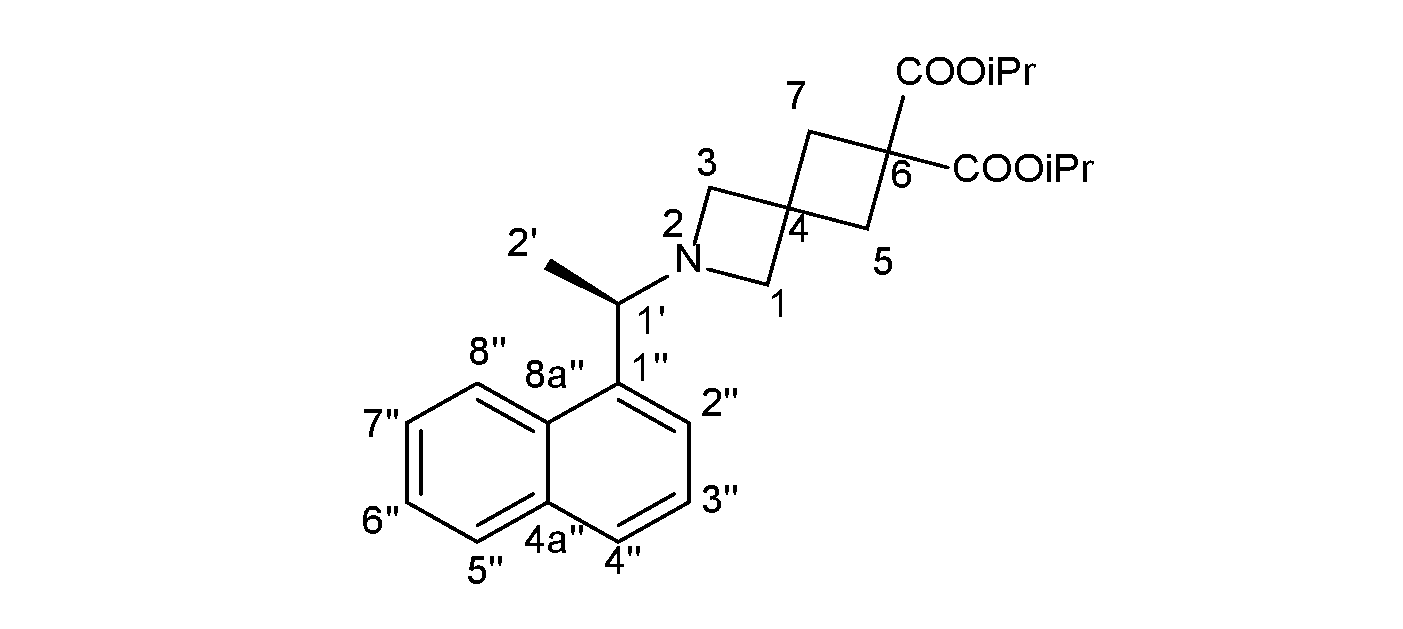
[0314] Diisopropyl 3,3-bis(hydroxymethyl)cyclobutene-1 ,1 -dicarboxylate (0.5 g, 1.73 mmol) was dissolved in dry CH3CN (4 mL) and the solution was cooled to -20 °C. Triflic anhydride (0.62 mL, 3.64 mmol) was added in a dropwise manner while keeping temperature below -10 °C. DIPEA (0.76 mL, 4.34 mmol) was then added slowly over 15 mins to the reaction mixture. After formation of the bistriflate (by mass spectral analysis), additional DIPEA (0.76 mL, 4.34 mmol) was added in a dropwise manner followed by (R)-(+)-1-(1-naphthyl)ethylamine (0.28 mL, 1.73 mmol), and the resulting mixture was heated to 70 °C for 2 h. After completion, the reaction mixture was cooled to room temperature and diluted with 25 mL of toluene and washed with 3 times with 20 mL of water. The organic layer was dried over Na2SO4, filtered and concentrated under reduced pressure to give a crude residue which was purified by silica gel column chromatography (1 :2, Ethyl Acetate: Hexane) to furnish the desired compound (0.58g, 78%) as a colorless syrup. [a]D 22 = +25.5 (c = 1.0, CHCI3); 1H NMR (500 MHz, CDCl3) δ 8.18 (d, J = 8.2 Hz, 1 H, H8 "), 7.83 (dd, J = 8.1 , 1.6 Hz, 1 H, H5 "), 7.70 (d, J = 8.2 Hz, 1 H, H4 ), 7.62 (d, J = 7.1 Hz, 1 H, H2 "), 7.52 - 7.38 (m, 3H, H3 , H6 " , Hr), 5.02 (hept, J = 6.3 Hz, 2H, -CH(CH3)2), 4.02 (q, J = 6.5 Hz, 1 H, H1'), 3.24 (q, J = 7.7 Hz, 4H, H1, H3 ), 2.67 (qd, J = 11.5, 1.8 Hz, 4H, H5, H7), 1.30 (d, J = 6.5 Hz, 3H, H2'), 1.21
(d, J = 2.4 Hz, 6H, -CH(CH3)2), 1.20 (d, J = 2.4 Hz, 6H, -CH(CH3)2). 13C NMR (126 MHz, CDCI3) 6 171.2 (CO), 139.2 (C1"), 134.0 (C4a"), 131.2 (C8a"), 129.0 (C5"), 127.2 (C4''), 125.8 (C3"), 125.7 (C2'), 125.2 (C6"), 123.9 (C7"), 123.3 (C8"), 68.8 (-CH(CH3)2), 65.8 (C1, C3), 64.7 (C1') 49.1 , (C4), 39.5 (C5, C7), 32.7 (C6), 21.6 (-CH(CH3)2), 20.6 (C2). HRMS (ESI) m/z: Calcd for C26H34NO4 [M + H]+ 424.2482; Found 424.2473. (R)-2-(1-(Naphthalen-1-yl)ethyl)-2-azaspiro(3.31heptane-6,6-dicarboxylic acid

[0315] To a solution of diisopropyl (R)-2-(1-(naphthalen-1-yl)ethyl)-2-azaspiro[3.3]heptane-6,6- dicarboxylate (0.50g, 1.15 mmol) in ethanol (5 mL), a solution of NaOH (47mg, 3.90 mmol) in ethanol (1 mL) was added. The resulting mixture was refluxed for 2 h and cooled down to room temperature. A white salt formed and was filtered, washed with EtOH (2x10 mL) and dried under high vacuum to afford the disodium salt of 2, which was dissolved in water (5 mL) and stirred for 10 min until homogeneity was achieved. The resulting solution was acidified with 2N HCI to pH = 2, leading to the formation of a slurry, which was cooled to 0 °C and stirred for 1 h. The so- obtained solid was filtered and washed with MeOH (2x10 mL) and dried under high vacuum to furnish the desired compound (0.34g, 86%) as a white solid, m.p.: 252-256 °C; [a]D 22 = +28.7 (c = 0.7, DMSO); 1H NMR (500 MHz, DMSO -d6) δ 8.21 (d, J = 8.2 Hz, 1 H, H8 "), 7.88 (dd, J = 7.7, 1.8 Hz, 1 H, H5 ), 7.75 (d, J = 8.0 Hz, 1 H, H4 ), 7.61 (d, J = 7.0 Hz, 1 H, H2 ), 7.57 - 7.41 (m, 3H, H3 , H6 , Hr), 4.48 (q, J = 6.6 Hz, 1 H, H1'), 4.32 (d, J = 9.9 Hz, 1 H, H3), 4.25 (d, J = 9.7 Hz, 1 H, H3 ), 2.50 (d, J = 12.5 Hz, 1 H, Hi), 2.37 (d, J = 12.5 Hz, 1 H, Hi), 2.29 (dd, J = 15.4, 8.9 Hz, 2H, H5, H7), 2.03 - 1 .87 (m, 2H, H5, H7 ), 1.35 (d, J = 6.6 Hz, 3H, H2); 13C NMR (126 MHz, DMSO-D6) δ 172.0 (COCH), 171.1 (COCH), 141.7 (C1"), 134.0 (C4a"), 131.4 (C8a "), 129.2 (C5 ), 127.3 (C4 "), 126.3 (C3 "), 126.2 (C2 "), 125.9 (C6 "), 123.6 (C7 ), 123.3 (C8 "), 75.9 (C3), 54.2 (C1'), 50.5 (C1), 49.2 (C4), 38.3 (C6), 34.8 (C7), 34.7 (C5), 24.2 (C2). HRMS (ESI) m/z: Calcd for C20H22NO4 [M + H]+ 340.1543; Found 340.1528.
General procedure for synthesis of amides from (R)-2-(1-(Naphthalen-1-yl)ethyl)-2- azaspiro[3.3]heptane-6,6-dicarboxylic acid

Reagents and conditions: (a) RNH2, carbonyl diimidazole, THF, rt to reflux
[0316] To a stirred suspension of the diacid (50 mg, 0.147 mmol) in dry THF (2 mL). was added 1.1'-carbonyl diimidazole (26 mg, 0.22 mmol) in two portions. The resulting mixture was stirred at rt for 2 h under an argon atmosphere. The amine (0.16 mmol) was added in one portion and the mixture refluxed (70 °C) for 0.5 h. The reaction mixture was cooled down to room temperature and the solvent was removed in vacuo to give a crude residue, which was dissolved in 20 mL of ethyl acetate and washed with saturated NaHCO3 solution (10 mL). The organic layer was dried over Na2SO4, filtered, and concentrated under reduced pressure to give a crude residue which was purified by silica gel column chromatography (1-10% MeOH/CH2CI2) to afford the desired amide. N--((2-Methoxypyridin-4-yl)methyl) (R)-2-(1-(naphthalen-1-yl)ethyl)-2-azaspirof3.31heptane-6- carboxamide

[0317] This colorless oil was prepared according to the general procedure (44 mg, 72%); [a]D 22 = +8.9 (c = 0.5, CHCl3); 1H NMR (500 MHz, Chloroform-d) δ 8.15 (d, J = 8.1 Hz, 1 H, H8"), 8.06 (d, J = 5.3 Hz, 1 H, H6'''') , 7.84 (dd, J = 8.1 , 1.6 Hz, 1 H, H5"), 7.71 (d, J = 8.2 Hz, 1 H, H4''), 7.64 (d, J =
7.2 Hz, 1 H, H2'), 7.53-7.41 (m, 3H, H3'', H6'', H7''), 6.72 (dd, J= 5.4, 1.5 Hz, 1H, H5'"), 6.56 (s, 1H, H2'"), 5.76 (t, J= 6.0 Hz, 1H, -NH), 4.35 (d, J= 6.0 Hz, 2H, -NHCH2), 4.04 (q, J= 6.3 Hz, 1H, H1'), 3.89 (s, 3H, -OCH3), 3.38- 3.19 (m, 4H, H1, H3), 2.85 (p, J= 8.1 Hz, 1H, H6), 2.49-2.41 (m, 2H, H5, H7), 2.40-2.29 (m, 2H, H5, H7), 1.33 (d, J= 6.6 Hz, 3H, H2).13C NMR (126 MHz, CDCI3) δ 174.6 (-CONH), 164.7 (C2''''), 150.2 (C4'''), 147.2 (C8'''), 139.1 (C1"), 134.0 (C4a"), 131.2 (C8a"), 129.0 (C5"), 127.2 (C4''), 125.8 (C3"), 125.7 (C2"), 125.2 (Cr), 123.9 (C7"), 123.2 (C8"), 115.7 (C3'''), 109.0 (C4'''), 66.1 (C3), 65.2 (Ci), 64.7 (C1'), 53.5 (OCH3), 42.3 (-NHCH2), 36.2 (C5), 35.8 (C7), 35.0 (C6), 34.5 (C4), 20.6 (C2). HRMS (ESI) m/z: Calcd for C26H30N3O2 [M + H]+ 416.2332; Found 416.2317. N--(Benzo[d][ 1,3]dioxol-5-ylmethyl) (R)-2-(1-(naphthalen-1-yl)ethyl)-2-azaspiro[3.3]heptane-6- carboxamide

[0318] This colorless syrup was prepared according to the general procedure (51 mg, 81%); [a]D 22 = +9.7 (c= 0.7, CHCI3); 1H NMR (500 MHz, CDCI3) 58.17 (d, J= 8.4 Hz, 1H, H8"), 7.83 (dd, J = 7.8, 1.7 Hz, 1H, H5"), 7.71 (d, J= 8.1 Hz, 1H, H4), 7.62 (d, J= 7.1 Hz, 1H, H2), 7.55-7.38 (m, 3H. Hr, Hr, H7), 6.80 - 6.68 (m, 2H, Hr, H6'''), 6.68 (dd, J= 7.9, 1.7 Hz, 1H. H4'''), 5.90 (s, 2H, OCH2O), 5.67 (t, J= 5.7 Hz, 1H. -NH), 54.28 (d, J= 5.7 Hz, 1H, -NHCH2), 4.03 (q, J= 6.5 Hz, 1H, Hr), 3.25 (dd, J= 15.6, 7.6 Hz, 2H, H3), 3.18 (t, J= 7.0 Hz, 2H, H1), 2.79 (p, J= 8.3 Hz, 1H, H6), 2.42 (dt, J= 11.6, 8.0 Hz, 2H, H5, H7), 2.38-2.21 (m, 2H, H5, H7), 1.31 (d, J=6.5 Hz, 3H, H2'); 13C NMR (126 MHz, CDCI3) δ 174.3 (-CONH), 148.0 (C4™), 147.0 (Cr), 139.2 (C1"), 134.0 (C4a"), 132.3 (Cr), 131.2 (C8a"), 129.0 (C5"), 127.2 (C4''), 125.8 (Cr), 125.7 (C2"), 125.2 (Cr), 123.9 (C71") 1,23.3 (Cr), 121.1 (Cr), 108.4 (Cr), 108.3 (C5'''), 101.1 (-OCH2O'''), 66.2 (C3), 65.2 (Ci), 64.7 (C1'), 43.5 (-NHCH2), 36.2 (C5), 35.9 (C7), 35.1 (C6), 34.4 (C4), 20.6 (C2). HRMS (ESI) m/z: Calcd for C27H29N2O3 [M + H]+ 429.2172; Found 429.2167. N--(3-Aminobenzyl) (R)-2-(1-(naphthalen-1-yl)ethyl)-2-azaspirof3.31heptane-6-carboxamide

[0319] This colorless syrup was prepared according to the general procedure (40 mg, 68%); [a]D 22 = +24.5 (c= 0.4, CHCl3); 1H NMR (500 MHz, CDCl3) δ 8.19 (d, J= 8.5 Hz, 1H, Hr), 7.84 (d, J = 8.0 Hz, 1H, H5"), 7.71 (d, J= 8.2 Hz, 1H, H4''), 7.63 (d, J= 7.2 Hz, 1H, Hr), 7.46 (dq, J= 21.2, 7.3 Hz, 3H, H3", H6", H7"), 7.07 (t, J= 7.6 Hz, 1H, H5'''), 6.60 (d, J= 7.6 Hz, 1H, Hr), 6.54 (d, J= 8.2 Hz, 2H, H4''', H6'''), 5.72 (t, J= 5.8 Hz, 1H, -NH), 4.28 (d, J= 5.7 Hz, 2H, -NHCH2), 4.03 (q, J= 6.5 Hz, 1 H, H1'), 3.65 (s, 2H, NH2), 3.36 - 3.07 (m, 4H, Hi , H3), 2.79 (p, J = 8.3 Hz, 1 H, H6), 2.43 (dt, J = 14.2, 7.2 Hz, 2H, H5, H7), 2.38 - 2.21 (m, 2H, H5, H7), 1.31 (d, J = 6.5 Hz, 3H, H2); 13C NMR (126 MHz, CDCl3) δ 174.4 (-CONH), 146.9 (C3™), 139.6 (C1'''), 139.3 (C1"), 134.0 (C4a"), 131.2 (C8a"), 129.7 (C5'''), 129.0 (C5"), 127.2 (C4''), 125.8 (C3"), 125.7 (C2"), 125.2 (C6"), 123.9 (C7"), 123.3 (C8"), 117.8 (C6'''), 114.4 (C2'''), 114.3 (C4'''), 66.2 (C3), 65.2 (C1"), 64.7 (C1'), 43.7 (-NHCH2), 36.3 (C5), 35.9 (C7), 35.1 (C6), 34.4 (C4), 20.7 (C2). HRMS (ESI) m/z: Calcd for C26H30N3O [M + H]+ 400.2383; Found 400.2372. N--(3-Fluorobenzyl) (R)-2-(1-(naphthalen-1-yl)ethyl)-2-azaspirof3.31heptane-6-carboxamide

[0320] This colorless syrup was prepared according to the general procedure (52 mg, 88%); [a]D 22 = +7.4 (c= 0.6, CHCl3); 1H NMR (500 MHz, CDCI3) 58.15 (d, J= 8.3 Hz, 1H, Hr), 7.84 (dd, J = 8.0, 1.6 Hz, 1H, H5"), 7.72 (d, J= 8.2 Hz, 1H, H4''), 7.65 (d, J= 7.1 Hz, 1H, Hr), 7.57-7.39 (m, 3H, H3", Hr, Hr), 7.31 -7.20 (m, 1H, H5'''), 7.00 (d, J= 7.7 Hz, 1H, H2'''), 6.98-6.87 (m, 2H, H4''',
H6'''), 5.70 (t, J= 6.0 Hz, 1 H, -NH), 4.39 (d, J= 5.8 Hz, 2H, -NHCH2'''), 4.11 (s, 1H, H1'), 3.30 (dd, J= 33.5, 7.9 Hz, 4H, Hi, H3), 2.83 (p, J= 8.2 Hz, 1H, H6), 2.45 (dt, J= 11.7, 7.2 Hz, 2H, H5, H7), 2.42 - 2.25 (m, 2H, H5, H7), 1.34 (d, J = 6.5 Hz, 3H, H2); 13C NMR (126 MHz, CDCl3) δ 174.4, 163.0 (d, J= 247.2, C3'''), 141.07 (Cr), 141.01 (Cr), 134.0 (C4a"), 131.1 (C8a"), 130.3 (d, J= 8.3, C5'''), 129.0 (C5"), 127.4 (C4"), 125.8 (Cr, Cr), 125.3 (Cr), 124.0 (Cr), 123.2 (d, J= 2.7, C6'''), 123.1 (Cr), 114.6 (d, J= 19.8, C2'''), 114.4 (d, J= 19.6, C4'''), 65.9 (C3), 65.1 (Ci), 64.4 (C1'), 43.1 (- NHCH2), 36.2 (C5), 35.8 (C7), 35.0 (C8), 34.5 (C4), 20.4 (C2). HRMS (ESI) m/z: Calcd for C26H28N2O F [M + H]+ 403.2180; Found 403.2169. N--(3-Methoxybenzyl) (R)-2-(1-(naphthalen-1-yl)ethyl)-2-azaspirof3.31heptane-6-carboxamide

[0321] This colorless syrup was prepared according to the general procedure (51 mg, 84%); [a]D 22 = +5.3 (c= 1.0, CHCI3); 1H NMR (500 MHz, CDCl3) δ 8.17 (d, J= 8.1 Hz, 1H, Hr), 7.84 (dd, J = 8.0, 1.6 Hz, 1H, Hr), 7.71 (d, J= 8.1 Hz, 1H, H4''), 7.62 (d, J= 7.1 Hz, 1H, Hr), 7.53-7.38 (m, 3H, H3", H6", H7''), 7.22 (t, J= 7.8 Hz, 1H, Hr ), 66.84 - 6.77 (m, 3H, H2-, H4-, Hr'), 5.62 (t, J= 5.8 Hz, 1H, -NH), 4.37 (d, J= 5.7 Hz, 2H, -NHCH2), 4.04 (q, J= 6.6 Hz, 1H, H1'), 3.77 (s, 3H, -OCH3), 3.27 (dd, J= 15.6, 7.7 Hz, 2H, H3), 3.22-3.14 (m, 2H, Hi), 2.81 (p, J= 8.3 Hz, 1H, H6), 2.45 (dt, J= 11.6, 7.6 Hz, 2H, H5, H7), 2.39 - 2.24 (m, 2H, H5, H7), 1.31 (d, J = 6.4 Hz, 3H, H2); 13C NMR (126 MHz, CDCl3) δ 174.3 (-CONH), 159.9 (C3'''), 140.0 (C1'''), 139.2 (C1"), 134.0 (C4a"), 131.2 (Csa"), 129.8 (C5'''), 129.0 (C5"), 127.2 (C4''), 125.8 (Cr), 125.7 (C2"), 125.2 (C6"), 123.9 (C7"), 123.2 (Cr), 120.0 (C6'''), 113.4 (C4'''), 113.0 (C2'''), 66.1 (C3), 65.2 (Ci), 64.7 (Cr), 55.3 (-OCH3), 43.6 (- NHCH2), 36.3 (C5), 35.9 (C7), 35.1 (C6), 34.4 (C4), 20.6 (C2). HRMS (ESI) m/z: Calcd for C27H3IN2O2 [M + H]+ 415.2380; Found 415.2373. N--((2-Aminopyridin-4-yl)methyl) (R)-2-(1-(naphthalen-1-yl)ethyl)-2-azaspirof3.31heptane-6- carboxamide

[0322] This white foam was prepared according to the general procedure (43 mg, 73%); [a]D 22 = +13.0 (c = 0.7, CHCl3); 1H NMR (500 MHz, CDCl3) δ 8.18 (s, 1 H, H8"), 7.98 (d, J = 5.6 Hz, 1 H, He''') , 7.88 - 7.80 (m, 1 H, H5"), 7.71 (d, J = 8.0 Hz, 1 H, Hr), 7.61 (d, J = 7.2 Hz, 1 H, H2"), 7.53 - 7.38 (m, 3H, H3-, H6", H7"), 6.53 - 6.46 (m, 1 H, H5'''), 6.34 (s, 1 H, H2'''), 5.62 (t, J = 5.9 Hz, 1 H, - NH), 4.38 (s, 2H. NH2), 4.29 (d, J= 6.0 Hz, 2H, -NHCH2), 4.03 (q, J= 6.5 Hz, 1 H, H1'), 3.34 - 3.15 (m, 4H, H1 , H3), 2.85 (p, J = 8.4 Hz, 1 H, H6), 2.51 - 2.24 (m, 4H, H5, H7), 1.30 (d, J = 6.6 Hz, 3H, H2); 13C NMR (126 MHz, CDCl3) δ 174.6 (CONH''') , 158.8 (C2™), 149.2 (C4''') , 148.6 (C6'''), 139.2 (Cr), 134.0 (C4a"), 131.2 (C8a"), 129.0 (C5"), 127.2 (C4''), 125.7 (C3"), 125.7 (C2"), 125.2 (C6"), 123.9 (Cr), 123.2 (C8") 113.0 (C5'''), 106.8 (C3'''), 66.1 (C3), 65.2 (Ci), 64.7 (C1'), 42.5 (-NHCH2), 36.3 (C5), 35.9 (C7), 35.1 (C6), 34.5 (C4), 20.6 (C2). HRMS (ESI) m/z: Calcd for C25H29N4O [M + H]+ 401.2335; Found 401.2320.
Methyl (R)-2-(1-(naphthalen-1-yl)ethyl)-2-azaspirof3.31heptane-6-carboxylate

[0323] To a stirred suspension of (R)-2-(1-(naphthalen-1-yl)ethyl)-2-azaspiro[3.3]heptane-6,6- dicarboxylic acid (0.50g, 1.47 mmol) in dry THF (5 mL). was added 1.1'-carbonyl diimidazole (0.36g, 2.21 mmol) in two portions. The resulting mixture was stirred at rt for 2h under an argon atmosphere. Dry MeOH (2 mL) was added in one portion and the mixture refluxed (70 °C) for 0.5 h. The reaction mixture was cooled down to room temperature and solvent was removed in vacuo to give a crude residue. This residue was dissolved in 20 mL of ethyl acetate and washed with saturated NaHCO3 solution (10 mL). The organic layer was dried over Na2SO4, filtered, and
concentrated under reduced pressure to give a residue which was purified by neutral alumina column chromatography (5-10% EtOAc/Hexane) to furnish the desired compound (0.42g, 92%) as a colorless syrup; [a]D 22 = +36.8 (c = 1.0, CHCl3); 1H NMR (500 MHz, CDCl3) δ 8.19 (d, J = 8.4 Hz, 1 H, H8"), 7.84 (dd, J = 8.0, 1.6 Hz, 1 H, H5''), 7.72 (d, J = 8.1 Hz, 1 H, H4''), 7.64 (d, J = 7.1 Hz, 1 H, H2''), 7.54 - 7.40 (m, 3H, Hr, H6", H7''), 4.03 (q, J = 6.5 Hz, 1 H, H1'), 3.65 (s, 3H, COOMe), 3.27 (d, J = 7.4 Hz, 1 H, H3), 3.26 - 3.16 (m, 3H, H3, Hi), 2.98 (p, J = 8.4 Hz, 1 H, H6), 2.48 - 2.30 (m, 4H, H5, H7), 1.32 (d, J = 6.5 Hz, 3H, H2); 13C NMR (126 MHz, CDCl3) δ 175.8 (-CO), 139.3 (Cr), 134.0 (C4a''), 131.2 (C8a''), 129.0 (C5"), 127.2 (C4''), 125.8 (C3"), 125.7 (C2''), 125.2 (C6"), 123.9 (C7"), 123.3 (C8"), 66.1 (C3), 65.4 (Ci), 64.7 (C1') 51.7 (OMe), 36.2 (C5), 35.9 (C7), 34.7 (C6), 33.3 (C4), 20.7 (C2). HRMS (ESI) m/z: Calcd for C20H24NO2 [M + H]+ 310.1801 ; Found 310.1796.
(R)-2-(1-(Naphthalen-1-yl)ethyl)-2-azaspirof3.31heptane-6-methanol

[0324] To a suspension of LAH (27.6 mg, 0.73 mmol) in THF (1 mL) was added a solution of 5 (150 mg, 0.49 mmol) in THF (1 mL) in a dropwise manner at 0 °C under an argon atmosphere. The reaction was then brought to rt, stirred until completion (monitored by TLC and mass spectral analysis), then quenched with ice cold water and diluted with CH2CI2 (15 mL). The organic layer was separated, collected, dried over Na2SO4, filtered, and concentrated under reduced pressure to give a residue which was purified by neutral alumina column chromatography (20-30% EtOAc/Hexane) to furnish the desired compound (0.12g, 87%) as white solid; m.p.: 128-132 °C; [a]D 22 = +32.1 (c = 0.6, DMSO); 1H NMR (500 MHz, DMSO-d6) δ 8.23 (d, J= 8.7 Hz, 1 H, H8''), 7.90 - 7.83 (m, 1 H, H5"), 7.73 (d, J = 8.1 Hz, 1 H, H4''), 7.55 (d, J = 7.1 Hz, 1 H, H2''), 7.45 (m, 3H, H3", H6", H7"), 4.38 (t, J = 5.3 Hz, 1 H, -OH), 3.96 (q, J = 6.6 Hz, 1 H, H1'), 3.27 - 3.23 (m, 2H, -CH2OH), 3.12 - 3.03 (m, 2H, H3), 3.03 - 2.95 (m, 2H, H1), 2.15 (h, J = 6.9, 6.4 Hz, 1 H, H6), 2.07 - 1.99 (m, 2H, H5, H7), 1.82 - 1.72 (m, 2H, H5, H7), 1.16 (d, J = 6.4 Hz, 3H, H2); 13C NMR (126 MHz, DMSO- D6) δ 140.0 (C1"), 134.0 (C4a"), 131.2 (C8a"), 129.2 (C5"), 127.3 (C4''), 126.2 (C3"), 126.2 (C2"), 125.8
(C6"), 124.3 (C7"), 123.8 (C8"), 66.4 (C3), 66.0 (C1), 65.5 (C1'), 35.5 (-CH2OH), 34.6 (C6), 32.3 (C4), 21.1 (C2). HRMS (ESI) mlz: Calcd for C19H24NO [M + H]; 282.1852; Found 282.1845. (R)-N--((2-Methoxypyridin-4-yl)methyl)-2-(1-(naphthalen-1-yl)ethyl)-2-azaspirof3.31heptane-6- methanamine

[0325] A stirred solution of (R)-2-(1-(naphthalen-1-yl)ethyl)-2-azaspiro[3.3]heptane-6-methanol (0.11g, 0.39 mmol) in CH2CI2 (3 mL) was treated with Dess Martin Periodinane (0.33g, 0.78 mmol), and then stirred at rt for 2 h. After complete conversion, the reaction mixture was diluted with 5 mL CH2CI2, 5 mL of sat. aqueous NaHCO3, 5 mL of aqueous sodium thiosulfate and stirred for 0.5 h at room temperature. The organic layer was separated, collected, dried over Na2SO4, filtered, and concentrated under reduced pressure to give a residue which was used immediately for the next reaction without purification. The above residue was dissolved in dry MeOH (2 mL), treated with (2-methoxypyridin-4-yl)methanamine (0.14 mL, 0.8 mmol), and stirred at room temperature for 2 h. NaCNBH3 (74.2 mg, 1.18 mmol) and AcOH (0.09 mL, 1.57 mmol) were then added and the mixture was stirred overnight at room temperature under an argon atmosphere. The reaction was quenched with 2 mL Et3N, and the volatiles evaporated under high vacuum to give a residue, which was dissolved in CH2CI2 (20 mL), and diluted with saturated aqueous NaHCO3. The organic layer was separated, collected, dried over Na2SO4, filtered, and concentrated under reduced pressure to give a residue, which was purified by silica gel column chromatography (5-10% MeOH/CH2CI2) to furnish the desired compound (91 mg, 58%) as a colorless syrup; [a]D 22 = +10 (c = 0.4, CHCI3); 1H NMR (500 MHz, CDCl3) δ 8.20 - 8.13 (m, 1 H, H8"), 8.07 (d, J = 5.2 Hz, 1 H, H6'''), 7.87 - 7.82 (m, 1 H, H5"), 7.72 (d, J = 8.2 Hz, 1 H, H4''), 7.60 (d, J = 7.0 Hz, 1 H, H2"), 7.45 (m, 3H, Hr, H6", Hy), 6.87 (dd, J = 5.3, 1.3 Hz, 1 H, H5''') , 6.73 (s, 1 H, H2'''), 4.52 (q, J = 6.6 Hz, 1 H, H1'), 3.93 (s, 3H, OCH3), 3.61 (s, 2H, -NHCH2), 2.83 - 2.73 (m, 3H, H3, -CH2NH), 2.71 (d, J = 9.4 Hz, 1 H, Hi, H3), 2.47 (d, J = 11.7 Hz, 1 H, Hi), 2.37 (d, J = 11.8 Hz, 1 H, Hi), 2.30 - 2.24 (m, 1 H, H6), 1.89 (s, 1 H, -NH), 1.71 (dt, J = 10.9, 7.1 Hz, 2H, H5, H7), 1.57
(dt, J= 22.9, 7.9 Hz, 2H, H5, H7), 1.45 (d, J= 6.6 Hz, 3H, H2); 13C NMR (126 MHz, CDCl3) δ 164.6 (C2''') , 151.7 (C4'''') , 146.6 (C6'''') , 141.3 (Cr), 134.0 (C4a"), 131.4 (C8a"), 129.0 (C5"), 127.2 (C4''), 125.7 (C3"), 125.7 (C2''') , 125.3 (C6"), 123.1 (Cr), 122.9 (C8"), 117.3 (C3''') , 110.3 (C4''') , 60.2 (C3), 59.9 (Ci), 56.4 (C6), 55.1 (C1'), 54.3 (C4), 53.4 (OCH3), 42.9 (-NHCH2), 35.6 (C5), 35.4 (C7), 30.2 (- CH2NH), 23.6 (C2). HRMS (ESI) m/z: Calcd for C26H32N3O [M + H]+ 402.2539; Found 402.2530.
Benzophenone 1-naphthylhydrazone

Reagents and conditions: (a) Benzophenone, H2SO4, MeOH, 50 °C, 4 h.
[0326] A stirred solution of benzophenone (0.94 g, 5.14 mmol) in MeOH (8 mL) was treated dropwise with concentrated H2SO4 (0.16 mL) at 20 °C followed by 1-napthylhydrazine hydrochloride135 (1 g, 5.14 mmol). The reaction mixture was heated to 50 °C and stirred for 4 h then was cooled at 0 °C for 20 min, and the precipitate was filtered, and washed with cold MeOH (6 mL) to afford the product as a yellow solid (1.4 g, 83%), which was directly used for the next step without further purification. 1H NMR (500 MHz, CDCl3) δ 8.31 (s, 1 H, H-8'), 7.92 - 7.86 (m, 2H, H-5', H-4'), 7.83 - 7.79 (m, 2H, Nap), 7.73 - 7.69 (m, 2H, Nap), 7.68 - 7.62 (m, 1 H, Nap), 7.58 (t, J = 7.9 Hz, 1 H, Ar), 7.53 (d, J = 1 .7 Hz, 1 H, Ar), 7.49 - 7.30 (m, 8H, Ar). 13C NMR (126 MHz, CDCl3) δ 146.5 (C-1), 139.5 (C-T), 138.4, 134.4, 133.1 , 130.3, 130.1 , 129.7, 129.3, 129.0, 128.5, 128.5, 127.0, 125.8, 125.2, 122.1 , 120.2, 119.2, 108.3. HRMS (ESI) mlz: [M + H]+ Calcd for C23H19N2 323.1543; Found 323.1535.
Benzophenone N--methyl-(1-naphthyl)hydrazone
 Reagents and conditions: (a) NaH, Mel, MeOH, DMF, 20 °C, 3.5 h.
[0327] A stirred solution of benzophenone 1 -naphthylhydrazone (2 g, 6.20 mmol) in anhydrous DMF (12 mL) was slowly treated with NaH (0.04 g, 9.30 mmol) at 0 °C, and then stirred at 0 °C for 0.5 h, before methyl iodide (0.58 mL, 9.30 mmol) was added dropwise over 5 min and the resulting mixture was warmed to 20 °C and stirred for 3 h. The reaction mixture was cooled to 0 °C before it was quenched with water (20 mL) and extracted with ethyl acetate (3x20 mL), and the combined organic phase washed with 1 N HCI (30 mL), saturated aqueous NaHCO3 (30 mL), and brine (30 mL), dried over Na2SO4 and concentrated in vacuo. The residue was subjected to flash chromatography (0 to 10% ethyl acetate/hexane) to give the product (1.8 g, 87%) as a light orange solid. 1H NMR (500 MHz, CDCl3) δ 7.99 - 7.91 (m, 1 H, H-8'), 7.71 - 7.67 (m, 1 H, H-5'), 7.64 - 7.59 (m, 2H, H-2', H-7'), 7.47 (m, 2H, H-6'", H-2"), 7.41 - 7.36 (m, 2H, H-4', H-3'), 7.35 - 7.32 (m, 3H, H-6', H-2'", H-6"), 7.31 - 7.22 (m, 1 H, H-5'"), 7.09 - 7.04 (m, 2H, H-3", H-4'"), 7.03 - 6.99 (m, 2H, H-5", H-3'"), 6.98 - 6.93 (m, 1 H H-4"), 3.26 (s, 3H, -NCH3). 13C NMR (126 MHz, CDCl3) δ 155.9 (C-1), 150.8 (C-T), 139.6 (C-8a'), 137.2 (C-1"), 134.4 (C-1'"), 132.5 (C-4a'), 130.2, 129.0, 128.9, 128.8, 128.4, 128.2, 128.0, 127.8, 127.6, 127.4, 125.7, 125.3, 124.9, 123.9, 120.4, 48.7 (CH3). HRMS (ESI) m/z: [M + Na]+ Calcd for C24H20N2Na 359.1524; Found 359.1530. N--Methyl-N--(1-naphthyl)hydrazine

Reagents and conditions: (a) HCI, THF, 20 °C, 12 h.
[0328] A solution of benzophenone N--methyl-(1-naphthyl)hydrazone (2 g, 5.94 mmol) in THF (60 mL) was treated with 6 M HCI (18.2 mL, 109 mmol) and stirred at room temperature for 10 h before concentration in vacuo. The residue was washed with diethyl ether (2* 20 mL) and the solid was dried under reduced pressure. The solid was dissolved in water (30 mL) with vigorous stirring and the pH was carefully adjusted to 7 with 20% aqueous NaOH. The cloudy mixture was extracted with diethyl ether (2x 20 mL) and the combined organic phase was dried over Na2SO4, and concentrated under reduced pressure to give the product (0.8 g, 81 %) as a dark brown oil. 1H NMR (500 MHz, CD3OD) 5 8.26 (d, J = 8.9 Hz, 1 H, H-8), 7.92 (d, J = 9.7 Hz, 1 H, H-2), 7.85 (d, J = 8.0 Hz, 1 H, H-5), 7.63 - 7.58 (m, 2H, H-3, H-7), 7.55 (m, 2H, H-6, H-4) 3.20 (s, 3H, CH3). 13C
NMR (126 MHz, CD3OD) 6 145.7 (C-1), 136.1 (C-8a), 129.7 (C-2), 129.5 (C-8), 129.0 (C-3), 128.1 (C-7), 128.0 (C-4a), 126.5 (C-6), 123.4 (C-4), 117.6 (C-5), 46.3 (CH3). HRMS (ESI) mlz: [M + H]+ Calcd for C11H13N2173.1079; Found 173.1070.
Diisopropyl N--[(naphthalen-1-yl)methylamino]-2-azaspirof3.31heptane-6,6-dicarboxylate

Reagents and conditions: (a) Trifluoromethanesulfonic anhydride, DIPEA, CH3CN, -20 °C to 70 °C, 2h.
[0329] To a stirred mixture of diisopropyl 3, 3-bis(hydroxymethyl)cyclobutane- 1 ,1 -dicarboxylate136 (167 mg, 0.58 mmol) and acetonitrile (1 mL) at -20 °C, was carefully added trifluoromethanesulfonic anhydride (0.2 mL, 1.22 mmol) while maintaining the temperature below -10 °C. DIPEA (0.25 mL, 1.45 mmol) was then added slowly to the reaction mixture over 10 min. After formation of the bistriflate was complete (by mass spectral analysis), a second aliquot of DIPEA (0.25 mL, 1.45 mmol) was added dropwise followed by addition of N--methyl-N--(1- naphthyl)hydrazine (100 mg, 0.58 mmol) and heating of the resulting mixture to 70 °C for 2 h. The reaction mixture was cooled to room temperature and diluted with ethyl acetate (6 mL), washed with water (3x5 mL) and brine (3 mL). The combined organic layer was dried over Na2SO4, filtered and concentrated in vacuo. The crude residue was purified by silica gel column chromatography (0 to 3% methanol/dichloromethane) to yield the product (185 mg, 75%) as a brown foam. 1H NMR (500 MHz, CDCl3) δ 8.34 (br s, 1 H, H-8'), 8.00 (m, 2H, H-4', H-5'), 7.79 (t, J = 7.8 Hz, 1 H, H-2'), 7.62 (t, J = 7.6 Hz, 1 H, H-3'), 7.54 (t, J = 8.1 Hz, 1 H, H-7'), 7.37 (t, J = 8.2 Hz, 1 H, H-6'), 5.05 (d, J = 11.7 Hz, 1 H, H-1a), 4.94 (h, 6.3 Hz, 2H, -CH(CH3)2), 4.71 (d, J = 11.7 Hz, 1 H, H-1 b), 4.08 (s, 3H, -CH3), 3.85 (dd, J = 12.3, 7.0 Hz, 1 H, H-3a), 3.36 (dd, J = 12.3, 9.7 Hz, 1 H, H-3b), 2.98 - 2.87 (m, 2H, H-5), 2.15 (d, J = 12.4 Hz, 2H, H-7), 1.19 - 1.10 (m, 9H, -CH(CH3)2), 1.07 (d, J = 6.3 Hz, 3H, CH(CH3)2). 13C NMR (126 MHz, CDCl3) δ 170.5 (CO), 170.4 (CO), 140.2 (C-1'), 135.9 (C-4a'), 133.1 (C-4'), 130.6 (C-4'), 129.0 (C-2'), 127.2 (C-3'), 124.8 (C-7'), 123.6 (C-6'), 122.4 (C-8a'), 122.0 (C-4a'), 120.5 (C-8a'), 119.4, 79.5 (C-1), 69.6 (-CH(CH3)2), 58.4 (C-3), 57.1
(CH3), 47.8 (C-4), 42.0 (C-6), 39.0 (C-7), 38.0 (C-5), 21.5 (-CH(CH3)2), 21.4 (-CH(CH3)2), 21.4 (- CH(CH3)2). HRMS (ESI) mlz: [M + H]+ Calcd for C25H33N2O4425.2435; Found 425.2445. N--[(2-Methoxypyridin-4-yl)methyl] N'-r(naphthalen-1-yl)methylamino1-2-azaspiro[3.3]heptane-6- carboxamide

Reagents and conditions: (a) NaOH, H3O+, rt, 12 h (b) (2-Methoxypyridin-4-yl)methanamine, GDI, THF, rt to 70 °C, 2.5 h.
[0330] Diisopropyl N--[(naphthalen-1-yl)methylamino]-2-azaspiro[3.3]heptane-6,6-dicarboxylate (60 mg, 0.14 mmol) and methanol (0.2 mL), and 2 M aqueous NaOH (0.6 mL) were stirred at 20 °C for 12 h. The reaction mixture was then acidified by 3 N HCI to pH 3 and then extracted with diethyl ether (4 x 1 mL). The combined organic layer was dried over Na2SO4, filtered and concentrated in vacuo. The crude mixture was dissolved in dry THF (1.6 mL) and treated with 1 ,1 '-carbonyl diimidazole (30.5 mg, 0.19 mmol) in two portions. The resulting mixture was stirred at 20 °C for 2 h, then was treated with (2-methoxypyridin-4-yl)methylamine (16.2 μL, 0.13 mmol) and the temperature increased to 70 °C for 0.5 h. After cooling to 20 °C the mixture was concentrated in vacuo, dissolved in ethyl acetate (2 mL), washed with saturated aqueous NaHCO3 (1 mL), dried over Na2SO4, filtered, concentrated under reduced pressure to give a residue, which was purified by column chromatography on neutral alumina (50 to 100% ethyl acetate/hexane) to furnish the desired product (43 mg, 73%, 2 steps) as a colorless syrup. 1H NMR (500 MHz, CD3OD) 5 8.63 (br s, 1 H, H-8'), 8.37 (d, J = 7.9 Hz, 1 H, H-6"), 8.14 (d, J = 8.2 Hz, 1 H, H-5'), 8.10 (d, J = 11.9 Hz, 1 H, H-4'), 8.00 (dd, J = 5.4, 3.3 Hz, 1 H, H-3'), 7.79 (q, J = 7.3 Hz, 1 H, H-6'), 7.72 - 7.65 (m, 2H), 7.62 (td, J = 8.1 , 3.3 Hz, 1 H), 7.03 (s, 1 H, H-3"), 6.81 (t, J = 5.1 Hz, 1 H), 6.63 (s, 1 H), 5.03 (d, J = 11.4 Hz, 1 H, H-1a), 4.62 (t, J = 11.5 Hz, 1 H, H-1b), 4.31 (s, 2H, -NHCH2), 3.95 - 3.83 (m, 6H, -NCH3, -OCH3), 3.78 (dd, J = 17.7, 12.5 Hz, 1 H, H-3a), 3.48 (dd, J = 21.5, 12.5 Hz, 1 H, H-3b), 3.22 - 3.08 (m, 1 H, H-6), 2.73 (td, J = 10.0, 9.1 , 5.3 Hz, 1 H, H-5), 2.68 - 2.59 (m, 1 H, H-5), 2.41 - 1.99 (m, 2H, H-7). 13C NMR (126 MHz, CD3OD) 5 175.5 (-CONH), 164.8 (C-2"), 151.5 (C-4"), 146.5 (C-6"), 142.4 (C-T), 136.1 (C-4a'), 132.7 (C-8a'), 130.0, 128.2, 126.9, 124.6,
123.0, 121.7 (C-8'), 119.9 (C-6"), 115.5, 108.3, 80.4 (C-1), 80.3, 58.0 (C-3), 57.6, 52.7 (-OCH3), 41.6 (-NHCH2), 35.6 (C-5), 33.6 (C-6), 33.2 (C-7). HRMS (ESI) m/z: [M + H]+ Calcd for C25H29N4O2 417.2285; Found 417.2292.
7-Phenyl-2-tosyl-6,8-dioxa-2-azaspiro(3.51nonane:

[0331] A stirred solution of NaH (60 % dispersion in mineral oil) (262 mg, 6.57 mmol) in anhydrous DMF (20 mL) was treated with KI (43.6 mg, 0.263 mmol) followed portion-wise by TsNH2 (495 mg, 2.89 mmol) and then was stirred for 0.5 h at 20 °C. 2-Phenyl-1 ,3-dioxane-5,5- diyl)bis(methylene) dimethanesulfonate (1g, 2.63 mmol) was then added and the reaction mixture stirred overnight (16 h) at 140 °C. After cooling to room temperature, the reaction then was quenched with brine (20 mL) and the reaction mixture was extracted with Et2O (3x30 mL). The combined organic layers were washed with brine (60 mL), dried over MgSO4 and concentrated to dryness. The crude product was purified by flash column chromatography over silica gel (eluent: hexanes : EtOAc (EtOAc, 0 — > 30 %)) to give the title compound as a white solid (550 mg, 58 %). Rf 0.36 (hexanes : EtOAc 7 : 3 (v/v); UV). 1H NMR (500 MHz, DMSO-c/6) 5 7.76 (d, J = 8.2 Hz, 2H, H-6”, H-2”), 7.52 (d, J = 8.0 Hz, 2H, H-3”, H-5”), 7.33 (s, 5H, C6H5CH), 5.38 (s, 1 H,_C6H5CH ), 3.74 (d, J = 8.8 Hz, 4H, 2xH-9, 2xH-5), 3.66 (d, J = 11.2 Hz, 2H, H-1 , H-3 ), 3.36 (s, 2H, H-1 , H-3),* 2.44 (s, 3H, CH3). 13C NMR (126 MHz, DMSO-c/6) 5 144.8 (C-4”), 138.4 (C-1'), 131.3 (C- 1”), 130.6 (C-3”, C-5”), 129.3 (C-5', C-3'), 128.8 (C-4'), 128.5 (C-6”, C-2”), 126.6 (C-6', C-2'), 100.7 (PhCH), 72.5 (C-9), 60.2 (C-3), 53.8 (C-1), 32.1 (C-4), 21.6 (CH3). HRMS (ESI) m/z: Calcd for Ci9H2iNNaO4S [M+Na]+ 382.1089; Found 382.1072. *Peak overlaps with residual signal of DMSO-c/6.
(1-Tosylazetidine-3,3-diyl)dimethanol:
 [0332] 7-Phenyl-2-tosyl-6,8-dioxa-2-azaspiro[3.5]nonane (500 mg, 1.39 mmol) was dissolved in CH2CI2 (20 mL) and the reaction mixture was cooled down to 0 °C before TFA (90% aq. solution) (4 mL) was added and the reaction mixture was stirred for 1 .5 h at 0 °C. After completion of the reaction, detected by LCMS, the reaction mixture was concentrated to dryness and the crude product was purified by flash column chromatography over silica gel (eluents: hexanes : EtOAc (EtOAc, 0 — > 30 %); CH2CI2 : MeOH (MeOH 0 — > 20 %)) to give the title compound as a colorless syrup (270 mg, 71 %). Rf 0 (hexanes : EtOAc 7 : 3 (v/v); CAM). 1H NMR (500 MHz, CD3OD) 5 7.77 - 7.71 (m, 1 H, H-2”), 7.71 - 7.65 (m, 1 H, H-6”), 7.43 (d, J = 8.0 Hz, 1 H, H-3”), 7.30 (d, J = 8.1 Hz, 1 H, H-5”), 3.49 (s, 2H, H-1'), 3.38 (s, 2H, H-1'), 2.43 (s, 2H, H-2), 2.37 (s, 2H, H-4).13C NMR (126 MHz, CD3OD) 5 144.4 (C-1”), 131.6 (C-4”), 129.7 (C-3”, C-5”), 128.3 (C-2”, C-4”), 62.8 (C-4), 54.2 (C-2), 39.7 (C-3), 35.7 (C-1'), 30.4 (C-1'), 20.3 (CH3). HRMS (ESI) mlz: Calcd for Ci2H17NNaO4S [M+Na]+ 294.0776; Found 294.0763. (R)-2-(1-(Naphthalen-1-yl)ethyl)-6-tosyl-2,6-diazaspirof3.31heptane

[0333] (1-Tosylazetidine-3,3-diyl)dimethanol (250 mg, 0.921 mmol) was dissolved in anhydrous MeCN (3 mL) and the reaction mixture was cooled down to 0 °C with stirring. Subsequently, Tf2O (324 μL, 1.93 mmol) was added followed drop-wise by DIPEA (400 μL, 2,39 mmol). After formation of the ditriflate (15 min), detected by LCMS, further DI PEA (400 μL, 2,39 mmol) was added drop-wise followed by slow addition of (R)-1-(naphthalen-1-yl)ethan-1-amine (147 μL, 0.921 mmol). The reaction mixture then was stirred for 10 min at 0 °C and then refluxed for 3 h. After completion, detected by LCMS, the reaction mixture was quenched with sat. aq. NaHCO3 (10 mL) and extracted with EtOAc (3 x 20 mL). The combined organic layers were washed with brine (50 mL), dried over MgSO4 and concentrated to dryness. The crude product was purified by flash column chromatography over silica gel (eluent: hexanes : EtOAc (EtOAc, 0 — > 30 %)) to give the title compound as white solid 260 mg (70 %). Rf 0.56 (hexanes : EtOAc 7 : 3 (v/v); UV). [a]D 20' 22 - 9.6 (c 7.5, CHCl3). 1H NMR (500 MHz, CDCl3) δ 8.64 - 8.58 (m, 1 H, H-8”), 8.09 - 7.94 (m,
1 H, H-5”), 7.88 (d, J = 8.0 Hz, 1 H, H-4” ), 7.81 (d, J = 8.2 Hz, 1 H, H-7”), 7.68 - 7.60 (m, 2H, H- 2'”, H-6'”), 7.58 - 7.44 (m, 2H, H-3”, H-2”), 7.40 - 7.28 (m, 3H, H-3'”, H-5'”, H-6”), 3.25 (s, 2H, H-5, H-6), 3.16 (s, 2H, H-5, H-6 ), 2.95 (d, J = 1.1 Hz, 2H, H-4, H-2), 2.87 (d, J = 1.1 Hz, 2H, H-4, H-2), 2.40 (s, CH3), 1.50 (d, J = 6.5 Hz, 3H, H-1'), 1.35-1.31 (m, 1 H, H-2'). 13C NMR (126 MHz, CDCl3) δ 149.1 (C-1'”), 144.5 (C-4'”), 133.4 (C-4a”), 131.1 (C-8a”), 130.8 (C-1”), 129.9 (C-3'”, C-5'”), 129.6 (C-4”), 129.4 (C-5”), 128.4 (C-2'”, C-6'”), 128.2 (C-7”), 126.0 (C-6”), 125.9 (C-3”), 124.0 (C-8”), 121.8 (C-2”), 61.7 (C-4, C-2), 59.7 (C-2'), 45.9 (C-6, C-5), 31.8 (C-3), 21.6 (C-2'), 20.7 (C-1'). HRMS (ESI) m/z: Calcd for C24H27N2O2S+ [M+H]+ 407.1788; Found 407.1775. (R)-(6-(1-(Naphthalen-1-yl)ethyl)-2,6-diazaspirof3.31heptan-2-yl)(pyridin-3-yl)methanone

[0334] A stirred solution of (R)-2-(1-(naphthalen-1-yl)ethyl)-6-tosyl-2,6-diazaspiro[3.3]heptane (110 mg, 0.271 mmol) in MeOH (10 mL) was treated with Mg turnings (52.5 mg, 2.17 mmol) and sonicated (40 kHz) for 1.5 h at 20 °C. After completion, detected by LCMS, the reaction mixture was diluted with Et2O (20 mL) and filtered on CELITE®. The filter cake was additionally washed with Et2O (3x20 mL), and the filtrate was dried over MgSO4 and concentrated to dryness. The residue (80 mg, 0.317 mmol) was taken up in anhydrous CH2CI2 (2 mL) and added at 0 °C to a stirred solution of nicotinic acid (39 mg, 0.317 mmol), EDCI (76 mg, 0.396 mmol) and HOBt (53.5 mg, 0.396 mmol) in anhydrous CH2CI2 (4 mL), followed by addition of DI PEA (220 μL, 1 .26 mmol). The reaction mixture then was allowed to warm up to 20 °C and was stirred for 16 h before it was quenched with H2O (5 mL) and extracted with CH2CI2 (3X 10 mL). The combined organic layers were dried over MgSO4 and concentrated to dryness. The crude material was purified by flash column chromatography over silica gel (eluents: hexanes : EtOAc (EtOAc, 0 — > 30 %); CH2CI2 : MeOH (MeOH 0 — > 10 %)) to give the title compound as a colorless syrup (35 mg, 36 % over 2 steps). Rf 0.50 (CH2CI2 : MeOH 99 : 1 (v/v); UV). [a]D 20-22 + 4.5 (c 5, MeOH). 1H NMR (500 MHz, CD3OD) 5 8.80 (dd, J = 2.2, 0.9 Hz, 1 H, H-2'”), 8.66 (dd, J = 4.9, 1.6 Hz, 1 H, H-6'”), 8.24 - 8.18 (m, 1 H, H-4'”), 8.08 (dt, J = 7.9, 1.9 Hz, 1 H, H-8”), 7.86 (dd, J = 8.2, 1.5 Hz, 1 H, H-4”), 7.75 (d, J = 8.1 Hz, 1 H, H-5”), 7.59 - 7.41 (m, 5H, H-2”, H-7”, H-5'”, H-3”, H-6”), 4.52 - 4.44 (m, 1 H, 2xH-
3' ), 4.26 (d, J = 13.9 Hz, 2H, 2xH-1), 3.49 - 3.39 (m, 4H, 2xH-5, 2xH-7), 2.01 (s, 1 H, H-T), 1.36 - 1.27 (m, 3H, H-2'). 13C NMR (126 MHz, CD3OD) 5 179.0 (CO), 167.8 (C-6'”), 151.1 (C-2'”), 148.1 (C-3'”), 138.2 (C-4a”), 136.1 (C-8a”), 134.2 (C-1”), 131.2 (C-4'”), 129.4 (C-4”), 128.7 (C- 5”), 127.3 (C-7”), 125.7 (C-6”), 125.3 (C-3”), 125.2 (C-5'”), 123.8 (C-8”), 122.7 (C-2”), 62.8 (C- 1), 62.7 (C-3), 58.8 (C-5, C-7), 32.9 (C-4), 22.9 (H-T), 19.4 (H-2'). HRMS (ESI) m/z: Calcd for C23H24N3O [M+H]+ 358.1914; Found 358.1902.
3-Ethoxy-4-((2-methyl-5-nitrophenyl)amino)cyclobut-3-ene-1 ,2-dione

[0335] A solution of diethyl squarate (2.05 mL, 13.8 mmol) and 2-methyl-5-nitroaniline (2.00 g, 13.14 mmol) in ethanol was heated under microwave irradiation to 120 °C for 4 h. The reaction mixture was then concentrated under vacuum, suspended in ether, and filtered. The precipitate was washed with MeCN and the filtrate was concentrated to give the title compound (0.647 g, 2.34 mmol, 18%) as a yellow solid. 1H NMR (500 MHz, CDCl3) δ 8.23 - 8.16 (m, 2H, H-6", H-10), 7.95 (dd, J = 8.3, 2.3 Hz, 1 H, H-4"), 7.37 (d, J = 8.3 Hz, 1 H, H-3"), 4.89 (q, J = 7.0 Hz, 2H, H-T), 2.49 (s, 3H, H-7"), 1.50 (t, J = 7.0 Hz, 3H, H-2'). 13C NMR (126 MHz, CDCl3) δ 188.8 (C-1), 184.8 (C-2), 179.0 (C-3), 168.5 (C-4), 147.0 (C-5"), 136.1 (C-1", C-2"), 131.7 (C-3"), 120.0 (C-4"), 116.1 (C-6"), 71.1 (C-1'), 18.2 (C-7"), 15.8 (C-2'). HRMS (ESI): m/z: Calcd for Ci3Hi3N2O5 [M+H]+ 277.0814; Found 277.0811. N--((2-Methyl-5-nitrophenyl)) N'-(R)-((1-(naphthalen-1-yl)ethyl))squaramide

[0336] A solution of 3-ethoxy-4-((2-methyl-5-nitrophenyl)amino)cyclobut-3-ene-1 , 2-dione (0.304 g, 1.10 mmol) and (R)-(+)-1-(1-naphthyl)ethylamine (0.19 mL, 1.2 mmol) in ethanol (3 mL) was heated under microwave irradiation to 50 °C for 15 min. The reaction mixture was concentrated and adsorbed on CELITE® followed by purification over silica gel eluting with ethyl acetate to give
the title compound (0.348 g, 0.87 mmol, 79%) as a yellow solid. [a]D 23 = -140.3 (c = 1.0, CHCI3), 1H NMR (500 MHz, CDCl3) δ 8.78 (s, 1 H, NH), 8.56 (d, J = 7.8 Hz, 1 H, NH'), 8.24 (d, J = 2.3 Hz, 1 H, H-6'), 7.97 (d, J = 8.5 Hz, 1 H, H-9'"), 7.74 (dd, J = 8.1 , 1.4 Hz, 1 H, H-6'"), 7.64 (d, J = 8.2 Hz, 1 H, H-4'"), 7.57 (dd, J = 8.3, 2.3 Hz, 1 H, H-4'), 7.48 - 7.41 (m, 2H, H-2'", H-8'"), 7.38 (t, J = 7.4 Hz, 1 H, H-7'"), 7.28 (t, J = 7.7 Hz, 1 H, H-3'"), 6.98 (d, J = 8.3 Hz, 1 H, H-3'), 6.04 (p, J = 6.9 Hz, 1 H, H-1"), 2.05 (s, 3H, H-7'), 1.70 (d, J = 6.7 Hz, 3H, H-2"). 13C NMR (126 MHz, CDCl3) δ 182.6 (C-1), 181.3 (C-2), 170.9 (C-3), 162.4 (C-4), 146.7 (C-5'), 137.5 (C-1"'), 137.0 (C-1 '), 135.0 (C-2'), 134.0 (C-5'"), 131.1 (C-3'), 130.2 (C-10'"), 129.1 (C-6'"), 128.8 (C-4'"), 126.6 (C-8'"), 125.9 (C- 7'"), 125.5 (C-3'"), 123.0 (C-2'"), 122.7 (C-9'"), 118.4 (C-4'), 115.3 (C-6'), 51.0 (C-1"), 23.1 (C-2"), 18.1 (C-7'). HRMS (ESI) m/z: Calcd for C23H19N3O4Na [M+Na]+ 424.1268; Found 424.1261. N--((5-Amino-2-methylphenyl)) N'-(R)-((1-(naphthalen-1-yl)ethyl))squaramide

[0337] Palladium on carbon (10 wt%, 2 mg) was added to a solution of N--((2-methyl-5- nitrophenyl)) N'-(R)-((1-(naphthalen-1-yl)ethyl))squaramide (20 mg, 0.05 mmol) in 1 ,4-dioxane (1 mL) and the reaction mixture was stirred under H2 at atmospheric pressure for 2 h followed by addition of 10% aqueous acetic acid (1.0 mL). After an additional 0.5 h stirring, palladium on carbon (10 wt%, 6.6 mg) was added and the reaction mixture was stirred for 1 h before it was filtered and concentrated under vacuum. The crude residue was then dry loaded on CELITE® and purified over silica gel eluting with 0 to 10% methanol in CH2CI2 to give the title compound (7.9 mg, 0.02 mmol, 43%) as a brown solid. [a]D = -88.29 (c = 0.3, CHCI3), 1H NMR (500 MHz, CD3OD) 5 8.14 (br s, 1 H, H-9'"), 7.89 (dd, J = 8.2, 1.4 Hz, 1 H, H-6'"), 7.82 (d, J = 8.2 Hz, 1 H, H- 4'"), 7.61 - 7.53 (m, 2H, H-2'", H-8'"), 7.51 - 7.47 (m, 2H, H-3'", H-7'"), 6.85 (d, J = 8.1 Hz, 1 H, H- 3'), 6.74 (br s, 1 H, H-6'), 6.41 (dd, J = 8.1 , 2.3 Hz, 1 H, H-4'), 6.24 (br s, 1 H, H-1 "), 2.09 (s, 3H, H- 7'), 1.76 (d, J = 6.8 Hz, 3H, H-2"). 13C NMR (126 MHz, CD3OD) 5 184.1 (C-1), 181.5 (C-4), 168.3 (C-2), 164.8 (C-3), 146.4 (C-5'), 138.1 (C-1'"), 136.5 (C-1'), 134.3 (C-5'"), 130.9 (C-3'), 130.6 (C- 10'"), 128.7 (C-6'"), 128.3 (C-4'"), 126.4 (C-8'"), 125.7 (C-3'"), 125.2 (C-7'"), 122.6 (C-9'"), 122.3 (C-2'"), 117.5 (C-2'), 112.3 (C-4'), 108.7 (C-6'), 49.8 (C-1"), 22.0 (C-2"), 15.5 (C-7'). HRMS (ESI) m/z: Calcd for C23H22N3O2 [M+H]+ 372.1707; Found 372.1700.
3-[N'-(Naphthalen-1-yl)-N'-methylhydrazinyl]-4-[(2-methyl-5-nitrophenyl)amino]cvclobut-3-ene-
1.2-dione

Reagents and conditions: (a) EtOH, 20 °C, 16 h.
[0338] N-Methyl-N--(1-naphthyl)hydrazine (90 mg, 0.52 mmol) and 3-ethoxy-4-((2-methyl-5- nitrophenyl)amino)cyclobut-3-ene-1 , 2-dione (173 mg, 0.63 mmol) were taken up in ethanol (1.7 mL) and stirred at 20 °C for 16 h. The reaction mixture was concentrated and purified by silica gel column chromatography (20 - 60% ethyl acetate/hexane) to yield the product (63.1 mg, 30%) as a dark brown syrup. 1H NMR (500 MHz, CDCI3) 6 9.64 (s, 1 H, H-6'), 8.45 (s, 1 H, H-8'), 8.08 (d, J = 7.9 Hz, H-5"), 7.89 (d, J = 7.9 Hz, 1 H, H-4'), 7.73 (m, 2H), 7.52 (m, 4H), 7.14 (d, J = 8.3 Hz, 1 H), 3.40 (s, 3H, CH3), 1.90 (s, 3H, -NCH3). 13C NMR (126 MHz, CDCI3) 6 183.6 (C-1), 179.2 (C-2), 167.0 (C-3), 147.3 (C-2'), 146.5 (C-5), 136.7 ( C-1), 134.9, 134.4, 131.1 , 129.5, 127.0, 126.6, 126.6, 126.2, 121.6, 119.1 , 116.1 , 115.9, 48.3 (CH3), 17.7 (-NCH3). HRMS (ESI) m/z: [M + Na]+ Calcd for C22H18N4O4Na 425.1226; Found 425.1230.
3-[N'-(Naphthalen-1-yl)-N'-methylhydrazinyll-4-[(5-amino-2-methylphenyl)aminolcyclobut-3-ene- 1 ,2-dione

Reagents and conditions: (a) Pd/C, H2, 1 ,4-dioxane, AcOH, 20 °C, 5 h.
[0339] To a stirred solution of 3-[N'-(naphthalen-1-yl)-N'-methylhydrazinyl]-4-[(2-methyl-5- nitrophenyl)amino]cyclobut-3-ene-1 , 2-dione (47.7 mg, 0.12 mmol) in a 1 :1 mixture of 1 ,4-dioxane (1.2 mL) and 10% aqueous acetic acid (0.6 mL) was added Pd/C (6.31 mg, 0.01 mmol). The resulting mixture was stirred at 20 °C under hydrogen (1 atm) for 5 h, then was filtered and the filtrate concentrated to give a residue, which was purified by silica gel column chromatography
(20 - 60% ethyl acetate/hexane) to furnish the desired product (38.4 mg, 87%) as an off-white solid. 1H NMR (500 MHz, CDCI3 + CD3OD) 5 8.00 (br s, 1 H, H-8"), 7.83 (d, J = 9.5 Hz, 1 H, H-5"), 7.66 (d, J = 8.0 Hz, 1 H, H-4"), 7.47 (m, 2H, H-6", H-3"), 7.43 (d, J = 7.9 Hz, 1 H, H-2"), 7.39 (t, J = 7.7 Hz, 1 H, H-7"), 7.02 (br s, 1 H, H-6'), 6.77 (d, J = 8.3 Hz, 1 H, H-3'), 6.33 (dd, J = 8.3, 2.3 Hz, 1 H, H-4'), 3.27 (s, 3H, -NCH3), 1.78 (s, 3H, -CH3). 13C NMR (126 MHz, CDCI3 + CD3OD) 5 182.4 (C-1), 166.7 (C-2), 146.2 (C-5'), 136.3 (C-T), 134.9 (C-4a"), 131.3 (C-3'), 129.1 (C-8a"), 126.9 (C-5"), 126.5 (C-4"), 126.5 (C-3"), 125.6 (C-2"), 122.1 (C-8"), 115.0 (C-7"), 112.2 (C-4'), 107.9 (C-6'), 47.7 (-NCH3), 16.4 (CH3). HRMS (ESI) m/z: [M + H]+ Calcd for C22H20N4O2373.1659; Found 373.1680. N1-(2-Methyl-5-nitrophenyl) N2-(R)-(1-(naphthalen-1-yl)ethyl)oxalamide

[0340] A solution of 2-methyl-5-nitroaniline (101 mg, 0.66 mmol) in CH2CI2 (3 mL) was added to a stirred solution of oxalyl chloride (0.17 mL, 1.98 mmol) and K2CO3 (0.273 g, 1.98 mmol) in CH2CI2 (3 mL) at 0 °C. After 10 min the reaction mixture was concentrated under vacuum and dissolved in CH2CI2 (12 mL) followed by addition of (R)-(+)-1-(1-naphthyl)ethylamine (0.11 mL, 0.69 mmol) at 0 °C. The reaction mixture was stirred for 15 min then diluted with EtOAc and washed with 1 N HCI and brine. The organic layer was dried with Na2SO4, filtered, and concentrated. The crude residue was adsorbed on CELITE® and purified over silica gel eluting with 70% to 100% CH2CI2 in hexanes to give the title compound (0.151 g, 0.40 mmol, 60%) as a white solid. [a]D 23 = -59.71 (c = 0.07, CHCI3), 1H NMR (500 MHz, CDCl3) δ 9.42 (s, 1 H, NH), 8.99 (d, J = 2.4 Hz, 1 H, H-6'), 8.07 (d, J = 8.5 Hz, 1 H, H-9'"), 7.95 (dd, J = 8.4, 2.4 Hz, 1 H, H-4'), 7.90 - 7.85 (m, 2H, NH', H-4'"), 7.82 (d, J = 8.2 Hz, 1 H, H-6'"), 7.59 - 7.54 (m, 2H, H-2'", H-3'"), 7.53 - 7.44 (m, 2H, H-7'", H-8'"), 7.34 (d, J = 8.4 Hz, 1 H, H-3'), 5.93 (qd, J = 6.9, 6.9, 1.6 Hz, 1 H, H- 1”), 2.42 (s, 3H, H-7'), 1.77 (d, J = 6.9 Hz, 3H, H-2"). 13C NMR (126 MHz, CDCl3) δ 158.5 (C-2),
157.7 (C-1), 147.1 (C-5'), 137.1 (C-1'"), 135.4 (C-1'), 135.2 (C-2'), 134.1 (C-5'"), 131.2 (C-3'),
130.8 (C-10'"), 129.2 (C-4'"), 128.9 (C-6'"), 126.8 (C-3'"), 126.1 (C-8'"), 125.4 (C-7'"), 122.8 (C- 2'"), 122.8 (C-9'"), 120.2 (C-4'), 115.9 (C-6'), 46.0 (C-1"), 21.1 (C-2"), 17.8 (C-7'). HRMS (ESI) m/z: Calcd for C21H19N3O4Na [M+Na]+ 400.1269; Found 400.1263.
N1-(5-Amino-2-methylphenyl) N2-(R)-(1-(naphthalen-1-yl)ethyl)oxalamide

[0341] Palladium on carbon (10 wt%, 5.2 mg) was added to a solution of N1-(2-methyl-5- nitrophenyl) N2-(R)-(1-(naphthalen-1-yl)ethyl)oxalamide (33.7 mg, 0.09 mmol) in 1 ,4-dioxane (2 mL) and the reaction mixture was stirred under H2 for 1 h followed by addition of further palladium on carbon (11 mg). After an additional 1 h of stirring glacial AcOH (0.25 mL) was added and the reaction mixture was stirred for 9 h before filtration and concentration under vacuum. The residue was adsorbed on CELITE® and purified over silica gel eluting with 25% to 100% ethyl acetate in hexanes to give the title compound (16.3 mg, 0.05 mmol, 53%) as a yellow film. [a]D 23 = -40.34 (c = 0.7, CHCl3), 1H NMR (500 MHz, CDCl3) δ 9.27 (s, 1 H, NH), 8.09 (d, J= 8.4 Hz, 1 H, H-9'"), 7.92 (d, J = 8.5 Hz, 1 H, NH'), 7.87 (dd, J = 8.1 , 1.4 Hz, 1 H, H-6'"), 7.81 (d, J = 8.2 Hz, 1 H, H-4'"), 7.59 - 7.53 (m, 2H, H-2'", H-8'"), 7.52 - 7.48 (m, 2H, H-6', H-7'"), 7.46 (dd, J = 8.2, 7.2 Hz, 1 H, H-3'"), 6.95 (d, J = 8.1 Hz, 1 H, H-3'), 6.42 (dd, J = 8.1 , 2.4 Hz, 1 H, H-4'), 5.92 (dq, J = 8.5, 6.9 Hz, 1 H, H-1"), 2.22 (s, 3H, H-7'), 1.74 (d, J = 6.9 Hz, 3H, H-2"). 13C NMR (126 MHz, CDCl3) δ 159.3 (C- 2), 157.2 (C-1), 145.3 (C-5'), 137.4 (C-1'"), 135.2 (C-T), 134.1 (C-5'"), 131.2 (C-3'), 130.9 (C-1 O'"), 129.1 (C-6'"), 128.7 (C-4'"), 126.8 (C-8'"), 126.0 (C-7'"), 125.4 (C-3'"), 122.9 (C-9'"), 122.8 (C-2'"), 117.7 (C-2'), 112.4 (C-4'), 107.8 (C-6'), 45.8 (C-1"), 21.1 (C-2"), 16.5 (C-7'). HRMS (ESI) m/z: Calcd for C21H21N3O2Na [M+Na]+ 370.1526; Found 370.1518.
(EZZ)-2-Methyl-N'-(1-(naphthalen-1-yl)ethylidene)-5-nitrobenzohydrazide
 [0342] (EZZ)-(1-(Naphthalen-1-yl)ethylidene)hydrazine (4 g, 21.71 mmol) was dissolved in pyridine (3 mL) and anhydrous CH2CI2 (2 mL) and cooled down to 0 °C before 2-methyl-5- nitrobenzoyl chloride (4.77 g, 23.88 mmol) in anhydrous CH2CI2 (4 mL) was added dropwise. The reaction mixture then was allowed to warm up to 20 °C and was stirred for 15 min before it was filtered and the white precipitate was washed with cold CH2CI2 (3x10 mL) and hexanes (3x10 mL) to give a mixture of (E/Z)-isomers of the title compound as a white solid (6.8 g, 90 %). 1H NMR (500 MHz, DMSO-c/6) 5 11.38 (s, 1 H, NH), 11.13 (s, 1 H, NH(a) *), 8.37 (d, J = 2.5 Hz, 1 H, H-6”), 8.30 - 8.25(m, 2H, H-4”, H-5'), 8.21 (d, J = 2.5 Hz, 1 H, H-6(a)”), 8.08 (dd, J = 8.5, 2.5 Hz, 1 H, H- 4(a)”), 8.03 - 7.96 (m, 2H, H-5(a)', H-4'), 7.92 - 7.81 (m, 3H, H-4(a)', H-8', H-8(a)'), 7.67 - 7.53 (m, 5H, H-3”, H-3(a)”, H-7', H-7(a)', H-3'), 7.51 - 7.39 (m, 4H, H-3(a)', H-2', H-2(a)', H-6'), 7.23 (td, J= 6.8, 3.3 Hz, 1 H, H-6(a)'), 2.55 (s, 3H, 3xH-1), 2.46 (s, 6H, CH3, CH3(a)), 2.38 (s, 3H, 3xH- 1a). 13C NMR (126 MHz, DMSO-c/6) 5 170.1 (C-5), 163.7 (C-5(a)), 157.7 (C-2), 152.0 (C-2(a)), 145.3 (C-5”), 145.2 (C-5(a)”), 144.5 (C-2”), 142.5 (C-2(a)”), 138.2 (C-4a'), 137.5 (C-4a(a)'), 136.7 (C-8(a)', C-8a'), 133.4 (C-4'), 133.3 (C-4(a)'), 131.9 (C-1”), 131.3 (C-1(a)”), 130.0 (C-T), 129.6 (C-1 (a)') , 129.0 (C-5', C-5(a)'), 128.4 (C-7), 128.3 (C-7(a)'), 126.6 (C-3”, C-3(a)”), 126.1 (C-6'), 126.0 (C-6(a)'), 125.93 (C-8'), 125.88 (C-8(a)'), 125.6 (C-3'), 125.3 (C-3(a)'), 125.2 (C-2'), 125.1 (C-2(a)'), 124.3 (C-4”), 123.30 (C-4(a)”), 122.8 (C-6”), 121.8 (C-6(a)”), 19.7 (CH3), 19.67 (CH3(a)), 19.2 (C-1), 18.8 (C-1 (a)). HRMS (ESI) m/z: Calcd for C20H18N3O3 [M+H]+ 348.1343; Found 348.1337. *a - corresponds to the second isomer.
2-Methyl-N'-(1-(naphthalen-1-yl)ethyl)-5-nitrobenzohydrazide

[0343] (EZZ)-2-Methyl-N'-(1-(naphthalen-1-yl)ethylidene)-5-nitrobenzohydrazide (2.3 g, 6.62 mmol) was suspended in MeOH — THF (1 : 1 , (v/v)) (20 mL) and NaBH3CN (428 mg, 6.81 mmol, 1.03 eq.) was added followed by drop-wise addition of glacial AcOH (570 μL, 9.97 mmol) until pH 4 — 5. The reaction mixture was stirred 16 h at 20 °C (completion was detected by LCMS) and then quenched with 1M aq. NaOH (60 mL) and extracted with Et2O (3x80 mL). The combined organic layers were dried over MgSO4 and concentrated to dryness. The crude product was
purified by flash column chromatography over silica gel (eluent: hexanes : EtOAc (EtOAc, 0 — > 30 %)) to give the title compound as a yellowish solid (1.55 g, 67%). Rf 0.49 (hexanes : EtOAc 7 : 3 (v/v); UV). 1H NMR (500 MHz, DMSO-c/6) 5 9.95 (s, 1 H, NHCO), 8.32 (t, J = 4.2 Hz, 1 H, H-6”),
8.13 (dd, J = 8.4, 2.5 Hz, 1 H, H-4”), 7.96 - 7.90 (m, 2H, H-8',H-5'), 7.85 - 7.78 (m, 2H, H-4', H- 2'), 7.58 - 7.48 (m, 3H, H-6', H-3', H-7'), 7.46 (d, J= 8.4 Hz, 1 H, H-3”), 5.58 (br s, 1 H, NH-NHCO),
5.13 (q, J = 6.6 Hz, 1 H, H-2), 2.25 (s, 3H, CH3), 1.49 (d, J= 6.6 Hz, 3H, H-1). 13C NMR (126 MHz, DMSO-c/6) 5 166.8 (C-5), 145.7 (C-5”), 144.7 (C-1”), 139.8 (C-T), 137.0 (C-2”), 134.0 (C-4a'), 132.4 (C-3”), 131.6 (C-8a'), 129.2 (C-4'), 127.8 (C-5'), 126.5 (C-7'), 126.1 (C-6'), 126.0 (C-3'), 124.6 (C-8'), 124.3 (C-1'), 123.7 (C-6”), 122.6 (C-4”), 54.8 (C-2), 21.5 (CH3), 19.7 (C-1). HRMS- ESI: m/z calcd. for C20H19N3NaO3 + [M+Na]+ 372.1324, found 372.1308.
5-(2-Methyl-5-nitrophenyl)-3-(1-(naphthalen-1-yl)ethyl)-1 ,3,4-oxadiazol-2(3/-/)-one

[0344] To a stirred solution of triphosgene (135.9 mg, 0.457 mmol) in anhydrous CH2CI2 (6 mL) at 0 °C was added 2-methyl-N'-(1-(naphthalen-1-yl)ethyl)-5-nitrobenzohydrazide (400 mg, 1.14 mmol) in anhydrous CH2CI2 (6 mL) and then, dropwise, NEt3 (160 μL, 1.14 mmol). After warming to 20 °C the reaction mixture was stirred for 4 h under an Ar atmosphere. The reaction then was quenched with H2O (20 mL), and the reaction mixture was extracted with CH2CI2 (3x30 mL). The combined organic layers were dried over MgSO4 and concentrated to dryness. The crude product was purified by flash column chromatography over silica gel (eluent: hexanes : EtOAc (EtOAc, 5 —> 25 %)) to give the title compound as a yellow foam (310 mg, 72%). Rf 0.20 (hexanes : EtOAc 9 : 1 (v/v); UV). 1H NMR (500 MHz, CDCl3) δ 8.61 (d, J = 2.5 Hz, 1 H, H-6'”), 8.29 (d, J = 8.6 Hz, 1 H, H-3'”), 8.16 (dd, J = 8.6, 2.5 Hz, 1 H, H-4'”), 7.91 - 7.83 (m, 2H, H-7”, H-6”), 7.79 - 7.74 (m, 1 H, H-8”), 7.65 - 7.58 (m, 1 H, H-4”), 7.56 - 7.49 (m, 2H, H-2”, H-5”), 7.42 (d, J = 8.4 Hz, 1 H, H- 3”), 6.28 (q, J = 7.0 Hz, 1 H, H-1), 2.66 (s, 3H, CH3), 2.02 (d, J = 7.0 Hz, 3H, CH3(H-2)). 13C NMR (126 MHz, CDCl3) δ 152.0 (C-5), 151.7 (C-2), 146.3 (C-5'”), 144.8 (C-1'”), 134.7 (C-2'”), 133.8 (C-4a”), 132.8 (C-8a”), 130.7 (C-1”), 129.1 (C-4”), 129.0 (C-5”), 127.0 (C-7”), 125.9 (C-3'”), 125.1 (C-6”), 125.0 (C-3”), 124.3 (C-8”), 123.8 (C-2”), 122.8 (C-6'”), 122.5 (C-4'”), 50.8 (C-T),
22.2 (CH3), 19.2 (C-2'). HRMS (ESI) m/z: Calcd for C21H17N3NaO4 [M+Na]+ 398.1113; Found 398.1097.
5-(5-Amino-2-methylphenyl)-3-(1-(naphthalen-1-yl)ethyl)-1 ,3,4-oxadiazol-2(3/-/)-one
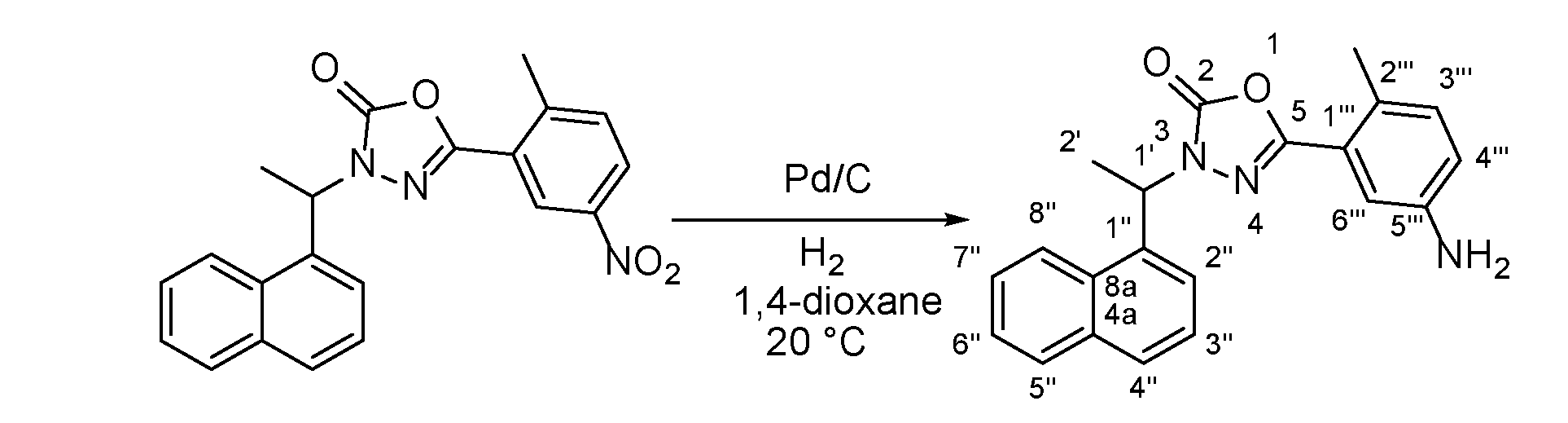
[0345] 5-(2-Methyl-5-nitrophenyl)-3-(1-(naphthalen-1-yl)ethyl)-1 ,3,4-oxadiazol-2(3/-/)-one (132 mg, 0.35 mmol) was dissolved in 1 ,4-dioxane (4 mL) and Pd/C (10% wt) (22.4 mg, 0.021 mmol) was added. The reaction mixture was stirred for 4 h under H2 (balloon) at 20 °C. After completion, detected by LCMS, the reaction mixture was filtered through CELITE® and the filter cake was additionally washed with Et2O (3x15 mL). The filtrate was concentrated to dryness and crude product was purified by flash column chromatography over silica gel (eluent: hexanes : EtOAc (EtOAc, 0 — > 30 %)) to give the title compound as a yellow syrup (70 mg, 57 %). Rf 0.43 (hexanes : EtOAc 7 : 3 (v/v); UV). 1H NMR (500 MHz, CDCl3) δ 8.27 (d, J = 8.6 Hz, 1 H, H-8”), 7.89 - 7.79 (m, 2H, H-4”, H-5”), 7.76 - 7.70 (m, 1 H, H-2”), 7.59 (ddd, J = 8.6, 6.8, 1.4 Hz, 1 H, H-7”), 7.55 - 7.44 (m, 2H, H-6”,H-3”), 7.06 (d, J = 2.6 Hz, 1 H, H-6'”), 7.01 (d, J = 8.2 Hz, 1 H, H-3'”), 6.66 (dd, J = 8.1 , 2.5 Hz, 1 H, H-4'”), 6.21 (q, J = 7.0 Hz, 1 H, H-T), 3.21 (s, 2H, NH2), 2.41 (s, 3H, CH3), 1.96 (d, J = 7.0 Hz, 3H, H-2'). 13C NMR (126 MHz, CDCl3) δ 153.8 (C-5) , 152.8 (C-1), 144.3 (C- 5'”), 135.37 (C-2'”), 133.8 (C-4a”), 132.6 (C-8a”), 130.8 (C-1”), 129.0 (C-4”), 128.9 (C-5”), 127.5 (C-7”), 126.9 (C-3'”), 125.9 (C-6”), 125.2 (C-3”), 124.3 (C-8”), 123.1 (C-1”'), 122.8 (C-1”), 117.9 (C-6'”), 114.0 (C-5'”), 50.6 (C-2'), 20.9 (CH3), 19.4 (C-2'). HRMS (ESI) m/z Calcd for C21H19N3NaO2 [M+H]+ 346.1550; Found 346.1532.
5-Amino-2-methyl-N,-(1-(naphthalen-1-yl)ethyl)benzohydrazide
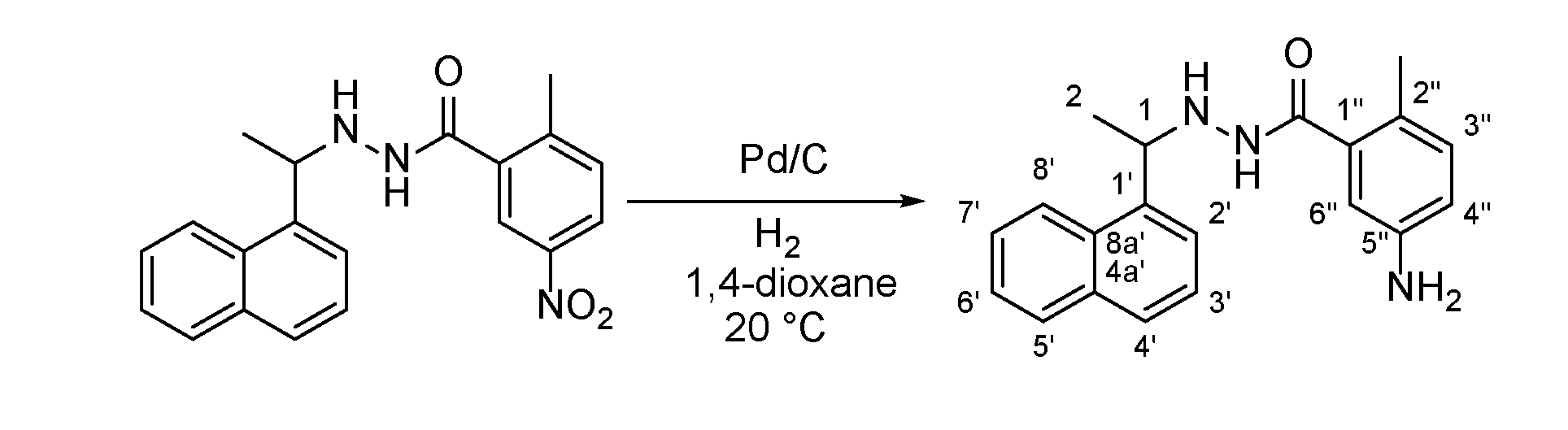 [0346] 2-Methyl-N'-(1-(naphthalen-1-yl)ethyl)-5-nitrobenzohydrazide (150 mg, 0.429 mmol) was dissolved in 1 ,4-dioxane (4 mL) and Pd/C (10% wt) (27.4 mg, 0.025) was added. The reaction mixture then was stirred for 4 h under H2 (balloon) at 20 °C. After completion, detected by LCMS, the reaction mixture was filtered through CELITE® and the filter cake was additionally washed with Et2O (3x15 mL). The filtrate was concentrated to dryness and the crude product was purified by flash column chromatography over silica gel (eluent: hexanes : EtOAc (EtOAc, 0 — > 30 %)) to give the title compound as a yellowish resin (69 mg, 51 %). Rf 0.15 (hexanes : EtOAc 7 : 3 (v/v); UV). 1H NMR (500 MHz, CDCl3) δ 8.31 (d, J = 8.3 Hz, 1 H, H-8'), 7.86 (dd, J = 8.0, 1.6 Hz, 1 H, H- 4'), 7.79 - 7.69 (m, 2H, H-5', H-2'), 7.52 - 7.41 (m, 3H, H-2', H-6', H-3'), 7.16 (s, 1 H, H-6'), 6.84 (d, J = 8.1 Hz, 1 H, H-3”), 6.47 (dd, J = 8.1 , 2.5 Hz, 1 H, H-4”), 6.28 (d, J = 2.5 Hz, 1 H, H-6”), 5.15 (m, 1 H, H-1), 3.39 (br, 1 H, NH), 2.11 (s, 3H, CH3), 1.56 (d, J = 6.6 Hz, 3H, H-2), 1.24 (br, 2H, NH2). 13C NMR (126 MHz, CDCl3) δ 169.7 (CO), 143.9 (C-5”), 138.9 (C-2”), 134.7 (C-4a'), 134.0 (C-8a', C-1'), 131.7 (C-T), 131.6 (C-4'), 128.9 (C-1”), 127.9 (C-5'), 126.1 (C-7'), 125.7 (C-3”), 125.6 (C-6'), 123.8 (C-3'), 123.3 (C-8'), 117.0 (C-6”), 113.7 (C-4”), 55.8 (C-1), 20.9 (CH3), 18.4 (C-2). HRMS (ESI): m/z Calcd for C20H21N3NaO [M+Na]+ 342.1577; Found 342.1558. N'-Methyl-N'-(naphthalen-1-yl) 2-methyl-5-nitrobenzhydrazide

Reagents and conditions: (a) 2-Methyl-5-nitrobenzoic acid, EDCI, DIPEA, CH2CI2, 20 °C, 3 h.
[0347] To a mixture of N--methyl-N--(1-naphthyl)hydrazine (70 mg, 0.41 mmol) and anhydrous dichloromethane (2.3 mL), were added 2-methyl-5-nitrobenzoic acid (110 mg, 0.61 mmol), 1- ethyl-3-[3-dimethylaminopropyl]carbodiimide hydrochloride (95 mg, 0.61 mmol) and diisopropylethylamine (0.14 mL, 0.81 mmol). The reaction mixture was stirred at 20 °C for 3 h before it was washed with 1 N HCI (2x2 mL), saturated aqueous NaHCO3 (2x 2 mL), brine (2 mL), dried over Na2SO4, filtered, concentrated and then purified by flash chromatography (0 to 50% ethyl acetate/hexane) to give the product (0.1 g, 84%) as a white solid. 1H NMR (500 MHz, CDCI3) 5 8.30 (dd, J = 6.3, 3.5 Hz, 1 H), 8.01 (d, J = 2.5 Hz, 1 H), 7.80 (dd, J = 6.2, 3.3 Hz, 1 H), 7.65 (s, 1 H), 7.61 (d, J = 8.5 Hz, 1 H), 7.48 (dd, J = 6.4, 3.3 Hz, 2H), 7.36 (d, J = 7.7 Hz, 1 H), 7.28 (d, J = 7.3 Hz, 1 H), 7.26 - 7.22 (m, 1 H), 7.18 - 7.12 (m, 1 H), 3.28 (s, 3H), 2.43 (s, 3H).13C NMR (126
MHz, CDCl3) δ 165.6, 145.7, 145.6, 144.8, 135.5, 134.7, 132.0, 131.2, 128.3, 126.5, 126.2, 125.9, 125.2, 124.8, 123.8, 122.0, 114.8, 43.0, 20.0. HRMS (ESI) m/z: Calc for CigH^C^Na [M+Na]+ 358.1168; Found 358.1160. N'-Methyl-AT-(naphthalen-1 -yl) 5-amino-2-methylbenzhydrazide
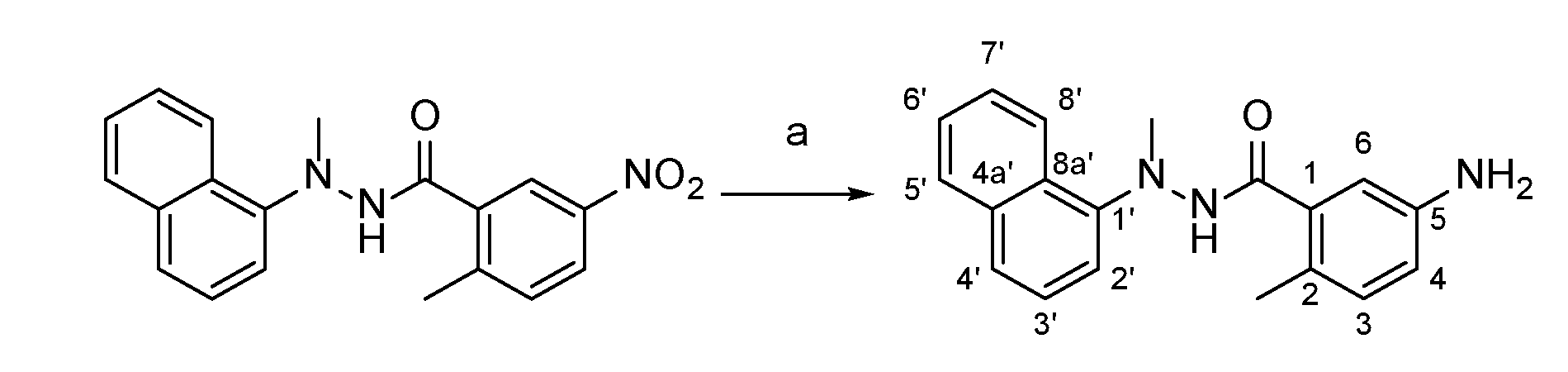
Reagents and conditions: (a) Pd/C, H2, 1 ,4-dioxane, 20 °C, 5 h.
[0348] A stirred solution of N'-methyl-N'-(naphthalen-1-yl) 2-methyl-5-nitrobenzhydrazide (110 mg, 0.33 mmol) in 1 ,4-dioxane (3.3 mL) was treated with Pd/C (17.42 mg, 0.02 mmol, 0.05 equiv) and stirred at 20 °C under hydrogen (1 atm) for 5 h. The reaction mixture was filtered, and the filtrate was evaporated to give a residue, which was purified by silica gel column chromatography (20 to 60% ethyl acetate/hexane) to yield the title product (79.1 mg, 79%) as a white solid. 1H NMR (500 MHz, CD3OD) 5 7.7 (d, J = 9.0 Hz, 1 H, H-8'), 7.7 - 7.7 (m, 2H, H-5', H-4'), 7.4 (m, 1 H, H-3'), 7.3 - 7.2 (m, 2H, H-7', H-2'), 7.2 (d, J = 2.5 Hz, 1 H, H- H-6), 7.0 (d, J = 8.2 Hz, 1 H, H-6'), 6.9 (d, J= 2.5 Hz, 1 H, H-3), 6.7 (dd, J = 8.1 , 2.5 Hz, 1 H, H-4), 3.3 (s, 3H, CH3), 2.3 (s, 3H, -NCH3). 13C NMR (126 MHz, CD3OD) 5 171.4 (-CONH), 147.5 (C-1), 145.4 (C-T), 134.7, 131.3, 128.7, 128.6, 127.1 , 126.5, 126.0, 124.7, 122.9, 117.3, 116.0, 113.9, 107.4, 39.8 (CH3), 17.5 (-NCH3). HRMS (ESI) mlz: [M + H]+ Calcd for C19H20N3O 306.1601 ; Found 306.1610.
Benzophenone 2-naphthylhydrazone

Reagents and conditions: (a) Benzophenone, H2SO4, MeOH, 50 °C, 4 h.
[0349] A stirred solution of benzophenone (0.94 g, 5.14 mmol) in MeOH (8 mL) was treated dropwise with concentrated H2SO4 (0.16 mL) at 20 °C, followed by 2-napthylhydrazine
hydrochloride135 (1 g, 5.14 mmol). The reaction mixture was heated to 50 °C and stirred for 6 h then was cooled on an ice bath for 20 min. The precipitate was filtered, washed with cold MeOH (6 mL) and dried to give the title product as a pale pink solid (1.5 g, 88%), which was directly used for the next step without further purification. 1H NMR (500 MHz, CDCl3) δ 7.75 - 7.68 (m, 3H, Nap), 7.68 - 7.63 (m, 3H, Nap), 7.63 - 7.58 (m, 2H, -NH, Nap), 7.57 - 7.51 (m, 1 H, Ar), 7.45 (d, J = 2.2 Hz, 1 H, Ar), 7.42 - 7.35 (m, 4H, Ar), 7.35 - 7.22 (m, 4H, Ar). 13C NMR (126 MHz, CDCl3) δ 144.9 (C-1), 142.4 (C-2'), 138.4, 134.9, 132.9, 129.8, 129.4, 129.3, 129.2, 129.1 , 128.3, 128.2, 127.9, 126.7, 126.6, 126.5, 123.0, 115.7, 107.2. HRMS (ESI) m/z: [M + H]+ Calcd for C23H19N2 323.1543; Found 323.1533.
Benzophenone N-methyl-(2-naphthyl)hydrazone

Reagents and conditions: (a) NaH, CH3I, DMF, 20 °C, 3.5 h.
[0350] A stirred solution of benzophenone 2-naphthylhydrazone (6.49 g, 20.1 mmol) in 40.3 mL of dry DMF was slowly treated with NaH (1.21 g, 30.2 mmol) at 0 °C, and then stirred at this temperature for 0.5 h. Then methyl iodide (1.88 ml, 30.19 mmol, 1.5 equiv.) was added dropwise over 5 min and the resulting mixture was warmed to 20 °C and stirred for 3 h when TLC showed complete conversion of the starting material. The reaction mixture was cooled to 0 °C and quenched with water (100 mL). The mixture was extracted with ethyl acetate (3x100 mL) and the combined organic phase was washed with 1 N HCI, saturated aqueous NaHCO3, brine, dried over Na2SO4, and concentrated in vacuo. The residue was purified by flash column chromatography (0 - 10% ethyl acetate/hexane) to yield the product (6 g, 89%) as an orange solid. 1H NMR (500 MHz, CDCl3) δ 7.81 - 7.71 (m, 3H, Nap), 7.71 - 7.61 (m, 3H, Nap), 7.47 - 7.37 (m, 9H, Nap, Ar), 7.30 (m, 2H, Ar), 3.03 (s, 3H, -CH3). 13C NMR (126 MHz, CDCl3) δ 156.9 (C-1), 148.2 (C-2'), 139.6, 137.4, 134.6, 129.4, 129.3, 128.8, 128.7, 128.6, 128.5, 128.2, 127.7, 126.9, 126.3, 123.1 , 117.4, 108.7, 41.0 (CH3). HRMS (ESI) m/z: [M + Na]+ Calcd for C24H20N2Na 359.1524; Found 359.1536. N--Methyl-N--(2-naphthyl)hydrazine

Reagents and conditions: (a) HCI, THF, 20 °C, 12 h.
[0351] To a solution of benzophenone N--methyl-(2-naphthy I) hydrazone (1.27 g, 3.77 mmol) in THF (38 mL) was added 6 M HCI (18.2 mL, 109 mmol). The resulting mixture was stirred at 20 °C for 12 h and then concentrated in vacuo. The residue was washed with diethyl ether (2x20 mL) and the solid was dried under reduced pressure and then was dissolved in water (20 mL) with vigorous stirring and carefully neutralized with 20% aqueous NaOH, after which the mixture was extracted three times with diethyl ether. The combined organic phase was dried over Na2SO4 and concentrated to give the product (0.6 g, 85%) as a dark brown oil. 1H NMR (500 MHz, CD3OD) 5 7.91 (d, J = 9.0 Hz, 1 H, H-3), 7.83 (m, 2H, H-1 , H-4), 7.53 - 7.47 (m, 2H, H-8, H-5), 7.43 (m, 1 H, H-6), 7.39 (dd, J = 9.1 , 2.5 Hz, 1 H, H-7), 3.28 (s, 3H, CH3). 13C NMR (126 MHz, CD3OD) 5 145.5 (C-2), 133.7 (C-1), 130.9 (C-3), 129.6 (C-4), 127.4 (C-8a), 127.3 (C-4a), 126.9 (C-8,) 125.5 (C- 7), 118.3 (C-5), 113.2 (C-6), 42.8 (CH3). HRMS (ESI) m/z: [M + H]+ Calcd for CnHi3N2 173.1079; Found 173.1085. N'-Methyl-N'-(naphtalen-2-yl) 2-methyl-5-nitrobenzhydrazide

Reagents and conditions: (a) 2-Methyl-5-nitrobenzoic acid, EDCI, DIPEA, CH2CI2, 20 °C, 4 h
[0352] To a stirred mixture of N--methyl-N--(2-naphthyl)hydrazine (100 mg, 0.58 mmol) and dry dichloromethane (3 mL), were added 2-methyl-5-nitrobenzoic acid (158 mg, 0.87 mmol), 1-ethyl- 3-[3-dimethylaminopropyl]carbodiimide hydrochloride (135 mg, 0.87 mmol) and diisopropylethylamine (0.20 ml, 1.16 mmol). The reaction mixture was stirred at 20 °C for 4 h before it was washed with 1 N HCI (2x2 mL), saturated aqueous NaHCO3 (2x2 mL), brine (2 mL), dried over Na2SO4, filtered, concentrated and then subjected to flash column chromatographic
purification (0 to 50% ethyl acetate/hexane) to give the product (0.2 g, 80%) as a white solid. 1H NMR (500 MHz, CDCl3) δ 8.50 (s, 1 H), 8.08 (d, J = 2.4 Hz, 1 H), 7.93 (dd, J = 8.4, 2.5 Hz, 1 H), 7.64 (d, J = 8.1 Hz, 1 H), 7.55 (dd, J = 8.6, 6.6 Hz, 2H), 7.36 (ddd, J = 8.2, 6.7, 1.3 Hz, 1 H), 7.26 (ddd, J = 8.0, 6.7, 1.3 Hz, 1 H), 7.12 (d, J = 8.4 Hz, 1 H), 6.96 (dd, J = 9.0, 2.5 Hz, 1 H), 3.09 (s, 3H), 2.32 (s, 3H). 13C NMR (126 MHz, CDCl3) δ 166.9 (-CONH), 146.7 (C-2'), 145.6 (C-5), 144.9 (C-1), 134.3 (C-4a'), 132.1 , 129.1 , 128.5, 127.6, 126.8, 126.6, 124.9, 123.6, 122.0, 115.8, 107.7, 60.5, 40.6 (-NCH3), 20.0 (CH3). HRMS (ESI) m/z: [M + Na]+ Calcd for C19H17N3O3Na 358.1168; Found 358.1156. N'-Methyl- N'-(naphthalen-2-yl) 5-amino-2-methylbenzhydrazide

Reagents and conditions: (a) Pd/C, H2, 1 ,4-dioxane, 20 C, 5 h
[0353] A stirred solution of N'-methyl- N'-(naphthalen-2-yl) 2-methyl-5-nitrobenzhydrazide (50 mg, 0.15 mmol) in 1 ,4-dioxane (1.5 mL) was treated with Pd/C (7.93 mg, 0.01 mmol) then was stirred at 20 °C under hydrogen (1 atm) for 5 h. Then the mixture was filtered and the filtrate was evaporated. The residue was purified by silica gel column chromatography (20 - 60% ethyl acetate/hexane) to give the product (38.7 mg, 85%) as a white solid. 1H NMR (500 MHz, CD3OD) 5 8.37 (d, J = 8.2, 1 H, H-3'), 7.83 - 7.80 (m, 1 H, H-T), 7.62 (dt, J = 7.8, 1.1 Hz, 1 H), 7.51 - 7.44 (m, 2H), 7.43 - 7.35 (m, 2H), 6.92 (d, J = 8.2 Hz, 1 H, H-4'), 6.66 (dd, J = 8.1 , 2.5 Hz, 1 H, H-4), 6.58 (d, J= 2.5 Hz, 1 H, H-3), 3.24 (s, 3H, -CH3), 2.20 (s, 3H, -NCH3). 13C NMR (126 MHz, CD3OD) 5 170.2 (-CONH), 146.3 (C-2'), 145.2 (C-5), 134.9 (C-1), 134.8 (C-4a'), 131.1 , 128.6, 127.9, 125.8, 125.3, 125.0, 124.8, 124.7, 123.7, 117.1 , 114.5, 113.9, 42.1 (-CH3), 17.2 (-NCH3). HRMS (ESI) m/z: [M + H]+ Calcd for Ci9H20N30306.1601 ; Found 306.1615.
Example 21: Results
PLpros are Highly Conserved among SARS-like Coronaviruses
[0354] Prior to SARS-CoV-2, group 2b consisted of fifteen SARS-like viruses originating from several species of old-world bats, primarily horseshoe bats. Sequence analysis of these viruses along with that of SARS-CoV-2 revealed that each encoded one of six unique PLpro sequences (FIGs. 1A-1B). The recent A146D mutation in the SARS-CoV-2 strain originating from the United
Kingdom brings the total to seven. Both the genomes and PLpros of group 2b viruses share sequence identity greater than 80 percent. PLpros and PLP2 have been shown to vary in terms of substrate preference and activity. To gain a better understanding of subgroup 2b substrate preferences, a third subgroup 2b PLpro originating from BtSCoV-Rf1 .2004 was selected to identify subgroup 2b DUB and delSGylase activity, as well as to assist in subgroup 2b broad- spectrum inhibitor development. BtSCoV-Rf 1.2004 was isolated from the greater horseshoe bat (R. ferrumequinum) in Yichang, China, just 320 km from the location of the initial outbreak of the SARS-CoV-2 pandemic. BtSCoV-Rf1 .2004 was chosen because at 93.9% conservation it is the most distantly related group 2b virus from SARS-CoV-1 other than SARS-CoV-2. Highlighting how conserved PLpro is among subgroup 2b viruses, despite the distant relation of BtSCoV- Rf1.2004 to SARS-CoV-1 and SARS-CoV-2, the PLpro of BtSCoV-Rf1 .2004 retains 97.8% and 82.2% sequence homology, respectively. Initial examination of key functional areas, particularly the active site, naphthalene inhibitor binding pocket, and the Ub interacting motif (UIM) reveal that these areas are highly conserved among group 2b PLpros (FIGs. 1A-1 B). Even the recent A146D mutation in SARS-CoV-2 is located externally on the back of the thumb domain and does not interact with substrates or cause internal changes.
Deubiquitinase and DelSGylase Activity of BtS CoV-Rf1.2004 PLpro
[0355] To identify differences in enzyme kinetics between BtSCoV-Rf1 .2004 PLpro and those of other group 2b viruses, the kinetic parameters of BtSCoV-Rf1.2004 PLpro for various substrates was determined. Utilizing the fluorogenic reporter group 7-amino-4-methylcoumarin (AMC) kinetic values were obtained for Ub-AMC and ISG15-AMC as well as the last five consensus amino acids between them (RLRGG; peptide-AMC) (Table 2).

 aFor nonsaturating substrates, kapp is calculated to approximate kcat/Km. bThe kinetic parameters of SARS-CoV-2 PLpro (ppl ab 1564-1876; 1-315) are from Freitas et al. cThe kinetic parameters of SARS-CoV PLpro (ppl ab 1541-1855; 1-315) and MERS-CoV PLpro (ppl ab 1484-1802; 3-322) are from Baez-Santos et al. dThe kinetic parameters of MHV PLP are from Chen et al.
[0356] The enzymatic efficiency of BtSCoV-Rf1 .2004 PLpro for Ub-AMC is 1.0±0.0 μM-1min-1 with KM and kcat values of 14.3±0.9 and 13.9±0.4, respectively. Similarly to other group 2b viruses, BtSCoV-Rf1 .2004 PLpro demonstrated a clear preference for ISG15 over Ub. Despite utilizing up to 20 μM ISG15-AMC with 1 nM protease, saturation could not be reached to determine KM and kcat values. However, using first-order kinetics the enzymatic efficiency was found to be 56.6±5.3 μM-1min-1. The difficulty in saturating the PLpro appears to be due to its robust delSGylase activity, which is twice as efficient as any other SARS-CoV PLpro. Despite not being able to calculate a maximum turnover rate, a rate of 595 min-1 was observed at 20 μM. The calculated maximum turnover for ISG15-AMC by SARS-CoV-1 is 436 min-1, making BtSCoV-Rf1 .2004 PLpro the most robust delSGylase among coronavirus PLpros by a considerable margin. Through the same method as ISG15-AMC it was determined that BtSCoV-Rf1 .2004 PLpro's enzymatic efficiency for peptide-AMC is 0.1 ±0.007 μM-1min-1 , which is within the range of other group 2b PLpros.
Poly-Ub Linkage Preferences for SARS-CoV PLpro
[0357] PLpros have often shown greater ability to process poly-Ub chains than those of mono- Ub conjugates. To determine if this is the case with BtSCoV-Rf1 .2004, PLpro cleavage activity was tested against the eight different linkage types of di-Ub M1 , K6, K1 1 , K27, K29, K33, K48, and K63. Utilizing similar experimental conditions to those used to evaluate other PLpros24, 31 , 10 μM of each di-Ub was incubated with 20 nM PLpro from BtSCoV-Rf1 .2004. BtSCoV-Rf 1.2004 demonstrated little ability to cleave di-Ub of any linkage type. Only a small amount of K48 was cleaved after 60 minutes by BtSCoV-Rf1 .2004 PLpro (FIG. 2A). This is similar to what was seen in assays using other SARS-CoV PLpros, which showed little to no activity toward di-Ub24, 31 . However, when tested against tetra-Ub chains BtSCoV-Rf1.2004 PLpro demonstrated
significantly higher DUB activity. The K48 linked tetra-Ub was entirely converted to di-Ub in less than five minutes and well-defined bands of tri and di-Ub appear in the K63 cleavage experiment after approximately forty minutes.
[0358] Species Specific DelSGylase Activity of BtS CoV-Rf1 .2004 PLpro
[0359] DelSGylases have been shown to be selective for ISG15s from species which they have been found to productively infect. Unlike Ub that is almost completely conserved between species, ISG15 can vary with sequence similarity as low as 60% within class Mammalia. In vivo, ISG15 is translated as a pro-form that consists of the mature ISG15 with several amino acids following the LRLRGG cleavage site (prolSG15). Given BtSCoV-Rf1.2004 PLpro's similarity with other subgroup 2b PLpros in substrate preference for ISG15 over mono-Ub, molecular weight shift experiments using prolSG15s from various species were used to assess ISG15 species preference among a collection of fourteen species. The experimental parameters that were employed were consistent with previous studies focusing on other PLpros incubating 20 nM PLpro with 10 μM prolSG15 originating from the various species (FIGs. 3A-3B).
[0360] In line with previous findings of other PLpro preferring ISG15s from species that serve as reservoirs for their parent virus, BtSCoV-Rf1.2004 PLpro distinctly possesses the highest rate of activity towards ISG15s encoded by the greater horseshoe bat and the Chinese rufous horseshoe bat. Horseshoe bats are known reservoirs for group 2b viruses and are present throughout much of Southeast Asia, sub-Saharan Africa, and Southern Europe. BtSCoV-Rf1.2004 PLpro also has varying levels of proficiency for cleaving vesper bat, sheep, and northern tree shrew prolSG15s with more moderate activity toward human, cow, camel and mouse. Relatively weak activity towards pig, hedgehog, and Egyptian fruit bat was observed with no detectable activity against rabbit or fish ISG15. The cleavage rate of several important ISG15s such as human, mouse, and vesper bat by BtSCoV-Rf1 .2004 PLpro closely matched what was seen with SARS-CoV-1 and SARS-CoV-2. While some species' ISG15s are cleaved more slowly than long-chain K48-Ub, those of BtSCoV-Rf1 ,2004's natural hosts R. ferrumequinum and R. sinicus appear to be the preferred substrates.
Structure of BtSCoV-Rf1 .2004 PLpro - GRL0617 Complex
[0361] To evaluate any differences between group 2b PLpros, an x-ray crystal structure of the BtSCoV-Rf1 .2004 PLpro was obtained for comparison to structures of SARS-CoV-1 and SARS- CoV-2 PLpros. The structure was determined to a resolution of 3.16A in space group P21212. A homology model of BtSCoV-Rf1 .2004 PLpro based on a SARS-CoV-1 PLpro (PDB 3E9S)
catalytic core was used as a search model. Upon finding two monomers of the catalytic core in the asymmetric unit, the Ubl domain for the monomers was subsequently located using the Ubl of 3E9S as a search model.
[0362] Globally, the BtSCoV-Rf1 .2004 PLpro resembles other group 2b PLpros in secondary and tertiary structure (FIGs. 5A-5C). It consists of a catalytic core made up of a palm, thumb, and zinc finger domain. The core was found in a holo, open conformation. Additionally, the PLpros contain an N-terminal Ubl domain. The Ubl domain of BtSCoV-Rf1 .2004 is shifted approximately 90 degrees from previously seen elongated forms and is tucked against the catalytic domain when compared to the typical extended conformation. Until now, this tucked conformation had only been seen in SARS-CoV-1 PLpro in complex with mouse ISG15 (PDB 5TL7). When in this conformation a seam of electrostatic interactions is formed between residues on the Ubl domain and a-helix 3 of the thumb domain. These interactions appear to stabilize the association of the two domains.
[0363] When examining the BL2 loop, Fo - Fc density was readily observed for GRL0617 in both monomers (FIG. 6A). Within the pocket GRL0617 is oriented similarly in all group 2b PLpros, forming hydrogen bonds with D165 and Q270, as well as hydrophobic interactions with P248 and P249 (FIG. 6C). However, between the monomers of BtSCoV-Rf1.2004 there are differences in the positions of the Q270 side chain, the eastern arene ring, and most notably the western naphthyl group. The differences appear to be due to a crystal contact present on the B chain that is absent on the A chain in which V226 of the B chain zinc finger forms a hydrophobic interaction with the western naphthyl group of B chain GRL0617.
[0364] This contact is also responsible for a shift in the zinc finger loop. The zinc finger loop appears to be the most variable region within the catalytic core of the PLpro (FIG. 6B). Similar shifts in both the zinc finger loop and the western naphthyl group of GRL0617 are seen in the structures of SARS-CoV-1 (FIG. 6B) and SARS-CoV-2 (FIG. 6C) respectively, and also appear to be caused by crystal contacts. The similar variation between the A chain and B chain monomers and variation between PLpros indicates that artifacts of the crystal lattice may be equally or more influential to ligand binding than residue differences between enzymes.
[0365] The only notable difference in residue conformation between the PLpros is L163, which in SARS-CoV-1 and BtSCoV-Rf1 .2004 is angled towards the 2-methyl group of GRL0617, but in SARS-CoV-2 angled away from the pocket (FIG. 6B). This altered conformation is seen in structures of SARS-CoV-1 PLpro bound to human and mouse ISG15, along with a shifted BL2
loop to accommodate the C-terminal GG cleavage motif of Ubl substrates (PDB 5TL6 and 5TL7). These changes provide insight into the flexibility of the BL2 loop when accommodating BL2 inhibitors as well as how the influence of crystal contacts on the BL2 loop in some structure may need to be accounted for when using these structures for drug discovery purposes.
Inhibition of SARS-CoV Family PLpros with Novel Inhibitors
[0366] With GRL0617 being readily accommodated within the BtSCoV-Rf1 .2004 PLpro P3/P4 site, the practicality of targeting PLpro broadly appears feasible. As a result, several compounds were synthesized based on series I and series II compounds design for the inhibition of SARS- CoV-1 PLpro. While variation in PLpro sequences exist among group 2b viruses, the residues lining the active site and the adjacent P3 and P4 sites are fully conserved (FIGs. 1A-1B). These residues bind RLRGG residues of Ubl substrates to facilitate cleavage. They have also been shown to be critical in binding naphthalene-based compounds that successfully inhibit PLpro cleavage activity in SARS-CoV-1 and SARS-CoV-2. Preliminary studies show that inhibitors designed to bind at this site in SARS-CoV-1 exhibit similar IC50 and EC50 values when tested against SARS-CoV-2.
[0367] The naphthalene-based inhibitors can be categorized into two groups by their backbone structure. The series I and II hits share a common binding site for their western hydrophobic moieties. The two series differ in the eastern arene moieties, which occupy proximal but different binding pockets, and by the central core - a simple amide unit in series I and a piperidine ring in series II. This suggested that there exists considerable scope for innovation in the central core, in terms of both the spacing it provides between the eastern and western arenes and the basic structure employed. With this in mind, alternative central cores based on piperidine analogs such as azetidines, and spiroazetidines, and other bicyclic systems were examined; these would allow for variation of the separation between the eastern and western arene while retaining the basic geometry of a 4-substituted piperidine ring.
[0368] The X-ray crystallographically-derived essential interactions of series I compound GRL0617 in complex with the CoV-1 PLpro (PDB 3E9S) are summarized in FIGs. 9A-9B. Early X-ray structures of a series II inhibitor with CoV-1 PLpro (PDB 3MJ5) revealed the occupancy of the same hydrophobic pocket by the naphthalene ring but showed the piperidine ring in an unlikely high-energy twist-boat conformation with no interaction of either the basic ring nitrogen or the adjacent amide NH with D165.36 A subsequent reevaluation of this x-ray structure, however, represented the piperidine ring in a more standard chair conformation with an H-bond from the
basic piperidine nitrogen to D165.37 A further structure of a close analog 3j of this compound (PDB 4OVZ) also showed the piperidine in a chair conformation and H-bonded to D165 (FIG. 9B). Adopting the latter structure as the more likely, the strong parallels between the interactions of the western halves of the series I and II compounds with the protein are evident and form a solid base on which to engineer next generation compounds for the inhibition of COV-2 PLpro. The aromatic rings of the eastern halves of the series I and II compounds occupy different sites because of the differing dimensions of the central portions. In series I the backbone amide of Q270 H-bonds to the amide carbonyl of the inhibitor, whereas in series II the hydrocarbon part of the Q270 side chain forms one face of hydrophobic pocket encapsulating the eastern arene, which is completed by the side chain of M209 and other residues. Y269 interacts with the amino group in the eastern arene of the series I compound, but with the amide carbonyl of the series II compound.
[0369] The hydrophobic eastern part of the binding domain was explored by the synthesis of analogs of series I compounds in which the naphthalene unit was exchanged for a cyclohexyl or 1-adamantanyl moiety. An authentic sample of GRL0617 was first prepared as outlined previously; syntheses of compounds DC-PHRM-23, DC-PHRM-3, (±)-772477238, DC-PHRM-4, and DC-PHRM-5 were also prepared as disclosed herein (Scheme 1).
[0370] Remaining with series I, the influence of absolute configuration at the stereogenic center in the amide portion of GRL0617 was next investigated by replacing the R-configured CHMe by an NMe moiety in the form of the hydrazide DC-PHRM-9 (Scheme 2). The regioisomer DC- PHRM-15 was also accessed by analogous means. The substitution of the R-configured CHMe by an NMe moiety in both DC-PHRM-9 and DC-PHRM-15 draws on analogy with recent work with trisubstituted hydroxylamines, according to which the N-methyl hydrazide moiety is considered as an isostere of either enantiomer of the parent compound owing to the pyramidal yet rapidly inverting nature of the hydrazide nitrogen atom. The 1- and 2-naphthylhydrazines required for these syntheses were accessed by a literature method.
[0371] Remaining with series I, thioamides DC-PHRM-1 and DC-PHRM-8 were prepared by treatment of the parents with Lawesson's reagent, and reduced the amide in GRL0617, by silylation and subsequent treatment with lithium aluminum hydride, 42 to the corresponding amine DC-PHRM-24. Finally in this series, the inverted amide DC-PHRM-20 was prepared by condensation of 1 -naphthylacetyl chloride with 2-methyl-5-nitroaniline followed by hydrogenolysis (Scheme 3).
[0372] Turning to the series II compounds, (±)-DC-PHRM-28 and DC-PHRM-37 were also prepared as disclosed herein (Scheme 4). An analog of DC-PHRM-28, DC-PHRM-31 , was also prepared as disclosed (Scheme 4).
[0373] Series II analogs were prepared in which the central piperidine ring was replaced by a spiroazetidine moiety. To this end, DC-PHRM-12, DC-PHRM-16, DC-PHRM-19, DC-PHRM-21 , DC-PHRM-29, and DC-PHRM-30 were prepared as described above. Diamine DCPHRM-33 and an analog DC-PHRM-38 of DC-PHRM-12 in which the chiral CHMe unit was replaced by the NMe moiety, were prepared using a minor variation on the general route to the spiroazetidines (Scheme 5).
[0374] Returning to the theme of inverted amides and hybrid structures encompassing aspects of both the series I and II compounds, DC-PHRM-13 was first prepared based on the azetidine core by standard means. In a similar vein, spirodiazetidine coupled to nicotinic acid DC-PHRM- 34 was synthesized (Scheme 6).
[0375] To explore the requirement for basic nitrogen in the core of the series II compounds, the 1 ,2-oxazine derivative was prepared as a mixture of diastereomers of DC-PHRM-27 (Scheme 7).
[0376] To further probe the structural requirements in the central portion of the binding pocket, squaramides and oxalamides were explored, including DC-PHRM-11 in 43% yield, DC-PHRM-10 in 85% yield, and DC-PHRM-17 in 53% yield (Scheme 8).
[0377] To complete the investigation of the structural requirements of the central portion of the binding pocket, taking note of the broad utility of oxadiazoles as molecular scaffolds, the oxazdiazole DC-PHRM-25 was prepared. Hydrogenolysis of this substance over palladium on carbon gave hydrazide DC-PHRM-26, itself suitable for screening (Scheme 9).
[0378] All compounds were assayed for their ability to inhibit SARS-CoV-2, SARS-CoV-1 , and BtSCoV-Rf1 .2004 PLpros, with an initial survey determining percentage inhibition at a fixed concentration of 50 μM (Table 1).
Structure of BtS CoV-Rf1.2004 PLpro - DC-PHRM-12 Complex
[0379] There is little data on how series II compounds interact with group 2b PLpros, and furthermore, no structure of compounds with spiroazetidine backbones. SAR data indicate that the use of either piperidine or spiroazetidine backbones affects the potency of series II inhibitors. Perhaps more importantly, it shows that the optimal decoration of the eastern arene ring differs depending on which backbone is used. In order to further explore these differences, BtSCoV-
Rf1.2004 PLpro was crystallized in complex with DC-PHRM-12. Utilizing X-ray diffraction its structure was determined to a resolution of 2.89A in space group P6422. The BtSCoV-Rf1.2004 PLpro-GRL0617 complex structure was used as a search model for phasing the catalytic core. Upon finding a single monomer in the asymmetric unit, the Ubl domain was added. As with the GRL0167 co-crystal structure, the Ubl domain of this structure was in a tucked conformation.
[0380] As with the structure of BtSCoV-Rf1 .2004 PLpro in complex with GRL0617, Fo-Fc density is found within the P3/P4 binding pocket (FIG. 8A). Upon refinement, the 2Fo-Fc map is found to be well suited for DC-PHRM-12. In this pocket DC-PHRM-12 forms five hydrogen bonds with the protein. The amide scaffold forms hydrogen bonds with the main chains of L163, Y269, and Q270, while spiroazetidine nitrogen forms bonds with the side chains of D165 and Y274. Additionally, strong hydrophobic interactions are formed between the western naphthyl group and P248 and P249 as is typical of naphthalene based PLpro inhibitors. However, when compared with a structure of SARS-CoV-1 PLpro in complex with DC-PHRM-37 (PDB 3MJ5), the naphthyl group of DC-PHRM-12 is situated approximately 0.9A further away from the two prolines (FIG. 8B). The difference in naphthyl group location could be due to a shift of the BL2 loop caused by the bulky 1 ,3-dioxolane ring. The eastern arene groups of both DC-PHRM-12 and DC-PHRM-37 cause a shift in the BL2 loop that is similar to the conformation it adopts to accommodate Ubl substrates. However this shift is more pronounced in the DC-PHRM-37 co-crystal structure, even causing Q270 to flip away from the arene rings in order to avoid a steric clash.
In Vitro Cytotoxicity, Serum Binding, and Stability of Protease Inhibitors
[0381] The preliminary toxicity of these inhibitors was determined by assessing their ability to decrease the reductive capability of numerous cells using the MTT assay and determining CC50 values. These values were compared to that determined for GRL0617 as well as Mesecar 15g, both of which have been previously assessed for cytotoxicity. As previously reported, GRL0617 and Mesecar 15g has the lower cytotoxicity as determined by CC50 in multiple cells, including human renal proximal tubule cells (RPTEC), Beas-2B, A549 and Sh-SH5Y cells. DC-PHRM-12 did not reduce MTT staining below 50% in A549 of Sh-SY5Y cells at concentrations as high as 100 mM, which as similar to GRL6017. Focusing on RPTEC and Beast-2b cells, DC-PHRM- 12displayed the lowest CC50 values in comparison to DC-PHRM-28 and DC-PHRM-16. The CC50 reported in these cells is folds-higher than the IC50 reported for inhibition of PLpro degradation, as determined above. In general, amongst DC compounds, alteration of the east moiety appeared to alter the CC50, as compared to the west moiety or the central rings. The addition of
the central ring decreased the CC50 as compared to GRL0617, as shown by comparison of DC compounds and Mesecar 15g. The effect of these compounds on MTT staining was validated using cell morphology, which demonstrated morphological characteristics of cell death in combination with reduced cell number.
[0382] The effect of serum binding on the efficacy of these compounds was determined by comparison to CC50s for DC-PHRM-12, DC-PHRM-16, DC-PHRM-28, DC-PHRM-37, and GRL0617 in the presence and absence of FBS. Stability was also assessed by incubating the compound in media containing FBS for 24 hours prior to exposure to RPTECs. As previously reported, serum binding appeared to have minimal effect on the toxicity of GRL017, which also appeared fairly stable over 24 hours. In contrast, incubation of DC-PHRM-12 in FBS for 5 minutes prior to exposure to RPTECs decreased the toxicity of this chemical compared to incubated in in media alone. Incubation of DC-PHRM-12 in media containing serum further decreased the toxicity of this compounds, suggesting chemical instability, enhanced protein binding, or both. In contrast, the toxicity of DC-PHRM-16, DC-PHRM-28, and DC-PHRM-37 was not altered by the presence of FBS in the media, or by incubation in media and serum overnight. This suggests that serum binding to these compounds does not alter their toxicity, and further suggest that these chemicals are relatively stable in media and serum for at least 24 hours.
Example 22: Discussion
Conserved Features among Group 2b PLpros
[0383] The residues lining the active site, BL2 loop, P3 site, and P4 site are identical among all seven unique PLpros. The BL2 loop, P3 site, and P4 site are responsible for binding naphthalene inhibitors as well as the leucine and arginine of the C-terminal RLRGG amino acid sequence of Ubl substrates. The active site facilitates hydrolysis of the Ubl substrate peptide bond. Furthermore, the UIM, which is known to accommodate both Ub and ISG15 binding, is fully conserved between BtSCoV-Rf1 .2004 and SARS-CoV-1 . SARS-CoV-2 PLpro has six differences at the UIM, T171 (S), H172(Y), K196(Q), L217(F), V226(T), and Q233(K). Of the six points of difference in SARS-CoV-2, five are identical across the other group 2b PLpros and the sixth, V226(l) of BtSCoV-Rm 1.2004, is likely to be inconsequential due to the similarity between Valine and Isoleucine. The conservation of Q233 is noteworthy because experiments have shown Q233(E) SARS-CoV-1 mutants notably diminished DUB activity but increased delSGylase activity.
[0384] Additionally, all the residues stabilizing the interaction between the Ubl and thumb domain are highly conserved among group 2b PLpros. This points to the possibility that the tucked conformation is a common feature among group 2b PLpros. Furthermore, there is little conservation of these residues outside group 2b, even among other betacoronaviruses such as MERS.
Trends in Group 2b PLpro DelSGylatinq Activities
[0385] As with all enzymes, viral PLpros have distinct substrate preferences even between Ubls. The substrate(s) that a protease is particular efficient at processing can provide clues to which pathways are most critical to inhibit for viral replication. Trends in these substrate preferences can be useful in predicting howto treat related diseases that may arise in the future, however activities can vary widely between viruses. While the group 2a murine hepatitis virus (MHV) PLP2 has a strong preference for Ub over ISG15, group 2b and 2c PLpros appears to favor ISG15. More surprisingly, the kinetic profile of SARS-CoV-2 PLpro is more similar to that of MERS-CoV than SARS-CoV-1.
[0386] Similar to what has been seen in SARS-CoV-1 and SARS-CoV-2, the delSGylase activity of BtSCoV-Rf1 .2004 PLpro exceeds its DUB activity, except in the case of long-chain K48-Ub. The consistently robust delSGylase activity displayed by group 2b PLpros relative to their modest DUB activity suggests that ISG15 regulated immune pathways may be more detrimental to viral replication than pathways regulated by Ub. Despite this, the specific utility delSGylase activity serves coronaviruses is unknown. Because delSGylase activity appears critical to coronavirus replication, species-specific delSGylase activity can be a factor in determining what species a virus can productively infect. Interspecies variation in ISG15 has been shown to limit the zoonotic range of influenza B. The similarity in species specificity between group 2b viruses indicates that these viruses probably infect many of the same host species. Humans, palm civets, pangolins, minks, and several bats have all been identified as host species for group 2b viruses, and some have been shown to host multiple 2b viruses. The largely conserved species preferences of group 2b viruses may also enable them to productively infect new species that already serve as reservoirs for other 2b viruses with relatively few mutations.
[0387] The diminished delSGylase activity BtSCoV-Rf1.2004 PLpro has in pigs is noteworthy due to the importance of pigs as livestock in many regions horseshoe bats inhabit. As voracious omnivores pigs could easily be exposed to many zoonotic viruses by eating wild animals found in their enclosures, and viruses such as the flu strain H1 N1 have crossed from pigs to humans
before. While pigs have not been shown to be reservoirs of SARS-CoV-1 or SARS-CoV-2 the possibility, or lack thereof, of a virus to infect a species so agriculturally important and physiologically similar to humans has a profound impact on how much of a threat a virus presents and how to approach controlling it.
[0388] BtSCoV-Rf1 .2004 PLpro may be able to serve as a useful tool in determining residues that affect interspecies differences between SARS-CoV-1 and SARS-CoV-2. The delSGylase activities of these PLpros differ against ISG15s from sheep, camel, northern tree shrew, and jackknife fish. The PLpro of BtSCoV-Rf1.2004 matches the activity of SARS-CoV-2 against sheep, camel, and jackknife fish, but matches that of SARS-CoV-1 against northern tree shrew. While mammalian respiratory viruses would not naturally infect fish, SARS-CoV-1 , MERS-CoV, and mouse hepatitis virus (MHV) PLpros all demonstrate some off-target activity towards jackknife fish ISG15. SARS-CoV-2 was the first betacoronavirus to show no appreciable activity towards fish ISG15, but the lack of activity demonstrated by BtSCoV-Rf1 .2004 PLpro, which is more closely related to SARS-CoV-1 , could help discern which differences are responsible.
[0389] The ability of BtSCoV-Rf1 .2004 PLpro to quickly processes horseshoe bat and vesper bat ISG15s, while having little activity towards Egyptian fruit bats is not unusual. This was observed in SARS-CoV-2 as well and is likely due to the diversity within order Chiroptera. Bats make up over 20% of all mammal species and ISG15 can share as little as 60% sequence identity between bats from different families, which is no greater than the similarity expected between any two mammalian ISG15s (see FIG. 4).
Deubiquinatinq Activity of BtS CoV-Rf1.2004 PLpro
[0390] Due to BtSCoV-Rf 1.2004 and SARS-CoV-1 PLpros sharing a conserved UIM that is not shared by SARS-CoV-2 PLpro it is surprising that BtSCoV-Rf1 .2004 has a kinetic profile towards mono-Ub-AMC that is more similar to that of SARS-CoV-2 than SARS-CoV-1. While all three PLpros are similarly efficient at processing mono-Ub, SARS-CoV-1 has a substantially higher maximum turnover rate. Di-Ub cleavage assays data supports the results of the mono-Ub-AMC assays. BtSCoV-Rf1 .2004 PLpro processed a small amount of K48 d-Ub into mono-Ub after 1 hr (FIGs. 3A-3B), while previous studies show SARS-CoV-1 having some modest activity towards several linkage types of di-UB and SARS-CoV-2 having no ability to cleave di-Ub of any kind.
[0391] Despite ISG15 being the preferred Ubl substrate of group 2b PLpros, DUB activity may be a determining factor in viral pathogenicity, as well as a critical part of the survival strategy of individual viruses. The group 2a betacoronavirus MHV has one of the few PLpros that is a more
robust DUB than delSGylase, and recent studies show that loss of DUB activity reduces MHV pathogenicity. Similar effects have been observed when DUB activity is ablated in the ovarian tumor domain protease of Crimean Congo hemorrhagic fever virus (CCHFV). While PLpro mutation experiments have not explored this trend within group 2b viruses, SARS-CoV-1 , which is far more pathogenic than SARS-CoV-2, also has more robust DUB activity. If the relationship between DUB activity and pathogenicity proves to be causal then viruses with higher DUB activity would warrant extensive monitoring. However, exceedingly deadly spillover events are often self- limiting as hosts die before they are able to transmit the disease.
[0392] Specificity within DUB activity can be informative about the immune evasion mechanisms critical to a virus. MHV, which relies more heavily on DUB than delSGylase activity, has high activity against K11 , K48, and K63 di-Ub. K11 and K48 linked Ub are proteasomal degradation signals. By cleaving these Ub linkage types viruses keep their proteins functional in the cytosol longer. K63 linked Ub is involved in regulating RLR signaling and IFN production. By suppressing those signals a virus can keep its host's innate immune system in a passive rather than anti-viral state for a longer period post-infection. So far all group 2b PLpros have demonstrated a clear preference for K48 linked poly-Ub, with SARS-CoV-1 and BtSCoV-Rf1.2004 showing some lesser activity against other linkage types. One of the key anti-viral factors produced in response to type- I IFN signaling is ISG15. Therefore, it's possible that viruses with robust K63 DUB activity don't rely on delSGylase activity for survival. Likewise, viruses such those of group 2b that have robust delSGylase activity may be able to overcome reduced K63 DUB activity because they can better manage the downstream effects of type-l IFN.
[0393] The group 2b PLpros prefer long chain Ub over di-Ub. SARS-CoV-2, which has little DUB activity at all, is still capable of cleaving K48 tetra-Ub into di-Ub, but can't process di-Ub into mono- Ub regardless of linkage form. SARS-CoV-1 is slightly more active against several forms of di- Ub, but cleaves long chains more quickly. BtSCoV-Rf1.2004 PLpro, which has similar activity towards mono-Ub-AMC as SARS-CoV-2 PLpro, demonstrated little observable activity towards di-Ub. Only when tested against K48 tetra-Ub was the efficient DUB activity noticeable, fully processing tetra-Ub into di-Ub in less than 5 minutes (FIGs. 3A-3B). Previous studies have shown that while MERS cleaves all lengths of K48 poly-Ub at an equal rate, tri-Ub was the minimum length chain for efficient cleavage by SARS-CoV-1 PLpro. This phenomenon was ascribed to SARS-CoV-1 having di-distributive DUB activity, cleaving Ubl substrates in groups of two, compared to MERS having mono-distributive activity. It appears that SARS-CoV-2 and BtSCoV- Rf1.2004 PLpros also possess di-distributive DUB activity, given their ability to cleave K48 tetra-
Ub but not di-Ub. Previously this activity in SARS-CoV-1 was attributed to the presence of a conserved distal Ub pocket on the thumb domain that is not present in MERS. It now seems possible that the orientation of the Ubl domain may also be a contributing factor. The unique interactions between the Ubl and thumb domains are highly conserved among 2b PLpros, which all display the unusual di-distributive DUB mechanism. DUB activity predicated on the basis of cleaving Ubls in sets of two would be counterproductive if Ub was the primary target. However, because group 2b PLpros prefer ISG15, which structurally resembles M1 di-Ub, requiring sets of two Ubl substrates likely increases efficiency and specificity.
Naphthalene-Based Inhibitors are Broadly Effective Group 2b Therapeutics
[0394] Initial evaluation of each novel compound at 50 μM revealed that most compounds have equivalent levels of inhibition against all three group 2b PLpros regardless of inhibitor efficacy. This trend was further supported by IC50 testing of top compounds, which determined that IC50 values for each inhibitor for all three PLpros were usually within one to two-fold, and always within one order of magnitude. In addition to known compounds, several novel compounds demonstrated low μM IC50 values and show promise as potential lead compounds (Table 3).

[0395] It should be emphasized that the above-described embodiments of the present disclosure are merely possible examples of implementations set forth for a clear understanding of the principles of the disclosure. Many variations and modifications may be made to the above- described embodiment(s) without departing substantially from the spirit and principles of the disclosure. All such modifications and variations are intended to be included herein within the scope of this disclosure and protected by the following claims.
REFERENCES
1. Adams, P. D.; et al, PHENIX: a comprehensive Python-based system for macromolecular structure solution. Acta Crystallogr D Biol Crystallogr 2010, 66 (Pt 2), 213-21.
2. Agbowuro, A. A. et al, Proteases and protease inhibitors in infectious diseases. Med Res Rev 2018, 38, 1295-1331. DOI: 10.1002/med.21475.
3. Al-Azayzih, A. et al, Liposome-mediated delivery of the p21 activated kinase-1 (PAK-1) inhibitor IPA-3 limits prostate tumor growth in vivo. Nanomedicine 2016, 12 (5), 1231-9. DOI: 10.1016/j.nano.2016.01.003.
4. Aljuffali, I. A. et al, Enhanced antitumor activity of low-dose continuous administration schedules of topotecan in prostate cancer. Cancer biology & therapy 2011 , 12 (5), 407-20.
5. Amaraneni, M. et al, Influence of Maturation on In Vivo Tissue to Plasma Partition Coefficients for Cis- and Trans-Permethrin. J Pharm Sci 2017, 106 (8), 2144-2151. DOI: 10.1016/j.xphs.2017.04.024.
6. Amaraneni, M. et al, Brain uptake of deltamethrin in rats as a function of plasma protein binding and blood-brain barrier maturation. Neurotoxicology 2017, 62, 24-29. DOI: 10.1016/j. neuro.2017.04.009.
7. Amaraneni, M. et al, Plasma protein binding limits the blood brain barrier permeation of the pyrethroid insecticide, deltamethrin. Toxicol Lett 2016, 250-251 , 21-8. DOI: 10.1016/j.toxlet.2016.03.006.
8. Ames, B. N. et al, Methods for detecting carcinogens and mutagens with the Salmonella/mammalian-microsome mutagenicity test. Mutat Res 1975, 31 (6), 347-64. DOI: 10.1016/0165-1161 (75)90046- 1 .
9. Anantpadma, M. et al, Ebola Virus Bayesian Machine Learning Models Enable New in Vitro Leads. ACS Omega 2019, 4 (1), 2353-2361. DOI: 10.1021/acsomega.8b02948.
10. Astorga, B. et al, Molecular Determinants of Ligand Selectivity for the Human Multidrug And Toxin Extrusion Proteins, MATE1 and MATE-2K. The Journal of pharmacology and experimental therapeutics 2012, 341 (3), 743-55.
11 . Azhar, E. I. et al, Evidence for camel-to-human transmission of MERS coronavirus. N Engl J Med 2014, 370 (26), 2499-505. DOI: 10.1056/NEJMoa1401505.
12. Baez-Santos, Y. M. et al, X-ray structural and biological evaluation of a series of potent and highly selective inhibitors of human coronavirus papain-like proteases. J Med Chem 2014, 57, 2393-2412. DOI: 10.1021/jm401712t.
13. Baez-Santos, Y. M. et al, Catalytic function and substrate specificity of the papain-like protease domain of nsp3 from the Middle East respiratory syndrome coronavirus. J Virol 2014, 88, 12511-12527. DOI: 10.1128/JVI.01294-14.
14. Baez-Santos, Y. M. et al, The SARS-coronavirus papain-like protease: structure, function and inhibition by designed antiviral compounds. Antiviral Res 2015, 115, 21-38. DOI: 10.1016/j.antiviral.2014.12.015.
15. Bahadduri, P. M. et al, Targeting drug transporters - combining in silico and in vitro approaches to predict in vivo. Methods in molecular biology 2010, 637, 65-103.
16. Bailey-Elkin, B. A. et al, Crystal structure of the Middle East respiratory syndrome coronavirus (MERS-CoV) papain-like protease bound to ubiquitin facilitates targeted disruption of deubiquitinating activity to demonstrate its role in innate immune suppression. J Biol Chem 2014, 289, 34667-34682. DOI: 10.1074/jbc.M114.609644.
17. Balakin, K. V. et al, Comprehensive computational assessment of ADME properties using mapping techniques. Curr Drug Disc Tech 2005, 2, 99-113.
18. Balakirev, M. Y. et al, Otubains: a new family of cysteine proteases in the ubiquitin pathway. EMBO Rep 2003, 4 (5), 517-22. DOI: 10.1038/sj.embor.embor824[pii]embor824.
19. Barretto, N. et al, The papain-like protease of severe acute respiratory syndrome coronavirus has deubiquitinating activity. J Virol 2005, 79 (24), 15189-98. DOI: 10.1128/JVI.79.24.15189-15198.2005.
20. Bekes, M.; et al, SARS hCoV papain-like protease is a unique Lys48 linkage-specific di- distributive deubiquitinating enzyme. Biochem J 2015, 468 (2), 215-26.
21. Bekes, M. et al, Recognition of Lys48-Linked Di-ubiquitin and Deubiquitinating Activities of the SARS Coronavirus Papain-like Protease. Molecular Cell 2016, 62, 572-585. DOI: 10.1016/j.molcel.2016.04.016.
22. Belostotskii, A. M. et al, Conformational Dynamics in Nitrogen-Fused Azabicycles. J. Org. Chem. 2003, 68, 3055-3063.
23. Bostdm, J.; et al, Oxadiazoles in Medicinal Chemistry. J. Med. Chem. 2012, 55, 1817- 1830.
24. Bull, R. J. et al, Absorption and disposition of bromate in F344 rats. Toxicology 2012, 300 (1-2), 83-91. DOI: 10.1016/j.tox.2012.06.002.
25. Burkhard, J. A. et al, Synthesis of Azaspirocycles and their Evaluation in Drug Discovery Angew. Chem. Int. Ed. 2010, 49, 3524-3527.
26. Cali, J. J. et al, Bioluminescent assays for ADME evaluation: dialing in CYP selectivity with luminogenic substrates. Expert Opin Drug Metab Toxicol 2012, 8 (9), 1115-30. DOI: 10.1517/17425255.2012.695345.
27. Capodagli, G. C. et al, Diversity of Ubiquitin and ISG15 Specificity among Nairoviruses' Viral Ovarian Tumor Domain Proteases. Journal of Virology 2013, 87, 3815-3827 %! Diversity of Ubiquitin and ISG3815 Specificity among Nairoviruses' Viral Ovarian Tumor Domain Proteases.
28. Capodagli, G. C. et al, Structural analysis of a viral ovarian tumor domain protease from the Crimean-Congo Hemorrhagic Fever virus in complex with covalently bonded ubiquitin. J Virol 2011. DOI: JVI.02496-10 [pii]10.1128/JVI.02496-10.
29. Cavalli, R. et al, Enhanced antiviral activity of acyclovir loaded into nanoparticles. Methods Enzymol 2012, 509, 1-19. DOI: 10.1016/B978-0-12-391858-1.00001-0.
30. US Centers for Disease Control and Prevention, People at Risk for Serious Illness from
COVID-19. <https://www.cdc.gov/coronavirus/2019-ncov/specific-groups/high-risk- complications.html> (accessed May 6th, 2020).
31 . Chan, J. F. et al, Simulation of the clinical and pathological manifestations of Coronavirus Disease 2019 (CO VID- 19) in golden Syrian hamster model: implications for disease pathogenesis and transmissibility. Clin Infect Dis 2020. DOI: 10.1093/cid/ciaa325.
32. Chang, C. et al, Pharmacophores for human ADME/Tox-related proteins. In Pharmacophores and pharmacophore searches, Langer, T.; Hoffman, R. D., Eds. Wiley-VCH: Weinheim, 2006; pp 299-324.
33. Chen, V. B.; et al, MolProbity: all-atom structure validation for macromolecular crystallography. Acta Crystallogr D Biol Crystallogr 2010, 66 (Pt 1), 12-21.
34. Chen, X.; et al, Thiopurine analogue inhibitors of severe acute respiratory syndrome- coronavirus papain-like protease, a deubiquitinating and delSGylating enzyme. Antivir Chem Chemother 2009, 19 (4), 151-6.
35. Chen, Y. et al, X-ray Structural and Functional Studies of the Three Tandemly Linked Domains of Non-structural Protein 3 (nsp3) from Murine Hepatitis Virus Reveal Conserved Functions. J Biol Chem 2015, 290, 25293-25306. DOI: 10.1074/jbc.M115.662130.
36. Chiu, M.; et al, Dilemmas With Rotavirus Vaccine: The Neonate and Immunocompromised. Pediatr Infect Dis J 2019, 38 (6S Suppl 1), S43-S46.
37. Cianni, L. et al, Can Cysteine Protease Cross-Class Inhibitors Achieve Selectivity? J Med Chem 2019, 62 (23), 10497-10525. DOI: 10.1021/acs.jmedchem.9b00683.
38. Clark, A. M. et al, Open source bayesian models: 1. Application to ADME/Tox and drug discovery datasets. Journal of chemical information and modeling 2015, 55, 1231-1245. DOI: 10.1021/acs.jcim.5b00143.
39. Gasman, J. R. et al, Decoupling delSGylating and deubiquitinating activities of the MERS virus papain-like protease. Antiviral Res 2020, 174, 104661. DOI:
10.1016/j.antiviral.2O19.104661 .
40. Coronaviridae Study Group of the International Committee on Taxonomy of, V., The species Severe acute respiratory syndrome-related coronavirus: classifying 2019-nCoV and naming it SARS-CoV-2. Nat Microbiol 2020. DOI: 10.1038/s41564-020-0695-z.
41. Cummings, B. S. et al, Identification of caspase-independent apoptosis in epithelial and cancer cells. J Pharmacol Exp Ther 2004, 310 (1), 126-34.
42. Cummings, B. S. et al, Metabolism and toxicity of trichloroethylene and S-(1 ,2- dichlorovinyl)-L-cysteine in freshly isolated human proximal tubular cells. Toxicol Sci 2000, 53 (2), 458-66.
43. Cummings, B. S. et al, Expression of glutathione-dependent enzymes and cytochrome P450s in freshly isolated and primary cultures of proximal tubular cells from human kidney. J Pharmacol Exp Ther 2000, 293 (2), 677-85.
44. Cummings, B. S. et al, Role of cytochrome P450 and glutathione S-transferase alpha in the metabolism and cytotoxicity of trichloroethylene in rat kidney. Biochem Pharmacol 2000, 59 (5), 531-43.
45. Cummings, B. S. et al, Differential effects of cocaine exposure on the abundance of phospholipid species in rat brain and blood. Drug Alcohol Depend 2015, 152, 147-56. DOI: 10.1016/j.drugalcdep.2015.04.009.
46. Cummings, B. S. et al, Measurement of cell death in Mammalian cells. Curr Protoc Pharmacol 2012, Chapter 12, Unit12 8. DOI: 10.1002/0471141755.ph1208s56.
47. Cummings, B. S. et al, Cytotoxicity of trichloroethylene and S-(1 , 2-dichlorovinyl)-L- cysteine in primary cultures of rat renal proximal tubular and distal tubular cells. Toxicology 2000, 150 (1-3), 83-98.
48. Daczkowski, C. M. et al, Structural Insights into the Interaction of Coronavirus Papain-Like Proteases and Interferon-Stimulated Gene Product 15 from Different Species. J Mol Biol 2017, 429 (11), 1661-1683. DOI: 10.1016/j.jmb.2017.04.011 .
49. Daczkowski, C. M. et al, Structurally Guided Removal of DelSGylase Biochemical Activity from Papain-Like Protease Originating from Middle East Respiratory Syndrome Coronavirus. J Virol 2017, 91. DOI: 10.1128/JVI.01067-17.
50. Dalecki, A. G. et al, High-throughput screening and Bayesian machine learning for copper- dependent inhibitors of Staphylococcus aureus. Metallomics 2019, 11 (3), 696-706. DOI: 10.1039/c8mt00342d.
51. Davis, M. E. et al, Ubiquitination in the antiviral immune response. Virology 2015, 479- 480, 52-65. DOI: 10.1016/j.virol.2015.02.033.
52. de Leuw, P. et al, Protease inhibitors for the treatment of hepatitis C virus infection. GMS Infect Dis 2017, 5, Doc08. DOI: 10.3205/id000034.
53. Deaton, M. K. et al, Biochemical and Structural Insights into the Preference of Nairoviral DelSGylases for Interferon-Stimulated Gene Product 15 Originating from Certain Species. J Virol 2016, 90, 8314-8327. DOI: 10.1128/JVI.00975-16.
54. Deaton, M. K. et al, The vOTU domain of highly-pathogenic porcine reproductive and respiratory syndrome virus displays a differential substrate preference. Virology 2014, 454-455, 247-253. DOI: 10.1016/j.virol.2014.02.026.
55. Deng, X. et al, Structure-Guided Mutagenesis Alters Deubiquitinating Activity and Attenuates Pathogenesis of a Murine Coronavirus. J Virol 2020. DOI: 10.1128/JVI.01734-19.
56. Devaraj, S. G. et al, Regulation of IRF-3-dependent Innate Immunity by the Papain-like Protease Domain of the Severe Acute Respiratory Syndrome Coronavirus. Journal of Biological Chemistry 2007, 282, 32208-32221. DOI: 10.1074/jbc.M704870200.
57. Dhanju, S.; et al, Synthesis, Cytotoxicity and Genotoxicity of 10-Aza-9-oxakal kitoxin, An N,N,O-Trisubstituted Hydroxylamine Analog, or Hydroxalog, of a Marine Natural Product. J. Am. Chem. Soc. 2020, 142, 9147-9151.
58. Diao, L. et al, Novel Inhibitors of Human Organic Cation/Carnitine Transporter (hOCTN2) via Computational Modeling and In Vitro Testing. Pharmaceutical research 2009, 26, 1890-1900.
59. Diao, L. et al, Quantitative Structure Activity Relationship for Inhibition of Human Organic Cation/Carnitine Transporter. Molecular pharmaceutics 2010, 7, 2120-2130.
60. Dilucca, M.; et al, Codon Usage and Phenotypic Divergences of SARS-CoV-2 Genes. Viruses 2020, 12 (5).
61. Dong, E. et al, An interactive web-based dashboard to track COVID-19 in real time. Lancet Infect Dis 2020. DOI: 10.1016/S1473-3099(20)30120-1 .
62. Dong, Z. et al, Quantitative NTCP pharmacophore and lack of association between DILI and NTCP Inhibition. European journal of pharmaceutical sciences : official journal of the European Federation for Pharmaceutical Sciences 2014, 66C, 1-9. DOI:
10.1016/j.ejps.2014.09.005.
63. Dong, Z. et al, Structure-activity relationship for FDA approved drugs as inhibitors of the human sodium taurocholate cotransporting polypeptide (NTCP). Molecular pharmaceutics 2013, 10 (3), 1008-19.
64. Dudley, M. Z.; et al, The state of vaccine safety science: systematic reviews of the evidence. Lancet Infect Dis 2020, 20 (5), e80-e89.
65. Dzimianski, J. V. et al, Probing the impact of nairovirus genomic diversity on viral ovarian tumor domain protease (vOTU) structure and deubiquitinase activity. PLoS Pathog 2019, 15, e1007515. DOI: 10.1371/journal.ppat.1007515.
66. Dzimianski, J. V. et al, ISG15: It's Complicated. J Mol Biol 2019, 431 , 4203-4216. DOI: 10.1016/j.jmb.2019.03.013.
67. Dzimianski, J. V. et al, Determining the molecular drivers of species-specific interferon- stimulated gene product 15 interactions with nairovirus ovarian tumor domain proteases. PLoS One 2019, 14, e0226415. DOI: 10.1371/journal.pone.0226415.
68. Edelmann, M. J. et al, Structural basis and specificity of human otubain 1 -mediated deubiquitination. Biochem J 2009, 418 (2), 379-90. DOI: BJ20081318 [pii]10.1042/BJ20081318.
69. Ekins, S., Progress in computational toxicology. Journal of pharmacological and toxicological methods 2014, 69 (2), 115-40. DOI: 10.1016/j.vascn.2013.12.003.
70. Ekins, S., Systems-ADME/Tox: resources and network approaches. Journal of pharmacological and toxicological methods 2006, 53 (1), 38-66. DOI: S1056-8719(05)00072- 9[pii]10.1016/j.vascn.2005.05.005.
71 . Ekins, S. et al, A Combined Approach to Drug Metabolism and Toxicity Assessment. Drug metabolism and disposition: the biological fate of chemicals 2006, 34, 495-503.
72. Ekins, S. et al, Computational prediction of human drug metabolism. Expert opinion on drug metabolism & toxicology 2005, 1 (2), 303-24. DOI: 10.1517/17425255.1.2.303.
73. Ekins, S. et al, Towards a new age of virtual ADME/TOX and multidimensional drug discovery. Molecular diversity 2002, 5 (4), 255-75.
74. Ekins, S. et al, Algorithms for network analysis in systems-ADME/Tox using the MetaCore and MetaDrug platforms. Xenobiotica; the fate of foreign compounds in biological systems 2006, 36 (10-11), 877-901. DOI: WM36L81T53L930LK [pii]10.1080/00498250600861660.
75. Ekins, S. et al, A Substrate Pharmacophore for the Human Organic Cation/Carnitine Transporter Identifies Compounds Associated with Rhabdomyolysis. Molecular pharmaceutics 2012, 9, 905-913.
76. Ekins, S. et al, Repurposing Approved Drugs as Inhibitors of Kv7.1 and Nav1.8 to Treat Pitt Hopkins Syndrome. Pharm Res 2019, 36 (9), 137. DOI: 10.1007/s11095-019-2671 -y.
77. Ekins, S. et al, Evolving molecules using multi-objective optimization: applying to ADME. Drug discovery today 2010, 15, 451-460.
78. Ekins, S. et al, Challenges predicting ligand-receptor interactions of promiscuous proteins: the nuclear receptor PXR. PLoS computational biology 2009, 5 (12), e1000594. DOI: 10.1371/journal.pcbi.1000594.
79. Ekins, S. et al, Deja vu: Stimulating Open Drug Discovery for SARS-CoV-2. Drug Discov Today 2020, In press.
80. Ekins, S. et al, Techniques: application of systems biology to absorption, distribution, metabolism, excretion and toxicity. Trends in pharmacological sciences 2005, 26 (4), 202-9. DOI: S0165-6147(05)00051 -9 [pii]10.1016/j.tips.2005.02.006.
81. Ekins, S. et al, Exploiting machine learning for end-to-end drug discovery and development. Nat Mater 2019, 18 (5), 435-441. DOI: 10.1038/s41563-019-0338-z.
82. Ekins, S. et al, Present and future in vitro approaches for drug metabolism. Journal of pharmacological and toxicological methods 2000, 44 (1), 313-24. DOI: S1056-8719(00)00110-6 [pii],
83. Ekins, S. et al, Computational models for enzymes, transporters, channels and receptors relevant to ADME/TOX. Rev Comp Chem 2004, 20, 333-415.
84. Ekins, S. et al, Progress in predicting human ADME parameters in silico. Journal of pharmacological and toxicological methods 2000, 44 (1), 251-72. DOI: S1056-8719(00)00109-X [pii].
85. Ekins, S. et al, Precompetitive Preclinical ADME/Tox Data: Set It Free on The Web to Facilitate Computational Model Building to Assist Drug Development. Lab on a chip 2010, 10, 13- 22.
86. Ekins, S. et al, A Predictive Ligand-Based Bayesian Model for Human Drug Induced Liver Injury. Drug metabolism and disposition: the biological fate of chemicals 2010, 38, 2302-2308.
87. Ekins, S. et al, Application of in silico approaches to predicting drug-- interactions. Journal of pharmacological and toxicological methods 2001 , 45 (1), 65-9. DOI: S1056-8719(01)00119-8 [pii].
88. El Ashry, E. S. K., Y. et al, Synthesis of functionalised derivatives of pentaerythritol. J. Chem. Res., Miniprint 2003, 111-128.
89. Emsley, P.; et al, Features and development of Coot. Acta Crystallogr D Biol Crystallogr 2010, 66 (Pt 4), 486-501.
90. Fehr, A. R. et al, Coronaviruses: an overview of their replication and pathogenesis. Methods in molecular biology (Clifton, N.J.) 2015, 1282, 1-23. DOI: 10.1007/978-1-4939-2438- 7_1.
91. Finn, J., Application of SBDD to the discovery of new antibacterial drugs. Methods Mol Biol 2012, 841 , 291-319. DOI: 10.1007/978-1-61779- 520-6_13.
92. Fluckiger-lsler, S. et al, The Ames II and Ames MPF Penta I Assay: A Liquid Microplate Format Modification of the Classic Ames Test. Huamn Press, New York, NY: 2014. DOI: 10.1007/978- 1 -4939- 1068-7_2.
93. Freitas, B. T. et al, Characterization and noncovalent inhibition of the deubiquitinase and delSGylase activity of SARS-CoV-2 papain-like protease. ACS Infect Dis 2020. DOI: 10.1021/acsinfecdis.0c00168.
94. Freitas, B. T.; et al, How ISG15 combats viral infection. Virus Res 2020, 286.
95. Frias-Staheli, N. et al, Ovarian tumor domain-containing viral proteases evade ubiquitin- and ISG15-dependent innate immune responses. Cell Host Microbe 2007, 2 (6), 404-16.
96. Frieman, M. et al, Severe acute respiratory syndrome coronavirus papain-like protease ubiquitin-like domain and catalytic domain regulate antagonism of IRF3 and NF-kappaB signaling. J Virol 2009, 83 (13), 6689-705. DOI: 10.1128/J VI.02220-08.
97. Ghosh, A. K. et al, Recent Progress in the Development of HIV-1 Protease Inhibitors for the Treatment of HIV/AIDS. J Med Chem 2016, 59 (11), 5172-208. DOI: 10.1021/acs.jmedchem.5b01697.
98. Ghosh, A. K. et al, Structure-based design, synthesis, and biological evaluation of a series of novel and reversible inhibitors for the severe acute respiratory syndrome-coronavirus papain- like protease. J Med Chem 2009, 52 (16), 5228-40. DOI: 10.1021/jm900611t.
99. Ghosh, A. K. et al, Severe acute respiratory syndrome coronavirus papain-like novel protease inhibitors: design, synthesis, protein-ligand X-ray structure and biological evaluation. J Med Chem 2010, 53 (13), 4968-79. DOI: 10.1021/jm1004489.
100. Gorbalenya, A. E. et al; Coronaviridae Study Group of the International Committee on Taxonomy of, V., The species Severe acute respiratory syndrome-related coronavirus: classifying 2019-nCoV and naming it SARS-CoV-2. Nature Microbiology 2020, 5, 536-544. DOI: 10.1038/S41564-020-0695-z.
101. Gottlieb, G. S. et al; University of Washington-Dakar, H. I. V. S. G., HIV Drug Resistance. N Engl J Med 2018, 378 (9), 874-5. DOI: 10.1056/NEJMc1716089.
102. Grein, J. et al, Compassionate Use of Remdesivir for Patients with Severe Covid-19. N Engl J Med 2020, 382 (24), 2327-2336. DOI: 10.1056/NEJMoa2007016.
103. Griffiths, D.; et al. Preparation of Ureido-Carboxamido Thiophenes as Inhibitors of IKK2 Kinase. W02003010163, 2003.
104. Gullick, D. et al, Determination of deltamethrin in rat plasma and brain using gas chromatography-negative chemical ionization mass spectrometry. Journal of chromatography. B,
Analytical technologies in the biomedical and life sciences 2014, 960, 158-65. DOI: 10.1016/j.jchromb.2014.04.008.
105. Gupta, R. R. et al, Using open source computational tools for predicting human metabolic stability and additional ADME/TOX properties. Drug metabolism and disposition: the biological fate of chemicals 2010, 38, 2083-2090.
106. Harcourt, B. H. et al, Identification of Severe Acute Respiratory Syndrome Coronavirus Replicase Products and Characterization of Papain-Like Protease Activity. Journal of Virology 2004, 78 (24), 13600-13612. DOI: 10.1128/JVI.78.24.13600-13612.2004.
107. Hedvat, M. et al, Selected approaches for rational drug design and high throughput screening to identify anti-cancer molecules. Anticancer Agents Med Chem 2012, 12 (9), 1143-55. DOI: 10.2174/187152012803529709.
108. Hernandez, H. W. et al, High Throughput and Computational Repurposing for Neglected Diseases. Pharm Res 2018, 36 (2), 27. DOI: 10.1007/s11095-018-2558-3.
109. Hilgenfeld, R. et al, From SARS to MERS: 10 years of research on highly pathogenic human coronaviruses. Antiviral Research 2013, 100 (1), 286-295. DOI:
10.1016/j.antiviral.2O13.08.015.
110. Hill, J.; et al, Diversity-Oriented Synthesis of N,N,O-Trisubstituted Hydroxylamines from Alcohols and Amines by N-O Bond Formation. J. Am. Chem. Soc. 2020, 142, 14820-14825.
111. Hossain, M. et al, Novel hybrid molecules of 3,5-bis(benzylidene)-4-piperidones and dichloroacetic acid which demonstrate potent tumour-selective cytotoxicity. Bioorg Med Chem Lett 2020, 30 (3), 126878. DOI: 10.1016/j.bmcl.2019.126878.
112. Jain, S. et al, Characterization of human lysophospholipid acyltransferase 3. J Lipid Res 2009, 50 (8), 1563-70. DOI: M800398-JLR200 [pii]10.1194/jlr.M800398-JLR200.
113. Jennifer, H. et al, Severe Acute Respiratory Syndrome Coronavirus 2 from Patient with 2019 Novel Coronavirus Disease, United States. Emerging Infectious Disease journal 2020, 26. DOI: 10.3201/eid2606.200516.
114. Ji, W.; et al, Cross-species transmission of the newly identified coronavirus 2019-nCoV. J Med Virol 2020, 92 (4), 433-440.
115. Jiang, T. L. et al, Myotis davidii. In The IUCN Red List of Threatened Species 2019, 2019.
116. Kaiser, S. E. et al, Protein standard absolute quantification (PSAQ) method for the measurement of cellular ubiquitin pools. Nat Methods 2011 , 8, 691-696. DOI: 10.1038/nmeth.1649.
117. Kayagaki, N. et al, DUBA: a deubiquitinase that regulates type I interferon production. Science 2007, 318 (5856), 1628-32. DOI: 1145918 [pii]10.1126/science.1145918.
118. Kilianski, A.; et al, Cell-based antiviral screening against coronaviruses: developing virus- specific and broad-spectrum inhibitors. Antiviral Res 2014, 101 , 105-12.
119. Kim, Y. et al, Reversal of the Progression of Fatal Coronavirus Infection in Cats by a Broad-Spectrum Coronavirus Protease Inhibitor. PLoS Pathog 2016, 12 (3), e1005531. DOI: 10.1371/journal.ppat.1005531.
120. Kim, Y. et al, Broad-spectrum antivirals against 3C or 3C-like proteases of picornaviruses, noroviruses, and coronaviruses. J Virol 2012, 86 (21), 11754-62. DOI: 10.1128/JVI.01348-12.
121 . Klebe, R. J. et al, A technically simple "non-lethal" vital staining procedure for viral plaque and cell transformation assays. Brief report. Arch Virol 1984, 81 (3-4), 359-62. DOI: 10.1007/BF01310007.
122. Klemm, T.; et al, Mechanism and inhibition of the papain-like protease, PLpro, of SARS- CoV-2. EMBO J 2020, 39 (18), e106275.
123. Korea Centers for Disease, C. & Prevention, Middle East Respiratory Syndrome Coronavirus Outbreak in the Republic of Korea, 2015. Osong Public Health and Research Perspectives 2015, 6 (4), 269-278. DOI: 10.1016/j.phrp.2015.08.006.
124. Kortagere, S. et al, Troubleshooting computational methods in drug discovery. Journal of pharmacological and toxicological methods 2010, 61 (2), 67-75.
125. Korth, H.-G. et al, Nitric Oxide Cheletropic Traps (NOCTs) with Improved Thermal Stability and Water Solubility. J. Am. Chem. Soc. 1994, 116, 2767-277.
126. Lafrance, D.; et al, Mild Decarboxylative Activation of Malonic Acid Derivatives by 1 ,1'- Carbonyldiimidazole. Org. Lett. 2011 , 13, 2322-2325.
127. Lam, T. T.; et al, Identifying SARS-CoV-2-related coronaviruses in Malayan pangolins. Nature 2020, 583 (7815), 282-285.
128. Lampejo, T., Influenza and antiviral resistance: an overview. Eur J Clin Microbiol Infect Dis 2020. DOI: 10.1007/s10096-020-03840-9.
129. Lane, T. et al, Comparing and Validating Machine Learning Models for Mycobacterium tuberculosis Drug Discovery. Mol Pharm 2018, 15 (10), 4346-4360. DOI:
10.1021/acs.molpharmaceut.8b00083.
130. Langley, C. et al, Structure of interferon-stimulated gene product 15 (ISG15) from the bat species Myotis davidii and the impact of interdomain ISG15 interactions on viral protein engagement. Acta Crystallogr D Struct Biol 2019, 75, 21-31. DOI: 10.1107/S2059798318015322.
131 . Lee, H. et al, Inhibitor recognition specificity of MERS-CoV papain-like protease may differ from that of SARS-CoV. ACS Chem Biol 2015, 10, 1456-1465. DOI: 10.1021/cb500917m.
132. Li, G. et al, Discovery of novel xanthine compounds targeting DPP-IV and GPR119 as anti-diabetic agents. Eur. J. Med. Chem. 2016, 124, 103-116.
133. Li, S. et al, Design, synthesis and biological evaluation of homoerythrina alkaloid derivatives bearing a triazole moiety as PARP-1 inhibitors and as potential antitumor drugs. Bioorg Chem 2020, 94, 103385. DOI: 10.1016/j.bioorg.2019.103385.
134. Li, W. et al, Bats are natural reservoirs of SARS-like coronaviruses. Science 2005, 310 (5748), 676-9. DOI: 10.1126/science.1118391 .
135. Lipinski, C. A., Lead- and drug-like compounds: the rule-of-five revolution. Drug Discov Today Technol 2004, 1 (4), 337-41. DOI: 10.1016/j.ddtec.2004.11 .007.
136. Lopez, J. C. et al, Internal Dynamics in Azetidine: A Microwave and ab initio study. J. Phys. Chem. 2001 , 114, 2237.
137. Marchetti, L. A. et al, The Versatility of Squaramides: From Supramolecular Chemistry to Chemical Biology. Chem 2019, 5, 1398-1485.
138. Marion, F. et al, Silylated Vinyloxiranes - Recent Advances and Synthetic Applications. Eur. J. Org. Chem. 2006, 453-462.
139. McCoy, A. J.; et al, Phaser crystallographic software. J Appl Crystallogr 2007, 40 (Pt 4), 658-674.
140. McGinnis, A. C. et al, Ion exchange liquid chromatography method for the direct determination of small ribonucleic acids. Analytica chimica acta 2013, 799, 57-67. DOI: 10.1016/j.aca.2013.08.040.
141. Menachery, V. D. et al, A SARS-like cluster of circulating bat coronaviruses shows potential for human emergence. Nat Med 2015, 21 (12), 1508-13. DOI: 10.1038/nm.3985.
142. Mielech, A. M. et al, Murine Coronavirus Ubiquitin-Like Domain Is Important for Papain- Like Protease Stability and Viral Pathogenesis. Journal of Virology 2015, 89 (9), 4907-4917. DOI: 10.1128/jvi.00338-15.
143. Motati, D. R.; et al, The Discovery and Development of Oxalamide and Pyrrole Small Molecule Inhibitors of gp120 and HIV Entry - A Review Curr. Topics Med. Chem, 2019, 19, 1650- 1675.
144. Mortuza, T. et al, Toxicokinetics of Deltamethrin: Dosage Dependency, Vehicle Effects, and Low-Dose Age-Equivalent Dosimetry in Rats. Toxicol Sci 2018, 162 (1), 327-336. DOI: 10.1093/toxsci/kfx260.
145. Mortuza, T. et al, Effect of dose and exposure protocol on the toxicokinetics and first-pass elimination of trichloroethylene and 1 ,1 ,1 -trichloroethane. Toxicol Appl Pharmacol 2018, 360, 185-192. DOI: 10.1016/j.taap.2018.09.043.
146. Mykhailiuk, P. K., Saturated Bioisosteres of Benzene: Where to go Next? Org. Biomol. Chem. 2019, 17, 2839-2849.
147. Oreshkova, N.; et al, SARS-CoV-2 infection in farmed minks, the Netherlands, April and May 2020. Euro Surveill 2020, 25 (23).
148. Otwinowski, Z.; et al, Processing of X-ray diffraction data collected in oscillation mode. Methods Enzymol 1997, 276, 307-26.
149. Palmer, A. M. et al, Tetrahydrochromenoimidazoles as Potassium-Competitive Acid Blockers (P-CABs): Structure-Activity Relationship of Their Antisecretory Properties and Their Affinity toward the hERG Channel. J. Med. Chem. 2010, 53, 3645-3674.
150. Pan, Y. et al, Identification and Validation of Novel hPXR Activators Amongst Prescribed Drugs via Ligand-Based Virtual Screening. Drug metabolism and disposition: the biological fate of chemicals 2011 , 39, 337-344.
151. Pang, J. et al, Toxicokinetics of cis- and trans-Permethrin: Influence of Isomer, Maturation, and Sex. Toxicol Sci 2020, 174 (1), 25-37. DOI: 10.1093/toxsci/kfz237.
152. Pati, S. et al, Effects of high-fat diet and age on the blood lipidome and circulating endocannabinoids of female C57BL/6 mice. Biochim Biophys Acta Mol Cell Biol Lipids 2018, 1863 (1), 26-39. DOI: 10.1016/j.bbalip.2O17.09.011.
153. Pati, S. et al, Extraction, chromatographic and mass spectrometric methods for lipid analysis. Biomed Chromatogr 2016, 30 (5), 695-709. DOI: 10.1002/bmc.3683.
154. Perlman, S. et al, Coronaviruses post-SARS: update on replication and pathogenesis. Nat Rev Microbiol 2009, 7 (6), 439-50. DOI: 10.1038/nrmicro2147.
155. Perryman, A. L. et al, Predicting mouse liver microsomal stability with "pruned1 machine learning models and public data. Pharmaceutical research 2015, 33, 433-449. DOI: 10.1007/sl 1095-015-1800-5.
156. Peterson, B. et al, Alterations in phospholipid and fatty acid lipid profiles in primary neocortical cells during oxidant-induced cell injury. Chem Biol Interact 2008, 174 (3), 163-76.
157. Pitsillou, E.; et al, Identification of Small Molecule Inhibitors of the Deubiquitinating Activity of the SARS-CoV-2 Papain-Like Protease: in silico Molecular Docking Studies and in vitro Enzymatic Activity Assay. Front Chem 2020, 8, 623971 .
158. Portoghese, P. S. et al, Design of peptidomimetic delta-opioid receptor antagonists using the message address concept. J. Med. Chem. 1990, 33, 1714-1720.
159. Radchenko, D. S. et al, Synthesis of 2-azaspiro[3.3]heptane-derived amino acids: ornitine and GABA analogues. Amino Acids 2010, 39, 515-521.
160. Ratia, K. et al, Structural Basis for the Ubiquitin-Linkage Specificity and delSGylating Activity of SARS-CoV Papain-Like Protease. PLoS Pathog 2014, 10, e1004113. DOI: 10.1371/journal.ppat.1004113.
161 . Ratia, K. et al, A noncovalent class of papain-like protease/deubiquitinase inhibitors blocks SARS virus replication. Proc Natl Acad Sci U S A 2008, 105 (42), 16119-24. DOI: 10.1073/pnas.0805240105.
162. Ratia, K. et al, Severe acute respiratory syndrome coronavirus papain-like protease: Structure of a viral deubiquitinating enzyme. Proceedings of the National Academy of Sciences 2006, 103 (15), 5717-5722. DOI: 10.1073/pnas.0510851103.
163. Ravinder, B.; et al, Amide Activation by TMSCI: Reduction of Amides to Amines by LiAIH4 Under Mild Conditions. 2013, 54, 4908-4913.
164. Roberts, A. et al, Animal models and vaccines for SARS-CoV infection. Virus Res 2008, 133 (1), 20-32. DOI: 10.1016/j.virusres.2007.03.025.
165. Rogers-Evans, M. et al, Adventures in Drug-like Chemistry Space: From Oxetanes to Spiroazetidines and Beyond! Chimia 2014, 68, 492-499.
166. Russo, D. P. et al, Comparing Multiple Machine Learning Algorithms and Metrics for Estrogen Receptor Binding Prediction. Mol Pharm 2018, 15 (10), 4361-4370. DOI: 10.1021/acs.molpharmaceut.8b00546.
167. Rut, W.; et al, Activity profiling and structures of inhibitor-bound SARS-CoV-2-PLpro protease provides a framework for anti-COVID-19 drug design. bioRxiv 2020.
168. Saavedra, G. et al, Differential roles for cytosolic and microsomal Ca2+-independent phospholipase A2 in cell growth and maintenance of phospholipids. J Pharmacol Exp Ther 2006, 318 (3), 1211-9.
169. Sadler, A. J. et al, Interferon-inducible antiviral effectors. Nat Rev Immunol 2008, 8 (7), 559-68. DOI: 10.1038/nri2314.
170. Sander, A. L.; et al, An Observational Laboratory-Based Assessment of SARS-CoV-2 Molecular Diagnostics in Benin, Western Africa. mSphere 2021 , 6 (1).
171. Sandoval, P. J. et al, Assessment of Substrate-Dependent Ligand Interactions at the Organic Cation Transporter OCT2 Using Six Model Substrates. Mol Pharmacol 2018, 94 (3), 1057-1068. DOI: 10.1124/mol.117.111443.
172. Scholpa, N. E. et al, Nephrotoxicity of epigenetic inhibitors used for the treatment of cancer. Chem Biol Interact 2016, 258, 21-9. DOI: 10.1016/j.cbi.2O16.08.010.
173. Scholpa, N. E. et al, Epigenetic Changes in p21 Expression in Renal Cells after Exposure to Bromate. Toxicol Sci 2014, 141 (2), 432-40. DOI: 10.1093/toxsci/kfu138.
174. Scholte, F. E. M. et al, Stable Occupancy of the Crimean-Congo Hemorrhagic Fever Virus- Encoded Deubiquitinase Blocks Viral Infection. mBio 2019, 10. DOI: 10.1128/mBio.01065-19.
175. Scholte, F. E. M. et al, Crimean-Congo Hemorrhagic Fever Virus Suppresses Innate Immune Responses via a Ubiquitin and ISG15 Specific Protease. Cell Rep 2017, 20 (10), 2396- 2407. DOI: 10.1016/j.celrep.2017.08.040.
176. Sethi, P. K. et al, Ontogeny of plasma proteins, albumin and binding of diazepam, cyclosporine, and deltamethrin. Pediatr Res 2016, 79 (3), 409-15. DOI: 10.1038/pr.2015.237.
177. Sethi, P. et al, Plasma Protein and Lipoprotein Binding of Cis- and Trans-Permethrin and Deltamethrin in Adult Humans and Rats. Drug Metab Dispos 2019, 47 (9), 941-948. DOI: 10.1124/dmd.118.085464.
178. Shakespeare, W. C. et al, Novel bone-targeted Src tyrosine kinase inhibitor drug discovery. Curr Opin Drug Discov Devel 2003, 6 (5), 729-41.
179. Sharma, V. et al, Recent advancement in the discovery and development of COX-2 inhibitors: Insight into biological activities and SAR studies (2008-2019). Bioorg Chem 2019, 89, 103007. DOI: 10.1016/j.bioorg.2019.103007.
180. Shen, Z.; et al, Potent, Novel SARS-CoV-2 PLpro Inhibitors Block Viral Replication in Monkey and Human Cell Cultures. bioRxiv 2021.
181. Shin, D. et al, Papain-like protease regulates SARS-CoV-2 viral spread and innate immunity. Nature 2020. DOI: 10.1038/s41586-020-2601 -5.
182. Singh, A. K. et al, Remdesivir in COVID-19: A critical review of pharmacology, pre-clinical and clinical studies. Diabetes Metab Syndr 2020, 14 (4), 641-648. DOI:
10.1016/j.dsx.2020.05.018.
183. Song, H. D. et al., Cross-host evolution of severe acute respiratory syndrome coronavirus in palm civet and human. Proc Natl Acad Sci U S A 2005, 102 (7), 2430-5. DOI: 10.1073/pnas.0409608102.
184. Speer, S. D. et al, ISG15 deficiency and increased viral resistance in humans but not mice. Nature Communications 2016, 7, 11496. DOI: 10.1038/ncommsl 1496.
185. Sridharan, H. et al, Species specificity of the NS1 protein of influenza B virus: It binds only human and non-human primate ubiquitin-like ISG15 proteins. J Biol Chem 2010. DOI: C109.095703 [pii] 10.1074/jbc.C109.095703.
186. Sun, B. et al, Inhibition of Ca2+-independent phospholipase A2 decreases prostate cancer cell growth by p53-dependent and independent mechanisms. J Pharmacol Exp Ther 2008, 326 (1), 59-68.
187. Takacs, A. et al, Synthesis of 2-naphthylacrylamides and 2-naphthylacrylates via homogeneous catalytic carbonylation of 1-iodo-1 -naphthylethene derivatives. Tetrahedron 2009, 65, 4795-4800.
188. Thiel, V. et al, Mechanisms and enzymes involved in SARS coronavirus genome expression. Journal of General Virology 2003, 84 (9), 2305-2315. DOI: doi: 10.1099/vir.0.19424- 0.
189. van Doremalen, N. et al., SARS-Like Coronavirus WIV1-CoV Does Not Replicate in Egyptian Fruit Bats (Rousettus aegyptiacus). Viruses 2018, 10. DOI: 10.3390/v10120727.
190. van Kasteren, P. B. et al, Deubiquitinase function of arterivirus papain-like protease 2 suppresses the innate immune response in infected host cells. Proc Natl Acad Sci U S A 2013, 110, E838-847. DOI: 10.1073/pnas.1218464110.
191. Vergara-Alert, J.; et al, Livestock Susceptibility to Infection with Middle East Respiratory Syndrome Coronavirus. Emerg Infect Dis 2017, 23 (2), 232-240. DOI: 10.3201/eid2302.161239.
192. Versteeg, G. A. et al, Species-specific antagonism of host ISGylation by the influenza B virus NS1 protein. Journal of Virology 2010, 84, 5423-5430. DOI: 10.1128/JVI.02395-09.
193. Wager, T. T. et al, Central Nervous System Multiparameter Optimization Desirability: Application in Drug Discovery. ACS Chem Neurosci 2016, 7 (6), 767-75. DOI: 10.1021/acschemneuro.6b00029.
194. Wager, T. T. et al, Moving beyond rules: the development of a central nervous system multiparameter optimization (CNS MPO) approach to enable alignment of druglike properties. ACS Chem Neurosci 2010, 1 (6), 435-49. DOI: 10.1021/cn100008c.
195. Wang, L. F.; et al, Review of bats and SARS. Emerg Infect Dis 2006, 12 (12), 1834-40.
196. Wang, P. F. et al, Isolation and characterization of microsatellite loci from Pterocarya stenoptera (Juglandaceae). Appl Plant Sci 2018, 6, e01205. DOI: 10.1002/aps3.1205.
197. Wang, P. F. et al, Halogen Substitution Influences Ketamine Metabolism by Cytochrome P450 2B6: In Vitro and Computational Approaches. Mol Pharm 2019, 16 (2), 898-906. DOI: 10.1021/acs.molpharmaceut.8b01214.
198. Webb, B. et al, Protein Structure Modeling with MODELLER. Methods Mol Biol 2017, 1654, 39-54. DOI: 10.1007/978-1-4939-7231-9_4.
199. Winn, M. D.; et al, Overview of the CCP4 suite and current developments. Acta Crystallogr D Biol Crystallogr 2011 , 67 (Pt 4), 235-42.
200. World Health Organization: Middle East respiratory syndrome coronavirus (MERS-CoV) - Saudi Arabia, <http://www.who.int/csr/don/26-april-2016-mers-saudi-arabia/en/> (accessed May 6, 2020).
201. World Health Organization: Middle East respiratory syndrome coronavirus (MERS-CoV). <http://www.who.int/mediacentre/factsheets/mers-cov/en/> (accessed May 6, 2020).
202. World Health Organization Pneumonia of unknown cause - China. <https://www.who.int/csr/don/05-january-2020-pneumonia-of-unkown-cause-china/en/> (accessed May 6, 2020).
203. Wu, J. et al, Severe Acute Respiratory Syndrome Coronavirus 2: From Gene Structure to Pathogenic Mechanisms and Potential Therapy. Front Microbiol 2020, 11 , 1576. DOI: 10.3389/fmicb.2020.01576.
204. Wurm, F. R.; et al, Be squared: expanding the horizon of squaric acid-mediated conjugations. Chem. Soc. Rev. 2013, 42, 8220-8236.
205. Yang, H. et al, Drug design targeting the main protease, the Achilles' heel of coronaviruses. Curr Pharm Des 2006, 12 (35), 4573-90. DOI: 10.2174/138161206779010369.
206. Zhang, J. et al, Structure-Based Optimization of N-Substituted Oseltamivir Derivatives as Potent Anti-Influenza A Virus Agents with Significantly Improved Potency against Oseltamivir- Resistant N1-H274Y Variant. J Med Chem 2018, 61 (22), 9976-9999. DOI: 10.1021/acs.jmedchem.8b01065.
207. Zhang, L. et al, Crystal structure of SARS-CoV-2 main protease provides a basis for design of improved alpha-ketoamide inhibitors. Science 2020. DOI: 10.1126/science.abb3405.
208. Zhang, X. et al, The synergistic effect of sodium chlorite and bromochloroacetic acid on
BrO3(-)-induced renal cell death. Toxicology 2011 , 289 (2-3), 151-9. DOI:
10.1016/j.tox.2011.08.008.
209. Zhang, X. et al, Cellular and molecular mechanisms of bromate-induced cytotoxicity in human and rat kidney cells. Toxicology 2010, 269 (1), 13-23. DOI: S0300-483X(10)00013-2 [pii]10.1016/j.tox.2010.01.002. 210. Zhang, Y. et al, Development and optimization of a direct plaque assay for human and avian metapneumoviruses. J Virol Methods 2012, 185, 61-68. DOI: 10.1016/j.jviromet.2012.05.030. 211. Zhao, C. et al, Human ISG15 conjugation targets both IFN-induced and constitutively expressed proteins functioning in diverse cellular pathways. Proc Natl Acad Sci U S A 2005, 102 (29), 10200-5. 212. Zhao, C. et al, Influenza B virus non-structural protein 1 counteracts ISG15 antiviral activity by sequestering ISGylated viral proteins. Nat Commun 2016, 7, 12754. DOI: 10.1038/ncomms12754. 213. Zheng, X. et al, Computational models for drug inhibition of the human apical sodium- dependent bile acid transporter. Molecular pharmaceutics 2009, 6 (5), 1591-603. DOI: 10.1021/mp900163d. 214. Ziebuhr, J. et al, Human coronavirus 229E papain-like proteases have overlapping specificities but distinct functions in viral replication. J Virol 2007, 81 (8), 3922-32. DOI: 10.1128/JVI.02091-06. 215. Zientek, M. et al, Integrated in silico-in vitro strategy for addressing cytochrome P4503A4 time-dependent inhibition. Chemical research in toxicology 2010, 23 (3), 664-76. 216. Zorn, K. M. et al, Multiple Machine Learning Comparisons of HIV Cell-based and Reverse Transcriptase Data Sets. Mol Pharm 2019, 16 (4), 1620-1632. DOI: 10.1021/acs.molpharmaceut.8b01297.
Claims
What is claimed is:
1. A compound comprising a structure of Formula I:

Formula I wherein V comprises an aryl group, a fused aryl group comprising 2-4 rings, a fused cycloalkane, a bridged cycloalkane, or a polycyclic alkane; wherein W comprises N or CH; wherein R1 comprises hydrogen or a substituted or unsubstituted alkyl group; wherein L comprises:
 wherein R3 comprises hydrogen, alkyl, arylalkyl, heteroarylalkyl, -CH2OH, -CH2NH2,
-CH2CHOHCH2OH, -CH2CHOHCH2NH2, -CH2CHNH2CH2OH, -CH2CH2OH,
-CH2CH2NH2, or -CH2CH=CH2; wherein R4 comprises alkyl, arylalkyl, heteroarylalkyl, -CH2OH, -CH2NH2, -CH2CHOHCH2OH, -CH2CHOHCH2NH2, -CH2CHNH2CH2OH, -CH2CH2OH, -CH2CH2NH2, or -CH2CH=CH2; wherein X comprises -CH2NH-, -C(=O)NH-, -C(=O)-, -C(=S)-, -C(=S)NH-, -S(-O)2-, -S(-O)2NH-, or is absent;
wherein Y comprises CH or N or is absent; wherein R2 comprises hydrogen, alkyl, arylalkyl, heteroarylalkyl, -CH2OH, -CH2NH2, -CH2CHOHCH2OH, -CH2CHOHCH2NH2, -CH2CHNH2CH2OH, -CH2CH2OH, or -CH2CH2NH2, wherein when Y is absent, R2 is absent; and wherein Z comprises a substituted or unsubstituted aryl or heteroaryl group, wherein when Y is absent, Z is covalently bonded to X and wherein X and Y are absent, Z is covalently bonded to L. 2. The compound of claim1, wherein V is:
 3. The compound of claim 1, wherein R1 is hydrogen, methyl, or aminomethyl. 4. The compound of claim 1, wherein L is:
 5. The compound of claim 1, wherein R3 is hydrogen. 6. The compound of claim 1, wherein X is -C(=O)NH- or is absent. 7. The compound of claim 1, wherein Y is CH or is absent. 8. The compound of claim 1, wherein R2 is hydrogen. 9. The compound of claim 1, wherein Z is a substituted or unsubstituted aryl group. 10. The compound of claim 9, wherein the substituted or unsubstituted aryl group is:


31. The compound of claim 1, wherein the compound comprises at least one stereocenter. 32. The compound of claim 31, wherein the at least one stereocenter comprises an R configuration, an S configuration, a scalemic mixture of R and S configurations, or a racemic mixture of R and S configurations. 33. The compound of claim 31 or 32, wherein W is CH, and R1 is not hydrogen. 34. The compound of claim 31 or 32, wherein Y is CH, and R2 is not hydrogen. 35. A pharmaceutical composition comprising the compound of any one of claims 1-32. 36. The pharmaceutical composition of claim 35, further comprising at least one excipient. 37. The pharmaceutical composition of claim 35, wherein the pharmaceutical composition is administered to a subject orally, by inhalation, parenterally, intravenously, mucosally, or a combination thereof. 38. A method for reducing the severity of at least one symptom of a coronavirus in a subject, the method comprising administering to the subject a therapeutically effective amount of the compound of any one of claims 1-32 or the pharmaceutical composition of any one of claims 35-37. 39. The method of claim 38, wherein the subject is a mammal or a bird. 40. The method of claim 38, wherein the mammal is a human, bat, pangolin, mouse, rat, pig, dog, cat, camel, cow, raccoon dog, palm civet, chicken, or turkey. 41. The method of claim 38, wherein the at least one symptom of a coronavirus comprises fever, chills, cough, shortness of breath, difficulty breathing, fatigue, muscle aches, headache, loss of sense of taste, loss of sense of smell, sore throat, congestion, runny nose, nausea, vomiting, diarrhea, confusion, chest pressure, blood clots, a rash, discoloration of fingers or toes, delirium, dizziness, muscle weakness, hypoxia, multisystem inflammatory syndrome in children, or any combination thereof. 42. A method for preventing infection of a subject by a coronavirus, the method comprising administering to the subject a therapeutically effective amount of the compound of any one of claims 1-32 or the pharmaceutical composition of any one of claims 35-37. 43. A method for reducing at least one process related to coronavirus pathogenesis in a plurality of cells, the method comprising contacting the cells with the compound of any one of claims 1-32 or the pharmaceutical composition of any one of claims 35-37.
44. The method of claim 43, wherein the process related to coronavirus pathogenesis comprises reduction of viral RNA replication, ablation of viral deubiquitination, ablation of deISGase activity, cleavage of a viral polypeptide, suppression of a host innate immune response, or any combination thereof. 45. The method of claim 38, wherein the coronavirus comprises severe acute respiratory syndrome coronavirus 2 (SARS-CoV-2), severe acute respiratory syndrome coronavirus 1 (SARS-CoV-1), Middle East respiratory syndrome (MERS), or any combination thereof. 46. The method of claim 38, wherein the compound has an IC50 RI^OHVV^WKDQ^^^^^^0^ 47. The method of claim 38, wherein the compound has an IC50 RI^OHVV^WKDQ^^^^^0^
Applications Claiming Priority (2)
| Application Number | Priority Date | Filing Date | Title |
|---|---|---|---|
| US202063086137P | 2020-10-01 | 2020-10-01 | |
| US63/086,137 | 2020-10-01 |
Publications (1)
| Publication Number | Publication Date |
|---|---|
| WO2022072975A1 true WO2022072975A1 (en) | 2022-04-07 |
Family
ID=80951767
Family Applications (1)
| Application Number | Title | Priority Date | Filing Date |
|---|---|---|---|
| PCT/US2021/071439 Ceased WO2022072975A1 (en) | 2020-10-01 | 2021-09-14 | Compositions and methods of treatment for sars-cov-2 through papain protease inhibition |
Country Status (1)
| Country | Link |
|---|---|
| WO (1) | WO2022072975A1 (en) |
Cited By (8)
| Publication number | Priority date | Publication date | Assignee | Title |
|---|---|---|---|---|
| WO2023114379A1 (en) * | 2021-12-16 | 2023-06-22 | Huahai Us Inc. | Plpro inhibitors |
| WO2024033479A1 (en) * | 2022-08-11 | 2024-02-15 | Remynd N.V. | (aza)spiroheptane derivatives for the treatment of neurodegenerative disorders |
| US20240382604A1 (en) * | 2022-12-13 | 2024-11-21 | Guangzhou Medical University | Polypeptide-coupled small molecule compound and antiviral application thereof |
| CN119320366A (en) * | 2023-07-17 | 2025-01-17 | 中国医学科学院药物研究所 | Substituted naphthalene methyl oxadiazole-aniline compound and application thereof |
| WO2025049275A1 (en) * | 2023-08-25 | 2025-03-06 | Biogen Ma Inc. | Emopamil-binding protein inhibitors and uses thereof |
| WO2025129773A1 (en) * | 2023-12-22 | 2025-06-26 | 广州国家实验室 | Coronavirus papain-like protease inhibitor |
| CN120230027A (en) * | 2023-12-22 | 2025-07-01 | 广州国家实验室 | A coronavirus papain-like protease inhibitor containing acenaphthene and its use |
| WO2025162130A1 (en) * | 2024-02-04 | 2025-08-07 | 中国科学院上海药物研究所 | Antiviral heterocyclic scaffold derivative, preparation method therefor, pharmaceutical combination comprising same, and use thereof |
Citations (4)
| Publication number | Priority date | Publication date | Assignee | Title |
|---|---|---|---|---|
| US20040127549A1 (en) * | 2001-01-17 | 2004-07-01 | Martin Quibell | Cyclic 2-carbonylaminoketones as inhibitors of cruzipain and other cysteine proteases |
| US20100087442A1 (en) * | 2002-04-25 | 2010-04-08 | Ono Pharmaceutical Co., Ltd | Diketohydrazine derivative compounds and drugs containing the compounds as the active ingredient |
| US20110223659A1 (en) * | 2003-11-03 | 2011-09-15 | Diagnostic Hybrids, Inc. | Compositions And Methods For Detecting Severe Acute Respiratory Syndrome Coronavirus |
| US20160108207A1 (en) * | 2014-10-17 | 2016-04-21 | Plastipak Packaging, Inc. | Oxygen scavengers, compositions comprising the scavengers, and articles made from the compositions |
-
2021
- 2021-09-14 WO PCT/US2021/071439 patent/WO2022072975A1/en not_active Ceased
Patent Citations (4)
| Publication number | Priority date | Publication date | Assignee | Title |
|---|---|---|---|---|
| US20040127549A1 (en) * | 2001-01-17 | 2004-07-01 | Martin Quibell | Cyclic 2-carbonylaminoketones as inhibitors of cruzipain and other cysteine proteases |
| US20100087442A1 (en) * | 2002-04-25 | 2010-04-08 | Ono Pharmaceutical Co., Ltd | Diketohydrazine derivative compounds and drugs containing the compounds as the active ingredient |
| US20110223659A1 (en) * | 2003-11-03 | 2011-09-15 | Diagnostic Hybrids, Inc. | Compositions And Methods For Detecting Severe Acute Respiratory Syndrome Coronavirus |
| US20160108207A1 (en) * | 2014-10-17 | 2016-04-21 | Plastipak Packaging, Inc. | Oxygen scavengers, compositions comprising the scavengers, and articles made from the compositions |
Non-Patent Citations (1)
| Title |
|---|
| BAEZ-SANTOS ET AL.: "The SARS-coronavirus papain-like protease: Structure, function and inhibition by designed antiviral compounds", ANTIVIRAL RESEARCH, vol. 115, 29 December 2014 (2014-12-29), pages 21 - 38, XP029136855, DOI: 10.1016/j.antiviral.2014.12.015 * |
Cited By (9)
| Publication number | Priority date | Publication date | Assignee | Title |
|---|---|---|---|---|
| WO2023114379A1 (en) * | 2021-12-16 | 2023-06-22 | Huahai Us Inc. | Plpro inhibitors |
| WO2024033479A1 (en) * | 2022-08-11 | 2024-02-15 | Remynd N.V. | (aza)spiroheptane derivatives for the treatment of neurodegenerative disorders |
| US20240382604A1 (en) * | 2022-12-13 | 2024-11-21 | Guangzhou Medical University | Polypeptide-coupled small molecule compound and antiviral application thereof |
| US12220461B2 (en) * | 2022-12-13 | 2025-02-11 | Guangzhou Medical University | Polypeptide-coupled small molecule compound and antiviral application thereof |
| CN119320366A (en) * | 2023-07-17 | 2025-01-17 | 中国医学科学院药物研究所 | Substituted naphthalene methyl oxadiazole-aniline compound and application thereof |
| WO2025049275A1 (en) * | 2023-08-25 | 2025-03-06 | Biogen Ma Inc. | Emopamil-binding protein inhibitors and uses thereof |
| WO2025129773A1 (en) * | 2023-12-22 | 2025-06-26 | 广州国家实验室 | Coronavirus papain-like protease inhibitor |
| CN120230027A (en) * | 2023-12-22 | 2025-07-01 | 广州国家实验室 | A coronavirus papain-like protease inhibitor containing acenaphthene and its use |
| WO2025162130A1 (en) * | 2024-02-04 | 2025-08-07 | 中国科学院上海药物研究所 | Antiviral heterocyclic scaffold derivative, preparation method therefor, pharmaceutical combination comprising same, and use thereof |
Similar Documents
| Publication | Publication Date | Title |
|---|---|---|
| WO2022072975A1 (en) | Compositions and methods of treatment for sars-cov-2 through papain protease inhibition | |
| US10196376B2 (en) | Hepatitis B antiviral agents | |
| JP6448647B2 (en) | Aza-pyridone compounds and uses thereof | |
| CN105001225B (en) | The heterocyclic modulators of lipid synthesis | |
| WO2018042343A2 (en) | Compounds that inhibit 3c and 3cl proteases and methods of use thereof | |
| EP4072548A1 (en) | Compositions and methods for substituted 7-(piperazin-1-yl)pyrazolo[1,5-a]pyrimidine analogs as inhibitors of kras | |
| CN108697715A (en) | Include the treatment of influenza drug of the combination of cap dependence endonuclease enzyme inhibitor and antiviral drug | |
| JP5897566B2 (en) | Cyclic N, N'-diarylthiourea and N, N'-diarylurea-androgen receptor antagonists, anticancer agents, methods for their preparation and uses | |
| AU2016229147B2 (en) | Aza-pyridone compounds and uses thereof | |
| EP3565543A1 (en) | Mu opioid receptor modulators | |
| CN119585247A (en) | Bicyclic heterocyclic amide inhibitors of NaV1.8 for the treatment of pain | |
| JP7190494B2 (en) | Novel nucleoside or nucleotide derivatives and uses thereof | |
| US20260014133A1 (en) | SUBSTITUTED 3-(l-OXOISOINDOLIN-2-YL)PIPERIDINE-2,6-DIONE/2-(2,6-DIOXOPIPERIDIN-3-YL)ISOINDOLINE-l,3-DIONE ANALOGS AS MODULATORS OF CEREBLON PROTEIN | |
| JP2022504703A (en) | Pyrimidine and pyrazine HDAC1, 2 inhibitors | |
| US20260062413A1 (en) | Kinase inhibitors for the treatment of neurodegenerative diseases | |
| CN114456150A (en) | NR2B receptor antagonist or pharmaceutically acceptable salt thereof, preparation method and use thereof | |
| TW202342061A (en) | Lonp1 inhibitors, uses and methods | |
| JP2008546840A (en) | Non-nucleoside reverse transcriptase inhibitors | |
| TR201810207T4 (en) | 3,4-diamino-6-chloropyrazine-2-carboxamide compounds for the treatment of Enac-mediated diseases. | |
| US20250129045A1 (en) | Small molecule pim and mtor kinase inhibitor and methods of use thereof | |
| US20250122166A1 (en) | Substituted n-((2-(2,6-dioxopiperidin-3-yl)-1-oxoisoindolin-4-yl)methyl)benzamide analogs as modulators of cereblon protein | |
| JP2008546837A (en) | Non-nucleoside reverse transcriptase inhibitors | |
| WO2019195493A2 (en) | Substituted 2-aminobenzimidazoles analogs as antibiofilm agents | |
| US20250367209A1 (en) | Identification of novel benzothiazones as tau-sh3 interaction inhibitors for the treatment of alzheimer’s disease | |
| US20250312335A1 (en) | Flt combination therapy for cancer and compositions therefor |
Legal Events
| Date | Code | Title | Description |
|---|---|---|---|
| 121 | Ep: the epo has been informed by wipo that ep was designated in this application |
Ref document number: 21876685 Country of ref document: EP Kind code of ref document: A1 |
|
| NENP | Non-entry into the national phase |
Ref country code: DE |
|
| 122 | Ep: pct application non-entry in european phase |
Ref document number: 21876685 Country of ref document: EP Kind code of ref document: A1 |