WO2022044702A1 - ターゲット計測方法、ターゲット計測用デバイス、ターゲット計測装置、及びターゲット計測用キット - Google Patents
ターゲット計測方法、ターゲット計測用デバイス、ターゲット計測装置、及びターゲット計測用キット Download PDFInfo
- Publication number
- WO2022044702A1 WO2022044702A1 PCT/JP2021/028455 JP2021028455W WO2022044702A1 WO 2022044702 A1 WO2022044702 A1 WO 2022044702A1 JP 2021028455 W JP2021028455 W JP 2021028455W WO 2022044702 A1 WO2022044702 A1 WO 2022044702A1
- Authority
- WO
- WIPO (PCT)
- Prior art keywords
- target
- molecule
- immobilized
- solid phase
- capture molecule
- Prior art date
- Legal status (The legal status is an assumption and is not a legal conclusion. Google has not performed a legal analysis and makes no representation as to the accuracy of the status listed.)
- Ceased
Links
- XDTMQSROBMDMFD-UHFFFAOYSA-N C1CCCCC1 Chemical compound C1CCCCC1 XDTMQSROBMDMFD-UHFFFAOYSA-N 0.000 description 1
Images




Classifications
-
- G—PHYSICS
- G01—MEASURING; TESTING
- G01N—INVESTIGATING OR ANALYSING MATERIALS BY DETERMINING THEIR CHEMICAL OR PHYSICAL PROPERTIES
- G01N21/00—Investigating or analysing materials by the use of optical means, i.e. using sub-millimetre waves, infrared, visible or ultraviolet light
- G01N21/62—Systems in which the material investigated is excited whereby it emits light or causes a change in wavelength of the incident light
- G01N21/63—Systems in which the material investigated is excited whereby it emits light or causes a change in wavelength of the incident light optically excited
- G01N21/64—Fluorescence; Phosphorescence
- G01N21/6428—Measuring fluorescence of fluorescent products of reactions or of fluorochrome labelled reactive substances, e.g. measuring quenching effects, using measuring "optrodes"
-
- C—CHEMISTRY; METALLURGY
- C12—BIOCHEMISTRY; BEER; SPIRITS; WINE; VINEGAR; MICROBIOLOGY; ENZYMOLOGY; MUTATION OR GENETIC ENGINEERING
- C12Q—MEASURING OR TESTING PROCESSES INVOLVING ENZYMES, NUCLEIC ACIDS OR MICROORGANISMS; COMPOSITIONS OR TEST PAPERS THEREFOR; PROCESSES OF PREPARING SUCH COMPOSITIONS; CONDITION-RESPONSIVE CONTROL IN MICROBIOLOGICAL OR ENZYMOLOGICAL PROCESSES
- C12Q1/00—Measuring or testing processes involving enzymes, nucleic acids or microorganisms; Compositions therefor; Processes of preparing such compositions
- C12Q1/68—Measuring or testing processes involving enzymes, nucleic acids or microorganisms; Compositions therefor; Processes of preparing such compositions involving nucleic acids
- C12Q1/6813—Hybridisation assays
- C12Q1/6816—Hybridisation assays characterised by the detection means
-
- G—PHYSICS
- G01—MEASURING; TESTING
- G01N—INVESTIGATING OR ANALYSING MATERIALS BY DETERMINING THEIR CHEMICAL OR PHYSICAL PROPERTIES
- G01N33/00—Investigating or analysing materials by specific methods not covered by groups G01N1/00 - G01N31/00
- G01N33/48—Biological material, e.g. blood, urine; Haemocytometers
- G01N33/50—Chemical analysis of biological material, e.g. blood, urine; Testing involving biospecific ligand binding methods; Immunological testing
- G01N33/53—Immunoassay; Biospecific binding assay; Materials therefor
- G01N33/543—Immunoassay; Biospecific binding assay; Materials therefor with an insoluble carrier for immobilising immunochemicals
-
- G—PHYSICS
- G01—MEASURING; TESTING
- G01N—INVESTIGATING OR ANALYSING MATERIALS BY DETERMINING THEIR CHEMICAL OR PHYSICAL PROPERTIES
- G01N33/00—Investigating or analysing materials by specific methods not covered by groups G01N1/00 - G01N31/00
- G01N33/48—Biological material, e.g. blood, urine; Haemocytometers
- G01N33/50—Chemical analysis of biological material, e.g. blood, urine; Testing involving biospecific ligand binding methods; Immunological testing
- G01N33/58—Chemical analysis of biological material, e.g. blood, urine; Testing involving biospecific ligand binding methods; Immunological testing involving labelled substances
- G01N33/582—Chemical analysis of biological material, e.g. blood, urine; Testing involving biospecific ligand binding methods; Immunological testing involving labelled substances with fluorescent label
-
- G—PHYSICS
- G01—MEASURING; TESTING
- G01N—INVESTIGATING OR ANALYSING MATERIALS BY DETERMINING THEIR CHEMICAL OR PHYSICAL PROPERTIES
- G01N2201/00—Features of devices classified in G01N21/00
- G01N2201/06—Illumination; Optics
- G01N2201/064—Stray light conditioning
Definitions
- the present invention relates to a target measurement method, a target measurement device, a target measurement device, and a target measurement kit.
- Non-Patent Documents 1 and 2 and Patent Document 1 disclose conventional measurement methods for measuring a target using a DNA microarray.
- the nucleic acid sequence measuring methods of Non-Patent Documents 1 and 2 require a washing operation for removing a target that has not been collected, and the washing operation may deteriorate the measurement accuracy. There is a problem. Further, although the nucleic acid sequence measurement method of Patent Document 1 does not require the washing operation as in Non-Patent Documents 1 and 2, the offset light emitted from the solution of the sample supplied to the DNA microarray becomes noise and is measured. There is a problem that the accuracy is deteriorated.
- the present invention has been made in view of the above circumstances, and is a target measurement method, a target measurement device, a target measurement device, and a target measurement kit that can improve the measurement accuracy of the target contained in the sample.
- the purpose is to provide.
- a target measurement method for measuring a target included in a sample The excitation light that excites the fluorescent molecule or the fluorescent molecule emits light on the solid phase surface of the substrate provided with the conjugate of the target and the capture molecule that specifically binds to the target, which is modified with the fluorescent molecule.
- the fluorescence obtained by irradiating the excitation light from the side opposite to the solid phase surface of the substrate in a state where the solution containing the absorbent substance that absorbs the fluorescence is in contact with the solid phase surface of the substrate is applied to the solid surface surface of the substrate. Is a target measurement method that measures from the opposite side.
- the target is modified with the fluorescent molecule, and the target is modified with the fluorescent molecule.
- the capture molecule is modified with the fluorescent molecule, and the capture molecule is modified with the fluorescent molecule.
- the capture molecule is modified with the fluorescent molecule, and the capture molecule is modified with the fluorescent molecule.
- the target measurement method according to [1], wherein the target is bound to the trapping molecule immobilized on the solid phase surface to obtain the conjugate.
- the target and one of the trapping molecules immobilized on the solid phase surface are supplied with the other of the target and the trapping molecule and the fluorescent molecule to obtain the conjugate.
- the target is a nucleic acid having a specific nucleic acid sequence.
- the capture molecule is a detection probe having a sequence complementary to the specific nucleic acid sequence.
- the target measurement method according to any one of [1] to [5], wherein the target is hybridized with the detection probe to obtain the conjugate.
- a target measurement device used when measuring a target contained in a sample A substrate in which either one of the target and a capture molecule specifically bound to the target is immobilized on a solid phase surface, and a substrate.
- a container to which an excitation light that excites a fluorescent molecule that modifies a bond between the target and the capture molecule or an absorbent substance that absorbs the fluorescence emitted from the fluorescent molecule is added, that is, the target and the capture molecule.
- the target measurement device wherein the container is supplied with a solution containing the capture molecule modified with the fluorescent molecule.
- the capture molecule modified with the fluorescent molecule is immobilized on the solid phase surface.
- the target measurement device wherein a solution containing the target is supplied to the container.
- Either the target or the capture molecule is immobilized on the solid phase surface.
- Measurement device [12]
- the target is a target having a specific nucleic acid sequence.
- the target measurement device according to any one of [7] to [11], wherein the capture molecule is a detection probe having a sequence complementary to the specific nucleic acid sequence.
- the target measurement device according to any one of [7] to [12], and A fluorescence reader that measures the amount of fluorescence from the target measurement device, Has a target measuring device.
- a target measurement kit used when measuring a target contained in a sample A substrate in which one of the target and a capture molecule that specifically binds to the target is immobilized on a solid phase surface, and a substrate.
- Target measurement kit including. [15] The target measurement kit according to [14], wherein the absorbent substance is preliminarily added to the container. [16] The trapping molecule is immobilized on the solid phase surface. The target measurement kit according to [14] or [15], wherein the container holds a solution containing the target modified with the fluorescent molecule and the absorbent substance. [17] The target is immobilized on the solid surface. The target measurement kit according to [14] or [15], wherein the container holds a solution containing the capture molecule modified with the fluorescent molecule and the absorbent substance.
- the capture molecule modified with the fluorescent molecule is immobilized on the solid phase surface.
- Either the target or the capture molecule is immobilized on the solid phase surface.
- the container holds a solution containing either one of the target and the capture molecule, the fluorescent molecule that binds to the conjugate of the target and the capture molecule, and the absorbance substance [14. ]
- the target is a target having a specific nucleic acid sequence.
- the target measurement method the target measurement device, the target measurement device, and the target measurement kit of the present invention, there is an effect that the measurement accuracy of the target included in the sample can be improved as compared with the conventional case.
- a method of immobilizing a DNA probe modified with a fluorescent molecule (donor fluorescent probe) and a quenching molecule (quenching probe) that specifically binds to the DNA probe on the solid phase surface of the substrate and binding the target to the donor fluorescent probe is shown. It is a figure. It is a figure which shows an example of the structure of the device for target measurement of this invention. It is a flowchart which shows an example of the operation procedure which detects a target using the device for target measurement of this invention. It is a figure which shows an example of the structure of the target measuring apparatus of this invention.
- the embodiment of the present invention makes it possible to improve the measurement accuracy of the target included in the sample as compared with the conventional case.
- a fluorescence-modified PCR product obtained by performing PCR on a DNA sample using a fluorescence-modifying primer is added to a DNA microarray and hybridized, and the sample is mixed. It detects the target of.
- the method disclosed in Non-Patent Document 2 described above is to detect a target in a sample by hybridizing and reacting a target immobilized on a microarray with a fluorescence-modified fluorescent probe.
- the method disclosed in Patent Document 1 described above is a nucleic acid sequence measurement device provided with a fluorescent probe to which a fluorescent molecule is added and a quenching probe to which a quenching molecule for quenching the fluorescence of the fluorescent molecule is added as a detection probe.
- DNA microarray is used to measure the target. In this method, it is possible to measure the target without adding fluorescent molecules to the target and washing the DNA microarray (washing for removing uncollected targets and the like).
- a target in a nucleic acid sequence measuring device that measures the presence or absence or amount of a specific nucleic acid using a DNA microarray, when a target is not present, donor fluorescent probes and quenching probes that are independent of each other are bound via a binding portion. It is maintained and the fluorescence of the fluorescent molecule is quenched by the quenching molecule.
- the target binds to the detection part, the bond between the donor fluorescent probe and the quenching probe via the binding part is broken, and the quenching molecule separates from the donor fluorescent molecule, so that the donor fluorescent molecule fluoresces. Present.
- the target contained in the sample can be measured.
- the nucleic acid sequence measurement method of Non-Patent Document 1 described above requires a washing operation for removing a target that has not been collected, and the reaction target is exfoliated by the washing operation, resulting in a decrease in the quantitativeness of the target.
- the lower limit of detection may worsen.
- the nucleic acid sequence measurement method of Non-Patent Document 2 requires a washing operation for removing uncollected probes, and the reacted probe is peeled off by the washing operation, the quantitativeness of the target is lowered, and the lower limit of detection is reached. May get worse.
- Non-Patent Document 1 and Non-Patent Document 2 there is a possibility that the sample is mixed between adjacent wells on the microarray due to the washing operation required for the method, and the target cannot be detected accurately. There is.
- Patent Document 1 it is possible to measure a target without cleaning the DNA microarray (cleaning for removing a target or the like that has not been collected).
- nucleic acid samples extracted from a sample containing a living body or a microorganism as a target preparation often contain residual molecules such as proteins and sugars derived from the sample. Therefore, the nucleic acid sample solution emits fluorescence when acquiring a fluorescent image, which causes an increase in the amount of background light, and offset light is emitted from the sample solution supplied to the nucleic acid sequence measurement device. .. Such offset light becomes noise and deteriorates the measurement accuracy.
- the fluorescence emitted from the solution of the sample supplied to the nucleic acid sequence measurement device is also weak, and when this weak fluorescence is buried in the offset light, the target is measured. I can't do it.
- a conjugate of the target and a capture molecule that specifically binds to the target (hereinafter, may be simply referred to as “capture molecule”) modified with a fluorescent molecule is provided.
- a solution containing an excitation light that excites the fluorescent molecule or an absorbent substance that absorbs the fluorescence emitted from the fluorescent molecule (hereinafter, may be simply referred to as “absorbent substance”) is in contact with the solid phase surface of the substrate.
- the fluorescence obtained by irradiating the excitation light that excites the fluorescent molecule from the side opposite to the solid surface surface of the substrate is measured from the side opposite to the solid phase surface of the substrate. ..
- the measurement accuracy of the target included in the sample can be improved as compared with the conventional case.
- a method for obtaining a conjugate of the target and a capture molecule specifically bound to the target which is modified with a fluorescent molecule.
- Examples thereof include a method of supplying the other and the fluorescent molecule to obtain the conjugate.
- a capture molecule modified with the fluorescent molecule and the capture molecule are used as a method for obtaining the conjugate by binding the target to the capture molecule modified with the fluorescent molecule, which is immobilized on the solid phase surface.
- the quenching molecule that specifically binds to the quenching molecule modified with the quenching substance is solidified so that the fluorescent molecule modifying the capturing molecule is extinguished by the quenching substance modifying the quenching molecule. It is immobilized on the phase surface so that when the target does not exist, fluorescence does not occur even if the fluorescent molecule is excited by excitation light, and when the target exists, the target is bound to the capture molecule to form a conjugate. There is a way to get it.
- the quenching substance modifying the quenching molecule separates from the fluorescent molecule modifying the capture molecule, so that fluorescence is emitted from the capture molecule immobilized on the solid phase surface. Occur.
- the conjugate by supplying either the target or the capture molecule and the fluorescent molecule to either the target or the capture molecule immobilized on the solid phase surface.
- a nucleic acid having a specific nucleic acid sequence and a nucleic acid probe having a nucleic acid sequence complementary to the specific nucleic acid sequence of the nucleic acid is immobilized on the solid phase surface of the nucleic acid and the nucleic acid probe.
- Examples thereof include a method of supplying either one and an intercalator modified with a fluorescent molecule to bind to the nucleic acid and the conjugate of the nucleic acid probe to the solid phase surface to obtain a conjugate.
- the target is not particularly limited as long as it is a target to be detected in the sample, and examples thereof include nucleic acids such as DNA and RNA, peptides, and proteins.
- the capture molecule that specifically binds to the target include a detection probe that hybridizes with nucleic acid, an antibody or antibody fragment that specifically binds to an antigen such as a peptide or protein, and an aptamer that specifically binds to nucleic acid.
- the antibody either a polyclonal antibody or a monoclonal antibody can be used, but a monoclonal antibody is preferable.
- the antibody fragment examples include F (ab') 2 , F (ab) 2 , Fab', Fab, Fv, scFv, variants thereof, fusion proteins or fusion peptides containing an antibody moiety, and the like.
- the target may be an antibody or an antibody fragment
- the capture molecule may be an antigen such as a peptide or protein that specifically binds to the antibody or antibody fragment.
- the combination of the target and the capture molecule that specifically binds to the target is, for example, a detection probe in which the target is a nucleic acid having a specific nucleic acid sequence and the capture molecule has a sequence complementary to the specific nucleic acid sequence.
- a detection probe in which the target is a nucleic acid having a specific nucleic acid sequence and the capture molecule has a sequence complementary to the specific nucleic acid sequence.
- the target is an antigen and the capture molecule is an antibody or an antibody fragment that specifically binds to the antigen.
- the target is a nucleic acid having a specific nucleic acid sequence and the capture molecule is a detection probe having a sequence complementary to the specific nucleic acid sequence
- the target nucleic acid is hybridized to the detection probe which is the capture molecule. Join.
- FIG. 1 shows a specific example of a method of modifying the target with the fluorescent molecule and binding the target to the capture molecule immobilized on the solid phase surface to obtain the conjugate.
- target 3 is DNA having a specific nucleic acid sequence
- the DNA is modified with fluorescent molecule 4
- the capture molecule is a nucleic acid sequence complementary to the specific nucleic acid sequence of target 3.
- It is a DNA probe 1 having a detection sequence 2.
- the DNA probe 1 is immobilized on a DNA microarray 5 which is a substrate via a linker 21.
- the target 3 modified with the fluorescent molecule 4 binds to the DNA probe 1 immobilized on the DNA microarray 5 by a hybridization reaction, and the fluorescent molecule 4 modifying the target 3 is excited by excitation light to cause fluorescence. Be radiated.
- FIG. 2 shows a specific example of a method of modifying the capture molecule with the fluorescent molecule and binding the capture molecule to the target immobilized on the solid phase surface to obtain the conjugate.
- the target 3 is a DNA having a specific nucleic acid sequence
- the capture molecule is a DNA probe 1 having a detection sequence 2 which is a nucleic acid sequence complementary to the specific nucleic acid sequence of the target 3.
- the DNA probe 1 is modified with the fluorescent molecule 4, and the target 3 is immobilized on the DNA microarray 5 which is a substrate.
- the DNA probe 1 modified with the fluorescent molecule 4 binds to the target 3 immobilized on the DNA microarray 5 by a hybridization reaction, and fluoresces by exciting the fluorescent molecule 4 modifying the DNA probe 1 with excitation light. Is radiated.
- FIG. 3 shows a specific example of a method of modifying the capture molecule with the fluorescent molecule and binding the target to the capture molecule immobilized on the solid phase surface to obtain the conjugate.
- the detection sequence 2 is a DNA in which the target 3 has a specific nucleic acid sequence and the capture molecule is a nucleic acid sequence complementary to the specific nucleic acid sequence of the target 3 modified with the fluorescent molecule 4.
- It is a donor fluorescent probe 6 having.
- the donor fluorescent probe 6 is immobilized on a DNA microarray 5 which is a substrate via a linker 21, and a quenching probe 7 having a sequence complementary to the nucleic acid sequence of the donor fluorescent probe 6 modified with the quenching substance 8 is provided.
- the DNA microarray 5 which is a substrate so as to hybridize with the donor fluorescent probe 6 at the binding portion 22.
- the fluorescent molecule 4 is in a state of being extinguished by the quenching substance 8, and no fluorescence is generated even if the fluorescent molecule 4 is excited by the excitation light.
- the target 3 binds to the detection sequence 2 of the donor fluorescent probe 6 modified with the fluorescent molecule 4 by a hybrid reaction, and the extinguishing probe 7 separates from the donor fluorescent probe 6 to cause a fluorescent molecule. Fluorescence is emitted by exciting the fluorescent molecule 4 modifying the donor fluorescent probe 6 modified with 4 with excitation light.
- complementary in the present invention means that one nucleic acid sequence has a nucleic acid sequence capable of forming a double-stranded state with the other nucleic acid sequence, and is not necessarily completely complementary. May contain some mismatched base pairs.
- the fluorescent molecule used in the present invention is not particularly limited as long as it is a molecule that is excited by specific excitation light to generate fluorescence, but Alexa Fluor (registered trademark) series, ATTO series, Brilliant series, and Chromeo (registered trademark).
- Alexa Fluor registered trademark
- ATTO ATTO series
- Brilliant series Brilliant series
- Chromeo registered trademark
- Examples include the series, Bactiochlorin series, FAM, TAMRA, Cy dye series, FITC, HiLite Fluor (registered trademark) series, Rhodamine series, Tide Fluor (registered trademark) series, iFluor (registered trademark) series, and DY dye series.
- the substrate used in the present invention plate-shaped quartz, glass, silicon, single crystals such as calcium fluoride and sapphire, ceramics, resin materials and the like having a rectangular shape when viewed in a plan view are used.
- the resin material include COP (cycloolefin polymer), COC (cyclic olefin copolymer), polycarbonate, acrylic resin, polyethylene resin and the like having excellent optical properties, chemical and thermal stability.
- the shape of the substrate when viewed in a plan view may be any shape.
- the fluorescence obtained by irradiating the excitation light that excites the fluorescent molecule from the side opposite to the solid surface of the substrate is measured from the side opposite to the solid surface of the substrate.
- the solid-phase surface of the substrate to which the target and the capture molecule are bonded is held so that the solid-phase surface of the substrate is in contact with the solution containing the absorbent substance.
- the target in the sample solution is modified with a fluorescent molecule and the capture molecule that specifically binds to the target is immobilized on the solid phase surface of the substrate
- the target modified with the fluorescent molecule in the sample solution Bonds to the trapping molecule immobilized on the solid surface of the substrate.
- the solid phase surface of the substrate to which the target modified with the fluorescent molecule and the capture molecule are bonded is held so that the solid phase surface of the substrate is in contact with the solution containing the absorbent substance.
- the capture molecule that specifically binds to the target in the sample solution is modified with a fluorescent molecule, and when the target is immobilized on the solid phase surface of the substrate, the target is modified with the fluorescent molecule in the sample solution.
- the trapping molecule binds to the target immobilized on the solid surface of the substrate.
- the solid-phase surface of the substrate to which the capture molecule modified with the fluorescent molecule and the target are bonded is held so that the solid-phase surface of the substrate is in contact with the solution containing the absorbent substance.
- the solid-phase surface of the substrate is brought into contact with the container in which the solution is held.
- a method of arranging the substrate in a container a method of injecting the solution into a container integrally prepared with the substrate so that the solid phase surface of the substrate is inside the container, and the like so that the solid phase surface of the substrate comes into contact with the solution.
- the container into which the solution is injected.
- the absorbent substance may be added to the container in advance so that the absorbent substance is added to the sample solution when the sample solution containing the target or the capture molecule is injected into the container.
- the absorbent substance may be added to the sample solution containing the trapping molecule and then injected into the container.
- the timing of adding the absorbent substance to the sample solution may be any stage as long as it is before the fluorescent molecule is irradiated with the excitation light.
- the target and the capture molecule are on the solid surface of the substrate. It may be a stage before the bond on the surface, or it may be a stage after the target and the trapping molecule are bonded on the solid surface surface of the substrate.
- the substrate or the capture molecule is modified with a fluorescent molecule, and the solid phase surface of the substrate to which the target and the capture molecule are bonded is placed in a solution containing an absorbent substance that absorbs the excitation light that excites the fluorescent molecule.
- a solution containing an absorbent substance that absorbs the excitation light that excites the fluorescent molecule By holding the solid phase surface of the solution in contact with each other, when the solution is irradiated with the excitation light that excites the fluorescent molecule, the absorbent substance contained in the solution absorbs the excitation light that tries to pass through the solution. , Transmission of excitation light can be suppressed. By suppressing the transmission of the excitation light into the solution, the excitation of the fluorescent molecules free in the solution can be suppressed, the generation of fluorescence from the solution can be suppressed, and the background light can be reduced.
- the light-absorbing substance When a substance that absorbs fluorescence emitted from a fluorescent molecule is used as the light-absorbing substance, even if the fluorescent substance in the solution is excited by excitation light to emit fluorescence, the light-absorbing substance is released from the solution. By absorbing the emitted fluorescence, it is possible to suppress the generation of fluorescence from the solution and reduce the background light.
- residual molecules such as proteins and sugars derived from the sample contained in the sample solution extracted from the sample containing a living body or a microorganism may be contained in the solution containing the target.
- the light-absorbing substance can suppress the generation of excitation or fluorescence of the residual molecule, it is generated from the residual substance even when applied to a target detection device that originally does not require cleaning.
- the background light due to fluorescence can be reduced, and the detection sensitivity can be further improved.
- the absorbent material is not particularly limited as long as it has an excitation light that excites a fluorescent molecule or an optical property that absorbs light having a wavelength of fluorescence emitted from the fluorescent molecule, and the fluorescent molecule used in the present invention is generated. Although it is appropriately selected according to the wavelength of fluorescence, pigments and the like used for coloring paints, inks, cosmetics, foods and the like are used. Pigments include various particles such as metals such as gold and silver, oxides such as iron oxide, nitrides, and organic polymers. Absorption is selected from the absorption characteristics of the material itself, colored particles, and the optical characteristics of absorption due to surface coloring. It can be used as a substance. In addition, metal nanoparticles can be used as an absorbent because surface plasmon resonance occurs at a specific wavelength due to the interaction between electrons and light on the particle surface and strong dimming of light occurs.
- the absorbent substance used in the present invention include, for example, when Cy3 (registered trademark) is used as a fluorescent molecule, iron oxide (Fe 2 O 3 , Fe 2 O 4 ), gold nanoparticles, silver nanoparticles, and the like.
- Examples thereof include black colored silica particles, polymer black colored particles such as a styrene and acrylic acid copolymer, and the like.
- the absorbent material may be in a dry state or in a solution state.
- the absorbent substance is a substance that absorbs the excitation light
- an absorbent substance that penetrates the solid phase and reduces the scattering of the excitation light that enters the solution containing the absorbent substance is preferable. This is because if the scattering of the excitation light entering the solution containing the absorbent substance is small, the light path length is extended due to the scattering of the light transmitted through the solution due to the scattering substance, and the fluorescent molecules in the solution are added. This is because it is possible to further suppress the phenomenon of being excited by the substance and increasing the fluorescence.
- This phenomenon expresses the logarithm of the ratio of the incident light and the transmitted light transmitted through the substance as the absorbance, and has the effect of scattering on the Lambert-Beer law, which is a law that formulates a proportional relationship with the concentration and the optical path length. Similar to the phenomenon formulated by the added Modified Lambert-Beer law, a phenomenon in which when a scattering substance is present, the increase in absorbance in proportion to the concentration of the substance and the linear optical path length in the optical axis direction cannot be obtained. Is. The scattering phenomenon of light by a substance differs depending on the particle size.
- the absorbent substance For a substance sufficiently larger than the wavelength, it is a geometrical optical approximation, for a particle size of about the wavelength, Mie scattering, and for a particle size sufficiently smaller than the wavelength, Rayleigh scattering. expressed.
- Mie scattering since the absorbent substance is added and dispersed in the solution, it is considered that Mie scattering or Rayleigh scattering occurs. It is known that the total scattering intensity of Mie scattering varies depending on the particle size and increases in proportion to the square to the sixth power of the particle size. It is also known that the total scattering intensity of Rayleigh scattering increases in proportion to the sixth power of the particle size. For the above reasons, in the present invention, it is preferable that the particle size of the absorbent substance is small.
- the absorbent substance is a substance that absorbs fluorescence
- the fluorescence from the fluorescent molecule near the contact surface between the solution and the solid phase surface is faster than the fluorescence from the fluorescent molecule inside the solution
- the solid phase surface of the substrate is Those in which the fluorescence generated near the contact surface between the solution and the solid phase is scattered on the solution side and is absorbed by the absorbent substance without reaching the detector side in order to reach the detector installed on the opposite side. Therefore, an absorbent substance that reduces the scattering of fluorescence is preferable.
- the absorbent substance is added to the solution, it is desirable that it is stably dispersed during the measurement of fluorescence and that unevenness does not occur in the solution.
- the dispersion stability of particles is measured by various measuring methods such as visual observation, measurement of change in transmitted light intensity, and measurement of change in scattered light intensity.
- the difficulty of precipitation can be estimated from the parameters of the centrifugation conditions for centrifuging the substance by a centrifuge, and the dispersion stability can be estimated.
- the particle size is less than 800 nm
- the parameter required for centrifugation is 10,000 ⁇ g, which is 20 minutes, and it is difficult to precipitate, and it is excellent in dispersibility, which is preferable.
- the particle size is 200 nm or less, when it is iron oxide particles, the particle size is 100 nm or less, and when it is gold nanoparticles, particles having a particle size of 15 nm or less are excellent in dispersibility and are preferable.
- the absorbent substance is preferably hydrophilic in order to be added to and dispersed in the solution.
- the absorptive substance is hydrophobic, it can be modified to be hydrophilic on the surface, introduced with surface functional groups such as carboxyl groups and sulfon groups, coated with oxides, and hydrophilic polymers such as PEG, PEO and dextran. It is preferable to make it hydrophilic by chemical modification or the like.
- the added absorbance substance does not adsorb the target or the capture molecule.
- the hydrophilic polymer such as PEG
- a blocking agent such as BSA that suppresses non-specific adsorption of biomolecules to a solution containing an absorbent substance, it is possible to suppress non-specific adsorption of the absorbent substance on a target or a trapping molecule.
- the excitation light that excites the fluorescent molecule is irradiated from the side opposite to the solid surface surface of the substrate, and the obtained fluorescence is measured from the side opposite to the solid surface surface of the substrate.
- the method of irradiating the excitation light that excites the fluorescent molecule from the side opposite to the solid phase surface of the substrate and measuring the obtained fluorescence is not particularly limited as long as the fluorescence emitted from the fluorescent molecule can be measured.
- a method of measuring by using a camera and binding a fluorescent image generated from a fluorescent molecule onto a detection element of the camera can be mentioned.
- the excitation light source examples include a laser light source that emits a single-wavelength laser beam or its expanded light, an LED (Light Emitting Diode), a lamp that emits white light, a light source composed of a combination of an LED and a wavelength filter, and the like. Can be used.
- a laser light source that emits a single-wavelength laser beam or its expanded light
- an LED Light Emitting Diode
- a lamp that emits white light a light source composed of a combination of an LED and a wavelength filter, and the like.
- the camera used for measurement can be a color or monochrome CCD, a CMOS camera, an EM-CCD characterized by high sensitivity, a digital CMOS, or the like. Further, a combination such as a photodiode which is a single detector arranged one-to-one with the spot may be used.
- the fluorescent image obtained by the target measurement method of the present invention it is possible to acquire images before and after the binding between the target at the same spot and the captured molecule. Therefore, it is not affected by variations in the amount of light between solid phases and spots.
- the amount of change in fluorescence can be calculated from the fluorescence images before and after binding, and the number of bound molecules can be calculated.
- the calculation of the fluorescence change amount may use the average light amount of the entire spot, or may use the fluorescence change amount of each pixel of the spot image.
- the target measurement device of the present invention can be used in the target measurement method of the present invention.
- the target measurement device of the present invention is a target measurement device used when measuring a target contained in a sample, and is a substrate in which either the target or the capture molecule is immobilized on a solid phase surface. And the container to which the excitation light that excites the fluorescent molecule that modifies the bond between the target and the capture molecule, or the absorbent substance that absorbs the fluorescence emitted from the fluorescent molecule is added, and the target and the capture.
- a device for target measurement comprising one of the molecules and a container capable of holding a solution containing the absorbent substance in contact with the solid phase surface of the substrate.
- the target measurement device of the present invention is a target measurement device in which a trapping molecule is immobilized on a solid phase surface of a substrate and a solution containing a target modified with a fluorescent molecule is supplied to a container; Target measurement device in which a target is immobilized on a solid surface and a solution containing a capture molecule modified with a fluorescent molecule is supplied to a container; a capture molecule modified with a fluorescent molecule on the solid surface of a substrate. Is immobilized and a target measuring device is supplied with a solution containing the target in a container; one of a target and a capture molecule is immobilized on the solid phase surface of the substrate, and the container is equipped with the above.
- Examples thereof include a target measurement device to which a solution containing any one of the target and the capture molecule and a fluorescent molecule that binds to a conjugate of the target and the capture molecule is supplied.
- Examples of the target and the capture molecule include those described above.
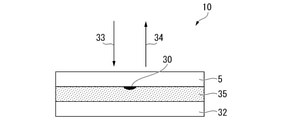
- FIG. 4 is a diagram showing an example of the configuration of the target measurement device of the present invention.
- FIG. 4 shows an example of a DNA microarray on which a DNA probe is immobilized as a solid phase.
- a target or a trapping molecule is immobilized on the solid phase surface of the substrate.
- a DNA probe 1 having a complementary sequence of a specific target nucleic acid sequence is immobilized on a DNA microarray 5 which is a substrate.
- the target measurement device of the present embodiment is emitted from the target 3 in which the target 3 is modified with the fluorescent molecule 4 and the fluorescent molecule 4 is modified, and the excitation light 33 for exciting the fluorescent molecule 4 or the fluorescent molecule 4.
- a container 32 capable of holding an absorbent target solution 35 containing an absorbent substance that absorbs fluorescence 34, and a DNA microarray 5 in which the absorbent substance-added target solution 35 is immobilized with the DNA probe 1. It is held in contact with the solid phase surface of.
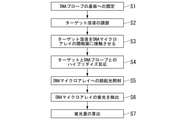
- FIG. 5 is a flowchart showing an operation procedure for detecting the target 3 using the target measurement device shown in FIG.
- the DNA probe 1 modified with the fluorescent molecule 4 is immobilized on the DNA spot 30 (step S1).
- the target 3 in the sample is modified with the fluorescent molecule 4 to prepare a target solution (step S2).
- amplification of the target 3 having a specific nucleic acid sequence may be performed.
- the timing for confirming whether or not the target 3 is present in the sample is not limited to that after the completion of amplification, and may be during amplification.
- the modification of the target 3 with the fluorescent molecule 4 may be performed after the amplification is confirmed, and the process may proceed to step S3 described later only when the amplification is confirmed.
- electrophoresis, antigen-antibody reaction, mass spectrometry, real-time PCR and the like can be appropriately used.
- the prepared target solution is supplied to the container 32 to which the DNA microarray on which the DNA probe 1 is immobilized is arranged in the container to which the light-absorbing substance is added, and the target solution is supplied to the DNA. It is brought into contact with the solid surface of the microarray 5 (step S3).
- the absorbent substance added to the container 32 is added to the target solution when the target solution is supplied to the container 32, and becomes the absorbent substance-added target solution 35.
- the target 3 modified with the fluorescent molecule 4 and the DNA immobilized on the DNA microarray 5 Hybridization reaction with probe 1 (step S4).
- the target 3 binds to the DNA probe 1, and the fluorescent molecule 4 modifying the target 3 is captured in the DNA spot 30 on which the DNA probe 1 is immobilized.
- the excitation light 33 that excites the fluorescent molecule 4 is irradiated from the side opposite to the solid phase surface of the DNA microarray 5 (step S5).
- the fluorescence 34 generated from the fluorescent molecule 4 that modifies the target 3 bound to the DNA probe 1 immobilized on the DNA microarray 5 is detected from the side opposite to the solid phase surface of the DNA microarray 5 (step S6). ..
- the fluorescence image generated from the fluorescence molecule 4 is acquired by the fluorescence reader 40.
- the amount of fluorescence is calculated from the acquired fluorescence image (step S7).
- the light-absorbing substance is a substance that absorbs the excitation light 33 that excites the fluorescent molecule 4
- the excitation light 33 for exciting the fluorescent molecule 4 is irradiated to the light-absorbing substance-added target solution 35, but the light-absorbing substance-added target Since the solution 35 contains an absorbent substance that absorbs the excitation light 33 that excites the fluorescent molecule 4, the unreacted fluorescent molecule 4 that is free in the solution 35 and does not hybridize with the DNA probe 1 is released. It is possible to suppress the excitation of the fluorescent molecule 4 of the target 3 modified with.
- the excitation light 33 for exciting the fluorescent molecule 4 is irradiated to the target solution 35 to which the light-absorbing substance is added, but the light-absorbing substance is added. Since the target solution 35 contains an absorbent substance that absorbs the fluorescence 34 emitted from the fluorescent molecule 4, the unreacted fluorescent molecule 4 that is free in the solution 35 and does not hybridize with the DNA probe 1 It is possible to suppress the generation of fluorescence from the fluorescent molecule 4 of the target 3 modified with.
- the number of molecules of the hybridized target 3 can be calculated from the amount of change in fluorescence of the fluorescent molecule 4 before and after the hybridization reaction.
- a hybrid reaction is carried out using a standard solution of Target 3 having a known number of molecules, the amount of change in fluorescence of fluorescent molecule 4 before and after the reaction is measured, and a calibration curve showing the relationship between the number of molecules and the amount of change in fluorescence. Is created in advance. From this calibration curve and the amount of change in fluorescence of the fluorescent molecule 4 before and after the hybridization reaction using the sample, the number of molecules of the hybridized target 3 can be calculated.
- an absorbent substance is added to the solution in step S2 or step S3.
- a solution containing a target or a capture molecule that specifically binds to the target is prepared, and the concentration of the target or the capture molecule is adjusted.
- the concentration of the target or the capture molecule is adjusted. For example, if the target is DNA having a specific nucleic acid sequence and the capture molecule is a DNA probe having a complementary sequence to the specific nucleic acid sequence of the target, a DNA probe solution is prepared and the DNA probe solution is prepared. Adjust the concentration.
- the target or trapping molecule is immobilized on the solid surface of the substrate.
- the DNA probe is immobilized on the solid surface
- the DNA probe 1 is spotted on the solid surface using a spotter or the like, and the DNA probe 1 is immobilized on the solid surface.
- the solid phase surface is immersed in a blocking solution to inactivate unreacted active functional groups.
- the region on the solid phase surface where the target or the trapping molecule is spotted may be divided into blocks in units of a predetermined number.
- the addition of the target solution to the target measurement device is performed block by block. Further, the image acquisition of the target measurement device is often performed for each block. That is, it can be said that the block is an image acquisition area.
- the solid phase surface is washed to remove excess unimmobilized targets or trapping molecules, and the washing liquid is also removed.
- the substrate produced by the above procedure is appropriately stored until use in an environment suitable for the substrate and the properties of the target and the trapping molecule immobilized on the substrate, such as shading, temperature, and humidity conditions.
- the substrate on which the target or capture molecule is immobilized in (3) has a solid phase surface on which the target or capture molecule is immobilized.
- the substrate may be integrated with the container, or the substrate and the container may be separated so that the substrate can be arranged in the container when measuring the target.
- the absorbent material may be in a dry state or in a liquid state.
- the absorbent substance can be added to the solution when the solution containing the target or the capture molecule modified with the fluorescent molecule is supplied to the container.
- the absorption substance may be added to the container before the substrate is placed in the container, or may be added after the substrate is placed in the container. When the absorbent substance is added after the substrate is placed in the container, the absorbent substance can be added from the injection port provided in the container.
- the target measuring device of the present invention includes a target measuring device of the present invention and a fluorescence reading device for measuring the amount of fluorescence of a fluorescent molecule from the target measuring device.
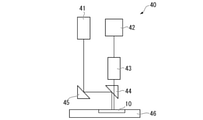
- FIG. 6 is an example of a configuration diagram showing the target measuring device of the present invention.
- the target measuring device 10 since the target of the target measuring device 10 and the image before and after the binding of the captured molecule are acquired, after the image before the binding is acquired, the target measuring device 10 is fixed by the temperature control stage. The temperature of the phase surface is raised to allow the bonding reaction to proceed, and the image after bonding is acquired in a state where the temperature is lowered to room temperature again.
- the target 3 modified with the fluorescent molecule 4 is hybridized with the DNA probe 1 to obtain images before and after the hybridization reaction.
- the temperature control stage has a shaking function, rotation of a target measuring device, stirring function by a vortex mixer, etc. during the reaction between the target and the trapped molecule in order to promote the bond between the target and the trapped molecule.
- the laser light emitted from the laser light source 41 is reflected by the dichroic mirror 44 via the mirror 45 and illuminates the solid phase surface of the target measurement device.
- the irradiated light becomes the excitation light 33 for the fluorescent molecule 4 on the solid phase surface of the target measurement device 10, the fluorescent molecule 4 is in an excited state, and the fluorescent molecule 4 radiates the fluorescence 34.
- the fluorescence emitted from the solid phase surface of the target measurement device 10 passes through the dichroic mirror 44 and is detected by forming a fluorescence image on the detection element of the CCD camera 42 via the imaging optical system 43.
- a bandpass filter tuned to the excitation light wavelength may be installed on the excitation light 33 side, or tuned to the fluorescence wavelength to be detected on the fluorescence 34 side.
- a band pass filter may be installed.
- the fluorescent image obtained by the target measuring device of the present invention can acquire images before and after the binding between the target at the same spot and the captured molecule. Therefore, it is not affected by variations in the amount of light between solid phases and spots.
- the amount of change in fluorescence can be calculated from the fluorescence images before and after the binding reaction, and the number of molecules undergoing the binding reaction can be calculated.
- the calculation of the fluorescence change amount may use the average light amount of the entire spot, or may use the fluorescence change amount of each pixel of the spot image.
- the target measuring device of the present invention may include a computer for controlling the CCD camera 42, an arithmetic device for calculating the light amount of the image, and a recording device for storing the image and the light amount.
- the target measuring device of the present invention is not limited to the above embodiment. Since the target measuring device of the present invention detects fluorescence from the surface opposite to the fixed surface of the detection spot on the solid phase surface, a fluorescence microscope, a confocal microscope, an evanescent fluorescence detector, a thin film oblique illumination microscope, and a sheet illumination microscope. , A structured illumination microscope, a multiphoton excitation microscope, etc. can be used.
- the target measurement kit of the present invention can be used for the target measurement method of the present invention.
- the target measurement kit of the present invention is a target measurement kit used when measuring a target contained in a sample, and is a substrate in which either the target or the capture molecule is immobilized on a solid phase surface. And a container that can hold a solution containing either the target or the capture molecule in contact with the solid phase surface of the substrate, and fluorescence that modifies the conjugate of the target and the capture molecule. It contains an excitation light that excites a molecule or an light-absorbing substance that absorbs the fluorescence emitted from the fluorescent molecule.
- the absorbent material may be added to the sample solution when preparing the sample solution containing the target or capture molecule.
- the timing of adding the absorbent substance to the sample solution may be any stage as long as it is before the fluorescent molecule is irradiated with the excitation light. For example, even at the stage of preparing the sample solution, the target and the capture molecule are bonded on the solid phase. It may be a previous step, or it may be a step after the target and the capture molecule are bound on the solid phase.
- An absorbent substance may be added to the container in advance.
- the absorbent material may be in a dry state or in a liquid state.
- the absorbent substance can be added to the solution when the solution containing the target or the capture molecule modified with the fluorescent molecule is supplied to the container.
- a capture molecule is immobilized on the solid phase surface of the substrate, and the container is in a state where a solution containing the target modified with fluorescent molecules and the light-absorbing substance is brought into contact with the surface of the substrate.
- the target may be immobilized on the solid phase surface of the substrate, and the container may contain a capture molecule modified with a fluorescent molecule and the light-absorbing substance. It may be a container capable of holding the containing solution in contact with the solid phase surface.
- a capture molecule modified with a fluorescent molecule is immobilized on the solid phase surface of the substrate, and the container is brought into contact with the solid phase surface by a solution containing the target and the absorbent substance. It may be a container that can be held in a state.
- either one of the target and the trapping molecule is immobilized on the solid surface of the substrate, and the container has the target and the trapping molecule on the other side of the target and the trapping molecule.
- a container may be used in which a solution containing the fluorescent molecule bound to the conjugate of the substrate and the light-absorbing substance can be held in contact with the solid phase surface of the substrate.
- Examples of the target and capture molecule include the above-mentioned target and capture molecule.
- Examples of the target measurement kit of the present invention include a kit having a specific nucleic acid sequence as a target and a DNA probe having a sequence complementary to the specific nucleic acid sequence as a capture molecule. ..
- the target measurement kit of the present invention may include the target measurement device of the present invention.
- the above-mentioned substrates, absorbent substances, and containers can be mentioned.
- the target measurement kit of the present invention may further include a standard solution necessary for quantifying the target, a necessary buffer solution, a product description, and the like.
- the target is DNA having a specific nucleic acid sequence
- the capture molecule is a DNA probe having a sequence complementary to the specific nucleic acid sequence.
- the DNA probe is immobilized on the solid surface of a DNA microarray, and the target is modified with a fluorescent molecule.
- the target measurement kit of the present embodiment is a container capable of holding a DNA microarray 5 on which a DNA probe 1 is immobilized and a target solution 35 to which an absorbent substance is added, and the solution 35 is used as the DNA probe 1.
- a container 32 that is held in contact with the solid phase surface of the DNA microarray 5 on which the DNA microarray 5 is immobilized, and an absorbent substance is added to the container 32.
- the target 3 in the sample is modified with the fluorescent molecule 4 to prepare a target solution.
- amplification of the target 3 having a specific nucleic acid sequence may be performed.
- the target solution is supplied to the container 32, and the target solution is brought into contact with the solid phase surface of the DNA microarray 5.
- the absorbent substance added to the container 32 is added to the target solution when the target solution is supplied to the container 32, and becomes the absorbent substance-added target solution 35.
- the target 3 modified with the fluorescent molecule 4 and the DNA immobilized on the DNA microarray 5
- the probe 1 and the probe 1 are hybridized.
- the target 3 binds to the DNA probe 1, and the fluorescent molecule 4 modifying the target 3 is captured in the DNA spot 30 on which the DNA probe 1 is immobilized.
- the excitation light 33 that excites the fluorescent molecule 4 is irradiated from the side opposite to the solid phase surface of the DNA microarray 5.
- the fluorescence 34 generated from the fluorescent molecule 4 that modifies the target 3 bound to the DNA probe 1 immobilized on the DNA microarray 5 is detected from the side opposite to the solid phase surface of the DNA microarray 5.
- the fluorescence image generated from the fluorescence molecule 4 is acquired by the fluorescence reader 40. Then, the amount of fluorescence is calculated from the acquired fluorescence image.
- the scope of application of the present invention is not limited to the above embodiment.
- the present invention can be widely applied to a target measurement method for measuring a target contained in a sample, a target measurement device, a target measurement device, and a target measurement kit.
- the target measurement method, target measurement device, target measurement device, and target measurement kit of the present invention include dry image measurement in fluorescent molecular light intensity measurement, in-liquid observation of fluorescent molecular light intensity of biochip, and real-time observation in continuous reaction. Can be used for. Specifically, it can be used, for example, for bacterial species discrimination by gene / polymer analysis, oncogene, animal and plant discrimination, intestinal bacterial test, and the like.
- the target measurement method, the target measurement device, the target measurement device, and the target measurement kit of the present invention are also applied to a solid phase method such as a labeled antibody method used for clinical examinations and the like.
- a solid phase method such as a labeled antibody method used for clinical examinations and the like.
- the FISH method fluorescence in situ hybridization
- the FIA method fluorescence immunofluorescence measurement method
- the IFA measures the serum (antibody) reaction that labels the fluorescent substance on the pathogen that becomes the antigen. It also applies to the method (indirect fluorescent antibody method).
- Example 1 The effect of reducing the background light by adding the absorbent substance was confirmed. Cy3® molecules were adjusted to a concentration of 0.3 to 3,000 nM as fluorescent molecules 4 in the container, and a transparent glass substrate was placed on the container. A fluorescent image was acquired by transmitting the excitation light 33 at 532 nm through the transparent glass substrate.
- FIG. 7 shows the results of calculating the amount of background light from the acquired fluorescent image when the absorbent substance was added to the solution in the container and when it was not added.
- Table 1 shows the background light ratio (the amount of background light when the absorbent substance is not added / the amount of background light when the absorbent substance is added) when the concentration of the fluorescent molecule is changed.
- the light-absorbing substance used was dextran-coated iron oxide (Fe 2 O 3 ) having a particle size of 50 nm, and was added so as to be 50 mg / ml in the solution.
- the background light can be reduced from 1/4 to 1/17 depending on the Cy3 molecular concentration, and the reduction effect is high when the background light is high.
- the fluorescence of the solution is about 10 ⁇ W / m 2 , and the effect is obtained even in the solution with the background light of about 10 ⁇ W / m 2 , from the sample. It was found that the fluorescence generated by exciting the solution generated by molecules other than the brought-in target 3 is also effective.
- the background light can be reduced to 1/2 even in the state of water containing no Cy3 molecule, but this is because the excitation light 33 does not pass through the solution, so that the reflection on the bottom surface of the container and the autofluorescence are reduced. It is considered that this is the cause, and a secondary effect was confirmed.
- FIG. 8 is a spot image of a spot in which a synthetic DNA modified with Cy3 molecules is immobilized on a substrate and has an exposure time of 1 second by a fluorescence reader in a solution having a Cy3 molecule concentration of 3 to 300 nM. It was found that when the Cy3 molecular concentration is 30 nM or more, the background light can be reduced to 1/10 or more, so that spot observation is possible even when the fluorescence exhibited by the solution is high.
- FIG. 9 shows the relationship between the amount of spot light and the background light when the Cy3 molecular concentration is 30 nM.
- the amount of fluorescence due to the fluorescent molecule 4 captured by the DNA probe 1 of the spot is calculated from the difference between the amount of light of the spot and the background light. No, the detection signal was not lowered by adding the absorbent substance.
- the ratio of the amount of spot light to the background light is S / N
- the S / N is 1.3 when the absorbent substance is not added, whereas the S / N is when the absorbent substance is added. It became 5.3, and the S / N was improved by 4.2 times.
- Example 2 A DNA microarray 5 in which a plurality of unmodified DNA probes 1 were arranged on a substrate was prepared, and the applicability of the addition of an absorbent substance was confirmed in spot observation by hybridization of a target DNA modified with a Cy3 molecule as follows. did. A target DNA modified with a Cy3 molecule so as to be 0.25 nM was prepared in a container, and at this time, an absorbent substance was added under the same conditions as in Example 1, and a DNA microarray 5 was placed. Incubation was carried out at 60 ° C. and 5 rpm for 30 minutes to hybridize the DNA probe 1 and the target DNA. After returning to room temperature, a fluorescence image of the spot was acquired by a fluorescence reader, and the amount of light was calculated. The results are shown in FIG.
- the absorbent substance when the absorbent substance was added, the fluorescence of the target modified with the unreacted Cy3 molecule released in the solution was reduced, and the background light was reduced to 1 / 3.7.
- the ratio of the amount of spot light to the background light is S / N
- the S / N when the absorbent substance is not added is 1.5
- the S / N when the absorbent substance is added is 1.5.
- the S / N was improved 2.5 times.
- the absorbent substance is the hybrid reaction between the DNA probe 1 and the target 3. It can be seen that it does not inhibit.
Landscapes
- Health & Medical Sciences (AREA)
- Life Sciences & Earth Sciences (AREA)
- Immunology (AREA)
- Chemical & Material Sciences (AREA)
- Engineering & Computer Science (AREA)
- Molecular Biology (AREA)
- Hematology (AREA)
- Urology & Nephrology (AREA)
- Biomedical Technology (AREA)
- Physics & Mathematics (AREA)
- Biochemistry (AREA)
- General Health & Medical Sciences (AREA)
- Analytical Chemistry (AREA)
- Microbiology (AREA)
- Biotechnology (AREA)
- General Physics & Mathematics (AREA)
- Pathology (AREA)
- Medicinal Chemistry (AREA)
- Food Science & Technology (AREA)
- Cell Biology (AREA)
- Organic Chemistry (AREA)
- Proteomics, Peptides & Aminoacids (AREA)
- Wood Science & Technology (AREA)
- Zoology (AREA)
- Nuclear Medicine, Radiotherapy & Molecular Imaging (AREA)
- Biophysics (AREA)
- Optics & Photonics (AREA)
- Chemical Kinetics & Catalysis (AREA)
- Bioinformatics & Cheminformatics (AREA)
- General Engineering & Computer Science (AREA)
- Genetics & Genomics (AREA)
- Investigating, Analyzing Materials By Fluorescence Or Luminescence (AREA)
- Measuring Or Testing Involving Enzymes Or Micro-Organisms (AREA)
- Apparatus Associated With Microorganisms And Enzymes (AREA)
Priority Applications (4)
| Application Number | Priority Date | Filing Date | Title |
|---|---|---|---|
| US18/023,249 US20230314419A1 (en) | 2020-08-31 | 2021-07-30 | Target measurement method, target measurement device, target measurement apparatus, and target measurement kit |
| JP2022545580A JP7841429B2 (ja) | 2020-08-31 | 2021-07-30 | ターゲット計測方法及びターゲット計測装置 |
| CN202180051930.8A CN116171319A (zh) | 2020-08-31 | 2021-07-30 | 靶标检测方法、靶标检测用器件、靶标检测装置及靶标检测用试剂盒 |
| EP21861130.9A EP4206332A4 (en) | 2020-08-31 | 2021-07-30 | TARGET MEASURING METHOD, TARGET MEASURING DEVICE, TARGET MEASURING APPARATUS AND TARGET MEASURING KIT |
Applications Claiming Priority (2)
| Application Number | Priority Date | Filing Date | Title |
|---|---|---|---|
| JP2020-145840 | 2020-08-31 | ||
| JP2020145840 | 2020-08-31 |
Publications (1)
| Publication Number | Publication Date |
|---|---|
| WO2022044702A1 true WO2022044702A1 (ja) | 2022-03-03 |
Family
ID=80355107
Family Applications (1)
| Application Number | Title | Priority Date | Filing Date |
|---|---|---|---|
| PCT/JP2021/028455 Ceased WO2022044702A1 (ja) | 2020-08-31 | 2021-07-30 | ターゲット計測方法、ターゲット計測用デバイス、ターゲット計測装置、及びターゲット計測用キット |
Country Status (5)
| Country | Link |
|---|---|
| US (1) | US20230314419A1 (https=) |
| EP (1) | EP4206332A4 (https=) |
| JP (1) | JP7841429B2 (https=) |
| CN (1) | CN116171319A (https=) |
| WO (1) | WO2022044702A1 (https=) |
Families Citing this family (1)
| Publication number | Priority date | Publication date | Assignee | Title |
|---|---|---|---|---|
| KR20260050742A (ko) * | 2024-10-08 | 2026-04-15 | 광주과학기술원 | 산란광 검출이 가능한 미세유체 흐름 소자 |
Citations (5)
| Publication number | Priority date | Publication date | Assignee | Title |
|---|---|---|---|---|
| JPH07120397A (ja) * | 1993-08-31 | 1995-05-12 | Daikin Ind Ltd | 光学的測定装置およびその方法 |
| JP2001194310A (ja) * | 2000-01-17 | 2001-07-19 | Yokogawa Electric Corp | バイオチップ読み取り装置 |
| JP2001311690A (ja) * | 2000-04-28 | 2001-11-09 | Yokogawa Electric Corp | バイオチップ読取装置及び電気泳動装置 |
| JP2003084002A (ja) * | 2001-06-27 | 2003-03-19 | Fuji Photo Film Co Ltd | 蛍光検出におけるバックグラウンドの低減方法 |
| JP2015043702A (ja) | 2013-08-27 | 2015-03-12 | 横河電機株式会社 | 核酸配列計測方法、核酸配列計測用デバイス、核酸配列計測用デバイスの製造方法および核酸配列計測装置 |
Family Cites Families (2)
| Publication number | Priority date | Publication date | Assignee | Title |
|---|---|---|---|---|
| US4680275A (en) * | 1985-02-11 | 1987-07-14 | Becton, Dickinson And Company | Homogeneous fluorescence immunoassay using a light absorbing material |
| CN103975061A (zh) * | 2011-10-31 | 2014-08-06 | 荣研化学株式会社 | 靶核酸的检测方法 |
-
2021
- 2021-07-30 CN CN202180051930.8A patent/CN116171319A/zh active Pending
- 2021-07-30 US US18/023,249 patent/US20230314419A1/en active Pending
- 2021-07-30 JP JP2022545580A patent/JP7841429B2/ja active Active
- 2021-07-30 WO PCT/JP2021/028455 patent/WO2022044702A1/ja not_active Ceased
- 2021-07-30 EP EP21861130.9A patent/EP4206332A4/en active Pending
Patent Citations (5)
| Publication number | Priority date | Publication date | Assignee | Title |
|---|---|---|---|---|
| JPH07120397A (ja) * | 1993-08-31 | 1995-05-12 | Daikin Ind Ltd | 光学的測定装置およびその方法 |
| JP2001194310A (ja) * | 2000-01-17 | 2001-07-19 | Yokogawa Electric Corp | バイオチップ読み取り装置 |
| JP2001311690A (ja) * | 2000-04-28 | 2001-11-09 | Yokogawa Electric Corp | バイオチップ読取装置及び電気泳動装置 |
| JP2003084002A (ja) * | 2001-06-27 | 2003-03-19 | Fuji Photo Film Co Ltd | 蛍光検出におけるバックグラウンドの低減方法 |
| JP2015043702A (ja) | 2013-08-27 | 2015-03-12 | 横河電機株式会社 | 核酸配列計測方法、核酸配列計測用デバイス、核酸配列計測用デバイスの製造方法および核酸配列計測装置 |
Non-Patent Citations (3)
| Title |
|---|
| KOICHI HITRAYAMA ET AL.: "Development of DNA Chip for detection of UGT1A1 Polymorphisms", TOYO KOHAN, vol. 38, pages 51 - 56 |
| See also references of EP4206332A4 |
| VIVIAN G. C. ET AL.: "Making and reading microarrays", NATURE GENETICS SUPPLEMENT, vol. 21, 1999, pages 15 - 19 |
Also Published As
| Publication number | Publication date |
|---|---|
| JPWO2022044702A1 (https=) | 2022-03-03 |
| JP7841429B2 (ja) | 2026-04-07 |
| CN116171319A (zh) | 2023-05-26 |
| EP4206332A1 (en) | 2023-07-05 |
| EP4206332A4 (en) | 2024-10-09 |
| US20230314419A1 (en) | 2023-10-05 |
Similar Documents
| Publication | Publication Date | Title |
|---|---|---|
| US9260656B2 (en) | Fluorescent silica nano-particle, fluorescent nano-material, and biochip and assay using the same | |
| EP3036530B1 (en) | Phosphorescent reporters | |
| CN107121396B (zh) | 用于检测分析物的方法 | |
| JP5860922B2 (ja) | ビーズまたは他の捕捉物を用いた分子または粒子の超高感度検出 | |
| JP5652393B2 (ja) | Spfs−lpfs系による測定方法に供するプラズモン励起センサおよびアッセイ法 | |
| US6861251B2 (en) | Translucent solid matrix assay device for microarray analysis | |
| JP5428322B2 (ja) | プラズモン励起センサを用いたアッセイ法 | |
| JP5772612B2 (ja) | 表面プラズモン励起増強蛍光分光法を利用する蛍光測定装置用センサチップを用いたアッセイ方法、およびアッセイ用キット | |
| JP5660035B2 (ja) | 融合タンパク質含有集合体、その製造方法及び該集合体を用いたアッセイ法 | |
| JP7841429B2 (ja) | ターゲット計測方法及びターゲット計測装置 | |
| JP2009186220A (ja) | バイオアレイの検出方法 | |
| JP5754309B2 (ja) | 表面プラズモン励起増強蛍光分光法を利用して蛍光量を測定する定量分析方法ならびにそれに用いられる定量分析用キットおよびアナライト解離抑制剤 | |
| JP2012037477A (ja) | センサチップおよびそれを用いたアッセイ法 | |
| JP5298877B2 (ja) | プラズモン励起センサを用いたアッセイ法 | |
| JP7676786B2 (ja) | ターゲット計測用デバイスの製造方法、及びターゲット計測用キット | |
| US20240003890A1 (en) | Particle-based detection of analytes | |
| JP5298876B2 (ja) | プラズモン励起センサおよびそれを用いたアッセイ法 | |
| WO2023008271A1 (ja) | 核酸計測デバイス、その設計方法、製造方法及び計測方法 | |
| JP2010181323A (ja) | 表面プラズモンを利用したアッセイ法 | |
| WO2010084953A1 (ja) | プラズモン励起センサおよびそれを用いたアッセイ法 | |
| HK1164440A (en) | Analyte detection assay | |
| HK1164440B (en) | Analyte detection assay |
Legal Events
| Date | Code | Title | Description |
|---|---|---|---|
| 121 | Ep: the epo has been informed by wipo that ep was designated in this application |
Ref document number: 21861130 Country of ref document: EP Kind code of ref document: A1 |
|
| ENP | Entry into the national phase |
Ref document number: 2022545580 Country of ref document: JP Kind code of ref document: A |
|
| NENP | Non-entry into the national phase |
Ref country code: DE |
|
| ENP | Entry into the national phase |
Ref document number: 2021861130 Country of ref document: EP Effective date: 20230331 |