WO2022039235A1 - 中空部を有する窒化ホウ素粒子を含有するシート - Google Patents
中空部を有する窒化ホウ素粒子を含有するシート Download PDFInfo
- Publication number
- WO2022039235A1 WO2022039235A1 PCT/JP2021/030446 JP2021030446W WO2022039235A1 WO 2022039235 A1 WO2022039235 A1 WO 2022039235A1 JP 2021030446 W JP2021030446 W JP 2021030446W WO 2022039235 A1 WO2022039235 A1 WO 2022039235A1
- Authority
- WO
- WIPO (PCT)
- Prior art keywords
- boron nitride
- nitride particles
- sheet
- resin
- particles
- Prior art date
- Legal status (The legal status is an assumption and is not a legal conclusion. Google has not performed a legal analysis and makes no representation as to the accuracy of the status listed.)
- Ceased
Links
Images


Classifications
-
- C—CHEMISTRY; METALLURGY
- C08—ORGANIC MACROMOLECULAR COMPOUNDS; THEIR PREPARATION OR CHEMICAL WORKING-UP; COMPOSITIONS BASED THEREON
- C08K—Use of inorganic or non-macromolecular organic substances as compounding ingredients
- C08K3/00—Use of inorganic substances as compounding ingredients
- C08K3/38—Boron-containing compounds
-
- C—CHEMISTRY; METALLURGY
- C01—INORGANIC CHEMISTRY
- C01B—NON-METALLIC ELEMENTS; COMPOUNDS THEREOF; METALLOIDS OR COMPOUNDS THEREOF NOT COVERED BY SUBCLASS C01C
- C01B21/00—Nitrogen; Compounds thereof
- C01B21/06—Binary compounds of nitrogen with metals, with silicon, or with boron, or with carbon, i.e. nitrides; Compounds of nitrogen with more than one metal, silicon or boron
- C01B21/064—Binary compounds of nitrogen with metals, with silicon, or with boron, or with carbon, i.e. nitrides; Compounds of nitrogen with more than one metal, silicon or boron with boron
-
- C—CHEMISTRY; METALLURGY
- C08—ORGANIC MACROMOLECULAR COMPOUNDS; THEIR PREPARATION OR CHEMICAL WORKING-UP; COMPOSITIONS BASED THEREON
- C08J—WORKING-UP; GENERAL PROCESSES OF COMPOUNDING; AFTER-TREATMENT NOT COVERED BY SUBCLASSES C08B, C08C, C08F, C08G or C08H
- C08J5/00—Manufacture of articles or shaped materials containing macromolecular substances
- C08J5/18—Manufacture of films or sheets
-
- C—CHEMISTRY; METALLURGY
- C08—ORGANIC MACROMOLECULAR COMPOUNDS; THEIR PREPARATION OR CHEMICAL WORKING-UP; COMPOSITIONS BASED THEREON
- C08K—Use of inorganic or non-macromolecular organic substances as compounding ingredients
- C08K7/00—Use of ingredients characterised by shape
- C08K7/22—Expanded, porous or hollow particles
- C08K7/24—Expanded, porous or hollow particles inorganic
-
- C—CHEMISTRY; METALLURGY
- C08—ORGANIC MACROMOLECULAR COMPOUNDS; THEIR PREPARATION OR CHEMICAL WORKING-UP; COMPOSITIONS BASED THEREON
- C08L—COMPOSITIONS OF MACROMOLECULAR COMPOUNDS
- C08L101/00—Compositions of unspecified macromolecular compounds
-
- C—CHEMISTRY; METALLURGY
- C01—INORGANIC CHEMISTRY
- C01P—INDEXING SCHEME RELATING TO STRUCTURAL AND PHYSICAL ASPECTS OF SOLID INORGANIC COMPOUNDS
- C01P2004/00—Particle morphology
- C01P2004/54—Particles characterised by their aspect ratio, i.e. the ratio of sizes in the longest to the shortest dimension
-
- C—CHEMISTRY; METALLURGY
- C01—INORGANIC CHEMISTRY
- C01P—INDEXING SCHEME RELATING TO STRUCTURAL AND PHYSICAL ASPECTS OF SOLID INORGANIC COMPOUNDS
- C01P2004/00—Particle morphology
- C01P2004/60—Particles characterised by their size
- C01P2004/61—Micrometer sized, i.e. from 1-100 micrometer
-
- C—CHEMISTRY; METALLURGY
- C08—ORGANIC MACROMOLECULAR COMPOUNDS; THEIR PREPARATION OR CHEMICAL WORKING-UP; COMPOSITIONS BASED THEREON
- C08J—WORKING-UP; GENERAL PROCESSES OF COMPOUNDING; AFTER-TREATMENT NOT COVERED BY SUBCLASSES C08B, C08C, C08F, C08G or C08H
- C08J2300/00—Characterised by the use of unspecified polymers
-
- C—CHEMISTRY; METALLURGY
- C08—ORGANIC MACROMOLECULAR COMPOUNDS; THEIR PREPARATION OR CHEMICAL WORKING-UP; COMPOSITIONS BASED THEREON
- C08J—WORKING-UP; GENERAL PROCESSES OF COMPOUNDING; AFTER-TREATMENT NOT COVERED BY SUBCLASSES C08B, C08C, C08F, C08G or C08H
- C08J2363/00—Characterised by the use of epoxy resins; Derivatives of epoxy resins
-
- C—CHEMISTRY; METALLURGY
- C08—ORGANIC MACROMOLECULAR COMPOUNDS; THEIR PREPARATION OR CHEMICAL WORKING-UP; COMPOSITIONS BASED THEREON
- C08K—Use of inorganic or non-macromolecular organic substances as compounding ingredients
- C08K3/00—Use of inorganic substances as compounding ingredients
- C08K3/28—Nitrogen-containing compounds
- C08K2003/285—Ammonium nitrates
-
- C—CHEMISTRY; METALLURGY
- C08—ORGANIC MACROMOLECULAR COMPOUNDS; THEIR PREPARATION OR CHEMICAL WORKING-UP; COMPOSITIONS BASED THEREON
- C08K—Use of inorganic or non-macromolecular organic substances as compounding ingredients
- C08K3/00—Use of inorganic substances as compounding ingredients
- C08K3/38—Boron-containing compounds
- C08K2003/382—Boron-containing compounds and nitrogen
- C08K2003/385—Binary compounds of nitrogen with boron
-
- C—CHEMISTRY; METALLURGY
- C08—ORGANIC MACROMOLECULAR COMPOUNDS; THEIR PREPARATION OR CHEMICAL WORKING-UP; COMPOSITIONS BASED THEREON
- C08K—Use of inorganic or non-macromolecular organic substances as compounding ingredients
- C08K2201/00—Specific properties of additives
- C08K2201/002—Physical properties
- C08K2201/004—Additives being defined by their length
-
- C—CHEMISTRY; METALLURGY
- C08—ORGANIC MACROMOLECULAR COMPOUNDS; THEIR PREPARATION OR CHEMICAL WORKING-UP; COMPOSITIONS BASED THEREON
- C08K—Use of inorganic or non-macromolecular organic substances as compounding ingredients
- C08K2201/00—Specific properties of additives
- C08K2201/016—Additives defined by their aspect ratio
Definitions
- the present disclosure relates to a sheet containing boron nitride particles having a hollow portion.
- Boron nitride powder which has characteristics such as high thermal conductivity, high insulation, and low relative permittivity, is attracting attention as a ceramic powder.
- Boron nitride powder is generally composed of agglomerated particles (lumpy particles) formed by agglomerating primary particles of boron nitride.
- agglomerated particles lumpy particles
- the shape of the agglomerated particles is further spheroidized to improve the filling property, the powder strength is improved, and the purity is further increased to improve the insulating property of the heat transfer sheet or the like filled with the powder.
- Hexagonal boron nitride powder which is said to have achieved improvement and stabilization of withstand voltage, is disclosed.
- the heat transfer sheet becomes heavier as the filling amount of the boron nitride powder is increased, so that it may be desirable to reduce the weight.
- an object of the present invention is to provide a sheet that can be reduced in weight.
- One aspect of the present invention is a sheet containing a resin and boron nitride particles having a hollow portion, and the hollow portion of the boron nitride particles is filled with the resin.
- the boron nitride particles have a hollow portion, and the hollow portion is filled with a resin lighter than boron nitride, so that, for example, the conventional primary particles of boron nitride are aggregated into agglomerated particles (lumpy form).
- the weight of the sheet can be reduced as compared with the case of using particles).
- the sheet containing the boron nitride particles in the hollow portion may have a thermal conductivity equal to or higher than that of, for example, a conventional sheet containing agglomerated particles (lumpy particles) of boron nitride. It turned out that.
- the area ratio of the hollow portion to the boron nitride particles may be 40% or more.
- the boron nitride particles may contain boron nitride particles having an aspect ratio of 1.5 or more.
- the boron nitride particles having an aspect ratio of 1.5 or more may have a maximum length of 80 ⁇ m or more.
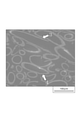
- 6 is an SEM image of a cross section of the sheet of Example 1.
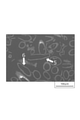
- 6 is an SEM image of a cross section of the sheet of Example 2.
- 6 is an SEM image of a cross section of the sheet of Example 3.
- One embodiment of the present invention is a sheet containing a resin and boron nitride particles.
- This sheet can be used, for example, as a heat dissipation sheet.
- Resins include epoxy resin, silicone resin, silicone rubber, acrylic resin, phenol resin, melamine resin, urea resin, unsaturated polyester, fluororesin, polyimide, polyamideimide, polyetherimide, polybutylene terephthalate, polyethylene terephthalate, and polyphenylene ether.
- Polyphenylene sulfide total aromatic polyester, polysulfone, liquid crystal polymer, polyether sulfone, polycarbonate, maleimide modified resin, ABS (acrylonitrile-butadiene-styrene) resin, AAS (acrylonitrile-acrylic rubber / styrene) resin, AES (acrylonitrile / ethylene) -Propin / diene rubber-styrene) resin and the like can be mentioned. These resins may be used alone or in combination of two or more.
- the resin may be in an uncured state, may be in a semi-cured state (a state in which a cured resin and an uncured resin are present), and may be in a completely cured state (a state in which only a substantially cured resin is present). ) May be.
- the proportion of the resin in the sheet may be 10% or more, 20% or more, 30% or more, or 40% or more, and may be 90% or less, 85% or less, or 80% or less.
- the ratio of the resin in the sheet is as follows: A cross-sectional image (SEM image) obtained by observing any 10 cross sections of the sheet with a scanning electron microscope (SEM) at a magnification of 300 times is obtained by image analysis software (for example, "Mountain Tech Co., Ltd.” 10 pieces calculated by incorporating into Mac-view ”) and calculating the area ratio occupied by the resin (including the resin filled in the hollow portion of the boron nitride particles) in an arbitrary 300 ⁇ m ⁇ 300 ⁇ m region in each cross-sectional image. It is defined as the average value of the area ratio in the cross section of.
- Boron nitride particles are boron nitride particles having a hollow portion.
- the boron nitride particles may have, for example, an outer shell portion formed by boron nitride and a hollow portion surrounded by the outer shell portion.
- the boron nitride particles have a hollow shape.
- the outer shell portion may have an opening communicating with the hollow portion.
- the hollow portion may be formed along the appearance shape of the boron nitride particles, and may have a shape substantially similar to the appearance shape of the boron nitride particles.
- the boron nitride particles have a hollow shape as described above can be confirmed by observing the cross section of the sheet with an SEM and confirming it in the SEM image of the cross section of the sheet.
- SEM image cross-sectional image
- the hollow portion of the boron nitride particles means the closed space.
- the hollow portion of the boron nitride particles is a straight line connecting the ends of the boron nitride particles in the opening and the boron nitride particles. It means the part surrounded by the outer shell part of.
- the straight line connecting the ends of the boron nitride particles at the opening shall be connected so that the area of the hollow portion is maximized.
- the hollow portion is made of a resin that is lighter than boron nitride as compared with solid boron nitride particles (for example, conventional boron nitride particles in which primary particles of boron nitride are aggregated). Since it can be filled in, the weight of the sheet can be expected to be reduced.
- the boron nitride particles are those in which the area ratio of the hollow portion to the boron nitride particles in the cross section of the sheet is 40% or more, 50% or more, or 60% or more from the viewpoint of further weight reduction of the sheet. May include.
- the area ratio of the hollow portion to the boron nitride particles may be 90% or less or 80% or less.
- the cross-sectional image (SEM image) of the sheet is incorporated into image analysis software (for example, "Mac-view” manufactured by Mountech Co., Ltd.), and the cross-sectional image of the boron nitride particles in the cross-sectional image is taken. It can be obtained by calculating from the image.
- the boron nitride particles may contain boron nitride particles having an outer shell having a thickness of preferably 50 ⁇ m or less, more preferably 30 ⁇ m or less, still more preferably 15 ⁇ m or less, from the viewpoint of further weight reduction of the sheet.
- the thickness of the outer shell portion of the boron nitride particles may be 1 ⁇ m or more or 3 ⁇ m or more from the viewpoint of facilitating the maintenance of the shape of the boron nitride particles.
- the thickness of the outer shell portion is defined as the average value of the thicknesses of the outer shell portions at any 10 points in one boron nitride particle having a hollow portion in the cross-sectional image (SEM image) of the sheet.
- the boron nitride particles may include boron nitride particles having an aspect ratio of 1.5 or more, 1.7 or more, 2.0 or more, 3.0 or more, 5.0 or more, or 7.0 or more.
- the aspect ratio of the boron nitride particles may be 12.0 or less, 10.0 or less, 9.0 or less, or 8.0 or less.
- the aspect ratio of the boron nitride particles is the maximum length (maximum length in the longitudinal direction) L1 of the boron nitride particles and the boron nitride particles in the direction perpendicular to the direction having the maximum length (longitudinal direction) (short direction). Is defined as the ratio (L 1 / L 2 ) to the maximum length (maximum length in the lateral direction) L 2 .
- the maximum length of the boron nitride particles means the maximum length of the linear distance between any two points on one boron nitride particle when the cross section of the sheet is observed by SEM.
- the maximum length L 1 in the longitudinal direction and the maximum length L 2 in the lateral direction of the boron nitride particles are measured by incorporating the SEM image of the sheet into image analysis software (for example, "Mac-view” manufactured by Mountech Co., Ltd.). can do.
- the sheet may have a cross section in which the average aspect ratio of the boron nitride particles is 1.3 or more, and the average aspect ratio may be 1.5 or more or 1.7 or more, and 10.0 or less. It may be 9.0 or less, or 8.0 or less.
- the average aspect ratio of boron nitride particles is defined as follows. That is, first, the cross section of the sheet is observed with a scanning electron microscope (SEM) at a magnification of 300 times in three fields, and the cross-sectional image (SEM image) of each field is image analysis software (for example, "Mac-" manufactured by Mountech Co., Ltd. Incorporate into a microscope, and observe a total of 5 boron nitride particles in 3 visual fields in an arbitrary 300 ⁇ m ⁇ 300 ⁇ m region in the cross-sectional image of each visual field.
- the average aspect ratio of the boron nitride particles is defined as the average value of the aspect ratios of the five boron nitride particles observed in the three visual fields.
- the boron nitride particles are arranged so that the longitudinal direction of the boron nitride particles is along the thickness direction of the sheet, the heat transfer loss between the boron nitride particles is reduced, so that the thermal conductivity of the sheet is more excellent. Conceivable.
- the maximum length L 1 in the longitudinal direction of the boron nitride particles having the above-mentioned aspect ratio may be 80 ⁇ m or more, 100 ⁇ m or more, or 150 ⁇ m or more from the viewpoint of further improving the thermal conductivity of the sheet.
- the maximum length L 1 of the boron nitride particles in the longitudinal direction may be 500 ⁇ m or less or 400 ⁇ m or less.
- the sheet may have a cross section in which the average maximum length of the boron nitride particles is 50 ⁇ m or more.
- the average maximum length may be 70 ⁇ m or more or 80 ⁇ m or more, and may be 500 ⁇ m or less or 400 ⁇ m or less.
- the average maximum length of boron nitride particles is defined as follows. That is, first, the cross section of the sheet is observed with a scanning electron microscope (SEM) at a magnification of 300 times in three fields, and the cross-sectional image (SEM image) of each field is image analysis software (for example, "Mac-" manufactured by Mountech Co., Ltd. Incorporate into a microscope, and observe a total of 5 boron nitride particles in 3 visual fields in an arbitrary 300 ⁇ m ⁇ 300 ⁇ m region in the cross-sectional image of each visual field.
- the average maximum length of the boron nitride particles is defined as the average value of the maximum lengths of the five boron nitride particles observed in the three fields of view.
- the maximum length or the average maximum length of the boron nitride particles When the maximum length or the average maximum length of the boron nitride particles is large, the number of particles arranged in the thickness direction of the sheet is reduced, and the heat transfer loss between the boron nitride particles is reduced, so that the thermal conductivity of the sheet is improved. Considered to be excellent.
- both ends in the longitudinal direction may be an open end, and both may be open ends.
- the open end may communicate with the hollow portion.
- the proportion of boron nitride particles in the sheet may be 10% or more, 15% or more, or 20% or more from the viewpoint of improving the thermal conductivity of the sheet.
- the proportion of boron nitride particles in the sheet may be 90% or less, 80% or less, 70% or less, or 60% or less.
- image analysis software for example, "Mac-view" manufactured by Mountech Co., Ltd.
- the area ratio occupied by the boron nitride particles (excluding the hollow portion of the boron nitride particles) in an arbitrary 300 ⁇ m ⁇ 300 ⁇ m region in each cross-sectional image is calculated, and is defined as the average value of the area ratios in the calculated 10 cross sections.
- the sheet may further contain other components.
- the sheet When the resin is in an uncured state or a partially cured state, the sheet may further contain a curing agent or may further contain a curing accelerator (curing catalyst).
- the curing agent is appropriately selected depending on the type of resin.
- examples of the curing agent include phenol novolac compounds, acid anhydrides, amino compounds, imidazole compounds and the like.
- the content of the curing agent may be 0.5 parts by mass or more or 1 part by mass or more, and may be 15 parts by mass or less or 10 parts by mass or less with respect to 100 parts by mass of the resin.
- curing accelerator examples include phosphorus-based curing accelerators such as tetraphenylphosphonium tetraphenylborate and triphenylphosphate, imidazole-based curing accelerators such as 2-phenyl-4,5-dihydroxymethylimidazole, and triphenyl.
- phosphorus-based curing accelerators such as tetraphenylphosphonium tetraphenylborate and triphenylphosphate
- imidazole-based curing accelerators such as 2-phenyl-4,5-dihydroxymethylimidazole
- triphenyl examples include amine-based curing accelerators such as boron monoethylamine.
- Other components may be a coupling agent, a wet dispersant, a surface conditioner, or the like.
- the coupling agent include a silane-based coupling agent, a titanate-based coupling agent, an aluminate-based coupling agent, and the like.
- the chemical bonding group contained in these coupling agents include a vinyl group, an epoxy group, an amino group, a methacryl group, a mercapto group and the like.
- wet dispersant examples include phosphate ester salts, carboxylic acid esters, polyesters, acrylic copolymers, block copolymers and the like.
- Examples of the surface conditioner include an acrylic surface conditioner, a silicone type surface conditioner, a vinyl type surface conditioner, and a fluorine type surface conditioner.
- the thickness of the sheet may be 50 ⁇ m or more, 80 ⁇ m or more, or 100 ⁇ m or more, and may be 500 ⁇ m or less, 400 ⁇ m or less, or 300 ⁇ m or less.
- the sheet described above includes, for example, a step of preparing the above-mentioned boron nitride particles (preparation step), a step of preparing a resin composition containing the boron nitride particles and a resin (preparation step), and a sheet of the resin composition. It is manufactured by a sheet manufacturing method including a step of molding into a shape (molding step). That is, another embodiment of the present invention is a method for manufacturing such a sheet.
- the preparation steps include, for example, a step (placement step) of arranging a mixture containing boron carbide and boric acid in a container made of a carbon material and a base material made of a carbon material, and nitrogen in the container. It has a step (formation step) of forming boron nitride particles on a substrate by heating and pressurizing in an atmosphere. This makes it possible to produce boron nitride particles having a hollow portion.
- the container made of carbon material is a container that can accommodate the above mixture and base material.
- the container may be, for example, a carbon crucible.
- the container is preferably a container whose airtightness can be enhanced by covering the opening.
- the mixture may be placed at the bottom of the container and the substrate may be placed so as to be fixed to the side wall surface in the container or the inside of the lid.
- the base material formed of the carbon material may be, for example, sheet-shaped, plate-shaped, or rod-shaped.
- the base material formed of the carbon material may be, for example, a carbon sheet (graphite sheet), a carbon plate, or a carbon rod.
- the boron carbide in the mixture may be, for example, powder (boron carbide powder).
- the boric acid in the mixture may be, for example, in the form of powder (boric acid powder).
- the mixture is obtained, for example, by mixing boron carbide powder and boric acid powder by a known method.
- Boron carbide powder can be produced by a known production method.
- a method for producing boron carbide powder for example, boric acid and acetylene black are mixed and then heated at 1800 to 2400 ° C. for 1 to 10 hours in an atmosphere of an inert gas (for example, nitrogen gas) to form a lump.
- an inert gas for example, nitrogen gas
- a method for obtaining boron carbide particles can be mentioned.
- Boron carbide powder can be obtained by appropriately pulverizing, sieving, washing, removing impurities, drying and the like from the massive boron carbide particles obtained by this method.
- the average particle size of the boron carbide powder can be adjusted by adjusting the crushing time of the agglomerated carbon boron particles.
- the average particle size of the boron carbide powder may be 5 ⁇ m or more, 7 ⁇ m or more, or 10 ⁇ m or more, and may be 100 ⁇ m or less, 90 ⁇ m or less, 80 ⁇ m or less, or 70 ⁇ m or less.
- the average particle size of the boron carbide powder can be measured by a laser diffraction / scattering method.
- the mixing ratio of boron carbide and boric acid can be appropriately selected.
- the content of boric acid in the mixture is preferably 2 parts by mass or more, more preferably 5 parts by mass or more, still more preferably 5 parts by mass or more, based on 100 parts by mass of boron carbide, from the viewpoint that the boron nitride particles tend to be large. Is 8 parts by mass or more, and may be 100 parts by mass or less, 90 parts by mass or less, or 80 parts by mass or less.
- the mixture containing boron carbide and boric acid may further contain other components.
- other components include silicon carbide, carbon, iron oxide and the like.
- the inside of the container has a nitrogen atmosphere containing, for example, 95% by volume or more of nitrogen gas.
- the content of nitrogen gas in the nitrogen atmosphere is preferably 95% by volume or more, more preferably 99.9% by volume or more, and may be substantially 100% by volume.
- Ammonia gas or the like may be contained in the nitrogen atmosphere in addition to nitrogen gas.
- the heating temperature is preferably 1450 ° C. or higher, more preferably 1600 ° C. or higher, still more preferably 1800 ° C. or higher, from the viewpoint that the boron nitride particles tend to become large.
- the heating temperature may be 2400 ° C or lower, 2300 ° C or lower, or 2200 ° C or lower.
- the pressure at the time of pressurization is preferably 0.3 MPa or more, more preferably 0.6 MPa or more, from the viewpoint that the boron nitride particles tend to be large.
- the pressure at the time of pressurization may be 1.0 MPa or less, or 0.9 MPa or less.
- the time for heating and pressurizing is preferably 3 hours or more, more preferably 5 hours or more, from the viewpoint that the boron nitride particles tend to grow in size.
- the time for heating and pressurizing may be 40 hours or less, or 30 hours or less.
- the boron nitride particles In the production step, boron nitride particles having a hollow portion are generated on a base material formed of a carbon material. Therefore, the boron nitride particles can be obtained by recovering the boron nitride particles on the substrate.
- the fact that the particles generated on the substrate are boron nitride particles means that a part of the particles generated on the substrate is recovered from the substrate, and the recovered particles are subjected to X-ray diffraction measurement to obtain a peak derived from boron nitride. Can be confirmed by detecting.
- the boron nitride particles obtained as described above may be classified so that only the boron nitride particles having the maximum length in a specific range can be obtained (classification step).
- a resin composition is prepared by mixing the boron nitride particles and the resin by a known method (for example, mixing with a Henschel mixer).
- the resin composition prepared in the preparation step may further contain a solvent (for example, a solvent for dissolving the resin), if necessary, and may further contain the other components described above.
- the amount of the boron nitride particles added may be 10 parts by mass or more, 30 parts by mass or more, or 50 parts by mass or more, and 600 parts by mass or less, 400 parts by mass or less, with respect to 100 parts by mass of the resin. Alternatively, it may be 300 parts by mass or less.
- Examples of the solvent include alcohol solvents, glycol ether solvents, aromatic solvents, ketone solvents and the like.
- examples of the alcohol solvent include isopropyl alcohol and diacetone alcohol.
- examples of the glycol ether solvent include ethyl cellosolve and butyl cellosolve.
- examples of the aromatic solvent include toluene, xylene and the like.
- Examples of the ketone solvent include methyl ethyl ketone and methyl isobutyl ketone.
- the resin composition can be molded into a sheet shape by applying the resin composition on the substrate using a film applicator.
- a step (curing step) of curing a part or all of the resin in the resin composition may be performed at the same time as or after molding.
- the method for curing the resin is appropriately selected according to the type of resin (and the curing agent used as needed).
- the resin when the resin is an epoxy resin and the above-mentioned curing agent is used together, the resin can be cured by heating in the curing step, and pressurization may be performed at the same time as heating. In this case, the cured state of the resin in the obtained sheet can be adjusted by adjusting the heating temperature and the heating time (pressure and pressurization time when pressurization is performed).
- the resin composition contains a solvent, the resin may be cured and the solvent may be volatilized in the curing step.
- Example 1 The lumpy boron carbide particles were pulverized by a pulverizer to obtain a boron carbide powder having an average particle diameter of 10 ⁇ m. 100 parts by mass of the obtained boron carbide powder and 9 parts by mass of boric acid are mixed and filled in a carbon crucible, the opening of the carbon crucible is covered with a carbon sheet (manufactured by NeoGraf), and the lid of the carbon crucible and the carbon crucible are covered. The carbon sheet was fixed by sandwiching the carbon sheet with. Particles were generated on the carbon sheet by heating the covered carbon rubbing pot in a resistance heating furnace in a nitrogen gas atmosphere at 2000 ° C. and 0.85 MPa for 20 hours.
- a carbon sheet manufactured by NeoGraf
- the particles generated on the carbon sheet were collected and subjected to X-ray diffraction measurement using an X-ray diffractometer (“ULTIMA-IV” manufactured by Rigaku Co., Ltd.).
- the X-ray diffraction measurement results and the X-ray diffraction measurement results of boron nitride powder (GP grade) manufactured by Denka Corporation as a comparison target are shown in FIG. 1, respectively.
- FIG. 1 only the peak derived from boron nitride was detected, and it was confirmed that the boron nitride particles were generated.
- FIG. 2 shows an SEM image of a cross section of the produced sheet.
- the area ratio of the hollow portion to the boron nitride particles is 68%, and the thickness of the outer shell portion is 7.0 ⁇ m.
- the aspect ratio was 2.5 and the maximum length was 168 ⁇ m.
- the area ratio of the hollow portion to the boron nitride particles is 62%, and the thickness of the outer shell portion.
- the aspect ratio was 2.9
- the maximum length was 140 ⁇ m.
- the proportion of resin in the sheet was 64%, and the proportion of boron nitride particles was 36%.
- Example 2 A sheet was produced in the same manner as in Example 1 except that the amount of boron nitride particles added was changed to 47 parts by mass with respect to 100 parts by mass of the resin.
- the SEM image of the cross section of the produced sheet is shown in FIG.
- the area ratio of the hollow portion to the boron nitride particles is 75%
- the thickness of the outer shell portion is 5.5 ⁇ m.
- the aspect ratio was 3.9 and the maximum length was 211 ⁇ m.
- the area ratio of the hollow portion to the boron nitride particles is 56%, and the thickness of the outer shell portion.
- the aspect ratio was 3.8, and the maximum length was 156 ⁇ m.
- the proportion of the resin in the sheet was 75%, and the proportion of the boron nitride particles was 25%.
- Example 3 A sheet was produced in the same manner as in Example 1 except that the amount of boron nitride particles added was changed to 33 parts by mass with respect to 100 parts by mass of the resin.
- the SEM image of the cross section of the produced sheet is shown in FIG.
- the area ratio of the hollow portion to the boron nitride particles is 70%
- the thickness of the outer shell portion is 5.2 ⁇ m.
- the aspect ratio was 4.6 and the maximum length was 182 ⁇ m.
- the area ratio of the hollow portion to the boron nitride particles is 65%, and the thickness of the outer shell portion.
- the aspect ratio was 2.9, and the maximum length was 111 ⁇ m.
- the proportion of resin in the sheet was 79%, and the proportion of boron nitride particles was 21%.
- Example 1 Examples except that the boron nitride particles obtained in Example 1 were changed to massive boron nitride particles having an average particle diameter of 85 ⁇ m, and the amount of boron nitride particles added was changed to 47 parts by mass with respect to 100 parts by mass of the resin. A sheet was prepared in the same manner as in 1.
Landscapes
- Chemical & Material Sciences (AREA)
- Organic Chemistry (AREA)
- Health & Medical Sciences (AREA)
- Chemical Kinetics & Catalysis (AREA)
- Medicinal Chemistry (AREA)
- Polymers & Plastics (AREA)
- Engineering & Computer Science (AREA)
- Manufacturing & Machinery (AREA)
- Materials Engineering (AREA)
- Inorganic Chemistry (AREA)
- Compositions Of Macromolecular Compounds (AREA)
- Cooling Or The Like Of Semiconductors Or Solid State Devices (AREA)
Priority Applications (4)
| Application Number | Priority Date | Filing Date | Title |
|---|---|---|---|
| CN202180038782.6A CN115697899A (zh) | 2020-08-20 | 2021-08-19 | 含有具有中空部的氮化硼粒子的片材 |
| KR1020237005820A KR102854947B1 (ko) | 2020-08-20 | 2021-08-19 | 중공부를 갖는 질화 붕소 입자를 함유하는 시트 |
| US18/041,851 US12570836B2 (en) | 2020-08-20 | 2021-08-19 | Sheet containing boron nitride particles each having hollow part |
| JP2022544002A JP7158634B2 (ja) | 2020-08-20 | 2021-08-19 | 中空部を有する窒化ホウ素粒子を含有するシート |
Applications Claiming Priority (2)
| Application Number | Priority Date | Filing Date | Title |
|---|---|---|---|
| JP2020-139474 | 2020-08-20 | ||
| JP2020139474 | 2020-08-20 |
Publications (1)
| Publication Number | Publication Date |
|---|---|
| WO2022039235A1 true WO2022039235A1 (ja) | 2022-02-24 |
Family
ID=80323561
Family Applications (1)
| Application Number | Title | Priority Date | Filing Date |
|---|---|---|---|
| PCT/JP2021/030446 Ceased WO2022039235A1 (ja) | 2020-08-20 | 2021-08-19 | 中空部を有する窒化ホウ素粒子を含有するシート |
Country Status (5)
| Country | Link |
|---|---|
| US (1) | US12570836B2 (https=) |
| JP (1) | JP7158634B2 (https=) |
| KR (1) | KR102854947B1 (https=) |
| CN (1) | CN115697899A (https=) |
| WO (1) | WO2022039235A1 (https=) |
Citations (5)
| Publication number | Priority date | Publication date | Assignee | Title |
|---|---|---|---|---|
| WO2014003193A1 (ja) * | 2012-06-27 | 2014-01-03 | 水島合金鉄株式会社 | 凹部付きbn球状焼結粒子およびその製造方法ならびに高分子材料 |
| JP2016076586A (ja) * | 2014-10-06 | 2016-05-12 | 住友ベークライト株式会社 | 造粒粉、放熱用樹脂組成物、放熱シート、半導体装置、および放熱部材 |
| CN108545708A (zh) * | 2018-03-14 | 2018-09-18 | 中国人民解放军火箭军工程大学 | 一种珊瑚状六方氮化硼微纳米管片复合结构的制备方法 |
| WO2019073690A1 (ja) * | 2017-10-13 | 2019-04-18 | デンカ株式会社 | 窒化ホウ素粉末、その製造方法及びそれを用いた放熱部材 |
| WO2020031883A1 (ja) * | 2018-08-09 | 2020-02-13 | 日立金属株式会社 | 窒化ホウ素ナノチューブ材料、窒化ホウ素ナノチューブ複合材料、及び窒化ホウ素ナノチューブ材料の製造方法 |
Family Cites Families (2)
| Publication number | Priority date | Publication date | Assignee | Title |
|---|---|---|---|---|
| CN102574684B (zh) | 2009-10-09 | 2015-04-29 | 水岛合金铁株式会社 | 六方氮化硼粉末及其制备方法 |
| CN106255721A (zh) * | 2014-04-30 | 2016-12-21 | 罗杰斯公司 | 导热复合材料及其制造方法以及包含所述复合材料的制品 |
-
2021
- 2021-08-19 JP JP2022544002A patent/JP7158634B2/ja active Active
- 2021-08-19 CN CN202180038782.6A patent/CN115697899A/zh active Pending
- 2021-08-19 US US18/041,851 patent/US12570836B2/en active Active
- 2021-08-19 KR KR1020237005820A patent/KR102854947B1/ko active Active
- 2021-08-19 WO PCT/JP2021/030446 patent/WO2022039235A1/ja not_active Ceased
Patent Citations (5)
| Publication number | Priority date | Publication date | Assignee | Title |
|---|---|---|---|---|
| WO2014003193A1 (ja) * | 2012-06-27 | 2014-01-03 | 水島合金鉄株式会社 | 凹部付きbn球状焼結粒子およびその製造方法ならびに高分子材料 |
| JP2016076586A (ja) * | 2014-10-06 | 2016-05-12 | 住友ベークライト株式会社 | 造粒粉、放熱用樹脂組成物、放熱シート、半導体装置、および放熱部材 |
| WO2019073690A1 (ja) * | 2017-10-13 | 2019-04-18 | デンカ株式会社 | 窒化ホウ素粉末、その製造方法及びそれを用いた放熱部材 |
| CN108545708A (zh) * | 2018-03-14 | 2018-09-18 | 中国人民解放军火箭军工程大学 | 一种珊瑚状六方氮化硼微纳米管片复合结构的制备方法 |
| WO2020031883A1 (ja) * | 2018-08-09 | 2020-02-13 | 日立金属株式会社 | 窒化ホウ素ナノチューブ材料、窒化ホウ素ナノチューブ複合材料、及び窒化ホウ素ナノチューブ材料の製造方法 |
Also Published As
| Publication number | Publication date |
|---|---|
| JP7158634B2 (ja) | 2022-10-21 |
| JPWO2022039235A1 (https=) | 2022-02-24 |
| US12570836B2 (en) | 2026-03-10 |
| KR20230052897A (ko) | 2023-04-20 |
| KR102854947B1 (ko) | 2025-09-03 |
| CN115697899A (zh) | 2023-02-03 |
| US20240010817A1 (en) | 2024-01-11 |
Similar Documents
| Publication | Publication Date | Title |
|---|---|---|
| JP7580512B2 (ja) | 窒化ホウ素粒子、樹脂組成物、及び樹脂組成物の製造方法 | |
| CN117043099B (zh) | 氮化硼粉末及树脂组合物 | |
| WO2022202827A1 (ja) | 窒化ホウ素粒子、その製造方法、及び樹脂組成物 | |
| JP7158634B2 (ja) | 中空部を有する窒化ホウ素粒子を含有するシート | |
| JP7106033B1 (ja) | 窒化ホウ素粒子、樹脂組成物、及び樹脂組成物の製造方法 | |
| JP7357180B1 (ja) | 窒化ホウ素粒子及び放熱シート | |
| KR102935933B1 (ko) | 질화붕소 분말 및 수지 조성물 | |
| JP7565340B2 (ja) | 塊状窒化ホウ素粒子及びその製造方法 | |
| JP7216872B2 (ja) | 窒化ホウ素粒子、樹脂組成物、及び樹脂組成物の製造方法 | |
| JP7626356B2 (ja) | 窒化ホウ素粒子、窒化ホウ素粒子の製造方法、樹脂組成物、及び樹脂組成物の製造方法 | |
| JP7357181B1 (ja) | 窒化ホウ素粒子及び放熱シート | |
| JP2022145088A (ja) | 熱伝導材およびその製造方法 | |
| JP7301920B2 (ja) | 特定の窒化ホウ素粒子を含む粉末、放熱シート及び放熱シートの製造方法 | |
| JP7209904B2 (ja) | 複合材料、放熱材及び放熱材の製造方法 | |
| JP7533144B2 (ja) | 熱伝導材の製造方法 | |
| WO2024048377A1 (ja) | シートの製造方法及びシート |
Legal Events
| Date | Code | Title | Description |
|---|---|---|---|
| 121 | Ep: the epo has been informed by wipo that ep was designated in this application |
Ref document number: 21858379 Country of ref document: EP Kind code of ref document: A1 |
|
| ENP | Entry into the national phase |
Ref document number: 2022544002 Country of ref document: JP Kind code of ref document: A |
|
| WWE | Wipo information: entry into national phase |
Ref document number: 18041851 Country of ref document: US |
|
| ENP | Entry into the national phase |
Ref document number: 20237005820 Country of ref document: KR Kind code of ref document: A |
|
| NENP | Non-entry into the national phase |
Ref country code: DE |
|
| 122 | Ep: pct application non-entry in european phase |
Ref document number: 21858379 Country of ref document: EP Kind code of ref document: A1 |
|
| WWG | Wipo information: grant in national office |
Ref document number: 18041851 Country of ref document: US |