WO2022032090A1 - Federated learning for anomaly detection - Google Patents
Federated learning for anomaly detection Download PDFInfo
- Publication number
- WO2022032090A1 WO2022032090A1 PCT/US2021/044933 US2021044933W WO2022032090A1 WO 2022032090 A1 WO2022032090 A1 WO 2022032090A1 US 2021044933 W US2021044933 W US 2021044933W WO 2022032090 A1 WO2022032090 A1 WO 2022032090A1
- Authority
- WO
- WIPO (PCT)
- Prior art keywords
- exemplars
- model
- edge devices
- federated
- local
- Prior art date
- Legal status (The legal status is an assumption and is not a legal conclusion. Google has not performed a legal analysis and makes no representation as to the accuracy of the status listed.)
- Ceased
Links
Classifications
-
- G—PHYSICS
- G06—COMPUTING OR CALCULATING; COUNTING
- G06N—COMPUTING ARRANGEMENTS BASED ON SPECIFIC COMPUTATIONAL MODELS
- G06N3/00—Computing arrangements based on biological models
- G06N3/02—Neural networks
- G06N3/08—Learning methods
-
- G—PHYSICS
- G06—COMPUTING OR CALCULATING; COUNTING
- G06N—COMPUTING ARRANGEMENTS BASED ON SPECIFIC COMPUTATIONAL MODELS
- G06N3/00—Computing arrangements based on biological models
- G06N3/02—Neural networks
- G06N3/04—Architecture, e.g. interconnection topology
-
- G—PHYSICS
- G06—COMPUTING OR CALCULATING; COUNTING
- G06N—COMPUTING ARRANGEMENTS BASED ON SPECIFIC COMPUTATIONAL MODELS
- G06N3/00—Computing arrangements based on biological models
- G06N3/02—Neural networks
- G06N3/04—Architecture, e.g. interconnection topology
- G06N3/044—Recurrent networks, e.g. Hopfield networks
- G06N3/0442—Recurrent networks, e.g. Hopfield networks characterised by memory or gating, e.g. long short-term memory [LSTM] or gated recurrent units [GRU]
-
- G—PHYSICS
- G06—COMPUTING OR CALCULATING; COUNTING
- G06N—COMPUTING ARRANGEMENTS BASED ON SPECIFIC COMPUTATIONAL MODELS
- G06N3/00—Computing arrangements based on biological models
- G06N3/02—Neural networks
- G06N3/08—Learning methods
- G06N3/0895—Weakly supervised learning, e.g. semi-supervised or self-supervised learning
-
- G—PHYSICS
- G06—COMPUTING OR CALCULATING; COUNTING
- G06N—COMPUTING ARRANGEMENTS BASED ON SPECIFIC COMPUTATIONAL MODELS
- G06N3/00—Computing arrangements based on biological models
- G06N3/02—Neural networks
- G06N3/08—Learning methods
- G06N3/098—Distributed learning, e.g. federated learning
-
- G—PHYSICS
- G06—COMPUTING OR CALCULATING; COUNTING
- G06N—COMPUTING ARRANGEMENTS BASED ON SPECIFIC COMPUTATIONAL MODELS
- G06N3/00—Computing arrangements based on biological models
- G06N3/02—Neural networks
- G06N3/04—Architecture, e.g. interconnection topology
- G06N3/044—Recurrent networks, e.g. Hopfield networks
Definitions
- the present invention relates to anomaly detection in cyber-physical systems, and, more particularly, to the use of federated learning among local models to improve model efficacy.
- a method for training a neural network includes collecting model exemplar information from edge devices, each model exemplar having been trained using information local to the respective edge devices.
- the collected model exemplar information is aggregated together using federated averaging.
- Global model exemplars are trained using federated constrained clustering.
- the trained global exemplars are transmitted to respective edge devices.
- a system for training a neural network model includes a hardware processor, a network interface in communication with edge devices, and a memory.
- the network interface is configured to collect model exemplar information from the edge devices, each model exemplar having been trained using information local to the respective edge devices, and to transmit trained global exemplars to respective edge devices.
- the memory stores a computer program product, which, when executed by the hardware processor, causes the hardware processor to aggregate the collected model exemplar information together using federated averaging and to train the global model exemplars using federated constrained clustering using a processor.
- FIG. 1 is a block diagram showing a federated model training system that collects local model information from a set of edge devices at a central server and that trains global model exemplars for use at the edge devices, in accordance with an embodiment of the present invention
- FIG. 2 is a block/flow diagram of a method for training edge device models using without transmitting potentially sensitive local sensor information to a central server, in accordance with an embodiment of the present invention
- FIG. 3 is a block/flow diagram of a method for aggregating local edge device models at a central server to generate global exemplars that capture diverse operating conditions, in accordance with an embodiment of the present invention
- FIG. 4 is a block/flow diagram of a method of detecting and correcting anomalous activity in a cyber-physical system using anomaly detection models that are trained using federated model training; in accordance with an embodiment of the present invention
- FIG. 5 is a block diagram of an edge device that detects and corrects anomalous activity in a cyber-physical system using anomaly detection models that are trained using federated model training; in accordance with an embodiment of the present invention.
- FIG. 6 is a block diagram of a model training server that aggregates local edge device models and generates global exemplars that capture diverse operating conditions, in accordance with an embodiment of the present invention.
- Federated learning may be used in a variety of machine learning applications, particularly where security and privacy make training a machine learning model challenging.
- federated, unsupervised anomaly detection which makes use of data collected during normal operation of heterogeneously distributed, isolated edge devices, may take into account unseen heterogeneous normal data at various devices, and may take into account the heterogeneity of local models that are trained on biased data.
- an exemplar-based approach for multivariate time series anomaly detection can preserve data privacy on edge devices and can handle data that is not distributed in an independent, identical way over edge devices.
- Local exemplars are used to perform anomaly detection and to capture a data distribution of clients, which may then be used to guide federated aggregation of local models in a distribution- aware manner.
- Each edge device may update relevant exemplars, while a centralized server aggregates the exemplars, based on alignment and clustering.
- the local exemplars may be modeled as parameters of a neural network, and may be trained end- to-end at the clients.
- maintenance system 104 in the context of respective monitored systems 102 are shown.
- the monitored system 102 can be any appropriate system, including physical systems such as manufacturing lines and physical plant operations, electronic systems such as computers or other computerized devices, software systems such as operating systems and applications, and cyberphysical systems that combine physical systems with electronic systems and/or software systems.
- Exemplary systems 102 may include a wide range of different types, including power plants, data centers, and transportation systems.
- One or more sensors within each respective monitored system 10 record information about the state of the monitored system 102.
- the sensors can be any appropriate type of sensor including, for example, physical sensors, such as temperature, humidity, vibration, pressure, voltage, current, magnetic field, electrical field, and light sensors, and software sensors, such as logging utilities installed on a computer system to record information regarding the state and behavior of the operating system and applications running on the computer system.
- the information generated by the sensors can be in any appropriate format and can include sensor log information generated with heterogeneous formats.
- the sensors of a monitored system 102 may transmit the logged sensor information to a respective local maintenance system 104 by any appropriate communications medium and protocol, including wireless and wired communications.
- the local maintenance system 104 can, for example, identify abnormal behavior by monitoring the multivariate time series that are generated by the sensor. Once anomalous behavior has been detected, the maintenance system 104 communicates with a system control unit to alter one or more parameters of the monitored system 102 to correct the anomalous behavior.
- Exemplary corrective actions include changing a security setting for an application or hardware component, changing an operational parameter of an application or hardware component (for example, an operating speed), halting and/or restarting an application, halting and/or rebooting a hardware component, changing an environmental condition, changing a network interface’s status or settings, etc.
- the maintenance system 106 thereby automatically corrects or mitigates the anomalous behavior. By identifying the particular sensors 104 that are associated with the anomalous classification, the amount of time needed to isolate a problem can be decreased.
- Each of the sensors outputs a respective time series, which encodes measurements made by the sensor over time.
- the time series may include pairs of information, with each pair including a measurement and a timestamp, representing the time at which the measurement was made.
- Each time series may be divided into segments, which represent measurements made by the sensor over a particular time range. Time series segments may represent any appropriate interval, such as one second, one minute, one hour, or one day. Time series segments may represent a set number of collection time points, rather than a fixed period of time, for example covering 100 measurements.
- Anomaly detection at the local maintenance systems 104 may be governed by respective machine learning models, for example implemented as neural networks.
- Each such model may include two parts, including a local part that is trained using data collected at the respective monitored system 102, and a global part that is trained by a central model training server 106.
- the maintenance systems 104 may provide their respective locally trained parts.
- the model training server 106 may then train the global part using information gleaned from the collected local parts, transmitting the trained global part to the respective maintenance systems 104. In this manner, information that is collected at the respective local maintenance systems 104 may be used to improve the anomaly detection performed of other such maintenance systems 104, without risking potentially sensitive local data.
- the different monitored systems 102 may experience very different circumstances. For example, two different systems 102 may experience different types of operation, both of which may be characterized as “normal” operation.
- a locally generated model which derives its training data from only one such system, may identify the normal operation of another system as anomalous. To avoid this problem, aggregation of model information may be used to account for multiple different environments, without transmitting the potentially sensitive local data itself.
- Block 202 distributes an initial model to the edge devices (e.g., the local maintenance systems 104) from the server 106.
- Block 204 collects local time series data at the edge devices, for example by collecting time series information from sensors at the respective monitored systems 102.
- Block 206 uses the local time series data to update the models at the edge devices 104.
- Each edge device 104 may perform its own respective update, based on the data that it has available. Such learning may be performed in an unsupervised fashion, as the data collected from the monitored system 102 may not be labeled.
- Block 208 aggregates the models from the respective edge devices 104 at the server 106. This aggregation is used to update the server’s model. Processing then returns to block 202, as the updated server model is distributed to the edge devices 104. This process may repeat indefinitely, as new information is collected by the edge devices 104, or may be repeated until model convergence is reached. New models may be distributed by the server 106 periodically, or after a sufficient amount of change from a previously distributed model.
- Anomaly detection and model updating in block 206 may be performed using the models, with exemplar-based anomaly detection generating exemplars. Client models may then be aggregated at the server side, under the guidance of these exemplars.
- Exemplar-based anomaly detection may use augmentation-free contrastive learning to extract latent representations, which may be used for deep clustering and anomaly detection. Clustering and representation learning may be performed at the same time, to mutually boost their performance.
- the local model may be trained based on time series data collected at the I th local device 102 for unsupervised anomaly detection.
- the central server 106 aggregates local models from different devices to form the global model in block 208.
- the embedding network of the global model g may be obtained by federated averaging, and the global exemplar module with K learnable exemplars is obtained by aggregating and aligning all local exemplar modules.
- the server 106 sends the global model to different edge devices 104 to update their local models.
- the objective function for learning may be formulated as: where 0 is a set of parameters for a neural network the Kullback-Leibler divergence, is the cluster membership vector for the z -th data, where q ⁇ is the probability of assigning the z -th data to the / Lh exemplar, and a G is a prior distribution over the exemplars to encourage cluster sizes on the edge devices to match the prior.
- the term q ⁇ provides the probability of assigning the z -th data to the exemplar.
- the term a may be initialized with a uniform distribution as and it mayb e updated with an exponential moving average at every iteration as: where is a parameter that changes the learning rate.
- the term may be a target cluster membership vector, with elements that are determined as:
- the neural network f may include, for example, long short-term memory (LSTM) layers or bidirectional LSTM layers to encode dynamics in the multivariate time series.
- the neural network may further include a fully connected layer to capture the exemplar, and this may be jointly trained with the embedding network parameter 0 in an end-to-end manner.
- the first term performs deep embedding clustering. This is performed on a per-device basis, and so the superscript I is omitted for brevity.
- the third term may be used for representation learning with deep relative preserving, to encourage the latent space to preserve the local similarity of the raw feature space as: s the set of nearest neighbors of the z -th example, y 2 is a learnable scale factor, and is determined by the cosine similarity between the embedding of the z -th and the samples. This term encourages the similarity of positive pairs to be larger than that of negative pairs. This may follow the formulation of a circle loss. To avoid computational and storage costs for the graph, the graph may be approximated by the samples within each minibatch.
- the anomaly score may be calculated by the absolute similarity between samples and exemplars. However, the above objective function only enforces relative margin. To address this, the similarity of the z -th sample may be directly optimized against a soft approximation of the nearest exemplar: An absolute margin enforcing term may be added to produce a final objective function: where y 3 is a learnable scale factor and m is a margin. Using softplus for the fourth term provides a similar scale to the other terms, and can prevent tuning hyperparameters to balance the terms. The anomaly score of a testing sample x may be computed as the negative cosine similarity to its nearest exemplar:
- the parameters of the embedding network 0 l , the set of exemplars and the cluster prior a 1 may be transmitted from the edge device 104 to the server 106.
- the edge devices 104 transmit their trained edge device models to the server 106 by any appropriate communications medium and protocol.
- the server 106 gathers the locally trained models and conducts data-free aggregation to construct a global model.
- a federated average may be performed in block 304 using an element- wise average of local exemplars, based on the prior that local models are trained with the same initialization. However, due to heterogeneity of local data, exemplars trained on different edge devices 104 may not match well.
- federated matched averaging 304 may average exemplars after matching them by their values. However, the prior and the value of the exemplars may be used jointly, with learned exemplars being projected to a latent space and then being matched according to their projected positions.
- Federated constrained clustering may be performed to generate global exemplars in block 306.
- the exemplars that are uploaded from the I th device may be denoted as IR xd , along with the size of each cluster as a t .
- the global exemplars U are expressed as and capture the overall distribution of data experienced by all devices.
- the term N LK may be used to denote the total number of exemplars.
- Federated constrained exemplar clustering may then aggregate the local models, and may be expressed as: where ⁇ p represents the parameters of the projection network h and where ⁇ v 1 , v K ⁇ are the latent cluster centers in the output space of h.
- R(- is a constraint function that encourages the learned projection h to give similar embeddings for exemplars that have the same initialization.
- the term q it is defined similarly to q ⁇ above: where y 4 is a scale factor.
- the term p 7i is defined in a similar manner as p t j, above.
- the constraint function may be defined as: where meaning that the two local exemplars share the same initialization, and is -1 otherwise.
- y 5 is a scale factor.
- the global exemplars may be obtained based on the clustering indicator matrix:
- Block 200 trains edge device models, as described above, using global exemplars that are generated by aggregation of locally trained model information.
- Block 410 collects new local time series data at the maintenance systems 104, from the respective monitored systems 102. This new local time series data may reflect recent operational characteristics of the respective monitored systems 102, and may be expressed as time series information.
- Block 420 uses the edge device models to detect anomalies in the local time series data. For example, a particular monitored system 102 may be in a state of abnormal operation, and the respective time series information that is provided to the edge device 104 may therefore be identified as being anomalous.
- block 430 may perform a corrective action. For example, the maintenance system 104 that detects the anomaly may trigger a change within the monitored system to automatically correct the abnormal operational state.
- Embodiments described herein may be entirely hardware, entirely software or including both hardware and software elements.
- the present invention is implemented in software, which includes but is not limited to firmware, resident software, microcode, etc.
- Embodiments may include a computer program product accessible from a computer-usable or computer-readable medium providing program code for use by or in connection with a computer or any instruction execution system.
- a computer-usable or computer readable medium may include any apparatus that stores, communicates, propagates, or transports the program for use by or in connection with the instruction execution system, apparatus, or device.
- the medium can be magnetic, optical, electronic, electromagnetic, infrared, or semiconductor system (or apparatus or device) or a propagation medium.
- the medium may include a computer-readable storage medium such as a semiconductor or solid state memory, magnetic tape, a removable computer diskette, a random access memory (RAM), a read-only memory (ROM), a rigid magnetic disk and an optical disk, etc.
- Each computer program may be tangibly stored in a machine-readable storage media or device (e.g., program memory or magnetic disk) readable by a general or special purpose programmable computer, for configuring and controlling operation of a computer when the storage media or device is read by the computer to perform the procedures described herein.
- the inventive system may also be considered to be embodied in a computer-readable storage medium, configured with a computer program, where the storage medium so configured causes a computer to operate in a specific and predefined manner to perform the functions described herein.
- a data processing system suitable for storing and/or executing program code may include at least one processor coupled directly or indirectly to memory elements through a system bus.
- the memory elements can include local memory employed during actual execution of the program code, bulk storage, and cache memories which provide temporary storage of at least some program code to reduce the number of times code is retrieved from bulk storage during execution.
- I/O devices including but not limited to keyboards, displays, pointing devices, etc. may be coupled to the system either directly or through intervening I/O controllers.
- Network adapters may also be coupled to the system to enable the data processing system to become coupled to other data processing systems or remote printers or storage devices through intervening private or public networks.
- Modems, cable modem and Ethernet cards are just a few of the currently available types of network adapters.
- the term “hardware processor subsystem” or “hardware processor” can refer to a processor, memory, software or combinations thereof that cooperate to perform one or more specific tasks.
- the hardware processor subsystem can include one or more data processing elements (e.g., logic circuits, processing circuits, instruction execution devices, etc.).
- the one or more data processing elements can be included in a central processing unit, a graphics processing unit, and/or a separate processor- or computing element-based controller (e.g., logic gates, etc.).
- the hardware processor subsystem can include one or more on-board memories (e.g., caches, dedicated memory arrays, read only memory, etc.).
- the hardware processor subsystem can include one or more memories that can be on or off board or that can be dedicated for use by the hardware processor subsystem (e.g., ROM, RAM, basic input/output system (BIOS), etc.).
- the hardware processor subsystem can include and execute one or more software elements.
- the one or more software elements can include an operating system and/or one or more applications and/or specific code to achieve a specified result.
- the hardware processor subsystem can include dedicated, specialized circuitry that performs one or more electronic processing functions to achieve a specified result.
- Such circuitry can include one or more application-specific integrated circuits (ASICs), field-programmable gate arrays (FPGAs), and/or programmable logic arrays (PLAs).
- ASICs application-specific integrated circuits
- FPGAs field-programmable gate arrays
- PDAs programmable logic arrays
- the maintenance system 104 includes a hardware processor 502 and memory 504.
- a network interface 506 provides communication between the maintenance system 104 and the model training server 106, and may operate by any appropriate wired or wireless communications medium and protocol.
- a sensor interface 508 receives information from one or more sensors in the monitored system 102.
- the communication with the sensors may be by any appropriate wired or wireless communications medium and protocol, and may include any combination of dedicated sensor inputs and general-purpose network communications.
- the collected sensor information may be used by a model trainer 510 to train a local model 512.
- a model manager 514 may communicate with the server 106, transmitting the local model 512 for aggregation, and may receive global exemplars from the server
- new sensor data may be provided as an input to the local model 512, to determine whether the monitored system 102 is behaving abnormally.
- controller 516 may automatically perform a corrective action.
- the controller may communicate with a control system within the monitored system 102, to deliver an instruction to compensate for operational parameters that are out of normal bounds.
- the model training server 106 includes a hardware processor 602 and memory 604.
- a network interface 606 provides communication between the maintenance system 104 and the model training server 106, and may operate by any appropriate wired or wireless communications medium and protocol.
- a model manager 607 receives local model information from the different maintenance systems 104.
- Model aggregator 610 aggregates these local models, with model trainer 612 generating a global model 614, as described above.
- the global model 614 is transmitted to the maintenance systems 104 by the model manager 608, providing the basis for future local model training.
- such phrasing is intended to encompass the selection of the first listed option (A) only, or the selection of the second listed option (B) only, or the selection of the third listed option (C) only, or the selection of the first and the second listed options (A and B) only, or the selection of the first and third listed options (A and C) only, or the selection of the second and third listed options (B and C) only, or the selection of all three options (A and B and C).
- This may be extended for as many items listed.
Landscapes
- Engineering & Computer Science (AREA)
- Theoretical Computer Science (AREA)
- Physics & Mathematics (AREA)
- General Health & Medical Sciences (AREA)
- Computing Systems (AREA)
- Biomedical Technology (AREA)
- Biophysics (AREA)
- Computational Linguistics (AREA)
- Data Mining & Analysis (AREA)
- Evolutionary Computation (AREA)
- Life Sciences & Earth Sciences (AREA)
- Molecular Biology (AREA)
- Artificial Intelligence (AREA)
- General Engineering & Computer Science (AREA)
- General Physics & Mathematics (AREA)
- Mathematical Physics (AREA)
- Software Systems (AREA)
- Health & Medical Sciences (AREA)
- Debugging And Monitoring (AREA)
- Computer And Data Communications (AREA)
Abstract
Methods and systems for training a neural network include collecting (302) model exemplar information from edge devices, each model exemplar having been trained using information local to the respective edge devices. The collected model exemplar information is aggregated (304) together using federated averaging. Global model exemplars are trained (306) using federated constrained clustering. The trained global exemplars are transmitted (206) to respective edge devices.
Description
FEDERATED LEARNING FOR ANOMALY DETECTION
RELATED APPLICATION INFORMATION
[0001] This application claims priority to U.S. Patent Application No. 17/395,118, filed on August 5, 2021, U.S. Provisional Patent Application No. 63/062,031, filed on August 6, 2020, to U.S. Provisional Patent Application No. 63/070,437, filed on August 26, 2020, and to U.S. Provisional Patent Application No. 63/075,450, filed on September 8, 2020, each incorporated herein by reference in its entirety.
BACKGROUND
Technical Field
[0002] The present invention relates to anomaly detection in cyber-physical systems, and, more particularly, to the use of federated learning among local models to improve model efficacy.
Description of the Related Art
[0003] While machine learning models benefit from being trained on large amounts of data, data sharing policies may limit the availability of such data. For example, data collected at an edge device may not be forwarded to a central location, out of concern for privacy violations.
SUMMARY
[0004] A method for training a neural network includes collecting model exemplar information from edge devices, each model exemplar having been trained using information local to the respective edge devices. The collected model exemplar information is aggregated together using federated averaging. Global model exemplars
are trained using federated constrained clustering. The trained global exemplars are transmitted to respective edge devices.
[0005] A system for training a neural network model includes a hardware processor, a network interface in communication with edge devices, and a memory. The network interface is configured to collect model exemplar information from the edge devices, each model exemplar having been trained using information local to the respective edge devices, and to transmit trained global exemplars to respective edge devices. The memory stores a computer program product, which, when executed by the hardware processor, causes the hardware processor to aggregate the collected model exemplar information together using federated averaging and to train the global model exemplars using federated constrained clustering using a processor.
[0006] These and other features and advantages will become apparent from the following detailed description of illustrative embodiments thereof, which is to be read in connection with the accompanying drawings.
BRIEF DESCRIPTION OF DRAWINGS
[0007] The disclosure will provide details in the following description of preferred embodiments with reference to the following figures wherein:
[0008] FIG. 1 is a block diagram showing a federated model training system that collects local model information from a set of edge devices at a central server and that trains global model exemplars for use at the edge devices, in accordance with an embodiment of the present invention;
[0009] FIG. 2 is a block/flow diagram of a method for training edge device models using without transmitting potentially sensitive local sensor information to a central server, in accordance with an embodiment of the present invention;
[0010] FIG. 3 is a block/flow diagram of a method for aggregating local edge device models at a central server to generate global exemplars that capture diverse operating conditions, in accordance with an embodiment of the present invention;
[0011] FIG. 4 is a block/flow diagram of a method of detecting and correcting anomalous activity in a cyber-physical system using anomaly detection models that are trained using federated model training; in accordance with an embodiment of the present invention;
[0012] FIG. 5 is a block diagram of an edge device that detects and corrects anomalous activity in a cyber-physical system using anomaly detection models that are trained using federated model training; in accordance with an embodiment of the present invention; and
[0013] FIG. 6 is a block diagram of a model training server that aggregates local edge device models and generates global exemplars that capture diverse operating conditions, in accordance with an embodiment of the present invention.
DETAILED DESCRIPTION OF PREFERRED EMBODIMENTS
[0014] Federated learning may be used in a variety of machine learning applications, particularly where security and privacy make training a machine learning model challenging. In particular, federated, unsupervised anomaly detection, which makes use of data collected during normal operation of heterogeneously distributed, isolated edge devices, may take into account unseen heterogeneous normal data at various devices, and may take into account the heterogeneity of local models that are trained on biased data.
[0015] Toward that end, an exemplar-based approach for multivariate time series anomaly detection can preserve data privacy on edge devices and can handle data that
is not distributed in an independent, identical way over edge devices. Local exemplars are used to perform anomaly detection and to capture a data distribution of clients, which may then be used to guide federated aggregation of local models in a distribution- aware manner. Each edge device may update relevant exemplars, while a centralized server aggregates the exemplars, based on alignment and clustering. The local exemplars may be modeled as parameters of a neural network, and may be trained end- to-end at the clients.
[0016] Referring now in detail to the figures in which like numerals represent the same or similar elements and initially to FIG. 1, maintenance system 104 in the context of respective monitored systems 102 are shown. The monitored system 102 can be any appropriate system, including physical systems such as manufacturing lines and physical plant operations, electronic systems such as computers or other computerized devices, software systems such as operating systems and applications, and cyberphysical systems that combine physical systems with electronic systems and/or software systems. Exemplary systems 102 may include a wide range of different types, including power plants, data centers, and transportation systems.
[0017] One or more sensors within each respective monitored system 10 record information about the state of the monitored system 102. The sensors can be any appropriate type of sensor including, for example, physical sensors, such as temperature, humidity, vibration, pressure, voltage, current, magnetic field, electrical field, and light sensors, and software sensors, such as logging utilities installed on a computer system to record information regarding the state and behavior of the operating system and applications running on the computer system. The information generated by the sensors can be in any appropriate format and can include sensor log information generated with heterogeneous formats.
[0018] The sensors of a monitored system 102 may transmit the logged sensor information to a respective local maintenance system 104 by any appropriate communications medium and protocol, including wireless and wired communications. The local maintenance system 104 can, for example, identify abnormal behavior by monitoring the multivariate time series that are generated by the sensor. Once anomalous behavior has been detected, the maintenance system 104 communicates with a system control unit to alter one or more parameters of the monitored system 102 to correct the anomalous behavior.
[0019] Exemplary corrective actions include changing a security setting for an application or hardware component, changing an operational parameter of an application or hardware component (for example, an operating speed), halting and/or restarting an application, halting and/or rebooting a hardware component, changing an environmental condition, changing a network interface’s status or settings, etc. The maintenance system 106 thereby automatically corrects or mitigates the anomalous behavior. By identifying the particular sensors 104 that are associated with the anomalous classification, the amount of time needed to isolate a problem can be decreased.
[0020] Each of the sensors outputs a respective time series, which encodes measurements made by the sensor over time. For example, the time series may include pairs of information, with each pair including a measurement and a timestamp, representing the time at which the measurement was made. Each time series may be divided into segments, which represent measurements made by the sensor over a particular time range. Time series segments may represent any appropriate interval, such as one second, one minute, one hour, or one day. Time series segments may
represent a set number of collection time points, rather than a fixed period of time, for example covering 100 measurements.
[0021] Anomaly detection at the local maintenance systems 104 may be governed by respective machine learning models, for example implemented as neural networks. Each such model may include two parts, including a local part that is trained using data collected at the respective monitored system 102, and a global part that is trained by a central model training server 106. Rather than passing raw data to the model training server 106, the maintenance systems 104 may provide their respective locally trained parts. The model training server 106 may then train the global part using information gleaned from the collected local parts, transmitting the trained global part to the respective maintenance systems 104. In this manner, information that is collected at the respective local maintenance systems 104 may be used to improve the anomaly detection performed of other such maintenance systems 104, without risking potentially sensitive local data.
[0022] Even in a case where the different monitored systems 102 are substantially identical, they may experience very different circumstances. For example, two different systems 102 may experience different types of operation, both of which may be characterized as “normal” operation. A locally generated model, which derives its training data from only one such system, may identify the normal operation of another system as anomalous. To avoid this problem, aggregation of model information may be used to account for multiple different environments, without transmitting the potentially sensitive local data itself.
[0023] Referring now to FIG. 2, a method of federated learning is shown. Block 202 distributes an initial model to the edge devices (e.g., the local maintenance systems 104) from the server 106. Block 204 collects local time series data at the edge devices, for
example by collecting time series information from sensors at the respective monitored systems 102.
[0024] Block 206 uses the local time series data to update the models at the edge devices 104. Each edge device 104 may perform its own respective update, based on the data that it has available. Such learning may be performed in an unsupervised fashion, as the data collected from the monitored system 102 may not be labeled.
[0025] Block 208 aggregates the models from the respective edge devices 104 at the server 106. This aggregation is used to update the server’s model. Processing then returns to block 202, as the updated server model is distributed to the edge devices 104. This process may repeat indefinitely, as new information is collected by the edge devices 104, or may be repeated until model convergence is reached. New models may be distributed by the server 106 periodically, or after a sufficient amount of change from a previously distributed model.
[0026] Anomaly detection and model updating in block 206 may be performed using the models, with exemplar-based anomaly detection generating exemplars. Client models may then be aggregated at the server side, under the guidance of these exemplars. Exemplar-based anomaly detection may use augmentation-free contrastive learning to extract latent representations, which may be used for deep clustering and anomaly detection. Clustering and representation learning may be performed at the same time, to mutually boost their performance.
[0027] In this step, it may be assumed that there are L edge devices 104, with the Ith local device learning a device- specific model, which includes an embedding network
 for feature encoding, and an exemplar module in which a set of K local exemplars for the Ith device Cl =
 is learned to capture potential normal patterns in a hidden feature space. The local model may be trained based on
time series data collected at the Ith local device 102 for unsupervised anomaly detection. The central server 106 aggregates local models from different devices to form the global model in block 208. The embedding network of the global model g may be
is learned to capture potential normal patterns in a hidden feature space. The local model may be trained based on
time series data collected at the Ith local device 102 for unsupervised anomaly detection. The central server 106 aggregates local models from different devices to form the global model in block 208. The embedding network of the global model g may be
 obtained by federated averaging, and the global exemplar module with K learnable exemplars is obtained by aggregating and aligning all local
 exemplar modules. The server 106 sends the global model to different edge devices 104 to update their local models.
[0028] Given a training set made up of data collected during normal operation, including n multivariate time series segments , where m is a number of
 time series and t is the length of the segments, the objective function for learning may be formulated as:
 where 0 is a set of parameters for a neural network the Kullback-Leibler
 divergence,
 is the cluster membership vector for the z-th data, where q^ is the probability of assigning the z-th data to the /Lh exemplar, and a G
 is a prior distribution over the exemplars to encourage cluster sizes on the edge devices to match the prior. The value of q^ may be calculated as:
 where
where
 may be implemented by a cosine similarity function, C = is the set of K learnable exemplars (e.g., clustering centers),
 and Yi is a scaling factor. The term q^ provides the probability of assigning the z-th data
to the exemplar. The term a may be initialized with a uniform distribution as
and Yi is a scaling factor. The term q^ provides the probability of assigning the z-th data
to the exemplar. The term a may be initialized with a uniform distribution as
 and it mayb e updated with an exponential moving average at every iteration as:
 where is a parameter that changes the learning rate. The term
 may be a target cluster membership vector, with elements that are determined as:

[0029] The neural network f may include, for example, long short-term memory (LSTM) layers or bidirectional LSTM layers to encode dynamics in the multivariate time series. The neural network/may further include a fully connected layer to capture the exemplar, and this may be jointly trained with the embedding network parameter 0 in an end-to-end manner. The first term performs deep embedding clustering. This is performed on a per-device basis, and so the superscript I is omitted for brevity.
[0030] The third term may be used for representation learning with deep relative preserving, to encourage the latent space to preserve the local similarity of the raw feature space as:
 s the set of nearest neighbors of the z-th example, y2 is a learnable scale factor,
 and is determined by the cosine similarity between the embedding of the z-th and the samples. This term encourages the similarity of positive pairs to be larger than that
of negative pairs. This may follow the formulation of a circle loss. To avoid computational and storage costs for the graph, the graph may be approximated by the samples within each minibatch.
and is determined by the cosine similarity between the embedding of the z-th and the samples. This term encourages the similarity of positive pairs to be larger than that
of negative pairs. This may follow the formulation of a circle loss. To avoid computational and storage costs for the graph, the graph may be approximated by the samples within each minibatch.
[0031] The anomaly score may be calculated by the absolute similarity between samples and exemplars. However, the above objective function only enforces relative margin. To address this, the similarity of the z-th sample may be directly optimized against a soft approximation of the nearest exemplar: An absolute
 margin enforcing term may be added to produce a final objective function:
 where y3 is a learnable scale factor and m is a margin. Using softplus for the fourth term provides a similar scale to the other terms, and can prevent tuning hyperparameters to balance the terms. The anomaly score of a testing sample x may be computed as the negative cosine similarity to its nearest exemplar:

After a number of rounds of training on the local device, the parameters of the
 embedding network 0l, the set of exemplars and the cluster prior a1 may
 be transmitted from the edge device 104 to the server 106.
[0032] Referring now to FIG. 3, additional detail is provided on the aggregation of the model at the server 106 in block 208. At block 302, the edge devices 104 transmit their trained edge device models to the server 106 by any appropriate communications medium and protocol. The server 106 gathers the locally trained models and conducts
data-free aggregation to construct a global model. A federated average may be performed in block 304 using an element- wise average of local exemplars, based on the prior that local models are trained with the same initialization. However, due to heterogeneity of local data, exemplars trained on different edge devices 104 may not match well. To address this, federated matched averaging 304 may average exemplars after matching them by their values. However, the prior and the value of the exemplars may be used jointly, with learned exemplars being projected to a latent space and then being matched according to their projected positions. Federated constrained clustering may be performed to generate global exemplars in block 306.
[0033] Given L edge devices 104, with K exemplars at each device, the exemplars that are uploaded from the Ith device ( may be denoted as

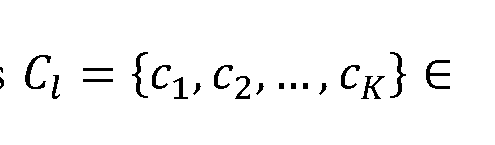 IR xd, along with the size of each cluster as at. The global exemplars U are expressed as and capture the overall distribution of data experienced by all devices.
 The term N = LK may be used to denote the total number of exemplars. Federated constrained exemplar clustering may then aggregate the local models, and may be expressed as:
 where <p represents the parameters of the projection network h and where {v1, vK} are the latent cluster centers in the output space of h. R(- is a constraint function that encourages the learned projection h to give similar embeddings for exemplars that have the same initialization. The term qit is defined similarly to q^ above:
 where y4 is a scale factor. The term p7i is defined in a similar manner as ptj, above. The constraint function may be defined as:
 where meaning that the two local exemplars share the same
 initialization, and is -1 otherwise. The term y5 is a scale factor.
[0034] The global exemplars may be obtained based on the clustering
 indicator matrix:

[0035] Referring now to FIG. 4, a method of anomaly detection and correction is shown. Block 200 trains edge device models, as described above, using global exemplars that are generated by aggregation of locally trained model information. Block 410 collects new local time series data at the maintenance systems 104, from the respective monitored systems 102. This new local time series data may reflect recent operational characteristics of the respective monitored systems 102, and may be expressed as time series information.
[0036] Block 420 uses the edge device models to detect anomalies in the local time series data. For example, a particular monitored system 102 may be in a state of abnormal operation, and the respective time series information that is provided to the edge device 104 may therefore be identified as being anomalous.
[0037] When an anomaly is detected, block 430 may perform a corrective action. For example, the maintenance system 104 that detects the anomaly may trigger a change within the monitored system to automatically correct the abnormal operational state.
[0038] Embodiments described herein may be entirely hardware, entirely software or including both hardware and software elements. In a preferred embodiment, the present invention is implemented in software, which includes but is not limited to firmware, resident software, microcode, etc.
[0039] Embodiments may include a computer program product accessible from a computer-usable or computer-readable medium providing program code for use by or in connection with a computer or any instruction execution system. A computer-usable or computer readable medium may include any apparatus that stores, communicates, propagates, or transports the program for use by or in connection with the instruction execution system, apparatus, or device. The medium can be magnetic, optical, electronic, electromagnetic, infrared, or semiconductor system (or apparatus or device) or a propagation medium. The medium may include a computer-readable storage medium such as a semiconductor or solid state memory, magnetic tape, a removable computer diskette, a random access memory (RAM), a read-only memory (ROM), a rigid magnetic disk and an optical disk, etc.
[0040] Each computer program may be tangibly stored in a machine-readable storage media or device (e.g., program memory or magnetic disk) readable by a general or special purpose programmable computer, for configuring and controlling operation of a computer when the storage media or device is read by the computer to perform the procedures described herein. The inventive system may also be considered to be embodied in a computer-readable storage medium, configured with a computer
program, where the storage medium so configured causes a computer to operate in a specific and predefined manner to perform the functions described herein.
[0041] A data processing system suitable for storing and/or executing program code may include at least one processor coupled directly or indirectly to memory elements through a system bus. The memory elements can include local memory employed during actual execution of the program code, bulk storage, and cache memories which provide temporary storage of at least some program code to reduce the number of times code is retrieved from bulk storage during execution. Input/output or I/O devices (including but not limited to keyboards, displays, pointing devices, etc.) may be coupled to the system either directly or through intervening I/O controllers.
[0042] Network adapters may also be coupled to the system to enable the data processing system to become coupled to other data processing systems or remote printers or storage devices through intervening private or public networks. Modems, cable modem and Ethernet cards are just a few of the currently available types of network adapters.
[0043] As employed herein, the term “hardware processor subsystem” or “hardware processor” can refer to a processor, memory, software or combinations thereof that cooperate to perform one or more specific tasks. In useful embodiments, the hardware processor subsystem can include one or more data processing elements (e.g., logic circuits, processing circuits, instruction execution devices, etc.). The one or more data processing elements can be included in a central processing unit, a graphics processing unit, and/or a separate processor- or computing element-based controller (e.g., logic gates, etc.). The hardware processor subsystem can include one or more on-board memories (e.g., caches, dedicated memory arrays, read only memory, etc.). In some embodiments, the hardware processor subsystem can include one or more memories
that can be on or off board or that can be dedicated for use by the hardware processor subsystem (e.g., ROM, RAM, basic input/output system (BIOS), etc.).
[0044] In some embodiments, the hardware processor subsystem can include and execute one or more software elements. The one or more software elements can include an operating system and/or one or more applications and/or specific code to achieve a specified result.
[0045] In other embodiments, the hardware processor subsystem can include dedicated, specialized circuitry that performs one or more electronic processing functions to achieve a specified result. Such circuitry can include one or more application-specific integrated circuits (ASICs), field-programmable gate arrays (FPGAs), and/or programmable logic arrays (PLAs).
[0046] These and other variations of a hardware processor subsystem are also contemplated in accordance with embodiments of the present invention.
[0047] Referring now to FIG. 5, additional detail on the maintenance system / edge device 104 is shown. The maintenance system 104 includes a hardware processor 502 and memory 504. A network interface 506 provides communication between the maintenance system 104 and the model training server 106, and may operate by any appropriate wired or wireless communications medium and protocol.
[0048] A sensor interface 508 receives information from one or more sensors in the monitored system 102. The communication with the sensors may be by any appropriate wired or wireless communications medium and protocol, and may include any combination of dedicated sensor inputs and general-purpose network communications. The collected sensor information may be used by a model trainer 510 to train a local model 512. A model manager 514 may communicate with the server 106, transmitting
the local model 512 for aggregation, and may receive global exemplars from the server
106 to be used in future model training.
[0049] During operation, new sensor data may be provided as an input to the local model 512, to determine whether the monitored system 102 is behaving abnormally. In the event that an anomaly is detected, controller 516 may automatically perform a corrective action. For example, the controller may communicate with a control system within the monitored system 102, to deliver an instruction to compensate for operational parameters that are out of normal bounds.
[0050] Referring now to FIG. 6, additional detail on the model training server 106 is shown. The model training server 106 includes a hardware processor 602 and memory 604. A network interface 606 provides communication between the maintenance system 104 and the model training server 106, and may operate by any appropriate wired or wireless communications medium and protocol.
[0051] A model manager 607 receives local model information from the different maintenance systems 104. Model aggregator 610 aggregates these local models, with model trainer 612 generating a global model 614, as described above. The global model 614 is transmitted to the maintenance systems 104 by the model manager 608, providing the basis for future local model training.
[0052] Reference in the specification to “one embodiment” or “an embodiment” of the present invention, as well as other variations thereof, means that a particular feature, structure, characteristic, and so forth described in connection with the embodiment is included in at least one embodiment of the present invention. Thus, the appearances of the phrase “in one embodiment” or “in an embodiment”, as well any other variations, appearing in various places throughout the specification are not necessarily all referring to the same embodiment. However, it is to be appreciated
that features of one or more embodiments can be combined given the teachings of the present invention provided herein.
[0053] It is to be appreciated that the use of any of the following “/”, “and/or”, and “at least one of’, for example, in the cases of “A/B”, “A and/or B” and “at least one of A and B”, is intended to encompass the selection of the first listed option (A) only, or the selection of the second listed option (B) only, or the selection of both options (A and B). As a further example, in the cases of “A, B, and/or C” and “at least one of A, B, and C”, such phrasing is intended to encompass the selection of the first listed option (A) only, or the selection of the second listed option (B) only, or the selection of the third listed option (C) only, or the selection of the first and the second listed options (A and B) only, or the selection of the first and third listed options (A and C) only, or the selection of the second and third listed options (B and C) only, or the selection of all three options (A and B and C). This may be extended for as many items listed.
[0054] The foregoing is to be understood as being in every respect illustrative and exemplary, but not restrictive, and the scope of the invention disclosed herein is not to be determined from the Detailed Description, but rather from the claims as interpreted according to the full breadth permitted by the patent laws. It is to be understood that the embodiments shown and described herein are only illustrative of the present invention and that those skilled in the art may implement various modifications without departing from the scope and spirit of the invention. Those skilled in the art could implement various other feature combinations without departing from the scope and spirit of the invention. Having thus described aspects of the invention, with the details and particularity required by the patent laws, what is claimed and desired protected by
Letters Patent is set forth in the appended claims.
Claims
1. A method for training a neural network model, comprising: collecting (302) model exemplar information from a plurality of edge devices, each model exemplar having been trained using information local to the respective edge devices; aggregating (304) the collected model exemplar information together using federated averaging; training (306) global model exemplars using federated constrained clustering using a processor; and transmitting (206) the trained global exemplars to respective edge devices of the plurality of edge devices.
2. The method of claim 1, wherein federated averaging includes determining an element- wise average of local exemplars.
3. The method of claim 2, wherein federated averaging includes averaging exemplars after matching the exemplars by their values.
4. The method of claim 3, wherein federated averaging includes projecting the local exemplars to a latent space and matching the local exemplars according to their respective positions in the latent space.
5. The method of claim 1, wherein federated constrained clustering may be performed by minimizing an objective function:


6. The method of claim 5, wherein training the global exemplars
 includes:
 where z is an index between 1 and K.
7. The method of claim 1, wherein collecting the model exemplar information does not gather training data for the model exemplars from the edge devices.
8. The method of claim 1, further comprising repeating the collection, aggregation, training, and transmission based on updated model exemplar information from the edge devices.
9. The method of claim 1, wherein the model exemplars are trained using multivariate time series data collected by the respective edge devices.
10. The method of claim 1, wherein the trained global model exemplars are configured to recognize diverse operating conditions from cyber-physical systems associated with the plurality of edge devices.
11. A system for training a neural network model, comprising: a hardware processor (502); a network interface (506) in communication with a plurality of edge devices, configured to collect (302) model exemplar information from the plurality of edge devices, each model exemplar having been trained using information local to the respective edge devices, and to transmit (206) trained global exemplars to respective edge devices of the plurality of edge devices; and a memory (504) that stores a computer program product, which, when executed by the hardware processor, causes the hardware processor to: aggregate (304) the collected model exemplar information together using federated averaging; and train (306) the global model exemplars using federated constrained clustering using a processor.
12. The system of claim 11, wherein the computer program product further causes the hardware processor to determine an element-wise average of local exemplars for federated averaging.
13. The system of claim 12, wherein the computer program product further causes the hardware processor to average exemplars after matching the exemplars by their values for federated averaging.
14. The system of claim 13, wherein the computer program product further causes the hardware processor to project the local exemplars to a latent space and matching the local exemplars according to their respective positions in the latent space for federated averaging.
15. The system of claim 11, wherein the computer program product further causes the hardware processor to minimizing an objective function for federated constrained clustering:
 where <p represents parameters of the projection network h, {v1, vK} are latent cluster centers in an output space of h, N is a number of number of time series segments, K is a number of global exemplars, L is a number of edge devices, /?(•) is a constraint function that encourages the projection network h to give similar embeddings for exemplars that have the same initialization, a- represents a prior
distribution for an edge device Z at a time z, is a target cluster membership vector for the edge device / at the time z, is a cluster membership vector for the edge device / at the time z, and c- is the exemplar of the edge device / at time z.
where <p represents parameters of the projection network h, {v1, vK} are latent cluster centers in an output space of h, N is a number of number of time series segments, K is a number of global exemplars, L is a number of edge devices, /?(•) is a constraint function that encourages the projection network h to give similar embeddings for exemplars that have the same initialization, a- represents a prior
distribution for an edge device Z at a time z, is a target cluster membership vector for the edge device / at the time z, is a cluster membership vector for the edge device / at the time z, and c- is the exemplar of the edge device / at time z.
16. The system of claim 15, wherein the computer program product further causes the hardware processor to train the global exemplars {ult uK] with:
 where z is an index between 1 and K.
17. The system of claim 11, wherein the network interface does not gather training data for the model exemplars from the edge devices.
18. The system of claim 11, wherein the computer program product further causes the hardware processor to repeat the aggregation and training based on updated model exemplar information from the edge devices.
19. The system of claim 11, wherein the model exemplars are trained using multivariate time series data collected by the respective edge devices.
20. The system of claim 11, wherein the trained global model exemplars are configured to recognize diverse operating conditions from cyber-physical systems associated with the plurality of edge devices.
Priority Applications (2)
| Application Number | Priority Date | Filing Date | Title |
|---|---|---|---|
| DE112021004174.6T DE112021004174T5 (en) | 2020-08-06 | 2021-08-06 | FEDERATED LEARNING FOR ANOMALY DETECTION |
| JP2022578598A JP2023537562A (en) | 2020-08-06 | 2021-08-06 | Federated learning for anomaly detection |
Applications Claiming Priority (8)
| Application Number | Priority Date | Filing Date | Title |
|---|---|---|---|
| US202063062031P | 2020-08-06 | 2020-08-06 | |
| US63/062,031 | 2020-08-06 | ||
| US202063070437P | 2020-08-26 | 2020-08-26 | |
| US63/070,437 | 2020-08-26 | ||
| US202063075450P | 2020-09-08 | 2020-09-08 | |
| US63/075,450 | 2020-09-08 | ||
| US17/395,118 | 2021-08-05 | ||
| US17/395,118 US12346808B2 (en) | 2020-08-06 | 2021-08-05 | Federated learning for anomaly detection |
Publications (1)
| Publication Number | Publication Date |
|---|---|
| WO2022032090A1 true WO2022032090A1 (en) | 2022-02-10 |
Family
ID=80114589
Family Applications (1)
| Application Number | Title | Priority Date | Filing Date |
|---|---|---|---|
| PCT/US2021/044933 Ceased WO2022032090A1 (en) | 2020-08-06 | 2021-08-06 | Federated learning for anomaly detection |
Country Status (4)
| Country | Link |
|---|---|
| US (2) | US12346808B2 (en) |
| JP (1) | JP2023537562A (en) |
| DE (1) | DE112021004174T5 (en) |
| WO (1) | WO2022032090A1 (en) |
Cited By (2)
| Publication number | Priority date | Publication date | Assignee | Title |
|---|---|---|---|---|
| JP2025534741A (en) * | 2022-10-25 | 2025-10-17 | エヌイーシー ラボラトリーズ アメリカ インク | Event prediction based on neural point processes for medical decision making |
| JP2025535802A (en) * | 2022-10-25 | 2025-10-28 | エヌイーシー ラボラトリーズ アメリカ インク | Anomaly detection using measurement time series and event sequences for medical decision making |
Families Citing this family (15)
| Publication number | Priority date | Publication date | Assignee | Title |
|---|---|---|---|---|
| WO2020086130A2 (en) * | 2018-07-21 | 2020-04-30 | The Regents Of The University Of California | Apparatus and method for boundary learning optimization |
| CN112015749B (en) * | 2020-10-27 | 2021-02-19 | 支付宝(杭州)信息技术有限公司 | Method, device and system for updating business model based on privacy protection |
| EP4337467A4 (en) | 2021-05-11 | 2025-05-07 | Strong Force VCN Portfolio 2019, LLC | Systems, methods, kits, and apparatuses for edge-distributed storage and querying in value chain networks |
| CN113761748B (en) * | 2021-09-09 | 2023-09-15 | 中国矿业大学 | An industrial process soft measurement method based on federated incremental random configuration network |
| EP4437487A4 (en) | 2021-11-23 | 2025-09-24 | Strong Force Ee Portfolio 2022 Llc | AI-BASED ENERGY PLATFORM, SYSTEMS AND PROCESSES |
| CN114580662B (en) * | 2022-02-28 | 2025-04-08 | 浙江大学 | Federated learning method and system based on anchor aggregation |
| CN114978893B (en) * | 2022-04-18 | 2024-04-12 | 西安交通大学 | Block chain-based decentralization federation learning method and system |
| CN115270964B (en) * | 2022-07-27 | 2025-07-25 | 电子科技大学 | Malicious traffic classification method based on improved federal learning algorithm |
| KR102778903B1 (en) * | 2022-11-21 | 2025-03-11 | 국립부경대학교 산학협력단 | INTRUSION DETECTION SYSTEM FOR IoT NETWORKS USING BLOCKCHAIN-ENABLED FEDERATED LEARNING AND OPERATING METHOD THEREOF |
| CN115983858B (en) * | 2022-12-26 | 2025-10-17 | 支付宝(杭州)信息技术有限公司 | Model processing and risk prevention and control processing method, device and equipment |
| WO2024186517A1 (en) * | 2023-03-07 | 2024-09-12 | Bobi, Inc. | Systems and methods for model security in distributed model training applications |
| US12445519B2 (en) * | 2024-02-21 | 2025-10-14 | International Business Machines Corporation | Metadata based data distribution |
| CN118193954B (en) * | 2024-04-09 | 2024-11-15 | 江苏华网融智科技有限公司 | A method and system for detecting abnormal data in distribution network based on edge computing |
| CN119443208B (en) * | 2024-11-05 | 2025-10-31 | 西北工业大学 | A peripheral federated continuous learning method based on brain-like spiking neural networks |
| CN120541884B (en) * | 2025-07-29 | 2025-09-26 | 杭州泛嘉科技有限公司 | Data processing method and device for privacy protection of embodied smart devices |
Citations (2)
| Publication number | Priority date | Publication date | Assignee | Title |
|---|---|---|---|---|
| US20190340534A1 (en) * | 2016-09-26 | 2019-11-07 | Google Llc | Communication Efficient Federated Learning |
| US20190377984A1 (en) * | 2018-06-06 | 2019-12-12 | DataRobot, Inc. | Detecting suitability of machine learning models for datasets |
Family Cites Families (11)
| Publication number | Priority date | Publication date | Assignee | Title |
|---|---|---|---|---|
| WO2012154657A2 (en) * | 2011-05-06 | 2012-11-15 | The Penn State Research Foundation | Robust anomaly detection and regularized domain adaptation of classifiers with application to internet packet-flows |
| US11087236B2 (en) * | 2016-07-29 | 2021-08-10 | Splunk Inc. | Transmitting machine learning models to edge devices for edge analytics |
| US11568327B2 (en) * | 2017-12-26 | 2023-01-31 | Aising Ltd. | Method for generating universal learned model |
| US10685159B2 (en) * | 2018-06-27 | 2020-06-16 | Intel Corporation | Analog functional safety with anomaly detection |
| US11362910B2 (en) * | 2018-07-17 | 2022-06-14 | International Business Machines Corporation | Distributed machine learning for anomaly detection |
| US11170320B2 (en) * | 2018-07-19 | 2021-11-09 | Adobe Inc. | Updating machine learning models on edge servers |
| US11410048B2 (en) * | 2019-05-17 | 2022-08-09 | Honda Motor Co., Ltd. | Systems and methods for anomalous event detection |
| US11836615B2 (en) * | 2019-09-20 | 2023-12-05 | International Business Machines Corporation | Bayesian nonparametric learning of neural networks |
| WO2021089429A2 (en) * | 2019-11-05 | 2021-05-14 | Telefonaktiebolaget Lm Ericsson (Publ) | Methods and apparatus for machine learning model life cycle |
| US20230177349A1 (en) * | 2020-06-01 | 2023-06-08 | Intel Corporation | Federated learning optimizations |
| US11763000B1 (en) * | 2022-06-17 | 2023-09-19 | Uab 360 It | Malware detection using federated learning |
-
2021
- 2021-08-05 US US17/395,118 patent/US12346808B2/en active Active
- 2021-08-06 DE DE112021004174.6T patent/DE112021004174T5/en active Pending
- 2021-08-06 WO PCT/US2021/044933 patent/WO2022032090A1/en not_active Ceased
- 2021-08-06 JP JP2022578598A patent/JP2023537562A/en active Pending
-
2022
- 2022-03-15 US US17/695,325 patent/US12340308B2/en active Active
Patent Citations (2)
| Publication number | Priority date | Publication date | Assignee | Title |
|---|---|---|---|---|
| US20190340534A1 (en) * | 2016-09-26 | 2019-11-07 | Google Llc | Communication Efficient Federated Learning |
| US20190377984A1 (en) * | 2018-06-06 | 2019-12-12 | DataRobot, Inc. | Detecting suitability of machine learning models for datasets |
Non-Patent Citations (3)
| Title |
|---|
| BONAWITZ KEITH BONAWITZ@GOOGLE.COM; IVANOV VLADIMIR VLIVAN@GOOGLE.COM; KREUTER BEN BENKREUTER@GOOGLE.COM; MARCEDONE ANTONIO MARCED: "Practical Secure Aggregation for Privacy-Preserving Machine Learning", RESEARCH & DEVELOPMENT IN INFORMATION RETRIEVAL, ACM, 2 PENN PLAZA, SUITE 701NEW YORKNY10121-0701USA, 30 October 2017 (2017-10-30) - 12 July 2018 (2018-07-12), 2 Penn Plaza, Suite 701New YorkNY10121-0701USA , pages 1175 - 1191, XP058633859, ISBN: 978-1-4503-5657-2, DOI: 10.1145/3133956.3133982 * |
| CLEMENT FUNG; CHRIS J.M. YOON; IVAN BESCHASTNIKH: "Mitigating Sybils in Federated Learning Poisoning", ARXIV.ORG, CORNELL UNIVERSITY LIBRARY, 201 OLIN LIBRARY CORNELL UNIVERSITY ITHACA, NY 14853, 14 August 2018 (2018-08-14), 201 Olin Library Cornell University Ithaca, NY 14853 , XP080896917 * |
| H. BRENDAN MCMAHAN; EIDER MOORE; DANIEL RAMAGE; BLAISE AG\"UERA Y ARCAS: "Federated Learning of Deep Networks using Model Averaging", ARXIV.ORG, CORNELL UNIVERSITY LIBRARY, 201 OLIN LIBRARY CORNELL UNIVERSITY ITHACA, NY 14853, 18 February 2016 (2016-02-18), 201 Olin Library Cornell University Ithaca, NY 14853 , XP080684356 * |
Cited By (2)
| Publication number | Priority date | Publication date | Assignee | Title |
|---|---|---|---|---|
| JP2025534741A (en) * | 2022-10-25 | 2025-10-17 | エヌイーシー ラボラトリーズ アメリカ インク | Event prediction based on neural point processes for medical decision making |
| JP2025535802A (en) * | 2022-10-25 | 2025-10-28 | エヌイーシー ラボラトリーズ アメリカ インク | Anomaly detection using measurement time series and event sequences for medical decision making |
Also Published As
| Publication number | Publication date |
|---|---|
| US20220215256A1 (en) | 2022-07-07 |
| JP2023537562A (en) | 2023-09-04 |
| US12346808B2 (en) | 2025-07-01 |
| US12340308B2 (en) | 2025-06-24 |
| DE112021004174T5 (en) | 2023-06-01 |
| US20220044117A1 (en) | 2022-02-10 |
Similar Documents
| Publication | Publication Date | Title |
|---|---|---|
| US12346808B2 (en) | Federated learning for anomaly detection | |
| US11120127B2 (en) | Reconstruction-based anomaly detection | |
| US12141052B2 (en) | Resilient estimation for grid situational awareness | |
| US11494618B2 (en) | Anomaly detection using deep learning on time series data | |
| US11494252B2 (en) | System and method for detecting anomalies in cyber-physical system with determined characteristics | |
| JP7495944B2 (en) | Off-line tuning system for detecting new motion zones in a motion detection system - Patents.com | |
| US11644211B2 (en) | Air conditioner control based on prediction from classification model | |
| WO2021071911A1 (en) | Sensor contribution ranking | |
| US8751414B2 (en) | Identifying abnormalities in resource usage | |
| CN120150194A (en) | Optimal scheduling method for hybrid energy storage system based on AI intelligent control | |
| US11543808B2 (en) | Sensor attribution for anomaly detection | |
| EP3635491B1 (en) | Predictive modelling and control for water resource infrastructure | |
| US11348013B2 (en) | Determining, encoding, and transmission of classification variables at end-device for remote monitoring | |
| US20240191898A1 (en) | Transfer Learning Model for Newly Setup Environment | |
| WO2024091562A1 (en) | Anomaly detection using metric time series and event sequences for medical decision making | |
| EP4639432A1 (en) | Industrial monitoring platform | |
| US20240303149A1 (en) | Metric and log joint autoencoder for anomaly detection in healthcare decision making | |
| US11228606B2 (en) | Graph-based sensor ranking | |
| WO2024091559A1 (en) | Neural point process-based event prediction for medical decision making | |
| Vetriveeran et al. | Optimized Multi‐Scale Attention Convolutional Neural Network for Micro‐Grid Energy Management System Employing in Internet of Things | |
| WO2021038775A1 (en) | Control method, control program, and air conditioning control device | |
| WO2026011718A1 (en) | Regulation method and apparatus for air conditioners in data center room, and computer device and storage medium | |
| Azeri et al. | Enhancing Self-Adaptive Cyber-Physical Systems using Federated Machine Learning. | |
| WO2022216792A1 (en) | Time series retrieval with code updates | |
| CN117980900A (en) | System and method for adaptive neutralization of network failures |
Legal Events
| Date | Code | Title | Description |
|---|---|---|---|
| 121 | Ep: the epo has been informed by wipo that ep was designated in this application |
Ref document number: 21853189 Country of ref document: EP Kind code of ref document: A1 |
|
| ENP | Entry into the national phase |
Ref document number: 2022578598 Country of ref document: JP Kind code of ref document: A |
|
| 122 | Ep: pct application non-entry in european phase |
Ref document number: 21853189 Country of ref document: EP Kind code of ref document: A1 |