WO2022030489A1 - Agent for treating myopia, preventing myopia and/or suppressing myopia progression - Google Patents
Agent for treating myopia, preventing myopia and/or suppressing myopia progression Download PDFInfo
- Publication number
- WO2022030489A1 WO2022030489A1 PCT/JP2021/028770 JP2021028770W WO2022030489A1 WO 2022030489 A1 WO2022030489 A1 WO 2022030489A1 JP 2021028770 W JP2021028770 W JP 2021028770W WO 2022030489 A1 WO2022030489 A1 WO 2022030489A1
- Authority
- WO
- WIPO (PCT)
- Prior art keywords
- myopia
- benzodiazepin
- pyrido
- diethylamino
- piperidinyl
- Prior art date
- Legal status (The legal status is an assumption and is not a legal conclusion. Google has not performed a legal analysis and makes no representation as to the accuracy of the status listed.)
- Ceased
Links
Classifications
-
- A—HUMAN NECESSITIES
- A61—MEDICAL OR VETERINARY SCIENCE; HYGIENE
- A61P—SPECIFIC THERAPEUTIC ACTIVITY OF CHEMICAL COMPOUNDS OR MEDICINAL PREPARATIONS
- A61P27/00—Drugs for disorders of the senses
- A61P27/02—Ophthalmic agents
-
- A—HUMAN NECESSITIES
- A61—MEDICAL OR VETERINARY SCIENCE; HYGIENE
- A61K—PREPARATIONS FOR MEDICAL, DENTAL OR TOILETRY PURPOSES
- A61K31/00—Medicinal preparations containing organic active ingredients
- A61K31/33—Heterocyclic compounds
- A61K31/395—Heterocyclic compounds having nitrogen as a ring hetero atom, e.g. guanethidine or rifamycins
- A61K31/55—Heterocyclic compounds having nitrogen as a ring hetero atom, e.g. guanethidine or rifamycins having seven-membered rings, e.g. azelastine, pentylenetetrazole
- A61K31/551—Heterocyclic compounds having nitrogen as a ring hetero atom, e.g. guanethidine or rifamycins having seven-membered rings, e.g. azelastine, pentylenetetrazole having two nitrogen atoms, e.g. dilazep
- A61K31/5513—1,4-Benzodiazepines, e.g. diazepam or clozapine
-
- A—HUMAN NECESSITIES
- A61—MEDICAL OR VETERINARY SCIENCE; HYGIENE
- A61K—PREPARATIONS FOR MEDICAL, DENTAL OR TOILETRY PURPOSES
- A61K47/00—Medicinal preparations characterised by the non-active ingredients used, e.g. carriers or inert additives; Targeting or modifying agents chemically bound to the active ingredient
- A61K47/02—Inorganic compounds
-
- A—HUMAN NECESSITIES
- A61—MEDICAL OR VETERINARY SCIENCE; HYGIENE
- A61K—PREPARATIONS FOR MEDICAL, DENTAL OR TOILETRY PURPOSES
- A61K9/00—Medicinal preparations characterised by special physical form
- A61K9/0012—Galenical forms characterised by the site of application
- A61K9/0048—Eye, e.g. artificial tears
-
- A—HUMAN NECESSITIES
- A61—MEDICAL OR VETERINARY SCIENCE; HYGIENE
- A61P—SPECIFIC THERAPEUTIC ACTIVITY OF CHEMICAL COMPOUNDS OR MEDICINAL PREPARATIONS
- A61P27/00—Drugs for disorders of the senses
- A61P27/02—Ophthalmic agents
- A61P27/06—Antiglaucoma agents or miotics
-
- A—HUMAN NECESSITIES
- A61—MEDICAL OR VETERINARY SCIENCE; HYGIENE
- A61P—SPECIFIC THERAPEUTIC ACTIVITY OF CHEMICAL COMPOUNDS OR MEDICINAL PREPARATIONS
- A61P27/00—Drugs for disorders of the senses
- A61P27/02—Ophthalmic agents
- A61P27/10—Ophthalmic agents for accommodation disorders, e.g. myopia
Definitions
- the present invention relates to an agent for treating myopia, preventing myopia and/or suppressing myopia progression. More specifically, the present invention relates to a pharmaceutical composition for treating myopia, preventing myopia and/or suppressing myopia progression, comprising (+)-11-[2-[2-[(diethylamino)methyl]-1-piperidinyl]acetyl]-5,11-dihydro-6H-pyrido[2,3-b][1,4]benzodiazepin-6-one (hereinafter also referred to as "AFDX0250”) or a salt thereof as an active ingredient.
- a pharmaceutical composition for treating myopia, preventing myopia and/or suppressing myopia progression comprising (+)-11-[2-[2-[(diethylamino)methyl]-1-piperidinyl]acetyl]-5,11-dihydro-6H-pyrido[2,3-b][1,4]benzodiazepin-6-one (hereinafter also referred to as "AFDX0250”)
- Myopia is one form of ametropia, which is a pathology that the eyesight blurs because the parallel rays from far distance which enters eyes meets an image in front of the retina.
- Myopia is considered to be caused by that the image when seeing at a distance is focused not on the retina but in front of the retina in case that the refraction of the cornea or the lens is too strong (refractive myopia) or that the image when seeing at a distance is focused not on the retina but in front of the retina even though the thickness of the lens is reduced in case that the axial length (the length between the cornea and the retina) is extended and is too longer than normal (axial myopia).
- the onset of myopia at an early age and the rapid myopia progression may lead to high myopia as an adult associated with visually disabling pathologic myopia.
- Patent Literature 1 discloses that atropine (muscarinic antagonist) is useful for the treatment of myopia
- Patent Literature 2 discloses that tiotropium (muscarinic M 2 /M 3 receptor antagonist), which is used for the treatment of chronic obstructive pulmonary disease (COPD), is effective for preventing myopia, treating myopia and/or suppressing myopia progression.
- atropine muscle
- tiotropium muscle M 2 /M 3 receptor antagonist
- Patent Literature 3 discloses that 11-[2-[2-[(diethylamino)methyl]-1-piperidinyl]acetyl]-5,11-dihydro-6H-pyrido[2,3-b][1,4]benzodiazepin-6-one (hereinafter also referred to as "AFDX0116" or "Otenzepad”) is useful for the treatment of glaucoma and/or ocular hypertension and that intraocular pressure is decreased by intracameral injection. Also, it is disclosed that one example of compounds for decreasing intraocular pressure includes AFDX0250 which is dextrorotatory (+)-enantiomer of AFDX0116. Non-Patent Literature 1 discloses that a selective muscarinic M 2 receptor antagonist suppresses myopia progression. Also, it is disclosed that one example of drugs for suppressing myopia progression includes AFDX0116.
- AFDX0250 can be used for treating myopia, preventing myopia and/or suppressing myopia progression.
- ADFX0250 can prevent the side effects due to mydriatic action.
- An object of the present invention is to find a novel compound useful for treating myopia, preventing myopia, and/or suppressing myopia progression.
- the object of the present invention is to find an agent for treating myopia which does not substantially have mydriatic action and which is superior in safety and sense of use.
- the present inventors have intensively studied to reach the aforementioned object, and have focused on (+)-11-[2-[(diethylamino)methyl]-1-piperidinyl]acetyl]-5,11-dihydro-6H-pyrido[2,3-b][1,4]benzodiazepin-6-one (AFDX0250) which has never been used in the study on the treatment of myopia with 11-[2-[2-[(diethylamino)methyl]-1-piperidinyl]acetyl]-5,11-dihydro-6H-pyrido[2,3-b][1,4]benzodiazepin-6-one (AFDX0116) which is selective muscarinic M 2 receptor antagonist.
- AFDX0250 suppresses the axial length elongation and the refractive error in an animal model with the symptoms of myopia, and thus is useful for treating myopia, preventing myopia and/or suppressing myopia progression.
- the present inventors have found that AFDX0250 not only inhibits mydriatic action produced by the use of muscarinic antagonists to the levels that do not affect daily life but also has a higher margin of safety as compared to any other muscarinic antagonists. Based upon the new findings, the present invention has been completed.
- a pharmaceutical composition for treating myopia, preventing myopia, and/or suppressing myopia progression comprising (+)-11-[2-[(diethylamino)methyl]-1-piperidinyl]acetyl]-5,11-dihydro-6H-pyrido[2,3-b][1,4]benzodiazepin-6-one or a salt thereof as an active ingredient, wherein the pharmaceutical composition is substantially free of (-)-11-[2-[2-[(diethylamino)methyl]-1-piperidinyl]acetyl]-5,11-dihydro-6H-pyrido[2,3-b][1,4]benzodiazepin-6-one or a salt thereof.
- ocular topical administration is ophthalmic administration, administration by an ophthalmic ointment, conjunctival sac administration, intravitreal administration, subconjunctival administration, sub-Tenon's administration, conjunctival sac injection, or application to the eyelid.
- ocular topical administration is ophthalmic administration, administration by an ophthalmic ointment, conjunctival sac administration, intravitreal administration, subconjunctival administration, sub-Tenon's administration, conjunctival sac injection, or application to the eyelid.
- (7) The pharmaceutical composition of any one of the above (1) to (6) which is in the form of an eye drop, an eye gel, an ophthalmic ointment, or an injection.
- a pharmaceutical composition for suppressing the axial length elongation comprising (+)-11-[2-[2-[(diethylamino)methyl]-1-piperidinyl]acetyl]-5,11-dihydro-6H-pyrido[2,3-b][1,4]benzodiazepin-6-one or a salt thereof as an active ingredient, wherein the pharmaceutical composition is substantially free of (-)-11-[2-[(diethylamino)methyl]-1-piperidinyl]acetyl]-5,11-dihydro-6H-pyrido[2,3-b][1,4]benzodiazepin-6-one or a salt thereof.
- a pharmaceutical composition for suppressing the refractive error comprising (+)-11-[2-[(diethylamino)methyl]-1-piperidinyl]acetyl]-5,11-dihydro-6H-pyrido[2,3-b][1,4]benzodiazepin-6-one or a salt thereof as an active ingredient, wherein the pharmaceutical composition is substantially free of (-)-11-[2-[(diethylamino)methyl]-1-piperidinyl]acetyl]-5,11-dihydro-6H-pyrido[2,3-b][1,4]benzodiazepin-6-one or a salt thereof.
- a method of treating and/or preventing myopia which comprises administering a therapeutically effective amount of (+)-11-[2-[2-[(diethylamino)methyl]-1-piperidinyl]acetyl]-5,11-dihydro-6H-pyrido[2,3-b][1,4]benzodiazepin-6-one or a salt thereof to a patient.
- a method of treating and/or preventing myopia which comprises administering an agent comprising a therapeutically effective amount of (+)-11-[2-[2-[(diethylamino)methyl]-1-piperidinyl]acetyl]-5,11-dihydro-6H-pyrido[2,3-b][1,4]benzodiazepin-6-one or a salt thereof which is substantially free of (-)-11-[2-[2-[(diethylamino)methyl]-1-piperidinyl]acetyl]-5,11-dihydro-6H-pyrido[2,3-b][1,4]benzodiazepin-6-one or a salt thereof.
- a method of suppressing myopia progression which comprises administering a therapeutically effective of (+)-11-[2-[2-[(diethylamino)methyl]-1-piperidinyl]acetyl]-5,11-dihydro-6H-pyrido[2,3-b][1,4]benzodiazepin-6-one or a salt thereof to a patient.
- a method of suppressing myopia progression which comprises administering an agent comprising a therapeutically effective amount of (+)-11-[2-[2-[(diethylamino)methyl]-1-piperidinyl]acetyl]-5,11-dihydro-6H-pyrido[2,3-b][1,4]benzodiazepin-6-one or a salt thereof which is substantially free of (-)-11-[2-[2-[(diethylamino)methyl]-1-piperidinyl]acetyl]-5,11-dihydro-6H-pyrido[2,3-b][1,4]benzodiazepin-6-one or a salt thereof.
- a method of suppressing the axial length elongation which comprises administering a therapeutically effective amount of (+)-11-[2-[2-[(diethylamino)methyl]-1-piperidinyl]acetyl]-5,11-dihydro-6H-pyrido[2,3-b][1,4]benzodiazepin-6-one or a salt thereof to a patient.
- a method of suppressing the axial length elongation which comprises administering an agent comprising a therapeutically effective amount of (+)-11-[2-[2-[(diethylamino)methyl]-1-piperidinyl]acetyl]-5,11-dihydro-6H-pyrido[2,3-b][1,4]benzodiazepin-6-one or a salt thereof which is substantially free of (-)-11-[2-[2-[(diethylamino)methyl]-1-piperidinyl]acetyl]-5,11-dihydro-6H-pyrido[2,3-b][1,4]benzodiazepin-6-one or a salt thereof.
- a method of suppressing the refractive error which comprises a therapeutically effective amount of (+)-11-[2-[2-[(diethylamino)methyl]-1-piperidinyl]acetyl]-5,11-dihydro-6H-pyrido[2,3-b][1,4]benzodiazepin-6-one or a salt thereof to a patient.
- a method of suppressing the refractive error which comprises administering an agent comprising a therapeutically effective amount of (+)-11-[2-[2-[(diethylamino)methyl]-1-piperidinyl]acetyl]-5,11-dihydro-6H-pyrido[2,3-b][1,4]benzodiazepin-6-one or a salt thereof which is substantially free of (-)-11-[2-[2-[(diethylamino)methyl]-1-piperidinyl]acetyl]-5,11-dihydro-6H-pyrido[2,3-b][1,4]benzodiazepin-6-one or a salt thereof.
- Each feature of the above (1) to (30) can be optionally selected and combined two or more.
- the pharmaceutical composition comprising (+)-11-[2-[2-[(diethylamino)methyl]-1-piperidinyl]acetyl]-5,11-dihydro-6H-pyrido[2,3-b][1,4]benzodiazepin-6-one or a salt thereof as an active ingredient, which not only produces effects for treating myopia, preventing myopia and/or suppressing myopia progression but also prevents mydriatic action produced by the use of muscarinic antagonists to the levels that do not affect daily life, can be provided.
- (+)-11-[2-[2-[(diethylamino)methyl]-1-piperidinyl]acetyl]-5,11-dihydro-6H-pyrido[2,3-b][1,4]benzodiazepin-6-one does not substantially have mydriatic action and has a high margin of safety, and thus the pharmaceutical composition of the present invention is expected to be used as an agent for treating myopia which is superior in safety and sense of use.
- (+)-11-[2-[2-[(diethylamino)methyl]-1-piperidinyl]acetyl]-5,11-dihydro-6H-pyrido[2,3-b][1,4]benzodiazepin-6-one may be in a salt form, and it is not particularly limited as long as the salt is a pharmaceutically acceptable salt.
- Examples thereof include a salt with an inorganic acid such as hydrochloric acid, hydrobromic acid, hydroiodic acid, nitric acid, sulfuric acid and phosphoric acid; a salt with an organic acid such as acetic acid, oxalic acid, fumaric acid, maleic acid, succinic acid, malic acid, citric acid, tartaric acid, adipic acid, gluconic acid, glucoheptonic acid, glucuronic acid, terephthalic acid, methanesulfonic acid, alanine, lactic acid, hippuric acid, 1,2-ethanedisulfonic acid, isethionic acid, lactobionic acid, oleic acid, gallic acid, pamoic acid, polygalacturonic acid, stearic acid, tannic acid, trifluoromethanesulfonic acid, benzenesulfonic acid, p-toluenesulfonic acid, lauryl sulfate,
- (+)-11-[2-[2-[(diethylamino)methyl]-1-piperidinyl]acetyl]-5,11-dihydro-6H-pyrido[2,3-b][1,4]benzodiazepin-6-one or a salt thereof may be in the form of a hydrate or a solvate.
- (+)-11-[2-[(diethylamino)methyl]-1-piperidinyl]acetyl]-5,11-dihydro-6H-pyrido[2,3-b][1,4]benzodiazepin-6-one or a salt thereof may be prepared according to a well-known method in the organic chemistry field or may be also obtained as a commercially available product.
- (+)-11-[2-[(diethylamino)methyl]-1-piperidinyl]acetyl]-5,11-dihydro-6H-pyrido[2,3-b][1,4]benzodiazepin-6-one can be prepared according to the step described in J. Med. Chem., 32(8), 1718-24, 1989.
- the concentration of (+)-11-[2-[2-[(diethylamino)methyl]-1-piperidinyl]acetyl]-5,11-dihydro-6H-pyrido[2,3-b][1,4]benzodiazepin-6-one or a salt thereof in the pharmaceutical composition of the present invention is not particularly limited, but it is preferably a concentration that the axial length elongation and/or the refractive error is/are suppressed when topically administering to the patient's eyes.
- the lower limit thereof is preferably 0.0001% (w/v), more preferably 0.0003% (w/v), furthermore preferably 0.0005% (w/v), even more preferably 0.001% (w/v), particularly 0.0013% (w/v), particularly more preferably 0.0015% (w/v), particularly furthermore preferably 0.0017% (w/v), and most preferably 0.002% (w/v).
- the concentration is preferably a concentration that the mydriatic action is not caused when topically administering to the patient's eyes.
- the upper limit thereof is preferably 5% (w/v), more preferably 3% (w/v), furthermore preferably 2% (w/v), even more preferably 1% (w/v), particularly preferably 0.5% (w/v), particularly more preferably 0.1% (w/v), particularly furthermore preferably 0.02% (w/v), particularly even more preferably 0.01% (w/v), and most preferably 0.004% (w/v).
- the upper limit thereof is preferably the same concentration as the minimum concentration that the mydriatic action is not caused when topically administering to the patient's eyes, more preferably 1/2 of the minimum concentration, furthermore preferably 1/5 of the minimum concentration, even more preferably 1/10 of the minimum concentration, particularly preferably 1/50 of the minimum concentration, and most preferably 1/100 of the minimum concentration.
- the range of the concentration that the axial length elongation and/or the refractive error is/are suppressed when topically administering to the patient's eyes as well as the concentration that the mydriatic action is not caused when topically administering to the patient's eyes is preferably 0.001 - 1% (w/v) or 0.001% (w/v) or more and less than 1% (w/v), more preferably 0.002 - 0.5% (w/v), furthermore preferably 0.002 - 0.1% (w/v), even more preferably 0.002 - 0.02% (w/v), particularly preferably 0.002 - 0.01% (w/v), particularly more preferably 0.0015 - 0.02% (w/v), particularly furthermore preferably 0.0017 - 0.01% (w/v), and most preferably 0.002 - 0.004% (w/v).
- the concentration of the compound in an eye drop is, for example, preferably 0.0001 - 5% (w/v), more preferably 0.0003 - 2% (w/v), furthermore preferably 0.0005 - 1% (w/v), even more preferably 0.001 - 0.5% (w/v), particularly preferably 0.0013 - 0.1% (w/v), particularly more preferably 0.0015 - 0.02% (w/v), particularly furthermore preferably 0.0017 - 0.01% (w/v), and most preferably 0.002 - 0.004% (w/v).
- the concentration of the compound in an ophthalmic ointment is, for example, preferably 0.0001 - 5% (w/w) and more preferably 0.001 - 3% (w/w).
- % (w/v) means the mass (g) of an object ingredient in 100 mL of the pharmaceutical composition of the present invention
- % (w/w) means the mass (g) of an object ingredient in 100 g of the pharmaceutical composition of the present invention.
- the pharmaceutical composition of the present invention comprises a salt of (+)-11-[2-[2-[(diethylamino)methyl]-1-piperidinyl]acetyl]-5,11-dihydro-6H-pyrido[2,3-b][1,4]benzodiazepin-6-one
- the values may mean the concentration of the salt of (+)-11-[2-[2-[(diethylamino)methyl]-1-piperidinyl]acetyl]-5,11-dihydro-6H-pyrido[2,3-b][1,4]benzodiazepin-6-one or the concentration of (+)-11-[2-[2-[(diethylamino)methyl]-1-piperidinyl]acetyl]-5,11-dihydro-6H-pyrido[2,3-b][1,4]benzodiazepin-6-one.
- the pharmaceutical composition of the present invention comprises (+)-11-[2-[(diethylamino)methyl]-1-piperidinyl]acetyl]-5,11-dihydro-6H-pyrido[2,3-b][1,4]benzodiazepin-6-one or a salt thereof in the form of a hydrate or a solvate
- the values may mean the concentration of (+)-11-[2-[(diethylamino)methyl]-1-piperidinyl]acetyl]-5,11-dihydro-6H-pyrido[2,3-b][1,4]benzodiazepin-6-one or a salt thereof in the form of a hydrate or a solvate or the concentration of (+)-11-[2-[2-[(diethylamino)methyl]-1-piperidinyl]acetyl]-5,11-dihydro-6H-pyrido[2,3-b][1,4]benzodiazepin-6-one or
- the term "substantially free of (-)-11-[2-[2-[(diethylamino)methyl]-1-piperidinyl]acetyl]-5,11-dihydro-6H-pyrido[2,3-b][1,4]benzodiazepin-6-one or a salt thereof” means that the pharmaceutical composition comprises none of (-)-11-[2-[(diethylamino)methyl]-1-piperidinyl]acetyl]-5,11-dihydro-6H-pyrido[2,3-b][1,4]benzodiazepin-6-one or a salt thereof, that (-)-11-[2-[2-[(diethylamino)methyl]-1-piperidinyl]acetyl]-5,11-dihydro-6H-pyrido[2,3-b][1,4]benzodiazepin-6-one or a salt thereof is not detected by a commonly-used method in pharmaceutical analysis such as liquid column chromatography by
- the concentration of (-)-11-[2-[2-[(diethylamino)methyl]-1-piperidinyl]acetyl]-5,11-dihydro-6H-pyrido[2,3-b][1,4]benzodiazepin-6-one or a salt thereof in the pharmaceutical composition is less than 0.1% (w/v), preferably 0.05% (w/v) or less, more preferably 0.001% (w/v) or less, furthermore preferably 0.0005% (w/v) or less, even more preferably 0.0001% (w/v) or less, particularly preferably 0.00005% (w/v) or less and most preferably 0.00001% (w/v) or less.
- the concentration of (-)-11-[2-[2-[(diethylamino)methyl]-1-piperidinyl]acetyl]-5,11-dihydro-6H-pyrido[2,3-b][1,4]benzodiazepin-6-one or a salt thereof in the pharmaceutical composition is preferably 0.05 part by weight or less, more preferably 0.03 part by weight or less, furthermore preferably 0.02 part by weight or less, even more preferably 0.01 part by weight, particularly preferably 0.005 part by weight, and most preferably 0.001 part by weight per part by weight of (+)-11-[2-[2-[(diethylamino)methyl]-1-piperidinyl]acetyl]-5,11-dihydro-6H-pyrido[2,3-b][1,4]benzodiazepin-6-one or a salt thereof.
- the concentration of (-)-11-[2-[2-[(diethylamino)methyl]-1-piperidinyl]acetyl]-5,11-dihydro-6H-pyrido[2,3-b][1,4]benzodiazepin-6-one or a salt thereof in the pharmaceutical composition is preferably as low as possible from the viewpoint of the effect, while the compound may be inevitably mixed as an impurity in the manufacture of any manufacturing methods.
- the lower limit of the concentration of (-)-11-[2-[2-[(diethylamino)methyl]-1-piperidinyl]acetyl]-5,11-dihydro-6H-pyrido[2,3-b][1,4]benzodiazepin-6-one or a salt thereof in the pharmaceutical composition is 0.000005% (w/v), preferably 0.000001% (w/v) based on the total pharmaceutical composition or is 0.0005 part by weight and preferably 0.0001 part by weight per part by weight of (+)-11-[2-[2-[(diethylamino)methyl]-1-piperidinyl]acetyl]-5,11-dihydro-6H-pyrido[2,3-b][1,4]benzodiazepin-6-one or a salt thereof in the pharmaceutical composition.
- myopia is defined as a refractive state of an uncorrected eye where parallel rays meet the eye in front of the retina.
- the "myopia” used herein includes all and every known classification and definition of myopia including, for example, axial myopia, refractive myopia, pseudomyopia, pathological myopia, simple myopia, extreme myopia, severe myopia, high myopia, moderate myopia, low myopia, myopia complicated by glaucoma (particularly, juvenile glaucoma), myopia at the risk of the onset of glaucoma, and myopia with high intraocular pressure, preferably axial myopia, extreme myopia, severe myopia, high myopia, and myopia complicated by glaucoma (particularly, juvenile glaucoma), and more preferably axial myopia.
- the term “treatment (treating)” means every treatment of myopia or the associated symptoms, for example, treating or improving myopia, particularly axial myopia and/or refractive myopia and alleviating or inhibiting symptoms associated with myopia.
- the treatment also encompasses inhibiting recurrence of myopia.
- the term “prophylaxis (preventing)” means preventing the onset of myopia, delaying the onset of myopia, or reducing the risk of the onset of myopia.
- the term “suppression of myopia progression (suppressing myopia progression)” means delaying the myopia progression (delay of myopia progression) or reducing the myopia progression (reduction of myopia progression).
- the term “treating myopia, preventing myopia and/or suppressing myopia progression” used herein includes suppressing the axial length elongation and/or suppressing the refractive error.
- the term "not substantially have mydriatic action” means that the pharmaceutical composition does not have mydriatic action at the level that affects daily life. The term includes that the pharmaceutical composition has no mydriatic action. In addition, even if mydriatic action is found in any measuring way, it is interpreted as "not substantially have mydriatic action" when the treated patient does not experience visual side effects of glare and pupil dilation which affect daily life.
- the pharmaceutical composition of the present invention has a high margin of safety and may have higher safety as compared to an agent for treating myopia comprising other muscarinic receptor antagonist.
- the term "margin of safety” means the range between the minimum effective concentration for producing the therapeutic effect of myopia and the maximum effective concentration for producing the therapeutic effect without mydriatic action.
- the margin of safety of the present invention is calculated according to maximum effective concentration/minimum effective concentration, and is, for example, 10 or more, preferably 100 or more, more preferably 150 or more, furthermore preferably 200 or more, and even more preferably 250 or more.
- the pharmaceutical composition of the present invention can be widely used regardless of the patient's age.
- the pharmaceutical composition can be used for preventing myopia in schoolage children or in teenagers or adults with myopia progression, and/or suppressing myopia progression in schoolage children or in teenagers or adults with myopia progression.
- the term "patient” means human and an animal such as dog, cat, and house. Among them, the patient is preferably human.
- the term "therapeutically effective amount” means a concentration for producing the therapeutic effect of myopia and the associated symptoms or a concentration for delaying the onset or progression of myopia, relative to untreated subjects.
- the pharmaceutical composition of the present invention may comprise a pharmaceutically acceptable active ingredient other than (+)-11-[2-[2-[(diethylamino)methyl]-1-piperidinyl]acetyl]-5,11-dihydro-6H-pyrido[2,3-b][1,4]benzodiazepin-6-one or a salt thereof unless otherwise noted.
- the pharmaceutical composition of the present invention may be administered orally or parenterally.
- the administration route include oral administration, intravenous administration, transdermal administration, and ocular topical administration (e.g., ophthalmic administration, administration by an ophthalmic ointment, conjunctival sac administration, intravitreal administration, subconjunctival administration, sub-Tenon's administration, conjunctival sac injection, application to the eyelid).
- the pharmaceutical composition of the present invention can be prepared with an active ingredient and one or more pharmaceutically acceptable additives in a desired dosage form such as an oral agent such as a tablet, a capsule, a granule, a powder, a lozenge, a syrup, an emulsion and a suspension or a parenteral agent such as an eye drop, an eye gel, an ophthalmic ointment, an injection, a suppository and a nasal agent according to a commonly-used method in the art.
- the preferred dosage form of the pharmaceutical composition of the present invention includes an eye drop, an eye gel, an ophthalmic ointment and an injection.
- the eye drop can be prepared by adding an active ingredient to a medium such as purified water and a buffer and stirring, and then adjusting the pH of the mixture with a pH adjuster.
- a commonly-used additive may be added into an eye drop. Examples thereof include a tonicity agent, a buffering agent, a surfactant, a stabilizing agent, a preservative, a solubilizing agent, or the like.
- the pH of the eye drop is not limited as long as the pH is in an acceptable range for ophthalmic formulations.
- a commonly-used base material may be used therein.
- the base material include white petrolatum, liquid paraffin, or the like.
- the oral agent such as a tablet, a capsule, a granule and a powder can be prepared with an additive such as an extending agent, a lubricant, a binder, a disintegrant, a coating agent and a film coating agent, as appropriate.
- Examples of the extending agent include lactose, crystalline cellulose, starch and vegetable oil
- examples of the lubricant include magnesium stearate and talc
- examples of the binder include hydroxypropylcellulose and polyvinylpyrrolidone
- examples of the disintegrant include carboxymethylcellulose calcium and low substituted hydroxypropylcellulose
- examples of the coating agent include hydroxypropylmethylcellulose, macrogol (polyethyleneglycol) and silicone resin
- examples of the film coating agent include gelatin film.
- the dose and administration of the pharmaceutical composition of the present invention can be suitably changed depending on various conditions such as dosage form, symptom, age and weight of a patient, age at the onset of myopia, and doctor's discretion.
- the dose and administration thereof is not particularly limited as long as it is sufficient to exhibit a desired efficacy.
- the eye drop can be administered at a dose of 1 drop to several drops a time, 1 to several times daily (e.g., 1 to 4 times, 1 to 6 times, or 1 to 8 times).
- the eye drop can be used with wearing contact lenses.
- Example 1 Test on suppression of myopia progression (axial length elongation and refractive error) in guinea pig myopia model (1) According to the following procedures, the effect of AFDX0250 on the suppression of myopia progression (the axial length elongation and the refractive error) was evaluated. (Preparation of sample) AFDX0250 was dissolved in purified water with a buffering agent and a tonicity agent to prepare 0.5% AFDX0250 solution. 1 mol/L sodium hydroxide reagent solution or dilute hydrochloric acid was added to the solution to adjust the pH thereof to neutral. Also, a buffering agent and a tonicity agent were dissolved in purified water to prepare a neutral vehicle.
- AFDX0250 solution administration groups 10 ⁇ L of the AFDX0250 solution in each concentration was topically administered to the right eye of each guinea pig once daily for 14 days from the day when the right eye was covered with the goggle (day 0) to day 13.
- 10 ⁇ L of the vehicle was topically administered to the right eye of each guinea pig once daily for 14 days from the day when the right eye was covered with the goggle (day 0) to day 13.
- 10 ⁇ L of the vehicle was topically administered to the left eye at the same frequency of administration as that of each group daily for 14 days from day 0 to day 13.
- the guinea pigs were reared under a normal rearing condition.
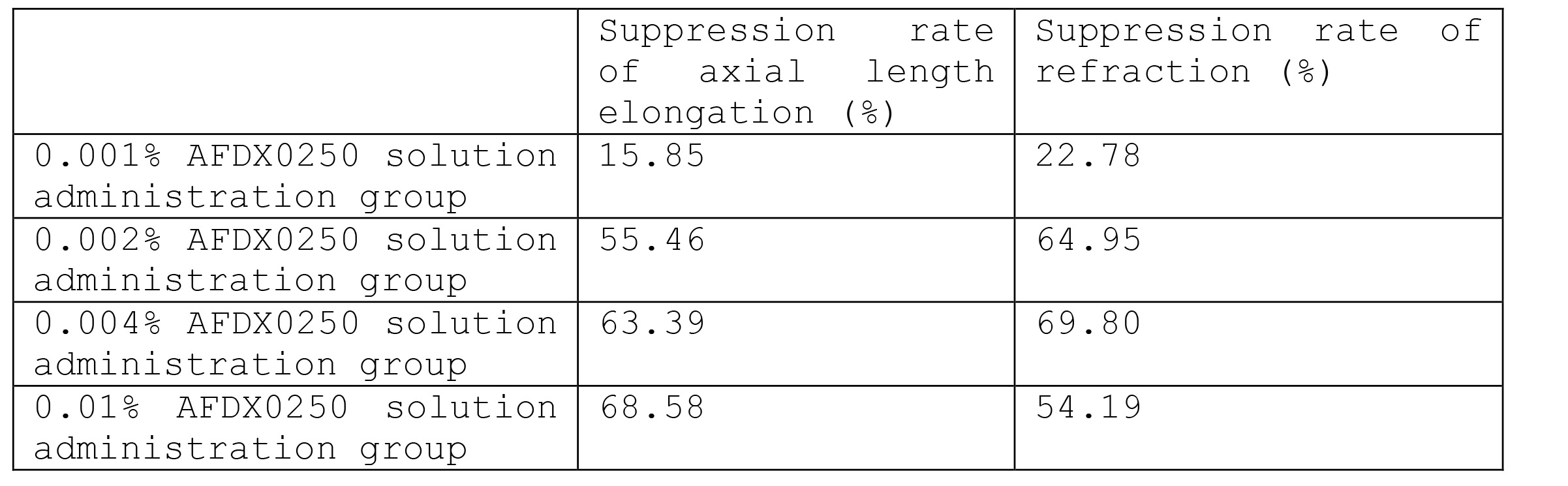
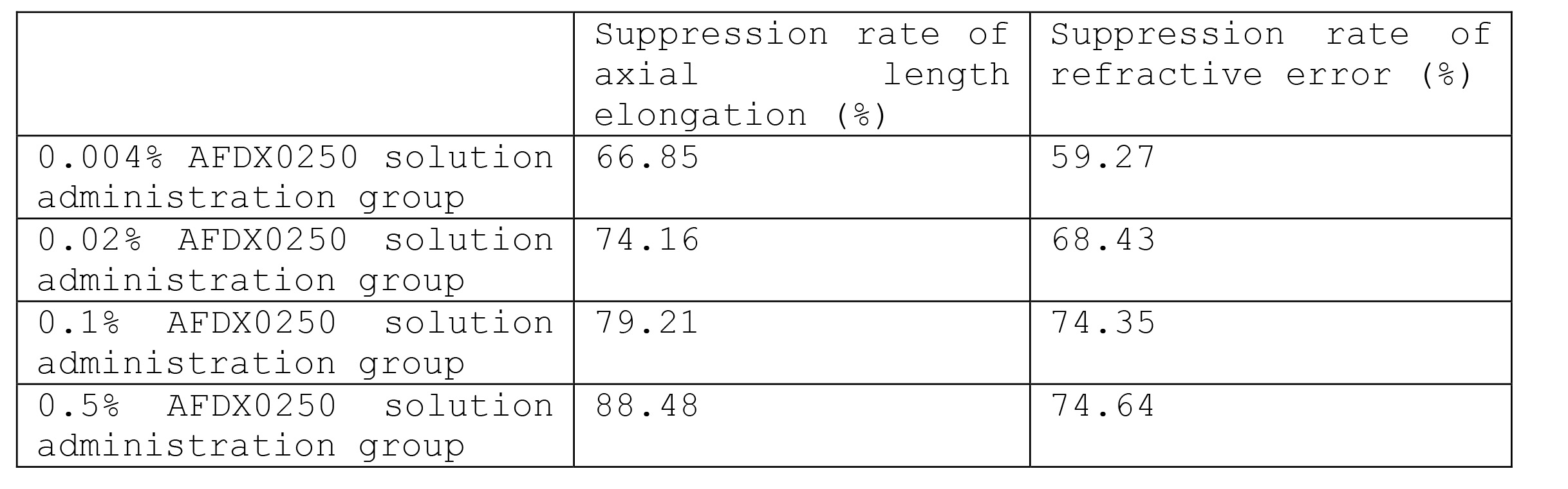
- the suppression rate of the axial length elongation and the suppression rate of the refractive error in each AFDX0250 solution administration group are shown in Table 3.
- the suppression rates were calculated using the values before rounding off to the values in Table 2, respectively.
- Example 2 Test on suppression of myopia progression (axial length elongation and refractive error) in guinea pig myopia model (2) According to the following procedures, the effect of AFDX0250 on the suppression of myopia progression (the axial length elongation and the refractive error) was evaluated.
- AFDX0250 was dissolved in purified water with a buffering agent and a tonicity agent to prepare 0.5% AFDX0250 solution. 1 mol/L sodium hydroxide reagent solution or dilute hydrochloric acid was added to the solution to adjust the pH thereof to neutral. Also, a buffering agent and a tonicity agent were dissolved in purified water to prepare a neutral vehicle.
- AFDX0250 solution administration groups 10 ⁇ L of the AFDX0250 solution in each concentration was topically administered to the right eye of each guinea pig once daily for 14 days from the day when the right eye was covered with the goggle (day 0) to day 13.
- 10 ⁇ L of the vehicle was topically administered to the right eye of each guinea pig once daily for 14 days from day 0 to day 13.
- 10 ⁇ L of the vehicle was topically administered to the left eye at the same frequency of administration as that of each group daily for 14 days from day 0 to day 13.
- the guinea pigs were reared under a normal rearing condition.
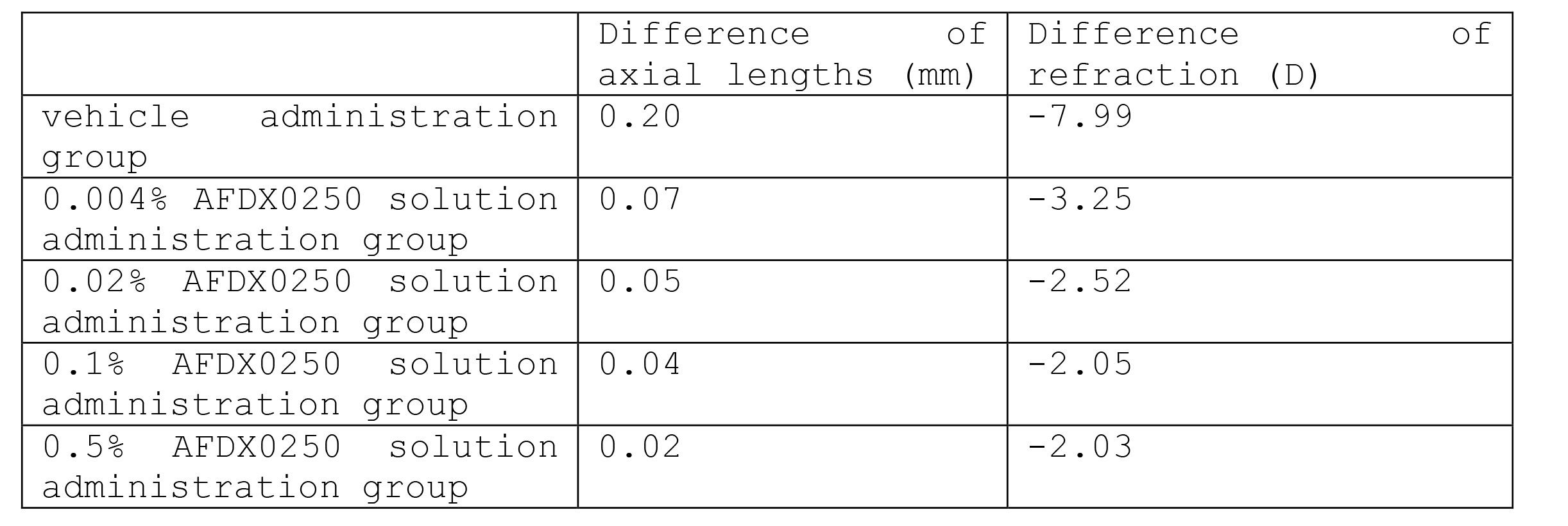
- the suppression rate of the axial length elongation and the suppression rate of the refractive error in each AFDX0250 solution administration group are shown in Table 6.
- the suppression rates were calculated using the values before rounding off to the values in Table 5, respectively.
- AFDX0250 strongly suppressed the axial length elongation and the refractive error. As a result, it was shown that AFDX0250 was effective for treating myopia, preventing myopia and/or suppressing myopia progression.
- Comparative Example 1 Test on suppression of myopia progression (axial length elongation and refractive error) in guinea pig myopia model (1) According to the following procedures, the effect of AFDX0116 on the suppression of myopia progression (the axial length elongation and the refractive error) was evaluated. (Preparation of sample) AFDX0116 was dissolved in purified water with a buffering agent and a tonicity agent to prepare 0.5% AFDX0116 solution. 1 mol/L sodium hydroxide reagent solution or dilute hydrochloric acid was added to the solution to adjust the pH thereof to neutral. Also, a buffering agent and a tonicity agent were dissolved in purified water to prepare a neutral vehicle.
- AFDX0116 solution administration groups 10 ⁇ L of the AFDX0116 solution in each concentration was topically administered to the right eye of each guinea pig once daily for 14 days from the day when the right eye was covered with the goggle (day 0) to day 13.
- 10 ⁇ L of the vehicle was topically administered to the right eye of each guinea pig once daily for 14 days from day 0 to day 13.
- 10 ⁇ L of the vehicle was topically administered to the left eye at the same frequency of administration as that of each group daily for 14 days from day 0 to day 13.
- the guinea pigs were reared under a normal rearing condition.
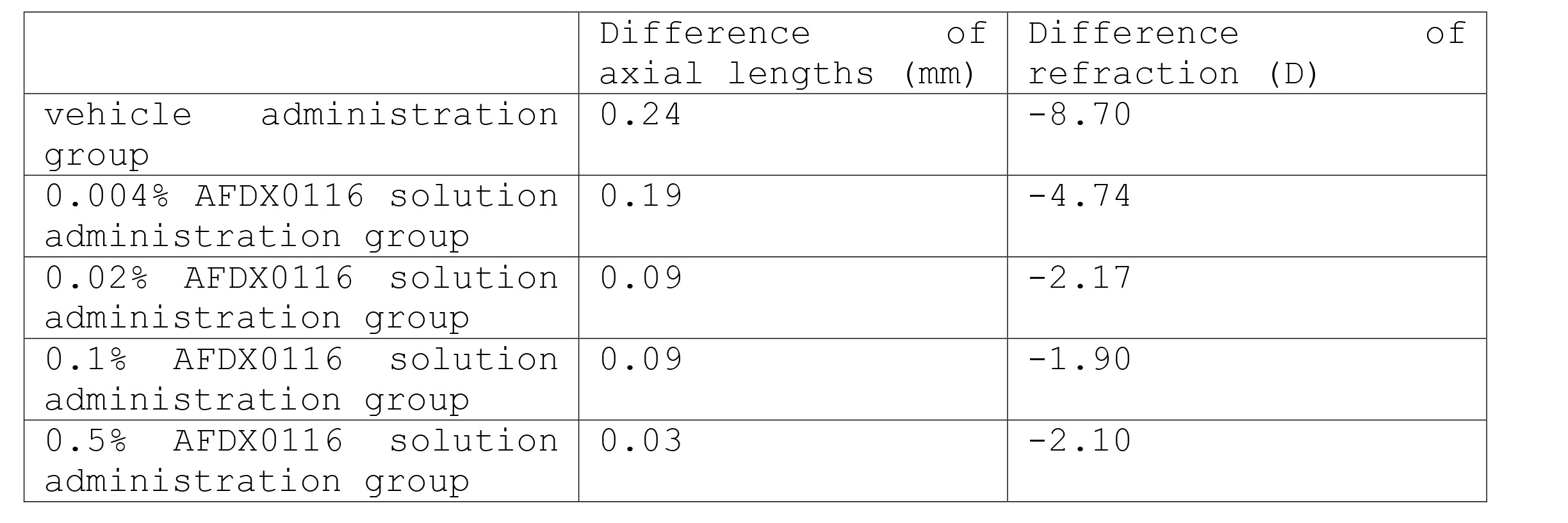
- the suppression rate of the axial length elongation and the suppression rate of the refractive error in each AFDX0116 solution administration group are shown in Table 9.
- the suppression rates were calculated using the values before rounding off to the values in Table 8, respectively.
- Comparative Example 2 Test on suppression of myopia progression (axial length elongation and refractive error) in guinea pig myopia model (2) According to the following procedures, the effect of AFDX0116 on the suppression of myopia progression (the axial length elongation and the refractive error) was evaluated.
- AFDX0116 was dissolved in purified water with a buffering agent and a tonicity agent to prepare 0.5% AFDX0116 solution. 1 mol/L sodium hydroxide reagent solution or dilute hydrochloric acid was added to the solution to adjust the pH thereof to neutral. Also, a buffering agent and a tonicity agent were dissolved in purified water to prepare a neutral vehicle.
- AFDX0116 solution administration groups 10 ⁇ L of the AFDX0116 solution in each concentration was topically administered to the right eye of each guinea pig once daily for 14 days from the day when the right eye was covered with the goggle (day 0) to day 13.
- 10 ⁇ L of the vehicle was topically administered to the right eye of each guinea pig once daily for 14 days from day 0 to day 13.
- 10 ⁇ L of the vehicle was topically administered to the left eye at the same frequency of administration as that of each group daily for 14 days from day 0 to day 13.
- the guinea pigs were reared under a normal rearing condition.
- the suppression rate of the axial length elongation and the suppression rate of the refractive error in each AFDX0116 solution administration group are shown in Table 12.
- the suppression rates were calculated using the values before rounding off to the values in Table 11, respectively.
- AFDX0116 suppressed the axial length elongation and the refractive error. As a result, it was demonstrated that the concentration of AFDX0116 showing the anti-myopic effect was higher than that of AFDX0250.
- Example 3 Evaluation of mydriatic action in AFDX0116 and AFDX0250 solutions AFDX0116 and AFDX0250 solutions were repeatedly topically administered to one eye of guinea pigs, respectively, to evaluate the effect of each solution on mydriasis.
- Preparation of sample 1. Preparation of AFDX0116 solution AFDX0116 was dissolved in purified water with a buffering agent and a tonicity agent to prepare 2% AFDX0116 solution. 1 mol/L sodium hydroxide reagent solution or dilute hydrochloric acid was added to the solution to adjust the pH thereof to neutral. Also, a buffering agent and a tonicity agent were dissolved in purified water to prepare neutral vehicle.
- AFDX0250 solution AFDX0250 was dissolved in purified water with a buffering agent and a tonicity agent to prepare 2% AFDX0250 solution. 1 mol/L sodium hydroxide reagent solution or dilute hydrochloric acid was added to the solution to adjust the pH thereof to neutral. Also, a buffering agent and a tonicity agent were dissolved in purified water to prepare neutral vehicle. 2.5 mL and 3 mL of the vehicles were mixed with 2.5 mL and 1 mL of 2% AFDX0250 solutions, respectively, and stirred to prepare 1% and 0.5% of AFDX0116 solutions.
- Each of the prepared solutions was topically administered to the left eye of each guinea pig (the left eyes of 3 guinea pigs for each solution) in a volume of 10 ⁇ L once daily for 5 days.
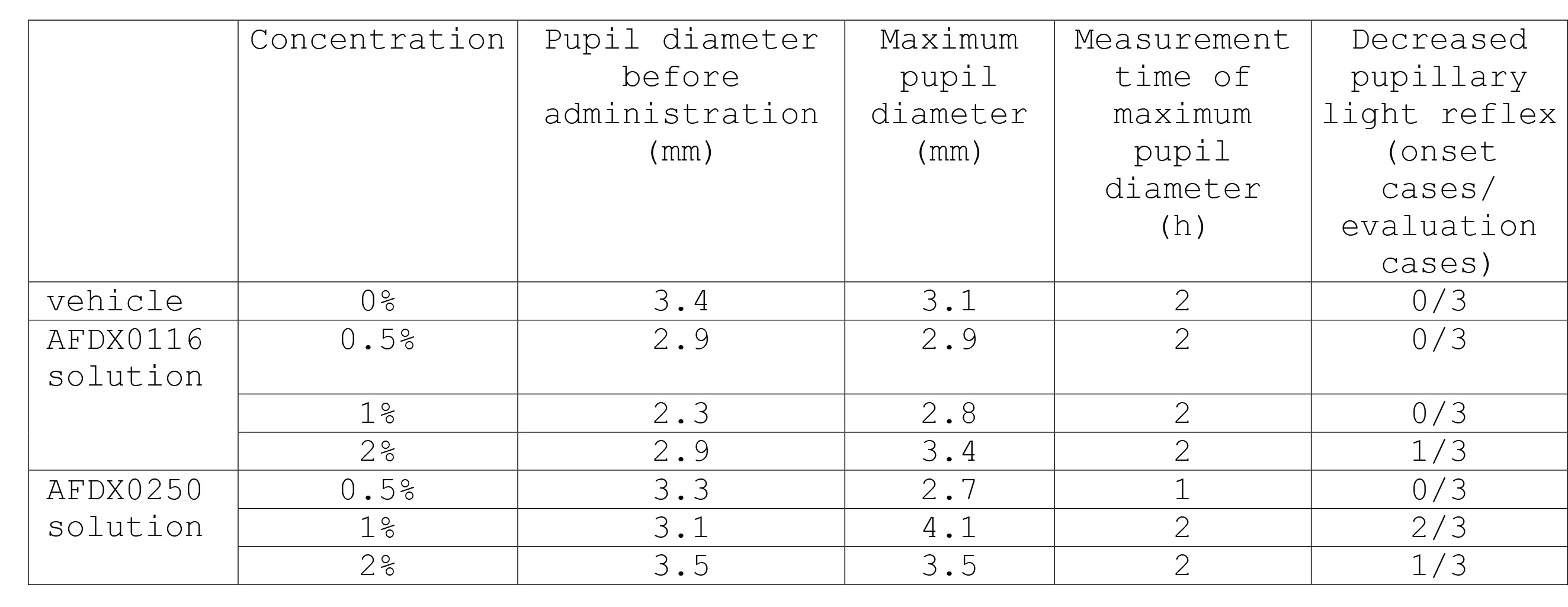
- the pupil diameter of each guinea pig was measured before the administration on day 5 as well as 1, 2 and 4 hours after the administration to observe the pupillary light reflex.
- the measured pupil diameters of each guinea pig at each measurement time were averaged to obtain a value.
- the obtained value was defined as the average pupil diameter.
- the longest diameter was defined as the maximum pupil diameter.
- Comparative Example 3 Evaluation of mydriatic action in atropine solution An atropine solution was repeatedly topically administered to one eye of a guinea pig to evaluate the effect of the solution on mydriasis. (Preparation of sample) Atropine sulfate hydrate and glycerin were dissolved in water for injection to prepare 0.001%, 0.0003% and 0.0001% atropine solutions without adjusting the pH.
- Each of the prepared solutions was topically administered to the left eye of guinea pigs (the left eyes of 3 guinea pigs for each solution) in a volume of 10 ⁇ L once daily for 5 days.
- the pupil diameter of each guinea pig was measured before the administration on day 5 as well as 1, 2 and 4 hours after the administration to observe the pupillary light reflex.
- the measured pupil diameters of each guinea pig at each measurement time were averaged to obtain the average value.
- the obtained average value was defined as the average pupil diameter.
- the longest diameter was defined as the maximum pupil diameter.
- the pharmaceutical composition of the present invention is effective for treating myopia, preventing myopia and/or suppressing myopia progression because (+)-11-[2-[2-[(diethylamino)methyl]-1-piperidinyl]acetyl]-5,11-dihydro-6H-pyrido[2,3-b][1,4]benzodiazepin-6-one or a salt thereof suppresses the axial length elongation and the refractive error.
- (+)-11-[2-[2-[(diethylamino)methyl]-1-piperidinyl]acetyl]-5,11-dihydro-6H-pyrido[2,3-b][1,4]benzodiazepin-6-one does not substantially have mydriatic action and has a higher margin of safety, and thus the pharmaceutical composition of the present invention is expected to be used as an agent for treating myopia which is superior in safety and sense of use.
Landscapes
- Health & Medical Sciences (AREA)
- Chemical & Material Sciences (AREA)
- Veterinary Medicine (AREA)
- Medicinal Chemistry (AREA)
- Pharmacology & Pharmacy (AREA)
- Life Sciences & Earth Sciences (AREA)
- Animal Behavior & Ethology (AREA)
- General Health & Medical Sciences (AREA)
- Public Health (AREA)
- Ophthalmology & Optometry (AREA)
- Epidemiology (AREA)
- Engineering & Computer Science (AREA)
- Bioinformatics & Cheminformatics (AREA)
- Chemical Kinetics & Catalysis (AREA)
- General Chemical & Material Sciences (AREA)
- Nuclear Medicine, Radiotherapy & Molecular Imaging (AREA)
- Organic Chemistry (AREA)
- Inorganic Chemistry (AREA)
- Pharmaceuticals Containing Other Organic And Inorganic Compounds (AREA)
- Medicinal Preparation (AREA)
Abstract
Description
Hence, the development of a novel agent for treating myopia, which can prevent the side effects due to mydriatic action, has been strongly desired.
Non-Patent Literature 1 discloses that a selective muscarinic M2 receptor antagonist suppresses myopia progression. Also, it is disclosed that one example of drugs for suppressing myopia progression includes AFDX0116.
[PL 2] WO 2018/174179
[PL 3] WO 93/18772
(1) A pharmaceutical composition for treating myopia, preventing myopia, and/or suppressing myopia progression, comprising (+)-11-[2-[2-[(diethylamino)methyl]-1-piperidinyl]acetyl]-5,11-dihydro-6H-pyrido[2,3-b][1,4]benzodiazepin-6-one or a salt thereof as an active ingredient, wherein the pharmaceutical composition is substantially free of (-)-11-[2-[2-[(diethylamino)methyl]-1-piperidinyl]acetyl]-5,11-dihydro-6H-pyrido[2,3-b][1,4]benzodiazepin-6-one or a salt thereof.
(2) The pharmaceutical composition of the above (1) which is free of (-)-11-[2-[2-[(diethylamino)methyl]-1-piperidinyl]acetyl]-5,11-dihydro-6H-pyrido[2,3-b][1,4]benzodiazepin-6-one or a salt thereof.
(3) The pharmaceutical composition of the above (1) or (2) which does not substantially have mydriatic action.
(4) The pharmaceutical composition of any one of the above (1) to (3), wherein the myopia is axial myopia, refractive myopia, pseudomyopia, pathological myopia, simple myopia, extreme myopia, severe myopia, high myopia, moderate myopia, low myopia, myopia complicated by glaucoma, myopia at the risk of the onset of glaucoma, or myopia with high intraocular pressure.
(5) The pharmaceutical composition of any one of the above (1) to (4) for ocular topical administration.
(6) The pharmaceutical composition of the above (5), wherein the ocular topical administration is ophthalmic administration, administration by an ophthalmic ointment, conjunctival sac administration, intravitreal administration, subconjunctival administration, sub-Tenon's administration, conjunctival sac injection, or application to the eyelid.
(7) The pharmaceutical composition of any one of the above (1) to (6) which is in the form of an eye drop, an eye gel, an ophthalmic ointment, or an injection.
(8) The pharmaceutical composition of any one of the above (1) to (7), wherein the concentration of (+)-11-[2-[2-[(diethylamino)methyl]-1-piperidinyl]acetyl]-5,11-dihydro-6H-pyrido[2,3-b][1,4]benzodiazepin-6-one or a salt thereof is 0.0001 - 5% (w/v).
(9) The pharmaceutical composition of any one of the above (1) to (7), wherein the concentration of (+)-11-[2-[2-[(diethylamino)methyl]-1-piperidinyl]acetyl]-5,11-dihydro-6H-pyrido[2,3-b][1,4]benzodiazepin-6-one or a salt thereof is 0.001 - 1% (w/v).
(10) The pharmaceutical composition of any one of the above (1) to (7), wherein the concentration of (+)-11-[2-[2-[(diethylamino)methyl]-1-piperidinyl]acetyl]-5,11-dihydro-6H-pyrido[2,3-b][1,4]benzodiazepin-6-one or a salt thereof is 0.001% (w/v) or more and less than 1% (w/v).
(11) The pharmaceutical composition of any one of the above (1) to (7), wherein the concentration of (+)-11-[2-[2-[(diethylamino)methyl]-1-piperidinyl]acetyl]-5,11-dihydro-6H-pyrido[2,3-b][1,4]benzodiazepin-6-one or a salt thereof is 0.002 - 0.5% (w/v).
(12) The pharmaceutical composition of any one of the above (1) to (7), wherein the concentration of (+)-11-[2-[2-[(diethylamino)methyl]-1-piperidinyl]acetyl]-5,11-dihydro-6H-pyrido[2,3-b][1,4]benzodiazepin-6-one or a salt thereof is 0.002 - 0.01% (w/v).
(13) The pharmaceutical composition of any one of the above (1) and (3) to (12), wherein the concentration of (-)-11-[2-[2-[(diethylamino)methyl]-1-piperidinyl]acetyl]-5,11-dihydro-6H-pyrido[2,3-b][1,4]benzodiazepin-6-one or a salt thereof is less than 0.1% (w/v).
(14) The pharmaceutical composition of any one of the above (1) and (3) to (13), wherein the concentration of (-)-11-[2-[2-[(diethylamino)methyl]-1-piperidinyl]acetyl]-5,11-dihydro-6H-pyrido[2,3-b][1,4]benzodiazepin-6-one or a salt thereof is 0.05 part by weight or less per part by weight of (+)-11-[2-[2-[(diethylamino)methyl]-1-piperidinyl]acetyl]-5,11-dihydro-6H-pyrido[2,3-b][1,4]benzodiazepin-6-one or a salt thereof.
(15) A pharmaceutical composition for suppressing the axial length elongation, comprising (+)-11-[2-[2-[(diethylamino)methyl]-1-piperidinyl]acetyl]-5,11-dihydro-6H-pyrido[2,3-b][1,4]benzodiazepin-6-one or a salt thereof as an active ingredient, wherein the pharmaceutical composition is substantially free of (-)-11-[2-[2-[(diethylamino)methyl]-1-piperidinyl]acetyl]-5,11-dihydro-6H-pyrido[2,3-b][1,4]benzodiazepin-6-one or a salt thereof.
(16) A pharmaceutical composition for suppressing the refractive error, comprising (+)-11-[2-[2-[(diethylamino)methyl]-1-piperidinyl]acetyl]-5,11-dihydro-6H-pyrido[2,3-b][1,4]benzodiazepin-6-one or a salt thereof as an active ingredient, wherein the pharmaceutical composition is substantially free of (-)-11-[2-[2-[(diethylamino)methyl]-1-piperidinyl]acetyl]-5,11-dihydro-6H-pyrido[2,3-b][1,4]benzodiazepin-6-one or a salt thereof.
(17) Use of (+)-11-[2-[2-[(diethylamino)methyl]-1-piperidinyl]acetyl]-5,11-dihydro-6H-pyrido[2,3-b][1,4]benzodiazepin-6-one or a salt thereof in the manufacture of an agent for treating and/or preventing myopia.
(18) The use of the above (17), wherein the agent is substantially free of (-)-11-[2-[2-[(diethylamino)methyl]-1-piperidinyl]acetyl]-5,11-dihydro-6H-pyrido[2,3-b][1,4]benzodiazepin-6-one or a salt thereof.
(19) Use of (+)-11-[2-[2-[(diethylamino)methyl]-1-piperidinyl]acetyl]-5,11-dihydro-6H-pyrido[2,3-b][1,4]benzodiazepin-6-one or a salt thereof in the manufacture of an agent for suppressing myopia progression.
(20) The use of the above (19), wherein the agent is substantially free of (-)-11-[2-[2-[(diethylamino)methyl]-1-piperidinyl]acethyl]-5,11-dihydro-6H-pyrido[2,3-b][1,4]benzodiazepin-6-one or a salt thereof.
(21) A method of treating and/or preventing myopia, which comprises administering a therapeutically effective amount of (+)-11-[2-[2-[(diethylamino)methyl]-1-piperidinyl]acetyl]-5,11-dihydro-6H-pyrido[2,3-b][1,4]benzodiazepin-6-one or a salt thereof to a patient.
(22) A method of treating and/or preventing myopia, which comprises administering an agent comprising a therapeutically effective amount of (+)-11-[2-[2-[(diethylamino)methyl]-1-piperidinyl]acetyl]-5,11-dihydro-6H-pyrido[2,3-b][1,4]benzodiazepin-6-one or a salt thereof which is substantially free of (-)-11-[2-[2-[(diethylamino)methyl]-1-piperidinyl]acetyl]-5,11-dihydro-6H-pyrido[2,3-b][1,4]benzodiazepin-6-one or a salt thereof.
(23) A method of suppressing myopia progression, which comprises administering a therapeutically effective of (+)-11-[2-[2-[(diethylamino)methyl]-1-piperidinyl]acetyl]-5,11-dihydro-6H-pyrido[2,3-b][1,4]benzodiazepin-6-one or a salt thereof to a patient.
(24) A method of suppressing myopia progression, which comprises administering an agent comprising a therapeutically effective amount of (+)-11-[2-[2-[(diethylamino)methyl]-1-piperidinyl]acetyl]-5,11-dihydro-6H-pyrido[2,3-b][1,4]benzodiazepin-6-one or a salt thereof which is substantially free of (-)-11-[2-[2-[(diethylamino)methyl]-1-piperidinyl]acetyl]-5,11-dihydro-6H-pyrido[2,3-b][1,4]benzodiazepin-6-one or a salt thereof.
(25) A method of suppressing the axial length elongation, which comprises administering a therapeutically effective amount of (+)-11-[2-[2-[(diethylamino)methyl]-1-piperidinyl]acetyl]-5,11-dihydro-6H-pyrido[2,3-b][1,4]benzodiazepin-6-one or a salt thereof to a patient.
(26) A method of suppressing the axial length elongation, which comprises administering an agent comprising a therapeutically effective amount of (+)-11-[2-[2-[(diethylamino)methyl]-1-piperidinyl]acetyl]-5,11-dihydro-6H-pyrido[2,3-b][1,4]benzodiazepin-6-one or a salt thereof which is substantially free of (-)-11-[2-[2-[(diethylamino)methyl]-1-piperidinyl]acetyl]-5,11-dihydro-6H-pyrido[2,3-b][1,4]benzodiazepin-6-one or a salt thereof.
(27) A method of suppressing the refractive error, which comprises a therapeutically effective amount of (+)-11-[2-[2-[(diethylamino)methyl]-1-piperidinyl]acetyl]-5,11-dihydro-6H-pyrido[2,3-b][1,4]benzodiazepin-6-one or a salt thereof to a patient.
(28) A method of suppressing the refractive error, which comprises administering an agent comprising a therapeutically effective amount of (+)-11-[2-[2-[(diethylamino)methyl]-1-piperidinyl]acetyl]-5,11-dihydro-6H-pyrido[2,3-b][1,4]benzodiazepin-6-one or a salt thereof which is substantially free of (-)-11-[2-[2-[(diethylamino)methyl]-1-piperidinyl]acetyl]-5,11-dihydro-6H-pyrido[2,3-b][1,4]benzodiazepin-6-one or a salt thereof.
(29) (+)-11-[2-[2-[(Diethylamino)methyl]-1-piperidinyl]acetyl]-5,11-dihydro-6H-pyrido[2,3-b][1,4]benzodiazepin-6-one or a salt thereof for the use in treating and/or preventing myopia.
(30) (+)-11-[2-[2-[(Diethylamino)methyl]-1-piperidinyl]acetyl]-5,11-dihydro-6H-pyrido[2,3-b][1,4]benzodiazepin-6-one or a salt thereof for the use in suppressing myopia progression.

As used herein, the term "% (w/v)" means the mass (g) of an object ingredient in 100 mL of the pharmaceutical composition of the present invention, and the term "% (w/w)" means the mass (g) of an object ingredient in 100 g of the pharmaceutical composition of the present invention. When the pharmaceutical composition of the present invention comprises a salt of (+)-11-[2-[2-[(diethylamino)methyl]-1-piperidinyl]acetyl]-5,11-dihydro-6H-pyrido[2,3-b][1,4]benzodiazepin-6-one, the values may mean the concentration of the salt of (+)-11-[2-[2-[(diethylamino)methyl]-1-piperidinyl]acetyl]-5,11-dihydro-6H-pyrido[2,3-b][1,4]benzodiazepin-6-one or the concentration of (+)-11-[2-[2-[(diethylamino)methyl]-1-piperidinyl]acetyl]-5,11-dihydro-6H-pyrido[2,3-b][1,4]benzodiazepin-6-one. In addition, when the pharmaceutical composition of the present invention comprises (+)-11-[2-[2-[(diethylamino)methyl]-1-piperidinyl]acetyl]-5,11-dihydro-6H-pyrido[2,3-b][1,4]benzodiazepin-6-one or a salt thereof in the form of a hydrate or a solvate, the values may mean the concentration of (+)-11-[2-[2-[(diethylamino)methyl]-1-piperidinyl]acetyl]-5,11-dihydro-6H-pyrido[2,3-b][1,4]benzodiazepin-6-one or a salt thereof in the form of a hydrate or a solvate or the concentration of (+)-11-[2-[2-[(diethylamino)methyl]-1-piperidinyl]acetyl]-5,11-dihydro-6H-pyrido[2,3-b][1,4]benzodiazepin-6-one or a salt thereof. Hereinafter, the same shall apply to the followings unless otherwise specified.
As used herein, the term "prophylaxis (preventing)" means preventing the onset of myopia, delaying the onset of myopia, or reducing the risk of the onset of myopia.
As used herein, the term "suppression of myopia progression (suppressing myopia progression)" means delaying the myopia progression (delay of myopia progression) or reducing the myopia progression (reduction of myopia progression).
Also, the term "treating myopia, preventing myopia and/or suppressing myopia progression" used herein includes suppressing the axial length elongation and/or suppressing the refractive error.
Also, as appropriate, a commonly-used additive may be added into an eye drop. Examples thereof include a tonicity agent, a buffering agent, a surfactant, a stabilizing agent, a preservative, a solubilizing agent, or the like.
According to the following procedures, the effect of AFDX0250 on the suppression of myopia progression (the axial length elongation and the refractive error) was evaluated.
(Preparation of sample)
AFDX0250 was dissolved in purified water with a buffering agent and a tonicity agent to prepare 0.5% AFDX0250 solution. 1 mol/L sodium hydroxide reagent solution or dilute hydrochloric acid was added to the solution to adjust the pH thereof to neutral. Also, a buffering agent and a tonicity agent were dissolved in purified water to prepare a neutral vehicle. 9.8 mL of the vehicle was mixed with 0.2 mL of 0.5% AFDX0250 solution and stirred to prepare 0.01% AFDX0250 solution. 3 mL, 4 mL and 4.5 mL of the vehicles were mixed with 2 mL, 1 mL and 0.5 mL of 0.01% AFDX0250 solutions, respectively, and stirred to prepare 0.004%, 0.002% and 0.001% AFDX0250 solutions.
A test tube with a diameter of 18 mm was cut off at the level of 10 mm from the bottom, and the cut-off bottom part was glued to one side of Velcro tape (about 20 mm square) with a hole of an appropriate diameter in the center with an adhesive agent to prepare a lens (goggle). 3-week-old guinea pigs (Slc:Hartley) (n=30) were obtained, and the prepared goggle was covered to the right eye of each guinea pig with an adhesive agent to induce myopia to the guinea pigs. The left eye thereof without goggle was used as control.
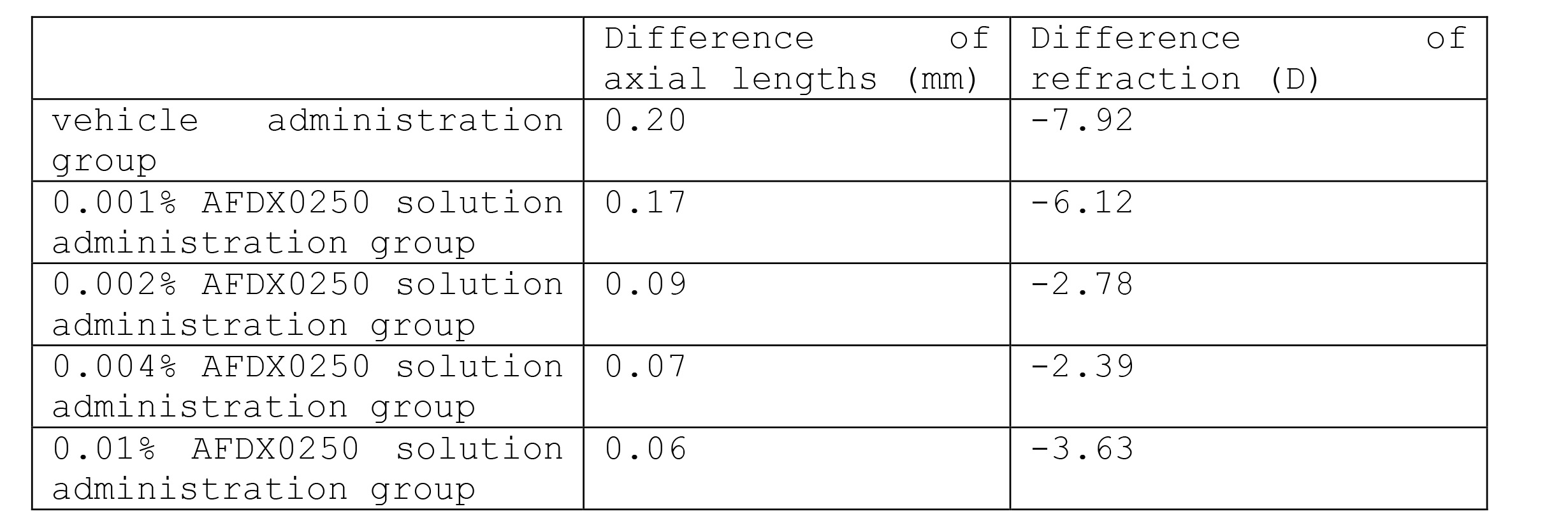
The prepared guinea pig myopia models were randomly classified into 0.001% AFDX0250 solution administration group, 0.002% AFDX0250 solution administration group, 0.004% AFDX0250 solution administration group, 0.01% AFDX0250 solution administration group and vehicle administration group (control group) (n=6 per group). In the AFDX0250 solution administration groups, 10 μL of the AFDX0250 solution in each concentration was topically administered to the right eye of each guinea pig once daily for 14 days from the day when the right eye was covered with the goggle (day 0) to day 13. In the control group, 10 μL of the vehicle was topically administered to the right eye of each guinea pig once daily for 14 days from the day when the right eye was covered with the goggle (day 0) to day 13. In the all groups, 10 μL of the vehicle was topically administered to the left eye at the same frequency of administration as that of each group daily for 14 days from day 0 to day 13. The guinea pigs were reared under a normal rearing condition.

On day 14 from the myopia induction, the axial lengths of right and left eyeballs were measured with an ultrasound axial length measurement device ECHOSCAN US-500 (A-scan) (NIDEK CO., LTD.), and the refractions were measured with the auto refractometer AR-1a (NIDEK CO., LTD.). The difference of axial lengths and the suppression rate of the axial length elongation as well as the difference of refraction and the suppression rate of the refractive error were calculated according to the following formulae. The calculation was performed in Microsoft Excel.
Difference of axial lengths (mm) = Axial length of right eye (mm) - Axial length of left eye (mm)
Suppression rate of axial length elongation (%) = (1-Difference of axial lengths in AFDX0250 solution administration group / Difference of axial lengths in control group) x 100
Difference of refraction (D) = Refraction of right eye (D) - Refraction of left eye (D)
Suppression rate of refractive error (%) = (1- Difference of refraction in AFDX0250 solution administration group / Difference of refraction in control group) x 100
The average values of the difference of axial lengths and the difference of refraction in the control group and in each AFDX0250 solution administration group are shown in Table 2.
According to the following procedures, the effect of AFDX0250 on the suppression of myopia progression (the axial length elongation and the refractive error) was evaluated.
(Preparation of sample)
AFDX0250 was dissolved in purified water with a buffering agent and a tonicity agent to prepare 0.5% AFDX0250 solution. 1 mol/L sodium hydroxide reagent solution or dilute hydrochloric acid was added to the solution to adjust the pH thereof to neutral. Also, a buffering agent and a tonicity agent were dissolved in purified water to prepare a neutral vehicle. 4 mL and 4.8 mL of vehicles were mixed with 1 mL and 0.2 mL of 0.5% AFDX0250 solutions, respectively, and stirred to prepare 0.1% and 0.02% of AFDX0250 solutions. Also, 4 mL of the vehicle was mixed with 1 mL of 0.02% AFDX0250 solution and stirred to prepare 0.004% AFDX0250 solution.
Guinea pig myopia models (n=30) were prepared according to similar method to that of (Preparation of guinea pig myopia model) of Example 1.
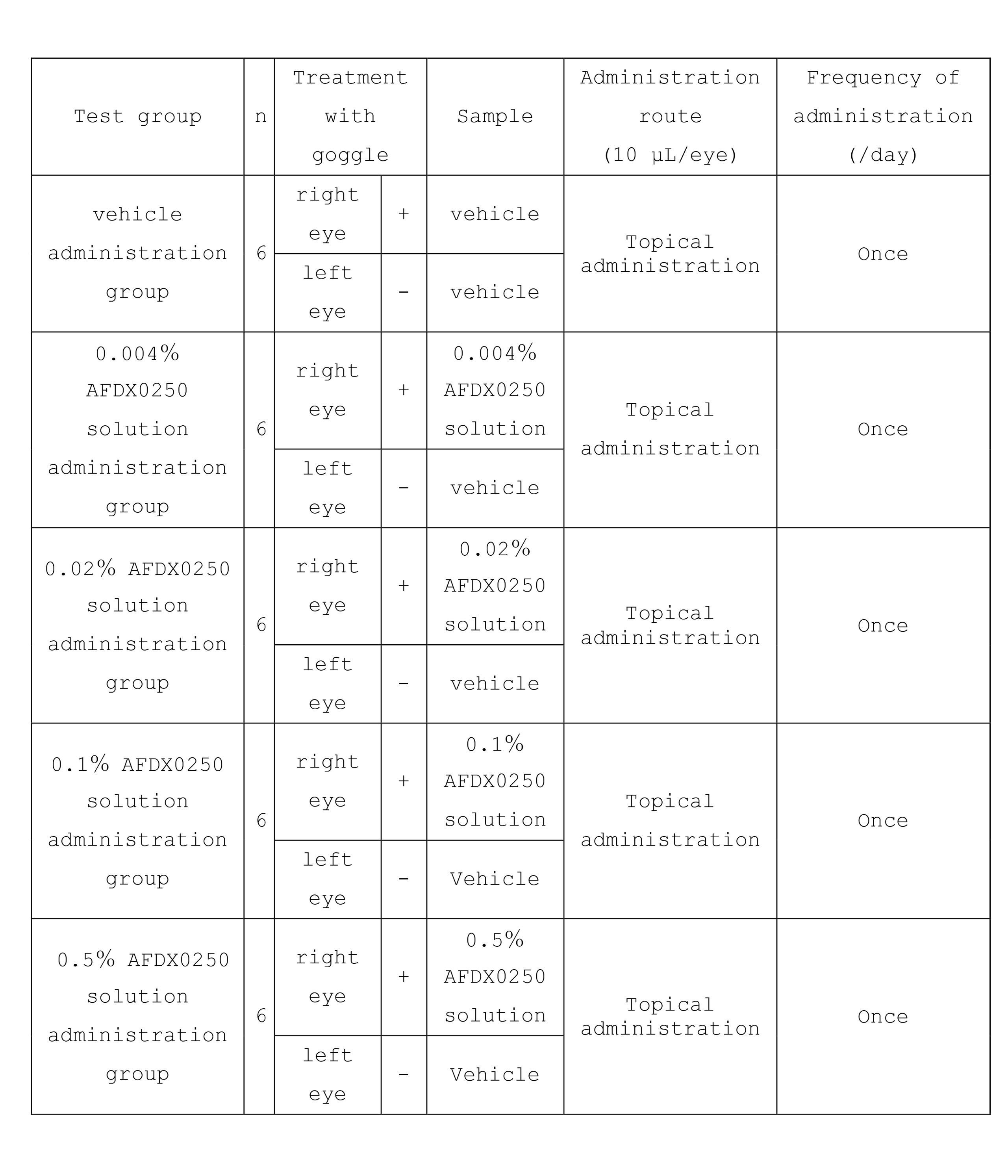
The prepared guinea pig myopia models were randomly classified into 0.004% AFDX0250 solution administration group, 0.02% AFDX0250 solution administration group, 0.1% AFDX0250 solution administration group, 0.5% AFDX0250 solution administration group and vehicle administration group (control group) (n=6 per group). In the AFDX0250 solution administration groups, 10 μL of the AFDX0250 solution in each concentration was topically administered to the right eye of each guinea pig once daily for 14 days from the day when the right eye was covered with the goggle (day 0) to day 13. In the control group, 10 μL of the vehicle was topically administered to the right eye of each guinea pig once daily for 14 days from day 0 to day 13. In the all groups, 10 μL of the vehicle was topically administered to the left eye at the same frequency of administration as that of each group daily for 14 days from day 0 to day 13. The guinea pigs were reared under a normal rearing condition.
The axial lengths and the refraction of right and left eyes were measured according to similar method to that of (Evaluation method) of Example 1, and the difference of axial lengths and the suppression rate of the axial length elongation as well as the difference of refraction and the suppression rate of the refractive error were calculated according to the formulae shown in Example 1. The calculation was performed in Microsoft Excel.
The average values of the difference of axial lengths and the difference of refraction in the control group and in each AFDX0250 solution administration group are shown in Table 5.
According to the following procedures, the effect of AFDX0116 on the suppression of myopia progression (the axial length elongation and the refractive error) was evaluated.
(Preparation of sample)
AFDX0116 was dissolved in purified water with a buffering agent and a tonicity agent to prepare 0.5% AFDX0116 solution. 1 mol/L sodium hydroxide reagent solution or dilute hydrochloric acid was added to the solution to adjust the pH thereof to neutral. Also, a buffering agent and a tonicity agent were dissolved in purified water to prepare a neutral vehicle. 4 mL and 4.8 mL of the vehicles were mixed with 1 mL and 0.2 mL of 0.5% AFDX0116 solutions, respectively, and stirred to prepare 0.1% and 0.02% of AFDX0116 solutions. Also, 4 mL of the vehicle was mixed with 1 mL of 0.02% AFDX0116 solution and stirred to prepare 0.004% AFDX0116 solution.
Guinea pig myopia models (n=30) were prepared according to similar method to that of (Preparation of guinea pig myopia model) in Example 1.
The prepared guinea pig myopia models were randomly classified into 0.004% AFDX0116 solution administration group, 0.02% AFDX0116 solution administration group, 0.1% AFDX0116 solution administration group, 0.5% AFDX0116 solution administration group and vehicle administration group (control group) (n=6 per group). In the AFDX0116 solution administration groups, 10 μL of the AFDX0116 solution in each concentration was topically administered to the right eye of each guinea pig once daily for 14 days from the day when the right eye was covered with the goggle (day 0) to day 13. In the control group, 10 μL of the vehicle was topically administered to the right eye of each guinea pig once daily for 14 days from day 0 to day 13. In the all groups, 10 μL of the vehicle was topically administered to the left eye at the same frequency of administration as that of each group daily for 14 days from day 0 to day 13. The guinea pigs were reared under a normal rearing condition.

The axial lengths and the refraction of right and left eyes were measured according to similar method to that of (Evaluation method) of Example 1, and the difference of axial lengths and the suppression rate of the axial length elongation as well as the difference of refraction and the suppression rate of the refractive error were calculated according to the formulae shown in Example 1. The calculation was performed in Microsoft Excel.
The average values of the difference of axial lengths and the difference of refraction in the control group and in each AFDX0116 solution administration group are shown in Table 8.

According to the following procedures, the effect of AFDX0116 on the suppression of myopia progression (the axial length elongation and the refractive error) was evaluated.
(Preparation of sample)
AFDX0116 was dissolved in purified water with a buffering agent and a tonicity agent to prepare 0.5% AFDX0116 solution. 1 mol/L sodium hydroxide reagent solution or dilute hydrochloric acid was added to the solution to adjust the pH thereof to neutral. Also, a buffering agent and a tonicity agent were dissolved in purified water to prepare a neutral vehicle. 4 mL and 4.8 mL of the vehicles were mixed with 1 mL and 0.2 mL of 0.5% AFDX0116 solutions, respectively, and stirred to prepare 0.1% and 0.02% of AFDX0116 solutions. Also, 2.5 mL and 4 mL of the vehicles were mixed with 2.5 mL and 1 mL of 0.02% AFDX0116 solutions, respectively, and stirred to prepare 0.01% and 0.004% AFDX0116 solutions.
Guinea pig myopia models (n=30) were prepared according to similar method to that of (Preparation of guinea pig myopia model) in Example 1.
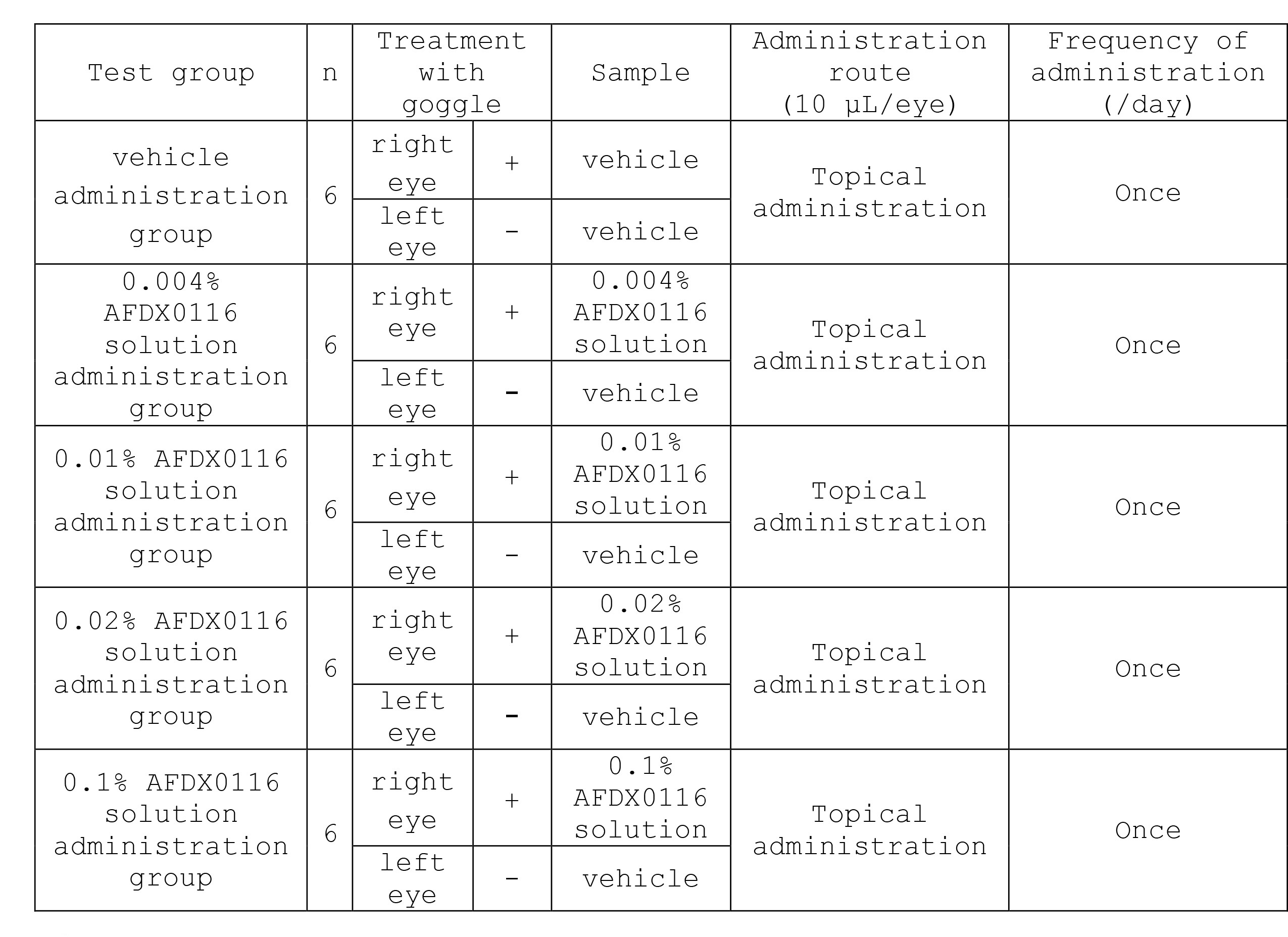
The prepared guinea pig myopia models were randomly classified into 0.004% AFDX0116 solution administration group, 0.01% AFDX0116 solution administration group, 0.02% AFDX0116 solution administration group, 0.1% AFDX0116 solution administration group and vehicle administration group (control group) (n=6 per group). In the AFDX0116 solution administration groups, 10 μL of the AFDX0116 solution in each concentration was topically administered to the right eye of each guinea pig once daily for 14 days from the day when the right eye was covered with the goggle (day 0) to day 13. In the control group, 10 μL of the vehicle was topically administered to the right eye of each guinea pig once daily for 14 days from day 0 to day 13. In the all groups, 10 μL of the vehicle was topically administered to the left eye at the same frequency of administration as that of each group daily for 14 days from day 0 to day 13. The guinea pigs were reared under a normal rearing condition.
The axial lengths and the refraction of right and left eyes were measured according to similar method to that of (Evaluation Method) of Example 1, and the difference of axial lengths and the suppression rate of the axial length elongation as well as the difference of refraction and the suppression rate of the refractive error were calculated according to the formulae shown in Example 1. The calculation was performed in Microsoft Excel.
The average values of the difference of axial lengths and the difference of refraction in the control group and in each AFDX0116 solution administration group are shown in Table 11.


AFDX0116 and AFDX0250 solutions were repeatedly topically administered to one eye of guinea pigs, respectively, to evaluate the effect of each solution on mydriasis.
(Preparation of sample)
1. Preparation of AFDX0116 solution
AFDX0116 was dissolved in purified water with a buffering agent and a tonicity agent to prepare 2% AFDX0116 solution. 1 mol/L sodium hydroxide reagent solution or dilute hydrochloric acid was added to the solution to adjust the pH thereof to neutral. Also, a buffering agent and a tonicity agent were dissolved in purified water to prepare neutral vehicle. 2.5 mL and 3 mL of the vehicles were mixed with 2.5 mL and 1 mL of 2% AFDX0116 solutions, respectively, and stirred to prepare 1% and 0.5% of AFDX0116 solutions.
2. Preparation of AFDX0250 solution
AFDX0250 was dissolved in purified water with a buffering agent and a tonicity agent to prepare 2% AFDX0250 solution. 1 mol/L sodium hydroxide reagent solution or dilute hydrochloric acid was added to the solution to adjust the pH thereof to neutral. Also, a buffering agent and a tonicity agent were dissolved in purified water to prepare neutral vehicle. 2.5 mL and 3 mL of the vehicles were mixed with 2.5 mL and 1 mL of 2% AFDX0250 solutions, respectively, and stirred to prepare 1% and 0.5% of AFDX0116 solutions.
Each of the prepared solutions was topically administered to the left eye of each guinea pig (the left eyes of 3 guinea pigs for each solution) in a volume of 10 μL once daily for 5 days. The pupil diameter of each guinea pig was measured before the administration on day 5 as well as 1, 2 and 4 hours after the administration to observe the pupillary light reflex. The measured pupil diameters of each guinea pig at each measurement time were averaged to obtain a value. The obtained value was defined as the average pupil diameter. Among each average pupil diameter at each measurement time, the longest diameter was defined as the maximum pupil diameter.
The result is shown in Table 13.
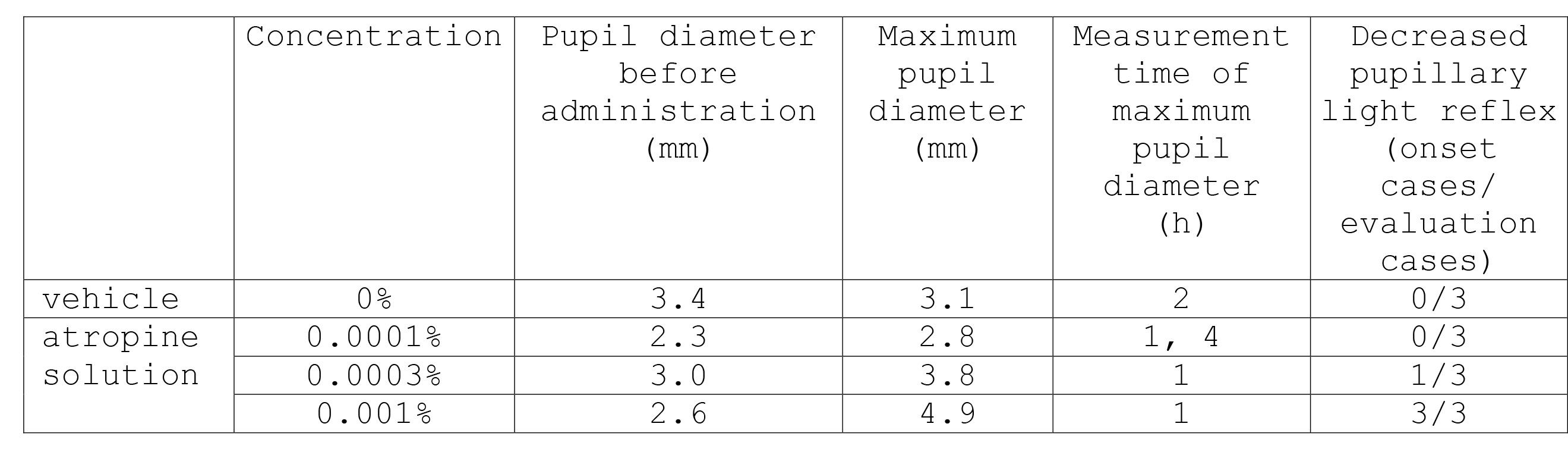
An atropine solution was repeatedly topically administered to one eye of a guinea pig to evaluate the effect of the solution on mydriasis.
(Preparation of sample)
Atropine sulfate hydrate and glycerin were dissolved in water for injection to prepare 0.001%, 0.0003% and 0.0001% atropine solutions without adjusting the pH.
Each of the prepared solutions was topically administered to the left eye of guinea pigs (the left eyes of 3 guinea pigs for each solution) in a volume of 10 μL once daily for 5 days. The pupil diameter of each guinea pig was measured before the administration on day 5 as well as 1, 2 and 4 hours after the administration to observe the pupillary light reflex. The measured pupil diameters of each guinea pig at each measurement time were averaged to obtain the average value. The obtained average value was defined as the average pupil diameter. Among each average pupil diameter at each measurement time, the longest diameter was defined as the maximum pupil diameter.
The result is shown in Table 14.
Claims (20)
- A pharmaceutical composition for treating myopia, preventing myopia and/or suppressing myopia progression, comprising (+)-11-[2-[2-
[(diethylamino)methyl]-1-piperidinyl]acetyl]-5,11-dihydro-6H-pyrido[2,3-b][1,4]benzodiazepin-6-one or a salt thereof as an active ingredient, wherein the pharmaceutical composition is substantially free of (-)-11-[2-[2-[(diethylamino)methyl]-1-piperidinyl]acetyl]-5,11-dihydro-6H-pyrido[2,3-b][1,4]benzodiazepin-6-one or a salt thereof. - The pharmaceutical composition of claim 1 which is free of (-)-11-[2-[2-[(diethylamino)methyl]-1-piperidinyl]acetyl]-5,11-dihydro-6H-pyrido[2,3-b][1,4]benzodiazepin-6-one or a salt thereof.
- The pharmaceutical composition of claim 1 or 2 which does not substantially have mydriatic action.
- The pharmaceutical composition of any one of claims 1 to 3, wherein the myopia is axial myopia, refractive myopia, pseudomyopia, pathological myopia, simple myopia, extreme myopia, severe myopia, high myopia, moderate myopia, low myopia, myopia complicated by glaucoma, myopia at the risk of the onset of glaucoma, or myopia with high intraocular pressure.
- The pharmaceutical composition of any one of claims 1 to 4 for ocular topical administration.
- The pharmaceutical composition of claim 5, wherein the ocular topical administration is ophthalmic administration, administration by an ophthalmic ointment, conjunctival sac administration, intravitreal administration, subconjunctival administration, sub-Tenon's administration, conjunctival sac injection, or application to the eyelid.
- The pharmaceutical composition of any one of claims 1 to 6 which is in the form of an eye drop, an eye gel, an ophthalmic ointment, or an injection.
- The pharmaceutical composition of any one of claims 1 to 7, wherein the concentration of (+)-11-[2-[2-[(diethylamino)methyl]-1-piperidinyl]acetyl]-5,11-dihydro-6H-pyrido[2,3-b][1,4]benzodiazepin-6-one or a salt thereof is 0.0001 - 5% (w/v).
- The pharmaceutical composition of any one of claims 1 to 7, wherein the concentration of (+)-11-[2-[2-[(diethylamino)methyl]-1-piperidinyl]acetyl]-5,11-dihydro-6H-pyrido[2,3-b][1,4]benzodiazepin-6-one or a salt thereof is 0.001 - 1% (w/v).
- The pharmaceutical composition of any one of claims 1 to 7, wherein the concentration of (+)-11-[2-[2-[(diethylamino)methyl]-1-piperidinyl]acetyl]-5,11-dihydro-6H-pyrido[2,3-b][1,4]benzodiazepin-6-one or a salt thereof is 0.001% (w/v) or more and less than 1% (w/v).
- The pharmaceutical composition of any one of claims 1 to 7, wherein the concentration of (+)-11-[2-[2-[(diethylamino)methyl]-1-piperidinyl]acetyl]-5,11-dihydro-6H-pyrido[2,3-b][1,4]benzodiazepin-6-one or a salt thereof is 0.002 - 0.5% (w/v).
- The pharmaceutical composition of any one of claims 1 to 7, wherein the concentration of (+)-11-[2-[2-[(diethylamino)methyl]-1-piperidinyl]acetyl]-5,11-dihydro-6H-pyrido[2,3-b][1,4]benzodiazepin-6-one or a salt thereof is 0.002 - 0.01% (w/v).
- The pharmaceutical composition of any one of claims 1 and 3 to 12, wherein the concentration of (-)-11-[2-[2-[(diethylamino)methyl]-1-piperidinyl]acetyl]-5,11-dihydro-6H-pyrido[2,3-b][1,4]benzodiazepin-6-one or a salt thereof is less than 0.1% (w/v).
- The pharmaceutical composition of any one of claims 1 and 3 to 13, wherein the concentration of (-)-11-[2-[2-[(diethylamino)methyl]-1-piperidinyl]acetyl]-5,11-dihydro-6H-pyrido[2,3-b][1,4]benzodiazepin-6-one or a salt thereof is 0.05 part by weight or less per part by weight of (+)-11-[2-[2-[(diethylamino)methyl]-1-piperidinyl]acetyl]-5,11-dihydro-6H-pyrido[2,3-b][1,4]benzodiazepin-6-one or a salt thereof.
- A pharmaceutical composition for suppressing the axial length elongation, comprising (+)-11-[2-[2-[(diethylamino)methyl]-1-piperidinyl]acetyl]-5,11-dihydro-6H-pyrido[2,3-b][1,4]benzodiazepin-6-one or a salt thereof as an active ingredient, wherein the pharmaceutical composition is substantially free of (-)-11-[2-[2-[(diethylamino)methyl]-1-piperidinyl]acetyl]-5,11-dihydro-6H-pyrido[2,3-b][1,4]benzodiazepin-6-one or a salt thereof.
- A pharmaceutical composition for suppressing the refractive error, comprising (+)-11-[2-[2-[(diethylamino)methyl]-1-piperidinyl]acetyl]-5,11-dihydro-6H-pyrido[2,3-b][1,4]benzodiazepin-6-one or a salt thereof as an active ingredient, wherein the pharmaceutical composition is substantially free of (-)-11-[2-[2-[(diethylamino)methyl]-1-piperidinyl]acetyl]-5,11-dihydro-6H-pyrido[2,3-b][1,4]benzodiazepin-6-one or a salt thereof.
- Use of (+)-11-[2-[2-[(diethylamino)methyl]-1-piperidinyl]acetyl]-5,11-dihydro-6H-pyrido[2,3-b][1,4]benzodiazepin-6-one or a salt thereof in the manufacture of an agent for treating and/or preventing myopia.
- The use of claim 17, wherein the agent is substantially free of (-)-11-[2-[2-[(diethylamino)methyl]-1-piperidinyl]acetyl]-5,11-dihydro-6H-pyrido[2,3-b][1,4]benzodiazepin-6-one or a salt thereof.
- Use of (+)-11-[2-[2-[(diethylamino)methyl]-1-piperidinyl]acetyl]-5,11-dihydro-6H-pyrido[2,3-b][1,4]benzodiazepin-6-one or a salt thereof in the manufacture of an agent for suppressing myopia progression.
- The use of claim 19, wherein the agent is substantially free of (-)-11-[2-[2-[(diethylamino)methyl]-1-piperidinyl]acethyl]-5,11-dihydro-6H-pyrido[2,3-b][1,4]benzodiazepin-6-one or a salt thereof.
Priority Applications (9)
| Application Number | Priority Date | Filing Date | Title |
|---|---|---|---|
| AU2021320350A AU2021320350A1 (en) | 2020-08-04 | 2021-08-03 | Agent for treating myopia, preventing myopia and/or suppressing myopia progression |
| EP21853900.5A EP4192471A4 (en) | 2020-08-04 | 2021-08-03 | AGENT FOR TREATING MYOPIA, PREVENTING MYOPIA AND/OR HARRING THE PROGRESSION OF MYOPIA |
| MX2023001457A MX2023001457A (en) | 2020-08-04 | 2021-08-03 | Agent for treating myopia, preventing myopia and/or suppressing myopia progression. |
| JP2021549989A JP2022539639A (en) | 2020-08-04 | 2021-08-03 | Medicine for treatment of myopia, prevention of myopia and/or inhibition of progression of myopia |
| BR112023001720A BR112023001720A2 (en) | 2020-08-04 | 2021-08-03 | PHARMACEUTICAL COMPOSITION FOR THE TREATMENT OF MYOPIA, PREVENTION OF MYOPIA AND/OR SUPPRESSION OF MYOPIA PROGRESSION, TO SUPPRESS AXIAL LENGTH STRETCHING AND TO SUPPRESS REFRACTIVE ERROR, AND, USE OF (+)-11-[2-[2 -[(DIETHYLAMINO)METHYL]-1-PIPERIDINYL]ACETYL]-5,11-DIHYDRO-6H-PYRIDO[2,3-B][1,4]BENZODIAZEPINE-6-ONE OR A SALT THEREOF |
| KR1020237006382A KR20230048067A (en) | 2020-08-04 | 2021-08-03 | Medications for treating myopia, preventing myopia and/or inhibiting the progression of myopia |
| CN202180002938.5A CN114302726A (en) | 2020-08-04 | 2021-08-03 | Medicament for treating myopia, preventing myopia and/or inhibiting myopia progression |
| CA3189821A CA3189821A1 (en) | 2020-08-04 | 2021-08-03 | Agent for treating myopia, preventing myopia and/or suppressing myopia progression |
| US18/019,395 US20230190766A1 (en) | 2020-08-04 | 2021-08-03 | Agent for treating myopia, preventing myopia and/or suppressing myopia progression |
Applications Claiming Priority (2)
| Application Number | Priority Date | Filing Date | Title |
|---|---|---|---|
| JP2020132626 | 2020-08-04 | ||
| JP2020-132626 | 2020-08-04 |
Publications (1)
| Publication Number | Publication Date |
|---|---|
| WO2022030489A1 true WO2022030489A1 (en) | 2022-02-10 |
Family
ID=80118062
Family Applications (1)
| Application Number | Title | Priority Date | Filing Date |
|---|---|---|---|
| PCT/JP2021/028770 Ceased WO2022030489A1 (en) | 2020-08-04 | 2021-08-03 | Agent for treating myopia, preventing myopia and/or suppressing myopia progression |
Country Status (11)
| Country | Link |
|---|---|
| US (1) | US20230190766A1 (en) |
| EP (1) | EP4192471A4 (en) |
| JP (3) | JP2022539639A (en) |
| KR (1) | KR20230048067A (en) |
| CN (1) | CN114302726A (en) |
| AU (1) | AU2021320350A1 (en) |
| BR (1) | BR112023001720A2 (en) |
| CA (1) | CA3189821A1 (en) |
| MX (1) | MX2023001457A (en) |
| TW (1) | TWI907473B (en) |
| WO (1) | WO2022030489A1 (en) |
Cited By (3)
| Publication number | Priority date | Publication date | Assignee | Title |
|---|---|---|---|---|
| WO2023190663A1 (en) | 2022-03-30 | 2023-10-05 | 参天製薬株式会社 | High-purity compound production method and purification method |
| WO2023190653A1 (en) | 2022-03-30 | 2023-10-05 | 参天製薬株式会社 | Sterilization method of pharmaceutical preparation and packaging |
| EP4230210A4 (en) * | 2020-10-14 | 2024-10-02 | Santen Pharmaceutical Co., Ltd. | Stable pharmaceutical composition |
Families Citing this family (2)
| Publication number | Priority date | Publication date | Assignee | Title |
|---|---|---|---|---|
| CN114302726A (en) * | 2020-08-04 | 2022-04-08 | 参天制药株式会社 | Medicament for treating myopia, preventing myopia and/or inhibiting myopia progression |
| CN120774910A (en) * | 2024-04-09 | 2025-10-14 | 深圳新锐基因科技有限公司 | Deuterated compound of benzodiazepine and application thereof |
Family Cites Families (4)
| Publication number | Priority date | Publication date | Assignee | Title |
|---|---|---|---|---|
| US5716952A (en) | 1992-03-18 | 1998-02-10 | Allergan | Method for reducing intraocular pressure in the mammalian eye by administration of muscarinic antagonists |
| CN117205209A (en) * | 2016-05-25 | 2023-12-12 | 新加坡保健服务集团 | Atropine-containing aqueous composition |
| WO2018174179A1 (en) | 2017-03-23 | 2018-09-27 | 公立大学法人兵庫県立大学 | Optical modulator |
| CN114302726A (en) * | 2020-08-04 | 2022-04-08 | 参天制药株式会社 | Medicament for treating myopia, preventing myopia and/or inhibiting myopia progression |
-
2021
- 2021-08-03 CN CN202180002938.5A patent/CN114302726A/en active Pending
- 2021-08-03 TW TW110128547A patent/TWI907473B/en active
- 2021-08-03 EP EP21853900.5A patent/EP4192471A4/en active Pending
- 2021-08-03 KR KR1020237006382A patent/KR20230048067A/en active Pending
- 2021-08-03 CA CA3189821A patent/CA3189821A1/en active Pending
- 2021-08-03 US US18/019,395 patent/US20230190766A1/en active Pending
- 2021-08-03 JP JP2021549989A patent/JP2022539639A/en not_active Withdrawn
- 2021-08-03 BR BR112023001720A patent/BR112023001720A2/en unknown
- 2021-08-03 MX MX2023001457A patent/MX2023001457A/en unknown
- 2021-08-03 WO PCT/JP2021/028770 patent/WO2022030489A1/en not_active Ceased
- 2021-08-03 AU AU2021320350A patent/AU2021320350A1/en active Pending
-
2022
- 2022-01-13 JP JP2022003871A patent/JP7174175B2/en active Active
- 2022-11-04 JP JP2022177198A patent/JP2023012531A/en active Pending
Non-Patent Citations (3)
| Title |
|---|
| ENGEL W W ET AL: "Tricyclic Compounds as Selective Muscarinic Receptor Antagonists. 3. Structure-Selectivity Relationships in a Series of Cardioselective (M2) Antimuscarinics", JOURNAL OF MEDICINAL CHEMISTRY, vol. 32, no. 8, 1 January 1989 (1989-01-01), US , pages 1718 - 1724, XP002166482, ISSN: 0022-2623, DOI: 10.1021/jm00128a008 * |
| See also references of EP4192471A4 * |
| V. A. BARATHI, J. L. KWAN, Q. S. W. TAN, S. R. WEON, L. F. SEET, L. K. GOH, E. N. VITHANA, R. W. BEUERMAN: "Muscarinic cholinergic receptor (M2) plays a crucial role in the development of myopia in mice", DISEASE MODELS & MECHANISMS, vol. 6, no. 5, 1 September 2013 (2013-09-01), GB , pages 1146 - 1158, XP055545977, ISSN: 1754-8403, DOI: 10.1242/dmm.010967 * |
Cited By (4)
| Publication number | Priority date | Publication date | Assignee | Title |
|---|---|---|---|---|
| EP4230210A4 (en) * | 2020-10-14 | 2024-10-02 | Santen Pharmaceutical Co., Ltd. | Stable pharmaceutical composition |
| WO2023190663A1 (en) | 2022-03-30 | 2023-10-05 | 参天製薬株式会社 | High-purity compound production method and purification method |
| WO2023190653A1 (en) | 2022-03-30 | 2023-10-05 | 参天製薬株式会社 | Sterilization method of pharmaceutical preparation and packaging |
| EP4501329A4 (en) * | 2022-03-30 | 2026-03-25 | Santen Pharmaceutical Co Ltd | Sterilization method of pharmaceutical preparation and packaging |
Also Published As
| Publication number | Publication date |
|---|---|
| MX2023001457A (en) | 2023-04-26 |
| JP2023012531A (en) | 2023-01-25 |
| KR20230048067A (en) | 2023-04-10 |
| JP2022539639A (en) | 2022-09-13 |
| US20230190766A1 (en) | 2023-06-22 |
| TW202220664A (en) | 2022-06-01 |
| TWI907473B (en) | 2025-12-11 |
| BR112023001720A2 (en) | 2023-03-28 |
| JP2022129363A (en) | 2022-09-05 |
| AU2021320350A1 (en) | 2023-02-09 |
| CN114302726A (en) | 2022-04-08 |
| EP4192471A4 (en) | 2024-07-24 |
| CA3189821A1 (en) | 2022-02-10 |
| JP7174175B2 (en) | 2022-11-17 |
| EP4192471A1 (en) | 2023-06-14 |
Similar Documents
| Publication | Publication Date | Title |
|---|---|---|
| WO2022030489A1 (en) | Agent for treating myopia, preventing myopia and/or suppressing myopia progression | |
| US10335367B2 (en) | Use of selected anticholinergic zwitterions | |
| KR20180014825A (en) | Compositions and methods for the treatment of abnormal refraction of eyes and improvement of distance vision | |
| CN107823202B (en) | Therapeutic agent for meibomian gland dysfunction | |
| JP7016880B2 (en) | Myopia prophylaxis, myopia treatment and / or myopia progression inhibitor containing tiotropium as an active ingredient | |
| JP2001081046A (en) | Treatment and control of eye development | |
| US20230285411A1 (en) | Drug formulation containing sepetaprost | |
| WO2018174145A1 (en) | Agent for preventing myopia, treating myopia, and/or preventing myopia progression comprising umeclidinium as active ingredient | |
| JP7659940B2 (en) | Methods for Treating Myopia with Vinpocetine | |
| HK40072845A (en) | Agent for treating myopia, preventing myopia and/or suppressing myopia progression | |
| WO2021145356A1 (en) | Drug composition for treating nearsightedness, preventing nearsightedness, and/or minimizing progression of nearsightedness | |
| WO2021145355A1 (en) | Pharmaceutical composition for treating myopia, preventing myopia, and/or suppressing progression of myopia | |
| TW304879B (en) | ||
| HK40016534A (en) | Agent for preventing myopia, treating myopia, and/or preventing myopia progression comprising tiotropium as active ingredient | |
| TWI654976B (en) | Use of selected anticholinergic zwitterions | |
| KR20000013487A (en) | Composition for preventing and treating near-sightedness containing glycopyrolate as effective ingredient | |
| EA041767B1 (en) | USE OF THIOTROPIUM FOR THE MANUFACTURE OF A MEANS FOR THE PREVENTION OF MYOPIA, TREATMENT OF MYOPIA AND/OR PREVENTION OF PROGRESSION OF MYOPIA | |
| HK1245680B (en) | Therapeutic agent for meibomian dysfunction |
Legal Events
| Date | Code | Title | Description |
|---|---|---|---|
| ENP | Entry into the national phase |
Ref document number: 2021549989 Country of ref document: JP Kind code of ref document: A |
|
| 121 | Ep: the epo has been informed by wipo that ep was designated in this application |
Ref document number: 21853900 Country of ref document: EP Kind code of ref document: A1 |
|
| ENP | Entry into the national phase |
Ref document number: 3189821 Country of ref document: CA |
|
| REG | Reference to national code |
Ref country code: BR Ref legal event code: B01A Ref document number: 112023001720 Country of ref document: BR |
|
| ENP | Entry into the national phase |
Ref document number: 2021320350 Country of ref document: AU Date of ref document: 20210803 Kind code of ref document: A |
|
| ENP | Entry into the national phase |
Ref document number: 20237006382 Country of ref document: KR Kind code of ref document: A |
|
| WWE | Wipo information: entry into national phase |
Ref document number: 2021853900 Country of ref document: EP |
|
| NENP | Non-entry into the national phase |
Ref country code: DE |
|
| ENP | Entry into the national phase |
Ref document number: 112023001720 Country of ref document: BR Kind code of ref document: A2 Effective date: 20230131 |