WO2022026657A1 - Preparation of cationic surfactants - Google Patents
Preparation of cationic surfactants Download PDFInfo
- Publication number
- WO2022026657A1 WO2022026657A1 PCT/US2021/043630 US2021043630W WO2022026657A1 WO 2022026657 A1 WO2022026657 A1 WO 2022026657A1 US 2021043630 W US2021043630 W US 2021043630W WO 2022026657 A1 WO2022026657 A1 WO 2022026657A1
- Authority
- WO
- WIPO (PCT)
- Prior art keywords
- reacting
- carboxylic acid
- acid
- epihalohydrin
- comprises reacting
- Prior art date
- Legal status (The legal status is an assumption and is not a legal conclusion. Google has not performed a legal analysis and makes no representation as to the accuracy of the status listed.)
- Ceased
Links
- 0 *[N+](*)(*)*NC(I)=O Chemical compound *[N+](*)(*)*NC(I)=O 0.000 description 4
Classifications
-
- C—CHEMISTRY; METALLURGY
- C07—ORGANIC CHEMISTRY
- C07C—ACYCLIC OR CARBOCYCLIC COMPOUNDS
- C07C237/00—Carboxylic acid amides, the carbon skeleton of the acid part being further substituted by amino groups
- C07C237/52—Carboxylic acid amides, the carbon skeleton of the acid part being further substituted by amino groups having the nitrogen atom of at least one of the carboxamide groups further acylated
-
- C—CHEMISTRY; METALLURGY
- C07—ORGANIC CHEMISTRY
- C07C—ACYCLIC OR CARBOCYCLIC COMPOUNDS
- C07C231/00—Preparation of carboxylic acid amides
- C07C231/02—Preparation of carboxylic acid amides from carboxylic acids or from esters, anhydrides, or halides thereof by reaction with ammonia or amines
-
- C—CHEMISTRY; METALLURGY
- C07—ORGANIC CHEMISTRY
- C07C—ACYCLIC OR CARBOCYCLIC COMPOUNDS
- C07C231/00—Preparation of carboxylic acid amides
- C07C231/12—Preparation of carboxylic acid amides by reactions not involving the formation of carboxamide groups
-
- C—CHEMISTRY; METALLURGY
- C07—ORGANIC CHEMISTRY
- C07C—ACYCLIC OR CARBOCYCLIC COMPOUNDS
- C07C233/00—Carboxylic acid amides
- C07C233/01—Carboxylic acid amides having carbon atoms of carboxamide groups bound to hydrogen atoms or to acyclic carbon atoms
- C07C233/34—Carboxylic acid amides having carbon atoms of carboxamide groups bound to hydrogen atoms or to acyclic carbon atoms having the nitrogen atom of at least one of the carboxamide groups bound to a carbon atom of a hydrocarbon radical substituted by amino groups
- C07C233/35—Carboxylic acid amides having carbon atoms of carboxamide groups bound to hydrogen atoms or to acyclic carbon atoms having the nitrogen atom of at least one of the carboxamide groups bound to a carbon atom of a hydrocarbon radical substituted by amino groups with the substituted hydrocarbon radical bound to the nitrogen atom of the carboxamide group by an acyclic carbon atom
- C07C233/36—Carboxylic acid amides having carbon atoms of carboxamide groups bound to hydrogen atoms or to acyclic carbon atoms having the nitrogen atom of at least one of the carboxamide groups bound to a carbon atom of a hydrocarbon radical substituted by amino groups with the substituted hydrocarbon radical bound to the nitrogen atom of the carboxamide group by an acyclic carbon atom having the carbon atom of the carboxamide group bound to a hydrogen atom or to a carbon atom of an acyclic saturated carbon skeleton
-
- C—CHEMISTRY; METALLURGY
- C07—ORGANIC CHEMISTRY
- C07C—ACYCLIC OR CARBOCYCLIC COMPOUNDS
- C07C233/00—Carboxylic acid amides
- C07C233/01—Carboxylic acid amides having carbon atoms of carboxamide groups bound to hydrogen atoms or to acyclic carbon atoms
- C07C233/34—Carboxylic acid amides having carbon atoms of carboxamide groups bound to hydrogen atoms or to acyclic carbon atoms having the nitrogen atom of at least one of the carboxamide groups bound to a carbon atom of a hydrocarbon radical substituted by amino groups
- C07C233/35—Carboxylic acid amides having carbon atoms of carboxamide groups bound to hydrogen atoms or to acyclic carbon atoms having the nitrogen atom of at least one of the carboxamide groups bound to a carbon atom of a hydrocarbon radical substituted by amino groups with the substituted hydrocarbon radical bound to the nitrogen atom of the carboxamide group by an acyclic carbon atom
- C07C233/38—Carboxylic acid amides having carbon atoms of carboxamide groups bound to hydrogen atoms or to acyclic carbon atoms having the nitrogen atom of at least one of the carboxamide groups bound to a carbon atom of a hydrocarbon radical substituted by amino groups with the substituted hydrocarbon radical bound to the nitrogen atom of the carboxamide group by an acyclic carbon atom having the carbon atom of the carboxamide group bound to a carbon atom of an acyclic unsaturated carbon skeleton
-
- C—CHEMISTRY; METALLURGY
- C09—DYES; PAINTS; POLISHES; NATURAL RESINS; ADHESIVES; COMPOSITIONS NOT OTHERWISE PROVIDED FOR; APPLICATIONS OF MATERIALS NOT OTHERWISE PROVIDED FOR
- C09K—MATERIALS FOR MISCELLANEOUS APPLICATIONS, NOT PROVIDED FOR ELSEWHERE
- C09K8/00—Compositions for drilling of boreholes or wells; Compositions for treating boreholes or wells, e.g. for completion or for remedial operations
- C09K8/58—Compositions for enhanced recovery methods for obtaining hydrocarbons, i.e. for improving the mobility of the oil, e.g. displacing fluids
- C09K8/584—Compositions for enhanced recovery methods for obtaining hydrocarbons, i.e. for improving the mobility of the oil, e.g. displacing fluids characterised by the use of specific surfactants
Definitions
- This document relates to cationic surfactants and methods of preparation of cationic surfactants.
- This disclosure describes cationic surfactants composed of erucyl amidopropyl groups, with different head groups introduced by reaction with an epihalohydrin. This disclosure also describes one- and two-step methods of producing the cationic surfactants.
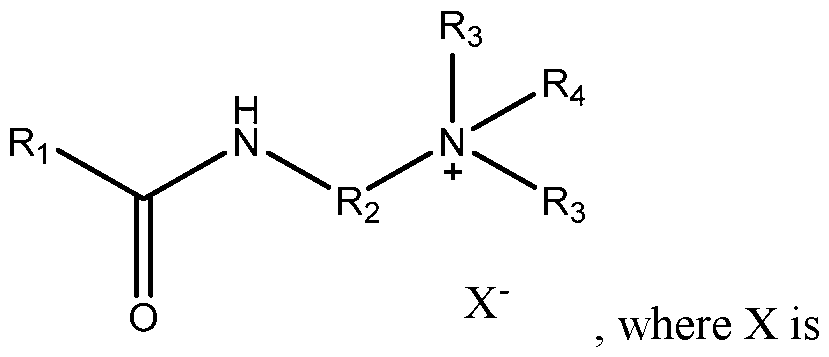
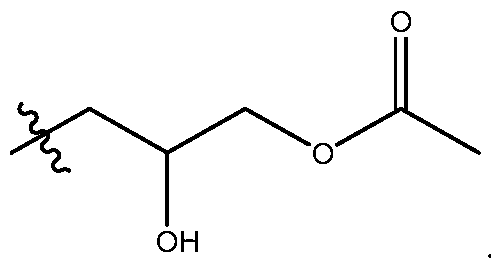
- a composition includes a compound of Formula I: halide, Ri is a saturated or unsaturated alkyl with 4 to 28 carbons, R.2 is alkyl, R.3 is methyl, and R.4 is selected from the group consisting of
- a composition includes a compound of Formula
- R is selected from the group consisting of:
- a process includes reacting a fatty acid modified with an amino alkyl group and an epihalohydrin, the presence of a base, to afford a cationic surfactant.
- a process includes reacting a fatty acid modified with an amino alkyl group, an epihalohydrin, and a carboxylic acid to afford a cationic surfactant.
- a process includes reacting a carboxylic acid, an epihalohydrin, and a catalyst to afford a halo-substituted alkyl ester.
- the process includes reacting the halo-substituted alkyl ester with a fatty acid modified with an amino alkyl group to afford a cationic surfactant.
- FIG. 1 shows an example structure of a cationic surfactant.
- FIG. 2 is a flow chart of an example method for the quatemization of a tertiary amine.
- FIG. 3 is an example reaction of N, N-dimethyl-erucyl-1,3- propylenediamine with epichlorohydrin.
- FIG. 4 is a flow chart of an example method of a two-step synthesis of cationic surfactants.
- FIG. 5A is an example reaction of a carboxylic acid and epichlorohydrin, catalyzed by tetrabutylammonium bromide.
- FIG. 5B is an example reaction of N, N-dimethyl-erucy 1-1,3, - propylenediamine with the chloro-hydroxyl alkyl ester synthesized in FIG. 5A.
- FIG. 6 is a flow chart of an example method of a one-step synthesis of cationic surfactants.
- FIG. 7 is an example reaction of N,N-dimethylerucyl-l,3,- propylenediamine, a carboxylic acid, and epichlorohydrin.
- FIG. 8 is an example IR spectrum of erucyl amidopropyl-2,3- dihydroxypropyl ammonium chloride.
- FIG. 9 is an example 1 HNMR spectrum of erucyl amidopropyl-2,3- dihydroxypropyl ammonium chloride.
- FIG. 10 is an example IR spectrum of erucyl amidopropyl-2-hydroxy-3- acetoxypropyl ammonium chloride.
- FIG. 11 is an example 1 HNMR spectrum of erucyl amidopropyl-2-hydroxy- 3-acetoxypropyl ammonium chloride.
- FIG. 12 is an example IR spectrum of erucyl amidopropyl-2-hydroxy-3-(2,
- FIG. 13 is an example 1 HNMR spectrum of erucyl ami dopropyl-2-hy droxy-
- FIG. 14 is an example IR spectrum of erucyl amidopropyl-2-hydroxy-3- propionyloxy propyl ammonium chloride.
- FIG. 15 is an example 1 HNMR spectrum of erucyl amidopropyl-2-hydroxy- 3-propionyloxy propyl ammonium chloride.
- cationic surfactants and methods of producing cationic surfactants. These surfactants are useful in enhanced oil recovery applications. For example, many carbonate reservoirs have high temperatures and high brine salinity. Currently available surfactants and polymers have limited utility in these high temperature, high salinity formations. Accordingly, it is essential to develop new surfactants that are stable and useful at high temperature and high salinity situations. In addition, the surfactants with ultra-low interfacial tension, for example tension below 10 3 mN/m, are useful for releasing trapped oil in a reservoir.
- FIG. 1 shows the structure of an example cationic surfactant.
- the surfactants include a hydrophobic tail Ra, an alkyl spacer where n
- cationic surfactants 1 to 6, and a cationic amine with two methyl groups and a functional group Rc.
- the resulting cationic surfactants are stable in high temperature and high salinity environments. Accordingly, these surfactants are useful in drilling and oil recovery applications, for example, for chemical flooding in a carbonate wellbore.
- the hydrophobic tail Ra is derived from a saturated or unsaturated fatty acid with 4 to 28 carbons.
- the fatty acid tail can be branched, unbranched, saturated, or unsaturated in either a cis- or trans- configuration.
- the properties of the fatty acid tail can influence the properties of the surfactant, for example, by influencing the melting point, stability, solubility, or the critical micelle concentration of the surfactants in seawater.
- the surfactants include ultra-long fatty acid chains, for example chains of 18 or more carbons.
- the fatty tail can be derived from erucic acid, a monounsaturated C22: lco9 fatty acid. Ultra- long fatty acid chains are very hydrophobic and typically not soluble in high salinity environments. However, the cationic surfactants described in this application have low interfacial tension and can be used in high salinity environments.
- the fatty acid head group is modified with an alkyl spacer.
- the carboxylic acid head group of a fatty acid can be reacted with an alkyl amine to form an amide bond between an alkyl spacer and a fatty acid.
- the alkyl spacer can be saturated alkyl group containing 1 to 6 carbons.
- the spacer can be a propyl group.
- the spacer can include a tertiary amine functional group. This tertiary amine can be quatemized. For example, the reaction between a tertiary amine and an epihalohydrin results in a quaternary amine.
- Quatemization of the tertiary amine introduces functional group Rc and results in the cationic surfactant.
- the positively charged amine of the cationic surfactant influences the solubility and stability of the surfactants.
- the cation can reduce surfactant adsorption in carbonate reservoirs.
- the cation can also improve the stability of the surfactant at high salinity environments, for example in brines with high concentrations of divalent ions such as Ca 2+ and Mg 2+ .
- Quatemization of the tertiary amine can be achieved by a reaction with an epihalohydrin.
- epichlorohydrin can quatemized the tertiary amine.
- Other epihalohydrins can also quatemized the tertiary amine. This results in an amine functionalized with an epoxy group. Under basic conditions, the epoxy can hydrolyze, yielding a dihydroxy functional group.
- FIG. 2 shows an example flow chart of a reaction scheme 200 for quatemization of a modified fatty acid.
- a fatty acid modified with a tertiary amine is combined with an epihalohydrin in a 1 : 1 molar ratio in a solvent.
- Suitable epihalohydrins include epichlorohydrin.
- the mixture is stirred, with heating, for 5-24 hours.
- the pH of the mixture is decreased to induce a basic condition.
- the solvent is removed from the mixture.
- the product is recry stallized.
- the final product is obtained by filtration.
- reaction scheme 200 An example of the reaction scheme 200 is shown in FIG. 3, where N, N- dimethyl-erucyl-l,3-propylenediamine is reacted with epichlorohydrin. This functionalizes the quaternary amine with an epoxide. Under basic conditions, the epoxide can hydrolyze, yielding a 1,2-dihydroxylpropyl functional group. Recrystallization of the product results in the cationic surfactant erucyl amidopropyl- 2,3-dihydroxypropyl ammonium chloride.
- Cationic surfactants can also be synthesized using a two-step process 400.
- FIG. 4 shows an example flow chart of a reaction scheme 400 to synthesize cationic surfactants.
- a carboxylic acid is combined with an epihalohydrin at a 1.25: 1 to 2: 1 molar ratio in the presence of a catalyst.
- the choice of carboxylic acid can be used to introduce additional functional groups, such as hydroxyl, ester, or polymerizable groups such as a vinyl double bond.
- the mixture is stirred with heating for 5-20 hours.
- the pH of the mixture is adjusted to approximately 7.
- the mixture is filtered to obtain the halogenated alkyl ester product.
- the halogenated alkyl ester is mixed with a modified fatty acid that contains a tertiary amine.
- the mixture is refluxed for 5-24 hours.
- the solvent is removed.
- the product is recry stallized.
- the final product, the cationic surfactant is obtained by filtering.
- FIG. 5A shows an example reaction of the first step of the two-step process 400 between a carboxylic acid (COOR) and epichlorohydrin, catalyzed by tetrabutylammonium bromide (TBAB).
- FIG. 5B shows an example reaction of the second step of the two- step process 400, where N,N-dimethyl-erucyl-l,3,-propylenediamine is combined with the chloro-hydroxyl alkyl ester synthesized in FIG. 5A. This generates a cationic surfactant that is compatible with brine solutions and has low oil-brine interfacial tension.
- the cationic surfactants can be synthesized using a one-step process.
- a carboxylic acid, an epihalohydrin, and an alkyl-modified fatty acid containing a tertiary amine are reacted to generate the cationic surfactant.
- FIG. 6 shows an example flow chart of a reaction scheme 600 for a one-step synthesis of cationic surfactants.
- a modified fatty acid that contains a tertiary amine is combined in solution with a carboxylic acid in a 1 : 1 molar ratio.
- the mixture is refluxed for 0.5 - 2 hours.
- FIG. 7 shows an example reaction of the one-step process 600, where N,N-dimethylerucyl-l,3,-propylenediamine is combined with a carboxylic acid and epichlorohydrin to yield the cationic surfactant.
- Tables 1 and 2 summarize the reactants for the one- and two-step synthetic processes, described in more detail below. [0042] Table 1: Summary of One-Step Processes, Examples 1, 3, 5, and 7
- Table 2 Summary of Two-Step Processes, Examples 2, 4, and 6
- Example 1 Synthesis of dihvdroxyl group: Erucyl amidopropyl-2. 3- dihvdroxypropyl ammonium chloride (C22APDAC)
- FIG. 8 shows an example infrared (IR) spectrum of C22APDAC, confirming the structure of C22APDAC as synthesized in Example 1.
- the wide absorption at 3290 cm 1 is due to the -N-H stretching vibration and the -O-H stretching vibration.
- the peaks at 2921 cm 1 and 2857 cm 1 are the stretching vibrations of the -CH3 and -C-H- (-CH2-) groups, respectively.
- the peak at 716 cm 1 indicates the existence of the alkyl chain. Accordingly, the IR spectrum in FIG. 8 confirms the structure of C22APDAC.
- FIG. 8 confirms the structure of C22APDAC.
- Example 9 is an example 1 HNMR spectrum of C22APDAC, confirming the structure of C22APDAC as synthesized in Example 1.
- C22APDAC was analyzed at 400 MHz in deuterated methanol. The following spectral peaks were observed, wherein s is a singlet, t is a triple, and m is a multiplet: 0.91 (m, 3H, 1), 1.31 (s, 30H, 2), 1.62 (s, 2H, 3), 2.05 (m, 6H, 4 ), 2.21 (m, 2H, 5), 3.30 (m, 14H, 6), 4.25 (m, H, 7), 5.35 (t, 2H, 8).
- the 1 HNMR spectrum provides additional confirmation of the structure of C22APDAC.
- Example 2 Two-step synthesis of erucyl amidopropyl-2-hvdroxy-3- acetoxypropyl ammonium chloride (C22APHAAC)
- Example 3 One-step synthesis of Erucyl amidopropyl-2-hvdroxy-3- acetoxypropyl ammonium chloride (C22APHAAC) 50 mmol of N, N-dimethyl-erucyl-1, 3-propylenediamine was mixed with 50 mmol of acetic acid in 10 mL of isopropanol. The mixture was heated to 95°C for 0.5 hours. 60 mmol of epichlorohydrin was added to the mixture. The mixture was then refluxed at 95°C for 7 hours. The solvent was removed under reduced pressure to yield a yellow, oily product. The synthesized product was recrystallized with acetone at -15°C for 24 hours. The purified product was obtained by filtering. The yield of the ester cationic surfactant C22APHAAC was 84.85% by weight.
- FIG. 10 shows an example IR spectrum of C22APHAAC, confirming the structure of C22APHAAC as synthesized in Example 3.
- the wide absorption at 3290 cm 1 is due to the N-H stretching vibration and the -O-H stretching vibration.
- the peaks at 2927 cm 1 and 2850 cm 1 are considered to be the stretching vibration of -CH3 and -C-H - (CH2-) groups.
- the peak at 726 cm 1 indicates the existence of the alkyl chain. Accordingly, the IR spectrum confirms the structure of C22APHAAC as synthesized in Example 3.
- FIG. 11 shows an example 1 HNMR spectrum of C22APHAAC, confirming the structure of C22APHAAC as synthesized in Example 3.
- C22APHAAC was analyzed at 400 MHz in deuterated methanol. The following spectral peaks were observed, wherein s is a singlet, t is a triple, and m is a multiplet: 0.91 (m, 3H, 1), 1.31 (s, 3 OH, 2), 1.62 (s, 2H, 3), 2.05 (m, 5H, 4 ), 2.22 (m, 2H, 5), 2.90 (m, 3H, 6), 3.32 (m, 14H, 7), 4.09 (t, 1H, 8 ), 5.35 (t, 2H, 9).
- the 1 HNMR spectrum provides additional confirmation of the structure of C22APHAAC.
- Example 4 Two-step synthesis of Erucyl amidopropyl-2-hvdroxy-3-(2.2.2 trifluoroacetoxyl propyl ammonium chloride (C22APHFAC)
- C22APHFAC was prepared with the same two-step method as Example 2, except with trifluoroacetic acid instead of acetic acid. 250 mmol of trifluoroacetic acid, 200 mmol of epichlorohydrin, and 6.25 mmol of tetrabutylammonium bromide (TBAB) were combined. The reaction mixture was heated to 90°C with stirring for 10 hours. After the reaction, the mixture was washed with saturated NaCl solution until the pH of the mixture was around 7. The remaining water in the mixture was removed using Na2S04. The product was recovered by filtering the solid. The yield of 3-chloro-2- hydroxypropyl 2, 2, 2-trifluoroacetate was 70% by weight.
- Example 5 One-step synthesis of Erucyl amidopropyl-2-hvdroxy-3-(2. 2 2 - trifluoroacetoxyl propyl ammonium chloride (C22APHFAC)
- C22APHFAC was prepared by a one-step method with the same procedures as Example 3, except trifluoroacetic acid was used instead of acetic acid.
- 50 mmol of N, N- dimethyl-erucyl-1, 3-propylenediamine was mixed with 50 mmol of trifluoroacetic acid in 10 mL of isopropanol.
- the mixture was heated to 95°C for 0.5 hours.
- 60 mmol of epichlorohydrin was added to the mixture.
- the mixture was then refluxed at 95°C for 7 hours.
- the solvent was removed under reduced pressure.
- the synthesized product was recry stallized with acetone at -15°C for 24 hours.
- the purified product was obtained by filtering.
- the yield of the ester cationic surfactant C22APFAC was 70% by weight.
- FIG. 12 shows an example IR spectrum of C22APFAC, as synthesized in Example 5.
- the IR spectrum shows a wide absorption at 3348 cm 1 due to the -N-H stretching vibration and the -O-H stretching vibration.
- the peaks at 2919 cm 1 and 2845 cm 1 are considered to be the stretching vibrations of-CFb and -C-H (-CH2-) groups.
- the peak at 726 cm 1 indicates the existence of the alkyl chain. Accordingly, the IR spectrum confirms the structure of C22APFAC.
- FIG. 13 shows an example 1 HNMR spectrum, confirming the structure of C22APFAC as synthesized in Example 5.
- C22APFAC was analyzed at 400 MHz in deuterated methanol. The following spectral peaks were observed, wherein s is a singlet, t is a triple, and m is amultiplet: 0.90 (m, 3H, 1), 1.31 (s, 30H, 2), 1.63 (s, 2H, 3), 2.05 (m, 7H, 4 ), 3.21 (m, 14H, 5), 4.09 (t, 1H, 6), 5.36 (t, 2H, 7).
- the 3 ⁇ 4NMR spectrum provides additional confirmation of the structure of C22APFAC.
- Example 6 Two-step synthesis of Erucyl amidopropyl-2-hvdroxy-3- propoionyloxy propyl ammonium chloride (C22APHPAC)
- C22APHPAC was prepared by a two-step method with the same procedures as example 2, except using propionic acid instead of acetic acid. 250 mmol of propionic acid, 200 mmol of epichlorohydrin, and 6.25 mmol of tetrabutylammonium bromide (TBAB) were combined. The reaction mixture was heated to 90°C with stirring for 10 hours. After the reaction, the mixture was washed with saturated NaCl solution until the pH of the mixture was around 7. The remaining water in the mixture was removed using Na2S04. The product was recovered by filtering the solid. The yield of 3-chloro-2- hydroxypropyl propionate was 50% by weight.
- Example 7 One-step synthesis of Erucyl amidopropyl-2-hvdroxy-3- propionyloxy propyl ammonium chloride (C22APHPAC)
- C22APHPAC was prepared by a one-step method with the same procedures as Example 3, except that propionic acid was used in place of acetic acid.
- 50 mmol of N, N- dimethyl-erucyl-1, 3-propylenediamine was mixed with 50 mmol of propionic acid in 10 mL of isopropanol.
- the mixture was heated to 95°C for 0.5 hours.
- 60 mmol of epichlorohydrin was added to the mixture.
- the mixture was then refluxed at 95°C for 7 hours.
- the solvent was removed under reduced pressure.
- the synthesized product was recrystallized with acetone at -15°C for 24 hours.
- the purified product was obtained by filtering.
- the yield of the cationic surfactant C22APHPAC was 54%.
- FIG. 14 shows an example IR spectrum of C22APHPAC as synthesized in Example 7.
- the wide absorption at 3317 cm 1 is due to the -N-H stretching vibration and the -O-H stretching vibration.
- the peaks at 2917 cm 1 and 2835 cm 1 are considered to be the stretching vibrations of the -CEE and -C-H- (-CEE-) groups, respectively.
- the peak at 716 cm 1 indicates the existence of the alkyl chain. Accordingly, the IR spectrum confirms the structure of C22APHPAC.
- FIG. 15 shows an example 1 HNMR spectrum, confirming the structure of C22APHPAC as synthesized in Example 7.
- C22APHPAC was analyzed at 400 MHz in deuterated methanol. The following spectral peaks were observed, wherein s is a singlet, t is triple, and m is multiplet: 0.91 (m, 3H, 1), 1.31 (s, 33H, 2), 1.62 (s, 2H, 3), 2.05 (m, 7H, 4 ), 2.23 (m, 2H, 5), 3.27 (m, 10H, 6), 3.52 (m, 4H, 7), 4.41 (t, 1H, 8), 5.36 (t, 2H, 9).
- the 1 HNMR spectrum provides additional confirmation of the structure of C22APHPAC.
- Example 8 Properties of Product Surfactants The properties of the surfactants in seawater including compatibility, critical micelle concentration (CMC) and the interfacial tension were investigated. The composition of seawater is listed in Table 3 and the observed properties of the surfactants are presented in Table 4.
- CMC critical micelle concentration
- a composition includes a compound of Formula I: halide, Ri is a saturated or unsaturated alkyl with 4 to 28 carbons, R2 is alkyl, R3 is methyl, and R4 is selected from the group consisting of
- R2 is propyl
- Ri is a monounsaturated alkyl chain with 21 carbons. [0070] This aspect, taken alone or combinable with any other aspect, can include the following features. Ri is
- R.4 is [0073] This aspect, taken alone or combinable with any other aspect, can include the following features. R4 is
- a composition includes a compound of Formula II: where R is selected from the group consisting of: halide.
- R is
- R is [0077] This aspect, taken alone or combinable with any other aspect, can include the following features.
- a process includes reacting a fatty acid modified with an amino alkyl group and an epihalohydrin, the presence of a base, to afford a cationic surfactant.
- This aspect taken alone or combinable with any other aspect, can include the following features. Reacting the fatty acid modified with an amino alkyl group includes reacting N, N-dimetyl-erucyl-l,3,-propylenediamine.
- Reacting the epihalohydrin includes reacting epichlorohydrin.
- Reacting in the presence of a base includes reacting in a presence of sodium hydroxide.
- a process includes reacting a fatty acid modified with an amino alkyl group, an epihalohydrin, and a carboxylic acid to afford a cationic surfactant.
- Reacting a fatty acid modified with an amino alkyl group includes reacting N,N-dimethyl-erucyl-l,3,-propylenediamine.
- Reacting an epihalohydrin includes reacting epichlorohydrin.
- Reacting a carboxylic acid includes reacting a carboxylic acid selected from acetic acid, propionic acid; and trifluoroacetic acid.
- Reacting a carboxylic acid includes reacting acetic acid.
- Reacting a carboxylic acid includes reacting propionic acid.
- Reacting a carboxylic acid includes reacting trifluoroacetic acid.
- a process includes reacting a carboxylic acid, an epihalohydrin, and a catalyst to afford a halo-substituted alkyl ester.
- the process includes reacting the halo-substituted alkyl ester with a fatty acid modified with an amino alkyl group to afford a cationic surfactant.
- This aspect taken alone or combinable with any other aspect, can include the following features.
- Reacting a catalyst includes reacting tetrabutylammonium bromide.
- Reacting an epihalohydrin includes reacting epichlorohydrin.
- Reacting a carboxylic acid includes reacting a carboxylic acid selected from acetic acid, propionic acid, and trifluoroacetic acid.
- Reacting a carboxylic acid includes reacting acetic acid.
- Reacting a carboxylic acid includes reacting propionic acid.
- Reacting a carboxylic acid includes reacting trifluoroacetic acid.
- Reacting a fatty acid modified with an amino alkyl group includes reacting N, N-dimetyl-erucyl-l,3,-propylenediamine.
- the term “substantially” as used in this disclosure refers to a majority of, or mostly, as in at least about 50%, 60%, 70%, 80%, 90%, 95%, 96%, 97%, 98%, 99%, 99.5%, 99.9%, 99.99%, or at least about 99.999% or more.
- alkyl employed alone or in combination with other terms, refers to a saturate hydrocarbon group that may be straight-chain or branched.
- halo or halogen, used alone or in combination with other terms, refers to fluoro, chloro, bromo, and iodo.
- solvent refers to a liquid that can dissolve a solid, another liquid, or a gas to form a solution.
- solvents are silicones, organic compounds, water, alcohols, ionic liquids, and supercritical fluids.
- weight percent (wt %) can be considered a mass fraction or a mass ratio of a substance to the total mixture or composition. Weight percent can be a weight-to-weight ratio or mass-to-mass ratio, unless indicated otherwise.
Landscapes
- Chemical & Material Sciences (AREA)
- Organic Chemistry (AREA)
- Chemical Kinetics & Catalysis (AREA)
- Oil, Petroleum & Natural Gas (AREA)
- Life Sciences & Earth Sciences (AREA)
- General Life Sciences & Earth Sciences (AREA)
- Engineering & Computer Science (AREA)
- Materials Engineering (AREA)
- Organic Low-Molecular-Weight Compounds And Preparation Thereof (AREA)
Abstract
Description




Claims


Priority Applications (1)
| Application Number | Priority Date | Filing Date | Title |
|---|---|---|---|
| SA523442342A SA523442342B1 (en) | 2020-07-29 | 2023-01-26 | Preparation of cationic surfactants |
Applications Claiming Priority (2)
| Application Number | Priority Date | Filing Date | Title |
|---|---|---|---|
| US16/942,565 US11286232B2 (en) | 2020-07-29 | 2020-07-29 | Preparation of cationic surfactants |
| US16/942,565 | 2020-07-29 |
Publications (1)
| Publication Number | Publication Date |
|---|---|
| WO2022026657A1 true WO2022026657A1 (en) | 2022-02-03 |
Family
ID=77431390
Family Applications (1)
| Application Number | Title | Priority Date | Filing Date |
|---|---|---|---|
| PCT/US2021/043630 Ceased WO2022026657A1 (en) | 2020-07-29 | 2021-07-29 | Preparation of cationic surfactants |
Country Status (3)
| Country | Link |
|---|---|
| US (4) | US11286232B2 (en) |
| SA (1) | SA523442342B1 (en) |
| WO (1) | WO2022026657A1 (en) |
Families Citing this family (1)
| Publication number | Priority date | Publication date | Assignee | Title |
|---|---|---|---|---|
| US11820842B2 (en) | 2020-09-09 | 2023-11-21 | Saudi Arabian Oil Company | Sulfonated polymer |
Citations (2)
| Publication number | Priority date | Publication date | Assignee | Title |
|---|---|---|---|---|
| WO2012061098A1 (en) * | 2010-10-25 | 2012-05-10 | Stepan Company | Quaternized fatty amines, amidoamines, and their derivatives from natural oil metathesis |
| CN108642879A (en) * | 2018-05-10 | 2018-10-12 | 浙江科峰新材料有限公司 | A kind of preparation process of softening agent film |
Family Cites Families (35)
| Publication number | Priority date | Publication date | Assignee | Title |
|---|---|---|---|---|
| US4274283A (en) | 1978-10-16 | 1981-06-23 | Exxon Production Research Company | Apparatus and method for measuring fluid gel strength |
| US4283321A (en) | 1979-10-03 | 1981-08-11 | Gaf Corporation | Alkyl aryl ethyleneoxy sulfonate surfactants for vinyl acetate polymerization |
| US4526947A (en) | 1982-05-14 | 1985-07-02 | The Goodyear Tire & Rubber Company | N,N-Dimethylacrylamide copolymer injection water viscosifier for enhanced oil recovery |
| US4719423A (en) | 1985-08-13 | 1988-01-12 | Shell Oil Company | NMR imaging of materials for transport properties |
| US4691558A (en) | 1986-06-19 | 1987-09-08 | Halliburton Company | Pressure pulse gelation test apparatus and method |
| US4979390A (en) | 1988-12-01 | 1990-12-25 | Morris Schupack | Method and apparatus for testing relative permeability of materials |
| US5101903A (en) | 1990-09-04 | 1992-04-07 | Akzo Nv | Method for modifying the permeability of an underground formation |
| US5387865A (en) | 1991-09-20 | 1995-02-07 | Exxon Research And Engineering Company | Permeability determination from NMR relaxation measurements for fluids in porous media |
| GB2262117B (en) | 1991-12-05 | 1995-05-03 | British Petroleum Co Plc | Method for the production of oil |
| JP4377063B2 (en) * | 1998-07-27 | 2009-12-02 | エルジー・ケム・リミテッド | Method for producing cationic surfactant having ester group in molecule |
| US6903064B1 (en) | 1999-05-26 | 2005-06-07 | Procter & Gamble Company | Detergent composition comprising polymeric suds volume and suds duration enhancers |
| CA2384108C (en) | 1999-09-07 | 2011-07-05 | Crompton Corporation | Quaternary ammonium salts as thickening agents for aqueous systems |
| US7254091B1 (en) | 2006-06-08 | 2007-08-07 | Bhp Billiton Innovation Pty Ltd. | Method for estimating and/or reducing uncertainty in reservoir models of potential petroleum reservoirs |
| US8725477B2 (en) | 2008-04-10 | 2014-05-13 | Schlumberger Technology Corporation | Method to generate numerical pseudocores using borehole images, digital rock samples, and multi-point statistics |
| US8648018B2 (en) | 2009-03-12 | 2014-02-11 | Conocophillips Company | Crosslinked swellable polymer |
| US9134457B2 (en) | 2009-04-08 | 2015-09-15 | Schlumberger Technology Corporation | Multiscale digital rock modeling for reservoir simulation |
| US20110004447A1 (en) | 2009-07-01 | 2011-01-06 | Schlumberger Technology Corporation | Method to build 3D digital models of porous media using transmitted laser scanning confocal mircoscopy and multi-point statistics |
| US8260589B1 (en) | 2009-12-24 | 2012-09-04 | Indian Institute Of Technology Madras | Methods and systems for modeling a physical object |
| RU2576501C2 (en) | 2011-02-28 | 2016-03-10 | Шлюмбергер Текнолоджи Б.В. | Methods of building 3-dimensional digital models of porous medium using combination of high and low resolution data and multi-point statistics |
| US9176081B2 (en) | 2011-04-29 | 2015-11-03 | Schlumberger Technology Corporation | NMR analysis of unconventional reservoir rock samples |
| CA2764539C (en) | 2012-01-16 | 2015-02-10 | Husky Oil Operations Limited | Method for creating a 3d model of a hydrocarbon reservoir, and method for comparative testing of hydrocarbon recovery techniques |
| US8970867B2 (en) | 2012-03-06 | 2015-03-03 | Mercury 3D, Llc | Secure management of 3D print media |
| US9558588B2 (en) | 2012-06-26 | 2017-01-31 | Schlumberger Technology Corporation | Method for building a 3D model of a rock sample |
| US10240436B2 (en) | 2012-09-20 | 2019-03-26 | Schlumberger Technology Corporation | Method of treating subterranean formation |
| JP6054981B2 (en) | 2012-10-03 | 2016-12-27 | 株式会社日本触媒 | (Meth) acrylic acid copolymer and method for producing the same |
| KR101964200B1 (en) | 2012-11-13 | 2019-04-01 | 주식회사 동진쎄미켐 | Preparation method of conductive polymer for electrolytic capacitor |
| US20140144628A1 (en) | 2012-11-26 | 2014-05-29 | University Of Kansas | Crosslinking of swellable polymer with pei |
| CN105026505B (en) | 2013-03-11 | 2018-12-14 | 陶氏环球技术有限责任公司 | Adhesive composition and its application in Anti-dew coating composition |
| CN103806905B (en) | 2013-07-31 | 2016-08-24 | 中国石油大学(华东) | Preparation has the device and method of the carbonate reservoir physical model of double porosity |
| US10228358B2 (en) | 2015-04-17 | 2019-03-12 | Pion Inc. | Apparatus and method for the assessment of concentration profiling and permeability rates |
| US10359486B2 (en) | 2016-04-03 | 2019-07-23 | Q Bio, Inc. | Rapid determination of a relaxation time |
| CN106543359B (en) | 2016-11-03 | 2019-07-12 | 中国地质大学(北京) | Fluid loss agent and its preparation method and application and water-base drilling fluid and its application |
| CN107841303B (en) | 2017-11-10 | 2019-04-12 | 中国石油大学(华东) | A kind of controllable viscoplasticity supermolecule clean fracturing liquid system and preparation method thereof |
| US10689978B2 (en) | 2018-05-31 | 2020-06-23 | Saudi Arabian Oil Company | Method for determining gelation time in a core plug |
| US11820842B2 (en) | 2020-09-09 | 2023-11-21 | Saudi Arabian Oil Company | Sulfonated polymer |
-
2020
- 2020-07-29 US US16/942,565 patent/US11286232B2/en active Active
-
2021
- 2021-07-29 WO PCT/US2021/043630 patent/WO2022026657A1/en not_active Ceased
- 2021-12-15 US US17/551,945 patent/US11591292B2/en active Active
- 2021-12-15 US US17/551,915 patent/US11591291B2/en active Active
- 2021-12-15 US US17/552,073 patent/US11993553B2/en active Active
-
2023
- 2023-01-26 SA SA523442342A patent/SA523442342B1/en unknown
Patent Citations (2)
| Publication number | Priority date | Publication date | Assignee | Title |
|---|---|---|---|---|
| WO2012061098A1 (en) * | 2010-10-25 | 2012-05-10 | Stepan Company | Quaternized fatty amines, amidoamines, and their derivatives from natural oil metathesis |
| CN108642879A (en) * | 2018-05-10 | 2018-10-12 | 浙江科峰新材料有限公司 | A kind of preparation process of softening agent film |
Non-Patent Citations (1)
| Title |
|---|
| YU ERLEI ET AL: "Synthesis of Novel Zwitterionic Heterogemini Surfactants Derived from Fatty Acid and Investigation of Their Behavior at the Air-Water Interface", LETTERS IN ORGANIC CHEMISTRY, vol. 12, no. 8, 26 August 2015 (2015-08-26), NL, pages 590 - 597, XP055859309, ISSN: 1570-1786, DOI: 10.2174/1570178612666150629181035 * |
Also Published As
| Publication number | Publication date |
|---|---|
| US20220106260A1 (en) | 2022-04-07 |
| US11591291B2 (en) | 2023-02-28 |
| US20220033348A1 (en) | 2022-02-03 |
| US20220106261A1 (en) | 2022-04-07 |
| US20220106262A1 (en) | 2022-04-07 |
| US11993553B2 (en) | 2024-05-28 |
| SA523442342B1 (en) | 2024-10-16 |
| US11591292B2 (en) | 2023-02-28 |
| US11286232B2 (en) | 2022-03-29 |
Similar Documents
| Publication | Publication Date | Title |
|---|---|---|
| CN103111229B (en) | Gemini type fluorocarbon surfactant containing sulfonic group and preparation method thereof | |
| CN116333759B (en) | Preparation method of temperature-resistant surfactant | |
| KR100975520B1 (en) | Improved Method of Making Mycophenolate Mofetil | |
| US11591291B2 (en) | Preparation of cationic surfactants | |
| CN103464050A (en) | Positive ion Gemini surfactants with head base region including hydroxyl radicals and preparation method thereof | |
| JP5905445B2 (en) | Surfactant composition with polyfluoroalkylsulfonamidoalkylamine | |
| CN1839111B (en) | Preparation method of medium-chain fatty acid metal salt | |
| JP2007106958A (en) | Fluorosurfactant | |
| KR102351563B1 (en) | Fluoride alkyl glycerin derivatives and its surfactant use | |
| NO171224B (en) | PROCEDURE FOR INHIBITING CORROSION ON METALS | |
| US3931238A (en) | Preparation of alcohols and ethers | |
| WO2005075442A1 (en) | Dehydrating condensation agent having property of accumulating at interface with water | |
| CN111088011A (en) | Composite surfactant for improving crude oil recovery ratio and preparation method and application thereof | |
| JPH032855B2 (en) | ||
| CN117511527B (en) | Descaling blocking remover and preparation method thereof | |
| CN104001449B (en) | Quaternary Ammonium Gemini Surfactants containing biphenyl group and preparation method thereof | |
| JP3569788B2 (en) | Method for producing fluorinated quaternary ammonium salt | |
| JPH0782207A (en) | Production of fluorenone and oxidation catalyst used therein | |
| EP3896055B1 (en) | Ammonium salt having saccharin anion | |
| CN117844458A (en) | A zwitterionic emulsifier and preparation method thereof | |
| JPH0328412B2 (en) | ||
| JP2019026590A (en) | 4-(2-oxiranylmethoxy) benzoic acid alkenyl ester and method for producing the same | |
| JPS6217586B2 (en) | ||
| JP2024047405A (en) | Surfactant | |
| JP6295495B2 (en) | Method for synthesizing ammonium salt and composition containing polysaccharide in synthesized ammonium salt |
Legal Events
| Date | Code | Title | Description |
|---|---|---|---|
| 121 | Ep: the epo has been informed by wipo that ep was designated in this application |
Ref document number: 21758515 Country of ref document: EP Kind code of ref document: A1 |
|
| NENP | Non-entry into the national phase |
Ref country code: DE |
|
| 32PN | Ep: public notification in the ep bulletin as address of the adressee cannot be established |
Free format text: NOTING OF LOSS OF RIGHTS PURSUANT TO RULE 112(1) EPC (EPO FORM 1205A DATED 17/07/2023) |
|
| WWE | Wipo information: entry into national phase |
Ref document number: 523442342 Country of ref document: SA |
|
| 122 | Ep: pct application non-entry in european phase |
Ref document number: 21758515 Country of ref document: EP Kind code of ref document: A1 |
|
| WWE | Wipo information: entry into national phase |
Ref document number: 523442342 Country of ref document: SA |
|
| WWG | Wipo information: grant in national office |
Ref document number: 523442342 Country of ref document: SA |