WO2022020295A1 - Aprosamine derivatives - Google Patents
Aprosamine derivatives Download PDFInfo
- Publication number
- WO2022020295A1 WO2022020295A1 PCT/US2021/042290 US2021042290W WO2022020295A1 WO 2022020295 A1 WO2022020295 A1 WO 2022020295A1 US 2021042290 W US2021042290 W US 2021042290W WO 2022020295 A1 WO2022020295 A1 WO 2022020295A1
- Authority
- WO
- WIPO (PCT)
- Prior art keywords
- compound
- formula
- bacterium
- aac
- alkyl
- Prior art date
- Legal status (The legal status is an assumption and is not a legal conclusion. Google has not performed a legal analysis and makes no representation as to the accuracy of the status listed.)
- Ceased
Links
- 0 C*O[C@](C(C1CO)N)OC(CN)[C@]1O Chemical compound C*O[C@](C(C1CO)N)OC(CN)[C@]1O 0.000 description 10
- BWCLXBGKQHNMLT-WBFVSEPISA-N CC(O[C@H](C(C1CO)N)OC(CN)[C@H]1O)=C Chemical compound CC(O[C@H](C(C1CO)N)OC(CN)[C@H]1O)=C BWCLXBGKQHNMLT-WBFVSEPISA-N 0.000 description 1
Classifications
-
- C—CHEMISTRY; METALLURGY
- C07—ORGANIC CHEMISTRY
- C07H—SUGARS; DERIVATIVES THEREOF; NUCLEOSIDES; NUCLEOTIDES; NUCLEIC ACIDS
- C07H15/00—Compounds containing hydrocarbon or substituted hydrocarbon radicals directly attached to hetero atoms of saccharide radicals
- C07H15/20—Carbocyclic rings
- C07H15/22—Cyclohexane rings, substituted by nitrogen atoms
- C07H15/222—Cyclohexane rings substituted by at least two nitrogen atoms
- C07H15/226—Cyclohexane rings substituted by at least two nitrogen atoms with at least two saccharide radicals directly attached to the cyclohexane rings
- C07H15/228—Cyclohexane rings substituted by at least two nitrogen atoms with at least two saccharide radicals directly attached to the cyclohexane rings attached to adjacent ring-carbon atoms of the cyclohexane rings
- C07H15/23—Cyclohexane rings substituted by at least two nitrogen atoms with at least two saccharide radicals directly attached to the cyclohexane rings attached to adjacent ring-carbon atoms of the cyclohexane rings with only two saccharide radicals in the molecule, e.g. ambutyrosin, butyrosin, xylostatin, ribostamycin
-
- A—HUMAN NECESSITIES
- A61—MEDICAL OR VETERINARY SCIENCE; HYGIENE
- A61P—SPECIFIC THERAPEUTIC ACTIVITY OF CHEMICAL COMPOUNDS OR MEDICINAL PREPARATIONS
- A61P31/00—Antiinfectives, i.e. antibiotics, antiseptics, chemotherapeutics
- A61P31/04—Antibacterial agents
-
- C—CHEMISTRY; METALLURGY
- C07—ORGANIC CHEMISTRY
- C07H—SUGARS; DERIVATIVES THEREOF; NUCLEOSIDES; NUCLEOTIDES; NUCLEIC ACIDS
- C07H15/00—Compounds containing hydrocarbon or substituted hydrocarbon radicals directly attached to hetero atoms of saccharide radicals
- C07H15/20—Carbocyclic rings
- C07H15/22—Cyclohexane rings, substituted by nitrogen atoms
- C07H15/222—Cyclohexane rings substituted by at least two nitrogen atoms
- C07H15/226—Cyclohexane rings substituted by at least two nitrogen atoms with at least two saccharide radicals directly attached to the cyclohexane rings
- C07H15/228—Cyclohexane rings substituted by at least two nitrogen atoms with at least two saccharide radicals directly attached to the cyclohexane rings attached to adjacent ring-carbon atoms of the cyclohexane rings
- C07H15/232—Cyclohexane rings substituted by at least two nitrogen atoms with at least two saccharide radicals directly attached to the cyclohexane rings attached to adjacent ring-carbon atoms of the cyclohexane rings with at least three saccharide radicals in the molecule, e.g. lividomycin, neomycin, paromomycin
Definitions
- Aminoglycoside antibiotics are listed by the World Health Organization as critically important antimicrobials for human therapy. Their high efficacy, broad-spectrum antibacterial activity, in combination with their unmatched rapid bactericidal potency, lack of drug-related allergy, little protein binding and minimal drug metabolism, absence of interaction with other pharmaceutical agents and with the host’s intestinal microbiome, are features that combine to make aminoglycosides a potent and powerful choice for the treatment of infections by Gram-negative pathogens. Profound clinical experience with this antibiotic class, accumulated since their introduction in the 1950s, and correspondingly predictable absorption, distribution, metabolism, and excretion mitigate the risk in new aminoglycoside antibiotic development.
- Aminoglycoside antibiotics bind to helix 44 of 16S rRNA, which is part of the decoding A-site of the small ribosomal subunit, resulting in mRNA misreading and translocation inhibition (see Davies, J.; Gorini, L.; Davies, B. D., Misreading of RNA Codewords Induced by Aminoglycoside Antibiotics. Mol. Pharmacol. 1965, 1, 93 ⁇ 106; and Caba ⁇ as, M. J.; Vázquez, D.; Modolell, J., Inhibition of Ribosomal Translocation by Aminoglycoside Antibiotics. Biochem. Biophys. Res. Comm. 1978, 83, 991 ⁇ 997).
- aminoglycoside toxicity is mainly mechanism-of-action-related, with limitations in ribosomal target selectivity being the main denominator.
- aminoglycoside antibiotic pharmacokinetics are notably different for the human host versus the bacterial pathogen. Bactericidal activity is peak concentration-dependent while aminoglycoside transport into eukaryotic cells is limited and readily saturated, with host toxicity being mainly trough level-dependent. Consequently, aminoglycoside antibiotic toxicity can be minimized and bactericidal activity enhanced by administration of a single daily dose, combining high peak concentrations with low trough levels, for a period not exceeding 10- 14 days. Clinically relevant aminoglycoside antibiotics are increasingly challenged by emerging resistance.
- AMEs aminoglycoside-modifying enzymes
- RMTases target-modifying enzymes
- AMEs modify specific hydroxy or amino substituents on the compound’s scaffold and are comprised of three different families: aminoglycoside acetyltransferases (AACs), aminoglycoside phosphotransferases (APHs), and aminoglycoside nucleotidyl transferases (ANTs) (see Vakulenko, S. B.; Mobashery, S., Versatility of Aminoglycosides and Prospects for Their Future. Clin. Microbiol. Rev. 2003, 16, 430 ⁇ 450).
- AACs aminoglycoside acetyltransferases
- APHs aminoglycoside phosphotransferases
- ANTs aminoglycoside nucleotidyl transferases
- RMTases modify the drug binding pocket by methylation, particularly at N7 of G1405. While AMEs have been known for more than 50 years, RMTases were first described in a clinical pathogen only more recently (see Galimand, M.; Courvalin, P.; Lambert, T., Plasmid ⁇ Mediated High ⁇ Level Resistance to Aminoglycosides in Enterobacteriaceae Due to 16S rRNA Methylation. Antimicrob. Agent. Chemother.2003, 47, 2565 ⁇ 2571).
- aprosamine derivatives which are useful in the treatment of bacterial infections, in particular infections with bacteria that are resistant to one or more antibiotics.
- the presently disclosed compounds are particularly active against Gram-negative bacteria that have developed resistance to more classical aminoglycoside antibiotics, through for example one of the mechanisms of resistance described herein.
- a compound is provided of Formula I-a, Formula I-b, Formula II-a, or Formula II-b: or a pharmaceutically acceptable salt or derivative thereof; wherein all variables are further defined herein.
- a pharmaceutical composition comprising a therapeutically effective amount of a compound described herein and a pharmaceutically acceptable carrier.
- a method for treating an infection with a bacterium in a subject comprising administering a therapeutically effective amount of a compound described herein, or a pharmaceutically acceptable salt or derivative thereof.
- the bacterium may comprise a Gram-negative bacterium.
- the bacterium may comprise a Gram-positive bacterium.
- the bacterium may comprise a mycobacterium.
- the bacterium may display resistance to one or more antibiotics.
- the terms “about”, “approximate”, “at or about”, and “substantially” mean that the amount or value in question can be the exact value or a value that provides equivalent results or effects as recited in the claims or taught herein. That is, it is understood that amounts, sizes, formulations, parameters, and other quantities and characteristics are not and need not be exact, but may be approximate and/or larger or smaller, as desired, reflecting tolerances, conversion factors, rounding off, measurement error and the like, and other factors known to those of skill in the art such that equivalent results or effects are obtained. In some circumstances, the value that provides equivalent results or effects cannot reasonably be determined.
- an amount, size, formulation, parameter, or other quantity or characteristic is “about”, “approximate”, or “at or about” whether or not expressly stated to be such. It is understood that where “about”, “approximate”, or “at or about” is used before a quantitative value, the parameter also includes the specific quantitative value itself, unless specifically stated otherwise.
- effective amount can refer to the amount of a disclosed compound or pharmaceutical composition provided herein that is sufficient to effect beneficial or desired biological, emotional, medicinal, or clinical response of a cell, tissue, system, animal, or human.
- an effective amount can be administered in one or more administrations, applications, or dosages.
- the term can also include within its scope amounts effective to enhance or restore substantially normal physiological function.
- therapeutically effective amount refers to an amount that is sufficient to achieve the desired therapeutic result or to have an effect on undesired symptoms but is generally insufficient to cause adverse side effects.
- the specific therapeutically effective dose level for any particular patient will depend upon a variety of factors including the disorder being treated and the severity of the disorder; the specific composition employed; the age, body weight, general health, sex and diet of the patient; the time of administration; the route of administration; the rate of excretion of the specific compound employed; the duration of the treatment; drugs used in combination or coincidental with the specific compound employed and like factors within the knowledge and expertise of the health practitioner and which may be well known in the medical arts.
- the desired response can be inhibiting the progression of the disease or condition. This may involve only slowing the progression of the disease temporarily. However, in other instances, it may be desired to halt the progression of the disease permanently.
- the desired response to treatment of the disease or condition also can be delaying the onset or even preventing the onset of the disease or condition.
- the dosage can be adjusted by the individual physician in the event of any contraindications. It is generally preferred that a maximum dose of the pharmacological agents of the invention (alone or in combination with other therapeutic agents) be used, that is, the highest safe dose according to sound medical judgement.
- a response to a therapeutically effective dose of a disclosed compound or pharmaceutical composition can be measured by determining the physiological effects of the treatment or medication, such as the decrease or lack of disease symptoms following administration of the treatment or pharmacological agent.
- Other assays will be known to one of ordinary skill in the art and can be employed for measuring the level of the response.
- the amount of a treatment may be varied for example by increasing or decreasing the amount of a disclosed compound and/or pharmaceutical composition, by changing the disclosed compound and/or pharmaceutical composition administered, by changing the route of administration, by changing the dosage timing and so on.
- Dosage can vary and can be administered in one or more dose administrations daily for one or several days. Guidance can be found in the literature for appropriate dosages for given classes of pharmaceutical products.
- prophylactically effective amount refers to an amount effective for preventing onset or initiation of a disease or condition.
- prevent or preventing refers to precluding, averting, obviating, forestalling, stopping, or hindering something from happening, especially by advance action. It is understood that where reduce, inhibit or prevent are used herein, unless specifically indicated otherwise, the use of the other two words is also expressly disclosed.
- the terms “optional” or “optionally” means that the subsequently described event or circumstance can or cannot occur, and that the description includes instances where said event or circumstance occurs and instances where it does not.
- “subject”, “individual”, or “patient” can refer to a vertebrate organism, such as a mammal (e.g., human). “Subject” can also refer to a cell, a population of cells, a tissue, an organ, or an organism, preferably to a human and constituents thereof.
- the terms “treating” and “treatment” can refer generally to obtaining a desired pharmacological and/or physiological effect.
- treatment can include any treatment of a medical disorder in a subject, particularly a human and can include any one or more of the following: (a) preventing the disease from occurring in a subject which may be predisposed to the disease but has not yet been diagnosed as having it; (b) inhibiting the disease, i.e., arresting its development; and (c) relieving the disease, i.e., mitigating or ameliorating the disease and/or its symptoms or conditions.
- treatment as used herein can refer to both therapeutic treatment alone, prophylactic treatment alone, or both therapeutic and prophylactic treatment.
- Those in need of treatment can include those already with the disorder and/or those in which the disorder is to be prevented.
- the term “treating”, can include inhibiting the disease, disorder or condition, e.g., impeding its progress; and relieving the disease, disorder, or condition, e.g., causing regression of the disease, disorder and/or condition.
- Treating the disease, disorder, or condition can include ameliorating at least one symptom of the particular disease, disorder, or condition, even if the underlying pathophysiology is not affected, e.g., such as treating the pain of a subject by administration of an analgesic agent even though such agent does not treat the cause of the pain.
- dose can refer to physically discrete units suitable for use in a subject, each unit containing predetermined quantity of a disclosed compound and/or a pharmaceutical composition thereof calculated to produce the desired response or responses in association with its administration.
- therapeutic can refer to treating, healing, and/or ameliorating a disease, disorder, condition, or side effect, or to decreasing the rate of advancement of a disease, disorder, condition, or side effect.
- the compounds described herein include diastereomers, tautomers, and other isomers, such as rotamers, as if each is specifically described, unless otherwise indicated or otherwise excluded by context.
- a dash (“-”) that is not between two letters or symbols is used to indicate a point of attachment for a substituent.
- substituted means that any one or more hydrogens on the designated atom or group is replaced with a moiety selected from the indicated group, provided that the designated atom’s normal valence is not exceeded and the resulting compound is stable.
- a stable active compound refers to a compound that can be isolated and can be formulated into a dosage form with a shelf life of at least one month.
- a stable manufacturing intermediate or precursor to an active compound is stable if it does not degrade within the period needed for reaction or other use.
- a stable moiety or substituent group is one that does not degrade, react or fall apart within the period necessary for use.
- Non-limiting examples of unstable moieties are those that combine heteroatoms in an unstable arrangement, as typically known and identifiable to those of skill in the art.
- Any suitable group may be present on a “substituted” or “optionally substituted” position that forms a stable molecule and meets the desired purpose of the invention and includes, but is not limited to: alkyl, haloalkyl, alkoxy, alkenyl, alkynyl, aryl, heteroaryl, cycloalkyl, heterocycle, aldehyde, amino, carboxylic acid, ester, ether, halo, hydroxy, keto, nitro, cyano, azido, silyl, sulfo-oxo, sulfonyl, sulfone, sulfoxide, sulfonylamino, or thiol.
- Alkyl is a straight chain or branched saturated aliphatic hydrocarbon group.
- the alkyl is C 1 -C 2 , C 1 -C 3 , or C 1 -C 6 (i.e., the alkyl chain can be 1, 2, 3, 4, 5, or 6 carbons in length).
- the specified ranges as used herein indicate an alkyl group with length of each member of the range described as an independent species.
- C 1 -C 6 alkyl as used herein indicates an alkyl group having from 1, 2, 3, 4, 5, or 6 carbon atoms and is intended to mean that each of these is described as an independent species and C 1 -C 4 alkyl as used herein indicates an alkyl group having from 1, 2, 3, or 4 carbon atoms and is intended to mean that each of these is described as an independent species.
- C 0 -C n alkyl When C 0 -C n alkyl is used herein in conjunction with another group, for example (C 3 -C 7 cycloalkyl)C 0 -C 4 alkyl, or -C 0 -C 4 (C 3 -C 7 cycloalkyl), the indicated group, in this case cycloalkyl, is either directly bound by a single covalent bond (C 0 alkyl), or attached by an alkyl chain, in this case 1, 2, 3, or 4 carbon atoms. Alkyls can also be attached via other groups such as heteroatoms, as in -O-C 0 -C 4 alkyl(C 3 -C 7 cycloalkyl).
- alkyl examples include, but are not limited to, methyl, ethyl, n-propyl, isopropyl, n-butyl, isobutyl, sec-butyl, t-butyl, n-pentyl, isopentyl, tert-pentyl, neopentyl, n-hexyl, 2-methylpentane, 3-methylpentane, 2,2-dimethylbutane, and 2,3-dimethylbutane.
- the alkyl group is optionally substituted as described herein.
- Aryl indicates an aromatic group containing only carbon in the aromatic ring or rings.
- the aryl group contains 1 to 3 separate or fused rings and is 6 to 14 or 18 ring atoms, without heteroatoms as ring members.
- such aryl groups may be further substituted with carbon or non-carbon atoms or groups.
- Such substitution may include fusion to a 4- to 7- or 5- to 7-membered saturated or partially unsaturated cyclic group that optionally contains 1, 2, or 3 heteroatoms independently selected from N, O, B, P, Si and S, to form, for example, a 3,4-methylenedioxyphenyl group.
- Aryl groups include, for example, phenyl and naphthyl, including 1-naphthyl and 2-naphthyl. In one embodiment, aryl groups are pendant.
- a pendant ring is a phenyl group substituted with a phenyl group.
- the aryl group is optionally substituted as described herein.
- “Heteroaryl” refers to a stable monocyclic, bicyclic, or multicyclic aromatic ring which contains from 1 to 3, or in some embodiments from 1, 2, or 3 heteroatoms selected from N, O, S, B and P (and typically selected from N, O, and S) with remaining ring atoms being carbon, or a stable bicyclic or tricyclic system containing at least one 5, 6, or 7 membered aromatic ring which contains from 1 to 3, or in some embodiments from 1 to 2, heteroatoms selected from N, O, S, B, or P with remaining ring atoms being carbon.
- the only heteroatom is nitrogen. In one embodiment, the only heteroatom is oxygen. In one embodiment, the only heteroatom is sulfur. Monocyclic heteroaryl groups typically have from 5 to 6 ring atoms. In some embodiments, bicyclic heteroaryl groups and 8- to 1-membered heteroaryl groups, that is, groups containing 8 or 10 ring atoms in which one 5, 6, or 7 member aromatic ring is fused to a second aromatic or non-aromatic ring, wherein the point of attachment is the aromatic ring. When the total number of S and O atoms in the heteroaryl group excess 1, these heteroatoms are not adjacent to one another. In one embodiment, the total number of S and O atoms in the heteroaryl group is not more than 2.
- the total number of S and O atoms in the heteroaryl group is not more than one.
- heteroaryl groups include, but are not limited to, pyridinyl (including, for example, 2 hydroxypyridinyl), imidazolyl, imidazopyridinyl, pyrimidinyl (including, for example, 4-hydroxypyrimidinyl), pyrazolyl, triazolyl, pyrazinyl, furyl, thienyl, isoxazolyl, thiazolyl, oxadiazolyl, oxazolyl, isothiazolyl, pyrrolyl, quinolinyl, isoquinolinyl, tetrahydroisoquinolinyl, indolyl, benzimidazolyl, benzofuranyl, cinnolinyl, indazolyl, indolizinyl, phthalazinyl, pyridazinyl, triazinyl,
- Heteroaryl groups may be optionally substituted independently with one or more substituents as described herein.
- a “pharmaceutically acceptable salt” is a derivative of the disclosed compound in which the parent compound is modified by making inorganic and organic, pharmaceutically acceptable, acid or base addition salts thereof.
- the salts of the present compounds can be synthesized from a parent compound that contains a basic or acidic moiety by conventional chemical methods. Generally, such salts can be prepared by reacting free acid forms of these compounds with a stoichiometric amount of the appropriate base (such as Na, Ca, Mg, or K hydroxide, carbonate, bicarbonate, or the like), or by reacting free base forms of these compounds with a stoichiometric amount of the appropriate acid.
- the appropriate base such as Na, Ca, Mg, or K hydroxide, carbonate, bicarbonate, or the like
- Salts of the present compounds further include solvates of the compounds and of the compound salts.
- pharmaceutically acceptable salts include, but are not limited to, mineral or organic acid salts of basic residues such as amines; alkali or organic salts of acidic residues such as carboxylic acids; and the like.
- the pharmaceutically acceptable salts include salts which are acceptable for human consumption and the quaternary ammonium salts of the parent compound formed, for example, from inorganic or organic salts.
- Example of such salts include, but are not limited to, those derived from inorganic acids such as hydrochloric, hydrobromic, sulfuric, sulfamic, phosphoric, nitric, and the like; and the salts prepared from organic acids such as acetic, propionic, succinic, glycolic, stearic, lactic, malic, tartaric, citric, ascorbic, pamoic, maleic, hydroxymaleic, phenylacetic, glutamic, benzoic, salicyclic, mesylic, esylic, besylic, sulfanilic, 2-acetoxybenzoic, fumaric, toluenesulfonic, methanesulfone, ethane disulfonic, oxalic, isethionic, HOOC-(CH 2 ) 1-4 -COOH, and the like, or using a different acid that produced the same counterion.
- inorganic acids such as hydrochloric, hydro
- the present disclosure also includes compounds with at least one desired isotopic substitution of an atom, at an amount above the natural abundance of the isotope, i.e., enriched.
- isotopes that can be incorporated into compounds of the present disclosure include isotopes of hydrogen, carbon, nitrogen, oxygen, phosphorous, fluorine, and chlorine, such as 2 H, 3 H, 11 C, 13 C, 15 N, 17 O, 18 O, 18 F, 31 P , 32 P, 35 S, 36 Cl, and 125 I, respectively.
- isotopically labeled compounds can be used in metabolic studies (with 14 C), reaction kinetic studies (with, for example 2 H or 3 H), detection or imaging techniques, such as positron emission tomography (PET) or single-photon emission computed tomography (SPECT) including drug and substrate tissue distribution assays, or in radioactive treatment of patients.
- PET positron emission tomography
- SPECT single-photon emission computed tomography
- an 18 F labeled compound may be particularly desirable for PET or SPECT studies.
- Isotopically labeled compounds of this invention and prodrugs thereof can generally be prepared by carrying out the procedures disclosed herein by substituting a readily available isotopically labeled reagent for a non- isotopically labeled reagent.
- isotopes of hydrogen for example deuterium ( 2 H) and tritium ( 3 H) may optionally be used anywhere in described structures that achieves the desired result.
- isotopes of carbon e.g., 13 C and 14 C, may be used.
- the isotopic substitution is replacing hydrogen with a deuterium at one or more locations on the molecule to improve the performance of the molecule as a drug, for example, the pharmacodynamics, pharmacokinetics, biodistribution, half-life, stability, AUC, T max , C max , etc.
- the deuterium can be bound to carbon in allocation of bond breakage during metabolism (an alpha-deuterium kinetic isotope effect) or next to or near the site of bond breakage (a beta- deuterium kinetic isotope effect).
- Isotopic substitutions for example deuterium substitutions, can be partial or complete. Partial deuterium substitution means that at least one hydrogen is substituted with deuterium.
- the isotope is 80, 85, 90, 95, or 99% or more enriched in an isotope at any location of interest. In some embodiments, deuterium is 80, 85, 90, 95, or 99% enriched at a desired location.
- the enrichment at any point is above natural abundance, and in an embodiment is enough to alter a detectable property of the compounds as a drug in a human.
- the compounds of the present disclosure may form a solvate with solvents (including water). Therefore, in one embodiment, the invention includes a solvated form of the active compound.
- solvate refers to a molecular complex of a compound of the present invention (including a salt thereof) with one or more solvent molecules.
- solvents are water, ethanol, dimethyl sulfoxide, acetone and other common organic solvents.
- hydrate refers to a molecular complex comprising a disclosed compound and water.
- solvates in accordance with the invention include those wherein the solvent of crystallization may be isotopically substituted, e.g., D 2 O, d6-acetone, or d6-DMSO.
- a solvate can be in a liquid or solid form.
- a “prodrug” as used herein means a compound which when administered to a host in vivo is converted into a parent drug.
- the term “parent drug” means any of the presently described compounds herein.
- Prodrugs can be used to achieve any desired effect, including to enhance properties of the parent drug or to improve the pharmaceutic or pharmacokinetic properties of the parent, including to increase the half-life of the drug in vivo.
- Prodrug strategies provide choices in modulating the conditions for in vivo generation of the parent drug.
- Non-limiting examples of prodrug strategies include covalent attachment of removable groups, or removable portions of groups, for example, but not limited to, acylating, phosphorylation, phosphonylation, phosphoramidate derivatives, amidation, reduction, oxidation, esterification, alkylation, other carboxy derivatives, sulfoxy or sulfone derivatives, carbonylation, or anhydrides, among others.
- the prodrug renders the parent compound more lipophilic.
- a prodrug can be provided that has several prodrug moieties in a linear, branched, or cyclic manner.
- non-limiting embodiments include the use of a divalent linker moiety such as a dicarboxylic acid, amino acid, diamine, hydroxycarboxylic acid, hydroxyamine, di- hydroxy compound, or other compound that has at least two functional groups that can link the parent compound with another prodrug moiety, and is typically biodegradable in vivo.
- a divalent linker moiety such as a dicarboxylic acid, amino acid, diamine, hydroxycarboxylic acid, hydroxyamine, di- hydroxy compound, or other compound that has at least two functional groups that can link the parent compound with another prodrug moiety, and is typically biodegradable in vivo.
- 2, 3, 4, or 5 prodrug biodegradable moieties are covalently bound in a sequence, branched, or cyclic fashion to the parent compound.
- Non-limiting examples of prodrugs according to the present disclosure are formed with: an amino on the parent drug and a carboxylic acid prodrug moiety to form an amide; an amino on the parent drug and a sulfonic acid to form a sulfonamide; a hydroxyl group on the parent drug and a carboxylic acid on the prodrug moiety to form an ester; a hydroxyl on the parent drug and a hydroxylated prodrug moiety to form an ester; a hydroxyl on the parent drug and a phosphonate on the prodrug to form a phosphonate ester; a hydroxyl on the parent drug and a phosphoric acid prodrug moiety to form a phosphate ester; a hydroxyl on the parent drug and a prodrug of the structure HO-(CH 2 ) 2 -O-(C 2 - 24 alkyl) to form an ether; a hydroxyl on the parent drug and a prodrug of the structure HO
- a prodrug is provided by attaching a natural or non-natural amino acid to an appropriate functional moiety on the parent compound, for example, oxygen, nitrogen, or sulfur, and typically oxygen or nitrogen, usually in a manner such that the amino acid is cleaved in vivo to provide the parent drug.
- the amino acid can be used alone or covalently linked (straight, branched or cyclic) to one or more other prodrug moieties to modify the parent drug to achieve the desired performance, such as increased half-life, lipophilicity, or other drug delivery or pharmacokinetic properties.
- the amino acid can be any compound with an amino group and a carboxylic acid, which includes an aliphatic amino acid, alkyl amino acid, aromatic amino acid, heteroaliphatic amino acid, heteroalkyl amino acid, heterocyclic amino acid, or heteroaryl amino acid.
- Compounds The present disclosure provides compounds which can be used in the treatment of bacterial infections, in particular infections with bacteria which have developed resistance to one or more antibiotics.
- a compound is provided of Formula I-a or Formula I-b: or a pharmaceutically acceptable salt or derivative thereof; wherein: X 1 is selected from -O-, -S-, and -CH 2 ; X 2 is selected from -O- and -S-; R 1 is selected from -H, -CH 3 , -CH 2 CH 3 , -CH 2 NH 2 , -CH 2 OH, -CH 2 CH 2 NH 2 , -CH 2 CH 2 OH, -CH 2 NHR 7 , -SR 7 , -CH 2 F, -CHF 2 , and -CF 3 ; R 2 is selected from -H, -OH, and -N(R a ) 2 ; one of R 3 and R 3’ is selected from -OH and -NH 2 , and the other of R 3 and R 3’ is selected from -H; R 4 is selected from -H, -OH, -NH 2 , and -NHR
- X 1 is -O-. In some embodiments of Formula I-a or Formula I-b, X 1 is -S-. In some embodiments of Formula I-a or Formula I-b, X 1 is -CH 2 . In some embodiments of Formula I-a or Formula I-b, X 2 is -O-. In some embodiments of Formula I-a or Formula I-b, X 2 is -S-. In some embodiments of Formula I-a or Formula I-b, R 1 is -H. In some embodiments of Formula I-a or Formula I-b, R 1 is -CH 3 .
- R 1 is -CH 2 CH 3 . In some embodiments of Formula I-a or Formula I-b, R 1 is -CH 2 NH 2 . In some embodiments of Formula I-a or Formula I-b, R 1 is -CH 2 OH. In some embodiments of Formula I-a or Formula I-b, R 1 is -CH 2 CH 2 NH 2 . In some embodiments of Formula I-a or Formula I-b, R 1 is -CH 2 CH 2 OH. In some embodiments of Formula I-a or Formula I-b, R 1 is -CH 2 NHR 7 . In some embodiments of Formula I-a or Formula I-b, R 1 is -SR 7 .
- R 1 is -CH 2 F. In some embodiments of Formula I-a or Formula I-b, R 1 is -CHF 2 . In some embodiments of Formula I-a or Formula I-b, R 1 is -CF 3 . In some embodiments of Formula I-a or Formula I-b, R 1 is -S(C 1 -C 4 alkyl). In some embodiments of Formula I-a or Formula I-b, R 1 is -SCH 3 . In some embodiments of Formula I-a or Formula I-b, R 1 -S(aryl). In some embodiments of Formula I-a or Formula I-b, R 2 is -H.
- R 2 is -OH. In some embodiments of Formula I-a or Formula I-b, R 2 is -N(R a ) 2 . In some embodiments of Formula I-a or Formula I-b, R 2 is -NH(C 1 -C 4 alkyl). In some embodiments of Formula I-a or Formula I-b, R 2 is -NHCH 3 . In some embodiments of Formula I-a or Formula I-b, R 3 is -OH and R 3’ is -H. In some embodiments of Formula I-a or Formula I-b, R 3 is -NH 2 and R 3’ is -H.
- R 3 is -H and R 3’ is -OH. In some embodiments of Formula I-a or Formula I-b, R 3 is -H and R 3’ is -NH 2 . In some embodiments of Formula I-a or Formula I-b, R 4 is -H. In some embodiments of Formula I-a or Formula I-b, R 4 is -OH. In some embodiments of Formula I-a or Formula I-b, R 4 is -NH 2 . In some embodiments of Formula I-a or Formula I-b, R 4 is -NHR b . In some embodiments of Formula I-a or Formula I-b, R 4 is -NH(CHO).
- R 4 is .
- R 5 is -H.
- R 5 is -COR c .
- R 5 is -CONHR c .
- R 5 is CON(OH)R c .
- R 5 is -CHO.
- R 5 is .
- R 6 is -H.
- R 6 is -F. In some embodiments of Formula I-a or Formula I-b, R 6 is -OH. In some embodiments of Formula I-a or Formula I-b, R 6 is -O(CH 2 ) n NH 2 , wherein n is 2 or 3. In some embodiments of Formula I-a or Formula I-b, R 6 is -O(CH 2 ) n NH(CH 2 ) m NH 2 , wherein n and m are independently 2 or 3. In some embodiments of Formula I-a or Formula I-b, R 6 is -O(CH 2 ) n -N-morpholino, wherein n is 2 or 3.
- R 6 is -O(CH 2 ) n -N-piperidino, wherein n is 2 or 3. In some embodiments of Formula I-a or Formula I-b, R 6 is -O(CH 2 ) n -N-[(CH 2 ) m OH] 2 , wherein n and m are independently 2 or 3. In some embodiments of Formula I-a or Formula I-b, n is 2. In some embodiments of Formula I-a or Formula I-b, n is 3. In some embodiments of Formula I-a or Formula I-b, m is 2. In some embodiments of Formula I-a or Formula I-b, m is 3.
- R 6 is In some embodiments of Formula I-a or Formula I-b, R 6 is . In some embodiments of Formula I-a or Formula I-b, R 7 is optionally substituted C 1 -C 4 alkyl. In some embodiments of Formula I-a or Formula I-b, R 7 is optionally substituted aryl. In some embodiments of Formula I-a or Formula I-b, R 7 is optionally substituted heteroaryl. In some embodiments of Formula I-a, the compound is selected from . In some embodiments of Formula I-b, the compound is selected from: . In some embodiments of Formula I-a, the compound is selected from:
- the compound of Formula I-b is selected from: , ,
- the compound is selected from: . In some embodiments of Formula I-a, the compound is selected from:
- the compound is selected from: In some embodiments of Formula I-a, the compound is selected from:
- the compound is selected from: . In some embodiments of Formula I-b, the compound is selected from: In some embodiments of Formula I-b, the compound is selected from: CH 3 CH 3 HN OH HN H In some embodiments of Formula I-b, the compound is selected from: In another aspect, a compound of Formula II-a or II-b is provided: or a pharmaceutically acceptable salt or derivative thereof; wherein: R 8 is selected from -H or -CH 2 R 9 ; R 9 is selected from -OH, -NH 2 , -NHCHO, or -NH(CH 2 ) n NH 2 ; and all other variables are as defined herein.
- X 1 is -O-. In some embodiments of Formula II-a or Formula II-b, X 1 is -S-. In some embodiments of Formula II-a or Formula II-b, X 1 is -CH 2 . In some embodiments of Formula II-a or Formula II-b, X 2 is -O-. In some embodiments of Formula II-a or Formula II-b, X 2 is -S-. In some embodiments of Formula II-a or Formula II-b, R 2 is -H. In some embodiments of Formula I-a or Formula I-b, R 2 is -OH.
- R 2 is -N(R a ) 2 . In some embodiments of Formula II-a or Formula II-b, R 2 is -NH(C 1 -C 4 alkyl). In some embodiments of Formula II-a or Formula II-b, R 2 is -NHCH 3 . In some embodiments of Formula II-a or Formula II-b, R 3 is -OH and R 3’ is -H. In some embodiments of Formula II-a or Formula II-b, R 3 is -NH 2 and R 3’ is -H. In some embodiments of Formula II-a or Formula II-b, R 3 is -H and R 3’ is -OH.
- R 3 is -H and R 3’ is -NH 2 .
- R 4 is -H.
- R 4 is -OH.
- R 4 is -NH 2 .
- R 4 is -NHR b .
- R 4 is -NH(CHO).
- R 4 is In some embodiments of Formula II-a or Formula II-b, R 5 is -H.
- R 5 is -COR c . In some embodiments of Formula II-a or Formula II-b, R 5 is -CONHR c . In some embodiments of Formula II-a or Formula II-b, R 5 is CON(OH)R c . In some embodiments of Formula II-a or Formula II-b, R 5 is -CHO. In some embodiments of Formula II-a of Formula II-b, R 5 is . In some embodiments of Formula II-a or Formula II-b, R 6 is -H. In some embodiments of Formula II-a or Formula II-b, R 6 is -F. In some embodiments of Formula II-a or Formula II-b, R 6 is -OH.
- R 6 is -O(CH 2 ) n NH 2 , wherein n is 2 or 3. In some embodiments of Formula II-a or Formula II-b, R 6 is -O(CH 2 ) n NH(CH 2 ) m NH 2 , wherein n and m are independently 2 or 3. In some embodiments of Formula II-a or Formula II-b, R 6 is -O(CH2)n-N-morpholino, wherein n is 2 or 3. In some embodiments of Formula II-a or Formula II-b, R 6 is -O(CH 2 ) n -N-piperidino, wherein n is 2 or 3.
- R 6 is -O(CH 2 ) n -N-[(CH 2 ) m OH] 2 , wherein n and m are independently 2 or 3.
- n is 2.
- n is 3.
- m is 2.
- m is 3.
- R 6 is In some embodiments of Formula II-a or Formula II-b, R 6 is .
- R 7 is optionally substituted C 1 -C 4 alkyl. In some embodiments of Formula II-a or Formula II-b, R 7 is methyl. In some embodiments of Formula II-a or Formula II-b, R 7 is ethyl. In some embodiments of Formula II-a or Formula II-b, R 7 is n-propyl. In some embodiments of Formula II-a or Formula II-b, R 7 is isopropyl. In some embodiments of Formula II-a or Formula II-b, R 7 is n-butyl. In some embodiments of Formula II-a or Formula II-b, R 7 is isobutyl.
- R 7 is sec-butyl. In some embodiments of Formula II-a or Formula II-b, R 7 is tert-butyl. In some embodiments of Formula II-a or Formula II-b, R 7 is optionally substituted aryl. In some embodiments of Formula II-a or Formula II-b, R 7 is phenyl. In some embodiments of Formula II-a or Formula II-b, R 7 is naphthyl. In some embodiments of Formula II-a or Formula II-b, R 7 is optionally substituted heteroaryl. In some embodiments of Formula II-a or Formula II-b, R 8 is -H.
- R 8 is -CH 2 R 9 . In some embodiments of Formula II-a or Formula II-b, R 8 is -CH 2 OH. In some embodiments of Formula II-a or Formula II-b, R 8 is -CH 2 NH 2 . In some embodiments of Formula II-a or Formula II-b, R 8 is -CH 2 NH(CH 2 ) n NH 2 , wherein n is 2 or 3. In some embodiments of Formula II-a, the compound is selected from . In some embodiments of Formula I-b, the compound is selected from: . In some embodiments of Formula II-a, the compound is selected from: In some embodiments, the compound of Formula II-b is selected from:
- the compound is selected from: In some embodiments of Formula II-a, the compound is selected from: In some embodiments of Formula II-a, the compound is selected from: In some embodiments of Formula II-a, the compound is selected from:
- the compound is selected from: In some embodiments of Formula II-a, the compound is selected from:
- the compound is selected from: In some embodiments of Formula II-b, the compound is selected from: . In some embodiments of Formula II-b, the compound is selected from: In some embodiments of Formula II-b, the compound is selected from: In some embodiments of Formula II-b, the compound is selected from:
- the compound is selected from: In some embodiments of Formula II-b, the compound is selected from:
- the present disclosure also provides methods for the treatment of medical disorder caused by a bacterium, for example a bacterial infection in a subject.
- the compounds disclosed herein may be used to treat a disorder, typically an infection, caused by a Gram-negative bacterium.
- Many Gram-negative bacteria are known to be pathogenic to animals and/or plants, including mammals such as humans, and can cause diseases and disorders such as enteritis, septicemia, meningitis, enteric fever, pneumonia, epiplottitis, cellulitis, diarrhea and sexually transmitted disease.
- Gram-negative cocci include three microorganisms which can cause a sexually transmitted disease (e.g., Neisseria gonorrheoeae), a meningitis (e.g., Neisseria meningitidis), and respiratory symptoms (e.g., Moraxella catarrhalis).
- a sexually transmitted disease e.g., Neisseria gonorrheoeae
- a meningitis e.g., Neisseria meningitidis
- respiratory symptoms e.g., Moraxella catarrhalis
- Some Gram-negative bacilli can cause respiratory problems (e.g., Hemophilus influenzae, Klebsiella pneumoniae, Legionella pneumophila, Psuedomonas aeruginosa), urinary problems (e.g., Escherichia coli, Proteus mirabilis, Enterobacter cloacae, Serratia marcescens), and gastrointestinal problems (e.g., Helicobacter pylori, Salmonella enteritidis, Salmonella typhi).
- respiratory problems e.g., Hemophilus influenzae, Klebsiella pneumoniae, Legionella pneumophila, Psuedomonas aeruginosa
- urinary problems e.g., Escherichia coli, Proteus mirabilis, Enterobacter cloacae, Serratia marcescens
- gastrointestinal problems e.g., Helicobacter pylori, Salmonella enteritidis, Salmonella typhi
- Gram-negative bacteria associated with nosocomial infections can also include, but are not limited to, Acinetobacter baumannii, which causes bacteremia, secondary meningitis, and ventilator-associated pneumonia in intensive-care units of hospital establishments.
- a method to treat an infection caused by a Gram-negative bacterium comprising administering a therapeutically effective amount of a compound described herein, or a pharmaceutically acceptable salt or derivative thereof.
- Non-limiting examples of Gram-negative bacteria whose infections may be treated using the compounds described herein, either alone or in combination with another therapeutic, include: Acinetobacter species including Acinetobacter baumannii and Acinetobacter lwoffii; Aeromonas species including Aeromonas veronii biovar sobria (previously Aeromonas sobria), Aeromonas caviae, and Aeromonas hydrophila; Alcaligenes/Achromobacter species including Alcaligenes faecalis and Alcaligenes xylosoxidans; Bacteroides species including Bacteroides fragilis; Bartonella species including Bartonella bacilliformis, Bartonella clarridgeiae, Bartonella elizabethae, Bartonella henselae, Bartonella koehlerae, Bartonella naantalienis, Bartonella quintana, Bartonella rochalimae, Bar
- Gram-negative bacterial infections which may be treated by the compounds described herein include, but are not limited to, respiratory tract infections (such as lower respiratory tract infections), sexually transmitted diseases, urinary tract infections, acute exacerbation of chronic bronchitis, respiratory infections of patients having cystic fibrosis, acute otitis media, neonatal septicemia, acute sinusitis, sepsis (such as catheter related sepsis), chlamydia, community-acquired pneumonia, nosocomial respiratory tract infections, complicated or uncomplicated skin or skin structure infections, gonococcal cervicitis or urethritis, hospital-acquired pneumonia, and osteomyelitis.
- respiratory tract infections such as lower respiratory tract infections
- sexually transmitted diseases such as lower respiratory tract infections
- urinary tract infections such as lower respiratory tract infections
- acute exacerbation of chronic bronchitis respiratory infections of patients having cystic fibrosis, acute otitis media, neonatal septicemia, acute sinusitis,
- Representative infections include those caused by Salmonella typhimurium (gastrointestinal infections, i.e., salmonellosis), Shigella spp. (gastrointestinal infections, i.e., shigellosis), Escherichia coli (urinary tract infections), Acinetobacter baumanii (wound infections), Pseudomonas aeruginosa (bloodstream infections and pneumonia), Klebsiella pneumoniae (pneumonia, urinary tract infections, and bloodstream infections), Neisseria gonorrhoeae (sexually transmitted diseases, i.e., gonorrhea), Neisseria meningitides (meningitis), Serratia spp.
- Salmonella typhimurium gastrointestinal infections, i.e., salmonellosis
- Shigella spp. gastrointestinal infections, i.e., shigellosis
- Escherichia coli urinary tract infections
- Acinetobacter baumanii wound infections
- the compounds disclosed herein may be used to treat a disorder, typically an infection, caused by a Gram-positive bacterium.
- a method to treat an infection caused by a Gram-positive bacterium comprising administering a therapeutically effective amount of a compound described herein, or a pharmaceutically acceptable salt or derivative thereof.
- Gram- positive bacteria which may be treated using the compounds described herein either alone or in combination with another therapeutic include, but are not limited to: Actinomyces species including Actinomyces israelii, Actinomyces naeslundii, Actinomyces viscosus, Actinomyces odontolyticus, and Actinomyces pyogenes; Bacillus species including Bacillus antracis, Bacillus cereus, and Bacillus subtilis; Clostridium species including Clostridium botulinum, Clostridium difficile, Clostridium perfingens, Clostridium sordellii, and Clostridium tetani; Corynebacterium species including Corynebacterium diphtheriae, Coryne
- the compounds described herein may be used to treat a disorder, typically an infection, caused by a mycobacterium.
- a method to treat an infection caused by a mycobacterium comprising administering a therapeutically effective amount of a compound described herein, or a pharmaceutically acceptable salt or derivative thereof.
- Non-limiting examples of mycobacterium which may be treated using the compounds described herein either alone or in combination with another therapeutic include, but are not limited to: Mycobacterium tuberculosis, Mycobacterium bovis, Mycobacterium africanum, Mycobacterium microti, Mycobacterium canetti, Mycobacterium leprae, Mycobacterium lepromatosis, Mycobacterium kansasii, Mycobacterium simiae, Mycobacterium marinum, Mycobacterium scrofulaceum, Mycobacterium szulgai, Mycobacterium avium, Mycobacterium intracellulare, Mycobacterium ulcerans, Mycobacterium xenopi, Mycobacterium malmoense, Mycobacterium terrae, Mycobacterium haemophilum, Mycobacterium genavense, Mycobacterium chelonae, Mycobacterium abscessus, Mycobacterium fortuitum, Mycobacterium peregrinum, Myco
- Non-limiting examples of disorder mediated by bacteria that may be treated by the compounds described herein include actinomycosis, anaplasmosis, anthrax, bacillary angiomatosis, actinomycetoma, bacterial pneumonia, bacterial vaginosis, bacterial endocarditis, bartonellosis, botulism, boutenneuse fever, brucellosis, bejel, brucellosis spondylitis, bubonic plague, Buruli ulcer, Bairnsdale ulcer, bacillary dysentery, campylobacteriosis, Carrion’s disease, cat-scratch disease, cellulitis, chancrois, chlamydia, chlamydia conjunctivitis, clostridial myenecrosis, cholera, Clostridium difficile colitis, diphteria, Daintree ulcer, donavanosis, dysentery, ehrlichiosis, epidemic typhus,
- the compounds described herein may be used to treat an inflammatory disorder resulting from a bacterial infection, including but not limited to: adenoiditis, appendicitis, arteritis, ascending cholangitis, balanitis, blepharitis, bronchitis, bursitis, cellulitis, cerebral vasculitis, cervicitis, cemosis, cholecystitis, chondritis, choroioamnionitis, colitis, conjunctivitis, constrictive pericarditis, cryptitis, dacryoadenitis, dermatitis, duodenal lymphocytosis, encephalitis, endocarditis, endometritis, endothelitis, enteritis, enterocolitis, eosinophilis fasciitis, epididymitis, esophagitis, folliculitis, gastritis, gingivitis, glomeruloneph
- the compounds described herein may be used in the treatment of infections caused by a bacterium that has developed resistance to one or more antibiotics.
- a method for treating an infection in a subject caused by an antibiotic-resistant bacterium comprising administering a therapeutically effective amount of a compound described herein, or a pharmaceutically acceptable salt or derivative thereof.
- Gram-negative antibiotic resistant bacteria include, but are not limited to: antibiotic-resistant Burkholderia cepacian, carbapenem-resistant Enterobacteriaceae (CRE) bacteria, drug-resistant Campylobacter, drug-resistant non- typhoidal Salmonella, drug-resistant Shigella, multi-drug-resistant Acinetobacter, multi- drug-resistant Escherichia coli, multi-drug-resistant Klebsiella pneumoniae, multi-drug- resistant Neisseria Gonorrhoeae, and multi-drug-resistant Pseudomonas aeruginosa.
- CRE carbapenem-resistant Enterobacteriaceae
- antibiotic-resistant Gram-positive bacteria include, but are not limited to: antibiotic-resistant Clostridium difficile, drug-resistant Streptococcus pneumoniae, clindamycin-resistant Group B Streptococcus, erythromycin-resistant Group A Streptococcus, methicillin-resistant Staphyloccocus aureus (MRSA), vancomycin-resistant Staphylococcus aureus (VRSA), and vancomycin-resistant Enterococcus (VRE).
- MRSA methicillin-resistant Staphyloccocus aureus
- VRSA vancomycin-resistant Staphylococcus aureus
- VRE vancomycin-resistant Enterococcus
- the antibiotic-resistant bacterium may comprise a mycobacterium, for example Mycobacterium tuberculosis.
- the antibiotic-resistant bacterium may be selected from Clostridium difficile, Enterococcus faecalis, Enterococcus faecium, Mycobacterium tuberculosis, Mycobacterium abscessus, Staphylococcus aureus, Streptococcus pyogenes, Streptococcus pneumoniae, Campylobacter spp., Neisseria gonorrhoeae, Klebsiella pneumoniae, Salmonella spp., Escherichia coli, Acinetobacter spp., and Pseudomonas aeruginosa.
- the bacterium may express one or more carbapenemases.
- Carbapenemases are ⁇ -lactamases with versatile hydrolytic capabilities, having the ability to hydrolyze penicillins, cephalosporins, monobactams, and carbapenems.
- Non-limiting examples of carbapenemases include, but are not limited to: Class A carbapenemases such as SME-1, SME-2, SME-3, IMI-1, IMI-2, NMC-A, KPC-1, KPC-2, KPC-3, KPC-4, GES-2, GES-4, GES-5, and GES-6; class B metallo- ⁇ -lactamases such as BcII, IMP-1, IMP-3, IMP-4, IMP-6, IMP-8, Ccr-A, VIM-1, VIM-2, VIM-4, VIM-5 SPM-1, CphA, Sfn-1, L1, FEZ-1, Gob-1, and CAU-1; and class D oxa- ⁇ -lactamases such as OXA-23, OXA-24, OXA-25, OXA-26, OXA-27, OXA-40, OXA-48, OXA-49, OXA-50, OXA-50a, OXA-50b,
- the bacterium may express one or more ribosomal methyltransferases (RMTs).
- RMTs ribosomal methyltransferases
- Representative examples of RMTs which may be expressed include, but are not limited to, ArmA, RmtA, RmtB, RmtC, RmtD, RmtE, RmtF, RmtG and RmtH.
- the bacterium may express one or more aminoglycoside- modifying enzymes (AMEs).
- the AME may comprise an aminoglycoside N-acetyltransferase.
- aminoglycoside N- acetyltransferases which may be expressed by the bacterium include, but are not limited to, AAC(1), AAC(3)-Ia, AAC(3)-Ib, AAC(3)-Ic, AAC(3)-Id, AAC(3)-Ie, AAC(3)-IIa, AAC(3)-IIb, AAC(3)-IIc, AAC(3)-IIa, AAC(3)-IIb, AAC(3)-IIIC, AAC(3)-IVa, AAC(3)- VIa, AAC(3)-VIIa, AAC(3)-VIIIa, AAC(3)-IXa, AAC(3)-X, AAC(3)-X, AAC(3)-X, AAC(3)-X, AAC(3)-X, AAC(3)-X, AAC(3)-X, AAC(3)-X, AAC(3)-X, AAC(3)-X, AAC(3)-X, AAC(3)-X, AAC(3)-X, AAC(3)-X, AAC(3)-X, AAC(3)-X, A
- the AME may comprise an aminoglycoside O-phosphotransferase.
- aminoglycoside O-phosphotransferases which may be expressed by the bacterium include, but are not limited to, APH(4)-Ia, APH(4)-Ib, APH(6)-Ia, APH(6)-Ib, APH(6)-Ic, APH(6)- Id, APH(9)-Ia, APH(9)-Ib, APH(3’)-Ia, APH(3’)-Ib, APH(3’)-Ic, APH(3’)-IIa, APH(3’)- IIb, APH(3’)-IIc, APH(3’)-IIIa, APH(3’)-IVa, APH(3’)-Va, APH(3’)-Vb, APH(3’)-Vc, APH(3’)-VIa, APH(3’)-VIb, APH(3’)-VIb, APH(
- the AME comprises an aminoglycoside O-nucleotidyltransferase.
- Representative examples of aminoglycoside O-nucleotidyltransferases which may be expressed by the bacterium include, but are not limited to, ANT(6)-Ia, ANT(6)-Ib, ANT(9)- Ia, ANT(9)-Ib, ANT(4’)-Ia, ANT(4’)-IIa, ANT(4’)-IIb, ANT(2’’)-Ia, and ANT(3’’)-Ia.
- a method for treating contamination of a surface with a bacterium comprising contacting the surface with an effective amount of a compound described herein, or a pharmaceutically acceptable salt or derivative thereof.
- the surface may comprise a portion of a physical object (for example, a medical device) or may comprise an environmental surface (for example, a building surface or plant surface).
- the surface may comprise a portion of a medical device, for example medical tubings, urinary catheters, mucous extraction catheters, suction catheters, umbilical cannulas, contact lenses, intrauterine devices, intravaginal and intraintestinal devices, endotracheal tubes, bronchoscopes, dental protheses and orthodontic devices, surgical instruments, dental instruments, dental water lines, dental drain tubes, fabrics, paper, indicator strips (e.g., paper indicator strips or plastic indicator strips), adhesives (e.g., hydrogel adhesives, hot-melt adhesives, or solvent-based adhesives), bandages, tissue dressing or healing devices and occlusive patches, and any other devices used in the medical field.
- a medical device for example medical tubings, urinary catheters, mucous extraction catheters, suction catheters, umbilical cannulas, contact lenses, intrauterine devices, intravaginal and intraintestinal devices, endotracheal tubes, bronchoscopes, dental protheses and orthodontic devices, surgical instruments, dental instruments
- the compounds described herein can also be used in various fields as where antiseptic treatment or disinfection of materials is required, for example, surface disinfection, including for use in bioremediation, such as industry settings, including cleaning of heating and cooling systems, such as HVAC systems.
- Methods of Administration The compounds as used in the methods described herein can be administered by any suitable method and technique presently or prospectively known to those skilled in the art.
- the active components described herein can be formulated in a physiologically- or pharmaceutically-acceptable form and administered by any suitable route known in the art including, for example, oral and parenteral routes of administering.
- parenteral includes subcutaneous, intradermal, intravenous, intramuscular, intraperitoneal, and intrasternal administration, such as by injection.
- Administration of the active components of their compositions can be a single administration, or at continuous and distinct intervals as can be readily determined by a person skilled in the art.
- Compositions, as described herein, comprising an active compound and an excipient of some sort may be useful in a variety of medical and non-medical applications.
- pharmaceutical compositions comprising an active compound and an excipient may be useful for the treatment or prevention of an infection as described herein.
- Excipients include any and all solvents, diluents or other liquid vehicles, dispersion or suspension aids, surface active agents, isotonic agents, thickening or emulsifying agents, preservatives, solid binders, lubricants and the like, as suited to the particular dosage form desired.
- General considerations in formulation and/or manufacture can be found, for example, in Remington's Pharmaceutical Sciences, Sixteenth Edition, E. W. Martin (Mack Publishing Co., Easton, Pa., 1980), and Remington: The Science and Practice of Pharmacy, 21st Edition (Lippincott Williams & Wilkins, 2005).
- excipients include, but are not limited to, any non-toxic, inert solid, semisolid or liquid filler, diluent, encapsulating material or formulation auxiliary of any type.
- materials which can serve as excipients include, but are not limited to, sugars such as lactose, glucose, and sucrose; starches such as corn starch and potato starch; cellulose and its derivatives such as sodium carboxymethyl cellulose, ethyl cellulose, and cellulose acetate; powdered tragacanth; malt; gelatin; talc; excipients such as cocoa butter and suppository waxes; oils such as peanut oil, cottonseed oil; safflower oil; sesame oil; olive oil; corn oil and soybean oil; glycols such as propylene glycol; esters such as ethyl oleate and ethyl laurate; agar; detergents such as Tween 80; buffering agents such as magnesium hydroxide and aluminum hydro
- the excipients may be chosen based on what the composition is useful for.
- the choice of the excipient will depend on the route of administration, the agent being delivered, time course of delivery of the agent, etc., and can be administered to humans and/or to animals, orally, rectally, parenterally, intracisternally, intravaginally, intranasally, intraperitoneally, topically (as by powders, creams, ointments, or drops), buccally, or as an oral or nasal spray.
- the active compounds disclosed herein are administered topically.
- Exemplary diluents include calcium carbonate, sodium carbonate, calcium phosphate, dicalcium phosphate, calcium sulfate, calcium hydrogen phosphate, sodium phosphate lactose, sucrose, cellulose, microcrystalline cellulose, kaolin, mannitol, sorbitol, inositol, sodium chloride, dry starch, cornstarch, powdered sugar, etc., and combinations thereof.
- Exemplary granulating and/or dispersing agents include potato starch, corn starch, tapioca starch, sodium starch glycolate, clays, alginic acid, guar gum, citrus pulp, agar, bentonite, cellulose and wood products, natural sponge, cation-exchange resins, calcium carbonate, silicates, sodium carbonate, cross-linked poly(vinyl-pyrrolidone) (crospovidone), sodium carboxymethyl starch (sodium starch glycolate), carboxymethyl cellulose, cross- linked sodium carboxymethyl cellulose (croscarmellose), methylcellulose, pregelatinized starch (starch 1500), microcrystalline starch, water insoluble starch, calcium carboxymethyl cellulose, magnesium aluminum silicate (Veegum), sodium lauryl sulfate, quaternary ammonium compounds, etc., and combinations thereof.
- cross-linked poly(vinyl-pyrrolidone) crospovidone
- sodium carboxymethyl starch sodium starch glycolate
- Exemplary surface active agents and/or emulsifiers include natural emulsifiers (e.g. acacia, agar, alginic acid, sodium alginate, tragacanth, chondrux, cholesterol, xanthan, pectin, gelatin, egg yolk, casein, wool fat, cholesterol, wax, and lecithin), colloidal clays (e.g. bentonite [aluminum silicate] and Veegum [magnesium aluminum silicate]), long chain amino acid derivatives, high molecular weight alcohols (e.g.
- stearyl alcohol cetyl alcohol, oleyl alcohol, triacetin monostearate, ethylene glycol distearate, glyceryl monostearate, and propylene glycol monostearate, polyvinyl alcohol
- carbomers e.g. carboxy polymethylene, polyacrylic acid, acrylic acid polymer, and carboxy vinyl polymer
- carrageenan cellulosic derivatives (e.g. carboxymethylcellulose sodium, powdered cellulose, hydroxymethyl cellulose, hydroxypropyl cellulose, hydroxypropyl methylcellulose, methylcellulose), sorbitan fatty acid esters (e.g.
- Cremophor polyoxyethylene ethers, (e.g. polyoxyethylene lauryl ether [Brij 30]), poly(vinyl- pyrrolidone), diethylene glycol monolaurate, triethanolamine oleate, sodium oleate, potassium oleate, ethyl oleate, oleic acid, ethyl laurate, sodium lauryl sulfate, Pluronic F 68, Poloxamer 188, cetrimonium bromide, cetylpyridinium chloride, benzalkonium chloride, docusate sodium, etc. and/or combinations thereof.
- Exemplary binding agents include starch (e.g. cornstarch and starch paste), gelatin, sugars (e.g.
- natural and synthetic gums e.g. acacia, sodium alginate, extract of Irish moss, panwar
- Exemplary preservatives include antioxidants, chelating agents, antimicrobial preservatives, antifungal preservatives, alcohol preservatives, acidic preservatives, and other preservatives.
- Exemplary antioxidants include alpha tocopherol, ascorbic acid, ascorbyl palmitate, butylated hydroxyanisole, butylated hydroxytoluene, monothioglycerol, potassium metabisulfite, propionic acid, propyl gallate, sodium ascorbate, sodium bisulfite, sodium metabisulfite, and sodium sulfite.
- Exemplary chelating agents include ethylenediaminetetraacetic acid (EDTA) and salts and hydrates thereof (e.g., sodium edetate, disodium edetate, trisodium edetate, calcium disodium edetate, dipotassium edetate, and the like), citric acid and salts and hydrates thereof (e.g., citric acid monohydrate), fumaric acid and salts and hydrates thereof, malic acid and salts and hydrates thereof, phosphoric acid and salts and hydrates thereof, and tartaric acid and salts and hydrates thereof.
- EDTA ethylenediaminetetraacetic acid
- salts and hydrates thereof e.g., sodium edetate, disodium edetate, trisodium edetate, calcium disodium edetate, dipotassium edetate, and the like
- citric acid and salts and hydrates thereof e.g., citric acid mono
- antimicrobial preservatives include benzalkonium chloride, benzethonium chloride, benzyl alcohol, bronopol, cetrimide, cetylpyridinium chloride, chlorhexidine, chlorobutanol, chlorocresol, chloroxylenol, cresol, ethyl alcohol, glycerin, hexetidine, imidurea, phenol, phenoxyethanol, phenylethyl alcohol, phenylmercuric nitrate, propylene glycol, and thimerosal.
- Exemplary antifungal preservatives include butyl paraben, methyl paraben, ethyl paraben, propyl paraben, benzoic acid, hydroxybenzoic acid, potassium benzoate, potassium sorbate, sodium benzoate, sodium propionate, and sorbic acid.
- Exemplary alcohol preservatives include ethanol, polyethylene glycol, phenol, phenolic compounds, bisphenol, chlorobutanol, hydroxybenzoate, and phenylethyl alcohol.
- Exemplary acidic preservatives include vitamin A, vitamin C, vitamin E, beta- carotene, citric acid, acetic acid, dehydroacetic acid, ascorbic acid, sorbic acid, and phytic acid.
- preservatives include tocopherol, tocopherol acetate, deteroxime mesylate, cetrimide, butylated hydroxyanisol (BHA), butylated hydroxytoluene (BHT), ethylenediamine, sodium lauryl sulfate (SLS), sodium lauryl ether sulfate (SLES), sodium bisulfite, sodium metabisulfite, potassium sulfite, potassium metabisulfite, Glydant Plus, Phenonip, methylparaben, Germall 115, Germaben II, Neolone, Kathon, and Euxyl.
- the preservative is an anti-oxidant.
- the preservative is a chelating agent.
- buffering agents include citrate buffer solutions, acetate buffer solutions, phosphate buffer solutions, ammonium chloride, calcium carbonate, calcium chloride, calcium citrate, calcium glubionate, calcium gluceptate, calcium gluconate, D-gluconic acid, calcium glycerophosphate, calcium lactate, propanoic acid, calcium levulinate, pentanoic acid, dibasic calcium phosphate, phosphoric acid, tribasic calcium phosphate, calcium hydroxide phosphate, potassium acetate, potassium chloride, potassium gluconate, potassium mixtures, dibasic potassium phosphate, monobasic potassium phosphate, potassium phosphate mixtures, sodium acetate, sodium bicarbonate, sodium chloride, sodium citrate, sodium lactate, dibasic sodium phosphate, monobasic sodium phosphate, sodium phosphate mixtures, tromethamine, magnesium hydroxide, aluminum hydroxide, alginic acid, pyr
- Exemplary lubricating agents include magnesium stearate, calcium stearate, stearic acid, silica, talc, malt, glyceryl behanate, hydrogenated vegetable oils, polyethylene glycol, sodium benzoate, sodium acetate, sodium chloride, leucine, magnesium lauryl sulfate, sodium lauryl sulfate, etc., and combinations thereof.
- Exemplary natural oils include almond, apricot kernel, avocado, babassu, bergamot, black current seed, borage, cade, chamomile, canola, caraway, carnauba, castor, cinnamon, cocoa butter, coconut, cod liver, coffee, corn, cotton seed, emu, eucalyptus, evening primrose, fish, flaxseed, geraniol, gourd, grape seed, hazel nut, hyssop, isopropyl myristate, jojoba, kukui nut, lavandin, lavender, lemon, litsea cubeba, macademia nut, mallow, mango seed, meadowfoam seed, mink, nutmeg, olive, orange, orange roughy, palm, palm kernel, peach kernel, peanut, poppy seed, pumpkin seed, rapeseed, rice bran, rosemary, safflower, sandalwood, sasquana, savoury, sea buck
- Exemplary synthetic oils include, but are not limited to, butyl stearate, caprylic triglyceride, capric triglyceride, cyclomethicone, diethyl sebacate, dimethicone 360, isopropyl myristate, mineral oil, octyldodecanol, oleyl alcohol, silicone oil, and combinations thereof. Additionally, the composition may further comprise a polymer.
- Exemplary polymers contemplated herein include, but are not limited to, cellulosic polymers and copolymers, for example, cellulose ethers such as methylcellulose (MC), hydroxyethylcellulose (HEC), hydroxypropyl cellulose (HPC), hydroxypropyl methyl cellulose (HPMC), methylhydroxyethylcellulose (MHEC), methylhydroxypropylcellulose (MHPC), carboxymethyl cellulose (CMC) and its various salts, including, e.g., the sodium salt, hydroxyethylcarboxymethylcellulose (HECMC) and its various salts, carboxymethylhydroxyethylcellulose (CMHEC) and its various salts, other polysaccharides and polysaccharide derivatives such as starch, dextran, dextran derivatives, chitosan, and alginic acid and its various salts, carageenan, varoius gums, including xanthan gum, guar gum, gum arabic, gum karaya
- composition may further comprise an emulsifying agent.
- emulsifying agents include, but are not limited to, a polyethylene glycol (PEG), a polypropylene glycol, a polyvinyl alcohol, a poly-N-vinyl pyrrolidone and copolymers thereof, poloxamer nonionic surfactants, neutral water-soluble polysaccharides (e.g., dextran, Ficoll, celluloses), non-cationic poly(meth)acrylates, non-cationic polyacrylates, such as poly (meth) acrylic acid, and esters amide and hydroxy alkyl amides thereof, natural emulsifiers (e.g.
- acacia agar, alginic acid, sodium alginate, tragacanth, chondrux, cholesterol, xanthan, pectin, gelatin, egg yolk, casein, wool fat, cholesterol, wax, and lecithin), colloidal clays (e.g. bentonite [aluminum silicate] and Veegum [magnesium aluminum silicate]), long chain amino acid derivatives, high molecular weight alcohols (e.g. stearyl alcohol, cetyl alcohol, oleyl alcohol, triacetin monostearate, ethylene glycol distearate, glyceryl monostearate, and propylene glycol monostearate, polyvinyl alcohol), carbomers (e.g.
- carboxy polymethylene polyacrylic acid, acrylic acid polymer, and carboxy vinyl polymer
- carrageenan cellulosic derivatives (e.g. carboxymethylcellulose sodium, powdered cellulose, hydroxymethyl cellulose, hydroxypropyl cellulose, hydroxypropyl methylcellulose, methylcellulose), sorbitan fatty acid esters (e.g.
- Cremophor polyoxyethylene ethers, (e.g. polyoxyethylene lauryl ether [Brij 30]), poly(vinyl- pyrrolidone), diethylene glycol monolaurate, triethanolamine oleate, sodium oleate, potassium oleate, ethyl oleate, oleic acid, ethyl laurate, sodium lauryl sulfate, Pluronic F 68, Poloxamer 188, cetrimonium bromide, cetylpyridinium chloride, benzalkonium chloride, docusate sodium, etc. and/or combinations thereof.
- the emulsifying agent is cholesterol.
- Liquid compositions include emulsions, microemulsions, solutions, suspensions, syrups, and elixirs.
- the liquid composition may contain inert diluents commonly used in the art such as, for example, water or other solvents, solubilizing agents and emulsifiers such as ethyl alcohol, isopropyl alcohol, ethyl carbonate, ethyl acetate, benzyl alcohol, benzyl benzoate, propylene glycol, 1,3-butylene glycol, dimethylformamide, oils (in particular, cottonseed, groundnut, corn, germ, olive, castor, and sesame oils), glycerol, tetrahydrofurfuryl alcohol, polyethylene glycols and fatty acid esters of sorbitan, and mixtures thereof.
- inert diluents commonly used in the art such as, for example, water or other solvents, solubilizing agents and emulsifiers such
- the oral compositions can also include adjuvants such as wetting agents, emulsifying and suspending agents, sweetening, flavoring, and perfuming agents.
- injectable compositions for example, injectable aqueous or oleaginous suspensions may be formulated according to the known art using suitable dispersing or wetting agents and suspending agents.
- the sterile injectable preparation may also be a injectable solution, suspension, or emulsion in a nontoxic parenterally acceptable diluent or solvent, for example, as a solution in 1,3-butanediol.
- acceptable vehicles and solvents for pharmaceutical or cosmetic compositions that may be employed are water, Ringer's solution, U.S.P.
- sterile, fixed oils are conventionally employed as a solvent or suspending medium. Any bland fixed oil can be employed including synthetic mono- or diglycerides.
- fatty acids such as oleic acid are used in the preparation of injectables.
- the particles are suspended in a carrier fluid comprising 1% (w/v) sodium carboxymethyl cellulose and 0.1% (v/v) Tween 80.
- the injectable composition can be sterilized, for example, by filtration through a bacteria-retaining filter, or by incorporating sterilizing agents in the form of sterile solid compositions which can be dissolved or dispersed in sterile water or other sterile injectable medium prior to use.
- compositions for rectal or vaginal administration may be in the form of suppositories which can be prepared by mixing the particles with suitable non-irritating excipients or carriers such as cocoa butter, polyethylene glycol, or a suppository wax which are solid at ambient temperature but liquid at body temperature and therefore melt in the rectum or vaginal cavity and release the particles.
- suitable non-irritating excipients or carriers such as cocoa butter, polyethylene glycol, or a suppository wax which are solid at ambient temperature but liquid at body temperature and therefore melt in the rectum or vaginal cavity and release the particles.
- Solid compositions include capsules, tablets, pills, powders, and granules.
- the particles are mixed with at least one excipient and/or a) fillers or extenders such as starches, lactose, sucrose, glucose, mannitol, and silicic acid, b) binders such as, for example, carboxymethylcellulose, alginates, gelatin, polyvinylpyrrolidinone, sucrose, and acacia, c) humectants such as glycerol, d) disintegrating agents such as agar- agar, calcium carbonate, potato or tapioca starch, alginic acid, certain silicates, and sodium carbonate, e) solution retarding agents such as paraffin, f) absorption accelerators such as quaternary ammonium compounds, g) wetting agents such as, for example, cetyl alcohol and glycerol monostearate, h) absorbents such as kaolin and bentonite clay, and i) lubricants such as talc, calcium stearate,
- the dosage form may also comprise buffering agents.
- Solid compositions of a similar type may also be employed as fillers in soft and hard- filled gelatin capsules using such excipients as lactose or milk sugar as well as high molecular weight polyethylene glycols and the like.
- Tablets, capsules, pills, and granules can be prepared with coatings and shells such as enteric coatings and other coatings well known in the pharmaceutical formulating art. They may optionally contain opacifying agents and can also be of a composition that they release the active ingredient(s) only, or preferentially, in a certain part of the intestinal tract, optionally, in a delayed manner.
- compositions which can be used include polymeric substances and waxes. Solid compositions of a similar type may also be employed as fillers in soft and hard- filled gelatin capsules using such excipients as lactose or milk sugar as well as high molecular weight polyethylene glycols and the like.
- Compositions for topical or transdermal administration include ointments, pastes, creams, lotions, gels, powders, solutions, sprays, inhalants, or patches. The active compound is admixed with an excipient and any needed preservatives or buffers as may be required.
- the ointments, pastes, creams, and gels may contain, in addition to the active compound, excipients such as animal and vegetable fats, oils, waxes, paraffins, starch, tragacanth, cellulose derivatives, polyethylene glycols, silicones, bentonites, silicic acid, talc, and zinc oxide, or mixtures thereof.
- Powders and sprays can contain, in addition to the active compound, excipients such as lactose, talc, silicic acid, aluminum hydroxide, calcium silicates, and polyamide powder, or mixtures of these substances. Sprays can additionally contain customary propellants such as chlorofluorohydrocarbons.
- Transdermal patches have the added advantage of providing controlled delivery of a compound to the body.
- Such dosage forms can be made by dissolving or dispensing the nanoparticles in a proper medium.
- Absorption enhancers can also be used to increase the flux of the compound across the skin.
- the rate can be controlled by either providing a rate controlling membrane or by dispersing the particles in a polymer matrix or gel.
- the active ingredient may be administered in such amounts, time, and route deemed necessary in order to achieve the desired result.
- the exact amount of the active ingredient will vary from subject to subject, depending on the species, age, and general condition of the subject, the severity of the infection, the particular active ingredient, its mode of administration, its mode of activity, and the like.
- the active ingredient, whether the active compound itself, or the active compound in combination with an agent, is preferably formulated in dosage unit form for ease of administration and uniformity of dosage.
- the total daily usage of the active ingredient will be decided by the attending physician within the scope of sound medical judgment.
- the specific therapeutically effective dose level for any particular subject will depend upon a variety of factors including the disorder being treated and the severity of the disorder; the activity of the active ingredient employed; the specific composition employed; the age, body weight, general health, sex and diet of the patient; the time of administration, route of administration, and rate of excretion of the specific active ingredient employed; the duration of the treatment; drugs used in combination or coincidental with the specific active ingredient employed; and like factors well known in the medical arts.
- the active ingredient may be administered by any route.
- the active ingredient is administered via a variety of routes, including oral, intravenous, intramuscular, intra-arterial, intramedullary, intrathecal, subcutaneous, intraventricular, transdermal, interdermal, rectal, intravaginal, intraperitoneal, topical (as by powders, ointments, creams, and/or drops), mucosal, nasal, bucal, enteral, sublingual; by intratracheal instillation, bronchial instillation, and/or inhalation; and/or as an oral spray, nasal spray, and/or aerosol.
- routes including oral, intravenous, intramuscular, intra-arterial, intramedullary, intrathecal, subcutaneous, intraventricular, transdermal, interdermal, rectal, intravaginal, intraperitoneal, topical (as by powders, ointments, creams, and/or drops), mucosal, nasal, bucal, enteral, sublingual; by intratracheal instillation, bronchi
- the most appropriate route of administration will depend upon a variety of factors including the nature of the active ingredient (e.g., its stability in the environment of the gastrointestinal tract), the condition of the subject (e.g., whether the subject is able to tolerate oral administration), etc.
- the exact amount of an active ingredient required to achieve a therapeutically or prophylactically effective amount will vary from subject to subject, depending on species, age, and general condition of a subject, severity of the side effects or disorder, identity of the particular compound(s), mode of administration, and the like.
- the amount to be administered to, for example, a child or an adolescent can be determined by a medical practitioner or person skilled in the art and can be lower or the same as that administered to an adult.
- Useful dosages of the active agents and pharmaceutical compositions disclosed herein can be determined by comparing their in vitro activity, and in vivo activity in animal models. Methods for the extrapolation of effective dosages in mice, and other animals, to humans are known to the art.
- the dosage ranges for the administration of the compositions are those large enough to produce the desired effect in which the symptoms or disorder are affected.
- the dosage should not be so large as to cause adverse side effects, such as unwanted cross-reactions, anaphylactic reactions, and the like.
- the dosage will vary with the age, condition, sex and extent of the disease in the patient and can be determined by one of skill in the art.
- the dosage can be adjusted by the individual physician in the event of any counterindications.
- Dosage can vary, and can be administered in one or more dose administrations daily, for one or several days.
- a number of embodiments of the disclosure have been described. Nevertheless, it will be understood that various modifications may be made without departing from the spirit and scope of the invention. Accordingly, other embodiments are within the scope of the following claims. By way of non-limiting illustration, examples of certain embodiments of the present disclosure are given below.
- Scheme 1 Synthesis of Compound M
- neomycin is reacted with Stick’s reagent (1H-imidazole-1-sulfonyl azide) to provide polyazido compound 1-2.
- compound 1-2 is oxidized with (diacetoxyiodo)benzene (BAIB) and (2,2,6,6-tetramethylpiperidin-1-yl)oxyl (TEMPO) to form carboxylic acid compound 1-3.
- BAIB diacetoxyiodo
- TEMPO (2,2,6,6-tetramethylpiperidin-1-yl)oxyl
- step 3 compound 1-3 is subjected to Barton decarboxylation conditions (for example, by conversion of the carboxylic acid functional group into a thiohydroxamate ester followed by reaction with tributylstannane and 2,2’- azobisisobutyronitrile with heating) to form decarboxylated compound 1-4.
- step 4 compound 1-4 is reacted with 4-methoxybenzoyl chloride (PMBzCl) to form poly(4- methoxybenzoyl) compound 1-5.
- step 5 compound 1-5 is reacted with benzenethiol and boron trifluoride diethyl etherate to form thioether compound 1-6.
- step 6 compound 1-6 is oxidized with meta-chloroperoxybenzoic acid (mCPBA) to form sulfoxide compound M.
- mCPBA meta-chloroperoxybenzoic acid
- step 6 compound 1-6 is oxidized with meta-chloroperoxybenzoic acid (mCPBA) to form sulfoxide compound M.
- Example 2 Synthesis of Glycosyl Donor (2S,3R,4R,5R,6R)-5-azido-2-(azidomethyl)-6- (((2R,5S)-2-(azidomethyl)-4-((4-methoxybenzoyl)oxy)-5- (phenylsulfinyl)tetrahydrofuran-3-yl)oxy)tetrahydro-2H-pyran-3,4-diyl bis(4- methoxybenzoate) (N) Compound N is synthesized according to the route shown in Scheme 2 below:
- step 2 Synthesis of Compound N
- neomycin is reacted with Stick’s reagent (1H-imidazole-1-sulfonyl azide) to provide polyazido compound 2-2.
- step 2 compound 2-2 is reacted with trisyl chloride followed by nucleophilic substitution with sodium azide to form azido compound 2-3.
- step 3 compound 2-3 is reacted with 4-methoxybenzoyl chloride (PMBzCl) in the presence of pyridine (py) to form poly(4-methoxybenzoyl) compound 2-4.
- step 4 compound 2-4 is reacted with benzenethiol and boron trifluoride diethyl etherate to form thioether compound 2-5.
- step 6 compound 2-5 is oxidized with meta-chloroperoxybenzoic acid (mCPBA) to form sulfoxide compound N.
- mCPBA meta-chloroperoxybenzoic acid
- step 6 compound 2-5 is oxidized with meta-chloroperoxybenzoic acid (mCPBA) to form sulfoxide compound N.
- Example 3 Synthesis of Aprosamine Derivatives (1S,2S,3R,4S,6R)-4,6-diazido-3- (((3aS,4R,5aS,7R,8S,9aS,9bR)-7-azido-3-methyl-2-oxo-4- (phenylthio)decahydropyrano[2',3':5,6]pyrano[3,4-d]oxazol-8-yl)oxy)-2- hydroxycyclohexyl benzoate (R) and (1S,2S,3R,4S,6R)-4
- step 2 compound 3-2 is reacted with hydrochloric acid to form compound 3-3.
- step 3 compound 3-3 is reacted with benzyl chloroformate (CbzCl) to form poly(benzyl carbamate) compound 3-4.
- step 4 compound 3-4 is reacted with benzenethiol and dimethylcarbonate (DMC) to form thioether compound 3-5.
- step 5 compound 3-5 is reacted with sodium hydride to form cyclic carbamate compound 3-6.
- step 6 compound 3-6 is reacted with benzoyl chloride (BzCl) to form benzoyl ester compound R.
- step 6 compound R is reacted with meta-chloroperoxybenzoic acid (mCPBA) to form sulfoxide compound 3-8.
- step 7 compound 3-8 is reacted with bis(trimethylsilyl)amine (HMDS), followed by reaction with trifluoromethanesulfonic anhydride (Tf 2 O) and triethylsilane, and then followed by reaction with tetrabutylammonium fluoride (TBAF) to form compound S.
- HMDS bis(trimethylsilyl)amine
- Tf 2 O trifluoromethanesulfonic anhydride
- TBAF tetrabutylammonium fluoride
- step 1 compound S is coupled to compound M in the presence of trifluoromethanesulfonic anhydride (Tf 2 O) to form compound 4-2.
- step 2 compound 4-2 is reacted with barium hydroxide and then subjected to hydrogenolysis (with palladium hydroxide on carbon and hydrogen gas) to form compound A.
- Example 5 Synthesis of Compounds B Compounds B are synthesized according to the route provided in Scheme 5: Scheme 5.
- Synthesis of Compounds B B In step 1, compound S is coupled with compound 5-1 in the presence of boron trifluoride diethyl etherate to provide compound 5-2.
- step 2 compound 5-2 is dehydroxylated with osmium tetroxide and N-methylmorpholine N-oxide followed by oxidative cleavage with sodium periodate to form aldehyde compound 5-3.
- step 3 compound 5-3 is subjected to reductive amination conditions in the presence of sodium cyanoborohydride to form compound 5-4.
- step 4 compound 5-4 is reacted with barium hydroxide followed by a Staudinger reaction with trimethylphosphine to form compound B.
- Example 6 Synthesis of Compounds C
- Compounds C are synthesized according to the route provided in Scheme 6: Scheme 6.
- step 1 compound R is coupled with compound 6-1 or compound N in the presence of trifluoromethanesulfonic anhydride to form compound 6-2.
- step 2 compound 6-2 is reacted with barium hydroxide followed by a Staudinger reaction with trimethylphosphine to provide compound C.
- Example 7 Synthesis of Compounds D Compounds D are synthesized according to the route provided in scheme 7: Scheme 7.
- step 1 compound R and compound M are coupled in the presence of trifluoromethanesulfonic anhydride to form compound 7-2.
- step 2 compound 7-2 is reacted with barium hydroxide followed by a Staudinger reaction with trimethylphosphine to form compound D.
- step 8 Synthesis of Compounds E
- Scheme 8 Compounds E are prepared according to the route provided in Scheme 8:
- step 1 compound R and compound 5-1 are coupled in the presence of boron trifluoride diethyl etherate to form compound 8-2.
- step 2 compound 8-2 is dehydroxylated with osmium tetroxide and N-methylmorpholine N-oxide followed by oxidative cleavage with sodium periodate to form aldehyde compound 8-3.
- step 3 compound 8-3 is subjected to reductive amination conditions with sodium cyanoborohydride to form amino compound 8-4.
- step 4 compound 8-4 is reacted with barium hydroxide followed by a Staudinger reaction with trimethylphosphine to provide compound E.
- compositions and methods of the appended claims are not limited in scope by the specific compositions and methods described herein, which are intended as illustrations of a few aspects of the claims and any compositions and methods that are functionally equivalent are intended to fall within the scope of the claims.
- Various modifications of the compositions and methods in addition to those shown and described herein are intended to fall within the scope of the appended claims.
- other combinations of the compositions and method steps also are intended to fall within the scope of the appended claims, even if not specifically recited.
- a combination of steps, elements, components, or constituents may be explicitly mentioned herein; however, other combinations of steps, elements, components, and constituents are included, even though not explicitly stated.
Landscapes
- Chemical & Material Sciences (AREA)
- Health & Medical Sciences (AREA)
- Organic Chemistry (AREA)
- Life Sciences & Earth Sciences (AREA)
- General Health & Medical Sciences (AREA)
- Engineering & Computer Science (AREA)
- Biochemistry (AREA)
- Biotechnology (AREA)
- Genetics & Genomics (AREA)
- Molecular Biology (AREA)
- Communicable Diseases (AREA)
- Oncology (AREA)
- Chemical Kinetics & Catalysis (AREA)
- General Chemical & Material Sciences (AREA)
- Medicinal Chemistry (AREA)
- Nuclear Medicine, Radiotherapy & Molecular Imaging (AREA)
- Pharmacology & Pharmacy (AREA)
- Animal Behavior & Ethology (AREA)
- Public Health (AREA)
- Veterinary Medicine (AREA)
- Pharmaceuticals Containing Other Organic And Inorganic Compounds (AREA)
Abstract
The present disclosure provides compounds for the treatment of medical disorders caused by bacteria, in particular aprosamine derivatives for the treatment of bacterial infections.
Description
APROSAMINE DERIVATIVES CROSS-REFERENCE TO RELATED APPLICATIONS This application claims the benefit of priority to United States Provisional Application No. 63/053,917, filed July 20, 2020, the disclosure of which is incorporated herein by reference in its entirety. STATEMENT REGARDING FEDERALLY SPONSORED RESEARCH OR DEVELOPMENT This invention was made with Government Support under Grant No. AI23352 awarded by the National Institutes of Health. The Government has certain rights in the invention. TECHNICAL FIELD This disclosure relates to compounds for the treatment of medical disorders, and more particularly to aprosamine derivatives for the treatment of bacterial infections. BACKGROUND Aminoglycoside antibiotics are listed by the World Health Organization as critically important antimicrobials for human therapy. Their high efficacy, broad-spectrum antibacterial activity, in combination with their unmatched rapid bactericidal potency, lack of drug-related allergy, little protein binding and minimal drug metabolism, absence of interaction with other pharmaceutical agents and with the host’s intestinal microbiome, are features that combine to make aminoglycosides a potent and powerful choice for the treatment of infections by Gram-negative pathogens. Profound clinical experience with this antibiotic class, accumulated since their introduction in the 1950s, and correspondingly predictable absorption, distribution, metabolism, and excretion mitigate the risk in new aminoglycoside antibiotic development. The development of potent antibacterial compound classes in the 1970s and 1980s (third generation cephalosporins, carbapenems, and fluoroquinolones), coupled with concerns about toxicity and the need for intravenous administration, shifted the interested away from aminoglycoside antibiotics and reduced their application in the clinic. However, the global emergence of antibiotic drug resistance has nullified the arsenal of potential broad-spectrum antibacterials available, leading to an ever-increasing global public health
crisis. Multidrug-resistant Gram-negative pathogens are of particular concern as they have evolved resistance to all major antibiotic classes including carbapenems, third and fourth generation cephalosporins, fluoroquinolones, and aminoglycosides. Widespread antimicrobial resistance now limits the therapeutic options for these pathogens to only very few select antibiotics. Last resort drugs, such as tigecycline and colistin, are however compromised by significant adverse side effects and plagued by limited efficacy and are increasingly challenged by emerging resistance. Infectious diseases, caused by multidrug- resistant and extremely drug resistant pathogens, such as carbapenemase-producing Enterobacteriaceae and Acinetobacter baumannii, are a major cause of morbidity and mortality worldwide. Society faces the evolution of pathogens for which no effective antimicrobial therapy is possible, with the description of the NDM-1 strain in 2010 probably being the single most discomforting observation in this respect (see Kumarasamy, K. K.; et al., Emergence of a new antibiotic resistance mechanism in India, Pakistan, and the UK: a molecular, biological, and epidemiological study. Lancet Infect. Dis. 2010, 10, 597‐602). Corresponding strains have mainly been observed in Asia (e.g., India, China, and Pakistan), the Middle East, and South America. For the time being, North America and Europe have been little hit by NDM-1 strains, but a recent outbreak of NDM-1 in Tuscany Italy, involving 7 hospitals and 350 patients, testifies to the rapid and global spread of multidrug- resistant Gram-negative pathogens, not obeying artificial state or natural continental borders (see ECDC European Centre for Disease Prevention and Control. Regional Outbreak of New Delhi Metallo‐beta‐lactamase Producing Carbapenen‐resistant Enterobacteriaceae, Italy, 2018‐2019; ECDC: Stockholm, 2019). Classical aminoglycoside antibiotics are exemplified by the 2-deoxystreptamine class which share a common neamine or paromamine core, resulting in compounds categorized as 4,5- and 4,6-aminoglycosides. Aminoglycoside antibiotics inhibit the essential process of protein synthesis by targeting the bacterial ribosome, one of the most effective targets in drug history. Aminoglycoside antibiotics bind to helix 44 of 16S rRNA, which is part of the decoding A-site of the small ribosomal subunit, resulting in mRNA misreading and translocation inhibition (see Davies, J.; Gorini, L.; Davies, B. D., Misreading of RNA Codewords Induced by Aminoglycoside Antibiotics. Mol. Pharmacol. 1965, 1, 93‐106; and Cabañas, M. J.; Vázquez, D.; Modolell, J., Inhibition of Ribosomal Translocation by Aminoglycoside Antibiotics. Biochem. Biophys. Res. Comm. 1978, 83,
991‐997). All 2-deoxystreptamines in clinical use for treatment of systemic bacterial infections are 4,6-aminoglycosides. Selectivity is a general concern for antibiotics targeting protein synthesis as the ribosome is present in all three domains of life, and aminoglycosides are no exception. Recent evidence converges on mitochondrial function as a key element in aminoglycoside toxicity, in particular ototoxicity (see Hobbie, S. N.; et al., Genetic Analysis of Interactions with Eukaryotic rRNA Identify the Mitoribosome as Target in Aminoglycoside Ototoxicity. Proc. Natl. Acad. Sci., USA 2008, 105, 20888‐20893). Overall, it can be broadly stated that aminoglycoside toxicity is mainly mechanism-of-action-related, with limitations in ribosomal target selectivity being the main denominator. Fortunately, aminoglycoside antibiotic pharmacokinetics are notably different for the human host versus the bacterial pathogen. Bactericidal activity is peak concentration-dependent while aminoglycoside transport into eukaryotic cells is limited and readily saturated, with host toxicity being mainly trough level-dependent. Consequently, aminoglycoside antibiotic toxicity can be minimized and bactericidal activity enhanced by administration of a single daily dose, combining high peak concentrations with low trough levels, for a period not exceeding 10- 14 days. Clinically relevant aminoglycoside antibiotics are increasingly challenged by emerging resistance. Two general mechanisms exist which confer resistance: aminoglycoside-modifying enzymes (AMEs) and target-modifying enzymes (ribosomal methyltransferases or RMTases). AMEs modify specific hydroxy or amino substituents on the compound’s scaffold and are comprised of three different families: aminoglycoside acetyltransferases (AACs), aminoglycoside phosphotransferases (APHs), and aminoglycoside nucleotidyl transferases (ANTs) (see Vakulenko, S. B.; Mobashery, S., Versatility of Aminoglycosides and Prospects for Their Future. Clin. Microbiol. Rev. 2003, 16, 430‐450). RMTases modify the drug binding pocket by methylation, particularly at N7 of G1405. While AMEs have been known for more than 50 years, RMTases were first described in a clinical pathogen only more recently (see Galimand, M.; Courvalin, P.; Lambert, T., Plasmid‐Mediated High‐Level Resistance to Aminoglycosides in Enterobacteriaceae Due to 16S rRNA Methylation. Antimicrob. Agent. Chemother.2003, 47, 2565‐2571). A number of enzymes, all carrying out the same modification of G1405, have since been reported in a variety of Gram-negative species, including ArmA, RmtA, RmtB, RmtC, RmtD, RmtE, RmtF, RmtG and RmtH. Two features of RMTases are particularly
relevant: without exception they affect all 4,6-aminoglycoside antibiotics, and they are frequently associated with carbapenemases and CTX-M-type ESBLs (see Doi, Y.; Wachino, J. I.; Arakawa, Y., Aminoglycoside Resistance: The Emergence of Acquired 16S Ribosomal RNA Methyltransferases. Infect. Dis. Clin. North Am.2016, 30, 523‐537). There is a clear need for the development of new antibiotic therapeutics, particularly those that show activity against bacteria that harbor resistance mutations. SUMMARY The present disclosure provides aprosamine derivatives which are useful in the treatment of bacterial infections, in particular infections with bacteria that are resistant to one or more antibiotics. The presently disclosed compounds are particularly active against Gram-negative bacteria that have developed resistance to more classical aminoglycoside antibiotics, through for example one of the mechanisms of resistance described herein. Thus, in one aspect, a compound is provided of Formula I-a, Formula I-b, Formula II-a, or Formula II-b:
 or a pharmaceutically acceptable salt or derivative thereof; wherein all variables are further defined herein. In another aspect, a pharmaceutical composition is provided comprising a therapeutically effective amount of a compound described herein and a pharmaceutically acceptable carrier.
In another aspect, a method for treating an infection with a bacterium in a subject is provided comprising administering a therapeutically effective amount of a compound described herein, or a pharmaceutically acceptable salt or derivative thereof. In some embodiments, the bacterium may comprise a Gram-negative bacterium. In some embodiments, the bacterium may comprise a Gram-positive bacterium. In some embodiments, the bacterium may comprise a mycobacterium. In some embodiments, the bacterium may display resistance to one or more antibiotics. The details of one or more embodiments of the disclosure are set forth in the description below. Other features, objects, and advantages of the disclosure will be apparent from the description and the claims. DETAILED DESCRIPTION Many modifications and other embodiments disclosed herein will come to mind to one skilled in the art to which the disclosed compounds, compositions and methods pertain having the benefit of the teaching presented in the foregoing descriptions and the associated drawings. Therefore, it is to be understood that the disclosures are not to be limited to the specific embodiments disclosed and that modifications and other embodiments are intended to be included within the scope of the appended claims. The skilled artisan will recognize many variants and adaptations of the aspects described herein. These variants and adaptations are intended to be included in the teachings of the disclosure and to be encompassed by the claims herein. Although specific terms are employed herein, they are used in a generic and descriptive sense only and not for purposes of limitation. As will be apparent to those of skill in the art upon reading this disclosure, each of the individual embodiments described and illustrated herein has discrete components and features which may be readily separated from and combined with the features of any of the other several embodiments without departing from the scope and spirit of the present disclosure. Any recited method can be carried out in the order of events recited or in any other order that is logically possible. That is, unless otherwise expressly stated, it is in no way intended that any method or aspect set forth herein be construed as requiring that its steps be performed in a specific order. Accordingly, where a method claim does not specifically state in the claims or description that the steps are to be limited to a specific order, it is in no way
intended that an order be inferred, in any respect. This holds for any possible non-express basis for interpretation, including matters of logic with respect to arrangement of steps or operational flow, plain meaning derived from grammatical organization or punctuations, or the number or type of aspects described in the specification. All publications mentioned herein are incorporated herein by reference to disclose and described the methods and/or materials in connection with which the publications are cited. The publications discussed herein are provided solely for the disclosure prior to the filing date of the present application. The dates of publication provided herein can be different from the actual publication dates, which can require independent confirmation. It is also to be understood that the terminology used herein is for the purpose of describing particular aspects only and is not intended to be limited. Unless defined otherwise, all technical and scientific terms used herein have the same meaning as commonly understood by one of ordinary skill in the art to which the disclosed compounds, compositions, and methods belong. It will be further understood that terms, such as those defined in commonly used dictionaries, should be interpreted as having a meaning that is consistent with their meaning in the context of the specification and relevant art and should not be interpreted in an idealized or overly formal sense unless expressly defined herein. Prior to describing the various aspects of the present disclosure, the following definitions are provided and should be used unless otherwise indicated. Additional terms may be defined elsewhere in the present disclosure. Definitions As used herein, “comprising” is to be interpreted as specifying the presence of the stated feature, integers, steps, or components as referred to, but does not preclude the presence or addition of one or more features, integers, steps, or components, or groups thereof. Moreover, each of the terms “by”, “comprising”, “comprises”, “comprised of”, “including”, “includes”, “included”, “involving”, “involves”, “involved”, and “such as” are used in their open, non-limiting sense and may be used interchangeably. Further, the term “comprising” is intended to include examples and aspects encompassed by the terms “consisting essentially of” and “consisting of”. Similarly, the term “consisting essentially of” is intended to include examples encompassed by the term “consisting of”. As used in the specification and the appended claims, the singular forms “a”, “an” and “the” include plural referents unless the context clearly dictates otherwise. Thus, for example, reference to “a compound”, “a pharmaceutical composition”, or “a medical
disorder” includes, but is not limited to, two or more such compounds, pharmaceutical compositions, or medical disorders, and the like. It should be noted that ratios, concentrations, amounts, and other numerical data can be expressed herein in a range format. It will be further understood that the endpoints of each of the ranges are significant both in relation to the other endpoint, and independently of the other endpoint. It is also understood that there are a number of values disclosed herein, and that value is also herein disclosed as “about” that particular value in addition to the value itself. For example, if the value “10” is disclosed, then “about 10” is also disclosed. Ranges can be expressed herein as from “about” one particular value, and/or to “about” another particular value. Similarly, when values are expressed as approximations, by use of the antecedent “about”, it will be understood that the particular value forms a further aspect. For example, if the value “about 10” is disclosed, then “10” is also disclosed. As used herein, the terms “about”, “approximate”, “at or about”, and “substantially” mean that the amount or value in question can be the exact value or a value that provides equivalent results or effects as recited in the claims or taught herein. That is, it is understood that amounts, sizes, formulations, parameters, and other quantities and characteristics are not and need not be exact, but may be approximate and/or larger or smaller, as desired, reflecting tolerances, conversion factors, rounding off, measurement error and the like, and other factors known to those of skill in the art such that equivalent results or effects are obtained. In some circumstances, the value that provides equivalent results or effects cannot reasonably be determined. In such cases, it is generally understood, as used herein, that “about” and “at or about” mean the nominal value indicated ± 10% variation unless otherwise indicated or inferred. In general, an amount, size, formulation, parameter, or other quantity or characteristic is “about”, “approximate”, or “at or about” whether or not expressly stated to be such. It is understood that where “about”, “approximate”, or “at or about” is used before a quantitative value, the parameter also includes the specific quantitative value itself, unless specifically stated otherwise. As used herein “effective amount” can refer to the amount of a disclosed compound or pharmaceutical composition provided herein that is sufficient to effect beneficial or desired biological, emotional, medicinal, or clinical response of a cell, tissue, system, animal, or human. An effective amount can be administered in one or more administrations, applications, or dosages. The term can also include within its scope amounts effective to enhance or restore substantially normal physiological function.
As used herein, the term “therapeutically effective amount” refers to an amount that is sufficient to achieve the desired therapeutic result or to have an effect on undesired symptoms but is generally insufficient to cause adverse side effects. The specific therapeutically effective dose level for any particular patient will depend upon a variety of factors including the disorder being treated and the severity of the disorder; the specific composition employed; the age, body weight, general health, sex and diet of the patient; the time of administration; the route of administration; the rate of excretion of the specific compound employed; the duration of the treatment; drugs used in combination or coincidental with the specific compound employed and like factors within the knowledge and expertise of the health practitioner and which may be well known in the medical arts. In the case of treating a particular disease or condition, in some instances, the desired response can be inhibiting the progression of the disease or condition. This may involve only slowing the progression of the disease temporarily. However, in other instances, it may be desired to halt the progression of the disease permanently. This can be monitored by routine diagnostic methods known to one of ordinary skill in the art for any particular disease. The desired response to treatment of the disease or condition also can be delaying the onset or even preventing the onset of the disease or condition. For example, it is well within the skill of the art to start doses of a compound at levels lower than those required to achieve the desired therapeutic effect and to gradually increase the dosage until the desired effect is achieved. The dosage can be adjusted by the individual physician in the event of any contraindications. It is generally preferred that a maximum dose of the pharmacological agents of the invention (alone or in combination with other therapeutic agents) be used, that is, the highest safe dose according to sound medical judgement. It will be understood by those of ordinary skill in the art, however, that a patient may insist upon a lower dose or tolerable dose for medical reasons, psychological reasons or for virtually any other reasons. A response to a therapeutically effective dose of a disclosed compound or pharmaceutical composition can be measured by determining the physiological effects of the treatment or medication, such as the decrease or lack of disease symptoms following administration of the treatment or pharmacological agent. Other assays will be known to one of ordinary skill in the art and can be employed for measuring the level of the response. The amount of a treatment may be varied for example by increasing or decreasing the amount of a disclosed compound and/or pharmaceutical composition, by changing the
disclosed compound and/or pharmaceutical composition administered, by changing the route of administration, by changing the dosage timing and so on. Dosage can vary and can be administered in one or more dose administrations daily for one or several days. Guidance can be found in the literature for appropriate dosages for given classes of pharmaceutical products. As used herein, the term “prophylactically effective amount” refers to an amount effective for preventing onset or initiation of a disease or condition. As used herein, the term “prevent” or “preventing” refers to precluding, averting, obviating, forestalling, stopping, or hindering something from happening, especially by advance action. It is understood that where reduce, inhibit or prevent are used herein, unless specifically indicated otherwise, the use of the other two words is also expressly disclosed. As used herein, the terms “optional” or “optionally” means that the subsequently described event or circumstance can or cannot occur, and that the description includes instances where said event or circumstance occurs and instances where it does not. As used interchangeably herein, “subject”, “individual”, or “patient” can refer to a vertebrate organism, such as a mammal (e.g., human). “Subject” can also refer to a cell, a population of cells, a tissue, an organ, or an organism, preferably to a human and constituents thereof. As used herein, the terms “treating” and “treatment” can refer generally to obtaining a desired pharmacological and/or physiological effect. The effect can be therapeutic in terms of a partial or complete cure of a disease, condition, symptom or adverse effect attributed to the disease, disorder or condition. The term “treatment” as used herein can include any treatment of a medical disorder in a subject, particularly a human and can include any one or more of the following: (a) preventing the disease from occurring in a subject which may be predisposed to the disease but has not yet been diagnosed as having it; (b) inhibiting the disease, i.e., arresting its development; and (c) relieving the disease, i.e., mitigating or ameliorating the disease and/or its symptoms or conditions. The term “treatment” as used herein can refer to both therapeutic treatment alone, prophylactic treatment alone, or both therapeutic and prophylactic treatment. Those in need of treatment (i.e., subjects in need thereof) can include those already with the disorder and/or those in which the disorder is to be prevented. As used herein, the term “treating”, can include inhibiting the disease, disorder or condition, e.g., impeding its progress; and relieving the disease, disorder, or condition, e.g., causing regression of the disease, disorder and/or condition. Treating the
disease, disorder, or condition can include ameliorating at least one symptom of the particular disease, disorder, or condition, even if the underlying pathophysiology is not affected, e.g., such as treating the pain of a subject by administration of an analgesic agent even though such agent does not treat the cause of the pain. As used herein, “dose”, “unit dose”, or “dosage” can refer to physically discrete units suitable for use in a subject, each unit containing predetermined quantity of a disclosed compound and/or a pharmaceutical composition thereof calculated to produce the desired response or responses in association with its administration. As used herein, “therapeutic” can refer to treating, healing, and/or ameliorating a disease, disorder, condition, or side effect, or to decreasing the rate of advancement of a disease, disorder, condition, or side effect. Chemical Definitions Compounds are described using standard nomenclature. Unless defined otherwise, all technical and scientific terms used herein have the same meaning as is commonly understood by one of skill in the art to which this invention belongs. The compounds described herein include diastereomers, tautomers, and other isomers, such as rotamers, as if each is specifically described, unless otherwise indicated or otherwise excluded by context. A dash (“-”) that is not between two letters or symbols is used to indicate a point of attachment for a substituent. For example, -(C=O)NH2 is attached through the carbon of the keto (C=O) group. The term “substituted” as used herein, means that any one or more hydrogens on the designated atom or group is replaced with a moiety selected from the indicated group, provided that the designated atom’s normal valence is not exceeded and the resulting compound is stable. For example, when the substituent is oxo (i.e., =O) then two hydrogens on the atom are replaced. Combinations of substituents and/or variables are permissible only if such combinations result in stable compounds or useful synthetic intermediates. A stable active compound refers to a compound that can be isolated and can be formulated into a dosage form with a shelf life of at least one month. A stable manufacturing intermediate or precursor to an active compound is stable if it does not degrade within the period needed for reaction or other use. A stable moiety or substituent group is one that does not degrade, react or fall apart within the period necessary for use. Non-limiting examples
of unstable moieties are those that combine heteroatoms in an unstable arrangement, as typically known and identifiable to those of skill in the art. Any suitable group may be present on a “substituted” or “optionally substituted” position that forms a stable molecule and meets the desired purpose of the invention and includes, but is not limited to: alkyl, haloalkyl, alkoxy, alkenyl, alkynyl, aryl, heteroaryl, cycloalkyl, heterocycle, aldehyde, amino, carboxylic acid, ester, ether, halo, hydroxy, keto, nitro, cyano, azido, silyl, sulfo-oxo, sulfonyl, sulfone, sulfoxide, sulfonylamino, or thiol. “Alkyl” is a straight chain or branched saturated aliphatic hydrocarbon group. In certain embodiments, the alkyl is C1-C2, C1-C3, or C1-C6 (i.e., the alkyl chain can be 1, 2, 3, 4, 5, or 6 carbons in length). The specified ranges as used herein indicate an alkyl group with length of each member of the range described as an independent species. For example, C1-C6alkyl as used herein indicates an alkyl group having from 1, 2, 3, 4, 5, or 6 carbon atoms and is intended to mean that each of these is described as an independent species and C1-C4alkyl as used herein indicates an alkyl group having from 1, 2, 3, or 4 carbon atoms and is intended to mean that each of these is described as an independent species. When C0-Cnalkyl is used herein in conjunction with another group, for example (C3-C7cycloalkyl)C0-C4alkyl, or -C0-C4(C3-C7cycloalkyl), the indicated group, in this case cycloalkyl, is either directly bound by a single covalent bond (C0alkyl), or attached by an alkyl chain, in this case 1, 2, 3, or 4 carbon atoms. Alkyls can also be attached via other groups such as heteroatoms, as in -O-C0-C4alkyl(C3-C7cycloalkyl). Examples of alkyl include, but are not limited to, methyl, ethyl, n-propyl, isopropyl, n-butyl, isobutyl, sec-butyl, t-butyl, n-pentyl, isopentyl, tert-pentyl, neopentyl, n-hexyl, 2-methylpentane, 3-methylpentane, 2,2-dimethylbutane, and 2,3-dimethylbutane. In one embodiment, the alkyl group is optionally substituted as described herein. “Aryl” indicates an aromatic group containing only carbon in the aromatic ring or rings. In one embodiment, the aryl group contains 1 to 3 separate or fused rings and is 6 to 14 or 18 ring atoms, without heteroatoms as ring members. When indicated, such aryl groups may be further substituted with carbon or non-carbon atoms or groups. Such substitution may include fusion to a 4- to 7- or 5- to 7-membered saturated or partially unsaturated cyclic group that optionally contains 1, 2, or 3 heteroatoms independently selected from N, O, B, P, Si and S, to form, for example, a 3,4-methylenedioxyphenyl group. Aryl groups include, for example, phenyl and naphthyl, including 1-naphthyl and 2-naphthyl. In one embodiment, aryl groups are pendant. An example of a pendant ring is a
phenyl group substituted with a phenyl group. In one embodiment, the aryl group is optionally substituted as described herein. “Heteroaryl” refers to a stable monocyclic, bicyclic, or multicyclic aromatic ring which contains from 1 to 3, or in some embodiments from 1, 2, or 3 heteroatoms selected from N, O, S, B and P (and typically selected from N, O, and S) with remaining ring atoms being carbon, or a stable bicyclic or tricyclic system containing at least one 5, 6, or 7 membered aromatic ring which contains from 1 to 3, or in some embodiments from 1 to 2, heteroatoms selected from N, O, S, B, or P with remaining ring atoms being carbon. In one embodiment, the only heteroatom is nitrogen. In one embodiment, the only heteroatom is oxygen. In one embodiment, the only heteroatom is sulfur. Monocyclic heteroaryl groups typically have from 5 to 6 ring atoms. In some embodiments, bicyclic heteroaryl groups and 8- to 1-membered heteroaryl groups, that is, groups containing 8 or 10 ring atoms in which one 5, 6, or 7 member aromatic ring is fused to a second aromatic or non-aromatic ring, wherein the point of attachment is the aromatic ring. When the total number of S and O atoms in the heteroaryl group excess 1, these heteroatoms are not adjacent to one another. In one embodiment, the total number of S and O atoms in the heteroaryl group is not more than 2. In another embodiment, the total number of S and O atoms in the heteroaryl group is not more than one. Examples of heteroaryl groups include, but are not limited to, pyridinyl (including, for example, 2 hydroxypyridinyl), imidazolyl, imidazopyridinyl, pyrimidinyl (including, for example, 4-hydroxypyrimidinyl), pyrazolyl, triazolyl, pyrazinyl, furyl, thienyl, isoxazolyl, thiazolyl, oxadiazolyl, oxazolyl, isothiazolyl, pyrrolyl, quinolinyl, isoquinolinyl, tetrahydroisoquinolinyl, indolyl, benzimidazolyl, benzofuranyl, cinnolinyl, indazolyl, indolizinyl, phthalazinyl, pyridazinyl, triazinyl, isoindolyl, pteridinyl, purinyl, oxadiazolyl, triazolyl, thiadiazolyl, furazanyl, benzofurazanyl, benzothiophenyl, benzothiazolyl, benzoxazolyl, quinazolinyl, quinoxalinyl, naphthyridinyl, tetrahydrofuranyl, and furopyridinyl. Heteroaryl groups may be optionally substituted independently with one or more substituents as described herein. A “pharmaceutically acceptable salt” is a derivative of the disclosed compound in which the parent compound is modified by making inorganic and organic, pharmaceutically acceptable, acid or base addition salts thereof. The salts of the present compounds can be synthesized from a parent compound that contains a basic or acidic moiety by conventional chemical methods. Generally, such salts can be prepared by reacting free acid forms of these compounds with a stoichiometric amount of the appropriate base (such as Na, Ca, Mg, or K
hydroxide, carbonate, bicarbonate, or the like), or by reacting free base forms of these compounds with a stoichiometric amount of the appropriate acid. Such reactions are typically carried out in water or in an organic solvent, or in a mixture of the two. Generally, non-aqueous media like ether, ethyl acetate, ethanol, isopropanol, or acetonitrile are typical, where practicable. Salts of the present compounds further include solvates of the compounds and of the compound salts. Examples of pharmaceutically acceptable salts include, but are not limited to, mineral or organic acid salts of basic residues such as amines; alkali or organic salts of acidic residues such as carboxylic acids; and the like. The pharmaceutically acceptable salts include salts which are acceptable for human consumption and the quaternary ammonium salts of the parent compound formed, for example, from inorganic or organic salts. Example of such salts include, but are not limited to, those derived from inorganic acids such as hydrochloric, hydrobromic, sulfuric, sulfamic, phosphoric, nitric, and the like; and the salts prepared from organic acids such as acetic, propionic, succinic, glycolic, stearic, lactic, malic, tartaric, citric, ascorbic, pamoic, maleic, hydroxymaleic, phenylacetic, glutamic, benzoic, salicyclic, mesylic, esylic, besylic, sulfanilic, 2-acetoxybenzoic, fumaric, toluenesulfonic, methanesulfone, ethane disulfonic, oxalic, isethionic, HOOC-(CH2)1-4-COOH, and the like, or using a different acid that produced the same counterion. Lists of additional suitable salts may be found, e.g., in Remington’s Pharmaceutical Sciences, 17th ed., Mack Publishing Company, Easton, PA., p. 1418 (1985). The present disclosure also includes compounds with at least one desired isotopic substitution of an atom, at an amount above the natural abundance of the isotope, i.e., enriched. Examples of isotopes that can be incorporated into compounds of the present disclosure include isotopes of hydrogen, carbon, nitrogen, oxygen, phosphorous, fluorine, and chlorine, such as 2H, 3H, 11C, 13C, 15N, 17O, 18O, 18F, 31P, 32P, 35S, 36Cl, and 125I, respectively. In one embodiment, isotopically labeled compounds can be used in metabolic studies (with 14C), reaction kinetic studies (with, for example 2H or 3H), detection or imaging techniques, such as positron emission tomography (PET) or single-photon emission computed tomography (SPECT) including drug and substrate tissue distribution assays, or in radioactive treatment of patients. In particular, an 18F labeled compound may be particularly desirable for PET or SPECT studies. Isotopically labeled compounds of this invention and prodrugs thereof can generally be prepared by carrying out the procedures
disclosed herein by substituting a readily available isotopically labeled reagent for a non- isotopically labeled reagent. By way of general example and without limitation, isotopes of hydrogen, for example deuterium (2H) and tritium (3H) may optionally be used anywhere in described structures that achieves the desired result. Alternatively or in addition, isotopes of carbon, e.g., 13C and 14C, may be used. In one embodiment, the isotopic substitution is replacing hydrogen with a deuterium at one or more locations on the molecule to improve the performance of the molecule as a drug, for example, the pharmacodynamics, pharmacokinetics, biodistribution, half-life, stability, AUC, Tmax, Cmax, etc. For example, the deuterium can be bound to carbon in allocation of bond breakage during metabolism (an alpha-deuterium kinetic isotope effect) or next to or near the site of bond breakage (a beta- deuterium kinetic isotope effect). Isotopic substitutions, for example deuterium substitutions, can be partial or complete. Partial deuterium substitution means that at least one hydrogen is substituted with deuterium. In certain embodiments, the isotope is 80, 85, 90, 95, or 99% or more enriched in an isotope at any location of interest. In some embodiments, deuterium is 80, 85, 90, 95, or 99% enriched at a desired location. Unless otherwise stated, the enrichment at any point is above natural abundance, and in an embodiment is enough to alter a detectable property of the compounds as a drug in a human. The compounds of the present disclosure may form a solvate with solvents (including water). Therefore, in one embodiment, the invention includes a solvated form of the active compound. The term “solvate” refers to a molecular complex of a compound of the present invention (including a salt thereof) with one or more solvent molecules. Non- limiting examples of solvents are water, ethanol, dimethyl sulfoxide, acetone and other common organic solvents. The term “hydrate” refers to a molecular complex comprising a disclosed compound and water. Pharmaceutically acceptable solvates in accordance with the invention include those wherein the solvent of crystallization may be isotopically substituted, e.g., D2O, d6-acetone, or d6-DMSO. A solvate can be in a liquid or solid form. A “prodrug” as used herein means a compound which when administered to a host in vivo is converted into a parent drug. As used herein, the term “parent drug” means any of the presently described compounds herein. Prodrugs can be used to achieve any desired effect, including to enhance properties of the parent drug or to improve the pharmaceutic or pharmacokinetic properties of the parent, including to increase the half-life of the drug in
vivo. Prodrug strategies provide choices in modulating the conditions for in vivo generation of the parent drug. Non-limiting examples of prodrug strategies include covalent attachment of removable groups, or removable portions of groups, for example, but not limited to, acylating, phosphorylation, phosphonylation, phosphoramidate derivatives, amidation, reduction, oxidation, esterification, alkylation, other carboxy derivatives, sulfoxy or sulfone derivatives, carbonylation, or anhydrides, among others. In certain embodiments, the prodrug renders the parent compound more lipophilic. In certain embodiments, a prodrug can be provided that has several prodrug moieties in a linear, branched, or cyclic manner. For example, non-limiting embodiments include the use of a divalent linker moiety such as a dicarboxylic acid, amino acid, diamine, hydroxycarboxylic acid, hydroxyamine, di- hydroxy compound, or other compound that has at least two functional groups that can link the parent compound with another prodrug moiety, and is typically biodegradable in vivo. In some embodiments, 2, 3, 4, or 5 prodrug biodegradable moieties are covalently bound in a sequence, branched, or cyclic fashion to the parent compound. Non-limiting examples of prodrugs according to the present disclosure are formed with: an amino on the parent drug and a carboxylic acid prodrug moiety to form an amide; an amino on the parent drug and a sulfonic acid to form a sulfonamide; a hydroxyl group on the parent drug and a carboxylic acid on the prodrug moiety to form an ester; a hydroxyl on the parent drug and a hydroxylated prodrug moiety to form an ester; a hydroxyl on the parent drug and a phosphonate on the prodrug to form a phosphonate ester; a hydroxyl on the parent drug and a phosphoric acid prodrug moiety to form a phosphate ester; a hydroxyl on the parent drug and a prodrug of the structure HO-(CH2)2-O-(C2-24 alkyl) to form an ether; a hydroxyl on the parent drug and a prodrug of the structure HO-(CH2)2-O-(C2-24 alkyl) to form an thioether; and an amine or hydroxyl on the parent compound and a prodrug moiety that is a biodegradable polymer or oligomer including but not limited to polylactic acid, polylactide- co-glycolide, polyglycolide, polyethylene glycol, polyanhydride, polyester, polyamide, or a peptide. In some embodiments, a prodrug is provided by attaching a natural or non-natural amino acid to an appropriate functional moiety on the parent compound, for example, oxygen, nitrogen, or sulfur, and typically oxygen or nitrogen, usually in a manner such that the amino acid is cleaved in vivo to provide the parent drug. The amino acid can be used alone or covalently linked (straight, branched or cyclic) to one or more other prodrug moieties to modify the parent drug to achieve the desired performance, such as increased
half-life, lipophilicity, or other drug delivery or pharmacokinetic properties. The amino acid can be any compound with an amino group and a carboxylic acid, which includes an aliphatic amino acid, alkyl amino acid, aromatic amino acid, heteroaliphatic amino acid, heteroalkyl amino acid, heterocyclic amino acid, or heteroaryl amino acid. Compounds The present disclosure provides compounds which can be used in the treatment of bacterial infections, in particular infections with bacteria which have developed resistance to one or more antibiotics. In one aspect, a compound is provided of Formula I-a or Formula I-b:
or a pharmaceutically acceptable salt or derivative thereof; wherein all variables are further defined herein. In another aspect, a pharmaceutical composition is provided comprising a therapeutically effective amount of a compound described herein and a pharmaceutically acceptable carrier.
In another aspect, a method for treating an infection with a bacterium in a subject is provided comprising administering a therapeutically effective amount of a compound described herein, or a pharmaceutically acceptable salt or derivative thereof. In some embodiments, the bacterium may comprise a Gram-negative bacterium. In some embodiments, the bacterium may comprise a Gram-positive bacterium. In some embodiments, the bacterium may comprise a mycobacterium. In some embodiments, the bacterium may display resistance to one or more antibiotics. The details of one or more embodiments of the disclosure are set forth in the description below. Other features, objects, and advantages of the disclosure will be apparent from the description and the claims. DETAILED DESCRIPTION Many modifications and other embodiments disclosed herein will come to mind to one skilled in the art to which the disclosed compounds, compositions and methods pertain having the benefit of the teaching presented in the foregoing descriptions and the associated drawings. Therefore, it is to be understood that the disclosures are not to be limited to the specific embodiments disclosed and that modifications and other embodiments are intended to be included within the scope of the appended claims. The skilled artisan will recognize many variants and adaptations of the aspects described herein. These variants and adaptations are intended to be included in the teachings of the disclosure and to be encompassed by the claims herein. Although specific terms are employed herein, they are used in a generic and descriptive sense only and not for purposes of limitation. As will be apparent to those of skill in the art upon reading this disclosure, each of the individual embodiments described and illustrated herein has discrete components and features which may be readily separated from and combined with the features of any of the other several embodiments without departing from the scope and spirit of the present disclosure. Any recited method can be carried out in the order of events recited or in any other order that is logically possible. That is, unless otherwise expressly stated, it is in no way intended that any method or aspect set forth herein be construed as requiring that its steps be performed in a specific order. Accordingly, where a method claim does not specifically state in the claims or description that the steps are to be limited to a specific order, it is in no way
intended that an order be inferred, in any respect. This holds for any possible non-express basis for interpretation, including matters of logic with respect to arrangement of steps or operational flow, plain meaning derived from grammatical organization or punctuations, or the number or type of aspects described in the specification. All publications mentioned herein are incorporated herein by reference to disclose and described the methods and/or materials in connection with which the publications are cited. The publications discussed herein are provided solely for the disclosure prior to the filing date of the present application. The dates of publication provided herein can be different from the actual publication dates, which can require independent confirmation. It is also to be understood that the terminology used herein is for the purpose of describing particular aspects only and is not intended to be limited. Unless defined otherwise, all technical and scientific terms used herein have the same meaning as commonly understood by one of ordinary skill in the art to which the disclosed compounds, compositions, and methods belong. It will be further understood that terms, such as those defined in commonly used dictionaries, should be interpreted as having a meaning that is consistent with their meaning in the context of the specification and relevant art and should not be interpreted in an idealized or overly formal sense unless expressly defined herein. Prior to describing the various aspects of the present disclosure, the following definitions are provided and should be used unless otherwise indicated. Additional terms may be defined elsewhere in the present disclosure. Definitions As used herein, “comprising” is to be interpreted as specifying the presence of the stated feature, integers, steps, or components as referred to, but does not preclude the presence or addition of one or more features, integers, steps, or components, or groups thereof. Moreover, each of the terms “by”, “comprising”, “comprises”, “comprised of”, “including”, “includes”, “included”, “involving”, “involves”, “involved”, and “such as” are used in their open, non-limiting sense and may be used interchangeably. Further, the term “comprising” is intended to include examples and aspects encompassed by the terms “consisting essentially of” and “consisting of”. Similarly, the term “consisting essentially of” is intended to include examples encompassed by the term “consisting of”. As used in the specification and the appended claims, the singular forms “a”, “an” and “the” include plural referents unless the context clearly dictates otherwise. Thus, for example, reference to “a compound”, “a pharmaceutical composition”, or “a medical
disorder” includes, but is not limited to, two or more such compounds, pharmaceutical compositions, or medical disorders, and the like. It should be noted that ratios, concentrations, amounts, and other numerical data can be expressed herein in a range format. It will be further understood that the endpoints of each of the ranges are significant both in relation to the other endpoint, and independently of the other endpoint. It is also understood that there are a number of values disclosed herein, and that value is also herein disclosed as “about” that particular value in addition to the value itself. For example, if the value “10” is disclosed, then “about 10” is also disclosed. Ranges can be expressed herein as from “about” one particular value, and/or to “about” another particular value. Similarly, when values are expressed as approximations, by use of the antecedent “about”, it will be understood that the particular value forms a further aspect. For example, if the value “about 10” is disclosed, then “10” is also disclosed. As used herein, the terms “about”, “approximate”, “at or about”, and “substantially” mean that the amount or value in question can be the exact value or a value that provides equivalent results or effects as recited in the claims or taught herein. That is, it is understood that amounts, sizes, formulations, parameters, and other quantities and characteristics are not and need not be exact, but may be approximate and/or larger or smaller, as desired, reflecting tolerances, conversion factors, rounding off, measurement error and the like, and other factors known to those of skill in the art such that equivalent results or effects are obtained. In some circumstances, the value that provides equivalent results or effects cannot reasonably be determined. In such cases, it is generally understood, as used herein, that “about” and “at or about” mean the nominal value indicated ± 10% variation unless otherwise indicated or inferred. In general, an amount, size, formulation, parameter, or other quantity or characteristic is “about”, “approximate”, or “at or about” whether or not expressly stated to be such. It is understood that where “about”, “approximate”, or “at or about” is used before a quantitative value, the parameter also includes the specific quantitative value itself, unless specifically stated otherwise. As used herein “effective amount” can refer to the amount of a disclosed compound or pharmaceutical composition provided herein that is sufficient to effect beneficial or desired biological, emotional, medicinal, or clinical response of a cell, tissue, system, animal, or human. An effective amount can be administered in one or more administrations, applications, or dosages. The term can also include within its scope amounts effective to enhance or restore substantially normal physiological function.
As used herein, the term “therapeutically effective amount” refers to an amount that is sufficient to achieve the desired therapeutic result or to have an effect on undesired symptoms but is generally insufficient to cause adverse side effects. The specific therapeutically effective dose level for any particular patient will depend upon a variety of factors including the disorder being treated and the severity of the disorder; the specific composition employed; the age, body weight, general health, sex and diet of the patient; the time of administration; the route of administration; the rate of excretion of the specific compound employed; the duration of the treatment; drugs used in combination or coincidental with the specific compound employed and like factors within the knowledge and expertise of the health practitioner and which may be well known in the medical arts. In the case of treating a particular disease or condition, in some instances, the desired response can be inhibiting the progression of the disease or condition. This may involve only slowing the progression of the disease temporarily. However, in other instances, it may be desired to halt the progression of the disease permanently. This can be monitored by routine diagnostic methods known to one of ordinary skill in the art for any particular disease. The desired response to treatment of the disease or condition also can be delaying the onset or even preventing the onset of the disease or condition. For example, it is well within the skill of the art to start doses of a compound at levels lower than those required to achieve the desired therapeutic effect and to gradually increase the dosage until the desired effect is achieved. The dosage can be adjusted by the individual physician in the event of any contraindications. It is generally preferred that a maximum dose of the pharmacological agents of the invention (alone or in combination with other therapeutic agents) be used, that is, the highest safe dose according to sound medical judgement. It will be understood by those of ordinary skill in the art, however, that a patient may insist upon a lower dose or tolerable dose for medical reasons, psychological reasons or for virtually any other reasons. A response to a therapeutically effective dose of a disclosed compound or pharmaceutical composition can be measured by determining the physiological effects of the treatment or medication, such as the decrease or lack of disease symptoms following administration of the treatment or pharmacological agent. Other assays will be known to one of ordinary skill in the art and can be employed for measuring the level of the response. The amount of a treatment may be varied for example by increasing or decreasing the amount of a disclosed compound and/or pharmaceutical composition, by changing the
disclosed compound and/or pharmaceutical composition administered, by changing the route of administration, by changing the dosage timing and so on. Dosage can vary and can be administered in one or more dose administrations daily for one or several days. Guidance can be found in the literature for appropriate dosages for given classes of pharmaceutical products. As used herein, the term “prophylactically effective amount” refers to an amount effective for preventing onset or initiation of a disease or condition. As used herein, the term “prevent” or “preventing” refers to precluding, averting, obviating, forestalling, stopping, or hindering something from happening, especially by advance action. It is understood that where reduce, inhibit or prevent are used herein, unless specifically indicated otherwise, the use of the other two words is also expressly disclosed. As used herein, the terms “optional” or “optionally” means that the subsequently described event or circumstance can or cannot occur, and that the description includes instances where said event or circumstance occurs and instances where it does not. As used interchangeably herein, “subject”, “individual”, or “patient” can refer to a vertebrate organism, such as a mammal (e.g., human). “Subject” can also refer to a cell, a population of cells, a tissue, an organ, or an organism, preferably to a human and constituents thereof. As used herein, the terms “treating” and “treatment” can refer generally to obtaining a desired pharmacological and/or physiological effect. The effect can be therapeutic in terms of a partial or complete cure of a disease, condition, symptom or adverse effect attributed to the disease, disorder or condition. The term “treatment” as used herein can include any treatment of a medical disorder in a subject, particularly a human and can include any one or more of the following: (a) preventing the disease from occurring in a subject which may be predisposed to the disease but has not yet been diagnosed as having it; (b) inhibiting the disease, i.e., arresting its development; and (c) relieving the disease, i.e., mitigating or ameliorating the disease and/or its symptoms or conditions. The term “treatment” as used herein can refer to both therapeutic treatment alone, prophylactic treatment alone, or both therapeutic and prophylactic treatment. Those in need of treatment (i.e., subjects in need thereof) can include those already with the disorder and/or those in which the disorder is to be prevented. As used herein, the term “treating”, can include inhibiting the disease, disorder or condition, e.g., impeding its progress; and relieving the disease, disorder, or condition, e.g., causing regression of the disease, disorder and/or condition. Treating the
disease, disorder, or condition can include ameliorating at least one symptom of the particular disease, disorder, or condition, even if the underlying pathophysiology is not affected, e.g., such as treating the pain of a subject by administration of an analgesic agent even though such agent does not treat the cause of the pain. As used herein, “dose”, “unit dose”, or “dosage” can refer to physically discrete units suitable for use in a subject, each unit containing predetermined quantity of a disclosed compound and/or a pharmaceutical composition thereof calculated to produce the desired response or responses in association with its administration. As used herein, “therapeutic” can refer to treating, healing, and/or ameliorating a disease, disorder, condition, or side effect, or to decreasing the rate of advancement of a disease, disorder, condition, or side effect. Chemical Definitions Compounds are described using standard nomenclature. Unless defined otherwise, all technical and scientific terms used herein have the same meaning as is commonly understood by one of skill in the art to which this invention belongs. The compounds described herein include diastereomers, tautomers, and other isomers, such as rotamers, as if each is specifically described, unless otherwise indicated or otherwise excluded by context. A dash (“-”) that is not between two letters or symbols is used to indicate a point of attachment for a substituent. For example, -(C=O)NH2 is attached through the carbon of the keto (C=O) group. The term “substituted” as used herein, means that any one or more hydrogens on the designated atom or group is replaced with a moiety selected from the indicated group, provided that the designated atom’s normal valence is not exceeded and the resulting compound is stable. For example, when the substituent is oxo (i.e., =O) then two hydrogens on the atom are replaced. Combinations of substituents and/or variables are permissible only if such combinations result in stable compounds or useful synthetic intermediates. A stable active compound refers to a compound that can be isolated and can be formulated into a dosage form with a shelf life of at least one month. A stable manufacturing intermediate or precursor to an active compound is stable if it does not degrade within the period needed for reaction or other use. A stable moiety or substituent group is one that does not degrade, react or fall apart within the period necessary for use. Non-limiting examples
of unstable moieties are those that combine heteroatoms in an unstable arrangement, as typically known and identifiable to those of skill in the art. Any suitable group may be present on a “substituted” or “optionally substituted” position that forms a stable molecule and meets the desired purpose of the invention and includes, but is not limited to: alkyl, haloalkyl, alkoxy, alkenyl, alkynyl, aryl, heteroaryl, cycloalkyl, heterocycle, aldehyde, amino, carboxylic acid, ester, ether, halo, hydroxy, keto, nitro, cyano, azido, silyl, sulfo-oxo, sulfonyl, sulfone, sulfoxide, sulfonylamino, or thiol. “Alkyl” is a straight chain or branched saturated aliphatic hydrocarbon group. In certain embodiments, the alkyl is C1-C2, C1-C3, or C1-C6 (i.e., the alkyl chain can be 1, 2, 3, 4, 5, or 6 carbons in length). The specified ranges as used herein indicate an alkyl group with length of each member of the range described as an independent species. For example, C1-C6alkyl as used herein indicates an alkyl group having from 1, 2, 3, 4, 5, or 6 carbon atoms and is intended to mean that each of these is described as an independent species and C1-C4alkyl as used herein indicates an alkyl group having from 1, 2, 3, or 4 carbon atoms and is intended to mean that each of these is described as an independent species. When C0-Cnalkyl is used herein in conjunction with another group, for example (C3-C7cycloalkyl)C0-C4alkyl, or -C0-C4(C3-C7cycloalkyl), the indicated group, in this case cycloalkyl, is either directly bound by a single covalent bond (C0alkyl), or attached by an alkyl chain, in this case 1, 2, 3, or 4 carbon atoms. Alkyls can also be attached via other groups such as heteroatoms, as in -O-C0-C4alkyl(C3-C7cycloalkyl). Examples of alkyl include, but are not limited to, methyl, ethyl, n-propyl, isopropyl, n-butyl, isobutyl, sec-butyl, t-butyl, n-pentyl, isopentyl, tert-pentyl, neopentyl, n-hexyl, 2-methylpentane, 3-methylpentane, 2,2-dimethylbutane, and 2,3-dimethylbutane. In one embodiment, the alkyl group is optionally substituted as described herein. “Aryl” indicates an aromatic group containing only carbon in the aromatic ring or rings. In one embodiment, the aryl group contains 1 to 3 separate or fused rings and is 6 to 14 or 18 ring atoms, without heteroatoms as ring members. When indicated, such aryl groups may be further substituted with carbon or non-carbon atoms or groups. Such substitution may include fusion to a 4- to 7- or 5- to 7-membered saturated or partially unsaturated cyclic group that optionally contains 1, 2, or 3 heteroatoms independently selected from N, O, B, P, Si and S, to form, for example, a 3,4-methylenedioxyphenyl group. Aryl groups include, for example, phenyl and naphthyl, including 1-naphthyl and 2-naphthyl. In one embodiment, aryl groups are pendant. An example of a pendant ring is a
phenyl group substituted with a phenyl group. In one embodiment, the aryl group is optionally substituted as described herein. “Heteroaryl” refers to a stable monocyclic, bicyclic, or multicyclic aromatic ring which contains from 1 to 3, or in some embodiments from 1, 2, or 3 heteroatoms selected from N, O, S, B and P (and typically selected from N, O, and S) with remaining ring atoms being carbon, or a stable bicyclic or tricyclic system containing at least one 5, 6, or 7 membered aromatic ring which contains from 1 to 3, or in some embodiments from 1 to 2, heteroatoms selected from N, O, S, B, or P with remaining ring atoms being carbon. In one embodiment, the only heteroatom is nitrogen. In one embodiment, the only heteroatom is oxygen. In one embodiment, the only heteroatom is sulfur. Monocyclic heteroaryl groups typically have from 5 to 6 ring atoms. In some embodiments, bicyclic heteroaryl groups and 8- to 1-membered heteroaryl groups, that is, groups containing 8 or 10 ring atoms in which one 5, 6, or 7 member aromatic ring is fused to a second aromatic or non-aromatic ring, wherein the point of attachment is the aromatic ring. When the total number of S and O atoms in the heteroaryl group excess 1, these heteroatoms are not adjacent to one another. In one embodiment, the total number of S and O atoms in the heteroaryl group is not more than 2. In another embodiment, the total number of S and O atoms in the heteroaryl group is not more than one. Examples of heteroaryl groups include, but are not limited to, pyridinyl (including, for example, 2 hydroxypyridinyl), imidazolyl, imidazopyridinyl, pyrimidinyl (including, for example, 4-hydroxypyrimidinyl), pyrazolyl, triazolyl, pyrazinyl, furyl, thienyl, isoxazolyl, thiazolyl, oxadiazolyl, oxazolyl, isothiazolyl, pyrrolyl, quinolinyl, isoquinolinyl, tetrahydroisoquinolinyl, indolyl, benzimidazolyl, benzofuranyl, cinnolinyl, indazolyl, indolizinyl, phthalazinyl, pyridazinyl, triazinyl, isoindolyl, pteridinyl, purinyl, oxadiazolyl, triazolyl, thiadiazolyl, furazanyl, benzofurazanyl, benzothiophenyl, benzothiazolyl, benzoxazolyl, quinazolinyl, quinoxalinyl, naphthyridinyl, tetrahydrofuranyl, and furopyridinyl. Heteroaryl groups may be optionally substituted independently with one or more substituents as described herein. A “pharmaceutically acceptable salt” is a derivative of the disclosed compound in which the parent compound is modified by making inorganic and organic, pharmaceutically acceptable, acid or base addition salts thereof. The salts of the present compounds can be synthesized from a parent compound that contains a basic or acidic moiety by conventional chemical methods. Generally, such salts can be prepared by reacting free acid forms of these compounds with a stoichiometric amount of the appropriate base (such as Na, Ca, Mg, or K
hydroxide, carbonate, bicarbonate, or the like), or by reacting free base forms of these compounds with a stoichiometric amount of the appropriate acid. Such reactions are typically carried out in water or in an organic solvent, or in a mixture of the two. Generally, non-aqueous media like ether, ethyl acetate, ethanol, isopropanol, or acetonitrile are typical, where practicable. Salts of the present compounds further include solvates of the compounds and of the compound salts. Examples of pharmaceutically acceptable salts include, but are not limited to, mineral or organic acid salts of basic residues such as amines; alkali or organic salts of acidic residues such as carboxylic acids; and the like. The pharmaceutically acceptable salts include salts which are acceptable for human consumption and the quaternary ammonium salts of the parent compound formed, for example, from inorganic or organic salts. Example of such salts include, but are not limited to, those derived from inorganic acids such as hydrochloric, hydrobromic, sulfuric, sulfamic, phosphoric, nitric, and the like; and the salts prepared from organic acids such as acetic, propionic, succinic, glycolic, stearic, lactic, malic, tartaric, citric, ascorbic, pamoic, maleic, hydroxymaleic, phenylacetic, glutamic, benzoic, salicyclic, mesylic, esylic, besylic, sulfanilic, 2-acetoxybenzoic, fumaric, toluenesulfonic, methanesulfone, ethane disulfonic, oxalic, isethionic, HOOC-(CH2)1-4-COOH, and the like, or using a different acid that produced the same counterion. Lists of additional suitable salts may be found, e.g., in Remington’s Pharmaceutical Sciences, 17th ed., Mack Publishing Company, Easton, PA., p. 1418 (1985). The present disclosure also includes compounds with at least one desired isotopic substitution of an atom, at an amount above the natural abundance of the isotope, i.e., enriched. Examples of isotopes that can be incorporated into compounds of the present disclosure include isotopes of hydrogen, carbon, nitrogen, oxygen, phosphorous, fluorine, and chlorine, such as 2H, 3H, 11C, 13C, 15N, 17O, 18O, 18F, 31P, 32P, 35S, 36Cl, and 125I, respectively. In one embodiment, isotopically labeled compounds can be used in metabolic studies (with 14C), reaction kinetic studies (with, for example 2H or 3H), detection or imaging techniques, such as positron emission tomography (PET) or single-photon emission computed tomography (SPECT) including drug and substrate tissue distribution assays, or in radioactive treatment of patients. In particular, an 18F labeled compound may be particularly desirable for PET or SPECT studies. Isotopically labeled compounds of this invention and prodrugs thereof can generally be prepared by carrying out the procedures
disclosed herein by substituting a readily available isotopically labeled reagent for a non- isotopically labeled reagent. By way of general example and without limitation, isotopes of hydrogen, for example deuterium (2H) and tritium (3H) may optionally be used anywhere in described structures that achieves the desired result. Alternatively or in addition, isotopes of carbon, e.g., 13C and 14C, may be used. In one embodiment, the isotopic substitution is replacing hydrogen with a deuterium at one or more locations on the molecule to improve the performance of the molecule as a drug, for example, the pharmacodynamics, pharmacokinetics, biodistribution, half-life, stability, AUC, Tmax, Cmax, etc. For example, the deuterium can be bound to carbon in allocation of bond breakage during metabolism (an alpha-deuterium kinetic isotope effect) or next to or near the site of bond breakage (a beta- deuterium kinetic isotope effect). Isotopic substitutions, for example deuterium substitutions, can be partial or complete. Partial deuterium substitution means that at least one hydrogen is substituted with deuterium. In certain embodiments, the isotope is 80, 85, 90, 95, or 99% or more enriched in an isotope at any location of interest. In some embodiments, deuterium is 80, 85, 90, 95, or 99% enriched at a desired location. Unless otherwise stated, the enrichment at any point is above natural abundance, and in an embodiment is enough to alter a detectable property of the compounds as a drug in a human. The compounds of the present disclosure may form a solvate with solvents (including water). Therefore, in one embodiment, the invention includes a solvated form of the active compound. The term “solvate” refers to a molecular complex of a compound of the present invention (including a salt thereof) with one or more solvent molecules. Non- limiting examples of solvents are water, ethanol, dimethyl sulfoxide, acetone and other common organic solvents. The term “hydrate” refers to a molecular complex comprising a disclosed compound and water. Pharmaceutically acceptable solvates in accordance with the invention include those wherein the solvent of crystallization may be isotopically substituted, e.g., D2O, d6-acetone, or d6-DMSO. A solvate can be in a liquid or solid form. A “prodrug” as used herein means a compound which when administered to a host in vivo is converted into a parent drug. As used herein, the term “parent drug” means any of the presently described compounds herein. Prodrugs can be used to achieve any desired effect, including to enhance properties of the parent drug or to improve the pharmaceutic or pharmacokinetic properties of the parent, including to increase the half-life of the drug in
vivo. Prodrug strategies provide choices in modulating the conditions for in vivo generation of the parent drug. Non-limiting examples of prodrug strategies include covalent attachment of removable groups, or removable portions of groups, for example, but not limited to, acylating, phosphorylation, phosphonylation, phosphoramidate derivatives, amidation, reduction, oxidation, esterification, alkylation, other carboxy derivatives, sulfoxy or sulfone derivatives, carbonylation, or anhydrides, among others. In certain embodiments, the prodrug renders the parent compound more lipophilic. In certain embodiments, a prodrug can be provided that has several prodrug moieties in a linear, branched, or cyclic manner. For example, non-limiting embodiments include the use of a divalent linker moiety such as a dicarboxylic acid, amino acid, diamine, hydroxycarboxylic acid, hydroxyamine, di- hydroxy compound, or other compound that has at least two functional groups that can link the parent compound with another prodrug moiety, and is typically biodegradable in vivo. In some embodiments, 2, 3, 4, or 5 prodrug biodegradable moieties are covalently bound in a sequence, branched, or cyclic fashion to the parent compound. Non-limiting examples of prodrugs according to the present disclosure are formed with: an amino on the parent drug and a carboxylic acid prodrug moiety to form an amide; an amino on the parent drug and a sulfonic acid to form a sulfonamide; a hydroxyl group on the parent drug and a carboxylic acid on the prodrug moiety to form an ester; a hydroxyl on the parent drug and a hydroxylated prodrug moiety to form an ester; a hydroxyl on the parent drug and a phosphonate on the prodrug to form a phosphonate ester; a hydroxyl on the parent drug and a phosphoric acid prodrug moiety to form a phosphate ester; a hydroxyl on the parent drug and a prodrug of the structure HO-(CH2)2-O-(C2-24 alkyl) to form an ether; a hydroxyl on the parent drug and a prodrug of the structure HO-(CH2)2-O-(C2-24 alkyl) to form an thioether; and an amine or hydroxyl on the parent compound and a prodrug moiety that is a biodegradable polymer or oligomer including but not limited to polylactic acid, polylactide- co-glycolide, polyglycolide, polyethylene glycol, polyanhydride, polyester, polyamide, or a peptide. In some embodiments, a prodrug is provided by attaching a natural or non-natural amino acid to an appropriate functional moiety on the parent compound, for example, oxygen, nitrogen, or sulfur, and typically oxygen or nitrogen, usually in a manner such that the amino acid is cleaved in vivo to provide the parent drug. The amino acid can be used alone or covalently linked (straight, branched or cyclic) to one or more other prodrug moieties to modify the parent drug to achieve the desired performance, such as increased
half-life, lipophilicity, or other drug delivery or pharmacokinetic properties. The amino acid can be any compound with an amino group and a carboxylic acid, which includes an aliphatic amino acid, alkyl amino acid, aromatic amino acid, heteroaliphatic amino acid, heteroalkyl amino acid, heterocyclic amino acid, or heteroaryl amino acid. Compounds The present disclosure provides compounds which can be used in the treatment of bacterial infections, in particular infections with bacteria which have developed resistance to one or more antibiotics. In one aspect, a compound is provided of Formula I-a or Formula I-b:
 or a pharmaceutically acceptable salt or derivative thereof; wherein: X1 is selected from -O-, -S-, and -CH2; X2 is selected from -O- and -S-; R1 is selected from -H, -CH3, -CH2CH3, -CH2NH2, -CH2OH, -CH2CH2NH2, -CH2CH2OH, -CH2NHR7, -SR7, -CH2F, -CHF2, and -CF3; R2 is selected from -H, -OH, and -N(Ra)2; one of R3 and R3’ is selected from -OH and -NH2, and the other of R3 and R3’ is selected from -H; R4 is selected from -H, -OH, -NH2, and -NHRb; R5 is selected from -H, -CORc, -CONHRc, and CON(OH)Rc; R6 is selected from -H, -F, -OH, -O(CH2)nNH2, -O(CH2)nNH(CH2)mNH2, -O(CH2)n-N-morpholino, -O(CH2)n-N-piperidino, and -O(CH2)n-N-[(CH2)mOH]2; or R6 is selected from:
 R7 is selected from optionally substituted C1-C4 alkyl, optionally substituted aryl, and optionally substituted heteroaryl; m and n are independently selected at each occurrence from 2 or 3; Ra is independently selected at each occurrence from -H or C1-C4 alkyl; Rb is selected from -CHO, -CONH2, optionally substituted C1-C6 alkyl, or CO(optionally substituted C1-C6 alkyl); and Rc is selected from H and optionally substituted C1-C6 alkyl. In some embodiments of Formula I-a or Formula I-b, X1 is -O-. In some embodiments of Formula I-a or Formula I-b, X1 is -S-. In some embodiments of Formula I-a or Formula I-b, X1 is -CH2. In some embodiments of Formula I-a or Formula I-b, X2 is -O-. In some embodiments of Formula I-a or Formula I-b, X2 is -S-. In some embodiments of Formula I-a or Formula I-b, R1 is -H. In some embodiments of Formula I-a or Formula I-b, R1 is -CH3. In some embodiments of Formula I-a or Formula I-b, R1 is -CH2CH3. In some embodiments of Formula I-a or Formula I-b, R1 is -CH2NH2. In some embodiments of Formula I-a or Formula I-b, R1 is -CH2OH. In some embodiments of Formula I-a or Formula I-b, R1 is -CH2CH2NH2. In some embodiments of Formula I-a or Formula I-b, R1 is -CH2CH2OH. In some embodiments of Formula I-a or Formula I-b, R1 is -CH2NHR7. In some embodiments of Formula I-a or Formula I-b, R1 is -SR7. In some embodiments of Formula I-a or Formula I-b, R1 is -CH2F. In some embodiments of Formula I-a or Formula I-b, R1 is -CHF2. In some embodiments of Formula I-a or Formula I-b, R1 is -CF3. In some embodiments of Formula I-a or Formula I-b, R1 is -S(C1-C4 alkyl). In some embodiments of Formula I-a or Formula I-b, R1 is -SCH3. In some embodiments of Formula I-a or Formula I-b, R1 -S(aryl). In some embodiments of Formula I-a or Formula I-b, R2 is -H. In some embodiments of Formula I-a or Formula I-b, R2 is -OH. In some embodiments of Formula I-a or Formula I-b, R2 is -N(Ra)2. In some embodiments of Formula I-a or Formula I-b, R2 is -NH(C1-C4 alkyl). In some embodiments of Formula I-a or Formula I-b, R2 is -NHCH3. In some embodiments of Formula I-a or Formula I-b, R3 is -OH and R3’ is -H. In some embodiments of Formula I-a or Formula I-b, R3 is -NH2 and R3’ is -H. In some
embodiments of Formula I-a or Formula I-b, R3 is -H and R3’ is -OH. In some embodiments of Formula I-a or Formula I-b, R3 is -H and R3’ is -NH2. In some embodiments of Formula I-a or Formula I-b, R4 is -H. In some embodiments of Formula I-a or Formula I-b, R4 is -OH. In some embodiments of Formula I-a or Formula I-b, R4 is -NH2. In some embodiments of Formula I-a or Formula I-b, R4 is -NHRb. In some embodiments of Formula I-a or Formula I-b, R4 is -NH(CHO). In some O embodiments of Formula I-a or Formula I-b, R4 is
R7 is selected from optionally substituted C1-C4 alkyl, optionally substituted aryl, and optionally substituted heteroaryl; m and n are independently selected at each occurrence from 2 or 3; Ra is independently selected at each occurrence from -H or C1-C4 alkyl; Rb is selected from -CHO, -CONH2, optionally substituted C1-C6 alkyl, or CO(optionally substituted C1-C6 alkyl); and Rc is selected from H and optionally substituted C1-C6 alkyl. In some embodiments of Formula I-a or Formula I-b, X1 is -O-. In some embodiments of Formula I-a or Formula I-b, X1 is -S-. In some embodiments of Formula I-a or Formula I-b, X1 is -CH2. In some embodiments of Formula I-a or Formula I-b, X2 is -O-. In some embodiments of Formula I-a or Formula I-b, X2 is -S-. In some embodiments of Formula I-a or Formula I-b, R1 is -H. In some embodiments of Formula I-a or Formula I-b, R1 is -CH3. In some embodiments of Formula I-a or Formula I-b, R1 is -CH2CH3. In some embodiments of Formula I-a or Formula I-b, R1 is -CH2NH2. In some embodiments of Formula I-a or Formula I-b, R1 is -CH2OH. In some embodiments of Formula I-a or Formula I-b, R1 is -CH2CH2NH2. In some embodiments of Formula I-a or Formula I-b, R1 is -CH2CH2OH. In some embodiments of Formula I-a or Formula I-b, R1 is -CH2NHR7. In some embodiments of Formula I-a or Formula I-b, R1 is -SR7. In some embodiments of Formula I-a or Formula I-b, R1 is -CH2F. In some embodiments of Formula I-a or Formula I-b, R1 is -CHF2. In some embodiments of Formula I-a or Formula I-b, R1 is -CF3. In some embodiments of Formula I-a or Formula I-b, R1 is -S(C1-C4 alkyl). In some embodiments of Formula I-a or Formula I-b, R1 is -SCH3. In some embodiments of Formula I-a or Formula I-b, R1 -S(aryl). In some embodiments of Formula I-a or Formula I-b, R2 is -H. In some embodiments of Formula I-a or Formula I-b, R2 is -OH. In some embodiments of Formula I-a or Formula I-b, R2 is -N(Ra)2. In some embodiments of Formula I-a or Formula I-b, R2 is -NH(C1-C4 alkyl). In some embodiments of Formula I-a or Formula I-b, R2 is -NHCH3. In some embodiments of Formula I-a or Formula I-b, R3 is -OH and R3’ is -H. In some embodiments of Formula I-a or Formula I-b, R3 is -NH2 and R3’ is -H. In some
embodiments of Formula I-a or Formula I-b, R3 is -H and R3’ is -OH. In some embodiments of Formula I-a or Formula I-b, R3 is -H and R3’ is -NH2. In some embodiments of Formula I-a or Formula I-b, R4 is -H. In some embodiments of Formula I-a or Formula I-b, R4 is -OH. In some embodiments of Formula I-a or Formula I-b, R4 is -NH2. In some embodiments of Formula I-a or Formula I-b, R4 is -NHRb. In some embodiments of Formula I-a or Formula I-b, R4 is -NH(CHO). In some O embodiments of Formula I-a or Formula I-b, R4 is
 . In some embodiments of Formula I-a or Formula I-b, R5 is -H. In some embodiments of Formula I-a or Formula I-b, R5 is -CORc. In some embodiments of Formula I-a or Formula I-b, R5 is -CONHRc. In some embodiments of Formula I-a or Formula I-b, R5 is CON(OH)Rc. In some embodiments of Formula I-a or Formula I-b, R5 is -CHO. In some embodiments of Formula I-a of Formula I-b, R5 is
 . In some embodiments of Formula I-a or Formula I-b, R6 is -H. In some embodiments of Formula I-a or Formula I-b, R6 is -F. In some embodiments of Formula I-a or Formula I-b, R6 is -OH. In some embodiments of Formula I-a or Formula I-b, R6 is -O(CH2)nNH2, wherein n is 2 or 3. In some embodiments of Formula I-a or Formula I-b, R6 is -O(CH2)nNH(CH2)mNH2, wherein n and m are independently 2 or 3. In some embodiments of Formula I-a or Formula I-b, R6 is -O(CH2)n-N-morpholino, wherein n is 2 or 3. In some embodiments of Formula I-a or Formula I-b, R6 is -O(CH2)n-N-piperidino, wherein n is 2 or 3. In some embodiments of Formula I-a or Formula I-b, R6 is -O(CH2)n-N-[(CH2)mOH]2, wherein n and m are independently 2 or 3. In some embodiments of Formula I-a or Formula I-b, n is 2. In some embodiments of Formula I-a or Formula I-b, n is 3. In some embodiments of Formula I-a or Formula I-b, m is 2. In some embodiments of Formula I-a or Formula I-b, m is 3. In some embodiments of Formula I-a or Formula I-b, R6 is
 In some embodiments of Formula I-a or Formula I-b, R6 is
 . In some embodiments of Formula I-a or Formula I-b, R7 is optionally substituted C1-C4 alkyl. In some embodiments of Formula I-a or Formula I-b, R7 is optionally substituted aryl. In some embodiments of Formula I-a or Formula I-b, R7 is optionally substituted heteroaryl. In some embodiments of Formula I-a, the compound is selected from
 . In some embodiments of Formula I-b, the compound is selected from:
 . In some embodiments of Formula I-a, the compound is selected from:
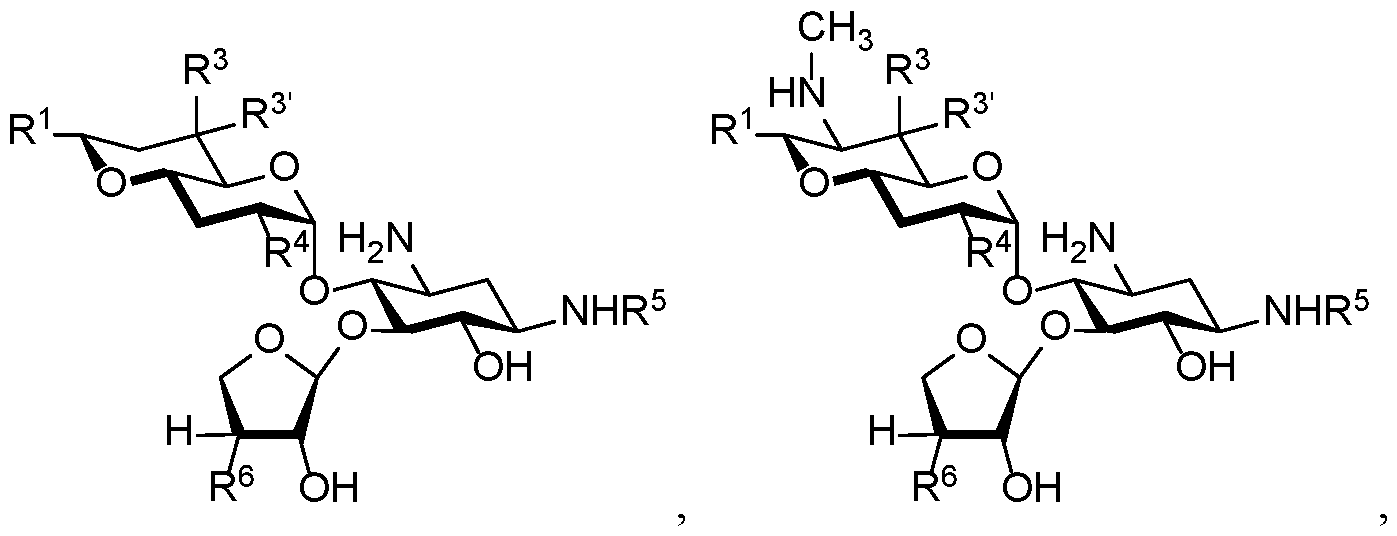


Compound M is synthesized according the route shown in Scheme 1 below: Scheme 1: Synthesis of Compound M
 In step 1, neomycin is reacted with Stick’s reagent (1H-imidazole-1-sulfonyl azide) to provide polyazido compound 1-2. In step 2, compound 1-2 is oxidized with (diacetoxyiodo)benzene (BAIB) and (2,2,6,6-tetramethylpiperidin-1-yl)oxyl (TEMPO) to
form carboxylic acid compound 1-3. In step 3, compound 1-3 is subjected to Barton decarboxylation conditions (for example, by conversion of the carboxylic acid functional group into a thiohydroxamate ester followed by reaction with tributylstannane and 2,2’- azobisisobutyronitrile with heating) to form decarboxylated compound 1-4. In step 4, compound 1-4 is reacted with 4-methoxybenzoyl chloride (PMBzCl) to form poly(4- methoxybenzoyl) compound 1-5. In step 5, compound 1-5 is reacted with benzenethiol and boron trifluoride diethyl etherate to form thioether compound 1-6. In step 6, compound 1-6 is oxidized with meta-chloroperoxybenzoic acid (mCPBA) to form sulfoxide compound M. Example 2. Synthesis of Glycosyl Donor (2S,3R,4R,5R,6R)-5-azido-2-(azidomethyl)-6- (((2R,5S)-2-(azidomethyl)-4-((4-methoxybenzoyl)oxy)-5- (phenylsulfinyl)tetrahydrofuran-3-yl)oxy)tetrahydro-2H-pyran-3,4-diyl bis(4- methoxybenzoate) (N) Compound N is synthesized according to the route shown in Scheme 2 below:
In step 1, neomycin is reacted with Stick’s reagent (1H-imidazole-1-sulfonyl azide) to provide polyazido compound 1-2. In step 2, compound 1-2 is oxidized with (diacetoxyiodo)benzene (BAIB) and (2,2,6,6-tetramethylpiperidin-1-yl)oxyl (TEMPO) to
form carboxylic acid compound 1-3. In step 3, compound 1-3 is subjected to Barton decarboxylation conditions (for example, by conversion of the carboxylic acid functional group into a thiohydroxamate ester followed by reaction with tributylstannane and 2,2’- azobisisobutyronitrile with heating) to form decarboxylated compound 1-4. In step 4, compound 1-4 is reacted with 4-methoxybenzoyl chloride (PMBzCl) to form poly(4- methoxybenzoyl) compound 1-5. In step 5, compound 1-5 is reacted with benzenethiol and boron trifluoride diethyl etherate to form thioether compound 1-6. In step 6, compound 1-6 is oxidized with meta-chloroperoxybenzoic acid (mCPBA) to form sulfoxide compound M. Example 2. Synthesis of Glycosyl Donor (2S,3R,4R,5R,6R)-5-azido-2-(azidomethyl)-6- (((2R,5S)-2-(azidomethyl)-4-((4-methoxybenzoyl)oxy)-5- (phenylsulfinyl)tetrahydrofuran-3-yl)oxy)tetrahydro-2H-pyran-3,4-diyl bis(4- methoxybenzoate) (N) Compound N is synthesized according to the route shown in Scheme 2 below:
Scheme 2: Synthesis of Compound N
 In step 1, neomycin is reacted with Stick’s reagent (1H-imidazole-1-sulfonyl azide) to provide polyazido compound 2-2. In step 2, compound 2-2 is reacted with trisyl chloride followed by nucleophilic substitution with sodium azide to form azido compound 2-3. In step 3, compound 2-3 is reacted with 4-methoxybenzoyl chloride (PMBzCl) in the presence of pyridine (py) to form poly(4-methoxybenzoyl) compound 2-4. In step 4, compound 2-4 is reacted with benzenethiol and boron trifluoride diethyl etherate to form thioether compound 2-5. In step 6, compound 2-5 is oxidized with meta-chloroperoxybenzoic acid (mCPBA) to form sulfoxide compound N.
Example 3. Synthesis of Aprosamine Derivatives (1S,2S,3R,4S,6R)-4,6-diazido-3- (((3aS,4R,5aS,7R,8S,9aS,9bR)-7-azido-3-methyl-2-oxo-4- (phenylthio)decahydropyrano[2',3':5,6]pyrano[3,4-d]oxazol-8-yl)oxy)-2- hydroxycyclohexyl benzoate (R) and (1S,2S,3R,4S,6R)-4,6-diazido-3- (((3aR,5aS,7R,8S,9aS,9bR)-7-azido-3-methyl-2- oxodecahydropyrano[2',3':5,6]pyrano[3,4-d]oxazol-8-yl)oxy)-2-hydroxycyclohexyl benzoate (S) Compound R and compound S are synthesized according to the route shown in Scheme 3: Scheme 3: Synthesis of Compound R and Compound S
In step 1, neomycin is reacted with Stick’s reagent (1H-imidazole-1-sulfonyl azide) to provide polyazido compound 2-2. In step 2, compound 2-2 is reacted with trisyl chloride followed by nucleophilic substitution with sodium azide to form azido compound 2-3. In step 3, compound 2-3 is reacted with 4-methoxybenzoyl chloride (PMBzCl) in the presence of pyridine (py) to form poly(4-methoxybenzoyl) compound 2-4. In step 4, compound 2-4 is reacted with benzenethiol and boron trifluoride diethyl etherate to form thioether compound 2-5. In step 6, compound 2-5 is oxidized with meta-chloroperoxybenzoic acid (mCPBA) to form sulfoxide compound N.
Example 3. Synthesis of Aprosamine Derivatives (1S,2S,3R,4S,6R)-4,6-diazido-3- (((3aS,4R,5aS,7R,8S,9aS,9bR)-7-azido-3-methyl-2-oxo-4- (phenylthio)decahydropyrano[2',3':5,6]pyrano[3,4-d]oxazol-8-yl)oxy)-2- hydroxycyclohexyl benzoate (R) and (1S,2S,3R,4S,6R)-4,6-diazido-3- (((3aR,5aS,7R,8S,9aS,9bR)-7-azido-3-methyl-2- oxodecahydropyrano[2',3':5,6]pyrano[3,4-d]oxazol-8-yl)oxy)-2-hydroxycyclohexyl benzoate (S) Compound R and compound S are synthesized according to the route shown in Scheme 3: Scheme 3: Synthesis of Compound R and Compound S
 In step 1, apramycin is reacted with trifluoromethanesulfonylazide (TfN3) to form polyazido compound 3-2. In step 2, compound 3-2 is reacted with hydrochloric acid to form compound 3-3. In step 3, compound 3-3 is reacted with benzyl chloroformate (CbzCl) to form poly(benzyl carbamate) compound 3-4. In step 4, compound 3-4 is reacted with benzenethiol and dimethylcarbonate (DMC) to form thioether compound 3-5. In step 5, compound 3-5 is reacted with sodium hydride to form cyclic carbamate compound 3-6. In step 6, compound 3-6 is reacted with benzoyl chloride (BzCl) to form benzoyl ester compound R. In step 6, compound R is reacted with meta-chloroperoxybenzoic acid (mCPBA) to form sulfoxide compound 3-8. In step 7, compound 3-8 is reacted with bis(trimethylsilyl)amine (HMDS), followed by reaction with trifluoromethanesulfonic anhydride (Tf2O) and triethylsilane, and then followed by reaction with tetrabutylammonium fluoride (TBAF) to form compound S. Example 4. Synthesis of (2S,3S,4R,5R,6R)-5-amino-2-(aminomethyl)-6-(((4S,5S)-5- (((1R,2R,3S,5R,6S)-3,5-diamino-2-(((2S,3R,4aS,7R,8R,8aR)-3-amino-8-hydroxy-7- (methylamino)octahydropyrano[3,2-b]pyran-2-yl)oxy)-6-hydroxycyclohexyl)oxy)-4- hydroxytetrahydrofuran-3-yl)oxy)tetrahydro-2H-pyran-3,4-diol (A) Compound A is synthesized according to the route shown in Scheme 4: Scheme 4. Synthesis of Compound A
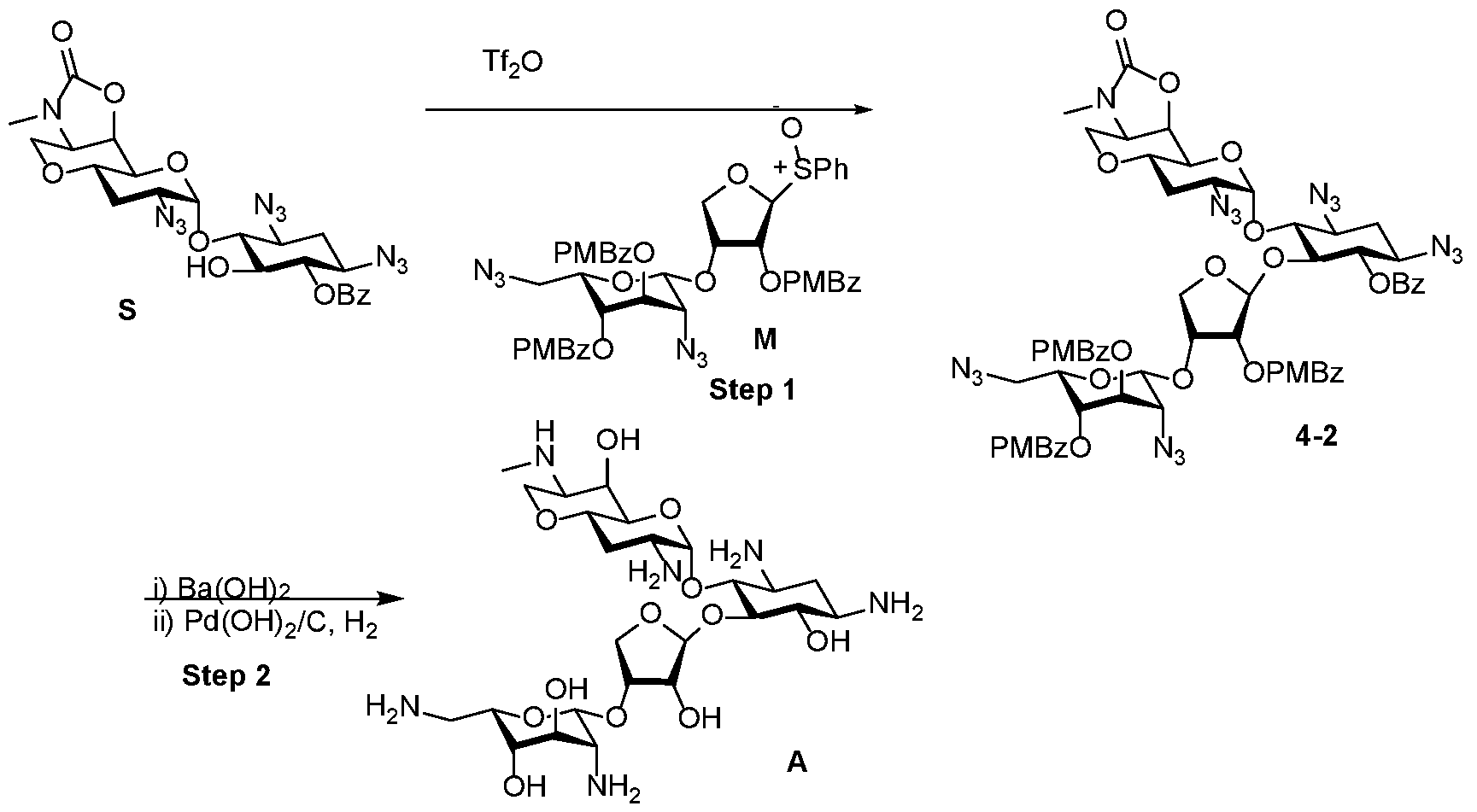 In step 1, compound S is coupled to compound M in the presence of trifluoromethanesulfonic anhydride (Tf2O) to form compound 4-2. In step 2, compound 4-2
is reacted with barium hydroxide and then subjected to hydrogenolysis (with palladium hydroxide on carbon and hydrogen gas) to form compound A. Example 5. Synthesis of Compounds B Compounds B are synthesized according to the route provided in Scheme 5: Scheme 5. Synthesis of Compounds B
In step 1, compound S is coupled to compound M in the presence of trifluoromethanesulfonic anhydride (Tf2O) to form compound 4-2. In step 2, compound 4-2
is reacted with barium hydroxide and then subjected to hydrogenolysis (with palladium hydroxide on carbon and hydrogen gas) to form compound A. Example 5. Synthesis of Compounds B Compounds B are synthesized according to the route provided in Scheme 5: Scheme 5. Synthesis of Compounds B
 B In step 1, compound S is coupled with compound 5-1 in the presence of boron trifluoride diethyl etherate to provide compound 5-2. In step 2, compound 5-2 is dehydroxylated with osmium tetroxide and N-methylmorpholine N-oxide followed by oxidative cleavage with sodium periodate to form aldehyde compound 5-3. In step 3,
compound 5-3 is subjected to reductive amination conditions in the presence of sodium cyanoborohydride to form compound 5-4. In Step 4, compound 5-4 is reacted with barium hydroxide followed by a Staudinger reaction with trimethylphosphine to form compound B. Example 6. Synthesis of Compounds C Compounds C are synthesized according to the route provided in Scheme 6: Scheme 6. Synthesis of Compound C
B In step 1, compound S is coupled with compound 5-1 in the presence of boron trifluoride diethyl etherate to provide compound 5-2. In step 2, compound 5-2 is dehydroxylated with osmium tetroxide and N-methylmorpholine N-oxide followed by oxidative cleavage with sodium periodate to form aldehyde compound 5-3. In step 3,
compound 5-3 is subjected to reductive amination conditions in the presence of sodium cyanoborohydride to form compound 5-4. In Step 4, compound 5-4 is reacted with barium hydroxide followed by a Staudinger reaction with trimethylphosphine to form compound B. Example 6. Synthesis of Compounds C Compounds C are synthesized according to the route provided in Scheme 6: Scheme 6. Synthesis of Compound C
 In step 1, compound R is coupled with compound 6-1 or compound N in the presence of trifluoromethanesulfonic anhydride to form compound 6-2. In step 2, compound 6-2 is reacted with barium hydroxide followed by a Staudinger reaction with trimethylphosphine to provide compound C. Example 7. Synthesis of Compounds D Compounds D are synthesized according to the route provided in scheme 7:
Scheme 7. Synthesis of Compounds D
In step 1, compound R is coupled with compound 6-1 or compound N in the presence of trifluoromethanesulfonic anhydride to form compound 6-2. In step 2, compound 6-2 is reacted with barium hydroxide followed by a Staudinger reaction with trimethylphosphine to provide compound C. Example 7. Synthesis of Compounds D Compounds D are synthesized according to the route provided in scheme 7:
Scheme 7. Synthesis of Compounds D
 D In step 1, compound R and compound M are coupled in the presence of trifluoromethanesulfonic anhydride to form compound 7-2. In step 2, compound 7-2 is reacted with barium hydroxide followed by a Staudinger reaction with trimethylphosphine to form compound D. Example 8. Synthesis of Compounds E Compounds E are prepared according to the route provided in Scheme 8:
Scheme 8. Synthesis of Compounds E
 In step 1, compound R and compound 5-1 are coupled in the presence of boron trifluoride diethyl etherate to form compound 8-2. In step 2, compound 8-2 is dehydroxylated with osmium tetroxide and N-methylmorpholine N-oxide followed by oxidative cleavage with sodium periodate to form aldehyde compound 8-3. In step 3, compound 8-3 is subjected to reductive amination conditions with sodium cyanoborohydride to form amino compound 8-4. In step 4, compound 8-4 is reacted with barium hydroxide followed by a Staudinger reaction with trimethylphosphine to provide compound E.
The compositions and methods of the appended claims are not limited in scope by the specific compositions and methods described herein, which are intended as illustrations of a few aspects of the claims and any compositions and methods that are functionally equivalent are intended to fall within the scope of the claims. Various modifications of the compositions and methods in addition to those shown and described herein are intended to fall within the scope of the appended claims. Further, while only certain representative compositions and method steps disclosed herein are specifically described, other combinations of the compositions and method steps also are intended to fall within the scope of the appended claims, even if not specifically recited. Thus, a combination of steps, elements, components, or constituents may be explicitly mentioned herein; however, other combinations of steps, elements, components, and constituents are included, even though not explicitly stated. The term “comprising” and variations thereof as used herein is used synonymously with the term “including” and variations thereof and are open, non-limiting terms. Although the terms “comprising” and “including” have been used herein to describe various embodiments, the terms “consisting essentially of” and “consisting of” can be used in place of “comprising” and “including” to provide for more specific embodiments of the invention and are also disclosed. Other than in the examples, or where otherwise noted, all numbers expressing quantities of ingredients, reaction conditions, and so forth used in the specification and claims are to be understood at the very least, and not as an attempt to limit the application of the doctrine of equivalents to the scope of the claims, to be construed in light of the number of significant digits and ordinary rounding approaches.
In step 1, compound R and compound 5-1 are coupled in the presence of boron trifluoride diethyl etherate to form compound 8-2. In step 2, compound 8-2 is dehydroxylated with osmium tetroxide and N-methylmorpholine N-oxide followed by oxidative cleavage with sodium periodate to form aldehyde compound 8-3. In step 3, compound 8-3 is subjected to reductive amination conditions with sodium cyanoborohydride to form amino compound 8-4. In step 4, compound 8-4 is reacted with barium hydroxide followed by a Staudinger reaction with trimethylphosphine to provide compound E.
The compositions and methods of the appended claims are not limited in scope by the specific compositions and methods described herein, which are intended as illustrations of a few aspects of the claims and any compositions and methods that are functionally equivalent are intended to fall within the scope of the claims. Various modifications of the compositions and methods in addition to those shown and described herein are intended to fall within the scope of the appended claims. Further, while only certain representative compositions and method steps disclosed herein are specifically described, other combinations of the compositions and method steps also are intended to fall within the scope of the appended claims, even if not specifically recited. Thus, a combination of steps, elements, components, or constituents may be explicitly mentioned herein; however, other combinations of steps, elements, components, and constituents are included, even though not explicitly stated. The term “comprising” and variations thereof as used herein is used synonymously with the term “including” and variations thereof and are open, non-limiting terms. Although the terms “comprising” and “including” have been used herein to describe various embodiments, the terms “consisting essentially of” and “consisting of” can be used in place of “comprising” and “including” to provide for more specific embodiments of the invention and are also disclosed. Other than in the examples, or where otherwise noted, all numbers expressing quantities of ingredients, reaction conditions, and so forth used in the specification and claims are to be understood at the very least, and not as an attempt to limit the application of the doctrine of equivalents to the scope of the claims, to be construed in light of the number of significant digits and ordinary rounding approaches.
Claims
CLAIMS What is claimed is: 1. A compound of Formula I-a, Formula I-b, Formula II-a or Formula II-b:
 or a pharmaceutically acceptable salt or derivative thereof; wherein: X1 is selected from -O-, -S-, and -CH2; X2 is selected from -O- and -S-; R1 is selected from -H, -CH3, -CH2CH3, -CH2NH2, -CH2OH, -CH2CH2NH2, -CH2CH2OH, -CH2NHR7, -SR7, -CH2F, -CHF2, and -CF3; R2 is selected from -H, -OH, and -N(Ra)2; one of R3 and R3’ is selected from -OH and -NH2, and the other of R3 and R3’ is selected from -H; R4 is selected from -H, -OH, -NH2, and -NHRb; R5 is selected from -H, -CORc, -CONHRc, and CON(OH)Rc; R6 is selected from -H, -F, -OH, -O(CH2)nNH2, -O(CH2)nNH(CH2)mNH2, -O(CH2)n-N-morpholino, -O(CH2)n-N-piperidino, and -O(CH2)n-N-[(CH2)mOH]2; or R6 is selected from:
 R7 is selected from optionally substituted C1-C4 alkyl, optionally substituted aryl, and optionally substituted heteroaryl; R8 is selected from -H or -CH2R9; R9 is selected from -OH, -NH2, -NHCHO, or -NH(CH2)nNH2; m and n are independently selected at each occurrence from 2 or 3; Ra is independently selected at each occurrence from -H or C1-C4 alkyl; Rb is selected from -CHO, -CONH2, optionally substituted C1-C6 alkyl, or CO(optionally substituted C1-C6 alkyl); and Rc is selected from H and optionally substituted C1-C6 alkyl.
2. The compound of claim 1, wherein X1 is -O-.
3. The compound of any one of claims 1 or 2, wherein X2 is -O-.
4. The compound of any one of claims 1-3, wherein R2 is -H.
5. The compound of any one of claims 1-3, wherein R2 is -N(Ra)2.
6. The compound of any one of claims 1-3, wherein R2 is -NHCH3.
7. The compound of any one of claims 1-6, wherein R3 is -OH and R3’ is -H.
8. The compound of any one of claims 1-6, wherein R3 is -H and R3’ is -OH.
9. The compound of any one of claims 1-8, wherein R4 is -NH2.
10. The compound of any one of claims 1-8, wherein R4 is -NHRb.
11. The compound of any one of claims 1-8, wherein R4 is -NHCHO.
12. The compound of any one of claim 1-8, wherein R4 is

13. The compound of any one of claims 1-12, wherein R5 is -H.
14. The compound of any one of claims 1-12, wherein R5 is -CORc.
15. The compound of any one of claims 1-12, wherein R5 is -CHO.
16. The compound of any one of claims 1-12, wherein R5 is

17. The compound of any one of claims 1-16, wherein R6 is -O(CH2)nNH2.
18. The compound of claim 17, wherein n is 2.
19. The compound of any one of claims 1-16, wherein R6 is
 .
.
20. The compound of any one of claims 1-19, wherein the compound is of Formula I-a or Formula I-b, or a pharmaceutically acceptable salt or derivative thereof.
21. The compound of claim 20, wherein R1 is -H.
22. The compound of claim 20, wherein R1 is -SR7.
23. The compound of any one of claims 20-22, wherein R7 is methyl.
24. The compound of any one of claims 1-19, wherein the compound is of Formula II-a or Formula II-b, or a pharmaceutically acceptable salt or derivative thereof.
25. The compound of claim 24, wherein R7 is methyl.
26. The compound of any one of claims 24 or 25, wherein R8 is -H.
27. The compound of any one of claims 24 or 25, wherein R8 is -CH2R9. 28. The compound of any one of claims 24-27, wherein R9 -OH. 29. The compound of any one of claims 24-27, wherein R9 is -NH2. 30. The compound of any one of claims 24-27, wherein R9 is -NHCHO. 31. A pharmaceutical composition comprising a compound of any one of claims 1-30 and a pharmaceutically acceptable carrier. 32. A method of treating an infection caused by a bacterium in a subject in need thereof, comprising administering to the subject a therapeutically effective amount of a compound of any one of claims 1-30 or a pharmaceutical composition of claim 31. 33. The method of claim 32, wherein the bacterium has developed resistance to one or more antibiotics. 34. The method of claim 33, wherein the bacterium expresses one or more carbapenemases. 35. The method of any one of claims 33 or 34, wherein the bacterium expresses one or more aminoglycoside modifying enzymes. 36. The method of any one of claims 33-35, wherein the bacterium expresses one or more ribosomal methyl transferases. 37. The method of any one of claims 33-36, wherein the bacterium is a Gram-positive bacterium. 38. the method of any one of claims 33-36, wherein the bacterium is a Gram-negative bacterium. 39. The method of any one of claims 33-36, wherein the bacterium is a mycobacterium. 40. The method of any one of claims 33-36, wherein the bacterium is selected from Clostridium difficile, Enterococcus faecalis, Enterococcus faecium, Mycobacterium
abscessus, Mycobacterium tuberculosis, Staphylococcus aureus, Streptococcus pyogenes, Streptococcus pneumoniae, Campylobacter sp., Neisseria gonorrhoeae, Klebsiella pneumoniae, Salmonella sp., Escherichia coli, Acinetobacter sp., and Pseudomonas aeruginosa.
Applications Claiming Priority (2)
| Application Number | Priority Date | Filing Date | Title |
|---|---|---|---|
| US202063053917P | 2020-07-20 | 2020-07-20 | |
| US63/053,917 | 2020-07-20 |
Publications (1)
| Publication Number | Publication Date |
|---|---|
| WO2022020295A1 true WO2022020295A1 (en) | 2022-01-27 |
Family
ID=79728891
Family Applications (1)
| Application Number | Title | Priority Date | Filing Date |
|---|---|---|---|
| PCT/US2021/042290 Ceased WO2022020295A1 (en) | 2020-07-20 | 2021-07-20 | Aprosamine derivatives |
Country Status (1)
| Country | Link |
|---|---|
| WO (1) | WO2022020295A1 (en) |
Citations (1)
| Publication number | Priority date | Publication date | Assignee | Title |
|---|---|---|---|---|
| US20200062793A1 (en) * | 2017-05-01 | 2020-02-27 | Wayne State University | Apramycin derivatives |
-
2021
- 2021-07-20 WO PCT/US2021/042290 patent/WO2022020295A1/en not_active Ceased
Patent Citations (1)
| Publication number | Priority date | Publication date | Assignee | Title |
|---|---|---|---|---|
| US20200062793A1 (en) * | 2017-05-01 | 2020-02-27 | Wayne State University | Apramycin derivatives |
Non-Patent Citations (2)
| Title |
|---|
| MANDHAPATI APPI REDDY, YANG GUANYU, KATO TAKAYUKI, SHCHERBAKOV DIMITRI, HOBBIE SVEN N., VASELLA ANDREA, BÖTTGER ERIK C., CRICH DAV: "Structure-Based Design and Synthesis of Apramycin-Paromomycin Analogues. Importance of the Configuration at the 6??-Position and Differences Between the 6??-Amino and Hydroxy Series", J AM CHEM SOC., vol. 139, no. 41, 18 October 2017 (2017-10-18), pages 14611 - 14619, XP055900987 * |
| QUIRKE ET AL.: "Apralogs: Apramycin 5-O-Glycosides and Ethers with Improved Antibacterial Activity and Ribosomal Selectivity and Reduced Susceptibility to the Aminoacyltranserferase (3) -IV Resistance Determinant", J AM CHEM SOC., vol. 142, no. 1, 8 January 2020 (2020-01-08), pages 530 - 544, XP055770224, DOI: 10.1021/jacs.9b11601 * |
Similar Documents
| Publication | Publication Date | Title |
|---|---|---|
| AU2009308181B2 (en) | Methods for treating resistant diseases using triazole containing macrolides | |
| IL171546A (en) | Oxazolidinone-quinoline derivatives and pharmaceutical compositions comprising them | |
| ES2532008T3 (en) | Antibacterial peptides | |
| CN1342163A (en) | Ketolide antibiotics | |
| EP2802593A1 (en) | Therapeutic boron-containing compounds | |
| KR102824010B1 (en) | Oxazolidinone compounds and their use as antibacterial agents | |
| EP2569324A1 (en) | Aminoglycoside derivatives | |
| TW201408681A (en) | Solid forms of (R)-2-(5-(2-(3-ethylureido)-6-fluoro-7-(tetrahydrofuran-2-yl)-1H-benzo[d]imidazol-5-yl)pyrimidin-2-yl)propan-2-yl dihydrogen phosphate and salts thereof | |
| CN111388489A (en) | Application of apramycin in preparation of bacterial infectious disease treatment | |
| US20050014706A1 (en) | Method of treating tuberculosis | |
| WO2020257306A1 (en) | Boronic acid derivatives and therapeutic uses thereof | |
| CA2971009A1 (en) | Antimicrobial combinations and their use in the treatment of microbial infection | |
| US11986459B2 (en) | Methods for the treatment of Mycobacterium infections | |
| WO2022020295A1 (en) | Aprosamine derivatives | |
| US10266544B2 (en) | Aryl substituted aminomethyl spectinomycin analogs as antibacterial agents | |
| US7759482B2 (en) | Aminoglycosides as antibiotics | |
| US20220127297A1 (en) | Novel Antibacterial 3"-Derivatives Of 4,6-Disubstituted 2,5-Dideoxystreptamine Aminoglycoside Antibiotics | |
| EP3598868B1 (en) | New polyimino ketoaldehydes | |
| WO2021000297A1 (en) | Compounds and methods of use thereof as antibacterial agents | |
| US20140011757A1 (en) | Novel macrolide derivative | |
| Hooper | Levofloxacin | |
| CA2993425C (en) | Effective aminoglycoside antibiotic for multidrug-resistant bacteria | |
| CA2993425A1 (en) | Effective aminoglycoside antibiotic for multidrug-resistant bacteria | |
| Andriole | SESSION IV: PRESENT AND FUTURE ROLES OF QUINOLONES: FUTURE ROLE AND USES OF THE QUINOLONES | |
| WO2018214463A1 (en) | Novel antibiotic and preparation method, use, and application thereof |
Legal Events
| Date | Code | Title | Description |
|---|---|---|---|
| 121 | Ep: the epo has been informed by wipo that ep was designated in this application |
Ref document number: 21846995 Country of ref document: EP Kind code of ref document: A1 |
|
| NENP | Non-entry into the national phase |
Ref country code: DE |
|
| 122 | Ep: pct application non-entry in european phase |
Ref document number: 21846995 Country of ref document: EP Kind code of ref document: A1 |