WO2022018425A1 - Hydrogenation catalyst - Google Patents
Hydrogenation catalyst Download PDFInfo
- Publication number
- WO2022018425A1 WO2022018425A1 PCT/GB2021/051856 GB2021051856W WO2022018425A1 WO 2022018425 A1 WO2022018425 A1 WO 2022018425A1 GB 2021051856 W GB2021051856 W GB 2021051856W WO 2022018425 A1 WO2022018425 A1 WO 2022018425A1
- Authority
- WO
- WIPO (PCT)
- Prior art keywords
- groups
- compound according
- formula
- optionally substituted
- independently selected
- Prior art date
- Legal status (The legal status is an assumption and is not a legal conclusion. Google has not performed a legal analysis and makes no representation as to the accuracy of the status listed.)
- Ceased
Links
- 0 *N1IN(*)[Zn]1* Chemical compound *N1IN(*)[Zn]1* 0.000 description 3
- QCKWFXXFLQADGO-UHFFFAOYSA-N CC(C)N([Si+](C)(C)C)[Si+](C)(C)C Chemical compound CC(C)N([Si+](C)(C)C)[Si+](C)(C)C QCKWFXXFLQADGO-UHFFFAOYSA-N 0.000 description 1
- LUPDEXKZPAZZDA-UHFFFAOYSA-N CC(C)Nc1cc(Cl)cc(Cl)c1 Chemical compound CC(C)Nc1cc(Cl)cc(Cl)c1 LUPDEXKZPAZZDA-UHFFFAOYSA-N 0.000 description 1
- PQFGHNDKTDSVJW-UHFFFAOYSA-N CC(C)Nc1cc(OC)cc(OC)c1 Chemical compound CC(C)Nc1cc(OC)cc(OC)c1 PQFGHNDKTDSVJW-UHFFFAOYSA-N 0.000 description 1
- FVRDZCZRCIRPJG-UHFFFAOYSA-N CC1[O](C)c(cccc2OC)c2N1 Chemical compound CC1[O](C)c(cccc2OC)c2N1 FVRDZCZRCIRPJG-UHFFFAOYSA-N 0.000 description 1
- KKTBUCVHSCATGB-UHFFFAOYSA-N CNC1CCCC1 Chemical compound CNC1CCCC1 KKTBUCVHSCATGB-UHFFFAOYSA-N 0.000 description 1
Classifications
-
- C—CHEMISTRY; METALLURGY
- C07—ORGANIC CHEMISTRY
- C07F—ACYCLIC, CARBOCYCLIC OR HETEROCYCLIC COMPOUNDS CONTAINING ELEMENTS OTHER THAN CARBON, HYDROGEN, HALOGEN, OXYGEN, NITROGEN, SULFUR, SELENIUM OR TELLURIUM
- C07F3/00—Compounds containing elements of Groups 2 or 12 of the Periodic Table
- C07F3/003—Compounds containing elements of Groups 2 or 12 of the Periodic Table without C-Metal linkages
-
- B—PERFORMING OPERATIONS; TRANSPORTING
- B01—PHYSICAL OR CHEMICAL PROCESSES OR APPARATUS IN GENERAL
- B01J—CHEMICAL OR PHYSICAL PROCESSES, e.g. CATALYSIS OR COLLOID CHEMISTRY; THEIR RELEVANT APPARATUS
- B01J31/00—Catalysts comprising hydrides, coordination complexes or organic compounds
- B01J31/16—Catalysts comprising hydrides, coordination complexes or organic compounds containing coordination complexes
- B01J31/18—Catalysts comprising hydrides, coordination complexes or organic compounds containing coordination complexes containing nitrogen, phosphorus, arsenic or antimony as complexing atoms, e.g. in pyridine ligands, or in resonance therewith, e.g. in isocyanide ligands C=N-R or as complexed central atoms
- B01J31/1805—Catalysts comprising hydrides, coordination complexes or organic compounds containing coordination complexes containing nitrogen, phosphorus, arsenic or antimony as complexing atoms, e.g. in pyridine ligands, or in resonance therewith, e.g. in isocyanide ligands C=N-R or as complexed central atoms the ligands containing nitrogen
-
- C—CHEMISTRY; METALLURGY
- C07—ORGANIC CHEMISTRY
- C07C—ACYCLIC OR CARBOCYCLIC COMPOUNDS
- C07C5/00—Preparation of hydrocarbons from hydrocarbons containing the same number of carbon atoms
- C07C5/02—Preparation of hydrocarbons from hydrocarbons containing the same number of carbon atoms by hydrogenation
- C07C5/08—Preparation of hydrocarbons from hydrocarbons containing the same number of carbon atoms by hydrogenation of carbon-to-carbon triple bonds
- C07C5/09—Preparation of hydrocarbons from hydrocarbons containing the same number of carbon atoms by hydrogenation of carbon-to-carbon triple bonds to carbon-to-carbon double bonds
-
- B—PERFORMING OPERATIONS; TRANSPORTING
- B01—PHYSICAL OR CHEMICAL PROCESSES OR APPARATUS IN GENERAL
- B01J—CHEMICAL OR PHYSICAL PROCESSES, e.g. CATALYSIS OR COLLOID CHEMISTRY; THEIR RELEVANT APPARATUS
- B01J2231/00—Catalytic reactions performed with catalysts classified in B01J31/00
- B01J2231/60—Reduction reactions, e.g. hydrogenation
- B01J2231/64—Reductions in general of organic substrates, e.g. hydride reductions or hydrogenations
- B01J2231/641—Hydrogenation of organic substrates, i.e. H2 or H-transfer hydrogenations, e.g. Fischer-Tropsch processes
- B01J2231/645—Hydrogenation of organic substrates, i.e. H2 or H-transfer hydrogenations, e.g. Fischer-Tropsch processes of C=C or C-C triple bonds
-
- B—PERFORMING OPERATIONS; TRANSPORTING
- B01—PHYSICAL OR CHEMICAL PROCESSES OR APPARATUS IN GENERAL
- B01J—CHEMICAL OR PHYSICAL PROCESSES, e.g. CATALYSIS OR COLLOID CHEMISTRY; THEIR RELEVANT APPARATUS
- B01J2531/00—Additional information regarding catalytic systems classified in B01J31/00
- B01J2531/02—Compositional aspects of complexes used, e.g. polynuclearity
- B01J2531/0238—Complexes comprising multidentate ligands, i.e. more than 2 ionic or coordinative bonds from the central metal to the ligand, the latter having at least two donor atoms, e.g. N, O, S, P
- B01J2531/0241—Rigid ligands, e.g. extended sp2-carbon frameworks or geminal di- or trisubstitution
-
- B—PERFORMING OPERATIONS; TRANSPORTING
- B01—PHYSICAL OR CHEMICAL PROCESSES OR APPARATUS IN GENERAL
- B01J—CHEMICAL OR PHYSICAL PROCESSES, e.g. CATALYSIS OR COLLOID CHEMISTRY; THEIR RELEVANT APPARATUS
- B01J2531/00—Additional information regarding catalytic systems classified in B01J31/00
- B01J2531/20—Complexes comprising metals of Group II (IIA or IIB) as the central metal
- B01J2531/26—Zinc
Definitions
- the present invention relates to zinc complexes and methods of manufacturing such complexes.
- the invention also relates to the use of such complexes in methods of selective hydrogenation of compounds containing reducible double or triple bonds and intermediates in such methods.
- Background of the Invention Alkynes are important starting materials in organic synthesis, particularly in the synthesis of bioactive compounds which contain carbon-carbon double bonds having a well-defined configuration.
- bioactive compounds include ⁇ -carotene, polyene antifungal drugs, crocaine, polyunsaturated fatty acids (PUFAs), pheromones and cruentaren.
- the stereoselective hydrogenation of alkynes to alkenes is an atom-economical method of synthesis of the carbon-carbon double bonds in these molecules.
- the most widely used method for the selective hydrogenation of alkynes employs the Lindlar catalyst in heterogeneous catalysis.
- the Lindlar catalyst consists of Pd (5%) deposited on CaCO3, treated with lead acetate.
- the lead acetate poison is used to improve the cis/trans selectivity of the catalyst.
- Hydrogenation with the Lindlar catalyst is therefore highly stereoselective, producing almost exclusively the (Z)-isomer.
- the compounds therefore provide effective catalysts for the reduction of a wide range of compounds with functional groups containing reducible double or triple bonds.
- the compounds provide effective catalysts for the chemo- and stereo-selective semi-hydrogenation of alkynes to (Z)-alkenes.
- si- hydrogenation refers to the hydrogenation of alkynes to alkenes, i.e. with little or no overhydrogenation to the alkane.
- the compounds have been found to facilitate the production of alkenes from alkynes at relatively high yield, in a chemo- and stereo-selective manner.
- catalysts comprising the compounds provide for preferential synthesis of the alkene without over- reduction to the alkane, and also provide for stereoselective production of (Z)-alkenes.
- a second aspect of the invention is a catalyst comprising a compound according to the first aspect.
- the catalyst is a hydrogenation catalyst.
- the catalyst is an alkyne hydrogenation catalyst.
- a third aspect of the invention is a method of reducing or hydrogenating a double or triple bond in the presence of a catalyst comprising a compound according to the first aspect.
- a fourth aspect is a method of activating dihydrogen for hydrogenation, comprising reacting dihydrogen with a catalyst comprising a compound according to the first aspect.
- a fifth aspect is a compound according to formula (VII): (VII) wherein L, R 3 and R 4 are as defined above under the first aspect; and R 11 and R 12 are each independently selected from (hetero)hydrocarbyl groups.
- R 11 and R 12 are each independently selected from alkyl and aryl groups.
- R 11 and R 12 are each independently selected from linear or branched unsubstituted C 1-6 alkyl, and C 3-8 aromatic or heteroaromatic groups.
- the hydrogenation may be carried out on any alkyne regardless of the identity of the groups R 11 and R 12 , such that R 11 and R 12 may be selected from any suitable alkyne substituent.
- a sixth aspect of the invention is a method of preparing an intermediate according to formula (VII):
- a seventh aspect of the invention is therefore a method of preparing an alkene according to formula (VI): (VI) the method comprising protonating a compound according to formula (VII):
- An eighth aspect of the invention is a method of making a compound according to formula (I): 3 (I) from starting materials comprising a compound according to formula (II): (II) wherein Y, L, R 3 and R 4 are as defined above under the first aspect.
- a ninth aspect of the invention is an intermediate according to formula (IV):
- a tenth aspect of the invention is a method of making an intermediate according to formula (IV): (IV) comprising reacting a compound according to formula (III) with ZnX 2 (III) wherein L, R 3 and R 4 are as defined above under the first aspect, M is a metal atom selected from Li, Na and K, and X is as defined under the ninth aspect.
- M is a metal atom selected from Li, Na and K
- X is as defined under the ninth aspect.
- An eleventh aspect of the invention is a method of making a compound according to formula (I): 3 (I) from a compound according to formula (IV): (IV) wherein Y, L, R 3 and R 4 are as defined in the first aspect, and X is a monovalent anion.
- a twelfth aspect of the invention is a method of making a compound according to formula (VIII): (VIII) comprising reacting a compound according to formula (I): 3 (I) with dihydrogen (H 2 ), wherein L, Y, R 3 and R 4 are as defined under the first aspect.
- the method according to the twelfth aspect may be used to prepare the hydride analogue (VIII) of the catalytic complex according to formula (I) in situ.
- the hydride analogue (VIII) may then go on to react with a compound containing a reducible double or triple bond which is present in the reaction mixture, e.g. an alkyne, in a first step towards semi-hydrogenation of the alkyne.
- a thirteenth aspect of the invention is the use of a compound according to the first aspect or catalyst according to the second aspect in a hydrogenation process, for example an alkyne hydrogenation process.
- Another aspect us the use of a compound according to the first aspect as a catalyst a hydrogenation process, for example an alkyne hydrogenation process.
- substituted is used herein in the conventional sense and refers to a chemical moiety which is covalently attached to, or if appropriate, fused to, a parent group.
- substituents are well known, and methods for their formation and introduction into a variety of parent groups are also well known.
- C4-20 aliphatic as used herein, pertains to a monovalent moiety obtained by removing a hydrogen atom from a carbon atom of a hydrocarbon compound having from 4 to 20 carbon atoms, which may be saturated or unsaturated (e.g. partially unsaturated, fully unsaturated).
- C 1-4 aliphatic refers to a monovalent moiety obtained by removing a hydrogen atom from a carbon atom of a hydrocarbon compound having from 1 to 4 carbon atoms, which may be saturated or unsaturated (e.g. partially unsaturated, fully unsaturated).
- aliphatic includes the sub-classes alkyl, alkenyl, alkynyl, cycloalkyl, etc.
- C 1-12 alkyl as used herein, pertains to a monovalent moiety obtained by removing a hydrogen atom from a carbon atom of an aliphatic, acyclic hydrocarbon compound having from 1 to 12 carbon atoms, which is saturated.
- C 1-4 alkyl refers to a monovalent moiety obtained by removing a hydrogen atom from a carbon atom of an aliphatic, acyclic hydrocarbon compound having from 1 to 4 carbon atoms, which is saturated.
- saturated alkyl groups include, but are not limited to, methyl (C 1 ), ethyl (C 2 ), propyl (C 3 ), butyl (C 4 ), pentyl (C 5 ), hexyl (C 6 ), heptyl (C 7 ) and octyl (C 8 ).
- saturated linear alkyl groups include, but are not limited to, methyl (C 1 ), ethyl (C2), n-propyl (C3), n-butyl (C 4 ), n-pentyl (amyl) (C 5 ), n-hexyl (C 6 ), n-heptyl (C7) and n-octyl (C8).
- saturated branched alkyl groups include iso-propyl (C3), iso-butyl (C 4 ), sec-butyl (C 4 ), tert-butyl (C 4 ), iso-pentyl (C 5 ), and neo-pentyl (C 5 ).
- Aryl refers to a monovalent moiety obtained by removing a hydrogen atom from an aromatic ring atom of an aromatic compound, which moiety has 6 ring carbon atoms.
- aryl refers to carboaryl moieties, i.e. does not include heteroaryl moieties. Examples of aryl groups include, but are not limited to, phenyl, naphthyl, tolyl and xylyl.
- Heteroaryl refers to a monovalent moiety obtained by removing a hydrogen atom from an aromatic ring atom of an aromatic compound, which moiety has 6 ring atoms, one or more of those ring atoms being a heteroatom.
- Heterocyclyl The term “6-membered heterocylyl” or “6-membered heterocylic group”, as used herein, pertains to a monovalent moiety obtained by removing a hydrogen atom from a ring atom of a heterocyclic compound, which moiety has 6 ring atoms, one or more of those ring atoms being a heteroatom (Hetero)hydrocarbyl:
- hydrocarbyl as used herein, pertains to a monovalent moiety obtained by removing a hydrogen atom from a hydrocarbon compound.
- hydrocarbyl includes the sub-classes aliphatic, aromatic, alkyl, alkenyl, alkynyl, cycloalkyl, etc.
- heterohydrocarbyl as used herein, pertains to a monovalent moiety obtained by removing a hydrogen atom from a hydrocarbon compound which also contains heteroatoms, e.g. a heteroaromatic compound, heterocyclic compound or a heteroaliphatic compound.
- Aralkyl The term “C 6-20 aralkyl”, as used herein, pertains to a monovalent moiety obtained by removing a hydrogen atom from a pendent alkyl group of an alkyl-substituted aromatic ring, wherein the total number of carbon atoms in the monovalent moiety is between 6 and 20.
- an aralkyl group is an aryl-substituted alkyl radical.
- Non-limiting examples of aralkyl groups include benzyl and ⁇ -phenylbenzyl (alpha-phenylbenzyl).
- Figure 1 shows a DFT-calculated Gibbs Free Energy profile for H 2 activation by a compound according to the invention, at standard conditions using the M06L functional and hybrid base-set, with energies provided in kcal mol -1 .
- Figure 2 shows initial and final 1 H NMR spectra for the protonolysis reaction of (DippBDI)ZnC(Ph)CHPh using aniline.
- Figure 3 shows initial and final 1 H NMR spectra for cis-stilbene hydrozincation reaction using (DippBDI)ZnH.
- Figure 4 shows initial and final 1 H NMR spectra for trans-stilbene hydrozincation reaction using (DippBDI)ZnH.
- Figure 5 shows the crystal structure of ( Dipp BDI)ZnC(Ph)CHPh as determined by X-ray crystallography, with 50% probability ellipsoids.
- Y is -QR 1 R 2 .
- R F is selected from linear unsubstituted C 1-4 alkyl groups. In some embodiments, R F is methyl.
- Y is selected from one of the following groups: The group Q In preferred embodiments, Y is -QR 1 R 2 .
- the group -QR 1 R 2 is selected from one of the following groups:
- the group L L is selected from -CR 8 -CR 9 -CR 10 -, -CR 5 -, -CR 6 -CR 7 -, -CR N3 -NR G -CR N4 - and -CR O1 -O-CR O2 -.
- L is selected from -CR 8 -CR 9 -CR 10 -, -CR 5 - and -CR 6 - CR 7 -.
- L is -CR 8 -CR 9 -CR 10 -.
- the compound is a compound according to formula (IA): (IA) or a salt, solvate or hydrate thereof.
- Y is QR 1 R 2 .
- L is -CR 8 -CR 9 -CR 10 -
- Y is QR 1 R 2 and Q is N.
- L is -CR 8 -CR 9 -CR 10 -
- Y is QR 1 R 2
- Q is N
- R 1 is R 1A and R 2 is R 2A .
- L is -CR 5 -.
- L is -CR 6 -CR 7 -.
- L is -CR N3 -NR G -CR N4 -. In some embodiments, L is -CR N3 -NR G -CR N4 - wherein R G is methyl. In some embodiments, L is -CR O1 -O-CR O2 -.
- R 1 is R 1A
- R 1A is selected from H; linear or branched unsubstituted C 1-12 aliphatic groups; C 6 aryl, optionally substituted with one or more groups R A ; 5-6 membered heteroaryl, optionally substituted with one or more groups R B ; C 6-20 aralkyl, optionally substituted with one or more groups R C ; and Si(C 1-6 alkyl) 3 .
- R 1A is H.
- the group Y is QHR 2 .
- R 1A is selected from linear or branched unsubstituted C 1-12 aliphatic groups. In some embodiments, R 1A is selected from linear or branched unsubstituted C 1-4 aliphatic groups. In some embodiments, R 1A is selected from methyl and ethyl.
- R 2 is R 2A , and R 2A is selected from H; linear or branched unsubstituted C 1-12 aliphatic groups; C 6 aryl, optionally substituted with one or more groups R A ; 5-6 membered heteroaryl, optionally substituted with one or more groups R B ; C 6-20 aralkyl, optionally substituted with one or more groups R C ; and Si(C 1-6 alkyl) 3 .
- R 2A is selected from C 6 aryl, optionally substituted with one or more groups R A ; and 5-6 membered heteroaryl, optionally substituted with one or more groups R B .
- R 2A is phenyl optionally substituted with one or more groups R A . In some embodiments, R 2A is phenyl optionally substituted with one or two groups R A . In some embodiments, R 2A is phenyl substituted with one or more groups R A . In some embodiments, R 2A is phenyl substituted with one or two groups R A . In some embodiments, R 2A is unsubstituted phenyl. In some embodiments, R 2A is Si(C 1-6 alkyl) 3 . In some embodiments, R 2A is Si(C 1-4 alkyl) 3 . In some embodiments, R 2A is Si(Me) 3 .
- R 1A is H and R 2A is selected from H; linear or branched unsubstituted C 1-12 aliphatic groups; C 6 aryl, optionally substituted with one or more groups R A ; 5-6 membered heteroaryl, optionally substituted with one or more groups R B ; C 6-20 aralkyl, optionally substituted with one or more groups R C ; and Si(C 1-6 alkyl) 3 .
- R 1A is H and R 2A is selected from linear or branched unsubstituted C 1-12 aliphatic groups; C 6 aryl, optionally substituted with one or more groups R A ; 5-6 membered heteroaryl, optionally substituted with one or more groups R B ; C 6-20 aralkyl, optionally substituted with one or more groups R C ; and Si(C 1-6 alkyl) 3 .
- R 1A is H and R 2A is selected from C 6 aryl, optionally substituted with one or more groups R A ; and 5-6 membered heteroaryl, optionally substituted with one or more groups R B .
- R 1A is H and R 2A is phenyl optionally substituted with one or more groups R A . In some embodiments, R 1A is H and R 2A is phenyl optionally substituted with one or two groups R A . In some embodiments, R 1A is H and R 2A is phenyl substituted with one or more groups R A . In some embodiments, R 1A is H and R 2A is phenyl substituted with one or two groups R A In some embodiments, R 1A is H and R 2A is unsubstituted phenyl. Hence in some embodiments, the group Y is QH(Ph).
- R 1 and R 2 together with the Q moiety to which they are attached are joined to form a 3-6 membered heterocyclic group optionally substituted with one or more groups R E .
- R 1 and R 2 together with the Q moiety to which they are attached are joined to form a 3-6 membered unsubstituted heterocyclic group.
- R 1 and R 2 together with the Q moiety to which they are attached are joined to form a 5-6 membered heterocyclic group optionally substituted with one or more groups R E .
- R 1 and R 2 together with the Q moiety to which they are attached are joined to form a 5-6 membered unsubstituted heterocyclic group. In some embodiments, R 1 and R 2 together with the Q moiety to which they are attached are joined to form a 3-6 membered heterocyclic group optionally substituted with one or more groups R E . In some embodiments, R 1 and R 2 together with the Q moiety to which they are attached are joined to form a 3-6 membered heteroaromatic group optionally substituted with one or more groups R E .
- Q is N, and R 1 and R 2 together with the N to which they are attached are joined to form a heterocyclic group selected from: aziridinyl, diaziridinyl, azetidinyl, diazetidinyl, pyrrolidinyl, pyrrolyl, oxazolidinyl, imidazolidinyl, pyrazolidinyl, imidazolyl, pyrazolyl, triazolyl, piperidinyl, diazinanyl, morpholinyl, thiomorpholinyl, thiazinyl and triazinanyl; optionally substituted with one or more groups R E .
- a heterocyclic group selected from: aziridinyl, diaziridinyl, azetidinyl, diazetidinyl, pyrrolidinyl, pyrrolyl, oxazolidinyl, imidazolidinyl, pyrazolidinyl,
- Q is N, and R 1 and R 2 together with the N to which they are attached are joined to form an unsubstituted heterocyclic group selected from: aziridinyl, diaziridinyl, azetidinyl, diazetidinyl, pyrrolidinyl, pyrrolyl, oxazolidinyl, imidazolidinyl, pyrazolidinyl, imidazolyl, pyrazolyl, triazolyl, piperidinyl, diazinanyl, morpholinyl, thiomorpholinyl, thiazinyl and triazinanyl.
- R 4 is R 4A , and R 4A is selected from H; linear or branched unsubstituted C 1-4 aliphatic groups; C aryl optionally substituted with one or more groups R A ; and C 5-6 heteroaryl, optionally substituted with one or more groups R B .
- R 4 is R 4A , and R 4A is selected from linear or branched unsubstituted C 1-4 aliphatic groups; C 5-6 aryl, optionally substituted with one or more groups R A ; and C 5-6 heteroaryl, optionally substituted with one or more groups R B .
- R 4A is independently selected from phenyl optionally substituted with one or more groups R A .
- R 4A is independently selected from phenyl substituted with one or more groups R A . In some embodiments, R 4A is independently selected from phenyl substituted with one or two groups R A . In some embodiments, R 4A is independently selected from phenyl substituted with two groups R A . In some embodiments, R 4A is independently selected from phenyl substituted in both ortho- positions with a group R A . In some embodiments, R 4A is independently selected from phenyl substituted in both ortho-positions with a group R A and unsubstituted in the meta and para positions. In some embodiments, R 4A is independently selected from methyl, ethyl and mesityl.
- R 1 and R 2 are each independently selected from H; linear or branched unsubstituted C 1-12 aliphatic groups; C 6 aryl, optionally substituted with one or more groups R A ; 5-6 membered heteroaryl, optionally substituted with one or more groups R B ; C 6-20 aralkyl, optionally substituted with one or more groups R C ; and Si(C 1-6 alkyl) 3 ; or R 1 and R 2 together with the Q moiety to which they are attached are joined to form a 3-6 membered heterocyclic group optionally substituted with one or more groups R E ; and R 4 is independently selected from linear or branched unsubstituted C 1-4 aliphatic groups; C 6 aryl, optionally substituted with one or more groups R A ; and 5-6 membered heteroaryl, optionally substituted with one or more groups R B .
- R 1 and R 2 are each independently selected from H; linear or branched unsubstituted C 1-12 aliphatic groups; C 6 aryl, optionally substituted with one or more groups R A ; 5-6 membered heteroaryl, optionally substituted with one or more groups R B ; C 6-20 aralkyl, optionally substituted with one or more groups R C ; and Si(C 1-6 alkyl) 3 ; and R 4 is independently selected from linear or branched unsubstituted C 1-4 aliphatic groups; C 6 aryl, optionally substituted with one or more groups R A ; and 5-6 membered heteroaryl, optionally substituted with one or more groups R B .
- R 1 is H and R 2 is selected from H; linear or branched unsubstituted C 1-12 aliphatic groups; C 6 aryl, optionally substituted with one or more groups R A ; 5-6 membered heteroaryl, optionally substituted with one or more groups R B ; C 6-20 aralkyl, optionally substituted with one or more groups R C ; and Si(C 1-6 alkyl) 3 ; and R 4 is independently selected from linear or branched unsubstituted C 1-4 aliphatic groups; C 6 aryl, optionally substituted with one or more groups R A ; and 5-6 membered heteroaryl, optionally substituted with one or more groups R B .
- R 1 and R 2 together with the Q moiety to which they are attached are joined to form a 3-6 membered heterocyclic group optionally substituted with one or more groups R E ; and R 4 is independently selected from linear or branched unsubstituted C 1-4 aliphatic groups; C 6 aryl, optionally substituted with one or more groups R A ; and 5-6 membered heteroaryl, optionally substituted with one or more groups R B .
- R 1 is selected from H; linear or branched unsubstituted C 1-12 aliphatic groups; C 6 aryl, optionally substituted with one or more groups R A ; 5-6 membered heteroaryl, optionally substituted with one or more groups R B ; C 6-20 aralkyl, optionally substituted with one or more groups R C ; and Si(C 1-6 alkyl) 3 ; and R 2 , R 4 and the atoms to which they are attached form a 5-8 membered heterocyclic group, optionally substituted with one or more groups R D , and optionally being fused to one or more optionally substituted aryl groups.
- R 1 is H; and R 2 , R 4 and the atoms to which they are attached form a 5-8 membered heterocyclic group, optionally substituted with one or more groups R D , and optionally being fused to one or more optionally substituted aryl groups.
- R 2 , R 4 and the atoms to which they are attached form a 5-8 membered heterocyclic group said 5-8 membered heterocyclic group is optionally fused to one or more optionally substituted aryl groups.
- the one or more aryl groups may be unsubstituted.
- said 5-8 membered heterocyclic group is fused to two optionally substituted aryl groups.
- the term “fused” here means that the 5-8 membered heterocyclic group shares two atoms with an adjacent ring structure, such that the 5-8 membered heterocyclic group and that adjacent ring form a bicyclic system (or a tricyclic system where two fused aryl groups are present).
- the group R 3 R 3 is selected from H; linear or branched unsubstituted C 1-12 aliphatic groups; C 6 aryl, optionally substituted with one or more groups R A , and 5-6 membered heteroaryl, optionally substituted with one or more groups R B .
- R 3 is selected from H; linear or branched unsubstituted C 1-4 aliphatic groups; C 6 aryl, optionally substituted with one or more groups R A , and 5-6 membered heteroaryl, optionally substituted with one or more groups R B .
- R 3 is selected from linear or branched unsubstituted C 1-4 aliphatic groups; C 6 aryl, optionally substituted with one or more groups R A , and 5-6 membered heteroaryl, optionally substituted with one or more groups R B .
- R 3 is selected from C 6 aryl, optionally substituted with one or more groups R A , and 5-6 membered heteroaryl, optionally substituted with one or more groups R B .
- R 3 is phenyl, optionally substituted with one or more groups R A .
- R 3 is independently selected from phenyl optionally substituted with one or more groups R A .
- R 3 is independently selected from phenyl substituted with one or more groups R A .
- R 3 is independently selected from phenyl substituted with one or two groups R A .
- R 3 is independently selected from phenyl substituted with two groups R A .
- R 3 is independently selected from phenyl substituted in both ortho- positions with a group R A . In some embodiments, R 3 is independently selected from phenyl substituted in both ortho-positions with a group R A and unsubstituted in the meta and para positions. In some embodiments, R 3 is independently selected from methyl, ethyl and mesityl. In some embodiments, R 3 and R 4 are the same, each being selected from any of the groups set out above. In some embodiments, R 3 and R 4 are each independently selected from phenyl optionally substituted with one or more groups R A . In some embodiments, R 3 and R 4 are each independently selected from phenyl substituted in both ortho-positions with a group R A .
- R 3 and R 4 are each independently selected from methyl, ethyl and mesityl.
- L is -CR 5 -, wherein R 5 is selected from H, linear or branched unsubstituted C 1-12 aliphatic groups, C 5-6 unsubstituted aryl or heteroaryl groups, and -NR N1 R N2 .
- R 5 is selected from H, linear or branched unsubstituted C 1-4 aliphatic groups C 5-6 unsubstituted aryl or heteroaryl groups, and -NR N1 R N2 .
- R 5 is H.
- R 5 is selected from linear or branched unsubstituted C 1-4 aliphatic groups. In some embodiments, R 5 is methyl or ethyl. In some embodiments, R 5 is methyl.
- the groups R 6 and R 7 R 6 and R 7 are each independently selected from H, linear or branched unsubstituted C 1-12 aliphatic groups, C 5-6 unsubstituted aryl or heteroaryl groups, and -NR N1 R N2 . In some embodiments, R 6 and R 7 are each independently selected from H, linear or branched unsubstituted C 1-4 aliphatic groups, C 5-6 unsubstituted aryl or heteroaryl groups, and -NR N1 R N2 .
- the ring system containing Zn and L is 5-membered.
- complexes according to formula (I) containing such a 5- membered ring system may carry a charge or a radical.
- a counterion may be present to balance that charge.
- [M’’] + may be any suitable cation, for example a metal ion, such as an alkali metal ion.
- R N3 , R N4 , R O1 and R O2 R N3 , R N4 , R O1 and R O2 are each independently selected from H, linear or branched unsubstituted C 1-12 aliphatic groups, C 5-6 unsubstituted aryl or heteroaryl groups, and -NR N1 R N2 .
- R N3 R N4 R O1 and R O2 are each independently selected from H, linear or branched unsubstituted C 1-4 aliphatic groups, C 5-6 unsubstituted aryl or heteroaryl groups, and -NR N1 R N2 .
- R N3 , R N4 , R O1 and R O2 are each independently selected from H, and linear or branched unsubstituted C 1-4 aliphatic groups.
- the groups R 8 , R 9 and R 10 In some embodiments, L is -CR 8 -CR 9 -CR 10 -, and R 8 , R 9 and R 10 are each independently selected from H, linear or branched unsubstituted C 1-12 aliphatic groups, C 5-6 unsubstituted aryl or heteroaryl groups, and -NR N1 R N2 ; or two or more of R 8 , R 9 and R 10 , together with the atoms to which they are attached, are joined to form a monocyclic or bicyclic group, with any remaining groups of R 8 , R 9 and R 10 being selected from H, linear or branched unsubstituted C 1-4 aliphatic groups, C 5-6 unsubstituted aryl or heteroaryl groups, and -NR N1
- the compound is a compound according to formula (IA): (IA) or a salt, solvate or hydrate thereof; wherein Y, R 3 , R 4 , R 8 , R 9 and R 10 are as defined above.
- R 8 , R 9 and R 10 are each independently selected from H, linear or branched unsubstituted C 1-4 aliphatic groups, C 5-6 unsubstituted aryl or heteroaryl groups, and NR N1 R N2
- R 8 , R 9 and R 10 are each independently selected from H, and linear or branched unsubstituted C 1-4 aliphatic groups.
- R 8 , R 9 and R 10 are each independently selected from H and methyl. In some embodiments of formula (IA), R 8 , R 9 and R 10 are each independently selected from H and methyl; and Y is QR 1 R 2 . In some embodiments of formula (IA), R 9 is H. In some embodiments of formula (IA), one or both of R 8 and R 10 is linear or branched unsubstituted C 1-4 aliphatic groups. In some embodiments of formula (IA), one or both of R 8 and R 10 is linear unsubstituted C 1-4 aliphatic groups. In some embodiments of formula (IA), one or both of R 8 and R 10 is methyl.
- R 9 is H and one or both of R 8 and R 10 is a linear or branched unsubstituted C 1-4 aliphatic group. In some embodiments of formula (IA), R 9 is H and one or both of R 8 and R 10 is methyl. In some embodiments of formula (IA), R 9 is H and both of R 8 and R 10 are methyl.
- R 8 , R 9 and R 10 are joined to form a monocyclic or bicyclic group, with any remaining groups of R 8 , R 9 and R 10 being selected from H, linear or branched unsubstituted C 1-4 aliphatic groups, C 5-6 unsubstituted aryl or heteroaryl groups, and -NR N1 R N2 .
- R 8 and R 9 together with the atoms to which they are attached, are joined to form a monocyclic group, and R 10 is selected from H, linear or branched unsubstituted C 1-4 aliphatic groups, C 5-6 unsubstituted aryl or heteroaryl groups, and -NR N1 R N2 .
- R 8 and R 9 together with the atoms to which they are attached, are joined to form a 6-membered monocyclic group, and R 10 is selected from H, linear or branched unsubstituted C 1-4 aliphatic groups, C 5-6 unsubstituted aryl or heteroaryl groups, and -NR N1 R N2 .
- R 8 and R 9 together with the atoms to which they are attached, are joined to form a 6-membered monocyclic group, and R 10 is selected from H, and linear or branched unsubstituted C 1-4 aliphatic groups.
- R 8 , R 9 and R 10 together with the atoms to which they are attached, are joined to form a bicyclic group. In some embodiments of formula (IA), R 8 , R 9 and R 10 , together with the atoms to which they are attached, are joined to form a naphthyl group.
- R 5 is -NR N1 R N2 .
- one or more of R 6 and R 7 is -NR N1 R N2 .
- one or more of R 8 , R 9 and R 10 is -NR N1 R N2 .
- R N1 and R N2 are each independently selected from linear or branched unsubstituted C 1-6 aliphatic groups, or R N1 and R N2 together with the N atom to which they are attached are joined to form a 3-6 membered heterocyclic group optionally substituted with one or more groups R E .
- R N1 and R N2 are each independently selected from linear or branched unsubstituted C 1-6 aliphatic groups. In some embodiments, R N1 and R N2 are each independently selected from linear or branched unsubstituted C 1-4 aliphatic groups. In some embodiments, R N1 and R N2 are each independently selected from linear unsubstituted C 1-6 aliphatic groups. In some embodiments, R N1 and R N2 are each independently selected from linear unsubstituted C 1-4 aliphatic groups. In some embodiments, R N1 and R N2 are each independently selected from methyl or ethyl.
- R N1 and R N2 together with the N atom to which they are attached are joined to form a 3-6 membered heterocyclic group optionally substituted with one or more groups R E . In some embodiments, R N1 and R N2 together with the N atom to which they are attached are joined to form an unsubstituted 3-6 membered heterocyclic group.
- R N1 and R N2 together with the N atom to which they are attached are joined to form a heterocyclic group selected from: aziridinyl, diaziridinyl, azetidinyl, diazetidinyl, pyrrolidinyl, pyrrolyl, oxazolidinyl, imidazolidinyl, pyrazolidinyl, imidazolyl, pyrazolyl, triazolyl, piperidinyl, diazinanyl, morpholinyl, thiomorpholinyl, thiazinyl and triazinanyl; optionally substituted with one or more groups R E .
- a heterocyclic group selected from: aziridinyl, diaziridinyl, azetidinyl, diazetidinyl, pyrrolidinyl, pyrrolyl, oxazolidinyl, imidazolidinyl, pyrazolidinyl, imi
- R N1 and R N2 together with the N atom to which they are attached are joined to form an unsubstituted heterocyclic group selected from: aziridinyl, diaziridinyl, azetidinyl, diazetidinyl, pyrrolidinyl, pyrrolyl, oxazolidinyl, imidazolidinyl, pyrazolidinyl, imidazolyl, pyrazolyl, triazolyl, piperidinyl, diazinanyl, morpholinyl, thiomorpholinyl, thiazinyl and triazinanyl.
- R A , R B , R C , R D and R E are each independently selected from linear or branched unsubstituted C 1-6 aliphatic groups; halo; O(C 1-6 alkyl); -CF 3 , -CF 2 H, -CFH 2 ; -OCF 3 , -OCF 2 H and -OCFH 2 .
- R A , R B , R C , R D and R E are each independently selected from linear or branched unsubstituted C 1-6 aliphatic groups; halo; and O(C 1-6 alkyl).
- R A , R B , R C , R D and R E are each independently selected from linear or branched unsubstituted C 1-6 aliphatic groups; halo; and O(Me). In some embodiments, R A , R B , R C , R D and R E are each independently selected from linear or branched unsubstituted C 1-6 aliphatic groups; Cl; and O(Me). In some embodiments, R A , R B , R C , R D and R E are each independently selected from linear or branched unsubstituted C 1-4 aliphatic groups.
- R A , R B , R C , R D and R E are each independently selected from linear unsubstituted C 1-6 aliphatic groups. In some embodiments, R A , R B , R C , R D and R E are each independently selected from linear unsubstituted C 1-4 aliphatic groups. In some embodiments, R A , R B , R C , R D and R E are each independently selected from methyl and ethyl.
- R F and R G are each independently selected from H; C 1-12 alkyl groups; C 6 aryl, optionally substituted with one or more groups R A ; 5-6 membered heteroaryl, optionally substituted with one or more groups R B ; and C 6-20 aralkyl, optionally substituted with one or more groups R C .
- R F and R G are each independently selected from H; branched C 1-12 alkyl groups; unsubstituted C 6 aryl; and unsubstituted C 6-20 aralkyl.
- R F is selected from C 1-12 alkyl groups; C 6 aryl, optionally substituted with one or more groups R A ; 5-6 membered heteroaryl, optionally substituted with one or more groups R B ; and C 6-20 aralkyl, optionally substituted with one or more groups R C .
- R F is selected from C 1-12 unsubstituted alkyl groups; C 6 aryl, optionally substituted with one or more groups R A ; and C 6-20 aralkyl, optionally substituted with one or more groups R C .
- R F is C 6 aryl, optionally substituted with one or more groups R A .
- R F is unsubstituted C 6 aryl.
- the group OR F is selected from one of the following groups: and .
- Provisos The compound according to formula (I) is not a compound according to formula (X): (X) wherein the group XX is selected from -N(SiMe 3 ) 2 and -NH(DIPP); and wherein DIPP is the group:
- the compound according to formula (I) is not a compound according to formula (X), wherein the group XX is selected from -NR 1A R 2A , wherein R 1A and R 2A are as defined above.
- the compound according to formula (I) is not a compound according to formula (X), wherein the group XX is selected from -QR 1 R 2 , wherein Q, R 1 and R 2 are as defined above. In some embodiments, the compound according to formula (I) is not a compound according to formula (X), wherein the group XX is Y, wherein Y is as defined above.
- Certain specific compounds according to formula (X) are disclosed by Webb et al. in the article “Utilising an anilido-imino ligand to stabilise zinc-phosphanide complexes: reactivity and fluorescent properties”, Dalton Trans, 2019, 48, 8094.
- Y is -NR 1 R 2 ;
- L is -CR 8 -CR 9 -CR 10 -;
- R 1 is R 1A , R 2 is R 2A , R 4 is R 4A ;
- R 3 and R 4A are each independently selected from H; linear or branched unsubstituted C 1-12 aliphatic groups; C 6 aryl, optionally substituted with one or more groups R A , and 5-6 membered heteroaryl, optionally substituted with one or more groups R B ;
- R 8 , R 9 and R 10 are each independently selected from H, linear or branched unsubstituted C 1-12 aliphatic groups, C 5-6 unsubstituted aryl or heteroaryl groups, and -NR N1 R N2 ;
- R 1A and R 2A are each independently selected from H; linear or branched unsubstituted C 1-12 aliphatic groups; C 6 aryl, optionally substituted with one or more groups R A
- Y is -NR 1 R 2 ;
- L is -CR 8 -CR 9 -CR 10 -;
- R 1 is R 1A
- R 2 is R 2A
- R 4 is R 4A ;
- R 3 and R 4A are each independently selected from linear or branched unsubstituted C 1-12 aliphatic groups; and C 6 aryl, optionally substituted with one or more groups R A ;
- R 8 , R 9 and R 10 are each independently selected from H, and linear or branched unsubstituted C 1-12 aliphatic groups,
- R 1A and R 2A are each independently selected from H; and C 6 aryl, optionally substituted with one or more groups R A ; and
- R A is as defined under the first aspect.
- Y is -NR 1 R 2 ;
- L is -CR 8 -CR 9 -CR 10 -;
- R 1 is R 1A
- R 2 is R 2A
- R 4 is R 4A ;
- R 3 and R 4A are each independently selected from C 6 aryl, optionally substituted with one or more groups R A ;
- R 8 , R 9 and R 10 are each independently selected from H, and linear or branched unsubstituted C 1-6 aliphatic groups,
- R 1A and R 2A are each independently selected from H; and C 6 aryl, optionally substituted with one or more groups R A ; and
- R A is as defined under the first aspect.
- the compound is: .
- a second aspect of the invention is a catalyst comprising a compound according to the first aspect.
- the catalyst is a hydrogenation catalyst.
- the catalyst is an alkyne hydrogenation catalyst.
- the catalyst comprises a compound according to the first aspect and a support.
- the support may be a solid support.
- the support may comprise a resin material.
- the support comprises a functional group attached to the compound of formula (I).
- the support when Y is QR 1 R 2 , the support comprises a functional group attached to the compound of formula (I) via the Q-R 2 group.
- the group Q R2 in the compound according to formula (I) may act as a linker attaching the compound to a support.
- the supported form of the compound may have a structure according to formula (XI): *Q(R 1 )-R 2X -A (XI) wherein the asterisk (*) represents the point of attachment to the Zn atom of the compound of formula (I); Q and R 1 are as defined under the first aspect above; R 2X is a divalent derivative of the R 2 group defined above; and A is a support moiety.
- the support moiety A is a solid support.
- the support moiety A is a resin.
- R 2X is the group -Ph-O-(CH 2 ) n -*, where the asterisk (*) represents the point of attachment to the support A; and wherein Ph is phenylene optionally substituted with one or more unsubstituted straight or branched C 1-6 alkyl groups.
- a third aspect of the invention is a method of reducing or hydrogenating a double or triple bond in the presence of a catalyst comprising a compound according to the first aspect.
- the method is a method of reducing or hydrogenating a compound selected from alkyne, alkene, nitrile, carbonyl (including aldehydes and ketones), ester and amide in the presence of a catalyst comprising a compound according to the first aspect.
- the method is a method of semi-hydrogenation of an alkyne to provide an alkene.
- the method is a method of manufacturing a compound selected from ⁇ -carotene, polyene antifungal drugs, crocaine, polyunsaturated fatty acids (PUFAs), pheromones and cruentaren.
- the method is a method of stereoselectively reducing or hydrogenating the double or triple bond to provide an excess of one stereoisomer.
- the molar ratio of a first stereoisomer to a second stereoisomer is at least 55:45, for example at least 60:40, at least 70:30, at least 80:20, at least 90:10, at least 95:5 or at least 99:1.
- the first stereoisomer is a (Z)-alkene and the second stereoisomer is an (E)-alkene.
- the method is a method of chemoselectively reducing or hydrogenating the double or triple bond.
- the molar ratio of a first product to a second product is at least 2:1, for example at least 5:1, at least 10:1, at least 20:1, at least 30:1, at least 50:1 or at least 99:1.
- the first product is an alkene and the second product is an alkane which results from further hydrogenation of the alkene.
- the method comprises reacting an alkyne according to formula (V): (V) with dihydrogen (H 2 ), in the presence of a catalyst comprising a compound according to the first aspect.
- the method comprises reacting an alkyne according to formula (V): (V) with dihydrogen (H 2 ), in the presence of a catalyst comprising a compound according to the first aspect, to produce an alkene according to formula (VI): (VI).
- the catalyst facilitates the chemo- and stereo-selective production of the alkene according to formula (VI).
- semi-hydrogenation takes place with very little over- hydrogenation, producing preferentially the alkene (VI) with little or no overhydrogenation to the alkane (chemoselectivity), and the reaction preferentially produces the (Z)-alkene over the (E)-alkene (stereoselectivity).
- the method of the third aspect comprises reducing or hydrogenating a double or triple bond in the presence of a catalyst comprising a supported catalyst with a structure according to formula (XI) described above.
- the method may be a flow process in which the supported catalyst forms part of a stationary phase, for example immobilised on a resin within a column.
- Reactants including hydrogen and a compound containing a double or triple bond e.g. an alkyne
- a compound containing a double or triple bond e.g. an alkyne
- the hydrogenation comprises first dissolving the catalyst comprising the compound according to formula (I) in a suitable solvent (Solvent A) to form a catalyst solution (Solution A), and combining Solution A with the compound to be hydrogenated, e.g. the alkyne according to formula (V).
- Solvent A may be an organic solvent, for example toluene.
- the compound to be hydrogenated may also be dissolved in a solvent (Solvent B) to form a solution (Solution B) before combining with Solution A.
- Solvent A and Solvent B may be the same solvent In some embodiments both Solvent A and Solvent B are toluene
- the reaction mixture may be pressurised with hydrogen and heated up to the reaction temperature.
- Hydrogenation may be performed under a hydrogen pressure of from 100 kPa to 10 MPa, for example from 200 kPa to 8 MPa, 500 kPa to 5 MPa, 1 MPa to 5 MPa or 800 kPa to 2.5 MPa.
- Hydrogenation may be performed at a temperature of from 50 °C to 200 °C, for example from 60 °C to 180 °C, from 80 °C to 160 °C or from 100 °C to 150 °C.
- the reaction mixture is stirred during the hydrogenation.
- the reaction time may be from 1 h to 50 h, for example from 1 h to 50 h, from 2 h to 40 h, from 5 h to 30 h, from 5 h to 20 h, from 10 h to 20 h or from 12 h to 18 h.
- R 11 and R 12 are each independently selected from alkyl and aryl groups.
- R 11 and R 12 are each independently selected from linear or branched unsubstituted C 1-6 alkyl, and C 3-8 aromatic or heteroaromatic groups.
- the hydrogenation may be carried out on any alkyne regardless of the identity of the groups R 11 and R 12 .
- a fourth aspect is a method of activating dihydrogen for hydrogenation, comprising reacting dihydrogen with a catalyst comprising a compound according to the first aspect.
- the inventors have found that compounds of formula (I) according to the invention provide for dihydrogen activation at zinc.
- the thus activated dihydrogen may then react with a reducible double or triple bond, such as an alkyne, in a hydrogenation reaction. This has been confirmed by DFT studies into the dihydrogen activation process for Compound 1: Compound 1 as explained in more detail in the appended examples.
- a fifth aspect is a compound according to formula (VII): (VII) wherein L, R 3 , R 4 , R 11 and R 12 are as defined above.
- a sixth aspect of the invention is a method of preparing an intermediate according to formula (VII): (VII) the method comprising reacting an alkyne according to formula (V): (V) with dihydrogen (H 2 ) in the presence of a catalyst comprising a compound according to formula (I): 3 (I) or a salt, solvate or hydrate thereof; wherein L, Y, R 3 , R 4 , R 11 and R 12 are as defined above. Protonation of the intermediate according to formula (VII) then provides the hydrogenated alkene product and the compound according to formula (I) may be regenerated.
- a seventh aspect of the invention is therefore a method of preparing an alkene according to formula (VI): (VI) the method comprising protonating a compound according to formula (VII): (VII) wherein L, R 3 , R 4 , R 11 and R 12 are as defined above.
- the protonation may be performed by any suitable acid, but preferably the protonation is performed by the species HY (e.g. HQR 1 R 2 ) which is generated when the compound according to formula (I) is reacted with dihydrogen and therefore may be present in the reaction mixture.
- the compound according to formula (I) is regenerated by the reaction with HY (e.g. HQR 1 R 2 ) such that it may act as a catalyst for the process.
- An eighth aspect of the invention is a method of making a compound according to formula (I): (I) from starting materials comprising a compound according to formula (II): (II) wherein Y, L, R 3 and R 4 are as defined in the first aspect above.
- the method of the eighth aspect comprises (a) reacting the compound according to formula (II) with a first metal-containing reagent to form a compound according to formula (III):
- step (c) comprises reacting the compound according to formula (IV) with M’Y to form the compound according to formula (I), wherein M’ is a metal atom and Y is as defined under the first aspect.
- M’ may be selected from Li, Na and K.
- step (c) comprises reacting the compound according to formula (IV) with MgYX’ to form the compound according to formula (I), wherein X’ is a monovalent anion and Y is as defined under the first aspect.
- X’ is a halogen anion.
- X’ is Cl.
- step (c) comprises reacting the compound according to formula (IV) with a Grignard reagent and HY to form the compound according to formula (I), wherein Y is as defined under the first aspect
- a Grignard reagent and HY to form the compound according to formula (I), wherein Y is as defined under the first aspect
- suitable Grignard reagents but non-limiting examples are reagents of the formula R 13 MgX’’, wherein R 13 is selected from aliphatic and aryl groups (for example, C 1-20 alkyl, aryl or vinyl) and X’’ is a monovalent anion, for example Cl.
- M is Li.
- the first metal-containing reagent is a lithiating reagent.
- the first metal-containing reagent is an organolithium reagent. In some embodiments, the first metal-containing reagent is n-BuLi. In some embodiments, M is Na. In some embodiments, the first metal-containing reagent is selected from NaH and NaOR Na , wherein R Na is an alkyl group. In some embodiments, M is K. In some embodiments, the first metal-containing reagent is selected from KH and KOR K , wherein R K is an alkyl group. In some embodiments, M’ is Li. In some embodiments, M’ is Na. In some embodiments, M’ is K. In some embodiments, M’Y is made by reacting a second metal-containing reagent with HY.
- M’ is Li and the second metal-containing reagent is a lithiating reagent. In some embodiments, M’ is Li and the second metal-containing reagent is an organolithium reagent. In some embodiments, M’ is Li and the second metal-containing reagent is n-BuLi. In some embodiments, M’ is Na and the second metal-containing reagent is selected from NaH and NaOR Na , wherein R Na is an alkyl group. In some embodiments, M’ is K and the second metal-containing reagent is selected from KH and KOR K , wherein R K is an alkyl group.
- both of the first organolithium reagent and the second metal- containing reagent comprises n BuLi.
- the method of the eighth aspect comprises, in step (a), dissolving the compound according to formula (II) in a solvent (Solvent C) to form a solution (Solution C), then adding the first metal-containing reagent to Solvent C.
- the first metal-containing reagent may be added drop-wise to Solution C.
- Solvent C is an organic solvent, e.g. tetrahydrofuran (THF).
- THF tetrahydrofuran
- the addition of the first metal-containing reagent to Solvent C is performed at low temperature, e.g. below -70 °C.
- Step (b) of the method according to the eighth aspect may include dissolving ZnX 2 in a solvent (Solvent D) to form a solution (Solution D).
- Solvent D is the same solvent as Solvent C.
- Solvent D is an organic solvent, e.g. tetrahydrofuran (THF).
- THF tetrahydrofuran
- the addition to Solvent D is performed at low temperature, e.g. below -70 °C.
- the reaction mixture may then be allowed to warm, for example to around room temperature.
- the reaction mixture is stirred after warming.
- the stirring may be performed for at least 1 h, for example at least 5 h, at least 8 h or at least 10 h.
- Step (c) of the method according to the eighth aspect may comprise first forming the compound M’Y by reacting a second metal-containing reagent with YH. In some embodiments, this comprises adding the second metal-containing reagent to a solution of YH.
- the addition may be dropwise addition of the second metal-containing reagent.
- the addition is performed at low temperature, e.g.
- the solution of YH may be a solution in organic solvent, e.g. THF.
- the reaction mixture may then be allowed to warm, for example to around room temperature. In some embodiments the reaction mixture is stirred after warming. The stirring may be performed for at least 1 h, for example at least 5 h, at least 8 h or at least 10 h.
- the compound M’Y may then be added to the compound according to formula (IV) to complete step (c) of the method. This addition may be performed at a temperature of from 5 °C to 40 °C, for example from 10 °C to 30 °C, from 15 °C to 30 °C, 20 °C to 30 °C, or at about room temperature.
- a ninth aspect of the invention is an intermediate according to formula (IV): (IV) wherein L, R 3 and R 4 are as defined in the first aspect and X is a monovalent anion. In some embodiments, X is Cl.
- a tenth aspect of the invention is a method of making an intermediate according to formula (IV): (IV) comprising reacting a compound according to formula (III) with ZnX 2
- An eleventh aspect of the invention is a method of making a compound according to formula (I): (I) from a compound according to formula (IV): (IV) wherein Y, L, R 3 and R 4 are as defined in the first aspect, and X is a monovalent anion.
- the method of the eleventh aspect comprises reacting the compound according to formula (IV) with M’Y to form the compound according to formula (I), wherein M’ is a metal atom and Y is as defined under the first aspect.
- M’ may be selected from Li, Na and K.
- the method of the eleventh aspect comprises reacting the compound according to formula (IV) with MgYX’ to form the compound according to formula (I), wherein X’ is a monovalent anion and Y is as defined under the first aspect.
- X and X’ are each independently selected from halogens and monovalent organic anions.
- X and X’ are each independently selected from halogens.
- X is Cl.
- X’ is Cl.
- M’ is Li.
- the method of the eleventh aspect comprises reacting the compound according to formula (IV) with a Grignard reagent and HY to form the compound according to formula (I), wherein Y is as defined under the first aspect.
- a Grignard reagent and HY are reacting the compound according to formula (IV) with a Grignard reagent and HY to form the compound according to formula (I), wherein Y is as defined under the first aspect.
- suitable Grignard reagents but non-limiting examples are reagents of the formula R 13 MgX’’, wherein R 13 is selected from aliphatic and aryl groups (for example, C1-20alkyl, aryl or vinyl) and X’’ is a monovalent anion, for example Cl.
- a twelfth aspect of the invention is a method of making a compound according to formula (VIII): (VIII) comprising reacting a compound according to formula (I): 3 (I) with dihydrogen (H 2 ), wherein L, Y, R 3 and R 4 are as defined under the first aspect.
- a thirteenth aspect of the invention is the use of a compound according to the first aspect or catalyst according to the second aspect in a hydrogenation process, for example an alkyne hydrogenation process.
- Another aspect us the use of a compound according to the first aspect as a catalyst a hydrogenation process, for example an alkyne hydrogenation process.
- General synthetic methods A number of synthetic routes are available for the preparation of compounds according to the invention. The skilled person will be able to select a suitable synthetic route based on the particular target compound. In some embodiments, synthesis may involve a stepwise reaction starting from a proligand compound (II), as shown in Scheme 1 below.
- pro-ligand compound of formula (II) is first reacted with a metal salt comprising a metal ion M + , to form the derivative according to formula (III).
- the metal ion M + may be any suitable ion including Li, Na or K.
- the metal salt which provides the ion M + may be, for example, a lithiating agent, such as an organolithium reagent, e.g. nBuLi.
- the salt may be NaH, NaOR, KH or KOR (wherein R is alkyl).
- the derivative according to formula (III) is then reacted with zinc salt ZnX 2 , where X is any suitable monovalent anion.
- X may be Cl, triflate or a carbanion such as an alkyl anion.
- Reacting the derivative according to formula (III) with ZnX 2 provides the complex according to formula (IV).
- the complex according to formula (IV) is reacted with M’-Y (for example, M’-QR 1 R 2 ) to form the compound according to formula (I).
- M’ is a metal atom such as Li, Na or K.
- M’-Y may be formed by the reaction of HY with a suitable reagent for introducing the metal atom, such as a lithiating reagent e.g. nBuLi.
- a Grignard reagent MgYX’ may be reacted with the compound according to formula (IV) where X’ is a halogen for example Cl
- An alternative method of synthesis for the compounds according to formula (I) involves the direct reaction of the proligand compound with a suitable zinc salt, as shown in Scheme 2 below.
- Scheme 2 In the reaction according to Scheme 2, pro-ligand compound of formula (II) is first reacted with zinc salt ZnX 2 , where X is any suitable monovalent anion.
- X may be Cl, triflate or a carbanion such as an alkyl anion. Reacting the proligand according to formula (II) with ZnX 2 provides the complex according to formula (IV).
- M’-Y is a metal atom such as Li, Na or K.
- M’- QR 1 R 2 may be formed by the reaction of HY with a suitable reagent for introducing the metal atom, such as a lithiating reagent e.g. nBuLi.
- a Grignard reagent MgYX’ may be reacted with the compound according to formula (IV), where X’ is a halogen, for example Cl.
- step (e) may involve the reaction of the compound according to formula (IV) with a Grignard reagent R 13 MgX’’, wherein R 13 is selected from aliphatic and aryl groups (for example, C1- 20alkyl, aryl or vinyl) and X’’ is a monovalent anion, for example Cl.
- Reaction with HY then gives the compound according to formula (I).
- the order of addition of R 13 MgX’’ and HY may not be critical.
- An alternative method of synthesis for the compounds according to formula (I) involves the reaction of a zinc compound Zn(Y) 2 with the proligand compound as shown in Scheme 3 below.
- Scheme 3 3 An alternative method of synthesis for the compounds according to formula (I) involves the reaction of a zinc hydride complex of formula (VIII) with HY as shown in Scheme 4 below.
- Scheme 4 Specific compound synthesis
- all manipulations were carried out under standard Schlenk-line and glovebox techniques under an inert atmosphere of argon or dinitrogen.
- An MBraun Labmaster glovebox was employed operating at ⁇ 0.1 ppm O2 and ⁇ 0.1 ppm H 2 O.
- NMR scale reactions were performed in J. Young tap NMR tubes equipped with internal standard capillaries of ferrocene or bis(trimethylsilyl)methane in C 6 D 6 and were prepared in a glovebox.
- Solvents were dried over activated alumina from an SPS (solvent purification system) based upon the Grubbs design and degassed before use. Glassware was dried for 12 hours at 120 °C prior to use. Benzene-d6 and toluene-d8 were freeze- pump-thaw degassed and stored over 3 ⁇ molecular sieves prior to use. NMR spectra were obtained on BRUKER 400 or 500 MHz machines, all peaks are referenced against residual solvent peak (C 6 D 5 H ⁇ 7.16 ppm, C 6 D 5 CD 2 H ⁇ 2.09 ppm) with values quoted in ppm. Data were processed in MestReNova.
- Crystallographic data was collected using Agilent Xcalibur PX Ultra A or Agilent Xcalibur 3E diffractometers, and the structures were refined using the SHELXTL and SHELX-2013 program systems.
- the ⁇ -diketiminate proligands ( Dipp BDI)H and ( Dep BDI)H, complex and diarylethyne substrates were prepared according to literature procedures. “( Dipp BDI)H” “( Dep BDI)H” Solvents were freeze-pump-thaw degassed and stored over 3 ⁇ molecular sieves prior to use. Chemicals were purchased from Sigma Aldrich, Alfa Aesar, Honeywell or Fluorochem and used without further purification unless stated.
- reagents were dried over 3 ⁇ sieves and freeze-pump-thaw degassed prior to use. All gases were supplied by BOC and used without further purification or drying.
- Quantitative gas chromatography (GC) analyses were performed with an Agilent Technologies 7820A GC with FID detector using either an Agilent DB-WAX or HP-PLOT Q column. The carrier gas used was helium. Durene was used as internal standard. High pressure (>10 bar) reactions were performed in either a Parr Instrument Company Series 5500 HPCL 300 mL reactor or Series 4790 GP 25 mL reactor with a 4848 reactor controller.
- Heating was supplied by a hot plate stirrer and metal bead bath or aluminium heating block and monitored using an internal thermocouple.
- Stirring was provided using PTFE coated magnetic stirrers (3.0 x 0.8 x 0.8 cm for 300 mL vessel and 1.2 x 0.4 x 0.4 cm for 25 mL vessel) and both reactors were fitted with PTFE liners. Due to issues with contamination and background catalysis all PTFE liners and stirrers were subject to a rigorous cleaning procedure after each reaction. This procedure was: an acetone rinse, then an aqua regia soak (10 – 20 minutes) followed by a thorough wash with distilled water and a final rinse with acetone. This cleaning procedure was coupled with appropriate control reactions to minimise background catalysis.
- Example 1 Compound 1 “( Dipp BDI)ZnNHPh” To a clean, dry Schlenk under argon, ( Dipp BDI)H (5 g, 11.9 mmol) was added and dissolved in THF (20 mL). “( Dipp BDI)H” n BuLi (1.6 M in hexanes, 7.5 mL, 11.9 mmol) was added dropwise at -78 °C, the reaction was then allowed to warm to 25 °C and stirred for 16 h. In a separate Schlenk, anhydrous ZnCl 2 (1.6 g, 11.9 mmol) was dissolved in THF (10 mL). The solution of ( Dipp BDI)Li was transferred dropwise via cannula onto the solution of ZnCl 2 at -78 °C. This mixture was allowed to warm to 25 °C and stirred for 16 h.
- CCDC 2004167 The C24-based isopropyl group in the structure was found to be disordered. Two orientations were identified of ca.56 and 44% occupancy, their geometries were optimised, the thermal parameters of adjacent atoms were restrained to be similar, and only the non- hydrogen atoms of the major occupancy orientation were refined anisotropically (those of the minor occupancy orientation were refined isotropically).
- the crystal structure of ( Dipp BDI)ZnC(Ph)CHPh is shown in Figure 5, with 50% probability ellipsoids.
- Example 3 Protonolysis of ( Dipp BDI)ZnC(Ph)CHPh using aniline
- the vinyl complex ( Dipp BDI)ZnC(Ph)CHPh (10 mg, 0.015 mmol) and aniline (1.4 ⁇ L, 0.015 mmol) were added directly to a clean, dry J. Young NMR tube.
- Bis(trimethylsilyl)methane (1 ⁇ L, 0.005 mmol) was added directly as an internal standard.
- the reaction volume was made up to 0.6 mL with C 6 D 6 , and the tube was sealed and removed from the glovebox. An initial 1 H NMR spectrum was recorded, and then the reaction mixture was heated to 100 °C for 4 days.
- Alkyne (10 equiv., 5.1 mmol) was weighed into a separate scintillation vial, dissolved in toluene (15 mL) and added to the Schlenk.
- the alkyne compounds used are set out in Table 1 below. ⁇ 0.5 mL was taken for NMR analysis.
- the Schlenk was sealed and removed from the glovebox. The Schlenk was attached to a N 2 line and the side-arm purged for 5 minutes before being opened to the gas line. The Schlenk was fitted with a subaseal and the reaction mixture transferred into the purged 300 mL pressure vessel (N 2 10 x 5 bar, followed by H 2 3 x 3 bar) using a 20 mL syringe and needle.
- the vessel was pressurised to 16 bar with H 2 and sealed.
- the reaction was heated to 145 °C to give a final pressure of 23 bar (measured using digital manometer). Stirring was set to 900 rpm and the reaction was run for 18 h.
- the reaction mixture was then analysed by NMR and gas chromatography. Table 1
- the vessel was then purged with N 2 (10 x 5 bar) followed by H 2 (3 x 3 bar), before being pressurised to 16 bar with H 2 and sealed.
- the reaction was heated to 145 °C to give a final pressure of 23 bar (measured using a digital manometer). Stirring was set to 900 rpm and the reaction was run for 18 h.
- the reaction mixture was then analysed by NMR and gas chromatography. Table 2 The reduced selectivity with diphenylacetylene in Example 14 relative to diethylacetylene in Example 15 was attributed to unoptimized reaction conditions in the particular reactor used. It is suspected that in this particular Example the reaction was left to run for too long resulting in complete conversion to Z-alkene followed by some over-hydrogenation or isomerisation.
- Comparative Example 1 - High pressure (>10 bar) reaction at 30 mL scale without catalyst The procedure as in Example 2 was carried out but in the absence of the catalyst Compound 1.
- the results were as follows: DFT studies into dihydrogen activation at zinc In order to explore the energetic feasibility of the dihydrogen activation process, DFT calculations were performed using the M06L functional and a hybrid basis set. In the solid state, Compound 1 possesses an arrangement in which the core of the ⁇ -diketiminate ligand, the Zn–N motif, and the phenyl ring of the anilide all lie within the same plane.
- (I) or a salt, solvate or hydrate thereof; wherein: Y is selected from -QR 1 R 2 , and OR F ; wherein Q is selected from N, P and P( O); L is selected from -CR 8 -CR 9 -CR 10 -, -CR 5 -, -CR 6 -CR 7 -, -CR N3 -NR G -CR N4 - and -CR O1 -O-CR O2 -; either: (A) R 1 is R 1A , R 2 is R 2A and R 4 is R 4A ; or (B) R 4 is R 4A ; and R 1 and R 2 together with the Q moiety to which they are attached are joined to form a 3-6 membered heterocyclic group optionally substituted with one or more groups R E ; or (C) R 1 is R 1A ; and R 2 , R 4 and the atoms to which they are attached form a 5-8 membered heterocyclic group, optionally substituted with one
- R 8 , R 9 and R 10 are each independently selected from H, linear or branched unsubstituted C 1-4 aliphatic groups, C 5-6 unsubstituted aryl or heteroaryl groups, and -NR N1 R N2 . 12.
- R 8 , R 9 and R 10 are each independently selected from H and methyl. 13.
- R 4A is selected from linear or branched unsubstituted C 1-4 aliphatic groups; C 6 aryl, optionally substituted with one or more groups R A ; and C 5-6 heteroaryl, optionally substituted with one or more groups R B . 16.
- a method of hydrogenation of reducing or hydrogenating a double or triple bond by reaction with dihydrogen in the presence of a catalyst comprising a compound according to any one of clauses 1 to 17. 20.
- a method of activating dihydrogen for hydrogenation comprising reacting dihydrogen with a catalyst comprising a compound according to any one of clauses 1 to 17. 21.
- step (c) comprises reacting the compound according to formula (IV) with M’Y, wherein M’Y is optionally made by reacting a second metal-containing reagent with YH. 25.
Landscapes
- Chemical & Material Sciences (AREA)
- Organic Chemistry (AREA)
- Inorganic Chemistry (AREA)
- Engineering & Computer Science (AREA)
- Materials Engineering (AREA)
- Chemical Kinetics & Catalysis (AREA)
- Organic Low-Molecular-Weight Compounds And Preparation Thereof (AREA)
Abstract
Zinc complexes are described which find use in methods of selective hydrogenation of compounds which contain reducible double or triple bonds, such as the reduction of alkynes to alkenes. The zinc complexes have a general structure according to formula (I): (I) Methods of manufacturing such zinc complexes are also described.
Description
HYDROGENATION CATALYST Field of the Invention The present invention relates to zinc complexes and methods of manufacturing such complexes. The invention also relates to the use of such complexes in methods of selective hydrogenation of compounds containing reducible double or triple bonds and intermediates in such methods. Background of the Invention Alkynes are important starting materials in organic synthesis, particularly in the synthesis of bioactive compounds which contain carbon-carbon double bonds having a well-defined configuration. Non-limiting examples of such bioactive compounds include β-carotene, polyene antifungal drugs, crocaine, polyunsaturated fatty acids (PUFAs), pheromones and cruentaren. The stereoselective hydrogenation of alkynes to alkenes is an atom-economical method of synthesis of the carbon-carbon double bonds in these molecules. The most widely used method for the selective hydrogenation of alkynes employs the Lindlar catalyst in heterogeneous catalysis. The Lindlar catalyst consists of Pd (5%) deposited on CaCO3, treated with lead acetate. The lead acetate poison is used to improve the cis/trans selectivity of the catalyst. Hydrogenation with the Lindlar catalyst is therefore highly stereoselective, producing almost exclusively the (Z)-isomer. Despite the effectiveness of the Lindlar catalyst in such syntheses, there is a need for alternative stereoselective catalysts useful in the hydrogenation of alkynes to prepare carbon-carbon double bonds, due in part to the high relative cost of the Pd metal present in the catalyst and also to the toxicity of the Pb catalyst poison used in the Lindlar catalyst. Such catalysts may find use in a wide range of applications in addition to the reduction of alkynes to alkenes. For example, such hydrogenation catalysts may also find use in the reduction of other functional groups containing reducible double or triple bonds, including but not limited to alkenes, nitriles, carbonyls (including aldehydes and ketones), esters and amides. The present invention was developed with a view to providing alternative hydrogenation catalysts to address or ameliorate one or more of the problems mentioned above.
Summary of the Invention A first aspect of the invention is a compound according to formula (I):
 (I) or a salt, solvate or hydrate thereof; wherein: Y is selected from -QR1R2, and ORF; wherein Q is selected from N, P and P(=O); L is selected from -CR8-CR9-CR10-, -CR5-, -CR6-CR7-, -CRN3-NRG-CRN4- and -CRO1-O-CRO2-; either: (A) R1 is R1A, R2 is R2A and R4 is R4A; or (B) R4 is R4A; and R1 and R2 together with the Q moiety to which they are attached are joined to form a 3-6 membered heterocyclic group optionally substituted with one or more groups RE; or (C) R1 is R1A; and R2, R4 and the atoms to which they are attached form a 5-8 membered heterocyclic group, optionally substituted with one or more groups RD, and optionally being fused to one or more optionally substituted aryl groups; R3 is selected from H; linear or branched unsubstituted C1-12 aliphatic groups; C6 aryl, optionally substituted with one or more groups RA, and 5-6 membered heteroaryl, optionally substituted with one or more groups RB; R5, R6, R7, RN3, RN4, RO1 and RO2 are each independently selected from H,
linear or branched unsubstituted C1-12 aliphatic groups, C5-6 unsubstituted aryl or heteroaryl groups, and -NRN1RN2; R8, R9 and R10 are each independently selected from H, linear or branched unsubstituted C1-12 aliphatic groups, C5-6 unsubstituted aryl or heteroaryl groups, and -NRN1RN2; or two or more of R8, R9 and R10, together with the atoms to which they are attached, are joined to form a monocyclic or bicyclic group, with any remaining groups of R8, R9 and R10 being selected from H, linear or branched unsubstituted C11--44 aliphatic groups, C5-6 unsubstituted aryl or heteroaryl groups, and -NRN1RN2; R1A, R2A and R4A are each independently selected from H; linear or branched unsubstituted C1-12 aliphatic groups; C6 aryl, optionally substituted with one or more groups RA; 5-6 membered heteroaryl, optionally substituted with one or more groups RB; C6-20 aralkyl, optionally substituted with one or more groups RC; and Si(C1-6alkyl)3; RN1 and RN2 are each independently selected from linear or branched unsubstituted C1-6 aliphatic groups, or RN1 and RN2 together with the N atom to which they are attached are joined to form a 3-6 membered heterocyclic group optionally substituted with one or more groups RE; RA, RB, RC, RD and RE are each independently selected from linear or branched unsubstituted C1-6 aliphatic groups; halo; O(C1-6alkyl); -CF3, -CF2H, -CFH2; -OCF3, -OCF2H and -OCFH2; RF and RG are independently selected from H; C1-12 alkyl groups;
C6 aryl, optionally substituted with one or more groups RA; 5-6 membered heteroaryl, optionally substituted with one or more groups RB; C6-20 aralkyl, optionally substituted with one or more groups RC; -S(=O)2CF3; and -C(=O)RH, wherein RH is linear or branched C1-6 alkyl optionally substituted with one or more groups independently selected from OH and halo; with the proviso that the compound is not a compound according to formula (X):
(I) or a salt, solvate or hydrate thereof; wherein: Y is selected from -QR1R2, and ORF; wherein Q is selected from N, P and P(=O); L is selected from -CR8-CR9-CR10-, -CR5-, -CR6-CR7-, -CRN3-NRG-CRN4- and -CRO1-O-CRO2-; either: (A) R1 is R1A, R2 is R2A and R4 is R4A; or (B) R4 is R4A; and R1 and R2 together with the Q moiety to which they are attached are joined to form a 3-6 membered heterocyclic group optionally substituted with one or more groups RE; or (C) R1 is R1A; and R2, R4 and the atoms to which they are attached form a 5-8 membered heterocyclic group, optionally substituted with one or more groups RD, and optionally being fused to one or more optionally substituted aryl groups; R3 is selected from H; linear or branched unsubstituted C1-12 aliphatic groups; C6 aryl, optionally substituted with one or more groups RA, and 5-6 membered heteroaryl, optionally substituted with one or more groups RB; R5, R6, R7, RN3, RN4, RO1 and RO2 are each independently selected from H,
linear or branched unsubstituted C1-12 aliphatic groups, C5-6 unsubstituted aryl or heteroaryl groups, and -NRN1RN2; R8, R9 and R10 are each independently selected from H, linear or branched unsubstituted C1-12 aliphatic groups, C5-6 unsubstituted aryl or heteroaryl groups, and -NRN1RN2; or two or more of R8, R9 and R10, together with the atoms to which they are attached, are joined to form a monocyclic or bicyclic group, with any remaining groups of R8, R9 and R10 being selected from H, linear or branched unsubstituted C11--44 aliphatic groups, C5-6 unsubstituted aryl or heteroaryl groups, and -NRN1RN2; R1A, R2A and R4A are each independently selected from H; linear or branched unsubstituted C1-12 aliphatic groups; C6 aryl, optionally substituted with one or more groups RA; 5-6 membered heteroaryl, optionally substituted with one or more groups RB; C6-20 aralkyl, optionally substituted with one or more groups RC; and Si(C1-6alkyl)3; RN1 and RN2 are each independently selected from linear or branched unsubstituted C1-6 aliphatic groups, or RN1 and RN2 together with the N atom to which they are attached are joined to form a 3-6 membered heterocyclic group optionally substituted with one or more groups RE; RA, RB, RC, RD and RE are each independently selected from linear or branched unsubstituted C1-6 aliphatic groups; halo; O(C1-6alkyl); -CF3, -CF2H, -CFH2; -OCF3, -OCF2H and -OCFH2; RF and RG are independently selected from H; C1-12 alkyl groups;
C6 aryl, optionally substituted with one or more groups RA; 5-6 membered heteroaryl, optionally substituted with one or more groups RB; C6-20 aralkyl, optionally substituted with one or more groups RC; -S(=O)2CF3; and -C(=O)RH, wherein RH is linear or branched C1-6 alkyl optionally substituted with one or more groups independently selected from OH and halo; with the proviso that the compound is not a compound according to formula (X):
 (X) wherein the group XX is selected from -N(SiMe3)2 and -NH(DIPP); and wherein DIPP is the group:
 It has been found that the zinc center facilitates the activation of dihydrogen through a 1,2-addition across the Zn-Y bond. The compounds therefore provide effective catalysts for the reduction of a wide range of compounds with functional groups containing reducible double or triple bonds. In particular, the compounds provide effective catalysts for the chemo- and stereo-selective semi-hydrogenation of alkynes to (Z)-alkenes. Herein, “semi- hydrogenation” refers to the hydrogenation of alkynes to alkenes, i.e. with little or no overhydrogenation to the alkane. The compounds have been found to facilitate the production of alkenes from alkynes at relatively high yield, in a chemo- and stereo-selective manner. In particular, catalysts comprising the compounds provide for preferential synthesis of the alkene without over- reduction to the alkane, and also provide for stereoselective production of (Z)-alkenes.
A second aspect of the invention is a catalyst comprising a compound according to the first aspect. In some embodiments, the catalyst is a hydrogenation catalyst. In some embodiments, the catalyst is an alkyne hydrogenation catalyst. A third aspect of the invention is a method of reducing or hydrogenating a double or triple bond in the presence of a catalyst comprising a compound according to the first aspect. A fourth aspect is a method of activating dihydrogen for hydrogenation, comprising reacting dihydrogen with a catalyst comprising a compound according to the first aspect. A fifth aspect is a compound according to formula (VII):
It has been found that the zinc center facilitates the activation of dihydrogen through a 1,2-addition across the Zn-Y bond. The compounds therefore provide effective catalysts for the reduction of a wide range of compounds with functional groups containing reducible double or triple bonds. In particular, the compounds provide effective catalysts for the chemo- and stereo-selective semi-hydrogenation of alkynes to (Z)-alkenes. Herein, “semi- hydrogenation” refers to the hydrogenation of alkynes to alkenes, i.e. with little or no overhydrogenation to the alkane. The compounds have been found to facilitate the production of alkenes from alkynes at relatively high yield, in a chemo- and stereo-selective manner. In particular, catalysts comprising the compounds provide for preferential synthesis of the alkene without over- reduction to the alkane, and also provide for stereoselective production of (Z)-alkenes.
A second aspect of the invention is a catalyst comprising a compound according to the first aspect. In some embodiments, the catalyst is a hydrogenation catalyst. In some embodiments, the catalyst is an alkyne hydrogenation catalyst. A third aspect of the invention is a method of reducing or hydrogenating a double or triple bond in the presence of a catalyst comprising a compound according to the first aspect. A fourth aspect is a method of activating dihydrogen for hydrogenation, comprising reacting dihydrogen with a catalyst comprising a compound according to the first aspect. A fifth aspect is a compound according to formula (VII):
 (VII) wherein L, R3 and R4 are as defined above under the first aspect; and R11 and R12 are each independently selected from (hetero)hydrocarbyl groups. In some embodiments R11 and R12 are each independently selected from alkyl and aryl groups. In some embodiments, R11 and R12 are each independently selected from linear or branched unsubstituted C1-6 alkyl, and C3-8 aromatic or heteroaromatic groups. However, the skilled person will understand that the hydrogenation may be carried out on any alkyne regardless of the identity of the groups R11 and R12, such that R11 and R12 may be selected from any suitable alkyne substituent. A sixth aspect of the invention is a method of preparing an intermediate according to formula (VII):


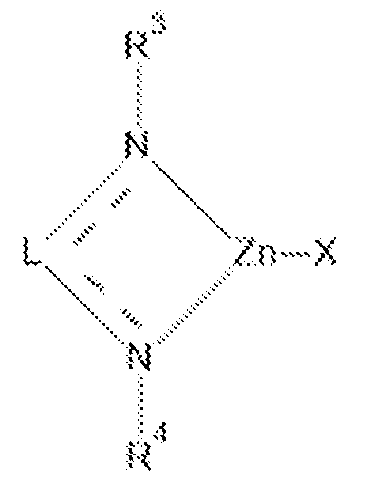


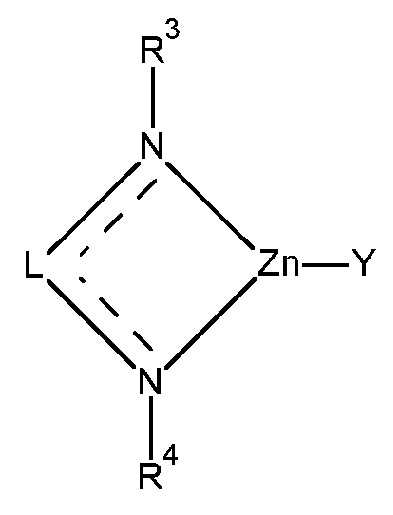
Scheme 1
 In the reaction according to Scheme 1, pro-ligand compound of formula (II) is first reacted with a metal salt comprising a metal ion M+, to form the derivative according to formula (III). The metal ion M+ may be any suitable ion including Li, Na or K. The metal salt which provides the ion M+ may be, for example, a lithiating agent, such as an organolithium reagent, e.g. nBuLi. Alternatively, the salt may be NaH, NaOR, KH or KOR (wherein R is alkyl). The derivative according to formula (III) is then reacted with zinc salt ZnX2, where X is any suitable monovalent anion. For example, X may be Cl, triflate or a carbanion such as an alkyl anion. Reacting the derivative according to formula (III) with ZnX2 provides the complex according to formula (IV). Finally, the complex according to formula (IV) is reacted with M’-Y (for example, M’-QR1R2) to form the compound according to formula (I). In the compound M’-Y, M’ is a metal atom such as Li, Na or K. M’-Y may be formed by the reaction of HY with a suitable reagent for introducing the metal atom, such as a lithiating reagent e.g. nBuLi. As an alternative in step (c), a Grignard reagent MgYX’ may be reacted with the compound according to formula (IV) where X’ is a halogen for example Cl
An alternative method of synthesis for the compounds according to formula (I) involves the direct reaction of the proligand compound with a suitable zinc salt, as shown in Scheme 2 below. Scheme 2
In the reaction according to Scheme 1, pro-ligand compound of formula (II) is first reacted with a metal salt comprising a metal ion M+, to form the derivative according to formula (III). The metal ion M+ may be any suitable ion including Li, Na or K. The metal salt which provides the ion M+ may be, for example, a lithiating agent, such as an organolithium reagent, e.g. nBuLi. Alternatively, the salt may be NaH, NaOR, KH or KOR (wherein R is alkyl). The derivative according to formula (III) is then reacted with zinc salt ZnX2, where X is any suitable monovalent anion. For example, X may be Cl, triflate or a carbanion such as an alkyl anion. Reacting the derivative according to formula (III) with ZnX2 provides the complex according to formula (IV). Finally, the complex according to formula (IV) is reacted with M’-Y (for example, M’-QR1R2) to form the compound according to formula (I). In the compound M’-Y, M’ is a metal atom such as Li, Na or K. M’-Y may be formed by the reaction of HY with a suitable reagent for introducing the metal atom, such as a lithiating reagent e.g. nBuLi. As an alternative in step (c), a Grignard reagent MgYX’ may be reacted with the compound according to formula (IV) where X’ is a halogen for example Cl
An alternative method of synthesis for the compounds according to formula (I) involves the direct reaction of the proligand compound with a suitable zinc salt, as shown in Scheme 2 below. Scheme 2
 In the reaction according to Scheme 2, pro-ligand compound of formula (II) is first reacted with zinc salt ZnX2, where X is any suitable monovalent anion. For example, X may be Cl, triflate or a carbanion such as an alkyl anion. Reacting the proligand according to formula (II) with ZnX2 provides the complex according to formula (IV). Finally, the complex according to formula (IV) is reacted with M’-Y to form the compound according to formula (I). In the compound M’-Y, M’ is a metal atom such as Li, Na or K. M’- QR1R2 may be formed by the reaction of HY with a suitable reagent for introducing the metal atom, such as a lithiating reagent e.g. nBuLi. As an alternative in step (e), a Grignard reagent MgYX’ may be reacted with the compound according to formula (IV), where X’ is a halogen, for example Cl. In an alternative synthesis, step (e) may involve the reaction of the compound according to formula (IV) with a Grignard reagent R13MgX’’, wherein R13 is selected from aliphatic and aryl groups (for example, C1- 20alkyl, aryl or vinyl) and X’’ is a monovalent anion, for example Cl. Reaction with HY then gives the compound according to formula (I). The order of addition of R13MgX’’ and HY may not be critical. An alternative method of synthesis for the compounds according to formula (I) involves the reaction of a zinc compound Zn(Y)2 with the proligand compound as shown in Scheme 3 below.
Scheme 3 3
In the reaction according to Scheme 2, pro-ligand compound of formula (II) is first reacted with zinc salt ZnX2, where X is any suitable monovalent anion. For example, X may be Cl, triflate or a carbanion such as an alkyl anion. Reacting the proligand according to formula (II) with ZnX2 provides the complex according to formula (IV). Finally, the complex according to formula (IV) is reacted with M’-Y to form the compound according to formula (I). In the compound M’-Y, M’ is a metal atom such as Li, Na or K. M’- QR1R2 may be formed by the reaction of HY with a suitable reagent for introducing the metal atom, such as a lithiating reagent e.g. nBuLi. As an alternative in step (e), a Grignard reagent MgYX’ may be reacted with the compound according to formula (IV), where X’ is a halogen, for example Cl. In an alternative synthesis, step (e) may involve the reaction of the compound according to formula (IV) with a Grignard reagent R13MgX’’, wherein R13 is selected from aliphatic and aryl groups (for example, C1- 20alkyl, aryl or vinyl) and X’’ is a monovalent anion, for example Cl. Reaction with HY then gives the compound according to formula (I). The order of addition of R13MgX’’ and HY may not be critical. An alternative method of synthesis for the compounds according to formula (I) involves the reaction of a zinc compound Zn(Y)2 with the proligand compound as shown in Scheme 3 below.
Scheme 3 3
 An alternative method of synthesis for the compounds according to formula (I) involves the reaction of a zinc hydride complex of formula (VIII) with HY as shown in Scheme 4 below. Scheme 4
 Specific compound synthesis In the following examples, all manipulations were carried out under standard Schlenk-line and glovebox techniques under an inert atmosphere of argon or dinitrogen. An MBraun Labmaster glovebox was employed operating at <0.1 ppm O2 and <0.1 ppm H2O. NMR scale reactions were performed in J. Young tap NMR tubes equipped with internal standard capillaries of ferrocene or bis(trimethylsilyl)methane in C6D6 and were prepared in a glovebox. Solvents were dried over activated alumina from an SPS (solvent purification system) based upon the Grubbs design and degassed before use. Glassware was dried for 12 hours at 120 °C prior to use. Benzene-d6 and toluene-d8 were freeze- pump-thaw degassed and stored over 3 Å molecular sieves prior to use. NMR spectra were obtained on BRUKER 400 or 500 MHz machines, all peaks are referenced against residual solvent peak (C6D5H δ 7.16 ppm, C6D5CD2H δ 2.09 ppm) with values quoted in ppm. Data were processed in MestReNova. Crystallographic data was collected using Agilent Xcalibur
PX Ultra A or Agilent Xcalibur 3E diffractometers, and the structures were refined using the SHELXTL and SHELX-2013 program systems. The β-diketiminate proligands (DippBDI)H and (DepBDI)H, complex and diarylethyne substrates were prepared according to literature procedures.
Specific compound synthesis In the following examples, all manipulations were carried out under standard Schlenk-line and glovebox techniques under an inert atmosphere of argon or dinitrogen. An MBraun Labmaster glovebox was employed operating at <0.1 ppm O2 and <0.1 ppm H2O. NMR scale reactions were performed in J. Young tap NMR tubes equipped with internal standard capillaries of ferrocene or bis(trimethylsilyl)methane in C6D6 and were prepared in a glovebox. Solvents were dried over activated alumina from an SPS (solvent purification system) based upon the Grubbs design and degassed before use. Glassware was dried for 12 hours at 120 °C prior to use. Benzene-d6 and toluene-d8 were freeze- pump-thaw degassed and stored over 3 Å molecular sieves prior to use. NMR spectra were obtained on BRUKER 400 or 500 MHz machines, all peaks are referenced against residual solvent peak (C6D5H δ 7.16 ppm, C6D5CD2H δ 2.09 ppm) with values quoted in ppm. Data were processed in MestReNova. Crystallographic data was collected using Agilent Xcalibur
PX Ultra A or Agilent Xcalibur 3E diffractometers, and the structures were refined using the SHELXTL and SHELX-2013 program systems. The β-diketiminate proligands (DippBDI)H and (DepBDI)H, complex and diarylethyne substrates were prepared according to literature procedures.
 “(DippBDI)H” “(DepBDI)H” Solvents were freeze-pump-thaw degassed and stored over 3 Å molecular sieves prior to use. Chemicals were purchased from Sigma Aldrich, Alfa Aesar, Honeywell or Fluorochem and used without further purification unless stated. Where liquids at 25 °C, reagents were dried over 3 Å sieves and freeze-pump-thaw degassed prior to use. All gases were supplied by BOC and used without further purification or drying. Quantitative gas chromatography (GC) analyses were performed with an Agilent Technologies 7820A GC with FID detector using either an Agilent DB-WAX or HP-PLOT Q column. The carrier gas used was helium. Durene was used as internal standard. High pressure (>10 bar) reactions were performed in either a Parr Instrument Company Series 5500 HPCL 300 mL reactor or Series 4790 GP 25 mL reactor with a 4848 reactor controller. Heating was supplied by a hot plate stirrer and metal bead bath or aluminium heating block and monitored using an internal thermocouple. Stirring was provided using PTFE coated magnetic stirrers (3.0 x 0.8 x 0.8 cm for 300 mL vessel and 1.2 x 0.4 x 0.4 cm for 25 mL vessel) and both reactors were fitted with PTFE liners. Due to issues with contamination and background catalysis all PTFE liners and stirrers were subject to a rigorous cleaning procedure after each reaction. This procedure was: an acetone rinse, then an aqua regia soak (10 – 20 minutes) followed by a thorough wash with distilled water and a final rinse with acetone. This cleaning procedure was coupled with appropriate control reactions to minimise background catalysis.
Example 1
“(DippBDI)H” “(DepBDI)H” Solvents were freeze-pump-thaw degassed and stored over 3 Å molecular sieves prior to use. Chemicals were purchased from Sigma Aldrich, Alfa Aesar, Honeywell or Fluorochem and used without further purification unless stated. Where liquids at 25 °C, reagents were dried over 3 Å sieves and freeze-pump-thaw degassed prior to use. All gases were supplied by BOC and used without further purification or drying. Quantitative gas chromatography (GC) analyses were performed with an Agilent Technologies 7820A GC with FID detector using either an Agilent DB-WAX or HP-PLOT Q column. The carrier gas used was helium. Durene was used as internal standard. High pressure (>10 bar) reactions were performed in either a Parr Instrument Company Series 5500 HPCL 300 mL reactor or Series 4790 GP 25 mL reactor with a 4848 reactor controller. Heating was supplied by a hot plate stirrer and metal bead bath or aluminium heating block and monitored using an internal thermocouple. Stirring was provided using PTFE coated magnetic stirrers (3.0 x 0.8 x 0.8 cm for 300 mL vessel and 1.2 x 0.4 x 0.4 cm for 25 mL vessel) and both reactors were fitted with PTFE liners. Due to issues with contamination and background catalysis all PTFE liners and stirrers were subject to a rigorous cleaning procedure after each reaction. This procedure was: an acetone rinse, then an aqua regia soak (10 – 20 minutes) followed by a thorough wash with distilled water and a final rinse with acetone. This cleaning procedure was coupled with appropriate control reactions to minimise background catalysis.
Example 1
 Compound 1 “(DippBDI)ZnNHPh” To a clean, dry Schlenk under argon, (DippBDI)H (5 g, 11.9 mmol) was added and dissolved in THF (20 mL).
 “(DippBDI)H” nBuLi (1.6 M in hexanes, 7.5 mL, 11.9 mmol) was added dropwise at -78 °C, the reaction was then allowed to warm to 25 °C and stirred for 16 h. In a separate Schlenk, anhydrous ZnCl2 (1.6 g, 11.9 mmol) was dissolved in THF (10 mL). The solution of (DippBDI)Li was transferred dropwise via cannula onto the solution of ZnCl2 at -78 °C. This mixture was allowed to warm to 25 °C and stirred for 16 h.


Examples 14-15 - High pressure (>10 bar) catalytic reactions at 7 mL scale
In a N2 glovebox, Compound 1, (DippBDI)ZnNHPh (75 mg, 0.1 mmol) and alkyne (10 equiv., 1.3 mmol) were weighed into separate scintillation vials, dissolved in toluene (7.5 mL) and added to a 25 mL pressure vessel. ~0.5 mL was taken for NMR analysis. The alkyne compounds used are set out in Table 2 below. The pressure vessel was sealed and removed from the glovebox. Inlet and outlet lines were fitted to the vessel, and the inlet valve was purged for 5 minutes with N2 before the vessel was opened to the gas line. The vessel was then purged with N2 (10 x 5 bar) followed by H2 (3 x 3 bar), before being pressurised to 16 bar with H2 and sealed. The reaction was heated to 145 °C to give a final pressure of 23 bar (measured using a digital manometer). Stirring was set to 900 rpm and
the reaction was run for 18 h. The reaction mixture was then analysed by NMR and gas chromatography. Table 2
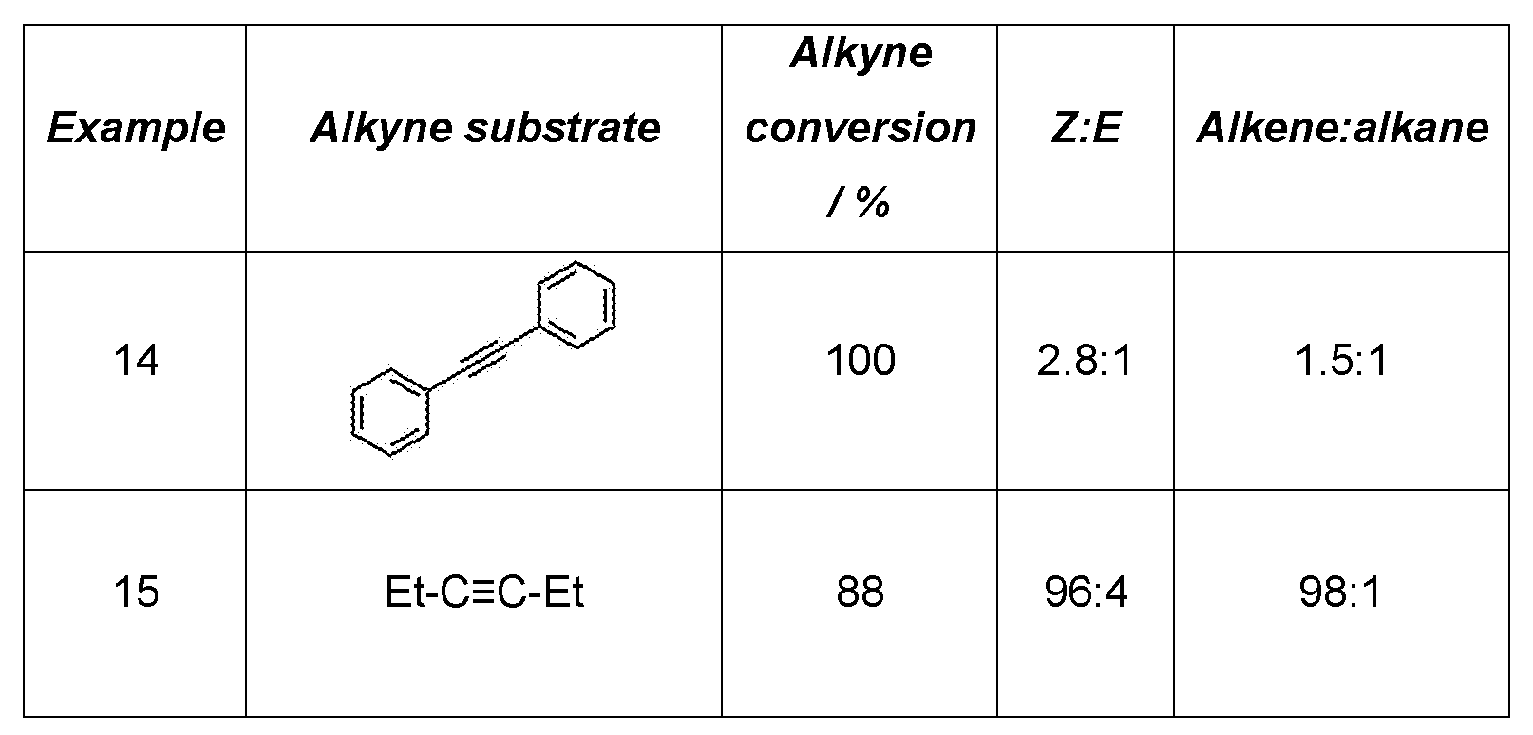 The reduced selectivity with diphenylacetylene in Example 14 relative to diethylacetylene in Example 15 was attributed to unoptimized reaction conditions in the particular reactor used. It is suspected that in this particular Example the reaction was left to run for too long resulting in complete conversion to Z-alkene followed by some over-hydrogenation or isomerisation. This could be addressed by tailoring the reaction time. Comparative Example 1 - High pressure (>10 bar) reaction at 30 mL scale without catalyst The procedure as in Example 2 was carried out but in the absence of the catalyst Compound 1. The results were as follows:
 DFT studies into dihydrogen activation at zinc In order to explore the energetic feasibility of the dihydrogen activation process, DFT calculations were performed using the M06L functional and a hybrid basis set. In the solid state, Compound 1 possesses an arrangement in which the core of the β-diketiminate ligand, the Zn–N motif, and the phenyl ring of the anilide all lie within the same plane. This conformation is reproduced by DFT calculations and results in an electronic structure in
which the frontier molecular orbitals of Compound 1 are set up to react with dihydrogen. Hence, the natural localized molecular orbitals (NLMOs) of Compound 1 allow the visualization the 2p-orbital on N and the 4s-orbital on Zn, which have been found to contribute to the HOMO and LUMO+1, respectively. The dual Lewis acidic / Lewis basic behavior of the Zn–N bond of Compound 1 was further supported by attempts to prepare an analogue of this compound. Variation of the steric demands of the ligand on zinc (Ar = 2,6- diisopropylphenyl vs 2,6-diethylphenyl) led to the isolation of the zincate complex Compound 2, in which an equiv. of Li–Cl is coordinated to the Zn–N bond:
DFT studies into dihydrogen activation at zinc In order to explore the energetic feasibility of the dihydrogen activation process, DFT calculations were performed using the M06L functional and a hybrid basis set. In the solid state, Compound 1 possesses an arrangement in which the core of the β-diketiminate ligand, the Zn–N motif, and the phenyl ring of the anilide all lie within the same plane. This conformation is reproduced by DFT calculations and results in an electronic structure in
which the frontier molecular orbitals of Compound 1 are set up to react with dihydrogen. Hence, the natural localized molecular orbitals (NLMOs) of Compound 1 allow the visualization the 2p-orbital on N and the 4s-orbital on Zn, which have been found to contribute to the HOMO and LUMO+1, respectively. The dual Lewis acidic / Lewis basic behavior of the Zn–N bond of Compound 1 was further supported by attempts to prepare an analogue of this compound. Variation of the steric demands of the ligand on zinc (Ar = 2,6- diisopropylphenyl vs 2,6-diethylphenyl) led to the isolation of the zincate complex Compound 2, in which an equiv. of Li–Cl is coordinated to the Zn–N bond:
 Compound 2 As shown in Figure 1, dihydrogen activation by Compound 1 was found to occur through a stepwise process involving the formation of a weakly bound encounter complex Int-1 which leads to TS-1. Int-1 is an unstable encounter complex of zinc with dihydrogen. While there is component of bonding that involves donation of electron density from the H–H bond to the vacant 4s-orbital of Zn in Int-1 it is not significant enough to assign this as a dihydrogen complex of zinc. Dihydrogen splitting occurs by translation of the H2 molecule across the zinc center, towards the anilide nitrogen atom, elongating both the H–H and Zn–N distances as it nears the transition state geometry. In TS-1 population of the s*-orbital of H2 occurs through donation of electron density from the N-based LP, breaking the H–H bond and forming Int-2 a weakly bound adduct of 2 and H2NPh. Further aspects and embodiments of the present disclosure are set out in the following numbered clauses: 1. A compound according to formula (I):


22. A method of making a compound according to formula (I):

(l) from starting materials comprising a compound according to formula (II):

(II) wherein Y, L, R3 and R4 are as defined in any one of clauses 1 to 17.
23. A method according to clause 22, comprising:
(a) reacting the compound according to formula (II) with a first metal- containing reagent to form a compound according to formula (III):

(III) wherein M is a metal atom selected from Li, Na and K;
(b) reacting the compound according to formula (III) with a zinc salt ZnX2 to form a compound according to formula (IV):
 (IV) wherein X is a monovalent anion; and (c) converting the compound according to formula (IV) into the compound according to formula (I); wherein one or both of the first metal-containing reagent and the second metal-containing reagent optionally comprises nBuLi. 24. A method according to clause 23, wherein step (c) comprises reacting the compound according to formula (IV) with M’Y, wherein M’Y is optionally made by reacting a second metal-containing reagent with YH. 25. An intermediate according to formula (IV):
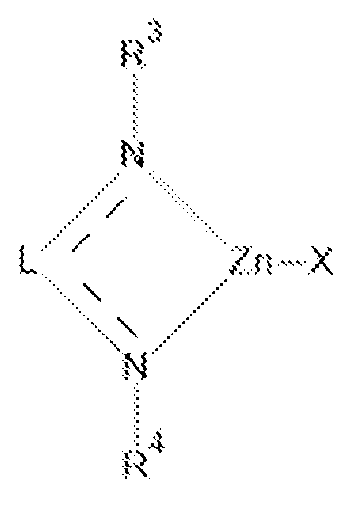 (IV) wherein L, R3 and R4 are as defined in any one of clauses 1 to 17 and X is a monovalent anion. 26. A method of making an intermediate according to formula (IV):

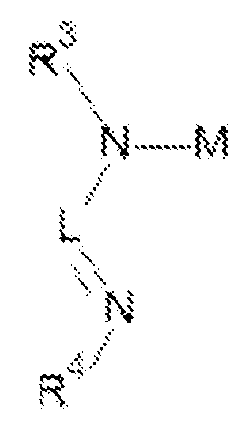


Claims
Claims 1. A compound according to formula (I):
 (I) or a salt, solvate or hydrate thereof; wherein: Y is -NHR2; L is selected from -CR8-CR9-CR10-, -CR5-, -CR6-CR7-, -CRN3-NRG-CRN4- and -CRO1-O-CRO2-; either: (A) R2 is R2A and R4 is R4A; or (B) R2 and R4 and the atoms to which they are attached form a 5-8 membered heterocyclic group, optionally substituted with one or more groups RD, and optionally being fused to one or more optionally substituted aryl groups; R3 is selected from H; linear or branched unsubstituted C1-12 aliphatic groups; C6 aryl, optionally substituted with one or more groups RA, and 5-6 membered heteroaryl, optionally substituted with one or more groups RB; R5, R6, R7, RN3, RN4, RO1 and RO2 are each independently selected from H, linear or branched unsubstituted C1-12 aliphatic groups,
C5-6 unsubstituted aryl or heteroaryl groups, and -NRN1RN2; R8, R9 and R10 are each independently selected from H, linear or branched unsubstituted C1-12 aliphatic groups, C5-6 unsubstituted aryl or heteroaryl groups, and -NRN1RN2; or two or more of R8, R9 and R10, together with the atoms to which they are attached, are joined to form a monocyclic or bicyclic group, with any remaining groups of R8, R9 and R10 being selected from H, linear or branched unsubstituted C1-4 aliphatic groups, C5-6 unsubstituted aryl or heteroaryl groups, and -NRN1RN2; R2A and R4A are each independently selected from H; linear or branched unsubstituted C1-12 aliphatic groups; C6 aryl, optionally substituted with one or more groups RA; 5-6 membered heteroaryl, optionally substituted with one or more groups RB; C6-20 aralkyl, optionally substituted with one or more groups RC; and Si(C1-6alkyl)3; RN1 and RN2 are each independently selected from linear or branched unsubstituted C1-6 aliphatic groups, or RN1 and RN2 together with the N atom to which they are attached are joined to form a 3-6 membered heterocyclic group optionally substituted with one or more groups RE; RA, RB, RC, RD and RE are each independently selected from linear or branched unsubstituted C1-6 aliphatic groups; halo; O(C1-6alkyl); -CF3, -CF2H, -CFH2; -OCF3, -OCF2H and -OCFH2; RF and RG are independently selected from H; C1-12 alkyl groups; C6 aryl, optionally substituted with one or more groups RA;
5-6 membered heteroaryl, optionally substituted with one or more groups RB; C6-20 aralkyl, optionally substituted with one or more groups RC; -S(=O)2CF3; and -C(=O)RH, wherein RH is linear or branched C1-6 alkyl optionally substituted with one or more groups independently selected from OH and halo; with the proviso that the compound is not a compound according to formula (X):
(I) or a salt, solvate or hydrate thereof; wherein: Y is -NHR2; L is selected from -CR8-CR9-CR10-, -CR5-, -CR6-CR7-, -CRN3-NRG-CRN4- and -CRO1-O-CRO2-; either: (A) R2 is R2A and R4 is R4A; or (B) R2 and R4 and the atoms to which they are attached form a 5-8 membered heterocyclic group, optionally substituted with one or more groups RD, and optionally being fused to one or more optionally substituted aryl groups; R3 is selected from H; linear or branched unsubstituted C1-12 aliphatic groups; C6 aryl, optionally substituted with one or more groups RA, and 5-6 membered heteroaryl, optionally substituted with one or more groups RB; R5, R6, R7, RN3, RN4, RO1 and RO2 are each independently selected from H, linear or branched unsubstituted C1-12 aliphatic groups,
C5-6 unsubstituted aryl or heteroaryl groups, and -NRN1RN2; R8, R9 and R10 are each independently selected from H, linear or branched unsubstituted C1-12 aliphatic groups, C5-6 unsubstituted aryl or heteroaryl groups, and -NRN1RN2; or two or more of R8, R9 and R10, together with the atoms to which they are attached, are joined to form a monocyclic or bicyclic group, with any remaining groups of R8, R9 and R10 being selected from H, linear or branched unsubstituted C1-4 aliphatic groups, C5-6 unsubstituted aryl or heteroaryl groups, and -NRN1RN2; R2A and R4A are each independently selected from H; linear or branched unsubstituted C1-12 aliphatic groups; C6 aryl, optionally substituted with one or more groups RA; 5-6 membered heteroaryl, optionally substituted with one or more groups RB; C6-20 aralkyl, optionally substituted with one or more groups RC; and Si(C1-6alkyl)3; RN1 and RN2 are each independently selected from linear or branched unsubstituted C1-6 aliphatic groups, or RN1 and RN2 together with the N atom to which they are attached are joined to form a 3-6 membered heterocyclic group optionally substituted with one or more groups RE; RA, RB, RC, RD and RE are each independently selected from linear or branched unsubstituted C1-6 aliphatic groups; halo; O(C1-6alkyl); -CF3, -CF2H, -CFH2; -OCF3, -OCF2H and -OCFH2; RF and RG are independently selected from H; C1-12 alkyl groups; C6 aryl, optionally substituted with one or more groups RA;
5-6 membered heteroaryl, optionally substituted with one or more groups RB; C6-20 aralkyl, optionally substituted with one or more groups RC; -S(=O)2CF3; and -C(=O)RH, wherein RH is linear or branched C1-6 alkyl optionally substituted with one or more groups independently selected from OH and halo; with the proviso that the compound is not a compound according to formula (X):
 (X) wherein the group XX is -NH(DIPP); and wherein DIPP is the group:
 .
.
2. A compound according to claim 1, wherein R2 is unsubstituted phenyl.
3. A compound according to claim 1 or claim 2, wherein R3 and R4 are the same.
4 A compound according to any one of claims 1 to 3, wherein R3 and R4 are each independently selected from phenyl optionally substituted with one or more groups RA.
5. A compound according to claim 4, wherein R3 and R4 are each independently selected from phenyl substituted in both ortho-positions with a group RA.
6. A compound according to any one of claims 1 to 5, wherein RA is selected from unsubstituted branched C3-6 alkyl.
7. A compound according to any one of claims 1 to 6, wherein L is -CR8-CR9-CR10-, such that the compound is a compound according to formula (IA):
 (IA) or a salt, solvate or hydrate thereof.
8. A compound according to claim 7, wherein R8, R9 and R10 are each independently selected from H, linear or branched unsubstituted C1-4 aliphatic groups, C5-6 unsubstituted aryl or heteroaryl groups, and -NRN1RN2.
9. A compound according to claim 7, wherein R8, R9 and R10 are each independently selected from H and methyl.
10. A compound according to any one of claims 7 to 9, wherein R9 is H.
11. A compound according to any one of claims 7 to 10, wherein one or both of R8 and R10 is methyl.
12. A compound according to any one of claims 1 to 11, wherein R4A is selected from linear or branched unsubstituted C1-4 aliphatic groups; C6 aryl, optionally substituted with one or more groups RA; and C5-6 heteroaryl, optionally substituted with one or more groups RB.
13. A compound according to any one of claims 1 to 12, wherein R3 is selected from linear or branched unsubstituted C1-4 aliphatic groups; C6 aryl, optionally substituted with one or more groups RA; and C5-6 heteroaryl, optionally substituted with one or more groups RB.
14. A compound according to any one of claims 1 to 13, wherein the compound is:
 15. A hydrogenation catalyst comprising a compound according to any one of claims 1 to 14. 16. A method of hydrogenation of reducing or hydrogenating a double or triple bond by reaction with dihydrogen in the presence of a catalyst comprising a compound according to any one of claims 1 to 14. 17. A method of activating dihydrogen for hydrogenation, comprising reacting dihydrogen with a catalyst comprising a compound according to any one of claims 1 to 14. 18. A compound according to formula (VII):
 (VII) wherein L, R3 and R4 are as defined in any one of claims 1 to 14; and R11 and R12 are each independently selected from optionally substituted (hetero)hydrocarbyl groups. 19. A method of making a compound according to formula (I):


Applications Claiming Priority (2)
| Application Number | Priority Date | Filing Date | Title |
|---|---|---|---|
| GBGB2011403.9A GB202011403D0 (en) | 2020-07-23 | 2020-07-23 | Hydrogenation catalyst |
| GB2011403.9 | 2020-07-23 |
Publications (1)
| Publication Number | Publication Date |
|---|---|
| WO2022018425A1 true WO2022018425A1 (en) | 2022-01-27 |
Family
ID=72339293
Family Applications (1)
| Application Number | Title | Priority Date | Filing Date |
|---|---|---|---|
| PCT/GB2021/051856 Ceased WO2022018425A1 (en) | 2020-07-23 | 2021-07-20 | Hydrogenation catalyst |
Country Status (2)
| Country | Link |
|---|---|
| GB (1) | GB202011403D0 (en) |
| WO (1) | WO2022018425A1 (en) |
-
2020
- 2020-07-23 GB GBGB2011403.9A patent/GB202011403D0/en not_active Ceased
-
2021
- 2021-07-20 WO PCT/GB2021/051856 patent/WO2022018425A1/en not_active Ceased
Non-Patent Citations (10)
| Title |
|---|
| BARTH JOHANN AMBROSIUS ET AL: "The Reagent (Z)-Selektive Reduktion von konjugierten Dreifachbindungen rnit Zn (Cu/Ag)l) (Z-)-Selective Reduction of Conjugated Alkynes with Zn (CdAg)", JOURNAL FUR PRAKTISCHE CHEMIE CHEMIKER-ZEITUNG DAS REAGENZ *, vol. 336, 1 January 1994 (1994-01-01), pages 714 - 715, XP055852711 * |
| DOVE ANDREW P. ET AL: "Magnesium and zinc complexes of a potentially tridentate [beta]-diketiminate ligand", DALTON TRANSACTIONS, no. 4, 1 January 2004 (2004-01-01), Cambridge, pages 570 - 578, XP055852574, ISSN: 1477-9226, DOI: 10.1039/B314760F * |
| JONES CAMERON ET AL: "Synthesis and characterisation of zinc gallyl complexes: First structural elucidations of Zn-Ga bonds", DALTON TRANSACTIONS, no. 28, 1 January 2007 (2007-01-01), Cambridge, pages 2997 - 2999, XP055852580, ISSN: 1477-9226, DOI: 10.1039/B706402K * |
| LORTIE JOHN L ET AL: "Supporting Information Zinc-Catalyzed Hydrosilylation and Hydroboration of N-Heterocycles Contents", ACS CATALYSIS, vol. 7, no. 12, 1 January 2017 (2017-01-01), pages 1 - 79, XP055852666 * |
| LORTIE JOHN L. ET AL: "Zinc-Catalyzed Hydrosilylation and Hydroboration of N-Heterocycles", ACS CATALYSIS, vol. 7, no. 12, 1 December 2017 (2017-12-01), US, pages 8454 - 8459, XP055852528, ISSN: 2155-5435, Retrieved from the Internet <URL:https://pubs.acs.org/doi/pdf/10.1021/acscatal.7b02811> DOI: 10.1021/acscatal.7b02811 * |
| PRUST JÖRG ET AL: "Synthesis and Structural Characterization of Monomeric Three-Coordinated [beta]-Diketoiminate Organozinc Derivatives", ORGANOMETALLICS, vol. 20, no. 17, 1 August 2001 (2001-08-01), pages 3825 - 3828, XP055852568, ISSN: 0276-7333, DOI: 10.1021/om010301x * |
| SCHMIDT SARAH ET AL: "Synthesis and Structural Characterization of New Zinc Amidinate Complexes", ORGANOMETALLICS, vol. 29, no. 22, 28 October 2010 (2010-10-28), pages 6097 - 6103, XP055852512, ISSN: 0276-7333, DOI: 10.1021/om1008549 * |
| SCHULZ STEPHAN ET AL: "Synthesis and Characterization of [beta] -Diketiminate Zinc Complexes", ZEITSCHRIFT FUR ANORGANISCHE UND ALLGEMEINE CHEMIE, vol. 635, no. 2, 1 February 2009 (2009-02-01), pages 216 - 220, XP055852582, ISSN: 0044-2313, DOI: 10.1002/zaac.200800374 * |
| SCHULZ STEPHAN ET AL: "X-Ray crystal structure of a heterobimetallic Al-Zn-oxide complex", CHEMICAL COMMUNICATIONS, vol. 47, no. 9, 1 January 2011 (2011-01-01), UK, pages 2676 - 2678, XP055852517, ISSN: 1359-7345, Retrieved from the Internet <URL:https://pubs.rsc.org/en/content/articlepdf/2011/cc/c0cc05599a> DOI: 10.1039/c0cc05599a * |
| WEBB ET AL.: "Utilising an anilido-imino ligand to stabilise zinc-phosphanide complexes: reactivity and fluorescent properties", DALTON TRANS, vol. 48, 2019, pages 8094 |
Also Published As
| Publication number | Publication date |
|---|---|
| GB202011403D0 (en) | 2020-09-09 |
Similar Documents
| Publication | Publication Date | Title |
|---|---|---|
| Gray et al. | Carbon-Nitrogen Bond Cleavage in an. eta. 2 (N, C)-Pyridine Complex Induced by Intramolecular Metal-to-Ligand Alkyl Migration: Models for Hydrodenitrogenation Catalysis | |
| Cohen et al. | Titanacycles derived from reductive coupling of nitriles, alkynes, acetaldehyde, and carbon dioxide with bis (pentamethylcyclopentadienyl)(ethylene) titanium (II) | |
| Soobramoney et al. | Coordination chemistry of Co complexes containing tridentate SNS ligands and their application as catalysts for the oxidation of n-octane | |
| Tamura et al. | Stereoselective E-olefin formation by Wittig-type olefination of aldehydes with allylic tributylphosphorus ylides derived from allylic nitro compounds | |
| Kostas et al. | Platinum complexes with a methoxy-amino phosphine or a nitrogen-containing bis (phosphine) ligand. Synthesis, characterization and application to hydrogenation of trans-cinnamaldehyde | |
| Fackler et al. | Isomerization of a symmetrical metal-metal bonded gold (II) ylide dimer to a mixed-valence gold (III)/gold (I) species | |
| Grissom et al. | Aryl radical additions to aldehydes and oxime ethers: the tandem enediyne-radical cyclization | |
| Kuniyasu et al. | Insertion of Alkynes into an ArS− Pt Bond: Regio-and Stereoselective Thermal Reactions, Facilitation by “o-Halogen Effect” and Photoirradiation, Different Alkyne Preferences Depending on the Ancillary Ligand, and Application to a Catalytic Reaction | |
| Saura-Llamas et al. | Epimerization of secondary alcohols by new homogeneous, low oxidation-state metal catalysts: carbon-hydrogen bond activation in rhenium alkoxide complexes (. eta. 5-C5R5) Re (NO)(PPh3)(OCHRR') | |
| Casey et al. | Preparation and reactions of alkyl-and arylpentacarbonyltungsten anions | |
| Alonso‐Moreno et al. | Well‐Defined Regioselective Iminopyridine Rhodium Catalysts for Anti‐Markovnikov Addition of Aromatic Primary Amines to 1‐Octyne | |
| Lynam et al. | Solvent and phosphine dependency in the reaction of cis-RuCl2 (P–P) 2 (P–P= dppm or dppe) with terminal alkynes | |
| Doğan et al. | Synthesis, characterization and catalytic activity of novel N-heterocyclic carbene-palladium complexes | |
| Nief et al. | Ligand exchange reaction of ferrocene with 2, 4, 6-triphenylphosphabenzene. Synthesis and structural study of isomeric (. eta. 5-phosphacyclohexadienyl)(. eta. 5-cyclopentadienyl) iron (II) complexes containing a. eta. 5-phosphadienyl unit | |
| Herrmann et al. | General synthesis and metal complexes of fused-ring bicyclic cyclopentadienes | |
| Casey et al. | Inversion of configuration in the bromination of vinylic mercurials | |
| Štěpnička et al. | Preparation of phosphinoferrocene carboxamides from isocyanates. Synthesis and structural characterisation of palladium (II) and platinum (II) complexes with 1′-(diphenylphosphino)-1-(N-phenylcarbamoyl) ferrocene | |
| Liu et al. | Reactions of hydrogen with ruthenium and osmium complexes containing tridentate ligands Cy2PCH2CH (CH2) 2PCy2 and 2, 6-(Ph2PCH2) 2C6H3 | |
| Jones et al. | Synthesis, structures, and carbon-hydrogen bond activation reactions of HRe (PR3) 2 (L) 3 complexes | |
| Planas et al. | Carbon–oxygen and carbon–sulfur bond activation of vinyl esters, ethers and sulfides by low valent ruthenium complexes | |
| van Vuuren et al. | Cyclometallated iridium NHC complexes containing self-isomerised ligands as catalysts for hydrosilylation and transfer hydrogenation reactions | |
| US3783140A (en) | Introduction of organic groups into ethylenically unsaturated carboxylic acids using a group viii metal salt | |
| Weisheit et al. | Photochemical behavior of (diphosphine)(η2-tolane) Pt0 complexes. Part A: Experimental considerations in solution and in the solid state | |
| Joy et al. | A new synthetic route for the preparation of [Os 3 (CO) 10 (μ-OH)(μ-H)] and its reaction with bis (diphenylphosphino) methane (dppm): syntheses and X-ray structures of two isomers of [Os 3 (CO) 8 (μ-OH)(μ-H)(μ-dppm)] and [Os 3 (CO) 7 (μ 3-CO)(μ 3-O)(μ-dppm)] | |
| Jones et al. | Flexible coordination of bulky amidinates and guanidinates towards rhodium (I): Conversion of kinetic to thermodymanic isomers |
Legal Events
| Date | Code | Title | Description |
|---|---|---|---|
| 121 | Ep: the epo has been informed by wipo that ep was designated in this application |
Ref document number: 21749263 Country of ref document: EP Kind code of ref document: A1 |
|
| NENP | Non-entry into the national phase |
Ref country code: DE |
|
| 122 | Ep: pct application non-entry in european phase |
Ref document number: 21749263 Country of ref document: EP Kind code of ref document: A1 |