WO2022018162A1 - FORMULATIONS OF NEW β-CRYPTOXANTHIN CRYSTAL FORM, PROCESSES FOR THEIR MANUFACTURE AND THEIR USES - Google Patents
FORMULATIONS OF NEW β-CRYPTOXANTHIN CRYSTAL FORM, PROCESSES FOR THEIR MANUFACTURE AND THEIR USES Download PDFInfo
- Publication number
- WO2022018162A1 WO2022018162A1 PCT/EP2021/070441 EP2021070441W WO2022018162A1 WO 2022018162 A1 WO2022018162 A1 WO 2022018162A1 EP 2021070441 W EP2021070441 W EP 2021070441W WO 2022018162 A1 WO2022018162 A1 WO 2022018162A1
- Authority
- WO
- WIPO (PCT)
- Prior art keywords
- cryptoxanthin
- weight
- range
- crystal form
- formulation
- Prior art date
- Legal status (The legal status is an assumption and is not a legal conclusion. Google has not performed a legal analysis and makes no representation as to the accuracy of the status listed.)
- Ceased
Links
Classifications
-
- A—HUMAN NECESSITIES
- A23—FOODS OR FOODSTUFFS; TREATMENT THEREOF, NOT COVERED BY OTHER CLASSES
- A23L—FOODS, FOODSTUFFS OR NON-ALCOHOLIC BEVERAGES, NOT OTHERWISE PROVIDED FOR; PREPARATION OR TREATMENT THEREOF
- A23L33/00—Modifying nutritive qualities of foods; Dietetic products; Preparation or treatment thereof
- A23L33/10—Modifying nutritive qualities of foods; Dietetic products; Preparation or treatment thereof using additives
- A23L33/15—Vitamins
-
- A—HUMAN NECESSITIES
- A23—FOODS OR FOODSTUFFS; TREATMENT THEREOF, NOT COVERED BY OTHER CLASSES
- A23L—FOODS, FOODSTUFFS OR NON-ALCOHOLIC BEVERAGES, NOT OTHERWISE PROVIDED FOR; PREPARATION OR TREATMENT THEREOF
- A23L33/00—Modifying nutritive qualities of foods; Dietetic products; Preparation or treatment thereof
- A23L33/10—Modifying nutritive qualities of foods; Dietetic products; Preparation or treatment thereof using additives
- A23L33/105—Plant extracts, their artificial duplicates or their derivatives
-
- A—HUMAN NECESSITIES
- A61—MEDICAL OR VETERINARY SCIENCE; HYGIENE
- A61K—PREPARATIONS FOR MEDICAL, DENTAL OR TOILETRY PURPOSES
- A61K31/00—Medicinal preparations containing organic active ingredients
- A61K31/045—Hydroxy compounds, e.g. alcohols; Salts thereof, e.g. alcoholates
- A61K31/07—Retinol compounds, e.g. vitamin A
-
- A—HUMAN NECESSITIES
- A61—MEDICAL OR VETERINARY SCIENCE; HYGIENE
- A61K—PREPARATIONS FOR MEDICAL, DENTAL OR TOILETRY PURPOSES
- A61K9/00—Medicinal preparations characterised by special physical form
- A61K9/14—Particulate form, e.g. powders, Processes for size reducing of pure drugs or the resulting products, Pure drug nanoparticles
- A61K9/16—Agglomerates; Granulates; Microbeadlets ; Microspheres; Pellets; Solid products obtained by spray drying, spray freeze drying, spray congealing,(multiple) emulsion solvent evaporation or extraction
- A61K9/1605—Excipients; Inactive ingredients
- A61K9/1617—Organic compounds, e.g. phospholipids, fats
- A61K9/1623—Sugars or sugar alcohols, e.g. lactose; Derivatives thereof; Homeopathic globules
Definitions
- Starch hydrolysates are classified according to their dextrose equivalents. “Dextrose” is a synonym for “glucose”.
- the term “dextrose equivalent” (DE) denotes the degree of hydrolysis and is a measure of the amount of reducing sugar calculated as D-glucose based on dry weight; the scale is based on native starch having a DE close to 0 and glucose having a DE of 100.
- the dried formulation according to the present invention comprises preferably 0.1 to 30.0 weight-%/0.3 to 25.0 weight-%, more preferably 0.5 to 20.0 weight-%, even more preferably 0.7 to 15.0 weight-%/0.8 to 10.0 weight-%, most preferably 1.0 to 7.0 weight-%, of crystal form I of b-cryptoxanthin, based on the total weight of the dried formulation.
- OSA-starch denotes any starch (from any natural source such as corn, waxy maize, waxy corn, wheat, tapioca and potato or synthesized) that was treated with octenyl succinic anhydride (OSA).
- the degree of substitution i.e. the number of hydroxyl groups esterified with OSA to the number of free non-esterified hydroxyl groups usually varies in a range of from 0.1% to 10%, preferably in a range of from 0.5% to 4%, more preferably in a range of from 3% to 4%.
- OSA-starches are also known under the expression “modified food starch”.
- glycerophospholipids are phosphatidic acid, bisphosphatidic acid, lecithin (phosphatidylcholine), phosphatidylethanolamine, phosphatidylmethyl- ethanolamine, phosphatidylserine, phosphatidylinositol, phosphatidylglycerol, and diphosphatidylglycerol (cardiolipin), as well as products containing any of these above and derived from plants such as soy bean, corn, peanut, rape seed, wheat, or the like, products containing any of the above and derived from egg yolk or an animal such as cattle, and various lecithins derived from microorganisms such as Escherichia coli.
- lecithin phosphatidylcholine
- phosphatidylethanolamine phosphatidylmethyl- ethanolamine
- phosphatidylserine phosphatidylinositol
- phosphatidylglycerol
- the hydrogenation may be performed by allowing lecithin to react with hydrogen in the presence of a catalyst, whereby the unsaturated bond of the fatty acid moiety is hydrogenated.
- the hydrogenation improves the stability of lecithin against oxidation.
- the hydroxylation may be performed by heating lecithin together with high concentrations of hydrogen peroxide and an organic acid such as acetic acid, tartaric acid, or butyric acid, in which the unsaturated bond of the fatty acid moiety is hydroxylated. The hydroxylation improves the hydrophilicity of lecithin.
- Preferred saponins are those from Quillaja.
- the total amount of the anti-oxidant (especially DL-a-tocopherol or mixed tocopherols) in the aqueous dispersion is preferably in the range of from 0.1 to 10 weight-%, more preferably in the range of from 0.2 to 2 weight-%, most preferably in the range of from 0.3 to 1.5 weight-%, based on the total weight of the aqueous dispersion.
- Formulations A to D are spray-dried powders; formulation E is an aqueous dispersion.
- the pre-cursors of the spray-dried formulations A to D, i.e. the corresponding aqueous dispersions are also preferred embodiments of the present invention.
- the water content of the dispersed suspension is adjusted to 66%.
- the suspension is kept at 40°C under stirring.
- Spray drying is performed with a NIRO Mobile MINOR 2000 Typ D1 device by rotary atomization with a nozzle air pressure of 2.0 bar, with inlet air temperature of 180°C ,and outlet air temperature of max. 96°C. Particle size distribution of the powder is measured by laser diffraction.
Landscapes
- Life Sciences & Earth Sciences (AREA)
- Health & Medical Sciences (AREA)
- Chemical & Material Sciences (AREA)
- Engineering & Computer Science (AREA)
- Mycology (AREA)
- Polymers & Plastics (AREA)
- Food Science & Technology (AREA)
- Nutrition Science (AREA)
- Public Health (AREA)
- Veterinary Medicine (AREA)
- Pharmacology & Pharmacy (AREA)
- General Health & Medical Sciences (AREA)
- Medicinal Chemistry (AREA)
- Animal Behavior & Ethology (AREA)
- Epidemiology (AREA)
- Bioinformatics & Cheminformatics (AREA)
- Botany (AREA)
- Biophysics (AREA)
- Molecular Biology (AREA)
- Acyclic And Carbocyclic Compounds In Medicinal Compositions (AREA)
Abstract
The invention relates to formulations of a new β-cryptoxanthin crystal form, processes for their manufacture and their uses, as well as to products suitable for human consumption comprising such formulations.
Description
Formulations of a new b-cryptoxanthin crystal form, processes for their manufacture and their uses
Summary of the invention
The invention relates to formulations of a new b-cryptoxanthin crystal form, processes for their manufacture and their uses, as well as to products suitable for human consumption comprising such formulations.
Background of the invention b-Cryptoxanthin ^-carotene-3-ol) is a natural carotenoid pigment. It can be isolated from a variety of sources including the petals and flowers of plants in the genus Physalis (see WO 2014/115037, WO 2016/174600, and Xin Wen et al. , Journal of Agricultural and Food Chemistry 2017, 65, 6140-6151 ), be obtained by fermentation (see e.g. US 2009/0093015, WO 2008/045405), as well as be synthesized chemically (see e.g. D. E. Loeber et al., J. Chem. Soc. C 1971 , 404; F. Khachik et al., Synthesis 2011 , 3, 509-516).
In the human body, b-cryptoxanthin is converted to vitamin A (retinol) and is, therefore, considered a provitamin A. According to WO 2005/110122 it can be used to increase the protein formation in a human or an animal. Further health benefits of b-cryptoxanthin are e.g. disclosed in WO 2008/079287, WO 2004/037236, WO 2016/157157 and WO 2015/089385.
Thus, there is a need to provide dietary supplements and pharmaceuticals that comprise b-cryptoxanthin. Examples of dietary supplements and pharmaceuticals that can be administered to humans or animals are hard capsules and tablets. The formulations according to the present invention may also be added to food and beverages.
In order to produce such dietary supplements or pharmaceuticals b-cryptoxanthin has to be provided in a formulation that is water-soluble.
b-Cryptoxanthin, however, is sparingly soluble in water which means that aqueous solutions of b-cryptoxanthin for direct applications are unavailable. Furthermore, b-cryptoxanthin is very sensitive to oxidation and heat treatment. Therefore, delivering b-cryptoxanthin in stable formulations which protect it against oxidation, which are water-dispersible and which are suitable for human consumption are of particular interest.
Thus, there is an ongoing need for a process facilitating the preparation of stable formulations of b-cryptoxanthin which are suitable for human consumption.
Preferably, such formulations are manufactured without the use of an organic solvent, especially without the use of a halogenated hydrocarbon such as dichloromethane or chloroform.
Since the b-cryptoxanthin has to be comminuted and micronization techniques often require organic solvents in contrast to milling, the method of choice for comminuting is milling.
Thus, there was a need to improve the milling properties of solid b-cryptoxanthin.
Surprisingly it has now be found that a certain, novel crystal form of b- cryptoxanthin is easy to mill in water since milling in an edible oil resulted for some crystal forms of b-cryptoxanthin in viscosity problems and thus facilitate the preparation of the above-mentioned formulations. A further advantage is that high concentrations of b-cryptoxanthin in the formulations could be achieved.
The prior art is silent on specific crystal forms of b-cryptoxanthin and their potential utility for preparing b-cryptoxanthin formulations. The inventors of the present patent application have found that it is of high importance to choose the right polymorph (= crystal-form) of b-cryptoxanthin and that a specific crystalline polymorph of b-cryptoxanthin can be more useful than others, especially for the preparation of an aqueous dispersion.
“Right” in this context means a polymorph of b-cryptoxanthin which is stable during the process of manufacturing the formulation and does not undergo polymorphism which could be accompanied by viscosity increase and thus, difficult handling of the b-cryptoxanthin dispersion that is obtained as an intermediate in the process of manufacturing the formulation.
Detailed description of the invention
The above cited need is fulfilled by the present invention, which is directed to formulations, especially to aqueous dispersions and dried formulations being produced from these aqueous dispersions which comprise crystal form I of b- cryptoxanthin (“needles”; see Figure 5), whereby one or more other crystal forms may optionally be present in a certain amount. Such other crystal forms are e.g. crystal form II of b-cryptoxanthin (“platelets”; see Figure 6), crystal form IV of b- cryptoxanthin (“platelets”), and crystal form VIII of b-cryptoxanthin.
Crystal form IV of b-cryptoxanthin (“platelets”) is already known from the prior art. Crystal form II of b-cryptoxanthin (“platelets”; see Figure 6) is also a new crystal form of b-cryptoxanthin.
Surprisingly, it has been found that all three crystal forms I, II and IV are easy to mill in aqueous dispersions. This could not be expected since milling of crystal forms II and IV in an edible oil in certain concentrations was not possible. Thus, the present invention is directed to a process for the manufacture of formulations of b- cryptoxanthin which comprise a milling step.
Furthermore, the inventors of the present invention found that the until now unknown crystal form I is the thermodynamically most stable form, whereas crystal forms II and IV transform into crystal form I in an edible oil such as corn oil, as well as in acetone. This transformation leads to a high increase in viscosity and thus, to major problems in milling. Therefore, only crystal form I can be milled in an edible oil.
The same may be expected with crystal form VIII of b-cryptoxanthin. Crystal form VIII of b-cryptoxanthin is an ethanol solvate that crystallizes in a polymorphic form which is different from crystal form II of b-cryptoxanthin. This can be concluded by comparing the XRPD patterns of crystal forms II and VIII of b-cryptoxanthin: The comparison reveals that the XRPD patterns are not similar.
Since crystal form VIII is an ethanol solvate as crystal form II, it can be assumed that crystal form VIII also transforms into crystal form I in an edible oil such as corn oil, and causes problems with high viscosity when milling is performed in an edible oil.
The invention also relates to methods of manufacturing such aqueous dispersions and dried formulations, as well as to methods of preparing said crystal forms. Interestingly, it was further found that the crystal form I of b-cryptoxanthin can be prepared from crystal form II of b-cryptoxanthin, and vice versa.
Finally, the invention is related to the use of such aqueous dispersions and dried formulations according to the invention in dietary supplements and pharmaceuticals such as hard capsules, tablets, instant drinks, granules and powders.
Crystal forms of b-cryptoxanthin
In particular, the present invention relates to formulations of the new crystal form I of b-cryptoxanthin, whereby crystal forms II, IV, and VIII may optionally be present, especially whereby crystal form II and crystal form IV and any mixture thereof may optionally be present.
Crystal form I of b-cryptoxanthin is anhydrous and ansolvated with needle-shaped crystals, whereas crystal form II is an ethanol solvate (ethanolate) which means that the ethanol is incorporated in the crystal lattice with the b-cryptoxanthin resulting in platelets crystals.
Crystal form IV of b-cryptoxanthin is obtained amongst others by drying crystal form II of b-cryptoxanthin by higher temperatures and are also platelets.
Crystal form VI of b-cryptoxanthin is obtained by crystallization in ethyl acetate or diethyl ether, whereas crystal form VIII of b-cryptoxanthin is obtained by crystallization in a mixture of ethanol and acetone in a volume ratio of 1:3.
Many techniques are used to identify the polymorphic forms of a material and its relative temperature stability. These techniques include X-ray powder diffraction (XRPD) and differential scanning calorimetry (DSC).
The present invention discloses for the first time the possibility of preparing formulations of specific crystal forms of b-cryptoxanthin clearly characterized by XRPD and DSC.
In most cases X-ray diffractometry is capable to reflect the differences in crystal structure. Ideally, X-ray diffraction on a single crystal (typical dimensions 100x100x100 pm3) yields a three-dimensional diffraction pattern of, normally, well-resolved peaks, which after phasing can be back-transformed into electron density. As a matter of fact, it is often difficult, if not impossible, to obtain single crystals of required quality and size from a given material. In powder diffraction experiment the sample consists of a huge number of crystallites with typical dimensions of 5x5x5 pm3. The powder is normally obtained by grinding or milling.
In case of crystal form I, II and IV, X-Ray Powder Diffraction (XRPD) patterns are obtained by collecting intensity data measured by a Rigaku Mim'Flex 600 diffractometer. The system is equipped with a Cu anode and a monochromator providing Cu-Ka radiation (l = 1.54056 A). The measurements are carried out using step width 0.02 degree.
In case of crystal Form VIII, the XRPD pattern was measured using Bruker D8 (LynxEye in Reflection) diffractometer with a copper Cu-Ka radiation (l = 1.54056 A). The X-Ray analysis was performed with a step width 0.02 degree.
Thermal analysis methods are defined as those techniques in which a property of the analyte is determined as a function of an externally applied temperature. In many respects, DSC is an easy method to use routinely on a quantitative basis, and for this reason it has become a widely accepted method for identification and characterization.
In accordance with the present invention, a DSC1 from Mettler Toledo equipped with a sensor type FRS 5+ is used to investigate the thermodynamic relationship between different polymorphs. The DSC cell is calibrated with indium (melting temperature Tm = 156.6 °C, enthalpy of fusion AHfus=28.45J.g.-1 ). b-Crypto- xanthin (normally 3 - 6 mg) was heated up at 10 K/min rate, from 25 °C to 220 °C in Al-pans while being purged with nitrogen.
A two point calibration of the DSC with Indium and Zinc is performed. The tolerances for the calibration are:

To investigate the different polymorphs, 3-5 mg samples of form I or II were heated from 20°C to 220°C at a heating rate of 10 K-min-1, respectively, while being purged with nitrogen (10 ml-min-l).
The morphology of crystal Form I and crystal Form II was examined by scanning electron microscopy from Schaefer-Tec-AG, the equipment type is Phenom ProX.
Crystal form I of b-cryptoxanthin is characterized by the following parameters: l-a) an X-Ray Powder Diffraction pattern comprising at least 3 peaks, preferably at least 4, 5 or 6 peaks, at the following 2-theta positions (deg) (±0.2 deg): 3.209(7), 13.402(3), 16.056(5), 18.174(10), 19.270(16), 25.192(4).
The X-Ray Powder Diffraction pattern of crystal form I of b-cryptoxanthin shows also peaks at the following 2-theta positions (deg) (±0.2 deg):
4.821 (16), 6.64(3), 7.33(4), 8.17(2), 8.70(2), 9.268(15), 9.738(5), 11.11 (3), 11.784(5), 12.460(3), 13.031 (7), 13.886(4), 14.622(7), 15.342(8), 15.630(6), 16.508(10), 16.925(11 ), 17.558(8), 18.580(9), 19.586(15), 20.139(10), 20.532(12), 20.99(3), 21.712(12), 22.403048, 23.124(9), 24.557155, 25.999(6), 26.848(18), 27.412(10), 28.13(4), 28.91 (7), 30.47(3), 31.28(4).
The numbers in parentheses is the estimated standard deviation. “16” means “± 0.016”; “3” means “± 0.003” etc.
In a preferred embodiment the crystal form I of b-cryptoxanthin shows also l-b) a Differential Scanning Calorimeter scan showing a phase transition at a temperature in the range of 60 to 120°C, preferably at a temperature in the range of from 80 to 100°C, more preferably at a temperature in the range of from 80 to 90° C, most preferably at a temperature of 85 °C ± 1 °C.
In a further preferred embodiment the crystal form I of b-cryptoxanthin shows also
I-c) a Differential Scanning Calorimeter scan showing melting at a temperature in the range of from 140°C to 200°C, preferably at a temperature in the range of from 150°C to 190°C.
Crystal form II of b-cryptoxanthin is characterized by the following parameters:
II-a) an XRPD (X-Ray Powder Diffraction) pattern comprising at least 3 peaks, preferably at least 5, 7 or 9 peaks, at the following 2-theta positions (deg) (±0.2 deg): 13.266(2), 13.646(3), 14.562(4), 14.923(2), 15.846(3), 16.599(3), 18.892(7), 21.203(5), 24.331 (12).
The X-Ray Powder Diffraction pattern of crystal form II of b-cryptoxanthin shows also peaks at the following 2-theta positions (deg) (±0.2 deg):
3.60(2), 9.937 (10), 11.190(9), 12.31961 , 15.240(9), 16.194(3), 17.526(19), 17.845(11 ), 18.64(6), 19.99(4), 20.608(8), 22.035(11 ), 23.20(4), 25.008(13), 25.94(4), 26.873(9), 29.51 (3), 30.084(18), 31.51 (3).
The numbers in parentheses is the estimated standard deviation. “2” means “± 0.002”; “10” means “± 0.010” etc.
In a preferred embodiment the crystal form II of b-cryptoxanthin shows also ll-b) a Differential Scanning Calorimeter scan showing a de-solvation peak at a temperature in the range of 100 to 160°C, preferably at a temperature in the range of from 110°C to 150°C.
In a further preferred embodiment the crystal form II of b-cryptoxanthin shows also ll-c) a Differential Scanning Calorimeter scan showing a melting peak at a temperature in the range of from 150°C to 195°C, preferably at a temperature in the range of from 155°C to 190°C.
Figure 1 shows the results, i.e. an X-Ray diffractogram of crystal form I and II of b- cryptoxanthin. The x-axis shows the 2-theta positions, the y-axis shows the counts.
The DSC analysis of crystal form I of b-cryptoxanthin (see Figure 2) shows a reversible endothermic peak in the range between 80° C and 100°C, followed by an intense endothermic peak between 150°C and 190°C corresponding to the melting peak.
The DSC analysis of crystal form II of b-cryptoxanthin (see Figure 3) shows a endothermic peak in the range between 110°C and 150°C corresponding to a de solvation peak, followed by an intense endothermic peak between 155°C and 190°C corresponding to the melting peak.
Crystal form IV of b-cryptoxanthin is characterized by the following parameters:
Ill-a) an X-Ray Powder Diffraction pattern comprising at least 3 peaks, preferably at least 5, 7 or 9 peaks, at the following 2-theta positions (deg) (±0.2 deg): 3.674(4), 14.497(3), 16.0204(18), 16.8337(18), 17.568(5), 17.867(5), 18.995(8), 22.093(2), 24.039(3).
The X-Ray Powder Diffraction pattern of crystal form IV of b-cryptoxanthin shows also peaks at the following 2-theta positions (deg) (±0.2 deg):
5.52(4), 9.60(5), 10.150(16), 10.955(5), 11.749(8), 12.857(15), 13.180(19), 13.531 (11 ), 14.804(4), 15.15(2), 16.517(6), 19.271 (7), 20.283(9), 20.81 (3), 21.689(10), 22.495(5), 23.072(4), 23.606(4), 24.402(4), 24.889(7), 25.244(3), 25.982(12), 27.02(4), 27.715(7), 29.552(11 ) and 30.47(3).
The numbers in parentheses is the estimated standard deviation. “4” means “± 0.004”; “5” means “± 0.005” etc.
Crystal form IV of b-cryptoxanthin are platelets.
Figure 4 shows the X-Ray powder diffraction pattern of crystal form IV of b- cryptoxanthin. The x-axis shows the 2-theta positions, the y-axis shows the counts.
Processes for the manufacture of the crystal forms and their conversion into each other; crystal form VIII
The process for the manufacture of b-cryptoxanthin is known to the person skilled in the art, see e.g. F. Khachik et al. , Synthesis 2011 , 3, 509-516. Hereby crystal form VI of b-cryptoxanthin is obtained by dissolving the crude b-cryptoxanthin in methylene chloride, precipitating it with hexane and filtering it. The inventors have found that crystal form VI may also be obtained by digestion in ethyl acetate or diethyl ether, by dissolving the crude b-cryptoxanthin in methylene chloride, precipitating it with hexane and filtering it. The inventors have found that crystal form VI may also be obtained by digestion in ethyl acetate or diethyl ether.
The manufacture of (3R)- and (3S)- b-cryptoxanthin is furthermore disclosed in examples 18 and 19 of US 2009/0311761 , whereby the crystallization is carried out with dichloromethane and hexane. Hereby crystal form VI of b-cryptoxanthin is obtained (see comparison example 3 of the present patent application).
The crystal form of b-cryptoxanthin obtained in R. Kuhn, C. Grundmann, Chemische Berichte 1933, pages 1746-1750 by crystallization in benzene-alcohol or benzene- methanol is described as butterfly- like connate, sharpened prisms or in regular prisms. It is thus different from any crystal form found by the present inventors.
If crude b-cryptoxanthin is crystallized in a mixture of acetone and ethanol with a volume ratio of ~ 3:1 (similar conditions to the ones used in examples of WO 2014/186683) crystal form VIII of b-cryptoxanthin is obtained (see comparison example 4 of the present patent application).
Figure 8 shows the X-Ray powder diffraction pattern of crystal form VIII of b- cryptoxanthin. The x-axis shows the 2-theta positions, the y-axis shows the counts.
Crystal form VIII of b-cryptoxanthin shows an X-Ray Powder Diffraction pattern comprising at least 3 peaks at the following 2-theta positions (deg) (±0.2 deg): 14.7695(13), 15.670(2), 16.2040(19), 18.252(4), 20.577(13), 22.513(7), 23.024(7), preferably comprising at least 5 peaks at the following 2-theta positions (deg) (±0.2 deg): 14.7695(13), 15.670(2), 16.2040(19), 18.252(4), 20.577(13), 22.513(7), 23.024(7); more preferably comprising 7 peaks at the following 2-theta positions (deg) (±0.2 deg): 14.7695(13), 15.670(2), 16.2040(19), 18.252(4), 20.577(13), 22.513(7), 23.024(7).
The X-Ray Powder Diffraction pattern of crystal form VIII of b-cryptoxanthin shows also peaks at the following 2-theta positions (deg) (±0.2 deg):
2.82559, 6.174611 , 8.415348, 9.6615(13), 11.0814(9), 11.226753, 12.260441 , 12.790(4), 13.237333, 13.684(8), 14.374(3), 15.19617, 17.243(19), 18.007536(),18.827(12), 19.707(8), 21.602(16), 24.27288, 24.596(8), 25.486(7), 25.906691 , 27.069(11 ), 28.193(15), 29.35(5), 29.821302, 30.75(3).
The numbers in parentheses is the estimated standard deviation. “13” means “± 0.013”; “9” means “± 0.009” etc.
The present invention is also directed to a process for the manufacture of crude b- cryptoxanthin (see Figure 7: compound of formula (1)) comprising the following steps:
I) reacting 2,7,11 -trimethyl-13-(2, 6, 6-trimethylcyclohex-1 -en-1 -yl)trideca- 2,4,6,8,10,12-hexaenal (see Fig. 7: compound of formula (3)) and 4-(5- (halotriaryl-5-phosphanyl)-3-methylpenta-1,3-dien-1-yl)-3,5,5- trimethylcyclohex-3-en-1 -ol (see Fig. 7: compound of formula (2)), in the presence of a 30 weight-% methanolic solution of sodium methoxide;
II) separating the thus obtained b-cryptoxanthin to obtain crude b- cryptoxanthin.
Step II) is preferably performed by filtration.
This reaction is shown in Fig. 7. The halogen X in the compound of formula (2) is Br or Cl, preferably it is Cl. Alternatively, for X also HSCV may be used. The substituent R is an aryl or a C1-4 alkyl substituted aryl or alkyl, preferably an aryl, more preferably phenyl. The preferred compound of formula (2) is (/?)-((2E,4E)-5- (4-hydroxy-2,6,6-trimethylcyclohex-1 -en-1 -yl)-3-methylpenta-2,4-dien-1 - yl)triphenylphosphonium halide/hydrogensulfate, especially the corresponding chloride.
Preferably the amount of sodium methoxide is in the range of from 1.00 to 1.50 equivalents, preferably in the range of from 1.00 to 1.20 equivalents, more preferably in the range of from 1.05 to 1.15 equivalents, based on the amount of 4- (5-(halotriaryl-5-phosphanyl)-3-methylpenta-1,3-dien-1 -yl)-3,5,5-trimethylcyclo- hex-3-en-1-ol, preferably based on the amount of (/?)-((2E,4E)-5-(4-hydroxy-2,6,6- trimethylcyclohex-1 -en-1 -yl)-3-methylpenta-2,4-dien-1 -yl)triphenylphosphonium halide/hydrogensulfate, especially the corresponding chloride.
In a further preferred embodiment of this process the reaction is performed in ethanol.
Thus, an especially preferred process for the manufacture of crude b-cryptoxanthin (see Figure 7: compound of formula (1)) comprises the following steps:
I) reacting 2,7,11 -trimethyl-13-(2, 6, 6-trimethylcyclohex-1-en-1 -yl)trideca- 2,4,6,8,10,12-hexaenal (compound of formula (3)) and (/?)-((2E,4E)-5-(4- hydroxy-2,6,6-trimethylcyclohex-1 -en-1 -yl)-3-methylpenta-2,4-dien-1 - yl)triphenylphosphonium chloride (compound of formula (2) with X being Cl and R being phenyl) to b-cryptoxanthin in ethanol in the presence of a 30 weight-% methanolic solution of sodium methoxide, whereby the amount of sodium methoxide is in the range of from 1.00 to 1.50 equivalents, preferably in the range of from 1.00 to 1.20 equivalents, more preferably in the range of from 1.05 to 1.15 equivalents, based on the amount of (/?)-((2E,4E)-5-(4-hydroxy-2,6,6-trimethylcyclohex-1-en-1- yl)-3-methylpenta-2,4-dien-1 -yl)triphenylphosphonium chloride;
II) separating the thus obtained b-cryptoxanthin to obtain crude b- cryptoxanthin.
Step II) is preferably performed by filtration.
To obtain crystal form I, such crude b-cryptoxanthin is subsequently treated as follows: b) suspending the crude b-cryptoxanthin in an organic solvent and optionally heating the suspension, whereby the organic solvent is selected from ketones R1- C(=0)-R2 with R1 and R2 being independently from each other straight-chain C1-4 alkyl or branched C3-4 alkyl, cyclic ethers with a total amount of carbon atoms from 4 to 7, dialkyl ethers R3-C(=0)-R4 with R3 and R4 being independently from each other straight-chain C1-4 alkyl or branched C3-4 alkyl, and dialkyl carbonates R50-
C(=0)-0R6 with R5 and R6 being independently from each other straight-chain CM alkyl or branched C3-4 alkyl; c) optionally cooling the suspension to a temperature of at most 30° C, preferably of at most 25 °C, more preferably of at most 20° C; d) optionally adding water to the cooled suspension; e) separating the crystal form I of b-cryptoxanthin; f) drying of the crystalline b-cryptoxanthin, preferably at a temperature in the range of from 40 to 60 °C.
Step b)
The non-limiting list of most preferred organic solvents that are suitable for carrying out step a) are acetone, a mixture of acetone and tetrahydrofuran with a volume ratio of 9:1, dimethyl carbonate, tert-butyl methyl ether and methyl ethyl ketone.
So, preferred organic solvents are ketones R1-C(=0)-R2 with R1 and R2 being independently from each other straight-chain CM alkyl or branched C3-4 alkyl, whereby the total number of carbon atoms in the ketones is from 3 to 6, preferably from 3 to 5, cyclic ethers with a total amount of carbon atoms from 4 to 6, dialkyl ethers R3-C(=0)-R4 with R3 and R4 being independently from each other straight- chain CM alkyl or branched C3-4 alkyl, whereby the total number of carbon atoms in these dialkyl ethers is from 4 to 6, and dialkyl carbonates R50-C(=0)-0R6 with R5 and R6 being independently from each other straight-chain CM alkyl or branched C3-4 alkyl, whereby the total number of carbon atoms in these dialkyl carbonates is from 3 to 6, preferably from 3 to 4.
In case the organic solvent is acetone (most preferred embodiment) the crude b- cryptoxanthin is suspended in it and the suspension heated to a temperature of at least 20°C, preferably to a temperature of at least 40°C, more preferably to a temperature of at least 45 °C, even more preferably to a temperature of at least 50° C, most preferably at reflux. Afterwards the suspension is cooled to a temperature of at most 30° C, preferably of at most 25 °C, more preferably of at most 20°C (step c).
In case a mixture of acetone and tetrahydrofuran with a volume ratio of 9:1 or dimethyl carbonate or tert-butyl methyl ether or methyl ethyl ketone is used as organic solvent, the b-cryptoxanthin suspension is heated to reflux, whereby the transformation of b-cryptoxanthin platelets to b-cryptoxanthin needles took place during the heating up. Thus, if these organic solvents are used heating to a temperature of at least 10 K below the boiling temperature of the organic solvent may be necessary. Afterwards the suspension is cooled to a temperature of at most 30° C, preferably of at most 25 °C, more preferably of at most 20 °C (step c).
Thus, a process of obtaining crystal form I comprises the following steps: a) providing crude b-cryptoxanthin; b) to f) as described above.
To purify crystal form II, such crude b-cryptoxanthin is treated as follows:
B) suspending the crude b-cryptoxanthin in ethanol and heating the suspension to a temperature of at least 60° C, preferably of at least 65 °C, more preferably of at least 70 °C, most preferably at reflux;
C) cooling the suspension to a temperature of at most 30° C, preferably of at most 25 °C, more preferably of at most 20° C;
D) separating b-cryptoxanthin;
E) drying the separated b-cryptoxanthin at a temperature in the range of from 30 to 50° C, preferably at a temperature in the range of from 35 to 45 °C, more preferably at a temperature around 40° C, to obtain the crystal form II of b-cryptoxanthin.
Thus, a process of obtaining crystal form II comprises the following steps:
A) providing crude b-cryptoxanthin;
B) to E) as described above.
When the crude b-cryptoxanthin as obtained in the process as disclosed above is dried at a temperature in the range of from 90 to 125°C, preferably at a temperature in the range of from 90 to 120°C, more preferably at a temperature in
the range of from 90 to 110°C, even more preferably at a temperature in the range of from 95 to 105°C, most preferably at a temperature around 100°C, the crystal form IV of b-cryptoxanthin is obtained.
Crystal form IV of b-cryptoxanthin may also be obtained by digestion of crude b- cryptoxanthin in methanol or in a mixture of methanol and toluene with a volume ratio of 4:1 or in a mixture of methanol and tetrahydrofuran with a volume ratio of 4:1 or in a mixture of methanol and 1 -propanol with a volume ratio of 1 : 1 or in a mixture of methanol and methyl ethyl ketone with a volume ratio of 1 : 1 or in a mixture of ethanol and water with a volume ratio of 1:1, followed by separation, preferably by filtration, and drying.
Thus, crystal form IV of b-cryptoxanthin as defined above may be produced by a process comprising the following steps:
A) providing crude b-cryptoxanthin;
B) to E) as described above;
P) drying the separated b-cryptoxanthin at a temperature in the range of from 90 to 125°C, preferably at a temperature in the range of from 90 to 120°C, more preferably at a temperature in the range of from 90 to 110°C, even more preferably at a temperature in the range of from 95 to 105°C, most preferably at a temperature around 100°C, to obtain the crystal form IV of b-cryptoxanthin.
Step e) and Step D), respectively, may be performed by filtration.
An alternative process of obtaining crystal form IV of b-cryptoxanthin comprises the following steps:
A) providing crude b-cryptoxanthin;
B’) suspending the crude b-cryptoxanthin in an organic solvent and heating the suspension to reflux, whereby the organic solvent is selected from methanol, a mixture of methanol and toluene with a volume ratio of 4:1 , a mixture of methanol and tetrahydrofuran with a volume ratio of 4:1, a mixture of methanol and 1 - propanol with a volume ratio of 1:1, a mixture of methanol and methyl ethyl
ketone with a volume ratio of 1 : 1 and a mixture of ethanol and water with a volume ratio of 1 : 1 ;
C) cooling the suspension to a temperature of at most 30° C, preferably of at most 25 °C, more preferably of at most 20° C;
D) separating b-cryptoxanthin;
E’) drying the separated b-cryptoxanthin.
As starting material also crude b-cryptoxanthin obtained from other chemical syntheses or from fermentation or from extraction from natural sources may be used. Preferably, the crude b-cryptoxanthin is manufactured by the advantageous process as disclosed above.
As mentioned above, crystal form I of b-cryptoxanthin (needles) may be transformed into crystal form II of b-cryptoxanthin (platelets) and vice versa (see Table 1 below).
Table 1: Tests performed by room temperature

When crystal form I of b-cryptoxanthin (needles) is suspended in acetone and at least 8 weight-% of ethanol are added at a temperature in the range of from 20 to 30° C (room temperature), crystal form II of b-cryptoxanthin (platelets) is formed. Hereby the amount of ethanol is based on the total weight of the solvent (acetone + ethanol),
When crystal form II of b-cryptoxanthin (platelets) is suspended in acetone at a temperature in the range of from 20 to 30° C (room temperature), crystal form I of b-cryptoxanthin (needles) is formed.
When crystal form II of b-cryptoxanthin (platelets) is suspended in a mixture of acetone and ethanol in a volume ratio of 9:1 and heated to reflux, crystal form I of b-cryptoxanthin (needles) is formed. If the amount of ethanol is increased and a mixture of acetone and ethanol in a volume ratio of 4:1 is used, no transformation takes place.
Other embodiments of the invention are an aqueous dispersion comprising crystal form I of b-cryptoxanthin and optionally one or more other crystal forms of b- cryptoxanthin such as crystal form II of b-cryptoxanthin and/or crystal form IV of b- cryptoxanthin, as well as a dried formulation made from such an aqueous dispersion, as well as processes for their manufacture. Details are given below.
Formulations according to the present invention
The present invention is directed to a formulation comprising i) crystal form I of b-cryptoxanthin with the preferences as given above, whereby one or more other crystal forms of b-cryptoxanthin may additionally be present; ii) at least a hydrocolloid and/or at least an emulsifier; and iii) optionally at least an antioxidant; iv) and optionally water.
When water is present in an amount of > 30 weight-%, based on the total weight of said formulation, this formulation is an aqueous dispersion. Such dispersion can be a suspension as well as an emulsion. The term “aqueous dispersion” encompasses also dispersions where part of the water has been replaced by another liquid such as e.g. glycerol. The person skilled in the art will choose the amount of the liquid such as preferably glycerol so that the viscosity of the resulting dispersion is as desired.
When such an aqueous dispersion is dried, and the water content is preferably at most 10 weight-%, more preferably at most 5 weight-%, based on the total weight of said dried aqueous dispersion, the formulation is a dried formulation. Since
some of the ingredients may be hygroscopic or contain a certain amount of water per se, a certain amount of water is also typical for a dried formulation.
Aqueous dispersion according to the present invention
The aqueous dispersion according to the present invention is an emulsion or a suspension comprising i) crystal form I of b-cryptoxanthin and optionally one or more other crystal forms of b-cryptoxanthin; ii) at least a hydrocolloid and/or at least an emulsifier; and iii) optionally at least an antioxidant; and iv) water, preferably in an amount of > 30 weight-%.
Dried formulations manufactured from such aqueous dispersions comprise: i) crystal form I of b-cryptoxanthin and optionally one or more other crystal forms of b-cryptoxanthin; ii) at least a hydrocolloid and/or at least an emulsifier; and iii) optionally at least an antioxidant; and iv) water, preferably in an amount of < 10 weight-%.
Depending on the drying process and the single ingredients of such dried formulation which may be hygroscopic or contain a certain amount of water per se, such dried formulations may also contain a certain amount of water, which will preferably be at most 10 weight-%, more preferably at most 5 weight-%, even more preferably at most 3 weight-%, based on the total weight of the dried formulation.
The single ingredients i) to iii) of said aqueous dispersions and dried formulations and their amounts are described in detail further below. The amounts of components i) to iii) are based on the total weight of the aqueous dispersion and dried formulation, respectively, and sum up to 100%.
The hydrocolloid (component ii)) may be partially be replaced by a filler. Suitable fillers are e.g. mono-, di-, oligo and polysaccharides, as well as any mixture
thereof. Preferred fillers are disaccharides and starch hydrolysates and any mixture thereof.
Starch hydrolysates are classified according to their dextrose equivalents. “Dextrose” is a synonym for “glucose”. The term “dextrose equivalent” (DE) denotes the degree of hydrolysis and is a measure of the amount of reducing sugar calculated as D-glucose based on dry weight; the scale is based on native starch having a DE close to 0 and glucose having a DE of 100.
Maltodextrin is a dextrin with a DE in the range of from 3 to 20; hydrolysed starch products with a DE > 20 are called “glucose syrups” or “dried glucose syrups” - depending on their water content. “Glucose syrups” or “dried glucose syrups” may be used in form of powders, micro-granulates or granulates. Glucose syrups consist in general of a mixture of glucose, maltose and oligo- and polysaccharides with varying amounts of these ingredients.
More preferred fillers are starch hydrolysates with a DE ranging from 5 to 25,
(dried) glucose syrups with a DE ranging from 20 to 80 and disaccharides such as sucrose, and any mixture thereof.
More details about specific fillers are given below.
Most preferred fillers are sucrose, a dried glucose syrup with a DE ranging from 20 to 23; a maltodextrin with a DE ranging from 5-8; a maltodextrin with a DE of 19, and any mixture thereof.
Such formulations are advantageously being prepared by a solvent or a hot oil process and not via extrusion as e.g. disclosed in CN-A 111 346 059, whereby temperatures ranging from 150 to 200° C are needed. Disadvantageous^, the amount of emulsifier in the formulations of CN-A 111 346 059 is high and ranges from ca. 20 to 45 weight-%, based on the total weight of the formulation. i) b-Cryptoxanthin
b-Cryptoxanthin (compound of formula I) can be obtained from a natural source, by fermentation or by chemical synthesis. A natural source might be mandarins. Chemical syntheses are e.g. described in D. E. Loeber et al. , J. Chem. Soc. C 1971, 404 and in F. Khachik et al., Synthesis 2011, 3, 509-516. The preferred chemical synthesis is disclosed above.

The lUPAC name of the isomer of b-cryptoxanthin occurring in nature is (1/?)-3,5,5- trimethyl-4-[(3E,5E,7E,9E,11E,13E,15E)-3,7,12,16-tetramethyl-18-(2,6,6- trimethylcyclohex-1-en-1 -yl)octadeca-1,3,5,7,9,11,13,15,17-nonaen-1 -yl]cyclohex- 3-en-1 -ol. Another name is (3/?)- , -caroten-3-ol. Another isomer occurring in nature is (3R,6’R)-6,£-carotene-3-ol.
In the formulations of the present invention crystal form I of b-cryptoxanthin and mixtures, especially with crystal form II of b-cryptoxanthin and/or crystal form IV of b-cryptoxanthin may be used. Preferably only crystal form I of b-cryptoxanthin is used.
Amount of b-cryptoxanthin in the aqueous dispersion according to the present invention
The aqueous dispersion according to the present invention comprises preferably 0.1 to 30.0 weight-%, more preferably 0.2 to 25.0 weight-%, even more preferably 0.3 to 20.0 weight-%, most preferably 0.5 to 15.0 weight-%, of crystal form I of b- cryptoxanthin, based on the total weight of the aqueous dispersion.
Amount of b-cryptoxanthin in the dried formulation according to the present invention
The dried formulation according to the present invention comprises preferably 0.1 to 30.0 weight-%/0.3 to 25.0 weight-%, more preferably 0.5 to 20.0 weight-%, even
more preferably 0.7 to 15.0 weight-%/0.8 to 10.0 weight-%, most preferably 1.0 to 7.0 weight-%, of crystal form I of b-cryptoxanthin, based on the total weight of the dried formulation. ii) Hydrocolloid
The term “hydrocolloid” in the context of the present invention encompasses modified food starch, Gum Arabic (= Gum Acacia) - either native or heat-treated as e.g. described in WO 2008/110225 or modified as e.g. disclosed in WO 2006/053761, Gum Ghatti, Guar Gum, octenyl-succinate anhydride-modified Gum Acacia as disclosed e.g. in WO 2012/059286, conjugates of plant gums and modified food starches consisting of one or more plant gum(s) such as Gum Acacia and/or Gum Ghatti and one or more modified food starches such as starch sodium octenyl succinate, wherein a 30 weight-% solution in water of said isolated plant gum — modified food starch conjugate at 25 °C has a phase angle of less than 85 degrees at a value of the dynamic modulus of 1 Pa, as determined with oscillatory rheological measurements (for more details see WO 2011 /039336), or any mixture thereof.
Native Gum Acacia: The Gum Acacia is native in the sense that it is chemically unmodified. Gum Acacia is a dried exudate from the stem and branches of Acacia Senegal or Acacia Seyal. Gum Acacia is commercially available in different qualities. Mixtures of Gum Acacia Senegal and Gum Acacia Seyal may also be used.
Further suitable hydrocolloids are proteins of plant or animal origin or hydrolysed proteins such as e.g. proteins from soy, pea, rice or lupin, or hydrolysed proteins from soy, pea, rice or lupin, gelatine such as e.g. bovine gelatine, poultry gelatine, fish gelatine, swine gelatine; milk proteins such as e.g. casein, caseinate, whey protein.
“Modified food starch”
A modified food starch is a food starch that has been chemically modified by known methods to have a chemical structure which provides it with a hydrophilic and a lipophilic portion. Preferably the modified food starch has a long hydrocarbon chain as part of its structure (preferably C5-C18).
At least one modified food starch is preferably used to make the dried formulation of this invention, but it is possible to use a mixture of two or more different modified food starches in one dried formulation.
Starches are hydrophilic and therefore do not have emulsifying capacities. However, modified food starches are made from starches substituted by known chemical methods with hydrophobic moieties. For example starch may be treated with cyclic dicarboxylic acid anhydrides such as succinic anhydrides, substituted with a hydrocarbon chain (see 0. B. Wurzburg (editor), “Modified Starches: Properties and Uses, CRC Press, Inc. Boca Raton, Florida, 1986, and subsequent editions). A particularly preferred modified food starch of this invention has the following formula (I)
 wherein St is a starch, R is an alkylene radical and R' is a hydrophobic group. Preferably R is a lower alkylene radical such as dimethylene or trimethylene. R' may be an alkyl or alkenyl group, preferably having 5 to 18 carbon atoms. A preferred compound of formula (I) is an “OSA-starch” (starch sodium octenyl succinate). The degree of substitution, i.e. the number of esterified hydroxyl groups to the number of free non-esterified hydroxyl groups usually varies in a range of from 0.1% to 10%, preferably in a range of from 0.5% to 4%, more preferably in a range of from 3% to 4%.
The term “OSA-starch“ denotes any starch (from any natural source such as corn, waxy maize, waxy corn, wheat, tapioca and potato or synthesized) that was treated with octenyl succinic anhydride (OSA). The degree of substitution, i.e. the number of hydroxyl groups esterified with OSA to the number of free non-esterified hydroxyl groups usually varies in a range of from 0.1% to 10%, preferably in a range
of from 0.5% to 4%, more preferably in a range of from 3% to 4%. OSA-starches are also known under the expression “modified food starch”.
The term “OSA-starches” encompasses also such starches that are commercially available e.g. from National Starch/lngredion under the tradenames HiCap 100, Capsul (octenylbutanedioate amylodextrin), Capsul HS, Purity Gum 2000, Clear Gum Co03, UNI-PURE, HYLON VII; from National Starch and Roquette Freres, respectively; from CereStar/Cargill under the tradename C*EmCap or from Tate & Lyle and Lyckeby. ii) Emulsifier
Non-limiting examples of emulsifiers are ascorbyl palmitate, ascorbyl stearate, propylene glycol esters, glycerol fatty acid esters, polyglycerol fatty acid esters, sucrose fatty acid esters, sorbitan fatty acid esters, polysorbates, phospholipids, mono- and/or diglycerides of edible fatty acids with citric acid, saponins, as well as mixtures thereof, whereby any combination is possible.
An example of a propylene glycol ester is propylene glycol alginate.
Examples of glycerol fatty acid ester are are esters of glycerol with a fatty acid of from 8 to 18 carbon atoms, such as caprylic acid, capric acid, lauric acid, myristic acid, palmitic acid, stearic acid, oleic acid, or linoleic acid. Preferred examples of the glycerol fatty acid esters include glyceryl monooleate, glyceryl monostearate, glyceryl monopalmitate, glyceryl monomyristate and glyceryl monolaurate.
Examples of polyglycerol fatty acid esters are esters of polyglycerol with an average degree of polymerization of 2 or more, preferably from 6 to 15, more preferably from 8 to 10, with a fatty acid of from 8 to 18 carbon atoms, such as caprylic acid, capric acid, lauric acid, myristic acid, palmitic acid, stearic acid, oleic acid, or linoleic acid. Preferred examples of the polyglycerol fatty acid esters include hexaglyceryl monooleate, hexaglyceryl monostearate, hexaglyceryl mono palmitate, hexaglyceryl monomyristate, hexaglyceryl monolaurate, decaglyceryl
monooleate, decaglyceryl monostearate, decaglyceryl monopalmitate, decaglyceryl monomyristate, and decaglyceryl monolaurate.
Examples of sucrose fatty acid esters are those whose fatty acid has 12 or more carbon atoms, more preferably 12 to 20 carton atoms. Preferred examples of sucrose fatty acid ester include sucrose dioleate, sucrose distearate, sucrose dipalmitate, sucrose dimyristate, sucrose dilaurate, sucrose monooleate, sucrose monostearate, sucrose monopalmitate, sucrose monomyristate, and sucrose monolaurate. Among them, more preferred are sucrose monooleate, sucrose monostearate, sucrose monopalmitate, sucrose monomyristate, and sucrose monolaurate.
Examples of sorbitan fatty acid esters (also known as “Spans”) are sorbitan monolaurate, sorbitan monooleate, sorbitan monopalmitate (Span 40), sorbitan monostearate and sorbitan tristearate.
Examples of polysorbates are Polysorbate 20 (Polyoxyethylene (20) sorbitan monolaurate), Polysorbate 40 (Polyoxyethylene (20) sorbitan monopalmitate), Polysorbate 60 (Polyoxyethylene (20) sorbitan monostearate), Polysorbate 65 (Polyoxyethylene (20) sorbitan tristearate), Polysorbate 80 (Polyoxyethylene (20) sorbitan monooleate), and Polysorbate 85 (Polyoxyethylene (20) sorbitan trioleate).
The term "phospholipids" includes glycerophospholipids and sphingophospholipids.
Examples of glycerophospholipids are phosphatidic acid, bisphosphatidic acid, lecithin (phosphatidylcholine), phosphatidylethanolamine, phosphatidylmethyl- ethanolamine, phosphatidylserine, phosphatidylinositol, phosphatidylglycerol, and diphosphatidylglycerol (cardiolipin), as well as products containing any of these above and derived from plants such as soy bean, corn, peanut, rape seed, wheat, or the like, products containing any of the above and derived from egg yolk or an animal such as cattle, and various lecithins derived from microorganisms such as Escherichia coli.
The glycerophospholipid may be an enzymatically decomposed glycerophospholipid. For example, lysolecithin, a product of enzymatic decomposition of the lecithin (enzymatically decomposed lecithin), results from the loss of one of the fatty acids (acyl groups), which has been bonded at position 1 or 2 of a glycerophospholipid. When the number of the fatty acid groups is reduced to one, the hydrophilicity of lecithin is improved, and the emulsifying or dispersing ability in water can be improved.
Lysolecithin is obtained by hydrolysis of lecithin in the presence of an acid or alkali catalyst. Alternatively, it may also be obtained by hydrolysis of lecithin with phospholipase A1 or A2.
Examples of compound name of such liso compounds typified by lysolecithin include lysophosphatidic acid, lysophosphatidylglycerol, lysophosphatidylinositol, lysophosphatidylethanolamine, lysophosphatidylmethylethanolamine, lysophosphatidylcholine (lysolecithin), and lysophosphatidylserine.
Glycerophospholipids typified by lecithin may be hydrogenated or hydroxylated.
For example, the hydrogenation may be performed by allowing lecithin to react with hydrogen in the presence of a catalyst, whereby the unsaturated bond of the fatty acid moiety is hydrogenated. The hydrogenation improves the stability of lecithin against oxidation. The hydroxylation may be performed by heating lecithin together with high concentrations of hydrogen peroxide and an organic acid such as acetic acid, tartaric acid, or butyric acid, in which the unsaturated bond of the fatty acid moiety is hydroxylated. The hydroxylation improves the hydrophilicity of lecithin.
Sphingophospholipids include sphingomyelin.
Examples of mono- and/or diglycerides of edible fatty acids with citric acid are commercially available under the name “Citrem”.
Saponins are glycosides occurring in plants which are of interest on account of their physical-chemical and physiological properties. Saponins are mostly bitter- tasting
surface-active compounds which have become known as a result of their importance for soap manufacture (Latin “sapo” = soap). The aglycone of the saponins consists of a steroid or triterpene moiety to which various sugar molecules are bound. A distinction is therefore made between steroid and triterpene saponins. For example, pulses, spinach, asparagus and oats contain saponins. Saponins are used, for example, in larger quantities in liquorice.
Within the European Community saponin-rich extracts from the bark of the panama or soap bark tree (Quillaia saponaria, so-called Quillaia tree) are licensed as food additives and are used, inter alia as foaming agents. The bark of this tree contains up to 5% saponins. In Germany, quillaia extracts are licensed as an additive for water-based alcohol-free, flavorised refreshing drinks (200 mg/L water-free extract).
The effective surface-active components in quillaia extracts are triterpene saponins which are obtained from the quillaia tree by aqueous extraction methods. A distinction is made here between quillaia extracts of type 1 and type 2. A quillaia extract of type 1 is obtained by aqueous extraction from the comminuted bark or from wood from the quillaia tree and subsequent purification. The total saponin content in the type 1 extract is about 20 to 25%. A type 2 quillaia extract is subjected to additional purification steps such as, for example, an ultra filtration, membrane filtration or affinity chromatography. The total saponin content in the type 2 extract is higher than in type 1 since type 1 is less purified than type 2 and is, relative to the dry substance in the range of from 65 to 90%.
Preferred saponins are those from Quillaja.
Amount of hydrocolloid/emulsifier in the formulations according to the present invention
The formulations of the present invention comprise either at least a hydrocolloid and/or at least an emulsifier as component ii). The formulations of the present invention may also comprise mixtures of hydrocolloids and/or mixtures of emulsifiers. The amounts of the hydrocolloid(s) and/or emulsifier(s) can be
calculated preferably by subtracting the amounts of b-cryptoxanthin, antioxidant and water from 100 weight-%.
Amount of hydrocolloid and/or emulsifier in the aqueous dispersions according to the present invention
Since preferred aqueous dispersions comprise preferably 50 to 70 weight-% of water and at least 0.5 weight-% of b-cryptoxanthin, the total amount of hydrocolloid and emulsifier is preferably in the range of from 29.5 to 49.5 weight-%, more preferably in the range of from 30 to 45 weight-%, most preferably in the range of from 32 to 40 weight-%, all amounts based on the total weight of the aqueous dispersion.
Other components
The hydrocolloid (component ii)) may be partially replaced by a filler. Suitable fillers are mono-, di-, oligo and polysaccharides, as well as any mixture thereof.
Suitable monosaccharides are e.g. fructose, glucose (= dextrose), mannose, galactose, sorbose, as well as any mixtures thereof.
Preferred monosaccharides are glucose and fructose, as well as any mixture thereof.
The term “glucose” in the context of the present invention does not only mean the pure substance, but also a glucose syrup with a DE > 90. This also applies for the other monosaccharides.
Suitable disaccharides are e.g. saccharose, isomaltose, isomaltulose (= palatinose), lactose, maltose, trehalose and nigerose, as well as any mixture thereof.
Suitable oligosaccharides are e.g. maltodextrin, and any mixture thereof as defined above.
Suitable examples of polysaccharides are cellulose, pectins, inulin, dextrin, and any mixture thereof.
An example of a mixture of mono- and disaccharides is invert sugar (glucose + fructose + saccharose).
Mixtures of mono- and polysaccharides are e.g. commercially available under the tradenames Glucidex IT 47 (from Roquette Freres), Dextrose Monohydrate ST (from Roquette Freres), Sirodex 331 (from Tate & Lyle) and Glucamyl F 452 (from Tate & Lyle).
Antioxidant
Any water-soluble or fat-soluble anti-oxidant being food-grade and thus, suitable for human consumption may be used. Such anti-oxidants are known to the person skilled in the art.
Water-soluble antioxidant
Preferred water-soluble antioxidants are selected from citric acid, citric acid salts, ascorbic acid, ascorbic acid salts (preferably sodium ascorbate), as well as any mixture thereof.
Fat-soluble anti -oxidant
Preferred fat-soluble anti-oxidants are selected from the group consisting of tocopherols, e.g. DL-a-tocopherol (i.e. synthetic tocopherol), D-a-tocopherol (i.e. natural tocopherol), b-, g- or d-tocopherol, or a mixture of two or more of these.
More preferably the fat-soluble antioxidant is DL-a-tocopherol or a mixture of tocopherols (“mixed tocopherols”). Most preferably the fat-soluble antioxidant is a mixture of tocopherols.
One non-limiting commercial example of mixed natural tocopherols (“MNT”) is “Tocomix 70 IP” from AOM (Buenos Aires, Argentina). Tocomix 70 IP comprises d-a- tocopherol, d- -tocopherol, d-y-tocopherol and d-6-tocopherol, whereby the total amount of tocopherols is at least 70.0 weight-% and the amount of non-a-toco- pherols is at least 56.0 weight-%.
Amount of anti-oxidant in the aqueous dispersions according to the present invention
Since the presence of the antioxidant is optional, its amount in the aqueous dispersion of the present invention is in the range of from 0 to 10 weight-%, based on the total weight of the aqueous dispersion.
If present, the total amount of the anti-oxidant (especially DL-a-tocopherol or mixed tocopherols) in the aqueous dispersion is preferably in the range of from 0.1 to 10 weight-%, more preferably in the range of from 0.2 to 2 weight-%, most preferably in the range of from 0.3 to 1.5 weight-%, based on the total weight of the aqueous dispersion.
Amount of anti-oxidant in the dried formulations according to the present invention
Since the presence of the antioxidant is optional, its amount in the dried formulation of the present invention is in the range of from 0 to 10 weight-%, based on the total weight of the dried formulation.
If present, the total amount of the anti-oxidant (especially DL-a-tocopherol or mixed tocopherols) in the dried formulation is preferably in the range of from 0.1 to 10 weight-%, more preferably in the range of from 0.2 to 2 weight-%, most preferably in the range of from 0.5 to 1.5 weight-%, based on the total weight of the dried formulation.
Amount of water in the aqueous dispersions according to the present invention
The amount of water in the aqueous dispersion is preferably in the range of from 30 to 99.8 weight-%, more preferably in the range of from 40 to 80 weight-%, most preferably in the range of from 50 to 70 weight-%, based on the total weight of the aqueous dispersion.
Amount of water in the dried formulations according to the present invention
The amount of water in the dried formulation is preferably in the range of from 0 to 10 weight-%, more preferably in the range of from 0.1 to 10 weight-%, even more preferably in the range of from 0.1 to 8 weight-%, most preferably in the range of from 0.5 to 5 weight-%, based on the total weight of the dried formulation.
Preferred embodiments of the formulations of the present invention
A preferred embodiment of the present invention is an aqueous dispersion consisting essentially of the components i) to iv), whereby the amount of component i) is in the range of from 0.1 to 30 weight-%/0.2 to 25 weight-%, preferably in the range of from 0.3 to 20 weight-%, more preferably in the range of from 0.5 to 15 weight-%, most preferably in the range of from 0.5 to 10 weight-%; and/or the amount component iii) is in the range of from 0 to 10 weight-%, preferably in the range of from 0.1 to 10 weight-%, more preferably in the range of from 0.2 to 2 weight-%, most preferably in the range of from 0.3 to 1 .5 weight-%, and/or the amount component iv) is in the range of from 30 to 99.8 weight-%, preferably in the range of from 40 to 80 weight-%, more preferably in the range of from 50 to 70 weight-%, and/or the amount of component ii) is the amount lacking to sum up to 100 weight-%, all amounts based on the total weight of the aqueous dispersion and whereby the amounts of compounds i) to iv) sum up to 100%.
A preferred embodiment of the present invention is a dried formulation consisting essentially of the components i) to iv), whereby the amount of component i) is in the range of from 0.1 to 30 weight-%/0.3 to 25 weight-%, preferably in the range of from 0.5 to 20 weight-%, more preferably in the range of from 0.7 to 15.0 weight- %/0.8 to 10 weight-%, most preferably in the range of from 1 .0 to 7.0; and/or the amount of component iii) is in the range of from 0 to 10 weight-%, preferably in the range of from 0.1 to 10 weight-%, more preferably in the range of from 0.2 to 2 weight-%, most preferably in the range of from 0.5 to 1.5 weight-%; and/or the amount of water is preferably in the range of from 0 to 10 weight-%, more preferably in the range of from 0.1 to 8 weight-%, most preferably in the range of from 0.5 to 5 weight-%, and/or the amount of component ii) is the amount lacking
to sum up to 100 weight-%, all amounts based on the total weight of the dried formulation and whereby the amounts of components i) to iv) sum up to 100%. The term “consisting essentially of” in the context of the present invention means that the amount of the listed ingredients sum up to 100 weight-%. However, it cannot be excluded that small amounts of impurities may be present such as e.g. in amounts of less than 5 weight-%, preferably less than weight-%, which are e.g. introduced via the respective raw materials or processes used.
Further preferred formulations according to the present invention are shown in the following tables. Formulations A to D are spray-dried powders; formulation E is an aqueous dispersion. The pre-cursors of the spray-dried formulations A to D, i.e. the corresponding aqueous dispersions are also preferred embodiments of the present invention.
Formulation A - Gum Arabic based - see examples 11-12: The amounts are given in weight%, based on the total weight of the formulation. The amounts of all ingredients sum up to 100 weight-%. Advantageously no antioxidant is needed.

Preferably the filler is a mixture of one or more disaccharides and one or more starch hydrolysates with the preferences as given in the table below. The amounts are given in weight%, based on the total weight of the formulation A. The amounts of all ingredients sum up to 100 weight-%.


Formulation B - OSA-starch based - see examples 8-10 and 13: The amounts are given in weight%, based on the total weight of the formulation. The amounts of all ingredients sum up to 100 weight-%. Advantageously no antioxidant or only a small amount of a water-soluble antioxidant such as sodium ascorbate and ascorbic acid is needed.
 Preferably the filler is a mixture of one or more disaccharides and one or more starch hydrolysates with the preferences as given in the table below. The amounts are given in weight%, based on the total weight of the formulation B. The amounts of all ingredients sum up to 100 weight-%.


Formulation C - whey protein based - see example 14: The amounts are given in weight%, based on the total weight of the formulation. The amounts of all ingredients sum up to 100 weight-%. Advantageously no antioxidant or only a small amount of a water-soluble antioxidant such as sodium ascorbate and ascorbic acid is needed.
Instead of whey protein any other plant or animal protein as cited above may also be used.
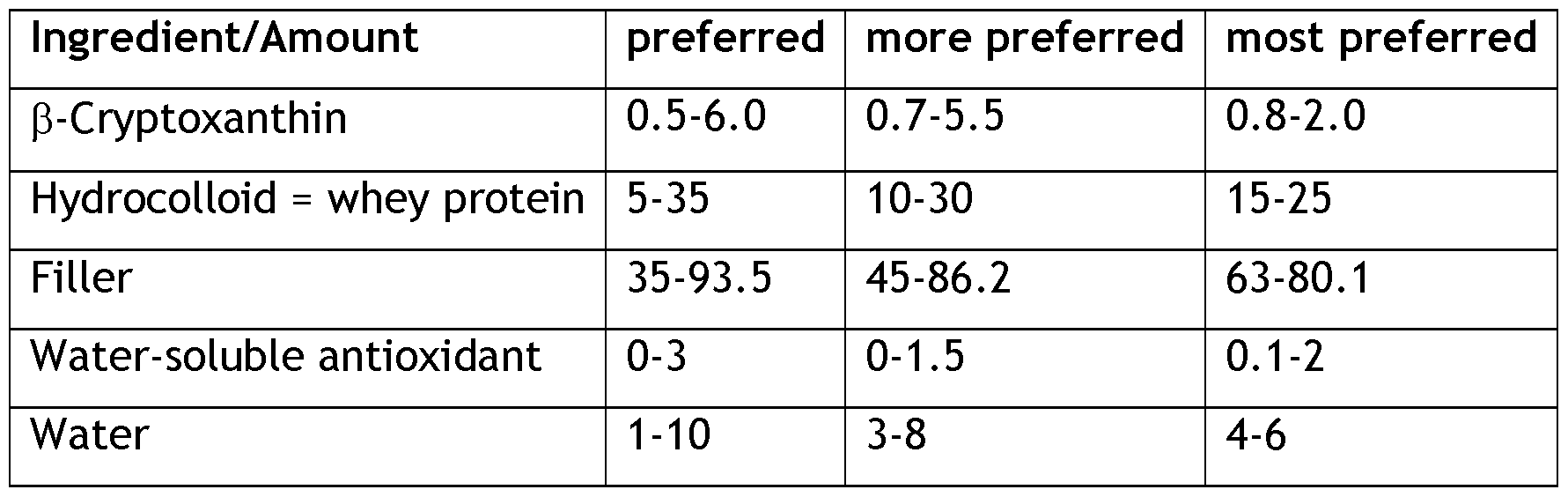
Preferably the filler is a mixture of one or more disaccharides and one or more starch hydrolysates with the preferences as given in the table below. The amounts are given in weight%, based on the total weight of the formulation C. The amounts of all ingredients sum up to 100 weight-%.


Formulation D - comprising an emulsifier - see example 15: The amounts are given in weight%, based on the total weight of the formulation. The amounts of all ingredients sum up to 100 weight-%. Advantageously no antioxidant or only a small amount of a water-soluble antioxidant such as sodium ascorbate and ascorbic acid is needed.
Instead of sucrose fatty acid esters another emulsifier with the preferences as cited above may also be used.

Preferably the filler is a mixture of one or more disaccharides and one or more starch hydrolysates with the preferences as given in the table below. The amounts are given in weight%, based on the total weight of the formulation D. The amounts of all ingredients sum up to 100 weight-%.


Formulation E - OSA-starch based - see example 5: The amounts are given in weight%, based on the total weight of the formulation. The amounts of all ingredients sum up to 100 weight-%. Advantageously no antioxidant or only a small amount of a water-soluble antioxidant such as sodium ascorbate and ascorbic acid is needed.

Process for the manufacture of the aqueous dispersion
Preferably said aqueous dispersion is manufactured by dispersing crystal form I of b-cryptoxanthin and optionally one or more other crystal form(s) such as crystal form II of b-cryptoxanthin and/or crystal form IV of b-cryptoxanthin in water in the presence of component ii), whereby optionally at least an antioxidant may be present.
As an additional step the thus resulting dispersion may also be comminuted, e.g. by milling.
Thus, the present invention is also directed to a process for the manufacture of the aqueous dispersion according to the present invention comprising the following step: a) dispersing the crystal form I of b-cryptoxanthin and optionally one or more other crystal forms of b-cryptoxanthin such as e.g. crystal form II of b- cryptoxanthin and/or crystal form IV of b-cryptoxanthin (component i)) in water in the presence of at least a hydrocolloid and/or at least an emulsifier (component ii)), optionally comminuting the dispersion and optionally adding (before, during or after comminuting) at least an antioxidant (component iii)).
If the dispersion is comminuted, e.g. by milling, the process may be carried out as follows:
Component i) may be dispersed in water in the presence of a minor amount of component ii) being sufficient to coat/bedew the b-cryptoxanthin crystals so as to prevent their floating on the water. Then the dispersion is comminuted, e.g. by milling. Afterwards the residual amount of component ii) is added.
Preferably milling is performed until the particle size D (v, 0.9) of b-cryptoxanthin crystals is < 30 pm, preferably < 20 pm, more preferably < 15 pm, measured dispersed in distilled water by laser diffraction, Mastersizer3000 ex Malvern, Fraunhofer light scattering model.
The milling step is preferably carried out with a commercially available ball mill/stirred media mill. The desired mean particle size of the b-cryptoxanthin particles is achieved by adjusting the following parameters with respect to each other: rotor speed (peripheral speed), mean residence time in the mill, material and size of the milling beads and load of the mill. The milling step can either be performed in circulation or passage mode. Yttria-stabilized zirconia beads (e.g. with a mean diameter of 0.1 to 1.5 mm) and an average load of 65 to 90% may be used. The preferred milling parameters may differ depending on the ball mill used in the milling step, but can easily be adjusted by the person skilled in the art.
The b-cryptoxanthin dispersion obtained in step a) may be dried to obtain a dried b-cryptoxanthin dispersion.
Thus, the present invention is also directed to a process for the manufacture of a formulation, whereby the formulation is a dried b-cryptoxanthin dispersion, comprising the following steps: a) dispersing the crystal form I of b-cryptoxanthin and optionally one or more other crystal forms of b-cryptoxanthin such as crystal form II of b- cryptoxanthin and/or crystal form IV of b-cryptoxanthin (component i)) in water in the presence of at least a hydrocolloid and/or at least an emulsifier (component ii)), optionally comminuting the dispersion and optionally adding (before, during or after comminuting) at least an antioxidant (component iii )); b) drying the b-cryptoxanthin dispersion obtained in step a) to obtain a dried b-cryptoxanthin dispersion. The drying may be performed by any process known to the person skilled in the art. Thus, the drying may e.g. be performed by spray-drying, granulating, spray granulating, powder-catch beadlet processing, fluid bed drying with one or more fluid bed(s), lyophilization or vacuum drying or any combination thereof.
Preferably the drying is performed by spray-drying or spray- granulation or powder- catch beadlet processing or any combination thereof. Since any combination of the drying processes is also possible; it may e.g. be possible to perform the drying by a combination of spray-drying with a multi-stage fluidized bed drying.
Products comprising the formulations according to the present invention
The aqueous dispersions and dried formulations according to the present invention with the preferences as given above are especially suitable for the manufacture of dietary supplements and pharmaceuticals, especially in the form of hard capsules, granules and tablets.
Those tablets may further comprise vitamins, mineral salts, trace elements and/or essential nutrients.
Examples of vitamins are vitamin A, vitamin E, vitamin C, vitamin K, vitamin B1, vitamin B2, vitamin B6, vitamin B12, vitamin D2, vitamin D3, biotin, folic acid, niacin, niacin amide, pantothenic acid and/or pantothenate. Instead of these compounds also the corresponding derivatives such as e.g. their esters and salts may be used. Examples of derivatives are Vitamin E acetate, Vitamin A acetate, levomefolic acid and 25-hydroxy vitamin D3.
Examples of mineral salts are salts of calcium, phosphor, magnesium, potassium, and chloride.
Examples of trace elements are chrome, cobalt, iron, fluorine (intake as fluoride salts), iodine (intake as iodide salts), copper, manganese, molybdenum, selenium, silicium and zinc.
Examples of essential nutrients are choline,
The term “hard capsules” encompasses “hard-gel capsules”, as well as non-gelatine hard capsules and further hard capsules based on other materials of non-animal
origin as e.g. starch. They may be manufactured according to processes known to the person skilled in the art.
The dried formulations according to the present invention are also suitable for instant powder mixtures which are used to produce instant drinks and as supplements for infant food formulations. Examples of such products are infant und maternal milk powder.
The formulation obtained by spray-drying is especially suitable for the manufacture of maternal dietary supplements to ensure pre-natal prosperity of the fetus and embryo, as well as well-being of the pregnant woman.
Maternal dietary supplements usually contain levomefolic acid, vitamin B1 , vitamin B2, niacin, panthotenic acid, vitamin B6, biotin, vitamin B12, vitamin C, vitamin D3, vitamin E, iron, folic acid, choline, zinc, copper, iodine and selenium.
Thus, the present invention is also directed to a maternal dietary supplement comprising levomefolic acid, vitamin B1, vitamin B2, niacin, panthotenic acid, vitamin B6, biotin, vitamin B12, vitamin C, vitamin D3, vitamin E, iron, folic acid, choline, zinc, copper, iodine, selenium and a b-cryptoxanthin formulation according to the present invention.
The formulation obtained by spray-granulation may be used in any application in the field of food, beverages and pharmaceuticals and is especially suitable for the manufacture of hard shell capsules and pressed tablets.
By the term “infant food formulations” in the context of the present invention, dry formulations are meant (especially baby milk formulations), which are then dissolved in a suitable solvent (usually water or milk, preferably water) and the dissolved form (warm or cold) is then consumed by the infant. The infant food formulation can be in any dry form, such powder, granules as well as tablets.
The term “infant food formulations” in the context of the present invention also encompasses liquid product forms such as ready-to-drink infant milks.
A preferred infant food formulation is a dry baby milk formulation (powder, granules or tablets) wherein the dried formulation according to the present invention is incorporated (b-cryptoxanthin fortified baby milk formulation).
Infant food formulations usually contain methylfolate, prebiotics, probiotics, vitamin E, calcium, iron, copper, zinc and magnesium.
Thus, the present invention is also directed to an infant food formulation comprising methylfolate, prebiotics, probiotics, vitamin E, calcium, iron, copper, zinc, magnesium and a b-cryptoxanthin formulation according to the present invention.
Further applications are gummies, cereal bars, juices, ready to use drinks in general and powder sticks.
The invention is now further illustrated in the following non-limiting examples. Examples
The following examples illustrate processes to manufacture crystal forms I, II and VIII of b-cryptoxanthin, as well as processes to manufacture aqueous dispersions and dried formulations comprising such b-cryptoxanthin crystal forms I and/or II.
Example 1: Synthesis of b-cryptoxanthin crystal form I (needles)
Under inert gas atmosphere C25-aldehyde (= (2E,4E,6E,8E,10E,12E)-2,7,11 - trimethyl-13-(2,6,6-trimethylcyclohex-1-en-1 -yl)trideca-2,4,6,8,10,12-hexaenal) (50 g, 135 mmol) and zeanyl salt such as e.g. zeanyl phosphonium chloride (= (/?)- ((2E,4E)-5-(4-hydroxy-2,6,6-trimethylcyclohex-1-en-1-yl)-3-methylpenta-2,4-dien- 1-yl)triphenylphosphonium chloride) (91 g, 155 mmol) are suspended in ethanol (432 ml). A solution of sodium methoxide (30% in methanol, 30.7 ml, 165 mmol) is
added drop wise within 60 min, whereby the temperature is maintained between 22 °C and 25 °C. Afterwards the reaction mixture is stirred for 1 hour at 24° C before the temperature is raised to reflux. Stirring is continued for another 1.5 hours.
Then the reaction mixture is cooled to room temperature and filtered. The filter cake is rinsed subsequently with ethanol/water 9:1 and water and then dried in vacuum overnight (50°C/10 mbar). Afterwards the crude product is obtained as purple crystals in 93% yield.
Under inert gas atmosphere, the crude material is suspended in acetone (1000 ml) and heated to reflux. When the temperature reaches approximately 42 °C, a change of crystal form is observed. After 30 min at reflux, the reaction mixture is cooled to room temperature. Via addition funnel, water (200 ml) is added and stirring is continued for another 30 min. The red slurry is filtered, and the filter cake is rinsed with acetone/water 8:2. The crystals are dried in vacuum (60° C/10 mbar) for 13 hours. The product is obtained as red crystals (139.4 g, 97% yield).
Example 2: Synthesis of b-cryptoxanthin crystal form II (platelets)
Under inert gas atmosphere C25-aldehyde (= (2E,4E,6E,8E,10E,12E)-2,7,11 - trimethyl-13-(2,6,6-trimethylcyclohex-1-en-1 -yl)trideca-2,4,6,8,10,12-hexaenal) (100 g, 270 mmol) and zeanyl salt such as e.g. zeanyl phosphonium chloride (= (/?)- ((2E,4E)-5-(4-hydroxy-2,6,6-trimethylcyclohex-1-en-1-yl)-3-methylpenta-2,4-dien- 1-yl)triphenylphosphonium chloride) (182 g, 311 mmol) are suspended in ethanol (864 ml). A solution of sodium methoxide (30% in methanol, 61.7 ml, 331 mmol) is added drop wise and the reaction mixture is stirred for 1 hour at 24°C before the temperature is raised to reflux.
After 1.5 hours at reflux, the slurry becomes more liquid again and stirring is continued for another 1.5 hours. Then the reaction mixture is cooled to room temperature and filtered.
The filter cake is rinsed subsequently with ethanol/water 9:1 and water and dried in vacuum overnight (50° C/10 mbar). After that the crude product is obtained as purple crystals (151.8 g, 93% yield).
The crude material is suspended in ethanol (2000 ml) and heated to reflux for 30 min. Then the oil-bath is removed, and the reaction mixture is cooled to room temperature.
The purple slurry is filtered, and the filter cake is rinsed with ethanol. The crystals are dried in vacuum (100°C/10 mbar) for 13 hours. The purified product is obtained as purple crystals (139.4 g, 98% yield).
Comparison Example 3: Synthesis of b-cryptoxanthin crystals with purification in the solvent system methylene chloride/n-hexane
Under inert gas atmosphere C25-aldehyde (9.29 g, 25 mmol) and zeanyl salt (15.41 g, 26.3 mmol) are suspended in ethanol (80 ml). A solution of sodium methoxide (30% in methanol, 5.22 ml, 28.0 mmol) is added drop wise within 60 min. After that the reaction mixture is stirred for 1 hour at 24 °C before the temperature is raised to reflux. After 1.5 hours at reflux, stirring is continued for another 1.5 hours. Then the reaction mixture is cooled to room temperature and filtered. The filter cake is rinsed subsequently with ethanol/water 9:1 and water and dried in vacuum overnight (40°C/10 mbar). After that the crude product is obtained as purple crystals (13.75 g).
Under inert gas atmosphere 5 g of the crude material are dissolved in methylene chloride (100 ml) with gentle heating. After cooling to room temperature, n-hexane (300 ml) is added dropwise over 30 min. After the first 100 ml of methylene chloride are added, crystal formation is observed. After complete addition, an orange-red suspension is obtained. Stirring is continued for 2 hours and after that, the suspension is filtered. The filter cake is rinsed with methylene chloride/hexanes 1:3 and the crystals are dried under reduced pressure (16 hours at 60 °C/10 mbar). The product is obtained as light-red crystals (2.88 g of crystal form VI of b-cryptoxanthin) in 55% yield (yield of crude product: 91%, crystallization yield: 60%).
Comparison Example 4: Synthesis of b-cryptoxanthin crystals with purification in the solvent system acetone/ethanol (volume ratio ~ 3:1)
In this example the work-up conditions similar to the ones as disclosed in WO 2014/186683 have been used, b-cryptoxanthin is synthesized via Wittig reaction in ethanol as disclosed above.
Under inert gas atmosphere, a suspension of b-cryptoxanthin (10 g, 16.53 mmol) in ethyl acetate (500 ml) is warmed in an oil-bath to 70° C. When the crystalline material is completely dissolved, the solution is allowed to cool to room temperature and the solvent is removed. To the resulting orange-colored solid are added acetone (300 ml) and ethanol (90 ml), and the mixture is heated to reflux for 30 minutes. Then, it is cooled to 5°C and stirring is continued for another 30 minutes. After that the suspension was filtered (G3 sinter) and the filter cake is rinsed with 2x 50 ml of acetone/ethanol (3:1). The crystalline material is dried overnight in the oven under vacuum (50° C / 10 mbar). The product b-cryptoxanthin is obtained as dark-red crystals (5.63 g of crystal form VIII of b-cryptoxanthin,
52.2% yield, 84.7% purity, 7.3% ethanol, 1.5% acetone).
Examples 5-15: Preparation of aqueous dispersions according to the present invention
The content of b-cryptoxanthin in the prepared formulations has been determined by HPLC. Furthermore, the following particles sizes: D(v, 0.1 ), D(v, 0.5) and D(v, 0.9) have been measured dispersed in distilled water as well as of the powders by laser diffraction, Mastersizer3000 ex Malvern, Fraunhofer light scattering model.
All results are summarized in Table 2 below.
Example 5: Manufacture of an aqueous dispersion of crystal form I of b- cryptoxanthin according to the present invention
114.0 g of OSA-Starch, 63.0 g of dried glucose syrup and 63.0 g of sucrose are dissolved in 380 g of preheated water at 65 °C for 1 to 2 hours (matrix). Afterwards
3.0 g of ascorbic acid (water-soluble antioxidant) are added to the matrix. The final matrix has a pH of 3.5. The matrix is then added to 48.0 g of crystal form I of b-cryptoxanthin and stirred with a rotor/stator device starting at 3500 rpm at room temperature and increasing to 7000 rpm and 44°C within 7 min. The crude suspension is centrifuged for 20 min at 4000 rpm to separate foam before milling and afterwards transferred to a laboratory stirred media mill. Milling is done in passage mode with grinding media size of 00.4 mm (8 passages), a bead filling ratio of 80% and a rotor speed of 11 m/s. The outlet temperature of the suspension during milling is adjusted to max. 46°C by water cooling of the double-walled milling cylinder. Decrease of the b-cryptoxanthin crystal particle size is measured by laser diffraction analysis after each milling passage. No transformation of the needle-shaped b-cryptoxanthin crystals into another crystal shape is observed under optical microscope with polarized light.
The obtained suspension may be spray granulated.
Example 6 Example 5 can be repeated without the addition of sucrose.
Example 7: Manufacture of an aqueous dispersion of crystal form of b-
 cryptoxanthin according to the present invention 11 weight-% of crystal form II of b-cryptoxanthin, 71 weight-% of water and 18 weight-% of modified food starch (OSA-starch) have been dispersed with a rotor/ stator device to obtain a suspension.
Example 8: Manufacture of a dried formulation of crystal form I of b-cryptoxanthin according to the present invention 120.2 g of OSA-Starch, 111.2 g of dried glucose syrup (DE2023) and 60.1 g of sucrose are dissolved in 412.5 g of preheated water at 53°C for 1 to 2 hours (matrix). Afterwards 3.0 g of sodium ascorbate (water-soluble antioxidant) are added to the matrix, what leads to a pH of 4.6. The matrix is then added to 4.2 g of crystal form I of b-cryptoxanthin and dispersed under stirring with a laboratory dissolver at 53 °C at 5500 rpm for 30 min. The crude suspension is kept at 40° C in a
water bath till it is defoamed. The b-cryptoxanthin crystal particle size distribution is measured by laser diffraction analysis.
The water content of the suspension is adjusted to 65%. Spray drying is performed with a NIRO Mobile MINOR 2000 Typ D1 device by rotary atomization with a nozzle air pressure of 3.7 bar, with inlet air temperature of 180°C ,and outlet air temperature of 80 °C. The particle size distribution of the powder is measured by laser diffraction.
Example 9: Manufacture of a dried formulation of crystal form I of b-cryptoxanthin according to the present invention 120.2 g of OSA-Starch, 111 .2 g of dried glucose syrup (DE2023) and 60.1 g of sucrose are dissolved in 412.5 g of preheated water at 53°C for 1 to 2 hours (matrix). Afterwards 3.0 g of sodium ascorbate (water-soluble antioxidant) are added to the matrix, what leads to a pH of 4.6. The matrix is then added to 4.2 g of crystal form I of b-cryptoxanthin and dispersed under stirring with a laboratory dissolver at 53 °C at 5500 rpm for 30 min. Crude suspension is kept at 40° C in a water bath till it is defoamed and afterwards the crude suspension is transferred to a laboratory stirred media mill. Milling is done in passage mode with grinding media size of 0 1 mm (2 passages), a bead filling ratio of 80% and a rotor speed of 5 m/s for the first passage and 11 m/s for the second passage. The outlet temperature of the suspension during milling is adjusted to max. 47° C by water cooling of the double-walled milling cylinder. Decrease of the b-cryptoxanthin crystal particle size is measured by laser diffraction analysis after each milling passage. No transformation of the needle-shaped b-cryptoxanthin crystals into another crystal shape is observed under optical microscope with polarized light.
The water content of the milled suspension is adjusted to 64%. Spray drying is performed with a NIRO Mobile MINOR 2000 Typ D1 device by rotary atomization with a nozzle air pressure of 3.7 bar, with inlet air temperature of 180°C ,and outlet air temperature of 80 °C. Particle size distribution of the powder is measured by laser diffraction.
Example 10: Manufacture of a dried formulation of crystal form I of b- cryptoxanthin according to the present invention 120.2 g of OSA-Starch, 111.2 g of dried glucose syrup (DE2023) and 60.1 g of sucrose are dissolved in 412.5 g of preheated water at 53°C for 1 to 2 hours (matrix). Afterwards 3.0 g of sodium ascorbate (water-soluble antioxidant) are added to the matrix, what leads to a pH of 4.6. The matrix is then added to 4.2 g of crystal form I of b-cryptoxanthin and dispersed under stirring with a laboratory dissolver at 53 °C at 5500 rpm for 30 min. The crude suspension is kept at 40° C in a water bath till it is defoamed and afterwards crude suspension is transferred to a laboratory stirred media mill. Milling is done in passage mode with grinding media size of 00.4 mm (4 passages), a bead filling ratio of 80% and a rotor speed of 5 m/s. The outlet temperature of the suspension during milling is adjusted to max. 40° C by water cooling of the double-walled milling cylinder. Decrease of the b- cryptoxanthin crystal particle size is measured by laser diffraction analysis after each milling passage. No transformation of the needle-shaped b-cryptoxanthin crystals into another crystal shape is observed under optical microscope with polarized light.
The water content of the milled suspension is adjusted to 63%. Spray drying is performed with a NIRO Mobile MINOR 2000 Typ D1 device by rotary atomization with a nozzle air pressure of 3.7 bar, with inlet air temperature of 180°C ,and outlet air temperature of 80 °C. Particle size distribution of the powder is measured by laser diffraction.
Example 11: Manufacture of dried formulations of crystal form I of b-cryptoxanthin according to the present invention - A) without milling, B) with milling
180.0 g of gum arabic, 261.6 g of dried glucose syrup (DE2023) and 120.0 g of sucrose are dissolved in 855.0 g of preheated water at 65°C in a water bath at 72°C for 1 to 2 hours (matrix). With 5% sulfuric acid (w/w) the pH of the matrix is adjusted from 4.5 to pH 3.5. The matrix is then added to 8.4 g of crystal form I of b-cryptoxanthin and dispersed with a rotor/stator device starting at 4000 rpm at room temperature and increasing to 6000 rpm and 39°C within 5 min. The crude suspension is kept at 40°C in a water bath till it is defoamed. One half of the
suspension is directly spray dried under below mentioned conditions (Example 11
A).
The other half of the suspension (Example 11 B) is transferred to a laboratory stirred media mill (DISPERMAT® SL-12C1 , VMA-Getzmann Gmbh). Milling is done in passage mode with grinding media size of 0 0.4 mm (1 passage), a bead filling ratio of 80% and a rotor speed of 5 m/s. The outlet temperature of the suspension during milling is adjusted to max. 30°C by water cooling of the double-walled milling cylinder. Decrease of the b-cryptoxanthin crystal particle size is measured by laser diffraction analysis after each milling passage. No transformation of the needle- shaped b-cryptoxanthin crystals into another crystal shape is observed under optical microscope with polarized light.
Spray-Drying
The water content of the dispersed and the milled suspension is adjusted to 64%. Spray drying is performed with a NIRO Mobile MINOR 2000 Typ D1 device by rotary atomization with a nozzle air pressure of 2.0 bar, with inlet air temperature of 180°C ,and outlet air temperature of max. 90 °C. Particle size distribution of the powder is measured by laser diffraction.
Example 12: Manufacture of dried formulations of crystal form I of b-cryptoxanthin according to the present invention - A) without milling, B) with milling 240.0 g of gum arabic, 208.8 g of dried glucose syrup (DE2023) and 112.8 g of sucrose are dissolved in 1058.6 g of preheated water at 65 °C in a water bath at 72 °C for 1 to 2 hours (matrix). With 5% sulfuric acid (w/w) the pH of the matrix is adjusted from 4.4 to pH 3.5. The matrix is then added to 8.4 g of crystal form I of b-cryptoxanthin and dispersed with a rotor/stator device (ULTRA-TURRAX® T-50, IKA®-Werke GmbH & Co. KG) starting at 4000 rpm at room temperature and increasing to 6000 rpm and 37°C within 5 min. The crude suspension is kept at 40°C in a water bath till it is defoamed. One half of the suspension is directly spray dried under below mentioned conditions (Example 12 A).
The other half of the suspension (Example 12 B) is transferred to a laboratory stirred media mill (DISPERMAT® SL-12C1 , VMA-Getzmann Gmbh). Milling is done i"
passage mode with grinding media size of 0 0.4 mm (1 passage), a bead filling ratio of 80% and a rotor speed of 5 m/s. The outlet temperature of the suspension during milling is adjusted to max. 30° C by water cooling of the double-walled milling cylinder. Decrease of the b-cryptoxanthin crystal particle size is measured by laser diffraction analysis after each milling passage. No transformation of the needle- shaped b-cryptoxanthin crystals into another crystal shape is observed under optical microscope with polarized light.
Spray-Drying
The water content of the dispersed and the milled suspension is adjusted to 68%. Spray drying is performed with a NIRO Mobile MINOR 2000 Typ D1 device by rotary atomization with a nozzle air pressure of 2.0 bar, with inlet air temperature of 180°C ,and outlet air temperature of max. 86 °C. Particle size distribution of the powder is measured by laser diffraction.
Example 13: Manufacture of dried formulations of crystal form I of b-cryptoxanthin according to the present invention - A) without milling, B) with milling 297 g of OSA-Starch, 331.9 g of maltodextrin (DE0508) and 331.9 g of maltodextrin (DE19) are dissolved in 1375.0 g of preheated water at 53 °C for 1 to 2 hours (matrix). pH was at 4.6. The matrix is then added to 57.6 g of crystal form I of b-cryptoxanthin and dispersed with a rotor/stator device (ULTRA-TURRAX® T-50, IKA®-Werke GmbH & Co. KG) starting at 4000 rpm at room temperature and increasing to 6000 rpm and 37° C within 5 min. The crude suspension is kept at 40° C in a water bath until it is defoamed. One half of the suspension is directly spray dried under below mentioned conditions (Example 13 A).
The other half of the suspension (Example 13 B) is transferred to a laboratory stirred media mill (DISPERMAT® SL-12C1 , VMA-Getzmann Gmbh). Milling is done in passage mode with grinding media size of 0 0.4 mm (1 passage), a bead filling ratio of 80% and a rotor speed of 5 m/s. The outlet temperature of the suspension during milling is adjusted to max. 30°C by water cooling of the double-walled milling cylinder. Decrease of the b-cryptoxanthin crystal particle size is measured by laser diffraction analysis after milling passage. No transformation of the needle-shaped b-
cryptoxanthin crystals into another crystal shape is observed under optical microscope with polarized light.
Spray-Drying The water content of the dispersed and the milled suspension is adjusted to 64%. Spray drying is performed with a NIRO Mobile MINOR 2000 Typ D1 device by rotary atomization with a nozzle air pressure of 2.0 bar, with inlet air temperature of 180°C, and outlet air temperature of max. 84 °C. Particle size distribution of the powder is measured by laser diffraction.
Example 14: Manufacture of dried formulations of crystal form I of b-cryptoxanthin according to the present invention
77 g of whey protein, 103.2 g of dried glucose syrup (DE2023), 103.2 g of maltodextrin (DE0508) and 77 g of sucrose are dissolved in 548.6 g of preheated water at 53°C for
1 to 2 hours (matrix). With 5% sodium hydroxide (w/w) the pH of the matrix is adjusted from to pH 7.4. The matrix is then added to 4.9 g of crystal form I of b- cryptoxanthin and dispersed with a rotor/stator device (ULTRA-TURRAX® T-50, IKA®-Werke GmbH & Co. KG) starting at 4000 rpm at room temperature and increasing to 6000 rpm and 37° C within 5 min. The crude suspension is kept at 40° C in a water bath until it is defoamed. The suspension is directly spray dried under below mentioned conditions.
Spray-Drying The water content of the dispersed suspension is adjusted to 63%. Spray drying is performed with a NIRO Mobile MINOR 2000 Typ D1 device by rotary atomization with a nozzle air pressure of 1.5 bar, with inlet air temperature of 180°C, and outlet air temperature of max. 80° C. Particle size distribution of the powder is measured by laser diffraction.
Example 15: Manufacture of dried formulations of crystal form I of b-cryptoxanthin according to the present invention
19.3 g of sucrose fatty acid ester E473 consisting mainly of mono and diesters of sucrose and stearic acid with a minimum total ester content of 80% as commercially available from Stearinerie Dubois, 132.1 g of dried glucose syrup (DE2023), 132.1 g of maltodextrin (DE0508) and 77 g of sucrose are dissolved in 548.6 g of preheated water at 70°C in a water bath at 72°C for 1 to 2 hours (matrix). With 5% sulfuric acid (w/w) the pH of the matrix is adjusted from 4.4 to pH 3.5. The matrix is then added to 4.9 g of crystal form I of b-cryptoxanthin and dispersed with a rotor/stator device (ULTRA-TURRAX® T-50, IKA®-Werke GmbH & Co. KG) starting at 4000 rpm at room temperature and increasing to 6000 rpm and 37° C within 5 min. The crude suspension is kept at 40°C in a water bath till it is defoamed. The suspension is directly spray dried under below mentioned conditions.
Spray-Drying
The water content of the dispersed suspension is adjusted to 66%. The suspension is kept at 40°C under stirring. Spray drying is performed with a NIRO Mobile MINOR 2000 Typ D1 device by rotary atomization with a nozzle air pressure of 2.0 bar, with inlet air temperature of 180°C ,and outlet air temperature of max. 96°C. Particle size distribution of the powder is measured by laser diffraction.

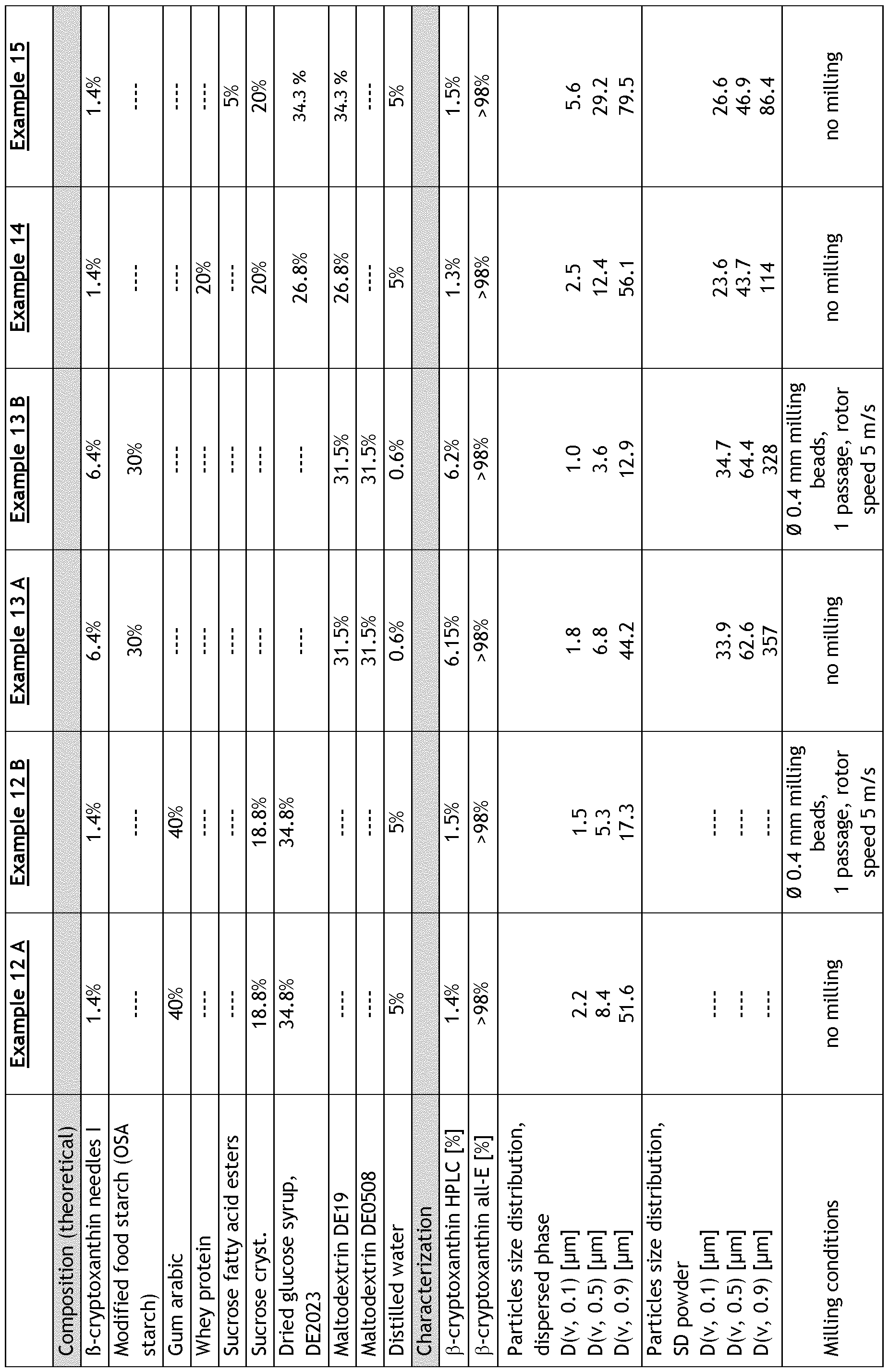
L.7.2021
Claims
1. A formulation comprising i) crystal form I of b-cryptoxanthin; and ii) at least a hydrocolloid and/or at least an emulsifier; and iii) optionally at least an antioxidant; iv) and optionally water; wherein said crystal form I is defined by the following parameters: l-a) an X-Ray Powder Diffraction pattern comprising at least 3 peaks at the following 2-theta positions (deg) (±0.2 deg): 3.209(7), 13.402(3), 16.056(5), 18.174(10), 19.270(16), 25.192(4).
2. The formulation according to claim 1 , wherein said crystal form I of b- cryptoxanthin is further defined by: l-b) a Differential Scanning Calorimeter scan showing a phase transition at a temperature in the range of 60 to 120°C, preferably at a temperature in the range of from 80 to 100°C, more preferably at a temperature in the range of from 80 to 90 °C, most preferably at a temperature of 85 °C ± 1 °C, all at a heating rate of 10 K/min; and/or l-c) a Differential Scanning Calorimeter scan showing melting at a temperature in the range of from 140°C to 200°C, preferably at a temperature in the range of from 150°C to 190°C, all at a heating rate of 10 K/min.
3. The formulation according to claim 1 and/or claim 2 being an aqueous dispersion or a dried formulation.
4. The formulation according to claim 3 being an aqueous dispersion, whereby the amount of component i) is in the range of from 0.1 to 30 weight-%/0.2 to 25 weight-%, preferably in the range of from 0.3 to 20 weight-%, more preferably in the range of from 0.5 to 15 weight-%, most preferably in the range of from 0.5 to 10 weight-%, and/or the amount component iii) is in the
range of from 0 to 10 weight-%, preferably in the range of from 0.1 to 10 weight-%, more preferably in the range of from 0.2 to 2 weight-%, most preferably in the range of from 0.3 to 1.5 weight-%, and/or the amount component iv) is in the range of from 30 to 99.8 weight-%, preferably in the range of from 40 to 80 weight-%, more preferably in the range of from 50 to 70 weight-%, and/or the amount of component ii) is the amount lacking to sum up to 100 weight-%, all amounts based on the total weight of the aqueous dispersion and whereby the amounts of compounds i) to iv) sum up to 100%.
5. The formulation according to claim 3 being a dried formulation, whereby the amount of component i) is in the range of from 0.1 to 30 weight-%/0.3 to 25 weight-%, preferably in the range of from 0.5 to 20 weight-%, more preferably in the range of from 0.7 to 15.0 weight-%, most preferably in the range of from 0.8 to 10 weight-%, and/or the amount component iii) is in the range of from 0 to 10 weight-%, preferably in the range of from 0.1 to 10 weight-%, more preferably in the range of from 0.2 to 2 weight-%, most preferably in the range of from 0.5 to 1.5 weight-%, and/or the amount of water is preferably in the range of from 0 to 10 weight-%, more preferably in the range of from 0.1 to 8 weight-%, most preferably in the range of from 0.5 to 5 weight-%, and/or the amount of component ii) is the amount lacking to sum up to 100 weight-%, all amounts based on the total weight of the dried formulation and whereby the amounts of components i) to iv) sum up to 100%.
6. The formulation according to any one or more of the preceding claims, wherein the hydrocolloid is modified food starch, Gum Arabic - either native or heat- treated or modified; Gum Ghatti, Guar Gum, octenyl-succinate anhydride- modified Gum Acacia, conjugates of plant gums and modified food starches consisting of one or more plant gum(s) such as Gum Acacia and/or Gum Ghatti and one or more modified food starches such as starch sodium octenyl succinate; a plant protein, a hydrolyzed plant protein, an animal protein such as gelatin or milk protein or any mixture thereof.
7. The formulation according to any one or more of the preceding claims, wherein the emulsifier is selected from ascorbyl palmitate, ascorbyl stearate, propylene
glycol esters, glycerol fatty acid esters, polyglycerol fatty acid esters, sucrose fatty acid esters, sorbitan fatty acid esters, polysorbates, phospholipids, mono- and/or diglycerides of edible fatty acids with citric acid, saponins, as well as any mixture thereof.
8. The formulation according to any one or more of the preceding claims, wherein the antioxidant is either a water-soluble antioxidant or a fat-soluble antioxidant or any mixture thereof, preferably wherein the antioxidant is citric acid, a citric acid salt, ascorbic acid, an ascorbic acid salt, a tocopherol, or any mixture thereof, more preferably wherein the antioxidant is sodium ascorbate, ascorbic acid or mixed tocopherols.
9. A process for the manufacture of an aqueous dispersion according to any one or more of claims 4 and 6 to 8 as far as they refer to a formulation being an aqueous dispersion, comprising the following steps: a) dispersing the crystal form I of b-cryptoxanthin and optionally another crystal form of b-cryptoxanthin such as crystal form II of b-cryptoxanthin and/or crystal form IV of b-cryptoxanthin (component i)) in water in the presence of at least a hydrocolloid and/or at least an emulsifier (component ii)), optionally comminuting the dispersion and optionally adding at least an antioxidant (component iii )), to obtain an aqueous b-cryptoxanthin dispersion.
10. The aqueous b-cryptoxanthin dispersion obtainable by the process according to claim 9.
11. A process for the manufacture of a dried formulation according to any one or more of claims 5 and 6 to 8 as far as they refer to a dried formulation, comprising the following steps: a) dispersing the crystal form I of b-cryptoxanthin (component i)) in water in the presence of at least a hydrocolloid and/or at least an emulsifier (component
ii)), optionally comminuting the dispersion and optionally adding at least an antioxidant (component iii)), to obtain an aqueous b-cryptoxanthin dispersion; b) drying the aqueous b-cryptoxanthin dispersion obtained in step a) to obtain a dried b-cryptoxanthin formulation.
12. The process according to claim 11, wherein the drying step b) is achieved by spray-drying, granulating, spray-granulating, powder-catch processing, fluid bed drying, lyophilization, vacuum drying and any combination thereof. 13. The dried formulation obtainable by the process according to claim 12 and/or
13.
14. A product suitable for human consumption comprising a formulation according to any one or more of claims 1 to 8 or an aqueous dispersion according to claim 10 or a dried formulation according to claim 13.
15. The product according to claim 14 being instant drinks, supplements for infant food formulations, maternal dietary supplements, granules, tablets and hard capsules.
Applications Claiming Priority (2)
| Application Number | Priority Date | Filing Date | Title |
|---|---|---|---|
| EP20187284 | 2020-07-22 | ||
| EP20187284.3 | 2020-07-22 |
Publications (1)
| Publication Number | Publication Date |
|---|---|
| WO2022018162A1 true WO2022018162A1 (en) | 2022-01-27 |
Family
ID=71783832
Family Applications (1)
| Application Number | Title | Priority Date | Filing Date |
|---|---|---|---|
| PCT/EP2021/070441 Ceased WO2022018162A1 (en) | 2020-07-22 | 2021-07-21 | FORMULATIONS OF NEW β-CRYPTOXANTHIN CRYSTAL FORM, PROCESSES FOR THEIR MANUFACTURE AND THEIR USES |
Country Status (2)
| Country | Link |
|---|---|
| TW (1) | TW202211807A (en) |
| WO (1) | WO2022018162A1 (en) |
Citations (16)
| Publication number | Priority date | Publication date | Assignee | Title |
|---|---|---|---|---|
| WO2004037236A1 (en) | 2002-10-25 | 2004-05-06 | KEMIN FOODS, L. C. d/b/a KEMIN HEALTH, L. C. | OSTEOGENESIS PROMOTER CONTAINING β-CRYPTOXANTHIN AS THE ACTIVE INGREDIENT |
| WO2005110122A1 (en) | 2004-05-18 | 2005-11-24 | Dsm Ip Assets B.V. | USE OF β-CRYPTOXANTHIN |
| WO2006053761A2 (en) | 2004-11-19 | 2006-05-26 | Dsm Ip Assets B.V. | Modified plant gums for preparations of active ingredients |
| WO2008045405A2 (en) | 2006-10-12 | 2008-04-17 | Kemin Industries, Inc. | Biosynthesis of beta-cryptoxanthin |
| WO2008079287A1 (en) | 2006-12-20 | 2008-07-03 | Kemin Foods, L.C. | Method of improving cardiovascular health |
| WO2008110225A1 (en) | 2007-03-15 | 2008-09-18 | Dsm Ip Assets B.V. | Carotenoid compositions containing modified gum acacia |
| US20090093015A1 (en) | 2007-10-09 | 2009-04-09 | Kemin Foods, L.C. | Beta-cryptoxanthin production using a novel lycopene beta-monocyclase gene |
| US20090311761A1 (en) | 2008-06-13 | 2009-12-17 | Frederick Khachik | Process for Synthesis of (3S)- and (3R)-3-Hydroxy-Beta-Ionone, and Their Transformation to Zeaxanthin and Beta-Cryptoxanthin |
| WO2011039336A1 (en) | 2009-10-02 | 2011-04-07 | Dsm Ip Assets B.V. | Novel plant gum-modified food starch conjugate as emulsifying agent for fat soluble ingredients |
| WO2012059286A1 (en) | 2010-11-03 | 2012-05-10 | Dsm Ip Assets B.V. | Carotenoid compositions containing octenyl succinate anhydride-modified gum acacia |
| WO2014115037A2 (en) | 2013-01-24 | 2014-07-31 | Omniactive Health Technologies Ltd. | Beta-cryptoxanthin from plant source and a process for its preparation |
| WO2014186683A1 (en) | 2013-05-16 | 2014-11-20 | University Of Maryland, College Park | PROCESS FOR A DIRECT ONE-POT TRANSFORMATION OF LUTEIN TO β-CRYPTOXANTHIN VIA ITS ACETATE ESTER |
| WO2015089385A1 (en) | 2013-12-12 | 2015-06-18 | Kemin Industries, Inc. | Personal care products containing extracts of chinese lantern (physalis alkekengi) |
| WO2016157157A1 (en) | 2015-04-02 | 2016-10-06 | Omniactive Health Technologies Limited | Methods for prevention and treatment of cardiometabolic syndrome and compositions used therein |
| WO2016174600A1 (en) | 2015-04-27 | 2016-11-03 | Omniactive Health Technologies Limited | Betacryptoxanthin compositions, processes for preparation and uses thereof |
| CN111346059A (en) | 2020-04-17 | 2020-06-30 | 山东天音生物科技有限公司 | Preparation method of water-soluble cryptoxanthin |
-
2021
- 2021-07-21 WO PCT/EP2021/070441 patent/WO2022018162A1/en not_active Ceased
- 2021-07-22 TW TW110127018A patent/TW202211807A/en unknown
Patent Citations (16)
| Publication number | Priority date | Publication date | Assignee | Title |
|---|---|---|---|---|
| WO2004037236A1 (en) | 2002-10-25 | 2004-05-06 | KEMIN FOODS, L. C. d/b/a KEMIN HEALTH, L. C. | OSTEOGENESIS PROMOTER CONTAINING β-CRYPTOXANTHIN AS THE ACTIVE INGREDIENT |
| WO2005110122A1 (en) | 2004-05-18 | 2005-11-24 | Dsm Ip Assets B.V. | USE OF β-CRYPTOXANTHIN |
| WO2006053761A2 (en) | 2004-11-19 | 2006-05-26 | Dsm Ip Assets B.V. | Modified plant gums for preparations of active ingredients |
| WO2008045405A2 (en) | 2006-10-12 | 2008-04-17 | Kemin Industries, Inc. | Biosynthesis of beta-cryptoxanthin |
| WO2008079287A1 (en) | 2006-12-20 | 2008-07-03 | Kemin Foods, L.C. | Method of improving cardiovascular health |
| WO2008110225A1 (en) | 2007-03-15 | 2008-09-18 | Dsm Ip Assets B.V. | Carotenoid compositions containing modified gum acacia |
| US20090093015A1 (en) | 2007-10-09 | 2009-04-09 | Kemin Foods, L.C. | Beta-cryptoxanthin production using a novel lycopene beta-monocyclase gene |
| US20090311761A1 (en) | 2008-06-13 | 2009-12-17 | Frederick Khachik | Process for Synthesis of (3S)- and (3R)-3-Hydroxy-Beta-Ionone, and Their Transformation to Zeaxanthin and Beta-Cryptoxanthin |
| WO2011039336A1 (en) | 2009-10-02 | 2011-04-07 | Dsm Ip Assets B.V. | Novel plant gum-modified food starch conjugate as emulsifying agent for fat soluble ingredients |
| WO2012059286A1 (en) | 2010-11-03 | 2012-05-10 | Dsm Ip Assets B.V. | Carotenoid compositions containing octenyl succinate anhydride-modified gum acacia |
| WO2014115037A2 (en) | 2013-01-24 | 2014-07-31 | Omniactive Health Technologies Ltd. | Beta-cryptoxanthin from plant source and a process for its preparation |
| WO2014186683A1 (en) | 2013-05-16 | 2014-11-20 | University Of Maryland, College Park | PROCESS FOR A DIRECT ONE-POT TRANSFORMATION OF LUTEIN TO β-CRYPTOXANTHIN VIA ITS ACETATE ESTER |
| WO2015089385A1 (en) | 2013-12-12 | 2015-06-18 | Kemin Industries, Inc. | Personal care products containing extracts of chinese lantern (physalis alkekengi) |
| WO2016157157A1 (en) | 2015-04-02 | 2016-10-06 | Omniactive Health Technologies Limited | Methods for prevention and treatment of cardiometabolic syndrome and compositions used therein |
| WO2016174600A1 (en) | 2015-04-27 | 2016-11-03 | Omniactive Health Technologies Limited | Betacryptoxanthin compositions, processes for preparation and uses thereof |
| CN111346059A (en) | 2020-04-17 | 2020-06-30 | 山东天音生物科技有限公司 | Preparation method of water-soluble cryptoxanthin |
Non-Patent Citations (6)
| Title |
|---|
| "Modified Starches: Properties and Uses", 1986, CRC PRESS, INC. |
| D. E. LOEBER ET AL., J. CHEM. SOC. C, vol. 404, 1971 |
| F. KHACHIK ET AL., SYNTHESIS, vol. 3, 2011, pages 509 - 516 |
| R. KUHNC. GRUNDMANN, CHEMISCHE BERICHTE, 1933, pages 1746 - 1750 |
| RICHARD KUHN ET AL: "Über Kryptoxanthin, ein Xanthophyll der Formel C40H56O (Über das Vitamin des Wachstums, V. Mitteil.)", CHEMISCHE BERICHTE, 1 January 1933 (1933-01-01), pages 1746 - 1750, XP055759209, DOI: 10.1002/cber.19330661126 * |
| XIN WEN ET AL., JOURNAL OF AGRICULTURAL AND FOOD CHEMISTRY, vol. 65, 2017, pages 6140 - 6151 |
Also Published As
| Publication number | Publication date |
|---|---|
| TW202211807A (en) | 2022-04-01 |
Similar Documents
| Publication | Publication Date | Title |
|---|---|---|
| ES3014060T3 (en) | Tablettable formulations of lipophilic health ingredients | |
| EP1964479B1 (en) | Process for the manufacture of a powder containing carotenoids | |
| JP5122485B2 (en) | Composition containing β-carotene | |
| EP2172196B1 (en) | Composition containing coenzyme q10 | |
| WO2008107152A1 (en) | Process for the manufacture of a powder containing carotenoids | |
| CN103025749A (en) | Polymorphs of 2'-o-fucosyllactose and producing thereof | |
| EP2172223A1 (en) | Composition containing physiologically active substance | |
| EP2311847A1 (en) | Composition containing stable vitamin B6 derivative | |
| US20030203854A1 (en) | Composition for effecting serum cholesterol levels | |
| EP2696704B1 (en) | Process for the manufacture of a powder containing lutein | |
| JP2014047173A (en) | Composition for keeping hesperetin metabolite in blood in long period of time and production method of the same | |
| JP2003520204A (en) | Cholesterol lowering stanol composition, preparation and use | |
| TW202211807A (en) | Formulations of a new β-cryptoxanthin crystal form, processes for their manufacture and their uses | |
| CN108779501A (en) | Powder containing α,α-trehalose dihydrate crystal, its production method and use | |
| JPH0710898A (en) | Method for modifying poorly water-soluble flavonoid | |
| JP3163502B2 (en) | α-Glycosyl flavones, their production and use | |
| EP4256966A1 (en) | 3-hydroxybutyric-acid-containing oil and fat composition | |
| JP2021042173A (en) | Curcumin solid dispersion | |
| CN105705042B (en) | Method for purifying astaxanthin | |
| CN109965279A (en) | The powderous preparations of food-grade astaxanthin comprising synthesis, oily suspended matter and dietary supplements | |
| WO2007014566A2 (en) | Microcapsules and their use | |
| EP3065567B1 (en) | Process for the purification of astaxanthin | |
| CN105705041B (en) | Method for purifying astaxanthin | |
| EP2044852A1 (en) | Compositions with colloidal particles of steroidal glycosides | |
| WO2015067709A1 (en) | Process for the purification of astaxanthin |
Legal Events
| Date | Code | Title | Description |
|---|---|---|---|
| 121 | Ep: the epo has been informed by wipo that ep was designated in this application |
Ref document number: 21749132 Country of ref document: EP Kind code of ref document: A1 |
|
| NENP | Non-entry into the national phase |
Ref country code: DE |
|
| 122 | Ep: pct application non-entry in european phase |
Ref document number: 21749132 Country of ref document: EP Kind code of ref document: A1 |