WO2022013841A1 - Thermal insulation material, method of preparing thermal insulation material, and product prepared from thermal insulation material - Google Patents
Thermal insulation material, method of preparing thermal insulation material, and product prepared from thermal insulation material Download PDFInfo
- Publication number
- WO2022013841A1 WO2022013841A1 PCT/IB2021/056470 IB2021056470W WO2022013841A1 WO 2022013841 A1 WO2022013841 A1 WO 2022013841A1 IB 2021056470 W IB2021056470 W IB 2021056470W WO 2022013841 A1 WO2022013841 A1 WO 2022013841A1
- Authority
- WO
- WIPO (PCT)
- Prior art keywords
- thermal insulation
- insulation material
- material according
- woven substrate
- preparing
- Prior art date
- Legal status (The legal status is an assumption and is not a legal conclusion. Google has not performed a legal analysis and makes no representation as to the accuracy of the status listed.)
- Ceased
Links
Classifications
-
- D—TEXTILES; PAPER
- D04—BRAIDING; LACE-MAKING; KNITTING; TRIMMINGS; NON-WOVEN FABRICS
- D04H—MAKING TEXTILE FABRICS, e.g. FROM FIBRES OR FILAMENTARY MATERIAL; FABRICS MADE BY SUCH PROCESSES OR APPARATUS, e.g. FELTS, NON-WOVEN FABRICS; COTTON-WOOL; WADDING ; NON-WOVEN FABRICS FROM STAPLE FIBRES, FILAMENTS OR YARNS, BONDED WITH AT LEAST ONE WEB-LIKE MATERIAL DURING THEIR CONSOLIDATION
- D04H1/00—Non-woven fabrics formed wholly or mainly of staple fibres or like relatively short fibres
- D04H1/40—Non-woven fabrics formed wholly or mainly of staple fibres or like relatively short fibres from fleeces or layers composed of fibres without existing or potential cohesive properties
- D04H1/58—Non-woven fabrics formed wholly or mainly of staple fibres or like relatively short fibres from fleeces or layers composed of fibres without existing or potential cohesive properties by applying, incorporating or activating chemical or thermoplastic bonding agents, e.g. adhesives
- D04H1/587—Non-woven fabrics formed wholly or mainly of staple fibres or like relatively short fibres from fleeces or layers composed of fibres without existing or potential cohesive properties by applying, incorporating or activating chemical or thermoplastic bonding agents, e.g. adhesives characterised by the bonding agents used
-
- D—TEXTILES; PAPER
- D06—TREATMENT OF TEXTILES OR THE LIKE; LAUNDERING; FLEXIBLE MATERIALS NOT OTHERWISE PROVIDED FOR
- D06M—TREATMENT, NOT PROVIDED FOR ELSEWHERE IN CLASS D06, OF FIBRES, THREADS, YARNS, FABRICS, FEATHERS OR FIBROUS GOODS MADE FROM SUCH MATERIALS
- D06M13/00—Treating fibres, threads, yarns, fabrics or fibrous goods made from such materials, with non-macromolecular organic compounds; Such treatment combined with mechanical treatment
- D06M13/322—Treating fibres, threads, yarns, fabrics or fibrous goods made from such materials, with non-macromolecular organic compounds; Such treatment combined with mechanical treatment with compounds containing nitrogen
- D06M13/46—Compounds containing quaternary nitrogen atoms
- D06M13/463—Compounds containing quaternary nitrogen atoms derived from monoamines
-
- A—HUMAN NECESSITIES
- A43—FOOTWEAR
- A43B—CHARACTERISTIC FEATURES OF FOOTWEAR; PARTS OF FOOTWEAR
- A43B1/00—Footwear characterised by the material
- A43B1/02—Footwear characterised by the material made of fibres or fabrics made therefrom
- A43B1/028—Synthetic or artificial fibres
-
- A—HUMAN NECESSITIES
- A43—FOOTWEAR
- A43B—CHARACTERISTIC FEATURES OF FOOTWEAR; PARTS OF FOOTWEAR
- A43B23/00—Uppers; Boot legs; Stiffeners; Other single parts of footwear
- A43B23/02—Uppers; Boot legs
- A43B23/0205—Uppers; Boot legs characterised by the material
-
- A—HUMAN NECESSITIES
- A43—FOOTWEAR
- A43B—CHARACTERISTIC FEATURES OF FOOTWEAR; PARTS OF FOOTWEAR
- A43B7/00—Footwear with health or hygienic arrangements
-
- C—CHEMISTRY; METALLURGY
- C01—INORGANIC CHEMISTRY
- C01B—NON-METALLIC ELEMENTS; COMPOUNDS THEREOF; METALLOIDS OR COMPOUNDS THEREOF NOT COVERED BY SUBCLASS C01C
- C01B33/00—Silicon; Compounds thereof
- C01B33/113—Silicon oxides; Hydrates thereof
- C01B33/12—Silica; Hydrates thereof, e.g. lepidoic silicic acid
- C01B33/14—Colloidal silica, e.g. dispersions, gels, sols
- C01B33/155—Preparation of hydroorganogels or organogels
-
- C—CHEMISTRY; METALLURGY
- C01—INORGANIC CHEMISTRY
- C01B—NON-METALLIC ELEMENTS; COMPOUNDS THEREOF; METALLOIDS OR COMPOUNDS THEREOF NOT COVERED BY SUBCLASS C01C
- C01B33/00—Silicon; Compounds thereof
- C01B33/113—Silicon oxides; Hydrates thereof
- C01B33/12—Silica; Hydrates thereof, e.g. lepidoic silicic acid
- C01B33/14—Colloidal silica, e.g. dispersions, gels, sols
- C01B33/157—After-treatment of gels
- C01B33/159—Coating or hydrophobisation
-
- C—CHEMISTRY; METALLURGY
- C01—INORGANIC CHEMISTRY
- C01B—NON-METALLIC ELEMENTS; COMPOUNDS THEREOF; METALLOIDS OR COMPOUNDS THEREOF NOT COVERED BY SUBCLASS C01C
- C01B33/00—Silicon; Compounds thereof
- C01B33/113—Silicon oxides; Hydrates thereof
- C01B33/12—Silica; Hydrates thereof, e.g. lepidoic silicic acid
- C01B33/16—Preparation of silica xerogels
- C01B33/163—Preparation of silica xerogels by hydrolysis of organosilicon compounds, e.g. ethyl orthosilicate
-
- D—TEXTILES; PAPER
- D04—BRAIDING; LACE-MAKING; KNITTING; TRIMMINGS; NON-WOVEN FABRICS
- D04H—MAKING TEXTILE FABRICS, e.g. FROM FIBRES OR FILAMENTARY MATERIAL; FABRICS MADE BY SUCH PROCESSES OR APPARATUS, e.g. FELTS, NON-WOVEN FABRICS; COTTON-WOOL; WADDING ; NON-WOVEN FABRICS FROM STAPLE FIBRES, FILAMENTS OR YARNS, BONDED WITH AT LEAST ONE WEB-LIKE MATERIAL DURING THEIR CONSOLIDATION
- D04H1/00—Non-woven fabrics formed wholly or mainly of staple fibres or like relatively short fibres
- D04H1/40—Non-woven fabrics formed wholly or mainly of staple fibres or like relatively short fibres from fleeces or layers composed of fibres without existing or potential cohesive properties
- D04H1/58—Non-woven fabrics formed wholly or mainly of staple fibres or like relatively short fibres from fleeces or layers composed of fibres without existing or potential cohesive properties by applying, incorporating or activating chemical or thermoplastic bonding agents, e.g. adhesives
- D04H1/60—Non-woven fabrics formed wholly or mainly of staple fibres or like relatively short fibres from fleeces or layers composed of fibres without existing or potential cohesive properties by applying, incorporating or activating chemical or thermoplastic bonding agents, e.g. adhesives the bonding agent being applied in dry state, e.g. thermo-activatable agents in solid or molten state, and heat being applied subsequently
-
- D—TEXTILES; PAPER
- D04—BRAIDING; LACE-MAKING; KNITTING; TRIMMINGS; NON-WOVEN FABRICS
- D04H—MAKING TEXTILE FABRICS, e.g. FROM FIBRES OR FILAMENTARY MATERIAL; FABRICS MADE BY SUCH PROCESSES OR APPARATUS, e.g. FELTS, NON-WOVEN FABRICS; COTTON-WOOL; WADDING ; NON-WOVEN FABRICS FROM STAPLE FIBRES, FILAMENTS OR YARNS, BONDED WITH AT LEAST ONE WEB-LIKE MATERIAL DURING THEIR CONSOLIDATION
- D04H3/00—Non-woven fabrics formed wholly or mainly of yarns or like filamentary material of substantial length
- D04H3/08—Non-woven fabrics formed wholly or mainly of yarns or like filamentary material of substantial length characterised by the method of strengthening or consolidating
- D04H3/12—Non-woven fabrics formed wholly or mainly of yarns or like filamentary material of substantial length characterised by the method of strengthening or consolidating with filaments or yarns secured together by chemical or thermo-activatable bonding agents, e.g. adhesives, applied or incorporated in liquid or solid form
-
- D—TEXTILES; PAPER
- D04—BRAIDING; LACE-MAKING; KNITTING; TRIMMINGS; NON-WOVEN FABRICS
- D04H—MAKING TEXTILE FABRICS, e.g. FROM FIBRES OR FILAMENTARY MATERIAL; FABRICS MADE BY SUCH PROCESSES OR APPARATUS, e.g. FELTS, NON-WOVEN FABRICS; COTTON-WOOL; WADDING ; NON-WOVEN FABRICS FROM STAPLE FIBRES, FILAMENTS OR YARNS, BONDED WITH AT LEAST ONE WEB-LIKE MATERIAL DURING THEIR CONSOLIDATION
- D04H5/00—Non woven fabrics formed of mixtures of relatively short fibres and yarns or like filamentary material of substantial length
- D04H5/04—Non woven fabrics formed of mixtures of relatively short fibres and yarns or like filamentary material of substantial length strengthened or consolidated by applying or incorporating chemical or thermo-activatable bonding agents in solid or liquid form
-
- D—TEXTILES; PAPER
- D06—TREATMENT OF TEXTILES OR THE LIKE; LAUNDERING; FLEXIBLE MATERIALS NOT OTHERWISE PROVIDED FOR
- D06M—TREATMENT, NOT PROVIDED FOR ELSEWHERE IN CLASS D06, OF FIBRES, THREADS, YARNS, FABRICS, FEATHERS OR FIBROUS GOODS MADE FROM SUCH MATERIALS
- D06M11/00—Treating fibres, threads, yarns, fabrics or fibrous goods made from such materials, with inorganic substances or complexes thereof; Such treatment combined with mechanical treatment, e.g. mercerising
- D06M11/07—Treating fibres, threads, yarns, fabrics or fibrous goods made from such materials, with inorganic substances or complexes thereof; Such treatment combined with mechanical treatment, e.g. mercerising with halogens; with halogen acids or salts thereof; with oxides or oxyacids of halogens or salts thereof
- D06M11/11—Treating fibres, threads, yarns, fabrics or fibrous goods made from such materials, with inorganic substances or complexes thereof; Such treatment combined with mechanical treatment, e.g. mercerising with halogens; with halogen acids or salts thereof; with oxides or oxyacids of halogens or salts thereof with halogen acids or salts thereof
-
- D—TEXTILES; PAPER
- D06—TREATMENT OF TEXTILES OR THE LIKE; LAUNDERING; FLEXIBLE MATERIALS NOT OTHERWISE PROVIDED FOR
- D06M—TREATMENT, NOT PROVIDED FOR ELSEWHERE IN CLASS D06, OF FIBRES, THREADS, YARNS, FABRICS, FEATHERS OR FIBROUS GOODS MADE FROM SUCH MATERIALS
- D06M11/00—Treating fibres, threads, yarns, fabrics or fibrous goods made from such materials, with inorganic substances or complexes thereof; Such treatment combined with mechanical treatment, e.g. mercerising
- D06M11/58—Treating fibres, threads, yarns, fabrics or fibrous goods made from such materials, with inorganic substances or complexes thereof; Such treatment combined with mechanical treatment, e.g. mercerising with nitrogen or compounds thereof, e.g. with nitrides
- D06M11/59—Treating fibres, threads, yarns, fabrics or fibrous goods made from such materials, with inorganic substances or complexes thereof; Such treatment combined with mechanical treatment, e.g. mercerising with nitrogen or compounds thereof, e.g. with nitrides with ammonia; with complexes of organic amines with inorganic substances
- D06M11/61—Liquid ammonia
-
- D—TEXTILES; PAPER
- D06—TREATMENT OF TEXTILES OR THE LIKE; LAUNDERING; FLEXIBLE MATERIALS NOT OTHERWISE PROVIDED FOR
- D06M—TREATMENT, NOT PROVIDED FOR ELSEWHERE IN CLASS D06, OF FIBRES, THREADS, YARNS, FABRICS, FEATHERS OR FIBROUS GOODS MADE FROM SUCH MATERIALS
- D06M13/00—Treating fibres, threads, yarns, fabrics or fibrous goods made from such materials, with non-macromolecular organic compounds; Such treatment combined with mechanical treatment
- D06M13/10—Treating fibres, threads, yarns, fabrics or fibrous goods made from such materials, with non-macromolecular organic compounds; Such treatment combined with mechanical treatment with compounds containing oxygen
- D06M13/184—Carboxylic acids; Anhydrides, halides or salts thereof
- D06M13/192—Polycarboxylic acids; Anhydrides, halides or salts thereof
-
- D—TEXTILES; PAPER
- D06—TREATMENT OF TEXTILES OR THE LIKE; LAUNDERING; FLEXIBLE MATERIALS NOT OTHERWISE PROVIDED FOR
- D06M—TREATMENT, NOT PROVIDED FOR ELSEWHERE IN CLASS D06, OF FIBRES, THREADS, YARNS, FABRICS, FEATHERS OR FIBROUS GOODS MADE FROM SUCH MATERIALS
- D06M13/00—Treating fibres, threads, yarns, fabrics or fibrous goods made from such materials, with non-macromolecular organic compounds; Such treatment combined with mechanical treatment
- D06M13/322—Treating fibres, threads, yarns, fabrics or fibrous goods made from such materials, with non-macromolecular organic compounds; Such treatment combined with mechanical treatment with compounds containing nitrogen
- D06M13/402—Amides imides, sulfamic acids
- D06M13/432—Urea, thiourea or derivatives thereof, e.g. biurets; Urea-inclusion compounds; Dicyanamides; Carbodiimides; Guanidines, e.g. dicyandiamides
-
- D—TEXTILES; PAPER
- D06—TREATMENT OF TEXTILES OR THE LIKE; LAUNDERING; FLEXIBLE MATERIALS NOT OTHERWISE PROVIDED FOR
- D06M—TREATMENT, NOT PROVIDED FOR ELSEWHERE IN CLASS D06, OF FIBRES, THREADS, YARNS, FABRICS, FEATHERS OR FIBROUS GOODS MADE FROM SUCH MATERIALS
- D06M13/00—Treating fibres, threads, yarns, fabrics or fibrous goods made from such materials, with non-macromolecular organic compounds; Such treatment combined with mechanical treatment
- D06M13/50—Treating fibres, threads, yarns, fabrics or fibrous goods made from such materials, with non-macromolecular organic compounds; Such treatment combined with mechanical treatment with organometallic compounds; with organic compounds containing boron, silicon, selenium or tellurium atoms
- D06M13/503—Treating fibres, threads, yarns, fabrics or fibrous goods made from such materials, with non-macromolecular organic compounds; Such treatment combined with mechanical treatment with organometallic compounds; with organic compounds containing boron, silicon, selenium or tellurium atoms without bond between a carbon atom and a metal or a boron, silicon, selenium or tellurium atom
- D06M13/507—Organic silicon compounds without carbon-silicon bond
-
- D—TEXTILES; PAPER
- D06—TREATMENT OF TEXTILES OR THE LIKE; LAUNDERING; FLEXIBLE MATERIALS NOT OTHERWISE PROVIDED FOR
- D06M—TREATMENT, NOT PROVIDED FOR ELSEWHERE IN CLASS D06, OF FIBRES, THREADS, YARNS, FABRICS, FEATHERS OR FIBROUS GOODS MADE FROM SUCH MATERIALS
- D06M13/00—Treating fibres, threads, yarns, fabrics or fibrous goods made from such materials, with non-macromolecular organic compounds; Such treatment combined with mechanical treatment
- D06M13/50—Treating fibres, threads, yarns, fabrics or fibrous goods made from such materials, with non-macromolecular organic compounds; Such treatment combined with mechanical treatment with organometallic compounds; with organic compounds containing boron, silicon, selenium or tellurium atoms
- D06M13/51—Compounds with at least one carbon-metal or carbon-boron, carbon-silicon, carbon-selenium, or carbon-tellurium bond
- D06M13/513—Compounds with at least one carbon-metal or carbon-boron, carbon-silicon, carbon-selenium, or carbon-tellurium bond with at least one carbon-silicon bond
-
- D—TEXTILES; PAPER
- D06—TREATMENT OF TEXTILES OR THE LIKE; LAUNDERING; FLEXIBLE MATERIALS NOT OTHERWISE PROVIDED FOR
- D06M—TREATMENT, NOT PROVIDED FOR ELSEWHERE IN CLASS D06, OF FIBRES, THREADS, YARNS, FABRICS, FEATHERS OR FIBROUS GOODS MADE FROM SUCH MATERIALS
- D06M13/00—Treating fibres, threads, yarns, fabrics or fibrous goods made from such materials, with non-macromolecular organic compounds; Such treatment combined with mechanical treatment
- D06M13/50—Treating fibres, threads, yarns, fabrics or fibrous goods made from such materials, with non-macromolecular organic compounds; Such treatment combined with mechanical treatment with organometallic compounds; with organic compounds containing boron, silicon, selenium or tellurium atoms
- D06M13/51—Compounds with at least one carbon-metal or carbon-boron, carbon-silicon, carbon-selenium, or carbon-tellurium bond
- D06M13/513—Compounds with at least one carbon-metal or carbon-boron, carbon-silicon, carbon-selenium, or carbon-tellurium bond with at least one carbon-silicon bond
- D06M13/5135—Unsaturated compounds containing silicon atoms
-
- D—TEXTILES; PAPER
- D06—TREATMENT OF TEXTILES OR THE LIKE; LAUNDERING; FLEXIBLE MATERIALS NOT OTHERWISE PROVIDED FOR
- D06M—TREATMENT, NOT PROVIDED FOR ELSEWHERE IN CLASS D06, OF FIBRES, THREADS, YARNS, FABRICS, FEATHERS OR FIBROUS GOODS MADE FROM SUCH MATERIALS
- D06M16/00—Biochemical treatment of fibres, threads, yarns, fabrics, or fibrous goods made from such materials, e.g. enzymatic
-
- F—MECHANICAL ENGINEERING; LIGHTING; HEATING; WEAPONS; BLASTING
- F16—ENGINEERING ELEMENTS AND UNITS; GENERAL MEASURES FOR PRODUCING AND MAINTAINING EFFECTIVE FUNCTIONING OF MACHINES OR INSTALLATIONS; THERMAL INSULATION IN GENERAL
- F16L—PIPES; JOINTS OR FITTINGS FOR PIPES; SUPPORTS FOR PIPES, CABLES OR PROTECTIVE TUBING; MEANS FOR THERMAL INSULATION IN GENERAL
- F16L59/00—Thermal insulation in general
-
- D—TEXTILES; PAPER
- D06—TREATMENT OF TEXTILES OR THE LIKE; LAUNDERING; FLEXIBLE MATERIALS NOT OTHERWISE PROVIDED FOR
- D06M—TREATMENT, NOT PROVIDED FOR ELSEWHERE IN CLASS D06, OF FIBRES, THREADS, YARNS, FABRICS, FEATHERS OR FIBROUS GOODS MADE FROM SUCH MATERIALS
- D06M2400/00—Specific information on the treatment or the process itself not provided in D06M23/00-D06M23/18
- D06M2400/02—Treating compositions in the form of solgel or aerogel
-
- D—TEXTILES; PAPER
- D10—INDEXING SCHEME ASSOCIATED WITH SUBLASSES OF SECTION D, RELATING TO TEXTILES
- D10B—INDEXING SCHEME ASSOCIATED WITH SUBLASSES OF SECTION D, RELATING TO TEXTILES
- D10B2201/00—Cellulose-based fibres, e.g. vegetable fibres
-
- D—TEXTILES; PAPER
- D10—INDEXING SCHEME ASSOCIATED WITH SUBLASSES OF SECTION D, RELATING TO TEXTILES
- D10B—INDEXING SCHEME ASSOCIATED WITH SUBLASSES OF SECTION D, RELATING TO TEXTILES
- D10B2321/00—Fibres made from polymers obtained by reactions only involving carbon-to-carbon unsaturated bonds
- D10B2321/02—Fibres made from polymers obtained by reactions only involving carbon-to-carbon unsaturated bonds polyolefins
- D10B2321/022—Fibres made from polymers obtained by reactions only involving carbon-to-carbon unsaturated bonds polyolefins polypropylene
-
- D—TEXTILES; PAPER
- D10—INDEXING SCHEME ASSOCIATED WITH SUBLASSES OF SECTION D, RELATING TO TEXTILES
- D10B—INDEXING SCHEME ASSOCIATED WITH SUBLASSES OF SECTION D, RELATING TO TEXTILES
- D10B2321/00—Fibres made from polymers obtained by reactions only involving carbon-to-carbon unsaturated bonds
- D10B2321/10—Fibres made from polymers obtained by reactions only involving carbon-to-carbon unsaturated bonds polymers of unsaturated nitriles, e.g. polyacrylonitrile, polyvinylidene cyanide
-
- D—TEXTILES; PAPER
- D10—INDEXING SCHEME ASSOCIATED WITH SUBLASSES OF SECTION D, RELATING TO TEXTILES
- D10B—INDEXING SCHEME ASSOCIATED WITH SUBLASSES OF SECTION D, RELATING TO TEXTILES
- D10B2331/00—Fibres made from polymers obtained otherwise than by reactions only involving carbon-to-carbon unsaturated bonds, e.g. polycondensation products
- D10B2331/02—Fibres made from polymers obtained otherwise than by reactions only involving carbon-to-carbon unsaturated bonds, e.g. polycondensation products polyamides
-
- D—TEXTILES; PAPER
- D10—INDEXING SCHEME ASSOCIATED WITH SUBLASSES OF SECTION D, RELATING TO TEXTILES
- D10B—INDEXING SCHEME ASSOCIATED WITH SUBLASSES OF SECTION D, RELATING TO TEXTILES
- D10B2331/00—Fibres made from polymers obtained otherwise than by reactions only involving carbon-to-carbon unsaturated bonds, e.g. polycondensation products
- D10B2331/04—Fibres made from polymers obtained otherwise than by reactions only involving carbon-to-carbon unsaturated bonds, e.g. polycondensation products polyesters, e.g. polyethylene terephthalate [PET]
Definitions
- the present application relates to a thermal insulation material, a method of preparing the thermal insulation material, and a product prepared from the thermal insulation material. Specifically, the present application relates to a thermal insulation material including a xerogel, a method of preparing the thermal insulation material, and a product thereof.
- Thermal insulation materials are widely used in clothing, shoes, gloves, etc., or used in bedding such as quilts. In order to achieve a thermal insulation effect, most of the structures of thermal insulation materials can retain air therein, thereby reducing heat energy dissipation.
- thermal insulation material In some applications where space is limited and a thermal insulation effect is required, for example, in footwear applications, a thermal insulation material would be compressed and consequently the thermal insulation effect is affected. Therefore, currently there are technologies that utilize the characteristics of low density and porosity of aerogels or xerogels to maintain the thermal insulation effect.
- xerogel and “aerogel” are used to describe a porous solid formed by drying a gel.
- the difference between the xerogel and the aerogel is based on the porosity and density of the structure.
- the porosity of the xerogel is usually 20%-40% and the density thereof is 0.5-0.8 g/cc; while the density of the aerogel is usually
- 0.1-0.2 g/cc and the porosity thereof is at least 75%.
- aerogels or xerogels are fragile due to the presence of many pores, and are therefore only applied to limited fields. How to maintain structural integrity in a compressed state is also an important issue.
- existing aerogel or xerogel products there are those that use various technologies to increase the physical structure strength of sols thereof.
- a fiber reinforced material is used in a process of preparing a xerogel
- disclosed in WO 1997023675 A2 is a composite material formed by thermoplastic fibers and aerogel particles
- disclosed in WO 2017087511 is a synthetic fiber including an aerogel particle and a polymer material
- disclosed in US 20160060808 A1 is a thermal isolation sheet containing a silica xerogel and a non-woven fabric.
- thermal insulation material a thermal insulation material, a method of preparing the thermal insulation material, and a product prepared from the thermal insulation material.
- the thermal insulation material provided in the embodiments of the present disclosure does not need to be prepared under harsh conditions such as supercritical and subcritical conditions or by means of solvent exchange methods, and are therefore helpful to simplify preparation processes and reduce preparation costs, and the resultant thermal insulation material still maintains certain structural strength, thermal insulation level, and air permeability, and can therefore be widely applied to various products.
- the thermal insulation material of the embodiments of the present disclosure further has the advantage of antibacterial property, and also maintains a thermal insulation effect in a compressed state by means of a stable structure, the thermal insulation material is also applicable to environments prone to bacteria breeding, such as but not limited to footwear.
- the thermal insulation material described in the embodiments of the present disclosure comprises a non-woven substrate, a xerogel, and a cationic surfactant.
- the non-woven substrate has a thickness retention ratio of at least 70% under a pressure of 1 kPa.
- the cationic surfactant includes a quaternary ammonium salt and is uniformly distributed in the xerogel, wherein the content of the non-woven substrate in the thermal insulation material in percentage by weight is 20%-96.7%, the content of the xerogel in the thermal insulation material in percentage by weight is 3%-60%, and the content of the cationic surfactant in the thermal insulation material in percentage by weight is 0.3%-20%.
- the material of the non-woven substrate is selected from at least one of a polyester fiber, a nylon fiber, an acrylic fiber, a polypropylene fiber, a polylactic acid fiber, and a cellulose fiber.
- the initial thickness of the non-woven substrate under a pressure of 0.02 kPa is 2-50 mm.
- the xerogel is formed from a gel comprising an organosilicon oxide precursor, and the organosilicon comprises an alkoxysilane.
- the alkoxysilane comprises an alkyltrialkoxysilane, and optionally, the alkyltrialkoxysilane is methyltrimethoxysilane, vinyltrimethoxysilane, and a combination thereof; or, the alkoxysilane comprises a dialkoxy silane, and optionally, the dialkoxysilane is selected from diethoxysilane, dimethoxysilane, and a combination thereof.
- the gel further comprises a solvent and a catalyst.
- the solvent comprises an alcohol, for example, methanol, ethanol, or a combination thereof;
- the catalyst comprises an acidic catalyst (such as oxalic acid, hydrochloric acid, or a combination thereof) and a basic catalyst (such as ammonium hydroxide, urea, or a combination thereof).
- the quaternary ammonium salt of the cationic surfactant is selected from a quaternary ammonium halogen salt, for example, hexadecyl trimethyl ammonium bromide, hexadecyl trimethyl ammonium chloride, benzalkonium bromide, benzalkonium chloride, or a combination thereof.
- a quaternary ammonium halogen salt for example, hexadecyl trimethyl ammonium bromide, hexadecyl trimethyl ammonium chloride, benzalkonium bromide, benzalkonium chloride, or a combination thereof.
- a method of preparing the thermal insulation material comprising: (a) providing a sol and a cationic surfactant, the cationic surfactant comprising a quaternary ammonium salt; (b) co-condensing the sol and the cationic surfactant to form a gel; (c) providing a non-woven substrate having a thickness retention ratio of at least 70% under a pressure of 1 kPa; (d) impregnating the non-woven substrate in the gel; and (e) heating and drying the non-woven substrate impregnated with the gel under atmospheric pressure to form the thermal insulation material having a xerogel bonded onto the non-woven substrate, wherein the content of the non-woven substrate in the thermal insulation material in percentage by weight is 20%-96.7%, the content of the xerogel in the thermal insulation material in percentage by weight is 3%-60%, and the content of the cationic surfactant in the thermal insulation material in percentage by weight is 0.3%-20%.
- FIG. l is a photograph of a thermal insulation material prepared in an embodiment of the present disclosure. Detailed Description
- Xerogel is used to describe a final product of a porous solid formed by drying a gel.
- Solid refers to a raw material used to form a gel.
- Glass refers to a colloidal substance formed by gluing and co-condensing a sol; in the present application, both sol and gel are used to describe a gel before the formation of a xerogel.
- Organicsilicon oxide precursor refers to a material that forms an organosilicon oxide when hydrolyzed and co-condensed.
- Initial thickness refers to an average thickness of a non-woven substrate measured under a pressure of 0.02 kPa.
- Gsm means weight in grams, which means grams per square meter, i.e., the weight in grams of a material per square meter.
- “Clo value” is a parameter to evaluate the thermal insulation capability of a material, which is substantially a thermal resistance value. The larger the value is, the better the thermal insulation capability is.
- the Clo value of clothes worn thereby is defined as 1.
- a to B or “A-B” includes the value of A, the value of B, and any value greater than A and less than B.
- Percentage by weight of A in B means that A is a part of B, and refers to the percentage of the weight of A when the weight of B is taken as 100%.
- a thermal insulation material including a non-woven substrate, a xerogel, and a cationic surfactant, wherein the cationic surfactant is dispersed in the xerogel, and the xerogel is uniformly distributed on the surface and in pores of the non-woven substrate and bonded to the non-woven substrate, so that the non-woven substrate can capture air by numerous pores of the xerogel, so as to achieve a thermal insulation effect.
- the material of the non-woven substrate may be selected from polyester fibers, such as a vertically lapped 100% polyester fiber (vertically lapped non-woven polyester), the weight in grams thereof may be 50-1240 gsm, which is not limited thereto though.
- the initial thickness of the non-woven substrate is preferably 2-50 mm, and the thickness retention ratio under a pressure of 1 kPa is at least 70%, that is, the thickness of the non-woven substrate under the pressure of 1 kPa should not be less than 70% of the initial thickness, so that the final thermal insulation material prepared has a certain thermal insulation effect.
- the xerogel in the embodiments of the present disclosure is formed by drying a gel, and the sol used to prepare the gel may include ingredients of an organic silicon oxide precursor, a solvent, a catalyst, and the like.
- an organosilicon of the organosilicon oxide precursor includes an alkoxysilane, for example, an alkyltrialkoxysilane or a dialkoxysilane, and the alkyltrialkoxysilane may be selected from methyltrimethoxysilane (MTMS), vinyltrimethoxysilane, and a combination thereof, and the dialkoxysilane may be diethoxysilane, dimethoxysilane, or a combination thereof.
- MTMS methyltrimethoxysilane
- the dialkoxysilane may be diethoxysilane, dimethoxysilane, or a combination thereof.
- the solvent in the sol used to prepare the gel is selectively added, and may be selected from alcohols, which, illustratively, may be methanol, ethanol, or a combination thereof, but is not limited thereto.
- the catalyst includes an acidic catalyst and a basic catalyst.
- the acidic catalyst may be added to the solvent and the organosilicon oxide precursor, so as to use the acidic catalyst to facilitate an early stage of hydrolysis reaction of a co-condensation process, while the basic catalyst is added after the acidic catalyst, so as to accelerate the condensation reaction to form the gel.
- the acidic catalyst may be optionally selected from oxalic acid, hydrochloric acid, or a combination thereof; and the basic catalyst may be selected from ammonium hydroxide, urea, and a combination thereof, which are not limited thereto though.
- a sol formulation usable in the embodiments of the present disclosure is described in, for example, Chem. Mater. 2005, Vol. 17, 2807-2816 (Dong et al.), Chem. Mater. 2004, Vol. 16, No. 11, 2041 (Loy et al.), Chem. Mater. 2006, Vol. 18, 541-546 (Dong et al), J. Colloid Interface Sci. 2006, 300, 179-285 (Rao et al.), WO 2010080239 A2, etc., which are incorporated herein by reference.
- the xerogel in the embodiments of the present disclosure further includes a cationic surfactant, which may be a quaternary ammonium salt surfactant, and may be preferably a quaternary ammonium salt surfactant comprising a halogen salt, for example, hexadecyl trimethyl ammonium bromide, hexadecyl trimethyl ammonium chloride, benzalkonium bromide, benzalkonium chloride, or a combination thereof.
- a cationic surfactant which may be a quaternary ammonium salt surfactant, and may be preferably a quaternary ammonium salt surfactant comprising a halogen salt, for example, hexadecyl trimethyl ammonium bromide, hexadecyl trimethyl ammonium chloride, benzalkonium bromide, benzalkonium chloride, or a combination thereof.
- the addition of the surfactant can facilitate the dis
- the use of the quaternary ammonium salt surfactant can further help to facilitate a polymerization reaction, secure the xerogel structure after drying, and enables an antibacterial effect of the xerogel.
- the method of preparing the thermal insulation material in the embodiments of the present disclosure can generally include providing a surfactant and a sol including a solvent, an organosilicon oxide precursor, and an acidic catalyst (wherein the solvent is a selectively added ingredient).
- the surfactant is preferably a cationic surfactant including a quaternary ammonium halogen salt, and the cationic surfactant is uniformly mixed with the ingredients of the sol, and the mixture is then left to stand for a period of time, for example, 24 hours, so that the mixture can undergo hydrolysis and an early stage of condensation reactions, and then a basic catalyst is added to initiate gelling and co-condensation reactions, so as to co-condense the sol and the cationic surfactant to form a gel, and impregnate the non-woven substrate in the gel, so that the gel is completely distributed on the surface and in pores of the non-woven substrate, and the non-woven substrate impregnated with the gel is subsequently heated and dried under an ambient pressure (for example, 1 atmosphere) to obtain the thermal insulation material of the embodiments of the present disclosure.
- an ambient pressure for example, 1 atmosphere
- the drying conditions of the gel are 1 atmosphere and a temperature of 110-150°C, but are not limited thereto, that is, the embodiments of the present disclosure can prepare a xerogel under ambient pressure, but it is not necessary to use supercritical or subcritical conditions or solvent exchange.
- the content of the non-woven substrate in percentage by weight in the thermal insulation material prepared in the embodiments of the present disclosure is 20%-96.7%
- the content of the xerogel in percentage by weight is 3%-60%
- the content of the cationic surfactant in percentage by weight is 0.3%-20%
- the thermal insulation material has good thermal insulation properties, air permeability, and antibacterial effects, and has a stable structure.
- Table 1 Materials used to prepare the thermal insulation material of the embodiments of the present disclosure
- the thickness ofthe non-woven substrate having a size of 30 cm*30 cm is measured under 0.02 kPa by a thickness tester, and the result is an initial thickness (TO).
- the thickness of the non-woven substrate measured under a pressure of 1 kPa is a compressed thickness
- Thickness retention ratio compressed thickness (Tl)/initial thickness (TO) *
- Thermal insulation effect The effect is represented by a Clo value, and is tested using an ASTMC518 standard test method, and takes an average value of three test results.
- the effect is represented by a Clo value obtained when the thermal insulation material to be tested is compressed under a pressure of 1 kPa. Air permeability
- the air permeability is tested using the method of determination of air permeability as specified in GB/T24218.15-2018 People's Republic of China national standard test method for non-woven fabrics, in which the test area is 20 cm 2 , and the pressure difference is 200 Pa. Antibacterial effect
- the antibacterial effect is tested using an AATCCIOO standard test method in which Escherichia coli, Staphylococcus aures, and Candida albicans are used. If 99.0% or more of the bacteria can be inhibited in 24 hours, it is considered to have an antibacterial effect.
- the gels in Experimental Examples 2 and 5-8 and Comparative Examples 1-2 and 5-9 were prepared by uniformly mixing the organosilicon oxide precursor, the solvent, the acidic catalyst, and the cationic surfactant for 30 minutes and then leaving the mixture to stand for 1 hour, and subsequently adding the basic catalyst and uniformly mixing to initiate gelling and co-condensation reactions to form the gels.
- the gel in Experimental Example 1 was prepared by uniformly mixing the organosilicon oxide precursor, the solvent, the acidic catalyst, and the cationic surfactant for 20 minutes and then leaving the mixture to stand for 24 hours, and subsequently adding the basic catalyst and uniformly mixing to initiate gelling and co-condensation reactions and leaving the mixture to stand for 24 hours to form the gel.
- the gel in Experimental Example 3 was prepared by uniformly mixing the organosilicon oxide precursor, the solvent, the acidic catalyst, water, and the cationic surfactant for 30 minutes, and subsequently adding the basic catalyst and stirring for 30 minutes to form the gel.
- the gel in Experimental Example 4 was prepared by uniformly mixing the organosilicon oxide precursor, the solvent, the acidic catalyst, and the cationic surfactant for 30 minutes, and subsequently adding the basic catalyst and stirring for 30 minutes to form the gel.
- the thermal insulation material was prepared by immersing each group of non-woven fiber in the aforementioned gel. There were no limitations on the size and weight of the non-woven substrate and the amount of the gel used. The principle was that the non-woven substrate could be completely impregnated with and adsorb the gel. After the impregnation was complete, the non-woven substrate with the gel was fed into a squeeze roller under a squeezing pressure of 5 kg/m 2 to control the final load of the gel, and then drying was performed under ambient pressure (i.e., approximately 1 atmosphere) at 150°C, to obtain the final thermal insulation material, in which the proportions of the non-woven substrate, the xerogel, and the surfactant were the percentages by weight thereof in the finally prepared thermal insulation material.
- ambient pressure i.e., approximately 1 atmosphere
- Experimental Example 2 is further compared with Comparative Example 1, or Experimental Example 5 is further compared with Comparative Example 6, it can be seen that when the xerogel lacks a quaternary ammonium salt ingredient, or the proportion of the quaternary ammonium salt is excessively low, the binding strength of the xerogel with the substrate would be affected. Therefore, it can be seen that adding a quaternary ammonium salt to the xerogel can help to strengthen the bonding strength of the xerogel with the substrate. It is found in the present application that the proportion of the quaternary ammonium salt is preferably 0.3%-20%.
- thermo insulation material having good structural stability, good air permeability and antibacterial effects that can be prepared under ambient pressure, and the thermal insulation material maintains a good thermal insulation capability when compressed, and is therefore suitable for application to various products, such as clothing, bedding, footwear, etc. Because the thermal insulation material of the embodiments of the present disclosure has good air permeability and bacteriostatic capability, and still has a thermal insulation capability in a compressed state, when applied to shoes, hosiery, and other products, the thermal insulation material can thereby avoid generation of unpleasant smell and allow for user comfort and warmth.
Landscapes
- Chemical & Material Sciences (AREA)
- Engineering & Computer Science (AREA)
- Textile Engineering (AREA)
- Organic Chemistry (AREA)
- Inorganic Chemistry (AREA)
- Dispersion Chemistry (AREA)
- General Chemical & Material Sciences (AREA)
- Chemical Kinetics & Catalysis (AREA)
- General Engineering & Computer Science (AREA)
- Public Health (AREA)
- General Health & Medical Sciences (AREA)
- Mechanical Engineering (AREA)
- Life Sciences & Earth Sciences (AREA)
- Biochemistry (AREA)
- Epidemiology (AREA)
- Health & Medical Sciences (AREA)
- Microbiology (AREA)
- Materials Engineering (AREA)
- Chemical Or Physical Treatment Of Fibers (AREA)
- Silicon Compounds (AREA)
- Manufacture Of Porous Articles, And Recovery And Treatment Of Waste Products (AREA)
Abstract
Provided in embodiments of the present disclosure are a thermal insulation material, a method of preparing the thermal insulation material, and a product prepared from the thermal insulation material. The thermal insulation material of the embodiments of the present disclosure comprises: a non-woven substrate having a thickness retention ratio of at least 70% under a pressure of 1 kPa; a xerogel; and a cationic surfactant comprising a quaternary ammonium salt and uniformly distributed in the xerogel; wherein the content of the non-woven substrate in the thermal insulation material in percentage by weight is 20%-96.7%, the content of the xerogel in the thermal insulation material in percentage by weight is 3%-60%, and the content of the cationic surfactant in the thermal insulation material in percentage by weight is 0.3%-20%.
Description
THERMAL INSULATION MATERIAL, METHOD OF PREPARING THERMAL INSULATION MATERIAL, AND PRODUCT PREPARED FROM THERMAL
INSULATION MATERIAL
Technical Field
The present application relates to a thermal insulation material, a method of preparing the thermal insulation material, and a product prepared from the thermal insulation material. Specifically, the present application relates to a thermal insulation material including a xerogel, a method of preparing the thermal insulation material, and a product thereof.
Background
Thermal insulation materials are widely used in clothing, shoes, gloves, etc., or used in bedding such as quilts. In order to achieve a thermal insulation effect, most of the structures of thermal insulation materials can retain air therein, thereby reducing heat energy dissipation.
In some applications where space is limited and a thermal insulation effect is required, for example, in footwear applications, a thermal insulation material would be compressed and consequently the thermal insulation effect is affected. Therefore, currently there are technologies that utilize the characteristics of low density and porosity of aerogels or xerogels to maintain the thermal insulation effect.
In some documents, the terms “xerogel” and “aerogel” are used to describe a porous solid formed by drying a gel. Generally, the difference between the xerogel and the aerogel is based on the porosity and density of the structure. The porosity of the xerogel is usually 20%-40% and the density thereof is 0.5-0.8 g/cc; while the density of the aerogel is usually
0.1-0.2 g/cc and the porosity thereof is at least 75%.
However, the aerogels or xerogels are fragile due to the presence of many pores, and are therefore only applied to limited fields. How to maintain structural integrity in a
compressed state is also an important issue. Among existing aerogel or xerogel products, there are those that use various technologies to increase the physical structure strength of sols thereof. For example, in WO 2013053951, a fiber reinforced material is used in a process of preparing a xerogel; disclosed in WO 1997023675 A2 is a composite material formed by thermoplastic fibers and aerogel particles; disclosed in WO 2017087511 is a synthetic fiber including an aerogel particle and a polymer material; and disclosed in US 20160060808 A1 is a thermal isolation sheet containing a silica xerogel and a non-woven fabric. However, these existing technologies still cannot overcome the problem of fragility of aerogels or xerogels; in addition, many processes of preparing aerogels use subcritical or supercritical conditions, or require solvent exchange for preparation, such as CN 102964111 A, and therefore the processes involve complicated steps and high expenditure.
In addition, there are also some technologies in which polymers are covered on the surface of aerogel or xerogel to overcome the problem of fragility, but these methods would sacrifice the air permeability of thermal insulation materials and increase the weight thereof.
Summary
In view of this, provided in embodiments of the present disclosure are a thermal insulation material, a method of preparing the thermal insulation material, and a product prepared from the thermal insulation material. The thermal insulation material provided in the embodiments of the present disclosure does not need to be prepared under harsh conditions such as supercritical and subcritical conditions or by means of solvent exchange methods, and are therefore helpful to simplify preparation processes and reduce preparation costs, and the resultant thermal insulation material still maintains certain structural strength, thermal insulation level, and air permeability, and can therefore be widely applied to various products. In addition, because the thermal insulation material of the embodiments of the present disclosure further has the advantage of antibacterial property, and also maintains a thermal insulation effect in a compressed state by means of a stable structure, the thermal
insulation material is also applicable to environments prone to bacteria breeding, such as but not limited to footwear.
Generally, the thermal insulation material described in the embodiments of the present disclosure comprises a non-woven substrate, a xerogel, and a cationic surfactant. The non-woven substrate has a thickness retention ratio of at least 70% under a pressure of 1 kPa. The cationic surfactant includes a quaternary ammonium salt and is uniformly distributed in the xerogel, wherein the content of the non-woven substrate in the thermal insulation material in percentage by weight is 20%-96.7%, the content of the xerogel in the thermal insulation material in percentage by weight is 3%-60%, and the content of the cationic surfactant in the thermal insulation material in percentage by weight is 0.3%-20%.
In some embodiments, the material of the non-woven substrate is selected from at least one of a polyester fiber, a nylon fiber, an acrylic fiber, a polypropylene fiber, a polylactic acid fiber, and a cellulose fiber.
In some embodiments, the initial thickness of the non-woven substrate under a pressure of 0.02 kPa is 2-50 mm.
In some embodiments, the xerogel is formed from a gel comprising an organosilicon oxide precursor, and the organosilicon comprises an alkoxysilane.
In some embodiments, the alkoxysilane comprises an alkyltrialkoxysilane, and optionally, the alkyltrialkoxysilane is methyltrimethoxysilane, vinyltrimethoxysilane, and a combination thereof; or, the alkoxysilane comprises a dialkoxy silane, and optionally, the dialkoxysilane is selected from diethoxysilane, dimethoxysilane, and a combination thereof.
In some embodiments, the gel further comprises a solvent and a catalyst. The solvent comprises an alcohol, for example, methanol, ethanol, or a combination thereof; the catalyst comprises an acidic catalyst (such as oxalic acid, hydrochloric acid, or a combination thereof) and a basic catalyst (such as ammonium hydroxide, urea, or a combination thereof).
In some embodiments, the quaternary ammonium salt of the cationic surfactant is selected from a quaternary ammonium halogen salt, for example, hexadecyl trimethyl
ammonium bromide, hexadecyl trimethyl ammonium chloride, benzalkonium bromide, benzalkonium chloride, or a combination thereof.
Further provided in the embodiments of the present disclosure is a method of preparing the thermal insulation material, comprising: (a) providing a sol and a cationic surfactant, the cationic surfactant comprising a quaternary ammonium salt; (b) co-condensing the sol and the cationic surfactant to form a gel; (c) providing a non-woven substrate having a thickness retention ratio of at least 70% under a pressure of 1 kPa; (d) impregnating the non-woven substrate in the gel; and (e) heating and drying the non-woven substrate impregnated with the gel under atmospheric pressure to form the thermal insulation material having a xerogel bonded onto the non-woven substrate, wherein the content of the non-woven substrate in the thermal insulation material in percentage by weight is 20%-96.7%, the content of the xerogel in the thermal insulation material in percentage by weight is 3%-60%, and the content of the cationic surfactant in the thermal insulation material in percentage by weight is 0.3%-20%.
Further provided in the embodiments of the present disclosure is a product prepared from the foregoing thermal insulation material.
Brief Description of the Drawings
The accompanying drawings are used to provide a further understanding of embodiments of the present disclosure, and constitute a part of the description, and serve to explain the present disclosure together with the embodiments of the present disclosure, but do not impose a limitation to the present disclosure. The above features, other features and advantages will become more apparent to those skilled in the art by describing detailed example embodiments with reference to the accompanying drawings, in which:
FIG. l is a photograph of a thermal insulation material prepared in an embodiment of the present disclosure.
Detailed Description
In order to enable those skilled in the art to better understand the technical solutions of embodiments of the present disclosure, a thermal insulation material, a method of preparing the thermal insulation material, and a product prepared from the thermal insulation material provided in embodiments of the present disclosure would be described in detail below with reference to the accompanying drawings.
The embodiments of the present disclosure would be adequately described hereinafter with reference to the accompanying drawings, but the illustrated embodiments may be embodied in different forms, and the embodiments of the present disclosure should not be construed as being limited to the embodiments set forth in the present disclosure. Rather, the purpose of providing these embodiments is to make the present disclosure thorough and complete, and to enable those skilled in the art to fully understand the scope of the present disclosure.
Without contradiction, each embodiment of the present disclosure and each feature in the embodiments can be combined with each other.
The terms used in the present disclosure are only used to describe specific embodiments, and are not intended to limit the present disclosure. The term “and/or” as used in the present disclosure includes any and all combinations of one or a plurality of related listed items. The singular forms “a” and “the” as used in the present disclosure are also intended to include plural forms, unless clearly specified in the context otherwise. The terms “comprise” and “prepared from...” as used in the present disclosure designate the presence of the described feature, entirety, step, operation, component, and/or assembly, but do not exclude the presence or addition of one or a plurality of other features, entireties, steps, operations, components, assemblies, and/or groups thereof.
Unless otherwise defined, the meanings of all terms (including technical and scientific terms) used in the present disclosure are the same as those commonly understood by those of ordinary skill in the art. It would also be understood that those terms such as
those defined in commonly used dictionaries should be interpreted as having meanings consistent with the meanings in the background of related art and the present disclosure, and would not be interpreted as having idealized or excessive formal meanings, unless explicitly defined as such in the present disclosure.
Unless otherwise defined, the following terms or descriptions in the present application have the following meanings:
“Xerogel” is used to describe a final product of a porous solid formed by drying a gel.
“Sol” refers to a raw material used to form a gel.
“Gel” refers to a colloidal substance formed by gluing and co-condensing a sol; in the present application, both sol and gel are used to describe a gel before the formation of a xerogel.
“Organosilicon oxide precursor” refers to a material that forms an organosilicon oxide when hydrolyzed and co-condensed.
“Initial thickness” refers to an average thickness of a non-woven substrate measured under a pressure of 0.02 kPa.
“Gsm” means weight in grams, which means grams per square meter, i.e., the weight in grams of a material per square meter.
“Clo value” is a parameter to evaluate the thermal insulation capability of a material, which is substantially a thermal resistance value. The larger the value is, the better the thermal insulation capability is. When a person who is quiet or engaged in mental work (calorific value at 209.2 kJ/m2*h) feels comfortable in an environment where the temperature is 21°C, the relative humidity is less than 50%, and the wind speed does not exceed 0.1 m/s, the Clo value of clothes worn thereby is defined as 1.
The description of “A to B” or “A-B” includes the value of A, the value of B, and any value greater than A and less than B.
“Percentage by weight of A in B” means that A is a part of B, and refers to the percentage of the weight of A when the weight of B is taken as 100%.
Provide in the embodiments of the present disclosure is a thermal insulation material, including a non-woven substrate, a xerogel, and a cationic surfactant, wherein the cationic surfactant is dispersed in the xerogel, and the xerogel is uniformly distributed on the surface and in pores of the non-woven substrate and bonded to the non-woven substrate, so that the non-woven substrate can capture air by numerous pores of the xerogel, so as to achieve a thermal insulation effect.
In some embodiments, the material of the non-woven substrate may be selected from polyester fibers, such as a vertically lapped 100% polyester fiber (vertically lapped non-woven polyester), the weight in grams thereof may be 50-1240 gsm, which is not limited thereto though.
In addition, the initial thickness of the non-woven substrate is preferably 2-50 mm, and the thickness retention ratio under a pressure of 1 kPa is at least 70%, that is, the thickness of the non-woven substrate under the pressure of 1 kPa should not be less than 70% of the initial thickness, so that the final thermal insulation material prepared has a certain thermal insulation effect.
Certainly, other artificial fibers or natural fibers, such as nylon fibers, acrylic fibers, polypropylene fibers, polylactic acid fibers, cellulose fibers, and other fiber materials may also be used as the non-woven substrate in the embodiments of the present disclosure, without limitation of using only the polyester fibers.
The xerogel in the embodiments of the present disclosure is formed by drying a gel, and the sol used to prepare the gel may include ingredients of an organic silicon oxide precursor, a solvent, a catalyst, and the like. In the embodiments of the present disclosure, an organosilicon of the organosilicon oxide precursor includes an alkoxysilane, for example, an alkyltrialkoxysilane or a dialkoxysilane, and the alkyltrialkoxysilane may be selected
from methyltrimethoxysilane (MTMS), vinyltrimethoxysilane, and a combination thereof, and the dialkoxysilane may be diethoxysilane, dimethoxysilane, or a combination thereof.
The solvent in the sol used to prepare the gel is selectively added, and may be selected from alcohols, which, illustratively, may be methanol, ethanol, or a combination thereof, but is not limited thereto.
The catalyst includes an acidic catalyst and a basic catalyst. The acidic catalyst may be added to the solvent and the organosilicon oxide precursor, so as to use the acidic catalyst to facilitate an early stage of hydrolysis reaction of a co-condensation process, while the basic catalyst is added after the acidic catalyst, so as to accelerate the condensation reaction to form the gel. In some embodiments, the acidic catalyst may be optionally selected from oxalic acid, hydrochloric acid, or a combination thereof; and the basic catalyst may be selected from ammonium hydroxide, urea, and a combination thereof, which are not limited thereto though.
A sol formulation usable in the embodiments of the present disclosure is described in, for example, Chem. Mater. 2005, Vol. 17, 2807-2816 (Dong et al.), Chem. Mater. 2004, Vol. 16, No. 11, 2041 (Loy et al.), Chem. Mater. 2006, Vol. 18, 541-546 (Dong et al), J. Colloid Interface Sci. 2006, 300, 179-285 (Rao et al.), WO 2010080239 A2, etc., which are incorporated herein by reference.
The xerogel in the embodiments of the present disclosure further includes a cationic surfactant, which may be a quaternary ammonium salt surfactant, and may be preferably a quaternary ammonium salt surfactant comprising a halogen salt, for example, hexadecyl trimethyl ammonium bromide, hexadecyl trimethyl ammonium chloride, benzalkonium bromide, benzalkonium chloride, or a combination thereof. The addition of the surfactant can facilitate the dispersion of the ingredients in the sol. In the embodiments of the present disclosure, the use of the quaternary ammonium salt surfactant can further help to facilitate a polymerization reaction, secure the xerogel structure after drying, and enables an antibacterial effect of the xerogel.
The method of preparing the thermal insulation material in the embodiments of the present disclosure can generally include providing a surfactant and a sol including a solvent, an organosilicon oxide precursor, and an acidic catalyst (wherein the solvent is a selectively added ingredient). In the embodiments of the present disclosure, the surfactant is preferably a cationic surfactant including a quaternary ammonium halogen salt, and the cationic surfactant is uniformly mixed with the ingredients of the sol, and the mixture is then left to stand for a period of time, for example, 24 hours, so that the mixture can undergo hydrolysis and an early stage of condensation reactions, and then a basic catalyst is added to initiate gelling and co-condensation reactions, so as to co-condense the sol and the cationic surfactant to form a gel, and impregnate the non-woven substrate in the gel, so that the gel is completely distributed on the surface and in pores of the non-woven substrate, and the non-woven substrate impregnated with the gel is subsequently heated and dried under an ambient pressure (for example, 1 atmosphere) to obtain the thermal insulation material of the embodiments of the present disclosure. In some embodiments, the drying conditions of the gel are 1 atmosphere and a temperature of 110-150°C, but are not limited thereto, that is, the embodiments of the present disclosure can prepare a xerogel under ambient pressure, but it is not necessary to use supercritical or subcritical conditions or solvent exchange.
The content of the non-woven substrate in percentage by weight in the thermal insulation material prepared in the embodiments of the present disclosure is 20%-96.7%, the content of the xerogel in percentage by weight is 3%-60%, and the content of the cationic surfactant in percentage by weight is 0.3%-20%, and the thermal insulation material has good thermal insulation properties, air permeability, and antibacterial effects, and has a stable structure. The following examples further illustrate the embodiments of the present disclosure.
Table 1. Materials used to prepare the thermal insulation material of the embodiments of the present disclosure

Test methods of various features of the thermal insulation material in the embodiments of the present disclosure are described as follows:
Thickness measurement
The thickness ofthe non-woven substrate having a size of 30 cm*30 cm is measured under 0.02 kPa by a thickness tester, and the result is an initial thickness (TO). The thickness of the non-woven substrate measured under a pressure of 1 kPa is a compressed thickness
(Tl).
Thickness retention ratio
Thickness retention ratio = compressed thickness (Tl)/initial thickness (TO) *
100%.
Thermal insulation effect The effect is represented by a Clo value, and is tested using an ASTMC518 standard test method, and takes an average value of three test results.
Thermal insulation effect in compressed state
The effect is represented by a Clo value obtained when the thermal insulation material to be tested is compressed under a pressure of 1 kPa. Air permeability
The air permeability is tested using the method of determination of air permeability as specified in GB/T24218.15-2018 People's Republic of China national standard test method for non-woven fabrics, in which the test area is 20 cm 2, and the pressure difference is 200 Pa. Antibacterial effect
The antibacterial effect is tested using an AATCCIOO standard test method in which Escherichia coli, Staphylococcus aures, and Candida albicans are used. If 99.0% or more of the bacteria can be inhibited in 24 hours, it is considered to have an antibacterial effect.
Xerogel stability The thermal insulation material is visually observed, after completed and when in a compressed state, whether a xerogel falls off, to evaluate the stability of the xerogel attached to the non-woven substrate.
Table 2. Gel formulations in experimental examples and comparative examples of the embodiments of the present disclosure


The gels in Experimental Examples 2 and 5-8 and Comparative Examples 1-2 and 5-9 were prepared by uniformly mixing the organosilicon oxide precursor, the solvent, the acidic catalyst, and the cationic surfactant for 30 minutes and then leaving the mixture to stand for 1 hour, and subsequently adding the basic catalyst and uniformly mixing to initiate gelling and co-condensation reactions to form the gels. The gel in Experimental Example 1 was prepared by uniformly mixing the organosilicon oxide precursor, the solvent, the acidic catalyst, and the cationic surfactant for 20 minutes and then leaving the mixture to stand for 24 hours, and subsequently adding the basic catalyst and uniformly mixing to initiate gelling
and co-condensation reactions and leaving the mixture to stand for 24 hours to form the gel. The gel in Experimental Example 3 was prepared by uniformly mixing the organosilicon oxide precursor, the solvent, the acidic catalyst, water, and the cationic surfactant for 30 minutes, and subsequently adding the basic catalyst and stirring for 30 minutes to form the gel. The gel in Experimental Example 4 was prepared by uniformly mixing the organosilicon oxide precursor, the solvent, the acidic catalyst, and the cationic surfactant for 30 minutes, and subsequently adding the basic catalyst and stirring for 30 minutes to form the gel.
Table 3. Formulations of the thermal insulation materials in the experimental examples of the embodiments of the present disclosure


The thermal insulation material was prepared by immersing each group of non-woven fiber in the aforementioned gel. There were no limitations on the size and weight of the non-woven substrate and the amount of the gel used. The principle was that the non-woven substrate could be completely impregnated with and adsorb the gel. After the impregnation was complete, the non-woven substrate with the gel was fed into a squeeze roller under a squeezing pressure of 5 kg/m2 to control the final load of the gel, and then drying was performed under ambient pressure (i.e., approximately 1 atmosphere) at 150°C, to obtain the final thermal insulation material, in which the proportions of the non-woven
substrate, the xerogel, and the surfactant were the percentages by weight thereof in the finally prepared thermal insulation material.
Table 4 Thermal insulation effect air permeability and antibacterial effect of the experimental examples and comparative examples
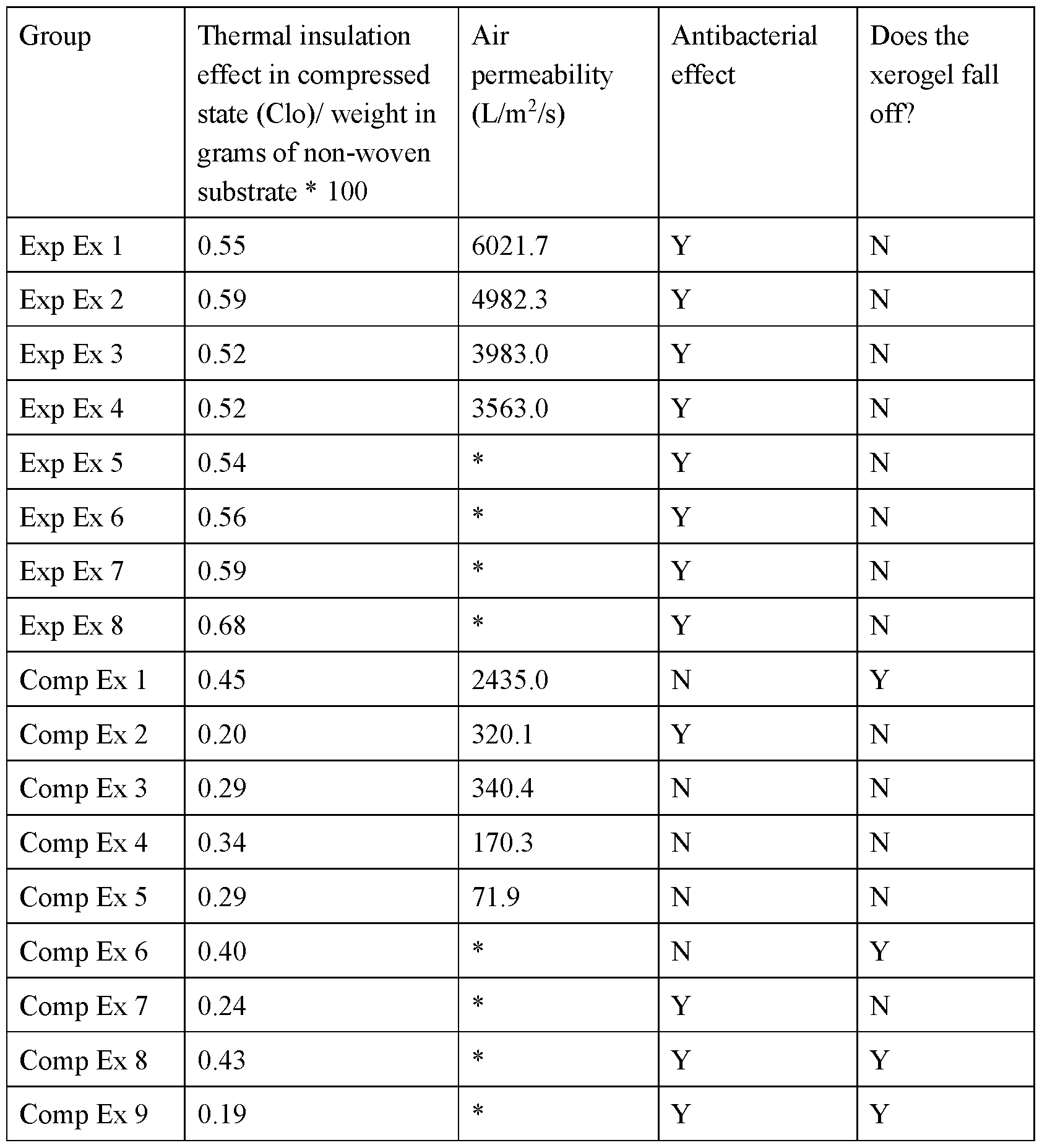 * indicates that testing is not performed.
It can be seen from Table 4 that compared with the comparative examples, the embodiments of the present disclosure have a better thermal insulation effect per unit of the non-woven substrate in a compressed state. If Comparative Example 5 is further compared
with Comparative Example 7, it can be seen that even if the xerogel is added in Comparative Example 7 and the quaternary ammonium salt therein help to produce an antibacterial effect, but they are not helpful to improve the thermal insulation effect of the thermal insulation material in a compressed state. Therefore, it is found in the present application that an appropriate thickness retention ratio of the non-woven substrate can help to improve the thermal insulation effect of the thermal insulation material, wherein the thickness retention ratio of the non-woven substrate is preferably greater than 70%.
If Experimental Example 2 is further compared with Comparative Example 1, or Experimental Example 5 is further compared with Comparative Example 6, it can be seen that when the xerogel lacks a quaternary ammonium salt ingredient, or the proportion of the quaternary ammonium salt is excessively low, the binding strength of the xerogel with the substrate would be affected. Therefore, it can be seen that adding a quaternary ammonium salt to the xerogel can help to strengthen the bonding strength of the xerogel with the substrate. It is found in the present application that the proportion of the quaternary ammonium salt is preferably 0.3%-20%.
From the comparison of Experimental Example 2 with Comparative Examples 8 and 9, it can be seen that even if the non-woven substrate has an appropriate thickness retention ratio and quaternary ammonium salt proportion, if the non-woven substrate proportion and the xerogel proportion exceed a range, the xerogel may fall off. That is, it is found in the present application that the proportion of the non-woven substrate is preferably 20%-96.7%, and the proportion of the xerogel is preferably 3%-60%.
In addition, it can be seen from the comparison of the experimental examples with the comparative examples that the addition of the quaternary ammonium salt not only helps to improve the structural stability of the thermal insulation material, but also enables the thermal insulation material to produce an antibacterial effect. It can also be seen from Experimental Example 2 and Comparative Example 1 that the thermal insulation material provided by the method of the embodiments of the present disclosure has better air
permeability; and if groups with similar weights in grams (Experimental Example 1 and Comparative Example 3, Experimental Example 3 and Comparative Example 4, and Experimental Example 4 and Comparative Example 5) are compared, it can be seen that the thermal insulation material prepared by the method of the embodiments of the present disclosure has excellent air permeability, and the addition of the quaternary ammonium salt in an appropriate proportion also helps to improve the air permeability of the thermal insulation material (Experimental Example 2 compared with Comparative Example 1).
It can thus be seen that provided in the embodiments of the present disclosure is a thermal insulation material having good structural stability, good air permeability and antibacterial effects that can be prepared under ambient pressure, and the thermal insulation material maintains a good thermal insulation capability when compressed, and is therefore suitable for application to various products, such as clothing, bedding, footwear, etc. Because the thermal insulation material of the embodiments of the present disclosure has good air permeability and bacteriostatic capability, and still has a thermal insulation capability in a compressed state, when applied to shoes, hosiery, and other products, the thermal insulation material can thereby avoid generation of unpleasant smell and allow for user comfort and warmth.
The present disclosure has disclosed example embodiments, and although specific terms are used, they are intended to and should only be interpreted as having general descriptive meanings, and are not intended for the purpose of limitation. In some examples, it would be obvious for those skilled in the art that unless clearly indicated otherwise, the features, characteristics, and/or elements described in conjunction with specific embodiments may be used alone, or may be used in combination with features, characteristics, and/or components described in conjunction with other embodiments. Therefore, those skilled in the art would understand that various changes in form and details can be made without departing from the scope of the present disclosure as set forth by the appended claims.
Claims
1. A thermal insulation material, comprising: a non-woven substrate having a thickness retention ratio of at least 70% under a pressure of 1 kPa; an xerogel; and a cationic surfactant comprising a quaternary ammonium salt and evenly distributed in the xerogel; wherein the content of the non-woven substrate in the thermal insulation material in percentage by weight is 20%-96.7%, the content of the xerogel in the thermal insulation material in percentage by weight is 3%-60%, and the content of the cationic surfactant in the thermal insulation material in percentage by weight is 0.3%-20%.
2. The thermal insulation material according to claim 1, wherein the material of the non-woven substrate is selected from at least one of a polyester fiber, a nylon fiber, an acrylic fiber, a polypropylene fiber, a polylactic acid fiber, and a cellulose fiber.
3. The thermal insulation material according to claim 1, wherein an initial thickness of the non-woven substrate under a pressure of 0.02 kPa is 2-50 mm.
4. The thermal insulation material according to claim 1, wherein the xerogel is formed from a gel comprising an organosilicon oxide precursor, and the organosilicon comprises an alkoxy silane.
5. The thermal insulation material according to claim 4, wherein the alkoxysilane comprises an alkyltrialkoxysilane, and the alkyltrialkoxysilane is methyltrimethoxysilane, vinyltrimethoxysilane, and a combination thereof.
6. The thermal insulation material according to claim 4, wherein the alkoxysilane comprises a dialkoxysilane, and the dialkoxysilane is selected from diethoxysilane, dimethoxysilane, and a combination thereof.
7. The thermal insulation material according to claim 4, wherein the gel further comprises a solvent and a catalyst.
8. The thermal insulation material according to claim 7, wherein the solvent comprises an alcohol, and the alcohol is selected from methanol, ethanol, and a combination thereof.
9. The thermal insulation material according to claim 7, wherein the catalyst comprises an acidic catalyst and a basic catalyst.
10. The thermal insulation material according to claim 9, wherein the acidic catalyst is selected from oxalic acid, hydrochloric acid, and a combination thereof.
11. The thermal insulation material according to claim 9, wherein the basic catalyst is selected from ammonium hydroxide, urea, and a combination thereof.
12. The thermal insulation material according to claim 1, wherein the quaternary ammonium salt of the cationic surfactant is selected from a quaternary ammonium halogen salt.
13. The thermal insulation material according to claim 12, wherein the quaternary ammonium halogen salt is selected from hexadecyl trimethyl ammonium bromide, hexadecyl trimethyl ammonium chloride, benzalkonium bromide, benzalkonium chloride,
and a combination thereof.
14. A method of preparing the thermal insulation material, comprising:
(a) providing a sol and a cationic surfactant, the cationic surfactant comprising a quaternary ammonium salt;
(b) co-condensing the sol and the cationic surfactant to form a gel;
(c) providing a non-woven substrate having a thickness retention ratio of at least 70% under a pressure of 1 kPa;
(d) impregnating the non-woven substrate in the gel; and
(e) heating and drying the non-woven substrate impregnated with the gel under atmospheric pressure to form the thermal insulation material having a xerogel bonded onto the non-woven substrate, wherein the content of the non-woven substrate in the thermal insulation material in percentage by weight is 20%-96.7%, the content of the xerogel in the thermal insulation material in percentage by weight is 3%-60%, and the content of the cationic surfactant in the thermal insulation material in percentage by weight is 0.3%-20%.
15. The method of preparing the thermal insulation material according to claim 14, wherein the sol comprises an organosilicon oxide precursor, and the organosilicon comprises an alkoxysilane.
16. The method of preparing the thermal insulation material according to claim 15, wherein the alkoxysilane comprises an alkyltrialkoxysilane, and the alkyltrialkoxysilane is methyltrimethoxysilane, vinyltrimethoxysilane, and a combination thereof.
17. The method of preparing the thermal insulation material according to claim 15, wherein the alkoxysilane comprises a dialkoxysilane, and the dialkoxysilane is selected from diethoxy silane, dimethoxysilane, and a combination thereof.
18. The method of preparing the thermal insulation material according to claim 14, wherein the quaternary ammonium salt is selected from a quaternary ammonium halogen salt.
19. The method of preparing the thermal insulation material according to claim 18, wherein the quaternary ammonium halogen salt is selected from hexadecyl trimethyl ammonium bromide, hexadecyl trimethyl ammonium chloride, benzalkonium bromide, benzalkonium chloride, and a combination thereof.
20. The method of preparing the thermal insulation material according to claim 14, wherein the sol further comprises a solvent and a catalyst.
21. The method of preparing the thermal insulation material according to claim 20, wherein the solvent comprises an alcohol, and the alcohol is selected from methanol, ethanol, and a combination thereof.
22. The method of preparing the thermal insulation material according to claim 20, wherein the catalyst comprises an acidic catalyst and a basic catalyst.
23. The method of preparing the thermal insulation material according to claim 14, wherein the material of the non-woven substrate is selected from at least one of a polyester fiber, a nylon fiber, an acrylic fiber, a polypropylene fiber, a polylactic acid fiber, and a cellulose fiber, and an initial thickness of the non-woven substrate under a pressure of 0.02 kPa is 2-50 mm.
24. The method of preparing the thermal insulation material according to claim 14, wherein the heating condition in step (e) is 110-150°C.
25. A product prepared from the thermal insulation material according to any one of claims 1 to 13.
Applications Claiming Priority (2)
| Application Number | Priority Date | Filing Date | Title |
|---|---|---|---|
| CN202010690351.5A CN111893649B (en) | 2020-07-17 | 2020-07-17 | Thermal insulation material, method for preparing thermal insulation material and product prepared from thermal insulation material |
| CN202010690351.5 | 2020-07-17 |
Publications (1)
| Publication Number | Publication Date |
|---|---|
| WO2022013841A1 true WO2022013841A1 (en) | 2022-01-20 |
Family
ID=73190276
Family Applications (1)
| Application Number | Title | Priority Date | Filing Date |
|---|---|---|---|
| PCT/IB2021/056470 Ceased WO2022013841A1 (en) | 2020-07-17 | 2021-07-16 | Thermal insulation material, method of preparing thermal insulation material, and product prepared from thermal insulation material |
Country Status (3)
| Country | Link |
|---|---|
| CN (1) | CN111893649B (en) |
| TW (1) | TW202206664A (en) |
| WO (1) | WO2022013841A1 (en) |
Citations (10)
| Publication number | Priority date | Publication date | Assignee | Title |
|---|---|---|---|---|
| WO1997023675A2 (en) | 1995-12-21 | 1997-07-03 | Hoechst Researach & Technology | Fibrous-formation aerogel composite material containing at least one thermoplastic fibrous material, process for the production thereof, and use therof |
| US20060223965A1 (en) * | 2005-03-31 | 2006-10-05 | Aspen Aerogels Inc. | High strength organic-inorganic hybrid gel materials |
| WO2010080239A2 (en) | 2008-12-18 | 2010-07-15 | 3M Innovative Properties Company | Methods of preparing hybrid aerogels |
| JP2011136859A (en) * | 2009-12-28 | 2011-07-14 | Asahi Fiber Glass Co Ltd | Fiber heat insulating material and method for manufacturing the same |
| CN102964111A (en) | 2012-10-27 | 2013-03-13 | 山西天一纳米材料科技有限公司 | Method for preparing insulation board with methyltrimethoxysilane as silicon source |
| WO2013053951A1 (en) | 2011-10-14 | 2013-04-18 | Enersens | Process for manufacturing xerogels |
| US20160060808A1 (en) | 2014-08-26 | 2016-03-03 | Panasonic Intellectual Property Management Co., Ltd. | Heat insulation sheet and method of producing the same |
| WO2016171558A1 (en) * | 2015-04-24 | 2016-10-27 | Separex S.A.S. | A process of applying a polymethylsilsesquioxane aerogel coating onto a porous substrate |
| WO2017087511A1 (en) | 2015-11-17 | 2017-05-26 | Primaloft, Inc. | Synthetic fiber containing aerogel and polymer material, and methods of making and articles comprising the same |
| WO2019027046A1 (en) * | 2017-08-04 | 2019-02-07 | 株式会社サムスン日本研究所 | Method for producing thermal insulation material, and composite thermal insulation material |
Family Cites Families (10)
| Publication number | Priority date | Publication date | Assignee | Title |
|---|---|---|---|---|
| US6723378B2 (en) * | 2001-10-25 | 2004-04-20 | The Regents Of The University Of California | Fibers and fabrics with insulating, water-proofing, and flame-resistant properties |
| WO2007011750A2 (en) * | 2005-07-15 | 2007-01-25 | Aspen Aerogels, Inc. | Secured aerogel composites and method of manufacture thereof |
| BR112012012614A2 (en) * | 2009-11-25 | 2018-06-05 | Cabot Corp | airgel composites and method for making and using them. |
| KR20140006886A (en) * | 2011-01-17 | 2014-01-16 | 컨스트럭션 리서치 앤 테크놀로지 게엠베하 | Composite thermal insulation system |
| WO2014004366A1 (en) * | 2012-06-26 | 2014-01-03 | Cabot Corporation | Flexible insulating structures and methods of making and using same |
| CN105593419A (en) * | 2013-08-09 | 2016-05-18 | 圣戈班伊索福公司 | Mineral fiber batting for manufacture of thermally insulating composite |
| WO2016047740A1 (en) * | 2014-09-25 | 2016-03-31 | 日立化成株式会社 | Aerogel composite, and supporting member and heat insulation material provided with aerogel composite |
| CN107849287A (en) * | 2015-07-15 | 2018-03-27 | 日立化成株式会社 | Aerogel composites |
| CN105698488A (en) * | 2016-01-29 | 2016-06-22 | 卓达新材料科技集团有限公司 | Normal-pressure drying method of non-woven fabric/aluminum silicon aerogel composite heat preserving board |
| CN109516763B (en) * | 2019-01-07 | 2021-07-20 | 东华大学 | A kind of cellulose fiber/SiO2 composite aerogel material and its preparation and application |
-
2020
- 2020-07-17 CN CN202010690351.5A patent/CN111893649B/en active Active
-
2021
- 2021-07-16 TW TW110126242A patent/TW202206664A/en unknown
- 2021-07-16 WO PCT/IB2021/056470 patent/WO2022013841A1/en not_active Ceased
Patent Citations (10)
| Publication number | Priority date | Publication date | Assignee | Title |
|---|---|---|---|---|
| WO1997023675A2 (en) | 1995-12-21 | 1997-07-03 | Hoechst Researach & Technology | Fibrous-formation aerogel composite material containing at least one thermoplastic fibrous material, process for the production thereof, and use therof |
| US20060223965A1 (en) * | 2005-03-31 | 2006-10-05 | Aspen Aerogels Inc. | High strength organic-inorganic hybrid gel materials |
| WO2010080239A2 (en) | 2008-12-18 | 2010-07-15 | 3M Innovative Properties Company | Methods of preparing hybrid aerogels |
| JP2011136859A (en) * | 2009-12-28 | 2011-07-14 | Asahi Fiber Glass Co Ltd | Fiber heat insulating material and method for manufacturing the same |
| WO2013053951A1 (en) | 2011-10-14 | 2013-04-18 | Enersens | Process for manufacturing xerogels |
| CN102964111A (en) | 2012-10-27 | 2013-03-13 | 山西天一纳米材料科技有限公司 | Method for preparing insulation board with methyltrimethoxysilane as silicon source |
| US20160060808A1 (en) | 2014-08-26 | 2016-03-03 | Panasonic Intellectual Property Management Co., Ltd. | Heat insulation sheet and method of producing the same |
| WO2016171558A1 (en) * | 2015-04-24 | 2016-10-27 | Separex S.A.S. | A process of applying a polymethylsilsesquioxane aerogel coating onto a porous substrate |
| WO2017087511A1 (en) | 2015-11-17 | 2017-05-26 | Primaloft, Inc. | Synthetic fiber containing aerogel and polymer material, and methods of making and articles comprising the same |
| WO2019027046A1 (en) * | 2017-08-04 | 2019-02-07 | 株式会社サムスン日本研究所 | Method for producing thermal insulation material, and composite thermal insulation material |
Non-Patent Citations (4)
| Title |
|---|
| CHEM. MATER., vol. 17, 2005, pages 2807 - 2816 |
| DONG ET AL., CHEM. MATER., vol. 16, no. 11, 2004, pages 2041 |
| DONG ET AL., J. COLLOID INTERFACE SCI., vol. 300, 2006, pages 179 - 285 |
| LOY ET AL., CHEM. MATER., vol. 18, 2006, pages 541 - 546 |
Also Published As
| Publication number | Publication date |
|---|---|
| TW202206664A (en) | 2022-02-16 |
| CN111893649B (en) | 2022-07-26 |
| CN111893649A (en) | 2020-11-06 |
Similar Documents
| Publication | Publication Date | Title |
|---|---|---|
| CN103203206B (en) | Cellulose/titanium dioxide/silica aerogel and preparation method thereof | |
| CN109516763B (en) | A kind of cellulose fiber/SiO2 composite aerogel material and its preparation and application | |
| CN107129262A (en) | A kind of ultra-thin aerogel composite and preparation method thereof | |
| JP2018523022A (en) | Improved method for producing silica airgel insulation products with high efficiency | |
| CN108409947A (en) | A kind of application of modified PET polyester | |
| CN104040067B (en) | Glass fiber board containing inorganic binder and its preparation method | |
| KR102005153B1 (en) | Non-woven structure for heat insulating materials including aerogel foaming layer | |
| CN114381936B (en) | Heat insulation aerogel composite material, preparation method and application | |
| WO2013157151A1 (en) | Multilayer sheet, heat-retaining structure provided with same, and method for producing multilayer sheet | |
| TW201542457A (en) | Flexible composite aerogel and manufacturing process | |
| Ramaswamy et al. | Superinsulating composite aerogels from polymethylsilsesquioxane and kapok fibers | |
| CN113716896A (en) | Silica aerogel-based flame-retardant composite shaping phase-change material, and preparation and application thereof | |
| KR101323618B1 (en) | Aerogel coating solution, method of manufacturing aerogel sheet coated thereby, and aerogel sheet manufactured by the same method | |
| US10042092B2 (en) | Heat-insulation material and production method thereof | |
| Xue et al. | Flexible fabrication of a novel SiO2/AF/ZIF-L composite embedded with MOF structure and its thermal insulation properties | |
| WO2022013841A1 (en) | Thermal insulation material, method of preparing thermal insulation material, and product prepared from thermal insulation material | |
| CN118390310A (en) | A method for preparing environmentally friendly and durable radiant cooling coated fabric by pre-gel process | |
| CN107009707B (en) | Composite Textiles | |
| CN113024880A (en) | Preparation method of cellulose acetate nanofiber composite aerogel for heat preservation | |
| CN116023115B (en) | Silicon aerogel-nanofiber composite membrane and preparation method thereof | |
| CN109898215A (en) | Composite wool fabric and its manufacture craft with cold-resistant heat-preserving function | |
| Zhai et al. | Hybrid aerogel composites reinforced with aramid fiber fabric for thermal protection | |
| TWI535658B (en) | Nonwoven / airgel composite fireproof / heat insulating material and preparation method thereof | |
| TWI568841B (en) | Anti - fire material of organic foam combined with airgel and its manufacturing method | |
| CN116587683B (en) | A heat-retaining and heat-insulating fabric |
Legal Events
| Date | Code | Title | Description |
|---|---|---|---|
| 121 | Ep: the epo has been informed by wipo that ep was designated in this application |
Ref document number: 21745433 Country of ref document: EP Kind code of ref document: A1 |
|
| NENP | Non-entry into the national phase |
Ref country code: DE |
|
| 122 | Ep: pct application non-entry in european phase |
Ref document number: 21745433 Country of ref document: EP Kind code of ref document: A1 |