WO2021260766A1 - 無線通信システム、中継機選択方法、中継機選択装置、及び中継機選択プログラム - Google Patents
無線通信システム、中継機選択方法、中継機選択装置、及び中継機選択プログラム Download PDFInfo
- Publication number
- WO2021260766A1 WO2021260766A1 PCT/JP2020/024367 JP2020024367W WO2021260766A1 WO 2021260766 A1 WO2021260766 A1 WO 2021260766A1 JP 2020024367 W JP2020024367 W JP 2020024367W WO 2021260766 A1 WO2021260766 A1 WO 2021260766A1
- Authority
- WO
- WIPO (PCT)
- Prior art keywords
- repeater
- repeaters
- station
- representative
- selection
- Prior art date
- Legal status (The legal status is an assumption and is not a legal conclusion. Google has not performed a legal analysis and makes no representation as to the accuracy of the status listed.)
- Ceased
Links
Images






Classifications
-
- H—ELECTRICITY
- H04—ELECTRIC COMMUNICATION TECHNIQUE
- H04W—WIRELESS COMMUNICATION NETWORKS
- H04W16/00—Network planning, e.g. coverage or traffic planning tools; Network deployment, e.g. resource partitioning or cells structures
- H04W16/14—Spectrum sharing arrangements between different networks
-
- H—ELECTRICITY
- H04—ELECTRIC COMMUNICATION TECHNIQUE
- H04W—WIRELESS COMMUNICATION NETWORKS
- H04W48/00—Access restriction; Network selection; Access point selection
- H04W48/16—Discovering, processing access restriction or access information
Definitions
- the present invention relates to a technique for selecting a repeater to be used in a wireless communication system using a repeater.
- Non-Patent Document 1 discloses a technique capable of reducing the interference power for an existing primary radio station and increasing the transmission capacity for a secondary use radio station. Specifically, by using a repeater such as a passive repeater, the propagation path of radio waves is controlled and the interference power is suppressed to a certain level or less.
- Non-Patent Document 1 Consider a wireless communication system that shares frequencies using a repeater as in Non-Patent Document 1 above. If there are multiple repeaters, at least one repeater is selected and used. At this time, there are a plurality of candidates for the combination of the selective repeaters.
- the interference level in the interfered station varies depending on the combination of the selective repeaters used. Therefore, it is necessary to determine the combination of selective repeaters so that the interference level in the interfered station satisfies a predetermined condition (desired condition).
- One object of the present invention is to provide a technique capable of suppressing the calculation time and the calculation load required for searching for a combination of repeaters satisfying a predetermined condition in a wireless communication system that shares a frequency by using a repeater. To do.
- the first aspect relates to a repeater selection method applied to a wireless communication system that shares a frequency with an interfered station.
- Wireless communication system N repeaters (N is an integer of 3 or more) and It is equipped with a transmitting station and a receiving station that perform wireless communication via at least one selective repeater among the N repeaters.
- the repeater channel information indicates the channel characteristics of the propagation path from the transmitting station to the interfered station via each repeater for each of the N repeaters.
- the repeater selection method is performed by the computer. How to select a repeater A clustering process that divides N repeaters into M clusters (M is an integer of 2 or more and less than N) based on the repeater channel information.
- Representative selection processing to select M representative repeaters representing each of the M clusters includes a repeater selection process of selecting at least one selected repeater from among M representative repeaters so that the interference level in the interfered station satisfies a predetermined condition based on the repeater channel information.
- the second aspect is related to the repeater selection program.
- the repeater selection program is executed by the computer, and causes the computer to execute the above-mentioned repeater selection method.
- the repeater selection program may be recorded on a computer-readable recording medium.
- the repeater selection program may be provided via the network.
- the third aspect relates to a wireless communication system that shares a frequency with an interfering station.
- Wireless communication system N repeaters (N is an integer of 3 or more) and A repeater selection device that selects at least one of the N repeaters as the selection repeater, and It includes a transmitting station and a receiving station that perform wireless communication via at least one selective repeater.
- the repeater channel information indicates the channel characteristics of the propagation path from the transmitting station to the interfered station via each repeater for each of the N repeaters.
- the repeater selection device is A clustering process that divides N repeaters into M clusters (M is an integer of 2 or more and less than N) based on the repeater channel information.
- a fourth aspect relates to a repeater selection device in a wireless communication system that shares a frequency with an interfering station.
- Wireless communication system N repeaters (N is an integer of 3 or more) and It is equipped with a transmitting station and a receiving station that perform wireless communication via at least one selective repeater among the N repeaters.
- the repeater channel information indicates the channel characteristics of the propagation path from the transmitting station to the interfered station via each repeater for each of the N repeaters.
- the repeater selection device is A storage device that stores repeater channel information, and Equipped with a processor.
- the processor is A clustering process that divides N repeaters into M clusters (M is an integer of 2 or more and less than N) based on the repeater channel information.
- wireless communication is performed using at least one selective repeater among the N repeaters.
- At least one selective repeater is selected so that the interference level in the interfered station satisfies a predetermined condition based on the repeater channel information.
- a clustering process is executed when selecting a selective repeater.
- N repeaters are divided into M clusters.
- a selected repeater satisfying a predetermined condition is selected from the M representative repeaters representing each of the M clusters.
- the number of candidates for the combination of M representative repeaters (2 M -1) is smaller than the number of candidates for the combination of N repeaters (2 N -1). Therefore, the calculation time and the calculation load required for searching for a combination of selective repeaters satisfying a predetermined condition are suppressed.
- FIG. 1 is a block diagram schematically showing a configuration of a wireless communication system 10 according to the present embodiment.
- the wireless communication system 10 includes a transmitting station T and a receiving station D that perform wireless communication.
- the wireless communication system 10 shares a frequency that shares the same frequency band as other wireless communication systems.
- the radio station of another radio communication system is hereinafter referred to as "interfered station P". In frequency sharing, it is important to suppress the interference level at the interfered station P.
- the propagation path from the transmitting station T to the receiving station D is actively controlled in order to suppress the interference level in the interfered station P. Therefore, the "repeater R" is used.
- the repeater R is a passive repeater configured to receive and re-radiate an incident signal.
- the passive repeater may be able to dynamically control the phase and amplitude of the received signal.
- the repeater R may be a reflector such as an IRS (Intelligent Reflector Surface) capable of dynamically controlling reflection characteristics such as a reflection direction, a reflectance, and a transmittance.
- the wireless communication system 10 includes a plurality of repeaters R. More specifically, the wireless communication system 10 includes N number of repeater R 1 ⁇ R N. Here, N is an integer of 3 or more. At least one of the N number of repeater R 1 ⁇ R N is selected and used.
- the repeater R that is selected and used is hereinafter referred to as "selective repeater RS".
- the transmitting station T and the receiving station D perform wireless communication via at least one selective repeater RS.
- Combination pattern S The combination of at least one selective repeater RS is hereinafter referred to as "combination pattern S" for convenience.
- the combination pattern S also includes the case where there is only one selective repeater RS.
- Combination pattern S can be said to be the selected state of the selected repeater RS in N number of repeater R 1 ⁇ R N.
- the interference level in the interfered station P varies depending on the combination pattern S used. According to this embodiment, one combination pattern S is determined so that the interference level in the interfered station P satisfies the "predetermined condition (desired condition)".
- the predetermined condition is that the interference level in the interfered station P is minimized.
- the combination pattern S that minimizes the interference level in the interfered station P is searched for.
- a predetermined condition is to maximize the transmission capacity from the transmitting station T to the receiving station D while suppressing the interference level in the interfered station P to a certain level or less.
- a combination pattern S that maximizes the transmission capacity from the transmitting station T to the receiving station D is searched under the condition that the interference level in the interfered station P is equal to or lower than a certain level.
- the number of candidates for the combination pattern S increases exponentially. It is preferable that the number of candidates for the combination pattern S increases from the viewpoint that the possibility of further lowering the interference level and further increasing the transmission capacity increases. On the other hand, an increase in the number of candidates for the combination pattern S leads to an increase in the calculation time and the calculation load required for searching for the combination pattern S satisfying a predetermined condition. In particular, when the number N of the repeaters R is large, the calculation time and the calculation load increase explosively.
- the present embodiment provides a technique capable of suppressing the calculation time and the calculation load required for searching for the combination pattern S satisfying a predetermined condition even when the number N of the repeaters R is large.
- the combination pattern S corresponds to the combination of the binary variables s Ri.
- Channel characteristics h TRIP of the channel extending through the repeater R i from the transmission station T to the interfered station P is expressed by the following equation (3).
- h TRi is the channel characteristics of the propagation path between the transmitting station T and the relay apparatus R i
- h RiP is the channel characteristics of the propagation path between the relay apparatus R i and the interfered station P be.
- a Pi and b Pi are real numbers
- j is an imaginary number.
- the channel characteristics h TRID propagation path from the transmitting station T to the reception station D via the repeater R i is expressed by the following equation (4).
- h RID is the channel characteristics of the propagation path between the reception station D and the relay apparatus R i.
- a Di and b Di are real numbers, and j is an imaginary number.
- the transmitting station T transmits the signal x to the receiving station D.
- Signal y d received at the signal y p and the receiving station D received by the interfered station P is expressed by the following equation (5) to (8).
- n p and nd are noise.
- Transmission capacity C D from the transmission station T to the reception station D is expressed by the following equation (12).
- ⁇ is an SNR (Signal-to-Noise Ratio).
- the interference level INR Interference-to-Noise Ratio
- INR Interference-to-Noise Ratio
- a combination pattern S (that is, a combination of binary variables sRi ) such that the interference level INR in the interfered station P satisfies a predetermined condition is searched for.
- the predetermined condition is that the interference level INR in the interfered station P is minimized.
- a combination pattern S (that is, a combination of binary variables s Ri ) that minimizes the interference level INR is searched for.
- the interference level INR is calculated based on the above equations (3), (10), and (13).
- the predetermined condition while suppressing the interference level INR below a certain level V, is to maximize the transmission capacity C D to the receiving station D from the transmitting station T.
- the transmission capacity C D is the maximum combination pattern S (i.e., a combination of binary variables s Ri) is searched.
- the interference level INR is calculated based on the above equations (3), (10), and (13).
- the transmission capacity CD is calculated based on the above equations (4), (11), and (12).
- the search for the combination pattern S satisfying a predetermined condition results in a 0-1 integer programming problem.
- the "clustering process” is performed in order to suppress the calculation time and the calculation load required for searching for the combination pattern S satisfying a predetermined condition.
- the clustering process, the relay apparatus R 1 ⁇ R N N-base is divided into M clusters.
- the number of clusters M is an integer of 2 or more and less than N.
- one "representative repeater RX" is selected from the repeaters R belonging to each cluster for each of the M clusters.
- M representative repeaters RX 1 to RX M representing each of the M clusters are selected.
- a combination pattern S satisfying a predetermined condition is searched from among the representative repeaters RX 1 to RX M of M units instead of the repeaters R 1 to RN of N units.
- the number of candidates for the combination pattern S of the representative repeaters RX 1 to RX M (2 M -1) of M units is from the number of candidates (2 N -1) of the combination pattern S of the combination patterns S of N repeaters R 1 to RN. There are few. Therefore, the calculation time and the calculation load required for searching for the combination pattern S satisfying a predetermined condition are suppressed. Even if the number N of the repeaters R increases, the calculation time and the calculation load can be suppressed to a constant value if the number of clusters M is constant.
- the channel characteristics h TRIP propagation path via the relay unit R i from the transmission station T leading to the interfered station P is considered.
- the channel characteristic h TRiP is represented by the above equation (3). That is, the channel characteristic h TRiP is represented by an IQ signal in complex number format (a pi + jb pi).
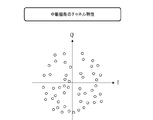
- Figure 3 shows the channel characteristics h TRIP each repeater R i on the IQ plane.
- N type channel characteristics h TRIP for each N number of repeater R 1 ⁇ R N is mapped to on the IQ plane.
- N points on the IQ plane represent N kinds of channel characteristics h TRiP.
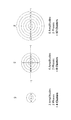
- FIG. 4 is a conceptual diagram for explaining a first example of the clustering process according to the present embodiment.
- a clustering process is performed on N points on the IQ plane. More specifically, the region containing N points on the IQ plane is divided into M areas. In the example shown in FIG. 4, the number of divisions in the amplitude direction is 2, the number of divisions in the phase direction is 4, and the number of areas (number of clusters M) is 8. The eight areas are symmetrically distributed.
- the point cloud belonging to each area constitutes one cluster. That is, the point clouds belonging to each of the M areas are set as M clusters.
- the relay unit R i having a channel characteristic h TRIP similar are summarized as a cluster.
- the clustering as the relay unit R i belong to the same cluster to the channel characteristics h TRIP are similar is executed.
- any one representative point (indicated by a black circle in FIG. 4) is selected from each cluster. For example, the point closest to the center of gravity of each cluster is selected as the representative point.
- Repeater R i having a channel characteristic h TRIP represented by that representative point are representative repeater RX.
- eight representative repeaters RX representing eight clusters are selected.
- a combination pattern S satisfying a predetermined condition is searched from among the eight representative repeaters RX. This significantly reduces the calculation time and calculation load.
- one representative repeater RX is selected from the clusters having similar channel characteristics h TRiP , the decrease in accuracy due to the use of the representative repeater RX instead of all the repeaters R is suppressed. In other words, it is possible to suppress the calculation time and calculation load required for searching for the combination pattern S satisfying a predetermined condition while sufficiently maintaining the accuracy. Further, since the combination (poor effect) of the repeaters R having similar channel characteristics h TRiP is automatically excluded, the overhead is reduced.
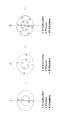
- the cluster settings are not limited to those shown in FIG. 5 and 6 show various examples of cluster settings. By changing the number of divisions in the amplitude direction and the number of divisions in the phase direction, clusters of various numbers and shapes can be created.
- FIG. 7 is a conceptual diagram for explaining a second example of the clustering process according to the present embodiment.
- the repeater R i having a channel characteristic h TRIP similar are summarized as a cluster.
- the clustering as the relay unit R i belong to the same cluster to the channel characteristics h TRIP are similar is executed.
- a well-known k-means method is used instead of the area division.
- N type channel characteristics h TRIP for each N number of repeater R 1 ⁇ R N is mapped as N points on the IQ plane. Then, N points on the IQ plane are divided into M clusters by the k-means method. In the example shown in FIG. 7, the number of clusters M is 5, and each of the clusters having 5 circles, triangles, squares, rhombuses, and stars is represented.
- any one representative point is selected from each cluster. For example, the point closest to the center of gravity of each cluster is selected as the representative point.
- Repeater R i having a channel characteristic h TRIP represented by that representative point are representative repeater RX.
- RX having a channel characteristic h TRIP represented by that representative point.
- five representative repeaters RX representing five clusters are selected.
- a combination pattern S satisfying a predetermined condition is searched from among the five representative repeaters RX. This significantly reduces the calculation time and calculation load.
- M clusters are one cluster (circle) having a small amplitude and densely located near the origin, and other clusters having a large amplitude and being sparse (triangle, square, rhombus, etc.). It is divided into two parts (stars).
- Clusters with large amplitude and sparseness are, so to speak, "outliers".
- the difference in amplitude between the clusters is too large as described above, there is a possibility that the combination pattern S having the interference level INR in the interfered station P satisfying a predetermined condition cannot be found.
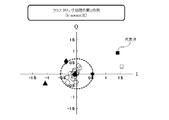
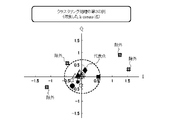
- FIG. 8 is a conceptual diagram for explaining a third example of the clustering process according to the present embodiment.
- the third example is a modification of the second example.
- the upper L points (outliers) having a large amplitude are excluded from the N points on the IQ plane in advance.
- the exclusion number L is an integer of 1 or more.
- the exclusion number L is set to the maximum integer that does not exceed N / M.
- N of the repeaters R increases, the number of exclusions L also increases.
- the number of clusters M decreases, the number of exclusions L increases.
- the number of clusters M decreases.
- the number of repeaters N is 20
- the number of clusters M is 5
- the number of exclusions L is 4.
- the top four points (outliers) having a large amplitude are excluded from the 20 points on the IQ plane in advance.
- the dashed circle in FIG. 8 indicates the upper limit of the amplitude that is not excluded.
- the NL points on the IQ plane are divided into M clusters by the k-means method.
- the number of clusters M is 5, and each of the clusters having 5 circles, triangles, squares, rhombuses, and stars is represented.
- any one representative point is selected from each cluster. For example, the point closest to the center of gravity of each cluster is selected as the representative point.
- Repeater R i having a channel characteristic h TRIP represented by that representative point are representative repeater RX. In the example shown in FIG. 8, five representative repeaters RX representing five clusters are selected.
- FIGS. 7 and 8 Comparing FIGS. 7 and 8, the following can be seen. That is, one cluster that was densely packed near the origin in FIG. 7 is decomposed into four clusters in FIG. 8. And the difference in amplitude between the clusters is suppressed. This makes it easier to find the combination pattern S such that the interference level INR in the interfered station P satisfies a predetermined condition.
- the third example is particularly effective when the number of clusters M is small.
- Configuration example 4-1 Overall Configuration
- a configuration example for realizing the processing according to the present embodiment will be described.
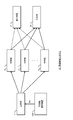
- FIG. 9 is a block diagram schematically showing the configuration of the wireless communication system 10 according to the present embodiment.
- Wireless communication system 10 includes a transmission station T, the receiving station D, in addition to the N units of the relay apparatus R 1 ⁇ R N, includes a repeater unit selection device 100.
- Repeater selecting device 100 selects at least one of the N number of repeater R 1 ⁇ R N as a selected repeater RS.
- the repeater selection device 100 selects at least one selective repeater RS so that the interference level INR in the interfered station P satisfies a predetermined condition.
- the repeater selection device 100 notifies the transmission station T of the selective repeater RS.
- the repeater selection device 100 may be included in the transmission station T or may be arranged outside the transmission station T. In the latter case, the repeater selection device 100 communicates with the transmission station T and notifies the selective repeater RS.
- Each repeater R is, for example, a passive repeater configured to receive an incident signal and re-radiate it.
- each repeater R analyzes the received signal and determines whether or not the received signal is a signal addressed to itself. If the received signal is a signal addressed to itself, the repeater R re-radiates the received signal. At this time, the repeater R may amplify the received signal and re-radiate it.
- the transmission station T transmits a signal to the selective repeater RS selected by the repeater selection device 100.
- the selective repeater RS receives the signal transmitted from the transmitting station T and re-radiates the received signal.
- the receiving station D receives the signal re-radiated by the selective repeater RS. In this way, the transmitting station T and the receiving station D perform wireless communication via the selective repeater RS selected by the repeater selection device 100.
- FIG. 10 is a block diagram showing a configuration example of the repeater selection device 100 according to the present embodiment.
- the repeater selection device 100 includes an input / output device 101 and an information processing device 102.
- the input / output device 101 includes a user interface that receives information from the user and also provides the information to the user. Examples of the user interface include a keyboard, a mouse, a touch panel, a display device, and the like.
- the input / output device 101 includes a communication device that communicates with the transmission station T.
- the information processing device 102 is a computer that performs various types of information processing.
- the information processing device 102 includes a processor 103 and a storage device 104.
- the processor 103 performs various information processing.
- the processor 103 includes a CPU (Central Processing Unit).
- the storage device 104 stores various information necessary for processing by the processor 103.
- Examples of the storage device 104 include a volatile memory, a non-volatile memory, an HDD (Hard Disk Drive), an SSD (Solid State Drive), and the like.
- the storage device 104 stores the repeater channel information 200, the clustering designation information 300, and the repeater selection information 400.
- each repeater R i channel characteristics for h TRIP that is, the channel characteristics h TRIP of the channel extending through the repeater R i from the transmission station T to the interfered station P.
- the channel characteristic h TRiP is measured in advance using, for example, a measuring instrument.
- the measured channel characteristic h TRiP is represented by an IQ signal in complex number format (see equation (3)).
- the interference level INR in the interfered station P can be calculated (see equations (3), (10), and (13)).
- the repeater channel information 200 is generated in advance by the user and registered in the storage device 104 via the input / output device 101 (user interface).
- the clustering designation information 300 specifies at least the number of clusters M. In the case of the first example (see FIGS. 4 to 6), the clustering designation information 300 specifies the number of clusters M, the number of divisions in the amplitude direction, and the number of divisions in the phase direction. In the case of the second example (see FIG. 7), the clustering designation information 300 specifies the number of clusters M. In the case of the third example (see FIG. 8), the clustering designation information 300 specifies the number of clusters M and the number of exclusions L. The clustering designation information 300 is generated in advance by the user and registered in the storage device 104 via the input / output device 101 (user interface).
- the repeater selection information 400 indicates a selective repeater RS selected by the repeater selection device 100.
- the repeater selection program PROG is a computer program executed by a computer.
- the function of the information processing apparatus 102 is realized by the processor 103 executing the repeater selection program PROG.
- the repeater selection program PROG is stored in the storage device 104.
- the repeater selection program PROG may be recorded on a computer-readable recording medium.
- the repeater selection program PROG may be provided via the network.
- the information processing device 102 may be realized by using hardware such as an ASIC (Application Specific Integrated Circuit), a PLD (Programmable Logic Device), and an FPGA (Field Programmable Gate Array).
- ASIC Application Specific Integrated Circuit
- PLD Process-Demand Device
- FPGA Field Programmable Gate Array
- FIG. 11 is a block diagram showing a functional configuration example of the repeater selection device 100 according to the present embodiment.
- the repeater selection device 100 includes an information acquisition unit 110, a clustering unit 120, a representative selection unit 130, a repeater selection unit 140, and an information output unit 150 as functional blocks. These functional blocks are realized by the information processing apparatus 102.
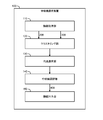
- FIG. 12 is a flowchart showing processing by the repeater selection device 100 according to the present embodiment.
- Step S110 information acquisition process
- the information acquisition unit 110 acquires the repeater channel information 200 and the clustering designation information 300 from the storage device 104.
- Step S120 the clustering unit 120 executes the "clustering process" based on the repeater channel information 200 and the clustering designation information 300. More specifically, the clustering section 120 divides the N number of repeater R 1 ⁇ R N into M clusters. The number of clusters M is specified by the clustering designation information 300. Clustering unit 120, the repeater R i channel characteristics h TRIP represented by repeater channel information 200 is similar to execute clustering processing to belong to the same cluster. Various examples can be considered as such a clustering process.
- FIG. 13 is a flowchart showing a first example (see FIGS. 4 to 6) of the clustering process.
- step S121 the clustering unit 120, based on the repeater channel information 200, the N type channel characteristics h TRIP regarding N number of repeater R 1 ⁇ R N, mapped as N points on the IQ plane.
- step S122 the clustering unit 120 divides the region including N points on the IQ plane into M areas based on the clustering designation information 300.
- the number of divisions in the amplitude direction and the number of divisions in the phase direction are specified by the clustering designation information 300.
- step S123 the clustering unit 120 sets a point cloud belonging to each of the M areas as M clusters.
- FIG. 14 is a flowchart showing a second example (see FIG. 7) of the clustering process. Step S121 is the same as in the case of the first example.
- step S124 the clustering unit 120 divides N points on the IQ plane into M clusters by the k-means method.
- the number of clusters M is specified by the clustering designation information 300.
- FIG. 15 is a flowchart showing a third example of the clustering process. Step S121 is the same as in the case of the first example.
- step S125 the clustering unit 120 excludes the upper L points having a large amplitude from the N points on the IQ plane.
- the exclusion number L is specified by the clustering designation information 300.
- the clustering unit 120 divides the NL points on the IQ plane into M clusters by the k-means method.
- the number of clusters M is specified by the clustering designation information 300.
- Step S130 (representative selection process)
- the representative selection unit 130 executes a "representative selection process" for selecting the representative repeater RX. More specifically, the representative selection unit 130 selects one representative repeater RX from the repeaters R belonging to each cluster. For example, the one closest to the center of gravity of each cluster is selected as the representative repeater RX. In this way, the representative selection unit 130 selects M representative repeaters RX 1 to RX M representing each of the M clusters.
- Step S140 the repeater selection unit 140 executes the "repeater selection process" for selecting the selected repeater RS. More specifically, the repeater selection unit 140 has M representative repeaters RX so that the interference level INR in the interfered station P satisfies a predetermined condition (desired condition) based on the repeater channel information 200. Select the selection repeater RS from 1 to RX M. The interference level INR can be calculated based on the repeater channel information 200 (see equations (3), (10), and (13)).
- An example of a predetermined condition is that the interference level INR in the interfered station P is minimized.
- Another example of a predetermined condition, while suppressing the interference level INR below a certain level, is to maximize the transmission capacity C D to the receiving station D from the transmitting station T.
- Transmission capacity C D can be calculated based on the propagation path of the channel characteristics h TRID, from the transmitting station T to the reception station D via the Repeater R i (Equation (4), (11), (12) reference).
- repeater channel information indicating the channel characteristics h TRID is used.
- the repeater selection unit 140 generates repeater selection information 400 indicating the selected selected repeater RS, and stores the repeater selection information 400 in the storage device 104.
- Step S150 (information output processing)
- the information output unit 150 reads the repeater selection information 400 from the storage device 104. Then, the information output unit 150 notifies the transmission station T of the repeater selection information 400 via the input / output device 101.
- the transmission station T transmits a signal to the selective repeater RS indicated by the repeater selection information 400.
- the selective repeater RS receives the signal transmitted from the transmitting station T and re-radiates the received signal.
- the receiving station D receives the signal re-radiated by the selective repeater RS. In this way, the transmitting station T and the receiving station D perform wireless communication via the selective repeater RS selected by the repeater selection device 100.
- the wireless communication by using at least one selected repeater RS of the N number of repeater R 1 ⁇ R N is performed.
- At least one selective repeater RS is selected so that the interference level INR in the interfered station P satisfies a predetermined condition based on the repeater channel information 200.
- a clustering process is executed when the selective repeater RS is selected.
- the clustering process the relay apparatus R 1 ⁇ R N N-base is divided into M clusters.
- the selection repeater RS satisfying a predetermined condition is selected from the representative repeaters RX 1 to RX M of M units representing each of the M clusters.
- the number of candidates for the combination of M representative repeaters RX 1 to RX M (2 M -1) is smaller than the number of candidates for the combination of N repeaters R 1 to RN (2 N -1). Therefore, the calculation time and the calculation load required for searching for a combination of selective repeaters RS satisfying a predetermined condition are suppressed. Even if the number N of the repeaters R increases, the calculation time and the calculation load can be suppressed to a constant value if the number of clusters M is constant.
- the channel characteristics h TRIP propagation path via the relay unit R i from the transmission station T leading to the interfered station P is considered.
- Repeater R i having similar channel characteristics h TRIP are summarized as a cluster.
- the clustering as the relay unit R i belong to the same cluster to the channel characteristics h TRIP are similar is executed. Since one representative repeater RX is selected from the clusters having similar channel characteristics h TRiP , the decrease in accuracy due to the use of the representative repeater RX instead of all the repeaters R is suppressed. In other words, it is possible to suppress the calculation time and the calculation load required for searching for a combination of selective repeaters RS satisfying a predetermined condition while sufficiently maintaining the accuracy. Further, since the combination (poor effect) of the repeaters R having similar channel characteristics h TRiP is automatically excluded, the overhead is reduced.
- 10 wireless communication system, 100 ... repeater selection device, 101 ... input / output device, 102 ... information processing device, 103 ... processor, 104 ... storage device, 110 ... information acquisition unit, 120 ... clustering unit, 130 ... representative selection unit , 140 ... repeater selection unit, 150 ... information output unit, 200 ... repeater channel information, 300 ... clustering designation information, 400 ... repeater selection information, PROG ... repeater selection program, D ... receiver station, P ... interfered Station, R ... Repeater, RS ... Selective repeater, RX ... Representative repeater, S ... Combination pattern, T ... Transmitter station
Landscapes
- Engineering & Computer Science (AREA)
- Computer Networks & Wireless Communication (AREA)
- Signal Processing (AREA)
- Computer Security & Cryptography (AREA)
- Mobile Radio Communication Systems (AREA)
Priority Applications (2)
| Application Number | Priority Date | Filing Date | Title |
|---|---|---|---|
| PCT/JP2020/024367 WO2021260766A1 (ja) | 2020-06-22 | 2020-06-22 | 無線通信システム、中継機選択方法、中継機選択装置、及び中継機選択プログラム |
| JP2022531258A JP7416243B2 (ja) | 2020-06-22 | 2020-06-22 | 無線通信システム、中継機選択方法、中継機選択装置、及び中継機選択プログラム |
Applications Claiming Priority (1)
| Application Number | Priority Date | Filing Date | Title |
|---|---|---|---|
| PCT/JP2020/024367 WO2021260766A1 (ja) | 2020-06-22 | 2020-06-22 | 無線通信システム、中継機選択方法、中継機選択装置、及び中継機選択プログラム |
Publications (1)
| Publication Number | Publication Date |
|---|---|
| WO2021260766A1 true WO2021260766A1 (ja) | 2021-12-30 |
Family
ID=79282697
Family Applications (1)
| Application Number | Title | Priority Date | Filing Date |
|---|---|---|---|
| PCT/JP2020/024367 Ceased WO2021260766A1 (ja) | 2020-06-22 | 2020-06-22 | 無線通信システム、中継機選択方法、中継機選択装置、及び中継機選択プログラム |
Country Status (2)
| Country | Link |
|---|---|
| JP (1) | JP7416243B2 (https=) |
| WO (1) | WO2021260766A1 (https=) |
Cited By (1)
| Publication number | Priority date | Publication date | Assignee | Title |
|---|---|---|---|---|
| WO2025140110A1 (zh) * | 2023-12-27 | 2025-07-03 | 维沃移动通信有限公司 | 数据传输方法、装置、中继设备、网络设备及介质 |
Citations (3)
| Publication number | Priority date | Publication date | Assignee | Title |
|---|---|---|---|---|
| JP2007074304A (ja) * | 2005-09-06 | 2007-03-22 | Ntt Docomo Inc | 中継局選択装置及び中継局選択方法 |
| JP2012161009A (ja) * | 2011-02-02 | 2012-08-23 | Nec Infrontia Corp | 無線lanシステム及びそのパケット配信方法、並びに無線lanアクセスポイント |
| JP2014011806A (ja) * | 2012-06-29 | 2014-01-20 | Samsung Electronics Co Ltd | 対象送信ノードと対象受信ノードのペアを、分散的に決定する方法及び協力ヘッダを介して中央集中的に決定する方法 |
-
2020
- 2020-06-22 JP JP2022531258A patent/JP7416243B2/ja active Active
- 2020-06-22 WO PCT/JP2020/024367 patent/WO2021260766A1/ja not_active Ceased
Patent Citations (3)
| Publication number | Priority date | Publication date | Assignee | Title |
|---|---|---|---|---|
| JP2007074304A (ja) * | 2005-09-06 | 2007-03-22 | Ntt Docomo Inc | 中継局選択装置及び中継局選択方法 |
| JP2012161009A (ja) * | 2011-02-02 | 2012-08-23 | Nec Infrontia Corp | 無線lanシステム及びそのパケット配信方法、並びに無線lanアクセスポイント |
| JP2014011806A (ja) * | 2012-06-29 | 2014-01-20 | Samsung Electronics Co Ltd | 対象送信ノードと対象受信ノードのペアを、分散的に決定する方法及び協力ヘッダを介して中央集中的に決定する方法 |
Non-Patent Citations (1)
| Title |
|---|
| OMIYA, RIKU ET AL.: "Experimental Evaluation of Interference Suppression Method by Selecting Combination of Passive Repeaters", LECTURE PROCEEDINGS OF THE 2020 IEICE GENERAL CONFERENCE, COMMUNICATION LECTURE PROCEEDINGS 1, 20 March 2020 (2020-03-20), pages 388 * |
Cited By (1)
| Publication number | Priority date | Publication date | Assignee | Title |
|---|---|---|---|---|
| WO2025140110A1 (zh) * | 2023-12-27 | 2025-07-03 | 维沃移动通信有限公司 | 数据传输方法、装置、中继设备、网络设备及介质 |
Also Published As
| Publication number | Publication date |
|---|---|
| JP7416243B2 (ja) | 2024-01-17 |
| JPWO2021260766A1 (https=) | 2021-12-30 |
Similar Documents
| Publication | Publication Date | Title |
|---|---|---|
| US20230110731A1 (en) | System, method, and apparatus for providing dynamic, prioritized spectrum management and utilization | |
| KR102749411B1 (ko) | 모션 인디케이터 값들에 기반한 무선 메시 네트워크 내 모션 로컬화 | |
| US11418272B2 (en) | Radio wave environment display device and method for displaying radio wave environment | |
| Cavalcanti et al. | A hybrid path loss prediction model based on artificial neural networks using empirical models for LTE and LTE-A at 800 MHz and 2600 MHz | |
| CN110346794B (zh) | 一种资源优化配置的分布式雷达成像方法 | |
| CN117978603B (zh) | 一种基于ofdm的反向散射通信感知一体化系统及方法 | |
| CN114175800A (zh) | 使用无线通信生成环境信息 | |
| EP3857723A1 (en) | Beam alignment | |
| JP7416243B2 (ja) | 無線通信システム、中継機選択方法、中継機選択装置、及び中継機選択プログラム | |
| KR102584996B1 (ko) | 무선 네트워크 디자인 방법, 저장매체 및 전자 장치 | |
| KR20170115804A (ko) | 지형지물을 고려한 이기종 무선 시스템 간의 간섭 분석 장치 및 방법 | |
| KR20210066682A (ko) | 인지 무선 네트워크 환경에서 유전자 알고리즘을 이용한 협력 스펙트럼 감지 최적화 시스템 및 이를 이용한 협력 스펙트럼 감지 최적화 방법 | |
| KR102704375B1 (ko) | 무선 통신 시스템에서 통합된 감지 및 통신을 위한 방법, 장치 및 시스템 | |
| KR20170065252A (ko) | Los 환경에서 채널 용량을 늘리기 위한 다중입출력 방법 및 장치 | |
| US11991545B2 (en) | Arrival rate estimation apparatus, arrival rate estimation method and program | |
| Xu et al. | A statistical model for the MIMO channel with rough reflection surfaces in the THz band | |
| KR101844160B1 (ko) | 전이중 다중 안테나 시스템에서의 안테나 선택 방법 | |
| KR102235149B1 (ko) | 협력 재밍을 사용한 상향 링크 비직교 다중 접속 네트워크에서 보안 전송률 형평성 향상을 위한 복호화 순서 선택 방법 및 그 시스템 | |
| KR102189818B1 (ko) | 게임이론 기반의 융합 주파수 지정 방법 및 주파수 지정 시스템 | |
| Ho et al. | Comparison of different antenna arrays for the BER reduction in indoor wireless communication | |
| US20240080677A1 (en) | Communication system, control server apparatus, base station placement method and program | |
| US11616709B2 (en) | Method and system for predicting availability in a radio frequency link aggregation group | |
| JP2015119223A (ja) | 情報通信端末装置及び情報通信方法 | |
| CN120091380B (zh) | 一种基于最大平均信噪比的无人机基站切换方法及系统 | |
| JP7414131B2 (ja) | 無線通信方法、無線通信装置、無線通信システム、及び無線通信プログラム |
Legal Events
| Date | Code | Title | Description |
|---|---|---|---|
| 121 | Ep: the epo has been informed by wipo that ep was designated in this application |
Ref document number: 20942329 Country of ref document: EP Kind code of ref document: A1 |
|
| ENP | Entry into the national phase |
Ref document number: 2022531258 Country of ref document: JP Kind code of ref document: A |
|
| NENP | Non-entry into the national phase |
Ref country code: DE |
|
| 122 | Ep: pct application non-entry in european phase |
Ref document number: 20942329 Country of ref document: EP Kind code of ref document: A1 |