WO2021200477A1 - 積層シート、衛生材料、医療材料および積層シートの製造方法 - Google Patents
積層シート、衛生材料、医療材料および積層シートの製造方法 Download PDFInfo
- Publication number
- WO2021200477A1 WO2021200477A1 PCT/JP2021/012252 JP2021012252W WO2021200477A1 WO 2021200477 A1 WO2021200477 A1 WO 2021200477A1 JP 2021012252 W JP2021012252 W JP 2021012252W WO 2021200477 A1 WO2021200477 A1 WO 2021200477A1
- Authority
- WO
- WIPO (PCT)
- Prior art keywords
- moisture
- permeable polyurethane
- polyurethane film
- laminated sheet
- permeable
- Prior art date
- Legal status (The legal status is an assumption and is not a legal conclusion. Google has not performed a legal analysis and makes no representation as to the accuracy of the status listed.)
- Ceased
Links
Images

Classifications
-
- A—HUMAN NECESSITIES
- A61—MEDICAL OR VETERINARY SCIENCE; HYGIENE
- A61L—METHODS OR APPARATUS FOR STERILISING MATERIALS OR OBJECTS IN GENERAL; DISINFECTION, STERILISATION OR DEODORISATION OF AIR; CHEMICAL ASPECTS OF BANDAGES, DRESSINGS, ABSORBENT PADS OR SURGICAL ARTICLES; MATERIALS FOR BANDAGES, DRESSINGS, ABSORBENT PADS OR SURGICAL ARTICLES
- A61L15/00—Chemical aspects of, or use of materials for, bandages, dressings or absorbent pads
- A61L15/16—Bandages, dressings or absorbent pads for physiological fluids such as urine or blood, e.g. sanitary towels, tampons
- A61L15/22—Bandages, dressings or absorbent pads for physiological fluids such as urine or blood, e.g. sanitary towels, tampons containing macromolecular materials
- A61L15/24—Macromolecular compounds obtained by reactions only involving carbon-to-carbon unsaturated bonds; Derivatives thereof
-
- A—HUMAN NECESSITIES
- A61—MEDICAL OR VETERINARY SCIENCE; HYGIENE
- A61F—FILTERS IMPLANTABLE INTO BLOOD VESSELS; PROSTHESES; DEVICES PROVIDING PATENCY TO, OR PREVENTING COLLAPSING OF, TUBULAR STRUCTURES OF THE BODY, e.g. STENTS; ORTHOPAEDIC, NURSING OR CONTRACEPTIVE DEVICES; FOMENTATION; TREATMENT OR PROTECTION OF EYES OR EARS; BANDAGES, DRESSINGS OR ABSORBENT PADS; FIRST-AID KITS
- A61F13/00—Bandages or dressings; Absorbent pads
- A61F13/15—Absorbent pads, e.g. sanitary towels, swabs or tampons for external or internal application to the body; Supporting or fastening means therefor; Tampon applicators
- A61F13/51—Absorbent pads, e.g. sanitary towels, swabs or tampons for external or internal application to the body; Supporting or fastening means therefor; Tampon applicators characterised by the outer layers of the pads
-
- A—HUMAN NECESSITIES
- A61—MEDICAL OR VETERINARY SCIENCE; HYGIENE
- A61F—FILTERS IMPLANTABLE INTO BLOOD VESSELS; PROSTHESES; DEVICES PROVIDING PATENCY TO, OR PREVENTING COLLAPSING OF, TUBULAR STRUCTURES OF THE BODY, e.g. STENTS; ORTHOPAEDIC, NURSING OR CONTRACEPTIVE DEVICES; FOMENTATION; TREATMENT OR PROTECTION OF EYES OR EARS; BANDAGES, DRESSINGS OR ABSORBENT PADS; FIRST-AID KITS
- A61F13/00—Bandages or dressings; Absorbent pads
- A61F13/15—Absorbent pads, e.g. sanitary towels, swabs or tampons for external or internal application to the body; Supporting or fastening means therefor; Tampon applicators
- A61F13/51—Absorbent pads, e.g. sanitary towels, swabs or tampons for external or internal application to the body; Supporting or fastening means therefor; Tampon applicators characterised by the outer layers of the pads
- A61F13/514—Backsheet, i.e. the impermeable cover or layer furthest from the skin
- A61F13/51474—Backsheet, i.e. the impermeable cover or layer furthest from the skin characterised by its structure
- A61F13/51478—Backsheet, i.e. the impermeable cover or layer furthest from the skin characterised by its structure being a laminate, e.g. multi-layered or with several layers
- A61F13/5148—Backsheet, i.e. the impermeable cover or layer furthest from the skin characterised by its structure being a laminate, e.g. multi-layered or with several layers having an impervious inner layer and a cloth-like outer layer
-
- A—HUMAN NECESSITIES
- A61—MEDICAL OR VETERINARY SCIENCE; HYGIENE
- A61L—METHODS OR APPARATUS FOR STERILISING MATERIALS OR OBJECTS IN GENERAL; DISINFECTION, STERILISATION OR DEODORISATION OF AIR; CHEMICAL ASPECTS OF BANDAGES, DRESSINGS, ABSORBENT PADS OR SURGICAL ARTICLES; MATERIALS FOR BANDAGES, DRESSINGS, ABSORBENT PADS OR SURGICAL ARTICLES
- A61L15/00—Chemical aspects of, or use of materials for, bandages, dressings or absorbent pads
- A61L15/16—Bandages, dressings or absorbent pads for physiological fluids such as urine or blood, e.g. sanitary towels, tampons
- A61L15/22—Bandages, dressings or absorbent pads for physiological fluids such as urine or blood, e.g. sanitary towels, tampons containing macromolecular materials
- A61L15/26—Macromolecular compounds obtained otherwise than by reactions only involving carbon-to-carbon unsaturated bonds; Derivatives thereof
-
- A—HUMAN NECESSITIES
- A61—MEDICAL OR VETERINARY SCIENCE; HYGIENE
- A61L—METHODS OR APPARATUS FOR STERILISING MATERIALS OR OBJECTS IN GENERAL; DISINFECTION, STERILISATION OR DEODORISATION OF AIR; CHEMICAL ASPECTS OF BANDAGES, DRESSINGS, ABSORBENT PADS OR SURGICAL ARTICLES; MATERIALS FOR BANDAGES, DRESSINGS, ABSORBENT PADS OR SURGICAL ARTICLES
- A61L15/00—Chemical aspects of, or use of materials for, bandages, dressings or absorbent pads
- A61L15/16—Bandages, dressings or absorbent pads for physiological fluids such as urine or blood, e.g. sanitary towels, tampons
- A61L15/42—Use of materials characterised by their function or physical properties
-
- B—PERFORMING OPERATIONS; TRANSPORTING
- B32—LAYERED PRODUCTS
- B32B—LAYERED PRODUCTS, i.e. PRODUCTS BUILT-UP OF STRATA OF FLAT OR NON-FLAT, e.g. CELLULAR OR HONEYCOMB, FORM
- B32B27/00—Layered products comprising a layer of synthetic resin
- B32B27/12—Layered products comprising a layer of synthetic resin next to a fibrous or filamentary layer
-
- B—PERFORMING OPERATIONS; TRANSPORTING
- B32—LAYERED PRODUCTS
- B32B—LAYERED PRODUCTS, i.e. PRODUCTS BUILT-UP OF STRATA OF FLAT OR NON-FLAT, e.g. CELLULAR OR HONEYCOMB, FORM
- B32B27/00—Layered products comprising a layer of synthetic resin
- B32B27/16—Layered products comprising a layer of synthetic resin specially treated, e.g. irradiated
-
- B—PERFORMING OPERATIONS; TRANSPORTING
- B32—LAYERED PRODUCTS
- B32B—LAYERED PRODUCTS, i.e. PRODUCTS BUILT-UP OF STRATA OF FLAT OR NON-FLAT, e.g. CELLULAR OR HONEYCOMB, FORM
- B32B27/00—Layered products comprising a layer of synthetic resin
- B32B27/32—Layered products comprising a layer of synthetic resin comprising polyolefins
-
- B—PERFORMING OPERATIONS; TRANSPORTING
- B32—LAYERED PRODUCTS
- B32B—LAYERED PRODUCTS, i.e. PRODUCTS BUILT-UP OF STRATA OF FLAT OR NON-FLAT, e.g. CELLULAR OR HONEYCOMB, FORM
- B32B27/00—Layered products comprising a layer of synthetic resin
- B32B27/40—Layered products comprising a layer of synthetic resin comprising polyurethanes
-
- B—PERFORMING OPERATIONS; TRANSPORTING
- B32—LAYERED PRODUCTS
- B32B—LAYERED PRODUCTS, i.e. PRODUCTS BUILT-UP OF STRATA OF FLAT OR NON-FLAT, e.g. CELLULAR OR HONEYCOMB, FORM
- B32B37/00—Methods or apparatus for laminating, e.g. by curing or by ultrasonic bonding
- B32B37/14—Methods or apparatus for laminating, e.g. by curing or by ultrasonic bonding characterised by the properties of the layers
- B32B37/16—Methods or apparatus for laminating, e.g. by curing or by ultrasonic bonding characterised by the properties of the layers with all layers existing as coherent layers before laminating
- B32B37/20—Methods or apparatus for laminating, e.g. by curing or by ultrasonic bonding characterised by the properties of the layers with all layers existing as coherent layers before laminating involving the assembly of continuous webs only
- B32B37/203—One or more of the layers being plastic
-
- B—PERFORMING OPERATIONS; TRANSPORTING
- B32—LAYERED PRODUCTS
- B32B—LAYERED PRODUCTS, i.e. PRODUCTS BUILT-UP OF STRATA OF FLAT OR NON-FLAT, e.g. CELLULAR OR HONEYCOMB, FORM
- B32B38/00—Ancillary operations in connection with laminating processes
- B32B38/18—Handling of layers or the laminate
- B32B38/1875—Tensioning
-
- B—PERFORMING OPERATIONS; TRANSPORTING
- B32—LAYERED PRODUCTS
- B32B—LAYERED PRODUCTS, i.e. PRODUCTS BUILT-UP OF STRATA OF FLAT OR NON-FLAT, e.g. CELLULAR OR HONEYCOMB, FORM
- B32B5/00—Layered products characterised by the non- homogeneity or physical structure, i.e. comprising a fibrous, filamentary, particulate or foam layer; Layered products characterised by having a layer differing constitutionally or physically in different parts
- B32B5/02—Layered products characterised by the non- homogeneity or physical structure, i.e. comprising a fibrous, filamentary, particulate or foam layer; Layered products characterised by having a layer differing constitutionally or physically in different parts characterised by structural features of a fibrous or filamentary layer
-
- B—PERFORMING OPERATIONS; TRANSPORTING
- B32—LAYERED PRODUCTS
- B32B—LAYERED PRODUCTS, i.e. PRODUCTS BUILT-UP OF STRATA OF FLAT OR NON-FLAT, e.g. CELLULAR OR HONEYCOMB, FORM
- B32B5/00—Layered products characterised by the non- homogeneity or physical structure, i.e. comprising a fibrous, filamentary, particulate or foam layer; Layered products characterised by having a layer differing constitutionally or physically in different parts
- B32B5/02—Layered products characterised by the non- homogeneity or physical structure, i.e. comprising a fibrous, filamentary, particulate or foam layer; Layered products characterised by having a layer differing constitutionally or physically in different parts characterised by structural features of a fibrous or filamentary layer
- B32B5/022—Non-woven fabric
-
- B—PERFORMING OPERATIONS; TRANSPORTING
- B32—LAYERED PRODUCTS
- B32B—LAYERED PRODUCTS, i.e. PRODUCTS BUILT-UP OF STRATA OF FLAT OR NON-FLAT, e.g. CELLULAR OR HONEYCOMB, FORM
- B32B5/00—Layered products characterised by the non- homogeneity or physical structure, i.e. comprising a fibrous, filamentary, particulate or foam layer; Layered products characterised by having a layer differing constitutionally or physically in different parts
- B32B5/02—Layered products characterised by the non- homogeneity or physical structure, i.e. comprising a fibrous, filamentary, particulate or foam layer; Layered products characterised by having a layer differing constitutionally or physically in different parts characterised by structural features of a fibrous or filamentary layer
- B32B5/08—Layered products characterised by the non- homogeneity or physical structure, i.e. comprising a fibrous, filamentary, particulate or foam layer; Layered products characterised by having a layer differing constitutionally or physically in different parts characterised by structural features of a fibrous or filamentary layer the fibres or filaments of a layer being of different substances, e.g. conjugate fibres, mixture of different fibres
-
- B—PERFORMING OPERATIONS; TRANSPORTING
- B32—LAYERED PRODUCTS
- B32B—LAYERED PRODUCTS, i.e. PRODUCTS BUILT-UP OF STRATA OF FLAT OR NON-FLAT, e.g. CELLULAR OR HONEYCOMB, FORM
- B32B7/00—Layered products characterised by the relation between layers; Layered products characterised by the relative orientation of features between layers, or by the relative values of a measurable parameter between layers, i.e. products comprising layers having different physical, chemical or physicochemical properties; Layered products characterised by the interconnection of layers
- B32B7/02—Physical, chemical or physicochemical properties
-
- B—PERFORMING OPERATIONS; TRANSPORTING
- B32—LAYERED PRODUCTS
- B32B—LAYERED PRODUCTS, i.e. PRODUCTS BUILT-UP OF STRATA OF FLAT OR NON-FLAT, e.g. CELLULAR OR HONEYCOMB, FORM
- B32B7/00—Layered products characterised by the relation between layers; Layered products characterised by the relative orientation of features between layers, or by the relative values of a measurable parameter between layers, i.e. products comprising layers having different physical, chemical or physicochemical properties; Layered products characterised by the interconnection of layers
- B32B7/02—Physical, chemical or physicochemical properties
- B32B7/027—Thermal properties
-
- B—PERFORMING OPERATIONS; TRANSPORTING
- B32—LAYERED PRODUCTS
- B32B—LAYERED PRODUCTS, i.e. PRODUCTS BUILT-UP OF STRATA OF FLAT OR NON-FLAT, e.g. CELLULAR OR HONEYCOMB, FORM
- B32B2250/00—Layers arrangement
- B32B2250/02—2 layers
-
- B—PERFORMING OPERATIONS; TRANSPORTING
- B32—LAYERED PRODUCTS
- B32B—LAYERED PRODUCTS, i.e. PRODUCTS BUILT-UP OF STRATA OF FLAT OR NON-FLAT, e.g. CELLULAR OR HONEYCOMB, FORM
- B32B2250/00—Layers arrangement
- B32B2250/03—3 layers
-
- B—PERFORMING OPERATIONS; TRANSPORTING
- B32—LAYERED PRODUCTS
- B32B—LAYERED PRODUCTS, i.e. PRODUCTS BUILT-UP OF STRATA OF FLAT OR NON-FLAT, e.g. CELLULAR OR HONEYCOMB, FORM
- B32B2250/00—Layers arrangement
- B32B2250/40—Symmetrical or sandwich layers, e.g. ABA, ABCBA, ABCCBA
-
- B—PERFORMING OPERATIONS; TRANSPORTING
- B32—LAYERED PRODUCTS
- B32B—LAYERED PRODUCTS, i.e. PRODUCTS BUILT-UP OF STRATA OF FLAT OR NON-FLAT, e.g. CELLULAR OR HONEYCOMB, FORM
- B32B2260/00—Layered product comprising an impregnated, embedded, or bonded layer wherein the layer comprises an impregnation, embedding, or binder material
- B32B2260/02—Composition of the impregnated, bonded or embedded layer
- B32B2260/021—Fibrous or filamentary layer
- B32B2260/023—Two or more layers
-
- B—PERFORMING OPERATIONS; TRANSPORTING
- B32—LAYERED PRODUCTS
- B32B—LAYERED PRODUCTS, i.e. PRODUCTS BUILT-UP OF STRATA OF FLAT OR NON-FLAT, e.g. CELLULAR OR HONEYCOMB, FORM
- B32B2260/00—Layered product comprising an impregnated, embedded, or bonded layer wherein the layer comprises an impregnation, embedding, or binder material
- B32B2260/04—Impregnation, embedding, or binder material
- B32B2260/046—Synthetic resin
-
- B—PERFORMING OPERATIONS; TRANSPORTING
- B32—LAYERED PRODUCTS
- B32B—LAYERED PRODUCTS, i.e. PRODUCTS BUILT-UP OF STRATA OF FLAT OR NON-FLAT, e.g. CELLULAR OR HONEYCOMB, FORM
- B32B2262/00—Composition or structural features of fibres which form a fibrous or filamentary layer or are present as additives
- B32B2262/02—Synthetic macromolecular fibres
- B32B2262/0253—Polyolefin fibres
-
- B—PERFORMING OPERATIONS; TRANSPORTING
- B32—LAYERED PRODUCTS
- B32B—LAYERED PRODUCTS, i.e. PRODUCTS BUILT-UP OF STRATA OF FLAT OR NON-FLAT, e.g. CELLULAR OR HONEYCOMB, FORM
- B32B2262/00—Composition or structural features of fibres which form a fibrous or filamentary layer or are present as additives
- B32B2262/02—Synthetic macromolecular fibres
- B32B2262/0292—Polyurethane fibres
-
- B—PERFORMING OPERATIONS; TRANSPORTING
- B32—LAYERED PRODUCTS
- B32B—LAYERED PRODUCTS, i.e. PRODUCTS BUILT-UP OF STRATA OF FLAT OR NON-FLAT, e.g. CELLULAR OR HONEYCOMB, FORM
- B32B2262/00—Composition or structural features of fibres which form a fibrous or filamentary layer or are present as additives
- B32B2262/14—Mixture of at least two fibres made of different materials
- B32B2262/144—Non-woven fabric
-
- B—PERFORMING OPERATIONS; TRANSPORTING
- B32—LAYERED PRODUCTS
- B32B—LAYERED PRODUCTS, i.e. PRODUCTS BUILT-UP OF STRATA OF FLAT OR NON-FLAT, e.g. CELLULAR OR HONEYCOMB, FORM
- B32B2307/00—Properties of the layers or laminate
- B32B2307/50—Properties of the layers or laminate having particular mechanical properties
- B32B2307/51—Elastic
-
- B—PERFORMING OPERATIONS; TRANSPORTING
- B32—LAYERED PRODUCTS
- B32B—LAYERED PRODUCTS, i.e. PRODUCTS BUILT-UP OF STRATA OF FLAT OR NON-FLAT, e.g. CELLULAR OR HONEYCOMB, FORM
- B32B2307/00—Properties of the layers or laminate
- B32B2307/50—Properties of the layers or laminate having particular mechanical properties
- B32B2307/514—Oriented
-
- B—PERFORMING OPERATIONS; TRANSPORTING
- B32—LAYERED PRODUCTS
- B32B—LAYERED PRODUCTS, i.e. PRODUCTS BUILT-UP OF STRATA OF FLAT OR NON-FLAT, e.g. CELLULAR OR HONEYCOMB, FORM
- B32B2307/00—Properties of the layers or laminate
- B32B2307/70—Other properties
- B32B2307/724—Permeability to gases, adsorption
-
- B—PERFORMING OPERATIONS; TRANSPORTING
- B32—LAYERED PRODUCTS
- B32B—LAYERED PRODUCTS, i.e. PRODUCTS BUILT-UP OF STRATA OF FLAT OR NON-FLAT, e.g. CELLULAR OR HONEYCOMB, FORM
- B32B2307/00—Properties of the layers or laminate
- B32B2307/70—Other properties
- B32B2307/726—Permeability to liquids, absorption
-
- B—PERFORMING OPERATIONS; TRANSPORTING
- B32—LAYERED PRODUCTS
- B32B—LAYERED PRODUCTS, i.e. PRODUCTS BUILT-UP OF STRATA OF FLAT OR NON-FLAT, e.g. CELLULAR OR HONEYCOMB, FORM
- B32B2307/00—Properties of the layers or laminate
- B32B2307/70—Other properties
- B32B2307/746—Slipping, anti-blocking, low friction
-
- B—PERFORMING OPERATIONS; TRANSPORTING
- B32—LAYERED PRODUCTS
- B32B—LAYERED PRODUCTS, i.e. PRODUCTS BUILT-UP OF STRATA OF FLAT OR NON-FLAT, e.g. CELLULAR OR HONEYCOMB, FORM
- B32B2307/00—Properties of the layers or laminate
- B32B2307/70—Other properties
- B32B2307/748—Releasability
-
- B—PERFORMING OPERATIONS; TRANSPORTING
- B32—LAYERED PRODUCTS
- B32B—LAYERED PRODUCTS, i.e. PRODUCTS BUILT-UP OF STRATA OF FLAT OR NON-FLAT, e.g. CELLULAR OR HONEYCOMB, FORM
- B32B2535/00—Medical equipment, e.g. bandage, prostheses or catheter
-
- B—PERFORMING OPERATIONS; TRANSPORTING
- B32—LAYERED PRODUCTS
- B32B—LAYERED PRODUCTS, i.e. PRODUCTS BUILT-UP OF STRATA OF FLAT OR NON-FLAT, e.g. CELLULAR OR HONEYCOMB, FORM
- B32B2555/00—Personal care
-
- B—PERFORMING OPERATIONS; TRANSPORTING
- B32—LAYERED PRODUCTS
- B32B—LAYERED PRODUCTS, i.e. PRODUCTS BUILT-UP OF STRATA OF FLAT OR NON-FLAT, e.g. CELLULAR OR HONEYCOMB, FORM
- B32B2555/00—Personal care
- B32B2555/02—Diapers or napkins
Definitions
- the present invention relates to a laminated sheet, a sanitary material, a medical material, and a method for manufacturing a laminated sheet.
- sanitary materials such as disposable diapers can suppress the permeation of liquid water and ensure excellent elasticity and moisture permeability.
- a sanitary material it has been studied to use a laminated sheet in which a stretchable non-woven fabric is laminated on a moisture-permeable polyurethane film.
- a moisture-permeable polyurethane film is addition-polymerized with 90% by weight of ethylene oxide and 10% by weight of propylene oxide, oxyalkylene polyol, 1,4-butanediol as a chain extender, and diphenylmethane diisocyanate.
- a stretchable moisture-permeable waterproof sheet which is formed from a polyurethane resin which is a reaction product of the above, and in which a non-woven fabric made of polypropylene is laminated on a moisture-permeable polyurethane film, has been proposed (see, for example, Example 1 of Patent Document 1). ..
- the stretchable moisture-permeable waterproof sheet described in Patent Document 1 has a limit in improving the stretchability. Further, in the stretchable moisture-permeable waterproof sheet described in Patent Document 1, the adhesion of the nonwoven fabric to the moisture-permeable polyurethane film is insufficient, and the nonwoven fabric may peel off from the moisture-permeable polyurethane film. Further, the laminated sheet is desired to have reduced tackiness (adhesiveness) from the viewpoint of tactile sensation when it comes into contact with the human body.
- a laminated sheet and a sanitary material capable of improving the adhesiveness of the spunbonded non-woven fabric to the moisture-permeable polyurethane film and reducing the tackiness while improving the elasticity.
- the present invention is a moisture-permeable polyurethane film having a hard segment phase and a first spunbonded nonwoven fabric arranged on one side in the thickness direction of the moisture-permeable polyurethane film, and is an elastic fiber containing a thermoplastic polyurethane.
- a laminated sheet comprising, and a first spunbonded nonwoven fabric containing non-stretchable fibers containing polyolefin, wherein the hard segment phase has a melting point of 65 ° C. or higher and 140 ° C. or lower.
- the laminate according to the above [1], wherein the moisture-permeable polyurethane film has a soft segment phase, and the soft segment phase is formed by a reaction between a polyether polyol and a polyisocyanate. Includes sheet.
- the present invention [3] includes the laminated sheet according to the above [2], wherein the number average molecular weight of the polyether polyol is 1200 g / mol or more and 2800 g / mol or less.
- the present invention [4] is a second spunbonded non-woven fabric arranged on the other side of the moisture-permeable polyurethane film in the thickness direction, and comprises elastic fibers containing thermoplastic polyurethane and non-stretchable fibers containing polyolefin.
- the present invention [6] includes sanitary materials including the laminated sheet according to any one of the above [1] to [5].
- the present invention [7] includes a medical material including the laminated sheet according to any one of the above [1] to [5].
- the present invention [8] comprises a step of preparing a spunbonded nonwoven fabric by mixing and heat-sealing elastic fibers containing thermoplastic polyurethane and non-stretchable fibers containing polyolefin, and a transparent having a hard segment phase.
- a step of preparing a moisture-permeable polyurethane film which is a wet polyurethane film and has a melting point of 65 ° C. or higher and 140 ° C. or lower in the hard segment phase, and pressure is applied so that the spunbonded nonwoven fabric is directed toward the moisture-permeable polyurethane film.
- the method for producing a laminated sheet includes a step of stretching the spunbonded nonwoven fabric and the moisture-permeable polyurethane film.
- the spunbonded nonwoven fabric in the step of laminating the spunbonded nonwoven fabric and the moisture-permeable polyurethane film, the spunbonded nonwoven fabric is brought into direct contact with one surface of the moisture-permeable polyurethane film in the thickness direction.
- the melting point of the hard segment phase of the moisture-permeable polyurethane film is equal to or lower than the above upper limit, and the first spunbonded nonwoven fabric contains elastic fibers containing thermoplastic polyurethane, so that the elasticity of the laminated sheet can be improved. While being able to achieve this, it is possible to improve the adhesion of the first spunbonded non-woven fabric to the moisture-permeable polyurethane film. Further, since the melting point of the hard segment phase in the moisture-permeable polyurethane film is at least the above lower limit and the first spunbonded nonwoven fabric contains non-stretchable fibers containing polyolefin, the tackiness of the laminated sheet can be reduced.
- a step of stretching the spunbonded nonwoven fabric and / or laminating the spunbonded nonwoven fabric and the moisture-permeable polyurethane film before laminating the spunbonded nonwoven fabric and the moisture-permeable polyurethane film Since the step of stretching is provided later, the laminated sheet having the above-mentioned characteristics can be smoothly produced.
- the sanitary material and the medical material of the present invention include the above-mentioned laminated sheet, it is possible to reduce tackiness while ensuring excellent elasticity and excellent adhesion.
- FIG. 1 is a schematic configuration diagram showing an embodiment of a laminated sheet of the present invention.
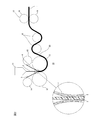
- FIG. 2 is a schematic configuration diagram of a melt extrusion laminating apparatus capable of carrying out the method for producing a laminated sheet of the present invention.
- the laminated sheet 1 includes a moisture-permeable polyurethane film 2, a first spunbonded non-woven fabric 3, and a second spunbonded non-woven fabric 4.
- the moisture-permeable polyurethane film 2 has a film shape (flat plate shape). Specifically, the moisture-permeable polyurethane film 2 has a predetermined thickness, extends in a predetermined direction orthogonal to the thickness direction, and has a flat front surface and a flat back surface.
- the thickness of the moisture-permeable polyurethane film 2 is, for example, 1 ⁇ m or more, preferably 5 ⁇ m or more, more preferably 10 ⁇ m or more, for example, 50 ⁇ m or less, preferably 30 ⁇ m or less, more preferably 25 ⁇ m or less.
- the moisture-permeable polyurethane film 2 contains a moisture-permeable polyurethane resin, and is preferably made of a moisture-permeable polyurethane resin.
- the moisture permeable polyurethane film 2 has a hard segment phase and a soft segment phase.
- the hard segment phase is a region (domain) composed of polyisocyanate and a low molecular weight diol as a chain extender, and is formed by a reaction between the polyisocyanate and a low molecular weight diol.
- the polyisocyanate contains, for example, diphenylmethane diisocyanate (MDI).
- MDI diphenylmethane diisocyanate
- diphenylmethane diisocyanate examples include 4,4'-diphenylmethane diisocyanate, 2,4'-diphenylmethane diisocyanate, and 2,2'-diphenylmethane diisocyanate.
- Diphenylmethane diisocyanate can be used alone or in combination of two or more.
- diphenylmethane diisocyanates 4,4'-diphenylmethane diisocyanate is preferable.
- the content ratio of diphenylmethane diisocyanate in polyisocyanate is, for example, 80% by mass or more, preferably 90% by mass or more, for example, 100% by mass or less.
- the polyisocyanate can contain other polyisocyanates in addition to diphenylmethane diisocyanate as long as it does not interfere with the scope of the present invention.
- polyisocyanates include, for example, aliphatic polyisocyanates (eg, 1,5-pentamethylene diisocyanate (PDI), 1,6-hexamethylene diisocyanate (HDI), etc.), alicyclic polyisocyanates (eg, 3-isosia).
- aliphatic polyisocyanates eg, 1,5-pentamethylene diisocyanate (PDI), 1,6-hexamethylene diisocyanate (HDI), etc.
- alicyclic polyisocyanates eg, 3-isosia
- Isocyanates TDI, etc.
- modified products modified from these polyisocyanates eg, multimers, isocyanurate modified products, biuret modified products, allophanate modified products, triol adducts, etc.
- modified products modified from diphenylmethane diisocyanate eg, modified products.
- a multimer, a modified carbodiimide, a polyphenylmethane polyisocyanate (polymeric MDI), etc.) can be mentioned.
- the content ratio of other polyisocyanates in the polyisocyanate is, for example, 0% by mass or more, for example, 40% by mass or less, preferably 20% by mass or less, and more preferably 10% by mass or less.
- the polyisocyanate is more preferably composed of diphenylmethane diisocyanate.
- the low molecular weight diol is, for example, a compound having a linear alkylene group and having two hydroxyl groups bonded to the alkylene group.
- the number average molecular weight of the low molecular weight diol is 60 g / mol or more and 200 g / mol or less.
- Examples of the low molecular weight diol include dihydric alcohols having 2 to 4 carbon atoms, and specifically, linear alkanediols (eg, ethylene glycol, 1,3-propanediol, 1,4-butanediol). Etc.), branched alkanediols (eg, 1,2-propanediol, 1,3-butanediol, etc.) and the like.
- Low molecular weight diols can be used alone or in combination of two or more.
- the low molecular weight diol preferably contains a linear alkanediol having 2 to 4 carbon atoms, and more preferably contains 1,4-butanediol.
- the melting point of such a hard segment phase is 65 ° C. or higher, preferably 75 ° C. or higher, more preferably 80 ° C. or higher, 140 ° C. or lower, preferably 138 ° C. or lower, and more preferably 135 ° C. or lower.
- the melting point of the hard segment phase can be measured by the method described in Examples described later (hereinafter, the same applies).
- the concentration of the hard segment phase in the moisture permeable polyurethane film 2 is, for example, 5% by mass or more, preferably 10% by mass or more, more preferably 12% by mass or more, still more preferably 18% by mass or more, for example. It is 40% by mass or less, preferably 30% by mass or less.
- the concentration of the hard segment phase can be calculated by the following formula (1).
- CE indicates a low molecular weight diol (chain extender)
- NCO indicates a polyisocyanate
- Mn indicates a number average molecular weight
- M.I. W. Indicates the molecular weight.
- the soft segment phase is a region (domain) composed of a high molecular weight polyol, and is formed by the reaction of the above-mentioned polyisocyanate and the high molecular weight polyol.
- the high molecular weight polyol is a compound having two or more hydroxyl groups and having a number average molecular weight of 400 g / mol or more, preferably 500 g / mol or more, for example, 10,000 g / mol or less, preferably 5000 g / mol or less.
- high-molecular-weight polyols include polyether polyols, polyester polyols, polycarbonate polyols, polyurethane polyols, epoxy polyols, vegetable oil polyols, polyolefin polyols, acrylic polyols, silicone polyols, fluorine polyols, vinyl monomer-modified polyols, and the like.
- a polyether polyol preferably, a polyester polyol, and a polycarbonate polyol are mentioned, and more preferably, a polyether polyol is mentioned.
- polyether polyol examples include polyoxy (C2 to 3) alkylene polyol, polytetramethylene ether glycol, polytrimethylene ether glycol and the like.
- polyoxy (C2-3) alkylene polyol for example, an addition polymer of C2-3 alkylene oxide such as ethylene oxide and propylene oxide using a low molecular weight polyol as an initiator (random and / or block of two or more alkylene oxides). Includes copolymers).
- the low molecular weight polyol is a compound having two or more hydroxyl groups and having a number average molecular weight of 60 g / mol or more and less than 400 g / mol, preferably 200 g / mol or less.
- Examples of the low molecular weight polyol include the above-mentioned low molecular weight diol having a number average molecular weight of 60 g / mol or more and 200 g / mol or less, and a dihydric alcohol having a number average molecular weight of more than 100 g / mol and less than 400 g / mol (for example, 1,5).
- -Alcohol diols having 5 to 8 carbon atoms such as pentandiol, 1,6-hexanediol, neopentyl glycol, 3-methyl-1,5-pentanediol, etc., for example, diethylene glycol, dipropylene glycol, etc. having 4 to 4 carbon atoms.
- examples thereof include etherdiols of 8), trihydric alcohols (eg, glycerin, trimethylolpropane, etc.), and tetrahydric alcohols (eg, tetramethylolmethane (pentaerythritol), diglycerin, etc.).
- the low molecular weight polyol as an initiator can be used alone or in combination of two or more.
- a dihydric alcohol having a number average molecular weight of more than 100 g / mol and less than 400 g / mol can be mentioned, and more preferably, an ether diol having 4 to 8 carbon atoms can be mentioned. And more preferably dipropylene glycol.
- examples of the polyoxy (C2 to 3) alkylene polyol include polyoxyethylene glycol, polyoxypropylene glycol, and copolymerized polyols thereof.
- the polyoxy (C2-3) alkylene polyol can be produced, for example, in the presence of a known alkaline catalyst or phosphazenium catalyst.
- polytetramethylene ether glycol for example, a ring-opening polymer obtained by cationic polymerization of tetrahydrofuran (polytetramethylene ether glycol (crystalline)) or the above-mentioned low molecular weight polyol or alkylene oxide is copolymerized with the polymerization unit of tetrahydrofuran.
- polytetramethylene ether glycol crystalline
- alkylene oxide low molecular weight polyol or alkylene oxide
- a plant-derived polytetramethylene ether glycol produced from a plant-based raw material such as furfural and using tetrahydrofuran as a starting material can also be mentioned.
- polytrimethylene ether glycol examples include polyols produced by polycondensation of plant-derived 1,3-propanediol.
- the high molecular weight polyol can be used alone or in combination of two or more.
- the high molecular weight polyol preferably contains a polyether polyol, and more preferably consists of a polyether polyol.
- the soft segment phase is preferably formed by the reaction of a polyether polyol with a polyisocyanate.
- the soft segment phase is formed by the reaction of the polyether polyol and the polyisocyanate
- the elasticity of the laminated sheet 1 can be surely improved, and the first spunbonded non-woven fabric 3 has a moisture-permeable polyurethane film 2. It is possible to surely improve the adhesion. In addition, the moisture permeability of the laminated sheet 1 can be improved.
- the polyether polyol preferably contains a polyoxy (C2-3) alkylene polyol and / or a polytetramethylene ether glycol, and more preferably consists of a polyoxy (C2-3) alkylene polyol and / or a polytetramethylene ether glycol. More preferably, it consists of a polyoxy (C2-3) alkylene polyol and a polytetramethylene ether glycol.
- the content ratio of the polyoxy (C2-3) alkylene polyol is that of the polyoxy (C2-3) alkylene polyol and the polytetramethylene ether glycol.
- 100% by mass of the total for example, 60% by mass or more, preferably 70% by mass or more, more preferably 78% by mass or more, for example, 95% by mass or less, preferably 90% by mass or less.
- the polyoxy (C2-3) alkylene polyol preferably contains an oxyethylene group.
- the content ratio of the oxyethylene group in the polyoxy (C2 to 3) alkylene polyol is, for example, 50% by mass or more, preferably 80% by mass or more, more preferably 85% by mass or more, for example, 100% by mass or less, preferably 100% by mass or less. , 95% by mass or less.
- the polyoxy (C2-3) alkylene polyol is more preferably composed of a polyoxyethylene polyol and / or a polyoxy (ethylene / propylene) copolymer polyol.
- the number average molecular weight of the polyether polyol is, for example, 400 g / mol or more, preferably 500 g / mol or more, more preferably 1200 g / mol or more, particularly preferably 1300 g / mol or more, and particularly preferably 1500 g / mol or more.
- it is 4000 g / mol or less, preferably 3000 g / mol or less, more preferably 2800 g / mol or less, particularly preferably 2500 g / mol or less, and particularly preferably 2400 g / mol or less.
- the number average molecular weight of the polyether polyol is in the above range, the elasticity of the laminated sheet 1 can be improved more reliably, and the adhesion of the first spunbonded non-woven fabric 3 to the moisture-permeable polyurethane film 2 can be improved. It can be planned more reliably. Further, when the number average molecular weight of the polyether polyol is not more than the above lower limit, the tackiness of the laminated sheet 1 can be surely reduced.
- the average number of functional groups of the high molecular weight polyol is, for example, 2.0 or more, for example, 4.0 or less, preferably 3.0 or less.
- the average number of functional groups of the polyol can be calculated from the charged components.
- the average hydroxyl value of the high molecular weight polyol is, for example, 35 mgKOH / g or more, preferably 40 mgKOH / g or more, more preferably 45 mgKOH / g or more, for example 115 mgKOH / g or less, preferably 87 mgKOH / g or less, more preferably. Is 78 mgKOH / g or less.
- the moisture-permeable polyurethane film 2 To manufacture the moisture-permeable polyurethane film 2, first, the moisture-permeable polyurethane is prepared.
- Moisture permeable polyurethane can be prepared, for example, by the prepolymer method.
- the above-mentioned polyisocyanate and the above-mentioned high-molecular-weight polyol are reacted at the following ratios to synthesize an isocyanate group-terminated urethane prepolymer having an isocyanate group at the molecular terminal.
- the ratio (NCO / OH) of the isocyanate group of the polyisocyanate to the hydroxyl group of the high molecular weight polyol is, for example, 1.9 or more, preferably 2.3 or more, more preferably 2.5 or more, for example. It is 3.5 or less, preferably 3.3 or less.
- the isocyanate group-terminated urethane prepolymer and the above-mentioned low molecular weight diol are reacted at a ratio in which the concentration of the hard segment phase falls within the above range.
- the ratio of the isocyanate group (NCO / OH) of the isocyanate group-terminated urethane prepolymer to the hydroxyl group of the low molecular weight diol is, for example, 0.990 or more, preferably 1.005 or more, for example, 1.150 or less. Preferably, it is 1.100 or less.
- the breathable polyurethane can also be manufactured by the one-shot method.
- a polyisocyanate, a high molecular weight polyol, and a low molecular weight diol are reacted at once at a ratio in which the concentration of the hard segment phase is within the above range to prepare a moisture permeable polyurethane.
- the breathable polyurethane obtained as described above is a thermoplastic polyurethane. Therefore, the obtained moisture-permeable polyurethane is crushed and pelletized, and then molded into a film or sheet by a known molding method such as extrusion molding. In the pelletization and extrusion molding steps, it is preferable to perform, for example, the filtration operation described in Japanese Patent No. 4332627 in order to reduce fish eyes in the moisture permeable polyurethane.
- the breathable polyurethane film 2 is manufactured.
- an antioxidant for example, a hindered phenol-based antioxidant
- an ultraviolet absorber for example, a benzotriazole-based ultraviolet absorber, a triazine-based agent
- Known additives such as UV absorbers, benzophenone-based UV absorbers, etc.), lubricants, mold release agents, and pigments such as titanium oxide can be added at appropriate timings and ratios.
- the moisture-permeable polyurethane film 2 contains a known additive in addition to the moisture-permeable polyurethane.
- the first spunbonded non-woven fabric 3 is arranged on one side in the thickness direction of the moisture-permeable polyurethane film 2. More specifically, the first spunbonded non-woven fabric 3 is arranged on the surface of the moisture-permeable polyurethane film 2 (one surface in the thickness direction) and comes into direct contact with the surface of the moisture-permeable polyurethane film 2.
- the first spunbonded non-woven fabric 3 is laminated on the moisture-permeable polyurethane film 2 without an adhesive. At least a part of the first spunbonded non-woven fabric 3 is fused to the surface of the moisture-permeable polyurethane film 2. In particular, at least a part of the stretchable fiber containing the thermoplastic polyurethane described later is fused to the surface of the moisture permeable polyurethane film 2.
- the first spunbonded non-woven fabric 3 contains elastic fibers containing thermoplastic polyurethane and non-stretchable fibers containing polyolefin.
- Elastic fiber is a polyurethane fiber made of thermoplastic polyurethane.
- thermoplastic polyurethane examples include the thermoplastic polyurethane-based elastomer (A1) described in JP-A-2008-213284.
- thermoplastic polyurethane is, for example, the above-mentioned polyisocyanate (preferably diphenylmethane diisocyanate), the above-mentioned high-molecular-weight polyol (preferably polyester polyol), and the above-mentioned low-molecular-weight polyol (preferably the above-mentioned low-molecular-weight diol).
- the thermoplastic polyurethane can be produced by a known method such as a prepolymer method or a prepolymer method, similarly to the moisture permeable polyurethane.
- thermoplastic polyurethane This prepares the thermoplastic polyurethane.
- the above-mentioned known additives can be added at an appropriate timing and ratio, if necessary.
- the stretchable fiber contains a known additive in addition to the thermoplastic polyurethane.
- thermoplastic polyurethane The hardness of such a thermoplastic polyurethane is, for example, 70A or more, preferably 73A or more, more preferably 75A or more, for example, 95A or less, preferably 90A or less, more preferably 88A or less, still more preferably. It is 85A or less.
- the hardness of the thermoplastic polyurethane can be measured by the method (durometer: type A) described in JIS K-7311 at 23 ° C. and 50% relative humidity (the same applies hereinafter).
- the tensile strength of the thermoplastic polyurethane is, for example, 20 MPa or more, preferably 30 MPa or more, for example 70 MPa or less, preferably 60 MPa or less.
- the tensile strength of the thermoplastic polyurethane can be measured by the method described in JIS K-7311 (the same applies hereinafter).
- the elongation at break of the thermoplastic polyurethane is, for example, 300% or more, preferably 400% or more, for example, 700% or less, preferably 600% or less.
- the elongation at break of the thermoplastic polyurethane can be measured by the method described in JIS K-7311 (the same applies hereinafter).
- the content ratio of the stretchable fiber in the first spunbonded non-woven fabric 3 is, for example, 30% by mass or more, and preferably 35% by mass or more from the viewpoint of further improving the stretchability.
- the content ratio of the elastic fiber is, for example, 70% by mass or less, preferably 60% by mass or less, from the viewpoint of further improving the tackiness.
- the non-stretchable fiber is a polyolefin fiber made of polyolefin.
- the polyolefin include the polyolefin (B) described in JP-A-2008-213284.
- polystyrene resin examples include polyethylene, polypropylene, and a polyethylene-polypropylene copolymer.
- Polyolefin can be used alone or in combination of two or more.
- Polyethylene preferably comprises polyethylene and / or polypropylene, more preferably polyethylene (more specifically, high density polyethylene) and polypropylene, and even more preferably polyethylene (more specifically, high density polyethylene). ) And polypropylene.
- the content ratio of polypropylene is, for example, 80% by mass or more, preferably 90% by mass or more, for example, 100% by mass or less, preferably 99% by mass or less, based on 100% by mass of the total of polyethylene and polypropylene.
- melt flow rate (MFR) of polypropylene conforms to ASTM D1238, and when measured at a temperature of 230 ° C. and a load of 2.16 kgf, for example, 10 g / 10 minutes or more, preferably 20 g / 10 minutes or more, for example, 1000 g / It is 10 minutes or less, preferably 100 g / 10 minutes or less.
- the density of polypropylene is, for example, 0.900 g / cm 3 or more 0.920 g / cm 3 or less.
- the melting point of polypropylene is, for example, 120 ° C. or higher, preferably 140 ° C. or higher, for example, 200 ° C. or lower, preferably 180 ° C. or lower.
- the melt flow rate (MFR) of polyethylene conforms to ASTM D1238, and when measured at a temperature of 230 ° C. and a load of 2.16 kgf, it is, for example, 1 g / 10 minutes or more, which is preferable from the viewpoint of further improving spinnability. 2 g / 10 minutes or more.
- the MFR of polyethylene is, for example, 1000 g / 10 minutes or less, preferably 100 g / 10 minutes or less, and more preferably 20 g / 10 minutes or less from the viewpoint of further improving extensibility.
- Density polyethylene is, for example, 0.940 g / cm 3 or more, from the viewpoint of improving the spinning property, preferably, 0.950 g / cm 3 or more.
- the density of polyethylene is, for example, 0.980 g / cm 3 or less, and preferably 0.975 g / cm 3 or less from the viewpoint of further improving moldability.
- the melting point of polyethylene is, for example, 100 ° C. or higher, preferably 120 ° C. or higher, for example, 180 ° C. or lower, preferably 160 ° C. or lower.
- the content ratio of the non-stretchable fibers in the first spunbonded non-woven fabric 3 is, for example, 30% by mass or more, preferably 40% by mass or more, for example, 70% by mass or less, preferably 65% by mass or less.
- the first spunbonded non-woven fabric 3 may contain other fibers in addition to the above-mentioned elastic fibers (polyurethane fibers) and non-stretchable fibers (polyolefin fibers) as long as the effects of the present invention are not impaired. can.
- other fibers include polystyrene fibers, polyvinyl chloride fibers, polyester fibers, and polyamide fibers.
- the content ratio of other fibers in the first spunbonded non-woven fabric 3 is, for example, 0% by mass or more, for example, 10% by mass or less, preferably 5% by mass or less.
- the first spunbonded non-woven fabric 3 is more preferably composed of elastic fibers (polyurethane fibers) and non-stretchable fibers (polyolefin fibers).
- the basis weight of the first spunbonded non-woven fabric 3 is, for example, 10 g / m 2 or more, preferably 15 g / m 2 or more, more preferably 20 g / m 2 or more, for example 100 g / m 2 or less, preferably 40 g / m. It is m 2 or less, more preferably 30 g / m 2 or less.
- the first spunbonded nonwoven fabric 3 can be produced, for example, by the method for producing a stretchable nonwoven fabric described in JP-A-2004-244791.
- the spinneret includes a plurality of first nozzles for ejecting thermoplastic polyurethane and a plurality of second nozzles for ejecting polyolefin.
- the stretchable fibers containing the thermoplastic polyurethane are discharged from the plurality of first nozzles, and at the same time, the non-stretchable fibers containing the polyolefin are discharged from the plurality of second nozzles.
- a web mixed fiber in which elastic fibers of thermoplastic polyurethane and non-elastic fibers of polyolefin are mixed is deposited on the collection surface.
- the web is heat-sealed by a heat embossing roll to partially heat-fuse the stretchable fibers and the non-stretchable fibers.
- the first spunbonded non-woven fabric 3 is prepared.
- the second spunbonded non-woven fabric 4 is arranged on the other side in the thickness direction of the moisture-permeable polyurethane film 2. More specifically, the second spunbonded non-woven fabric 4 is arranged on the back surface (one surface in the thickness direction) of the moisture permeable polyurethane film 2 and comes into direct contact with the back surface of the moisture permeable polyurethane film 2.
- the second spunbonded nonwoven fabric 4 has the same structure as the first spunbonded nonwoven fabric 3, and includes elastic fibers containing thermoplastic polyurethane and non-stretchable fibers containing polyolefin. Therefore, the description of the second spunbonded nonwoven fabric 4 will be omitted.
- the method for producing the laminated sheet 1 is that the laminated sheet 1 is laminated after a step of preparing a spunbonded nonwoven fabric, a step of preparing a moisture-permeable polyurethane film, a step of laminating the spunbonded nonwoven fabric and the moisture-permeable polyurethane film, and a step of laminating. It includes a step of stretching a spunbonded non-woven fabric and a breathable polyurethane film.
- Such a method for manufacturing the laminated sheet 1 is continuously carried out by, for example, the melt extrusion laminating apparatus 10 shown in FIG.
- the melt extrusion laminating apparatus 10 includes an extrusion molding machine 11, a first laminating roll 12, a second laminating roll 13, a first sending roll 14, a second sending roll 15, a plurality of cooling rolls 16, and a stretching machine. It has 17.
- the extrusion molding machine 11 is a known extrusion molding machine that extrudes the above-mentioned moisture-permeable polyurethane into a sheet and discharges the moisture-permeable polyurethane film 2.
- the moisture-permeable polyurethane film 2 immediately after being discharged may not be solidified.
- the extrusion molding machine 11 has a T-die. The extrusion molding machine 11 can adjust the temperature of the T-die.
- the first laminate roll 12 and the second laminate roll 13 are located on the downstream side in the discharge direction with respect to the extrusion molding machine 11.
- the first laminate roll 12 and the second laminate roll 13 are arranged so as to face each other.
- Each of the first laminate roll 12 and the second laminate roll 13 is rotatable.
- Each of the first laminate roll 12 and the second laminate roll 13 is temperature adjustable.
- the moisture-permeable polyurethane film 2 discharged from the extrusion molding machine 11 is supplied between the first laminate roll 12 and the second laminate roll 13.
- the first laminate roll 12 and the second laminate roll 13 are made of the first spunbonded non-woven fabric 3 and the second spunbonded nonwoven fabric 4 of the moisture-permeable polyurethane film 2 with respect to the moisture-permeable polyurethane film 2 supplied between them. Can be laminated from both sides.
- the first laminate roll 12 is movable with respect to the second laminate roll 13. As a result, in the first laminate roll 12, the first spunbonded non-woven fabric 3, the breathable polyurethane film 2, and the second spunbonded nonwoven fabric 4 are sandwiched between the first laminate roll 12 and the second laminate roll 13. The nip pressure acting on them can be adjusted.
- a long first spunbonded non-woven fabric 3 is wound around the first delivery roll 14 in advance.
- the elongated first spunbonded non-woven fabric 3 is prepared in advance by the method described above.
- the first spunbonded non-woven fabric 3 wound around the first delivery roll 14 has not yet been stretched.
- the first delivery roll 14 is rotatable and can deliver the unstretched first spunbonded non-woven fabric 3.
- the first delivery roll 14 is between the first laminate roll 12 and the second laminate roll 13 from the upstream side in the ejection direction of the extrusion molding machine 11 so as to come into contact with one surface of the moisture permeable polyurethane film 2 in the thickness direction. Is supplied with the first spunbonded non-woven fabric 3.
- the second delivery roll 15 is located on the opposite side of the first delivery roll 14 with respect to the extruder 11.
- a long second spunbonded non-woven fabric 4 is wound around the second delivery roll 15 in advance.
- the elongated second spunbonded nonwoven fabric 4 is prepared in advance by the method described above.
- the second spunbonded non-woven fabric 4 wound around the second delivery roll 15 has not yet been stretched.
- the second delivery roll 15 is rotatable and can deliver the unstretched second spunbonded non-woven fabric 4.
- the second delivery roll 15 is between the first laminate roll 12 and the second laminate roll 13 from the upstream side in the ejection direction of the extrusion molding machine 11 so as to come into contact with the other surface of the moisture permeable polyurethane film 2 in the thickness direction. Is supplied with the second spunbonded non-woven fabric 4.
- the plurality of cooling rolls 16 pass between the first laminate roll 12 and the second laminate roll 13, and the first spunbonded nonwoven fabric 3, the moisture-permeable polyurethane film 2, and the second spunbonded nonwoven fabric 4 are laminated.
- the laminated body 20 is cooled.
- Each of the plurality of cooling rolls 16 is temperature adjustable.
- the stretching machine 17 is, for example, a gear stretching device described in Japanese Patent Application Laid-Open No. 2004-244791.
- the stretching machine 17 gear-stretches the laminated body 20 cooled by the plurality of cooling rolls 16 to prepare the laminated sheet 1.
- the stretching machine 17 includes a first gear roll 18 and a second gear roll 19.
- Each peripheral surface of the first gear roll 18 and the second gear roll 19 has a plurality of gear teeth extending in the circumferential direction.
- the first gear roll 18 and the second gear roll 19 are arranged to face each other so as to mesh with each other.
- Each of the first gear roll 18 and the second gear roll 19 is rotatable.
- the laminate 20 cooled by the plurality of cooling rolls 16 is supplied between the first gear roll 18 and the second gear roll 19, is sandwiched between the first gear roll 18 and the second gear roll 19, and is gear-stretched.
- the moisture permeable polyurethane (pellets) prepared as described above is set in the extrusion molding machine 11.
- the water content of the moisture-permeable polyurethane pellets can be reduced to, for example, 500 ppm or less, preferably 300 ppm or less, more preferably 200 ppm or less by using a dehumidifying dryer. It is suitable from the viewpoint of improvement. It is preferable that the dehumidifying dryer is connected to the extrusion molding machine and the pellets are transported without being exposed to the atmosphere.
- the melted moisture-permeable polyurethane is extruded into a film from the T-die.
- the moisture-permeable polyurethane film 2 made of the moisture-permeable polyurethane in a molten state is prepared.
- the moisture-permeable polyurethane film 2 in the molten state is supplied between the first laminate roll 12 and the second laminate roll 13.
- the first spunbonded non-woven fabric 3 delivered from the first delivery roll 14 is supplied between the moisture-permeable polyurethane film 2 in the molten state and the first laminate roll 12, and is delivered from the second delivery roll 15.
- the second spunbonded non-woven fabric 4 is supplied between the moisture-permeable polyurethane film 2 in a molten state and the second laminate roll 13.
- the first spunbonded non-woven fabric 3 comes into direct contact with the surface (one surface in the thickness direction) of the moisture-permeable polyurethane film 2 in the molten state.
- the second spunbonded non-woven fabric 4 comes into direct contact with the back surface (the other surface in the thickness direction) of the melted moisture-permeable polyurethane film 2.
- the first spunbonded nonwoven fabric 3, the molten moisture-permeable polyurethane film 2, and the second spunbonded nonwoven fabric 4 are sandwiched between the first laminate roll 12 and the second laminate roll 13. Therefore, the nip from the first laminate roll 12 and the second laminate roll 13 so that each of the first spunbonded nonwoven fabric 3 and the second spunbonded nonwoven fabric 4 faces the moisture-permeable polyurethane film 2 in the molten state over the entire width direction. Pressure acts.
- the nip pressure is, for example, 0.1 MPaG or more, preferably 0.3 MPaG or more, for example 2.0 MPaG or less, preferably 1.0 MPaG or less, and more preferably 0.6 MPaG or less.
- each of the first laminate roll 12 and the second laminate roll 13 is, for example, 10 ° C. or higher, preferably 15 ° C. or higher, more preferably 20 ° C. or higher, for example, 50 ° C. or lower, preferably 40 ° C. or higher. It is below ° C.
- first spunbonded non-woven fabric 3 and the second spunbonded non-woven fabric 4 are laminated on both sides of the melted moisture-permeable polyurethane film 2.
- the first spunbonded non-woven fabric 3, the moisture-permeable polyurethane film 2, and the second spunbonded non-woven fabric 4 are laminated in this order to prepare the laminated body 20.
- the melted moisture-permeable polyurethane located on the surface of the moisture-permeable polyurethane film 2 is fused to at least a part (particularly elastic fiber) of the first spunbonded nonwoven fabric 3. Further, in the laminate 20, the molten moisture-permeable polyurethane located on the back surface of the moisture-permeable polyurethane film 2 is fused to at least a part (particularly elastic fiber) of the second spunbonded nonwoven fabric 4.
- the laminate 20 passes over the second laminate roll 13 and then is routed over the plurality of cooling rolls 16.
- the melted moisture-permeable polyurethane film 2 is solidified, and the first spunbonded nonwoven fabric 3 and the second spunbonded nonwoven fabric 4 are adhered to the moisture-permeable polyurethane film 2 without using an adhesive.
- the temperature of the cooling roll 16 is, for example, equal to or lower than the temperature of the second laminate roll 13.
- the temperature of the cooling roll 16 is, for example, 0 ° C. or higher, preferably 10 ° C. or higher, for example, 40 ° C. or lower, preferably 30 ° C. or lower.
- the cooled laminate 20 is supplied between the first gear roll 18 and the second gear roll 19, is sandwiched between the first gear roll 18 and the second gear roll 19, and is gear-stretched.
- the draw ratio in the gear stretching process is, for example, 1.5 times or more, preferably 2.0 times or more, for example, 5 times or less, preferably 4.0 times or less.
- the draw ratio is equal to or higher than the above lower limit value, the elasticity tends to be further improved.
- the draw ratio is not more than the above upper limit value, the damage given to the moisture permeable polyurethane film 2, the first spunbonded non-woven fabric and the second spunbonded non-woven fabric is reduced, and the fluff, strength reduction and peel strength reduction due to fiber breakage are further reduced. It tends to be preventable.
- the stretching direction in the gear stretching process may be the flow (MD) direction or the lateral (CD) direction. From the viewpoint of running stability during molding, the stretching direction is preferably the lateral (CD) direction.
- gearing in the lateral (CD) direction for example, a known continuous type or batch type may be used.
- stretching in the flow (MD) direction known methods such as gear processing and roll stretching can be used.
- both the lateral (CD) direction and the flow (MD) direction can be combined depending on the purpose.
- the laminated sheet 1 is manufactured.
- sanitary materials for example, disposable diapers, physiology
- examples include medical napkins, urine collecting pads, gauze, masks, wet wipes, laboratory clothes, dustproof masks, medical materials (for example, surgical clothes, cover cloth sets, etc.), maternity pads, caps, etc., preferably hygiene.
- Materials and medical materials are included.
- the sanitary material includes the laminated sheet 1 described above.
- the medical material includes the above-mentioned laminated sheet 1. Since such a sanitary material and a medical material include the above-mentioned laminated sheet 1, it is possible to reduce tackiness while ensuring excellent elasticity and excellent adhesion.
- the laminated sheet 1 can be used as a living material such as a carpet, a carpet base cloth, a storage bag, a furoshiki, a suit cover, a tea bag, a drain sheet, a wiper, shoes, slippers, and a bag. Further, the laminated sheet 1 can be used for automobile interior materials such as floor mats, various filters for automobiles, abrasives, felts for paper making, electric wire holding tapes, battery separators, air filters, liquid filters and other industrial materials. The laminated sheet 1 can also be applied to clothing interlining, brassiere cup interlining, shoulder pad, event jumper, and artificial leather (artificial leather base cloth, vinyl chloride leather base cloth, etc.).
- the melting point of the hard segment phase of the moisture-permeable polyurethane film 2 is equal to or lower than the above upper limit, and the first spunbonded nonwoven fabric 3 contains elastic fibers containing thermoplastic polyurethane. While the improvement can be achieved, the adhesion of the first spunbonded non-woven fabric 3 to the moisture-permeable polyurethane film 2 can be improved. Further, since the melting point of the hard segment phase in the moisture-permeable polyurethane film 2 is equal to or higher than the above lower limit and the first spunbonded nonwoven fabric 3 contains non-stretchable fibers containing polyolefin, the tackiness of the laminated sheet 1 can be reduced. can.
- the soft segment phase in the moisture-permeable polyurethane film 2 is preferably formed by the reaction of the polyether polyol and the polyisocyanate. Therefore, while the elasticity of the laminated sheet 1 can be surely improved, the adhesion of the first spunbonded non-woven fabric 3 to the moisture-permeable polyurethane film 2 can be surely improved. In addition, the moisture permeability of the laminated sheet 1 can be improved.
- the number average molecular weight of the polyether polyol forming the soft segment phase is preferably at least the above range. Therefore, while the elasticity of the laminated sheet 1 can be improved more reliably, the adhesion of the first spunbonded non-woven fabric 3 to the moisture-permeable polyurethane film 2 can be more reliably improved. In addition, the tackiness of the laminated sheet 1 can be surely reduced.
- the laminated sheet 1 in the method for manufacturing the laminated sheet 1, the first spunbonded nonwoven fabric 3, the moisture-permeable polyurethane film 2, and the second spunbonded nonwoven fabric 4 are laminated and then stretched by a stretching machine 17. Will be done. Therefore, the laminated sheet 1 having the above-mentioned characteristics can be smoothly manufactured.
- the above-mentioned laminated sheet 1 includes a moisture-permeable polyurethane film 2, a first spunbonded nonwoven fabric 3, and a second spunbonded nonwoven fabric 4, but the present invention is not limited thereto.
- the laminated sheet 1 does not include the second spunbonded nonwoven fabric 4, but may consist of the moisture-permeable polyurethane film 2 and the first spunbonded nonwoven fabric 3.
- the laminated sheet 1 may be provided with other layers in addition to the moisture-permeable polyurethane film 2 and the first spunbonded non-woven fabric 3 as long as the effects of the present invention are not impaired.
- Other layers include, for example, spunbonded non-woven fabrics other than the above-mentioned spunbonded non-woven fabrics, melt blown non-woven fabrics, wet non-woven fabrics, dry non-woven fabrics, needle punches, stitch bonds, films, natural fiber aggregates (for example, silk, gauze, cotton and rayon). ) And so on.
- the laminated spunbonded non-woven fabric and the moisture-permeable polyurethane film are stretched after the laminating step, but the spunbonded nonwoven fabric may be stretched before the laminating step. ..
- the laminated sheet 1 may be stretched after the first spunbonded nonwoven fabric 3 and the second spunbonded nonwoven fabric 4 are stretched, may be stretched after laminating, may be stretched before laminating, or laminated. It may be stretched before and after laminating. Stretching before laminating tends to further improve the peel strength, which is preferable.
- the stretching process before laminating is preferably a gear stretching process.
- MD flow
- known methods such as roll stretching and gear stretching can be used.
- the draw ratio in the stretching process before laminating is, for example, 1.5 times or more, preferably 2.0 times or more, for example, 5 times or less, preferably 4.0 times or less.
- the draw ratio is equal to or higher than the above lower limit value, the elasticity tends to be further improved.
- the draw ratio is not more than the above upper limit value, the damage given to the moisture permeable polyurethane film 2, the first spunbonded non-woven fabric and the second spunbonded non-woven fabric is reduced, and the fluff, strength reduction and peel strength reduction due to fiber breakage are further reduced. It tends to be preventable.
- the stretching direction in the stretching process before laminating may be the flow (MD) direction or the lateral (CD) direction. For the running stability of the spunbonded non-woven fabric at the time of laminating, it is more preferable that the stretching process before laminating is in the lateral (CD) direction.
- polyol A polyoxyethylene polyol
- Mn number average molecular weight of polyol A
- the average hydroxyl value of polyol A was 57.5 mgKOH / g.
- polyol B >> Polytetramethylene ether glycol (PTMEG, manufactured by Mitsubishi Chemical Corporation) was prepared as polyol B.
- the number average molecular weight (Mn) of polyol B was 995.
- the average hydroxyl value of polyol B was 112.8 mgKOH / g.
- polyol C polyoxyethylene polyoxypropylene polyol
- the oxyethylene group content was 80% by mass
- the oxypropylene group content was 20% by mass.
- the number average molecular weight (Mn) of polyol C was 2270.
- the average hydroxyl value of polyol C was 49.5 mgKOH / g.
- polyol D polyoxyethylene polyoxypropylene polyol
- Mn number average molecular weight
- polyol E polyoxyethylene polyoxypropylene polyol
- Mn number average molecular weight
- polyol F >> Polycarbonate diol (ETERNACOLL UH-200, manufactured by Ube Industries, Ltd.) was prepared as polyol F.
- the number average molecular weight (Mn) of polyol F was 1993.
- the average hydroxyl value of polyol F was 56.3 mgKOH / g.
- polyol G >> Polycaprolactone diol (Plaxel 220N, manufactured by Daicel) was prepared as polyol G.
- the number average molecular weight (Mn) of polyol G was 2008.
- the average hydroxyl value of polyol G was 55.9 mgKOH / g.
- prepolymer 4,4'-diphenylmethane diisocyanate (trade name: Cosmonate MDI-PH, manufactured by Mitsui Kagaku SKC Polyurethane Co., Ltd.) was added to the reactor and reacted at 80 ° C. for 4 hours according to the formulation shown in Table 1.
- prepolymer an isocyanate group-terminated urethane prepolymer (hereinafter referred to as prepolymer).
- 1,4-butanediol (hereinafter referred to as 1,4-BD, manufactured by Mitsubishi Chemical Corporation) and ethylene bisstearic acid amide dissolved in advance at 80 ° C. were added to the prepolymer adjusted to 80 ° C., and bubbles were added.
- the reaction mixture was sufficiently stirred and mixed so as not to be mixed with the reaction mixture.
- reaction mixture was quickly poured into a fluorinated container adjusted to 160 ° C. in advance, reacted at 160 ° C. for 2.5 hours, and then the container was transferred to another oven adjusted to 105 ° C. Instead, the reaction was carried out at 105 ° C. for 22 hours to prepare a moisture-permeable polyurethane A.
- the moisture-permeable polyurethane A was slowly cooled to room temperature (25 ° C.) and pulverized. Then, after curing at room temperature (25 ° C.) for two weeks, the pulverized moisture-permeable polyurethane A was dried in a dehumidifying dryer under the condition of 80 ° C., and then molded into pellets using a single-screw extruder. The set temperature of the extruder was set to 180 ° C. to 215 ° C. from the hopper to the tip of the die so that no foreign matter was observed on the strands.
- the obtained pellets were dried again in a dehumidifying dryer under the condition of 80 ° C., and a moisture-permeable polyurethane film A having a thickness of 20 ⁇ m was obtained from a T-die using a single-screw extruder.
- the cylinder temperature was set to 180 ° C. to 215 ° C.
- the temperature of the connecting pipe and the T-die was set to 195 ° C. to 218 ° C. so that no foreign matter was observed on the moisture-permeable polyurethane film A.
- Tables 1 and 2 show the formulation (charge amount) of each raw material of each moisture-permeable polyurethane, the hard segment concentration of each moisture-permeable polyurethane film, and the melting point of the hard segment phase of each moisture-permeable polyurethane film.
- Preparation Example 2 Breathable Polyurethane B >> A moisture-permeable polyurethane B and a moisture-permeable polyurethane film B were prepared in the same manner as in Preparation Example 1 except that the following points were changed.
- ⁇ Changes to the formulation of each ingredient as shown in Table 1 -The point that the drying temperature in the dehumidifying dryer was changed to 70 ° C, -The point that the set temperature of the extruder was changed from 170 ° C to 210 ° C, ⁇ The cylinder temperature was changed from 175 ° C to 210 ° C, and -The temperature of the connecting pipe and T-die was changed from 185 ° C to 210 ° C.
- Preparation Example 9 Breathable Polyurethane I >> A moisture-permeable polyurethane I and a moisture-permeable polyurethane film I were prepared in the same manner as in Preparation Example 1 except that the following points were changed. -The prescription of each raw material was changed as shown in Table 2.-The set temperature of the extruder was changed from 195 ° C to 223 ° C. ⁇ The cylinder temperature was changed from 190 ° C to 225 ° C, and -The temperature of the connecting pipe and T-die was changed from 195 ° C to 223 ° C.
- Preparation Example 10 Breathable Polyurethane J >> A moisture-permeable polyurethane J was prepared in the same manner as in Preparation Example 1 except that the formulation of each raw material was changed as shown in Table 2, and then the moisture-permeable polyurethane J was pulverized. Next, the crushed moisture-permeable polyurethane J is cured at room temperature (25 ° C.) for two weeks, dried in a dehumidifying dryer at 80 ° C., and then the set temperature of the extruder is adjusted using a single-screw extruder. Attempts were made to form pellets while adjusting at 195 ° C to 230 ° C.
- the strands did not melt and foamed. Since the ratio of the hydroxyl group concentration of 1,4-BD to the isocyanate group concentration in the prepolymer ([NCO] / [OH]) is 1.32, the isocyanate group is caused by chemical cross-linking during the synthesis of the moisture permeable polyurethane. It is presumed that the side reaction was induced. Therefore, the moisture-permeable polyurethane film J could not be molded.
- Preparation Example 11 Breathable Polyurethane K >> A breathable polyurethane K was prepared in the same manner as in Preparation Example 1 except that the chain extender was changed to neopentyl glycol and the formulation of each raw material was changed as shown in Table 2. Then, the moisture-permeable polyurethane K was cured at room temperature (25 ° C.) for two weeks, and it was confirmed by infrared spectroscopy that the isocyanate group of the moisture-permeable polyurethane had disappeared.
- the adhesiveness of the moisture-permeable polyurethane K was very high, and it was difficult to dehumidify and dry it, and then to strand it with a single-screw extruder. Since the chain extender was neopentyl glycol and the [NCO] / [OH] ratio was about 0.66, it is presumed that the hard segment phase did not aggregate and the resin did not solidify. Therefore, the moisture-permeable polyurethane film K could not be molded.
- Preparation Example 12 Breathable Polyurethane L >> A moisture-permeable polyurethane L and a moisture-permeable polyurethane film L were prepared in the same manner as in Preparation Example 1 except that the following points were changed.
- ⁇ Changes to the formulation of each ingredient as shown in Table 2 -The point that the drying temperature in the dehumidifying dryer was changed to 70 ° C, -The point that the set temperature of the extruder was changed from 170 ° C to 210 ° C, ⁇ The cylinder temperature was changed from 175 ° C to 210 ° C, and -The temperature of the connecting pipe and T-die was changed from 185 ° C to 210 ° C.
- a differential scanning calorimeter (trade name: EXSTAR6000 PC station and DSC220C, manufactured by SII Nanotechnology) was used to measure the melting point of the hard segment phase of the moisture permeable polyurethane of each preparation example.
- thermoplastic polyurethane >> In a nitrogen atmosphere, a reactor equipped with a stirrer was charged with 245 parts by mass of a polyester polyol (hydroxyl value 112.1 mgKOH / g, trade name: Takelac U-2410, manufactured by Mitsui Kagaku Co., Ltd.) and a polyester polyol (hydroxyl value 56. 2 mgKOH / g, trade name: Takelac U-2420, manufactured by Mitsui Kagaku Co., Ltd.
- antioxidant brand name: Adecastab AO-80, manufactured by ADEKA
- screws (2,6) -Diisopropylphenyl
- Carbodiimide trade name: Stabilizer 7000, manufactured by RASCHIG GmbH
- UV absorber benzotriazole-based UV absorber, trade name: JF-83, manufactured by Johoku Chemical Co., Ltd.
- prepolymer (hereinafter referred to as prepolymer) was prepared.
- reaction mixture was quickly poured into a fluorinated container adjusted to 170 ° C. in advance, reacted at 170 ° C. for 2 hours, and then the container was transferred to another oven adjusted to 110 ° C. to 110.
- Thermoplastic polyurethane was prepared by reacting at ° C. for 20 hours. Then, the thermoplastic polyurethane was slowly cooled to room temperature (25 ° C.) and pulverized.
- the crushed thermoplastic polyurethane was dried in a dehumidifying dryer under the condition of 80 ° C., and then molded into pellets using a single-screw extruder.
- the set temperature of the extruder was set to 180 ° C. to 215 ° C. from the hopper to the tip of the die so that no foreign matter was observed on the strands.
- the obtained pellets were dried again in a dehumidifying dryer under the condition of 80 ° C. and injection molded.
- the obtained thermoplastic polyurethane (hereinafter referred to as TPU) had a hardness of 81 A, a tensile strength of 54 MPa, and a breaking elongation of 580%.
- PO thermoplastic polyolefin
- PP propylene homopolymer
- HDPE high-density polyethylene
- MFR measured according to ASTM D1238, temperature 230 ° C., load 2.16 kgf
- density was 0.91 g / cm 3
- melting point was 160 ° C.
- MFR measured according to ASTM D1238, temperature 190 ° C., load 2.16 kgf
- density was 0.97 g / cm 3
- melting point was 134 ° C.
- TPU is melt-spun by the spunbond method under the conditions that the resin temperature and die temperature are both 210 ° C, the cooling air temperature is 20 ° C, the single-hole discharge rate is 0.7 g / min / hole, and the drawn air air speed is 3500 m / min.
- a web in which elastic fibers containing the above and non-stretchable fibers containing PO were mixed was deposited on the collection surface.
- the spinneret has the nozzle arrangement pattern shown in FIG. 2 of Japanese Patent Application Laid-Open No. 2004-244791, and the amount of the stretchable fiber of TPU is 40% by mass and the amount of non-stretchable fiber of PO is 60% by mass. Discharged.
- the web former speed was set to 20 m / min, and the obtained web was heat-embossed at 110 ° C. (engraved shape: rhombus, area ratio 18%), and a PO / TPU spunbonded non-woven fabric having a basis weight of 28 g / m 2 was applied.
- the web former speed was set to 20 m / min, and the obtained web was heat-embossed at 110 ° C. (engraved shape: rhombus, area ratio 18%), and a PO / TPU spunbonded non-woven fabric having a basis weight of 28 g / m 2 was applied.
- a PO / TPU spunbonded non-woven fabric having a basis weight of 28 g / m 2 was applied.
- Preparation Example 16 PO spunbonded non-woven fabric >> After melting only PP using an extruder, it is melt-spun by the spunbond method under the same conditions as in Preparation Example 15 using a spunbond molding machine having a base with a nozzle diameter of 0.6 mm ⁇ , and non-stretchable made of PP. A web of sex fibers (PP fibers) was deposited on the collection surface.
- the web former speed was set to 20 m / min, and the obtained web was embossed at 140 ° C. (engraved shape: rhombus, area ratio 18%) to prepare a PO spunbonded non-woven fabric having a basis weight of 28 g / m 2. ..
- Preparation Example 17 TPU spunbonded non-woven fabric >> After melting only the TPU using an extruder, it is melt-spun by the spunbond method under the same conditions as in Preparation Example 15 using a spunbond molding machine having a base with a nozzle diameter of 0.75 mm ⁇ , and the elasticity is made of TPU. A web of fibers (TPU fibers) was deposited on the collection surface.
- a polyester non-woven fabric (Mitsui Chemicals Remei R-250, basis weight 18 g / m 2 ) is installed on the collection surface in advance, and TPU fibers are laminated on the polyester non-woven fabric to make the collection surface sticky. Suppressed.
- the same polyester non-woven fabric as above was further laminated on the web made of TPU fiber.
- the web made of TPU fibers was sandwiched between the two polyester non-woven fabrics.
- Preparation Example 18 The PO / TPU spunbonded non-woven fabric obtained in Preparation Example 15 was stretched by a batch stretcher under the conditions of a tensile speed of 300 mm / min and a draw ratio of 3.0 times in the CD direction, and then immediately recovered to the original length at the same speed. To prepare a stretched TPU spunbonded non-woven fabric.
- the web former speed was set to 20 m / min
- the obtained web was embossed at 110 ° C. (engraved shape: rhombus, area ratio 18%), and then the two polyester non-woven fabrics were removed to give a grain of 28 g / m. 2 TPU spunbonded non-woven fabrics were prepared.
- Example 1 The moisture-permeable polyurethane A of Preparation Example 1 and the PO / TPU spunbonded non-woven fabric of Preparation Example 15 were set in the melt extrusion laminating apparatus shown in FIG.
- the temperature of the T-die at the tip of the extruder was set to 215 ° C., and the melted moisture-permeable polyurethane was formed into a film from the extruder. Then, the melted moisture-permeable polyurethane was supplied between the first laminate roll and the second laminate roll. The temperature of the first laminate roll and the second laminate roll was set to 30 ° C., and the nip pressure was set to 0.5 MPaG.
- a moisture-permeable polyurethane film laminated with two spunbonded non-woven fabrics is passed over a cooling roll (set temperature 25 ° C.) to cool and solidify the moisture-permeable polyurethane film.
- a cooling roll set temperature 25 ° C.
- Two spunbonded non-woven fabrics were bonded to a breathable polyurethane film without the use of adhesives.
- the laminate was allowed to stand in a constant temperature and humidity chamber at 23 ° C. and 55% relative humidity for 1 week.
- five sheets having a size of 200 mm in the flow direction (MD) and 200 mm in the lateral direction (CD) were cut out from the laminated body.
- the sheet was stretched by a batch stretching machine under the conditions of a tensile speed of 300 mm / min and a stretching ratio of 3.0 times in the CD direction, and then immediately restored to the original length at the same speed to prepare a laminated sheet.
- Example 2 A laminated sheet was prepared in the same manner as in Example 1 except that the following points were changed. -The point that the moisture-permeable polyurethane A of Preparation Example 1 was changed to the moisture-permeable polyurethane B of Preparation Example 2, -The temperature of the T-die at the tip of the extruder was changed to 210 ° C, and -The point that the temperature of each cylinder of the extruder was changed in the same manner as in Preparation Example 2.
- Example 3 A laminated sheet was prepared in the same manner as in Example 1 except that the following points were changed. -The point that the moisture-permeable polyurethane A of Preparation Example 1 was changed to the moisture-permeable polyurethane C of Preparation Example 3, -The temperature of the T-die at the tip of the extruder was changed to 218 ° C, and -The point that the temperature of each cylinder of the extruder was changed in the same manner as in Preparation Example 3.
- Example 4 A laminated sheet was prepared in the same manner as in Example 1 except that the following points were changed. -The point that the moisture-permeable polyurethane A of Preparation Example 1 was changed to the moisture-permeable polyurethane D of Preparation Example 4, -The temperature of the T-die at the tip of the extruder was changed to 210 ° C, and -The point that the temperature of each cylinder of the extruder was changed in the same manner as in Preparation Example 4.
- Example 5 A laminated sheet was prepared in the same manner as in Example 1 except that the following points were changed. -The point that the moisture-permeable polyurethane A of Preparation Example 1 was changed to the moisture-permeable polyurethane E of Preparation Example 5, -The temperature of the T-die at the tip of the extruder was changed to 218 ° C, and -The point that the temperature of each cylinder of the extruder was changed in the same manner as in Preparation Example 5.
- Example 6 A laminated sheet was prepared in the same manner as in Example 1 except that the following points were changed. -The point that the moisture-permeable polyurethane A of Preparation Example 1 was changed to the moisture-permeable polyurethane F of Preparation Example 6, -The temperature of the T-die at the tip of the extruder was changed to 218 ° C, and -The point that the temperature of each cylinder of the extruder was changed in the same manner as in Preparation Example 6.
- Example 7 A laminated sheet was prepared in the same manner as in Example 1 except that the following points were changed. -The point that the moisture-permeable polyurethane A of Preparation Example 1 was changed to the moisture-permeable polyurethane G of Preparation Example 7, -The temperature of the T-die at the tip of the extruder was changed to 218 ° C, and -The point that the temperature of each cylinder of the extruder was changed in the same manner as in Preparation Example 7.
- Example 8 A laminated sheet was prepared in the same manner as in Example 1 except that the following points were changed. -The point that the moisture-permeable polyurethane A of Preparation Example 1 was changed to the moisture-permeable polyurethane H of Preparation Example 8. -The temperature of the T-die at the tip of the extruder was changed to 218 ° C, and -The point that the temperature of each cylinder of the extruder was changed in the same manner as in Preparation Example 8.
- Example 9 A laminated sheet was prepared in the same manner as in Example 1 except that the following points were changed. -The PO / TPU spunbonded non-woven fabric of Preparation Example 15 was changed to the stretch-processed TPU spunbonded non-woven fabric of Preparation Example 18.
- Comparative Example 1 A laminated sheet was prepared in the same manner as in Example 1 except that the following points were changed. -The point that the moisture-permeable polyurethane A of Preparation Example 1 was changed to the moisture-permeable polyurethane I of Preparation Example 9, -The point that the PO / TPU spunbonded non-woven fabric of Preparation Example 15 was changed to the PO spunbonded non-woven fabric of Preparation Example 16. -The temperature of the T-die at the tip of the extruder was changed to 223 ° C, and -The point that the temperature of each cylinder of the extruder was changed in the same manner as in Preparation Example 9.
- Comparative Example 2 >> The moisture-permeable polyurethane J of Preparation Example 10 and the PO spunbonded non-woven fabric of Preparation Example 16 were set in the melt extrusion laminating apparatus shown in FIG. 2, but as described in Preparation Example 10, the moisture-permeable polyurethane J melted. Therefore, the laminated sheet could not be prepared.
- Comparative Example 3 The moisture-permeable polyurethane K of Preparation Example 11 and the PO spunbonded non-woven fabric of Preparation Example 16 were set in the melt extrusion laminating apparatus shown in FIG. 2, but as described in Preparation Example 11, the moisture-permeable polyurethane K was solidified. Therefore, the laminated sheet could not be prepared.
- Comparative Example 4 A laminated sheet was prepared in the same manner as in Example 1 except that the following points were changed. -The moisture-permeable polyurethane A of Preparation Example 1 was changed to the moisture-permeable polyurethane L of Preparation Example 12, the temperature of the T-die at the tip of the extruder was changed to 210 ° C, and -The point that the temperature of each cylinder of the extruder was changed in the same manner as in Preparation Example 12.
- Comparative Example 5 A laminated sheet was prepared in the same manner as in Example 1 except that the following points were changed. -The moisture-permeable polyurethane A of Preparation Example 1 was changed to the moisture-permeable polyurethane M of Preparation Example 13, the temperature of the T-die at the tip of the extruder was changed to 227 ° C, and -The point that the temperature of each cylinder of the extruder was changed in the same manner as in Preparation Example 13.
- Comparative Example 6 A laminated sheet was prepared in the same manner as in Example 1 except that the following points were changed. -The point that the PO / TPU spunbonded non-woven fabric of Preparation Example 15 was changed to the PO spunbonded non-woven fabric of Preparation Example 16 and -The temperature of the T-die at the tip of the extruder was changed to 218 ° C.
- Comparative Example 7 A laminated sheet was prepared in the same manner as in Example 1 except that the following points were changed. -The point that the PO / TPU spunbonded non-woven fabric of Preparation Example 15 was changed to the TPU spunbonded non-woven fabric of Preparation Example 17, and -The temperature of the T-die at the tip of the extruder was changed to 218 ° C.
- Comparative Example 8 A laminated sheet was prepared in the same manner as in Example 1 except that the following points were changed. -The point that the moisture-permeable polyurethane A of Preparation Example 1 was changed to the moisture-permeable polyurethane I of Preparation Example 9, -The temperature of the T-die at the tip of the extruder was changed to 223 ° C, and -The point that the temperature of each cylinder of the extruder was changed in the same manner as in Preparation Example 9.
- the laminated sheet, sanitary material, medical material and the manufacturing method of the laminated sheet of the present invention can be suitably used in life-related, medical / sanitary, industry, civil engineering / construction, agriculture / horticulture, and clothing.
Landscapes
- Health & Medical Sciences (AREA)
- Chemical & Material Sciences (AREA)
- Engineering & Computer Science (AREA)
- Animal Behavior & Ethology (AREA)
- Veterinary Medicine (AREA)
- Public Health (AREA)
- General Health & Medical Sciences (AREA)
- Epidemiology (AREA)
- Life Sciences & Earth Sciences (AREA)
- Hematology (AREA)
- Materials Engineering (AREA)
- Chemical Kinetics & Catalysis (AREA)
- Textile Engineering (AREA)
- Biomedical Technology (AREA)
- Heart & Thoracic Surgery (AREA)
- Vascular Medicine (AREA)
- Dermatology (AREA)
- Physics & Mathematics (AREA)
- Thermal Sciences (AREA)
- Laminated Bodies (AREA)
- Absorbent Articles And Supports Therefor (AREA)
- Nonwoven Fabrics (AREA)
Priority Applications (5)
| Application Number | Priority Date | Filing Date | Title |
|---|---|---|---|
| US17/758,806 US20230046949A1 (en) | 2020-03-31 | 2021-03-24 | Laminate sheet, sanitary material, medical material, and method for manufacturing laminate sheet |
| JP2022512026A JP7345055B2 (ja) | 2020-03-31 | 2021-03-24 | 積層シート、衛生材料、医療材料および積層シートの製造方法 |
| CN202180009656.8A CN114981083B (zh) | 2020-03-31 | 2021-03-24 | 层叠片、卫生材料、医疗材料及层叠片的制造方法 |
| EP21779058.3A EP4129678A4 (en) | 2020-03-31 | 2021-03-24 | LAMINATED SHEET, SANITARY EQUIPMENT, MEDICAL EQUIPMENT AND METHOD FOR MANUFACTURING LAMINATED SHEET |
| KR1020227023692A KR20220114017A (ko) | 2020-03-31 | 2021-03-24 | 적층 시트, 위생 재료, 의료 재료 및 적층 시트의 제조 방법 |
Applications Claiming Priority (2)
| Application Number | Priority Date | Filing Date | Title |
|---|---|---|---|
| JP2020-063589 | 2020-03-31 | ||
| JP2020063589 | 2020-03-31 |
Publications (1)
| Publication Number | Publication Date |
|---|---|
| WO2021200477A1 true WO2021200477A1 (ja) | 2021-10-07 |
Family
ID=77928733
Family Applications (1)
| Application Number | Title | Priority Date | Filing Date |
|---|---|---|---|
| PCT/JP2021/012252 Ceased WO2021200477A1 (ja) | 2020-03-31 | 2021-03-24 | 積層シート、衛生材料、医療材料および積層シートの製造方法 |
Country Status (7)
| Country | Link |
|---|---|
| US (1) | US20230046949A1 (https=) |
| EP (1) | EP4129678A4 (https=) |
| JP (1) | JP7345055B2 (https=) |
| KR (1) | KR20220114017A (https=) |
| CN (1) | CN114981083B (https=) |
| TW (1) | TW202203871A (https=) |
| WO (1) | WO2021200477A1 (https=) |
Families Citing this family (1)
| Publication number | Priority date | Publication date | Assignee | Title |
|---|---|---|---|---|
| DE102023131704A1 (de) | 2023-11-14 | 2025-05-15 | Topp Textil GmbH | Verfahren zur Herstellung eines mehrlagigen atmungsaktiven und wasserdichten Textil-Verbundstoffs, System zur Durchführung des Verfahrens und dadurch gewonnener mehrlagiger atmungsaktiver und wasserdichter Textil-Verbundstoff |
Citations (9)
| Publication number | Priority date | Publication date | Assignee | Title |
|---|---|---|---|---|
| JPH0770936A (ja) | 1993-08-27 | 1995-03-14 | Toyo Tire & Rubber Co Ltd | 伸縮性透湿防水シート |
| JPH07285187A (ja) * | 1994-02-25 | 1995-10-31 | New Oji Paper Co Ltd | 伸縮性、透湿性複合シート及びそれを用いた使いすておむつ |
| JPH09286085A (ja) * | 1996-04-24 | 1997-11-04 | Kao Corp | 透湿性複合シート及びそれを用いた吸収性物品 |
| JPH11106500A (ja) | 1997-05-28 | 1999-04-20 | Mitsui Chem Inc | ポリオキシアルキレンポリオール及びその誘導体、並びに、該ポリオキシアルキレンポリオールの製造方法 |
| JP2004244791A (ja) | 2003-01-24 | 2004-09-02 | Mitsui Chemicals Inc | 混合繊維、ならびに該混合繊維からなる伸縮性不織布およびその製造方法 |
| WO2008108238A1 (ja) * | 2007-03-02 | 2008-09-12 | Mitsui Chemicals, Inc. | 不織布積層体 |
| JP2008213284A (ja) | 2007-03-02 | 2008-09-18 | Mitsui Chemicals Inc | 不織布積層体 |
| JP2010006882A (ja) * | 2008-06-25 | 2010-01-14 | Nisshinbo Holdings Inc | 透湿性樹脂組成物、透湿フィルムおよび透湿材 |
| JP2017095681A (ja) * | 2015-11-17 | 2017-06-01 | 三洋化成工業株式会社 | 衛生材料用ウレタンフィルム |
Family Cites Families (4)
| Publication number | Priority date | Publication date | Assignee | Title |
|---|---|---|---|---|
| JP2001246709A (ja) * | 2000-03-06 | 2001-09-11 | Sekisui Chem Co Ltd | 積層シート及びその製造方法 |
| EP2005925B1 (en) * | 2006-03-31 | 2012-08-08 | KB Seiren, Ltd. | Medical sheet base and medical sheet comprising the same |
| JP2008213282A (ja) * | 2007-03-02 | 2008-09-18 | Mitsui Chemicals Inc | 不織布積層体及びその製造方法 |
| JP7143109B2 (ja) * | 2018-04-25 | 2022-09-28 | 東レ・オペロンテックス株式会社 | 複合積層体および紙おむつ |
-
2021
- 2021-03-24 CN CN202180009656.8A patent/CN114981083B/zh not_active Expired - Fee Related
- 2021-03-24 WO PCT/JP2021/012252 patent/WO2021200477A1/ja not_active Ceased
- 2021-03-24 EP EP21779058.3A patent/EP4129678A4/en not_active Withdrawn
- 2021-03-24 KR KR1020227023692A patent/KR20220114017A/ko not_active Ceased
- 2021-03-24 JP JP2022512026A patent/JP7345055B2/ja active Active
- 2021-03-24 US US17/758,806 patent/US20230046949A1/en not_active Abandoned
- 2021-03-30 TW TW110111450A patent/TW202203871A/zh unknown
Patent Citations (10)
| Publication number | Priority date | Publication date | Assignee | Title |
|---|---|---|---|---|
| JPH0770936A (ja) | 1993-08-27 | 1995-03-14 | Toyo Tire & Rubber Co Ltd | 伸縮性透湿防水シート |
| JPH07285187A (ja) * | 1994-02-25 | 1995-10-31 | New Oji Paper Co Ltd | 伸縮性、透湿性複合シート及びそれを用いた使いすておむつ |
| JPH09286085A (ja) * | 1996-04-24 | 1997-11-04 | Kao Corp | 透湿性複合シート及びそれを用いた吸収性物品 |
| JPH11106500A (ja) | 1997-05-28 | 1999-04-20 | Mitsui Chem Inc | ポリオキシアルキレンポリオール及びその誘導体、並びに、該ポリオキシアルキレンポリオールの製造方法 |
| JP2004244791A (ja) | 2003-01-24 | 2004-09-02 | Mitsui Chemicals Inc | 混合繊維、ならびに該混合繊維からなる伸縮性不織布およびその製造方法 |
| JP4332627B2 (ja) | 2003-01-24 | 2009-09-16 | 三井化学株式会社 | 混合繊維、ならびに該混合繊維からなる伸縮性不織布およびその製造方法 |
| WO2008108238A1 (ja) * | 2007-03-02 | 2008-09-12 | Mitsui Chemicals, Inc. | 不織布積層体 |
| JP2008213284A (ja) | 2007-03-02 | 2008-09-18 | Mitsui Chemicals Inc | 不織布積層体 |
| JP2010006882A (ja) * | 2008-06-25 | 2010-01-14 | Nisshinbo Holdings Inc | 透湿性樹脂組成物、透湿フィルムおよび透湿材 |
| JP2017095681A (ja) * | 2015-11-17 | 2017-06-01 | 三洋化成工業株式会社 | 衛生材料用ウレタンフィルム |
Non-Patent Citations (1)
| Title |
|---|
| See also references of EP4129678A4 |
Also Published As
| Publication number | Publication date |
|---|---|
| CN114981083A (zh) | 2022-08-30 |
| EP4129678A4 (en) | 2024-03-06 |
| KR20220114017A (ko) | 2022-08-17 |
| EP4129678A1 (en) | 2023-02-08 |
| JP7345055B2 (ja) | 2023-09-14 |
| JPWO2021200477A1 (https=) | 2021-10-07 |
| US20230046949A1 (en) | 2023-02-16 |
| CN114981083B (zh) | 2023-12-29 |
| TW202203871A (zh) | 2022-02-01 |
Similar Documents
| Publication | Publication Date | Title |
|---|---|---|
| KR100687391B1 (ko) | 신축성 부직포 및 그의 제조방법 | |
| JP4332627B2 (ja) | 混合繊維、ならびに該混合繊維からなる伸縮性不織布およびその製造方法 | |
| KR100687390B1 (ko) | 혼합 섬유, 및 해당 혼합 섬유로 이루어진 신축성 부직포,그리고, 그의 제조방법 | |
| US10669660B2 (en) | Method for producing a mixed fiber spunbonded nonwoven web | |
| EP2292822B1 (en) | Filament-mixed spun-bonded nonwoven fabric and use thereof | |
| CA2787065C (en) | High strength non-woven elastic fabrics | |
| KR20080080610A (ko) | 폴리트리메틸렌 에테르 연질부를 포함하는 열가소성폴리우레탄 | |
| EP2123441A1 (en) | Mixed-fiber nonwoven fabric laminate | |
| DK2559797T3 (en) | Spunbond nonwovens, process for its preparation and its use | |
| JP4332626B2 (ja) | 伸縮性不織布及びその製造方法 | |
| JP4984146B2 (ja) | ポリウレタン弾性糸およびその製造方法 | |
| JP7345055B2 (ja) | 積層シート、衛生材料、医療材料および積層シートの製造方法 | |
| WO2023190074A1 (ja) | メルトブローン不織布及び衛生材料 | |
| TWI777722B (zh) | 聚胺酯彈性纖維及其捲紗體、皺褶部件、以及衛生材料 | |
| US20230157905A1 (en) | Elasticized nonwoven laminates | |
| JP7343512B2 (ja) | 密に近接した多数の繊維ストランドで伸縮性化された不織布または織物 | |
| JP4449011B2 (ja) | サニタリー用品 | |
| KR101086165B1 (ko) | 신축성 폴리우레탄 부직포의 제조방법 및 그에 의해서 수득된 신축성 폴리우레탄 부직포 | |
| JP2642188B2 (ja) | 貼付用基材およびその製造方法 | |
| JPH11138727A (ja) | フィルムラミネート不織布及びその製造方法 | |
| CN109562000B (zh) | 防止体液渗漏的防护服装 | |
| JPH02242959A (ja) | 不織布製繃帯およびその製造方法 |
Legal Events
| Date | Code | Title | Description |
|---|---|---|---|
| 121 | Ep: the epo has been informed by wipo that ep was designated in this application |
Ref document number: 21779058 Country of ref document: EP Kind code of ref document: A1 |
|
| ENP | Entry into the national phase |
Ref document number: 2022512026 Country of ref document: JP Kind code of ref document: A |
|
| ENP | Entry into the national phase |
Ref document number: 20227023692 Country of ref document: KR Kind code of ref document: A |
|
| WWE | Wipo information: entry into national phase |
Ref document number: 202217044670 Country of ref document: IN |
|
| NENP | Non-entry into the national phase |
Ref country code: DE |
|
| ENP | Entry into the national phase |
Ref document number: 2021779058 Country of ref document: EP Effective date: 20221031 |