WO2021187323A1 - 吸水性樹脂粒子を製造する方法 - Google Patents
吸水性樹脂粒子を製造する方法 Download PDFInfo
- Publication number
- WO2021187323A1 WO2021187323A1 PCT/JP2021/009867 JP2021009867W WO2021187323A1 WO 2021187323 A1 WO2021187323 A1 WO 2021187323A1 JP 2021009867 W JP2021009867 W JP 2021009867W WO 2021187323 A1 WO2021187323 A1 WO 2021187323A1
- Authority
- WO
- WIPO (PCT)
- Prior art keywords
- cross
- mass
- premix
- water
- linking agent
- Prior art date
- Legal status (The legal status is an assumption and is not a legal conclusion. Google has not performed a legal analysis and makes no representation as to the accuracy of the status listed.)
- Ceased
Links
Images

Classifications
-
- C—CHEMISTRY; METALLURGY
- C08—ORGANIC MACROMOLECULAR COMPOUNDS; THEIR PREPARATION OR CHEMICAL WORKING-UP; COMPOSITIONS BASED THEREON
- C08J—WORKING-UP; GENERAL PROCESSES OF COMPOUNDING; AFTER-TREATMENT NOT COVERED BY SUBCLASSES C08B, C08C, C08F, C08G or C08H
- C08J3/00—Processes of treating or compounding macromolecular substances
- C08J3/24—Crosslinking, e.g. vulcanising, of macromolecules
Definitions
- the present invention relates to a method for producing water-absorbent resin particles.
- Patent Document 1 discloses a method for producing surface-crosslinked water-absorbent resin particles that can be used for absorbent articles such as sanitary products.
- Cross-linking treatment such as surface cross-linking tends to improve the absorption performance of water-absorbent resin particles under pressure.
- the cross-linking method has a limitation in its application because it tends to reduce the centrifuge holding capacity (CRC), which is the basic water absorption performance of the absorbent resin particles.
- One aspect of the present invention provides a method for producing water-absorbent resin particles, which can improve the absorption performance of the water-absorbent resin particles under pressure while suppressing the decrease in CRC by cross-linking the polymer particles.
- One aspect of the present invention relates to a method for producing water-absorbent resin particles containing polymer particles.
- the method comprises mixing a polymer and a powder of polymer particles containing water with a cross-linking agent and a cross-linking agent solution containing water to form a premix, and premixing the premix with the premix.
- a cross-linking agent and a cross-linking agent solution containing water to form a premix
- premixing the premix with the premix By heating so that a part of the water contained in the mixture is removed, thereby forming the cross-linking agent-introduced particles containing the polymer and the cross-linking agent, and further heating the cross-linking agent-introduced particles. It comprises forming polymer particles containing the polymer crosslinked by the cross-linking agent.
- the total of the water content of the polymer particles at the time when the powder is mixed with the cross-linking agent solution and the water content of the cross-linking agent solution is Y1 (g), and the water content of the premix is Y2 (g).
- the premix is used to form the cross-linking agent-introduced particles.
- Moisture residual rate (mass%) (Y2 / Y1) ⁇ 100
- the water residual ratio of the premix calculated in is 85% by mass or less
- Formula: Moisture content (mass%) (Y2 / Z2) x 100 It is heated until the moisture content of the premix calculated in 1 is 10% by mass or less.
- the cross-linking agent-introduced particles in which the cross-linking agent stays near the surface of the polymer particles are formed, and when the cross-linking proceeds in that state, the cross-linking density is increased in a relatively thin region near the surface of the polymer particles.
- polymer particles in which a region having a relatively low crosslink density is widely maintained can be obtained, which is presumed to contribute to the suppression of CRC decrease.
- a method for producing water-absorbent resin particles which can improve the absorption performance of the water-absorbent resin particles under pressure while suppressing the decrease in CRC by cross-linking the polymer particles.
- (meth) acrylic means both acrylic and methacryl.
- acrylate and “methacrylate” are also referred to as “(meth) acrylate”. This is also true for other similar terms.
- (Poly) means both with and without the "poly” prefix.
- the upper limit value or the lower limit value of the numerical range of one step can be arbitrarily combined with the upper limit value or the lower limit value of the numerical range of another step.
- the upper limit value or the lower limit value of the numerical range may be replaced with the value shown in the examples.
- Water-soluble means that it exhibits a solubility in water of 5% by mass or more at 25 ° C.
- the materials exemplified in the present specification may be used alone or in combination of two or more.
- Saline refers to a 0.9% by mass sodium chloride aqueous solution.
- Room temperature means 25 ° C.
- One embodiment of the method for producing water-absorbent resin particles forms a premix by mixing the polymer and the powder of the polymer particles containing water with a cross-linking agent and a cross-linking agent solution containing water. That is, the premix is heated so that a part of the water contained in the premix is removed, thereby forming the crosslinker-introduced particles containing the polymer and the crosslinker, and the crosslinker-introduced particles are further added. It includes forming polymer particles containing a polymer crosslinked by a cross-linking agent by heating.
- the polymer forming the polymer particles may be any as long as it can impart water absorption to the polymer particles.
- the monomer constituting the polymer may be an ethylenically unsaturated monomer.
- the polymer may be a crosslinked polymer.
- the ethylenically unsaturated monomer constituting the polymer is, for example, (meth) acrylic acid and a salt thereof, 2- (meth) acrylamide-2-methylpropanesulfonic acid and a salt thereof, (meth) acrylamide, N, N.
- -Dimethyl (meth) acrylamide 2-hydroxyethyl (meth) acrylate, N-methylol (meth) acrylamide, polyethylene glycol mono (meth) acrylate, N, N-diethylaminoethyl (meth) acrylate, N, N-diethylaminopropyl ( It may contain at least one compound selected from the group consisting of meta) acrylate and diethylaminopropyl (meth) acrylamide.
- the amino group may be quaternized.
- the ethylenically unsaturated monomer constituting the polymer contains at least one compound selected from the group consisting of acrylic acid and its salt, methacrylic acid and its salt, acrylamide, methacrylicamide and N, N-dimethylacrylamide. It may contain acrylic acid and its salt, methacrylic acid and its salt, and at least one compound selected from the group consisting of acrylamide, from acrylic acid and its salt, and methacrylic acid and its salt. It may contain at least one compound selected from the group.
- the polymer forming the polymer particles may have a functional group that reacts with the cross-linking agent.
- This functional group may be, for example, a carboxyl group, an amino group, or a combination thereof.
- the carboxyl group can be, for example, a group derived from acrylic acid, methacrylic acid or salts thereof.
- the polymer may contain a monomer unit derived from a monomer other than the ethylenically unsaturated monomer.
- the proportion of the monomer unit derived from the ethylenically unsaturated monomer (particularly (meth) acrylic acid and a salt thereof) in the polymer may be 70 to 100 mol% with respect to the total amount of the monomer.
- the polymer particles can be obtained by, for example, a polymerization method selected from a reverse phase suspension polymerization method, an aqueous solution polymerization method, a bulk polymerization method, and a precipitation polymerization method.
- Polymer particles containing a crosslinked polymer can be obtained by self-crosslinking during polymerization, reaction with an internal crosslinking agent, or a combination thereof.
- An example of a method for obtaining polymer particles by an aqueous solution polymerization method is to polymerize an ethylenically unsaturated monomer in a monomer aqueous solution containing an ethylenically unsaturated monomer and water to contain the polymer and water. Forming a lumpy hydrogel polymer, crushing the hydrogel polymer to form a crushed product, drying the crushed product to obtain a dried product, and further crushing the dried product. To obtain polymer particles.
- the powder of the polymer particles after pulverization may be classified by a sieve or the like.
- the acid group is neutralized with an alkaline neutralizer if necessary.
- alkaline neutralizers include alkali metal salts such as sodium hydroxide, sodium carbonate, sodium hydrogen carbonate, potassium hydroxide, potassium carbonate; and ammonia.
- the degree of neutralization of the monomer by the alkaline neutralizing agent may be 10 to 100 mol%, 30 to 90 mol%, 40 to 85 mol%, or 50 to 80 mol%.
- the degree of neutralization means the ratio of neutralized acid groups based on the amount of all acid groups contained in the monomer.
- the monomer aqueous solution may contain a polymerization initiator.
- the polymerization initiator may be a photoradical polymerization initiator, a thermal radical polymerization initiator, or a combination thereof.
- the polymerization initiator may be water-soluble.
- the thermal radical polymerization initiator may be, for example, an azo compound, a peroxide, or a combination thereof.
- the amount of the polymerization initiator is, for example, 0.001 to 1 mol, 0.005 to 0.5 mol, 0.008 to 0.3 mol, or 0.01 to 0.2 mol with respect to 100 mol of the monomer. It may be.
- the monomer aqueous solution may further contain a chain transfer agent or the like, if necessary.
- the monomer aqueous solution may contain an internal cross-linking agent, in which case polymer particles containing a cross-linked polymer cross-linked by the internal cross-linking agent can be obtained.
- the internal cross-linking agent may be a compound having two or more reactive functional groups (for example, polymerizable unsaturated groups).
- Examples of internal cross-linking agents are di or tri (meth) acrylics of polyols such as (poly) ethylene glycol, (poly) propylene glycol, trimethylolpropane, glycerin polyoxyethylene glycol, polyoxypropylene glycol, (poly) glycerin.
- Acid esters Unsaturated polyesters obtained by reacting the above polyol with unsaturated acids (maleic acid, fumaric acid, etc.); (poly) ethylene glycol diglycidyl ether, (poly) propylene glycol diglycidyl ether, (poly) ) Glycidyl group-containing compounds such as glycerin diglycidyl ether and glycidyl (meth) acrylate; bisacrylamides such as N, N'-methylenebis (meth) acrylamide; Tri (meth) acrylic acid esters; di (meth) acrylic acid carbamil esters obtained by reacting polyisocyanates (trilylene diisocyanate, hexamethylene diisocyanate, etc.) with hydroxyethyl (meth) acrylic acid; allylated starch Alylated cellulose; diallyl phthalate; N, N', N "-triallyl isocyanurate; divinylbenzene; pentaerythr
- the internal cross-linking agent is composed of polyethylene glycol diacrylate, trimethylpropantriacrylate, (poly) ethylene glycol diglycidyl ether, (poly) propylene glycol diglycidyl ether, and (poly) glycerin diglycidyl ether. It may contain at least one selected.
- the coarsely crushed product obtained by coarsely crushing the hydrogel polymer may be in the form of particles, or may have an elongated shape in which a plurality of particles are connected.
- the minimum width of the coarse crushed product may be, for example, about 0.1 to 15 mm or 1.0 to 10 mm.
- the maximum width of the coarse crushed product may be about 0.1 to 200 mm or 1.0 to 150 mm.
- devices for coarse crushing include centrifugal crushers, kneaders (eg, pressurized kneaders, double-armed kneaders, etc.), meat choppers, cutter mills, and pharma mills.
- the moisture content of the dried product obtained by drying may be, for example, 30% by mass or less, 20% by mass or less, 10% by mass or less, or 5% by mass or less.
- the water content can be measured by the same method as the “moisture content of polymer particles” described later.
- the drying method may be a general method such as natural drying, heat drying, spray drying, vacuum drying or a combination thereof.
- the coarsely crushed product may be dried under normal pressure or reduced pressure.
- the heating temperature for drying under normal pressure may be 70 to 250 ° C. or 80 to 200 ° C.
- the method of crushing the dried product is not particularly limited.
- the dried product can be crushed by using a crusher such as a centrifugal crusher, a roller mill, a stamp mill, a jet mill, a high-speed rotary crusher, and a container-driven mill.
- a crusher such as a centrifugal crusher, a roller mill, a stamp mill, a jet mill, a high-speed rotary crusher, and a container-driven mill.
- the powder of the polymer particles obtained by pulverization may be classified.
- Classification means an operation of dividing a particle group (powder) into two or more particle groups having different particle size distributions. A part of the powder of the polymer particles after the classification may be pulverized and classified again.
- the classification method is not particularly limited, but may be, for example, screen classification or wind power classification.
- Screen classification is a method of classifying particles on a screen into particles that pass through the mesh of the screen and particles that do not pass through the screen by vibrating the screen. Screen classification can be performed using, for example, a vibrating sieve, a rotary shifter, a cylindrical stirring sieve, a blower shifter, or a low-tap shaker.
- Wind power classification is a method of classifying particles using the flow of air.
- the medium particle size of the polymer particles before being mixed with the cross-linking agent solution which is obtained through pulverization and, if necessary, particle size adjustment such as classification, may be, for example, 200 to 500 ⁇ m.
- the CRC of the polymer particles before being mixed with the cross-linking agent solution which is used in the step for surface cross-linking described later, may be, for example, 30 to 50 g / g.
- the water content of the polymer particles before being mixed with the cross-linking agent solution may be 0 to 20% by mass, 0 to 10% by mass, or more than 0% by mass and 5% by mass or less.
- the water content of the polymer particles after the preheating may be within the above range.
- the "moisture content of the polymer particles” means the ratio of the water content in the polymer particles based on the total mass of the polymer particles containing water.
- the difference in mass of the polymer particles before and after heating can be regarded as the amount of water in the polymer particles. Details of the method for measuring the water content will be described in Examples described later.
- the temperature of the polymer particles may be raised by preheating the powder of the polymer particles before mixing with the cross-linking agent solution.
- the powder of the polymer particles whose temperature has been raised by the preheating is mixed with the cross-linking agent solution.
- Preheating may be performed while stirring the powder.
- the temperature reached by the polymer particles by preheating may be in the same range as the heating temperature of the premix.
- the preheating time may be in the range where the temperature of the polymer particles is equal to or higher than a predetermined temperature, and may be, for example, 2 to 60 minutes.
- the heating means for preheating is not particularly limited and can be selected from ordinary methods.
- the preheated polymer particle powder is mixed with the cross-linking agent solution.
- the amount of the cross-linking agent solution mixed with the powder of the polymer particles may be 0.1 to 20 parts by mass with respect to 100 parts by mass of the polymer particles. Additional materials other than the polymer particle powder and the cross-linking agent solution may be further added to the premix, but the amount of the non-water component of the additional material is the polymer particle powder and cross-linking. It may be, for example, 5% by mass or less, 4% by mass or less, 3% by mass or less, 2% by mass or less, or 1% by mass or less with respect to the total mass of the agent solution.
- the temperature at which the premix is heated (the temperature of the premix) is adjusted within a range in which the water in the premix is gradually removed and the progress of the reaction by the cross-linking agent is suppressed. Therefore, the temperature of the premix to be heated may be lower than the heating temperature for cross-linking the polymer in the polymer particles with a cross-linking agent.
- the temperature of the premix to be heated is 50 ° C. or higher, 55 ° C. or higher, 60 ° C. or higher, 65 ° C. or higher, 70 ° C. or higher, 75 ° C. or higher, 80 ° C. or higher, 85 ° C. or higher, 90 ° C. or higher. It may be 95 ° C.
- the temperature of the premix to be heated is 50 ° C or higher, 55 ° C or higher, 60 ° C or higher, 65 ° C or higher, 70 ° C or higher, 75 ° C or higher, 80 ° C or higher, 85 ° C or higher, 90 ° C or higher, 95 ° C or higher or 100.
- ° C or higher and may be 180 ° C or lower, 50 ° C or higher, 55 ° C or higher, 60 ° C or higher, 65 ° C or higher, 70 ° C or higher, 75 ° C or higher, 80 ° C or higher, 85 ° C or higher, 90 ° C or higher, 95 ° C. It may be higher than or equal to 100 ° C. or higher and 170 ° C. or lower.
- the heating temperature is high, the decrease in CRC can be suppressed more effectively, and the heating time of the cross-linking agent-introduced particles tends to be shortened.
- these temperature ranges may be applied when the cross-linking agent contains an alkylene carbonate compound.
- the heating temperature of the premix does not have to be kept constant and may vary.
- the heating time of the premix may be, for example, 2 minutes or more, 5 minutes or more, 60 minutes or less, 50 minutes or less, or 40 minutes or less.
- the heating time of the premix may be 2 minutes or more and 60 minutes or less, 50 minutes or less, or 40 minutes or less, and 5 minutes or more and 60 minutes or less, 50 minutes or less, or 40 minutes or less. ..
- the time for the premix to be heated to the above temperature range may be 2 minutes or more, or 5 minutes or more, 60 minutes or less, 50 minutes or less, or 40 minutes or less. You may.
- the time for the premix to be heated to the above temperature range may be 60 minutes or less, 50 minutes or less or 40 minutes or less in 2 minutes or more, and 60 minutes in 5 minutes or more. Hereinafter, it may be 50 minutes or less or 40 minutes or less.
- the heating time here can be the time from the time when the powder of the polymer particles is mixed with the total amount of the cross-linking agent solution.
- the time (mixing time) from the start of mixing the polymer particle powder with the cross-linking agent solution to the time when the polymer particle powder is mixed with the total amount of the cross-linking agent solution is, for example, 1 second or more. It may be present, or it may be within 120 seconds.
- the heating conditions of the premix are controlled so that the residual water content and the water content of the premix are within a predetermined range, which are calculated by the following formulas.
- a predetermined range which are calculated by the following formulas.
- Y1 is the sum of the water content of the polymer particles at the time when the powder of the polymer particles is mixed with the cross-linking agent solution and the water content of the cross-linking agent solution mixed with the polymer particles, and is usually used.
- Y2 is the amount of water in the premixture
- Z2 is the mass of the portion of the premixture excluding water.
- Y1, Y2 and Z2 can be determined from, for example, the amount of the polymer particles and the cross-linking agent solution charged, and the measured values of the water content of the polymer particles and the premixture.
- the water residual ratio in the premixture (crosslinking agent-introduced particles) after heating is a reserve relative to the total amount of water contained in the polymer particles before forming the premixture and water contained in the crosslinking agent solution. It corresponds to the percentage of the amount of water remaining in the mixture. If any material containing water is added to the premix, the amount of water contained in that material is also added to Y1. That is, Y1 is determined by regarding water derived from some material added other than the polymer particles and the cross-linking agent solution as a part of the water introduced by the cross-linking agent solution.
- the water residual ratio of the premix after heating is usually 85% by mass or less.
- the water residual ratio may be 80% by mass or less, 70% by mass or less, 65% by mass or less, 10% by mass or more, 15% by mass or more, 20% by mass or more, 25% by mass or more, 30% by mass or more. , 35% by mass or more, or 40% by mass or more.
- the residual water content of the premix after heating is 85% by mass or less, 10% by mass or more, 15% by mass or more, 20% by mass or more, 25% by mass or more, 30% by mass or more, 35% by mass or more, or 40% by mass. It may be 80% by mass or less, 10% by mass or more, 15% by mass or more, 20% by mass or more, 25% by mass or more, 30% by mass or more, 35% by mass or more, or 40% by mass or more.
- the water content of the premix after heating corresponds to the ratio of the amount of water remaining in the premix to the mass of the portion of the premix after heating excluding water.
- This water content can be calculated from, for example, the total mass of the premix containing water and the water content of the premix.
- the water content of the premix can be measured in the same manner as the water content of the polymer particles described above.
- the moisture content of the premix after heating is 10% by mass or less. This corresponds to a small initial water content of the premix.
- the water content of the premix after heating is 9% by mass or less, 8% by mass or less, 7% by mass or less, 6% by mass or less, 5% by mass or less, 4% by mass or less or 3.5% by mass or less. It may be 0.1% by mass or more.
- the heating means for heating the premix is not particularly limited and can be selected from ordinary methods.
- the premix may be heated with stirring.
- the powder of the polymer particles is preheated in the mixing container, the cross-linking agent solution is added to the powder in the preheated state, and the powder is preheated in the same mixing container as the preheating.
- the mixture may continue to be heated.
- the cross-linking agent solution can be water or a solution containing a cross-linking agent dissolved in water.
- the solvent contained in the cross-linking agent solution may be substantially only water.
- the proportion of the solvent other than water may be 10% by mass or less, 5% by mass or less, or 1% by mass or less based on the mass of the cross-linking agent solution.
- the solvent other than water may be a hydrophilic organic solvent, and examples thereof include ethyl alcohol, isopropyl alcohol, and acetone.
- the cross-linking agent contained in the cross-linking agent solution is mainly used to increase the cross-linking density near the surface of the polymer particles. Therefore, the cross-linking agent may be referred to as a "surface cross-linking agent".
- surface cross-linking agents include polyol compounds such as ethylene glycol, propylene glycol, 1,4-butanediol, trimethylolpropane, glycerin, polyoxyethylene glycol, polyoxypropylene glycol, and polyglycerin; (poly) ethylene glycol.
- Polyglycidyl compounds such as diglycidyl ether, (poly) glycerin diglycidyl ether, (poly) glycerin triglycidyl ether, trimethylpropan triglycidyl ether (poly) propylene glycol polyglycidyl ether, and (poly) glycerol polyglycidyl ether; epichlorohydrin , Epibromhydrin, and haloepoxy compounds such as ⁇ -methylepicrolhydrin; isocyanate compounds such as 2,4-tolylene diisocyanate and hexamethylene diisocyanate; 3-methyl-3-oxetanemethanol, 3-ethyl-3-oxetanemethanol.
- 3-Butyl-3-oxetanemethanol 3-methyl-3-oxetaneethanol, 3-ethyl-3-oxetaneethanol, and oxetane compounds such as 3-butyl-3-oxetaneethanol; 1,2-ethylenebisoxazoline and the like.
- These surface cross-linking agents may be used alone or in combination of two or more.
- the surface cross-linking agent may contain an alkylene carbonate compound, a polyol compound, or a combination thereof, or may contain an alkylene carbonate compound.
- the ratio of the alkylene carbonate compound in the surface cross-linking agent is 25 to 100 mol%, 30 to 100 mol%, 30 to 80 mol%, 35 to 70 mol%, or 35 based on the total amount of substance (mol) of the surface cross-linking agent. It may be up to 55 mol%.
- the amount of the cross-linking agent is 0.00001 to 0. Per mol of the monomer unit constituting the polymer in the polymer particles. It may be 03 mol, 0.00005 to 0.02 mol, or 0.0001 to 0.01 mol.
- the concentration of the cross-linking agent (surface cross-linking agent) in the cross-linking agent solution may be, for example, 0.1 to 50.0% by mass based on the mass of the cross-linking agent solution.
- the concentration of the cross-linking agent here means the total concentration of the cross-linking agent solutions when the cross-linking agent solution contains two or more kinds of cross-linking agents.
- the polymer crosslinked mainly by the surface cross-linking agent in the vicinity of the particle surface is obtained.
- the containing polymer particles, that is, the surface-crosslinked polymer particles are formed.
- the heating temperature and heating time for surface cross-linking are adjusted so that the cross-linking reaction proceeds appropriately in consideration of the type of surface cross-linking agent and the like.
- the heating temperature for surface cross-linking may exceed 180 ° C. or 190 ° C. or higher.
- the heating temperature for surface cross-linking may be 250 ° C. or lower.
- these temperature ranges may be applied when the surface cross-linking agent contains an alkylene carbonate compound.
- the heating time for surface cross-linking may be, for example, 5 to 90 minutes.
- polymer particles (water-absorbent resin particles) in which AAP is increased can be obtained while suppressing a decrease in CRC due to surface cross-linking. That is, the CRC and AAP of the polymer particles before being mixed with the cross-linking agent solution (or before preheating) were surface-crosslinked with "CRC (before surface cross-linking)" and "AAP (before surface cross-linking)", respectively.
- the CRC and AAP of the polymer particles are "CRC (after surface cross-linking)" and "AAP (after surface cross-linking)"
- the sum of ⁇ CRC and ⁇ AAP ( ⁇ CRC + ⁇ AAP) calculated by the following formula is large.
- ⁇ CRC CRC (after surface cross-linking) -CRC (before surface cross-linking)
- ⁇ AAP AAP (after surface cross-linking) -AAP (before surface cross-linking)
- Surface cross-linking tends to reduce CRC and increase AAP. Therefore, ⁇ CRC has a negative value, and ⁇ AAP has a positive value in many cases.
- a large ⁇ CRC + ⁇ AAP means that the AAP increased while suppressing the decrease in CRC associated with surface cross-linking.
- the polymer particles so that ⁇ CRC + ⁇ AAP is 12.0 g / g or more, 13.0 g / g or more, 14.0 g / g or more, or 15.0 g / g or more.
- the upper limit of ⁇ CRC + ⁇ AAP is not particularly limited, but is usually about 60 g / g.
- the surface-crosslinked polymer particles may be further dried or classified if necessary.
- Inorganic particles may be attached to the surface of the polymer particles. Examples of inorganic particles include silica particles such as amorphous silica.
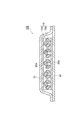
- FIG. 1 is a cross-sectional view showing an example of an absorbent article.
- the absorbent article 100 shown in FIG. 1 includes a sheet-shaped absorber 10, core wraps 20a and 20b, a liquid permeable sheet 30, and a liquid permeable sheet 40.
- the liquid permeable sheet 40, the core wrap 20b, the absorbent body 10, the core wrap 20a, and the liquid permeable sheet 30 are laminated in this order.
- the absorber 10 has water-absorbent resin particles 10a produced by the method according to the above-described embodiment, and a fiber layer 10b containing a fibrous material.
- the water-absorbent resin particles 10a are dispersed in the fiber layer 10b.
- CRC Centrifuge retention capacity
- the mass Mb of the non-woven fabric bag, which has been subjected to the same operation as the above operation without accommodating the particles to be measured, is measured.
- AAP Absorption rate under pressure
- the measuring device 110 is composed of a weight 112, a plastic cylinder 114 having an inner diameter of 60 mm, and a wire mesh 116 having a 400 mesh (opening 38 ⁇ m).
- the wire mesh 116 closes one opening of the cylinder 114, and the cylinder 114 and the wire mesh 116 are arranged so that the wire mesh 116 is horizontal.
- the weight 112 has a disc portion 112a, a rod-shaped portion 112b extending from the center of the disc portion 112a in a direction perpendicular to the disc portion 112a, and a cylindrical portion 112c having a through hole in the center.
- the rod-shaped portion 112b is inserted into the through hole.
- the disk portion 112a has a diameter substantially equal to the inner diameter of the cylinder 114 so that it can move in the vertical direction of the cylinder 114 inside the cylinder 114.
- the diameter of the cylindrical portion 112c is smaller than the diameter of the disc portion 112a.
- the weight of the weight 112 is adjusted so that a pressure of 2.07 kPa is applied to the particles to be measured.
- a glass filter 140 (ISO4793 P-250) having a diameter of 90 mm and a thickness of 7 mm is placed in the center of the bottom surface (diameter 150 mm) in the recess of the stainless steel petri dish 130.
- 0.90 mass% sodium chloride aqueous solution (25 ° C. ⁇ 2 ° C.) is added to the stainless steel petri dish until the water surface is level with the upper surface of the glass filter 140.
- a sheet of filter paper 150 with a diameter of 90 mm (ADVANTEC Toyo Co., Ltd., product name: (No. 3), thickness 0.23 mm, reserved particle diameter 5 ⁇ m) is placed on the glass filter 140, and the entire surface of the filter paper 150 is sodium chloride.
- the measuring device 110 in which the particles 120 before liquid absorption are charged is placed on the filter paper 150, and the particles 120 are made to absorb the sodium chloride aqueous solution while pressurizing the particles 120 at a pressure of 2.07 kPa.
- the measuring device 110 is lifted and the total mass Wb [g] of the measuring device 110 and the particles 120 after absorbing the liquid is measured.
- the absorption ratio under pressure (AAP) [g / g] is calculated by the following formula.
- AAP [g / g] (Wb [g] -Wa [g]) /0.90 [g]
- a rotor (8 mm ⁇ 30 mm, without ring) and 50 g of physiological saline are placed in a beaker having a water absorption rate of 100 mL by the Vortex method, and the beaker containing the physiological saline is held at 25 ° C. in a constant temperature bath.
- 2.0 g of the particles for measurement are put into a vortex of physiological saline stirred at 600 rpm, and at the same time, measurement with a stopwatch is started.
- the time point at which the vortex on the liquid surface converges is set as the end point, and the time (seconds) up to that point is taken as the water absorption rate.
- Medium particle size 10 g of powder of polymer particles or water-absorbent resin particles is mixed with a continuous fully automatic sonic vibration type sieving measuring instrument (Robot Shifter RPS-205, manufactured by Seishin Enterprise Co., Ltd.) and JIS standard opening 850 ⁇ m, 500 ⁇ m. , 425 ⁇ m, 300 ⁇ m, 250 ⁇ m, 180 ⁇ m and 106 ⁇ m sieves and a saucer are used for sieving.
- the mass of the particles remaining on each sieve is calculated as a mass percentage with respect to the total amount.
- the mass percentages of the particles remaining on each sieve are integrated in order from the one with the largest particle size, and the relationship between the mesh size of the sieve and the integrated value of the mass percentages of the particles remaining on the sieve is plotted on logarithmic probability paper. .. By connecting the plots on the probability paper with a straight line, the particle size corresponding to the cumulative mass percentage of 50% by mass is obtained, and this is defined as the medium particle size.
- the temperature of the reaction solution began to rise with the start of polymerization, and 3 minutes later, the maximum temperature reached 93 ° C. Then, the internal temperature was kept at 60 ° C., and 60 minutes after the start of the polymerization, the produced hydrogel-like polymer was taken out from the kneader.
- the hydrogel polymer was sequentially put into a meat chopper 12VR-750SDX manufactured by Kiren Royal Co., Ltd. and coarsely crushed.
- the diameter of the hole in the plate located at the outlet of the meat chopper was 6.4 mm.
- the coarsely crushed product of the hydrogel polymer was spread over a wire mesh having a mesh size of 0.8 cm ⁇ 0.8 cm and placed, and dried with hot air at 160 ° C. for 60 minutes to obtain a dried product.
- the dried product was crushed using a centrifugal crusher (Resch, ZM200, screen diameter 1 mm, 6000 rpm).
- the obtained pulverized material was passed through a sieve having a mesh size of 850 ⁇ m, and amorphous crushed particles (medium particle size: 331 ⁇ m) that did not pass through a sieve having a mesh size of 180 ⁇ m were obtained as polymer particles before surface cross-linking. rice field.
- the obtained polymer particles exhibited a centrifuge holding capacity (CRC) of 39.9 g / g, an absorption ratio under pressure (AAP) of 8.1 g / g, and a water content of 5.4% by mass. ..
- the cross-linking agent solution contained 11.13% by mass of ethylene carbonate, 17.77% by mass of propylene glycol, and 71.10% by mass of deionized water based on the total mass thereof.
- the premix containing the polymer particles and the cross-linking agent solution was stirred for 3 minutes after the completion of dropping the cross-linking agent solution. During that time, the temperature of the polymer particles was maintained at about 170 ° C. by heating with an oil bath at 200 ° C.
- the premix was stirred with heating for 3 minutes, the premix (crosslinking agent-introduced particles) was removed from the separable flask.
- the water content ⁇ 2 of the premix (crosslinking agent-introduced particles) after the heat treatment was measured and found to be 1.68% by mass.
- the cross-linking agent-introduced particles taken out from the separable flask are immediately surface-crosslinked with the polymer particles by heating them in a hot air dryer (manufactured by ADVANTEC, model: FV-320) set to an internal temperature of 200 ° C. for 90 minutes. Was advanced.
- a hot air dryer manufactured by ADVANTEC, model: FV-320
- X1 / (Z0 + X1) ⁇ 1 / 100
- the total Y1 of the water content X1 in the polymer particles and the water content in the cross-linking agent solution was calculated by the following formula.
- the mass of the portion of the premix after heating (crosslinking agent-introduced particles) excluding water that is, the total of the dry mass Z0 of the polymer particles before being mixed with the crosslinking agent solution and the crosslinking agent in the crosslinking agent solution.
- the mass Z2 of was calculated by the following formula.
- Example 2 Water-absorbent resin particles, which are surface-crosslinked polymer particles, were obtained in the same manner as in Example 1 except that the time for stirring the premix while heating was changed to 5 minutes. The water residual ratio and the water content in the premix (or the cross-linking agent-introduced particles) were determined by the same method as in Example 1.
- Example 3 Water-absorbent resin particles, which are surface-crosslinked polymer particles, were obtained in the same manner as in Example 1 except that the time for stirring the premix while heating was changed to 35 minutes. The water residual ratio and the water content in the premix (or the cross-linking agent-introduced particles) were determined by the same method as in Example 1.
- Example 4 The surface was the same as in Example 1 except that the temperature of the polymer particles was adjusted to 130 ° C. by changing the temperature of the oil bath for preheating the polymer particles and heating the premixture to 150 ° C. Water-absorbent resin particles, which are crosslinked polymer particles, were obtained. The water residual ratio and the water content in the premix (or the cross-linking agent-introduced particles) were determined by the same method as in Example 1. The time for stirring the premix while heating was also set to 3 minutes as in Example 1.
- Example 5 Water-absorbent resin particles, which are surface-crosslinked polymer particles, were obtained in the same manner as in Example 4 except that the time for stirring the premix while heating was changed to 35 minutes. The water residual ratio and the water content in the premix (or the cross-linking agent-introduced particles) were determined by the same method as in Example 1.
- Example 6 The surface was the same as in Example 1 except that the temperature of the polymer particles was adjusted to 90 ° C. by changing the temperature of the oil bath for preheating the polymer particles and heating the premixture to 110 ° C. Water-absorbent resin particles, which are crosslinked polymer particles, were obtained. The water residual ratio and the water content in the premix (or the cross-linking agent-introduced particles) were determined by the same method as in Example 1. However, the time for stirring the premix while heating was set to 35 minutes.
- Example 1 The surface was the same as in Example 1 except that the temperature of the polymer particles was adjusted to 40 ° C. by changing the temperature of the oil bath for preheating the polymer particles and heating the premixture to 45 ° C. Water-absorbent resin particles, which are crosslinked polymer particles, were obtained. The water residual ratio and the water content in the premix (or the cross-linking agent-introduced particles) were determined by the same method as in Example 1. However, the time for stirring the premix while heating was set to 5 minutes.
- Example 2 25 g of the polymer particles were placed in the same separable flask as in Example 1. The polymer particles were stirred for 35 minutes at a rotation speed of 300 rpm in a room temperature environment. The temperature of the polymer particles was 25 ° C. Next, 0.7 g of the same cross-linking agent solution as in Example 1 was placed in a separable flask, and the formed premix was stirred for 1 minute. The premix was heated in a hot air dryer (manufactured by ADVANTEC, model: FV-320) set to an internal temperature of 200 ° C. for 90 minutes.
- a hot air dryer manufactured by ADVANTEC, model: FV-320
- the powder of the polymer particles after heating was classified with a wire mesh having an opening of 850 ⁇ m to obtain water-absorbent resin particles which were fractions passing through the wire mesh of 850 ⁇ m.
- the residual water content and the water content in the premix were determined by the same method as in Example 1.
- Comparative Example 3 Water-absorbent resin particles were obtained in the same manner as in Comparative Example 2 except that the time for stirring the premix in the separable flask was changed to 35 minutes. The residual water content and the water content in the premix were determined by the same method as in Example 1.
- Results Tables 1 and 2 show the evaluation results.
- heating of the premix causes formation of cross-linking agent-introduced particles having a water content of 85% by mass or less and a water content of 10% by mass or less, and subsequent surface cross-linking reduces CRC. It was confirmed that AAP could be improved while suppressing it.
- 10 Absorbent, 10a ... Water-absorbent resin particles, 10b ... Fiber layer, 20a, 20b ... Core wrap, 30 ... Liquid permeable sheet, 40 ... Liquid permeable sheet, 100 ... Absorbent article, 110 ... Measuring device, 112 ... Weight, 112a ... Disc, 112b ... Rod, 112c ... Cylindrical, 114 ... Cylindrical, 116 ... Wire mesh, 120 ... Particles to be measured, 130 ... Stainless petri dish, 140 ... Glass filter, 150 ... Filter paper.
Landscapes
- Chemical & Material Sciences (AREA)
- Health & Medical Sciences (AREA)
- Chemical Kinetics & Catalysis (AREA)
- Medicinal Chemistry (AREA)
- Polymers & Plastics (AREA)
- Organic Chemistry (AREA)
- Processes Of Treating Macromolecular Substances (AREA)
- Solid-Sorbent Or Filter-Aiding Compositions (AREA)
Priority Applications (1)
| Application Number | Priority Date | Filing Date | Title |
|---|---|---|---|
| JP2022508291A JPWO2021187323A1 (https=) | 2020-03-18 | 2021-03-11 |
Applications Claiming Priority (2)
| Application Number | Priority Date | Filing Date | Title |
|---|---|---|---|
| JP2020047837 | 2020-03-18 | ||
| JP2020-047837 | 2020-03-18 |
Publications (1)
| Publication Number | Publication Date |
|---|---|
| WO2021187323A1 true WO2021187323A1 (ja) | 2021-09-23 |
Family
ID=77772059
Family Applications (1)
| Application Number | Title | Priority Date | Filing Date |
|---|---|---|---|
| PCT/JP2021/009867 Ceased WO2021187323A1 (ja) | 2020-03-18 | 2021-03-11 | 吸水性樹脂粒子を製造する方法 |
Country Status (2)
| Country | Link |
|---|---|
| JP (1) | JPWO2021187323A1 (https=) |
| WO (1) | WO2021187323A1 (https=) |
Citations (9)
| Publication number | Priority date | Publication date | Assignee | Title |
|---|---|---|---|---|
| JPH01113406A (ja) * | 1987-07-16 | 1989-05-02 | Lion Corp | 高吸水性ポリマーの製造方法 |
| JP2002121291A (ja) * | 2000-02-29 | 2002-04-23 | Nippon Shokubai Co Ltd | 吸水性樹脂粉末およびその製造方法 |
| JP2005113117A (ja) * | 2003-06-24 | 2005-04-28 | Nippon Shokubai Co Ltd | 吸水性樹脂組成物とその製造方法 |
| JP2007119757A (ja) * | 2005-09-30 | 2007-05-17 | Nippon Shokubai Co Ltd | 粒子状吸水剤の製造方法および粒子状吸水剤 |
| WO2009123193A1 (ja) * | 2008-03-31 | 2009-10-08 | 株式会社日本触媒 | 吸水性樹脂を主成分とする粒子状吸水剤の製造方法 |
| WO2010100936A1 (ja) * | 2009-03-04 | 2010-09-10 | 株式会社日本触媒 | 吸水性樹脂の製造方法 |
| WO2014041968A1 (ja) * | 2012-09-11 | 2014-03-20 | 株式会社日本触媒 | ポリアクリル酸(塩)系吸水剤の製造方法及びその吸水剤 |
| WO2016021519A1 (ja) * | 2014-08-04 | 2016-02-11 | 住友精化株式会社 | 吸水性樹脂組成物 |
| WO2018181565A1 (ja) * | 2017-03-31 | 2018-10-04 | 住友精化株式会社 | 吸水性樹脂粒子 |
Family Cites Families (2)
| Publication number | Priority date | Publication date | Assignee | Title |
|---|---|---|---|---|
| JPH0967522A (ja) * | 1995-09-04 | 1997-03-11 | Sanyo Chem Ind Ltd | 吸水性樹脂の製造法 |
| JP5132927B2 (ja) * | 2005-12-22 | 2013-01-30 | 株式会社日本触媒 | 吸水性樹脂の製造方法 |
-
2021
- 2021-03-11 WO PCT/JP2021/009867 patent/WO2021187323A1/ja not_active Ceased
- 2021-03-11 JP JP2022508291A patent/JPWO2021187323A1/ja active Pending
Patent Citations (9)
| Publication number | Priority date | Publication date | Assignee | Title |
|---|---|---|---|---|
| JPH01113406A (ja) * | 1987-07-16 | 1989-05-02 | Lion Corp | 高吸水性ポリマーの製造方法 |
| JP2002121291A (ja) * | 2000-02-29 | 2002-04-23 | Nippon Shokubai Co Ltd | 吸水性樹脂粉末およびその製造方法 |
| JP2005113117A (ja) * | 2003-06-24 | 2005-04-28 | Nippon Shokubai Co Ltd | 吸水性樹脂組成物とその製造方法 |
| JP2007119757A (ja) * | 2005-09-30 | 2007-05-17 | Nippon Shokubai Co Ltd | 粒子状吸水剤の製造方法および粒子状吸水剤 |
| WO2009123193A1 (ja) * | 2008-03-31 | 2009-10-08 | 株式会社日本触媒 | 吸水性樹脂を主成分とする粒子状吸水剤の製造方法 |
| WO2010100936A1 (ja) * | 2009-03-04 | 2010-09-10 | 株式会社日本触媒 | 吸水性樹脂の製造方法 |
| WO2014041968A1 (ja) * | 2012-09-11 | 2014-03-20 | 株式会社日本触媒 | ポリアクリル酸(塩)系吸水剤の製造方法及びその吸水剤 |
| WO2016021519A1 (ja) * | 2014-08-04 | 2016-02-11 | 住友精化株式会社 | 吸水性樹脂組成物 |
| WO2018181565A1 (ja) * | 2017-03-31 | 2018-10-04 | 住友精化株式会社 | 吸水性樹脂粒子 |
Also Published As
| Publication number | Publication date |
|---|---|
| JPWO2021187323A1 (https=) | 2021-09-23 |
Similar Documents
| Publication | Publication Date | Title |
|---|---|---|
| JP6980398B2 (ja) | 吸水剤及びその製造方法 | |
| KR102348349B1 (ko) | 흡수제 및 그의 제조 방법, 그리고 평가 방법 및 측정 방법 | |
| JP5430620B2 (ja) | 吸水性樹脂の製造方法 | |
| CN1683442B (zh) | 粉末状交联的吸收性聚合物、其制备方法及其应用 | |
| WO2016052537A1 (ja) | 吸水性樹脂粉末及び吸水性樹脂粉末の弾性率の測定方法 | |
| CN101137703B (zh) | 水解稳定的后交联的超强吸水剂 | |
| JP7273067B2 (ja) | 吸水性樹脂を主成分とする吸水剤及びその製造方法 | |
| WO2015030129A1 (ja) | ゲル粉砕装置、及びポリアクリル酸(塩)系吸水性樹脂粉末の製造方法、並びに吸水性樹脂粉末 | |
| WO2016143736A1 (ja) | 水性液体吸収性樹脂粒子の製造方法、水性液体吸収性樹脂粒子、吸収体及び吸収性物品 | |
| TW200427715A (en) | Water-absorbent resin and its production process | |
| KR20180022883A (ko) | 입자상 흡수제 | |
| KR102373041B1 (ko) | 폴리아크릴산(염)계 흡수성 수지의 제조 방법 | |
| JP3979724B2 (ja) | 吸水性樹脂造粒物の乾燥体の製造方法 | |
| WO2016143739A1 (ja) | 水性液体吸収性樹脂粒子の製造方法並びに吸収体及び吸収性物品 | |
| JP7191403B2 (ja) | 高吸水性樹脂およびその製造方法 | |
| WO2022181452A1 (ja) | 吸水性樹脂粒子を製造する方法 | |
| CN111655764A (zh) | 超吸收性聚合物及其制备方法 | |
| JP4749679B2 (ja) | 吸水性樹脂およびその製造方法 | |
| US20260021472A1 (en) | Particulate water-absorbing agent, absorbent body containing the particulate water-absorbing agent, and sanitary product including the absorbent body | |
| JP2016112474A (ja) | 吸水剤の製造方法 | |
| JPH10101735A (ja) | 吸水剤およびその製造方法 | |
| WO2021187323A1 (ja) | 吸水性樹脂粒子を製造する方法 | |
| JP7595080B2 (ja) | 吸水性樹脂粉末の製造方法 | |
| WO2021187325A1 (ja) | 吸水性樹脂粒子を製造する方法 | |
| JP4244084B2 (ja) | 吸水剤、その製造方法および体液吸収物品 |
Legal Events
| Date | Code | Title | Description |
|---|---|---|---|
| 121 | Ep: the epo has been informed by wipo that ep was designated in this application |
Ref document number: 21772390 Country of ref document: EP Kind code of ref document: A1 |
|
| ENP | Entry into the national phase |
Ref document number: 2022508291 Country of ref document: JP Kind code of ref document: A |
|
| NENP | Non-entry into the national phase |
Ref country code: DE |
|
| 122 | Ep: pct application non-entry in european phase |
Ref document number: 21772390 Country of ref document: EP Kind code of ref document: A1 |