WO2021183542A1 - Efficient preparation of dolastatin and auristatin analogs through a common intermediate - Google Patents
Efficient preparation of dolastatin and auristatin analogs through a common intermediate Download PDFInfo
- Publication number
- WO2021183542A1 WO2021183542A1 PCT/US2021/021547 US2021021547W WO2021183542A1 WO 2021183542 A1 WO2021183542 A1 WO 2021183542A1 US 2021021547 W US2021021547 W US 2021021547W WO 2021183542 A1 WO2021183542 A1 WO 2021183542A1
- Authority
- WO
- WIPO (PCT)
- Prior art keywords
- group
- alkyl
- butyl
- compound
- substituted
- Prior art date
- Legal status (The legal status is an assumption and is not a legal conclusion. Google has not performed a legal analysis and makes no representation as to the accuracy of the status listed.)
- Ceased
Links
- 0 CC[C@](C)[C@](*C([C@](C(C)C)NC(OC(C)(C)C)=O)=O)[C@@](CC(N(*CC1)[C@@]1[C@@]([C@@](C)C(O)=O)OC)=O)OC Chemical compound CC[C@](C)[C@](*C([C@](C(C)C)NC(OC(C)(C)C)=O)=O)[C@@](CC(N(*CC1)[C@@]1[C@@]([C@@](C)C(O)=O)OC)=O)OC 0.000 description 4
- XBPCUCUWBYBCDP-UHFFFAOYSA-O C(CC1)CCC1[NH2+]C1CCCCC1 Chemical compound C(CC1)CCC1[NH2+]C1CCCCC1 XBPCUCUWBYBCDP-UHFFFAOYSA-O 0.000 description 1
- NHNDVCZFVMSNRC-UHFFFAOYSA-N CC(CC(O)=O)=N Chemical compound CC(CC(O)=O)=N NHNDVCZFVMSNRC-UHFFFAOYSA-N 0.000 description 1
Classifications
-
- C—CHEMISTRY; METALLURGY
- C07—ORGANIC CHEMISTRY
- C07C—ACYCLIC OR CARBOCYCLIC COMPOUNDS
- C07C211/00—Compounds containing amino groups bound to a carbon skeleton
- C07C211/33—Compounds containing amino groups bound to a carbon skeleton having amino groups bound to carbon atoms of rings other than six-membered aromatic rings
- C07C211/34—Compounds containing amino groups bound to a carbon skeleton having amino groups bound to carbon atoms of rings other than six-membered aromatic rings of a saturated carbon skeleton
- C07C211/35—Compounds containing amino groups bound to a carbon skeleton having amino groups bound to carbon atoms of rings other than six-membered aromatic rings of a saturated carbon skeleton containing only non-condensed rings
-
- C—CHEMISTRY; METALLURGY
- C07—ORGANIC CHEMISTRY
- C07K—PEPTIDES
- C07K5/00—Peptides containing up to four amino acids in a fully defined sequence; Derivatives thereof
- C07K5/02—Peptides containing up to four amino acids in a fully defined sequence; Derivatives thereof containing at least one abnormal peptide link
- C07K5/0205—Peptides containing up to four amino acids in a fully defined sequence; Derivatives thereof containing at least one abnormal peptide link containing the structure -NH-(X)3-C(=0)-, e.g. statine or derivatives thereof
-
- C—CHEMISTRY; METALLURGY
- C07—ORGANIC CHEMISTRY
- C07C—ACYCLIC OR CARBOCYCLIC COMPOUNDS
- C07C211/00—Compounds containing amino groups bound to a carbon skeleton
- C07C211/62—Quaternary ammonium compounds
- C07C211/63—Quaternary ammonium compounds having quaternised nitrogen atoms bound to acyclic carbon atoms
-
- C—CHEMISTRY; METALLURGY
- C07—ORGANIC CHEMISTRY
- C07C—ACYCLIC OR CARBOCYCLIC COMPOUNDS
- C07C219/00—Compounds containing amino and esterified hydroxy groups bound to the same carbon skeleton
- C07C219/02—Compounds containing amino and esterified hydroxy groups bound to the same carbon skeleton having esterified hydroxy groups and amino groups bound to acyclic carbon atoms of the same carbon skeleton
- C07C219/04—Compounds containing amino and esterified hydroxy groups bound to the same carbon skeleton having esterified hydroxy groups and amino groups bound to acyclic carbon atoms of the same carbon skeleton the carbon skeleton being acyclic and saturated
- C07C219/06—Compounds containing amino and esterified hydroxy groups bound to the same carbon skeleton having esterified hydroxy groups and amino groups bound to acyclic carbon atoms of the same carbon skeleton the carbon skeleton being acyclic and saturated having the hydroxy groups esterified by carboxylic acids having the esterifying carboxyl groups bound to hydrogen atoms or to acyclic carbon atoms of an acyclic saturated carbon skeleton
-
- C—CHEMISTRY; METALLURGY
- C07—ORGANIC CHEMISTRY
- C07C—ACYCLIC OR CARBOCYCLIC COMPOUNDS
- C07C227/00—Preparation of compounds containing amino and carboxyl groups bound to the same carbon skeleton
- C07C227/38—Separation; Purification; Stabilisation; Use of additives
- C07C227/40—Separation; Purification
- C07C227/42—Crystallisation
-
- C—CHEMISTRY; METALLURGY
- C07—ORGANIC CHEMISTRY
- C07C—ACYCLIC OR CARBOCYCLIC COMPOUNDS
- C07C229/00—Compounds containing amino and carboxyl groups bound to the same carbon skeleton
- C07C229/02—Compounds containing amino and carboxyl groups bound to the same carbon skeleton having amino and carboxyl groups bound to acyclic carbon atoms of the same carbon skeleton
- C07C229/04—Compounds containing amino and carboxyl groups bound to the same carbon skeleton having amino and carboxyl groups bound to acyclic carbon atoms of the same carbon skeleton the carbon skeleton being acyclic and saturated
- C07C229/22—Compounds containing amino and carboxyl groups bound to the same carbon skeleton having amino and carboxyl groups bound to acyclic carbon atoms of the same carbon skeleton the carbon skeleton being acyclic and saturated the carbon skeleton being further substituted by oxygen atoms
-
- C—CHEMISTRY; METALLURGY
- C07—ORGANIC CHEMISTRY
- C07C—ACYCLIC OR CARBOCYCLIC COMPOUNDS
- C07C271/00—Derivatives of carbamic acids, i.e. compounds containing any of the groups, the nitrogen atom not being part of nitro or nitroso groups
- C07C271/06—Esters of carbamic acids
- C07C271/08—Esters of carbamic acids having oxygen atoms of carbamate groups bound to acyclic carbon atoms
- C07C271/10—Esters of carbamic acids having oxygen atoms of carbamate groups bound to acyclic carbon atoms with the nitrogen atoms of the carbamate groups bound to hydrogen atoms or to acyclic carbon atoms
- C07C271/22—Esters of carbamic acids having oxygen atoms of carbamate groups bound to acyclic carbon atoms with the nitrogen atoms of the carbamate groups bound to hydrogen atoms or to acyclic carbon atoms to carbon atoms of hydrocarbon radicals substituted by carboxyl groups
-
- C—CHEMISTRY; METALLURGY
- C07—ORGANIC CHEMISTRY
- C07D—HETEROCYCLIC COMPOUNDS
- C07D207/00—Heterocyclic compounds containing five-membered rings not condensed with other rings, with one nitrogen atom as the only ring hetero atom
- C07D207/02—Heterocyclic compounds containing five-membered rings not condensed with other rings, with one nitrogen atom as the only ring hetero atom with only hydrogen or carbon atoms directly attached to the ring nitrogen atom
- C07D207/04—Heterocyclic compounds containing five-membered rings not condensed with other rings, with one nitrogen atom as the only ring hetero atom with only hydrogen or carbon atoms directly attached to the ring nitrogen atom having no double bonds between ring members or between ring members and non-ring members
- C07D207/08—Heterocyclic compounds containing five-membered rings not condensed with other rings, with one nitrogen atom as the only ring hetero atom with only hydrogen or carbon atoms directly attached to the ring nitrogen atom having no double bonds between ring members or between ring members and non-ring members with hydrocarbon radicals, substituted by hetero atoms, attached to ring carbon atoms
-
- C—CHEMISTRY; METALLURGY
- C07—ORGANIC CHEMISTRY
- C07K—PEPTIDES
- C07K5/00—Peptides containing up to four amino acids in a fully defined sequence; Derivatives thereof
- C07K5/04—Peptides containing up to four amino acids in a fully defined sequence; Derivatives thereof containing only normal peptide links
- C07K5/06—Dipeptides
- C07K5/06008—Dipeptides with the first amino acid being neutral
- C07K5/06017—Dipeptides with the first amino acid being neutral and aliphatic
- C07K5/06034—Dipeptides with the first amino acid being neutral and aliphatic the side chain containing 2 to 4 carbon atoms
- C07K5/06052—Val-amino acid
-
- C—CHEMISTRY; METALLURGY
- C07—ORGANIC CHEMISTRY
- C07B—GENERAL METHODS OF ORGANIC CHEMISTRY; APPARATUS THEREFOR
- C07B2200/00—Indexing scheme relating to specific properties of organic compounds
- C07B2200/07—Optical isomers
-
- C—CHEMISTRY; METALLURGY
- C07—ORGANIC CHEMISTRY
- C07C—ACYCLIC OR CARBOCYCLIC COMPOUNDS
- C07C2601/00—Systems containing only non-condensed rings
- C07C2601/12—Systems containing only non-condensed rings with a six-membered ring
- C07C2601/14—The ring being saturated
-
- Y—GENERAL TAGGING OF NEW TECHNOLOGICAL DEVELOPMENTS; GENERAL TAGGING OF CROSS-SECTIONAL TECHNOLOGIES SPANNING OVER SEVERAL SECTIONS OF THE IPC; TECHNICAL SUBJECTS COVERED BY FORMER USPC CROSS-REFERENCE ART COLLECTIONS [XRACs] AND DIGESTS
- Y02—TECHNOLOGIES OR APPLICATIONS FOR MITIGATION OR ADAPTATION AGAINST CLIMATE CHANGE
- Y02P—CLIMATE CHANGE MITIGATION TECHNOLOGIES IN THE PRODUCTION OR PROCESSING OF GOODS
- Y02P20/00—Technologies relating to chemical industry
- Y02P20/50—Improvements relating to the production of bulk chemicals
- Y02P20/55—Design of synthesis routes, e.g. reducing the use of auxiliary or protecting groups
Definitions
- R 1 , R 2 , R 3 , R 4 R 5 and R 8 are each individually selected from H, C 1 -C 6 alkyl, C 1 -C 6 substituted alkyl, -OR 11 , -NR 11 R 12 , -SR 11 and halo;
- R 11 and R 12 are individually selected from H, C 1 -C 6 alkyl;
- R 6 and R 7 are each individually H or C 1 -C 4 alkyl;
- R 9 is H or an acid protecting group, and
- R 10 is H or an amino protecting group, by reacting the C-terminal carboxylic acid group with an amine (A) to form an amide bond and reacting the N-terminal amine with a carboxylic acid (CA) to form an amide bond.
- the reaction steps i.e., the reaction of the C-terminal carboxylic acid with an amine (A), or the reaction of the N-terminal amine with a carboxylic acid (CA), can be done in either order.
- the amine (A) may be selected from alkylamines, alkanolamines, arylalkanolamines, amino acids, amino acid derivatives, peptides, and peptide derivatives.
- the amine (A) may include one or more substituents.
- the amine (A) includes a protecting group.
- the carboxylic acid (CA) may be selected from amino acids, amino acid derivatives, peptides and peptide derivatives.
- the carboxylic acid (CA) includes one or more substituents. In some embodiments, the carboxylic acid (CA) may have a protecting group. [0007] In a preferred embodiment, the R groups in the compound of Formula I are selected to give the compound of Formula IA: .
- R 1 , R 2 , R 3 , R 4 R 5 and R 8 are each individually selected H, C 1 -C 6 alkyl, C 1 -C 6 substituted alkyl, -OR 11 , -NR 11 R 12 , -SR 11 and halo, R 11 and R 12 are individually selected from H and C 1 -C 6 alkyl, R 6 and R 7 are each individually H or C 1 -C 4 alkyl, R 10 is H or an amino protecting group; and Y + is counterion.
- R 1 , R 2 , R 3 , R 5 and R 8 are each individually selected from H, C 1 -C 6 alkyl, C 1 - C 6 substituted alkyl, -OR 11 , -NR 11 R 12 , -SR 11 and halo, R 11 and R 12 are individually selected from H and C 1 -C 6 alkyl, R 6 and R 7 are each individually selected from H or C 1 -C 4 alkyl, and Z- is a counterion.
- additional intermediate compounds and process steps which are useful for the preparation of high purity dolastatin core and high purity dolastatin and auristatin compounds.
- FIG 1 shows the structural features of the preferred compound of Formula I.
- FIG 2 shows the synthetic scheme for the preparation of Formula I.
- FIG 3 shows exemplary dolastatin and auristatin payloads that have entered the clinic, including (A) MMAE, (B) MMAF, (C) XMT-1505, XMT-1536, (D) Amberstatin 269, (E) Auristatin W, (F) Dolastatin 10, and (G) Pfizer Auristatin, along with the universal dolastatin core described herein, the dolastatin core is highlighted in each payload.
- FIG 4 shows the synthetic schemes for the preparation of mc-Val-Cit-PAB-N- Me-Val-OH, MMAE and vcMMAE via two routes from Dolastatin Core.
- the inventors To overcome the deficiencies in the conventional methods of preparing auristatins and dolastatins, the inventors have identified and synthesized an advanced intermediate that can be efficiently transformed into numerous dolastatin, auristatin and related compounds. Through this identification and synthesis of a universal dolastatin core, the inventors have been able to develop a new platform that can be tailored to provide highly efficient syntheses of existing dolastatins and auristatins, such as those shown in Figure 3.
- this platform may be used to develop new dolastatins, auristatins and related compounds.
- auristatins Provided herein are simplified methods for making dolastatins, auristatins or related compounds using a universal dolastatin core, shown in Formula I: According to the methods provided herein, the C-terminal carboxylic acid is reacted with an amine (A) to form an amide bond, and the N-terminal amine is reacted with a carboxylic acid (CA) to form an amide bond, yielding a dolastatin, an auristatin or a further dolastatin or auristatin intermediate compound that can then be modified further, such as by the addition of one or more of a spacer, a linker, and an attachment group.
- A an amine
- CA carboxylic acid
- the C- terminal carboxylic acid is first reacted with an amine (A), then the N-terminal amine is reacted with a carboxylic acid (CA).
- the N-terminal amine is reacted with a carboxylic acid (CA) first, then C-terminal carboxylic acid is first reacted with an amine (A) to form the a dolastatin, an auristatin or a further dolastatin or auristatin intermediate of interest.
- Suitable acid and amine protecting groups may be used to protect the terminal that is being reacted in a subsequent step.
- the protecting group can be removed by conventional methods prior to reacting with carboxylic acid (CA). When no protecting group is included, the optional deprotecting step is not necessary. Similarly, in embodiments in which there is a protecting group on the C-terminal carboxylic acid, the protecting group can be removed by conventional methods prior to reacting with amine (A). When no protecting group is included, the optional deprotecting step is not necessary. [0018] Suitable coupling agents may be used may be used when reacting the C- terminal carboxylic acid with amine (A) and when reacting N-terminal amine with carboxylic acid (CA).
- Suitable coupling agents used in the methods provided herein include, but are not limited to, carbonyldiimidazole (CDI), propylphosphonic anhydride (T3P) solution and HATU. Other suitable coupling agents are known to those of ordinary skill in the art. In some embodiments, a coupling additive is used. Coupling additives are used in coupling reactions to inhibit side reaction and reduce racemization.
- Useful coupling additives for the reactions described herein include N- hydroxysuccinimide (HOSu), N-hydroxy-5-norbornene-2,3-dicarboximide (HONB), 1-hydroxybenzotriazole (HOBt), 6-chloro-1-hydroxybenzotriazole (6-Cl-HOBt), 1- hydroxy-7-azabenzotriazole (HOAt), 3-hydroxy-4-oxo-3,4-dihydro-1,2,3- benzotriazine (HODhbt), its aza derivative (HODhat), and 2-pyridinol 1-oxide (HOPO).
- HSu N- hydroxysuccinimide
- HONB N-hydroxy-5-norbornene-2,3-dicarboximide
- 1-hydroxybenzotriazole HBt
- 6-Cl-HOBt 6-chloro-1-hydroxybenzotriazole
- 1- hydroxy-7-azabenzotriazole HAt
- the carboxylic acid when reacting N-terminal amine with carboxylic acid (CA), the carboxylic acid may be in the form of a preformed activated ester.
- preformed activated esters include: N-hydroxysuccinimide (NHS-esters), 4- nitrophenol (PNP-ester), tetra/pentafluorophenol (TFP/PFP-esters) and N- carboxyanhydrides (NCA’s).
- NHS-esters N-hydroxysuccinimide
- PNP-ester 4- nitrophenol
- TFP/PFP-esters tetra/pentafluorophenol
- NCA N- carboxyanhydrides
- Other suitable preformed activated esters are known to those of ordinary skill in the art.
- R 1 , R 2 , R 3 , R 4 R 5 and R 8 are each individually selected from H, C 1 -C 6 alkyl, C 1 -C 6 substituted alkyl, -OR 11 , -NR 11 R 12 , -SR 11 and halo; R 11 and R 12 are individually selected from H, C 1 -C 6 alkyl; R 6 and R 7 are each individually H or C 1 -C 4 alkyl; R 9 is H or an acid protecting group, and R 1 0 is H or an amino protecting group.
- the amine (A) may be selected from alkylamines, alkanolamines, arylalkanolamines, amino acids, amino acid derivatives, peptides and peptide derivatives. When amine (A) is a peptide or peptide derivative, it is preferably 2-6 amino acid residues in length.
- the amine (A) may include one or more substituents, suitable substituents include C 1 -C 6 alkyl, hydroxy, C 1 -C 6 alkoxy, amino, thiol, C 1 -C 6 alkylthio, and halo.
- amine (A) includes a protecting group.
- Suitable amine protecting groups include, but are not limited to, tert-butoxycarbonyl groups (Boc), 9-fluorenylmethoxycarbonyl groups (Fmoc), benzoyloxycarbonyl groups (Cbz, Z), and allyloxycarbonyl (Alloc).
- Suitable carboxyl protecting groups include, but are not limited to, simple esters, such as methyl ester, ethyl ester, tert-butyl ester, and benzyl ester, as well as esters formed with, e.g., trityl, 2,4-dimethoxylbenyl (Dmb), and 9-fluorenylmethyl (Fm).
- amine (A) may include one or more of a spacer, a linker and an attachment group.
- the amine (A) is selected from phenylalanine, phenylalanine derivatives, substituted phenylalanine, substituted phenylalanine derivatives, tryptophan, tryptophan derivatives, substituted tryptophan, substituted tryptophan derivatives, phenylpropanolamine, protected phenylpropanolamine, substituted phenylpropanolamine, protected substituted phenylpropanolamine, dolaphenine and protected dolaphenine, substituted dolaphenine, protected substituted dolaphenine, dolaphenine derivatives, protected dolaphenine derivatives, substituted dolaphenine derivatives, protected dolaphenine derivatives.
- the carboxylic acid (CA) may be selected from amino acids, amino acid derivatives, peptides and peptide derivatives. When carboxylic acid (CA) is a peptide or peptide derivative, it is preferably 2-6 amino acid residues in length.
- the carboxylic acid (CA) includes one or more substituents, suitable substituents include C 1 -C 6 alkyl, hydroxy, C 1 -C 6 alkoxy, amino, thiol, C 1 -C 6 alkylthio, and halo.
- the carboxylic acid (CA) may have a protecting group.
- Suitable carboxyl protecting groups include, but are not limited to, simple esters, such as methyl ester, ethyl ester, tert-butyl ester, and benzyl ester, as well as esters formed with, e.g., trityl, 2,4-dimethoxylbenyl (Dmb), and 9- fluorenylmethyl (Fm).
- Suitable amine protecting groups include, but are not limited to, tert-butoxycarbonyl groups (Boc), 9-fluorenylmethoxycarbonyl groups (Fmoc), benzoyloxycarbonyl groups (Cbz, Z), and allyloxycarbonyl (Alloc).
- carboxylic acid (CA) may include one or more of a spacer, a linker and an attachment group.
- carboxylic acid (CA) is selected from valine, protected valine, substituted valine, protected substituted valine, valine derivatives, protected valine derivatives, substituted valine derivatives, protected substituted valine derivatives, alanine, protected alanine, substituted alanine, protected substituted alanine, alanine derivatives, protected alanine derivatives, substituted alanine derivatives and protected substituted alanine derivatives.
- the compound of Formula I is with the R groups as defined above. [0025] In some preferred embodiments, the R groups in the compound of Formula I are selected to give the compound of Formula IA: [0026] Also provided is an isolated salt of Formula II: wherein R 1 , R 2 , R 3 , R 4 R 5 and R 8 are each individually selected H, C 1 -C 6 alkyl, C 1 -C 6 substituted alkyl, -OR 11 , -NR 11 R 12 , -SR 11 and halo, R 11 and R 12 are individually selected from H and C 1 -C 6 alkyl, R 6 and R 7 are each individually H or C 1 -C 4 alkyl, R 10 is H or an amino protecting group; and Y + is counterion.
- R 1 , R 2 , R 3 , R 4 R 5 and R 8 are each individually selected H, C 1 -C 6 alkyl, C 1 -C 6 substituted alkyl, -OR 11 , -NR 11 R 12 ,
- R 1 , R 2 , R 3 , R 4 R 5 and R 8 are each individually selected from H, methyl, ethyl, n-propyl, iso-propyl, n-butyl, sec-butyl, tert-butyl, and iso-butyl; R 6 and R 7 are each individually H or methyl, R 10 is H or tert-butoxycarbonyl (Boc), and Y + is an ammonium ion of the formula N + HR 13 R 1 4R 15 wherein R 13 is selected from optionally substituted C 1 -C 8 alkyl and optionally substituted C 3 -C 8 cycloalkyl; R 14 and R 15 are independently selected from H, optionally substituted C 1 -C 8 alkyl and optionally substituted C 3 -C 8 cycloalkyl; wherein each optional substituent, if present, is selected from alkyl and aryl.
- the isolated salt of Formula II has the structure wherein the R groups are defined as above.
- the isolated salt of Formula II has the structure [0031]
- additional compounds useful both in the preparation of the universal dolastatin core described herein as well as in alternate methods of preparing dolastatins, auristatins and related compounds are also provided.
- R 1 , R 2 , R 3 , R 5 and R 8 are each individually selected from H, C 1 -C 6 alkyl, C 1 - C 6 substituted alkyl, -OR 11 , -NR 11 R 12 , -SR 11 and halo, R 11 and R 12 are individually selected from H and C 1 -C 6 alkyl, R 6 and R 7 are each individually selected from H or C 1 -C 4 alkyl, and Z- is a counterion.
- the compound of Formula III is in solution. In other embodiments, the compound of Formula III may be isolated. The salt form enables facile isolation and purification at scale.
- R 1 , R 2 , R 3 , R 5 and R 8 are each individually selected from H, methyl, ethyl, n-propyl, isopropyl, n-butyl, sec-butyl, iso-butyl, and tert-butyl;
- R 6 and R 7 are each individually selected from H, methyl, ethyl, n-propyl, isopropyl, n-butyl, sec-butyl, iso-butyl, and tert-butyl;
- Z- is selected from halide, sulfate, hydrogen sulfate, phosphate, hydrogen phosphate, dihydrogen phosphate, mesylate
- the compound of Formula III is wherein the R groups and Z- are defined as above.
- the compound is of Formula III is: [0036] Also provided is a method of coupling an amino acid to a compound of Formula III wherein R 1 , R 2 , R 3 , R 5 and R 8 are each individually selected from H, C 1 -C 6 alkyl, C 1 - C 6 substituted alkyl, -OR 11 , -NR 11 R 12 , -SR 11 and halo; R 11 and R 12 are individually selected from H and C 1 -C 6 alkyl; R 6 and R 7 are each individually selected from H or C 1 -C 4 alkyl, and Z- is a counterion; by first contacting the compound of Formula III with an aqueous base to remove the counterion, and then contacting the compound of Formula III with an N-protected amino acid N-carboxyanhydride to yield a compound of Formula IV: wherein R 1
- the aqueous base is selected from Na 2 CO 3 , NaHCO 3 , NaOH, Na 2 HPO 4 , and Na 3 PO 4 .
- the Boc-NCA coupling is operationally convenient and facilitates isolation of compounds of Formula IV, the reaction goes to completion and side products are easily purged by aqueous workup. Less than 0.5% epimerization is observed using Boc-NCA compared to 5-10% for HATU-mediated coupling. This is particularly noteworthy as HATU is a preferred coupling agent to minimize epimerization. This is particularly important because diastereomeric impurities are difficult to remove.
- the starting compound III, and final compound, IV have R 1 , R 2 , R 3 , R 5 and R 8 each individually selected from H, methyl, ethyl, n-propyl, isopropyl, n-butyl, sec-butyl, iso-butyl, and tert-butyl;
- R 6 and R 7 are each individually selected from H, methyl, ethyl, n-propyl, isopropyl, n-butyl, sec- butyl, iso-butyl, and tert-butyl
- Z- is selected from halide, sulfate, hydrogen sulfate, phosphate, hydrogen phosphate, dihydrogen phosphate, mesylate, tosylate, benzene sulfonate, ethylsulfonate, nitrate, formate, acetate, trifluoroacetate, ox
- the compound of Formula III is the aqueous base is Na 2 CO 3
- the N-protected amino acid N-carboxyanhydride is Boc- Val-NCA
- the compound of Formula IV is: IV.
- Also provided is a method of preparing a crystalline compound of Formula V without using column chromatography, the method involving the steps of providing a crude hydroxy acid of Formula V V wherein R 2 , R 3 , and R 5 are each individually selected from H, C 1 -C 6 alkyl, C 1 -C 6 substituted alkyl, -OR 11 , -NR 11 R 12 , -SR 11 and halo; R 11 and R 12 are individually selected from H, C 1 -C 6 alkyl, and R 6 is selected from H and C 1 -C 4 alkyl; dissolving crude hydroxy acid in a soluble solvent, adding an insoluble solvent, initiating crystallization, and allowing the crystallization to complete yielding a purified
- the “soluble solvent” is a solvent in which the hydroxy acid is soluble in; in some embodiments, the soluble solvent is heated when dissolving the hydroxy acid.
- the “insoluble solvent” is a solvent in which the hydroxy acid is insoluble.
- the soluble solvent is tert-butyl methyl ether (MTBE) and the insoluble solvent is heptane.
- crystallization is initiated by seeding the hydroxy acid. In other embodiments, crystallization is initiated by heat cycling. In still other embodiments, crystallization may be initiated by a combination of seeding and heat cycling.
- the hydroxy acid of Formula V is wherien R 2 , R 3 and R 5 are each individually selected from the group consisting of H, methyl, ethyl, n-propyl, isopropyl, n-butyl, sec-butyl, iso-butyl, and tert-butyl; R 6 is selected from the group consisting of H and methyl.
- the soluble solvent is hot MTBE and the insoluble solvent is heptane.
- crystallization may be initiated by seeding, by heat cycling or a combination of seeding and heat cycling.
- the hydroxy acid of Formula V is .
- the method further includes a step of isolating the purified hydroxy acid of Formula V.
- the resulting purified hydroxy acid of formula V is a crystalline solid.
- the method includes the synthesis of the hydroxy acid of Formula V without the need for column chromatography at any step.
- the Ile-hydroxy acid shown above is synthesized starting with N-Boc isoleucine.
- the method involves condensing the N-Boc-isoleucine with mono-ethyl malonate to provide an Ile-keto-ester, reducing the Ile-keto-ester to provide an Ile-hydroxy-ester, and saponifying the Ile-hydroxy-ester to form a Ile- hydroxy-acid.
- the resulting Ile-hydroxy-acid is then purified by dissolving the crude Ile-hydroxy acid in a soluble solvent, adding an insoluble solvent, seeding the hydroxy acid to initiate crystallization, and allowing the crystallization to complete, yielding purified Ile-hydroxy-acid.
- the purified Ile-hydroxy acid is optionally filtered and dried to yield a crystalline solid.
- this method provides a highly scalable method of preparing a compound of Formula V in high diastereoselectivity without the need for column chromatography.
- the crystallization step eliminates the need for column chromatography and provides the material in a crystalline form that can be stored for subsequent use.
- R 2 , R 3 , and R 5 are each individually selected from H, C 1 -C 6 alkyl, C 1 -C 6 substituted alkyl, -OR 11 , -NR 11 R 12 , -SR 11 and halo;
- R 11 and R 12 are individually selected from H, C 1 -C 6 alkyl, and R 6 is selected from H and C 1 -C 4 alkyl;
- R 1 3 is selected from optionally substituted C 1 -C 8 alkyl and optionally substituted C 3 -C 8 cycloalkyl;
- R 1 4 and R 1 5 are independently selected from H, optionally substituted C1- C 8 alkyl and optionally substituted C 3 -C 8 cycloalkyl; wherein each optional substituent, if present, is selected alkyl and aryl.
- the compound Formula VI is wherien R 2 , R 3 and R 5 are each individually selected from H, methyl, ethyl, n-propyl, isopropyl, n-butyl, sec-butyl, iso-butyl, and tert-butyl, R 6 is selected from H and methyl; and NHR 13 R 14 R 15 is selected from diethylammonium ion, dibutylammonium ion, dicyclohexylammonium ion, methylcyclohexylammonium ion and methylbenzylammonium ion.
- the compound of Formula VI is: .
- the compound of formula VI may be isolated as a solid.
- the compound of Formula VI is a crystalline solid.
- R 1 and R 8 are individually selected from H, C 1 -C 6 alkyl, C 1 -C 6 substituted alkyl, -OR 11 , -NR 11 R 12 , -SR 11 and halo;
- R 11 and R 12 are individually selected from H, C 1 -C 6 alkyl;
- R 7 is selected from H or C 1 -C 4 alkyl;
- X- is selected from halide, sulfate, hydrogen sulfate, phosphate, hydrogen phosphate, dihydrogen phosphate, mesylate, tosylate, benzene sulfonate, ethylsulfonate, nitrate, formate, acetate, oxalate,
- Salt formation is advantageous as this material is unstable as the free base.
- the physical characteristics of the salt depends on the counterion.
- the material is a high purity, bench stable solid that when crystallized efficiently purges impurities.
- Other salt forms generate a viscous oil.
- the compound of Formula VII is wherein R 1 and R 8 are individually selected from H, methyl, ethyl, n-propyl, isopropyl, n-butyl, sec-butyl, iso-butyl, and tert-butyl, R 7 is selected from H and methyl; and X- is a halide, preferably chloride.
- the Formula VII is which is a high purity, bench stable solid that when crystallized efficiently purges impurities.
- the compound of formula VII may be isolated as a solid.
- the compound of Formula VII is a crystalline solid.
- a compound of Formula VIII [0054] This compound can advantageously be used in a simplified preparation of vcMMAE as well as other auristatins and dolastatins. [0055] Also provided are methods of preparing specific auristatins of interest.
- MMAE may then be used to prepare vcMMAE.
- MMAE is contacted with mc-Val-Cit-PABC-PNP in the presence of a coupling additive. The reaction is allowed to proceed to completion and the product is purified by rp-HPLC.
- a method of preparing vc-MMAE from a core compound of Formula IA by contacting the core compound with norephedrine in the presence of a coupling agent to form a core compound-norephedrine intermediate, deprotecting the core compound-norephedrine intermediate to form a deprotected core compound- norephedrine intermediate, contacting the deprotected core compound-norephedrine intermediate with mc-Val-Cit-PAB-N-Me-Val-OH in the presence of a coupling agent to yield vcMMAE.
- alkyl refers to a straight chain or branched, saturated hydrocarbon.
- Representative alkyl groups include, but are not limited to, - methyl, -ethyl, -n-propyl,-n-butyl, -n-pentyl, -n-hexyl and so forth;
- exemplary branched alkyls include, but are not limited to, -isopropyl, -sec-butyl, -isobutyl, -tert- butyl, -isopentyl and 2-methylbutyl.
- alkyl group may be attached at any available point to produce a stable compound.
- alkyl is also meant to encompass a fully substituted carbon.
- amino refers to -NH2, as well as "disubstituted amino” wherein one of the hydrogen atoms is replaced by a non-hydrogen substituent; and “trisubstituted amino” wherein both of the hydrogen atoms are replaced by non- hydrogen substituents, which may be identical or different.
- amine (A) refers specifically to the amine-containing compound that is reacted with the C-terminal carboxylic acid of the universal dolastatin core described herein.
- the amine (A) may be selected from alkylamines, alkanolamines, arylalkanolamines, amino acids, amino acid derivatives, and peptides.
- the amine (A) may include one or more substituents, suitable substituents include C 1 -C 6 alkyl, hydroxy, C 1 -C 6 alkoxy, amino, thiol, C 1 -C 6 alkylthio, and halo.
- amine (A) includes a protecting group.
- the protecting group may be an amine protecting group, a carboxyl protecting group, or a protecting group on the side chain or other protectable location.
- Suitable amine protecting groups include, but are not limited to, tert-butoxycarbonyl groups (Boc).9- fluorenylmethoxycarbonyl groups (Fmoc), benzoyloxycarbonyl groups (Cbz, Z), and Allyloxycarbonyl (Alloc).
- Suitable carboxyl protecting groups include, but are not limited to, simple esters, such as methyl ester, ethyl ester, tert-butyl ester, and benzyl ester, as well as esters formed with, e.g., trityl, 2,4-dimethoxylbenyl (Dmb), and 9- fluorenylmethyl (Fm).
- amine (A) is selected from phenylalanine, phenylalanine derivatives, substituted phenylalanine, substituted phenylalanine derivatives, tryptophan, tryptophan derivatives, substituted tryptophan, substituted tryptophan derivatives, phenylpropanolamine, protected phenylpropanolamine, substituted phenylpropanolamine, protected substituted phenylpropanolamine, dolaphenine and protected dolaphenine, substituted dolaphenine, protected substituted dolaphenine, dolaphenine derivatives, protected dolaphenine derivatives, substituted dolaphenine derivatives, protected dolaphenine derivatives.
- the amine may be a peptide, preferably having 2 – 6 amino acids residues, the amino acid residues may include combinations of naturally occurring amino acids, non-standard amino acids, substituted amino acids, and amino acid derivatives, and may include a protecting group.
- amino acid refers to both naturally occurring amino acids, i.e., standard and non-standard amino acids, as well as chemically synthesized amino acids, and includes both L- and D-isomers.
- Substituted amino acids are amino acids that include one or more substituents, typically on the side chain.
- Amino acid derivatives are amino acids which the ⁇ -amino group or acyl group have been chemically modified.
- Such modifications may include, for example, the addition of protecting groups, spacers, linkers, or other functional groups that are useful for further modification of the amino acid.
- Protected amino acids are amino acid derivatives that have a protecting group on the ⁇ -amino group, the acyl group or both the ⁇ -amino group and the acyl group.
- Suitable amine protecting groups include, but are not limited to, tert-butoxycarbonyl groups (Boc).9-fluorenylmethoxycarbonyl groups (Fmoc), benzoyloxycarbonyl groups (Cbz, Z), and Allyloxycarbonyl (Alloc).
- Suitable carboxyl protecting groups include, but are not limited to, simple esters, such as methyl ester, ethyl ester, tert-butyl ester, and benzyl ester, as well as esters formed with, e.g., trityl, 2,4-dimethoxylbenyl (Dmb), and 9-fluorenylmethyl (Fm).
- aryl refers to a carbocyclic aromatic group. Examples of aryl groups include, but are not limited to, phenyl, naphthyl and anthracenyl.
- carboxylic acid (CA) is selected from amino acids, amino acid derivatives, peptides and peptide derivatives.
- carboxylic acid (CA) refers specifically to the carboxylic-acid containing compound that is reacted with the N-terminal of the universal dolastatin core in the methods described herein.
- the carboxylic acid (CA) may be selected from amino acids, amino acid derivatives, peptides and peptide derivatives. When carboxylic acid (CA) is a peptide or peptide derivative, it is preferably 2-6 amino acid residues in length.
- the carboxylic acid (CA) includes one or more substituents, suitable substituents include C 1 -C 6 alkyl, hydroxy, C 1 -C 6 alkoxy, amino, thiol, C 1 -C 6 alkylthio, and halo.
- the carboxylic acid (CA) may have a protecting group.
- the protecting group may a carboxyl protecting group, be an amine protecting group, or a protecting group on the side chain or other protectable location.
- Suitable carboxyl protecting groups include, but are not limited to, simple esters, such as methyl ester, ethyl ester, tert-butyl ester, and benzyl ester, as well as esters formed with, e.g., trityl, 2,4-dimethoxylbenyl (Dmb), and 9-fluorenylmethyl (Fm).
- Suitable amine protecting groups include, but are not limited to, tert-butoxycarbonyl groups (Boc).9-fluorenylmethoxycarbonyl groups (Fmoc), benzoyloxycarbonyl groups (Cbz, Z), and Allyloxycarbonyl (Alloc).
- carboxylic acid may include one or more of a spacer, a linker and an attachment group.
- the term “coupling agent” refers to peptide coupling reagents used to activate a carboxyl moiety of a carboxylic acid to facilitate reaction with an amino group, such as the ⁇ -amino group of an amino acid, or the N-terminal amine of the universal dolastatin core.
- Suitable coupling agents used in the methods provided herein include, but are not limited to, cabonyldiimidazole (CDI), propylphosphonic anhydride (T3P) solution and HATU.
- Coupler refers to peptide coupling reagents that, in addition to facilitating the formation of a peptide bond, also inhibit side reactions and reduce racemization.
- Useful coupling additives for the reactions described herein include N-hydroxysuccinimide (HOSu), N-hydroxy-5-norbornene-2,3-dicarboximide (HONB), 1-hydroxybenzotriazole (HOBt), 6-chloro-1-hydroxybenzotriazole (6-Cl- HOBt), 1-hydroxy-7-azabenzotriazole (HOAt), 3-hydroxy-4-oxo-3,4-dihydro-1,2,3- benzotriazine (HODhbt), its aza derivative (HODhat), and 2-pyridinol 1-oxide (HOPO).
- Coupling additives are generally used in the presence of a base, such as 2,6- lutidine, DIPEA and NMM.
- halo refers to elements in VIIa of the periodic table, such as fluorine, chlorine, bromine and iodine.
- halide refers to the ion of a halogen.
- heterocyclic refers to any alkyl or aryl ring containing at least one non-carbon atom in the ring, i.e., heteroalkyl and heteroaryl, respectively. Exemplary non-carbon atoms include, but are not limited to, oxygen, nitrogen and sulfur; heterocyclic rings may include two or more non-carbon atoms in the ring; in such instances, the two or more non-carbon atoms may be the same or different.
- linker refers to a chemical entity modified to attach to an antibody or small molecule targeting group at one end and a cytotoxic agent, such as a dolastatin or auristatin at the other end.
- Conventional linkers include cleavable linkers and non-cleavable linkers.
- the linkers may include an attachment group, for attachment to an antibody, antibody fragment or other targeting entity, and a spacer, which allows for interaction at, e.g., a cleavable site.
- peptide as used herein, are 2 or more amino acids, substituted amino acids, amino acid derivatives, or substituted amino acid derivatives, including standard, non-standard, and chemically synthesized amino acids, and including for L- and D-isomers, that are linked together in an amide linkage.
- Peptides may include protecting groups at the N-terminal or the C-terminal. Suitable amine protecting groups include, but are not limited to, tert-butoxycarbonyl groups (Boc), 9- fluorenylmethoxycarbonyl groups (Fmoc), benzoyloxycarbonyl groups (Cbz, Z), and Allyloxycarbonyl (Alloc).
- Suitable carboxyl protecting groups include, but are not limited to, simple esters, such as methyl ester, ethyl ester, tert-butyl ester, and benzyl ester, as well as esters formed with, e.g., trityl, 2,4-dimethoxylbenyl (Dmb), and 9- fluorenylmethyl (Fm).
- simple esters such as methyl ester, ethyl ester, tert-butyl ester, and benzyl ester
- Dmb 2,4-dimethoxylbenyl
- Fm 9- fluorenylmethyl
- substituted refers to any group that replaces a hydrogen atom of, e.g., an alkyl, cycloalkyl, aryl, heteroaryl, amine, and so forth.
- Substituents may include, but are not limited to, such groups as alkyls, substituted alkyls, aryls, heteroaryls, ethers, amines, amides, thiols, sulfides, disulfides, halo and protecting groups.
- Suitable substituents for the amine (A) and the carboxylic acid (CA) used in the methods described herein include C 1 -C 6 alkyl, e.g., methyl, ethyl, propyl, isopropyl, butyl, sec-butyl, isobutyl, tert-butyl, pentyl, and so forth, hydroxy, C 1 -C 6 alkoxy, e.g., methoxy, ethoxy, and so forth, amino, thiol, C 1 -C 6 alkylthio, and halo.
- Examples. The following examples are illustrative of the synthesis of the universal dolastatin core and useful intermediates.
- Example 1 The following examples are illustrative of the synthesis of the universal dolastatin core and useful intermediates.
- This suspension was cooled to 0 °C, charged with Et 3 N (3.15 equiv.), and stirred for 2 h at 0 °C.
- the 0 °C imidazolide solution was charged slowly to the malonate suspension maintaining the temperature ⁇ 3 °C.
- the combined suspension was warmed to 20 °C and stirred for 18-72 h.
- the reaction was quenched with 10% (w/w) aqueous citric acid (20 vol.), maintaining an internal temperature of ⁇ 23 °C, and then concentrated under reduced pressure.
- the acidic aqueous layer was extracted with MTBE (3 x 5 vol.).
- the reaction was quenched by charging to a stirred solution of 10% (w/w) aqueous citric acid (20 vol.), with internal temperature ⁇ 8 °C and a resulting pH of 3-5.
- the MeOH was removed under reduced pressure, and the remaining aqueous phase extracted with MTBE (3 x 5 vol.).
- the combined organic extracts were washed with 20% (w/w) aqueous Na 2 CO 3 (2 x 5 vol.), dried over Na2SO4, and concentrated under reduced pressure to give the desired Ile-hydroxy-ester (89% yield, dr ⁇ 13:1) without further purification.
- the reaction was stirred at ⁇ -45 °C for 5 h until judged complete.
- the reaction was quenched by the addition of methanol (5 vol.) and 10% (w/w) aqueous NaOH (4.0 equiv.), maintaining an internal temperature of ⁇ -45 °C, then warmed to 5 °C and stirred until judged complete.
- the reaction mixture was concentrated under reduced pressure to remove organic solvents and then diluted with heptane (20 vol.), which was extracted with 10% (w/w) aqueous NaOH (2 x 5 vol.)
- the combined basic aqueous phases were adjusted to pH 4 by the addition of H3PO4 and then extracted with 1:1 heptane/MTBE (3 x 5 vol.).
- the combined organic layers were dried over Na 2 SO 4 and concentrated under reduced pressure to crude N-Boc-Dil.
- the resultant weight of the isolated crude was used in the subsequent chromatographic step.
- the crude N-Boc-Dil was loaded onto silica (not less than 20 g silica per 1 g of crude; silica equilibrated with eluent) using a minimal amount of 1:5 MTBE/heptane and eluted with 20% MTBE/heptane/0.1% acetic acid. Positive fractions were combined and reduced under pressure, and the resultant weight was used for the subsequent recrystallization.
- N-Boc-Dil (1 equiv.) was dissolved in heptane (10 vol.) and heated to 50 °C for 30 min. S- ⁇ -methylbenzylamine (0.95 equiv.) was charged, the reaction was cooled to 37 °C, and then seeded (0.5 wt%). The reaction was cooled to 20 °C over 1 h and stirred for an additional 6 h, and then solid products were isolated by filtration. The filter cake was washed with heptane (2 vol.) and dried under vacuum to give the final N-Boc-Dil.methylbenzylamine. [0083] Example 2. Preparation of O-benzyl ester Dolaproine hydrochloride salt.
- Triethylamine (1.5 equiv.) was charged to this cold reaction mixture followed by the addition of dibutyl boron triflate (1 M in CH 2 Cl 2 , 1.3 equiv.) while maintaining the reaction temperature ⁇ 4 °C.
- the reaction was stirred for 1 h at 0 °C then cooled to -70 °C.
- the reaction was stirred for 2 h at -70 °C, 1 h at -0 °C, then 15 min at room temperature.
- the mixture was diluted with DI water (15 vol.) and concentrated under reduced pressure to complete removal of organic solvent. DI water (15 vol.) was added to the residue.
- the mixture was extracted with EtOAc (3 x 15 vol.). The combined organics were washed with 1 M KHSO 4 (15 vol.), DI water (15 vol.), saturated aqueous NaHCO 3 (15 vol.) and brine (15 vol.). Charcoal (20 wt%) was charged and removed by filtration.
- Example 3 After stirring for 16 h, the reaction was concentrated under reduced pressure to removed CPME and HCl. The residue was dissolved in toluene (5 vol.) and heated to 80 °C. After dissolution, the reaction was cooled to RT and the solid product isolated by filtration. The solid was washed with toluene (2 vol.) and dried to afford O-Bn-Dap.HCl (2.9 g, 61%) as a white crystalline solid. [0090] Example 3.
- the solvent was swapped to iPrOAc and the reaction quenched by the addition of 1 M aqueous NaHCO3 (5 vol.) and glycine (5 equiv.).
- the organic layer was washed with 1 M NaHCO 3 (5 vol.) and DI water (5 vol.).
- the N-Boc-Val-Dil-Dap-OBn product was utilized in the subsequent step as a solution in iPrOAc.
- Dolastatin Core, N-Boc-Val-Dil- Dap-OH.DCHA, (75%, 99 A%) was isolated as a white crystalline solid by filtration.
- Example 5 Full preparation of the universal dolastatin core [0095] To a cooled solution (0 o C) of N-Boc-isoleucine (1 eq.) in THF (5 vol.) was charged CDI (1 eq.) portion wise. The reaction was allowed to warm to RT and stirred for 3 h.
- the EtOH was removed under reduced pressure and the basic aqueous phase extracted with MTBE (2 x 5 vol.).
- the combined organic phases were extracted with 10% aqueous NaOH (0.5 vol.) and the aqueous extract combined with the product containing basic aqueous phase.
- the combined aqueous phase was acidified with H 3 PO 4 (85 wt%, 1.5 eq.) to adjust the pH to 4.
- the acidified aqueous phase was extracted with MTBE (3 x 5 vol.).
- the combined organic extracts were dried over Na2SO4 and concentrated under reduced pressure to a constant weight (99% yield). [0098] The weight of the isolated product was used in the subsequent crystallization.
- the crude Ile-hydroxy-acid was dissolved in MTBE (2 vol.) and Heptane (2 vol.) and the solution warmed to NMT 55 o C. Heptane (4 vol.) was charged maintaining the temperature NLT 50 o C. After the addition the mixture was cooled to 45 o C. Upon cooling to 45 o C the crystallization was initiated, (either spontaneous, or addition of 0.5 wt% of seed). After crystallization initiation was observed the mixture was held at 45 o C for 2 h then cooled to RT. After cooling to RT the slurry was stirred vigorously for 12 h then isolated by filtration. The filter cake was washed with heptane (2 vol.) and dried under vacuum.
- N-Boc-Dil was further purified by crystallization in the subsequent step. [0100] N-Boc-Dil (1 eq.) was dissolved in heptane (10 vol.) and heated to 50 o C. S- ⁇ - methylbenzylamine (1 eq.) was charged and the reaction cooled to 35 o C. After stirring at 35 o C for 1 h the reaction was cooled to RT and stirred vigorously for 12 h.
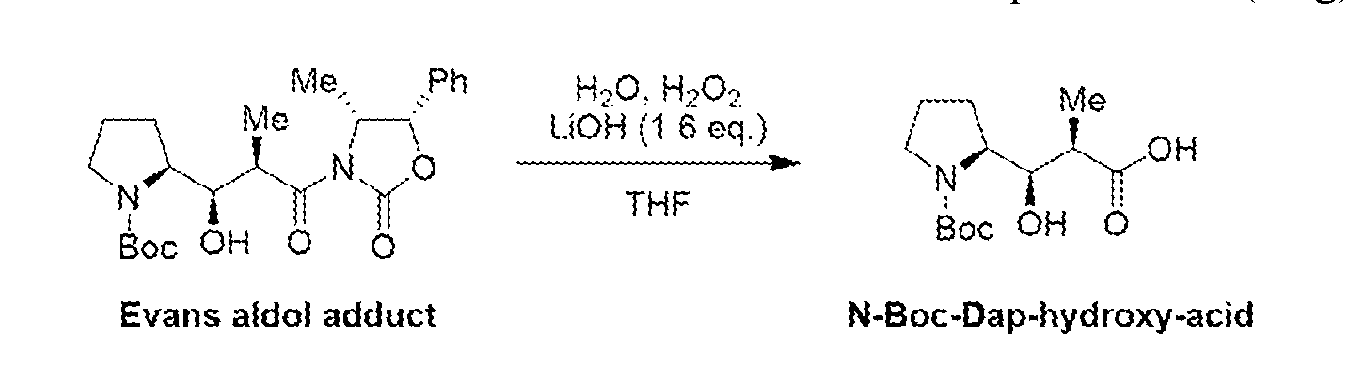
- N-Boc-Dap-Xc A solution of N-Boc-Dap-Xc (19.0 g, 0.044 mol, 1.0 equiv) in 5 vol of dichloromethane was cooled to 0 °C in an ice bath.
- the BnOLi-BnOH was cannulated into the N- Boc-Dap-Xc solution at such a rate to maintain the reaction temperature below 5 °C.
- the reaction was allowed to stir for 1-3 h, until complete by HPLC.
- the reaction mixture was diluted with 15 mL of ethyl acetate and quenched via the slow addition of 15 mL of sodium bicarbonate.
- the organic layer was separated and washed with an additional 15 mL of sodium bicarbonate followed by 2 x 15 mL of water and 2 x 15 mL of brine.
- the organic layer was then collected and dried over sodium sulfate.
- the solution was concentrated under rotary evaporation to afford the crude product.
- OBn-Dap.HCl (1 eq.) was charged followed by DIPEA (3.0 eq), 1-methylimidazole (1.0 eq), and T3P (1.5 eq.). The reaction was stirred at RT O/N at which time HPLC analysis indicated the desired intermediate was formed. The reaction was washed twice with 2.0 M HCl (5 vol.) and twice with water (5 vol.) then constant volume vacuum distilled until water content was ⁇ 0.1%. 3.0 M HCl in CPME (7.5 eq.) was charged and the reaction stirred at RT O/N at which time HPLC analysis indicated the desired product was formed.
- MMAE 100 mg, 80% as a colorless oil.
- Example 7 Preparation of vcMMAE from MMAE [0117] To a stirred solution of MMAE (36 mg, 1 equiv.) in DMF (10 vol.) was added mc-Val-Cit-PABC-PNP (1.1 equiv.), HOPO (1.1 equiv.) and 2,6-lutidine (2 vol.). After stirring overnight at RT the material was purified by preparative rp-HPLC (0.05% formic acid in water and acetonitrile, YMC PackPro C18, 250 x 20 mm, 10 ⁇ m).
- the vial was purged with nitrogen (x 3), and the solids were suspended in 2,6-lutidine (4.0 vol.) and DMF (4.0 vol.).
- Solid HOPO 1.2 equiv. was added in one portion, the vessel was sealed, and the reaction was stirred vigorously for 48 h.
- the reaction was poured into MTBE (200 vol.), and the resulting mixture was vacuum filtered (washing with MTBE) to deliver a grey solid.
- the reaction was stirred at RT for 16 h and quenched by the addition of 20% aqueous Na 2 CO 3 to pH 11.
- the mixture was extracted with iPrOAc (3 x 10 vol.), dried over Na2SO4, filtered and concentrated under reduced pressure.
- the residue was dissolved in 4 M aqueous HCl (20 vol.) and AcOH (20 vol.) and stirred at RT for 24 h.
- the reaction was purified by preparative rp-HPLC (0.05% formic acid in water and acetonitrile, Phenomenex Kinetex F5, 150 x 21.2 mm, 5 ⁇ m). The highest purity fractions were combined and lyophilized to yield MMAF (7 mg, 5%).
Landscapes
- Chemical & Material Sciences (AREA)
- Organic Chemistry (AREA)
- Molecular Biology (AREA)
- Proteomics, Peptides & Aminoacids (AREA)
- Biophysics (AREA)
- General Health & Medical Sciences (AREA)
- Genetics & Genomics (AREA)
- Medicinal Chemistry (AREA)
- Health & Medical Sciences (AREA)
- Biochemistry (AREA)
- Life Sciences & Earth Sciences (AREA)
- Crystallography & Structural Chemistry (AREA)
- Organic Low-Molecular-Weight Compounds And Preparation Thereof (AREA)
- Peptides Or Proteins (AREA)
- Medicines Containing Antibodies Or Antigens For Use As Internal Diagnostic Agents (AREA)
- Semiconductor Memories (AREA)
- Medicinal Preparation (AREA)
- Pharmaceuticals Containing Other Organic And Inorganic Compounds (AREA)
Abstract
Description







Claims


Priority Applications (9)
| Application Number | Priority Date | Filing Date | Title |
|---|---|---|---|
| CN202180020107.0A CN115190882A (en) | 2020-03-09 | 2021-03-09 | Efficient preparation of dolastatin and auristatin analogs via common intermediates |
| AU2021232889A AU2021232889A1 (en) | 2020-03-09 | 2021-03-09 | Efficient preparation of dolastatin and auristatin analogs through a common intermediate |
| IL296277A IL296277A (en) | 2020-03-09 | 2021-03-09 | Efficient preparation of dolastatin and auristatin analogs through a common intermediate |
| JP2022554332A JP2023519169A (en) | 2020-03-09 | 2021-03-09 | Efficient preparation of dolastatin and auristatin analogues via common intermediates |
| US17/905,907 US20230129674A1 (en) | 2020-03-09 | 2021-03-09 | Efficient preparation of dolastatin and auristatin analogs through a common intermediate |
| KR1020227029787A KR20220151166A (en) | 2020-03-09 | 2021-03-09 | Efficient Preparation of Dolastatin and Auristatin Analogs via Common Intermediates |
| EP21714777.6A EP4118094A1 (en) | 2020-03-09 | 2021-03-09 | Efficient preparation of dolastatin and auristatin analogs through a common intermediate |
| BR112022018002A BR112022018002A2 (en) | 2020-03-09 | 2021-03-09 | EFFICIENT PREPARATION OF DOLASTATIN AND AURISTATIN ANALOGS THROUGH A COMMON INTERMEDIATE |
| CA3170633A CA3170633A1 (en) | 2020-03-09 | 2021-03-09 | Efficient preparation of dolastatin and auristatin analogs through a common intermediate |
Applications Claiming Priority (2)
| Application Number | Priority Date | Filing Date | Title |
|---|---|---|---|
| US202062987150P | 2020-03-09 | 2020-03-09 | |
| US62/987,150 | 2020-03-09 |
Publications (1)
| Publication Number | Publication Date |
|---|---|
| WO2021183542A1 true WO2021183542A1 (en) | 2021-09-16 |
Family
ID=75252872
Family Applications (1)
| Application Number | Title | Priority Date | Filing Date |
|---|---|---|---|
| PCT/US2021/021547 Ceased WO2021183542A1 (en) | 2020-03-09 | 2021-03-09 | Efficient preparation of dolastatin and auristatin analogs through a common intermediate |
Country Status (11)
| Country | Link |
|---|---|
| US (1) | US20230129674A1 (en) |
| EP (1) | EP4118094A1 (en) |
| JP (1) | JP2023519169A (en) |
| KR (1) | KR20220151166A (en) |
| CN (1) | CN115190882A (en) |
| AU (1) | AU2021232889A1 (en) |
| BR (1) | BR112022018002A2 (en) |
| CA (1) | CA3170633A1 (en) |
| IL (1) | IL296277A (en) |
| TW (1) | TWI854108B (en) |
| WO (1) | WO2021183542A1 (en) |
Cited By (2)
| Publication number | Priority date | Publication date | Assignee | Title |
|---|---|---|---|---|
| WO2023033129A1 (en) | 2021-09-03 | 2023-03-09 | 東レ株式会社 | Pharmaceutical composition for treating and/or preventing cancer |
| CN116239513A (en) * | 2023-05-05 | 2023-06-09 | 天津凯莱英制药有限公司 | The preparation method of the key intermediate of MMAE, the preparation method of MMAE and antibody-conjugated drug |
Families Citing this family (1)
| Publication number | Priority date | Publication date | Assignee | Title |
|---|---|---|---|---|
| CN121241045A (en) * | 2023-06-02 | 2025-12-30 | 荣昌生物制药(烟台)股份有限公司 | A method for preparing and purifying an intermediate of methyloripstatin E compound |
Citations (2)
| Publication number | Priority date | Publication date | Assignee | Title |
|---|---|---|---|---|
| WO2012166559A1 (en) * | 2011-05-27 | 2012-12-06 | Ambrx, Inc. | Compositions containing, methods involving, and uses of non-natural amino acid linked dolastatin derivatives |
| WO2013173391A1 (en) * | 2012-05-15 | 2013-11-21 | Concortis Biosystems, Corp | Drug-conjugates, conjugation methods, and uses thereof |
Family Cites Families (6)
| Publication number | Priority date | Publication date | Assignee | Title |
|---|---|---|---|---|
| DE3839127A1 (en) * | 1988-11-19 | 1990-05-23 | Hoechst Ag | PYRROLIDONE-2-CARBONIC ACID DERIVATIVES WITH PSYCHOTROPER EFFECT |
| EP2447276A1 (en) * | 2010-10-27 | 2012-05-02 | Ferring B.V. | Process for the manufacture of Degarelix and its intermediates |
| CN102718780A (en) * | 2011-06-03 | 2012-10-10 | 刘伟娜 | Preparation method of cefmetazole sodium |
| JP6636925B2 (en) * | 2013-12-17 | 2020-01-29 | ノバルティス アーゲー | Cytotoxic peptides and conjugates thereof |
| WO2015095953A1 (en) * | 2013-12-27 | 2015-07-02 | The Centre For Drug Research And Development | Sulfonamide-containing linkage systems for drug conjugates |
| WO2015151079A2 (en) * | 2015-06-20 | 2015-10-08 | Hangzhou Dac Biotech Co, Ltd | Auristatin analogues and their conjugates with cell-binding molecules |
-
2021
- 2021-03-09 KR KR1020227029787A patent/KR20220151166A/en active Pending
- 2021-03-09 US US17/905,907 patent/US20230129674A1/en active Pending
- 2021-03-09 CA CA3170633A patent/CA3170633A1/en active Pending
- 2021-03-09 IL IL296277A patent/IL296277A/en unknown
- 2021-03-09 WO PCT/US2021/021547 patent/WO2021183542A1/en not_active Ceased
- 2021-03-09 BR BR112022018002A patent/BR112022018002A2/en unknown
- 2021-03-09 EP EP21714777.6A patent/EP4118094A1/en active Pending
- 2021-03-09 AU AU2021232889A patent/AU2021232889A1/en active Pending
- 2021-03-09 TW TW110108363A patent/TWI854108B/en active
- 2021-03-09 CN CN202180020107.0A patent/CN115190882A/en active Pending
- 2021-03-09 JP JP2022554332A patent/JP2023519169A/en active Pending
Patent Citations (2)
| Publication number | Priority date | Publication date | Assignee | Title |
|---|---|---|---|---|
| WO2012166559A1 (en) * | 2011-05-27 | 2012-12-06 | Ambrx, Inc. | Compositions containing, methods involving, and uses of non-natural amino acid linked dolastatin derivatives |
| WO2013173391A1 (en) * | 2012-05-15 | 2013-11-21 | Concortis Biosystems, Corp | Drug-conjugates, conjugation methods, and uses thereof |
Cited By (3)
| Publication number | Priority date | Publication date | Assignee | Title |
|---|---|---|---|---|
| WO2023033129A1 (en) | 2021-09-03 | 2023-03-09 | 東レ株式会社 | Pharmaceutical composition for treating and/or preventing cancer |
| CN116239513A (en) * | 2023-05-05 | 2023-06-09 | 天津凯莱英制药有限公司 | The preparation method of the key intermediate of MMAE, the preparation method of MMAE and antibody-conjugated drug |
| CN116239513B (en) * | 2023-05-05 | 2023-08-18 | 天津凯莱英制药有限公司 | The preparation method of the key intermediate of MMAE, the preparation method of MMAE and antibody-conjugated drug |
Also Published As
| Publication number | Publication date |
|---|---|
| CA3170633A1 (en) | 2021-09-16 |
| TWI854108B (en) | 2024-09-01 |
| KR20220151166A (en) | 2022-11-14 |
| TW202200602A (en) | 2022-01-01 |
| BR112022018002A2 (en) | 2022-11-08 |
| CN115190882A (en) | 2022-10-14 |
| EP4118094A1 (en) | 2023-01-18 |
| IL296277A (en) | 2022-11-01 |
| US20230129674A1 (en) | 2023-04-27 |
| JP2023519169A (en) | 2023-05-10 |
| AU2021232889A1 (en) | 2022-09-08 |
Similar Documents
| Publication | Publication Date | Title |
|---|---|---|
| FI86192C (en) | Stereoselective process for producing unsaturated lactones | |
| Webb et al. | Conformationally restricted arginine analogs | |
| AU2018240467B2 (en) | Peptide nucleic acid (PNA) monomers with an orthogonally protected ester moiety | |
| EP4118094A1 (en) | Efficient preparation of dolastatin and auristatin analogs through a common intermediate | |
| TW202235429A (en) | Method for preparing peptide compounds containing n-substited amino acid residue | |
| TWI764467B (en) | Compounds with khk inhibitory effect | |
| CN101184755A (en) | Preparation of Peptide Mimetic Compounds and Biologically Active Derivatives | |
| Vivet et al. | Synthesis of silaproline, a new proline surrogate | |
| US12240797B2 (en) | Method of preparing a DON prodrug from L-glutamic acid | |
| EP0206090A2 (en) | Peptide renin inhibitors | |
| JP2022543391A (en) | Composition of trophinetide | |
| HU206729B (en) | Process for producing cyclic neuroquinine antagonists and pharmaceutical compositions containing them | |
| EP3512835A1 (en) | A process for purification of carfilzomib intermediate | |
| CS197268B2 (en) | Process for preparing l-pyroglutamyl-l-histidyl-3-alkylprolinamides | |
| HU221619B1 (en) | Process for synthetise peptides and intermediates thereof | |
| US3781272A (en) | Tripeptide | |
| SE461042B (en) | PEPTIDES WITH GROWTH PROMOTIONAL ACTIVITY BASED VETERINARY COMPOSITIONS CONTAINING THESE PEPTIDES | |
| EP4363433A1 (en) | Peptide synthesis method involving sterically hindered mixed anhydride intermediate | |
| EP0371543A2 (en) | Gastrin releasing peptide antagonists | |
| US20030191053A1 (en) | Cyclic peptide derivative | |
| Yamada et al. | Studies of unusual amino acids and their peptides. VIII. The syntheses of an iminohexapeptide as a model of bottromycin and its related iminopeptides. | |
| KR102092817B1 (en) | Amatoxin derivatives and methods for their preparation | |
| JP5982720B2 (en) | Method for producing histidyl-prolinamide derivative using solid polymer support | |
| JP2025037736A (en) | Method for producing N-substituted peptides | |
| WO2026075272A1 (en) | Production method for 2-oxo-imidazole−containing dipeptide or salt thereof, and crystal form thereof |
Legal Events
| Date | Code | Title | Description |
|---|---|---|---|
| 121 | Ep: the epo has been informed by wipo that ep was designated in this application |
Ref document number: 21714777 Country of ref document: EP Kind code of ref document: A1 |
|
| ENP | Entry into the national phase |
Ref document number: 3170633 Country of ref document: CA |
|
| ENP | Entry into the national phase |
Ref document number: 2022554332 Country of ref document: JP Kind code of ref document: A Ref document number: 2021232889 Country of ref document: AU Date of ref document: 20210309 Kind code of ref document: A |
|
| REG | Reference to national code |
Ref country code: BR Ref legal event code: B01A Ref document number: 112022018002 Country of ref document: BR |
|
| WWE | Wipo information: entry into national phase |
Ref document number: 202217056913 Country of ref document: IN |
|
| NENP | Non-entry into the national phase |
Ref country code: DE |
|
| ENP | Entry into the national phase |
Ref document number: 2021714777 Country of ref document: EP Effective date: 20221010 |
|
| ENP | Entry into the national phase |
Ref document number: 112022018002 Country of ref document: BR Kind code of ref document: A2 Effective date: 20220908 |