WO2021177359A1 - アンモニアの分解方法とその利活用による燃料電池 - Google Patents
アンモニアの分解方法とその利活用による燃料電池 Download PDFInfo
- Publication number
- WO2021177359A1 WO2021177359A1 PCT/JP2021/008228 JP2021008228W WO2021177359A1 WO 2021177359 A1 WO2021177359 A1 WO 2021177359A1 JP 2021008228 W JP2021008228 W JP 2021008228W WO 2021177359 A1 WO2021177359 A1 WO 2021177359A1
- Authority
- WO
- WIPO (PCT)
- Prior art keywords
- ammonia
- formula
- fuel cell
- base
- complex
- Prior art date
- Legal status (The legal status is an assumption and is not a legal conclusion. Google has not performed a legal analysis and makes no representation as to the accuracy of the status listed.)
- Ceased
Links
- 0 CCC1C=C(C)C=C2C=*([C@@](CCCC3)[C@]3*3=C[C@]4C(O*)=C(C)C=C(*)C4)*3(*)OC12 Chemical compound CCC1C=C(C)C=C2C=*([C@@](CCCC3)[C@]3*3=C[C@]4C(O*)=C(C)C=C(*)C4)*3(*)OC12 0.000 description 1
Images

Classifications
-
- B—PERFORMING OPERATIONS; TRANSPORTING
- B01—PHYSICAL OR CHEMICAL PROCESSES OR APPARATUS IN GENERAL
- B01J—CHEMICAL OR PHYSICAL PROCESSES, e.g. CATALYSIS OR COLLOID CHEMISTRY; THEIR RELEVANT APPARATUS
- B01J31/00—Catalysts comprising hydrides, coordination complexes or organic compounds
- B01J31/16—Catalysts comprising hydrides, coordination complexes or organic compounds containing coordination complexes
-
- C—CHEMISTRY; METALLURGY
- C01—INORGANIC CHEMISTRY
- C01B—NON-METALLIC ELEMENTS; COMPOUNDS THEREOF; METALLOIDS OR COMPOUNDS THEREOF NOT COVERED BY SUBCLASS C01C
- C01B21/00—Nitrogen; Compounds thereof
- C01B21/02—Preparation of nitrogen
-
- C—CHEMISTRY; METALLURGY
- C07—ORGANIC CHEMISTRY
- C07C—ACYCLIC OR CARBOCYCLIC COMPOUNDS
- C07C251/00—Compounds containing nitrogen atoms doubly-bound to a carbon skeleton
- C07C251/02—Compounds containing nitrogen atoms doubly-bound to a carbon skeleton containing imino groups
- C07C251/24—Compounds containing nitrogen atoms doubly-bound to a carbon skeleton containing imino groups having carbon atoms of imino groups bound to carbon atoms of six-membered aromatic rings
-
- C—CHEMISTRY; METALLURGY
- C07—ORGANIC CHEMISTRY
- C07F—ACYCLIC, CARBOCYCLIC OR HETEROCYCLIC COMPOUNDS CONTAINING ELEMENTS OTHER THAN CARBON, HYDROGEN, HALOGEN, OXYGEN, NITROGEN, SULFUR, SELENIUM OR TELLURIUM
- C07F13/00—Compounds containing elements of Groups 7 or 17 of the Periodic Table
-
- H—ELECTRICITY
- H01—ELECTRIC ELEMENTS
- H01M—PROCESSES OR MEANS, e.g. BATTERIES, FOR THE DIRECT CONVERSION OF CHEMICAL ENERGY INTO ELECTRICAL ENERGY
- H01M4/00—Electrodes
- H01M4/86—Inert electrodes with catalytic activity, e.g. for fuel cells
- H01M4/90—Selection of catalytic material
-
- H—ELECTRICITY
- H01—ELECTRIC ELEMENTS
- H01M—PROCESSES OR MEANS, e.g. BATTERIES, FOR THE DIRECT CONVERSION OF CHEMICAL ENERGY INTO ELECTRICAL ENERGY
- H01M8/00—Fuel cells; Manufacture thereof
- H01M8/22—Fuel cells in which the fuel is based on materials comprising carbon or oxygen or hydrogen and other elements; Fuel cells in which the fuel is based on materials comprising only elements other than carbon, oxygen or hydrogen
-
- Y—GENERAL TAGGING OF NEW TECHNOLOGICAL DEVELOPMENTS; GENERAL TAGGING OF CROSS-SECTIONAL TECHNOLOGIES SPANNING OVER SEVERAL SECTIONS OF THE IPC; TECHNICAL SUBJECTS COVERED BY FORMER USPC CROSS-REFERENCE ART COLLECTIONS [XRACs] AND DIGESTS
- Y02—TECHNOLOGIES OR APPLICATIONS FOR MITIGATION OR ADAPTATION AGAINST CLIMATE CHANGE
- Y02E—REDUCTION OF GREENHOUSE GAS [GHG] EMISSIONS, RELATED TO ENERGY GENERATION, TRANSMISSION OR DISTRIBUTION
- Y02E60/00—Enabling technologies; Technologies with a potential or indirect contribution to GHG emissions mitigation
- Y02E60/30—Hydrogen technology
- Y02E60/50—Fuel cells
Definitions
- the present invention relates to a method for decomposing ammonia and a fuel cell by utilizing the method.
- Non-Patent Document 1 Ammonia is a desirable candidate as an energy carrier for a sustainable society, and has multiple advantages such as ease of handling, high energy density, and carbon neutrality (Non-Patent Document 1).
- Non-Patent Documents 2 to 4 As the fuel cell using ammonia as a fuel, for example, there are reports of an ammonia fuel cell using an electrolyte in which potassium hydroxide is melted, a fuel cell using ammonia as a fuel for an alkaline fuel cell, and the like (Non-Patent Documents 5 to 5). 9).
- the problem with the above-mentioned reported example is that it uses ruthenium, which is a transition metal complex. From the viewpoint of utilizing ammonia as an energy carrier, catalytic oxidation of ammonia to nitrogen by a base metal that can supply a large amount of catalyst. A metal complex capable of realizing the reaction has been desired. Further, in the above-mentioned reported example of the fuel cell, in the anode catalyst of the fuel cell, a fuel using ammonia as a fuel using a solid catalyst in which a single metal such as platinum or manganese or an alloy is fixed to carbon, alumina, an inorganic substance or the like. The battery was disclosed, and there was a problem that a high temperature and a large overvoltage were required.
- the present invention has been made to solve the above-mentioned problems, and mainly avoids the use of noble metals, decomposes ammonia by using a complex of a base metal, and extracts nitrogen molecules, electrons, and protons.
- the purpose Further, from the viewpoint of utilization of the ammonia decomposition method using the salen manganese complex, the molecular salen manganese complex according to the present invention is used at the anode of the fuel cell without using the conventional solid catalyst or metal particle catalyst.
- the purpose is to embody the power generation of fuel cells that use ammonia as fuel under mild conditions.
- the present inventors focused on the salene manganese complex used for organic synthesis such as asymmetric epoxidation reaction, and oxidatively decomposed ammonia in the presence of a base. It was found that nitrogen, protons and electrons can be obtained well, and from the viewpoint of utilization of the ammonia decomposition method using the salen manganese complex, the oxidative decomposition method of ammonia using the salen manganese complex is used in the anode catalyst layer of the fuel cell. We have also found that it functions as a catalyst for the above, and have completed the present invention.
- the method for decomposing ammonia of the present invention is a method for decomposing ammonia by oxidatively decomposing ammonia in the presence of a salene manganese complex and a base to obtain nitrogen, protons and electrons.
- Equation (1b) or Equation (1c) In the formula, R 1 and R 2 represent C1-C4 alkyl groups which may be the same or different, and X is a monovalent anion, axial ligand or halogen atom). It is a complex.
- ammonia can be oxidatively decomposed in the presence of a salene manganese complex that is not a noble metal complex and a base to obtain nitrogen, protons and electrons, and ammonia can be decomposed at low cost. Allows mass decomposition of ammonia. Further, the present invention provides power generation of a fuel cell using ammonia as a fuel under mild conditions using the method for decomposing ammonia.
- Fuel cell 101 Cathode side gas diffusion layer 102 Anode side gas diffusion layer 103 Anode catalyst layer 105 Cathode catalyst layer 107 Electrolyte film 109 Separator
- the catalyst used in the method for decomposing ammonia of the present embodiment is of formula (1a), formula (1b) or formula (1c).
- R 1 and R 2 represent C1 to C4 alkyl groups which may be the same or different, and X represents a monovalent anion or halogen atom).
- Specific examples of the C1 to C4 alkyl groups include methyl group, ethyl group, n-propyl group, isopropyl group, n-butyl group, isobutyl group, s-butyl group, t-butyl group and the like. -Butyl groups are preferred.
- Examples of the monovalent anion include hexafluorophosphate ion, hexachloroantimonate ion, trifluoromethanesulfonate ion, tetrafluoroborate ion, phosphate ion, sulfonate ion, and hydroxydone.
- Examples of the halogen atom include chloride, bromide and iodide.
- the complex of formula (1a) and the complex of formula (1b) have an enantiomeric relationship.
- the complex of the formula (1c) has the same configuration as the formula (1a) in the cases of (R) and (R) because the configuration of the carbon atom represented by * is (R) or (S). , (R) and (S) are meso-form complexes, and (S) and (S) are the same as in formula (1b), and even if they are single as described above. It may be a mixture thereof.
- the preferred salene manganese complex is the formula (1A) or the formula (1B).
- formula (4A) or formula (4B) (In the formula, Z is a monovalent anion, axial ligand or halogen atom.
- Z is hexachloroantimonate ion, hexafluorophosphate ion, chloride, bromide, iodide, hydroxide, phosphate ion, Examples thereof include sulfonate ion and trifluoromethanesulfonate ion, of which hexafluorophosphate ion is preferable.
- It is a complex represented by.
- the base plays a role of trapping the protons generated when ammonia is oxidatively decomposed.
- the base is not particularly limited as long as it plays such a role, but for example, a pyridine derivative is preferable.
- the pyridine derivative include pyridine and pyridine having at least one substituent from the 2-position to the 6-position.
- the substituent is not particularly limited, and examples thereof include an alkyl group, a dialkylamino group, an alkoxy group, an aryl group, and a halogen atom.
- alkyl group including the alkyl group in the dialkylamino group
- alkoxy group examples include the same as those already exemplified.
- pyridine derivative examples include pyridine, 2,6-lutidine, 2,4,6-cholidine, 4-dimethylaminopyridine (DMAP), and the like, of which 2,4,6-cholidine is preferable.
- DMAP 4-dimethylaminopyridine
- ammonia is produced by the reaction of an ammonium salt with a base in the system, the base is also used in this reaction.
- ammonia may be produced by the reaction of an ammonium salt and a base in the system, although ammonia gas may be used.
- ammonia gas may be used.
- the ammonium salt is not particularly limited as long as it quantitatively produces ammonia by reaction with a base, but for example, ammonium trifurate, ammonium hexafluorophosphate, ammonium chloride, ammonium bromide, and ammonium iodide.
- the oxidative decomposition of ammonia may be carried out by using an oxidizing agent containing a one-electron oxidant of triarylamine, or may be carried out under electrochemical oxidation conditions.
- An oxidant containing a one-electron oxidant of triarylamine serves to trap the electrons generated when ammonia is oxidatively decomposed.
- An example of such an oxidizing agent is the formula (2). Examples thereof include the compounds shown in. In formula (2), Ra and R b may be the same or different, and are an alkyl group, a halogen atom or a hydrogen atom.
- alkyl group and the halogen atom examples include the same ones already exemplified. Of these, those in which Ra is a bromine atom and R b is a hydrogen atom are preferable.
- Y is a monovalent anion, and examples thereof include hexachloroantimonate ion, hexafluorophosphate ion, chloride, bromide, iodide, hydroxydo, phosphate ion, sulfonate ion, and trifluoromethanesulfonate ion. Of these, hexachloroantimonate ion is preferable.
- oxidative decomposition of ammonia may be carried out in a solvent.
- the solvent is not particularly limited, and examples thereof include a nitrile solvent, a halogenated hydrocarbon solvent, a ketone solvent, an alcohol solvent, a cyclic ether solvent, a chain ether solvent, and water.
- the nitrile solvent include acetonitrile, propionitrile and the like.
- the halogenated hydrocarbon solvent include methylene chloride and chloroform.
- the ketone solvent include acetone and methyl ethyl ketone.
- the alcohol solvent include methanol and ethanol.
- the cyclic ether solvent include tetrahydrofuran (THF), 1,4-dioxane and the like.
- the chain ether solvent include diethyl ether and the like.
- oxidative decomposition of ammonia proceeds even if the reaction temperature is low.
- the reaction atmosphere may be, for example, an inert atmosphere (Ar atmosphere, etc.) or an atmosphere. Further, it is not necessary to create a pressurized atmosphere, and a normal pressure atmosphere may be used.
- the reaction time is not particularly limited, but is usually set in the range of several tens of minutes to several tens of hours.
- Ammonia-fueled fuel cell using the method for decomposing ammonia in this embodiment will be described.
- FIG. 1 is a cross-sectional view schematically showing the configuration of a fuel cell 100 using ammonia as fuel.
- a fuel cell 100 using ammonia as fuel will be described.
- the fuel cell 100 has an anode catalyst layer 103, a cathode catalyst layer 105, and an electrolyte film 107 sandwiched between both catalyst layers, and the cathode catalyst layer 105 has a gas diffusion layer 101 on the outside, and the anode catalyst layer 103. Has a gas diffusion layer 102 on the outside.
- a device composed of the gas diffusion layer 102, the anode catalyst layer 103, the electrolyte membrane 107, the cathode catalyst layer 105, and the gas diffusion layer 101 is referred to as a membrane electrode assembly (Membrane Electrode Assembly, hereinafter abbreviated as "MEA"). .. In the fuel cell 100, this MEA is usually sandwiched between the separators 109. Further, a component composed of a catalyst layer and a gas diffusion layer is referred to as a gas diffusion electrode (Gas Diffusion Electrode, hereinafter abbreviated as "GDE").
- GDE Gas Diffusion Electrode
- the fuel cell 100 uses an ion exchange resin film or the like as the electrolyte film 107, and reacts with oxygen, electrons, and water at the oxidizing agent electrode of the cathode catalyst layer 105 (O 2 + 4e ⁇ + 4H 2 O ⁇ 4OH ⁇ ).
- the hydroxide ion generated by the above moves through the electrolyte membrane 107 to the fuel electrode, which is the anode catalyst layer 103, and reacts with ammonia at the fuel electrode (2NH 3 ⁇ N 2 + 6e ⁇ + 6H + ) to produce nitrogen. , Generates electrons and protons.
- the ion exchange resin membrane is not particularly limited as long as it can move the hydroxide ions generated at the oxidant electrode to the fuel electrode, and examples thereof include a cation exchange membrane and an anion exchange membrane. .. Of these, an anion exchange membrane is preferable.
- the anion exchange membrane include a solid polymer membrane containing an anion exchange resin having an anion exchange group such as a quaternary ammonium group and a pyridinium group. Of these, an anion exchange membrane is preferable.
- anion exchange membrane examples include FAP, FAP-450, FAA-3, FAS, FAB, AMI-7001, which are anion exchange membranes manufactured by Fumasep, and AMV, AMT, which are anion exchange membranes manufactured by AGC. , DSV, AAV, ASV, ASV-N, AHO, APS4 and the like, of which FAP-450, FAA-3 manufactured by Membrane and ASV-N manufactured by AGC are preferable.
- the anode catalyst layer 103 contains a catalyst component (the above-mentioned salen manganese complex according to the present invention), a catalyst carrier for adsorbing the catalyst component, and an electrolyte.
- the cathode catalyst layer 105 contains a catalyst component, a catalyst carrier for supporting the catalyst component, and an electrolyte.
- a known catalyst can be used without particular limitation.
- Examples of the catalyst component used in the cathode catalyst layer 105 include platinum, gold, silver, ruthenium, iridium, rhodium, palladium, osmium, tungsten, lead, iron, chromium, cobalt, nickel, manganese, vanadium, molybdenum, gallium, and the like. Examples thereof include metals such as aluminum and alloys thereof, of which platinum is preferable.
- Examples of the catalyst carrier in each of the catalyst layers 103 and 105 include carbon black such as channel black, furnace black, thermal black, acetylene black, and Ketjen black, activated carbon obtained by carbonizing and activating a material containing various carbon atoms, and coke. , Natural graphite, artificial graphite, carbonic materials such as graphitized carbon, metal meshes such as nickel or titanium, metal foams and the like. Of these, carbon black is preferable as the catalyst carrier because it has a high specific surface area and excellent electron conductivity.
- Examples of the electrolyte in each of the catalyst layers 103 and 105 include Fusion FAA-3-SOLUT-10 manufactured by Fumasep, which is an anion exchange ionomer, and A3ver. 2.
- AS-4 (A3 ver.2 and AS-4 are described in, for example, magazine "Hydrogen Energy System", Vo1.35, No.2, 2010, page 9), Nafion (registered trademark, DuPont stock). Fluorophilic sulfonic acid polymers such as Aquivion (registered trademark, manufactured by Solvay Co., Ltd.), Flemion (registered trademark, manufactured by Asahi Glass Co., Ltd.), Aciplex (registered trademark, manufactured by Asahi Kasei Co., Ltd.), etc. Of these, Fusion FAA-3-SOLUT-10 and AS-4 are preferable.
- the separator 109 may be a gas-impermeable conductive member, for example, a carbon plate obtained by compressing carbon to make it gas-impermeable, or a solid metal plate.
- a flow path for supplying ammonia is provided between the separator 109 and the gas diffusion layer 102 on the anode side.
- a gas passage to which oxygen or air is supplied is formed between the separator 109 and the gas diffusion layer 101 on the cathode side.
- Example 1 An attempt was made to oxidatively decompose ammonia using a catalyst, an oxidizing agent, and a base.
- the salen manganese complex (1A) is available from Strem, Tokyo Chemical Industry, etc.
- the salen manganese complex (1B), which is an enantiomer of the salen manganese complex (1A), is Strem, Fujifilm Wako Pure Chemical Industries, Ltd., etc. Available from.
- Example 1 salen manganese complex (1A) (6.4mg, 0.01mmol) and, ammonium triflate as an ammonium salt (501 mg, 3.0 mmol) and, as an oxidizing agent [(p-BrC 6 H 4 ) 3 N ⁇ ] + [SbCl 6 ] - (2a) (735 mg, 0.9 mmol) and 2,4,6-cholidine (0.4 mL, 3.0 mmol) as a base in 5 mL of acetonitrile, 1 After stirring at ⁇ 40 ° C. for 2 hours under an argon atmosphere at atmospheric pressure, the mixture was stirred at room temperature for 4 hours. As a result, 4.3 equivalents (29% yield based on the oxidizing agent) of nitrogen was confirmed.
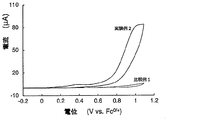
- Comparative Example 1 As Comparative Example 1, when CV measurement was performed under the same experimental conditions as in Experimental Example 2 except that the salen manganese complex (1a) was not used, the graph shown in Comparative Example 1 in FIG. 2 was obtained, and the steady current was measured. Not observed. From this result, it was confirmed that the oxidative decomposition of ammonia proceeds even under electrochemical oxidation conditions.
- Example 3 In Example 3, salen manganese complex (3A) (7.6mg, 0.01mmol) and, ammonium triflate as an ammonium salt (501 mg, 3.0 mmol) and, as an oxidizing agent [(p-BrC 6 H 4 ) 3 N ⁇ ] + [SbCl 6 ] - (2a) (735 mg, 0.9 mmol) and 2,4,6-cholidine (0.4 mL, 3.0 mmol) as a base in 5 mL of acetonitrile, 1 After stirring at ⁇ 40 ° C. for 2 hours under an ammonium atmosphere at atmospheric pressure, the mixture was stirred at room temperature for 4 hours. As a result, 3.0 equivalents (20% yield based on the oxidizing agent) of nitrogen was confirmed.
- Fuel cell power generation test 1 A power generation test of an ammonia-fueled fuel cell using the salen manganese complex (1A) as a catalyst for the anode catalyst layer was carried out.
- the MEA of the fuel cell was made of GDE on the cathode side, GDE on the anode side, and an electrolyte membrane.
- the GDE on the cathode side was prepared as follows.
- the catalyst ink used in the cathode catalyst layer is an electrode catalyst made of platinum-supported carbon (manufactured by Tanaka Kikinzoku Kogyo Co., Ltd., platinum content: 46.5% by weight, product name "TEC10E50E”), deionized water, ethanol (Fujifilm Wako Pure Chemical Industries, Ltd.).
- an anionic conduction ionomer dispersion (Fumion FAA-3-SOLUT-10 (10% by weight & N-methyl-2-pyrrolidone dispersion) manufactured by Fumasep).
- the proportion of anionic conduction ionomers in the catalyst ink was adjusted to be 28% by weight.
- Electrode catalyst, deionized water, ethanol and anionic conduction ionomer dispersion are added in this order to a glass vial, and the obtained dispersion is added to the ultrasonic homogenizer Smart NR-50M manufactured by Microtech Nithion.
- the catalyst ink was prepared by setting the output of ultrasonic waves to 40% and irradiating the particles for 30 minutes.
- a gas diffusion layer which is a carbon paper (“TGP-H-090” manufactured by Toray Industries, Inc. cut into a rectangle of 2.5 cm ⁇ 3 cm) fixed on a hot plate set at 80 ° C. with this catalyst ink. was applied to.
- the coating amount is such that the amount of platinum per 1 cm 2 of the coated surface is 1 mg, and the cathode side GDE composed of the cathode catalyst layer and the gas diffusion layer (the platinum catalyst (7.5 mg) is included on the GDE). ) was prepared.
- the ratio of anionic conduction ionomers in the above-mentioned catalyst ink will be described.
- the proportion (% by weight) of the anion conductive ionomer calculated from the following formula was set to 28% by weight.
- the anion conductive ionomer is abbreviated as "ionomer”.
- Ratio of ionomer [Ionomer solids (weight) / [Electrode catalyst (weight) + Ionomer solids (weight)]] x 100 Specifically, when a 10 wt% anion conductive ionomer dispersion was used, the amount of the electrode catalyst was 100.0 mg, the amount of the anionic ionomer dispersion was 389.0 mg, and the amount of deionized water was 0.6 mL. , The amount of ethanol was set to 5.1 mL.
- the GDE on the anode side was prepared as follows.
- the catalyst ink used in the anode catalyst layer is salene manganese complex (1A) (46.5 mg), carbon black (53.5 mg, manufactured by Lion, Ketjen Black, product name "EC300J”), deionized water, ethanol (Fuji). It was prepared using Film Wako Pure Chemical Industries, Ltd.) and an anion conducting ionomer dispersion liquid [Fumion FAA-3-SOLUT-10 (10% by weight & N-methyl-2-pyrrolidone dispersion) manufactured by Fumasep].
- the proportion of anionic conduction ionomers in the catalyst ink was adjusted to be 28% by weight.
- Salen manganese complex, carbon black, deionized water, ethanol and anionic conduction ionomer dispersion are added in this order to a glass vial, and the obtained dispersion is added to an ultrasonic homogenizer manufactured by Microtech Nithione.
- a catalyst ink was prepared by irradiating ultrasonic waves at an output of 40% for 30 minutes using a Smart NR-50M.
- a gas diffusion layer which is a carbon paper (“TGP-H-090” manufactured by Toray Industries, Inc. cut into a rectangle of 2.5 cm ⁇ 3 cm) fixed on a hot plate set at 80 ° C. with this catalyst ink. was applied to.
- the coating amount is such that the amount of the salene manganese complex per 1 cm 2 of the coated surface is 1 mg, and the GDE on the anode side composed of the anode catalyst layer and the gas diffusion layer (7.5 mg of the salene manganese complex (7.5 mg) on the GDE). ) Is included).
- the ratio of anionic conduction ionomers in the above-mentioned catalyst ink will be described.
- the proportion (% by weight) of the anion conductive ionomer calculated from the following formula was set to 28% by weight.
- the anion conductive ionomer is abbreviated as "ionomer”.
- Ratio of ionomer [Ionomer solids (weight) / [manganese complex (weight) + carbon black (weight) + ionomer solids (weight)]] x 100 Specifically, when a dispersion of 10% by weight of anion conducting ionomer was used, the amount of the dispersion of salen manganese complex (46.5 mg), carbon black (53.5 mg), and anion conducting ionomer was 389.0 mg. The amount of deionized water was set to 0.6 mL and the amount of ethanol was set to 5.1 mL.
- the MEA was prepared by combining the GDE on the anode side, the electrolyte membrane, and the GDE on the cathode side in this order.
- the MEA is placed in a single cell (manufactured by Nissan Chemical Co., Ltd., fuel cell) having a rectangular electrode area of 2.5 cm ⁇ 3 cm, and the power generation test of the fuel cell is performed by an electrochemical measurement system (manufactured by Princeton Applied Research Co., Ltd.). , VersaSTAT4), and the current density and voltage were measured.
- the open circuit voltage (Open Circuit Voltage, hereinafter abbreviated as "OCV" was measured.
- OCV Open Circuit Voltage
- the OCV of a single cell was 0.46V.
- the results of current density and voltage are shown in Table 1. Twice
- Example 5 Fuel cell power generation test 2
- a power generation test of a fuel cell using ammonia as a fuel was carried out in the same manner as in Example 4 except that ASV-N (thickness 100 ⁇ m) manufactured by AGC was used as the electrolyte membrane.
- the OCV of the single cell was 0.11V.
- the results of current density and voltage are shown in Table 2.
- the salen manganese complex used in the oxidative decomposition method of ammonia according to the present invention can be used for decomposition of ammonia, and further can be used as a catalyst in the anode catalyst layer of a fuel cell using ammonia as fuel.
Landscapes
- Chemical & Material Sciences (AREA)
- Organic Chemistry (AREA)
- Chemical Kinetics & Catalysis (AREA)
- Engineering & Computer Science (AREA)
- Inorganic Chemistry (AREA)
- Materials Engineering (AREA)
- General Chemical & Material Sciences (AREA)
- Electrochemistry (AREA)
- Life Sciences & Earth Sciences (AREA)
- Sustainable Energy (AREA)
- Sustainable Development (AREA)
- Manufacturing & Machinery (AREA)
- Catalysts (AREA)
- Fuel Cell (AREA)
- Inert Electrodes (AREA)
Priority Applications (1)
| Application Number | Priority Date | Filing Date | Title |
|---|---|---|---|
| JP2022504430A JPWO2021177359A1 (https=) | 2020-03-04 | 2021-03-03 |
Applications Claiming Priority (2)
| Application Number | Priority Date | Filing Date | Title |
|---|---|---|---|
| JP2020-037299 | 2020-03-04 | ||
| JP2020037299 | 2020-03-04 |
Publications (1)
| Publication Number | Publication Date |
|---|---|
| WO2021177359A1 true WO2021177359A1 (ja) | 2021-09-10 |
Family
ID=77612661
Family Applications (1)
| Application Number | Title | Priority Date | Filing Date |
|---|---|---|---|
| PCT/JP2021/008228 Ceased WO2021177359A1 (ja) | 2020-03-04 | 2021-03-03 | アンモニアの分解方法とその利活用による燃料電池 |
Country Status (2)
| Country | Link |
|---|---|
| JP (1) | JPWO2021177359A1 (https=) |
| WO (1) | WO2021177359A1 (https=) |
Cited By (7)
| Publication number | Priority date | Publication date | Assignee | Title |
|---|---|---|---|---|
| US11697108B2 (en) | 2021-06-11 | 2023-07-11 | Amogy Inc. | Systems and methods for processing ammonia |
| US11724245B2 (en) | 2021-08-13 | 2023-08-15 | Amogy Inc. | Integrated heat exchanger reactors for renewable fuel delivery systems |
| US11764381B2 (en) | 2021-08-17 | 2023-09-19 | Amogy Inc. | Systems and methods for processing hydrogen |
| US11795055B1 (en) | 2022-10-21 | 2023-10-24 | Amogy Inc. | Systems and methods for processing ammonia |
| US11834334B1 (en) | 2022-10-06 | 2023-12-05 | Amogy Inc. | Systems and methods of processing ammonia |
| US11834985B2 (en) | 2021-05-14 | 2023-12-05 | Amogy Inc. | Systems and methods for processing ammonia |
| US11866328B1 (en) | 2022-10-21 | 2024-01-09 | Amogy Inc. | Systems and methods for processing ammonia |
Citations (5)
| Publication number | Priority date | Publication date | Assignee | Title |
|---|---|---|---|---|
| JP2002284758A (ja) * | 2001-03-26 | 2002-10-03 | Japan Science & Technology Corp | サレンマンガン錯体を触媒とするアミノ化合物の製造方法 |
| JP2014196231A (ja) * | 2013-03-08 | 2014-10-16 | 富士フイルム株式会社 | 含窒素カーボンアロイの製造方法、含窒素カーボンアロイ、燃料電池触媒 |
| WO2016035705A1 (ja) * | 2014-09-01 | 2016-03-10 | 富士フイルム株式会社 | 含窒素カーボンアロイの製造方法、含窒素カーボンアロイ及び燃料電池触媒 |
| JP2016067964A (ja) * | 2014-09-26 | 2016-05-09 | 国立大学法人京都大学 | 酸化触媒組成物、およびこれを用いた燃料電池 |
| JP2016102037A (ja) * | 2014-11-28 | 2016-06-02 | 富士フイルム株式会社 | 含窒素カーボンアロイの製造方法、含窒素カーボンアロイ及び燃料電池触媒 |
-
2021
- 2021-03-03 JP JP2022504430A patent/JPWO2021177359A1/ja active Pending
- 2021-03-03 WO PCT/JP2021/008228 patent/WO2021177359A1/ja not_active Ceased
Patent Citations (5)
| Publication number | Priority date | Publication date | Assignee | Title |
|---|---|---|---|---|
| JP2002284758A (ja) * | 2001-03-26 | 2002-10-03 | Japan Science & Technology Corp | サレンマンガン錯体を触媒とするアミノ化合物の製造方法 |
| JP2014196231A (ja) * | 2013-03-08 | 2014-10-16 | 富士フイルム株式会社 | 含窒素カーボンアロイの製造方法、含窒素カーボンアロイ、燃料電池触媒 |
| WO2016035705A1 (ja) * | 2014-09-01 | 2016-03-10 | 富士フイルム株式会社 | 含窒素カーボンアロイの製造方法、含窒素カーボンアロイ及び燃料電池触媒 |
| JP2016067964A (ja) * | 2014-09-26 | 2016-05-09 | 国立大学法人京都大学 | 酸化触媒組成物、およびこれを用いた燃料電池 |
| JP2016102037A (ja) * | 2014-11-28 | 2016-06-02 | 富士フイルム株式会社 | 含窒素カーボンアロイの製造方法、含窒素カーボンアロイ及び燃料電池触媒 |
Non-Patent Citations (1)
| Title |
|---|
| GANLEY, JASON C.: "An intermediate-temperature direct ammonia fuel cell with a molten alkaline hydroxide electrolyte", JOURNAL OF POWER SOURCES, vol. 178, no. 1, 5 December 2007 (2007-12-05), pages 44 - 47, XP022479714 * |
Cited By (18)
| Publication number | Priority date | Publication date | Assignee | Title |
|---|---|---|---|---|
| US11994062B2 (en) | 2021-05-14 | 2024-05-28 | AMOGY, Inc. | Systems and methods for processing ammonia |
| US12421893B2 (en) | 2021-05-14 | 2025-09-23 | Amogy Inc. | Systems and methods for processing ammonia |
| US12000333B2 (en) | 2021-05-14 | 2024-06-04 | AMOGY, Inc. | Systems and methods for processing ammonia |
| US11834985B2 (en) | 2021-05-14 | 2023-12-05 | Amogy Inc. | Systems and methods for processing ammonia |
| US11994061B2 (en) | 2021-05-14 | 2024-05-28 | Amogy Inc. | Methods for reforming ammonia |
| US12491498B2 (en) | 2021-06-11 | 2025-12-09 | Amogy Inc. | Systems and methods for processing ammonia |
| US12097482B2 (en) | 2021-06-11 | 2024-09-24 | AMOGY, Inc. | Systems and methods for processing ammonia |
| US11697108B2 (en) | 2021-06-11 | 2023-07-11 | Amogy Inc. | Systems and methods for processing ammonia |
| US11724245B2 (en) | 2021-08-13 | 2023-08-15 | Amogy Inc. | Integrated heat exchanger reactors for renewable fuel delivery systems |
| US11843149B2 (en) | 2021-08-17 | 2023-12-12 | Amogy Inc. | Systems and methods for processing hydrogen |
| US11769893B2 (en) | 2021-08-17 | 2023-09-26 | Amogy Inc. | Systems and methods for processing hydrogen |
| US11764381B2 (en) | 2021-08-17 | 2023-09-19 | Amogy Inc. | Systems and methods for processing hydrogen |
| US11912574B1 (en) | 2022-10-06 | 2024-02-27 | Amogy Inc. | Methods for reforming ammonia |
| US11975968B2 (en) | 2022-10-06 | 2024-05-07 | AMOGY, Inc. | Systems and methods of processing ammonia |
| US11840447B1 (en) | 2022-10-06 | 2023-12-12 | Amogy Inc. | Systems and methods of processing ammonia |
| US11834334B1 (en) | 2022-10-06 | 2023-12-05 | Amogy Inc. | Systems and methods of processing ammonia |
| US11866328B1 (en) | 2022-10-21 | 2024-01-09 | Amogy Inc. | Systems and methods for processing ammonia |
| US11795055B1 (en) | 2022-10-21 | 2023-10-24 | Amogy Inc. | Systems and methods for processing ammonia |
Also Published As
| Publication number | Publication date |
|---|---|
| JPWO2021177359A1 (https=) | 2021-09-10 |
Similar Documents
| Publication | Publication Date | Title |
|---|---|---|
| WO2021177359A1 (ja) | アンモニアの分解方法とその利活用による燃料電池 | |
| JP7460089B2 (ja) | アンモニア燃料電池 | |
| JP5329405B2 (ja) | 触媒 | |
| Baglio et al. | Investigation of bimetallic Pt–M/C as DMFC cathode catalysts | |
| EP1771903B1 (en) | Ruthenium-rhodium alloy electrode catalyst and fuel cell comprising the same | |
| Kour et al. | Computational screening of transition metal–phthalocyanines for the electrochemical reduction of carbon dioxide | |
| KR101624641B1 (ko) | 연료전지용 전극 촉매, 그 제조방법, 및 이 전극 촉매를 이용한 막 전극 접합체와 연료전지 | |
| EP0390157B1 (en) | Electrolysis cell and method of use | |
| US20100248086A1 (en) | Method of Evaluating the Performance of Fuel Cell Cathode Catalysts, Corresponding Cathode Catalysts and Fuel Cell | |
| KR20030069283A (ko) | 백금-루테늄을 기본으로 하는 직접 메탄올 연료전지용4원계 합성 촉매 | |
| TW201217411A (en) | Polymer composite modified product | |
| US20040053098A1 (en) | Electrochemical cell | |
| JP2008218397A (ja) | 燃料電池 | |
| Chetty et al. | Dimethoxymethane and trimethoxymethane as alternative fuels for fuel cells | |
| JP2007273340A (ja) | 高耐久性燃料電池用電極触媒、及びその電極触媒を用いた燃料電池 | |
| KR102877130B1 (ko) | 고분자 전해질 연료전지용 백금-이트륨-코발트 고효율 산소환원반응 촉매 및 그의 제조방법 | |
| US3649365A (en) | Method of forming a catalyst catalyst coated powder and electrode | |
| JP2001126738A (ja) | 燃料電池用電極の製造方法およびそれを用いた直接メタノール燃料電池 | |
| KR102886631B1 (ko) | 고분자 전해질 연료전지용 백금-코발트 고효율 산소환원반응 촉매 및 그의 제조방법 | |
| Johnston et al. | Se-modified Ru nanoparticles as ORR catalysts–Part 1: Synthesis and analysis by RRDE and in PEFCs | |
| KR102886642B1 (ko) | 고분자 전해질 연료전지용 백금-코발트-니켈 고효율 산소환원반응 촉매 및 그의 제조방법 | |
| KR102886650B1 (ko) | 고분자 전해질 연료전지용 백금-니켈 고효율 산소환원반응 촉매 및 그의 제조방법 | |
| KR102877134B1 (ko) | 고분자 전해질 연료전지용 백금-이트륨-니켈 고효율 산소환원반응 촉매 및 그의 제조방법 | |
| CN121407106B (zh) | 一种直接利用二甲胺水溶液经电化学胺亚甲基化合成n,n,n′,n′-四甲基甲二胺的方法 | |
| CN117154111B (zh) | 燃料电池阴极电催化剂氮掺杂钌钴碳材料及其制备方法和应用 |
Legal Events
| Date | Code | Title | Description |
|---|---|---|---|
| 121 | Ep: the epo has been informed by wipo that ep was designated in this application |
Ref document number: 21764264 Country of ref document: EP Kind code of ref document: A1 |
|
| ENP | Entry into the national phase |
Ref document number: 2022504430 Country of ref document: JP Kind code of ref document: A |
|
| NENP | Non-entry into the national phase |
Ref country code: DE |
|
| 122 | Ep: pct application non-entry in european phase |
Ref document number: 21764264 Country of ref document: EP Kind code of ref document: A1 |