WO2021157274A1 - 磁性粒子含有組成物、磁性粒子含有膜及び電子部品 - Google Patents
磁性粒子含有組成物、磁性粒子含有膜及び電子部品 Download PDFInfo
- Publication number
- WO2021157274A1 WO2021157274A1 PCT/JP2021/000272 JP2021000272W WO2021157274A1 WO 2021157274 A1 WO2021157274 A1 WO 2021157274A1 JP 2021000272 W JP2021000272 W JP 2021000272W WO 2021157274 A1 WO2021157274 A1 WO 2021157274A1
- Authority
- WO
- WIPO (PCT)
- Prior art keywords
- group
- resin
- preferable
- magnetic
- magnetic particle
- Prior art date
- Legal status (The legal status is an assumption and is not a legal conclusion. Google has not performed a legal analysis and makes no representation as to the accuracy of the status listed.)
- Ceased
Links
Images

Classifications
-
- B—PERFORMING OPERATIONS; TRANSPORTING
- B22—CASTING; POWDER METALLURGY
- B22F—WORKING METALLIC POWDER; MANUFACTURE OF ARTICLES FROM METALLIC POWDER; MAKING METALLIC POWDER; APPARATUS OR DEVICES SPECIALLY ADAPTED FOR METALLIC POWDER
- B22F1/00—Metallic powder; Treatment of metallic powder, e.g. to facilitate working or to improve properties
- B22F1/08—Metallic powder characterised by particles having an amorphous microstructure
-
- B—PERFORMING OPERATIONS; TRANSPORTING
- B22—CASTING; POWDER METALLURGY
- B22F—WORKING METALLIC POWDER; MANUFACTURE OF ARTICLES FROM METALLIC POWDER; MAKING METALLIC POWDER; APPARATUS OR DEVICES SPECIALLY ADAPTED FOR METALLIC POWDER
- B22F1/00—Metallic powder; Treatment of metallic powder, e.g. to facilitate working or to improve properties
- B22F1/05—Metallic powder characterised by the size or surface area of the particles
- B22F1/052—Metallic powder characterised by the size or surface area of the particles characterised by a mixture of particles of different sizes or by the particle size distribution
-
- B—PERFORMING OPERATIONS; TRANSPORTING
- B22—CASTING; POWDER METALLURGY
- B22F—WORKING METALLIC POWDER; MANUFACTURE OF ARTICLES FROM METALLIC POWDER; MAKING METALLIC POWDER; APPARATUS OR DEVICES SPECIALLY ADAPTED FOR METALLIC POWDER
- B22F1/00—Metallic powder; Treatment of metallic powder, e.g. to facilitate working or to improve properties
- B22F1/10—Metallic powder containing lubricating or binding agents; Metallic powder containing organic material
- B22F1/107—Metallic powder containing lubricating or binding agents; Metallic powder containing organic material containing organic material comprising solvents, e.g. for slip casting
-
- B—PERFORMING OPERATIONS; TRANSPORTING
- B22—CASTING; POWDER METALLURGY
- B22F—WORKING METALLIC POWDER; MANUFACTURE OF ARTICLES FROM METALLIC POWDER; MAKING METALLIC POWDER; APPARATUS OR DEVICES SPECIALLY ADAPTED FOR METALLIC POWDER
- B22F9/00—Making metallic powder or suspensions thereof
- B22F9/002—Making metallic powder or suspensions thereof amorphous or microcrystalline
-
- C—CHEMISTRY; METALLURGY
- C22—METALLURGY; FERROUS OR NON-FERROUS ALLOYS; TREATMENT OF ALLOYS OR NON-FERROUS METALS
- C22C—ALLOYS
- C22C33/00—Making ferrous alloys
- C22C33/02—Making ferrous alloys by powder metallurgy
- C22C33/0257—Making ferrous alloys by powder metallurgy characterised by the range of the alloying elements
-
- H—ELECTRICITY
- H01—ELECTRIC ELEMENTS
- H01F—MAGNETS; INDUCTANCES; TRANSFORMERS; SELECTION OF MATERIALS FOR THEIR MAGNETIC PROPERTIES
- H01F1/00—Magnets or magnetic bodies characterised by the magnetic materials therefor; Selection of materials for their magnetic properties
- H01F1/01—Magnets or magnetic bodies characterised by the magnetic materials therefor; Selection of materials for their magnetic properties of inorganic materials
- H01F1/03—Magnets or magnetic bodies characterised by the magnetic materials therefor; Selection of materials for their magnetic properties of inorganic materials characterised by their coercivity
- H01F1/12—Magnets or magnetic bodies characterised by the magnetic materials therefor; Selection of materials for their magnetic properties of inorganic materials characterised by their coercivity of soft-magnetic materials
- H01F1/14—Magnets or magnetic bodies characterised by the magnetic materials therefor; Selection of materials for their magnetic properties of inorganic materials characterised by their coercivity of soft-magnetic materials metals or alloys
- H01F1/20—Magnets or magnetic bodies characterised by the magnetic materials therefor; Selection of materials for their magnetic properties of inorganic materials characterised by their coercivity of soft-magnetic materials metals or alloys in the form of particles, e.g. powder
- H01F1/22—Magnets or magnetic bodies characterised by the magnetic materials therefor; Selection of materials for their magnetic properties of inorganic materials characterised by their coercivity of soft-magnetic materials metals or alloys in the form of particles, e.g. powder pressed, sintered, or bound together
- H01F1/24—Magnets or magnetic bodies characterised by the magnetic materials therefor; Selection of materials for their magnetic properties of inorganic materials characterised by their coercivity of soft-magnetic materials metals or alloys in the form of particles, e.g. powder pressed, sintered, or bound together the particles being insulated
- H01F1/26—Magnets or magnetic bodies characterised by the magnetic materials therefor; Selection of materials for their magnetic properties of inorganic materials characterised by their coercivity of soft-magnetic materials metals or alloys in the form of particles, e.g. powder pressed, sintered, or bound together the particles being insulated by macromolecular organic substances
-
- H—ELECTRICITY
- H01—ELECTRIC ELEMENTS
- H01F—MAGNETS; INDUCTANCES; TRANSFORMERS; SELECTION OF MATERIALS FOR THEIR MAGNETIC PROPERTIES
- H01F1/00—Magnets or magnetic bodies characterised by the magnetic materials therefor; Selection of materials for their magnetic properties
- H01F1/01—Magnets or magnetic bodies characterised by the magnetic materials therefor; Selection of materials for their magnetic properties of inorganic materials
- H01F1/03—Magnets or magnetic bodies characterised by the magnetic materials therefor; Selection of materials for their magnetic properties of inorganic materials characterised by their coercivity
- H01F1/12—Magnets or magnetic bodies characterised by the magnetic materials therefor; Selection of materials for their magnetic properties of inorganic materials characterised by their coercivity of soft-magnetic materials
- H01F1/14—Magnets or magnetic bodies characterised by the magnetic materials therefor; Selection of materials for their magnetic properties of inorganic materials characterised by their coercivity of soft-magnetic materials metals or alloys
- H01F1/20—Magnets or magnetic bodies characterised by the magnetic materials therefor; Selection of materials for their magnetic properties of inorganic materials characterised by their coercivity of soft-magnetic materials metals or alloys in the form of particles, e.g. powder
- H01F1/28—Magnets or magnetic bodies characterised by the magnetic materials therefor; Selection of materials for their magnetic properties of inorganic materials characterised by their coercivity of soft-magnetic materials metals or alloys in the form of particles, e.g. powder dispersed or suspended in a bonding agent
-
- H—ELECTRICITY
- H01—ELECTRIC ELEMENTS
- H01F—MAGNETS; INDUCTANCES; TRANSFORMERS; SELECTION OF MATERIALS FOR THEIR MAGNETIC PROPERTIES
- H01F1/00—Magnets or magnetic bodies characterised by the magnetic materials therefor; Selection of materials for their magnetic properties
- H01F1/01—Magnets or magnetic bodies characterised by the magnetic materials therefor; Selection of materials for their magnetic properties of inorganic materials
- H01F1/03—Magnets or magnetic bodies characterised by the magnetic materials therefor; Selection of materials for their magnetic properties of inorganic materials characterised by their coercivity
- H01F1/12—Magnets or magnetic bodies characterised by the magnetic materials therefor; Selection of materials for their magnetic properties of inorganic materials characterised by their coercivity of soft-magnetic materials
- H01F1/34—Magnets or magnetic bodies characterised by the magnetic materials therefor; Selection of materials for their magnetic properties of inorganic materials characterised by their coercivity of soft-magnetic materials non-metallic substances, e.g. ferrites
- H01F1/342—Oxides
- H01F1/344—Ferrites, e.g. having a cubic spinel structure (X2+O)(Y23+O3), e.g. magnetite Fe3O4
- H01F1/348—Hexaferrites with decreased hardness or anisotropy, i.e. with increased permeability in the microwave (GHz) range, e.g. having a hexagonal crystallographic structure
-
- H—ELECTRICITY
- H01—ELECTRIC ELEMENTS
- H01F—MAGNETS; INDUCTANCES; TRANSFORMERS; SELECTION OF MATERIALS FOR THEIR MAGNETIC PROPERTIES
- H01F17/00—Fixed inductances of the signal type
- H01F17/04—Fixed inductances of the signal type with magnetic core
-
- B—PERFORMING OPERATIONS; TRANSPORTING
- B22—CASTING; POWDER METALLURGY
- B22F—WORKING METALLIC POWDER; MANUFACTURE OF ARTICLES FROM METALLIC POWDER; MAKING METALLIC POWDER; APPARATUS OR DEVICES SPECIALLY ADAPTED FOR METALLIC POWDER
- B22F7/00—Manufacture of composite layers, workpieces, or articles, comprising metallic powder, by sintering the powder, with or without compacting wherein at least one part is obtained by sintering or compression
- B22F7/02—Manufacture of composite layers, workpieces, or articles, comprising metallic powder, by sintering the powder, with or without compacting wherein at least one part is obtained by sintering or compression of composite layers
- B22F7/04—Manufacture of composite layers, workpieces, or articles, comprising metallic powder, by sintering the powder, with or without compacting wherein at least one part is obtained by sintering or compression of composite layers with one or more layers not made from powder, e.g. made from solid metal
- B22F2007/042—Manufacture of composite layers, workpieces, or articles, comprising metallic powder, by sintering the powder, with or without compacting wherein at least one part is obtained by sintering or compression of composite layers with one or more layers not made from powder, e.g. made from solid metal characterised by the layer forming method
-
- B—PERFORMING OPERATIONS; TRANSPORTING
- B22—CASTING; POWDER METALLURGY
- B22F—WORKING METALLIC POWDER; MANUFACTURE OF ARTICLES FROM METALLIC POWDER; MAKING METALLIC POWDER; APPARATUS OR DEVICES SPECIALLY ADAPTED FOR METALLIC POWDER
- B22F2304/00—Physical aspects of the powder
- B22F2304/10—Micron size particles, i.e. above 1 micrometer up to 500 micrometer
-
- B—PERFORMING OPERATIONS; TRANSPORTING
- B22—CASTING; POWDER METALLURGY
- B22F—WORKING METALLIC POWDER; MANUFACTURE OF ARTICLES FROM METALLIC POWDER; MAKING METALLIC POWDER; APPARATUS OR DEVICES SPECIALLY ADAPTED FOR METALLIC POWDER
- B22F2999/00—Aspects linked to processes or compositions used in powder metallurgy
Definitions
- the present invention relates to a magnetic particle-containing composition, a magnetic particle-containing film, and an electronic component.
- the present inventors prepared a magnetic particle-containing composition containing magnetic particles, a resin, and a solvent with reference to Patent Document 1, and found that the magnetic particles in the magnetic particle-containing composition were excellently precipitated. It may be difficult to achieve both stability (that is, the magnetic particles are hard to settle) and the excellent magnetic permeability of the magnetic particle-containing film obtained by using the magnetic particle-containing composition, and there is room for improvement. Clarified that there is.
- the present inventors have made magnetic particles containing magnetic particles having a plurality of peak tops in a particle size distribution curve representing a volume-based frequency distribution, a resin, and a solvent.
- the present invention has been completed by finding that the contained composition is excellent in sedimentation stability and the magnetic permeability of the magnetic particle-containing film formed by using the contained composition is excellent. That is, the present inventors have found that the above problems can be solved by the following configuration.
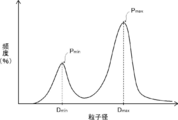
- the particle size at the peak top Pmin having the smallest particle size was defined as Dmin
- the particle size at the peak top Pmax having the largest particle size was defined as Dmax.
- the electronic component according to [10] which is used as an inductor.
- the present invention it is possible to provide a magnetic particle-containing composition capable of forming a magnetic particle-containing film having excellent magnetic permeability and having excellent sedimentation stability.
- the present invention can also provide a magnetic particle-containing film formed by using the magnetic particle-containing composition and an electronic component containing the magnetic particle-containing film.
- the present invention will be described in detail.
- the description of the constituent elements described below may be based on typical embodiments of the present invention, but the present invention is not limited to such embodiments.
- the notation without substitution and non-substitution includes a group having a substituent as well as a group having no substituent. do.
- the "alkyl group” includes not only an alkyl group having no substituent (unsubstituted alkyl group) but also an alkyl group having a substituent (substituted alkyl group).
- the "organic group” in the present specification means a group containing at least one carbon atom.
- the term “active light” or “radiation” refers to, for example, the emission line spectrum of a mercury lamp, far ultraviolet rays typified by an excimer laser, extreme ultraviolet rays (EUV light: Extreme Ultraviolet), X-rays, and electron beams (EB). : Electron Beam) and the like.
- the term “light” means active light or radiation.
- the term “exposure” as used herein refers to not only exposure to the emission line spectrum of a mercury lamp, far ultraviolet rays typified by excimer lasers, extreme ultraviolet rays, X-rays, EUV light, etc., but also electron beams, and the term “exposure”. It also includes drawing with particle beams such as ion beams.
- (meth) acrylate represents acrylate and methacrylate
- (meth) acrylic represents acrylic and methacrylic
- (meth) acryloyl represents acryloyl and methacryloyl.
- the total solid content of the magnetic particle-containing composition means a component forming a magnetic particle-containing film, and when the magnetic particle-containing composition contains a solvent (organic solvent, water, etc.), Means all components except solvent. Further, if the component forms a magnetic particle-containing film, the liquid component is also regarded as a solid content.
- the weight average molecular weight (Mw) is a polystyrene-equivalent value obtained by a GPC (Gel Permeation Chromatography) method.
- the GPC method uses HLC-8020GPC (manufactured by Tosoh Corporation), TSKgel SuperHZM-H, TSKgel SuperHZ4000, and TSKgel SuperHZ2000 (manufactured by Tosoh Corporation, 4.6 mm ID ⁇ 15 cm) as columns, and THF (tetrahydrofuran, manufactured by Tosoh Corporation) as an eluent. ) Is used.
- each component a substance corresponding to each component may be used alone or in combination of two or more.
- the content of the component means the total content of the substances used in combination unless otherwise specified.
- the magnetic particle-containing composition of the present invention (hereinafter, also simply referred to as “composition”) comprises magnetic particles having a plurality of peak tops in a particle size distribution curve representing a volume-based frequency distribution, a resin, and a solvent. contains.
- the magnetic particle-containing composition of the present invention can form a magnetic particle-containing film having excellent sedimentation stability and excellent magnetic permeability. The details of the reason for this are not clear, but it is estimated as follows.
- the magnetic permeability of the magnetic particle-containing film obtained by using the magnetic particles is insufficient.
- the present inventors have found that the magnetic permeability cannot be sufficiently increased because the voids between the magnetic particles become large only by using magnetic particles having a large average particle size.
- the present inventors have found that the magnetic permeability can be improved by using magnetic particles having a plurality of peak tops in a particle size distribution curve representing a volume-based frequency distribution. It is presumed that the reason for this is that the magnetic particles having a small average particle diameter are arranged between the magnetic particles having a large average particle diameter, so that the voids between the magnetic particles in the magnetic particle-containing film are reduced.
- the composition contains magnetic particles having a plurality of peak tops in a particle size distribution curve representing a volume-based frequency distribution.
- the material constituting the magnetic particles preferably contains a metal element, and more preferably contains at least one metal element selected from the group consisting of Fe, Ni and Co.
- the metal element is an alloy containing the metal element (preferably a magnetic alloy), a metal oxide (preferably a magnetic oxide), a metal nitride (preferably a magnetic oxide), or a metal carbide (preferably a metal carbide). It may be contained in magnetic particles as a magnetic carbide).
- the material constituting the magnetic particles may contain elements other than Fe, Ni and Co, and specific examples thereof include Al, Si, S, Sc, Ti, V, Cu, Y, Mo, Rh and Pd. , Ag, Sn, Sb, Te, Ba, Ta, W, Re, Au, Bi, La, Ce, Pr, Nd, P, Zn, Sr, Zr, Mn, Cr, Nb, Pb, Ca, B, C , N.
- the materials constituting the magnetic particles include Fe—Co alloys (preferably permenzur), Fe—Ni alloys (for example, Permalloy), Fe—Zr alloys, Fe—Mn alloys, and Fe. -Si-based alloys, Fe-Al-based alloys, Ni-Mo-based alloys (preferably Super Malloy), Fe-Ni-Co-based alloys, Fe-Si-Cr-based alloys, Fe-Si-B-based alloys, Fe- Si—Al alloys (preferably sentust), Fe—Si—BC alloys, Fe—Si—B—Cr alloys, Fe—Si—B—Cr—C alloys, Fe—Co—Si— B-based alloys, Fe-Si-B-Nb-based alloys, Fe nanocrystal alloys, Fe-based amorphous alloys, Co-based amorphous alloys and other alloys, and spinel ferrites (preferably Ni-Zn-based ferrites and Mn-Zn-based alloys,
- Ferrites and hexagonal ferrites (preferably barium ferrites, magnetoplumbite-type hexagonal ferrites represented by the formula (F1) described later) and the like.
- the alloy may be amorphous.
- alloys are preferable in that the magnetic particle-containing film is more excellent in magnetic permeability, and Fe-based amorphous alloys, Fe—Si—Cr alloys, Fe nanocrystal alloys, Fe—Ni—Co alloys, Co-based amorphous alloys, etc.
- Ni—Mo alloys are more preferred.
- ferrite is preferable, and spinel ferrite is more preferable, in that the chemical stability of the magnetic particle-containing film is more excellent.
- the material constituting the magnetic particles one type may be used alone, or two or more types may be used in combination.
- the formula (F1) is as follows. AFe (12-X) Al X O 19 formula (F1)
- A represents at least one metal element selected from the group consisting of Sr, Ba, Ca, and Pb, and x satisfies 1.5 ⁇ x ⁇ 8.0.
- a in the formula (F1) is at least one metal element selected from the group consisting of Sr, Ba, Ca, and Pb
- the type and number of the metal elements are not particularly limited.
- a in the formula (F1) is preferably at least one metal element selected from the group consisting of Sr, Ba, and Ca.
- X in the formula (F1) preferably satisfies 1.5 ⁇ x ⁇ 8.0, preferably 1.5 ⁇ x ⁇ 6.0, and more preferably 2.0 ⁇ x ⁇ 6.0. ..
- x in the formula (F1) is 1.5 or more, radio waves in a frequency band higher than 60 GHz can be absorbed.
- x in the formula (F1) is 8.0 or less, the magnetoplumbite-type hexagonal ferrite particles have magnetism.
- magnetoplumbite-type hexagonal ferrite represented by the formula (F1) include SrFe (9.58) Al (2.42) O 19 , SrFe (9.37) Al (2.63) O 19. , SrFe (9.27) Al (2.73) O 19 , SrFe (9.85) Al (2.15) O 19 , SrFe (10.00) Al (2.00) O 19 , SrFe (9.
- the composition of the magnetoplumbite-type hexagonal ferrite particles is confirmed by high frequency inductively coupled plasma (ICP) emission spectroscopic analysis. Specifically, a pressure-resistant container containing 12 mg of sample particles and 10 mL of a hydrochloric acid aqueous solution of 4 mol / L (liter; the same applies hereinafter) is held in an oven at a set temperature of 120 ° C. for 12 hours to obtain a solution. Next, 30 mL of pure water is added to the obtained solution, and the mixture is filtered using a 0.1 ⁇ m membrane filter. Elemental analysis of the filtrate thus obtained is performed using a radio frequency inductively coupled plasma (ICP) emission spectroscopic analyzer.
- ICP radio frequency inductively coupled plasma
- the content of each metal atom with respect to 100 atomic% of iron atoms is determined.
- the composition is confirmed based on the obtained content.
- a high frequency inductively coupled plasma (ICP) emission spectroscopic analyzer (model number: ICPS-8100) manufactured by Shimadzu Corporation can be preferably used.
- the measuring device is not limited to this.
- the magnetoplumbite-type hexagonal ferrite represented by the formula (F1) is preferably a magnetoplumbite-type hexagonal ferrite having a single crystal phase.
- the case where "the crystal phase is a single phase” indicates the crystal structure of a magnetoplumbite-type hexagonal ferrite having an arbitrary composition in powder X-ray diffraction (XRD: X-Ray-Diffraction) measurement. This refers to the case where only one type of diffraction pattern is observed.
- a plurality of magnetoplumbite-type hexagonal ferrites having an arbitrary composition are mixed, and two or more types of diffraction patterns are not observed, and diffraction patterns of crystals other than magnetoplumbite-type hexagonal ferrites are not observed.
- a database of the International Center for Diffraction Data ICDD
- ICDD International Center for Diffraction Data
- the diffraction pattern of magnetoplumbite-type hexagonal ferrite containing Sr refer to "00-033-1340" of the International Center for Diffraction Data (ICDD).
- the peak position shifts by substituting a part of iron with aluminum, the peak position shifts.
- Confirmation that the crystal phase of the magnetoplumbite-type hexagonal ferrite is a single phase can be performed, for example, by an X-ray diffraction (XRD) method.
- XRD X-ray diffraction
- a method of measuring under the following conditions using a powder X-ray diffractometer can be mentioned.
- the measuring device for example, an X'Pert Pro diffractometer manufactured by PANalytical Co., Ltd. can be preferably used.
- the measuring device is not limited to this.
- a surface layer may be provided on the surface of the magnetic particles.
- the magnetic particles since the magnetic particles have a surface layer, it is possible to impart a function to the magnetic particles according to the material of the surface layer.
- the surface layer include an inorganic layer and an organic layer.
- a metal oxide, a metal nitride, a metal carbide, a metal phosphate compound, and a boric acid can be formed because a surface layer having at least one excellent insulating property, gas barrier property, and chemical stability can be formed.
- a metal salt compound or a silicic acid compound (for example, a silicic acid ester such as tetraethyl orthosilicate or a silicate such as sodium silicate) is preferable.
- Specific examples of the elements contained in these compounds include Fe, Al, Ca, Mn, Zn, Mg, V, Cr, Y, Ba, Sr, Ge, Zr, Ti, Si, and rare earth elements.
- Examples of the material constituting the inorganic layer obtained by using the compound for forming the inorganic layer include silicon oxide, germanium oxide, titanium oxide, aluminum oxide, zirconium oxide and magnesium oxide, and the inorganic layer contains two or more of these. It may be a layer.
- Examples of the compound for forming an organic layer include an acrylic monomer.
- Specific examples of the acrylic monomer include the compounds described in paragraphs 0022 to 0023 of JP-A-2019-67960.
- Examples of the material constituting the organic layer obtained by using the compound for forming an organic layer include acrylic resin.
- the thickness of the surface layer is not particularly limited, but 3 to 1000 nm is preferable from the viewpoint that the function of the surface layer is more exhibited.
- the magnetic particles preferably contain a metal element having a standard redox potential of ⁇ 0.3 V or higher.
- a metal element having a standard redox potential of ⁇ 0.3 V or higher include Ni and Co.
- the lower limit of the standard redox potential of the metal element is preferably ⁇ 0.3 V or higher, and particularly preferably ⁇ 0.27 V or higher.
- the upper limit of the standard redox potential of the metal element is preferably 1.5 V or less.
- the content of the metal element having a standard oxidation-reduction potential of ⁇ 0.3 V or more is preferably 30% by mass or more, preferably 40% by mass, based on the total mass of the magnetic particles, because the magnetic permeability of the magnetic particle-containing film is more excellent. % Or more is particularly preferable.
- the upper limit of the content of the metal element having a standard redox potential of ⁇ 0.3 V or more is preferably 100% by mass or less, and particularly preferably 95% by mass or less.
- the value of the standard redox potential in the present specification the value of the standard redox potential described in the Chemical Handbook (5th edition) is adopted.
- the content of the magnetic particles is preferably 10% by mass or more, more preferably 25% by mass or more, further preferably 40% by mass or more, based on the total mass of the composition, from the viewpoint of more excellent magnetic permeability of the magnetic particle-containing film.
- the content of the magnetic particles is preferably 95% by mass or less, more preferably 90% by mass or less, based on the total mass of the composition, from the viewpoint of more excellent sedimentation stability of the magnetic particles.
- the content of the magnetic particles is preferably 10 to 99% by mass, particularly preferably 40 to 97% by mass, based on the total solid content of the composition, from the viewpoint of more excellent magnetic permeability of the magnetic particle-containing film.
- the average primary particle size of the magnetic particles is preferably 0.001 to 100 ⁇ m, more preferably 0.01 to 50 ⁇ m, further preferably 0.1 to 30 ⁇ m, and particularly preferably 0.5 to 25 ⁇ m. Since magnetic particles having a plurality of peak tops can be easily obtained in a particle size distribution curve representing a volume-based frequency distribution, it is preferable to use a plurality of magnetic particles having different average primary particle diameters in combination.
- the particle size of the primary particles of the magnetic particles is a particle photograph obtained by photographing the magnetic particles with a transmission electron microscope at an imaging magnification of 100,000 times and printing them on a printing paper so as to have a total magnification of 500,000 times.
- the contour of a particle (primary particle) is traced with a digitizer, and the diameter of a circle having the same area as the traced region (circular area phase diameter) is calculated for measurement.
- the primary particles refer to independent particles without agglomeration.
- Photography using a transmission electron microscope shall be performed by a direct method using a transmission electron microscope at an acceleration voltage of 300 kV. Observation and measurement with a transmission electron microscope can be performed using, for example, a transmission electron microscope H-9000 manufactured by Hitachi and an image analysis software KS-400 manufactured by Carl Zeiss.
- plate-like means a shape having two opposing plate surfaces.
- the shape that distinguishes between the major axis and the minor axis is the "elliptical shape".
- the major axis is determined as the axis (straight line) that can take the longest particle length.
- the minor axis is determined as the axis having the longest length when the particle length is taken by a straight line orthogonal to the major axis.
- a shape in which the long axis and the short axis cannot be specified from the shape is called an indeterminate form.
- the imaging using the transmission electron microscope for specifying the particle shape described above is performed without orienting the particles to be imaged.
- the shape of the magnetic particles may be plate-shaped, elliptical, spherical, or amorphous.
- the catalog value is adopted when a commercially available product is used. If there is no catalog value, the particle photograph taken as described above is used and the arithmetic mean of the values obtained for 500 randomly selected particles is used.
- FIG. 1 is a particle size distribution diagram showing an example of a frequency distribution curve of magnetic particles contained in the composition of the present invention. As shown in FIG. 1, the frequency distribution curve is represented by a particle size distribution map in which the horizontal axis is the particle size and the vertical axis is the frequency (%).
- the frequency distribution curve in the present invention is obtained as follows. First, the composition is diluted with a main solvent, if necessary, and ultrasonically dispersed for 60 minutes to prepare a dispersion. The composition is not diluted when the content of magnetic particles in the composition is 5% by mass or less, and when the content of magnetic particles in the composition is more than 5% by mass, the diluted dispersion liquid is used. The content of the magnetic particles in the particle is 5% by mass. Further, the main solvent means the solvent having the highest content among the solvents contained in the composition.
- the dispersion is measured by a laser diffraction / scattering type particle size distribution measuring device (product name "LA960N", manufactured by Horiba Seisakusho Co., Ltd.) in a measurement range mode in the range of 0.01 ⁇ m to 5000 ⁇ m, and is contained in the composition.
- LA960N laser diffraction / scattering type particle size distribution measuring device
- the peak top in the frequency distribution curve means the maximum point in the frequency distribution curve.
- the number of peak tops in the frequency distribution curve is two, the peak top Pmin having the smallest particle size and the peak top Pmax having the largest particle size.
- the number of peak tops in the frequency distribution curve is plural (that is, two or more), preferably 2 to 5, more preferably 2 to 4, further preferably 2 to 3, in terms of magnetic permeability and film forming property. Two are particularly preferable.
- the effect of the present invention is more excellent when the particle size at the peak top Pmin having the smallest particle size is Dmin and the particle size at the peak top Pmax having the largest particle size is Dmax among the plurality of peak tops in the frequency distribution curve.
- the ratio of Dmax to Dmin is preferably more than 2, more preferably 3 or more, and particularly preferably 4 or more.
- the upper limit of the above ratio (Dmax / Dmin) is preferably 150 or less, more preferably 100 or less, further preferably 50 or less, and particularly preferably 10 or less, from the viewpoint of more excellent effects of the present invention.
- the above ratio (Dmax / Dmin) can be set within the above value range by, for example, using a plurality of magnetic particles having different primary particle diameters and appropriately adjusting the blending ratio thereof.
- FIG. 2 is a particle size distribution diagram showing an example of a particle size distribution curve showing a volume-based cumulative distribution of magnetic particles contained in the composition of the present invention.
- the particle size distribution curve representing the volume-based cumulative distribution is represented by a particle size distribution map in which the horizontal axis is the particle size and the vertical axis is the cumulative (%).
- the particle size distribution curve representing the volume-based cumulative distribution is also referred to as a “cumulative distribution curve”.
- the cumulative distribution curve is measured by a method similar to the particle size distribution curve representing the volume-based frequency distribution.
- Dmin is preferably a particle size D 80 or less when the cumulative distribution curve has a cumulative total of 80%, and a particle size when the cumulative total on the cumulative distribution curve is 60%, from the viewpoint that the effect of the present invention is more excellent. It is particularly preferable that the D is 60 or less. Dmin is the point where the effect of the present invention is more excellent, it is preferred that accumulation is the particle diameter D 10 or more when it is 10% in the cumulative distribution curve, the particle diameter when the cumulative in a cumulative distribution curve is 20% It is particularly preferable that D is 20 or more. Dmin is preferably 0.1 to 50 ⁇ m, more preferably 0.5 to 25 ⁇ m, and particularly preferably 1 to 10 ⁇ m because the effect of the present invention is more excellent.
- Dmax is preferably a particle size D 90 or less when the cumulative distribution curve has a cumulative total of 90%, and a particle size when the cumulative total on the cumulative distribution curve is 80%, from the viewpoint of more excellent effect of the present invention. It is particularly preferable that the D is 80 or less. Dmax is preferably a particle size D of 20 or more when the cumulative distribution curve is 20% or more, and a particle size D when the cumulative distribution curve is 40%, from the viewpoint that the effect of the present invention is more excellent. It is particularly preferably 40 or more. Dmax is preferably 1 to 150 ⁇ m, more preferably 1 to 100 ⁇ m, further preferably 5 to 75 ⁇ m, and particularly preferably 7.5 to 50 ⁇ m from the viewpoint of further excellent effects of the present invention.
- the composition contains a resin.
- the resin include (meth) acrylic resin, epoxy resin, en-thiol resin, polycarbonate resin, polyether resin, polyarylate resin, polysulfone resin, polyethersulfone resin, polyphenylene resin, polyarylene ether phosphine oxide resin, and polyimide resin.
- examples thereof include polyamideimide resin, polyolefin resin, cyclic olefin resin, polyester resin, styrene resin, and phenoxy resin.
- One of these resins may be used alone, or two or more of these resins may be mixed and used.
- As the cyclic olefin resin a norbornene resin is preferable from the viewpoint of improving heat resistance.
- Examples of commercially available norbornene resins include the ARTON series manufactured by JSR Corporation (for example, ARTON F4520).
- Examples of the epoxy resin include an epoxy resin which is a glycidyl etherified product of a phenol compound, an epoxy resin which is a glycidyl etherified product of various novolak resins, an alicyclic epoxy resin, an aliphatic epoxy resin, a heterocyclic epoxy resin, and a glycidyl ester type.
- the epoxy resins are Marproof G-0150M, G-0105SA, G-0130SP, G-0250SP, G-1005S, G-1005SA, G-1010S, G-2050M, G-01100, G-01758 (NOF). (Epoxy group-containing polymer manufactured by Co., Ltd.) or the like can also be used. Further, as the resin, the resin described in the examples of International Publication No.
- the resin has an ethylenically unsaturated group in the side chain, particularly a (meth) acryloyl group
- the main chain and the ethylenically unsaturated group are bonded via a divalent linking group having an alicyclic structure. It is also preferable.
- One of the preferred embodiments of the resin is a resin having a polymerizable group such as an unsaturated double bond (for example, an ethylenically unsaturated double bond), an epoxy group or an oxetanyl group.
- a polymerizable group such as an unsaturated double bond (for example, an ethylenically unsaturated double bond), an epoxy group or an oxetanyl group.
- an unsaturated double bond for example, an ethylenically unsaturated double bond
- an epoxy group for example, an ethylenically unsaturated double bond
- an epoxy group for example, an epoxy group or an oxetanyl group.
- examples of such a resin include a polymer having an epoxy group in the side chain and a polymerizable monomer or oligomer having two or more epoxy groups in the molecule, and specific examples thereof include bisphenol A type epoxy.
- Examples thereof include resins, bisphenol F type epoxy resins, phenol novolac type epoxy resins, cresol novolac type epoxy resins, and aliphatic epoxy resins. These resins may be commercially available or may be obtained by introducing an epoxy group into the side chain of the polymer. As a commercially available product, for example, the description of paragraph 0191 of JP2012-155288A can be referred to, and these contents are incorporated in the present specification.
- ADEKA RESIN EP-4000S, EP-4003S, EP-4010S, EP-4011S (above, manufactured by ADEKA), NC-2000, NC-3000, NC-7300, XD-1000, EPPN- 501, EPPN-502 (all manufactured by ADEKA Corporation), JER1031S and the like can also be mentioned.
- JER-157S65, JER-152, JER-154, JER-157S70 (all manufactured by Mitsubishi Chemical Corporation) and the like can be mentioned.
- polymer having an oxetanyl group in the side chain and the polymerizable monomer or oligomer having two or more oxetanyl groups in the molecule described above include Aron Oxetane OXT-121, OXT-221, OX-SQ, and PNOX. As described above, (manufactured by Toa Synthesis Co., Ltd.) can be used.
- the introduction reaction is, for example, a tertiary amine such as triethylamine or benzylmethylamine, dodecyltrimethylammonium chloride, tetramethylammonium chloride, tetraethylammonium chloride or the like. It can be carried out by reacting with a quaternary ammonium salt, pyridine, triphenylphosphine or the like as a catalyst in an organic solvent at a reaction temperature of 50 to 150 ° C. for a predetermined time.
- the amount of the alicyclic epoxy unsaturated compound introduced can be controlled so that the acid value of the obtained polymer is in the range of 5 to 200 KOH ⁇ mg / g.
- the weight average molecular weight can be in the range of 500 to 500000, preferably 1000 to 500,000.
- those having a glycidyl group as an epoxy group such as glycidyl (meth) acrylate and allyl glycidyl ether can also be used.
- the description in paragraph 0045 of JP-A-2009-265518 can be referred to, and these contents are incorporated in the present specification.
- One of the preferred embodiments of the resin is a resin having an acid group, a basic group or an amide group.
- a resin having an acid group, a basic group or an amide group is suitable because it easily exerts a function as a dispersant for dispersing magnetic particles, and the effect of the present invention is more excellent.
- the acid group include a carboxy group, a phosphoric acid group, a sulfo group, a phenolic hydroxyl group, and the like, and a carboxy group is preferable from the viewpoint that the effect of the present invention is more excellent.
- the basic group include an amino group (ammonia, a group obtained by removing one hydrogen atom from a primary amine or a secondary amine), and an imino group.
- the resin preferably has a carboxy group or an amide group from the viewpoint that the effect of the present invention is more excellent.
- the acid value of the resin is preferably 10 to 500 mgKOH / g, particularly preferably 30 to 400 mgKOH / g or more, because the effect of the present invention is more excellent.
- the resin it is preferable to use a resin having a solubility in a solvent of 10 g / L or more, and a solubility in a solvent of 20 g / L, from the viewpoint that the dispersibility of the resin in the composition is improved and the effect of the present invention is more excellent. It is more preferable to use a resin having an L or more.
- the upper limit of the solubility of the resin in the solvent is preferably 2000 g / L or less, and particularly preferably 1000 g / L or less.
- the solubility of the resin in the solvent means the amount (g) of the resin dissolved in 1 L of the solvent at 25 ° C.
- the content of the resin is preferably 0.1 to 30% by mass, more preferably 1 to 20% by mass, and 2 to 15% by mass, based on the total mass of the composition, from the viewpoint of more excellent effects of the present invention. More preferably, 2.5 to 10% by mass is particularly preferable.
- One of the preferred embodiments of the resin is a resin (hereinafter, also referred to as “dispersed resin”) that functions as a dispersant for dispersing magnetic particles in the composition.
- the dispersed resin By using the dispersed resin, the effect of the present invention is more excellent.
- the dispersion resin include a resin having a repeating unit containing a graft chain, which will be described later, a coagulation control agent, and a coagulation dispersant.
- the dispersed resin examples include a resin having a repeating unit containing a graft chain (hereinafter, also referred to as “resin A”).
- resin A can also be used for purposes other than exerting the function as a dispersant.
- the content of the resin A is preferably 0.1 to 30% by mass, preferably 0.5 to 30% by mass, based on the total mass of the composition, from the viewpoint that the effect of the present invention is more excellent. 20% by mass is more preferable, and 1 to 10% by mass is particularly preferable.
- the graft chain preferably has an atomic number of 40 to 10000 excluding hydrogen atoms, more preferably 50 to 2000 atoms excluding hydrogen atoms, and an atomic number excluding hydrogen atoms. It is more preferably 60 to 500.
- the graft chain indicates from the root of the main chain (atom bonded to the main chain in a group branched from the main chain) to the end of the group branched from the main chain.
- the graft chain preferably contains a polymer structure, and examples of such a polymer structure include a poly (meth) acrylate structure (for example, a poly (meth) acrylic structure), a polyester structure, a polyurethane structure, and a polyurea. Examples thereof include a structure, a polyamide structure, and a polyether structure.
- the graft chain is at least selected from the group consisting of polyester structure, polyether structure, and poly (meth) acrylate structure.
- a graft chain containing one type is preferable, and a graft chain containing at least one of a polyester structure and a polyether structure is more preferable.
- the resin A may be a resin obtained by using a macromonomer containing a graft chain (a monomer having a polymer structure and binding to a main chain to form a graft chain).
- the macromonomer containing a graft chain (a monomer having a polymer structure and binding to a main chain to form a graft chain) is not particularly limited, but a macromonomer containing a reactive double bond group can be preferably used. ..
- macromonomers that correspond to the repeating unit containing the above-mentioned graft chain and are preferably used for the synthesis of resin A include AA-6, AA-10, AB-6, AS-6, AN-6, and AW-6. , AA-714, AY-707, AY-714, AK-5, AK-30, and AK-32 (all trade names, manufactured by Toa Synthetic Co., Ltd.), and Blemmer PP-100, Blemmer PP-500, Blemmer PP.
- Resin A preferably contains at least one structure selected from the group consisting of methyl polyacrylate, polymethyl methacrylate, and cyclic or chain polyester, and methyl polyacrylate, polymethyl methacrylate, etc. It is more preferable to contain at least one structure selected from the group consisting of a chain polyester and a polyvalerolactone structure, and it is more preferable to include a structure consisting of a methyl polyacrylate structure, a polymethyl methacrylate structure, a polycaprolactone structure, and a polyvalerolactone structure. It is particularly preferable to include at least one structure to be formed.
- the resin A may contain one of the above structures alone, or may contain a plurality of these structures.
- the polycaprolactone structure refers to a structure containing a ring-opened structure of ⁇ -caprolactone as a repeating unit.
- the polyvalerolactone structure refers to a structure containing a ring-opened structure of ⁇ -valerolactone as a repeating unit.
- the above-mentioned polycaprolactone structure can be introduced into the resin A.
- the resin A contains a repeating unit in which j and k in the formula (1) described later and the formula (2) described later are 4
- the above-mentioned polyvalerolactone structure can be introduced into the resin.
- the resin A contains a repeating unit in which X 5 in the formula (4) described later is a hydrogen atom and R 4 is a methyl group
- the above-mentioned methyl polyacrylate structure can be introduced into the resin A.
- the resin A contains a repeating unit in which X 5 in the formula (4) described later is a methyl group and R 4 is a methyl group
- the above-mentioned polymethyl methacrylate structure can be introduced into the resin A.
- the resin A preferably contains a repeating unit represented by any of the following formulas (1) to (4) as a repeating unit containing a graft chain, and the following formula (1A), the following formula (2A), and the following. It is more preferable to include a repeating unit represented by any of the formula (3A), the following formula (3B), and the following (4).
- W 1 , W 2 , W 3 , and W 4 independently represent an oxygen atom or NH, respectively.
- W 1 , W 2 , W 3 and W 4 are preferably oxygen atoms.
- X 1 , X 2 , X 3 , X 4 , and X 5 each independently represent a hydrogen atom or a monovalent organic group.
- X 1 , X 2 , X 3 , X 4 , and X 5 are each preferably a hydrogen atom or an alkyl group having 1 to 12 carbon atoms (carbon atoms), and each of them is preferable. Independently, a hydrogen atom or a methyl group is more preferred, and a methyl group is even more preferred.
- Y 1 , Y 2 , Y 3 and Y 4 each independently represent a divalent linking group, and the linking group is not particularly structurally restricted.
- Specific examples of the divalent linking group represented by Y 1 , Y 2 , Y 3 , and Y 4 include the following linking groups (Y-1) to (Y-21).
- a and B mean the binding sites with the left-terminal group and the right-terminal group in the formulas (1) to (4), respectively.
- (Y-2) or (Y-13) is more preferable because of the ease of synthesis.
- Z 1 , Z 2 , Z 3 , and Z 4 each independently represent a monovalent organic group.
- the structure of the organic group is not particularly limited, but specifically, an alkyl group, a hydroxyl group, an alkoxy group, an aryloxy group, a heteroaryloxy group, an alkylthioether group, an arylthioether group, a heteroarylthioether group, an amino group and the like. Can be mentioned.
- the organic group represented by Z 1 , Z 2 , Z 3 , and Z 4 a group having a steric repulsion effect is preferable from the viewpoint of improving dispersibility, and each group has 5 to 24 carbon atoms independently.
- a branched alkyl group having 5 to 24 carbon atoms, a cyclic alkyl group having 5 to 24 carbon atoms, or an alkoxy group having 5 to 24 carbon atoms are further preferable.
- the alkyl group contained in the alkoxy group may be linear, branched or cyclic.
- n, m, p, and q are each independently an integer of 1 to 500.
- j and k independently represent integers of 2 to 8, respectively.
- J and k in the formulas (1) and (2) are preferably integers of 4 to 6, and more preferably 5.
- n and m are preferably an integer of 10 or more, and more preferably an integer of 20 or more.
- the resin A contains a polycaprolactone structure and a polycaprolactone structure
- the sum of the number of repetitions of the polycaprolactone structure and the number of repetitions of polyvalerolactone is preferably an integer of 10 or more, and an integer of 20 or more is preferable. More preferred.
- R 3 represents a branched chain or linear alkylene group, preferably an alkylene group having 1 to 10 carbon atoms, and more preferably an alkylene group having 2 or 3 carbon atoms. when p is 2 ⁇ 500, R 3 existing in plural numbers may be different from one another the same.
- R 4 represents a hydrogen atom or a monovalent organic group, and the structure of the monovalent organic group is not particularly limited. The R 4, a hydrogen atom, an alkyl group, an aryl group, or a heteroaryl group, more preferably a hydrogen atom or an alkyl group.
- the alkyl group is preferably a linear alkyl group having 1 to 20 carbon atoms, a branched chain alkyl group having 3 to 20 carbon atoms, or a cyclic alkyl group having 5 to 20 carbon atoms.
- a linear alkyl group having 1 to 20 carbon atoms is more preferable, and a linear alkyl group having 1 to 6 carbon atoms is further preferable.
- q is 2 to 500
- a plurality of X 5 and R 4 existing in the graft chain may be the same or different from each other.
- the resin A may contain two or more kinds of repeating units containing graft chains having different structures. That is, the molecule of the resin A may contain repeating units represented by the formulas (1) to (4) having different structures from each other, and n, m, p, in the formulas (1) to (4).
- j and k may contain structures different from each other in the side chain, and in equations (3) and (4). is, R 3, R 4 a plurality present in the molecule, and X 5 may be different from one another the same.
- the repeating unit represented by the formula (1) is more preferably the repeating unit represented by the following formula (1A). Further, the repeating unit represented by the formula (2) is more preferably the repeating unit represented by the following formula (2A).
- X 1, Y 1, Z 1, and n is, X 1, Y 1, Z 1 in Formula (1), and have the same meanings as n, preferred ranges are also the same.
- repeating unit represented by the formula (3) it is more preferable that the repeating unit is represented by the following formula (3A) or the formula (3B).
- X 3, Y 3, Z 3, and p is, X 3, Y 3, Z 3 in Formula (3), and has the same meaning as p, preferred ranges are also the same ..
- the resin A contains a repeating unit represented by the formula (1A) as a repeating unit containing a graft chain.
- the resin A contains a repeating unit containing a polyalkyleneimine structure and a polyester structure.
- the repeating unit including the polyalkyleneimine structure and the polyester structure preferably contains the polyalkyleneimine structure in the main chain and the polyester structure as the graft chain.
- the polyalkyleneimine structure is a polymerization structure containing two or more identical or different alkyleneimine chains.
- Specific examples of the alkyleneimine chain include an alkyleneimine chain represented by the following formula (4A) and the following formula (4B).
- RX1 and RX2 each independently represent a hydrogen atom or an alkyl group.
- a 1 represents an integer of 2 or more.
- * 1 represents a bond position with a polyester chain, an adjacent alkyleneimine chain, or a hydrogen atom or a substituent.
- RX3 and RX4 each independently represent a hydrogen atom or an alkyl group.
- a 2 represents an integer of 2 or more.
- the polyester chain having an anionic group and the N + specified in the formula (4B) and the anionic group contained in the polyester chain form a salt-crosslinked group. To combine.
- R X1 and R X2, and R X3 and R X4 in the formula (4B) in the formula (4A) each independently represent a hydrogen atom or an alkyl group.
- the alkyl group preferably has 1 to 6 carbon atoms, and preferably 1 to 3 carbon atoms.
- both RX1 and RX2 are hydrogen atoms.
- both RX3 and RX4 are hydrogen atoms.
- the a 1 in the formula (4A) and the a 2 in the formula (4B) are not particularly limited as long as they are integers of 2 or more.
- the upper limit value is preferably 10 or less, more preferably 6 or less, further preferably 4 or less, further preferably 2 or 3, and particularly preferably 2.
- * represents a bond position with an adjacent alkyleneimine chain or a hydrogen atom or a substituent.
- substituent include a substituent such as an alkyl group (for example, an alkyl group having 1 to 6 carbon atoms).
- a polyester chain may be bonded as a substituent.
- the alkyleneimine chain represented by the formula (4A) is preferably connected to the polyester chain at the position * 1 described above. Specifically, it is preferable that the carbonyl carbon in the polyester chain is bonded at the above-mentioned * 1 position.
- Examples of the polyester chain include a polyester chain represented by the following formula (5A).
- alkyleneimine chain is an alkylene imine chain represented by the formula (4B)
- the polyester chains are anionic (preferably oxygen anion O -) include, N + Togashio in the anionic and formula (4B) It is preferable to form a cross-linking group.
- examples of such a polyester chain include a polyester chain represented by the following formula (5B).
- L X1, and L X2 in the formula (5B) in the formula (5A) each independently represents a divalent linking group.
- the divalent linking group preferably includes an alkylene group having 3 to 30 carbon atoms.
- B 11 in the formula (5A) and b 21 in the formula (5B) each independently represent an integer of 2 or more, and the upper limit thereof is, for example, 200 or less.
- B 12 in formula (5A) and b 22 in formula (5B) independently represent 0 or 1, respectively.
- X A in the formula (5A) and X B in the formula (5B) independently represent a hydrogen atom or a substituent.
- substituents include an alkyl group, an alkoxy group, a polyalkyleneoxyalkyl group, an aryl group and the like.
- the alkyl group (which may be linear, branched, or cyclic) and the alkyl group contained in the alkoxy group (which may be linear, branched, or cyclic).
- Examples of the number of carbon atoms include 1 to 30, and 1 to 10 are preferable.
- the alkyl group may further have a substituent, and examples of the substituent include a hydroxyl group and a halogen atom (the halogen atom includes a fluorine atom, a chlorine atom, a bromine atom, an iodine atom and the like).
- the polyalkyleneoxyalkyl group is a substituent represented by RX6 (OR X7 ) p (O) q ⁇ .
- RX6 represents an alkyl group
- RX7 represents an alkylene group
- p represents an integer of 2 or more
- q represents 0 or 1.
- Alkyl group represented by R X6 has the same meaning as the alkyl group represented by X A.
- the alkylene group represented by R X7 it includes one group obtained by removing a hydrogen atom from the alkyl group represented by X A.
- p is an integer of 2 or more, and the upper limit value thereof is, for example, 10 or less, preferably 5 or less.
- aryl group examples include an aryl group having 6 to 24 carbon atoms (which may be monocyclic or polycyclic).
- the aryl group may further have a substituent, and examples of the substituent include an alkyl group, a halogen atom, a cyano group and the like.
- polyester chain examples include ⁇ -caprolactone, ⁇ -caprolactone, ⁇ -propiolactone, ⁇ -butyrolactone, ⁇ -valerolactone, ⁇ -valerolactone, enant lactone, ⁇ -butyrolactone, ⁇ -hexanolactone, and ⁇ -octa.
- Lactones such as nolactone, ⁇ -hexalanolactone, ⁇ -octanolactone, ⁇ -dodecanolactone, ⁇ -methyl- ⁇ -butyrolactone, and lactide (which may be L-form or D-form).
- a structure in which the ring is opened is preferable, and a structure in which ⁇ -caprolactone or ⁇ -valerolactone is opened is more preferable.
- the repeating unit containing the polyalkyleneimine structure and the polyester structure can be synthesized according to the synthesis method described in Japanese Patent No. 5923557.
- the content of the repeating unit including the graft chain is preferably 2 to 95% by mass, more preferably 2 to 90% by mass, and 5 to 30% by mass with respect to the total mass of the resin A in terms of mass. Is particularly preferable. When the repeating unit including the graft chain is included in this range, the effect of the present invention is more excellent.
- the resin A may contain a hydrophobic repeating unit different from the repeating unit containing the graft chain (that is, not corresponding to the repeating unit containing the graft chain).
- the hydrophobic repeating unit is a repeating unit having no acid group (for example, a carboxylic acid group, a sulfonic acid group, a phosphoric acid group, a phenolic hydroxyl group, etc.).
- the hydrophobic repeating unit is preferably a (corresponding) repeating unit derived from a compound (monomer) having a ClogP value of 1.2 or more, and is a repeating unit derived from a compound having a ClogP value of 1.2 to 8. Is more preferable. Thereby, the effect of the present invention can be more reliably exhibited.
- the ClogP value is determined by Daylight Chemical Information System, Inc. It is a value calculated by the program "CLOGP” that can be obtained from.
- This program provides the value of "calculated logP” calculated by Hansch, Leo's fragment approach (see literature below). The fragment approach is based on the chemical structure of a compound, which divides the chemical structure into substructures (fragments) and sums the logP contributions assigned to the fragments to estimate the logP value of the compound. The details are described in the following documents. In this specification, the ClogP value calculated by the program CLOGP v4.82 is used.
- logP means the common logarithm of the partition coefficient P (Partition Cofficient), and quantitatively describes how an organic compound is distributed in the equilibrium of a two-phase system of oil (generally 1-octanol) and water. It is a physical property value expressed as a numerical value, and is expressed by the following formula.
- logP log (Coil / Water)
- Coil represents the molar concentration of the compound in the oil phase
- Water represents the molar concentration of the compound in the aqueous phase.
- the resin A preferably contains, as the hydrophobic repeating unit, one or more kinds of repeating units selected from the repeating units derived from the monomers represented by the following formulas (i) to (iii).
- R 1 , R 2 , and R 3 independently have a hydrogen atom, a halogen atom (for example, a fluorine atom, a chlorine atom, a bromine atom, etc.), or a carbon number of carbon atoms.
- a halogen atom for example, a fluorine atom, a chlorine atom, a bromine atom, etc.
- R 1 , R 2 , and R 3 are preferably hydrogen atoms or alkyl groups having 1 to 3 carbon atoms, and more preferably hydrogen atoms or methyl groups. It is more preferable that R 2 and R 3 are hydrogen atoms.
- X represents an oxygen atom (-O-) or an imino group (-NH-), and an oxygen atom is preferable.
- the divalent linking group includes a divalent aliphatic group (for example, an alkylene group, a substituted alkylene group, an alkenylene group, a substituted alkenylene group, an alkynylene group, a substituted alkynylene group) and a divalent aromatic group (for example, an arylene group).
- a divalent aliphatic group for example, an alkylene group, a substituted alkylene group, an alkenylene group, a substituted alkenylene group, an alkynylene group, a substituted alkynylene group
- a divalent aromatic group for example, an arylene group
- substituted arylene group a divalent heterocyclic group an oxygen atom (-O-), sulfur atom (-S-), an imino group (-NH-), a substituted imino group (-NR 31 -, wherein R 31 Examples include an aliphatic group, an aromatic group or a heterocyclic group), a carbonyl group (-CO-), and a combination thereof.
- the divalent aliphatic group may have a cyclic structure or a branched structure.
- the number of carbon atoms of the aliphatic group is preferably 1 to 20, more preferably 1 to 15, and even more preferably 1 to 10.
- the aliphatic group may be an unsaturated aliphatic group or a saturated aliphatic group, but a saturated aliphatic group is preferable.
- the aliphatic group may have a substituent. Examples of substituents include halogen atoms, aromatic groups, heterocyclic groups and the like.
- the number of carbon atoms of the divalent aromatic group is preferably 6 to 20, more preferably 6 to 15, and even more preferably 6 to 10.
- the aromatic group may have a substituent. Examples of substituents include halogen atoms, aliphatic groups, aromatic groups, heterocyclic groups and the like.
- the divalent heterocyclic group preferably contains a 5-membered ring or a 6-membered ring as the heterocycle. Another heterocycle, an aliphatic ring, or an aromatic ring may be condensed with the heterocycle.
- L is preferably a divalent linking group containing a single bond, an alkylene group or an oxyalkylene structure.
- the oxyalkylene structure is more preferably an oxyethylene structure or an oxypropylene structure.
- L may contain a polyoxyalkylene structure containing two or more repeated oxyalkylene structures.
- a polyoxyethylene structure or a polyoxypropylene structure is preferable.
- the polyoxyethylene structure is represented by ⁇ (OCH 2 CH 2 ) n ⁇ , and n is preferably an integer of 2 or more, and more preferably an integer of 2 to 10.
- an aliphatic group for example, an alkyl group, a substituted alkyl group, an unsaturated alkyl group, a substituted unsaturated alkyl group
- an aromatic group for example, an aryl group, a substituted aryl group, an arylene group, a substituted arylene group
- Heterocyclic groups and combinations thereof.
- These groups an oxygen atom (-O-), sulfur atom (-S-), an imino group (-NH-), a substituted imino group (-NR 31 -, wherein R 31 is an aliphatic group, an aromatic A group or heterocyclic group) or a carbonyl group (-CO-) may be contained.
- the aliphatic group may have a cyclic structure or a branched structure.
- the number of carbon atoms of the aliphatic group is preferably 1 to 20, more preferably 1 to 15, and even more preferably 1 to 10.
- the aliphatic group further includes a ring-assembled hydrocarbon group and a crosslinked ring-type hydrocarbon group. Examples of the ring-assembled hydrocarbon group include a bicyclohexyl group, a perhydronaphthalenyl group, a biphenyl group, and 4-. Cyclohexylphenyl group and the like are included.
- Bicyclic hydrocarbon rings include, for example, two rings such as pinan, bornan, norpinane, norbornane, and bicyclooctane ring (bicyclo [2.2.2] octane ring, bicyclo [3.2.1] octane ring, etc.).
- Tricyclic hydrocarbon rings such as formal hydrocarbon rings, homobredane, adamantane, tricyclo [5.2.1.0 2,6 ] decane, and tricyclo [4.3.1.1 2,5 ] undecane rings, and , Tetracyclo [4.4.0.1 2,5 .
- the crosslinked cyclic hydrocarbon ring includes fused cyclic hydrocarbon rings such as perhydronaphthalene (decalin), perhydroanthracene, perhydrophenanthrene, perhydroacenaphthene, perhydrofluorene, perhydroindene, and per.
- fused cyclic hydrocarbon rings such as perhydronaphthalene (decalin), perhydroanthracene, perhydrophenanthrene, perhydroacenaphthene, perhydrofluorene, perhydroindene, and per.
- a fused ring in which a plurality of 5- to 8-membered cycloalkane rings such as a hydrophenanthrene ring are condensed is also included.
- aliphatic group a saturated aliphatic group is preferable to an unsaturated aliphatic group.
- the aliphatic group may have a substituent. Examples of substituents include halogen atoms, aromatic groups and heterocyclic groups. However, the aliphatic group does not have an acid group as a substituent.
- the number of carbon atoms of the aromatic group is preferably 6 to 20, more preferably 6 to 15, and even more preferably 6 to 10.
- the aromatic group may have a substituent. Examples of substituents include halogen atoms, aliphatic groups, aromatic groups and heterocyclic groups. However, the aromatic group does not have an acid group as a substituent.
- R 4 , R 5 , and R 6 are independently hydrogen atoms, halogen atoms (for example, fluorine atoms, chlorine atoms, bromine atoms, etc.), and alkyl having 1 to 6 carbon atoms.
- L and Z are synonymous with the groups in the above.
- R 4 , R 5 , and R 6 a hydrogen atom or an alkyl group having 1 to 3 carbon atoms is preferable, and a hydrogen atom is more preferable.
- R 1 , R 2 and R 3 are hydrogen atoms or methyl groups
- L is a divalent compound containing a single bond or an alkylene group or an oxyalkylene structure.
- a compound in which X is an oxygen atom or an imino group and Z is an aliphatic group, a heterocyclic group, or an aromatic group is preferable as a linking group.
- R 1 is a hydrogen atom or a methyl group
- L is an alkylene group
- Z is an aliphatic group, a heterocyclic group, or an aromatic group. Is preferred.
- R 4 , R 5 and R 6 are hydrogen atoms or methyl groups
- Z is an aliphatic group, a heterocyclic group or an aromatic group. Certain compounds are preferred.
- Examples of typical compounds represented by the formulas (i) to (iii) include radically polymerizable compounds selected from acrylic acid esters, methacrylic acid esters, styrenes and the like.
- the compounds described in paragraphs 089 to 093 of JP2013-249417A can be referred to, and the contents thereof are described in the present specification. Incorporated in.
- the content of the hydrophobic repeating unit is preferably 10 to 90% by mass, more preferably 20 to 80% by mass, based on the total mass of the resin A.
- Resin A may have a functional group capable of forming an interaction with the magnetic particles.
- the resin A preferably further contains a repeating unit containing a functional group capable of forming an interaction with the magnetic particles.
- the functional group capable of forming an interaction with the magnetic particles include an acid group, a basic group, a coordinating group, and a reactive functional group.
- the resin A contains an acid group, a basic group, a coordinating group, or a functional group having reactivity
- the resin A contains a repeating unit containing an acid group, a repeating unit containing a basic group, and a coordinating group, respectively. It is preferable to include a repeating unit or a repeating unit having a functional group having reactivity.
- the repeating unit containing an alkali-soluble group as an acid group may be the same repeating unit as the repeating unit containing the graft chain described above or a different repeating unit, but includes an alkali-soluble group as an acid group.
- the repeating unit is a repeating unit different from the above-mentioned hydrophobic repeating unit (that is, does not correspond to the above-mentioned hydrophobic repeating unit).
- the acid group which is a functional group capable of forming an interaction with the magnetic particles include a carboxylic acid group, a sulfonic acid group, a phosphoric acid group, a phenolic hydroxyl group, and the like, and the carboxylic acid group, the sulfonic acid group, and phosphorus. At least one of the acid groups is preferable, and a carboxylic acid group is more preferable.
- the carboxylic acid group has good adsorption power to magnetic particles and high dispersibility. That is, the resin A preferably further contains a repeating unit containing at least one of a carboxylic acid group, a sulfonic acid group, and a phosphoric acid group.
- the resin A may have one or more repeating units containing an acid group.
- the content thereof is preferably 5 to 80% by mass, more preferably 10 to 60% by mass, based on the total mass of the resin A.
- Examples of the basic group which is a functional group capable of forming an interaction with the magnetic particles include a primary amino group, a secondary amino group, a tertiary amino group, a heterocycle containing an N atom, and an amide group.
- the preferred basic group is a tertiary amino group in that it has a good adsorption force to magnetic particles and a high dispersibility.
- Resin A may contain one or more of these basic groups.
- the content thereof is preferably 0.01 to 50% by mass, preferably 0.01 to 30% by mass, based on the total mass of the resin A. More preferred.
- Coordinating groups which are functional groups capable of forming interactions with magnetic particles, and reactive functional groups include, for example, acetylacetoxy groups, trialkoxysilyl groups, isocyanate groups, acid anhydrides, and acidified compounds. And so on.
- a preferred functional group is an acetylacetoxy group in that it has a good adsorptive power to magnetic particles and has high dispersibility of magnetic particles.
- Resin A may have one or more of these groups.
- the content thereof is 10 to 80 with respect to the total mass of the resin A in terms of mass. It is preferably by mass, more preferably 20 to 60% by mass.
- the resin A contains a functional group capable of forming an interaction with magnetic particles other than the graft chain
- the resin A contains a functional group capable of forming an interaction with the various magnetic particles described above, and these functional groups are sufficient.
- the group is introduced.
- the resin contained in the composition preferably contains one or more repeating units selected from the repeating units derived from the monomers represented by the following formulas (iv) to (vi).
- R 11 , R 12 , and R 13 each independently have a hydrogen atom, a halogen atom (for example, a fluorine atom, a chlorine atom, a bromine atom, etc.), or a carbon number of 1. Represents up to 6 alkyl groups (eg, methyl group, ethyl group, propyl group, etc.).
- a hydrogen atom or an alkyl group having 1 to 3 carbon atoms is preferable, and a hydrogen atom or a methyl group is more preferable.
- hydrogen atoms are more preferable as R 12 and R 13.
- X 1 in the formula (iv) represents an oxygen atom (-O-) or an imino group (-NH-), and an oxygen atom is preferable.
- Y in the formula (v) represents a methine group or a nitrogen atom.
- L 1 in the formulas (iv) to (v) represents a single bond or a divalent linking group.
- the definition of the divalent linking group is the same as the definition of the divalent linking group represented by L in the above formula (i).
- L 1 is preferably a divalent linking group containing a single bond, an alkylene group or an oxyalkylene structure.
- the oxyalkylene structure is more preferably an oxyethylene structure or an oxypropylene structure.
- L 1 may include a polyoxyalkylene structure containing two or more oxyalkylene structures repeatedly.
- As the polyoxyalkylene structure a polyoxyethylene structure or a polyoxypropylene structure is preferable.
- the polyoxyethylene structure is represented by ⁇ (OCH 2 CH 2 ) n ⁇ , and n is preferably an integer of 2 or more, and more preferably an integer of 2 to 10.
- Z 1 represents a functional group capable of forming an interaction with magnetic particles other than the graft chain, and a carboxylic acid group or a tertiary amino group is preferable, and a carboxylic acid group is more preferable. preferable.
- R 14 , R 15 , and R 16 are independently hydrogen atoms, halogen atoms (for example, fluorine atoms, chlorine atoms, bromine atoms, etc.), and alkyl groups having 1 to 6 carbon atoms. (e.g., a methyl group, an ethyl group, and propyl group), - Z 1, or an L 1 -Z 1. Wherein L 1 and Z 1 are the same meaning as L 1 and Z 1 in the above, it is the preferable examples. As R 14 , R 15 and R 16 , a hydrogen atom or an alkyl group having 1 to 3 carbon atoms is preferable, and a hydrogen atom is more preferable.
- halogen atoms for example, fluorine atoms, chlorine atoms, bromine atoms, etc.
- alkyl groups having 1 to 6 carbon atoms. e.g., a methyl group, an ethyl group, and propyl group
- L 1 and Z 1 are
- R 11 , R 12 , and R 13 are independently hydrogen atoms or methyl groups, and L 1 is a divalent linkage containing an alkylene group or an oxyalkylene structure.
- a compound in which X 1 is an oxygen atom or an imino group and Z 1 is a carboxylic acid group is preferable.
- R 11 is a hydrogen atom or a methyl group
- L 1 is an alkylene group
- Z 1 is a carboxylic acid group
- Y is a methine group. Is preferred.
- a compound in which R 14 , R 15 and R 16 are independently hydrogen atoms or methyl groups and Z 1 is a carboxylic acid group is preferable.
- monomers represented by the formulas (iv) to (vi) are shown below.
- monomers include methacrylic acid, crotonic acid, isocrotonic acid, a reaction product of a compound containing an addition-polymerizable double bond and a hydroxyl group in the molecule (for example, 2-hydroxyethyl methacrylate) and succinic anhydride.
- a reaction product of a compound containing an addition-polymerizable double bond and a hydroxyl group in the molecule and phthalic acid anhydride, and a reaction product of a compound containing an addition-polymerizable double bond and a hydroxyl group in the molecule and a tetrahydroxyphthalic acid anhydride is a reaction product of a compound containing an addition-polymerizable double bond and a hydroxyl group in the molecule and a tetrahydroxyphthalic acid anhydride.
- a reaction product of a compound containing an addition-polymerizable double bond and a hydroxyl group in the molecule and trimellitic anhydride, a reaction product of a compound containing an addition-polymerizable double bond and a hydroxyl group in the molecule and crotonic acid anhydride examples thereof include acrylic acid, acrylic acid dimer, acrylic acid oligomer, maleic acid, itaconic acid, fumaric acid, 4-vinylbenzoic acid, vinylphenol, 4-hydroxyphenylmethacrylate and the like.
- the content of the repeating unit containing the functional group capable of forming an interaction with the magnetic particles is the total mass of the resin A in terms of the interaction with the magnetic particles, the stability over time, and the permeability to the developing solution.
- 0.05 to 90% by mass is preferable, 1.0 to 80% by mass is more preferable, and 10 to 70% by mass is further preferable.
- Resin A may contain an ethylenically unsaturated group.
- the ethylenically unsaturated group is not particularly limited, and examples thereof include a (meth) acryloyl group, a vinyl group, and a styryl group, and a (meth) acryloyl group is preferable.
- the resin A preferably contains a repeating unit containing an ethylenically unsaturated group in the side chain, and contains a repeating unit containing an ethylenically unsaturated group in the side chain and derived from (meth) acrylate (hereinafter referred to as a repeating unit).
- the (meth) acrylic repeating unit containing an ethylenically unsaturated group in the side chain is, for example, a glycidyl group or an alicyclic ring on the above carboxylic acid group in the resin A containing the (meth) acrylic repeating unit containing a carboxylic acid group.
- Formula It is obtained by an addition reaction of an ethylenically unsaturated compound containing an epoxy group.
- the content thereof is preferably 30 to 70% by mass, more preferably 40 to 60% by mass, based on the total mass of the resin A. ..
- the resin A can be used as a repeating unit containing a graft chain, a hydrophobic repeating unit, and magnetic particles for the purpose of improving various performances such as film forming ability, as long as the effect of the present invention is not impaired. It may further have other repeating units having various functions, which are different from the repeating units containing functional groups capable of forming an interaction. Examples of such other repeating units include repeating units derived from radically polymerizable compounds selected from acrylonitriles, methacrylonitriles, and the like.
- the resin A can use one or more of these other repeating units, and the content thereof is preferably 0 to 80% by mass, preferably 10 to 60% by mass, based on the total mass of the resin A. % Is more preferable.
- the acid value of the resin A is not particularly limited, but for example, 0 to 400 mgKOH / g is preferable, 10 to 350 mgKOH / g is more preferable, 30 to 300 mgKOH / g is further preferable, and 50 to 200 mgKOH / g. The range of is particularly preferable. When the acid value of the resin A is 50 mgKOH / g or more, the sedimentation stability of the magnetic particles can be further improved.
- the acid value can be calculated from, for example, the average content of acid groups in the compound. Further, by changing the content of the repeating unit containing an acid group in the resin, a resin having a desired acid value can be obtained.
- the weight average molecular weight of the resin A is not particularly limited, but for example, 3,000 or more is preferable, 4,000 or more is more preferable, 5,000 or more is further preferable, and 6,000 or more is particularly preferable. Further, as the upper limit value, for example, 300,000 or less is preferable, 200,000 or less is more preferable, 100,000 or less is further preferable, and 50,000 or less is particularly preferable. Resin A can be synthesized based on a known method.
- the polymer compounds described in paragraphs 0127 to 0129 of JP2013-249417A can be referred to, and the contents thereof are incorporated in the present specification.
- the resin A the graft copolymers of paragraphs 0037 to 0115 (corresponding paragraphs 0075 to 0133 of US2011 / 0124824) of JP-A-2010-106268 can also be used, and these contents can be incorporated. Incorporated into the book.
- the dispersion resin examples include a coagulation control agent.
- the agglomeration control agent binds to relatively dense agglomerates such as magnetic particles, and further disperses other components (for example, alkali-soluble resin) optionally contained in the composition to increase the bulk. It has the function of being able to form high aggregates.
- the dispersion resin contains an aggregation control agent, hard cake formation of magnetic particles in the composition is suppressed, and bulky aggregates are formed, so that redispersibility can be improved.
- Examples of the aggregation control agent include cellulose derivatives.
- Examples of the cellulose derivative include carboxymethyl cellulose, methyl cellulose, hydroxyethyl cellulose, hydroxypropyl cellulose, hydroxypropyl methyl cellulose, hydroxypropyl ethyl cellulose, and salts thereof.
- the content of the coagulation control agent is preferably 0.1 to 20% by mass, particularly preferably 0.5 to 10% by mass, based on the total mass of the composition.
- the dispersion resin examples include coagulation dispersants.
- the coagulation / dispersant is adsorbed on the surface of the magnetic particles, and while separating the magnetic particles from each other, the distance between the magnetic particles is maintained at a certain level or more by the interaction between the dispersants, and the magnetic particles are prevented from directly agglomerating with each other. It has the function of being able to do it. As a result, agglomeration of magnetic particles is suppressed, and even when agglomerates are formed, agglomerates having a relatively low density are formed. Further, other components (for example, alkali-soluble resin) optionally contained in the composition can be dispersed in the composition to form bulky aggregates, so that the redispersibility can be improved.
- other components for example, alkali-soluble resin
- an alkylol ammonium salt of a polybasic acid is preferable.
- the polybasic acid may have two or more acid groups, for example, an acidic polymer containing a repeating unit having an acid group (for example, polyacrylic acid, polymethacrylic acid, polyvinylsulfonic acid, polyphosphoric acid, etc.).
- an acidic polymer containing a repeating unit having an acid group for example, polyacrylic acid, polymethacrylic acid, polyvinylsulfonic acid, polyphosphoric acid, etc.
- Examples of polybasic acids other than the above include polymers obtained by polymerizing unsaturated fatty acids such as crotonic acid.
- Alkyrol ammonium salts of polybasic acids are obtained by reacting these polybasic acids with alkyrol ammonium. The salt obtained by such a reaction usually contains the following partial structure.
- the alkylolammonium salt of the polybasic acid is preferably a polymer containing a plurality of the above partial structures.
- the weight average molecular weight is preferably 1,000 to 100,000, more preferably 5,000 to 20,000.
- the polymer of the alkylolammonium salt of polybasic acid binds to the surface of the magnetic particles and also hydrogen bonds with other coagulation / dispersant molecules, so that the main chain structure of the polymer penetrates between the magnetic particles and the magnetic particles are separated from each other. Can be separated.
- coagulation dispersant (a) saturated aliphatic monocarboxylic acids and hydroxy group-containing aliphatic monocarboxylic acids, (b) at least one of the polybasic acids, and (c) Examples thereof include amide wax, which is a condensate obtained by dehydration condensation of at least one of amines of diamines and tetraamines.
- amide wax which is a condensate obtained by dehydration condensation of at least one of amines of diamines and tetraamines.
- Saturated aliphatic monocarboxylic acids preferably have 12 to 22 carbon atoms. Specific examples thereof include lauric acid, myristic acid, pentadecic acid, palmitic acid, margaric acid, stearic acid, nonadecan acid, arachidic acid, behenic acid and the like.
- the hydroxy group-containing aliphatic monocarboxylic acids preferably have 12 to 22 carbon atoms. Specific examples thereof include 12-hydroxystearic acid and dihydroxystearic acid. These saturated aliphatic monocarboxylic acids and hydroxy group-containing aliphatic monocarboxylic acids may be used alone or in combination of two or more.
- a carboxylic acid having 2 to 12 carbon atoms and having a dibasic acid or more is preferable, and a dicarboxylic acid is more preferable.
- dicarboxylic acids include oxalic acid, malonic acid, succinic acid, glutaric acid, adipic acid, pimelic acid, suberic acid, azelaic acid, sebacic acid, 1,10-decandicarboxylic acid, and 1,12-dodecandicarboxylic acid.
- Aliphatic dicarboxylic acids such as acids; aromatic dicarboxylic acids such as phthalic acid, isophthalic acid, and terephthalic acid; 1,2-cyclohexanedicarboxylic acid, 1,3-cyclohexanedicarboxylic acid, 1,4-cyclohexanedicarboxylic acid, And alicyclic dicarboxylic acids such as cyclohexylsuccinic acid.
- aromatic dicarboxylic acids such as phthalic acid, isophthalic acid, and terephthalic acid
- 1,2-cyclohexanedicarboxylic acid 1,3-cyclohexanedicarboxylic acid
- 1,4-cyclohexanedicarboxylic acid 1,4-cyclohexanedicarboxylic acid
- alicyclic dicarboxylic acids such as cyclohexylsuccinic acid.
- the diamines preferably have 2 to 14 carbon atoms. Specifically, ethylenediamine, 1,3-propanediamine, 1,4-butanediamine, hexamethylenediamine, m-xylylenediamine, tolylenediamine, paraxylylenediamine, phenylenediamine, isophoronediamine, 1,10-decanediamine, Examples thereof include 1,12-dodecanediamine, 4,4-diaminodicyclohexylmethane and 4,4-diaminodiphenylmethane.
- the tetraamines preferably have 2 to 14 carbon atoms. Specific examples thereof include butane-1,1,4,4-tetraamine and pyrimidine-2,4,5,6-tetraamine. These diamines and tetraamines may be used alone or in combination of two or more.
- This amide wax is obtained as a mixture of a plurality of compounds having different molecular weights.
- the amido wax is preferably represented by the following chemical formula (I).
- the amido wax may be a single compound or a mixture.
- A is a dehydroxylated residue of a saturated aliphatic monocarboxylic acid and / or a hydroxy group-containing saturated aliphatic monocarboxylic acid
- B is a dehydroxylated residue of a polybasic acid
- C is a diamine and / or tetraamine.
- the dehydrogenated residue of, m is 0 ⁇ m ⁇ 5.
- One of the preferred embodiments of the coagulation dispersant is a compound represented by the following formula (II).
- R 1 represents a monovalent linear aliphatic hydrocarbon group having 10 to 25 carbon atoms
- R 2 and R 3 independently have 2, 4, 6 or 8 carbon atoms, respectively.
- divalent aliphatic hydrocarbon group a divalent alicyclic hydrocarbon group having 6 carbon atoms or a divalent aromatic hydrocarbon radical
- R 4 is a divalent aliphatic of 1 to 8 carbon atoms It represents a group hydrocarbon group
- R 5 and R 6 independently represent a monovalent aliphatic hydrocarbon group having 1 to 3 carbon atoms or a hydroxyalkyl ether group.
- L 1 to L 3 independently represent an amide bond, and when L 1 and L 3 are -CONH-, L 2 is -NHCO- and L 1 and L 3 are -NHCO. If ⁇ , then L 2 is ⁇ CONH ⁇ .
- R 1 is a monovalent linear aliphatic hydrocarbon group having 10 to 25 carbon atoms.
- Linear alkyl groups such as groups; linear alkenyl groups such as decenyl group, pentadecenyl group, oleyl group and eicosenyl group; linear alkynyl groups such as pentadecynyl group, octadecynyl group and nonadesinyl group can be mentioned.
- R 1 is a monovalent linear aliphatic compound having 14 to 25 carbon atoms in that it has an excellent thickening effect and can suppress the residual ash content to an extremely low level even when calcined at a low temperature.
- a hydrocarbon group is preferable, and a monovalent linear aliphatic hydrocarbon group having 18 to 21 carbon atoms is particularly preferable.
- the linear aliphatic hydrocarbon group is preferably an alkyl group.
- Examples of the divalent aliphatic hydrocarbon group having 2, 4, 6 or 8 carbon atoms in R 2 and R 3 include an ethylene group, an n-butylene group, an n-hexylene group and an n-octylene group.
- Examples of the divalent alicyclic hydrocarbon group having 6 carbon atoms in R 2 and R 3 include a 1,4-cyclohexylene group, a 1,3-cyclohexylene group and a 1,2-cyclohexylene group. ..
- Examples of the divalent aromatic hydrocarbon group in R 2 and R 3 include an arylene group having 6 to 10 carbon atoms such as a 1,4-phenylene group, a 1,3-phenylene group and a 1,2-phenylene group. Can be mentioned.
- R 2 and R 3 are preferably divalent aliphatic hydrocarbon groups having 2, 4, 6 or 8 carbon atoms, and are divalent having 2, 4 or 6 carbon atoms because they are excellent in thickening effect.
- An aliphatic hydrocarbon group is more preferable, a divalent aliphatic hydrocarbon group having 2 or 4 carbon atoms is further preferable, and a divalent aliphatic hydrocarbon group having 2 carbon atoms is particularly preferable.
- the divalent aliphatic hydrocarbon group is preferably a linear alkylene group.
- R 4 represents a divalent aliphatic hydrocarbon group having 1 to 8 carbon atoms, and among them, a linear or branched alkylene group is preferable, and a linear alkylene group is preferable because it has an excellent thickening effect. Especially preferable.
- the number of carbon atoms of the divalent aliphatic hydrocarbon group for R 4 is 1-8, from the viewpoint of excellent thickening effect, preferably 1-7, 3-7 is more preferable, further 3-6 Preferably, 3 to 5 are particularly preferable.
- R 4 is preferably a linear or branched alkylene group having 1 to 8 carbon atoms, more preferably a linear alkylene group having 1 to 7 carbon atoms, and a linear alkylene group having 3 to 7 carbon atoms. Is more preferable, a linear alkylene group having 3 to 6 carbon atoms is particularly preferable, and a linear alkylene group having 3 to 5 carbon atoms is most preferable.
- the monovalent aliphatic hydrocarbon group for R 5 and ⁇ 1 carbon atoms for R 6 for example, a methyl group, an ethyl group, a propyl group, a linear or branched chain of 1 to 3 carbon atoms such as isopropyl Hydrocarbon group; linear or branched alkenyl group having 2 to 3 carbon atoms such as vinyl group, 1-methylvinyl group and 2-propenyl group; linear chain having 2 to 3 carbon atoms such as ethynyl group and propynyl group. Examples thereof include a state or a branched chain alkynyl group.
- hydroxyalkyl ether group in R 5 and R 6 examples include a mono or di (hydroxy) C 1-3 alkyl ether group such as a 2-hydroxyethoxy group, a 2-hydroxypropoxy group, and a 2,3-dihydroxypropoxy group. Can be mentioned.
- R 5 and R 6 are each independently preferably a monovalent aliphatic hydrocarbon group having 1 to 3 carbon atoms, more preferably a linear or branched alkyl group having 1 to 3 carbon atoms, and carbon. Linear alkyl groups of numbers 1 to 3 are more preferred, and methyl groups are particularly preferred.
- the compounds represented by the following formulas (II-1) to (II-9) are preferable.
- coagulation dispersant examples include ANTI-TERRA-203, 204, 206, and 250 (trade name, manufactured by BYK): ANTI-TERRA-U (trade name, manufactured by BYK): DISPER BYK-102. , 180, 191 (both product names, manufactured by BYK): BYK-P105 (trade name, manufactured by BYK): TEGO Disper630, 700 (both product names, manufactured by Ebonic Degussa Japan): Tarren VA- 705B (trade name, manufactured by Kyoeisha Chemical Co., Ltd.): FLOWNON RCM-300TL (trade name, manufactured by Kyoeisha Chemical Co., Ltd., amide wax) and the like can be mentioned.
- the content of the coagulation dispersant is preferably 0.1 to 20% by mass, particularly preferably 0.5 to 10% by mass, based on the total mass of the composition.
- the resin in the present invention may contain an alkali-soluble resin.
- the alkali-soluble resin means a resin containing a group that promotes alkali solubility (alkali-soluble group, for example, an acid group such as a carboxylic acid group), and means a resin different from the resin A already described. ..
- alkali-soluble resin examples include resins containing at least one alkali-soluble group in the molecule, and examples thereof include polyhydroxystyrene resin, polysiloxane resin, (meth) acrylic resin, (meth) acrylamide resin, and (meth) acrylic. / (Meta) acrylamide copolymer, epoxy resin, polyimide resin and the like can be mentioned.
- the alkali-soluble resin include a copolymer of an unsaturated carboxylic acid and an ethylenically unsaturated compound.
- the unsaturated carboxylic acid is not particularly limited, but is a monocarboxylic acid such as (meth) acrylic acid, crotonic acid, and vinylacetic acid; a dicarboxylic acid such as itaconic acid, maleic acid, and fumaric acid, or an acid anhydride thereof; , Polyvalent carboxylic acid monoesters such as mono (2- (meth) acryloyloxyethyl) phthalate; and the like.
- copolymerizable ethylenically unsaturated compounds examples include methyl (meth) acrylate. Further, the compounds described in paragraphs 0027 of JP-A-2010-97210 and paragraphs 0036 to 0037 of JP-A-2015-68893 can also be used, and the above contents are incorporated in the present specification.
- a copolymerizable ethylenically unsaturated compound may be used in combination with a compound having an ethylenically unsaturated group in the side chain. That is, the alkali-soluble resin may contain a repeating unit containing an ethylenically unsaturated group in the side chain. As the ethylenically unsaturated group contained in the side chain, a (meth) acrylic acid group is preferable.
- the repeating unit containing an ethylenically unsaturated group in the side chain is, for example, an ethylenically unsaturated compound containing a glycidyl group or an alicyclic epoxy group in the carboxylic acid group of the (meth) acrylic repeating unit containing a carboxylic acid group. Obtained by an addition reaction.
- an alkali-soluble resin containing a curable group is also preferable.
- the curable group include an ethylenically unsaturated group (for example, a (meth) acryloyl group, a vinyl group, a styryl group, etc.), a cyclic ether group (for example, an epoxy group, an oxetanyl group, etc.) and the like. These are, but are not limited to. Among them, an ethylenically unsaturated group is preferable as a curable group, and a (meth) acryloyl group is more preferable, because polymerization can be controlled by a radical reaction.
- alkali-soluble resin containing a curable group an alkali-soluble resin having a curable group in the side chain or the like is preferable.
- the alkali-soluble resin containing a curable group include Dianal NR series (manufactured by Mitsubishi Rayon Co., Ltd.), Photomer 6173 (COOH-containing polyurethane acrylic oligomer. Diamond Shamlock Co., manufactured by Ltd.), Viscort R-264, and KS resist 106.
- Cyclomer P series for example, ACA230AA
- Praxel CF200 series all manufactured by Daicel Co., Ltd.
- Ebecryl3800 manufactured by Daicel Ornex
- Acrycure RD-F8 manufactured by Nippon Catalyst Co., Ltd.
- alkali-soluble resin examples include JP-A-59-44615, JP-A-54-34327, JP-A-58-125777, JP-A-54-25957, JP-A-54-92723, and A radical polymer containing a carboxylic acid group in a side chain described in JP-A-59-53836 and JP-A-59-71048; And the acetal-modified polyvinyl alcohol-based binder resin containing an alkali-soluble group described in JP-A-2001-318436; polyvinylpyrrolidone; polyethylene oxide; alcohol-soluble nylon, and 2,2-bis- (4-hydroxyphenyl)-. Polyether or the like which is a reaction product of propane and epichlorohydrin; and the polyimide resin described in the pamphlet of International Publication No. 2008/123097; and the like can be used.
- alkali-soluble resin for example, the compounds described in paragraphs 0225 to 0245 of JP2016-75845A can also be used, and the above contents are incorporated in the present specification.
- a polyimide precursor can also be used as the alkali-soluble resin.
- the polyimide precursor means a resin obtained by an addition polymerization reaction of a compound containing an acid anhydride group and a diamine compound at 40 to 100 ° C.
- Specific examples of the polyimide precursor include the compounds described in paragraphs 0011 to 0031 of JP-A-2008-106250, the compounds described in paragraphs 0022 to 0039 of JP-A-2016-122101, and JP-A-2016-.
- alkali-soluble resin examples include [benzyl (meth) acrylate / (meth) acrylic acid / other addition-polymerizable vinyl monomer if necessary] copolymer and [allyl (meth) acrylate / (meth) acrylic acid / necessary.
- Other addition-polymerizable vinyl monomers] Copolymers are suitable because they have an excellent balance of film strength, sensitivity, and developability.
- the other addition-polymerizable vinyl monomers may be used alone or in combination of two or more.
- the copolymer preferably has a curable group, and more preferably contains an ethylenically unsaturated group such as a (meth) acryloyl group, from the viewpoint of more excellent moisture resistance of the cured film.
- a curable group may be introduced into the copolymer by using a monomer having a curable group as the other addition-polymerizable vinyl monomer.
- a curable group (preferably (preferably (preferably (preferably (preferably Meta) Ethylene unsaturated groups such as acryloyl groups) may be introduced.
- the other addition-polymerizable vinyl monomer include methyl (meth) acrylate, a styrene-based monomer (hydroxystyrene, etc.), and an ether dimer.
- the ether dimer include a compound represented by the following general formula (ED1) and a compound represented by the following general formula (ED2).
- R 1 and R 2 independently represent a hydrogen atom or a hydrocarbon group having 1 to 25 carbon atoms.
- R represents a hydrogen atom or an organic group having 1 to 30 carbon atoms.
- ED2 the description of Japanese Patent Application Laid-Open No. 2010-168539 can be referred to.
- ether dimer for example, paragraph 0317 of JP2013-29760A can be referred to, and this content is incorporated in the present specification.
- the ether dimer may be only one kind or two or more kinds.
- the acid value of the alkali-soluble resin is not particularly limited, but is generally preferably 30 to 500 mgKOH / g, more preferably 50 to 200 mgKOH / g or more.
- the content of the alkali-soluble resin is preferably 0.1 to 40% by mass, more preferably 0.5 to 30% by mass, based on the total mass of the composition. -20% by mass is particularly preferable.
- the composition contains a solvent.
- the solvent include water and an organic solvent, and an organic solvent is preferable.
- the boiling point of the solvent is preferably 100 to 400 ° C., preferably 150 to 300 ° C., and particularly preferably 170 to 250 ° C. from the viewpoint of coatability. As used herein, the boiling point means a standard boiling point unless otherwise specified.
- organic solvent examples include acetone, methyl ethyl ketone, cyclohexane, ethyl acetate, ethylene dichloride, tetrahydrofuran, toluene, ethylene glycol monomethyl ether, ethylene glycol monoethyl ether, ethylene glycol dimethyl ether, propylene glycol monomethyl ether, propylene glycol monoethyl ether, and acetyl acetone.
- Cyclohexanone, cyclopentanone, diacetone alcohol ethylene glycol monomethyl ether acetate, ethylene glycol ethyl ether acetate, ethylene glycol monoisopropyl ether, ethylene glycol monobutyl ether acetate, 1,4-butanediol diacetate, 3-methoxypropanol, methoxy Methoxyethanol, diethylene glycol monomethyl ether, diethylene glycol monoethyl ether, diethylene glycol dimethyl ether, diethylene glycol diethyl ether, propylene glycol monomethyl ether acetate, propylene glycol monoethyl ether acetate, 3-methoxypropyl acetate, N, N-dimethylformamide, dimethyl sulfoxide, ⁇ - Examples thereof include, but are not limited to, butyrolactone, butyl acetate, methyl lactate, N-methyl-2-pyrrolidone, and ethyl lactate
- the content of the solvent is preferably 1 to 60% by mass, more preferably 2 to 50% by mass, and particularly preferably 3 to 40% by mass, based on the total mass of the composition, from the viewpoint that the effect of the present invention is more excellent. ..
- the composition may contain a polymerization initiator.
- the polymerization initiator is not particularly limited, and a known polymerization initiator can be used. Examples of the polymerization initiator include a photopolymerization initiator and a thermal polymerization initiator, and a photopolymerization initiator is preferable. As the polymerization initiator, a so-called radical polymerization initiator is preferable.
- the content of the polymerization initiator in the composition is not particularly limited, but is preferably 0.5 to 15% by mass, more preferably 1.0 to 10% by mass, based on the total solid content of the composition. More preferably, it is 5 to 8.0% by mass.
- thermal polymerization initiator examples include 2,2'-azobisisobutyronitrile (AIBN), 3-carboxypropionitrile, azobismalononitrile, and dimethyl- (2,2') -azobis (2-2').
- thermal polymerization initiator examples include azo compounds such as methylpropionate) [V-601] and organic peroxides such as benzoyl peroxide, lauroyl peroxide, and potassium persulfate.
- polymerization initiator examples include the polymerization initiator described on pages 65 to 148 of "Ultraviolet Curing System" by Kiyomi Kato (published by General Technology Center Co., Ltd .: 1989). ..
- the photopolymerization initiator is not particularly limited as long as the polymerization of the polymerizable compound can be initiated, and a known photopolymerization initiator can be used.
- a photopolymerization initiator for example, a photopolymerization initiator having photosensitivity from an ultraviolet region to a visible light region is preferable. Further, it may be an activator that causes some action with a photoexcited sensitizer to generate an active radical, or may be an initiator that initiates cationic polymerization depending on the type of the polymerizable compound.
- the photopolymerization initiator preferably contains at least one compound having a molar extinction coefficient of at least 50 in the range of 300 to 800 nm (more preferably 330 to 500 nm).
- the photopolymerization initiator examples include halogenated hydrocarbon derivatives (for example, compounds containing a triazine skeleton, compounds containing an oxadiazole skeleton, etc.), acylphosphine compounds such as acylphosphine oxide, hexaarylbiimidazole, and oxime derivatives. Oxime compounds such as, organic peroxides, thio compounds, ketone compounds, aromatic onium salts, aminoacetophenone compounds, hydroxyacetophenone and the like can be mentioned.
- paragraphs 0265 to 0268 of JP2013-29760A can be referred to, and the contents thereof are incorporated in the present specification.
- the photopolymerization initiator for example, the aminoacetophenone-based initiator described in JP-A-10-291969 and the acylphosphine-based initiator described in Japanese Patent No. 4225898 can also be used.
- the hydroxyacetophenone compound for example, IRGACURE-184, DAROCUR-1173, IRGACURE-500, IRGACURE-2959, and IRGACURE-127 (trade names, all manufactured by BASF) can be used.
- the aminoacetophenone compound for example, commercially available products IRGACURE-907, IRGACURE-369, and IRGACURE-379EG (trade names, all manufactured by BASF) can be used.
- aminoacetophenone compound the compound described in JP-A-2009-191179, in which the absorption wavelength is matched with a long-wave light source having a wavelength of 365 nm or a wavelength of 405 nm, can also be used.
- acylphosphine compound commercially available IRGACURE-819 and IRGACURE-TPO (trade names, both manufactured by BASF) can be used.
- an oxime ester-based polymerization initiator (oxime compound) is more preferable.
- an oxime compound is preferable because it has high sensitivity, high polymerization efficiency, a high content of a coloring material in the composition, and is easy to design.
- the oxime compound the compound described in JP-A-2001-233842, the compound described in JP-A-2000-80068, or the compound described in JP-A-2006-342166 can be used.
- Examples of the oxime compound include 3-benzoyloxyiminobutane-2-one, 3-acetoxyiminobutane-2-one, 3-propionyloxyiminobutane-2-one, 2-acetoxyiminopentane-3-one, and the like.
- J. C. S. Perkin II (1979) pp. 1653-1660
- IRGACURE-OXE01 manufactured by BASF
- IRGACURE-OXE02 manufactured by BASF
- IRGACURE-OXE03 manufactured by BASF
- IRGACURE-OXE04 manufactured by BASF
- TR-PBG-304 manufactured by Changshu Powerful Electronics New Materials Co., Ltd.
- ADEKA ARCLUDS NCI-831 ADEKA ARCULDS NCI-930
- N-1919 carboxyl-containing photoinitiator
- Agents manufactured by ADEKA
- oxime compound other than the above description a compound described in JP-A-2009-5199004 in which an oxime is linked to the N-position of carbazole; a compound described in US Pat. No. 7,626,957 in which a heterosubstituted group is introduced at a benzophenone moiety; Compounds described in JP-A-2010-15025 and US Patent Publication No. 2009-292039 in which a nitro group is introduced into a dye moiety; ketooxime compounds described in WO 2009-131189; and triazine skeleton and oxime.
- R and B each independently represent a monovalent substituent
- A represents a divalent organic group
- Ar represents an aryl group.
- a monovalent non-metal atomic group is preferable.
- the monovalent non-metal atomic group include an alkyl group, an aryl group, an acyl group, an alkoxycarbonyl group, an aryloxycarbonyl group, a heterocyclic group, an alkylthiocarbonyl group, an arylthiocarbonyl group and the like.
- these groups may have one or more substituents.
- the above-mentioned substituent may be further substituted with another substituent.
- substituents examples include a halogen atom, an aryloxy group, an alkoxycarbonyl group or an aryloxycarbonyl group, an acyloxy group, an acyl group, an alkyl group, an aryl group and the like.
- an aryl group, a heterocyclic group, an arylcarbonyl group, or a heterocyclic carbonyl group is preferable, and an aryl group or a heterocyclic group is preferable.
- These groups may have one or more substituents. Examples of the substituent include the above-mentioned substituents.
- the divalent organic group represented by A is preferably an alkylene group having 1 to 12 carbon atoms, a cycloalkylene group, or an alkynylene group. These groups may have one or more substituents. Examples of the substituent include the above-mentioned substituents.
- An oxime compound containing a fluorine atom can also be used as a photopolymerization initiator.
- Specific examples of the oxime compound containing a fluorine atom include the compounds described in JP-A-2010-262028; compounds 24, 36-40 described in JP-A-2014-500852; and JP-A-2013-164471.
- the compound (C-3) described; and the like can be mentioned. This content is incorporated herein by reference.
- photopolymerization initiator compounds represented by the following general formulas (1) to (4) can also be used.
- R 1 and R 2 are independently an alkyl group having 1 to 20 carbon atoms, an alicyclic hydrocarbon group having 4 to 20 carbon atoms, an aryl group having 6 to 30 carbon atoms, or a carbon. Representing an arylalkyl group of the number 7 to 30, when R 1 and R 2 are phenyl groups, the phenyl groups may be bonded to each other to form a fluorene group, and R 3 and R 4 are independently hydrogen.
- X is a direct bond or a carbonyl group. Is shown.
- R 1, R 2, R 3, and R 4, R 1, R 2, R 3 in the formula (1), and has the same meaning as R 4, R 5 are, -R 6, -OR 6 , -SR 6 , -COR 6 , -CONR 6 R 6 , -NR 6 COR 6 , -OCOR 6 , -COOR 6 , -SCOR 6 , -OCSR 6 , -COSR 6 , -CSOR 6 , -CN , Halogen atom, or hydroxyl group, where R 6 is an alkyl group having 1 to 20 carbon atoms, an aryl group having 6 to 30 carbon atoms, an arylalkyl group having 7 to 30 carbon atoms, or a heterocycle having 4 to 20 carbon atoms. Represents a group, X represents a direct bond or a carbonyl group, and a represents an integer of 0-4.
- R 1 is an alkyl group having 1 to 20 carbon atoms, an alicyclic hydrocarbon group having 4 to 20 carbon atoms, an aryl group having 6 to 30 carbon atoms, or an arylalkyl group having 7 to 30 carbon atoms.
- R 3 and R 4 independently represent a hydrogen atom, an alkyl group having 1 to 20 carbon atoms, an aryl group having 6 to 30 carbon atoms, an arylalkyl group having 7 to 30 carbon atoms, or 4 carbon atoms, respectively.
- R 1, R 3, and R 4, R 1, R 3 in the formula (3), and has the same meaning as R 4, R 5 are, -R 6, -OR 6, -SR 6 , -COR 6 , -CONR 6 R 6 , -NR 6 COR 6 , -OCOR 6 , -COOR 6 , -SCOR 6 , -OCSR 6 , -COSR 6 , -COR 6 , -CN, halogen atom, or hydroxyl group
- R 6 represents an alkyl group having 1 to 20 carbon atoms, an aryl group having 6 to 30 carbon atoms, an aryl alkyl group having 7 to 30 carbon atoms, or a heterocyclic group having 4 to 20 carbon atoms.
- R 1 and R 2 are preferably a methyl group, an ethyl group, an n-propyl group, an i-propyl group, a cyclohexyl group, or a phenyl group.
- R 3 is preferably a methyl group, an ethyl group, a phenyl group, a tolyl group, or a xsilyl group.
- R 4 is preferably an alkyl group or a phenyl group having 1 to 6 carbon atoms.
- R 5 is preferably a methyl group, an ethyl group, a phenyl group, a tolyl group, or a naphthyl group.
- R 1 is preferably a methyl group, an ethyl group, an n-propyl group, an i-propyl group, a cyclohexyl group, or a phenyl group.
- R 3 is preferably a methyl group, an ethyl group, a phenyl group, a tolyl group, or a xsilyl group.
- R 4 is preferably an alkyl group having 1 to 6 carbon atoms or a phenyl group.
- R 5 is preferably a methyl group, an ethyl group, a phenyl group, a tolyl group, or a naphthyl group. Direct binding is preferable for X.
- Specific examples of the compounds represented by the formulas (1) and (2) include the compounds described in paragraphs 0076 to 0079 of JP-A-2014-137466. This content is incorporated herein by reference.
- the oxime compound preferably used in the above composition is shown below.
- the oxime compound represented by the general formula (C-13) is more preferable.
- the oxime compound the compound described in Table 1 of International Publication No. 2015-036910 pamphlet can also be used, and the above contents are incorporated in the present specification.
- the oxime compound preferably has a maximum absorption wavelength in the wavelength region of 350 to 500 nm, more preferably has a maximum absorption wavelength in the wavelength region of 360 to 480 nm, and further preferably has high absorbance at wavelengths of 365 nm and 405 nm. ..
- the molar extinction coefficient of the oxime compound at 365 nm or 405 nm is preferably 1,000 to 300,000, more preferably 2,000 to 300,000, and even more preferably 5,000 to 200,000 from the viewpoint of sensitivity.
- the molar extinction coefficient of a compound can be measured by a known method.
- ethyl acetate with an ultraviolet-visible spectrophotometer (Varian Cary-5 spectrophotometer). Is preferable. Two or more kinds of photopolymerization initiators may be used in combination, if necessary.
- the composition of the present invention may contain a polymerizable compound.
- the polymerizable compound means a compound that polymerizes under the action of the above-mentioned polymerization initiator, and means a component different from the resin in the above-mentioned composition of the present invention.
- the content of the polymerizable compound in the composition is not particularly limited, but is preferably 1 to 25% by mass, more preferably 1 to 20% by mass, and 3 to 15% by mass with respect to the total solid content of the composition. More preferred.
- the molecular weight (or weight average molecular weight) of the polymerizable compound is not particularly limited, but is preferably 2000 or less.
- the polymerizable compound is preferably a compound containing a group containing an ethylenically unsaturated bond (hereinafter, also simply referred to as “ethylene unsaturated group”). That is, the composition of the present invention preferably contains a small molecule compound containing an ethylenically unsaturated group as a polymerizable compound.
- a compound containing one or more ethylenically unsaturated bonds is preferable, a compound containing two or more is more preferable, a compound containing three or more is further preferable, and a compound containing five or more is particularly preferable.
- the upper limit is, for example, 15 or less.
- Examples of the ethylenically unsaturated group include a vinyl group, a (meth) allyl group, a (meth) acryloyl group and the like.
- the polymerizable compound for example, the compounds described in paragraph 0050 of JP-A-2008-260927 and paragraph 0040 of JP-A-2015-68893 can be used, and the above contents are incorporated in the present specification. ..
- the polymerizable compound may be in any chemical form such as, for example, a monomer, a prepolymer, an oligomer, and a mixture thereof, and a multimer thereof.
- the polymerizable compound is preferably a (meth) acrylate compound having 3 to 15 functionalities, and more preferably a (meth) acrylate compound having 3 to 6 functionalities.
- a compound containing one or more ethylenically unsaturated groups and having a boiling point of 100 ° C. or higher under normal pressure is also preferable.
- the compounds described in paragraphs 0227 of JP2013-29760A and paragraphs 0254 to 0257 of JP2008-292970 can be referred to, and the contents thereof are incorporated in the present specification.
- the polymerizable compounds are dipentaerythritol triacrylate (commercially available KAYARAD D-330; manufactured by Nippon Kayaku Co., Ltd.), dipentaerythritol tetraacrylate (commercially available KAYARAD D-320; manufactured by Nippon Kayaku Co., Ltd.), and di.
- Pentaerythritol penta (meth) acrylate (commercially available KAYARAD D-310; manufactured by Nippon Kayaku Co., Ltd.), dipentaerythritol hexa (meth) acrylate (commercially available KAYARAD DPHA; manufactured by Nippon Kayaku Co., Ltd., A-DPH- 12E; manufactured by Shin-Nakamura Chemical Co., Ltd.) and structures in which these (meth) acryloyl groups are mediated by ethylene glycol residues or propylene glycol residues (for example, SR454, SR499 commercially available from Sartmer) are preferable. These oligomer types can also be used.
- NK ester A-TMMT penentaerythritol tetraacrylate, manufactured by Shin-Nakamura Chemical Co., Ltd.
- KAYARAD RP-1040 KAYARAD DPEA-12LT, KAYARAD DPHA LT, KAYARAD RP-3060, and KAYARAD DPEA-12 (all trade names, trade names, Nippon Kayaku Co., Ltd.) may be used.
- the preferred embodiments of the polymerizable compound are shown below.
- the polymerizable compound may have an acid group such as a carboxylic acid group, a sulfonic acid group, and a phosphoric acid group.
- an ester of an aliphatic polyhydroxy compound and an unsaturated carboxylic acid is preferable, and an acid group is obtained by reacting an unreacted hydroxyl group of the aliphatic polyhydroxy compound with a non-aromatic carboxylic acid anhydride.
- a polymerizable compound having the above is more preferable, and in this ester, a compound in which the aliphatic polyhydroxy compound is pentaerythritol and / or dipentaerythritol is further preferable.
- Examples of commercially available products include Aronix TO-2349, M-305, M-510, and M-520 manufactured by Toagosei Co., Ltd.
- the acid value of the polymerizable compound containing an acid group is preferably 0.1 to 40 mgKOH / g, more preferably 5 to 30 mgKOH / g.
- the acid value of the polymerizable compound is 0.1 mgKOH / g or more, the developing and dissolving properties are good, and when it is 40 mgKOH / g or less, it is advantageous in production and / or handling. Furthermore, the photopolymerization performance is good and the curability is excellent.
- a compound containing a caprolactone structure is also a preferable embodiment.
- the compound containing a caprolactone structure is not particularly limited as long as the caprolactone structure is contained in the molecule, and for example, trimethylolethane, ditrimethylolethane, trimethylolpropane, ditrimethylolpropane, pentaerythritol, dipentaerythritol, tripentaerythritol, etc.
- Examples thereof include ⁇ -caprolactone-modified polyfunctional (meth) acrylate obtained by esterifying a polyhydric alcohol such as glycerin, diglycerol, or trimethylolmelamine with (meth) acrylic acid and ⁇ -caprolactone.
- a compound containing a caprolactone structure represented by the following formula (Z-1) is preferable.
- R 1 represents a hydrogen atom or a methyl group
- m represents a number of 1 or 2
- "*" represents a bond.
- R 1 represents a hydrogen atom or a methyl group
- "*" represents a bond
- a compound represented by the following formula (Z-4) or (Z-5) can also be used.
- E represents ⁇ ((CH 2 ) y CH 2 O) ⁇ or ((CH 2 ) y CH (CH 3 ) O) ⁇ , where y is. , 0-10, where X represents a (meth) acryloyl group, a hydrogen atom, or a carboxylic acid group.
- the total number of (meth) acryloyl groups is 3 or 4
- m represents an integer of 0 to 10
- the total of each m is an integer of 0 to 40.
- the total number of (meth) acryloyl groups is 5 or 6
- n represents an integer of 0 to 10
- the total of each n is an integer of 0 to 60.
- m is preferably an integer of 0 to 6, and more preferably an integer of 0 to 4. Further, the total of each m is preferably an integer of 2 to 40, more preferably an integer of 2 to 16, and even more preferably an integer of 4 to 8.
- n is preferably an integer of 0 to 6, and more preferably an integer of 0 to 4. Further, the total of each n is preferably an integer of 3 to 60, more preferably an integer of 3 to 24, and even more preferably an integer of 6 to 12.
- -((CH 2 ) y CH 2 O)-or ((CH 2 ) y CH (CH 3 ) O)-in the formula (Z-4) or the formula (Z-5) is on the oxygen atom side. A form in which the end binds to X is preferable.
- the compound represented by the formula (Z-4) or the formula (Z-5) may be used alone or in combination of two or more.
- the compounds in which all 6 Xs are acryloyl groups in the formula (Z-5), and the 6 Xs are preferable that the mixture is a mixture with a compound in which at least one is a hydrogen atom. With such a configuration, the developability can be further improved.
- the total content of the compound represented by the formula (Z-4) or the formula (Z-5) in the polymerizable compound is preferably 20% by mass or more, more preferably 50% by mass or more.
- the pentaerythritol derivative and / or the dipentaerythritol derivative is more preferable.
- the polymerizable compound may contain a cardo skeleton.
- a polymerizable compound containing a 9,9-bisarylfluorene skeleton is preferable.
- the polymerizable compound containing the cardo skeleton is not limited, and examples thereof include Oncoat EX series (manufactured by Nagase & Co., Ltd.) and Ogsol (manufactured by Osaka Gas Chemical Co., Ltd.).
- a compound containing an isocyanuric acid skeleton as a central core is also preferable.
- Examples of such a polymerizable compound include NK ester A-9300 (manufactured by Shin-Nakamura Chemical Co., Ltd.).
- the content of ethylenically unsaturated groups in the polymerizable compound (meaning the value obtained by dividing the number of ethylenically unsaturated groups in the polymerizable compound by the molecular weight (g / mol) of the polymerizable compound) is 5.0 mmol / g or more is preferable.
- the upper limit is not particularly limited, but is generally 20.0 mmol / g or less.
- an oxacyclo compound as the polymerizable compound.
- a compound having an epoxy group or an oxetanyl group is preferable, and a compound having an epoxy group (epoxy compound) is particularly preferable.
- Specific examples of such a polymerizable compound include a monofunctional or polyfunctional glycidyl ether compound. Examples of commercially available products include polyfunctional aliphatic glycidyl ether compounds such as Denacol EX-212L, EX-214L, EX-216L, EX-321L, EX-850L, (all manufactured by Nagase ChemteX Corporation). Be done.
- low-chlorine products such as EX-212, EX-214, EX-216, EX-321, EX-614, and EX-850 can be used in the same manner.
- celloxide 2021P manufactured by Daicel Corporation, a polyfunctional epoxy monomer
- the composition may contain a polymerization inhibitor.
- the polymerization inhibitor is not particularly limited, and a known polymerization inhibitor can be used.
- examples of the polymerization inhibitor include phenolic polymerization inhibitors (eg, p-methoxyphenol, 2,5-di-tert-butyl-4-methylphenol, 2,6-ditert-butyl-4-methylphenol, etc.
- the effect of the polymerization inhibitor is remarkable when used together with a resin containing a curable group.
- the content of the polymerization inhibitor in the composition is not particularly limited, but is preferably 0.0001 to 0.5% by mass, more preferably 0.0001 to 0.2% by mass, based on the total solid content of the composition. It is preferably 0.0001 to 0.05% by mass, more preferably 0.0001 to 0.05% by mass.
- the ratio of the content of the polymerization inhibitor to the content of the polymerizable compound in the composition is preferably more than 0.0005. 0.0006 to 0.02 is more preferable, and 0.0006 to 0.005 is even more preferable.
- the composition may include a surfactant.
- the surfactant contributes to the improvement of the coatability of the composition.
- the content of the surfactant is preferably 0.001 to 2.0% by mass, preferably 0.005 to 0.5% by mass, based on the total solid content of the composition. % Is more preferable, and 0.01 to 0.1% by mass is further preferable.
- surfactant examples include a fluorine-based surfactant, a nonionic surfactant, a cationic surfactant, an anionic surfactant, and a silicone-based surfactant.
- the liquid properties (particularly, fluidity) of the composition will be further improved. That is, when a film is formed using a composition containing a fluorine-based surfactant, the interfacial tension between the surface to be coated and the coating liquid is reduced to improve the wettability to the surface to be coated, and the surface to be coated is improved. The applicability to is improved. Therefore, even when a thin film of about several ⁇ m is formed with a small amount of liquid, it is effective in that it is possible to more preferably form a film having a uniform thickness with small thickness unevenness.
- the fluorine content in the fluorine-based surfactant is preferably 3 to 40% by mass, more preferably 5 to 30% by mass, and even more preferably 7 to 25% by mass.
- a fluorine-based surfactant having a fluorine content within this range is effective in terms of uniformity of coating film thickness and / or liquid saving, and has good solubility in the composition.
- fluorine-based surfactant examples include Megafuck F171, F172, F173, F176, F177, F141, F142, F143, F144, R30, F437, F475, and F479.
- F482, F554, and F780 above, manufactured by DIC
- Florard FC430, FC431, and FC171 above, manufactured by Sumitomo 3M
- Surfron S-382, SC-101, SC-103, SC-104, SC-105, SC-1068, SC-381, SC-383, S-393, and KH-40 all manufactured by AGC
- PF636, PF656, PF6320. , PF6520, PF7002 manufactured by OMNOVA
- a block polymer can also be used as the fluorine-based surfactant, and specific examples thereof include compounds described in JP-A-2011-89090.
- the composition may further contain any other component other than the components described above.
- any other component include sensitizers, co-sensitizers, cross-linking agents (curing agents), curing accelerators, thermosetting accelerators, plasticizers, diluents, oil sensitizers, rubber components, etc.
- Known additives such as adhesion promoters and other auxiliaries (eg, defoamers, flame retardants, leveling agents, peeling accelerators, antioxidants, fragrances, surface tension modifiers, chain transfer agents, etc.) May be added as needed.
- the viscosity of the composition at 23 ° C. is preferably 1 to 10000 Pa ⁇ s, preferably 10 to 5000 Pa ⁇ s, when the shear rate is 0.1 (1 / s), from the viewpoint of more excellent sedimentation stability of the magnetic particles. More preferably, 50 to 1000 Pa ⁇ s is particularly preferable.
- the viscosity of the composition at 23 ° C. is preferably 100 Pa ⁇ s or less, more preferably 50 Pa ⁇ s or less, and more preferably 10 Pa ⁇ s or less, when the shear rate is 1000 (1 / s), from the viewpoint of more excellent sedimentation stability of the magnetic particles. -S or less is particularly preferable.
- the lower limit is preferably 0.001 Pa ⁇ s or more.
- the viscosity of the composition at 23 ° C. is obtained by measuring at 23 ° C. using MCR-102 (manufactured by Anton Pearl Co., Ltd.) while accelerating from 0.1 / s to 1000 / s.
- the composition can be prepared by mixing each of the above components by a known mixing method (for example, a mixing method using a stirrer, a homogenizer, a high-pressure emulsifier, a wet pulverizer, a wet disperser, or the like).
- a mixing method for example, a mixing method using a stirrer, a homogenizer, a high-pressure emulsifier, a wet pulverizer, a wet disperser, or the like.
- each component may be blended all at once, or each component may be dissolved or dispersed in a solvent and then sequentially blended.
- the order of feeding and working conditions at the time of blending are not particularly limited.
- the magnetic particle-containing film of the present invention is formed by using the above-mentioned magnetic particle-containing composition of the present invention.
- the film thickness of the magnetic particle-containing film is preferably 1 to 10000 ⁇ m, more preferably 10 to 1000 ⁇ m, and particularly preferably 15 to 800 ⁇ m from the viewpoint of being superior in magnetic permeability.
- the magnetic particle-containing film is suitably used as an electronic component such as an antenna and an inductor installed in an electronic communication device or the like.
- the magnetic particle-containing film of the present invention is obtained, for example, by curing the above composition.
- the method for producing the magnetic particle-containing film is not particularly limited, but it is preferable to include the following steps. ⁇ Composition layer forming process ⁇ Curing process
- composition layer forming step a magnetic particle-containing composition is applied onto a substrate (support) or the like to form a layer (composition layer) of the magnetic particle-containing composition.
- a substrate for example, a wiring board having an antenna portion or an inductor portion can be used.
- the magnetic particle-containing composition As a method of applying the magnetic particle-containing composition on the substrate, various coating methods such as a slit coating method, an inkjet method, a rotary coating method, a casting coating method, a roll coating method, and a screen printing method can be applied.
- the film thickness of the composition layer is preferably 1 to 10000 ⁇ m, more preferably 10 to 1000 ⁇ m, and particularly preferably 15 to 800 ⁇ m.
- the composition layer applied on the substrate can be dried (prebaked) in, for example, a hot plate, an oven, or the like at a temperature of 50 to 140 ° C. for 10 to 1800 seconds.
- the curing step is not particularly limited as long as the composition layer can be cured, and examples thereof include a heat treatment for heating the composition layer and an exposure treatment for irradiating the composition layer with active light rays or radiation.
- the heat treatment can be performed continuously or in a batch manner by using a heating means such as a hot plate, a convection oven (hot air circulation type dryer), or a high frequency heater.
- the heating temperature in the heat treatment is preferably 120 to 260 ° C, particularly preferably 150 to 240 ° C.
- the prebaking in the composition layer forming step may also serve as the heat treatment in the curing step.
- the method of irradiating the active light or the radiation is not particularly limited, but it is preferable to irradiate the radiation through a photomask having a patterned opening.
- the exposure is preferably performed by irradiation with radiation.
- the radiation that can be used for exposure ultraviolet rays such as g-ray, h-ray, and i-ray are preferable, and a high-pressure mercury lamp is preferable as the light source.
- the irradiation intensity is preferably 5 ⁇ 1500mJ / cm 2, more preferably 10 ⁇ 1000mJ / cm 2.
- the magnetic particle-containing composition contains a thermal polymerization initiator, the composition layer may be heated in the above exposure treatment.
- the heating temperature is not particularly limited, but is preferably 80 to 250 ° C.
- the heating time is not particularly limited, but is preferably 30 to 300 seconds.
- the composition layer is heated in the exposure treatment, it may also serve as a post-heating step described later. In other words, when the composition layer is heated in the exposure treatment, the method for producing the magnetic particle-containing film does not have to include a post-heating step.
- a developing step is a step of developing the composition layer after exposure to form a magnetic particle-containing film.
- the type of developer used in the developing process is not particularly limited, but an alkaline developer that does not damage the circuit or the like is desirable.
- the developing temperature is, for example, 20 to 30 ° C.
- the development time is, for example, 20 to 90 seconds. In recent years, it may be carried out for 120 to 180 seconds in order to remove the residue better. Further, in order to further improve the residue removability, the step of shaking off the developer every 60 seconds and further supplying a new developer may be repeated several times.
- Alkaline developer an alkaline aqueous solution prepared by dissolving an alkaline compound in water so as to have a concentration of 0.001 to 10% by mass (preferably 0.01 to 5% by mass) is preferable.
- Alkaline compounds include, for example, sodium hydroxide, potassium hydroxide, sodium carbonate, sodium silicate, sodium metasilicate, aqueous ammonia, ethylamine, diethylamine, dimethylethanolamine, tetramethylammonium hydroxide, tetraethylammonium hydroxide, tetrapropylammonium.
- Post-baking is a post-development heat treatment to complete the cure.
- the heating temperature is preferably 240 ° C. or lower, more preferably 220 ° C. or lower. There is no particular lower limit, but considering efficient and effective treatment, 50 ° C. or higher is preferable, and 100 ° C. or higher is more preferable.
- Post-baking can be performed continuously or in batch using a heating means such as a hot plate, a convection oven (hot air circulation dryer), or a high-frequency heater.
- the above post-baking is preferably performed in an atmosphere with a low oxygen concentration.
- the oxygen concentration is preferably 19% by volume or less, more preferably 15% by volume or less, further preferably 10% by volume or less, particularly preferably 7% by volume or less, and most preferably 3% by volume or less. There is no particular lower limit, but 10 volume ppm or more is practical.
- the curing may be completed by UV (ultraviolet) irradiation instead of the post-baking by heating described above.
- the magnetic particle-containing composition preferably further contains a UV curing agent.
- the UV curing agent is preferably a UV curing agent capable of curing at a wavelength shorter than 365 nm, which is the exposure wavelength of the polymerization initiator added for the lithography process by ordinary i-ray exposure.
- Examples of the UV curing agent include Omnirad 2959 (trade name) (manufactured by IGM Resins BV).
- the composition layer is a material that cures at a wavelength of 340 nm or less.
- the exposure amount of UV irradiation is preferably 100 to 5000 mJ, more preferably 300 to 4000 mJ, and even more preferably 800 to 3500 mJ. It is preferable that this UV curing step is performed after the exposure treatment in order to perform low temperature curing more effectively. It is preferable to use an ozoneless mercury lamp as the exposure light source.
- the electronic component of the present invention includes the above-mentioned magnetic particle-containing film of the present invention. That is, the electronic component of the present invention may include the magnetic particle-containing film as a part of the component. Examples of electronic components include inductors and antennas. As the electronic component, a component having a known structure can be used.
- each component shown in Table 1 was prepared. The outline of each component shown in Table 1 is shown below.
- M-1 Fe-based amorphous particles (product name "AW2-08 PF-5F", manufactured by Epson Atmix, average primary particle size 3 ⁇ m)
- M-2 Fe-based amorphous particles (product name "AW2-08 PF-8F", manufactured by Epson Atmix, average primary particle size 5 ⁇ m)
- M-3 Fe—Si—Cr alloy particles (product name “MA-XCQ-4”, manufactured by DOWA Electronics, average primary particle diameter 3 ⁇ m)
- M-4 Fe—Si—Cr alloy particles (product name “MA-XCQ-5”, manufactured by DOWA Electronics, average primary particle diameter 5 ⁇ m)
- M-5 Fe-based amorphous particles (product name "KUAMET6B2-V1-38 ⁇ m”, manufactured by Epson Atmix, average primary particle diameter 15 ⁇ m)
- M-6 Fe-based amorphous particles (product name "KUAMET6B2-53 ⁇ m”, manufactured by Epson Atmix, average primary particle diameter 24 ⁇ m)
- M-7 Fe-based
- Phase is single layer, average primary particle size 0.1 ⁇ m)
- M-17 Magnetoplumbite-type hexagonal ferrite particles (SrFe (9.58) Al (2.42) O 19 , manufactured and crystallized in the same manner as in Example 1 of International Publication No. 2019/131675.
- Phase is single layer, average primary particle size 5 ⁇ m)
- M-18 Magnetoplumbite-type hexagonal ferrite particles (SrFe (9.58) Al (2.42) O 19 , manufactured and crystallized in the same manner as in Example 1 of International Publication No. 2019/131675.
- Phase is single layer, average primary particle size 15 ⁇ m)
- the average primary particle diameter of the magnetic particles is a measured value measured by the above method.
- D-1 The following compounds (weight average molecular weight 10000, amine value 50 mgKOH / g, acid value 50 mgKOH / g, solubility in solvent S-1 300 g / L, solubility in solvent S-2 300 g / L)
- D-2 The following compounds (weight average molecular weight 10000, solubility in solvent S-1, 300 g / L, solubility in solvent S-2 300 g / L, acid value 70 mgKOH / g)
- D-3 The following compounds (weight average molecular weight 10000, acid value 40 mgKOH / g, solubility in solvent S-1 400 g / L, solubility in solvent S-2 400 g / L)
- D-4 Product name "BYK-P105" (manufactured by BYK), polymer of low molecular weight unsaturated carboxylic acid, acid value 365 mgKOH / g, solubility in solvent S-1, 500 g / L,
- A-1 Curing accelerator (triphenylphosphine, manufactured by Tokyo Chemical Industry Co., Ltd.)
- A-2 Photopolymerization initiator (product name "IRGACURE-OXE03", manufactured by BASF)
- A-3 Polymerizable compound (product name "KAYARAD RP-1040", manufactured by Nippon Kayaku Co., Ltd., polyfunctional acrylic monomer)
- A-4 Polymerizable compound (product name "Ceroxide 2021P", manufactured by Daicel Corporation, polyfunctional epoxy monomer)
- A-5 Polymerizable compound (product name "Denacol EX-614", manufactured by Nagase ChemteX, polyfunctional epoxy monomer)
- A-6 Photopolymerization initiator (Product name "ADEKA ARKULS NCI-831", manufactured by ADEKA Corporation)
- A-7 Polymerizable compound (product name "A-TMMT”, manufactured by Toagosei Co., Ltd., polyfunctional acrylic monomer)
- the viscosity of the magnetic particle-containing composition at 23 ° C. was measured according to the method described above. The viscosities were classified according to the following criteria based on the measured values. The results are shown in Table 1.
- a magnetic particle-containing film for magnetic permeability evaluation Using the magnetic particle-containing composition obtained as described above, a magnetic particle-containing film for evaluating magnetic permeability, which will be described later, was produced. Specifically, after dropping each magnetic particle-containing composition on a silicon wafer (thickness 100 ⁇ m) (hereinafter, also referred to as “substrate A”), a baker applicator is used to form a film thickness of 100 ⁇ m after baking, which will be described later. The coating was applied so as to become. Then, a dry bake was carried out for 10 minutes using a hot plate at 100 ° C., and then a curing bake was carried out for 15 minutes using a hot plate at 230 ° C.
- the magnetic particle-containing composition contains a photopolymerization initiator
- a UV (ultraviolet) Cure device manufactured by Ushio Denki is used instead of the curing bake to apply a coating film at an exposure amount of 20 J / cm 2. The entire surface was exposed to obtain a magnetic particle-containing film for evaluating magnetic permeability.
- a magnetic particle-containing film for pattern shape evaluation (Manufacturing of magnetic particle-containing film for pattern shape evaluation) Among the magnetic particle-containing compositions obtained as described above, for the magnetic particle-containing composition containing a photopolymerization initiator, a magnetic particle-containing film for pattern shape evaluation, which will be described later, was produced. Specifically, each is on a silicon wafer (thickness 700 ⁇ m) (hereinafter, also referred to as “substrate B”) with an undercoat layer (manufactured by FUJIFILM Electronics Materials Co., Ltd., CT-4000L, thickness 0.1 ⁇ m). After dropping the magnetic particle-containing composition, a coating was applied using a baker applicator so as to have a film thickness of 30 ⁇ m after baking described later.
- a dry bake was carried out for 10 minutes using a hot plate at 100 ° C. to obtain a dry film.
- a dry film was exposed to a dry film under the condition of 100 mJ / cm 2 by a proxy military exposure machine through a mask having a line and space pattern (line width 300 ⁇ m, space width 300 ⁇ m).
- a shower development process was performed at 23 ° C. for 60 seconds using a simple developing device (manufactured by Mikasa).
- TMAH tetramethylammonium hydroxide
- the magnetic particle-containing film for evaluating magnetic permeability obtained as described above was cut into a size of 10 mm ⁇ 28 mm.
- the cut sample was measured for relative permeability ⁇ 'at 100 MHz using a high-frequency magnetic permeability measuring device (Model No. PER01 manufactured by Keycom Co., Ltd.), and evaluated based on the following evaluation criteria. If the following evaluation criteria are "3" or higher, it is judged that the magnetic permeability is excellent.
- Table 1 The results are shown in Table 1.
- the magnetic particle-containing film for pattern shape evaluation obtained as described above was observed using an optical microscope (product name "BX53M", manufactured by Olympus Corporation), and the pattern shape was evaluated based on the following evaluation criteria. The results are shown in Table 1.
- 3 The line pattern is in close contact with the substrate, a space is formed, and there is no residue having a size of 50 ⁇ m or more.
- 2 The line pattern is in close contact with the substrate and a space is formed, but a residue having a size of 50 ⁇ m or more is present in the space portion.
- 1 The line pattern is not in close contact with the substrate, or the space is filled (there is no space).
- a magnetic particle-containing composition containing magnetic particles having a plurality of peak tops, a resin, and a solvent in a particle size distribution curve representing a volume-based frequency distribution has excellent sedimentation stability.
- the magnetic particle-containing film formed by using the same had excellent magnetic permeability (Example).
- Examples 1 to 12 From the comparison of Examples 1 to 12, if Dmax / Dmin is more than 2 (Examples 1 to 9, 11, 12), the magnetic particle-containing film formed by using the same has a higher magnetic permeability. It has been shown. From the comparison with Examples 3 and 21 to 24, if a resin having an acid group, a basic group or an amide group is used (Examples 21 to 24), the precipitation stability of the magnetic particle-containing composition can be improved. Shown. From the comparison of Examples 50 to 55, if the content of the magnetic particles is 60% by mass or more with respect to the total mass of the magnetic particle-containing composition (Examples 50, 51 and 53), the magnetic particle-containing composition is precipitated. It was shown that the stability and the magnetic permeability of the magnetic particle-containing film can be compatible with each other at a higher level.
Landscapes
- Chemical & Material Sciences (AREA)
- Engineering & Computer Science (AREA)
- Power Engineering (AREA)
- Dispersion Chemistry (AREA)
- Crystallography & Structural Chemistry (AREA)
- Spectroscopy & Molecular Physics (AREA)
- Physics & Mathematics (AREA)
- Materials Engineering (AREA)
- Mechanical Engineering (AREA)
- Metallurgy (AREA)
- Organic Chemistry (AREA)
- Microelectronics & Electronic Packaging (AREA)
- Soft Magnetic Materials (AREA)
- Materials For Photolithography (AREA)
- Compositions Of Macromolecular Compounds (AREA)
Priority Applications (8)
| Application Number | Priority Date | Filing Date | Title |
|---|---|---|---|
| JP2021575667A JP7700054B2 (ja) | 2020-02-05 | 2021-01-07 | 磁性粒子含有組成物、磁性粒子含有膜及び電子部品 |
| US17/852,845 US20220375668A1 (en) | 2020-02-05 | 2022-06-29 | Magnetic particle-containing composition, magnetic particle-containing film, and electronic component |
| JP2024077238A JP7753442B2 (ja) | 2020-02-05 | 2024-05-10 | 磁性粒子含有組成物、磁性粒子含有膜及び電子部品 |
| JP2025069316A JP2025111584A (ja) | 2020-02-05 | 2025-04-21 | 磁性粒子含有組成物、磁性粒子含有膜及び電子部品 |
| JP2025069343A JP2025111585A (ja) | 2020-02-05 | 2025-04-21 | 磁性粒子含有組成物、磁性粒子含有膜及び電子部品 |
| JP2025069384A JP2025111587A (ja) | 2020-02-05 | 2025-04-21 | 磁性粒子含有組成物、磁性粒子含有膜及び電子部品 |
| JP2025069376A JP2025111586A (ja) | 2020-02-05 | 2025-04-21 | 磁性粒子含有組成物、磁性粒子含有膜及び電子部品 |
| JP2025069298A JP2025111582A (ja) | 2020-02-05 | 2025-04-21 | 磁性粒子含有組成物、磁性粒子含有膜及び電子部品 |
Applications Claiming Priority (2)
| Application Number | Priority Date | Filing Date | Title |
|---|---|---|---|
| JP2020-018098 | 2020-02-05 | ||
| JP2020018098 | 2020-02-05 |
Related Child Applications (1)
| Application Number | Title | Priority Date | Filing Date |
|---|---|---|---|
| US17/852,845 Continuation US20220375668A1 (en) | 2020-02-05 | 2022-06-29 | Magnetic particle-containing composition, magnetic particle-containing film, and electronic component |
Publications (1)
| Publication Number | Publication Date |
|---|---|
| WO2021157274A1 true WO2021157274A1 (ja) | 2021-08-12 |
Family
ID=77200108
Family Applications (1)
| Application Number | Title | Priority Date | Filing Date |
|---|---|---|---|
| PCT/JP2021/000272 Ceased WO2021157274A1 (ja) | 2020-02-05 | 2021-01-07 | 磁性粒子含有組成物、磁性粒子含有膜及び電子部品 |
Country Status (4)
| Country | Link |
|---|---|
| US (1) | US20220375668A1 (https=) |
| JP (7) | JP7700054B2 (https=) |
| TW (1) | TW202147355A (https=) |
| WO (1) | WO2021157274A1 (https=) |
Cited By (4)
| Publication number | Priority date | Publication date | Assignee | Title |
|---|---|---|---|---|
| WO2023054565A1 (ja) * | 2021-09-30 | 2023-04-06 | 富士フイルム株式会社 | 磁性粒子含有組成物の製造方法、磁性粒子含有組成物、磁性粒子含有硬化物、磁性粒子導入基板、電子材料 |
| WO2024043162A1 (ja) * | 2022-08-25 | 2024-02-29 | 富士フイルム株式会社 | 組成物収容体 |
| WO2024247505A1 (ja) * | 2023-05-26 | 2024-12-05 | 株式会社レゾナック | 磁性ペースト、回路部材、回路部材の製造方法 |
| WO2025258588A1 (ja) * | 2024-06-13 | 2025-12-18 | 国立大学法人信州大学 | 複合磁性材、複合磁性体、回転電機用コアと、複合磁性体の製造方法 |
Families Citing this family (1)
| Publication number | Priority date | Publication date | Assignee | Title |
|---|---|---|---|---|
| WO2021157274A1 (ja) * | 2020-02-05 | 2021-08-12 | 富士フイルム株式会社 | 磁性粒子含有組成物、磁性粒子含有膜及び電子部品 |
Citations (2)
| Publication number | Priority date | Publication date | Assignee | Title |
|---|---|---|---|---|
| JP2016108561A (ja) * | 2014-12-04 | 2016-06-20 | 日東電工株式会社 | 軟磁性樹脂組成物および軟磁性フィルム |
| JP2018113436A (ja) * | 2017-01-12 | 2018-07-19 | Tdk株式会社 | 軟磁性材料、コア及びインダクタ |
Family Cites Families (14)
| Publication number | Priority date | Publication date | Assignee | Title |
|---|---|---|---|---|
| JP4329595B2 (ja) | 2004-03-31 | 2009-09-09 | 日立金属株式会社 | 希土類磁石粉末およびそれを用いたコンパウンドならびにそれを用いたボンド磁石 |
| US20060083694A1 (en) * | 2004-08-07 | 2006-04-20 | Cabot Corporation | Multi-component particles comprising inorganic nanoparticles distributed in an organic matrix and processes for making and using same |
| JPWO2010035874A1 (ja) * | 2008-09-29 | 2012-02-23 | 日油株式会社 | アンテナ用磁性複合体及びそれを用いたアンテナ素子 |
| JP5412172B2 (ja) | 2009-04-30 | 2014-02-12 | 日立金属株式会社 | 希土類系永久磁石およびその製造方法 |
| JP5923851B2 (ja) * | 2010-12-09 | 2016-05-25 | 東レ株式会社 | ペースト組成物およびそれを用いた磁性体組成物 |
| JP6290553B2 (ja) * | 2013-07-24 | 2018-03-07 | 株式会社巴川製紙所 | 複合磁性体 |
| JP6812091B2 (ja) * | 2014-05-29 | 2021-01-13 | 日東電工株式会社 | 軟磁性樹脂組成物および軟磁性フィルム |
| JP6222189B2 (ja) | 2014-12-05 | 2017-11-01 | Jfeスチール株式会社 | 粉末冶金用合金鋼粉および焼結体 |
| JP2016207710A (ja) | 2015-04-16 | 2016-12-08 | 株式会社ジェイテクト | 磁石の製造方法及び磁石 |
| JP6744921B2 (ja) | 2016-09-27 | 2020-08-19 | 富士フイルム株式会社 | 分散液、組成物、膜、膜の製造方法および分散剤 |
| US10573442B2 (en) * | 2017-01-12 | 2020-02-25 | Tdk Corporation | Soft magnetic material, core, and inductor |
| JP7220674B2 (ja) | 2017-12-27 | 2023-02-10 | 富士フイルム株式会社 | マグネトプランバイト型六方晶フェライトの粒子及びその製造方法、並びに電波吸収体 |
| WO2021157274A1 (ja) * | 2020-02-05 | 2021-08-12 | 富士フイルム株式会社 | 磁性粒子含有組成物、磁性粒子含有膜及び電子部品 |
| WO2022138734A1 (ja) * | 2020-12-25 | 2022-06-30 | 富士フイルム株式会社 | 組成物、磁性粒子含有硬化物、及び、電子部品 |
-
2021
- 2021-01-07 WO PCT/JP2021/000272 patent/WO2021157274A1/ja not_active Ceased
- 2021-01-07 JP JP2021575667A patent/JP7700054B2/ja active Active
- 2021-01-13 TW TW110101196A patent/TW202147355A/zh unknown
-
2022
- 2022-06-29 US US17/852,845 patent/US20220375668A1/en active Pending
-
2024
- 2024-05-10 JP JP2024077238A patent/JP7753442B2/ja active Active
-
2025
- 2025-04-21 JP JP2025069316A patent/JP2025111584A/ja active Pending
- 2025-04-21 JP JP2025069376A patent/JP2025111586A/ja active Pending
- 2025-04-21 JP JP2025069384A patent/JP2025111587A/ja active Pending
- 2025-04-21 JP JP2025069343A patent/JP2025111585A/ja active Pending
- 2025-04-21 JP JP2025069298A patent/JP2025111582A/ja not_active Abandoned
Patent Citations (2)
| Publication number | Priority date | Publication date | Assignee | Title |
|---|---|---|---|---|
| JP2016108561A (ja) * | 2014-12-04 | 2016-06-20 | 日東電工株式会社 | 軟磁性樹脂組成物および軟磁性フィルム |
| JP2018113436A (ja) * | 2017-01-12 | 2018-07-19 | Tdk株式会社 | 軟磁性材料、コア及びインダクタ |
Cited By (4)
| Publication number | Priority date | Publication date | Assignee | Title |
|---|---|---|---|---|
| WO2023054565A1 (ja) * | 2021-09-30 | 2023-04-06 | 富士フイルム株式会社 | 磁性粒子含有組成物の製造方法、磁性粒子含有組成物、磁性粒子含有硬化物、磁性粒子導入基板、電子材料 |
| WO2024043162A1 (ja) * | 2022-08-25 | 2024-02-29 | 富士フイルム株式会社 | 組成物収容体 |
| WO2024247505A1 (ja) * | 2023-05-26 | 2024-12-05 | 株式会社レゾナック | 磁性ペースト、回路部材、回路部材の製造方法 |
| WO2025258588A1 (ja) * | 2024-06-13 | 2025-12-18 | 国立大学法人信州大学 | 複合磁性材、複合磁性体、回転電機用コアと、複合磁性体の製造方法 |
Also Published As
| Publication number | Publication date |
|---|---|
| JP2025111585A (ja) | 2025-07-30 |
| JP7753442B2 (ja) | 2025-10-14 |
| JP2025111582A (ja) | 2025-07-30 |
| JPWO2021157274A1 (https=) | 2021-08-12 |
| TW202147355A (zh) | 2021-12-16 |
| JP7700054B2 (ja) | 2025-06-30 |
| JP2024112858A (ja) | 2024-08-21 |
| US20220375668A1 (en) | 2022-11-24 |
| JP2025111587A (ja) | 2025-07-30 |
| JP2025111586A (ja) | 2025-07-30 |
| JP2025111584A (ja) | 2025-07-30 |
Similar Documents
| Publication | Publication Date | Title |
|---|---|---|
| JP7753442B2 (ja) | 磁性粒子含有組成物、磁性粒子含有膜及び電子部品 | |
| WO2021117395A1 (ja) | 磁性粒子含有膜、積層体及び電子部品 | |
| JP7836363B2 (ja) | 組成物、磁性粒子含有膜、及び、電子部品 | |
| JP7848390B2 (ja) | 組成物、磁性粒子含有硬化物、磁性粒子導入基板、電子材料 | |
| JP7229337B2 (ja) | 感光性樹脂組成物、硬化膜、インダクタ、アンテナ | |
| JP7578616B2 (ja) | 組成物、膜、硬化膜、硬化膜の製造方法、電子部品 | |
| JP7627280B2 (ja) | 組成物、磁性粒子含有膜、及び、電子部品 | |
| TWI914407B (zh) | 組成物、含有磁性粒子的膜及電子零件 | |
| CN116964697A (zh) | 组合物、含磁性粒子的固化物、磁性粒子导入基板、电子材料 |
Legal Events
| Date | Code | Title | Description |
|---|---|---|---|
| 121 | Ep: the epo has been informed by wipo that ep was designated in this application |
Ref document number: 21750711 Country of ref document: EP Kind code of ref document: A1 |
|
| ENP | Entry into the national phase |
Ref document number: 2021575667 Country of ref document: JP Kind code of ref document: A |
|
| NENP | Non-entry into the national phase |
Ref country code: DE |
|
| 122 | Ep: pct application non-entry in european phase |
Ref document number: 21750711 Country of ref document: EP Kind code of ref document: A1 |