WO2021149786A1 - Methods of treating cancer using dihydropyrimidin-2-one compounds - Google Patents
Methods of treating cancer using dihydropyrimidin-2-one compounds Download PDFInfo
- Publication number
- WO2021149786A1 WO2021149786A1 PCT/JP2021/002137 JP2021002137W WO2021149786A1 WO 2021149786 A1 WO2021149786 A1 WO 2021149786A1 JP 2021002137 W JP2021002137 W JP 2021002137W WO 2021149786 A1 WO2021149786 A1 WO 2021149786A1
- Authority
- WO
- WIPO (PCT)
- Prior art keywords
- cancer
- pharmaceutically acceptable
- compound
- acceptable salt
- acid
- Prior art date
- Legal status (The legal status is an assumption and is not a legal conclusion. Google has not performed a legal analysis and makes no representation as to the accuracy of the status listed.)
- Ceased
Links
Classifications
-
- A—HUMAN NECESSITIES
- A61—MEDICAL OR VETERINARY SCIENCE; HYGIENE
- A61K—PREPARATIONS FOR MEDICAL, DENTAL OR TOILETRY PURPOSES
- A61K45/00—Medicinal preparations containing active ingredients not provided for in groups A61K31/00 - A61K41/00
- A61K45/06—Mixtures of active ingredients without chemical characterisation, e.g. antiphlogistics and cardiaca
-
- A—HUMAN NECESSITIES
- A61—MEDICAL OR VETERINARY SCIENCE; HYGIENE
- A61K—PREPARATIONS FOR MEDICAL, DENTAL OR TOILETRY PURPOSES
- A61K31/00—Medicinal preparations containing organic active ingredients
- A61K31/33—Heterocyclic compounds
- A61K31/335—Heterocyclic compounds having oxygen as the only ring hetero atom, e.g. fungichromin
- A61K31/337—Heterocyclic compounds having oxygen as the only ring hetero atom, e.g. fungichromin having four-membered rings, e.g. taxol
-
- A—HUMAN NECESSITIES
- A61—MEDICAL OR VETERINARY SCIENCE; HYGIENE
- A61K—PREPARATIONS FOR MEDICAL, DENTAL OR TOILETRY PURPOSES
- A61K31/00—Medicinal preparations containing organic active ingredients
- A61K31/33—Heterocyclic compounds
- A61K31/395—Heterocyclic compounds having nitrogen as a ring hetero atom, e.g. guanethidine or rifamycins
- A61K31/435—Heterocyclic compounds having nitrogen as a ring hetero atom, e.g. guanethidine or rifamycins having six-membered rings with one nitrogen as the only ring hetero atom
- A61K31/47—Quinolines; Isoquinolines
- A61K31/4738—Quinolines; Isoquinolines ortho- or peri-condensed with heterocyclic ring systems
- A61K31/4745—Quinolines; Isoquinolines ortho- or peri-condensed with heterocyclic ring systems condensed with ring systems having nitrogen as a ring hetero atom, e.g. phenantrolines
-
- A—HUMAN NECESSITIES
- A61—MEDICAL OR VETERINARY SCIENCE; HYGIENE
- A61K—PREPARATIONS FOR MEDICAL, DENTAL OR TOILETRY PURPOSES
- A61K31/00—Medicinal preparations containing organic active ingredients
- A61K31/33—Heterocyclic compounds
- A61K31/395—Heterocyclic compounds having nitrogen as a ring hetero atom, e.g. guanethidine or rifamycins
- A61K31/495—Heterocyclic compounds having nitrogen as a ring hetero atom, e.g. guanethidine or rifamycins having six-membered rings with two or more nitrogen atoms as the only ring heteroatoms, e.g. piperazine or tetrazines
- A61K31/505—Pyrimidines; Hydrogenated pyrimidines, e.g. trimethoprim
- A61K31/513—Pyrimidines; Hydrogenated pyrimidines, e.g. trimethoprim having oxo groups directly attached to the heterocyclic ring, e.g. cytosine
-
- A—HUMAN NECESSITIES
- A61—MEDICAL OR VETERINARY SCIENCE; HYGIENE
- A61K—PREPARATIONS FOR MEDICAL, DENTAL OR TOILETRY PURPOSES
- A61K31/00—Medicinal preparations containing organic active ingredients
- A61K31/33—Heterocyclic compounds
- A61K31/395—Heterocyclic compounds having nitrogen as a ring hetero atom, e.g. guanethidine or rifamycins
- A61K31/495—Heterocyclic compounds having nitrogen as a ring hetero atom, e.g. guanethidine or rifamycins having six-membered rings with two or more nitrogen atoms as the only ring heteroatoms, e.g. piperazine or tetrazines
- A61K31/505—Pyrimidines; Hydrogenated pyrimidines, e.g. trimethoprim
- A61K31/517—Pyrimidines; Hydrogenated pyrimidines, e.g. trimethoprim ortho- or peri-condensed with carbocyclic ring systems, e.g. quinazoline, perimidine
-
- A—HUMAN NECESSITIES
- A61—MEDICAL OR VETERINARY SCIENCE; HYGIENE
- A61K—PREPARATIONS FOR MEDICAL, DENTAL OR TOILETRY PURPOSES
- A61K31/00—Medicinal preparations containing organic active ingredients
- A61K31/33—Heterocyclic compounds
- A61K31/395—Heterocyclic compounds having nitrogen as a ring hetero atom, e.g. guanethidine or rifamycins
- A61K31/495—Heterocyclic compounds having nitrogen as a ring hetero atom, e.g. guanethidine or rifamycins having six-membered rings with two or more nitrogen atoms as the only ring heteroatoms, e.g. piperazine or tetrazines
- A61K31/505—Pyrimidines; Hydrogenated pyrimidines, e.g. trimethoprim
- A61K31/519—Pyrimidines; Hydrogenated pyrimidines, e.g. trimethoprim ortho- or peri-condensed with heterocyclic rings
-
- A—HUMAN NECESSITIES
- A61—MEDICAL OR VETERINARY SCIENCE; HYGIENE
- A61K—PREPARATIONS FOR MEDICAL, DENTAL OR TOILETRY PURPOSES
- A61K31/00—Medicinal preparations containing organic active ingredients
- A61K31/33—Heterocyclic compounds
- A61K31/555—Heterocyclic compounds containing heavy metals, e.g. hemin, hematin, melarsoprol
-
- A—HUMAN NECESSITIES
- A61—MEDICAL OR VETERINARY SCIENCE; HYGIENE
- A61K—PREPARATIONS FOR MEDICAL, DENTAL OR TOILETRY PURPOSES
- A61K31/00—Medicinal preparations containing organic active ingredients
- A61K31/70—Carbohydrates; Sugars; Derivatives thereof
- A61K31/7042—Compounds having saccharide radicals and heterocyclic rings
- A61K31/7052—Compounds having saccharide radicals and heterocyclic rings having nitrogen as a ring hetero atom, e.g. nucleosides, nucleotides
- A61K31/706—Compounds having saccharide radicals and heterocyclic rings having nitrogen as a ring hetero atom, e.g. nucleosides, nucleotides containing six-membered rings with nitrogen as a ring hetero atom
- A61K31/7064—Compounds having saccharide radicals and heterocyclic rings having nitrogen as a ring hetero atom, e.g. nucleosides, nucleotides containing six-membered rings with nitrogen as a ring hetero atom containing condensed or non-condensed pyrimidines
- A61K31/7068—Compounds having saccharide radicals and heterocyclic rings having nitrogen as a ring hetero atom, e.g. nucleosides, nucleotides containing six-membered rings with nitrogen as a ring hetero atom containing condensed or non-condensed pyrimidines having oxo groups directly attached to the pyrimidine ring, e.g. cytidine, cytidylic acid
-
- A—HUMAN NECESSITIES
- A61—MEDICAL OR VETERINARY SCIENCE; HYGIENE
- A61P—SPECIFIC THERAPEUTIC ACTIVITY OF CHEMICAL COMPOUNDS OR MEDICINAL PREPARATIONS
- A61P35/00—Antineoplastic agents
-
- A—HUMAN NECESSITIES
- A61—MEDICAL OR VETERINARY SCIENCE; HYGIENE
- A61P—SPECIFIC THERAPEUTIC ACTIVITY OF CHEMICAL COMPOUNDS OR MEDICINAL PREPARATIONS
- A61P35/00—Antineoplastic agents
- A61P35/02—Antineoplastic agents specific for leukemia
Definitions
- the present invention pertains to medicinal use of 3- ⁇ (S)-4-[3-chloro-4-(3,3-dimethyl-butyl)-phenyl]-5-isopropyl-4-methyl-2-oxo-3,4-dihydro-2H-pyrimidin-1-yl ⁇ -propionic acid or a pharmaceutically acceptable salt thereof and 3- ⁇ (S)-4-[4-((1R,2R)-2-tert-butyl-cyclopropyl)-3-chloro-phenyl]-5-isopropyl-4-methyl-2-oxo-3,4-dihydro-2H-pyrimidin-1-yl ⁇ bicyclo[1.1.1]pentane-1-carboxylic acid or a pharmaceutically acceptable salt thereof as therapeutic agents or prophylactic agents for cancer.
- BACKGROUND Cancer occurs when cells in the body grow out of control.
- pancreas is a gland located in the abdomen, between the stomach and the spine.
- Pancreatic cancer arises from cells within the pancreas.
- Pancreatic cancers are either exocrine or neuroendocrine cancers, depending on the type of cell from which they are derived.
- Pancreatic adenocarcinoma accounts for about 85% of all pancreatic cancers.
- Pancreatic adenocarcinoma has a poor prognosis, with 25% of patients surviving one year after diagnosis and 5% of patients living for five years after diagnosis.
- Breast cancer is cancer that forms in the cells of the breasts. Breast cancers that start in the cells that line the ducts are called ductal cancers. Breast cancers that start in the lobules are called lobular cancers. Some breast cancers start in the stroma.
- liver cancer also known as hepatic cancer and primary hepatic cancer, is a cancer that starts in the liver.
- the leading causes of liver cancer are cirrhosis due to Hepatitis B, Hepatitis C, or alcohol.
- the prostate is located below the bladder and in front of the rectum. Prostate cancer begins when cells in the prostate gland grow out of control.
- the invention features a method of treating or preventing a pancreatic cancer in a human subject in need thereof by administering to the human subject a therapeutically effective amount of a compound represented by the following formula: or a pharmaceutically acceptable salt thereof.
- the invention also features a method of treating or preventing a pancreatic cancer in a human subject in need thereof by administering to the human subject a therapeutically effective amount of a compound represented by the following formula: or a pharmaceutically acceptable salt thereof.
- the pancreatic cancer is an exocrine pancreatic cancer.
- the exocrine pancreatic cancer is an adenocarcinoma (e.g., a ductal adenocarcinoma or an acinar adenocarcinoma).
- the exocrine pancreatic cancer is an acinar cell carcinoma, an adenosquamous carcinoma, a colloid carcinoma, a hepatoid carcinoma, an intraductal papillary mucinous neoplasm, a mucinous cystic neoplasm, a pancreatic intraepithelial neoplasia, a pancreatoblastoma, a serous cystadenoma, a signet ring cell carcinoma, a solid-pseudopapillary neoplasm, an undifferentiated carcinoma, or an undifferentiated carcinoma with osteoclast-like giant cells.
- the pancreatic cancer is a pancreatic neuroendocrine tumor.
- the pancreatic neuroendocrine tumor is an insulinoma or a glucagonoma.
- the compound or pharmaceutically acceptable salt thereof is administered orally.
- the compound or pharmaceutically acceptable salt thereof is administered in combination with a second agent.
- the second agent is gemcitabine.
- gemcitabine is administered intravenously.
- the compound or pharmaceutically acceptable salt thereof is administered orally and gemcitabine is administered intravenously.
- gemcitabine is administered orally.
- the compound or pharmaceutically acceptable salt thereof is administered orally and gemcitabine is administered orally.
- the second agent is erlotinib, nab-paclitaxel, FOLFIRINOX, or TS-1.
- the invention also features a method of treating or preventing a cancer in a human subject in need thereof by administering to the human subject a therapeutically effective amount of a compound represented by the following formula: or a pharmaceutically acceptable salt thereof, wherein the cancer is a breast cancer, a liver cancer, a prostate cancer, a lung cancer, or a leukemia.
- the invention also features a method of treating or preventing a cancer in a human subject in need thereof by administering to the human subject a therapeutically effective amount of a compound represented by the following formula: or a pharmaceutically acceptable salt thereof, wherein the cancer is a breast cancer, a liver cancer, a prostate cancer, a lung cancer, or a leukemia.
- the breast cancer is triple-negative breast cancer.
- the liver cancer is associated with hepatitis B virus or hepatitis C virus infection.
- the prostate cancer is castration-resistant prostate cancer.
- the lung cancer is small cell lung cancer.
- the lung cancer is non-small cell lung cancer.
- the leukemia is acute lymphocytic leukemia, acute myelogenous leukemia, chronic lymphocytic leukemia, or chronic myelogenous leukemia.
- the compound or pharmaceutically acceptable salt thereof is administered orally.
- the compound or pharmaceutically acceptable salt thereof is administered in combination with a second agent.
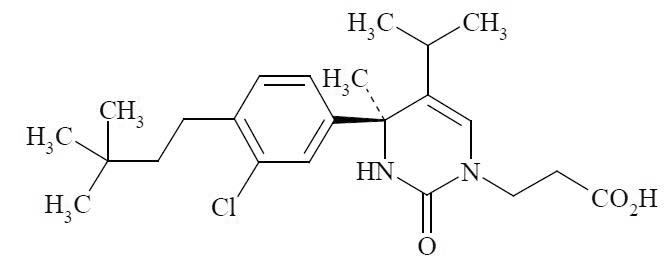
- Compound A is 3- ⁇ (S)-4-[3-chloro-4-(3,3-dimethyl-butyl)-phenyl]-5-isopropyl-4-methyl-2-oxo-3,4-dihydro-2H-pyrimidin-1-yl ⁇ -propionic acid, and is represented by the following formula: .
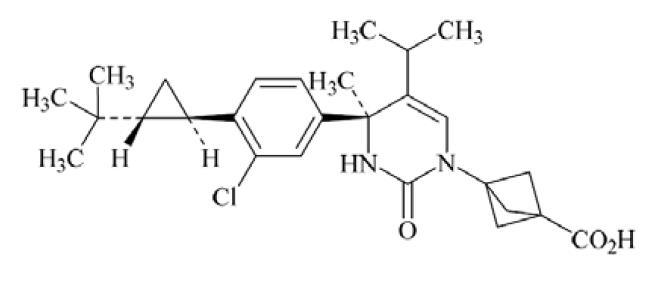
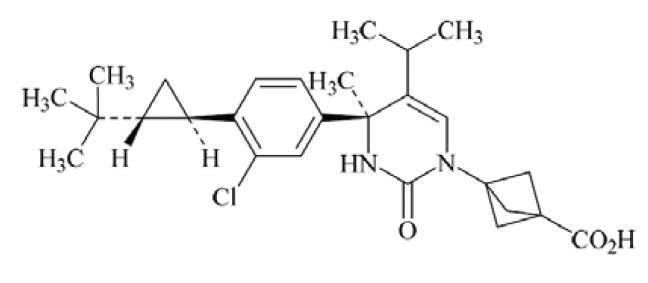
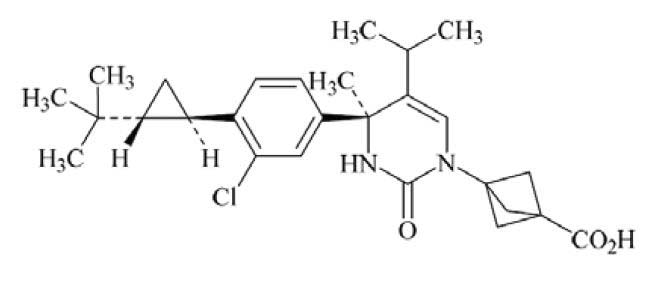
- Compound B is 3- ⁇ (S)-4-[4-((1R,2R)-2-tert-butyl-cyclopropyl)-3-chloro-phenyl]-5-isopropyl-4-methyl-2-oxo-3,4-dihydro-2H-pyrimidin-1-yl ⁇ bicyclo[1.1.1]pentane-1-carboxylic acid, and is represented by the following formula: .
- Compound A and pharmaceutically acceptable salts thereof can be produced using a known method, such as a method described in US Patent number 10,196,363, the content of which is incorporated herein for reference.
- Compound B and pharmaceutically acceptable salts thereof can be produced using a known method, such as a method described in US published application number 2019/0300488, the content of which is incorporated herein for reference.
- pharmaceutically acceptable salt may be any salts without excess toxicity known in the art. Specifically, it includes, for example, salts with inorganic acids, salts with organic acids, salts with inorganic bases, and salts with organic bases.
- Various forms of pharmaceutically acceptable salts are well known in the art and are listed, for example, in the following references: (a) Berge et al., J. Pharm. Sci., 66, p1-19 (1977); (b) Stahl et al., "Handbook of Pharmaceutical Salts: Properties, Selection, and Use” (Wiley-VCH, Weinheim, Germany, 2002); (c) Paulekuhn et al., J. Med. Chem., 50, p6665-6672 (2007).
- Compound A or Compound B may be reacted with an inorganic acid, organic acid, inorganic base, or organic base to give each pharmaceutically acceptable salt thereof.
- Such salts with inorganic acids include, for example, salts with hydrofluoric acid, hydrochloric acid, hydrobromic acid, hydroiodic acid, nitric acid, phosphoric acid, and sulfuric acid.
- Preferable salts include salts with hydrochloric acid, nitric acid, sulfuric acid, phosphoric acid, and hydrobromic acid.
- Such salts with organic acids include, for example, salts with acetic acid, adipic acid, alginic acid, 4-aminosalicylic acid, anhydromethylenecitric acid, benzoic acid, benzenesulfonic acid, camphor acid, camphor-10-sulfonic acid, carbonic acid, citric acid, edetic acid, ethane-1,2-disulfonic acid, dodecylsulfonic acid, ethanesulfonic acid, fumaric acid, glucoheptonic acid, gluconic acid, glucuronic acid, glucoheptonic acid, glycollylarsanilic acid, hydroxynaphthoic acid, 2-hydroxy-1-ethanesulfonic acid, lactic acid, lactobionic acid, malic acid, maleic acid, mandelic acid, methanesulfonic acid, methylsulfuric acid, methylnitric acid, methylenebis(salicylic acid), galacta
- Preferable salts include salts with oxalic acid, maleic acid, citric acid, fumaric acid, lactic acid, malic acid, succinic acid, tartaric acid, acetic acid, trifluoroacetic acid, benzoic acid, glucuronic acid, oleic acid, pamoic acid, methanesulfonic acid, benzenesulfonic acid, p-toluenesulfonic acid, and 2-hydroxy-1-ethanesulfonic acid.
- Such salts with inorganic bases include, for example, salts with lithium, sodium, potassium, magnesium, calcium, barium, aluminum, zinc, bismuth, and ammonium.
- Preferable salts include salts with sodium, potassium, calcium, magnesium, and zinc.
- Such salts with organic bases include, for example, salts with arecoline, betaine, choline, clemizole, ethylenediamine, N-methylglucamine, N-benzylphenethylamine, tris(hydroxymethyl)methylamine, arginine, and lysine.
- Preferable salts include salts with tris(hydroxymethyl)methylamine, N-methylglucamine, and lysine.
- Compound A or Compound B or a pharmaceutically acceptable salt thereof may exist in a solvate form.
- solvate means Compound A or Compound B or a pharmaceutically acceptable salt thereof coordinate with a solvent molecule and includes a hydrate.
- a solvate is preferably a pharmaceutically acceptable solvate and includes hydrates, ethanolates, and solvates with dimethylsufoxide of Compound A or Compound B or a pharmaceutically acceptable salt thereof.
- such a solvate includes a hemihydrate, monohydrate, dihydrate, or monoethanolate of Compound A or Compound B, or a monohydrate of a hydrochloride salt or a 2/3 ethanolate of a dihydrochloride salt of Compound A or Compound B.
- Compound A or Compound B or a pharmaceutically acceptable salt thereof may be labelled with an isotope atom such as 2 H, 3 H, 14 C, and 35 S.
- any hydrogen atoms of Compound A or Compound B include protium 1 H (H), deuterium 2 H (D), and tritium 3 H (T).
- Compound A or Compound B, or a pharmaceutically acceptable salt thereof is preferably Compound A or Compound B, or a pharmaceutically acceptable salt thereof, substantially purified. More preferable one is Compound A or Compound B, or a pharmaceutically acceptable salt thereof, having 80% or more of purity.
- the therapeutic agent or prophylactic agent for pancreatic cancer of the present invention is produced, for example, according to a known method in the technical field of medicinal preparations by mixing Compound A or Compound B or a pharmaceutically acceptable salt thereof with a suitable amount of at least one kind of pharmaceutically acceptable carrier or the like as appropriate.
- the amount of Compound A or Compound B or a pharmaceutically acceptable salt thereof in said preparation differs according to the dosage form, dose, and the like, but is, for example, 0.1 to 100 wt % of the entire preparation.
- the therapeutic agent or prophylactic agent can be administered orally or parenterally.
- Oral administration or parenteral administration such as intravenous, intramuscular, subcutaneous, percutaneous, local, or rectal administration can be given as examples of dosage forms.
- These can be prepared according to known methods in the technical field of medicinal preparations.
- Examples of a “pharmaceutically acceptable carrier” include various organic or inorganic carrier substances conventionally used as formulation materials, and examples include excipients, disintegrants, binders, fluidizers, lubricants, and the like for solid preparations; solvents, solubilizing agents, suspending agents, isotonicity agents, buffering agents, soothing agents, and the like for liquid preparations; and bases, emulsifiers, humectants, stabilizers, labilizing agents, dispersants, plasticizers, pH regulators, absorption promoters, gelling agents, antiseptics, fillers, solvents, solubilizers, suspending agents, and the like for semisolid preparations. It is also acceptable to use additives such as preservatives, antioxidants, colorants, sweetening agents, and the like as necessary.
- an "excipient” examples include lactose, sucrose, D-mannitol, D-sorbitol, cornstarch, dextrin, microcrystalline cellulose, crystalline cellulose, carmellose, carmellose calcium, sodium carboxymethyl starch, low-substituted hydroxypropylcellulose, gum arabic, and the like.
- Examples of a “disintegrant” include carmellose, carmellose calcium, carmellose sodium, sodium carboxymethyl starch, croscarmellose sodium, crospovidone, low-substituted hydroxypropylcellulose, hydroxypropylmethylcellulose, crystalline cellulose, and the like.
- binder examples include hydroxypropylcellulose, hydroxypropylmethylcellulose, povidone, crystalline cellulose, sucrose, dextrin, starch, gelatin, carmellose sodium, gum arabic, and the like.
- a "fluidizer” examples include light anhydrous silicic acid, magnesium stearate, and the like.
- lubricant examples include magnesium stearate, calcium stearate, talc, and the like.
- solvent examples include purified water, ethanol, propylene glycol, macrogol, sesame oil, corn oil, olive oil, and the like.
- a “solubilizing agent” examples include propylene glycol, D-mannitol, benzyl benzoate, ethanol, triethanolamine, sodium carbonate, sodium citrate, and the like.
- a "suspending agent” examples include benzalkonium chloride, carmellose, hydroxypropylcellulose, propylene glycol, povidone, methylcellulose, glycerol monostearate, and the like.
- an “isotonic agent” examples include glucose, D-sorbitol, sodium chloride, D-mannitol, and the like.
- Examples of a “buffering agent” include sodium hydrogenphosphate, sodium acetate, sodium carbonate, sodium citrate, and the like.
- a “soothing agent” examples include benzyl alcohol and the like.
- Examples of a “base” include water, vegetable oils (olive oil, corn oil, peanut oil, sesame oil, castor oil, and the like), lower alcohols (ethanol, propanol, propylene glycol, 1,3-butylene glycol, phenol, and the like), higher fatty acids and esters thereof, waxes, higher alcohols, polyhydric alcohols, hydrocarbons (white petrolatum, liquid paraffin, paraffin, and the like), hydrophilic petrolatum, purified lanolin, absorptive ointments, hydrous lanolin, hydrophilic ointments, starches, pullulan, gum arabic, tragacanth gum, gelatins, dextran, cellulose derivatives (methyl cellulose, carboxymethyl cellulose, hydroxyethyl cellulose, hydroxypropyl cellulose, and the like), synthetic polymers (carboxyvinyl polymer, sodium polyacrylate, polyvinyl alcohol, polyvinyl pyrrolidone, and the like), propy
- a "preservative” examples include ethyl parahydroxybenzoate, chlorobutanol, benzyl alcohol, sodium dehydroacetate, sorbic acid, and the like.
- an "antioxidant” examples include sodium sulfite, ascorbic acid, and the like.
- Examples of a "colorant” include food colorings (such as Food Red No. 2 or No. 3, or Food Yellow No. 4 or No. 5), ⁇ -carotene, and the like.
- sweetening agent examples include saccharine sodium, dipotassium glycyrrhizinate, aspartame, and the like.
- Formulation examples for Compound A and Compound B include the following formulations. The present invention is not, however, limited by these formulation examples.
- Formulation Example 1 Production of a capsule 1) Compound A or Compound B 30 mg 2) Microcrystalline cellulose 10 mg 3) Lactose 19 mg 4) Magnesium stearate 1 mg 1), 2), 3), and 4) are mixed and filled in a gelatin capsule.
- Formulation Example 2 Production of a tablet 1) Compound A or Compound B 10 g 2) Lactose 50 g 3) Corn starch 15 g 4) Carmellose calcium 44 g 5) Magnesium stearate 1 g
- the total amounts of 1), 2), and 3) and 30 g of 4) are kneaded with water, vacuum dried, and sieved.
- the sieved powder is mixed with 14 g of 4) and 1 g of 5), and the mixture is punched by means of a tableting machine. In this way, 1,000 tablets each containing 10 mg of Compound A or Compound B per tablet are obtained.
- Compound A or a pharmaceutically acceptable salt thereof or Compound B or a pharmaceutically acceptable salt thereof can be used as an active ingredient of a therapeutic agent or prophylactic agent for cancer, such as pancreatic cancer, breast cancer, liver cancer, or prostate cancer.
- treating also includes ameliorating symptoms, preventing from becoming severe, maintaining remission, preventing exacerbation, and preventing relapse.
- preventing means suppressing pathogenesis of symptoms.
- pancreatic cancer means a cancer arising from cells within the pancreas.
- the pancreas is a gland located in the abdomen, between the stomach and the spine.
- Pancreatic cancers are either exocrine or neuroendocrine cancers, depending on the type of cell from which they are derived.
- exocrine pancreatic cancers include adenocarcinoma (e.g., ductal adenocarcinoma and acinar adenocarcinoma), acinar cell carcinoma, adenosquamous carcinoma, colloid carcinoma, hepatoid carcinoma, intraductal papillary mucinous neoplasm, mucinous cystic neoplasm, pancreatic intraepithelial neoplasia, pancreatoblastoma, serous cystadenoma, signet ring cell carcinoma, solid-pseudopapillary neoplasm, undifferentiated carcinoma, and undifferentiated carcinoma with osteoclast-like giant cells.
- pancreatic neuroendocrine tumors include insulinoma and glucagonoma.
- breast cancer means a cancer arising from cells within breast tissue.
- Breast cancer cells have receptors on their surface, in their cytoplasm, and in their nucleus.
- Breast cancer cells may or may not have one or more of the following three receptors: estrogen receptor, progesterone receptor, and human epidermal growth factor receptor 2 (HER2).
- HER2 human epidermal growth factor receptor 2
- Triple-negative breast cancer is negative for each of estrogen receptor, progesterone receptor, and HER2.
- liver cancer means a cancer arising from cells within the liver.
- the most common risk factor for liver cancer is chronic infection with hepatitis B virus or hepatitis C virus. These infections lead to cirrhosis of the liver.
- the most common types of liver cancer are hepatocellular carcinoma and cholangiocarcinoma.
- prostate cancer means a cancer arising from cells within the prostate gland.
- An example of prostate cancer includes castration-resistant prostate cancer. Most prostate cancers are adenocarcinomas. Other types of prostate cancer include small cell carcinomas, neuroendocrine tumors, transitional cell carcinomas, and sarcomas.
- lung cancer means a cancer arising from cells within the lung.
- Examples of lung cancer include small cell lung cancer and non-small cell lung cancer.
- leukemia means a cancer of the blood or bone marrow.
- leukemia include acute lymphocytic leukemia, acute myelogenous leukemia, chronic lymphocytic leukemia, and chronic myelogenous leukemia.
- Compound A or a pharmaceutically acceptable salt thereof or Compound B or a pharmaceutically acceptable salt thereof can be used in combination (hereinafter also referred to as “concomitantly") with one or multiple other drugs (hereinafter also referred to as a “concomitant drug” or a “second agent”) using a common practice employed in the medical field.
- Examples of a concomitant drug include Abraxane (nab-paclitaxel), Afinitor (Everolimus), Erlotinib Hydrochloride, Everolimus, 5-FU (Fluorouracil Injection), Fluorouracil Injection, Gemzar (Gemcitabine Hydrochloride), Irinotecan Hydrochloride Liposome, Mitomycin C, Onivyde (Irinotecan Hydrochloride Liposome), Paclitaxel Albumin-stabilized Nanoparticle Formulation, Sutent (Sunitinib Malate), Tarceva (Erlotinib Hydrochloride), FOLFIRINOX (Oxaliplatin, Fluorouracil, Leucovorin Calcium, and Irinotecan Hydrochloride combination), GEMCITABINE-CISPLATIN (Gemcitabine Hydrochloride and Cisplatin combination), GEMCITABINE-OXALIPLATIN (Gemcitabine Hydrochloride and Oxaliplatin combination),
- Gemzar can be administered intravenously or orally.
- an exemplary dosing regimen is 1000 mg/m 2 over 30 minutes once weekly for the first 7 weeks, then one week rest, then once weekly for 3 weeks of each 28-day cycle.
- the timing of administration of a drug comprising Compound A or a pharmaceutically acceptable salt thereof or Compound B or a pharmaceutically acceptable salt thereof and a concomitant drug is not limited, it is acceptable to administer these to an administration subject as a combination drug, and it is also acceptable to administer the two formulations either simultaneously or at a fixed interval. Furthermore, it is also acceptable to use the therapeutic agent or prophylactic agent of the present invention and a concomitant drug as a medication that is characterized in that the medication is a kit comprising said agent and concomitant drug.
- the dosage of a concomitant drug is acceptable as long as it is based on a dosage used in clinical practice, and the dosage can be appropriately selected according to the administration subject, disease, symptoms, dosage form, administration route, administration time, combination, and so on.
- the dosage form of a concomitant drug is not particularly limited, and is acceptable as long as a drug comprising Compound A or a pharmaceutically acceptable salt thereof or Compound B or a pharmaceutically acceptable salt thereof are combined with the concomitant drug.
- Examples of one embodiment of the present invention include a method for the treatment or prophylaxis of pancreatic cancer that comprises administering to a human a therapeutically effective amount of Compound A or a pharmaceutically acceptable salt thereof or Compound B or a pharmaceutically acceptable salt thereof.
- Examples of another embodiment of the present invention include a method for the treatment or prophylaxis of breast cancer (e.g., triple-negative breast cancer) that comprises administering to a human a therapeutically effective amount of Compound A or a pharmaceutically acceptable salt thereof or Compound B or a pharmaceutically acceptable salt thereof.
- a method for the treatment or prophylaxis of breast cancer e.g., triple-negative breast cancer
- Examples of another embodiment of the present invention include a method for the treatment or prophylaxis of liver cancer (e.g., liver cancer associated with hepatitis B virus or hepatitis C virus infection) that comprises administering to a human a therapeutically effective amount of Compound A or a pharmaceutically acceptable salt thereof or Compound B or a pharmaceutically acceptable salt thereof.
- liver cancer e.g., liver cancer associated with hepatitis B virus or hepatitis C virus infection
- Examples of another embodiment of the present invention include a method for the treatment or prophylaxis of prostate cancer that comprises administering to a human a therapeutically effective amount of Compound A or a pharmaceutically acceptable salt thereof or Compound B or a pharmaceutically acceptable salt thereof.
- Examples of another embodiment of the present invention include a method for the treatment or prophylaxis of lung cancer that comprises administering to a human a therapeutically effective amount of Compound A or a pharmaceutically acceptable salt thereof or Compound B or a pharmaceutically acceptable salt thereof.
- Examples of another embodiment of the present invention include a method for the treatment or prophylaxis of leukemia that comprises administering to a human a therapeutically effective amount of Compound A or a pharmaceutically acceptable salt thereof or Compound B or a pharmaceutically acceptable salt thereof.
- an “effective amount” signifies, for example, the amount of a medication or drug that elicits a biological or medical response in a tissue, system, or human.
- a “therapeutically effective amount” signifies an arbitrary amount that either produces a treatment, cure, prophylaxis, or improvement where cancer or a side effect is improved in comparison with a corresponding subject that has not received such an amount.
- Example 1 Evaluation of the Effect of Compounds on Viability of Organoid Lines The effect of three compounds on cell proliferation of three organoid lines was evaluated.
- the three test compounds evaluated were Compound A, Compound B, and gemcitabine.
- the organoid lines used are described in Table 1.
- the major reagents used are described in Table 2.
- the cells were cultured in a 37ºC incubator with 5% CO 2 and 95% air.
- Gemcitabine was purchased from Selleck (Cat. no. S1714). Staurosporine, a positive control, was purchased from Selleck (Cat. no. S1421).
- EnVision Multi Label Reader 2104-0010A PerkinElmer, Equip ID:TAREA0011; CO 2 Water Jacketed Incubator, SANYO, Equip ID: TAINC0020; Digital Dispenser, Tecan D300e; and Multidrop Combi reagent dispenser, Thermofisher.
- organoids were sheared to uniform sizes.
- the organoids were processed 1:1 using 50% Matrigel to define the size of the organoids to perform the screen.
- organoids were seeded, as follows. a) The organoids were collected from each well by adding 20 ⁇ l 100x Dispase solution to each well from a 6-well plate, which contains 2 ml of organoid medium. b) The plates were put back in the incubator, at 37°C for 30 minutes. c) The organoids were collected from all wells and pipetted through a pre-wet 100 ⁇ m filter into a 50 ml plastic tube. d) Once all wells were filtered over 100 ⁇ m filters, the flow though was filtered over a pre-wet 20 ⁇ m filter. e) The 20 ⁇ m filter was inverted and the organoids were recovered in a new 50 ml tube.
- the top working concentration was 100 ⁇ M, with 3.16-fold serial dilutions of each dose level, to achieve 9 dose levels, identified below as C1-C9.
- the top working concentration was 1 ⁇ M, with 3.16-fold serial dilutions of each dose level, to achieve 9 dose levels, identified below as C1-C9. l) Screening plates were placed back into the incubator.
- a dose-response curve was fitted using nonlinear regression model with a sigmoidal dose response.
- the formula for calculating surviving rate is shown below.
- the surviving rate (%) (Lum Test article -Lum Medium control )/ (Lum None treated -Lum Medium control ) x 100%.
Landscapes
- Health & Medical Sciences (AREA)
- Life Sciences & Earth Sciences (AREA)
- Veterinary Medicine (AREA)
- Chemical & Material Sciences (AREA)
- Medicinal Chemistry (AREA)
- Pharmacology & Pharmacy (AREA)
- Animal Behavior & Ethology (AREA)
- General Health & Medical Sciences (AREA)
- Public Health (AREA)
- Epidemiology (AREA)
- Chemical Kinetics & Catalysis (AREA)
- General Chemical & Material Sciences (AREA)
- Nuclear Medicine, Radiotherapy & Molecular Imaging (AREA)
- Organic Chemistry (AREA)
- Molecular Biology (AREA)
- Hematology (AREA)
- Oncology (AREA)
- Pharmaceuticals Containing Other Organic And Inorganic Compounds (AREA)
Abstract
Provided is a therapeutic or prophylactic agent for cancer comprising 3-{(S)-4-[3-chloro-4-(3,3-dimethyl-butyl)-phenyl]-5-isopropyl-4-methyl-2-oxo-3,4-dihydro-2H-pyrimidin-1-yl}-propionic acid or a pharmaceutically acceptable salt thereof or 3-{(S)-4-[4-((1R,2R)-2-tert-butyl-cyclopropyl)-3-chloro-phenyl]-5-isopropyl-4-methyl-2-oxo-3,4-dihydro-2H-pyrimidin-1-yl}bicyclo[1.1.1]pentane-1-carboxylic acid or a pharmaceutically acceptable salt thereof.
Description
CROSS-REFERENCE TO RELATED APPLICATIONS
This application claims priority to U.S. Provisional Appl. No. 62/965,254, filed January 24, 2020. The content of the prior application is incorporated by reference herein in its entirety.
This application claims priority to U.S. Provisional Appl. No. 62/965,254, filed January 24, 2020. The content of the prior application is incorporated by reference herein in its entirety.
TECHNICAL FIELD
The present invention pertains to medicinal use of 3-{(S)-4-[3-chloro-4-(3,3-dimethyl-butyl)-phenyl]-5-isopropyl-4-methyl-2-oxo-3,4-dihydro-2H-pyrimidin-1-yl}-propionic acid or a pharmaceutically acceptable salt thereof and 3-{(S)-4-[4-((1R,2R)-2-tert-butyl-cyclopropyl)-3-chloro-phenyl]-5-isopropyl-4-methyl-2-oxo-3,4-dihydro-2H-pyrimidin-1-yl}bicyclo[1.1.1]pentane-1-carboxylic acid or a pharmaceutically acceptable salt thereof as therapeutic agents or prophylactic agents for cancer.
The present invention pertains to medicinal use of 3-{(S)-4-[3-chloro-4-(3,3-dimethyl-butyl)-phenyl]-5-isopropyl-4-methyl-2-oxo-3,4-dihydro-2H-pyrimidin-1-yl}-propionic acid or a pharmaceutically acceptable salt thereof and 3-{(S)-4-[4-((1R,2R)-2-tert-butyl-cyclopropyl)-3-chloro-phenyl]-5-isopropyl-4-methyl-2-oxo-3,4-dihydro-2H-pyrimidin-1-yl}bicyclo[1.1.1]pentane-1-carboxylic acid or a pharmaceutically acceptable salt thereof as therapeutic agents or prophylactic agents for cancer.
BACKGROUND
Cancer occurs when cells in the body grow out of control.
Cancer occurs when cells in the body grow out of control.
The pancreas is a gland located in the abdomen, between the stomach and the spine. Pancreatic cancer arises from cells within the pancreas. Pancreatic cancers are either exocrine or neuroendocrine cancers, depending on the type of cell from which they are derived. Pancreatic adenocarcinoma accounts for about 85% of all pancreatic cancers. Pancreatic adenocarcinoma has a poor prognosis, with 25% of patients surviving one year after diagnosis and 5% of patients living for five years after diagnosis.
Breast cancer is cancer that forms in the cells of the breasts. Breast cancers that start in the cells that line the ducts are called ductal cancers. Breast cancers that start in the lobules are called lobular cancers. Some breast cancers start in the stroma.
The liver is located in the right upper quadrant of the abdomen, below the diaphragm. Liver cancer, also known as hepatic cancer and primary hepatic cancer, is a cancer that starts in the liver. The leading causes of liver cancer are cirrhosis due to Hepatitis B, Hepatitis C, or alcohol.
The prostate is located below the bladder and in front of the rectum. Prostate cancer begins when cells in the prostate gland grow out of control.
SUMMARY
The invention features a method of treating or preventing a pancreatic cancer in a human subject in need thereof by administering to the human subject a therapeutically effective amount of a compound represented by the following formula:
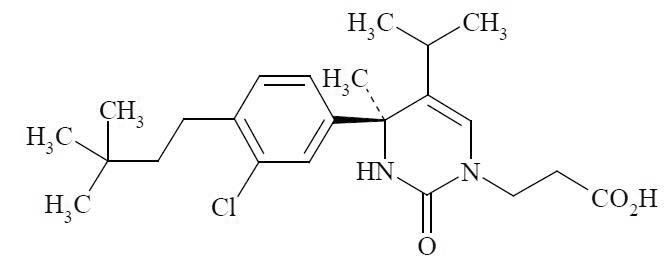
or a pharmaceutically acceptable salt thereof.
The invention features a method of treating or preventing a pancreatic cancer in a human subject in need thereof by administering to the human subject a therapeutically effective amount of a compound represented by the following formula:
The invention also features a method of treating or preventing a pancreatic cancer in a human subject in need thereof by administering to the human subject a therapeutically effective amount of a compound represented by the following formula:
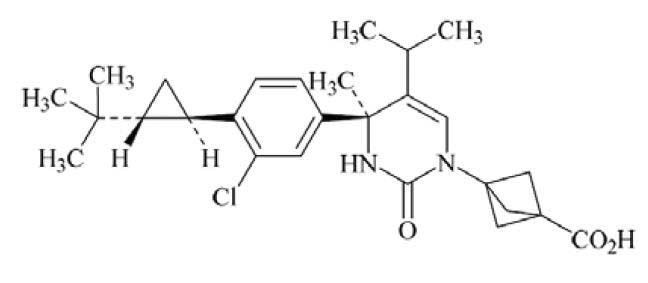
or a pharmaceutically acceptable salt thereof.
In some embodiments of any of the preceding methods, the pancreatic cancer is an exocrine pancreatic cancer. In some instances, the exocrine pancreatic cancer is an adenocarcinoma (e.g., a ductal adenocarcinoma or an acinar adenocarcinoma). In some instances, the exocrine pancreatic cancer is an acinar cell carcinoma, an adenosquamous carcinoma, a colloid carcinoma, a hepatoid carcinoma, an intraductal papillary mucinous neoplasm, a mucinous cystic neoplasm, a pancreatic intraepithelial neoplasia, a pancreatoblastoma, a serous cystadenoma, a signet ring cell carcinoma, a solid-pseudopapillary neoplasm, an undifferentiated carcinoma, or an undifferentiated carcinoma with osteoclast-like giant cells.
In some embodiments of any of the preceding methods, the pancreatic cancer is a pancreatic neuroendocrine tumor. In some instances, the pancreatic neuroendocrine tumor is an insulinoma or a glucagonoma.
In some embodiments of any of the preceding methods, the compound or pharmaceutically acceptable salt thereof is administered orally.
In some embodiments of any of the preceding methods, the compound or pharmaceutically acceptable salt thereof is administered in combination with a second agent. In some instances, the second agent is gemcitabine. In some instances, gemcitabine is administered intravenously. In some instances, the compound or pharmaceutically acceptable salt thereof is administered orally and gemcitabine is administered intravenously. In some instances, gemcitabine is administered orally. In some instances, the compound or pharmaceutically acceptable salt thereof is administered orally and gemcitabine is administered orally. In some instances, the second agent is erlotinib, nab-paclitaxel, FOLFIRINOX, or TS-1.
The invention also features a method of treating or preventing a cancer in a human subject in need thereof by administering to the human subject a therapeutically effective amount of a compound represented by the following formula:
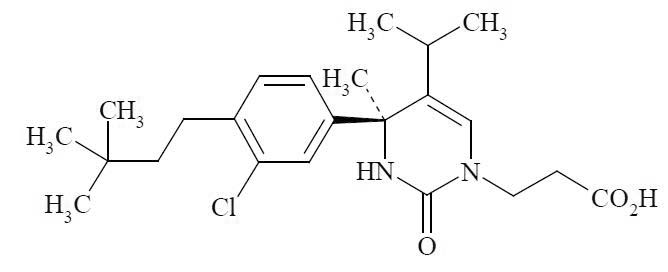
or a pharmaceutically acceptable salt thereof, wherein the cancer is a breast cancer, a liver cancer, a prostate cancer, a lung cancer, or a leukemia.
The invention also features a method of treating or preventing a cancer in a human subject in need thereof by administering to the human subject a therapeutically effective amount of a compound represented by the following formula:
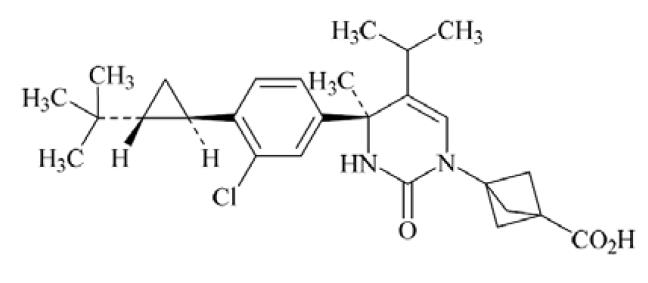
or a pharmaceutically acceptable salt thereof, wherein the cancer is a breast cancer, a liver cancer, a prostate cancer, a lung cancer, or a leukemia.
In some embodiments, the breast cancer is triple-negative breast cancer.
In some embodiments, the liver cancer is associated with hepatitis B virus or hepatitis C virus infection.
In some embodiments, the prostate cancer is castration-resistant prostate cancer.
In some embodiments, the lung cancer is small cell lung cancer.
In some embodiments, the lung cancer is non-small cell lung cancer.
In some embodiments, the leukemia is acute lymphocytic leukemia, acute myelogenous leukemia, chronic lymphocytic leukemia, or chronic myelogenous leukemia.
In some embodiments of any of the preceding methods, the compound or pharmaceutically acceptable salt thereof is administered orally.
In some embodiments of any of the preceding methods, the compound or pharmaceutically acceptable salt thereof is administered in combination with a second agent.
DETAILED DESCRIPTION
Compound A, Compound B, and Pharmaceutically Acceptable Salts
"Compound A" is 3-{(S)-4-[3-chloro-4-(3,3-dimethyl-butyl)-phenyl]-5-isopropyl-4-methyl-2-oxo-3,4-dihydro-2H-pyrimidin-1-yl}-propionic acid, and is represented by the following formula:
.
Compound A, Compound B, and Pharmaceutically Acceptable Salts
"Compound A" is 3-{(S)-4-[3-chloro-4-(3,3-dimethyl-butyl)-phenyl]-5-isopropyl-4-methyl-2-oxo-3,4-dihydro-2H-pyrimidin-1-yl}-propionic acid, and is represented by the following formula:
"Compound B" is 3-{(S)-4-[4-((1R,2R)-2-tert-butyl-cyclopropyl)-3-chloro-phenyl]-5-isopropyl-4-methyl-2-oxo-3,4-dihydro-2H-pyrimidin-1-yl}bicyclo[1.1.1]pentane-1-carboxylic acid, and is represented by the following formula:
.
Compound A and pharmaceutically acceptable salts thereof can be produced using a known method, such as a method described in US Patent number 10,196,363, the content of which is incorporated herein for reference.
Compound B and pharmaceutically acceptable salts thereof can be produced using a known method, such as a method described in US published application number 2019/0300488, the content of which is incorporated herein for reference.
The term "pharmaceutically acceptable salt" may be any salts without excess toxicity known in the art. Specifically, it includes, for example, salts with inorganic acids, salts with organic acids, salts with inorganic bases, and salts with organic bases. Various forms of pharmaceutically acceptable salts are well known in the art and are listed, for example, in the following references:
(a) Berge et al., J. Pharm. Sci., 66, p1-19 (1977);
(b) Stahl et al., "Handbook of Pharmaceutical Salts: Properties, Selection, and Use" (Wiley-VCH, Weinheim, Germany, 2002);
(c) Paulekuhn et al., J. Med. Chem., 50, p6665-6672 (2007).
(a) Berge et al., J. Pharm. Sci., 66, p1-19 (1977);
(b) Stahl et al., "Handbook of Pharmaceutical Salts: Properties, Selection, and Use" (Wiley-VCH, Weinheim, Germany, 2002);
(c) Paulekuhn et al., J. Med. Chem., 50, p6665-6672 (2007).
According to known methods, Compound A or Compound B may be reacted with an inorganic acid, organic acid, inorganic base, or organic base to give each pharmaceutically acceptable salt thereof.
Such salts with inorganic acids include, for example, salts with hydrofluoric acid, hydrochloric acid, hydrobromic acid, hydroiodic acid, nitric acid, phosphoric acid, and sulfuric acid. Preferable salts include salts with hydrochloric acid, nitric acid, sulfuric acid, phosphoric acid, and hydrobromic acid.
Such salts with organic acids include, for example, salts with acetic acid, adipic acid, alginic acid, 4-aminosalicylic acid, anhydromethylenecitric acid, benzoic acid, benzenesulfonic acid, camphor acid, camphor-10-sulfonic acid, carbonic acid, citric acid, edetic acid, ethane-1,2-disulfonic acid, dodecylsulfonic acid, ethanesulfonic acid, fumaric acid, glucoheptonic acid, gluconic acid, glucuronic acid, glucoheptonic acid, glycollylarsanilic acid, hydroxynaphthoic acid, 2-hydroxy-1-ethanesulfonic acid, lactic acid, lactobionic acid, malic acid, maleic acid, mandelic acid, methanesulfonic acid, methylsulfuric acid, methylnitric acid, methylenebis(salicylic acid), galactaric acid, naphthalene-2-sulfonic acid, 2-naphthoic acid, 1,5-naphthalenedisulfonic acid, oleic acid, oxalic acid, pamoic acid, pantothenic acid, pectic acid, picric acid, propionic acid, polygalacturonic acid, salicylic acid, stearic acid, succinic acid, tannic acid, tartaric acid, teoclic acid, thiocyanic acid, trifluoroacetic acid, p-toluenesulfonic acid, undecanoic acid, asparaginic acid, and glutamic acid. Preferable salts include salts with oxalic acid, maleic acid, citric acid, fumaric acid, lactic acid, malic acid, succinic acid, tartaric acid, acetic acid, trifluoroacetic acid, benzoic acid, glucuronic acid, oleic acid, pamoic acid, methanesulfonic acid, benzenesulfonic acid, p-toluenesulfonic acid, and 2-hydroxy-1-ethanesulfonic acid.
Such salts with inorganic bases include, for example, salts with lithium, sodium, potassium, magnesium, calcium, barium, aluminum, zinc, bismuth, and ammonium. Preferable salts include salts with sodium, potassium, calcium, magnesium, and zinc.
Such salts with organic bases include, for example, salts with arecoline, betaine, choline, clemizole, ethylenediamine, N-methylglucamine, N-benzylphenethylamine, tris(hydroxymethyl)methylamine, arginine, and lysine. Preferable salts include salts with tris(hydroxymethyl)methylamine, N-methylglucamine, and lysine.
Compound A or Compound B or a pharmaceutically acceptable salt thereof may exist in a solvate form.
The term "solvate" means Compound A or Compound B or a pharmaceutically acceptable salt thereof coordinate with a solvent molecule and includes a hydrate. Such a solvate is preferably a pharmaceutically acceptable solvate and includes hydrates, ethanolates, and solvates with dimethylsufoxide of Compound A or Compound B or a pharmaceutically acceptable salt thereof.
Specifically, such a solvate includes a hemihydrate, monohydrate, dihydrate, or monoethanolate of Compound A or Compound B, or a monohydrate of a hydrochloride salt or a 2/3 ethanolate of a dihydrochloride salt of Compound A or Compound B.
Compound A or Compound B or a pharmaceutically acceptable salt thereof may be labelled with an isotope atom such as 2H, 3H, 14C, and 35S.
For example, any hydrogen atoms of Compound A or Compound B include protium 1H (H), deuterium 2H (D), and tritium 3H (T).
Compound A or Compound B, or a pharmaceutically acceptable salt thereof is preferably Compound A or Compound B, or a pharmaceutically acceptable salt thereof, substantially purified. More preferable one is Compound A or Compound B, or a pharmaceutically acceptable salt thereof, having 80% or more of purity.
The therapeutic agent or prophylactic agent for pancreatic cancer of the present invention is produced, for example, according to a known method in the technical field of medicinal preparations by mixing Compound A or Compound B or a pharmaceutically acceptable salt thereof with a suitable amount of at least one kind of pharmaceutically acceptable carrier or the like as appropriate. The amount of Compound A or Compound B or a pharmaceutically acceptable salt thereof in said preparation differs according to the dosage form, dose, and the like, but is, for example, 0.1 to 100 wt % of the entire preparation.
The therapeutic agent or prophylactic agent can be administered orally or parenterally. Oral administration or parenteral administration such as intravenous, intramuscular, subcutaneous, percutaneous, local, or rectal administration can be given as examples of dosage forms. Tablets, capsules, granules, powders, troches, syrups, emulsions, suspensions, and the like can be given as examples of dosage forms that are appropriate for oral administration, and external preparations, suppositories, injections, eye drops, eye ointments, patches, gels, implants, nasal preparations, or pulmonary preparations can be given as examples of dosage forms that are appropriate for parenteral administration. These can be prepared according to known methods in the technical field of medicinal preparations.
Examples of a "pharmaceutically acceptable carrier" include various organic or inorganic carrier substances conventionally used as formulation materials, and examples include excipients, disintegrants, binders, fluidizers, lubricants, and the like for solid preparations; solvents, solubilizing agents, suspending agents, isotonicity agents, buffering agents, soothing agents, and the like for liquid preparations; and bases, emulsifiers, humectants, stabilizers, labilizing agents, dispersants, plasticizers, pH regulators, absorption promoters, gelling agents, antiseptics, fillers, solvents, solubilizers, suspending agents, and the like for semisolid preparations. It is also acceptable to use additives such as preservatives, antioxidants, colorants, sweetening agents, and the like as necessary.
Examples of an "excipient" include lactose, sucrose, D-mannitol, D-sorbitol, cornstarch, dextrin, microcrystalline cellulose, crystalline cellulose, carmellose, carmellose calcium, sodium carboxymethyl starch, low-substituted hydroxypropylcellulose, gum arabic, and the like.
Examples of a "disintegrant" include carmellose, carmellose calcium, carmellose sodium, sodium carboxymethyl starch, croscarmellose sodium, crospovidone, low-substituted hydroxypropylcellulose, hydroxypropylmethylcellulose, crystalline cellulose, and the like.
Examples of a "binder" include hydroxypropylcellulose, hydroxypropylmethylcellulose, povidone, crystalline cellulose, sucrose, dextrin, starch, gelatin, carmellose sodium, gum arabic, and the like.
Examples of a "fluidizer" include light anhydrous silicic acid, magnesium stearate, and the like.
Examples of a "lubricant" include magnesium stearate, calcium stearate, talc, and the like.
Examples of a "solvent" include purified water, ethanol, propylene glycol, macrogol, sesame oil, corn oil, olive oil, and the like.
Examples of a "solubilizing agent" include propylene glycol, D-mannitol, benzyl benzoate, ethanol, triethanolamine, sodium carbonate, sodium citrate, and the like.
Examples of a "suspending agent" include benzalkonium chloride, carmellose, hydroxypropylcellulose, propylene glycol, povidone, methylcellulose, glycerol monostearate, and the like.
Examples of an "isotonic agent" include glucose, D-sorbitol, sodium chloride, D-mannitol, and the like.
Examples of a "buffering agent" include sodium hydrogenphosphate, sodium acetate, sodium carbonate, sodium citrate, and the like.
Examples of a "soothing agent" include benzyl alcohol and the like.
Examples of a "base" include water, vegetable oils (olive oil, corn oil, peanut oil, sesame oil, castor oil, and the like), lower alcohols (ethanol, propanol, propylene glycol, 1,3-butylene glycol, phenol, and the like), higher fatty acids and esters thereof, waxes, higher alcohols, polyhydric alcohols, hydrocarbons (white petrolatum, liquid paraffin, paraffin, and the like), hydrophilic petrolatum, purified lanolin, absorptive ointments, hydrous lanolin, hydrophilic ointments, starches, pullulan, gum arabic, tragacanth gum, gelatins, dextran, cellulose derivatives (methyl cellulose, carboxymethyl cellulose, hydroxyethyl cellulose, hydroxypropyl cellulose, and the like), synthetic polymers (carboxyvinyl polymer, sodium polyacrylate, polyvinyl alcohol, polyvinyl pyrrolidone, and the like), propylene glycol, macrogol (Macrogol 200-600 and the like), and a combination of two or more kinds of these.
Examples of a "preservative" include ethyl parahydroxybenzoate, chlorobutanol, benzyl alcohol, sodium dehydroacetate, sorbic acid, and the like.
Examples of an "antioxidant" include sodium sulfite, ascorbic acid, and the like.
Examples of a "colorant" include food colorings (such as Food Red No. 2 or No. 3, or Food Yellow No. 4 or No. 5), β-carotene, and the like.
Examples of a "sweetening agent" include saccharine sodium, dipotassium glycyrrhizinate, aspartame, and the like.
Formulation examples for Compound A and Compound B include the following formulations. The present invention is not, however, limited by these formulation examples.
Formulation Example 1: Production of a capsule
1) Compound A or Compound B 30 mg
2) Microcrystalline cellulose 10 mg
3) Lactose 19 mg
4) Magnesium stearate 1 mg
1), 2), 3), and 4) are mixed and filled in a gelatin capsule.
Formulation Example 2: Production of a tablet
1) Compound A or Compound B 10 g
2) Lactose 50 g
3) Corn starch 15 g
4) Carmellose calcium 44 g
5) Magnesium stearate 1 g
The total amounts of 1), 2), and 3) and 30 g of 4) are kneaded with water, vacuum dried, and sieved. The sieved powder is mixed with 14 g of 4) and 1 g of 5), and the mixture is punched by means of a tableting machine. In this way, 1,000 tablets each containing 10 mg of Compound A or Compound B per tablet are obtained.
Treatment or Prevention of Cancer
Compound A or a pharmaceutically acceptable salt thereof or Compound B or a pharmaceutically acceptable salt thereof can be used as an active ingredient of a therapeutic agent or prophylactic agent for cancer, such as pancreatic cancer, breast cancer, liver cancer, or prostate cancer.
Compound A or a pharmaceutically acceptable salt thereof or Compound B or a pharmaceutically acceptable salt thereof can be used as an active ingredient of a therapeutic agent or prophylactic agent for cancer, such as pancreatic cancer, breast cancer, liver cancer, or prostate cancer.
The term "treating" used herein also includes ameliorating symptoms, preventing from becoming severe, maintaining remission, preventing exacerbation, and preventing relapse.
The term "preventing" used herein means suppressing pathogenesis of symptoms.
The term "pancreatic cancer" means a cancer arising from cells within the pancreas. The pancreas is a gland located in the abdomen, between the stomach and the spine. Pancreatic cancers are either exocrine or neuroendocrine cancers, depending on the type of cell from which they are derived. Examples of exocrine pancreatic cancers include adenocarcinoma (e.g., ductal adenocarcinoma and acinar adenocarcinoma), acinar cell carcinoma, adenosquamous carcinoma, colloid carcinoma, hepatoid carcinoma, intraductal papillary mucinous neoplasm, mucinous cystic neoplasm, pancreatic intraepithelial neoplasia, pancreatoblastoma, serous cystadenoma, signet ring cell carcinoma, solid-pseudopapillary neoplasm, undifferentiated carcinoma, and undifferentiated carcinoma with osteoclast-like giant cells. Examples of pancreatic neuroendocrine tumors include insulinoma and glucagonoma.
The term "breast cancer" means a cancer arising from cells within breast tissue. Breast cancer cells have receptors on their surface, in their cytoplasm, and in their nucleus. Breast cancer cells may or may not have one or more of the following three receptors: estrogen receptor, progesterone receptor, and human epidermal growth factor receptor 2 (HER2). Triple-negative breast cancer is negative for each of estrogen receptor, progesterone receptor, and HER2.
The term "liver cancer" means a cancer arising from cells within the liver. The most common risk factor for liver cancer is chronic infection with hepatitis B virus or hepatitis C virus. These infections lead to cirrhosis of the liver. The most common types of liver cancer are hepatocellular carcinoma and cholangiocarcinoma.
The term "prostate cancer" means a cancer arising from cells within the prostate gland. An example of prostate cancer includes castration-resistant prostate cancer. Most prostate cancers are adenocarcinomas. Other types of prostate cancer include small cell carcinomas, neuroendocrine tumors, transitional cell carcinomas, and sarcomas.
The term "lung cancer" means a cancer arising from cells within the lung. Examples of lung cancer include small cell lung cancer and non-small cell lung cancer.
The term "leukemia" means a cancer of the blood or bone marrow. Examples of leukemia include acute lymphocytic leukemia, acute myelogenous leukemia, chronic lymphocytic leukemia, and chronic myelogenous leukemia.
Compound A or a pharmaceutically acceptable salt thereof or Compound B or a pharmaceutically acceptable salt thereof can be used in combination (hereinafter also referred to as "concomitantly") with one or multiple other drugs (hereinafter also referred to as a "concomitant drug" or a "second agent") using a common practice employed in the medical field.
Examples of a concomitant drug include Abraxane (nab-paclitaxel), Afinitor (Everolimus), Erlotinib Hydrochloride, Everolimus, 5-FU (Fluorouracil Injection), Fluorouracil Injection, Gemzar (Gemcitabine Hydrochloride), Irinotecan Hydrochloride Liposome, Mitomycin C, Onivyde (Irinotecan Hydrochloride Liposome), Paclitaxel Albumin-stabilized Nanoparticle Formulation, Sutent (Sunitinib Malate), Tarceva (Erlotinib Hydrochloride), FOLFIRINOX (Oxaliplatin, Fluorouracil, Leucovorin Calcium, and Irinotecan Hydrochloride combination), GEMCITABINE-CISPLATIN (Gemcitabine Hydrochloride and Cisplatin combination), GEMCITABINE-OXALIPLATIN (Gemcitabine Hydrochloride and Oxaliplatin combination), OFF (Oxaliplatin, Fluorouracil, and Leucovorin Calcium combination), and TS-1(tegafur, gimeracil, and oteracil combination).
Gemzar (Gemcitabine Hydrochloride) can be administered intravenously or orally. For intravenous administration, an exemplary dosing regimen is 1000 mg/m2 over 30 minutes once weekly for the first 7 weeks, then one week rest, then once weekly for 3 weeks of each 28-day cycle.
The timing of administration of a drug comprising Compound A or a pharmaceutically acceptable salt thereof or Compound B or a pharmaceutically acceptable salt thereof and a concomitant drug is not limited, it is acceptable to administer these to an administration subject as a combination drug, and it is also acceptable to administer the two formulations either simultaneously or at a fixed interval. Furthermore, it is also acceptable to use the therapeutic agent or prophylactic agent of the present invention and a concomitant drug as a medication that is characterized in that the medication is a kit comprising said agent and concomitant drug. The dosage of a concomitant drug is acceptable as long as it is based on a dosage used in clinical practice, and the dosage can be appropriately selected according to the administration subject, disease, symptoms, dosage form, administration route, administration time, combination, and so on. The dosage form of a concomitant drug is not particularly limited, and is acceptable as long as a drug comprising Compound A or a pharmaceutically acceptable salt thereof or Compound B or a pharmaceutically acceptable salt thereof are combined with the concomitant drug.
Examples of one embodiment of the present invention include a method for the treatment or prophylaxis of pancreatic cancer that comprises administering to a human a therapeutically effective amount of Compound A or a pharmaceutically acceptable salt thereof or Compound B or a pharmaceutically acceptable salt thereof.
Examples of another embodiment of the present invention include a method for the treatment or prophylaxis of breast cancer (e.g., triple-negative breast cancer) that comprises administering to a human a therapeutically effective amount of Compound A or a pharmaceutically acceptable salt thereof or Compound B or a pharmaceutically acceptable salt thereof.
Examples of another embodiment of the present invention include a method for the treatment or prophylaxis of liver cancer (e.g., liver cancer associated with hepatitis B virus or hepatitis C virus infection) that comprises administering to a human a therapeutically effective amount of Compound A or a pharmaceutically acceptable salt thereof or Compound B or a pharmaceutically acceptable salt thereof.
Examples of another embodiment of the present invention include a method for the treatment or prophylaxis of prostate cancer that comprises administering to a human a therapeutically effective amount of Compound A or a pharmaceutically acceptable salt thereof or Compound B or a pharmaceutically acceptable salt thereof.
Examples of another embodiment of the present invention include a method for the treatment or prophylaxis of lung cancer that comprises administering to a human a therapeutically effective amount of Compound A or a pharmaceutically acceptable salt thereof or Compound B or a pharmaceutically acceptable salt thereof.
Examples of another embodiment of the present invention include a method for the treatment or prophylaxis of leukemia that comprises administering to a human a therapeutically effective amount of Compound A or a pharmaceutically acceptable salt thereof or Compound B or a pharmaceutically acceptable salt thereof.
In this specification, an "effective amount" signifies, for example, the amount of a medication or drug that elicits a biological or medical response in a tissue, system, or human. Furthermore, a "therapeutically effective amount" signifies an arbitrary amount that either produces a treatment, cure, prophylaxis, or improvement where cancer or a side effect is improved in comparison with a corresponding subject that has not received such an amount.
The present invention will be explained below in detail using examples of embodiment, but the present invention is not limited by these examples of embodiment.
The following examples are provided to better illustrate the claimed invention and are not to be interpreted as limiting the scope of the invention. To the extent that specific materials are mentioned, it is merely for purposes of illustration and is not intended to limit the invention. One skilled in the art can develop equivalent means or reactants without the exercise of inventive capacity and without departing from the scope of the invention.
EXAMPLES
Example 1: Evaluation of the Effect of Compounds on Viability of Organoid Lines
The effect of three compounds on cell proliferation of three organoid lines was evaluated. The three test compounds evaluated were Compound A, Compound B, and gemcitabine. The organoid lines used are described in Table 1. The major reagents used are described in Table 2.
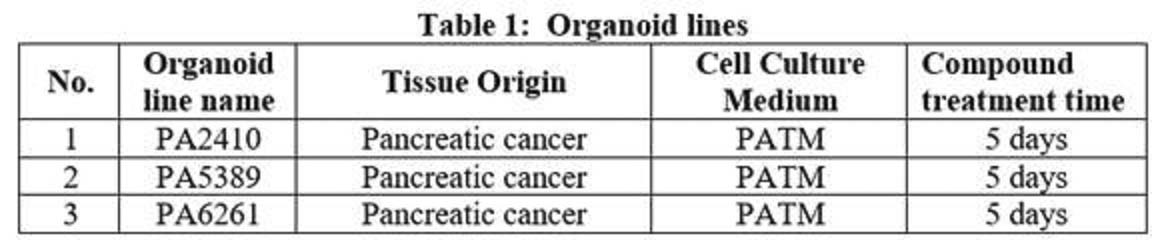
The cells were cultured in a 37ºC incubator with 5% CO2 and 95% air.
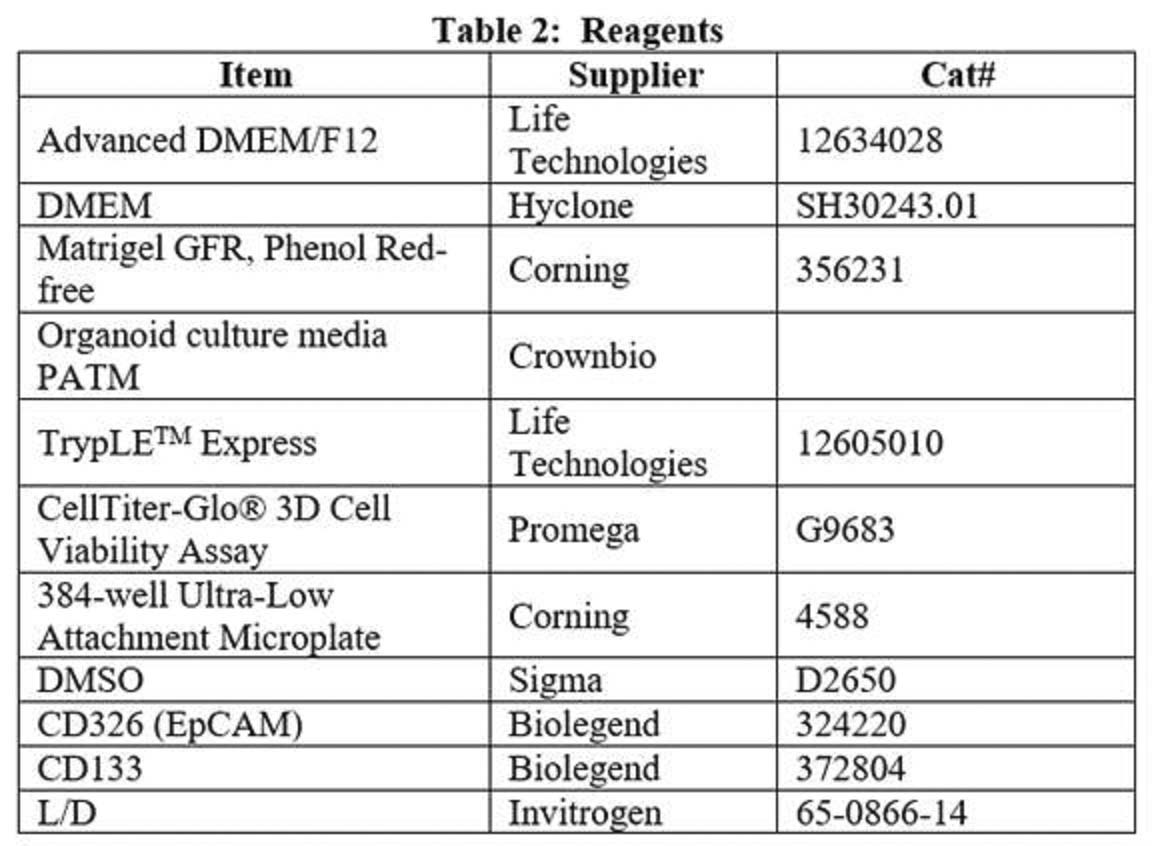
Example 1: Evaluation of the Effect of Compounds on Viability of Organoid Lines
The effect of three compounds on cell proliferation of three organoid lines was evaluated. The three test compounds evaluated were Compound A, Compound B, and gemcitabine. The organoid lines used are described in Table 1. The major reagents used are described in Table 2.
Gemcitabine was purchased from Selleck (Cat. no. S1714).
Staurosporine, a positive control, was purchased from Selleck (Cat. no. S1421).
Staurosporine, a positive control, was purchased from Selleck (Cat. no. S1421).
The following equipment was used in the analysis:
EnVision Multi Label Reader 2104-0010A, PerkinElmer, Equip ID:TAREA0011;
CO2 Water Jacketed Incubator, SANYO, Equip ID: TAINC0020;
Digital Dispenser, Tecan D300e; and
Multidrop Combi reagent dispenser, Thermofisher.
EnVision Multi Label Reader 2104-0010A, PerkinElmer, Equip ID:TAREA0011;
CO2 Water Jacketed Incubator, SANYO, Equip ID: TAINC0020;
Digital Dispenser, Tecan D300e; and
Multidrop Combi reagent dispenser, Thermofisher.
On Day -1, organoids were sheared to uniform sizes. The organoids were processed 1:1 using 50% Matrigel to define the size of the organoids to perform the screen.
On Day 0, organoids were seeded, as follows.
a) The organoids were collected from each well by adding 20 μl 100x Dispase solution to each well from a 6-well plate, which contains 2 ml of organoid medium.
b) The plates were put back in the incubator, at 37°C for 30 minutes.
c) The organoids were collected from all wells and pipetted through a pre-wet 100 μm filter into a 50 ml plastic tube.
d) Once all wells were filtered over 100 μm filters, the flow though was filtered over a pre-wet 20 μm filter.
e) The 20 μm filter was inverted and the organoids were recovered in a new 50 ml tube.
f) The organoids were collected and resuspended in the corresponding culture media. The organoids were counted to determine the concentration.
g) The cell concentration was adjusted with culture medium to the proper concentration.
h) Matrigel was added to a final concentration of 5% v/v and the organoids suspension was kept on ice.
i) 40 μL cell suspensions were added to a 384-well plate by Multidrop dispenser.
j) Screening plates were placed back into the incubator before adding compounds.
k) Compounds (Compound A, Compound B, and gemcitabine) were added and evaluated at each of the concentrations shown below.
For Compound A and Compound B, the top working concentration was 100 μM, with 3.16-fold serial dilutions of each dose level, to achieve 9 dose levels, identified below as C1-C9.

For gemcitabine, the top working concentration was 1 μM, with 3.16-fold serial dilutions of each dose level, to achieve 9 dose levels, identified below as C1-C9.

l) Screening plates were placed back into the incubator.
On Day 5, endpoint CellTiter-Glo (CTG) reading was performed. Assay plates were read for luminescent CTG signal at the end of the assays. 40 μL of CTG 3D per well was added by Multidrop dispenser, the contents were mixed for 5 minutes on the plate shaker, and the plates were incubated for 30 minutes at room temperature in the dark. Luminescent signal was read on an Envision plate reader.
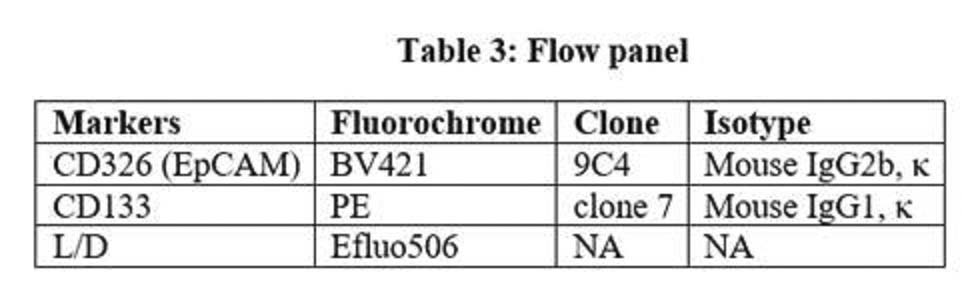
Samples were processed as single cell suspensions and stained, followed by flow cytometry data acquisition and analysis. The final statistical analyses was performed on proportions of cells of interest (Table 3) of all cells of the population defined in a SSC-FSC plot.
In order to calculate absolute IC50, a dose-response curve was fitted using nonlinear regression model with a sigmoidal dose response. The formula for calculating surviving rate is shown below.
The surviving rate (%) = (LumTest article-LumMedium control)/ (LumNone treated-LumMedium control) x 100%.
The surviving rate (%) = (LumTest article-LumMedium control)/ (LumNone treated-LumMedium control) x 100%.
The IC50 and maximal inhibition of proliferation for each of the compounds, in each of the three organoid lines, is depicted in Table 4.

Other Embodiments
While the invention has been described in conjunction with the detailed description thereof, the foregoing description is intended to illustrate and not limit the scope of the invention, which is defined by the scope of the appended claims. Other aspects, advantages, and modifications are within the scope of the following claims.
While the invention has been described in conjunction with the detailed description thereof, the foregoing description is intended to illustrate and not limit the scope of the invention, which is defined by the scope of the appended claims. Other aspects, advantages, and modifications are within the scope of the following claims.
Claims (29)
- A method of treating or preventing a pancreatic cancer in a human subject in need thereof, comprising administering to the human subject a therapeutically effective amount of a compound represented by the following formula:

- A method of treating or preventing a pancreatic cancer in a human subject in need thereof, comprising administering to the human subject a therapeutically effective amount of a compound represented by the following formula:
- The method of claim 1 or 2, wherein the pancreatic cancer is an exocrine pancreatic cancer.
- The method of claim 3, wherein the exocrine pancreatic cancer is an adenocarcinoma.
- The method of claim 4, wherein the adenocarcinoma is a ductal adenocarcinoma.
- The method of claim 4, wherein the adenocarcinoma is an acinar adenocarcinoma.
- The method of claim 3, wherein the exocrine pancreatic cancer is an acinar cell carcinoma, an adenosquamous carcinoma, a colloid carcinoma, a hepatoid carcinoma, an intraductal papillary mucinous neoplasm, a mucinous cystic neoplasm, a pancreatic intraepithelial neoplasia, a pancreatoblastoma, a serous cystadenoma, a signet ring cell carcinoma, a solid-pseudopapillary neoplasm, an undifferentiated carcinoma, or an undifferentiated carcinoma with osteoclast-like giant cells.
- The method of claim 3, wherein the exocrine pancreatic cancer is an adenosquamous carcinoma.
- The method of claim 3, wherein the exocrine pancreatic cancer is a pancreatic intraepithelial neoplasia.
- The method of claim 1 or 2, wherein the pancreatic cancer is a pancreatic neuroendocrine tumor.
- The method of claim 10, wherein the pancreatic neuroendocrine tumor is an insulinoma or a glucagonoma.
- The method of any one of the preceding claims, wherein the compound or pharmaceutically acceptable salt thereof is administered orally.
- The method of any one of the preceding claims, wherein the compound or pharmaceutically acceptable salt thereof is administered in combination with a second agent.
- The method of claim 13, wherein the second agent is gemcitabine.
- The method of claim 14, wherein gemcitabine is administered intravenously.
- The method of claim 14, wherein the compound or pharmaceutically acceptable salt thereof is administered orally and gemcitabine is administered intravenously.
- The method of claim 14, wherein gemcitabine is administered orally.
- The method of claim 14, wherein the compound or pharmaceutically acceptable salt thereof is administered orally and gemcitabine is administered orally.
- The method of claim 13, wherein the second agent is erlotinib, nab-paclitaxel, FOLFIRINOX, or TS-1.
- A method of treating or preventing a cancer in a human subject in need thereof, comprising administering to the human subject a therapeutically effective amount of a compound represented by the following formula:

wherein the cancer is a breast cancer, a liver cancer, a prostate cancer, a lung cancer, or a leukemia. - A method of treating or preventing a cancer in a human subject in need thereof, comprising administering to the human subject a therapeutically effective amount of a compound represented by the following formula:
wherein the cancer is a breast cancer, a liver cancer, a prostate cancer, a lung cancer, or a leukemia. - The method of claim 20 or 21, wherein the breast cancer is triple-negative breast cancer.
- The method of claim 20 or 21, wherein the liver cancer is associated with hepatitis B virus or hepatitis C virus infection.
- The method of claim 20 or 21, wherein the prostate cancer is castration-resistant prostate cancer.
- The method of claim 20 or 21, wherein the lung cancer is small cell lung cancer.
- The method of claim 20 or 21, wherein the lung cancer is non-small cell lung cancer.
- The method of claim 20 or 21, wherein the leukemia is acute lymphocytic leukemia, acute myelogenous leukemia, chronic lymphocytic leukemia, or chronic myelogenous leukemia.
- The method of any one of claims 20 to 27, wherein the compound or pharmaceutically acceptable salt thereof is administered orally.
- The method of any one of claims 20 to 28, wherein the compound or pharmaceutically acceptable salt thereof is administered in combination with a second agent.
Applications Claiming Priority (2)
| Application Number | Priority Date | Filing Date | Title |
|---|---|---|---|
| US202062965254P | 2020-01-24 | 2020-01-24 | |
| US62/965,254 | 2020-01-24 |
Publications (1)
| Publication Number | Publication Date |
|---|---|
| WO2021149786A1 true WO2021149786A1 (en) | 2021-07-29 |
Family
ID=74561971
Family Applications (1)
| Application Number | Title | Priority Date | Filing Date |
|---|---|---|---|
| PCT/JP2021/002137 Ceased WO2021149786A1 (en) | 2020-01-24 | 2021-01-22 | Methods of treating cancer using dihydropyrimidin-2-one compounds |
Country Status (1)
| Country | Link |
|---|---|
| WO (1) | WO2021149786A1 (en) |
Cited By (1)
| Publication number | Priority date | Publication date | Assignee | Title |
|---|---|---|---|---|
| WO2023232870A1 (en) | 2022-05-31 | 2023-12-07 | Immunic Ag | Rorg/rorgt modulators for the treatment of virus infections like covid-19 |
Citations (3)
| Publication number | Priority date | Publication date | Assignee | Title |
|---|---|---|---|---|
| US10196363B2 (en) | 2014-12-12 | 2019-02-05 | Japan Tobacco Inc. | Dihydropyrimidin-2-one compounds and medical use thereof |
| US20190300488A1 (en) | 2018-02-28 | 2019-10-03 | Japan Tobacco Inc. | 4-methyldihydropyrimidinone compounds and pharmaceutical use thereof |
| WO2020172467A1 (en) * | 2019-02-20 | 2020-08-27 | The Regents Of The University Of California | Treatment for retinoic acid receptor-related orphan receptor ɣ (rorɣ)-dependent cancers |
-
2021
- 2021-01-22 WO PCT/JP2021/002137 patent/WO2021149786A1/en not_active Ceased
Patent Citations (3)
| Publication number | Priority date | Publication date | Assignee | Title |
|---|---|---|---|---|
| US10196363B2 (en) | 2014-12-12 | 2019-02-05 | Japan Tobacco Inc. | Dihydropyrimidin-2-one compounds and medical use thereof |
| US20190300488A1 (en) | 2018-02-28 | 2019-10-03 | Japan Tobacco Inc. | 4-methyldihydropyrimidinone compounds and pharmaceutical use thereof |
| WO2020172467A1 (en) * | 2019-02-20 | 2020-08-27 | The Regents Of The University Of California | Treatment for retinoic acid receptor-related orphan receptor ɣ (rorɣ)-dependent cancers |
Non-Patent Citations (5)
| Title |
|---|
| BERGE ET AL., J. PHARM. SCI., vol. 66, 1977, pages l-19 |
| LYTLE NIKKI K ET AL: "A Multiscale Map of the Stem Cell State in Pancreatic Adenocarcinoma", CELL, vol. 177, no. 3, 10 March 2019 (2019-03-10), pages 572, XP085663710, ISSN: 0092-8674, DOI: 10.1016/J.CELL.2019.03.010 * |
| PAULEKUHN ET AL., J. MED. CHEM., vol. 50, 2007, pages 6665 - 6672 |
| STAHL ET AL.: "Handbook of Pharmaceutical Salts: Properties, Selection, and Use", 2002, WILEY-VCH |
| WANG JUNJIAN ET AL: "ROR-[gamma] drives androgen receptor expression and represents a therapeutic target in castration-resistant prostate cancer", NATURE MEDICINE, NATURE PUB. CO, NEW YORK, vol. 22, no. 5, 28 March 2016 (2016-03-28), pages 488 - 496, XP037202995, ISSN: 1078-8956, [retrieved on 20160328], DOI: 10.1038/NM.4070 * |
Cited By (1)
| Publication number | Priority date | Publication date | Assignee | Title |
|---|---|---|---|---|
| WO2023232870A1 (en) | 2022-05-31 | 2023-12-07 | Immunic Ag | Rorg/rorgt modulators for the treatment of virus infections like covid-19 |
Similar Documents
| Publication | Publication Date | Title |
|---|---|---|
| US20220387384A1 (en) | Methods of treating lsd1-related diseases and disorders with lsd1 inhibitors | |
| EP4186895A1 (en) | Compound useful as cdk7 kinase inhibitor and use thereof | |
| ES2573515T3 (en) | Anti-tumor agent that uses compounds with combined kinase inhibitory effect | |
| US12178792B2 (en) | Pharmaceutical composition and use thereof in preparing drug for treating tumor multi-drug resistance | |
| KR101668931B1 (en) | Effect potentiator for antitumor agents | |
| WO2016023422A1 (en) | 2-(2,4,5-substituted aniline) pyrimidine derivative, pharmaceutical composition and use thereof | |
| JP4110347B2 (en) | Anti-HIV agent | |
| CN111558044B (en) | Pharmaceutical composition containing sunitinib, and preparation and application thereof | |
| JP2024050645A (en) | Heteroaryl-substituted pyrazole compounds and their medical uses | |
| US20230310394A1 (en) | Sorafenib, regorafenib and novel use of analogue or derivative thereof | |
| TWI869511B (en) | Methods of treating cancer | |
| TR201815685T4 (en) | Combinations of act and mec inhibitory compounds for the treatment of cancer. | |
| CN105985323A (en) | Novel epidermal growth factor receptor inhibitor and application thereof | |
| US20240342138A1 (en) | Microtubule targeting agents | |
| CN101323629B (en) | 4-{6-[5-(2-chlorinde-6- methylaniline formyl)-thiazole-2-amido]-2-methyl pyrimidine-4}-piperazine-1- diethyl methylphosphate | |
| CN111362924B (en) | Deuterated pyrimidine derivatives and uses thereof | |
| US20150238488A1 (en) | Drug composition for treating tumors and application thereof | |
| CN107840847A (en) | Deuterated 3 (4,5 substituted-amino pyrimidine) phenyl derivatives and its application | |
| KR20220143666A (en) | Crystalline form of polycyclic anaplastic lymphoma kinase inhibitor | |
| CN110698491B (en) | 2-(Camptothecin-10-oxy)acetamide compounds and their applications | |
| WO2018050108A1 (en) | Deuterated 3-(4,5-substituted pyrimidinamine) phenyl derivatives and applications thereof | |
| CN111100117A (en) | Crystal form A of aminopyrimidine compound mesylate and preparation method and application thereof | |
| WO2022262577A1 (en) | Salt of selective fgfr4 inhibitor, and preparation method therefor and application thereof | |
| RU2322236C2 (en) | Drug for treatment of benign and malignant tumor disease comprising derivative of dysorazol | |
| EP4061348A1 (en) | Dosing regimens for a protein kinase c inhibitor |
Legal Events
| Date | Code | Title | Description |
|---|---|---|---|
| 121 | Ep: the epo has been informed by wipo that ep was designated in this application |
Ref document number: 21704030 Country of ref document: EP Kind code of ref document: A1 |
|
| NENP | Non-entry into the national phase |
Ref country code: DE |
|
| 122 | Ep: pct application non-entry in european phase |
Ref document number: 21704030 Country of ref document: EP Kind code of ref document: A1 |