WO2021140651A1 - 端末、基地局、通信方法及び通信プログラム - Google Patents
端末、基地局、通信方法及び通信プログラム Download PDFInfo
- Publication number
- WO2021140651A1 WO2021140651A1 PCT/JP2020/000670 JP2020000670W WO2021140651A1 WO 2021140651 A1 WO2021140651 A1 WO 2021140651A1 JP 2020000670 W JP2020000670 W JP 2020000670W WO 2021140651 A1 WO2021140651 A1 WO 2021140651A1
- Authority
- WO
- WIPO (PCT)
- Prior art keywords
- communication
- data
- terminal
- frame
- processing unit
- Prior art date
- Legal status (The legal status is an assumption and is not a legal conclusion. Google has not performed a legal analysis and makes no representation as to the accuracy of the status listed.)
- Ceased
Links
Images





Classifications
-
- H—ELECTRICITY
- H04—ELECTRIC COMMUNICATION TECHNIQUE
- H04W—WIRELESS COMMUNICATION NETWORKS
- H04W48/00—Access restriction; Network selection; Access point selection
- H04W48/16—Discovering, processing access restriction or access information
-
- H—ELECTRICITY
- H04—ELECTRIC COMMUNICATION TECHNIQUE
- H04W—WIRELESS COMMUNICATION NETWORKS
- H04W28/00—Network traffic management; Network resource management
- H04W28/02—Traffic management, e.g. flow control or congestion control
- H04W28/0231—Traffic management, e.g. flow control or congestion control based on communication conditions
- H04W28/0236—Traffic management, e.g. flow control or congestion control based on communication conditions radio quality, e.g. interference, losses or delay
-
- H—ELECTRICITY
- H04—ELECTRIC COMMUNICATION TECHNIQUE
- H04W—WIRELESS COMMUNICATION NETWORKS
- H04W28/00—Network traffic management; Network resource management
- H04W28/02—Traffic management, e.g. flow control or congestion control
- H04W28/0247—Traffic management, e.g. flow control or congestion control based on conditions of the access network or the infrastructure network
-
- H—ELECTRICITY
- H04—ELECTRIC COMMUNICATION TECHNIQUE
- H04W—WIRELESS COMMUNICATION NETWORKS
- H04W28/00—Network traffic management; Network resource management
- H04W28/02—Traffic management, e.g. flow control or congestion control
- H04W28/0278—Traffic management, e.g. flow control or congestion control using buffer status reports
-
- H—ELECTRICITY
- H04—ELECTRIC COMMUNICATION TECHNIQUE
- H04W—WIRELESS COMMUNICATION NETWORKS
- H04W28/00—Network traffic management; Network resource management
- H04W28/02—Traffic management, e.g. flow control or congestion control
- H04W28/08—Load balancing or load distribution
- H04W28/09—Management thereof
- H04W28/0992—Management thereof based on the type of application
-
- H—ELECTRICITY
- H04—ELECTRIC COMMUNICATION TECHNIQUE
- H04W—WIRELESS COMMUNICATION NETWORKS
- H04W72/00—Local resource management
- H04W72/50—Allocation or scheduling criteria for wireless resources
- H04W72/56—Allocation or scheduling criteria for wireless resources based on priority criteria
-
- H—ELECTRICITY
- H04—ELECTRIC COMMUNICATION TECHNIQUE
- H04W—WIRELESS COMMUNICATION NETWORKS
- H04W74/00—Wireless channel access
- H04W74/08—Non-scheduled access, e.g. ALOHA
- H04W74/0808—Non-scheduled access, e.g. ALOHA using carrier sensing, e.g. carrier sense multiple access [CSMA]
-
- H—ELECTRICITY
- H04—ELECTRIC COMMUNICATION TECHNIQUE
- H04W—WIRELESS COMMUNICATION NETWORKS
- H04W84/00—Network topologies
- H04W84/02—Hierarchically pre-organised networks, e.g. paging networks, cellular networks, WLAN [Wireless Local Area Network] or WLL [Wireless Local Loop]
- H04W84/10—Small scale networks; Flat hierarchical networks
- H04W84/12—WLAN [Wireless Local Area Networks]
Definitions
- the embodiment relates to a terminal, a base station, a communication method, and a communication program.
- the wireless LAN (Local Area Network) base station and terminal access the channel using CSMA / CA (Carrier Sense Multiple Access with Collision Avoidance) and transmit wireless signals.
- CSMA / CA Carrier Sense Multiple Access with Collision Avoidance
- the base station and the terminal wait for the time specified by the access parameter, and transmit the radio signal after confirming by the carrier sense that the channel is not in use by another terminal or the like.
- EDCA Enhanced Distribution Channel Access
- data from the upper layer is classified into one of four access categories (AC), that is, AC_VO (Voice), AC_VI (Video), AC_BE (Best effort), and AC_BK (Background).
- AC_VO Voice over IP
- AC_VI Video
- AC_BE Best effort
- AC_BK Background
- CSMA / CA is performed for each access category.
- the access parameters are assigned so that the transmission of the radio signal is relatively prioritized in the order of AC_VO, AC_VI, AC_BE, AC_BK.
- EDCA gives relative priority among traffic.
- RTAs Real-Time Applications
- network games and control of industrial robots may have absolute delay and jitter requirements for each application. Relative prioritization alone does not tell us whether RTA is available or if we can control it to make it available.
- the terminal includes a data processing unit and a wireless signal processing unit.
- the data processing unit generates a first frame that includes a requirement condition regarding a delay during data communication and inquires the base station whether or not communication satisfying the requirement condition is possible.
- the radio signal processing unit transmits the first frame.
- FIG. 1 is a diagram showing an example of a communication system configuration according to the present embodiment.
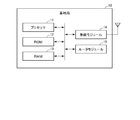
- FIG. 2 is a diagram showing an example of the hardware configuration of the base station.
- FIG. 3 is a diagram showing an example of the hardware configuration of the terminal.
- FIG. 4 is a diagram showing processing of a MAC (Media Access Control) layer during communication between a base station and a terminal.
- FIG. 5 is a functional block diagram of the base station.
- FIG. 6 is a functional block diagram of the terminal.
- FIG. 7 is a flowchart showing the operation of the terminal according to the present embodiment.
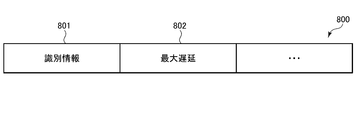
- FIG. 8 is a diagram showing an example of the format of the negotiation frame.
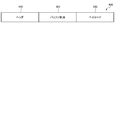
- FIG. 9 is a diagram showing an example of the format of the status notification frame.
- FIG. 10 is a flowchart showing the operation of the base station according to the present embodiment.
- FIG. 11 is a sequence diagram showing an example of transmission opportunity control of the terminal by the base station.
- FIG. 1 is a diagram showing a configuration of an example of a communication system according to an embodiment.
- the communication system 1 includes a base station 10 and a plurality of terminals 20.
- the base station 10 wirelessly communicates with the terminal 20 in the predetermined service area. Although not shown in FIG. 1, communication may be performed between the terminals 20.
- the base station 10 is an access point (AP) for the terminal 20.
- the base station 10 is not limited to a fixed one, and may be mounted on a mobile body.
- the base station 10 includes a processor 11, a ROM (Read Only Memory) 12, a RAM (Random Access Memory) 13, a wireless module 14, and a router module 15.
- the processor 11 is a processing device that controls the entire base station 10.
- the processor 11 is, for example, a CPU (Central Processing Unit).
- the processor 11 is not limited to the CPU. Further, an ASIC (Application Specific IC) or the like may be used instead of the CPU. Further, the number of processors 11 may be two or more instead of one.
- the ROM 12 is a read-only storage device.
- the ROM 12 stores firmware, software, and various programs necessary for the operation of the base station 10.
- the RAM 13 is a storage device that can be arbitrarily written.
- the RAM 13 is used as a work area for the processor 11, and temporarily stores the firmware and the like stored in the ROM 12.
- the wireless module 14 is a module configured to perform necessary processing for wireless LAN communication. For example, the wireless module 14 constructs a MAC (Media Access Control) frame from the data transferred from the processor 11, converts the configured MAC frame into a wireless signal, and transmits it to the terminal 20. Further, the wireless module 14 receives a wireless signal from the terminal 20, extracts data from the received wireless signal, and transfers the data to, for example, the processor 11.
- MAC Media Access Control
- the router module 15 is provided for the base station 10 to communicate with, for example, a server (not shown) via a network.
- the base station 10 does not necessarily have the router module 15.
- the base station 10 may be configured to access a router provided outside the base station 10 by wireless communication or wired communication and connect to a network via this router.
- the terminal 20 is a terminal device (STA) such as a smartphone or a tablet terminal.
- the terminal 20 may be a mobile terminal, a terminal mounted on a mobile body, or a fixed terminal.
- the terminal 20 includes a processor 21, a ROM 22, a RAM 23, a wireless module 24, a display 25, and a storage 26.
- the processor 21 is a processing device that controls the entire terminal 20.
- the processor 21 is, for example, a CPU.
- the processor 21 is not limited to the CPU. Further, ASIC or the like may be used instead of the CPU. Further, the number of processors 21 may be two or more instead of one.
- the ROM 22 is a read-only storage device.
- the ROM 22 stores firmware, software, and various programs necessary for the operation of the terminal 20.
- the RAM 23 is a storage device that can be arbitrarily written.
- the RAM 23 is used as a work area for the processor 21, and temporarily stores the firmware and the like stored in the ROM 22.
- the wireless module 24 is a module configured to perform necessary processing for wireless LAN communication.
- the wireless module 24, for example, constructs a MAC frame for wireless communication from the data transferred from the processor 21, converts the configured MAC frame into a wireless signal, and transmits it to the base station 10. Further, the wireless module 24 receives a wireless signal from the base station 10, extracts data from the received wireless signal, and transfers the data to, for example, the processor 21.
- the display 25 is a display device that displays various screens.
- the display 25 may be a liquid crystal display, an organic EL display, or the like. Further, the display 25 may include a touch panel.
- the storage 26 is a storage device such as an HDD (Hard Disk Drive) or an SSD (Solid State Drive). The storage 26 stores, for example, various applications executed by the processor 21.
- the radio module performs A-MSDU aggregation. Specifically, the wireless module combines a plurality of data input from an upper layer such as an application layer to generate an A-MSDU (Aggregate-MAC service data unit).
- A-MSDU Aggregate-MAC service data unit
- step S11 the wireless module assigns a sequence number (SN) to the A-MSDU.
- the sequence number is a unique number for identifying the A-MSDU.
- step S12 the wireless module fragmentes (divides) the A-MSDU into a plurality of MPDUs (MAC protocol data units).
- step S13 the wireless module encrypts each MPDU and generates an encrypted MPDU.
- step S14 the wireless module adds a MAC header and an error detection code (FCS) to each encrypted MPDU.
- the error detection code is, for example, a CRC (Cyclic Redundancy Check) code.
- the radio module performs A-MPDU aggregation. Specifically, the wireless module combines a plurality of MPDUs to generate an A-MPDU (Aggregate-MAC protocol data unit) as a MAC frame.
- the wireless module processes the physical layer for the MAC frame. That is, the wireless module performs modulation processing or the like on the MAC frame to generate a wireless signal, and transmits the wireless signal to the base station 10.
- the radio module processes the physical layer to restore the MAC frame from the radio signal. After that, the wireless module performs the processing of the MAC layer shown in FIG.
- step S20 the wireless module performs A-MPDU deaggregation. Specifically, the wireless module divides the A-MPDU into MPDU units.
- the wireless module detects an error. For example, the radio module determines whether or not the reception of the radio signal is successful by CRC. When the reception of the radio signal fails, the radio module may make a retransmission request. At this time, the wireless module may request retransmission in MPDU units. On the other hand, when the reception of the radio signal is successful, the radio module performs the following processing.
- step S22 the wireless module performs address detection. At this time, the wireless module determines whether or not the sent MPDU is addressed to itself based on the address recorded in the MAC header of each MPDU. When it is not addressed to itself, the wireless module does not perform the following processing. When addressed to itself, the wireless module does the following:
- step S23 the wireless module decrypts the encrypted MPDU.
- step S24 the wireless module defragments the MPDU. That is, the wireless module restores the A-MSDU from the plurality of MPDUs.
- step S25 the radio module performs A-MSDU deaggregation. Specifically, the wireless module restores the A-MSDU to data in MSDU units. After step S25, the wireless module outputs data to an upper layer of the MAC layer.
- the upper layer is, for example, an application layer.
- the terminal 20 includes a data processing unit 201, a wireless signal processing unit 202, and a buffer information acquisition unit 203.
- the data processing unit 201, the radio signal processing unit 202, and the buffer information acquisition unit 203 are realized by, for example, the processor 21 and the radio module 24.
- the data processing unit 201 constitutes a MAC frame from, for example, data input from a higher-level application. Further, the data processing unit 201 restores data from the MAC frame transferred from the radio signal processing unit 202. This data is used, for example, by higher-level applications. Specifically, when there is a restriction on the delay during data communication in the application, the data processing unit 201 includes a requirement condition regarding the delay during data communication and inquires whether or not communication satisfying the requirement condition is possible. Generate a frame (also called the first frame).
- the requirement conditions include, for example, communication quality requirements such as delay and jitter in data communication.
- applications having delay restrictions such as online games (network games) and industrial robot control applications, in which communication delay has a large effect on service quality (hereinafter, real-time application or RTA). Also called).
- real-time application or RTA real-time application
- the configuration and processing disclosed in the present embodiment can be applied to any application that is not limited to these applications and has a requirement regarding communication quality.
- the data processing unit 201 When the data processing unit 201 receives a notification from the base station 10 that communication satisfying the required conditions is possible, the data processing unit 201 includes a status notification frame (both the second frame) including information on the buffer status of the data transmitted according to the required conditions. To generate).
- the buffer status indicates, for example, information about the amount of data stored in the transmit queue when transmitting data. Statistical values such as the waiting time measured in the buffer, its average value, and jitter may be included.
- the buffer status includes information that can be measured about the buffer in addition to the amount of accumulated data, and each delay time (of the buffer) until the data input from the real-time application is received by the base station 10.
- the transmission queue according to the present embodiment is a transmission queue in the radio signal processing unit 202 assuming a case where transmission control is performed by the EDCA method, and the details will be described later.
- the wireless signal processing unit 202 performs processing for transmitting or receiving a wireless signal.
- the radio signal processing unit 202 converts the MAC frame composed of the data processing unit 201 into a radio signal, and transmits the radio signal to, for example, the base station 10.
- the radio signal processing unit 202 converts the negotiation frame and the status notification frame into radio signals and transmits them to the base station 10.
- the radio signal processing unit 202 receives a radio signal from the base station 10, extracts a MAC frame from the received radio signal, and transfers the MAC frame to the data processing unit 201.
- the wireless signal processing unit 202 may transmit a wireless signal by EDCA (Enhanced Distributed Channel Access) as a priority control method, for example.
- the radio signal processing unit 202 includes transmission queues AC_VO, AC_VI, AC_BE, and AC_BK for each access category (AC).
- the transmission queue AC_VO is a queue for holding MAC frames categorized in VO (Voice).
- the transmission queue AC_VI is a queue for holding MAC frames categorized in VI (Video).
- the transmission queue AC_BE is a queue for holding MAC frames categorized in BE (Best effort).
- the transmission queue AC_BK is a queue for holding a MAC frame categorized in BK (Background).
- TID traffic type
- the TID is given for each application (session) handled by the terminal 20.
- the mapping to the access category described above may be performed based on the TID.
- the radio signal processing unit 202 maps the MAC frame transferred from the data processing unit 201 to one of the four access categories according to the category of the data recorded in the MAC frame. According to the result of this mapping, the radio signal processing unit 102 inputs the MAC frame into the corresponding transmission queue.
- the wireless signal processing unit 202 waits for transmission for a time specified by the access parameters set for each access category while confirming that the wireless signal is not transmitted by another terminal or the like by the carrier sense for each access category. If there is no transmission of a wireless signal by another terminal or the like while waiting for transmission, the wireless signal processing unit 202 takes out a MAC frame from the corresponding transmission queue, converts the MAC frame into a wireless signal, and transmits the MAC frame. ..
- Access parameters may be assigned so that the transmission of the radio signal is relatively prioritized in the order of VO, VI, BE, BK.
- Access parameters may include CWmin, CWmax, AIFS, TXOPLimit.
- CWmin and CWmax are the maximum and minimum values of CW (ContentionWindow), which is the waiting time for transmission, respectively. The shorter CWmin and CWmax, the easier it is for the transmission queue to obtain transmission rights.
- AIFS Bitration InterFrame Space
- TXOPLimit is an upper limit of TXOP (Transmission Opportunity), which is the occupied time of the channel. The larger the value of TXOPLimit, the more radio signals can be transmitted with one transmission right.
- the base station 10 includes a data processing unit 101, a radio signal processing unit 102, a management unit 103, and a communication control unit 104.
- the data processing unit 101, the wireless signal processing unit 102, the management unit 103, and the communication control unit 104 are realized by, for example, the processor 11 and the wireless module 14.
- the data processing unit 101 generates a MAC frame from the data transferred from the server on the network. Further, the data processing unit 101 restores data from the MAC frame transferred from the radio signal processing unit 102. Specifically, when the negotiation frame is received from the terminal 20, the data processing unit 101 determines whether or not communication satisfying the required conditions is possible between the base station 10 and the terminal 20. When the data processing unit determines that communication that meets the required conditions is possible, a frame (also referred to as permission notification) indicating that communication prioritizing traffic related to real-time application data (hereinafter referred to as RTA traffic) is permitted. To generate.
- a frame also referred to as permission notification
- RTA traffic communication prioritizing traffic related to real-time application data
- the data processing unit 101 determines whether or not there is a possibility that the required conditions may not be satisfied in the subsequent communication based on the buffer information and the traffic status of the service area of the base station 10. judge.
- the base station 10 determines whether or not the required conditions can be satisfied, if there is a server on the network (not shown) that manages whether or not the real-time application can be handled, the determination result is obtained for the server. May be notified.
- the server can be accessed from a mobile network (4G, 5G, etc.)
- the terminal 20 can also acquire whether or not the real-time application can be handled by the communication line.
- the success rate can be increased by first accessing the server and starting the negotiation with the base station 10 which is determined to satisfy the requirements of the real-time application.
- the wireless signal processing unit 102 performs processing for transmitting or receiving a wireless signal. For example, the wireless signal processing unit 102 converts the MAC frame composed of the data processing unit 101 into a wireless signal, and transmits the wireless signal to the terminal 20. Further, the wireless signal processing unit 102 receives a wireless signal from the terminal 20, extracts a MAC frame from the received wireless signal, and transfers the MAC frame to the data processing unit 101. Specifically, the wireless signal processing unit 102 converts the permission notification into a wireless signal and transmits it.
- the management unit 103 manages the requirement conditions sent from the terminal 20. For example, the management unit 103 manages the correspondence between the terminal 20 and the request condition transmitted by the terminal 20 in a table, for example, and uses the information managed in the table at a necessary timing.
- the communication control unit 104 Based on the correspondence managed by the management unit 103, the communication control unit 104 gives priority to the communication of the terminal 20 when there is a possibility that the required condition cannot be satisfied in the communication of the terminal 20 that desires the communication under the required condition.
- the transmission opportunity of the terminal is controlled so as to be performed. The method of controlling communication opportunities will be described later.
- the operation of the terminal 20 shown in FIG. 7 includes a negotiation phase from step S701 to step S703 and a communication phase from step S704 to step S707.
- step S701 the data processing unit 201 generates a negotiation frame.
- the negotiation frame contains information on the maximum delay that the real-time application can tolerate.
- the radio signal processing unit 202 converts the negotiation frame into a radio signal and transmits it to the base station 10.
- the radio signal processing unit 102 transmits the negotiation frame as a wireless signal.
- step S703 the data processing unit 201 determines whether or not the permission notification has been received from the base station 10.
- the process proceeds to step S704.
- the negotiation is completed in the negotiation phase.
- the terminal 20 does not receive the permission notification, that is, when there is no permission notification for a certain period of time and the time-out occurs, or when the refusal notification is received, the process returns to step S702 and the same process is repeated. This is because it was determined that RTA traffic cannot be prioritized due to the congestion status of the channel at the time of receiving the negotiation frame, and at another time there is room in the channel and RTA traffic can be prioritized. Because there is a possibility.
- step S704 it is assumed that the data generated by the real-time application (hereinafter referred to as RTA data) is generated in the communication phase.
- the data processing unit 201 generates a status notification frame in order to transmit RTA data to the base station 10 and notify the base station 10 of the buffer status of the own terminal. Specifically, when RTA data is input to the data processing unit 201 from the upper layer, the data processing unit 201 acquires the amount of data accumulated in the transmission queue for RTA data as a buffer status, and the data amount Generate a status notification frame containing information about and the RTA data body.
- step S705 the data processing unit 201 transmits a status notification frame to the base station 10.
- the radio signal processing unit 102 converts the status notification frame into a radio signal and transmits the status notification frame, for example, by using the access control of the CSMA / CA method, as in step S702.
- the radio signal processing unit 202 converts the status notification frame into a radio signal and transmits it to the base station 10 based on the obtained channel access transmission right.
- the terminal 20 has a transmission queue for each access category, and uses the access parameters as described above assigned to each access category to perform channel access with CSMA / CA for each transmission queue.
- the access category AC_RTA for RTA may be added. That is, a transmission queue for AC_RTA may be prepared, and the access parameter of AC_RTA may be set with the highest priority.
- the priority RTA data frame can be transmitted from the transmission queue for AC_RTA, and the RTA traffic can be prioritized.
- the radio signal processing unit 202 converts the RTA data frames stored in the RTA queue into wireless signals in order from the beginning of the RTA queue and transmits the data frames.
- data other than RTA data classified into the access category of AC_RTA that is, data classified into the access categories of AC_VO, AC_VI, AC_BE and AC_BK are also referred to as non-RTA data.
- step S707 it is determined whether or not transmission is completed for all the generated RTA data frames. When all the generated RTA data frames are transmitted, the process is terminated, and when the transmission of all the generated RTA data is not completed, the process returns to step S706 and the same process is repeated. The processes from step S704 to step S707 may be repeated every time RTA data is generated.
- the negotiation frame 800 includes a header field 801 that includes identification information of the terminal 20 and the like, and a requirement condition of the real-time application, here, a maximum delay field 802 indicating the maximum amount of delay that can be tolerated by the real-time application.
- the negotiation frame 800 may include other information regarding communication quality such as the maximum amount of jitter that can be tolerated in a real-time application.
- the status notification frame 900 includes a header field 901 that includes terminal identification information, a buffer status field 902 that indicates the buffer status of RTA data, and a payload field 903 that stores the RTA data body.
- the status notification frame 900 does not have to include the RTA data body in the payload field 903 when only transmitting the buffer status to the base station 10.
- the buffer status is stored in the buffer status field 902 independent of the header field 901 and the payload field 903, but the present invention is not limited to this, and the buffer status is the header field 901 without providing the buffer status field 902. Alternatively, it may be included in the payload field 903.
- the operation of the base station 10 shown in FIG. 10 includes a negotiation phase from step S1001 to step S1003 and a communication phase from step S1004 to step S1009.
- step S1001 the radio signal processing unit 102 receives the negotiation frame from the terminal 20.
- the radio signal processing unit 102 extracts RTA requirements (for example, maximum delay) from the negotiation frame.
- step S1002 the data processing unit 101 determines whether or not the requirements of the extracted real-time application are satisfied based on the current communication status. Specifically, the data processing unit 101 has, for example, communication conditions such as traffic congestion in the service area of the base station 10, a period during which the channel is continuously occupied by interference waves, and an RTA that has already been established. It may be determined whether or not a delay larger than the maximum delay required by the real-time application is expected to occur in consideration of at least one of the determination materials such as the number of sessions to be used.
- communication conditions such as traffic congestion in the service area of the base station 10
- a period during which the channel is continuously occupied by interference waves and an RTA that has already been established. It may be determined whether or not a delay larger than the maximum delay required by the real-time application is expected to occur in consideration of at least one of the determination materials such as the number of sessions to be used.
- the data processing unit 101 satisfies the requirements of the real-time application as long as the period during which the channel is continuously occupied by the interference wave is equal to or longer than the threshold value. If the period during which the channel is occupied is less than the threshold value, it is determined that the requirements of the real-time application can be satisfied. If the number of RTA sessions has already been established, it is determined that the required conditions cannot be satisfied if the set value as the maximum number of RTA sessions exceeds the established number of RTA sessions. If it is less than or equal to the number of RTA sessions, it may be determined that the required conditions can be satisfied.
- the data processing unit 101 can receive a report of the measurement result of the delay or jitter for each access category from the terminal 20, the report may be used as one of the determination materials.
- step S1003 If it is assumed that a delay larger than the maximum delay will occur based on the current communication status, the required condition cannot be satisfied, and the process proceeds to step S1003. On the other hand, when it is assumed that a delay equal to or less than the maximum delay occurs, the required condition can be satisfied, so the process proceeds to step S1004.
- the determination material for determining the required condition is not limited to the above-mentioned one, and any information may be used as long as it is information that can be used as a determination material for determining whether or not the required condition can be satisfied.
- step S1003 the data processing unit 101 and the radio signal processing unit 102 of the base station 10 notify the terminal 20 that has transmitted the negotiation frame a refusal notification indicating that the communication satisfying the required conditions cannot be performed. And send.
- step S1004 the management unit 103 acquires and stores information regarding the requirement condition extracted from the negotiation frame, here the maximum delay.
- step S1005 the data processing unit 101 and the radio signal processing unit 102 of the base station 10 notify the terminal 20 that has transmitted the negotiation frame a permission notification indicating that communication satisfying the required conditions can be secured. And send.
- the base station 10 may request that an ACK for the permission notification be transmitted. As a result, the negotiation is completed in the negotiation phase.
- step S1006 the data processing unit 101 determines whether or not the status notification frame has been received from the terminal 20. If the status notification frame is received, the process proceeds to step S1007, and if the status notification frame is not received, the process proceeds to step S1008.
- step S1007 the data processing unit 101 determines, based on the buffer status included in the status notification frame, whether or not there is a possibility that the RTA traffic stays and the required conditions cannot be satisfied in the subsequent communication. Specifically, for example, when the amount of data indicated in the buffer status is equal to or greater than the threshold value, RTA traffic may be accumulated and the delay during data communication may not be contained in the maximum delay negotiated with the terminal 20. Therefore, the data processing unit 101 may determine that the required conditions may not be satisfied in the subsequent communication. Further, in addition to the buffer status, the same communication status as in the case where the requirement condition shown in step S1002 is determined may be further considered, and it may be determined whether or not the requirement condition may not be satisfied. If there is a possibility that the required condition cannot be satisfied, the process proceeds to step S1009, and if there is no possibility that the required condition cannot be satisfied, the process proceeds to step S1008.
- step S1008 the communication control unit 104 performs communication control regarding non-RTA data, that is, a normal data frame.
- step S1009 the communication control unit 104 performs communication control so that the RTA traffic does not stay, that is, the required condition is satisfied.
- a beacon signal including a notification that the access parameter is changed so that the RTA traffic is preferentially transmitted is transmitted to the terminal 20.
- the terminal 20 preferentially transmits the RTA traffic by setting the parameters according to the access parameters included in the beacon signal.
- the frequency of giving a transmission opportunity to the terminal 20 may be increased by transmitting the polling frame from the base station 10 to the terminal 20 by the HCCA (Hybrid coordination function Controlled Channel Access) method.
- HCCA Hybrid coordination function Controlled Channel Access
- the trigger frame of OFDMA may increase the frequency with which the transmission right is given to the terminal 20 so that more transmission opportunities can be obtained.
- the communication control unit 104 may perform control to lengthen the TXOP period allocated to the terminal 20 as the amount of data indicated in the buffer status increases.
- FIG. 11 is a sequence diagram showing frame transmission / reception between the base station 10 and the terminals 20-1 and the terminal 20-2.
- the terminal 20-1 is a terminal having a requirement condition by the real-time application (hereinafter referred to as an RTA terminal)
- the terminal 20-2 is a terminal that does not have the requirement condition by the real-time application and performs normal data communication.
- the terminal 20-1 transmits the negotiation frame 1101 to the base station 10 to enable communication based on the requirement condition (maximum delay) by the real-time application.
- the base station 10 determines the requirement condition included in the negotiation frame 1101, and here, assuming that the requirement condition can be satisfied, the permission notification 1102 is transmitted to the terminal 20-1.
- the status notification frame 1103 including the RTA data is transmitted.
- Base station 10 monitors the traffic status so that the delay of RTA data is within the maximum delay of the required conditions.
- the status notification frame 1103 received by the base station 10 from the terminal 20-1 may cause the RTA traffic accumulated from the buffer status of the RTA data to stay.
- the base station 10 generates a polling frame including an instruction for giving a transmission opportunity to the terminal 20-1.
- the base station 10 transmits the generated polling frame 1104-1 to the terminal group, the terminal 20-1 and the terminal 20-2 belonging to the own station. Since the terminal 20-1 that has received the polling frame 1104-1 is given a transmission opportunity preferentially from the base station, it generates a status notification frame 1103 including RTA data and transmits it to the base station 10. After that, preferential data communication regarding RTA data such as receiving ACK1106 from the base station 10 can be performed.
- the polling frame 1104-2 including the above may be transmitted.
- the terminal 20-1 can continuously obtain transmission opportunities, so that the communication control of RTA data can be appropriately performed.
- the terminal 20-2 is prohibited from transmitting until the TXOP period of the terminal 20-1 (period 1111 in the example of FIG. 11) is completed after the second polling frame 1104-2 is transmitted in the example of FIG. Since it is a period, data will not be sent or received.
- the terminal 20-2 can transmit the data frame 1105 when the transmission right is obtained after the end of the transmission prohibition period.
- the terminal transmits a negotiation frame to the base station as to whether or not the requirements of the real-time application can be satisfied between the base station and the terminal.
- the base station determines that the required conditions can be met, the base station sends a permission notification to the terminal to complete the negotiation.
- the terminal transmits the RTA data to the base station that notifies the buffer status of the RTA data.
- the base station can perform transmission control that gives priority to the terminal from the base station so that the RTA traffic is prioritized when the RTA traffic data may be retained. ..
- each process according to the above-described embodiment can be stored as a program that can be executed by a processor that is a computer.
- it can be stored and distributed in a storage medium of an external storage device such as a magnetic disk, an optical disk, or a semiconductor memory.
- the processor reads the program stored in the storage medium of the external storage device, and the operation is controlled by the read program, so that the above-described processing can be executed.
- the present invention is not limited to the above embodiment, and can be variously modified at the implementation stage without departing from the gist thereof.
- each embodiment may be carried out in combination as appropriate, and in that case, the combined effect can be obtained.
- the above-described embodiment includes various inventions, and various inventions can be extracted by a combination selected from a plurality of disclosed constituent requirements. For example, even if some constituent requirements are deleted from all the constituent requirements shown in the embodiment, if the problem can be solved and the effect is obtained, the configuration in which the constituent requirements are deleted can be extracted as an invention.
Landscapes
- Engineering & Computer Science (AREA)
- Computer Networks & Wireless Communication (AREA)
- Signal Processing (AREA)
- Computer Security & Cryptography (AREA)
- Mobile Radio Communication Systems (AREA)
Priority Applications (6)
| Application Number | Priority Date | Filing Date | Title |
|---|---|---|---|
| PCT/JP2020/000670 WO2021140651A1 (ja) | 2020-01-10 | 2020-01-10 | 端末、基地局、通信方法及び通信プログラム |
| JP2021569694A JP7405154B2 (ja) | 2020-01-10 | 2020-01-10 | 基地局、通信方法及び通信プログラム |
| CN202080092520.3A CN114982293B (zh) | 2020-01-10 | 2020-01-10 | 终端、基站、通信方法以及存储介质 |
| US17/791,462 US12464439B2 (en) | 2020-01-10 | 2020-01-10 | Terminal apparatus, base station, communication method, and communication program |
| EP20911599.7A EP4090082A4 (en) | 2020-01-10 | 2020-01-10 | TERMINAL, BASE STATION, COMMUNICATION METHOD, AND COMMUNICATION PROGRAM |
| US19/351,514 US20260040198A1 (en) | 2020-01-10 | 2025-10-07 | Terminal apparatus, base station, communication method, and communication program |
Applications Claiming Priority (1)
| Application Number | Priority Date | Filing Date | Title |
|---|---|---|---|
| PCT/JP2020/000670 WO2021140651A1 (ja) | 2020-01-10 | 2020-01-10 | 端末、基地局、通信方法及び通信プログラム |
Related Child Applications (2)
| Application Number | Title | Priority Date | Filing Date |
|---|---|---|---|
| US17/791,462 A-371-Of-International US12464439B2 (en) | 2020-01-10 | 2020-01-10 | Terminal apparatus, base station, communication method, and communication program |
| US19/351,514 Continuation US20260040198A1 (en) | 2020-01-10 | 2025-10-07 | Terminal apparatus, base station, communication method, and communication program |
Publications (1)
| Publication Number | Publication Date |
|---|---|
| WO2021140651A1 true WO2021140651A1 (ja) | 2021-07-15 |
Family
ID=76787820
Family Applications (1)
| Application Number | Title | Priority Date | Filing Date |
|---|---|---|---|
| PCT/JP2020/000670 Ceased WO2021140651A1 (ja) | 2020-01-10 | 2020-01-10 | 端末、基地局、通信方法及び通信プログラム |
Country Status (5)
| Country | Link |
|---|---|
| US (2) | US12464439B2 (https=) |
| EP (1) | EP4090082A4 (https=) |
| JP (1) | JP7405154B2 (https=) |
| CN (1) | CN114982293B (https=) |
| WO (1) | WO2021140651A1 (https=) |
Families Citing this family (2)
| Publication number | Priority date | Publication date | Assignee | Title |
|---|---|---|---|---|
| TWI757221B (zh) * | 2021-08-12 | 2022-03-01 | 瑞昱半導體股份有限公司 | 無線通訊裝置與資料處理方法 |
| US20250220708A1 (en) * | 2023-12-28 | 2025-07-03 | Cisco Technology, Inc. | Coordinated Peer-to-Peer Transmission Opportunities |
Citations (3)
| Publication number | Priority date | Publication date | Assignee | Title |
|---|---|---|---|---|
| JPH11298533A (ja) * | 1997-10-14 | 1999-10-29 | Lucent Technol Inc | 通信ネットワークのための多重アクセス・システムにおけるバンド幅共有のための方法 |
| JP2014017549A (ja) * | 2012-07-05 | 2014-01-30 | Ricoh Co Ltd | 無線通信装置及び優先制御方法 |
| WO2018175919A1 (en) * | 2017-03-24 | 2018-09-27 | Qualcomm Incorporated | Scheduling requests and buffer status reports for low latency wireless communications |
Family Cites Families (9)
| Publication number | Priority date | Publication date | Assignee | Title |
|---|---|---|---|---|
| US8233462B2 (en) * | 2003-10-15 | 2012-07-31 | Qualcomm Incorporated | High speed media access control and direct link protocol |
| JP4331088B2 (ja) * | 2004-11-01 | 2009-09-16 | 株式会社東芝 | 通信装置および通信方法 |
| JP4335219B2 (ja) * | 2006-03-03 | 2009-09-30 | 日本電信電話株式会社 | 無線lanトラヒック優先制御方法及びその装置 |
| JP5346242B2 (ja) * | 2009-03-26 | 2013-11-20 | 京セラ株式会社 | 無線基地局及び通信制御方法 |
| US9264986B2 (en) * | 2012-06-25 | 2016-02-16 | Qualcomm Incorporated | System and method for reducing power consumption in a wireless communication system |
| GB2555455B (en) * | 2016-10-28 | 2020-02-26 | Canon Kk | QoS management for multi-user EDCA transmission mode in 802.11ax networks |
| JP6841413B2 (ja) * | 2016-12-12 | 2021-03-10 | 国立研究開発法人情報通信研究機構 | 無線通信システム及び方法 |
| GB2560787B (en) * | 2017-01-06 | 2019-06-26 | Canon Kk | Qos management for multi-user and single user EDCA transmission mode in wireless networks |
| US11178694B2 (en) * | 2019-09-09 | 2021-11-16 | Sony Group Corporation | RTA queue management in wireless local area network (WLAN) stations |
-
2020
- 2020-01-10 CN CN202080092520.3A patent/CN114982293B/zh active Active
- 2020-01-10 JP JP2021569694A patent/JP7405154B2/ja active Active
- 2020-01-10 US US17/791,462 patent/US12464439B2/en active Active
- 2020-01-10 WO PCT/JP2020/000670 patent/WO2021140651A1/ja not_active Ceased
- 2020-01-10 EP EP20911599.7A patent/EP4090082A4/en active Pending
-
2025
- 2025-10-07 US US19/351,514 patent/US20260040198A1/en active Pending
Patent Citations (3)
| Publication number | Priority date | Publication date | Assignee | Title |
|---|---|---|---|---|
| JPH11298533A (ja) * | 1997-10-14 | 1999-10-29 | Lucent Technol Inc | 通信ネットワークのための多重アクセス・システムにおけるバンド幅共有のための方法 |
| JP2014017549A (ja) * | 2012-07-05 | 2014-01-30 | Ricoh Co Ltd | 無線通信装置及び優先制御方法 |
| WO2018175919A1 (en) * | 2017-03-24 | 2018-09-27 | Qualcomm Incorporated | Scheduling requests and buffer status reports for low latency wireless communications |
Non-Patent Citations (2)
| Title |
|---|
| "10.22.2 HCF contention based channel access (EDCA", IEEE STD 802. 11-2016, 7 December 2016 (2016-12-07) |
| See also references of EP4090082A4 |
Also Published As
| Publication number | Publication date |
|---|---|
| US20260040198A1 (en) | 2026-02-05 |
| US12464439B2 (en) | 2025-11-04 |
| JP7405154B2 (ja) | 2023-12-26 |
| EP4090082A1 (en) | 2022-11-16 |
| EP4090082A4 (en) | 2023-10-11 |
| CN114982293A (zh) | 2022-08-30 |
| US20230033744A1 (en) | 2023-02-02 |
| JPWO2021140651A1 (https=) | 2021-07-15 |
| CN114982293B (zh) | 2024-10-18 |
Similar Documents
| Publication | Publication Date | Title |
|---|---|---|
| US11937294B2 (en) | Communication method, apparatus, computer-readable medium and electronic device | |
| US20260040198A1 (en) | Terminal apparatus, base station, communication method, and communication program | |
| CN110999467A (zh) | 多业务标识符的聚合媒体访问控制协议数据单元传输 | |
| US7602759B2 (en) | Wireless LAN system making quality of communication improve and a communication method therefor | |
| JP2004221710A (ja) | 無線lanシステム、および無線lanシステムの通信制御方法 | |
| CN111083655A (zh) | 最小分配信令 | |
| US20230413347A1 (en) | Transmitting station and receiving station | |
| JP7347653B2 (ja) | 端末、通信方法及び通信プログラム | |
| EP4089934B1 (en) | Terminal device, method and program for wireless communication | |
| EP4090102B1 (en) | Base station, terminal, and wireless communication method | |
| JP5731366B2 (ja) | 無線通信装置、及び無線通信方法 | |
| JP7476966B2 (ja) | 基地局及び通信方法 | |
| US20260121959A1 (en) | Terminal apparatus, communication method, and communication program | |
| WO2022024175A1 (ja) | 基地局及び通信方法 | |
| WO2024218916A1 (ja) | シェアードアクセスポイント、シェアリングアクセスポイント、端末装置および通信方法 | |
| WO2024034050A1 (ja) | アクセスポイント | |
| JP2025119005A (ja) | 送信局及び受信局 | |
| Naick et al. | Adaptive traffic for VoIP to improve the QoS | |
| JP2007259113A (ja) | 帯域測定装置、帯域測定方法及び帯域測定プログラム |
Legal Events
| Date | Code | Title | Description |
|---|---|---|---|
| 121 | Ep: the epo has been informed by wipo that ep was designated in this application |
Ref document number: 20911599 Country of ref document: EP Kind code of ref document: A1 |
|
| ENP | Entry into the national phase |
Ref document number: 2021569694 Country of ref document: JP Kind code of ref document: A |
|
| NENP | Non-entry into the national phase |
Ref country code: DE |
|
| ENP | Entry into the national phase |
Ref document number: 2020911599 Country of ref document: EP Effective date: 20220810 |
|
| WWG | Wipo information: grant in national office |
Ref document number: 17791462 Country of ref document: US |