WO2021095765A1 - ブロック式変形玩具 - Google Patents
ブロック式変形玩具 Download PDFInfo
- Publication number
- WO2021095765A1 WO2021095765A1 PCT/JP2020/042068 JP2020042068W WO2021095765A1 WO 2021095765 A1 WO2021095765 A1 WO 2021095765A1 JP 2020042068 W JP2020042068 W JP 2020042068W WO 2021095765 A1 WO2021095765 A1 WO 2021095765A1
- Authority
- WO
- WIPO (PCT)
- Prior art keywords
- block
- blocks
- type
- deformable toy
- type deformable
- Prior art date
- Legal status (The legal status is an assumption and is not a legal conclusion. Google has not performed a legal analysis and makes no representation as to the accuracy of the status listed.)
- Ceased
Links
Images








Classifications
-
- A—HUMAN NECESSITIES
- A63—SPORTS; GAMES; AMUSEMENTS
- A63H—TOYS, e.g. TOPS, DOLLS, HOOPS OR BUILDING BLOCKS
- A63H33/00—Other toys
- A63H33/04—Building blocks, strips, or similar building parts
-
- A—HUMAN NECESSITIES
- A63—SPORTS; GAMES; AMUSEMENTS
- A63H—TOYS, e.g. TOPS, DOLLS, HOOPS OR BUILDING BLOCKS
- A63H3/00—Dolls
- A63H3/36—Details; Accessories
- A63H3/46—Connections for limbs
-
- A—HUMAN NECESSITIES
- A63—SPORTS; GAMES; AMUSEMENTS
- A63H—TOYS, e.g. TOPS, DOLLS, HOOPS OR BUILDING BLOCKS
- A63H3/00—Dolls
- A63H3/04—Dolls with deformable framework
-
- A—HUMAN NECESSITIES
- A63—SPORTS; GAMES; AMUSEMENTS
- A63H—TOYS, e.g. TOPS, DOLLS, HOOPS OR BUILDING BLOCKS
- A63H33/00—Other toys
- A63H33/003—Convertible toys, e.g. robots convertible into rockets or vehicles convertible into planes
Definitions
- the present invention relates to a deformed toy formed by connecting blocks with a rubber string.
- Patent Documents 1 and 2 Conventionally, there are block-type deformable toys for humanoid robots shown in Patent Documents 1 and 2 below.
- These toys basically form a deformed toy by gathering blocks of regular hexahedron shape by the urging force of a rubber cord. That is, these deformable toys can be deformed into a state in which the outer shape is folded so as to have a box shape and a state in which the outer shape is extended so as to have a humanoid robot shape.
- the conventional block-type deformable toys emphasize making the humanoid robot take various postures in order to enhance playability. Therefore, in many cases, a hexahedral block is used, and the angle formed by each surface forming the block is basically 90 degrees. When such a hexahedral block is used, the blocks in contact with each other can be freely rotated, and the humanoid robot can be made to take various postures. For this reason, for example, the posture of the head can be turned in an impossible direction in reality, and since this is allowed, there is no idea of enhancing the design.
- the present invention has been made in view of such circumstances, and provides a block-type deformable toy capable of realizing a complicated shape of design, for example, various animal shapes while ensuring the degree of freedom of folding.
- the purpose is a block-type deformable toy capable of realizing a complicated shape of design, for example, various animal shapes while ensuring the degree of freedom of folding.
- Another purpose is to make a block-type deformable toy that can easily position the blocks to realize a cohesive outer shape when the block-type deformable toy composed of blocks having a complicated shape is folded. To provide.
- a block-type deformed toy that expresses the shape of an object by combining multiple blocks. Adjacent blocks are urged by elastic cords in the direction of contact with each other. The adjacent blocks are expressed as being folded so that the outer shape is compact by changing the positional relationship between the adjacent blocks so that different surfaces are in contact with each other against the urging force of the elastic cord material. It can be transformed into a stretched state so that it has the shape of an object. Further, Of the plurality of blocks, at least two blocks are configured so that their two surfaces are in contact with each other at the same time, whereby the rotation around the elastic cord material is restricted.
- a block-type deformable toy characterized by being.
- This block-type deformable toy is a block-type deformable toy characterized in that at least the head, body, and feet are represented by a combination of a plurality of blocks.
- the folded state is a block-type deformable toy characterized in that the outer shape is configured to be box-shaped.
- An animal-type block-type deformable toy characterized in that the angles formed by the two surfaces are 30 degrees to 170 degrees and 190 degrees to 330 degrees.
- the block-type deformable toy is characterized in that the above two blocks have two or more states in which the two surfaces are in contact with each other at the same time.
- the above two or more states are block-type deformable toys characterized in that they are in a folded state and an extended state, respectively.
- the two blocks are blocks constituting the head and the body, and the block-type deformable toy is characterized in that the displacement of the head in the rotation direction with respect to the body is regulated by the above configuration.
- FIG. 1 is a front view of a monkey-shaped block-type deformable toy showing an embodiment of the present invention.
- FIG. 2 is also a plan view.
- FIG. 3 is also a rear view (the rubber cord is seen through).
- FIG. 4 is also a bottom view.
- FIG. 5 is also a side view.
- FIG. 6 is also a perspective view.
- FIG. 7 is also a perspective view showing a folded state.
- FIG. 8 is also a side view.
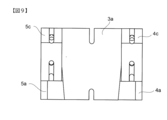
- FIG. 9 is also a rear view.
- FIG. 10 is also a plan view.
- FIG. 11 is also a front view.
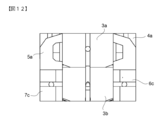
- FIG. 12 is also a bottom view.
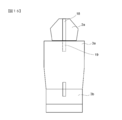
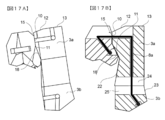
- 13A and 13B are schematic views showing the head and the torso as well.
- FIG. 14 is also a schematic view (cross-sectional view) showing the head.
- FIG. 15 is a plan view of FIG. 13A.
- 16 is a rear view of FIG. 13A.
- 17A and 17B are schematic views showing a state in which the heads of FIGS. 13A and 13B are folded.
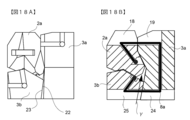
- 18A and 18B are schematic views showing a state in which the head and the body of FIGS. 13A and 13B are folded.
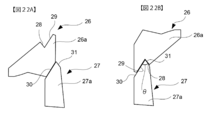
- the rear view of FIG. 18A. 22A and 22B are schematic views showing a modified example in the same manner.
- FIG. 1 shows a monkey-shaped block-type deformable toy 1 as an animal-type block-type deformable toy of this embodiment.
- This monkey-shaped block-type deformable toy 1 has a plurality of blocks 2a, 3a to 3b, 4a to 4c constituting a head 2, a body 3, a right arm 4, a left arm 5, a right leg 6, and a left leg 7.
- a monkey is expressed by a combination of 5, 5a to 5c, 6a to 6c, and 7a to 7c.
- the block-type deformable toy of the prior art was designed as a humanoid robot, but in the example of the present invention, the blocks 2a, 3a to 3b, 4a to 4c, 5a to 5c, 6a to 6c, and 7a to 7c are used. It is possible to express a specific kind of animal by making it a complicated shape including how to combine them with each other.
- FIG. 2 is a plan view of this monkey-shaped block type deformable toy
- FIG. 3 is a rear view
- FIG. 4 is a bottom view
- FIG. 5 is a right side view.
- FIG. 6 shows a perspective view.
- each block 2a to 7c is urged in a direction close to each other by the first to third rubber cord members shown by 8a to 8c in the figure. That is, the first rubber cord member 8a extends from the block 2a constituting the head 2 to the block 3b forming the buttocks of the body 3 through the block 3a forming the body 3 and is formed at both ends.
- the head 2 and the body 3 are assembled by engaging the bumps with the blocks 2a and 3b at both ends.
- the rubber cord members 8a to 8c are actually embedded in the toy and cannot be seen from the outside, but are shown through in FIG.
- the second rubber cord member 8b extends from the block 4a constituting the hand of the right arm portion to the block 5a constituting the left arm portion through the blocks 4b, 4c, 3a, 5c and 5b, and is formed at both ends.
- the third rubber cord member 8c extends from the block 6a constituting the foot portion of the right leg portion to the block 7a constituting the left leg portion through the blocks 6b, 6c, 3b, 7c and 7b, and both ends. By engaging the bumps formed in the portions with the blocks 6a and 7a at both ends, the blocks 6a to 6c and 7a to 7c of both legs are assembled with respect to the blocks 3b of the body portion 3.
- FIG. 7 is a perspective view showing the folded state of the monkey-shaped block type deformable toy
- FIG. 8 is a side view
- FIG. 9 is a rear view
- FIG. 10 is a plan view
- FIG. 11 is a front view
- FIG. It shows the bottom view.
- At least two blocks out of the plurality of blocks have a state in which their two surfaces are in contact with each other at the same time, whereby the rotation around the elastic cord member is performed. It is configured so that movement is regulated.
- the two blocks are a block 2a constituting the head 2 and a block 3a constituting the upper chest of the body 3.
- the lower surfaces 10 and 11 (two surfaces referred to in the claims) of the block 2a constituting the head 2 are tilted at an angle ⁇ of 160 degrees (see FIG. 14), and the body portion.
- the upper surfaces 12 and 13 that abut with the two surfaces of the head at the same time are 200 degrees (360 degrees minus the angle 160 degrees formed by the two lower surfaces 10 and 11 of the head 2). It is formed at an angle of (value).
- the extension line of the rubber cord member 8a can be seen from the state where the two surfaces are in contact with each other.
- the two surfaces 10, 11, 12, and 13 interfere with each other, and the blocks 2a and 3a of the above 2 are separated from each other (the direction indicated by the arrow ⁇ ). It will be driven against the urging force of the rubber cord member 8a.
- the rotation in the direction indicated by the arrow ⁇ is restricted, and when the hand is released, the position returns to the original position, that is, the position where the two surfaces 10, 11, 12, and 13 come into contact with each other. It is configured.
- FIG. 15 is a plan view of FIG. 13A
- FIG. 16 is a rear view.
- 17A to 21 are views showing a state in which the three blocks 2a, 3a, and 3b shown in FIG. 13A are folded.
- the head 2 is folded as shown in FIG. 17A.
- two surfaces 15 and 16 that mesh with the two surfaces 10 and 11 formed on the head 2 are formed on the front surface of the block corresponding to the upper chest of the body 3 and these are formed with each other.
- the state of contact with each other is configured. That is, two adjacent surfaces 15 and 16 are formed on the upper chest of the body at an angle of 200 degrees so that the two surfaces 10/11 and 15/16 are in contact with each other. It has become.
- the head 2 is formed with slits 18 along the vertical direction in the back of the head. Further, the body portion 3 is formed with slits 19 that open in the directions of the upper surfaces 12 and 13 and the front surfaces 15 and 16. As a result, the rubber cord member 8a is routed without interfering with the blocks 2a and 3a, and as shown in FIG. 17B, the head 2 can be folded.
- a block 3b constituting the lower abdomen of the body is attached to the lower part of the block 3a to which the head 2 is attached to the body 3.
- the other end of the rubber cord member 8a is fixed to the block 3b.
- the two blocks 3a and 3b are in contact with each other on one surface 20 and 21, and in the state shown in FIGS. 13A and 13B, they can freely rotate around the rubber cord member 8a (arrow ⁇ ). In this respect, the rotation angle is not restricted because the head 2 is not in contact with each other on two surfaces as in the case of the head 2.
- the rear portion (buttocks) of the block 3b constituting the lower abdomen is provided with an inclined surface 22 inclined by about 15 degrees with respect to the direction of the rubber cord member 8a, and the abdomen of the block 3a constituting the body.
- An inclined surface 23 having the same angle is provided at a portion corresponding to the above. Then, when folding, the blocks 2 and 23 are brought into contact with each other so that the block 3b is urged upward (in the direction of arrow ⁇ ) along the inclination and brought into contact with the head 2 (2a). , The lower surface (shown in FIGS. 18A and 18B) when folded can be made flush with each other.
- the blocks 3a and 3b are provided with slits 24 and 25 over the surfaces 20, 21, 22 and 23, and the rubber cord member 8a does not interfere with the block when folded.
- the present invention is not limited to the above-mentioned embodiment and modification, and can be modified without changing the gist.
- FIGS. 22A and 22B are schematic views showing the head of a giraffe-type block-type deformable toy.
- the two blocks in which the two surfaces are in contact with each other at the same time are the block 26a forming the head 26 and the block 27a forming the upper end of the neck 27, as shown in FIGS. 13A and 13B.
- the displacement of the head 26 with respect to the neck 27 in the rotation direction is regulated. That is, in this modified example, the lower surfaces 28 and 29 (two surfaces referred to in the claims) of the block 26a constituting the head 26 are tilted at an angle ⁇ of 30 degrees (see FIG. 22B), and the neck portion 27.
- the upper surfaces 30 and 31 that abut with the two surfaces of the head at the same time are 330 degrees (360 degrees minus the angle of 30 degrees formed by the two lower surfaces 28 and 29 of the head 22). ) Is formed at an angle.
- the angle formed by the two surfaces of the block on the side having the sharpened portion is 30 degrees to 170 degrees. , 190 degrees to 330 degrees is preferable.
- the animal type block type deformed toy was a monkey, but it may be a giraffe as in the modified example, it may be another animal, or it may be a human type.
- animal type may be a block type deformed toy that expresses the form of an artificial object such as a passenger car or an airplane.
Landscapes
- Toys (AREA)
Priority Applications (4)
| Application Number | Priority Date | Filing Date | Title |
|---|---|---|---|
| CN202080048746.3A CN114072212B (zh) | 2019-11-12 | 2020-11-11 | 积木式变形玩具 |
| JP2021556120A JP7140434B2 (ja) | 2019-11-12 | 2020-11-11 | ブロック式変形玩具 |
| US17/628,116 US12005371B2 (en) | 2019-11-12 | 2020-11-11 | Block-type transformable toy |
| EP20887250.7A EP4059585B1 (en) | 2019-11-12 | 2020-11-11 | Block-type transformable toy |
Applications Claiming Priority (2)
| Application Number | Priority Date | Filing Date | Title |
|---|---|---|---|
| US201962934342P | 2019-11-12 | 2019-11-12 | |
| US62/934,342 | 2019-11-12 |
Publications (1)
| Publication Number | Publication Date |
|---|---|
| WO2021095765A1 true WO2021095765A1 (ja) | 2021-05-20 |
Family
ID=75912689
Family Applications (1)
| Application Number | Title | Priority Date | Filing Date |
|---|---|---|---|
| PCT/JP2020/042068 Ceased WO2021095765A1 (ja) | 2019-11-12 | 2020-11-11 | ブロック式変形玩具 |
Country Status (5)
| Country | Link |
|---|---|
| US (1) | US12005371B2 (https=) |
| EP (1) | EP4059585B1 (https=) |
| JP (1) | JP7140434B2 (https=) |
| CN (1) | CN114072212B (https=) |
| WO (1) | WO2021095765A1 (https=) |
Cited By (1)
| Publication number | Priority date | Publication date | Assignee | Title |
|---|---|---|---|---|
| WO2023122686A1 (en) * | 2021-12-22 | 2023-06-29 | Grimes Brad | Action figures and building blocks |
Families Citing this family (1)
| Publication number | Priority date | Publication date | Assignee | Title |
|---|---|---|---|---|
| CN219681680U (zh) * | 2022-07-07 | 2023-09-15 | 浙江菲元科技有限公司 | 一种拼插动物积木玩具 |
Citations (10)
| Publication number | Priority date | Publication date | Assignee | Title |
|---|---|---|---|---|
| JPS6142995U (ja) * | 1984-08-23 | 1986-03-20 | 一躬 竹内 | 連続ブロツク |
| JPH0228297U (https=) * | 1988-08-11 | 1990-02-23 | ||
| JP3015685U (ja) * | 1995-03-10 | 1995-09-05 | 有限会社ファインデザイン | 絵合せブロック玩具 |
| JPH09155068A (ja) * | 1995-12-06 | 1997-06-17 | Toshiya Urabe | 動的変化を有する組立構造物 |
| US6482063B1 (en) | 1999-11-18 | 2002-11-19 | Charles Raymond Frigard | Articulating blocks toy |
| US20100221975A1 (en) * | 2009-02-16 | 2010-09-02 | Kimbrough Richard R | Transformable Jewelry and Decorative Structures |
| US20120156960A1 (en) | 2010-12-21 | 2012-06-21 | David Weeks Studio LLC | Transformable Toy Robot |
| US20160136531A1 (en) * | 2014-11-18 | 2016-05-19 | Virginie MANICHON | Articulated toy robot with frame, base, building accessories, and kits therefor |
| US20170106302A1 (en) * | 2015-01-16 | 2017-04-20 | Kma Concepts Limited | Toy Figure with Articulating Limbs and Body |
| US20180184768A1 (en) * | 2017-01-05 | 2018-07-05 | Richard R. Kimbrough | Transformable Jewelry and Decorative Structures |
Family Cites Families (10)
| Publication number | Priority date | Publication date | Assignee | Title |
|---|---|---|---|---|
| US957666A (en) | 1909-05-25 | 1910-05-10 | George Washington Ferguson | Jointed figure. |
| US3577673A (en) * | 1968-01-31 | 1971-05-04 | Ottorino Monestier | Block elements of variable angular form |
| USD306621S (en) * | 1987-10-30 | 1990-03-13 | Takara Co., Ltd. | Reconfigurable toy cassette |
| US4997375A (en) * | 1989-12-18 | 1991-03-05 | Heinz Ted L | Elastically interconnected articulated blocks |
| US5302148A (en) * | 1991-08-16 | 1994-04-12 | Ted Heinz | Rotatable demountable blocks of several shapes on a central elastic anchor |
| CN203043537U (zh) * | 2012-09-26 | 2013-07-10 | 楼峰明 | 一种新型机器人益智玩具 |
| CN204395434U (zh) | 2015-01-16 | 2015-06-17 | 东莞市诺峰实业有限公司 | 一种灵活的玩具机器人 |
| WO2016114821A1 (en) | 2015-01-16 | 2016-07-21 | Kma Concepts Limited | Toy figure with articulating limbs and body |
| US10035076B2 (en) * | 2016-09-21 | 2018-07-31 | Mga Entertainment, Inc. | Transformer toy with rolling vehicle integrated into command center |
| CN206934728U (zh) * | 2017-06-21 | 2018-01-30 | 刘树平 | 魔方机器人玩具 |
-
2020
- 2020-11-11 US US17/628,116 patent/US12005371B2/en active Active
- 2020-11-11 JP JP2021556120A patent/JP7140434B2/ja active Active
- 2020-11-11 WO PCT/JP2020/042068 patent/WO2021095765A1/ja not_active Ceased
- 2020-11-11 CN CN202080048746.3A patent/CN114072212B/zh active Active
- 2020-11-11 EP EP20887250.7A patent/EP4059585B1/en active Active
Patent Citations (10)
| Publication number | Priority date | Publication date | Assignee | Title |
|---|---|---|---|---|
| JPS6142995U (ja) * | 1984-08-23 | 1986-03-20 | 一躬 竹内 | 連続ブロツク |
| JPH0228297U (https=) * | 1988-08-11 | 1990-02-23 | ||
| JP3015685U (ja) * | 1995-03-10 | 1995-09-05 | 有限会社ファインデザイン | 絵合せブロック玩具 |
| JPH09155068A (ja) * | 1995-12-06 | 1997-06-17 | Toshiya Urabe | 動的変化を有する組立構造物 |
| US6482063B1 (en) | 1999-11-18 | 2002-11-19 | Charles Raymond Frigard | Articulating blocks toy |
| US20100221975A1 (en) * | 2009-02-16 | 2010-09-02 | Kimbrough Richard R | Transformable Jewelry and Decorative Structures |
| US20120156960A1 (en) | 2010-12-21 | 2012-06-21 | David Weeks Studio LLC | Transformable Toy Robot |
| US20160136531A1 (en) * | 2014-11-18 | 2016-05-19 | Virginie MANICHON | Articulated toy robot with frame, base, building accessories, and kits therefor |
| US20170106302A1 (en) * | 2015-01-16 | 2017-04-20 | Kma Concepts Limited | Toy Figure with Articulating Limbs and Body |
| US20180184768A1 (en) * | 2017-01-05 | 2018-07-05 | Richard R. Kimbrough | Transformable Jewelry and Decorative Structures |
Non-Patent Citations (1)
| Title |
|---|
| See also references of EP4059585A4 |
Cited By (1)
| Publication number | Priority date | Publication date | Assignee | Title |
|---|---|---|---|---|
| WO2023122686A1 (en) * | 2021-12-22 | 2023-06-29 | Grimes Brad | Action figures and building blocks |
Also Published As
| Publication number | Publication date |
|---|---|
| JP7140434B2 (ja) | 2022-09-21 |
| CN114072212A (zh) | 2022-02-18 |
| US20220274031A1 (en) | 2022-09-01 |
| EP4059585A4 (en) | 2023-11-15 |
| CN114072212B (zh) | 2025-05-27 |
| EP4059585B1 (en) | 2025-01-01 |
| EP4059585A1 (en) | 2022-09-21 |
| US12005371B2 (en) | 2024-06-11 |
| JPWO2021095765A1 (https=) | 2021-05-20 |
Similar Documents
| Publication | Publication Date | Title |
|---|---|---|
| CN105965514B (zh) | 仿生液压四足机器恐龙结构 | |
| CN114307178B (zh) | 人形体和转动机构 | |
| US9993739B2 (en) | Transformable toy robot | |
| WO2021095765A1 (ja) | ブロック式変形玩具 | |
| US20200246717A1 (en) | Building toy | |
| US1579367A (en) | Jointed figure toy | |
| JP7754792B2 (ja) | 模型部品、及び関節構造 | |
| CN110841303A (zh) | 人型玩具 | |
| JP2021023659A (ja) | 関節構造及び人形体 | |
| CN108579099B (zh) | 可转换的玩具 | |
| CN106659941A (zh) | 人偶玩具的肩关节结构和人偶玩具 | |
| JP7474897B1 (ja) | 模型玩具及び関節構造体 | |
| US3740128A (en) | Amusement device | |
| JP4834169B1 (ja) | 変形ロボット玩具 | |
| TWI326613B (https=) | ||
| CN116785734A (zh) | 模型玩具和关节构造体 | |
| JP2023132856A (ja) | 模型玩具、及び可動構造 | |
| CN114534267B (zh) | 人形状玩具和模型的连结构件 | |
| JP2021023830A (ja) | 関節構造及び人形体 | |
| JP7360566B1 (ja) | 模型玩具、及び可動構造体 | |
| US839770A (en) | Toy. | |
| CN119113534A (zh) | 模型玩具和可动构造体 | |
| CN116370975A (zh) | 玩具的可动构造 | |
| JP2023165305A (ja) | 人形体、及び回動機構 | |
| WO2017130923A1 (ja) | 木製フィギュア |
Legal Events
| Date | Code | Title | Description |
|---|---|---|---|
| 121 | Ep: the epo has been informed by wipo that ep was designated in this application |
Ref document number: 20887250 Country of ref document: EP Kind code of ref document: A1 |
|
| ENP | Entry into the national phase |
Ref document number: 2021556120 Country of ref document: JP Kind code of ref document: A |
|
| NENP | Non-entry into the national phase |
Ref country code: DE |
|
| ENP | Entry into the national phase |
Ref document number: 2020887250 Country of ref document: EP Effective date: 20220613 |
|
| WWG | Wipo information: grant in national office |
Ref document number: 202080048746.3 Country of ref document: CN |