WO2021080014A1 - 濃度測定方法、濃度測定装置およびプログラム - Google Patents
濃度測定方法、濃度測定装置およびプログラム Download PDFInfo
- Publication number
- WO2021080014A1 WO2021080014A1 PCT/JP2020/039998 JP2020039998W WO2021080014A1 WO 2021080014 A1 WO2021080014 A1 WO 2021080014A1 JP 2020039998 W JP2020039998 W JP 2020039998W WO 2021080014 A1 WO2021080014 A1 WO 2021080014A1
- Authority
- WO
- WIPO (PCT)
- Prior art keywords
- solution sample
- substance
- measured
- concentration
- reagent
- Prior art date
- Legal status (The legal status is an assumption and is not a legal conclusion. Google has not performed a legal analysis and makes no representation as to the accuracy of the status listed.)
- Ceased
Links
Images
Classifications
-
- G—PHYSICS
- G01—MEASURING; TESTING
- G01N—INVESTIGATING OR ANALYSING MATERIALS BY DETERMINING THEIR CHEMICAL OR PHYSICAL PROPERTIES
- G01N21/00—Investigating or analysing materials by the use of optical means, i.e. using sub-millimetre waves, infrared, visible or ultraviolet light
- G01N21/75—Systems in which material is subjected to a chemical reaction, the progress or the result of the reaction being investigated
- G01N21/77—Systems in which material is subjected to a chemical reaction, the progress or the result of the reaction being investigated by observing the effect on a chemical indicator
- G01N21/78—Systems in which material is subjected to a chemical reaction, the progress or the result of the reaction being investigated by observing the effect on a chemical indicator producing a change of colour
Definitions
- the present invention relates to a concentration measuring method, a concentration measuring device and a program, and in particular, a concentration measuring method using a reagent that reacts with a substance to be measured to change the magnitude of parameters such as fluorescence intensity and absorbance, and the concentration. It relates to a concentration measuring device and a program which can be suitably used for a measuring method.
- a quantification method using trifluoperazine (TFP) in which the magnitude of fluorescence intensity changes according to the bromate ion concentration is used. It has been proposed (see, for example, Patent Documents 1 and 2).
- TFP trifluoperazine
- the magnitude of the fluorescence intensity when the bromate ion in the sample water is reacted with TFP is measured, and the obtained measured value of the fluorescence intensity is compared with a calibration curve prepared in advance.
- a method for determining the bromate ion concentration in the sample water has been proposed.
- the present invention provides a method for measuring the concentration of a substance to be measured in a solution sample using a reagent that reacts with the substance to be measured and changes the magnitude of a parameter. Therefore, the concentration of the substance to be measured can be easily adjusted with high accuracy.
- the purpose is to make it possible to measure.
- An object of the present invention is to solve the above problems advantageously, and the concentration measuring method of the present invention reacts the concentration of the measurement target substance contained in the solution sample with the measurement target substance to form a solution.
- the present invention aims to advantageously solve the above problems, and the concentration measuring apparatus of the present invention reacts the concentration of the measurement target substance contained in the solution sample with the measurement target substance.
- This is a device for measuring using a reagent that changes the size of the parameters of the solution sample, and a solution sample containing a substance to be measured having an unknown concentration and a known amount of the substance to be measured were added to the solution sample.
- a measuring unit that measures the change over time of the parameter, and a substance to be measured in the solution sample and the reference solution sample based on the measurement result by the measuring unit.
- the present invention aims to solve the above problems advantageously, and the program of the present invention reacts the concentration of the substance to be measured contained in the solution sample with the substance to be measured to make a solution.
- the concentration of the substance to be measured can be easily measured with high accuracy.
- the concentration measuring method of the present invention is a method of measuring the concentration of a substance to be measured in a solution sample containing the substance to be measured by using a reagent that reacts with the substance to be measured and changes the size of a parameter of the solution sample. ..
- the concentration measurement method of the present invention for example, bromate ions as analyte (BrO 3 -) bromate ion concentration in the solution sample containing, solution sample reacts with bromate ions fluorescence It can be used when measuring with trifluoperazine as a reagent for changing the magnitude of intensity.
- the combination of the substance to be measured, the parameter, and the reagent to which the concentration measuring method of the present invention can be applied is not limited to the above-mentioned example, and the parameter may be, for example, absorbance.
- the substance to be measured may be iron ion, pH, or DNA.
- the reagent may be pennant trolley, FITC (fluorescein isothiocyanate), or EMA (Ethidium MonoAzide).
- the concentration measuring method of the present invention was made by finding the following findings.
- substances other than the substance to be measured contained in the solution sample (hereinafter, may be referred to as "coexisting substance") also react with the reagent and have parameters. Can affect changes in the size of.
- coexisting substance substances other than the substance to be measured contained in the solution sample
- the reaction between the substance to be measured and the reagent reaches the apparent reaction end (equilibrium) relatively early, whereas the reaction between the coexisting substance and the reagent is measured. Even if the reaction between the target substance and the reagent reaches equilibrium, it does not end and continues to affect the change in the magnitude of the parameter.
- the magnitude of the change in the fluorescence intensity of the solution sample is measured.
- the sum of the magnitude of the change in fluorescence intensity due to the reaction between the target substance and the reagent and the magnitude of the change in fluorescence intensity due to the reaction between the coexisting substance and the reagent shows that the reaction between the target substance and the reagent is In a system in which the apparent reaction termination (equilibrium) is reached relatively early, but the reaction between the coexisting substance and the reagent is not completed, the change in fluorescence intensity due to the reaction between the coexisting substance and the reagent is the measurement target substance and the reagent.
- the concentration of the substance to be measured is determined as follows.
- the concentration measurement method of the present invention utilizes the above-mentioned new findings and uses a solution sample containing a substance to be measured having an unknown concentration and a reference solution sample in which a known amount of the substance to be measured is added to the solution sample.
- the concentration of the substance to be measured is measured.
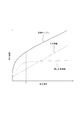
- the behavior as shown in FIG. 2 is exhibited.
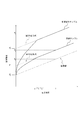
- the reference in the graph shown in FIG. 2, the analyte and the reagent with apparently time the reaction is terminated T is the reaction time longer portion than E of (a portion located on the right side of the FIG.
- the difference between the fluorescence intensity of the solution sample and the fluorescence intensity of the solution sample corresponds to the amount (known amount) of the substance to be measured added to the solution sample at the time of preparing the reference solution.
- the fluorescent intensity obtained by extrapolating to the start reacting relationship between fluorescence intensity and the reaction time of the solution sample in the longer portion the reaction time than the time T E (T 0), it coexisting materials in the solution sample.
- the fluorescence intensity in a state of not reacting with the reagent that is, the fluorescence intensity corresponding to the concentration of the substance to be measured in the solution sample).
- the concentration of the substance to be measured in the solution sample can be obtained without creating a calibration curve or the like. Will be possible.
- the influence of coexisting substances can be canceled when the difference between the fluorescence intensity of the reference solution sample and the fluorescence intensity of the solution sample is taken, so that the concentration of the substance to be measured can be highly accurate. Can be obtained at.
- C ⁇ (P 1 '-P 0') / (P 2 '-P 1') ⁇ ⁇ (m / M) ⁇ (1)
- C Concentration of the substance to be measured in the solution sample
- m Mass of the substance to be measured added to the solution sample (known amount)
- M Mass of reference solution sample [Relationship 2] Create a first approximation formula for solution samples representing the relationship between the magnitude and response time of the fluorescence intensity of the time T E later, for the reference solution samples representing the relationship between the magnitude and response time of the fluorescence intensity of the time T E after create a second approximate
- the time at which the apparent reaction between the substance to be measured and the reagent is completed is, for example, (1) a method of theoretically calculating the reaction rate constant between the substance to be measured and the reagent, (2).
- a method in which the time at which the differential value of the curve showing the relationship between the reaction time and the fluorescence intensity becomes zero or less than a predetermined value for the first time is set as the reaction end time, (3)
- the first approximate expression and the second approximate expression are created.
- the reaction end time is determined by using a method such as a method in which the time at which the value obtained by dividing the slope of the first approximation formula by the slope of the second approximation formula is 0.9 or more and 1.1 or less is set as the reaction end time. be able to.
- the method (2) above is preferable from the viewpoint of ease of use.
- the time T 1 at which the apparent reaction between the measurement target substance and the reagent in the solution sample ends and the time at which the apparent reaction between the measurement target substance and the reagent in the reference solution sample ends are not particularly limited, and can be matched by making the reaction conditions of the substance to be measured such as the reaction temperature and the reagent the same.
- the first approximation formula and the second approximation formula are not particularly limited, and a known regression analysis method (single regression analysis or multiple regression analysis) such as the least squares method or curve fitting can be applied. It can be obtained by using.
- a solution sample containing a measurement target substance having an unknown concentration and a known amount of the measurement target substance are added to the solution sample.
- the measurement target substance in the solution sample and the reference solution sample and the measurement target substance in the reference solution sample based on the measurement step of adding the reagent to the reference solution sample and measuring the change with time of the parameter and the measurement result of the measurement step. It is obtained by substituting time T (however, T ⁇ 0) into the analytical step of creating an approximate expression representing the relationship between the magnitude of the parameter and time after the apparent reaction end time with the reagent.
- the amount of the substance to be measured (known amount) added to the solution sample in the sample preparation step is not particularly limited, and is, for example, 1/2 of the control standard value, 1/2 of the legal standard value, or measurement. It can be 10 times the value of the unit of sensitivity (eg, 10 mg / L when the unit is mg / L).
- the execution order of the first measurement step and the second measurement step is not particularly limited.
- the reaction conditions of the substance to be measured and the reagent should be the same in the first measurement step and the second measurement step. Is preferable.
- the concentration measuring device of the present invention is a device that measures the concentration of a substance to be measured contained in a solution sample by using a reagent that reacts with the substance to be measured and changes the size of a parameter of the solution sample. Then, the concentration measuring apparatus of the present invention can be suitably used, for example, when determining the concentration of the substance to be measured in the solution sample by using the concentration measuring method of the present invention described above.
- an example of the concentration measuring device of the present invention includes a measuring unit, an analysis unit, and a calculation unit, and may have any other configuration.
- the measuring unit measures the time course of the parameters of the solution sample containing the measurement target substance of unknown concentration and the reference solution sample in which a known amount of the measurement target substance is added to the solution sample with the reagent added. ..
- the measuring unit can be configured by using a measuring device (for example, a fluorometer or an absorbance meter) according to the type of parameter.
- the reagent may be added to the solution sample and the reference solution sample manually by the measurer or automatically by the measuring unit.
- the analysis unit and the calculation unit can be composed of a single computer, a plurality of computers, or the like. Then, the analysis unit approximates the relationship between the magnitude and time of the parameters after the apparent reaction end time between the substance to be measured and the reagent in the solution sample and the reference solution sample based on the measurement result by the measurement unit. Create an expression. Further, the calculation unit obtains the concentration of the substance to be measured in the solution sample from the relationship between the value of the parameter obtained by substituting the time T (however, T ⁇ 0) into the approximate expression and the known amount.
- the program of the present invention is used when measuring the concentration of a substance to be measured contained in a solution sample using a reagent that reacts with the substance to be measured and changes the size of a parameter of the solution sample. Then, the program of the present invention, for example, causes the above-mentioned concentration measuring device of the present invention to function as a concentration measuring device for obtaining the concentration of the substance to be measured in the solution sample by using the above-mentioned concentration measuring method of the present invention. It can be preferably used.
- the concentration of the substance to be measured contained in the solution sample is measured by using a reagent that reacts with the substance to be measured and changes the size of the parameter of the solution sample.
- the solution sample containing the substance to be measured having an unknown concentration and the reference solution sample to which a known amount of the substance to be measured was added to the solution sample
- the changes over time of the parameters were measured with the reagent added.
- an example of the program of the present invention causes the concentration measuring device to perform the above-mentioned steps via, for example, a control device such as a computer that controls the operation of the concentration measuring device.
- this program may be recorded on a computer-readable recording medium. Using such a recording medium, it is possible to install the program on the computer.
- the recording medium on which the program is recorded may be a non-transient recording medium.
- the non-transient recording medium is not particularly limited, but may be, for example, a recording medium such as a CD-ROM or a DVD-ROM.
- the program can also be provided by download over the network.
- Example 1 Ozone-treated water (A) collected from a pipe after ozone treatment was prepared as a solution sample containing bromate ion as a substance to be measured.
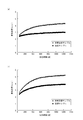
- a reference sample solution was prepared by adding 0.75 ⁇ g of bromate ion standard to 75 ml of ozone-treated water (A) so that the concentration was added by 10 ⁇ g / L (sample preparation step). Then, trifluoperazine was added as a reagent to each of the solution sample and the reference solution sample so as to have a concentration of 3 ⁇ mol / L, and the change with time of the fluorescence intensity was measured using a prototype device capable of measuring fluorescence (). First measurement step and second measurement step). The results are shown in FIG. 3 (a).
- the times T 1 and T 2 at which the apparent reaction between the substance to be measured and the reagent are completed, the first approximate formula and the second approximate formula, and the reaction start time are as follows.
- Example 2 In the sample preparation step, ozone-treated water (B) collected from the ozone-treated piping was prepared as a solution sample containing bromate ion as a substance to be measured, and bromate ion standard was prepared for 75 ml of ozone-treated water (B). 0.75 ⁇ g was added so that the concentration was added by 10 ⁇ g / L to prepare a reference sample solution.
- concentration of the substance to be measured in the solution sample (ozone-treated water (B)) was determined in the same manner as in Example 1 except for the above, it was 11.98 ⁇ g / L.
- the concentration of the substance to be measured can be easily measured with high accuracy.
Landscapes
- Physics & Mathematics (AREA)
- Chemical & Material Sciences (AREA)
- Engineering & Computer Science (AREA)
- Chemical Kinetics & Catalysis (AREA)
- Plasma & Fusion (AREA)
- Health & Medical Sciences (AREA)
- Life Sciences & Earth Sciences (AREA)
- Analytical Chemistry (AREA)
- Biochemistry (AREA)
- General Health & Medical Sciences (AREA)
- General Physics & Mathematics (AREA)
- Immunology (AREA)
- Pathology (AREA)
- Investigating Or Analysing Materials By The Use Of Chemical Reactions (AREA)
- Investigating Or Analyzing Non-Biological Materials By The Use Of Chemical Means (AREA)
Priority Applications (1)
| Application Number | Priority Date | Filing Date | Title |
|---|---|---|---|
| JP2021553582A JP7477522B2 (ja) | 2019-10-25 | 2020-10-23 | 濃度測定方法、濃度測定装置およびプログラム |
Applications Claiming Priority (2)
| Application Number | Priority Date | Filing Date | Title |
|---|---|---|---|
| JP2019194650 | 2019-10-25 | ||
| JP2019-194650 | 2019-10-25 |
Publications (1)
| Publication Number | Publication Date |
|---|---|
| WO2021080014A1 true WO2021080014A1 (ja) | 2021-04-29 |
Family
ID=75620730
Family Applications (1)
| Application Number | Title | Priority Date | Filing Date |
|---|---|---|---|
| PCT/JP2020/039998 Ceased WO2021080014A1 (ja) | 2019-10-25 | 2020-10-23 | 濃度測定方法、濃度測定装置およびプログラム |
Country Status (2)
| Country | Link |
|---|---|
| JP (1) | JP7477522B2 (https=) |
| WO (1) | WO2021080014A1 (https=) |
Citations (9)
| Publication number | Priority date | Publication date | Assignee | Title |
|---|---|---|---|---|
| JPS61180143A (ja) * | 1985-07-17 | 1986-08-12 | フレデリツク・ジエイ・アラジエム | 免疫拡散による蛋白の定量分析方法 |
| JPS63118655A (ja) * | 1986-03-19 | 1988-05-23 | ベ−リンガ−・マンハイム・ゲゼルシヤフト・ミツト・ベシユレンクテル・ハフツング | 免疫反応の反応成分を測定するための方法及び試薬 |
| JPH06148187A (ja) * | 1991-02-07 | 1994-05-27 | Konica Corp | 免疫学的測定方法 |
| WO2009116554A1 (ja) * | 2008-03-19 | 2009-09-24 | メタウォーター株式会社 | 臭素酸イオンの測定方法および装置 |
| JP2010271095A (ja) * | 2009-05-20 | 2010-12-02 | Hitachi High-Technologies Corp | 自動分析装置及び分析方法 |
| US20130130308A1 (en) * | 2011-11-23 | 2013-05-23 | Envolure | Process for directly measuring multiple biodegradabilities |
| JP2014002007A (ja) * | 2012-06-18 | 2014-01-09 | Metawater Co Ltd | 臭素酸イオンの測定方法及び測定装置 |
| WO2014174818A1 (ja) * | 2013-04-26 | 2014-10-30 | パナソニックIpマネジメント株式会社 | 酸化物質定量方法および酸化物質定量装置 |
| JP2016057162A (ja) * | 2014-09-09 | 2016-04-21 | メタウォーター株式会社 | 臭素酸イオン濃度の測定方法および測定システム |
-
2020
- 2020-10-23 JP JP2021553582A patent/JP7477522B2/ja active Active
- 2020-10-23 WO PCT/JP2020/039998 patent/WO2021080014A1/ja not_active Ceased
Patent Citations (9)
| Publication number | Priority date | Publication date | Assignee | Title |
|---|---|---|---|---|
| JPS61180143A (ja) * | 1985-07-17 | 1986-08-12 | フレデリツク・ジエイ・アラジエム | 免疫拡散による蛋白の定量分析方法 |
| JPS63118655A (ja) * | 1986-03-19 | 1988-05-23 | ベ−リンガ−・マンハイム・ゲゼルシヤフト・ミツト・ベシユレンクテル・ハフツング | 免疫反応の反応成分を測定するための方法及び試薬 |
| JPH06148187A (ja) * | 1991-02-07 | 1994-05-27 | Konica Corp | 免疫学的測定方法 |
| WO2009116554A1 (ja) * | 2008-03-19 | 2009-09-24 | メタウォーター株式会社 | 臭素酸イオンの測定方法および装置 |
| JP2010271095A (ja) * | 2009-05-20 | 2010-12-02 | Hitachi High-Technologies Corp | 自動分析装置及び分析方法 |
| US20130130308A1 (en) * | 2011-11-23 | 2013-05-23 | Envolure | Process for directly measuring multiple biodegradabilities |
| JP2014002007A (ja) * | 2012-06-18 | 2014-01-09 | Metawater Co Ltd | 臭素酸イオンの測定方法及び測定装置 |
| WO2014174818A1 (ja) * | 2013-04-26 | 2014-10-30 | パナソニックIpマネジメント株式会社 | 酸化物質定量方法および酸化物質定量装置 |
| JP2016057162A (ja) * | 2014-09-09 | 2016-04-21 | メタウォーター株式会社 | 臭素酸イオン濃度の測定方法および測定システム |
Also Published As
| Publication number | Publication date |
|---|---|
| JP7477522B2 (ja) | 2024-05-01 |
| JPWO2021080014A1 (https=) | 2021-04-29 |
Similar Documents
| Publication | Publication Date | Title |
|---|---|---|
| Campaña et al. | ALAMIN: a chemometric program to check analytical method performance and to assess the trueness by standard addition methodology | |
| JP5006441B2 (ja) | 全血分析 | |
| ATE295541T1 (de) | Verfahren und vorrichtung zur untersuchung von wirksstoffskandidaten und zur bestimmung ihrer pharmakokinetischen parametern | |
| CN108124462B (zh) | 一种混合物检测方法及设备 | |
| JP7693718B2 (ja) | 定量器-確認器比チェックのために顧客質量分析機器を較正するためのコンピュータ実装方法 | |
| Hegazy et al. | Novel spectrophotometric determination of chloramphenicol and dexamethasone in the presence of non labeled interfering substances using univariate methods and multivariate regression model updating | |
| CN113324973A (zh) | 一种结合光谱内标的多因素校正拉曼光谱定量分析方法 | |
| CN110174417A (zh) | 一种滤棒中三乙酸甘油酯的定量检测方法 | |
| CN109633181A (zh) | 一种血浆中变肾上腺素和去甲变肾上腺素的检测试剂盒 | |
| CN108140122A (zh) | 一种混合物检测方法及设备 | |
| CN103115881B (zh) | 评定并减小铁矿石中钾的不确定度数值的方法 | |
| WO2021080014A1 (ja) | 濃度測定方法、濃度測定装置およびプログラム | |
| JPH06194313A (ja) | 反応測定方法 | |
| Basavaiah et al. | Three useful bromimetric methods for the determination of salbutamol sulfate | |
| CN102661943B (zh) | 用表面增强拉曼光谱测定胱氨酸的方法 | |
| DK2542885T3 (en) | Analyte quantification using flow-induced dispersion analysis | |
| Bruton | Known addition ion selective electrode technique for simultaneously determining fluoride and chloride in calcium halophosphate | |
| Geertjens et al. | Straightforward model construction and analysis of multicomponent biomolecular systems in equilibrium | |
| Mateo et al. | Development and evaluation of a rapid and sensitive homogeneous assay for haptoglobin measurements in saliva | |
| WO2024046267A1 (zh) | 基于反应曲线的曲率检测待检测样本的前带现象的方法和装置 | |
| CN103630525A (zh) | 表面增强拉曼光谱测定镉的方法 | |
| Taleuzzaman et al. | Bio-analytical method validation-A review | |
| US20110046908A1 (en) | Method and apparatus for calibrating result from test device | |
| JP2595267B2 (ja) | 測光的評価を用いる物質の測定法 | |
| Stefan-van Staden et al. | Fast screening of whole blood samples for early detection and monitoring of thyroid diseases |
Legal Events
| Date | Code | Title | Description |
|---|---|---|---|
| 121 | Ep: the epo has been informed by wipo that ep was designated in this application |
Ref document number: 20880112 Country of ref document: EP Kind code of ref document: A1 |
|
| ENP | Entry into the national phase |
Ref document number: 2021553582 Country of ref document: JP Kind code of ref document: A |
|
| NENP | Non-entry into the national phase |
Ref country code: DE |
|
| 122 | Ep: pct application non-entry in european phase |
Ref document number: 20880112 Country of ref document: EP Kind code of ref document: A1 |