WO2021069332A1 - Fluid-system components - Google Patents
Fluid-system components Download PDFInfo
- Publication number
- WO2021069332A1 WO2021069332A1 PCT/EP2020/077722 EP2020077722W WO2021069332A1 WO 2021069332 A1 WO2021069332 A1 WO 2021069332A1 EP 2020077722 W EP2020077722 W EP 2020077722W WO 2021069332 A1 WO2021069332 A1 WO 2021069332A1
- Authority
- WO
- WIPO (PCT)
- Prior art keywords
- system component
- fluid
- less
- polymeric composition
- polymer
- Prior art date
- Legal status (The legal status is an assumption and is not a legal conclusion. Google has not performed a legal analysis and makes no representation as to the accuracy of the status listed.)
- Ceased
Links
Classifications
-
- C—CHEMISTRY; METALLURGY
- C08—ORGANIC MACROMOLECULAR COMPOUNDS; THEIR PREPARATION OR CHEMICAL WORKING-UP; COMPOSITIONS BASED THEREON
- C08L—COMPOSITIONS OF MACROMOLECULAR COMPOUNDS
- C08L27/00—Compositions of homopolymers or copolymers of compounds having one or more unsaturated aliphatic radicals, each having only one carbon-to-carbon double bond, and at least one being terminated by a halogen; Compositions of derivatives of such polymers
- C08L27/02—Compositions of homopolymers or copolymers of compounds having one or more unsaturated aliphatic radicals, each having only one carbon-to-carbon double bond, and at least one being terminated by a halogen; Compositions of derivatives of such polymers not modified by chemical after-treatment
- C08L27/12—Compositions of homopolymers or copolymers of compounds having one or more unsaturated aliphatic radicals, each having only one carbon-to-carbon double bond, and at least one being terminated by a halogen; Compositions of derivatives of such polymers not modified by chemical after-treatment containing fluorine atoms
-
- C—CHEMISTRY; METALLURGY
- C08—ORGANIC MACROMOLECULAR COMPOUNDS; THEIR PREPARATION OR CHEMICAL WORKING-UP; COMPOSITIONS BASED THEREON
- C08F—MACROMOLECULAR COMPOUNDS OBTAINED BY REACTIONS ONLY INVOLVING CARBON-TO-CARBON UNSATURATED BONDS
- C08F210/00—Copolymers of unsaturated aliphatic hydrocarbons having only one carbon-to-carbon double bond
- C08F210/02—Ethene
-
- C—CHEMISTRY; METALLURGY
- C08—ORGANIC MACROMOLECULAR COMPOUNDS; THEIR PREPARATION OR CHEMICAL WORKING-UP; COMPOSITIONS BASED THEREON
- C08F—MACROMOLECULAR COMPOUNDS OBTAINED BY REACTIONS ONLY INVOLVING CARBON-TO-CARBON UNSATURATED BONDS
- C08F214/00—Copolymers of compounds having one or more unsaturated aliphatic radicals, each having only one carbon-to-carbon double bond, and at least one being terminated by a halogen
- C08F214/18—Monomers containing fluorine
- C08F214/24—Trifluorochloroethene
- C08F214/245—Trifluorochloroethene with non-fluorinated comonomers
-
- C—CHEMISTRY; METALLURGY
- C08—ORGANIC MACROMOLECULAR COMPOUNDS; THEIR PREPARATION OR CHEMICAL WORKING-UP; COMPOSITIONS BASED THEREON
- C08F—MACROMOLECULAR COMPOUNDS OBTAINED BY REACTIONS ONLY INVOLVING CARBON-TO-CARBON UNSATURATED BONDS
- C08F214/00—Copolymers of compounds having one or more unsaturated aliphatic radicals, each having only one carbon-to-carbon double bond, and at least one being terminated by a halogen
- C08F214/18—Monomers containing fluorine
- C08F214/26—Tetrafluoroethene
- C08F214/265—Tetrafluoroethene with non-fluorinated comonomers
-
- C—CHEMISTRY; METALLURGY
- C08—ORGANIC MACROMOLECULAR COMPOUNDS; THEIR PREPARATION OR CHEMICAL WORKING-UP; COMPOSITIONS BASED THEREON
- C08F—MACROMOLECULAR COMPOUNDS OBTAINED BY REACTIONS ONLY INVOLVING CARBON-TO-CARBON UNSATURATED BONDS
- C08F220/00—Copolymers of compounds having one or more unsaturated aliphatic radicals, each having only one carbon-to-carbon double bond, and only one being terminated by only one carboxyl radical or a salt, anhydride ester, amide, imide or nitrile thereof
- C08F220/02—Monocarboxylic acids having less than ten carbon atoms; Derivatives thereof
- C08F220/10—Esters
- C08F220/12—Esters of monohydric alcohols or phenols
- C08F220/16—Esters of monohydric alcohols or phenols of phenols or of alcohols containing two or more carbon atoms
- C08F220/18—Esters of monohydric alcohols or phenols of phenols or of alcohols containing two or more carbon atoms with acrylic or methacrylic acids
-
- C—CHEMISTRY; METALLURGY
- C08—ORGANIC MACROMOLECULAR COMPOUNDS; THEIR PREPARATION OR CHEMICAL WORKING-UP; COMPOSITIONS BASED THEREON
- C08F—MACROMOLECULAR COMPOUNDS OBTAINED BY REACTIONS ONLY INVOLVING CARBON-TO-CARBON UNSATURATED BONDS
- C08F220/00—Copolymers of compounds having one or more unsaturated aliphatic radicals, each having only one carbon-to-carbon double bond, and only one being terminated by only one carboxyl radical or a salt, anhydride ester, amide, imide or nitrile thereof
- C08F220/02—Monocarboxylic acids having less than ten carbon atoms; Derivatives thereof
- C08F220/10—Esters
- C08F220/26—Esters containing oxygen in addition to the carboxy oxygen
- C08F220/28—Esters containing oxygen in addition to the carboxy oxygen containing no aromatic rings in the alcohol moiety
-
- C—CHEMISTRY; METALLURGY
- C08—ORGANIC MACROMOLECULAR COMPOUNDS; THEIR PREPARATION OR CHEMICAL WORKING-UP; COMPOSITIONS BASED THEREON
- C08L—COMPOSITIONS OF MACROMOLECULAR COMPOUNDS
- C08L27/00—Compositions of homopolymers or copolymers of compounds having one or more unsaturated aliphatic radicals, each having only one carbon-to-carbon double bond, and at least one being terminated by a halogen; Compositions of derivatives of such polymers
- C08L27/02—Compositions of homopolymers or copolymers of compounds having one or more unsaturated aliphatic radicals, each having only one carbon-to-carbon double bond, and at least one being terminated by a halogen; Compositions of derivatives of such polymers not modified by chemical after-treatment
- C08L27/12—Compositions of homopolymers or copolymers of compounds having one or more unsaturated aliphatic radicals, each having only one carbon-to-carbon double bond, and at least one being terminated by a halogen; Compositions of derivatives of such polymers not modified by chemical after-treatment containing fluorine atoms
- C08L27/18—Homopolymers or copolymers or tetrafluoroethene
-
- C—CHEMISTRY; METALLURGY
- C08—ORGANIC MACROMOLECULAR COMPOUNDS; THEIR PREPARATION OR CHEMICAL WORKING-UP; COMPOSITIONS BASED THEREON
- C08L—COMPOSITIONS OF MACROMOLECULAR COMPOUNDS
- C08L2203/00—Applications
- C08L2203/18—Applications used for pipes
-
- C—CHEMISTRY; METALLURGY
- C08—ORGANIC MACROMOLECULAR COMPOUNDS; THEIR PREPARATION OR CHEMICAL WORKING-UP; COMPOSITIONS BASED THEREON
- C08L—COMPOSITIONS OF MACROMOLECULAR COMPOUNDS
- C08L2205/00—Polymer mixtures characterised by other features
- C08L2205/02—Polymer mixtures characterised by other features containing two or more polymers of the same C08L -group
Definitions
- the present invention relates to fluid-system components, particularly suitable for systems using pure and ultrapure fluids, which can find application in particular in the electronics industry, for example in the manufacturing of semiconductor devices.
- the present invention is concerned with the components of a fluid distribution system (“fluid-system components”) which is suitable for pure and ultrapure fluids which can find application in an electronics manufacturing facility e.g. a semiconductor manufacturing facility.
- fluid-system components which is suitable for pure and ultrapure fluids which can find application in an electronics manufacturing facility e.g. a semiconductor manufacturing facility.
- Ultrapure fluids commonly used in the electronics industry include ultrapure water, ultrapure hydrofluoric acid, ultrapure hydrogen peroxide, ultrapure isopropyl alcohol, ultrapure ammonium hydroxide and others.
- the purity grade of such fluids is defined by industry standards, depending on the specific application, under the ASTM or SEMI norms which are known to the skilled person. The respect of these standards is necessary in order to prevent contamination of electronics and semiconductor materials. For example widely used requirements for ultra-pure water quality are documented by ASTM D5127 "Standard Guide for Ultra-Pure Water Used in the Electronics and Semiconductor Industries” and SEMI F63 "Guide for ultrapure water used in semiconductor processing".
- Fluid-system components which are used to transport and contain ultrapure fluids must also respect purity standards.
- Specific industry standards have been developed to define which materials can be used in fluid-system components for handling ultrapure fluids.
- the standards defined in the norm “SEMI F-57” has been broadly adopted by the semiconductor industry even if in some cases different requirements, which can be more or less stringent than the SEMI F-57 norm have been imposed depending on the specific application.
- the SEMI F-57 standard considers 5 categories of contaminants: a) total organic carbon (TOC) b) 7 ionic contaminants c) 16 metallic contaminants d) particles e) surface roughness.
- the SEMI F-57 standard provides for maximum levels for each contaminant a)-d) typically in pg/m 2 and a measure for surface roughness.
- the levels of contaminants are measured in pg/m 2 because typically the contaminant are measured trough extraction tests which are conducted treating a surface made of the material with the solvent of choice and the extracted amount is directly proportional to the treated surface.
- fluid distribution systems are typically made of out of a number of different fluid-system components joined together. Some fluid system components are described for example in the Saint Gobain Process System Website under “electronics” at www.processsystems.saint-gobain.com.
- fluid-system components for the semiconductor industry are typically made from selected materials which ensure the extreme purity which is required by the standards.
- PTFE polytetrafluoroethylene
- PVDF polyvinylidene fluoride
- PVDF polyvinylidene fluoride
- the present invention relates to a fluid-system component comprising a thermoplastic polymeric composition, said composition comprising one or more semi crystalline polymer, the semi crystalline polymer comprising recurring units derived from ethylene (E) and at least one of chlorotrifluoroethylene (CTFE) and tetrafluoroethylene (TFE) said semi crystalline polymer having a heat of fusion of less than 35 J/g [polymer (A)] and wherein said thermoplastic polymeric composition when subject to the extraction test described herein has a leeching of less than 50 ppb, preferably less than 10 ppb for each of Ca, Fe, K, Na, Zn, Ti, Sn, Ce, Cu, Zr, Bi, Si, Al, Sb.
- the present invention relates to a method of making such fluid system components.
- the present invention relates to method of transporting or containing ultrapure fluids including the step of contacting said ultrapure fluids with one or more of such fluid-system component.
- Fluid systems in an electronics manufacturing facility are typically used to distribute and contain ultrapure fluids as described in the background section of the present application.
- fluid-system component include in general each of the components defining the path for fluids to be transported, collected and used in a fluid distribution system for example in an electronics manufacturing facility, particularly in a semiconductors manufacturing facility.
- Fluid-system components include for example pipes (rigid and flexible), valves, fittings, pumps, manifolds, regulators, pressure regulators, static mixers, gauge protectors, filter housings, o-rings, wet benches.
- Fluid-system components comprise a thermoplastic polymeric composition, said composition comprising one or more semi crystalline polymer, the semi crystalline polymer comprising recurring units derived from ethylene (E) and at least one of chlorotrifluoroethylene (CTFE) and tetrafluoroethylene (TFE) said semi crystalline polymer having a heat of fusion of less than 35 J/g [polymer (A)] wherein said thermoplastic polymeric composition when subject to the extraction test described herein has a leeching of less than 50 ppb, preferably less than 10 ppb for each of Ca, Fe, K, Na, Zn, Ti, Sn, Ce, Cu, Zr, Bi, Si, Al, Sb.
- the thermoplastic composition of the invention comprises one or more semi crystalline polymer (A) characterized by a low heat of fusion which indicates a low level of crystallinity.
- the thermoplastic polymeric composition comprises at least 95%wt, more preferably at least 99%, and even more preferably consists of said one or more semi crystalline polymer (A).
- said one or more semi crystalline polymer (A) comprises more than 95% in moles of recurring units derived from ethylene, CTFE and TFE.
- the one or more polymer (A) comprises an amount of recurring units derived from ethylene of less than 50 % moles, preferably of less than 48 % moles, more preferably of less than 45 % moles, as this enable achieving improved properties due to the fluoromonomer components.
- Polymers (A) suitable in the present invention typically comprise:
- CTFE chlorotrifluoroethylene
- TFE tetrafluoroethylene
- the comonomer is a hydrogenated comonomer selected from the group of the (meth)acrylic monomers. More preferably the hydrogenated comonomer is selected from the group of the hydroxyalkylacrylate comonomers, such as hydroxyethylacrylate, hydroxypropylacrylate and (hydroxy)ethylhexylacrylate, and alkyl acrylate comonomers, such as n- butyl acrylate.
- ECTFE copolymers i.e. copolymers of ethylene and CTFE and, optionally, a third monomer, as above detailed, are preferred.
- Polymers (A) suitable in the composition of the invention preferably possess a melting temperature between 150 and 230°C, preferably between 170 and 220°C, more preferably between 175 and 215°C.
- This melting temperature range is linked to the relatively low level of crystallinity of these polymers which is a consequence of the excess of one of the monomer type, typically of the fluorine containing monomer with respect to the ethylene monomer in the one or more polymer (A).
- ETFE and ECTFE co-polymers have the higher crystallinity when the molar ratio is 50/50 and their crystallinity, and consequently their melting temperature quickly decreases while increasing or decreasing the level of ethylene with respect to the 50/50 ratio.
- the melting temperature is determined by Differential Scanning
- the heat of fusion in particular is a good measure of the crystallinity of the polymer.
- the heat of fusion of polymer (A) is determined by Differential Scanning Calorimetry (DSC) at a heating rate of 10°C/min, according to ASTM D 3418.
- the polymer (A) possess a heat of fusion of less than 35 J/g, preferably of at most 30 J/g, more preferably of at most 25 J/g.
- polymer (A) is essential for polymer (A) of being a semi-crystalline polymer, i.e. a polymer having a detectable melting temperature when determined according to ASTM D 3418. Without lower limit for heat of fusion being critical, it is nevertheless understood that polymers (A) will generally possess a heat of fusion of at least 1 J/g, preferably of at least 2 J/g, more preferably of at least 5 J/g.
- an ECTFE polymer with a 50/50 molar ratio such as Flalar® H901 from Solvay, typically has a melting temperature of about 242°C and in order to be effectively worked (e.g. moulded or extruded) it has to be heated further at a typical processing temperature of about 275°C. At this processing temperature in fact it reaches a melt flow rate of about 1g/min (under 2.16kg) which allows the material to be worked with conventional equipment.
- an ECTFE copolymer manufactured in the same way but according to the present invention has a melting temperature of about 205°C and reaches a melt flow rate of about 1g/min (under 2.16kg) at about 230°C at which temperature it can be worked into a finished product.
- ECTFE polymers which have been found to give particularly good results are those consisting essentially of recurring units derived from:
- CTFE chlorotrifluoroethylene
- Polymers (A) as defined above can be prepared with very low levels of impurities using conventional techniques, so that they typically have a very low level of metal contaminants and a low level of TOC (total organic carbon).
- Normally polymers (A) selected according to the invention will not require special attention in their preparation: polymers (A) manufactured with conventional source ingredients and techniques, known in the art for ETFE and ECTFE manufacturing, have a content in TOC and metal impurities which is sufficiently low to be used in a thermoplastic composition which satisfy the extraction test requirements of the invention.
- some commercial grades of copolymers in this class contain additives such as antioxidants or UV absorbers which may contribute significantly to the levels of extractable impurities. These grades are not recommended for the present invention.
- Thermoplastic polymeric compositions for the present invention have a
- the thermoplastic composition in the fluid system components of the invention comprises at least 95%wt, preferably at least 99%, and more preferably consists of said one or more semi crystalline polymer (A).
- the thermoplastic polymeric composition is free from additives such as UV filters, antioxidants, surfactants, acid scavengers, metal oxides and salts and the like.
- the polymeric composition of the invention is free from any non polymeric component. In this context for “free of it is intended that additives and/or non polymeric components may be present at a total level of trace impurity of less than 10 mg/kg, preferably less than 1 mg/kg and more preferably below their detectable limit.
- the melt flow rate of the thermoplastic composition of the invention measured following the procedure of ASTM 3275-81 at 225°C and 2.16 Kg ranges generally from 0.01 to 75 g/10 min, preferably from 0.1 to 50 g/10 min, more preferably from 0.5 to 30 g/10 min.
- the melt flow rate of the thermoplastic polymeric composition of the invention is 1 g/1 Omin under 2.16 kg at a temperature below 255°C.
- a melt flow rate of 1 g/1 Omin under 2.16 kg is a typical values at which the thermoplastic composition can be worked with conventional equipment, so that this preferred requirement indicates that the thermoplastic composition of the invention can be melt processed with conventional equipment at a temperature below 255°C.
- Fluid-system components in accordance to the present invention can either be entirely made of the thermoplastic polymeric composition of the invention, or they can combine a part made from the thermoplastic polymeric composition of the invention with other parts made from different materials including other plastics, glass, metals, composite materials and mixture thereof.
- tubings are typically made out of plastics wherein at least the innermost layer contacting the fluid is made from the thermoplastic polymeric composition of the invention, while valves, fittings pumps and mixers often combine parts made from the thermoplastic polymeric composition of the invention with parts made from other materials as described.
- fluid-system components may leach out chemicals of various nature in particular from the surfaces of such components which are directly in contact with the fluids.
- a fluid contacting surface i.e. a surface which will go in contact with the fluid when in use.
- a pipe only the innermost surface of the pipe is a “fluid contacting surface”.
- some parts of the fluid- system components of the invention parts may be constructed as multilayer parts.
- the layer forming the fluid contacting surface is made from the thermoplastic composition of the invention.
- thermoplastic composition of the invention At least the entire surface of the fluid-system component which goes in contact with the fluid when in use (its “fluid contacting surface”) is made from the thermoplastic composition of the invention.
- the entire plastic portion of the fluid- system component is made of the thermoplastic composition of the invention.
- the fluid-system components of the invention do not comprise other polymeric material other than the thermoplastic polymeric composition of the invention.
- the present invention relates to a method of making a fluid system component comprising the steps of: a) providing a thermoplastic polymeric composition, said composition comprising one or more semi crystalline polymer, the semi crystalline polymer comprising recurring units derived from ethylene (E) and at least one of chlorotrifluoroethylene (CTFE) and tetrafluoroethylene (TFE) said semi crystalline polymer having a heat of fusion of less than 35 J/g [polymer (A)] wherein said thermoplastic polymeric composition when subject to the extraction test described herein has a leeching of less than 50 ppb, preferably less than 10 ppb, for each of Ca, Fe, K, Na, Zn, Ti, Sn, Ce, Cu, Zr, Bi, Si, Al, Sb. b) heating said thermoplastic polymeric composition to
- melt forming method for example molding, extrusion, 3d printing, shaping and so on.
- the present invention relates to a method of transporting or containing ultra-pure fluids said method including the step of contacting said ultrapure fluids with one or more fluid-system component as described above.
- this method is particularly useful in an electronics manufacturing facility, typically a semiconductor manufacturing facility.
- fluid system components according to the invention can have excellent performance in handling ultrapure fluids with extremely low levels of leached metals and TOC. This is due to the specific selection of semi crystalline co-polymers of ethylene and at least one of CTFE or TFE, having a heat of fusion of less than 35 J/g.
- Polymers in the same class with higher heat of fusion typically do not withstand melt processing and start decomposing at their melt processing temperatures so that the decomposition products contribute to the leachable organic fraction thus causing an increased TOC. Also the increased processing temperature causes an increased metal content due to the interactions of the materials with the equipment during processing.
- Commercial materials in the class of ECTFE and ETFE copolymers having a heat of fusion above 35 J/g typically contain antioxidant additives which are able to prevent degradation at the melt processing temperature, however these antioxidant additives cause and significant increase in the levels of extractables making the material unsuitable for ultrapure fluids handling.
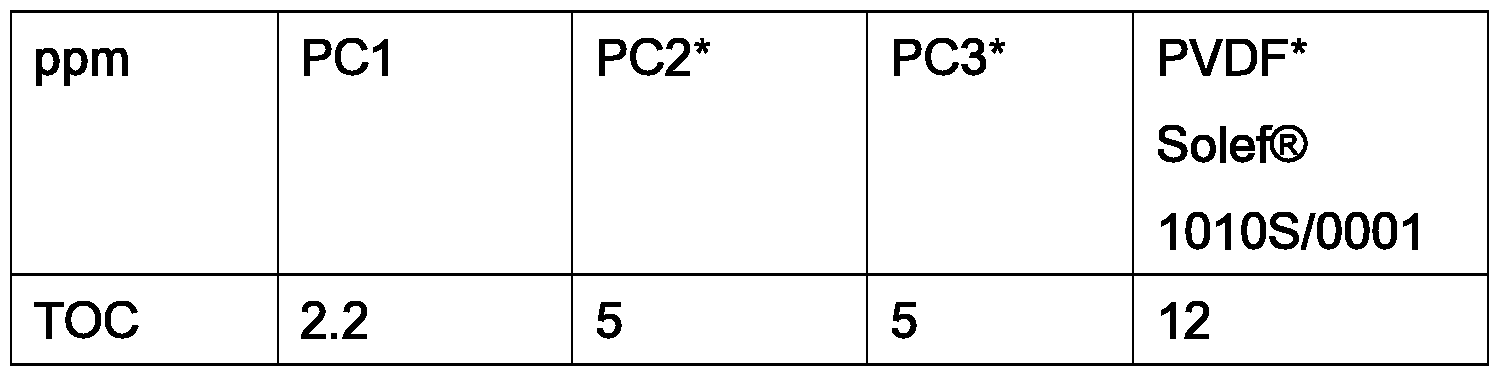
- the selected polymers for the present invention surprisingly also have a comparable metal content but a lower TOC than commonly used polymers for ultrapure fluids handling such as PVDF.
- fluid system components according to the present invention can be obtained by melt processing of the thermoplastic composition as described above, at a relatively low processing temperature and with conventional techniques such as molding extrusion or 3D printing.
- the resulting fluid system components present a very low level of extractables in terms of Metal ions and TOC and are therefore suitable for use to transport and contain ultrapure fluids such as those used in the electronics and semiconductor industries without causing the contamination of those fluids.
- the melting temperature is determined by Differential Scanning Calorimetry (DSC) at a heating rate of 10°C/min, according to ASTM D 3418.
- the heat of fusion of polymer (A) is determined by Differential Scanning Calorimetry (DSC) at a heating rate of 10°C/min, according to ASTM D 3418.
- the melt flow rate of the polymer (A) is measured following the procedure of ASTM 3275-81 under 2.16 Kg at the indicated temperature.
- Milli-Q water from Millipore water treatment system.
- ECTFE copolymer with 50% in moles of CTFE recurring units and 50% of Ethylene recurring units with additives: ethylene-acrylic acid copolymer metal salts notably commercially as Aclyn® grade + antioxidant selected from phosphate derivatives (ADK-260)).
- PVDF Solef® 1010S/0001 commercial grade polyvinylidene fluoride polymer from Solvay.
- thermoplastic polymeric composition under testing is melted in a double screw 27mm LEISTRITZ extruder having an L/D ratio of 40, and extruded through a 4mm 2 circular die.
- the temperature profile of the extruder must be set so that the temperature measured at the extrusion die should be about 30°C +/- 5°C higher than the melting temperature of the polymeric composition (or of the highest melting temperature in case more DSC peaks are present).
- a skilled person will know how to adjust the other parameters of the extruder accordingly.
- the extrusion speed is not critical however the melted composition should not reside in the extruder for very long time to avoid contamination from the extruder materials, therefore screw speed and torque must be set so to extrude the polymeric composition at a speed of from about 5 kg/h to 40 kg/h.
- the extruded strands having a diameter of about 2 mm (+/- 0.2mm) are cooled in a water bath, dried and cut in pellets of about 1 mm length. The resulting pellets are used for the following testing.
- the water after aging is then sampled and tested for cations and TOC. Metals are measured using ICP-MS and reported as ppb of concentration in the aged water.
- TOC is measured according to ASTM D7573-18a and reported as ppm of TOC concentration in the aged water.
Landscapes
- Chemical & Material Sciences (AREA)
- Health & Medical Sciences (AREA)
- Chemical Kinetics & Catalysis (AREA)
- Medicinal Chemistry (AREA)
- Polymers & Plastics (AREA)
- Organic Chemistry (AREA)
- Compositions Of Macromolecular Compounds (AREA)
- Rigid Pipes And Flexible Pipes (AREA)
- Weting (AREA)
Abstract
Description

Claims
Priority Applications (5)
| Application Number | Priority Date | Filing Date | Title |
|---|---|---|---|
| CN202080070629.7A CN114502639A (en) | 2019-10-09 | 2020-10-02 | Fluid system component |
| KR1020227013666A KR20220080113A (en) | 2019-10-09 | 2020-10-02 | Fluid-System Components |
| EP20780758.7A EP4041784A1 (en) | 2019-10-09 | 2020-10-02 | Fluid-system components |
| US17/767,869 US20240084122A1 (en) | 2019-10-09 | 2020-10-02 | Fluid-system components |
| JP2022520636A JP7618658B2 (en) | 2019-10-09 | 2020-10-02 | Fluid System Components |
Applications Claiming Priority (2)
| Application Number | Priority Date | Filing Date | Title |
|---|---|---|---|
| EP19202277 | 2019-10-09 | ||
| EP19202277.0 | 2019-10-09 |
Publications (1)
| Publication Number | Publication Date |
|---|---|
| WO2021069332A1 true WO2021069332A1 (en) | 2021-04-15 |
Family
ID=68392685
Family Applications (1)
| Application Number | Title | Priority Date | Filing Date |
|---|---|---|---|
| PCT/EP2020/077722 Ceased WO2021069332A1 (en) | 2019-10-09 | 2020-10-02 | Fluid-system components |
Country Status (6)
| Country | Link |
|---|---|
| US (1) | US20240084122A1 (en) |
| EP (1) | EP4041784A1 (en) |
| JP (1) | JP7618658B2 (en) |
| KR (1) | KR20220080113A (en) |
| CN (1) | CN114502639A (en) |
| WO (1) | WO2021069332A1 (en) |
Citations (3)
| Publication number | Priority date | Publication date | Assignee | Title |
|---|---|---|---|---|
| JPH04354582A (en) * | 1991-05-30 | 1992-12-08 | Sekisui Chem Co Ltd | Ultra-pure water transporting and piping system |
| WO2016046300A1 (en) * | 2014-09-24 | 2016-03-31 | Solvay Specialty Polymers Italy S.P.A. | Fluoropolymer composition |
| WO2016128315A1 (en) * | 2015-02-11 | 2016-08-18 | Solvay Specialty Polymers Italy S.P.A. | Novel thermoprocessable fluoropolymer |
Family Cites Families (5)
| Publication number | Priority date | Publication date | Assignee | Title |
|---|---|---|---|---|
| JP2001055764A (en) * | 1999-08-17 | 2001-02-27 | Katsuji Ando | Filter vessel for rainwater |
| JP2004299808A (en) * | 2003-03-28 | 2004-10-28 | Shinko Electric Co Ltd | Transfer device |
| CN1308361C (en) * | 2004-08-09 | 2007-04-04 | 大连振邦氟涂料股份有限公司 | Process for preparing ethylene-chlorotrifluoroethylene copolymer |
| KR101804609B1 (en) * | 2010-10-15 | 2017-12-05 | 솔베이 스페셜티 폴리머스 이태리 에스.피.에이. | Fluoropolymer composition |
| CN109575157B (en) * | 2018-11-16 | 2020-12-15 | 上海华谊三爱富新材料有限公司 | Fluoropolymer having low metal ion content and method for producing same |
-
2020
- 2020-10-02 CN CN202080070629.7A patent/CN114502639A/en active Pending
- 2020-10-02 WO PCT/EP2020/077722 patent/WO2021069332A1/en not_active Ceased
- 2020-10-02 US US17/767,869 patent/US20240084122A1/en active Pending
- 2020-10-02 JP JP2022520636A patent/JP7618658B2/en active Active
- 2020-10-02 KR KR1020227013666A patent/KR20220080113A/en not_active Ceased
- 2020-10-02 EP EP20780758.7A patent/EP4041784A1/en not_active Withdrawn
Patent Citations (3)
| Publication number | Priority date | Publication date | Assignee | Title |
|---|---|---|---|---|
| JPH04354582A (en) * | 1991-05-30 | 1992-12-08 | Sekisui Chem Co Ltd | Ultra-pure water transporting and piping system |
| WO2016046300A1 (en) * | 2014-09-24 | 2016-03-31 | Solvay Specialty Polymers Italy S.P.A. | Fluoropolymer composition |
| WO2016128315A1 (en) * | 2015-02-11 | 2016-08-18 | Solvay Specialty Polymers Italy S.P.A. | Novel thermoprocessable fluoropolymer |
Non-Patent Citations (6)
| Title |
|---|
| "Guide for ultrapure water used in semiconductor processing", SEMI F63 |
| "Standard Guide for Ultra-Pure Water Used in the Electronics and Semiconductor Industries", ASTM D5127 |
| DATABASE CA [online] CHEMICAL ABSTRACTS SERVICE, COLUMBUS, OHIO, US; KOJIMA, EIJI: "Ultrapure water transport pipeline system", XP002797097, retrieved from STN Database accession no. 1993:154062 * |
| DATABASE CA [online] CHEMICAL ABSTRACTS SERVICE, COLUMBUS, OHIO, US; TEWARSON, ARCHIBALD: "Clean room process compatibility of polymeric materials for the", XP002797099, retrieved from STN Database accession no. 2003:781253 * |
| See also references of EP4041784A1 |
| TEWARSON ET AL: "Clean room process compatibility of polymeric materials for the semiconductor industry", JOURNAL OF FIRE SCIENCES, SAGE PUBLICATIONS, GB, vol. 21, no. 5, 1 September 2003 (2003-09-01), pages 397 - 413, XP009518341, ISSN: 0734-9041, DOI: 10.1177/0734904103036209 * |
Also Published As
| Publication number | Publication date |
|---|---|
| US20240084122A1 (en) | 2024-03-14 |
| KR20220080113A (en) | 2022-06-14 |
| CN114502639A (en) | 2022-05-13 |
| EP4041784A1 (en) | 2022-08-17 |
| JP7618658B2 (en) | 2025-01-21 |
| JP2022550965A (en) | 2022-12-06 |
Similar Documents
| Publication | Publication Date | Title |
|---|---|---|
| US20240217155A1 (en) | Melt processible fluororesin molded article | |
| JP7249114B2 (en) | Hot-melt fluororesin injection molded product | |
| CN102869685B (en) | Fluorine resin molded article and production of same | |
| JP3559062B2 (en) | Tetrafluoroethylene / fluoroalkoxytrifluoroethylene copolymer composition | |
| EP3647344A1 (en) | Fluororesin molded body | |
| EP3738756B1 (en) | A pfa molded body with improved blister resistance and its use for semiconductor application | |
| JP6705157B2 (en) | Polyethylene resin for ultra high purity chemical containers and high purity chemical containers made of the same | |
| WO2021069332A1 (en) | Fluid-system components | |
| EP0693363B1 (en) | Fluororesin molded product smoothing method and smoothed molded product | |
| WO2018237297A1 (en) | MOLDED ARTICLE IN A FLUORINATED RESIN THAT CAN BE IMPLEMENTED IN THE FADED STATE | |
| WO2022031585A1 (en) | Resin pellet, method of its manufacturing, and molded product thereof | |
| EP0706542B1 (en) | Containers and tubing formed from a TETRAFLUOROETHYLENE/FLUOROALKOXY TRIFLUOROETHYLENE COPOLYMER COMPOSITION | |
| JP7721160B2 (en) | extrusion molding | |
| US20040232584A1 (en) | Testing of fabricated fluoropolymer articles for metal contamination | |
| EP4438632A1 (en) | Polyvinylidene fluoride for high purity water supply applications | |
| WO2024182649A1 (en) | Static-dissipative pfa blends and uses thereof | |
| JP2026075089A (en) | Method for manufacturing fluoropolymer molded articles | |
| WO2025239321A1 (en) | Low-elution polyethylene resin and injection-molded component comprising same | |
| WO2026088966A1 (en) | Method for producing fluoropolymer molded body | |
| JP2024134769A (en) | Piping Materials |
Legal Events
| Date | Code | Title | Description |
|---|---|---|---|
| 121 | Ep: the epo has been informed by wipo that ep was designated in this application |
Ref document number: 20780758 Country of ref document: EP Kind code of ref document: A1 |
|
| ENP | Entry into the national phase |
Ref document number: 2022520636 Country of ref document: JP Kind code of ref document: A |
|
| WWE | Wipo information: entry into national phase |
Ref document number: 17767869 Country of ref document: US |
|
| NENP | Non-entry into the national phase |
Ref country code: DE |
|
| ENP | Entry into the national phase |
Ref document number: 20227013666 Country of ref document: KR Kind code of ref document: A |
|
| ENP | Entry into the national phase |
Ref document number: 2020780758 Country of ref document: EP Effective date: 20220509 |
|
| WWR | Wipo information: refused in national office |
Ref document number: 1020227013666 Country of ref document: KR |