WO2021069331A1 - Lily of the valley odorant - Google Patents
Lily of the valley odorant Download PDFInfo
- Publication number
- WO2021069331A1 WO2021069331A1 PCT/EP2020/077714 EP2020077714W WO2021069331A1 WO 2021069331 A1 WO2021069331 A1 WO 2021069331A1 EP 2020077714 W EP2020077714 W EP 2020077714W WO 2021069331 A1 WO2021069331 A1 WO 2021069331A1
- Authority
- WO
- WIPO (PCT)
- Prior art keywords
- compound
- mixture
- formula
- methoxypropan
- product
- Prior art date
- Legal status (The legal status is an assumption and is not a legal conclusion. Google has not performed a legal analysis and makes no representation as to the accuracy of the status listed.)
- Ceased
Links
- 0 CC(C)(c1ccc(C(*)CC=O)c(*)c1)OC Chemical compound CC(C)(c1ccc(C(*)CC=O)c(*)c1)OC 0.000 description 1
Classifications
-
- C—CHEMISTRY; METALLURGY
- C11—ANIMAL OR VEGETABLE OILS, FATS, FATTY SUBSTANCES OR WAXES; FATTY ACIDS THEREFROM; DETERGENTS; CANDLES
- C11D—DETERGENT COMPOSITIONS; USE OF SINGLE SUBSTANCES AS DETERGENTS; SOAP OR SOAP-MAKING; RESIN SOAPS; RECOVERY OF GLYCEROL
- C11D3/00—Other compounding ingredients of detergent compositions covered in group C11D1/00
- C11D3/50—Perfumes
-
- A—HUMAN NECESSITIES
- A61—MEDICAL OR VETERINARY SCIENCE; HYGIENE
- A61K—PREPARATIONS FOR MEDICAL, DENTAL OR TOILETRY PURPOSES
- A61K8/00—Cosmetics or similar toiletry preparations
- A61K8/18—Cosmetics or similar toiletry preparations characterised by the composition
- A61K8/30—Cosmetics or similar toiletry preparations characterised by the composition containing organic compounds
- A61K8/33—Cosmetics or similar toiletry preparations characterised by the composition containing organic compounds containing oxygen
-
- A—HUMAN NECESSITIES
- A61—MEDICAL OR VETERINARY SCIENCE; HYGIENE
- A61Q—SPECIFIC USE OF COSMETICS OR SIMILAR TOILETRY PREPARATIONS
- A61Q13/00—Formulations or additives for perfume preparations
-
- C—CHEMISTRY; METALLURGY
- C07—ORGANIC CHEMISTRY
- C07C—ACYCLIC OR CARBOCYCLIC COMPOUNDS
- C07C47/00—Compounds having —CHO groups
- C07C47/20—Unsaturated compounds having —CHO groups bound to acyclic carbon atoms
- C07C47/277—Unsaturated compounds having —CHO groups bound to acyclic carbon atoms containing ether groups, groups, groups, or groups
-
- C—CHEMISTRY; METALLURGY
- C11—ANIMAL OR VEGETABLE OILS, FATS, FATTY SUBSTANCES OR WAXES; FATTY ACIDS THEREFROM; DETERGENTS; CANDLES
- C11D—DETERGENT COMPOSITIONS; USE OF SINGLE SUBSTANCES AS DETERGENTS; SOAP OR SOAP-MAKING; RESIN SOAPS; RECOVERY OF GLYCEROL
- C11D3/00—Other compounding ingredients of detergent compositions covered in group C11D1/00
- C11D3/50—Perfumes
- C11D3/502—Protected perfumes
- C11D3/507—Compounds releasing perfumes by thermal or chemical activation
Definitions
- the present invention relates to the field of perfumery. More particularly, it concerns a compound of formula (I) or a properfume suitable to release a compound of formula (I), as defined below, and its uses as perfuming ingredient, in particular to confer odor notes of muguet type. Moreover, following what is mentioned herein, the present invention comprises the compound of formula (I) as part of a perfuming composition or of a perfumed consumer product.
- the present invention provides a novel perfumery ingredient imparting lily of the valley note, by using compounds of formula (I) which imparts a less aggressive odor than the prior art and with an increase biodegradability.
- the prior art document mentioned above does not disclose the compounds of formula (I) or the organoleptic properties of the compounds of formula (I). Summary of the Invention
- the invention relates to compound of formula (I) imparting an odor of floral type, in particular lily of the valley (also named muguet) which is much appreciated in perfumery.
- a first object of the present invention a method to confer, enhance, improve or modify the odor properties of a perfuming composition or of a perfumed article, which method comprises adding to said composition or article an effective amount of at least a compound of formula in the form of any one of its stereoisomers or a mixture thereof, and wherein
- R 1 and R 2 represent, independently from each other, a hydrogen atom or a C 1-2 alkyl group
- -C(Me)2(OMe) group is, relative to position 1, a meta or a para substituent of the aromatic ring or a mixture thereof.
- a second object of the present invention is the use as perfuming ingredient of a compound of formula (I) as defined above.
- a third object of the present invention is a compound of formula in the form of any one of its stereoisomers or a mixture thereof, and wherein
- R 1 and R 2 represent, independently from each other, a hydrogen atom or a C 1-2 alkyl group
- -C(Me)2(OMe) group is, relative to position 1, a meta or a para substituent of the aromatic ring or a mixture thereof; provided that 3-[4-(2-methoxy-2-propanyl)phenyl]propanal and 3-[4-(2-methoxypropan- 2-yl)phenyl]butanal are excluded.
- Another object of the present invention is a properfume compound suitable to release the compound of formula in the form of any one of its stereoisomers or a mixture thereof, and wherein
- R 1 and R 2 represent, independently from each other, a hydrogen atom or a C1-2 alkyl group
- -C(Me)2(OMe) group is, relative to position 1, a meta or a para substituent of the aromatic ring or a mixture thereof.
- Another object of the present invention is a perfuming composition
- a perfuming composition comprising i) at least one compound of formula (I) and / or at least one properfume compound, as defined above; ii) at least one ingredient selected from the group consisting of a perfumery carrier and a perfumery base; and iii) optionally at least one perfumery adjuvant.
- a further object of the present invention is a perfumed consumer product comprising at least one compound of formula (I), and / or at least one properfume compound or a perfuming composition as defined above.
- Figure 1 Biodegradation of 3-[4-(2-methoxy-2-propanyl)phenyl]propanal (invention’s compound) and 3-[4-(2-methoxy-2-propanyl)phenyl]-2-methylpropanal (prior art compound) in function of time.
- a first object of the present invention is a compound of formula in the form of any one of its stereoisomers or a mixture thereof, and wherein
- R 1 and R 2 represent, independently from each other, a hydrogen atom or a C1-2 alkyl group
- -C(Me)2(OMe) group is, relative to position 1, a meta or a para substituent of the aromatic ring or a mixture thereof.
- Said compound can be used as perfuming ingredient, for instance to impart odor notes of the floral type.
- said compound (I) is C 13 -C 17 compound, preferably a C 13 -C 14 compound.
- any one of its stereoisomers or the similar, it is meant the normal meaning understood by a person skilled in the art, i.e. that the invention compound can be a pure enantiomer (if chiral) or a mixture of enantiomers.
- -C(Me)2(OMe) group is, relative to position 1, a meta or a para substituent of the aromatic ring or a mixture thereof’, it is meant that the compound of formula (I) may be in the form of a pure regioisomer; e.g. - C(Me)2(OMe) group being a para substituent of the aromatic ring, relative to position 1 or the compound of formula (I) may be in the form of a mixture of regioisomers; e.g.
- -C(Me)2(OMe) group is, relative to position 1, a meta substituent of the aromatic ring or a mixture thereof’, it designates that the -C(Me)2(OMe) group is in meta position relative to position 1 and in para relative to the carbon bearing R 2 group.
- the -C(Me)2(OMe) group may be in position 4 or 5 respectively corresponding to para and meta position.
- the compound of formula (I) is in the form of a mixture of regioisomers comprising at least 80 % of regioisomers wherein -C(Me)2(OMe) group is a para substituent of the aromatic ring and at most 20 % regioisomers wherein -C(Me)2(OMe) group is a meta substituent of the aromatic ring.
- the compound of formula (I) is in the form of a mixture of regioisomers comprising at least 90 % of regioisomers wherein -C(Me)2(OMe) group is a para substituent of the aromatic ring and at most 10 % regioisomers wherein C(Me)2(OMe) group is a meta substituent of the aromatic ring.
- R 2 represents a methyl group
- the invention s compound is of formula in the form of any one of its stereoisomers or a mixture thereof, and wherein R 1 and R 2 represent, independently from each other, a hydrogen atom or a C1-2 alkyl group.
- R 1 may represent a hydrogen atom or a methyl group, preferably a hydrogen atom.
- the invention s compound is of formula in the form of any one of its stereoisomers or a mixture thereof, and wherein R 2 represents a hydrogen atom or a C 1-2 alkyl group.
- R 2 may represent a hydrogen atom or a methyl group, preferably a hydrogen atom.
- R 2 may represent a hydrogen atom or a methyl group, preferably a hydrogen atom.
- the invention may cite, as non-limiting example, 3-[4-(2-methoxy-2-propanyl)phenyl]propanal imparting a fresh floral, lily of the valley odor note with creamy aspect and subtle green facet.
- the organoleptic properties of this compound strongly reminiscent of the well-known Lilial ® (2-methyl-3-[4-(2-methyl- 2-propanyl)phenyl]propanal, trademark from Givaudan-Roure SA, Vernier, Congress) make it an olfactive substitute of the allergen Lilial ® while distinguishing by less technic impression.
- the invention imparts the nicest lily of the valley note.
- the compound of formula (I) is 3-[4-(2-methoxy-2-propanyl)phenyl]propanal, 3-[4-(2-methoxypropan-2- yl)-2-methylphenyl]propanal or a mixture comprising 3-(4-(2-methoxypropan-2-yl)-2- methylphenyl)propanal and 3-(5-(2-methoxypropan-2-yl)-2-methylphenyl)propanal.
- the compound of formula (I) is 3-[4-(2-methoxy-2-propanyl)phenyl]propanal, 3-[4-(2-methoxypropan-2-yl)-2-methylphenyl]propanal or a mixture comprising at least 90% of 3-(4-(2-methoxypropan-2-yl)-2-methylphenyl)propanal and at most 10% of 3-(5- (2-methoxypropan-2-yl)-2-methylphenyl)propanal.
- the compound of formula (I) is 3-[4-(2-methoxy-2-propanyl)phenyl]propanal.
- the invention’s compounds distinguish themselves by a clearly stronger muguet, creamy and fresh note and by lacking the aldehydic note so characteristic of the prior art compound.
- the invention’s compounds impart an odor note closer to Lilial ® than the prior art compounds while being more elegant, softer and less technic than Lilial ® .
- the invention’s compounds are more substantive and more enveloping than the prior art compounds.
- the invention’s compounds blend particularly well with the musky note and boost their perception even after 24 h which is not observed with 3-(4-(2-methoxypropan-2- yl)phenyl)-2-methylpropanal or even with Lilial ® .
- the odor of the invention’s compounds is also lacking, or not possessing significant, fatty and metallic notes which are characteristic of the prior art compounds. Said differences lend the invention’s compounds and the prior art compounds to be each suitable for different uses, i.e. to impart different organoleptic impressions.
- the invention concerns the use of a compound of formula (I) as a perfuming ingredient.
- a method or a process to confer, enhance, improve or modify the odor properties of a perfuming composition or of a perfumed article or of a surface which method comprises adding to said composition or article an effective amount of at least a compound of formula (I), e.g. to impart its typical note.
- the final hedonic effect may depend on the precise dosage and on the organoleptic properties of the invention’s compound, but anyway the addition of the invention’s compound will impart to the final product its typical touch in the form of a note, touch or aspect depending on the dosage.
- use of a compound of formula (I) it has to be understood here also the use of any composition containing a compound (I) and which can be advantageously employed in the perfumery industry.
- compositions which in fact can be advantageously employed as perfuming ingredients, are also an object of the present invention.
- another object of the present invention is a perfuming composition
- a perfuming composition comprising: i) as a perfuming ingredient, at least one invention’s compound and / or at least one properfume compound, as defined below; ii) at least one ingredient selected from the group consisting of a perfumery carrier and a perfumery base; and iii) optionally at least one perfumery adjuvant.
- perfumery carrier it is meant here a material which is practically neutral from a perfumery point of view, i.e. that does not significantly alter the organoleptic properties of perfuming ingredients.
- Said carrier may be a liquid or a solid.
- liquid carrier one may cite, as non-limiting examples, an emulsifying system, i.e. a solvent and a surfactant system, or a solvent commonly used in perfumery.
- an emulsifying system i.e. a solvent and a surfactant system
- a solvent commonly used in perfumery i.e. a solvent and a surfactant system
- solvents such as butylene or propylene glycol, glycerol, dipropyleneglycol and its monoether, 1,2,3- propanetriyl triacetate, dimethyl glutarate, dimethyl adipate l,3-diacetyloxypropan-2-yl acetate, diethyl phthalate, isopropyl myristate, benzyl benzoate, benzyl alcohol, 2-(2- ethoxyethoxy)-l-ethano, tri-ethyl citrate or mixtures thereof, which are the most commonly used.
- solvents such as butylene or propylene glycol, glycerol, dipropyleneglycol and its monoether, 1,2,3- propanetriyl triacetate, dimethyl glutarate, dimethyl adipate l,3-diacetyloxypropan-2-yl acetate, diethyl phthalate, isopropyl myristate, benzyl benzoate,
- compositions which comprise both a perfumery carrier and a perfumery base can be also ethanol, water/ethanol mixtures, limonene or other terpenes, isoparaffins such as those known under the trademark Isopar ® (origin: Exxon Chemical) or glycol ethers and glycol ether esters such as those known under the trademark Dowanol ® (origin: Dow Chemical Company), or hydrogenated castors oils such as those known under the trademark Cremophor ® RH 40 (origin: BASF).
- isoparaffins such as those known under the trademark Isopar ® (origin: Exxon Chemical) or glycol ethers and glycol ether esters such as those known under the trademark Dowanol ® (origin: Dow Chemical Company)
- Dowanol ® origin: Dow Chemical Company
- hydrogenated castors oils such as those known under the trademark Cremophor ® RH 40 (origin: BASF).
- Solid carrier is meant to designate a material to which the perfuming composition or some element of the perfuming composition can be chemically or physically bound. In general such solid carriers are employed either to stabilize the composition, or to control the rate of evaporation of the compositions or of some ingredients. Solid carriers are of current use in the art and a person skilled in the art knows how to reach the desired effect. However by way of non-limiting examples of solid carriers, one may cite absorbing gums or polymers or inorganic materials, such as porous polymers, cyclodextrins, wood based materials, organic or inorganic gels, clays, gypsum talc or zeolites.
- encapsulating materials may comprise wall-forming and plasticizing materials, such as mono, di- or trisaccharides, natural or modified starches, hydrocolloids, cellulose derivatives, polyvinyl acetates, polyvinylalcohols, proteins or pectins, or yet the materials cited in reference texts such as H. Scherz, Hydrokolloide: Stabilisatoren, Dickungs- und Gelierstoff in Strukturn, Band 2 der Strukturtechnisch Strukturchemie, claritat, Behr's Verlag GmbH & Co., Hamburg, 1996.
- the encapsulation is a well-known process to a person skilled in the art, and may be performed, for instance, by using techniques such as spray-drying, agglomeration or yet extrusion; or consists of a coating encapsulation, including coacervation and complex coacervation techniques.
- solid carriers As non-limiting examples of solid carriers, one may cite in particular the core shell capsules with resins of aminoplast, polyamide, polyester, polyurea or polyurethane type or a mixture thereof (all of said resins are well known to a person skilled in the art) using techniques like phase separation process induced by polymerization, interfacial polymerization, coacervation or altogether (all of said techniques have been described in the prior art), optionally in the presence of a polymeric stabilizer or of a cationic copolymer. Resins may be produced by the polycondensation of an aldehyde (e.g.
- resins are the ones produced by the polycondensation of a polyol, like glycerol, and a polyisocyanate, like a trimer of hexamethylene diisocyanate, a trimer of isophorone diisocyanate or xylylene diisocyanate or a Biuret of hexamethylene diisocyanate or a trimer of xylylene diisocyanate with trimethylolpropane (known with the tradename of Takenate ® , origin: Mitsui Chemicals), among which a trimer of xylylene diisocyanate with trimethylolpropane and a Biuret of hexamethylene diisocyanate are preferred.
- a polyocyanate like a trimer of hexamethylene diisocyanate, a trimer of isophorone diisocyanate or xylylene diisocyanate or a Biuret of hexamethylene diisocyanate
- perfumery base what is meant here is a composition comprising at least one perfuming co-ingredient.
- perfuming co-ingredient is not of formula (I).
- perfuming co ingredient it is meant here a compound, which is used in a perfuming preparation or a composition to impart a hedonic effect.
- co-ingredient to be considered as being a perfuming one, must be recognized by a person skilled in the art as being able to impart or modify in a positive or pleasant way the odor of a composition, and not just as having an odor.
- perfuming co-ingredients present in the base do not warrant a more detailed description here, which in any case would not be exhaustive, the skilled person being able to select them on the basis of his general knowledge and according to the intended use or application and the desired organoleptic effect.
- these perfuming co-ingredients belong to chemical classes as varied as alcohols, lactones, aldehydes, ketones, esters, ethers, acetates, nitriles, terpenoids, nitrogenous or sulphurous heterocyclic compounds and essential oils, and said perfuming co-ingredients can be of natural or synthetic origin.
- perfuming co-ingredients knows for having a similar olf active note, such as:
- perfuming co-ingredients which are commonly used in perfume formulations, such as:
- Aldehydic ingredients decanal, dodecanal, 2-methyl-undecanal, 10-undecenal, octanal, nonanal and/or nonenal;
- Aromatic -herbal ingredients eucalyptus oil, camphor, eucalyptol, 5- methyltricyclo[6.2.1.0 ⁇ 2,7 ⁇ ]undecan-4-one, l-methoxy-3-hexanethiol, 2-ethyl- 4, 4-dimethyl- 1,3-oxathiane, 2,2,7/8,9/10-Tetramethylspiro[5.5]undec-8-en-l-one, menthol and/or alpha-pinene;
- Citrus ingredients dihydromyrcenol, citral, orange oil, linalyl acetate, citronellyl nitrile, orange terpenes, limonene, l-p-menthen-8-yl acetate and/or l,4(8)-p- menthadiene;
- Floral ingredients methyl dihydrojasmonate, linalool, citronellol, phenylethanol, 3-(4-tert-butylphenyl)-2-methylpropanal, hexylcinnamic aldehyde, benzyl acetate, benzyl salicylate, tetrahydro-2-isobutyl-4-methyl-4(2H)-pyranol, beta ionone, methyl 2-(methylamino)benzoate, (E)-3-methyl-4-(2,6,6-trimethyl-2-cyclohexen- l-yl)-3-buten-2-one, (lE)-l-(2,6,6-trimethyl-2-cyclohexen-l-yl)-l-penten-3-one, l-(2, 6, 6-trimethyl- l,3-cyclohexadien-l-yl)-2-buten-l-one, (2E)-l-(2,6,6- trimethyl-2
- Fruity ingredients gamma-undecalactone, 2, 2, 5 -trimethyl- 5- pentylcyclopentanone, 2-methyl-4-propyl-l,3-oxathiane, 4-decanolide, ethyl 2- methyl-pentanoate, hexyl acetate, ethyl 2-methylbutanoate, gamma-nonalactone, allyl heptanoate, 2-phenoxyethyl isobutyrate, ethyl 2-methyl- l,3-dioxolane-2- acetate, 3-(3,3/l,l-dimethyl-5-indanyl)propanal, diethyl 1,4- cyclohexanedicarboxylate, 3-methyl-2-hexen-l-yl acetate, l-[3,3- dimethy Icy clohexyl] ethyl [3 -ethyl-2-oxiranyl] acetate and
- Woody ingredients l-[(lRS,6SR)-2,2,6-trimethylcyclohexyl]-3-hexanol, 3,3- dimethyl-5-[(lR)-2,2,3-trimethyl-3-cyclopenten-l-yl]-4-penten-2-ol, 3,4'- dimethylspiro[oxirane-2,9'-tricyclo[6.2.1.0 2,7 ]undec[4]ene, (1- ethoxyethoxy)cyclododecane, 2,2,9,ll-tetramethylspiro[5.5]undec-8-en-l-yl acetate, l-(octahydro-2,3,8,8-tetramethyl-2-naphtalenyl)-l-ethanone, patchouli oil, terpenes fractions of patchouli oil, clearwood ® , (l'R,E)-2-ethyl-4-(2',2',3'- trimethyl-3'-
- ingredients e.g. amber, powdery spicy or watery: dodecahydro-3a,6,6,9a- tetramethyl-naphtho[2,l-b]furan and any of its stereoisomers, heliotropin, anisic aldehyde, eugenol, cinnamic aldehyde, clove oil, 3-(l,3-benzodioxol-5-yl)-2- methylpropanal, 7-methyl-2H- 1 ,5-benzodioxepin-3(4H)-one, 2,5,5-trimethyl- l,2,3,4,4a,5,6,7-octahydro-2-naphthalenol, 1-phenylvinyl acetate, 6-methyl-7-oxa- l-thia-4-azaspiro[4.4]nonan and/or 3-(3-isopropyl-l-phenyl)butanal.
- a perfumery base according to the invention may not be limited to the above mentioned perfuming co-ingredients, and many other of these co-ingredients are in any case listed in reference texts such as the book by S. Arctander, Perfume and Flavor Chemicals, 1969, Montclair, New Jersey, USA, or its more recent versions, or in other works of a similar nature, as well as in the abundant patent literature in the field of perfumery. It is also understood that said co-ingredients may also be compounds known to release in a controlled manner various types of perfuming compounds also known as properfume or profragrance.
- Non-limiting examples of suitable properfume may include 4-(dodecylthio)-4-(2,6,6-trimethyl-2-cyclohexen- 1 -yl)-2-butanone, 4-(dodecylthio)-4- (2,6,6-trimethyl-l-cyclohexen-l-yl)-2-butanone, trans-3-(dodecylthio)-l-(2,6,6-trimethyl- 3-cyclohexen-l-yl)-l-butanone, 2-phenylethyl oxo(phenyl)acetate or a mixture thereof.
- perfumery adjuvant we mean here an ingredient capable of imparting additional added benefit such as a color, a particular light resistance, chemical stability, etc.
- viscosity agents e.g. surfactants, thickeners, gelling and/or rheology modifiers
- stabilizing agents e.g. preservatives, antioxidant, heat/light and or buffers or chelating agents, such as BHT
- coloring agents e.g. dyes and/or pigments
- preservatives e.g. antibacterial or antimicrobial or antifungal or anti irritant agents
- abrasives skin cooling agents, fixatives, insect repellants, ointments, vitamins and mixtures thereof.
- composition consisting of at least one compound of formula (I) and / or at least one properfume releasing the compound of formula (I) and at least one perfumery carrier consists of a particular embodiment of the invention as well as a perfuming composition comprising at least one compound of formula (I) and / or at least one properfume releasing the compound of formula (I), at least one perfumery carrier, at least one perfumery base, and optionally at least one perfumery adjuvant.
- compositions mentioned above comprise more than one compound of formula (I) and enable the perfumer to prepare accords or perfumes possessing the odor tonality of various compounds of the invention, creating thus new building block for creation purposes.
- any mixture resulting directly from a chemical synthesis e.g. a reaction medium without an adequate purification, in which the compound of the invention would be involved as a starting, intermediate or end-product could not be considered as a perfuming composition according to the invention as far as said mixture does not provide the inventive compound in a suitable form for perfumery.
- unpurified reaction mixtures are generally excluded from the present invention unless otherwise specified.
- the invention’s compound can also be advantageously used in all the fields of modern perfumery, i.e. fine or functional perfumery, to positively impart or modify the odor of a consumer product into which said compound (I) is added.
- Another object of the present invention consists of by a perfumed consumer product comprising, as a perfuming ingredient, at least one compound of formula (I) and / or at least one properfume compound as defined below or a perfuming composition as defined above.
- the invention’s compound can be added as such or as part of an invention’s perfuming composition.
- perfumed consumer product is meant to designate a consumer product which delivers at least a pleasant perfuming effect to the surface or space to which it is applied (e.g. skin, hair, textile, or home surface).
- a perfumed consumer product according to the invention is a perfumed consumer product which comprises a functional formulation, as well as optionally additional benefit agents, corresponding to the desired consumer product, and an olfactive effective amount of at least one invention’s compound.
- said perfumed consumer product is a non-edible product.
- Non-limiting examples of suitable perfumed consumer products include a perfume, such as a fine perfume, a splash or eau de perfume, a cologne or a shave or after- shave lotion; a fabric care product, such as a liquid or solid detergent, a fabric softener, a liquid or solid scent booster, a fabric refresher, an ironing water, a paper, a bleach, a carpet cleaner, a curtain-care product; a body-care product, such as a hair care product (e.g. a shampoo, a coloring preparation or a hair spray, a color-care product, a hair shaping product, a dental care product), a disinfectant, an intimate care product; a cosmetic preparation (e.g.
- a skin cream or lotion a vanishing cream or a deodorant or antiperspirant (e.g. a spray or roll on), a hair remover, a tanning or sun or after sun product, a nail product, a skin cleansing, a makeup); or a skin-care product (e.g.
- an air care product such as an air freshener or a “ready to use” powdered air freshener which can be used in the home space (rooms, refrigerators, cupboards, shoes or car) and/or in a public space (halls, hotels, malls, etc..); or a home care product, such as a mold remover, a furnisher care product, a wipe, a dish detergent or a hard-surface (e.g. a floor, bath, sanitary or a window-cleaning) detergent; a leather care product; a car care product, such as a polish, a wax or a plastic cleaner.
- an air care product such as an air freshener or a “ready to use” powdered air freshener which can be used in the home space (rooms, refrigerators, cupboards, shoes or car) and/or in a public space (halls, hotels, malls, etc..); or a home care product, such as a mold remover, a furnisher care product, a wipe, a
- the proportions in which the compounds according to the invention can be incorporated into the various aforementioned products or compositions vary within a wide range of values. These values are dependent on the nature of the article to be perfumed and on the desired organoleptic effect as well as on the nature of the co-ingredients in a given base when the compounds according to the invention are mixed with perfuming co- ingredients, solvents or additives commonly used in the art.
- typical concentrations are in the order of 0.001 % to 10 % by weight, or even more, of the compounds of the invention based on the weight of the composition into which they are incorporated.
- typical concentrations are in the order of 0.0001 % to 5 % by weight, or even more, of the compounds of the invention based on the weight of the consumer product into which they are incorporated.
- perfumed consumer products may represent an aggressive medium for the invention’s compounds, so that it may be necessary to protect the latter from premature decomposition, for example by encapsulation or by chemically binding it to another chemical which is suitable to release the invention’s ingredient upon a suitable external stimulus, such as an enzyme, light, heat or a change of pH.
- a suitable external stimulus such as an enzyme, light, heat or a change of pH.
- a precursor compound able to release a perfuming ingredient under a suitable trigger is also known as properfume or profragrance.
- So another object of the present invention is a properfume compound suitable to release the compound of formula in the form of any one of its stereoisomers or a mixture thereof, and wherein
- R 1 and R 2 represent, independently from each other, a hydrogen atom or a C 1-2 alkyl group
- -C(Me)2(OMe) group is, relative to position 1, a meta or a para substituent of the aromatic ring or a mixture thereof.
- the properfume compound suitable to release the compound of formula in the form of any one of its stereoisomers or a mixture thereof, and wherein R 1 and R 2 as the same meaning as above.
- the invention’s compounds can be prepared according to standard method known in the art as described herein-below. Examples
- Electrodes carbon / stainless steel Electrode Surface: 100 cm 2 Electrodes spacing: 5mm Power: 4A (40mA/cm 2 )
- This oil was purified by vacuum distillation (106 to 162°C, 0.7 to 0.2 mbar) through a Sulzer path to give 13.8 g (9%) of l-(dimethoxymethyl)-4-(2-methoxypropan- 2-yl)-2-methylbenzene.
- this oil was purified by vacuum distillation (140 to 180°C, 0.1 mbar) through a short path to give 0.85 g (383%) of 3-(4-(2-methoxypropan-2-yl)-2-methylphenyl)propanal.
- Electrochemistry was run using the following data: Electrodes: carbon / stainless steel Electrode Surface: 100 cm 2 Electrodes spacing: 5mm Power: 4A (40mA/cm 2 ) Voltage: ⁇ 35V
- This oil was purified by vacuum distillation (100 to 140°C, 1 to 0.5 mbar) through a Fischer column path and a short path to give 49 g (45% yield) of l-(dimethoxymethyl)-4- (2-methoxypropan-2-yl)-2-methylbenzene with a purity of 94% (the rest being 2- (dimethoxymethyl)-4-(2-methoxypropan-2-yl)-l-methylbenzene).
- step c) To l-(dimethoxymethyl)-4-(2-methoxypropan-2-yl)-2-methylbenzene as obtained in step c) (49 g, 205.6 mmol) in a round bottom flask was added BF 3 .Et 2 0 (0.06 g, 0.4 mmol). Then Ethyl vinyl ether (15.6 g, 215.9 mmol) was added in 30 minutes in order to maintain an internal temperature below 10°C. The mixture was slowly warmed-up to RT overnight.
- MeONa (30 % in MeOH, 0.3 g) was added to quench the catalyst.
- Acetic acid 69.2 g, 1152 mmol
- Sodium hydroxide 28 g, 209.4 mmol
- the mixture was heated under vacuum (105°C, 800 to 700 mbar) with removal of light compounds (63 g collected). When nothing distilled off, reaction was cooled down to RT. Two extractions with 100 g of Heptane were done. The combined organic phase was washed with 100 g of water.
- a perfuming composition for fine fragrance was prepared by admixing the following ingredients:
- the composition acquired a more aldehydic and greener connotation with less creamy aspect.
- the fragrance composition was more aggressive with less volume. After 24 h, not much effect was perceived apart from a slight green and fatty aspect.
- composition comprising the invention’s compound was the nicest and with the strongest organoleptic properties even after 24 h.
- Biodegradability measurement of the invention s compound and comparative compound
- the biodegradation assessment was carried out using the OECD 301F (‘manometric respirometry’) biodegradation test under identical conditions with sludge inoculum originating from the same wastewater treatment plant as follows.
- Mineral medium was prepared from stock solutions according to the OECD guideline (OECD, 1992): 100 mL of solution A (8.50 g/L KH 2 P0 4 , 21.75 g/L K 2 HP0 4 , 33.40 g/L Na 2 HP0 4 x 2 H 2 0, 0.50 g/L NH 4 C1), 10 mL of solution B (27.50 g/L CaCl 2 ), 10 mL of solution C (22.50 g/L MgSC x 7 fhO) and 10 mL of solution D (0.25 g/L FeCL x 6 H2O) were mixed, the volume adjusted to 10 L with demineralized water and the pH adjusted to 7.4.
- solution A 8.50 g/L KH 2 P0 4 , 21.75 g/L K 2 HP0 4 , 33.40 g/L Na 2 HP0 4 x 2 H 2 0, 0.50 g/L NH 4 C1
- 10 mL of solution B 27.
- Activated sludge was collected from the sewage plant at Villette (Thonex, Switzerland), which treats predominantly domestic wastewaters.
- the sample was filtered on a polypropylene 149 mhi pore size filter (Spectrum Laboratories, Collinso Dominguez, USA), washed three times by centrifugation at 3000 x g for 30 min at room temperature and suspended in the same volume of medium. The suspension was stirred and maintained under pure oxygen at room temperature overnight.
- the test material was dispersed directly in the final volume of medium (200 mL) to give a test concentration of 100 mg/L and then inoculated in the test flask with 30 mg/L dry weight of sludge. Use was made of duplicates containing inoculum only and duplicates containing test substance plus inoculum.
- Table 1 Percentage of the biodegradation of invention’s compounds and comparative compound
- the invention’s compound, 3-(4-(2-methoxypropan-2-yl)phenyl)propanal are highly biodegradable after 60 days with a percentage of degradation reaching more than 80% whereas 3-[4-(2-methoxy-2-propanyl)phenyl]-2-methylpropanal does not exceed 60%.
Landscapes
- Chemical & Material Sciences (AREA)
- Organic Chemistry (AREA)
- Life Sciences & Earth Sciences (AREA)
- Health & Medical Sciences (AREA)
- Oil, Petroleum & Natural Gas (AREA)
- Chemical Kinetics & Catalysis (AREA)
- General Health & Medical Sciences (AREA)
- Public Health (AREA)
- Veterinary Medicine (AREA)
- Wood Science & Technology (AREA)
- Engineering & Computer Science (AREA)
- Animal Behavior & Ethology (AREA)
- Birds (AREA)
- Epidemiology (AREA)
- Emergency Medicine (AREA)
- Fats And Perfumes (AREA)
- Cosmetics (AREA)
- Detergent Compositions (AREA)
Abstract
The present invention concerns compound of formula (I) (I) in the form of any one of its stereoisomers or a mixture thereof, and wherein R1 and R2 represent, independently from each other, a hydrogen atom or a C1-2 alkyl group; and -C(Me)2(OMe) group is, relative to position 1, a meta or a para substituent of the aromatic ring or a mixture thereof. The use as a perfuming ingredient of the invention's compound, the invention's compound as part of a perfuming composition or of a perfumed consumer product and a properfume releasing the invention's compound are also part of the present invention.
Description
LILY OF THE VALLEY ODORANT
Technical field
The present invention relates to the field of perfumery. More particularly, it concerns a compound of formula (I) or a properfume suitable to release a compound of formula (I), as defined below, and its uses as perfuming ingredient, in particular to confer odor notes of muguet type. Moreover, following what is mentioned herein, the present invention comprises the compound of formula (I) as part of a perfuming composition or of a perfumed consumer product.
Background of the Invention
Some of the most sought ingredients in the perfumery field are the ones imparting a floral impression and in particular a lily of the valley odor, particularly because this delicate floral odor does not survive even the mildest of extraction methods to yield an essential oil. Said note is very appreciated and used in a multitude of perfumed consumer products. For many decades, a lot of effort has been invested in finding compounds possessing this very complex white floral odor, especially since the use of Lilial® (2- methyl-3-[4-(2-methyl-2-propanyl)phenyl]propanal, trademark from Givaudan-Roure SA, Vernier, Suisse) representing one of the most valuable perfuming ingredients with a lily of the valley and watery connotation, has been limited due to various reasons.
There is a need to develop novel perfuming ingredients conferring a floral odor note being as close as possible to the natural odor of the lily of the valley blossom. In addition, in order to minimize the impact on the environment, said novel perfuming ingredients have to be highly biodegradable. EP0392258 reports 3-[4-(2-methoxy-2-propanyl)phenyl]-2-methylpropanal as a compound imparting white flower note in the direction of Lilial®. However the biodegradability of this compound is medium.
The present invention provides a novel perfumery ingredient imparting lily of the valley note, by using compounds of formula (I) which imparts a less aggressive odor than the prior art and with an increase biodegradability. The prior art document mentioned above does not disclose the compounds of formula (I) or the organoleptic properties of the compounds of formula (I).
Summary of the Invention
The invention relates to compound of formula (I) imparting an odor of floral type, in particular lily of the valley (also named muguet) which is much appreciated in perfumery.
So, a first object of the present invention a method to confer, enhance, improve or modify the odor properties of a perfuming composition or of a perfumed article, which method comprises adding to said composition or article an effective amount of at least a compound of formula
 in the form of any one of its stereoisomers or a mixture thereof, and wherein
R1 and R2 represent, independently from each other, a hydrogen atom or a C1-2 alkyl group; and
-C(Me)2(OMe) group is, relative to position 1, a meta or a para substituent of the aromatic ring or a mixture thereof.
A second object of the present invention is the use as perfuming ingredient of a compound of formula (I) as defined above.
A third object of the present invention is a compound of formula
 in the form of any one of its stereoisomers or a mixture thereof, and wherein
R1 and R2 represent, independently from each other, a hydrogen atom or a C1-2 alkyl group; and
-C(Me)2(OMe) group is, relative to position 1, a meta or a para substituent of the aromatic ring or a mixture thereof;
provided that 3-[4-(2-methoxy-2-propanyl)phenyl]propanal and 3-[4-(2-methoxypropan- 2-yl)phenyl]butanal are excluded.
Another object of the present invention is a properfume compound suitable to release the compound of formula
 in the form of any one of its stereoisomers or a mixture thereof, and wherein
R1 and R2 represent, independently from each other, a hydrogen atom or a C1-2 alkyl group; and
-C(Me)2(OMe) group is, relative to position 1, a meta or a para substituent of the aromatic ring or a mixture thereof.
Another object of the present invention is a perfuming composition comprising i) at least one compound of formula (I) and / or at least one properfume compound, as defined above; ii) at least one ingredient selected from the group consisting of a perfumery carrier and a perfumery base; and iii) optionally at least one perfumery adjuvant.
A further object of the present invention is a perfumed consumer product comprising at least one compound of formula (I), and / or at least one properfume compound or a perfuming composition as defined above.
Brief Description of the Drawings
Figure 1: Biodegradation of 3-[4-(2-methoxy-2-propanyl)phenyl]propanal (invention’s compound) and 3-[4-(2-methoxy-2-propanyl)phenyl]-2-methylpropanal (prior art compound) in function of time.
Description of the invention
Surprisingly, it has now been discovered that compounds of formula (I) possess a very interesting fresh lily of the valley odor note with creamy connotation while being
elegant. The organoleptic note imparted by the invention’s compounds bring more radiance and delicacy and less aldehydic or fatty aspect compared to known compounds. In addition, the invention compounds are highly biodegradable.
A first object of the present invention is a compound of formula
 in the form of any one of its stereoisomers or a mixture thereof, and wherein
R1 and R2 represent, independently from each other, a hydrogen atom or a C1-2 alkyl group; and
-C(Me)2(OMe) group is, relative to position 1, a meta or a para substituent of the aromatic ring or a mixture thereof. Said compound can be used as perfuming ingredient, for instance to impart odor notes of the floral type.
According to any one of the above embodiments of the invention, said compound (I) is C13-C17 compound, preferably a C13-C14 compound.
For the sake of clarity, by the expression “any one of its stereoisomers”, or the similar, it is meant the normal meaning understood by a person skilled in the art, i.e. that the invention compound can be a pure enantiomer (if chiral) or a mixture of enantiomers.
For the sake of clarity, by the expression “-C(Me)2(OMe) group is, relative to position 1, a meta or a para substituent of the aromatic ring or a mixture thereof’, it is meant that the compound of formula (I) may be in the form of a pure regioisomer; e.g. - C(Me)2(OMe) group being a para substituent of the aromatic ring, relative to position 1 or the compound of formula (I) may be in the form of a mixture of regioisomers; e.g. a mixture comprising a compound of formula (I) wherein -C(Me)2(OMe) group is a para substituent of the aromatic ring, relative to position 1 and a compound of formula (I) wherein -C(Me)2(OMe) group is a meta substituent of the aromatic ring, relative to position 1. When compound of formula (I) is in the form of a mixture of regioisomers, R1 and R2 have the same meaning in each regioisomer.
For the sake of clarity, by the expression “-C(Me)2(OMe) group is, relative to position 1, a meta substituent of the aromatic ring or a mixture thereof’, it designates that
the -C(Me)2(OMe) group is in meta position relative to position 1 and in para relative to the carbon bearing R2 group. In other words, the -C(Me)2(OMe) group may be in position 4 or 5 respectively corresponding to para and meta position.
According to any one of the above embodiments of the invention, the compound of formula (I) is in the form of a mixture of regioisomers comprising at least 80 % of regioisomers wherein -C(Me)2(OMe) group is a para substituent of the aromatic ring and at most 20 % regioisomers wherein -C(Me)2(OMe) group is a meta substituent of the aromatic ring. Preferably, the compound of formula (I) is in the form of a mixture of regioisomers comprising at least 90 % of regioisomers wherein -C(Me)2(OMe) group is a para substituent of the aromatic ring and at most 10 % regioisomers wherein C(Me)2(OMe) group is a meta substituent of the aromatic ring.
According to a particular embodiment, when compound of formula (I) is in a form of a mixture of regioisomers, R2 represents a methyl group.
According to any one of the above embodiments, the invention’s compound is of formula
 in the form of any one of its stereoisomers or a mixture thereof, and wherein R1 and R2 represent, independently from each other, a hydrogen atom or a C1-2 alkyl group.
According to any one of the above embodiments, R1 may represent a hydrogen atom or a methyl group, preferably a hydrogen atom.
According to any one of the above embodiments, the invention’s compound is of formula
 in the form of any one of its stereoisomers or a mixture thereof, and wherein R2 represents a hydrogen atom or a C 1-2 alkyl group.
According to any one of the above embodiments, R2 may represent a hydrogen atom or a methyl group, preferably a hydrogen atom. As specific examples of the invention’s compounds, one may cite, as non-limiting example, 3-[4-(2-methoxy-2-propanyl)phenyl]propanal imparting a fresh floral, lily of the valley odor note with creamy aspect and subtle green facet. The organoleptic properties of this compound strongly reminiscent of the well-known Lilial® (2-methyl-3-[4-(2-methyl- 2-propanyl)phenyl]propanal, trademark from Givaudan-Roure SA, Vernier, Suisse) make it an olfactive substitute of the allergen Lilial® while distinguishing by less technic impression.
As other example, one may cite 3-(4-(2-methoxypropan-2-yl)-2- methylphenyl)propanal, which possesses an odor similar to the one above-mentioned.
The invention’s compound imparts the nicest lily of the valley note. All of the comparative compounds cited above, being structurally close to the invention’s compound, possess also off-notes such as aldehydic and metallic notes. A small structural difference provides a high impact on the organoleptic properties. Only the invention’s compound provides a nice lily of the valley note.
Table 1 : Comparative compounds and their odor properties
 According to a particular embodiment of the invention, the compound of formula (I) is 3-[4-(2-methoxy-2-propanyl)phenyl]propanal, 3-[4-(2-methoxypropan-2- yl)-2-methylphenyl]propanal or a mixture comprising 3-(4-(2-methoxypropan-2-yl)-2- methylphenyl)propanal and 3-(5-(2-methoxypropan-2-yl)-2-methylphenyl)propanal. Preferably, the compound of formula (I) is 3-[4-(2-methoxy-2-propanyl)phenyl]propanal, 3-[4-(2-methoxypropan-2-yl)-2-methylphenyl]propanal or a mixture comprising at least 90% of 3-(4-(2-methoxypropan-2-yl)-2-methylphenyl)propanal and at most 10% of 3-(5- (2-methoxypropan-2-yl)-2-methylphenyl)propanal. Even more preferably, the compound of formula (I) is 3-[4-(2-methoxy-2-propanyl)phenyl]propanal. When the odor of the invention’s compounds is compared with that of the prior art compound 3-(4-(2-methoxypropan-2-yl)phenyl)-2-methylpropanal, then the invention’s compounds distinguish themselves by a clearly stronger muguet, creamy and fresh note and by lacking the aldehydic note so characteristic of the prior art compound. The invention’s compounds impart an odor note closer to Lilial® than the prior art compounds while being more elegant, softer and less technic than Lilial®. The invention’s compounds are more substantive and more enveloping than the prior art compounds. In addition, the invention’s compounds blend particularly well with the musky note and boost their perception even after 24 h which is not observed with 3-(4-(2-methoxypropan-2- yl)phenyl)-2-methylpropanal or even with Lilial®. The odor of the invention’s compounds is also lacking, or not possessing significant, fatty and metallic notes which are characteristic of the prior art compounds. Said differences lend the invention’s compounds and the prior art compounds to be each suitable for different uses, i.e. to impart different organoleptic impressions.
As mentioned above, the invention concerns the use of a compound of formula (I) as a perfuming ingredient. In other words, it concerns a method or a process to confer, enhance, improve or modify the odor properties of a perfuming composition or of a perfumed article or of a surface, which method comprises adding to said composition or article an effective amount of at least a compound of formula (I), e.g. to impart its typical note. Understood that the final hedonic effect may depend on the precise dosage and on the organoleptic properties of the invention’s compound, but anyway the addition of the invention’s compound will impart to the final product its typical touch in the form of a note, touch or aspect depending on the dosage.
By “use of a compound of formula (I)” it has to be understood here also the use of any composition containing a compound (I) and which can be advantageously employed in the perfumery industry.
Said compositions, which in fact can be advantageously employed as perfuming ingredients, are also an object of the present invention.
Therefore, another object of the present invention is a perfuming composition comprising: i) as a perfuming ingredient, at least one invention’s compound and / or at least one properfume compound, as defined below; ii) at least one ingredient selected from the group consisting of a perfumery carrier and a perfumery base; and iii) optionally at least one perfumery adjuvant.
By “perfumery carrier” it is meant here a material which is practically neutral from a perfumery point of view, i.e. that does not significantly alter the organoleptic properties of perfuming ingredients. Said carrier may be a liquid or a solid.
As liquid carrier one may cite, as non-limiting examples, an emulsifying system, i.e. a solvent and a surfactant system, or a solvent commonly used in perfumery. A detailed description of the nature and type of solvents commonly used in perfumery cannot be exhaustive. However, one can cite as non-limiting examples, solvents such as butylene or propylene glycol, glycerol, dipropyleneglycol and its monoether, 1,2,3- propanetriyl triacetate, dimethyl glutarate, dimethyl adipate l,3-diacetyloxypropan-2-yl acetate, diethyl phthalate, isopropyl myristate, benzyl benzoate, benzyl alcohol, 2-(2- ethoxyethoxy)-l-ethano, tri-ethyl citrate or mixtures thereof, which are the most commonly used. For the compositions which comprise both a perfumery carrier and a perfumery base, other suitable perfumery carriers than those previously specified, can be also ethanol, water/ethanol mixtures, limonene or other terpenes, isoparaffins such as those known under the trademark Isopar® (origin: Exxon Chemical) or glycol ethers and glycol ether esters such as those known under the trademark Dowanol® (origin: Dow Chemical Company), or hydrogenated castors oils such as those known under the trademark Cremophor® RH 40 (origin: BASF).
Solid carrier is meant to designate a material to which the perfuming composition or some element of the perfuming composition can be chemically or physically bound. In
general such solid carriers are employed either to stabilize the composition, or to control the rate of evaporation of the compositions or of some ingredients. Solid carriers are of current use in the art and a person skilled in the art knows how to reach the desired effect. However by way of non-limiting examples of solid carriers, one may cite absorbing gums or polymers or inorganic materials, such as porous polymers, cyclodextrins, wood based materials, organic or inorganic gels, clays, gypsum talc or zeolites.
As other non-limiting examples of solid carriers, one may cite encapsulating materials. Examples of such materials may comprise wall-forming and plasticizing materials, such as mono, di- or trisaccharides, natural or modified starches, hydrocolloids, cellulose derivatives, polyvinyl acetates, polyvinylalcohols, proteins or pectins, or yet the materials cited in reference texts such as H. Scherz, Hydrokolloide: Stabilisatoren, Dickungs- und Geliermittel in Lebensmitteln, Band 2 der Schriftenreihe Lebensmittelchemie, Lebensmittelqualitat, Behr's Verlag GmbH & Co., Hamburg, 1996. The encapsulation is a well-known process to a person skilled in the art, and may be performed, for instance, by using techniques such as spray-drying, agglomeration or yet extrusion; or consists of a coating encapsulation, including coacervation and complex coacervation techniques.
As non-limiting examples of solid carriers, one may cite in particular the core shell capsules with resins of aminoplast, polyamide, polyester, polyurea or polyurethane type or a mixture thereof (all of said resins are well known to a person skilled in the art) using techniques like phase separation process induced by polymerization, interfacial polymerization, coacervation or altogether (all of said techniques have been described in the prior art), optionally in the presence of a polymeric stabilizer or of a cationic copolymer. Resins may be produced by the polycondensation of an aldehyde (e.g. formaldehyde, 2,2-dimethoxyethanal, glyoxal, glyoxylic acid or glycolaldehyde and mixtures thereof) with an amine such as urea, benzoguanamine, glycoluryl, melamine, methylol melamine, methylated methylol melamine, guanazole and the like, as well as mixtures thereof. Alternatively one may use preformed resins alkylolated polyamines such as those commercially available under the trademark Urac® (origin: Cytec Technology Corp.), Cymel® (origin: Cytec Technology Corp.), Urecoll® or Luracoll® (origin: BASF).
Other resins are the ones produced by the polycondensation of a polyol, like glycerol, and a polyisocyanate, like a trimer of hexamethylene diisocyanate, a trimer of isophorone diisocyanate or xylylene diisocyanate or a Biuret of hexamethylene diisocyanate or a trimer of xylylene diisocyanate with trimethylolpropane (known with the tradename of Takenate®, origin: Mitsui Chemicals), among which a trimer of xylylene diisocyanate with trimethylolpropane and a Biuret of hexamethylene diisocyanate are preferred.
Some of the seminal literature related to the encapsulation of perfumes by polycondensation of amino resins, namely melamine based resins with aldehydes includes articles such as those published by K. Dietrich et al. Acta Polymerica, 1989, vol. 40, pages 243, 325 and 683, as well as 1990, vol. 41, page 91. Such articles already describe the various parameters affecting the preparation of such core-shell microcapsules following prior art methods that are also further detailed and exemplified in the patent literature. US 4’396'670, to the Wiggins Teape Group Limited, is a pertinent early example of the latter. Since then, many other authors have enriched the literature in this field and it would be impossible to cover all published developments here, but the general knowledge in encapsulation technology is very significant. More recent publications of pertinence, which disclose suitable uses of such microcapsules, are represented for example by the article of K. Bmyninckx and M. Dusselier, ACS Sustainable Chemistry & Engineering, 2019, vol. 7, pages 8041-8054.
By “perfumery base” what is meant here is a composition comprising at least one perfuming co-ingredient.
Said perfuming co-ingredient is not of formula (I). Moreover, by “perfuming co ingredient” it is meant here a compound, which is used in a perfuming preparation or a composition to impart a hedonic effect. In other words such a co-ingredient, to be considered as being a perfuming one, must be recognized by a person skilled in the art as being able to impart or modify in a positive or pleasant way the odor of a composition, and not just as having an odor.
The nature and type of the perfuming co -ingredients present in the base do not warrant a more detailed description here, which in any case would not be exhaustive, the skilled person being able to select them on the basis of his general knowledge and according to the intended use or application and the desired organoleptic effect. In general terms, these perfuming co-ingredients belong to chemical classes as varied as alcohols,
lactones, aldehydes, ketones, esters, ethers, acetates, nitriles, terpenoids, nitrogenous or sulphurous heterocyclic compounds and essential oils, and said perfuming co-ingredients can be of natural or synthetic origin.
In particular one may cite perfuming co-ingredients knows for having a similar olf active note, such as:
In particular one may cite perfuming co-ingredients which are commonly used in perfume formulations, such as:
Aldehydic ingredients: decanal, dodecanal, 2-methyl-undecanal, 10-undecenal, octanal, nonanal and/or nonenal;
Aromatic -herbal ingredients: eucalyptus oil, camphor, eucalyptol, 5- methyltricyclo[6.2.1.0~2,7~]undecan-4-one, l-methoxy-3-hexanethiol, 2-ethyl- 4, 4-dimethyl- 1,3-oxathiane, 2,2,7/8,9/10-Tetramethylspiro[5.5]undec-8-en-l-one, menthol and/or alpha-pinene;
- Balsamic ingredients: coumarin, ethylvanillin and/or vanillin;
- Citrus ingredients: dihydromyrcenol, citral, orange oil, linalyl acetate, citronellyl nitrile, orange terpenes, limonene, l-p-menthen-8-yl acetate and/or l,4(8)-p- menthadiene;
Floral ingredients: methyl dihydrojasmonate, linalool, citronellol, phenylethanol, 3-(4-tert-butylphenyl)-2-methylpropanal, hexylcinnamic aldehyde, benzyl acetate, benzyl salicylate, tetrahydro-2-isobutyl-4-methyl-4(2H)-pyranol, beta ionone, methyl 2-(methylamino)benzoate, (E)-3-methyl-4-(2,6,6-trimethyl-2-cyclohexen- l-yl)-3-buten-2-one, (lE)-l-(2,6,6-trimethyl-2-cyclohexen-l-yl)-l-penten-3-one, l-(2, 6, 6-trimethyl- l,3-cyclohexadien-l-yl)-2-buten-l-one, (2E)-l-(2,6,6- trimethyl-2-cyclohexen-l-yl)-2-buten-l-one, (2E)-l-[2,6,6-trimethyl-3- cyclohexen- 1 -yl]-2-buten- 1 -one, (2E)- 1 -(2,6,6-trimethyl- 1 -cyclohexen- 1 -yl)-2- buten-l-one, 2,5-dimethyl-2-indanmethanol, 2,6,6-trimethyl-3-cyclohexene-l- carboxylate, 3-(4,4-dimethyl-l-cyclohexen-l-yl)propanal, hexyl salicylate, 3,7- dimethyl- l,6-nonadien-3-ol, 3-(4-isopropylphenyl)-2-methylpropanal, verdyl acetate, geraniol, p-menth-l-en-8-ol, 4-(l,l-dimethylethyl)-l-cyclohexyle acetate, l,l-dimethyl-2-phenylethyl acetate, 4-cyclohexyl-2-methyl-2-butanol, amyl salicylate , high cis methyl dihydrojasmonate, 3-methyl-5-phenyl-l-pentanol, verdyl proprionate, geranyl acetate, tetrahydro linalool, cis-7-p-menthanol, propyl (S)-2-( 1 , 1 -dimethylpropoxyjpropanoate, 2-methoxynaphthalene, 2,2,2-trichloro- 1 -
phenylethyl acetate, 4/3-(4-hydroxy-4-methylpentyl)-3-cyclohexene- 1- carbaldehyde, amylcinnamic aldehyde, 8-decen-5-olide, 4-phenyl-2-butanone, isononyle acetate, 4-(l,l-dimethylethyl)-l -cyclohexyl acetate, verdyl isobutyrate and/or mixture of methylionones isomers;
Fruity ingredients: gamma-undecalactone, 2, 2, 5 -trimethyl- 5- pentylcyclopentanone, 2-methyl-4-propyl-l,3-oxathiane, 4-decanolide, ethyl 2- methyl-pentanoate, hexyl acetate, ethyl 2-methylbutanoate, gamma-nonalactone, allyl heptanoate, 2-phenoxyethyl isobutyrate, ethyl 2-methyl- l,3-dioxolane-2- acetate, 3-(3,3/l,l-dimethyl-5-indanyl)propanal, diethyl 1,4- cyclohexanedicarboxylate, 3-methyl-2-hexen-l-yl acetate, l-[3,3- dimethy Icy clohexyl] ethyl [3 -ethyl-2-oxiranyl] acetate and/or diethyl 1,4- cyclohexane dicarboxylate;
Green ingredients: 2-methyl-3-hexanone (E)-oxime, 2,4-dimethyl-3-cyclohexene- 1-carbaldehyde, 2-tert-butyl- 1 -cyclohexyl acetate, styrallyl acetate, allyl (2- methylbutoxy)acetate, 4-methyl-3-decen-5-ol, diphenyl ether, (Z)-3-hexen-l-ol and/or 1 -(5, 5 -dimethyl- 1 -cyclohexen- 1 -yl)-4-penten- 1 -one;
Musk ingredients: l,4-dioxa-5,17-cycloheptadecanedione, (Z)-4-cyclopentadecen- 1-one, 3-methylcyclopentadecanone, l-oxa-12-cyclohexadecen-2-one, l-oxa-13- cyclohexadecen-2-one, (9Z)-9-cycloheptadecen-l-one, 2-{ lS)-l-[(lR)-3,3- dimethylcyclohexyl] ethoxy } -2-oxoethyl propionate 3 -methyl-5-cyclopentadecen- 1-one, 1,3, 4,6,7, 8-hexahydro-4, 6, 6,7,8, 8-hexamethyl-cyclopenta-g-2- benzopyrane, ( 1 S , l'R)-2- [ 1 -(3 ',3 '-dimethyl- 1 '-cyclohexyl)ethoxy ] -2-methylpropyl propanoate, oxacy clohexadecan-2-oneand/or ( 1 S , l'R)- [ 1 -(3 ',3 '-dimethyl- 1 '- cyclohexyl)ethoxycarbonyl]methyl propanoate;
Woody ingredients: l-[(lRS,6SR)-2,2,6-trimethylcyclohexyl]-3-hexanol, 3,3- dimethyl-5-[(lR)-2,2,3-trimethyl-3-cyclopenten-l-yl]-4-penten-2-ol, 3,4'- dimethylspiro[oxirane-2,9'-tricyclo[6.2.1.02,7]undec[4]ene, (1- ethoxyethoxy)cyclododecane, 2,2,9,ll-tetramethylspiro[5.5]undec-8-en-l-yl acetate, l-(octahydro-2,3,8,8-tetramethyl-2-naphtalenyl)-l-ethanone, patchouli oil, terpenes fractions of patchouli oil, clearwood®, (l'R,E)-2-ethyl-4-(2',2',3'- trimethyl-3'-cyclopenten-l'-yl)-2-buten-l-ol, 2-ethyl-4-(2,2,3-trimethyl-3- cyclopenten-l-yl)-2-buten-l-ol, methyl cedryl ketone, 5-(2,2,3-trimethyl-3-
cyclopentenyl)-3-methylpentan-2-ol, l-(2,3,8,8-tetramethyl-l,2,3,4,6,7,8,8a- octahydronaphthalen-2-yl)ethan-l-one and/or isobornyl acetate;
Other ingredients (e.g. amber, powdery spicy or watery): dodecahydro-3a,6,6,9a- tetramethyl-naphtho[2,l-b]furan and any of its stereoisomers, heliotropin, anisic aldehyde, eugenol, cinnamic aldehyde, clove oil, 3-(l,3-benzodioxol-5-yl)-2- methylpropanal, 7-methyl-2H- 1 ,5-benzodioxepin-3(4H)-one, 2,5,5-trimethyl- l,2,3,4,4a,5,6,7-octahydro-2-naphthalenol, 1-phenylvinyl acetate, 6-methyl-7-oxa- l-thia-4-azaspiro[4.4]nonan and/or 3-(3-isopropyl-l-phenyl)butanal.
A perfumery base according to the invention may not be limited to the above mentioned perfuming co-ingredients, and many other of these co-ingredients are in any case listed in reference texts such as the book by S. Arctander, Perfume and Flavor Chemicals, 1969, Montclair, New Jersey, USA, or its more recent versions, or in other works of a similar nature, as well as in the abundant patent literature in the field of perfumery. It is also understood that said co-ingredients may also be compounds known to release in a controlled manner various types of perfuming compounds also known as properfume or profragrance. Non-limiting examples of suitable properfume may include 4-(dodecylthio)-4-(2,6,6-trimethyl-2-cyclohexen- 1 -yl)-2-butanone, 4-(dodecylthio)-4- (2,6,6-trimethyl-l-cyclohexen-l-yl)-2-butanone, trans-3-(dodecylthio)-l-(2,6,6-trimethyl- 3-cyclohexen-l-yl)-l-butanone, 2-phenylethyl oxo(phenyl)acetate or a mixture thereof. By “perfumery adjuvant” we mean here an ingredient capable of imparting additional added benefit such as a color, a particular light resistance, chemical stability, etc. A detailed description of the nature and type of adjuvant commonly used in perfuming composition cannot be exhaustive, but it has to be mentioned that said ingredients are well known to a person skilled in the art. One may cite as specific non- limiting examples the following: viscosity agents (e.g. surfactants, thickeners, gelling and/or rheology modifiers), stabilizing agents (e.g. preservatives, antioxidant, heat/light and or buffers or chelating agents, such as BHT), coloring agents (e.g. dyes and/or pigments), preservatives (e.g. antibacterial or antimicrobial or antifungal or anti irritant agents), abrasives, skin cooling agents, fixatives, insect repellants, ointments, vitamins and mixtures thereof.
It is understood that a person skilled in the art is perfectly able to design optimal formulations for the desired effect by admixing the above mentioned components of a
perfuming composition, simply by applying the standard knowledge of the art as well as by trial and error methodologies.
An invention’s composition consisting of at least one compound of formula (I) and / or at least one properfume releasing the compound of formula (I) and at least one perfumery carrier consists of a particular embodiment of the invention as well as a perfuming composition comprising at least one compound of formula (I) and / or at least one properfume releasing the compound of formula (I), at least one perfumery carrier, at least one perfumery base, and optionally at least one perfumery adjuvant.
According to a particular embodiment, the compositions mentioned above, comprise more than one compound of formula (I) and enable the perfumer to prepare accords or perfumes possessing the odor tonality of various compounds of the invention, creating thus new building block for creation purposes.
For the sake of clarity, it is also understood that any mixture resulting directly from a chemical synthesis, e.g. a reaction medium without an adequate purification, in which the compound of the invention would be involved as a starting, intermediate or end-product could not be considered as a perfuming composition according to the invention as far as said mixture does not provide the inventive compound in a suitable form for perfumery. Thus, unpurified reaction mixtures are generally excluded from the present invention unless otherwise specified. The invention’s compound can also be advantageously used in all the fields of modern perfumery, i.e. fine or functional perfumery, to positively impart or modify the odor of a consumer product into which said compound (I) is added. Consequently, another object of the present invention consists of by a perfumed consumer product comprising, as a perfuming ingredient, at least one compound of formula (I) and / or at least one properfume compound as defined below or a perfuming composition as defined above.
The invention’s compound can be added as such or as part of an invention’s perfuming composition.
For the sake of clarity, “perfumed consumer product” is meant to designate a consumer product which delivers at least a pleasant perfuming effect to the surface or space to which it is applied (e.g. skin, hair, textile, or home surface). In other words, a perfumed consumer product according to the invention is a perfumed consumer product which comprises a functional formulation, as well as optionally additional benefit agents,
corresponding to the desired consumer product, and an olfactive effective amount of at least one invention’s compound. For the sake of clarity, said perfumed consumer product is a non-edible product.
The nature and type of the constituents of the perfumed consumer product do not warrant a more detailed description here, which in any case would not be exhaustive, the skilled person being able to select them on the basis of his general knowledge and according to the nature and the desired effect of said product.
Non-limiting examples of suitable perfumed consumer products include a perfume, such as a fine perfume, a splash or eau de parfum, a cologne or a shave or after- shave lotion; a fabric care product, such as a liquid or solid detergent, a fabric softener, a liquid or solid scent booster, a fabric refresher, an ironing water, a paper, a bleach, a carpet cleaner, a curtain-care product; a body-care product, such as a hair care product (e.g. a shampoo, a coloring preparation or a hair spray, a color-care product, a hair shaping product, a dental care product), a disinfectant, an intimate care product; a cosmetic preparation (e.g. a skin cream or lotion, a vanishing cream or a deodorant or antiperspirant (e.g. a spray or roll on), a hair remover, a tanning or sun or after sun product, a nail product, a skin cleansing, a makeup); or a skin-care product (e.g. a soap, a shower or bath mousse, oil or gel, or a hygiene product or a foot/hand care products); an air care product, such as an air freshener or a “ready to use” powdered air freshener which can be used in the home space (rooms, refrigerators, cupboards, shoes or car) and/or in a public space (halls, hotels, malls, etc..); or a home care product, such as a mold remover, a furnisher care product, a wipe, a dish detergent or a hard-surface (e.g. a floor, bath, sanitary or a window-cleaning) detergent; a leather care product; a car care product, such as a polish, a wax or a plastic cleaner. The proportions in which the compounds according to the invention can be incorporated into the various aforementioned products or compositions vary within a wide range of values. These values are dependent on the nature of the article to be perfumed and on the desired organoleptic effect as well as on the nature of the co-ingredients in a given base when the compounds according to the invention are mixed with perfuming co- ingredients, solvents or additives commonly used in the art.
For example, in the case of perfuming compositions, typical concentrations are in the order of 0.001 % to 10 % by weight, or even more, of the compounds of the invention based on the weight of the composition into which they are incorporated. In the case of
perfumed consumer product, typical concentrations are in the order of 0.0001 % to 5 % by weight, or even more, of the compounds of the invention based on the weight of the consumer product into which they are incorporated.
Some of the above-mentioned perfumed consumer products may represent an aggressive medium for the invention’s compounds, so that it may be necessary to protect the latter from premature decomposition, for example by encapsulation or by chemically binding it to another chemical which is suitable to release the invention’s ingredient upon a suitable external stimulus, such as an enzyme, light, heat or a change of pH. A precursor compound able to release a perfuming ingredient under a suitable trigger is also known as properfume or profragrance.
So another object of the present invention is a properfume compound suitable to release the compound of formula
 in the form of any one of its stereoisomers or a mixture thereof, and wherein
R1 and R2 represent, independently from each other, a hydrogen atom or a C1-2 alkyl group; and
-C(Me)2(OMe) group is, relative to position 1, a meta or a para substituent of the aromatic ring or a mixture thereof.
According to a particular embodiment, the properfume compound suitable to release the compound of formula
 in the form of any one of its stereoisomers or a mixture thereof, and wherein R1
and R2 as the same meaning as above.
in the form of any one of its stereoisomers or a mixture thereof, and wherein R1
and R2 as the same meaning as above.
The invention’s compounds can be prepared according to standard method known in the art as described herein-below. Examples
The invention will now be described in further detail by way of the following examples, wherein the abbreviations have the usual meaning in the art, the temperatures are indicated in degrees centigrade (°C) ; the NMR spectral data were recorded in CDCb at 600 MHz for 1 H and at 150 MHz for 13C (if not stated otherwise), the chemical shifts d are indicated in ppm with respect to TMS as standard, the coupling constants J are expressed in Hz.
Example 1 Synthesis of 3-(4-(2-methoxypropan-2-yl)phenyl)propanal (compounds of formula (I)) a) Preparation of 1 -(dimethoxymethyl)-4-(2-methoxypropan-2-yl)benzene: Electrochemistry was running using the following data:
Electrodes: carbon / stainless steel Electrode Surface: 100 cm2 Electrodes spacing: 5mm Power: 4A (40mA/cm2 )
Voltage:~35V
To MeOH (1520 mL) was added p-Cymene (380 g, 2.83 mol), pTsONa (18 g, 0.093 mol) at 35°C. The voltage was applied to the circulating mixture which was kept at 35°C. After 169h with these conditions a full conversion was observed by GC. Voltage was stopped. MeOH was removed under vacuum to give 641 g of crude material. lOOg of Diethyl Ether and 100 g of water were added. The two layers were separated. Organic phase was concentrated gave 608 g of oil. This oil was purified by vacuum distillation (119 to 140°C, 1 to 0.5 mbar) through a Sulzer path to give 138 g (22%) of l-(dimethoxymethyl)-
4-(2-methoxypropan-2-yl)benzene with a purity of 98.6%.
NMR: 7.42-7.41 (m, 4H), 5.38 (s, 1H), 3.34 (s, 6H), 3.06 (s, 3H), 1.52 (s, 6H).
13C NMR: 27.9 (q), 50.7 (q), 52.9 (q), 76.7 (s), 103.3 (d), 125.7 (d), 126.6 (d), 136.7 (s), 146.3 (s). b ) Preparation of (E)-3-(4-(2 -methoxypropan-2-yl )phenyl )acrylaldehyde : At RT, to l-(dimethoxymethyl)-4-(2-methoxypropan-2-yl)benzene (137 g, 0.604 mol) in a round bottom flask was added ZnCh (3.3 g, 0.024 mol) as a solution in Ethyl Acetate (32 mL). Then H3PO4 (85%, 4.9 g, 0.042 mol) was added. The mixture was cooled down to 5°C and Ethyl Vinyl Ether (87.5 mL, 0.905 mol) was slowly added in 2h in order to maintain an internal temperature below 10°C. After the end of the addition the mixture was stirred at the same temperature during lh.
To Acetic Acid (190 mL, 3.32 mol) at RT was added Sodium Hydroxide (80.5 g, 0.603 mol), followed by the crude mixture from the previous reaction. The mixture was heated under vacuum with removal of light compounds (105°C, 800 to 700 mbar). When nothing distilled off, reaction was cooled down to RT. Two extractions with 100 g of Heptane were done. The combined organic phase was washed with lOOg of water. After concentration, this oil was purified by vacuum distillation (120 to 150°C, 120 to 0.1 mbar) through a short path to give 83.3 g (68%) of (E)-3-(4-(2-methoxypropan-2- yl)phenyl)acrylaldehyde as a mixture of stereoisomers with the ratio 99/1.
 9.2 Hz, 1H), 7.59-7.44 (m, 4H), 6.76-6.74 (d, J = 9.2 Hz, 1H), 6.73-6.71 (d, J = 9.2 Hz, 1H), 3.10 (s, 3H), 1.54 (s, 6H).
13C NMR: 27.8 (q), 50.8 (q), 76.8 (s), 126.6 (d), 128,4 (d), 128.6 (d), 132.7 (s), 149.9 (s), 152.6 (d), 193.9 (d). c) Preparation of 3-(4-(2-methoxypropan-2-yl)phenyl)propanal: To (E)-3-(4-(2-methoxypropan-2-yl)phenyl)acrylaldehyde in z'PrOH (150 mL) at RT was added AcOK (0.096 g, 0.001 mol) followed by Pd/C (5%, 0.18 g). The mixture was put under ¾ (15 bar) and heated at 60°C during 24h. Cooled down to RT, pressure was released. The crude was filtered over a pad of Celite®. After concentration, this oil was purified by vacuum distillation (140 to 180°C, 4 to 0.1 mbar) through a short path to give 18 g (25%) of 3-(4-(2-methoxypropan-2-yl)phenyl)propanal.
NMR: 9.82 (s, 1H), 7.34-7.32 (m, 2H), 7.18-7.16 (m, 2H), 3.05 (s, 3H), 2.95 (t, J = 7.5 Hz, 2H), 2.78 (dt, J =7.8 Hz, 1.3 Hz, 2H), 1.51 (s, 6H).
13C NMR: 27.7 (t), 27.9 (q), 45.2 (t), 50.6 (q), 76.6 (s), 126.1 (d), 128.1 (d), 138.8 (s), 143.9 (d), 201.6 (d).
Example 2
Synthesis of 3-(4-(2-mcthoxypiOpan-2-yl )-2-mcthylphcnyl )propanal (compounds of formula (I)) a) Preparation of l-(dimethoxymethyl)-4-(2-methoxypropan-2-yl)-2-methylbenzene: Electrochemistry was running using the following data: Electrodes: carbon / stainless steel Electrode Surface: 100 cm2 Electrodes spacing: 5mm Power: 4A (40mA/cm2 )
Voltage:~35V To MeOH (608 mL) was added 4-isopropyl- 1,2-dimethylbenzene (96.9 g, 0.653 mol), pTsONa (7,1 g, 0.037 mol) at 35°C. The voltage was applied to the circulating mixture which was kept at 35°C. After 53h with these conditions a full conversion was observed by GC. Voltage was stopped. MeOH was removed under vacuum to give 185 g of crude material. This oil was purified by vacuum distillation (106 to 162°C, 0.7 to 0.2 mbar) through a Sulzer path to give 13.8 g (9%) of l-(dimethoxymethyl)-4-(2-methoxypropan- 2-yl)-2-methylbenzene.
NMR: 7.52-7.47 (m, 1H), 7.25-7.18 (m, 2H), 3.34 (s, 6H), 3.06 (s, 3H), 2.38 (s, 3H), 1.51 (s, 6H).
13C NMR: 19.1 (q), 27.9 (q), 50.7 (q), 53.2 (q), 76.6 (s), 101.9 (d), 122.9 (d), 126.4 (d), 128.0 (d), 134.3 (s), 136.0 (s), 146.0 (s). b) Preparation of (E)-3-(4-(2-methoxypropan-2-yl)-2-methylphenyl)acrylaldehyde:
At RT, to l-(dimethoxymethyl)-4-(2-methoxypropan-2-yl)-2-methylbenzene (13 g, 0.054 mol) in a round bottom flask was added ZnCh (0.29 g, 0.002 mol) as a solution in Ethyl Acetate (2.8 mL). Then H3PO4 (85%, 0.44 g, 0.038 mol) was added. The mixture was cooled down to 5°C and Ethyl Vinyl Ether (7.8 mL, 0.081 mol) was slowly added in 2h in
order to maintain an internal temperature below 10°C. After the end of the addition the mixture was stirred at the same temperature during lh.
To Acetic Acid (17 mL, 0.297 mol) at RT was added Sodium Hydroxide (7.2 g, 0.054 mol), followed by the crude mixture from the previous reaction. The mixture was heated under vacuum with removal of light compounds (105°C, 800 to 700 mbar). When nothing distilled off, reaction was cooled down to RT. Two extractions with 10 g of Heptane were done. The combined organic phase was washed with lOOg of water. After concentration, this oil was purified by silica gel chromatography using Cyclohexane/Ethyl Acetate (85/15) as an eluent. 2,25 g (19%) of (E)-3-(4-(2-methoxypropan-2-yl)-2- methylphenyl)acrylaldehyde was obtained.
 9.3 Hz, 1H), 7.78-7.75 (d, J = 18.9Hz, 1H), 7.60-7.57 (m, 1H), 7.31-7.26 (m, 2H), 6.71-6.66 (dd, J = 18.9 Hz, 9.3 Hz, 1H), 3.1 (s, 3H), 2.50 (s,
3H), 1.53 (s, 6H).
13C NMR: 20.0 (q), 27.7 (q), 50.8 (q), 76.7 (s), 124.2 (d), 126.9 (d), 128,5 (d), 129.3 (d), 131.4 (s), 137.9 (s), 149.5 (s), 150.1 (d), 194.0 (d). c) Preparation of 3-(4-(2-methoxypropan-2-yl)-2-methylphenyl)propanal:
To (E)-3-(4-(2-methoxypropan-2-yl)-2-methylphenyl)acrylaldehyde in z'PrOH (6 mL) at RT was added AcOK (0.006 g, 0.00006 mol) followed by Pd/C (5%, 0.011 g). The mixture was put under ¾ (15 bar) and heated at 60°C during 4h. Cooled down to RT, pressure was released. The crude was filtered over a pad of Celite®. After concentration, this oil was purified by vacuum distillation (140 to 180°C, 0.1 mbar) through a short path to give 0.85 g (383%) of 3-(4-(2-methoxypropan-2-yl)-2-methylphenyl)propanal.
NMR: 9.85 (t, J = 1.3 Hz, 1H), 7.20-7.08 (m, 3H), 3.05 (s, 3H), 2.93 (t, J = 7.5 Hz,
2H), 2.75 (dt, J = 8.0 Hz, 1.1 Hz, 2H), 2.33 (s, 3H), 1.51 (s, 6H).
13C NMR: 19.6 (q), 25.1 (t), 27.9 (d), 44.0 (t), 50.6 (q), 76.6 (s), 123.7 (d), 127.8 (d),
128.3 (d), 135.7 (s), 136.9 (s), 144.0 (s), 201.7 (d).
Example 3
Synthesis of a mixture comprising 3-(4-(2-methoxypropan-2-yl)-2- methylphenvDnropanal and 3-(5-(2-methoxypropan-2-yl)-2-methylphenyl)propanal (compounds of formula (D)
a) Preparation of 2-(3 ,4-dimethylphenyl)propan-2-ol:
In a 3L Schmizo under N2 was charged MeMgBr (507.5 mL, 1522.5 mmol, 3M in Et20, 2.56 eq.). The mixture was cooled down to 5°C then a solution of Ethyl 3,4- Dimethylbenzoate (106 g, 594.7 mmol) in Me-THF (200 g) was added in lh45 while keeping the temperature at 5°C. The mixture is slowly warmed-up to RT in 22h. Full conversion was observed. The reaction was quenched with a solution of NH4CI (30% in water, 326 g) followed by H2SO4 (50% in water, 120 g). The aqueous phase was extracted with Me-THF (100 g). The organic phases were washed with water (100 g). Solvent was evaporated to give 98.8 g of crude material. This oil was purified by vacuum distillation (73 to 80°C, 0.1 mbar) through a short path to give 85 g (91% yield) of 2-(3,4- dimethylphenyl)propan-2-ol.
 7.25 (m, 1H), 7.218-7.18 (m, 1H), 7.11-7.07 (m, 1H), 2.27 (s, 3H), 2.24 (s, 3H), 1.78 (bs, 1H), 1.57 (s, 6H). 13C NMR (90 MHz, CDCI3): 19.3 (q), 19.9 (q), 31.7 (q), 72.2 (s), 121.8 (d), 125.8 (d), 129.5 (d), 134.9 (s), 136.3 (s), 146.8 (s). b) Preparation of 4-(2-methoxypropan-2-yl)-l ,2-dimethylbenzene:
In a 3F Schmizo under N2, Me-THF (880g) was charged followed by NaH (22.5 g, 60 % in mineral oil, 562.6 mmol). At 25°C, 2-(3,4-dimethylphenyl)propan-2-ol (84 g, 511.5 mmol) was slowly added and the white suspension was stirred during 30 minutes. Iodomethane (79.8g, 562.6 mmol) was added in 30 minutes and the mixture was stirred during 20h. The mixture was quenched with NH4CI solution (30%, 100 g) and water (100 g). The aqueous phase was extracted with Me-THF (100 g). Organic phases were combined and concentrated. The crude was purified by distillation using a Vigreux column to give 84 g (92% yield) of 4-(2-methoxypropan-2-yl)-l,2-dimethylbenzene.
 7.11 (m, 1H), 7.15-7.08 (m, 2H), 3.06 (s, 3H), 2.27 (s, 3H), 2.25 (s, 3H), 1.51 (s, 6H). 13C NMR (125 MHz, CDCI3): 19.3 (q), 20.0 (q), 28.0 (q), 76.6 (s), 123.3 (d), 127.1 (d), 129.5 (d), 135.0 (s), 136.2 (s), 143.3 (s). c) Preparation of a mixture comprising l-(dimethoxymethyl)-4-(2-methoxypropan-2- yl)-2-methylbenzene & 2-(dimethoxymethyl)-4-(2-methoxypropan-2-yl)-l- methylbenzene:
Electrochemistry was run using the following data:
Electrodes: carbon / stainless steel Electrode Surface: 100 cm2 Electrodes spacing: 5mm Power: 4A (40mA/cm2) Voltage: ~35V
To MeOH (657 mL) was added 4-(2-methoxypropan-2-yl)-l,2-dimethylbenzene (82 g, 460 mmol), pTsONa (15 g, 75.9 mmol) at 35°C. The voltage was applied to the circulating mixture which was kept at 35°C. After 169h with these conditions, a full conversion was observed by GC. Voltage was stopped. MeOH was removed under vacuum to give 95 g of crude material. lOOg of Diethyl Ether and 100 g of water were added. The two layers were separated. Organic phase was concentrated to give 93 g of oil. This oil was purified by vacuum distillation (100 to 140°C, 1 to 0.5 mbar) through a Fischer column path and a short path to give 49 g (45% yield) of l-(dimethoxymethyl)-4- (2-methoxypropan-2-yl)-2-methylbenzene with a purity of 94% (the rest being 2- (dimethoxymethyl)-4-(2-methoxypropan-2-yl)-l-methylbenzene).
1 H NMR (500 MHz, CDCb) of l-(dimethoxymethyl)-4-(2-methoxypropan-2-yl)-2- methylbenzene: 7.52-7.47 (m, 1H), 7.25-7.18 (m, 2H), 5.44 (s, 1H), 3.33 (s, 6H), 3.06 (s, 3H), 2.38 (s, 3H), 1.51 (s, 6H). 13C NMR (125 MHz, CDCb) of 3: 19.1 (q), 27.9 (q), 50.7 (q), 53.2 (q), 76.6 (s), 101.9 (d), 122.9 (d), 126.4 (d), 128.0 (d), 134.3 (s), 136.0 (s), 146.0 (s). d) Preparation of (E)-3-(4-(2-methoxypropan-2-yl)-2-methylphenyl)acrylaldehyde :
At 8°C, to l-(dimethoxymethyl)-4-(2-methoxypropan-2-yl)-2-methylbenzene as obtained in step c) (49 g, 205.6 mmol) in a round bottom flask was added BF3.Et20 (0.06 g, 0.4 mmol). Then Ethyl vinyl ether (15.6 g, 215.9 mmol) was added in 30 minutes in order to maintain an internal temperature below 10°C. The mixture was slowly warmed-up to RT overnight.
MeONa (30 % in MeOH, 0.3 g) was added to quench the catalyst. To Acetic acid (69.2 g, 1152 mmol) at RT was added Sodium hydroxide (28 g, 209.4 mmol), followed by the crude mixture from the previous reaction. The mixture was heated under vacuum (105°C, 800 to 700 mbar) with removal of light compounds (63 g collected). When nothing distilled off, reaction was cooled down to RT. Two extractions
with 100 g of Heptane were done. The combined organic phase was washed with 100 g of water. After concentration, this oil was purified by vacuum distillation (120 to 150°C, 120 to 0.1 mbar) through a Widmer column to give 17.9 g of (E)-3-(4-(2-methoxypropan-2- yl)-2-methylphenyl)acrylaldehyde.
The distilled material was then recrystallised in Heptane (10 g) at -78°C to give 10.8 g of (E)-3-(4-(2-methoxypropan-2-yl)-2-methylphenyl)acrylaldehyde (24 % yield; 95% purity and the rest being the isomer originating from 2-(dimethoxymethyl)-4-(2-methoxypropan- 2-yl)- 1 -methylbenzene) .
NMR (500 MHz, CDCb) of (E)-3-(4-(2-methoxypropan-2-yl)-2- methylphenyl)acrylaldehyde: 9.72 (d, J =7.8 Hz, 1H), 7.77 (d, J =15.8 Hz, 1H), 7.61-7.56 (m, 1H), 7.32-7.24 (m, 2H), 5.44 (dd, J =15.8 Hz, 7.7 Hz, 1H), 3.10 (s, 3H), 2.49 (s, 3H), 1.53 (s, 6H). 13C NMR (125 MHz, CDCb) of 5: 20.0 (q), 27.7 (q), 50.8 (q), 76.7 (s), 124.2 (d), 126.9 (d), 128.5 (d), 129.3 (d), 131.4 (s), 137.9 (s), 149.5 (s), 150.1 (d), 194.0 (d). e) Preparation of a mixture comprising 3-(4-(2-methoxypropan-2-yl)-2- methylphenyl)propanal & 3-(5-(2-methoxypropan-2-yl)-2-methylphenyl)propanal: To (E)-3-(4-(2-methoxypropan-2-yl)-2-methylphenyl)acrylaldehyde in z'PrOH (18.4 g) at RT was added AcOK (0.0125 g, 0.13 mmol) followed by Pd/C (5%, 0.02 g). The mixture was put under ¾ (15 bar) and heated at 60°C during 24h. Cooled down to RT, pressure was released. The crude was filtered over a pad of Celite®. After concentration, this oil was purified by vacuum distillation (140 to 180°C, 4 to 0.1 mbar) through a short path to give 8.4 g (84% yield) of 3-(4-(2-methoxypropan-2-yl)-2-methylphenyl)propanal (90% purity with 10% of the isomer 3-(5-(2-methoxypropan-2-yl)-2-methylphenyl)propanal derived from 2-(dimethoxymethyl)-4-(2-methoxypropan-2-yl)- 1 -methylbenzene).
 9.85 (bs, 1H), 7.21-7.15 (m, 2H), 7.11-7.07 (m, 1H), 3.06 (s, 3H), 2.93 (t, J =7.8 Hz, 2H), 2.75 (t, J =7.8 Hz, 2H), 2.33 (s, 3H), 1.51 (s, 6H). 13C NMR (125 MHz, CDCb) of 6: 19.6 (q), 25.1 (t), 27.9 (q), 44.0 (t), 50.6 (q), 76.6 (s), 123.7 (d), 127.8 (d), 128.3 (d), 135.7 (s), 136.9 (s), 144.0 (s), 201.7 (d).
Example 4
Preparation of a perfuming composition
A perfuming composition for fine fragrance, was prepared by admixing the following ingredients:
Parts by weight Ingredient
Benzyl acetate 160
1.5-dimethyl- l-vinyl-4-hexenyl acetate 160
(2e)-3-phenyl-2-propen-l-ol 160
(2e)-2-benzylideneoctanal 800 ethyl 2-methylpentanoate 40
(3ars,5asr,9asr,9brs)-3a,6,6,9a-tetramethyldodecahydronaphtho[2,l-b]furan 20
3,7-dimethyl-6-octen-l-ol 600
(-)-(2e)-2-ethyl-4-[(lr)-2,2,3-trimethyl-3-cyclopenten-l-yl]-2-buten-l-ol 80
(2e)-l-[(lrs,2sr)-2,6,6-trimethyl-3-cyclohexen-l-yl]-2-buten-l-one 10
2.6-dimethyl-7-octen-2-ol 400
Oxacyclohexadecan-2-one 200
5-heptyldihydro-2(3h)-furanone 20
3.7-dimethyl-2,6-octadien- 1 -ol 200
Oxacyclohexadec-12-en-2-one 200
Methyl 2-((lrs,2rs)-3-oxo-2-pentylcyclopentyl)acetate 800
(+)-( 1 s , l'r)-2- [ 1 -(3 ',3 '-dimethyl- 1 '-cyclohexyl)ethoxy ] -2-methylpropyl
1600 propanoate
Indole 40
Mixture of methylionones isomers 200
1-(octahydro-2,3,8,8-tetramethyl-2-naphtalenyl)- 1-ethanone 2000
3.7-dimethyl- l,6-octadien-3-ol 300
3-methyl-5-cyclopentadecen- 1-one 80
Trans- 1-(2, 2, 6-trimethyl- l-cyclohexyl)-3-hexanol 30
2-phenylethanol 200
(z)-3-hexen-l-ol 10
Benzyl 2-hydroxybenzoate 400
(3z)-3-hexen-l-yl salicylate 40
alpha-terpineol 200
(e)-4-methyl-3-decen-5-ol 20
2-tert-butyl- 1 -cyclohexyl acetate 200
(2,2-dimethoxyethyl)benzene 20
2,4-dimethyl-3-cyclohexene-l-carbaldehyde 10
9200
The addition of 800 parts by weight of 3-[4-(2-methoxy-2-propanyl)phenyl]propanal to the above-described composition imparted to the latter a remarkable radiance, and volume associated with a reinforced floral connotation in the direction of lily of the valley while conferring a freshness impression due to a natural floral-green effect. In addition, the composition acquired creamier aspect. The invention’s compound matched elegantly with the balsamic, the floral, the floral-powdery and the musky notes of the composition. Even after 24 h, the observed effects on top were still clearly noticeable.
When, instead of the invention’s compound, the same amount of 3-[4-(2-methoxy-2- propanyl)phenyl]-2-methylpropanal was used, the composition acquired a more aldehydic and greener connotation with less creamy aspect. The fragrance composition was more aggressive with less volume. After 24 h, not much effect was perceived apart from a slight green and fatty aspect.
The composition comprising the invention’s compound was the nicest and with the strongest organoleptic properties even after 24 h.
Example 5
Biodegradability measurement of the invention’s compound and comparative compound The biodegradation assessment was carried out using the OECD 301F (‘manometric respirometry’) biodegradation test under identical conditions with sludge inoculum originating from the same wastewater treatment plant as follows.
Mineral medium was prepared from stock solutions according to the OECD guideline (OECD, 1992): 100 mL of solution A (8.50 g/L KH2P04, 21.75 g/L K2HP04, 33.40 g/L Na2HP04 x 2 H20, 0.50 g/L NH4C1), 10 mL of solution B (27.50 g/L CaCl2), 10 mL of
solution C (22.50 g/L MgSC x 7 fhO) and 10 mL of solution D (0.25 g/L FeCL x 6 H2O) were mixed, the volume adjusted to 10 L with demineralized water and the pH adjusted to 7.4.
Activated sludge was collected from the sewage plant at Villette (Thonex, Switzerland), which treats predominantly domestic wastewaters. The sample was filtered on a polypropylene 149 mhi pore size filter (Spectrum Laboratories, Rancho Dominguez, USA), washed three times by centrifugation at 3000 x g for 30 min at room temperature and suspended in the same volume of medium. The suspension was stirred and maintained under pure oxygen at room temperature overnight. The test material was dispersed directly in the final volume of medium (200 mL) to give a test concentration of 100 mg/L and then inoculated in the test flask with 30 mg/L dry weight of sludge. Use was made of duplicates containing inoculum only and duplicates containing test substance plus inoculum.
The samples were magnetically stirred and incubated in diffuse light at 22 ± 1 °C. On day 60, all manometric data were collected. The manometric device OxitopC (WTW,
Weilheim, Germany) calculated automatically the oxygen consumption. The percentage of biodegradation was calculated as described in the OECD 301F guideline (Organisation for Economic Co-operation and Development (OECD), 1992. OECD Guideline for testing of chemicals, Degradation and accumulation, No. 301: Ready biodegradability). The test was conducted twice in parallel with each compound; i.e. the 3-[4-(2-methoxy-2- propanyl)phenyl]propanal (invention’s compound) and 3-[4-(2-methoxy-2- propanyl)phenyl]-2-methylpropanal (prior art compound). The results are shown in Table 1 and Figure 1. Figure 1 corresponds to an average of both test.
Table 1: Percentage of the biodegradation of invention’s compounds and comparative compound
 The invention’s compound, 3-(4-(2-methoxypropan-2-yl)phenyl)propanal are highly biodegradable after 60 days with a percentage of degradation reaching more than 80% whereas 3-[4-(2-methoxy-2-propanyl)phenyl]-2-methylpropanal does not exceed 60%. In other words, the invention’s compound, unexpectedly and despite of the structure similarity, was the most biodegradable compound.
Claims
Claims
1. A method to confer, enhance, improve or modify the odor properties of a perfuming composition or of a perfumed article, which method comprises adding to said composition or article an effective amount of at least a compound of formula
 in the form of any one of its stereoisomers or a mixture thereof, and wherein
R1 and R2 represent, independently from each other, a hydrogen atom or a C1-2 alkyl group; and -C(Me)2(OMe) group is, relative to position 1, a meta or a para substituent of the aromatic ring or a mixture thereof.
2. The method according to claim 1, wherein the compound (I) is of formula
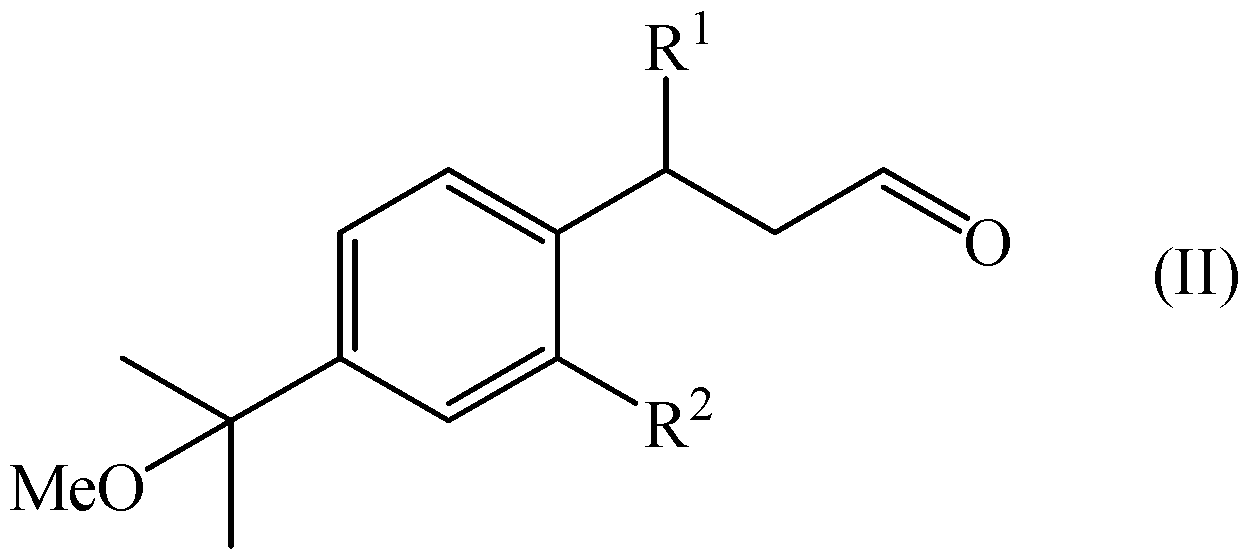 in the form of any one of its stereoisomers or a mixture thereof, and wherein R1 and R2 represent, independently from each other, a hydrogen atom or a C1-2 alkyl group.
3. The method according to any one of claims 1 and 2, wherein R1 and R2 represent, independently from each other, a hydrogen atom or a methyl group.
4. The method according to any one of claims 1 to 3, wherein R1 is a hydrogen atom.
5. The method according to any one of claims 1 to 4, wherein the the compound of formula (I) is 3-(4-(2-methoxypropan-2-yl)phenyl)propanal, 3-(4-(2- methoxypropan-2-yl)-2-methylphenyl)propanal or a mixture comprising 3-(4-(2- methoxypropan-2-yl)-2-methylphenyl)propanal and 3-(5-(2-methoxypropan-2-yl)-2- methylphenyl)propanal.
6. Use as perfuming ingredient of a compound of formula (I) as defined in claims 1 to 5
7. A compound of formula
 in the form of any one of its stereoisomers or a mixture thereof, and wherein R1 and R2 represent, independently from each other, a hydrogen atom or a C1-2 alkyl group; and
-C(Me)2(OMe) group is, relative to position 1, a meta or a para substituent of the aromatic ring or a mixture thereof; provided that 3-[4-(2-methoxy-2-propanyl)phenyl]propanal and 3-[4-(2-methoxypropan- 2-yl)phenyl]butanal are excluded.
8. The compound according to claim 7, wherein the compound (I) is of formula
in the form of any one of its stereoisomers or a mixture thereof, and wherein R1 and R2 represent, independently from each other, a hydrogen atom or a C1-2 alkyl group. 9. A properfume compound suitable to release the compound of formula
 in the form of any one of its stereoisomers or a mixture thereof, and wherein
R1 and R2 represent, independently from each other, a hydrogen atom or a C1-2 alkyl group; and -C(Me)2(OMe) group is, relative to position 1, a meta or a para substituent of the aromatic ring or a mixture thereof.
10. The properfume according to claim 9, wherein the compound (I) is of formula
 in the form of any one of its stereoisomers or a mixture thereof, and wherein R1 and R2
represent, independently from each other, a hydrogen atom or a C1-2 alkyl group.
in the form of any one of its stereoisomers or a mixture thereof, and wherein R1 and R2
represent, independently from each other, a hydrogen atom or a C1-2 alkyl group.
11. A perfuming composition comprising i) at least one compound of formula (I), as defined in any one of claims 1 to 5 and / or at least one properfume compound as defined in claims 9 to 10; ii) at least one ingredient selected from the group consisting of a perfumery carrier and a perfumery base; and iv) optionally at least one perfumery adjuvant. 12. A perfumed consumer product comprising at least one compound of formula (I) as defined in any one of claims 1 to 5 and / or at least one properfume compound as defined in claims 9 to 10 or a perfuming composition as defined in claim
11. 13. The perfumed consumer product according to claim 12, wherein the perfumed consumer product is a perfume, a fabric care product, a body-care product, a cosmetic preparation, a skin-care product, an air care product or a home care product.
14. The perfumed consumer product according to claim 13, wherein the perfumed consumer product is a fine perfume, a splash or eau de perfume, a cologne, an shave or after-shave lotion, a liquid or solid detergent, a fabric softener, a fabric refresher, an ironing water, a paper, a bleach, a carpet cleaners, curtain-care products a shampoo, a coloring preparation, a color care product, a hair shaping product, a dental care product, a disinfectant, an intimate care product, a hair spray, a vanishing cream, a deodorant or antiperspirant, hair remover, tanning or sun product, nail products, skin cleansing, a makeup, a perfumed soap, shower or bath mousse, oil or gel, or a foot/hand care products, a hygiene product, an air freshener, a “ready to use” powdered air freshener, a mold remover, furnisher care, wipe, a dish detergent or hard- surface detergent, a leather care product, a car care product.
Applications Claiming Priority (2)
| Application Number | Priority Date | Filing Date | Title |
|---|---|---|---|
| EP19202481.8 | 2019-10-10 | ||
| EP19202481 | 2019-10-10 |
Publications (1)
| Publication Number | Publication Date |
|---|---|
| WO2021069331A1 true WO2021069331A1 (en) | 2021-04-15 |
Family
ID=68424567
Family Applications (1)
| Application Number | Title | Priority Date | Filing Date |
|---|---|---|---|
| PCT/EP2020/077714 Ceased WO2021069331A1 (en) | 2019-10-10 | 2020-10-02 | Lily of the valley odorant |
Country Status (1)
| Country | Link |
|---|---|
| WO (1) | WO2021069331A1 (en) |
Cited By (1)
| Publication number | Priority date | Publication date | Assignee | Title |
|---|---|---|---|---|
| WO2023078870A3 (en) * | 2021-11-03 | 2023-09-28 | Firmenich Sa | Fragrance compositions with moisturizing benefits |
Citations (4)
| Publication number | Priority date | Publication date | Assignee | Title |
|---|---|---|---|---|
| WO2011029743A1 (en) * | 2009-09-09 | 2011-03-17 | Basf Se | Lily of the valley-type fragrance compositions comprising 2,5,7,7-tetramethyloctanal |
| WO2016074865A1 (en) * | 2014-11-10 | 2016-05-19 | Givaudan Sa | Phenyl based compounds substituted with aldehyde moieties and their use in perfumery |
| WO2017009175A1 (en) * | 2015-07-14 | 2017-01-19 | Firmenich Sa | Compound having a muguet odor |
| US10138195B2 (en) * | 2014-11-10 | 2018-11-27 | Givaudan, S.A. | Organic compounds |
-
2020
- 2020-10-02 WO PCT/EP2020/077714 patent/WO2021069331A1/en not_active Ceased
Patent Citations (4)
| Publication number | Priority date | Publication date | Assignee | Title |
|---|---|---|---|---|
| WO2011029743A1 (en) * | 2009-09-09 | 2011-03-17 | Basf Se | Lily of the valley-type fragrance compositions comprising 2,5,7,7-tetramethyloctanal |
| WO2016074865A1 (en) * | 2014-11-10 | 2016-05-19 | Givaudan Sa | Phenyl based compounds substituted with aldehyde moieties and their use in perfumery |
| US10138195B2 (en) * | 2014-11-10 | 2018-11-27 | Givaudan, S.A. | Organic compounds |
| WO2017009175A1 (en) * | 2015-07-14 | 2017-01-19 | Firmenich Sa | Compound having a muguet odor |
Cited By (1)
| Publication number | Priority date | Publication date | Assignee | Title |
|---|---|---|---|---|
| WO2023078870A3 (en) * | 2021-11-03 | 2023-09-28 | Firmenich Sa | Fragrance compositions with moisturizing benefits |
Similar Documents
| Publication | Publication Date | Title |
|---|---|---|
| EP3322786B1 (en) | Compound having a muguet odor | |
| EP3349862B1 (en) | A green, lily of the valley perfuming ingredient | |
| EP3596036A1 (en) | Cyclohexene derivatives as perfuming ingredients | |
| EP3230260B1 (en) | Aliphatic nitrile with rosy odor | |
| EP3356502B1 (en) | Vetiver odorant | |
| EP3286290A1 (en) | Osmanthus odorant | |
| EP3655513A1 (en) | Cyclamen odorant | |
| EP3681987B1 (en) | Lily of the valley odorant | |
| EP3810566B1 (en) | Cyclohexene propanal derivatives as perfuming ingredients | |
| EP3606902B1 (en) | Vetiver odorant | |
| EP3883927B1 (en) | Amber odorant | |
| EP4097199B1 (en) | Odorant compound | |
| EP3774711A1 (en) | Cyclopropyl ring opening by alpha alkylation of an aldehyde with a polycyclic olefin | |
| US10519397B2 (en) | Powerful woody powdery odorant |
Legal Events
| Date | Code | Title | Description |
|---|---|---|---|
| 121 | Ep: the epo has been informed by wipo that ep was designated in this application |
Ref document number: 20788735 Country of ref document: EP Kind code of ref document: A1 |
|
| NENP | Non-entry into the national phase |
Ref country code: DE |
|
| 122 | Ep: pct application non-entry in european phase |
Ref document number: 20788735 Country of ref document: EP Kind code of ref document: A1 |