WO2021065990A1 - フロロシリコーンゴム積層体の製造方法およびフロロシリコーンゴム積層体 - Google Patents
フロロシリコーンゴム積層体の製造方法およびフロロシリコーンゴム積層体 Download PDFInfo
- Publication number
- WO2021065990A1 WO2021065990A1 PCT/JP2020/037094 JP2020037094W WO2021065990A1 WO 2021065990 A1 WO2021065990 A1 WO 2021065990A1 JP 2020037094 W JP2020037094 W JP 2020037094W WO 2021065990 A1 WO2021065990 A1 WO 2021065990A1
- Authority
- WO
- WIPO (PCT)
- Prior art keywords
- fluorosilicone rubber
- sio
- fluorosiloxane
- group
- component
- Prior art date
- Legal status (The legal status is an assumption and is not a legal conclusion. Google has not performed a legal analysis and makes no representation as to the accuracy of the status listed.)
- Ceased
Links
Images

Classifications
-
- C—CHEMISTRY; METALLURGY
- C09—DYES; PAINTS; POLISHES; NATURAL RESINS; ADHESIVES; COMPOSITIONS NOT OTHERWISE PROVIDED FOR; APPLICATIONS OF MATERIALS NOT OTHERWISE PROVIDED FOR
- C09D—COATING COMPOSITIONS, e.g. PAINTS, VARNISHES OR LACQUERS; FILLING PASTES; CHEMICAL PAINT OR INK REMOVERS; INKS; CORRECTING FLUIDS; WOODSTAINS; PASTES OR SOLIDS FOR COLOURING OR PRINTING; USE OF MATERIALS THEREFOR
- C09D183/00—Coating compositions based on macromolecular compounds obtained by reactions forming in the main chain of the macromolecule a linkage containing silicon, with or without sulfur, nitrogen, oxygen, or carbon only; Coating compositions based on derivatives of such polymers
- C09D183/04—Polysiloxanes
- C09D183/08—Polysiloxanes containing silicon bound to organic groups containing atoms other than carbon, hydrogen, and oxygen
-
- B—PERFORMING OPERATIONS; TRANSPORTING
- B05—SPRAYING OR ATOMISING IN GENERAL; APPLYING FLUENT MATERIALS TO SURFACES, IN GENERAL
- B05D—PROCESSES FOR APPLYING FLUENT MATERIALS TO SURFACES, IN GENERAL
- B05D1/00—Processes for applying liquids or other fluent materials
- B05D1/36—Successively applying liquids or other fluent materials, e.g. without intermediate treatment
-
- C—CHEMISTRY; METALLURGY
- C08—ORGANIC MACROMOLECULAR COMPOUNDS; THEIR PREPARATION OR CHEMICAL WORKING-UP; COMPOSITIONS BASED THEREON
- C08J—WORKING-UP; GENERAL PROCESSES OF COMPOUNDING; AFTER-TREATMENT NOT COVERED BY SUBCLASSES C08B, C08C, C08F, C08G or C08H
- C08J7/00—Chemical treatment or coating of shaped articles made of macromolecular substances
- C08J7/04—Coating
- C08J7/042—Coating with two or more layers, where at least one layer of a composition contains a polymer binder
-
- B—PERFORMING OPERATIONS; TRANSPORTING
- B05—SPRAYING OR ATOMISING IN GENERAL; APPLYING FLUENT MATERIALS TO SURFACES, IN GENERAL
- B05D—PROCESSES FOR APPLYING FLUENT MATERIALS TO SURFACES, IN GENERAL
- B05D1/00—Processes for applying liquids or other fluent materials
- B05D1/36—Successively applying liquids or other fluent materials, e.g. without intermediate treatment
- B05D1/38—Successively applying liquids or other fluent materials, e.g. without intermediate treatment with intermediate treatment
-
- B—PERFORMING OPERATIONS; TRANSPORTING
- B05—SPRAYING OR ATOMISING IN GENERAL; APPLYING FLUENT MATERIALS TO SURFACES, IN GENERAL
- B05D—PROCESSES FOR APPLYING FLUENT MATERIALS TO SURFACES, IN GENERAL
- B05D5/00—Processes for applying liquids or other fluent materials to surfaces to obtain special surface effects, finishes or structures
- B05D5/08—Processes for applying liquids or other fluent materials to surfaces to obtain special surface effects, finishes or structures to obtain an anti-friction or anti-adhesive surface
- B05D5/083—Processes for applying liquids or other fluent materials to surfaces to obtain special surface effects, finishes or structures to obtain an anti-friction or anti-adhesive surface involving the use of fluoropolymers
-
- B—PERFORMING OPERATIONS; TRANSPORTING
- B05—SPRAYING OR ATOMISING IN GENERAL; APPLYING FLUENT MATERIALS TO SURFACES, IN GENERAL
- B05D—PROCESSES FOR APPLYING FLUENT MATERIALS TO SURFACES, IN GENERAL
- B05D7/00—Processes, other than flocking, specially adapted for applying liquids or other fluent materials to particular surfaces or for applying particular liquids or other fluent materials
- B05D7/02—Processes, other than flocking, specially adapted for applying liquids or other fluent materials to particular surfaces or for applying particular liquids or other fluent materials to macromolecular substances, e.g. rubber
-
- B—PERFORMING OPERATIONS; TRANSPORTING
- B05—SPRAYING OR ATOMISING IN GENERAL; APPLYING FLUENT MATERIALS TO SURFACES, IN GENERAL
- B05D—PROCESSES FOR APPLYING FLUENT MATERIALS TO SURFACES, IN GENERAL
- B05D7/00—Processes, other than flocking, specially adapted for applying liquids or other fluent materials to particular surfaces or for applying particular liquids or other fluent materials
- B05D7/14—Processes, other than flocking, specially adapted for applying liquids or other fluent materials to particular surfaces or for applying particular liquids or other fluent materials to metal, e.g. car bodies
-
- B—PERFORMING OPERATIONS; TRANSPORTING
- B05—SPRAYING OR ATOMISING IN GENERAL; APPLYING FLUENT MATERIALS TO SURFACES, IN GENERAL
- B05D—PROCESSES FOR APPLYING FLUENT MATERIALS TO SURFACES, IN GENERAL
- B05D7/00—Processes, other than flocking, specially adapted for applying liquids or other fluent materials to particular surfaces or for applying particular liquids or other fluent materials
- B05D7/24—Processes, other than flocking, specially adapted for applying liquids or other fluent materials to particular surfaces or for applying particular liquids or other fluent materials for applying particular liquids or other fluent materials
-
- B—PERFORMING OPERATIONS; TRANSPORTING
- B05—SPRAYING OR ATOMISING IN GENERAL; APPLYING FLUENT MATERIALS TO SURFACES, IN GENERAL
- B05D—PROCESSES FOR APPLYING FLUENT MATERIALS TO SURFACES, IN GENERAL
- B05D7/00—Processes, other than flocking, specially adapted for applying liquids or other fluent materials to particular surfaces or for applying particular liquids or other fluent materials
- B05D7/50—Multilayers
- B05D7/52—Two layers
- B05D7/54—No clear coat specified
-
- B—PERFORMING OPERATIONS; TRANSPORTING
- B32—LAYERED PRODUCTS
- B32B—LAYERED PRODUCTS, i.e. PRODUCTS BUILT-UP OF STRATA OF FLAT OR NON-FLAT, e.g. CELLULAR OR HONEYCOMB, FORM
- B32B25/00—Layered products comprising a layer of natural or synthetic rubber
- B32B25/20—Layered products comprising a layer of natural or synthetic rubber comprising silicone rubber
-
- B—PERFORMING OPERATIONS; TRANSPORTING
- B32—LAYERED PRODUCTS
- B32B—LAYERED PRODUCTS, i.e. PRODUCTS BUILT-UP OF STRATA OF FLAT OR NON-FLAT, e.g. CELLULAR OR HONEYCOMB, FORM
- B32B27/00—Layered products comprising a layer of synthetic resin
- B32B27/30—Layered products comprising a layer of synthetic resin comprising vinyl (co)polymers; comprising acrylic (co)polymers
-
- C—CHEMISTRY; METALLURGY
- C08—ORGANIC MACROMOLECULAR COMPOUNDS; THEIR PREPARATION OR CHEMICAL WORKING-UP; COMPOSITIONS BASED THEREON
- C08J—WORKING-UP; GENERAL PROCESSES OF COMPOUNDING; AFTER-TREATMENT NOT COVERED BY SUBCLASSES C08B, C08C, C08F, C08G or C08H
- C08J7/00—Chemical treatment or coating of shaped articles made of macromolecular substances
- C08J7/04—Coating
- C08J7/043—Improving the adhesiveness of the coatings per se, e.g. forming primers
-
- C—CHEMISTRY; METALLURGY
- C09—DYES; PAINTS; POLISHES; NATURAL RESINS; ADHESIVES; COMPOSITIONS NOT OTHERWISE PROVIDED FOR; APPLICATIONS OF MATERIALS NOT OTHERWISE PROVIDED FOR
- C09D—COATING COMPOSITIONS, e.g. PAINTS, VARNISHES OR LACQUERS; FILLING PASTES; CHEMICAL PAINT OR INK REMOVERS; INKS; CORRECTING FLUIDS; WOODSTAINS; PASTES OR SOLIDS FOR COLOURING OR PRINTING; USE OF MATERIALS THEREFOR
- C09D5/00—Coating compositions, e.g. paints, varnishes or lacquers, characterised by their physical nature or the effects produced; Filling pastes
- C09D5/002—Priming paints
-
- B—PERFORMING OPERATIONS; TRANSPORTING
- B05—SPRAYING OR ATOMISING IN GENERAL; APPLYING FLUENT MATERIALS TO SURFACES, IN GENERAL
- B05D—PROCESSES FOR APPLYING FLUENT MATERIALS TO SURFACES, IN GENERAL
- B05D2201/00—Polymeric substrate or laminate
-
- B—PERFORMING OPERATIONS; TRANSPORTING
- B05—SPRAYING OR ATOMISING IN GENERAL; APPLYING FLUENT MATERIALS TO SURFACES, IN GENERAL
- B05D—PROCESSES FOR APPLYING FLUENT MATERIALS TO SURFACES, IN GENERAL
- B05D2201/00—Polymeric substrate or laminate
- B05D2201/02—Polymeric substrate
-
- B—PERFORMING OPERATIONS; TRANSPORTING
- B05—SPRAYING OR ATOMISING IN GENERAL; APPLYING FLUENT MATERIALS TO SURFACES, IN GENERAL
- B05D—PROCESSES FOR APPLYING FLUENT MATERIALS TO SURFACES, IN GENERAL
- B05D2202/00—Metallic substrate
-
- B—PERFORMING OPERATIONS; TRANSPORTING
- B05—SPRAYING OR ATOMISING IN GENERAL; APPLYING FLUENT MATERIALS TO SURFACES, IN GENERAL
- B05D—PROCESSES FOR APPLYING FLUENT MATERIALS TO SURFACES, IN GENERAL
- B05D7/00—Processes, other than flocking, specially adapted for applying liquids or other fluent materials to particular surfaces or for applying particular liquids or other fluent materials
- B05D7/50—Multilayers
- B05D7/52—Two layers
- B05D7/54—No clear coat specified
- B05D7/544—No clear coat specified the first layer is let to dry at least partially before applying the second layer
-
- C—CHEMISTRY; METALLURGY
- C08—ORGANIC MACROMOLECULAR COMPOUNDS; THEIR PREPARATION OR CHEMICAL WORKING-UP; COMPOSITIONS BASED THEREON
- C08G—MACROMOLECULAR COMPOUNDS OBTAINED OTHERWISE THAN BY REACTIONS ONLY INVOLVING UNSATURATED CARBON-TO-CARBON BONDS
- C08G77/00—Macromolecular compounds obtained by reactions forming a linkage containing silicon with or without sulfur, nitrogen, oxygen or carbon in the main chain of the macromolecule
- C08G77/04—Polysiloxanes
- C08G77/12—Polysiloxanes containing silicon bound to hydrogen
-
- C—CHEMISTRY; METALLURGY
- C08—ORGANIC MACROMOLECULAR COMPOUNDS; THEIR PREPARATION OR CHEMICAL WORKING-UP; COMPOSITIONS BASED THEREON
- C08G—MACROMOLECULAR COMPOUNDS OBTAINED OTHERWISE THAN BY REACTIONS ONLY INVOLVING UNSATURATED CARBON-TO-CARBON BONDS
- C08G77/00—Macromolecular compounds obtained by reactions forming a linkage containing silicon with or without sulfur, nitrogen, oxygen or carbon in the main chain of the macromolecule
- C08G77/04—Polysiloxanes
- C08G77/20—Polysiloxanes containing silicon bound to unsaturated aliphatic groups
-
- C—CHEMISTRY; METALLURGY
- C08—ORGANIC MACROMOLECULAR COMPOUNDS; THEIR PREPARATION OR CHEMICAL WORKING-UP; COMPOSITIONS BASED THEREON
- C08G—MACROMOLECULAR COMPOUNDS OBTAINED OTHERWISE THAN BY REACTIONS ONLY INVOLVING UNSATURATED CARBON-TO-CARBON BONDS
- C08G77/00—Macromolecular compounds obtained by reactions forming a linkage containing silicon with or without sulfur, nitrogen, oxygen or carbon in the main chain of the macromolecule
- C08G77/04—Polysiloxanes
- C08G77/22—Polysiloxanes containing silicon bound to organic groups containing atoms other than carbon, hydrogen and oxygen
- C08G77/24—Polysiloxanes containing silicon bound to organic groups containing atoms other than carbon, hydrogen and oxygen halogen-containing groups
-
- C—CHEMISTRY; METALLURGY
- C08—ORGANIC MACROMOLECULAR COMPOUNDS; THEIR PREPARATION OR CHEMICAL WORKING-UP; COMPOSITIONS BASED THEREON
- C08J—WORKING-UP; GENERAL PROCESSES OF COMPOUNDING; AFTER-TREATMENT NOT COVERED BY SUBCLASSES C08B, C08C, C08F, C08G or C08H
- C08J2367/00—Characterised by the use of polyesters obtained by reactions forming a carboxylic ester link in the main chain; Derivatives of such polymers
- C08J2367/02—Polyesters derived from dicarboxylic acids and dihydroxy compounds
-
- C—CHEMISTRY; METALLURGY
- C08—ORGANIC MACROMOLECULAR COMPOUNDS; THEIR PREPARATION OR CHEMICAL WORKING-UP; COMPOSITIONS BASED THEREON
- C08J—WORKING-UP; GENERAL PROCESSES OF COMPOUNDING; AFTER-TREATMENT NOT COVERED BY SUBCLASSES C08B, C08C, C08F, C08G or C08H
- C08J2483/00—Characterised by the use of macromolecular compounds obtained by reactions forming in the main chain of the macromolecule a linkage containing silicon with or without sulfur, nitrogen, oxygen, or carbon only; Derivatives of such polymers
- C08J2483/04—Polysiloxanes
- C08J2483/08—Polysiloxanes containing silicon bound to organic groups containing atoms other than carbon, hydrogen, and oxygen
Definitions
- the present invention relates to a method for producing a fluorosilicone rubber laminate and a fluorosilicone rubber laminate obtained by the manufacturing method.
- the fluorosilicone rubber composition containing an organopolysiloxane having a fluoroalkyl group such as 3,3,3-trifluoropropyl group as a main component is a fluorosilicone rubber having excellent heat resistance, cold resistance, oil resistance, and fuel oil resistance. Since it is formed, it is used as a rubber material such as a fixing roll and a paper feed roll, or as a rubber material for automobiles or aircraft.
- the fluorosilicone rubber composition has a problem that it is difficult to directly adhere to a base material such as metal or plastic. Therefore, in order to bond the fluorosilicone rubber composition to a base material such as metal or plastic, the use of a primer composition has been proposed.
- Patent Document 1 proposes to use a primer composition composed of an organosilicon compound having a fluorine-containing organic group and a hydrogensilyl group at both ends of the molecule, and a platinum-based catalyst.
- Patent Document 2 proposes to use a primer composition composed of a silicon atom-bonded hydrogen atom-containing fluorosiloxane and a platinum-based catalyst.
- Patent Document 3 contains an organopolysiloxane having a degree of polymerization of 1,000 or more, a fine powder silica-based filler, and a silicon atom-bonded hydrogen atom containing a predetermined amount of 3,3,3-trifluoropropyl group.
- a method of contacting and curing has been proposed.
- the primer composition proposed in Patent Documents 1 and 2 contains a compound having a silicon atom-bonded hydrogen atom and a platinum-based catalyst at the same time, it was expected by a dehydrogenation reaction of the silicon atom-bonded hydrogen atom or the like. It was not possible to improve the adhesiveness as much as that, and it was difficult to remarkably improve the adhesiveness between the fluorosilicone rubber and the base material by the bonding method proposed in Patent Document 3.
- An object of the present invention is to provide a method for producing a fluorosilicone rubber laminate in which a fluorosilicone rubber layer and a base material are well adhered to each other.
- the method for producing a fluorosilicone rubber laminate of the present invention is characterized by at least the following steps (1) and (2).
- the fluorosilicone rubber composition contains a platinum-based catalyst and / or a silicon atom-bonded hydrogen atom-containing fluorosiloxane.
- the primer composition contains a platinum-based catalyst or a silicon atom-bonded hydrogen atom-containing fluorosiloxane.
- the primer composition does not contain a platinum-based catalyst and a silicon atom-bonded hydrogen atom-containing fluorosiloxane at the same time.
- Either the primer composition or the fluorosilicone rubber composition contains a platinum-based catalyst or a silicon atom-bonded hydrogen atom-containing fluorosiloxane.
- the base material is preferably metal or plastic.
- Fluorosilicone rubber composition (A) Organopolysiloxane having at least two alkenyl groups in one molecule and at least 20 mol% of all silicon-bonded organic groups being fluoroalkyl groups, or the component (a1) and (a1). a2) A molecule has at least two alkenyl groups and no fluoroalkyl group, or even if it has a fluoroalkyl group, at most less than 20 mol% of all silicon-bonded organic groups.
- Mixture with organopolysiloxane; It consists of (b) an organic peroxide; and (c) a platinum-based catalyst, at least.
- the primer composition is (D) Silicon atom-bonded hydrogen atom-containing fluorosiloxane; It preferably consists of (e) an alkoxysilane and / or a partially hydrolyzed condensate thereof; and (f) a catalyst for a condensation reaction.
- the above component (d) has the following general formula: R 1 3 SiO (R 1 R f SiO) m (R 1 HSiO) n SiR 1 3 (In the formula, R 1 is the same or different, monovalent hydrocarbon group having 1 to 20 carbon atoms having no aliphatic unsaturated bond, R f is the same or different fluoroalkyl group, m is 1 or more.
- n is an integer of 2 or more, and the sum of m and n is an integer of 5 to 100.
- Fluorosiloxane represented by, or the following average unit formula: [HR 1 2 SiO 1/2 ] a (R f SiO 3/2 ) b (In the equation, R 1 and R f are the same as described above, and a and b are numbers satisfying 0 ⁇ a ⁇ 1, 0 ⁇ b ⁇ 1 and a + b 1, respectively.) It is preferable that it is at least one selected from the fluorosiloxane represented by.
- Fluorosilicone rubber composition (A) Organopolysiloxane having at least two alkenyl groups in one molecule and at least 20 mol% of all silicon-bonded organic groups being fluoroalkyl groups, or the component (a1) and (a1). a2) A molecule has at least two alkenyl groups and no fluoroalkyl group, or even if it has a fluoroalkyl group, at most less than 20 mol% of all silicon-bonded organic groups.
- the primer composition is (C) Platinum-based catalyst; It preferably consists of (e) an alkoxysilane and / or a partially hydrolyzed condensate thereof; and (f) a catalyst for a condensation reaction.
- the above component (d) has the following general formula: R 1 3 SiO (R 1 R f SiO) m (R 1 HSiO) n SiR 1 3 (In the formula, R 1 is the same or different, monovalent hydrocarbon group having 1 to 20 carbon atoms having no aliphatic unsaturated bond, R f is the same or different fluoroalkyl group, m is 1 or more.
- n is an integer of 2 or more, and the sum of m and n is an integer of 5 to 100.
- Fluorosiloxane represented by, or the following average unit formula: [HR 1 2 SiO 1/2 ] a (R f SiO 3/2 ) b (In the equation, R 1 and R f are the same as described above, and a and b are numbers satisfying 0 ⁇ a ⁇ 1, 0 ⁇ b ⁇ 1 and a + b 1, respectively.) It is preferable that it is at least one selected from the fluorosiloxane represented by.
- Fluorosilicone rubber composition (A) Organopolysiloxane having at least two alkenyl groups in one molecule and at least 20 mol% of all silicon-bonded organic groups being fluoroalkyl groups, or the component (a1) and (a1). a2) A molecule has at least two alkenyl groups and no fluoroalkyl group, or even if it has a fluoroalkyl group, at most less than 20 mol% of all silicon-bonded organic groups.
- Organopolysiloxane It consists of (c) a platinum-based catalyst; and (d) a silicon atom-bonded hydrogen atom-containing fluorosiloxane.
- the primer composition is (D) Silicon atom-bonded hydrogen atom-containing fluorosiloxane; It preferably consists of (e) an alkoxysilane and / or a partially hydrolyzed condensate thereof; and (f) a catalyst for a condensation reaction.
- the above component (d) has the following general formula: R 1 3 SiO (R 1 R f SiO) m (R 1 HSiO) n SiR 1 3 (In the formula, R 1 is the same or different, monovalent hydrocarbon group having 1 to 20 carbon atoms having no aliphatic unsaturated bond, R f is the same or different fluoroalkyl group, m is 1 or more.
- n is an integer of 2 or more, and the sum of m and n is an integer of 5 to 100.
- Fluorosiloxane represented by, or the following average unit formula: [HR 1 2 SiO 1/2 ] a (R f SiO 3/2 ) b (In the equation, R 1 and R f are the same as described above, and a and b are numbers satisfying 0 ⁇ a ⁇ 1, 0 ⁇ b ⁇ 1 and a + b 1, respectively.) It is preferable that it is at least one selected from the fluorosiloxane represented by.
- Fluorosilicone rubber composition (A) Organopolysiloxane having at least two alkenyl groups in one molecule and at least 20 mol% of all silicon-bonded organic groups being fluoroalkyl groups, or the component (a1) and (a1). a2) A molecule has at least two alkenyl groups and no fluoroalkyl group, or even if it has a fluoroalkyl group, at most less than 20 mol% of all silicon-bonded organic groups.
- the primer composition comprises at least (c) a platinum-based catalyst; and (d) a silicon atom-bonded hydrogen atom-containing fluorosiloxane.
- (C) Platinum-based catalyst It preferably consists of (e) an alkoxysilane and / or a partially hydrolyzed condensate thereof; and (f) a catalyst for a condensation reaction.
- the above component (d) has the following general formula: R 1 3 SiO (R 1 R f SiO) m (R 1 HSiO) n SiR 1 3 (In the formula, R 1 is the same or different, monovalent hydrocarbon group having 1 to 20 carbon atoms having no aliphatic unsaturated bond, R f is the same or different fluoroalkyl group, m is 1 or more.
- n is an integer of 2 or more, and the sum of m and n is an integer of 5 to 100.
- Fluorosiloxane represented by, or the following average unit formula: [HR 1 2 SiO 1/2 ] a (R f SiO 3/2 ) b (In the equation, R 1 and R f are the same as described above, and a and b are numbers satisfying 0 ⁇ a ⁇ 1, 0 ⁇ b ⁇ 1 and a + b 1, respectively.) It is preferable that it is at least one selected from the fluorosiloxane represented by.
- the fluorosilicone rubber laminate of the present invention is composed of a fluorosilicone rubber and a base material, and is characterized by being obtained by the above-mentioned manufacturing method.
- the method for producing a fluorosilicone rubber laminate of the present invention is characterized by at least consisting of the following steps (1) and (2).
- the primer composition is applied to the substrate.
- the base material includes metals such as iron, copper, nickel, aluminum, zinc, stainless steel, and titanium; acrylonitrile-butadiene-styrene (ABS) resin, polyethylene terephthalate (PET) resin, polybutylene terephthalate (PBT) resin, and nylon.
- ABS acrylonitrile-butadiene-styrene
- PET polyethylene terephthalate
- PBT polybutylene terephthalate
- nylon examples thereof include plastics such as resins, polyphenylene sulfide (PPS) resins, polymethylmethacrylate (PMMA) resins, polycarbonate (PC) resins, polyimide (PI) resins, and polyamide (PA) resins.
- PPS polyphenylene sulfide
- PMMA polymethylmethacrylate
- PC polycarbonate
- PI polyimide
- PA polyamide
- the primer composition is dried or cured to form a primer layer on the surface of the base material.
- it may be heated to 70 ° C. or lower.
- the fluorosilicone rubber composition is brought into contact with the primer layer.
- the primer composition is applied to the substrate, air-dried for 30 minutes or more, and then the fluorosilicone rubber composition is brought into contact with the substrate.
- the method of laminating the fluorosilicone rubber composition on the primer layer is not limited, and for example, a method of placing the fluorosilicone rubber composition on a substrate having a primer layer in a compression molding machine and compression molding, in a mold. A method of placing the base material and injecting the fluorosilicone rubber composition into the mold can be mentioned.
- the fluorosilicone rubber is adhered to the primer layer by curing the fluorosilicone rubber composition.
- the conditions for curing the fluorosilicone rubber composition are not limited, but it is preferable to heat-press for 5 to 20 minutes under the conditions of a pressure of 100 to 250 kgf / cm 2 and a temperature of 170 to 190 ° C. Further, after molding the fluorosilicone rubber laminate, it may be further heat-treated to perform secondary vulcanization.
- the primer composition contains a platinum-based catalyst or a silicon atom-bonded hydrogen atom-containing fluorosiloxane.
- the fluorosilicone rubber composition contains a platinum-based catalyst and / or a silicon atom-bonded hydrogen atom-containing fluorosiloxane.
- the primer composition does not contain a platinum-based catalyst and a silicon atom-bonded hydrogen atom-containing fluorosiloxane at the same time, and either the primer composition or the fluorosilicone rubber composition is a platinum-based catalyst or a silicon atom-bonded hydrogen. Contains atomic-containing fluorosiloxane.
- (Combination 1) Fluorosilicone rubber composition (A) Organopolysiloxane having at least two alkenyl groups in one molecule and at least 20 mol% of all silicon-bonded organic groups being fluoroalkyl groups, or the component (a1) and (a1). a2) A molecule has at least two alkenyl groups and no fluoroalkyl group, or even if it has a fluoroalkyl group, at most less than 20 mol% of all silicon-bonded organic groups.
- the primer composition (D) Silicon atom-bonded hydrogen atom-containing fluorosiloxane; It consists of at least (e) an alkoxysilane and / or a partially hydrolyzed condensate thereof; and (f) a catalyst for a condensation reaction.
- (Combination 2) Fluorosilicone rubber composition (A) Organopolysiloxane having at least two alkenyl groups in one molecule and at least 20 mol% of all silicon-bonded organic groups being fluoroalkyl groups, or the component (a1) and (a1). a2) A molecule has at least two alkenyl groups and no fluoroalkyl group, or even if it has a fluoroalkyl group, at most less than 20 mol% of all silicon-bonded organic groups.
- (Combination 3) Fluorosilicone rubber composition (A) Organopolysiloxane having at least two alkenyl groups in one molecule and at least 20 mol% of all silicon-bonded organic groups being fluoroalkyl groups, or the component (a1) and (a1). a2) A molecule has at least two alkenyl groups and no fluoroalkyl group, or even if it has a fluoroalkyl group, at most less than 20 mol% of all silicon-bonded organic groups.
- the primer composition (D) Silicon atom-bonded hydrogen atom-containing fluorosiloxane; It consists of at least (e) an alkoxysilane and / or a partially hydrolyzed condensate thereof; and (f) a catalyst for a condensation reaction.
- (Combination 4) Fluorosilicone rubber composition (A) Organopolysiloxane having at least two alkenyl groups in one molecule and at least 20 mol% of all silicon-bonded organic groups being fluoroalkyl groups, or the component (a1) and (a1). a2) A molecule has at least two alkenyl groups and no fluoroalkyl group, or even if it has a fluoroalkyl group, at most less than 20 mol% of all silicon-bonded organic groups.
- Mixture with organopolysiloxane It consists of (c) a platinum-based catalyst; and (d) a silicon atom-bonded hydrogen atom-containing fluorosiloxane.
- the primer composition (C) Platinum-based catalyst; It consists of at least (e) an alkoxysilane and / or a partially hydrolyzed condensate thereof; and (f) a catalyst for a condensation reaction.
- the component (a) is the main agent of the fluorosilicone rubber composition, and the component (a1) has at least two alkenyl groups in one molecule, and at least 20 mol% of all the silicon atom-bonded organic groups are fluoroalkyl groups.
- a silicon atom even if it has at least two alkenyl groups and no fluoroalkyl group, or even if it has a fluoroalkyl group, in a certain organopolysiloxane, or one molecule of the components (a1) and (a2). It is a mixture with organopolysiloxane, which contains at most less than 20 mol% of all bound organic groups.
- the component (a1) is an organopolysiloxane having at least two alkenyl groups in one molecule and at least 20 mol% of all silicon atom-bonded organic groups being fluoroalkyl groups.
- alkenyl group in the component (a1) include alkenyl groups having 2 to 12 carbon atoms such as a vinyl group, an allyl group, a butenyl group, and a hexenyl group, and a vinyl group is preferable.
- fluoroalkyl group in the component (a1) 3,3,3-trifluoropropyl group, 4,4,4,3,3-pentafluorobutyl group, 5,5,5,4,4, 3,3-Heptafluoropentyl group, 6,6,6,5,5,4,4,3,3-nonafluorohexyl group, 7,7,7,6,6,5,5,4,4, Fluoroalkyl groups having 3 to 12 carbon atoms such as 3,3-undecafluoroheptyl group are exemplified, and preferably 3,3,3-trifluoropropyl group, 4,4,4,3,3-.
- the content of the fluoroalkyl group in the component (a1) is at least 20 mol%, preferably at least 30 mol%, of the total organic group of silicon atoms, while at most 70 mol%, or at most 60. Mol%.
- the content of the fluoroalkyl group can be in any range in which the above upper limit and lower limit are combined. This is because when the content of the fluoroalkyl group in the component (a1) is not less than the above lower limit, the oil resistance and fuel oil resistance of the obtained fluorosilicone rubber are improved, while it is not more than the above upper limit.
- Examples of the group bonded to a silicon atom other than the alkenyl group and the fluoroalkyl group in the component (a1) include a monovalent hydrocarbon group having 1 to 20 carbon atoms, preferably 1 to 8 carbon atoms.
- Examples include an alkyl group such as a methyl group, an ethyl group, a propyl group and a butyl group; a cycloalkyl group such as a cyclohexyl group; an aryl group such as a phenyl group and a trill group; and an aralkyl group such as a benzyl group and a phenethyl group.
- Preferred are alkyl groups, especially methyl groups.
- the molecular structure of such a component (a1) is not limited, and examples thereof include a linear chain, a linear chain having a partial branch, and a branched chain.
- the viscosity of the component (a1) is not limited, and is preferably a liquid to a raw rubber having a viscosity of at least 1 Pa ⁇ s at 25 ° C.
- As the liquid it is particularly preferable that the viscosity at 25 ° C. is at least 10 Pa ⁇ s, while at most 1,000 Pa ⁇ s.
- the viscosity of the component (a1) at 25 ° C. can be measured by a rotational viscometer conforming to JIS K7117-1.
- the raw rubber-like material in particular, a raw rubber-like material having a Williams plasticizer of 100 to 800 at 25 ° C., a raw rubber-like material having a Williams plasticizer of 100 to 400, or a Williams plasticizer of 200 at 25 ° C. specified in JIS K6249.
- a raw rubber-like material of up to 400 is preferable.
- the component (a2) has at least two alkenyl groups in one molecule and does not have a fluoroalkyl group, or even if it has a fluoroalkyl group, at most 20 mol of all silicon-bonded organic groups.
- Organopolysiloxane which is less than%.
- alkenyl group in the component (a2) include alkenyl groups having 2 to 12 carbon atoms such as a vinyl group, an allyl group, a butenyl group, and a hexenyl group, and a vinyl group is preferable.
- the component (a2) does not have a fluoroalkyl group, or even if it has a fluoroalkyl group, its content is less than 20 mol% at most of all silicon atom-bonded organic groups.
- the fluoroalkyl group that may be contained in the component (a2) includes a 3,3,3-trifluoropropyl group, a 4,4,4,3,3-pentafluorobutyl group, 5,5,5,4.
- 4,3,3-heptafluoropentyl group, 6,6,6,5,5,4,4,3,3-nonafluorohexyl group, 7,7,7,6,6,5,5,4 , 4,3,3-Undecafluoroheptyl group and other fluoroalkyl groups having 3 to 12 carbon atoms are exemplified, preferably 3,3,3-trifluoropropyl group, 4,4,4,3. , 3-Pentafluorobutyl group, 5,5,5,4,4,3,3-heptafluoropentyl group.
- Examples of the group bonded to a silicon atom other than the alkenyl group and the fluoroalkyl group in the component (a2) include a monovalent hydrocarbon group having 1 to 20 carbon atoms, preferably 1 to 8 carbon atoms.
- Examples include an alkyl group such as a methyl group, an ethyl group, a propyl group and a butyl group; a cycloalkyl group such as a cyclohexyl group; an aryl group such as a phenyl group and a trill group; and an aralkyl group such as a benzyl group and a phenethyl group.
- alkyl groups especially methyl groups.
- the molecular structure of such a component (a2) is not limited, and examples thereof include a linear chain, a linear chain having a partial branch, and a branched chain.
- the viscosity of the component (a2) is not limited, and is preferably a liquid to a raw rubber having a viscosity of at least 1 Pa ⁇ s at 25 ° C.
- As the liquid it is particularly preferable that the viscosity at 25 ° C. is at least 10 Pa ⁇ s, while at most 1,000 Pa ⁇ s.
- the viscosity of the component (a2) at 25 ° C. can be measured by a rotational viscometer conforming to JIS K7117-1.
- the raw rubber-like material is, in particular, a raw rubber-like material having a Williams plasticity of 100 to 800 at 25 ° C. specified in JIS K6249, or a raw rubber-like material having a Williams plasticity of 100 to 400.
- the component (a) is only the above component (a1) or a mixture of the above component (a1) and the component (a2).
- the mixing ratio thereof is not limited, but the mass ratio of the component (a1): the component (a2) is 50:50 to 99: 1. It is preferably in the range of 60:40 to 99: 1, 70:30 to 99: 1, 80:20 to 99: 1, or 85:15 to 99: 1.
- Component (b) is an organic peroxide for curing the fluorosilicone rubber composition by a radical reaction.
- a known organic peroxide can be used to cure the fluorosilicone rubber composition.
- examples of such a component (b) include benzoyl peroxide, tertiary butyl perbenzoate, orthomethylbenzoyl peroxide, paramethylbenzoyl peroxide, diterhally butyl peroxide, dicumyl peroxide, and 1,1-bis (Tasha).
- the content of the component (b) is not limited, but is preferably at least 0.1 part by mass, at least 0.5 part by mass, or at least 1 part by mass with respect to 100 parts by mass of the component (a). , At most 10 parts by mass, at most 5 parts by mass, or at most 3 parts by mass, and can be any range in which the above upper limit and lower limit are combined. This is because the obtained fluorosilicone rubber composition is sufficiently cured when the content of the component (b) is not more than the lower limit of the above range, while the obtained fluorosilicone rubber composition is not more than the upper limit of the above range. This is because the mechanical properties of the silicone rubber are good.
- the component (c) is a platinum-based catalyst for improving the adhesiveness between the fluorosilicone rubber composition and the primer layer, and the component (c) in the fluorosilicone rubber composition in the above combinations 3 and 4 is the component (c). It also acts as a catalyst for curing the composition in a hydrosilylation reaction.
- the component (c) include chloroplatinic acid, an alcohol solution of chloroplatinic acid, a carbonyl complex of platinum, an alkenylsiloxane complex of platinum, and an olefin complex of platinum.
- the component (c) when blended with the fluorosilicone rubber composition, it is preferably a platinum alkenylsiloxane complex because it has good compatibility with the component (a).
- examples of the alkenylsiloxane include 1,3-divinyltetramethyldisiloxane, 1,1,3,3-tetravinyldimethyldisiloxane.
- the content thereof is not limited, but the amount of platinum atoms in the component (c) with respect to the fluorosilicone rubber composition is at least 0.1 ppm in mass units. , At least 1 ppm, or at least 5 ppm, while at most 1,000 ppm, at most 500 ppm, at most 250 ppm, at most 200 ppm, or more. Both are in an amount of 100 ppm, and can be in an arbitrary range in which the above upper limit and lower limit are combined.
- the content thereof is not limited, but the amount of platinum atoms in the component (c) with respect to the component (e) is at least 0.1 ppm in terms of mass, at least.
- the component (d) is a silicon atom-bonded hydrogen atom-containing fluorosiloxane for improving the adhesiveness between the fluorosilicone rubber composition and the primer layer, and the component in the fluorosilicone rubber composition in the above combinations 3 and 4.
- (D) also acts as a cross-linking agent for curing the composition in a hydrosilylation reaction.
- the component (d) in the fluorosilicone rubber composition and the component (d) in the primer composition may be the same or different.
- Such a component (d) is preferably an organosiloxane having at least two silicon atom-bonded hydrogen atoms and at least one fluoroalkyl group in one molecule.
- the fluoroalkyl group in the component (d) includes a 3,3,3-trifluoropropyl group, a 4,4,4,3,3-pentafluorobutyl group, 5,5,5,4,4,3, 3-Heptafluoropentyl group, 6,6,6,5,5,4,4,3,3-Nonafluorohexyl group, 7,7,7,6,6,5,5,4,4,3, Fluoroalkyl groups having 3 to 12 carbon atoms such as 3-undecafluoroheptyl group are exemplified, and preferably 3,3,3-trifluoropropyl group, 4,4,4,3,3-pentafluoro. Butyl group, 5,5,5,4,4,3,3-heptafluoropentyl group.
- the content of the fluoroalkyl group in the component (d) is not limited, but is at least 5 mol%, at least 10 mol%, at least 15 mol% of all silicon-bonded organic groups, while at most 70 mol%, more. At most 60 mol%, at most 50 mol%, or at most 40 mol%.
- the content of the fluoroalkyl group can be in any range in which the above upper limit and lower limit are combined. This is because when the content of the fluoroalkyl group in the component (d) is at least the above lower limit, the oil resistance and oil resistance of the fluorosilicone rubber obtained when the component (d) is blended with the fluorosilicone rubber composition.
- the fuel oil property is improved and the adhesiveness of the obtained fluorosilicone rubber is improved, while when it is not more than the above upper limit, the heat resistance and cold resistance of the obtained fluorosilicone rubber are improved.
- the monovalent group having 1 to 20 carbon atoms, preferably 1 to 8 carbon atoms, which does not have an aliphatic unsaturated bond.
- a hydrocarbon group is exemplified, and specifically, an alkyl group such as a methyl group, an ethyl group, a propyl group and a butyl group; a cycloalkyl group such as a cyclohexyl group; an aryl group such as a phenyl group and a tolyl group; a benzyl group and a phenethyl group.
- An aralkyl group such as a group is exemplified, and an alkyl group, particularly a methyl group, is preferable.
- the molecular structure of the component (d) is not limited, and examples thereof include linear, linear with partially branched, branched chain, network, and cyclic, and a mixture of two or more kinds having these molecular structures can be used. There may be.
- a component (d) the general formula: R 1 3 SiO (R 1 R f SiO) m (R 1 HSiO) n SiR 1 3 Organopolysiloxane represented by, and average unit formula: [HR 1 2 SiO 1/2 ] a (R f SiO 3/2 ) b Organopolysiloxane represented by is exemplified.
- R 1 is a monovalent hydrocarbon group having the same or different aliphatic unsaturated bonds and having 1 to 20 carbon atoms, and the same groups as described above are exemplified, preferably an alkyl group, particularly an alkyl group. It is a methyl group.
- R f is the same or different fluoroalkyl group, and the same group as described above is exemplified.
- m is an integer of 1 or more
- n is an integer of 2 or more
- the sum of m and n is an integer in the range of 5 to 100, preferably the sum of m and n. Is an integer in the range of 10-50.
- the ratio of R f to the sum of R 1 and R f are at least 5 mole%, at least 10 mole%, at least 15 mol%, whereas, with 70 mole%, at most 60 mol%, It is preferably at most 50 mol%, or at most 40 mol%.
- the ratio of R f can be within an arbitrary range in which the above lower limit and upper limit are combined.
- the ratio of R f to the sum of R 1 and R f are at least 5 mole%, at least 10 mole%, at least 15 mol%, whereas, with 70 mole%, at most 60 mol%, It is preferably at most 50 mol%, or at most 40 mol%.
- the ratio of R f can be within an arbitrary range in which the above lower limit and upper limit are combined.
- the content thereof is not limited, but preferably at least 0.1 part by mass with respect to 100 parts by mass of the component (a). , At least 0.5 parts by mass, or at least 1 part by mass, while at most 20 parts by mass, at most 10 parts by mass, or at most 5 parts by mass, any combination of the above upper and lower limits. Can be a range.
- the content thereof is not limited, but is preferable with respect to a total of 1 mol of the alkenyl groups in the component (a). Is an amount of at least 1 mol, at least 2 mol, or at least 3 mol of silicon atom-bonded hydrogen atom in the component (d), while at most 30 mol, at most.
- the amount is 20 mol, at most 10 mol, or at most 5 mol, and can be any range in which the above lower limit and upper limit are combined.
- the obtained fluorosilicone rubber composition is sufficiently cured when the content of the component (d) is at least the lower limit of the above range, while when it is at least the upper limit of the above range, it is under a high temperature environment. This is because the heat resistance of the obtained fluorosilicone rubber in the laminated body after being exposed to is improved.
- the component (d) when blended into the primer composition, its content is not limited, but preferably at least 1 part by mass, at least 5 parts by mass, or at least 5 parts by mass with respect to 100 parts by mass of the component (e). It is at least 10 parts by mass, while it is at most 500 parts by mass, at most 400 parts by mass, at most 300 parts by mass, or at most 250 parts by mass, and is an arbitrary range in which the above upper limit and lower limit are combined. be able to.
- the component (e) is the main agent of the primer composition, and is an alkoxysilane and / or a partially hydrolyzed condensate thereof for forming a primer layer on the surface of the substrate by a condensation reaction with the following component (f). ..
- a component (e) include trimethoxysilane, triethoxysilane, methyltrimethoxysilane, ethyltrimethoxysilane, vinyltrimethoxysilane, methylvinyldimethoxysilane, vinyltriethoxysilane, and vinyltris ( ⁇ -methoxyethoxy).
- Examples thereof include silane, allyltrimethoxysilane, allyltriethoxysilane, allylmethyldiethoxysilane, tetramethoxysilane, tetraethoxysilane, methylpolysilicate and ethylpolysilicate which are partial hydrolysis condensates of these alkoxysilanes.
- the component (f) is a catalyst for a condensation reaction for cross-linking the primer composition.
- an organic titanium compound and an organic tin compound are exemplified, and an organic titanium compound is preferable.
- this organic titanium compound include tetraisopropyl titanate, tetra (n-propyl) titanate, tetra (n-butyl) titanate, tetra (2-ethylhexyl) titanate, dibutyldiisopropyl titanate, triethanolamine titanate, ethylene glycol titanate, and bis ( Acetylacetone) diisopropoxytitanium, bis (ethylacetylacetonate) diisopropoxytitanium, tetra (trimethylsiloxy) titanate.
- the content of the component (f) is not particularly limited, but is preferably at least 1 part by mass, at least 10 parts by mass, or at least 50 parts by mass with respect to 100 parts by mass of the component (e), while at most 200 parts by mass. It is a mass part, at most 150 parts by mass, or at most 100 parts by mass, and can be any range in which the above upper limit and lower limit are combined. This is because when the content of the component (f) is at least the lower limit of the above range, the adhesiveness of the obtained primer to the substrate is improved, while when it is at least the upper limit of the above range, the primer layer This is because the mechanical strength is improved.
- the component (g) is an arbitrary organic solvent for improving the coatability of the primer composition.
- a component (g) include aromatic solvents such as toluene and xylene; aliphatic hydrocarbon solvents such as n-heptane, n-hexane and cyclohexane; and ketone solvents such as acetone, methyl ethyl ketone and methyl isobutyl ketone. ; Ester-based solvent such as ethyl acetate and butyl acetate Ether-based solvent such as tetrahydrofuran and diethyl ether are exemplified.
- the content of the component (g) is not particularly limited and may be appropriately changed in order to adjust the coatability, but it is preferably at most 5,000 parts by mass with respect to 100 parts by mass of the component (e). Is preferable.
- the fluorosilicone rubber composition may contain silica fine powder in order to improve the mechanical properties of the obtained fluorosilicone rubber.
- silica fine powder include dry method silica such as fumed silica and wet method silica such as precipitated silica, and their surfaces are organosilane, hexaorganodisilazane, diorganopolysiloxane, and diorganocyclopoly. Fine powdered silica that has been hydrophobized with an organosilicon compound such as siloxane can also be used.
- the BET specific surface area of this silica fine powder is not limited, but is preferably in the range of 50 m 2 / g to 400 m 2 / g, or in the range of 100 to 400 m 2 / g.
- the content of the silica fine powder is not limited, but it is preferably 10 parts by mass or more with respect to 100 parts by mass of the component (a) because the obtained fluorosilicone rubber has good mechanical properties. Since the formability of the fluorosilicone rubber composition is good, it is preferably 100 parts by mass or less with respect to 100 parts by mass of the component (a).
- the fluorosilicone rubber composition in the above combinations 3 and 4 may contain a reaction inhibitor in order to adjust the curing rate thereof.
- this reaction inhibitor include 2-methyl-3-butin-2-ol, 3,5-dimethyl-1-hexin-3-ol, 3-methyl-1-pentin-3-ol, and 2-phenyl-3.
- Alkyne alcohols such as -butin-2-ol, 1-ethynyl-1-cyclohexanol, 2-ethynylisopropanol, 2-ethynylbutane-2-ol; trimethyl (3,5-dimethyl-1-hexin-3-oxy) Silanes, dimethylbis (3-methyl-1-butynoxy) silanes, methylvinylbis (3-methyl-1-butin-3-oxy) silanes, and [(1,1-dimethyl-2-propynyl) oxy] trimethylsilanes.
- Cyrilized acetylene alcohols such as 2-isobutyl-1-butene-3-in, 3,5-dimethyl-3-hexene-1-in, 3-methyl-3-pentene-1-in, 3-methyl-3 -Hexen-1-in, 1-ethynylcyclohexene, 3-ethyl-3-butene-1-in, 3-phenyl-3-butene-1-in and other enein compounds; diallyl maleate, dimethyl maleate, diethyl Fumarate, diallyl fumarate, bis-2-methoxy-1-methylethyl maleate, monooctyl maleate, monoisooctyl maleate, monoallyl maleate, monomethyl maleate, monoethyl fumarate, monoallyl fumarate, And unsaturated carboxylic acid esters such as 2-methoxy-1-methylethylmaleate; 1,3,5,7-tetramethyl-1,3,5,7-tetravinylcyclotet
- the content of the reaction inhibitor is not limited, but is preferably at least 0.01 part by mass or at least 0.1 part by mass with respect to 100 parts by mass of the component (a), while at most 5 parts by mass. Alternatively, it is at most 3 parts by mass, and can be an arbitrary range in which the above lower limit and upper limit are combined.
- various compounding agents usually used for fluorosilicone rubber compositions may be added to the fluorosilicone rubber composition to the extent that the object of the present invention is not impaired.
- this compounding agent include an increasing filler such as silica soil, quartz powder, and calcium carbonate; pigments such as titanium oxide, carbon black, and petals; and heat resistant agents such as rare earth oxides, cerium silanolate, and cerium fatty acid salt.
- mold release agents such as fatty acids such as stearic acid, zinc stearate, and calcium stearate, and metal salts thereof.
- the fluorosilicone rubber laminate of the present invention is composed of a fluorosilicone rubber and a base material, and is characterized by being obtained by the above-mentioned production method.
- the thickness of the fluorosilicone rubber laminated on the primer layer is not limited, and the shape thereof is also not limited.
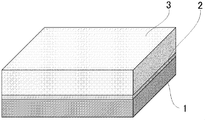
- a laminate having a primer layer 2 on one side of the base material 1 and having a fluorosilicone rubber layer 3 via the primer layer 2 or a laminate shown in FIG.
- Such a laminate having primer layers 2 on both sides of the base material 1 and having a fluorosilicone rubber layer 3 via the primer layers 2 is exemplified.
- the method for producing the fluorosilicone rubber laminate and the fluorosilicone rubber laminate of the present invention will be described in detail with reference to Examples and Comparative Examples.
- the present invention is not limited to these examples.
- the characteristics such as viscosity and plasticity are values at room temperature (25 ° C.) unless otherwise specified.
- the viscosity (Pa ⁇ s) is a value measured using a rotational viscometer compliant with JIS K7117-1
- the kinematic viscosity (mm 2 / s) is a value measured using a Ubbelohde type viscometer compliant with JIS Z8803. It is a measured value
- the Williams plasticity is a value measured by the method specified in JIS K 6249.
- the divinyl-1,1,3,3-tetramethyldisiloxane complex has a Williams plasticity of 165, both ends of the molecular chain are substantially sealed with a dimethylvinylsiloxy group, and a part thereof is sealed with a hydroxy group.
- the primer composition (3) was prepared by uniformly mixing 92 parts by mass of n-heptane, 0.2 parts by mass of tetraethoxysilane, 4 parts by mass of ethyl polysilicate, and 4 parts by mass of tetra (n-butyl) titanate. ..
- An adherend was prepared by attaching a Teflon (registered trademark) adhesive tape to one end of one side of a stainless steel plate 6 cm in length and 2.5 cm in width. Then, the primer composition was applied to the portion to which the Teflon (registered trademark) adhesive tape was not attached, and the mixture was allowed to stand at room temperature for 60 minutes and air-dried. After air-drying, the fluorosilicone rubber composition is applied to the entire surface of the stainless steel plate in an amount such that the thickness is 2 mm, and then heat-pressed for 10 minutes under the conditions of a pressure of 200 kgf / cm 2 and a temperature of 170 ° C. to cure and bond.
- An adherend was prepared by attaching a Teflon (registered trademark) adhesive tape to one end of one side of a polybutylene terephthalate (PBT) resin plate 6 cm in length and 2.5 cm in width. Then, this primer composition was applied to the portion to which the Teflon (registered trademark) adhesive tape was not attached, and left at room temperature for 60 minutes to be air-dried. After air-drying, the fluorosilicone rubber composition is applied to the entire surface of the PBT resin plate in an amount such that the thickness is 2 mm, and then heat-pressed for 10 minutes under the conditions of a pressure of 200 kgf / cm 2 and a temperature of 170 ° C. to cure and bond.
- PBT polybutylene terephthalate
- the fluorosilicone rubber laminate obtained by the production method of the present invention has excellent adhesion between the fluorosilicone rubber layer and the base material, and fluorosilicone rubber has excellent heat resistance and fuel oil resistance. It is suitable as a roll part such as a paper feed roll; a transport machine part such as an automobile or an aircraft, a petroleum shipping equipment part; and a diaphragm part.
Landscapes
- Chemical & Material Sciences (AREA)
- Engineering & Computer Science (AREA)
- Life Sciences & Earth Sciences (AREA)
- Wood Science & Technology (AREA)
- Organic Chemistry (AREA)
- Chemical Kinetics & Catalysis (AREA)
- Polymers & Plastics (AREA)
- Health & Medical Sciences (AREA)
- Medicinal Chemistry (AREA)
- Materials Engineering (AREA)
- Compositions Of Macromolecular Compounds (AREA)
- Laminated Bodies (AREA)
- Application Of Or Painting With Fluid Materials (AREA)
- Paints Or Removers (AREA)
Priority Applications (5)
| Application Number | Priority Date | Filing Date | Title |
|---|---|---|---|
| KR1020227013737A KR102916145B1 (ko) | 2019-09-30 | 2020-09-30 | 플루오로실리콘 고무 적층체의 제조 방법 및 플루오로실리콘 고무 적층체 |
| JP2021551356A JP7497950B2 (ja) | 2019-09-30 | 2020-09-30 | フロロシリコーンゴム積層体の製造方法およびフロロシリコーンゴム積層体 |
| CN202080066203.4A CN114430758B (zh) | 2019-09-30 | 2020-09-30 | 氟硅橡胶层叠体的制造方法以及氟硅橡胶层叠体 |
| US17/764,733 US12497537B2 (en) | 2019-09-30 | 2020-09-30 | Method of producing fluorosilicone rubber laminate, and fluorosilicone rubber laminate |
| EP20871343.8A EP4039377A4 (en) | 2019-09-30 | 2020-09-30 | METHOD FOR PRODUCING FLUORINATED SILICONE RUBBER LAMINATED BODY AND FLUORINATED SILICONE RUBBER LAMINATED BODY |
Applications Claiming Priority (2)
| Application Number | Priority Date | Filing Date | Title |
|---|---|---|---|
| JP2019-180800 | 2019-09-30 | ||
| JP2019180800 | 2019-09-30 |
Publications (1)
| Publication Number | Publication Date |
|---|---|
| WO2021065990A1 true WO2021065990A1 (ja) | 2021-04-08 |
Family
ID=75336950
Family Applications (1)
| Application Number | Title | Priority Date | Filing Date |
|---|---|---|---|
| PCT/JP2020/037094 Ceased WO2021065990A1 (ja) | 2019-09-30 | 2020-09-30 | フロロシリコーンゴム積層体の製造方法およびフロロシリコーンゴム積層体 |
Country Status (6)
| Country | Link |
|---|---|
| US (1) | US12497537B2 (https=) |
| EP (1) | EP4039377A4 (https=) |
| JP (1) | JP7497950B2 (https=) |
| KR (1) | KR102916145B1 (https=) |
| CN (1) | CN114430758B (https=) |
| WO (1) | WO2021065990A1 (https=) |
Cited By (1)
| Publication number | Priority date | Publication date | Assignee | Title |
|---|---|---|---|---|
| WO2024005002A1 (ja) * | 2022-06-29 | 2024-01-04 | 富士フイルム株式会社 | 音響波プローブ、音響波測定装置、並びに、超音波診断装置 |
Citations (9)
| Publication number | Priority date | Publication date | Assignee | Title |
|---|---|---|---|---|
| JPS61278582A (ja) * | 1985-06-03 | 1986-12-09 | Toray Silicone Co Ltd | 接着用プライマ−組成物 |
| JPH0228259A (ja) * | 1988-05-20 | 1990-01-30 | Minnesota Mining & Mfg Co <3M> | 硬化性オルガノフルオロシリコーン組成物 |
| JPH0586352A (ja) * | 1991-09-27 | 1993-04-06 | Shin Etsu Chem Co Ltd | プライマー組成物 |
| JPH06306333A (ja) * | 1993-04-26 | 1994-11-01 | Toshiba Silicone Co Ltd | ミラブル型シリコーンゴムの接着方法 |
| JPH08302198A (ja) | 1995-05-12 | 1996-11-19 | Shin Etsu Chem Co Ltd | プライマー組成物 |
| JPH09268257A (ja) | 1996-03-29 | 1997-10-14 | Toray Dow Corning Silicone Co Ltd | フルオロシリコーンゴム組成物およびその接着方法 |
| JP2002194103A (ja) * | 2000-12-26 | 2002-07-10 | Canon Inc | ゴムローラの製造方法及び加熱定着ロ一ラ |
| JP2005060430A (ja) | 2003-08-13 | 2005-03-10 | Shin Etsu Chem Co Ltd | プライマー組成物 |
| JP2005082669A (ja) * | 2003-09-08 | 2005-03-31 | Shin Etsu Chem Co Ltd | エアーバッグ用シリコーンゴムコーティング組成物及びエアーバッグ |
Family Cites Families (3)
| Publication number | Priority date | Publication date | Assignee | Title |
|---|---|---|---|---|
| JP4753289B2 (ja) | 2004-07-12 | 2011-08-24 | 信越化学工業株式会社 | フッ素系エラストマー又はフッ素系ゲル用プライマー組成物 |
| GB0509467D0 (en) | 2005-05-10 | 2005-06-15 | Dow Corning | Fluorosilicone rubber composition and adhering method thereof |
| CN103159968B (zh) | 2011-12-08 | 2017-04-05 | 道康宁(中国)投资有限公司 | 一种用来将氟硅橡胶层粘合于硅橡胶层的方法 |
-
2020
- 2020-09-30 CN CN202080066203.4A patent/CN114430758B/zh active Active
- 2020-09-30 US US17/764,733 patent/US12497537B2/en active Active
- 2020-09-30 JP JP2021551356A patent/JP7497950B2/ja active Active
- 2020-09-30 WO PCT/JP2020/037094 patent/WO2021065990A1/ja not_active Ceased
- 2020-09-30 EP EP20871343.8A patent/EP4039377A4/en active Pending
- 2020-09-30 KR KR1020227013737A patent/KR102916145B1/ko active Active
Patent Citations (9)
| Publication number | Priority date | Publication date | Assignee | Title |
|---|---|---|---|---|
| JPS61278582A (ja) * | 1985-06-03 | 1986-12-09 | Toray Silicone Co Ltd | 接着用プライマ−組成物 |
| JPH0228259A (ja) * | 1988-05-20 | 1990-01-30 | Minnesota Mining & Mfg Co <3M> | 硬化性オルガノフルオロシリコーン組成物 |
| JPH0586352A (ja) * | 1991-09-27 | 1993-04-06 | Shin Etsu Chem Co Ltd | プライマー組成物 |
| JPH06306333A (ja) * | 1993-04-26 | 1994-11-01 | Toshiba Silicone Co Ltd | ミラブル型シリコーンゴムの接着方法 |
| JPH08302198A (ja) | 1995-05-12 | 1996-11-19 | Shin Etsu Chem Co Ltd | プライマー組成物 |
| JPH09268257A (ja) | 1996-03-29 | 1997-10-14 | Toray Dow Corning Silicone Co Ltd | フルオロシリコーンゴム組成物およびその接着方法 |
| JP2002194103A (ja) * | 2000-12-26 | 2002-07-10 | Canon Inc | ゴムローラの製造方法及び加熱定着ロ一ラ |
| JP2005060430A (ja) | 2003-08-13 | 2005-03-10 | Shin Etsu Chem Co Ltd | プライマー組成物 |
| JP2005082669A (ja) * | 2003-09-08 | 2005-03-31 | Shin Etsu Chem Co Ltd | エアーバッグ用シリコーンゴムコーティング組成物及びエアーバッグ |
Non-Patent Citations (1)
| Title |
|---|
| See also references of EP4039377A4 |
Cited By (1)
| Publication number | Priority date | Publication date | Assignee | Title |
|---|---|---|---|---|
| WO2024005002A1 (ja) * | 2022-06-29 | 2024-01-04 | 富士フイルム株式会社 | 音響波プローブ、音響波測定装置、並びに、超音波診断装置 |
Also Published As
| Publication number | Publication date |
|---|---|
| JPWO2021065990A1 (https=) | 2021-04-08 |
| EP4039377A4 (en) | 2023-10-18 |
| CN114430758A (zh) | 2022-05-03 |
| KR20220083717A (ko) | 2022-06-20 |
| US20220325137A1 (en) | 2022-10-13 |
| CN114430758B (zh) | 2023-06-20 |
| EP4039377A1 (en) | 2022-08-10 |
| US12497537B2 (en) | 2025-12-16 |
| JP7497950B2 (ja) | 2024-06-11 |
| KR102916145B1 (ko) | 2026-01-22 |
Similar Documents
| Publication | Publication Date | Title |
|---|---|---|
| CN110088206B (zh) | 固化性有机聚硅氧烷组合物以及电气电子零部件的保护剂或粘合剂组合物 | |
| JP3386828B2 (ja) | 付加硬化性シリコ―ン接着剤組成物 | |
| JP5627941B2 (ja) | 光により架橋可能なシリコーン混合物からシリコーン被覆及びシリコーン成形品を製造する方法 | |
| CN115181426A (zh) | 固化性有机聚硅氧烷组合物以及电气电子元件的保护剂或粘接剂组合物 | |
| JP5025917B2 (ja) | 硬化性オルガノポリシロキサン組成物 | |
| JP2013124297A (ja) | 硬化性ポリオルガノシロキサン組成物 | |
| CN112512798A (zh) | 氟硅橡胶与硅橡胶的层叠体的制造方法 | |
| CN114144477B (zh) | 可固化有机聚硅氧烷组合物、固化产物和电气/电子设备 | |
| JP2004323764A (ja) | 接着性ポリオルガノシロキサン組成物 | |
| JP6945934B2 (ja) | 接着性ポリオルガノシロキサン組成物 | |
| JP3935530B2 (ja) | プライマー組成物および接着方法 | |
| JP4522816B2 (ja) | 難燃性を有する接着性ポリオルガノシロキサン組成物 | |
| JP4804775B2 (ja) | シール用硬化性ポリオルガノシロキサン組成物、およびガスケット | |
| US12305084B2 (en) | Adhesive polyorganosiloxane composition | |
| JP5068988B2 (ja) | 接着性ポリオルガノシロキサン組成物 | |
| KR102916145B1 (ko) | 플루오로실리콘 고무 적층체의 제조 방법 및 플루오로실리콘 고무 적층체 | |
| CN103930490A (zh) | 填充的有机硅组合物及其制备和用途 | |
| JP3808279B2 (ja) | 接着方法 | |
| JPH1160954A (ja) | シリコーンバインダー組成物 |
Legal Events
| Date | Code | Title | Description |
|---|---|---|---|
| 121 | Ep: the epo has been informed by wipo that ep was designated in this application |
Ref document number: 20871343 Country of ref document: EP Kind code of ref document: A1 |
|
| ENP | Entry into the national phase |
Ref document number: 2021551356 Country of ref document: JP Kind code of ref document: A |
|
| NENP | Non-entry into the national phase |
Ref country code: DE |
|
| ENP | Entry into the national phase |
Ref document number: 20227013737 Country of ref document: KR Kind code of ref document: A |
|
| ENP | Entry into the national phase |
Ref document number: 2020871343 Country of ref document: EP Effective date: 20220502 |
|
| WWG | Wipo information: grant in national office |
Ref document number: 17764733 Country of ref document: US |