WO2021049166A1 - 熱電変換材料、熱電変換素子、熱電変換材料を用いて電力を得る方法及び熱を輸送する方法 - Google Patents
熱電変換材料、熱電変換素子、熱電変換材料を用いて電力を得る方法及び熱を輸送する方法 Download PDFInfo
- Publication number
- WO2021049166A1 WO2021049166A1 PCT/JP2020/027533 JP2020027533W WO2021049166A1 WO 2021049166 A1 WO2021049166 A1 WO 2021049166A1 JP 2020027533 W JP2020027533 W JP 2020027533W WO 2021049166 A1 WO2021049166 A1 WO 2021049166A1
- Authority
- WO
- WIPO (PCT)
- Prior art keywords
- thermoelectric conversion
- conversion material
- type
- electrode
- conversion unit
- Prior art date
- Legal status (The legal status is an assumption and is not a legal conclusion. Google has not performed a legal analysis and makes no representation as to the accuracy of the status listed.)
- Ceased
Links
Images


Classifications
-
- H—ELECTRICITY
- H10—SEMICONDUCTOR DEVICES; ELECTRIC SOLID-STATE DEVICES NOT OTHERWISE PROVIDED FOR
- H10N—ELECTRIC SOLID-STATE DEVICES NOT OTHERWISE PROVIDED FOR
- H10N10/00—Thermoelectric devices comprising a junction of dissimilar materials, i.e. devices exhibiting Seebeck or Peltier effects
- H10N10/80—Constructional details
- H10N10/85—Thermoelectric active materials
- H10N10/851—Thermoelectric active materials comprising inorganic compositions
-
- C—CHEMISTRY; METALLURGY
- C01—INORGANIC CHEMISTRY
- C01B—NON-METALLIC ELEMENTS; COMPOUNDS THEREOF; METALLOIDS OR COMPOUNDS THEREOF NOT COVERED BY SUBCLASS C01C
- C01B33/00—Silicon; Compounds thereof
- C01B33/06—Metal silicides
-
- H—ELECTRICITY
- H10—SEMICONDUCTOR DEVICES; ELECTRIC SOLID-STATE DEVICES NOT OTHERWISE PROVIDED FOR
- H10N—ELECTRIC SOLID-STATE DEVICES NOT OTHERWISE PROVIDED FOR
- H10N10/00—Thermoelectric devices comprising a junction of dissimilar materials, i.e. devices exhibiting Seebeck or Peltier effects
- H10N10/10—Thermoelectric devices comprising a junction of dissimilar materials, i.e. devices exhibiting Seebeck or Peltier effects operating with only the Peltier or Seebeck effects
-
- H—ELECTRICITY
- H10—SEMICONDUCTOR DEVICES; ELECTRIC SOLID-STATE DEVICES NOT OTHERWISE PROVIDED FOR
- H10N—ELECTRIC SOLID-STATE DEVICES NOT OTHERWISE PROVIDED FOR
- H10N10/00—Thermoelectric devices comprising a junction of dissimilar materials, i.e. devices exhibiting Seebeck or Peltier effects
- H10N10/10—Thermoelectric devices comprising a junction of dissimilar materials, i.e. devices exhibiting Seebeck or Peltier effects operating with only the Peltier or Seebeck effects
- H10N10/17—Thermoelectric devices comprising a junction of dissimilar materials, i.e. devices exhibiting Seebeck or Peltier effects operating with only the Peltier or Seebeck effects characterised by the structure or configuration of the cell or thermocouple forming the device
-
- H—ELECTRICITY
- H10—SEMICONDUCTOR DEVICES; ELECTRIC SOLID-STATE DEVICES NOT OTHERWISE PROVIDED FOR
- H10N—ELECTRIC SOLID-STATE DEVICES NOT OTHERWISE PROVIDED FOR
- H10N10/00—Thermoelectric devices comprising a junction of dissimilar materials, i.e. devices exhibiting Seebeck or Peltier effects
- H10N10/80—Constructional details
- H10N10/85—Thermoelectric active materials
- H10N10/851—Thermoelectric active materials comprising inorganic compositions
- H10N10/8556—Thermoelectric active materials comprising inorganic compositions comprising compounds containing germanium or silicon
-
- C—CHEMISTRY; METALLURGY
- C01—INORGANIC CHEMISTRY
- C01P—INDEXING SCHEME RELATING TO STRUCTURAL AND PHYSICAL ASPECTS OF SOLID INORGANIC COMPOUNDS
- C01P2002/00—Crystal-structural characteristics
- C01P2002/60—Compounds characterised by their crystallite size
-
- C—CHEMISTRY; METALLURGY
- C01—INORGANIC CHEMISTRY
- C01P—INDEXING SCHEME RELATING TO STRUCTURAL AND PHYSICAL ASPECTS OF SOLID INORGANIC COMPOUNDS
- C01P2002/00—Crystal-structural characteristics
- C01P2002/70—Crystal-structural characteristics defined by measured X-ray, neutron or electron diffraction data
- C01P2002/72—Crystal-structural characteristics defined by measured X-ray, neutron or electron diffraction data by d-values or two theta-values, e.g. as X-ray diagram
-
- C—CHEMISTRY; METALLURGY
- C01—INORGANIC CHEMISTRY
- C01P—INDEXING SCHEME RELATING TO STRUCTURAL AND PHYSICAL ASPECTS OF SOLID INORGANIC COMPOUNDS
- C01P2002/00—Crystal-structural characteristics
- C01P2002/70—Crystal-structural characteristics defined by measured X-ray, neutron or electron diffraction data
- C01P2002/77—Crystal-structural characteristics defined by measured X-ray, neutron or electron diffraction data by unit-cell parameters, atom positions or structure diagrams
-
- C—CHEMISTRY; METALLURGY
- C01—INORGANIC CHEMISTRY
- C01P—INDEXING SCHEME RELATING TO STRUCTURAL AND PHYSICAL ASPECTS OF SOLID INORGANIC COMPOUNDS
- C01P2006/00—Physical properties of inorganic compounds
- C01P2006/32—Thermal properties
-
- C—CHEMISTRY; METALLURGY
- C01—INORGANIC CHEMISTRY
- C01P—INDEXING SCHEME RELATING TO STRUCTURAL AND PHYSICAL ASPECTS OF SOLID INORGANIC COMPOUNDS
- C01P2006/00—Physical properties of inorganic compounds
- C01P2006/40—Electric properties
Definitions
- the present disclosure relates to a thermoelectric conversion material, a thermoelectric conversion element, a method of obtaining electric power using a thermoelectric conversion material, and a method of transporting heat.
- thermoelectric power generation technology is a technology that directly converts thermal energy into electrical energy by utilizing the Seebeck effect.
- Non-Patent Documents 1 and 2 disclose a method for producing a Li 2 MgSi crystalline substance.
- the purpose of this disclosure is to provide new thermoelectric conversion materials.
- thermoelectric conversion material having a composition represented by the chemical formula Li 2-a + b Mg 1-b Si. here, The following conditions (1) or (2) Conditions (1) 0 ⁇ a ⁇ 0.0001 and 0.0001 ⁇ b ⁇ 0.25-a, Condition (2) 0.0001 ⁇ a ⁇ 0.25 and 0 ⁇ b ⁇ 0.25-a, One of the above is satisfied, and the thermoelectric conversion material has a Li 8 Al 3 Si 5 type crystal structure. Provide thermoelectric conversion materials.
- thermoelectric conversion material This disclosure provides a novel thermoelectric conversion material.
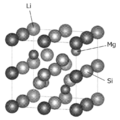
- FIG. 1 is a schematic view showing the crystal structure of Li 2 MgSi.
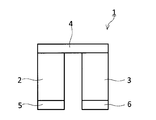
- FIG. 2 is a schematic view showing an example of the thermoelectric conversion element of the present disclosure.
- FIG. 3 is a schematic view showing an example of a thermoelectric conversion module including the thermoelectric conversion element of the present disclosure.
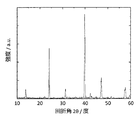
- FIG. 4 is a graph showing the diffraction X-ray intensity distribution of the Li 2 MgSi crystal structure.
- FIG. 5 is a schematic view showing an example of a cross section of a structure in a thermoelectric conversion material having a grain boundary structure.
- FIG. 6 is a graph showing the diffraction X-ray intensity distribution of the thermoelectric conversion material having the composition Li 1.8 MgSi produced in the examples.
- thermoelectric conversion material of the present disclosure has a composition represented by the chemical formula Li 2-a + b Mg 1-b Si. here, The following conditions (1) or (2) Conditions (1) 0 ⁇ a ⁇ 0.0001 and 0.0001 ⁇ b ⁇ 0.25-a, Condition (2) 0.0001 ⁇ a ⁇ 0.25 and 0 ⁇ b ⁇ 0.25-a, Either one of the above is satisfied, and the thermoelectric conversion material has a Li 8 Al 3 Si 5 type crystal structure.
- the Li 2 MgSi crystalline material has a crystal structure also called Li 8 Al 3 Si 5 type belonging to the space group P-43 m as shown in FIG. This point is disclosed in the Inorganic Crystal Structure Database (ICSD).
- ICSD Inorganic Crystal Structure Database
- Non-Patent Documents 1 and 2 the Li 2 MgSi crystalline material is not treated as a thermoelectric conversion material, and the figure of merit ZT is not disclosed.
- the present inventors calculated the predicted value of the performance index ZT for tens of thousands of compounds in the inorganic crystal structure database by using a material search method based on data science called material informatics. For the calculation, a prediction model of the figure of merit ZT originally established by the present inventors was used. This prediction model is more accurate than traditional methods. Therefore, by using this prediction model, it is possible to obtain a prediction result with higher reliability than before. Therefore, the present inventors investigated whether the Li 2 MgSi crystalline material, which has not been treated as a thermoelectric conversion material, is a promising material as a thermoelectric conversion material.
- the Li 2 MgSi crystalline material in a defect-free state is poor in carriers. Therefore, a high figure of merit ZT cannot be expected with a defect-free Li 2 MgSi crystalline material. Therefore, in order to improve the figure of merit ZT, the present inventors have studied the introduction of defects into the Li 2 MgSi crystalline material to generate p-type carriers. As a result, the present inventors have come up with two types of defects: a defect that causes a hole in the Li site and a defect in which Li occupies the Mg site. In addition, it was also examined to reduce the thermal conductivity and improve the figure of merit ZT by providing grain boundaries in Li 2 MgSi.
- the figure of merit ZT in the Li 2-a + b Mg 1-b Si crystalline material was calculated by calculation, and the range of a and b from which a high figure of merit ZT was obtained was found. Furthermore, Li 1.8 MgSi crystalline material could be actually synthesized. Specifically, as shown in Examples 1 to 17 and Comparative Examples 1 to 3 described later, when 0 ⁇ a ⁇ 0.0001 and 0.0001 ⁇ b ⁇ 0.25-a. , Or 0.0001 ⁇ a ⁇ 0.25 and 0 ⁇ b ⁇ 0.25-a, the Li 2-a + b Mg 1-b Si crystalline material is 0.10 or more at a temperature of 400 K. Can have a high figure of merit ZT.
- thermoelectric conversion material of the present disclosure has a Li 8 Al 3 Si 5 type crystal structure.
- the thermoelectric conversion materials of the present disclosure typically have a p-type polarity.
- thermoelectric conversion material of the present disclosure may have a polycrystalline structure.
- the average particle size of the crystal grains contained in the polycrystalline structure may be 0.64 nm or more and 100 nm or less, or 0.64 nm or more and 10 nm or less.
- the manufacturing method is not limited to the above example.
- the amount of Li deficiency and the amount of replacement of Li with Mg sites can be controlled, for example, by changing the amount of Li as a starting material with respect to the amount of Mg.
- thermoelectric conversion element A thermoelectric conversion element can be achieved by the thermoelectric conversion material of the present disclosure.
- an example of this thermoelectric conversion element comprises: p-type thermoelectric conversion unit 2, n-type thermoelectric conversion unit 3, first electrode 4, second electrode 5 and third electrode 6.
- one end of the p-type thermoelectric conversion unit 2 and one end of the n-type thermoelectric conversion unit 3 are electrically connected to each other via the first electrode 4.
- the other end of the p-type thermoelectric conversion unit 2 is electrically connected to the second electrode 5.
- the other end of the n-type thermoelectric conversion unit 3 is electrically connected to the third electrode 6.
- the p-type thermoelectric conversion unit 2 includes the thermoelectric conversion material of the present disclosure.
- the n-type thermoelectric conversion unit 3 includes an Mg 3 (Sb, Bi) 2 system thermoelectric conversion material as an example. Specifically, it is a thermoelectric conversion material having a composition represented by the chemical formula Mg 3.08 Sb 1.49 Bi 0.49 Se 0.02.
- thermoelectric conversion element for example, one end of the p-type thermoelectric conversion unit 2 and one end of the n-type thermoelectric conversion unit 3 are at high temperature, whereas the other end of the p-type thermoelectric conversion unit 2 is n. Electric power is obtained when a temperature difference is formed so that the other end of the type thermoelectric conversion unit 3 has a low temperature.
- thermoelectric conversion element when an electric current is applied, one end of the p-type thermoelectric conversion unit 2 and one end of the n-type thermoelectric conversion unit 3 become the other end of the p-type thermoelectric conversion unit 2. Heat is transported to the other end of the n-type thermoelectric conversion unit 3.
- the polarity of the current is reversed, the direction of heat transfer is also reversed, and one end of the p-type thermoelectric conversion unit 2 and the other end of the n-type thermoelectric conversion unit 3 are reversed. Heat is transported to one end of the end and the n-type thermoelectric conversion unit 3.
- thermoelectric conversion module 11 includes a plurality of thermoelectric conversion elements 1.
- the plurality of thermoelectric conversion elements 1 are arranged between the substrates 13A and 13B so that the unit including the p-type thermoelectric conversion unit 2 and the n-type thermoelectric conversion unit 3 is repeated.
- Each unit is electrically connected in series via a connection electrode 12 from the output line 14A to the output line 14B of the thermoelectric conversion module 11.
- the connection electrode 12, which is the third electrode 6, the n-type thermoelectric conversion unit 3, the first electrode 4, the p-type thermoelectric conversion unit 2, and the connection electrode 12, which is the second electrode 5, are electrically operated in this order. It is connected.
- thermoelectric conversion material Metal of obtaining electric power using thermoelectric conversion material
- electrodes are arranged at one end and the other end of the thermoelectric conversion material of the present disclosure, and the temperature difference is such that one end is high temperature and the other end is low temperature. Is formed, the p-shaped carrier moves from one end to the other to obtain power.
- thermoelectric conversion material Metal of transporting heat using thermoelectric conversion material
- the Peltier effect is generated by applying an electric current to the thermoelectric conversion material of the present disclosure, and heat is transported from one end to the other end of the thermoelectric conversion material.
- cooling / temperature control using a thermoelectric conversion material can be measured.
- thermoelectric conversion material of the present disclosure will be described in more detail by way of examples.
- thermoelectric conversion material of the present disclosure is not limited to the specific aspects shown below.
- Non-Patent Document 1 discloses that the crystal structure of the Li 2 MgSi crystalline material belongs to the space group P-43m. Based on the X-ray crystal diffraction method, the X-ray diffraction peak of the Li 8 Al 3 Si 5 type crystal structure can be confirmed.
- FIG. 4 was obtained by calculating the crystal structure factor F and the integrated diffraction intensity I of Li 2 MgSi using software (RIETAN, source URL: http://fujioizumi.verse.jp/download/download.html).
- Li 2 MgSi is a graph showing the diffraction X-ray intensity distribution of the crystal structure.
- the diffracted X-ray intensity distribution shown in the graph was almost the same as the diffracted X-ray intensity distribution of the Li 8 Al 3 Si 5 type crystal structure. That is, it was confirmed that the Li 2 Mg Si crystal structure can have a Li 8 Al 3 Si 5 type crystal structure.
- the crystal structure factor F is obtained by the following relational expression (1).
- F ⁇ f i exp (2 ⁇ ir i ⁇ k) ⁇ ⁇ ⁇ (1)
- r i is the position vector of the atom in the crystal
- f i is the atomic scattering factor of the atom at the position of r i
- ⁇ k is the difference in the wave vector of the X-ray before and after scattering.
- the integrated diffraction intensity I is obtained by the following relational expression (2).
- I I e L
- I e is the scattering intensity of one electron
- N is the number of unit cells in the crystal
- L is a coefficient depending on the experimental conditions including the attraction factor.
- the crystal structure of the Li 2 MgSi matrix, the crystal structure lacking Li, the crystal structure in which Li occupies a part of the Mg site, and the ternary phase diagram of Li-Mg-Si are known.
- the total energy of the known crystal structure was calculated by using the DFT method, and the stability was evaluated by the convex hull curved surface.
- thermoelectric conversion efficiency is determined by the figure of merit ZT of the material.
- ZT is defined by the following relational expression (3).
- S is the Seebeck coefficient
- ⁇ is the electrical conductivity
- T is the absolute temperature of the evaluation environment
- ⁇ e is the thermal conductivity of the electron
- ⁇ lat is the lattice thermal conductivity.
- the reduced Fermi energy was calculated from the defect concentration as described below.
- the density of states effective mass m d were obtained by fitting the density of states obtained by VASP code relation (8) below.
- D VB (E-E F) 4 ⁇ (2m d) 3/2 / h 3 ⁇ (E F -E) 1/2 ⁇ (8)
- the mobility ⁇ which is a parameter for determining ⁇ , was calculated by the following theoretical formula (9); (see Non-Patent Document 5).
- ⁇ (8 ⁇ ) 1/2 (h / 2 ⁇ ) 4 eB / 3m * 5/2 (k B T) 3/2 g 2 ⁇ (9)
- e is an elementary charge
- m * is the effective mass of the carrier
- B is the elastic constant
- g is the deformation potential.
- m * , B and g were calculated by the DFT method using the VASP code.
- ⁇ is the amount of change in the band end energy level when the lattice constant l is changed by ⁇ l.
- the lattice thermal conductivity ⁇ lat was calculated by the following empirical formula (10) based on the Debye-Callaway model disclosed in Non-Patent Document 7.
- ⁇ lat ⁇ acoustic + ⁇ optical ⁇ ⁇ ⁇ (10)
- ⁇ acoustic and ⁇ optical are represented by the following relational expressions (11) and (12).
- ⁇ acoustic A 1 Mv 3 / V 2/3 n 1/3 ...
- ⁇ optical A 2 v / V 2/3 (1-1 / n 2/3 ) ⁇ ⁇ ⁇ (12)
- M is the average atomic mass
- v is the longitudinal wave sound wave velocity
- V is the volume per atom
- n the number of atoms contained in the unit cell.
- the calculation prediction of the figure of merit ZT consists of two steps: a step of calculating the Fermi energy from the composition, more specifically, the defect concentration, and a step of calculating each physical quantity corresponding to the calculated Fermi energy.
- E form (q, E F) is the formation energy of the defect having a charge in the charge q, it is represented by the following equation (16).
- E form (q, E F) E defect (q) -E defect (0) + q (E VBM + E F) ⁇ (16)
- E defect (q) is the total energy of the crystal having a defect charged with a charge q
- E VBM is the energy at the upper end of the valence band.
- thermoelectric conversion characteristics including the figure of merit ZT were evaluated by the above method in the composition range in which it can be predicted that Li 2-a + b Mg 1-b Si crystals can be stably synthesized.
- Tables 1, 2 and 3, respectively, show a material having a composition represented by the formula Li 2-a Mg Si, a material having a composition represented by the formula Li 2 + b Mg 1-b Si, and a material having a composition represented by the formula Li 2
- the evaluation results of the thermoelectric conversion characteristics at a temperature of 400 K of a material having a composition represented by -a + b Mg 1-b Si are shown.
- thermoelectric conversion characteristics in polycrystalline thermoelectric conversion materials with grain boundaries The performance index ZT of a polycrystalline thermoelectric conversion material having grain boundaries can be calculated by extending the theoretical formula of lattice thermal conductivity in the above theory. It is known that in a thermoelectric conversion material having a grain boundary structure with fine crystal grains, the lattice thermal conductivity is suppressed, which makes it possible to improve ZT. As shown in FIG. 5, in the cross section of the structure having the grain boundary structure, the orientation of each crystal grain is usually randomly distributed.
- the lattice thermal conductivity when having a grain boundary structure having an average particle size d is the following formula (17), which is a combination of the theoretical formula disclosed in Non-Patent Document 7 and the theoretical formula disclosed in Non-Patent Document 8. , (18) can be evaluated.
- ⁇ lat 1 / (1 / ⁇ acoustic + 1 / ⁇ grain ) + ⁇ optical ⁇ ⁇ ⁇ (17)
- ⁇ grain k B Bd / 2nV ⁇ ⁇ ⁇ (18)
- ⁇ acoustic is the acoustic phonon thermal conductivity when the average particle size is infinite
- ⁇ grain is the correction value of the acoustic phonon thermal conductivity when grain boundary scattering occurs
- ⁇ optical is the thermal conductivity of the optical phonon.
- the average particle size in the present specification can be defined as follows.
- the number N of crystal grains (grains) is counted from the observation image of the cross section of the thermoelectric conversion material by a scanning electron microscope (SEM). At this time, the crystal grains partially observed at the end of the observation image are counted as 0.5 for convenience.
- the average grain size (average crystal grain size; hereinafter also referred to as “AGS”) is defined by the following formula (II) using the number N of crystal grains, the area A of the field of view of the observed image, and the pi. it can.
- AGS ⁇ 4A / ( ⁇ N) ⁇ 1/2 ... (II)
- Equation (II) is an approximate equation that expresses the average grain size of crystal grains assuming that the crystal grains have a true spherical shape and a cross section passing through the center of the crystal grains is observed. is there. In reality, the grains are amorphous and not true spheres. Therefore, the average particle size derived from equation (II) is not necessarily equal to the true average particle size of the crystal grains. However, in the present specification, the amount represented by the formula (II) is taken as the average particle size for convenience, and the description of the embodiment and the scope of claims are defined by the amount.
- thermoelectric conversion characteristics Assuming that the minimum value of the achievable average particle size d is the lattice constant of 0.64 nm, the relationship between d and thermoelectric conversion characteristics is evaluated by calculation in the range of d ⁇ 0.64 nm according to the above theoretical formula. Was carried out. Table 4 below shows the relationship at a temperature of 400 K for Li 2.01 Mg 0.99 Si for which the highest predicted value of ZT was obtained in the limit of d ⁇ ⁇ .
- Elemental Li, Mg and Si as raw materials were weighed at a composition ratio of 1.8: 1: 1.
- the weighed raw material was sealed in a stainless steel container filled with an argon atmosphere together with a stainless steel ball having a diameter of 10 mm.
- the encapsulated raw material was pulverized and mixed by a planetary ball mill method for 6 hours under the condition of a rotation speed of 400 rpm.
- the resulting mixed powder was introduced into a graphite mold and hot pressed under an argon atmosphere. During the hot press, the temperature of 680 ° C. was maintained for 30 minutes while applying a pressure of 90 MPa. In this way, a cylindrical compact body having a mass density of 95% of the theoretical density was obtained.
- the chemical composition of the resulting compact was analyzed by energy dispersive X-ray spectroscopy.
- 10 was used for the analysis.
- the obtained compact body was cut into strips and pellets to obtain test pieces.
- the Seebeck coefficient S and the electrical conductivity ⁇ were evaluated using a strip-shaped test piece.
- Thermal conductivity ⁇ was evaluated using pelleted test pieces.
- ZEM-3 manufactured by Advance Riko Co., Ltd. was used for the evaluation of Seebeck coefficient and electrical conductivity.
- LFA457 manufactured by NETZSCH was used for the evaluation of thermal conductivity.
- thermoelectric conversion characteristics at the temperature T of the produced Li 1.8 MgSi are shown in Table 5 below.
- thermoelectric conversion material of the present disclosure can be used for a thermoelectric conversion element and a thermoelectric conversion module that convert thermal energy into electrical energy.
Landscapes
- Chemical & Material Sciences (AREA)
- Inorganic Chemistry (AREA)
- Organic Chemistry (AREA)
- Silicon Compounds (AREA)
- Powder Metallurgy (AREA)
Priority Applications (3)
| Application Number | Priority Date | Filing Date | Title |
|---|---|---|---|
| CN202080030532.3A CN113748524A (zh) | 2019-09-09 | 2020-07-15 | 热电转换材料、热电转换元件、使用热电转换材料获得电的方法以及输送热的方法 |
| JP2021545143A JPWO2021049166A1 (https=) | 2019-09-09 | 2020-07-15 | |
| US17/512,623 US11910713B2 (en) | 2019-09-09 | 2021-10-27 | Thermoelectric conversion technique |
Applications Claiming Priority (2)
| Application Number | Priority Date | Filing Date | Title |
|---|---|---|---|
| JP2019163900 | 2019-09-09 | ||
| JP2019-163900 | 2019-09-09 |
Related Child Applications (1)
| Application Number | Title | Priority Date | Filing Date |
|---|---|---|---|
| US17/512,623 Continuation US11910713B2 (en) | 2019-09-09 | 2021-10-27 | Thermoelectric conversion technique |
Publications (1)
| Publication Number | Publication Date |
|---|---|
| WO2021049166A1 true WO2021049166A1 (ja) | 2021-03-18 |
Family
ID=74866119
Family Applications (1)
| Application Number | Title | Priority Date | Filing Date |
|---|---|---|---|
| PCT/JP2020/027533 Ceased WO2021049166A1 (ja) | 2019-09-09 | 2020-07-15 | 熱電変換材料、熱電変換素子、熱電変換材料を用いて電力を得る方法及び熱を輸送する方法 |
Country Status (4)
| Country | Link |
|---|---|
| US (1) | US11910713B2 (https=) |
| JP (1) | JPWO2021049166A1 (https=) |
| CN (1) | CN113748524A (https=) |
| WO (1) | WO2021049166A1 (https=) |
Cited By (1)
| Publication number | Priority date | Publication date | Assignee | Title |
|---|---|---|---|---|
| US20220128270A1 (en) * | 2020-10-27 | 2022-04-28 | Savannah River Nuclear Solutions, Llc | High Temperature Thermochemical Energy Storage Materials |
Families Citing this family (1)
| Publication number | Priority date | Publication date | Assignee | Title |
|---|---|---|---|---|
| CN115786751B (zh) * | 2022-11-15 | 2024-01-19 | 重庆天齐锂业有限责任公司 | 锂镁硅合金熔炼方法 |
Citations (3)
| Publication number | Priority date | Publication date | Assignee | Title |
|---|---|---|---|---|
| JP2010050185A (ja) * | 2008-08-20 | 2010-03-04 | Fdk Corp | Mg金属間化合物及びそれを応用したデバイス |
| JP2013197550A (ja) * | 2012-03-22 | 2013-09-30 | Ngk Insulators Ltd | 熱電材料およびその製造方法 |
| JP2018178162A (ja) * | 2017-04-05 | 2018-11-15 | トヨタ自動車株式会社 | 熱電材料の製造方法 |
Family Cites Families (12)
| Publication number | Priority date | Publication date | Assignee | Title |
|---|---|---|---|---|
| US5294503A (en) * | 1992-10-13 | 1994-03-15 | The United States Of America As Represented By The National Aeronautics And Space Administration | Anode for rechargeable ambient temperature lithium cells |
| EP1039556A4 (en) * | 1997-10-24 | 2007-02-21 | Neomax Co Ltd | THERMOELECTRIC TRANSMISSION MATERIAL AND ITS MANUFACTURE |
| JP2005305394A (ja) * | 2004-04-26 | 2005-11-04 | Toyota Central Res & Dev Lab Inc | 水素吸蔵材料 |
| US20060090787A1 (en) * | 2004-10-28 | 2006-05-04 | Onvural O R | Thermoelectric alternators and thermoelectric climate control devices with controlled current flow for motor vehicles |
| EA200901438A1 (ru) * | 2007-04-24 | 2010-06-30 | Блэклайт Пауэр, Инк. | Реактор для водородного катализа |
| JP5274146B2 (ja) * | 2008-08-08 | 2013-08-28 | 独立行政法人物質・材料研究機構 | マグネシウム、珪素、スズからなる熱電半導体およびその製造方法 |
| JP5482229B2 (ja) * | 2010-01-25 | 2014-05-07 | 株式会社ミツバ | 熱電材料およびその製造方法 |
| US8801953B2 (en) * | 2010-10-19 | 2014-08-12 | California Institute Of Technology | Zintl phases for thermoelectric applications |
| JP5931413B2 (ja) * | 2010-11-24 | 2016-06-08 | 剛 梶谷 | p型熱電変換材料及びその製造方法、並びに、熱電変換素子及び熱電変換モジュール |
| WO2017046912A1 (ja) * | 2015-09-17 | 2017-03-23 | 株式会社日立製作所 | 熱電変換材料及びこれを用いた熱電変換モジュール |
| WO2017146095A1 (ja) * | 2016-02-24 | 2017-08-31 | 三菱マテリアル株式会社 | マグネシウム系熱電変換材料の製造方法、マグネシウム系熱電変換素子の製造方法、マグネシウム系熱電変換材料、マグネシウム系熱電変換素子、熱電変換装置 |
| JP7209167B2 (ja) * | 2017-05-08 | 2023-01-20 | パナソニックIpマネジメント株式会社 | ジントル相熱電変換材料 |
-
2020
- 2020-07-15 JP JP2021545143A patent/JPWO2021049166A1/ja not_active Ceased
- 2020-07-15 CN CN202080030532.3A patent/CN113748524A/zh active Pending
- 2020-07-15 WO PCT/JP2020/027533 patent/WO2021049166A1/ja not_active Ceased
-
2021
- 2021-10-27 US US17/512,623 patent/US11910713B2/en active Active
Patent Citations (3)
| Publication number | Priority date | Publication date | Assignee | Title |
|---|---|---|---|---|
| JP2010050185A (ja) * | 2008-08-20 | 2010-03-04 | Fdk Corp | Mg金属間化合物及びそれを応用したデバイス |
| JP2013197550A (ja) * | 2012-03-22 | 2013-09-30 | Ngk Insulators Ltd | 熱電材料およびその製造方法 |
| JP2018178162A (ja) * | 2017-04-05 | 2018-11-15 | トヨタ自動車株式会社 | 熱電材料の製造方法 |
Cited By (2)
| Publication number | Priority date | Publication date | Assignee | Title |
|---|---|---|---|---|
| US20220128270A1 (en) * | 2020-10-27 | 2022-04-28 | Savannah River Nuclear Solutions, Llc | High Temperature Thermochemical Energy Storage Materials |
| US11976235B2 (en) * | 2020-10-27 | 2024-05-07 | Battelle Savannah River Alliance, Llc | High temperature thermochemical energy storage materials |
Also Published As
| Publication number | Publication date |
|---|---|
| CN113748524A (zh) | 2021-12-03 |
| US20220052245A1 (en) | 2022-02-17 |
| JPWO2021049166A1 (https=) | 2021-03-18 |
| US11910713B2 (en) | 2024-02-20 |
Similar Documents
| Publication | Publication Date | Title |
|---|---|---|
| Zhang et al. | Achieving ultralow lattice thermal conductivity and high thermoelectric performance in GeTe alloys via introducing Cu2Te nanocrystals and resonant level doping | |
| Qian et al. | Synergistically optimizing interdependent thermoelectric parameters of n-type PbSe through alloying CdSe | |
| Luo et al. | Soft phonon modes from off-center Ge atoms lead to ultralow thermal conductivity and superior thermoelectric performance in n-type PbSe–GeSe | |
| Cooley et al. | High seebeck coefficient and unusually low thermal conductivity near ambient temperatures in layered compound yb2–x eu x cdsb2 | |
| Zhu et al. | Realizing high thermoelectric performance in Sb-doped Ag2Te compounds with a low-temperature monoclinic structure | |
| Qin et al. | Crystal structure and atomic vacancy optimized thermoelectric properties in gadolinium selenides | |
| Yamada et al. | A thermoelectric zintl phase na2+ xga2+ xsn4–x with disordered na atoms in helical tunnels | |
| Wang et al. | Enhancement of thermoelectric properties in n-type NbCoSn half-Heusler compounds via Ta alloying | |
| Huang et al. | Effects of Sb deviation from its stoichiometric ratio on the micro-and electronic structures and thermoelectric properties of Cu12Sb4S13 | |
| Rogl et al. | Properties of HPT-processed large bulks of p-type skutterudite DD0. 7Fe3CoSb12 with ZT> 1.3 | |
| US11910713B2 (en) | Thermoelectric conversion technique | |
| Moorthy et al. | Sulfur vacancy-driven band splitting and phonon anharmonicity enhance the thermoelectric performance in n-type CuFeS2 | |
| Ponce-Ruiz et al. | Theoretical and experimental study of CaMgSi thermoelectric properties | |
| Song et al. | Crystal structure, electronic transport, and improved thermoelectric properties of doped inte | |
| Wu et al. | Constructing high-performance bulk thermoelectric composites by incorporating uniformly dispersed fullerene sub-nanoclusters | |
| Xia et al. | Chemical composition engineering leading to the significant improvement in the thermoelectric performance of AgBiSe2-based n-type solid solutions | |
| KR102259535B1 (ko) | 열 전도도 및 열전 성능 지수가 개선된 열전 재료 | |
| WO2022009586A1 (ja) | 熱電変換材料、熱電変換素子、熱電変換モジュール、発電方法、及び伝熱方法 | |
| US11737365B2 (en) | Thermoelectric conversion technique | |
| JP2023008120A (ja) | 熱電変換材料、熱電変換素子、熱電変換モジュール、発電方法、及び伝熱方法 | |
| Ojha et al. | Exploring the thermoelectric performance of NiFeMnAl and ZnFeVAl as novel quaternary Heusler compounds | |
| Meng et al. | Single-and Two-band Transport Properties Crossover in Bi 2 Te 3 Based Thermoelectrics | |
| Shen et al. | Point Defect Scattering and Phonon Softening for Achieving High Thermoelectric Performance in p-Type ZnSb with Optimal Carrier Concentration | |
| KR102419462B1 (ko) | 퍼밍기어타이트 열전재료 및 이의 제조 방법 | |
| WO2023281926A1 (ja) | 熱電変換材料、熱電変換素子、熱電変換モジュール、発電方法、及び伝熱方法 |
Legal Events
| Date | Code | Title | Description |
|---|---|---|---|
| 121 | Ep: the epo has been informed by wipo that ep was designated in this application |
Ref document number: 20863450 Country of ref document: EP Kind code of ref document: A1 |
|
| ENP | Entry into the national phase |
Ref document number: 2021545143 Country of ref document: JP Kind code of ref document: A |
|
| NENP | Non-entry into the national phase |
Ref country code: DE |
|
| 122 | Ep: pct application non-entry in european phase |
Ref document number: 20863450 Country of ref document: EP Kind code of ref document: A1 |