WO2020257653A1 - Radiolabeled compounds and uses thereof - Google Patents
Radiolabeled compounds and uses thereof Download PDFInfo
- Publication number
- WO2020257653A1 WO2020257653A1 PCT/US2020/038739 US2020038739W WO2020257653A1 WO 2020257653 A1 WO2020257653 A1 WO 2020257653A1 US 2020038739 W US2020038739 W US 2020038739W WO 2020257653 A1 WO2020257653 A1 WO 2020257653A1
- Authority
- WO
- WIPO (PCT)
- Prior art keywords
- alkyl
- compound
- heteroaryl
- aryl
- heterocycloalkyl
- Prior art date
- Legal status (The legal status is an assumption and is not a legal conclusion. Google has not performed a legal analysis and makes no representation as to the accuracy of the status listed.)
- Ceased
Links
- 0 Cc1nc(*)c(*)c(*)n1 Chemical compound Cc1nc(*)c(*)c(*)n1 0.000 description 29
- BOLMMMHSGLQHLW-UHFFFAOYSA-N CCCC(Sc(cc1)ccc1-c1nc(C(F)(F)F)cc(NCc2ccc[s]2)n1)=O Chemical compound CCCC(Sc(cc1)ccc1-c1nc(C(F)(F)F)cc(NCc2ccc[s]2)n1)=O BOLMMMHSGLQHLW-UHFFFAOYSA-N 0.000 description 1
- LVTIKUJBLRJZSP-UHFFFAOYSA-N CS(c(cc1)ccc1-c1cc(Cl)nc(NCc2ccccc2)n1)(=O)=O Chemical compound CS(c(cc1)ccc1-c1cc(Cl)nc(NCc2ccccc2)n1)(=O)=O LVTIKUJBLRJZSP-UHFFFAOYSA-N 0.000 description 1
- YOGMPOMAMHCGEX-UHFFFAOYSA-N CS(c(cc1)ccc1-c1cc(Cl)nc(NCc2ncc[s]2)n1)(=O)=O Chemical compound CS(c(cc1)ccc1-c1cc(Cl)nc(NCc2ncc[s]2)n1)(=O)=O YOGMPOMAMHCGEX-UHFFFAOYSA-N 0.000 description 1
- ZLPBPGMSFHGSNO-UHFFFAOYSA-N CS(c(cc1)ccc1-c1n[o]c(C(F)(F)Br)c1-c1ccccc1)(=O)=O Chemical compound CS(c(cc1)ccc1-c1n[o]c(C(F)(F)Br)c1-c1ccccc1)(=O)=O ZLPBPGMSFHGSNO-UHFFFAOYSA-N 0.000 description 1
- HYDVVHMBXYHJSB-UHFFFAOYSA-N CS(c(cc1)ccc1-c1nc(F)cc(NCc2ccccc2)n1)(=O)=O Chemical compound CS(c(cc1)ccc1-c1nc(F)cc(NCc2ccccc2)n1)(=O)=O HYDVVHMBXYHJSB-UHFFFAOYSA-N 0.000 description 1
- QPKXWUBZVKVRIQ-UHFFFAOYSA-N C[O](c1cc(NCc2ccc[s]2)nc(-c(cc2)ccc2S(C)(=O)=O)n1)=C Chemical compound C[O](c1cc(NCc2ccc[s]2)nc(-c(cc2)ccc2S(C)(=O)=O)n1)=C QPKXWUBZVKVRIQ-UHFFFAOYSA-N 0.000 description 1
- KROUGDLXJMNHCE-UHFFFAOYSA-N Cc([o]nc1-c(cc2)ccc2S(C)(=O)=O)c1-c1ccccc1 Chemical compound Cc([o]nc1-c(cc2)ccc2S(C)(=O)=O)c1-c1ccccc1 KROUGDLXJMNHCE-UHFFFAOYSA-N 0.000 description 1
Classifications
-
- C—CHEMISTRY; METALLURGY
- C07—ORGANIC CHEMISTRY
- C07D—HETEROCYCLIC COMPOUNDS
- C07D239/00—Heterocyclic compounds containing 1,3-diazine or hydrogenated 1,3-diazine rings
- C07D239/02—Heterocyclic compounds containing 1,3-diazine or hydrogenated 1,3-diazine rings not condensed with other rings
- C07D239/24—Heterocyclic compounds containing 1,3-diazine or hydrogenated 1,3-diazine rings not condensed with other rings having three or more double bonds between ring members or between ring members and non-ring members
- C07D239/28—Heterocyclic compounds containing 1,3-diazine or hydrogenated 1,3-diazine rings not condensed with other rings having three or more double bonds between ring members or between ring members and non-ring members with hetero atoms or with carbon atoms having three bonds to hetero atoms with at the most one bond to halogen, directly attached to ring carbon atoms
- C07D239/32—One oxygen, sulfur or nitrogen atom
- C07D239/42—One nitrogen atom
-
- C—CHEMISTRY; METALLURGY
- C07—ORGANIC CHEMISTRY
- C07D—HETEROCYCLIC COMPOUNDS
- C07D261/00—Heterocyclic compounds containing 1,2-oxazole or hydrogenated 1,2-oxazole rings
- C07D261/02—Heterocyclic compounds containing 1,2-oxazole or hydrogenated 1,2-oxazole rings not condensed with other rings
- C07D261/06—Heterocyclic compounds containing 1,2-oxazole or hydrogenated 1,2-oxazole rings not condensed with other rings having two or more double bonds between ring members or between ring members and non-ring members
- C07D261/08—Heterocyclic compounds containing 1,2-oxazole or hydrogenated 1,2-oxazole rings not condensed with other rings having two or more double bonds between ring members or between ring members and non-ring members with only hydrogen atoms, hydrocarbon or substituted hydrocarbon radicals, directly attached to ring carbon atoms
-
- C—CHEMISTRY; METALLURGY
- C07—ORGANIC CHEMISTRY
- C07D—HETEROCYCLIC COMPOUNDS
- C07D409/00—Heterocyclic compounds containing two or more hetero rings, at least one ring having sulfur atoms as the only ring hetero atoms
- C07D409/02—Heterocyclic compounds containing two or more hetero rings, at least one ring having sulfur atoms as the only ring hetero atoms containing two hetero rings
- C07D409/12—Heterocyclic compounds containing two or more hetero rings, at least one ring having sulfur atoms as the only ring hetero atoms containing two hetero rings linked by a chain containing hetero atoms as chain links
-
- C—CHEMISTRY; METALLURGY
- C07—ORGANIC CHEMISTRY
- C07D—HETEROCYCLIC COMPOUNDS
- C07D413/00—Heterocyclic compounds containing two or more hetero rings, at least one ring having nitrogen and oxygen atoms as the only ring hetero atoms
- C07D413/02—Heterocyclic compounds containing two or more hetero rings, at least one ring having nitrogen and oxygen atoms as the only ring hetero atoms containing two hetero rings
- C07D413/04—Heterocyclic compounds containing two or more hetero rings, at least one ring having nitrogen and oxygen atoms as the only ring hetero atoms containing two hetero rings directly linked by a ring-member-to-ring-member bond
-
- C—CHEMISTRY; METALLURGY
- C07—ORGANIC CHEMISTRY
- C07D—HETEROCYCLIC COMPOUNDS
- C07D417/00—Heterocyclic compounds containing two or more hetero rings, at least one ring having nitrogen and sulfur atoms as the only ring hetero atoms, not provided for by group C07D415/00
- C07D417/02—Heterocyclic compounds containing two or more hetero rings, at least one ring having nitrogen and sulfur atoms as the only ring hetero atoms, not provided for by group C07D415/00 containing two hetero rings
- C07D417/12—Heterocyclic compounds containing two or more hetero rings, at least one ring having nitrogen and sulfur atoms as the only ring hetero atoms, not provided for by group C07D415/00 containing two hetero rings linked by a chain containing hetero atoms as chain links
-
- A—HUMAN NECESSITIES
- A61—MEDICAL OR VETERINARY SCIENCE; HYGIENE
- A61K—PREPARATIONS FOR MEDICAL, DENTAL OR TOILETRY PURPOSES
- A61K51/00—Preparations containing radioactive substances for use in therapy or testing in vivo
- A61K51/02—Preparations containing radioactive substances for use in therapy or testing in vivo characterised by the carrier, i.e. characterised by the agent or material covalently linked or complexing the radioactive nucleus
- A61K51/04—Organic compounds
- A61K51/041—Heterocyclic compounds
-
- C—CHEMISTRY; METALLURGY
- C07—ORGANIC CHEMISTRY
- C07B—GENERAL METHODS OF ORGANIC CHEMISTRY; APPARATUS THEREFOR
- C07B2200/00—Indexing scheme relating to specific properties of organic compounds
- C07B2200/05—Isotopically modified compounds, e.g. labelled
Definitions
- the present disclosure relates generally to the field of radiolabeled compounds. More particularly, the present disclosure relates to radiolabeled arylpyrimidine and isoxazole compounds.
- COX Cyclooxygenase
- COX enzymes also called prostaglandin endoperoxidase synthases, are essential enzymes in prostaglandin biosynthesis.
- COX enzymes catalyze the oxidative conversion of arachidonic acid substrates to prostaglandins, prostacyclins, and thromboxane.
- COX-1 is predominantly constitutive.
- COX-2 is predominantly inducible, though it can also be constitutive in, for example, kidney, brain, heart, liver, testicles, and tracheal epithelia. While the structures of COX-1 and COX-2 are similar, COX-2 is more rapidly degraded, has a shorter half-life, and possesses a larger binding site due to a secondary internal pocket.
- the third isoform, COX-3 may be responsible for the antipyretic and analgesic activities of non-steroidal anti-inflammatory drugs (“NSAIDs”).
- NSAIDs non-steroidal anti-inflammatory drugs
- COX-2 can be induced by inflammatory stimuli and catalyze prostanoid formation associated with inflammation and proliferative diseases.
- COX-2 In the central nervous system (“CNS”), COX-2 is modestly expressed under normal physiologic conditions and has a role in, for example, brain, cardiac, and kidney functions. However, during inflammation, COX-2 is significantly upregulated. Neuroinflammation and COX-2 induction are protective under some circumstances, but excessive inflammation and COX-2 induction may be involved in the pathogenesis of disease.
- ALS amyotrophic lateral sclerosis
- Inhibition of COX-2 may be a potential protective treatment strategy by slowing or halting the progression of disease.
- Monitoring in vivo changes in COX-2 expression could be useful for quantifying disease pathogenesis, such as detecting organ rejection and joints affected by arthritis, and assessing target occupancy and biological effects of COX-2- selective inhibitors (“COXIBs”).
- COXIBs COX-2- selective inhibitors
- Availability of noninvasive diagnostic methods, such as positron emission tomography (“PET”) imaging is particularly crucial for CNS diseases, given the difficulty of accessing the brain, and presents a direct way of imaging changes in COX-2 in vivo during disease progression and therapy.
- PET positron emission tomography
- Noninvasive PET imaging of COX-2 protein can be a powerful molecular imaging method for quantifying inflammation.
- a specific COX-2 PET tracer could also serve as a biological marker of COX-2 induction, and as an index of the effect of COXIBs.
- existing radioligands for PET are not effective for imaging COX-2 induction in vivo, possibly due to their suboptimal pharmacology and physiological properties, and other issues in translating to the clinic.
- [ U C]MC 1] [ u C]-6-methoxy-2-(4- (methylsulfonyl)phenyl)-/V-(thiophen-2-ylmethyl)pyrimidin-4-amine
- [ U C]MC 1] [ U C]-6-methoxy-2-(4- (methylsulfonyl)phenyl)-/V-(thiophen-2-ylmethyl)pyrimidin-4-amine
- [ U C]MC1 is not practical for multicenter trials, commercial use, or clinical applications, because this half-life is too short to allow the tracer to be shipped beyond the confines of a single medical center.
- Other u C-labeled COXIBs e.g,
- R is selected from the group consisting of (Ci-Ce)alkyl, (Ci-Ce)alkenyl, (Ci- C6)alkynyl, (Ci-C6)heteroalkyl, (Ci-C6)heteroalkenyl, (Ci-C6)heteroalkynyl, (C3- C7)cycloalkyl, (C3-C7)heterocycloalkyl, (C3-C7)cycloalkenyl, (C3-C7)heterocycloalkenyl, (Ci- C6)alkyl-(C3-C7)cycloalkyl, (Ci-C6)alkyl-(C3-C7)heterocycloalkyl, (Ci-C6)alkyl-(C3-C7)cycloalkenyl, (Ci-C6)alkyl-(C3-C7)heterocycloalkyl, (Ci-C6)alkyl-(C3-C7)cycl
- R 1 , R 2 , R 3 , and R 4 are each independently selected from the group consisting of hydrogen, deuterium, 3 H, U C, halogen, 18 F, 75 Br, 76 Br, 120 I, 123 I, 124 I, 125 I, 13 X I, (Ci-Ce)alkyl, (Ci-Ce)alkenyl, (Ci-Ce)alkynyl, (Ci-C6)heteroalkyl, (Ci-C6)heteroalkenyl, (Ci- C6)heteroalkynyl, (C3-C7)cycloalkyl, (C3-C7)heterocycloalkyl, (C3-C7)cycloalkenyl, (C 3 - C7)heterocycloalkenyl, (Ci-C6)alkyl-(C3-C7)cycloalkyl, (Ci-C6)alkyl-(C3- C7)heterocycloalkyl, (
- R, R 1 , R 2 , R 3 , R 4 , or R 5 comprises at least one of 3 H, U C, 18 F, 75 Br, 76 Br, 120 I, 123 I, 124 I, 125 I, or 131 I;
- R 3 is CF 3 , R 4
- R 2 is not
- R is selected from the group consisting of (Ci-Ce)alkyl, (Ci-Ce)alkynyl, (Ci-C6)heteroalkyl, (Ci-C6)heteroalkynyl, (C3- C7)cycloalkyl, (C3-C7)heterocycloalkyl, (Ci-C6)alkyl-(C3-C7)cycloalkyl, (Ci-C6)alkyl-(C3- C7)heterocycloalkyl, aryl, (Ci-Ce)alkyl-aryl, heteroaryl, (Ci-C6)alkyl-heteroaryl, and N(R 5 )2; wherein each (Ci-Ce)alkyl, (Ci-Ce)alkynyl, (Ci-C6)heteroalkyl, (Ci-C6)heteroalkyl, (Ci
- each occurrence of R 5 is independently selected from the group consisting of hydrogen, (Ci-Ce)alkyl, aryl, (Ci- C6)alkyl-aryl, heteroaryl, and (Ci-C6)alkyl-heteroaryl; wherein each (Ci-Ce)alkyl, aryl, (Ci-Ce)alkyl-aryl, heteroaryl, or (Ci-Ce)alkyl- heteroaryl is optionally substituted with deuterium, U C, 18 F, or 123 I.
- R is CFb, U CH3, CH2 18 F,
- R is CH3, U CH3, or (CH2)2 18 F.
- R 1 , R 2 , R 3 , and R 4 are each independently selected from the group consisting of hydrogen, deuterium, halogen, U C, 18 F, 123 I, (Ci-Ce)alkyl, (Ci-Ce)alkynyl, (Ci-C 6 )heteroalkyl, (Ci-C 6 )heteroalkynyl, (C3- C7)cycloalkyl, (C 3 -C7)heterocycloalkyl, (Ci-C 6 )alkyl-(C 3 -C7)cycloalkyl, (Ci-C6)alkyl-(C 3 - C7)heterocycloalkyl, aryl, (Ci-Ce)alkyl-aryl, heteroaryl, (Ci-C 6 )alkyl-heteroaryl, and N(R 5 )2;
- each occurrence of R 5 is independently selected from the group consisting of hydrogen, deuterium, (C 1 -Cr,)al kyl , aryl, (Ci-Ce)alkyl-aryl, heteroaryl, and (Ci-C 6 )alkyl-heteroaryl;
- each (Ci-Ce)alkyl, aryl, (Ci-Ce)alkyl-aryl, heteroaryl, or (Ci-Ce)alkyl- heteroaryl is optionally substituted with deuterium, U C, 18 F, or 123 I.
- R 1 , R 2 , R 3 , and R 4 are each independently hydrogen, deuterium, halogen, 18 F, 123 I, CFb, U CH3, CH2 18 F, (CH2)2 18 F, CF3,
- R 1 is hydrogen or 18 F.
- R 2 is hydrogen
- R 3 is hydrogen or 18 F.
- R 4 is halogen, 18 F, CF2 18 F,
- R is CH 3 or U CH 3 ;
- R 1 and R 3 are hydrogen
- R 2 is N(R 5 ) 2 ;
- R 4 is F, Cl, CF 3 , or 18 F; and each occurrence of R 5 is independently hydrogen, (Ci-Ce)alkyl-aryl, or (Ci-Ce)alkyl- heteroaryl.
- each occurrence of R 5 is independently hydrogen
- R 2 is
- R is CH 3 ;
- R 1 and R 2 are hydrogen
- R 2 is 18 F
- R 4 is (NR 5 )2
- each occurrence of R 5 is independently hydrogen, (Ci-Ce)alkyl-aryl, or (Ci-Ce)alkyl- heteroaryl.
- R and R 4 are (Ci-Ce)alkyl, optionally substituted with one or more deuterium, 18 F, or halogen;
- R 1 is hydrogen or 18 F
- R 2 is aryl, optionally substituted with 18 F, or heteroaryl, optionally substituted with 18 F.
- R is CFb or (CH2)2 18 F.
- R 2 is
- R 4 is CF3, CF2 18 F, CFh 18 F, or
- the compound of Formula I is pharmaceutically acceptable salt thereof.
- the compound of Formula I is pharmaceutically acceptable salt thereof.
- the compound of Formula I is pharmaceutically acceptable salt thereof.
- the compound of Formula I is pharmaceutically acceptable salt thereof.
- the compound of Formula I is pharmaceutically acceptable salt thereof.
- the compound of Formula I is f the embodiments described herein, the compound of Formula I is f the embodiments described herein, the compound of Formula I is [0046] In any one of the embodiments described herein, the compound of Formula I is
- halogen atom(s) or thioester(s) comprising reacting one or more halogen atom(s) or thioester(s) in the compound with one or more radionuclide source(s) independently selected from the group consisting of deuterium, 3 H, U C, 18 F, 75 Br, 76 Br, 120 I, 123 I, 124 I, 125 I, and 13 3 ⁇ 4;
- R is selected from the group consisting of (Ci-Ce)alkyl, (Ci-C6)alkenyl, (Ci- C6)alkynyl, (Ci-C6)heteroalkyl, (Ci-C6)heteroalkenyl, (Ci-C6)heteroalkynyl, (C 3 - C7)cycloalkyl, (C3-C7)heterocycloalkyl, (C3-C7)cycloalkenyl, (C3-C7)heterocycloalkenyl, (Ci- C6)alkyl-(C3-C7)cycloalkyl, (Ci-C6)alkyl-(C3-C7)heterocycloalkyl, (Ci-C6)alkyl-(C3-C7)cycloalkenyl, (Ci-C6)alkyl-(C3-C7)heterocycloalkyl, (Ci-C6)alkyl-(C3-C7)cycl
- R 1 , R 2 , R 3 , and R 4 are each independently selected from the group consisting of hydrogen, deuterium, 3 H, U C, halogen, 18 F, 75 Br, 76 Br, 120 I, 123 I, 124 I, 125 I, 13 X I, (Ci-Ce)alkyl, (Ci-Ce)alkenyl, (Ci-Ce)alkynyl, (Ci-C6)heteroalkyl, (Ci-C6)heteroalkenyl, (Ci- C6)heteroalkynyl, (C3-C7)cycloalkyl, (C3-C7)heterocycloalkyl, (C3-C7)cycloalkenyl, (C 3 - C7)heterocycloalkenyl, (Ci-C6)alkyl-(C3-C7)cycloalkyl, (Ci-C6)alkyl-(C3- C7)heterocycloalkyl, (
- R is CFb
- R 1 and R 2 are hydrogen
- R 3 is CF 3 , R 4
- the one or more halogen atom(s) are independently chlorine or bromine.
- the radionuclide source is a F source.
- the one or more thioester(s) comprise .
- the radionuclide source is a U C source and wherein the process further comprises an oxidant.
- the compound of Formula I is pharmaceutically acceptable salt thereof
- the 18 F source comprises 18 F or [ 18 F]fluoroalkyl tosylate.
- the 18 F source comprises K 18 F or a tetraalkylammonium [ 18 F]fluoride.
- [ 18 F]fluoride is tetrabutylammonium [ 18 F]fluoride or tetraethylammonium [ 18 F]fluoride. [0070] In any one of the embodiments described herein, the [ 18 F]fluoroalkyl tosylate is 2- [ 18 F]fluoroethyl tosylate.
- the process further comprises a chelating agent, a base, and/or a polar aprotic solvent.
- the chelating agent is a crown ether or a cryptand.
- the cryptand is K222.
- the base is potassium carbonate, tetrabutylammonium hydroxide, pyrrolidine, or 2,6-lutidine.
- the polar aprotic solvent is dimethyl sulfoxide, A/ A'-di m ethyl form am i de, tetrahydrofuran, or combinations thereof.
- the U C source comprises a
- the [ u C]alkyl halide is u CH3l and the [ u C]alkyl triflate is u CH30Tf.
- the oxidant is Oxone ® .
- a method for imaging a sample or organism comprises:
- Formula I or a pharmaceutically acceptable salt thereof in an amount effective to detect emission of deuterium, 3 H, U C, 18 F, 75 Br, 76 Br, 120 I, 123 I, 124 I, 125 I, 13 1 1, or a combination thereof;
- R is selected from the group consisting of (Ci-Ce)alkyl, (Ci-C6)alkenyl, (Ci- C6)alkynyl, (Ci-C6)heteroalkyl, (Ci-C6)heteroalkenyl, (Ci-C6)heteroalkynyl, (C 3 - C7)cycloalkyl, (C3-C7)heterocycloalkyl, (C3-C7)cycloalkenyl, (C3-C7)heterocycloalkenyl, (Ci- C6)alkyl-(C3-C7)cycloalkyl, (Ci-C6)alkyl-(C3-C7)heterocycloalkyl, (Ci-C6)alkyl-(C3-C7)cycloalkenyl, (Ci-C6)alkyl-(C3-C7)heterocycloalkyl, (Ci-C6)alkyl-(C3-C7)cycl
- R 1 , R 2 , R 3 , and R 4 are each independently selected from the group consisting of hydrogen, deuterium, 3 H, U C, halogen, 18 F, 75 Br, 76 Br, 120 I, 123 I, 124 I, 125 I, 13 X I, (Ci-Ce)alkyl, (Ci-Ce)alkenyl, (Ci-Ce)alkynyl, (Ci-C6)heteroalkyl, (Ci-C6)heteroalkenyl, (Ci- C6)heteroalkynyl, (C3-C7)cycloalkyl, (C3-C7)heterocycloalkyl, (C3-C7)cycloalkenyl, (C 3 - C7)heterocycloalkenyl, (Ci-C6)alkyl-(C3-C7)cycloalkyl, (Ci-C6)alkyl-(C3- C7)heterocycloalkyl, (
- R is CFb
- R 1 and R 2 are hydrogen
- R 3 is CF 3 , R 4
- the emission is measured using positron emission tomography.
- the sample is a cell culture.
- the organism is a mammal.
- the mammal is a mouse, rat, pig, dog, monkey, baboon, or human.
- the compound interacts with a protein and measuring the emission allows determination of the expression level or distribution of the protein in the sample or organism.
- the protein is involved in inflammation and measuring the emission allows determination of the amount or distribution of inflammation in the sample or organism.
- the protein is cyclooxygenase-2.
- the mammal is known or suspected to have a condition or state selected from the group consisting of arthritis, cardiovascular disease, central nervous system damage, central nervous system disorders, gastrointestinal disorder, hypersensitivity, swelling, inflammatory disease, metabolic disorder, neoplastic disease, neurodegenerative disease, neuromuscular junction disease, ophthalmic disease, post-operative inflammation, psychiatric condition, reproductive event, respiratory disease, skin disorder, tissue repair, urogenital disease, white matter disease, and a combination thereof.
- a condition or state selected from the group consisting of arthritis, cardiovascular disease, central nervous system damage, central nervous system disorders, gastrointestinal disorder, hypersensitivity, swelling, inflammatory disease, metabolic disorder, neoplastic disease, neurodegenerative disease, neuromuscular junction disease, ophthalmic disease, post-operative inflammation, psychiatric condition, reproductive event, respiratory disease, skin disorder, tissue repair, urogenital disease, white matter disease, and a combination thereof.
- the neurodegenerative disease is Alzheimer’s disease, Parkinson’s disease, Huntington’s disease, amyotrophic lateral sclerosis, cortical dementias, or multiple sclerosis.
- the arthritis is rheumatoid or osteoarthritis.
- the neoplastic disease comprises a cancer selected from the group consisting of colorectal cancer, breast cancer, lung cancer, prostate cancer, bladder cancer, cervical cancer, skin cancer, lymphoma, and a combination thereof.
- the central nervous system damage or disorder comprises traumatic brain injury.
- the inflammatory disease is asthma, Bechet’s disease, bronchitis, bursitis, Crohn’s disease, endotoxin shock syndrome, gastritis, gingivitis, inflammatory bowel disease, polymyositis, pulmonary inflammation, cystic fibrosis, rheumatic fever, sarcoidosis, tendinitis, thyroiditis, or ulcerative colitis.
- the pulmonary inflammation is an acute respiratory disease syndrome resulting from viral and/or bacterial infection.
- the viral infection comprises COVID-19.
- the cardiovascular disease comprises myocardial infarction.
- the urogenital disease comprises renal disease.
- the reproductive event comprises ovulation, pregnancy, childbirth, and a combination thereof.
- the mammal is known or suspected to be experiencing pain.
- FIG. 1 shows chemical structures of [ U C]MC1, [ 18 F]pyricoxib, [ 18 F]triacoxib, and [ l x F]-6-fluoro-2-(4-(methylsulfonyl)phenyl)-A-(thiazol-2-yl methyl )pyri mi din-4-amine (“[ 18 F]FMTP”), according to one or more embodiments.
- FIG. 2 shows binding of [ 18 F]FMTP in BxPC3 and PANC-1 cells, according to one or more embodiments.
- FIG. 3A shows microPET images of [ 18 F]FMTP in mice at 0-10 minutes, summed transaxial, with the relative intensity of 18 F emission indicated by a red (highest)-orange- yellow-green-blue-black (lowest) color gradient, according to one or more embodiments.
- FIG. 3B shows microPET images of [ 18 F]FMTP in mice at 0-10 minutes, summed sagittal, with the relative intensity of 18 F emission indicated by a red (highest)-orange-yellow- green-blue-black (lowest) color gradient, according to one or more embodiments.
- FIG. 3C shows microPET images of [ 18 F]FMTP in mice at 0-40 minutes, summed transaxial, with the relative intensity of 18 F emission indicated by a red (highest)-orange- yellow-green-blue-black (lowest) color gradient, according to one or more embodiments.
- FIG. 3D shows microPET images of [ 18 F]FMTP in mice at 0-40 minutes, summed sagittal, with the relative intensity of 18 F emission indicated by a red (highest)-orange-yellow- green-blue-black (lowest) color gradient, according to one or more embodiments.
- FIG. 4 shows time activity curves of [ 18 F]FMTP in mice, according to one or more embodiments.
- FIG. 5 shows microPET images of [ 18 F]FMTP in phosphate buffered saline (“PBS”)- and lipopolysaccharide (“LPS”)-treated mice, with the relative intensity of 18 F emission indicated by a red (highest)-orange-yellow-green-blue-black (lowest) color gradient, according to one or more embodiments.
- FIG. 6 shows time activity curves of [ 18 F]FMTP in PBS- and LPS-treated mice, according to one or more embodiments.
- FIG. 7 shows autoradiography evaluation of [ 18 F]FMTP in brain sections of LPS- and PBS-treated mice, according to one or more embodiments.
- Radiolabeled compounds that interact with biomarkers (e.g ., proteins) for disease are useful for assaying the presence, amount, activity, or other properties of the biomarker using radioactive imaging (e.g., PET).
- radioactive imaging e.g., PET
- Such imaging can be used to diagnose disease, monitor disease progression and treatment, and determine the lowest effective dose of therapeutics, and evaluate the effectiveness of therapeutics.
- the COX-2 protein which is a biomarker for various diseases described herein, can be assayed using PET imaging of a radiolabeled compound that binds or otherwise interacts with COX-2.
- radiolabeled compounds have a half-life that is impractical for medical use.
- some radiolabeled COX-2-interacting compounds incorporate an U C label, which has a half-life of about 20 minutes. It is not practical for such compounds to be sold commercially, used in long-term imaging applications, or transported between medical centers.
- R is selected from the group consisting of (Ci-Ce)alkyl, (Ci-Ce)alkenyl, (Ci- C 6 )alkynyl, (Ci-C 6 )heteroalkyl, (Ci-C 6 )heteroalkenyl, (Ci-C 6 )heteroalkynyl, (C3- C7)cycloalkyl, (C3-C7)heterocycloalkyl, (C3-C7)cycloalkenyl, (C3-C7)heterocycloalkenyl, (Ci- C6)alkyl-(C3-C7)cycloalkyl, (Ci-C6)alkyl-(C3-C7)heterocycloalkyl, (Ci-C6)alkyl-(C3-C7)cycloalkenyl, (Ci-C6)alkyl-(C3-C7)heterocycloalkyl, (Ci-C6)alkyl
- R 1 , R 2 , R 3 , and R 4 are each independently selected from the group consisting of hydrogen, deuterium, 3 H, U C, halogen, 18 F, 75 Br, 76 Br, 120 I, 123 I, 124 I, 125 I, 13 X I, (Ci-Ce)alkyl, (Ci-Ce)alkenyl, (Ci-Ce)alkynyl, (Ci-C6)heteroalkyl, (Ci-C6)heteroalkenyl, (Ci- C6)heteroalkynyl, (C3-C7)cycloalkyl, (C3-C7)heterocycloalkyl, (C3-C7)cycloalkenyl, (C 3 - C7)heterocycloalkenyl, (Ci-C6)alkyl-(C3-C7)cycloalkyl, (Ci-C6)alkyl-(C3- C7)heterocycloalkyl, (
- R, R 1 , R 2 , R 3 , R 4 , or R 5 comprises at least one of 3 H, U C, 18 F,
- R is selected from the group consisting of (Ci-Ce)alkyl, (Ci-C6)alkenyl, (Ci-Ce)alkynyl, (Ci-C6)heteroalkyl, (Ci-C6)heteroalkenyl, (Ci- C6)heteroalkynyl, (C3-C7)cycloalkyl, (C3-C7)heterocycloalkyl, (C3-C7)cycloalkenyl, (C3- C7)heterocycloalkenyl, (Ci-C6)alkyl-(C3-C7)cycloalkyl, (Ci-C6)alkyl-(C3- C7)heterocycloalkyl, (Ci-C6)alkyl-(C3-C7)cycloalkenyl, (Ci-C6)alkyl-(C3- C7)heterocycloalkyl, (Ci-C6)alkyl-(C3-C7)cycl
- R is selected from the group consisting of (Ci-Ce)alkyl, (Ci- C6)alkynyl, (Ci-Ce)heteroalkyl, (Ci-Ce)heteroalkynyl, (C3-C7)cycloalkyl, (C3- C7)heterocycloalkyl, (Ci-C6)alkyl-(C3-C7)cycloalkyl, (Ci-C6)alkyl-(C3-C7)heterocycloalkyl, aryl, (Ci-Ce)alkyl-aryl, heteroaryl, (Ci-C6)alkyl-heteroaryl, and N(R 5 )2.
- Ci-Ce alkyl
- Ci- C6alkynyl Ci-Ce)heteroalkyl
- Ci-Ce heteroalkynyl
- Ci-Ce heteroalkynyl
- C3-C7
- R is (Ci-C6)alkyl. In some embodiments, R is aryl. In some embodiments, R is heteroaryl. In some embodiments, R is (Ci-C6)alkyl-aryl. In some embodiments, R is (Ci- C6)alkyl-heteroaryl.
- each (Ci-Ce)alkyl, (Ci-Ce)alkynyl, (Ci-Ce)heteroalkyl, (Ci-Ce)heteroalkynyl, (C3-C7)cycloalkyl, (C3- C7)heterocycloalkyl, (Ci-C6)alkyl-(C3-C7)cycloalkyl, (Ci-C6)alkyl-(C3-C7)heterocycloalkyl, aryl, (Ci-C6)alkyl-aryl, heteroaryl, or (Ci-Ce)alkyl-heteroaryl comprising R is optionally substituted with one or more deuterium, U C, 18 F, or 123 I.
- R is CH 3 , U CH 3 , CH 2 18 F, (CH 2 ) 2 18 F, CF 3 , CF 2 18 F, CD 2 18 F,
- R is ⁇ Fb. In some embodiments, R is (CH 2 ) 2 18 F.
- R 1 is selected from the group consisting of hydrogen, deuterium, 3 H, U C, halogen, 18 F, 75 Br, 76 Br, 120 I, 123 I, 124 I, 125 I, 131 I, (Ci-Ce)alkyl, (Ci- C6)alkenyl, (Ci-Ce)alkynyl, (Ci-C6)heteroalkyl, (Ci-C6)heteroalkenyl, (Ci-Ce)heteroalkynyl, (C3-C7)cycloalkyl, (C3-C7)heterocycloalkyl, (C3-C7)cycloalkenyl, (C3-C7)heterocycloalkenyl, (Ci-C6)alkyl-(C3-C7)cycloalkyl, (Ci-C6)alkyl-(C3-C7)heterocycloalkyl, (Ci-C6)alkyl-(C3-C7)heter
- R 1 is selected from the group consisting of hydrogen, deuterium, halogen, U C, 18 F, 123 I, (Ci-Ce)alkyl, (Ci-Ce)alkynyl, (Ci- C6)heteroalkyl, (Ci-C6)heteroalkynyl, (C3-C7)cycloalkyl, (C3-C7)heterocycloalkyl, (Ci- C6)alkyl-(C3-C7)cycloalkyl, (Ci-C6)alkyl-(C3-C7)heterocycloalkyl, aryl, (Ci-Ce)alkyl-aryl, heteroaryl, (Ci-C6)alkyl-heteroaryl, and N(R 5 ) 2 .
- R 1 is hydrogen, deuterium, 18 F, U C, 123 I, (Ci-Ce)alkyl, aryl, heteroaryl, (Ci-Ce)alkyl-aryl, (Ci-Ce)alkyl- heteroaryl, or N(R 5 ) 2 .
- R 1 is hydrogen.
- R 1 is (Ci-C6)alkyl.
- R 1 is aryl.
- R 1 is heteroaryl.
- R 1 is (Ci-C6)alkyl-aryl.
- R 1 is (Ci-Ce)alkyl- heteroaryl.
- R 1 is N(R 5 )2.
- R 1 is 18 F.
- each (Ci-Ce)alkyl, aryl, heteroaryl, (Ci-Ce)alkyl-aryl, (Ci-Ce)alkyl-heteroaryl comprising R 1 is optionally substituted with one or more deuterium, U C, 18 F, or 123 I.
- R 1 is hydrogen, deuterium, halogen, 18 F, 123 I, CFb, U CH3,
- R 2 is selected from the group consisting of hydrogen, deuterium, 3 H, halogen, U C, 18 F, 75 Br, 76 Br, 120 I, 123 I, 124 I, 125 I, 131 I, (Ci-Ce)alkyl, (Ci- C6)alkenyl, (Ci-Ce)alkynyl, (Ci-Ce)heteroalkyl, (Ci-Ce)heteroalkenyl, (Ci-Ce)heteroalkynyl, (C3-C7)cycloalkyl, (C3-C7)heterocycloalkyl, (C3-C7)cycloalkenyl, (C3-C7)heterocycloalkenyl, (Ci-C6)alkyl-(C3-C7)cycloalkyl, (Ci-C6)alkyl-(C3-C7)heterocycloalkyl, (Ci-C6)alkyl, (Ci-C6)
- R 2 is selected from the group consisting of hydrogen, deuterium, halogen, U C, 18 F, 123 I, (Ci-Ce)alkyl, (Ci-Ce)alkynyl, (Ci- C6)heteroalkyl, (Ci-C6)heteroalkynyl, (C3-C7)cycloalkyl, (C3-C7)heterocycloalkyl, (Ci- C6)alkyl-(C3-C7)cycloalkyl, (Ci-C6)alkyl-(C3-C7)heterocycloalkyl, aryl, (Ci-Ce)alkyl-aryl, heteroaryl, (Ci-C6)alkyl-heteroaryl, and N(R 5 )2.
- R 2 is hydrogen, deuterium, 18 F, U C, 18 F, 123 I, (Ci-Ce)alkyl, aryl, heteroaryl, (Ci-Ce)alkyl-aryl, (Ci-Ce)alkyl- heteroaryl, or N(R 5 )2.
- R 2 is hydrogen.
- R 2 is (Ci-C6)alkyl.
- R 2 is aryl.
- R 2 is phenyl.
- R 2 is heteroaryl.
- R 2 is (Ci-C6)alkyl-aryl.
- R 2 is (Ci-C6)alkyl-heteroaryl.
- R 2 is N(R 5 )2.
- each (Ci-Ce)alkyl, aryl, heteroaryl, (Ci-Ce)alkyl-aryl, or (Ci-C6)alkyl-heteroaryl of R 2 is optionally substituted with one or more deuterium, U C, 18 F, or 123 I.
- R 2 is hydrogen, deuterium, halogen, 18 F, 123 I, CH3, U CH 3 ,
- R 2 is
- R 3 is selected from the group consisting of hydrogen
- R 3 is selected from the group consisting of hydrogen, deuterium, halogen, U C, 18 F, 123 I, (Ci-Ce)alkyl, (Ci-Ce)alkynyl, (Ci- C6)heteroalkyl, (Ci-Ce)heteroalkynyl, (C3-C7)cycloalkyl, (C3-C7)heterocycloalkyl, (Ci- C6)alkyl-(C3-C7)cycloalkyl, (Ci-C6)alkyl-(C3-C7)heterocycloalkyl, aryl, (Ci-Ce)alkyl-aryl, heteroaryl, (Ci-C6)alkyl-heteroaryl, and N(R 5 )2.
- R 3 is hydrogen, deuterium, U C, 18 F, 123 I, (Ci-Ce)alkyl, aryl, heteroaryl, (Ci-Ce)alkyl-aryl, (Ci-Ce)alkyl- heteroaryl, or N(R 5 )2.
- R 3 is hydrogen.
- R 3 is (Ci-C6)alkyl.
- R 3 is aryl.
- R 3 is heteroaryl.
- R 3 is (Ci-C6)alkyl-aryl.
- R 3 is (Ci-Ce)alkyl- heteroaryl.
- R 3 is N(R 5 )2.
- each (Ci-Ce)alkyl, aryl, heteroaryl, (Ci-Ce)alkyl-aryl, or (Ci-C6)alkyl-heteroaryl of R 3 is optionally substituted with one or more deuterium, U C, 18 F, or 123 I.
- R 3 is hydrogen, deuterium, halogen, F, i23 I, CH3,“CFb,
- R 3 is hydrogen or 18 F. In some embodiments, R 3 is hydrogen. In some embodiments, R 3 is 18 F.
- R 4 is selected from the group consisting of hydrogen, deuterium, 3 H, U C, halogen, 18 F, 75 Br, 76 Br, 120 I, 123 I, 124 I, 125 I, 131 I, (Ci-Ce)alkyl, (Ci- C6)alkenyl, (Ci-Ce)alkynyl, (Ci-Ce)heteroalkyl, (Ci-Ce)heteroalkenyl, (Ci-Ce)heteroalkynyl, (C3-C7)cycloalkyl, (C3-C7)heterocycloalkyl, (C3-C7)cycloalkenyl, (C3-C7)heterocycloalkenyl, (Ci-C6)alkyl-(C3-C7)cycloalkyl, (Ci-C6)alkyl-(C3-C7)heterocycloalkyl, (Ci-C6)alkyl, (Ci-C6)
- R 4 is selected from the group consisting of hydrogen, deuterium, halogen, U C, 18 F, 123 I, (Ci-Ce)alkyl, (Ci-Ce)alkynyl, (Ci- C6)heteroalkyl, (Ci-Ce)heteroalkynyl, (C3-C7)cycloalkyl, (C3-C7)heterocycloalkyl, (Ci- C6)alkyl-(C3-C7)cycloalkyl, (Ci-C6)alkyl-(C3-C7)heterocycloalkyl, aryl, (Ci-Ce)alkyl-aryl, heteroaryl, (Ci-C6)alkyl-heteroaryl, and N(R 5 )2.
- R 4 is hydrogen, deuterium, U C, 18 F, 123 I, (Ci-Ce)alkyl, aryl, heteroaryl, (Ci-Ce)alkyl-aryl, (Ci-Ce)alkyl- heteroaryl, or N(R 5 )2.
- R 4 is hydrogen.
- R 4 is (Ci-C6)alkyl.
- R 4 is aryl.
- R 4 is heteroaryl.
- R 4 is (Ci-C6)alkyl-aryl.
- R 4 is (Ci-Ce)alkyl- heteroaryl.
- R 4 is N(R 5 )2.
- each (Ci-Ce)alkyl, aryl, heteroaryl, (Ci-Ce)alkyl-aryl, or (Ci-C6)alkyl-heteroaryl of R 4 is optionally substituted with one or more deuterium, U C, 18 F, or 123 I.
- R 4 is hydrogen, deuterium, halogen, 18 F, 123 I, CH3, U CH3,
- R 4 is halogen, some embodiments, R 4 is CF3, CH2 18 F, CD2 18 F, or CF2 18 F. In some embodiments, R 4 is CF3. In some embodiments, R 4 is CH2 18 F. In some embodiments, R 4 is CD2 18 F. In some embodiments, R 4 is CF2 18 F.
- each occurrence of R 5 is independently selected from the group consisting of hydrogen, deuterium, 3 H, (Ci-Ce)alkyl, (Ci-Ce)alkenyl, (Ci-Ce)alkynyl, (Ci-Ce)heteroalkyl, (Ci-C6)heteroalkenyl, (Ci-C6)heteroalkynyl, (C3-C7)cycloalkyl, (C3- C7)heterocycloalkyl, (C3-C7)cycloalkenyl, (C3-C7)heterocycloalkenyl, (Ci-C6)alkyl-(C3- C7)cycloalkyl, (Ci-C6)alkyl-(C3-C7)heterocycloalkyl, (Ci-C6)alkyl-(C3-C7)cycloalkenyl, (Ci- C6)alkyl-(C3-C7)heterocycloalkyl,
- each occurrence of R 5 is independently selected from the group consisting of hydrogen, deuterium, (Ci-Ce)alkyl, (Ci-Ce)alkynyl, (Ci-C6)heteroalkyl, (Ci-Ce)heteroalkynyl, (C3-C7)cycloalkyl, (C3-C7)heterocycloalkyl, (Ci-C6)alkyl-(C3- C7)cycloalkyl, (Ci-C6)alkyl-(C3-C7)heterocycloalkyl, aryl, (Ci-Ce)alkyl-aryl, heteroaryl, and (Ci-C6)alkyl-heteroaryl.
- each occurrence of R 5 is independently selected from the group consisting of hydrogen, (Ci-Ce)alkyl, aryl, heteroaryl, (C i-Cr,)al kyl- aryl, and (Ci-C6)alkyl-heteroaryl.
- R 5 is hydrogen.
- R 5 is (Ci-C6)alkyl.
- R 5 is aryl.
- R 5 is heteroaryl.
- R 5 is (Ci-C6)alkyl-aryl.
- R 2 is N(R 5 )2; R 4 is F, Cl, CF3, or 18 F; and each occurrence of R 5 is independently hydrogen, (Ci-Ce)alkyl-aryl, or (Ci-C6)alkyl-heteroaryl. In some embodiments, each occurrence of R is independently hydrogen, some embodiments,
- R 4 is (NR 5 )2; and each occurrence of R 5 is independently hydrogen, (Ci i-C>,)al kyl-aryl, or (Ci-C6)alkyl-heteroaryl. In some embodiments, each occurrence of R 5 is independently hydrogen, , . In some embodiments, R 2 is
- R are (Ci-Ce)alkyl, optionally substituted with one or more halogen, deuterium, or 18 F;
- R 1 is hydrogen or 18 F;
- R 2 is aryl, optionally substituted with 18 F, or heteroaryl, optionally substituted with 18 F.
- R is CFF or (CFFf F.
- R > 2 is
- R 4 is CF3, CH2 18 F, CD2 18 F , or CF 2 18 F.
- the compound of Formula I is N-(2-aminoethyl)-2-aminoethyl-N-(2-aminoethyl)-2-aminoethyl-N-(2-aminoethyl)-2-aminoethyl-N-(2-aminoethyl)-2-aminoethyl-N-(2-aminoethyl)-2-aminoe-N-(2-aminoe-N-(2-aminoethyl)-2-aminoethyl-N-(2-aminoethyl)-2-aminoethyl-N-(2-aminoethyl)-2-aminoethyl-N-(2-aminoethyl)-2-aminoethyl-N-(2-aminoethyl)-2-aminoethyl-N-(2-aminoethyl)-2-aminoethyl
- the compound of Formula I is N-(2-aminoethyl)-2-aminoethyl-N-(2-aminoethyl)-2-aminoethyl-N-(2-aminoethyl)-2-aminoethyl-N-(2-aminoethyl)-2-aminoethyl-N-(2-aminoethyl)-2-aminoe-N-(2-aminoe-N-(2-aminoethyl)-2-aminoethyl-N-(2-aminoethyl)-2-aminoethyl-N-(2-aminoethyl)-2-aminoethyl-N-(2-aminoethyl)-2-aminoethyl-N-(2-aminoethyl)-2-aminoethyl-N-(2-aminoethyl)-2-aminoethyl
- the compound of Formula [0139] is N-(2-aminoethyl)-2-aminoethyl-N-(2-aminoethyl)-2-aminoethyl-N-(2-aminoethyl)-2-aminoethyl-N-(2-aminoethyl)-2-aminoethyl-N-(2-aminoethyl)-2-aminoethyl-N-oxidethyl-N-(2-aminoethyl)-2-aminoethyl-N-(2-aminoethyl)-2-aminoethyl-N-(2-aminoethyl)-2-aminoethyl-N-(2-aminoethyl)-2-aminoethyl-N-(2-aminoethyl)-2-aminoethyl-N-(2-aminoethyl)-2-amino
- the compound of Formula I is N-(2-aminoethyl)-2-aminoethyl-N-(2-aminoethyl)-2-aminoethyl-N-(2-aminoethyl)-2-aminoethyl-N-(2-aminoethyl)-2-aminoethyl-N-(2-aminoethyl)-2-aminoe-N-(2-aminoe-N-(2-aminoethyl)-2-aminoethyl-N-(2-aminoethyl)-2-aminoethyl-N-(2-aminoethyl)-2-aminoethyl-N-(2-aminoethyl)-2-aminoethyl-N-(2-aminoethyl)-2-aminoethyl-N-(2-aminoethyl)-2-aminoethyl
- the compound of Formula I is N-(2-aminoethyl)-2-aminoethyl-N-(2-aminoethyl)-2-aminoethyl-N-(2-aminoethyl)-2-aminoethyl-N-(2-aminoethyl)-2-aminoethyl-N-(2-aminoethyl)-2-aminoe-N-(2-aminoe-N-(2-aminoethyl)-2-aminoethyl-N-(2-aminoethyl)-2-aminoethyl-N-(2-aminoethyl)-2-aminoethyl-N-(2-aminoethyl)-2-aminoethyl-N-(2-aminoethyl)-2-aminoethyl-N-(2-aminoethyl)-2-aminoethyl
- the compound of Formula [0142] is N-(2-aminoethyl)-2-aminoethyl-N-(2-aminoethyl)-2-aminoethyl-N-(2-aminoethyl)-2-aminoethyl-N-(2-aminoethyl)-2-aminoethyl-N-(2-aminoethyl)-2-aminoethyl-N-oxidethyl-N-(2-aminoethyl)-2-aminoethyl-N-(2-aminoethyl)-2-aminoethyl-N-(2-aminoethyl)-2-aminoethyl-N-(2-aminoethyl)-2-aminoethyl-N-(2-aminoethyl)-2-aminoethyl-N-(2-aminoethyl)-2-amino
- the compound of Formula I is N-(2-aminoethyl)-2-aminoethyl-N-(2-aminoethyl)-2-aminoethyl-N-(2-aminoethyl)-2-aminoethyl-N-(2-aminoethyl)-2-aminoethyl-N-(2-aminoethyl)-2-aminoe-N-(2-aminoe-N-(2-aminoethyl)-2-aminoethyl-N-(2-aminoethyl)-2-aminoethyl-N-(2-aminoethyl)-2-aminoethyl-N-(2-aminoethyl)-2-aminoethyl-N-(2-aminoethyl)-2-aminoethyl-N-(2-aminoethyl)-2-aminoethyl
- the compound of Formula I is N-(2-aminoethyl)-2-aminoethyl-N-(2-aminoethyl)-2-aminoethyl-N-(2-aminoethyl)-2-aminoethyl-N-(2-aminoethyl)-2-aminoethyl-N-(2-aminoethyl)-2-aminoe-N-(2-aminoe-N-(2-aminoethyl)-2-aminoethyl-N-(2-aminoethyl)-2-aminoethyl-N-(2-aminoethyl)-2-aminoethyl-N-(2-aminoethyl)-2-aminoethyl-N-(2-aminoethyl)-2-aminoethyl-N-(2-aminoethyl)-2-aminoethyl
- the compound of Formula [0145] is N-(0145] in some embodiments, N-(0145] in some embodiments, N-(0145] in some embodiments, N-(0145] in some embodiments, N-(0145] in some embodiments, N-(0145] in some embodiments, N-(0145] in some embodiments, N-(0145] in some embodiments, N-(0145] in some embodiments, N-(0145] In some embodiments, the compound of Formula I is
- the compound of Formula 1 is a pharmaceutically acceptable salt thereof.
- the compound of Formula 1 is a pharmaceutically acceptable salt thereof.
- the compound of Formula I is hereof. In some embodiments, the compound of Formula I is hereof. In some embodiments, the compound of Formula I is
- the specific activity of the 18 F-labelled compounds of Formula I is about 1 to about 5 Ci/miho ⁇ . In some embodiments, the molar activity of the 18 F- labelled compounds of Formula I is about 0.5 Ci/pmol or greater. In some embodiments, the molar activity of the 18 F-labelled compounds of Formula I is about 0.5 to about 2.5 Ci/pmol.
- the compound of Formula I can exist as a salt form.
- the salt form is pharmaceutically acceptable.
- salts including pharmaceutically acceptable salts, are those derived from inorganic or organic acids (e.g ., hydrochloric, hydrobromic, sulfuric, nitric, perchloric, phosphoric, formic, acetic, lactic, maleic, fumaric, succinic, tartaric, glycolic, salicylic, citric, methanesulfonic, benzenesulfonic, benzoic, malonic, trifluoroacetic, trichloroacetic, and naphthalene-2 sulfonic acids); salts derived from inorganic or organic bases (e.g., sodium, potassium, calcium, magnesium, zinc, ammonia, lysine, arginine, histidine, polyhydroxylated amines, and tetrafluoroborates); and hemi-salt
- Formula I or a pharmaceutically acceptable salt thereof comprises reacting one or more halogen atom(s) or thioester(s) in the compound with one or more radionuclide source(s)
- the one or more halogen atom(s) are independently chlorine or bromine. In some embodiments, the one or more halogen atom(s) are chlorine. In some embodiments, the one or more halogen atom(s) are bromine.
- the one or more thioester(s) comprise .
- the radionuclide source is a 18 F source.
- the a 18 F source comprises a 18 F source.
- 18 F sources include K 18 F and a tetraalkylammonium [ 18 F]fluoride (e.g, tetrabutylammonium
- the 18 F source is K 18 F.
- the 18 F source comprises a [ 18 F]fluoroalkyl tosylate.
- a non limiting example of a [ 18 F]fluoroalkyl tosylate is 2-[ 18 F]fluoroethyl tosylate.
- the process further comprises a chelating agent.
- the chelating agent is capable of chelating a cationic metal, such as potassium ion, sodium ion, calcium ion, lithium ion, and the like.
- the chelating agent is capable of chelating potassium ion.
- Non-limiting examples of potassium chelating agents include crown ethers (e.g, 12-crown-4, 15-crown-5, 18-crown-6, dibenzo-18-crown-6, and diaza-18-crown-6) and cryptands.
- the cryptand is a cationic metal, such as potassium ion, sodium ion, calcium ion, lithium ion, and the like.
- the chelating agent is capable of chelating potassium ion.
- Non-limiting examples of potassium chelating agents include crown ethers (e.g, 12-crown-4, 15-crown-5, 18-crown-6, dibenzo-18-crown-6, and
- the cryptand is Kryptofix ® 222 (“K222”).
- the process further comprises a base.
- bases include organic bases, such as tetrabutylammonium hydroxide,
- pyrrolidine lithium diisopropylamide, 2,6-lutidine, lithium diethylamide, sodium methoxide, //-butyllithium, lithium hexamethyldisilazide, sodium hexamethyldisilazide, potassium hexamethyl disilazide, potassium /er/-butoxide, piperidine, piperazine, sodium acetate, morpholine, diethylamine, tetramethylpiperidine, diisopropylamine, and triethylamine; and inorganic bases, such as sodium hydroxide, potassium hydroxide, calcium hydroxide, potassium carbonate, sodium carbonate, cesium carbonate, potassium bicarbonate, sodium hydride, and potassium hydride.
- inorganic bases such as sodium hydroxide, potassium hydroxide, calcium hydroxide, potassium carbonate, sodium carbonate, cesium carbonate, potassium bicarbonate, sodium hydride, and potassium hydride.
- the base is a carbonate. In some embodiments, the base is potassium carbonate. In some embodiments, the base is tetrabutylammonium hydroxide. In some embodiments, the base is pyrrolidine. In some embodiments, the base is 2,6-lutidine.
- the process further comprises a polar aprotic solvent.
- polar aprotic solvents include M, A -di m ethyl form am i de (“DMF”), hexamethylphosphoramide (“HMPA”), dimethyl sulfoxide (“DMSO”), tetramethylene sulfone, 1,4-dioxane, acetone, ether (e.g, diethyl ether, diphenyl ether, and tetrahydrofuran (“THF”)) acetonitrile, methyl ethyl ketone, ethyl acetate, and combinations thereof.
- ether e.g, diethyl ether, diphenyl ether, and tetrahydrofuran (“THF”)
- the polar aprotic solvent is THF, DMF, DMSO, or combinations thereof. In some embodiments, the polar aprotic solvent is THF. In some embodiments, the polar aprotic solvent is DMF. In some embodiments, the polar aprotic solvent is DMSO. In some embodiments, the solvent is anhydrous (i.e., comprises less than about 1% water).
- the radionuclide source is a U C source.
- the U C source comprises a [ u C]alkyl halide and a [ u C]alkyl triflate.
- a non limiting example of a [ u C]alkyl halide is n CH3l.
- a non-limiting example of a [ u C]alkyl triflate is u CH30Tf.
- the U C source is u CH3l.
- the U C source is n CH 3 0Tf
- the process further comprises an oxidant.
- the process further comprises an oxidant when the radionuclide source is a U C source.
- oxidants include Oxone ® , optionally with a water/THF solvent, a peroxyacid (e.g., weto-chloroperoxybenzoic acid), potassium peroxymonosulfate, H2O2, NalCri, /-BuOCl, Ca(OCl)2, NaClCte, NaOCl, a dioxirane, and KMnCri.
- the oxidant is Oxone ® or potassium peroxymonosulfate.
- the oxidant is Oxone ® .
- the process comprises reacting one or more chlorine or bromine atom(s) in a compound of Formula I with a 18 F source.
- the 18 F source is K 18 F.
- the 18 F source is 2-[ 18 F]fluoroethyl tosylate.
- the process comprises reacting one or more thioester(s) in a compound of Formula I with a U C source in the presence of an oxidant.
- the U C source is u CH3l.
- the U C source is u CH30Tf.
- the oxidant is Oxone ® .
- the compound of Formula I is N-(2-aminoethyl)-2-aminoethyl-N-(2-aminoethyl)-2-aminoethyl-N-(2-aminoethyl)-2-aminoethyl-N-(2-aminoethyl)-2-aminoethyl-N-(2-aminoethyl)-2-aminoe-N-(2-aminoe-N-(2-aminoethyl)-2-aminoethyl-N-(2-aminoethyl)-2-aminoethyl-N-(2-aminoethyl)-2-aminoethyl-N-(2-aminoethyl)-2-aminoethyl-N-(2-aminoethyl)-2-aminoethyl-N-(2-aminoethyl)-2-aminoethyl
- the 18 F source is a 18 F source. In some embodiments, the
- the 18 F source is a 18 F source.
- the compound of Formula I is N-(2-aminoethyl)-2-aminoethyl-N-(2-aminoethyl)-2-aminoethyl-N-(2-aminoethyl)-2-aminoethyl-N-(2-aminoethyl)-2-aminoethyl-N-(2-aminoethyl)-2-aminoe-N-(2-aminoe-N-(2-aminoethyl)-2-aminoethyl-N-(2-aminoethyl)-2-aminoethyl-N-(2-aminoethyl)-2-aminoethyl-N-(2-aminoethyl)-2-aminoethyl-N-(2-aminoethyl)-2-aminoethyl-N-(2-aminoethyl)-2-aminoethyl
- the 18 F source is a 18 F source. In some embodiments, the
- the 18 F source is a 18 F source.
- the compound of Formula I is N-(2-aminoethyl)-2-aminoethyl-N-(2-aminoethyl)-2-aminoethyl-N-(2-aminoethyl)-2-aminoethyl-N-(2-aminoethyl)-2-aminoethyl-N-(2-aminoethyl)-2-aminoe-N-(2-aminoe-N-(2-aminoethyl)-2-aminoethyl-N-(2-aminoethyl)-2-aminoethyl-N-(2-aminoethyl)-2-aminoethyl-N-(2-aminoethyl)-2-aminoethyl-N-(2-aminoethyl)-2-aminoethyl-N-(2-aminoethyl)-2-aminoethyl
- the 18 F source is a 18 F source. In some embodiments, the
- the process comprises reacting the compound source.
- the 18 F source is a 18 F source.
- the compound of Formula I is N-(2-aminoethyl)-2-aminoethyl-N-(2-aminoethyl)-2-aminoethyl-N-(2-aminoethyl)-2-aminoethyl-N-(2-aminoethyl)-2-aminoethyl-N-(2-aminoethyl)-2-aminoe-N-(2-aminoe-N-(2-aminoethyl)-2-aminoethyl-N-(2-aminoethyl)-2-aminoethyl-N-(2-aminoethyl)-2-aminoethyl-N-(2-aminoethyl)-2-aminoethyl-N-(2-aminoethyl)-2-aminoethyl-N-(2-aminoethyl)-2-aminoethyl
- the 18 F source is a 18 F source. In some embodiments, the
- the i8 F source is a i8 F source.
- the compound of Formula I is
- the F source is a F source. In some embodiments, the
- the X F source is a X F source.
- the compound of Formula I is N-(2-aminoethyl)-2-aminoethyl-N-(2-aminoethyl)-2-aminoethyl-N-(2-aminoethyl)-2-aminoethyl-N-(2-aminoethyl)-2-aminoethyl-N-(2-aminoethyl)-2-aminoe-N-(2-aminoe-N-(2-aminoethyl)-2-aminoethyl-N-(2-aminoethyl)-2-aminoethyl-N-(2-aminoethyl)-2-aminoethyl-N-(2-aminoethyl)-2-aminoethyl-N-(2-aminoethyl)-2-aminoethyl-N-(2-aminoethyl)-2-aminoethyl
- the process comprises reacting the compound source.
- the F source is a F source.
- the F source is a F source.
- the 18 F source is a 18 F source.
- the compound of Formula I is N-(2-aminoethyl)-2-aminoethyl-N-(2-aminoethyl)-2-aminoethyl-N-(2-aminoethyl)-2-aminoethyl-N-(2-aminoethyl)-2-aminoethyl-N-(2-aminoethyl)-2-aminoe-N-(2-aminoe-N-(2-aminoethyl)-2-aminoethyl-N-(2-aminoethyl)-2-aminoethyl-N-(2-aminoethyl)-2-aminoethyl-N-(2-aminoethyl)-2-aminoethyl-N-(2-aminoethyl)-2-aminoethyl-N-(2-aminoethyl)-2-aminoethyl
- the U C source is p O3 ⁇ 4I and/or u CH30Tf and the oxidant is Oxone ® .
- the compound of Formula I is
- the process comprises reacting the compound source and an oxidant.
- the C source is CFbl and/or CFFOTf and the oxidant is Oxone ® .
- the compound of Formula I is N-(2-aminoethyl)-2-aminoethyl-N-(2-aminoethyl)-2-aminoethyl-N-(2-aminoethyl)-2-aminoethyl-N-(2-aminoethyl)-2-aminoethyl-N-(2-aminoethyl)-2-aminoe-N-(2-aminoe-N-(2-aminoethyl)-2-aminoethyl-N-(2-aminoethyl)-2-aminoethyl-N-(2-aminoethyl)-2-aminoethyl-N-(2-aminoethyl)-2-aminoethyl-N-(2-aminoethyl)-2-aminoethyl-N-(2-aminoethyl)-2-aminoethyl
- the U C source is p O3 ⁇ 4I and/or CFFOTf and the oxidant is Oxone ® .
- the compound of Formula I is
- the C source is CH3I and/or
- the U C source is u CH3l and/or u CH30Tf and the oxidant is Oxone ® .
- the compound of Formula I is
- the U C source is p O3 ⁇ 4I and/or u CH30Tf and the oxidant is Oxone ® .
- the IX F source is a 18 F
- the compound of Formula the process comprises reacting the compound source.
- the 18 F source is a 18 F source.
- the F source is a F source.
- the compound of Formula I is
- urce is a 18 F source.
- the F source is a F source.
- the compound of Formula I is
- urce is a 18 F source.
- the X F source is 2-[ FJfluoroethyl tosylate.
- the compound of Formula I is
- compounds of Formula I may be synthesized according to Scheme 1.
- the base is an alkoxide (e.g ., NaOCFb).
- the solvent is a polar protic solvent (e.g., water, methanol, ethanol, isopropanol, and /-butanol).
- [Cl] is a chlorinating agent (e.g, POCh).
- [O] is an oxidizing agent.
- Oxone ® optionally with a water/THF solvent, a peroxyacid (e.g, we a-chloroperoxybenzoic acid), potassium peroxymonosulfate, H2O2, NalCri, /-BuOCl, Ca(OCl)2, NaCICk, NaOCl, a dioxirane, and KMn04.
- the oxidizing agent is Oxone ® or potassium
- the chloride is displaced with R 2 using, for example, a cross-coupling reaction (e.g, a palladium-mediated cross-coupling reaction) or a substitution reaction (e.g, a nucleophilic aromatic substitution reaction).
- a cross-coupling reaction e.g, a palladium-mediated cross-coupling reaction
- a substitution reaction e.g, a nucleophilic aromatic substitution reaction
- the radiochemical yield of the reaction to install the 18 F radioisotope in compounds of Formula I is about 10 to about 50%. In some embodiments, the radiochemical yield of the reaction to install the 18 F radioisotope in compounds of Formula I is about 15 to about 35%. In some embodiments, the radiochemical yield of the reaction to install the 18 F radioisotope in compounds of Formula I is about 20 to about 30%.
- a method for imaging a sample or organism comprises:
- Formula I or a pharmaceutically acceptable salt thereof in an amount effective to detect emission of deuterium, 3 H, U C, 18 F, 75 Br, 76 Br, 120 I, 123 I, 124 I, 125 I, 131 I, or a combination thereof;
- the amount effective to detect emission is the weight, concentration, or molar activity of the compound, or a pharmaceutically acceptable salt or dosage form thereof, that, when dosed to the sample or organism, permits detection of the radioactive emission of the radioisotope(s). In some embodiments, this is an amount that permits detection of the radioactive emission of the radioisotope(s) via PET. In some embodiments, this is an amount that permits detection of the radioactive emission of 18 F.
- a non-limiting example of an imaging-effective dosage amount ranges from about 0.001 mCi to about 30 mCi.
- the emission is measured using PET.
- the sample is a cell culture.
- cell cultures include BxPC3 (COX-2-positive) and PANC-1 (COX-2-negative).
- the organism is an animal. In some embodiments, the organism is a mammal. In some embodiments, the mammal is a mouse, rat, pig, dog, monkey, baboon, or human. In some embodiments, the mammal is a mouse. In some embodiments, the mammal is a rat. In some embodiments, the mammal is a pig. In some embodiments, the mammal is a dog. In some embodiments, the mammal is a monkey. In some embodiments, the monkey is a rhesus macaque. In some embodiments, the mammal is a baboon. In some embodiments, the mammal is a human.
- the compound can be administered to the sample or organism per se (neat) or in the form of a pharmaceutically acceptable salt or solution.
- the salt or solution may be administered by intravenous, intramuscular, or other parenteral means.
- the compound, salt, or solution can also be administered by intranasal application, inhalation, topically, orally, rectally, vaginally, or as implants.
- Suitable liquid or solid forms include, for example, aqueous or saline solutions for injection or inhalation, microencapsulated, encochleated, coated onto microscopic gold particles, contained in liposomes or other vesicles, nebulized, aerosols, pellets for implantation into the skin, or dried onto a sharp object to be scratched into the skin, granules, powders, tablets, coated tablets, (micro)capsules, suppositories, syrups, emulsions, suspensions, creams, drops, or preparations with protracted release of active compounds in whose preparation excipients and additives and/or auxiliaries include, for example, disintegrants, binders, coating agents, swelling agents, lubricants, flavorings, sweeteners or solubilizers are customarily used as described above.
- the compound can be administered as a controlled- or sustained-release form. In some embodiments, the compound can be administered in pro drug form. Additional administration forms and modes of administration are known in the art of pharmacy. See generally , Remington, The Science and Practice of Pharmacy, Vols. 1 and 2, Pharmaceutical Press 2013 (incorporated herein by reference in its entirety). See also U.S. Patent Application Publication No. 2008/0138282 A1 (incorporated herein by reference in its entirety).
- the compound interacts with a biological target and measuring the emission allows determination of the expression level or distribution of the biological target in the sample or organism.
- the biological target e.g. , protein
- the biological target is implicated in a disease (e.g., is downregulated or upregulated, is under-expressed or overexpressed, etc.) and measuring the emission allows diagnosis, progression, and treatment of the disease to be assessed.
- the compound interacts with a protein and measuring the emission allows determination of the expression level or distribution of the protein in the sample or organism.
- the protein is involved in inflammation and measuring the emission allows determination of the amount or distribution of inflammation, inflection, and/or injury in the sample or organism.
- the protein is COX-2.
- the compound interacts with (e.g, binds) and/or inhibits COX-2. In some embodiments, this binding or inhibition, in combination with the imaging method, is used to determine COX-2 expression level or activity, or diagnose or monitor a disease or treatment involving COX-2.
- the animal is known or suspected to have a condition or state selected from the group consisting of arthritis (e.g, rheumatoid arthritis, osteoarthritis, and spondyloarthropathies), cardiovascular disease (e.g, atherosclerosis, myocardial infarction, myocardial ischemia, periarteritis nodosa, and vascular disease), central nervous system damage (e.g, from stroke, ischemia, and trauma), central nervous system disorder (e.g, multiple sclerosis, a seizure disorder, such as epilepsy, headache, including but not limited to migraine headache, and brain injury, including but not limited to traumatic brain injury), gastrointestinal disorder (e.g, irritable bowel syndrome), hypersensitivity (e.g, autoimmune disease, including but not limited to aplastic anemia, graft rejection, lupus, scleroderma, and allergy, including but not limited to allergic rhinitis), inflammatory disease (e.g, asthma
- arthritis e.g,
- the condition is Alzheimer’s disease, Parkinson’s disease, rheumatoid arthritis, osteoarthritis, myocardial infarction, traumatic brain injury,
- the animal is known or suspected to be experiencing pain. In some embodiments, the animal is known or suspected to be experiencing pain as a result of the conditions listed above.
- COX-2 is induced by inflammatory stimuli.
- COX-2 catalyzes prostanoid formation associated with, for example, inflammation and proliferative diseases.
- COX-2 is modestly expressed under normal physiologic conditions and plays a role in, for example, brain, cardiac, and kidney function, but is upregulated or overexpressed during inflammation.
- excessive inflammation and associated COX-2 induction may be part of the pathogenesis of neurodegenerative diseases, such as Alzheimer’s disease, Parkinson’s disease, and amyotrophic lateral sclerosis, as well as in traumatic brain injury.
- COX-2 induction is involved in pain, major depressive disorder,
- inhibition of COX-2 may be a protective treatment strategy by slowing or halting the progression of disease.
- monitoring in vivo changes in COX-2 expression can be used for quantifying disease pathogenesis, such as detecting organ rejection, detecting arthritic joints, and assessing target occupancy and biological effects of COX-2 inhibitors.
- noninvasive radio imaging such as PET, is useful for assessing brain diseases due to the difficulty of accessing the brain.
- the method can be used to measure and/or detect COX-2 protein in COX-2 associated diseases, conditions, and disorders.
- COX-2-associated diseases, conditions, and disorders include a condition or state selected from the group consisting of arthritis (e.g ., rheumatoid arthritis, osteoarthritis, and
- cardiovascular disease e.g., atherosclerosis, myocardial infarction, myocardial ischemia, periarteritis nodosa, and vascular disease
- central nervous system damage e.g, from stroke, ischemia, and trauma
- central nervous system disorder e.g, multiple sclerosis, a seizure disorder, such as epilepsy, headache, including but not limited to migraine headache, and brain injury, including but not limited to traumatic brain injury
- gastrointestinal disorder e.g, irritable bowel syndrome
- hypersensitivity e.g, autoimmune disease, including but not limited to aplastic anemia, graft rejection, lupus, scleroderma, and allergy, including but not limited to allergic rhinitis
- inflammatory disease e.g, asthma, Bechet’s disease, bronchitis, bursitis, Crohn’s disease, endotoxin shock syndrome, gastritis, gingivitis, inflammatory bowel disease, poly
- the condition is Alzheimer’s disease, Parkinson’s disease, rheumatoid arthritis, osteoarthritis, myocardial infarction, traumatic brain injury, inflammatory disease, cancer, renal disease, or amyotrophic lateral sclerosis.
- the method can be used to detect or monitor processes, diseases, or disorders that may involve the upregulation of COX-2 protein expression including, but not limited to upregulation and/or overexpression of COX-2 is associated with inflammation, pain, fever, arthritis (e.g., rheumatoid arthritis and osteoarthritis),
- neurodegenerative disease e.g, Alzheimer’s disease, Parkinson’s disease, amyotrophic lateral sclerosis
- angiogenesis e.g., angiogenesis, cancer, stroke, cardiac condition (e.g, myocardial infarction and atherosclerosis), diabetes, allograft rejection, urogenital disease, renal function, tissue repair, bone metabolism, ovulation, pregnancy, and child birth.
- cardiac condition e.g, myocardial infarction and atherosclerosis
- diabetes allograft rejection, urogenital disease, renal function, tissue repair, bone metabolism, ovulation, pregnancy, and child birth.
- the method can be used to screen a sample or organism for diseases, disorders, states, or conditions that are related to COX-2 expression or activity.
- diseases, disorders, states, or conditions that are related to COX-2 expression or activity.
- Non-limiting examples include inflammation, pain, fever, arthritis (e.g, rheumatoid arthritis and osteoarthritis), neurodegenerative disease (e.g, Alzheimer’s disease, Parkinson’s disease, amyotrophic lateral sclerosis), vascular condition (e.g, angiogenesis), cancer, reproduction (e.g, ovulation, pregnancy, and child birth), renal function, tissue repair, bone metabolism, stroke, cardiac condition (e.g, myocardial infarction, atherosclerosis), diabetes, allograft rejection, and urogenital disease.
- inflammation pain, fever, arthritis (e.g, rheumatoid arthritis and osteoarthritis), neurodegenerative disease (e.g, Alzheimer’s disease, Parkinson’s disease, amyotrophic lateral sclerosis), vascular
- the method can be used to screen for organisms that are more susceptible to side effects of COX-2 inhibitors, as manifested by an increased detection of the compounds of Formula I in specified tissue compartments.
- the method can be used to determine the efficacy of COX- 2 inhibitors administered to an organism to treat a disorder that involves the upregulation of COX-2 protein expression.
- the method can be used to monitor the course of inflammation in an organism. For example, whether a particular COX-2 inhibitor therapeutic regimen aimed at ameliorating the cause of the inflammatory process, or the inflammatory process itself, is effective, can be determined by measuring the decrease of COX-2 protein expression at suspected sites of inflammation. [0202] Additional uses for the methods described herein can be found in U.S. Patent Application Publication No. 2008/0138282 A1 (incorporated herein by reference in its entirety).
- Example 1 Radiosynthesis and Evaluation of [ 18 F]FMTP and [ 18 F]FMPP
- COX or prostaglandin endoperoxidase synthase
- COX-1 has predominantly constitutive activity and is involved in many normal physiological functions.
- COX-2 is inducible under normal physiologic conditions, with relatively low constitutive activity and mostly found in kidney, brain, and heart.
- the third isoform, COX-3 may be responsible for febrile response and mediates the antipyretic effects of aspirin and acetaminophen.
- COX-2 inhibition mediates the analgesic activities of NSAIDs.
- COX-2 induced by inflammatory stimuli, catalyzes prostanoid formation associated with
- COX-2 induction are implicated in the pathogenesis of neurodegenerative diseases such as Alzheimer’s disease, Parkinson’s disease, and ALS, as well as psychiatric disorders, smoking, seizure disorders, and brain injuries (e.g ., TBI).
- COX-2 induction is also involved in for example, pain, arthritis, cancers, myocardial infarction, and acute allograft rejection.
- COXIBs can have anti-inflammatory effects.
- Upregulation/overexpression of COX-2 is involved in neuroinflammation associated with many neurological diseases and malignancies of the brain. Outside the brain, inflammation and COX-2 induction contribute to the pathogenesis of, for example, pain, arthritis, and acute allograft rejection, and to responses to, for example, infections, tumors, autoimmune disorders, and injuries. Therefore, targeting COX-2 may be a potential neuroprotective treatment strategy aiming to reduce the progression of neurodegenerative and other diseases.
- COX-2 quantification allows, for example, quantification of inflammation, tracking of disease course, assessing target occupancy of NSAIDs, and or monitoring clinical use of FDA-approved COXIB medications.
- Prior methods of COX-2 quantification include ex vivo assays of tissue samples, invasively obtained from biopsies. PET imaging would allow noninvasive and in vivo visualization of COX-2 throughout the body.
- Prior COX-2 PET ligands were not successful for in vivo quantification of COX-2 due to limitations, such as suboptimal COX-2 affinity, high nonspecific binding, de[ 18 F]fluorination, skeletal uptake, poor brain or organ uptake, inability to detect basal or low level of COX-2, and poor signal-to-noise ratio due to lipophilicity.
- [ U C]TMI a potent COX-2 inhibitor, was the only prior radiotracer exhibiting partial blocking of constitutive COX-2 level in baboon brain, however, its ability to image inflammation in animal disease models was yet to be proven.
- [ U C]MC1 another member of the class of arylpyrimidines, showed increased binding to COX-2 in animal models of neuroinflammation. See FIG. 1.
- [ U C]MC1 failed to detect constitutive or low level of COX-2 in brain under conditions without inflammation, and cold (i.e., non-radiolabeled) MCI showed no specific binding in CNS and periphery organs.
- COXIBs with sub-nanomolar affinity and radiolabeled with long-lived isotopes, such as 18 F (decay half-life 110 min) may overcome the limitations of these prior tracers.
- [ 18 F]FMTP belonging to the pyrimidine class of COXIBs, was evaluated as a PET tracer for COX-2 imaging owing to the presence of a chemically and metabolically stable radiolabeling position on the aromatic ring, level of lipophilicity for passive brain entry, and high COX-2 affinity.
- 18 F was produced using Eclipse cyclotron (Siemens, Knoxville, TN).
- Gamma-ray detector Bioscan Flow-Count fitted with Nal detector
- a UV detector Waters Model 996 set at 254 nm
- Data acquisition for both the analytical and preparative systems was accomplished using a Waters Empower Chromatography System. Dynamic microPET image acquisitions were performed with Trifoil mPET/CT scanner.
- Tetra- «-butylammonium fluoride (0.1 mL, 1 M solution in THF) was added to a solution of Cl-MTP (20 mg, 0.05 mmol) in DMF (2 mL). The resulting solution was heated at 140 °C for 1 hour, at which time point, HPLC analyses showed > 95% consumption of Cl-MTP. The reaction mixture was then allowed to cool, diluted with water (20 mL), and extracted with ethyl acetate (3x10 mL). The combined ethyl acetate fractions were further washed with saturated brine, dried over anhydrous MgSCb, and
- the reaction mixture was allowed to cool to room temperature, diluted with 20 mL water, and passed through a classic C-18 Sep-Pak cartridge and eluted with 1 mL acetonitrile.
- the crude product in acetonitrile was injected onto a semipreparative HPLC column (Phenomenex, Prodigy ODS-Prep 10 x 250 mm, 10 mih; and eluted with 50:50 acetonitrile:0.1 M ammonium formate with a flow rate of 8 mL/min).
- BxPC3 and PANC-1 human pancreas carcinoma cell lines were plated on a 24- well plate at 2 x 10 5 cells/well. After 48 hours, [ 18 F]FMTP was added (2.0 pCi/mL) to the cell medium for 30 minutes. For blocking experiments, non-labelled FMTP or celecoxib (5 mM) was added to cells 30 minutes before [ 18 F]FMTP. After incubation with [ 18 F]FMTP, cells were washed 4 times with cold PBS, lysed with 0.1 N NaOH, and counted in a gamma counter (Hidex AMG, LabLogic, Tampa, FL).
- FIG. 2 illustrates a > 2-fold uptake
- mice Male white mice were anesthetized with isoflurane (l%-2% isoflurane in 100% oxygen) using a nose cone, and a 29-gauge needle connected to a catheter was placed into the lateral tail vein.
- mice were stereotactically injected with 5 pg of LPS or PBS (controls) in the brain and imaging experiments conducted 24 hours later. The animal was placed in prone position on the platform of the scanner and moved into the center of the field of view guided by laser beam calibration.
- [ 18 F]FMTP ⁇ 2.5 MBq 25 mL in 20% ethanol-saline solution was injected through the tail- vein catheter manually.
- the error caused by the injector and catheter was corrected by subtracting the remaining dose.
- 40-minute dynamic imaging was acquired on a microPET scanner (Siemens Inveon).
- the acquired list-mode data were reconstructed with 3D ordered subset expectation maximization (OSEM) algorithm using the software of Siemens Inveon Acquisition Workplace with a framing protocol of 2 x 30 seconds, 4 x 60 seconds, 3 x 120 seconds, 3 x 180 seconds, and 4 x 300 seconds.
- PMOD software version 4.0, Switzerland
- three-dimensional ellipsoid volume of interests (“VOIs”) ranging from 2-to-6 mm were placed manually at the center of the brain, heart (blood-pool), liver, proximal humerus (bone), and posterior cervical muscle.
- the standardized uptake values (“SUVs”) were estimated using a calibration factor calculated from the phantom study and time activity curves (“TACs”) were derived from VOIs in the series of reconstructed images.
- FIGS. 3A-3D show the summed early frames (0-10 minute) and total frames (0-40 minute) of microPET images.
- Crosses in FIGS. 3 A-3D represent the region with brain.
- the tracer penetrated the BBB and subsequently showed a fast washout of activity from brain.
- TACs also indicated an initial rapid influx of radioactivity followed by rapid washout (FIG. 4).
- the uptake of [ 18 F]FMTP peaked around 1 minute in heart and brain, and then decreased rapidly. The absence of retention of [ 18 F]FMTP activity in these organs was predicted due to low COX-2 expression in normal mouse brain.
- Intracranial injection of LPS in mice is known to generate COX-2 induction and
- PET imaging of LPS treated mice was performed after 24 hours with [ 18 F]FMTP, and an approximately 2-fold increase of tracer binding was found in brain compared with PBS-treated mice (FIG. 5).
- TACs in whole brain showed higher binding of [ 18 F]FMTP in LPS-treated mice compared with PBS-treated controls (FIG. 6).
- MicroPET data correlated with autoradiography performed in brain sections of microPET imaged animals using [ 18 F]FMTP. See FIG. 7.
- a new method for radiosynthesis of [ 18 F]FMTP and [ 18 F]FMPP included a chlorine-to- 18 F displacement reaction of aryl[l,3]pyrimidine core molecule.
- Advantages of the radiosynthesis described in one or more embodiments herein include, but are not limited to, accessibility of precursor, one step, no prosthetic group required, facile separation and purification, and no de[ 18 F]fluorination. Proof-of-concept of the use of [ 18 F]FMTP for quantifying COX-2 was demonstrated first, in vitro , in COX-2-positive BxPC3 cells.
- MicroPET imaging of normal mice demonstrated BBB penetration and a fast washout of radioactivity from brain, possibly due to low concentration of COX-2 in normal brain.
- [ 18 F]FMTP showed a higher binding in LPS-induced neuroinflammation compared to binding in the brain of control mice. Specific binding to COX-2 in cell lines, lack of in vivo de[ 18 F]fluorination and skeletal uptake, BBB permeability, and higher brain binding in neuroinflammation demonstrated the potential of [ 18 F]FMTP as a PET tracer for imaging inflammation where COX-2 overexpression is reported. [ 18 F]FMTP may be useful for rapid determination of the lowest effective dose of, e.g ., a COXIB.
Landscapes
- Chemical & Material Sciences (AREA)
- Organic Chemistry (AREA)
- Pharmaceuticals Containing Other Organic And Inorganic Compounds (AREA)
Abstract
Radiolabeled compounds of Formula I are described. Processes for radiolabeling the compounds are described. Methods for radioactive imaging using the compounds are also described.
Description
RADIOLABELED COMPOUNDS AND USES THEREOF
CROSS-REFERENCE TO RELATED APPLICATIONS
[0001] This application claims priority to U.S. Provisional Patent Application No.
62/864,339, filed June 20, 2019, which is hereby incorporated by reference in its entirety.
INCORPORATION BY REFERENCE
[0002] All patents, patent applications, and publications cited herein are hereby incorporated by reference in their entirety in order to more fully describe the state of the art as known to those skilled therein as of the date of the invention described herein.
FIELD OF THE INVENTION
[0003] The present disclosure relates generally to the field of radiolabeled compounds. More particularly, the present disclosure relates to radiolabeled arylpyrimidine and isoxazole compounds.
BACKGROUND
[0004] Cyclooxygenase (“COX”) enzymes, also called prostaglandin endoperoxidase synthases, are essential enzymes in prostaglandin biosynthesis. COX enzymes catalyze the oxidative conversion of arachidonic acid substrates to prostaglandins, prostacyclins, and thromboxane. There are three known isoforms of COX: COX-1, COX-2, and COX-3.
Among these isoforms, COX-1 is predominantly constitutive. COX-2 is predominantly inducible, though it can also be constitutive in, for example, kidney, brain, heart, liver, testicles, and tracheal epithelia. While the structures of COX-1 and COX-2 are similar, COX-2 is more rapidly degraded, has a shorter half-life, and possesses a larger binding site due to a secondary internal pocket. The third isoform, COX-3, may be responsible for the antipyretic and analgesic activities of non-steroidal anti-inflammatory drugs (“NSAIDs”). COX-1 shares 63% homology with COX-2. COX-3 shares 90% homology with COX-1 and about 60% homology with COX-2.
[0005] COX-2 can be induced by inflammatory stimuli and catalyze prostanoid formation associated with inflammation and proliferative diseases. In the central nervous system (“CNS”), COX-2 is modestly expressed under normal physiologic conditions and has a role in, for example, brain, cardiac, and kidney functions. However, during inflammation, COX-2
is significantly upregulated. Neuroinflammation and COX-2 induction are protective under some circumstances, but excessive inflammation and COX-2 induction may be involved in the pathogenesis of disease. These include, for example, inflammation, pain, fever, major depressive disorder (“MDD”), schizophrenia, arthritis (e.g, rheumatoid arthritis and osteoarthritis), neurodegenerative diseases (e.g, Alzheimer’s disease, Parkinson’s disease, and amyotrophic lateral sclerosis (“ALS”)), brain tumors (see, e.g, Patti et al. Cancer Letters 2002, 180: 13-21; hereby incorporated by reference in its entirety), angiogenesis, cancer, stroke, myocardial infarction (see, e.g., Yasojima et al. Brain Research 1999, 830:226-36; hereby incorporated by reference in its entirety), atherosclerosis, diabetes, allograft rejection (see, e.g., Yang et al. Circulation 2000, 101 :430-8; hereby incorporated by reference in its entirety), urogenital disease, renal function, tissue repair, bone metabolism, ovulation, pregnancy, child birth, and traumatic brain injury (“TBI”).
[0006] Inhibition of COX-2 may be a potential protective treatment strategy by slowing or halting the progression of disease. Monitoring in vivo changes in COX-2 expression could be useful for quantifying disease pathogenesis, such as detecting organ rejection and joints affected by arthritis, and assessing target occupancy and biological effects of COX-2- selective inhibitors (“COXIBs”). Availability of noninvasive diagnostic methods, such as positron emission tomography (“PET”) imaging, is particularly crucial for CNS diseases, given the difficulty of accessing the brain, and presents a direct way of imaging changes in COX-2 in vivo during disease progression and therapy.
[0007] Noninvasive PET imaging of COX-2 protein can be a powerful molecular imaging method for quantifying inflammation. A specific COX-2 PET tracer could also serve as a biological marker of COX-2 induction, and as an index of the effect of COXIBs. However, existing radioligands for PET are not effective for imaging COX-2 induction in vivo, possibly due to their suboptimal pharmacology and physiological properties, and other issues in translating to the clinic. For example, [uC]-6-methoxy-2-(4- (methylsulfonyl)phenyl)-/V-(thiophen-2-ylmethyl)pyrimidin-4-amine (“[UC]MC 1”), a COXIB, showed increased binding to COX-2 during neuroinflammation. However, due to its 20-minute half-life, [UC]MC1 is not practical for multicenter trials, commercial use, or clinical applications, because this half-life is too short to allow the tracer to be shipped beyond the confines of a single medical center. Other uC-labeled COXIBs (e.g,
[uC]celecoxib, [uC]etoricoxib, [uC]rofecoxib, [uC]-3-(4-methylsulfonylphenyl)-4-phenyl- 5-trifluoromethyl isoxazole (“[UC]-TMI”), and [uC]-4-[5-(4-methylphenyl)-3-
(tri fl uorom ethyl )-l //-pyrazol-l -yljbenzenesulfonamide (“[uC]MOV”)) have been imaged in, for example, mouse, monkey, and baboon, but with issues similar to [UC]MC1. See , e.g . , Bioorg. Med. Chem. Lett. 2018, 28:3592-5; Bioorg. Med. Chem. Lett. 2018, 28:2432-5;
Molecules 2018, 23 :E 1929; Bioorg. Med. Chem. 2007, 15: 1802-7; Bioorg. Med. Chem. Lett. 2005, 15:4699-702; Bioorg. Med. Chem. Lett. 2005, 15:4268-71; and J. Labeled Comp.
Radiopharm. 2005, 48:887-95; each of which is hereby incorporated by reference in its entirety.
[0008] Thus, there remains a need for COX-2-selective PET tracers, including those useful for imaging COX-2 expression.
SUMMARY OF THE INVENTION
[0009] In one aspect, a compound of Formula I:

Formula I or a pharmaceutically acceptable salt thereof, is described, wherein:

R is selected from the group consisting of (Ci-Ce)alkyl, (Ci-Ce)alkenyl, (Ci- C6)alkynyl, (Ci-C6)heteroalkyl, (Ci-C6)heteroalkenyl, (Ci-C6)heteroalkynyl, (C3- C7)cycloalkyl, (C3-C7)heterocycloalkyl, (C3-C7)cycloalkenyl, (C3-C7)heterocycloalkenyl, (Ci- C6)alkyl-(C3-C7)cycloalkyl, (Ci-C6)alkyl-(C3-C7)heterocycloalkyl, (Ci-C6)alkyl-(C3- C7)cycloalkenyl, (Ci-C6)alkyl-(C3-C7)heterocycloalkenyl, aryl, (Ci-Ce)alkyl-aryl, heteroaryl, (Ci-C6)alkyl-heteroaryl, and N(R5)2; wherein each (Ci-Ce)alkyl, (Ci-Ce)alkenyl, (Ci-Ce)alkynyl, (Ci- C6)heteroalkyl, (Ci-C6)heteroalkenyl, (Ci-C6)heteroalkynyl, (C3-C7)cycloalkyl, (C3- C7)heterocycloalkyl, (C3-C7)cycloalkenyl, (C3-C7)heterocycloalkenyl, (Ci-Ce)alkyl- (C3-C7)cycloalkyl, (Ci-C6)alkyl-(C3-C7)heterocycloalkyl, (Ci-C6)alkyl-(C3-
C7)cycloalkenyl, (Ci-C6)alkyl-(C3-C7)heterocycloalkenyl, aryl, (Ci-C6)alkyl-aryl, heteroaryl, or (Ci-Ce)alkyl-heteroaryl is optionally substituted with one or more deuterium, 3H, UC, halogen, 18F, 75Br, 76Br, 120I, 123I, 124I, 125I, 13 1I, N(R5)2, CN, OR5, SR5, SOR5, SO2R5, SO2NHR5, SO3R5, NHSO2R5, COR5, or NHCOR5;
R1, R2, R3, and R4 are each independently selected from the group consisting of hydrogen, deuterium, 3H, UC, halogen, 18F, 75Br, 76Br, 120I, 123I, 124I, 125I, 13 XI, (Ci-Ce)alkyl, (Ci-Ce)alkenyl, (Ci-Ce)alkynyl, (Ci-C6)heteroalkyl, (Ci-C6)heteroalkenyl, (Ci- C6)heteroalkynyl, (C3-C7)cycloalkyl, (C3-C7)heterocycloalkyl, (C3-C7)cycloalkenyl, (C3- C7)heterocycloalkenyl, (Ci-C6)alkyl-(C3-C7)cycloalkyl, (Ci-C6)alkyl-(C3- C7)heterocycloalkyl, (Ci-C6)alkyl-(C3-C7)cycloalkenyl, (Ci-C6)alkyl-(C3- C7)heterocycloalkenyl, aryl, (Ci-Ce)alkyl-aryl, heteroaryl, (Ci-C6)alkyl-heteroaryl, N(R5)2, CN, OR5, SR5, SOR5, SO2R5, SO2NHR5, SO3R5, NHSO2R5, COR5, and HCOR5;
wherein each (Ci-Ce)alkyl, (Ci-Ce)alkenyl, (Ci-Ce)alkynyl, (Ci- C6)heteroalkyl, (Ci-C6)heteroalkenyl, (Ci-C6)heteroalkynyl, (C3-C7)cycloalkyl, (C3- C7)heterocycloalkyl, (C3-C7)cycloalkenyl, (C3-C7)heterocycloalkenyl, (Ci-Ce)alkyl- (C3-C7)cycloalkyl, (Ci-C6)alkyl-(C3-C7)heterocycloalkyl, (Ci-C6)alkyl-(C3- C7)cycloalkenyl, (Ci-C6)alkyl-(C3-C7)heterocycloalkenyl, aryl, (Ci-Ce)alkyl-aryl, heteroaryl, or (Ci-C6)alkyl-heteroaryl is optionally substituted with one or more deuterium, 3H, UC, halogen, 18F, 75Br, 76Br, 120I, 123I, 124I, 125I, 13 3I, N(R5)2, CN, OR5, SR5, SOR5, SO2R5, SO2NHR5, SO3R5, NHSO2R5, COR5, or NHCOR5; and each occurrence of R5 is independently selected from the group consisting of hydrogen, deuterium, 3H, (Ci-Ce)alkyl, (Ci-Ce)alkenyl, (Ci-Ce)alkynyl, (Ci-C6)heteroalkyl, (Ci-C6)heteroalkenyl, (Ci-C6)heteroalkynyl, (C3-C7)cycloalkyl, (C3-C7)heterocycloalkyl, (C3- C7)cycloalkenyl, (C3-C7)heterocycloalkenyl, (Ci-C6)alkyl-(C3-C7)cycloalkyl, (Ci-Ce)alkyl- (C3-C7)heterocycloalkyl, (Ci-C6)alkyl-(C3-C7)cycloalkenyl, (Ci-C6)alkyl-(C3- C7)heterocycloalkenyl, aryl, (Ci-Ce)alkyl-aryl, heteroaryl, and (Ci-C6)alkyl-heteroaryl;
wherein each (Ci-Ce)alkyl, (Ci-Ce)alkenyl, (Ci-Ce)alkynyl, (Ci- C6)heteroalkyl, (Ci-C6)heteroalkenyl, (Ci-C6)heteroalkynyl, (C3-C7)cycloalkyl, (C3- C7)heterocycloalkyl, (C3-C7)cycloalkenyl, (C3-C7)heterocycloalkenyl, (Ci-Ce)alkyl- (C3-C7)cycloalkyl, (Ci-C6)alkyl-(C3-C7)heterocycloalkyl, (Ci-C6)alkyl-(C3- C7)cycloalkenyl, (Ci-C6)alkyl-(C3-C7)heterocycloalkenyl, aryl, (Ci-Ce)alkyl-aryl,
heteroaryl, and (Ci-C6)alkyl-heteroaryl is optionally substituted with one or more deuterium, 3H, UC, 18F, 75Br, 76Br, 120I, 123I, 124I, 125I, or 134;
wherein at least one of R, R1, R2, R3, R4, or R5 comprises at least one of 3H, UC, 18F, 75Br, 76Br, 120I, 123I, 124I, 125I, or 131I;
wherein when
 hydrogen, and R2 is phenyl, R4 is not
CF3;
wherein when
 are hydrogen, and R3 is CF3, R4
is not

wherein when
 are hydrogen, and R4 is
OUCH3, R2 is not

[0010] In any one of the embodiments described herein,

[0011] In any one of the embodiments described herein,

[0012] In any one of the embodiments described herein,
 [0013] In any one of the embodiments described herein, R is selected from the group consisting of (Ci-Ce)alkyl, (Ci-Ce)alkynyl, (Ci-C6)heteroalkyl, (Ci-C6)heteroalkynyl, (C3- C7)cycloalkyl, (C3-C7)heterocycloalkyl, (Ci-C6)alkyl-(C3-C7)cycloalkyl, (Ci-C6)alkyl-(C3- C7)heterocycloalkyl, aryl, (Ci-Ce)alkyl-aryl, heteroaryl, (Ci-C6)alkyl-heteroaryl, and N(R5)2; wherein each (Ci-Ce)alkyl, (Ci-Ce)alkynyl, (Ci-C6)heteroalkyl, (Ci- C6)heteroalkynyl, (C3-C7)cycloalkyl, (C3-C7)heterocycloalkyl, (Ci-C6)alkyl-(C3- C7)cycloalkyl, (Ci-C6)alkyl-(C3-C7)heterocycloalkyl, aryl, (Ci-Ce)alkyl-aryl, heteroaryl, or (Ci-C6)alkyl-heteroaryl is optionally substituted with deuterium, UC, 18F, or 123I.
[0014] In any one of the embodiments described herein, each occurrence of R5 is independently selected from the group consisting of hydrogen, (Ci-Ce)alkyl, aryl, (Ci- C6)alkyl-aryl, heteroaryl, and (Ci-C6)alkyl-heteroaryl; wherein each (Ci-Ce)alkyl, aryl, (Ci-Ce)alkyl-aryl, heteroaryl, or (Ci-Ce)alkyl- heteroaryl is optionally substituted with deuterium, UC, 18F, or 123I.
[0015] In any one of the embodiments described herein, R is CFb, UCH3, CH218F,

[0017] In any one of the embodiments described herein, R1, R2, R3, and R4 are each independently selected from the group consisting of hydrogen, deuterium, halogen, UC, 18F, 123I, (Ci-Ce)alkyl, (Ci-Ce)alkynyl, (Ci-C6)heteroalkyl, (Ci-C6)heteroalkynyl, (C3- C7)cycloalkyl, (C3-C7)heterocycloalkyl, (Ci-C6)alkyl-(C3-C7)cycloalkyl, (Ci-C6)alkyl-(C3- C7)heterocycloalkyl, aryl, (Ci-Ce)alkyl-aryl, heteroaryl, (Ci-C6)alkyl-heteroaryl, and N(R5)2;
wherein each (Ci-Ce)alkyl, (Ci-Ce)alkynyl, (Ci-C6)heteroalkyl, (Ci- C6)heteroalkynyl, (C3-C7)cycloalkyl, (C3-C7)heterocycloalkyl, (Ci-C6)alkyl-(C3- C7)cycloalkyl, (Ci-C6)alkyl-(C3-C7)heterocycloalkyl, aryl, (Ci-Ce)alkyl-aryl, heteroaryl, or (Ci-C6)alkyl-heteroaryl is optionally substituted with deuterium, UC, 18F, or 123I.
[0018] In any one of the embodiments described herein, each occurrence of R5 is independently selected from the group consisting of hydrogen, deuterium, (C 1 -Cr,)al kyl , aryl, (Ci-Ce)alkyl-aryl, heteroaryl, and (Ci-C6)alkyl-heteroaryl;
wherein each (Ci-Ce)alkyl, aryl, (Ci-Ce)alkyl-aryl, heteroaryl, or (Ci-Ce)alkyl- heteroaryl is optionally substituted with deuterium, UC, 18F, or 123I.
[0019] In any one of the embodiments described herein, R1, R2, R3, and R4 are each independently hydrogen, deuterium, halogen, 18F, 123I, CFb, UCH3, CH218F, (CH2)218F, CF3,
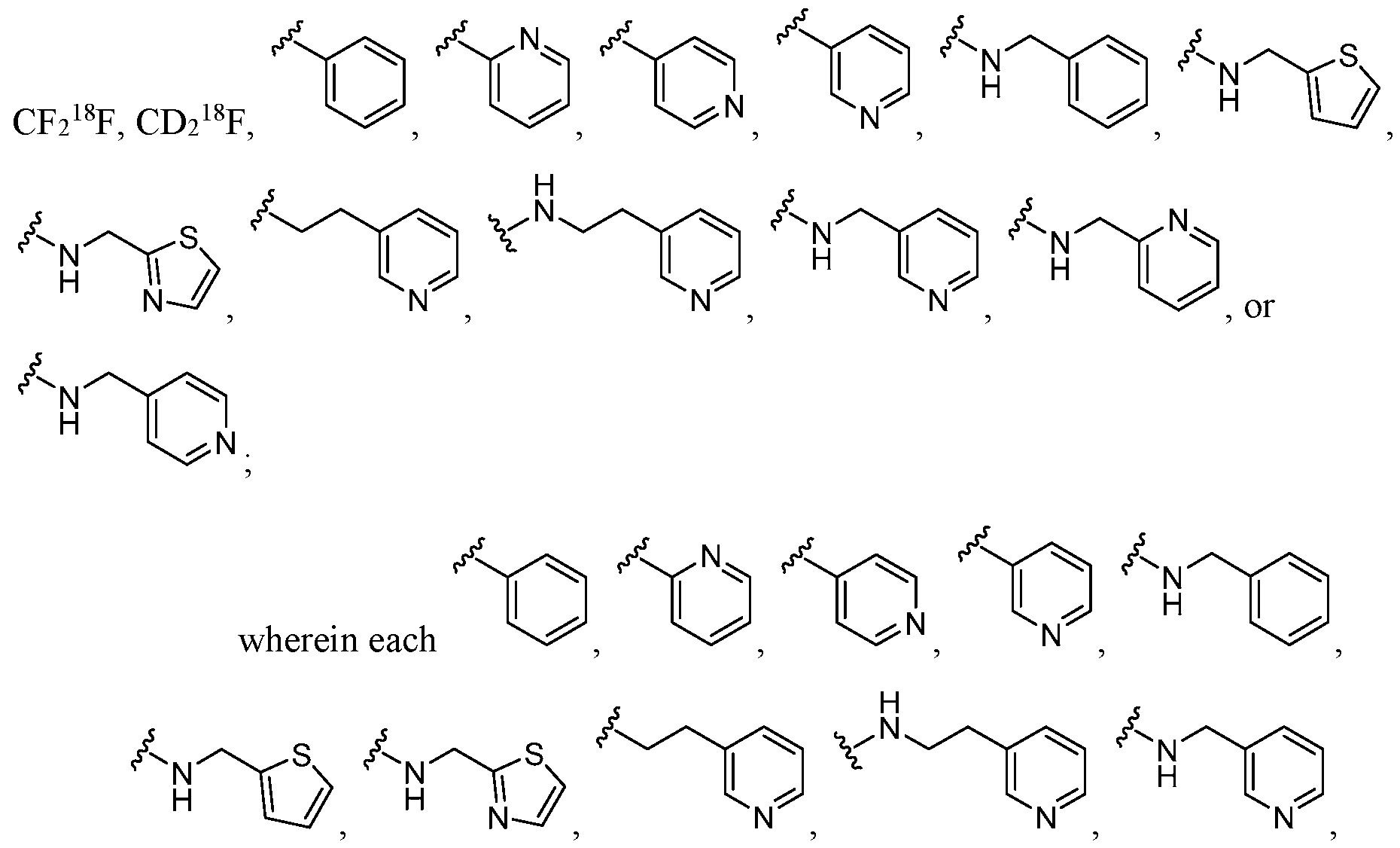

[0020] In any one of the embodiments described herein, R1 is hydrogen or 18F.
[0021] In any one of the embodiments described herein, R2 is hydrogen,


[0022] In any one of the embodiments described herein, R3 is hydrogen or 18F.
[0023] In any one of the embodiments described herein, R4 is halogen, 18F, CF218F,

[0024] In any one of the embodiments described herein,

R is CH3 or UCH3;
R1 and R3 are hydrogen;
R2 is N(R5)2;
R4 is F, Cl, CF3, or 18F; and each occurrence of R5 is independently hydrogen, (Ci-Ce)alkyl-aryl, or (Ci-Ce)alkyl- heteroaryl.
[0025] In any one of the embodiments described herein, each occurrence of R5 is independently hydrogen,
 [0026] In any one of the embodiments described herein, R2 is


R is CH3;
R1 and R2 are hydrogen;
R2 is 18F;
R4 is (NR5)2; and
each occurrence of R5 is independently hydrogen, (Ci-Ce)alkyl-aryl, or (Ci-Ce)alkyl- heteroaryl.
[0028] In any one of the embodiments described herein,

R and R4 are (Ci-Ce)alkyl, optionally substituted with one or more deuterium, 18F, or halogen;
R1 is hydrogen or 18F; and
R2 is aryl, optionally substituted with 18F, or heteroaryl, optionally substituted with 18F.
[0029] In any one of the embodiments described herein, R is CFb or (CH2)218F.
[0030] In any one of the embodiments described herein, R2 is


[0031] In any one of the embodiments described herein, R4 is CF3, CF218F, CFh18F, or
CD2 18F.
[0032] In any one of the embodiments described herein, the compound of Formula I is

[0033] In any one of the embodiments described herein, the compound of Formula I is

[0034] In any one of the embodiments described herein, the compound of Formula I is

[0035] In any one of the embodiments described herein, the compound of Formula I is


[0037] In any one of the embodiments described herein, the compound of Formula I is
 pharmaceutically acceptable salt thereof.
[0038] In any one of the embodiments described herein, the compound of Formula I is
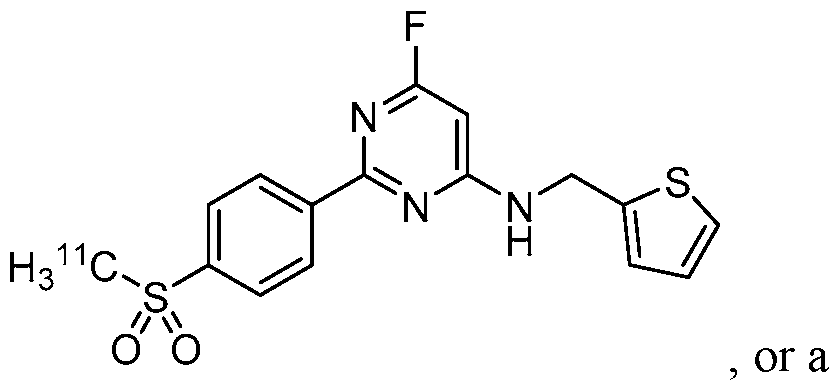 pharmaceutically acceptable salt thereof.
[0039] In any one of the embodiments described herein, the compound of Formula I is
 pharmaceutically acceptable salt thereof.
[0040] In any one of the embodiments described herein, the compound of Formula I is
 pharmaceutically acceptable salt thereof.
[0041] In any one of the embodiments described herein, the compound of Formula I is

[0043] In any one of the embodiments described herein, the compound of Formula I is f the embodiments described herein, the compound of Formula I is f the embodiments described herein, the compound of Formula I is
 [0046] In any one of the embodiments described herein, the compound of Formula I is

[0048] In any one of the embodiments described herein, the compound of Formula I is

[0049] In another aspect, a process for synthesizing a compound of Formula I:

Formula I or a pharmaceutically acceptable salt thereof, is described,
comprising reacting one or more halogen atom(s) or thioester(s) in the compound with one or more radionuclide source(s) independently selected from the group consisting of deuterium, 3H, UC, 18F, 75Br, 76Br, 120I, 123I, 124I, 125I, and 13 ¾;
wherein:

wherein each (Ci-Ce)alkyl, (Ci-Ce)alkenyl, (Ci-Ce)alkynyl, (Ci- C6)heteroalkyl, (Ci-C6)heteroalkenyl, (Ci-C6)heteroalkynyl, (C3-C7)cycloalkyl, (C3- C7)heterocycloalkyl, (C3-C7)cycloalkenyl, (C3-C7)heterocycloalkenyl, (C 1 -Cr,)al kyl- (C3-C7)cycloalkyl, (Ci-C6)alkyl-(C3-C7)heterocycloalkyl, (Ci-C6)alkyl-(C3- C7)cycloalkenyl, (Ci-C6)alkyl-(C3-C7)heterocycloalkenyl, aryl, (Ci-Ce)alkyl-aryl, heteroaryl, or (Ci-C6)alkyl-heteroaryl is optionally substituted with one or more deuterium, 3H, UC, halogen, 18F, 75Br, 76Br, 120I, 123I, 124I, 125I, 134I, N(R5)2, CN, OR5, SR5, SOR5, SO2R5, SO2NHR5, SO3R5, NHSO2R5, COR5, or NHCOR5;
R1, R2, R3, and R4 are each independently selected from the group consisting of hydrogen, deuterium, 3H, UC, halogen, 18F, 75Br, 76Br, 120I, 123I, 124I, 125I, 13 XI, (Ci-Ce)alkyl, (Ci-Ce)alkenyl, (Ci-Ce)alkynyl, (Ci-C6)heteroalkyl, (Ci-C6)heteroalkenyl, (Ci- C6)heteroalkynyl, (C3-C7)cycloalkyl, (C3-C7)heterocycloalkyl, (C3-C7)cycloalkenyl, (C3- C7)heterocycloalkenyl, (Ci-C6)alkyl-(C3-C7)cycloalkyl, (Ci-C6)alkyl-(C3- C7)heterocycloalkyl, (Ci-C6)alkyl-(C3-C7)cycloalkenyl, (Ci-C6)alkyl-(C3- C7)heterocycloalkenyl, aryl, (Ci-Ce)alkyl-aryl, heteroaryl, (Ci-C6)alkyl-heteroaryl, N(R5)2, CN, OR5, SR5, SOR5, SO2R5, SO2NHR5, SO3R5, NHSO2R5, COR5, and HCOR5;
wherein each (Ci-Ce)alkyl, (Ci-Ce)alkenyl, (Ci-Ce)alkynyl, (Ci- C6)heteroalkyl, (Ci-C6)heteroalkenyl, (Ci-C6)heteroalkynyl, (C3-C7)cycloalkyl, (C3- C7)heterocycloalkyl, (C3-C7)cycloalkenyl, (C3-C7)heterocycloalkenyl, (Ci-Ce)alkyl- (C3-C7)cycloalkyl, (Ci-C6)alkyl-(C3-C7)heterocycloalkyl, (Ci-C6)alkyl-(C3- C7)cycloalkenyl, (Ci-C6)alkyl-(C3-C7)heterocycloalkenyl, aryl, (Ci-Ce)alkyl-aryl, heteroaryl, or (Ci-C6)alkyl-heteroaryl is optionally substituted with one or more deuterium, 3H, UC, halogen, 18F, 75Br, 76Br, 120I, 123I, 124I, 125I, 134I, N(R5)2, CN, OR5, SR5, SOR5, SO2R5, SO2NHR5, SO3R5, NHSO2R5, COR5, or NHCOR5; and each occurrence of R5 is independently selected from the group consisting of hydrogen, deuterium, 3H, (Ci-Ce)alkyl, (Ci-Ce)alkenyl, (Ci-Ce)alkynyl, (Ci-C6)heteroalkyl,
(Ci-C6)heteroalkenyl, (Ci-C6)heteroalkynyl, (C3-C7)cycloalkyl, (C3-C7)heterocycloalkyl, (C3- C7)cycloalkenyl, (C3-C7)heterocycloalkenyl, (Ci-C6)alkyl-(C3-C7)cycloalkyl, (Ci-Ce)alkyl- (C3-C7)heterocycloalkyl, (Ci-C6)alkyl-(C3-C7)cycloalkenyl, (Ci-C6)alkyl-(C3- C7)heterocycloalkenyl, aryl, (Ci-Ce)alkyl-aryl, heteroaryl, and (Ci-C6)alkyl-heteroaryl; wherein each (Ci-Ce)alkyl, (Ci-Ce)alkenyl, (Ci-Ce)alkynyl, (Ci- C6)heteroalkyl, (Ci-C6)heteroalkenyl, (Ci-Ce)heteroalkynyl, (C3-C7)cycloalkyl, (C3- C7)heterocycloalkyl, (C3-C7)cycloalkenyl, (C3-C7)heterocycloalkenyl, (C i -Cr,)al kyl- (C3-C7)cycloalkyl, (Ci-C6)alkyl-(C3-C7)heterocycloalkyl, (Ci-C6)alkyl-(C3- C7)cycloalkenyl, (Ci-C6)alkyl-(C3-C7)heterocycloalkenyl, aryl, (Ci-Ce)alkyl-aryl, heteroaryl, and (Ci-C6)alkyl-heteroaryl is optionally substituted with one or more deuterium, 3H, UC, 18F, 75Br, 76Br, 120I, 123I, 124I, 125I, or 134; wherein at least one of R, R1, R2, R3, R4, or R5 comprises at least one of 3H, UC, 18F, 75Br, 76Br, 120I, 123I, 124I, 125I, or 131I;
wherein when
 hydrogen, and R2 is phenyl, R4 is not
CF3;
wherein when A is R , R is CFb, R1 and R2 are hydrogen, and R3 is CF3, R4

[0050] In any one of the embodiments described herein, the one or more halogen atom(s) are independently chlorine or bromine.
[0051] In any one of the embodiments described herein, the radionuclide source is a F source.
[0052] In any one of the embodiments described herein, the one or more thioester(s) comprise
 .
.
[0053] In any one of the embodiments described herein, the radionuclide source is a UC source and wherein the process further comprises an oxidant.
[0054] In any one of the embodiments described herein, the compound of Formula I is

comprising reacting the compound
 source.
[0055] In any one of the embodiments described herein, the compound of Formula I is

comprising reacting the compound
 source.
[0056] In any one of the embodiments described herein, the compound of Formula I is
 pharmaceutically acceptable salt thereof;
comprising reacting the compound
 source.
[0057] In any one of the embodiments described herein, the compound of Formula I is

comprising reacting the compound

[0058] In any one of the embodiments described herein, the compound of Formula I is

comprising reacting the compound
 [0059] In any one of the embodiments described herein, the compound of Formula I is

comprising reacting the compound

[0060] In any one of the embodiments described herein, the compound of Formula I is

comprising reacting the compound

source and an oxidant.
[0061] In any one of the embodiments described herein, the compound of Formula I is


source and an oxidant.
[0062] In any one of the embodiments described herein, the compound of Formula I is

comprising reacting the compound

source and an oxidant.
[0063] In any one of the embodiments described herein, the compound of Formula I is

18F source.
[0064] In any one of the embodiments described herein, the compound of Formula I is

[0065] In any one of the embodiments described herein, the compound of Formula I is

[0066] In any one of the embodiments described herein, the compound of Formula I is

a 18F source.
[0067] In any one of the embodiments described herein, the 18F source comprises 18F or [18F]fluoroalkyl tosylate.
[0068] In any one of the embodiments described herein, the 18F source comprises K18F or a tetraalkylammonium [18F]fluoride.
[0069] In any one of the embodiments described herein, the tetraalkylammonium
[18F]fluoride is tetrabutylammonium [18F]fluoride or tetraethylammonium [18F]fluoride.
[0070] In any one of the embodiments described herein, the [18F]fluoroalkyl tosylate is 2- [18F]fluoroethyl tosylate.
[0071] In any one of the embodiments described herein, the process further comprises a chelating agent, a base, and/or a polar aprotic solvent.
[0072] In any one of the embodiments described herein, the chelating agent is a crown ether or a cryptand.
[0073] In any one of the embodiments described herein, the cryptand is K222.
[0074] In any one of the embodiments described herein, the base is potassium carbonate, tetrabutylammonium hydroxide, pyrrolidine, or 2,6-lutidine.
[0075] In any one of the embodiments described herein, the polar aprotic solvent is dimethyl sulfoxide, A/ A'-di m ethyl form am i de, tetrahydrofuran, or combinations thereof.
[0076] In any one of the embodiments described herein, the UC source comprises a
[uC]alkyl halide and a [uC]alkyl triflate.
[0077] In any one of the embodiments described herein, the [uC]alkyl halide is uCH3l and the [uC]alkyl triflate is uCH30Tf.
[0078] In any one of the embodiments described herein, the oxidant is Oxone®.
[0079] In yet another aspect, a method for imaging a sample or organism comprises:
(a) administering to the sample or organism a compound of Formula I:

Formula I or a pharmaceutically acceptable salt thereof, in an amount effective to detect emission of deuterium, 3H, UC, 18F, 75Br, 76Br, 120I, 123I, 124I, 125I, 13 11, or a combination thereof; and
(b) measuring the emission of the one or more radionuclide(s) in the compound; wherein:

wherein each (Ci-Ce)alkyl, (Ci-Ce)alkenyl, (Ci-Ce)alkynyl, (Ci- C6)heteroalkyl, (Ci-C6)heteroalkenyl, (Ci-C6)heteroalkynyl, (C3-C7)cycloalkyl, (C3- C7)heterocycloalkyl, (C3-C7)cycloalkenyl, (C3-C7)heterocycloalkenyl, (C 1 -Cr,)al kyl- (C3-C7)cycloalkyl, (Ci-C6)alkyl-(C3-C7)heterocycloalkyl, (Ci-C6)alkyl-(C3- C7)cycloalkenyl, (Ci-C6)alkyl-(C3-C7)heterocycloalkenyl, aryl, (Ci-Ce)alkyl-aryl, heteroaryl, or (Ci-C6)alkyl-heteroaryl is optionally substituted with one or more deuterium, 3H, UC, halogen, 18F, 75Br, 76Br, 120I, 123I, 124I, 125I, 133I, N(R5)2, CN, OR5, SR5, SOR5, SO2R5, SO2NHR5, SO3R5, NHSO2R5, COR5, or NHCOR5;
R1, R2, R3, and R4 are each independently selected from the group consisting of hydrogen, deuterium, 3H, UC, halogen, 18F, 75Br, 76Br, 120I, 123I, 124I, 125I, 13 XI, (Ci-Ce)alkyl, (Ci-Ce)alkenyl, (Ci-Ce)alkynyl, (Ci-C6)heteroalkyl, (Ci-C6)heteroalkenyl, (Ci- C6)heteroalkynyl, (C3-C7)cycloalkyl, (C3-C7)heterocycloalkyl, (C3-C7)cycloalkenyl, (C3- C7)heterocycloalkenyl, (Ci-C6)alkyl-(C3-C7)cycloalkyl, (Ci-C6)alkyl-(C3- C7)heterocycloalkyl, (Ci-C6)alkyl-(C3-C7)cycloalkenyl, (Ci-C6)alkyl-(C3- C7)heterocycloalkenyl, aryl, (Ci-Ce)alkyl-aryl, heteroaryl, (Ci-C6)alkyl-heteroaryl, N(R5)2, CN, OR5, SR5, SOR5, SO2R5, SO2NHR5, SO3R5, NHSO2R5, COR5, and HCOR5;
wherein each (Ci-Ce)alkyl, (Ci-Ce)alkenyl, (Ci-Ce)alkynyl, (Ci- C6)heteroalkyl, (Ci-C6)heteroalkenyl, (Ci-C6)heteroalkynyl, (C3-C7)cycloalkyl, (C3- C7)heterocycloalkyl, (C3-C7)cycloalkenyl, (C3-C7)heterocycloalkenyl, (Ci-Ce)alkyl- (C3-C7)cycloalkyl, (Ci-C6)alkyl-(C3-C7)heterocycloalkyl, (Ci-C6)alkyl-(C3- C7)cycloalkenyl, (Ci-C6)alkyl-(C3-C7)heterocycloalkenyl, aryl, (Ci-Ce)alkyl-aryl, heteroaryl, or (Ci-C6)alkyl-heteroaryl is optionally substituted with one or more deuterium, 3H, UC, halogen, 18F, 75Br, 76Br, 120I, 123I, 124I, 125I, 134I, N(R5)2, CN, OR5, SR5, SOR5, SO2R5, SO2NHR5, SO3R5, NHSO2R5, COR5, or NHCOR5; and each occurrence of R5 is independently selected from the group consisting of hydrogen, deuterium, 3H, (Ci-Ce)alkyl, (Ci-Ce)alkenyl, (Ci-Ce)alkynyl, (Ci-C6)heteroalkyl,
(Ci-C6)heteroalkenyl, (Ci-C6)heteroalkynyl, (C3-C7)cycloalkyl, (C3-C7)heterocycloalkyl, (C3- C7)cycloalkenyl, (C3-C7)heterocycloalkenyl, (Ci-C6)alkyl-(C3-C7)cycloalkyl, (Ci-Ce)alkyl- (C3-C7)heterocycloalkyl, (Ci-C6)alkyl-(C3-C7)cycloalkenyl, (Ci-C6)alkyl-(C3- C7)heterocycloalkenyl, aryl, (Ci-Ce)alkyl-aryl, heteroaryl, and (Ci-C6)alkyl-heteroaryl; wherein each (Ci-Ce)alkyl, (Ci-Ce)alkenyl, (Ci-Ce)alkynyl, (Ci- C6)heteroalkyl, (Ci-C6)heteroalkenyl, (Ci-Ce)heteroalkynyl, (C3-C7)cycloalkyl, (C3- C7)heterocycloalkyl, (C3-C7)cycloalkenyl, (C3-C7)heterocycloalkenyl, (C i -Cr,)al kyl- (C3-C7)cycloalkyl, (Ci-C6)alkyl-(C3-C7)heterocycloalkyl, (Ci-C6)alkyl-(C3- C7)cycloalkenyl, (Ci-C6)alkyl-(C3-C7)heterocycloalkenyl, aryl, (Ci-Ce)alkyl-aryl, heteroaryl, and (Ci-C6)alkyl-heteroaryl is optionally substituted with one or more deuterium, 3H, UC, 18F, 75Br, 76Br, 120I, 123I, 124I, 125I, or 134; wherein at least one of R, R1, R2, R3, R4, or R5 comprises at least one of 3H, UC, 18F, 75Br, 76Br, 120I, 123I, 124I, 125I, or 131I;
wherein when
 hydrogen, and R2 is phenyl, R4 is not
CF3;
wherein when A is R , R is CFb, R1 and R2 are hydrogen, and R3 is CF3, R4

[0080] In any one of the embodiments described herein, the emission is measured using positron emission tomography.
[0081] In any one of the embodiments described herein, the sample is a cell culture.
[0082] In any one of the embodiments described herein, the organism is a mammal.
[0083] In any one of the embodiments described herein, the mammal is a mouse, rat, pig, dog, monkey, baboon, or human.
[0084] In any one of the embodiments described herein, the compound interacts with a protein and measuring the emission allows determination of the expression level or distribution of the protein in the sample or organism.
[0085] In any one of the embodiments described herein, the protein is involved in inflammation and measuring the emission allows determination of the amount or distribution of inflammation in the sample or organism.
[0086] In any one of the embodiments described herein, the protein is cyclooxygenase-2.
[0087] In any one of the embodiments described herein, the mammal is known or suspected to have a condition or state selected from the group consisting of arthritis, cardiovascular disease, central nervous system damage, central nervous system disorders, gastrointestinal disorder, hypersensitivity, swelling, inflammatory disease, metabolic disorder, neoplastic disease, neurodegenerative disease, neuromuscular junction disease, ophthalmic disease, post-operative inflammation, psychiatric condition, reproductive event, respiratory disease, skin disorder, tissue repair, urogenital disease, white matter disease, and a combination thereof.
[0088] In any one of the embodiments described herein, the neurodegenerative disease is Alzheimer’s disease, Parkinson’s disease, Huntington’s disease, amyotrophic lateral sclerosis, cortical dementias, or multiple sclerosis.
[0089] In any one of the embodiments described herein, the arthritis is rheumatoid or osteoarthritis.
[0090] In any one of the embodiments described herein, the neoplastic disease comprises a cancer selected from the group consisting of colorectal cancer, breast cancer, lung cancer, prostate cancer, bladder cancer, cervical cancer, skin cancer, lymphoma, and a combination thereof.
[0091] In any one of the embodiments described herein, the central nervous system damage or disorder comprises traumatic brain injury.
[0092] In any one of the embodiments described herein, the inflammatory disease is asthma, Bechet’s disease, bronchitis, bursitis, Crohn’s disease, endotoxin shock syndrome, gastritis, gingivitis, inflammatory bowel disease, polymyositis, pulmonary inflammation, cystic fibrosis, rheumatic fever, sarcoidosis, tendinitis, thyroiditis, or ulcerative colitis.
[0093] In any one of the embodiments described herein, the pulmonary inflammation is an acute respiratory disease syndrome resulting from viral and/or bacterial infection.
[0094] In any one of the embodiments described herein, the viral infection comprises COVID-19.
[0095] In any one of the embodiments described herein, the cardiovascular disease comprises myocardial infarction.
[0096] In any one of the embodiments described herein, the urogenital disease comprises renal disease.
[0097] In any one of the embodiments described herein, the reproductive event comprises ovulation, pregnancy, childbirth, and a combination thereof.
[0098] In any one of the embodiments described herein, the mammal is known or suspected to be experiencing pain.
[0099] Any aspect or embodiment disclosed herein may be combined with another aspect or embodiment disclosed herein. The combination of one or more embodiments described herein with other one or more embodiments described herein is expressly contemplated.
[0100] Unless otherwise defined, used, or characterized herein, terms that are used herein (including technical and scientific terms) are to be interpreted as having a meaning that is consistent with their accepted meaning in the context of the relevant art and are not to be interpreted in an idealized or overly formal sense unless expressly so defined herein. The terminology used herein is for the purpose of describing particular embodiments and is not intended to be limiting of exemplary embodiments. As used herein, singular forms, such as “a” and“an,” are intended to include the plural forms as well, unless the context indicates otherwise. The term“about” as used herein can describe a range of a recited value, including ±10%, ±5%, or ±2% of the value. Additionally, the terms“includes,”“including,” “comprises,” and“comprising” specify the presence of the stated elements or steps but do not preclude the presence or addition of one or more other elements or steps.
BRIEF DESCRIPTION OF THE FIGURES
[0101] The invention is described with reference to the following figures, which are presented for the purpose of illustration only and are not intended to be limiting. The patent or application file contains at least one drawing executed in color. Copies of this patent or patent application publication with color drawing(s) will be provided by the United States Patent and Trademark Office upon request and payment of the necessary fee.
[0102] FIG. 1 shows chemical structures of [UC]MC1, [18F]pyricoxib, [18F]triacoxib, and [l xF]-6-fluoro-2-(4-(methylsulfonyl)phenyl)-A-(thiazol-2-yl methyl )pyri mi din-4-amine (“[18F]FMTP”), according to one or more embodiments.
[0103] FIG. 2 shows binding of [18F]FMTP in BxPC3 and PANC-1 cells, according to one or more embodiments.
[0104] FIG. 3A shows microPET images of [18F]FMTP in mice at 0-10 minutes, summed transaxial, with the relative intensity of 18F emission indicated by a red (highest)-orange- yellow-green-blue-black (lowest) color gradient, according to one or more embodiments.
[0105] FIG. 3B shows microPET images of [18F]FMTP in mice at 0-10 minutes, summed sagittal, with the relative intensity of 18F emission indicated by a red (highest)-orange-yellow- green-blue-black (lowest) color gradient, according to one or more embodiments.
[0106] FIG. 3C shows microPET images of [18F]FMTP in mice at 0-40 minutes, summed transaxial, with the relative intensity of 18F emission indicated by a red (highest)-orange- yellow-green-blue-black (lowest) color gradient, according to one or more embodiments.
[0107] FIG. 3D shows microPET images of [18F]FMTP in mice at 0-40 minutes, summed sagittal, with the relative intensity of 18F emission indicated by a red (highest)-orange-yellow- green-blue-black (lowest) color gradient, according to one or more embodiments.
[0108] FIG. 4 shows time activity curves of [18F]FMTP in mice, according to one or more embodiments.
[0109] FIG. 5 shows microPET images of [18F]FMTP in phosphate buffered saline (“PBS”)- and lipopolysaccharide (“LPS”)-treated mice, with the relative intensity of 18F emission indicated by a red (highest)-orange-yellow-green-blue-black (lowest) color gradient, according to one or more embodiments.
[0110] FIG. 6 shows time activity curves of [18F]FMTP in PBS- and LPS-treated mice, according to one or more embodiments.
[0111] FIG. 7 shows autoradiography evaluation of [18F]FMTP in brain sections of LPS- and PBS-treated mice, according to one or more embodiments.
DETAILED DESCRIPTION OF THE INVENTION
[0112] Radiolabeled compounds that interact with biomarkers ( e.g ., proteins) for disease are useful for assaying the presence, amount, activity, or other properties of the biomarker using radioactive imaging (e.g., PET). Such imaging can be used to diagnose disease, monitor disease progression and treatment, and determine the lowest effective dose of therapeutics, and evaluate the effectiveness of therapeutics. For example, the COX-2 protein, which is a biomarker for various diseases described herein, can be assayed using PET imaging of a radiolabeled compound that binds or otherwise interacts with COX-2.
However, many existing radiolabeled compounds have a half-life that is impractical for medical use. For example, some radiolabeled COX-2-interacting compounds incorporate an UC label, which has a half-life of about 20 minutes. It is not practical for such compounds to be sold commercially, used in long-term imaging applications, or transported between medical centers.
[0113] Compounds
[0114] In one aspect, a compound of Formula I

Formula I or a pharmaceutically acceptable salt thereof, is described,
wherein

R is selected from the group consisting of (Ci-Ce)alkyl, (Ci-Ce)alkenyl, (Ci- C6)alkynyl, (Ci-C6)heteroalkyl, (Ci-C6)heteroalkenyl, (Ci-C6)heteroalkynyl, (C3-
C7)cycloalkyl, (C3-C7)heterocycloalkyl, (C3-C7)cycloalkenyl, (C3-C7)heterocycloalkenyl, (Ci- C6)alkyl-(C3-C7)cycloalkyl, (Ci-C6)alkyl-(C3-C7)heterocycloalkyl, (Ci-C6)alkyl-(C3- C7)cycloalkenyl, (Ci-C6)alkyl-(C3-C7)heterocycloalkenyl, aryl, (Ci-C6)alkyl-aryl, heteroaryl, (Ci-Ce)alkyl-heteroaryl, and N(R5)2;
wherein each (Ci-Ce)alkyl, (Ci-Ce)alkenyl, (Ci-Ce)alkynyl, (Ci- C6)heteroalkyl, (Ci-Ce)heteroalkenyl, (Ci-Ce)heteroalkynyl, (C3-C7)cycloalkyl, (C3- C7)heterocycloalkyl, (C3-C7)cycloalkenyl, (C3-C7)heterocycloalkenyl, (C 1 -Cr,)al kyl- (C3-C7)cycloalkyl, (Ci-C6)alkyl-(C3-C7)heterocycloalkyl, (Ci-C6)alkyl-(C3- C7)cycloalkenyl, (Ci-C6)alkyl-(C3-C7)heterocycloalkenyl, aryl, (Ci-Ce)alkyl-aryl, heteroaryl, or (Ci-Ce)alkyl-heteroaryl is optionally substituted with one or more deuterium, 3H, UC, halogen, 18F, 75Br, 76Br, 120I, 123I, 124I, 125I, 133I, N(R5)2, CN, OR5, SR5, SOR5, SO2R5, SO2NHR5, SO3R5, NHSO2R5, COR5, or NHCOR5;
R1, R2, R3, and R4 are each independently selected from the group consisting of hydrogen, deuterium, 3H, UC, halogen, 18F, 75Br, 76Br, 120I, 123I, 124I, 125I, 13 XI, (Ci-Ce)alkyl, (Ci-Ce)alkenyl, (Ci-Ce)alkynyl, (Ci-C6)heteroalkyl, (Ci-C6)heteroalkenyl, (Ci- C6)heteroalkynyl, (C3-C7)cycloalkyl, (C3-C7)heterocycloalkyl, (C3-C7)cycloalkenyl, (C3- C7)heterocycloalkenyl, (Ci-C6)alkyl-(C3-C7)cycloalkyl, (Ci-C6)alkyl-(C3- C7)heterocycloalkyl, (Ci-C6)alkyl-(C3-C7)cycloalkenyl, (Ci-C6)alkyl-(C3- C7)heterocycloalkenyl, aryl, (Ci-Ce)alkyl-aryl, heteroaryl, (Ci-C6)alkyl-heteroaryl, N(R5)2, CN, OR5, SR5, SOR5, SO2R5, SO2NHR5, SO3R5, NHSO2R5, COR5, and HCOR5;
wherein each (Ci-Ce)alkyl, (Ci-Ce)alkenyl, (Ci-Ce)alkynyl, (Ci- C6)heteroalkyl, (Ci-C6)heteroalkenyl, (Ci-C6)heteroalkynyl, (C3-C7)cycloalkyl, (C3- C7)heterocycloalkyl, (C3-C7)cycloalkenyl, (C3-C7)heterocycloalkenyl, (Ci-Ce)alkyl- (C3-C7)cycloalkyl, (Ci-C6)alkyl-(C3-C7)heterocycloalkyl, (Ci-C6)alkyl-(C3- C7)cycloalkenyl, (Ci-C6)alkyl-(C3-C7)heterocycloalkenyl, aryl, (Ci-Ce)alkyl-aryl, heteroaryl, or (Ci-C6)alkyl-heteroaryl is optionally substituted with one or more deuterium, 3H, UC, halogen, 18F, 75Br, 76Br, 120I, 123I, 124I, 125I, 134I, N(R5)2, CN, OR5, SR5, SOR5, SO2R5, SO2NHR5, SO3R5, NHSO2R5, COR5, or NHCOR5; and each occurrence of R5 is independently selected from the group consisting of hydrogen, deuterium, 3H, (Ci-Ce)alkyl, (Ci-Ce)alkenyl, (Ci-Ce)alkynyl, (Ci-C6)heteroalkyl, (Ci-C6)heteroalkenyl, (Ci-C6)heteroalkynyl, (C3-C7)cycloalkyl, (C3-C7)heterocycloalkyl, (C3- C7)cycloalkenyl, (C3-C7)heterocycloalkenyl, (Ci-C6)alkyl-(C3-C7)cycloalkyl, (Ci-Ce)alkyl-
(C3-C7)heterocycloalkyl, (Ci-C6)alkyl-(C3-C7)cycloalkenyl, (Ci-C6)alkyl-(C3- C7)heterocycloalkenyl, aryl, (Ci-Ce)alkyl-aryl, heteroaryl, and (C i -G,)al kyl -heteroaryl ; wherein each (Ci-Ce)alkyl, (Ci-Ce)alkenyl, (Ci-Ce)alkynyl, (Ci- C6)heteroalkyl, (Ci-Ce)heteroalkenyl, (Ci-Ce)heteroalkynyl, (C3-C7)cycloalkyl, (C3- C7)heterocycloalkyl, (C3-C7)cycloalkenyl, (C3-C7)heterocycloalkenyl, (C 1 -Cr,)al kyl- (C3-C7)cycloalkyl, (Ci-C6)alkyl-(C3-C7)heterocycloalkyl, (Ci-C6)alkyl-(C3- C7)cycloalkenyl, (Ci-C6)alkyl-(C3-C7)heterocycloalkenyl, aryl, (Ci-Ce)alkyl-aryl, heteroaryl, and (Ci-Ce)alkyl-heteroaryl is optionally substituted with one or more

wherein at least one of R, R1, R2, R3, R4, or R5 comprises at least one of 3H, UC, 18F,


embodiments,
 some embodiments,
 some
some
embodiments,

[0116] In some embodiments, R is selected from the group consisting of (Ci-Ce)alkyl, (Ci-C6)alkenyl, (Ci-Ce)alkynyl, (Ci-C6)heteroalkyl, (Ci-C6)heteroalkenyl, (Ci- C6)heteroalkynyl, (C3-C7)cycloalkyl, (C3-C7)heterocycloalkyl, (C3-C7)cycloalkenyl, (C3- C7)heterocycloalkenyl, (Ci-C6)alkyl-(C3-C7)cycloalkyl, (Ci-C6)alkyl-(C3- C7)heterocycloalkyl, (Ci-C6)alkyl-(C3-C7)cycloalkenyl, (Ci-C6)alkyl-(C3- C7)heterocycloalkenyl, aryl, (Ci-Ce)alkyl-aryl, heteroaryl, (Ci-C6)alkyl-heteroaryl, and N(R5)2. In some embodiments, R is selected from the group consisting of (Ci-Ce)alkyl, (Ci- C6)alkynyl, (Ci-Ce)heteroalkyl, (Ci-Ce)heteroalkynyl, (C3-C7)cycloalkyl, (C3- C7)heterocycloalkyl, (Ci-C6)alkyl-(C3-C7)cycloalkyl, (Ci-C6)alkyl-(C3-C7)heterocycloalkyl, aryl, (Ci-Ce)alkyl-aryl, heteroaryl, (Ci-C6)alkyl-heteroaryl, and N(R5)2. In some
embodiments, R is (Ci-C6)alkyl. In some embodiments, R is aryl. In some embodiments, R is heteroaryl. In some embodiments, R is (Ci-C6)alkyl-aryl. In some embodiments, R is (Ci- C6)alkyl-heteroaryl.
[0117] In some embodiments, each (Ci-Ce)alkyl, (Ci-Ce)alkenyl, (Ci-Ce)alkynyl, (Ci- C6)heteroalkyl, (Ci-C6)heteroalkenyl, (Ci-Ce)heteroalkynyl, (C3-C7)cycloalkyl, (C3- C7)heterocycloalkyl, (C3-C7)cycloalkenyl, (C3-C7)heterocycloalkenyl, (Ci-C6)alkyl-(C3- C7)cycloalkyl, (Ci-C6)alkyl-(C3-C7)heterocycloalkyl, (Ci-C6)alkyl-(C3-C7)cycloalkenyl, (Ci- C6)alkyl-(C3-C7)heterocycloalkenyl, aryl, (Ci-Ce)alkyl-aryl, heteroaryl, or (Ci-Ce)alkyl- heteroaryl comprising R is optionally substituted with one or more deuterium, 3H, UC,

SO2NHR5, SO3R5, NHSO2R5, COR5, or NHCOR5. In some embodiments, each (Ci-Ce)alkyl, (Ci-Ce)alkynyl, (Ci-Ce)heteroalkyl, (Ci-Ce)heteroalkynyl, (C3-C7)cycloalkyl, (C3-
C7)heterocycloalkyl, (Ci-C6)alkyl-(C3-C7)cycloalkyl, (Ci-C6)alkyl-(C3-C7)heterocycloalkyl, aryl, (Ci-C6)alkyl-aryl, heteroaryl, or (Ci-Ce)alkyl-heteroaryl comprising R is optionally substituted with one or more deuterium, UC, 18F, or 123I.
[0118] In some embodiments, R is CH3, UCH3, CH2 18F, (CH2)2 18F, CF3, CF2 18F, CD2 18F,


some embodiments, R is ^Fb. In some embodiments, R is (CH2)2 18F.
[0119] In some embodiments, R1 is selected from the group consisting of hydrogen, deuterium, 3H, UC, halogen, 18F, 75Br, 76Br, 120I, 123I, 124I, 125I, 131I, (Ci-Ce)alkyl, (Ci- C6)alkenyl, (Ci-Ce)alkynyl, (Ci-C6)heteroalkyl, (Ci-C6)heteroalkenyl, (Ci-Ce)heteroalkynyl, (C3-C7)cycloalkyl, (C3-C7)heterocycloalkyl, (C3-C7)cycloalkenyl, (C3-C7)heterocycloalkenyl, (Ci-C6)alkyl-(C3-C7)cycloalkyl, (Ci-C6)alkyl-(C3-C7)heterocycloalkyl, (Ci-C6)alkyl-(C3- C7)cycloalkenyl, (Ci-C6)alkyl-(C3-C7)heterocycloalkenyl, aryl, (Ci-Ce)alkyl-aryl, heteroaryl, (Ci-C6)alkyl-heteroaryl, N(R5)2, CN, OR5, SR5, SOR5, S02R5, S02NHR5, SO3R5, NHS02R5, COR5, and NHCOR5. In some embodiments, R1 is selected from the group consisting of hydrogen, deuterium, halogen, UC, 18F, 123I, (Ci-Ce)alkyl, (Ci-Ce)alkynyl, (Ci- C6)heteroalkyl, (Ci-C6)heteroalkynyl, (C3-C7)cycloalkyl, (C3-C7)heterocycloalkyl, (Ci- C6)alkyl-(C3-C7)cycloalkyl, (Ci-C6)alkyl-(C3-C7)heterocycloalkyl, aryl, (Ci-Ce)alkyl-aryl, heteroaryl, (Ci-C6)alkyl-heteroaryl, and N(R5)2. In some embodiments, R1 is hydrogen, deuterium, 18F, UC, 123I, (Ci-Ce)alkyl, aryl, heteroaryl, (Ci-Ce)alkyl-aryl, (Ci-Ce)alkyl- heteroaryl, or N(R5)2. In some embodiments, R1 is hydrogen. In some embodiments, R1 is
(Ci-C6)alkyl. In some embodiments, R1 is aryl. In some embodiments, R1 is heteroaryl. In some embodiments, R1 is (Ci-C6)alkyl-aryl. In some embodiments, R1 is (Ci-Ce)alkyl- heteroaryl. In some embodiments, R1 is N(R5)2. In some embodiments, R1 is 18F.
[0120] In some embodiments, each (Ci-Ce)alkyl, (Ci-Ce)alkenyl, (Ci-Ce)alkynyl, (Ci- C6)heteroalkyl, (Ci-Ce)heteroalkenyl, (Ci-Ce)heteroalkynyl, (C3-C7)cycloalkyl, (C3- C7)heterocycloalkyl, (C3-C7)cycloalkenyl, (C3-C7)heterocycloalkenyl, (Ci-C6)alkyl-(C3- C7)cycloalkyl, (Ci-C6)alkyl-(C3-C7)heterocycloalkyl, (Ci-C6)alkyl-(C3-C7)cycloalkenyl, (Ci- C6)alkyl-(C3-C7)heterocycloalkenyl, aryl, (Ci-Ce)alkyl-aryl, heteroaryl, or (Ci-Ce)alkyl- heteroaryl of R1 is optionally substituted with one or more deuterium, 3H, UC, halogen, 18F, 75Br, 76Br, 120I, 123I, 124I, 125I, 13 ¾, N(R5)2, CN, OR5, SR5, SOR5, SO2R5, SO2NHR5, SO3R5, NHSO2R5, COR5, or NHCOR5. In some embodiments, each (Ci-Ce)alkyl, aryl, heteroaryl, (Ci-Ce)alkyl-aryl, (Ci-Ce)alkyl-heteroaryl comprising R1 is optionally substituted with one or more deuterium, UC, 18F, or 123I.
[0121] In some embodiments, R1 is hydrogen, deuterium, halogen, 18F, 123I, CFb, UCH3,

optionally substituted with deuterium, UC, 18F, or 123I.
[0122] In some embodiments, R2 is selected from the group consisting of hydrogen, deuterium, 3H, halogen, UC, 18F, 75Br, 76Br, 120I, 123I, 124I, 125I, 131I, (Ci-Ce)alkyl, (Ci- C6)alkenyl, (Ci-Ce)alkynyl, (Ci-Ce)heteroalkyl, (Ci-Ce)heteroalkenyl, (Ci-Ce)heteroalkynyl, (C3-C7)cycloalkyl, (C3-C7)heterocycloalkyl, (C3-C7)cycloalkenyl, (C3-C7)heterocycloalkenyl,
(Ci-C6)alkyl-(C3-C7)cycloalkyl, (Ci-C6)alkyl-(C3-C7)heterocycloalkyl, (Ci-C6)alkyl-(C3- C7)cycloalkenyl, (Ci-C6)alkyl-(C3-C7)heterocycloalkenyl, aryl, (Ci-C6)alkyl-aryl, heteroaryl, (Ci-C6)alkyl-heteroaryl, N(R5)2, CN, OR5, SR5, SOR5, SO2R5, SO2NHR5, SO3R5, NHSO2R5, COR5, and NHCOR5. In some embodiments, R2 is selected from the group consisting of hydrogen, deuterium, halogen, UC, 18F, 123I, (Ci-Ce)alkyl, (Ci-Ce)alkynyl, (Ci- C6)heteroalkyl, (Ci-C6)heteroalkynyl, (C3-C7)cycloalkyl, (C3-C7)heterocycloalkyl, (Ci- C6)alkyl-(C3-C7)cycloalkyl, (Ci-C6)alkyl-(C3-C7)heterocycloalkyl, aryl, (Ci-Ce)alkyl-aryl, heteroaryl, (Ci-C6)alkyl-heteroaryl, and N(R5)2. In some embodiments, R2 is hydrogen, deuterium, 18F, UC, 18F, 123I, (Ci-Ce)alkyl, aryl, heteroaryl, (Ci-Ce)alkyl-aryl, (Ci-Ce)alkyl- heteroaryl, or N(R5)2. In some embodiments, R2 is hydrogen. In some embodiments, R2 is (Ci-C6)alkyl. In some embodiments, R2 is aryl. In some embodiments, R2 is phenyl. In some embodiments, R2 is heteroaryl. In some embodiments, R2 is (Ci-C6)alkyl-aryl. In some embodiments, R2 is (Ci-C6)alkyl-heteroaryl. In some embodiments, R2 is N(R5)2.
[0123] In some embodiments, each (Ci-Ce)alkyl, (Ci-Ce)alkenyl, (Ci-Ce)alkynyl, (Ci- C6)heteroalkyl, (Ci-C6)heteroalkenyl, (Ci-Ce)heteroalkynyl, (C3-C7)cycloalkyl, (C3- C7)heterocycloalkyl, (C3-C7)cycloalkenyl, (C3-C7)heterocycloalkenyl, (Ci-C6)alkyl-(C3- C7)cycloalkyl, (Ci-C6)alkyl-(C3-C7)heterocycloalkyl, (Ci-C6)alkyl-(C3-C7)cycloalkenyl, (Ci- C6)alkyl-(C3-C7)heterocycloalkenyl, aryl, (Ci-Ce)alkyl-aryl, heteroaryl, or (Ci-Ce)alkyl- heteroaryl of R2 is optionally substituted with one or more deuterium, UC, 3H, halogen, 18F, 75Br, 76Br, 120I, 123I, 124I, 125I, 13 ¾, N(R5)2, CN, OR5, SR5, SOR5, SO2R5, SO2NHR5, SO3R5, NHSO2R5, COR5, or NHCOR5. In some embodiments, each (Ci-Ce)alkyl, aryl, heteroaryl, (Ci-Ce)alkyl-aryl, or (Ci-C6)alkyl-heteroaryl of R2 is optionally substituted with one or more deuterium, UC, 18F, or 123I.
[0124] In some embodiments, R2 is hydrogen, deuterium, halogen, 18F, 123I, CH3, UCH3,


[0125] In some embodiments, R3 is selected from the group consisting of hydrogen,

C6)alkenyl, (Ci-Ce)alkynyl, (Ci-Ce)heteroalkyl, (Ci-Ce)heteroalkenyl, (Ci-Ce)heteroalkynyl, (C3-C7)cycloalkyl, (C3-C7)heterocycloalkyl, (C3-C7)cycloalkenyl, (C3-C7)heterocycloalkenyl, (Ci-C6)alkyl-(C3-C7)cycloalkyl, (Ci-C6)alkyl-(C3-C7)heterocycloalkyl, (Ci-C6)alkyl-(C3- C7)cycloalkenyl, (Ci-C6)alkyl-(C3-C7)heterocycloalkenyl, aryl, (Ci-Ce)alkyl-aryl, heteroaryl, (Ci-C6)alkyl-heteroaryl, N(R5)2, CN, OR5, SR5, SOR5, SO2R5, SO2NHR5, SO3R5, NHSO2R5, COR5, and NHCOR5. In some embodiments, R3 is selected from the group consisting of hydrogen, deuterium, halogen, UC, 18F, 123I, (Ci-Ce)alkyl, (Ci-Ce)alkynyl, (Ci- C6)heteroalkyl, (Ci-Ce)heteroalkynyl, (C3-C7)cycloalkyl, (C3-C7)heterocycloalkyl, (Ci- C6)alkyl-(C3-C7)cycloalkyl, (Ci-C6)alkyl-(C3-C7)heterocycloalkyl, aryl, (Ci-Ce)alkyl-aryl, heteroaryl, (Ci-C6)alkyl-heteroaryl, and N(R5)2. In some embodiments, R3 is hydrogen, deuterium, UC, 18F, 123I, (Ci-Ce)alkyl, aryl, heteroaryl, (Ci-Ce)alkyl-aryl, (Ci-Ce)alkyl- heteroaryl, or N(R5)2. In some embodiments, R3 is hydrogen. In some embodiments, R3 is (Ci-C6)alkyl. In some embodiments, R3 is aryl. In some embodiments, R3 is heteroaryl. In some embodiments, R3 is (Ci-C6)alkyl-aryl. In some embodiments, R3 is (Ci-Ce)alkyl- heteroaryl. In some embodiments, R3 is N(R5)2.
[0126] In some embodiments, each (Ci-Ce)alkyl, (Ci-Ce)alkenyl, (Ci-Ce)alkynyl, (Ci- C6)heteroalkyl, (Ci-Ce)heteroalkenyl, (Ci-Ce)heteroalkynyl, (C3-C7)cycloalkyl, (C3- C7)heterocycloalkyl, (C3-C7)cycloalkenyl, (C3-C7)heterocycloalkenyl, (Ci-C6)alkyl-(C3- C7)cycloalkyl, (Ci-C6)alkyl-(C3-C7)heterocycloalkyl, (Ci-C6)alkyl-(C3-C7)cycloalkenyl, (Ci-
C6)alkyl-(C3-C7)heterocycloalkenyl, aryl, (Ci-Ce)alkyl-aryl, heteroaryl, or (Ci-Ce)alkyl- heteroaryl of R3 is optionally substituted with one or more deuterium, 3H, UC, halogen, 18F, 75Br, 76Br, 120I, 123I, 124I, 125I, 13 ¾, N(R5)2, CN, OR5, SR5, SOR5, SOzR5, S02NHR5, SO3R5, NHS02R5, COR5, or NHCOR5. In some embodiments, each (Ci-Ce)alkyl, aryl, heteroaryl, (Ci-Ce)alkyl-aryl, or (Ci-C6)alkyl-heteroaryl of R3 is optionally substituted with one or more deuterium, UC, 18F, or 123I.
[0127] In some embodiments, R3 is hydrogen, deuterium, halogen, F, i23I, CH3,“CFb,

[0128] In some embodiments, R4 is selected from the group consisting of hydrogen, deuterium, 3H, UC, halogen, 18F, 75Br, 76Br, 120I, 123I, 124I, 125I, 131I, (Ci-Ce)alkyl, (Ci- C6)alkenyl, (Ci-Ce)alkynyl, (Ci-Ce)heteroalkyl, (Ci-Ce)heteroalkenyl, (Ci-Ce)heteroalkynyl, (C3-C7)cycloalkyl, (C3-C7)heterocycloalkyl, (C3-C7)cycloalkenyl, (C3-C7)heterocycloalkenyl, (Ci-C6)alkyl-(C3-C7)cycloalkyl, (Ci-C6)alkyl-(C3-C7)heterocycloalkyl, (Ci-C6)alkyl-(C3- C7)cycloalkenyl, (Ci-C6)alkyl-(C3-C7)heterocycloalkenyl, aryl, (Ci-Ce)alkyl-aryl, heteroaryl, (Ci-C6)alkyl-heteroaryl, N(R5)2, CN, OR5, SR5, SOR5, SOzR5, S02NHR5, SO3R5, NHS02R5, COR5, and NHCOR5. In some embodiments, R4 is selected from the group consisting of hydrogen, deuterium, halogen, UC, 18F, 123I, (Ci-Ce)alkyl, (Ci-Ce)alkynyl, (Ci- C6)heteroalkyl, (Ci-Ce)heteroalkynyl, (C3-C7)cycloalkyl, (C3-C7)heterocycloalkyl, (Ci- C6)alkyl-(C3-C7)cycloalkyl, (Ci-C6)alkyl-(C3-C7)heterocycloalkyl, aryl, (Ci-Ce)alkyl-aryl,
heteroaryl, (Ci-C6)alkyl-heteroaryl, and N(R5)2. In some embodiments, R4 is hydrogen, deuterium, UC, 18F, 123I, (Ci-Ce)alkyl, aryl, heteroaryl, (Ci-Ce)alkyl-aryl, (Ci-Ce)alkyl- heteroaryl, or N(R5)2. In some embodiments, R4 is hydrogen. In some embodiments, R4 is (Ci-C6)alkyl. In some embodiments, R4 is aryl. In some embodiments, R4 is heteroaryl. In some embodiments, R4 is (Ci-C6)alkyl-aryl. In some embodiments, R4 is (Ci-Ce)alkyl- heteroaryl. In some embodiments, R4 is N(R5)2.
[0129] In some embodiments, each (Ci-Ce)alkyl, (Ci-C6)alkenyl, (Ci-Ce)alkynyl, (Ci- C6)heteroalkyl, (Ci-Ce)heteroalkenyl, (Ci-Ce)heteroalkynyl, (C3-C7)cycloalkyl, (C3- C7)heterocycloalkyl, (C3-C7)cycloalkenyl, (C3-C7)heterocycloalkenyl, (Ci-C6)alkyl-(C3- C7)cycloalkyl, (Ci-C6)alkyl-(C3-C7)heterocycloalkyl, (Ci-C6)alkyl-(C3-C7)cycloalkenyl, (Ci- C6)alkyl-(C3-C7)heterocycloalkenyl, aryl, (Ci-C6)alkyl-aryl, heteroaryl, or (Ci-Ce)alkyl- heteroaryl of R4 is optionally substituted with one or more deuterium, 3H, UC, halogen, 18F, 75Br, 76Br, 120I, 123I, 124I, 125I, 13 ¾, N(R5)2, CN, OR5, SR5, SOR5, SO2R5, SO2NHR5, SO3R5, NHSO2R5, COR5, or NHCOR5. In some embodiments, each (Ci-Ce)alkyl, aryl, heteroaryl, (Ci-Ce)alkyl-aryl, or (Ci-C6)alkyl-heteroaryl of R4 is optionally substituted with one or more deuterium, UC, 18F, or 123I.
[0130] In some embodiments, R4 is hydrogen, deuterium, halogen, 18F, 123I, CH3, UCH3,

optionally substituted with deuterium, UC, 18F, or 123I. In some embodiments, R4 is halogen,
 some embodiments, R4 is CF3, CH218F, CD218F, or CF218F. In some embodiments, R4 is CF3. In some embodiments, R4 is CH218F. In some embodiments, R4 is CD218F. In some embodiments, R4 is CF218F.
[0131] In some embodiments, each occurrence of R5 is independently selected from the group consisting of hydrogen, deuterium, 3H, (Ci-Ce)alkyl, (Ci-Ce)alkenyl, (Ci-Ce)alkynyl, (Ci-Ce)heteroalkyl, (Ci-C6)heteroalkenyl, (Ci-C6)heteroalkynyl, (C3-C7)cycloalkyl, (C3- C7)heterocycloalkyl, (C3-C7)cycloalkenyl, (C3-C7)heterocycloalkenyl, (Ci-C6)alkyl-(C3- C7)cycloalkyl, (Ci-C6)alkyl-(C3-C7)heterocycloalkyl, (Ci-C6)alkyl-(C3-C7)cycloalkenyl, (Ci- C6)alkyl-(C3-C7)heterocycloalkenyl, aryl, (Ci-Ce)alkyl-aryl, heteroaryl, and (Ci-Ce)alkyl- heteroaryl. In some embodiments, each occurrence of R5 is independently selected from the group consisting of hydrogen, deuterium, (Ci-Ce)alkyl, (Ci-Ce)alkynyl, (Ci-C6)heteroalkyl, (Ci-Ce)heteroalkynyl, (C3-C7)cycloalkyl, (C3-C7)heterocycloalkyl, (Ci-C6)alkyl-(C3- C7)cycloalkyl, (Ci-C6)alkyl-(C3-C7)heterocycloalkyl, aryl, (Ci-Ce)alkyl-aryl, heteroaryl, and (Ci-C6)alkyl-heteroaryl. In some embodiments, each occurrence of R5 is independently selected from the group consisting of hydrogen, (Ci-Ce)alkyl, aryl, heteroaryl, (C i-Cr,)al kyl- aryl, and (Ci-C6)alkyl-heteroaryl. In some embodiments, R5 is hydrogen. In some embodiments, R5 is (Ci-C6)alkyl. In some embodiments, R5 is aryl. In some embodiments, R5 is heteroaryl. In some embodiments, R5 is (Ci-C6)alkyl-aryl.
[0132] In some embodiments, each (Ci-Ce)alkyl, (Ci-Ce)alkenyl, (Ci-Ce)alkynyl, (Ci- C6)heteroalkyl, (Ci-C6)heteroalkenyl, (Ci-Ce)heteroalkynyl, (C3-C7)cycloalkyl, (C3- C7)heterocycloalkyl, (C3-C7)cycloalkenyl, (C3-C7)heterocycloalkenyl, (Ci-C6)alkyl-(C3- C7)cycloalkyl, (Ci-C6)alkyl-(C3-C7)heterocycloalkyl, (Ci-C6)alkyl-(C3-C7)cycloalkenyl, (Ci- C6)alkyl-(C3-C7)heterocycloalkenyl, aryl, (Ci-Ce)alkyl-aryl, heteroaryl, and (Ci-Ce)alkyl- heteroaryl of R5 is optionally substituted with one or more deuterium, 3H, UC, 18F, 7¾r, 76Br, 120I, 123 124 i25 ^ or i3i jn some embodiments, each (Ci-Ce)alkyl, aryl, heteroaryl, (Ci- C6)alkyl-aryl, and (Ci-C6)alkyl-heteroaryl of R5 is optionally substituted with one or more deuterium, UC, 18F, or 123I.
[0133] In some embodiments, each occurrence of R5 is independently hydrogen,
 , . In some embodiments, each occurrence of R is independently hydrogen,

[0134] In some embodiments,
 are hydrogen; R2 is N(R5)2; R4 is F, Cl, CF3, or 18F; and each occurrence of R5 is independently hydrogen, (Ci-Ce)alkyl-aryl, or (Ci-C6)alkyl-heteroaryl. In some embodiments, each occurrence of R is independently hydrogen,
 some embodiments,

[0135] In some embodiments,
 are hydrogen; R2 is
18F; R4 is (NR5)2; and each occurrence of R5 is independently hydrogen, (Ci i-C>,)al kyl-aryl, or (Ci-C6)alkyl-heteroaryl. In some embodiments, each occurrence of R5 is independently hydrogen,
 , . In some embodiments, R2 is
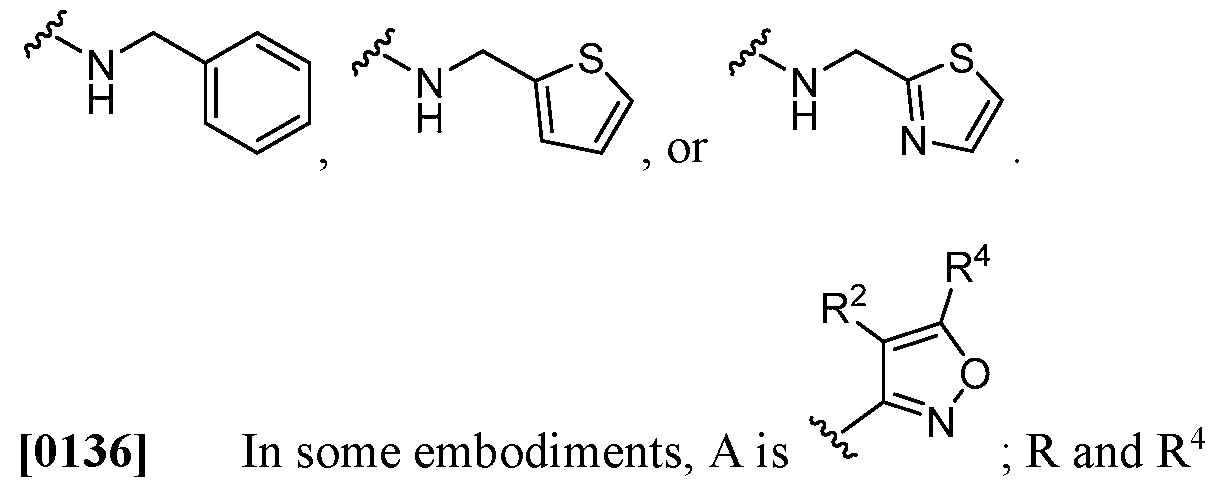


[0137] In some embodiments, the compound of Formula I is

embodiments, the compound of Formula

[0138] In some embodiments, the compound of Formula I is

embodiments, the compound of Formula
 [0139] In some embodiments, the compound of Formula I is

embodiments, the compound of Formula

[0140] In some embodiments, the compound of Formula I is

embodiments, the compound of Formula

[0141] In some embodiments, the compound of Formula I is

embodiments, the compound of Formula
 [0142] In some embodiments, the compound of Formula I is

embodiments, the compound of Formula

[0143] In some embodiments, the compound of Formula I is

embodiments, the compound of Formula

[0144] In some embodiments, the compound of Formula I is

embodiments, the compound of Formula
 [0145] In some embodiments, the compound of Formula I is

embodiments, the compound of Formula

[0146] In some embodiments, the compound of Formula

a pharmaceutically acceptable salt thereof. In some embodiments, the compound of Formula


pharmaceutically acceptable salt thereof. In some embodiments, the compound of Formula I

[0151] In some embodiments, the compound of Formula

pharmaceutically acceptable salt thereof. In some embodiments, the compound of Formula I

[0152] In some embodiments, the compound of Formula

or a pharmaceutically acceptable salt thereof. In some embodiments, the compound of


or a pharmaceutically acceptable salt thereof. In some embodiments, the compound of
Formula
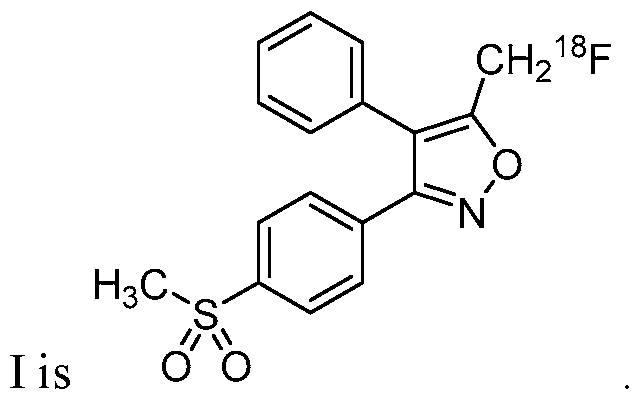
[0154] In some embodiments, the specific activity of the 18F-labelled compounds of Formula I is about 1 to about 5 Ci/mihoΐ. In some embodiments, the molar activity of the 18F- labelled compounds of Formula I is about 0.5 Ci/pmol or greater. In some embodiments, the molar activity of the 18F-labelled compounds of Formula I is about 0.5 to about 2.5 Ci/pmol.
[0155] In some embodiments, the compound of Formula I can exist as a salt form. In some embodiments, the salt form is pharmaceutically acceptable. Non-limiting examples of salts, including pharmaceutically acceptable salts, are those derived from inorganic or organic acids ( e.g ., hydrochloric, hydrobromic, sulfuric, nitric, perchloric, phosphoric, formic, acetic, lactic, maleic, fumaric, succinic, tartaric, glycolic, salicylic, citric, methanesulfonic, benzenesulfonic, benzoic, malonic, trifluoroacetic, trichloroacetic, and naphthalene-2 sulfonic acids); salts derived from inorganic or organic bases (e.g., sodium, potassium, calcium, magnesium, zinc, ammonia, lysine, arginine, histidine, polyhydroxylated amines, and tetrafluoroborates); and hemi-salts, such as those derived from acids comprising two carboxylic acid groups (e.g, malic acid, fumaric acid, maleic acid, succinic acid, tartaric acid, glutaric acid, oxalic acid, adipic acid, and citric acid) or diprotic mineral acids (e.g, sulfuric acid). Other exemplary salts are found, for example, in Berge, et al. (J. Pharm. Sci. 1977, 66(1): 1 (incorporated by reference herein in its entirety).
[0156] Processes for Compound Synthesis
[0157] In yet another aspect, a process for synthesizing a compound of Formula I

Formula I or a pharmaceutically acceptable salt thereof, comprises reacting one or more halogen atom(s) or thioester(s) in the compound with one or more radionuclide source(s)
independently selected from the group consisting of deuterium, 3H, UC, 18F, 75Br, 76Br, 120I,

[0158] In some embodiments, the one or more halogen atom(s) are independently chlorine or bromine. In some embodiments, the one or more halogen atom(s) are chlorine. In some embodiments, the one or more halogen atom(s) are bromine.
O
[0159] In some embodiments, the one or more thioester(s) comprise
 .
.
[0160] In some embodiments, the radionuclide source is a 18F source. In some embodiments, the a 18F source comprises a 18F source. Non-limiting examples of 18F sources include K18F and a tetraalkylammonium [18F]fluoride (e.g, tetrabutylammonium
[18F]fluoride and tetraethylammonium [18F]fluoride). In some embodiments, the 18F source is K18F. In some embodiments, the 18F source comprises a [18F]fluoroalkyl tosylate. A non limiting example of a [18F]fluoroalkyl tosylate is 2-[18F]fluoroethyl tosylate.
[0161] In some embodiments, the process further comprises a chelating agent. In some embodiments, the chelating agent is capable of chelating a cationic metal, such as potassium ion, sodium ion, calcium ion, lithium ion, and the like. In some embodiments, the chelating agent is capable of chelating potassium ion. Non-limiting examples of potassium chelating agents include crown ethers (e.g, 12-crown-4, 15-crown-5, 18-crown-6, dibenzo-18-crown-6, and diaza-18-crown-6) and cryptands. In some embodiments, the cryptand is a
[2.2.2]cryptand. In some embodiments, the cryptand is Kryptofix® 222 (“K222”).
[0162] In some embodiments, the process further comprises a base. Non-limiting examples of bases include organic bases, such as tetrabutylammonium hydroxide,
pyrrolidine, lithium diisopropylamide, 2,6-lutidine, lithium diethylamide, sodium methoxide, //-butyllithium, lithium hexamethyldisilazide, sodium hexamethyldisilazide, potassium hexamethyl disilazide, potassium /er/-butoxide, piperidine, piperazine, sodium acetate, morpholine, diethylamine, tetramethylpiperidine, diisopropylamine, and triethylamine; and
inorganic bases, such as sodium hydroxide, potassium hydroxide, calcium hydroxide, potassium carbonate, sodium carbonate, cesium carbonate, potassium bicarbonate, sodium hydride, and potassium hydride. In some embodiments, the base is a carbonate. In some embodiments, the base is potassium carbonate. In some embodiments, the base is tetrabutylammonium hydroxide. In some embodiments, the base is pyrrolidine. In some embodiments, the base is 2,6-lutidine.
[0163] In some embodiments, the process further comprises a polar aprotic solvent. Non limiting examples of polar aprotic solvents include M, A -di m ethyl form am i de (“DMF”), hexamethylphosphoramide (“HMPA”), dimethyl sulfoxide (“DMSO”), tetramethylene sulfone, 1,4-dioxane, acetone, ether (e.g, diethyl ether, diphenyl ether, and tetrahydrofuran (“THF”)) acetonitrile, methyl ethyl ketone, ethyl acetate, and combinations thereof. In some embodiments, the polar aprotic solvent is THF, DMF, DMSO, or combinations thereof. In some embodiments, the polar aprotic solvent is THF. In some embodiments, the polar aprotic solvent is DMF. In some embodiments, the polar aprotic solvent is DMSO. In some embodiments, the solvent is anhydrous (i.e., comprises less than about 1% water).
[0164] In some embodiments, the radionuclide source is a UC source. In some embodiments, the UC source comprises a [uC]alkyl halide and a [uC]alkyl triflate. A non limiting example of a [uC]alkyl halide is nCH3l. A non-limiting example of a [uC]alkyl triflate is uCH30Tf. In some embodiments, the UC source is uCH3l. In some embodiments, the UC source is nCH30Tf
[0165] In some embodiments, the process further comprises an oxidant. In some embodiments, the process further comprises an oxidant when the radionuclide source is a UC source. Non-limiting examples of oxidants include Oxone®, optionally with a water/THF solvent, a peroxyacid (e.g., weto-chloroperoxybenzoic acid), potassium peroxymonosulfate, H2O2, NalCri, /-BuOCl, Ca(OCl)2, NaClCte, NaOCl, a dioxirane, and KMnCri. In some embodiments, the oxidant is Oxone® or potassium peroxymonosulfate. In some
embodiments, the oxidant is Oxone®.
[0166] In some embodiments, the process comprises reacting one or more chlorine or bromine atom(s) in a compound of Formula I with a 18F source. In some embodiments, the 18F source is K18F. In some embodiments, the 18F source is 2-[18F]fluoroethyl tosylate.
[0167] In some embodiments, the process comprises reacting one or more thioester(s) in a compound of Formula I with a UC source in the presence of an oxidant. In some
embodiments, the UC source is uCH3l. In some embodiments, the UC source is uCH30Tf. In some embodiments, the oxidant is Oxone®.
[0168] In some embodiments, the compound of Formula I is

process comprises reacting the compound

source. In some embodiments, the 18F source is a 18F source. In some embodiments, the
compound of Formula
 the process comprises
reacting the compound
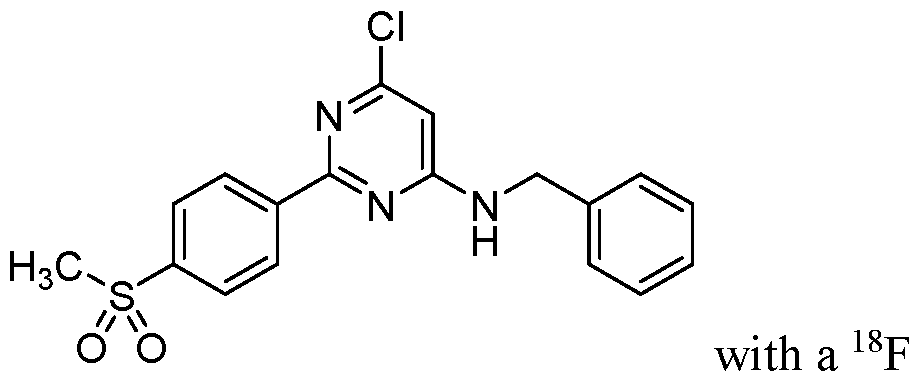 source. In some embodiments, the 18F source is a 18F source.
[0169] In some embodiments, the compound of Formula I is


source. In some embodiments, the 18F source is a 18F source. In some embodiments, the
compound of Formula
 the process comprises
reacting the compound
 source. In some embodiments, the 18F source is a 18F source.
[0170] In some embodiments, the compound of Formula I is

process comprises reacting the compound

source. In some embodiments, the 18F source is a 18F source. In some embodiments, the
compound of Formula
 the process comprises
reacting the compound
the process comprises
reacting the compound
 source. In some embodiments, the 18F source is a 18F source.
[0171] In some embodiments, the compound of Formula I is
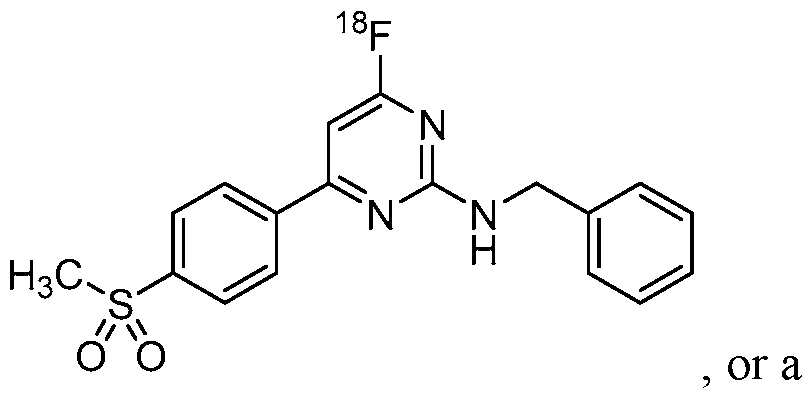
process comprises reacting the compound

source. In some embodiments, the 18F source is a 18F source. In some embodiments, the
compound of Formula
 the process comprises
reacting the compound
 source. In some embodiments, the i8F source is a i8F source.
[0172] In some embodiments, the compound of Formula I is
source. In some embodiments, the i8F source is a i8F source.
[0172] In some embodiments, the compound of Formula I is

process comprises reacting the compound

source. In some embodiments, the F source is a F source. In some embodiments, the
compound of Formula
 the process comprises
reacting the compound
 source. In some embodiments, the XF source is a XF source.
[0173] In some embodiments, the compound of Formula I is

process comprises reacting the compound
 source. In some embodiments, the F source is a F source. In some embodiments, the
compound of Formula
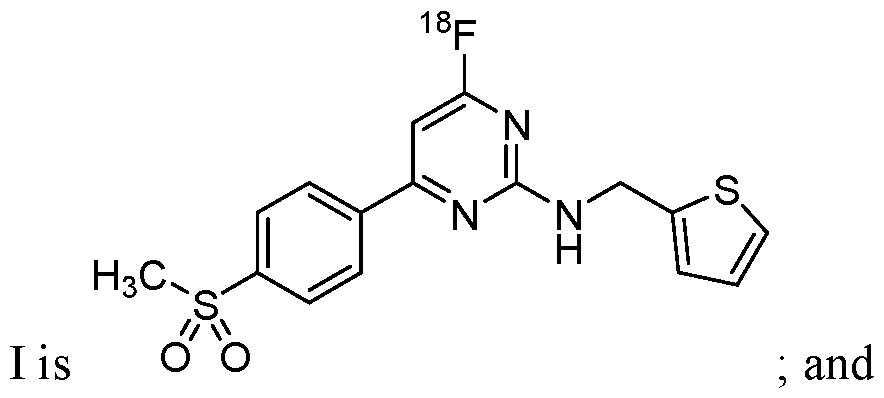 the process comprises
reacting the compound
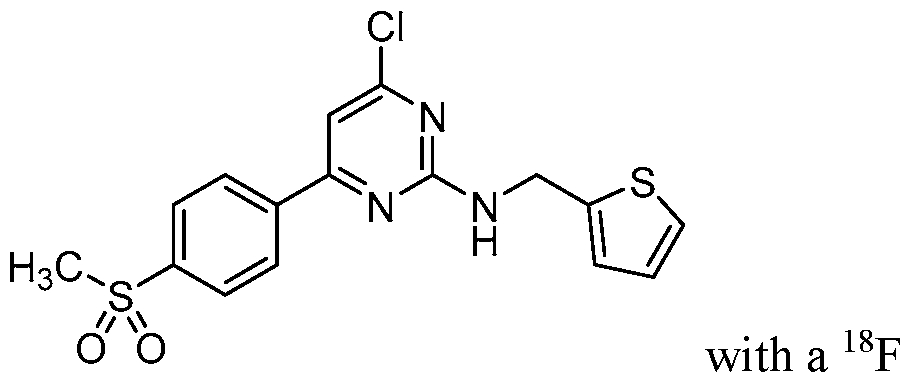 source. In some embodiments, the 18F source is a 18F source.
[0174] In some embodiments, the compound of Formula I is
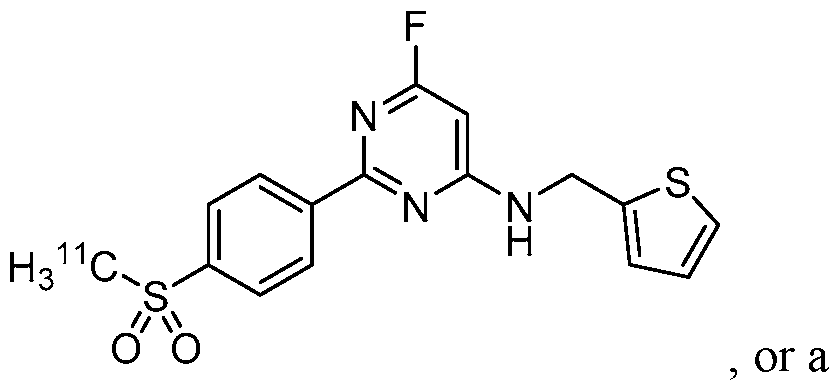
process comprises reacting the compound

UC source and an oxidant. In some embodiments, the UC source is pO¾I and/or uCH30Tf and the oxidant is Oxone®. In some embodiments, the compound of Formula I is
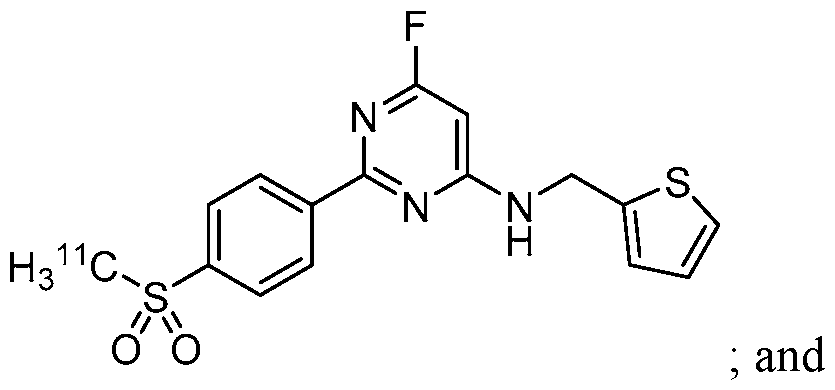

[0175] In some embodiments, the compound of Formula I is

process comprises reacting the compound

UC source and an oxidant. In some embodiments, the UC source is pO¾I and/or CFFOTf and the oxidant is Oxone®. In some embodiments, the compound of Formula I is

embodiments, the C source is CH3I and/or

[0176] In some embodiments, the compound of Formula I is
pharmaceutically acceptable salt thereof; and the
process comprises reacting the compound

UC source and an oxidant. In some embodiments, the UC source is uCH3l and/or uCH30Tf and the oxidant is Oxone®. In some embodiments, the compound of Formula I is

embodiments, the UC source is pO¾I and/or uCH30Tf and the oxidant is Oxone®.
[0177] In some embodiments, the compound of Formula

a pharmaceutically acceptable salt thereof; and the process comprises reacting the compound

source. In some embodiments, the compound of Formula
 the process comprises reacting the compound
 source. In some embodiments, the 18F source is a 18F source.
[0178] In some embodiments, the compound of Formula

or a pharmaceutically acceptable salt thereof; and the process comprises reacting the
compound
 source. In some embodiments, the F source is a F source. In some embodiments, the compound of Formula I is


or a pharmaceutically acceptable salt thereof; and the process comprises reacting the
compound
 source. In some embodiments, the F source is a F source. In some embodiments, the compound of Formula I is

[0180] In some embodiments, the compound of Formula

or a pharmaceutically acceptable salt thereof; and the process comprises reacting the
1
compound
 source. In some embodiments, the XF source is 2-[ FJfluoroethyl tosylate. In some embodiments, the compound of Formula I is

[18F]fluoroethyl tosylate.
[0181] In some embodiments, compounds of Formula I may be synthesized according to Scheme 1.

Scheme 1 : Synthesis of compounds of Formula I, according to some embodiments.
In some embodiments, the base is an alkoxide ( e.g ., NaOCFb). In some embodiments, the solvent is a polar protic solvent (e.g., water, methanol, ethanol, isopropanol, and /-butanol).
In some embodiments, [Cl] is a chlorinating agent (e.g, POCh). In some embodiments, [O] is an oxidizing agent. Non-limiting examples of oxidizing agents include Oxone®, optionally with a water/THF solvent, a peroxyacid (e.g, we a-chloroperoxybenzoic acid), potassium peroxymonosulfate, H2O2, NalCri, /-BuOCl, Ca(OCl)2, NaCICk, NaOCl, a dioxirane, and KMn04. In some embodiments, the oxidizing agent is Oxone® or potassium
peroxymonosulfate. In some embodiments, the chloride is displaced with R2 using, for example, a cross-coupling reaction (e.g, a palladium-mediated cross-coupling reaction) or a substitution reaction (e.g, a nucleophilic aromatic substitution reaction).
[0182] Additional processes, reagents, and conditions for synthesis of compounds of Formula I can be found in U.S. Patent Application Publication No. 2008/0138282 A1 (incorporated herein by reference in its entirety).
[0183] In some embodiments, the radiochemical yield of the reaction to install the 18F radioisotope in compounds of Formula I is about 10 to about 50%. In some embodiments, the radiochemical yield of the reaction to install the 18F radioisotope in compounds of Formula I is about 15 to about 35%. In some embodiments, the radiochemical yield of the reaction to install the 18F radioisotope in compounds of Formula I is about 20 to about 30%.
[0184] Methods of Radio Imaging
[0185] In yet another aspect, a method for imaging a sample or organism comprises:
(a) administering to the sample or organism a compound of Formula I

Formula I or a pharmaceutically acceptable salt thereof, in an amount effective to detect emission of deuterium, 3H, UC, 18F, 75Br, 76Br, 120I, 123I, 124I, 125I, 131I, or a combination thereof; and
(b) measuring the emission of the one or more radionuclide(s) in the compound.
[0186] In some embodiments, the amount effective to detect emission is the weight, concentration, or molar activity of the compound, or a pharmaceutically acceptable salt or
dosage form thereof, that, when dosed to the sample or organism, permits detection of the radioactive emission of the radioisotope(s). In some embodiments, this is an amount that permits detection of the radioactive emission of the radioisotope(s) via PET. In some embodiments, this is an amount that permits detection of the radioactive emission of 18F. A non-limiting example of an imaging-effective dosage amount ranges from about 0.001 mCi to about 30 mCi.
[0187] In some embodiments, the emission is measured using PET.
[0188] In some embodiments, the sample is a cell culture. Non-limiting examples of cell cultures include BxPC3 (COX-2-positive) and PANC-1 (COX-2-negative).
[0189] In some embodiments, the organism is an animal. In some embodiments, the organism is a mammal. In some embodiments, the mammal is a mouse, rat, pig, dog, monkey, baboon, or human. In some embodiments, the mammal is a mouse. In some embodiments, the mammal is a rat. In some embodiments, the mammal is a pig. In some embodiments, the mammal is a dog. In some embodiments, the mammal is a monkey. In some embodiments, the monkey is a rhesus macaque. In some embodiments, the mammal is a baboon. In some embodiments, the mammal is a human.
[0190] In some embodiments, the compound can be administered to the sample or organism per se (neat) or in the form of a pharmaceutically acceptable salt or solution. For example the salt or solution may be administered by intravenous, intramuscular, or other parenteral means. The compound, salt, or solution can also be administered by intranasal application, inhalation, topically, orally, rectally, vaginally, or as implants. Suitable liquid or solid forms include, for example, aqueous or saline solutions for injection or inhalation, microencapsulated, encochleated, coated onto microscopic gold particles, contained in liposomes or other vesicles, nebulized, aerosols, pellets for implantation into the skin, or dried onto a sharp object to be scratched into the skin, granules, powders, tablets, coated tablets, (micro)capsules, suppositories, syrups, emulsions, suspensions, creams, drops, or preparations with protracted release of active compounds in whose preparation excipients and additives and/or auxiliaries include, for example, disintegrants, binders, coating agents, swelling agents, lubricants, flavorings, sweeteners or solubilizers are customarily used as described above. In some embodiments, the compound can be administered as a controlled- or sustained-release form. In some embodiments, the compound can be administered in pro drug form. Additional administration forms and modes of administration are known in the art
of pharmacy. See generally , Remington, The Science and Practice of Pharmacy, Vols. 1 and 2, Pharmaceutical Press 2013 (incorporated herein by reference in its entirety). See also U.S. Patent Application Publication No. 2008/0138282 A1 (incorporated herein by reference in its entirety).
[0191] In some embodiments, the compound interacts with a biological target and measuring the emission allows determination of the expression level or distribution of the biological target in the sample or organism. In some embodiments, the biological target ( e.g. , protein) is implicated in a disease (e.g., is downregulated or upregulated, is under-expressed or overexpressed, etc.) and measuring the emission allows diagnosis, progression, and treatment of the disease to be assessed. In some embodiments, the compound interacts with a protein and measuring the emission allows determination of the expression level or distribution of the protein in the sample or organism. In some embodiments, the protein is involved in inflammation and measuring the emission allows determination of the amount or distribution of inflammation, inflection, and/or injury in the sample or organism. In some embodiments, the protein is COX-2. In some embodiments, the compound interacts with (e.g, binds) and/or inhibits COX-2. In some embodiments, this binding or inhibition, in combination with the imaging method, is used to determine COX-2 expression level or activity, or diagnose or monitor a disease or treatment involving COX-2.
[0192] In some embodiments, the animal is known or suspected to have a condition or state selected from the group consisting of arthritis (e.g, rheumatoid arthritis, osteoarthritis, and spondyloarthropathies), cardiovascular disease (e.g, atherosclerosis, myocardial infarction, myocardial ischemia, periarteritis nodosa, and vascular disease), central nervous system damage (e.g, from stroke, ischemia, and trauma), central nervous system disorder (e.g, multiple sclerosis, a seizure disorder, such as epilepsy, headache, including but not limited to migraine headache, and brain injury, including but not limited to traumatic brain injury), gastrointestinal disorder (e.g, irritable bowel syndrome), hypersensitivity (e.g, autoimmune disease, including but not limited to aplastic anemia, graft rejection, lupus, scleroderma, and allergy, including but not limited to allergic rhinitis), inflammatory disease (e.g, asthma, Bechet’s disease, bronchitis, bursitis, Crohn’s disease, endotoxin shock syndrome, gastritis, gingivitis, inflammatory bowel disease, polymyositis, pulmonary inflammation, such as acute respiratory disease syndrome and severe acute respiratory syndrome from viral (e.g, COVID-19) and bacterial infections, Lyme disease, meningitis, and from cystic fibrosis, rheumatic fever, sarcoidosis, tendinitis, thyroiditis, and ulcerative
colitis), metabolic disorder ( e.g ., affecting bone metabolism, type 1 diabetes, and type 2 diabetes), neoplastic disease (e.g., cancer, including but not limited to colorectal cancer, breast cancer, lung cancer, prostate cancer, bladder cancer, cervical cancer, skin cancer, and lymphoma, including but not limited to Hodgkin lymphoma and non-Hodgkin lymphoma), neurodegenerative disease (e.g, multiple sclerosis, Alzheimer’s disease, amyotrophic lateral sclerosis, cortical dementias, Huntington’s disease, and Parkinson’s disease), neuromuscular junction disease (e.g, myasthenia gravis), ophthalmic disease (e.g, retinitis, retinopathies, uveitis, ocular photophobia, conjunctivitis, and acute injury to the eye tissue), post-operative inflammation (e.g, from ophthalmic surgery, cataract surgery, and refractive surgery), psychiatric condition (e.g, depressive disorder, schizophrenia, and an alcohol use disorder), reproductive event (e.g, ovulation, pregnancy, and child birth), respiratory disease (e.g., respiratory distress syndrome), skin disorder (e.g, psoriasis, eczema, burns, and dermatitis), tissue repair, urogenital disease (e.g, renal disease, including but not limited to nephritis and nephrotic syndrome), white matter disease, and a combination thereof.
[0193] In some embodiments, the condition is Alzheimer’s disease, Parkinson’s disease, rheumatoid arthritis, osteoarthritis, myocardial infarction, traumatic brain injury,
inflammatory disease, cancer, renal disease, or amyotrophic lateral sclerosis.
[0194] In some embodiments, the animal is known or suspected to be experiencing pain. In some embodiments, the animal is known or suspected to be experiencing pain as a result of the conditions listed above.
[0195] In some embodiments, COX-2 is induced by inflammatory stimuli. In some embodiments, COX-2 catalyzes prostanoid formation associated with, for example, inflammation and proliferative diseases. In some embodiments, COX-2 is modestly expressed under normal physiologic conditions and plays a role in, for example, brain, cardiac, and kidney function, but is upregulated or overexpressed during inflammation. In some embodiments, excessive inflammation and associated COX-2 induction may be part of the pathogenesis of neurodegenerative diseases, such as Alzheimer’s disease, Parkinson’s disease, and amyotrophic lateral sclerosis, as well as in traumatic brain injury. In some embodiments, COX-2 induction is involved in pain, major depressive disorder,
schizophrenia, arthritis, cancer, and acute allograft rejection. In some embodiments, inhibition of COX-2 may be a protective treatment strategy by slowing or halting the progression of disease. In some embodiments, monitoring in vivo changes in COX-2
expression can be used for quantifying disease pathogenesis, such as detecting organ rejection, detecting arthritic joints, and assessing target occupancy and biological effects of COX-2 inhibitors. In some embodiments, noninvasive radio imaging, such as PET, is useful for assessing brain diseases due to the difficulty of accessing the brain.
[0196] In some embodiments, the method can be used to measure and/or detect COX-2 protein in COX-2 associated diseases, conditions, and disorders. Non-limiting examples of COX-2-associated diseases, conditions, and disorders include a condition or state selected from the group consisting of arthritis ( e.g ., rheumatoid arthritis, osteoarthritis, and
spondyloarthropathies), cardiovascular disease (e.g., atherosclerosis, myocardial infarction, myocardial ischemia, periarteritis nodosa, and vascular disease), central nervous system damage (e.g, from stroke, ischemia, and trauma), central nervous system disorder (e.g, multiple sclerosis, a seizure disorder, such as epilepsy, headache, including but not limited to migraine headache, and brain injury, including but not limited to traumatic brain injury), gastrointestinal disorder (e.g, irritable bowel syndrome), hypersensitivity (e.g, autoimmune disease, including but not limited to aplastic anemia, graft rejection, lupus, scleroderma, and allergy, including but not limited to allergic rhinitis), inflammatory disease (e.g, asthma, Bechet’s disease, bronchitis, bursitis, Crohn’s disease, endotoxin shock syndrome, gastritis, gingivitis, inflammatory bowel disease, polymyositis, pulmonary inflammation, such as acute respiratory disease syndrome and severe acute respiratory syndrome from viral (e.g, COVID- 19) and bacterial infections, Lyme disease, meningitis, and from cystic fibrosis, rheumatic fever, sarcoidosis, tendinitis, thyroiditis, and ulcerative colitis), metabolic disorder (e.g, affecting bone metabolism, type 1 diabetes, and type 2 diabetes), neoplastic disease (e.g, cancer, including but not limited to colorectal cancer, breast cancer, lung cancer, prostate cancer, bladder cancer, cervical cancer, skin cancer, and lymphoma, including but not limited to Hodgkin lymphoma and non-Hodgkin lymphoma), neurodegenerative disease (e.g, multiple sclerosis, Alzheimer’s disease, amyotrophic lateral sclerosis, cortical dementias, Huntington’s disease, and Parkinson’s disease), neuromuscular junction disease (e.g, myasthenia gravis), ophthalmic disease (e.g, retinitis, retinopathies, uveitis, ocular photophobia, conjunctivitis, and acute injury to the eye tissue), post-operative inflammation (e.g, from ophthalmic surgery, cataract surgery, and refractive surgery), psychiatric condition (e.g, depressive disorder, alcohol use disorder, and schizophrenia, reproductive event (e.g, ovulation, pregnancy, and child birth), respiratory disease (e.g, respiratory distress syndrome), skin disorder (e.g, psoriasis, eczema, bums, and dermatitis), tissue repair,
urogenital disease ( e.g ., renal disease, including but not limited to nephritis and nephrotic syndrome), white matter disease, or a combination thereof. In some embodiments, the condition is Alzheimer’s disease, Parkinson’s disease, rheumatoid arthritis, osteoarthritis, myocardial infarction, traumatic brain injury, inflammatory disease, cancer, renal disease, or amyotrophic lateral sclerosis.
[0197] In some embodiments, the method can be used to detect or monitor processes, diseases, or disorders that may involve the upregulation of COX-2 protein expression including, but not limited to upregulation and/or overexpression of COX-2 is associated with inflammation, pain, fever, arthritis (e.g., rheumatoid arthritis and osteoarthritis),
neurodegenerative disease (e.g, Alzheimer’s disease, Parkinson’s disease, amyotrophic lateral sclerosis), angiogenesis, cancer, stroke, cardiac condition (e.g, myocardial infarction and atherosclerosis), diabetes, allograft rejection, urogenital disease, renal function, tissue repair, bone metabolism, ovulation, pregnancy, and child birth.
[0198] In some embodiments, the method can be used to screen a sample or organism for diseases, disorders, states, or conditions that are related to COX-2 expression or activity. Non-limiting examples include inflammation, pain, fever, arthritis (e.g, rheumatoid arthritis and osteoarthritis), neurodegenerative disease (e.g, Alzheimer’s disease, Parkinson’s disease, amyotrophic lateral sclerosis), vascular condition (e.g, angiogenesis), cancer, reproduction (e.g, ovulation, pregnancy, and child birth), renal function, tissue repair, bone metabolism, stroke, cardiac condition (e.g, myocardial infarction, atherosclerosis), diabetes, allograft rejection, and urogenital disease.
[0199] In some embodiments, the method can be used to screen for organisms that are more susceptible to side effects of COX-2 inhibitors, as manifested by an increased detection of the compounds of Formula I in specified tissue compartments.
[0200] In some embodiments, the method can be used to determine the efficacy of COX- 2 inhibitors administered to an organism to treat a disorder that involves the upregulation of COX-2 protein expression.
[0201] In some embodiments, the method can be used to monitor the course of inflammation in an organism. For example, whether a particular COX-2 inhibitor therapeutic regimen aimed at ameliorating the cause of the inflammatory process, or the inflammatory process itself, is effective, can be determined by measuring the decrease of COX-2 protein expression at suspected sites of inflammation.
[0202] Additional uses for the methods described herein can be found in U.S. Patent Application Publication No. 2008/0138282 A1 (incorporated herein by reference in its entirety).
[0203] The representative examples which follow are intended to help illustrate the invention, and are not intended to, nor should they be construed to, limit the scope of the invention. Indeed, various modifications of the invention and many further embodiments thereof, in addition to those shown and described herein, will become apparent to those skilled in the art from the full contents of this document, including the examples which follow and the references to the scientific and patent literature cited herein. It should further be appreciated that the contents of those cited references are incorporated herein by reference to help illustrate the state of the art. The following examples contain important additional information, exemplification, and guidance which can be adapted to the practice of this invention in its various embodiments and equivalents thereof.
EXAMPLES
[0204] Example 1: Radiosynthesis and Evaluation of [18F]FMTP and [18F]FMPP
[0205] COX, or prostaglandin endoperoxidase synthase, is an enzyme involved in the biosynthesis of prostaglandins, prostacyclins, and thromboxanes from arachidonic acid. Among the three known isoforms of COX (COX-1, COX-2, and COX-3), COX-1 has predominantly constitutive activity and is involved in many normal physiological functions. In contrast, COX-2 is inducible under normal physiologic conditions, with relatively low constitutive activity and mostly found in kidney, brain, and heart. The third isoform, COX-3, may be responsible for febrile response and mediates the antipyretic effects of aspirin and acetaminophen. COX-2 inhibition mediates the analgesic activities of NSAIDs. COX-2, induced by inflammatory stimuli, catalyzes prostanoid formation associated with
inflammation and proliferative diseases, including those in the CNS. Neuroinflammation and COX-2 induction are implicated in the pathogenesis of neurodegenerative diseases such as Alzheimer’s disease, Parkinson’s disease, and ALS, as well as psychiatric disorders, smoking, seizure disorders, and brain injuries ( e.g ., TBI). COX-2 induction is also involved in for example, pain, arthritis, cancers, myocardial infarction, and acute allograft rejection. COXIBs can have anti-inflammatory effects.
[0206] Upregulation/overexpression of COX-2 is involved in neuroinflammation associated with many neurological diseases and malignancies of the brain. Outside the brain,
inflammation and COX-2 induction contribute to the pathogenesis of, for example, pain, arthritis, and acute allograft rejection, and to responses to, for example, infections, tumors, autoimmune disorders, and injuries. Therefore, targeting COX-2 may be a potential neuroprotective treatment strategy aiming to reduce the progression of neurodegenerative and other diseases.
[0207] Monitoring in vivo changes in COX-2 expression allows, for example, quantification of inflammation, tracking of disease course, assessing target occupancy of NSAIDs, and or monitoring clinical use of FDA-approved COXIB medications. Prior methods of COX-2 quantification include ex vivo assays of tissue samples, invasively obtained from biopsies. PET imaging would allow noninvasive and in vivo visualization of COX-2 throughout the body. Prior COX-2 PET ligands were not successful for in vivo quantification of COX-2 due to limitations, such as suboptimal COX-2 affinity, high nonspecific binding, de[18F]fluorination, skeletal uptake, poor brain or organ uptake, inability to detect basal or low level of COX-2, and poor signal-to-noise ratio due to lipophilicity. [UC]TMI, a potent COX-2 inhibitor, was the only prior radiotracer exhibiting partial blocking of constitutive COX-2 level in baboon brain, however, its ability to image inflammation in animal disease models was yet to be proven. [18F]Pyricoxib, another prior COX-2 inhibitor belonging to the class of 2-(4-methylsulfonylphenyl)pyrimidines, and the prior triazole analogue [18F]triacoxib, showed a higher binding in COX-2 positive cells (HCA-7) compared with COX-2 negative cells (HCT-116). However, both tracers demonstrated only modest binding in xenografts in vivo and did not show significant uptake in brain. See FIG. 1.
Similarly, [UC]MC1, another member of the class of arylpyrimidines, showed increased binding to COX-2 in animal models of neuroinflammation. See FIG. 1. Despite promising uptake in neuroinflammation, [UC]MC1 failed to detect constitutive or low level of COX-2 in brain under conditions without inflammation, and cold (i.e., non-radiolabeled) MCI showed no specific binding in CNS and periphery organs. COXIBs with sub-nanomolar affinity and radiolabeled with long-lived isotopes, such as 18F (decay half-life 110 min), may overcome the limitations of these prior tracers. In Example 1, the radiosynthesis and evaluation of [18F] FMTP; COX-2 ICso = 2.5 nM) as potential PET ligand for COX-2 imaging in brain and periphery (see FIG. 1) was conducted. [18F]FMTP, belonging to the pyrimidine class of COXIBs, was evaluated as a PET tracer for COX-2 imaging owing to the presence of a chemically and metabolically stable radiolabeling position on the aromatic ring, level of lipophilicity for passive brain entry, and high COX-2 affinity.
[0208] Materials and Methods
[0209] The radiochemical synthesis of [18F]FMTP and [18F]FMPP were optimized using a chlorine-to-fluorine displacement method, by reacting 18F-fluoride/K222/K2C03 with the corresponding chlorine precursor molecules. Cellular uptake studies of [18F]FMTP were performed in COX-2-positive BxPC3 and COX-2-negative PANC-1 cell lines with unlabeled FMTP as well as celecoxib (5 mM) to define specific binding agents. Dynamic microPET image acquisition was performed in anesthetized nude mice, LPS-induced neuroinflammation mice, and PBS-administered control mice using a Trifoil mPET/CT for a scan period of 50 or 60 minutes.
[0210] Materials
[0211] 18F was produced using Eclipse cyclotron (Siemens, Knoxville, TN). Gamma-ray detector (Bioscan Flow-Count fitted with Nal detector) coupled in series with a UV detector (Waters Model 996 set at 254 nm) were used for detection of radiolabeled products. Data acquisition for both the analytical and preparative systems was accomplished using a Waters Empower Chromatography System. Dynamic microPET image acquisitions were performed with Trifoil mPET/CT scanner.
[0212] Synthesis of [18F] FMTP and [18F]FMPP

Scheme 2: Synthesis of [18F]FMTP.
[0213] Synthesis of the starting 4-(methylthio)benzimidamide was conducted as reported in Oijales et al.“Novel 2-(4-Methylsulfonylphenyl)pyrimidine Derivatives as Highly Potent
and Specific COX-2 Inhibitors. Bioorg. Med. Chem. 2008, 16:2183-99 (incorporated herein by reference in its entirety. See also Scheme 1.
[0214] Thiophene-2-ylmethanamine (68 mg, 0.6 mmol) was added to a solution of 4,6- dichloro-2-(4-(methylsulfonyl)phenyl)pyrimidine (0.3 mmol, 90 mg) in 4 mL dry
dichloromethane and 0.1 mL triethylamine. The reaction mixture was stirred at room temperature for 1 hour and, at this time, HPLC analyses showed > 95% consumption of the chloro-substrate. The reaction mixture was evaporated and chromatographed over silica gel using 40:60 ethyl acetate-hexane to afford 75 mg (65%) of Cl-MTP as pale-yellow solid. Cl-MTP: melting point: 169-171 °C; ¾ NMR (400 MHz, CDCb): d 3.0 (3H, s, CTb), 4.85 (2H, bs, CHz), 5.3 (1H, bs, NH), 6.3 (1H, s), 6.9 (1H, m), 7.0 (1H, d, J = 2.81 Hz), 7.2 (2H, d, overlapped with CDCb), 7.9 (2H, d, J = 8.53 Hz), and 8.5 (2H, d, J = 8.56 Hz).
[0215] Tetra-«-butylammonium fluoride (“TBAF”) (0.1 mL, 1 M solution in THF) was added to a solution of Cl-MTP (20 mg, 0.05 mmol) in DMF (2 mL). The resulting solution was heated at 140 °C for 1 hour, at which time point, HPLC analyses showed > 95% consumption of Cl-MTP. The reaction mixture was then allowed to cool, diluted with water (20 mL), and extracted with ethyl acetate (3x10 mL). The combined ethyl acetate fractions were further washed with saturated brine, dried over anhydrous MgSCb, and
chromatographed over silica gel (20% ethyl acetate-hexane) to afford 15 mg (85%) of FMTP as pale-yellow solid. FMTP: melting point: 131.5 °C; ¾ NMR (400 MHz, CDCb): d 3.0 (3H, s, Ob), 4.8 (2H, bs, CH2), 5.9 (1H, bs, NH), 6.4 (1H, s), 6.9-7 (1H, m), 7.05 (1H, d, J = 2.82 Hz), 7.2 (2H, d, overlapped with CDCb), 8.0 (2H, d, J = 8.51), 8.6 (2H, d, J = 8.54); HRMS (MH+) calculated for: C16H15FN3O2S2: 364.0512; Found: 364.0533.

Scheme 3: Synthesis of [18F]FMPP.
[0216] Benzylamine (64 mg, 0.6 mmol) was added to a solution of 4,6-dichloro-2-(4- (methylsulfonyl)phenyl)pyrimidine (0.3 mmol, 90 mg) in 4 mL dry dichloromethane and 0.1 mL triethylamine. The reaction mixture was stirred at room temperature for 1 hour and, at this time, HPLC analyses showed > 95% consumption of the chi or o- substrate. The reaction mixture was evaporated and chromatographed over silica gel using 40:60 ethyl acetate- hexane to afford 65 mg (60%) of Cl-MPP as pale-yellow solid.
[0217] TBAF (0.1 mL, 1 M solution in THF) was added to a solution of Cl-MPP (20 mg, 0.05 mmol) in DMF (2 mL). The resulting solution was heated at 140 °C for 1 hour, at which time point, HPLC analyses showed > 95% consumption of Cl-MTP. The reaction mixture was then allowed to cool, diluted with water (20 mL), and extracted with ethyl acetate (3 x 10 mL). The combined ethyl acetate fractions were further washed with saturated brine, dried over anhydrous MgSCri, and chromatographed over silica gel (20% ethyl acetate-hexane) to afford 13 mg (80%) of FMPP as pale-yellow solid. FMPP: melting point: 125.5 °C; ¾ NMR (400 MHz, CDCb): d 3.0 (3H, s, CHs), 4.9 (2H, bs, CHz), 6.1 (1H, bs, NH), 6.5 (1H, s), 7.3 (5H, m), 8.0 (2H, d, J = 8.51), 8.6 (2H, d, J = 8.54); HRMS (MH+) calculated for: C18H17FN3O2S: 357.0942; Found: 357.0926.
[0218] 18F (Eclipse cyclotron, Siemens) trapped from QMA was eluted with 1 mL of 10: 1 acetonitrile:water, containing K222 (36 mg) and potassium carbonate (2 mg). The reaction mixture was azeotropically heated and dried at 98 °C under a stream of argon by the repeated addition of acetonitrile (4 x 0.5 mL). A solution of approximately 2 mg of Cl-MTP or Cl-
MPP in 500 mΐ. of DMSO was then added to the reaction vial, sealed, and heated for 20 minutes at 140 °C. The reaction mixture was allowed to cool to room temperature, diluted with 20 mL water, and passed through a classic C-18 Sep-Pak cartridge and eluted with 1 mL acetonitrile. The crude product in acetonitrile was injected onto a semipreparative HPLC column (Phenomenex, Prodigy ODS-Prep 10 x 250 mm, 10 mih; and eluted with 50:50 acetonitrile:0.1 M ammonium formate with a flow rate of 8 mL/min). [18F]FMTP eluted at 9- 10 minutes and [18F]FMPP eluted at 12 minutes, and were collected based on the g-detector reading, diluted with 50 mL of deionized water and passed through a classic C-18 Sep-Pak cartridge, washed with 10 mL of deionized water, and eluted with 1 mL of ethanol.
Reconstruction of the product in 1 mL of absolute ethanol afforded [18F]FMTP in 35 ± 5% yield and [18F]FMPP at 30 ±_5% at the end of synthesis (“EOS”). A portion of the ethanol solution was analyzed by analytical HPLC (Phenomenex, Prodigy ODS(3) 4.6 x 250 mm, 5 mih; mobile phase; 60:40 acetonitrile:0.1 M AMF, flow rate 2 mL/min, tR = ~5-6 minutes) to determine the molar activity, chemical, and radiochemical purities. The ethanol solution was then diluted to a volume of 10 mL with saline and filtered through a sterile environment, and a portion of this solution was formulated for injection.
[0219] In Vitro and In Vivo Evaluation of [18F]FMTP
[0220] Cell Update of [18F]FMTP
[0221] BxPC3 and PANC-1 human pancreas carcinoma cell lines were plated on a 24- well plate at 2 x 10⁵ cells/well. After 48 hours, [18F]FMTP was added (2.0 pCi/mL) to the cell medium for 30 minutes. For blocking experiments, non-labelled FMTP or celecoxib (5 mM) was added to cells 30 minutes before [18F]FMTP. After incubation with [18F]FMTP, cells were washed 4 times with cold PBS, lysed with 0.1 N NaOH, and counted in a gamma counter (Hidex AMG, LabLogic, Tampa, FL).
[0222] Proof-of-concept and selectivity of [18F]FMTP binding to COX-2 was examined by evaluating the tracer uptake in COX-2-positive BxPC3 and a control COX-2-negative PANC1 human pancreatic carcinoma cell lines. FIG. 2 illustrates a > 2-fold uptake of
[18F]FMTP in BxPC3 cells compared with PANC1 cells. Values shown in FIG. 2 are the mean ± standard deviation (“SD”) from four independent experiments. This binding was substantially blocked with unlabeled FMTP. Blocking with celecoxib, an FDA-approved COXIB, produced less proportional blocking compared with cold FMTP. [18F]FMTP
showed negligible binding to PANC1 cells and no specific binding with FMTP or celecoxib block.
[0223] MicroPET Imaging of [18F]FMTP
[0224] Animals (male white mice) were anesthetized with isoflurane (l%-2% isoflurane in 100% oxygen) using a nose cone, and a 29-gauge needle connected to a catheter was placed into the lateral tail vein. For neuroinflammation, mice were stereotactically injected with 5 pg of LPS or PBS (controls) in the brain and imaging experiments conducted 24 hours later. The animal was placed in prone position on the platform of the scanner and moved into the center of the field of view guided by laser beam calibration. Immediately after scan start, [18F]FMTP (~2.5 MBq 25 mL in 20% ethanol-saline solution) was injected through the tail- vein catheter manually. The error caused by the injector and catheter was corrected by subtracting the remaining dose. 40-minute dynamic imaging was acquired on a microPET scanner (Siemens Inveon). The acquired list-mode data were reconstructed with 3D ordered subset expectation maximization (OSEM) algorithm using the software of Siemens Inveon Acquisition Workplace with a framing protocol of 2 x 30 seconds, 4 x 60 seconds, 3 x 120 seconds, 3 x 180 seconds, and 4 x 300 seconds. Using PMOD software (version 4.0, Switzerland), three-dimensional ellipsoid volume of interests (“VOIs”) ranging from 2-to-6 mm were placed manually at the center of the brain, heart (blood-pool), liver, proximal humerus (bone), and posterior cervical muscle. The standardized uptake values (“SUVs”) were estimated using a calibration factor calculated from the phantom study and time activity curves (“TACs”) were derived from VOIs in the series of reconstructed images.
[0225] FIGS. 3A-3D show the summed early frames (0-10 minute) and total frames (0-40 minute) of microPET images. Crosses in FIGS. 3 A-3D represent the region with brain. As evident from the images, the tracer penetrated the BBB and subsequently showed a fast washout of activity from brain. TACs also indicated an initial rapid influx of radioactivity followed by rapid washout (FIG. 4). The uptake of [18F]FMTP peaked around 1 minute in heart and brain, and then decreased rapidly. The absence of retention of [18F]FMTP activity in these organs was predicted due to low COX-2 expression in normal mouse brain. Highest radioactivity outside the heart was found in liver, and the delay to peak at 5-10 minutes was probably due to the accumulation of radioactive metabolite(s). The tracer did not show uptake in spine and skeleton, which indicated lack of de[18F]fluorination, an advantage of [18F]FMTP for use in in vivo PET imaging. The binding of [18F]FMTP in LPS-induced
neuroinflammation in mice was studied in comparison to vehicle (PBS)-treated-mice.
Intracranial injection of LPS in mice is known to generate COX-2 induction and
neuroinflammation after around 24 hours. Therefore, PET imaging of LPS treated mice was performed after 24 hours with [18F]FMTP, and an approximately 2-fold increase of tracer binding was found in brain compared with PBS-treated mice (FIG. 5). TACs in whole brain showed higher binding of [18F]FMTP in LPS-treated mice compared with PBS-treated controls (FIG. 6). MicroPET data correlated with autoradiography performed in brain sections of microPET imaged animals using [18F]FMTP. See FIG. 7.
[0226] A new method for radiosynthesis of [18F]FMTP and [18F]FMPP included a chlorine-to-18F displacement reaction of aryl[l,3]pyrimidine core molecule. Advantages of the radiosynthesis described in one or more embodiments herein include, but are not limited to, accessibility of precursor, one step, no prosthetic group required, facile separation and purification, and no de[18F]fluorination. Proof-of-concept of the use of [18F]FMTP for quantifying COX-2 was demonstrated first, in vitro , in COX-2-positive BxPC3 cells.
MicroPET imaging of normal mice demonstrated BBB penetration and a fast washout of radioactivity from brain, possibly due to low concentration of COX-2 in normal brain.
[18F]FMTP showed a higher binding in LPS-induced neuroinflammation compared to binding in the brain of control mice. Specific binding to COX-2 in cell lines, lack of in vivo de[18F]fluorination and skeletal uptake, BBB permeability, and higher brain binding in neuroinflammation demonstrated the potential of [18F]FMTP as a PET tracer for imaging inflammation where COX-2 overexpression is reported. [18F]FMTP may be useful for rapid determination of the lowest effective dose of, e.g ., a COXIB.
[0227] References
[0228] Fitzpatrick F.“Cyclooxygenase enzymes: regulation and function. Curr. Pharm. Des. 2004, 10(6):577-88 (incorporated herein by reference in its entirety).
[0229] DeWitt DL.“Prostaglandin endoperoxide synthase: regulation of enzyme expression.” Biochim. Biophys. Acta. 1991, 1083(2): 121-34 (incorporated herein by reference in its entirety).
[0230] Smith WL et al.“Prostaglandin endoperoxide synthase: structure and catalysis.” Biochim. Biophys. Acta. 1991, 1083(1): 1-17 (incorporated herein by reference in its entirety).
[0231] Kumata K et al.“Assessment of radioligands for PET imaging of cyclooxygenase- 2 in an ischemic neuronal Injury model.” Brain Res. 2013, 1533: 152-62 (incorporated herein by reference in its entirety).
[0232] Yasojima K et al.“Distribution of cyclooxygenase- 1 and cyclooxygenase-2 mRNAs and proteins in human brain and peripheral organs.” Brain Res. 1999, 830(2):226-36 (incorporated herein by reference in its entirety).
[0233] Ho L et al.“Regional distribution of cyclooxygenase-2 in the hippocampal formation in Alzheimer's disease.” J. Neurosci. Res. 1999, 57(3):295-303 (incorporated herein by reference in its entirety).
[0234] Botting R et al.“COX-3 and the mechanism of action of
paracetamol/acetaminophen.” Prostaglandins Leukot Essent Fatty Acids 2005, 72(2):85-7 (incorporated herein by reference in its entirety).
[0235] Schwab JM et al.“COX-3 the enzyme and the concept: steps towards highly specialized pathways and precision therapeutics?” Prostaglandins Leukot Essent Fatty Acids 2003, 69(5):339-43 (incorporated herein by reference in its entirety).
[0236] Warner TD et al.“Cyclooxygenase-3 (COX-3): filling in the gaps toward a COX continuum?” Proc. Natl. Acad. Sci. USA 2002, 99(21): 13371-3 (incorporated herein by reference in its entirety).
[0237] Choi SH et al.“The distinct roles of cyclooxygenase- 1 and -2 in
neuroinflammation: implications for translational research.” Trends Pharmacol Sci. 2009, 30(4): 174-81 (incorporated herein by reference in its entirety).
[0238] Minghetti L.“Cyclooxygenase-2 (COX-2) in inflammatory and degenerative brain diseases.” J. Neuropathol. Exp. Neurol. 2004, 63(9):901-10 (incorporated herein by reference in its entirety).
[0239] Guan PP et al.“Integrated communications between cyclooxygenase-2 and Alzheimer's disease.” FASEB J. 2019, 33(1): 13-33 (incorporated herein by reference in its entirety).
[0240] Dhir A.“An update of cyclooxygenase (COX)-inhibitors in epilepsy disorders.” Expert Opin. Investig. Drugs. 2019, 28(2): 191-205 (incorporated herein by reference in its entirety).
[0241] Rojas A et al.“The COX-2/prostanoid signaling cascades in seizure disorders.” Expert Opin. Ther. Targets. 2019, 23(1): 1-13 (incorporated herein by reference in its entirety).
[0242] Strauss KI.“COX2 inhibitors for acquired brain injuries: Is the time ripe?” Crit. Care. Med. 2010, 38(2):723-724 (incorporated herein by reference in its entirety).
[0243] de Vries EF et al.“Nuclear imaging of inflammation in neurologic and psychiatric disorders.” Curr. Clin. Pharmacol. 2006, l(3):229-42 (incorporated herein by reference in its entirety).
[0244] Fond G et al.“Effectiveness and tolerance of anti-inflammatory drugs’ add-on therapy in major mental disorders: a systematic qualitative review.” Acta. Psychiatr. Scand. 2014, 129(3): 163-79 (incorporated herein by reference in its entirety).
[0245] Na KS et al.“The role of pro-inflammatory cytokines in the neuroinflammation and neurogenesis of schizophrenia.” Prog. Neuropsychopharmacol. Biol. Psychiatry. 2014, 48:277-86 (incorporated herein by reference in its entirety).
[0246] Mathew ST et al.“Efficacy and safety of COX-2 inhibitors in the clinical management of arthritis: mini review.” ISRN Pharmacol. 2011, 2011 :480291 (incorporated herein by reference in its entirety).
[0247] Yang X et al.“Upregulation of COX-2 during cardiac allograft rejection.” Circulation 2000, 101(4): 430-8 (incorporated herein by reference in its entirety).
[0248] Patti R et al.“Overexpression of cyclooxygenase-2 (COX-2) in human primitive neuroectodermal tumors: effect of celecoxib and rofecoxib.” Cancer Lett. 2002, 180(1): 13-21 (incorporated herein by reference in its entirety).
[0249] Puljak L et al.“Celecoxib for osteoarthritis.” Cochrane Database Syst. Rev. 2017, 5:CD009865 (incorporated herein by reference in its entirety).
[0250] Rayar AM et al.“Update on COX-2 selective inhibitors: chemical classification, side effects and their use in cancers and neuronal diseases.” Curr. Top. Med. Chem. 2017, 17(26):2935-56 (incorporated herein by reference in its entirety).
[0251] Miao XP et al.“Role of selective cyclooxygenase-2 inhibitors in exacerbation of inflammatory bowel disease: a systematic review and meta-analysis.” Curr. Ther. Res. 2008, 69(3): 181-91 (incorporated herein by reference in its entirety).
[0252] Prabhakaran J et al.“Synthesis of [1 lCjcelecoxib: A potential PET probe for imaging COX-2 expression.” J. Label. Comp. Radiopharm. 2005, 48:887-95 (incorporated herein by reference in its entirety).
[0253] Prabhakaran J et al.“Synthesis and in vivo evaluation of [18F]-4-[5-(4- methylphenyl)-3(trifluoromethyl)-lH-pyrazol-l-yl]benzenesulfonamide as a PET imaging
probe for COX-2 expression.” Bioorg. Med. Chem. Lett. 2007, 15: 1802-7 (incorporated herein by reference in its entirety).
[0254] Toyokuni T et al.“Synthesis of 4-(5-[18F]fluoromethyl-3phenylisoxazol-4- yl)benzenesulfonamide, a new [18F]fluorinated analogue of valdecoxib, as a potential radiotracer for imaging cyclooxygenase-2 with positron emission tomography.” Bioorg. Med. Chem. Lett. 2005, 15:4699-702 (incorporated herein by reference in its entirety).
[0255] Prabhakaran J et al.“Radiosynthesis and in vivo evaluation of [11C]M0V as a PET imaging agent for COX-2.’’Bioorg. Med. Chem. Lett. 2018, 28(14):2432-5
(incorporated herein by reference in its entirety).
[0256] Kaur J et al.“Design, synthesis, and evaluation of an 18F-labeled radiotracer based on celecoxib-NBD for positron emission tomography (PET) imaging of
cyclooxygenase-2 (COX-2).” Chem. Med. Chem. 2015, 10:1635-40 (incorporated herein by reference in its entirety).
[0257] Wuest F et al.“Synthesis and evaluation in vitro and in vivo of a 1 lC-labeled cyclooxygenase-2 (COX-2) inhibitor.” Bioorg. Med. Chem. 2008, 16:7662-70 (incorporated herein by reference in its entirety).
[0258] De Vries EFJ et al.“Synthesis and in vivo evaluation of 18F-desbromo-DuP-697 as a PET tracer for cyclooxygenase-2 expression.” J. Nucl. Med. 2003, 44: 1700-6
(incorporated herein by reference in its entirety).
[0259] De Vries EFJ et al.“Evaluation of [1 lC]rofecoxib as PET tracer for
cyclooxygenase 2 overexpression in rat models of inflammation.” Nucl. Med. Biol. 2008, 35:35-42 (incorporated herein by reference in its entirety).
[0260] Tanaka M et al.“Radiosynthesis and evaluation of 1 lC-labeled di aryl -substituted imidazole and indole derivatives for mapping cyclooxygenase-2.” Biol. Pharm. Bull. 2006, 29:2087-209 (incorporated herein by reference in its entirety).
[0261] Pacelli A et al.“Imaging COX-2 expression in cancer using PET/SPECT radioligands: current status and future directions.” J. Labelled. Comp. Radiopharm. 2014, 57(4):317-22 (incorporated herein by reference in its entirety).
[0262] Tietz O et al.“Radiotracers for molecular imaging of cyclooxygenase-2 (COX-2) enzyme.” Curr. Med. Chem. 2013, 20(35):4350-69 (incorporated herein by reference in its entirety).
[0263] Kumar JSD et al.“In vivo evaluation of [11C]TMI, a COX-2 selective PET tracer, in baboons.” Bioorg. Med. Chem. Lett. 2018, 28(23-24):3592-5 (incorporated herein by reference in its entirety).
[0264] Tietz O et al.“PET imaging of cyclooxygenase-2 (COX-2) in a pre-clinical colorectal cancer model.” Eur. J. Nuc. Med. Mol. Imag. Res. 2016, 6(1):37 (incorporated herein by reference in its entirety).
[0265] Tietz O et al.“Impact of structural alterations on the radiopharmacological profile of 18F-labeled pyrimidines as cyclooxygenase-2 (COX-2) imaging agents.” Nucl. Med. Biol. 2018, 62-63:9-17 (incorporated herein by reference in its entirety).
[0266] Litchfield M et al.“Radiosynthesis and biological evaluation of [18F]triacoxib: a new radiotracer for PET imaging of COX-2.” Mol. Pharm. 2020, 17(1):251-61 (incorporated herein by reference in its entirety).
[0267] Kim M-J et al.“Evaluation of two potent and selective PET radioligands to image COX-1 and COX-2 in rhesus monkeys.” J. Nucl. Med. 2018, 59(12): 1907-12 (incorporated herein by reference in its entirety).
[0268] Gallagher E et al.“Novel PET radioligands show That COX-2, but not COX-1, is induced by neuroinflammation in rhesus macaque.” Biological Psychiatry Annual Meeting, 2018, 83(9):S160 (incorporated herein by reference in its entirety).
[0269] Prabhakaran J et al.“Radiosynthesis and evaluation of [18FJFMTP: a potential COX-2 PET ligand.” J. Nucl. Med. 2019, 60: 1106 (incorporated herein by reference in its entirety).
[0270] Cortes-Salva MY et al.“2-(4-Methylsulfonylphenyl)pyrimidines as prospective radioligands for imaging cyclooxygenase-2 with PET-synthesis, triage, and radiolabeling.” Molecules 2018, 23(11):2850 (incorporated herein by reference in its entirety).
[0271] Orjales A et al.“Novel 2-(4-methylsulfonylphenyl)pyrimidine derivatives as highly potent and specific COX-2 inhibitors.” Bioorg. Med. Chem. 2008, 16(5):2183-99 (incorporated herein by reference in its entirety).
[0272] Catorce MN et al.“LPS-induced murine neuroinflammation model: main features and suitability for pre-clinical assessment of nutraceuticals.” Curr. Neuropharmacol. 2016, 14(2): 155-64 (incorporated herein by reference in its entirety).
[0273] Font-Nieves M et al.“Induction of COX-2 enzyme and down-regulation of COX- 1 expression by lipopolysaccharide (LPS) control prostaglandin E2 production in astrocytes.” J. Biol. Chem. 2012, 287(9):6454-68 (incorporated herein by reference in its entirety).
[0274] Yao R et al.“Performance characteristics of the 3-D OSEM algorithm in the reconstruction of small animal PET images. Ordered-subsets expectation-maximization.” IEEE transactions on medical imaging. 2000, 19, 798-804 (incorporated herein by reference in its entirety).
[0275] Yang Z et al.“Dynamic FDG-PET imaging to differentiate malignancies from inflammation in subcutaneous and in situ mouse model for non-small cell lung carcinoma (NSCLC).” PLoS One 2015, 10(9):e0139089 (incorporated herein by reference in its entirety).
Claims
1. A compound of Formula I:

Formula I or a pharmaceutically acceptable salt thereof,
wherein:

R is selected from the group consisting of (Ci-Ce)alkyl, (Ci-Ce)alkenyl, (Ci- C6)alkynyl, (Ci-Ce)heteroalkyl, (Ci-C6)heteroalkenyl, (Ci-Ce)heteroalkynyl, (C3- C7)cycloalkyl, (C3-C7)heterocycloalkyl, (C3-C7)cycloalkenyl, (C3-C7)heterocycloalkenyl, (Ci- C6)alkyl-(C3-C7)cycloalkyl, (Ci-C6)alkyl-(C3-C7)heterocycloalkyl, (Ci-C6)alkyl-(C3- C7)cycloalkenyl, (Ci-C6)alkyl-(C3-C7)heterocycloalkenyl, aryl, (Ci-Ce)alkyl-aryl, heteroaryl, (Ci-C6)alkyl-heteroaryl, and N(R5)2;
wherein each (Ci-Ce)alkyl, (Ci-Ce)alkenyl, (Ci-Ce)alkynyl, (Ci- C6)heteroalkyl, (Ci-C6)heteroalkenyl, (Ci-Ce)heteroalkynyl, (C3-C7)cycloalkyl, (C3- C7)heterocycloalkyl, (C3-C7)cycloalkenyl, (C3-C7)heterocycloalkenyl, (Ci-Ce)alkyl- (C3-C7)cycloalkyl, (Ci-C6)alkyl-(C3-C7)heterocycloalkyl, (Ci-C6)alkyl-(C3- C7)cycloalkenyl, (Ci-C6)alkyl-(C3-C7)heterocycloalkenyl, aryl, (Ci-Ce)alkyl-aryl, heteroaryl, or (Ci-C6)alkyl-heteroaryl is optionally substituted with one or more deuterium, 3H, UC, halogen, 18F, 75Br, 76Br, 120I, 123I, 124I, 125I, 13 1I, N(R5)2, CN, OR5, SR5, SOR5, SO2R5, SO2NHR5, SO3R5, NHSO2R5, COR5, or NHCOR5;
R1, R2, R3, and R4 are each independently selected from the group consisting of hydrogen, deuterium, 3H, UC, halogen, 18F, 75Br, 76Br, 120I, 123I, 124I, 125I, 13 XI, (Ci-Ce)alkyl, (Ci-Ce)alkenyl, (Ci-Ce)alkynyl, (Ci-Ce)heteroalkyl, (Ci-C6)heteroalkenyl, (Ci- C6)heteroalkynyl, (C3-C7)cycloalkyl, (C3-C7)heterocycloalkyl, (C3-C7)cycloalkenyl, (C3- C7)heterocycloalkenyl, (Ci-C6)alkyl-(C3-C7)cycloalkyl, (Ci-C6)alkyl-(C3- C7)heterocycloalkyl, (Ci-C6)alkyl-(C3-C7)cycloalkenyl, (Ci-C6)alkyl-(C3-
C7)heterocycloalkenyl, aryl, (Ci-Ce)alkyl-aryl, heteroaryl, (Ci-C6)alkyl-heteroaryl, N(R5)2, CN, OR5, SR5, SOR5, SO2R5, SO2NHR5, SO3R5, NHSO2R5, COR5, and NHCOR5;
wherein each (Ci-Ce)alkyl, (Ci-Ce)alkenyl, (Ci-Ce)alkynyl, (Ci- C6)heteroalkyl, (Ci-Ce)heteroalkenyl, (Ci-Ce)heteroalkynyl, (C3-C7)cycloalkyl, (C3- C7)heterocycloalkyl, (C3-C7)cycloalkenyl, (C3-C7)heterocycloalkenyl, (Ci-Ce)alkyl- (C3-C7)cycloalkyl, (Ci-C6)alkyl-(C3-C7)heterocycloalkyl, (Ci-C6)alkyl-(C3- C7)cycloalkenyl, (Ci-C6)alkyl-(C3-C7)heterocycloalkenyl, aryl, (Ci-Ce)alkyl-aryl, heteroaryl, or (Ci-Ce)alkyl-heteroaryl is optionally substituted with one or more deuterium, 3H, UC, halogen, 18F, 75Br, 76Br, 120I, 123I, 124I, 125I, 13 4I, N(R5)2, CN, OR5, SR5, SOR5, SO2R5, SO2NHR5, SO3R5, NHSO2R5, COR5, or HCOR5; and each occurrence of R5 is independently selected from the group consisting of hydrogen, deuterium, 3H, (Ci-Ce)alkyl, (Ci-Ce)alkenyl, (Ci-Ce)alkynyl, (Ci-C6)heteroalkyl, (Ci-C6)heteroalkenyl, (Ci-C6)heteroalkynyl, (C3-C7)cycloalkyl, (C3-C7)heterocycloalkyl, (C3- C7)cycloalkenyl, (C3-C7)heterocycloalkenyl, (Ci-C6)alkyl-(C3-C7)cycloalkyl, (Ci-Ce)alkyl- (C3-C7)heterocycloalkyl, (Ci-C6)alkyl-(C3-C7)cycloalkenyl, (Ci-C6)alkyl-(C3- C7)heterocycloalkenyl, aryl, (Ci-Ce)alkyl-aryl, heteroaryl, and (Ci-C6)alkyl-heteroaryl;
wherein each (Ci-Ce)alkyl, (Ci-Ce)alkenyl, (Ci-Ce)alkynyl, (Ci- C6)heteroalkyl, (Ci-C6)heteroalkenyl, (Ci-C6)heteroalkynyl, (C3-C7)cycloalkyl, (C3- C7)heterocycloalkyl, (C3-C7)cycloalkenyl, (C3-C7)heterocycloalkenyl, (Ci-Ce)alkyl- (C3-C7)cycloalkyl, (Ci-C6)alkyl-(C3-C7)heterocycloalkyl, (Ci-C6)alkyl-(C3- C7)cycloalkenyl, (Ci-C6)alkyl-(C3-C7)heterocycloalkenyl, aryl, (Ci-Ce)alkyl-aryl, heteroaryl, and (Ci-C6)alkyl-heteroaryl is optionally substituted with one or more deuterium, 3H, UC, 18F, 75Br, 76Br, 120I, 123I, 124I, 125I, or 134;
wherein at least one of R, R1, R2, R3, R4, or R5 comprises at least one of 3H, UC, 18F, 75Br, 76Br, 120I, 123I, 124I, 125I, or 13 1I;
wherein when
 hydrogen, and R2 is phenyl, R4 is not
CF3;
ft .
wherein when A is R , R is CH3, R1 and R2 are hydrogen, and R3 is CF3, R4
is not
 wherein when
 are hydrogen, and R4 is
OUCH3, R2 is not

2. The compound of claim 1, wherein

3. The compound of claim 1, wherein

4 The compound of claim 1, wherein

5. The compound of any one of claims 1-4, wherein R is selected from the group consisting of (Ci-Ce)alkyl, (Ci-Ce)alkynyl, (Ci-C6)heteroalkyl, (Ci-C6)heteroalkynyl, (C3- C7)cycloalkyl, (C3-C7)heterocycloalkyl, (Ci-C6)alkyl-(C3-C7)cycloalkyl, (Ci-C6)alkyl-(C3- C7)heterocycloalkyl, aryl, (Ci-Ce)alkyl-aryl, heteroaryl, (Ci-C6)alkyl-heteroaryl, and N(R5)2; wherein each (Ci-Ce)alkyl, (Ci-Ce)alkynyl, (Ci-C6)heteroalkyl, (Ci- C6)heteroalkynyl, (C3-C7)cycloalkyl, (C3-C7)heterocycloalkyl, (Ci-C6)alkyl-(C3- C7)cycloalkyl, (Ci-C6)alkyl-(C3-C7)heterocycloalkyl, aryl, (Ci-Ce)alkyl-aryl,
heteroaryl, or (Ci-C6)alkyl-heteroaryl is optionally substituted with deuterium, UC, 18F, or 123I.
6. The compound of any one of claims 1-5, wherein each occurrence of R5 is
independently selected from the group consisting of hydrogen, (Ci-Ce)alkyl, aryl, (Ci- C6)alkyl-aryl, heteroaryl, and (Ci-C6)alkyl-heteroaryl; wherein each (Ci-Ce)alkyl, aryl, (Ci-Ce)alkyl-aryl, heteroaryl, or (Ci-Ce)alkyl- heteroaryl is optionally substituted with deuterium, UC, 18F, or 123T
7. The compound of any one of claims 1-6, wherein R is CFb, UCH3, CH218F, (CH2)218F,

8. The compound of any one of claims 1-7, wherein R is CFb, UCH3, or (CH2)218F.
9. The compound of claim 1, wherein R1, R2, R3, and R4 are each independently selected from the group consisting of hydrogen, deuterium, halogen, UC, 18F, 123I, (Ci-Ce)alkyl, (Ci- C6)alkynyl, (Ci-C6)heteroalkyl, (Ci-C6)heteroalkynyl, (C3-C7)cycloalkyl, (C3- C7)heterocycloalkyl, (Ci-C6)alkyl-(C3-C7)cycloalkyl, (Ci-C6)alkyl-(C3-C7)heterocycloalkyl, aryl, (Ci-Ce)alkyl-aryl, heteroaryl, (Ci-C6)alkyl-heteroaryl, and N(R5)2;
wherein each (Ci-Ce)alkyl, (Ci-C6)alkynyl, (Ci-Ce)heteroalkyl, (Ci- C6)heteroalkynyl, (C3-C7)cycloalkyl, (C3-C7)heterocycloalkyl, (Ci-C6)alkyl-(C3- C7)cycloalkyl, (Ci-C6)alkyl-(C3-C7)heterocycloalkyl, aryl, (Ci-Ce)alkyl-aryl, heteroaryl, or (Ci-Ce)alkyl-heteroaryl is optionally substituted with deuterium, UC, 18F, or 123I.
10. The compound of claim 1 or 9, wherein each occurrence of R5 is independently selected from the group consisting of hydrogen, deuterium, (C i -Cr,)al kyl , aryl, (C i -Cr,)al kyl - aryl, heteroaryl, and (Ci-C6)alkyl-heteroaryl; wherein each (Ci-Ce)alkyl, aryl, (Ci-Ce)alkyl-aryl, heteroaryl, or (Ci-Ce)alkyl- heteroaryl is optionally substituted with deuterium, UC, 18F, or 123T
11. The compound of any one of claims 1, 9, or 10, wherein R1, R2, R3, and R4 are each independently hydrogen, deuterium, halogen, 18F, 123I, CFb, UCH3, CH218F, (CH2)218F, CF3,

12. The compound of any one of claims 1, 9, or 10-11, wherein R1 is hydrogen or 18F.
13. The compound of any one of claims 1, 9, or 10-11, wherein R2 is hydrogen,

14. The compound of any one of claims 1, 9, or 10-11, wherein R3 is hydrogen or 18F.
15. The compound of any one of claims 1, 9, or 10-11, wherein R4 is halogen, 18F,

16. The compound of claim 1, wherein:

R is CH3 or UCH3;
R1 and R3 are hydrogen;
R2 is N(R5)2;
R4 is F, Cl, CF3, or 18F; and each occurrence of R5 is independently hydrogen, (Ci-Ce)alkyl-aryl, or (Ci-Ce)alkyl- heteroaryl.
17. The compound of claim 16, wherein each occurrence of R5 is independently hydrogen,

18. The compound of claim 16 or 17, wherein R2 is
 or
or

19. The compound of claim 1, wherein:

R is CH3;
R1 and R2 are hydrogen;
R2 is 18F;
R4 is (NR5)2; and
each occurrence of R5 is independently hydrogen, (Ci-Ce)alkyl-aryl, or (Ci-Ce)alkyl- heteroaryl.
20. The compound of claim 19, wherein each occurrence of R5 is independently hydrogen,

21. The compound of claim 19 or 20, wherein R2 is
 or
or
of claim 1, wherein:

R and R4 are (Ci-Ce)alkyl, optionally substituted with one or more deuterium, 18F, or halogen;
R1 is hydrogen or 18F;
R2 is aryl, optionally substituted with 18F, or heteroaryl, optionally substituted with
23. The compound of claim 22, wherein R is CFb or (CFh)218F.
24. The compound of claim 22, wherein R2 is
 ,
,
25. The compound of claim 22, wherein R4 is CF3, CF218F, CH218F, or CD218F.
26. The compound of claim 1, wherein the compound of Formula I is

27. The compound of claim 1, wherein the compound of Formula I is

28. The compound of claim 1, wherein the compound of Formula I is

29. The compound of claim 1, wherein the compound of Formula I is
 pharmaceutically acceptable salt thereof.
30. The compound of claim 1, wherein the compound of Formula I is
 pharmaceutically acceptable salt thereof.
31. The compound of claim 1, wherein the compound of Formula I is
 pharmaceutically acceptable salt thereof.
32. The compound of claim 1, wherein the compound of Formula I is
 pharmaceutically acceptable salt thereof.
33. The compound of claim 1, wherein the compound of Formula I is
 pharmaceutically acceptable salt thereof.
34. The compound of claim 1, wherein the compound of Formula I is
 pharmaceutically acceptable salt thereof.
35. The compound of claim 1, wherein the compound of Formula I is


39. The compound of claim 1, wherein the compound of Formula I is
of claim 1, wherein the compound of Formula I is

41. The compound of claim 1, wherein the compound of Formula I is

43. A process for synthesizing a compound of Formula I:

Formula I
or a pharmaceutically acceptable salt thereof,
comprising reacting one or more halogen atom(s) or thioester(s) in the compound with one or more radionuclide source(s) independently selected from the group consisting of deuterium, 3H, UC, 18F, 75Br, 76Br, 120I, 123I, 124I, 125I, and 13 XI;
wherein:

R is selected from the group consisting of (Ci-Ce)alkyl, (Ci-C6)alkenyl, (Ci- C6)alkynyl, (Ci-C6)heteroalkyl, (Ci-C6)heteroalkenyl, (Ci-C6)heteroalkynyl, (C3- C7)cycloalkyl, (C3-C7)heterocycloalkyl, (C3-C7)cycloalkenyl, (C3-C7)heterocycloalkenyl, (Ci- C6)alkyl-(C3-C7)cycloalkyl, (Ci-C6)alkyl-(C3-C7)heterocycloalkyl, (Ci-C6)alkyl-(C3- C7)cycloalkenyl, (Ci-C6)alkyl-(C3-C7)heterocycloalkenyl, aryl, (Ci-Ce)alkyl-aryl, heteroaryl, (Ci-C6)alkyl-heteroaryl, and N(R5)2;
wherein each (Ci-Ce)alkyl, (Ci-Ce)alkenyl, (Ci-Ce)alkynyl, (Ci- C6)heteroalkyl, (Ci-C6)heteroalkenyl, (Ci-C6)heteroalkynyl, (C3-C7)cycloalkyl, (C3- C7)heterocycloalkyl, (C3-C7)cycloalkenyl, (C3-C7)heterocycloalkenyl, (C 1 -Cr,)al kyl- (C3-C7)cycloalkyl, (Ci-C6)alkyl-(C3-C7)heterocycloalkyl, (Ci-C6)alkyl-(C3- C7)cycloalkenyl, (Ci-C6)alkyl-(C3-C7)heterocycloalkenyl, aryl, (Ci-Ce)alkyl-aryl, heteroaryl, or (Ci-C6)alkyl-heteroaryl is optionally substituted with one or more deuterium, 3H, UC, halogen, 18F, 75Br, 76Br, 120I, 123I, 124I, 125I, 13 3I, N(R5)2, CN, OR5, SR5, SOR5, SO2R5, SO2NHR5, SO3R5, NHSO2R5, COR5, or NHCOR5;
R1, R2, R3, and R4 are each independently selected from the group consisting of hydrogen, deuterium, 3H, UC, halogen, 18F, 75Br, 76Br, 120I, 123I, 124I, 125I, 13 XI, (Ci-Ce)alkyl, (Ci-Ce)alkenyl, (Ci-Ce)alkynyl, (Ci-C6)heteroalkyl, (Ci-C6)heteroalkenyl, (Ci- C6)heteroalkynyl, (C3-C7)cycloalkyl, (C3-C7)heterocycloalkyl, (C3-C7)cycloalkenyl, (C3- C7)heterocycloalkenyl, (Ci-C6)alkyl-(C3-C7)cycloalkyl, (Ci-C6)alkyl-(C3- C7)heterocycloalkyl, (Ci-C6)alkyl-(C3-C7)cycloalkenyl, (Ci-C6)alkyl-(C3- C7)heterocycloalkenyl, aryl, (Ci-Ce)alkyl-aryl, heteroaryl, (Ci-C6)alkyl-heteroaryl, N(R5)2, CN, OR5, SR5, SOR5, SO2R5, SO2NHR5, SO3R5, NHSO2R5, COR5, and HCOR5;
wherein each (Ci-Ce)alkyl, (Ci-Ce)alkenyl, (Ci-Ce)alkynyl, (Ci- C6)heteroalkyl, (Ci-C6)heteroalkenyl, (Ci-C6)heteroalkynyl, (C3-C7)cycloalkyl, (C3-
C7)heterocycloalkyl, (C3-C7)cycloalkenyl, (C3-C7)heterocycloalkenyl, (Ci-Ce)alkyl- (C3-C7)cycloalkyl, (Ci-C6)alkyl-(C3-C7)heterocycloalkyl, (Ci-C6)alkyl-(C3- C7)cycloalkenyl, (Ci-C6)alkyl-(C3-C7)heterocycloalkenyl, aryl, (Ci-Ce)alkyl-aryl, heteroaryl, or (Ci-Ce)alkyl-heteroaryl is optionally substituted with one or more deuterium, 3H, UC, halogen, 18F, 75Br, 76Br, 120I, 123I, 124I, 125I, 133I, N(R5)2, CN, OR5,
SR5, SOR5, SO2R5, SO2NHR5, SO3R5, NHSO2R5, COR5, or NHCOR5; and each occurrence of R5 is independently selected from the group consisting of hydrogen, deuterium, 3H, (Ci-Ce)alkyl, (Ci-Ce)alkenyl, (Ci-Ce)alkynyl, (Ci-C6)heteroalkyl, (Ci-C6)heteroalkenyl, (Ci-C6)heteroalkynyl, (C3-C7)cycloalkyl, (C3-C7)heterocycloalkyl, (C3- C7)cycloalkenyl, (C3-C7)heterocycloalkenyl, (Ci-C6)alkyl-(C3-C7)cycloalkyl, (Ci-Ce)alkyl- (C3-C7)heterocycloalkyl, (Ci-C6)alkyl-(C3-C7)cycloalkenyl, (Ci-C6)alkyl-(C3- C7)heterocycloalkenyl, aryl, (Ci-Ce)alkyl-aryl, heteroaryl, and (Ci-C6)alkyl-heteroaryl; wherein each (Ci-Ce)alkyl, (Ci-Ce)alkenyl, (Ci-Ce)alkynyl, (Ci- C6)heteroalkyl, (Ci-C6)heteroalkenyl, (Ci-C6)heteroalkynyl, (C3-C7)cycloalkyl, (C3- C7)heterocycloalkyl, (C3-C7)cycloalkenyl, (C3-C7)heterocycloalkenyl, (Ci-Ce)alkyl- (C3-C7)cycloalkyl, (Ci-C6)alkyl-(C3-C7)heterocycloalkyl, (Ci-C6)alkyl-(C3- C7)cycloalkenyl, (Ci-C6)alkyl-(C3-C7)heterocycloalkenyl, aryl, (Ci-Ce)alkyl-aryl, heteroaryl, and (Ci-C6)alkyl-heteroaryl is optionally substituted with one or more

wherein at least one of R, R1, R2, R3, R4, or R5 comprises at least one of 3H, UC, 18F,


O CFb, R 2 ; i_s not

44. The process of claim 43, wherein

45. The process of claim 43, wherein

R
'N=< 4
46. The process of claim 43, wherein A is
47. The process of any one of claims 43-46, wherein R is selected from the group consisting of (Ci-Ce)alkyl, (Ci-Ce)alkynyl, (Ci-C6)heteroalkyl, (Ci-C6)heteroalkynyl, (C3- C7)cycloalkyl, (C3-C7)heterocycloalkyl, (Ci-C6)alkyl-(C3-C7)cycloalkyl, (Ci-C6)alkyl-(C3- C7)heterocycloalkyl, aryl, (C 1 -Cr,)al kyl -aryl , heteroaryl, (Ci-C6)alkyl-heteroaryl, and N(R5)2; wherein each (Ci-Ce)alkyl, (Ci-Ce)alkynyl, (Ci-C6)heteroalkyl, (Ci- C6)heteroalkynyl, (C3-C7)cycloalkyl, (C3-C7)heterocycloalkyl, (Ci-C6)alkyl-(C3- C7)cycloalkyl, (Ci-C6)alkyl-(C3-C7)heterocycloalkyl, aryl, (Ci-Ce)alkyl-aryl, heteroaryl, or (Ci-C6)alkyl-heteroaryl is optionally substituted with deuterium, UC, 18F, or 123T
48. The process of claim 43, wherein R1, R2, R3, and R4 are each independently selected from the group consisting of hydrogen, deuterium, halogen, UC, 18F, 123I, (Ci-Ce)alkyl, (Ci- C6)alkynyl, (Ci-C6)heteroalkyl, (Ci-C6)heteroalkynyl, (C3-C7)cycloalkyl, (C3- C7)heterocycloalkyl, (Ci-C6)alkyl-(C3-C7)cycloalkyl, (Ci-C6)alkyl-(C3-C7)heterocycloalkyl, aryl, (Ci-Ce)alkyl-aryl, heteroaryl, (Ci-C6)alkyl-heteroaryl, and N(R5)2;
wherein each (Ci-Ce)alkyl, (Ci-Ce)alkynyl, (Ci-C6)heteroalkyl, (Ci- C6)heteroalkynyl, (C3-C7)cycloalkyl, (C3-C7)heterocycloalkyl, (Ci-C6)alkyl-(C3- C7)cycloalkyl, (Ci-C6)alkyl-(C3-C7)heterocycloalkyl, aryl, (Ci-Ce)alkyl-aryl, heteroaryl, or (Ci-C6)alkyl-heteroaryl is optionally substituted with deuterium, UC, 18F, or 123I.
49. The process of any one of claims 43, 47, or 48, wherein each occurrence of R5 is independently selected from the group consisting of hydrogen, deuterium, (C i -Cr,)al kyl , aryl, (Ci-Ce)alkyl-aryl, heteroaryl, and (Ci-C6)alkyl-heteroaryl; wherein each (Ci-Ce)alkyl, aryl, (Ci-Ce)alkyl-aryl, heteroaryl, or (Ci-Ce)alkyl- heteroaryl is optionally substituted with deuterium, UC, 18F, or 123I.
50. The process of any one of claims 43-49 wherein the one or more halogen atom(s) are independently chlorine or bromine.
51. The process of claim 50, wherein the radionuclide source is a 18F source.
52. The process of any one of claims 43-49, wherein the one or more thioester(s)

53. The process of claim 52, wherein the radionuclide source is a UC source and wherein the process further comprises an oxidant.
54. The process of any one of claims 43 or 50-51, wherein the compound of Formula I is

comprising reacting the compound

source.
55. The process of any one of claims 43 or 50-51, wherein the compound of Formula I is

comprising reacting the compound

source.
56. The process of any one of claims 43 or 50-51, wherein the compound of Formula I is

comprising reacting the compound
 source.
57. The process of any one of claims 43 or 50-51, wherein the compound of Formula I is


58. The process of any one of claims 43 or 50-51, wherein the compound of Formula I is
 pharmaceutically acceptable salt thereof;
comprising reacting the compound

59. The process of any one of claims 43 or 50-51, wherein the compound of Formula I is
 pharmaceutically acceptable salt thereof;
comprising reacting the compound

60. The process of any one of claims 43 or 52-53, wherein the compound of Formula I is

comprising reacting the compound

source and an oxidant.
61. The process of any one of claims 43 or 52-53, wherein the compound of Formula I is

comprising reacting the compound

source and an oxidant.
62. The process of any one of claims 43 or 52-53, wherein the compound of Formula I is


source and an oxidant.
63. The process of any one of claims 43 or 50-51, wherein the compound of Formula I is

64. The process of any one of claims 43 or 52-53, wherein the compound of Formula I is

65. The process of any one of claims 43 or 50-51, wherein the compound of Formula I is

a F source.
66. The process of any one of claims 43 or 50-51, wherein the compound of Formula I is

67. The process of any one of claims 43, 50-51, 54-59, or 63, wherein the 18F source comprises 18F or [18F]fluoroalkyl tosylate.
68. The process of any one of claims 43, 50-51, 54-59, or 63-67, wherein the 18F source comprises K18F or a tetraalkylammonium [18F]fluoride.
69. The process of claim 68, wherein the tetraalkylammonium [18F]fluoride is tetrabutylammonium [18F]fluoride or tetraethylammonium [18F]fluoride.
70. The process of claim 67, wherein the [18F]fluoroalkyl tosylate is 2-[18F]fluoroethyl tosylate.
71. The process of any one of claims 43, 50-51, 54-59, or 63-70, further comprising a chelating agent, a base, and/or a polar aprotic solvent.
72. The process of claim 71, wherein the chelating agent is a crown ether or a cryptand.
73. The process of claim 72, wherein the cryptand is K222.
74. The process of claim 71, wherein the base is potassium carbonate,
tetrabutylammonium hydroxide, pyrrolidine, or 2,6-lutidine.
75. The process of claim 71, wherein the polar aprotic solvent is dimethyl sulfoxide, N,N- dimethylformamide, tetrahydrofuran, or combinations thereof.
76. The process of any one of claims 43, 52-53, and 60-62, wherein the UC source comprises a [uC]alkyl halide and a [uC]alkyl triflate.
77. The process of claim 76, wherein the [uC]alkyl halide is uCH3l and the [uC]alkyl triflate is uCH30Tf.
78. The process of any one of claims 43, 52-53, 60-62, or 76-77, wherein the oxidant is Oxone®.
79. A method for imaging a sample or organism comprising:
(a) administering to the sample or organism a compound of Formula I:

Formula I or a pharmaceutically acceptable salt thereof, in an amount effective to detect emission of deuterium, 3H, UC, 18F, 75Br, 76Br, 120I, 123I, 124I, 125I, 131I, or a combination thereof; and
(b) measuring the emission of the one or more radionuclide(s) in the compound; wherein:

R is selected from the group consisting of (Ci-Ce)alkyl, (Ci-Ce)alkenyl, (Ci- C6)alkynyl, (Ci-C6)heteroalkyl, (Ci-C6)heteroalkenyl, (Ci-C6)heteroalkynyl, (C3- C7)cycloalkyl, (C3-C7)heterocycloalkyl, (C3-C7)cycloalkenyl, (C3-C7)heterocycloalkenyl, (Ci- C6)alkyl-(C3-C7)cycloalkyl, (Ci-C6)alkyl-(C3-C7)heterocycloalkyl, (Ci-C6)alkyl-(C3- C7)cycloalkenyl, (Ci-C6)alkyl-(C3-C7)heterocycloalkenyl, aryl, (Ci-Ce)alkyl-aryl, heteroaryl, (Ci-C6)alkyl-heteroaryl, and N(R5)2;
wherein each (Ci-Ce)alkyl, (Ci-C6)alkenyl, (Ci-Ce)alkynyl, (Ci- C6)heteroalkyl, (Ci-Ce)heteroalkenyl, (Ci-Ce)heteroalkynyl, (C3-C7)cycloalkyl, (C3- C7)heterocycloalkyl, (C3-C7)cycloalkenyl, (C3-C7)heterocycloalkenyl, (Ci-Ce)alkyl- (C3-C7)cycloalkyl, (Ci-C6)alkyl-(C3-C7)heterocycloalkyl, (Ci-C6)alkyl-(C3- C7)cycloalkenyl, (Ci-C6)alkyl-(C3-C7)heterocycloalkenyl, aryl, (Ci-Ce)alkyl-aryl, heteroaryl, or (Ci-Ce)alkyl-heteroaryl is optionally substituted with one or more deuterium, 3H, UC, halogen, 18F, 75Br, 76Br, 120I, 123I, 124I, 125I, 133I, N(R5)2, CN, OR5, SR5, SOR5, SO2R5, SO2NHR5, SO3R5, NHSO2R5, COR5, or NHCOR5;
R1, R2, R3, and R4 are each independently selected from the group consisting of hydrogen, deuterium, 3H, UC, halogen, 18F, 75Br, 76Br, 120I, 123I, 124I, 125I, 13 XI, (Ci-Ce)alkyl, (Ci-Ce)alkenyl, (Ci-Ce)alkynyl, (Ci-C6)heteroalkyl, (Ci-C6)heteroalkenyl, (Ci- C6)heteroalkynyl, (C3-C7)cycloalkyl, (C3-C7)heterocycloalkyl, (C3-C7)cycloalkenyl, (C3- C7)heterocycloalkenyl, (Ci-C6)alkyl-(C3-C7)cycloalkyl, (Ci-C6)alkyl-(C3- C7)heterocycloalkyl, (Ci-C6)alkyl-(C3-C7)cycloalkenyl, (Ci-C6)alkyl-(C3- C7)heterocycloalkenyl, aryl, (Ci-Ce)alkyl-aryl, heteroaryl, (Ci-C6)alkyl-heteroaryl, N(R5)2, CN, OR5, SR5, SOR5, SO2R5, SO2NHR5, SO3R5, NHSO2R5, COR5, and HCOR5;
wherein each (Ci-Ce)alkyl, (Ci-Ce)alkenyl, (Ci-Ce)alkynyl, (Ci- C6)heteroalkyl, (Ci-C6)heteroalkenyl, (Ci-C6)heteroalkynyl, (C3-C7)cycloalkyl, (C3- C7)heterocycloalkyl, (C3-C7)cycloalkenyl, (C3-C7)heterocycloalkenyl, (Ci-Ce)alkyl- (C3-C7)cycloalkyl, (Ci-C6)alkyl-(C3-C7)heterocycloalkyl, (Ci-C6)alkyl-(C3- C7)cycloalkenyl, (Ci-C6)alkyl-(C3-C7)heterocycloalkenyl, aryl, (Ci-Ce)alkyl-aryl, heteroaryl, or (Ci-C6)alkyl-heteroaryl is optionally substituted with one or more deuterium, 3H, UC, halogen, 18F, 75Br, 76Br, 120I, 123I, 124I, 125I, 134I, N(R5)2, CN, OR5, SR5, SOR5, SO2R5, SO2NHR5, SO3R5, NHSO2R5, COR5, or NHCOR5; and each occurrence of R5 is independently selected from the group consisting of hydrogen, deuterium, 3H, (Ci-Ce)alkyl, (Ci-Ce)alkenyl, (Ci-Ce)alkynyl, (Ci-C6)heteroalkyl, (Ci-C6)heteroalkenyl, (Ci-C6)heteroalkynyl, (C3-C7)cycloalkyl, (C3-C7)heterocycloalkyl, (C3- C7)cycloalkenyl, (C3-C7)heterocycloalkenyl, (Ci-C6)alkyl-(C3-C7)cycloalkyl, (Ci-Ce)alkyl- (C3-C7)heterocycloalkyl, (Ci-C6)alkyl-(C3-C7)cycloalkenyl, (Ci-C6)alkyl-(C3- C7)heterocycloalkenyl, aryl, (Ci-Ce)alkyl-aryl, heteroaryl, and (Ci-C6)alkyl-heteroaryl; wherein each (Ci-Ce)alkyl, (Ci-Ce)alkenyl, (Ci-Ce)alkynyl, (Ci- C6)heteroalkyl, (Ci-C6)heteroalkenyl, (Ci-C6)heteroalkynyl, (C3-C7)cycloalkyl, (C3-
C7)heterocycloalkyl, (C3-C7)cycloalkenyl, (C3-C7)heterocycloalkenyl, (C i -Cr,)al kyl- (C3-C7)cycloalkyl, (Ci-C6)alkyl-(C3-C7)heterocycloalkyl, (Ci-C6)alkyl-(C3- C7)cycloalkenyl, (Ci-C6)alkyl-(C3-C7)heterocycloalkenyl, aryl, (Ci-Ce)alkyl-aryl, heteroaryl, and (Ci-C6)alkyl-heteroaryl is optionally substituted with one or more deuterium, 3H, UC, 18F, 75Br, 76Br, 120I, 123I, 124I, 125I, or 134; wherein at least one of R, R1, R2, R3, R4, or R5 comprises at least one of 3H, UC, 18F, 75Br, 76Br, 120I, 123I, 124I, 125I, or 131I;
wherein when
 hydrogen, and R2 is phenyl, R4 is not
CF3;
wherein when A is R4 , R is CFb, R1 and R2 are hydrogen, and R3 is CF3, R4
is not
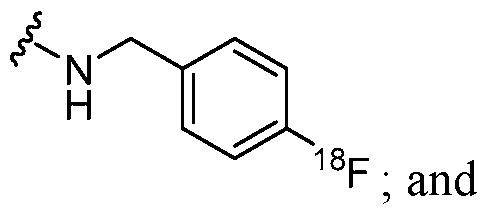
wherein when
 are hydrogen, and R4 is
O CH3, R is not vT >
80. The method of claim 79, wherein the emission is measured using positron emission tomography.
81. The method of claim 79 or 80, wherein the sample is a cell culture.
82. The method of claim 79 or 80, wherein the organism is a mammal.
83. The method of claim 82, wherein the mammal is a mouse, rat, pig, dog, monkey, baboon, or human.
84. The method of claim 79, wherein the compound interacts with a protein and measuring the emission allows determination of the expression level or distribution of the protein in the sample or organism.
85. The method of claim 84, wherein the protein is involved in inflammation and measuring the emission allows determination of the amount or distribution of inflammation in the sample or organism.
86. The method of claim 84 or 85, wherein the protein is cyclooxygenase-2.
87. The method of claim 82 or 83, wherein the mammal is known or suspected to have a condition or state selected from the group consisting of arthritis, cardiovascular disease, central nervous system damage, central nervous system disorders, gastrointestinal disorder, hypersensitivity, swelling, inflammatory disease, metabolic disorder, neoplastic disease, neurodegenerative disease, neuromuscular junction disease, ophthalmic disease, post operative inflammation, psychiatric condition, reproductive event, respiratory disease, skin disorder, tissue repair, urogenital disease, white matter disease, and a combination thereof.
88. The method of claim 87, wherein the neurodegenerative disease is Alzheimer’s disease, Parkinson’s disease, Huntington’s disease, amyotrophic lateral sclerosis, cortical dementias, or multiple sclerosis.
89. The method of claim 87, wherein the arthritis is rheumatoid or osteoarthritis.
90. The method of claim 87, wherein the neoplastic disease comprises a cancer selected from the group consisting of colorectal cancer, breast cancer, lung cancer, prostate cancer, bladder cancer, cervical cancer, skin cancer, lymphoma, and a combination thereof.
91. The method of claim 87, wherein the central nervous system damage or disorder comprises traumatic brain injury.
92. The method of claim 87, wherein the inflammatory disease is asthma, Bechet’s disease, bronchitis, bursitis, Crohn’s disease, endotoxin shock syndrome, gastritis, gingivitis, inflammatory bowel disease, polymyositis, pulmonary inflammation, cystic fibrosis, rheumatic fever, sarcoidosis, tendinitis, thyroiditis, or ulcerative colitis.
93. The method of claim 92, wherein the pulmonary inflammation is an acute respiratory disease syndrome resulting from viral and/or bacterial infection.
94. The method of claim 93, wherein the viral infection comprises COVID-19.
95. The method of claim 87, wherein the cardiovascular disease comprises myocardial infarction.
96. The method of claim 87, wherein the urogenital disease comprises renal disease.
97. The method of claim 87, wherein the reproductive event comprises ovulation, pregnancy, childbirth, and a combination thereof.
98. The method of any one of claims 87-97, wherein the mammal is known or suspected to be experiencing pain.
99. The method of any one of claims 79-98,

100. The method of any one of claims 79-98, wherein

101. The method of any one of claims 79-98,

102. The method of any one of claims 79-101, wherein R is selected from the group consisting of (Ci-Ce)alkyl, (Ci-Ce)alkynyl, (Ci-C6)heteroalkyl, (Ci-C6)heteroalkynyl, (C3- C7)cycloalkyl, (C3-C7)heterocycloalkyl, (Ci-C6)alkyl-(C3-C7)cycloalkyl, (Ci-C6)alkyl-(C3- C7)heterocycloalkyl, aryl, (Ci-Ce)alkyl-aryl, heteroaryl, (Ci-C6)alkyl-heteroaryl, and N(R5)2; wherein each (Ci-Ce)alkyl, (Ci-Ce)alkynyl, (Ci-C6)heteroalkyl, (Ci- C6)heteroalkynyl, (C3-C7)cycloalkyl, (C3-C7)heterocycloalkyl, (Ci-C6)alkyl-(C3- C7)cycloalkyl, (Ci-C6)alkyl-(C3-C7)heterocycloalkyl, aryl, (Ci-Ce)alkyl-aryl,
heteroaryl, or (Ci-C6)alkyl-heteroaryl is optionally substituted with deuterium, UC, 18F, or 123I.
103. The method of any one of claims 79-102, wherein each occurrence of R5 is independently selected from the group consisting of hydrogen, (Ci-Ce)alkyl, aryl, (Ci- C6)alkyl-aryl, heteroaryl, and (Ci-C6)alkyl-heteroaryl; wherein each (Ci-Ce)alkyl, aryl, (Ci-Ce)alkyl-aryl, heteroaryl, or (Ci-Ce)alkyl- heteroaryl is optionally substituted with deuterium, UC, 18F, or 123I.
104. The method of any one of claims 79-103, wherein R is CFF, UCH3, CH218F,

105. The method of any one of claims 79-104, wherein R is CFF, UCH3, or (CH2)218F.
106. The method of any one of claims 79-98, wherein R1, R2, R3, and R4 are each independently selected from the group consisting of hydrogen, deuterium, halogen, UC, 18F, 123I, (Ci-Ce)alkyl, (Ci-Ce)alkynyl, (Ci-C6)heteroalkyl, (Ci-C6)heteroalkynyl, (C3- C7)cycloalkyl, (C3-C7)heterocycloalkyl, (Ci-C6)alkyl-(C3-C7)cycloalkyl, (Ci-C6)alkyl-(C3- C7)heterocycloalkyl, aryl, (Ci-Ce)alkyl-aryl, heteroaryl, (Ci-C6)alkyl-heteroaryl, and N(R5)2;
wherein each (Ci-Ce)alkyl, (Ci-C6)alkynyl, (Ci-Ce)heteroalkyl, (Ci- C6)heteroalkynyl, (C3-C7)cycloalkyl, (C3-C7)heterocycloalkyl, (Ci-C6)alkyl-(C3- C7)cycloalkyl, (Ci-C6)alkyl-(C3-C7)heterocycloalkyl, aryl, (Ci-Ce)alkyl-aryl, heteroaryl, or (Ci-Ce)alkyl-heteroaryl is optionally substituted with deuterium, UC, 18F, or 123I.
107. The method of any one of claims 79-98 or 106, wherein each occurrence of R5 is independently selected from the group consisting of hydrogen, deuterium, (C i -Cr,)al kyl , aryl, (Ci-Ce)alkyl-aryl, heteroaryl, and (Ci-C6)alkyl-heteroaryl;
wherein each (Ci-Ce)alkyl, aryl, (Ci-Ce)alkyl-aryl, heteroaryl, or (Ci-Ce)alkyl- heteroaryl is optionally substituted with deuterium, UC, 18F, or 123T
108. The method of any one of claims 79-98 or 106-107, wherein R1, R2, R3, and R4 are each independently hydrogen, deuterium, halogen, 18F, 123I, CFb, UCH3, CH218F, (CH2)218F,

109. The method of any one of claims 79-98 or 106-108, wherein R1 is hydrogen or 18F.
110. The method of any one of claims 79-98 or 106-108, wherein R2 is hydrogen,

111. The method of any one of claims 79-98 or 106-108, wherein R3 is hydrogen or 18F.
112. The method of any one of claims 79-98 or 106-108, wherein R4 is 18F, CD218F,

113. The method of any one of claims 79-98, wherein:

R is CH3 or UCH3;
R1 and R3 are hydrogen;
R2 is N(R5)2;
R4 is F, Cl, CF3, or 18F; and each occurrence of R5 is independently hydrogen, (Ci-Ce)alkyl-aryl, or (Ci-Ce)alkyl- heteroaryl.
114. The method of claim 113, wherein each occurrence of R5 is independently hydrogen,

116. The method of any one of claims 79-98, wherein:

R is CH3;
R1 and R2 are hydrogen;
R3 is 18F;
R4 is (NR5)2; and
each occurrence of R5 is independently hydrogen, (Ci-Ce)alkyl-aryl, or (Ci-Ce)alkyl- heteroaryl.
117. The method of claim 116, wherein each occurrence of R5 is independently hydrogen,

118. The method of claim 116 or 117, wherein R2 is
 or
or
any one of claims 79-98, wherein:

R and R4 are (Ci-Ce)alkyl, optionally substituted with one or more 18F, halogen, or deuterium;
R1 is hydrogen or 18F;
R2 is aryl, optionally substituted with 18F, or heteroaryl, optionally substituted with
120. The method of claim 119, wherein R is CFb or (CFh)218F.
121. The method of claim 119, wherein R2 is

122. The method of claim 119, wherein R4 is CF3, CH218F, CD218F, or CF218F.
123. The method of any one of claims 79-98, wherein the compound of Formula I is

124. The method of any one of claims 79-98, wherein the compound of Formula I is

125. The method of any one of claims 79-98, wherein the compound of Formula I is

126. The method of any one of claims 79-98, wherein the compound of Formula I is
 pharmaceutically acceptable salt thereof.
127. The method of any one of claims 79-98, wherein the compound of Formula I is
 pharmaceutically acceptable salt thereof.
128. The method of any one of claims 79-98, wherein the compound of Formula I is
 pharmaceutically acceptable salt thereof.
129. The method of any one of claims 79-98, wherein the compound of Formula I is
 pharmaceutically acceptable salt thereof.
130. The method of any one of claims 79-98, wherein the compound of Formula I is
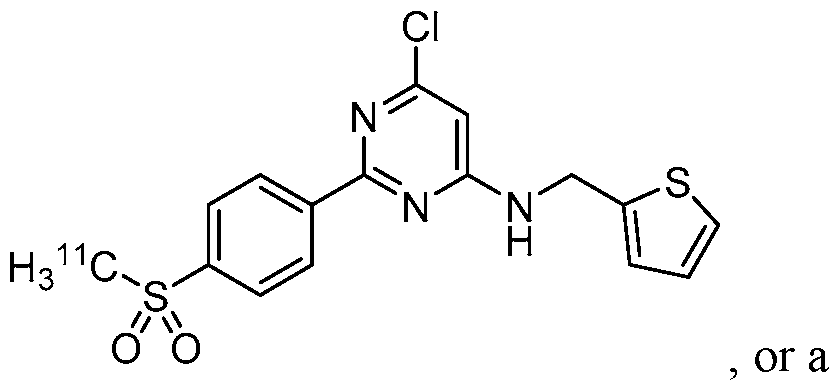 pharmaceutically acceptable salt thereof.
131. The method of any one of claims 79-98, wherein the compound of Formula I is
 pharmaceutically acceptable salt thereof.
132. The method of any one of claims 79-98, wherein the compound of Formula I is

134. The method of any one of claims 79-98, wherein the compound of Formula I is ny one of claims 79-98, wherein the compound of Formula I is

136. The method of any one of claims 79-98, wherein the compound of Formula I is
any one of claims 79-98, wherein the compound of Formula I is

138. The method of any one of claims 79-98, wherein the compound of Formula I is

Priority Applications (1)
| Application Number | Priority Date | Filing Date | Title |
|---|---|---|---|
| US17/553,462 US20220106275A1 (en) | 2019-06-20 | 2021-12-16 | Radiolabeled compounds and uses thereof |
Applications Claiming Priority (2)
| Application Number | Priority Date | Filing Date | Title |
|---|---|---|---|
| US201962864339P | 2019-06-20 | 2019-06-20 | |
| US62/864,339 | 2019-06-20 |
Related Child Applications (1)
| Application Number | Title | Priority Date | Filing Date |
|---|---|---|---|
| US17/553,462 Continuation US20220106275A1 (en) | 2019-06-20 | 2021-12-16 | Radiolabeled compounds and uses thereof |
Publications (1)
| Publication Number | Publication Date |
|---|---|
| WO2020257653A1 true WO2020257653A1 (en) | 2020-12-24 |
Family
ID=74040390
Family Applications (1)
| Application Number | Title | Priority Date | Filing Date |
|---|---|---|---|
| PCT/US2020/038739 Ceased WO2020257653A1 (en) | 2019-06-20 | 2020-06-19 | Radiolabeled compounds and uses thereof |
Country Status (2)
| Country | Link |
|---|---|
| US (1) | US20220106275A1 (en) |
| WO (1) | WO2020257653A1 (en) |
Cited By (1)
| Publication number | Priority date | Publication date | Assignee | Title |
|---|---|---|---|---|
| US11993580B1 (en) | 2022-12-02 | 2024-05-28 | Neumora Therapeutics, Inc. | Methods of treating neurological disorders |
Family Cites Families (1)
| Publication number | Priority date | Publication date | Assignee | Title |
|---|---|---|---|---|
| US7329401B2 (en) * | 2002-04-15 | 2008-02-12 | The Regents Of The University Of California | Cyclooxygenase-2 selective agents useful as imaging probes and related methods |
-
2020
- 2020-06-19 WO PCT/US2020/038739 patent/WO2020257653A1/en not_active Ceased
-
2021
- 2021-12-16 US US17/553,462 patent/US20220106275A1/en active Pending
Non-Patent Citations (4)
| Title |
|---|
| DATABASE PubChem COMPOUND NCBI; 17 March 2015 (2015-03-17), "COMPOUND SUMMARY 2-(4-Methylsulfonylphenyl)pyrimidine", XP055776368, Database accession no. CID 91500721 * |
| DE VRIES ET AL.: "Evaluation of [11C]rofecoxib as PET tracer for cyclooxygenase 2 overexpression in rat models of inflammation", NUCLEAR MEDICINE AND BIOLOGY, vol. 35, 2008, pages 35 - 42, XP022458209, DOI: 10.1016/j.nucmedbio.2007.07.015 * |
| MAJO ET AL.: "A general method for the synthesis of aryl [11C]methylsulfones: Potential PET probes for imaging cyclooxygenase-2 expression", BIOORGANIC & MEDICINAL CHEMISTRY LETTERS, vol. 15, 2005, pages 4268 - 4271, XP025314025, DOI: 10.1016/j.bmcl.2005.06.080 * |
| TIETZ OLE, SHARMA SAI KIRAN, KAUR JATINDER, WAY JENILEE, MARSHALL ALISON, WUEST MELINDA, WUEST FRANK: "Synthesis of three 18F-labelled cyclooxygenase-2 (COX-2) inhibitors based on a pyrimidine scaffold", ORG. BIOMOL. CHEM., vol. 11, 2013, pages 8052 - 8064, XP055776370 * |
Cited By (2)
| Publication number | Priority date | Publication date | Assignee | Title |
|---|---|---|---|---|
| US11993580B1 (en) | 2022-12-02 | 2024-05-28 | Neumora Therapeutics, Inc. | Methods of treating neurological disorders |
| US12371414B2 (en) | 2022-12-02 | 2025-07-29 | Neumora Therapeutics, Inc. | Methods of treating neurological disorders |
Also Published As
| Publication number | Publication date |
|---|---|
| US20220106275A1 (en) | 2022-04-07 |
Similar Documents
| Publication | Publication Date | Title |
|---|---|---|
| Rong et al. | Radiochemistry for positron emission tomography | |
| L Cole et al. | Radiosyntheses using fluorine-18: the art and science of late stage fluorination | |
| Jacobson et al. | Fluorine-18 radiochemistry, labeling strategies and synthetic routes | |
| Kelly et al. | Synthesis and pre-clinical evaluation of a new class of high-affinity 18F-labeled PSMA ligands for detection of prostate cancer by PET imaging | |
| Glaser et al. | Radiosynthesis and biodistribution of cyclic RGD peptides conjugated with novel [18F] fluorinated aldehyde-containing prosthetic groups | |
| Cai et al. | Synthesis and Evaluation of Two 18F-Labeled 6-Iodo-2-(4 ‘-N, N-dimethylamino) phenylimidazo [1, 2-a] pyridine Derivatives as Prospective Radioligands for β-Amyloid in Alzheimer's Disease | |
| Li et al. | Automation of the radiosynthesis of six different 18F-labeled radiotracers on the AllinOne | |
| US9957231B2 (en) | Iodine(II)-mediated radiofluorination | |
| Purohit et al. | Synthesis and biological evaluation of pyridazinone analogues as potential cardiac positron emission tomography tracers | |
| Van Der Wildt et al. | Discovery of a CSF-1R inhibitor and PET tracer for imaging of microglia and macrophages in the brain | |
| Berroteran-Infante et al. | (R)-[18F] NEBIFQUINIDE: A promising new PET tracer for TSPO imaging | |
| Cao et al. | Synthesis of novel PEG-modified nitroimidazole derivatives via “hot-click” reaction and their biological evaluation as potential PET imaging agent for tumors | |
| Bouhlel et al. | Synthesis, radiolabeling, and biological evaluation of (R)-and (S)-2-amino-5-[18F] fluoro-2-methylpentanoic acid ((R)-,(S)-[18F] FAMPe) as potential positron emission tomography tracers for brain tumors | |
| Kumar et al. | Radiosynthesis and evaluation of [18F] FMTP, a COX-2 PET ligand | |
| US20220106275A1 (en) | Radiolabeled compounds and uses thereof | |
| KR101852647B1 (en) | Compounds for use in imaging, diagnosing and/or treatment of diseases of the central nervous system | |
| US7329401B2 (en) | Cyclooxygenase-2 selective agents useful as imaging probes and related methods | |
| Lee et al. | Potential and practical adrenomedullary PET radiopharmaceuticals as an alternative to m-iodobenzylguanidine: m-(ω-[18f] fluoroalkyl) benzylguanidines | |
| Pickel et al. | Synthesis, Radiolabeling, and Biological Evaluation of the trans-Stereoisomers of 1-Amino-3-(fluoro-18F)-4-fluorocyclopentane-1-carboxylic Acid as PET Imaging Agents | |
| Nerella et al. | Carbon-11 patents (2012–2022): synthetic methodologies and novel radiotracers for PET imaging | |
| Högnäsbacka et al. | Synthesis and preclinical evaluation of [11C] EAI045 as a PET tracer for imaging tumors expressing mutated epidermal growth factor receptor | |
| JP7284490B2 (en) | Monoamine oxidase B imaging probe | |
| KR20130122944A (en) | Novel precursors of radiolabelled choline analog compounds | |
| Li et al. | Late-Stage Rapid [18F] Trifluoromethyl Radiolabeling of Terminal Alkenes at Room Temperature | |
| Yu et al. | Radiosynthesis and evaluation of a C-11 radiotracer for transient receptor potential canonical 5 in the brain |
Legal Events
| Date | Code | Title | Description |
|---|---|---|---|
| 121 | Ep: the epo has been informed by wipo that ep was designated in this application |
Ref document number: 20826255 Country of ref document: EP Kind code of ref document: A1 |
|
| NENP | Non-entry into the national phase |
Ref country code: DE |
|
| 122 | Ep: pct application non-entry in european phase |
Ref document number: 20826255 Country of ref document: EP Kind code of ref document: A1 |