WO2020255299A1 - 異常度推定装置、異常度推定方法、プログラム - Google Patents
異常度推定装置、異常度推定方法、プログラム Download PDFInfo
- Publication number
- WO2020255299A1 WO2020255299A1 PCT/JP2019/024312 JP2019024312W WO2020255299A1 WO 2020255299 A1 WO2020255299 A1 WO 2020255299A1 JP 2019024312 W JP2019024312 W JP 2019024312W WO 2020255299 A1 WO2020255299 A1 WO 2020255299A1
- Authority
- WO
- WIPO (PCT)
- Prior art keywords
- abnormality
- degree
- estimation
- anomaly
- normal
- Prior art date
- Legal status (The legal status is an assumption and is not a legal conclusion. Google has not performed a legal analysis and makes no representation as to the accuracy of the status listed.)
- Ceased
Links
Images


Classifications
-
- G—PHYSICS
- G10—MUSICAL INSTRUMENTS; ACOUSTICS
- G10L—SPEECH ANALYSIS TECHNIQUES OR SPEECH SYNTHESIS; SPEECH RECOGNITION; SPEECH OR VOICE PROCESSING TECHNIQUES; SPEECH OR AUDIO CODING OR DECODING
- G10L25/00—Speech or voice analysis techniques not restricted to a single one of groups G10L15/00 - G10L21/00
- G10L25/48—Speech or voice analysis techniques not restricted to a single one of groups G10L15/00 - G10L21/00 specially adapted for particular use
- G10L25/51—Speech or voice analysis techniques not restricted to a single one of groups G10L15/00 - G10L21/00 specially adapted for particular use for comparison or discrimination
-
- G—PHYSICS
- G06—COMPUTING OR CALCULATING; COUNTING
- G06F—ELECTRIC DIGITAL DATA PROCESSING
- G06F17/00—Digital computing or data processing equipment or methods, specially adapted for specific functions
- G06F17/10—Complex mathematical operations
- G06F17/18—Complex mathematical operations for evaluating statistical data, e.g. average values, frequency distributions, probability functions, regression analysis
-
- G—PHYSICS
- G06—COMPUTING OR CALCULATING; COUNTING
- G06N—COMPUTING ARRANGEMENTS BASED ON SPECIFIC COMPUTATIONAL MODELS
- G06N3/00—Computing arrangements based on biological models
- G06N3/02—Neural networks
- G06N3/04—Architecture, e.g. interconnection topology
- G06N3/045—Combinations of networks
-
- G—PHYSICS
- G06—COMPUTING OR CALCULATING; COUNTING
- G06N—COMPUTING ARRANGEMENTS BASED ON SPECIFIC COMPUTATIONAL MODELS
- G06N3/00—Computing arrangements based on biological models
- G06N3/02—Neural networks
- G06N3/04—Architecture, e.g. interconnection topology
- G06N3/045—Combinations of networks
- G06N3/0455—Auto-encoder networks; Encoder-decoder networks
-
- G—PHYSICS
- G06—COMPUTING OR CALCULATING; COUNTING
- G06N—COMPUTING ARRANGEMENTS BASED ON SPECIFIC COMPUTATIONAL MODELS
- G06N3/00—Computing arrangements based on biological models
- G06N3/02—Neural networks
- G06N3/08—Learning methods
- G06N3/088—Non-supervised learning, e.g. competitive learning
-
- G—PHYSICS
- G10—MUSICAL INSTRUMENTS; ACOUSTICS
- G10L—SPEECH ANALYSIS TECHNIQUES OR SPEECH SYNTHESIS; SPEECH RECOGNITION; SPEECH OR VOICE PROCESSING TECHNIQUES; SPEECH OR AUDIO CODING OR DECODING
- G10L25/00—Speech or voice analysis techniques not restricted to a single one of groups G10L15/00 - G10L21/00
- G10L25/27—Speech or voice analysis techniques not restricted to a single one of groups G10L15/00 - G10L21/00 characterised by the analysis technique
Definitions
- the present invention relates to unsupervised abnormality detection, and relates to an abnormality degree estimation device, an abnormality degree estimation method, and a program.
- Unsupervised anomaly detection is a problem of determining whether the observation vector x ⁇ R D is normal data or abnormal data.
- the observation vector x may be a spectrum of sound or an image.
- Identification result H (A ⁇ (x) - ⁇ )... (1) Will be.
- H () is a step function that returns 1 if the argument is non-negative and 0 if the argument is negative. That is, according to Eq. (1), the device by this method determines that the observation is abnormal if the identification result is 1, and determines that the observation is normal if the identification result is 0.
- the above method is used, for example, in Non-Patent Document 1.
- the degree of anomaly is not defined as “abnormality” of x, but as “dissociation from normality” of x.
- "normality” is the generation probability of x (ie likelihood)
- the dissociation from the normality of x can be expressed by, for example, the negative log-likelihood (ie information amount) of the generation probability of x. Therefore, let q ⁇ (x) be the generative model of x with the parameter ⁇ estimated by some method, and define the degree of anomaly as follows.
- a ⁇ (x) -lnq ⁇ (x)... (2)
- ⁇ is the following Kullback-Leibler information amount (KL information amount). ) Should be optimized to be minimized.
- J ⁇ J ⁇
- an object of the present invention is to provide an abnormality degree estimation device capable of appropriately determining normal data having a low appearance frequency as normal.
- the abnormality degree estimation device of the present invention is an abnormality degree estimation device that estimates the abnormality degree of the input acoustic signal, and is an abnormality degree estimation model optimized by using a set of normal sounds, and the appearance frequency is high. It includes an estimation unit that estimates the degree of abnormality of an acoustic signal using a model optimized so that the difference between the degree of abnormality in a high normal sound and the degree of abnormality in a normal sound with a low frequency of appearance is minimized.
- normal data having a low appearance frequency can be appropriately determined to be normal.
- FIG. 1 The block diagram which shows the structure of the abnormality degree estimation model learning apparatus of Example 1.
- FIG. The flowchart which shows the operation of the abnormality degree estimation model learning apparatus of Example 1.
- FIG. The block diagram which shows the structure of the abnormality degree estimation apparatus of Example 1.
- FIG. The flowchart which shows the operation of the abnormality degree estimation apparatus of Example 1.
- a ⁇ (x) is learned by minimizing the KL information amount in Eq. (5)
- a ⁇ (X) is the information amount of the sample with the lowest generation probability in the series. For example, considering Japanese voice, vowels such as "a” and “i” occur frequently, but consonants such as "w” and "p” occur less frequently.
- the degree of anomaly based on the maximum amount of information in Eq. (9)
- the degree of anomaly becomes high even though the voice is normal. Therefore, the number of false positives that falsely determine normal as abnormal increases.
- An intuitive way to solve this problem is to learn ⁇ so as to minimize the maximum amount of information in Eq. (9).
- a ⁇ (x) is no longer an amount of information, but ⁇ can be learned so as to directly minimize the degree of anomaly in normal data.
- N samples could be used to obtain one gradient in Eq. (5), but one gradient was obtained in Eq. (10). Only one sample is available. Therefore, the gradient calculation can be unstable, which is also impractical.
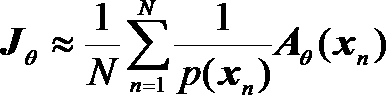
- equation (12) is in the form of the expected value for p (x), it can be approximated by the average value of the following training data.
- the anomaly degree that minimizes Eq. (9) is output by giving a large weight to the "low-appearance frequency" normal data that has a low probability of existing in the training data and minimizing the average value of the weighted anomaly degree.
- Anomaly estimation model A ⁇ (x) can be designed.
- the most common way to use the Gaussian kernel is:
- ⁇ is a positive constant to avoid division by zero, and a value of about 10 -5 should be set.
- the * part (first item) in the above formula may be changed.
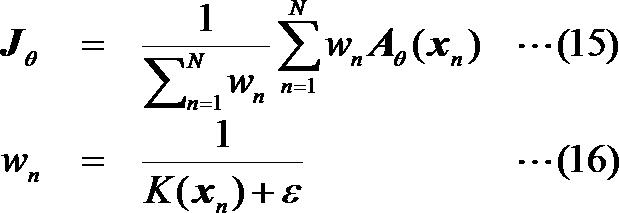
- the first term of the above equation may be changed to equation (15). That is, when calculating the average value of normal data obtained by multiplying the degree of abnormality by some weight, the weight can be designed to give a large weight to normal data having a low probability of existing in the training data and having a low frequency of appearance. ..
- the abnormality degree estimation model learning device 11 of the first embodiment includes a learning data acquisition unit 111, a weight calculation unit 112, a parameter update unit 113, a convergence test unit 114, and an abnormality degree estimation model storage unit. Includes 115.
- the operation of each configuration requirement will be described in detail with reference to FIG.
- an acoustic signal can be considered as the data, but the data handled here is not limited to the audio system, but is general data including normal data and abnormal data, and may be, for example, image data.
- the weight calculation unit 112 calculates the weight so as to give a large weight to the “low-appearance frequency” normal data having a low probability of existing in the training data (S112). Specifically, the formula
- the weight calculation unit 112 estimates the true distribution p (x) using kernel density estimation.
- W n in may be calculated as a weight. Further, the weight calculation unit 112 calculates the weight.
- the parameter update unit 113 updates the parameter ⁇ so as to reduce the value of the cost function J ⁇ using the weight calculated in step S112 (S113).
- ⁇ Convergence determination unit 114 The convergence test unit 114 determines the convergence of the value of the cost function J ⁇ , and if it has not converged, returns to step S112. Did step S113 repeat a certain number of times (for example, 100,000 times) as a rule for convergence test? Etc. can be used. Repeating step S113 until it converges is equivalent to finding the parameter ⁇ by ⁇ ⁇ argmin ⁇ J ⁇ . As mentioned above, ⁇ ⁇ argmin ⁇ J ⁇ is
- the parameter ⁇ may be obtained so as to minimize the approximated objective function J ⁇ .
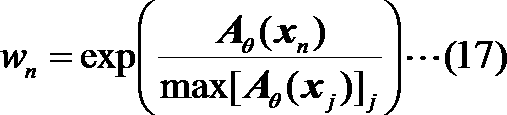
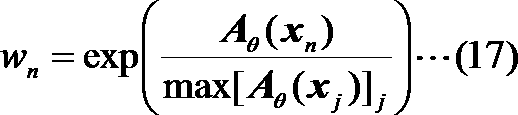
- the weight w n is
- the abnormality degree estimation model storage unit 115 stores the parameter ⁇ converged in step S114 and the abnormality degree estimation model A ⁇ (x) (S115).
- steps S112 and S114 all the data may be used, or a method using a part of all the samples such as the stochastic gradient descent method may be used. Further, in designing the abnormality degree estimation model A ⁇ (x), an autoencoder or the like may be used as in Non-Patent Document 1.
- the abnormality degree estimation device 12 of the first embodiment includes an abnormality degree estimation model storage unit 120, an abnormality degree estimation data acquisition unit 121, and an estimation unit 122.
- the operation of each configuration requirement will be described in detail with reference to FIG.
- the abnormality degree estimation model storage unit 120 stores in advance the abnormality degree estimation model A ⁇ (x) learned (optimized) by the abnormality degree estimation model learning device 11.
- the abnormality degree estimation data acquisition unit 121 acquires the abnormality degree estimation data (S121).
- an acoustic signal can be considered as the data, but the data handled here is not limited to the audio system, but is general data including normal data and abnormal data, and may be, for example, image data.
- the estimation unit 122 is trained (optimized) by the abnormality degree estimation model learning device 11, and estimates the abnormality degree of the above-mentioned data (for example, an acoustic signal) by using a model stored in advance in the abnormality degree estimation model storage unit 120. (S122).
- the difference between the abnormality degree in the normal data (normal sound) having a high appearance frequency and the abnormality degree in the normal data (normal sound) having a low appearance frequency is the minimum. It is a model trained (optimized) to be.
- the abnormality degree estimation model used in step S122 includes normal data (normal sound) having a high frequency of appearance as opposed to normal data (normal sound) having a low frequency of appearance in a set of normal data (normal sound). In comparison, it is learned (optimized) by giving a large weight.
- the anomaly estimation model A ⁇ (x) used in step S122 has a constant probability density in the set of normal sounds ⁇ x
- the weight w n is
- the anomaly degree estimation model learning device 11 of the first embodiment when constructing an anomaly detection system for series data, the anomaly degree estimation model A ⁇ (x) is used to reduce false positives that falsely determine normality as anomaly. You can learn. As a result, according to the abnormality degree estimation device 12 of the first embodiment, normal data having a low appearance frequency can be appropriately determined to be normal.
- the device of the present invention is, for example, as a single hardware entity, an input unit to which a keyboard or the like can be connected, an output unit to which a liquid crystal display or the like can be connected, and a communication device (for example, a communication cable) capable of communicating outside the hardware entity.
- Communication unit to which can be connected CPU (Central Processing Unit, cache memory, registers, etc.), RAM or ROM which is memory, external storage device which is hard disk, and input unit, output unit, communication unit of these , CPU, RAM, ROM, has a connecting bus so that data can be exchanged between external storage devices.
- a device (drive) or the like capable of reading and writing a recording medium such as a CD-ROM may be provided in the hardware entity.
- a general-purpose computer or the like is a physical entity equipped with such hardware resources.
- the external storage device of the hardware entity stores the program required to realize the above-mentioned functions and the data required for processing this program (not limited to the external storage device, for example, reading a program). It may be stored in a ROM, which is a dedicated storage device). Further, the data obtained by the processing of these programs is appropriately stored in a RAM, an external storage device, or the like.
- each program stored in the external storage device (or ROM, etc.) and the data necessary for processing each program are read into the memory as needed, and are appropriately interpreted, executed, and processed by the CPU. ..
- the CPU realizes a predetermined function (each configuration requirement represented by the above, ... Department, ... means, etc.).
- the present invention is not limited to the above-described embodiment, and can be appropriately modified without departing from the spirit of the present invention. Further, the processes described in the above-described embodiment are not only executed in chronological order according to the order described, but may also be executed in parallel or individually depending on the processing capacity of the device that executes the processes or if necessary. ..
- the processing function in the hardware entity (device of the present invention) described in the above embodiment is realized by a computer
- the processing content of the function that the hardware entity should have is described by a program. Then, by executing this program on the computer, the processing function in the hardware entity is realized on the computer.
- the various processes described above can be performed by causing the recording unit 10020 of the computer shown in FIG. 5 to read a program for executing each step of the above method and operating the control unit 10010, the input unit 10030, the output unit 10040, and the like. ..
- the program that describes this processing content can be recorded on a computer-readable recording medium.
- the computer-readable recording medium may be, for example, a magnetic recording device, an optical disk, a photomagnetic recording medium, a semiconductor memory, or the like.
- a hard disk device, a flexible disk, a magnetic tape, or the like as a magnetic recording device is used as an optical disk
- a DVD (Digital Versatile Disc), a DVD-RAM (Random Access Memory), or a CD-ROM (Compact Disc Read Only) is used as an optical disk.
- Memory CD-R (Recordable) / RW (ReWritable), etc.
- MO Magnetto-Optical disc
- EP-ROM Electroically Erasable and Programmable-Read Only Memory
- semiconductor memory can be used.
- this program is carried out, for example, by selling, transferring, renting, etc., a portable recording medium such as a DVD or CD-ROM on which the program is recorded.
- the program may be stored in the storage device of the server computer, and the program may be distributed by transferring the program from the server computer to another computer via a network.
- a computer that executes such a program first stores, for example, a program recorded on a portable recording medium or a program transferred from a server computer in its own storage device. Then, at the time of executing the process, the computer reads the program stored in its own recording medium and executes the process according to the read program. Further, as another execution form of this program, a computer may read the program directly from a portable recording medium and execute processing according to the program, and further, the program is transferred from the server computer to this computer. It is also possible to execute the process according to the received program one by one each time.
- ASP Application Service Provider
- the program in this embodiment includes information used for processing by a computer and equivalent to the program (data that is not a direct command to the computer but has a property of defining the processing of the computer, etc.).
- the hardware entity is configured by executing a predetermined program on the computer, but at least a part of these processing contents may be realized in terms of hardware.
Landscapes
- Engineering & Computer Science (AREA)
- Physics & Mathematics (AREA)
- Theoretical Computer Science (AREA)
- Data Mining & Analysis (AREA)
- General Physics & Mathematics (AREA)
- Mathematical Physics (AREA)
- Health & Medical Sciences (AREA)
- Computational Linguistics (AREA)
- General Engineering & Computer Science (AREA)
- Life Sciences & Earth Sciences (AREA)
- Software Systems (AREA)
- Mathematical Optimization (AREA)
- Mathematical Analysis (AREA)
- Computational Mathematics (AREA)
- Pure & Applied Mathematics (AREA)
- Acoustics & Sound (AREA)
- Human Computer Interaction (AREA)
- Signal Processing (AREA)
- Audiology, Speech & Language Pathology (AREA)
- Multimedia (AREA)
- Biophysics (AREA)
- Computing Systems (AREA)
- Molecular Biology (AREA)
- General Health & Medical Sciences (AREA)
- Evolutionary Computation (AREA)
- Biomedical Technology (AREA)
- Artificial Intelligence (AREA)
- Bioinformatics & Cheminformatics (AREA)
- Databases & Information Systems (AREA)
- Algebra (AREA)
- Probability & Statistics with Applications (AREA)
- Operations Research (AREA)
- Evolutionary Biology (AREA)
- Bioinformatics & Computational Biology (AREA)
- Complex Calculations (AREA)
- Measurement Of Mechanical Vibrations Or Ultrasonic Waves (AREA)
- Testing And Monitoring For Control Systems (AREA)
Abstract
Description
教師なし異常検知とは、観測ベクトルx∈RDが正常データか異常データかを判定する問題である。ここで観測ベクトルxは音のスペクトルでもいいし、画像でも良い。
識別結果=H(Aθ(x)-φ)…(1)
となる。ここでH( )は引数が非負なら1、負なら0を返すステップ関数である。つまりこの方法による装置は、(1)式により、識別結果が1ならば観測を異常と判定し、0ならば正常と判定する。上記の方法は、例えば非特許文献1などで利用されている。
Aθ(x)=-lnqθ(x)…(2)

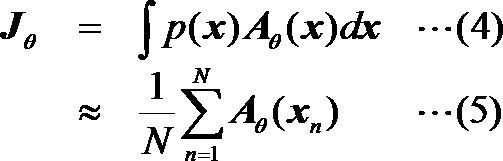
異常判定対象として何らかの時系列データを考える。つまり入力データをx∈RDを系列化したX∈RD×T=(x1,...,xT)とする場合の異常検知を考える。この具体例として、例えば、時間周波数表現した音声データや、動画データを考えるとよい。式(2)と同様に、この時系列データの異常度を定義すると以下となる。
Aθ(X)=-lnqθ(X)…(6)



そこで、あらゆる正常データに対して式(9)を最小化する異常度を考える。いまUを、正常音の集合{x|p(x)>0}に一定の確率密度を持ち、それ以外の領域に密度を持たない一様分布とする。任意の領域に確率密度を持つ確率分布の中で、最大情報量を最小化する確率分布は一様分布であることから、Aθ(x)は以下の目的関数を最小にするよう学習すればいい。



しかし、真の分布p(x)は未知であるため、重み1/p(x)は何らかの形で推定しなくてはならない。ここでは、カーネル密度推定を利用した推定法を述べる。カーネル密度推定は、学習データ{xn}N n=1からp(x)を求めるノンパラメトリックな密度推定法である。最も一般的なガウスカーネルを利用する方法は以下である。


式(16)の重みの計算はカーネル密度推定に基づいているため、計算量やメモリ消費量が膨大になることがある。これを避けるために、重みを異常度の逆数として近似的に与えてもよい。

ここまで、式(5)の形のコスト関数を変更する検討をしてきたが、それ以外のコスト関数を採用することもできる。例えば、正常データ{xn}N n=1だけでなく、実測値やシミュレーションで異常データ{ym}M m=1を得られているとする。この場合、例えば以下のようなコスト関数を利用することができる。

以下、図1を参照して実施例1の異常度推定モデル学習装置11の構成について説明する。同図に示すように本実施例の異常度推定モデル学習装置11は、学習データ取得部111と、重み計算部112と、パラメータ更新部113と、収束判定部114と、異常度推定モデル記憶部115を含む。以下、図2を参照して各構成要件の動作を詳述する。
学習データ取得部111は、正常データ{xn}N n=1と、必要であれば異常データ{ym}M m=1などの補助データを取得する(S111)。データとして例えば音響信号などが考えられるが、ここで取り扱うデータは音声系に限らず、正常なデータと異常なデータが含まれるデータ全般であり、例えば画像データなどでもよい。
重み計算部112は、学習データに存在する確率の低い“出現頻度が低い”正常データに大きな重みを与えるよう重みを計算する(S112)。具体的には、式

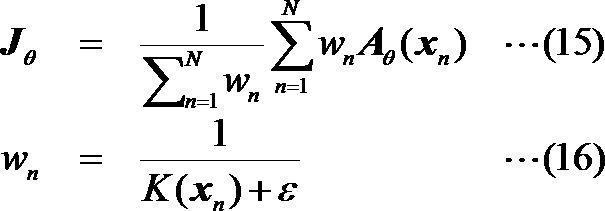
パラメータ更新部113は、ステップS112で計算した重みを利用したコスト関数Jθの値を小さくするようにパラメータθを更新する(S113)。
収束判定部114は、コスト関数Jθの値の収束判定をし、収束していなければステップS112に戻る。収束判定のルールとして、ステップS113を一定回数(例えば10万回)繰り返したか?などを利用できる。ステップS113を収束するまで繰り返し実行することは、θ←argminθJθにより、パラメータθを求めることに等しい。前述したように、θ←argminθJθとは、


異常度推定モデル記憶部115は、ステップS114により収束したパラメータθおよび、異常度推定モデルAθ(x)を記憶する(S115)。
以下、図3を参照して実施例1の異常度推定装置12の構成について説明する。同図に示すように本実施例の異常度推定装置12は、異常度推定モデル記憶部120と、異常度推定用データ取得部121と、推定部122を含む。以下、図4を参照して各構成要件の動作を詳述する。
異常度推定モデル記憶部120は、異常度推定モデル学習装置11で学習(最適化)した異常度推定モデルAθ(x)を予め記憶する。
異常度推定用データ取得部121は、異常度推定用のデータを取得する(S121)。データとして例えば音響信号などが考えられるが、ここで取り扱うデータは音声系に限らず、正常なデータと異常なデータが含まれるデータ全般であり、例えば画像データなどでもよい。
推定部122は、異常度推定モデル学習装置11で学習(最適化)され、異常度推定モデル記憶部120に予め記憶されたモデルを用いて、上述のデータ(例えば音響信号)の異常度を推定する(S122)。




実施例1の異常度推定モデル学習装置11によれば、系列データに関する異常検知システムを構築する際、正常を異常と誤判定する偽陽性を小さくするよう、異常度推定モデルAθ(x)を学習することができる。これにより、実施例1の異常度推定装置12によれば、出現頻度が低い正常データを適切に正常と判定することができる。
本発明の装置は、例えば単一のハードウェアエンティティとして、キーボードなどが接続可能な入力部、液晶ディスプレイなどが接続可能な出力部、ハードウェアエンティティの外部に通信可能な通信装置(例えば通信ケーブル)が接続可能な通信部、CPU(Central Processing Unit、キャッシュメモリやレジスタなどを備えていてもよい)、メモリであるRAMやROM、ハードディスクである外部記憶装置並びにこれらの入力部、出力部、通信部、CPU、RAM、ROM、外部記憶装置の間のデータのやり取りが可能なように接続するバスを有している。また必要に応じて、ハードウェアエンティティに、CD-ROMなどの記録媒体を読み書きできる装置(ドライブ)などを設けることとしてもよい。このようなハードウェア資源を備えた物理的実体としては、汎用コンピュータなどがある。
Claims (8)
- 入力された音響信号の異常度を推定する異常度推定装置であって、
正常音の集合を用いて最適化された異常度推定モデルであって、出現頻度が高い正常音における異常度と、前記出現頻度が低い前記正常音における前記異常度との差が最小となるように最適化されたモデルを用いて、前記音響信号の異常度を推定する推定部を含む
異常度推定装置。 - 請求項1に記載の異常度推定装置であって、
前記推定部は、
正常音の集合における前記出現頻度が低い前記正常音に対して、前記出現頻度が高い前記正常音と比較して、大きな重みを与えることにより最適化された前記異常度推定モデルを用いて、前記音響信号の異常度を推定する
異常度推定装置。 - 請求項2に記載の異常度推定装置であって、
U(x)を正常音の集合に一定の確率密度を持ち、それ以外の領域に密度を持たない一様分布とし、Aθ(x)をθをパラメータとして観測ベクトルxの異常らしさを求める異常度推定モデルとし、
前記推定部は、

で表される目的関数Jθを最小化するように最適化された前記異常度推定モデルAθ(x)を用いて、前記音響信号の異常度を推定する
異常度推定装置。 - 請求項3に記載の異常度推定装置であって、
観測ベクトルxの真の生成モデルをp(x)とし、Nを2以上の整数とし、n=1、…、Nとし、前記目的関数Jθを
と近似し、j=1、…、Nとし、λをバンド幅パラメータとし、p(xn)をカーネル密度推定によって、

と近似し、εをゼロ除算を避けるための正の定数とし、目的関数Jθ、重みwnを、

と近似して、近似された前記目的関数Jθを最小化するように最適化された前記異常度推定モデルAθ(x)を用いて、前記音響信号の異常度を推定する
異常度推定装置。 - 請求項4に記載の異常度推定装置であって、
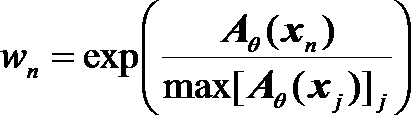
前記重みwnは、
と計算される
異常度推定装置。 - 入力されたデータの異常度を推定する異常度推定装置であって、
正常データの集合を用いて最適化された異常度推定モデルであって、出現頻度が高い正常データにおける異常度と、前記出現頻度が低い前記正常データにおける前記異常度との差が最小となるように最適化されたモデルを用いて、前記データの異常度を推定する推定部を含む
異常度推定装置。 - 入力された音響信号の異常度を推定する異常度推定方法であって、
正常音の集合を用いて最適化された異常度推定モデルであって、出現頻度が高い正常音における異常度と、前記出現頻度が低い前記正常音における前記異常度との差が最小となるように最適化されたモデルを用いて、前記音響信号の異常度を推定するステップを含む
異常度推定方法。 - コンピュータを請求項1から6の何れかに記載の異常度推定装置として機能させるプログラム。
Priority Applications (3)
| Application Number | Priority Date | Filing Date | Title |
|---|---|---|---|
| JP2021528537A JP7231027B2 (ja) | 2019-06-19 | 2019-06-19 | 異常度推定装置、異常度推定方法、プログラム |
| PCT/JP2019/024312 WO2020255299A1 (ja) | 2019-06-19 | 2019-06-19 | 異常度推定装置、異常度推定方法、プログラム |
| US17/619,200 US12387743B2 (en) | 2019-06-19 | 2019-06-19 | Abnormality estimation device, abnormality estimation method, and program |
Applications Claiming Priority (1)
| Application Number | Priority Date | Filing Date | Title |
|---|---|---|---|
| PCT/JP2019/024312 WO2020255299A1 (ja) | 2019-06-19 | 2019-06-19 | 異常度推定装置、異常度推定方法、プログラム |
Publications (1)
| Publication Number | Publication Date |
|---|---|
| WO2020255299A1 true WO2020255299A1 (ja) | 2020-12-24 |
Family
ID=74037034
Family Applications (1)
| Application Number | Title | Priority Date | Filing Date |
|---|---|---|---|
| PCT/JP2019/024312 Ceased WO2020255299A1 (ja) | 2019-06-19 | 2019-06-19 | 異常度推定装置、異常度推定方法、プログラム |
Country Status (3)
| Country | Link |
|---|---|
| US (1) | US12387743B2 (ja) |
| JP (1) | JP7231027B2 (ja) |
| WO (1) | WO2020255299A1 (ja) |
Cited By (1)
| Publication number | Priority date | Publication date | Assignee | Title |
|---|---|---|---|---|
| WO2024070169A1 (ja) * | 2022-09-29 | 2024-04-04 | 日本碍子株式会社 | 試作条件提案システム、試作条件提案方法 |
Citations (5)
| Publication number | Priority date | Publication date | Assignee | Title |
|---|---|---|---|---|
| JPH07219581A (ja) * | 1994-01-31 | 1995-08-18 | Babcock Hitachi Kk | 音響信号の識別方法および装置 |
| JP2006300896A (ja) * | 2005-04-25 | 2006-11-02 | Matsushita Electric Works Ltd | 設備監視方法および設備監視装置 |
| JP2012181280A (ja) * | 2011-02-28 | 2012-09-20 | Sogo Keibi Hosho Co Ltd | 音処理装置および音処理方法 |
| JP2017090606A (ja) * | 2015-11-09 | 2017-05-25 | 日本電信電話株式会社 | 異常音検出装置、異常音検出学習装置、これらの方法及びプログラム |
| WO2017171051A1 (ja) * | 2016-04-01 | 2017-10-05 | 日本電信電話株式会社 | 異常音検出学習装置、音響特徴量抽出装置、異常音サンプリング装置、これらの方法及びプログラム |
Family Cites Families (7)
| Publication number | Priority date | Publication date | Assignee | Title |
|---|---|---|---|---|
| FR2994495B1 (fr) * | 2012-08-10 | 2015-08-21 | Thales Sa | Procede et systeme pour detecter des evenements sonores dans un environnement donne |
| CA2932069A1 (en) * | 2013-11-29 | 2015-06-04 | Ge Aviation Systems Limited | Method of construction of anomaly models from abnormal data |
| JP2019531792A (ja) * | 2016-09-07 | 2019-11-07 | コーニンクレッカ フィリップス エヌ ヴェKoninklijke Philips N.V. | 異常心音の検出のための分類器アンサンブル |
| JP6794197B2 (ja) | 2016-09-12 | 2020-12-02 | キヤノン株式会社 | 情報処理装置、情報処理方法及びプログラム |
| WO2019166397A1 (en) * | 2018-02-28 | 2019-09-06 | Robert Bosch Gmbh | Intelligent audio analytic apparatus (iaaa) and method for space system |
| EP3628564A1 (en) * | 2018-09-26 | 2020-04-01 | Siemens Mobility GmbH | Method for analysing conditions of technical components |
| JP7149197B2 (ja) * | 2019-02-06 | 2022-10-06 | 株式会社日立製作所 | 異常音検知装置および異常音検知方法 |
-
2019
- 2019-06-19 WO PCT/JP2019/024312 patent/WO2020255299A1/ja not_active Ceased
- 2019-06-19 US US17/619,200 patent/US12387743B2/en active Active
- 2019-06-19 JP JP2021528537A patent/JP7231027B2/ja active Active
Patent Citations (5)
| Publication number | Priority date | Publication date | Assignee | Title |
|---|---|---|---|---|
| JPH07219581A (ja) * | 1994-01-31 | 1995-08-18 | Babcock Hitachi Kk | 音響信号の識別方法および装置 |
| JP2006300896A (ja) * | 2005-04-25 | 2006-11-02 | Matsushita Electric Works Ltd | 設備監視方法および設備監視装置 |
| JP2012181280A (ja) * | 2011-02-28 | 2012-09-20 | Sogo Keibi Hosho Co Ltd | 音処理装置および音処理方法 |
| JP2017090606A (ja) * | 2015-11-09 | 2017-05-25 | 日本電信電話株式会社 | 異常音検出装置、異常音検出学習装置、これらの方法及びプログラム |
| WO2017171051A1 (ja) * | 2016-04-01 | 2017-10-05 | 日本電信電話株式会社 | 異常音検出学習装置、音響特徴量抽出装置、異常音サンプリング装置、これらの方法及びプログラム |
Cited By (2)
| Publication number | Priority date | Publication date | Assignee | Title |
|---|---|---|---|---|
| WO2024070169A1 (ja) * | 2022-09-29 | 2024-04-04 | 日本碍子株式会社 | 試作条件提案システム、試作条件提案方法 |
| JPWO2024070169A1 (ja) * | 2022-09-29 | 2024-04-04 |
Also Published As
| Publication number | Publication date |
|---|---|
| JP7231027B2 (ja) | 2023-03-01 |
| US20220246165A1 (en) | 2022-08-04 |
| JPWO2020255299A1 (ja) | 2020-12-24 |
| US12387743B2 (en) | 2025-08-12 |
Similar Documents
| Publication | Publication Date | Title |
|---|---|---|
| US12182731B2 (en) | Anomaly detection apparatus, anomaly detection method, and program | |
| US11004012B2 (en) | Assessment of machine learning performance with limited test data | |
| CN109783490B (zh) | 数据融合方法、装置、计算机设备及存储介质 | |
| JP6881207B2 (ja) | 学習装置、プログラム | |
| JP6943067B2 (ja) | 異常音検知装置、異常検知装置、プログラム | |
| JP7188598B2 (ja) | 異常度推定装置、異常度推定方法、およびプログラム | |
| US20200401943A1 (en) | Model learning apparatus, model learning method, and program | |
| EP3115939A1 (en) | Alternative training distribution based on density modification | |
| WO2020234984A1 (ja) | 学習装置、学習方法、コンピュータプログラム及び記録媒体 | |
| US20230206099A1 (en) | Computational estimation of a characteristic of a posterior distribution | |
| CN115049003B (zh) | 一种预训练模型微调方法、装置、设备和存储介质 | |
| US20230186150A1 (en) | Hyperparameter selection using budget-aware bayesian optimization | |
| US20170178168A1 (en) | Effectiveness of service complexity configurations in top-down complex services design | |
| US12212939B2 (en) | Target sound signal generation apparatus, target sound signal generation method, and program | |
| JP7231027B2 (ja) | 異常度推定装置、異常度推定方法、プログラム | |
| JP7529159B2 (ja) | 学習装置、学習方法、および、学習プログラム | |
| JP2022183763A (ja) | 学習装置、方法およびプログラム | |
| JP7505555B2 (ja) | 学習装置、学習方法及びプログラム | |
| JP7188597B2 (ja) | 特徴量抽出装置、異常度推定装置、それらの方法、およびプログラム | |
| US20240378445A1 (en) | Learning device, learning method, and program | |
| WO2023148965A1 (ja) | モデル学習装置、モデル学習方法、プログラム | |
| JP6852167B2 (ja) | コンフュージョンネットワーク分散表現生成装置、コンフュージョンネットワーク分類装置、コンフュージョンネットワーク分散表現生成方法、コンフュージョンネットワーク分類方法、プログラム | |
| CN115687986A (zh) | 样本管理的方法、电子设备和计算机程序产品 | |
| JP7226568B2 (ja) | ニューラルネットワーク学習装置、ニューラルネットワーク学習方法、プログラム | |
| CN113723436A (zh) | 数据的处理方法、装置、计算机设备和存储介质 |
Legal Events
| Date | Code | Title | Description |
|---|---|---|---|
| 121 | Ep: the epo has been informed by wipo that ep was designated in this application |
Ref document number: 19934308 Country of ref document: EP Kind code of ref document: A1 |
|
| ENP | Entry into the national phase |
Ref document number: 2021528537 Country of ref document: JP Kind code of ref document: A |
|
| NENP | Non-entry into the national phase |
Ref country code: DE |
|
| 122 | Ep: pct application non-entry in european phase |
Ref document number: 19934308 Country of ref document: EP Kind code of ref document: A1 |
|
| WWG | Wipo information: grant in national office |
Ref document number: 17619200 Country of ref document: US |