WO2020233258A1 - 一种数据共享策略下的多中心协同预后预测系统 - Google Patents
一种数据共享策略下的多中心协同预后预测系统 Download PDFInfo
- Publication number
- WO2020233258A1 WO2020233258A1 PCT/CN2020/083588 CN2020083588W WO2020233258A1 WO 2020233258 A1 WO2020233258 A1 WO 2020233258A1 CN 2020083588 W CN2020083588 W CN 2020083588W WO 2020233258 A1 WO2020233258 A1 WO 2020233258A1
- Authority
- WO
- WIPO (PCT)
- Prior art keywords
- data
- center
- medical institution
- model
- prognosis prediction
- Prior art date
- Legal status (The legal status is an assumption and is not a legal conclusion. Google has not performed a legal analysis and makes no representation as to the accuracy of the status listed.)
- Ceased
Links
Classifications
-
- G—PHYSICS
- G06—COMPUTING OR CALCULATING; COUNTING
- G06F—ELECTRIC DIGITAL DATA PROCESSING
- G06F18/00—Pattern recognition
- G06F18/20—Analysing
- G06F18/24—Classification techniques
- G06F18/241—Classification techniques relating to the classification model, e.g. parametric or non-parametric approaches
-
- G—PHYSICS
- G06—COMPUTING OR CALCULATING; COUNTING
- G06F—ELECTRIC DIGITAL DATA PROCESSING
- G06F21/00—Security arrangements for protecting computers, components thereof, programs or data against unauthorised activity
- G06F21/60—Protecting data
- G06F21/62—Protecting access to data via a platform, e.g. using keys or access control rules
- G06F21/6218—Protecting access to data via a platform, e.g. using keys or access control rules to a system of files or objects, e.g. local or distributed file system or database
- G06F21/6245—Protecting personal data, e.g. for financial or medical purposes
-
- G—PHYSICS
- G16—INFORMATION AND COMMUNICATION TECHNOLOGY [ICT] SPECIALLY ADAPTED FOR SPECIFIC APPLICATION FIELDS
- G16H—HEALTHCARE INFORMATICS, i.e. INFORMATION AND COMMUNICATION TECHNOLOGY [ICT] SPECIALLY ADAPTED FOR THE HANDLING OR PROCESSING OF MEDICAL OR HEALTHCARE DATA
- G16H10/00—ICT specially adapted for the handling or processing of patient-related medical or healthcare data
- G16H10/60—ICT specially adapted for the handling or processing of patient-related medical or healthcare data for patient-specific data, e.g. for electronic patient records
Definitions
- the present invention belongs to the medical field and machine learning field, and in particular relates to a multi-center collaborative prognosis prediction system under a data sharing strategy.
- Prognosis prediction plays an important role in clinical research and practice.
- the predictive model based on the electronic health record (EHR) data of a single medical institution may lack sufficient statistical power and good generalization ability. Therefore, the construction of a prognosis prediction model based on the collaborative analysis of the electronic health record data of multiple medical institutions can be used to increase the number and coverage of patients for model training, enrich the prognostic characteristics of patients, and ultimately improve the accuracy and accuracy of the model’s prognosis prediction.
- Generalization Ensemble learning is an algorithm that is widely used in clinical prognosis. Unlike linear models such as logistic regression and cox models, ensemble learning algorithms usually have better accuracy and have the ability to capture the nonlinear relationship between variables. Avoid overfitting problems that are common in machine learning.
- the purpose of the present invention is to provide a multi-center collaborative prognosis prediction system under a novel data sharing strategy in view of the deficiencies of the prior art.
- a multi-center collaborative prognosis prediction system under a data sharing strategy the system includes the following four modules:
- Data acquisition module Collect data of various variables required for patient prognosis prediction in each medical institution center, as the source data set of the medical institution center.
- (2) Data anonymization module randomly sample the source data set of each medical institution center with a percentage p, and use an anonymization algorithm to generate anonymized data for the sampled data, and the remaining data is used as the local training of the medical institution center Set; the anonymized data from the center of each medical institution is collected by the central server to synthesize the enhanced data set; the enhanced data set is divided into two parts, namely the additional training set and the validation set; the additional training set is used for backhaul and assigned to each medical Institutional center; the validation set is used to select the hyper parameters of the integrated learning model.
- Model training module each medical institution center trains the sub-classifier of the integrated learning model locally, and the training data during the training includes the local training set of the medical institution center and the central server transmits back to the medical institution The additional training set of the institution center; this shows that the training set used to train the sub-classifiers of each medical institution center not only comes from the center itself but also from the data set of other centers, thereby increasing the randomness of the data set and improving the overall learning model performance.
- the hyperparameters of the integrated learning model are selected using the validation set created from the enhanced data set.
- Prognosis model application module the central server collects the sub-classifiers trained locally in each medical institution center to form a complete integrated learning model; new patient data is input into the integrated learning model to perform prognosis prediction.
- the random sampling percentage p of the central source data set of each medical institution is selected as 50%. Fixing the anonymized data ratio p at 50% can improve the prediction effect of the ensemble learning model.
- the direct integration of sub-classifiers or the complete anonymization of data and then centralized training can not achieve the best results; the size of p can be adjusted to accommodate complex Decision support scenarios are used to predict the prognosis of patients in clinical practice under different scenarios.
- the anonymization algorithm can be selected from k-anonymity (k-anonymity), l-diversity (l-diversity), t-closeness (t-closeness) and differential privacy and other anonymous algorithms.
- k-anonymity k-anonymity
- l-diversity l-diversity
- t-closeness t-closeness
- differential privacy and other anonymous algorithms k-anonymity
- the method specifically used to realize k-anonymity can choose suppression, which means that certain information is completely hidden and certain data items are not released.
- the system considers horizontal-partitioned data, that is, the source data set of each medical institution center has the same kinds of variables.
- the beneficial effect of the present invention is that the present invention innovatively proposes a multi-center data sharing strategy, which can realize privacy-protected data sharing under multiple medical institution centers, thereby providing sufficient data for model construction.
- the present invention uses an integrated learning algorithm (such as a random forest algorithm) that can obtain a better prediction result than a weak classifier to construct a system.
- the system processes sensitive patient-level data in each center, and at the same time constructs a sub-classifier of the integrated learning model, only exchanges less sensitive intermediate results to build a complete integrated learning model, thus ensuring that the proposed multi-center model is compatible with The centralized model has the same or even better results.
- the multi-center collaborative prognosis prediction system of the present invention protects the personal privacy of patients, and does not need to run algorithm models on large centralized data sources. In actual clinical applications, it provides reliable results for the lack of samples for constructing prediction models in a single medical institution. solution.
- FIG. 1 is a framework diagram of a multi-center collaborative prognosis prediction system under a data sharing strategy
- FIG. 2 is a schematic diagram of a data sharing strategy
- FIG. 3 is a schematic diagram of data transmission in each center
- FIG. 4 is a comparison diagram of the prediction capabilities of the multi-center collaborative prognosis prediction system under the data sharing strategy of the present invention and the prognosis prediction system under the centralized training.
- a multi-center collaborative prognosis prediction system under a novel data sharing strategy provided by the present invention includes the following four modules:
- (1) Data acquisition module Collect data of various variables required for patient prognosis prediction at each medical institution center, as the source data set of the medical institution center. This embodiment uses colorectal cancer data for experimental verification. The number of medical institution centers is five. The electronic medical record data samples collected by each medical institution center through the data acquisition module are shown in Table 1, including age and gender. , Tumor size, T stage, N stage, and carcinoembryonic antigen index.
- Table 1 Examples of electronic medical record data collection of a single center for colorectal cancer patients
- (2) Data anonymization module As shown in Figure 2, the source data set of each medical institution center is randomly sampled with a percentage p, the sampled data is used to generate anonymized data using an anonymization algorithm, and the remaining data is used as the The local training set of the medical institution center.
- the anonymized data from each medical institution center is collected by the central server to synthesize an enhanced data set; the enhanced data set is divided into two parts, namely an additional training set and a validation set; the additional training set is used for backhaul and distributed to each medical institution center ;
- the validation set is used to select the hyperparameters of the integrated learning model.
- the anonymization data ratio p is set to 50%.
- the specific anonymization algorithm uses the suppression algorithm in k-anonymity. There are two hyperparameters that need to be selected through the verification set: the maximum number of features used by a single decision tree, and The number of classifiers.
- Model training module As shown in Figure 2, each medical institution center trains the sub-classifier of the integrated learning model locally, and the training data in the training process includes the local training set and central training set of the medical institution center.
- the server sends back the additional training set of the center of the medical institution; this shows that the training set used to train the sub-classifiers of each medical institution center not only comes from the center itself but also from the data set of other centers, thereby increasing the randomness of the data set. Improve the overall performance of the integrated learning model.
- Prognosis model application module the central server collects sub-classifiers trained locally in each medical institution center to form a complete integrated learning model; new patient data is input into the integrated learning model to perform prognosis prediction.
- the experimental results are shown in Figure 4.
- the predictive ability of the prognostic prediction system is measured by AUC. It can be seen that the multi-center collaborative prognosis prediction system under the data sharing strategy proposed by the present invention can obtain better prediction results than the prognosis prediction system under centralized training.
Landscapes
- Engineering & Computer Science (AREA)
- Theoretical Computer Science (AREA)
- General Health & Medical Sciences (AREA)
- Health & Medical Sciences (AREA)
- General Engineering & Computer Science (AREA)
- Bioethics (AREA)
- Medical Informatics (AREA)
- Data Mining & Analysis (AREA)
- General Physics & Mathematics (AREA)
- Physics & Mathematics (AREA)
- Computer Hardware Design (AREA)
- Life Sciences & Earth Sciences (AREA)
- Computer Security & Cryptography (AREA)
- Epidemiology (AREA)
- Primary Health Care (AREA)
- Public Health (AREA)
- Databases & Information Systems (AREA)
- Software Systems (AREA)
- Artificial Intelligence (AREA)
- Bioinformatics & Cheminformatics (AREA)
- Bioinformatics & Computational Biology (AREA)
- Computer Vision & Pattern Recognition (AREA)
- Evolutionary Biology (AREA)
- Evolutionary Computation (AREA)
- Management, Administration, Business Operations System, And Electronic Commerce (AREA)
Abstract
本发明公开了一种数据共享策略下的多中心协同预后预测系统。该系统能够在多个医疗机构中心下实现隐私保护的数据共享,从而为模型构建提供足够的数据。本发明采用相对于弱分类器能够获得更好预测结果的集成学习算法来构建系统。该系统在各个中心处理敏感的患者级数据,并同时构建出集成学习模型的子分类器,仅交换不太敏感的中间结果以构建完整的集成学习模型,从而保证了所提出的多中心模型与集中式模型具有相同甚至更优的结果。本发明多中心协同预后预测系统保护了患者的个人隐私,不需要在大型集中式数据源上运行算法模型,在实际临床应用中,为单个医疗机构中构建预测模型的样本太少提供了可靠的解决方案。
Description
[0001] 本发明属于医疗领域及机器学习领域,尤其涉及一种数据共享策略下的多中心协同预后预测系统。
[0002] 预后预测在临床研究和实践中发挥着重要作用。基于单个医疗机构的电子健康记录(EHR)数据构建的预测模型可能缺少足够的统计效力和良好的泛化能力。因此,基于多个医疗机构中心电子健康记录数据协同分析的预后预测模型构建,可以用于提高用于模型训练的患者数量和覆盖面,丰富患者的预后特征,最终提高模型的预后预测的准确性和泛化能力。集成学习是一种在临床预后中应用非常广泛的算法,与逻辑回归和cox模型等线性模型不同,集成学习算法通常精度更好,且具有捕获变量间的非线性关系的能力,能很好地避免机器学习中常见的过拟合问题。因此,利用集成学习算法进行模型构建,为多中心下的协同预后预测系统的搭建提供理想的解决方案。另外,在进行多中心预后预测的同时,必须要保护患者的隐私。现有的多中心下隐私保护的集成学习训练模型大多是基于加密的方法,如利用加性同态加密等方法。Aslett等人提出基于完全同态加密的集成学习模型。Magkos等人利用基于同态加密的协议框架构建加密模块,从而训练出集成学习分类器。虽然这些加密方法可以防止信息泄漏与数据交换,但会显著影响计算和存储效率,可扩展性差,不适用于处理多中心下的大型临床数据。
[0003] 本发明的目的在于针对现有技术的不足,提供一种新型数据共享策略下的多中心协同预后预测系统。
[0004] 本发明的目的是通过以下技术方案来实现的:一种数据共享策略下的多中心协同预后预测系统,该系统包括以下四个模块:
[0005] (1)数据获取模块:在各医疗机构中心分别收集患者预后预测所需要的各个变量的数据,作为该医疗机构中心的源数据集。
[0006] (2)数据匿名化模块:对每个医疗机构中心的源数据集以百分比p进行随机采样,对采样数据使用匿名化算法生成匿名化数据,剩余数据作为该医疗机构中心的本地训练集;来自每个医疗机构中心的匿名化数据由中央服务器收集合成增强数据集;将增强数据集分成两部分,即附加训练集和验证集;附加训练集用于回传并分配给每个医疗机构中心;验证集用于选择集成学习模型的超参数(hyper parameter)。
[0007] (3)模型训练模块:每个医疗机构中心在本地训练集成学习模型的子分类器,在训练过程中的训练数据包括该医疗机构中心的本地训练集和中央服务器回传给该医疗机构中心的附加训练集;这表明用于训练每个医疗机构中心子分类器的训练集不仅来自中心本身还来自其他中心的数据集,从而增加数据集的随机性,以提高集成学习模型的整体性能。在训练过程中,利用从增强数据集创建的验证集选择集成学习模型的超参数。
[0008] (4)预后模型应用模块:由中央服务器收集各医疗机构中心本地训练的子分类器构成完整的集成学习模型;将新的患者数据输入该集成学习模型执行预后预测。
[0009] 进一步地,所述数据匿名化模块中,每个医疗机构中心源数据集的随机采样百分比p选择50%。将匿名化数据比例p固定在50%能够提升集成学习模型的预测效果,子分类器的直接集成或者数据的完全匿名化再集中训练都不能实现最佳结果;p的大小可以调整以适应复杂的决策支持场景,用于不同场景下的临床实践中患者的预后预测。
[0010] 进一步地,所述匿名化算法可选择k-匿名算法(k-anonymity)、l-多样性(l-diversity)、t-临近度(t-closeness)以及差分隐私等匿名算法。其中具体用于实现k-匿名的方法可以选择抑制(suppression),抑制即彻底隐藏某些信息,不发布某些数据项。
[0011] 进一步地,该系统考虑水平分割数据(horizontal-partitioned data),即每个医疗机构中心的源数据集具有相同种类的变量。
[0012] 本发明的有益效果是:本发明创新地提出了一种多中心数据共享策略,能够在多个医疗机构中心下实现隐私保护的数据共享,从而为模型构建提供足够的数据。本发明采用相对于弱分类器能够获得更好预测结果的集成学习算法(如随机森林算法)来构建系统。该系统在各个中心处理敏感的患者级数据,并同时构建出集成学习模型的子分类器,仅交换不太敏感的中间结果以构建完整的集成学习模型,从而保证了所提出的多中心模型与集中式模型具有相同甚至更优的结果。本发明多中心协同预后预测系统保护了患者的个人隐私,不需要在大型集中式数据源上运行算法模型,在实际临床应用中,为单个医疗机构中构建预测模型的样本太少提供了可靠的解决方案。
[0013] 图1为数据共享策略下的多中心协同预后预测系统框架图;
[0014] 图2为数据共享策略示意图;
[0015] 图3为各中心数据传输示意图;
[0016] 图4为本发明数据共享策略下的多中心协同预后预测系统与集中式训练下的预后预测系统的预测能力对比图。
[0017] 下面结合附图和具体实施例对本发明作进一步详细说明。
[0018] 本发明提供的一种新型数据共享策略下的多中心协同预后预测系统,如图1所示,包括以下四个模块:
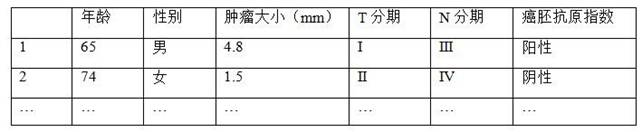
[0019] (1)数据获取模块:在各医疗机构中心分别收集患者预后预测所需要的各个变量的数据,作为该医疗机构中心的源数据集。本实施例采用结直肠癌的数据进行实验验证,其中医疗机构中心的个数为5个,各个医疗机构中心通过数据获取模块采集到的电子病历数据样例如表1所示,共包括年龄、性别、肿瘤大小、T分期、N分期以及癌胚抗原指数等6个变量的数据信息。
[0020] 表1:结直肠癌患者的单个中心的电子病历数据采集举例
[0021] (2)数据匿名化模块:如图2所示,对每个医疗机构中心的源数据集以百分比p进行随机采样,对采样数据使用匿名化算法生成匿名化数据,剩余数据作为该医疗机构中心的本地训练集。来自每个医疗机构中心的匿名化数据由中央服务器收集合成增强数据集;将增强数据集分成两部分,即附加训练集和验证集;附加训练集用于回传并分配给每个医疗机构中心;验证集用于选择集成学习模型的超参数(hyperparameter)。在实验中,匿名化数据比例p设置为50%,具体的匿名化算法采用k-匿名中的抑制算法,需要通过验证集选择的超参数有2个:单个决策树使用特征的最大数量、子分类器的数量。
[0022] (3)模型训练模块:如图2所示,每个医疗机构中心在本地训练集成学习模型的子分类器,在训练过程中的训练数据包括该医疗机构中心的本地训练集和中央服务器回传给该医疗机构中心的附加训练集;这表明用于训练每个医疗机构中心子分类器的训练集不仅来自中心本身还来自其他中心的数据集,从而增加数据集的随机性,以提高集成学习模型的整体性能。在训练过程中,利用从增强数据集创建的验证集选择集成学习模型的超参数,从而解决多中心模式下的袋外误差(OOB)与标准随机森林不完全相同导致的无偏估计无效的问题。
[0023] (4)预后模型应用模块:由中央服务器收集各医疗机构中心本地训练的子分类器构成完整的集成学习模型;将新的患者数据输入该集成学习模型执行预后预测。实验结果如图4所示,预后预测系统的预测能力用AUC来衡量。可以看出本发明提出的数据共享策略下的多中心协同预后预测系统可以取得比集中式训练下的预后预测系统更优的预测结果。
[0024] 上述实施例用来解释说明本发明,而不是对本发明进行限制,在本发明的精神和权利要求的保护范围内,对本发明做出的任何修改和改变,都落入本发明的保护范围。
Claims (4)
- 一种数据共享策略下的多中心协同预后预测系统,其特征在于,包括:(1)数据获取模块:在各医疗机构中心分别收集患者预后预测所需要的各个变量的数据,作为该医疗机构中心的源数据集;(2)数据匿名化模块:对每个医疗机构中心的源数据集以百分比p进行随机采样,对采样数据使用匿名化算法生成匿名化数据,剩余数据作为该医疗机构中心的本地训练集;来自每个医疗机构中心的匿名化数据由中央服务器收集合成增强数据集;将增强数据集分成两部分,即附加训练集和验证集;附加训练集用于回传并分配给每个医疗机构中心;验证集用于选择集成学习模型的超参数(hyper parameter);(3)模型训练模块:每个医疗机构中心在本地训练集成学习模型的子分类器,在训练过程中的训练数据包括该医疗机构中心的本地训练集和中央服务器回传给该医疗机构中心的附加训练集;这表明用于训练每个医疗机构中心子分类器的训练集不仅来自中心本身还来自其他中心的数据集,从而增加数据集的随机性,以提高集成学习模型的整体性能;在训练过程中,利用从增强数据集创建的验证集选择集成学习模型的超参数;(4)预后模型应用模块:由中央服务器收集各医疗机构中心本地训练的子分类器构成完整的集成学习模型;将新的患者数据输入该集成学习模型执行预后预测。
- 根据权利要求1所述的一种数据共享策略下的多中心协同预后预测系统,其特征在于,所述数据匿名化模块中,每个医疗机构中心源数据集的随机采样百分比p选择50%。
- 根据权利要求1所述的一种数据共享策略下的多中心协同预后预测系统,其特征在于,所述匿名化算法可选择k-匿名算法(k-anonymity)、l-多样性(l-diversity)、t-临近度(t-closeness)以及差分隐私等匿名算法;其中具体用于实现k-匿名的方法可以选择抑制(suppression),抑制即彻底隐藏某些信息,不发布某些数据项。
- 根据权利要求1所述的一种数据共享策略下的多中心协同预后预测系统,其特征在于,该系统考虑水平分割数据(horizontal-partitioned data),即每个医疗机构中心的源数据集具有相同种类的变量。
Applications Claiming Priority (2)
| Application Number | Priority Date | Filing Date | Title |
|---|---|---|---|
| CN201910629800.2 | 2019-07-12 | ||
| CN201910629800.2A CN110348241B (zh) | 2019-07-12 | 2019-07-12 | 一种数据共享策略下的多中心协同预后预测系统 |
Publications (1)
| Publication Number | Publication Date |
|---|---|
| WO2020233258A1 true WO2020233258A1 (zh) | 2020-11-26 |
Family
ID=68175993
Family Applications (1)
| Application Number | Title | Priority Date | Filing Date |
|---|---|---|---|
| PCT/CN2020/083588 Ceased WO2020233258A1 (zh) | 2019-07-12 | 2020-04-07 | 一种数据共享策略下的多中心协同预后预测系统 |
Country Status (2)
| Country | Link |
|---|---|
| CN (1) | CN110348241B (zh) |
| WO (1) | WO2020233258A1 (zh) |
Cited By (1)
| Publication number | Priority date | Publication date | Assignee | Title |
|---|---|---|---|---|
| CN115442099B (zh) * | 2022-08-28 | 2023-06-06 | 北方工业大学 | 一种基于分布式gan的隐私保护数据共享方法及系统 |
Families Citing this family (5)
| Publication number | Priority date | Publication date | Assignee | Title |
|---|---|---|---|---|
| CN110348241B (zh) * | 2019-07-12 | 2021-08-03 | 之江实验室 | 一种数据共享策略下的多中心协同预后预测系统 |
| CN111245903B (zh) * | 2019-12-31 | 2022-07-01 | 烽火通信科技股份有限公司 | 一种基于边缘计算的联合学习方法及系统 |
| CN111222570B (zh) * | 2020-01-06 | 2022-08-26 | 广西师范大学 | 基于差分隐私的集成学习分类方法 |
| CN113221162A (zh) * | 2021-04-28 | 2021-08-06 | 健康数据(北京)科技有限公司 | 一种基于区块链的专病大数据隐私保护方法及系统 |
| CN117577333B (zh) * | 2024-01-17 | 2024-04-09 | 浙江大学 | 基于因果特征学习的多中心临床预后预测系统 |
Citations (3)
| Publication number | Priority date | Publication date | Assignee | Title |
|---|---|---|---|---|
| CN106886799A (zh) * | 2017-03-17 | 2017-06-23 | 东北大学 | 一种基于混合集成学习的连续退火带钢质量在线检测方法 |
| CN106897545A (zh) * | 2017-01-05 | 2017-06-27 | 浙江大学 | 一种基于深度置信网络的肿瘤预后预测系统 |
| CN110348241A (zh) * | 2019-07-12 | 2019-10-18 | 之江实验室 | 一种数据共享策略下的多中心协同预后预测系统 |
Family Cites Families (5)
| Publication number | Priority date | Publication date | Assignee | Title |
|---|---|---|---|---|
| KR20130063565A (ko) * | 2011-12-07 | 2013-06-17 | 조윤진 | 언라벨데이터를 이용한 앙상블 형태의 데이터마이닝 모형 구축장치 및 그 방법 |
| CN104200417A (zh) * | 2014-08-20 | 2014-12-10 | 西安唐城电子医疗设备研究所 | 基于云计算的康复训练系统 |
| US20180089587A1 (en) * | 2016-09-26 | 2018-03-29 | Google Inc. | Systems and Methods for Communication Efficient Distributed Mean Estimation |
| CN109711556B (zh) * | 2018-12-24 | 2020-11-03 | 中国南方电网有限责任公司 | 机巡数据处理方法、装置、网级服务器和省级服务器 |
| CN109977694A (zh) * | 2019-03-11 | 2019-07-05 | 暨南大学 | 一种基于协作深度学习的数据共享方法 |
-
2019
- 2019-07-12 CN CN201910629800.2A patent/CN110348241B/zh active Active
-
2020
- 2020-04-07 WO PCT/CN2020/083588 patent/WO2020233258A1/zh not_active Ceased
Patent Citations (3)
| Publication number | Priority date | Publication date | Assignee | Title |
|---|---|---|---|---|
| CN106897545A (zh) * | 2017-01-05 | 2017-06-27 | 浙江大学 | 一种基于深度置信网络的肿瘤预后预测系统 |
| CN106886799A (zh) * | 2017-03-17 | 2017-06-23 | 东北大学 | 一种基于混合集成学习的连续退火带钢质量在线检测方法 |
| CN110348241A (zh) * | 2019-07-12 | 2019-10-18 | 之江实验室 | 一种数据共享策略下的多中心协同预后预测系统 |
Non-Patent Citations (1)
| Title |
|---|
| LI, GUO: "Study on the use of machine learning models in predicting advanced schistosomiasis prognosis", CHINESE DOCTORAL DISSERTATIONS FULL-TEXT DATABASE, MEDICAL AND HEALTH SCIENCES, no. 5, 15 May 2019 (2019-05-15), ISSN: 1674-022X, DOI: 21184500X * |
Cited By (1)
| Publication number | Priority date | Publication date | Assignee | Title |
|---|---|---|---|---|
| CN115442099B (zh) * | 2022-08-28 | 2023-06-06 | 北方工业大学 | 一种基于分布式gan的隐私保护数据共享方法及系统 |
Also Published As
| Publication number | Publication date |
|---|---|
| CN110348241B (zh) | 2021-08-03 |
| CN110348241A (zh) | 2019-10-18 |
Similar Documents
| Publication | Publication Date | Title |
|---|---|---|
| Zhang et al. | Recent methodological advances in federated learning for healthcare | |
| KR102849472B1 (ko) | 보호된 데이터에 관한 분산형 개인정보 보호 컴퓨팅 | |
| Połap et al. | Blockchain technology and neural networks for the internet of medical things | |
| Tang et al. | A time series driven model for early sepsis prediction based on transformer module | |
| CN110348241B (zh) | 一种数据共享策略下的多中心协同预后预测系统 | |
| Zhou et al. | A machine learning-based predictor for the identification of the recurrence of patients with gastric cancer after operation | |
| Liu et al. | Application of machine learning techniques to predict bone metastasis in patients with prostate cancer | |
| Cygu et al. | Comparing machine learning approaches to incorporate time-varying covariates in predicting cancer survival time | |
| Siddique et al. | Privacy-enhanced pneumonia diagnosis: IoT-enabled federated multi-party computation in industry 5.0 | |
| Kaneko et al. | Urine cell image recognition using a deep‐learning model for an automated slide evaluation system | |
| Reich et al. | The Heart and Artificial Intelligence—How Can We Improve Medicine Without Causing Harm | |
| Rogers et al. | VaultDB: a real-world pilot of secure multi-party computation within a clinical research network | |
| Mahdavi et al. | Hybrid feature engineering of medical data via variational autoencoders with triplet loss: a COVID-19 prognosis study | |
| Diamantoulaki et al. | Healthcare Industry 5.0: Pareto Optimal IoT-Based Health Monitoring With Federated Learning | |
| Repetto et al. | Blockchain-enabled predictive digital twin approach for healthcare: enhancing accuracy and performance with federated learning | |
| Kawai et al. | Multimodal ensemble machine learning predicts neurological outcome within three hours after out of hospital cardiac arrest | |
| Gururaj et al. | AI and immunology as a new research paradigm | |
| Sharma et al. | Internet of healthcare things: machine learning for security and privacy | |
| Kong et al. | OO-LSTM: A trusted medical transfers prediction model with on-chain and off-chain data fusion | |
| Naresh et al. | Secure Multiparty Computation for Privacy‐Preserving Machine Learning in Healthcare: A Comprehensive Survey | |
| Heylen et al. | Cohort profile: The Belgian I AM frontier prospective cohort study for comprehensive health outcome exploration | |
| Almulla et al. | A trust-based global expert system for disease diagnosis using hierarchical federated learning | |
| Jiran Meitei et al. | Role of AI/ML in the study of autism spectrum disorders: A bibliometric analysis | |
| Wu et al. | Case studies and recommendations for designing federated learning models for digital healthcare systems | |
| Jahin et al. | Privacy-Preserving and Explainable Multi-Hospital CKD Prediction via Federated Learning with Blockchain Logging and Differential Privacy |
Legal Events
| Date | Code | Title | Description |
|---|---|---|---|
| 121 | Ep: the epo has been informed by wipo that ep was designated in this application |
Ref document number: 20810222 Country of ref document: EP Kind code of ref document: A1 |
|
| NENP | Non-entry into the national phase |
Ref country code: DE |
|
| 122 | Ep: pct application non-entry in european phase |
Ref document number: 20810222 Country of ref document: EP Kind code of ref document: A1 |