WO2020213730A1 - 抗原特異抗体を含む配列クラスターを特定する方法 - Google Patents
抗原特異抗体を含む配列クラスターを特定する方法 Download PDFInfo
- Publication number
- WO2020213730A1 WO2020213730A1 PCT/JP2020/016947 JP2020016947W WO2020213730A1 WO 2020213730 A1 WO2020213730 A1 WO 2020213730A1 JP 2020016947 W JP2020016947 W JP 2020016947W WO 2020213730 A1 WO2020213730 A1 WO 2020213730A1
- Authority
- WO
- WIPO (PCT)
- Prior art keywords
- sequence
- sequence data
- antibody
- data group
- antigen
- Prior art date
- Legal status (The legal status is an assumption and is not a legal conclusion. Google has not performed a legal analysis and makes no representation as to the accuracy of the status listed.)
- Ceased
Links
Images




Classifications
-
- G—PHYSICS
- G01—MEASURING; TESTING
- G01N—INVESTIGATING OR ANALYSING MATERIALS BY DETERMINING THEIR CHEMICAL OR PHYSICAL PROPERTIES
- G01N33/00—Investigating or analysing materials by specific methods not covered by groups G01N1/00 - G01N31/00
- G01N33/48—Biological material, e.g. blood, urine; Haemocytometers
-
- G—PHYSICS
- G16—INFORMATION AND COMMUNICATION TECHNOLOGY [ICT] SPECIALLY ADAPTED FOR SPECIFIC APPLICATION FIELDS
- G16B—BIOINFORMATICS, i.e. INFORMATION AND COMMUNICATION TECHNOLOGY [ICT] SPECIALLY ADAPTED FOR GENETIC OR PROTEIN-RELATED DATA PROCESSING IN COMPUTATIONAL MOLECULAR BIOLOGY
- G16B30/00—ICT specially adapted for sequence analysis involving nucleotides or amino acids
- G16B30/10—Sequence alignment; Homology search
Definitions
- the present invention relates to a method for identifying a sequence cluster containing sequence data indicating an antigen-specific antibody.
- the present invention also relates to a determination system for determining whether or not a sequence cluster contains an antigen-specific antibody, and a method for producing an antigen-specific antibody.
- Antibodies are biomolecules used in many fields including the fields of medicine and molecular biology. For example, it is used as a therapeutic agent and a diagnostic agent in the pharmaceutical field, and as a carrier for antigen purification and / or a detection reagent in the molecular biology field.
- Antigen-specific monoclonal antibody can be obtained by various methods.
- an antigen-specific monoclonal antibody is produced by fusing B cells (B cells) obtained from an animal to which the antigen has been administered and myeloma cells to prepare a hybridoma, and a hybridoma is predetermined from the hybridoma. It can be obtained by a screening method including selection of an antibody-producing hybridoma exhibiting the reactivity of the above.
- an antigen-specific monoclonal antibody that exhibits a predetermined reactivity to a specific antigen is obtained from an antibody library containing antigen-specific antibody candidates. Obtainable.
- Non-Patent Document 1 A method for obtaining antigen-specific monoclonals for frequently detected ones from genetic information obtained by analysis with a next-generation sequencer from immune cells increased in specific lymph nodes without biopanning has also been reported.
- Non-Patent Document 1 if attention is paid only to the genetic information of an antibody that is frequently detected in a specific organ as in the method described in Non-Patent Document 1, for example, a low frequency but high affinity and an antigen specificity are combined. You will overlook the useful antigen-specific antibodies you have.
- the present inventors select an antibody group in which mutations accumulate significantly over time from the genetic information of the antibody group obtained from the animal to which the antigen has been administered at a plurality of time points, thereby producing the antigen-specific antibody.
- genetic information can be selected and completed the present invention.
- the present inventors further found a method for efficiently obtaining the genetic information of an antigen-specific antibody from the genetic information of an antibody population obtained from an animal to which an antigen was administered at a plurality of time points, and completed the present invention. ..
- the present invention relates to: A method for identifying sequence clusters containing sequence data indicating antigen-specific antibodies that are candidates for antibody production, and preparing a sequence data group containing sequence data of antibodies obtained from animals that may have been immunostimulated.
- a step of determining whether or not the sequence cluster contains sequence data indicating an antigen-specific antibody that is a candidate for antibody production based on the change in the type of the original sequence, wherein the original sequence is the sequence of the antibody shown in the sequence data.
- a specific method in which the sequence has the highest degree of sequence agreement with the genomic sequence of the animal species corresponding to the animal from which the antibody was obtained.
- a database including a sequence data group containing sequence data of antibodies obtained from a sex animal is stored, and the control unit includes a molecular phylogenetic tree creation unit that creates a molecular phylogenetic tree from the sequence data group, and the control unit.
- the sequence cluster is a candidate for antibody production based on a change in the degree of sequence agreement between the sequence of the antibody shown in the sequence data in the sequence cluster in the molecular phylogenetic tree and the original sequence of the antibody or a change in the type of antibody.
- the original sequence includes the sequence data determination unit for determining whether or not the sequence data indicating the specific antibody is included, and the original sequence is the sequence of the antibody shown in the sequence data and the animal species corresponding to the animal from which the antibody was obtained.
- a determination system in which the sequence has the highest degree of sequence matching with the genome sequence.
- a method for producing an antigen-specific antibody which is a step of preparing a sequence data group containing sequence data of an antibody obtained from an animal that may have been immune-stimulated; a molecular phylogenetic tree is prepared from the sequence data group. Step; The sequence cluster is a candidate for antibody production based on a change in the degree of sequence matching between the antibody sequence shown in the sequence data in the sequence cluster in the molecular phylogenetic tree and the original sequence of the antibody or a change in the type of antibody.
- a production method comprising a step of selecting; and a step of producing an antibody having the amino acid sequence shown in the selected sequence data.
- the original sequence includes the sequence of the antibody shown in the sequence data and the animal corresponding to the animal from which the antibody was obtained, including the step of comparing the sequence matching degree between the sequence of the above and the original sequence of the antibody and the threshold value.
- a database including a sequence data group containing sequence data of the antibody is stored, and the control unit stores sequence data relating to a sequence having a predetermined sequence match with the sequence shown in the specific sequence data in the sequence data group.
- sequence data preparation unit includes a step of excluding the specific sequence data from the sequence data group when the number of is less than the threshold for the number of sequence data.
- the sequence data selection unit includes a step of comparing the sequence matching degree between the antibody sequence and the original sequence of the antibody and the threshold value, and the original sequence is the sequence of the antibody shown in the sequence data and the antibody.
- a determination system in which the sequence has the highest degree of sequence matching with the genomic sequence of the animal species corresponding to the obtained animal.
- the original sequence includes the sequence of the antibody shown in the sequence data and the animal corresponding to the animal from which the antibody was obtained, including the step of comparing the sequence matching degree between the sequence of the above and the original sequence of the antibody and the threshold value.
- a database including a sequence data group containing sequence data of the antibody is stored, and the control unit stores sequence data relating to a sequence having a predetermined sequence match with the sequence shown in the specific sequence data in the sequence data group.
- the sequence data preparation unit and the sequence data in the sequence data group include executing a process of excluding the specific sequence data from the sequence data group when the number of data is less than the threshold value for the number of sequence data.
- the original sequence is shown in the sequence data, including a sequence data selection unit that includes performing a process of comparing the sequence match between the antibody sequence shown in the above and the original sequence of the antibody with a threshold value.
- a determination system in which the sequence of the antibody and the genomic sequence of the animal species corresponding to the animal from which the antibody was obtained have the highest degree of sequence matching.
- a method for producing an antigen-specific antibody which is a step of preparing a sequence data group containing sequence data of antibodies obtained from an animal that may have been immune-stimulated; sequence data indicating the antigen-specific antibody from the sequence data group.
- the preparatory step comprises the steps of preparing an antibody having the amino acid sequence shown in the selected sequence data; the sequence shown in the specific sequence data in the sequence data group and a predetermined sequence.
- the selection step includes the step of excluding the specific sequence data from the sequence data group when the number of sequence data for the sequence having a degree of coincidence is less than the threshold for the number of sequence data, and the selection step is the sequence data group.
- the original sequence selected as the sequence data indicating the antibody is the sequence having the highest degree of sequence matching between the sequence of the antibody shown in the sequence data and the genomic sequence of the animal species corresponding to the animal from which the antibody was obtained. , Manufacturing method.
- genetic information of an antigen-specific antibody that is a candidate for antibody production can be obtained quickly and efficiently without using an experimental method such as biopanning. Further, according to another aspect of the present invention, an antigen-specific antibody can be produced quickly and efficiently based on the acquired genetic information.
- FIG. 1b is a line graph showing that the distribution of class values (solid line) of the histogram with respect to the reference array ⁇ follows the probability density function (dashed line) with respect to the Poisson distribution.
- 6 is a histogram relating to the reference sequence ⁇ , which includes sequence
- FIG. 1f is a histogram about the reference sequence ⁇ including the reference sequence data ⁇ and the query sequence data excluded from the histogram of the reference sequence ⁇ of FIG. 1d.
- FIG. 2a is a line graph showing the classification based on the sequence length of the variable region of the antibody.
- FIG. 2b is a table in which the sequence data having a sequence length of 354 bp in FIG. 2a is classified based on the V gene fragment and the J gene fragment.
- FIG. 3a shows the case where the sequence cluster non-forming sequence data was not excluded from the sequence data group classified in FIG. 2b (the V gene fragment is vhh3-S1 and the J gene fragment is igJ-4). It is a molecular phylogenetic tree of (U40 ⁇ 0).
- FIG. 3b is a molecular phylogenetic tree when the number of sequence data having up to 40 base substitutions is less than 10 (U40 ⁇ 10).
- FIG. 3c is a molecular phylogenetic tree when the number of sequence data having up to 40 base substitutions is less than 50 (U40 ⁇ 50).
- red circles dark color
- green circles indicate IgG3 sequence data
- the size of each circle indicates the frequency of appearance (integration).
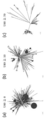
- FIG. 4a is a molecular phylogenetic tree for extracting sequence clusters from the molecular phylogenetic tree.
- FIG. 4a is a molecular phylogenetic tree for extracting sequence clusters from the molecular phylogenetic tree.
- FIG. 4b is a diagram showing nine sequence clusters (b1 to b9) extracted from the molecular phylogenetic tree of FIG. 4a.
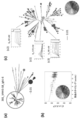
- FIG. 5a is a molecular phylogenetic tree created for a classification sequence data group based on sequence length 372 bp (V gene fragment is VHH3-S8 and J gene fragment is igJ-6).
- FIG. 5b is a molecular phylogenetic tree created for a classification sequence data group based on sequence length 354 bp (V gene fragment is vhh3-S1 and J gene fragment is igJ-4).
- FIGS. 5c and 5d are scatter plots showing the relationship between the bit score of each sequence data in the sequence cluster (circled by a curve) indicated by a red circle and the timing of blood sampling in FIGS. 5a and 5b, respectively.
- 5e and 5f are Biacore sensorgrams showing the binding strength of the antibody reconstructed from the sequence data in the sequence clusters (circled by the curve) shown by the red circles in the phylogenetic trees of FIGS. 5a and 5b, respectively.
- FIG. 6a is a molecular phylogenetic tree created for a classification sequence data group based on sequence length 381 bp (V gene fragment is VHH3-S8 and J gene fragment is igJ-6).
- Part 6b is a scatter plot showing the relationship between the bit score of the sequence data in the sequence cluster (circled by the curve) indicated by the red circle in FIG. 6a and the timing of blood sampling.
- FIG. 6c is shown by the molecular phylogenetic tree created for the sequence data in the sequence cluster (circled by a curve) indicated by the red circle in the phylogenetic tree of FIG. 6a, and by the broken arrow in the phylogenetic tree.
- It is a Biacore sensorgram showing the binding force of the antibody reconstructed from the sequence data (c1, c2, c3).
- the block diagram which shows the schematic structure of the determination system 1 which concerns on Embodiment 2.
- the block diagram which shows the schematic structure of the database 107 which concerns on Embodiment 2.
- sequence data is readable by a computer, including at least information on a base sequence encoding a part or all of an antibody, or an amino acid sequence thereof (also referred to as “sequence information” or simply “sequence”).
- Electronic data including sequence information of antibodies obtained from an animal that may have been immune-stimulated.
- Antibody sequencing data can be obtained, for example, from lymphoid cells present in blood samples taken from animals that may have been immunostimulated, using known sequencing methods or commercially available sequencing devices. ..
- the blood sample may be, for example, a sample that has been treated to isolate whole blood, plasma or serum, or antibody taken from an animal.
- the known sequencing method may be, for example, an analysis method based on the Sanger method.
- the commercially available sequencing apparatus may be, for example, a next generation sequencer such as Illumina's Miseq or HiSeq 4000.
- the antibody sequence information includes, but is not limited to, information on a base sequence encoding one or more complementarity determining regions (CDRs) or an amino acid sequence thereof.
- the antibody sequence information includes, for example, information on a base sequence encoding a part of the variable region (V region) of the antibody containing at least CDR or an amino acid sequence thereof.
- the sequence data includes, for example, information on the quality of sequencing (also referred to as "quality score"), information on when the antibody was collected, and information on the animal species from which the antibody was collected, in addition to the information on the base sequence or amino acid sequence. It may be included.
- sequence data group means a collection of a plurality of sequence data having the sequence information of an antibody.
- the sequence data group is not limited, but is a collection of a huge number of sequence data having the sequence information of each antibody obtained by sequencing by the next-generation sequencer (also referred to as “sequence data group after sequencing”). It may be.
- the sequence data after the sequence determination may be, for example, a combination of a plurality of collections of sequence data acquired from the same animal at different times.
- Sequence data groups include, for example, cleanup, aggregation into unique sequence data, integration of sequence determination errors, classification, and removal of sequence cluster non-formable sequence data for the sequence data group after sequence determination.
- sequence data may be a collection of sequence data generated by performing any one of the above steps, a combination of two or more steps, or all the steps.
- the huge number of sequence data may be, for example, 10,000 to 10 million, 100,000 to 8 million, 1 million to 7 million, or 2 million to 6 million sequence data.
- unique sequence means the only sequence data having the same sequence and sequence length in a certain sequence data group.
- the unique sequence data is not limited, but when there are two or more sequence data having the same sequence and sequence length in the sequence data group after the sequence is determined, the unique sequence described later is used.
- the sequence data group obtained by executing the aggregation process to data it may be the only sequence data having information on the number of aggregated sequence data in addition to the sequence and sequence length of the sequences described above. ..
- the above-mentioned sequence of sequences is included in the sequence data group.
- it may be the only sequence data that further has information that the number of aggregated sequence data is one.
- the "next generation sequencer” means a sequencing device capable of simultaneously determining the sequence information of a huge number of gene fragments.
- a huge number of gene fragments are, but are not limited to, 100,000 or more, for example, 300,000 or more, 1 million or more, 3 million or more, 10 million or more, 30 million or more, 100 million or more. It may be, for example, a gene fragment of 200 million fragments or less, 100 million fragments or less, and 50 million fragments or less.
- the chain length of the gene fragment is not limited, but may be between 30 bp and 1000 bp, for example, 900 bp or less, 500 bp or less, and 200 bp or less.
- the sequence data of the antibody fragment whose sequence information has been determined by the next-generation sequencer may have a quality score, but is not limited.
- the term "antibody” means all or part of an immunoglobulin (Ig) molecule having the ability to bind to a predetermined antigen.
- the antibody is an amino acid sequence corresponding to the complementarity determining region (CDR) of the variable region (V region) of the heavy chain (H chain) and the light chain (L chain) constituting the immunoglobulin molecule, without limitation. It is a protein having.
- Antibodies include, for example, complete antibodies, antibody fragments, chimeric antibodies.
- the type of antibody may be, but is not limited to, IgG, IgM, IgA, IgD or IgE.
- IgG may be, for example, a subclass of IgG1, IgG2, IgG3, and IgG4.
- antibody fragment means a portion of an antibody that has the ability to bind to a given antigen.
- Antibody fragments include, but are not limited to, Fab, F (ab') 2 , or single chain antibodies (scFv).
- the antibody fragment can be produced by a known method.
- Fab can be produced, for example, from a complete antibody by a known enzyme treatment.
- chimeric antibody means a fusion protein in which all or part of two or more proteins having the ability to bind to a predetermined antigen is bound.
- the chimeric antibody is not limited, but is an antibody obtained by linking a variable region (V region) of an antibody derived from a species other than human and a constant region (C region) of an antibody derived from human, or derived from a species other than human.
- An antibody also referred to as "humanized antibody” in which the CDR of the antibody of the above antibody and a human antibody portion other than the CDR is linked is included.
- the chimeric antibody can be produced by a known method.
- the chimeric antibody can be produced, for example, by linking genes by a genetic engineering technique.
- the term "antigen-specific antibody” means an antibody that binds to a target antigen with a binding force equal to or higher than a predetermined value. Binding force, but are not limited to, dissociation constant (K D), the affinity constant (K A), association rate constant (k on), or indicated by the dissociation rate constant (k off).
- the binding force can be measured by a known method or a commercially available measuring device.
- the commercially available measuring device may be, for example, Biacore manufactured by GE Healthcare.
- the predetermined binding force is, but is not limited to, a dissociation constant (K) of 10-5 M or less, preferably 10-6 M or less, more preferably 10-7 M or less, and even more preferably 10-8 M or less. D ) may be.
- K dissociation constant
- the predetermined binding force is not limited, but exhibits the dissociation constant for the target antigen, and is 10-5 M or more, preferably 10-4 M or more, or more with the substance other than the antigen. It may preferably show a dissociation constant of 10 -3 M or higher.
- An antigen-specific antibody for example, exhibits a dissociation constant of 10-7 M or less with respect to a predetermined antigen, and a dissociation constant of 10-4 M or more with a substance other than the antigen.
- An antigen-specific antibody for example, exhibits a dissociation constant of 10-8 M or less with respect to a predetermined antigen, and a dissociation constant of 10-3 M or more with a substance other than the antigen.
- the antigen-specific antibody has, for example, a binding rate constant of 10 5 M -1 ⁇ s -1 or more, preferably 10 6 M -1 ⁇ s -1 or more with respect to the antigen.
- the antigen-specific antibody has, for example, a dissociation rate constant of 10 -3 s -1 or less, preferably 10 -4 s -1 or less from the antigen.
- variable region means a portion of an immunoglobulin molecule consisting of about 110 amino acid residues on the amino (N) terminal side.
- the H chain variable region is represented as V H
- variable region of the L chain is expressed as V L.
- complementarity determining region means a region that forms a three-dimensional structure complementary to an antigen molecule and determines the specificity of an antibody.
- the CDR is not limited, but exists separately in the polypeptide chain of the H chain and the L chain of the antibody, respectively, and is represented as H1, H2 and H3 in the H chain, and L1 and L2 in the L chain. And L3.
- the "constant region (C region)” means a portion of an immunoglobulin molecule other than the variable region (V region).
- the "V gene” and the “C gene” mean a gene encoding a variable region (V region) and a gene encoding a constant region (C region), respectively.
- VJ recombination means a process in which a V gene fragment and a J gene fragment are linked to form a variable region of an antibody in the process of B cell differentiation.
- VDJ recombination means a process in which a D (diversity) gene fragment is further linked between a V gene fragment and a J gene fragment to form an H chain.
- V (D) J recombination means VJ recombination and / or VDJ recombination.
- V (D) J recombination when multiple types of V gene fragments existing on the genome sequence, multiple types of J gene fragments, and in some cases multiple types of D gene fragments are combined one by one, a base is used. Deletions or additions can occur randomly at their linking sites.
- V gene fragment and the "J gene fragment” mean genes encoding a part of the variable region (V region) of the immunoglobulin polypeptide chain, respectively.
- the V region of the H chain of an immunoglobulin consists of 110 to 120 amino acids, and the gene is the part encoding 90 to 100 amino acids ( VH ) from the N-terminal, followed by the part encoding several amino acids (V H ).
- D H composed of three gene fragments portion (J H) encoding the remaining dozen amino acids (gene segment).
- the V region of the L chain of the immunoglobulin does not contain the D gene fragment and is composed of the V gene fragment ( VL ) and the J gene fragment ( JL ).
- affinity maturation means a phenomenon in which the affinity of an antibody for an antigen to be immunized increases with the passage of time after immunization.
- Affinity maturation can occur, but is not limited to, due to point mutations in the V regions of the H and L chains in the process of rapid proliferation of antigen-activated B cells.
- Mutations in affinity maturation can introduce, but are not limited to, about one mutation per cell generation into the CDRs of the V region.
- the "original sequence” (also referred to as “primordial sequence” or “ancestral sequence”) is a sequence of an antibody and the animal species corresponding to the animal from which the antibody was obtained. It means the sequence having the highest degree of sequence matching with the genome sequence of.
- the sequence having the highest degree of sequence matching means the sequence having the highest degree of sequence matching among the similar sequences when there are a plurality of similar sequences.
- the sequence of the antibody is, but is not limited to, one or both of the V gene fragment and the J gene fragment that make up the variable region of the antibody.
- the degree of sequence matching between one or both of the V gene fragment and the J gene fragment constituting the variable region of the antibody and the genome sequence of the animal species corresponding to the animal from which the antibody was obtained is homologous.
- the gene fragment having the highest degree of sequence matching is alone or a combination.
- homology search means an operation of finding a sequence similar to a query sequence (quarry sequence) from a database.
- the homology search is performed by a known program, but not limited to.
- known programs include, for example, FASTA programs, BLAST programs, and PSI-BLAST programs.
- the degree of sequence matching can be calculated for either a base sequence or an amino acid sequence.
- sequence matching degree means an index indicating the degree of sequence matching between two sequences.
- the sequence match degree is, but is not limited to, a score value based on the number of sequence matches, sequence identity, or sequence identity.
- sequence match is a score value based on the number of sequence mismatches, sequence mismatches, or sequence mismatches. The sequence match is calculated using a gap penalty, but not limited to.
- the score value means a numerical value obtained by scoring sequence identity or sequence mismatch.
- Scoring of sequence identity is performed using a score matrix, but not limited to.
- the score matrix for scoring the match and mismatch of the base sequence is, for example, the Jukes-Cantor69 model, the Kimura80 model, the Tamura92 model, and the Tamura-Nei93, in which the probability that each base (A, T, G, C) is replaced is constant.
- Score models for scoring amino acid sequence matches and mismatches include, for example, the PAM matrix (eg PAM250) and the BLOSUM matrix (eg BLOSUM50, BLOSUM62, BLOSUM80).
- sequence means a base sequence or an amino acid sequence having the same sequence sequence and the same sequence length.
- change in sequence matching degree means that the sequence matching degree between the sequence shown in the sequence data of the antibody in the sequence data group and its original sequence changes with the passage of time after antigen administration.
- the change in the degree of sequence matching is, for example, the slope of the degree of sequence matching.
- the slope of the degree of sequence matching may be a change in the degree of sequence matching with respect to the elapsed time from the start to the end of the blood sampling protocol, or a change in the degree of sequence matching per number of blood samplings from the first blood sampling to the end of blood sampling.
- change in antibody type means that the antibody class changes with the passage of time after antigen administration.
- the change in antibody type is, for example, an antibody class switch.
- the indicators indicating the antibody class switch are the ratio of the antibody class in the antibody population shown at the time of a blood collection (for example, [IgG2 type] / [IgG class type in the antibody population]). It is the difference from the ratio of the antibody class in the antibody population shown after the blood collection.
- the "molecular phylogenetic tree” means a diagram showing a branching relationship regarding an antibody sequence.
- the molecular phylogenetic tree is, but is not limited to, a stellate phylogenetic tree or an infinite phylogenetic tree.
- the molecular phylogenetic tree is created based on, but not limited to, information on the amino acid sequence of an antibody or the base sequence encoding the amino acid sequence.
- the molecular phylogenetic tree can be prepared by a known method. As a method for creating a molecular phylogenetic tree, for example, Bioinformatics: Sequence and Genome Analysis 2nd Edition (David Mount, Cold Spring Harbor Laboratory Press;
- the molecular phylogenetic tree can be created based on the distance matrix.
- the molecular phylogenetic tree can be created using a neighbor-joining method, an average distance method, or a minimum evolution method.
- the molecular phylogenetic tree can be created without the use of a distance matrix.
- the molecular phylogenetic tree can be created using maximum parsimony, maximum likelihood or Bayesian inference.
- the molecular phylogenetic tree can be created using, but not limited to, known software (for example, the ape package of the statistical analysis software “R”) or MEGAX (https://www.megasoftware.net/). ..
- the molecular phylogenetic tree can be run against sequence data groups.
- the creation of a molecular phylogenetic tree is performed, for example, on a cluster-forming sequence data group.
- the creation of a molecular phylogenetic tree may be performed on sequence data groups in a sequence cluster, which will be described later, without limitation.
- sequence cluster means a group (subgroup) that is connected to each other in a molecular phylogenetic tree in a form that can be distinguished from others.
- Sequence clusters can be found using, but not limited to, known methods of searching for subgroups used in the field of network analysis.
- a method for finding a sequence cluster for example, there are a method of searching based on the number of components connecting each separated sequence, and a method of extracting a portion having a high density of sequence information in the molecular phylogenetic tree.
- a known program for example, a Sna package and an Igraf package can be used.
- a sequence cluster is formed between branch points (also referred to as connection points) in a molecular phylogenetic tree when the length of branches (Branch, edge) connecting the branch points is equal to or greater than a predetermined value.
- the region outside the center of the molecular phylogenetic tree may be extracted as a sequence cluster from a predetermined position.
- candidate for antibody production means sequence data existing in a sequence data group or a sequence cluster determined to contain an antigen-specific antibody.
- the candidate for antibody production may be sequence data present in a sequence cluster determined to contain an antigen-specific antibody.
- the candidate for antibody production may be sequence data present in the sequence group generated after classification and exclusion of sequence cluster non-forming sequence data.
- antibody production or “antibody production” means producing an antibody.
- the antibody can be produced by a known method. As a known method, for example, International Patent Publication WO99 / 18212 can be referred to.
- a DNA fragment encoding the target CDR is inserted into a known protein expression vector to construct a plasmid for antibody expression, the plasmid is introduced into a predetermined host, and the target antibody is introduced into the host. It can be produced or produced by expressing it.
- the antibody expressed in the host can be recovered and purified by a known method.
- the DNA fragment encoding the CDR of interest can be optimized according to the codon frequency (codon sage or codon frequency) of the host to be expressed.
- antigen or “immunity (anti) source” means a substance that induces humoral immunity or cell-mediated immunity by producing an antibody or a sensitized lymphocyte.
- the antigen may be, but is not limited to, a substance introduced into the body from outside the body of the animal, or may be a substance produced in the body of the animal.
- the antigen introduced into the body from outside the body may be, for example, a proteinaceous substance of interest, a bacterium, or a virus.
- the antigen produced in the body may be, for example, a proteinaceous substance produced from a mutation or a foreign gene, or a protein denatured by an external factor such as irradiation.
- mammals that may have been immune-stimulated are, but are not limited to, animals that have been administered a given antigen, animals that have been irradiated, or have been infected with a virus. Including animals.
- An animal to which a given antigen has been administered is, for example, an animal to which the protein antigen of interest has been administered according to known administration protocols commonly used for that species (number of doses, interval of dosing, dose / dose). If there is no known dosing protocol for a particular animal species, the dosing protocol can be appropriately configured by those skilled in the art with reference to known dosing protocols for closely related animal species.
- the antigen is administered to the animal at least once.
- the antigen is administered, for example, in the animal as many times as expected for affinity maturation of the antibody.
- the administration interval of the antigens may be a constant interval or an indefinite interval.
- Animals that may have been infected with a virus include, for example, animals that exist in areas where viruses such as influenza virus are endemic.
- Irradiated animals include, for example, animals that have undergone radiation therapy.
- immunostimulation may result in antibodies that have undergone affinity maturation.
- a person skilled in the art can appropriately set the radiotherapy protocol according to the condition of the site to be irradiated and the condition of the body to be irradiated.
- the "animal” is, but is not limited to, a cartilaginous fish, a cetartiodactyla, a rodent, or a primat.
- Cartilaginous fish include, for example, sharks, rays, and chimaera.
- Cetartiodactyla include, for example, camelids, including alpaca and camels, suidae, including pigs, and bovids, including cows, goats and sheep. Cetartiodactyla are preferably alpaca.
- Rodents include, for example, Lagomorpha, including rabbits, and Rodents, including mice and rats. Rodents are preferably rabbits.
- the primate animals are, for example, proto-monkey animals including lemurs, old world monkeys including Japanese macaques, and hominids including humans, orangutans and gorillas. Primates are, for example, non-human animals or humans. Primates are preferably humans.
- animal species means a biological species to which an animal belongs.
- the genomic sequence of the animal species may be, but is not limited to, a genomic sequence stored in a known database.
- a known database for example, Genbank (NCBI), DDBJ (DNA Data Bank of Japan), Entrez (NCBI), Genomics Biology (NCBI) can be used.
- a first aspect of the present invention provides a method of identifying a sequence cluster containing sequence data indicating an antigen-specific antibody that is a candidate for antibody production.
- One embodiment of the first aspect of the present invention (hereinafter referred to as “Embodiment 1”) will be described below.
- the identification method comprises the step of preparing a sequence data group containing sequence data of antibodies obtained from immunostimulated animals.
- the step of preparing the sequence data group includes acquiring a specific sequence data group, and in some cases, a step such as cleanup described later is performed on the acquired sequence data group to generate a new sequence data group. Including further to do.
- the step of preparing the sequence data group includes, but is not limited to, acquiring the sequence data group after the sequence is determined.
- i is, but is not limited to, an integer between 1 and 15.
- i is, for example, an integer between 3 and 8, 3, 4, 5, 6, 7 or 8.
- the time interval for acquiring a plurality of antibody populations may be a fixed interval or an indefinite interval.
- the sequence data group after sequencing includes, for example, from alpaca in which the antigen of interest was administered with an adjuvant five times at 2-week intervals, once before antigen administration, once during the antigen administration interval, and 1 after antigen administration. It may be a collection of sequence data of each antibody obtained from lymphoid cells in a blood sample collected a total of 6 times.
- the sequence data group after the sequence determination contains, for example, about 3 million sequence data.
- the reading frame is shifted to the antibody sequence data obtained by sequencing from lymphoid cells in animal body fluids (eg, blood, lymph), for example, in the V (D) J recombination process. Sequence data containing sequence information of genes showing no amino acid sequence may be included.
- the preparation step of the sequence data group includes, but is not limited to, a step of excluding (cleaning up) the sequence data showing the amino acid sequence from the sequence data group.
- This cleanup step may be performed, for example, by excluding the base sequence data whose base sequence encoding the variable region portion of the antibody or the region containing the portion is not a multiple of 3 from the sequence data group.
- a collection of sequence data indicating the amino acid sequence hereinafter, also referred to as “cleanup sequence data group” is generated.
- the cleanup step can reduce the number of sequence data in the sequence data group.
- the cleanup may further include the step of excluding sequence data below a predetermined quality score from the sequence data group, optionally based on the quality score. Cleanup based on the quality score can be performed on sequence data having base sequence information or amino acid sequence information.
- the antibody population obtained from an animal may contain multiple antibodies having the same sequence. Therefore, a collection of sequence data obtained by sequencing the antibody population (sequence data group after sequencing) may include a plurality of sequence data having the same sequence information.
- the preparation step of the sequence data group is not limited, but a step of aggregating a plurality of sequence data including the same sequence information into one sequence data including the sequence information (hereinafter referred to as “unique sequence data”). Including.
- the unique sequence data also includes information on the number of aggregated sequence data (hereinafter referred to as "occurrence frequency (aggregate)").
- aggregate occurrence frequency
- the aggregation step can reduce the number of sequence data in the sequence data group.
- sequence information obtained by sequencing may include random errors that occur in the process associated with the sequencing.
- This random error can occur in a variety of processes, including, for example, the process of DNA synthesis by DNA polymerase, including DNA amplification by PCR and DNA replication during sequencing, and / or the process of signal analysis from fluorescent images.
- Sequence data related to sequence information having random errors that occur in the process of sequencing is sequence data indicating the sequence of the gene to be sequenced (also referred to as "original sequence") (hereinafter referred to as "integrated unique sequence data"). Integrate into.
- the integrated unique sequence data further includes information on the total value of the appearance frequency (aggregation) contained in the integrated sequence data (hereinafter referred to as “occurrence frequency (integration)”) in addition to the information contained in the unique sequence data. ..
- occurrence frequency integration
- integrated unique sequence data group a collection of integrated unique sequence data (hereinafter referred to as “integrated unique sequence data group”) is generated.
- the integration step makes it possible to reduce the number of sequence data in the sequence data group.
- the preparation process of the sequence data group includes, but is not limited to, the step of integrating the error of the sequence determination.
- the integration of sequence determination errors is, for example, the sequence data having the highest appearance frequency (aggregation) in a collection of sequence data having an appearance frequency (aggregation) (hereinafter referred to as "reference sequence data"), and the sequence of the reference sequence data.
- the appearance of the reference sequence data as sequence data hereinafter referred to as "reference sequence data” of a sequence having the same length as (hereinafter referred to as "reference sequence” but having n base substitutions with respect to the reference sequence.
- the step includes integrating the query sequence data in which the ratio of the appearance frequency (aggregation) of the query sequence data to the frequency (aggregation) is less than the threshold value into the reference sequence data.
- the integration step further includes a step of generating an integration sequence data group by preliminarily selecting sequence data having a sequence having the same length as the reference sequence from the sequence data group for integrating the sequence determination error. Good.
- the base sequence shown in the unique sequence data showing the original sequence is referred to as a "reference sequence”.
- the unique sequence data indicating the query sequence is integrated with the unique sequence data indicating the reference sequence. Whether or not the query sequence is caused by an error in the sequence determination of the reference sequence is determined by calculating the ratio of the probability that the query sequence and the reference sequence will appear.
- pn be the probability that a sequence determination error will occur in the nth base of the base sequence having a sequence length k.
- the probability (P 0 ) that an error in sequence determination does not occur can be expressed by the following equation.
- the probability ( Pi ) that an error occurs in one place in the i-th base of the base sequence having the sequence length k can be expressed by the following formula.
- the probability ( Pij ) that an error occurs in two places in the i-th and j-th bases of the base sequence having the sequence length k can be expressed by the following formula. Similarly, the probability that an error will occur in three or more bases in the "reference sequence” and the "reference sequence” can be calculated.
- the base sequence is composed of four types of A, G, C and T. Therefore, the number of cases where an arbitrary base is changed to another base is 3. Assuming that the probability that the reference sequence appears is P 0 as described above, the probability that the query sequence will occur can be expressed by the following equation. The probability may change depending on the type of base substitution, but here it is assumed that all base substitutions occur with the same probability.
- the probability that the query sequence will occur can be expressed by the following formula.
- the probability that a query sequence will occur when three or more bases are different between the "reference sequence” and the "query sequence” can be calculated.
- the probability P 0 at which the "reference sequence" appears is as follows. Can be expressed in.
- the probability that the "query sequence" will occur can be expressed as follows.
- Equation 4 If the value of the probability p i that an error of i-th base sequencing occurs becomes apparent, [Expression 4], by transforming the equation shown in Equation 5, the probability / reference sequence "query sequence occurs The probability of occurrence (P 0 ) ”can be calculated. For example, when the difference in the base sequence is only one place in the i-th base, the following equation is derived from [Equation 4] and [Equation 6].
- the query sequence is It is possible to set a threshold value (hereinafter, also referred to as “threshold value (probability)”) relating to “probability of occurrence / probability of occurrence of reference sequence (P 0 )”.
- the threshold value (probability) can be appropriately set to a value larger than the calculated value on the right side of [Equation 9] or [Equation 10].
- the unique sequence data in the unique sequence data group is sorted in descending order by appearance frequency (aggregation), and the base sequence of the unique sequence data having the highest appearance frequency (aggregation) is used as a reference sequence.
- the appearance frequency (aggregation) of the reference sequence is F 0 in [Equation 13].
- unique sequence data having the same sequence length as the base sequence of the reference sequence but having a base sequence different only in the i-th base is selected from the unique sequence data group (here, only the i-th base is used).
- the same calculation as above is performed using the unique sequence data having the second highest appearance frequency (aggregation) as the reference sequence, and p for the unique sequence data having the second highest appearance frequency (aggregation).
- the 3-position, also calculated for unique sequence data # 4, ..., the value of p i is obtained for each unique sequence data to the reference sequence.
- a threshold value based on a statistical value of values of a number of p i obtained. For example obtained obtained number of the mean value from values of a plurality of p i after removing outliers from the value of p i or the median value, may be calculated threshold (probability) from that value, or It may be set appropriately based on the above value.
- the term "outlier” means a value that deviates significantly from a plurality of values. Outliers can be detected based on standard deviation, Smirnov-Grabs, or Thompson tests, without limitation. In one example, outliers are detected by Smirnov Grabs.
- Antibodies are known to mature through a process of V (D) J recombination and then a process of affinity maturation. Antibodies of various sequence lengths can be produced in the process of V (D) J recombination. During the process of affinity maturation, various antibodies of the same sequence length but different amino acid sequences can be produced during the process of affinity maturation. In tracking the maturation process of the antibody by additional immunostimulation, the sequence data of the antibody population is classified by the sequence length, and the antibody sequence data is classified by the V gene region and the J gene region. , It may be possible to efficiently find sequence data indicating an antigen-specific antibody.
- the preparation step of the sequence data group is based on, but not limited to, the sequence data in the sequence data group based on either or both of the sequence length and the original sequence on the genomic sequence of the animal species corresponding to the animal. Includes the process of classifying. By the step of classifying, a classification sequence data group composed of classes including the corresponding sequence data is generated.
- the sequence data in the sequence data group is classified based on, for example, the combination of the sequence length and the original sequence on the genome sequence of the animal species.
- Classification based on sequence length includes, for example, assigning sequence data in a sequence data group to a class relating to the corresponding sequence length based on the sequence length shown in the sequence data.
- the classification based on the original sequence corresponds to, for example, the sequence data in the sequence data group, one or both of the V gene fragment and the J gene fragment constituting the variable region of the antibody shown in the sequence data, and the animal. This includes assigning the sequence data to each class related to the gene fragment having the highest sequence match (that is, the original sequence) based on the sequence match obtained by homology search with the genomic sequence of the animal species.
- the sequence matching degree is, for example, a score value relating to sequence identity or sequence identity.
- an antigen-specific antibody that has undergone affinity maturation and exhibits higher affinity has a sequence similar to that of the antibody and is compared when subjected to a molecular phylogenetic tree analysis. It is considered that a sequence cluster is formed in the molecular phylogenetic tree together with a series of antibodies having a high affinity. On the contrary, there are few or few antibodies having a relatively low affinity that has not undergone affinity maturation and have a sequence similar to that of the antibody, and when a molecular phylogenetic tree analysis is performed, the antibody is a molecule. It is considered that the phylogenetic tree does not form a sequence cluster.
- sequence cluster non-forming sequence data sequence data having the sequence information of the antigen-specific antibody can be obtained. It may be possible to find out with high efficiency.
- the sequence data group preparation step includes, but is not limited to, a step of excluding the sequence cluster non-formable sequence data from the sequence data group and generating a sequence cluster formable data group. Exclusion of sequence cluster non-formable sequence data is that the number of sequence data having a predetermined sequence match for the sequence shown in the specific sequence data in the sequence data group is less than the threshold for the number of sequence data. In this case, the step of excluding the specific sequence data (sequence cluster non-formable sequence data) from the sequence data group is included.
- the predetermined degree of sequence matching is sequence identity.
- sequence identity is 90% and the threshold for the number of sequence data is 20, the exclusion of sequence cluster non-formable sequence data is 90% sequence identity to the sequence shown in the specific sequence data in the sequence data group. If the number of sexable sequence data is less than the threshold (20), the sequence data is excluded from the sequence data group. In the sequence data group in which this exclusion step is repeated, a set of sequence data in which 20 or more sequence data having a sequence showing 90% sequence identity with a certain sequence exists. Such sequence data groups are expected to contain sequence data showing antigen-specific antibodies that have undergone affinity maturation very efficiently.
- the predetermined degree of sequence matching is the number of sequence mismatches.
- the number of sequence mismatches may be a number corresponding to 10% of the sequence length shown in the sequence data. For example, when the sequence length is 400 bp, 40, which is 10% of the sequence length, may be set as the number of sequence mismatches.
- the threshold for the number of sequence data is 10 (U40 ⁇ 10)
- the exclusion of sequence cluster non-formable sequence data is for the sequence shown in the particular sequence data in the sequence data group. If the number of sequence data having up to 40 mismatching bases or amino acids is less than the threshold (10), the sequence data is excluded from the sequence data group. It is expected that the sequence data group in which this exclusion step is repeated contains sequence data showing the antigen-specific antibody that has undergone affinity maturation very efficiently.
- the threshold value regarding the number of sequence data is not limited, but may be a constant value, or may vary depending on the appearance frequency (aggregation) or appearance frequency (integration) of the specific sequence data. .. In one example, the threshold for the number of sequence data may be 10. In another example, the threshold for the number of sequence data may be 10% of the frequency of occurrence (aggregation) or frequency of occurrence (integration). In this example, when the appearance frequency (aggregation) is 100, the threshold value regarding the number of sequence data is 10.
- the steps of preparing the sequence data group include a step of cleaning up, a step of aggregating into unique sequence data, a step of integrating sequence determination errors, a step of classifying, and a sequence cluster non-formable sequence data.
- the step of preparing the sequence data group may appropriately include at least one step, at least two steps, and at least three steps selected from the group consisting of the above steps.
- Each of the above-mentioned steps can be included in various orders without particular limitation as long as the step of aggregating the unique sequence data is performed before the step of integrating the sequence determination error.
- the step of aggregating into unique sequence data is preferably performed prior to the step of excluding sequence cluster non-formable sequence data.
- the sequence data group may include only the step of acquiring the sequence data group.
- the specific method according to the first embodiment includes a step of creating a molecular phylogenetic tree from the sequence data group.
- the molecular phylogenetic tree was calculated by calculating a distance matrix from the sequences shown in the sequence data in the sequence data group using known software (ap package of statistical analysis software "R"), but not limited to. It can be created from the distance matrix by using the proximity coupling method.
- the specific method according to the first embodiment is based on a change in the degree of sequence agreement between the sequence of the antibody shown in the sequence data in the sequence cluster in the molecular phylogenetic tree and the original sequence of the antibody or a change in the type of the antibody.
- the step includes determining whether or not the cluster contains sequence data indicating an antigen-specific antibody that is a candidate for antibody production. This determination step identifies one or more sequence clusters containing sequence data indicating antigen-specific antibodies that are candidates for antibody production.
- the original sequence is the sequence having the highest degree of sequence agreement between the sequence of the antibody shown in the sequence data and the genomic sequence of the animal species corresponding to the animal from which the antibody was obtained.
- the original sequence is not limited, but the degree of sequence matching between each of the V gene fragment and the J gene fragment constituting the variable region of the antibody and the genomic sequence of the animal species corresponding to the animal from which the antibody was obtained is BLAST. It is the gene fragment with the highest sequence identity (%) obtained by the search.
- the sequence cluster contains sequence data indicating an antigen-specific antibody.
- the change in the type of antibody in the determination step is, for example, an antibody class switch, and when the antibody class switch exceeds a predetermined number of times in a certain period, the sequence data indicates the antigen-specific antibody. Is determined to include.
- the sequence matching degree before antigen administration between the antibody sequence shown in the sequence data in the sequence cluster in the molecular phylogenetic tree and the original sequence of the antibody is less than the threshold for the sequence matching degree before antigen administration.
- the sequence data may be determined to be a sequence cluster containing no sequence-specific antibody.
- the determination step may further include a step of extracting sequence clusters from the molecular phylogenetic tree.
- a sequence cluster is outside the center of the molecular phylogenetic tree from a predetermined position between those bifurcation points when the length of the branch connecting the bifurcation points in the molecular phylogenetic tree is greater than or equal to a predetermined value. Region may be extracted as an array cluster.
- the molecular phylogenetic tree of the first embodiment was created for the sequence data group prepared in the preparation step of the sequence data group, but the invention according to the first aspect is not limited to this.
- the molecular phylogenetic tree may be created again for a collection of sequence data contained in a sequence cluster determined to contain sequence data indicating an antigen-specific antibody that is a candidate for antibody production.
- a step of determining whether or not the sequence cluster in the re-created molecular phylogenetic tree contains sequence data indicating an antigen-specific antibody that is a candidate for antibody production may be further performed.
- a second aspect of the present invention provides a determination system for determining whether or not a sequence cluster contains sequence data indicating an antigen-specific antibody that is a candidate for antibody production.
- a determination system for determining whether or not a sequence cluster contains sequence data indicating an antigen-specific antibody that is a candidate for antibody production.
- the determination system includes a control unit and a storage unit.
- the storage unit stores a database containing a sequence data group containing sequence data of antibodies obtained from animals to which the antigen has been administered.
- the control unit matches the sequence of the molecular phylogenetic tree that creates the molecular phylogenetic tree from the sequence data group with the sequence of the antibody shown in the sequence data in the sequence cluster in the molecular phylogenetic tree and the original sequence of the antibody. It includes a sequence data determination unit for determining whether or not the sequence cluster is a sequence cluster containing sequence data indicating an antigen-specific antibody that is a candidate for antibody production based on a change in degree or a change in the type of antibody.
- the determination system according to the second embodiment includes a control unit and a storage unit.
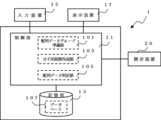
- FIG. 7 is a block diagram showing a schematic configuration of the determination system 1 according to the second embodiment.
- the determination system 1 includes a control unit 11 that controls the overall operation thereof, and a storage unit 13 that stores the database 107.
- An input device 15 for inputting by a user, a display device 17 for displaying a screen, and a measuring device 20 are connected to the determination system 1 via an interface.
- the control unit 11 is composed of a processing circuit corresponding to a processor such as a CPU (central processing unit) and a memory (main storage device).
- the processor of the control unit 11 executes the computer program loaded in the memory.
- the control unit 11 realizes functions such as the sequence data group preparation section 101, the molecular phylogenetic tree creation section 103, and the sequence data determination section 105, which will be described later.
- the control unit 11 may realize a predetermined function in cooperation with software, or may realize a predetermined function only by hardware.
- the storage unit 13 is an auxiliary storage device, for example, a hard disk drive (HDD) or a solid state drive (SSD).
- a computer program is stored in the storage unit 13.
- the computer program is loaded into memory and executed by the processor.
- the computer program includes an operating system and an application program.
- the application program includes a sequence data group preparation program that functions the sequence data group preparation unit, a calculation program that calculates various parameters including the degree of sequence matching, a molecular phylogenetic tree creation program that functions the molecular phylogenetic tree creation unit, and molecules, which will be described later. It includes a sequence cluster extraction program that extracts sequence clusters from a phylogenetic tree, a sequence data determination program that functions the sequence data determination unit, a threshold acquisition program that acquires a threshold, and a display program that displays determination results and the like.
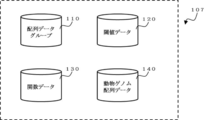
- FIG. 8 is a block diagram showing a schematic configuration of the database 107 according to the second embodiment.
- the database 107 stores the sequence data group 110, the threshold data 120, the function data 130, and the animal genome sequence data 140.
- the sequence data group 110 includes the sequence data group after the sequence is determined.
- the sequence data of the sequence data group includes information on the base sequence encoding the variable region portion of the antibody, information on the sequence length, and a quality score (Q score).
- the sequence data may further include information about the type of antibody (IgG2 or IgG3), information about the time of blood collection, and information about the animal from which the blood was collected.
- the sequence data group 110 may further include a cleanup sequence data group, a unique sequence data group, an integrated unique sequence data group, a classified sequence data group, and a sequence cluster formability data group, which will be described later.
- the threshold data 120 includes a threshold value (hereinafter referred to as "threshold value (matching degree)”) relating to a change in the sequence matching degree of the antibody sequence shown in the sequence data in the sequence cluster in the molecular phylogenetic tree described later.
- the threshold (matching degree) includes, for example, a predetermined value regarding the slope of the sequence matching degree per change in the time when the sequence data of each antibody is acquired.
- the threshold value is a threshold value related to the quality score of sequence determination and a threshold value related to "probability of occurrence of query sequence / probability of occurrence of reference sequence (P 0 )" used when integrating errors of sequence determination "hereinafter” threshold value (probability) ". ), It may further include a threshold value regarding the number of sequence data used when excluding sequence data that is not sequence cluster-forming.
- the function data 130 includes score function data for scoring the degree of sequence match in a homology search of a base sequence or an amino acid sequence.
- the score function for scoring the match and mismatch of amino acid sequences is, for example, a score matrix such as a PAM matrix (for example, PAM250) and a BLOSUM matrix (for example, BLOSUM50).
- the data included in the function data 130 may further include a probability density function related to the Poisson distribution and a function used for regression analysis.
- Animal genome sequence data 140 includes genome sequence data for animal species including alpaca.
- the alpaca genome sequence data includes the sequences encoding the V gene and J gene of the antibody.
- the animal genome sequence data 140 may further include human genome sequence data.
- the storage unit 13 When the database 107 is stored in a storage medium such as a magnetic disk, an optical disk, a magneto-optical disk, or a flash memory, the storage unit 13 includes a drive device for reading / writing information to the storage medium and the storage medium thereof. It may be composed of.
- the input device 15 is composed of a device or a device for inputting necessary information (designated information for designating an address in which an array data group is stored) and instruction information required by the user to the control unit 11.
- the input device 15 has a function of outputting input information to the control unit 11 via an interface.
- the input device 15 may be, for example, a keyboard, a mouse, and a voice recognition device.
- the types of input information are not limited to these.
- the input information may include, for example, information about the animal from which the blood was drawn.
- the instruction information includes information that instructs the processing process.
- the information instructing the processing process is, for example, regarding the processing in the sequence data group preparation unit described later, from the sequence data group after the sequence determination, the cleanup process, the aggregation process to the unique sequence, the integration process of the sequence determination error, Includes instructional information regarding the order in which any or all of the classification process and the sequence cluster non-formable sequence data exclusion process should be performed.
- the control unit 11 may acquire the sequence data group after the sequence determination from the sequence data group 110 stored in the database 107 according to the instruction input from the input device 15, and form a sequence cluster in the molecular phylogenetic tree described later.
- a function of preparing a sequence library including generating a collection of sequence data (hereinafter referred to as "sequence cluster-forming sequence data group"); a function of creating a molecular phylogenetic tree from the sequence data group; the molecular phylogenetic tree Has a function of determining whether or not the sequence cluster of the above contains an antigen-specific antibody; and a display function of displaying the determination result and the like.
- control unit 11 The function of the control unit 11 is realized by executing the corresponding application program loaded in the memory of the control unit 11 in the processing circuit including the processor of the control unit 11.
- the display device 17 is composed of a device capable of allowing the user to perceive the determination result of the control unit 11, and may be, for example, a display and a printer.
- the measuring device 20 is composed of a device for measuring a gene sequence.
- the measuring device 20 may be, for example, a next-generation DNA sequencer.
- the measuring device 20 has a function of outputting measurement data to the control unit 11 via an interface.
- the solid line connecting the measuring device 20 and the control unit 11 is composed of a transmitter / receiver including an interface that functions to transmit / receive data and signals by wire or wirelessly between these elements. The same applies to the solid line connecting the other elements in FIG. 7.
- the database 107 is stored in the storage unit 13 inside the determination system 1, but the location where the database is stored is not limited to this.
- the database 107 may be stored in a storage device existing outside the determination system 1, for example.
- a storage device may be composed of all or a part of a storage medium such as an optical disk, for example, and the storage device may be provided in a server connected to the determination system according to the second aspect by a network. ..
- the determination system 1 is connected to the measuring device 20 existing outside, but the determination system according to the present invention is not limited to this.
- the measuring device 20 may exist inside the determination system 1.
- the measurement data obtained by using the measuring device 20 may be read by the control unit 11 and stored in the database 107, for example.
- the determination system 1 may be configured so that the measurement data is read into the control unit 11 without being connected to the measurement device 20.
- the operation of the determination system according to the second embodiment will be described with reference to FIGS. 9 to 11.
- the user uses the input device 15 (FIG. 7) to input instructions to the control unit 11 and necessary information (designated information for designating an address in which various data are stored, and information about the collected animal).
- FIG. 9 is a flowchart showing a determination as to whether or not the sequence cluster in the molecular phylogenetic tree contains sequence data indicating an antigen-specific antibody in the determination system according to the present invention.
- the determination system includes an array data group preparation unit that generates a predetermined array data group.
- the processor of the control unit 11 receives an instruction from the user and input of necessary information via the input device 15, the processor of the control unit 11 executes the preparation of the array data group (S11).
- the processor loads and executes the array data group preparation program stored in the storage unit 13 in the memory.
- the array data group preparation unit 101 is realized in the control unit 11 (FIG. 7).
- FIG. 10 is a flowchart showing the preparation of the sequence data group in the sequence library preparation S11.
- the array data group preparation unit 101 refers to the designated information input by the user and executes an array data group acquisition process or the like.
- the sequence data group preparation unit 101 refers to the designated information input by the user, and loads the sequence data group after the sequence determination stored in the sequence data group 110 in the database 107 into the memory (S31).
- the sequence data constituting the sequence data group after sequencing includes information on the base sequence encoding the variable region portion of the antibody, information on the sequence length, information on blood sampling time (weeks), and quality score (Q score). Including.
- the array data group preparation unit 101 refers to the instruction information input by the user, executes the instructed process, and generates an array data group according to the process.
- the instruction information includes the generation of the cleanup sequence data group by the cleanup process, the generation of the unique sequence data group by the aggregation process to the unique sequence, and the error of the sequence determination for the sequence data group after the sequence determination.
- the sequence data group preparation unit 101 executes exclusion (cleanup) of the sequence data that does not show the amino acid sequence (S32). As a result, a cleanup sequence data group is generated, and the generated sequence data group is stored in the sequence data group 110 in the database 107.
- the sequence data group preparation unit 101 acquires information on the sequence length of the base sequence encoding the variable region portion of the antibody shown in the sequence data in the sequence data group after sequencing, and the sequence length is determined. If it is a multiple of 3, a selection tag is attached, and if it is not a multiple of 3, an exclusion tag is attached (3k + 1 or 3k + 2).
- the sequence data group preparation unit 101 executes selection / exclusion tagging for all sequence data in the sequence data group after sequence determination. When the sequence data group preparation unit 101 finishes tagging all the sequence data in the sequence data group after the sequence determination, the sequence data group preparation unit 101 finishes the selection / exclusion tagging.
- the sequence data group preparation unit 101 selects the sequence data with the selection tag from the sequence data group after the sequence determination, and generates a cleanup sequence data group composed of the selected sequence data.
- the generated cleanup sequence data group is stored in the sequence data group 110 in the database 107.
- the sequence indicates an amino acid sequence.
- the sequence data in the cleanup sequence data group may further include information about the amino acid sequence.
- Example 3 regarding the cleanup process, a process of removing sequence data that does not show an amino acid sequence has been described, but the cleanup process is not limited to this.
- the cleanup process may be, for example, a cleanup process based on the quality score included in the sequence data.
- the cleanup process may be a combination of removal of sequence data that does not show an amino acid sequence and removal based on a quality score.
- the cleanup process is executed by selecting the array data with the selection tag, but the content of the cleanup process is not limited to this.
- the cleanup process may be executed, for example, by excluding the sequence data with the exclusion tag from the sequence data group after the sequence determination.
- the cleanup process was performed on the base sequence, but the type of sequence on which the cleanup process is performed is not limited to this.
- the cleanup process can also be performed on the amino acid sequence.
- the sequence data group preparation unit 101 attaches an aggregation tag ( ⁇ ) to one sequence data in the cleanup sequence data group in the aggregation process to the unique sequence data, and acquires information about the sequence shown in the sequence data. ..
- the sequence data group preparation unit 101 assigns the same aggregation tag ( ⁇ ) to other sequence data indicating the same sequence as the acquired sequence.
- the sequence data group preparation unit 101 finishes adding the aggregate tag ( ⁇ ) to all the sequence data indicating the same sequence as the sequence in the cleanup sequence data group, the tagging of the aggregate tag ( ⁇ ) ends. ..
- the sequence data group preparation unit 101 assigns an aggregate tag ( ⁇ ) different from the aggregate tag ( ⁇ ) to one array data indicating an array different from the array shown in the sequence data to which the aggregate tag ( ⁇ ) is attached. However, the tagging of the aggregate tag ( ⁇ ) ends when all the sequence data indicating the same sequence as the sequence in the cleanup sequence data group has been added, as described above. Further, the sequence data group preparation unit 101 sequentially tags the sequence data showing the sequence shown in the sequence data to which the aggregate tag ( ⁇ ) is attached and the sequence data showing another sequence with another aggregate tag ( ⁇ , based .. When the number of array data in the cleanup array data group and the number of array data to which the aggregate tag is attached match, the array data group preparation unit 101 ends the addition of the aggregate tag.
- the array data group preparation unit 101 then converts a plurality of array data with the same type of aggregate tag into one array data (for example, one of the array data with the aggregate tag, or a newly generated array.
- Unique sequence data is generated by aggregating into data).
- the unique sequence data includes information on the frequency of occurrence (aggregation) in addition to the information contained in the sequence data.
- Example 3 the aggregation process to the unique sequence data was executed on the base sequence, but the type of the sequence that executes the unique sequence is not limited to this.
- the aggregation process to the unique sequence data can be performed on the amino acid sequence.
- the sequence data group preparation unit 101 executes a process of integrating errors in sequence determination (S34). By this process, an integrated unique sequence data group is generated, and the generated sequence data group is stored in the sequence data group 110 in the database 107.
- FIG. 11 is a flowchart showing the integration step of the sequence determination error.
- A Generation of sequence data group for integration
- the sequence data group preparation unit 101 acquires information on the appearance frequency (aggregation) from all the unique sequence data in the unique sequence data group, and the occurrence frequency (aggregation) is the highest.
- the appearance frequency (aggregation) of the unique sequence data is 2 or more (S41; YES)
- the sequence data group preparation unit 101 executes the generation of the sequence data group for integration (S42).
- the sequence data group for sequence integration is generated, and the sequence data used for generating the sequence data group for sequence integration is excluded from the unique sequence data group.
- the sequence data group preparation unit 101 selects unique sequence data (hereinafter referred to as “reference sequence data ⁇ ”) showing the highest frequency of occurrence (aggregation).
- the array data group preparation unit 101 loads the calculation program stored in the storage unit 13 into the memory, and realizes a function of generating and calculating various parameters including the sequence matching degree (hereinafter referred to as “generation & calculation function"). ..
- the sequence data group preparation unit 101 that realizes the generation & calculation function is a base sequence of unique sequence data having the same sequence length as the base sequence of the reference sequence data ⁇ (hereinafter, also referred to as “reference sequence ⁇ ”) (hereinafter, also referred to as “query sequence”).
- the array data group preparation unit 101 executes the information generation and addition processing for all the array data in the unique array data group.
- the sequence data group preparation unit 101 selects sequence data having the number of base substitutions caused by an error in sequencing from the reference sequence ⁇ .
- the sequence data group preparation unit 101 acquires information on the appearance frequency (aggregation) of the reference sequence data ⁇ and the probability density function on the Poisson distribution stored in the function data 130 in the database 107, and obtains the acquired frequency of appearance (aggregation) From the probability density function related to the Poisson distribution, the minimum number of base substitutions (m) at which the frequency of appearance (aggregation) is 1 or less is calculated. For example, when the expected value of the number of base substitutions is 0.3, the probabilities that the number of base substitutions is 0, 1, 2, 3, 4 are 0.74, 0.22, 0.03, and 0.003, respectively. , 0.0003.
- the appearance frequencies of the sequences having 0, 1, 2, 3, and 4 base substitutions are 100, 30, 4.5, and 0.5, respectively. , 0.03, and m is set to 3.
- the appearance frequency (aggregation) of the reference sequence data ⁇ is 1000, m is set to 4.
- FIG. 12 is a flowchart showing the selection S43 of the array data for integration.
- the sequence data group preparation unit 101 that realizes the generation & calculation function provides information given to the unique sequence data (information on the number of the mismatched base, information on the type of base substitution, and base substitution.
- the ratio of "probability of occurrence of query sequence / probability of occurrence of reference sequence (P 0 )" described in detail in the first embodiment is calculated with reference to (information on the number of reference sequences) (S51). The calculated ratio may be added to the unique sequence data.
- the array data group preparation unit 101 loads the threshold value acquisition program stored in the storage unit 13 into the memory to realize a function of acquiring the threshold value.
- the array data group preparation unit 101 that realizes the threshold value acquisition function has a threshold value (hereinafter referred to as “threshold value (probability)”) related to “probability of occurrence of query sequence / probability of occurrence of reference sequence (P 0 )” stored in threshold value data 120. (S52).
- the array data group preparation unit 101 loads the array data determination program stored in the storage unit into the memory and realizes a function of determining the array data.
- the sequence data group preparation unit 101 that realizes the sequence data determination function is the unique sequence data to be integrated when the ratio given to the unique sequence data is less than the acquired threshold (probability) (S53; YES).
- An integrated tag indicating that there is is attached to the unique sequence data (S54).
- the sequence data group preparation unit 101 that realizes the sequence data determination function can use the unique sequence data to be integrated.
- a non-integrated tag indicating the absence is added to the unique sequence data (S55).
- the sequence data group preparation unit 101 returns to the flowchart showing the integration of the sequence determination error in FIG. 11, and the integration assigned to the unique sequence data in the integration sequence data group.
- the unique sequence data to which the integrated tag is attached is integrated with the reference sequence data ⁇ (S44).
- integrated unique sequence data regarding the reference sequence ⁇ is generated, and the generated sequence data is stored in the database 107.
- the integrated unique sequence data related to the reference sequence ⁇ includes information on the total occurrence frequency (aggregation) included in the integrated unique sequence data in addition to the information contained in the reference sequence data ⁇ (hereinafter, “appearance frequency (integrated)”). ) Is further included.
- the sequence data group preparation unit 101 refers to the non-integrated tag attached to the unique sequence data in the integrated array data group, and refers to the unique sequence data to which the non-integrated tag is attached ( That is, the unique sequence data that was not used for generating the integrated unique sequence data in S44) is returned to the unique sequence data group (S45).
- the sequence data group preparation unit 101 acquires information on the frequency of occurrence (aggregation) from all the unique sequence data in the unique sequence data group excluding the unique sequence data used to generate the integrated unique sequence data for the reference sequence ⁇ . Then, when the appearance frequency (aggregation) of the unique sequence data having the highest appearance frequency (aggregation) is 2 or more (S41; YES), S42 to S45 are repeated.
- S51 for calculating the ratio and then S52 for acquiring the threshold value (probability) were executed, but the order of the steps is not limited to this.
- S51 and S52 may be executed in any order, or may be executed at the same time, as long as they are executed by the time S53 for comparing the calculated ratio and the acquired threshold value (probability) is executed. Good.
- the sequence data group preparation unit 101 appears from all the unique sequence data in the unique sequence data group excluding the unique sequence data not used for the generation of the integrated unique sequence data.
- the appearance frequency (aggregation) of the unique sequence data having the highest appearance frequency (aggregation) is less than 2 (S41; NO)
- the integrated unique sequence data and the integrated unique sequence stored in the database are obtained. All the unique sequence data in the unique sequence data group excluding the unique sequence data not used for data generation is loaded into the memory to generate the integrated unique sequence data group (S46).
- S46 integrated unique sequence data group is generated, and the generated integrated unique sequence group is stored in the sequence data group 110 in the database 107.
- the generation S46 of the integrated unique sequence data group is executed after it is determined that the largest number of occurrences (aggregation) in the unique sequence data group is less than 2 (S41; NO).
- S41; NO the order of steps is not limited to this.
- S46 may be executed at the same time as S44 that generates integrated unique sequence data after it is determined that the largest number of occurrences (aggregation) in the unique sequence data group is 2 or more (S41; YES).
- S45 for returning the unique sequence data not used for generating the integrated unique sequence data of the second embodiment to the unique sequence data group was executed after the generation of the integrated unique sequence data S44, but the order of the steps is not limited to this.
- S45 may be executed after the integration sequence data selection S43 and before S41 for determining whether to repeat S42 to S45 is executed.
- S45 may be executed before the generation S44 of the integrated unique sequence data, or may be executed at the same time as S44, for example.
- the generation S44 of the integrated unique sequence data was executed after the selection S43 of the sequence data for integration, but the order of the steps is not limited to this.
- S43 may be executed, for example, after it is determined that the largest number of occurrences (aggregation) in the unique sequence data group is less than 2 (S41; NO).
- the integrated tag assigned to the unique sequence data is given information about the type of the contrasted reference sequence (for example, the reference sequence data ⁇ ), and in the integration of the unique sequence data, the assigned reference sequence is given.
- Unique array data with the same information about the type of is integrated.
- S41 for determining whether or not the largest number of occurrences (aggregation) in the unique sequence data group of the second embodiment is 2 or more was executed prior to S42 to S45, but the order of the steps is not limited to this.
- S41 may be executed after S45 is executed, for example, in order to determine whether or not to repeat S42 to S45. That is, S41 does not have to be executed before the first generation of the array data group for integration S42.
- the generation S42 of the integration sequence data group was executed, but the present invention is not limited to this. In one example, in the integration of sequence determination errors, the integration sequence data group generation S42 may not be executed. In the case of this example, in the integration of sequence determination errors, the reference sequence data is sequence data having a sequence having the same sequence length as the reference sequence of the reference sequence data.
- the sequence data group preparation unit 101 provides information on the sequence length, the original V gene fragment, and the original J gene fragment. Execution of classification based on (S35).
- the sequence data group preparation unit 101 acquires information on the sequence length of each sequence data in the integrated unique sequence data group, and has the same sequence length.
- a sequence length classification tag related to the sequence length is added to each sequence data indicating the sequence.
- the array data group preparation unit 101 ends the assignment of the array length classification tag.
- the sequence data group preparation unit 101 constitutes the variable region of the antibody shown in each sequence data in the integrated unique sequence data group when the addition of the sequence length classification tag is completed.
- the sequence data group preparation unit 101 loads the calculation program stored in the storage unit 13 into the memory and realizes a function of calculating the sequence matching degree.
- the sequence data group preparation unit 101 that realizes the generation & calculation function refers to the information about the animal that has collected blood from the input information input by the user, and refers to the corresponding animal species stored in the animal genome sequence data 140 in the database 107. Acquire genomic information.
- Animal genome sequence data contains regions encoding multiple types of V gene fragments, depending on the animal species.
- the sequence data group preparation unit 101 that realizes the generation & calculation function encodes the sequence information including the V gene region of the antibody shown in the sequence data and each V gene fragment on the genome sequence.
- the degree of sequence matching with a plurality of regions is calculated respectively.
- the sequence data group preparation unit 101 uses the V gene fragment shown in the region on the genome sequence showing the highest sequence match degree among the calculated sequence match degrees as the original V gene fragment.
- the sequence data group preparation unit 101 attaches a V gene fragment classification tag for the original V gene fragment to the sequence data.
- the sequence data group preparation unit 101 ends the addition of the V gene fragment classification tag.
- the sequence data group preparation unit 101 corresponds to the variable region of the antibody shown in the sequence data in the same manner as above.
- the sequence data group preparation unit 101 ends the addition of the J gene fragment classification tag.
- (D) Generation of classification sequence data group When the assignment of the classification tag is completed, the sequence data group preparation unit 101 creates a class corresponding to the combination of the sequence length, the type of the original V gene fragment, and the type of the original J gene fragment. Generate. The sequence data group preparation unit 101 allocates sequence data to which various classification tags are attached to the corresponding classes, and generates a classification sequence data group. As a result, the generated classification sequence data group is stored in the sequence data group 110 in the database 107. Each class contains sequence data indicating a sequence having a sequence length corresponding to that class and showing a sequence derived from the corresponding original V gene fragment and original J gene fragment.
- the classification tags were assigned in the order of the classification based on the sequence length, the classification based on the original V gene fragment, and the classification based on the J gene fragment.
- the order in which grants are executed is not limited to this.
- these classification tags may be added at the same time.
- the classification tag is assigned at least one classification tag selected from the group consisting of the sequence length classification tag, the V gene fragment classification tag, and the J gene fragment classification tag. You can.
- sequence data group preparation unit 101 excludes the sequence cluster non-formable sequence data from the sequence data group in each class (S36). As a result, a sequence cluster-forming sequence data group is generated, and the generated sequence data group is stored in the sequence data group 110 in the database 107.
- the sequence data group preparation unit 101 refers to the specified information input by the user and refers to a threshold value (for example, 30) regarding the number of base substitutions stored in the threshold data 120 in the database 107. (Items) and a threshold value (for example, 50 items) regarding the number of sequence data are acquired.
- a threshold value for example, 30
- a threshold value for example, 50 items
- the sequence data group preparation unit 101 acquires the sequence information of each sequence data in any class (for example, a class having a large number of included sequence data) in the classified sequence data group.
- the sequence data group preparation unit 101 realizes the above-mentioned generation & calculation function, selects one sequence data in the class (for example, sequence data having a high occurrence frequency (integration)), and sets the selected sequence data array. The number of base substitutions with other sequence data in the class is calculated respectively.
- the sequence data group preparation unit 101 counts the number of sequence data indicating the number of base substitutions below the threshold for the number of base substitutions, and whether the counted number of sequence data is less than or equal to the threshold for the number of sequence data. Is determined. When the number of counted sequence data is less than the threshold value for the number of sequence data, the sequence data group preparation unit 101 excludes the sequence data from the class as sequence cluster non-formable sequence data.
- the sequence data group preparation unit 101 executes the exclusion of the sequence cluster non-formable sequence data for each sequence data in the class.
- the sequence data group preparation unit 101 of the sequence cluster non-formable sequence data for that class End the exclusion process.
- sequence data that constitutes the class in which the exclusion process of the sequence cluster non-formable sequence data is executed is a collection of sequence data that may form a sequence cluster in the molecular phylogenetic tree described later (“Sequence cluster formable sequence data”). ), which is a sequence cluster-forming sequence data group containing those sequence data.
- sequence cluster formable sequence data which is a sequence cluster-forming sequence data group containing those sequence data.
- the sequence data group preparation unit 101 sets the sequence cluster-forming sequence data. Is excluded from the classification array data group as it does not include.
- the cleanup process S32 of the second embodiment is executed for the sequence data group after the sequence determination, but is not limited to this.
- the cleanup process S32 may or may not be performed on the unique sequence data group, the integrated unique sequence data group, the classified sequence data group, or the sequence cluster-forming sequence data group.
- the aggregation process S33 for the unique array data of the second embodiment is executed for the array data group after the cleanup, but is not limited to this.
- the aggregation process S33 to the unique sequence data may be executed or executed for the sequence data group after the sequence determination, the integrated unique sequence data group, the classified sequence data group, or the sequence cluster-forming sequence data group. It does not have to be.
- the integration S34 of the sequence determination error of the second embodiment was executed immediately after the step of generating the unique sequence data group, but is not limited to this.
- the integration of sequence determination errors S34 may or may not be executed in any order as long as the generation of the unique sequence data group is executed.
- the classification S35 of the second embodiment is executed for the integrated unique sequence data group, but is not limited to this.
- the classification step S35 may or is executed for the sequence data group, the cleanup sequence data group, the unique sequence data group, the integrated unique sequence data group, and the sequence cluster formability sequence data group after the sequence determination. It does not have to be.
- Sequence cluster-formability Sequence data group generation S36 may or may not be performed on the sequence data group, cleanup sequence data group, unique sequence data group, and integrated unique sequence data group after sequencing. You may.
- the determination system includes a molecular phylogenetic tree creation unit that creates a molecular phylogenetic tree from the sequence data group.
- the processor of the control unit 11 executes the creation of the molecular phylogenetic tree shown in FIG. 9 (S12). Creation of a molecular phylogenetic tree
- the processor of the control unit 11 loads the molecular phylogenetic tree creation program stored in the storage unit 13 into the memory and executes it.
- the molecular phylogenetic tree creation unit 103 is realized in the control unit 11.
- the molecular phylogenetic tree creation unit 103 performs multiple alignment on the sequence data in the prepared sequence cluster-forming sequence data group, and calculates the distance matrix from the sequence data obtained by the multiple alignment to calculate the molecular phylogenetic tree. To create.
- the distance matrix was calculated, but the method of creating the molecular phylogenetic tree is not limited to this.
- the molecular phylogenetic tree may be created, for example, by using a maximum parsimony method based on minimizing the total length of the branches of the phylogenetic tree.
- the creation of the molecular phylogenetic tree of Embodiment 2 was performed on the sequence cluster-forming sequence data group, but is not limited thereto.
- the creation of the molecular phylogenetic tree may be performed on the integrated unique sequence data group or the classified sequence data group.
- the determination system is based on a change in the degree of sequence agreement between the sequence of the antibody shown in the sequence data in the sequence cluster in the molecular phylogenetic tree and the original sequence of the antibody or a change in the type of the antibody. It includes a sequence data determination unit for determining whether or not the cluster is a sequence cluster containing sequence data indicating an antigen-specific antibody that is a candidate for antibody production.
- the array data determination unit 105 loads the array cluster extraction program stored in the storage unit 13 into the memory and executes it. As a result, the array cluster extraction function is realized.
- the sequence data determination unit 105 which realizes the sequence data extraction function, executes the extraction of the sequence cluster from the created molecular phylogenetic tree (S13). As a result, sequence data in the sequence cluster extracted from the molecular phylogenetic tree can be obtained.
- the sequence data determination unit 105 that realizes the sequence cluster extraction function extracts a portion having a high density of sequence information in the created molecular phylogenetic tree as a sequence cluster.
- the sequence data determination unit 105 calculates a change in the sequence information of the sequence data in the sequence cluster (for example, the inclination of the sequence match degree per unit time) (S14). In the calculation of the slope of the sequence matching degree S14, the sequence data determination unit 105 loads the calculation program stored in the storage unit 13 into the memory and executes it. As a result, the sequence data determination unit 105 realizes a function of calculating the slope of the sequence matching degree.
- the sequence data determination unit 105 that realizes the generation & calculation function calculates the degree of sequence matching between the sequence information of each sequence data in the sequence cluster and the sequence information of the original V and J gene fragments included in the sequence data.
- the sequence data determination unit 105 acquires information on blood collection time (weeks) from each sequence data in the sequence cluster, and calculates the slope of the sequence match degree with respect to the passage of time using the sequence match degree calculated above.
- the sequence data determination unit 105 loads the threshold value acquisition program stored in the storage unit 13 into the memory and realizes a function of acquiring the threshold value.
- the sequence data determination unit 105 that has realized the threshold value acquisition function acquires a threshold value (hereinafter referred to as “threshold value (slope)”) related to the slope of the sequence matching degree stored in the threshold value data 120 (S15).
- the sequence data determination unit 105 compares the calculated inclination of the sequence matching degree with the acquired threshold (inclination), and when the inclination of the sequence matching degree is smaller than the threshold (inclination). (S16; YES), a display tag indicating that the sequence data indicating the antigen-specific antibody is contained is added to the sequence cluster indicating the slope of the sequence matching degree (S17).
- the sequence data determination unit 105 When the slope of the sequence matching degree is equal to or greater than the threshold (slope) (S16; NO), the sequence data determination unit 105 provides sequence data indicating the antigen-specific antibody to the sequence cluster showing the gradient of the sequence matching degree. A display tag indicating that it is not included is added (S18).
- the processor of the control unit 11 executes the determination result display (S19).
- the processor executes a display program loaded into the memory from the storage unit 13 and outputs a video signal corresponding to the display tag to the display device 17.
- the display device 17 may be, for example, a display. In this case, the display displays the determination result based on the input video signal.
- the molecular phylogenetic tree creation S12 and the sequence cluster extraction S13 were executed once, but the number of executions is not limited to this.
- the molecular phylogenetic tree created by executing the molecular phylogenetic tree creation S12'again, the sequence cluster extraction S13' May be executed.
- the calculation of the slope of the sequence matching degree of the sequence data in the sequence cluster S14 and the acquisition of the threshold value (slope) S15 are executed in this order, but the order of the steps is not limited to this.
- S14 and S15 may be executed by the comparison S16 between the slope of the sequence matching degree and the threshold value (slope), and S14 and S15 may be executed in any order or may be executed at the same time.
- a third aspect of the present invention provides a method of producing an antigen-specific antibody.
- One embodiment of the third aspect of the present invention (hereinafter referred to as “Embodiment 3”) will be described below.
- the production method is a step of preparing a sequence data group containing sequence data of an antibody obtained from an animal that may have been immune-stimulated; a step of creating a molecular phylogenetic tree from the sequence data group;
- the sequence cluster is a candidate for antibody production based on the change in the degree of sequence matching between the antibody sequence shown in the sequence data in the sequence cluster in the molecular phylogenetic tree and the original sequence of the antibody or the change in the type of antibody.
- the steps; and the step of producing an antibody having the amino acid sequence shown in the selected sequence data; are included.
- the step of preparing a sequence data group, the step of creating a molecular phylogenetic tree, and the step of determining whether or not the sequence cluster includes sequence data indicating an antigen-specific antibody are carried out.
- the features described in the specific method according to Form 1 and the features described in the present specification are appropriately applied.
- the production method includes a step of selecting sequence data indicating an antigen-specific antibody that is a candidate for antibody production for a sequence cluster determined to contain sequence data indicating an antigen-specific antibody.
- the sequence data is, for example, among the sequence data in the sequence cluster determined to contain the sequence data indicating the antigen-specific antibody, the sequence identity between the sequence shown in the sequence data and its original sequence is equal to or less than the threshold for sequence matching. May be elected in the case of.
- the sequence data is the sequence data having the smallest sequence identity between the sequence shown in the sequence data and its original sequence, or the sequence data in which the timing of collecting the antibody is the latest, and the sequence data is shown.
- the sequence identity with the original sequence may be less than or equal to the threshold for sequence matching.
- the production method includes a step of producing an antibody having an amino acid sequence shown in the sequence data in the sequence cluster determined to contain the sequence data indicating the antigen-specific antibody.
- the antibody is not limited, but a DNA fragment having a sequence in which the CDR of the selected sequence data is optimized according to the codon appearance frequency of Escherichia coli is inserted into a protein expression vector for Escherichia coli to construct a plasmid. , The plasmid is produced by introducing it into Escherichia coli and expressing it.
- a fourth aspect of the present invention provides a method for selecting sequence data indicating an antigen-specific antibody that is a candidate for antibody production.
- One embodiment of the fourth aspect of the present invention (hereinafter referred to as “Embodiment 4”) will be described below.
- the selection method according to the fourth embodiment is different from the specific method according to the first embodiment described above, but since there are common parts in the specific steps, here, the difference from the specific method according to the first embodiment. The points will be mainly described.
- the selection method according to the fourth embodiment is different from the specific method according to the first embodiment, and determines whether or not it includes a step of creating a molecular phylogenetic tree and sequence data indicating an antigen-specific antibody that is a candidate for antibody production. The process is not included as an essential process.
- the selection method according to the fourth embodiment includes "exclusion of sequence cluster non-formable sequence data" detailing the specific method according to the first embodiment as an essential step.
- the selection method according to the fourth embodiment further includes a step of selecting sequence data indicating an antigen-specific antibody from the sequence data group as an essential step.
- the step of selecting the sequence data described above includes a step of comparing the sequence matching degree between the antibody sequence shown in the sequence data in the sequence data group and the original sequence of the antibody and the threshold value.
- the above-mentioned comparison step is not limited, but the sequence matching degree (for example, 88% matching degree) between the antibody sequence shown in the sequence data in the sequence data group and the original sequence of the antibody is the threshold value.
- it includes selection as sequence data indicating an antigen-specific antibody that is a candidate for antibody production.
- the above-mentioned comparison step may further include, for example, in addition to the comparison between the sequence matching degree and the threshold value, the comparison between the time when the antibody was acquired (for example, the fifth time) and the threshold value (for example, the fourth time). ..
- the sequence data is used as sequence data indicating an antigen-specific antibody that is a candidate for antibody production. Including electing as.
- the selection method according to the fourth embodiment includes "cleanup of sequence data not showing an amino acid sequence”, “aggregation into a unique sequence”, and “integration of sequence determination errors” described in detail in the selection method according to the first embodiment. , And “classification”.
- the selection method according to the fourth aspect of the invention may further include a step of creating a molecular phylogenetic tree and a step of determining whether or not it contains sequence data indicating an antigen-specific antibody that is a candidate for antibody production. ..
- a fifth aspect of the present invention provides a selection system for selecting sequence data indicating an antigen-specific antibody that is a candidate for antibody production.
- One embodiment of the first aspect of the present invention (hereinafter referred to as “Embodiment 5”) will be described below.
- the selection method according to the fifth embodiment is a system different from the determination system according to the second embodiment described above, but since there is a common part in specific data processing, here, the determination system according to the second embodiment is used. The differences will be mainly described.
- the selection system according to the fifth embodiment does not include the molecular phylogenetic tree creation unit and the sequence data determination unit as essential parts.
- the selection system according to the fifth embodiment includes "generation of an array cluster-forming sequence data group" in the "sequence data preparation unit" detailed for the determination system according to the second embodiment as an essential process.
- the selection system according to the fifth embodiment further includes a sequence data selection unit as an essential unit.
- the sequence data selection unit described above includes executing a process of comparing the sequence matching degree between the antibody sequence shown in the sequence data in the sequence data group and the original sequence of the antibody and the threshold value.
- the sequence data selection unit is not limited, but the sequence agreement between the sequence of the antibody shown in the sequence data in the sequence data group and the original sequence of the antibody (for example, 88%).
- the degree of coincidence is lower than the threshold value (for example, the degree of coincidence of 90%)
- a selection tag indicating that the sequence data indicates an antigen-specific antibody that is a candidate for antibody production is added to the sequence data. Including.
- the above-mentioned comparison process further includes, for example, in addition to the comparison between the sequence matching degree and the threshold value, the execution of the process of comparing the time when the antibody was acquired (for example, the fifth time) and the threshold value (for example, the fourth time). It's fine.
- the sequence data selection unit when the time when the antibody is acquired is equal to or greater than the threshold value and the degree of sequence matching is less than the threshold value, the sequence data indicates an antigen-specific antibody that is a candidate for antibody production. Includes a process of adding a selection tag indicating that the data is array data.
- the selection system according to the fifth embodiment includes "cleanup processing”, “aggregation processing into a unique sequence”, “integration processing of sequence determination error”, and “classification processing” described in detail in the determination system according to the second embodiment. "including.
- the selection system according to the fifth aspect of the invention may further include a molecular phylogenetic tree creation unit and a sequence data determination unit.
- a sixth aspect of the present invention provides a method of producing an antigen-specific antibody.
- One embodiment of the sixth aspect of the present invention (hereinafter referred to as “Embodiment 6”) will be described below.
- the production method according to the sixth embodiment is different from the production method according to the third embodiment described above, but since there are common parts in the specific steps, here, the difference from the specific method according to the third embodiment is used. The points will be mainly described.
- the production method according to the sixth embodiment is different from the production method according to the third embodiment, and determines whether or not it includes a step of producing a molecular phylogenetic tree and sequence data indicating an antigen-specific antibody that is a candidate for antibody production.
- the process is not included as an essential process.
- the production method according to the sixth embodiment includes "exclusion of sequence cluster non-formable sequence data" which details the production method according to the third embodiment as an essential step.
- the production method according to the sixth embodiment further includes a step of selecting sequence data indicating an antigen-specific antibody from the sequence data group as an essential step. In the step of selecting the sequence data described above, the features described in the step of selecting the sequence data of the fourth embodiment and the features described in the present specification are appropriately applied.
- Embodiments according to the first or fourth aspect of the present invention may be, for example, those described below, but are not limited to these: [Item 1] A method for identifying a sequence cluster containing sequence data indicating an antigen-specific antibody that is a candidate for antibody production, and a sequence containing sequence data of an antibody obtained from an animal that may have been immunostimulated. The step of preparing a data group; the step of creating a molecular phylogenetic tree from the sequence data group; and the degree of sequence agreement between the sequence of the antibody shown in the sequence data in the sequence cluster in the molecular phylogenetic tree and the original sequence of the antibody.
- the original sequence is shown in the sequence data, comprising the step of determining whether the sequence cluster contains sequence data indicating antigen-specific antibodies that are candidates for antibody production based on changes or changes in antibody type;
- a specific method in which the sequence of the antibody to be obtained is the sequence having the highest degree of sequence matching with the genomic sequence of the animal species corresponding to the animal from which the antibody was obtained.
- the preparatory step includes a step of acquiring a sequence data group, the sequence data group acquired in the preparatory step is a sequence data group after sequencing, and the preparatory step is an amino acid sequence.
- Item 2 The specific method according to Item 1, which comprises a step of cleaning up sequence data that does not show.
- the preparation step includes a step of aggregating a plurality of sequence data showing the same sequence into one sequence data (hereinafter referred to as "unique sequence data"), and the unique sequence data is the sequence data.
- the identification method according to Item 2-1 The identification method according to Item 2-1 including information on the sequence shown in the above and information on the number of aggregated sequence data (hereinafter referred to as "occurrence frequency (aggregation)").
- the preparatory step includes a step of acquiring an sequence data group, the sequence data group acquired in the preparatory step is a sequence data group after sequencing, and the preparatory step is the same. Item 2.
- the item 1 comprises a step of aggregating a plurality of sequence data indicating an array into unique sequence data, wherein the unique sequence data includes information on the sequence shown in the sequence data and information on the frequency of occurrence (aggregation).
- Specific method [Item 2-4] The specific method according to Item 2-3, wherein the preparation step includes a step of cleaning up sequence data showing no amino acid sequence.
- the preparatory step includes a step of acquiring a sequence data group, and the preparatory step includes comparing information on the quality of sequence determination contained in the sequence data with a threshold value.
- Item 4 The specific method according to any one of Items 1 to 2-4, which comprises a step of cleaning up less than sequence data.
- the sequence data group is a unique sequence data group composed of the unique sequence data, the unique sequence data is base sequence data, and the frequency of occurrence (aggregation) is the highest among the unique sequence data groups.
- the unique sequence data having the sequence having the base substitution of (m) is used as the query sequence data, and the ratio of the appearance frequency (aggregation) of the query sequence to the appearance frequency (aggregation) of the reference sequence data in the preparation step is Item 2.
- the specific method according to any one of Items 2-2 to 2-5 which comprises a step of integrating a query sequence below the threshold into the reference sequence data.
- the preparation step classifies the sequence data in the sequence data group based on one or both of the sequence length and the original sequence on the genomic sequence of the animal species corresponding to the animal.
- the specific method according to any one of Items 1 to 3 which comprises a step.
- the number of sequence data related to the sequence shown in the specific sequence data in the sequence data group and the sequence having a predetermined sequence match degree is less than the threshold value regarding the number of sequence data.
- Item 6 The specific method according to any one of Items 1 to 3, wherein the specific sequence data is excluded from the sequence data group.
- the preparation step classifies the sequence data in the sequence data group based on the sequence length and / or both of the original sequences on the genomic sequence of the animal species corresponding to the animal.
- the specific sequence when the number of sequence data for the sequence shown in the specific sequence data in the step and the sequence data group and the sequence having a predetermined sequence match degree is less than the threshold for the number of sequence data.
- Item 6. The specific method according to any one of Items 1 to 3, which comprises a step of excluding data from the sequence data group.
- Item 7-1 The item according to any one of Items 1 to 6, wherein the change in the degree of sequence matching is a change in the degree of sequence matching per unit time, and the change in the type of antibody is an antibody class switch. How to identify.
- the preparatory step has a predetermined sequence match with the sequence shown in the specific sequence data in the sequence data group, including the step of selecting the sequence data indicating the antigen-specific antibody from the sequence data group.
- the step of excluding the specific sequence data from the sequence data group is included, and the selection step is the sequence data in the sequence data group.
- the original sequence includes the sequence of the antibody shown in the sequence data and the animal from which the antibody was obtained, which comprises a step of comparing the degree of sequence matching between the sequence of the antibody shown in the above and the original sequence of the antibody and the threshold value.
- the selection method which is the sequence having the highest degree of sequence matching with the genomic sequence of the animal species corresponding to.
- the preparatory step includes a step of acquiring a sequence data group, the sequence data group acquired in the preparatory step is a sequence data group after sequencing, and the preparatory step is an amino acid sequence.
- the selection method according to Item 10 which comprises a step of cleaning up sequence data that does not show.
- the preparatory step includes a step of aggregating a plurality of sequence data showing the same sequence into unique sequence data, and the unique sequence data includes information on the sequence shown in the sequence data and an appearance frequency.
- the preparatory step includes a step of acquiring an sequence data group, the sequence data group acquired in the preparatory step is a sequence data group after sequence determination, and the preparatory step is the same.
- the unique sequence data includes a step of aggregating a plurality of sequence data indicating an array into unique sequence data, and the unique sequence data includes information on the sequence shown in the sequence data and information on appearance frequency (aggregation).
- Selection method [Item 13-4] The selection method according to Item 13-3, wherein the preparation step includes a step of cleaning up sequence data showing no amino acid sequence.
- the preparatory step includes a step of acquiring a sequence data group, and the preparatory step includes comparing information on the quality of sequence determination contained in the sequence data with a threshold value.
- Item 6 The selection method according to any one of Item 10, Item 13-1 to Item 13-7, which comprises a step of cleaning up less than sequence data.
- the sequence data group is a unique sequence data group composed of the unique sequence data, the unique sequence data is base sequence data, and the frequency of occurrence (aggregation) is the highest among the unique sequence data groups.
- the unique sequence data having the sequence having the base substitution of (m) is used as the query sequence data, and the ratio of the appearance frequency (aggregation) of the query sequence to the appearance frequency (aggregation) of the reference sequence data in the preparation step is Item 6.
- the selection method according to any one of Items 13-2 to 13-7 which comprises a step of integrating a query sequence below the threshold into the reference sequence data.
- the preparatory step is a step of classifying the sequence data in the sequence data group based on one or both of the sequence length and the original sequence on the genomic sequence of the animal species corresponding to the animal.
- Item 2. The selection method according to any one of Items 10 and 13 to 14, including.
- [Item 16-1] The selection method according to Item 14, wherein the preparation step is carried out in the order of the integration step and the exclusion step.
- Item 16 The selection method according to Item 15, wherein the preparation step is carried out in the order of the integration step, the classification step, and the exclusion step.
- the classification based on the original sequence corresponds to one or both of the V gene fragment and the J gene fragment constituting the variable region of the antibody shown in the sequence data in the sequence data group, and the animal.
- Item 15 or Item 16 includes a step of calculating the sequence matching degree obtained by homology search with the genomic sequence of the animal species to be used, and a step of assigning the sequence data to the class for the gene fragment showing the highest sequence matching degree.
- the change in the degree of sequence matching is the change in the degree of sequence matching per unit time, and the change in the type of antibody is the class switch of the antibody, according to any one of Items 10 and 13 to 17. Described selection method.
- the sequence data group is a collection of sequence data having sequence information in which the sequence of each antibody of the antibody population obtained i times from an animal that may have been immunostimulated at different times is sequenced.
- Item 4. The selection method according to any one of Items 10 and 13 to 18.
- [Item 20] A step of creating a molecular phylogenetic tree from the sequence data group, and a change in the degree of sequence matching between the antibody sequence shown in the sequence data in the sequence cluster in the molecular phylogenetic tree and the original sequence of the antibody.
- a step of determining whether or not the sequence cluster contains sequence data indicating an antigen-specific antibody that is a candidate for antibody production based on a change in the type of antibody is further included, and the selection step is the step of producing the antibody in the determination step.
- Item 2. The selection according to any one of Items 10 and 13 to 19, which can be read as a step of selecting sequence data indicating an antigen-specific antibody from a sequence cluster, which is determined to contain sequence data indicating a candidate antigen-specific antibody.
- Method [Item 21] The selection method according to Item 20, wherein the preparation step, the molecular phylogenetic tree preparation step, the determination step, and the selection step are carried out in this order.
- Example 1 The purpose of this example is to efficiently select sequence data showing an antigen-specific antibody from a sequence data group obtained by sequencing an antibody population derived from an animal to which an antigen has been administered.
- Antigen administration and blood sampling protocol One alpaca was administered with 2 mg / dose of Fab, a human IgG antibody, as an antigen together with an adjuvant. The antigen was administered 6 times at 2-week intervals. Blood (50 mL / time) was collected from the alpaca once before the antigen administration and 14 times every week from the start of the antigen administration, for a total of 15 times. The outline of the antigen administration and blood sampling protocol is shown below.
- PBMCs Peripheral blood mononuclear cells
- cDNA was synthesized using SuperScript (trademark) III First-Strand Synthesis System (Invitrogen). Using the synthesized cDNA and the primer set shown in the table below, a DNA fragment (sequence length of about 300 bp to about 500 bp) encoding the variable region of the alpaca IgG2 and IgG3 antibody was obtained by the PCR method.
- a DNA fragment library for sequencing was prepared by adding an adapter sequence for Miseq and a barcode sequence to the DNA fragment.
- the nucleotide sequence of the library was determined by the pair-end method using a next-generation sequencer (Miseq) manufactured by Illumina.
- Sequence data group (A ) Sequence data group after sequencing The sequence data of each antibody of the antibody group in the blood sample collected at each time was collected and used as the sequence data group after sequencing.
- the antibody sequence data includes information on the base sequence encoding the variable region portion of the antibody, information on the type of antibody (IgG2 or IgG3), information on the timing of blood collection, information on the animals in which blood was collected, and quality score (Q score). ).
- the number (A) of sequence data relating to antibodies (IgG2 and IgG3) in blood samples collected at each time in the sequence data group after sequencing is shown in Table a below.
- the number of sequence data in the sequence data group to be analyzed was about 4.95 million (Table a).
- An object of this example is to efficiently select sequence data indicating an antigen-specific antibody from the sequence data group.
- a molecular phylogenetic tree is created for the sequence data in the sequence data group.
- the amount of calculation increases exponentially as the number of data to be analyzed increases. Therefore, when a molecular phylogenetic tree is created for an excessive number of data, it takes an enormous amount of time to calculate it, which is not realistic.
- sequence data group is subjected to the processes (B) to (F) described later to reduce the number of data, and then a molecular phylogenetic tree is created and the prepared molecule.
- the unique sequence data was generated for the entire sequence data group, and the unique sequence data group was generated.
- the number of sequence data in the sequence library was reduced from about 210,000 (A) to about 90,000 (B).
- Table a the number of calculation for creating a molecular phylogenetic tree can be reduced by the aggregation process to the unique sequence data.
- sequence information obtained by sequence determination may include random errors that occur in the process associated with the sequence determination.
- the sequence data having a random error may have sequence information in which one-base substitution, two-base substitution ... n base substitutions are introduced into the original sequence. Since sequence data having such a base substitution is randomly generated, the appearance rate of the sequence data follows a Poisson distribution. When the appearance rate of a certain unique sequence data and the appearance rate of the sequence data showing a base sequence different from the unique sequence by one base, two bases, ... n bases follow the Poisson distribution, the sequence data of the group is said to be unique. Since it is considered to be a collection of sequence data indicating an array containing a random error in the array, the group of array data is integrated into the unique array data indicating the original array.
- the integration of sequencing errors was performed as follows: (A) Generation of an integration sequence data group for the reference sequence ⁇
- the appearance frequency (aggregation) of the reference sequence data ⁇ and the appearance frequency (aggregation) of each query sequence data (n 1, 2, ... m).
- the probability density of the reference sequence data ⁇ was calculated by dividing the frequency of appearance (aggregation) of the reference sequence data ⁇ by the sum of the above.
- the unique sequence data is different from the reference sequence ⁇ . Presumed to be a unique sequence.
- the unique sequence data indicating the other unique sequence (hereinafter referred to as "reference sequence data ⁇ ") was excluded from the integration sequence data group for the reference sequence ⁇ and returned to the original cleanup sequence data group. ..
- the reference sequence having the same base substitution as the base sequence of the reference sequence data ⁇ (the same base number and the same type of base substitution).
- Sequence data showing a base sequence in which ⁇ and one base, two bases ... l are different from each other were excluded from the integration sequence data group for the reference sequence ⁇ , and returned to the original cleanup sequence data group. This is because the sequence data having the same base substitution as the base sequence of the reference sequence data ⁇ is considered to be the sequence data indicating a sequence in which a random error occurs in the base sequence of the reference sequence data ⁇ .
- the number of sequence data in the sequence data group is, for example, about 69,000 (C) to about 2,000 (D) for the IgG2 antibody of the blood sample (first time). ) (Table a). Therefore, the amount of calculation can be reduced by creating a molecular phylogenetic tree for a sequence data group containing the number of sequence data reduced by the error integration process of sequence determination.
- the integrated unique sequence data further includes information (appearance frequency (integration)) regarding the number of sequence data integrated into the unique sequence data, in addition to the above information included in the unique sequence data.
- V (D) J recombination process followed by an affinity maturation process. It is known to mature.
- V (D) J recombination the antibody is produced by combining one each from a plurality of types of V gene fragments, a plurality of types of D gene fragments, and a plurality of types of J gene fragments existing on the genome sequence. To. At this time, deletions or additions of bases can occur randomly at their linking sites.
- antibodies of various sequence lengths with different combinations of V (D) J gene fragments can be produced in the process of V (D) J recombination.
- affinity maturation antibodies undergo high frequency point mutations in their variable regions. This point mutation is mainly a base substitution mutation, and a base deletion or insertion is rare. Therefore, various antibodies with the same sequence length but different amino acid sequences can be produced during affinity maturation.
- the antibody population in the blood sample is classified according to the antibody produced in the process of V (D) J recombination. Then, it was considered rational to trace mutations (base substitutions) that occurred in the V gene region and the variable region of the J gene region of the antibody in the group.
- (E-1) Classification based on sequence length In consideration of the above-mentioned process of V (D) J recombination, the sequence data in the sequence data group is classified based on the sequence length (FIG. 2a), and each class is classified. A sequence length class sequence data group composed of sequence data indicating the sequence length corresponding to is generated.
- E-2 Classification based on original sequence
- Base substitution in the process of affinity maturation is concentrated in the portion of the antibody V gene fragment and J gene fragment corresponding to the complementarity determining regions (CDR).
- CDR complementarity determining regions
- the base sequences other than the CDR sequence are almost the same as the base sequences of the V gene fragment and the J gene fragment on the genome sequence. Therefore, it was considered that it was possible to estimate from which V gene fragment and which J gene fragment the antibody was produced by the combination of which V gene fragment and which J gene fragment on the genome sequence, from the base sequences of the V gene fragment and the J gene fragment of the antibody.
- nucleotide sequences of the V gene fragment and the J gene fragment of the antibody were searched for sequence identity with respect to the genome sequence of alpaca by blast, they corresponded to the sequences of the V gene fragment and the J gene fragment of the antibody. It was possible to estimate the sequences of the V gene fragment and the J gene fragment on the genome sequence.
- the sequence data group is further classified based on the original sequences of the V gene fragment and the J gene fragment of the antibody. For example, a sequence length class sequence data group in which the base sequence of the variable region of the antibody was 354 bp was classified based on the original sequences of the V gene fragment and the J gene fragment of the antibody (FIG. 2b). Classification based on this original sequence was performed for each sequence length class sequence data group, and a classification sequence data group was generated.
- Each sequence data classified based on the original sequence further contains information on the original V gene fragment and J gene fragment in addition to the information contained in the integrated unique sequence data.
- B cells showing an antibody having a relatively high affinity for an antigen are preferentially stimulated by the antigen, and the B cells are selected. Will proliferate.
- mutations are introduced into the variable region of the antibody at a high mutation rate, and an antibody showing higher affinity can be produced.
- the base sequence of the antigen-specific antibody which makes it possible to preferentially receive the stimulus from the antigen before the antigen-specific antibody showing higher affinity is produced. There must have been a series of antibodies similar to.
- an antigen-specific antibody that undergoes affinity maturation and exhibits higher affinity has a base sequence similar to that of the antibody and has a relatively high affinity when subjected to molecular phylogenetic tree analysis. Together with a series of antibodies, it is thought to form sequence clusters in molecular phylogenetic tree analysis.
- B cells showing an antibody having a relatively low affinity for an antigen cannot be preferentially stimulated by the antigen, and the B cells cannot selectively proliferate.
- mutations do not accumulate in antibody genes that exhibit such antibodies with relatively low affinity.
- the molecular phylogenetic tree analysis is performed on the antibody showing a relatively low affinity that has not undergone affinity maturation, there are few or few antibodies having a base sequence similar to the base sequence of the antibody, and the molecule. It is considered that sequence clusters are not formed in phylogenetic tree analysis.
- the molecular phylogenetic tree is created by excluding the sequence data of the antibody that is presumed not to form a sequence cluster (hereinafter referred to as "sequence cluster non-forming sequence data") from the sequence data group in advance. It is possible to reduce the amount of calculation required for.
- sequence length of the base sequence of the sequenced antibody was approximately 300 bp to 500 bp
- "40" was set as the number of base substitutions at which the sequence identity was about 90%.
- Classification based on the above-mentioned sequence length and original sequence With respect to the sequence of specific sequence data in any class in the sequence data group, the total of the sequence data showing the sequences having up to 40 base substitutions is 10 in the class.
- the specific sequence data is evaluated as sequence data related to an antibody that has not undergone affinity maturation (that is, sequence cluster non-forming sequence data) and is excluded from the class. did.
- sequence cluster-forming sequence data By excluding this sequence cluster non-formable sequence data for all sequence data included in the class, there is at least 10 sequence data indicating a sequence having up to 40 base substitutions in the class.
- sequence data to be used hereinafter referred to as "sequence cluster-forming sequence data" will remain. Since such sequence cluster-forming sequence data is presumed to be sequence data indicating an antigen-specific antibody that has undergone affinity maturation, a sequence data group composed of sequence cluster-forming sequence data (hereinafter, “sequence cluster”).
- sequence cluster cluster a sequence data group composed of sequence cluster-forming sequence data.
- the "formable sequence data group" will contain sequence data indicating antigen-specific antibodies very efficiently.
- sequence cluster non-formable sequence data By the above-mentioned exclusion process of sequence cluster non-formable sequence data, the number of sequence data included in the class can be reduced, so that the amount of calculation at the time of creating a molecular phylogenetic tree can be reduced.
- antigen-specific antibodies can be selected very efficiently from the molecular phylogenetic tree created for the sequence cluster-forming sequence data group.
- the molecular phylogenetic tree (U40 ⁇ 0) is obtained for the sequence length of 354 bp and the classification sequence data group of the original sequence (vh3-ightJ-4) without excluding the sequence cluster non-forming sequence data.
- sequence cluster non-forming sequence data was excluded (U40 ⁇ 10, U40 ⁇ 50), and a molecular phylogenetic tree was prepared for each sequence cluster-forming sequence data group (FIG. 3b; U40 ⁇ 10 and FIG. 3c; U40 ⁇ 50).
- sequence cluster non-formable sequence data By pre-excluding sequence cluster non-formable sequence data from the sequence data group, not only can the amount of computation required to create a molecular phylogenetic tree be reduced, but the complexity of the molecular phylogenetic tree created (eg, branch bifurcations). The number of (nodes) and the number of branches) has decreased. This facilitated the extraction of sequence clusters from the molecular phylogenetic tree described later.
- the predetermined region range is also extracted as the sequence cluster (b2 in FIG. 4b).
- nine sequence clusters were extracted from the molecular phylogenetic tree shown in FIG. 4a (FIG. 4b).
- FIG. 5b is a molecular phylogenetic tree created from a sequence data group included in the sequence cluster (FIG. 4b) shown in b1 among the phylogenetic trees shown in FIG. 4 (FIG. 4a).
- sequence data of the antibodies in the sequence cluster the region surrounded by the red circle (circled in the curve) in FIG. 5a and the region surrounded by the red circle (circled in the curve) in FIG. 5b
- the sequence of each antibody was calculated. Specifically, the identity between the sequence data of the V gene region and the J gene region of each antibody and the original sequence corresponding to the gene region estimated by the BLAST search was evaluated by a bit score (score value).
- FIGS. 5a and 5b In order to show the change in bit score according to the blood collection time for the antibody sequence data in each of the sequence clusters circled in red (circled by a curve) in FIGS. 5a and 5b, the horizontal axis is the timing of blood collection after antigen administration (weeks). ), And a scatter plot with the vertical axis as the bit score was created (FIGS. 5c and 5d).
- circle plots ( ⁇ ) indicate IgG2 sequence data
- triangle plots ( ⁇ ) indicate IgG3 sequence data.
- the size of each plot reflects the number of unique sequence data (appearance frequency (total)), and the larger the plot size, the higher the appearance frequency (total).
- the color (shading) of each plot indicates at which blood sampling time the antibody sequence first appeared (insertion view in FIGS. 5c and d).
- FIG. 5c shows that there is almost no change between the bit score calculated from the original antibody sequence before the antigen administration (first time) and the bit score calculated from the antibody sequence data at the 4 to 15 blood sampling periods. Is shown. This is because in the protocol of this example involving 6 antigen administrations, mutations were accumulated in the antibody shown in the sequence data in this sequence cluster (red circle (circled area in FIG. 5a)). That is, it indicates that the sequence cluster did not contain sequence data indicating an antibody specific to the administered antigen. Therefore, it is determined that this sequence cluster is not a sequence cluster containing an antigen-specific antibody.
- the bit score calculated from the antibody sequence data at 4 to 15 blood sampling periods is reduced by a certain rate as compared with the bit score calculated from the original antibody sequence before the antigen administration (first time). did.
- the color (shade) of the plot shown in FIG. 5d changes from yellow (light color “3”) to light blue (relatively dark “9”) to red as the number of weeks (weeks) after antigen administration increases. It changed to (dark "15") (inset in FIG. 5d). This change in color (shading) indicates that the types of antibodies increased through the additional administration of the antigen. Conversely, the color (shading) of the plot shown in FIG. 5c remained green (light "4-7"). The fact that this color (shade) did not change indicates that there was no change in the type of antibody through the additional administration of the antigen.
- sequence cluster is a sequence cluster containing an antigen-specific antibody. Suggest that. Therefore, such a sequence cluster is determined to be a sequence cluster containing an antigen-specific antibody.
- bit score of FIG. 5d before the antigen administration was about 430.
- bit score of FIG. 5c before the antigen administration was about 350.
- the higher the degree of sequence matching with the original sequence the larger the bit score.
- 5c containing the antibody having a small proportion of the bit score before antigen administration to its maximum value was not an antigen-specific antibody against the antigen administered in this example, as described above. Therefore, a sequence cluster containing an antibody having a small ratio of the bit score before administration of the antigen to the maximum value is determined not to contain the antigen-specific antibody.
- the base of the sequence data in the sequence cluster determined to contain the sequence data of the antigen-specific antibody. Based on the sequence, antibodies containing the corresponding variable regions were reconstructed. Specifically, based on the information on the base sequence encoding the variable region of the antigen-specific antibody shown in the sequence data, a DNA having a base sequence with optimized base codons for Escherichia coli expression was synthesized. The synthesized DNA was inserted into an Escherichia coli expression vector (pAED4 or pCold3) to construct a VHH antibody expression plasmid.
- pAED4 or pCold3 an Escherichia coli expression vector
- Escherichia coli (BL21 (DE3) pLysS) transformed with the plasmid is cultured under predetermined conditions to produce a VHH antibody having a corresponding variable region from the DNA, and the VHH antibody is produced from the Escherichia coli according to a known method. Was recovered.
- the binding force (dissociation constant) of the recovered antibody to the administered antigen (Fab of human IgG antibody) was measured with Biacore2000 (GE Healthcare Japan).
- the recovered antibody concentration: 150 nM, 100 nM, 75 nM, 50 nM, 25 nM, 12.5 nM
- the antibody having the variable region shown in the sequence data in the sequence cluster determined to contain the sequence data of the antigen-specific antibody binds to the antigen Fab with a dissociation constant of 0.5 nM. It has been shown. From the results of Example 1, the sequence cluster determined to contain the sequence data indicating the antigen-specific antibody actually contains the base sequence data of the antibody (antigen-specific antibody) that binds to the antigen with a relatively strong binding force. Was shown.
- an antibody containing the corresponding variable region was reconstructed based on the base sequence of the sequence data in the sequence cluster determined not to contain the sequence data of the antigen-specific antibody, and the antibody thereof was reconstructed.
- the binding force of the antibody to the antigen was measured (Fig. 5e). As a result, it was not possible to measure the binding force to the antigen, and it was shown that it was not actually the nucleotide sequence data of the antigen-specific antibody.
- Example 2 The binding force of the antibody reconstructed from various sequence data in the sequence cluster determined to contain the sequence data of the antigen-specific antibody was measured.
- a molecular phylogenetic tree was prepared in the same manner as in Example 1 for a classification sequence data group (sequence length: 381 bp, V gene fragment: VHH3-S8, and J gene fragment: igJ-6) different from that in FIG. FIG. 6a).
- the horizontal axis is the timing of blood sampling after antigen administration (weeks) and the vertical axis is the bit score in the same manner as in the above method.
- a scatter plot was created (FIG. 6b). From the slope of the plot and the transition of color (shading), this sequence cluster was determined to be a sequence cluster containing an antigen-specific antibody.
- the antibody reconstructed from the sequence data shown in c1 in FIG. 6c had a characteristic of having a binding constant to an antigen of 370 nM, a rapid dissociation from the antigen, or a high dissociation rate constant [nM / s].
- the two antibodies reconstructed from the sequence data shown in c2 and c3 in FIG. 6c have binding constants to the antigen of 68 nM and 90 nM, respectively, which are relatively higher than the antibody of c1 in FIG. 6c. It bound to the antigen administered by binding force. Dissociation from the antigen was also relatively slow.
- sequence data shown in c1 in FIG. 6c was obtained at the timing of blood sampling at the 6th week.
- sequence data of c2 and c3 in FIG. 6c, which showed stronger binding force than c1 in FIG. 6c, were obtained at the timing of blood sampling at the 13th week.
- Example 2 showed that all the sequence data in the sequence cluster determined to contain the sequence data indicating the antigen-specific antibody contained the nucleotide sequence encoding the variable region of the antibody having a relatively high binding force. .. In addition, Example 2 showed that sequence data having base sequence information encoding a variable region of an antibody having various characteristics also exists in the sequence cluster.
- Example 2 among the sequence data in the sequence cluster determined to contain the sequence data indicating the antigen-specific antibody, the sequence data of the antibody in which the number of administrations of the antigen is larger and the number of weeks after the antigen administration is longer has passed. was shown to be an antigen-specific antibody with higher binding strength.
Landscapes
- Life Sciences & Earth Sciences (AREA)
- Health & Medical Sciences (AREA)
- Engineering & Computer Science (AREA)
- Chemical & Material Sciences (AREA)
- Physics & Mathematics (AREA)
- Analytical Chemistry (AREA)
- General Health & Medical Sciences (AREA)
- Spectroscopy & Molecular Physics (AREA)
- Molecular Biology (AREA)
- Bioinformatics & Computational Biology (AREA)
- Biotechnology (AREA)
- Evolutionary Biology (AREA)
- Proteomics, Peptides & Aminoacids (AREA)
- Medical Informatics (AREA)
- Biophysics (AREA)
- Theoretical Computer Science (AREA)
- Biomedical Technology (AREA)
- Hematology (AREA)
- Bioinformatics & Cheminformatics (AREA)
- Urology & Nephrology (AREA)
- Food Science & Technology (AREA)
- Medicinal Chemistry (AREA)
- Biochemistry (AREA)
- General Physics & Mathematics (AREA)
- Immunology (AREA)
- Pathology (AREA)
- Investigating Or Analysing Biological Materials (AREA)
- Peptides Or Proteins (AREA)
Abstract
動物から得られた抗体群の遺伝子情報のなかから、抗原特異抗体の遺伝子情報を選抜すること。 抗体作製の候補となる抗原特異抗体を示す配列データを含む配列クラスターを特定する方法であって、免疫刺激を受けた可能性のある動物から取得された抗体の配列データを含む配列データグループを準備する工程;前記配列データグループから分子系統樹を作成する工程;及び、前記分子系統樹における配列クラスター中の配列データに示される抗体の配列と前記抗体のオリジナル配列との配列一致度の変化又は抗体の種類の変化に基づいて、前記配列クラスターが抗体作製の候補となる抗原特異抗体を示す配列データを含むか否かを判定する工程を含み、前記オリジナル配列が、配列データに示される抗体の配列と、前記抗体が得られた動物に対応する動物種のゲノム配列との配列一致度が最も高い配列である、特定方法。
Description
本発明は、抗原特異抗体を示す配列データを含む配列クラスターを特定する方法に関する。本発明はまた、抗原特異抗体を含む配列クラスターか否かを判定する判定システム、及び抗原特異抗体の作製方法に関する。
抗体は、医薬分野及び分子生物学分野を含む多くの分野で利用されている生体分子である。例えば、医薬分野では治療薬及び診断薬として利用され、分子生物学分野では抗原精製用の担体及び/又は検出用試薬として利用さている。
抗原特異的なモノクローナル抗体は、さまざまな方法により取得することができる。例えば、抗原特異的なモノクローナル抗体は、抗原を投与した動物から取得したB細胞(B cells)とミエローマ細胞と融合させてハイブリドーマ(hybridomas)を作製し、前記ハイブリドーマの中から前記抗原に対して所定の反応性を示す抗体産生ハイブリドーマ(hybridoma)を選抜することを含むスクリーニング法により得ることができる。
また、ファージディスプレイ法及びリボソームディスプレイ法などのバイオパニング方法を用いて、抗原特異的な抗体の候補を含む抗体ライブラリーから特定の抗原に対して所定の反応性を示す抗原特異的なモノクローナル抗体を得ることができる。
近年、遺伝子配列の大規模かつ迅速な測定を可能にする様々なシークエンサー(「次世代シークエンサー」ともいう)が開発され、市販されている。従来のバイオパニング方法と次世代シークエンサーによる解析された遺伝子情報とを組合せ、抗原特異的な抗体を迅速かつ効率的にスクリーニングする方法が報告されている(特許文献1)。
バイオパニングを行うことなく、特定のリンパ節で増加した免疫細胞から次世代シークエンサーで解析して得られた遺伝子情報から、高頻度に検出されたものについて抗原特異的なモノクローナルを得る方法も報告されている(非特許文献1)。
Scientific Report 2015(5)13926:1-10
しかしながら、非特許文献1記載の方法のように、特定の臓器で高頻度に検出される抗体の遺伝子情報だけに着目したのでは、例えば、低頻度であるが高い親和性と抗原特異性をあわせ持つ有用な抗原特異的な抗体を見落とすことになる。
本発明者らは、抗原を投与した動物から複数の時点で得られた抗体群の遺伝子情報のなかで、時間経過に伴って変異の蓄積が大きい抗体集団を選抜することで、抗原特異抗体の遺伝子情報を選抜できることを見出し、本発明を完成させた。本発明者らは、さらに、抗原を投与した動物から複数の時点で得られた抗体集団の遺伝子情報から、効率的に抗原特異抗体の遺伝子情報を取得する方法を見出し、本発明を完成させた。
すなわち、本発明は、以下に関する:
抗体作製の候補となる抗原特異抗体を示す配列データを含む配列クラスターを特定する方法であって、免疫刺激を受けた可能性のある動物から取得された抗体の配列データを含む配列データグループを準備する工程;前記配列データグループから分子系統樹を作成する工程;及び、前記分子系統樹における配列クラスター中の配列データに示される抗体の配列と前記抗体のオリジナル配列との配列一致度の変化又は抗体の種類の変化に基づいて、前記配列クラスターが抗体作製の候補となる抗原特異抗体を示す配列データを含むか否かを判定する工程を含み、前記オリジナル配列が、配列データに示される抗体の配列と、前記抗体が得られた動物に対応する動物種のゲノム配列との配列一致度が最も高い配列である、特定方法。
抗体作製の候補となる抗原特異抗体を示す配列データを含む配列クラスターを特定する方法であって、免疫刺激を受けた可能性のある動物から取得された抗体の配列データを含む配列データグループを準備する工程;前記配列データグループから分子系統樹を作成する工程;及び、前記分子系統樹における配列クラスター中の配列データに示される抗体の配列と前記抗体のオリジナル配列との配列一致度の変化又は抗体の種類の変化に基づいて、前記配列クラスターが抗体作製の候補となる抗原特異抗体を示す配列データを含むか否かを判定する工程を含み、前記オリジナル配列が、配列データに示される抗体の配列と、前記抗体が得られた動物に対応する動物種のゲノム配列との配列一致度が最も高い配列である、特定方法。
抗体作製の候補となる抗原特異抗体を示す配列データを含む配列クラスターか否かを判定する判定システムであって、制御部と、記憶部とを備え、前記記憶部は、免疫刺激を受けた可能性のある動物から取得された抗体の配列データを含む配列データグループを含むデータベースを格納しており、前記制御部は、前記配列データグループから分子系統樹を作成する分子系統樹作成部と、前記分子系統樹における配列クラスター中の配列データに示される抗体の配列と前記抗体のオリジナル配列との配列一致度の変化又は抗体の種類の変化に基づいて、前記配列クラスターが抗体作製の候補となる抗原特異抗体を示す配列データを含むか否かを判定する配列データ判定部とを含み、前記オリジナル配列が、配列データに示される抗体の配列と、前記抗体が得られた動物に対応する動物種のゲノム配列との配列一致度が最も高い配列である、判定システム。
抗原特異抗体を作製する方法であって、免疫刺激を受けた可能性のある動物から取得された抗体の配列データを含む配列データグループを準備する工程;前記配列データグループから分子系統樹を作成する工程;前記分子系統樹における配列クラスター中の配列データに示される抗体の配列と前記抗体のオリジナル配列との配列一致度の変化又は抗体の種類の変化に基づいて、前記配列クラスターが抗体作製の候補となる抗原特異抗体を示す配列データを含むか否かを判定する工程;抗原特異抗体を示す配列データを含むと判定された配列クラスターから、抗体作製の候補となる抗原特異抗体を示す配列データを選出する工程;及び、選出された配列データに示されるアミノ酸配列を有する抗体を作製する工程を含む、作製方法。
抗原特異抗体を作製する方法であって、免疫刺激を受けた可能性のある動物から取得された抗体の配列データを含む配列データグループを準備する工程;前記配列データグループから分子系統樹を作成する工程;前記分子系統樹における配列クラスター中の配列データに示される抗体の配列と前記抗体のオリジナル配列との配列一致度の変化又は抗体の種類の変化に基づいて、前記配列クラスターが抗体作製の候補となる抗原特異抗体を示す配列データを含むか否かを判定する工程;抗原特異抗体を示す配列データを含むと判定された配列クラスターから、抗体作製の候補となる抗原特異抗体を示す配列データを選出する工程;及び、選出された配列データに示されるアミノ酸配列を有する抗体を作製する工程を含む、作製方法。
抗体作製の候補となる抗原特異抗体を示す配列データを選出する方法であって、免疫刺激を受けた可能性のある動物から取得された抗体の配列データを含む配列データグループを準備する工程;及び、配列データグループから抗原特異抗体を示す配列データを選出する工程を含み、前記準備工程が、前記配列データグループ中の特定の配列データに示される配列と所定の配列一致度を有する配列に関する配列データの個数が、配列データの個数に関する閾値未満である場合に、前記特定の配列データを前記配列データグループから除外する工程を含み、前記選出工程が、前記配列データグループ中の配列データに示される抗体の配列と前記抗体のオリジナル配列との配列一致度と、閾値とを対比する工程を含み、前記オリジナル配列が、配列データに示される抗体の配列と、前記抗体が得られた動物に対応する動物種のゲノム配列との配列一致度が最も高い配列である、選出方法。
抗体作製の候補となる抗原特異抗体を示す配列データを選出する選出システムであって、制御部と、記憶部とを備え、前記記憶部は、免疫刺激を受けた可能性のある動物から取得された抗体の配列データを含む配列データグループを含むデータベースを格納しており、前記制御部は、前記配列データグループ中の特定の配列データに示される配列と所定の配列一致度を有する配列に関する配列データの個数が、配列データの個数に関する閾値未満である場合に、前記特定の配列データを前記配列データグループから除外する工程を含む、配列データ準備部と、前記配列データグループ中の配列データに示される抗体の配列と前記抗体のオリジナル配列との配列一致度と、閾値とを対比する工程を含む、配列データ選出部とを含み、前記オリジナル配列が、配列データに示される抗体の配列と、前記抗体が得られた動物に対応する動物種のゲノム配列との配列一致度が最も高い配列である、判定システム。
抗体作製の候補となる抗原特異抗体を示す配列データを選出する選出システムであって、制御部と、記憶部とを備え、前記記憶部は、免疫刺激を受けた可能性のある動物から取得された抗体の配列データを含む配列データグループを含むデータベースを格納しており、前記制御部は、前記配列データグループ中の特定の配列データに示される配列と所定の配列一致度を有する配列に関する配列データの個数が、配列データの個数に関する閾値未満である場合に、前記特定の配列データを前記配列データグループから除外する工程を含む、配列データ準備部と、前記配列データグループ中の配列データに示される抗体の配列と前記抗体のオリジナル配列との配列一致度と、閾値とを対比する工程を含む、配列データ選出部とを含み、前記オリジナル配列が、配列データに示される抗体の配列と、前記抗体が得られた動物に対応する動物種のゲノム配列との配列一致度が最も高い配列である、判定システム。
抗体作製の候補となる抗原特異抗体を示す配列データを選出する方法であって、免疫刺激を受けた可能性のある動物から取得された抗体の配列データを含む配列データグループを準備する工程;及び配列データグループから抗原特異抗体を示す配列データを選出する工程;を含み、前記準備工程が、前記配列データグループ中の特定の配列データに示される配列と所定の配列一致度を有する配列に関する配列データの個数が、配列データの個数に関する閾値未満である場合に、前記特定の配列データを前記配列データグループから除外する工程を含み、前記選出工程が、前記配列データグループ中の配列データに示される抗体の配列と前記抗体のオリジナル配列との配列一致度と、閾値とを対比する工程を含み、前記オリジナル配列が、配列データに示される抗体の配列と、前記抗体が得られた動物に対応する動物種のゲノム配列との配列一致度が最も高い配列である、選出方法。
抗体作製の候補となる抗原特異抗体を示す配列データを選出する選出システムであって、制御部と、記憶部とを備え、前記記憶部は、免疫刺激を受けた可能性のある動物から取得された抗体の配列データを含む配列データグループを含むデータベースを格納しており、前記制御部は、前記配列データグループ中の特定の配列データに示される配列と所定の配列一致度を有する配列に関する配列データの個数が、配列データの個数に関する閾値未満である場合に、前記特定の配列データを前記配列データグループから除外する処理を実行すること含む、配列データ準備部と、前記配列データグループ中の配列データに示される抗体の配列と前記抗体のオリジナル配列との配列一致度と、閾値とを対比する処理を実行することを含む、配列データ選出部とを含み、前記オリジナル配列が、配列データに示される抗体の配列と、前記抗体が得られた動物に対応する動物種のゲノム配列との配列一致度が最も高い配列である、判定システム。
抗原特異抗体を作製する方法であって、免疫刺激を受けた可能性のある動物から取得された抗体の配列データを含む配列データグループを準備する工程;配列データグループから抗原特異抗体を示す配列データを選出する工程;及び、選出された配列データに示されるアミノ酸配列を有する抗体を作製する工程を含み、前記準備工程が、前記配列データグループ中の特定の配列データに示される配列と所定の配列一致度を有する配列に関する配列データの個数が、配列データの個数に関する閾値未満である場合に、前記特定の配列データを前記配列データグループから除外する工程を含み、前記選出工程が、前記配列データグループ中の配列データに示される抗体の配列と前記抗体のオリジナル配列との配列一致度と、閾値とを対比する工程を含み、前記配列一致度が閾値未満の場合に、前記配列データを、抗原特異抗体を示す配列データとして選出し、前記オリジナル配列が、配列データに示される抗体の配列と、前記抗体が得られた動物に対応する動物種のゲノム配列との配列一致度が最も高い配列である、作製方法。
本発明の1つの態様によれば、バイオパニングなどの実験手法を用いることなく、迅速に且つ効率的に、抗体作製の候補となる抗原特異抗体の遺伝子情報を取得することができる。また、本発明の他の態様によれば、取得された遺伝子情報に基づいて、迅速に且つ効率的に、抗原特異的な抗体を作製することができる。
[定義]
本明細書において「配列データ」は、抗体の一部若しくは全部をコードする塩基配列、又はそれらのアミノ酸配列に関する情報(「配列情報」又は単に「配列」ともいう)を少なくとも含む、コンピュータに読み取り可能な電子データであって、免疫刺激を受けた可能性のある動物から取得された抗体の配列情報を含む電子データを意味する。抗体の配列データは、例えば、免疫刺激を受けた可能性のある動物から採取した血液サンプルに存在したリンパ系細胞から、公知の配列決定法又は市販の配列決定装置を用いて取得することができる。血液サンプルは、例えば、動物から採取した全血、血漿又は血清、若しくは抗体を単離するための処理が施されたサンプルであってよい。公知の配列決定法は、例えば、サンガー法に基づく解析方法であってよい。市販の配列決定装置は、例えば、イルミナ社のMiseq又はHiSeq 4000などの次世代シークエンサーであってよい。
本明細書において「配列データ」は、抗体の一部若しくは全部をコードする塩基配列、又はそれらのアミノ酸配列に関する情報(「配列情報」又は単に「配列」ともいう)を少なくとも含む、コンピュータに読み取り可能な電子データであって、免疫刺激を受けた可能性のある動物から取得された抗体の配列情報を含む電子データを意味する。抗体の配列データは、例えば、免疫刺激を受けた可能性のある動物から採取した血液サンプルに存在したリンパ系細胞から、公知の配列決定法又は市販の配列決定装置を用いて取得することができる。血液サンプルは、例えば、動物から採取した全血、血漿又は血清、若しくは抗体を単離するための処理が施されたサンプルであってよい。公知の配列決定法は、例えば、サンガー法に基づく解析方法であってよい。市販の配列決定装置は、例えば、イルミナ社のMiseq又はHiSeq 4000などの次世代シークエンサーであってよい。
抗体の配列情報は、限定するものではないが、1以上の相補性決定領域(CDR)をコードする塩基配列若しくはそのアミノ酸配列に関する情報を含む。抗体の配列情報は、例えば、CDRを少なくとも含む抗体の可変領域(V領域)の一部をコードする塩基配列若しくはそのアミノ酸配列に関する情報を含む。配列データは、前記塩基配列若しくはアミノ酸配列に関する情報に加えて、例えば、配列決定の品質に関する情報(「品質スコア」ともいう)、抗体を採取した時期に関する情報、抗体を採取した動物種に関する情報を含んでもよい。
本明細書において「配列データグループ」は、抗体の配列情報を有する複数の配列データの集まりを意味する。配列データグループは、限定するものではないが、次世代シークエンサーによる配列決定により得られた各抗体の配列情報を有する膨大な数の配列データの集まり(「配列決定後の配列データグループ」ともいう)であってよい。配列決定後の配列データは、例えば、同一の動物から異なる時期に取得された配列データの集まりを複数個組み合せたものであってよい。配列データグループは、例えば、配列決定後の配列データグループに対して、後述のクリーンアップ、ユニーク配列データへの集約、配列決定の誤りの統合、クラス分け、及び配列クラスター非形成性配列データの除去のいずれか単独の工程又は2以上の組合せの工程若しくは全ての工程を行って生成される配列データの集まりであってもよい。膨大な数の配列データは、例えば、1万~1000万個、10万~800万個、100万~700万個、又は200万~600万個の配列データであってよい。
本明細書において「ユニーク配列」は、ある配列データグループ内で、配列の並び及び配列長が同じ配列情報を有する唯一の配列データを意味する。ユニーク配列データは、限定するものではないが、配列決定後の配列データグループ内に、配列の並び及び配列長が同じ配列情報を有する2個以上の配列データが存在した場合に、後述のユニーク配列データへの集約処理を実行して得られた配列データグループ内に、前記した配列の並び及び配列長に加えて、集約された配列データの個数に関する情報を更に有する唯一つの配列データであってよい。他の例において、配列決定後の配列データグループ内に、配列の並び及び配列長が同じ配列情報を有する配列データがその1個のみであった場合、配列データグループ内に、前記した配列の並び及び配列長に加えて、集約された配列データの個数が1個であるとの情報を更に有する唯一の配列データであってよい。
本明細書において「次世代シークエンサー」は、膨大な数の遺伝子断片の配列情報を同時に決定できる配列決定装置を意味する。膨大な数の遺伝子断片は、限定するものではないが、10万断片以上、例えば30万断片以上、100万断片以上、300万断片以上、1000万断片以上、3000万断片以上、1億断片以上であって、例えば2億断片以下、1億断片以下、5000万断片以下の遺伝子断片であってよい。遺伝子断片の鎖長は、限定するものではないが、30bp~1000bpの間、例えば900bp以下、500bp以下、200bp以下であってよい。次世代シークエンサーにより配列情報が決定された抗体断片の配列データは、限定するものではないが、品質スコアを有してもよい。
本明細書において「抗体」は、所定の抗原に対する結合能を有する免疫グロブリン(Ig)分子の全部もしくは一部を意味する。抗体は、限定するものではないが、免疫グロブリン分子を構成する重鎖(H鎖)及び軽鎖(L鎖)のうち可変領域(V領域)の相補性決定領域(CDR)に対応するアミノ酸配列を有するタンパク質である。抗体は、例えば、完全抗体、抗体断片、キメラ抗体を含む。抗体のタイプは、限定するものではないが、IgG、IgM、IgA、IgD又はIgEであってよい。IgGは、例えば、IgG1、IgG2、IgG3、及びIgG4のサブクラスであってよい。
本明細書において「抗体断片」は、所定の抗原に対する結合能を有する抗体の一部を意味する。抗体断片は、限定するものではないが、Fab、F(ab’)2、又は一本鎖抗体(scFv)を含む。抗体断片は公知の方法により製造することができる。Fabは、例えば、完全抗体から公知の酵素処理により製造することができる。
本明細書において「キメラ抗体」は、所定の抗原に対する結合能を有する、2以上のタンパク質の全部又は一部が結合した融合タンパク質を意味する。キメラ抗体は、限定するものではないが、ヒト以外の種由来の抗体の可変領域(V領域)とヒト由来の抗体の定常領域(C領域)とを連結させた抗体、又はヒト以外の種由来の抗体のCDRとCDR以外のヒト抗体部分とを連結させた抗体(「ヒト化抗体」ともいう)を含む。キメラ抗体は公知の方法により製造することができる。キメラ抗体は、例えば、遺伝子工学的手法により遺伝子を連結することで製造することができる。
本明細書において「抗原特異抗体」は、所定以上の結合力でもって目的とする抗原に結合する抗体を意味する。結合力は、限定するものではないが、解離定数(KD)、親和性定数(KA)、結合速度定数(kon)、又は解離速度定数(koff)により示される。結合力は、公知の方法若しくは市販の測定装置により測定することができる。市販の測定装置は、例えば、GEヘルスケア社のBiacoreであってよい。
所定の結合力は、限定するものではないが、10-5M以下、好ましくは10-6M以下、より好ましくは10-7M以下、さらにより好ましくは10-8M以下の解離定数(KD)であってよい。所定の結合力は、限定するものではないが、目的の抗原に対しては前記解離定数を示し、前記抗原以外の物質とは、10-5M以上、好ましくは10-4M以上、又はより好ましくは10-3M以上の解離定数を示すことであってよい。
抗原特異抗体は、例えば、所定の抗原に対して10-7M以下の解離定数を示し、前記抗原以外の物質とは10-4M以上の解離定数を示す。抗原特異抗体は、例えば、所定の抗原に対して10-8M以下の解離定数を示し、前記抗原以外の物質とは10-3M以上の解離定数を示す。抗原特異抗体は、例えば、抗原に対して105M-1・s-1以上、好ましくは106M-1・s-1以上の結合速度定数を有する。抗原特異抗体は、例えば、抗原から10-3s-1以下、好ましくは10-4s-1以下の解離速度定数を有する。
本明細書において「可変領域(V領域)」は、免疫グロブリン分子のアミノ(N)末端側約110残基のアミノ酸からなる部分を意味する。H鎖の可変領域はVHと表され、L鎖の可変領域はVLと表される。本明細書において「相補性決定領域(CDR)」は、抗原分子と相補的な立体構造を形成し、抗体の特異性を決める領域を意味する。CDRは、限定するものではないが、抗体のH鎖及びL鎖のポリペプチド鎖中にそれぞれ3カ所に分離し存在し、H鎖ではH1、H2及びH3と表され、L鎖ではL1、L2及びL3と表される。
本明細書において「定常領域(C領域)」は、可変領域(V領域)以外の免疫グロブリン分子の部分を意味する。本明細書において「V遺伝子」及び「C遺伝子」はそれぞれ、可変領域(V領域)をコードする遺伝子、及び定常領域(C領域)をコードする遺伝子を意味する。
本明細書において「V-J組換え」は、B細胞の分化の過程で、V遺伝子断片とJ遺伝子断片とが連結し、抗体の可変領域を形成する過程を意味する。本明細書において「VDJ組換え」は、V遺伝子断片とJ遺伝子断片との間にさらにD(diversity)遺伝子断片が連結されてH鎖が形成される過程を意味する。本明細書において「V(D)J組換え」は、V-J組換え及び/又はVDJ組換えを意味する。V(D)J組換えでは、ゲノム配列上に存在する複数種類のV遺伝子断片、及び複数種類のJ遺伝子断片、場合により複数種類のD遺伝子断片からそれぞれ1つずつ組合される際に、塩基の欠失又は付加がそれらの連結部位でランダムに生じ得る。
本明細書において「V遺伝子断片」及び「J遺伝子断片」はそれぞれ、免疫グロブリンポリペプチド鎖の可変領域(V領域)の一部をコードする遺伝子を意味する。免疫グロブリンのH鎖のV領域は110~120個のアミノ酸からなり、その遺伝子は、N末端から90~100個のアミノ酸をコードする部分(VH)、続く数個のアミノ酸をコードする部分(DH)、残り十数個のアミノ酸をコードする部分(JH)の3つの遺伝子断片(gene segment)から構成される。免疫グロブリンのL鎖のV領域は、D遺伝子断片を含まず、V遺伝子断片(VL)及びJ遺伝子断片(JL)から構成される。
本明細書において「親和性成熟」は、抗体が免疫対象の抗原に示す親和性が、免疫後の時間経過とともに増加する現象を意味する。親和性成熟は、限定するものではないが、抗原で刺激されることで活性化したB細胞が急速に増殖する過程で、H鎖、L鎖のV領域に点変異が生じることにより生じ得る。親和性成熟における変異では、限定するものではないが、V領域のCDRに1細胞世代あたり約1つの変異が導入され得る。
本明細書において「オリジナル配列」(「始原配列(primordial sequence)」又は「祖先配列(ancestral sequence)」とも称される)は、抗体の配列と、その抗体が得られた動物に対応する動物種のゲノム配列との配列一致度が最も高い配列を意味する。配列一致度が最も高い配列は、類似する配列が複数存在する場合に、それらの類似配列中で、配列一致度が最も高い配列を意味する。オリジナル配列の文脈において、抗体の配列は、限定するものではないが、抗体の可変領域を構成するV遺伝子断片及びJ遺伝子断片のいずれか一方又は両方である。オリジナル配列は、例えば、抗体の可変領域を構成するV遺伝子断片及びJ遺伝子断片のいずれか一方又は両方と、前記抗体が得られた動物に対応する動物種のゲノム配列との配列一致度がホモロジー検索で示された複数の類似配列のうち、配列一致度が最も高い遺伝子断片単独又は組合せである。
本明細書において「ホモロジー検索」は、問い合わせ配列(query sequence)に対して、類似した配列をデータベースから探し出す操作を意味する。ホモロジー検索は、限定するものではないが、公知のプログラムにより実行される。そのような公知のプログラムは、例えば、FASTAプログラム、BLSATプログラム、及びPSI-BLASTプログラムを含む。配列一致度の算出は、塩基配列又はアミノ酸配列のいずれに対しても行うことができる。
本明細書において「配列一致度」は、2つの配列間で配列が一致する度合いを示す指標を意味する。配列一致度は、限定するものではないが、配列一致の数、配列同一性、又は配列同一性に基づくスコア値である。他の例において、配列一致度は、配列不一致の数、配列不一致性、又は配列不一致性に基づくスコア値である。配列一致度は、限定するものではないが、ギャップペナルティを用いて算出される。
配列一致の数又は配列不一致の数は、問い合わせ配列と類似した配列との間で一致した又は不一致となった塩基若しくはアミノ酸の個数を意味する。配列同一性又は配列不一致性は、問い合わせ配列の長さに対する一致した又は不一致となった塩基若しくはアミノ酸の個数の割合(=[一致した又は不一致となった塩基若しくはアミノ酸の個数]/[問い合わせ配列の長さ])を意味する。スコア値は、配列同一性又は配列不一致性をスコア化した数値を意味する。
配列同一性のスコア化は、限定するものではないが、スコア行列を用いて行われる。塩基配列の一致及び不一致をスコア化するスコア行列は、例えば、各塩基(A、T、G、C)が置換される確率を一定とするJukes-Cantor69モデル、Kimura80モデル、Tamura92モデル、Tamura-Nei93モデル、一般時間反転可能モデル(general time-reversal:GTR)モデルがある。アミノ酸配列の一致及び不一致をスコア化するスコアモデルは、例えば、PAM行列(例えばPAM250)、BLOSUM行列(例えばBLOSUM50、BLOSUM62、BLOSUM80)がある。
本明細書において「同一の配列」は、配列の並びが同一であり、且つ、配列長が同じ塩基配列又はアミノ酸配列を意味する。
本明細書において「配列一致度の変化」は、抗原投与後の時間経過に伴って、配列データグループ中の抗体の配列データに示される配列とそのオリジナル配列との配列一致度が変化すること意味する。配列一致度の変化は、例えば、配列一致度の傾きである。配列一致度の傾きは、採血プロトコル開始時から終了時までの経過時間に対する配列一致度の変化、又は第1回目の採血から採血終了までの採血回数あたりの配列一致度の変化であってよい。
本明細書において「抗体種類の変化」は、抗原投与後の時間経過に伴って、抗体のクラスが変化することを意味する。抗体種類の変化は、例えば、抗体のクラススイッチである。一例において、抗体のクラススイッチを示す指標は、ある採血の際に示された抗体集団中の抗体クラスの割合(例えば、[IgG2の種類]/[抗体集団中のIgGクラスの種類])と、その採血後に示される抗体集団中の抗体クラスの割合との差である。
本明細書において「分子系統樹」は、抗体の配列に関する分岐関係を示す図を意味する。分子系統樹は、限定するものではないが、星状系統樹又は無限系統樹である。分子系統樹は、限定するものではないが、抗体のアミノ酸配列又は前記アミノ酸配列をコードする塩基配列に関する情報に基づいて作成される。分子系統樹は、公知の方法により作成することができる。分子系統樹を作成するための方法は、例えば、Bioinformatics:Sequence and Genome Analysis 2nd Edition(David Mount,Cold Spring Harbor Laboratory Press;2nd edition(August 16,2004))に記載の方法を用いることができる。
一例において、分子系統樹は、距離行列に基づいて作成することができる。距離行列に基づいて作成する場合、分子系統樹は、近接結合法、平均距離法又は最小進化法を用いて作成することができる。他の例において、分子系統樹は、距離行列を用いずに作成することができる。距離行列を用いずに作成する場合、分子系統樹は、最大節約法、最尤法又はベイズ推定を用いて作成することができる。分子系統樹は、限定するものではないが、公知のソフトウェア(例えば、統計分析ソフトウェア「R」のapeパッケージ)、MEGAX(https://www.megasoftware.net/)を用いて作成することができる。分子系統樹は、配列データグループに対して実行することができる。分子系統樹の作成は、例えば、クラスター形成性配列データグループに対して実行される。他の例において、分子系統樹の作成は、限定するものではないが、後述する配列クラスター中の配列データグループに対して実行してもよい。
本明細書において「配列クラスター」は、分子系統樹において、その内部に他とは区別できるような形で相互に結びついた集団(サブグループ)を意味する。配列クラスターは、限定するものではないが、ネットワーク分析の分野で用いられるサブグループを探索する公知の方法を用いて見つけ出すことができる。配列クラスターを見つけ出す方法は、例えば、分離したそれぞれの配列を連結する成分の数に基づいて探索する方法、及び、分子系統樹内部で配列情報の密度が高い部分を取り出す方法がある。これらの方法は、例えば、公知のプログラムにより実行することができる。そのような公知のプログラムとしては、例えば、Snaパッケージ、及びIgraphパッケージを用いることができる。一例において、配列クラスターは、分子系統樹における分岐点(連結点ともいう)と分岐点とを結ぶ枝(Branch、edge)の長さが所定の値以上である場合に、それらの分岐点間の所定の位置から分子系統樹の中心から外側の領域を配列クラスターとして抽出してもよい。
本明細書において「抗体作製の候補」は、配列データグループ又は抗原特異抗体を含むと判定された配列クラスターに存在する配列データを意味する。一例において、抗体作製の候補は、抗原特異抗体を含むと判定された配列クラスターに存在する配列データであってよい。一例において、抗体作製の候補は、クラス分け及び配列クラスター非形成性配列データの排除を行った後に生成された配列グループに存在する配列データであってよい。
本明細書において「抗体作製」又は「抗体を作製する」は、抗体を製造することを意味する。抗体は、公知の方法により製造することができる。公知の方法としては、例えば、国際特許公報WO99/18212を参照することができる。抗体は、例えば、目的のCDRをコードするDNA断片を公知の蛋白質発現ベクターに挿入して抗体発現用のプラスミドを構築し、前記プラスミドを所定の宿主に導入し、前記宿主中に目的の抗体を発現させることにより製造又は作製することができる。宿主中に発現させた抗体は、公知の方法により回収及び精製できる。目的のCDRをコードするDNA断片は、発現させる宿主のコドン出現頻度(codon usage又はcodon frequency)に応じて最適化できる。
本明細書において「抗原」又は「免疫(抗)原」は、抗体又は感作リンパ球を産生させて体液性免疫又は細胞性免疫を誘発する物質を意味する。抗原は、限定するものではないが、その動物の体外から体内に導入された物質であってもよく、又はその動物の体内で産生されたものであってもよい。体外から体内に導入される抗原としては、例えば、興味あるタンパク質性の物質、細菌、又はウイルスであってよい。体内で産生される抗原としては、例えば、突然変異又は外来遺伝子に由来して産生タンパク質性の物質、又は放射線照射等の外的要因により変性されたタンパク質であってよい。
本明細書において「免疫刺激を受けた可能性のある動物」は、限定するものではないが、所定の抗原が投与された動物、放射線照射を受けた動物、ウイルス感染を受けた可能性のある動物を含む。所定の抗原が投与された動物は、例えば、その動物種に関して一般に用いられる公知の投与プロトコル(投与回数、投与間隔、投与量/回)に従って、興味のあるタンパク質抗原が投与された動物である。特定の動物種について公知の投与プロトコルが存在しない場合、投与プロトコルは、当業者が近縁の動物種の公知の投与プロトコルを参照して、適宜設定できる。抗原は、少なくとも1回動物に投与される。抗原は、例えば、その動物において、抗体の親和性成熟が期待される回数投与される。抗原が2回以上投与される場合、それらの抗原の投与間隔は、一定間隔であってもよく不定間隔であってもよい。
ウイルス感染を受けた可能性のある動物は、例えば、インフルエンザウイルスなどのウイルスが流行している地域に存在する動物を含む。放射線照射を受けた動物は、例えば、放射線治療を受けた動物を含む。限定するものではないが、腫瘍に対する放射線治療を受けた動物では、免疫刺激の結果親和性成熟を経た抗体が得られる場合がある。放射線治療のプロトコルは、当業者であれば、放射線を照射すべき部位の状態及び放射線照射を受ける胴部の状態に応じて適宜設定することができる。
本明細書において「動物」は、限定するものではないが、軟骨魚類、鯨偶蹄類動物、げっ歯類動物、又は霊長類動物である。軟骨魚類は、例えば、サメ、エイ、およびギンザメを含む。鯨偶蹄類動物は、例えば、アルパカ及びラクダを含むラクダ科動物、ブタを含むイノシシ科動物、並びにウシ、ヤギ及びヒツジを含むウシ科動物を含む。鯨偶蹄類動物は、好ましくはアルパカである。げっ歯類動物は、例えば、ウサギを含むウサギ目動物、並びにマウス及びラットを含むネズミ目動物を含む。げっ歯類動物は、好ましくはウサギである。霊長類動物は、例えば、キツネザルを含む原猿類動物、ニホンザルを含むオナガザル科動物、並びにヒト、チンパンジー及びゴリラを含むヒト科動物である。霊長類は、例えば、非ヒト動物又はヒトである。霊長類は、好ましくはヒトである。
本明細書において「動物種」は、ある動物が属する生物学的種を意味する。動物種のゲノム配列は、限定するものではないが、公知のデータベース上に格納されたゲノム配列であってよい。公知のデータベースは、例えば、Genbank(NCBI)、DDBJ(日本DNAデータバンク)、Entrez(NCBI)、Genomic Biology(NCBI)を用いることができる。
以下に、本発明の態様に係る実施形態について説明するが、これらの実施形態は本発明の例示であり、添付する特許請求の範囲に記載の発明をいかようにも限定するものではない。
[実施形態1]
本発明の第1の態様は、抗体作製の候補となる抗原特異抗体を示す配列データを含む配列クラスターを特定する方法を提供する。本発明の第1の態様の1つの実施形態(以下「実施形態1」という)について以下に説明する。
本発明の第1の態様は、抗体作製の候補となる抗原特異抗体を示す配列データを含む配列クラスターを特定する方法を提供する。本発明の第1の態様の1つの実施形態(以下「実施形態1」という)について以下に説明する。
<配列データグループの準備>
前記特定方法は、免疫刺激を受けた動物から取得された抗体の配列データを含む配列データグループを準備する工程を含む。前記配列データグループを準備する工程は、特定の配列データグループを取得することを含み、場合により、取得した配列データグループに対して後述するクリーンアップなどの工程を行い、新たな配列データグループを生成することをさらに含む。
前記特定方法は、免疫刺激を受けた動物から取得された抗体の配列データを含む配列データグループを準備する工程を含む。前記配列データグループを準備する工程は、特定の配列データグループを取得することを含み、場合により、取得した配列データグループに対して後述するクリーンアップなどの工程を行い、新たな配列データグループを生成することをさらに含む。
(配列決定後の配列データグループ)
配列データグループを準備する工程は、限定するものではないが、配列決定後の配列データグループを取得することを含む。配列決定後の配列データグループは、例えば、興味ある抗原が投与されて免疫刺激を受けた動物から異なる時期にi回(i=1、2、3・・・)取得された抗体集団の各抗体の配列を配列決定した配列情報を有する配列データの集まり(Xi)である。配列決定後の配列データグループの取得は、例えば、配列データグループをコンピュータに読み込ませることを含む。iは、限定するものではないが、1~15の間の整数である。iは、例えば、3~8の間の整数、3、4、5、6、7又は8である。複数の抗体集団を取得する時期の間隔は一定間隔であってもよく又は不定間隔であってもよい。
配列データグループを準備する工程は、限定するものではないが、配列決定後の配列データグループを取得することを含む。配列決定後の配列データグループは、例えば、興味ある抗原が投与されて免疫刺激を受けた動物から異なる時期にi回(i=1、2、3・・・)取得された抗体集団の各抗体の配列を配列決定した配列情報を有する配列データの集まり(Xi)である。配列決定後の配列データグループの取得は、例えば、配列データグループをコンピュータに読み込ませることを含む。iは、限定するものではないが、1~15の間の整数である。iは、例えば、3~8の間の整数、3、4、5、6、7又は8である。複数の抗体集団を取得する時期の間隔は一定間隔であってもよく又は不定間隔であってもよい。
配列決定後の配列データグループは、例えば、興味ある抗原がアジュバントとともに2週間隔で5回投与されたアルパカから、抗原投与前に1回、抗原投与間隔の間に1回ずつ、抗原投与後に1回の計6回採取された血液サンプル中のリンパ系細胞から得られた各抗体の配列データの集まりであってよい。配列決定後の配列データグループは、例えば、約300万個の配列データを含む。
(アミノ酸配列を示さない配列データ等のクリーンアップ)
動物の体液(例えば、血液、リンパ液)中のリンパ系細胞から配列決定により得られた抗体の配列データには、例えばV(D)J組換え過程などで読み取り枠(reading frame)がシフトしてアミノ酸配列を示さない遺伝子の配列情報を有する配列データが含まれ得る。
動物の体液(例えば、血液、リンパ液)中のリンパ系細胞から配列決定により得られた抗体の配列データには、例えばV(D)J組換え過程などで読み取り枠(reading frame)がシフトしてアミノ酸配列を示さない遺伝子の配列情報を有する配列データが含まれ得る。
配列データグループの準備工程は、限定するものではないが、配列データグループから、アミノ酸配列を示さない配列データを除外(クリーンアップ)する工程を含む。このクリーンアップ工程は、例えば、抗体の可変領域部分又は前記部分を含む領域をコードする塩基配列が3の倍数でない塩基配列データを、配列データグループから除外することにより行われてよい。クリーンアップ工程を配列データグループに対して行うことで、アミノ酸配列を示す配列データの集まり(以下「クリーンアップ配列データグループ」ともいう)が生成される。また、クリーンアップ工程により、配列データグループにおける配列データの数を減少させることができる。
クリーンアップは、場合により、品質スコアに基づいて、配列データグループから所定の品質スコア未満の配列データを除外する工程をさらに含んでもよい。品質スコアに基づくクリーンアップは、塩基配列情報又はアミノ酸配列情報を有する配列データに対して行うことができる。
(ユニーク配列データへの集約)
動物から取得された抗体集団には、同一の配列を有する抗体が複数含まれ得る。従って、前記抗体集団を配列決定して得られる配列データの集まり(配列決定後の配列データグループ)には、同一の配列情報を有する配列データが複数含まれ得る。
動物から取得された抗体集団には、同一の配列を有する抗体が複数含まれ得る。従って、前記抗体集団を配列決定して得られる配列データの集まり(配列決定後の配列データグループ)には、同一の配列情報を有する配列データが複数含まれ得る。
配列データグループの準備工程は、限定するものではないが、同一の配列情報を含む複数の配列データを、前記配列情報を含む1つの配列データ(以下「ユニーク配列データ」という)に集約する工程を含む。ユニーク配列データは、集約した配列データの個数(以下「出現頻度(集約)」という)に関する情報も含む。集約工程を配列データグループに対して行うことで、ユニーク配列データの集まり(以下「ユニーク配列データグループ」という)が生成される。集約工程により、配列データグループにおける配列データの数を減少させることができる。
(配列決定の誤りの統合)
配列決定により得られた配列情報には、配列決定に付随する過程で生じるランダムなエラーが含まれ得ることが知られている。このランダムなエラーは、例えば、PCRによるDNA増幅及び配列決定時のDNA複製を含むDNAポリメラーゼによるDNA合成過程、及び/又は蛍光画像からのシグナル解析過程を含む様々な過程で生じ得る。配列決定の過程で生じるランダムなエラーを有する配列情報に関する配列データを、配列決定の対象である遺伝子の配列(「本来の配列」ともいう)を示す配列データ(以下「統合ユニーク配列データ」という)に統合する。統合ユニーク配列データは、ユニーク配列データに含まれた情報に加えて、統合された配列データに含まれる出現頻度(集約)の合計値に関する情報(以下「出現頻度(統合)」という)をさらに含む。この統合工程を配列データグループに対して行うことで、統合ユニーク配列データの集まり(以下「統合ユニーク配列データグループ」という)が生成される。統合工程により、配列データグループにおける配列データの数を減少させることが可能となる。
配列決定により得られた配列情報には、配列決定に付随する過程で生じるランダムなエラーが含まれ得ることが知られている。このランダムなエラーは、例えば、PCRによるDNA増幅及び配列決定時のDNA複製を含むDNAポリメラーゼによるDNA合成過程、及び/又は蛍光画像からのシグナル解析過程を含む様々な過程で生じ得る。配列決定の過程で生じるランダムなエラーを有する配列情報に関する配列データを、配列決定の対象である遺伝子の配列(「本来の配列」ともいう)を示す配列データ(以下「統合ユニーク配列データ」という)に統合する。統合ユニーク配列データは、ユニーク配列データに含まれた情報に加えて、統合された配列データに含まれる出現頻度(集約)の合計値に関する情報(以下「出現頻度(統合)」という)をさらに含む。この統合工程を配列データグループに対して行うことで、統合ユニーク配列データの集まり(以下「統合ユニーク配列データグループ」という)が生成される。統合工程により、配列データグループにおける配列データの数を減少させることが可能となる。
配列データグループの準備工程は、限定するものではないが、配列決定の誤りを統合する工程を含む。配列決定の誤りの統合は、例えば、出現頻度(集約)を有する配列データの集まりにおいて、出現頻度(集約)が最も大きい配列データ(以下「基準配列データ」という)とし、前記基準配列データの配列(以下「基準配列」という)と同じ長さであるが、前記基準配列に対してn個の塩基置換を有する配列の配列データ(以下「照会配列データ」という)とし、前記基準配列データの出現頻度(集約)に対する前記照会配列データの出現頻度(集約)の比率が閾値未満の照会配列データを、前記基準配列データに統合する工程を含む。
前記統合工程は、前記基準配列と同じ長さの配列を有する配列データを、配列決定の誤りの統合を行う配列データグループから予め選出して、統合用配列データグループを生成する工程をさらに含んでよい。
配列決定の誤りの統合を、ユニーク配列データに対して実行する場合について説明する。ユニーク配列データグループ中で、本来の配列を示す(又は配列決定の誤りがない)ユニーク配列データに示される塩基配列を「基準配列」とする。前記ユニーク配列データグループ中のユニーク配列データの塩基配列であって、基準配列と同一の配列長を有し、基準配列とは配列が別の塩基配列を「照会配列」とする。
照会配列の塩基配列が基準配列の塩基配列の配列決定の誤りにより生じたものである場合に、照会配列を示すユニーク配列データを、基準配列を示すユニーク配列データに統合する。照会配列が基準配列の配列決定の誤りにより生じたものであるか否かを、照会配列と基準配列が出現する確率の比を計算することにより判定する。
例えば、配列長kの塩基配列のn番目の塩基に配列決定の誤りが生じる確率をpnとする。配列決定の誤りが生じない確率(P0)は、以下の式で表すことができる。

配列長kの塩基配列のi番目の塩基に1カ所誤りが生じる確率(Pi)は以下の式で表すことができる。

配列長kの塩基配列のi番目の塩基に1カ所誤りが生じる確率(Pi)は以下の式で表すことができる。
また、配列長kの塩基配列のi番目及びj番目の塩基に2カ所誤りが生じる確率(Pij)は以下の式で表すことができる。

同様にして、「基準配列」と「照会配列」とで3カ所以上の塩基に誤りが生じる確率も計算できる。
同様にして、「基準配列」と「照会配列」とで3カ所以上の塩基に誤りが生じる確率も計算できる。
配列長kの塩基配列に関する「基準配列」と「照会配列」とで、例えば、i番目の塩基が1カ所異なっていた場合、塩基配列はA、G、C及びTの4種類から構成されるので、任意の塩基から別の塩基へ変化する場合の数は3である。上述のように基準配列が出現する確率をP0とした場合、照会配列が生じる確率は以下の式で表すことができる。塩基置換の種類によって確率が変わることもありうるが、ここでは、すべての塩基置換が同じ確率で生じるとした。

また「基準配列」と「照会配列」とで、例えば、i番目の塩基とj番目の塩基の2カ所が異なっていた場合、照会配列が生じる確率は以下の式で表すことができる。

同様にして、「基準配列」と「照会配列」とで3カ所以上の塩基が異なっていた場合の照会配列が生じる確率も計算できる。
同様にして、「基準配列」と「照会配列」とで3カ所以上の塩基が異なっていた場合の照会配列が生じる確率も計算できる。
ここで、基準配列の出現頻度(集約)をF0とし、基準配列より派生した配列の出現頻度(集約)の総和をFtotalとすると、「基準配列」が出現する確率P0は以下のように表すことができる。

また、照会配列の出現頻度(集約)をFqueryとすると、「照会配列」が生じる確率は以下のように表すことができる。

[数6]及び[数7]から以下の式が導かれる。

[数6]~[数8]は、前記ユニーク配列データグループにおける各配列データの出現頻度(集約)から計算することができる。
[数6]~[数8]は、前記ユニーク配列データグループにおける各配列データの出現頻度(集約)から計算することができる。
i番目の塩基に配列決定の誤りが生じる確率piの値が明らかになれば、[数4]、[数5]で示した式を変形して、「照会配列が生じる確率/基準配列が生じる確率(P0)」を計算することができる。例えば、塩基配列の違いがi番目の塩基に1箇所のみの場合、[数4]及び[数6]から以下の式が導かれる。

また、塩基配列の違いがi番目とj番目の塩基の2カ所の場合は[数5]及び[数6]から以下の式が導かれる。

同様にして、「基準配列」と「照会配列」との塩基配列の違いが3カ所以上の場合も、「照会配列が生じる確率/基準配列が生じる確率(P0)」を計算することができる。
同様にして、「基準配列」と「照会配列」との塩基配列の違いが3カ所以上の場合も、「照会配列が生じる確率/基準配列が生じる確率(P0)」を計算することができる。
照会配列の塩基配列が基準配列の塩基配列の配列決定の誤りにより生じたものであるか否かを判定するにあたって、[数9]又は[数10]の右辺の計算値から、「照会配列が生じる確率/基準配列が生じる確率(P0)」に関する閾値(以下「閾値(確率)」ともいう)を設定することができる。前記閾値(確率)は、[数9]又は[数10]の右辺の計算値よりも大きい値に適宜設定することができる。例えば、ユニーク配列データグループから計算できる[数8]の計算値が、閾値(確率)以下であれば、照会配列を基準配列に統合する。他方、[数8]の計算値が、閾値(確率)よりも大きな値であれば、照会配列は基準配列に統合しない。
塩基配列のi番目に配列決定の誤りが生じる確率piの導出方法を以下に説明する。[数1]~[数10]では、配列長kの塩基配列においてi番目の塩基に配列決定の誤りが生じる確率piについて説明してきたが、piは実験ごとに決定される値である。
基準配列と照会配列との塩基配列の違いが、n番目の塩基に1カ所のみある場合、i番目の塩基に配列決定の誤りが生じる確率piは[数2]を変形することによって、以下の式で表される。

基準配列と照会配列との塩基配列の違いが、n番目の塩基に1カ所のみある場合、i番目の塩基に配列決定の誤りが生じる確率piは[数2]を変形することによって、以下の式で表される。
ここで、塩基配列のi番目の塩基が1カ所のみ異なる塩基配列の出現頻度(集約)の総和をFiとした場合、Piは以下の式で表せる。

また、piは[数6]、[数11]及び[数12]より以下の式で表すことができる。

また、piは[数6]、[数11]及び[数12]より以下の式で表すことができる。
以上で導出されたi番目の塩基に配列決定の誤りが生じる確率piの計算方法を以下に説明する。まず、ユニーク配列データグループ中のユニーク配列データを出現頻度(集約)で降順に並び替え、出現頻度(集約)が第1位のユニーク配列データの塩基配列を基準配列とする。基準配列の出現頻度(集約)が[数13]におけるF0となる。次に、基準配列の塩基配列と配列長が同じであるが、i番目の塩基のみ異なる塩基配列を有するユニーク配列データを、前記ユニーク配列データグループから選出し(ここで、i番目の塩基のみが異なるユニーク配列は、塩基の種類が4種類存在するため、最大3種類のユニーク配列データが選出され得る)、それらのユニーク配列データの出現頻度(集約)を合計する。この合計値は[数13]におけるFiとなる。F0及びFiの値がそれぞれ得られので、それらの値を[数13]に代入することで、piを計算することができる。
配列長kの塩基配列のi番目の塩基における配列決定の誤りを統合する工程を、i=1~kまで繰り返すことで、ユニーク配列データグループにおいて、出現頻度(集約)が第1位のユニーク配列データについてのpi(i=1~k)の値が得られる。次に、ユニーク配列データグループにおいて、出現頻度(集約)が第2位のユニーク配列データを基準配列として、上記と同じ計算を行い、出現頻度(集約)が第2位のユニーク配列データについてのpi(i=1~k)の値が得られる。同様に、第3位、第4位・・・のユニーク配列データについても計算して、基準配列とされた各ユニーク配列データに関してpiの値が得られる。
得られた数多くのpiの値の統計値に基づいて閾値(確率)を設定してもよい。例えば得られた数多くのpiの値から外れ値を取り除いた後の複数のpiの値から平均値又は中央値を得て、その値から閾値(確率)を計算してもよいし、又は前記値に基づいて適宜設定してもよい。本明細書において「外れ値」は、複数の値から大きく外れた値を意味する。外れ値は、限定するものではないが、標準偏差、スミルノフ・グラブス、又はトンプソン検定に基づいて検出することができる。一例において、外れ値は、スミルノフ・グラブスにより検出される。
(クラス分け)
抗体は、V(D)J組換えの過程、次いで、親和性の成熟の過程を経て、成熟することが知られている。V(D)J組換えの過程で、様々な配列長の抗体が生成され得る。親和性成熟の過程で、配列長は同一であるがアミノ酸配列が異なる様々な抗体が、親和性成熟の過程で生成され得る。追加の免疫刺激による抗体の成熟過程を追跡するにあたって、抗体集団の配列データを、配列長ごとにクラス分けし、並びに、V遺伝子領域及びJ遺伝子領域ごとに抗体の配列データをクラス分けすることで、抗原特異抗体を示す配列データを効率的に見つけ出すことが可能になり得る。
抗体は、V(D)J組換えの過程、次いで、親和性の成熟の過程を経て、成熟することが知られている。V(D)J組換えの過程で、様々な配列長の抗体が生成され得る。親和性成熟の過程で、配列長は同一であるがアミノ酸配列が異なる様々な抗体が、親和性成熟の過程で生成され得る。追加の免疫刺激による抗体の成熟過程を追跡するにあたって、抗体集団の配列データを、配列長ごとにクラス分けし、並びに、V遺伝子領域及びJ遺伝子領域ごとに抗体の配列データをクラス分けすることで、抗原特異抗体を示す配列データを効率的に見つけ出すことが可能になり得る。
配列データグループの準備工程は、限定するものではないが、配列データグループ中の配列データを、配列長及び前記動物に対応する動物種のゲノム配列上のオリジナル配列のいずれか一方又は両方に基づいてクラス分けする工程を含む。前記クラス分けする工程により、対応する配列データを含むクラスで構成された、クラス分け配列データグループが生成される。
配列データグループ中の配列データは、例えば、配列長及び前記動物種のゲノム配列上のオリジナル配列の組合せに基づいてクラス分けされる。配列長に基づくクラス分けは、例えば、配列データグループ中の配列データを、配列データに示される配列長に基づいて、対応する配列長に関するクラスにそれぞれ割り当てることを含む。オリジナル配列に基づくクラス分けは、例えば、配列データグループ中の配列データを、配列データに示される抗体の可変領域を構成するV遺伝子断片及びJ遺伝子断片のいずれか一方又は両方と、前記動物に対応する動物種のゲノム配列とのホモロジー検索により得られた配列一致度に基づいて、前記配列データを配列一致度が最も高い遺伝子断片(すなわち、オリジナル配列)に関するクラスにそれぞれ割り当てることを含む。前記配列一致度は、例えば、配列の同一性、又は配列の同一性に関するスコア値である。
(配列クラスター非形成性配列データの除外)
親和性成熟の過程を考慮すれば、親和性成熟を受けてより高い親和性を示す抗原特異抗体は、分子系統樹解析を行った場合、その抗体の配列と類似する配列を有し、且つ比較的高い親和性を有する一連の抗体とともに、分子系統樹にて配列クラスターを形成すると考えられる。反対に、親和性成熟を受けていない比較的低い親和性を示す抗体は、その抗体の配列と類似する配列を有する抗体は少なく又はほとんどなく、分子系統樹解析を行った場合、その抗体は分子系統樹にて配列クラスターを形成しないと考えられる。従って、配列クラスターを形成しないと推定される抗体の配列データ(以下「配列クラスター非形成性配列データ」という)を配列データグループから予め除外することで、抗原特異抗体の配列情報を有する配列データを高効率に見つけ出すことが可能になり得る。
親和性成熟の過程を考慮すれば、親和性成熟を受けてより高い親和性を示す抗原特異抗体は、分子系統樹解析を行った場合、その抗体の配列と類似する配列を有し、且つ比較的高い親和性を有する一連の抗体とともに、分子系統樹にて配列クラスターを形成すると考えられる。反対に、親和性成熟を受けていない比較的低い親和性を示す抗体は、その抗体の配列と類似する配列を有する抗体は少なく又はほとんどなく、分子系統樹解析を行った場合、その抗体は分子系統樹にて配列クラスターを形成しないと考えられる。従って、配列クラスターを形成しないと推定される抗体の配列データ(以下「配列クラスター非形成性配列データ」という)を配列データグループから予め除外することで、抗原特異抗体の配列情報を有する配列データを高効率に見つけ出すことが可能になり得る。
配列データグループ準備工程は、限定するものではないが、配列データグループから配列クラスター非形成性配列データを除外し、配列クラスター形成性データグループを生成する工程を含む。配列クラスター非成形性配列データの除外は、配列データグループ中の特定の配列データに示される配列に対して、所定の配列一致度を有する配列データの個数が、配列データの個数に関する閾値未満である場合に、前記特定の配列データ(配列クラスター非形成性配列データ)を前記配列データグループから除外する工程を含む。
一例において、所定の配列一致度は、配列同一性である。配列同一性を90%とし、配列データの個数に関する閾値を20とした場合、配列クラスター非形成性配列データの除外は、配列データグループ中の特定の配列データに示される配列と90%の配列同一性を有する配列データの数が閾値(20)未満の場合、その配列データは、前記配列データグループから除外される。この除外工程が繰り返された配列データグループには、ある配列と90%の配列同一性を示す配列を有する配列データが20個以上存在する配列データの集まりとなる。そのような配列データグループには、親和性成熟を受けた抗原特異抗体を示す配列データが非常に効率的に含まれると期待される。
他の例において、所定の配列一致度は、配列不一致の数である。配列不一致の数を、配列データに示される配列長の10%に相当する数値としてよい。例えば、配列長が400bpの場合、その10%に当たる40を配列不一致度の数としてよい。配列不一致度の数を40とし、配列データ数に関する閾値を10とした場合(U40<10)、配列クラスター非形成性配列データの除外は、配列データグループ中の特定の配列データに示される配列に対して不一致となる塩基又はアミノ酸が40個まで有する配列データの数が閾値(10)未満の場合、その配列データは、前記配列データグループから除外される。この除外工程が繰り返された配列データグループには親和性成熟を受けた抗原特異抗体を示す配列データが非常に効率的に含まれると期待される。
配列データの個数に関する閾値は、限定するものではないが、一定の値であってもよく、又は前記特定の配列データの出現頻度(集約)若しくは出現頻度(統合)に応じて変動してもよい。一例において、配列データの個数に関する閾値は10であってよい。他の例において、配列データの個数に関する閾値は、出現頻度(集約)又は出現頻度(統合)の10%であってよい。この例において、出現頻度(集約)が100の場合、配列データの個数に関する閾値は10となる。
実施形態1では、配列データグループを準備する工程は、クリーンアップする工程、ユニーク配列データに集約する工程、配列決定の誤りを統合する工程、クラス分けする工程、そして、配列クラスター非形成性配列データを除去する工程の順で含んだが、第1の態様に係る準備工程に含まれる工程の数及び順序はこれに限定されない。配列データグループを準備する工程は、前記した工程からなる群より選択される少なくとも1つの工程、少なくとも2つの工程、少なくとも3つの工程を適宜含んでよい。前記した各工程は、配列決定の誤りを統合する工程の前に、ユニーク配列データに集約する工程が行われれば、特に制限なく様々な順序で含めることができる。ユニーク配列データに集約する工程は、好ましくは、配列クラスター非形成性配列データを除外する工程の前に実施される。配列データグループを準備する工程において、前記した工程が行われた配列データグループが取得される場合、配列データグループは配列データグループを取得する工程のみを含んでよい。
<分子系統樹の作成>
実施形態1に係る特定方法は、前記配列データグループから分子系統樹を作成する工程を含む。分子系統樹は、限定するものではないが、公知のソフトウェア(統計分析ソフトウェア「R」のapeパッケージ)を用いて、配列データグループ中の配列データに示される配列から距離行列を算出し、算出した距離行列から近接結合法を用いることによって作成することができる。
実施形態1に係る特定方法は、前記配列データグループから分子系統樹を作成する工程を含む。分子系統樹は、限定するものではないが、公知のソフトウェア(統計分析ソフトウェア「R」のapeパッケージ)を用いて、配列データグループ中の配列データに示される配列から距離行列を算出し、算出した距離行列から近接結合法を用いることによって作成することができる。
<配列クラスターが抗原特異抗体を示す配列データを含むか否かの判定>
実施形態1に係る特定方法は、分子系統樹における配列クラスター中の配列データに示される抗体の配列と前記抗体のオリジナル配列との配列一致度の変化又は抗体の種類の変化に基づいて、前記配列クラスターが抗体作製の候補となる抗原特異抗体を示す配列データを含むか否かを判定する工程を含む。この判定工程により、抗体作製の候補となる抗原特異抗体を示す配列データを含む1つ又は複数の配列クラスターが特定される。
実施形態1に係る特定方法は、分子系統樹における配列クラスター中の配列データに示される抗体の配列と前記抗体のオリジナル配列との配列一致度の変化又は抗体の種類の変化に基づいて、前記配列クラスターが抗体作製の候補となる抗原特異抗体を示す配列データを含むか否かを判定する工程を含む。この判定工程により、抗体作製の候補となる抗原特異抗体を示す配列データを含む1つ又は複数の配列クラスターが特定される。
前記オリジナル配列は、配列データに示される抗体の配列と、前記抗体が得られた動物に対応する動物種のゲノム配列との配列一致度が最も高い配列である。オリジナル配列は、限定するものではないが、抗体の可変領域を構成するV遺伝子断片及びJ遺伝子断片それぞれと、前記抗体が得られた動物に対応する動物種のゲノム配列との配列一致度がBLAST検索により得られる配列同一性(%)が最も高い遺伝子断片である。
判定工程における配列一致度の変化は、例えば、単位時間当たりの配列一致度の変化(=「配列一致度の傾き」)であり、前記配列一致度の傾きが、配列一致度の傾きに関する閾値未満の場合に、前記配列クラスターが抗原特異抗体を示す配列データを含むと判定する。判定工程における抗体の種類の変化は、例えば、抗体のクラススイッチであり、前記抗体のクラススイッチが、一定期間の間に所定の回数を超える場合に、前記配列クラスターが抗原特異抗体を示す配列データを含むと判定する。
判定工程は、例えば、分子系統樹における配列クラスター中の配列データに示される抗体の配列と前記抗体のオリジナル配列との、抗原投与前の配列一致度が、抗原投与前の配列一致度に関する閾値未満の場合、前記配列データを配列特異抗体含まない配列クラスターであると判定することを含んでもよい。
判定工程は、分子系統樹から配列クラスターを抽出する工程をさらに含んでよい。一例において、配列クラスターは、分子系統樹における分岐点と分岐点とを結ぶ枝の長さが所定の値以上である場合に、それらの分岐点間の所定の位置から分子系統樹の中心から外側の領域を配列クラスターとして抽出してもよい。
実施形態1の分子系統樹の作成は、配列データグループの準備工程で準備された配列データグループについて行われたが、第1の態様に係る発明はこれに限定されない。分子系統樹の作成は、抗体作製の候補となる抗原特異抗体を示す配列データを含むと判定された配列クラスター中に含まれる配列データの集まりについて再度行われてよい。この再度作成された分子系統樹おける配列クラスターが抗体作製の候補となる抗原特異抗体を示す配列データを含むか否かの判定工程が更に行われてもよい。
[実施形態2]
本発明の第2の態様は、抗体作製の候補となる抗原特異抗体を示す配列データを含む配列クラスターであるか否かを判定する判定システムを提供する。本発明の第2の態様の1つの実施形態(以下「実施形態2」という)について以下に説明する。
本発明の第2の態様は、抗体作製の候補となる抗原特異抗体を示す配列データを含む配列クラスターであるか否かを判定する判定システムを提供する。本発明の第2の態様の1つの実施形態(以下「実施形態2」という)について以下に説明する。
前記判定システムは、制御部と、記憶部とを備えている。前記記憶部は、抗原を投与された動物から取得された抗体の配列データを含む配列データグループを含むデータベースを格納する。前記制御部は、前記配列データグループから分子系統樹を作成する分子系統樹作成部と、前記分子系統樹における配列クラスター中の配列データに示される抗体の配列と前記抗体のオリジナル配列との配列一致度の変化又は抗体の種類の変化に基づいて、前記配列クラスターが抗体作製の候補となる抗原特異抗体を示す配列データを含む配列クラスターであるか否かを判定する配列データ判定部とを含む。
<制御部及び記憶部>
実施形態2に係る判定システムは、制御部と、記憶部とを備えている。
図7は、実施形態2に係る判定システム1の概略構成を示すブロック図である。判定システム1は、その全体動作を制御する制御部11と、データベース107を格納した記憶部13とを備える。判定システム1には、インターフェースを介して、ユーザが入力を行う入力装置15と、画面表示を行う表示装置17と、測定装置20とが接続されている。
実施形態2に係る判定システムは、制御部と、記憶部とを備えている。
図7は、実施形態2に係る判定システム1の概略構成を示すブロック図である。判定システム1は、その全体動作を制御する制御部11と、データベース107を格納した記憶部13とを備える。判定システム1には、インターフェースを介して、ユーザが入力を行う入力装置15と、画面表示を行う表示装置17と、測定装置20とが接続されている。
制御部11は、CPU(中央処理装置)などのプロセッサに対応する処理回路と、メモリ(主記憶装置)とで構成される。制御部11のプロセッサは、メモリにロードされたコンピュータプログラムを実行する。制御部11は、所定のコンピュータプログラムを実行することにより、後述する配列データグループ準備部101、分子系統樹作成部103、及び配列データ判定部105等の機能を実現する。制御部11は、ソフトウェアと協働して所定の機能を実現してもよいし、ハードウェアのみで所定の機能を実現してもよい。
記憶部13は補助記憶装置であり、例えば、ハードディスクドライブ(HDD)またはソリッドステートドライブ(SSD)である。記憶部13には、例えば、コンピュータプログラムが格納されている。コンピュータプログラムは、メモリにロードされてプロセッサにより実行される。前記コンピュータプログラムは、オペレーティングシステムおよびアプリケーションプログラムを含む。
前記アプリケーションプログラムは、後述する、配列データグループ準備部を機能させる配列データグループ準備プログラム、配列一致度を含む各種パラメーターを算出する算出プログラム、分子系統樹作成部を機能させる分子系統樹作成プログラム、分子系統樹から配列クラスターを抽出する配列クラスター抽出プログラム、配列データ判定部を機能させる配列データ判定プログラム、閾値を取得する閾値取得プログラム、及び判定結果などを表示させる表示プログラムを含む。
実施形態2では、データベース107は、記憶部13に格納されている。
図8は、実施形態2に係るデータベース107の概略構成を示すブロック図である。データベース107には、配列データグループ110、閾値データ120、関数データ130、及び動物ゲノム配列データ140が格納されている。
図8は、実施形態2に係るデータベース107の概略構成を示すブロック図である。データベース107には、配列データグループ110、閾値データ120、関数データ130、及び動物ゲノム配列データ140が格納されている。
配列データグループ110は、配列決定後の配列データグループを含む。配列データグループの配列データは、抗体の可変領域部分をコードする塩基配列に関する情報、配列長に関する情報、及び品質スコア(Quality Score;Qスコア)を含む。配列データは、抗体のタイプ(IgG2又はIgG3)に関する情報、採血時期に関する情報、及び採血した動物に関する情報をさらに含んでもよい。配列データグループ110は、さらに、後述するクリーンアップ配列データグループ、ユニーク配列データグループ、統合ユニーク配列データグループ、クラス分け配列データグループ、及び、配列クラスター形成性データグループを含んでもよい。
閾値データ120は、後述の分子系統樹における配列クラスター中の配列データに示される抗体の配列の、前記配列一致度の変化に関する閾値(以下「閾値(一致度)」という)を含む。閾値(一致度)は、例えば、各抗体の配列データが取得された時間の変化あたりの配列一致度の傾きに関する所定の値を含む。閾値は、配列決定の品質スコアに関する閾値、配列決定の誤りを統合する際に利用される「照会配列が生じる確率/基準配列が生じる確率(P0)」に関する閾値「以下「閾値(確率)」という)、配列クラスター非形成性の配列データを除外する際に利用される配列データの個数に関する閾値をさらに含んでよい。
関数データ130は、塩基配列又はアミノ酸配列のホモロジー検索における配列一致度をスコア化するスコア関数データを含む。塩基配列の一致及び不一致をスコア化するスコア関数は、例えば、以下の式で示される:

[式中、Aは動物のゲノム塩基配列に関する情報を示し、Bは配列データの塩基配列に関する情報を示す。]。この例において、ゲノム配列の塩基(A)と対応する配列データの塩基(B)とが一致する場合(α A=B)は1点が付与され、不一致の場合(β A≠B)は-3が付与される。このスコア関数を以下の表に示す:
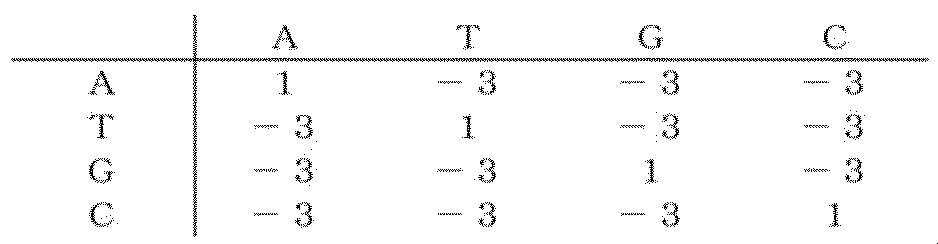
[式中、Aは動物のゲノム塩基配列に関する情報を示し、Bは配列データの塩基配列に関する情報を示す。]。この例において、ゲノム配列の塩基(A)と対応する配列データの塩基(B)とが一致する場合(α A=B)は1点が付与され、不一致の場合(β A≠B)は-3が付与される。このスコア関数を以下の表に示す:
アミノ酸配列の一致及び不一致をスコア化するスコア関数は、例えば、PAM行列(例えばPAM250)、BLOSUM行列(例えばBLOSUM50)などのスコア行列である。関数データ130に含まれるデータは、ポアソン分布に関する確率密度関数、回帰分析に用いられる関数をさらに含んでもよい。
動物ゲノム配列データ140は、アルパカを含む動物種に関するゲノム配列データを含む。アルパカのゲノム配列データは、抗体のV遺伝子、及びJ遺伝子をコードする配列を含む。動物ゲノム配列データ140は、ヒトゲノム配列データをさらに含んでもよい。
データベース107が、磁気ディスク、光ディスク、光磁気ディスク、またはフラッシュメモリなどの記憶媒体に格納されている場合、記憶部13は、記憶媒体に対して情報を読み出す/書き込むドライブ装置と、その記憶媒体とで構成されてもよい。
入力装置15は、ユーザが必要な情報(配列データグループが格納されたアドレスを指定する指定情報)および指示情報を制御部11に入力するための機器または装置により構成される。入力装置15は、入力情報を、インターフェースを介して制御部11へ出力する機能を有する。入力装置15は、例えばキーボード、マウス、および音声認識装置であってよい。入力情報の種類はこれらに限定されない。入力情報は、例えば、採血した動物に関する情報を含んでもよい。
指示情報は、処理工程を指示する情報を含む。処理工程を指示する情報は、例えば、後述の配列データグループ準備部での処理に関して、配列決定後の配列データグループから、クリーンアップ処理、ユニーク配列への集約処理、配列決定の誤りの統合処理、クラス分け処理、及び配列クラスター非形成性配列データ除外処理のいずれか又は全部をどのような順序で実行するかに関する指示情報を含む。
制御部11は、入力装置15から入力された指示に従い、データベース107に格納された配列データグループ110から配列決定後の配列データグループを取得し、後述する分子系統樹において配列クラスターを形成する可能性がある配列データの集まり(以下「配列クラスター形成性配列データグループ」という)を生成することを含む配列ライブラリーを準備する機能;前記配列データグループから分子系統樹を作成する機能;前記分子系統樹の配列クラスターが抗原特異抗体を含むか否かを判定する機能;及び判定結果などを表示する表示機能を有する。
制御部11の前記機能は、制御部11のメモリにロードされた、対応するアプリケーションプログラムを、制御部11のプロセッサを含む処理回路にて実行することで実現される。
表示装置17は、制御部11の判定結果などをユーザに知覚させることが可能な装置により構成され、例えばディスプレイ、およびプリンターであってよい。
測定装置20は、遺伝子配列を測定するための装置により構成される。測定装置20は、例えば、次世代DNAシークエンサーであってよい。測定装置20は、測定データを、インターフェースを介して制御部11へ出力する機能を有する。
図7において、測定装置20と制御部11とを繋ぐ実線は、それらの要素間の有線または無線によるデータおよび信号の送受信を機能させるインターフェースを含む送受信機により構成される。図7において、これら以外の各要素を繋ぐ実線も同様である。
実施形態2では、データベース107は判定システム1内部の記憶部13に格納されたが、データベースが格納される場所はこれに限定されない。データベース107は、例えば判定システム1の外部に存在する記憶装置に格納されていてもよい。このような記憶装置は、例えば、光ディスクなどの記憶媒体の全部または一部により構成されてよく、第2の態様に係る判定システムとネットワークにより接続されるサーバーに記憶装置が設けられていてもよい。
実施形態2では、判定システム1は外部に存在する測定装置20と接続されているが、本発明に係る判定システムはこれに限定されない。例えば、測定装置20は判定システム1の内部に存在してもよい。測定装置20を用いて得られた測定データを、制御部11に読み込ませ、例えば、データベース107に格納させてもよい。判定システム1は、測定装置20と接続されておらず、測定データが制御部11に読み込まれる構成であってもよい。
実施形態2に係る判定システムの動作を、図9~11を用いて説明する。
ユーザが、入力装置15を使用して(図7)、制御部11に対する指示および必要な情報(各種のデータが格納されたアドレスを指定する指定情報、及び採血した動物に関する情報)を入力する。
ユーザが、入力装置15を使用して(図7)、制御部11に対する指示および必要な情報(各種のデータが格納されたアドレスを指定する指定情報、及び採血した動物に関する情報)を入力する。
図9は、本発明に係る判定システムにおける、分子系統樹中の配列クラスターが抗原特異抗体を示す配列データを含むか否かの判定を示すフローチャートである。
<配列データグループ準備部>
実施形態2に係る判定システムは、所定の配列データグループを生成する、配列データグループ準備部を含む。
制御部11のプロセッサは、入力装置15を介したユーザからの指示および必要な情報の入力があると、配列データグループの準備を実行する(S11)。配列データグループ準備S11では、プロセッサは、記憶部13に格納された配列データグループ準備プログラムをメモリにロードし実行する。これにより、制御部11に、配列データグループ準備部101が実現される(図7)。
実施形態2に係る判定システムは、所定の配列データグループを生成する、配列データグループ準備部を含む。
制御部11のプロセッサは、入力装置15を介したユーザからの指示および必要な情報の入力があると、配列データグループの準備を実行する(S11)。配列データグループ準備S11では、プロセッサは、記憶部13に格納された配列データグループ準備プログラムをメモリにロードし実行する。これにより、制御部11に、配列データグループ準備部101が実現される(図7)。
図10は、配列ライブラリー準備S11における、配列データグループの準備を示すフローチャートである。配列データグループ準備部101は、ユーザが入力した指定情報を参照し、配列データグループの取得処理等を実行する。
(配列データグループの取得)
配列データグループ準備部101は、ユーザが入力した指定情報を参照し、データベース107内の配列データグループ110に格納された配列決定後の配列データグループをメモリにロードする(S31)。配列決定後の配列データグループを構成する配列データは、抗体の可変領域部分をコードする塩基配列に関する情報、配列長に関する情報、採血時期(weeks)に関する情報、品質スコア(Quality Score;Qスコア)を含む。
配列データグループ準備部101は、ユーザが入力した指定情報を参照し、データベース107内の配列データグループ110に格納された配列決定後の配列データグループをメモリにロードする(S31)。配列決定後の配列データグループを構成する配列データは、抗体の可変領域部分をコードする塩基配列に関する情報、配列長に関する情報、採血時期(weeks)に関する情報、品質スコア(Quality Score;Qスコア)を含む。
配列データグループ準備部101は、ユーザが入力した指示情報を参照し、指示された処理を実行して、処理に応じた配列データグループを生成する。実施形態2において、指示情報は、配列決定後の配列データグループに対して、クリーンアップ処理によるクリーンアップ配列データグループの生成、ユニーク配列への集約処理によるユニーク配列データグループの生成、配列決定の誤りの統合処理による統合ユニーク配列データグループの生成、クラス分け処理によるクラス分け配列データグループの生成、及び配列クラスター非形成性配列データ除外処理による配列クラスター形成性配列データグループの生成の順で実行する指示、及び各処理により生成された配列データグループをデータベース107に格納する指示を含む。
(クリーンアップ処理)
配列データグループ準備部101は、配列決定後の配列データグループが取得されると、アミノ酸配列を示さない配列データの除外(クリーンアップ)を実行する(S32)。これにより、クリーンアップ配列データグループが生成され、生成された配列データグループはデータベース107中の配列データグループ110に格納される。
配列データグループ準備部101は、配列決定後の配列データグループが取得されると、アミノ酸配列を示さない配列データの除外(クリーンアップ)を実行する(S32)。これにより、クリーンアップ配列データグループが生成され、生成された配列データグループはデータベース107中の配列データグループ110に格納される。
クリーンアップS32では、配列データグループ準備部101は、配列決定後の配列データグループ中の配列データに示される抗体の可変領域部分をコードする塩基配列の配列長に関する情報を取得し、前記配列長が3の倍数の場合(3k)に選出タグを付与し、3の倍数でない場合(3k+1又は3k+2)に除外タグを付与する。配列データグループ準備部101は、選出/除外タグ付けを配列決定後の配列データグループ中の全ての配列データに対して実行する。配列データグループ準備部101は、配列決定後の配列データグループ中の全ての配列データにタグ付けを終えると、選出/除外タグ付けを終了する。
配列データグループ準備部101は、タグ付終了後に、選出タグが付された配列データを配列決定後の配列データグループから選出し、選出した配列データで構成されるクリーンアップ配列データグループを生成する。生成されたクリーンアップ配列データグループは、データベース107中の配列データグループ110に格納される。
可変領域部分をコードする塩基配列が3の倍数の場合、その配列はアミノ酸配列を示す。クリーンアップ配列データグループ中の配列データは、アミノ酸配列に関する情報をさらに含んでもよい。
実施例3では、クリーンアップ処理に関して、アミノ酸配列を示さない配列データを除去する処理を説明したが、クリーンアップ処理はこれに限定されない。クリーンアップ処理は、例えば、配列データに含まれる品質スコアに基づくクリーンアップ処理であってよい。また、クリーンアップ処理は、アミノ酸配列を示さない配列データの除去及び品質スコアに基づく除去の組合せであってよい。
実施形態2では、クリーンアップ処理は、選出タグが付された配列データを選出することにより実行されたが、クリーンアップ処理の内容はこれに限定されない。クリーンアップ処理は、例えば、除外タグが付された配列データを、配列決定後の配列データグループから除外することによって実行されてもよい。実施例3では、クリーンアップ処理は、塩基配列に対して実行されたが、クリーンアップ処理を実行する配列の種類はこれに限定されない。クリーンアップ処理は、アミノ酸配列に対しても実行できる。
(ユニーク配列データへの集約)
配列データグループ準備部101は、クリーンアップ配列データグループが生成されると、同一の配列を示す複数の配列データを1つの配列データ(=「ユニーク配列データ」)へ集約する処理を実行する(S33)。これにより、ユニーク配列データグループが生成され、生成された配列データグループはデータベース107中の配列データグループ110に格納される。
配列データグループ準備部101は、クリーンアップ配列データグループが生成されると、同一の配列を示す複数の配列データを1つの配列データ(=「ユニーク配列データ」)へ集約する処理を実行する(S33)。これにより、ユニーク配列データグループが生成され、生成された配列データグループはデータベース107中の配列データグループ110に格納される。
配列データグループ準備部101は、ユニーク配列データへの集約処理において、クリーンアップ配列データグループ中の1つの配列データに集約タグ(α)を付与し、その配列データに示される配列に関する情報を取得する。配列データグループ準備部101は、取得した配列と同一の配列を示す他の配列データに対して同じ集約タグ(α)を付与する。配列データグループ準備部101は、クリーンアップ配列データグループにおいて、前記配列と同一の配列を示す配列データのすべてに集約タグ(α)を付与し終えると、集約タグ(α)のタグ付けを終了する。
配列データグループ準備部101は、集約タグ(α)を付与した配列データに示される配列と別の配列を示す1つ配列データに、集約タグ(α)とは別の集約タグ(β)を付与し、その集約タグ(β)のタグ付けは、上記と同様、クリーンアップ配列データグループにおいて前記配列と同一の配列を示す配列データのすべてに付与し終えると、終了する。さらに、配列データグループ準備部101は、集約タグ(β)を付与した配列データに示される配列と別の配列を示す配列データに、別の集約タグ(γ、・・・)を順にタグ付けする。配列データグループ準備部101は、クリーンアップ配列データグループ中の配列データの数と、集約タグを付与した配列データの数とが一致すると、集約タグの付与を終了する。
配列データグループ準備部101は、次いで、同じ種類の集約タグが付された複数の配列データを、1つの配列データ(例えば、集約タグが付されたいずれかの配列データ、又は新たに生成した配列データ)に集約することで、ユニーク配列データを生成する。ユニーク配列データは、配列データに含まれる情報に加えて、出現頻度(集約)に関する情報をさらに含む。
実施例3では、ユニーク配列データへの集約処理は、塩基配列に対して実行されたが、ユニーク配列を実行する配列の種類はこれに限定されない。ユニーク配列データへの集約処理は、アミノ酸配列に対して実行することができる。
(配列決定の誤りの統合)
配列データグループ準備部101は、ユニーク配列データグループが生成されると、配列決定の誤りを統合する処理を実行する(S34)。この処理により、統合ユニーク配列データグループが生成され、生成された配列データグループはデータベース107中の配列データグループ110に格納される。
配列データグループ準備部101は、ユニーク配列データグループが生成されると、配列決定の誤りを統合する処理を実行する(S34)。この処理により、統合ユニーク配列データグループが生成され、生成された配列データグループはデータベース107中の配列データグループ110に格納される。
図11は、配列決定の誤りの統合ステップを示すフローチャートである。
(a)統合用配列データグループの生成
配列データグループ準備部101は、ユニーク配列データグループ中のすべてのユニーク配列データから出現頻度(集約)に関する情報を取得し、出現頻度(集約)が一番大きいユニーク配列データの出現頻度(集約)が2以上の場合(S41;YES)、配列データグループ準備部101は、統合用配列データグループの生成を実行する(S42)。これにより、配列統合用配列データグループが生成され、前記配列統合用配列データグループの生成に用いられた配列データは、前記ユニーク配列データグループから除外される。
(a)統合用配列データグループの生成
配列データグループ準備部101は、ユニーク配列データグループ中のすべてのユニーク配列データから出現頻度(集約)に関する情報を取得し、出現頻度(集約)が一番大きいユニーク配列データの出現頻度(集約)が2以上の場合(S41;YES)、配列データグループ準備部101は、統合用配列データグループの生成を実行する(S42)。これにより、配列統合用配列データグループが生成され、前記配列統合用配列データグループの生成に用いられた配列データは、前記ユニーク配列データグループから除外される。
統合用配列データグループの生成S42において、配列データグループ準備部101は、一番大きい出現頻度(集約)を示したユニーク配列データ(以下「基準配列データα」という)を選出する。
配列データグループ準備部101は、記憶部13に格納された算出プログラムをメモリにロードして、配列一致度を含む各種パラメーターを生成及び算出する機能を実現(以下「生成&算出機能」という)する。生成&算出機能を実現した配列データグループ準備部101は、基準配列データαの塩基配列(以下「基準配列α」ともいう)と同じ配列長のユニーク配列データの塩基配列(以下「照会配列」ともいう)とを対比し、不一致となった塩基が何番目の塩基であるかに関する情報、塩基置換の種類に関する情報、及び塩基置換の数に関する情報を生成し、基準配列データαと比較された配列データ(「照会配列データ」ともいう)に付与する。配列データグループ準備部101は、前記情報の生成及び付与処理をユニーク配列データグループ中の全ての配列データに対して実行する。
配列データグループ準備部101は、記憶部13に格納された算出プログラムをメモリにロードして、配列一致度を含む各種パラメーターを生成及び算出する機能を実現(以下「生成&算出機能」という)する。生成&算出機能を実現した配列データグループ準備部101は、基準配列データαの塩基配列(以下「基準配列α」ともいう)と同じ配列長のユニーク配列データの塩基配列(以下「照会配列」ともいう)とを対比し、不一致となった塩基が何番目の塩基であるかに関する情報、塩基置換の種類に関する情報、及び塩基置換の数に関する情報を生成し、基準配列データαと比較された配列データ(「照会配列データ」ともいう)に付与する。配列データグループ準備部101は、前記情報の生成及び付与処理をユニーク配列データグループ中の全ての配列データに対して実行する。
次いで、配列データグループ準備部101は、基準配列αから、配列決定の誤りによって生じえた塩基置換数を有する配列データを選出する。配列データグループ準備部101は、基準配列データαの出現頻度(集約)に関する情報及びデータベース107内の関数データ130に格納されたポアソン分布に関する確率密度関数を取得し、取得した出現頻度(集約)とポアソン分布に関する確率密度関数とから、出現頻度(集約)が1以下になる最少の塩基置換数(m)を算出する。例えば、塩基置換数の期待値が0.3個の場合、塩基置換数が0、1、2、3、4となる確率はそれぞれ、0.74、0.22、0.03、0.003、0.0003となる。この場合、基準配列データαの出現頻度(集約)が100の場合、塩基置換数が0、1、2、3、4の配列の出現頻度はそれぞれ、100、30、4.5、0.5、0.03となり、mは3に設定される。同様にして、基準配列データαの出現頻度(集約)が1000の場合、mは4に設定される。なお、塩基置換数の期待値は、上述したi番目の塩基に配列決定の誤りが生じる確率piに関する式:
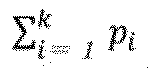
から算出することができる。
から算出することができる。
生成&算出機能を実現した配列データグループ準備部101は、塩基置換の数(m)が設定されると、ユニーク配列データに付与された塩基置換の数に関する情報を参照し、m個までの塩基置換を有する配列データ(塩基置換の数n=0、1、・・・m)を選出して、統合用配列データグループを生成する。配列データグループ準備部101は、統合用配列データグループの生成のために選出されたユニーク配列データを、前記ユニーク配列データグループから除外する。
(b)統合ユニーク配列データの生成
配列データグループ準備部101は、統合用配列データグループが生成されると、前記統合用配列データグループ中の配列データから、統合すべき配列データ(以下「統合用配列データ」という)を選出する処理を実行する(S43)。
図12は、統合用配列データの選出S43を示すフローチャートである。生成&算出機能を実現した配列データグループ準備部101は、ユニーク配列データに付与された情報(不一致となった塩基が何番目の塩基であるかに関する情報、塩基置換の種類に関する情報、及び塩基置換の数に関する情報)を参照し、実施形態1において詳述した「照会配列が生じる確率/基準配列が生じる確率(P0)」である比率を算出する(S51)。算出された前記比率は、前記ユニーク配列データに付与されてよい。
配列データグループ準備部101は、前記比率が算出されると、記憶部13に格納された閾値取得プログラムをメモリにロードして、閾値を取得する機能を実現する。閾値取得機能を実現した配列データグループ準備部101は、閾値データ120に格納された「照会配列が生じる確率/基準配列が生じる確率(P0)」に関する閾値(以下「閾値(確率)」という)を取得する(S52)。
配列データグループ準備部101は、閾値(確率)が取得されると、記憶部に格納された配列データ判定プログラムをメモリにロードして、配列データを判定する機能を実現する。配列データ判定機能を実現した配列データグループ準備部101は、ユニーク配列データに付与された前記比率が取得された閾値(確率)未満である場合に(S53;YES)、統合すべきユニーク配列データであること示す統合タグをそのユニーク配列データに付与する(S54)。
配列データ判定機能を実現した配列データグループ準備部101は、ユニーク配列データに付与された前記比率が取得された閾値(確率)以上である場合に(S53;NO)、統合すべきユニーク配列データではないこと示す非統合タグをそのユニーク配列データに付与する(S55)。配列データグループ準備部101は、統合用配列データグループ中の全てのユニーク配列データにタグ付けを終えると、統合/非統合タグの付与を終了する。
配列データグループ準備部101は、統合/非統合タグの付与が終了すると、図11の配列決定の誤りの統合を示すフローチャートに戻って、統合用配列データグループ中のユニーク配列データに付与された統合タグを参照し、統合タグが付与されたユニーク配列データを、基準配列データαに統合する(S44)。これにより、基準配列αに関する統合ユニーク配列データが生成され、生成された配列データはデータベース107に格納される。基準配列αに関する統合ユニーク配列データは、基準配列データαに含まれた情報に加えて、統合されたユニーク配列データに含まれる出現頻度(集約)の総和に関する情報(以下「出現頻度(統合)」という)をさらに含む。
配列データグループ準備部101は、統合ユニーク配列データの生成が終了すると、統合用配列データグループ中のユニーク配列データに付与された非統合タグを参照し、非統合タグが付与されたユニーク配列データ(即ち、S44において統合ユニーク配列データの生成に用いなかったユニーク配列データ)を、前記ユニーク配列データグループに戻す(S45)。
配列データグループ準備部101は、基準配列αに関する統合ユニーク配列データの生成に用いられたユニーク配列データが除外されたユニーク配列データグループ中のすべてのユニーク配列データから出現頻度(集約)に関する情報を取得し、出現頻度(集約)が一番大きいユニーク配列データの出現頻度(集約)が2以上の場合(S41;YES)、S42~S45を繰り返す。
実施形態2の統合用配列データの選出では、比率を算出するS51に続いて、閾値(確率)を取得するS52が実行されたが、ステップの順序はこれに限定されない。S51、S52は、算出された比率と取得された閾値(確率)とを比較するS53が実行されるまでに、実行されれば、いずれの順序で実行されてもよく、又は同時に実行されてもよい。
(c)統合ユニーク配列データグループの生成
配列データグループ準備部101は、統合ユニーク配列データの生成に用いなかったユニーク配列データが除外されたユニーク配列データグループ中のすべてのユニーク配列データから出現頻度(集約)に関する情報を取得し、出現頻度(集約)が一番大きいユニーク配列データの出現頻度(集約)が2未満の場合(S41;NO)、データベースに格納された統合ユニーク配列データ及び統合ユニーク配列データの生成に用いなかったユニーク配列データが除外されたユニーク配列データグループ中のすべてのユニーク配列データをメモリにロードして、統合ユニーク配列データグループを生成する(S46)。これにより、統合ユニーク配列データグループが生成され、生成された統合ユニーク配列グループはデータベース107中の配列データグループ110に格納される。
配列データグループ準備部101は、統合ユニーク配列データの生成に用いなかったユニーク配列データが除外されたユニーク配列データグループ中のすべてのユニーク配列データから出現頻度(集約)に関する情報を取得し、出現頻度(集約)が一番大きいユニーク配列データの出現頻度(集約)が2未満の場合(S41;NO)、データベースに格納された統合ユニーク配列データ及び統合ユニーク配列データの生成に用いなかったユニーク配列データが除外されたユニーク配列データグループ中のすべてのユニーク配列データをメモリにロードして、統合ユニーク配列データグループを生成する(S46)。これにより、統合ユニーク配列データグループが生成され、生成された統合ユニーク配列グループはデータベース107中の配列データグループ110に格納される。
実施形態2の配列決定の誤りの統合では、統合ユニーク配列データグループの生成S46は、ユニーク配列データグループにおいて一番大きい出現数(集約)が2未満と判定された後に(S41;NO)実行されたが、ステップの順序はこれに限定されない。S46は、例えば、ユニーク配列データグループにおいて一番大きい出現数(集約)が2以上と判定された後に(S41;YES)、統合ユニーク配列データを生成するS44と同時に実行されてもよい。
実施形態2の統合ユニーク配列データの生成に用いなかったユニーク配列データをユニーク配列データグループに戻すS45は、統合ユニーク配列データの生成S44の後に実行されたが、ステップの順序はこれに限定されない。S45は、統合用配列データ選出S43の後であって、S42~S45を繰り返すか否かを判定するためのS41が実行される前に、実行されればよい。S45は、例えば、統合ユニーク配列データの生成S44の前実行されてもよく、S44と同時に実行されてもよい。
実施形態2の配列決定の誤りの統合では、統合ユニーク配列データの生成S44は、統合用配列データの選出S43の後に実行されたが、ステップの順序はこれに限定されない。S43は、例えば、ユニーク配列データグループにおいて一番大きい出現数(集約)が2未満と判定された後に(S41;NO)実行されてよい。この場合、ユニーク配列データに付与される統合タグには、対比された基準配列の種類(例えば、基準配列データα)に関する情報が付与されており、ユニーク配列データの統合では、付与された基準配列の種類に関する情報が同じユニーク配列データが統合される。
実施形態2のユニーク配列データグループにおいて一番大きい出現数(集約)が2以上か否かを判定するS41は、S42~S45に先行して実施されたが、ステップの順序はこれに限定されない。S41は、例えば、S42~S45を繰り返すか否かを判定するために、S45が実行された後に実行されればよい。即ち、S41は、第1回目の統合用配列データグループの生成S42の前に実行されてなくてもよい。
実施形態2の配列決定の誤りの統合では、統合用配列データグループの生成S42が実行されたが、これに限定されない。一例において、配列決定の誤りの統合において、統合用配列データグループの生成S42は実行されなくてもよい。この例の場合、配列決定の誤りの統合において、参照配列データは、基準配列データの基準配列と同じ配列長の配列を有する配列データである。
(クラス分け)
図10の配列データグループの準備を示すフローチャートに戻って、配列データグループ準備部101は、統合ユニーク配列データグループが生成されると、配列長、オリジナルV遺伝子断片、及びオリジナルJ遺伝子断片に関する情報に基づいたクラス分けを実行する(S35)。
図10の配列データグループの準備を示すフローチャートに戻って、配列データグループ準備部101は、統合ユニーク配列データグループが生成されると、配列長、オリジナルV遺伝子断片、及びオリジナルJ遺伝子断片に関する情報に基づいたクラス分けを実行する(S35)。
(a)配列長に基づいたクラス分け
配列長に基づいたクラス分けにおいて、配列データグループ準備部101は、統合ユニーク配列データグループ中の各配列データの配列長に関する情報を取得し、同じ配列長の配列を示す各配列データに配列長に関する配列長クラス分けタグを付与する。
配列データグループ準備部101は、配列データグループ中の配列データの数と配列長クラス分けタグを付与した回数とが一致すると、配列長クラス分けタグの付与を終了する。
配列長に基づいたクラス分けにおいて、配列データグループ準備部101は、統合ユニーク配列データグループ中の各配列データの配列長に関する情報を取得し、同じ配列長の配列を示す各配列データに配列長に関する配列長クラス分けタグを付与する。
配列データグループ準備部101は、配列データグループ中の配列データの数と配列長クラス分けタグを付与した回数とが一致すると、配列長クラス分けタグの付与を終了する。
(b)オリジナルV遺伝子断片に基づいたクラス分け
配列データグループ準備部101は、配列長クラス分けタグの付与が終了すると、統合ユニーク配列データグループ中の各配列データに示される抗体の可変領域を構成するV遺伝子断片と対応するゲノム配列上のV遺伝子断片(=「オリジナルV遺伝子断片」)を推定し、その配列データにオリジナルV遺伝子断片に関するタグを付与する。
配列データグループ準備部101は、配列長クラス分けタグの付与が終了すると、統合ユニーク配列データグループ中の各配列データに示される抗体の可変領域を構成するV遺伝子断片と対応するゲノム配列上のV遺伝子断片(=「オリジナルV遺伝子断片」)を推定し、その配列データにオリジナルV遺伝子断片に関するタグを付与する。
オリジナルV遺伝子断片の推定において、配列データグループ準備部101は、記憶部13に格納された算出プログラムをメモリにロードして、配列一致度を算出する機能を実現する。生成&算出機能を実現した配列データグループ準備部101は、ユーザが入力した入力情報から採血をした動物に関する情報を参照し、データベース107内の動物ゲノム配列データ140に格納された対応する動物種のゲノム情報を取得する。
動物のゲノム配列データには、動物種に応じて、複数種類のV遺伝子断片をコードする領域が存在する。オリジナルV遺伝子断片の推定において、生成&算出機能を実現した配列データグループ準備部101は、その配列データに示される抗体のV遺伝子領域を含む配列情報とゲノム配列上の各V遺伝子断片をコードする複数の領域との配列一致度をそれぞれ算出する。配列一致度は、例えば、1から不一致の数を配列長で除した値を差し引くことで算出される([配列一致度]=1-[不一致の数]/[配列長])。
配列データグループ準備部101は、算出された配列一致度のうち、最も高い配列一致度を示すゲノム配列上の領域に示されるV遺伝子断片をオリジナルV遺伝子断片とする。配列データグループ準備部101は、オリジナルV遺伝子断片に関するV遺伝子断片クラス分けタグをその配列データに付与する。配列データグループ準備部101は、配列データグループ中の配列データの数とV遺伝子断片クラス分けタグを付与した回数とが一致すると、V遺伝子断片クラス分けタグの付与を終了する。
(c)オリジナルJ遺伝子断片に基づいたクラス分け
配列データグループ準備部101は、V遺伝子断片クラス分けタグの付与が終了すると、上記と同様にして、配列データに示される抗体の可変領域と対応するゲノム配列上のJ遺伝子断片(=「オリジナルJ遺伝子断片」)を特定し、その配列データにJ遺伝子断片クラス分けタグを付与する。配列データグループ準備部101は、配列データグループ中の配列データの数とJ遺伝子断片クラス分けタグを付与した回数とが一致すると、J遺伝子断片クラス分けタグの付与を終了する。
配列データグループ準備部101は、V遺伝子断片クラス分けタグの付与が終了すると、上記と同様にして、配列データに示される抗体の可変領域と対応するゲノム配列上のJ遺伝子断片(=「オリジナルJ遺伝子断片」)を特定し、その配列データにJ遺伝子断片クラス分けタグを付与する。配列データグループ準備部101は、配列データグループ中の配列データの数とJ遺伝子断片クラス分けタグを付与した回数とが一致すると、J遺伝子断片クラス分けタグの付与を終了する。
(d)クラス分け配列データグループの生成
配列データグループ準備部101は、クラス分けタグの付与が終了すると、配列長、オリジナルV遺伝子断片の種類及びオリジナルJ遺伝子断片の種類の組合せに対応したクラスを生成する。配列データグループ準備部101は、各種のクラス分けタグが付与された配列データを、対応するクラスに割当て、クラス分け配列データグループを生成する。これにより、生成されたクラス分け配列データグループは、データベース107中の配列データグループ110に格納される。各クラスには、そのクラスに対応する配列長の配列であって、対応するオリジナルV遺伝子断片及びオリジナルJ遺伝子断片に由来する配列を示す配列データが含まれる。
配列データグループ準備部101は、クラス分けタグの付与が終了すると、配列長、オリジナルV遺伝子断片の種類及びオリジナルJ遺伝子断片の種類の組合せに対応したクラスを生成する。配列データグループ準備部101は、各種のクラス分けタグが付与された配列データを、対応するクラスに割当て、クラス分け配列データグループを生成する。これにより、生成されたクラス分け配列データグループは、データベース107中の配列データグループ110に格納される。各クラスには、そのクラスに対応する配列長の配列であって、対応するオリジナルV遺伝子断片及びオリジナルJ遺伝子断片に由来する配列を示す配列データが含まれる。
実施形態2のクラス分けでは、配列長に基づくクラス分け、オリジナルV遺伝子断片に基づくクラス分け、そしてJ遺伝子断片に基づくクラス分けの順でクラス分けタグの付与が実行されたが、クラス分けタグの付与を実行する順序はこれに限定されない。例えば、これらのクラス分けタグの付与は同時に行われてもよい。クラス分けタグの付与は、配列長クラス分けタグの付与、V遺伝子断片クラス分けタグの付与、J遺伝子断片クラス分けタグの付与からなる群より選択される少なくとも1つのクラス分けタグの付与が実行されてよい。
(配列クラスター形成性配列データグループの生成)
配列データグループ準備部101は、クラス分けデータグループが生成されると、各クラス中の配列データグループから配列クラスター非形成性配列データの除外を実行する(S36)。これにより、配列クラスター形成性配列データグループが生成され、生成された配列データグループはデータベース107中の配列データグループ110に格納される。
配列データグループ準備部101は、クラス分けデータグループが生成されると、各クラス中の配列データグループから配列クラスター非形成性配列データの除外を実行する(S36)。これにより、配列クラスター形成性配列データグループが生成され、生成された配列データグループはデータベース107中の配列データグループ110に格納される。
配列クラスター非形成性配列データの除外S36において、配列データグループ準備部101は、ユーザが入力した指定情報を参照し、データベース107内の閾値データ120に格納された塩基置換の数に関する閾値(例えば30個)及び配列データ数に関する閾値(例えば50個)を取得する。
配列データグループ準備部101は、閾値の取得が終了すると、クラス分け配列データグループ中の任意のクラス(例えば、含まれる配列データの数の多いクラス)内の各配列データの配列情報を取得する。配列データグループ準備部101は、上記した生成&算出機能を実現し、前記クラス内の1つの配列データ(例えば、出現頻度(統合)が大きい配列データ)を選択し、選択した配列データの配列と前記クラス内の他の配列データとの塩基置換の数をそれぞれ算出する。
配列データグループ準備部101は、前記塩基置換の数に関する閾値未満の塩基置換の数を示す配列データの数を計数し、計数した配列データの数が、前記配列データ数に関する閾値未満であるか以下かを判定する。配列データグループ準備部101は、計数した配列データの数が、配列データ数に関する閾値未満の場合、その配列データを、配列クラスター非形成性配列データとして、前記クラスから除外する。
配列データグループ準備部101は、前記配列クラスター非形成性配列データの除外を、前記クラス中の各配列データについて実行する。配列データグループ準備部101は、1つのクラスにおいて配列クラスター非形成性配列データの除外処理の回数が、前記クラス中の配列データの数と一致した場合、そのクラスに対する配列クラスター非形成性配列データの除外処理を終了する。
配列クラスター非形成性配列データの除外処理が実行されたクラスを構成する配列データは、後述する分子系統樹において配列クラスターを形成する可能性がある配列データの集まり(「配列クラスター形成性配列データ」)であり、それらの配列データを含む配列クラスター形成性配列データグループである。配列データグループ準備部101は、クラス分け配列データグループの1つのクラスに対する配列クラスター非形成性配列データの除外が終了すると、前記クラス分け配列データグループの他のクラスに対して同様に配列クラスター非形成性配列データの除外を実行する。
配列データグループ準備部101は、実施形態2において、クラス分け配列データグループ中のクラスに含まれる配列データの数が、前記配列データ数に関する閾値未満の場合、そのクラスは、配列クラスター形成性配列データを含まないとして、クラス分け配列データグループから除外する。
実施形態2のクリーンアップ処理S32は、配列決定後の配列データグループに対して実行されたが、これに限定されない。クリーンアップ処理S32は、ユニーク配列データグループ、統合ユニーク配列データグループ、クラス分け配列データグループ、又は配列クラスター形成性配列データグループに対して実行されてもよく、若しくは実行されなくてもよい。
実施形態2のユニーク配列データへの集約処理S33は、クリーンアップ後の配列データグループに対して実行されたが、これに限定されない。ユニーク配列データへの集約処理S33は、配列決定後の配列データグループ、統合ユニーク配列データグループ、クラス分け配列データグループ、又は配列クラスター形成性配列データグループに対して実行されてもよく、若しくは実行されなくてもよい。
実施形態2の配列決定の誤りの統合S34は、ユニーク配列データグループの生成ステップの直後に実行されたが、これに限定されない。配列決定の誤りの統合S34は、ユニーク配列データグループの生成が実行された後であれば、いずれの順序で実行されてもよく、若しくは実行されてなくてもよい。
実施形態2のクラス分けS35は、統合ユニーク配列データグループに対して実行されたが、これに限定されない。クラス分けステップS35は、配列決定後の配列データグループ、クリーンアップ配列データグループ、ユニーク配列データグループ、統合ユニーク配列データグループ、配列クラスター形成性配列データグループに対して実行されてもよく、若しくは実行されなくてもよい。
実施形態2の配列クラスター形成性配列データグループの生成S36は、クラス分けデータグループに対して実行されたが、これに限定されない。配列クラスター形成性配列データグループの生成S36は、配列決定後の配列データグループ、クリーンアップ配列データグループ、ユニーク配列データグループ、統合ユニーク配列データグループに対して実行されてもよく、若しくは実行されてなくてもよい。
<分子系統樹作成部>
実施形態2に係る判定システムは、配列データグループから分子系統樹を作成する分子系統樹作成部を含む。
制御部11のプロセッサは、配列データグループが準備されると、図9に示される分子系統樹の作成を実行する(S12)。分子系統樹の作成S12において、制御部11のプロセッサは、記憶部13に格納された分子系統樹作成プログラムをメモリにロードして実行する。これにより、制御部11に分子系統樹作成部103が実現される。
実施形態2に係る判定システムは、配列データグループから分子系統樹を作成する分子系統樹作成部を含む。
制御部11のプロセッサは、配列データグループが準備されると、図9に示される分子系統樹の作成を実行する(S12)。分子系統樹の作成S12において、制御部11のプロセッサは、記憶部13に格納された分子系統樹作成プログラムをメモリにロードして実行する。これにより、制御部11に分子系統樹作成部103が実現される。
分子系統樹作成部103は、準備された配列クラスター形成性配列データグループ中の配列データについてマルチプルアライメント(multiple alignment)を行い、マルチプルアライメントを行った配列データから距離行列を計算することで分子系統樹を作成する。
実施形態2の分子系統樹の作成では、距離行列を計算することにより行われたが、分子系統樹の作成方法はこれに限定されない。分子系統樹の作成は、例えば、系統樹の枝の長さの合計を最小にすることに基づく最大節約法を用いてもよい。
実施形態2の分子系統樹の作成は、配列クラスター形成性配列データグループに対して実行されたが、これに限定されない。分子系統樹の作成は、統合ユニーク配列データグループ、又はクラス分け配列データグループに対して実行されてもよい。
実施形態2の分子系統樹の作成は、配列クラスター形成性配列データグループに対して実行されたが、これに限定されない。分子系統樹の作成は、統合ユニーク配列データグループ、又はクラス分け配列データグループに対して実行されてもよい。
<配列データ判定部>
実施形態2に係る判定システムは、分子系統樹における配列クラスター中の配列データに示される抗体の配列と前記抗体のオリジナル配列との配列一致度の変化又は抗体の種類の変化に基づいて、前記配列クラスターが抗体作製の候補となる抗原特異抗体を示す配列データを含む配列クラスターであるか否かを判定する配列データ判定部を含む。
実施形態2に係る判定システムは、分子系統樹における配列クラスター中の配列データに示される抗体の配列と前記抗体のオリジナル配列との配列一致度の変化又は抗体の種類の変化に基づいて、前記配列クラスターが抗体作製の候補となる抗原特異抗体を示す配列データを含む配列クラスターであるか否かを判定する配列データ判定部を含む。
(分子系統樹からの配列クラスター抽出)
制御部11のプロセッサは、分子系統樹が作成されると、記憶部13に格納された配列データ判定部を機能させる配列データ判定プログラムをメモリにロードして実行する。これにより、制御部11に配列データ判定部105が実現される。
制御部11のプロセッサは、分子系統樹が作成されると、記憶部13に格納された配列データ判定部を機能させる配列データ判定プログラムをメモリにロードして実行する。これにより、制御部11に配列データ判定部105が実現される。
配列データ判定部105は、記憶部13に格納された配列クラスター抽出プログラムをメモリにロードして実行する。これにより、配列クラスター抽出機能が実現される。配列クラスター抽出機能を配列データ実現した配列データ判定部105は、作成された分子系統樹からの配列クラスターの抽出を実行する(S13)。これにより、分子系統樹から抽出された配列クラスター中の配列データが得られる。配列クラスター抽出機能を実現した配列データ判定部105は、作成された分子系統樹内で配列情報の密度が高い部分を配列クラスターとして抽出する。
(配列クラスター中の配列データの配列一致度の傾きの算出)
配列データ判定部105は、配列クラスターが抽出されると、配列クラスター中の配列データの配列情報の変化(例えば、単位時間当たりの配列一致度の傾き)を算出する(S14)。配列一致度の傾きの算出S14において、配列データ判定部105は、記憶部13に格納された算出プログラムをメモリにロードして実行する。これにより、配列データ判定部105に配列一致度の傾きを算出する機能が実現される。生成&算出機能を実現した配列データ判定部105は、配列クラスター中の各配列データの配列情報と、その配列データに含まれるオリジナルV、J遺伝子断片の配列情報との配列一致度を算出する。
配列データ判定部105は、配列クラスターが抽出されると、配列クラスター中の配列データの配列情報の変化(例えば、単位時間当たりの配列一致度の傾き)を算出する(S14)。配列一致度の傾きの算出S14において、配列データ判定部105は、記憶部13に格納された算出プログラムをメモリにロードして実行する。これにより、配列データ判定部105に配列一致度の傾きを算出する機能が実現される。生成&算出機能を実現した配列データ判定部105は、配列クラスター中の各配列データの配列情報と、その配列データに含まれるオリジナルV、J遺伝子断片の配列情報との配列一致度を算出する。
配列データ判定部105は、採血時期(weeks)に関する情報を前記配列クラスター中の各配列データから取得し、上記で算出した配列一致度を用いて、時間経過に対する配列一致度の傾きを算出する。
(抗原特異抗体を含む配列クラスターであるか否かの判定)
配列データ判定部105は、配列一致度の傾きが算出されると、記憶部13に格納された閾値取得プログラムをメモリにロードして、閾値を取得する機能を実現する。閾値取得機能を実現した配列データ判定部105は、閾値データ120に格納された配列一致度の傾きに関する閾値(以下「閾値(傾き)」という)を取得する(S15)。
配列データ判定部105は、配列一致度の傾きが算出されると、記憶部13に格納された閾値取得プログラムをメモリにロードして、閾値を取得する機能を実現する。閾値取得機能を実現した配列データ判定部105は、閾値データ120に格納された配列一致度の傾きに関する閾値(以下「閾値(傾き)」という)を取得する(S15)。
配列データ判定部105は、閾値(傾き)が取得されると、算出した配列一致度の傾きと取得した閾値(傾き)とを対比し、配列一致度の傾きが閾値(傾き)より小さい場合に(S16;YES)、その配列一致度の傾きを示した配列クラスターに対して、抗原特異抗体を示す配列データを含むことを示す表示タグを付与する(S17)。
配列データ判定部105は、配列一致度の傾きが閾値(傾き)以上の場合に(S16;NO)、その配列一致度の傾きを示した配列クラスターに対して、抗原特異抗体を示す配列データを含まないことを示す表示タグを付与する(S18)。
<判定結果表示>
制御部11のプロセッサは、表示タグが付与されると、判定結果表示を実行する(S19)。判定結果表示S19では、プロセッサは、記憶部13からメモリにロードされた表示プログラムを実行し、表示タグに応じた映像信号を表示装置17に出力する。表示装置17は例えばディスプレイであってよい。この場合、該ディスプレイは入力された映像信号をもとに判定結果を表示する。
制御部11のプロセッサは、表示タグが付与されると、判定結果表示を実行する(S19)。判定結果表示S19では、プロセッサは、記憶部13からメモリにロードされた表示プログラムを実行し、表示タグに応じた映像信号を表示装置17に出力する。表示装置17は例えばディスプレイであってよい。この場合、該ディスプレイは入力された映像信号をもとに判定結果を表示する。
実施形態2では、分子系統樹の作成S12及び配列クラスターの抽出S13は1回ずつ実行されたが、実行される回数はこれに限定されない。例えば、配列クラスターの抽出S13に抽出された配列クラスター中の配列データの集まりに対して、再度、分子系統樹の作成S12’を実行して作成された分子系統樹について、配列クラスターの抽出S13’を実行してもよい。
実施形態2では、配列クラスター中の配列データの配列一致度の傾きの算出S14、そして、閾値(傾き)の取得S15の順に実行されたが、ステップの順序はこれに限定されない。S14及びS15は、配列一致度の傾きと閾値(傾き)との対比S16までに実行されればよく、S14及びS15はいずれの順序で実行されてもよく、若しくは同時に実行されてもよい。
[実施形態3]
本発明の第3の態様は、抗原特異抗体を作製する方法を提供する。本発明の第3の態様の1つの実施形態(以下「実施形態3」という)について以下に説明する。
本発明の第3の態様は、抗原特異抗体を作製する方法を提供する。本発明の第3の態様の1つの実施形態(以下「実施形態3」という)について以下に説明する。
実施形態3に係る作製方法は、免疫刺激を受けた可能性のある動物から取得された抗体の配列データを含む配列データグループを準備する工程;前記配列データグループから分子系統樹を作成する工程;前記分子系統樹における配列クラスター中の配列データに示される抗体の配列と前記抗体のオリジナル配列との配列一致度の変化又は抗体の種類の変化に基づいて、前記配列クラスターが抗体作製の候補となる抗原特異抗体を示す配列データを含むか否かを判定する工程;抗原特異抗体を示す配列データを含むと判定された配列クラスターから、抗体作製の候補となる抗原特異抗体を示す配列データを選出する工程;及び選出された配列データに示されるアミノ酸配列を有する抗体を作製する工程;を含む。
実施形態3に係る作製方法における、配列データグループを準備する工程、分子系統樹を作成する工程、及び抗原特異抗体を示す配列データを含む配列クラスターであるか否かを判定する工程には、実施形態1に係る特定方法において説明した特徴及び本明細書に記載の特徴が適宜適用される。
<抗原特異抗体を示す配列データの選出>
実施形態3に係る作製方法は、抗原特異抗体を示す配列データを含むと判定された配列クラスターについて、抗体作製の候補となる抗原特異抗体を示す配列データを選出する工程を含む。配列データは、例えば、抗原特異抗体を示す配列データを含むと判定された配列クラスター中の配列データのうち、配列データ示される配列とそのオリジナル配列との配列同一性が、配列一致度に関する閾値以下の場合に選出されてよい。他の例において、配列データは、配列データ示される配列とそのオリジナル配列との配列同一性が最も小さいもの、又は抗体を採取したタイミングが一番遅い配列データであって、配列データ示される配列とそのオリジナル配列との配列同一性が配列一致度に関する閾値以下のものであってよい。
実施形態3に係る作製方法は、抗原特異抗体を示す配列データを含むと判定された配列クラスターについて、抗体作製の候補となる抗原特異抗体を示す配列データを選出する工程を含む。配列データは、例えば、抗原特異抗体を示す配列データを含むと判定された配列クラスター中の配列データのうち、配列データ示される配列とそのオリジナル配列との配列同一性が、配列一致度に関する閾値以下の場合に選出されてよい。他の例において、配列データは、配列データ示される配列とそのオリジナル配列との配列同一性が最も小さいもの、又は抗体を採取したタイミングが一番遅い配列データであって、配列データ示される配列とそのオリジナル配列との配列同一性が配列一致度に関する閾値以下のものであってよい。
<配列データに示されるアミノ酸配列を有する抗体の作製>
実施形態3に係る作製方法は、抗原特異抗体を示す配列データを含むと判定された配列クラスター中の配列データに示されるアミノ酸配列を有する抗体を作製する工程を含む。抗体は、限定するものではないが、選出された配列データのCDRを大腸菌のコドン出現頻度に応じて最適化した配列を有するDNA断片を、大腸菌用の蛋白質発現ベクターに挿入してプラスミドを構築し、前記プラスミドを大腸菌に導入して発現させることにより製造される。
実施形態3に係る作製方法は、抗原特異抗体を示す配列データを含むと判定された配列クラスター中の配列データに示されるアミノ酸配列を有する抗体を作製する工程を含む。抗体は、限定するものではないが、選出された配列データのCDRを大腸菌のコドン出現頻度に応じて最適化した配列を有するDNA断片を、大腸菌用の蛋白質発現ベクターに挿入してプラスミドを構築し、前記プラスミドを大腸菌に導入して発現させることにより製造される。
[実施形態4]
本発明の第4の態様は、抗体作製の候補となる抗原特異抗体を示す配列データを選出する方法を提供する。本発明の第4の態様の1つの実施形態(以下「実施形態4」という)について以下に説明する。実施形態4に係る選出方法は、上述した実施形態1に係る特定方法と異なる方法であるが、具体的な工程において共通する部分があるため、ここでは、実施形態1に係る特定方法との相違点を主として説明する。
本発明の第4の態様は、抗体作製の候補となる抗原特異抗体を示す配列データを選出する方法を提供する。本発明の第4の態様の1つの実施形態(以下「実施形態4」という)について以下に説明する。実施形態4に係る選出方法は、上述した実施形態1に係る特定方法と異なる方法であるが、具体的な工程において共通する部分があるため、ここでは、実施形態1に係る特定方法との相違点を主として説明する。
実施形態4に係る選出方法は、実施形態1に係る特定方法と異なり、分子系統樹を作成する工程、及び、抗体作製の候補となる抗原特異抗体を示す配列データを含むか否かを判定する工程を、必須の工程としては含まない。実施形態4に係る選出方法は、実施形態1に係る特定方法について詳述した「配列クラスター非形成性配列データの除外」を必須の工程として含む。実施形態4に係る選出方法は、更に、配列データグループから抗原特異抗体を示す配列データを選出する工程を必須の工程として含む。
前記した配列データを選出する工程は、配列データグループ中の配列データに示される抗体の配列と前記抗体のオリジナル配列との配列一致度と、閾値とを対比する工程を含む。前記した対比する工程は、限定するものではないが、配列データグループ中の配列データに示される抗体の配列と前記抗体のオリジナル配列との配列一致度(例えば88%の一致度)が、前記閾値(例えば90%の一致度)よりも低い場合に、抗体作製の候補となる抗原特異抗体を示す配列データとして選出することを含む。前記した対比する工程は、例えば、配列一致度と閾値との対比に加えて、その抗体が取得された時期(例えば5回目)と閾値(例えば4回目)とを対比することを更に含んでよい。この例において、選出工程では、抗体が取得された時期が閾値以上の場合であって、配列一致度が閾値未満の場合に、その配列データを抗体作製の候補となる抗原特異抗体を示す配列データとして選出することを含む。
実施形態4に係る選出方法は、実施形態1に係る選出方法において詳述した「アミノ酸配列を示さない配列データ等のクリーンアップ」、「ユニーク配列への集約」、「配列決定の誤りの統合」、及び「クラス分け」を含む。発明の第4の態様に係る選出方法は、さらに、分子系統樹を作成する工程、及び、抗体作製の候補となる抗原特異抗体を示す配列データを含むか否かを判定する工程を含んでもよい。
[実施形態5]
本発明の第5の態様は、抗体作製の候補となる抗原特異抗体を示す配列データを選出する選出システムを提供する。本発明の第の態様の1つの実施形態(以下「実施形態5」という)について以下に説明する。実施形態5に係る選出方法は、上述した実施形態2に係る判定システムと異なるシステムであるが、具体的なデータ処理において共通する部分があるため、ここでは、実施形態2に係る判定システムとの相違点を主として説明する。
本発明の第5の態様は、抗体作製の候補となる抗原特異抗体を示す配列データを選出する選出システムを提供する。本発明の第の態様の1つの実施形態(以下「実施形態5」という)について以下に説明する。実施形態5に係る選出方法は、上述した実施形態2に係る判定システムと異なるシステムであるが、具体的なデータ処理において共通する部分があるため、ここでは、実施形態2に係る判定システムとの相違点を主として説明する。
実施形態5に係る選出システムは、実施形態2に係る判定システムと異なり、分子系統樹作成部、及び、配列データ判定部を、必須の部としては含まない。実施形態5に係る選出システムは、実施形態2に係る判定システムについて詳述した「配列データ準備部」のうち「配列クラスター形成性配列データグループの生成」を必須の処理として含む。実施形態5に係る選出システムは、更に、配列データ選出部を必須の部として含む。
前記した配列データ選出部は、配列データグループ中の配列データに示される抗体の配列と前記抗体のオリジナル配列との配列一致度と、閾値とを対比する処理を実行することを含む。前記した対比する処理においては、配列データ選出部は、限定するものではないが、配列データグループ中の配列データに示される抗体の配列と前記抗体のオリジナル配列との配列一致度(例えば88%の一致度)が、前記閾値(例えば90%の一致度)よりも低い場合に、抗体作製の候補となる抗原特異抗体を示す配列データであることを示す選出タグを前記配列データに付与することを含む。前記した対比する処理は、例えば、配列一致度と閾値との対比に加えて、その抗体が取得された時期(例えば5回目)と閾値(例えば4回目)とを対比する処理の実行を更に含んでよい。この例において、配列データ選出部では、抗体が取得された時期が閾値以上の場合であって、配列一致度が閾値未満の場合に、その配列データを抗体作製の候補となる抗原特異抗体を示す配列データであることを示す選出タグを付与する処理を含む。
実施形態5に係る選出システムは、実施形態2に係る判定システムにおいて詳述した「クリーンアップ処理」、「ユニーク配列への集約処理」、「配列決定の誤りの統合処理」、及び「クラス分け処理」を含む。発明の第5の態様に係る選出システムは、さらに、分子系統樹作成部、及び、配列データ判定部を含んでもよい。
[実施形態6]
本発明の第6の態様は、抗原特異抗体を作製する方法を提供する。本発明の第6の態様の1つの実施形態(以下「実施形態6」という)について以下に説明する。実施形態6に係る作製方法は、上述した実施形態3に係る作製方法と異なる方法であるが、具体的な工程において共通する部分があるため、ここでは、実施形態3に係る特定方法との相違点を主として説明する。
本発明の第6の態様は、抗原特異抗体を作製する方法を提供する。本発明の第6の態様の1つの実施形態(以下「実施形態6」という)について以下に説明する。実施形態6に係る作製方法は、上述した実施形態3に係る作製方法と異なる方法であるが、具体的な工程において共通する部分があるため、ここでは、実施形態3に係る特定方法との相違点を主として説明する。
実施形態6に係る作製方法は、実施形態3に係る作製方法と異なり、分子系統樹を作成する工程、及び、抗体作製の候補となる抗原特異抗体を示す配列データを含むか否かを判定する工程を、必須の工程としては含まない。実施形態6に係る作製方法は、実施形態3に係る作製方法について詳述した「配列クラスター非形成性配列データの除外」を必須の工程として含む。実施形態6に係る作製方法は、更に、配列データグループから抗原特異抗体を示す配列データを選出する工程を必須の工程として含む。前記した配列データを選出する工程は、実施形態4の配列データを選出する工程において説明した特徴及び本願明細書に記載の特徴が適宜適用される。
実施形態6に係る作製方法における配列データグループを準備する工程には、実施形態1に係る配列データグループを準備する工程において説明した特徴及び本願明細書に記載の特徴が適宜適用される。実施形態6に係る抗体を作製する工程には、実施形態3に係る抗体を作製する工程において説明した特徴及び本願明細書に記載の特徴が適宜適用される。
本発明の第1又は第4の態様に係る実施形態は、例えば、以下に記載されるものであってよいが、これらに限定されない:
[項1]抗体作製の候補となる抗原特異抗体を示す配列データを含む配列クラスターを特定する方法であって、免疫刺激を受けた可能性のある動物から取得された抗体の配列データを含む配列データグループを準備する工程;前記配列データグループから分子系統樹を作成する工程;及び前記分子系統樹における配列クラスター中の配列データに示される抗体の配列と前記抗体のオリジナル配列との配列一致度の変化又は抗体の種類の変化に基づいて、前記配列クラスターが抗体作製の候補となる抗原特異抗体を示す配列データを含むか否かを判定する工程;を含み、前記オリジナル配列が、配列データに示される抗体の配列と、前記抗体が得られた動物に対応する動物種のゲノム配列との配列一致度が最も高い配列である、特定方法。
[項2-1]前記準備工程が、配列データグループを取得する工程を含み、前記準備工程で取得される配列データグループが、配列決定後の配列データグループであり、前記準備工程が、アミノ酸配列を示さない配列データをクリーンアップする工程を含む、項1に記載の特定方法。
[項2-2]前記準備工程が、同一の配列を示す複数の配列データを1つの配列データ(以下「ユニーク配列データ」という)に集約する工程を含み、前記ユニーク配列データは、前記配列データに示される配列に関する情報、及び集約した配列データの個数に関する情報(以下「出現頻度(集約)」という)を含む、項2-1に記載の特定方法。
[項2-3]前記準備工程が、配列データグループを取得する工程を含み、前記準備工程で取得される配列データグループが、配列決定後の配列データグループであり、前記準備工程が、同一の配列を示す複数の配列データをユニーク配列データに集約する工程を含み、前記ユニーク配列データは、前記配列データに示される配列に関する情報、及び出現頻度(集約)に関する情報を含む、項1に記載の特定方法。
[項2-4]前記準備工程が、アミノ酸配列を示さない配列データをクリーンアップする工程を含む、項2-3に記載の特定方法。
[項2-5]前記準備工程が、配列データグループを取得する工程を含み、前記準備工程が、配列データに含まれる配列決定の品質に関する情報と、閾値とを対比することを含み、前記閾値未満の配列データをクリーンアップする工程を含む、項1~項2-4のいずれかに記載の特定方法。
[項3]前記配列データグループが、前記ユニーク配列データで構成されるユニーク配列データグループであり、前記ユニーク配列データが塩基配列データであり、前記ユニーク配列データグループ中、出現頻度(集約)が最も大きいユニーク配列データを基準配列データ(n=0)とし、前記基準配列データの配列(以下「基準配列」という)と同じ長さであるが、前記基準配列に対してn個(n=1、・・・m)の塩基置換を有する配列を有するユニーク配列データを照会配列データとし、前記準備工程が、前記基準配列データの出現頻度(集約)に対する前記照会配列の出現頻度(集約)の比率が閾値未満の照会配列を、前記基準配列データに統合する工程を含む、項2-2~項2-5のいずれかに記載の特定方法。
[項4-1]前記準備工程が、前記配列データグループ中の配列データを、配列長及び前記動物に対応する動物種のゲノム配列上のオリジナル配列のいずれか一方又は両方に基づいてクラス分けする工程を含む、項1~項3のいずれかに記載の特定方法。
[項4-2]前記準備工程が、前記配列データグループ中の特定の配列データに示される配列と所定の配列一致度を有する配列に関する配列データの個数が、配列データの個数に関する閾値未満である場合に、前記特定の配列データを前記配列データグループから除外する工程を含む、項1~項3のいずれかに記載の特定方法。
[項4-3]前記準備工程が、前記配列データグループ中の配列データを、配列長及び前記動物に対応する動物種のゲノム配列上のオリジナル配列のいずれか一方又は両方に基づいてクラス分けする工程、及び、前記配列データグループ中の特定の配列データに示される配列と所定の配列一致度を有する配列に関する配列データの個数が、配列データの個数に関する閾値未満である場合に、前記特定の配列データを前記配列データグループから除外する工程を含む、項1~項3のいずれかに記載の特定方法。
[項5-1]前記準備工程が、前記統合工程、及び前記クラス分け工程の順で実施することを含む、項4-3に記載の特定方法。
[項5-2]前記準備工程が、前記統合工程、及び前記除外工程の順で実施することを含む、項4-3に記載の特定方法。
[項5-3]前記準備工程が、前記統合工程、前記クラス分け工程、及び前記除外工程の順で実施することを含む、項4-3に記載の特定方法。
[項6]前記オリジナル配列に基づくクラス分けが、前記配列データグループ中の配列データに示される抗体の可変領域を構成するV遺伝子断片及びJ遺伝子断片のいずれか一方又は両方と、前記動物に対応する動物種のゲノム配列とのホモロジー検索により得られた配列一致度を算出する工程、及び前記配列データを、最も高い配列一致度を示す遺伝子断片に関するクラスに割り当てる工程を含む、項4-1、項4-3、項5-1、又は項5-3に記載の特定方法。
[項7-1]前記配列一致度の変化が、単位時間当たりの配列一致度の変化であり、及び抗体の種類の変化が抗体のクラススイッチである、項1~項6のいずれかに記載の特定方法。
[項7-2]前記配列データグループが、免疫刺激を受けた可能性のある動物から、異なる時期にi回取得された抗体集団の各抗体の配列を配列決定した配列情報を有する配列データの集まりである、項1~項6及び項7-1のいずれかに記載の特定方法。
[項10]抗体作製の候補となる抗原特異抗体を示す配列データを選出する方法であって、免疫刺激を受けた可能性のある動物から取得された抗体の配列データを含む配列データグループを準備する工程;及び配列データグループから抗原特異抗体を示す配列データを選出する工程;を含み、前記準備工程が、前記配列データグループ中の特定の配列データに示される配列と所定の配列一致度を有する配列に関する配列データの個数が、配列データの個数に関する閾値未満である場合に、前記特定の配列データを前記配列データグループから除外する工程を含み、前記選出工程が、前記配列データグループ中の配列データに示される抗体の配列と前記抗体のオリジナル配列との配列一致度と、閾値とを対比する工程を含み、前記オリジナル配列が、配列データに示される抗体の配列と、前記抗体が得られた動物に対応する動物種のゲノム配列との配列一致度が最も高い配列である、選出方法。
[項13-1]前記準備工程が、配列データグループを取得する工程を含み、前記準備工程で取得される配列データグループが、配列決定後の配列データグループであり、前記準備工程が、アミノ酸配列を示さない配列データをクリーンアップする工程を含む、項10に記載の選出方法。
[項13-2]前記準備工程が、同一の配列を示す複数の配列データをユニーク配列データに集約する工程を含み、前記ユニーク配列データは、前記配列データに示される配列に関する情報、及び出現頻度(集約)に関する情報を含む、項13-1に記載の選出方法。
[項13-3]前記準備工程が、配列データグループを取得する工程を含み、前記準備工程で取得される配列データグループが、配列決定後の配列データグループであり、前記準備工程が、同一の配列を示す複数の配列データをユニーク配列データに集約する工程を含み、前記ユニーク配列データは、前記配列データに示される配列に関する情報、及び出現頻度(集約)に関する情報を含む、項10に記載の選出方法。
[項13-4]前記準備工程が、アミノ酸配列を示さない配列データをクリーンアップする工程を含む、項13-3に記載の選出方法。
[項13-5]前記準備工程が、クリーンアップ工程、及び除外工程の順で実施することを含む、項13-1又は項13-2に記載の選出方法。
[項13-6]前記準備工程が、ユニーク配列データへの集約工程、及び除外工程の順で実施することを含む、項13-3又は項13-4に記載の選出方法。
[項13-7]前記準備工程が、クリーンアップ工程、ユニーク配列データへの集約工程、及び除外工程の順で実施することを含む、項13-2又は項13-4に記載の選出方法。
[項13-8]前記準備工程が、配列データグループを取得する工程を含み、前記準備工程が、配列データに含まれる配列決定の品質に関する情報と、閾値とを対比することを含み、前記閾値未満の配列データをクリーンアップする工程を含む、項10、項13-1~項13-7のいずれかに記載の選出方法。
[項14]前記配列データグループが、前記ユニーク配列データで構成されるユニーク配列データグループであり、前記ユニーク配列データが塩基配列データであり、前記ユニーク配列データグループ中、出現頻度(集約)が最も大きいユニーク配列データを基準配列データ(n=0)とし、前記基準配列データの配列(以下「基準配列」という)と同じ長さであるが、前記基準配列に対してn個(n=1、・・・m)の塩基置換を有する配列を有するユニーク配列データを照会配列データとし、前記準備工程が、前記基準配列データの出現頻度(集約)に対する前記照会配列の出現頻度(集約)の比率が閾値未満の照会配列を、前記基準配列データに統合する工程を含む、項13-2~項13-7のいずれかに記載の選出方法。
[項15]前記準備工程が、前記配列データグループ中の配列データを、配列長及び前記動物に対応する動物種のゲノム配列上のオリジナル配列のいずれか一方又は両方に基づいてクラス分けする工程を含む、項10及び項13~項14のいずれかに記載の選出方法。
[項16-1]前記準備工程が、前記統合工程、及び前記除外工程の順で実施することを含む、項14に記載の選出方法。
[項16-2]前記準備工程が、前記統合工程、前記クラス分け工程、及び前記除外工程の順で実施することを含む、項15に記載の選出方法。
[項15]前記準備工程が、前記配列データグループ中の配列データを、配列長及び前記動物に対応する動物種のゲノム配列上のオリジナル配列のいずれか一方又は両方に基づいてクラス分けする工程を含む、項10及び項13~項14のいずれかに記載の選出方法。
[項16-1]前記準備工程が、前記統合工程、及び前記除外工程の順で実施することを含む、項14に記載の選出方法。
[項16-2]前記準備工程が、前記統合工程、前記クラス分け工程、及び前記除外工程の順で実施することを含む、項15に記載の選出方法。
[項17]前記オリジナル配列に基づくクラス分けが、前記配列データグループ中の配列データに示される抗体の可変領域を構成するV遺伝子断片及びJ遺伝子断片のいずれか一方又は両方と、前記動物に対応する動物種のゲノム配列とのホモロジー検索により得られた配列一致度を算出する工程、及び前記配列データを、最も高い配列一致度を示す遺伝子断片に関するクラスに割り当てる工程を含む、項15又は項16-2に記載の選出方法。
[項18]前記配列一致度の変化が、単位時間当たりの配列一致度の変化であり、及び抗体の種類の変化が抗体のクラススイッチである、項10及び項13~項17のいずれかに記載の選出方法。
[項19]前記配列データグループが、免疫刺激を受けた可能性のある動物から、異なる時期にi回取得された抗体集団の各抗体の配列を配列決定した配列情報を有する配列データの集まりである、項10及び項13~項18のいずれかに記載の選出方法。
[項18]前記配列一致度の変化が、単位時間当たりの配列一致度の変化であり、及び抗体の種類の変化が抗体のクラススイッチである、項10及び項13~項17のいずれかに記載の選出方法。
[項19]前記配列データグループが、免疫刺激を受けた可能性のある動物から、異なる時期にi回取得された抗体集団の各抗体の配列を配列決定した配列情報を有する配列データの集まりである、項10及び項13~項18のいずれかに記載の選出方法。
[項20]前記配列データグループから分子系統樹を作成する工程、及び、前記分子系統樹における配列クラスター中の配列データに示される抗体の配列と前記抗体のオリジナル配列との配列一致度の変化又は抗体の種類の変化に基づいて、前記配列クラスターが抗体作製の候補となる抗原特異抗体を示す配列データを含むか否かを判定する工程を更に含み、前記選出工程が、判定工程において抗体作製の候補となる抗原特異抗体を示す配列データを含むと判定された、配列クラスターから抗原特異抗体を示す配列データを選出する工程に読み替えられる、項10及び項13~項19のいずれかに記載の選出方法。
[項21]前記準備工程、分子系統樹の作成工程、判定工程、及び選出工程の順で実施する、項20に記載の選出方法。
[項21]前記準備工程、分子系統樹の作成工程、判定工程、及び選出工程の順で実施する、項20に記載の選出方法。
上記した第1の態様及び第4の態様に係る実施形態について言及した特徴は、本発明の第2の態様、第3の態様、第5の態様及び第6の態様に係る実施形態の対応する工程及び処理に適宜適用することができる。
以下、具体的な実施例を記載するが、この実施例は本発明の好ましい実施形態を示すものであり、添付する特許請求の範囲に記載の発明をいかようにも限定するものではない。
[実施例1]
本実施例では、抗原が投与された動物由来の抗体集団を配列決定することで得られた配列データグループの中から、抗原特異抗体を示す配列データを効率的に選び出すことを目的とする。
本実施例では、抗原が投与された動物由来の抗体集団を配列決定することで得られた配列データグループの中から、抗原特異抗体を示す配列データを効率的に選び出すことを目的とする。
(1)抗原投与及び採血プロトコル
アルパカ一頭に、2mg/回のヒトIgG抗体のFabを抗原としてアジュバントと共に投与した。抗原は2週間隔で6回投与した。前記アルパカから血液(50mL/回)を、抗原投与前に1回、抗原投与開始から1週間ごとに14回、計15回採取した。抗原投与及び採血のプロトコルの概要を以下に示す。
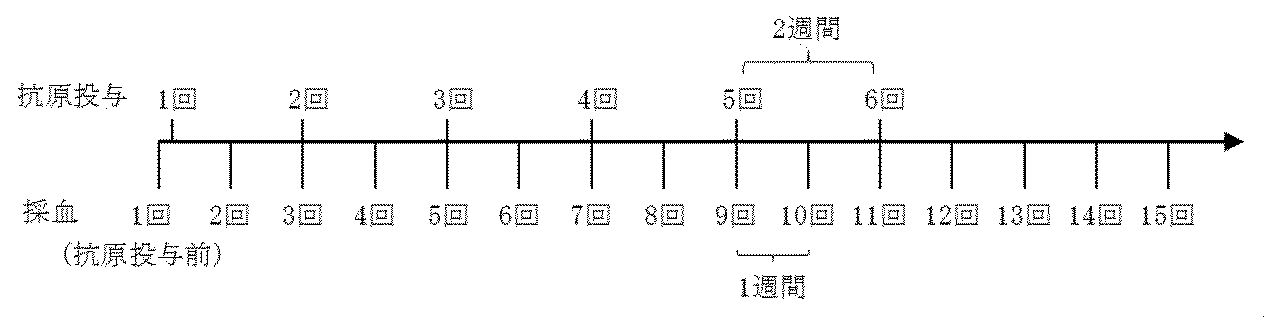
アルパカ一頭に、2mg/回のヒトIgG抗体のFabを抗原としてアジュバントと共に投与した。抗原は2週間隔で6回投与した。前記アルパカから血液(50mL/回)を、抗原投与前に1回、抗原投与開始から1週間ごとに14回、計15回採取した。抗原投与及び採血のプロトコルの概要を以下に示す。
(2)抗体遺伝子の配列決定
各時期に採取された血液サンプルに、ヒト用リンパ球分離液(1.077g/mL)及びEDTA(終濃度0.1%)を添加し、リューコセップ(遠心管)を用いた遠心分離によって末梢血単核細胞(Peripheral Blood Mononuclear Cells:PBMCs)を分離した。分離した各時期の血液サンプルのPBMCsをPBSでそれぞれ洗浄し、次いで、各血液サンプルのmRNAを、RNAisoPlus(タカラバイオ株式会社)を用いて抽出した。
各時期に採取された血液サンプルに、ヒト用リンパ球分離液(1.077g/mL)及びEDTA(終濃度0.1%)を添加し、リューコセップ(遠心管)を用いた遠心分離によって末梢血単核細胞(Peripheral Blood Mononuclear Cells:PBMCs)を分離した。分離した各時期の血液サンプルのPBMCsをPBSでそれぞれ洗浄し、次いで、各血液サンプルのmRNAを、RNAisoPlus(タカラバイオ株式会社)を用いて抽出した。
抽出したmRNAから、SuperScript(商標)III First-Strand Synthesis System(invitrogen社)を用いてcDNAを合成した。合成したcDNA及び以下の表に示したプライマーセットを用い、PCR法により、アルパカIgG2及びIgG3抗体の可変領域をコードしたDNA断片(約300bp~約500bpの配列長)を得た。

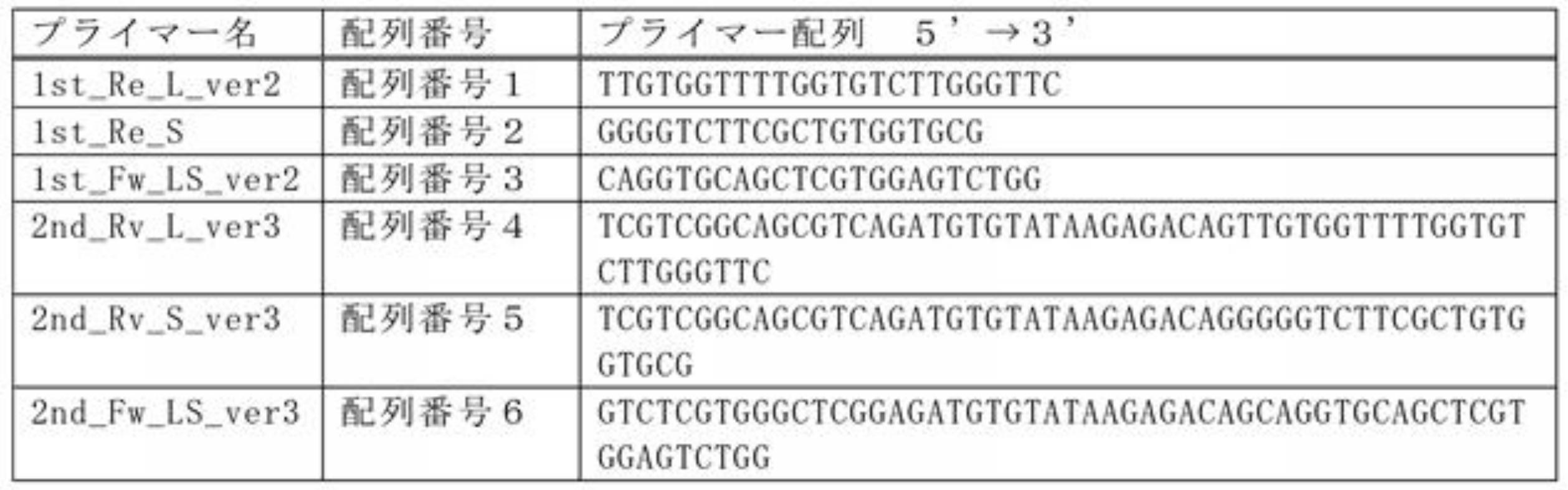
Nextera XT Index kit(イルミナ社)を用い、前記DNA断片に、Miseq用のアダプター配列及びバーコード配列を付加したシークエンス用のDNA断片ライブラリーを調製した。前記ライブラリーの塩基配列は、イルミナ社の次世代シークエンサー(Miseq)を用いて、ペアエンド法により決定した。
(3)配列データグループ
(A)配列決定後の配列データグループ
各時期に採取された血液サンプル中の抗体集団の各抗体の配列データを集め、配列決定後の配列データグループとした。抗体の配列データは、抗体の可変領域部分をコードする塩基配列に関する情報、抗体のタイプ(IgG2又はIgG3)に関する情報、採血時期に関する情報、採血した動物に関する情報、及び品質スコア(Quality Score;Qスコア)を有した。
配列決定後の配列データグループ中、各時期に採取された血液サンプル中の抗体(IgG2及びIgG3)に関する配列データの個数(A)を以下の表aに示す。
(A)配列決定後の配列データグループ
各時期に採取された血液サンプル中の抗体集団の各抗体の配列データを集め、配列決定後の配列データグループとした。抗体の配列データは、抗体の可変領域部分をコードする塩基配列に関する情報、抗体のタイプ(IgG2又はIgG3)に関する情報、採血時期に関する情報、採血した動物に関する情報、及び品質スコア(Quality Score;Qスコア)を有した。
配列決定後の配列データグループ中、各時期に採取された血液サンプル中の抗体(IgG2及びIgG3)に関する配列データの個数(A)を以下の表aに示す。

本実施例において、分析対象である配列データグループ中の配列データの個数は約495万であった(表a)。
本実施例の目的は、前記配列データグループの中から、抗原特異抗体を示す配列データを効率的に選び出すことである。この目的のために、本実施例では、配列データグループ中の配列データについて分子系統樹を作成する。一般に、分子系統樹の作成は、分析対象であるデータ数が増えると、その計算量が指数関数的に増加する。このため、過大なデータ数に対して分子系統樹の作成を行った場合、その計算に膨大な時間を要することとなり、現実的ではない。或いは、計算機の性能によっては、適切な分子系統樹が作成できない場合もある。本実施例の目的を達成するために、前記配列データグループに対して後述の処理(B)~(F)を施して、データ数を減らしたうえで、分子系統樹を作成し、作成した分子系統樹から抗原特異抗体を選び出すこととした。
本実施例の目的は、前記配列データグループの中から、抗原特異抗体を示す配列データを効率的に選び出すことである。この目的のために、本実施例では、配列データグループ中の配列データについて分子系統樹を作成する。一般に、分子系統樹の作成は、分析対象であるデータ数が増えると、その計算量が指数関数的に増加する。このため、過大なデータ数に対して分子系統樹の作成を行った場合、その計算に膨大な時間を要することとなり、現実的ではない。或いは、計算機の性能によっては、適切な分子系統樹が作成できない場合もある。本実施例の目的を達成するために、前記配列データグループに対して後述の処理(B)~(F)を施して、データ数を減らしたうえで、分子系統樹を作成し、作成した分子系統樹から抗原特異抗体を選び出すこととした。
(B)ユニーク配列データへの集約
前記配列データグループ中、同一の塩基配列を示す配列データを1つの配列データ(=「ユニーク配列データ」)に集約した。ユニーク配列データの生成を、前記配列データグループ全体に対して行い、ユニーク配列データグループを生成した。このユニーク配列データの集約処理により、例えば血液サンプル(1回目)のIgG2抗体に関しては、配列ライブラリー中の配列データの個数は約21万個(A)から約9万個(B)に減少した(表a)。従って、ユニーク配列データへの集約処理により、分子系統樹作成のための計算量を低減させることができる。
ユニーク配列データは、配列データに含まれる前記情報に加えて、集約された塩基配列データの個数に関する情報(=「出現頻度(集約)」)をさらに含む。
(C)アミノ酸配列を示さない配列データ等の除外(クリーンアップ)
ユニーク配列データのユニーク配列の配列長が3の倍数でない場合、そのユニーク配列データは抗体となるアミノ酸に関する情報を有していないことを意味する。ユニーク配列データグループから、アミノ酸配列を示さないユニーク配列データを除外(クリーンアップ)した。このクリーンアップ処理を、ユニーク配列データグループ中の全ての配列データに対して行い、その配列長が3の倍数のユニーク配列データから構成されるクリーンアップ配列データグループを生成した。
このクリーンアップ処理により、例えば血液サンプル(1回目)のIgG2抗体に関しては、ユニーク配列データの配列ライブラリー中の配列データの個数は約9万個(B)から約6.9万個(C)に減少した(表a)。従って、クリーンアップ処理により、分子系統樹作成のための計算量を低減させることができる。
(D)配列決定の誤りの統合
配列決定により得られた配列情報には、配列決定に付随する過程で生じるランダムなエラーが含まれ得ることが知られている。ランダムなエラーを有する配列データは、本来の配列に対して一塩基置換、二塩基置換・・・n個の塩基置換が導入された配列情報を有し得る。このような塩基置換を有する配列データは、ランダムに生成されるため、当該配列データの出現率はポアソン分布に従う。あるユニーク配列データの出現率と、そのユニーク配列と一塩基、二塩基、・・・n塩基異なる塩基配列を示す配列データの出現率が、ポアソン分布に従う場合、それら一群の配列データは、前記ユニーク配列にランダムなエラーが入った配列を示す配列データの集まりと考えられるため、前記一群の配列データを本来の配列を示すユニーク配列データに統合する。
配列決定により得られた配列情報には、配列決定に付随する過程で生じるランダムなエラーが含まれ得ることが知られている。ランダムなエラーを有する配列データは、本来の配列に対して一塩基置換、二塩基置換・・・n個の塩基置換が導入された配列情報を有し得る。このような塩基置換を有する配列データは、ランダムに生成されるため、当該配列データの出現率はポアソン分布に従う。あるユニーク配列データの出現率と、そのユニーク配列と一塩基、二塩基、・・・n塩基異なる塩基配列を示す配列データの出現率が、ポアソン分布に従う場合、それら一群の配列データは、前記ユニーク配列にランダムなエラーが入った配列を示す配列データの集まりと考えられるため、前記一群の配列データを本来の配列を示すユニーク配列データに統合する。
本実施例では、配列決定の誤りの統合は以下のように行った:
(a)基準配列αに関する統合用配列データグループの生成
クリーンアップ配列データグループ中、出現頻度(集約)が一番大きいユニーク配列データを基準配列データαとし、基準配列データαに示される塩基配列(以下「基準配列α」ともいう)と同じ配列長であるが、基準配列αと一塩基異なる配列を示すユニーク配列データ、二塩基異なる配列を示す配列データ、・・・m個の塩基が異なる配列を示す配列データ(以下「照会配列データ(n=m)」ともいう)を集め、基準配列αに関する統合用配列データグループを生成した。
(a)基準配列αに関する統合用配列データグループの生成
クリーンアップ配列データグループ中、出現頻度(集約)が一番大きいユニーク配列データを基準配列データαとし、基準配列データαに示される塩基配列(以下「基準配列α」ともいう)と同じ配列長であるが、基準配列αと一塩基異なる配列を示すユニーク配列データ、二塩基異なる配列を示す配列データ、・・・m個の塩基が異なる配列を示す配列データ(以下「照会配列データ(n=m)」ともいう)を集め、基準配列αに関する統合用配列データグループを生成した。
基準配列αに関する統合用配列データグループにおいて、基準配列αと一塩基異なる塩基配列を示す照会配列データ(n=1)には、塩基置換の数は一個で共通するが、塩基置換の場所が異なる様々な塩基配列のユニーク配列データが存在する。照会配列αに関する統合用配列データグループにおいて、照会配列データ(n=m)におけるmは、基準配列データαの出現頻度(集約)と塩基置換の期待値とから、出現頻度(集約)がはじめて1以下になる値とした。
(b)確率密度の算出
基準配列αに関する統合用配列データグループにおいて、基準配列データαの出現頻度(集約)と各照会配列データ(n=1、2・・・m)の出現頻度(集約)の総和で、基準配列データαの出現頻度(集約)を除することで、基準配列データαの確率密度を算出した。同様に、前記総和で、各照会配列データ(n=1、2・・・m)の出現頻度(集約)を除することで、各照会配列データの確率密度を算出した。ここで、照会配列データ(n=1)には、基準配列αと一塩基異なる種々のユニーク配列データが含まれている。従って、照会配列データ(n=1)の確率密度は、基準配列αと一塩基異なる個々のユニーク配列データの確率密度の合計値である。
基準配列αに関する統合用配列データグループにおいて、基準配列データαの出現頻度(集約)と各照会配列データ(n=1、2・・・m)の出現頻度(集約)の総和で、基準配列データαの出現頻度(集約)を除することで、基準配列データαの確率密度を算出した。同様に、前記総和で、各照会配列データ(n=1、2・・・m)の出現頻度(集約)を除することで、各照会配列データの確率密度を算出した。ここで、照会配列データ(n=1)には、基準配列αと一塩基異なる種々のユニーク配列データが含まれている。従って、照会配列データ(n=1)の確率密度は、基準配列αと一塩基異なる個々のユニーク配列データの確率密度の合計値である。
(c-1)基準配列に関するヒストグラムがポアソン分布に従う場合
基準配列αに関する統合用配列データグループについて、基準配列αに対する塩基置換の個数の順に並べた、基準配列αに関するヒストグラムを作成した(図1a)。基準配列αに関するヒストグラムにおいて、基準配列データαの確率密度と照会配列データ(n=1~5)の確率密度の分布がポアソン分布に従う場合(図1b)、基準配列αに関する統合用配列データグループ中の照会配列データ(n=1~5)を基準配列データα(n=0))に統合し、基準配列αに関する統合ユニーク配列データを生成した(図1c)。
基準配列αに関する統合用配列データグループについて、基準配列αに対する塩基置換の個数の順に並べた、基準配列αに関するヒストグラムを作成した(図1a)。基準配列αに関するヒストグラムにおいて、基準配列データαの確率密度と照会配列データ(n=1~5)の確率密度の分布がポアソン分布に従う場合(図1b)、基準配列αに関する統合用配列データグループ中の照会配列データ(n=1~5)を基準配列データα(n=0))に統合し、基準配列αに関する統合ユニーク配列データを生成した(図1c)。
(c-2)基準配列に関するヒストグラムがポアソン分布に従わない場合
基準配列βに関する統合用配列データグループについて、基準配列βに対する塩基置換の個数の順に並べた、基準配列βに関するヒストグラムを作成した(図1d)。基準配列βに関するヒストグラムにおいて、基準配列データβの確率密度と照会配列データ(n=1~5)の確率密度の分布がポアソン分布に従わなかったため、以下の処理を行った。
基準配列βに関する統合用配列データグループについて、基準配列βに対する塩基置換の個数の順に並べた、基準配列βに関するヒストグラムを作成した(図1d)。基準配列βに関するヒストグラムにおいて、基準配列データβの確率密度と照会配列データ(n=1~5)の確率密度の分布がポアソン分布に従わなかったため、以下の処理を行った。
特定の照会配列データ(例えばn=2)に含まれる特定のユニーク配列データの出現率(=[そのユニーク配列の出現頻度(集約)]/[基準配列データβの出現頻度(集約)と各照会配列データ(n=1、2・・・m)の出現頻度(集約)の総和])が、確率の観点から外れ値と判断される場合、そのユニーク配列データは、基準配列βとは別のユニーク配列と推定される。この推定に基づき、前記別のユニーク配列を示すユニーク配列データ(以下「基準配列データγ」という)を、基準配列βに関する統合用配列データグループから除外し、元のクリーンアップ配列データグループに戻した。
また、基準配列データγを除外した基準配列βに関する統合用配列データグループにおいて、基準配列データγの塩基配列と同一の塩基置換(同じ塩基の番号に、同じ種類の塩基置換)を有する、基準配列γと一塩基、二塩基・・・l個の塩基が異なる塩基配列を示す配列データを、基準配列βに関する統合用配列データグループから除外し、元のクリーンアップ配列データグループに戻した。この処理は、基準配列データγの塩基配列と同一の塩基置換を有する配列データは、基準配列データγの塩基配列にランダムなエラーが生じた配列を示す配列データと考えられるためである。
基準配列データγの配列に関連する配列データを除外した基準配列βに関する統合用配列データグループにおいて、確率の観点から外れ値と判断される確率密度を示すユニーク配列データが存在する場合、上記除外処理を繰り返し行った。
基準配列βと別のユニーク配列を示す配列データを除外した後の基準配列βに関する統合用配列データグループにおいて、基準配列データβの確率密度とその照会配列データ(n=1、2・・・m)の確率密度の分布がポアソン分布に従う場合(図1e)、照会配列データ(n=1、2・・・m)を基準配列データβに統合した。
基準配列βと別のユニーク配列を示す配列データを除外した後の基準配列βに関する統合用配列データグループにおいて、基準配列データβの確率密度とその照会配列データ(n=1、2・・・m)の確率密度の分布がポアソン分布に従う場合(図1e)、照会配列データ(n=1、2・・・m)を基準配列データβに統合した。
クリーンアップ配列データグループから配列決定の誤りの統合に用いた配列データを除外し、除外したクリーンアップ配列データグループについて、上記配列決定の誤り統合処理を繰り返す。配列決定の誤り統合処理を繰り返すうち、基準配列データδについても、配列決定の誤りの統合が実行された(図1f)。
(d)配列決定の誤り統合後の配列データグループの生成
配列決定の誤りの統合に用いた配列データを除外した配列データグループにおいて、上記配列決定の誤りの統合処理を、一番大きい出現頻度(集約)が1になるまで繰り返した。一番大きい出現頻度(集約)が1になった場合、上記で生成した統合ユニーク配列データを集めて、統合ユニーク配列データグループを生成した。
配列決定の誤りの統合に用いた配列データを除外した配列データグループにおいて、上記配列決定の誤りの統合処理を、一番大きい出現頻度(集約)が1になるまで繰り返した。一番大きい出現頻度(集約)が1になった場合、上記で生成した統合ユニーク配列データを集めて、統合ユニーク配列データグループを生成した。
この配列決定の誤り統合処理により、配列データグループ中の配列データの個数は、例えば血液サンプル(1回目)のIgG2抗体に関して、約6.9万個(C)から約0.2万個(D)へと大幅に減少した(表a)。従って、配列決定の誤り統合処理により減少した個数の配列データを含む配列データグループについて分子系統樹を作成することで、その計算量を低減させることができる。
統合後のユニーク配列データは、ユニーク配列データに含まれる前記情報に加えて、ユニーク配列データに統合された配列データの数に関する情報(出現頻度(統合))をさらに含む。
(E)クラス分けによる、クラス分け配列データグループの生成
抗体は、V(D)J組換え(V(D)J recombination)の過程、次いで、親和性の成熟(affinity maturation)の過程を経て、成熟することが知られている。
V(D)J組換えの過程で、抗体は、ゲノム配列上に存在する複数種類のV遺伝子断片、複数種類のD遺伝子断片及び複数種類のJ遺伝子断片からそれぞれ1つずつ組合されて産生される。この際、塩基の欠失又は付加がそれらの連結部位でランダムに生じ得る。従って、V(D)J遺伝子断片の種々の組合せを有する様々な配列長の抗体が、V(D)J組換えの過程で生成され得る。
親和性成熟の過程で、抗体は、高頻度の点突然変異をその可変領域に受ける。この点突然変異は、塩基置換変異が主であり、塩基の欠失又は挿入は稀である。従って、配列長は同一であるがアミノ酸配列が異なる様々な抗体が、親和性成熟の過程で生成され得る。
抗原の追加投与によって、特定の抗体が成熟していく過程を経時的に追跡するにあたっては、血液サンプル中の抗体集団をV(D)J組換えの過程で産生された抗体ごとにクラス分けし、次いで、前記グループ中の抗体のV遺伝子領域、及びJ遺伝子領域の可変領域に生じた突然変異(塩基置換)を追跡することが合理的と考えた。
(E-1)配列長に基づくクラス分け
上記したV(D)J組換えの過程を考慮し、配列データグループ中の配列データをその配列長に基づいてクラス分けし(図2a)、各クラスに対応する配列長を示す配列データで構成される配列長クラス配列データグループを生成した。
上記したV(D)J組換えの過程を考慮し、配列データグループ中の配列データをその配列長に基づいてクラス分けし(図2a)、各クラスに対応する配列長を示す配列データで構成される配列長クラス配列データグループを生成した。
上記したように、抗体の親和性成熟では、塩基置換が主として生じ、通常、その配列長に変化はない。このため、配列長クラス配列データグループ中の各クラスには、V(D)J組換えにより産生された様々な抗体と、その後の親和性成熟を受けた一連の抗体とが集まっていると期待される。従って、配列長に基づくクラス分け処理により得られた各配列長クラス配列データグループについて分子系統樹を作成することで、その計算量を低減させつつ、そのクラス内に含まれる親和性成熟を受けた抗体の配列データを効率的に選び出すことが可能となる。
(E-2)オリジナル配列に基づくクラス分け
親和性成熟の過程での塩基置換は、抗体のV遺伝子断片及びJ遺伝子断片のうち、相補性決定領域(CDR)に対応する部分に集中する。V遺伝子断片及びJ遺伝子断片において、CDR配列以外の塩基配列はゲノム配列上のV遺伝子断片及びJ遺伝子断片の塩基配列とほとんど同一である。従って、その抗体のV遺伝子断片及びJ遺伝子断片の塩基配列から、その抗体が、ゲノム配列上のどのV遺伝子断片とどのJ遺伝子断片との組合せにより産生されたかを推定できると考えた。
親和性成熟の過程での塩基置換は、抗体のV遺伝子断片及びJ遺伝子断片のうち、相補性決定領域(CDR)に対応する部分に集中する。V遺伝子断片及びJ遺伝子断片において、CDR配列以外の塩基配列はゲノム配列上のV遺伝子断片及びJ遺伝子断片の塩基配列とほとんど同一である。従って、その抗体のV遺伝子断片及びJ遺伝子断片の塩基配列から、その抗体が、ゲノム配列上のどのV遺伝子断片とどのJ遺伝子断片との組合せにより産生されたかを推定できると考えた。
実際、その抗体のV遺伝子断片及びJ遺伝子断片の塩基配列を、アルパカのゲノム配列に対して、配列同一性をblastにより検索したところ、その抗体のV遺伝子断片、J遺伝子断片の配列に対応するゲノム配列上のV遺伝子断片、及びJ遺伝子断片それぞれの配列を推定可能であった。
抗体のV遺伝子断片及びJ遺伝子断片それぞれのオリジナル配列に基づいて、配列データグループをさらにクラス分けする。例えば、抗体の可変領域の塩基配列が354bpの配列長クラス配列データグループについて、抗体のV遺伝子断片及びJ遺伝子断片それぞれのオリジナル配列に基づいてクラス分けした(図2b)。このオリジナル配列に基づくクラス分けを、各配列長クラス配列データグループに対して行い、クラス分け配列データグループを生成した。
オリジナル配列に基づいてクラス分けされた各配列データは、統合ユニーク配列データに含まれる情報に加えて、そのオリジナルのV遺伝子断片及びJ遺伝子断片に関する情報をさらに含む。
上記したように、抗体の親和性成熟では、塩基置換が主として抗体のCDR配列に生じ、通常、その他の塩基配列に変化はない。このため、オリジナル配列データグループ中の各クラスには、V(D)J組換えにより産生された特定の抗体と、その後の親和性成熟を受けた一連の抗体とが効率的に集まっていると期待される。従って、オリジナル配列に基づくクラス分け処理により得られた各クラスについて分子系統樹を作成することで、その計算量を低減させつつ、その分子系統樹から抗原特異抗体をより効率的に選び出すことが可能となる。
(F)配列クラスター形成性配列データグループの生成
親和性成熟の過程において、抗原に対する親和性が比較的高い抗体を示すB細胞は、前記抗原からの刺激を優先的に受け、前記B細胞は選択的に増殖することとなる。このB細胞の増殖過程で前記抗体の可変領域には高い変異率で変異が導入され、より高い親和性を示す抗体が産生され得る。この親和性成熟の過程を考慮すれば、より高い親和性を示す抗原特異抗体が産生されるまでに、前記抗原からの刺激を優先的に受けることを可能にした、前記抗原特異抗体の塩基配列と類似した一連の抗体群が存在したはずである。
従って、親和性成熟を受けてより高い親和性を示す抗原特異抗体は、分子系統樹解析を行った場合、その抗体の塩基配列と類似する塩基配列を有し、且つ比較的高い親和性を有する一連の抗体とともに、分子系統樹解析において配列クラスターを形成すると考えられる。
反対に、抗原に対する親和性が比較的低い抗体を示すB細胞は、前記抗原からの刺激を優先的に受けることができず、前記B細胞は選択的に増殖することができない。この結果、そのような親和性が比較的低い抗体を示す抗体遺伝子に変異が蓄積することはない。
このように、親和性成熟を受けていない比較的低い親和性を示す抗体は、分子系統樹解析を行った場合、その抗体の塩基配列と類似する塩基配列を有する抗体は少なく又はほとんどなく、分子系統樹解析において配列クラスターを形成しないと考えられる。
このように、親和性成熟を受けていない比較的低い親和性を示す抗体は、分子系統樹解析を行った場合、その抗体の塩基配列と類似する塩基配列を有する抗体は少なく又はほとんどなく、分子系統樹解析において配列クラスターを形成しないと考えられる。
以上より、分子系統樹解析において、配列クラスターを形成しないと推定される抗体の配列データ(以下「配列クラスター非形成性配列データ」という)を配列データグループから予め除外することで、分子系統樹作成に必要な計算量を低減させることが可能となる。
本実施例では、配列決定した抗体の塩基配列の配列長は概ね300bp~500bpであったことから、配列同一性が約90%となる塩基置換の数として「40」を設定した。
上記した配列長及びオリジナル配列に基づくクラス分け配列データグループ内の任意のクラス中の特定の配列データの配列に関して、40個までの塩基置換を有する配列を示す配列データの合計が前記クラス内で10を下回る場合(以下「U40<10」等という)、前記特定の配列データは親和性成熟を受けていない抗体に関する配列データ(即ち、配列クラスター非形成性配列データ)と評価し、前記クラスから除外した。
上記した配列長及びオリジナル配列に基づくクラス分け配列データグループ内の任意のクラス中の特定の配列データの配列に関して、40個までの塩基置換を有する配列を示す配列データの合計が前記クラス内で10を下回る場合(以下「U40<10」等という)、前記特定の配列データは親和性成熟を受けていない抗体に関する配列データ(即ち、配列クラスター非形成性配列データ)と評価し、前記クラスから除外した。
この配列クラスター非形成性配列データの除外を、前記クラスに含まれるすべての配列データに対して行うことで、そのクラスには40個までの塩基置換を有する配列を示す配列データが少なくとも10個存在する配列データ(以下「配列クラスター形成性配列データ」という)が残ることとなる。このような配列クラスター形成性配列データは、親和性成熟を受けた抗原特異抗体を示す配列データであると推定されるため、配列クラスター形成性配列データで構成される配列データグループ(以下「配列クラスター形成性配列データグループ」ともいう)には、抗原特異抗体を示す配列データが非常に効率的に含まれることとなる。
上記した配列クラスター非形成性配列データの除外処理により、そのクラスに含まれる配列データの個数を低減することができるため、分子系統樹作成の際の計算量を低減させることができる。また、配列クラスター形成性配列データグループについて作成した分子系統樹からは、非常に効率的に抗原特異抗体を選び出すことが可能となる。
(4)分子系統樹の作成
配列データグループからJukes-Cantor69を用いて距離行列を計算し、距離行列から近接結合法(neighbor-joining method)を用いることによって分子系統樹を得た。これらの計算に、統計分析ソフトウェア「R」のapeパッケージを用いた。
配列データグループからJukes-Cantor69を用いて距離行列を計算し、距離行列から近接結合法(neighbor-joining method)を用いることによって分子系統樹を得た。これらの計算に、統計分析ソフトウェア「R」のapeパッケージを用いた。
本実施例では、まず、配列クラスター非形成性配列データの除外を行わず、354bpの配列長及びオリジナル配列(vhh3-ighJ-4)のクラス分け配列データグループについて、分子系統樹(U40≧0)を作成した(図3a)。さらに、配列クラスター非形成性配列データの除外(U40<10、U40<50)を行い、配列クラスター形成性配列データグループについてそれぞれ分子系統樹を作成した(図3b;U40≧10、及び図3c;U40≧50)。ここで、本実施例において「U40≧10」及び「U40≧50」は、ある配列データに示される塩基配列に40個までの塩基置換を有する配列を示す配列データの数(=「U40」)が10以上及び50以上であることをそれぞれ意味する。
配列クラスター非形成性配列データを配列データグループから予め除外することによって、分子系統樹の作成のための計算量を低減できるだけでなく、作成される分子系統樹の複雑度(例えば、枝の分岐点(ノード)の数、枝の数)が低減した。これにより、後述する分子系統樹からの配列クラスター抽出が容易となった。
(5)分子系統樹から配列クラスターの抽出
親和性成熟を受けたことが期待される一連の抗体群を示す配列データを含む配列クラスターを抽出するために、以下の処理を行った。
作成された分子系統樹において、枝同士のノードから延びる枝の長さが、枝長に関する閾値以上の場合、そのノードから延びる枝において前記閾値に対応する位置よりも枝根に対して遠方(外側)の部分を配列クラスターとして抽出した(図4a)。また、配列クラスター抽出後の分子系統樹において、所定範囲内のノードの数がノードの数に関する閾値以上の場合、その所定の領域範囲も配列クラスターとして抽出した(図4b中のb2)。この配列クラスター抽出により、図4aで示される分子系統樹から9つの配列クラスター(b1~b9)が抽出された(図4b)。
(6)抗原特異抗体を示す配列データを含む配列クラスターであるか否かの判定
上記のように抽出された配列クラスターが、抗原特異抗体を示す配列データを含むか否かを以下のように判定した。
抗体の親和性成熟では、抗体の可変領域に点突然変異が高頻度に生じ、その結果、抗原との親和性が高い抗原特異抗体へと成熟していく。親和性成熟を受けた抗体の配列には、抗原投与後の時間経過に応じて点突然変異が数多く蓄積する。このため、その塩基配列は、そのオリジナル配列と比べた場合に、その配列同一性又はホモロジー検索におけるスコア値(配列が一致する場合に正のスコアを付与する場合)は小さくなっていくと期待される。
上記のように抽出された配列クラスターが、抗原特異抗体を示す配列データを含むか否かを以下のように判定した。
抗体の親和性成熟では、抗体の可変領域に点突然変異が高頻度に生じ、その結果、抗原との親和性が高い抗原特異抗体へと成熟していく。親和性成熟を受けた抗体の配列には、抗原投与後の時間経過に応じて点突然変異が数多く蓄積する。このため、その塩基配列は、そのオリジナル配列と比べた場合に、その配列同一性又はホモロジー検索におけるスコア値(配列が一致する場合に正のスコアを付与する場合)は小さくなっていくと期待される。
(4)及び(5)にて説明したようにして、配列データグループから分子系統樹(図5a及び図5b)を作成した(U40≧10)。図5bは、図4で示される系統樹(図4a)のうち、b1で示される配列クラスター(図4b)に含まれる配列データグループから作成された分子系統樹である。作成した分子系統樹における配列クラスター(図5a中赤丸で(曲線で丸く)囲った領域、及び図5b中赤丸で(曲線で丸く)囲った領域)中の抗体の配列データについて、各抗体の配列とその抗体のオリジナル配列との配列一致度を算出した。具体的には、各抗体のV遺伝子領域及びJ遺伝子領域の配列データと、BLAST検索で推定したその遺伝子領域に対応するオリジナル配列との同一性を、ビットスコア(スコア値)にて評価した。
図5a及び図5b中赤丸で(曲線で丸く)囲った配列クラスターそれぞれにおける抗体の配列データについて採血時期に応じたビットスコアの変化を示すために、横軸を抗原投与後の採血のタイミング(weeks)とし、縦軸をビットスコアとした散布図を作成した(図5c及び図5d)。図5c及び図5dにおいて丸プロット(○)はIgG2の配列データを示し、三角プロット(△)はIgG3の配列データを示す。各プロットのサイズは、各ユニーク配列データの個数(出現頻度(合計))を反映し、プロットサイズが大きいものほど、出現頻度(合計)が高いことを示す。各プロットの色(濃淡)は、その抗体配列がどの採血時期に初めて出現したかを示している(図5c及びd中の挿入図)。
(配列一致度の傾き)
図5cは、抗原投与前(1回目)の抗体のオリジナル配列から算出されたビットスコアと、4~15回の採血時期の抗体の配列データから算出されたビットスコアとがほとんど変化していないことを示す。これは、6回の抗原投与を含む本実施例のプロトコルでは、この配列クラスター(図5a中の赤丸(曲線で丸く囲われた領域))中の配列データに示される抗体には変異は蓄積されなかったこと、即ち、前記配列クラスターは投与した抗原に特異的な抗体を示す配列データを含まないことを示している。従って、この配列クラスターは、抗原特異抗体を含む配列クラスターではないと判定される。
図5cは、抗原投与前(1回目)の抗体のオリジナル配列から算出されたビットスコアと、4~15回の採血時期の抗体の配列データから算出されたビットスコアとがほとんど変化していないことを示す。これは、6回の抗原投与を含む本実施例のプロトコルでは、この配列クラスター(図5a中の赤丸(曲線で丸く囲われた領域))中の配列データに示される抗体には変異は蓄積されなかったこと、即ち、前記配列クラスターは投与した抗原に特異的な抗体を示す配列データを含まないことを示している。従って、この配列クラスターは、抗原特異抗体を含む配列クラスターではないと判定される。
図5dは、抗原投与前(1回目)の抗体のオリジナル配列から算出されたビットスコアと比べて、4~15回の採血時期の抗体の配列データから算出されたビットスコアは一定の割合で低下した。これは、6回の抗原投与を含む本実施例のプロトコルにより、この配列クラスター(図5b中の赤丸(曲線で丸く囲われた領域))中の配列データに示される抗体に変異が順次蓄積されたこと、即ち、前記配列クラスターは抗原特異抗体を示す配列データを含むことを示唆する。従って、この配列クラスターは、抗原特異抗体を含む配列クラスターであると判定される。
(時間経過に伴う抗体種類の多様化)
図5dで示されるプロットの色(濃淡)は、抗原投与後からの週数(weeks)が増えるに従って、黄色(淡色の「3」)から水色(比較的濃い色の「9」)を経て赤色(濃色の「15」)(図5d挿入図)へと変化した。この色(濃淡)の変化は、抗原の追加投与を通じて、抗体の種類が増えたことを示している。反対に、図5cで示されるプロットの色(濃淡)は、緑色(淡色の「4~7」)のままであった。この色(濃淡)が変化しないことは、抗原の追加投与を通じて、抗体の種類に変化がなかったことを示している。
これらの結果は、配列クラスター内の配列データの種類が、抗原投与後のある時点で閾値よりも多い場合又は時間経過に伴って増える場合、その配列クラスターは、抗原特異抗体を含む配列クラスターであることを示唆する。従って、そのような配列クラスターは、抗原特異抗体を含む配列クラスターであると判定される。
(クラススイッチ)
図5dでは、丸及び三角のプロットが含まれ、それらの出現比が時間経過に伴って大きく変化している。これは、この配列クラスター内にIgG2抗体とIgG3抗体とが含まれること、及び、抗体のクラスがIgG2とIgG3とで入れ替わっていること(即ち抗体のクラススイッチが生じていること)を示している。反対に、図5cでは、丸及び三角のプロットの出現比がほぼ一定であった。これは、この配列クラスター内でクラススイッチはほとんど生じていないことを示している。
これらの結果は、配列クラスター内の配列データに示される抗体クラスが、時間経過に伴って変化する場合、その配列クラスターは、抗原特異的な抗体を含む配列クラスターであることを示唆する。従って、そのような配列クラスターは、抗原特異抗体を含む配列クラスターであると判定される。
(抗原投与前の配列一致度)
図5dの抗原投与前のビットスコアは約430であった。他方、図5cの抗原投与前のビットスコアは約350であった。本実施例において、ビットスコアは、オリジナル配列との配列一致度が高いほど、大きな数値を示す。
抗原投与前のビットスコアが小さい理由として、その抗体は、本実施例で投与された抗原とは別の抗原に対して既に親和性成熟を受けたものであることが推測される。そのような親和性成熟を受けた抗体は、本実施例で投与された抗原に対して親和性成熟を受けることは生物学的に通常ない。実際、抗原投与前のビットスコアのその最大値に対する割合が小さい抗体を含む図5cの配列クラスターは、上記のとおり、本実施例で投与された抗原に対する抗原特異抗体ではないと結論された。従って、抗原投与前のビットスコアのその最大値に対する割合が小さい抗体を含む配列クラスターは、抗原特異抗体を含まないと判定される。
(7)配列クラスター中の配列データから再構築した抗体の結合力の測定
上記(6)のようにして、抗原特異的な抗体の配列データを含むと判定された配列クラスター中の配列データの塩基配列に基づいて、対応する可変領域を含む抗体を再構築した。
具体的には、前記配列データに示される、抗原特異的な抗体の可変領域をコードする塩基配列の情報に基づいて、大腸菌発現用に塩基コドンを最適化した塩基配列を有するDNAを合成し、合成したDNAを大腸菌発現用ベクター(pAED4またはpCold3)に挿入して、VHH抗体発現用プラスミドを構築した。前記プラスミドを用いて形質転換した大腸菌(BL21(DE3)pLysS)を所定条件下で培養して、前記DNAから対応する可変領域を有するVHH抗体を産生させ、公知の方法に従って、大腸菌から前記VHH抗体を回収した。
回収した前記抗体の投与した抗原(ヒトIgG抗体のFab)に対する結合力(解離定数)を、Biacore2000(GEヘルスケアジャパン)にて測定した。結合力測定では、回収した抗体(濃度:150nM、100nM、75nM、50nM、25nM、12.5nM)を、CM5センサーチップ上に固定化した抗原Fabと接触させる様式にて測定した(図5f)。
その結果、抗原特異的な抗体の配列データを含むと判定された配列クラスター中の前記配列データに示される可変領域を有する抗体は、抗原Fabに対して0.5nMの解離定数でもって結合することが示された。実施例1の結果から、抗原特異抗体を示す配列データを含むと判定された配列クラスターは、実際に、比較的強い結合力でもって抗原に結合する抗体(抗原特異抗体)の塩基配列データを含むことが示された。
同様に、上記(6)において、抗原特異的な抗体の配列データを含まないと判定された配列クラスター中の配列データの塩基配列に基づいて、対応する可変領域を含む抗体を再構築し、その抗体の前記抗原に対する結合力を測定した(図5e)。その結果、抗原に対する結合力を測定することはできず、実際に、抗原特異抗体の塩基配列データではないことが示された。
[実施例2]
抗原特異的な抗体の配列データを含むと判定された配列クラスター中の種々の配列データから再構築した抗体の結合力測定を行った。
図5bとは別のクラス分け配列データグループ(配列長:381bp、V遺伝子断片:VHH3-S8、及びJ遺伝子断片:ighJ-6)について、実施例1と同様にして分子系統樹を作成した(図6a)。図6aの赤丸で(曲線で丸く)囲った領域中の抗体配列データについて、前述の方法と同様にして、横軸を抗原投与後の採血のタイミング(weeks)とし、縦軸をビットスコアとした散布図を作成した(図6b)。プロットの傾きおよび色(濃淡)の変遷から、この配列クラスターは抗原特異抗体を含む配列クラスターであると判定された。
次に、図6a中赤丸で示した(曲線で丸く囲われた)配列クラスターに含まれる抗体の配列データを用いて分子系統樹を作成した(図6c)。実施例1に記載の方法と実質的に同じ方法で、図6c中破線矢印で示した(c1、c2、c3)の配列データから、抗体をそれぞれ再構築した。再構築した抗体の結合力測定を実施例1と同様に行った。
図6c中のc1で示した配列データから再構築した抗体は、抗原への結合定数が370nMであり、抗原からの解離が速い又は解離速度定数[nM/s]が高いという特徴があった。図6c中のc2およびc3で示した配列データから再構築した2つの抗体は、抗原への結合定数がそれぞれ68nM及び90nMであり、いずれも図6c中のc1の抗体に比べて、比較的高い結合力で投与した抗原と結合した。また、抗原からの解離も比較的遅かった。
図6c中のc1で示した配列データは6週目の採血のタイミングで得られたものであった。図6c中のc1よりも強い結合力を示した図6c中のc2及びc3の配列データは13週目の採血のタイミングで得られたものであった。
実施例2は、抗原特異抗体を示す配列データを含むと判定された配列クラスター中の配列データはいずれも、比較的高い結合力を有する抗体の可変領域をコードする塩基配列を含むことを示した。また、実施例2は、前記配列クラスター内にも様々な特徴を持つ抗体の可変領域をコードする塩基配列情報を有する配列データが存在することを示した。
実施例2は、抗原特異抗体を示す配列データを含むと判定された配列クラスター中の配列データのなかでも、抗原の投与回数がより多く、抗原投与からの週数がより経過した抗体の配列データの方がより高い結合力を有する抗原特異抗体である可能性を示した。
Claims (12)
- 抗体作製の候補となる抗原特異抗体を示す配列データを含む配列クラスターを特定する方法であって、
免疫刺激を受けた可能性のある動物から取得された抗体の配列データを含む配列データグループを準備する工程;
前記配列データグループから分子系統樹を作成する工程;及び
前記分子系統樹における配列クラスター中の配列データに示される抗体の配列と前記抗体のオリジナル配列との配列一致度の変化又は抗体の種類の変化に基づいて、前記配列クラスターが抗体作製の候補となる抗原特異抗体を示す配列データを含むか否かを判定する工程;
を含み、
前記オリジナル配列が、配列データに示される抗体の配列と、前記抗体が得られた動物に対応する動物種のゲノム配列との配列一致度が最も高い配列である、特定方法。 - 前記準備工程で取得される配列データグループが、配列決定後の配列データグループであり、
前記準備工程が、同一の配列を示す複数の配列データを1つの配列データ(以下「ユニーク配列データ」という)に集約する工程を含み、
前記ユニーク配列データは、前記配列データに示される配列に関する情報、及び集約した配列データの個数に関する情報(以下「出現頻度(集約)」という)を含む、請求項1に記載の特定方法。 - 前記配列データグループが、前記ユニーク配列データで構成されるユニーク配列データグループであり、
前記ユニーク配列データが塩基配列データであり、
前記ユニーク配列データグループ中、出現頻度(集約)が最も大きいユニーク配列データを基準配列データ(n=0)とし、前記基準配列データの配列(以下「基準配列」という)と同じ長さであるが、前記基準配列に対してn個(n=1、・・・m)の塩基置換を有する配列を有するユニーク配列データを照会配列データとし、
前記準備工程が、前記基準配列データの出現頻度(集約)に対する前記照会配列の出現頻度(集約)の比率が閾値未満の照会配列を、前記基準配列データに統合する工程を含む、請求項2に記載の特定方法。 - 前記準備工程が、
前記配列データグループ中の配列データを、配列長及び前記動物に対応する動物種のゲノム配列上のオリジナル配列のいずれか一方又は両方に基づいてクラス分けする工程;及び
前記配列データグループ中の特定の配列データに示される配列と所定の配列一致度を有する配列に関する配列データの個数が、配列データの個数に関する閾値未満である場合に、前記特定の配列データを前記配列データグループから除外する工程、
のいずれか一方又は両方を含む、請求項1~3のいずれか一項に記載の特定方法。 - 前記準備工程が、前記統合工程、前記クラス分け工程、及び前記除外工程の順で実施することを含む、請求項4に記載の特定方法。
- 前記オリジナル配列に基づくクラス分けが、
前記配列データグループ中の配列データに示される抗体の可変領域を構成するV遺伝子断片及びJ遺伝子断片のいずれか一方又は両方と、前記動物に対応する動物種のゲノム配列とのホモロジー検索により得られた配列一致度を算出する工程、及び
前記配列データを、最も高い配列一致度を示す遺伝子断片に関するクラスに割り当てる工程を含む、請求項4または5に記載の特定方法。 - 前記配列一致度の変化が、単位時間当たりの配列一致度の変化であり、及び抗体の種類の変化が抗体のクラススイッチである、請求項1~6のいずれか一項に記載の特定方法。
- 抗体作製の候補となる抗原特異抗体を示す配列データを含む配列クラスターか否かを判定する判定システムであって、
制御部と、記憶部とを備え、
前記記憶部は、免疫刺激を受けた可能性のある動物から取得された抗体の配列データを含む配列データグループを含むデータベースを格納しており、
前記制御部は、
前記配列データグループから分子系統樹を作成する分子系統樹作成部と、
前記分子系統樹における配列クラスター中の配列データに示される抗体の配列と前記抗体のオリジナル配列との配列一致度の変化又は抗体の種類の変化に基づいて、前記配列クラスターが抗体作製の候補となる抗原特異抗体を示す配列データを含むか否かを判定する配列データ判定部と
を含み、
前記オリジナル配列が、配列データに示される抗体の配列と、前記抗体が得られた動物に対応する動物種のゲノム配列との配列一致度が最も高い配列である、判定システム。 - 抗原特異抗体を作製する方法であって、
免疫刺激を受けた可能性のある動物から取得された抗体の配列データを含む配列データグループを準備する工程;
前記配列データグループから分子系統樹を作成する工程;
前記分子系統樹における配列クラスター中の配列データに示される抗体の配列と前記抗体のオリジナル配列との配列一致度の変化又は抗体の種類の変化に基づいて、前記配列クラスターが抗体作製の候補となる抗原特異抗体を示す配列データを含むか否かを判定する工程;
抗原特異抗体を示す配列データを含むと判定された配列クラスターから、抗体作製の候補となる抗原特異抗体を示す配列データを選出する工程;及び
選出された配列データに示されるアミノ酸配列を有する抗体を作製する工程;
を含む、作製方法。 - 抗体作製の候補となる抗原特異抗体を示す配列データを選出する方法であって、
免疫刺激を受けた可能性のある動物から取得された抗体の配列データを含む配列データグループを準備する工程;及び
配列データグループから抗原特異抗体を示す配列データを選出する工程;
を含み、
前記準備工程が、前記配列データグループ中の特定の配列データに示される配列と所定の配列一致度を有する配列に関する配列データの個数が、配列データの個数に関する閾値未満である場合に、前記特定の配列データを前記配列データグループから除外する工程を含み、
前記選出工程が、前記配列データグループ中の配列データに示される抗体の配列と前記抗体のオリジナル配列との配列一致度と、閾値とを対比する工程を含み、
前記オリジナル配列が、配列データに示される抗体の配列と、前記抗体が得られた動物に対応する動物種のゲノム配列との配列一致度が最も高い配列である、選出方法。 - 抗体作製の候補となる抗原特異抗体を示す配列データを選出する選出システムであって、
制御部と、記憶部とを備え、
前記記憶部は、免疫刺激を受けた可能性のある動物から取得された抗体の配列データを含む配列データグループを含むデータベースを格納しており、
前記制御部は、
前記配列データグループ中の特定の配列データに示される配列と所定の配列一致度を有する配列に関する配列データの個数が、配列データの個数に関する閾値未満である場合に、前記特定の配列データを前記配列データグループから除外する処理を実行すること含む、配列データ準備部と、
前記配列データグループ中の配列データに示される抗体の配列と前記抗体のオリジナル配列との配列一致度と、閾値とを対比する処理を実行することを含む、配列データ選出部と
を含み、
前記オリジナル配列が、配列データに示される抗体の配列と、前記抗体が得られた動物に対応する動物種のゲノム配列との配列一致度が最も高い配列である、判定システム。 - 抗原特異抗体を作製する方法であって、
免疫刺激を受けた可能性のある動物から取得された抗体の配列データを含む配列データグループを準備する工程;
配列データグループから抗原特異抗体を示す配列データを選出する工程;及び
選出された配列データに示されるアミノ酸配列を有する抗体を作製する工程;
を含み、
前記準備工程が、前記配列データグループ中の特定の配列データに示される配列と所定の配列一致度を有する配列に関する配列データの個数が、配列データの個数に関する閾値未満である場合に、前記特定の配列データを前記配列データグループから除外する工程を含み、
前記選出工程が、前記配列データグループ中の配列データに示される抗体の配列と前記抗体のオリジナル配列との配列一致度と、閾値とを対比する工程を含み、
前記配列一致度が閾値未満の場合に、前記配列データを、抗原特異抗体を示す配列データとして選出し、
前記オリジナル配列が、配列データに示される抗体の配列と、前記抗体が得られた動物に対応する動物種のゲノム配列との配列一致度が最も高い配列である、作製方法。
Applications Claiming Priority (2)
| Application Number | Priority Date | Filing Date | Title |
|---|---|---|---|
| JP2019-080434 | 2019-04-19 | ||
| JP2019080434A JP7376867B2 (ja) | 2019-04-19 | 2019-04-19 | 抗原特異抗体を含む配列クラスターを特定する方法 |
Publications (1)
| Publication Number | Publication Date |
|---|---|
| WO2020213730A1 true WO2020213730A1 (ja) | 2020-10-22 |
Family
ID=72837343
Family Applications (1)
| Application Number | Title | Priority Date | Filing Date |
|---|---|---|---|
| PCT/JP2020/016947 Ceased WO2020213730A1 (ja) | 2019-04-19 | 2020-04-17 | 抗原特異抗体を含む配列クラスターを特定する方法 |
Country Status (2)
| Country | Link |
|---|---|
| JP (1) | JP7376867B2 (ja) |
| WO (1) | WO2020213730A1 (ja) |
Citations (2)
| Publication number | Priority date | Publication date | Assignee | Title |
|---|---|---|---|---|
| JP2015119637A (ja) * | 2013-11-22 | 2015-07-02 | 国立研究開発法人産業技術総合研究所 | 低分子化抗体のスクリーニング方法及び製造方法 |
| WO2018162376A1 (en) * | 2017-03-07 | 2018-09-13 | F. Hoffmann-La Roche Ag | Method for discovery of alternative antigen specific antibody variants |
Family Cites Families (1)
| Publication number | Priority date | Publication date | Assignee | Title |
|---|---|---|---|---|
| AU750453B2 (en) * | 1997-10-03 | 2002-07-18 | Chugai Seiyaku Kabushiki Kaisha | Natural human antibody |
-
2019
- 2019-04-19 JP JP2019080434A patent/JP7376867B2/ja active Active
-
2020
- 2020-04-17 WO PCT/JP2020/016947 patent/WO2020213730A1/ja not_active Ceased
Patent Citations (2)
| Publication number | Priority date | Publication date | Assignee | Title |
|---|---|---|---|---|
| JP2015119637A (ja) * | 2013-11-22 | 2015-07-02 | 国立研究開発法人産業技術総合研究所 | 低分子化抗体のスクリーニング方法及び製造方法 |
| WO2018162376A1 (en) * | 2017-03-07 | 2018-09-13 | F. Hoffmann-La Roche Ag | Method for discovery of alternative antigen specific antibody variants |
Also Published As
| Publication number | Publication date |
|---|---|
| JP7376867B2 (ja) | 2023-11-09 |
| JP2020177529A (ja) | 2020-10-29 |
Similar Documents
| Publication | Publication Date | Title |
|---|---|---|
| Marcou et al. | High-throughput immune repertoire analysis with IGoR | |
| Mhanna et al. | Adaptive immune receptor repertoire analysis | |
| Miho et al. | Computational strategies for dissecting the high-dimensional complexity of adaptive immune repertoires | |
| CN113853656A (zh) | 用于对抗体进行分类的系统和方法 | |
| JP7757472B2 (ja) | 情報処理システム、情報処理方法、プログラム、及び、抗原結合分子或いはタンパク質を製造する方法 | |
| Mahajan et al. | Epitope specific antibodies and T cell receptors in the immune epitope database | |
| Benichou et al. | The restricted DH gene reading frame usage in the expressed human antibody repertoire is selected based upon its amino acid content | |
| AU2020269607B2 (en) | Identification of convergent antibody specificity sequence patterns | |
| Elhanati et al. | Predicting the spectrum of TCR repertoire sharing with a data‐driven model of recombination | |
| JP7602034B2 (ja) | バイオ医薬品開発のための方法およびシステム | |
| CN111247599A (zh) | 用于预测人类群体中的亲缘关系的系统和方法 | |
| Mahajan et al. | Hallucinating structure-conditioned antibody libraries for target-specific binders | |
| Gabernet et al. | nf-core/airrflow: An adaptive immune receptor repertoire analysis workflow employing the Immcantation framework | |
| WO2025022002A1 (en) | Analysis of antigen-binding proteins | |
| Xu et al. | Advances in antibody discovery from human BCR repertoires | |
| CN115295084B (zh) | 一种肿瘤新抗原免疫组库数据可视化分析方法和系统 | |
| US20250201352A1 (en) | System and method for mapping molecules into interfaces | |
| JP7376867B2 (ja) | 抗原特異抗体を含む配列クラスターを特定する方法 | |
| WO2024051806A1 (zh) | 一种设计人源化抗体序列的方法 | |
| CN118510946A (zh) | 用于抗体文库智能构建的系统和方法 | |
| Spence et al. | Ultradeep analysis of tumor heterogeneity in regions of somatic hypermutation | |
| US20250266124A1 (en) | Systems and methods for determining antigen specificity of antigen binding molecules and visualizing adaptive immune cell clonotyping data | |
| Aghebati-Maleki et al. | The Application of Next Generation Sequencing in Phage Display: A Short Review | |
| López-Santibáñez-Jácome et al. | The pipeline repertoire of Ig-Seq analysis | |
| Vlachakis | Antibody Clustering and 3D Modeling for Neurodegenerative Diseases |
Legal Events
| Date | Code | Title | Description |
|---|---|---|---|
| 121 | Ep: the epo has been informed by wipo that ep was designated in this application |
Ref document number: 20791365 Country of ref document: EP Kind code of ref document: A1 |
|
| NENP | Non-entry into the national phase |
Ref country code: DE |
|
| 122 | Ep: pct application non-entry in european phase |
Ref document number: 20791365 Country of ref document: EP Kind code of ref document: A1 |