WO2020198464A1 - Highly selective electrochemical hydrogenation of alkynes - Google Patents
Highly selective electrochemical hydrogenation of alkynes Download PDFInfo
- Publication number
- WO2020198464A1 WO2020198464A1 PCT/US2020/024943 US2020024943W WO2020198464A1 WO 2020198464 A1 WO2020198464 A1 WO 2020198464A1 US 2020024943 W US2020024943 W US 2020024943W WO 2020198464 A1 WO2020198464 A1 WO 2020198464A1
- Authority
- WO
- WIPO (PCT)
- Prior art keywords
- nmr
- mhz
- cathode
- ppm
- anode
- Prior art date
- Legal status (The legal status is an assumption and is not a legal conclusion. Google has not performed a legal analysis and makes no representation as to the accuracy of the status listed.)
- Ceased
Links
Classifications
-
- C—CHEMISTRY; METALLURGY
- C07—ORGANIC CHEMISTRY
- C07B—GENERAL METHODS OF ORGANIC CHEMISTRY; APPARATUS THEREFOR
- C07B31/00—Reduction in general
-
- C—CHEMISTRY; METALLURGY
- C25—ELECTROLYTIC OR ELECTROPHORETIC PROCESSES; APPARATUS THEREFOR
- C25B—ELECTROLYTIC OR ELECTROPHORETIC PROCESSES FOR THE PRODUCTION OF COMPOUNDS OR NON-METALS; APPARATUS THEREFOR
- C25B3/00—Electrolytic production of organic compounds
- C25B3/01—Products
- C25B3/03—Acyclic or carbocyclic hydrocarbons
-
- C—CHEMISTRY; METALLURGY
- C25—ELECTROLYTIC OR ELECTROPHORETIC PROCESSES; APPARATUS THEREFOR
- C25B—ELECTROLYTIC OR ELECTROPHORETIC PROCESSES FOR THE PRODUCTION OF COMPOUNDS OR NON-METALS; APPARATUS THEREFOR
- C25B3/00—Electrolytic production of organic compounds
- C25B3/20—Processes
- C25B3/25—Reduction
-
- C—CHEMISTRY; METALLURGY
- C25—ELECTROLYTIC OR ELECTROPHORETIC PROCESSES; APPARATUS THEREFOR
- C25B—ELECTROLYTIC OR ELECTROPHORETIC PROCESSES FOR THE PRODUCTION OF COMPOUNDS OR NON-METALS; APPARATUS THEREFOR
- C25B9/00—Cells or assemblies of cells; Constructional parts of cells; Assemblies of constructional parts, e.g. electrode-diaphragm assemblies; Process-related cell features
- C25B9/17—Cells comprising dimensionally-stable non-movable electrodes; Assemblies of constructional parts thereof
Definitions
- Cis-alkenes are important scaffolds in various natural products, pharmaceuticals, and organic functional materials. They are also key building blocks for developing molecular complexity from their stereospecific transformations. Current methods use catalytic reduction with transition metals for synthesis of cis-alkenes. However, transition metal-catalyzed selective semi-hydrogenation of alkynes to cis-olefms suffers from drawbacks including the use of stoichiometric amounts of reducing reagents, poor chemo- and stereo-selectivity and overreduction of alkenes to alkanes. A need exists for cost-effective hydrogenation methods with improved efficiency and environmental friendliness.
- Embodiments of the invention include an electrochemical method to prepare an alkene, such as a cis-alkene, from an alkyne by reacting an alkyne in a reactor in the presence of an electrochemical cell having a cathode and an anode.
- Embodiments of the invention further include an electrochemical method to prepare an alkane from an alkyne by reacting an alkyne in a reactor in the presence of an electrochemical cell having a cathode and an anode.
- Embodiments of the invention also include an electrochemical method to prepare an alkane from an alkene, such as a cis-alkene, by reacting an alkene, such as a cis-alkene, in a reactor in the presence of an electrochemical cell having a cathode and an anode.
- the alkene is not a trans-alkene.
- R 1 , R 2 , R 3 , R 4 , R 5 , Rr, and R 7 are independently selected from H; CN; alkyl, such as methyl, ethyl, propyl, n-butyl, t-butyl, and the like; alkoxy, vinyl, alkenyl, formyl; CF 3 ; CCl 3 ; halide, C 6 H 5 ; amide such as C(0)N(CH 3 ) 2 , C(0)N(CH 2 CH 3 )2, C(0)N(CH 2 CH 2 CH 3 ) 2 , and the like; acyl, such as C(O)- C 6 3 ⁇ 4, and the like; ester, amino, thioalkoxy, phosphino, and the like; halide atom (F, Cl, Br, I), or any sulfur-containing group (e.g., triflate, sulfonate, tosylate) and the like; Arylating compound may be a heterocyclic aromatic compound
- FIGS. 1A and IB illustrate fluorescence images of products 4a-4d in toluene (2.0 c 10 '5 M) under UV light (365 nm) and before and after grinding.
- FIGS. 2A-2G illustrate (A-C) SEM micrographs of palladium nanoparticles formed on the cathode surface. (D) X-ray diffractograms of the palladium nanoparticles and (E-G) SEM micrographs of the Pd nanoparticles from the solution.
- FIG. 3 illustrates hydrogenation of alkynes to Z-alkenes and construction of
- FIG. 4 illustrates a plausible mechanism of electrochemical selective hydrogenation of alkynes.
- FIGS. 5A-5B illustrates normalized UV-Vis absorption and emission spectra of products 4a-4d in toluene.
- FIG. 6 illustrates emission color coordinates of product 4b in the CIE 1931 chromaticity diagram.
- FIG. 7 illustrates fluorescence emission spectra of unground and ground products 4a-4d.
- FIG. 8 illustrates a DSC trace of product 4b in different states.
- FIG. 9 illustrates powder XRD patterns of product 4b in different states.
- FIG. 10 illustrates TGA curves of product 4b.
- FIG. 11 illustrates cyclic voltammetry of 1, 2-diphenyl ethyne.
- FIG. 12 is a 3 ⁇ 4 and deuterium labelled NMR spectra of the identified product.
- FIG. 13 is a 3 ⁇ 4 and/or a 13 C NMR spectra of the identified product.
- FIG. 14 is a 3 ⁇ 4 and/or a 13 C NMR spectra of the identified product.
- FIG. 15 is a 3 ⁇ 4 and/or a 13 C NMR spectra of the identified product.
- FIG. 16 is a 3 ⁇ 4 and/or a 13 C NMR spectra of the identified product.
- FIG. 17 is a 3 ⁇ 4 and/or a 13 C NMR spectra of the identified product.
- FIG. 18 is a 3 ⁇ 4 and/or a 13 C NMR spectra of the identified product.
- FIG. 19 is a 3 ⁇ 4 and/or a 13 C NMR spectra of the identified product.
- FIG. 20 is a 3 ⁇ 4 and/or a 13 C NMR spectra of the identified product.
- FIG. 21 is a 3 ⁇ 4 and/or a 13 C NMR spectra of the identified product.
- FIG. 22 is a 3 ⁇ 4 and/or a 13 C NMR spectra of the identified product.
- FIG. 23 is a 'H and/or a 13 C NMR spectra of the identified product.
- FIG. 24 is a 'H and/or a 13 C NMR spectra of the identified product.
- FIG. 25 is a 'H and/or a 13 C NMR spectra of the identified product.
- FIG. 26 is a 'H and/or a 13 C NMR spectra of the identified product.
- FIG. 27 is a 'H and/or a 13 C NMR spectra of the identified product.
- FIG. 28 is a 'H and/or a 13 C NMR spectra of the identified product.
- FIG. 29 is a 'H and/or a 13 C NMR spectra of the identified product.
- FIG. 30 is a 'H and/or a 13 C NMR spectra of the identified product.
- FIG. 31 is a 3 ⁇ 4 and/or a 13 C NMR spectra of the identified product.
- FIG. 32 is a 'H and/or a 13 C NMR spectra of the identified product.
- FIG. 33 is a 'H and/or a 13 C NMR spectra of the identified product.
- FIG. 34 is a 'H and/or a 13 C NMR spectra of the identified product.
- FIG. 35 is a 3 ⁇ 4 and/or a 13 C NMR spectra of the identified product.
- FIG. 36 is a 'H and/or a 13 C NMR spectra of the identified product.
- FIG. 37 is a 'H and/or a 13 C NMR spectra of the identified product.
- FIG. 38 is a 3 ⁇ 4 and/or a 13 C NMR spectra of the identified product.
- FIG. 39 is a 'H and/or a 13 C NMR spectra of the identified product.
- FIG. 40 is a 'H and/or a 13 C NMR spectra of the identified product.
- FIG. 41 is a 3 ⁇ 4 and/or a 13 C NMR spectra of the identified product.
- FIG. 42 is a 'H and/or a 13 C NMR spectra of the identified product.
- FIG. 43 is a 'H and/or a 13 C NMR spectra of the identified product.
- FIG. 44 is a 'H and/or a 13 C NMR spectra of the identified product.
- FIG. 45 is a 'H and/or a 13 C NMR spectra of the identified product.
- FIG. 46 is a 3 ⁇ 4 and/or a 13 C NMR spectra of the identified product.
- FIG. 47 is a 3 ⁇ 4 and/or a 13 C NMR spectra of the identified product.
- FIG. 48 is a 'H and/or a 13 C NMR spectra of the identified product.
- FIG. 49 is a 'H and/or a 13 C NMR spectra of the identified product.
- FIG. 50 is a 'H and/or a 13 C NMR spectra of the identified product.
- FIG. 51 is a 3 ⁇ 4 and/or a 13 C NMR spectra of the identified product.
- FIG. 52 is a 'H and/or a 13 C NMR spectra of the identified product.
- FIG. 53 is a 'H and/or a 13 C NMR spectra of the identified product.
- FIG. 54 is a 'H and/or a 13 C NMR spectra of the identified product.
- FIG. 55 is a 'H and deuterium labelled NMR spectra of the identified product.
- FIG. 56 illustrates additional embodiments of the synthetic processes of the invention.
- Mechanochromic fluorescent materials are a class of“smart” materials with fluorescent properties that change in response to external force stimuli.
- Alkynes 1 were prepared according to the literature procedures (M. Takimoto, S. Usami, Z. Hou, Scandium-catalyzed regio- and stereospecific methylalumination of silyloxy/alkoxy-substituted alkynes and alkenes. J. Am. Chem. Soc. 131, 18266-18268 (2009); C. Feng, T.-R Loh, Palladium-catalyzed decarboxyl ative cross-coupling of alkynyl carboxylic acids with arylboronic acids. Chem. Commun. 46, 4779-4781 (2010); A. Sagadevan, K.
- Ethene-l,l,2-triyltribenzene was synthesized according to the literature procedures (C.-L. Sun, Y.-F. Gu, B. Wang, Z.-J. Shi, Direct arylation of alkenes with aryl iodides/bromides through an organocatalytic radical process. Chem. Eur. J. 17, 10844-10847 (2011). 1, 1,2,2- tetraphenylethene was prepared according to the literature procedures (C. Zhou, R. C.
- IR Infrared
- IR Infrared
- IR Infrared
- XRD X-ray diffraction
- Fluorescence spectra were obtained on an Agilent Technologies Cary Eclipse Fluorescence Spectrometer. Absorption spectra were collected on a Thormo Scientific Evolution 600
- Cyclic voltammetry (CV) measurement was performed on CH Instruments electrochemical workstation using an Ag/AgCl reference electrode, a platinum wire counter electrode, and a platinum plate working electrode.
- Standard XRD patterns PDF 00-001-0228 for PdCl 2 and PDF 01-087-0643 for Pd were used for identifying the peaks.
- DSC Differential scanning calorimetry
- TGA thermal gravimetric analyzer
- the electrochemical hydrogenation was carried out in three-necked round-bottomed flask (10 mL), with a graphite rod anode and a platinum disc cathode, la (0.80 mmol, 142.4 mg), Pd source (0.5 mol%), base (0.5 equiv), electrolyte (1.0 equiv) and solvent (8.0 mL) were placed in a three-necked round-bottomed flask at indicated temperature with a indicated constant current maintained for 2.5 h. The mixture was cooled to room temperature, and diluted with 20 mL of EtOAc. The organic mixture was then washed with brine, dried over anh. Na 2 S0 4 , and evaporated under vacuum.
- Electrochemical hydrogenation was carried out in three-necked round-bottomed flask (10 mL), with a graphite rod anode and a platinum disc cathode. 1 (0.80 mmol), PdCl 2 (0.5 mol%,
- Electro-reduction reaction was performed in three-necked round-bottomed flask (10 mL), with a graphite rod anode and a platinum disc cathode. 1 (0.80 mmol), PdCl 2 (0.5 mol%, 0.7 mg), Me2NH (1.0 equiv, 0.4 mL, 2.0 M in the methonal), " n B ⁇ 4NI (2.0 equiv, 591 mg) and MeCN (8.0 mL) were placed in a three-necked round-bottomed flask at 60 °C with a constant current of 0.3 A maintained for 2.5-8 h. The mixture was cooled to room temperature, and diluted with 20 mL of EtOAc.
- Electro-reduction reaction was performed in three-necked round-bottomed flask (10 mL), with a graphite rod anode and a platinum disc cathode. 2 (0.80 mmol), PdCl 2 (0.5 mol%, 0.7 mg), Me 2 NH (1.0 equiv, 0.4 mL, 2.0 M in the methonal), " n B ⁇ 4NI (2.0 equiv, 291 mg) and MeCN (8.0 mL) were placed in a three-necked round-bottomed flask at 60 °C with a constant current of 0.3 Amaintained for 2.5-10 h. The mixture was cooled to room temperature, and diluted with 20 mL of EtOAc.
- the electrochemical hydrogenation was carried out in three-necked round- bottomed flask (100 mL), with a graphite rod anode and reused with the unwashed Pt electrode as cathode, la (0.80 mmol, 142.4 mg), recycled Pd nanoparticles (filtration solution), Me?NH (0.5 equiv, 0.2 mL, 2.0 M in the methonal), " n B ⁇ 4NI (1.0 equiv, 295.5 mg) and MeOH (8.0 mL) were placed in a three-necked round-bottomed flask at 60 °C with a constant current of 0.1 A maintained for 2.5 h.
- the electrochemical hydrogenation was carried out in three-necked round-bottomed flask (10 mL), with a graphite rod anode and a platinum disc cathode. 1,1, 2, 2-tetraphenyl ethene (0.20 mmol, 64.4 mg), PdCl 2 (2.0 mol%, 0.7 mg), Me 2 NH (1.0 equiv, 0.1 mL, 2.0 M in the methonal), "BU4NI (2.0 equiv, 147.8 mg) and MeCN (6.0 mL) were placed in a three-necked round- bottomed flask at 60 °C with a constant current of 0.3 A maintained for 10 h.
- Electrochemical hydrogenation was carried out in three-necked round-bottomed flask (10 mL), with a graphite rod anode and a platinum disc cathode.
- l,l,2,2-tetra(thiophen-2-yl)ethene (0.20 mmol, 71.2 mg)
- PdCl 2 2.0 mol%, 0.7 mg
- Me 2 NH 1.0 equiv, 0.1 mL, 2.0 M in the methonal
- n B ⁇ 4NI 2.0 equiv, 147.8 mg
- MeCN 6.0 mL
- Heteroarylethynes were exclusively reduced to the corresponding Z-alkenes without affecting the heteroaromatic rings (2e and 2f). Furthermore, hydrogenation of unactivated dialkyl acetylenes also provided the corresponding Z-olefms in high yields with excellent selectivity (21-2n and 2q- 2x). Moreover, terminal alkynes can be easily hydrogenated (2o-2p). As shown in Table 1, a variety of valuable functionalities such as amino, chloro, cyano, ether, fluoro, methoxyl, methyl, silicon, trifluoromethyl, and heterocycle were all well tolerated. Benzyl and naphthalene were compatible under the present conditions (2q-2t). Table 1 shows the electrochemical selective hydrogenation of various alkynes to Z-alkenes.
- the metal electrode is not sacrificed under the present conditions. Moreover, deuterated 1,2-diphenyl ethane was obtained with 100% of deuterium incorporation in 83% yield with CD 3 CN as the solvent under the standard reaction conditions (FIG. 12). Alkenes were also reduced cleanly to alkanes with the inventive processes. The inventive processes also showed good catalytic activity toward mono-, di-, tri-, and tetra-substituted alkenes (Table 3). Table 3 shows the electrochemical selective hydrogenation of alkenes to alkanes.
- TPA-bearing (z)-2-(4-styrylphenyl)oxazole scaffolds were synthesized (4a-4d) (FIG. 3 and Table 4).
- (z)-l-chloro-4-styrylbenzene and (z)-l,2-bis(4- chlorophenyl)ethane were used as starting materials.
- Palladium-catalyzed C-H/C-Cl crosscoupling of TPA-bearing oxazoles (5) with 2g or 2j was performed to obtain the corresponding TPA-bearing (z)-2-(4-styrylphenyl)oxazole scaffolds 4a-4d (Table 4).
- Table 4 shows the synthesis of TPA-containing (z)-2-(4-styrylphenyl)oxazoles.
- Product 4b was further investigated and its powder phase characteristics were studied by differential scanning calorimetry (DSC) and powder X-ray diffraction (PXRD) analysis.
- DSC experiment of the unground 4b did not present endothermic or exothermic peaks.
- the ground 4b exhibited an obvious endothermic peak, indicating a transition from a metastable state to the stable state (Fig. 8).
- the PXRD patterns of the pristine solid of 4b exhibited sharp and intense reflections, whereas the sharp peaks disappeared after grinding (Fig. 9). These observations demonstrated a morphological transition from the crystalline to amorphous phase.
- thermal stability was also evaluated by thermal gravimetric analyzer analysis (Fig. 10). Thermal decomposition temperatures (T d ) of 4b is 343 °C, which indicate that 4b is thermally stable.
- the palladium catalyst is recycleable.
- Other metal catalysts useful in the invention include rhodium, iron, cobalt, ruthenium, iridium, platinum, and copper catalysts, including but not limited to Cu(OTf)2 and CuCl 2 .
Landscapes
- Chemical & Material Sciences (AREA)
- Organic Chemistry (AREA)
- Engineering & Computer Science (AREA)
- Chemical Kinetics & Catalysis (AREA)
- Electrochemistry (AREA)
- Materials Engineering (AREA)
- Metallurgy (AREA)
- Organic Low-Molecular-Weight Compounds And Preparation Thereof (AREA)
Abstract
Disclosed are electrochemical methods to prepare an alkane or an alkene, such as a cis- alkene, from an alkyne, or an alkane from an alkene. The method utilizes an electrochemical cell having a cathode and an anode and a reactor.
Description
HIGHLY SELECTIVE ELECTROCHEMICAL HYDROGENATION OF ALKYNES
Cis-alkenes are important scaffolds in various natural products, pharmaceuticals, and organic functional materials. They are also key building blocks for developing molecular complexity from their stereospecific transformations. Current methods use catalytic reduction with transition metals for synthesis of cis-alkenes. However, transition metal-catalyzed selective semi-hydrogenation of alkynes to cis-olefms suffers from drawbacks including the use of stoichiometric amounts of reducing reagents, poor chemo- and stereo-selectivity and overreduction of alkenes to alkanes. A need exists for cost-effective hydrogenation methods with improved efficiency and environmental friendliness.
Embodiments of the invention include an electrochemical method to prepare an alkene, such as a cis-alkene, from an alkyne by reacting an alkyne in a reactor in the presence of an electrochemical cell having a cathode and an anode. Embodiments of the invention further include an electrochemical method to prepare an alkane from an alkyne by reacting an alkyne in a reactor in the presence of an electrochemical cell having a cathode and an anode.
Embodiments of the invention also include an electrochemical method to prepare an alkane from an alkene, such as a cis-alkene, by reacting an alkene, such as a cis-alkene, in a reactor in the presence of an electrochemical cell having a cathode and an anode. In embodiments of the invention, the alkene is not a trans-alkene.
Additional embodiments of the invention include compounds represented by the following Formula:

R1, R2, R3, R4, R5, Rr, and R7 are independently selected from H; CN; alkyl, such as methyl, ethyl, propyl, n-butyl, t-butyl, and the like; alkoxy, vinyl, alkenyl, formyl; CF3; CCl3; halide, C6H5; amide such as C(0)N(CH3)2, C(0)N(CH2CH3)2, C(0)N(CH2CH2CH3)2, and the like; acyl, such as C(O)-
C6¾, and the like; ester, amino, thioalkoxy, phosphino, and the like; halide atom (F, Cl, Br, I), or any sulfur-containing group (e.g., triflate, sulfonate, tosylate) and the like; Arylating compound may be a heterocyclic aromatic compound such as an azole or azole derivative, aryl phosphates, aryl trifluoroacetates, and the like; The arylating compound may also be any aromatic or heteroaromatic halide, such as an aromatic or heteroaromatic chloride or bromide or iodine.
BRIEF DESCRIPTION OF THE DRAWINGS
The patent or application file contains at least one drawing executed in color. Copies of this patent or patent application publication with color drawing(s) will be provided by the Office upon request and payment of the necessary fee.
FIGS. 1A and IB illustrate fluorescence images of products 4a-4d in toluene (2.0 c 10'5 M) under UV light (365 nm) and before and after grinding.
FIGS. 2A-2G illustrate (A-C) SEM micrographs of palladium nanoparticles formed on the cathode surface. (D) X-ray diffractograms of the palladium nanoparticles and (E-G) SEM micrographs of the Pd nanoparticles from the solution.
FIG. 3 illustrates hydrogenation of alkynes to Z-alkenes and construction of
mechanochromic materials.
FIG. 4 illustrates a plausible mechanism of electrochemical selective hydrogenation of alkynes.
FIGS. 5A-5B illustrates normalized UV-Vis absorption and emission spectra of products 4a-4d in toluene.
FIG. 6 illustrates emission color coordinates of product 4b in the CIE1931 chromaticity diagram.
FIG. 7 illustrates fluorescence emission spectra of unground and ground products 4a-4d.
FIG. 8 illustrates a DSC trace of product 4b in different states.
FIG. 9 illustrates powder XRD patterns of product 4b in different states.
FIG. 10 illustrates TGA curves of product 4b.
FIG. 11 illustrates cyclic voltammetry of 1, 2-diphenyl ethyne.
FIG. 12 is a ¾ and deuterium labelled NMR spectra of the identified product.
FIG. 13 is a ¾ and/or a 13C NMR spectra of the identified product.
FIG. 14 is a ¾ and/or a 13C NMR spectra of the identified product.
FIG. 15 is a ¾ and/or a 13C NMR spectra of the identified product. FIG. 16 is a ¾ and/or a 13C NMR spectra of the identified product. FIG. 17 is a ¾ and/or a 13C NMR spectra of the identified product. FIG. 18 is a ¾ and/or a 13C NMR spectra of the identified product. FIG. 19 is a ¾ and/or a 13C NMR spectra of the identified product. FIG. 20 is a ¾ and/or a 13C NMR spectra of the identified product. FIG. 21 is a ¾ and/or a 13C NMR spectra of the identified product. FIG. 22 is a ¾ and/or a 13C NMR spectra of the identified product. FIG. 23 is a 'H and/or a 13C NMR spectra of the identified product. FIG. 24 is a 'H and/or a 13C NMR spectra of the identified product. FIG. 25 is a 'H and/or a 13C NMR spectra of the identified product. FIG. 26 is a 'H and/or a 13C NMR spectra of the identified product. FIG. 27 is a 'H and/or a 13C NMR spectra of the identified product. FIG. 28 is a 'H and/or a 13C NMR spectra of the identified product. FIG. 29 is a 'H and/or a 13C NMR spectra of the identified product. FIG. 30 is a 'H and/or a 13C NMR spectra of the identified product. FIG. 31 is a ¾ and/or a 13C NMR spectra of the identified product. FIG. 32 is a 'H and/or a 13C NMR spectra of the identified product. FIG. 33 is a 'H and/or a 13C NMR spectra of the identified product. FIG. 34 is a 'H and/or a 13C NMR spectra of the identified product. FIG. 35 is a ¾ and/or a 13C NMR spectra of the identified product. FIG. 36 is a 'H and/or a 13C NMR spectra of the identified product. FIG. 37 is a 'H and/or a 13C NMR spectra of the identified product. FIG. 38 is a ¾ and/or a 13C NMR spectra of the identified product. FIG. 39 is a 'H and/or a 13C NMR spectra of the identified product. FIG. 40 is a 'H and/or a 13C NMR spectra of the identified product. FIG. 41 is a ¾ and/or a 13C NMR spectra of the identified product. FIG. 42 is a 'H and/or a 13C NMR spectra of the identified product. FIG. 43 is a 'H and/or a 13C NMR spectra of the identified product. FIG. 44 is a 'H and/or a 13C NMR spectra of the identified product. FIG. 45 is a 'H and/or a 13C NMR spectra of the identified product.
FIG. 46 is a ¾ and/or a 13C NMR spectra of the identified product.
FIG. 47 is a ¾ and/or a 13C NMR spectra of the identified product.
FIG. 48 is a 'H and/or a 13C NMR spectra of the identified product.
FIG. 49 is a 'H and/or a 13C NMR spectra of the identified product.
FIG. 50 is a 'H and/or a 13C NMR spectra of the identified product.
FIG. 51 is a ¾ and/or a 13C NMR spectra of the identified product.
FIG. 52 is a 'H and/or a 13C NMR spectra of the identified product.
FIG. 53 is a 'H and/or a 13C NMR spectra of the identified product.
FIG. 54 is a 'H and/or a 13C NMR spectra of the identified product.
FIG. 55 is a 'H and deuterium labelled NMR spectra of the identified product.
FIG. 56 illustrates additional embodiments of the synthetic processes of the invention.
Mechanochromic fluorescent materials are a class of“smart” materials with fluorescent properties that change in response to external force stimuli.
Unless otherwise noted, all reagents were purchased from commercial sources and used without further purification. Alkynes 1 were prepared according to the literature procedures (M. Takimoto, S. Usami, Z. Hou, Scandium-catalyzed regio- and stereospecific methylalumination of silyloxy/alkoxy-substituted alkynes and alkenes. J. Am. Chem. Soc. 131, 18266-18268 (2009); C. Feng, T.-R Loh, Palladium-catalyzed decarboxyl ative cross-coupling of alkynyl carboxylic acids with arylboronic acids. Chem. Commun. 46, 4779-4781 (2010); A. Sagadevan, K. C. Hwang, Photo-induced sonogashira C-C coupling reaction catalyzed by simple copper (I) chloride salt at room temperature Adv. Synth. Catal. 354, 3421-3427 (2012); and, H Hu, F. Yang, Y. Wu, Palladacycle-catalyzed deacetonative sonogashira coupling of aryl propargyl alcohols with aryl chlorides. J. Org. Chem. 78, 10506-10511 (2013).).
Ethene-l,l,2-triyltribenzene was synthesized according to the literature procedures (C.-L. Sun, Y.-F. Gu, B. Wang, Z.-J. Shi, Direct arylation of alkenes with aryl iodides/bromides through an organocatalytic radical process. Chem. Eur. J. 17, 10844-10847 (2011). 1, 1,2,2- tetraphenylethene was prepared according to the literature procedures (C. Zhou, R. C. Larock, Regio- and stereoselective route to tetrasubstituted olefins by the palladium-catalyzed three- component coupling of aryl iodides, internal alkynes, and arylboronic acids. J. Org. Chem. 70, 3765-3777 (2005). The solvents were purified and dried using an innovative technology PS-MD- 5 solvent purification system.
Electrochemical reactions were performed in three-necked round-bottomed flask (10 mL). The anodic electrode was graphite rod (cp6 mmx60 mm) and cathodic electrode was platinum disc (3.0 mm) or platinum plate (10x 10x0.1 mm). 1 (0.80 mmol), PdCl2 (0.5 mol%, 0.7 mg), Me2NH (0.5 equiv, 0.2 mL, 2.0 M in the methonal), Tetrabutylammonium iodide (nBμ4NI) (1.0 equiv, 295.5 mg) and MeOH (8.0 mL) were placed in a three-necked round-bottomed flask at 60 °C with a constant current of 0.1 A maintained for 2.5-5 h. The mixture was cooled to room temperature, and diluted with 20 mL of EtOAc. The organic mixture was then washed with brine, dried over anh. Na2O4 , and evaporated under vacuum. The residue was purified by flash column chromatography (n-hexane) on silica gel to provide the desired products 2.
NMR spectra were recorded on a Bruker AVANCE-400 or 500 spectrometer. The 'H NMR (400 or 500 MHz) chemical shifts were measured relative to tetramethylsilane (d 0 ppm). The 13C NMR (100 or 125 MHz) chemical shifts were given using tetramethylsilane (d 0 ppm) as the internal standard. Chemical instrument is a dual display potentiostat (DJS-292B) (made in China). High resolution mass spectra (HR-MS) were obtained with an Agilent 6200 Accurate- Mass TOF LC/MS system with Electrospray Ionization (ESI). Infrared (IR) spectra were collected on a Nicolet 6700 spectrophotometer. Frequencies are given in reciprocal centimeters (cm'1) and only selected absorbance is reported. X-ray diffraction (XRD) of the palladium particles was carried out using Bruker D8 advance X-ray diffractometer with a Cu-Ka radiation source (l = 1.54184 A, 50 KV, 1000 uA) at room temperature. Standard XRD patterns were used for identifying the peaks (PDF 00-001-0228 for PdCl2, and PDF 01-087-0643 for Pd).
Fluorescence spectra were obtained on an Agilent Technologies Cary Eclipse Fluorescence Spectrometer. Absorption spectra were collected on a Thormo Scientific Evolution 600
Spectrometer. Cyclic voltammetry (CV) measurement was performed on CH Instruments electrochemical workstation using an Ag/AgCl reference electrode, a platinum wire counter electrode, and a platinum plate working electrode. Standard XRD patterns (PDF 00-001-0228 for PdCl2 and PDF 01-087-0643 for Pd) were used for identifying the peaks. Differential scanning calorimetry (DSC) and thermal gravimetric analyzer (TGA) data wre performed using a TA Instruments SDT-Q600.
The electrochemical hydrogenation was carried out in three-necked round-bottomed flask (10 mL), with a graphite rod anode and a platinum disc cathode, la (0.80 mmol, 142.4 mg), Pd source (0.5 mol%), base (0.5 equiv), electrolyte (1.0 equiv) and solvent (8.0 mL) were placed in
a three-necked round-bottomed flask at indicated temperature with a indicated constant current maintained for 2.5 h. The mixture was cooled to room temperature, and diluted with 20 mL of EtOAc. The organic mixture was then washed with brine, dried over anh. Na2S04, and evaporated under vacuum. The crude product was analyzed by 1H NMR in CDCl3. Yields are based on la, determined by crude 1H NMR using dibromomethane as the internal standard and the residue was purified by flash column chromatography on silica gel to provide the desired product. Table SI illustrates optimization of the electrochemical hydrogenation reaction conditions.
Table SI


Electrochemical hydrogenation was carried out in three-necked round-bottomed flask (10 mL), with a graphite rod anode and a platinum disc cathode. 1 (0.80 mmol), PdCl2 (0.5 mol%,
0.7 mg), Me2NH (0.5 equiv, 0.2 mL, 2.0 M in the methonal), "Bμ4NI (1.0 equiv, 295.5 mg) and MeOH (8.0 mL) were placed in a three-necked round-bottomed flask at 60 °C with a constant current of 0.1 A maintained for 2.5-5 h. The mixture was cooled to room temperature, and diluted with 20 mL of EtOAc. The organic mixture was then washed with brine, dried over anh. Na2SO4, and evaporated under vacuum. The residue was purified by flash column chromatography (n- hexane) on silica gel to provide the desired products 2.
Pd-catalyzed hydrogenation of alkynes to alkanes via electro-reduction
Electro-reduction reaction was performed in three-necked round-bottomed flask (10 mL), with a graphite rod anode and a platinum disc cathode. 1 (0.80 mmol), PdCl2 (0.5 mol%, 0.7 mg), Me2NH (1.0 equiv, 0.4 mL, 2.0 M in the methonal), "nBμ4NI (2.0 equiv, 591 mg) and MeCN (8.0 mL) were placed in a three-necked round-bottomed flask at 60 °C with a constant current of 0.3 A maintained for 2.5-8 h. The mixture was cooled to room temperature, and diluted with 20 mL of EtOAc. The organic mixture was then washed with brine, dried over anh. Na2S04, and evaporated under vacuum. The residue was purified by flash column chromatography (n-hexane) on silica gel to provide the desired products 3a-3f.
Pd-catalyzed hydrogenation of alkenes to alkanes via electro-reduction
Electro-reduction reaction was performed in three-necked round-bottomed flask (10 mL), with a graphite rod anode and a platinum disc cathode. 2 (0.80 mmol), PdCl2 (0.5 mol%, 0.7 mg), Me2NH (1.0 equiv, 0.4 mL, 2.0 M in the methonal), "nBμ4NI (2.0 equiv, 291 mg) and MeCN (8.0 mL) were placed in a three-necked round-bottomed flask at 60 °C with a constant current of 0.3 Amaintained for 2.5-10 h. The mixture was cooled to room temperature, and diluted with 20 mL of EtOAc. The organic mixture was then washed with brine, dried over anh. Na2S04, and evaporated under vacuum. The residue was purified by flash column chromatography (n-hexane) on silica gel to provide the desired products 3g-3k.

1 -((but-2-yn- 1 -yloxy)m ethyl )naphthalene (1 q)
To a stirred solution of but-2-yn-l-ol (252 mg, 3.6 mmol) in THF (20 mL) was added dropwise NaH (60% dispersion in oil, 214 mg, 5.3 mmol) at 0 °C. After the mixture was stirred at 0 °C for 3 h. The desired l-(bromomethyl)naphthalene (950 mg, 4.3 mmol) and a piece of tetrabutylammonium iodide were then added. The solution was stirred at room temperature for 15 h. The aqueous layer was extracted with Et20 and the combined organic layers were washed with water and brine, dried over anhydrous Na2SO4ri, then concentrated in vacuo. The residue was purified by silica gel column chromatography (hexane/EtOAc =30/1) to afford yellow solid 642.6 mg, yield: 85%. 1H NMR (400 MHz, CDCh): S (ppm) 7.81-7.82 (m, 4H), 7.45-7.47 (m, 3H), 4.74 (s, 2H), 4.16-4.18 (m, 2H), 1.88 (t, J = 2.2 Hz, 3H); 13C NMR (100 MHz, CDCh): d (ppm) 135.2, 133.3, 133.1, 128.2, 127.9, 127.7, 126.8, 126.1, 126.0, 125.9, 82.7, 75.1, 71.5, 57.8, 3.6; Ms (El): m/z = 210.1 [M+],

2-((but-2-yn- 1 -yloxy)methyl)pyridine (1 r)
To a stirred solution of but-2-yn-l-ol (252 mg, 3.6 mmol) in THF (20 mL) was added dropwise NaH (60% dispersion in oil, 214 mg, 5.3 mmol) at 0 °C. After the mixture was stirred at 0 °C for 3 h. The desired 2-(bromomethyl)pyridine (740 mg, 4.3 mmol) and a piece of tetrabutylammonium iodide were then added. The solution was stirred at room temperature for 15 h. The aqueous layer was extracted with Et20 and the combined organic layers were washed with water and brine, dried over anhydrous Na2SO4 , then concentrated in vacuo. The residue was purified by silica gel column chromatography (hexane/EtOAc =10/1) to afford pale yellow liquid, 452.4 mg, yield: 78%. 1 HNMR (400 MHz, CDCh): d (ppm) 8.55 (d, J= 4.8 Hz, 1H), 7.68 (t, J= 7.8 Hz, 1H), 7.45 (d, J= 7.6 Hz, 1H), 7.18 (t, J= 6.0 Hz, 1H), 4.71 (s, 2H), 4.25 (s, 2H), 1.86 (s, 3H); 13C NMR (100 MHz, CDCh): d (ppm) 158.1, 149.1, 136.6, 122.4, 121.6, 83.0,
74.9, 72.4, 58.7, 3.6; Ms (El): m/z = 161.1 [M+],
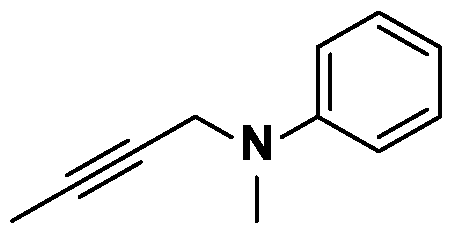
A-(but-2-yn- 1 -yl )-N-methyl ani 1 i ne (1 v)
To a stirred solution of but-2-yn-l-yl 4-methylbenzenesulfonate (896 mg, 4.0 mmol) in DMF (30 mL) was added /V-methylaniline (389 mg, 3.6 mmol) at room temperature. The solution was stirred at room temperature for 20 h. The aqueous layer was extracted with EtOAc and the combined organic layers were washed with water and brine, dried over anhydrous Na2SC>4, then concentrated in vacuo. The residue was purified by silica gel column
chromatography (hexane/DCM/EtOAc =50/1/1) to afford yellowish-brown oil 539.4 mg, yield: 94%. 1H NMR (400 MHz, CDCh): d (ppm) 7.22-7.26 (m, 2H), 6.83 (d, J = 8.0 Hz, 2H), 6.77 (t, J= 7.4 Hz, 1H), 3.97 (d, 7= 4.8 Hz, 2H), 2.94 (s, 3H), 1.76 (t, 7= 2.2 Hz, 3H); 13C NMR (100
MHz, CDCh): d (ppm) 149.4, 129.0, 117.9, 114.1, 79.6, 74.6, 42.7, 38.5, 3.5; Ms (El): m/z 159.1 [M+],

1 -(but-2-yn- 1 -yl)-4-phenylpiperidine ( 1 w)
To a stirred solution of but-2-yn-l-yl 4-methylbenzenesulfonate (896 mg, 4.0 mmol) in DMF (30 mL) was added 4-phenylpiperidine (579.6 mg, 3.6 mmol) at room temperature. The solution was stirred at room temperature for 20 h. The aqueous layer was extracted with EtOAc and the combined organic layers were washed with water and brine, dried over anhydrous Na2S04, then concentrated in vacuo. The residue was purified by silica gel column
chromatography (hexane/DCM/EtOAc =50/1/1) to afford light yellow solid 690.1 mg, yield: 90%. 1H NMR (400 MHz, CDCh): d (ppm) 7.16-7.30 (m, 5H), 3.24-3.25 (m, 2H), 3.04-3.06 (m, 2H), 2.45-2.53 (m, 1H), 2.20-2.26 (m, 2H), 1.84-1.87 (m, 7H); 13C NMR (100 MHz, CDCh): d
(ppm) 146.4, 128.4, 126.9, 126.1, 80.5, 74.6, 53.4, 47.8, 42.4, 33.5, 3.5; HRMS (ESC): calcd for C15H20N [M+H]+ 214.1590, found 214.1598.

(Z)-l, 2-diphenyl ethene (2a)
Colorless liquid 116.6 mg, yield: 81%. GC analysis of the crude product indicated that the ratio of stereoisomers was E:Z = 1 :99. The electrochemical hydrogenation was carried out in three-necked round-bottomed flask (100 mL), with a graphite rod anode and a platinum plate (10x10x0.1 mm) cathode, la (8.0 mmol, 1.424 g), PdCl2 (0.5 mol%), Me2NH (0.5 equiv, 2.0 M in the methonal), "nBμ4NI (1.0 equiv) and MeOH (30.0 mL) were placed in a three-necked round- bottomed flask at 60 °C with a constant current of 0.1 A maintained for 20 h. The mixture was cooled to room temperature, and diluted with 200 mL of EtOAc. The organic mixture was then washed with brine, dried over anh. Na2SO4 , and evaporated under vacuum. The residue was purified by flash column chromatography (n-hexane) on silica gel to provide the desired products 1.12 g, yield: 78%. The electrochemical hydrogenation was carried out in three-necked round- bottomed flask (100 mL), with a graphite rod anode and reused with the unwashed Pt electrode as cathode, la (0.80 mmol, 142.4 mg), recycled Pd nanoparticles (filtration solution), Me?NH (0.5 equiv, 0.2 mL, 2.0 M in the methonal), "nBμ4NI (1.0 equiv, 295.5 mg) and MeOH (8.0 mL) were placed in a three-necked round-bottomed flask at 60 °C with a constant current of 0.1 A maintained for 2.5 h. The mixture was cooled to room temperature, a yield of 76% and high selectivity (99: 1) were obtained. This yield is based on la, determined by 1H NMR using dibromomethane as the internal standard. 1H NMR (400 MHz, CDCh): d (ppm) 7.17-7.26 (M, 10H), 6.60 (s, 2H); 13C NMR (100 MHz, CDCh): d (ppm) 137.3, 130.3, 128.9, 128.2, 127.1. Ms (El): m/z = 180.1 [M+],

A colorless liquid. Yellow solid 131.5 mg, yield: 83%. 1H NMR (400 MHz, CDCh): δ (ppm) 7.16-7.21 (M, 7H), 6.88 (t, J= 8.8 Hz, 2H), 6.57 (d, J= 12.0 Hz, 1H), 6.52 (d, J= 12.2 Hz, 1H); 13C NMR (100 MHz, CDCh): d (ppm) 130.6, 130.5, 130.3, 129.1, 128.8, 128.3, 127.2, 115.3, 115.0. Ms (El): m/z = 198.1 [M+],

(Z)-l-styryl-4-(trifluoromethyl)benzene (2c)
White solid, 174.6 mg, yield: 88%. GC analysis of the crude product indicated that the ratio of stereoisomers was E:Z = 1 :99. 1H NMR (400 MHz, CDCh): d (ppm) 7.45 (d, J= 7.8 Hz, 2H), 7.31 (d, 7= 8.0 Hz, 2H), 7.19 - 7.23 (m, 5H), 6.70 (d, J= 12.0 Hz, 1H), 6.57 (d, J = 12.0 Hz, 1H). 13C NMR (100 MHz, CDCh) d 141.0, 136.6, 132.4, 129.2, 128.9, 128.8, 128.5, 127.6, 125.24, 125.21, 125.17, 125.13. Ms (El): m/z = 248.1 [M+],

White solid 131.2 mg, yield: 80%. 1H NMR (400 MHz, CDCh): S (ppm) 7.49-7.51 (m, 1H), 7.43-7.47 (M, 2H), 7.73 (t, J= 7.8 Hz, 1H), 7.22-7.25 (M, 3H), 7.16-7.18 (M, 2H), 7.73 (d, J= 12.0 Hz, 1H), 6.54 (d, J= 12.0 Hz, 1H); 13C NMR (100 MHz, CDCh): S (ppm) 138.6, 136.2, 133.2, 132.7, 132.4, 130.5, 129.0, 128.7, 127.7, 118.7, 112.5; Ms (El): m/z = 205.1 [M+],

An orange oil, 122 mg, yield: 82%. GC analysis of the crude product indicated that the ratio of stereoisomers was E:Z = 1 :99. 1H NMR (400 MHz, CDCh): d (ppm) 7.24-7.34 (m, 5H), 7.06 (d, J= 4.8 Hz, 1H), 6.95 (d, J= 2.8 Hz, 1H), 6.85-6.87 (m, 1H), 6.68 (d, J= 12.0 Hz, 1H), 6.56 (d, J= 12.0 Hz, 1H). 13C NMR (100 MHz, CDCh) d 139.8, 137.3, 128.9, 128.8, 128.5, 128.1, 127.5, 126.4, 125.5, 123.3. Ms (El): m/z = 186.1 [M+],

(Z)-4-styrylpyridine (2f)
Abrown oil, 133.2 mg, yield: 92%. 1H NMR (400 MHz, CDCh): d (ppm) 8.45 (s, 2H), 7.20- 7.24 (m, 5H), 7.09 (s, 2H), 6.78 (d, J= 9.6 Hz, 1H), 6.49 (d, J= 9.2 Hz, 1H). 13C NMR (100 MHz, CDCh) d 149.9, 145.0, 136.2, 134.0, 128.8, 128.5, 127.9, 127.6, 123.5. Ms (El): m/z = 181.1 [M+],

(Z)-l-chloro-4-styrylbenzene (2g)
Pale yellow solid Yellow solid 157.5 mg, yield: 92%. 1H NMR (400 MHz, CDCh): d (ppm) 7.15 - 7.21 (m, 9H), 6.61 (d, J= 12.0 Hz, 1H), 6.51 (d, J= 12.0 Hz, 1H). 13C NMR (100 MHz, CDCh) d 136.9, 135.7, 132.8, 131.0, 130.2, 128.9, 128.8, 128.4, 128.3, 127.3. Ms (El): m/z = 214.1 [M+],

(Z)-l,2-di-p-tolylethene (2h)
Pale yellow solid, 133.1 mg, yield: 80%. GC analysis of the crude product indicated that the ratio of stereoisomers was E:Z = 2:98. 1H NMR (400 MHz, CDCh): d (ppm) 7.15 (d, J= 8.0 Hz, 4H), 7.02 (d, J= 7.6 Hz, 4H), 6.50 (s, 2H), 2.30 (s, 6H). 13C NMR (100 MHz, CDCh) d 136.7, 134.6, 129.5, 128.9, 128.8, 21.2. Ms (El): m/z = 208.1 [M+],

(Z)-l,2-bis(4-fluorophenyl)ethene (2i)
White solid, 121.0 mg, yield: 70%.1H NMR (400 MHz, CDCh): d (ppm) 7.15 - 7.18 (m, 4H), 6.88-6.94 (m, 4H), 6.52 (s, 2H). 13C NMR (100 MHz, CDCh) d 163.1, 160.7, 132.9, 130.6, 130.5, 129.1, 115.4, 115.2. Ms (El): m/z = 216.1 [M+],

(Z)-l,2-bis(4-chlorophenyl)ethene (2j)
Pale yellow solid, 150.8 mg, yield: 76%. 1H NMR (400 MHz, CDCh): d (ppm) 7.19 (d, J = 8.8 Hz, 4H), 7.13 (d, J= 8.8 Hz, 4H), 6.54 (s, 2H). 13C NMR (100 MHz, CDCh) d 135.3, 133.1, 130.2, 129.6, 128.6. Ms (El): m/z = 248.0 [M+],

(Z)-prop-l-en-l-ylbenzene (2k)
Colorless liquid, 75.5 mg, yield: 80%. 1H NMR (400 MHz, CDCh): d (ppm) 7.19-7.30 (m, 5H), 6.43 (d, J = 8.0 Hz, 1H), 5.77 (d, J= 8.8 Hz, 1H), 1.89 (s, 3H). 13C NMR (100 MHz, CDCh) d = 137.67, 129.9, 128.9, 128.1, 126.7, 126.4, 14.6. Ms (El): m/z = 118.1 [M+],

(Z)-dodec-6-ene (21)
Colorless liquid, 103.5 mg, yield: 77%. 1H NMR (400 MHz, CDCh): d (ppm) 5.34-5.37 (m, 2H), 2.02 (q, J= 5.8 Hz, 4H), 1.26-1.36 (m, 12H), 0.89 (t, J= 7.0 Hz, 6H). 13C NMR (100 MHz, CDCh) d 129.9, 31.6, 29.5, 27.2, 22.6, 14.1. Ms (El): m/z = 168.2 [M+],

(Z)-non-3-en-l-ylbenzene (2m)
Yellowish oil, 134.0 mg, yield: 83%. 1H NMR (400 MHz, CDCh): d (ppm) 7.16-7.29 (m, 5H), 5.34-5.43 (m, 2H), 2.65 (t, J= 8.2 Hz, 2H), 2.33-2.38 (m, 2H), 1.97 (t, J= 5.8 Hz, 2H), 1.26-1.28 (m, 6H), 0.88 (t, 7= 7.0 Hz, 3H); 13C NMR (100 MHz, CDCh): d (ppm) 142.2, 130.8, 128.6, 128.5, 128.3, 125.8, 36.1, 31.5, 29.3, 29.2, 27.2, 22.6, 14.1. HRMS (ESI+): calcd for C15H23 [M+H]+ 203.1794, found 203.1801.

(Z)-dodec-3-en-l-ylbenzene (2n)
Yellowish oil, 158.1 mg, yield: 81%. 1H NMR (400 MHz, CDCh): d (ppm) 7.15-7.28 (m, 5H), 5.34-5.43 (m, 2H), 2.65 (t, J= 7.6 Hz, 2H), 2.32-2.38 (m, 2H), 1.97 (d, J= 5.6 Hz, 2H), 1.25-1.26 (m, 12H), 0.88 (t, 7= 6.6 Hz, 3H); 13C NMR (100 MHz, CDCh): d (ppm) 142.2,
130.8, 128.6, 128.5, 128.3, 125.8, 36.1, 31.9, 29.7, 29.5, 29.3, 29.2, 27.3, 22.7, 14.1; HRMS (ESC): calcd for CI8H29 [M+H]+ 245.2264, found 245.2267. IR (cm'1): 3005, 2925, 2854, 1604, 1454, 1077, 1030, 746, 722, 698, 485.

dec-l-ene (2o)
Colorless liquid, 69.4 mg, yield: 62%. 1H NMR (400 MHz, CDCl3): d (ppm) 5.75-5.85 (m, 1H), 4.91-5.00 (m, 2H), 2.04 (q, J= 7.2 Hz, 2H), 1.28-1.38 (m, 12H), 0.88 (t, J= 6.4 Hz, 3H); 13C NMR (100 MHz, CDCl3): d (ppm) 139.2, 114.1, 33.9, 32.0, 29.6, 29.4, 29.3, 29.1, 22.8, 14.1. Ms (El): m/z = 140.1 [M+],

tert-butyl(pent-4-en-l-yloxy)diphenylsilane (2p)
Colorless liquid, 174.1 mg, yield: 67%. 1H NMR (400 MHz, CDCl3): d (ppm) 7.66-7.68 (m, 4H), 7.33-7.37 (m, 6H), 5.74-5.84 (m, 1H), 4.91-5.01 (m, 2H), 3.68 (t, J= 6.4 Hz, 2H), 2.14 (t, 7= 6.6 Hz, 2H), 1.64-1.69 (m, 2H), 1.06-1.08 (m, 9H); 13C NMR (100 MHz, CDCl3): d (ppm) 138.5, 135.6, 134.1, 129.5, 127.6, 114.5, 63.3, 31.8, 30.1, 26.9, 19.2; HRMS (ESI+): calcd for C2iH29OSi [M+H]+ 325.1982, found 325.1980.

(Z)- 1 -((but-2-en- 1 -yloxy)methyl)naphthalene (2q)
Yellow oil 149.2 mg, yield: 88%. 1H NMR (400 MHz, CDCl3): d (ppm) 7.76-7.80 (m, 4H), 7.42-7.46 (m, 3H), 5.66-5.67 (m, 2H), 4.64 (s, 2H), 4.10 (d, J= 5.2 Hz, 2H), 1.62 (d, J= 5.2 Hz, 3H); 13C NMR (100 MHz, CDCl3): d (ppm) 136.0, 133.3, 133.0, 128.1, 128.0, 127.9, 127.7, 126.9, 126.4, 126.0, 125.81, 125.76, 72.1, 65.5, 13.2; HRMS (ESC): calcd for C15H17O [M+H]+ 213.1274, found 213.1269. IR (cm'1): 3054, 3021, 2920, 2855, 1720, 1602, 1509, 1441, 1261, 1090, 1018, 951, 854, 816, 751, 475.

(Z)-2-((but-2-en-yloxy)methyl)pyridine (2r)
Pale yellow liquid, 88.7 mg, yield: 68%. 1H NMR (400 MHz, CDCl3): d (ppm) 8.56 (s, 1H), 7.69-7.70 (m, 1H), 7.46-7.47 (m, 1H), 7.19 (s, 1H), 5.66-5.70 (m, 2H), 4.64 (s, 2H), 4.19 (s, 2H), 1.68 (s, 3H); 13C NMR (100 MHz, CDCl3): d (ppm) 158.8, 149.1, 136.6, 128.3, 126.6,
122.3, 121.4, 73.0, 66.2, 13.2; HRMS (ESC): calcd for C10H14NO [M+H]+ 164.1070, found 164.1080. IR (cm'1): 3054, 2201, 1422, 1265, 896, 740, 705, 434.

(Z)- 1 -((but-2-en- 1 -yloxy)methyl)-4-methoxybenzene (2s)
Pale yellow liquid, 92.1 mg, yield: 60%. 1H NMR (400 MHz, CDCl3): d (ppm) 7.27-7.28 (m, 2H), 6.87-6.88 (m, 2H), 5.61-5.67 (m, 2H), 4.44-4.45 (m, 2H), 4.06 (s, 2H), 3.79 (s, 3H), 1.64 (s, 3H); 13C NMR (100 MHz, CDCl3): d (ppm) 159.2, 130.6, 129.4, 127.9, 127.1, 113.8, 71.8, 65.2, 55.3, 13.2; HRMS (ESC): calcd for Ci2Hi702 [M+H]+ 193.1223, found 193.1230. IR (cm'1): 2937, 2856, 1714, 1612, 1513, 1301, 1265, 1248, 1172, 1083, 1036, 822, 738, 703.

(Z)-l-((but-2-en-l-yloxy)methyl)-4-chlorobenzene (2t)
Pale yellow liquid 125.4 mg, yield: 80%. 1H NMR (500 MHz, CD3OD): d (ppm) 7.33- 7.37 (m, 4H), 5.56-5.69 (m, 2H), 4.47-4.48 (m, 2H), 4.10 (d, J = 6.0 Hz, 2H), 1.65 (d, J = 7.0 Hz, 3H); 13C NMR (125 MHz, CD3OD): d (ppm) 138.6, 134.3, 130.4, 129.4, 129.1, 127.7, 72.1,
66.5, 53.2; HRMS (ESI+): calcd for CHH14CIO [M+H]+ 197.0728, found 197.0723. IR (cm'1): 3022, 2921, 1600, 1506, 1364, 1265, 1202, 1033, 739, 692, 514.

(Z)-(but-2-en- 1 -yloxy)(tert-butyl)diphenylsilane (2u)
Colorless liquid 228.1 mg, yield: 92%. 1H NMR (400 MHz, CDCl3): d (ppm) 7.67-7.72 (m, 4H), 7.35-7.43 (m, 6H), 5.59-5.61 (m, 1H), 5.44-5.51 (m, 1H), 4.27 (d, J= 8.8 Hz, 2H), 1.46 (d, J= 6.8 Hz, 3H), 1.05 (d, 7= 0.4 Hz, 9H); 13C NMR (100 MHz, CDCl3): d (ppm) 135.6,
134.0, 130.0, 129.5, 127.6, 125.1, 60.1, 26.8, 19.2, 13.0; HRMS (ESI+): calcd for C2oH27OSi
[M+H]+ 311.1826, found 311.1840. IR (cm'1): 3071, 2960, 2858, 1589, 1472, 1265, 1111, 1079, 823, 740, 702, 612, 506.

(Z)-/V-(but-2-en- 1 -yl )-N-m ethyl ani 1 i ne (2v)
Yellowish-brown solid 87.6 mg, yield: 68%. 1H NMR (400 MHz, CDCl3): d (ppm) 7.19- 7.24 (m, 2H), 6.68-6.75 (m, 3H), 5.59-5.66 (m, 1H), 5.41-5.47 (m, 1H), 3.94 (d, J= 6.4 Hz, 2H), 2.89 (s, 3H), 1.71 (d, J= 5.2 Hz, 3H); 13C NMR (100 MHz, CDCl3): d (ppm) 149.8, 129.1,
126.9, 126.6, 116.7, 113.1, 49.5, 38.0, 13.0; HRMS (ESC): calcd for CnHieN [M+H]+ 162.1277, found 162.1271. IR (cm'1): 3691, 3054, 2987, 2859, 2686, 2521, 2411, 2306, 1612, 1513, 1265, 1173, 1077, 1035, 896, 739, 583, 517.

(Z)- 1 -(but-2-en- 1 -yl)-4-phenylpiperidine (2w)
Yellow oil 118.7 mg, yield: 69%. 1H NMR (400 MHz, CDCl3): d (ppm) 7.19-7.28 (m, 5H), 5.57-5.66 (m, 2H), 3.05-3.07 (m, 4H), 2.50 (s, 1H), 2.06-2.07 (m, 2H), 1.83-1.84 (m, 4H), 1.67 (s, 3H); 13C NMR (100 MHz, CDCl3): d (ppm) 146.5, 128.4, 127.1, 127.0, 126.9, 126.1, 55.1, 54.3, 42.8, 33.6, 13.1; HRMS (ESI+): calcd for C15H22N [M+H]+ 216.1747, found
216, 1767. IR (cm'1): 3600, 3005, 1714, 1421, 1363, 1222, 1092, 903, 530.

(Z)-2-((pent-3-en-l -yloxy)methyl)pyridine (2x)
Pale yellow oil 106.2 mg, yield: 75%. 1H NMR (400 MHz, CDCh): S (ppm) 8.54 (d, J = 4.8 Hz, 1H), 7.66-7.71 (m, 1H), 7.45 (d, J= 7.8 Hz, 1H), 7.15-7.18 (m, 1H), 5.53-5.60 (m, 1H), 5.41-5.48 (m, 1H), 4.65 (s, 2H), 3.58 (t, J= 6.8 Hz, 2H), 2.40-2.46 (m, 2H), 1.64 (d, J= 7.8 Hz, 3H); 13C NMR (100 MHz, CDCh): d (ppm) 158.9, 149.1, 136.6, 126.4, 126.0, 122.3, 121.3,
73.8, 70.6, 27.7, 12.9; HRMS (ESI+): calcd for CnHi16ON [M+H]+ 178.1226, found 178.1218. IR (cm'1): 2959, 2927, 2874, 1464, 1379, 909, 737, 423.

ethylbenzene (3a)
Colorless liquid 59.3 mg, yield: 70%. 1HNMR (400 MHz, CDCh): d (ppm) 7.14-7.28 (m, 5H), 2.61-2.70 (m, 2H), 1.23 (t, J= 7.8 Hz, 3H); 13C NMR (100 MHz, CDCh): d (ppm) 144.3, 128.3, 127.9, 125.6, 28.9, 15.6. Ms (El): m/z = 106.1 [M+],

propylbenzene (3b)
Colorless liquid 79.7 mg, yield: 83%. 1HNMR (400 MHz, CDCh): d (ppm) 7.12-7.24 (m, 5H), 2.55 (t, J= 7.4 Hz, 2H), 1.57-1.66 (m, 2H), 0.92 (t, J= 5.4 Hz, 3H); 13C NMR (100 MHz, CDCh): d (ppm) 142.7, 128.5, 128.3, 125.7, 38.2, 24.6, 13.8. Ms (El): m/z = 120.1 [M+],

1,2-diphenyl ethane (3c)
White solid 123.7 mg, yield: 85%. 1HNMR (400 MHz, CDCh): d (ppm) 7.26-7.30 (m, 4H), 7.17-7.23 (m, 6H), 2.92 (s, 4H); 13C NMR (100 MHz, CDCh): d (ppm) 141.8, 128.5, 128.3,
125.9, 37.9. Ms (El): m/z = 182.1 [M+],

l-methyl-4-phenethylbenzene (3d)
White solid 127.0 mg, yield: 81%. 1HNMR (400 MHz, CDCh): S (ppm) 7.25-7.29 (m, 2H), 7.14-7.19 (m, 4H), 6.97-7.01 (m, 3H), 2.89 (s, 4H), 2.32 (s, 3H); 13C NMR (100 MHz, CDCh): S (ppm) 141.9, 141.8, 137.9, 129.3, 128.3, 128.2, 126.7, 125.9, 125.4, 38.0, 21.4. Ms (El): m/z = 196.1 [M+],

1 -methoxy-4-phenethylb enzene (3 e)
White solid, 154.3 mg, yield: 91%. 1HNMR (400 MHz, CDCh): d (ppm) 7.22-7.27 (m, 2H), 7.14-7.18 (m, 3H), 7.04-7.07 (m, 2H), 6.77-6.81 (m, 2H), 3.74 (s, 3H), 2.85-2.86 (m, 4H); 13C NMR (100 MHz, CDCh): d (ppm) 157.9, 141.8, 133.9, 129.3, 128.5, 128.3, 125.9, 113.8, 55.2, 38.2, 37.0. Ms (El): m/z = 212.1 [M+],

1,4-diphenylbutane (3f)
Colorless liquid, 129.3 mg, yield: 77%. 1HNMR (400 MHz, CDCh): d (ppm) 7.13-7.34 (m, 10H), 2.63 (m, 4H), 1.65-1.69 (m, 4H); 13C NMR (100 MHz, CDCh): d (ppm) 142.6, 128.5, 128.3, 125.7, 35.8, 31.1. Ms (El): m/z = 210.1 [M+],

2-ethylnaphthalene (3g)
Colorless liquid, 102.3 mg, yield: 82%. 1HNMR (400 MHz, CDCl3): 7.72-7.78 (m, 3H), 7.59 (s, 1H), 7.31-7.41 (m, 3H), 2.78 (q, J= 7.6 Hz, 2H), 1.28-1.32 (m, 3H); 13C NMR (100 MHz, CDCl3): d (ppm) 141.8, 133.8, 132.0, 127.8, 127.6, 127.4, 127.1, 125.8, 125.6, 125.0, 29.1, 15.5. Ms (El): m/z = 156.1 [M+],

ethane- 1,1-diyl dibenzene (3h)
Colorless liquid, 128.1 mg, yield: 88%. 1HNMR (400 MHz, CDCl3): d (ppm) 7.08-7.26 (m, 10H), 4.10-4.15 (m, 1H), 1.60-1.64 (m, 3H); 13C NMR (100 MHz, CDCl3): d (ppm) 146.3, 128.3, 127.6, 126.0, 44.8, 21.8. Ms (El): m/z = 182.1 [M+],

ethane- 1 , 1 ,2-triyltribenzene (3i)
Colorless liquid, 142.4 mg, yield: 69%. 1HNMR (400 MHz, CDCl3): d (ppm) 7.10-7.25 (m, 13H), 6.99 (d, J= 6.8 Hz, 2H), 4.22 (t, J= 7.8 Hz, 1H), 3.35 (d, J= 8.0 Hz, 2H); 13C NMR (100 MHz, CDCl3): d 144.5, 140.3, 129.1, 128.3, 128.1, 126.2, 125.9, 53.1, 42.1. Ms (El): m/z = 258.1 [M+],

1,1, 2, 2-tetraphenyl ethane (3j)
The electrochemical hydrogenation was carried out in three-necked round-bottomed flask (10 mL), with a graphite rod anode and a platinum disc cathode. 1,1, 2, 2-tetraphenyl ethene (0.20 mmol, 64.4 mg), PdCl2 (2.0 mol%, 0.7 mg), Me2NH (1.0 equiv, 0.1 mL, 2.0 M in the methonal), "BU4NI (2.0 equiv, 147.8 mg) and MeCN (6.0 mL) were placed in a three-necked round- bottomed flask at 60 °C with a constant current of 0.3 A maintained for 10 h. The mixture was cooled to room temperature, and diluted with 20 mL of EtOAc. The organic mixture was then washed with brine, dried over anh. Na2S04, and evaporated under vacuum. The residue was purified by flash column chromatography (n-hexane) on silica gel to provide the desired products. White soild 58.1 mg, yield: 87%. 1HNMR (400 MHz, CD3COCD3): d (ppm) 7.29 (d, J = 8.4 Hz, 8H), 6.97 (t, J= 7.8 Hz, 8H), 6.81-6.85 (m, 4H), 4.99 (s, 2H); 13C NMR (100 MHz, CD3COCD3): d (ppm) 143.8, 128.0, 127.5, 125.1, 55.1. HRMS (ESI+): calcd for C26H23 [M+H]+ 335.1794, found 335.1800.

1 , 1 ,2,2-tetra(thiophen-2-yl)ethane (3 k)
Electrochemical hydrogenation was carried out in three-necked round-bottomed flask (10 mL), with a graphite rod anode and a platinum disc cathode. l,l,2,2-tetra(thiophen-2-yl)ethene (0.20 mmol, 71.2 mg), PdCl2 (2.0 mol%, 0.7 mg), Me2NH (1.0 equiv, 0.1 mL, 2.0 M in the methonal), "nBμ4NI (2.0 equiv, 147.8 mg) and MeCN (6.0 mL) were placed in a three-necked round-bottomed flask at 60 °C with a constant current of 0.3 A maintained for 10 h. The mixture was cooled to room temperature, and diluted with 20 mL of EtOAc. The organic mixture was then washed with brine, dried over anh. Na2S04, and evaporated under vacuum. The residue was
purified by flash column chromatography (n-hexane) on silica gel to provide the desired products. Yellow soild 57.3 mg, yield: 80%. M.p. : 102-104 °C; 1HNMR (400 MHz, CD3COCD3): d (ppm) 7.05 (d, J= 4.0 Hz, 4H), 6.82 (d, J= 4.0 Hz, 4H), 6.66-6.68 (m, 4H), 5.22 (s, 2H); 13C NMR (100 MHz, CD3COCD3): d (ppm) 146.3, 126.2, 125.5, 124.1, 49.6; HRMS (ESI+): calcd for C18H15S4 [M+H]+ 359.0051, found 359.0038. IR (cm'1): 3054, 2986, 2305, 1265. 895, 743, 704, 439.

(Z)-/V,/V-diphenyl-4-(2-(4-styrylphenyl)oxazol-5-yl)aniline (4a)
To a reaction tube with a magnetic stirring bar, Pd(OAc)2 (2.3 mg, 0.01 mmol), 4- (oxazol -5-yl )-/V,/V-di phenyl ani 1 i ne (31.2 mg, 0.1 mmol), (z)-l-chloro-4-styrylbenzene (42.8 mg, 0.2 mmol), Cy3P HBF4 (7.4 mg, 0.02 mmol) and CS2CO3 (97.7 mg, 0.3 mmol) and toluene (2.0 mL) were added under N2 atmosphere. The reaction mixture was stirred at 110 °C for 24 h. The mixture was cooled to room temperature, and diluted with 20 mL of CH2CI2. The organic mixture was then washed with brine, dried over anh. Na2SC>4, and evaporated under vacuum. The residue was purified by flash column chromatography (n-hexane/ethyl acetate/dichloromethane = 20/1/1, v/v/v) on silica gel to provide the desired products, yellow solid 31.8 mg, yield: 65%. ¾ NMR (400 MHz, CDCl3): d (ppm) 7.93 (d, J = 8.4 Hz, 2H), 7.54 (d, J= 8.8Hz, 2H), 7.20-7.31 (m, 11H), 7.03-7.13 (m, 9H), 6.68 (d, J= 12.4 Hz, 1H), 6.60 (d, J= 12.4 Hz, 1H); 13C NMR (100 MHz, CDCl3): d (ppm) 160.6, 151.3, 148.1, 147.3, 139.2, 137.0, 131.5, 129.5, 129.42, 129.37, 128.9, 128.4, 127.4, 126.1, 126.0, 125.2, 124.8, 123.5, 123.2, 122.4, 121.7; HRMS (ESI+): calcd for C35H27N2O [M+H]+ 491.2118, found 491.2125. IR (cm'1): 3033, 2926, 1724, 1589, 1488, 1329, 1281, 1177, 1109, 1027, 951, 824, 754, 696.

(Z)-A(A-di phenyl -4'-(2-(4-styryl phenyl )oxazol -5-yl )-[ l , 1 '-biphenyl] -4-amine (4b)
To a reaction tube with a magnetic stirring bar, Pd(OAc)2 (2.3 mg, 0.01 mmol), 4'- (oxazol-5-yl)-/V,/V-diphenyl-[l,r-biphenyl]-4-amine (38.8 mg, 0.1 mmol), (z)-l-chloro-4- styrylbenzene (42.8 mg, 0.2 mmol), Cy3P HBF4 (7.4 mg, 0.02 mmol) and CS2CO3 (97.7 mg, 0.3 mmol) and toluene (2.0 mL) were added under N2 atmosphere. The reaction mixture was stirred at 110 °C for 24 h. The mixture was cooled to room temperature, and diluted with 20 mL of CH2CI2. The organic mixture was then washed with brine, dried over anh. Na2SO4 , and evaporated under vacuum. The residue was purified by flash column chromatography (n- hexane/ethyl acetate/dichloromethane = 20/1/1, v/v/v) on silica gel to provide the desired products, yellow solid 40.2 mg, yield: 71%. 1H NMR (400 MHz, CDCl3): δ (ppm) 7.97 (d, J =
8.4 Hz, 2H), 7.74 (d, J= 8.4Hz, 2H), 7.63 (d, J= 8.8Hz, 2H), 7.50 (d, J= 8.4Hz, 2H), 7.44 (s, 1H), 7.36 (d, J= 8.4Hz, 2H), 7.23-7.29 (m, 9H), 7.13-7.15 (m, 6H), 7.02-7.06 (m, 2H), 6.69 (d, J = 12.4 Hz, 1H), 6.62 (d, J= 12.0 Hz, 1H); 13C NMR (100 MHz, CDCl3): d (ppm) 161.1, 151.2, 147.6, 140.6, 139.4, 137.0, 134.0, 131.6, 129.5, 129.4, 129.3, 128.9, 128.4, 127.6, 127.4, 127.0, 126.4, 126.2, 126.1, 124.6, 123.7, 123.5, 123.2; HRMS (ESI+): calcd for C41H31N2O [M+H]+ 567.2431, found 567.2426. IR (cm'1): 3031, 2926, 1733, 1699, 1652, 1539, 1488, 1418, 1327, 1265, 1179, 952, 820, 739, 698.

(Z)-4-(2-(4-(4-chlorostyryl)phenyl)oxazol-5-yl)-N,N-di phenyl aniline (4c)
To a reaction tube with a magnetic stirring bar, Pd(OAc)2 (2.3 mg, 0.01 mmol), 4- (oxazol -5-yl )-A( A'-di phenyl ani 1 i ne (31.2 mg, 0.1 mmol), (z)-l,2-bis(4-chlorophenyl)ethene (49.6 mg, 0.2 mmol), Cy3P HBF4 (7.4 mg, 0.02 mmol) and CS2CO3 (97.7 mg, 0.3 mmol) and toluene (4.0 mL) were added under N2 atmosphere. The reaction mixture was stirred at 110 °C for 16 h. The mixture was cooled to room temperature, and diluted with 20 mL of CH2CI2. The organic mixture was then washed with brine, dried over anh. Na2SOL4 , and evaporated under vacuum. The residue was purified by flash column chromatography (n-hexane/ethyl acetate/di chi orom ethane = 20/1/1, v/v/v) on silica gel to provide the desired products, yellow solid 31.4 mg, yield: 60%. ¾ NMR (500 MHz, CDCl3): S (ppm) 7.95 (d, J= 8.5 Hz, 2H), 7.55 (d, J= 8.5Hz, 2H), 7.25-7.37 (m, 7H), 7.17-7.21 (m, 3H), 7.05-7.13 (m, 9H), 6.64 (d, J= 12.0 Hz, 1H), 6.60 (d, J= 12.5 Hz, 1H); 13C NMR (125 MHz, CDCl3): δ (ppm) 160.4, 151.4, 148.2, 147.3, 138.8, 135.4, 133.1, 130.23, 130.16, 130.1, 129.4, 129.3, 128.6, 126.4, 126.1, 125.2, 124.8, 123.5, 123.1, 122.4, 121.6; HRMS (ESI+): calcd for C35H26CIN2O [M+H]+ 525.1728, found 525.1726. IR (cm’1): 3037, 2928, 2852, 1589, 1489, 1419, 1329, 1265, 1178, 1089, 1014, 951, 882, 825, 739, 698.

(Z)-4,4'-((ethene-l,2-diylbis(4, l-phenylene))bis(oxazole-2,5-diyl))
bi s(N, N-di phenyl ani 1 i ne) (4d)
To a reaction tube with a magnetic stirring bar, Pd(OAc)2 (4.6 mg, 0.02 mmol), 4- (oxazol -5-yl )-N, N-di phenyl ani 1 i ne (124.8 mg, 0.4 mmol), (z)-l,2-bis(4-chlorophenyl)ethene (24.8 mg, 0.1 mmol), Cy3P HBF4 (14.8 mg, 0.04 mmol) and CS2CO3 (195.4 mg, 0.6 mmol) and toluene (4.0 mL) were added under N2 atmosphere. The reaction mixture was stirred at 110 °C for 24 h. The mixture was cooled to room temperature, and diluted with 20 mL of CH2CI2. The organic mixture was then washed with brine, dried over anh. Na2SO4 , and evaporated under vacuum. The residue was purified by flash column chromatography (n-hexane/ethyl
acetate/dichloromethane/acetone = 40/2/2/1, v/v/v/v) on silica gel to provide the desired products, yellow solid 34.4 mg, yield: 43%. 1H NMR (400 MHz, CDCl3): d (ppm) 7.95 (d, J = 8.4 Hz, 4H), 7.55 (d, J= 8.8 Hz, 4H), 7.37 (d, J= 8.4 Hz, 4H), 7.32 (s, 2H), 7.26-7.30 (m, 4H), 7.04-7.13 (m, 20H), 6.70 (s, 2H); 13C NMR (100 MHz, CDCl3): d (ppm) 160.5, 151.3, 148.2, 147.3, 138.9, 130.7, 129.4, 126.4, 126.2, 125.3, 125.2, 124.8, 123.5, 123.1, 122.5, 121.7; HRMS (ESI+): calcd for C56H41N4O2 [M+H]+ 801.3224, found 801.3225. IR (cm'1): 3035, 2929, 1814, 1681, 1588, 1489, 1448, 1328, 1275, 1177, 1132, 1074, 951, 825, 738, 697.
1, 2-diphenyl ethyne (la) was used as a model substrate to evaluate the feasibility of the electrochemical hydrogenation strategy (Table SI), la was hydrogenated efficiently to afford (Z)-l, 2-diphenyl ethene (2a) in 81% yield with great selectivity (E/Z 1 :99) under a constant current of 0.1 A in a user-friendly undivided three-necked round-bottomed flask at 60 °C (Table SI, entry 1). The reaction conditions were further investigated. Among the electrolytes investigated (e.g. "nBμ4NI, "BU4NPF6, and "BU4NBF4), nBμ4NI was the most effective one (Table SI, entries 1-3). Methanol proved to be the most effective solvent (Table S I, entries 4-7). It was
found that the selectivity and yield of 2a were reduced when other bases were used or in the absence of Me2NH (Table SI, entry 8-10). Furthermore, replacement of PdCl2 with Pd(OAC)2 led to a slightly decreased reaction yield (Table SI, entry 11). A significant lower reaction yield was obtained by decreasing the operating current or temperature (Table SI, entries 12-13), while no desired product could be obtained in the absence of electric current (Table SI, entry 14). A very low yield was observed when a same electrode (either Pt/Pt or C/C) was employed (Table SI, entries 15-16). In addition, 2a was obtained in 18% yield when unwashed and reused Pt electrode was used as the cathode (Table SI, entry 17). Desired product was obtained in 76% yield with high selectivity using the recycled palladium nanoparticles (Table SI, entry 18), indicating that the inventive processes have potential for industrial production. Potential overreduced alkane byproduct was not detected in the reaction.
A library of alkynes were subjected to electrochemical hydrogenation, and the corresponding Z-alkenes were obtained in high yields with excellent chemo- and stereoselectivity (Table 1). (Z)-l, 2-diphenyl ethene (2a) was obtained on a gram scale in 78% yield with high Z/E selectivity. Di(hetero)arylethynes with either an electron-donating or electron- withdrawing substituent resulted in good yields of the desired Z-alkenes (2a-j).
Heteroarylethynes were exclusively reduced to the corresponding Z-alkenes without affecting the heteroaromatic rings (2e and 2f). Furthermore, hydrogenation of unactivated dialkyl acetylenes also provided the corresponding Z-olefms in high yields with excellent selectivity (21-2n and 2q- 2x). Moreover, terminal alkynes can be easily hydrogenated (2o-2p). As shown in Table 1, a variety of valuable functionalities such as amino, chloro, cyano, ether, fluoro, methoxyl, methyl, silicon, trifluoromethyl, and heterocycle were all well tolerated. Benzyl and naphthalene were compatible under the present conditions (2q-2t). Table 1 shows the electrochemical selective hydrogenation of various alkynes to Z-alkenes.
Table 1.

*Reaction conditions: C anode, Pt cathode, constant current = 0.1 A, 1 (0.80 mmol), PdCl2 (0.5 mol%), Me2NH (0.5 equiv), "nBμ4NI (1.0 equiv), MeOH (8.0 mL), 60 °C, 2.5 h. Isolated yields and Z/E ratios are shown. Selectivity was determined by GC or NMR analysis. '3,5 h. ^Constant current = 0.2 A, PdCl2 (2.0 mol%), 5 h. sPdCl2 (1.0 mol%), 3.5 h.
Complete reduction of alkynes to saturated alkanes was also achieved under slightly modified reaction conditions (Table 2). Table 2 shows the electrochemical selective hydrogenation of alkynes to alkanes.
Table 2.

Reaction conditions: C anode, Pt cathode, constant current = 0.3 A, 1 (0.80 mmol), PdCl2 (0.5 mol%), Me2NH (1.0 equiv), nBu4NI (2.0 equiv), MeCN (8.0 mL), 60 °C, 2.5 h.†PdCl2 (1.0 mol%), Me2NH (2.0 equiv), nBu4NI (3.0 equiv), 8 h.
The metal electrode is not sacrificed under the present conditions. Moreover, deuterated 1,2-diphenyl ethane was obtained with 100% of deuterium incorporation in 83% yield with CD3CN as the solvent under the standard reaction conditions (FIG. 12). Alkenes were also reduced cleanly to alkanes with the inventive processes. The inventive processes also showed good catalytic activity toward mono-, di-, tri-, and tetra-substituted alkenes (Table 3). Table 3 shows the electrochemical selective hydrogenation of alkenes to alkanes.
Table 3.

Reaction conditions: C anode, Pt cathode, constant current = 0.3 A, 2 (0.80 mmol), PdCl2 (0.5 mol%), Me2NH (1.0 equiv), nBu4NI (2.0 equiv), MeCN (8.0 mL), 60 °C, 2.5 h.†PdCl2 (1.0 mol%). iPdCl2 (2.0 mol%), 10 h.
A series of novel TPA-bearing (z)-2-(4-styrylphenyl)oxazole scaffolds were synthesized (4a-4d) (FIG. 3 and Table 4). (z)-l-chloro-4-styrylbenzene and (z)-l,2-bis(4- chlorophenyl)ethane were used as starting materials. Palladium-catalyzed C-H/C-Cl crosscoupling of TPA-bearing oxazoles (5) with 2g or 2j was performed to obtain the corresponding TPA-bearing (z)-2-(4-styrylphenyl)oxazole scaffolds 4a-4d (Table 4). Table 4 shows the synthesis of TPA-containing (z)-2-(4-styrylphenyl)oxazoles.
Table 4.

The photophysical properties of these scaffolds (4a-4d) were measured with respect to emission maximum along with quantum yields in toluene solution (2.0 x 10'5 M) and emission maxima before and after grinding (Table 4 and Fig. 1). As shown in Fig. 1 A and Fig. 3b, their emission wavelengths in toluene are located in blue region (452 nm to 490 nm), and high fluorescence quantum yields in toluene (53%-62%) have been determined. 4b displayed deep- blue emission with CIE1931 of (0.15, 0.08), which is very close to EBEi coordinates of (0.15,
0.06) (Fig. 6). The absorption and emission spectra of 4a-4d in toluene are shown in Fig. 5. Molecules 4a-4d indicated blue-shifted mechanochromic luminescence properties (Fig. IB). Grinding of the pristine powder 4a-4d induced a blue-shift with emission color change from yellow (kem = 503-568 nm) to blue-green (Xem = 483-502 nm), approximately 31, 34, 20, and 66 nm respectively (Table 4, Fig. 1 and Fig. 11).
Product 4b was further investigated and its powder phase characteristics were studied by differential scanning calorimetry (DSC) and powder X-ray diffraction (PXRD) analysis. DSC experiment of the unground 4b did not present endothermic or exothermic peaks. In contrast, the ground 4b exhibited an obvious endothermic peak, indicating a transition from a metastable state to the stable state (Fig. 8). The PXRD patterns of the pristine solid of 4b exhibited sharp and intense reflections, whereas the sharp peaks disappeared after grinding (Fig. 9). These observations demonstrated a morphological transition from the crystalline to amorphous phase. Furthermore, its thermal stability was also evaluated by thermal gravimetric analyzer analysis (Fig. 10). Thermal decomposition temperatures (Td) of 4b is 343 °C, which indicate that 4b is thermally stable.
A series of deuterium labeling experiments were performed to verify the hydrogen source of Z-alkenes (Fig. 54). With CD3OD as the solvent, (Z)-l, 2-diphenyl ethene ([D]-2a) was obtained with 83% of deuterium incorporation in the absence of a base (FIG. 54 scheme A), indicating that the hydrogen comes from both CD3OD and the electrolyte, BmNT Furthermore, a slightly smaller proportion of deuterated product was observed with the addition of
diisopropylamine instead of diisopropylamine-d (FIG. 54, scheme B-C), suggesting that the diisopropylamine may also provide hydrogen in the reaction. Additionally, with CH3OD as the solvent, the corresponding [D]-2a (D incorporation: ca. 82%) was observed (FIG. 54, scheme
ID), suggesting that hydrogen was not provided by the methyl group in methanol in the reaction. Hydrogen sources are believed to be the hydroxyl group in methanol, electrolyte nBμ4NI, and dimethylamine under the standard reaction conditions (FIG. 4).
A series of control experiments were conducted to probe the reaction pathway. The reaction either failed or proceeded with low efficiency when the solvent methanol was changed to formaldehyde or formic acid etc. (FIG. 54, Scheme F-I). These results indicate that a potential pathway involving the combination of carboxylic acid and zerovalent palladium catalyst could be excluded. Additionally, when the reaction was performed with PdCl2 or Pd(PPh3)4 as a catalyst under 1 atm ¾, only 2-6% of (Z)-l, 2-diphenyl ethene was observed (FIG. 54, Scheme J-L), which excludes the possibility of the mechanism of hydrogenation with molecular hydrogen (¾). Furthermore, cyclic voltammetry (CV) of 1, 2-diphenyl ethyne (la) in CH3OH with "nBμ4NI (0.2 M) under nitrogen at a platinum electrode at a scan rate of v = 0.1 Vs/1 was measured (Fig. 11).
Advantageously, the palladium catalyst is recycleable. Other metal catalysts useful in the invention include rhodium, iron, cobalt, ruthenium, iridium, platinum, and copper catalysts, including but not limited to Cu(OTf)2 and CuCl2.
Product la showed a single irreversible reduction peak at -0.67 V (vs. Ag/Ag+), indicating that la can be reduced in CH3OH. The morphologic analyses of all palladium particles including those from the cathode surface and the solution were carried out with scanning electron microscopy (SEM) (Fig. 2). SEM micrographs revealed irregular palladium deposits of nanometric dimensions. X-ray diffractograms (XRD) of these palladium particles showed that they are completely the Pd° (Fig. 2D). On the basis of the above observed results and previous reports, a plausible mechanism for the selective electrochemical hydrogenation reaction of alkynes to Z-alkenes was proposed (FIG. 4). Initially, methanol was used as a hydrogen source to generate chemisorbed hydrogen at the cathode. Palladium(O) nanoparticles were generated on the cathode, and adsorb hydrogen. Next, a hydrogen transfer process occured with alkynes to give intermediate C. Subsequently, intermediate C adsorbed another hydrogen atom to generate intermediate D. Finally, products Z-alkenes are generated and desorpted, and adsorption sites are regenerated. In the reaction, tetrabutylammonium ion is reduced by the cathode to generate tributylamine which then loses an electron on the anode to form amine radical cation E. This
radical cation species could also transfer a hydrogen atom to intermediate C to afford the product 2

Standard method:

A total cost: $ 4.84, base on 1 mmol la.
Inventive method:


A total cost: $ 0.65, base on 1 mmol la.
Various modifications and additions can be made to the embodiments disclosed herein without departing from the scope of the disclosure. For example, while the embodiments described above refer to particular features, the scope of this disclosure also includes embodiments having different combinations of features and embodiments that do not include all of the described features. Thus, the scope of the present disclosure is intended to embrace all such alternatives, modifications, and variations as fall within the scope of the claims, together with all equivalents.
All publications, patents and patent applications referenced herein are hereby
incorporated by reference in their entirety for all purposes as if each such publication, patent or patent application had been individually indicated to be incorporated by reference.
REFERENCES
H. Lindlar, R. Dubuis, Palladium catalyst for partial reduction of acetylenes. Org. Synth. 46, 89- 90 (1966).
R. Shen, T. Chen, Y. Zhao, R. Qiu, Y. Zhou, S. Yin, X. Wang, M. Goto, L.-B. Han, Facile regio- and stereoselective hydrometalation of alkynes with a combination of carboxylic acids and group 10 transition metal complexes: selective hydrogenation of alkynes with formic acid. J. Am. Chem. Soc. 133, 17037-17044 (2011).
C. Oger, L. Balas, T. Durand, J. M. Galano, Are alkyne reductions chemo-, region-, and stereoselective enough to provide pure (Z)-olefms in polyfunctionalized bioactive molecules? Chem. Rev. 113, 1313-1350 (2013).
A. Fedorov, H.-J. Liu, H.-K. Lo, C. Coperet, Silica-supported cu nanoparticle catalysts for alkyne semihydrogenation: effect of ligands on rates and selectivity. J. Am. Chem. Soc. 138, 16502-16507 (2016).
S. Fu, N.-Y. Chen, X. Liu, Z. Shao, S. P. Luo, Q. Liu, Ligand-controlled cobalt-catalyzed transfer hydrogenation of alkynes: stereodivergent synthesis of Z- and E-alkenes. J. Am. Chem. Soc. 138, 8588-8594 (2016).
B. S. Takale, X. Feng, Y. Lu, M. Bao, T. Jin, T. Minato, Y. Yamamoto, Unsupported nanoporous gold catalyst for chemoselective hydrogenation reactions under low pressure: effect of residual silver on the reaction. J. Am. Chem. Soc. 138, 10356-10364 (2016).
J. G. Vries, C. J. Elsevier, Handbook for homogeneous hydrogenation, Vol. 7, Wiley-VCH, Weinheim, p. 375-412 (2007).
Hu, F.; Patel, M.; Luo, F.; Flach, C.; Mendelsohn, R.; Garfunkel, E.; He, H.; Szostak, M. Graphene-catalyzed direct Friedel-Crafts alkylation reactions: mechanism, selectivity, and synthetic utility. J. Am. Chem. Soc. 137, 14473-14480 (2015).
H. Lindlar, Ein neuer katalysator fiir selektive hydrierungen. Helv. Chim. Acta. 35, 446-450 (1952).
M. Gruttadauria, L. F. Liotta, R. Noto, G. Deganello, Palladium on pumice: new catalysts for the stereoselective semihydrogenation of alkynes to (Z)-alkenes. Tetrahedron Lett. 42, 2015-2017 (2001).
F. Alonso, I. Osante, M. Yus, Highly stereoselective semihydrogenation of alkynes promoted by nickel (0) nanoparticles. Adv. Synth. Catal. 348, 305-308 (2006).
J. B. Sperry, D. L. Wright, The application of cathodic reductions and anodic oxidations in the synthesis of complex molecules. Chem. Soc. Rev. 35, 605-621 (2006).
J.-i. Yoshida, K. Kataoka, R. Horcajada, A. Nagaki, Modem strategies in electroorganic synthesis. Chem. Rev. 108, 2265-2299 (2008).
M. Yan, Y. Kawamata, P. S. Baran, Synthetic organic electrochemical methods since 2000: on the verge of a renaissance. Chem. Rev. 117, 13230-13319 (2017).
Y. Jiang, K. Xu, C. Zeng, Use of electrochemistry in the synthesis of heterocyclic structures. Chem. Rev. 118, 4485-4540 (2017).
S. Tang, Y.-C. Liu, A.-W. Lei, Electrochemical oxidative cross-coupling with hydrogen evolution: a green and sustainable way for bond formation. Chem. 4, 27-45 (2018).
A. Wiebe, T. Gieshoff, S. Mçhle, E. Rodrigo, M. Zirbes, S. R. Waldvogel, Electrifying organic synthesis. Angew. Chem. Int. Ed. 57, 5594-5620 (2018).
A. Wiebe, T. Gieshoff, S. Mohle, E. Rodrigo, M. Zirbes, S. R. Waldvogel, Electrifying organic synthesis. Angew. Chem., Int. Ed. 57, 5594-5619 (2018).
N. Sauermann, T. H. Meyer, Y. Qiu, L. Ackermann, Electrocatalytic C-H activation. ACS Catal. 8, 7086-7103 (2018).
C. Ma, P. Fang, T.-S. Mei, Recent advances in C-H functionalization using electrochemical transition metal catalysis. ACS Catal. 8, 7179-7192 (2018).
K. D. Moeller, Using physical organic chemistry to shape the course of electrochemical reactions. Chem. Rev. 118, 4817-4833 (2018).
E. J. Horn, B. R. Rosen, Y. Chen, J. Tang, K. Chen, M. D. Eastgate, P. S. Baran, Scalable and sustainable electrochemical allylic C-H oxidation. Nature , 533, 77-81 (2016).
A. Badalyan, S. S. Stahl, Cooperative electrocatalytic alcohol oxidation with electron-proton- transfer mediators. Nature , 535, 406-410 (2016).
N. Fu, G. S. Sauer, A. Saha, A. Loo, S. Lin, Metal-catalyzed electrochemical diazidation of alkenes. Science , 357, 575-579 (2017).
P. Xiong, H.-H. Xu, H.-C. Xu, Metal- and reagent-free intramolecular oxidative amination of triand tetrasubstituted alkenes. J. Am. Chem. Soc. 139, 2956-2959 (2017).
Q.-L.Yang, Y.-Q. Li, C. Ma, P. Fang, X.-J. Zhang, T.-S. Mei, Palladium-catalyzed C(sp3)-H oxygenation via electrochemical oxidation J. Am. Chem. Soc. 139, 3293-3298 (2017).
Y. Qiu, C. Tian, L. Massignan, T. Rogge, L. Ackermann, El ectrooxi dative ruthenium-catalyzed C-H/O-H annulation by weak O-coordination. Angew. Chem., Int. Ed. 57, 5818-5825 (2018).
K.-Y. Ye, G. Pombar, N. Fu, G. S. Sauer, I. Keresztes, S. Lin, Anodically coupled electrolysis for the hetero-difunctionalization of alkenes J. Am. Chem. Soc. 140, 2438-2441 (2018).
P. Xiong, H.-H. Xu, J. Song, H.-C. Xu, Electrochemical difluoromethylarylation of alkynes. J. Am. Chem. Soc. 140, 2460-2464 (2018).
X. Gao, P. Wang, L. Zeng, S. Tang, A. Lei, Cobalt(II)-catalyzed electroo amination of arenes with alkylamines. J. Am. Chem. Soc. 140, 4195-4199 (2018).
Z. L. Li, S. Kelkar, L. Raycraft, M. Garedew, J. E. Jackson, D. J. Miller, C.M. Saffron, A mild approach for bio-oil stabilization and upgrading: electrocatalytic hydrogenation using ruthenium supported on activated carbon cloth. Green Chem. 16, 844-852 (2014).
X. H. Chadderdon, D. J. Chadderdon, J. E. Matthiesen, Y. Qiu, J. M. Carraher, J. P. Tessonnier,
W. Li, Mechanisms of furfural reduction on metal electrodes: distinguishing pathways for selective hydrogenation of bioderived oxygenates. J. Am. Chem. Soc. 139, 14120-14128 (2017).
D. C. Cantu, A. B. Padmaperuma, M.-T. Nguyen, S. A. Akhade, Y. Yoon, Y.-G. Wang, M.-S. Lee, V.-A. Glezakou, R. Rousseau, M. A. Lilga, A combined experimental and theoretical study on the activity and selectivity of the electrocatalytic hydrogenation of aldehydes. ACS Catal. 8, 7645- 7658 (2018).
K. N. Campbell, E. E. Young, The addition of hydrogen to multiple carbon-carbon bonds. IV. the electrolytic reduction of alkyl and aryl acetylenes. J. Am. Chem. Soc. 65, 965-967 (1943).
F. D. Popp, H. P. Schultz, Electrolytic reduction of organic compounds. Chem. Rev. 62, 19-40 (1962).
A. Perosa, P. Tundo, S. Zinovyev, Mild catalytic multiphase hydrogenolysis of benzyl ethers. Green Chem., 4, 492-494 (2002).
M. Vilar, J. L. Oliveira, M. Navarro, Investigation of the hydrogenation reactivity of some organic substrates using an electrocatalytic method. Appl. Catal., A. 372 , 1-7 (2010).
X. Cui, K. Burgess, Catalytic homogeneous asymmetric hydrogenations of largely unfunctionalized alkenes. Chem. Rev. 105, 3272-3296 (2005).
Y. Sagara, T. Kato, Mechanically induced luminescence changes in molecular assemblies. Nat. Chem. 1, 605-610 (2009).
T. Mutai, H. Satou, K. Araki, Reproducible on-off switching of solid-state luminescence by controlling molecular packing through heat-mode interconversion. Nat. Mater. 4, 685-687 (2005).
D. A. Davis, A. Hamilton, J. Yang, L. D. Cremar, D. V. Gough, S. L. Potisek, M. T. Ong, P. V. Braun, T. J. Martinez, S. R. White, J. S. Moore, N. R. Sottos, Force-induced activation of covalent bonds in mechanoresponsive polymeric materials. Nature. 459, 68-72 (2009).
D. Zhao, G. Li, D. Wu, X. Qin, P. Neuhaus, Y. Cheng, S. Yang, Z. Lu, X. Pu, C. Long, J. You, Angew. Chem. Int. Ed. 52, 13676-13680 (2013).
J. Wu, Y Y Cheng, J. B. Lan, D. Wu, S. Y Qian, L. P Yan, Z. He, X. Y Li, K. Wang, B. Zou, J. S. You, Molecular engineering of mechanochromic materials by programmed C-H arylation: making a counterpoint in the chromism trend. J. Am. Chem. Soc. 138, 12803-12812 (2016).
B. Li, K. Seth, B. Niu, L. Pan, H. Yang, H. Ge. Transient-ligand-enabled ortho- arylation of five- membered heterocycles: facile access to mechanochromic materials. Angew. Chem. Int. Ed. 57, 3401-3405 (2018).
B. Li, J. Lan, D. Wu, J.You, Rhodium(III)-catalyzed ortho -h eteroaryl ati on of phenols through internal oxidative C- H activation: rapid screening of single-molecular white-light-emitting materials. Angew. Chem. Int. Ed. 54, 14008-14012 (2015).
B. Li, G. Tang, L. Zhou, D. Wu, J. Lan, L. Zhou, Z. Lu, J. You, Unexpected sole enol-form emission of 2-(2'-Hydroxyphenyl)oxazoles for highly efficient deep-blue-emitting organic electroluminescent devices. Adv. Funct. Mater. 27, 1605245-1605253 (2017).
B. Li, L. Zhou, H. Cheng, Q. Huang, J. Lan, L. Zhou, J. You, Dual-emissive 2-(20- hydroxyphenyl)oxazoles for high performance organic electroluminescent devices: discovery of a new equilibrium of excited state intramolecular proton transfer with a reverse intersystem crossing process. Chem. Sci ., 9, 1213-1220 (2018).
Wu, Y.; Yi, H.; Lei, A. Electrochemical acceptorless dehydrogenation of /V-heterocycles utilizing TEMPO as an organo-electrocatalyst. ACS Catal. 8, 1192-1196 (2018).
Wang, H.-B.; Huang, J.-M. Decarboxylative coupling of a-keto acids with ortho- phenylenediamines promoted by an electrochemical method in aqueous media. Adv. Synth. Catal. 358, 1975-1981 (2016).
M. Takimoto, S. Usami, Z. Hou, Scandium-catalyzed regio- and stereospecific methylalumination of silyloxy/alkoxy-substituted alkynes and alkenes. J. Am. Chem. Soc. 131, 18266-18268 (2009).
C. Feng, T.-P. Loh, Palladium-catalyzed decarboxylative cross-coupling of alkynyl carboxylic acids with arylboronic acids. Chem. Commun. 46, 4779-4781 (2010).
A. Sagadevan, K. C. Hwang, Photo-induced sonogashira C-C coupling reaction catalyzed by simple copper (I) chloride salt at room temperature Adv. Synth. Catal. 354, 3421-3427 (2012).
H. Hu, F. Yang, Y. Wu, Palladacycle-catalyzed deacetonative sonogashira coupling of aryl propargyl alcohols with aryl chlorides. J. Org. Chem. 78, 10506-10511 (2013).
C.-L. Sun, Y.-F. Gu, B. Wang, Z.-J. Shi, Direct arylation of alkenes with aryl iodides/bromides through an organocatalytic radical process. Chem. Eur. J. 17, 10844-10847 (2011).
C. Zhou, R. C. Larock, Regio- and stereoselective route to tetrasubstituted olefins by the palladium-catalyzed three-component coupling of aryl iodides, internal alkynes, and arylboronic acids. J. Org. Chem. 70, 3765-3777 (2005).
Claims
1. An electrochemical method to prepare an alkene from an alkyne, the method comprising the steps of: reacting an alkyne in a reactor in the presence of an electrochemical cell having a cathode and an anode.
2. The method of claim 1, where the alkene is a cis-alkene.
3. The method of claim 1, where the alkene is not a trans-alkene.
4. The method of claim 1, where the anode is a graphic rod anode.
5. The method of claim 1, where the cathode is a platinum disc cathode.
6. The method of claim 1, where the reactor is a three necked round-bottom flask.
7. The method of claim 1, where the reacting step further comprises reacting at a temperature of about 60°C, with a constant current of about 0.1 A for about 2.5 to about 5 hours.
8. An electrochemical method to prepare an alkane from an alkyne, the method comprising the steps of: reacting an alkyne in a reactor in the presence of an electrochemical cell having a cathode and an anode.
9. The method of claim 8, where the anode is a graphic rod anode.
10. The method of claim 8, where the cathode is a platinum disc cathode.
11. The method of claim 8, where the reactor is a three necked round-bottom flask.
12. An electrochemical method to prepare an alkane from an alkene, the method comprising the steps of: reacting an alkene in a reactor in the presence of an electrochemical cell having a cathode and an anode.
13. The method of claim 12, where the anode is a graphic rod anode.
14. The method of claim 12, where the cathode is a platinum disc cathode.
15. The method of claim 12, where the reactor is a three necked round-bottom flask.
16. Compounds represented by Formula (I):

where R1, R2, R3, R4, R5, R6 and R7 are independently selected from H; CN; alkyl, such as methyl, ethyl, propyl, n-butyl, t-butyl, and the like; alkoxy, vinyl, alkenyl, formyl; CF3; CCl3; halide, C6H5; amide such as C(0)N(CH3)2, C(0)N(CH2CH3)2, C(0)N(CH2CH2CH3)2, and the like; acyl, such as C(0)-C6H5, and the like; ester, amino, thioalkoxy, phosphino, and the like; halide atom (F, Cl, Br, I), or any sulfur-containing group (e.g., triflate, sulfonate, tosylate) and the like; arylating compound may be a heterocyclic aromatic compound such as an azole or azole derivative, aryl phosphates, aryl trifluoroacetates, and the like; The arylating compound may also be any aromatic or heteroaromatic halide, such as an aromatic or heteroaromatic chloride or bromide or iodine.
17. Compounds represented by Formula (II):

where R1, R2, R3, R4, R5, R6 and R7 are independently selected from H; CN; alkyl, such as methyl, ethyl, propyl, n-butyl, t-butyl, and the like; alkoxy, vinyl, alkenyl, formyl; CF3; CCl3; halide, C6H5; amide such as C(0)N(CH3)2, C(0)N(CH2CH3)2, C(0)N(CH2CH2CH3)2, and the like; acyl, such as C(0)-C6H5, and the like; ester, amino, thioalkoxy, phosphino, and the like; halide atom (F, Cl, Br, I), or any sulfur-containing group (e.g., triflate, sulfonate, tosylate) and the like; arylating compound may be a heterocyclic aromatic compound such as an azole or azole derivative, aryl phosphates, aryl trifluoroacetates, and the like; The arylating compound may also be any aromatic or heteroaromatic halide, such as an aromatic or heteroaromatic chloride or bromide or iodine.
Applications Claiming Priority (2)
| Application Number | Priority Date | Filing Date | Title |
|---|---|---|---|
| US201962823825P | 2019-03-26 | 2019-03-26 | |
| US62/823,825 | 2019-03-26 |
Publications (1)
| Publication Number | Publication Date |
|---|---|
| WO2020198464A1 true WO2020198464A1 (en) | 2020-10-01 |
Family
ID=72609484
Family Applications (1)
| Application Number | Title | Priority Date | Filing Date |
|---|---|---|---|
| PCT/US2020/024943 Ceased WO2020198464A1 (en) | 2019-03-26 | 2020-03-26 | Highly selective electrochemical hydrogenation of alkynes |
Country Status (1)
| Country | Link |
|---|---|
| WO (1) | WO2020198464A1 (en) |
Cited By (1)
| Publication number | Priority date | Publication date | Assignee | Title |
|---|---|---|---|---|
| US12391800B1 (en) * | 2025-03-18 | 2025-08-19 | Imam Mohammad Ibn Saud Islamic University | Tetraphenylethene-based polymers for supercapacitors |
Citations (4)
| Publication number | Priority date | Publication date | Assignee | Title |
|---|---|---|---|---|
| US4120761A (en) * | 1977-12-15 | 1978-10-17 | Monsanto Company | Electrochemical process for the preparation of acetals of 2-haloaldehydes |
| US5035777A (en) * | 1988-03-07 | 1991-07-30 | Atochem North America, Inc. | Preparation of alkanesulfonyl halides and alkanesulfonic acids |
| US20040206633A1 (en) * | 2001-08-24 | 2004-10-21 | Teruo Umemoto | Method for preparing polymers containing cyclopentanone structures |
| JP2018131688A (en) * | 2017-02-16 | 2018-08-23 | Jxtgエネルギー株式会社 | Manufacturing apparatus and manufacturing method of cis-alkene |
-
2020
- 2020-03-26 WO PCT/US2020/024943 patent/WO2020198464A1/en not_active Ceased
Patent Citations (4)
| Publication number | Priority date | Publication date | Assignee | Title |
|---|---|---|---|---|
| US4120761A (en) * | 1977-12-15 | 1978-10-17 | Monsanto Company | Electrochemical process for the preparation of acetals of 2-haloaldehydes |
| US5035777A (en) * | 1988-03-07 | 1991-07-30 | Atochem North America, Inc. | Preparation of alkanesulfonyl halides and alkanesulfonic acids |
| US20040206633A1 (en) * | 2001-08-24 | 2004-10-21 | Teruo Umemoto | Method for preparing polymers containing cyclopentanone structures |
| JP2018131688A (en) * | 2017-02-16 | 2018-08-23 | Jxtgエネルギー株式会社 | Manufacturing apparatus and manufacturing method of cis-alkene |
Non-Patent Citations (2)
| Title |
|---|
| BEIJING LI , HAIBO GE: "Highly selective electrochemical hydrogenation of alkynes: Rapid construction of mechanochromic materials", SCIENCE ADVANCES, vol. 5, no. 5, 24 May 2019 (2019-05-24), pages 1 - 7, XP055744341, ISSN: 2375-2548, DOI: 10.1126/sciadv.aaw2774 * |
| JIN LI, LINGFENG HE, XU LIU, XU CHENG, GUIGEN LI: "Electrochemical Hydrogenation with Gaseous Ammonia", ANGEWANDTE CHEMIE, vol. 131, no. 6, 14 December 2018 (2018-12-14), pages 1773 - 1777, XP055744338, ISSN: 0044-8249, DOI: 10.1002/ange.201813464 * |
Cited By (1)
| Publication number | Priority date | Publication date | Assignee | Title |
|---|---|---|---|---|
| US12391800B1 (en) * | 2025-03-18 | 2025-08-19 | Imam Mohammad Ibn Saud Islamic University | Tetraphenylethene-based polymers for supercapacitors |
Similar Documents
| Publication | Publication Date | Title |
|---|---|---|
| Wu et al. | Direct substitution of primary allylic amines with sulfinate salts | |
| Iwasaki et al. | Palladium-catalyzed peri-selective chalcogenation of naphthylamines with diaryl disulfides and diselenides via C–H bond cleavage | |
| Tao et al. | Branched-selective hydroacylation of alkenes via photoredox cobalt and N-heterocyclic carbene cooperative triple catalysis | |
| Zhang et al. | Silver-catalyzed double-decarboxylative cross-coupling of α-keto acids with cinnamic acids in water: a strategy for the preparation of chalcones | |
| Roche et al. | Synthesis of ortho/ortho′-substituted 1, 1-diarylethylenes through cross-coupling reactions of sterically encumbered hydrazones and aryl halides | |
| WO2012065571A1 (en) | Chiral spiro-pyridylamidophosphine ligand compound, synthesis method therefor and application thereof | |
| Fujihara et al. | Cobalt-and rhodium-catalyzed carboxylation using carbon dioxide as the C1 source | |
| Watts et al. | Enantioselective alkynylations of aromatic and aliphatic aldehydes catalyzed by terpene derived chiral amino alcohols | |
| JP4841954B2 (en) | Method for producing phosphonium borate compound, novel phosphonium borate compound and method for using the same | |
| CN110878001A (en) | Process for the isomerization of (Z) -olefins to (E) -olefins | |
| CN110423217B (en) | Preparation method of conjugated eneyne compound | |
| EP2655303A1 (en) | Hydrogenation of esters or carbonyl groups with tetradentate amino/imino-thioether based ruthenium complexes | |
| Zhang et al. | Efficient and environmentally friendly Glaser coupling of terminal alkynes catalyzed by multinuclear copper complexes under base-free conditions | |
| Zhang et al. | Synthesis of a biferrocene diphosphine ligand with only planar chirality and its application in the Rh-catalyzed asymmetric hydrogenation of β-keto sulfones | |
| Chandu et al. | Organophotoredox catalysis: switchable radical generation from alkyl sodium sulfinates for sulfonylation and alkylative activation of C–C bonds of cyclopropenes | |
| WO2020198464A1 (en) | Highly selective electrochemical hydrogenation of alkynes | |
| Chang et al. | Pd-Catalyzed decarboxylative alkynylation of alkynyl carboxylic acids with arylsulfonyl hydrazides via a desulfinative process | |
| CN108059591B (en) | Catalytic asymmetric synthesis method of chiral α -fluoro- β -ethynyl ketone compound | |
| CN110372653B (en) | A kind of selenide benzofuran compound and its synthesis method | |
| CN1938280B (en) | Thiourea composition and use thereof | |
| CN118108628A (en) | A benzocycloheptatriene compound and a synthesis method thereof | |
| JP2009137911A (en) | Method for regioselective deuteration of aromatic rings of aromatic compounds | |
| EP2949655B1 (en) | Reaction catalyst for cross coupling and method for manufacturing aromatic compound | |
| CN101844958A (en) | Method for synthesizing optical active secondary aryl alcohol by using asymmetric catalysis method | |
| Sarmah | Studies on the Palladium and Copper Catalysed Synthesis of Some Functionalised Carbocycles and Heterocycles |
Legal Events
| Date | Code | Title | Description |
|---|---|---|---|
| 121 | Ep: the epo has been informed by wipo that ep was designated in this application |
Ref document number: 20776966 Country of ref document: EP Kind code of ref document: A1 |
|
| NENP | Non-entry into the national phase |
Ref country code: DE |
|
| 122 | Ep: pct application non-entry in european phase |
Ref document number: 20776966 Country of ref document: EP Kind code of ref document: A1 |