WO2020196624A1 - 有機エレクトロルミネッセンス素子 - Google Patents
有機エレクトロルミネッセンス素子 Download PDFInfo
- Publication number
- WO2020196624A1 WO2020196624A1 PCT/JP2020/013340 JP2020013340W WO2020196624A1 WO 2020196624 A1 WO2020196624 A1 WO 2020196624A1 JP 2020013340 W JP2020013340 W JP 2020013340W WO 2020196624 A1 WO2020196624 A1 WO 2020196624A1
- Authority
- WO
- WIPO (PCT)
- Prior art keywords
- group
- general formula
- carbon atoms
- platinum complex
- light emitting
- Prior art date
- Legal status (The legal status is an assumption and is not a legal conclusion. Google has not performed a legal analysis and makes no representation as to the accuracy of the status listed.)
- Ceased
Links
- 0 **1=CC2=CC=**2C(*/*(/N)=C2)C1C*1C2=CC=*1 Chemical compound **1=CC2=CC=**2C(*/*(/N)=C2)C1C*1C2=CC=*1 0.000 description 2
- ICFGFAUMBISMLR-UHFFFAOYSA-N O=Cc1ccn[nH]1 Chemical compound O=Cc1ccn[nH]1 ICFGFAUMBISMLR-UHFFFAOYSA-N 0.000 description 1
Images



Classifications
-
- C—CHEMISTRY; METALLURGY
- C09—DYES; PAINTS; POLISHES; NATURAL RESINS; ADHESIVES; COMPOSITIONS NOT OTHERWISE PROVIDED FOR; APPLICATIONS OF MATERIALS NOT OTHERWISE PROVIDED FOR
- C09K—MATERIALS FOR MISCELLANEOUS APPLICATIONS, NOT PROVIDED FOR ELSEWHERE
- C09K11/00—Luminescent materials, e.g. electroluminescent or chemiluminescent
- C09K11/06—Luminescent materials, e.g. electroluminescent or chemiluminescent containing organic luminescent materials
-
- H—ELECTRICITY
- H10—SEMICONDUCTOR DEVICES; ELECTRIC SOLID-STATE DEVICES NOT OTHERWISE PROVIDED FOR
- H10K—ORGANIC ELECTRIC SOLID-STATE DEVICES
- H10K50/00—Organic light-emitting devices
- H10K50/10—OLEDs or polymer light-emitting diodes [PLED]
- H10K50/11—OLEDs or polymer light-emitting diodes [PLED] characterised by the electroluminescent [EL] layers
Definitions
- the present invention relates to an organic electroluminescence device (hereinafter, may be referred to as an organic EL device).
- An organic EL device containing a host compound which is a charge transporting material and a phosphorescent material in a light emitting layer is known (see, for example, Patent Document 1).
- an organic EL device containing a host compound and a phosphorescent material in a light emitting layer (hereinafter, may be referred to as a host compound-containing device)
- the organic EL device Luminous efficiency (hereinafter, may be simply referred to as "luminous efficiency") may decrease.
- the host compound-containing element the lower the concentration of the phosphorescent material in the light emitting layer, the lower the efficiency of energy transfer between the host compound and the phosphorescent material tends to decrease.
- the optimum concentration of the phosphorescent material in the light emitting layer is about 6% by mass or more and 8% by mass or less. Therefore, in the host compound-containing device, when forming the light emitting layer, the permissible range (process margin) of the concentration of the phosphorescent material tends to be narrowed, so that it may be difficult to improve the productivity.
- the present invention has been made in view of the above problems, and an object of the present invention is to provide a highly productive organic EL device.
- the organic EL element according to the present invention includes an anode, a cathode, and a light emitting layer provided between the anode and the cathode.
- the light emitting layer contains a platinum complex represented by the following general formula (I), the following general formula (II), the following general formula (III), or the following general formula (IV).
- n1 and n2 are independently integers of 2 or more and 20 or less.
- R 1 and R 2 are independently halogen atoms, alkyl groups having 1 to 32 carbon atoms, alkoxy groups having 2 to 16 carbon atoms, alkynyl groups having 2 to 16 carbon atoms, and carbon atoms.
- R 11 , R 12 , R 13 and R 14 are independently halogen atoms, alkyl groups having 1 or more and 16 or less carbon atoms, alkoxy groups having 2 or more and 16 or less carbon atoms, and 2 or more and 16 or less carbon atoms.
- a and c are each independently an integer of 0 or more and 2 or less.
- b and d are independently integers of 0 or more and 4 or less.
- a, b, c and d in the general formula (I), the general formula (II), the general formula (III) and the general formula (IV) are 0.
- the light emitting layer comprises a platinum complex represented by the general formula (I) or the general formula (II).
- the light emitting layer comprises a platinum complex represented by the general formula (III) or the general formula (IV), and in the general formula (III) and the general formula (IV), R 1 and R 2 is an alkyl group having 1 to 32 carbon atoms independently.
- the light emitting layer contains a platinum complex represented by the following chemical formula (1).
- the light emitting layer further comprises a host compound.
- Halogen atom means a fluorine atom, a chlorine atom, a bromine atom or an iodine atom.
- a fluorine atom is preferable.
- alkyl group having 1 or more and 16 or less carbon atoms is linear or branched and unsubstituted.
- alkyl group having 1 or more and 16 or less carbon atoms include a methyl group, an ethyl group, a propyl group, a butyl group, a pentyl group, a hexyl group, a heptyl group, an octyl group, a nonyl group, a decyl group, an undecyl group and a dodecyl group.
- alkyl group having 1 or more and 16 or less carbon atoms an alkyl group having 1 or more and 13 or less carbon atoms is preferable, an alkyl group having 1 or more and 8 or less carbon atoms is more preferable, and an alkyl group having 1 or more and 5 or less carbon atoms is preferable. Is more preferable.
- alkyl group having 1 or more and 32 or less carbon atoms is linear or branched and unsubstituted.
- alkyl group having 1 to 32 carbon atoms include a methyl group, an ethyl group, a propyl group, a butyl group, a pentyl group, a hexyl group, a heptyl group, an octyl group, a nonyl group, a decyl group, an undecyl group and a dodecyl group.
- Tridecyl group Tridecyl group, tetradecyl group, pentadecyl group, hexadecyl group, heptadecyl group, octadecyl group, nonadecil group, icosyl group, henicosyl group, docosyl group, tricosyl group, tetracosyl group, pentacosyl group, hexacosyl group, heptacosyl group, octacosyl group, nonacosyl group.
- Examples include a group, a triacontyl group, a gentriacontyl group and a dotriacontyl group.
- alkyl group having 1 or more and 32 or less carbon atoms an alkyl group having 4 or more and 24 or less carbon atoms is preferable, an alkyl group having 4 or more and 20 or less carbon atoms is more preferable, and an alkyl group having 5 or more and 16 or less carbon atoms is preferable. Is more preferable.
- alkenyl group having 2 or more and 16 or less carbon atoms is linear or branched and unsubstituted.
- alkenyl group having 2 or more and 16 or less carbon atoms include a vinyl group, an allyl group, an isopropenyl group, a butenyl group, a pentenyl group, a hexenyl group, a heptenyl group, an octenyl group, a nonenyl group, a decynyl group and an undecynyl group.
- Examples thereof include a dodecynyl group, a tridodecynyl group, a tetradecynyl group, a pentadecynyl group and a hexadecynyl group.
- the alkenyl group having 2 or more and 16 or less carbon atoms an alkenyl group having 2 or more and 12 or less carbon atoms is preferable, an alkenyl group having 2 or more and 10 or less carbon atoms is more preferable, and an alkenyl group having 2 or more and 8 or less carbon atoms is preferable. Is more preferable.
- the position of the double bond is not limited in the alkenyl group having 2 to 16 carbon atoms.
- alkynyl group having 2 or more and 16 or less carbon atoms is linear or branched and unsubstituted.
- alkynyl group having 2 or more and 16 or less carbon atoms include an acetylenyl group, a propynyl group, a butynyl group, a pentynyl group, a hexynyl group, a heptynyl group and an octynyl group.
- alkynyl group having 2 or more and 16 or less carbon atoms an alkynyl group having 2 or more and 12 or less carbon atoms is preferable, an alkynyl group having 2 or more and 10 or less carbon atoms is more preferable, and an alkynyl group having 2 or more and 8 or less carbon atoms is preferable. Is more preferable.
- the position of the triple bond is not limited in the alkynyl group having 2 or more and 16 or less carbon atoms.
- the "cycloalkyl group having 5 or more and 8 or less carbon atoms" is an unsubstituted and cyclic alkyl group having 5 or more and 8 or less carbon atoms.
- Examples of the cycloalkyl group having 5 or more and 8 or less carbon atoms include a cyclopentyl group, a cyclohexyl group, a cycloheptyl group and a cyclooctyl group.
- a cycloalkyl group having 5 or more and 8 or less carbon atoms a cycloalkyl group having 5 or more and 7 or less carbon atoms is preferable, and a cyclopentyl group or a cyclohexyl group is more preferable.
- alkoxy group having 1 or more and 16 or less carbon atoms is linear or branched and unsubstituted.
- alkoxy group having 1 to 16 carbon atoms include a methoxy group, an ethoxy group, a propyloxy group, a butyloxy group, a pentyloxy group, a hexyloxy group, a heptyloxy group, an octyloxy group, a nonyloxy group and a decyloxy group.
- Examples thereof include an undecyloxy group, a dodecyloxy group, a tridecyloxy group, a tetradecyloxy group, a pentadecyloxy group and a hexadecyloxy group.
- an alkoxy group having 1 or more and 16 or less carbon atoms an alkoxy group having 1 or more and 13 or less carbon atoms is preferable, an alkoxy group having 1 or more and 8 or less carbon atoms is more preferable, and 1 or more and 5 or less carbon atoms. Alkoxy groups are more preferred.
- alkylamino group having 1 to 16 carbon atoms is linear or branched and unsubstituted.
- alkylamino group having 1 or more and 16 or less carbon atoms include a methylamino group, an ethylamino group, a propylamino group, a butylamino group, a pentylamino group, a hexylamino group, a heptylamino group, an octylamino group and a nonylamino group.
- Decylamino group undecylamino group, dodecylamino group, tridecylamino group, tetradecylamino group, pentadecylamino group and hexadecylamino group.
- alkylamino group having 1 or more and 16 or less carbon atoms an alkylamino group having 1 or more and 13 or less carbon atoms is preferable, and an alkylamino group having 1 or more and 8 or less carbon atoms is more preferable.
- alkoxycarbonyl group having 2 or more and 17 or less carbon atoms means a group having a total carbon atom number of 2 or more and 17 or less among the groups in which the alkoxy group and the carbonyl group are bonded.
- the alkoxycarbonyl group having 2 to 17 carbon atoms is unsubstituted and the alkoxy group portion is linear or branched.
- alkoxycarbonyl group having 2 to 17 carbon atoms examples include a methoxycarbonyl group, an ethoxycarbonyl group, a propyloxycarbonyl group, a butyloxycarbonyl group, a pentyloxycarbonyl group, a hexyloxycarbonyl group, a heptyloxycarbonyl group, and an octyl.
- the alkoxycarbonyl group having 2 or more and 17 or less carbon atoms an alkoxycarbonyl group having 2 or more and 14 or less carbon atoms is preferable, an alkoxycarbonyl group having 2 or more and 9 or less carbon atoms is more preferable, and 2 or more and 6 or less carbon atoms. Alkoxycarbonyl group of is more preferred.
- the "host compound” is a material having charge transport performance, and is a compound that plays a role of donating energy, for example, to a phosphorescent material (platinum complex) in the light emitting layer.
- the organic EL element according to the present embodiment includes an anode, a cathode, and a light emitting layer provided between the anode and the cathode.
- the light emitting layer contains a platinum complex represented by the following general formula (I), the following general formula (II), the following general formula (III), or the following general formula (IV).
- n1 and n2 are independently integers of 2 or more and 20 or less.
- R 1 and R 2 are independently halogen atoms, alkyl groups having 1 to 32 carbon atoms, alkoxy groups having 2 to 16 carbon atoms, alkynyl groups having 2 to 16 carbon atoms, and carbon atoms.
- R 11 , R 12 , R 13 and R 14 are independently halogen atoms, alkyl groups having 1 or more and 16 or less carbon atoms, alkoxy groups having 2 or more and 16 or less carbon atoms, and 2 or more and 16 or less carbon atoms.
- a and c are each independently an integer of 0 or more and 2 or less.
- b and d are independently integers of 0 or more and 4 or less.
- the platinum complexes represented by the general formula (I), the general formula (II), the general formula (III) and the general formula (IV) are referred to as the platinum complex (I), the platinum complex (II) and the platinum complex (III), respectively. ) And the platinum complex (IV). Further, at least one platinum complex selected from the group consisting of a platinum complex (I), a platinum complex (II), a platinum complex (III) and a platinum complex (IV) may be described as a specific platinum complex.
- the organic EL device of the present embodiment contains one or more of the specific platinum complexes as a phosphorescent material in the light emitting layer.
- the light emitting layer contains a specific platinum complex.
- the ligand of the specific platinum complex is a chelate ligand having an iminopyrazole skeleton. More specifically, the ligand of the specific platinum complex has a structure (or a partial structure) represented by the following general formula (V).
- a ligand having a structure (or a partial structure) represented by the general formula (V) may be referred to as an IP ligand.
- RA is a part of ⁇ (CH 2 ) n1 ⁇ in the general formula (I), a part of ⁇ (CH 2 ) n2 ⁇ in the general formula (II), and general.
- the organic EL device of the present embodiment exhibits high luminous efficiency regardless of the concentration of the specific platinum complex in the light emitting layer. Therefore, in the organic EL device of the present embodiment, it is not necessary to strictly adjust the concentration of the specific platinum complex when forming the light emitting layer, so that a wide process margin can be secured. Therefore, according to this embodiment, it is possible to provide a highly productive organic EL device.
- RA in the general formula (V) is a group containing a hydrogen atom (more specifically, an alkyl group having 1 or more and 32 or less carbon atoms,-(CH 2 ) n1- . Part of- (CH 2 ) n2- part of- , etc.) is preferable.
- the reason why the specific platinum complex in which RA is a group containing a hydrogen atom can further enhance the luminous efficiency is presumed as follows. When RA is a group containing a hydrogen atom, in a specific platinum complex, between the hydrogen atom possessed by RA in one IP ligand and the nitrogen atom constituting the pyrazole ring of the other IP ligand.
- the specific platinum complex includes a platinum complex (I) in which a in the general formula (I) is 0, and a platinum complex (II) in which b in the general formula (II) is 0. ,
- the platinum complex (III) in which c in the general formula (III) is 0, or the platinum complex (IV) in which d in the general formula (IV) is 0 is preferable.
- the platinum complex (I) or the platinum complex (II) is preferable as the specific platinum complex, and the platinum complex (I) in which n1 in the general formula (I) is an integer of 8 or more and 15 or less. ), Or the platinum complex (II) in which n2 in the general formula (II) is an integer of 8 or more and 15 or less is more preferable.
- the reason why the luminous efficiency is further increased when the platinum complex (I) or the platinum complex (II) is used as the specific platinum complex is presumed as follows.
- the platinum complex (I) is a ring-crossing complex in which the nitrogen atoms of two IP ligands are crosslinked with an alkylene group represented by ⁇ (CH 2 ) n1 ⁇ in the general formula (I). ..
- the platinum complex (II) is a ring-crossing complex in which the nitrogen atoms of two IP ligands are crosslinked with an alkylene group represented by- (CH 2 ) n2- in the general formula (II). Is. In the crystalline state, the platinum complex (I) and the platinum complex (II) have higher flatness by fixing the positions of the complex molecules with each other by the crosslinked structure portion, and also have heat deactivation due to molecular vibration. It is thought that it can be suppressed.
- n1 in the general formula (I) is an integer of 8 or more and 15 or less
- n2 in the general formula (II) is an integer of 8 or more and 15 or less.
- the light emitting layer contains a platinum complex (III) or a platinum complex (IV), in order to further improve the light emitting efficiency, the light emitting layer has R 1 in the general formula (III) having 1 or more and 32 or less carbon atoms. It is preferable that the platinum complex (III) which is an alkyl group of the above, or the platinum complex (IV) in which R 2 in the general formula (IV) is an alkyl group having 1 or more and 32 or less carbon atoms is contained, and the general formula (III) It is more preferable that R 1 thereof contains a platinum complex (III) which is an alkyl group having 1 or more and 32 or less carbon atoms.
- R 1 and R 2 may be the same or different.
- the platinum complex (I) contained in the light emitting layer is an integer in which n1 in the general formula (I) is 8 or more and 15 or less.
- the platinum complex (I) is preferably, and the platinum complex (I) in which n1 in the general formula (I) is an integer of 9 or more and 13 or less is more preferable, and n1 in the general formula (I) is 9 or more and 12 or less.
- the platinum complex (I), which is an integer, is more preferable.
- the platinum complex (I) contained in the light emitting layer has n1 in the general formula (I) of 8 or more and 15 or less.
- a platinum complex (I) in which a in the general formula (I) is 0 is more preferable, and a platinum complex in which n1 in the general formula (I) is an integer of 9 or more and 12 or less and a in the general formula (I) is 0 ( I) is more preferable, and a platinum complex represented by the following chemical formula (1) (hereinafter, may be referred to as compound (1)) is particularly preferable.
- the platinum complex (II) contained in the light emitting layer is an integer in which n2 in the general formula (II) is 8 or more and 15 or less.
- the platinum complex (II) is preferably, and the platinum complex (II) in which n2 in the general formula (II) is an integer of 9 or more and 13 or less is more preferable, and n2 in the general formula (II) is 9 or more and 12 or less.
- a platinum complex (II), which is an integer, is more preferable.
- n2 in the general formula (II) is 8 or more and 15 or less as the platinum complex (II) contained in the light emitting layer in order to further improve the light emission efficiency.
- a platinum complex (II) in which b is 0 is more preferable, and a platinum complex in which n2 in the general formula (II) is an integer of 9 or more and 12 or less and b in the general formula (II) is 0 ( II) is more preferable, and a platinum complex represented by the following chemical formula (2) is particularly preferable.
- R 1 in the general formula (III) has one or more carbon atoms.
- a platinum complex (III) having an alkyl group of 32 or less is preferable, and a platinum complex (III) in which R 1 in the general formula (III) is an alkyl group having 4 or more and 24 or less carbon atoms is more preferable, and the general formula (III) is more preferable.
- R 1 in the platinum complex (III) is more preferably an alkyl group having 4 to 20 carbon atoms.
- R 1 in the general formula (III) has the number of carbon atoms.
- a platinum complex (III) having an alkyl group of 1 or more and 32 or less and c in the general formula (III) being 0 is preferable, and an alkyl having R 1 in the general formula (III) having 4 or more and 24 or less carbon atoms is preferable.
- a platinum complex (III) which is a group and has 0 c in the general formula (III) is more preferable, and R 1 in the general formula (III) is an alkyl group having 4 to 20 carbon atoms and having 20 or less carbon atoms.
- R 2 in the general formula (IV) has one or more carbon atoms.
- a platinum complex (IV) having an alkyl group of 32 or less is preferable, and a platinum complex (IV) in which R 2 in the general formula (IV) is an alkyl group having 4 or more and 24 or less carbon atoms is more preferable, and the general formula (IV).
- R 2 in the platinum complex (IV) is more preferably an alkyl group having 4 to 20 carbon atoms.
- R 2 in the general formula (IV) has the number of carbon atoms.
- a platinum complex (IV) having an alkyl group of 1 or more and 32 or less and d in the general formula (IV) being 0 is preferable, and an alkyl having R 2 in the general formula (IV) having 4 or more and 24 or less carbon atoms is preferable.
- a platinum complex (IV) which is a group and has 0 d in the general formula (IV) is more preferable, and R 2 in the general formula (IV) is an alkyl group having 4 to 20 carbon atoms and having 20 or less carbon atoms.
- a platinum complex (IV) in which d in the general formula (IV) is 0 is more preferable.
- the platinum complex (I) is preferable as the specific platinum complex, and the platinum complex (I) in which n1 in the general formula (I) is an integer of 8 or more and 15 or less is more preferable.
- the platinum complex (I) in which n1 in the formula (I) is an integer of 8 or more and 15 or less and a in the general formula (I) is 0 is more preferable, and the compound (1) is particularly preferable.
- the platinum complex (I) is synthesized, for example, according to the following reaction formulas (RA-1) and (RA-2), or by a method similar thereto.
- the reactions represented by the reaction formulas (RA-1) and (RA-2) may be referred to as reactions (RA-1) and (RA-2), respectively.
- R 11 in the general formula (I) R 11 in the general formula (I), a and n1 Is synonymous with.
- Pt-C Warm represented by the reaction formula (RA-2) means a platinum compound.
- an aldehyde derivative represented by the general formula (XA) (hereinafter referred to as an aldehyde derivative (XA)) and 0.5 molar equivalent of diamine (more than) with respect to the aldehyde derivative (XA).
- the compound represented by the general formula (XIA)) is heated in a solvent to obtain a compound represented by the general formula (XII) (hereinafter, referred to as compound (XII)).
- the reaction temperature of the reaction (RA-1) is, for example, 20 ° C. or higher and 100 ° C. or lower.
- the reaction time of the reaction (RA-1) is, for example, 1 hour or more and 48 hours or less.
- the solvent used in the reaction (RA-1) is not particularly limited, but for example, methanol, ethanol, a mixture of dimethylformamide (hereinafter, may be referred to as DMF) and methanol, and dimethyl sulfoxide (hereinafter, dimethyl sulfoxide). It may be described as DMSO).
- the compound (XII) and the platinum compound are reacted in a solvent in the presence of a base to obtain a platinum complex (I).
- platinum compound examples include PtCl 2 (CH 3 CN) 2 and K 2 PtCl 4 .
- the base include K 2 CO 3 , NaH and triethylamine.
- the reaction temperature of the reaction (RA-2) is, for example, 20 ° C. or higher and 130 ° C. or lower.
- the reaction time of the reaction (RA-2) is, for example, 1 hour or more and 48 hours or less.
- the solvent used in the reaction (RA-2) is not particularly limited, and examples thereof include a mixture of DMF and methanol, DMSO, and a mixture of toluene and DMSO.
- the platinum complex (II) is synthesized, for example, according to the following reaction formulas (RB-1) and (RB-2), or by a method similar thereto.
- the reactions represented by the reaction formulas (RB-1) and (RB-2) may be referred to as reactions (RB-1) and (RB-2), respectively.
- R 12 in the general formula (II), b and n2 Is synonymous with.
- Pt-C Chromem represented by the reaction formula (RB-2) means a platinum compound.
- an aldehyde derivative represented by the general formula (XVIA) (hereinafter referred to as an aldehyde derivative (XVIA)) and a diamine (more than 0.5 molar equivalent) with respect to the aldehyde derivative (XVIA).
- the compound represented by the general formula (XIB)) is heated in a solvent to obtain a compound represented by the general formula (XIII) (hereinafter referred to as compound (XIII)).
- the reaction temperature of the reaction (RB-1) is, for example, 20 ° C. or higher and 100 ° C. or lower.
- the reaction time of the reaction (RB-1) is, for example, 1 hour or more and 48 hours or less.
- the solvent used in the reaction (RB-1) is not particularly limited, and examples thereof include methanol, ethanol, a mixture of DMF and methanol, and DMSO.
- the compound (XIII) and the platinum compound are reacted in a solvent in the presence of a base to obtain a platinum complex (II).
- platinum compound examples include PtCl 2 (CH 3 CN) 2 and K 2 PtCl 4 .
- the base include K 2 CO 3 , NaH and triethylamine.
- the reaction temperature of the reaction (RB-2) is, for example, 20 ° C. or higher and 130 ° C. or lower.
- the reaction time of the reaction (RB-2) is, for example, 1 hour or more and 48 hours or less.
- the solvent used in the reaction (RB-2) is not particularly limited, and examples thereof include a mixture of DMF and methanol, DMSO, and a mixture of toluene and DMSO.
- the platinum complex (III) is synthesized, for example, according to the following reaction formulas (RC-1) and (RC-2), or by a method similar thereto.
- the reactions represented by the reaction formulas (RC-1) and (RC-2) may be referred to as reactions (RC-1) and (RC-2), respectively.
- Scheme formula represented by (RC-1) (XB) , the R 13 and c in (XIVA) and (XV), respectively, are R 13 and c the same meaning as in the general formula (III) .
- Pt-C Chromem represented by the reaction formula (RC-2) means a platinum compound.
- an aldehyde derivative represented by the general formula (XB) (hereinafter referred to as an aldehyde derivative (XB)) and an amine equivalent to 1 molar equivalent to the aldehyde derivative (XB) (more specifically, ,
- the compound represented by the general formula (XIVA)) is heated in a solvent to obtain a compound represented by the general formula (XV) (hereinafter, referred to as compound (XV)).
- the reaction temperature of the reaction (RC-1) is, for example, 20 ° C. or higher and 100 ° C. or lower.
- the reaction time of the reaction (RC-1) is, for example, 1 hour or more and 48 hours or less.
- the solvent used in the reaction (RC-1) is not particularly limited, and examples thereof include methanol, ethanol, a mixture of DMF and methanol, and DMSO.
- the compound (XV) and the platinum compound are reacted in a solvent in the presence of a base to obtain a platinum complex (III).
- platinum compound examples include PtCl 2 (CH 3 CN) 2 and K 2 PtCl 4 .
- the base include K 2 CO 3 , NaH and triethylamine.
- the reaction temperature of the reaction (RC-2) is, for example, 20 ° C. or higher and 130 ° C. or lower.
- the reaction time of the reaction (RC-2) is, for example, 1 hour or more and 48 hours or less.
- the solvent used in the reaction (RC-2) is not particularly limited, and examples thereof include a mixture of DMF and methanol, DMSO, and a mixture of toluene and DMSO.
- the platinum complex (IV) is synthesized, for example, according to the following reaction formulas (RD-1) and (RD-2), or by a method similar thereto.
- the reactions represented by the reaction formulas (RD-1) and (RD-2) may be described as reactions (RD-1) and (RD-2), respectively.
- R 14 and d in the general formulas (XVIB), (XIVB) and (XVI) represented by the reaction formula (RD-1) are synonymous with R 14 and d in the general formula (IV), respectively. ..
- Pt-C Maum represented by the reaction formula (RD-2) means a platinum compound.
- an aldehyde derivative represented by the general formula (XVIB) (hereinafter referred to as an aldehyde derivative (XVIB)) and an amine equivalent to 1 molar equivalent to the aldehyde derivative (XVIB) (more specifically, ,
- the compound represented by the general formula (XIVB)) is heated in a solvent to obtain a compound represented by the general formula (XVI) (hereinafter, referred to as compound (XVI)).
- the reaction temperature of the reaction (RD-1) is, for example, 20 ° C. or higher and 100 ° C. or lower.
- the reaction time of the reaction (RD-1) is, for example, 1 hour or more and 48 hours or less.
- the solvent used in the reaction (RD-1) is not particularly limited, and examples thereof include methanol, ethanol, a mixture of DMF and methanol, and DMSO.
- the compound (XVI) and the platinum compound are reacted in a solvent in the presence of a base to obtain a platinum complex (IV).
- platinum compound examples include PtCl 2 (CH 3 CN) 2 and K 2 PtCl 4 .
- the base include K 2 CO 3 , NaH and triethylamine.
- the reaction temperature of the reaction (RD-2) is, for example, 20 ° C. or higher and 130 ° C. or lower.
- the reaction time of the reaction (RD-2) is, for example, 1 hour or more and 48 hours or less.
- the solvent used in the reaction (RD-2) is not particularly limited, and examples thereof include a mixture of DMF and methanol, DMSO, and a mixture of toluene and DMSO.
- the layer structure of the organic EL element according to the present embodiment is not particularly limited as long as it has a layer structure including an anode, a cathode, and a light emitting layer provided between the anode and the cathode.
- Examples of the layer structure of the organic EL element according to the present embodiment include the layer structures of C1 to C7 shown below.
- Anode / light emitting layer / cathode C2 anode / light emitting layer / electron transport layer / cathode C3: anode / hole transport layer / light emitting layer / cathode C4: anode / hole transport layer / light emitting layer / electron transport layer / cathode C5: Anode / hole transport layer / light emitting layer / electron transport layer / electron injection layer (cathode buffer layer) / cathode C6: anode / hole injection layer (anode buffer layer) / hole transport layer / light emitting layer / electron transport Layer / cathode C7: anode / hole injection layer (anode buffer layer) / hole transport layer / light emitting layer / electron transport layer / electron injection layer (cathode buffer layer) / cathode
- the organic EL element according to the present embodiment may have a substrate that supports an anode or a cathode.
- the organic EL element according to the present embodiment may be a top emission type that extracts light to the opposite side of the substrate, or a bottom emission that extracts light to the substrate side. It may be a mold.
- FIG. 1 to be referred to is a cross-sectional view showing an example of the structure of the organic EL element according to the present embodiment.
- FIG. 1 to be referred to is schematically shown mainly for each component for the sake of easy understanding, and the size, number, shape, etc. of each of the illustrated components are shown for convenience of drawing creation. It may be different from the actual one.
- the organic EL element 10 shown in FIG. 1 includes a substrate 11, an anode 12, a hole injection layer 13, a hole transport layer 14, a light emitting layer 15, an electron transport layer 16, and an electron injection layer 17. Includes cathode 18.
- the anode 12, the hole injection layer 13, the hole transport layer 14, the light emitting layer 15, the electron transport layer 16, the electron injection layer 17, and the cathode 18 are laminated on the substrate 11 in this order.
- the thickness of the substrate 11 is, for example, 0.1 mm or more and 30 mm or less, preferably 0.5 mm or more and 5 mm or less.
- the thickness of the anode 12 is, for example, 10 nm or more and 1000 nm or less, preferably 30 nm or more and 200 nm or less.
- the thickness of the hole injection layer 13 is, for example, 1 nm or more and 1000 nm or less, preferably 5 nm or more and 50 nm or less.
- the thickness of the hole transport layer 14 is, for example, 10 nm or more and 150 nm or less, preferably 20 nm or more and 100 nm or less.
- the thickness of the light emitting layer 15 is, for example, 3 nm or more and 100 nm or less, preferably 5 nm or more and 50 nm or less.
- the thickness of the electron transport layer 16 is, for example, 10 nm or more and 150 nm or less, preferably 20 nm or more and 100 nm or less.
- the thickness of the electron injection layer 17 is, for example, 0.1 nm or more and 10 nm or less, preferably 0.5 nm or more and 5 nm or less.
- the thickness of the cathode 18 is, for example, 10 nm or more and 500 nm or less, preferably 50 nm or more and 200 nm or less.
- the anode 12, the hole injection layer 13, the hole transport layer 14, the light emitting layer 15, the electron transport layer 16, the electron injection layer 17, and the cathode 18 are laminated in this order on the substrate 11.
- the laminating method for laminating each layer on the substrate 11 is not particularly limited, and depending on the material constituting each layer, for example, a known laminating method (more specifically, a sputtering method, a spin coating method, or a vacuum deposition method). , Printing method, etc.) can be adopted.
- the organic EL element 10 is a bottom emission type organic EL element
- a highly transparent material transparent material
- the transparent material suitable for the substrate 11 include a glass material and a resin material.
- the glass material include quartz glass and soda glass.
- the resin material include polyethylene terephthalate, polyethylene naphthalate, polycarbonate and polyarylate.
- the material of the substrate 11 only one kind may be used, or two or more kinds may be used in combination.
- the anode 12 injects holes into the hole injection layer 13. Therefore, as the material of the anode 12, a material having a relatively large work function is used. Further, since the organic EL element 10 is a bottom emission type organic EL element, a highly transparent material is preferable as the material of the anode 12.
- Suitable materials for the anode 12 include, for example, tin-doped indium oxide (hereinafter, may be referred to as ITO) and fluorine-doped materials. Examples include tin oxide. As the material of the anode 12, only one kind may be used, or two or more kinds may be used in combination. In order to further increase the luminous efficiency, ITO is preferable as the material of the anode 12.
- PEDOT-PSS polystyrene sulfonic acid
- Copper phthalocyanine copper phthalocyanine
- PEDOT-PSS polystyrene sulfonic acid
- Examples of the material of the hole transport layer 14 include aromatic amine derivatives, polyvinylcarbazoles, polyvinylcarbazole derivatives, polysilanes, polysilane derivatives, polysiloxane derivatives, pyrazoline derivatives, stillben derivatives, polyaniline, polyaniline derivatives, polythiophene, polythiophene derivatives, and polypyrrole. , And polypyrrole derivatives. As the material of the hole transport layer 14, only one kind may be used, or two or more kinds may be used in combination.
- an aromatic amine derivative is preferable as the material of the hole transport layer 14, and N, N'-di-1-naphthyl-N, N'-diphenylbenzidine (hereinafter referred to as NPB) is described. May be) is more preferable.
- NPB N, N'-di-1-naphthyl-N, N'-diphenylbenzidine
- the light emitting layer 15 contains the above-mentioned specific platinum complex. Further, the light emitting layer 15 may contain a host compound in addition to the specific platinum complex. In order to further increase the luminous efficiency, the light emitting layer 15 preferably contains a specific platinum complex and a host compound, and the light emitting layer 15 is composed of the specific platinum complex and the host compound (consisting only of the specific platinum complex and the host compound). Is more preferable. When the light emitting layer 15 contains a host compound, the light emitting layer 15 may contain only one kind of host compound or may contain two or more kinds of host compounds.
- the light emitting layer 15 may be composed of a specific platinum complex.
- the light emitting layer 15 is composed of the specific platinum complex (consisting only of the specific platinum complex), for example, co-evaporation becomes unnecessary when forming the light emitting layer 15. Therefore, in order to further improve the productivity of the organic EL element 10, it is preferable that the light emitting layer 15 is composed of the specific platinum complex.
- the concentration of the specific platinum complex in the light emitting layer 15 is 1% by mass or more and 80% by mass or less with respect to the total mass of the light emitting layer 15. It is preferably 5% by mass or more and 50% by mass or less, and further preferably 5% by mass or more and 35% by mass or less.
- the host compound contained in the light emitting layer 15 includes 4,4'-bis (9H-carbazole-9-yl) biphenyl (hereinafter, hereinafter, (Sometimes referred to as CBP), 1,3-bis (9-carbazolyl) benzene, 4,4'-bis (carbazole-9-yl) -2,2'-dimethylbiphenyl, polyvinylcarbazole, polyphenylene and polyfluorene.
- CBP 4,4'-bis (9H-carbazole-9-yl) biphenyl
- 1,3-bis (9-carbazolyl) benzene 4,4'-bis (carbazole-9-yl) -2,2'-dimethylbiphenyl
- polyvinylcarbazole polyphenylene and polyfluorene.
- CBP 4,4'-bis (9H-carbazole-9-yl) biphenyl
- Electrode 16 As the material of the electron transport layer 16, for example, 2,2', 2''-(1,3,5-benzenetriyl) tris (1-phenyl-1H-benzimidazole) (hereinafter, TPBi) will be described. ), 2-Phenyl-4,6-bis (3,5-dipyridylphenyl) pyrimidines, pyrazine derivatives, and phenanthroline derivatives. As the material of the electron transport layer 16, only one kind may be used, or two or more kinds may be used in combination. In order to further increase the luminous efficiency, TPBi is preferable as the material of the electron transport layer 16.
- Electrode 17 Examples of the material of the electron injection layer 17 include lithium fluoride, magnesium fluoride and aluminum oxide. As the material of the electron injection layer 17, only one kind may be used, or two or more kinds may be used in combination. Lithium fluoride is preferable as the material of the electron injection layer 17 in order to further increase the luminous efficiency.
- the cathode 18 injects electrons into the electron injecting layer 17. Therefore, as the material of the cathode 18, a material having a relatively small work function is used. Examples of the material of the cathode 18 include aluminum, silver, magnesium, calcium and gold. As the material of the cathode 18, only one kind may be used, or two or more kinds may be used in combination. In order to further increase the luminous efficiency, aluminum is preferable as the material of the cathode 18.
- organic EL element 10 organic EL element having a layer structure of C7
- the present invention is limited to the organic EL element 10 shown in FIG. It's not a thing.
- the organic EL element of the present invention may have any of the layer configurations C1 to C6 described above.
- the material of each layer constituting the organic EL element is, for example, the material of the layer having the same name in the organic EL element 10. The materials exemplified as can be used.
- the organic EL device of the present invention has a layer structure different from the above-mentioned layer structure of C1 to C7 as long as it has a layer structure including an anode, a cathode, and a light emitting layer provided between the anode and the cathode. You may have.
- the material other than the specific platinum complex used as the material of the light emitting layer is not particularly limited. Therefore, the material other than the specific platinum complex in the organic EL device of the present invention may be different from the material exemplified as the material constituting the organic EL device 10.
- the nuclear magnetic resonance spectrum ( 1 H-NMR spectrum) of the platinum complex was measured using a nuclear magnetic resonance apparatus (“UNITY-INOVA” manufactured by Varian, resonance frequency: 500 MHz).
- the residual signal of the measurement solvent (CDCl 3 ) was used as an internal reference.
- the solid-state emission quantum yield ⁇ of the platinum complex is measured using a spectrofluorometer (“FP-6500N” manufactured by JASCO Corporation) and an integrating sphere unit (“INK-533” manufactured by JASCO Corporation). did.
- pyrazole-3-carbaldehyde (0.480 g, 5.0 mmol) and 1,12-dodecanediamine (0.501 g, 2.5 mmol) were added to ethanol (50 mL).
- the resulting mixture was heated to reflux (reflux time: 20 hours).
- the solvent (ethanol) is removed from the reaction solution under reduced pressure, and the ligands N, N'-(dodecane-1,12-diyl) bis [1- (1H-pyrazole-5-yl) methaneimine] (Hereinafter referred to as ligand 1-1) was obtained as a yellow liquid.
- the obtained ligand 1-1 was used for the next reaction (R1-2) without purification.
- the solid emission quantum yield ⁇ was measured by the absolute method using light having a wavelength of 420 nm as the excitation light.
- the sample (crystal of compound (1), crystal of compound (3), crystal of compound (4), crystal of compound (5) and crystal of compound (6) (Any) was placed in a quartz cell, argon gas was circulated in the quartz cell for 1 minute, and then measurement was performed in an argon gas atmosphere. Further, in the measurement at a temperature of 77 K, the quartz cell containing the crystals was cooled with liquid nitrogen using a quartz Dewar condenser. The emission spectrum obtained by the measurement was corrected by using a standard light source.
- a solid-state quantum efficiency calculation program (manufactured by JASCO Corporation) was used to calculate the solid-state emission quantum yield ⁇ . Further, the maximum wavelength (solid) of the light emitted by the sample (any of the crystal of compound (1), the crystal of compound (3), the crystal of compound (4), the crystal of compound (5) and the crystal of compound (6)) is emitted. The maximum emission wavelength) was also measured. Table 1 shows the results of the solid-state emission quantum yield ⁇ and the solid-state emission maximum wavelength.
- the compound (1), the compound (3) and the compound (4) have a solid emission quantum yield at a temperature of 298 K (room temperature) as compared with the comparative compounds (5) and (6). ⁇ was high. From this result, it was shown that the compound (1), the compound (3) and the compound (4) are suitable for an organic EL device which is a solid-state light emitting device.
- the organic EL devices D-1 to D-3 were produced using the compound (1) obtained by the above-mentioned synthesis method.
- the "deposited rate” is the thickness of the film (deposited rate) formed per unit time.
- Transparent base material D-1a A coating liquid D for a hole injection layer of a transparent base material in which a film (anode) made of ITO with a thickness of 150 nm is formed on a glass substrate (thickness: 0.7 mm) by a sputtering method.
- -1b PEDOT-PSS ("Baytron P Al4083" manufactured by Bayer) Material for hole transport layer
- D-1c NPB Phosphorescent Material
- D-1d Compound (1)
- D-1f TPBi Material for electron injection layer
- D-1g Lithium fluoride
- Cathode material D-1h Aluminum
- the prepared transparent substrate D-1a was ultrasonically cleaned in acetone for 10 minutes and then ultrasonically cleaned in 2-propanol for 10 minutes. Next, the ultrasonically cleaned transparent substrate D-1a was washed by boiling in 2-propanol for 5 minutes, dried with nitrogen gas, and then washed with UV ozone.
- the coating liquid D-1b for the hole injection layer was applied onto the anode of the transparent substrate D-1a washed with UV ozone by the spin coating method.
- the application conditions by the spin coating method were a rotation speed of 5000 rpm and a rotation time of 40 seconds.
- the coated coating liquid D-1b for the hole injection layer was heated at a temperature of 120 ° C. for 20 minutes to form a hole injection layer (thickness: 20 nm) on the anode.
- the hole transport layer material D-1c is vapor-deposited on the hole injection layer by a vacuum vapor deposition method (vacuum degree: 1 ⁇ 10 -4 Pa) to obtain a hole transport layer (thickness: 30 nm). It was.
- the vapor deposition rate when the hole transport layer material D-1c was vapor-deposited was 1.5 ⁇ / sec.
- the phosphorescent material D-1d and the host compound D-1e are co-deposited on the hole transport layer by a vacuum vapor deposition method (vacuum degree: 1 ⁇ 10 -4 Pa), and the phosphorescent material D is deposited.
- a light emitting layer composed of -1d and the host compound D-1e (thickness: 15 nm, concentration of phosphorescent material D-1d in the light emitting layer: 20% by mass based on the total mass of the light emitting layer) was obtained.
- the vapor deposition rate of the phosphorescent material D-1d when co-depositing the phosphorescent material D-1d and the host compound D-1e was 0.4 ⁇ / sec.
- the vapor deposition rate of the host compound D-1e when co-depositing the phosphorescent material D-1d and the host compound D-1e was 1.6 ⁇ / sec.
- the vapor deposition rates of the phosphorescent material D-1d and the host compound D-1e are values converted into the vapor deposition rates when they are vapor-deposited alone.
- the electron transport layer material D-1f was vapor-deposited on the light emitting layer by a vacuum vapor deposition method (vacuum degree: 1 ⁇ 10 -4 Pa) to obtain an electron transport layer (thickness: 50 nm).
- the vapor deposition rate when the material D-1f for the electron transport layer was vapor-deposited was 2.0 ⁇ / sec.
- D-1 g of the material for the electron injection layer was vapor-deposited on the electron transport layer by a vacuum vapor deposition method (vacuum degree: 1 ⁇ 10 -4 Pa) to obtain an electron injection layer (thickness: 0.8 nm). ..
- the vapor deposition rate when depositing D-1 g of the material for the electron injection layer was 0.1 ⁇ / sec.
- the cathode material D-1h was deposited on the electron-injected layer by a vacuum vapor deposition method (vacuum degree: 1 ⁇ 10 -4 Pa) to obtain a cathode (thickness: 100 nm).
- the vapor deposition rate when the cathode material D-1h was vapor-deposited was 8.0 ⁇ / sec.
- the organic EL element D-2 was obtained by the same method as that for producing the organic EL element D-1, except that the method for forming the light emitting layer was changed to the method shown below.
- the phosphorescent material D-1d is deposited on the hole transport layer by a vacuum vapor deposition method (vacuum degree: 1 ⁇ 10 -4 Pa), and is composed of the phosphorescent material D-1d (phosphorescent material D).
- a light emitting layer (thickness: 10 nm) composed of only -1d was obtained.
- the vapor deposition rate for vapor deposition of the phosphorescent material D-1d was 2.0 ⁇ / sec.
- the organic EL element D-3 was obtained by the same method as that for producing the organic EL element D-1, except that the method for forming the light emitting layer was changed to the method shown below.
- the phosphorescent material D-1d is deposited on the hole transport layer by a vacuum vapor deposition method (vacuum degree: 1 ⁇ 10 -4 Pa), and is composed of the phosphorescent material D-1d (phosphorescent material D).
- a light emitting layer (thickness: 30 nm) composed of only -1d was obtained.
- the vapor deposition rate for vapor deposition of the phosphorescent material D-1d was 2.0 ⁇ / sec.
- a spectroradiometer (Co., Ltd.) is used to obtain the emission spectrum when a voltage of 7 V is applied to each of the organic EL elements D-1 to D-3 using a DC voltage / current source (“Model 2400” manufactured by Caseley Instruments). It was measured by Topcon's "SR-3"). The results are shown in FIG.
- the standardized emission intensity on the vertical axis of FIG. 3 is standardized by dividing the emission intensity for each wavelength measured in the wavelength range of 450 nm or more and 750 nm or less by the maximum emission intensity in the wavelength range of 450 nm or more and 750 nm or less. It means the emission intensity.
- sample TF a sample in which a thin film (thickness: 60 nm) made of the compound (1) is separately provided on a glass substrate is prepared and the thin film is irradiated with excitation light having a wavelength of 400 nm.
- the emission spectrum of the above was measured with an ultraviolet / visible spectrophotometer (“MCPD-3700” manufactured by Otsuka Electronics Co., Ltd.).
- the peak position of the emission spectrum (not shown) of the measured sample TF coincided with the peak position of the emission spectrum of the organic EL elements D-1 to D-3.
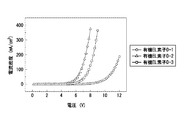
- FIG. 4 is a graph showing the relationship between voltage and brightness in the organic EL elements D-1 to D-3.
- FIG. 5 is a graph showing the relationship between the current density and the external quantum efficiency in the organic EL elements D-1 to D-3.
- the organic EL elements D-2 and D-3 containing no host compound in the light emitting layer are organic EL elements D containing a host compound in the light emitting layer.
- the brightness was higher than -1.
- an organic EL device having high luminous efficiency that is, an organic EL device having high productivity
- an organic EL device having high productivity can be provided regardless of the concentration of the specific platinum complex in the light emitting layer.
- the organic EL element according to the present invention is useful as a highly productive organic EL element.
- Organic EL element organic electroluminescence element
- Anode Light emitting layer 18: Cathode
Landscapes
- Chemical & Material Sciences (AREA)
- Engineering & Computer Science (AREA)
- Materials Engineering (AREA)
- Organic Chemistry (AREA)
- Electroluminescent Light Sources (AREA)
Priority Applications (1)
| Application Number | Priority Date | Filing Date | Title |
|---|---|---|---|
| JP2021509506A JP7427262B2 (ja) | 2019-03-26 | 2020-03-25 | 有機エレクトロルミネッセンス素子 |
Applications Claiming Priority (2)
| Application Number | Priority Date | Filing Date | Title |
|---|---|---|---|
| JP2019059192 | 2019-03-26 | ||
| JP2019-059192 | 2019-03-26 |
Publications (1)
| Publication Number | Publication Date |
|---|---|
| WO2020196624A1 true WO2020196624A1 (ja) | 2020-10-01 |
Family
ID=72608546
Family Applications (1)
| Application Number | Title | Priority Date | Filing Date |
|---|---|---|---|
| PCT/JP2020/013340 Ceased WO2020196624A1 (ja) | 2019-03-26 | 2020-03-25 | 有機エレクトロルミネッセンス素子 |
Country Status (2)
| Country | Link |
|---|---|
| JP (1) | JP7427262B2 (https=) |
| WO (1) | WO2020196624A1 (https=) |
Citations (3)
| Publication number | Priority date | Publication date | Assignee | Title |
|---|---|---|---|---|
| JP2007535807A (ja) * | 2004-04-30 | 2007-12-06 | ザ ユニバーシティ オブ ホンコン | 有機発光素子 |
| WO2015053291A1 (ja) * | 2013-10-11 | 2015-04-16 | 国立大学法人大阪大学 | 白金錯体を含む発光材料 |
| JP2015172007A (ja) * | 2014-03-11 | 2015-10-01 | 国立大学法人大阪大学 | 白金錯体およびそれを含む発光材料 |
-
2020
- 2020-03-25 JP JP2021509506A patent/JP7427262B2/ja active Active
- 2020-03-25 WO PCT/JP2020/013340 patent/WO2020196624A1/ja not_active Ceased
Patent Citations (3)
| Publication number | Priority date | Publication date | Assignee | Title |
|---|---|---|---|---|
| JP2007535807A (ja) * | 2004-04-30 | 2007-12-06 | ザ ユニバーシティ オブ ホンコン | 有機発光素子 |
| WO2015053291A1 (ja) * | 2013-10-11 | 2015-04-16 | 国立大学法人大阪大学 | 白金錯体を含む発光材料 |
| JP2015172007A (ja) * | 2014-03-11 | 2015-10-01 | 国立大学法人大阪大学 | 白金錯体およびそれを含む発光材料 |
Non-Patent Citations (1)
| Title |
|---|
| KOMIYA, N ET AL.: "Highly Phosphorescent Crystals of Vaulted trans- Bis(salicylaldiminato)platinum(II) Complexes", J. AM. CHEM. SOC., vol. 133, no. 17, 8 April 2011 (2011-04-08), pages 6493 - 6496, XP055743863 * |
Also Published As
| Publication number | Publication date |
|---|---|
| JP7427262B2 (ja) | 2024-02-05 |
| JPWO2020196624A1 (https=) | 2020-10-01 |
Similar Documents
| Publication | Publication Date | Title |
|---|---|---|
| US8940407B2 (en) | Organic electroluminescent device | |
| KR20120101651A (ko) | 복핵 백금-카르벤 착체 및 oled에서의 이의 용도 | |
| Li et al. | Intramolecular hydrogen bond–enhanced electroluminescence performance of hybridized local and charge transfer (HLCT) excited-state blue-emissive materials | |
| Song et al. | Chiral multiple-resonance thermally activated delayed fluorescence materials based on chiral spiro-axis skeleton for efficient circularly polarized electroluminescence | |
| TWI895967B (zh) | 一種金屬銥絡合物及電致發光器件 | |
| CN114933559A (zh) | 一种发光辅助材料及其制备方法、发光器件、发光装置 | |
| WO2025227444A1 (zh) | 一种蓝色发光组合物及包含其的有机电致发光器件 | |
| CN116438178A (zh) | 化合物、发光材料、延迟荧光材料及有机发光元件 | |
| CN118496252A (zh) | 含硼稠环化合物及电子器件 | |
| KR20220154774A (ko) | 유기 전계 발광 디바이스용 헤테로방향족 화합물 | |
| KR20220083444A (ko) | 유기 발광 화합물 및 이를 포함하는 유기 전계 발광 소자 | |
| TWI911459B (zh) | 有機發光元件及膜 | |
| CN115651031A (zh) | 金属配合物及其应用 | |
| KR20190016867A (ko) | 유기금속 화합물 및 이를 포함한 유기 발광 소자 | |
| JP7427262B2 (ja) | 有機エレクトロルミネッセンス素子 | |
| CN116143734A (zh) | 一种发光辅助材料、其制备方法及有机电致发光器件 | |
| JP5967663B2 (ja) | 白金錯体 | |
| KR102906127B1 (ko) | 헤테로고리 화합물, 이를 포함하는 유기 발광 소자, 이의 제조 방법 및 유기 발광 소자의 유기물층용 조성물 | |
| KR20250164754A (ko) | 유기 발광 소자 | |
| WO2015053291A1 (ja) | 白金錯体を含む発光材料 | |
| KR102328788B1 (ko) | 화합물 및 이를 포함하는 유기 발광 소자 | |
| CN115894570A (zh) | 一种金属配合物及其应用 | |
| CN116675711A (zh) | 含硼有机化合物及其在有机电致发光器件中的应用 | |
| WO2023053835A1 (ja) | 化合物、組成物、ホスト材料、電子障壁材料および有機発光素子 | |
| CN116425798A (zh) | 一种金属配合物及其应用 |
Legal Events
| Date | Code | Title | Description |
|---|---|---|---|
| 121 | Ep: the epo has been informed by wipo that ep was designated in this application |
Ref document number: 20778086 Country of ref document: EP Kind code of ref document: A1 |
|
| ENP | Entry into the national phase |
Ref document number: 2021509506 Country of ref document: JP Kind code of ref document: A |
|
| NENP | Non-entry into the national phase |
Ref country code: DE |
|
| 122 | Ep: pct application non-entry in european phase |
Ref document number: 20778086 Country of ref document: EP Kind code of ref document: A1 |