WO2020185165A2 - A method of identifying a flavivirus infection and related kits, peptides and compositions - Google Patents
A method of identifying a flavivirus infection and related kits, peptides and compositions Download PDFInfo
- Publication number
- WO2020185165A2 WO2020185165A2 PCT/SG2020/050130 SG2020050130W WO2020185165A2 WO 2020185165 A2 WO2020185165 A2 WO 2020185165A2 SG 2020050130 W SG2020050130 W SG 2020050130W WO 2020185165 A2 WO2020185165 A2 WO 2020185165A2
- Authority
- WO
- WIPO (PCT)
- Prior art keywords
- sequence
- zikv
- seq
- portions
- amino acids
- Prior art date
- Legal status (The legal status is an assumption and is not a legal conclusion. Google has not performed a legal analysis and makes no representation as to the accuracy of the status listed.)
- Ceased
Links
Classifications
-
- G—PHYSICS
- G01—MEASURING; TESTING
- G01N—INVESTIGATING OR ANALYSING MATERIALS BY DETERMINING THEIR CHEMICAL OR PHYSICAL PROPERTIES
- G01N33/00—Investigating or analysing materials by specific methods not covered by groups G01N1/00 - G01N31/00
- G01N33/48—Biological material, e.g. blood, urine; Haemocytometers
- G01N33/50—Chemical analysis of biological material, e.g. blood, urine; Testing involving biospecific ligand binding methods; Immunological testing
- G01N33/53—Immunoassay; Biospecific binding assay; Materials therefor
- G01N33/569—Immunoassay; Biospecific binding assay; Materials therefor for microorganisms, e.g. protozoa, bacteria, viruses
- G01N33/56983—Viruses
-
- G—PHYSICS
- G01—MEASURING; TESTING
- G01N—INVESTIGATING OR ANALYSING MATERIALS BY DETERMINING THEIR CHEMICAL OR PHYSICAL PROPERTIES
- G01N2333/00—Assays involving biological materials from specific organisms or of a specific nature
- G01N2333/005—Assays involving biological materials from specific organisms or of a specific nature from viruses
- G01N2333/08—RNA viruses
- G01N2333/18—Togaviridae; Flaviviridae
- G01N2333/183—Flaviviridae, e.g. pestivirus, mucosal disease virus, bovine viral diarrhoea virus, classical swine fever virus (hog cholera virus) or border disease virus
- G01N2333/185—Flaviviruses or Group B arboviruses, e.g. yellow fever virus, japanese encephalitis, tick-borne encephalitis, dengue
-
- G—PHYSICS
- G01—MEASURING; TESTING
- G01N—INVESTIGATING OR ANALYSING MATERIALS BY DETERMINING THEIR CHEMICAL OR PHYSICAL PROPERTIES
- G01N2469/00—Immunoassays for the detection of microorganisms
- G01N2469/20—Detection of antibodies in sample from host which are directed against antigens from microorganisms
Definitions
- the present disclosure relates broadly to virus infection.
- the present disclosure relates to a method of identifying a flavivirus (such as Zika virus or dengue virus) infection and related kits, peptides and compositions.
- flavivirus such as Zika virus or dengue virus
- Flaviviridae are a family of positive, single-stranded, enveloped RNA viruses.
- the genus Flavivirus have been reported to cause widespread morbidity and mortality throughout the world.
- Some flaviviruses are transmitted through mosquitoes and they include yellow fever virus (YFV), dengue virus (DENV), Japanese encephalitis virus (JEV), West Nile virus (WNV), and Zika virus (ZIKV).
- YFV yellow fever virus
- DENV dengue virus
- JEV Japanese encephalitis virus
- WNV West Nile virus
- ZIKV Zika virus
- DENV1 Dengue fever, caused by DENV, is found in tropical and sub-tropical climates worldwide. In recent decades, the global incidence of dengue has grown dramatically with about half of the world’s population is now at risk.
- DENV serotypes There are four DENV serotypes: DENV1 , DENV2, DENV3, and DENV4. As the four serotypes are different, a person can be infected with DENV as many as four times in his or her lifetime.
- ZIKV Zika fever
- ZIKV Zika virus
- GSS Guillain-Barre syndrome
- CNS congenital central nervous system
- Treatment is usually symptomatic and pain-relief medicine is the only available option during disease onset. Brazil, hit by the ZIKV epidemics since 2014, accounted for more than 200,000 probable cases of ZIKV with almost 2,000 cases of microcephaly in 2015-16.
- Serologic testing is an important tool for the diagnosis of flavivirus infection in patients living in areas where circulation of multiple pathogens causes similar disease symptoms.
- Currently there is lack of an accurate diagnostic system available in the market due to high cross-reactivity between ZIKV, DENV, and other closely-related flaviviruses. While the use of inactivated whole virus or full- length antigens may give better sensitivity and specificity, such approaches are typically inefficient and/or expensive. Therefore, alternative approaches which can offer an accurate yet inexpensive way to differentiate ZIKV and/or DENV from other closely-related flaviviruses infections are highly desired.
- flavivirus virus such as ZIKV and/or DENV
- a method of identifying Zika virus (ZIKV) and/or dengue virus (DENV) infection in a subject comprising determining whether a sample of the subject reacts with one or more peptide that is capable of being recognized more strongly by ZIKV- and/or DENV-induced antibody than a recognition of consensus sequence of the non-ZIKV and/or non- DENV- flavivirus by the ZIKV- and/or DENV-induced antibody.
- the peptide is capable of being recognized more strongly by ZIKV- and/or DENV-induced antibody than the non-ZIKV and/or non- DENV- flavivirus induced antibody.
- the peptide comprises an epitope, optionally a linear epitope, of ZIKV and/or DENV prM protein, ZIKV and/or DENV E glycoprotein or ZIKV and/or DENV NS1 protein.
- the peptide comprises an epitope located in a solvent-exposed region of ZIKV and/or DENV prM protein, ZIKV and/or DENV E glycoprotein or ZIKV and/or DENV NS1 protein.
- the peptide is from 15 to 20 amino acids long.
- the peptide is selected from the group consisting of:
- SEQ ID NO: 1 HMCDATMSYECPMLDEGV
- HMCDATMSYECPMLDEGV a sequence having at least 75% sequence identity thereto or a sequence differing by one, two, three or four amino acids thereto or portions thereof;
- SEQ ID NO: 2 (TVSNMAEVRSYCYEASIS) or a sequence having at least 75% sequence identity thereto or a sequence differing by one, two, three or four amino acids thereto or portions thereof;
- SEQ ID NO: 3 (ISDMASDSRCPTQGEAYL) or a sequence having at least 75% sequence identity thereto or a sequence differing by one, two, three or four amino acids thereto or portions thereof;
- SEQ ID NO: 4 (TGVFVYNDVEAWRDRYKY) or a sequence having at least 75% sequence identity thereto or a sequence differing by one, two, three or four amino acids thereto or portions thereof;
- SEQ ID NO: 5 (REGYRTQMKGPWHSEELE) or a sequence having at least 75% sequence identity thereto or a sequence differing by one, two, three or four amino acids thereto or portions thereof;
- SEQ ID NO: 6 TTLGMNKCYIQIMDLGHM or a sequence having at least 75% sequence identity thereto or a sequence differing by one, two, three or four amino acids thereto or portions thereof;
- SEQ ID NO: 7 (CWCNTTSTWVVYGTCHHK) or a sequence having at least 75% sequence identity thereto or a sequence differing by one, two, three or four amino acids thereto or portions thereof;
- SEQ ID NO: 8 (TRSQTWLESREYTKHLIR) or a sequence having at least 75% sequence identity thereto or a sequence differing by one, two, three or four amino acids thereto or portions thereof;
- SEQ ID NO: 9 (HKKGEARRSRRAVTLPSH) or a sequence having at least 75% sequence identity thereto or a sequence differing by one, two, three or four amino acids thereto or portions thereof;
- SEQ ID NO: 10 (RNPGFALAAAAIAWLLGS) or a sequence having at least 75% sequence identity thereto or a sequence differing by one, two, three or four amino acids thereto or portions thereof;
- SEQ ID NO: 1 1 (EATLGGFGSLGLDCEPRT) or a sequence having at least 75% sequence identity thereto or a sequence differing by one, two, three or four amino acids thereto or portions thereof;
- SEQ ID NO: 12 (KAFEATVRGAKRMAVLGD) or a sequence having at least 75% sequence identity thereto or a sequence differing by one, two, three or four amino acids thereto or portions thereof;
- SEQ ID NO: 13 ELCEDTMTYKCPRITEA or a sequence having at least 75% sequence identity thereto or a sequence differing by one, two, three or four amino acids thereto or portions thereof.
- the peptide is substantially incapable of being recognized by the non-ZIKV and/or non-DENV flavivirus-induced antibody.
- the consensus sequence of the non-ZIKV flavivirus is substantially incapable of being recognized by the ZIKV-induced antibody.
- the consensus sequence of the non-DENV flavivirus is substantially incapable of being recognized by the DENV-induced antibody.
- the non-ZIKV flavivirus comprises yellow fever virus and/or dengue virus.
- the non-DENV flavivirus comprises yellow fever virus and/or Zika virus.
- the method comprises determining whether the sample of the subject reacts with at least two peptides that are capable of being recognized more strongly by the ZIKV- and/or DENV- induced antibody than the non-ZIKV and/or DENV- flavivirus-induced antibody.
- the subject is a pregnant subject
- the method comprises determining whether a sample of the subject reacts with a peptide selected from SEQ ID NO: 4 (TGVFVYNDVEAWRDRYKY) or a sequence having at least 75% sequence identity thereto or a sequence differing by one, two, three or four amino acids thereto portions thereof.
- determining whether a sample of the subject reacts with a peptide comprises performing an immunoassay to assess whether antibodies that are capable of binding to the peptide are present in the sample.
- the method comprises a diagnostic method or a prognostic method.
- the method further comprising administering to the subject a ZIKV and/or DENV treatment regimen if the subject is indicated for ZIKV and/or DENV infection.
- kits for identifying ZIKV and/or DENV infection in a subject comprising one or more peptide that is capable of being recognized more strongly by ZIKV- and/or DENV- induced antibody than a non-ZIKV and/or DENV- flavivirus-induced antibody.
- the one or more peptide is selected from the group consisting of:
- SEQ ID NO: 1 HMCDATMSYECPMLDEGV
- HMCDATMSYECPMLDEGV a sequence having at least 75% sequence identity thereto or a sequence differing by one, two, three or four amino acids thereto or portions thereof;
- SEQ ID NO: 2 (TVSNMAEVRSYCYEASIS) or a sequence having at least 75% sequence identity thereto or a sequence differing by one, two, three or four amino acids thereto or portions thereof;
- SEQ ID NO: 3 ISDMASDSRCPTQGEAYL or a sequence having at least 75% sequence identity thereto or a sequence differing by one, two, three or four amino acids thereto or portions thereof
- SEQ ID NO: 4 TVFVYNDVEAWRDRYKY or a sequence having at least 75% sequence identity thereto or a sequence differing by one, two, three or four amino acids thereto or portions thereof;
- SEQ ID NO: 5 (REGYRTQMKGPWHSEELE) or a sequence having at least 75% sequence identity thereto or a sequence differing by one, two, three or four amino acids thereto or portions thereof;
- SEQ ID NO: 6 TTLGMNKCYIQIMDLGHM or a sequence having at least 75% sequence identity thereto or a sequence differing by one, two, three or four amino acids thereto or portions thereof;
- SEQ ID NO: 7 (CWCNTTSTWVVYGTCHHK) or a sequence having at least 75% sequence identity thereto or a sequence differing by one, two, three or four amino acids thereto or portions thereof;
- SEQ ID NO: 8 (TRSQTWLESREYTKHLIR) or a sequence having at least 75% sequence identity thereto or a sequence differing by one, two, three or four amino acids thereto or portions thereof;
- SEQ ID NO: 9 (HKKGEARRSRRAVTLPSH) or a sequence having at least 75% sequence identity thereto or a sequence differing by one, two, three or four amino acids thereto or portions thereof;
- SEQ ID NO: 10 (RNPGFALAAAAIAWLLGS) or a sequence having at least 75% sequence identity thereto or a sequence differing by one, two, three or four amino acids thereto or portions thereof;
- SEQ ID NO: 1 1 (EATLGGFGSLGLDCEPRT) or a sequence having at least 75% sequence identity thereto or a sequence differing by one, two, three or four amino acids thereto or portions thereof;
- SEQ ID NO: 12 (KAFEATVRGAKRMAVLGD) or a sequence having at least 75% sequence identity thereto or a sequence differing by one, two, three or four amino acids thereto or portions thereof;
- SEQ ID NO: 13 ELCEDTMTYKCPRITEA or a sequence having at least 75% sequence identity thereto or a sequence differing by one, two, three or four amino acids thereto or portions thereof.
- the kit further comprising one or more of the following: a plate coated with a capture agent for anti-ZIKV and/or anti-DENV, and
- a detection agent for detecting the presence of captured anti-ZIKV and/or anti-DENV a detection agent for detecting the presence of captured anti-ZIKV and/or anti-DENV
- the capture agent and the detection agent comprise a ZIKV and/or DENV antigen and/or an anti-ZIKV and/or anti-DENV immunoglobulin.
- the subject comprises a human subject.
- the human subject comprises a pregnant human subject.
- an isolated peptide selected from the group consisting of:
- SEQ ID NO: 1 HMCDATMSYECPMLDEGV
- HMCDATMSYECPMLDEGV a sequence having at least 75% sequence identity thereto or a sequence differing by one, two, three or four amino acids thereto or portions thereof;
- SEQ ID NO: 2 (TVSNMAEVRSYCYEASIS) or a sequence having at least 75% sequence identity thereto or a sequence differing by one, two, three or four amino acids thereto or portions thereof;
- SEQ ID NO: 3 (ISDMASDSRCPTQGEAYL) or a sequence having at least 75% sequence identity thereto or a sequence differing by one, two, three or four amino acids thereto or portions thereof;
- SEQ ID NO: 4 (TGVFVYNDVEAWRDRYKY) or a sequence having at least 75% sequence identity thereto or a sequence differing by one, two, three or four amino acids thereto or portions thereof;
- SEQ ID NO: 5 (REGYRTQMKGPWHSEELE) or a sequence having at least 75% sequence identity thereto or a sequence differing by one, two, three or four amino acids thereto or portions thereof;
- SEQ ID NO: 6 TTLGMNKCYIQIMDLGHM or a sequence having at least 75% sequence identity thereto or a sequence differing by one, two, three or four amino acids thereto or portions thereof;
- SEQ ID NO: 7 (CWCNTTSTWVVYGTCHHK) or a sequence having at least 75% sequence identity thereto or a sequence differing by one, two, three or four amino acids thereto or portions thereof;
- SEQ ID NO: 8 (TRSQTWLESREYTKHLIR) or a sequence having at least 75% sequence identity thereto or a sequence differing by one, two, three or four amino acids thereto or portions thereof;
- SEQ ID NO: 9 (HKKGEARRSRRAVTLPSH) or a sequence having at least 75% sequence identity thereto or a sequence differing by one, two, three or four amino acids thereto or portions thereof;
- SEQ ID NO: 10 (RNPGFALAAAAIAWLLGS) or a sequence having at least 75% sequence identity thereto or a sequence differing by one, two, three or four amino acids thereto or portions thereof;
- SEQ ID NO: 1 1 (EATLGGFGSLGLDCEPRT) or a sequence having at least 75% sequence identity thereto or a sequence differing by one, two, three or four amino acids thereto or portions thereof;
- SEQ ID NO: 12 (KAFEATVRGAKRMAVLGD) or a sequence having at least 75% sequence identity thereto or a sequence differing by one, two, three or four amino acids thereto or portions thereof;
- SEQ ID NO: 13 ELCEDTMTYKCPRITEA or a sequence having at least 75% sequence identity thereto or a sequence differing by one, two, three or four amino acids thereto or portions thereof.
- an immune system stimulating composition comprising a peptide selected from the group consisting of:
- SEQ ID NO: 1 HMCDATMSYECPMLDEGV
- HMCDATMSYECPMLDEGV a sequence having at least 75% sequence identity thereto or a sequence differing by one, two, three or four amino acids thereto or portions thereof;
- SEQ ID NO: 2 (TVSNMAEVRSYCYEASIS) or a sequence having at least 75% sequence identity thereto or a sequence differing by one, two, three or four amino acids thereto or portions thereof;
- SEQ ID NO: 3 (ISDMASDSRCPTQGEAYL) or a sequence having at least 75% sequence identity thereto or a sequence differing by one, two, three or four amino acids thereto or portions thereof;
- SEQ ID NO: 4 (TGVFVYNDVEAWRDRYKY) or a sequence having at least 75% sequence identity thereto or a sequence differing by one, two, three or four amino acids thereto or portions thereof
- SEQ ID NO: 5 (REGYRTQMKGPWHSEELE) or a sequence having at least 75% sequence identity thereto or a sequence differing by one, two, three or four amino acids thereto or portions thereof;
- SEQ ID NO: 6 TTLGMNKCYIQIMDLGHM or a sequence having at least 75% sequence identity thereto or a sequence differing by one, two, three or four amino acids thereto or portions thereof;
- SEQ ID NO: 7 (CWCNTTSTWVVYGTCHHK) or a sequence having at least 75% sequence identity thereto or a sequence differing by one, two, three or four amino acids thereto or portions thereof;
- SEQ ID NO: 8 (TRSQTWLESREYTKHLIR) or a sequence having at least 75% sequence identity thereto or a sequence differing by one, two, three or four amino acids thereto or portions thereof;
- SEQ ID NO: 9 (HKKGEARRSRRAVTLPSH) or a sequence having at least 75% sequence identity thereto or a sequence differing by one, two, three or four amino acids thereto or portions thereof;
- SEQ ID NO: 10 (RNPGFALAAAAIAWLLGS) or a sequence having at least 75% sequence identity thereto or a sequence differing by one, two, three or four amino acids thereto or portions thereof;
- SEQ ID NO: 1 1 (EATLGGFGSLGLDCEPRT) or a sequence having at least 75% sequence identity thereto or a sequence differing by one, two, three or four amino acids thereto or portions thereof;
- SEQ ID NO: 12 (KAFEATVRGAKRMAVLGD) or a sequence having at least 75% sequence identity thereto or a sequence differing by one, two, three or four amino acids thereto or portions thereof;
- SEQ ID NO: 13 ELCEDTMTYKCPRITEA or a sequence having at least 75% sequence identity thereto or a sequence differing by one, two, three or four amino acids thereto or portions thereof.
- identifying as used herein in relation to an infection is to be interpreted broadly to encompass determining a presence, an absence, an amount, or a level of disease burden of the infection.
- peptide as used herein broadly refers to any chain of amino acid residues connected via peptide bonds.
- the peptide may be naturally occurring or synthetic (e.g., generated by chemical synthesis or recombinant DNA technology). No particular size is implied by the term“peptide”. In some examples, peptide may not include a whole virus or a full-length antigen.
- antigen binding protein as used herein broadly refers to any peptide-based molecule that recognizes and binds to a target such as a virus (e.g. ZIKV).
- antigen binding protein include antibodies, including an antibody of any of the five major classes of immunoglobulins: IgA, IgD, IgE, IgG, and IgM, or subclasses (isotypes) thereof (e.g. IgGI, lgG2, lgG3, lgG4, lgA1 and lgA2), and antigen-binding fragments thereof.
- the antigen binding protein comprises anti-ZIKV IgG.
- the term “reacts with” as used herein broadly refers to the binding between an antigen-binding protein (such as an antibody or fragment thereof) and an antigen/epitope with a level higher than the binding between a non specific antigen-binding protein (such as a non-specific antibody or fragment thereof) and the same antigen/epitope.
- an antigen-binding protein such as an antibody or fragment thereof
- an antigen/epitope with a level higher than the binding between a non specific antigen-binding protein (such as a non-specific antibody or fragment thereof) and the same antigen/epitope.
- a sample“reacts with” a ZIKV antigenic peptide if the sample comprises antigen-binding protein that shows higher binding activity for the ZIKV antigenic peptide as compared to any antigen-binding protein from a control sample (e.g. a non-flavivirus-infected control sample).
- the term“reaction” is to be constru
- the term “recognized more strongly” as used herein to compare the properties of two or more different antigen-binding proteins for the same antigen/epitope broadly encompasses the meaning that a binding activity between the antigen/epitope and an antigen-binding protein is higher than a binding activity, if any, between the antigen/epitope and another antigen-binding protein.
- an antigenic peptide is recognized more strongly by ZIKV antibody than a non-ZIKV antibody if a binding activity between the ZIKV antibody and the antigenic peptide, as measured by an immunoassay, is higher than that between the non-ZIKV antibody and the antigenic peptide.
- the term“immune response” as used herein encompasses both cellular and humoral immune responses. In some embodiments, the immune response is sufficient to provide immunoprotection against virus such as ZIKV.
- stimulation as used herein in relation to an immune response broadly refers to an increase, an amplification or a boosting of an immune response.
- stimulation encompasses an initial stimulation of a new immune response or an enhancement of a pre-existing immune response.
- micro as used herein is to be interpreted broadly to include dimensions from about 1 micron to about 1000 microns.
- nano as used herein is to be interpreted broadly to include dimensions less than about 1000 nm.
- Coupled or “connected” as used in this description are intended to cover both directly connected or connected through one or more intermediate means, unless otherwise stated.
- association with refers to a broad relationship between the two elements.
- the relationship includes, but is not limited to a physical, a chemical or a biological relationship.
- elements A and B may be directly or indirectly attached to each other or element A may contain element B or vice versa.
- adjacent refers to one element being in close proximity to another element and may be but is not limited to the elements contacting each other or may further include the elements being separated by one or more further elements disposed therebetween.
- the word“substantially” whenever used is understood to include, but not restricted to, “entirely” or“completely” and the like.
- terms such as “comprising”, “comprise”, and the like whenever used are intended to be non-restricting descriptive language in that they broadly include elements/components recited after such terms, in addition to other components not explicitly recited.
- reference to a“one” feature is also intended to be a reference to“at least one” of that feature.
- Terms such as “consisting”, “consist”, and the like may in the appropriate context, be considered as a subset of terms such as “comprising”, “comprise”, and the like.
- the disclosure may have disclosed a method and/or process as a particular sequence of steps. Flowever, unless otherwise required, it will be appreciated that the method or process should not be limited to the particular sequence of steps disclosed. Other sequences of steps may be possible. The particular order of the steps disclosed herein should not be construed as undue limitations. Unless otherwise required, a method and/or process disclosed herein should not be limited to the steps being carried out in the order written. The sequence of steps may be varied and still remain within the scope of the disclosure.
- ZIKV Zika virus
- DEV dengue virus
- a method of identifying Zika virus (ZIKV) and/or dengue virus (DENV) infection in a subject comprising determining whether a sample of the subject reacts with one or more peptide that is capable of being recognized more strongly by ZIKV- and/or DENV- induced antibody than a recognition of consensus sequence of the non-ZIKV and/or non-DENV- flavivirus by the ZIKV- and/or DENV-induced antibody.
- a method of identifying Zika virus (ZIKV) infection in a subject comprising determining whether a sample of the subject reacts with one or more peptide that is capable of being recognized more strongly by ZIKV-induced antibody than a recognition of consensus sequence of the non-ZIKV flavivirus by the ZIKV-induced antibody.
- ZIKV Zika virus
- the peptide comprises a peptide that is capable of being recognized more strongly by ZIKV- and/or DENV-induced antibody than the non-ZIKV and/or non-DENV- flavivirus induced antibody.
- a method of identifying ZIKV and/or DENV infection in a subject comprising determining whether a sample of the subject reacts with one or more peptide (or fragments thereof), wherein a reaction of the sample to the peptide sequence is indicative of ZIKV and/or DENV infection in the subject.
- the peptide comprises a peptide that is capable of being recognized more strongly by a ZIKV- and/or DENV-induced antigen binding protein (such as a ZIKV- and/or DENV- induced antibody or fragments thereof) or a ZIKV- and/or DENV-antigen binding protein (such as a ZIKV and/or DENV antibody or fragments thereof) than a non-ZIKV and/or non-DENV flavivirus-induced antigen binding protein (such as a non-ZIKV and/or non-DENV flavivirus-induced antibody or fragments thereof) or a non-ZIKV and/or non- DENV flavivirus antigen binding protein (such as a non-ZIKV and/or non-DENV flavivirus antibody or fragments).
- a ZIKV- and/or DENV-induced antigen binding protein such as a ZIKV- and/or DENV- induced antibody or fragments thereof
- a method of identifying ZIKV and/or DENV infection in a subject comprising determining whether a sample of the subject reacts with one or more peptide that is capable of being recognized more strongly by ZIKV- and/or DENV- induced antigen binding protein than a non-ZIKV and/or non-DENV flavivirus- induced antigen binding protein, wherein a reaction of the sample to the peptide sequence is indicative of ZIKV and/or DENV infection in the subject.
- a sample may react with the peptide sequence if the sample comprises antigen binding protein that shows higher binding activity for the peptide as compared to any antigen-binding protein from a control sample.
- the peptide comprises a peptide that is capable of being recognized more strongly by a ZIKV-induced antigen binding protein (such as a ZIKV-induced antibody or fragments thereof) or a ZIKV-antigen binding protein (such as a ZIKV antibody or fragments thereof) than a non-ZIKV flavivirus-induced antigen binding protein (such as a non-ZIKV flavivirus-induced antibody or fragments thereof) or a non-ZIKV flavivirus antigen binding protein (such as a non-ZIKV flavivirus antibody or fragments).
- a ZIKV-induced antigen binding protein such as a ZIKV-induced antibody or fragments thereof
- a ZIKV-antigen binding protein such as a ZIKV antibody or fragments thereof
- a non-ZIKV flavivirus-induced antigen binding protein such as a non-ZIKV flavivirus-induced antibody or fragments thereof
- a method of identifying ZIKV infection in a subject comprising determining whether a sample of the subject reacts with one or more peptide that is capable of being recognized more strongly by ZIKV-induced antigen binding protein than a non-ZIKV flavivirus-induced antigen binding protein, wherein a reaction of the sample to the peptide sequence is indicative of ZIKV infection in the subject.
- a sample may react with the peptide sequence if the sample comprises antigen-binding protein that shows higher binding activity for the peptide as compared to any antigen-binding protein from a control sample.
- a ZIKV- and/or DENV induced antigen binding protein may show higher recognition for the peptide than a non-ZIKV and/or non-DENV flavivirus-induced antigen binding protein.
- a ZIKV- and/or DENV-induced antigen binding protein may show higher binding activity for the peptide than a non-ZIKV and/or non-DENV flavivirus-induced antigen binding protein.
- a ZIKV- and/or DENV-induced antigen binding protein may give a signal/readout of stronger intensity/magnitude, e.g.
- the peptide is capable of being recognized by ZIKV- and/or DENV-induced antigen binding protein with intensity stronger than the recognition of the peptide by a non-ZIKV and/or non-DENV flavivirus-induced antigen binding protein.
- a higher proportion/amount of ZIKV- and/or DENV-induced antigen binding protein binds to the peptide as compared to a non-ZIKV and/or non-DENV flavivirus-induced antigen binding protein.
- a ZIKV-induced antigen binding protein may show higher recognition for the peptide than a non-ZIKV flavivirus-induced antigen binding protein. In some examples, a ZIKV-induced antigen binding protein may show higher binding activity for the peptide than a non-ZIKV flavivirus-induced antigen binding protein. In some examples, a ZIKV-induced antigen binding protein may give a signal/readout of stronger intensity/magnitude, e.g. a chemiluminescence signal/readout of stronger intensity, as compared to a non- ZIKV flavivirus-induced antigen binding protein in an immunoassay for measuring binding to the peptide.
- the peptide is capable of being recognized by ZIKV-induced antigen binding protein with intensity stronger than the recognition of the peptide by a non-ZIKV flavivirus-induced antigen binding protein.
- a higher proportion/amount of ZIKV-induced antigen binding protein binds to the peptide as compared to a non-ZIKV flavivirus-induced antigen binding protein.
- a binding activity between the ZIKV- and/or DENV- induced antigen binding protein and the peptide or an intensity/magnitude of a signal/readout from an immunoassay measuring a binding of the ZIKV- and/or DENV- induced antigen binding protein and the peptide is at least about 1 .0, at least about 1 .1 , at least about 1 .2, at least about 1 .3, at least about 1 .4, at least about 1 .5, at least about 1 .6, at least about 1 .7, at least about 1 .8, at least about 1 .9, at least about 2.0, at least about 2.1 , at least about 2.2, at least about 2.3, at least about 2.4, at least about 2.5, at least about 2.6, at least about 2.7, at least about 2.8, at least about 2.9, at least about 3.0, at least about 3.1 , at least about 3.2, at least about 3.3, at least about 3.4, at least about 3.5, at least about
- ZIKV and/or DENV antigen binding protein is generated by a subject's body in response to ZIKV and/or DENV infection and thus are present in sample from a subject having a disease state.
- a ZIKV- and/or DENV-induced antigen binding protein comprises an antibody that is generated in a subject in response to ZIKV and/or DENV infection.
- a non-ZIKV and/or non- DENV flavivirus-induced antigen binding protein comprises an antibody that is generated in a subject in response to the non-ZIKV flavivirus infection.
- the peptide comprises an epitope of ZIKV and/or DENV. In various embodiments, the peptide comprises an immunodominant epitope of ZIKV and/or DENV.
- the peptide comprises an epitope of ZIKV. In various embodiments, the peptide comprises an immunodominant epitope of ZIKV.
- the peptide comprises an epitope of DENV. In various embodiments, the peptide comprises an immunodominant epitope of DENV. In various embodiments, the peptide comprises an epitope of ZIKV prM protein, ZIKV E glycoprotein or ZIKV NS1 protein. In some embodiments, the peptide comprises an epitope of a ZIKV structural protein selected from prM protein and E glycoprotein. In some embodiments, the peptide comprises an epitope of a ZIKV non-structural protein selected from NS1 protein.
- the peptide comprises an epitope of DENV prM protein, DENV E glycoprotein or DENV NS1 protein. In some embodiments, the peptide comprises an epitope of a DENV structural protein selected from prM protein and E glycoprotein. In some embodiments, the peptide comprises an epitope of a DENV non-structural protein selected from NS1 protein.
- the method differentially distinguishes between ZIKV infection and DENV infection.
- the peptide comprises an epitope located in a solvent-exposed region of ZIKV. In various embodiments, the peptide comprises an epitope located in a solvent-exposed region of ZIKV prM protein, ZIKV E glycoprotein or ZIKV NS1 protein. Thus, the epitope may have high solvent accessibility. The epitope may be located in an accessible/exposed region of ZIKV.
- the peptide comprises an epitope located in a solvent-exposed region of DENV. In various embodiments, the peptide comprises an epitope located in a solvent-exposed region of DENV prM protein, DENV E glycoprotein or DENV NS1 protein. Thus, the epitope may have high solvent accessibility. The epitope may be located in an accessible/exposed region of DENV.
- solvent-exposed region refers to solvent accessibility, which is in turn defined as the extent of burial or exposure of amino acid residues in the 3-dimensional protein structure.
- solvent-exposed regions can be visualized using software known in the art, such as, but is not limited to, PyMOL (Schrondinger).
- the length/size of the peptide is no more than about 30, no more than about 29, no more than about 28, no more than about 27, no more than about 26, no more than about 25, no more than about 24, no more than about 23, no more than about 22, no more than about 21 , no more than about 20, no more than about 19, no more than about 18, no more than about 17, no more than about 16, no more than about 15, no more than about 14, no more than about 13, no more than about 12, no more than about 1 1 , no more than about 10, no more than about 9, no more than about 8, no more than about 7, no more than about 6 or no more than about 5 amino acids long.
- the length/size of the peptide is from about 5 to about 30, from about 10 to about 25 or from about 15 to about 20 amino acids long. In some embodiments, the length/size of the peptide is about 15, about 16, about 17, about 18, about 19 or about 20 amino acids long. In various embodiments, the peptide comprises an oligopeptide. In various embodiments, the peptide comprises a short oligopeptide. In various embodiments, the peptide comprises a linear peptide.
- the peptide is capable of being recognized more strongly by ZIKV- and/or DENV-induced antigen binding protein than the recognition of corresponding peptide of the non-ZIKV and/or non-DENV flavivirus by the ZIKV- and/or DENV-induced antigen binding protein.
- the corresponding peptide may be identified by aligning the sequences of ZIKV and/or DENV and the non-ZIKV and/or non-DENV flavivirus to identify region homologous to a peptide of ZIKV and/or DENV.
- the peptide is capable of being recognized more strongly by ZIKV-induced antigen binding protein than the recognition of corresponding peptide of the non-ZIKV flavivirus by the ZIKV-induced antigen binding protein.
- the corresponding peptide may be identified by aligning the sequences of ZIKV and the non-ZIKV flavivirus to identify region homologous to a peptide of ZIKV.
- the corresponding peptide may consist of the corresponding amino acids at about the same positions of a non-ZIKV flavivirus i.e. positions 57-73 of the prM protein of a non- ZIKV flavivirus.
- the amino acid sequence may be obtained from a consensus sequence of the flavivirus.
- a consensus sequence represents an“average" sequence in which each position represents the amino acid most often found when multiple sequences (e.g. sequences of difference strains of a flavivirus) are compared/aligned.
- the peptide is capable of being recognized more strongly by ZIKV- and/or DENV-induced antigen binding protein than the recognition of consensus sequence of the non-ZIKV and/or non-DENV flavivirus by the ZIKV- and/or DENV-induced antigen binding protein.
- a ZIKV- and/or DENV-induced antigen binding protein may show higher recognition for the peptide than for the consensus sequence. In some examples, a ZIKV- and/or DENV-induced antigen binding protein may show higher binding activity for the peptide than for the consensus sequence. In some examples, a ZIKV- and/or DENV-induced antigen binding protein may give a signal/readout of stronger intensity, e.g. a chemiluminescence signal/readout of stronger intensity, for binding to the peptide as compared to binding for the consensus sequence in an immunoassay.
- a signal/readout of stronger intensity e.g. a chemiluminescence signal/readout of stronger intensity
- the peptide is capable of being recognized by ZIKV- and/or DENV-induced antigen binding protein with intensity stronger than the recognition of consensus sequence of the non-ZIKV and/or non-DENV flavivirus by the ZIKV- and/or DENV-induced antigen binding protein.
- a higher proportion/amount of ZIKV- and/or DENV-induced antigen binding protein binds to the peptide as compared to consensus sequence.
- a ZIKV-induced antigen binding protein may show higher recognition for the peptide than for the consensus sequence. In some examples, a ZIKV-induced antigen binding protein may show higher binding activity for the peptide than for the consensus sequence. In some examples, a ZIKV-induced antigen binding protein may give a signal/readout of stronger intensity, e.g. a chemiluminescence signal/readout of stronger intensity, for binding to the peptide as compared to binding for the consensus sequence in an immunoassay.
- a signal/readout of stronger intensity e.g. a chemiluminescence signal/readout of stronger intensity
- the peptide is capable of being recognized by ZIKV-induced antigen binding protein with intensity stronger than the recognition of consensus sequence of the non-ZIKV flavivirus by the ZIKV- induced antigen binding protein.
- a higher proportion/amount of ZIKV-induced antigen binding protein binds to the peptide as compared to consensus sequence.
- a binding activity between the ZIKV- and/or DENV- induced antigen binding protein and the peptide or an intensity/magnitude of a signal/readout from an immunoassay measuring a binding of the ZIKV- and/or DENV-induced antigen binding protein and the peptide is at least about 1 .0, at least about 1 .1 , at least about 1 .2, at least about 1 .3, at least about 1 .4, at least about 1 .5, at least about 1 .6, at least about 1 .7, at least about 1 .8, at least about 1 .9, at least about 2.0, at least about 2.1 , at least about 2.2, at least about 2.3, at least about 2.4, at least about 2.5, at least about 2.6, at least about 2.7, at least about 2.8, at least about 2.9, at least about 3.0, at least about 3.1 , at least about 3.2, at least about 3.3, at least about 3.4, at least about 3.5, at least about
- the peptide comprises: a sequence corresponding to the amino acid sequence at the following positions on a ZIKV and/or DENV prM protein (the first amino acid in the prM protein being annotated as 1 ): from about 30 to about 170, from about 40 to about 60, from about 50 to about 80, from about 80 to about 100, from about 90 to about 120, from about 120 to about 140, from about 140 to about 170, from about 41 to about 58, from about 57 to about 74, from about 57 to about 73, from about 81 to about 98, from about 97 to about 1 14, from about 121 to about 138, from about 145 to about 162, SEQ ID NO: 1 (HMCDATMSYECPMLDEGV), SEQ ID NO: 6 (TTLGMNKCYIQIMDLGHM), SEQ ID NO: 7 (CWCNTTSTWVVYGTCHHK), SEQ ID NO: 8 (TRSQTWLESREYTKHLIR), SEQ ID NO: 9 (HKKGEARRS
- linear portions thereof, or a sequence having at least about 70%, at least about 75%, at least about 80%, at least about 85%, at least about 90%, at least about 95%, or at least about 99% sequence identity thereto or portions thereof, or a sequence differing by about one, about two, about three, about four, about five, about six or more amino acids thereto or portions thereof.
- the peptide comprises: a sequence corresponding to the amino acid sequence at the following positions on a ZIKV prM protein (the first amino acid in the prM protein being annotated as 1 ): from about 30 to about 170, from about 40 to about 60, from about 50 to about 80, from about 80 to about 100, from about 90 to about 120, from about 120 to about 140, from about 140 to about 170, from about 41 to about 58, from about 57 to about 74, from about 57 to about 73, from about 81 to about 98, from about 97 to about 1 14, from about 121 to about 138, from about 145 to about 162, SEQ ID NO: 1 (HMCDATMSYECPMLDEGV) or portions (e.g.
- linear portions thereof, or a sequence having at least about 70%, at least about 75%, at least about 80%, at least about 85%, at least about 90%, at least about 95%, or at least about 99% sequence identity thereto or portions thereof, or a sequence differing by about one, about two, about three, about four, about five, about six or more amino acids thereto or portions thereof.
- the peptide comprises: a sequence corresponding to the amino acid sequence at the following positions on a ZIKV and/or DENV prM protein (the first amino acid in the prM protein being annotated as 1 ): from about 30 to about 170, from about 40 to about 60, from about 50 to about 80, from about 80 to about 100, from about 90 to about 120, from about 120 to about 140, from about 140 to about 170, from about 41 to about 58, from about 57 to about 74, from about 57 to about 73, from about 81 to about 98, from about 97 to about 1 14, from about 121 to about 138, from about 145 to about 162, SEQ ID NO: 9 (HKKGEARRSRRAVTLPSH), SEQ ID NO: 13 (ELCEDTMTYKCPRITEA), or their portions (e.g.
- linear portions thereof, or a sequence having at least about 70%, at least about 75%, at least about 80%, at least about 85%, at least about 90%, at least about 95%, or at least about 99% sequence identity thereto or portions thereof, or a sequence differing by about one, about two, about three, about four, about five, about six or more amino acids thereto or portions thereof.
- the peptide comprises: a sequence corresponding to the amino acid sequence at the following positions on a ZIKV E glycoprotein (the first amino acid in the E glycoprotein being annotated as 1 ): from about 40 to about 430, from about 40 to about 90, from about 170 to about 200, from about 400 to about 430, from about 49 to about 82, from about 177 to about 194, from about 409 to about 426, SEQ ID NO: 2
- KAFEATVRGAKRMAVLGD KAFEATVRGAKRMAVLGD or portions (e.g. linear portions) thereof, or a sequence having at least about 70%, at least about 75%, at least about 80%, at least about 85%, at least about 90%, at least about 95%, or at least about 99% sequence identity thereto or portions thereof, or a sequence differing by about one, about two, about three, about four, about five, about six or more amino acids thereto or portions thereof.
- the peptide comprises: a sequence corresponding to the amino acid sequence at the following positions on a ZIKV E glycoprotein (the first amino acid in the E glycoprotein being annotated as 1 ): from about 40 to about 430, from about 40 to about 90, from about 170 to about 200, from about 400 to about 430, from about 49 to about 82, from about 177 to about 194, from about 409 to about 426, SEQ ID NO: 2
- TVSNMAEVRSYCYEASIS SEQ ID NO: 3 (ISDMASDSRCPTQGEAYL) or portions (e.g. linear portions) thereof, or a sequence having at least about 70%, at least about 75%, at least about 80%, at least about 85%, at least about 90%, at least about 95%, or at least about 99% sequence identity thereto or portions thereof, or a sequence differing by about one, about two, about three, about four, about five, about six or more amino acids thereto or portions thereof.
- the peptide comprises: a sequence corresponding to the amino acid sequence at the following positions on a ZIKV NS1 protein (the first amino acid in the NS1 protein being annotated as 1 ): from about 10 to about 280, from about 10 to about 40, from about 250 to about 280, from about 17 to about 34 or from about 257 to about 274, SEQ ID NO: 4 (TGVFVYNDVEAWRDRYKY), SEQ ID NO: 5 (REGYRTQMKGPWHSEELE) or portions (e.g.
- linear portions thereof or a sequence having at least about 70%, at least about 75%, at least about 80%, at least about 85%, at least about 90%, at least about 95%, or at least about 99% sequence identity thereto or portions thereof, or a sequence differing by about one, about two, about three, about four, about five, about six or more amino acids thereto or portions thereof.
- the peptide is selected from the group consisting of: SEQ ID NO: 1 (HMCDATMSYECPMLDEGV) or a sequence having at least 75% sequence identity thereto or a sequence differing by one, two, three or four amino acids thereto or portions thereof; SEQ ID NO: 2 (TVSNMAEVRSYCYEASIS) or a sequence having at least 75% sequence identity thereto or a sequence differing by one, two, three or four amino acids thereto or portions thereof; SEQ ID NO: 3 (ISDMASDSRCPTQGEAYL) or a sequence having at least 75% sequence identity thereto or a sequence differing by one, two, three or four amino acids thereto or portions thereof; SEQ ID NO: 4 (TGVFVYNDVEAWRDRYKY) or a sequence having at least 75% sequence identity thereto or a sequence differing by one, two, three or four amino acids thereto or portions thereof; SEQ ID NO: 5 (REGYRTQMKGPWHSEELE) or a sequence having
- the peptide is selected from the group consisting of: SEQ ID NO: 1 (FIMCDATMSYECPMLDEGV) or a sequence having at least 75% sequence identity thereto or a sequence differing by one, two, three or four amino acids thereto or portions thereof; SEQ ID NO: 2 (TVSNMAEVRSYCYEASIS) or a sequence having at least 75% sequence identity thereto or a sequence differing by one, two, three or four amino acids thereto or portions thereof; SEQ ID NO: 3 (ISDMASDSRCPTQGEAYL) or a sequence having at least 75% sequence identity thereto or a sequence differing by one, two, three or four amino acids thereto or portions thereof; SEQ ID NO: 4 (TGVFVYNDVEAWRDRYKY) or a sequence having at least 75% sequence identity thereto or a sequence differing by one, two, three or four amino acids thereto or portions thereof; and SEQ ID NO: 5 (REGYRTQMKGPWH
- the peptide is selected from the group consisting of: SEQ ID NO: 9 (FIKKGEARRSRRAVTLPSFI) or a sequence having at least 75% sequence identity thereto or a sequence differing by one, two, three or four amino acids thereto or portions thereof; and SEQ ID NO: 13 (ELCEDTMTYKCPRITEA) or a sequence having at least 75% sequence identity thereto or a sequence differing by one, two, three or four amino acids thereto or portions thereof.
- the non-ZIKV flavivirus may comprise any member of the family Flaviviridae. Examples include dengue virus (DENV), yellow fever virus (YFV), Japanese encephalitis virus, West Nile encephalitis virus, St. Louis encephalitis virus, tick-borne encephalitis virus, Kyasanur forest disease virus and Alkhurma hemorrhagic fever virus.
- the non-ZIKV flavivirus comprises yellow fever virus and/or dengue virus.
- the dengue virus may be of serotype 1 , 2, 3 or 4.
- the non-ZIKV flavivirus comprises dengue virus serotype 1 (DENV-1 ).
- the non-DENV flavivirus may comprise any member of the family Flaviviridae. Examples include Zika virus (ZIKV), yellow fever virus (YFV), Japanese encephalitis virus, West Nile encephalitis virus, St. Louis encephalitis virus, tick-borne encephalitis virus, Kyasanur forest disease virus and Alkhurma hemorrhagic fever virus.
- ZIKV Zika virus
- YFV yellow fever virus
- Japanese encephalitis virus West Nile encephalitis virus
- St. Louis encephalitis virus St. Louis encephalitis virus
- tick-borne encephalitis virus Kyasanur forest disease virus
- Alkhurma hemorrhagic fever virus Alkhurma hemorrhagic fever virus.
- the non-ZIKV flavivirus comprises yellow fever virus and/or Zika virus.
- the peptide is substantially incapable of being recognized by the non-ZIKV and/or non-DENV flavivirus-induced antigen binding protein.
- the binding activity of the non-ZIKV and/or non-DENV flavivirus-induced antigen binding protein for the peptide is substantially similar or not substantially higher than any non-specific binding of any antigen binding protein in a control sample (e.g. a non-flavivirus-infected control sample) for the peptide.
- a control sample e.g. a non-flavivirus-infected control sample
- the peptide is not recognized by a YFV-induced antigen binding protein.
- the peptide is not recognized by a ZIKV-induced antigen binding protein.
- the peptide is not recognized by DENV- induced antigen binding protein.
- the peptide is specifically recognized by a ZIKV- and/or DENV-induced antigen binding protein.
- the peptide is dissimilar in terms of sequence, structure and/or conformation to the corresponding peptide or consensus sequence of a non-ZIKV flavivirus such as YFV or DENV.
- the peptide is dissimilar in terms of sequence, structure and/or conformation to the corresponding peptide or consensus sequence of a non-DENV flavivirus such as YFV or ZIKV.
- the peptide has low sequence similarity/identity with the corresponding peptide or consensus sequence of a non-ZIKV and/or non- DENV flavivirus such as YFV.
- the sequence similarity/identity between the peptide and the corresponding peptide or consensus sequence of a non-ZIKV and/or non-DENV flavivirus is no more than about 90%, no more than about 85%, no more than about 80%, no more than about 75%, no more than about 70%, no more than about 65%, no more than about 60%, no more than about 55%, no more than about 50%, no more than about 45%, no more than about 40%, no more than about 35%, no more than about 30%, no more than about 25%, no more than about 20%, no more than about 15%, no more than about 10% or no more than about 5%.
- the sequence similarity/identity between the peptide and the corresponding peptide or consensus sequence of a non-ZIKV and/or non-DENV flavivirus is no more
- the peptide has low sequence similarity/identity with the corresponding peptide or consensus sequence of a non-DENV flavivirus such as YFV or ZIKV.
- the sequence similarity/identity between the peptide and the corresponding peptide or consensus sequence of a non-DENV flavivirus is no more than about 90%, no more than about 85%, no more than about 80%, no more than about 75%, no more than about 70%, no more than about 65%, no more than about 60%, no more than about 55%, no more than about 50%, no more than about 45%, no more than about 40%, no more than about 35%, no more than about 30%, no more than about 25%, no more than about 20%, no more than about 15%, no more than about 10% or no more than about 5%.
- the sequence similarity/identity between the peptide and the corresponding peptide or consensus sequence of a non-DENV flavivirus is between about 40% to about 75%.
- the peptide has low sequence similarity/identity with the corresponding peptide or consensus sequence of a non-ZIKV flavivirus such as YFV or DENV.
- the sequence similarity/identity between the peptide and the corresponding peptide or consensus sequence of a non-ZIKV flavivirus is no more than about 90%, no more than about 85%, no more than about 80%, no more than about 75%, no more than about 70%, no more than about 65%, no more than about 60%, no more than about 55%, no more than about 50%, no more than about 45%, no more than about 40%, no more than about 35%, no more than about 30%, no more than about 25%, no more than about 20%, no more than about 15%, no more than about 10% or no more than about 5%.
- the sequence similarity/identity between the peptide and the corresponding peptide or consensus sequence of a non-ZIKV flavivirus is between about 40% to about 75%.
- protein regions with lower sequence similarity may generate less cross-reactive antibodies and improve the differentiation performance in flavivirus detection.
- the corresponding peptide or consensus sequence of the non-ZIKV and/or non-DENV flavivirus is substantially incapable of being recognized by the ZIKV- and/or DENV-induced antigen binding protein.
- the binding activity of the ZIKV- and/or DENV-induced antigen binding protein for the corresponding peptide or consensus sequence is substantially similar or not substantially higher than any non-specific binding of any antigen binding protein in a control sample (e.g. a non-flavivirus-infected control sample) for the corresponding peptide or consensus sequence.
- the corresponding peptide or consensus sequence of the non-ZIKV flavivirus is substantially incapable of being recognized by the ZIKV-induced antigen binding protein.
- the binding activity of the ZIKV-induced antigen binding protein for the corresponding peptide or consensus sequence is substantially similar or not substantially higher than any non-specific binding of any antigen binding protein in a control sample (e.g. a non-flavivirus-infected control sample) for the corresponding peptide or consensus sequence.
- the subject comprises a pregnant subject.
- the pregnant subject may be in her first trimester, second trimester or third trimester.
- the peptide comprises an epitope of ZIKV NS1 protein, optionally wherein the peptide comprises: a sequence corresponding to the amino acid sequence at the following positions on a ZIKV NS1 protein (the first amino acid in the NS1 protein being annotated as 1 ): from about 10 to about 40, from about 17 to about 34, SEQ ID NO: 4 (TGVFVYNDVEAWRDRYKY), or portions (e.g.
- the method comprises determining whether a sample of the subject reacts to a peptide selected from SEQ ID NO: 4 (TGVFVYNDVEAWRDRYKY) or a sequence having at least 75% sequence identity thereto or a sequence differing by one, two, three or four amino acids thereto, or portions thereof.
- the method may also comprise use of multiple or a plurality of peptides having one or more features as described hereinabove (e.g. capable of being recognized more strongly by the ZIKV- and/or DENV-induced antigen binding protein than the non-ZIKV and/or non-DENV flavivirus-induced antigen binding protein, capable of being recognized more strongly by ZIKV-and/or DENV- induced antigen binding protein than the recognition of corresponding peptide of the non-ZIKV and/or non-DENV flavivirus by the ZIKV- and/or DENV- induced antigen binding protein etc) for detecting ZIKV- and/or DENV- induced antigen binding protein or ZIKV- and/or DENV-antigen binding protein.
- multiple or a plurality of peptides having one or more features as described hereinabove e.g. capable of being recognized more strongly by the ZIKV- and/or DENV-induced antigen binding protein than the non-ZIKV and
- the method comprises determining whether the sample of the subject reacts to at least two peptides that are capable of being recognized more strongly by the ZIKV- and/or DENV- induced antigen binding protein than the non-ZIKV and/or non-DENV flavivirus-induced antigen binding protein, wherein a reaction of the sample to the at least two peptides is indicative of ZIKV and/or DENV infection in the subject.
- determining whether a sample of the subject reacts to a peptide comprises performing an immunoassay to assess whether antibodies that are capable of binding to the peptide are present in the sample.
- immunoassay include radioimmunoassay (RIA), chemiluminescence- and fluorescence-immunoassays, enzyme-linked immunosorbent assay (ELISA), enzyme-linked immunosorbent spot (ELISPOT), Luminex-based bead arrays, protein microarray assays, immunochromatography (ICG)-based assay and rapid test formats such as immunochromatographic strip tests.
- the assay can be competitive and non-competitive sandwich assays.
- the immunoassay comprises ELISA, such as, but is not limited to direct ELISA, indirect ELISA, competitive ELISA, sandwich ELISA, and the like.
- the immunoassay comprises a sandwich ELISA.
- the suitability of the specific ELISA to be used would be within the purview of the skill of the person skilled in the art.
- the assay is in the form of a non competitive sandwich assay, wherein a ZIKV and/or DENV antibody or a fragment thereof to be detected and/or quantified is bound to an antibody of the ZIKV and/or DENV antibody or fragment thereof and/or a ZIKV and/or DENV antigen.
- a ZIKV and/or DENV antigen may be labelled, for example with biotin, and may be bound to a solid phase e.g. a bead, a surface of a well or other containment body, a chip or a strip, for capturing any ZIKV and/or DENV antibody or a fragment thereof, and an antibody of the ZIKV and/or DENV antibody is used for detecting any captured ZIKV and/or DENV antibody.
- the detection antibody may be labelled, for example, with a dye, radioisotope or a reactive or catalytically active moiety.
- the detection antibody is labelled with horseradish peroxidase (HRP) and tetramethylbenzidine (TMB) substrate may be added for visualization. It will be appreciated that other suitable labels and substrates may also be used.
- a plate e.g. microplate, microtiter plate etc. coated with streptavidin is used for capturing the biotin-labelled ZIKV and/or DENV antigen, which is then used for capturing any ZIKV and/or DENV antibody or a fragment thereof, and a labelled anti-ZIKV and/or anti-DENV immunoglobulin is used for detection.
- the anti-ZIKV immunoglobulin may be anti-ZIKV IgG, anti-ZIKV IgM or anti-ZIKV IgA. In some embodiments, the anti-ZIKV immunoglobulin comprises anti-ZIKV IgM. In some embodiments, detection based on anti-ZIKV IgG, as opposed to anti-ZIKV IgM or anti-ZIKV IgA leads to better sensitivity.
- the anti-DENV immunoglobulin may be anti-DENV IgG, anti-DENV IgM or anti-DENV IgA. In some embodiments, the anti-DENV immunoglobulin comprises anti-DENV IgM. In some embodiments, detection based on anti-DENV IgG, as opposed to anti-DENV IgM or anti-DENV IgA leads to better sensitivity.
- the sample comprises a biological sample.
- the biological sample comprises a fluid biological sample or a liquid biological sample.
- the fluid biological sample or liquid biological sample may be blood, serum, plasma, sputum, lavage fluid, cerebrospinal fluid, urine, semen, sweat, tears, saliva, and the like.
- the fluid biological sample or liquid biological sample comprises whole blood, blood serum, blood plasma or processed fractions thereof.
- the fluid biological sample comprises blood serum or blood plasma.
- the fluid biological sample comprises antigen binding proteins such as antibodies.
- the sample comprises a sample that is collected from a subject during an acute phase or a convalescent phase.
- the sample is collected from a subject about one day, about two days, about three days, about four days, about five days, about six days, about seven days, about eight days, about nine days or about ten days post-illness onset.
- the sample is collected from a subject when subject shows symptoms associated with ZIKV infection, such as fever, arthritis/arthralgia, skin rash, conjunctivitis, joint pain, headache, Guillain-Barre syndrome (GBS) and congenital central nervous system (CNS) abnormalities.
- GBS Guillain-Barre syndrome
- CNS congenital central nervous system
- the sample is collected from a subject when subject shows symptoms associated with DENV infection, such as fever (typically high fever), headache, muscle, bone, and joint pain, nausea, vomiting, pain behind the eyes, swollen glands, rash, severe abdominal pain, persistent vomiting, bleeding from gums or nose, blood in urine, stools or vomit, bleeding under the skin, difficult or rapid breathing, cold or clammy skin (shock), fatigue, and irritability or restlessness.
- symptoms associated with DENV infection such as fever (typically high fever), headache, muscle, bone, and joint pain, nausea, vomiting, pain behind the eyes, swollen glands, rash, severe abdominal pain, persistent vomiting, bleeding from gums or nose, blood in urine, stools or vomit, bleeding under the skin, difficult or rapid breathing, cold or clammy skin (shock), fatigue, and irritability or restlessness.
- the peptide may serve as a serology marker for identifying ZIKV and/or DENV infection in a subject.
- the method comprises a diagnostic method or a prognostic method.
- a reaction of a subject’s sample to the peptide may be indicative of ZIKV and/or DENV infection in the subject.
- a reduced level of reaction of the subject’s sample relative to an earlier sample e.g. a sample collected from the same subject at an earlier time point
- the method has high sensitivity and/or specificity. In various embodiments, the method has a sensitivity of at least about 50%, at least about 55%, at least about 60%, at least about 65%, at least about 70%, at least about 75%, at least about 80%, at least about 85%, at least about 90%, at least about 95%, at least about 97%, at least about 99% or at least about 100%. In various embodiments, the method has a specificity of at least about 50%, at least about 55%, at least about 60%, at least about 65%, at least about 70%, at least about 75%, at least about 80%, at least about 85%, at least about 90%, at least about 95%, at least about 97%, at least about 99% or at least about 100%.
- the method comprises an in vitro or an ex vivo method.
- the method further comprises administering to the subject a ZIKV and/or DENV treatment regimen if the subject is indicated for ZIKV and/or DENV infection.
- a method of treating ZIKV and/or DENV infection comprising determining whether a sample of the subject reacts with the peptide, wherein if the sample reacts to the peptide, administering to subject a ZIKV and/or DENV treatment regimen.
- a method of distinguishing ZIKV and/or DENV infection from a non-ZIKV flavivirus infection in a subject comprising determining whether a sample of the subject reacts with one or more peptide that is capable of being recognized more strongly by ZIKV- and/or DENV- induced antigen binding protein than the non-ZIKV and/or non- DENV flavivirus-induced antigen binding protein.
- a method of identifying a ZIKV- and/or DENV specific antigen/epitope comprising contacting a test peptide with a ZIKV-induced antigen binding protein and a non-ZIKV and/or non- DENV flavivirus-induced antigen binding protein under conditions suitable for binding; and determining a binding activity of the ZIKV- and/or DENV- induced antigen binding protein for the test peptide and a binding activity of the non-ZIKV and/or non-DENV flavivirus-induced antigen binding protein for the test peptide, wherein if the binding activity of the ZIKV- and/or DENV- induced antigen binding protein for the test peptide is stronger/higher than the binding activity of the non- ZIKV and/or non-DENV flavivirus-induced antigen binding protein for the test peptide, the test peptide is identified as a ZIKV- and/or DENV- specific antigen
- the method further comprises contacting a corresponding peptide from the non-ZIKV and/or non-DENV flavivirus with the ZIKV- and/or DENV- induced antigen binding protein under conditions suitable for binding; and determining a binding activity of the ZIKV- and/or DENV- induced antigen binding protein for the corresponding peptide, wherein if the binding activity of the ZIKV- and/or DENV- induced antigen binding protein for the test peptide is stronger/higher than the binding activity of the ZIKV- and/or DENV- induced antigen binding protein for the corresponding peptide, the test peptide is identified as a ZIKV- and/or DENV- specific antigen/epitope.
- the method further comprises generating a library of short linear peptides, optionally short overlapping linear peptides, from ZIKV and/or DENV and/or the non-ZIKV and/or DENV flavivirus for use as the test peptides and/or the corresponding peptides.
- the method comprises an ELISA method.
- Embodiments of the method may be used for identifying further suitable peptides that (i) is capable of being recognized more strongly by ZIKV- and/or DENV- induced antigen binding protein than a non-ZIKV and/or non- DENV flavivirus-induced antigen binding protein; and/or (ii) is capable of being recognized more strongly by ZIKV- and/or DENV- induced antigen binding protein than the recognition of consensus sequence of the non-ZIKV and/or non-DENV flavivirus by the ZIKV- and/or DENV- induced antigen binding protein in the method of identifying ZIKV and/or DENV infection in a subject.
- kits for identifying ZIKV and/or DENV infection in a subject comprising one or more peptide that is capable of being recognized more strongly by ZIKV- and/or DENV- induced antigen binding protein than a non-ZIKV and/or non-DENV flavivirus-induced antigen binding protein.
- the peptide may be selected from the group consisting of: SEQ ID NO: 1 (HMCDATMSYECPMLDEGV) or a sequence having at least 75% sequence identity thereto or a sequence differing by one, two, three or four amino acids thereto or portions thereof; SEQ ID NO: 2 (TVSNMAEVRSYCYEASIS) or a sequence having at least 75% sequence identity thereto or a sequence differing by one, two, three or four amino acids thereto or portions thereof; SEQ ID NO: 3 (ISDMASDSRCPTQGEAYL) or a sequence having at least 75% sequence identity thereto or a sequence differing by one, two, three or four amino acids thereto or portions thereof; SEQ ID NO: 4 (TGVFVYNDVEAWRDRYKY) or a sequence having at least 75% sequence identity thereto or a sequence differing by one, two, three or four amino acids thereto or portions thereof; SEQ ID NO: 5 (REGYRTQMKGPWHSEELE) or a sequence having at least 7
- kits for identifying ZIKV infection in a subject comprising one or more peptide that is capable of being recognized more strongly by ZIKV- induced antigen binding protein than a non-ZIKV flavivirus-induced antigen binding protein.
- the peptide is selected from the group consisting of: SEQ ID NO: 1 (HMCDATMSYECPMLDEGV) or a sequence having at least 75% sequence identity thereto or a sequence differing by one, two, three or four amino acids thereto or portions thereof; SEQ ID NO: 2 (TVSNMAEVRSYCYEASIS) or a sequence having at least 75% sequence identity thereto or a sequence differing by one, two, three or four amino acids thereto or portions thereof; SEQ ID NO: 3 (ISDMASDSRCPTQGEAYL) or a sequence having at least 75% sequence identity thereto or a sequence differing by one, two, three or four amino acids thereto or portions thereof; SEQ ID NO: 4 (TGVFVYNDVEAWRDRYKY) or a sequence having at least 75% sequence identity thereto or a sequence differing by one, two, three or four amino acids thereto or portions thereof; and SEQ ID NO: 5 (REGYRTQMKGPWHSE
- kits for identifying DENV infection in a subject comprising one or more peptide that is capable of being recognized more strongly by DENV- induced antigen binding protein than a non-DENV flavivirus-induced antigen binding protein.
- the peptide is selected from the group consisting of: SEQ ID NO: 9 (HKKGEARRSRRAVTLPSH) or a sequence having at least 75% sequence identity thereto or a sequence differing by one, two, three or four amino acids thereto or portions thereof; and SEQ ID NO: 13 (ELCEDTMTYKCPRITEA) or a sequence having at least 75% sequence identity thereto or a sequence differing by one, two, three or four amino acids thereto or portions thereof.
- the kit may also further comprise one or more of the following: a plate coated with a capture agent for anti-ZIKV and/or anti-DENV, and a detection agent for detecting the presence of captured anti-ZIKV and/or anti-DENV.
- the capture and detection agent may be independently selected from a purified ZIKV and/or DENV, ZIKV and/or DENV antigen, antibody of anti-ZIKV and/or anti- DENV or an anti-ZIKV and/or anti-DENV immunoglobulin.
- the anti ZIKV- and/or anti-DENV immunoglobulin may be one or more of anti-ZIKV and/or anti-DENV IgG, anti-ZIKV and/or anti-DENV IgM and/or anti-ZIKV and/or anti-DENV IgA.
- the capture agent comprises ZIKV and/or DENV antigen and the detection agent comprises a labelled anti-ZIKV and/or anti-DENV immunoglobulin.
- the capture agent comprises anti-ZIKV and/or anti-DENV immunoglobulin and the detection agent comprises labelled ZIKV and/or DENV antigen.
- the capture agent and the detection agent comprise a ZIKV and/or DENV antigen and/or an anti-ZIKV and/or anti-DENV immunoglobulin.
- the capture agent and the detection agent is selected from the group consisting of: (i) a ZIKV and/or DENV antigen and one or more of a labelled anti-ZIKV and/or anti-DENV immunoglobulin and (ii) anti-ZIKV and/or anti-DENV immunoglobulin and a labelled ZIKV and/or DENV antigen.
- the kit may be a diagnostic kit or a prognostic kit.
- the subject comprises a mammal. In various embodiments, the subject comprises a human subject. In various embodiments, the subject comprises a pregnant human subject.
- a peptide optionally an isolated peptide comprising: a sequence corresponding to the amino acid sequence at the following positions on a ZIKV and/or DENV prM protein (the first amino acid in the prM protein being annotated as 1 ): from about 30 to about 170, from about 40 to about 60, from about 50 to about 80, from about 80 to about 100, from about 90 to about 120, from about 120 to about 140, from about 140 to about 170, from about 41 to about 58, from about 57 to about 74, from about 81 to about 98, from about 97 to about 1 14, from about 121 to about 138, from about 145 to about 162, SEQ ID NO: 1 (HMCDATMSYECPMLDEGV), SEQ ID NO: 6 (TTLGMNKCYIQIMDLGHM), SEQ ID NO: 7 (CWCNTTSTWVVYGTCHHK), SEQ ID NO: 8 (TRSQTWLESREYTKHLIR), SEQ ID NO: 9 (HMCDATMSYECPMLD
- linear portions thereof, or a sequence having at least about 70%, at least about 75%, at least about 80%, at least about 85%, at least about 90%, at least about 95%, or at least about 99% sequence identity thereto or portions thereof, or a sequence differing by about one, about two, about three, about four, about five, about six or more amino acids thereto or portions thereof.
- a peptide optionally an isolated peptide comprising: a sequence corresponding to the amino acid sequence at the following positions on a ZIKV prM protein (the first amino acid in the prM protein being annotated as 1 ): from about 30 to about 170, from about 40 to about 60, from about 50 to about 80, from about 80 to about 100, from about 90 to about 120, from about 120 to about 140, from about 140 to about 170, from about 41 to about 58, from about 57 to about 74, from about 57 to about 73, from about 81 to about 98, from about 97 to about 1 14, from about 121 to about 138, from about 145 to about 162, SEQ ID NO: 1 (HMCDATMSYECPMLDEGV), or portions (e.g.
- linear portions thereof, or a sequence having at least about 70%, at least about 75%, at least about 80%, at least about 85%, at least about 90%, at least about 95%, or at least about 99% sequence identity thereto or portions thereof, or a sequence differing by about one, about two, about three, about four, about five, about six or more amino acids thereto or portions thereof.
- a peptide optionally an isolated peptide comprising: a sequence corresponding to the amino acid sequence at the following positions on a ZIKV prM protein (the first amino acid in the prM protein being annotated as 1 ): from about 30 to about 170, from about 40 to about 60, from about 50 to about 80, from about 80 to about 100, from about 90 to about 120, from about 120 to about 140, from about 140 to about 170, from about 41 to about 58, from about 57 to about 74, from about 57 to about 73, from about 81 to about 98, from about 97 to about 1 14, from about 121 to about 138, from about 145 to about 162, SEQ ID NO: 6 (TTLGMNKCYIQIMDLGHM), SEQ ID NO: 7 (CWCNTTSTWVVYGTCHHK), SEQ ID NO: 8 (TRSQTWLESREYTKHLIR), SEQ ID NO: 10 (RNPGFALAAAAIAWLLGS), or portions (e
- linear portions thereof, or a sequence having at least about 70%, at least about 75%, at least about 80%, at least about 85%, at least about 90%, at least about 95%, or at least about 99% sequence identity thereto or portions thereof, or a sequence differing by about one, about two, about three, about four, about five, about six or more amino acids thereto or portions thereof.
- a peptide optionally an isolated peptide comprising: a sequence corresponding to the amino acid sequence at the following positions on a DENV prM protein (the first amino acid in the prM protein being annotated as 1 ): from about 30 to about 170, from about 40 to about 60, from about 50 to about 80, from about 80 to about 100, from about 90 to about 120, from about 120 to about 140, from about 140 to about 170, from about 41 to about 58, from about 57 to about 74, from about 57 to about 73, from about 81 to about 98, from about 97 to about 1 14, from about 121 to about 138, from about 145 to about 162, SEQ ID NO: 9 (HKKGEARRSRRAVTLPSH), SEQ ID NO: 13 (ELCEDTMTYKCPRITEA) or portions (e.g.
- linear portions thereof, or a sequence having at least about 70%, at least about 75%, at least about 80%, at least about 85%, at least about 90%, at least about 95%, or at least about 99% sequence identity thereto or portions thereof, or a sequence differing by about one, about two, about three, about four, about five, about six or more amino acids thereto or portions thereof.
- a peptide optionally an isolated peptide comprising: a sequence corresponding to the amino acid sequence at the following positions on a ZIKV E glycoprotein (the first amino acid in the E glycoprotein being annotated as 1 ): from about 40 to about 430, from about 40 to about 90, from about 170 to about 200, from about 400 to about 430, from about 49 to about 82, from about 177 to about 194, from about 409 to about 426, SEQ ID NO: 2 (TVSNMAEVRSYCYEASIS), SEQ ID NO: 3
- ISDMASDSRCPTQGEAYL SEQ ID NO: 1 1
- EATLGGFGSLGLDCEPRT SEQ ID NO: 12
- KAFEATVRGAKRMAVLGD KAFEATVRGAKRMAVLGD
- portions e.g. linear portions
- a peptide optionally an isolated peptide comprising: a sequence corresponding to the amino acid sequence at the following positions on a ZIKV E glycoprotein (the first amino acid in the E glycoprotein being annotated as 1 ): from about 40 to about 430, from about 40 to about 90, from about 170 to about 200, from about 400 to about 430, from about 49 to about 82, from about 177 to about 194, from about 409 to about 426, SEQ ID NO: 2 (TVSNMAEVRSYCYEASIS), SEQ ID NO: 3
- ISDMASDSRCPTQGEAYL or portions (e.g. linear portions) thereof, or a sequence having at least about 70%, at least about 75%, at least about 80%, at least about 85%, at least about 90%, at least about 95%, or at least about 99% sequence identity thereto or portions thereof, or a sequence differing by about one, about two, about three, about four, about five, about six or more amino acids thereto or portions thereof.
- a peptide optionally an isolated peptide comprising: a sequence corresponding to the amino acid sequence at the following positions on a ZIKV NS1 protein (the first amino acid in the NS1 protein being annotated as 1 ): from about 10 to about 280, from about 10 to about 40, from about 250 to about 280, from about 17 to about 34 or from about 257 to about 274, SEQ ID NO: 4 (TGVFVYNDVEAWRDRYKY), SEQ ID NO: 5 (REGYRTQMKGPWFISEELE) or portions (e.g.
- linear portions thereof or a sequence having at least about 70%, at least about 75%, at least about 80%, at least about 85%, at least about 90%, at least about 95%, or at least about 99% sequence identity thereto or portions thereof, or a sequence differing by about one, about two, about three, about four, about five, about six or more amino acids thereto or portions thereof.
- a peptide optionally an isolated peptide, selected from the group consisting of: SEQ ID NO: 1 (HMCDATMSYECPMLDEGV) or a sequence having at least 75% sequence identity thereto or a sequence differing by one, two, three or four amino acids thereto or portions thereof; SEQ ID NO: 2 (TVSNMAEVRSYCYEASIS) or a sequence having at least 75% sequence identity thereto or a sequence differing by one, two, three or four amino acids thereto or portions thereof; SEQ ID NO: 3 (ISDMASDSRCPTQGEAYL) or a sequence having at least 75% sequence identity thereto or a sequence differing by one, two, three or four amino acids thereto or portions thereof; SEQ ID NO: 4 (TGVFVYNDVEAWRDRYKY) or a sequence having at least 75% sequence identity thereto or a sequence differing by one, two, three or four amino acids thereto or portions thereof; SEQ ID NO: 5 (REGYRTQ
- composition optionally an immune system modulating composition, further optionally an immune system stimulating/activating composition, further optionally a vaccine composition, comprising the peptide.
- the composition may be capable of stimulating, e.g. increasing, amplifying or boosting, an immune response against ZIKV and/or DENV infection in a subject when administered to the subject.
- the composition is capable of increasing an immune response against ZIKV and/or DENV infection in a subject by at least about 10%, at least about 20%, at least about 30%, at least about 40%, at least about 50%, at least about 60%, at least about 70%, at least about 80%, at least about 90%, at least about 100%, at least about 2-fold, at least about 3-fold, at least about 4-fold, at least about 5-fold, at least about 6-fold, at least about 7-fold, at least about 8-fold, at least about 9-fold or at least about 10-fold after administration to the subject.
- an immune response of the subject can be determined by measuring an amount of ZIKV- and/or DENV-antigen binding proteins in a sample from the subject.
- the composition may further comprise an adjuvant. Examples of suitable adjuvants include aluminum hydroxide and aluminum phosphate which may enable a body’s immune response to be increased when administered.
- a composition optionally an immune modulating composition, further optionally an immune system stimulating/activating composition, further optionally a vaccine composition comprising a peptide selected from the group consisting of: SEQ ID NO: 1 (HMCDATMSYECPMLDEGV) or a sequence having at least 75% sequence identity thereto or a sequence differing by one, two, three or four amino acids thereto or portions thereof; SEQ ID NO: 2 (TVSNMAEVRSYCYEASIS) or a sequence having at least 75% sequence identity thereto or a sequence differing by one, two, three or four amino acids thereto or portions thereof; SEQ ID NO: 3 (ISDMASDSRCPTQGEAYL) or a sequence having at least 75% sequence identity thereto or a sequence differing by one, two, three or four amino acids thereto or portions thereof; SEQ ID NO: 4 (TGVFVYNDVEAWRDRYKY) or a sequence having at least 75% sequence identity thereto or a sequence differing by one, two, three or four amino acids thereto
- a method, a kit, a peptide or a composition as described herein there is provided a method, a kit, a peptide or a composition as described herein.
- FIG. 1 Antibody profiles of ZIKV-infected patients.
- Data were first normalized by subtracting the signal from healthy controls. Next, data were expressed as specific antibody recognition against ZIKV (OD from ZIKV peptide - OD from YFV peptide) and DENV (OD from DENV peptide - OD from YFV peptide) peptides from the same region. Data are presented in heat-map format with black representing high OD signal and white representing low OD signal.
- White colour bars represent signal against DENV peptides and black colour bars represent signal against ZIKV peptides.
- Dotted line represents the antibody recognition level from healthy donors. Results represent an average of two independent experiments. Statistical significance was measured using Mann-Whitney U test, multiple testing corrections done using the method of Bonferroni. * P ⁇ 0.05, ** P ⁇ 0.01 , *** P ⁇ 0.001 .
- FIG. 3 Specific epitope recognition in ZIKV-infected pregnant women from different geographic locations.
- ZIKV IgG antibody detection in Brazil ZIKV- infected pregnant women (6 ZIKV-infected pregnant women with normal fetuses and 1 ZIKV-infected pregnant woman whose fetus had congenital anomalies), during the acute and convalescent phases of disease, at a dilution of 1 :200 were determined by ZIKV virion-based ELISA.
- Dotted line represents the mean value of the healthy donors and data are presented as mean.
- FIG. 5 Mapping of epitopes onto ZIKV prM, E and NS1 structures.
- A-C Schematic representations of identified epitope position determined by peptide- ELISA in the ZIKV prM protein, E glycoprotein and NS1 protein. Epitopes in the prM protein were located based on structures predicted by the l-TASSER server. Epitopes in E glycoprotein and NS1 protein were located based on the structural data retrieved from PDB records: 5IZ7 and 5K6K respectively.
- D Antigenic response profiles in ZIKV-infected and DENV-infected patients from 18 independent published cohort studies and the current Brazil ZIKV-infected patients and Singapore DENV-infected patients. The average percentage of patients shows positive antibody response against the respective antigens and data were represented by the bar chart (upper panel). Heat map shows the percentage of patients with positive antibody response against the respective antigens reported from the individual study and data were arranged in chronological order (lower panel).
- Example embodiments of the disclosure will be better understood and readily apparent to one of ordinary skill in the art from the following discussions and if applicable, in conjunction with the figures. It should be appreciated that other modifications related to structural, electrical and optical changes may be made without deviating from the scope of the invention.
- Example embodiments are not necessarily mutually exclusive as some may be combined with one or more embodiments to form new exemplary embodiments.
- Acute phase serum specimens were collected from Brazil ZIKV cohort including 51 ZIKV-infected patients at median 3 days post-illness onset (PIO), of which seven were pregnant women who also provided serum samples between one to three months (convalescent phase) after the first sampling. Serum samples were obtained from 10 mL of peripheral blood collected in dry tube after peripheral venipuncture. All samples were transported on ice within 6 h to the Laboratory for Study of Emerging Viruses at the Biology Institute of the University of Campinas. All samples were processed and tested for ZIKV on real-time RT- PCR and for DENV by rapid diagnostic tests (a solid-phase immunochromatography test for Dengue IgG/lgM detection - Biopix, Sao Paulo, Brazil). All ZIKV-positive patients were DENV IgM negatives. Healthy samples from four donors were included and pre-screened for presence of ZIKV viral RNA and ZIKV-specific antibodies.
- ZIKV virion-based ELISA assay was performed as described previously [1 -4] Briefly, polystyrene 96-well microtiter plates (MaxiSorp, Nunc) were coated with purified ZIKV (1 x10 6 virions in 50 mI PBS) overnight. Wells were blocked with PBS containing 0.05% Tween-20 and 5% non-fat milk (PBST-milk) and incubated for 1 .5 hours at 37°C. Serum samples were diluted in 1 :200 with PBST-milk and incubated for 1 hour at 37°C. HRP-conjugated goat anti-human IgM and IgG were used to detect human antibodies bound to virus-coated wells. Reactions were developed using TMB substrate and terminated by Stop reagent. Absorbance was measured at 450 nm. Healthy donors sample pool was used as controls. ELISA readings were done in duplicates.
- Calculation is based on the number of pregnant women enrolled in this study.
- Peptide-based ELISA for epitope screening was first performed on synthesized biotinylated peptides library (Mimotopes) consisting of 18-mer overlapping peptides generated from ZIKV Polynesian isolate (KJ776791 ) and the consensus sequence of DENV1 strains (KP406801 , KJ649286, JQ675358, JN697058, JF459993, GQ398255, KC762654, KJ726664, KJ189347,
- HG316481 , and JX669475 are expected to cause high levels of background signal in the study. Therefore, a biotinylated peptide library generated from Yellow fever virus (YFV strain 17D) was synthesized for background signal detection against ZIKV-infected patient samples from Brazil in this study. After the full library screening, thirteen peptide sequences were selected from the full peptide library and re-synthesized for further validation screening (EMC microcollections GmbH).
- ZIKV-infected patients three immunodominant antigens (prM, E and NS1 proteins) were selected because they have been found to be the immunoreactive antigens that elicit host adaptive immune responses during viral infection and have been demonstrated to be the targets of humoral immunity in humans.
- Epitope recognition profiles of ZIKV- infected patients were first assessed using pooled serum samples from 32 anti- ZIKV IgG positive patient samples which were collected during the acute phase of disease (FIG. 1 B - D). Multiple linear epitopes were identified from several immunodominant antigens: six peptide regions from prM, three peptide regions from E, and two peptide regions from NS1 (FIG. 1 B - D). These ZIKV peptide regions were recognized by pooled serum samples with intensity stronger than the recognition of corresponding peptide regions on DENV. Therefore, these peptide regions were specifically recognized by antibodies of ZIKV-infected patients.
- ZIKV- infected patient samples showed a higher level of recognition on another peptide sequence (ZIKV E peptide 29, amino acid residues 65-82) relative to the corresponding DENV peptide sequence (FIG. 2A, Table 2).
- DENV- infected patients specifically recognized two peptide regions (DENV prM peptide 8 and ZIKV prM peptide 13, amino acid residues 57-73 and 97-1 14 respectively) from the prM protein but not from the other antigens (FIG. 2C).
- peptide region ZIKV prM peptide 8 with amino acid residues 57-74 was specifically recognized by ZIKV-infected patient samples (FIG. 2C, Table 2). This suggests that these five regions could be differential epitopes to distinguish between ZIKV and DENV infections.
- the results showed that ZIKV- infected and DENV-infected patients can be serologically differentiated using specific epitopes from various immunodominant antigens.
- Table 2 The percentage of patients with positive anti-peptide IgG antibody response tested using in-house peptide-based ELISA.
- a Positivity is calculated as [(Number of patients with positive result / total number of patients tested) x 100%].
- ZIKV epitopes which were detected exclusively by ZIKV-infected adult patients were selected (FIG. 1 B - D) and screened with samples from ZIKV- infected pregnant women with positive anti-ZIKV IgG antibody response (FIG. 3A). Interestingly, only one specific epitope (ZIKV NS1 peptide 86 with amino acid residues 17-34) was recognized by ZIKV-infected pregnant women (FIG. 3B), at a higher level of recognition than the other selected epitopes. To further validate the versatility of this specific epitope as an early serological target, plasma samples from ZIKV-infected pregnant women collected from a separate cohort in Singapore during the ZIKF outbreaks in 2016 were screened (Table 3).
- Structural data of the E glycoproteins and NS1 protein were retrieved from Protein Data Bank (PDB) (identifiers 5IZ7 and 5K6K) and visualized using the UCSF CFIIMERA software as described previously [5]. Structures of prM sequences were predicted separately using individual l-TASSER queries, and visualized using UCSF Chimera software as described previously [5]. Sequence similarity was calculated using DNASTAR Lasergene 15 software.
- PDB Protein Data Bank
- each antigen is annotated as 1 .
- epitope-containing sequences were then mapped onto predicted three-dimensional (3D) structures of the ZIKV prM proteins or the available 3D crystal structures of the ZIKV E glycoprotein and NS1 protein (PDB identifier 5IZ7 and 5K6K). Based on the available information, the three immunodominant antigens are structurally similar between the two closely-related flaviviruses. Mapping results showed that all the epitope sequences are located in a solvent exposed region (FIG. 5A - C). The mapping results were further supported by a recent publication describing a bioinformatics-based prediction of ZIKV B cell epitopes. The prediction results coincide with the screening data where epitopes from the E glycoprotein and NS1 protein were located at the surface exposed sites. This supported the idea that the epitopes identified from this disclosure had a sufficient level of exposure for antibody interaction.
- Embodiments of the method relate to the use of specific peptide sequences derived from the viral proteins of Zika virus and closely related flavivirus such as dengue virus that could be used as potential serology marker(s) for early ZIKV detection, and also for improved differentiation performance between closely related flaviviruses.
- Embodiments of the method have identified five peptide regions (ZIKV prM peptide 8, ZIKV E peptide 27 and 29, ZIKV NS1 peptide 86 and 1 17) as differential epitopes that can advantageously distinguish between ZIKV and DENV infections, and further identifies one of them (ZIKV NS1 peptide 86; amino acid residues 17-34) as a useful early marker for ZIKV infections in particularly ZIKV-infected pregnant women.
Landscapes
- Health & Medical Sciences (AREA)
- Life Sciences & Earth Sciences (AREA)
- Immunology (AREA)
- Engineering & Computer Science (AREA)
- Urology & Nephrology (AREA)
- Chemical & Material Sciences (AREA)
- Biomedical Technology (AREA)
- Virology (AREA)
- Molecular Biology (AREA)
- Hematology (AREA)
- Physics & Mathematics (AREA)
- General Physics & Mathematics (AREA)
- Biotechnology (AREA)
- Tropical Medicine & Parasitology (AREA)
- Food Science & Technology (AREA)
- Medicinal Chemistry (AREA)
- Biochemistry (AREA)
- Analytical Chemistry (AREA)
- Cell Biology (AREA)
- General Health & Medical Sciences (AREA)
- Microbiology (AREA)
- Pathology (AREA)
- Peptides Or Proteins (AREA)
- Measuring Or Testing Involving Enzymes Or Micro-Organisms (AREA)
Abstract
There is provided a method of identifying Zika virus (ZIKV) and/or dengue virus (DENV) infection in a subject. In various embodiment, the method comprises determining whether a sample of the subject reacts with one or more peptide that is capable of being recognized more strongly by ZIKV- and/or DENV-induced antibody than a recognition of consensus sequence of the non-ZIKV and/or non-DENV- flavivirus by the ZIKV- and/or DENV-induced antibody. Also disclosed are kits, peptides, and immune compositions thereof.
Description
A METHOD OF IDENTIFYING A FLAVIVIRUS INFECTION AND RELATED KITS, PEPTIDES AND COMPOSITIONS
TECHNICAL FIELD
The present disclosure relates broadly to virus infection. In some examples, the present disclosure relates to a method of identifying a flavivirus (such as Zika virus or dengue virus) infection and related kits, peptides and compositions.
BACKGROUND
Flaviviridae are a family of positive, single-stranded, enveloped RNA viruses. The genus Flavivirus have been reported to cause widespread morbidity and mortality throughout the world. Some flaviviruses are transmitted through mosquitoes and they include yellow fever virus (YFV), dengue virus (DENV), Japanese encephalitis virus (JEV), West Nile virus (WNV), and Zika virus (ZIKV).
Dengue fever, caused by DENV, is found in tropical and sub-tropical climates worldwide. In recent decades, the global incidence of dengue has grown dramatically with about half of the world’s population is now at risk. There are four DENV serotypes: DENV1 , DENV2, DENV3, and DENV4. As the four serotypes are different, a person can be infected with DENV as many as four times in his or her lifetime.
ZIKV was first identified in Uganda and isolated from infected monkeys in 1947. ZIKV has re-emerged as an important flavivirus that has caused several Zika fever (ZIKF) epidemics worldwide. Since 2007, 76 countries and territories have reported mosquito-borne local ZIKV transmission, 29 of which have reported congenital anomalies such as microcephaly possibly associated with ZIKV infection.
ZIKV is mainly transmitted by Aedes mosquitoes and the majority of patients remains asymptomatic or exhibits mild symptoms that normally last for less than seven days. These symptoms include fever, arthritis/arthralgia, skin rash, conjunctivitis, joint pain, and headache. However, reports have indicated
the role of ZIKV infection in Guillain-Barre syndrome (GBS) and congenital central nervous system (CNS) abnormalities. Therefore, ZIKV infection poses a global public health emergency. Treatment is usually symptomatic and pain-relief medicine is the only available option during disease onset. Brazil, hit by the ZIKV epidemics since 2014, accounted for more than 200,000 probable cases of ZIKV with almost 2,000 cases of microcephaly in 2015-16.
Serologic testing is an important tool for the diagnosis of flavivirus infection in patients living in areas where circulation of multiple pathogens causes similar disease symptoms. Currently, there is lack of an accurate diagnostic system available in the market due to high cross-reactivity between ZIKV, DENV, and other closely-related flaviviruses. While the use of inactivated whole virus or full- length antigens may give better sensitivity and specificity, such approaches are typically inefficient and/or expensive. Therefore, alternative approaches which can offer an accurate yet inexpensive way to differentiate ZIKV and/or DENV from other closely-related flaviviruses infections are highly desired.
Thus, there is a need to provide a method of identifying flavivirus virus (such as ZIKV and/or DENV) infection and related kits, peptides and compositions.
SUMMARY
In one aspect, there is provided a method of identifying Zika virus (ZIKV) and/or dengue virus (DENV) infection in a subject, the method comprising determining whether a sample of the subject reacts with one or more peptide that is capable of being recognized more strongly by ZIKV- and/or DENV-induced antibody than a recognition of consensus sequence of the non-ZIKV and/or non- DENV- flavivirus by the ZIKV- and/or DENV-induced antibody.
In various embodiments, the peptide is capable of being recognized more strongly by ZIKV- and/or DENV-induced antibody than the non-ZIKV and/or non- DENV- flavivirus induced antibody.
In various embodiments, the peptide comprises an epitope, optionally a linear epitope, of ZIKV and/or DENV prM protein, ZIKV and/or DENV E glycoprotein or ZIKV and/or DENV NS1 protein.
In various embodiments, the peptide comprises an epitope located in a solvent-exposed region of ZIKV and/or DENV prM protein, ZIKV and/or DENV E glycoprotein or ZIKV and/or DENV NS1 protein.
In various embodiments, the peptide is from 15 to 20 amino acids long.
In various embodiments, the peptide is selected from the group consisting of:
SEQ ID NO: 1 (HMCDATMSYECPMLDEGV) or a sequence having at least 75% sequence identity thereto or a sequence differing by one, two, three or four amino acids thereto or portions thereof;
SEQ ID NO: 2 (TVSNMAEVRSYCYEASIS) or a sequence having at least 75% sequence identity thereto or a sequence differing by one, two, three or four amino acids thereto or portions thereof;
SEQ ID NO: 3 (ISDMASDSRCPTQGEAYL) or a sequence having at least 75% sequence identity thereto or a sequence differing by one, two, three or four amino acids thereto or portions thereof;
SEQ ID NO: 4 (TGVFVYNDVEAWRDRYKY) or a sequence having at least 75% sequence identity thereto or a sequence differing by one, two, three or four amino acids thereto or portions thereof;
SEQ ID NO: 5 (REGYRTQMKGPWHSEELE) or a sequence having at least 75% sequence identity thereto or a sequence differing by one, two, three or four amino acids thereto or portions thereof;
SEQ ID NO: 6 (TTLGMNKCYIQIMDLGHM) or a sequence having at least 75% sequence identity thereto or a sequence differing by one, two, three or four amino acids thereto or portions thereof;
SEQ ID NO: 7 (CWCNTTSTWVVYGTCHHK) or a sequence having at least 75% sequence identity thereto or a sequence differing by one, two, three or four amino acids thereto or portions thereof;
SEQ ID NO: 8 (TRSQTWLESREYTKHLIR) or a sequence having at least 75% sequence identity thereto or a sequence differing by one, two, three or four amino acids thereto or portions thereof;
SEQ ID NO: 9 (HKKGEARRSRRAVTLPSH) or a sequence having at least 75% sequence identity thereto or a sequence differing by one, two, three or four amino acids thereto or portions thereof;
SEQ ID NO: 10 (RNPGFALAAAAIAWLLGS) or a sequence having at least 75% sequence identity thereto or a sequence differing by one, two, three or four amino acids thereto or portions thereof;
SEQ ID NO: 1 1 (EATLGGFGSLGLDCEPRT) or a sequence having at least 75% sequence identity thereto or a sequence differing by one, two, three or four amino acids thereto or portions thereof;
SEQ ID NO: 12 (KAFEATVRGAKRMAVLGD) or a sequence having at least 75% sequence identity thereto or a sequence differing by one, two, three or four amino acids thereto or portions thereof; and
SEQ ID NO: 13 (ELCEDTMTYKCPRITEA) or a sequence having at least 75% sequence identity thereto or a sequence differing by one, two, three or four amino acids thereto or portions thereof.
In various embodiments, the peptide is substantially incapable of being recognized by the non-ZIKV and/or non-DENV flavivirus-induced antibody.
In various embodiments, the consensus sequence of the non-ZIKV flavivirus is substantially incapable of being recognized by the ZIKV-induced antibody.
In various embodiments, the consensus sequence of the non-DENV flavivirus is substantially incapable of being recognized by the DENV-induced antibody.
In various embodiments, the non-ZIKV flavivirus comprises yellow fever virus and/or dengue virus.
In various embodiments, the non-DENV flavivirus comprises yellow fever virus and/or Zika virus.
In various embodiments, the method comprises determining whether the sample of the subject reacts with at least two peptides that are capable of being
recognized more strongly by the ZIKV- and/or DENV- induced antibody than the non-ZIKV and/or DENV- flavivirus-induced antibody.
In various embodiments, the subject is a pregnant subject, and the method comprises determining whether a sample of the subject reacts with a peptide selected from SEQ ID NO: 4 (TGVFVYNDVEAWRDRYKY) or a sequence having at least 75% sequence identity thereto or a sequence differing by one, two, three or four amino acids thereto portions thereof.
In various embodiments, determining whether a sample of the subject reacts with a peptide comprises performing an immunoassay to assess whether antibodies that are capable of binding to the peptide are present in the sample.
In various embodiments, the method comprises a diagnostic method or a prognostic method.
In various embodiments, the method further comprising administering to the subject a ZIKV and/or DENV treatment regimen if the subject is indicated for ZIKV and/or DENV infection.
In another aspect, there is provided a kit for identifying ZIKV and/or DENV infection in a subject, the kit comprising one or more peptide that is capable of being recognized more strongly by ZIKV- and/or DENV- induced antibody than a non-ZIKV and/or DENV- flavivirus-induced antibody.
In various embodiments, the one or more peptide is selected from the group consisting of:
SEQ ID NO: 1 (HMCDATMSYECPMLDEGV) or a sequence having at least 75% sequence identity thereto or a sequence differing by one, two, three or four amino acids thereto or portions thereof;
SEQ ID NO: 2 (TVSNMAEVRSYCYEASIS) or a sequence having at least 75% sequence identity thereto or a sequence differing by one, two, three or four amino acids thereto or portions thereof;
SEQ ID NO: 3 (ISDMASDSRCPTQGEAYL) or a sequence having at least 75% sequence identity thereto or a sequence differing by one, two, three or four amino acids thereto or portions thereof;
SEQ ID NO: 4 (TGVFVYNDVEAWRDRYKY) or a sequence having at least 75% sequence identity thereto or a sequence differing by one, two, three or four amino acids thereto or portions thereof;
SEQ ID NO: 5 (REGYRTQMKGPWHSEELE) or a sequence having at least 75% sequence identity thereto or a sequence differing by one, two, three or four amino acids thereto or portions thereof;
SEQ ID NO: 6 (TTLGMNKCYIQIMDLGHM) or a sequence having at least 75% sequence identity thereto or a sequence differing by one, two, three or four amino acids thereto or portions thereof;
SEQ ID NO: 7 (CWCNTTSTWVVYGTCHHK) or a sequence having at least 75% sequence identity thereto or a sequence differing by one, two, three or four amino acids thereto or portions thereof;
SEQ ID NO: 8 (TRSQTWLESREYTKHLIR) or a sequence having at least 75% sequence identity thereto or a sequence differing by one, two, three or four amino acids thereto or portions thereof;
SEQ ID NO: 9 (HKKGEARRSRRAVTLPSH) or a sequence having at least 75% sequence identity thereto or a sequence differing by one, two, three or four amino acids thereto or portions thereof;
SEQ ID NO: 10 (RNPGFALAAAAIAWLLGS) or a sequence having at least 75% sequence identity thereto or a sequence differing by one, two, three or four amino acids thereto or portions thereof;
SEQ ID NO: 1 1 (EATLGGFGSLGLDCEPRT) or a sequence having at least 75% sequence identity thereto or a sequence differing by one, two, three or four amino acids thereto or portions thereof;
SEQ ID NO: 12 (KAFEATVRGAKRMAVLGD) or a sequence having at least 75% sequence identity thereto or a sequence differing by one, two, three or four amino acids thereto or portions thereof; and
SEQ ID NO: 13 (ELCEDTMTYKCPRITEA) or a sequence having at least 75% sequence identity thereto or a sequence differing by one, two, three or four amino acids thereto or portions thereof.
In various embodiments, the kit further comprising one or more of the following:
a plate coated with a capture agent for anti-ZIKV and/or anti-DENV, and
a detection agent for detecting the presence of captured anti-ZIKV and/or anti-DENV,
wherein the capture agent and the detection agent comprise a ZIKV and/or DENV antigen and/or an anti-ZIKV and/or anti-DENV immunoglobulin.
In various embodiments, the subject comprises a human subject. In various embodiments, the human subject comprises a pregnant human subject.
In another aspect, there is provided an isolated peptide selected from the group consisting of:
SEQ ID NO: 1 (HMCDATMSYECPMLDEGV) or a sequence having at least 75% sequence identity thereto or a sequence differing by one, two, three or four amino acids thereto or portions thereof;
SEQ ID NO: 2 (TVSNMAEVRSYCYEASIS) or a sequence having at least 75% sequence identity thereto or a sequence differing by one, two, three or four amino acids thereto or portions thereof;
SEQ ID NO: 3 (ISDMASDSRCPTQGEAYL) or a sequence having at least 75% sequence identity thereto or a sequence differing by one, two, three or four amino acids thereto or portions thereof;
SEQ ID NO: 4 (TGVFVYNDVEAWRDRYKY) or a sequence having at least 75% sequence identity thereto or a sequence differing by one, two, three or four amino acids thereto or portions thereof;
SEQ ID NO: 5 (REGYRTQMKGPWHSEELE) or a sequence having at least 75% sequence identity thereto or a sequence differing by one, two, three or four amino acids thereto or portions thereof;
SEQ ID NO: 6 (TTLGMNKCYIQIMDLGHM) or a sequence having at least 75% sequence identity thereto or a sequence differing by one, two, three or four amino acids thereto or portions thereof;
SEQ ID NO: 7 (CWCNTTSTWVVYGTCHHK) or a sequence having at least 75% sequence identity thereto or a sequence differing by one, two, three or four amino acids thereto or portions thereof;
SEQ ID NO: 8 (TRSQTWLESREYTKHLIR) or a sequence having at least 75% sequence identity thereto or a sequence differing by one, two, three or four amino acids thereto or portions thereof;
SEQ ID NO: 9 (HKKGEARRSRRAVTLPSH) or a sequence having at least 75% sequence identity thereto or a sequence differing by one, two, three or four amino acids thereto or portions thereof;
SEQ ID NO: 10 (RNPGFALAAAAIAWLLGS) or a sequence having at least 75% sequence identity thereto or a sequence differing by one, two, three or four amino acids thereto or portions thereof;
SEQ ID NO: 1 1 (EATLGGFGSLGLDCEPRT) or a sequence having at least 75% sequence identity thereto or a sequence differing by one, two, three or four amino acids thereto or portions thereof;
SEQ ID NO: 12 (KAFEATVRGAKRMAVLGD) or a sequence having at least 75% sequence identity thereto or a sequence differing by one, two, three or four amino acids thereto or portions thereof;
SEQ ID NO: 13 (ELCEDTMTYKCPRITEA) or a sequence having at least 75% sequence identity thereto or a sequence differing by one, two, three or four amino acids thereto or portions thereof.
In yet another aspect, there is provided an immune system stimulating composition comprising a peptide selected from the group consisting of:
SEQ ID NO: 1 (HMCDATMSYECPMLDEGV) or a sequence having at least 75% sequence identity thereto or a sequence differing by one, two, three or four amino acids thereto or portions thereof;
SEQ ID NO: 2 (TVSNMAEVRSYCYEASIS) or a sequence having at least 75% sequence identity thereto or a sequence differing by one, two, three or four amino acids thereto or portions thereof;
SEQ ID NO: 3 (ISDMASDSRCPTQGEAYL) or a sequence having at least 75% sequence identity thereto or a sequence differing by one, two, three or four amino acids thereto or portions thereof;
SEQ ID NO: 4 (TGVFVYNDVEAWRDRYKY) or a sequence having at least 75% sequence identity thereto or a sequence differing by one, two, three or four amino acids thereto or portions thereof;
SEQ ID NO: 5 (REGYRTQMKGPWHSEELE) or a sequence having at least 75% sequence identity thereto or a sequence differing by one, two, three or four amino acids thereto or portions thereof;
SEQ ID NO: 6 (TTLGMNKCYIQIMDLGHM) or a sequence having at least 75% sequence identity thereto or a sequence differing by one, two, three or four amino acids thereto or portions thereof;
SEQ ID NO: 7 (CWCNTTSTWVVYGTCHHK) or a sequence having at least 75% sequence identity thereto or a sequence differing by one, two, three or four amino acids thereto or portions thereof;
SEQ ID NO: 8 (TRSQTWLESREYTKHLIR) or a sequence having at least 75% sequence identity thereto or a sequence differing by one, two, three or four amino acids thereto or portions thereof;
SEQ ID NO: 9 (HKKGEARRSRRAVTLPSH) or a sequence having at least 75% sequence identity thereto or a sequence differing by one, two, three or four amino acids thereto or portions thereof;
SEQ ID NO: 10 (RNPGFALAAAAIAWLLGS) or a sequence having at least 75% sequence identity thereto or a sequence differing by one, two, three or four amino acids thereto or portions thereof;
SEQ ID NO: 1 1 (EATLGGFGSLGLDCEPRT) or a sequence having at least 75% sequence identity thereto or a sequence differing by one, two, three or four amino acids thereto or portions thereof;
SEQ ID NO: 12 (KAFEATVRGAKRMAVLGD) or a sequence having at least 75% sequence identity thereto or a sequence differing by one, two, three or four amino acids thereto or portions thereof; and
SEQ ID NO: 13 (ELCEDTMTYKCPRITEA) or a sequence having at least 75% sequence identity thereto or a sequence differing by one, two, three or four amino acids thereto or portions thereof.
DEFINITIONS
The term“identifying” as used herein in relation to an infection is to be interpreted broadly to encompass determining a presence, an absence, an amount, or a level of disease burden of the infection.
The term“peptide” as used herein broadly refers to any chain of amino acid residues connected via peptide bonds. The peptide may be naturally occurring or synthetic (e.g., generated by chemical synthesis or recombinant DNA technology). No particular size is implied by the term“peptide”. In some examples, peptide may not include a whole virus or a full-length antigen.
The term "antigen binding protein" as used herein broadly refers to any peptide-based molecule that recognizes and binds to a target such as a virus (e.g. ZIKV). Examples of antigen binding protein include antibodies, including an antibody of any of the five major classes of immunoglobulins: IgA, IgD, IgE, IgG, and IgM, or subclasses (isotypes) thereof (e.g. IgGI, lgG2, lgG3, lgG4, lgA1 and lgA2), and antigen-binding fragments thereof. In some examples, the antigen binding protein comprises anti-ZIKV IgG.
The term “reacts with” as used herein broadly refers to the binding between an antigen-binding protein (such as an antibody or fragment thereof) and an antigen/epitope with a level higher than the binding between a non specific antigen-binding protein (such as a non-specific antibody or fragment thereof) and the same antigen/epitope. For example, a sample“reacts with” a ZIKV antigenic peptide if the sample comprises antigen-binding protein that shows higher binding activity for the ZIKV antigenic peptide as compared to any antigen-binding protein from a control sample (e.g. a non-flavivirus-infected control sample). The term“reaction” is to be construed accordingly.
The term “recognized more strongly” as used herein to compare the properties of two or more different antigen-binding proteins for the same antigen/epitope broadly encompasses the meaning that a binding activity between the antigen/epitope and an antigen-binding protein is higher than a binding activity, if any, between the antigen/epitope and another antigen-binding protein. In some examples, an antigenic peptide is recognized more strongly by ZIKV antibody than a non-ZIKV antibody if a binding activity between the ZIKV antibody and the antigenic peptide, as measured by an immunoassay, is higher than that between the non-ZIKV antibody and the antigenic peptide.
The term“immune response” as used herein encompasses both cellular and humoral immune responses. In some embodiments, the immune response is sufficient to provide immunoprotection against virus such as ZIKV.
The term "stimulate" as used herein in relation to an immune response broadly refers to an increase, an amplification or a boosting of an immune response. The term “stimulate” encompasses an initial stimulation of a new immune response or an enhancement of a pre-existing immune response.
The term "micro" as used herein is to be interpreted broadly to include dimensions from about 1 micron to about 1000 microns.
The term "nano" as used herein is to be interpreted broadly to include dimensions less than about 1000 nm.
The terms "coupled" or "connected" as used in this description are intended to cover both directly connected or connected through one or more intermediate means, unless otherwise stated.
The term "associated with", used herein when referring to two elements refers to a broad relationship between the two elements. The relationship includes, but is not limited to a physical, a chemical or a biological relationship. For example, when element A is associated with element B, elements A and B may be directly or indirectly attached to each other or element A may contain element B or vice versa.
The term "adjacent" used herein when referring to two elements refers to one element being in close proximity to another element and may be but is not limited to the elements contacting each other or may further include the elements being separated by one or more further elements disposed therebetween.
The term "and/or", e.g., "X and/or Y" is understood to mean either "X and Y" or "X or Y" and should be taken to provide explicit support for both meanings or for either meaning.
Further, in the description herein, the word“substantially” whenever used is understood to include, but not restricted to, "entirely" or“completely" and the like. In addition, terms such as "comprising", "comprise", and the like whenever used, are intended to be non-restricting descriptive language in that they broadly include elements/components recited after such terms, in addition to other
components not explicitly recited. For example, when “comprising” is used, reference to a“one” feature is also intended to be a reference to“at least one” of that feature. Terms such as “consisting”, “consist”, and the like, may in the appropriate context, be considered as a subset of terms such as "comprising", "comprise", and the like. Therefore, in embodiments disclosed herein using the terms such as "comprising", "comprise", and the like, it will be appreciated that these embodiments provide teaching for corresponding embodiments using terms such as“consisting”,“consist”, and the like. Further, terms such as "about", "approximately" and the like whenever used, typically means a reasonable variation, for example a variation of +/- 5% of the disclosed value, or a variance of 4% of the disclosed value, or a variance of 3% of the disclosed value, a variance of 2% of the disclosed value or a variance of 1 % of the disclosed value.
Furthermore, in the description herein, certain values may be disclosed in a range. The values showing the end points of a range are intended to illustrate a preferred range. Whenever a range has been described, it is intended that the range covers and teaches all possible sub-ranges as well as individual numerical values within that range. That is, the end points of a range should not be interpreted as inflexible limitations. For example, a description of a range of 1 % to 5% is intended to have specifically disclosed sub-ranges 1 % to 2%, 1 % to 3%, 1 % to 4%, 2% to 3% etc., as well as individually, values within that range such as 1 %, 2%, 3%, 4% and 5%. The intention of the above specific disclosure is applicable to any depth/breadth of a range.
Additionally, when describing some embodiments, the disclosure may have disclosed a method and/or process as a particular sequence of steps. Flowever, unless otherwise required, it will be appreciated that the method or process should not be limited to the particular sequence of steps disclosed. Other sequences of steps may be possible. The particular order of the steps disclosed herein should not be construed as undue limitations. Unless otherwise required, a method and/or process disclosed herein should not be limited to the steps being carried out in the order written. The sequence of steps may be varied and still remain within the scope of the disclosure.
Furthermore, it will be appreciated that while the present disclosure provides embodiments having one or more of the features/characteristics discussed herein, one or more of these features/characteristics may also be disclaimed in other alternative embodiments and the present disclosure provides support for such disclaimers and these associated alternative embodiments.
DESCRIPTION OF EMBODIMENTS
Exemplary, non-limiting embodiments of a method of identifying Zika virus (ZIKV) and/or dengue virus (DENV) infection and related peptides and kits are disclosed hereinafter.
In various embodiments, there is provided a method of identifying Zika virus (ZIKV) and/or dengue virus (DENV) infection in a subject, the method comprising determining whether a sample of the subject reacts with one or more peptide that is capable of being recognized more strongly by ZIKV- and/or DENV- induced antibody than a recognition of consensus sequence of the non-ZIKV and/or non-DENV- flavivirus by the ZIKV- and/or DENV-induced antibody.
In various embodiments, there is provided a method of identifying Zika virus (ZIKV) infection in a subject, the method comprising determining whether a sample of the subject reacts with one or more peptide that is capable of being recognized more strongly by ZIKV-induced antibody than a recognition of consensus sequence of the non-ZIKV flavivirus by the ZIKV-induced antibody.
In various embodiments, the peptide comprises a peptide that is capable of being recognized more strongly by ZIKV- and/or DENV-induced antibody than the non-ZIKV and/or non-DENV- flavivirus induced antibody.
In various embodiments, there is provided a method of identifying ZIKV and/or DENV infection in a subject, the method comprising determining whether a sample of the subject reacts with one or more peptide (or fragments thereof), wherein a reaction of the sample to the peptide sequence is indicative of ZIKV and/or DENV infection in the subject.
In various embodiments, the peptide comprises a peptide that is capable of being recognized more strongly by a ZIKV- and/or DENV-induced antigen binding protein (such as a ZIKV- and/or DENV- induced antibody or fragments
thereof) or a ZIKV- and/or DENV-antigen binding protein (such as a ZIKV and/or DENV antibody or fragments thereof) than a non-ZIKV and/or non-DENV flavivirus-induced antigen binding protein (such as a non-ZIKV and/or non-DENV flavivirus-induced antibody or fragments thereof) or a non-ZIKV and/or non- DENV flavivirus antigen binding protein (such as a non-ZIKV and/or non-DENV flavivirus antibody or fragments). In various embodiments therefore, there is a method of identifying ZIKV and/or DENV infection in a subject, the method comprising determining whether a sample of the subject reacts with one or more peptide that is capable of being recognized more strongly by ZIKV- and/or DENV- induced antigen binding protein than a non-ZIKV and/or non-DENV flavivirus- induced antigen binding protein, wherein a reaction of the sample to the peptide sequence is indicative of ZIKV and/or DENV infection in the subject. For example, a sample may react with the peptide sequence if the sample comprises antigen binding protein that shows higher binding activity for the peptide as compared to any antigen-binding protein from a control sample.
In various embodiments, the peptide comprises a peptide that is capable of being recognized more strongly by a ZIKV-induced antigen binding protein (such as a ZIKV-induced antibody or fragments thereof) or a ZIKV-antigen binding protein (such as a ZIKV antibody or fragments thereof) than a non-ZIKV flavivirus-induced antigen binding protein (such as a non-ZIKV flavivirus-induced antibody or fragments thereof) or a non-ZIKV flavivirus antigen binding protein (such as a non-ZIKV flavivirus antibody or fragments). In various embodiments therefore, there is a method of identifying ZIKV infection in a subject, the method comprising determining whether a sample of the subject reacts with one or more peptide that is capable of being recognized more strongly by ZIKV-induced antigen binding protein than a non-ZIKV flavivirus-induced antigen binding protein, wherein a reaction of the sample to the peptide sequence is indicative of ZIKV infection in the subject. For example, a sample may react with the peptide sequence if the sample comprises antigen-binding protein that shows higher binding activity for the peptide as compared to any antigen-binding protein from a control sample.
In some examples, a ZIKV- and/or DENV induced antigen binding protein may show higher recognition for the peptide than a non-ZIKV and/or non-DENV flavivirus-induced antigen binding protein. In some examples, a ZIKV- and/or DENV-induced antigen binding protein may show higher binding activity for the peptide than a non-ZIKV and/or non-DENV flavivirus-induced antigen binding protein. In some examples, a ZIKV- and/or DENV-induced antigen binding protein may give a signal/readout of stronger intensity/magnitude, e.g. a chemiluminescence signal/readout of stronger intensity, as compared to a non- ZIKV and/or non-DENV flavivirus-induced antigen binding protein in an immunoassay for measuring binding to the peptide. In some examples therefore, the peptide is capable of being recognized by ZIKV- and/or DENV-induced antigen binding protein with intensity stronger than the recognition of the peptide by a non-ZIKV and/or non-DENV flavivirus-induced antigen binding protein. In some examples, a higher proportion/amount of ZIKV- and/or DENV-induced antigen binding protein binds to the peptide as compared to a non-ZIKV and/or non-DENV flavivirus-induced antigen binding protein.
In some examples, a ZIKV-induced antigen binding protein may show higher recognition for the peptide than a non-ZIKV flavivirus-induced antigen binding protein. In some examples, a ZIKV-induced antigen binding protein may show higher binding activity for the peptide than a non-ZIKV flavivirus-induced antigen binding protein. In some examples, a ZIKV-induced antigen binding protein may give a signal/readout of stronger intensity/magnitude, e.g. a chemiluminescence signal/readout of stronger intensity, as compared to a non- ZIKV flavivirus-induced antigen binding protein in an immunoassay for measuring binding to the peptide. In some examples therefore, the peptide is capable of being recognized by ZIKV-induced antigen binding protein with intensity stronger than the recognition of the peptide by a non-ZIKV flavivirus-induced antigen binding protein. In some examples, a higher proportion/amount of ZIKV-induced antigen binding protein binds to the peptide as compared to a non-ZIKV flavivirus- induced antigen binding protein.
In some examples, a binding activity between the ZIKV- and/or DENV- induced antigen binding protein and the peptide or an intensity/magnitude of a
signal/readout from an immunoassay measuring a binding of the ZIKV- and/or DENV- induced antigen binding protein and the peptide is at least about 1 .0, at least about 1 .1 , at least about 1 .2, at least about 1 .3, at least about 1 .4, at least about 1 .5, at least about 1 .6, at least about 1 .7, at least about 1 .8, at least about 1 .9, at least about 2.0, at least about 2.1 , at least about 2.2, at least about 2.3, at least about 2.4, at least about 2.5, at least about 2.6, at least about 2.7, at least about 2.8, at least about 2.9, at least about 3.0, at least about 3.1 , at least about 3.2, at least about 3.3, at least about 3.4, at least about 3.5, at least about 3.6, at least about 3.7, at least about 3.8, at least about 3.9, at least about 4.0, at least about 4.1 , at least about 4.2, at least about 4.3, at least about 4.4, at least about 4.5, at least about 4.6, at least about 4.7, at least about 4.8, at least about 4.9 or at least about 5.0 times or folds higher than that between the non-ZIKV and/or non-DENV flavivirus-induced antigen binding protein and the peptide. The difference may be statistically significant, for example, a calculated p-value may be less than 0.05.
Without wishing to be bound by theory, it is believed that ZIKV and/or DENV antigen binding protein is generated by a subject's body in response to ZIKV and/or DENV infection and thus are present in sample from a subject having a disease state. In some embodiments, a ZIKV- and/or DENV-induced antigen binding protein comprises an antibody that is generated in a subject in response to ZIKV and/or DENV infection. In some embodiments, a non-ZIKV and/or non- DENV flavivirus-induced antigen binding protein comprises an antibody that is generated in a subject in response to the non-ZIKV flavivirus infection.
In various embodiments, the peptide comprises an epitope of ZIKV and/or DENV. In various embodiments, the peptide comprises an immunodominant epitope of ZIKV and/or DENV.
In various embodiments, the peptide comprises an epitope of ZIKV. In various embodiments, the peptide comprises an immunodominant epitope of ZIKV.
In various embodiments, the peptide comprises an epitope of DENV. In various embodiments, the peptide comprises an immunodominant epitope of DENV.
In various embodiments, the peptide comprises an epitope of ZIKV prM protein, ZIKV E glycoprotein or ZIKV NS1 protein. In some embodiments, the peptide comprises an epitope of a ZIKV structural protein selected from prM protein and E glycoprotein. In some embodiments, the peptide comprises an epitope of a ZIKV non-structural protein selected from NS1 protein.
In various embodiments, the peptide comprises an epitope of DENV prM protein, DENV E glycoprotein or DENV NS1 protein. In some embodiments, the peptide comprises an epitope of a DENV structural protein selected from prM protein and E glycoprotein. In some embodiments, the peptide comprises an epitope of a DENV non-structural protein selected from NS1 protein.
In some embodiments, the method differentially distinguishes between ZIKV infection and DENV infection.
In various embodiments, the peptide comprises an epitope located in a solvent-exposed region of ZIKV. In various embodiments, the peptide comprises an epitope located in a solvent-exposed region of ZIKV prM protein, ZIKV E glycoprotein or ZIKV NS1 protein. Thus, the epitope may have high solvent accessibility. The epitope may be located in an accessible/exposed region of ZIKV.
In various embodiments, the peptide comprises an epitope located in a solvent-exposed region of DENV. In various embodiments, the peptide comprises an epitope located in a solvent-exposed region of DENV prM protein, DENV E glycoprotein or DENV NS1 protein. Thus, the epitope may have high solvent accessibility. The epitope may be located in an accessible/exposed region of DENV.
Various structural data and software programs are available for evaluating an accessibility of an epitope or sequence on a protein. For example, accessibility of an epitope on E glycoprotein or NS1 protein may be evaluated based on structural data available at the Protein Data Bank. For example, accessibility of an epitope on prM protein may be predicted using T-TASSER queries together with visualization using UCSF Chimera software. As used herein, the phrase “solvent-exposed region” refers to solvent accessibility, which is in turn defined as the extent of burial or exposure of amino acid residues in the 3-dimensional
protein structure. In some examples, solvent-exposed regions can be visualized using software known in the art, such as, but is not limited to, PyMOL (Schrondinger).
In various embodiments, the length/size of the peptide is no more than about 30, no more than about 29, no more than about 28, no more than about 27, no more than about 26, no more than about 25, no more than about 24, no more than about 23, no more than about 22, no more than about 21 , no more than about 20, no more than about 19, no more than about 18, no more than about 17, no more than about 16, no more than about 15, no more than about 14, no more than about 13, no more than about 12, no more than about 1 1 , no more than about 10, no more than about 9, no more than about 8, no more than about 7, no more than about 6 or no more than about 5 amino acids long. In various embodiments, the length/size of the peptide is from about 5 to about 30, from about 10 to about 25 or from about 15 to about 20 amino acids long. In some embodiments, the length/size of the peptide is about 15, about 16, about 17, about 18, about 19 or about 20 amino acids long. In various embodiments, the peptide comprises an oligopeptide. In various embodiments, the peptide comprises a short oligopeptide. In various embodiments, the peptide comprises a linear peptide.
In various embodiments, the peptide is capable of being recognized more strongly by ZIKV- and/or DENV-induced antigen binding protein than the recognition of corresponding peptide of the non-ZIKV and/or non-DENV flavivirus by the ZIKV- and/or DENV-induced antigen binding protein. The corresponding peptide may be identified by aligning the sequences of ZIKV and/or DENV and the non-ZIKV and/or non-DENV flavivirus to identify region homologous to a peptide of ZIKV and/or DENV.
In various embodiments, the peptide is capable of being recognized more strongly by ZIKV-induced antigen binding protein than the recognition of corresponding peptide of the non-ZIKV flavivirus by the ZIKV-induced antigen binding protein. The corresponding peptide may be identified by aligning the sequences of ZIKV and the non-ZIKV flavivirus to identify region homologous to a peptide of ZIKV. For example, where the peptide has a sequence
corresponding to the amino acids at positions 57-74 of a ZIKV prM protein (the first amino acid in the prM protein being annotated as 1 ), the corresponding peptide may consist of the corresponding amino acids at about the same positions of a non-ZIKV flavivirus i.e. positions 57-73 of the prM protein of a non- ZIKV flavivirus. In various embodiments, for a flavivirus having multiple strains and/or serotypes, the amino acid sequence may be obtained from a consensus sequence of the flavivirus.
As may be appreciated, a consensus sequence represents an“average" sequence in which each position represents the amino acid most often found when multiple sequences (e.g. sequences of difference strains of a flavivirus) are compared/aligned.
In various embodiments therefore, the peptide is capable of being recognized more strongly by ZIKV- and/or DENV-induced antigen binding protein than the recognition of consensus sequence of the non-ZIKV and/or non-DENV flavivirus by the ZIKV- and/or DENV-induced antigen binding protein.
In some examples, a ZIKV- and/or DENV-induced antigen binding protein may show higher recognition for the peptide than for the consensus sequence. In some examples, a ZIKV- and/or DENV-induced antigen binding protein may show higher binding activity for the peptide than for the consensus sequence. In some examples, a ZIKV- and/or DENV-induced antigen binding protein may give a signal/readout of stronger intensity, e.g. a chemiluminescence signal/readout of stronger intensity, for binding to the peptide as compared to binding for the consensus sequence in an immunoassay. In some examples therefore, the peptide is capable of being recognized by ZIKV- and/or DENV-induced antigen binding protein with intensity stronger than the recognition of consensus sequence of the non-ZIKV and/or non-DENV flavivirus by the ZIKV- and/or DENV-induced antigen binding protein. In some examples, a higher proportion/amount of ZIKV- and/or DENV-induced antigen binding protein binds to the peptide as compared to consensus sequence.
In some examples, a ZIKV-induced antigen binding protein may show higher recognition for the peptide than for the consensus sequence. In some examples, a ZIKV-induced antigen binding protein may show higher binding
activity for the peptide than for the consensus sequence. In some examples, a ZIKV-induced antigen binding protein may give a signal/readout of stronger intensity, e.g. a chemiluminescence signal/readout of stronger intensity, for binding to the peptide as compared to binding for the consensus sequence in an immunoassay. In some examples therefore, the peptide is capable of being recognized by ZIKV-induced antigen binding protein with intensity stronger than the recognition of consensus sequence of the non-ZIKV flavivirus by the ZIKV- induced antigen binding protein. In some examples, a higher proportion/amount of ZIKV-induced antigen binding protein binds to the peptide as compared to consensus sequence.
In some examples, a binding activity between the ZIKV- and/or DENV- induced antigen binding protein and the peptide or an intensity/magnitude of a signal/readout from an immunoassay measuring a binding of the ZIKV- and/or DENV-induced antigen binding protein and the peptide is at least about 1 .0, at least about 1 .1 , at least about 1 .2, at least about 1 .3, at least about 1 .4, at least about 1 .5, at least about 1 .6, at least about 1 .7, at least about 1 .8, at least about 1 .9, at least about 2.0, at least about 2.1 , at least about 2.2, at least about 2.3, at least about 2.4, at least about 2.5, at least about 2.6, at least about 2.7, at least about 2.8, at least about 2.9, at least about 3.0, at least about 3.1 , at least about 3.2, at least about 3.3, at least about 3.4, at least about 3.5, at least about 3.6, at least about 3.7, at least about 3.8, at least about 3.9, at least about 4.0, at least about 4.1 , at least about 4.2, at least about 4.3, at least about 4.4, at least about 4.5, at least about 4.6, at least about 4.7, at least about 4.8, at least about 4.9 or at least about 5.0 times or folds higher than that between the ZIKV- and/or DENV- induced antigen binding protein and the corresponding peptide. The difference may be statistically significant, for example, a calculated p-value may be less than 0.05.
In various embodiments, the peptide comprises: a sequence corresponding to the amino acid sequence at the following positions on a ZIKV and/or DENV prM protein (the first amino acid in the prM protein being annotated as 1 ): from about 30 to about 170, from about 40 to about 60, from about 50 to about 80, from about 80 to about 100, from about 90 to about 120, from about
120 to about 140, from about 140 to about 170, from about 41 to about 58, from about 57 to about 74, from about 57 to about 73, from about 81 to about 98, from about 97 to about 1 14, from about 121 to about 138, from about 145 to about 162, SEQ ID NO: 1 (HMCDATMSYECPMLDEGV), SEQ ID NO: 6 (TTLGMNKCYIQIMDLGHM), SEQ ID NO: 7 (CWCNTTSTWVVYGTCHHK), SEQ ID NO: 8 (TRSQTWLESREYTKHLIR), SEQ ID NO: 9 (HKKGEARRSRRAVTLPSH), SEQ ID NO: 10 (RNPGFALAAAAIAWLLGS), SEQ ID NO: 13 (ELCEDTMTYKCPRITEA) or their portions (e.g. linear portions) thereof, or a sequence having at least about 70%, at least about 75%, at least about 80%, at least about 85%, at least about 90%, at least about 95%, or at least about 99% sequence identity thereto or portions thereof, or a sequence differing by about one, about two, about three, about four, about five, about six or more amino acids thereto or portions thereof.
In various embodiments, the peptide comprises: a sequence corresponding to the amino acid sequence at the following positions on a ZIKV prM protein (the first amino acid in the prM protein being annotated as 1 ): from about 30 to about 170, from about 40 to about 60, from about 50 to about 80, from about 80 to about 100, from about 90 to about 120, from about 120 to about 140, from about 140 to about 170, from about 41 to about 58, from about 57 to about 74, from about 57 to about 73, from about 81 to about 98, from about 97 to about 1 14, from about 121 to about 138, from about 145 to about 162, SEQ ID NO: 1 (HMCDATMSYECPMLDEGV) or portions (e.g. linear portions) thereof, or a sequence having at least about 70%, at least about 75%, at least about 80%, at least about 85%, at least about 90%, at least about 95%, or at least about 99% sequence identity thereto or portions thereof, or a sequence differing by about one, about two, about three, about four, about five, about six or more amino acids thereto or portions thereof.
In various embodiments, the peptide comprises: a sequence corresponding to the amino acid sequence at the following positions on a ZIKV and/or DENV prM protein (the first amino acid in the prM protein being annotated as 1 ): from about 30 to about 170, from about 40 to about 60, from about 50 to about 80, from about 80 to about 100, from about 90 to about 120, from about
120 to about 140, from about 140 to about 170, from about 41 to about 58, from about 57 to about 74, from about 57 to about 73, from about 81 to about 98, from about 97 to about 1 14, from about 121 to about 138, from about 145 to about 162, SEQ ID NO: 9 (HKKGEARRSRRAVTLPSH), SEQ ID NO: 13 (ELCEDTMTYKCPRITEA), or their portions (e.g. linear portions) thereof, or a sequence having at least about 70%, at least about 75%, at least about 80%, at least about 85%, at least about 90%, at least about 95%, or at least about 99% sequence identity thereto or portions thereof, or a sequence differing by about one, about two, about three, about four, about five, about six or more amino acids thereto or portions thereof.
In various embodiments, the peptide comprises: a sequence corresponding to the amino acid sequence at the following positions on a ZIKV E glycoprotein (the first amino acid in the E glycoprotein being annotated as 1 ): from about 40 to about 430, from about 40 to about 90, from about 170 to about 200, from about 400 to about 430, from about 49 to about 82, from about 177 to about 194, from about 409 to about 426, SEQ ID NO: 2
(TVSNMAEVRSYCYEASIS), SEQ ID NO: 3 (ISDMASDSRCPTQGEAYL), SEQ ID NO: 1 1 (EATLGGFGSLGLDCEPRT), SEQ ID NO: 12
(KAFEATVRGAKRMAVLGD) or portions (e.g. linear portions) thereof, or a sequence having at least about 70%, at least about 75%, at least about 80%, at least about 85%, at least about 90%, at least about 95%, or at least about 99% sequence identity thereto or portions thereof, or a sequence differing by about one, about two, about three, about four, about five, about six or more amino acids thereto or portions thereof.
In various embodiments, the peptide comprises: a sequence corresponding to the amino acid sequence at the following positions on a ZIKV E glycoprotein (the first amino acid in the E glycoprotein being annotated as 1 ): from about 40 to about 430, from about 40 to about 90, from about 170 to about 200, from about 400 to about 430, from about 49 to about 82, from about 177 to about 194, from about 409 to about 426, SEQ ID NO: 2
(TVSNMAEVRSYCYEASIS), SEQ ID NO: 3 (ISDMASDSRCPTQGEAYL) or portions (e.g. linear portions) thereof, or a sequence having at least about 70%,
at least about 75%, at least about 80%, at least about 85%, at least about 90%, at least about 95%, or at least about 99% sequence identity thereto or portions thereof, or a sequence differing by about one, about two, about three, about four, about five, about six or more amino acids thereto or portions thereof.
In various embodiments, the peptide comprises: a sequence corresponding to the amino acid sequence at the following positions on a ZIKV NS1 protein (the first amino acid in the NS1 protein being annotated as 1 ): from about 10 to about 280, from about 10 to about 40, from about 250 to about 280, from about 17 to about 34 or from about 257 to about 274, SEQ ID NO: 4 (TGVFVYNDVEAWRDRYKY), SEQ ID NO: 5 (REGYRTQMKGPWHSEELE) or portions (e.g. linear portions) thereof or a sequence having at least about 70%, at least about 75%, at least about 80%, at least about 85%, at least about 90%, at least about 95%, or at least about 99% sequence identity thereto or portions thereof, or a sequence differing by about one, about two, about three, about four, about five, about six or more amino acids thereto or portions thereof.
In various embodiments, the peptide is selected from the group consisting of: SEQ ID NO: 1 (HMCDATMSYECPMLDEGV) or a sequence having at least 75% sequence identity thereto or a sequence differing by one, two, three or four amino acids thereto or portions thereof; SEQ ID NO: 2 (TVSNMAEVRSYCYEASIS) or a sequence having at least 75% sequence identity thereto or a sequence differing by one, two, three or four amino acids thereto or portions thereof; SEQ ID NO: 3 (ISDMASDSRCPTQGEAYL) or a sequence having at least 75% sequence identity thereto or a sequence differing by one, two, three or four amino acids thereto or portions thereof; SEQ ID NO: 4 (TGVFVYNDVEAWRDRYKY) or a sequence having at least 75% sequence identity thereto or a sequence differing by one, two, three or four amino acids thereto or portions thereof; SEQ ID NO: 5 (REGYRTQMKGPWHSEELE) or a sequence having at least about 75% sequence identity thereto or a sequence differing by one, two, three or four amino acids thereto or portions thereof; SEQ ID NO: 6 (TTLGMNKCYIQIMDLGHM) or a sequence having at least 75% sequence identity thereto or a sequence differing by one, two, three or four amino acids thereto or portions thereof; SEQ ID NO: 7 (CWCNTTSTWVVYGTCHHK)
or a sequence having at least 75% sequence identity thereto or a sequence differing by one, two, three or four amino acids thereto or portions thereof; SEQ ID NO: 8 (TRSQTWLESREYTKHLIR) or a sequence having at least 75% sequence identity thereto or a sequence differing by one, two, three or four amino acids thereto or portions thereof; SEQ ID NO: 9 (HKKGEARRSRRAVTLPSH) or a sequence having at least 75% sequence identity thereto or a sequence differing by one, two, three or four amino acids thereto or portions thereof; SEQ ID NO: 10 (RNPGFALAAAAIAWLLGS) or a sequence having at least 75% sequence identity thereto or a sequence differing by one, two, three or four amino acids thereto or portions thereof; SEQ ID NO: 1 1 (EATLGGFGSLGLDCEPRT) or a sequence having at least 75% sequence identity thereto or a sequence differing by one, two, three or four amino acids thereto or portions thereof; SEQ ID NO: 12 (KAFEATVRGAKRMAVLGD) or a sequence having at least 75% sequence identity thereto or a sequence differing by one, two, three or four amino acids thereto or portions thereof; and SEQ ID NO: 13 (ELCEDTMTYKCPRITEA) or a sequence having at least 75% sequence identity thereto or a sequence differing by one, two, three or four amino acids thereto or portions thereof.
In various embodiments, for ZIKV, the peptide is selected from the group consisting of: SEQ ID NO: 1 (FIMCDATMSYECPMLDEGV) or a sequence having at least 75% sequence identity thereto or a sequence differing by one, two, three or four amino acids thereto or portions thereof; SEQ ID NO: 2 (TVSNMAEVRSYCYEASIS) or a sequence having at least 75% sequence identity thereto or a sequence differing by one, two, three or four amino acids thereto or portions thereof; SEQ ID NO: 3 (ISDMASDSRCPTQGEAYL) or a sequence having at least 75% sequence identity thereto or a sequence differing by one, two, three or four amino acids thereto or portions thereof; SEQ ID NO: 4 (TGVFVYNDVEAWRDRYKY) or a sequence having at least 75% sequence identity thereto or a sequence differing by one, two, three or four amino acids thereto or portions thereof; and SEQ ID NO: 5 (REGYRTQMKGPWHSEELE) or a sequence having at least about 75% sequence identity thereto or a sequence differing by one, two, three or four amino acids thereto or portions thereof; SEQ ID NO: 6 (TTLGMNKCYIQIMDLGFIM) or a sequence having at least 75%
sequence identity thereto or a sequence differing by one, two, three or four amino acids thereto or portions thereof; SEQ ID NO: 7 (CWCNTTSTWVVYGTCHHK) or a sequence having at least 75% sequence identity thereto or a sequence differing by one, two, three or four amino acids thereto or portions thereof; SEQ ID NO: 8 (TRSQTWLESREYTKHLIR) or a sequence having at least 75% sequence identity thereto or a sequence differing by one, two, three or four amino acids thereto or portions thereof; SEQ ID NO: 10 (RNPGFALAAAAIAWLLGS) or a sequence having at least 75% sequence identity thereto or a sequence differing by one, two, three or four amino acids thereto or portions thereof; SEQ ID NO: 1 1 (EATLGGFGSLGLDCEPRT) or a sequence having at least 75% sequence identity thereto or a sequence differing by one, two, three or four amino acids thereto or portions thereof; and SEQ ID NO: 12 (KAFEATVRGAKRMAVLGD) or a sequence having at least 75% sequence identity thereto or a sequence differing by one, two, three or four amino acids thereto or portions thereof.
In various embodiments, for DENV, the peptide is selected from the group consisting of: SEQ ID NO: 9 (FIKKGEARRSRRAVTLPSFI) or a sequence having at least 75% sequence identity thereto or a sequence differing by one, two, three or four amino acids thereto or portions thereof; and SEQ ID NO: 13 (ELCEDTMTYKCPRITEA) or a sequence having at least 75% sequence identity thereto or a sequence differing by one, two, three or four amino acids thereto or portions thereof.
The non-ZIKV flavivirus may comprise any member of the family Flaviviridae. Examples include dengue virus (DENV), yellow fever virus (YFV), Japanese encephalitis virus, West Nile encephalitis virus, St. Louis encephalitis virus, tick-borne encephalitis virus, Kyasanur forest disease virus and Alkhurma hemorrhagic fever virus. In some embodiments, the non-ZIKV flavivirus comprises yellow fever virus and/or dengue virus. The dengue virus may be of serotype 1 , 2, 3 or 4. In some embodiments, the non-ZIKV flavivirus comprises dengue virus serotype 1 (DENV-1 ).
The non-DENV flavivirus may comprise any member of the family Flaviviridae. Examples include Zika virus (ZIKV), yellow fever virus (YFV), Japanese encephalitis virus, West Nile encephalitis virus, St. Louis encephalitis
virus, tick-borne encephalitis virus, Kyasanur forest disease virus and Alkhurma hemorrhagic fever virus. In some embodiments, the non-ZIKV flavivirus comprises yellow fever virus and/or Zika virus.
In various embodiments, the peptide is substantially incapable of being recognized by the non-ZIKV and/or non-DENV flavivirus-induced antigen binding protein. For example, the binding activity of the non-ZIKV and/or non-DENV flavivirus-induced antigen binding protein for the peptide is substantially similar or not substantially higher than any non-specific binding of any antigen binding protein in a control sample (e.g. a non-flavivirus-infected control sample) for the peptide. For example, the peptide is not recognized by a YFV-induced antigen binding protein. For example, the peptide is not recognized by a ZIKV-induced antigen binding protein. For example, the peptide is not recognized by DENV- induced antigen binding protein. In various embodiments, the peptide is specifically recognized by a ZIKV- and/or DENV-induced antigen binding protein. In some examples, the peptide is dissimilar in terms of sequence, structure and/or conformation to the corresponding peptide or consensus sequence of a non-ZIKV flavivirus such as YFV or DENV. In some examples, the peptide is dissimilar in terms of sequence, structure and/or conformation to the corresponding peptide or consensus sequence of a non-DENV flavivirus such as YFV or ZIKV.
In some examples, the peptide has low sequence similarity/identity with the corresponding peptide or consensus sequence of a non-ZIKV and/or non- DENV flavivirus such as YFV. In various embodiments, the sequence similarity/identity between the peptide and the corresponding peptide or consensus sequence of a non-ZIKV and/or non-DENV flavivirus is no more than about 90%, no more than about 85%, no more than about 80%, no more than about 75%, no more than about 70%, no more than about 65%, no more than about 60%, no more than about 55%, no more than about 50%, no more than about 45%, no more than about 40%, no more than about 35%, no more than about 30%, no more than about 25%, no more than about 20%, no more than about 15%, no more than about 10% or no more than about 5%. In various embodiments, the sequence similarity/identity between the peptide and the
corresponding peptide or consensus sequence of a non-ZIKV and/or non-DENV flavivirus is between about 40% to about 75%.
In some examples, the peptide has low sequence similarity/identity with the corresponding peptide or consensus sequence of a non-DENV flavivirus such as YFV or ZIKV. In various embodiments, the sequence similarity/identity between the peptide and the corresponding peptide or consensus sequence of a non-DENV flavivirus is no more than about 90%, no more than about 85%, no more than about 80%, no more than about 75%, no more than about 70%, no more than about 65%, no more than about 60%, no more than about 55%, no more than about 50%, no more than about 45%, no more than about 40%, no more than about 35%, no more than about 30%, no more than about 25%, no more than about 20%, no more than about 15%, no more than about 10% or no more than about 5%. In various embodiments, the sequence similarity/identity between the peptide and the corresponding peptide or consensus sequence of a non-DENV flavivirus is between about 40% to about 75%.
In some examples, the peptide has low sequence similarity/identity with the corresponding peptide or consensus sequence of a non-ZIKV flavivirus such as YFV or DENV. In various embodiments, the sequence similarity/identity between the peptide and the corresponding peptide or consensus sequence of a non-ZIKV flavivirus is no more than about 90%, no more than about 85%, no more than about 80%, no more than about 75%, no more than about 70%, no more than about 65%, no more than about 60%, no more than about 55%, no more than about 50%, no more than about 45%, no more than about 40%, no more than about 35%, no more than about 30%, no more than about 25%, no more than about 20%, no more than about 15%, no more than about 10% or no more than about 5%. In various embodiments, the sequence similarity/identity between the peptide and the corresponding peptide or consensus sequence of a non-ZIKV flavivirus is between about 40% to about 75%.
Advantageously, protein regions with lower sequence similarity may generate less cross-reactive antibodies and improve the differentiation performance in flavivirus detection.
In various embodiments, the corresponding peptide or consensus sequence of the non-ZIKV and/or non-DENV flavivirus is substantially incapable of being recognized by the ZIKV- and/or DENV-induced antigen binding protein. For example, the binding activity of the ZIKV- and/or DENV-induced antigen binding protein for the corresponding peptide or consensus sequence is substantially similar or not substantially higher than any non-specific binding of any antigen binding protein in a control sample (e.g. a non-flavivirus-infected control sample) for the corresponding peptide or consensus sequence.
In various embodiments, the corresponding peptide or consensus sequence of the non-ZIKV flavivirus is substantially incapable of being recognized by the ZIKV-induced antigen binding protein. For example, the binding activity of the ZIKV-induced antigen binding protein for the corresponding peptide or consensus sequence is substantially similar or not substantially higher than any non-specific binding of any antigen binding protein in a control sample (e.g. a non-flavivirus-infected control sample) for the corresponding peptide or consensus sequence.
In some embodiments, the subject comprises a pregnant subject. The pregnant subject may be in her first trimester, second trimester or third trimester. In some embodiments, where the subject comprises a pregnant subject, the peptide comprises an epitope of ZIKV NS1 protein, optionally wherein the peptide comprises: a sequence corresponding to the amino acid sequence at the following positions on a ZIKV NS1 protein (the first amino acid in the NS1 protein being annotated as 1 ): from about 10 to about 40, from about 17 to about 34, SEQ ID NO: 4 (TGVFVYNDVEAWRDRYKY), or portions (e.g. linear portions) thereof or a sequence having at least about 70%, at least about 75%, at least about 80%, at least about 85%, at least about 90%, at least about 95%, or at least about 99% sequence identity thereto or portions thereof, or a sequence differing by about one, about two, about three, about four, about five, about six or more amino acids thereto or portions thereof. In some embodiments, wherein the subject is a pregnant subject, the method comprises determining whether a sample of the subject reacts to a peptide selected from SEQ ID NO: 4 (TGVFVYNDVEAWRDRYKY) or a sequence having at least 75% sequence
identity thereto or a sequence differing by one, two, three or four amino acids thereto, or portions thereof.
The method may also comprise use of multiple or a plurality of peptides having one or more features as described hereinabove (e.g. capable of being recognized more strongly by the ZIKV- and/or DENV-induced antigen binding protein than the non-ZIKV and/or non-DENV flavivirus-induced antigen binding protein, capable of being recognized more strongly by ZIKV-and/or DENV- induced antigen binding protein than the recognition of corresponding peptide of the non-ZIKV and/or non-DENV flavivirus by the ZIKV- and/or DENV- induced antigen binding protein etc) for detecting ZIKV- and/or DENV- induced antigen binding protein or ZIKV- and/or DENV-antigen binding protein. In some embodiments, at least about two, at least about three, at least about four or at least about five distinct peptides may be used for detecting ZIKV- and/or DENV- induced antigen binding protein or ZIKV- and/or DENV- antigen binding protein. In some embodiments therefore, the method comprises determining whether the sample of the subject reacts to at least two peptides that are capable of being recognized more strongly by the ZIKV- and/or DENV- induced antigen binding protein than the non-ZIKV and/or non-DENV flavivirus-induced antigen binding protein, wherein a reaction of the sample to the at least two peptides is indicative of ZIKV and/or DENV infection in the subject.
In various embodiments, determining whether a sample of the subject reacts to a peptide comprises performing an immunoassay to assess whether antibodies that are capable of binding to the peptide are present in the sample. Examples of immunoassay include radioimmunoassay (RIA), chemiluminescence- and fluorescence-immunoassays, enzyme-linked immunosorbent assay (ELISA), enzyme-linked immunosorbent spot (ELISPOT), Luminex-based bead arrays, protein microarray assays, immunochromatography (ICG)-based assay and rapid test formats such as immunochromatographic strip tests. The assay can be competitive and non-competitive sandwich assays.
In some embodiments, the immunoassay comprises ELISA, such as, but is not limited to direct ELISA, indirect ELISA, competitive ELISA, sandwich ELISA, and the like. In some embodiments, the immunoassay comprises a
sandwich ELISA. The suitability of the specific ELISA to be used would be within the purview of the skill of the person skilled in the art. However, as an illustration of the present invention, in some embodiments, the assay is in the form of a non competitive sandwich assay, wherein a ZIKV and/or DENV antibody or a fragment thereof to be detected and/or quantified is bound to an antibody of the ZIKV and/or DENV antibody or fragment thereof and/or a ZIKV and/or DENV antigen. In some examples, a ZIKV and/or DENV antigen may be labelled, for example with biotin, and may be bound to a solid phase e.g. a bead, a surface of a well or other containment body, a chip or a strip, for capturing any ZIKV and/or DENV antibody or a fragment thereof, and an antibody of the ZIKV and/or DENV antibody is used for detecting any captured ZIKV and/or DENV antibody. The detection antibody may be labelled, for example, with a dye, radioisotope or a reactive or catalytically active moiety. In one example, the detection antibody is labelled with horseradish peroxidase (HRP) and tetramethylbenzidine (TMB) substrate may be added for visualization. It will be appreciated that other suitable labels and substrates may also be used. In some examples, a plate (e.g. microplate, microtiter plate etc.) coated with streptavidin is used for capturing the biotin-labelled ZIKV and/or DENV antigen, which is then used for capturing any ZIKV and/or DENV antibody or a fragment thereof, and a labelled anti-ZIKV and/or anti-DENV immunoglobulin is used for detection. The anti-ZIKV immunoglobulin may be anti-ZIKV IgG, anti-ZIKV IgM or anti-ZIKV IgA. In some embodiments, the anti-ZIKV immunoglobulin comprises anti-ZIKV IgM. In some embodiments, detection based on anti-ZIKV IgG, as opposed to anti-ZIKV IgM or anti-ZIKV IgA leads to better sensitivity. The anti-DENV immunoglobulin may be anti-DENV IgG, anti-DENV IgM or anti-DENV IgA. In some embodiments, the anti-DENV immunoglobulin comprises anti-DENV IgM. In some embodiments, detection based on anti-DENV IgG, as opposed to anti-DENV IgM or anti-DENV IgA leads to better sensitivity.
In various embodiments, the sample comprises a biological sample. In various embodiments, the biological sample comprises a fluid biological sample or a liquid biological sample. The fluid biological sample or liquid biological sample may be blood, serum, plasma, sputum, lavage fluid, cerebrospinal fluid,
urine, semen, sweat, tears, saliva, and the like. In some embodiments, the fluid biological sample or liquid biological sample comprises whole blood, blood serum, blood plasma or processed fractions thereof. In some embodiments, the fluid biological sample comprises blood serum or blood plasma. In some embodiments, the fluid biological sample comprises antigen binding proteins such as antibodies.
In various embodiments, the sample comprises a sample that is collected from a subject during an acute phase or a convalescent phase. In various embodiments, the sample is collected from a subject about one day, about two days, about three days, about four days, about five days, about six days, about seven days, about eight days, about nine days or about ten days post-illness onset. In various embodiments, the sample is collected from a subject when subject shows symptoms associated with ZIKV infection, such as fever, arthritis/arthralgia, skin rash, conjunctivitis, joint pain, headache, Guillain-Barre syndrome (GBS) and congenital central nervous system (CNS) abnormalities. In various embodiments, the sample is collected from a subject when subject shows symptoms associated with DENV infection, such as fever (typically high fever), headache, muscle, bone, and joint pain, nausea, vomiting, pain behind the eyes, swollen glands, rash, severe abdominal pain, persistent vomiting, bleeding from gums or nose, blood in urine, stools or vomit, bleeding under the skin, difficult or rapid breathing, cold or clammy skin (shock), fatigue, and irritability or restlessness.
The peptide may serve as a serology marker for identifying ZIKV and/or DENV infection in a subject. In various embodiments, the method comprises a diagnostic method or a prognostic method. For example, a reaction of a subject’s sample to the peptide may be indicative of ZIKV and/or DENV infection in the subject. For example, a reduced level of reaction of the subject’s sample relative to an earlier sample (e.g. a sample collected from the same subject at an earlier time point) may be indicative of prognosis of ZIKV and/or DENV infection in the subject.
In various embodiments, the method has high sensitivity and/or specificity. In various embodiments, the method has a sensitivity of at least about 50%, at
least about 55%, at least about 60%, at least about 65%, at least about 70%, at least about 75%, at least about 80%, at least about 85%, at least about 90%, at least about 95%, at least about 97%, at least about 99% or at least about 100%. In various embodiments, the method has a specificity of at least about 50%, at least about 55%, at least about 60%, at least about 65%, at least about 70%, at least about 75%, at least about 80%, at least about 85%, at least about 90%, at least about 95%, at least about 97%, at least about 99% or at least about 100%.
In various embodiments, the method comprises an in vitro or an ex vivo method.
In some embodiments, the method further comprises administering to the subject a ZIKV and/or DENV treatment regimen if the subject is indicated for ZIKV and/or DENV infection.
In some embodiments, there is provided a method of treating ZIKV and/or DENV infection, the method comprising determining whether a sample of the subject reacts with the peptide, wherein if the sample reacts to the peptide, administering to subject a ZIKV and/or DENV treatment regimen.
In various embodiments, there is provided a method of distinguishing ZIKV and/or DENV infection from a non-ZIKV flavivirus infection in a subject, the method comprising determining whether a sample of the subject reacts with one or more peptide that is capable of being recognized more strongly by ZIKV- and/or DENV- induced antigen binding protein than the non-ZIKV and/or non- DENV flavivirus-induced antigen binding protein.
In some embodiments, there is provided a method of identifying a ZIKV- and/or DENV specific antigen/epitope, the method comprising contacting a test peptide with a ZIKV-induced antigen binding protein and a non-ZIKV and/or non- DENV flavivirus-induced antigen binding protein under conditions suitable for binding; and determining a binding activity of the ZIKV- and/or DENV- induced antigen binding protein for the test peptide and a binding activity of the non-ZIKV and/or non-DENV flavivirus-induced antigen binding protein for the test peptide, wherein if the binding activity of the ZIKV- and/or DENV- induced antigen binding protein for the test peptide is stronger/higher than the binding activity of the non- ZIKV and/or non-DENV flavivirus-induced antigen binding protein for the test
peptide, the test peptide is identified as a ZIKV- and/or DENV- specific antigen/epitope. In some embodiments, the method further comprises contacting a corresponding peptide from the non-ZIKV and/or non-DENV flavivirus with the ZIKV- and/or DENV- induced antigen binding protein under conditions suitable for binding; and determining a binding activity of the ZIKV- and/or DENV- induced antigen binding protein for the corresponding peptide, wherein if the binding activity of the ZIKV- and/or DENV- induced antigen binding protein for the test peptide is stronger/higher than the binding activity of the ZIKV- and/or DENV- induced antigen binding protein for the corresponding peptide, the test peptide is identified as a ZIKV- and/or DENV- specific antigen/epitope. In some embodiments, the method further comprises generating a library of short linear peptides, optionally short overlapping linear peptides, from ZIKV and/or DENV and/or the non-ZIKV and/or DENV flavivirus for use as the test peptides and/or the corresponding peptides. In some embodiments, the method comprises an ELISA method. Embodiments of the method may be used for identifying further suitable peptides that (i) is capable of being recognized more strongly by ZIKV- and/or DENV- induced antigen binding protein than a non-ZIKV and/or non- DENV flavivirus-induced antigen binding protein; and/or (ii) is capable of being recognized more strongly by ZIKV- and/or DENV- induced antigen binding protein than the recognition of consensus sequence of the non-ZIKV and/or non-DENV flavivirus by the ZIKV- and/or DENV- induced antigen binding protein in the method of identifying ZIKV and/or DENV infection in a subject.
In various embodiments, there is provided a kit for identifying ZIKV and/or DENV infection in a subject, the kit comprising one or more peptide that is capable of being recognized more strongly by ZIKV- and/or DENV- induced antigen binding protein than a non-ZIKV and/or non-DENV flavivirus-induced antigen binding protein. The peptide may be selected from the group consisting of: SEQ ID NO: 1 (HMCDATMSYECPMLDEGV) or a sequence having at least 75% sequence identity thereto or a sequence differing by one, two, three or four amino acids thereto or portions thereof; SEQ ID NO: 2 (TVSNMAEVRSYCYEASIS) or a sequence having at least 75% sequence identity thereto or a sequence differing by one, two, three or four amino acids
thereto or portions thereof; SEQ ID NO: 3 (ISDMASDSRCPTQGEAYL) or a sequence having at least 75% sequence identity thereto or a sequence differing by one, two, three or four amino acids thereto or portions thereof; SEQ ID NO: 4 (TGVFVYNDVEAWRDRYKY) or a sequence having at least 75% sequence identity thereto or a sequence differing by one, two, three or four amino acids thereto or portions thereof; SEQ ID NO: 5 (REGYRTQMKGPWHSEELE) or a sequence having at least 75% sequence identity thereto or a sequence differing by one, two, three or four amino acids thereto or portions thereof; SEQ ID NO: 6 (TTLGMNKCYIQIMDLGHM) or a sequence having at least 75% sequence identity thereto or a sequence differing by one, two, three or four amino acids thereto or portions thereof; SEQ ID NO: 7 (CWCNTTSTWVVYGTCHHK) or a sequence having at least 75% sequence identity thereto or a sequence differing by one, two, three or four amino acids thereto or portions thereof; SEQ ID NO: 8 (TRSQTWLESREYTKHLIR) or a sequence having at least 75% sequence identity thereto or a sequence differing by one, two, three or four amino acids thereto or portions thereof; SEQ ID NO: 9 (HKKGEARRSRRAVTLPSH) or a sequence having at least 75% sequence identity thereto or a sequence differing by one, two, three or four amino acids thereto or portions thereof; SEQ ID NO: 10 (RNPGFALAAAAIAWLLGS) or a sequence having at least 75% sequence identity thereto or a sequence differing by one, two, three or four amino acids thereto or portions thereof; SEQ ID NO: 1 1 (EATLGGFGSLGLDCEPRT) or a sequence having at least 75% sequence identity thereto or a sequence differing by one, two, three or four amino acids thereto or portions thereof; SEQ ID NO: 12 (KAFEATVRGAKRMAVLGD) or a sequence having at least 75% sequence identity thereto or a sequence differing by one, two, three or four amino acids thereto or portions thereof; and SEQ ID NO: 13 (ELCEDTMTYKCPRITEA) or a sequence having at least 75% sequence identity thereto or a sequence differing by one, two, three or four amino acids thereto or portions thereof.
In various embodiments, there is provided a kit for identifying ZIKV infection in a subject, the kit comprising one or more peptide that is capable of being recognized more strongly by ZIKV- induced antigen binding protein than a non-ZIKV flavivirus-induced antigen binding protein. In various embodiments, for
ZIKV, the peptide is selected from the group consisting of: SEQ ID NO: 1 (HMCDATMSYECPMLDEGV) or a sequence having at least 75% sequence identity thereto or a sequence differing by one, two, three or four amino acids thereto or portions thereof; SEQ ID NO: 2 (TVSNMAEVRSYCYEASIS) or a sequence having at least 75% sequence identity thereto or a sequence differing by one, two, three or four amino acids thereto or portions thereof; SEQ ID NO: 3 (ISDMASDSRCPTQGEAYL) or a sequence having at least 75% sequence identity thereto or a sequence differing by one, two, three or four amino acids thereto or portions thereof; SEQ ID NO: 4 (TGVFVYNDVEAWRDRYKY) or a sequence having at least 75% sequence identity thereto or a sequence differing by one, two, three or four amino acids thereto or portions thereof; and SEQ ID NO: 5 (REGYRTQMKGPWHSEELE) or a sequence having at least about 75% sequence identity thereto or a sequence differing by one, two, three or four amino acids thereto or portions thereof; SEQ ID NO: 6 (TTLGMNKCYIQIMDLGHM) or a sequence having at least 75% sequence identity thereto or a sequence differing by one, two, three or four amino acids thereto or portions thereof; SEQ ID NO: 7 (CWCNTTSTWVVYGTCHHK) or a sequence having at least 75% sequence identity thereto or a sequence differing by one, two, three or four amino acids thereto or portions thereof; SEQ ID NO: 8 (TRSQTWLESREYTKHLIR) or a sequence having at least 75% sequence identity thereto or a sequence differing by one, two, three or four amino acids thereto or portions thereof; SEQ ID NO: 10 (RNPGFALAAAAIAWLLGS) or a sequence having at least 75% sequence identity thereto or a sequence differing by one, two, three or four amino acids thereto or portions thereof; SEQ ID NO: 1 1 (EATLGGFGSLGLDCEPRT) or a sequence having at least 75% sequence identity thereto or a sequence differing by one, two, three or four amino acids thereto or portions thereof; and SEQ ID NO: 12 (KAFEATVRGAKRMAVLGD) or a sequence having at least 75% sequence identity thereto or a sequence differing by one, two, three or four amino acids thereto or portions thereof.
In various embodiments, there is provided a kit for identifying DENV infection in a subject, the kit comprising one or more peptide that is capable of being recognized more strongly by DENV- induced antigen binding protein than
a non-DENV flavivirus-induced antigen binding protein. In various embodiments, for DENV, the peptide is selected from the group consisting of: SEQ ID NO: 9 (HKKGEARRSRRAVTLPSH) or a sequence having at least 75% sequence identity thereto or a sequence differing by one, two, three or four amino acids thereto or portions thereof; and SEQ ID NO: 13 (ELCEDTMTYKCPRITEA) or a sequence having at least 75% sequence identity thereto or a sequence differing by one, two, three or four amino acids thereto or portions thereof.
The kit may also further comprise one or more of the following: a plate coated with a capture agent for anti-ZIKV and/or anti-DENV, and a detection agent for detecting the presence of captured anti-ZIKV and/or anti-DENV. The capture and detection agent may be independently selected from a purified ZIKV and/or DENV, ZIKV and/or DENV antigen, antibody of anti-ZIKV and/or anti- DENV or an anti-ZIKV and/or anti-DENV immunoglobulin. The anti ZIKV- and/or anti-DENV immunoglobulin may be one or more of anti-ZIKV and/or anti-DENV IgG, anti-ZIKV and/or anti-DENV IgM and/or anti-ZIKV and/or anti-DENV IgA. In some embodiments, the capture agent comprises ZIKV and/or DENV antigen and the detection agent comprises a labelled anti-ZIKV and/or anti-DENV immunoglobulin. In some embodiments, the capture agent comprises anti-ZIKV and/or anti-DENV immunoglobulin and the detection agent comprises labelled ZIKV and/or DENV antigen. In some embodiments, the capture agent and the detection agent comprise a ZIKV and/or DENV antigen and/or an anti-ZIKV and/or anti-DENV immunoglobulin. In some embodiments, the capture agent and the detection agent is selected from the group consisting of: (i) a ZIKV and/or DENV antigen and one or more of a labelled anti-ZIKV and/or anti-DENV immunoglobulin and (ii) anti-ZIKV and/or anti-DENV immunoglobulin and a labelled ZIKV and/or DENV antigen.
The kit may be a diagnostic kit or a prognostic kit.
In various embodiments, the subject comprises a mammal. In various embodiments, the subject comprises a human subject. In various embodiments, the subject comprises a pregnant human subject.
In various embodiments, there is provided a peptide, optionally an isolated peptide comprising: a sequence corresponding to the amino acid sequence at
the following positions on a ZIKV and/or DENV prM protein (the first amino acid in the prM protein being annotated as 1 ): from about 30 to about 170, from about 40 to about 60, from about 50 to about 80, from about 80 to about 100, from about 90 to about 120, from about 120 to about 140, from about 140 to about 170, from about 41 to about 58, from about 57 to about 74, from about 81 to about 98, from about 97 to about 1 14, from about 121 to about 138, from about 145 to about 162, SEQ ID NO: 1 (HMCDATMSYECPMLDEGV), SEQ ID NO: 6 (TTLGMNKCYIQIMDLGHM), SEQ ID NO: 7 (CWCNTTSTWVVYGTCHHK), SEQ ID NO: 8 (TRSQTWLESREYTKHLIR), SEQ ID NO: 9 (HKKGEARRSRRAVTLPSH), SEQ ID NO: 10 (RNPGFALAAAAIAWLLGS), SEQ ID NO: 13 (ELCEDTMTYKCPRITEA) or portions (e.g. linear portions) thereof, or a sequence having at least about 70%, at least about 75%, at least about 80%, at least about 85%, at least about 90%, at least about 95%, or at least about 99% sequence identity thereto or portions thereof, or a sequence differing by about one, about two, about three, about four, about five, about six or more amino acids thereto or portions thereof.
In various embodiments, there is provided a peptide, optionally an isolated peptide comprising: a sequence corresponding to the amino acid sequence at the following positions on a ZIKV prM protein (the first amino acid in the prM protein being annotated as 1 ): from about 30 to about 170, from about 40 to about 60, from about 50 to about 80, from about 80 to about 100, from about 90 to about 120, from about 120 to about 140, from about 140 to about 170, from about 41 to about 58, from about 57 to about 74, from about 57 to about 73, from about 81 to about 98, from about 97 to about 1 14, from about 121 to about 138, from about 145 to about 162, SEQ ID NO: 1 (HMCDATMSYECPMLDEGV), or portions (e.g. linear portions) thereof, or a sequence having at least about 70%, at least about 75%, at least about 80%, at least about 85%, at least about 90%, at least about 95%, or at least about 99% sequence identity thereto or portions thereof, or a sequence differing by about one, about two, about three, about four, about five, about six or more amino acids thereto or portions thereof.
In various embodiments, there is provided a peptide, optionally an isolated peptide comprising: a sequence corresponding to the amino acid sequence at
the following positions on a ZIKV prM protein (the first amino acid in the prM protein being annotated as 1 ): from about 30 to about 170, from about 40 to about 60, from about 50 to about 80, from about 80 to about 100, from about 90 to about 120, from about 120 to about 140, from about 140 to about 170, from about 41 to about 58, from about 57 to about 74, from about 57 to about 73, from about 81 to about 98, from about 97 to about 1 14, from about 121 to about 138, from about 145 to about 162, SEQ ID NO: 6 (TTLGMNKCYIQIMDLGHM), SEQ ID NO: 7 (CWCNTTSTWVVYGTCHHK), SEQ ID NO: 8 (TRSQTWLESREYTKHLIR), SEQ ID NO: 10 (RNPGFALAAAAIAWLLGS), or portions (e.g. linear portions) thereof, or a sequence having at least about 70%, at least about 75%, at least about 80%, at least about 85%, at least about 90%, at least about 95%, or at least about 99% sequence identity thereto or portions thereof, or a sequence differing by about one, about two, about three, about four, about five, about six or more amino acids thereto or portions thereof.
In various embodiments, there is provided a peptide, optionally an isolated peptide comprising: a sequence corresponding to the amino acid sequence at the following positions on a DENV prM protein (the first amino acid in the prM protein being annotated as 1 ): from about 30 to about 170, from about 40 to about 60, from about 50 to about 80, from about 80 to about 100, from about 90 to about 120, from about 120 to about 140, from about 140 to about 170, from about 41 to about 58, from about 57 to about 74, from about 57 to about 73, from about 81 to about 98, from about 97 to about 1 14, from about 121 to about 138, from about 145 to about 162, SEQ ID NO: 9 (HKKGEARRSRRAVTLPSH), SEQ ID NO: 13 (ELCEDTMTYKCPRITEA) or portions (e.g. linear portions) thereof, or a sequence having at least about 70%, at least about 75%, at least about 80%, at least about 85%, at least about 90%, at least about 95%, or at least about 99% sequence identity thereto or portions thereof, or a sequence differing by about one, about two, about three, about four, about five, about six or more amino acids thereto or portions thereof.
In various embodiments, there is provided a peptide, optionally an isolated peptide comprising: a sequence corresponding to the amino acid sequence at the following positions on a ZIKV E glycoprotein (the first amino acid in the E
glycoprotein being annotated as 1 ): from about 40 to about 430, from about 40 to about 90, from about 170 to about 200, from about 400 to about 430, from about 49 to about 82, from about 177 to about 194, from about 409 to about 426, SEQ ID NO: 2 (TVSNMAEVRSYCYEASIS), SEQ ID NO: 3
(ISDMASDSRCPTQGEAYL), SEQ ID NO: 1 1 (EATLGGFGSLGLDCEPRT), SEQ ID NO: 12 (KAFEATVRGAKRMAVLGD) or portions (e.g. linear portions) thereof, or a sequence having at least about 70%, at least about 75%, at least about 80%, at least about 85%, at least about 90%, at least about 95%, or at least about 99% sequence identity thereto or portions thereof, or a sequence differing by about one, about two, about three, about four, about five, about six or more amino acids thereto or portions thereof.
In various embodiments, there is provided a peptide, optionally an isolated peptide comprising: a sequence corresponding to the amino acid sequence at the following positions on a ZIKV E glycoprotein (the first amino acid in the E glycoprotein being annotated as 1 ): from about 40 to about 430, from about 40 to about 90, from about 170 to about 200, from about 400 to about 430, from about 49 to about 82, from about 177 to about 194, from about 409 to about 426, SEQ ID NO: 2 (TVSNMAEVRSYCYEASIS), SEQ ID NO: 3
(ISDMASDSRCPTQGEAYL) or portions (e.g. linear portions) thereof, or a sequence having at least about 70%, at least about 75%, at least about 80%, at least about 85%, at least about 90%, at least about 95%, or at least about 99% sequence identity thereto or portions thereof, or a sequence differing by about one, about two, about three, about four, about five, about six or more amino acids thereto or portions thereof.
In various embodiments, there is provided a peptide, optionally an isolated peptide comprising: a sequence corresponding to the amino acid sequence at the following positions on a ZIKV NS1 protein (the first amino acid in the NS1 protein being annotated as 1 ): from about 10 to about 280, from about 10 to about 40, from about 250 to about 280, from about 17 to about 34 or from about 257 to about 274, SEQ ID NO: 4 (TGVFVYNDVEAWRDRYKY), SEQ ID NO: 5 (REGYRTQMKGPWFISEELE) or portions (e.g. linear portions) thereof or a sequence having at least about 70%, at least about 75%, at least about 80%, at
least about 85%, at least about 90%, at least about 95%, or at least about 99% sequence identity thereto or portions thereof, or a sequence differing by about one, about two, about three, about four, about five, about six or more amino acids thereto or portions thereof.
In various embodiments, there is provided a peptide, optionally an isolated peptide, selected from the group consisting of: SEQ ID NO: 1 (HMCDATMSYECPMLDEGV) or a sequence having at least 75% sequence identity thereto or a sequence differing by one, two, three or four amino acids thereto or portions thereof; SEQ ID NO: 2 (TVSNMAEVRSYCYEASIS) or a sequence having at least 75% sequence identity thereto or a sequence differing by one, two, three or four amino acids thereto or portions thereof; SEQ ID NO: 3 (ISDMASDSRCPTQGEAYL) or a sequence having at least 75% sequence identity thereto or a sequence differing by one, two, three or four amino acids thereto or portions thereof; SEQ ID NO: 4 (TGVFVYNDVEAWRDRYKY) or a sequence having at least 75% sequence identity thereto or a sequence differing by one, two, three or four amino acids thereto or portions thereof; SEQ ID NO: 5 (REGYRTQMKGPWHSEELE) or a sequence having at least 75% sequence identity thereto or a sequence differing by one, two, three or four amino acids thereto or portions thereof; SEQ ID NO: 6 (TTLGMNKCYIQIMDLGHM) or a sequence having at least 75% sequence identity thereto or a sequence differing by one, two, three or four amino acids thereto or portions thereof; SEQ ID NO: 7 (CWCNTTSTWVVYGTCHHK) or a sequence having at least 75% sequence identity thereto or a sequence differing by one, two, three or four amino acids thereto or portions thereof; SEQ ID NO: 8 (TRSQTWLESREYTKHLIR) or a sequence having at least 75% sequence identity thereto or a sequence differing by one, two, three or four amino acids thereto or portions thereof; SEQ ID NO: 9 (HKKGEARRSRRAVTLPSH) or a sequence having at least 75% sequence identity thereto or a sequence differing by one, two, three or four amino acids thereto or portions thereof; SEQ ID NO: 10 (RNPGFALAAAAIAWLLGS) or a sequence having at least 75% sequence identity thereto or a sequence differing by one, two, three or four amino acids thereto or portions thereof; SEQ ID NO: 1 1 (EATLGGFGSLGLDCEPRT) or a sequence having at least 75% sequence
identity thereto or a sequence differing by one, two, three or four amino acids thereto or portions thereof; SEQ ID NO: 12 (KAFEATVRGAKRMAVLGD) or a sequence having at least 75% sequence identity thereto or a sequence differing by one, two, three or four amino acids thereto or portions thereof; and SEQ ID NO: 13 (ELCEDTMTYKCPRITEA) or a sequence having at least 75% sequence identity thereto or a sequence differing by one, two, three or four amino acids thereto or portions thereof.
In various embodiments, there is provided a composition, optionally an immune system modulating composition, further optionally an immune system stimulating/activating composition, further optionally a vaccine composition, comprising the peptide. The composition may be capable of stimulating, e.g. increasing, amplifying or boosting, an immune response against ZIKV and/or DENV infection in a subject when administered to the subject. In various embodiments, the composition is capable of increasing an immune response against ZIKV and/or DENV infection in a subject by at least about 10%, at least about 20%, at least about 30%, at least about 40%, at least about 50%, at least about 60%, at least about 70%, at least about 80%, at least about 90%, at least about 100%, at least about 2-fold, at least about 3-fold, at least about 4-fold, at least about 5-fold, at least about 6-fold, at least about 7-fold, at least about 8-fold, at least about 9-fold or at least about 10-fold after administration to the subject. In some examples, an immune response of the subject can be determined by measuring an amount of ZIKV- and/or DENV-antigen binding proteins in a sample from the subject. The composition may further comprise an adjuvant. Examples of suitable adjuvants include aluminum hydroxide and aluminum phosphate which may enable a body’s immune response to be increased when administered.
In some embodiments, there is provided a composition, optionally an immune modulating composition, further optionally an immune system stimulating/activating composition, further optionally a vaccine composition comprising a peptide selected from the group consisting of: SEQ ID NO: 1 (HMCDATMSYECPMLDEGV) or a sequence having at least 75% sequence identity thereto or a sequence differing by one, two, three or four amino acids
thereto or portions thereof; SEQ ID NO: 2 (TVSNMAEVRSYCYEASIS) or a sequence having at least 75% sequence identity thereto or a sequence differing by one, two, three or four amino acids thereto or portions thereof; SEQ ID NO: 3 (ISDMASDSRCPTQGEAYL) or a sequence having at least 75% sequence identity thereto or a sequence differing by one, two, three or four amino acids thereto or portions thereof; SEQ ID NO: 4 (TGVFVYNDVEAWRDRYKY) or a sequence having at least 75% sequence identity thereto or a sequence differing by one, two, three or four amino acids thereto or portions thereof; SEQ ID NO: 5 (REGYRTQMKGPWHSEELE) or a sequence having at least 75% sequence identity thereto or a sequence differing by one, two, three or four amino acids thereto or portions thereof; SEQ ID NO: 6 (TTLGMNKCYIQIMDLGHM) or a sequence having at least 75% sequence identity thereto or a sequence differing by one, two, three or four amino acids thereto or portions thereof; SEQ ID NO: 7 (CWCNTTSTWVVYGTCHHK) or a sequence having at least 75% sequence identity thereto or a sequence differing by one, two, three or four amino acids thereto or portions thereof; SEQ ID NO: 8 (TRSQTWLESREYTKHLIR) or a sequence having at least 75% sequence identity thereto or a sequence differing by one, two, three or four amino acids thereto or portions thereof; SEQ ID NO: 9 (HKKGEARRSRRAVTLPSH) or a sequence having at least 75% sequence identity thereto or a sequence differing by one, two, three or four amino acids thereto or portions thereof; SEQ ID NO: 10 (RNPGFALAAAAIAWLLGS) or a sequence having at least 75% sequence identity thereto or a sequence differing by one, two, three or four amino acids thereto or portions thereof; SEQ ID NO: 1 1 (EATLGGFGSLGLDCEPRT) or a sequence having at least 75% sequence identity thereto or a sequence differing by one, two, three or four amino acids thereto or portions thereof; SEQ ID NO: 12 (KAFEATVRGAKRMAVLGD) or a sequence having at least 75% sequence identity thereto or a sequence differing by one, two, three or four amino acids thereto or portions thereof; and SEQ ID NO: 13 (ELCEDTMTYKCPRITEA) or a sequence having at least 75% sequence identity thereto or a sequence differing by one, two, three or four amino acids thereto or portions thereof.
In various embodiments, there is provided a method of inducing an immune response in a subject, the method comprising administering the composition, optionally an immune modulating composition, further optionally an immune system stimulating/activating composition, further optionally a vaccine composition to the subject.
In various embodiments, there is provided a method, a kit, a peptide or a composition as described herein.
BRIEF DESCRIPTION OF FIGURES
FIG. 1 Antibody profiles of ZIKV-infected patients. (A) ZIKV IgG antibody detection in ZIKV-infected non-pregnant adult serum samples (N = 44) during the acute phase of disease, at a dilution of 1 :200 were determined by ZIKV virion- based ELISA. Dotted line represents the mean value of the healthy donors and data are presented as mean. Serum samples were then pooled from 32 anti-ZIKV IgG positive non-pregnant adults (Black solid circle) and were subjected to ZIKV and DENV peptide-based ELISA assays corresponding to the antigens including (B) prM protein, (C) E glycoprotein and (D) NS1 protein. Data were first normalized by subtracting the signal from healthy controls. Next, data were expressed as specific antibody recognition against ZIKV (OD from ZIKV peptide - OD from YFV peptide) and DENV (OD from DENV peptide - OD from YFV peptide) peptides from the same region. Data are presented in heat-map format with black representing high OD signal and white representing low OD signal. Data were further expressed as antibody recognition fold difference between ZIKV and DENV peptides from the same region (Fold = OD from ZIKV peptide - OD from YFV peptide / OD from DENV peptide - OD from YFV peptide) and are presented in heat-map format with black representing stronger antibody recognition on ZIKV peptides (ZIKV prefer) and white representing stronger antibody recognition on DENV peptides (DENV prefer). The regions of protein found to be important for antibody recognition against ZIKV peptide are indicated in black below the heat map. The numbers correspond to the amino acid positions along the ZIKV antigens and the first amino acid from each antigen is annotated as 1 . Results represent mean from two independent experiments.
FIG. 2. Differential pattern of epitope recognition between ZIKV-infected and DENV-infected patients. Selected peptides were resynthesized and used as indicated to perform ELISA assays. Individual ZIKV-infected non-pregnant adult serum samples (N = 32) and DENV-infected non-pregnant adult serum samples (N = 12) were subjected to ZIKV and DENV peptide-based ELISA assays corresponding to the antigens including (A) E glycoprotein, (B) NS1 protein and (C) prM protein. Due to the possible noise signal from YFV vaccination, data from ZIKV-infected non-pregnant adult serum samples were first subtracted with signal against corresponding YFV peptides (OD from ZIKV peptide - OD from YFV peptide) and expressed as specific antibody recognition in order to identify the specific response without the noise signal due to YFV vaccination. Next, data from DENV-infected non-pregnant adults and data from subtracted ZIKV-infected non-pregnant adults were normalized as fold change relative to the healthy controls and are presented as mean ± S.E.M. in bar-chart format. White colour bars represent signal against DENV peptides and black colour bars represent signal against ZIKV peptides. Dotted line represents the antibody recognition level from healthy donors. Results represent an average of two independent experiments. Statistical significance was measured using Mann-Whitney U test, multiple testing corrections done using the method of Bonferroni. *P < 0.05, **P < 0.01 , ***P < 0.001 .
FIG. 3. Specific epitope recognition in ZIKV-infected pregnant women from different geographic locations. (A) ZIKV IgG antibody detection in Brazil ZIKV- infected pregnant women (6 ZIKV-infected pregnant women with normal fetuses and 1 ZIKV-infected pregnant woman whose fetus had congenital anomalies), during the acute and convalescent phases of disease, at a dilution of 1 :200 were determined by ZIKV virion-based ELISA. Dotted line represents the mean value of the healthy donors and data are presented as mean. (B) Seven individual ZIKV-infected pregnant women serum samples from Brazil ZIKV cohort collected during the acute and convalescent phases of disease were subjected to ZIKV and DENV peptide-based ELISA assays corresponding to the antigens including prM protein, E glycoprotein and NS1 protein. (C) Two ZIKV-infected pregnant women serum samples from Singapore ZIKV cohort collected during the acute
and convalescent phases of diseases were subjected to the same peptide-based ELISA assays. Due to the possible noise signal from YFV vaccination, data from ZIKV-infected pregnant women serum samples were first subtracted with signal against corresponding YFV peptides (OD from ZIKV peptide - OD from YFV peptide) and expressed as specific antibody recognition in order to identify the specific response without the noise signal due to YFV vaccination. Next, data are presented in heatmap format, with white colour representing low signal and black colour representing high signal against the peptides. Results represent an average of two independent experiments. (D) Specific ZIKV epitope recognized by ZIKV-infected pregnant women was identified along the NS1 protein region. Anti-peptide antibody responses are presented as mean ± SD in bar-chart format. Statistical significance was measured using Mann-Whitney U test, multiple testing corrections done using the method of Bonferroni. **P < 0.01 .
FIG. 4. (A and B) Antibody profiles of ZIKV-infected CONFIDENTIAL ETPL2-05-1 CONFIDENTIAL 1 1 pregnant women from Singapore ZIKV cohort. Plasma samples were collected from ZIKV-infected pregnant women (N = 3) during the acute and convalescent phase of disease. ZIKV IgG antibody response were tested at a dilution of 1 :200 by ZIKV virion-based ELISA. Data were expressed OD and presented as mean ± SD in bar-chart format. Results represent an average of two independent experiments.
FIG. 5. Mapping of epitopes onto ZIKV prM, E and NS1 structures. (A-C) Schematic representations of identified epitope position determined by peptide- ELISA in the ZIKV prM protein, E glycoprotein and NS1 protein. Epitopes in the prM protein were located based on structures predicted by the l-TASSER server. Epitopes in E glycoprotein and NS1 protein were located based on the structural data retrieved from PDB records: 5IZ7 and 5K6K respectively. (D) Antigenic response profiles in ZIKV-infected and DENV-infected patients from 18 independent published cohort studies and the current Brazil ZIKV-infected patients and Singapore DENV-infected patients. The average percentage of patients shows positive antibody response against the respective antigens and data were represented by the bar chart (upper panel). Heat map shows the percentage of patients with positive antibody response against the respective
antigens reported from the individual study and data were arranged in chronological order (lower panel).
EXAMPLES
Example embodiments of the disclosure will be better understood and readily apparent to one of ordinary skill in the art from the following discussions and if applicable, in conjunction with the figures. It should be appreciated that other modifications related to structural, electrical and optical changes may be made without deviating from the scope of the invention. Example embodiments are not necessarily mutually exclusive as some may be combined with one or more embodiments to form new exemplary embodiments.
Patients and Serum Collection
Acute phase serum specimens were collected from Brazil ZIKV cohort including 51 ZIKV-infected patients at median 3 days post-illness onset (PIO), of which seven were pregnant women who also provided serum samples between one to three months (convalescent phase) after the first sampling. Serum samples were obtained from 10 mL of peripheral blood collected in dry tube after peripheral venipuncture. All samples were transported on ice within 6 h to the Laboratory for Study of Emerging Viruses at the Biology Institute of the University of Campinas. All samples were processed and tested for ZIKV on real-time RT- PCR and for DENV by rapid diagnostic tests (a solid-phase immunochromatography test for Dengue IgG/lgM detection - Biopix, Sao Paulo, Brazil). All ZIKV-positive patients were DENV IgM negatives. Healthy samples from four donors were included and pre-screened for presence of ZIKV viral RNA and ZIKV-specific antibodies.
Three pregnant women from the Singapore ZIKV cohort were enrolled into the study upon admission into the KK Women’s and Children’s Hospital, Singapore. Hematological and biochemistry laboratory tests were performed in parallel with ZIKV-specific RT-PCR upon admission. ZIKV infection was confirmed by positive ZIKV RT-PCR result in whole blood. Whole blood specimens were obtained at 2 collection time points: acute (0-7 days post illness onset (PIO)) and convalescent (> 10 days PIO) phases. Plasma samples were
obtained from 2 ml_ of whole blood collected in EDTA Vacutainer tubes (Becton Dickinson) after peripheral venipuncture.
Twelve DENV-infected patients who were selected from a group of 400 patients recruited at the Communicable Disease Centre, Tan Took Seng Hospital, Singapore between January 2010 and September 2012 were included in this study for epitope screening comparison. Patient recruitment and samples collections were described previously, and acute phase specimens with DENV IgG positive response were collected from 12 DENV-infected patients at median 3.5 days PIO.
Antibody profiles of ZIKV-infected patients in Campinas. Brazil
ZIKV virion-based ELISA assay was performed as described previously [1 -4] Briefly, polystyrene 96-well microtiter plates (MaxiSorp, Nunc) were coated with purified ZIKV (1 x10⁶ virions in 50 mI PBS) overnight. Wells were blocked with PBS containing 0.05% Tween-20 and 5% non-fat milk (PBST-milk) and incubated for 1 .5 hours at 37°C. Serum samples were diluted in 1 :200 with PBST-milk and incubated for 1 hour at 37°C. HRP-conjugated goat anti-human IgM and IgG were used to detect human antibodies bound to virus-coated wells. Reactions were developed using TMB substrate and terminated by Stop reagent. Absorbance was measured at 450 nm. Healthy donors sample pool was used as controls. ELISA readings were done in duplicates.
Between February and August 2016, 51 patients were recruited in this study based on their clinical symptoms during hospital admission (Table 1 , FIG. 1 A). All febrile patients’ sera were screened by qRT-PCR and/or an in-house anti- ZIKV serology ELISA assay. Majority of the non-pregnant adult patients (32 out of 44) were anti-ZIKV IgG positive during the first 10 days post-illness onset (FIG 1 A). In line with the observation that ZIKV is generally self-limiting with mild symptoms, majority of the non-pregnant adult patients (42 out of 44) were observed to display mild symptoms with no neurological complications during the acute phase of the infection. All ZIKV-positive patients included in this study were negatives for DENV-lgM in a solid-phase immunochromatography test (Biopix, Sao Paulo, Brazil).
Table 1. Demographics and characteristics of ZIKV-infected patients admitted to University of Campinas Hospital (HC Unicamp) and Women's Comprehensive Healthcare Center (CAISM) and enrolled in this study (February 2016 - August 2016).

Calculation is based on the number of pregnant women enrolled in this study.
Differential epitopes recognition in ZIKV-infected adult patients
Peptide-based ELISA for epitope screening was first performed on synthesized biotinylated peptides library (Mimotopes) consisting of 18-mer overlapping peptides generated from ZIKV Polynesian isolate (KJ776791 ) and the consensus sequence of DENV1 strains (KP406801 , KJ649286, JQ675358, JN697058, JF459993, GQ398255, KC762654, KJ726664, KJ189347,
HG316481 , and JX669475) as previously described [2-4] Due to a nation-wide vaccination program against yellow fever in Brazil, cross-reactive antibodies induced by yellow fever vaccination are expected to cause high levels of background signal in the study. Therefore, a biotinylated peptide library
generated from Yellow fever virus (YFV strain 17D) was synthesized for background signal detection against ZIKV-infected patient samples from Brazil in this study. After the full library screening, thirteen peptide sequences were selected from the full peptide library and re-synthesized for further validation screening (EMC microcollections GmbH).
To identify the epitopes recognized in ZIKV-infected patients, three immunodominant antigens (prM, E and NS1 proteins) were selected because they have been found to be the immunoreactive antigens that elicit host adaptive immune responses during viral infection and have been demonstrated to be the targets of humoral immunity in humans. Epitope recognition profiles of ZIKV- infected patients were first assessed using pooled serum samples from 32 anti- ZIKV IgG positive patient samples which were collected during the acute phase of disease (FIG. 1 B - D). Multiple linear epitopes were identified from several immunodominant antigens: six peptide regions from prM, three peptide regions from E, and two peptide regions from NS1 (FIG. 1 B - D). These ZIKV peptide regions were recognized by pooled serum samples with intensity stronger than the recognition of corresponding peptide regions on DENV. Therefore, these peptide regions were specifically recognized by antibodies of ZIKV-infected patients.
Next, specific epitopes were re-synthesized and tested against the current ZIKV-infected patient cohort and compared with DENV-infected patient samples that were collected at a similar disease phase post-illness onset (median 3.5 days PIO) between 2010-2012, more than 4 years before the emergence of the ZIKF epidemic. Three peptide sequences (ZIKV E peptide 27, ZIKV NS1 peptide 86 and ZIKV NS1 peptide 1 17, amino acid residues 49-66, 17-34 and 257-274 respectively) were specifically recognized by ZIKV-infected patient samples but not DENV-infected patient samples (FIG. 2A and 2B, Table 2). ZIKV- infected patient samples showed a higher level of recognition on another peptide sequence (ZIKV E peptide 29, amino acid residues 65-82) relative to the corresponding DENV peptide sequence (FIG. 2A, Table 2). Interestingly, DENV- infected patients specifically recognized two peptide regions (DENV prM peptide 8 and ZIKV prM peptide 13, amino acid residues 57-73 and 97-1 14 respectively)
from the prM protein but not from the other antigens (FIG. 2C). Importantly, peptide region ZIKV prM peptide 8 with amino acid residues 57-74 (corresponding peptide of DENV prM peptide 8 with amino acid residues 57-73) was specifically recognized by ZIKV-infected patient samples (FIG. 2C, Table 2). This suggests that these five regions could be differential epitopes to distinguish between ZIKV and DENV infections. In summary, the results showed that ZIKV- infected and DENV-infected patients can be serologically differentiated using specific epitopes from various immunodominant antigens.
Table 2. The percentage of patients with positive anti-peptide IgG antibody response tested using in-house peptide-based ELISA.

Specific epitope recognition bv ZIKV-infected pregnant women
Fetal development malformations have been reported in a significant proportion of ZIKV-infected pregnant women and hence, early diagnostic research is imperative before the next wave of ZIKV outbreaks. In this study, seven ZIKV-infected pregnant women were enrolled. The median age of this patient group was 25 years (interquartile range, 20-30 years), and the age of patients between this patient group and the non-pregnant adult cohort (median age, 35; interquartile range, 18-66 years) was not significant. Out of the seven, one pregnant woman was later found to carry a baby with fetal growth associated malformations. All pregnant women were anti-ZIKV IgG positive at acute and convalescent phases (FIG. 3A).
ZIKV epitopes which were detected exclusively by ZIKV-infected adult patients were selected (FIG. 1 B - D) and screened with samples from ZIKV- infected pregnant women with positive anti-ZIKV IgG antibody response (FIG. 3A). Interestingly, only one specific epitope (ZIKV NS1 peptide 86 with amino acid residues 17-34) was recognized by ZIKV-infected pregnant women (FIG. 3B), at a higher level of recognition than the other selected epitopes. To further validate the versatility of this specific epitope as an early serological target, plasma samples from ZIKV-infected pregnant women collected from a separate cohort in Singapore during the ZIKF outbreaks in 2016 were screened (Table 3).
Table 3. Demographic and characteristics of ZIKV-infected pregnant women admitted to KK Women’s and Children’s Hospital, Singapore and enrolled in this study.

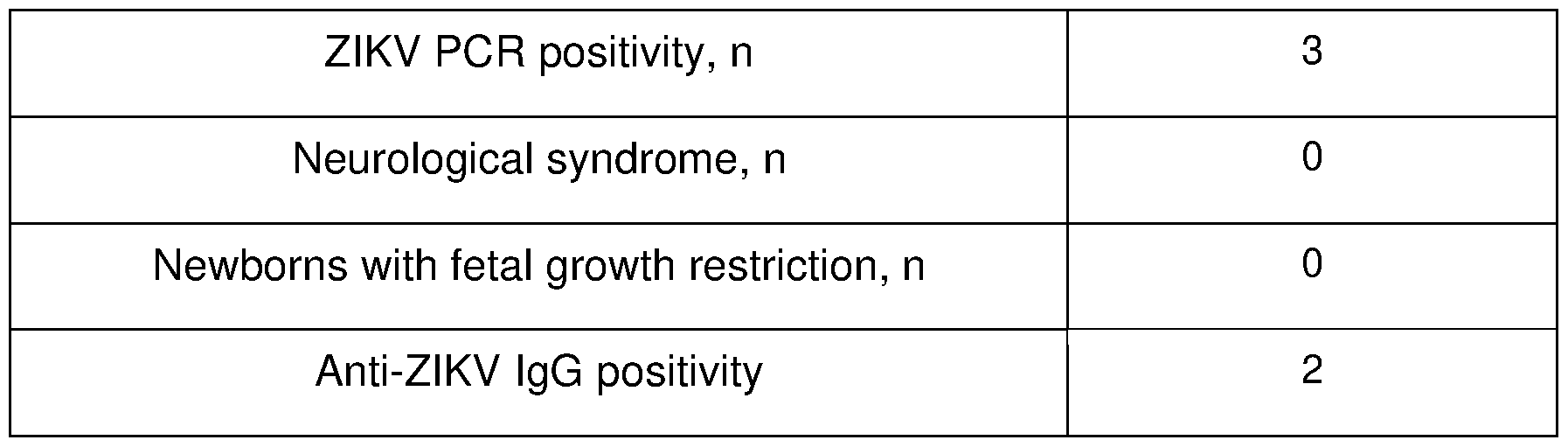
Two out of three ZIKV-infected pregnant women from the Singapore ZIKV cohort showed positive anti-ZIKV IgG antibody response during the acute and convalescent phase of disease and samples from these two anti-ZIKV IgG positive pregnant women were used for subsequent peptide screening (FIG. 4A and 4B). Peptide screening assays further demonstrated that ZIKV-infected pregnant women from both the Brazil and Singapore ZIKV cohorts showed a higher level of recognition for the ZIKV NS1 peptide 86 peptide (amino acid residues 17-34), as compared to the corresponding peptide from DENV (FIG. 3C - D). Similar levels of antibodies recognized against this epitope were present at both the acute and convalescent phase of disease (FIG. 3D). Thus, the results suggested that antibodies against ZIKV NS1 peptide 86 appear to be a common early marker for ZIKV infections, especially in ZIKV-infected pregnant women. The reason for a difference in epitope recognition between non-pregnant adults and pregnant women is currently unknown. There is limited information about the effect of pregnancy on the profiles of epitope-specific antibody expression during infections. This observation is probably related to the immunologic alternations and modulation of immune status locally or systemically during pregnancy.
Mapping of epitopes onto ZIKV prM. E and NS1 structures
Structural data of the E glycoproteins and NS1 protein were retrieved from Protein Data Bank (PDB) (identifiers 5IZ7 and 5K6K) and visualized using the UCSF CFIIMERA software as described previously [5]. Structures of prM sequences were predicted separately using individual l-TASSER queries, and
visualized using UCSF Chimera software as described previously [5]. Sequence similarity was calculated using DNASTAR Lasergene 15 software.
This disclosure showed that all three immunodominant antigens (prM, E and NS1 ) carry distinct epitopes that were recognized by the sera of ZIKV- infected and DENV-infected patient cohorts (Table 4).
Table 4. ZIKV-specific differential linear B-cell epitopes within the ZIKV proteomes were listed.

To locate the spatial position of the identified epitopes, epitope-containing sequences were then mapped onto predicted three-dimensional (3D) structures of the ZIKV prM proteins or the available 3D crystal structures of the ZIKV E glycoprotein and NS1 protein (PDB identifier 5IZ7 and 5K6K). Based on the available information, the three immunodominant antigens are structurally similar between the two closely-related flaviviruses. Mapping results showed that all the epitope sequences are located in a solvent exposed region (FIG. 5A - C). The mapping results were further supported by a recent publication describing a bioinformatics-based prediction of ZIKV B cell epitopes. The prediction results coincide with the screening data where epitopes from the E glycoprotein and NS1 protein were located at the surface exposed sites. This supported the idea that
the epitopes identified from this disclosure had a sufficient level of exposure for antibody interaction.
ZIKV infections in geographically different areas have been widely reported in recent years. Therefore, the present disclosure sought to collate the data from studies reporting antibody response in different ZIKV cohorts, and compared the data with the findings from the present disclosure. Studies reporting antibody response in different DENV cohorts were also collated for comparison. The pooled data sets suggested that all three antigens gave a high level of positive antibody response even from different patient cohorts (FIG. 5D). A similar observation was obtained between ZIKV and DENV cohorts.
It will be appreciated by a person skilled in the art that other variations and/or modifications may be made to the embodiments disclosed herein without departing from the spirit or scope of the disclosure as broadly described. For example, in the description herein, features of different exemplary embodiments may be mixed, combined, interchanged, incorporated, adopted, modified, included etc. or the like across different exemplary embodiments. The present embodiments are, therefore, to be considered in all respects to be illustrative and not restrictive.
References
1 . Kam YW, Lum FM, Teo TH, et al. Early neutralizing IgG response to Chikungunya virus in infected patients targets a dominant linear epitope on the E2 glycoprotein. EMBO Mol Med, 2012; 4:330-343.
2. Kam Y-W, Leite JA, Amrun SN, et al. ZIKV-specific NS1 epitopes as serological markers of acute Zika virus infection. J Infect Dis, 2019;
3. Kam Y-W, Lee CY-P, Teo T-H, et al. Cross-reactive dengue human monoclonal antibody prevents severe pathologies and death from Zika virus infections. JCI Insight, 2017; 2:1-10.
4. Amrun SN, Yee W-X, Abu Bakar F, et al. Novel differential linear B- cell epitopes to identify Zika and dengue virus infections in patients. Clin Transl Immunol, 2019; 8:e1066.
5. Kam Y-W, Lee WWL, Simarmata D, et al. Longitudinal analysis of the human antibody response to Chikungunya virus infection: implications for serodiagnosis and vaccine development. J Virol, 2012; 86:13005-13015.
APPLICATIONS
Embodiments of the method relate to the use of specific peptide sequences derived from the viral proteins of Zika virus and closely related flavivirus such as dengue virus that could be used as potential serology marker(s) for early ZIKV detection, and also for improved differentiation performance between closely related flaviviruses.
Embodiments of the method have identified five peptide regions (ZIKV prM peptide 8, ZIKV E peptide 27 and 29, ZIKV NS1 peptide 86 and 1 17) as differential epitopes that can advantageously distinguish between ZIKV and DENV infections, and further identifies one of them (ZIKV NS1 peptide 86; amino acid residues 17-34) as a useful early marker for ZIKV infections in particularly ZIKV-infected pregnant women. Notably, before the present disclosure, there was no systematic analysis of ZIKV epitopes in ZIKV-infected pregnant women, or description of epitopes within the ZIKV viral proteins (prM) which can be recognized by ZIKV-infected patients.
Claims
1. A method of identifying Zika virus (ZIKV) and/or dengue virus (DENV) infection in a subject, the method comprising determining whether a sample of the subject reacts with one or more peptide that is capable of being recognized more strongly by ZIKV- and/or DENV-induced antibody than a recognition of consensus sequence of the non-ZIKV and/or non-DENV- flavivirus by the ZIKV- and/or DENV-induced antibody.
2. The method of claim 1 , wherein the peptide is capable of being recognized more strongly by ZIKV- and/or DENV-induced antibody than the non-ZIKV and/or non-DENV- flavivirus induced antibody.
3. The method of any one of the preceding claims, wherein the peptide comprises an epitope, optionally a linear epitope, of ZIKV and/or DENV prM protein, ZIKV and/or DENV E glycoprotein or ZIKV and/or DENV NS1 protein.
4. The method of any one of the preceding claims, wherein the peptide comprises an epitope located in a solvent-exposed region of ZIKV and/or DENV prM protein, ZIKV and/or DENV E glycoprotein or ZIKV and/or DENV NS1 protein.
5. The method of any one of the preceding claims, wherein the peptide is from 15 to 20 amino acids long.
6. The method of any one of the preceding claims, wherein the peptide is selected from the group consisting of:
SEQ ID NO: 1 (HMCDATMSYECPMLDEGV) or a sequence having at least 75% sequence identity thereto or a sequence differing by one, two, three or four amino acids thereto or portions thereof;
SEQ ID NO: 2 (TVSNMAEVRSYCYEASIS) or a sequence having at least 75% sequence identity thereto or a sequence differing by one, two, three or four amino acids thereto or portions thereof;
SEQ ID NO: 3 (ISDMASDSRCPTQGEAYL) or a sequence having at least 75% sequence identity thereto or a sequence differing by one, two, three or four amino acids thereto or portions thereof;
SEQ ID NO: 4 (TGVFVYNDVEAWRDRYKY) or a sequence having at least 75% sequence identity thereto or a sequence differing by one, two, three or four amino acids thereto or portions thereof;
SEQ ID NO: 5 (REGYRTQMKGPWHSEELE) or a sequence having at least 75% sequence identity thereto or a sequence differing by one, two, three or four amino acids thereto or portions thereof;
SEQ ID NO: 6 (TTLGMNKCYIQIMDLGHM) or a sequence having at least 75% sequence identity thereto or a sequence differing by one, two, three or four amino acids thereto or portions thereof;
SEQ ID NO: 7 (CWCNTTSTWVVYGTCHHK) or a sequence having at least 75% sequence identity thereto or a sequence differing by one, two, three or four amino acids thereto or portions thereof;
SEQ ID NO: 8 (TRSQTWLESREYTKHLIR) or a sequence having at least 75% sequence identity thereto or a sequence differing by one, two, three or four amino acids thereto or portions thereof;
SEQ ID NO: 9 (HKKGEARRSRRAVTLPSH) or a sequence having at least 75% sequence identity thereto or a sequence differing by one, two, three or four amino acids thereto or portions thereof;
SEQ ID NO: 10 (RNPGFALAAAAIAWLLGS) or a sequence having at least 75% sequence identity thereto or a sequence differing by one, two, three or four amino acids thereto or portions thereof;
SEQ ID NO: 1 1 (EATLGGFGSLGLDCEPRT) or a sequence having at least 75% sequence identity thereto or a sequence differing by one, two, three or four amino acids thereto or portions thereof;
SEQ ID NO: 12 (KAFEATVRGAKRMAVLGD) or a sequence having at least 75% sequence identity thereto or a sequence differing by one, two, three or four amino acids thereto or portions thereof; and
SEQ ID NO: 13 (ELCEDTMTYKCPRITEA) or a sequence having at least 75% sequence identity thereto or a sequence differing by one, two, three or four amino acids thereto or portions thereof.
7. The method of any one of the preceding claims, wherein the peptide is substantially incapable of being recognized by the non-ZIKV and/or non- DENV flavivirus-induced antibody.
8. The method of any of claims 1 -7, wherein the consensus sequence of the non-ZIKV flavivirus is substantially incapable of being recognized by the ZIKV-induced antibody.
9. The method of any of claims 1 -7, wherein the consensus sequence of the non-DENV flavivirus is substantially incapable of being recognized by the DENV-induced antibody.
10. The method of any one of claims 1 to 8, wherein the non-ZIKV flavivirus comprises yellow fever virus and/or dengue virus.
1 1. The method of any one of claims 1 to 8, wherein the non-DENV flavivirus comprises yellow fever virus and/or Zika virus.
12. The method of any one of the preceding claims, wherein the method comprises determining whether the sample of the subject reacts with at least two peptides that are capable of being recognized more strongly by the ZIKV- and/or DENV- induced antibody than the non-ZIKV and/or DENV- flavivirus-induced antibody.
13. The method of any one of the preceding claims, wherein the subject is a pregnant subject, and the method comprises determining whether a sample of the subject reacts with a peptide selected from SEQ ID NO: 4 (TGVFVYNDVEAWRDRYKY) or a sequence having at least 75% sequence identity thereto or a sequence differing by one, two, three or four amino acids thereto portions thereof.
14. The method of any one of the preceding claims, wherein determining whether a sample of the subject reacts with a peptide comprises performing an immunoassay to assess whether antibodies that are capable of binding to the peptide are present in the sample.
15. The method of any one of the preceding claims, wherein the method comprises a diagnostic method or a prognostic method.
16. The method of any one of the preceding claims, the method further comprising administering to the subject a ZIKV and/or DENV treatment regimen if the subject is indicated for ZIKV and/or DENV infection.
17. A kit for identifying ZIKV and/or DENV infection in a subject, the kit comprising one or more peptide that is capable of being recognized more strongly by ZIKV- and/or DENV- induced antibody than a non-ZIKV and/or DENV- flavivirus-induced antibody.
18. The kit of claim 17, wherein the one or more peptide is selected from the group consisting of:
SEQ ID NO: 1 (HMCDATMSYECPMLDEGV) or a sequence having at least 75% sequence identity thereto or a sequence differing by one, two, three or four amino acids thereto or portions thereof;
SEQ ID NO: 2 (TVSNMAEVRSYCYEASIS) or a sequence having at least 75% sequence identity thereto or a sequence differing by one, two, three or four amino acids thereto or portions thereof;
SEQ ID NO: 3 (ISDMASDSRCPTQGEAYL) or a sequence having at least 75% sequence identity thereto or a sequence differing by one, two, three or four amino acids thereto or portions thereof;
SEQ ID NO: 4 (TGVFVYNDVEAWRDRYKY) or a sequence having at least 75% sequence identity thereto or a sequence differing by one, two, three or four amino acids thereto or portions thereof;
SEQ ID NO: 5 (REGYRTQMKGPWHSEELE) or a sequence having at least 75% sequence identity thereto or a sequence differing by one, two, three or four amino acids thereto or portions thereof;
SEQ ID NO: 6 (TTLGMNKCYIQIMDLGHM) or a sequence having at least 75% sequence identity thereto or a sequence differing by one, two, three or four amino acids thereto or portions thereof;
SEQ ID NO: 7 (CWCNTTSTWVVYGTCHHK) or a sequence having at least 75% sequence identity thereto or a sequence differing by one, two, three or four amino acids thereto or portions thereof;
SEQ ID NO: 8 (TRSQTWLESREYTKHLIR) or a sequence having at least 75% sequence identity thereto or a sequence differing by one, two, three or four amino acids thereto or portions thereof;
SEQ ID NO: 9 (HKKGEARRSRRAVTLPSH) or a sequence having at least 75% sequence identity thereto or a sequence differing by one, two, three or four amino acids thereto or portions thereof;
SEQ ID NO: 10 (RNPGFALAAAAIAWLLGS) or a sequence having at least 75% sequence identity thereto or a sequence differing by one, two, three or four amino acids thereto or portions thereof;
SEQ ID NO: 1 1 (EATLGGFGSLGLDCEPRT) or a sequence having at least 75% sequence identity thereto or a sequence differing by one, two, three or four amino acids thereto or portions thereof;
SEQ ID NO: 12 (KAFEATVRGAKRMAVLGD) or a sequence having at least 75% sequence identity thereto or a sequence differing by one, two, three or four amino acids thereto or portions thereof; and
SEQ ID NO: 13 (ELCEDTMTYKCPRITEA) or a sequence having at least 75% sequence identity thereto or a sequence differing by one, two, three or four amino acids thereto or portions thereof.
19. The kit of claim 17 or claim 18 further comprising one or more of the following:
a plate coated with a capture agent for anti-ZIKV and/or anti-DENV, and
a detection agent for detecting the presence of captured anti-ZIKV and/or anti-DENV,
wherein the capture agent and the detection agent comprise a ZIKV and/or DENV antigen and/or an anti-ZIKV and/or anti-DENV immunoglobulin.
20. The method or the kit of any one of the preceding claims, wherein the subject comprises a human subject.
21 . The method or the kit of claim 20, wherein the human subject comprises a pregnant human subject.
22. An isolated peptide selected from the group consisting of:
SEQ ID NO: 1 (HMCDATMSYECPMLDEGV) or a sequence having at least 75% sequence identity thereto or a sequence differing by one, two, three or four amino acids thereto or portions thereof;
SEQ ID NO: 2 (TVSNMAEVRSYCYEASIS) or a sequence having at least 75% sequence identity thereto or a sequence differing by one, two, three or four amino acids thereto or portions thereof;
SEQ ID NO: 3 (ISDMASDSRCPTQGEAYL) or a sequence having at least 75% sequence identity thereto or a sequence differing by one, two, three or four amino acids thereto or portions thereof;
SEQ ID NO: 4 (TGVFVYNDVEAWRDRYKY) or a sequence having at least 75% sequence identity thereto or a sequence differing by one, two, three or four amino acids thereto or portions thereof;
SEQ ID NO: 5 (REGYRTQMKGPWHSEELE) or a sequence having at least 75% sequence identity thereto or a sequence differing by one, two, three or four amino acids thereto or portions thereof;
SEQ ID NO: 6 (TTLGMNKCYIQIMDLGHM) or a sequence having at least 75% sequence identity thereto or a sequence differing by one, two, three or four amino acids thereto or portions thereof;
SEQ ID NO: 7 (CWCNTTSTWVVYGTCHHK) or a sequence having at least 75% sequence identity thereto or a sequence differing by one, two, three or four amino acids thereto or portions thereof;
SEQ ID NO: 8 (TRSQTWLESREYTKHLIR) or a sequence having at least 75% sequence identity thereto or a sequence differing by one, two, three or four amino acids thereto or portions thereof;
SEQ ID NO: 9 (HKKGEARRSRRAVTLPSH) or a sequence having at least 75% sequence identity thereto or a sequence differing by one, two, three or four amino acids thereto or portions thereof;
SEQ ID NO: 10 (RNPGFALAAAAIAWLLGS) or a sequence having at least 75% sequence identity thereto or a sequence differing by one, two, three or four amino acids thereto or portions thereof;
SEQ ID NO: 1 1 (EATLGGFGSLGLDCEPRT) or a sequence having at least 75% sequence identity thereto or a sequence differing by one, two, three or four amino acids thereto or portions thereof;
SEQ ID NO: 12 (KAFEATVRGAKRMAVLGD) or a sequence having at least 75% sequence identity thereto or a sequence differing by one, two, three or four amino acids thereto or portions thereof;
SEQ ID NO: 13 (ELCEDTMTYKCPRITEA) or a sequence having at least 75% sequence identity thereto or a sequence differing by one, two, three or four amino acids thereto or portions thereof.
23. An immune system stimulating composition comprising a peptide selected from the group consisting of:
SEQ ID NO: 1 (HMCDATMSYECPMLDEGV) or a sequence having at least 75% sequence identity thereto or a sequence differing by one, two, three or four amino acids thereto or portions thereof;
SEQ ID NO: 2 (TVSNMAEVRSYCYEASIS) or a sequence having at least 75% sequence identity thereto or a sequence differing by one, two, three or four amino acids thereto or portions thereof;
SEQ ID NO: 3 (ISDMASDSRCPTQGEAYL) or a sequence having at least 75% sequence identity thereto or a sequence differing by one, two, three or four amino acids thereto or portions thereof;
SEQ ID NO: 4 (TGVFVYNDVEAWRDRYKY) or a sequence having at least 75% sequence identity thereto or a sequence differing by one, two, three or four amino acids thereto or portions thereof;
SEQ ID NO: 5 (REGYRTQMKGPWHSEELE) or a sequence having at least 75% sequence identity thereto or a sequence differing by one, two, three or four amino acids thereto or portions thereof;
SEQ ID NO: 6 (TTLGMNKCYIQIMDLGHM) or a sequence having at least 75% sequence identity thereto or a sequence differing by one, two, three or four amino acids thereto or portions thereof;
SEQ ID NO: 7 (CWCNTTSTWVVYGTCHHK) or a sequence having at least 75% sequence identity thereto or a sequence differing by one, two, three or four amino acids thereto or portions thereof;
SEQ ID NO: 8 (TRSQTWLESREYTKHLIR) or a sequence having at least 75% sequence identity thereto or a sequence differing by one, two, three or four amino acids thereto or portions thereof;
SEQ ID NO: 9 (HKKGEARRSRRAVTLPSH) or a sequence having at least 75% sequence identity thereto or a sequence differing by one, two, three or four amino acids thereto or portions thereof;
SEQ ID NO: 10 (RNPGFALAAAAIAWLLGS) or a sequence having at least 75% sequence identity thereto or a sequence differing by one, two, three or four amino acids thereto or portions thereof;
SEQ ID NO: 1 1 (EATLGGFGSLGLDCEPRT) or a sequence having at least 75% sequence identity thereto or a sequence differing by one, two, three or four amino acids thereto or portions thereof;
SEQ ID NO: 12 (KAFEATVRGAKRMAVLGD) or a sequence having at least 75% sequence identity thereto or a sequence differing by one, two, three or four amino acids thereto or portions thereof; and
SEQ ID NO: 13 (ELCEDTMTYKCPRITEA) or a sequence having at least 75% sequence identity thereto or a sequence differing by one, two, three or four amino acids thereto or portions thereof.
Priority Applications (1)
| Application Number | Priority Date | Filing Date | Title |
|---|---|---|---|
| SG11202110063XA SG11202110063XA (en) | 2019-03-11 | 2020-03-11 | A method of identifying a flavivirus infection and related kits, peptides and compositions |
Applications Claiming Priority (2)
| Application Number | Priority Date | Filing Date | Title |
|---|---|---|---|
| SG10201902162S | 2019-03-11 | ||
| SG10201902162S | 2019-03-11 |
Publications (2)
| Publication Number | Publication Date |
|---|---|
| WO2020185165A2 true WO2020185165A2 (en) | 2020-09-17 |
| WO2020185165A3 WO2020185165A3 (en) | 2021-07-01 |
Family
ID=72425919
Family Applications (1)
| Application Number | Title | Priority Date | Filing Date |
|---|---|---|---|
| PCT/SG2020/050130 Ceased WO2020185165A2 (en) | 2019-03-11 | 2020-03-11 | A method of identifying a flavivirus infection and related kits, peptides and compositions |
Country Status (2)
| Country | Link |
|---|---|
| SG (1) | SG11202110063XA (en) |
| WO (1) | WO2020185165A2 (en) |
-
2020
- 2020-03-11 SG SG11202110063XA patent/SG11202110063XA/en unknown
- 2020-03-11 WO PCT/SG2020/050130 patent/WO2020185165A2/en not_active Ceased
Also Published As
| Publication number | Publication date |
|---|---|
| WO2020185165A3 (en) | 2021-07-01 |
| SG11202110063XA (en) | 2021-10-28 |
Similar Documents
| Publication | Publication Date | Title |
|---|---|---|
| Wu et al. | Serologic and molecular biologic methods for SARS-associated coronavirus infection, Taiwan | |
| Clements et al. | Serodiagnosis of Rocky Mountain spotted fever: comparison of IgM and IgG enzyme-linked immunosorbent assays and indirect fluorescent antibody test | |
| KR102775928B1 (en) | Availability and immunoreactivity of flavivirus NS1 polypeptide | |
| Raoult et al. | Line blot and western blot immunoassays for diagnosis of Mediterranean spotted fever | |
| Kim et al. | Improvement of the diagnostic sensitivity of scrub typhus using a mixture of recombinant antigens derived from Orientia tsutsugamushi serotypes | |
| Yamaguchi et al. | Immunity against seasonal human coronavirus OC43 mitigates fatal deterioration of COVID-19 | |
| KR20080113417A (en) | Competitive Enzyme Linked Immunosorbent Assay for the Detection of Flavivirus Specific Antibodies | |
| Kam et al. | ZIKV-specific NS1 epitopes as serological markers of acute Zika virus infection | |
| WO2009139725A1 (en) | Point of care test for the detection of exposure or immunity to dengue virus | |
| Klontz et al. | Laboratory testing for Powassan virus: past, present, and future | |
| Elgh et al. | The clinical usefulness of a Puumalavirus recombinant nucleocapsid protein based enzyme-linked immunosorbent assay in the diagnosis of nephropathia epidemica as compared with an immunofluorescence assay | |
| YAMASHITA et al. | A significant age shift of the human parvovirus B19 antibody prevalence among young adults in Japan observed in a decade | |
| EP2023142A1 (en) | Immunoassay utilizing recombinant nucleocapsid-proteins for detection of antibodies to human coronaviruses | |
| AU8735798A (en) | Use of recombinant envelope proteins for diagnosing the dengue virus | |
| JP2020026953A (en) | Kit for detecting antibody of severe fever with thrombocytopenia syndrome virus and method for detecting antibody of severe fever with thrombocytopenia syndrome virus | |
| US7074555B2 (en) | Detection of West Nile Virus | |
| Goedhals et al. | Identification of human linear B-cell epitope sites on the envelope glycoproteins of Crimean-Congo haemorrhagic fever virus | |
| KR20210011273A (en) | Monoclonal antibody with specificity for the envelope protein domain Ⅲ of Zika virus, hybridoma cell line producing the same and use thereof | |
| JP7489228B2 (en) | SARS-CoV-2 derived nucleocapsid fragment and method and kit for detecting anti-SARS-CoV-2 antibodies using said fragment | |
| Neubauer et al. | Serodiagnosis of human plague by an anti-F1 capsular antigen specific IgG/IgM ELISA and immunoblot | |
| CN109142723B (en) | Human immunodeficiency virus rapid detection test card and application thereof | |
| Komoro et al. | Characterization of monoclonal antibodies against Hokkaido strain tick-borne encephalitis virus | |
| JP7631219B2 (en) | Methods for identifying flavivirus infections, and related peptides, kits, and compositions | |
| CN112646006A (en) | Marker epitope polypeptide for diagnosing COVID-19 mild and severe symptoms and application thereof | |
| KR910007962A (en) | HIV related peptides |
Legal Events
| Date | Code | Title | Description |
|---|---|---|---|
| NENP | Non-entry into the national phase |
Ref country code: DE |
|
| 122 | Ep: pct application non-entry in european phase |
Ref document number: 20769813 Country of ref document: EP Kind code of ref document: A2 |