WO2020178776A1 - Process for preparing {6-[(diethylamino)methyl]naphthalen-2-yl}methyl [4-(hydroxycarbamoyl)phenyl]carbamate having high purity - Google Patents

Process for preparing {6-[(diethylamino)methyl]naphthalen-2-yl}methyl [4-(hydroxycarbamoyl)phenyl]carbamate having high purity Download PDF

Info

Publication number
WO2020178776A1
WO2020178776A1 PCT/IB2020/051907 IB2020051907W WO2020178776A1 WO 2020178776 A1 WO2020178776 A1 WO 2020178776A1 IB 2020051907 W IB2020051907 W IB 2020051907W WO 2020178776 A1 WO2020178776 A1 WO 2020178776A1
Authority
WO
WIPO (PCT)
Prior art keywords
methyl
hydroxycarbamoyl
naphthalen
diethylamino
carbamate
Prior art date
Legal status (The legal status is an assumption and is not a legal conclusion. Google has not performed a legal analysis and makes no representation as to the accuracy of the status listed.)
Ceased
Application number
PCT/IB2020/051907
Other languages
French (fr)
Other versions
WO2020178776A9 (en
Inventor
Stefano Turchetta
Maurizio Zenoni
Elio Ullucci
Stefania COCCIOLO
Giorgio Berardi
Nakia MAULUCCI
Current Assignee (The listed assignees may be inaccurate. Google has not performed a legal analysis and makes no representation or warranty as to the accuracy of the list.)
Chemi SpA
Original Assignee
Chemi SpA
Priority date (The priority date is an assumption and is not a legal conclusion. Google has not performed a legal analysis and makes no representation as to the accuracy of the date listed.)
Filing date
Publication date
Priority to JP2021552958A priority Critical patent/JP7507777B2/en
Priority to IL315035A priority patent/IL315035A/en
Priority to CA3129436A priority patent/CA3129436A1/en
Priority to BR112021015446-9A priority patent/BR112021015446B1/en
Priority to US17/435,731 priority patent/US12129224B2/en
Priority to KR1020217031828A priority patent/KR102908349B1/en
Priority to KR1020257025080A priority patent/KR20250121145A/en
Priority to PE2021001315A priority patent/PE20212321A1/en
Priority to CN202311004806.3A priority patent/CN116947701A/en
Priority to EP20714690.3A priority patent/EP3891124A1/en
Priority to CN202080018345.3A priority patent/CN113614066B/en
Priority to CN202311004809.7A priority patent/CN116947702A/en
Priority to CN202311005409.8A priority patent/CN116947703A/en
Priority to MX2021010549A priority patent/MX2021010549A/en
Application filed by Chemi SpA filed Critical Chemi SpA
Priority to AU2020231702A priority patent/AU2020231702B8/en
Priority to IL284811A priority patent/IL284811B2/en
Publication of WO2020178776A1 publication Critical patent/WO2020178776A1/en
Publication of WO2020178776A9 publication Critical patent/WO2020178776A9/en
Priority to CONC2021/0011714A priority patent/CO2021011714A2/en
Anticipated expiration legal-status Critical
Priority to US18/338,435 priority patent/US12606519B2/en
Priority to JP2024064833A priority patent/JP7714080B2/en
Priority to JP2024064832A priority patent/JP2024074994A/en
Ceased legal-status Critical Current

Links

Classifications

    • CCHEMISTRY; METALLURGY
    • C07ORGANIC CHEMISTRY
    • C07CACYCLIC OR CARBOCYCLIC COMPOUNDS
    • C07C271/00Derivatives of carbamic acids, i.e. compounds containing any of the groups, the nitrogen atom not being part of nitro or nitroso groups
    • C07C271/06Esters of carbamic acids
    • C07C271/08Esters of carbamic acids having oxygen atoms of carbamate groups bound to acyclic carbon atoms
    • C07C271/26Esters of carbamic acids having oxygen atoms of carbamate groups bound to acyclic carbon atoms with the nitrogen atom of at least one of the carbamate groups bound to a carbon atom of a six-membered aromatic ring
    • C07C271/28Esters of carbamic acids having oxygen atoms of carbamate groups bound to acyclic carbon atoms with the nitrogen atom of at least one of the carbamate groups bound to a carbon atom of a six-membered aromatic ring to a carbon atom of a non-condensed six-membered aromatic ring
    • AHUMAN NECESSITIES
    • A61MEDICAL OR VETERINARY SCIENCE; HYGIENE
    • A61KPREPARATIONS FOR MEDICAL, DENTAL OR TOILETRY PURPOSES
    • A61K31/00Medicinal preparations containing organic active ingredients
    • A61K31/21Esters, e.g. nitroglycerine, selenocyanates
    • A61K31/27Esters, e.g. nitroglycerine, selenocyanates of carbamic or thiocarbamic acids, meprobamate, carbachol, neostigmine
    • AHUMAN NECESSITIES
    • A61MEDICAL OR VETERINARY SCIENCE; HYGIENE
    • A61PSPECIFIC THERAPEUTIC ACTIVITY OF CHEMICAL COMPOUNDS OR MEDICINAL PREPARATIONS
    • A61P29/00Non-central analgesic, antipyretic or antiinflammatory agents, e.g. antirheumatic agents; Non-steroidal antiinflammatory drugs [NSAID]
    • AHUMAN NECESSITIES
    • A61MEDICAL OR VETERINARY SCIENCE; HYGIENE
    • A61PSPECIFIC THERAPEUTIC ACTIVITY OF CHEMICAL COMPOUNDS OR MEDICINAL PREPARATIONS
    • A61P35/00Antineoplastic agents
    • AHUMAN NECESSITIES
    • A61MEDICAL OR VETERINARY SCIENCE; HYGIENE
    • A61PSPECIFIC THERAPEUTIC ACTIVITY OF CHEMICAL COMPOUNDS OR MEDICINAL PREPARATIONS
    • A61P35/00Antineoplastic agents
    • A61P35/02Antineoplastic agents specific for leukemia
    • BPERFORMING OPERATIONS; TRANSPORTING
    • B01PHYSICAL OR CHEMICAL PROCESSES OR APPARATUS IN GENERAL
    • B01JCHEMICAL OR PHYSICAL PROCESSES, e.g. CATALYSIS OR COLLOID CHEMISTRY; THEIR RELEVANT APPARATUS
    • B01J20/00Solid sorbent compositions or filter aid compositions; Sorbents for chromatography; Processes for preparing, regenerating or reactivating thereof
    • B01J20/281Sorbents specially adapted for preparative, analytical or investigative chromatography
    • B01J20/286Phases chemically bonded to a substrate, e.g. to silica or to polymers
    • CCHEMISTRY; METALLURGY
    • C07ORGANIC CHEMISTRY
    • C07CACYCLIC OR CARBOCYCLIC COMPOUNDS
    • C07C269/00Preparation of derivatives of carbamic acid, i.e. compounds containing any of the groups, the nitrogen atom not being part of nitro or nitroso groups
    • C07C269/06Preparation of derivatives of carbamic acid, i.e. compounds containing any of the groups, the nitrogen atom not being part of nitro or nitroso groups by reactions not involving the formation of carbamate groups
    • CCHEMISTRY; METALLURGY
    • C07ORGANIC CHEMISTRY
    • C07CACYCLIC OR CARBOCYCLIC COMPOUNDS
    • C07C269/00Preparation of derivatives of carbamic acid, i.e. compounds containing any of the groups, the nitrogen atom not being part of nitro or nitroso groups
    • C07C269/08Separation; Purification; Stabilisation; Use of additives
    • GPHYSICS
    • G01MEASURING; TESTING
    • G01NINVESTIGATING OR ANALYSING MATERIALS BY DETERMINING THEIR CHEMICAL OR PHYSICAL PROPERTIES
    • G01N30/00Investigating or analysing materials by separation into components using adsorption, absorption or similar phenomena or using ion-exchange, e.g. chromatography or field flow fractionation
    • G01N30/02Column chromatography
    • GPHYSICS
    • G01MEASURING; TESTING
    • G01NINVESTIGATING OR ANALYSING MATERIALS BY DETERMINING THEIR CHEMICAL OR PHYSICAL PROPERTIES
    • G01N30/00Investigating or analysing materials by separation into components using adsorption, absorption or similar phenomena or using ion-exchange, e.g. chromatography or field flow fractionation
    • G01N30/02Column chromatography
    • G01N30/04Preparation or injection of sample to be analysed
    • G01N30/06Preparation
    • GPHYSICS
    • G01MEASURING; TESTING
    • G01NINVESTIGATING OR ANALYSING MATERIALS BY DETERMINING THEIR CHEMICAL OR PHYSICAL PROPERTIES
    • G01N30/00Investigating or analysing materials by separation into components using adsorption, absorption or similar phenomena or using ion-exchange, e.g. chromatography or field flow fractionation
    • G01N30/02Column chromatography
    • G01N30/26Conditioning of the fluid carrier; Flow patterns
    • G01N30/28Control of physical parameters of the fluid carrier
    • G01N30/34Control of physical parameters of the fluid carrier of fluid composition, e.g. gradient
    • GPHYSICS
    • G01MEASURING; TESTING
    • G01NINVESTIGATING OR ANALYSING MATERIALS BY DETERMINING THEIR CHEMICAL OR PHYSICAL PROPERTIES
    • G01N30/00Investigating or analysing materials by separation into components using adsorption, absorption or similar phenomena or using ion-exchange, e.g. chromatography or field flow fractionation
    • G01N30/02Column chromatography
    • G01N30/62Detectors specially adapted therefor
    • G01N30/74Optical detectors
    • GPHYSICS
    • G01MEASURING; TESTING
    • G01NINVESTIGATING OR ANALYSING MATERIALS BY DETERMINING THEIR CHEMICAL OR PHYSICAL PROPERTIES
    • G01N30/00Investigating or analysing materials by separation into components using adsorption, absorption or similar phenomena or using ion-exchange, e.g. chromatography or field flow fractionation
    • G01N30/02Column chromatography
    • G01N2030/022Column chromatography characterised by the kind of separation mechanism
    • G01N2030/027Liquid chromatography

Definitions

  • the object of the present invention is a process for obtaining ⁇ 6- [(diethylamino)methyl]naphthalen-2-yl ⁇ methyl [4-
  • a further object of the present invention is an HPLC method for determining the purity of the product and possible impurities thereof.
  • Givinostat® also known by the name of ITF2357, (lUPAC name ⁇ 6- [(diethylamino)methyl]naphthalen-2-yl ⁇ methyl [4-
  • hydroxycarbamoyl)phenyljcarbamate is a hydroxamic acid, used in the form of hydrochloride thereof, in particular hydrochloride monohydrate, that acts as an inhibitor of Histone Deacetylase (HDAC) and exerts its action on the homonymous class I and II enzymes.
  • HDAC Histone Deacetylase
  • Givinostat shows a very promising activity profile in multiple myeloma and acute myelogenic leukemia, both in vitro and in vivo, and also acts as an anti-inflammatory agent and as an inhibitor of tumor necrosis factor alpha (TNF-a), IL-1 , and IL-6 secretion.
  • Givinostat is currently used in multiple Phase III studies for inflammatory diseases (Duchenne and Becker muscular dystrophy, juvenile arthritis, and polycythemia vera) and in clinical trials for blood cancers (myelomas and lymphomas).
  • the amide (ITF2374) has the following formula (la):
  • physiologically acceptable excipient refers to a substance devoid of any pharmacological effect of its own and which does not produce adverse reactions when administered to a mammal, preferably a human.
  • Physiologically acceptable excipients are well known in the art and are disclosed, for instance in the Handbook of Pharmaceutical Excipients, sixth edition 2009, herein incorporated by reference.
  • pharmaceutically acceptable salts refers to those salts having the biological efficacy and properties of the salified compound and which do not produce adverse reactions when administered to a mammal, preferably a human being.
  • the pharmaceutically acceptable salts can be inorganic or organic salts; examples of pharmaceutically acceptable salts include, but are not limited to carbonate, hydrochloride, hydrobromide, sulfate, hydrogen sulfate, citrate, maleate, fumarate, trifluoroacetate, 2- naphthalenesulfonate, and para-toluenesulfonate. More information on pharmaceutically acceptable salts may be found in Handbook of pharmaceutical salts, P. Stahl, C.
  • the terms“consists of”,“consisting of” are to be construed as closed terms.
  • the term “having high purity” refers to a purity greater than 99.5%, preferably equal to or greater than 99.6%.
  • Givinostat or ITF2357 are intended to indicate the hydrochloride salt of ⁇ 6- [(diethylamino)methyl]naphthalen-2-yl ⁇ methyl [4-
  • hydrochloride salt has instead a CAS number of 199657-29-9 and the free base has a CAS number of 497833-27-9.
  • halogen refers to fluorine (F), chlorine (Cl), bromine (Br), or iodine (I).
  • dipolar aprotic solvent not sensitive to acidity refers to a solvent devoid of acid sensitive components.
  • TFIF is an example of an acid sensitive solvent.
  • DMSO, acetonitrile, dimethylacetamide, or dimethylformamide are instead examples of solvents not sensitive to acidity.
  • unknown impurity refers to any unknown impurity present in ⁇ 6- [(diethylamino)methyl]naphthalen-2-yl ⁇ methyl [4-
  • the present invention relates to a process for preparing ⁇ 6-[(diethylamino)methyl]naphthalen-2-yl ⁇ methyl [4- (hydroxycarbamoyl)phenyl]carbamate and/or pharmaceutically acceptable salts thereof having an amount of any single unknown impurity equal to or lower than 0.10% and/or high purity.
  • the process of the present invention allows to obtain ⁇ 6-[(diethylamino)methyl]naphthalen-2-yl ⁇ methyl [4-
  • the present invention relates to ⁇ 6- [(diethylamino)methyl]naphthalen-2-yl ⁇ methyl [4-
  • hydrochloride more preferably hydrochloride monohydrate, having an amount of any single unknown impurity equal to or lower than 0.10% or having an amount of any single unknown impurity other than intermediate (I) or amide (la) equal to or lower than 0.15%, preferably equal to or lower than 0.10%.
  • the present invention relates to ⁇ 6- [(diethylamino)methyl]naphthalen-2-yl ⁇ methyl [4-
  • hydrochloride more preferably hydrochloride monohydrate, having a purity greater than 99.5%, preferably equal to or greater than 99.6%.
  • the present invention relates to a new HPLC analytical method for determining the purity of ⁇ 6- [(diethylamino)methyl]naphthalen-2-yl ⁇ methyl [4- (hydroxycarbamoyl)phenyl]carbamate and/or pharmaceutically acceptable salts thereof and detect impurities thereof.
  • the present invention relates to ⁇ 6- [(diethylamino)methyl]naphthalen-2-yl ⁇ methyl [4-
  • hydrochloride more preferably hydrochloride monohydrate, having an amount equal to or lower than 0.10% of an unknown impurity at an RRT of 0.93 ⁇ 0.02 and/or an unknown impurity at an RRT of 1.21 ⁇ 0.02 and/or an unknown impurity at an RRT of 1 .51 ⁇ 0.02 and/or of an unknown impurity at an RRT 1 .75 ⁇ 0.02, the RRT being measured using the HPLC method according to the invention.
  • the present invention relates to a process for preparing ⁇ 6-[(diethylamino)methyl]naphthalen-2-yl ⁇ methyl [4- (hydroxycarbamoyl)phenyl]carbamate and/or pharmaceutically acceptable salts thereof comprising the HPLC method for determining the purity according to the invention.
  • Figure 1 shows the chromatogram obtained by the HPLC method according to the invention, on an ad hoc prepared mixture containing all the typical Givinostat impurities.
  • An object of the present invention is a process for preparing ⁇ 6- [(diethylamino)methyl]naphthalen-2-yl ⁇ methyl [4-
  • X is halogen, preferably chlorine
  • steps i) and ii) will be named STEP 2 according to the process of the invention.
  • the organic solvent of step i) in STEP 2 is selected from the group comprising THF, methyl-THF, dioxane, ethylene glycol dimethyl ether, and bis(2-methoxyethyl)ether.
  • said organic solvent is used in an amount comprised between 1 and 100 parts by volume per part by weight of the compound of formula (II).
  • said organic solvent has a water content lower than 0.5%.
  • step ii) in STEP 2 of the process according to the invention is carried out at room temperature.
  • the process of the present invention (STEP 2) is characterized in that it further comprises a step iii) of isolating ⁇ 6- [(diethylamino)methyl]naphthalen-2-yl ⁇ methyl [4-
  • the compound of formula (II) is obtained from the corresponding acid of formula (I) by reaction with a halogenating agent, preferably a chlorinating agent (step a), in an aprotic dipolar solvent insensitive to acidity.
  • a halogenating agent preferably a chlorinating agent (step a)
  • the compound of formula (II) is isolated from the reaction mixture by precipitation with organic solvent, preferably followed by filtration (step b).
  • steps a) and b) will be named STEP 1 according to the process of the invention.
  • the solvent insensitive to acidity is a solvent devoid of acid sensitive components (therefore devoid of THF for example). This characteristic of the solvent allows to use reduced amounts of halogenating agent compared to the prior art.
  • THF represents an acid-sensitive solvent, since in acidic conditions it can degrade and generate reactive species that can form unwanted by-products in the halogenation reaction.
  • said aprotic dipolar solvent insensitive to acidity is selected from DMSO, acetonitrile, dimethylacetamide, or dimethylformamide, more preferably dimethylformamide.
  • chlorinating agents examples include thionyl chloride (SOCI 2 ), phosphorus trichloride (PCI 3 ), phosphorus oxychloride (POCI 3 ), or phosphorus pentachloride (PCI 5 ).
  • SOCI 2 thionyl chloride
  • PCI 3 phosphorus trichloride
  • POCI 3 phosphorus oxychloride
  • PCI 5 phosphorus pentachloride
  • the corresponding brominating agents SOBr 2 , PBr 3 , POBr 3 or PBr 5 may be used.
  • the organic solvent used to precipitate the compound (II) is selected from aliphatic or aromatic hydrocarbons, ethers, esters or alcohols, more preferably toluene or THF.
  • a further object of the present invention is ⁇ 6- [(diethylamino)methyl]naphthalen-2-yl ⁇ methyl [4-
  • the present invention relates to ⁇ 6- [(diethylamino)methyl]naphthalen-2-yl ⁇ methyl [4-
  • a further object of the present invention is ⁇ 6- [(diethylamino)methyl]naphthalen-2-yl ⁇ methyl [4-
  • hydrochloride more preferably hydrochloride monohydrate, having an amount of any single unknown impurity equal to or lower than 0.10% or having an amount of any single unknown impurity other than intermediate (I) or amide (la) equal to or lower than 0.15%, preferably equal to or lower than 0.10%.
  • a further object of the present invention is ⁇ 6-
  • hydrochloride more preferably hydrochloride monohydrate, having a purity greater than 99.5%, preferably equal to or greater than 99.6%.
  • a further object of the present invention is ⁇ 6-
  • (hydroxycarbamoyl)phenyljcarbamate and/or pharmaceutically acceptable salts thereof preferably hydrochloride, more preferably hydrochloride monohydrate, having an amount equal to or lower than 0.10% of an unknown impurity at an RRT of 0.93 ⁇ 0.02 and/or an unknown impurity at an RRT of 1.21 ⁇ 0.02 and/or an unknown impurity at an RRT of 1 .51 ⁇ 0.02 and/or an unknown impurity at an RRT 1.75 ⁇ 0.02, the RRT being measured using the HPLC method according to the invention.
  • the RRT is measured using the following HPLC method:
  • Mobile phase B Methanol buffered at pH 37-3.8
  • an ammonium formate-formic acid buffer at pH 37-3.8 is used.
  • a 263 nm UV detector is used.
  • the column temperature is 25 ⁇ 1 °C.
  • the injection volume is 5 mI_.
  • the flow rate is 0.25 mL/min.
  • the product sample is diluted in DMSO.
  • a further object of the present invention is a pharmaceutical composition containing ⁇ 6-[(diethylamino)methyl]naphthalen-2-yl ⁇ methyl [4- (hydroxycarbamoyl)phenyl]carbamate and/or pharmaceutically acceptable salts thereof, as defined above, and at least one pharmaceutically acceptable excipient.
  • the active principle is in the form of micronized particles, having an average size smaller than 200 pm, preferably between 100 pm and 1 pm, more preferably between 50 pm and 5 pm.
  • a further object of the present invention is also a method for determining the purity of the product ⁇ 6-[(diethylamino)methyl]naphthalen-2-yl ⁇ methyl [4- (hydroxycarbamoyl)phenyl]carbamate and/or pharmaceutically acceptable salts thereof comprising eluting the product through an HPLC column having a stationary phase containing alkyl chains bound to an inorganic support, for example silica, and subsequent detection of the same product and impurities thereof using a detector suitable for measuring the amount of analyte eluting from the column, for example a detector of the UV, MS or RID type.
  • said alkyl chains are of octadecyl, octyl or butyl (C18, C8 or C4) type, preferably C18.
  • the stationary phase consists of a silica support, derivatized with C18 alkyl chains, having a carbon load lower than 9% by weight.
  • Carbon load means the carbon content, as % by weight, of the stationary phase bound to silica. High carbon loads (15-25%) make the surface of the stationary phase more hydrophobic and can retain the most hydrophobic impurities, making correct quantitative evaluation thereof impossible.
  • polar organic solvent is a C1 -C4 alcohol, preferably methanol, or acetonitrile.
  • mixtures of water and methanol, water and acetonitrile can be used, optionally with or without an elution gradient, optionally with or without buffers.
  • the aforementioned mixtures can be used with the addition of a buffer. More preferably, an ammonium formate-formic acid buffer at pH 3.7-3.8.
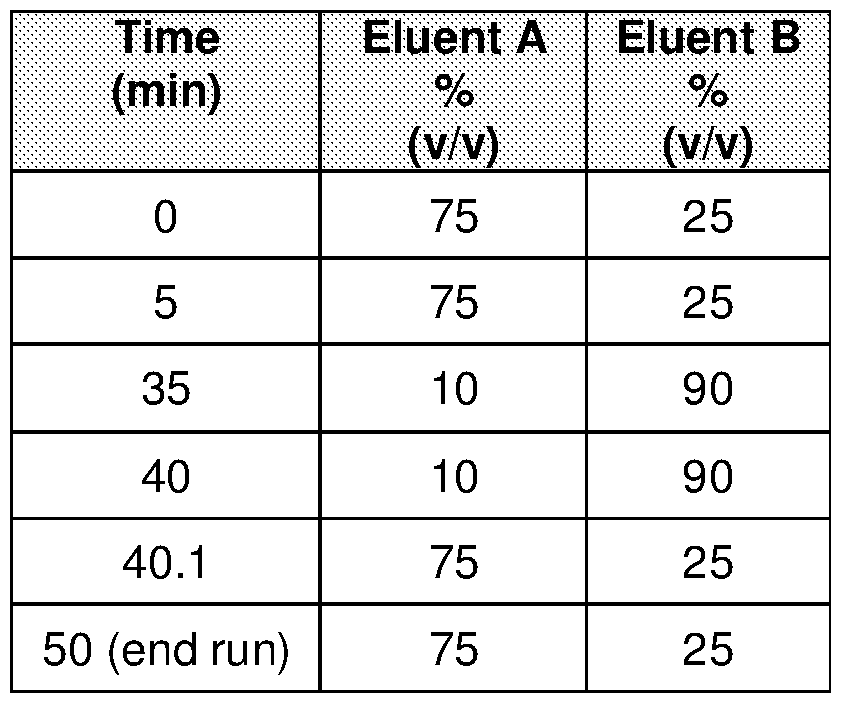
  • a chromatographic run according to the following scheme is used as the elution method:
  • Eluent A means water and ammonium formate-formic acid buffer at pH 3.7-3.8
  • Eluent B means methanol and ammonium formate-formic acid buffer at pH 3.7-3.8.
  • a further object of the present invention is also a process for preparing ⁇ 6- [(diethylamino)methyl]naphthalen-2-yl ⁇ methyl [4-
  • the product is dried in oven at 30°C under reduce pressure for 16 hours. 7.2 g of dry pure Givinostat are obtained, whose purity is 98.8% and shows the presence of an unknown impurity at 0.23%.
  • the wet crude Givinostat is suspended in a solution of NaHC0 3 (10 g) in 408 ml. of water at 20 ⁇ 3°C, then THF (408 ml.) is added and gradual dissolution is observed. The resulting solution is stirred for 30 minutes, then ethyl acetate (204 ml.) is added. After 1 5 minutes, stirring is stopped and the two phases are allowed to separate. The aqueous phase is discarded, and the organic phase is treated with 37% HCI under vigorous stirring until reaching pH ⁇ 2. The resulting suspension is stirred for 30 minutes, then the precipitate is isolated by vacuum filtration and washed with THF. 31 g of wet pure Givinostat are obtained.
  • the product is dried in oven at 30°C under reduced pressure for 16 hours. 15.6 g of dry pure Givinostat are obtained. HPLC purity analysis shows that the product does not contain any unknown impurities in amounts greater than 0.10%.
  • THF is then removed under reduced pressure until the total volume is about halved and a white precipitate is observed.
  • the mixture is cooled to 10°C and kept under stirring at this temperature for 30 minutes.
  • the product is isolated by vacuum filtration and washed with water. 36 g of wet crude Givinostat are obtained.
  • the wet crude Givinostat is suspended in a solution of NaHC0 3 (10 g) in 408 mL of water at 20 ⁇ 3°C, then THF (408 mL) is added and gradual dissolution is observed. The resulting solution is stirred for 30 minutes, then ethyl acetate (204 mL) is added. After 1 5 minutes, stirring is stopped and the two phases are allowed to separate. The aqueous phase is discarded, and the organic phase is treated with 37% HCI under vigorous stirring until reaching pH ⁇ 2. The resulting suspension is stirred for 30 minutes, then the precipitate is isolated by vacuum filtration and washed with THF. 27 g of wet pure Givinostat are obtained.
  • the product is dried in oven at 30°C under reduced pressure for 16 hours. 15.4 g of dry pure Givinostat are obtained. HPLC purity analysis shows that the product does not contain any unknown impurities in amounts greater than 0.10%.
  • the wet crude Givinostat is suspended in a solution consisting of NaHC0 3 (21 kg) in 860 L of water and 860 L of THF at 20 ⁇ 3°C, observing gradual dissolution.
  • the resulting solution is stirred for 30 minutes, then ethyl acetate (440 L) is added. After 15 minutes, stirring is stopped and the two phases are allowed to separate.
  • the aqueous phase is discarded, and the organic phase is treated with 37% HCI under vigorous stirring until reaching pH ⁇ 2.
  • the resulting suspension is stirred for 30 minutes, then the precipitate is isolated by vacuum filtration and washed with THF. 58 kg of wet pure Givinostat are obtained.
  • the product is dried in oven at 30°C under reduced pressure for 16 hours. 35 kg of dry pure Givinostat are obtained. HPLC purity analysis shows that the product does not contain any unknown impurities in amounts greater than 0.10% and has an overall purity greater than 99.5%.
  • the wet filtrate is charged back into the reactor in which 5 kg of sodium bicarbonate, 1000 ml. of deionized water and 1000 ml. of THF are added.
  • the mixture is stirred and heated to 47-53°C, keeping it in these conditions for 3 hours.
  • the mixture is then cooled to 17-23°C and the phases are allowed to settle.
  • the separated aqueous phase is reextracted with 500 mL of ethyl acetate.
  • the organic extracts are then combined and 200 mL of 37% HCI are added to these, under vigorous stirring, observing precipitation of the product.
  • the mixture is kept under stirring for 30 minutes, then it is filtered and the panel washed with 400 ml. of THF.
  • the wet filtrate is charged back into the reactor in which 5 kg of sodium bicarbonate, 1000 ml. of deionized water and 1000 ml. of THF are added. The mixture is stirred at 17-23°C, keeping these conditions for 30 minutes. 500 ml. of ethyl acetate are then added to the mixture at 17-23°C, stirring for 15 minutes. The phases are allowed to settle and the separate organic phase is filtered on a 10 micron microfilter. Reactor and lines are then washed with a mixture of 120 ml. of THF and 60 ml. of ethyl acetate, and 200 ml. of 37% HCI are added to the combined organic phases, observing precipitation of the product.
  • the mixture is kept under stirring for 30 minutes, then it is filtered and the panel washed with 400 ml. of THF.
  • the product is discharged (157 g) and dried under vacuum ( ⁇ 50 mbar) at 25- 35°C for 15 hours. 107 g of final product are obtained.
  • the wet filtrate is charged back into the reactor in which 5 kg of sodium bicarbonate, 1000 ml. of deionized water and 1000 ml. of THF are added.
  • the mixture is stirred and heated to 47-53°C, maintaining these conditions for 3 hours.
  • the mixture is then cooled to 17-23°C and the phases allowed to settle.
  • the separated aqueous phase is reextracted with 500 ml. of ethyl acetate.
  • the organic extracts are then combined and 200 ml. of 37% HCI are added to these, under vigorous stirring, observing precipitation of the product.
  • the mixture is kept under stirring for 30 minutes, then it is filtered and the panel washed with 400 ml. of THF.
  • the wet filtrate is charged back into the reactor in which 5 kg of sodium bicarbonate, 1000 ml. of deionized water and 1000 ml. of THF are added. The mixture is stirred at 17-23°C, keeping these conditions for 30 minutes. 500 ml. of ethyl acetate are then added to the mixture at 17-23°C, stirring for 15 minutes. The phases are allowed to settle and the separate organic phase is filtered on a 10 micron microfilter. Reactor and lines are then washed with a mixture of 120 ml. of THF and 60 ml. of ethyl acetate, and 200 ml. of 37% HCI are added to the combined organic phases, observing precipitation of the product.
  • FIG. 1 A typical chromatogram obtained by HPLC method according to the invention, on an ad hoc prepared mixture containing all typical impurities of the product, is shown in Figure 1 .
  • Table 1 shows, in particular, the relative retention times of Givinostat (RRT 1 ), amide metabolite (la) (RRT 1 .08), intermediate (I) (RRT 1 .27) and unknown impurities, evaluated by the HPLC analysis described in Example 9
  • the experiment TT 180 (Example 2) relates to repetition of the process used in the state of the art, while experiments TT 177 (Example 3) and TT 183 (Example 4) relates to experiments wherein the method of the present invention is applied with regards to STEP 2, where a 50% hydroxylamine aqueous solution is added to a solution of intermediate (II) produced according to the known art, dissolved in THF.
  • a further critical aspect to limit the impurities formation is the amount of water contained in the mixture containing intermediate (II) to which hydroxylamine is added, which must be limited within 0.5% based on the weight of the mixture.
  • hydroxylamine addition time does not constitute a limitation while, unlike the state of the art method, the method of the present invention allows to operate at room temperature rather than at 5°C.

Landscapes

  • Chemical & Material Sciences (AREA)
  • Organic Chemistry (AREA)
  • Health & Medical Sciences (AREA)
  • Life Sciences & Earth Sciences (AREA)
  • General Health & Medical Sciences (AREA)
  • Chemical Kinetics & Catalysis (AREA)
  • Analytical Chemistry (AREA)
  • Physics & Mathematics (AREA)
  • Pharmacology & Pharmacy (AREA)
  • Immunology (AREA)
  • General Physics & Mathematics (AREA)
  • Medicinal Chemistry (AREA)
  • Biochemistry (AREA)
  • Animal Behavior & Ethology (AREA)
  • Public Health (AREA)
  • Veterinary Medicine (AREA)
  • Pathology (AREA)
  • General Chemical & Material Sciences (AREA)
  • Nuclear Medicine, Radiotherapy & Molecular Imaging (AREA)
  • Emergency Medicine (AREA)
  • Epidemiology (AREA)
  • Pain & Pain Management (AREA)
  • Rheumatology (AREA)
  • Spectroscopy & Molecular Physics (AREA)
  • Hematology (AREA)
  • Oncology (AREA)
  • Organic Low-Molecular-Weight Compounds And Preparation Thereof (AREA)
  • Pharmaceuticals Containing Other Organic And Inorganic Compounds (AREA)
  • Acyclic And Carbocyclic Compounds In Medicinal Compositions (AREA)

Abstract

A process for obtaining {{6-[(diethylamino)methyl]naphthalen-2-yl}methyl [4- (hydroxycarbamoyl)phenyl]carbamate and/or pharmaceutically acceptable salts thereof having high purity is described. This process allows to obtain a product having an amount of any single unknown impurity equal to or less than 0.10%, as well as a product having a purity greater than 99.5%, preferably equal to or greater than 99.6%. An HPLC method for determining the purity of the product and possible impurities thereof is also described.

Description

Process for preparing {6-[(diethylamino)methyl]naphthalen-2-yl}methyl [4-
(hydroxycarbamoyl)phenyl]carbamate having high purity
Description
The object of the present invention is a process for obtaining {6- [(diethylamino)methyl]naphthalen-2-yl}methyl [4-
(hydroxycarbamoyl)phenyl]carbamate and/or pharmaceutically acceptable salts thereof having high purity. Such process allows to obtain a product having an amount of any single unknown impurity equal to or less than 0.10%, as well as a product having a purity greater than 99.5%, preferably equal to or greater than 99.6%.
A further object of the present invention is an HPLC method for determining the purity of the product and possible impurities thereof.
State of the Art
Givinostat®, also known by the name of ITF2357, (lUPAC name {6- [(diethylamino)methyl]naphthalen-2-yl}methyl [4-
(hydroxycarbamoyl)phenyljcarbamate is a hydroxamic acid, used in the form of hydrochloride thereof, in particular hydrochloride monohydrate, that acts as an inhibitor of Histone Deacetylase (HDAC) and exerts its action on the homonymous class I and II enzymes.
Givinostat shows a very promising activity profile in multiple myeloma and acute myelogenic leukemia, both in vitro and in vivo, and also acts as an anti-inflammatory agent and as an inhibitor of tumor necrosis factor alpha (TNF-a), IL-1 , and IL-6 secretion. Givinostat is currently used in multiple Phase III studies for inflammatory diseases (Duchenne and Becker muscular dystrophy, juvenile arthritis, and polycythemia vera) and in clinical trials for blood cancers (myelomas and lymphomas).
US 6,034,096 reports the preparation of Givinostat, while US 7,329,689 and W02004/065355 deal with the preparation and characterization of one polymorph monohydrate thereof.
US 8,518,988 describes the preparation and characterization of an anhydrous polymorph of Givinostat.
The methods for preparing Givinostat described in the cited documents first provide for the synthesis of the acyl chloride (II) from intermediate (I) (STEP 1 ), which is then added as THF-wet solid to a solution of hydroxylamine in water and THF to generate the final product (STEP 2), according to the following Scheme 1 :
Scheme 1
STEP 1
Figure imgf000003_0001
(ii) GIVINOSTAT o The above cited documents do not describe any impurities deriving from the synthesis.
The literature (A. Furlan, V. Monzani, L.L. Reznikov, F. Leoni, G. Fossati. D. Modena, P. Mascagni, C. A. Dinarello, Mol. Med. 201 1 , 17 (5-6) 353- 362) elucidates that intermediate (I) (ITF2375) and the corresponding amide (ITF2374) are the two main in vivo metabolites of Givinostat (ITF2357), deriving from biotransformation of the hydroxamic group into carboxylic acid and amide, respectively.
The amide (ITF2374) has the following formula (la):
Figure imgf000004_0001
Therefore, the presence of intermediate (I) or amide (la) in Givinostat, in amounts greater than 0.15% is justified, those being qualified impurities.
On the basis of current guidelines in the pharmaceutical field, which provide for a detailed description of the impurity profile of active ingredients intended for human use, the development of new processes for producing Givinostat in accordance with current quality standards and the identification of new analytical techniques for determining the purity of Givinostat, such as to allow the identification of the presence of any impurities, is of fundamental importance.
Definitions Unless otherwise defined, all terms of art, notations and other scientific terminology used herein are intended to have the meanings commonly understood by those of skill in the art to which this disclosure pertains. In some cases, terms with commonly understood meanings are defined herein for clarity and/or for ready reference; thus, the inclusion of such definitions herein should not be construed to represent a substantial difference over what is generally understood in the art.
The term“physiologically acceptable excipient” herein refers to a substance devoid of any pharmacological effect of its own and which does not produce adverse reactions when administered to a mammal, preferably a human. Physiologically acceptable excipients are well known in the art and are disclosed, for instance in the Handbook of Pharmaceutical Excipients, sixth edition 2009, herein incorporated by reference.
The term“pharmaceutically acceptable salts” refers to those salts having the biological efficacy and properties of the salified compound and which do not produce adverse reactions when administered to a mammal, preferably a human being. The pharmaceutically acceptable salts can be inorganic or organic salts; examples of pharmaceutically acceptable salts include, but are not limited to carbonate, hydrochloride, hydrobromide, sulfate, hydrogen sulfate, citrate, maleate, fumarate, trifluoroacetate, 2- naphthalenesulfonate, and para-toluenesulfonate. More information on pharmaceutically acceptable salts may be found in Handbook of pharmaceutical salts, P. Stahl, C. Wermuth, WILEY-VCH, 127-133, 2008, incorporated herein by reference. The terms “comprising”, “having”, “including” and “containing” are to be construed open-ended terms (i.e. meaning“including, but not limited to”) and are to be considered as providing support also for terms as“consist essentially of”,“consisting essentially of”,“consist of” or“consisting of”.
The terms “consist essentially of”, “consisting essentially of” are to be construed as semi-closed terms, meaning that no other ingredients which materially affects the basic and novel characteristics of the invention are included (optional excipients may thus included).
The terms“consists of”,“consisting of” are to be construed as closed terms. The term “having high purity” refers to a purity greater than 99.5%, preferably equal to or greater than 99.6%.
Within the scope of the present description, the terms Givinostat or ITF2357 are intended to indicate the hydrochloride salt of {6- [(diethylamino)methyl]naphthalen-2-yl}methyl [4-
(hydroxycarbamoyl)phenyl]carbamate, in particular hydrochloride monohydrate (CAS n. 732302-99-7). The hydrochloride salt has instead a CAS number of 199657-29-9 and the free base has a CAS number of 497833-27-9.
The term“halogen” refers to fluorine (F), chlorine (Cl), bromine (Br), or iodine (I).
The term“dipolar aprotic solvent not sensitive to acidity” refers to a solvent devoid of acid sensitive components. TFIF is an example of an acid sensitive solvent. DMSO, acetonitrile, dimethylacetamide, or dimethylformamide are instead examples of solvents not sensitive to acidity. The term“unknown impurity” refers to any unknown impurity present in {6- [(diethylamino)methyl]naphthalen-2-yl}methyl [4-
(hydroxycarbamoyl)phenyl]carbamate and/or pharmaceutically acceptable salts thereof.
Brief Description of the Invention
With reference to processes for the preparation of Givinostat used in the state of the art, the inventors have observed that these processes provide Givinostat having a single unknown impurity content greater than 0.10%. The Applicant therefore faced the problem of developing a new process to prepare Givinostat having a content of any single unknown impurity equal to or lower than 0.10% (area% in the HPLC chromatogram), which is the level expected by ICH for unknown impurities, when the daily dosage of the active substance is less than 2 g, as in the case of Givinostat.
Unexpectedly, it has been found that in STEP 1 (Scheme 1 ), it is critical to perform the halogenation reaction of intermediate (I) in a solvent devoid of acid sensitive components to reduce the halogenating agent equivalents necessary to complete the desired reaction, while obtaining intermediate (II) having an amount of impurities lower than that obtained by applying the known art.
Equally unexpectedly, the inventors found that, in STEP 2 (Scheme 1 ), intermediate (II) and hydroxylamine order of addition is critical to obtain a final product having a single unknown impurity equal to or lower than 0.10% by area in the relative purity analysis chromatogram.
Therefore, in a first aspect, the present invention relates to a process for preparing {6-[(diethylamino)methyl]naphthalen-2-yl}methyl [4- (hydroxycarbamoyl)phenyl]carbamate and/or pharmaceutically acceptable salts thereof having an amount of any single unknown impurity equal to or lower than 0.10% and/or high purity.
In a preferred embodiment, the process of the present invention allows to obtain {6-[(diethylamino)methyl]naphthalen-2-yl}methyl [4-
(hydroxycarbamoyl)phenyl]carbamate and/or pharmaceutically acceptable salts thereof having a purity greater than 99.5%, preferably equal to or greater than 99.6%.
According to a second aspect thereof, the present invention relates to {6- [(diethylamino)methyl]naphthalen-2-yl}methyl [4-
(hydroxycarbamoyl)phenyl]carbamate and/or pharmaceutically acceptable salts thereof, preferably hydrochloride, more preferably hydrochloride monohydrate, having an amount of any single unknown impurity equal to or lower than 0.10% or having an amount of any single unknown impurity other than intermediate (I) or amide (la) equal to or lower than 0.15%, preferably equal to or lower than 0.10%.
According to a third aspect thereof, the present invention relates to {6- [(diethylamino)methyl]naphthalen-2-yl}methyl [4-
(hydroxycarbamoyl)phenyl]carbamate and/or pharmaceutically acceptable salts thereof, preferably hydrochloride, more preferably hydrochloride monohydrate, having a purity greater than 99.5%, preferably equal to or greater than 99.6%.
According to a fourth aspect thereof, the present invention relates to a new HPLC analytical method for determining the purity of {6- [(diethylamino)methyl]naphthalen-2-yl}methyl [4- (hydroxycarbamoyl)phenyl]carbamate and/or pharmaceutically acceptable salts thereof and detect impurities thereof.
According to a fifth aspect thereof, the present invention relates to {6- [(diethylamino)methyl]naphthalen-2-yl}methyl [4-
(hydroxycarbamoyl)phenyl]carbamate and/or pharmaceutically acceptable salts thereof, preferably hydrochloride, more preferably hydrochloride monohydrate, having an amount equal to or lower than 0.10% of an unknown impurity at an RRT of 0.93±0.02 and/or an unknown impurity at an RRT of 1.21 ±0.02 and/or an unknown impurity at an RRT of 1 .51 ±0.02 and/or of an unknown impurity at an RRT 1 .75±0.02, the RRT being measured using the HPLC method according to the invention.
According to a sixth aspect thereof, the present invention relates to a process for preparing {6-[(diethylamino)methyl]naphthalen-2-yl}methyl [4- (hydroxycarbamoyl)phenyl]carbamate and/or pharmaceutically acceptable salts thereof comprising the HPLC method for determining the purity according to the invention.
Description of the Figures
Figure 1 shows the chromatogram obtained by the HPLC method according to the invention, on an ad hoc prepared mixture containing all the typical Givinostat impurities.
Detailed Description of the Invention
An object of the present invention is a process for preparing {6- [(diethylamino)methyl]naphthalen-2-yl}methyl [4-
(hydroxycarbamoyl)phenyl]carbamate and/or pharmaceutically acceptable salts thereof having an amount of any single unknown impurity equal to or lower than 0.10%, said process comprising the steps of:
i) preparing a solution or a suspension of the compound of formula (II) in an organic solvent:
Figure imgf000010_0001
wherein X is halogen, preferably chlorine;
ii) adding hydroxylamine to the solution or suspension obtained from step i).
Within the scope of the present description, steps i) and ii) will be named STEP 2 according to the process of the invention.
In a preferred embodiment, the organic solvent of step i) in STEP 2 is selected from the group comprising THF, methyl-THF, dioxane, ethylene glycol dimethyl ether, and bis(2-methoxyethyl)ether.
Preferably, said organic solvent is used in an amount comprised between 1 and 100 parts by volume per part by weight of the compound of formula (II). Preferably, said organic solvent has a water content lower than 0.5%.
Preferably, step ii) in STEP 2 of the process according to the invention is carried out at room temperature.
In a preferred embodiment, the process of the present invention (STEP 2) is characterized in that it further comprises a step iii) of isolating {6- [(diethylamino)methyl]naphthalen-2-yl}methyl [4-
(hydroxycarbamoyl)phenyl]carbamate as a free base or as a pharmaceutically acceptable salt, preferably hydrochloride, more preferably hydrochloride monohydrate.
In a further preferred embodiment, the compound of formula (II) is obtained from the corresponding acid of formula (I) by reaction with a halogenating agent, preferably a chlorinating agent (step a), in an aprotic dipolar solvent insensitive to acidity.
Preferably, the compound of formula (II) is isolated from the reaction mixture by precipitation with organic solvent, preferably followed by filtration (step b).
Within the scope of the present description, steps a) and b) will be named STEP 1 according to the process of the invention.
The solvent insensitive to acidity is a solvent devoid of acid sensitive components (therefore devoid of THF for example). This characteristic of the solvent allows to use reduced amounts of halogenating agent compared to the prior art.
By way of example, THF represents an acid-sensitive solvent, since in acidic conditions it can degrade and generate reactive species that can form unwanted by-products in the halogenation reaction.
Preferably, in step a) of STEP 1 , said aprotic dipolar solvent insensitive to acidity is selected from DMSO, acetonitrile, dimethylacetamide, or dimethylformamide, more preferably dimethylformamide.
Examples of chlorinating agents that may be used in the process of the present invention are thionyl chloride (SOCI2), phosphorus trichloride (PCI3), phosphorus oxychloride (POCI3), or phosphorus pentachloride (PCI5). Alternatively, the corresponding brominating agents SOBr2, PBr3, POBr3 or PBr5 may be used.
In a preferred embodiment of step b) in STEP 1 , the organic solvent used to precipitate the compound (II) is selected from aliphatic or aromatic hydrocarbons, ethers, esters or alcohols, more preferably toluene or THF.
A further object of the present invention is {6- [(diethylamino)methyl]naphthalen-2-yl}methyl [4-
(hydroxycarbamoyl)phenyl]carbamate and/or pharmaceutically acceptable salts thereof having an amount of any single unknown impurity equal to or lower than 0.10%, obtainable by application with respect to the known art only of STEP 2 as defined above.
In a further preferred embodiment, the present invention relates to {6- [(diethylamino)methyl]naphthalen-2-yl}methyl [4-
(hydroxycarbamoyl)phenyl]carbamate and/or pharmaceutically acceptable salts thereof having a purity greater than 99.5%, preferably equal to or greater than 99.6%, by application with respect to the known art of both STEP 1 and STEP 2 as defined above.
A further object of the present invention is {6- [(diethylamino)methyl]naphthalen-2-yl}methyl [4-
(hydroxycarbamoyl)phenyl]carbamate and/or pharmaceutically acceptable salts thereof, preferably hydrochloride, more preferably hydrochloride monohydrate, having an amount of any single unknown impurity equal to or lower than 0.10% or having an amount of any single unknown impurity other than intermediate (I) or amide (la) equal to or lower than 0.15%, preferably equal to or lower than 0.10%. A further object of the present invention is {6-
[(diethylamino)methyl]naphthalen-2-yl}methyl [4-
(hydroxycarbamoyl)phenyl]carbamate and/or pharmaceutically acceptable salts thereof, preferably hydrochloride, more preferably hydrochloride monohydrate, having a purity greater than 99.5%, preferably equal to or greater than 99.6%.
A further object of the present invention is {6-
[(diethylamino)methyl]naphthalen-2-yl}methyl [4-
(hydroxycarbamoyl)phenyljcarbamate and/or pharmaceutically acceptable salts thereof, preferably hydrochloride, more preferably hydrochloride monohydrate, having an amount equal to or lower than 0.10% of an unknown impurity at an RRT of 0.93±0.02 and/or an unknown impurity at an RRT of 1.21 ±0.02 and/or an unknown impurity at an RRT of 1 .51 ±0.02 and/or an unknown impurity at an RRT 1.75±0.02, the RRT being measured using the HPLC method according to the invention.
In a preferred embodiment, the RRT is measured using the following HPLC method:
- Stationary phase: support based on silica particles containing C18 alkyl chains and having a carbon load lower than 9% by weight; Mobile phase A: Water buffered at pH 37-3.8
Mobile phase B: Methanol buffered at pH 37-3.8
using the following gradient elution method:
Figure imgf000014_0001
Preferably, an ammonium formate-formic acid buffer at pH 37-3.8 is used. Preferably, a 263 nm UV detector is used.
Preferably, the column temperature is 25 ± 1 °C.
Preferably, the injection volume is 5 mI_.
Preferably, the flow rate is 0.25 mL/min.
Preferably, the product sample is diluted in DMSO.
A further object of the present invention is a pharmaceutical composition containing {6-[(diethylamino)methyl]naphthalen-2-yl}methyl [4- (hydroxycarbamoyl)phenyl]carbamate and/or pharmaceutically acceptable salts thereof, as defined above, and at least one pharmaceutically acceptable excipient.
In a preferred embodiment of the pharmaceutical composition, the active principle is in the form of micronized particles, having an average size smaller than 200 pm, preferably between 100 pm and 1 pm, more preferably between 50 pm and 5 pm.
A further object of the present invention is also a method for determining the purity of the product {6-[(diethylamino)methyl]naphthalen-2-yl}methyl [4- (hydroxycarbamoyl)phenyl]carbamate and/or pharmaceutically acceptable salts thereof comprising eluting the product through an HPLC column having a stationary phase containing alkyl chains bound to an inorganic support, for example silica, and subsequent detection of the same product and impurities thereof using a detector suitable for measuring the amount of analyte eluting from the column, for example a detector of the UV, MS or RID type.
In a preferred embodiment of the process according to the invention, said alkyl chains are of octadecyl, octyl or butyl (C18, C8 or C4) type, preferably C18. In one even more preferred embodiment, the stationary phase consists of a silica support, derivatized with C18 alkyl chains, having a carbon load lower than 9% by weight.
Carbon load means the carbon content, as % by weight, of the stationary phase bound to silica. High carbon loads (15-25%) make the surface of the stationary phase more hydrophobic and can retain the most hydrophobic impurities, making correct quantitative evaluation thereof impossible.
Several columns of this type are commercially available, for example ACE 5 C18-300, Halo C18 (solid core), YMC-Pack OSD-A, BioBasic-18 PEEK. In a preferred embodiment, a column Halo C18-90 A (Code 95812-902 produced by Advanced Materials Technology) is used.
Different eluents selected from water, a polar organic solvent, or a mixture thereof may be used with the stationary phase and detector combinations described above. Said polar organic solvent is a C1 -C4 alcohol, preferably methanol, or acetonitrile.
Preferably, in the HPLC method of the present invention mixtures of water and methanol, water and acetonitrile can be used, optionally with or without an elution gradient, optionally with or without buffers. Preferably, the aforementioned mixtures can be used with the addition of a buffer. More preferably, an ammonium formate-formic acid buffer at pH 3.7-3.8.
In a preferred embodiment, a chromatographic run according to the following scheme is used as the elution method:
Figure imgf000016_0001
wherein Eluent A means water and ammonium formate-formic acid buffer at pH 3.7-3.8, and Eluent B means methanol and ammonium formate-formic acid buffer at pH 3.7-3.8.
A further object of the present invention is also a process for preparing {6- [(diethylamino)methyl]naphthalen-2-yl}methyl [4-
(hydroxycarbamoyl)phenyl]carbamate and/or pharmaceutically acceptable salts thereof comprising the method for determining the purity according to the invention.
The examples reported in the following experimental section are to be considered as examples of the process object of the present invention and do not constitute a limitation to the scope of validity of the invention itself. EXPERIMENTAL PART
EXAMPLE 1 (Comparative)
Synthesis of Intermediate (II) according to the Prior Art
73 g (0.1796 moles) of Intermediate (I) and 1 .12 L of dry THF are charged into a 2 L reactor previously dried and under an inert atmosphere. The suspension obtained is stirred at room temperature for 30 minutes. The internal temperature is lowered to 3 ÷ 5°C, and 64 g of thionyl chloride (0.538 moles) are added over 5 minutes, then the reaction mixture is heated up to reflux temperature and kept under stirring for about 1 hour. 2 g of dry DMF are added and the mixture is stirred for further 4 hrs at the same temperature. The reaction mixture is then concentrated under reduced pressure to a residual volume of about 0.3 L. Then, 0.35 L of toluene are charged, and the mixture is concentrated again. This operation is repeated another time. After cooling the mixture to room temperature, dry TFIF (0.7 L) is added, and the mixture is stirred for about 30 minutes. The white precipitate of Intermediate (II) is then filtered and washed with dry TFIF. The wet product (107 g) is stored at 5°C and used as it is.
EXAMPLE 2 (Comparative)
Synthesis of Givinostat according to the Process of the Prior Art (Experiment TT180)
125 mL of dry TFIF and 60 mL of water are charged into a 1 L reactor, previously dried and under an inert atmosphere. Aqueous hydroxylamine (21 g, 50% w/w) is added to this solution, and the resulting mixture is cooled to 5°C. 19 g of wet Intermediate (II) from Example 1 (corresponding to 13 g of starting material, Intermediate (I)) are charged in a single portion and the internal temperature gradually increases to 20 ± 3°C. Gradual dissolution is observed and the resulting mixture is kept under stirring for 30-40 minutes. Then, water (55 ml.) is added and 6N HCI aqueous solution (about 60 g) is then slowly added until reaching pH <2, while keeping the internal temperature at 20 ± 3°C. THF is then removed under reduced pressure until the total volume is about halved and a white precipitate is observed. The mixture is cooled to 10 °C and kept under stirring at this temperature for 30 minutes. The product is isolated by vacuum filtration and washed with water. 16.4 g of wet crude Givinostat are obtained.
Crude Givinostat is suspended in a solution of NaHC03 (6.5 g) in 285 ml. of water at 20 ± 3°C, then THF (265 ml.) is added and gradual dissolution is observed. The resulting solution is stirred for 30 minutes, then ethyl acetate (132 ml.) is added. After 15 minutes, stirring is stopped and the two phases are allowed to separate. The aqueous phase is discarded, and the organic phase is treated with 37% HCI under vigorous stirring until reaching pH < 2. The resulting suspension is stirred for 30 minutes, then the precipitate is isolated by vacuum filtration and washed with THF. 17 g of wet pure Givinostat are obtained.
The product is dried in oven at 30°C under reduce pressure for 16 hours. 7.2 g of dry pure Givinostat are obtained, whose purity is 98.8% and shows the presence of an unknown impurity at 0.23%.
EXAMPLE 3
Synthesis of Givinostat according to the Process of the Prior Art for STEP 1 and Process of the Invention for STEP 2 (experiment TT177) In a 1 L reactor, previously dried and under an inert atmosphere, 29.3 g of wet Intermediate (II) from Example 1 (corresponding to 20 g of starting material Intermediate (I)) are suspended in 192 ml. of dry THF and the internal temperature brought to 20 ± 3°C. Aqueous hydroxylamine (32 g, 50% w/w) is added in a single portion and the mixture is kept under stirring for 30-40 minutes. Then, water (176 ml.) is added and gradual dissolution of the precipitate is observed. 6N HCI aqueous solution (about 93 g) is slowly added until reaching pH < 2, while keeping the internal temperature at 20 ± 3°C. THF is then removed under reduced pressure until the total volume is about halved, and a white precipitate is observed. The mixture is cooled to 10°C and kept under stirring at this temperature for 30 minutes. The product is isolated by vacuum filtration and washed with water. 29 g of wet crude Givinostat are obtained.
The wet crude Givinostat is suspended in a solution of NaHC03 (10 g) in 408 ml. of water at 20 ± 3°C, then THF (408 ml.) is added and gradual dissolution is observed. The resulting solution is stirred for 30 minutes, then ethyl acetate (204 ml.) is added. After 1 5 minutes, stirring is stopped and the two phases are allowed to separate. The aqueous phase is discarded, and the organic phase is treated with 37% HCI under vigorous stirring until reaching pH < 2. The resulting suspension is stirred for 30 minutes, then the precipitate is isolated by vacuum filtration and washed with THF. 31 g of wet pure Givinostat are obtained.
The product is dried in oven at 30°C under reduced pressure for 16 hours. 15.6 g of dry pure Givinostat are obtained. HPLC purity analysis shows that the product does not contain any unknown impurities in amounts greater than 0.10%.
EXAMPLE 4
Synthesis of Givinostat according to the Process of the Prior Art for STEP 1 and Process of the Invention for STEP 2 (entry TT 183)
In a 1 L reactor, previously dried and under an inert atmosphere, 29.3 g of wet Intermediate (II) from Example 1 (corresponding to 20 g of starting material Intermediate (I)) are suspended in 192 mL of dry THF and the internal temperature brought to 20 ± 3°C. Aqueous hydroxylamine (32 g, 50% w/w) is added by pouring it over 15 minutes and the mixture is kept under stirring for 30-40 minutes. Then, water (176 mL) is added and gradual dissolution of the precipitate is observed. 6N HCI aqueous solution (about 91 g) is slowly added until reaching pH < 2, while keeping the internal temperature at 20 ± 3°C. THF is then removed under reduced pressure until the total volume is about halved and a white precipitate is observed. The mixture is cooled to 10°C and kept under stirring at this temperature for 30 minutes. The product is isolated by vacuum filtration and washed with water. 36 g of wet crude Givinostat are obtained.
The wet crude Givinostat is suspended in a solution of NaHC03 (10 g) in 408 mL of water at 20 ± 3°C, then THF (408 mL) is added and gradual dissolution is observed. The resulting solution is stirred for 30 minutes, then ethyl acetate (204 mL) is added. After 1 5 minutes, stirring is stopped and the two phases are allowed to separate. The aqueous phase is discarded, and the organic phase is treated with 37% HCI under vigorous stirring until reaching pH < 2. The resulting suspension is stirred for 30 minutes, then the precipitate is isolated by vacuum filtration and washed with THF. 27 g of wet pure Givinostat are obtained.
The product is dried in oven at 30°C under reduced pressure for 16 hours. 15.4 g of dry pure Givinostat are obtained. HPLC purity analysis shows that the product does not contain any unknown impurities in amounts greater than 0.10%.
EXAMPLE 5
Synthesis of Givinostat according to the Process of the Prior Art for STEP 1 and Process of the Invention for STEP 2. Industrial Scale
In a 2000 L reactor, previously dried and under an inert atmosphere, 50.0 kg of wet Intermediate (II) (corresponding to 40 g of starting material Intermediate (I)) are suspended in 400 L of dry THF and the internal temperature brought to 20 ± 3°C. Aqueous hydroxylamine (67.2 kg, 50% w/w) is added by pouring it over 15 minutes and the mixture is kept under stirring for 30-40 minutes. Then, water (447 L) is added and gradual dissolution of the precipitate is observed. 6N HCI aqueous solution (about 170 kg) is slowly added until reaching pH < 2, while keeping the internal temperature at 20 ± 3°C. THF is then removed under reduced pressure until the total volume is about halved, and a white precipitate is observed. The mixture is cooled to 10°C and kept under stirring at this temperature for 30 minutes. The product is isolated by vacuum filtration and washed with water. 60 kg of wet crude Givinostat are obtained.
The wet crude Givinostat is suspended in a solution consisting of NaHC03 (21 kg) in 860 L of water and 860 L of THF at 20 ± 3°C, observing gradual dissolution. The resulting solution is stirred for 30 minutes, then ethyl acetate (440 L) is added. After 15 minutes, stirring is stopped and the two phases are allowed to separate. The aqueous phase is discarded, and the organic phase is treated with 37% HCI under vigorous stirring until reaching pH < 2. The resulting suspension is stirred for 30 minutes, then the precipitate is isolated by vacuum filtration and washed with THF. 58 kg of wet pure Givinostat are obtained.
The product is dried in oven at 30°C under reduced pressure for 16 hours. 35 kg of dry pure Givinostat are obtained. HPLC purity analysis shows that the product does not contain any unknown impurities in amounts greater than 0.10% and has an overall purity greater than 99.5%.
EXAMPLE 6 (experiment TT259)
Synthesis of Givinostat according to the Process of the Invention (STEP 1 + STEP 2)
STEP 1 : Synthesis of Intermediate (II)
100 g (0.2460 moles) di Intermediate (I) and 300 mL of dimethylformamide are charged into a 3 L reactor, previously dried and under an inert atmosphere. The suspension thus obtained is stirred at 20-25°C for 30 minutes. 40 g (0.3362 moles) of thionyl chloride are added observing a slight exotherm, which is contained to maintain the reaction mixture at 20- 25°C. The suspension obtained is kept at 20-25°C for further 2 hours, then two vacuum cycles are performed, and pressure is restored with nitrogen, to remove the gases produced by the reaction. 2000 mL of THF are then added, keeping the mixture at 20-25°C for 1 hour. The suspension is then filtered on a buchner and washed with 300 mL of THF. The wet product (133 g) is stored at 5°C and used as-is. STEP 2: Synthesis of Givinostat
133 g of Intermediate (II) from STEP 1 and 960 ml. of THF are charged into a 3 L reactor, previously dried and under an inert atmosphere. The suspension obtained is stirred and thermostated at 12-18°C. 160 g (2.424 moles) of 50% w/w hydroxylamine water solution are added to the suspension (the reaction is exothermic and the mixture temperature goes from 15°C to 28°C). It is then thermostated at 17-23°C and kept in these conditions for 40’.
Then, keeping the same temperature, 1 100 ml. of deionized water are added, observing gradual dissolution of the precipitate. At the end, 220 g of 15% w/w HCI aqueous solution are added, until reaching a pH of the mixture of 1 .2-1 .8. The mixture is kept under stirring for 30 minutes at 17- 23°C, then concentrated under reduced pressure while maintaining the internal temperature of 25°C up to a residual volume of about 1400 ml_. The pressure is then restored and 1000 ml. of deionized water are charged. The mixture is then cooled to 7-13°C and kept under stirring for 1 hour. The suspension is filtered by washing with 400 ml. of deionized water acidified with 1 .2 g of 37% HCI.
The wet filtrate is charged back into the reactor in which 5 kg of sodium bicarbonate, 1000 ml. of deionized water and 1000 ml. of THF are added. The mixture is stirred and heated to 47-53°C, keeping it in these conditions for 3 hours. The mixture is then cooled to 17-23°C and the phases are allowed to settle. The separated aqueous phase is reextracted with 500 mL of ethyl acetate. The organic extracts are then combined and 200 mL of 37% HCI are added to these, under vigorous stirring, observing precipitation of the product. The mixture is kept under stirring for 30 minutes, then it is filtered and the panel washed with 400 ml. of THF.
The wet filtrate is charged back into the reactor in which 5 kg of sodium bicarbonate, 1000 ml. of deionized water and 1000 ml. of THF are added. The mixture is stirred at 17-23°C, keeping these conditions for 30 minutes. 500 ml. of ethyl acetate are then added to the mixture at 17-23°C, stirring for 15 minutes. The phases are allowed to settle and the separate organic phase is filtered on a 10 micron microfilter. Reactor and lines are then washed with a mixture of 120 ml. of THF and 60 ml. of ethyl acetate, and 200 ml. of 37% HCI are added to the combined organic phases, observing precipitation of the product. The mixture is kept under stirring for 30 minutes, then it is filtered and the panel washed with 400 ml. of THF. The product is discharged (157 g) and dried under vacuum (< 50 mbar) at 25- 35°C for 15 hours. 107 g of final product are obtained.
EXAMPLE 7 (experiment TT267)
Synthesis of Givinostat according to the Process of the Invention (STEP 1 + STEP 2) .
A preparation of Intermediated (II), that is then transformed into Givinostat as described in Example 6, is repeated. At the end of the process 105 g of product are obtained.
EXAMPLE 8 (experiment TT287)
Synthesis of Givinostat according to the Process of the Invention (STEP 1 + STEP 2) .
100 g (0.2460 moles) of Intermediate (I) and 300 mL of dimethylformamide are charged into a 3 L reactor, previously dried and under an inert atmosphere. The suspension obtained is stirred at 20-25°C for 30 minutes. 40 g (0.3362 moles) of thionyl chloride are then added observing a slight exotherm that is contained in order to maintain the reaction mixture at 20- 25°C. The suspension obtained is kept at 20-25°C for another 2 hours, then two vacuum cycles are performed, and pressure is restored with nitrogen, to remove the gases produced by the reaction. 2000 ml. of toluene are then added, keeping the mixture at 20-25°C for 1 hour. The suspension is then filtered on a buchner and washed with 300 ml. of toluene. The wet product (133 g) is stored at 5°C and used as it is.
133 g of Intermediate (II) from the described preparation and 960 ml. of THF are charged into a 3 L reactor, previously dried and under an inert atmosphere. The obtained suspension is stirred and thermostated at 12- 18°C. 160 g (2.424 moles) of 50% w/w hydroxylamine water solution are added to the suspension (the reaction is exothermic and the mixture temperature goes from 15°C to 28°C). Then, it is thermostated at 17-23°C and kept in these conditions for 40’.
Then, keeping the same temperature, 1 100 ml. of deionized water are added while keeping the temperature at 17-23°C and observing gradual dissolution of the precipitate. At the end, 220 g of 15% w/w HCI aqueous solution are added until reaching a pH of the mixture of 1 .2-1.8. It is kept under stirring for 30 minutes at 17-23°C, then it is concentrated under reduced pressure while keeping the internal temperature at 25°C until a residual volume of about 1400 ml. is reached. Pressure is then restored and 1000 ml. of deionized water charged. It is then cooled to 7-13°C and kept under stirring for 1 hour. The suspension is filtered by washing with 400 ml. of deionized water acidified with 1 .2 g of 37% HCI.
The wet filtrate is charged back into the reactor in which 5 kg of sodium bicarbonate, 1000 ml. of deionized water and 1000 ml. of THF are added. The mixture is stirred and heated to 47-53°C, maintaining these conditions for 3 hours. The mixture is then cooled to 17-23°C and the phases allowed to settle. The separated aqueous phase is reextracted with 500 ml. of ethyl acetate. The organic extracts are then combined and 200 ml. of 37% HCI are added to these, under vigorous stirring, observing precipitation of the product. The mixture is kept under stirring for 30 minutes, then it is filtered and the panel washed with 400 ml. of THF.
The wet filtrate is charged back into the reactor in which 5 kg of sodium bicarbonate, 1000 ml. of deionized water and 1000 ml. of THF are added. The mixture is stirred at 17-23°C, keeping these conditions for 30 minutes. 500 ml. of ethyl acetate are then added to the mixture at 17-23°C, stirring for 15 minutes. The phases are allowed to settle and the separate organic phase is filtered on a 10 micron microfilter. Reactor and lines are then washed with a mixture of 120 ml. of THF and 60 ml. of ethyl acetate, and 200 ml. of 37% HCI are added to the combined organic phases, observing precipitation of the product. The mixture is kept under stirring for 30 minutes, then the panel is filtered and washed with 400 ml. of THF. The product is discharged (157 g) and dried under vacuum (< 50 mbar) at 25- 35°C for 15 hours. 107 g of final product are obtained.
EXAMPLE 9
HPLC method for determining Givinostat purity and impurities thereof
Figure imgf000027_0001
Figure imgf000027_0002
Sample Preparation
Weigh accurately about 20 mg of ITF2357 sample, transfer it into a 100 mL flask and fill up to volume with DMSO (cone. 0.20 mg/mL).
A typical chromatogram obtained by HPLC method according to the invention, on an ad hoc prepared mixture containing all typical impurities of the product, is shown in Figure 1 .
EXAMPLE 11 Purity analysis for Givinostat obtained with the state of the art process (Example 2), with the process known in the art for STEP 1 and process of the invention for STEP 2 (Examples 3 and 4) and with the process of the invention both for STEP 1 and STEP 2 (Examples 6. 7 and 8)
Table 1
Figure imgf000028_0001
Table 1 shows, in particular, the relative retention times of Givinostat (RRT 1 ), amide metabolite (la) (RRT 1 .08), intermediate (I) (RRT 1 .27) and unknown impurities, evaluated by the HPLC analysis described in Example 9
The experiment TT 180 (Example 2) relates to repetition of the process used in the state of the art, while experiments TT 177 (Example 3) and TT 183 (Example 4) relates to experiments wherein the method of the present invention is applied with regards to STEP 2, where a 50% hydroxylamine aqueous solution is added to a solution of intermediate (II) produced according to the known art, dissolved in THF.
It is evident from the analysis of the purity data in Table 1 that the reverse addition order (hydroxylamine to intermediate (II)) compared to standard one (intermediate (II) to hydroxylamine) allows to obtain a reduction of all unknown impurities below 0.10% based on final reaction product. Vice versa, using the standard process, one impurity results to be well above the limit of 0.10%.
A further critical aspect to limit the impurities formation is the amount of water contained in the mixture containing intermediate (II) to which hydroxylamine is added, which must be limited within 0.5% based on the weight of the mixture. On the other hand, hydroxylamine addition time does not constitute a limitation while, unlike the state of the art method, the method of the present invention allows to operate at room temperature rather than at 5°C.
In Examples 6, 7 and 8 both the innovations of the present invention, regarding STEP 1 and STEP 2 have been applied. It will be clear from the values reported in the table that Givinostat is obtained with a purity greater than 99.5%, preferably equal or greater than 99.6%, and that no unknown impurities are detectable (detection limit of the method 0.02%).

Claims

Claims
1 . A process for preparing {6-[(diethylamino)methyl]naphthalen-2- yljmethyl [4-(hydroxycarbamoyl)phenyl]carbamate and/or pharmaceutically acceptable salts thereof having an amount of any single unknown impurity equal to or lower than 0.10%, said process comprising the steps of:
i) preparing a solution or a suspension of the compound of formula (II) in an organic solvent:
Figure imgf000031_0001
wherein X is halogen, preferably chlorine;
ii) adding hydroxylamine to the solution or suspension obtained from step i).
2. The process according to claim 1 , characterized in that said organic solvent is selected from the group comprising THF, methyl-THF, dioxane, ethylene glycol dimethyl ether, and bis(2- methoxyethyl)ether.
3. The process according to claim 1 or 2, characterized in that said organic solvent is used in an amount comprised between 1 and 100 parts by volume per part by weight of the compound of formula (II).
4. The process according to any one of the preceding claims, characterized in that said organic solvent has a water content lower than 0.5%.
5. The process according to any one of the preceding claims, characterized in that step ii) is carried out at room temperature.
6. The process according to any one of the preceding claims, characterized in that it further comprises a step iii) of isolating {6- [(diethylamino)methyl]naphthalen-2-yl}methyl [4-
(hydroxycarbamoyl)phenyl]carbamate as a free base or as a pharmaceutically acceptable salt, preferably hydrochloride, more preferably hydrochloride monohydrate.
7. The process according to any one of the preceding claims, characterized in that said compound of formula (II) is obtained from the corresponding acid of formula (I) by reaction with a halogenating agent, in an aprotic dipolar solvent insensitive to acidity.
8. The process according to claim 7, characterized in that said aprotic dipolar solvent is selected from DMSO, acetonitrile, dimethylacetamide, or dimethylformamide.
9. The process according to claim 7 or 8, characterized in that said halogenating agent is a chlorinating agent, preferably selected from thionyl chloride (SOCI ), phosphorus trichloride (PCI3), phosphorus oxychloride (POCI3), or phosphorus pentachloride (PCI5).
10. The process according to any one of claims 7 to 9, characterized in that the compound of formula (II) is isolated by precipitation with organic solvent, preferably selected from aliphatic or aromatic hydrocarbons, ethers, esters, or alcohols, more preferably toluene or
THF.
1 1 . {6-[(diethylamino)methyl]naphthalen-2-yl}methyl [4- (hydroxycarbamoyl)phenyl]carbamate and/or pharmaceutically acceptable salts thereof having an amount of any single unknown impurity equal to or lower than 0.10%, obtainable by the process according to any one of the preceding claims.
12. {6-[(diethylamino)methyl]naphthalen-2-yl}methyl [4- (hydroxycarbamoyl)phenyl]carbamate and/or pharmaceutically acceptable salts thereof having a purity greater than 99.5%, preferably equal to or greater than 99.6%, obtainable by the process according to any one of claims 7 to 10.
13. {6-[(diethylamino)methyl]naphthalen-2-yl}methyl [4-
(hydroxycarbamoyl)phenyl]carbamate and/or pharmaceutically acceptable salts thereof, preferably hydrochloride, more preferably hydrochloride monohydrate, having an amount of any single unknown impurity equal to or lower than 0.10% or having an amount of any single unknown impurity other than intermediate (I) or amide (la) equal to or lower than 0.15%, preferably equal to or lower than 0.10%.
14. {6-[(diethylamino)methyl]naphthalen-2-yl}methyl [4-
(hydroxycarbamoyl)phenyl]carbamate and/or pharmaceutically acceptable salts thereof, preferably hydrochloride, more preferably hydrochloride monohydrate, having a purity greater than 99.5%, preferably equal to or greater than 99.6%.
15. A method for determining the purity of the product {6- [(diethylamino)methyl]naphthalen-2-yl}methyl [4- (hydroxycarbamoyl)phenyl]carbamate and/or pharmaceutically acceptable salts thereof comprising the elution of the product through an HPLC column having a stationary phase containing alkyl chains, and subsequent detection of the product itself and the impurities thereof by means of a detector, preferably said detector is of UV, MS or RID type.
16. The method according to claim 15, characterized in that said alkyl chains are of octadecyl, octyl, or butyl (C1 8, C8 or C4) type, preferably C18.
17. The method according to claim 15 or 16, characterized in that said stationary phase consists of particles of support material, preferably silica, containing alkyl chains, preferably of C1 8, C8 or C4 type.
18. The method according to any one of claims 15 to 17, characterized in that the carbon load of the stationary phase is lower than 9% by weight.
19. The method according to any one of claims 15 to 18, characterized in that the eluent phases consist of an aqueous solution, a polar organic solvent, or a mixture thereof, preferably with the addition of a buffer.
20. The method according to claim 1 9, characterized in that said polar organic solvent is a C C4 alcohol, preferably methanol or acetonitrile.
21 . The method according to claim 20, characterized in that it is performed according to the following operating conditions: - Stationary phase: support based on silica particles containing C18 alkyl chains and having a carbon load lower than 9% by weight; Mobile phase A: Water buffered at pH 3.7-3.8
Mobile phase B: Methanol buffered at pH 3.7-3.8
using the following gradient elution method:
Figure imgf000035_0001
22. {6-[(diethylamino)methyl]naphthalen-2-yl}methyl [4-
(hydroxycarbamoyl)phenyl]carbamate and/or pharmaceutically acceptable salts thereof, preferably hydrochloride, more preferably hydrochloride monohydrate, having an amount equal to or lower than 0.10% of an unknown impurity at an RRT of 0.93±0.02 and/or of an unknown impurity at an RRT of 1 .21 ±0.02 and/or of an unknown impurity at an RRT of 1 .51 ±0.02 and/or of an unknown impurity at an RRT of 1 .75±0.02, the RRT being measured using the HPLC method of claim 21 .
23. A process for preparing {6-[(diethylamino)methyl]naphthalen-2- yljmethyl [4-(hydroxycarbamoyl)phenyl]carbamate and/or pharmaceutically acceptable salts thereof comprising the method according to any one of claims 15 to 21 .
PCT/IB2020/051907 2019-03-06 2020-03-05 Process for preparing {6-[(diethylamino)methyl]naphthalen-2-yl}methyl [4-(hydroxycarbamoyl)phenyl]carbamate having high purity Ceased WO2020178776A1 (en)

Priority Applications (20)

Application Number Priority Date Filing Date Title
CN202311005409.8A CN116947703A (en) 2019-03-06 2020-03-05 Method for preparing high-purity [4-(hydroxycarbamoyl)phenyl]carbamic acid {6-[(diethylamino)methyl]naphthalene-2-yl}methyl ester
CA3129436A CA3129436A1 (en) 2019-03-06 2020-03-05 Process for preparing {6-[(diethylamino)methyl]naphthalen-2-yl}methyl [4-(hydroxycarbamoyl)phenyl]carbamate having high purity
BR112021015446-9A BR112021015446B1 (en) 2019-03-06 2020-03-05 PROCESS FOR PREPARING {6-[(DIETHYLAMINO)METHYL]NAPHTHALEN-2-YL}METHYL [4-(HYDROXYCARBAMOYL)PHENYL]CARBAMATE PRESENTING HIGH PURITY
US17/435,731 US12129224B2 (en) 2019-03-06 2020-03-05 Process for preparing {6-[(diethylamino)methyl]naphthalen-2-yl}methyl [4-(hydroxycarbamoyl)phenyl]carbamate having high purity
KR1020217031828A KR102908349B1 (en) 2019-03-06 2020-03-05 Method for producing high purity (6-[(diethylamino)methyl]naphthalen-2-yl)methyl [4-(hydroxycarbamoyl)phenyl]carbamate
KR1020257025080A KR20250121145A (en) 2019-03-06 2020-03-05 Process for preparing (6-[(diethylamino)methyl]naphthalen-2-yl)methyl [4-(hydroxycarbamoyl)phenyl]carbamate having high purity
PE2021001315A PE20212321A1 (en) 2019-03-06 2020-03-05 PROCESS TO PREPARE HIGH PURITY {6-[(DIETHYLAMINO)METHYL]NAPHTHALENE-2-IL}METHYL [4-(HYDROXYCARBAMOYL) PHENYL]CARBAMATE
CN202311004806.3A CN116947701A (en) 2019-03-06 2020-03-05 Method for preparing high-purity [4-(hydroxycarbamoyl)phenyl]carbamic acid {6-[(diethylamino)methyl]naphthalene-2-yl}methyl ester
IL315035A IL315035A (en) 2019-03-06 2020-03-05 Method for preparing high-purity {6-[(diethylsamino)methyl]naphthalen-2yl}methyl [4-(hydroxycarbomoyl)phenyl]carbamate
CN202080018345.3A CN113614066B (en) 2019-03-06 2020-03-05 Method for preparing high-purity {6-[(diethylamino)methyl]naphthalene-2-yl}methyl [4-(hydroxycarbamoyl)phenyl]carbamate
CN202311004809.7A CN116947702A (en) 2019-03-06 2020-03-05 Method for preparing high-purity {6- [ (diethylamino) methyl ] naphthalen-2-yl } methyl [4- (hydroxycarbamoyl) phenyl ] carbamate
JP2021552958A JP7507777B2 (en) 2019-03-06 2020-03-05 Method for producing {6-[(diethylamino)methyl]naphthalen-2-yl}methyl[4-(hydroxycarbamoyl)phenyl]carbamate with high purity
EP20714690.3A EP3891124A1 (en) 2019-03-06 2020-03-05 Process for preparing {6-[(diethylamino)methyl]naphthalen-2-yl}methyl [4-(hydroxycarbamoyl)phenyl]carbamate having high purity
MX2021010549A MX2021010549A (en) 2019-03-06 2020-03-05 Process for preparing {6-[(diethylamino)methyl]naphthalen-2-yl}me thyl [4-(hydroxycarbamoyl)phenyl]carbamate having high purity.
AU2020231702A AU2020231702B8 (en) 2019-03-06 2020-03-05 Process for preparing {6-((diethylamino)methyl)naphthalen-2-yl}methyl (4-(hydroxycarbamoyl)phenyl)carbamate having high purity
IL284811A IL284811B2 (en) 2019-03-06 2020-03-05 Process for preparing {6-[(diethylamino)methyl]naphthalen-2-yl}methyl [4-(hydroxycarbamoyl)phenyl]carbamate having high purity
CONC2021/0011714A CO2021011714A2 (en) 2019-03-06 2021-09-06 Process for preparing high purity {6 - [(diethylamino) methyl] naphthalen-2-yl} methyl [4- (hydroxycarbamoyl) phenyl] carbamate
US18/338,435 US12606519B2 (en) 2019-03-06 2023-06-21 Process for preparing {6-[(diethylamino) methyl]naphthalen-2-yl}methyl [4-(hydroxycarbamoyl)phenyl] carbamate having high purity
JP2024064833A JP7714080B2 (en) 2019-03-06 2024-04-12 Method for determining the purity of {6-[(diethylamino)methyl]naphthalen-2-yl}methyl[4-(hydroxycarbamoyl)phenyl]carbamate
JP2024064832A JP2024074994A (en) 2019-03-06 2024-04-12 Method for producing {6-[(diethylamino)methyl]naphthalen-2-yl}methyl[4-(hydroxycarbamoyl)phenyl]carbamate with high purity

Applications Claiming Priority (2)

Application Number Priority Date Filing Date Title
IT102019000003281 2019-03-06
IT102019000003281A IT201900003281A1 (en) 2019-03-06 2019-03-06 Process to prepare high purity {6 - [(diethylamino) methyl] naphthalen-2-yl} methyl [4- (hydroxycarbamoyl) phenyl] carbamate

Related Child Applications (2)

Application Number Title Priority Date Filing Date
US17/435,731 A-371-Of-International US12129224B2 (en) 2019-03-06 2020-03-05 Process for preparing {6-[(diethylamino)methyl]naphthalen-2-yl}methyl [4-(hydroxycarbamoyl)phenyl]carbamate having high purity
US18/338,435 Division US12606519B2 (en) 2019-03-06 2023-06-21 Process for preparing {6-[(diethylamino) methyl]naphthalen-2-yl}methyl [4-(hydroxycarbamoyl)phenyl] carbamate having high purity

Publications (2)

Publication Number Publication Date
WO2020178776A1 true WO2020178776A1 (en) 2020-09-10
WO2020178776A9 WO2020178776A9 (en) 2021-06-24

Family

ID=66690827

Family Applications (1)

Application Number Title Priority Date Filing Date
PCT/IB2020/051907 Ceased WO2020178776A1 (en) 2019-03-06 2020-03-05 Process for preparing {6-[(diethylamino)methyl]naphthalen-2-yl}methyl [4-(hydroxycarbamoyl)phenyl]carbamate having high purity

Country Status (14)

Country Link
US (2) US12129224B2 (en)
EP (1) EP3891124A1 (en)
JP (3) JP7507777B2 (en)
KR (2) KR102908349B1 (en)
CN (4) CN113614066B (en)
AU (1) AU2020231702B8 (en)
CA (2) CA3129436A1 (en)
CL (2) CL2021002302A1 (en)
CO (1) CO2021011714A2 (en)
IL (2) IL315035A (en)
IT (1) IT201900003281A1 (en)
MX (1) MX2021010549A (en)
PE (1) PE20212321A1 (en)
WO (1) WO2020178776A1 (en)

Cited By (2)

* Cited by examiner, † Cited by third party
Publication number Priority date Publication date Assignee Title
WO2022189747A1 (en) 2021-03-09 2022-09-15 Saint-Gobain Glass France Device for positioning glass sheets, facility for manufacturing glazing comprising such a device and method for automatically controlling the positioning of the glass sheets in such a facility
EP4230196A1 (en) 2022-02-21 2023-08-23 Som Innovation Biotech, S.A. Compounds for use in the treatment of dystrophinopathies

Citations (1)

* Cited by examiner, † Cited by third party
Publication number Priority date Publication date Assignee Title
WO2004065355A1 (en) * 2003-01-17 2004-08-05 Italfarmaco Spa Monohydrate hydrochloride of the 4-hydroxycarbamoyl-phenyl)-carbamic acid (6-diethylaminomethyl-naphtalen-2-yl) ester

Family Cites Families (5)

* Cited by examiner, † Cited by third party
Publication number Priority date Publication date Assignee Title
IT1283637B1 (en) 1996-05-14 1998-04-23 Italfarmaco Spa COMPOUNDS WITH ANTI-INFLAMMATORY AND IMMUNOSOPPRESSIVE ACTIVITY
IT1396915B1 (en) * 2009-10-23 2012-12-20 Italfarmaco Spa DIETYL- [6- (4-HYDROXICARBAMYL-PHENYL-CARBAMYLOSSIMETHYL) -NAFTALEN-2-IL-METHYL] -AMMONIUM CHLORIDE AND OTHER DERIVATIVES OF N-HYDROXY-BENZAMID FOR THE USE IN THE TREATMENT OF HIV INFECTIONS.
IT1397912B1 (en) 2010-01-28 2013-02-04 Chemi Spa NEW POLYMORPHOUS OF ESTER 6-DIETHYLAMINOMETHYL-2-NAFTYLIC OF 4-HYDROXICARBAMYL-PHENYL-CARBAMIC ACID.
EP3871669A1 (en) * 2012-02-03 2021-09-01 Italfarmaco SpA Diethyl-[6-(4-hydroxycarbamoyl-phenyl-carbamoyloxy-methyl)-naphthalen-2-yl-methyl]-ammonium chloride for use in the treatment of muscular dystrophy
ITUB20155193A1 (en) * 2015-11-03 2017-05-03 Italfarmaco Spa Physically and chemically stable oral Givinostat suspensions

Patent Citations (1)

* Cited by examiner, † Cited by third party
Publication number Priority date Publication date Assignee Title
WO2004065355A1 (en) * 2003-01-17 2004-08-05 Italfarmaco Spa Monohydrate hydrochloride of the 4-hydroxycarbamoyl-phenyl)-carbamic acid (6-diethylaminomethyl-naphtalen-2-yl) ester

Cited By (4)

* Cited by examiner, † Cited by third party
Publication number Priority date Publication date Assignee Title
WO2022189747A1 (en) 2021-03-09 2022-09-15 Saint-Gobain Glass France Device for positioning glass sheets, facility for manufacturing glazing comprising such a device and method for automatically controlling the positioning of the glass sheets in such a facility
FR3120626A1 (en) 2021-03-09 2022-09-16 Saint-Gobain Glass France Device for positioning glass sheets, installation for manufacturing glazing comprising such a device and method for automatically controlling the positioning of the sheets of glass in such an installation
EP4230196A1 (en) 2022-02-21 2023-08-23 Som Innovation Biotech, S.A. Compounds for use in the treatment of dystrophinopathies
WO2023156645A1 (en) 2022-02-21 2023-08-24 Som Innovation Biotech, S.A. Compounds for use in the treatment of dystrophinopathies

Also Published As

Publication number Publication date
JP7507777B2 (en) 2024-06-28
CN113614066A (en) 2021-11-05
US20220177421A1 (en) 2022-06-09
WO2020178776A9 (en) 2021-06-24
JP2024083569A (en) 2024-06-21
CL2023000675A1 (en) 2023-12-11
MX2021010549A (en) 2021-11-12
JP7714080B2 (en) 2025-07-28
CO2021011714A2 (en) 2021-10-29
CL2021002302A1 (en) 2022-05-06
CA3230330A1 (en) 2020-09-10
IT201900003281A1 (en) 2020-09-06
IL284811B1 (en) 2024-09-01
KR102908349B1 (en) 2026-01-07
AU2020231702B8 (en) 2025-08-07
JP2024074994A (en) 2024-05-31
CN116947701A (en) 2023-10-27
BR112021015446A2 (en) 2021-10-05
US20230348368A1 (en) 2023-11-02
PE20212321A1 (en) 2021-12-14
IL284811B2 (en) 2025-01-01
IL284811A (en) 2021-08-31
AU2020231702B1 (en) 2025-07-17
CN116947702A (en) 2023-10-27
KR20250121145A (en) 2025-08-11
US12129224B2 (en) 2024-10-29
CN113614066B (en) 2023-08-29
CA3129436A1 (en) 2020-09-10
AU2020231702A1 (en) 2021-08-05
KR20210137098A (en) 2021-11-17
EP3891124A1 (en) 2021-10-13
JP2022527146A (en) 2022-05-31
IL315035A (en) 2024-10-01
CN116947703A (en) 2023-10-27
US12606519B2 (en) 2026-04-21

Similar Documents

Publication Publication Date Title
JP7714080B2 (en) Method for determining the purity of {6-[(diethylamino)methyl]naphthalen-2-yl}methyl[4-(hydroxycarbamoyl)phenyl]carbamate
JP2020189855A (en) Pyrazole-amide compounds and their pharmaceutical uses
JP7348907B2 (en) hypoxanthine compound
RU2826216C2 (en) Method of producing {6-[(diethylamino)methyl]naphthalen-2-yl}methyl[4-(hydroxycarbamoyl)phenyl]carbamate having high purity
EP3434675A1 (en) Hydrochloride salt crystal of drug for treating or preventing jak-associated disease and preparation method thereof
US20240425463A1 (en) Process for manufacturing a diphenylphrazine derivative
CN116514902A (en) Deuterated peptidomimetic compounds and application thereof
US20170342037A1 (en) A CRYSTAL FORM OF NEPTINIB di-P-METHYLBENZENESULFONATE, PREPARATION METHOD THEREOF, AND PHARMACEUTICAL COMPOSITION CONTAINING SAME
US20150175596A1 (en) Salts and hydrates of antipsychotics
BR112021015446B1 (en) PROCESS FOR PREPARING {6-[(DIETHYLAMINO)METHYL]NAPHTHALEN-2-YL}METHYL [4-(HYDROXYCARBAMOYL)PHENYL]CARBAMATE PRESENTING HIGH PURITY
BR122024002460B1 (en) {6-[(DIETHYLAMINO)METHYL]NAPHTHALEN-2-YL}METHYL 4-(HYDROXYCARBAMOYL)PHENYL]CARBAMATE PRESENTING HIGH PURITY AND ITS SALTS
BR122024002460A2 (en) {6-[(DIETHYLAMINO)METHYL]NAPHTHALEN-2-YL} METHYL (HYDROXYCARBAMOYL)PHENYL]CARBAMATE PRESENTING HIGH PURITY AND ITS SALTS
KR20230114224A (en) Method for preparing ester compound for preventing or treating sarcopenia from D-type non-natural amino acid and ester compound prepared thereby
US20180244628A1 (en) Crystalline form of androgen receptor inhibitor and preparation method thereof
EP3542796A1 (en) Compound having anti-cancer effect, and preparation method therefor and use thereof
EP4406942A1 (en) Stable monohydrate of df2755a and process for its preparation
CN110092799B (en) Cyclic compound, preparation method and application thereof
EP3421474A1 (en) New crystalline forms of (6-(1h-indazol-6-yl)-n-[4-(4-morpholinyl)phenyl]imidazo[1,2-a]pyrazin-8-amine) methanesulfonate
WO2022025228A1 (en) Method for evaluating degree of purity of pharmaceutical substance contained in composite body, and method for producing composite body
CN115639292A (en) Mirabegron sustained-release tablet degradation impurity and preparation method and application thereof

Legal Events

Date Code Title Description
121 Ep: the epo has been informed by wipo that ep was designated in this application

Ref document number: 20714690

Country of ref document: EP

Kind code of ref document: A1

WWE Wipo information: entry into national phase

Ref document number: 20714690.3

Country of ref document: EP

ENP Entry into the national phase

Ref document number: 2020714690

Country of ref document: EP

Effective date: 20210709

ENP Entry into the national phase

Ref document number: 2020231702

Country of ref document: AU

Date of ref document: 20200305

Kind code of ref document: A

ENP Entry into the national phase

Ref document number: 3129436

Country of ref document: CA

REG Reference to national code

Ref country code: BR

Ref legal event code: B01A

Ref document number: 112021015446

Country of ref document: BR

ENP Entry into the national phase

Ref document number: 2021552958

Country of ref document: JP

Kind code of ref document: A

WWE Wipo information: entry into national phase

Ref document number: NC2021/0011714

Country of ref document: CO

NENP Non-entry into the national phase

Ref country code: DE

ENP Entry into the national phase

Ref document number: 20217031828

Country of ref document: KR

Kind code of ref document: A

ENP Entry into the national phase

Ref document number: 112021015446

Country of ref document: BR

Kind code of ref document: A2

Effective date: 20210805

WWE Wipo information: entry into national phase

Ref document number: 2021125992

Country of ref document: RU

WWP Wipo information: published in national office

Ref document number: NC2021/0011714

Country of ref document: CO

WWG Wipo information: grant in national office

Ref document number: MX/A/2021/010549

Country of ref document: MX

WWR Wipo information: refused in national office

Ref document number: 1020217031828

Country of ref document: KR

WWR Wipo information: refused in national office

Ref document number: 1020217031828

Country of ref document: KR

WWC Wipo information: continuation of processing after refusal or withdrawal

Ref document number: 1020217031828

Country of ref document: KR

WWP Wipo information: published in national office

Ref document number: 1020257025080

Country of ref document: KR