WO2020169683A1 - Hydrazonopyrrolidine derivatives for use in preventing and/or treating disorders associated to acinetobacter baumannii - Google Patents
Hydrazonopyrrolidine derivatives for use in preventing and/or treating disorders associated to acinetobacter baumannii Download PDFInfo
- Publication number
- WO2020169683A1 WO2020169683A1 PCT/EP2020/054393 EP2020054393W WO2020169683A1 WO 2020169683 A1 WO2020169683 A1 WO 2020169683A1 EP 2020054393 W EP2020054393 W EP 2020054393W WO 2020169683 A1 WO2020169683 A1 WO 2020169683A1
- Authority
- WO
- WIPO (PCT)
- Prior art keywords
- char
- alkyl
- compound
- mmol
- halo
- Prior art date
- Legal status (The legal status is an assumption and is not a legal conclusion. Google has not performed a legal analysis and makes no representation as to the accuracy of the status listed.)
- Ceased
Links
Classifications
-
- A—HUMAN NECESSITIES
- A61—MEDICAL OR VETERINARY SCIENCE; HYGIENE
- A61K—PREPARATIONS FOR MEDICAL, DENTAL OR TOILETRY PURPOSES
- A61K31/00—Medicinal preparations containing organic active ingredients
- A61K31/33—Heterocyclic compounds
- A61K31/395—Heterocyclic compounds having nitrogen as a ring hetero atom, e.g. guanethidine or rifamycins
- A61K31/40—Heterocyclic compounds having nitrogen as a ring hetero atom, e.g. guanethidine or rifamycins having five-membered rings with one nitrogen as the only ring hetero atom, e.g. sulpiride, succinimide, tolmetin, buflomedil
-
- A—HUMAN NECESSITIES
- A61—MEDICAL OR VETERINARY SCIENCE; HYGIENE
- A61K—PREPARATIONS FOR MEDICAL, DENTAL OR TOILETRY PURPOSES
- A61K31/00—Medicinal preparations containing organic active ingredients
- A61K31/13—Amines
- A61K31/15—Oximes (>C=N—O—); Hydrazines (>N—N<); Hydrazones (>N—N=) ; Imines (C—N=C)
-
- A—HUMAN NECESSITIES
- A61—MEDICAL OR VETERINARY SCIENCE; HYGIENE
- A61K—PREPARATIONS FOR MEDICAL, DENTAL OR TOILETRY PURPOSES
- A61K31/00—Medicinal preparations containing organic active ingredients
- A61K31/33—Heterocyclic compounds
- A61K31/395—Heterocyclic compounds having nitrogen as a ring hetero atom, e.g. guanethidine or rifamycins
- A61K31/41—Heterocyclic compounds having nitrogen as a ring hetero atom, e.g. guanethidine or rifamycins having five-membered rings with two or more ring hetero atoms, at least one of which being nitrogen, e.g. tetrazole
- A61K31/425—Thiazoles
- A61K31/427—Thiazoles not condensed and containing further heterocyclic rings
-
- A—HUMAN NECESSITIES
- A61—MEDICAL OR VETERINARY SCIENCE; HYGIENE
- A61K—PREPARATIONS FOR MEDICAL, DENTAL OR TOILETRY PURPOSES
- A61K31/00—Medicinal preparations containing organic active ingredients
- A61K31/33—Heterocyclic compounds
- A61K31/395—Heterocyclic compounds having nitrogen as a ring hetero atom, e.g. guanethidine or rifamycins
- A61K31/435—Heterocyclic compounds having nitrogen as a ring hetero atom, e.g. guanethidine or rifamycins having six-membered rings with one nitrogen as the only ring hetero atom
- A61K31/44—Non condensed pyridines; Hydrogenated derivatives thereof
- A61K31/4427—Non condensed pyridines; Hydrogenated derivatives thereof containing further heterocyclic ring systems
- A61K31/4439—Non condensed pyridines; Hydrogenated derivatives thereof containing further heterocyclic ring systems containing a five-membered ring with nitrogen as a ring hetero atom, e.g. omeprazole
-
- A—HUMAN NECESSITIES
- A61—MEDICAL OR VETERINARY SCIENCE; HYGIENE
- A61K—PREPARATIONS FOR MEDICAL, DENTAL OR TOILETRY PURPOSES
- A61K31/00—Medicinal preparations containing organic active ingredients
- A61K31/33—Heterocyclic compounds
- A61K31/395—Heterocyclic compounds having nitrogen as a ring hetero atom, e.g. guanethidine or rifamycins
- A61K31/435—Heterocyclic compounds having nitrogen as a ring hetero atom, e.g. guanethidine or rifamycins having six-membered rings with one nitrogen as the only ring hetero atom
- A61K31/44—Non condensed pyridines; Hydrogenated derivatives thereof
- A61K31/445—Non condensed piperidines, e.g. piperocaine
- A61K31/4458—Non condensed piperidines, e.g. piperocaine only substituted in position 2, e.g. methylphenidate
-
- A—HUMAN NECESSITIES
- A61—MEDICAL OR VETERINARY SCIENCE; HYGIENE
- A61K—PREPARATIONS FOR MEDICAL, DENTAL OR TOILETRY PURPOSES
- A61K45/00—Medicinal preparations containing active ingredients not provided for in groups A61K31/00 - A61K41/00
- A61K45/06—Mixtures of active ingredients without chemical characterisation, e.g. antiphlogistics and cardiaca
-
- A—HUMAN NECESSITIES
- A61—MEDICAL OR VETERINARY SCIENCE; HYGIENE
- A61P—SPECIFIC THERAPEUTIC ACTIVITY OF CHEMICAL COMPOUNDS OR MEDICINAL PREPARATIONS
- A61P11/00—Drugs for disorders of the respiratory system
-
- A—HUMAN NECESSITIES
- A61—MEDICAL OR VETERINARY SCIENCE; HYGIENE
- A61P—SPECIFIC THERAPEUTIC ACTIVITY OF CHEMICAL COMPOUNDS OR MEDICINAL PREPARATIONS
- A61P31/00—Antiinfectives, i.e. antibiotics, antiseptics, chemotherapeutics
- A61P31/04—Antibacterial agents
Definitions
- the invention relates to hydrazonopyrrolidine derivatives compounds for use for preventing and/or treating disorders associated to Acinetobacter baumannii.
- the present invention also relates to pharmaceutical compositions containing said compounds and the process for preparing said compounds.
- Acinetobacter baumannii is a Gram-negative coccobacillus, a commensal of the skin, especially its moist regions, and of the digestive tract.
- Acinetobacter is mainly responsible for nosocomial infections, especially in immune-depressed patients.
- the associated pathologies are sepsis, pneumopathy, meningitis, endocarditis, abscess, wound superinfection, urinary tract infection.
- the main species involved is Acinetobacter baumannii.
- Acinetobacter is strictly aerobic, oxidase negative and catalase positive.
- the use of glucose via the oxidative pathway is common but may be absent.
- Acinetobacter baumannii has emerged as one of the most problematic pathogens in healthcare facilities. It is involved in 2% to 4% of nosocomial infections in the EU and the USA. Its capacity for long-term survival in hospitals, combined with the emergence of resistance, potentiates its ability for nosocomial spread. This pathogen generally targets the most vulnerable patients. Nosocomial pneumonia is the most common infection. Recently, however, bacteraemia and infections of the skin, the soft tissue, the urinary tract or the central nervous system have emerged as highly problematic for certain institutions.
- the main antibiotics used to treat it are carbapenems, ampicillin in combination with sulbactam, tigecycline, aminoglycosides and colistin.
- carbapenems ampicillin in combination with sulbactam, tigecycline, aminoglycosides and colistin.
- 61 % of Acinetobacter baumannii strains are resistant to carbapenems and 65% have combined resistance to at least 3 classes among carbapenems, ampicillin/sulbactam, aminoglycosides, cephalosporins, fluoroquinolones and piperacillin.
- the mortality rate for multidrug-resistant A. baumannii nosocomial infections is 25%, while the overall mortality rate for nosocomial infections is 0.9%.
- the reference antibiotics are cephalosporinases as first-line treatment, with a high failure rate due to the resistances observed.
- the antibiogram of A. baumannii infection must be broad and complete in order to choose the best therapeutic approach.
- Colistin a polypeptide antibiotic of the polymyxin family, often remains the drug used as a last resort against resistant strains.
- certain multidrug-resistant strains with colistin resistance have recently been described.
- a second strategy aims to increase the sensitivity of bacterial strains to known antibiotics.
- a third strategy is to discover new compounds capable of selectively controlling the bacterium Acinetobacter baumannii.
- the inventors have discovered new compounds with antibacterial properties that are specific to the multidrug-resistant bacterium Adnetobacter baumannii.
- the compounds of the invention are therefore capable of selectively controlling the bacterium Adnetobacter baumannii.
- a first object of the invention is a compound of the following general formula (I ):
- A is a group selected from (Cr -Cio)alkyl, (C 3 -Cio)cycloalkyl, aryl or heteroaryl; said (Ci -Ci 0 )alkyl group being optionally substituted with one or several groups selected from halo, oxo, -CF 3 , -CN, - N0 2 , -NO + , -OR 7 , -NR 7 R 8 , -NR 7 NR 8 R 9 , -NR 7 COR 8 , -NR 7 C0 2 R 8 , -NR 7 S(0) 2 RS, CO 2 R 7 , -COR 8 , -CONR 7 R 8 , - CO(NR 7 R 8 ) 2 , -C0NR 7 NR 8 R 9 , -SR ?
- n 1 , 2 or 3;
- R and R’ are, independently of one another, hydrogen, halo, oxo, (Ci-C 6 )alkyl, -CF 3 , -CN, -N0 2 , -
- Ri is a hydrogen atom or a (Ci -Cio)alkyl group being optionally substituted with one or several groups selected from halo, oxo, -CF 3 , -CN, -N0 2 , -NCT, -OR 7 , -NR R 8 , -NR 7 NR 8 R 9 , -NR 7 COR 8 , -NR 7 C0 2 R 8 , -NR 7 S(0) 2 RS, C0 2 R 7J -CORS, -CONR 7 R 8 , -CO(NR 7 R 8 ) 2 , -CONR 7 NR 8 R 9 , -SR 7 , -S(0) 2 R 7 , -OCOR 7 , -OCONR 7 R 8 , and -0S(0) 2 R 7 ; and
- Each R 7 to R 9 are, independently of one another, hydrogen atom, halo, (CrC 6 )alkyl or halofCr C 6 )alkyl;
- Another object of the invention is a pharmaceutical composition comprising at least one compound of formula (I) of the invention and at least one pharmaceutically acceptable excipient, for use for preventing and/or treating disorders associated to Acinetobacter baumannii.
- Another object of the invention is a pharmaceutical composition
- a pharmaceutical composition comprising:
- At least one other active ingredient such as one other active ingredient that can be used for preventing and/or treating disorders associated to Acinetobacter baumannii
- the term“pharmaceutically acceptable” is intended to mean what is useful to the preparation of a pharmaceutical composition, and what is generally safe and non-toxic, for a pharmaceutical use.
- pharmaceutically acceptable salt or solvate is intended to mean, in the framework of the present invention, a salt or solvate of a compound which is pharmaceutically acceptable, as defined above, and which possesses the pharmacological activity of the corresponding compound.
- pharmaceutically acceptable salts comprise:
- Acceptable organic bases comprise diethanolamine, ethanolamine, N-methylglucamine, triethanolamine, tromethamine and the like.
- Acceptable inorganic bases comprise aluminium hydroxide, calcium hydroxide, potassium hydroxide, sodium carbonate and sodium hydroxide.
- Acceptable solvates for the therapeutic use of the compounds of the present invention include conventional solvates such as those formed during the last step of the preparation of the compounds of the invention due to the presence of solvents.
- solvates due to the presence of water these solvates are also called hydrates) or ethanol.
- (CrCio)alkyl refers to a straight or branched saturated hydrocarbon chain containing from 1 to 10 carbon atoms including, but not limited to, methyl, ethyl, n-propyl, iso-propyl, n-butyl, iso-butyl, sec-butyl, ferf-butyl, n-pentyl, iso-pentyl, sec- pentyl, ieri-pentyl, n-hexyl, iso-hexyl, sec-hexyl, tert-hexyl, n-heptyl, n-octyl, n-nonyl, n-decyl, and the like.
- (Ci-C 6 )alkyl refers to a straight or branched saturated hydrocarbon chain containing from 1 to 6 carbon atoms including, but not limited to, methyl, ethyl, n-propyl, iso-propyl, n-butyl, iso-butyl, sec-butyl, f-butyl, n-pentyl, iso-pentyl, sec- pentyl, ferf-pentyl, n-hexyl, iso-hexyl, sec-hexyl, terf-hexyl, and the like.
- (C3-Cio)cycloalkyl refers to a hydrocarbon monocycle, bicycle or tricycle (i.e. comprising fused rings), each cycle having having 3 to 6 carbon atoms including, but not limited to, cyclopropyl, cyclopentyl, cyclohexyl, decahydronaphthyl, indenyl, indanyl, adamantyl and the like.
- aryl refers to an aromatic hydrocarbon group comprising preferably 6 to 10 carbon atoms and comprising one or more, notably 1 or 2, fused rings, such as, for example, a phenyl or naphthyl group.
- fused rings such as, for example, a phenyl or naphthyl group.
- it will be a phenyl group.
- the term“5- or 6-membered aryl” as used in the present invention refers to an aryl as defined above having 5 or 6 carbon atoms in the ring(s).
- (Ci-C 6 )alkylaryl refers to an aryl group as defined above, bound to the molecule via a (CrC 6 )alkyl group as defined above.
- heteroaryl refers an aromatic hydrocarbon monocycle or bicycle (i.e. comprising fused rings), each cycle having advantageously 5 or 6 members, notably 6 members, and 1 to 4, notably 1 or 2, carbon atoms having each been replaced with a heteroatom such as a nitrogen, sulfur or oxygen atom, preferably nitrogen or oxygen atom.
- a heteroaryl can be notably thiophene, furan, pyrrole, imidazole, pyrazole, oxazole, isoxazole, thiazole, isothiazole, triazoles (1 ,2,3-triazole and 1 ,2,4-triazole), benzofuran, indole, benzothiophene, benzimidazole, indazole, benzoxazole, benzisoxazole, benzothiazole, benzisothiazole, pyridine, pyrimidine, pyridazine, pyrazine, triazine, quinoline, isoquinoline, quinoxaline, quinazoline, etc.
- heteroaryl refers to a heteroaryl as defined above having 5 or 6 atoms in the ring(s).
- halogen refers to a fluorine, bromine, chlorine or iodine atom.
- stereoisomers is intended to designate diastereoisomers or enantiomers. These are therefore optical isomers. Stereoisomers which are not mirror images of one another are thus designated as “diastereoisomers,” and stereoisomers which are non- superimposable mirror images are designated as“enantiomers”.
- a first object of the invention is a compound of formula (I): or a pharmaceutically acceptable salt and/or solvate thereof, wherein A, X, Y, n, R and R’ are as defined above.
- n is an integer between 1 to 3.
- n is 1 or 2, more advantageously, n is 1.
- A is a group selected from (Ci -Ci 0 )alkyl, (C 3 -Ci 0 )cycloalkyl, aryl or heteroaryl; said (Ci-Ci 0 )alkyl group being optionally substituted with one or several groups selected from halo, oxo, -CF3, -CN, -NO 2 , -NO + , -OR7, -NR7R8, -NR7NR8R9, -NR7COR8, -NR7CO 2 R8, - NR 7 S(0) 2 R8, CO2R7, -CORs, -CONR7R8, -CO(NR 7 R 8 )Z, -CONR7NR8R9, -SR7, -S(0) 2 R 7 , -OCOR7, -OCONR7R8, and -0S(0) 2 R 7 ; said (C 3 -Ci 0 )cycloalkyl group being optionally
- A is a group selected from (CrC 6 )alkyl, (C 3 -C 6 )cycloalkyl, aryl or heteroaryl; said (Ci-C 6 )alkyl group being optionally substituted with one or several groups selected from halo, oxo, R7, -CORS, -CON said (C 3 - C 6 )cycloalkyl group being optionally substituted with one or several groups selected from halo, oxo, (C,-C 6 )alkyl, -CF 3 , -CN, -NO2, -NO + , -OR7, -NR 7 R 8 , -NR 7 NR 8 R9, -NR 7 C0R 8 , -NR7CO2R8, -NR 7 S(0) 2 R8, CO2R7, -CORs, -CONR7R8, -CO(NR 7 R 8 )2, -C0NR 7 NR 8 R 9 , -SR?,
- A is a group selected from aryl or heteroaryl, said group being optionally substituted with one or several groups selected from halo, (Ci-C 6 )alkyl, -CF 3 , -CN, -N0 2 , -NO + , -OR 7 , - -CO2R7, -CORs, -CONR7R8, - being as defined above.
- A is a group selected from aryl or 5-6-membered heteroaryl, said group being optionally substituted with one or several groups selected from halo, (C t -Cijalkyl, -CF 3 , -CN, -NO2, - N0 + , -OR?, -NRyRs, -NRyCORs, -NR 7 C0 2 R 8 , -NR 7 S(0) 2 R8, -NR 7 NR 8 R9, -CONR 7 NR 8 R9, -C0 2 R 7 , -COR 8 , - C0NR 7 R S , -CO(NR 7 R 8 ) 2 , -SR 7 , -S(0) 2 R 7 , -0C0R 7 , -0C0NR 7 R 8 , and -0S(0) 2 R 7; R 7 to R9 being as defined above.
- A is a group selected from phenyl, naphthyl, pyridyl, pyrrolyl, furyl, thienyl, benzotriazolyl said group being optionally substituted with one or several groups selected from halo, (C r C 6 )alkyl, 8 , -NR 7 NRsR 9 , - CONR 7 NR 8 R 9 , , and -0S(0) 2 R 7; R 7 to R 9 being as defined above.
- A is of the following formula (Ai):
- one or two R 2 to R 3 ⁇ 4 are, independently of one another, halo, -CF 3 , -CN, NO% -N0 2 , -OR 7 , -NR 7 R 8 , -NR 7 COR 8 , -NR 7 C0 2 R 8 , -NR 7 S(0) 2 R 8 , -NR 7 NR 8 R 9 , -CONRzNRsR,, -C0 2 R 7 , -COR S , -CONR 7 R 8 , -CO(NR 7 R 8 ) 2 , -SR 7 , -S(0) 2 R 7 , -OCOR 7 , -0C0NR 7 R 8 , -0S(0) 2 R 7 , or (Ci -C 6 )alkyl, preferably halo, -CF 3 , -CN, -0R 7 , -NR 7 R 8 , NO ⁇ , -N0 2 , -OR 7 , -NR 7
- X is -NRr, -S-, -0- or -CH 2 -
- Ri is a hydrogen atom or a (Ci-Cio)alkyl group being optionally substituted with one or several groups selected from halo, oxo, - CF 3 , -CN, -N0 2 , -NO ⁇ , -OR ? , -NR 7 R S , -NR 7 NR S R 9 , -NR 7 COR S , -NR 7 C0 2 R S , -NR 7 S(0) 2 R S , COIR ?
- X is -NRr, -S-, -0- or -CH 2 -, and Ri is a hydrogen atom or a (CrC t o)alkyl group.
- X is -NRr or -CH 2 -, and Ri is a hydrogen atom or a (CrCio)alkyl group.
- X is -NRr, Ri being a hydrogen atom or a (CrCio)alkyl, preferably a hydrogen atom or a (Ci -C 6 )alkyl, more preferably a hydrogen atom.
- X is -NH-.
- Y is a single bond, -CO- or -S0 2 -.
- Y is a single bond or -S0 2 -. More advantageously, Y is a single bond.
- R and R’ are, independently of one another, hydrogen atom, halo, oxo, (C, -C 6 )alkyl, -CF 3 , -CN, -N0 2 , -NO", -0R 7 , -NR 7 R 8 , -NR 7 NR 8 R 9 , -NR 7 C0R 8 , -NR 7 C0 2 R 8 , - NR 7 S(0) 2 R 8 , CO 2 R 7 , -COR 8 , -CONR 7 R 8 , -CO(NR 7 R 8 ) 2 , -CONR 7 NR 8 R 9 , -SR 7 , -S(0) 2 R 7 , -OCOR 7 , -OCONR 7 R 8 , or -0S(0) 2 R 7 .
- R and R’ are, independently of one another, H, -F, -N0 2 , -CF 3 or -Cl.
- n 1 , 2 or 3;
- X is -NRr, -S-, -0- or -CH 2 -, with Ri being a hydrogen atom or a (Ci -Ci 0 )alkyl group;
- Y is a single bond, -CO- or -S0 2 -;
- R and R’ are, independently of one another, hydrogen atom, halo, oxo, (Ci-Ce)alkyl, -CF 3 , -CN, -N0 2 , -NO", -0R 7 , -NR 7 R 8 , -NR 7 NR 8 R 9 , -NR 7 C0R 8 , -NR 7 C0 2 R 8 , -NR 7 S(0) Z R 8 , C0 2 R 7 , -C0R 8 , -C0NR 7 R 8 , - CO(NR 7 R 8 ) 2 , -CONR 7 NR 8 R 9 , -SR 7 , -S(0) 2 R 7 , -OCOR 7 , -OCONR 7 R 8 , or -0S(0) 2 R 7 .
- n 1 , 2 or 3;
- X is -NRr, with Ri being a hydrogen atom or a (CrCio)alkyl group;
- Y is a single bond, -CO- or -S0 2 -;
- R and R’ are, independently of one another, hydrogen atom, halo, oxo, (CrC 6 )alkyl, -CF 3 , -CN, -N0 2 , -NO", -OR 7 , -NR 7 R 8 , -NR 7 NR 8 R 9 , -NR 7 C0R 8 , -NR 7 C0 2 R 8 , -NR 7 S(0) 2 R 8 , C0 2 R 7 , -C0R 8 , -C0NR 7 R 8 , - CO(NR 7 R 8 ) 2 , -CONR 7 NR 8 R 9 , -SR ? , -S(0) 2 R 7 , -0C0R 7 , -0C0NR 7 R 8 , or -0S(0) 2 R 7 .
- n 1 , 2 or 3;
- X is -NRr, -S-, -0- or -CH 2 -, with Ri being a hydrogen atom or a (CrCio)alkyl group;
- R and R’ are, independently of one another, hydrogen atom, halo, oxo, (CrC 6 )alkyl, -CF 3 , -CN, -N0 2 , -NO", -OR 7 , -NR 7 R 8 , -NR 7 NR 8 R 9 , -NR 7 COR 8 , -NR 7 C0 2 R 8 , -NR 7 S(0) 2 RS, C0 2 R 7 , -COR 8 , -CONR 7 R 8 , - C0(NR 7 RS) 2 , -C0NR 7 NRSR 9 , -SR?, -S(0) 2 R 7 , -0C0R 7 , -0C0NR 7 RS, or -0S(0) 2 R 7 .
- n 1 , 2 or 3;
- A is a group selected from aryl or heteroaryl, said group being optionally substituted with one or several groups selected from halo, (CrC 6 >alkyl, -CF 3 , -CN, -N0 2 , -NO", -0R 7 , -NR 7 R 8 , -NR 7 COR 8 , - NR 7 C0 2 R 8 , -NR 7 S(0) 2 R 8 , -NR 7 NR 8 R 9 , -CONR 7 NR 8 R 9 , -C0 2 R 7 , -C0R 8 , -C0NR 7 R 8 , -CO(NR 7 R 8 ) 2 , -SR 7 , - S(0) 2 R 7 , -0C0R 7 , -0C0NR 7 R 8 , and -0S(0) 2 R 7 ;
- X is -NRr, -S-, -0- or -CH 2 -, with Ri being a hydrogen atom or a (CrCio)alkyl group;
- Y is a single bond, -CO- or -S0 2 -; and • R and R’ are, independently of one another, hydrogen atom, halo, oxo, (CrC 6 )alkyl, -CF3, -CN, -NOz, -NO + , -OR , -NR 7 R 8 , -NR NR R , -NR 7 COR 8 , -NR 7 CO Z R 8 , -NR 7 S(0) Z R 8 , CO 2 R 7 , -COR 8 , -CONR 7 R 8 , - CO(NR 7 R 8 ) 2 , -CONR 7 NR 8 R 9 , -SR ? , -S(0) 2 R 7 , -0C0R 7 , -0C0NR 7 R 8 , or -0S(0) 2 R 7 .
- n 1 or 2;
- A is a group selected from aryl or heteroaryl, said group being optionally substituted with one or several groups selected from halo, (CrC 6 )alkyl, -CF 3 , -CN, -N0 2 , -NO + , -OR 7 , -NR 7 R 8 , -NR 7 COR 8 , - NR 7 C0 2 R 8 , -NR 7 S(0) 2 RS, -NR 7 NR 8 R 9 , -CONR 7 NR 8 R 9 , -C0 2 R 7 , -COR 8 , -C0NR 7 R 8 , -CO(NR 7 RS) 2 , -SR 7 , - S(0) 2 R 7 , -0C0R 7 , -OCONR 7 RS, and -0S(0) 2 R 7 ;
- X is -NRr, with Ri being a hydrogen atom or a (Ci -Ci 0 )alkyl group;
- Y is a single bond, -CO- or -S0 2 -;
- R and R’ are, independently of one another, hydrogen atom, halo, oxo, (Ci-C 8 )alkyl, -CF3, -CN, -NOz, -NO", -OR 7 , -NR 7 R 8 , -NR 7 NR 8 R 9 , -NR 7 C0R 8 , -NR 7 C0 2 R b , -NR 7 S(0) 2 R 8 , C0 2 R 7 , -C0R 8 , -C0NR 7 R 8 , - CO(NR 7 R 8 ) 2 , -CONR 7 NR 8 R 9 , -SR ? , -S(0)ZR 7 , -0C0R 7 , -OCONRZRS, or -0S(0) 2 R 7 .
- n 1 , 2 or 3;
- A is a group selected from aryl or heteroaryl, said group being optionally substituted with one or several groups selected from halo, (CrCe)alkyl, -CF3, -CN, -N0 2 , -NO", -0R 7 , -NR 7 R 8 , -NR 7 COR 8 , - NR 7 C0 2 R 8 , -NR 7 S(0) 2 R 8 , -NR 7 NR 8 R 9 , -C0NR 7 NR 8 R 9 , -C0 2 R 7 , -COR 8 , -C0NR 7 R 8 , -CO(NR 7 R 8 ) 2 , -SR 7 , - S(0)ZR 7 , -0C0R 7 , -OCONRZRS, and -0S(0) 2 R 7 ;
- X is -NRr, -S-, -0- or -CH 2 -, with Ri being a hydrogen atom or a (Ci -Cio)alkyl group;
- R and R’ are, independently of one another, hydrogen atom, halo, oxo, (Ci-C 6 )alkyl, -CF 3 , -CN, -N0 2 , -NO", -OR 7 , -NR 7 R 8 , -NR 7 NR 8 R 9 , -NR 7 COR 8 , -NR 7 CO 2 R 8 , -NR 7 S(0)ZR 8 , CO 2 R 7 , -COR 8 , -C0NR 7 R 8 , - CO(NR 7 R 8 ) 2 , -CONR 7 NRSR 9 , -SR?, -S(0) 2 R 7 , -0C0R 7 , -OCONR 7 RS, or -0S(0) 2 R 7 .
- n 1 , 2 or 3;
- A is of the general formula (Ai ) as defined above;
- X is -NRr, -S-, -0- or -CH 2 -, with Ri being a hydrogen atom or a (CrCuj)alkyl group;
- Y is a single bond, -CO- or -S0 2 -;
- R and R’ are, independently of one another, hydrogen atom, halo, oxo, (CrC 6 )alkyl, -CF 3 , -CN, -NOz, -NO", -0R 7 , -NR 7 RS, -NR 7 NRSR 9 , -NR 7 C0R 8 , -NR 7 C0 2 R 8 , -NR 7 S(0) 2 R 8 , COZR 7 , -CORS, -CONR 7 R 8 , - CO(NR 7 R 8 ) 2 , -CONR 7 NR 8 R 9 , -SR ? , -S(0) 2 R 7 , -0C0R 7 , -0C0NR 7 R 8 , or -0S(0) 2 R 7 .
- n 1 or 2;
- A is of the general formula (Ai ) as defined above;
- X is -NRr, with Ri being a hydrogen atom or a (CrCio)alkyl group;
- Y is a single bond, -CO- or -S0 2 -; and • R and R’ are, independently of one another, hydrogen atom, halo, oxo, (CrC 6 )alkyl, -CF , -CN, -NOz, -NO + , -OR , -NR 7 R 8 , -NR NR R , -NR 7 COR 8 , -NR 7 CO Z R 8 , -NR 7 S(0) Z R 8 , CO 2 R 7 , -COR 8 , -CONR 7 R 8 , - CO(NR 7 R 8 ) 2 , -CONR 7 NR 8 R 9 , -SR ? , -S(0) 2 R 7 , -0C0R 7 , -0C0NR 7 R 8 , or -0S(0) 2 R 7 .
- n 1 , 2 or 3;
- A is of the general formula (Ai ) as defined above;
- X is -NRr, -S-, -O- or -CH 2 -, with Ri being a hydrogen atom or a (Ci -Ci 0 )alkyl group;
- R and R’ are, independently of one another, hydrogen atom, halo, oxo, (CrC 6 )alkyl, -CF , -CN,
- n 1 or 2;
- n 1 or 2;
- A is a group selected from aryl or heteroaryl, said group being optionally substituted with one or several groups selected from halo, (Ci -C 6 )alkyl, -CF 3 , -CN, -N0 2 , -NO ⁇ , -0R 7 , -NR 7 R 8 , -NR 7 COR 8 , -
- R and R’ are, independently of one another, hydrogen atom, halo, oxo, (Ci-C 6 )alkyl, -CF 3 , -CN, -NOz, -NO + , -0R 7 , -NR 7 RS, -NR 7 NRSR 9 , -NR 7 C0R 8 , -NR 7 C0 2 R 8 , -NR 7 S(0) 2 R 8 , COZR 7 , -CORS, -CONR 7 R 8 , - CO(NR 7 R 8 ) 2 , -C0NR 7 NR 8 R 9 , -SR 7 , -S(0) 2 R 7 , -0C0R 7 , -0C0NR 7 R 8 , or -0S(0) 2 R 7 .
- n 1 or 2;
- A is of the general formula (Ai ) as defined above;
- R and R’ are, independently of one another, hydrogen atom, halo, oxo, (Ci-C 6 )alkyl, -CF 3 , -CN, -NOz, -NO + , -0R 7 , -NR 7 RS, -NR 7 NRSR 9 , -NR 7 COR 8 , -NR 7 C0 2 R 8 , -NR 7 S(0) 2 R 8 , C0 2 R 7 , -CORS, -C0NR 7 R 8 , - CO(NR 7 R 8 ) 2 , -C0NR 7 NR 8 R 9 , -SR ?
- Ri is a hydrogen atom or a (Ci-Ci 0 )alkyl, preferably a hydrogen atom or a (CrC 6 )alkyl, more preferably a hydrogen atom; A, R and R’ being as defined above.
- A is a group selected from aryl or heteroaryl, said group being optionally substituted with one or several groups selected from halo, (CrC 6 )alkyl, -CF 3 , -CN, -N0 2 , -NO + , -0R 7 , -NR 7 R 8 , -NR 7 COR 8 , - NR 7 C0 2 R 8 , -NR 7 S(0) 2 RS, -NR 7 NR 8 R 9 , -CONR 7 NR 8 R 9 , -C0 2 R 7 , -CORg, -CONR 7 R 8 , -C0(NR 7 R 8 ) 2 , -SR 7 , - S(0) 2 R 7 , -0C0R 7 , -OCONR 7 RS, and -0S(0) 2 R 7 ;
- Ri is a hydrogen atom or a (Ci-C 10 )alkyl
- R and R’ are, independently of one another, hydrogen atom, halo, oxo, (Ci-C 6 )alkyl, -CF 3 , -CN, -N0 2 , -NO + , -OR 7 , -NR 7 R 8 , -NR 7 NR 8 R 9 , -NR 7 C0R 8 , -NR 7 C0 2 R 8 , -NR 7 S(0) 2 R 8 , CO 2 R 7 , -COR 8 , -C0NR 7 R 8 , - CO(NR 7 R 8 ) 2 , -CONR 7 NR 8 R 9 , -SR ? , -S(0) 2 R 7 , -0C0R 7 , -0C0NR 7 R 8 , or -0S(0) 2 R 7 .
- A is a group selected from aryl or heteroaryl, said group being optionally substituted with one or several groups selected from halo, (CrCeJalkyl, -CF 3 , -CN, -N0 2 , -NO + , -0R 7 , -NR 7 R 8 , -NR 7 COR 8 , - NR 7 C0 2 R 8 , -NR 7 S(0) 2 R 8 , -NR 7 NR 8 R 9 , -C0NR 7 NR 8 R 9 , -C0 2 R 7 , -COR 8 , -C0NR 7 R 8 , -CO(NR 7 R 8 ) 2 , -SR 7 , - S(0) 2 R 7 , -0C0R 7 , -0C0NR 7 R 8 , and -0S(0) 2 R 7 ;
- Ri is a hydrogen atom
- R and R’ are, independently of one another, hydrogen atom, halo, oxo, (Ci-C 6 )alkyl, -CF 3 , -CN, -N0 2 , -NO", -OR 7 , -NR 7 R 8 , -NR 7 NR 8 R 9 , -NR 7 C0R 8 , -NR 7 CO 2 R 8 , -NR 7 S(0) 2 R 8 , C0 2 R 7 , -C0R 8 , -C0NR 7 R 8 , - CO(NR 7 RS) 2 , -C0NR 7 NRSR 9 , -SR?, -S(0) 2 R 7 , -0C0R 7 , -OCONR 7 RS, or -0S(0) 2 R 7 .
- A is of the general formula (Ai ) as defined above;
- Ri is a hydrogen atom or a (Ci-Ci 0 )alkyl
- R and R’ are, independently of one another, hydrogen atom, halo, oxo, (Ci-C & )alkyl, -CF 3 , -CN, -N0 2 , -NO", -0R 7 , -NR 7 R 8 , -NR 7 NR 8 R 9 , -NR 7 C0R 8 , -NR 7 C0 2 R 8 , -NR 7 S(0) 2 R 8 , CO 2 R 7 , -COR 8 , -C0NR 7 R 8 , - CO(NR 7 R 8 ) 2 , -CONR 7 NR 8 R 9 , -SR 7 , -S(0) 2 R 7 , -OCOR 7 , -OCONR 7 R 8 , or -0S(0) 2 R 7 .
- A is of the general formula (A t ) as defined above;
- Ri is a hydrogen atom
- R and R’ are, independently of one another, hydrogen atom, halo, oxo, (Ci-C 6 )alkyl, -CF 3 , -CN,
- each R , Re, and R 9 are, independently of one another, hydrogen atom, halo, (CrCeJalkyl or halo(Ci-C 6 )alkyl.
- the compound of the invention can be advantageously in the form of a pharmaceutically acceptable salt, such as a salt selected from the group of hydrochloric, hydrobromic, sulfuric, nitric and phosphoric acid and the like; or formed with organic acids such as acetic, benzenesulfonic, fumaric, glucoheptonic, gluconic, glutamic, glycolic, hydroxynaphtoic, 2-hydroxyethanesulfonic, lactic, maleic, malic, mandelic, methanesulfonic, muconic, 2-naphtalenesulfonic, propionic, succinic, dibenzoyl-L-tartaric, tartaric, p-toluenesulfonic, trimethylacetic, and trifluoroacetic acid and the like.
- a pharmaceutically acceptable salt such as a salt selected from the group of hydrochloric, hydrobromic, sulfuric, nitric and phosphoric acid and the like; or formed with organic
- the compound according to the present invention can be in particular selected from the compounds 1 to 55, advantageously 1 to 22 and 23 to 53, in particular 1 to 22, preferably from compounds 1 to 12, 19 to 21 , 23 to 29 and 32 to 53, in particular from compounds 1 to 12 and 19 to 21 of the examples below and the pharmaceutically acceptable salts and solvates thereof, in particular the hydrochloride salts thereof.
- the present invention also relates to the compounds of formula (I) as defined above, for use as antibacterial agent.
- the present invention also relates to a method for preventing and/or for treating disorders associated to Adnetobacter baumannii, comprising the administration to a person in need thereof of an effective dose of a compound of formula (I) as defined above.
- the present invention also relates to the use of a compound of formula (I) as defined above, for the manufacture of a drug for preventing and/or treating disorders associated to Adnetobacter baumannii.
- the disorders associated to the human Acinetobacter baumannii may be in particular bacteremia, septic shock, ventilator-associated pneumonia, extensive soft tissue necrosis, and rapidly progressive systemic infections that ultimately lead to multi-organ failure and death are prone to occur in severely immunocompromised hosts.
- Said rapidly progressive systemic infections may be in particular pneumonia; bronchiolitis; tracheobronchitis; suppurative infection (eg abscesses) in any organ system, including the lungs, urinary tract, skin and soft tissues; bacteremia; septic shock; meningitis (primarily after neurosurgical procedures), cellulitis, or phlebitis in patients with an indwelling venous catheter; ocular infections; native or prosthetic valve endocarditis; osteomyelitis; septic arthritis; or pancreatic and liver abscesses.
- the invention also relates to a pharmaceutical composition
- a pharmaceutical composition comprising a compound of formula (I) of the invention as disclosed above as active ingredient, in particular as antibacterial agent and/or antioxidant agent, and a pharmaceutically acceptable excipient, for use for preventing and/or treating disorders associated to Adnetobacter baumannii.
- compositions according to the invention may be formulated notably for topical administration, oral administration or for injection, wherein said compositions are intended for mammals, including humans.
- the pharmaceutical composition can be administered orally by means of tablets and gelatin capsules.
- a solid composition When a solid composition is prepared in the form of tablets, the main active ingredient is mixed with a pharmaceutical vehicle such as gelatin, starch, lactose, magnesium stearate, talc, gum arabic and the like.
- the tablets may be coated with sucrose or with other suitable materials, or they may be treated in such a way that they have a prolonged or delayed activity and they continuously release a predetermined amount of active principle.
- a preparation in gelatin capsules may be obtained by mixing the active ingredient with a diluent and pouring the mixture obtained into soft or hard gelatin capsules.
- aqueous suspensions, isotonic saline solutions or sterile and injectable solutions which contain pharmacologically compatible dispersing agents and/or wetting agents are used.
- compositions according to the invention may also be administered topically by all the means and in particular cream, gel, stick or serum
- the active ingredient may be administered in unit dosage forms of administration, in mixture with standard pharmaceutical carriers, to animals or to humans.
- compositions according to the invention may further comprise at least one other active ingredient, such as one other antibacterial agent, advantageously one other active ingredient that can be used for preventing and/or treating disorders associated to Adnetobacter baumannii.
- the other active ingredient is advantageously selected from any antibiotic compound currently used to prevent and/or treat disorders associated to Adnetobacter baumannii such as penicillins, cephalosporins, trimethoprim-sulfamethoxazole, fluoroquinolones, aminoglycosides, carbapenems, colistin, and polymyxins.
- the present invention relates also to a pharmaceutical composition
- a pharmaceutical composition comprising:
- At least one other active ingredient such as one other active ingredient that can be used for preventing and/or treating disorders associated to Adnetobacter baumannii, for use for preventing and/or treating disorders associated to Acinetobacter baumannii.
- the other active ingredient is advantageously selected from any antibiotic compound currently used to prevent and/or treat disorders associated to Acinetobacter baumannii such as penicillins, cephalosporins, trimethoprim-sulfamethoxazole, fluoroquinolones, aminoglycosides, carbapenems, colistin, and polymyxins.
- any antibiotic compound currently used to prevent and/or treat disorders associated to Acinetobacter baumannii such as penicillins, cephalosporins, trimethoprim-sulfamethoxazole, fluoroquinolones, aminoglycosides, carbapenems, colistin, and polymyxins.
- the present invention also relates to a method for preventing and/or treating disorders associated to Acinetobacter baumannii, comprising the administration to a person in need thereof of an effective dose of a pharmaceutical composition as defined above.
- the present invention also relates to the use of a pharmaceutical composition as defined above, for the manufacture of a drug for the prevention and/or the treatment of disorders associated to Acinetobacter baumannii.
- the disorders associated to the human Acinetobacter baumannii may be in particular bacteremia, septic shock, ventilator-associated pneumonia, extensive soft tissue necrosis, and rapidly progressive systemic infections that ultimately lead to multi-organ failure and death are prone to occur in severely immunocompromised hosts.
- Said rapidly progressive systemic infections may be in particular pneumonia; bronchiolitis; tracheobronchitis; suppurative infection (eg abscesses) in any organ system, including the lungs, urinary tract, skin and soft tissues; bacteremia; septic shock; meningitis (primarily after neurosurgical procedures), cellulitis, or phlebitis in patients with an indwelling venous catheter; ocular infections; native or prosthetic valve endocarditis; osteomyelitis; septic arthritis; or pancreatic and liver abscesses.
- the subject in need thereof is a mammal, in particular an animal or the human.
- the subject in need thereof is the human.
- the compounds of the invention (I) can be obtained by a one or two steps process as described in Scheme 1.
- the derivative (IV) can be transformed to its activated form (Via or Vlb) by methyloxonium tetrafluoroborate (Me 3 OBF 4 ) in dichloromethane as described by Mahatthananchai and Bode in Chemical Science 2012, 3(1), 192- 197 or by Romanov- ichailidis et al in Organic Letters 2012, 14(18), 4906-4909.
- Via An alternative route to (Via) may be the use of dimethylsulfate under heating as reported by Schann et al in the Journal of Medicinal Chemistry 2001, 44, 1588- 1593 so as by Fasseur et al in J. Heterocycl. Chem. 1992, 29, 1285
- Derivative (Vlb) is obtained by thionation of compound IV with the Lawesson reagent as described by Matsumoto, Yohei et al in Chemistry - A European Journal, 2018, 24(23), 6062-6066 or using trimethyloxonium tetrafluoroborate (Me 3 OBF ) and NaSFI as described by Kaloustian and Khouri in Tetrahedron Letters, 1981, 22(5), 413- 16.
- Flydrazine derivatives of general formula (V) may then be added to a solution of the activated intermediate (VI) in presence of a catalytic amount of acid.
- the reaction can be followed by NMR and is stopped as soon as compound (VI) has been totally converted.
- intermediate (VI) is dissolved in ethanol in presence of 1 %mol equivalent of HCl and hydrazine derivatives of general formula (V) are added dropwise.
- the mixture can be then heated, for example at 60 ° C until completion of the reaction. If needed, the compound obtained may be then recovered as stable salts in particular stable hydrochloride salts after treatment, purification and salification.
- the products 1 -53 can be obtained by a one or two steps process as described in Scheme 1 .
- the lactam derivative A is transformed to its iminoether B.
- the iminoether B could be obtained by treatment of lactam A by use of trimethyloxonium tetrafluoroborate (Me 3 OBF ) in dichloromethane as described by Mahatthananchai and Bode in Chemical Science 2012, 3(1), 192- 197 or by Romanov-Michailidis et al in Organic Letters 2012, 14(18), 4906-4909.
- An alternative route to iminoether B may be the use of dimethylsulfate under heating as reported by Schann et al in the Journal of Medicinal Chemistry 2001, 44, 1588- 1593 so as by Fasseur et al in J. Heterocycl. Chem. 1992, 29, 1285.
- Hydrazine derivatives C may then be added to a solution of iminoether B in presence of a catalytic amount of acid.
- the reaction can be followed by NMR and is stopped as soon as the iminoether B has been totally converted.
- intermediate B is dissolved in ethanol in presence of 1%mol equivalent of HCl and phenylhydrazine derivatives C are added dropwise. The mixture is then heated to 60 ° C until completion of the reaction.
- the products 1 -49 are then recovered as stable hydrochloride salts after treatment, purification and salification.
- Example 8 2-(2-(m-tolyl) hydrazono) pyrrolidine hydrochloride - 8 Following the general procedure, 2-(2-(m-tolyl)hydrazono)pyrrolidine hydrochloride was obtained through the reaction of 5-methoxy-3,4-dihydro-2H-pyrrole (2 g, 20.1 mmol) and m-tolylhydrazine hydrochloride (3.2 g, 20.1 mmol), in the presence of 37% HCl (0.2 mmol), in 30 mL EtOH. The mixture was stirred at 50°C for 3 h. The crude product was obtained by the evaporation of residual solvent and after transformed into the corresponding salt, employing acetyl chloride in MeOH. The obtained salt was washed with ethanol, affording 8 as a white solid (1 .8 g, 40 % yield),
- Example 14 Af-(pyrrolidin-2-ylidene) benzenesulfonohydrazide hydrochloride - 14 Following the general procedure, N'-(pyrrolidin-2-ylidene)benzenesulfonohydrazide was obtained through the reaction of 5-methoxy-3,4-dihydro-2H-pyrrole (2 g, 20.1 mmol) and benzenesulfonohydrazide (3.4 g, 20.1 mmol), in the presence of 37% HCl (0.2 mmol), in 30 mL EtOH. The mixture was stirred at 50 ° C for 3 h.
- N'-(pyrrolidin-2-ylidene)benzohydrazide hydrochloride - 18 Following the general procedure, N'-(pyrrolidin-2-ylidene)benzohydrazide hydrochloride was obtained through the reaction of 5-methoxy-3,4-dihydro-2H-pyrrole (1 .24 g, 12.8 mmol) and benzohydrazide (1 .74 g, 12.8 mmol), in the presence of 37% HCl (0.2 mmol), in 30 mL EtOH. The mixture was stirred at 50°C for 3 h. The crude product was obtained by the evaporation of left solvent and after transformed into the corresponding salt, employing acetyl chloride in MeOH. The obtained salt was washed with ethanol, affording 18 as a white solid (2.15 g, 70 % yield),
- Example 20 Methyl 5-(2-hydrazono)pyrrolidine-2-carboxylate hydrochloride - 20 Following the general procedure, methyl 5-(2-hydrazono)pyrrolidine-2-carboxylate hydrochloride was obtained through the reaction of methyl 5-methoxy-3,4-dihydro-2H-pyrrole-2-carboxylate (2 g, 12.8 mmol) and phenylhydrazine (1.4 g, 12.8 mmol), in the presence of 37% HCl (0.2 mmol), in 30 mL EtOH. The mixture was stirred at 50 °C for 3 h.
- methyl 5-(2-(2,5-dichlorophenyl)hydrazono)pyrrolidine-2- carboxylate hydrochloride was obtained through the reaction of methyl 5-methoxy-3,4-dihydro-2H- pyrrole-2-carboxylate (2 g, 12.8 mmol) and 2,5-dichlorohydrazine (2.26 g, 12.8 mmol), in the presence of 37% HCl (0.2 mmol), in 30 mL EtOH. The mixture was stirred at 50°C for 3 h. The crude product was obtained by the evaporation of residual solvent and after transformed into the corresponding salt, employing acetyl chloride in MeOH. The obtained salt was washed with ethanol, affording 21 as a white solid (2.38 g, 55 % yield),
- methyl 5-(2-picolinoylhydrazono)pyrrolidine-2-carboxylate hydrochloride was obtained through the reaction of methyl 5-methoxy-3,4-dihydro-2H-pyrrole-2- carboxylate (2 g, 12.8 mmol) and picolinohydrazide (1.75 g, 12.8 mmol), in the presence of 37% HCl (0.2 mmol), in 30 mL EtOH. The mixture was stirred at 50° C for 3 h. The crude product was obtained by the evaporation of left solvent and after transformed into the corresponding salt, employing acetyl chloride in MeOH. The obtained salt was washed with ethanol, affording 22 as a yellowish solid (2.1 g, 55 % yield),
- 2-(2-(naphthalen-1 -yl)hydrazono)pyrrolidine hydrochloride was obtained through the reaction of 5-methoxy-3,4-dihydro-2H-pyrrole (0.5 g, 5 mmol) and naphthalen- 1 -ylhydrazine hydrochloride (1.0 g, 5 mmol) in 20 mL EtOH. The mixture was stirred at 50° for 3 h. The crude product was washed with ethanol, affording a white solid (1.0 g, 76 % yield),
- methyl 5-(2-(4-nitrophenyl)hydrazono)pyrrolidine-2-carboxylate hydrochloride was obtained through the reaction of methyl 5-methoxy-3,4-dihydro-2H-pyrrole-2- carboxylate (0.5 g, 3.2 mmol) and (4-nitrophenyl)hydrazine (0.49 g, 3.2 mmol), in 30 mL EtOH. The mixture was stirred at 50° for 3 h and the precipitate was filtered off. The obtained solid was washed with ethanol, affording the wanted compound as a red solid (0.5 g, 57 % yield),
- Ratio conformer 1 /conformer 2 94/06
- a sampling of the products of the present invention were tested for their activity against Acinetobacter baumannii (A. baumannii) as well as against the following bacteria: Staphylococcus aureus (S. aureus), Klebsiella pneumoniae (K. pneumoniae), Escherichia coli (E. coli), and Pseudomonas aeruginosia (P. aeruginosa).
- the title compound 1 was also tested against the following fungi/yeasts: Candida albicans (C. albicans) and Cryptococcus neoformans (C. neoformans).
- the minimum inhibitory concentration (MIC) for Acinetobacter baumannii was determined using the colorimetric resazurine microtitre assay (REMA). Briefly, ampules of frozen bacterial stocks were thawed, and bacteria diluted into Cation Adjusted Mueller Hinton Broth (CAMHB, Difco), to a final working concentration (OD600, optical density at 600 nm, of 0.0003 for A. baumannii). Working bacterial cultures were then added to the wells of a 96-well plate using a repeater pipette (100 pL in all wells, except first column with 200 pL).
- test compound was added at a concentration of 10 mg/mL in DMSO, giving a final concentration of 100 pg/mL (lower concentrations were used for more potent compounds). Eleven serial 1 -in-2 dilutions were then made down the plate by transferring 100 pL between wells. The last column of the plate remained without compound as control. Plates were then incubated at 37 ° C for 5 hrs. To evaluate bacterial viability, 10 pL of 0.025% resazurin was added to the wells and let to incubate for up to 2 hours.
- Bacterial resazurin turnover to fluorescent resorufin was measured by fluorescence (Ex, 530 nm, Em: 590 nm).
- the MIC was defined as the concentration of compound that prevented the turnover of resazurin (less than 10 % resazurin turnover compared to the non-treated control).
- HepG2 cells human hepatocellular cell line, ATCC HB-8065
- ATCC American Type Culture Collection
- DMEM Dulbecco’s modified Eagle’s Medium
- FBS heat-inactivated fetal bovine serum
- HepG2 cells were seeded at a density of 2500 cells/well on a 96-well plate in 100 ml of DMEM without red phenol supplemented with 10% FBS. Cells were allowed to attach overnight.
- the title compound 20 exhibits a high selectivity towards Acinetobacter baumannii, being inactive against the other bacterial or fungal/yeast strains tested.
Landscapes
- Health & Medical Sciences (AREA)
- Veterinary Medicine (AREA)
- Public Health (AREA)
- General Health & Medical Sciences (AREA)
- Pharmacology & Pharmacy (AREA)
- Animal Behavior & Ethology (AREA)
- Chemical & Material Sciences (AREA)
- Medicinal Chemistry (AREA)
- Life Sciences & Earth Sciences (AREA)
- Epidemiology (AREA)
- Nuclear Medicine, Radiotherapy & Molecular Imaging (AREA)
- General Chemical & Material Sciences (AREA)
- Chemical Kinetics & Catalysis (AREA)
- Organic Chemistry (AREA)
- Bioinformatics & Cheminformatics (AREA)
- Pulmonology (AREA)
- Engineering & Computer Science (AREA)
- Communicable Diseases (AREA)
- Oncology (AREA)
- Pharmaceuticals Containing Other Organic And Inorganic Compounds (AREA)
Abstract
The present invention relates to compounds of the following general formula (I): or a pharmaceutically acceptable salt and/or solvate thereof, for use for preventing and/or treating disorders associated to Acinetobacter baumannii. The present invention also relates to pharmaceutical compositions containing said compounds.
Description
HYDRAZONOPYRROLIDINE DERIVATIVES FOR USE IN PREVENTING AND/OR
TREATING DISORDERS ASSOCIATED TO ACINETOBACTER BAUMANN 11
FIELD OF THE INVENTION
The invention relates to hydrazonopyrrolidine derivatives compounds for use for preventing and/or treating disorders associated to Acinetobacter baumannii. The present invention also relates to pharmaceutical compositions containing said compounds and the process for preparing said compounds.
BACKGROUND OF THE INVENTION
Today, bacterial resistance to antibiotics is a serious global public health problem which is advancing very rapidly. Despite the mobilization of the World Health Organization (WHO), the number of victims (mortality, morbidity) continues to increase, with increasingly pessimistic forecasts. Faced with the emergency, it is possible to act at different levels, including the discovery of new therapies: although antibiotic resistance is advancing at an alarming rate, it is a fact that no antibiotic with a new mechanism of action has been developed in the past 20 years. Given the situation, it is therefore essential to develop new classes of antibiotics. On 27 February 2017, WHO published the first catalogue listing the 12 families of bacteria that pose the greatest threat to humanity ever identified. These data show that the bacterium Acinetobacter baumannii is a genuine threat to populations and that new compounds are urgently needed to fight this threat.
Bacteria of the genus Acinetobacter are found in many natural environments (soil, water, plants, etc. ) and are part of the normal skin flora of humans and animals. They are also isolated from oral, nasopharyngeal or faecal flora and may be present in food. Acinetobacter baumannii (AB) is a Gram-negative coccobacillus, a commensal of the skin, especially its moist regions, and of the digestive tract. Like Pseudomonas, Acinetobacter is mainly responsible for nosocomial infections, especially in immune-depressed patients. The associated pathologies are sepsis, pneumopathy, meningitis, endocarditis, abscess, wound superinfection, urinary tract infection. The main species involved is Acinetobacter baumannii. Acinetobacter is strictly aerobic, oxidase negative and catalase positive. The use of glucose via the oxidative pathway is common but may be absent.
Acinetobacter baumannii has emerged as one of the most problematic pathogens in healthcare facilities. It is involved in 2% to 4% of nosocomial infections in the EU and the USA. Its capacity for long-term survival in hospitals, combined with the emergence of resistance, potentiates its ability for nosocomial spread. This pathogen generally targets the most vulnerable patients. Nosocomial pneumonia is the most common infection. Recently, however, bacteraemia and infections of the skin, the soft tissue, the urinary tract or the central nervous system have emerged as highly problematic for certain institutions.
The existence of strains resistant to all antibiotics used in human therapy places A. baumannii among the organisms that threaten the current therapeutic arsenal. Given the number and diversity of resistance determinants identified in this bacterium, the choice of molecules during empirical treatment is a genuine challenge. Carbapenems have long been considered the treatment of choice
for Acinetobacter infections. Today, the clinical utility of this class is threatened by the emergence of resistance, fostered by its increasing use in connection with the emergence of multidrug-resistant Enterobacteriaceae. Currently, combinations of molecules and/or the use of older antibiotics such as colistin are often the only options. The main antibiotics used to treat it are carbapenems, ampicillin in combination with sulbactam, tigecycline, aminoglycosides and colistin. In the USA, 61 % of Acinetobacter baumannii strains are resistant to carbapenems and 65% have combined resistance to at least 3 classes among carbapenems, ampicillin/sulbactam, aminoglycosides, cephalosporins, fluoroquinolones and piperacillin. The mortality rate for multidrug-resistant A. baumannii nosocomial infections is 25%, while the overall mortality rate for nosocomial infections is 0.9%.
With regard to A. baumannii, the diversity of resistance mechanisms developed is impressive: inactivation enzymes, efflux pumps, impermeability, target modifications. The same applies to genetic factors (mutations, acquisition of transposons, plasmids, integrons, promoter insertion sequence, etc.). At the origin of these processes is an ability to integrate genetic material from relatively genetically similar species. One of the most striking examples is the diversity of enzymes conferring resistance to carbapenems. These resistances are particularly worrying because, since the emergence of cephalosporinase-hyperproducing strains in the 1990s, carbapenems have been the reference antibiotics for Acinetobacter infections. The concomitant emergence of resistance to fluoroquinolones and to aminosides has given this bacterium the status of multidrug-resistant bacteria, or MDRB. It is therefore urgent to look for new alternatives in the fight against this bacterium.
Knowledge of the bacterium A. baumannii is relatively limited and impedes the discovery of new compounds with a specific mode of action. Therefore, compounds capable of specifically targeting A. baumannii to the detriment of other bacteria, fungi and yeasts have two significant advantages: 1 ) they limit the development of cross-resistance; 2) they have a particular mode of action that may lead to the discovery of a new biological target.
To date, the reference antibiotics are cephalosporinases as first-line treatment, with a high failure rate due to the resistances observed. The antibiogram of A. baumannii infection must be broad and complete in order to choose the best therapeutic approach. Colistin, a polypeptide antibiotic of the polymyxin family, often remains the drug used as a last resort against resistant strains. Unfortunately, certain multidrug-resistant strains with colistin resistance have recently been described.
One of the alternatives studied is the use of combinations of known antibiotics in the hope of a synergistic effect on resistant bacterial strains. However, this approach shows limitations in the choice of possible combinations and the long-term applicability of this strategy.
A second strategy aims to increase the sensitivity of bacterial strains to known antibiotics.
A third strategy is to discover new compounds capable of selectively controlling the bacterium Acinetobacter baumannii.
Thus, there is a need for new compounds capable of selectively controlling the bacterium Acinetobacter baumannii.
SUMMARY OF THE INVENTION
The inventors have discovered new compounds with antibacterial properties that are specific to the multidrug-resistant bacterium Adnetobacter baumannii. The compounds of the invention are therefore capable of selectively controlling the bacterium Adnetobacter baumannii.
A first object of the invention is a compound of the following general formula (I ):

or a pharmaceutically acceptable salt and/or solvate thereof, wherein:
• A is a group selected from (Cr -Cio)alkyl, (C3-Cio)cycloalkyl, aryl or heteroaryl; said (Ci -Ci0)alkyl group being optionally substituted with one or several groups selected from halo, oxo, -CF3, -CN, - N02, -NO+, -OR7, -NR7R8, -NR7NR8R9, -NR7COR8, -NR7C02R8, -NR7S(0)2RS, CO2R7, -COR8, -CONR7R8, - CO(NR7R8)2, -C0NR7NR8R9, -SR?, -S(0)2R7, -0C0R7, -0C0NR7R8, and -0S(0)2R7; said (C3-C,0)cycloalkyl group being optionally substituted with one or several groups selected from halo, oxo, (Ci -C6)alkyl, - CF3, -CN, -N02, -NCr, -OR7, -NR7RS, -NR7NR8R9, -NR7CORS, -NR7C02RS, -NR7S(0)2RS, C02R7, -CORS, - CONR7RB, -CO(NR7R8)Z, -CONR7NR8R9, -SR7, -S(0)2R7, -OCOR7, -OCONR7R8, and -OS(0)2R7; and said aryl or heteroaryl group being optionally substituted with one or several groups selected from halo, (Cr C6)alkyl, -CF3, -CN, -N02, -N0+, -0R7, -NR7R8, -NR7COR8, -NR7C02R8, -NR7S(0)2R8, -NR7NR8R9, - CONR7NR8R9, -C02R7, -COR8, -CONR7RB, -CO(NR7R8)2, -SR7, -S(0)2R7, -0C0R7, -OCONR7R8, and -0S(0)2R7;
• X 1S -NR1 -, -S-, -0- or -CH2-;
• n is 1 , 2 or 3;
• Y is a single bond, -CO-, -S02- or (CH2)m- with m = 1 -10;
• R and R’ are, independently of one another, hydrogen, halo, oxo, (Ci-C6)alkyl, -CF3, -CN, -N02, -
NO+, -OR7, -NR7RS, -NR7NR8R9, -NR7COR8, -NR7C02R8, -NR7S(0)2R8, C02R7, -COR8, -CONR7R8, -
CO(NR7R8)2, -C0NR7NR8R9, -SR?, -S(0)ZR7, -OCOR7, -0C0NR7R8, or -0S(0)2R7;
• Ri is a hydrogen atom or a (Ci -Cio)alkyl group being optionally substituted with one or several groups selected from halo, oxo, -CF3, -CN, -N02, -NCT, -OR7, -NR R8, -NR7NR8R9, -NR7COR8, -NR7C02R8, -NR7S(0)2RS, C02R7J -CORS, -CONR7R8, -CO(NR7R8)2, -CONR7NR8R9, -SR7, -S(0)2R7, -OCOR7, -OCONR7R8, and -0S(0)2R7; and
• Each R7 to R9 are, independently of one another, hydrogen atom, halo, (CrC6)alkyl or halofCr C6)alkyl;
for use for preventing and/or treating disorders associated to Adnetobacter baumannii.
Another object of the invention is a pharmaceutical composition comprising at least one compound of formula (I) of the invention and at least one pharmaceutically acceptable excipient, for use for preventing and/or treating disorders associated to Acinetobacter baumannii.
Another object of the invention is a pharmaceutical composition comprising:
(i) at least one compound of formula (I) as defined above, and
(ii) at least one other active ingredient, such as one other active ingredient that can be used for preventing and/or treating disorders associated to Acinetobacter baumannii,
for use for preventing and/or treating disorders associated to Acinetobacter baumannii.
DETAILED DESCRIPTION OF THE INVENTION
Definitions
For the purpose of the invention, the term“pharmaceutically acceptable” is intended to mean what is useful to the preparation of a pharmaceutical composition, and what is generally safe and non-toxic, for a pharmaceutical use.
The term“pharmaceutically acceptable salt or solvate” is intended to mean, in the framework of the present invention, a salt or solvate of a compound which is pharmaceutically acceptable, as defined above, and which possesses the pharmacological activity of the corresponding compound. The pharmaceutically acceptable salts comprise:
(1 ) acid addition salts formed with inorganic acids such as hydrochloric, hydrobromic, sulfuric, nitric and phosphoric acid and the like; or formed with organic acids such as acetic, benzenesulfonic, fumaric, glucoheptonic, gluconic, glutamic, glycolic, hydroxynaphtoic, 2-hydroxyethanesulfonic, lactic, maleic, malic, mandelic, methanesulfonic, muconic, 2-naphtalenesulfonic, propionic, succinic, dibenzoyl-L-tartaric, tartaric, p-toluenesulfonic, trimethylacetic, and trifluoroacetic acid and the like, and
(2) base addition salts formed when an acid proton present in the compound is either replaced by a metal ion, such as an alkali metal ion, an alkaline-earth metal ion, or an aluminium ion; or coordinated with an organic or inorganic base. Acceptable organic bases comprise diethanolamine, ethanolamine, N-methylglucamine, triethanolamine, tromethamine and the like. Acceptable inorganic bases comprise aluminium hydroxide, calcium hydroxide, potassium hydroxide, sodium carbonate and sodium hydroxide.
Acceptable solvates for the therapeutic use of the compounds of the present invention include conventional solvates such as those formed during the last step of the preparation of the compounds of the invention due to the presence of solvents. As an example, mention may be made of solvates due to the presence of water (these solvates are also called hydrates) or ethanol.
The terms“(CrCio)alkyl”, as used in the present invention, refers to a straight or branched saturated hydrocarbon chain containing from 1 to 10 carbon atoms including, but not limited to, methyl, ethyl, n-propyl, iso-propyl, n-butyl, iso-butyl, sec-butyl, ferf-butyl, n-pentyl, iso-pentyl, sec-
pentyl, ieri-pentyl, n-hexyl, iso-hexyl, sec-hexyl, tert-hexyl, n-heptyl, n-octyl, n-nonyl, n-decyl, and the like.
The terms“(Ci-C6)alkyl”, as used in the present invention, refers to a straight or branched saturated hydrocarbon chain containing from 1 to 6 carbon atoms including, but not limited to, methyl, ethyl, n-propyl, iso-propyl, n-butyl, iso-butyl, sec-butyl, f-butyl, n-pentyl, iso-pentyl, sec- pentyl, ferf-pentyl, n-hexyl, iso-hexyl, sec-hexyl, terf-hexyl, and the like.
The term “(C3-Cio)cycloalkyl”, as used in the present invention, refers to a hydrocarbon monocycle, bicycle or tricycle (i.e. comprising fused rings), each cycle having having 3 to 6 carbon atoms including, but not limited to, cyclopropyl, cyclopentyl, cyclohexyl, decahydronaphthyl, indenyl, indanyl, adamantyl and the like.
The term“aryl”, as used in the present invention, refers to an aromatic hydrocarbon group comprising preferably 6 to 10 carbon atoms and comprising one or more, notably 1 or 2, fused rings, such as, for example, a phenyl or naphthyl group. Advantageously, it will be a phenyl group.
The term“5- or 6-membered aryl" as used in the present invention, refers to an aryl as defined above having 5 or 6 carbon atoms in the ring(s).
The term“(Ci-C6)alkylaryl”, as used in the present invention, refers to an aryl group as defined above, bound to the molecule via a (CrC6)alkyl group as defined above.
The term “heteroaryl” as used in the present invention refers an aromatic hydrocarbon monocycle or bicycle (i.e. comprising fused rings), each cycle having advantageously 5 or 6 members, notably 6 members, and 1 to 4, notably 1 or 2, carbon atoms having each been replaced with a heteroatom such as a nitrogen, sulfur or oxygen atom, preferably nitrogen or oxygen atom.
A heteroaryl can be notably thiophene, furan, pyrrole, imidazole, pyrazole, oxazole, isoxazole, thiazole, isothiazole, triazoles (1 ,2,3-triazole and 1 ,2,4-triazole), benzofuran, indole, benzothiophene, benzimidazole, indazole, benzoxazole, benzisoxazole, benzothiazole, benzisothiazole, pyridine, pyrimidine, pyridazine, pyrazine, triazine, quinoline, isoquinoline, quinoxaline, quinazoline, etc.
The term“5- or 6-membered heteroaryl" as used in the present invention, refers to a heteroaryl as defined above having 5 or 6 atoms in the ring(s).
The term“halogen” or“halo”, as used in the present invention, refers to a fluorine, bromine, chlorine or iodine atom.
Within the meaning of this invention,“stereoisomers” is intended to designate diastereoisomers or enantiomers. These are therefore optical isomers. Stereoisomers which are not mirror images of one another are thus designated as “diastereoisomers,” and stereoisomers which are non- superimposable mirror images are designated as“enantiomers”.
Within the meaning of this invention, “conformers” is intended to designate a form of stereoisomers in which the isomers can be interconverted just by rotations about formally single bonds.
Compounds of the invention
A first object of the invention is a compound of formula (I):
or a pharmaceutically acceptable salt and/or solvate thereof, wherein A, X, Y, n, R and R’ are as defined above.
In the compound of the invention, n is an integer between 1 to 3. Advantageously, n is 1 or 2, more advantageously, n is 1.
In the compound of the invention, A is a group selected from (Ci -Ci0)alkyl, (C3-Ci0)cycloalkyl, aryl or heteroaryl; said (Ci-Ci0)alkyl group being optionally substituted with one or several groups selected from halo, oxo, -CF3, -CN, -NO2, -NO+, -OR7, -NR7R8, -NR7NR8R9, -NR7COR8, -NR7CO2R8, - NR7S(0)2R8, CO2R7, -CORs, -CONR7R8, -CO(NR7R8)Z, -CONR7NR8R9, -SR7, -S(0)2R7, -OCOR7, -OCONR7R8, and -0S(0)2R7; said (C3-Ci0)cycloalkyl group being optionally substituted with one or several groups selected from halo, oxo, (CrC6)alkyl, -CF3, -CN, -NO2, -NO+, -OR7, -NR7R8, -NR7NR8R9, -NR7COR8, - NR7CO2R8, -NR7S(0)2R8, CO2R7, -CORe, -CONR7R8, -CO(NR7R8)2, -CONR7NR8R9, -SR7, -S(0)2R7, -OCOR7, - OCONR R8, and -0S(0)2R7; and said aryl or heteroaryl group being optionally substituted with one or several groups selected from halo, (Ci-C6>alkyl, -CF3, -CN, -NO2, -NO+, -OR7, -NR7R8, -NR7COR8, - NR7CO2R8, -NR7S(0)2R8, -NR7NR8R9, -CONR7NR8R9, -CO2R7, -CORe, -CONR7R8, -CO(NR7R8)2, -SR7, -S(0)2R7, -OCOR7, -OCONR7R8, and -0S(0)2R7; Rz to R9 being as defined above.
Advantageously, A is a group selected from (CrC6)alkyl, (C3-C6)cycloalkyl, aryl or heteroaryl; said (Ci-C6)alkyl group being optionally substituted with one or several groups selected from halo, oxo, R7, -CORS, -CON
 said (C3- C6)cycloalkyl group being optionally substituted with one or several groups selected from halo, oxo, (C,-C6)alkyl, -CF3, -CN, -NO2, -NO+, -OR7, -NR7R8, -NR7NR8R9, -NR7C0R8, -NR7CO2R8, -NR7S(0)2R8, CO2R7, -CORs, -CONR7R8, -CO(NR7R8)2, -C0NR7NR8R9, -SR?, -S(0)ZR7, -OCOR7, -OCONR7R8, and -0S(0)2R7; and said aryl or heteroaryl group being optionally substituted with one or several groups selected from halo, (Ci -Ce)alkyl, - NR8R9, -C0NR7NR8R9, -CO2
 and - 0S(0)2R7; R7 to R9 being as defined above.
Advantageously, A is a group selected from aryl or heteroaryl, said group being optionally substituted with one or several groups selected from halo, (Ci-C6)alkyl, -CF3, -CN, -N02, -NO+, -OR7, - -CO2R7, -CORs, -CONR7R8, -
 being as defined above.
Advantageously, A is a group selected from aryl or 5-6-membered heteroaryl, said group being optionally substituted with one or several groups selected from halo, (Ct-Cijalkyl, -CF3, -CN, -NO2, -
N0+, -OR?, -NRyRs, -NRyCORs, -NR7C02R8, -NR7S(0)2R8, -NR7NR8R9, -CONR7NR8R9, -C02R7, -COR8, - C0NR7RS, -CO(NR7R8)2, -SR7, -S(0)2R7, -0C0R7, -0C0NR7R8, and -0S(0)2R7; R7 to R9 being as defined above.
Advantageously, A is a group selected from phenyl, naphthyl, pyridyl, pyrrolyl, furyl, thienyl, benzotriazolyl said group being optionally substituted with one or several groups selected from halo, (CrC6)alkyl, 8, -NR7NRsR9, - CONR7NR8R9,
 , and -0S(0)2R7; R7 to R9 being as defined above.
Advantageously, A is of the following formula (Ai):

CO(NR7R8)2, -SR?, -S(0)2R7, -0C0R7, -OCONR7R8, -0S(0)2R7, or (Ci-C6)alkyl; R7 to R9 being as defined above.
Advantageously, in the compound of formula (Ai), one or two R2 to R¾ are, independently of one another, halo, -CF3, -CN, NO% -N02, -OR7, -NR7R8, -NR7COR8, -NR7C02R8, -NR7S(0)2R8, -NR7NR8R9, -CONRzNRsR,, -C02R7, -CORS, -CONR7R8, -CO(NR7R8)2, -SR7, -S(0)2R7, -OCOR7, -0C0NR7R8, -0S(0)2R7, or (Ci -C6)alkyl, preferably halo, -CF3, -CN, -0R7, -NR7R8, NO÷, -N02, or (CrC6)alkyl; the others R2 to R6 being hydrogen atoms; and wherein R7 to R9 are as defined above.
In the compound of the invention, X is -NRr, -S-, -0- or -CH2-, and Ri is a hydrogen atom or a (Ci-Cio)alkyl group being optionally substituted with one or several groups selected from halo, oxo, - CF3, -CN, -N02, -NO÷, -OR?, -NR7RS, -NR7NRSR9, -NR7CORS, -NR7C02RS, -NR7S(0)2RS, COIR?, -CORS, - CONR7R8, -C0(NR7R8)2, -CONRzNRsR,, -SR7, -S(0)2R7, -0C0R7, -0C0NR7R8, and -0S(0)2R7.
Advantageously, X is -NRr, -S-, -0- or -CH2-, and Ri is a hydrogen atom or a (CrCto)alkyl group. Advantageously, X is -NRr or -CH2-, and Ri is a hydrogen atom or a (CrCio)alkyl group. More advantageously, X is -NRr, Ri being a hydrogen atom or a (CrCio)alkyl, preferably a hydrogen atom or a (Ci -C6)alkyl, more preferably a hydrogen atom. In a preferred matter, X is -NH-.
In the compound of the invention, Y is a single bond, -C0-, -S02- or -(CH2)m- with m = 1 -10. Advantageously, Y is a single bond, -CO- or -S02-. Advantageously, Y is a single bond or -S02-. More advantageously, Y is a single bond.
In the compound of the invention, R and R’ are, independently of one another, hydrogen atom, halo, oxo, (C, -C6)alkyl, -CF3, -CN, -N02, -NO", -0R7, -NR7R8, -NR7NR8R9, -NR7C0R8, -NR7C02R8, - NR7S(0)2R8, CO2R7, -COR8, -CONR7R8, -CO(NR7R8)2, -CONR7NR8R9, -SR7, -S(0)2R7, -OCOR7, -OCONR7R8, or -0S(0)2R7. Advantageously, R and R’ are, independently of one another, H, -F, -N02, -CF3 or -Cl.
Advantageously, in the compound of formula (I):
• n is 1 , 2 or 3;
• A is as defined above;
• X is -NRr, -S-, -0- or -CH2-, with Ri being a hydrogen atom or a (Ci -Ci0)alkyl group;
• Y is a single bond, -CO- or -S02-; and
• R and R’ are, independently of one another, hydrogen atom, halo, oxo, (Ci-Ce)alkyl, -CF3, -CN, -N02, -NO", -0R7, -NR7R8, -NR7NR8R9, -NR7C0R8, -NR7C02R8, -NR7S(0)ZR8, C02R7, -C0R8, -C0NR7R8, - CO(NR7R8)2, -CONR7NR8R9, -SR7, -S(0)2R7, -OCOR7, -OCONR7R8, or -0S(0)2R7.
Advantageously, in the compound of formula (I):
• n is 1 , 2 or 3;
• A is as defined above;
• X is -NRr, with Ri being a hydrogen atom or a (CrCio)alkyl group;
• Y is a single bond, -CO- or -S02-; and
• R and R’ are, independently of one another, hydrogen atom, halo, oxo, (CrC6)alkyl, -CF3, -CN, -N02, -NO", -OR7, -NR7R8, -NR7NR8R9, -NR7C0R8, -NR7C02R8, -NR7S(0)2R8, C02R7, -C0R8, -C0NR7R8, - CO(NR7R8)2, -CONR7NR8R9, -SR?, -S(0)2R7, -0C0R7, -0C0NR7R8, or -0S(0)2R7.
Advantageously, in the compound of formula (I):
• n is 1 , 2 or 3;
• A is as defined above;
• X is -NRr, -S-, -0- or -CH2-, with Ri being a hydrogen atom or a (CrCio)alkyl group;
• Y is a single bond; and
• R and R’ are, independently of one another, hydrogen atom, halo, oxo, (CrC6)alkyl, -CF3, -CN, -N02, -NO", -OR7, -NR7R8, -NR7NR8R9, -NR7COR8, -NR7C02R8, -NR7S(0)2RS, C02R7, -COR8, -CONR7R8, - C0(NR7RS)2, -C0NR7NRSR9, -SR?, -S(0)2R7, -0C0R7, -0C0NR7RS, or -0S(0)2R7.
Advantageously, in the compound of formula (I):
• n is 1 , 2 or 3;
• A is a group selected from aryl or heteroaryl, said group being optionally substituted with one or several groups selected from halo, (CrC6>alkyl, -CF3, -CN, -N02, -NO", -0R7, -NR7R8, -NR7COR8, - NR7C02R8, -NR7S(0)2R8, -NR7NR8R9, -CONR7NR8R9, -C02R7, -C0R8, -C0NR7R8, -CO(NR7R8)2, -SR7, - S(0)2R7, -0C0R7, -0C0NR7R8, and -0S(0)2R7;
• X is -NRr, -S-, -0- or -CH2-, with Ri being a hydrogen atom or a (CrCio)alkyl group;
• Y is a single bond, -CO- or -S02-; and
• R and R’ are, independently of one another, hydrogen atom, halo, oxo, (CrC6)alkyl, -CF3, -CN, -NOz, -NO+, -OR , -NR7R8, -NR NR R , -NR7COR8, -NR7COZR8, -NR7S(0)ZR8, CO2R7, -COR8, -CONR7R8, - CO(NR7R8)2, -CONR7NR8R9, -SR?, -S(0)2R7, -0C0R7, -0C0NR7R8, or -0S(0)2R7.
Advantageously, in the compound of formula (I):
• n is 1 or 2;
• A is a group selected from aryl or heteroaryl, said group being optionally substituted with one or several groups selected from halo, (CrC6)alkyl, -CF3, -CN, -N02, -NO+, -OR7, -NR7R8, -NR7COR8, - NR7C02R8, -NR7S(0)2RS, -NR7NR8R9, -CONR7NR8R9, -C02R7, -COR8, -C0NR7R8, -CO(NR7RS)2, -SR7, - S(0)2R7, -0C0R7, -OCONR7RS, and -0S(0)2R7;
• X is -NRr, with Ri being a hydrogen atom or a (Ci -Ci0)alkyl group;
• Y is a single bond, -CO- or -S02-; and
• R and R’ are, independently of one another, hydrogen atom, halo, oxo, (Ci-C8)alkyl, -CF3, -CN, -NOz, -NO", -OR7, -NR7R8, -NR7NR8R9, -NR7C0R8, -NR7C02Rb, -NR7S(0)2R8, C02R7, -C0R8, -C0NR7R8, - CO(NR7R8)2, -CONR7NR8R9, -SR?, -S(0)ZR7, -0C0R7, -OCONRZRS, or -0S(0)2R7.
Advantageously, in the compound of formula (I):
• n is 1 , 2 or 3;
• A is a group selected from aryl or heteroaryl, said group being optionally substituted with one or several groups selected from halo, (CrCe)alkyl, -CF3, -CN, -N02, -NO", -0R7, -NR7R8, -NR7COR8, - NR7C02R8, -NR7S(0)2R8, -NR7NR8R9, -C0NR7NR8R9, -C02R7, -COR8, -C0NR7R8, -CO(NR7R8)2, -SR7, - S(0)ZR7, -0C0R7, -OCONRZRS, and -0S(0)2R7;
• X is -NRr, -S-, -0- or -CH2-, with Ri being a hydrogen atom or a (Ci -Cio)alkyl group;
• Y is a single bond; and
• R and R’ are, independently of one another, hydrogen atom, halo, oxo, (Ci-C6)alkyl, -CF3, -CN, -N02, -NO", -OR7, -NR7R8, -NR7NR8R9, -NR7COR8, -NR7CO2R8, -NR7S(0)ZR8, CO2R7, -COR8, -C0NR7R8, - CO(NR7R8)2, -CONR7NRSR9, -SR?, -S(0)2R7, -0C0R7, -OCONR7RS, or -0S(0)2R7.
Advantageously, in the compound of formula (I):
• n is 1 , 2 or 3;
• A is of the general formula (Ai ) as defined above;
• X is -NRr, -S-, -0- or -CH2-, with Ri being a hydrogen atom or a (CrCuj)alkyl group;
• Y is a single bond, -CO- or -S02-; and
• R and R’ are, independently of one another, hydrogen atom, halo, oxo, (CrC6)alkyl, -CF3, -CN, -NOz, -NO", -0R7, -NR7RS, -NR7NRSR9, -NR7C0R8, -NR7C02R8, -NR7S(0)2R8, COZR7, -CORS, -CONR7R8, - CO(NR7R8)2, -CONR7NR8R9, -SR?, -S(0)2R7, -0C0R7, -0C0NR7R8, or -0S(0)2R7.
Advantageously, in the compound of formula (I):
• n is 1 or 2;
• A is of the general formula (Ai ) as defined above;
• X is -NRr, with Ri being a hydrogen atom or a (CrCio)alkyl group;
• Y is a single bond, -CO- or -S02-; and
• R and R’ are, independently of one another, hydrogen atom, halo, oxo, (CrC6)alkyl, -CF , -CN, -NOz, -NO+, -OR , -NR7R8, -NR NR R , -NR7COR8, -NR7COZR8, -NR7S(0)ZR8, CO2R7, -COR8, -CONR7R8, - CO(NR7R8)2, -CONR7NR8R9, -SR?, -S(0)2R7, -0C0R7, -0C0NR7R8, or -0S(0)2R7.
Advantageously, in the compound of formula (I):
• n is 1 , 2 or 3;
• A is of the general formula (Ai ) as defined above;
• X is -NRr, -S-, -O- or -CH2-, with Ri being a hydrogen atom or a (Ci -Ci0)alkyl group;
• Y is a single bond; and
• R and R’ are, independently of one another, hydrogen atom, halo, oxo, (CrC6)alkyl, -CF , -CN,

Advantageously, in the compound of formula (I),
• n is 1 or 2;
• A is as defined above;
• X is CH2;
• Y is a single bond; and
• R and R’ are as defined above.
Advantageously, in the compound of formula (I),
• n is 1 or 2;
• A is a group selected from aryl or heteroaryl, said group being optionally substituted with one or several groups selected from halo, (Ci -C6)alkyl, -CF3, -CN, -N02, -NO÷, -0R7, -NR7R8, -NR7COR8, -
NR7CO2R8, -NR7S(0)2R8, -NR7NR8R9, -CONR7NR8R9, -CO2R7, -COR8, -CONR7R8, -CO(NR7R8)2, -SR7, -
S(0)2R7, -0C0R7, -OCONR7RS, and -0S(0)2R7;
• X is CH2;
• Y is a single bond; and
• R and R’ are, independently of one another, hydrogen atom, halo, oxo, (Ci-C6)alkyl, -CF3, -CN, -NOz, -NO+, -0R7, -NR7RS, -NR7NRSR9, -NR7C0R8, -NR7C02R8, -NR7S(0)2R8, COZR7, -CORS, -CONR7R8, - CO(NR7R8)2, -C0NR7NR8R9, -SR7, -S(0)2R7, -0C0R7, -0C0NR7R8, or -0S(0)2R7.
Advantageously, in the compound of formula (I),
• n is 1 or 2;
• A is of the general formula (Ai ) as defined above;
• X is CHz;
• Y is a single bond; and
• R and R’ are, independently of one another, hydrogen atom, halo, oxo, (Ci-C6)alkyl, -CF3, -CN, -NOz, -NO+, -0R7, -NR7RS, -NR7NRSR9, -NR7COR8, -NR7C02R8, -NR7S(0)2R8, C02R7, -CORS, -C0NR7R8, - CO(NR7R8)2, -C0NR7NR8R9, -SR?, -S(0)2R7, -0C0R7, -0C0NR7R8, or -0S(0)2R7.
or a pharmaceutically acceptable salt and/or solvate thereof, wherein A, Ri, R and R’ are as defined above.
Advantageously, in the compound of formula (II) or (I II), Ri is a hydrogen atom or a (Ci-Ci0)alkyl, preferably a hydrogen atom or a (CrC6)alkyl, more preferably a hydrogen atom; A, R and R’ being as defined above.
Advantageously, in the compound of formula (II ) or (I II ):
• A is a group selected from aryl or heteroaryl, said group being optionally substituted with one or several groups selected from halo, (CrC6)alkyl, -CF3, -CN, -N02, -NO+, -0R7, -NR7R8, -NR7COR8, - NR7C02R8, -NR7S(0)2RS, -NR7NR8R9, -CONR7NR8R9, -C02R7, -CORg, -CONR7R8, -C0(NR7R8)2, -SR7, - S(0)2R7, -0C0R7, -OCONR7RS, and -0S(0)2R7;
• Ri is a hydrogen atom or a (Ci-C10)alkyl; and
• R and R’ are, independently of one another, hydrogen atom, halo, oxo, (Ci-C6)alkyl, -CF3, -CN, -N02, -NO+, -OR7, -NR7R8, -NR7NR8R9, -NR7C0R8, -NR7C02R8, -NR7S(0)2R8, CO2R7, -COR8, -C0NR7R8, - CO(NR7R8)2, -CONR7NR8R9, -SR?, -S(0)2R7, -0C0R7, -0C0NR7R8, or -0S(0)2R7.
Advantageously, in the compound of formula (II ) or (III) :
• A is a group selected from aryl or heteroaryl, said group being optionally substituted with one or several groups selected from halo, (CrCeJalkyl, -CF3, -CN, -N02, -NO+, -0R7, -NR7R8, -NR7COR8, - NR7C02R8, -NR7S(0)2R8, -NR7NR8R9, -C0NR7NR8R9, -C02R7, -COR8, -C0NR7R8, -CO(NR7R8)2, -SR7, - S(0)2R7, -0C0R7, -0C0NR7R8, and -0S(0)2R7;
• Ri is a hydrogen atom; and
• R and R’ are, independently of one another, hydrogen atom, halo, oxo, (Ci-C6)alkyl, -CF3, -CN, -N02, -NO", -OR7, -NR7R8, -NR7NR8R9, -NR7C0R8, -NR7CO2R8, -NR7S(0)2R8, C02R7, -C0R8, -C0NR7R8, - CO(NR7RS)2, -C0NR7NRSR9, -SR?, -S(0)2R7, -0C0R7, -OCONR7RS, or -0S(0)2R7.
Advantageously, in the compound of formula (II ) or (III) :
• A is of the general formula (Ai ) as defined above;
• Ri is a hydrogen atom or a (Ci-Ci0)alkyl; and
• R and R’ are, independently of one another, hydrogen atom, halo, oxo, (Ci-C&)alkyl, -CF3, -CN, -N02, -NO", -0R7, -NR7R8, -NR7NR8R9, -NR7C0R8, -NR7C02R8, -NR7S(0)2R8, CO2R7, -COR8, -C0NR7R8, - CO(NR7R8)2, -CONR7NR8R9, -SR7, -S(0)2R7, -OCOR7, -OCONR7R8, or -0S(0)2R7.
Advantageously, in the compound of formula (II ) or (III) :
• A is of the general formula (At ) as defined above;
• Ri is a hydrogen atom; and
• R and R’ are, independently of one another, hydrogen atom, halo, oxo, (Ci-C6)alkyl, -CF3, -CN,

In all the definitions recited above, each R , Re, and R9 are, independently of one another, hydrogen atom, halo, (CrCeJalkyl or halo(Ci-C6)alkyl.
The compound of the invention can be advantageously in the form of a pharmaceutically acceptable salt, such as a salt selected from the group of hydrochloric, hydrobromic, sulfuric, nitric and phosphoric acid and the like; or formed with organic acids such as acetic, benzenesulfonic, fumaric, glucoheptonic, gluconic, glutamic, glycolic, hydroxynaphtoic, 2-hydroxyethanesulfonic, lactic, maleic, malic, mandelic, methanesulfonic, muconic, 2-naphtalenesulfonic, propionic, succinic, dibenzoyl-L-tartaric, tartaric, p-toluenesulfonic, trimethylacetic, and trifluoroacetic acid and the like. Advantageously, the compound of the invention is in the form of hydrochloride salt.
The compound according to the present invention can be in particular selected from the compounds 1 to 55, advantageously 1 to 22 and 23 to 53, in particular 1 to 22, preferably from compounds 1 to 12, 19 to 21 , 23 to 29 and 32 to 53, in particular from compounds 1 to 12 and 19 to 21 of the examples below and the pharmaceutically acceptable salts and solvates thereof, in particular the hydrochloride salts thereof.
The present invention also relates to the compounds of formula (I) as defined above, for use as antibacterial agent.
The present invention also relates to a method for preventing and/or for treating disorders associated to Adnetobacter baumannii, comprising the administration to a person in need thereof of an effective dose of a compound of formula (I) as defined above.
The present invention also relates to the use of a compound of formula (I) as defined above, for the manufacture of a drug for preventing and/or treating disorders associated to Adnetobacter baumannii.
The disorders associated to the human Acinetobacter baumannii may be in particular bacteremia, septic shock, ventilator-associated pneumonia, extensive soft tissue necrosis, and rapidly progressive systemic infections that ultimately lead to multi-organ failure and death are prone to occur in severely immunocompromised hosts. Said rapidly progressive systemic infections may be in particular pneumonia; bronchiolitis; tracheobronchitis; suppurative infection (eg abscesses) in any organ system, including the lungs, urinary tract, skin and soft tissues; bacteremia; septic shock; meningitis (primarily after neurosurgical procedures), cellulitis, or phlebitis in patients with an
indwelling venous catheter; ocular infections; native or prosthetic valve endocarditis; osteomyelitis; septic arthritis; or pancreatic and liver abscesses.
Pharmaceutical composition
The invention also relates to a pharmaceutical composition comprising a compound of formula (I) of the invention as disclosed above as active ingredient, in particular as antibacterial agent and/or antioxidant agent, and a pharmaceutically acceptable excipient, for use for preventing and/or treating disorders associated to Adnetobacter baumannii.
The pharmaceutical compositions according to the invention may be formulated notably for topical administration, oral administration or for injection, wherein said compositions are intended for mammals, including humans. The pharmaceutical composition can be administered orally by means of tablets and gelatin capsules.
When a solid composition is prepared in the form of tablets, the main active ingredient is mixed with a pharmaceutical vehicle such as gelatin, starch, lactose, magnesium stearate, talc, gum arabic and the like. The tablets may be coated with sucrose or with other suitable materials, or they may be treated in such a way that they have a prolonged or delayed activity and they continuously release a predetermined amount of active principle. A preparation in gelatin capsules may be obtained by mixing the active ingredient with a diluent and pouring the mixture obtained into soft or hard gelatin capsules.
For administration by injection, aqueous suspensions, isotonic saline solutions or sterile and injectable solutions which contain pharmacologically compatible dispersing agents and/or wetting agents are used.
The pharmaceutical compositions according to the invention may also be administered topically by all the means and in particular cream, gel, stick or serum
The active ingredient may be administered in unit dosage forms of administration, in mixture with standard pharmaceutical carriers, to animals or to humans.
The pharmaceutical compositions according to the invention may further comprise at least one other active ingredient, such as one other antibacterial agent, advantageously one other active ingredient that can be used for preventing and/or treating disorders associated to Adnetobacter baumannii. The other active ingredient is advantageously selected from any antibiotic compound currently used to prevent and/or treat disorders associated to Adnetobacter baumannii such as penicillins, cephalosporins, trimethoprim-sulfamethoxazole, fluoroquinolones, aminoglycosides, carbapenems, colistin, and polymyxins.
The present invention relates also to a pharmaceutical composition comprising:
(i) at least one compound of formula (I) as defined above, and
(ii) at least one other active ingredient, such as one other active ingredient that can be used for preventing and/or treating disorders associated to Adnetobacter baumannii,
for use for preventing and/or treating disorders associated to Acinetobacter baumannii.
The other active ingredient is advantageously selected from any antibiotic compound currently used to prevent and/or treat disorders associated to Acinetobacter baumannii such as penicillins, cephalosporins, trimethoprim-sulfamethoxazole, fluoroquinolones, aminoglycosides, carbapenems, colistin, and polymyxins.
The present invention also relates to a method for preventing and/or treating disorders associated to Acinetobacter baumannii, comprising the administration to a person in need thereof of an effective dose of a pharmaceutical composition as defined above.
The present invention also relates to the use of a pharmaceutical composition as defined above, for the manufacture of a drug for the prevention and/or the treatment of disorders associated to Acinetobacter baumannii.
The disorders associated to the human Acinetobacter baumannii may be in particular bacteremia, septic shock, ventilator-associated pneumonia, extensive soft tissue necrosis, and rapidly progressive systemic infections that ultimately lead to multi-organ failure and death are prone to occur in severely immunocompromised hosts. Said rapidly progressive systemic infections may be in particular pneumonia; bronchiolitis; tracheobronchitis; suppurative infection (eg abscesses) in any organ system, including the lungs, urinary tract, skin and soft tissues; bacteremia; septic shock; meningitis (primarily after neurosurgical procedures), cellulitis, or phlebitis in patients with an indwelling venous catheter; ocular infections; native or prosthetic valve endocarditis; osteomyelitis; septic arthritis; or pancreatic and liver abscesses.
In a particular embodiment, the subject in need thereof is a mammal, in particular an animal or the human.
In a particular and preferred embodiment, the subject in need thereof is the human.
Method for preparing the compounds of the invention
The compounds of the invention (I) can be obtained by a one or two steps process as described in Scheme 1. In a first step, the derivative (IV) can be transformed to its activated form (Via or Vlb) by methyloxonium tetrafluoroborate (Me3OBF4) in dichloromethane as described by Mahatthananchai and Bode in Chemical Science 2012, 3(1), 192- 197 or by Romanov- ichailidis et al in Organic Letters 2012, 14(18), 4906-4909. An alternative route to (Via) may be the use of dimethylsulfate under heating as reported by Schann et al in the Journal of Medicinal Chemistry 2001, 44, 1588- 1593 so as by Fasseur et al in J. Heterocycl. Chem. 1992, 29, 1285 Derivative (Vlb) is obtained by thionation of compound IV with the Lawesson reagent as described by Matsumoto, Yohei et al in Chemistry - A European Journal, 2018, 24(23), 6062-6066 or using trimethyloxonium tetrafluoroborate (Me3OBF ) and NaSFI as described by Kaloustian and Khouri in Tetrahedron Letters, 1981, 22(5), 413- 16. Flydrazine derivatives of general formula (V) may then be added to a solution of the activated intermediate (VI)
in presence of a catalytic amount of acid. The reaction can be followed by NMR and is stopped as soon as compound (VI) has been totally converted. In a typical experiment, intermediate (VI) is dissolved in ethanol in presence of 1 %mol equivalent of HCl and hydrazine derivatives of general formula (V) are added dropwise. The mixture can be then heated, for example at 60 ° C until completion of the reaction. If needed, the compound obtained may be then recovered as stable salts in particular stable hydrochloride salts after treatment, purification and salification. In the particular series where X = CH2, derivatives IV could be used without activation and directly coupled with hydrazine in toluene at reflux using a Dean Stark device to eliminate water.

R'
(r
O'- R
X thionation
X = C, N, O, S

(IV)

X = c s o
c, s, o (I)

if X = C, toluene, reflux, Dean Stark SchGITIG 1
It will be appreciated that while some preferred conditions are herein disclosed for carrying out the processes, such as temperature, reagents, or solvents, for example, it will be matter of routine for the skilled in the art to adjust such conditions to each particular case to achieve optimized results and obtained the targeted products or intermediates.
The invention is further illustrated by the following non-limitative examples.
EXAMPLES
1 ) Table of compounds


General methods
In the following examples, the products 1 -53 can be obtained by a one or two steps process as described in Scheme 1 . In a first step, the lactam derivative A is transformed to its iminoether B. The iminoether B could be obtained by treatment of lactam A by use of trimethyloxonium tetrafluoroborate (Me3OBF ) in dichloromethane as described by Mahatthananchai and Bode in Chemical Science 2012, 3(1), 192- 197 or by Romanov-Michailidis et al in Organic Letters 2012, 14(18), 4906-4909. An alternative route to iminoether B may be the use of dimethylsulfate under heating as reported by Schann et al in the Journal of Medicinal Chemistry 2001, 44, 1588- 1593 so as by Fasseur et al in J. Heterocycl. Chem. 1992, 29, 1285. Hydrazine derivatives C may then be added to a solution of iminoether B in presence of a catalytic amount of acid. The reaction can be followed by NMR and is stopped as soon as the iminoether B has been totally converted. In a typical experiment, intermediate B is dissolved in ethanol in presence of 1%mol equivalent of HCl and phenylhydrazine derivatives C are added dropwise. The mixture is then heated to 60°C until completion of the reaction. In the following examples, the products 1 -49 are then recovered as stable hydrochloride salts after treatment, purification and salification.
It is to be noted that qualified chemists can use other activation form of the lactam, as thio iminoether, lactam thione, iminochloride and so on.
In the particular series where X = CH2, derivatives IV (compounds 50-53) can be obtained in one step from the lactam A without activation and directly coupled with hydrazine in toluene at reflux using a Dean Stark device to eliminate water.

then HCl


if R-COOCH3, intermediate B2

A' 50-53
Scheme 1 .
Abbreviations
TEA: triethylamine
THF: tetrahydrofuran
DCM: dichloromethane
EtOH: ethanol
TLC: thin layer chromatography
Et20: diethylether
DMSO: dimethylsulfoxide
D2O: deuterium oxide
Starting materials are commercially available and were used without further purification. Melting points were measured on a MPA 100 OptiMelt® apparatus. Nuclear magnetic resonance (NMR) spectra were acquired at 400 MHz for 1H NMR, 100 MHz for , 3C NMR and 376 MHz for 19F NMR on a Varian 400- MR spectrometer, at 25 ° C. Chemical shifts (d) are quoted in parts per million (ppm) and are referenced to TMS as an internal standard. Coupling constants (J) are quoted in hertz. Comparisons with known or reported compounds and 2D methods (HMBC and HSQC experiments) have been used to confirm the NMR peak assignments. Organic solutions have been concentrated under reduced pressure using a Biichi rotary evaporator. Column chromatography was performed with a CombiFlash Rf Companion (Teledyne-lsco System) using RediSep packed columns. IR spectra were recorded on a Varian 640-IR FT-IR Spectrometer. Elemental analyses (C, H, N, S) of new compounds were determined on a Thermo Electron apparatus by‘Pole Chimie Moleculaire-Welience’, Faculte de Sciences Mirande, Universite de Bourgogne, Dijon, France. Yield refers to the isolated analytically pure material.
3) Description of the compounds 1 -53
Example 1. 2-(2-phenylhydrazono) pyrrolidine hydrochloride - 1

Following the general procedure, 2-(2-phenylhydrazono)pyrrolidine hydrochloride was obtained through the reaction of 5-methoxy-3,4-dihydro-2H-pyrrole (2 g, 20.1 mmol) and phenylhydrazine (2.2 g, 20.1 mmol), in the presence of 37% HCl (0.2 mmol), in 30 mL EtOH. The mixture was stirred at 50 °C for 3 h. The crude product was obtained by the evaporation of residual solvent and after transformed into the corresponding salt, employing acetyl chloride in MeOH. The obtained salt was washed with ethanol, affording 1 as a white solid (1 .3 g, 30 % yield),
m.p. 230-231 C
1H NMR (400 MHz, DMSO-ds): d 11.63 (s, 1 H, Ntf), 10.43 (s, 1 H, N H), 8.75 (s, 1 H, NH), 7.27 (q, J = 7.2 Hz, 2H, CHAr), 6.88 (m, 3H, CHAr ), 3.56 (t, J = 7.2 Hz, 2H, CH2), 2.9 (t, J = 8.0 Hz, 2H, CH2), 1.81 (bs, J = 7.2 Hz, 2H, CH2).
13C{1H}NMR (100 MHz, DMSO-d6): 170.9 (C,v), 146.8 (C,v), 129.4 (2 CHAr), 121.1 (CHAr), 1 13.8 (2 CHAr), 47.3 (CH2), 29.0 (CH2), 21 .1 (CH2).
IR v (cm'1): 3097, 2994, 1696, 1494, 1313, 1247, 1064.
Example 2. 2-(2-(p-tolyl)hydrazono) pyrrolidine hydrochloride - 2

Following the general procedure, 2-(2-(p-tolyl)hydrazono)pyrrolidine hydrochloride was obtained through the reaction of 5-methoxy-3,4-dihydro-2H-pyrrole (2 g, 20.1 mmol) and p-tolylhydrazine hydrochloride (3.2 g, 20.1 mmol), in the presence of 37% HCl (0.2 mmol), in 30 mL EtOH. The mixture was stirred at 50°C for 3 h. The crude product was obtained by the evaporation of residual solvent and after transformed into the corresponding salt, employing acetyl chloride in MeOH. The obtained salt was washed with ethanol, affording 2 as a white solid (2.5 g, 55 % yield),
m.p. 249-250 °C
1H NMR (400 MHz, DMSO-d6): d 11.58 (s, 1 H, N H), 9.99 (s, 1 H, NH), 8.59 (s, 1 H, N H), 7.05 (d, J = 8.4 Hz, 2H, CHAr), 6.77 (d, J = 8.4 Hz, 2H, CHAr), 3.56 (t, J = 7.2 Hz, 2H, CHZ), 2.96 (t, J = 8.0 Hz, 2H, C Hz), 2.21 (s, 3H, CH3), 2.14 (m, 2H, C Hz).
13C{1H}NMR (100 MHz, DMSO-d6): 170.7 (C,y), 144.4 (C,v), 129.9 (Civ), 129.8 (2CHAr), 1 14.1 (2CHAr), 49.5 (CHz), 28.9 (CHZ), 21 .1 (CHZ), 20.6 (CH3).
IR v (cm 1): 3149, 2968, 1704, 1513, 1311 , 1253, 1066.
Example 3. 2-(2-(4-chlorophenyl) hydrazono)pyrrolidine hydrochloride - 3

Following the general procedure, 2-(2-(4-chlorophenyl)hydrazono)pyrrolidine hydrochloride was obtained through the reaction of 5-methoxy-3,4-dihydro-2H-pyrrole (2 g, 20.1 mmol) and (4- chlorophenyl)hydrazine hydrochloride (3.5 g, 20.1 mmol), in the presence of 37% HCl (0.2 mmol), in 30 mL EtOH. The mixture was stirred at 50°C for 3 h. The crude product was obtained by the evaporation of left solvent and after transformed into the corresponding salt, employing acetyl chloride in MeOH. The obtained salt was washed with ethanol, affording 3 as a white solid (3.2 g, 65 % yield),
m.p. 244-245 °C
1H NMR (400 MHz, DMSO-d6): d 11.68 (bs, 1 H, N H), 10.08 (s, 1 H, NH), 8.94 (bs, 1 H, N H), 7.30 (t, J = 8.8 Hz, 2H, CHAr), 6.90 (dd, J = 8.4 Hz, 2H, CHAr), 3.56 (t, J = 6.8 Hz, 2H, CHZ), 2.98 (t, J = 6.8 Hz, 2H, CHZ), 2.16 (t, J = 6.8 Hz, 2H, CHz).
13C{1H}NMR (100 MHz, DMSO-d6): 170.9 (C,v), 145.9 (C,v), 129.1 (2CHAr), 124.5 (C,v), 1 15.5 (2CHAr), 47.4 (CHz), 29.0 (CHZ), 21 .1 (CHZ).
IR v (cm'1): 3120, 3079, 2968, 1698, 1488, 1314, 1253.
Example 4. 2-(2-(4-fluorophenyl) hydrazono)pyrrolidine hydrochloride - 4

Following the general procedure, 2-(2-(4-fluorophenyl)hydrazono)pyrrolidine hydrochloride was obtained through the reaction of 5-methoxy-3,4-dihydro-2H-pyrrole (2 g, 20.1 mmol) and (4- fluorophenyl)hydrazine hydrochloride (3.3 g, 20.1 mmol), in the presence of 37% HCl (0.2 mmol), in 30 mL EtOH. The mixture was stirred at 50°C for 3 h. The crude product was obtained by the evaporation of left solvent and after transformed into the corresponding salt, employing acetyl chloride in MeOH. The obtained salt was washed with ethanol, affording 4 as a white solid (4.0 g, 87 % yield),
m.p. 251 -252 C
1H NMR (400 MHz, DMSO-d6): d 11.71 (s, 1 H, NH), 10.05 (s, 1 H, NH), 8.81 (s, 1 H, N H), 7.10 (t, J = 9.2 Hz, 2H, CHAr), 6.91 (dd, J = 9.2 Hz, J = 2.4 Hz, 2H, CHAr), 3.56 (t, J = 7.2 Hz, 2H, C H2), 2.96 (t, J = 8.0 Hz, 2H, CHz), 2.16 (t, J = 7.2 Hz, 2H, CH2).
13C{1H}NMR (100 MHz, DMSO-d6): 170.8 (C,v), 157.4 (C v, JC-F = 233.3 Hz), 143.3 (d, C,v, J = 2.2 Hz), 115.9 (2CHAr, JC-F = 22.8 HZ), 115.9 (2CHAr, JC-F = 7.6 Hz), 47.3 (CH2), 29.0 (CH2), 21 .1 (CH2).
IR v (cnv1): 3162, 3089, 2971 , 1694, 1505, 1313, 1212, 1 155.
Example 5. 2-(2-(4-nitrophenyl) hydrazono)pyrrolidine hydrochloride - 5

Following the general procedure, 2-(2-(4-nitrophenyl)hydrazono)pyrrolidine hydrochloride was obtained through the reaction of 5-methoxy-3,4-dihydro-2H-pyrrole (2 g, 20.1 mmol) and (4- nitrophenyl)hydrazine (3.0 g, 20.1 mmol), in the presence of 37% HCl (0.2 mmol), in 30 mL EtOH. The mixture was stirred at 50° C for 3 h. The crude product was obtained by the evaporation of residual solvent and after transformed into the corresponding salt, employing acetyl chloride in MeOH. The obtained salt was washed with ethanol, affording 5 as a red solid (1.5 g, 30 % yield),
m.p. 237-238 °C
1H NMR (400 MHz, DMSO-d6): 6 9.17 (s, 1 H, NH), 7.98 (dd, J = 8.0 Hz, J = 1.2 Hz, 2H, CHAr), 6.78 (d, J = 9.2 Hz, 2H, CHAr), 6.72 (s, 1 H, NH), 3.37 (m, 2H, CH2), 2.49 (m, 2H, CH2), 2.06 (m, 2H, CH2). 13C{1H}NMR (100 MHz, DMSO-d6): 156.4 (C,v), 152.3 (C,v), 135.8 (C,v), 126.7 (2CHAr), 1 10.1 (2CHAr), 45.3 (CH2), 29.4 (CH2), 22.4 (CH2).
IR v (cm'1): 3250, 1633, 1583, 1461 , 1283, 1252, 1 110.
Example 6. 2-(2-(4-cyanophenyl) hydrazono)pyrrolidine hydrochloride - 6
Following the general procedure, 4-(2-(pyrrolidin-2-ylidene)hydrazinyl)benzonitrile hydrochloride was obtained through the reaction of 5-methoxy-3,4-dihydro-2H-pyrrole (1 g, 10.0 mmol) and 4- hydrazinylbenzonitrile hydrochloride (1.7 g, 10.0 mmol), in the presence of 37% HCl (0.1 mmol), in 15 mL EtOH. The mixture was stirred at 50°C for 3 h. The crude product was obtained by the evaporation of residual solvent and after transformed into the corresponding salt, employing acetyl chloride in MeOH. The obtained salt was washed with ethanol, affording 6 as a white solid (0.7 g, 30 % yield),
m.p. 231 -232 °C
1H NMR (400 MHz, DMSO-ds): d 11.72 (s, 1 H, NH), 10.18 (s, 1 H, NH), 9.51 (s, 1 H, NH), 7.68 (d, J = 6.8 Hz, 2H, CHAr), 6.97 (d, J = 6.8 Hz, 2H, CHAr), 3.58 (t, J = 6.8 Hz, 2H, CH2), 3.00 (t, J = 8 Hz, 2H, CH2), 2.19 (t, J = 8.4 Hz, 2H, CH2).
13C{1H}NMR (100 MHz, DMSO-d6): 171.1 (C,y), 150.7 (C,v), 134.0 (2CHAr), 120.0 (Civ), 1 13.6 (2CHAr), 102.0 (Civ), 47.6 (CH2), 29.2 (CH2), 21.0 (CH2).
IR v (cm'1): 3048, 2964, 2854, 2212, 1694, 1605, 1518, 1312, 1264, 1169.
Example 7. 2-(2-(4-methoxyphenyl) hydrazono)pyrrolidine hydrochloride - 7

Following the general procedure, 2-(2-(4-methoxyphenyl)hydrazono)pyrrolidine hydrochloride was obtained through the reaction of 5-methoxy-3,4-dihydro-2H-pyrrole (2 g, 20.1 mmol) and (4- methoxyphenyl) hydrazine hydrochloride (3.5 g, 20.1 mmol), in the presence of 37% HCl (0.2 mmol), in 30 mL EtOH. The mixture was stirred at 50° C for 3 h. The crude product was obtained by the evaporation of residual solvent and after transformed into the corresponding salt, employing acetyl chloride in MeOH. The obtained salt was washed with ethanol, affording 7 as a white solid (2.2 g, 45 % yield),
m.p. 237-238 C
1H NMR (400 MHz, DMSO-d6): d 11.53 (s, 1 H, N H), 10.00 (s, 1 H, NH), 8.44 (s, 1 H, N H), 6.84 (s, 4H, CHAr), 3.69 (s, 3H, OC H3), 3.56 (t, J = 7.2 Hz, 2H, C H2), 2.95 (t, J = 7.6 Hz, 2H, CH2), 2.14 (t, J = 7.2 Hz, 2H, CHz).
13C{1H}NMR (100 MHz, DMSO-d6): 170.6 (C,v), 154.5 (C,v), 140.3 (C,v), 115.6 (2CHAr), 114.8 (2CHAr), 55.8 (0CH3), 47.2 (CH2), 28.9 (CH2), 21.1 (CH2).
IR v (cm 1): 3149, 3092, 2983, 1704, 1506, 1235, 1 172, 1031.
Example 8. 2-(2-(m-tolyl) hydrazono) pyrrolidine hydrochloride - 8
Following the general procedure, 2-(2-(m-tolyl)hydrazono)pyrrolidine hydrochloride was obtained through the reaction of 5-methoxy-3,4-dihydro-2H-pyrrole (2 g, 20.1 mmol) and m-tolylhydrazine hydrochloride (3.2 g, 20.1 mmol), in the presence of 37% HCl (0.2 mmol), in 30 mL EtOH. The mixture was stirred at 50°C for 3 h. The crude product was obtained by the evaporation of residual solvent and after transformed into the corresponding salt, employing acetyl chloride in MeOH. The obtained salt was washed with ethanol, affording 8 as a white solid (1 .8 g, 40 % yield),
m.p. 234-235 C
1H NMR (400 MHz, DMSO-d6): d 11.60 (s, 1 H, NH), 10.00 (s, 1 H, NH), 8.69 (s, 1 H, NH), 7.12 (t, J = 7.2 Hz, 1 H, CHAr), 6.80 (d, J = 9.2 Hz, 3H, CHAr), 3.54 (t, J = 6.8 Hz, 2H, CH2), 2.98 (t, J = 8.0 Hz, 2H, C H2), 2.25 (s, 3H, CH3), 2.08 (m, 2H, C hf2).
13C{1H}NMR (100 MHz, DMSO-d6): 170.8 (C,v), 146.8 (C,v), 138.7 (C,v), 129.3 (CHAr), 121 .9 (CHAr), 114.3 (CHAr), 111.1 (CHAr), 47.3 (CH2), 28.9 (CH2), 21.6 (CH3), 21.1 (CH2).
IR v (cm'1): 3099, 2876, 1704, 1592, 1488, 1310, 1 170, 1063.
Example 9. 2-(2-(o-tolyl)hydrazono) pyrrolidine hydrochloride - 9

Following the general procedure, 2-(2-(o-tolyl)hydrazono)pyrrolidine hydrochloride was obtained through the reaction of 5-methoxy-3,4-dihydro-2H-pyrrole (2 g, 20.1 mmol) and o-tolylhydrazine hydrochloride (3.2 g, 20.1 mmol), in the presence of 37% HCl (0.2 mmol), in 30 mL EtOH. The mixture was stirred at 50°C for 3 h. The crude product was obtained by the evaporation of residual solvent and after transformed into the corresponding salt, employing acetyl chloride in MeOH. The obtained salt was washed with ethanol, affording 9 as a white solid (2.3 g, 50 % yield),
m.p. 256-257 °C
1H NMR (400 MHz, DMSO-d6): d 11.70 (s, 1 H, NH), 9.95 (s, 1 H, NH), 8.13 (s, 1 H, NH), 7.08 (d, J = 7.2 Hz, 2H, CHAr), 6.80 (m, 2H, CHAr), 3.56 (t, J = 7.2 Hz, 2H, CH2), 3.01 (t, J = 8.0 Hz, 2H, C H2), 2.24 (s, 3H, CH3), 2.18 (m, 2H, CH2).
13C{1H}NMR (100 MHz, DMSO-d6): 170.5 (C,v), 144.3 (C,v), 130.8 (CHAr), 126.9 (CHAr), 123.9 (CHAr), 120.9 (CHAr), 112.05 (C,v), 47.2 (CH2), 29.0 (CH2), 21.1 (CH2), 17.7 (CH3).
IR v (cnv1): 3173, 1687, 1591 , 131 1 , 1252, 1049.
Example 10. 2-(2-(2,6-dichlorophenyl) hydrazono)pyrrolidine hydrochloride - 10
Following the general procedure, 2-(2-(2,6-dichlorophenyl)hydrazono)pyrrolidine hydrochloride was obtained through the reaction of 5-methoxy-3,4-dihydro-2H-pyrrole (2 g, 20.1 mmol) and (2,6- dichlorophenyl)hydrazine hydrochloride (4.6 g, 20.1 mmol), in the presence of 37% HCl (0.2 mmol), in 30 mL EtOH. The mixture was stirred at 50° C for 3 h. The crude product was obtained by the evaporation of left solvent and after transformed into the corresponding salt, employing acetyl chloride in MeOH. The obtained salt was washed with ethanol, affording 10 as a white solid (3.0 g, 55 % yield),
m.p. 249-250 °C
1H NMR (400 MHz, DMSO-d6): d 11.9 (s, 1 H, NH), 10.25 (s, 1 H, N H), 8.00 (s, 1 H, NH), 7.48 (t, J = 7.6 Hz, 2H, CHAr), 7.12 (t, J = 8.0 Hz, 1 H, CHAr), 3.65 (t, J = 7.2 Hz, 2H, CHZ), 2.86 (t, J = 7.6 Hz, 2H, CH2), 2.17 (t, J = 7.6 Hz, 2H, C Hz).
13C{1H}NMR (100 MHz, DMSO-d6): 169.5 (C,v), 138.7 (C,v), 129.9 (2CHAr), 126.3 (CHAr), 125.8 (C,v), 47.5 (CHz), 29.1 (CHZ), 21 .3 (CHZ).
IR v (cm'1): 3214, 2978, 2814, 1698, 1446, 1303, 1265.
Example 1 1. 2-(2-(2,5-difluorophenyl) hydrazono) pyrrolidine hydrochloride - 1 1

Following the general procedure, 2-(2-(2,5-difluorophenyl)hydrazono)pyrrolidine hydrochloride was obtained through the reaction of 5-methoxy-3,4-dihydro-2H-pyrrole (2 g, 20.1 mmol) and (2,5- difluorophenyl)hydrazine (2.9 g, 20.1 mmol), in the presence of 37% HCl (0.2 mmol), in 30 mL EtOH. The mixture was stirred at 50°C for 3 h. The crude product was obtained by the evaporation of left solvent and after transformed into the corresponding salt, employing acetyl chloride in MeOH. The obtained salt was washed with ethanol, affording 1 1 as a white solid (1 .0 g, 20 % yield),
m.p. 247-248 C
1H NMR (400 MHz, DMSO-d6): d 1 1 .75 (s, 1 H, NH), 10.14 (s, 1 H, NH), 8.92 (s, 1 H, NH), 7.20 (m, 1 H, CHAr), 6.91 (dd, J = 7.2 Hz, J = 3.2 Hz, 1 H, CHAr), 6.70 (d, J = 5.2 Hz, 1 H, CHAr), 3.58 (t, J = 6.8 Hz, 2H, CHz), 3.01 (t, J = 7.6 Hz, 2H, CHZ), 2.19 (t, J = 7.6 Hz, 2H, CHZ).
13C{1H}NMR (100 MHz, DMSO-d6): 171 .2 (Civ), 159.3 (dd, C,v, J = 237 Hz, J = 1.5 Hz), 147.0 (dd, Civ , J = 237 Hz), 136.1 (dd, C,v, J = 13 Hz, J = 10.7 Hz), 1 16.1 (dd, CHAr, J =20.0 Hz, J = 10.0 Hz), 106.7 (dd, CHAr, J = 33 Hz, J = 7.6 Hz), 102.2 (dd, CHAr, J = 28.5 Hz, J = 3.0 Hz), 47.5 (CHZ), 29.2 (CHZ), 21.0 (CHz).
IR v (cm'1): 3144, 2957, 1696, 1504, 1434, 1312, 1 157, 1052.
Example 12. 2-(2-(4-trifluoromethylphenyl) hydrazono)pyrrolidine hydrochloride - 12

Following the general procedure, 2-(2-(4-(trifluoromethyl)phenyl)hydrazono)pyrrolidine hydrochloride was obtained through the reaction of 5-methoxy-3,4-dihydro-2H-pyrrole (0.55 g, 20.1 mmol) and (4-(trifluoromethyl)phenyl)hydrazine (1 g, 5.6 mmol), in the presence of 37% HCl (0.05 mmol), in 15 mL EtOH. The mixture was stirred at 50° C for 3 h. The crude product was obtained by the evaporation of residual solvent and after transformed into the corresponding salt, employing acetyl chloride in MeOH. The obtained salt was washed with ethanol, affording 12 as a white solid (1 .5 g, 95 % yield),
m.p. 243 -244 °C
1H NMR (400 MHz, DMSO-d6): d 11.81 (s, 1 H, N H), 10.13 (s, 1 H, NH), 9.35 (s, 1 H, NH), 7.59 (d, J = 8.4 Hz, 2H, CHAr), 7.00 (d, J = 8.4 Hz, 2H, CHAr), 3.57 (td, J = 6.8 Hz, J = 4.0 Hz, 2H, C H2), 3.08 (t, J = 7.6 Hz, 2H, CHz), 2.18 (t, J = 7.2 Hz, 2H, CH2).
13C{1H}NMR (100 MHz, DMSO-d6): 171.0 (C,v), 150.2 (C,v), 126.8 (CV, JC-F = 3.2 Hz), 123.8 (CV, JC-F = 269.6 Hz), 113.4 (4CHAr), 47.5 (CH2), 29.1 (CH2), 21 .1 (CH2).
IR v (cm'1): 3088, 2980, 1698, 1615, 1315, 1100.
Example 13. 2-(2-(tert-butyl) hydrazono)pyrrolidine hydrochloride - 13
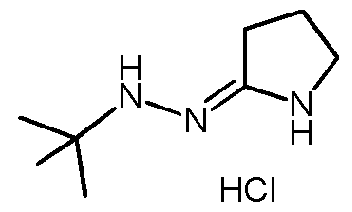
Following the general procedure, 2-(2-(tert-butyl)hydrazono)pyrrolidine hydrochloride was obtained through the reaction of 5-methoxy-3,4-dihydro-2H-pyrrole (2 g, 20.1 mmol) and tert-butylhydrazine hydrochloride (2.6 g, 20.1 mmol), in the presence of 37% HCl (0.2 mmol), in 30 mL EtOH. The mixture was stirred at 50° C for 6 h. The crude product was obtained by the evaporation of left solvent and after transformed into the corresponding salt, employing acetyl chloride in MeOH. The obtained salt was washed with ethanol, affording 13 as a white solid (2.7 g, 70 % yield),
m.p. 244-245 °C
1H NMR (400 MHz, DMSO-d6): d 10.75 (s, 1 H, NH), 9.50 (s, 1 H, NH), 5.50 (s, 1 H, NH), 3.51 (t, J = 7.2 Hz, 2H, CH2), 2.85 (t, J = 8.0 Hz, 2H, CH2), 2.10 (t, J = 7.6 Hz, 2H, CH2), 1.06 (s, 9H, CH3).
13C{1H}NMR (100 MHz, DMSO-d6): 170.5 (C,v), 54.7 (C,v), 46.7 (CH2), 28.8 (CH2), 27.2 (3CH3), 21.1 (CHz).
IR v (cm'1): 3154, 2947, 1680, 1356, 1306, 1220, 1052.
Example 14. Af-(pyrrolidin-2-ylidene) benzenesulfonohydrazide hydrochloride - 14
Following the general procedure, N'-(pyrrolidin-2-ylidene)benzenesulfonohydrazide was obtained through the reaction of 5-methoxy-3,4-dihydro-2H-pyrrole (2 g, 20.1 mmol) and benzenesulfonohydrazide (3.4 g, 20.1 mmol), in the presence of 37% HCl (0.2 mmol), in 30 mL EtOH. The mixture was stirred at 50°C for 3 h. The crude product was obtained by the evaporation of left solvent and after transformed into the corresponding salt, employing acetyl chloride in MeOH. The obtained salt was washed with ethanol, affording 14 as a white solid (2.9 g, 60 % yield), m.p. 191 -192 °C
1H NMR (400 MHz, DMSO-d6): d 8.81 (bs, 1 H, N H), 7.80 (d, J = 8.4 Hz, 2H, CHAr), 7.54 (d, J = 8.4 Hz, 3H, CHAr), 6.81 (bs, 1 H, N H), 3.25 (t, J = 6.4 Hz, 2H, CH2), 2.17 (bs, 2H, C Hz), 1.83 (t, J = 8.4 Hz, 2H, CHz).
13C{1H}NMR (100 MHz, DMSO-d6): 163.4 (C,v), 140.2 (C,v), 132.4 (CHAr), 129.0 (2CHAr), 127.8 (2CHAr), 45.3 (CHz), 29.0 (CHz), 22.1 (CH2).
IR v (cm'1): 3247, 1688, 1549, 1262, 1132, 1108, 1067.
Example 15. 2-(2-cydohexyl hydrazono)pyrrolidine hydrochloride - 15

Following the general procedure, 2-(2-cyclohexylhydrazono)pyrrolidine hydrochloride was obtained through the reaction of 5-methoxy-3,4-dihydro-2H-pyrrole (2 g, 20.1 mmol) and cyclohexylhydrazine hydrochloride (3.0 g, 20.1 mmol), in the presence of 37% HCl (0.2 mmol), in 30 mL EtOH. The mixture was stirred at 50° C for 3 h. The crude product was obtained by the evaporation of left solvent and after transformed into the corresponding salt, employing acetyl chloride in MeOH. The obtained salt was washed with ethanol, affording 15 as a white solid (2.4 g, 55 % yield),
m.p. 170-171 C
Ή NMR (400 MHz, DMSO-d6): d 11.05 (s, 1 H, NH), 9.47 (s, 1 H, NH), 5.71 (s, 1 H, N H), 3.49 (bs, 2H, CHz), 2.80 (bs, 2H, CH2), 2.79 (bs, 1 H, C H), 1.81 (bs, 2H, CH2), 1 .81 -1.68 (m, 6H, C H2) 1 .20-1.08 (m, 4H, CHz).
13C{1H}NMR (100 MHz, DMSO-d6): 169.2 (C,v), 58.08 (CH), 46.8 (CHz), 30.7 (2CHZ), 28.7 (CHz), 26.0 (CHz), 24.4 (2CHz), 21.1 (CHz).
IR v (cm'1): 3171 , 2923, 2852, 1688, 1454, 1305, 1057.
Example 16. 2-(2-(pyrrolidin-2-ylidene)hydrazinyl)benzo[d]thiazole hydrochloride - 16

Following the general procedure, 2-(2-(pyrrolidin-2-ylidene)hydrazinyl)benzo[d]thiazole hydrochloride was obtained through the reaction of 5-methoxy-3,4-dihydro-2H-pyrrole (2 g, 20.1 mmol) and 2-hydrazinylbenzo[d]thiazole (3.3 g, 20.1 mmol), in the presence of 37% HCl (0.2 mmol), in 30 mL EtOH. The mixture was stirred at 50° C for 3 h. The crude product was obtained by the evaporation of left solvent and after transformed into the corresponding salt, employing acetyl chloride in MeOH. The obtained salt was washed with ethanol, affording 16 as a yellowish solid (1.33 g, 25 % yield),
m.p. 237-238 C
1H NMR (400 MHz, DMSO-d6): d 12.2 (s, 1 H, N H), 9.86 (s, 1 H, NH), 7.70 (d, J = 8.0 Hz, 1 H, CHAr), 7.30 (d, J = 4.8 Hz, 2H, CHAr), 7.12 (d, J = 8.0 Hz, 1 H, CHAr), 3.59 (t, J = 6.8 Hz, 2H, CHz), 2.95 (t, J = 8.0 Hz, 2H, CHz), 2.20 (t, J = 7.6 Hz, 2H, CHZ).
13C{1H}NMR (100 MHz, DMSO-d6): 165.9 (C,y), 164.9 (C,v), 142.3 (Civ), 126.6 (2CHAr), 122.1 (2CHAr), 114.5 (Civ), 47.0 (CHZ), 28.6 (CHZ), 20.6 (CHZ).
IR v (cm 1): 2931 , 1679, 1607, 1463, 1393, 1305, 1248.
Example 17. (E)-AT-(pyrrolidin-2-ylidene)acetohydrazide hydrochloride - 17

Following the general procedure, (E)-N'-(pyrrolidin-2-ylidene)acetohydrazide hydrochloride was obtained through the reaction of 5-methoxy-3,4-dihydro-2H-pyrrole (1.24 g, 12.8 mmol) and acetohydrazide (0.95 g, 12.8 mmol), in the presence of 37% HCl (0.2 mmol), in 30 mL EtOH. The mixture was stirred at 50°C for 3 h. The crude product was obtained by the evaporation of left solvent and after transformed into the corresponding salt, employing acetyl chloride in MeOH. The obtained salt was washed with ethanol, affording 17 as a white solid (1.60 g, 70 % yield),
m.p. 194-195 C
1H NMR (400 MHz, DMSO-d6): d 9.0 (bs, 1 H, NH, isomer 1 ), 9.1 (s, 1 H, NH, isomer 2), 6.70 (bs, 1 H, NH, isomers 1 + 2), 3.30-3.26 (m, 2H, CHZ, isomers 1 + 2), 2.34-2.29 (m, 2H, CHZ, isomers 1 + 2), 1.94- 1.77 (m, 5H, CHZ + CH3 isomers 1 + 2).
13C{1H}NMR (100 MHz, DMSO-d6): 170.8 (Civ), 164.4 (Civ), 158.8 (Civ), 153.3 (C,v), 45.2 (CHZ), 45.1 (CHz), 29.3 (CHz), 29.2 (CHZ), 22.4 (CHz), 22.2 (CHz), 21.8 (CH3), 20.6 (CH3).
Example 18. N'-(pyrrolidin-2-ylidene)benzohydrazide hydrochloride - 18
Following the general procedure, N'-(pyrrolidin-2-ylidene)benzohydrazide hydrochloride was obtained through the reaction of 5-methoxy-3,4-dihydro-2H-pyrrole (1 .24 g, 12.8 mmol) and benzohydrazide (1 .74 g, 12.8 mmol), in the presence of 37% HCl (0.2 mmol), in 30 mL EtOH. The mixture was stirred at 50°C for 3 h. The crude product was obtained by the evaporation of left solvent and after transformed into the corresponding salt, employing acetyl chloride in MeOH. The obtained salt was washed with ethanol, affording 18 as a white solid (2.15 g, 70 % yield),
m.p. 243-244 °C
Ή NMR (400 MHz, DMSO-d6): d 9.90 (bs, 1 H, NH), 7.86 (t, J = 6.4 Hz, 2H, CHAr), 7.45-7.38 (m, 3H, CHAr), 7.20-7.10 (bs, 1 H, NH), 3.33 (t, J = 6.4 Hz, 2H, C H2), 2.50-2.45 (m, 2H, CH2), 1 .96-1.90 (m, 2H, CHz).
13C{1H}NMR (100 MHz, DMSO-d6): 162.9 (C,v), 160.5 (C,v), 138.6 (C,v), 130.6 (CHAr), 128.3 (2CHAr), 127.7 (2CHAr), 45.2 (CH2), 29.3 (CH2), 22.1 (CH2).
Example 19. 2-(2-(4-chlorophenyl)hydrazono)piperidine hydrochloride - 19

Following the general procedure, 2-(2-(4-chlorophenyl)hydrazono)piperidine hydrochloride was obtained through the reaction of 6-methoxy-2,3,4,5-tetrahydropyridine (2 g, 17.6 mmol) and (4- chlorophenyl)hydrazine hydrochloride (3.1 g, 17.6 mmol), in the presence of 37% HCl (0.2 mmol), in 30 mL EtOH. The mixture was stirred at 50°C for 3 h. The crude product was obtained by the evaporation of left solvent and after transformed into the corresponding salt, employing acethyl chloride in MeOH. The obtained salt was washed with ethanol, affording 19 as a white solid (4.5 g, 100 % yield),
m.p. 267-268 °C
1H NMR (400 MHz, DMSO-d6): d 11.35 (s, 1 H, NH), 9.68 (s, 1 H, NH), 8.72 (s, 1 H, NH), 7.28 (d, J = 8.8 Hz, 2H, CHAr), 6.89 (d, J = 8.4 Hz, 2H, CHAr), 3.26 (s, 2H, CH2), 2.71 (s, 2H, CH2), 1 .77 (s, 4H, CH2). 13C{1H}NMR (100 MHz, DMSO-d6): 165.3 (C,v), 145.9 (C,v), 129.1 (2CHAr), 124.5 (C,v), 1 15.6 (2CHAr), 41.3 (CH2), 24.0 (CHz), 21 .1 (CH2), 17.7 (CH2).
IR v (cm'1): 3081 , 2976, 1658, 1593, 1488, 1412, 1250.
Example 20. Methyl 5-(2-hydrazono)pyrrolidine-2-carboxylate hydrochloride - 20
 Following the general procedure, methyl 5-(2-hydrazono)pyrrolidine-2-carboxylate hydrochloride was obtained through the reaction of methyl 5-methoxy-3,4-dihydro-2H-pyrrole-2-carboxylate (2 g, 12.8 mmol) and phenylhydrazine (1.4 g, 12.8 mmol), in the presence of 37% HCl (0.2 mmol), in 30 mL EtOH. The mixture was stirred at 50 °C for 3 h. The crude product was obtained by the evaporation of residual solvent and after transformed into the corresponding salt, employing acetyl chloride in MeOH. The obtained salt was washed with ethanol, affording 20 as a yellowish solid (2.0 g, 60 % yield), m.p. 175-178 C
1H NMR (400 MHz, DMSO-d6): d 7.23 (t, J = 7.6 Hz, 2H, CHAr), 6.92 (t, J = 7.6 Hz, 1 H, CHAr), 6.80 (dd, J = 7.6 Hz, J = 1.2 Hz, 2H, CHAr), 4.60-4.55 (m, 1 H, C H), 3.64 (s, 3H, CH ), 2.98-2.93 (m, 2H, C H ), 2.70-2.50 (m, 1 H, CHZ), 2.40-2.20 (m, 1 H, C Hz).
Example 21. Methyl 5-(2-(2,5-dichlorophenyl)hydrazono)pyrrolidine-2-carboxylate
hydrochloride - 21

Following the general procedure, methyl 5-(2-(2,5-dichlorophenyl)hydrazono)pyrrolidine-2- carboxylate hydrochloride was obtained through the reaction of methyl 5-methoxy-3,4-dihydro-2H- pyrrole-2-carboxylate (2 g, 12.8 mmol) and 2,5-dichlorohydrazine (2.26 g, 12.8 mmol), in the presence of 37% HCl (0.2 mmol), in 30 mL EtOH. The mixture was stirred at 50°C for 3 h. The crude product was obtained by the evaporation of residual solvent and after transformed into the corresponding salt, employing acetyl chloride in MeOH. The obtained salt was washed with ethanol, affording 21 as a white solid (2.38 g, 55 % yield),
m.p. 197-198 C
1H NMR (400 MHz, DMSO-d6): d 12.6 (bs, 1 H, NH), 10.44 (bs, 1 H, NH), 8.80 (s, 1 H, NH), 7.41 (d, J = 8.0 Hz, 1 H, CHAr), 7.06 (s, 1 H, CHAr), 6.96 (m, 1 H, CHAr), 4.60 (dd, J = 12.4 Hz, J = 3.6 Hz, 1 H, C H), 3.16-2.97 (m, 2H, CH2), 2.51 (s, 3H, CH3), 2.58-2.05 (m, 2H, CH2).
13C{1H}NMR (100 MHz, DMSO-d6): 172.3 (Civ), 171.4 (C,v), 143.9 (C,v), 133.1 (C,v), 131.4 (CHAr), 121.3 (CHAr), 117.2 (C,v), 1 13.7 (CHAr), 60.4 (CH), 53.0 (CH3), 28.5 (CHZ), 25.7 (CH2).
Example 22. Methyl 5-(2-picolinoylhydrazono)pyrrolidine-2-carboxylate hydrochloride - 22

Following the general procedure, methyl 5-(2-picolinoylhydrazono)pyrrolidine-2-carboxylate hydrochloride was obtained through the reaction of methyl 5-methoxy-3,4-dihydro-2H-pyrrole-2- carboxylate (2 g, 12.8 mmol) and picolinohydrazide (1.75 g, 12.8 mmol), in the presence of 37% HCl (0.2 mmol), in 30 mL EtOH. The mixture was stirred at 50° C for 3 h. The crude product was obtained
by the evaporation of left solvent and after transformed into the corresponding salt, employing acetyl chloride in MeOH. The obtained salt was washed with ethanol, affording 22 as a yellowish solid (2.1 g, 55 % yield),
m.p. 199-200 °C
1H NMR (400 MHz, DMSO-d6): d 10.5-10.0 (bs, 1 H, N H), 9.01 (s, 1 H, CHAr), 8.64 (dd, J = 4.8 Hz, J = 1.2 HZ, 1 H, CHAr), 8.17 (d, J = 8.0 Hz, 1 H, CHAr), 7.46 (dd, J = 8.0 Hz, J = 4.4 Hz, 1 H, ArH), 4.34 (m, 1 H, C H), 3.68 (s, 3H, CH ), 2.56-2.50 (m, 2H, C H2), 2.35-2.29 (m, 1 H, C Hz), 2.07-2.00 (m, 1 H, C H2). 13C{1H}NMR (100 MHz, DMSO-d6): 173.3 (C,v), 171.8 ( v), 161.5 (C,v), 159.6 (C,v), 151.4 (CHAr), 149.0 (CHAr), 135.4 (CHAr), 123.6 (CHAr), 58.6 (CH), 52.5 (CH3), 28.3 (CH2), 26.1 (CH2).
Example 23. (E)-2-(2-(4-chlorophenyl)hydrazono)azepane hydrochloride - 23

(E)-2-(2-(4-chlorophenyl)hydrazono)azepane hydrochloride was obtained through the reaction of 7- methoxy-3,4,5,6-tetrahydro-2H-azepine (2.23 g, 17.6 mmol) and (4-chlorophenyl)hydrazine hydrochloride (3.1 g, 17.6 mmol), in the presence of 37% HCl (0.2 mmol), in 30 mL EtOH. The mixture was stirred at 50° for 3 h. The crude product was obtained by the evaporation of left solvent and after transformed into the corresponding salt, employing acetyl chloride in MeOH. The obtained salt was washed with ethanol, affording the compound as a white solid (0.5 g, 1 1 % yield),
m.p. 236-238 °C
1H NMR (400 MHz, DMSO-d6): d 11.50 (s, 1 H, HCl), 9.69 (br s, 1 H, NH), 8.72 (s, 1 H, NH), 7.32 (d, J = 8.8 Hz, 2H, CHAr), 6.84 (d, J = 8.0 Hz, 2H, CHAr), 3.42 (m, 2H, CH2), 2.81 (m, 2H, CH2), 1 .73 (m, 4H, 2C H2), 1.54 (m, 2H, CH2).
13C NMR (100 MHz, DMSO-d6): d 170.8 (C=N), 145.0 (C,v), 128.9 (2CHAr), 124.3 (C,v), 1 15.1 (2CHAr), 43.1 (CH2), 29.0 (CH2), 28.5 (CH2), 27.4 (CH2), 23.4 (CH2).
IR v (cm 1): 3144, 3082, 2932, 2876, 2843, 1665, 1593, 1489, 1449, 1248, 1121.
Example 24. (E)-2-(2-(4-bromophenyl)hydrazono)pyrrolidine hydrochloride - 24

Following the general procedure, 2-(2-(4-bromophenyl)hydrazono)pyrrolidine hydrochloride was obtained through the reaction of 5-methoxy-3,4-dihydro-2H-pyrrole (0.5 g, 5 mmol) and (4- bromophenyl)hydrazine hydrochloride (1 .1 g, 5 mmol) in 30 mL EtOH. The mixture was stirred at 50° for 3 h. The crude product was washed with ethanol, affording the wanted as a white solid (1.0 g, 68 % yield),
m.p. 246-247 °C
1H NMR (400 MHz, DMSO-d6): d 11.54 (br s, 1 H, HCl), 10.09 (br s, 1 H, N H), 8.86 (br s, 1 H, NH), 7.38 (d, J = 8.7 Hz, 2H, CHAr), 6.84 (d, J = 8.7 Hz, 2H, CHAr), 3.55 (t, J = 7.4 Hz, 2H, C Hz), 2.97 (t, J = 7.7 Hz, 2H, C Hz), 2.17 (quint, J = 7.7 Hz, 2H, C Hz).
13C{1H}NMR (100 MHz, DMSO-d6): d 170.5 (C=N), 145.8 ( v), 131 .6 (2CHAr), 115.5 (2CHAr), 111.8 (Civ), 47.0 (CHZ), 28.6 (CHZ), 20.6 (CHZ).
IR v (cm 1): 3124, 2966, 1703, 1588, 1487, 1314, 1282, 1254, 1071.
Example 25. (E)-2-(2-(3-bromophenyl)hydrazono)pyrrolidine hydrochloride - 25

Following the general procedure, 2-(2-(3-bromophenyl)hydrazono)pyrrolidine hydrochloride was obtained through the reaction of 5-methoxy-3,4-dihydro-2H-pyrrole (0.5 g, 5 mmol) and (3- bromophenyl)hydrazine hydrochloride (1 .1 g, 5 mmol) in 30 mL EtOH. The mixture was stirred at 50° for 3 h. The crude product was washed with ethanol, affording the wanted as a white solid (0.8 g, 54 % yield),
m.p. 247-248 °C
1H NMR (400 MHz, DMSO-d6): d 11.66 (br s, 1 H, HCl), 10.02 (br s, 1 H, NH), 9.03 (br s, 1 H, NH), 7.16 (t, J = 7.9 Hz, 1 H, CHAr), 7.05-7.01 (m, 2H, CHAr), 6.85 (d, J = 7.9 Hz, 1 H, CHAr), 3.54 (t, J = 7.9 Hz, 2H, CHZ), 2.97 (t, J = 7.9 Hz, 2H, CHZ), 2.17 (quint, J = 7.9 Hz, 2H, CHZ).
13C{1H}NMR (100 MHz, DMSO-d6): d 170.3 (C=N), 148.2 (C,v), 130.9 (CHAr), 123.0 (CHAr), 122.2 (C,v), 115.5 (CHAr), 112.4 (CHAr), 46.9 (CHZ), 28.6 (CHZ), 20.6 (CHZ).
IR v (cm'1): 3145, 2971 , 1693, 1596, 1478, 1312, 1242.
Example 26. (E)-2-(2-(3-chlorophenyl)hydrazono)pyrrolidine hydrochloride - 26

Following the general procedure, 2-(2-(3-chlorophenyl)hydrazono)pyrrolidine hydrochloride was obtained through the reaction of 5-methoxy-3,4-dihydro-2H-pyrrole (1.0 g, 10 mmol) and (3- chlorophenyl)hydrazine hydrochloride (1.7 g, 10.1 mmol), in 20 mL EtOH. The mixture was stirred at 50° for 3 h. The crude product was washed with ethanol, affording the wanted compound as a white solid (0.73 g, 30 % yield),
m.p. 242-243 °C
1H NMR (400 MHz, DMSO-d6): d 11.79 (br s, 1 H, HCl), 10.09 (br s, 1 H, N H), 9.12 (br s, 1 H, NH), 7.25 (t, J = 7.9 Hz, 1 H, CHAr), 6.89-6.93 (m, 2H, CHAr), 6.84 (d, J = 7.9 Hz, 1 H, CHAr), 3.55 (t, J = 7.9 Hz, 2H, C Hz), 2.99 (t, J = 7.9 Hz, 2H, C H2), 2.16 (quint, J = 7.9 Hz, 2H, C H2).
13C{1H}NMR (100 MHz, DMSO-d6): d 170.6 (C=N), 148.1 (C,v), 133.7 (Civ), 130.6 (CHAr), 120.1 (CHAr), 112.8 (CHAr), 112.1 (CHAr), 47.0 (CH2), 28.6 (CH2), 20.6 (CH2).
IR v (cm 1): 3166, 3084, 2969, 1690, 1587, 1471 , 1307, 1248.
Example 27. (E)-2-(2-(3-nitrophenyl)hydrazono)pyrrolidine hydrochloride - 27

Following the general procedure, (E)-2-(2-(3-nitrophenyl)hydrazono)pyrrolidine hydrochloride was obtained through the reaction of 5-methoxy-3,4-dihydro-2H-pyrrole (1.24 g, 12.8 mmol) and (3- nitrophenyl)hydrazine (1.96 g, 12.8 mmol), in the presence of 37% HCl (0.2 mmol), in 30 mL EtOH. The mixture was stirred at 50 ° C for 3 h. The crude product was obtained by filtration. The obtained salt was washed with ethanol, affording 27 as a white solid (1.02 g, 31 % yield),
m.p. 242-243 °C
1H NMR (400 MHz, DMSO-d6): d 11.79 (br s, 1 H, HCl), 10.09 (br s, 1 H, NH), 9.12 (br s, 1 H, NH), 7.25 (t, J = 7.9 Hz, 1 H, CHAr), 6.89-6.93 (m, 2H, CHAr), 6.84 (d, J = 7.9 Hz, 1 H, CHAr), 3.55 (t, J = 7.9 Hz, 2H, CH2), 2.99 (t, J = 7.9 Hz, 2H, CH2), 2.16 (quint, J = 7.9 Hz, 2H, CH2).
13C{1H}NMR (100 MHz, DMSO-d6): d 170.6 (C=N), 148.1 (C,v), 133.7 (C,v), 130.6 (CHAr), 120.1 (CHAr), 112.8 (CHAr), 112.1 (CHAr), 47.0 (CH2), 28.6 (CH2), 20.6 (CH2).
IR v (cm'1): 3153, 3078, 2988, 1692, 1523, 1349, 1311.
Example 28. (E)-2-(2-(2-chlorophenyl)hydrazono)pyrrolidine hydrochloride - 28

Following the general procedure, 2-(2-(2-chlorophenyl)hydrazono)pyrrolidine hydrochloride was obtained through the reaction of 5-methoxy-3,4-dihydro-2H-pyrrole (1.0 g, 10 mmol) and (2- chlorophenyl)hydrazine hydrochloride (1.7 g, 10.1 mmol), in 20 mL EtOH. The mixture was stirred at 50° for 3 h. The crude product was washed with ethanol, affording the wanted compound as a white solid (1 .4 g, 56% yield),
m.p. 246-247 C
1H NMR (400 MHz, DMSO-d6): d 11.77 (br s, 1 H, HCl), 10.06 (br s, 1 H, NH), 8.44 (br s, 1 H, NH), 7.35 (dd, J = 7.8, 1 .2 Hz, 1 H, CHAr), 7.22 (td, J = 7.8, 1.3 Hz, 1 H, CHAr), 6.95 (dd, J = 8.2, 1 .5 Hz, 1 H,
CHAr), 6.88 (td, J = 7.8, 1.7 Hz, 1 H, CHAr), 3.56 (t, J = 7.8 Hz, 2H, C Hz), 3.01 (t, J = 7.8 Hz, 2H, C Hz), 2.18 (quint, J = 7.8 Hz, 2H, CH2).
13C{1H}NMR (100 MHz, DMSO-d6): d 170.4 (C=N), 142.1 (C,v), 129.6 (CHAr), 128.0 (CHAr), 121.6 (CHAr), 118.3 (C,v), 1 14.0 (CHAr), 47.1 (CH2), 28.8 (CH2), 20.6 (CH2).
IR v (cm'1): 3169, 2963, 1690, 1595, 1493, 1302, 1 159.
Example 29. (E)-2-(2-(3,4-dimethylphenyl)hydrazono)pyrrolidine hydrochloride - 29

Following the general procedure, 2-(2-(3,4-dimethylphenyl)hydrazono)pyrrolidine hydrochloride was obtained through the reaction of 5-methoxy-3,4-dihydro-2H-pyrrole (0.86 g, 8.7 mmol) and 3,4- dimethylphenylhydrazine (1 , 19 g, 8.7 mmol) in 30 mL EtOH. The mixture was stirred at 50° C for 24 h. The crude product was obtained by filtration. The obtained salt was washed with ethanol, affording 29 as a white solid (0.50 g, 25 % yield),
m.p. 212-213 °C
1H NMR (400 MHz, DMSO-d6): d 11.61 (s, 1 H, HCl), 9.97 (s, 1 H, NH), 8.55 (s, 1 H, N H), 6.99 (d, J = 8.0 Hz, 1 H, CHAr), 6.66 (s, 1 H, CHAr), 6.60 (d, J = 8.0 Hz, 1 H, CHAr), 3.54 (t, J = 7.6 Hz, 2H, CH2), 2.97 (t, J = 8.0 Hz, 2H, CH2), 2.17 (quint, J = 7.6 Hz, 2H, CH2), 2.17 (s, 3H, CH ), 2.13 (s, 3H, CH ).
13C{1H}NMR (100 MHz, DMSO-d6): d 170.1 (C=N), 144.3 (CHAr), 136.6 (C,v), 129.8 (CHAr), 128.2 (C,v), 114.9 (CHAr), 111.1 (C,y), 46.8 (CHZ), 28.5 (CHZ), 20.7 (CHZ), 19.6 (CH3), 18.6 (CH3).
IR v (cm'1): 3157, 2878, 1697, 1614, 1504, 1310, 1300.
Example 30. (E)-2-(2-(naphthalen-1 -yl)hydrazono)pyrrolidine hydrochloride - 30

Following the general procedure, 2-(2-(naphthalen-1 -yl)hydrazono)pyrrolidine hydrochloride was obtained through the reaction of 5-methoxy-3,4-dihydro-2H-pyrrole (0.5 g, 5 mmol) and naphthalen- 1 -ylhydrazine hydrochloride (1.0 g, 5 mmol) in 20 mL EtOH. The mixture was stirred at 50° for 3 h. The crude product was washed with ethanol, affording a white solid (1.0 g, 76 % yield),
m.p. 256-257 °C
Ή NMR (400 MHz, DMSO-d6): d 11.74 (br s, 1 H, HCl), 10.04 (br s, 1 H, NH), 9.16 (br s, 1 H, NH), 8.18- 8.16 (m, 1 H, CHAr), 7.90-7.88 (m, 1 H, CHAr), 7.54-7.52 (m, 2H, CHAr), 7.46 (d, J = 7.6 Hz, 1 H, CHAr), 7.39 (t, J = 7.6 Hz, 1 H, CHAr), 6.88 (d, J = 7.6 Hz, 1 H, CHAr), 3.57 (t, J = 7.9 Hz, 2H, CH2), 3.08 (t, J = 7.9 Hz, 2H, CH2), 2.21 (quint, J = 7.9 Hz, 2H, CH2).
13C{1H}NMR (100 MHz, DMSO-d6): d 170.2 (C=N), 141.2 (Civ), 133.8 (Civ), 128.0 (CHAr), 126.2 (CHAr), 126.0 (CHAr), 125.0 (CHAr), 122.4 (C,v), 122.0 (CHAr), 120.5 (CHAr), 106.2 (CHAr), 47.0 (CHZ), 28.7 (CHz), 20.7 (CHz).
IR v (cm'1): 3234, 2956, 1686, 1583, 1526, 1403, 1310.
Example 31. (E)-2-(2-(2-methoxyphenyl)hydrazono)pyrrolidine hydrochloride - 31

Following the general procedure, 2-(2-(2-methoxyphenyl)hydrazono)pyrrolidine hydrochloride was obtained through the reaction of 5-methoxy-3,4-dihydro-2H-pyrrole (0.5 g, 5 mmol) and (2- methoxyphenyl)hydrazine hydrochloride (1.1 g, 5 mmol) in 30 mL EtOH. The mixture was stirred at 50° for 3 h. The crude product was washed with ethanol, affording the wanted as a white solid (0.75 g, 60 % yield),
m.p. 262-263 °C
1H NMR (400 MHz, DMSO-d6): d 1 1 .35 (br s, 1 H, HCl), 9.97 (br s, 1 H, N H), 8.06 (br s, 1 H, N H), 6.98 (dd, J = 7.3, 2.2 Hz, 1 H, CHAr), 6.89-6.85 (m, 2H, CHAr), 6.81 (dd, J = 7.3, 2.2 Hz, 1 H, CHAr), 3.82 (s, 3H, OCHj), 3.55 (t, J = 7.8 Hz, 2H, CH2), 2.97 (t, J = 7.8 Hz, 2H, CHZ), 2.17 (quint, J = 7.8 Hz, 2H, C Hz).
13C{1H}NMR (100 MHz, DMSO-d6): d 170.3 (C=N), 146.9 (Civ), 134.9 (Civ), 121 .1 (CHAr), 120.7 (CHAr), 112.7 (CHAr), 110.9 (CHAr), 55.5 (CH3), 46.9 (CH2), 28.6 (CHZ), 20.7 (CHZ).
IR v (cm 1): 3185, 1698, 1596, 1506, 1456, 1306, 1253, 1229, 1033.
Example 32. (E)-2-(2-(2-bromophenyl)hydrazono)pyrrolidine hydrochloride - 32

Following the general procedure, 2-(2-(2-bromophenyl)hydrazono)pyrrolidine hydrochloride was obtained through the reaction of 5-methoxy-3,4-dihydro-2H-pyrrole (0.5 g, 5 mmol) and (2- bromophenyl)hydrazine hydrochloride (1 .1 g, 5 mmol) in 30 mL EtOH. The mixture was stirred at 50° for 3 h. The crude product was washed with ethanol, affording the wanted as a white solid (0.75 g, 60 % yield),
m.p. 227-228 °C
1H NMR (400 MHz, DMSO-d6): d 11.75 (br s, 1 H, HCl), 10.02 (br s, 1 H, NH), 8.23 (br s, 1 H, NH), 7.54 (dd, J = 7.9, 1.3 Hz, 1 H, CHAr), 7.29 (t, J = 7.6 Hz, 1 H, CHAr), 6.96 (dd, J = 8.3, 1.3 Hz, 1 H, CHAr), 6.85 (td, J = 7.5, 1 .4 Hz, 1 H, CHAr), 3.56 (t, J = 7.2 Hz, 2H, CHZ), 3.00 (t, J = 7.2 Hz, 2H, CH2), 2.18 (quint, J = 7.2 Hz, 2H, CHZ).
13C{1H}NMR (100 MHz, DMSO-d6): d 170.3 (C=N), 143.1 (C,v), 132.9 (CHAr), 128.5 (CHAr), 122.1 (CHAr), 114.2 (CHAr), 107.9 (C!V), 47.1 (CHZ), 28.8 (CHZ), 20.7 (CHZ).
IR v (cm'1): 3168, 2962, 1690, 1593, 1489, 1301 , 1020.
Example 33. (E)-2-(2-(3,5-dichlorophenyl)hydrazono)pyrrolidine hydrochloride - 33

Following the general procedure, (E)-2-(2-(3,5-dichlorophenyl)hydrazono)pyrrolidine hydrochloride was obtained through the reaction of 5-methoxy-3,4-dihydro-2H-pyrrole (1.24 g, 12.8 mmol) and (3,5- dichlorophenyl)hydrazine (2.26 g, 12.8 mmol) in 30 mL EtOH. The mixture was stirred at 50° C for 24 h. The crude product was obtained by filtration. The obtained salt was washed with ethanol, affording 33 as a white solid (1.32 g, 37 % yield),
m.p. 216-218 °C
1H NMR (400 MHz, DMSO-d6): d 1 1 .81 (s, 1 H, HCl), 10.14 (s, 1 H, N H), 9.46 (s, 1 H, NH), 7.01 (s, 1 H, CHAr), 6.93 (s, 2H, CHAr), 3.55 (t, J = 7.2 Hz, 2H, C H2), 2.99 (t, J = 7.2 Hz, 2H, CH2), 2.16 (quint, J = 7.2 Hz, 2H, C H2).
13C{1H}NMR (100 MHz, DMSO-d6): d 170.8 (C=N), 149.2 (C,v), 134.5 (CHAr), 119.3 (2C|V), 111.6 (2CHAr), 47.1 (CH2), 28.8 (CH2), 20.6 (CH2).
IR v (cm 1): 2970, 2899, 1682, 1584, 1514, 1449, 1414, 1306.
Example 34. (E)-2-(2-(2-(trifluoromethyl)phenyl)hydrazono)pyrrolidine hydrochloride - 34
 Ratio isomer 1 /isomer 2 : 91 /09
Following the general procedure, 2-(2-(2-trifluoromethylphenyl)hydrazono)pyrrolidine hydrochloride was obtained through the reaction of 5-methoxy-3,4-dihydro-2H-pyrrole (0.7 g, 7.1 mmol) and 2- (trifluoromethyl)phenylhydrazine (1 ,25 g, 7.1 mmol) in 30 mL EtOH. The mixture was stirred at 50°C for 24 h. The crude product was obtained by filtration. The obtained salt was washed with ethanol, affording 34 as a white solid (0.48 g, 30 % yield),
m.p. 204-205 °C
1H NMR (400 MHz, DMSO-d6): d 12.06 (s, 1 H, HCl, conformer 1 ), 11 .97 (br s, 1 H, HCl, conformed), 10.19 (s, 1 H, NH, conformer 2), 9.95 (s, 1 H, NH, conformer 1 ), 8.46 (s, 1 H, NH, conformer 2), 8.40 (s, 1 H, NH, conformer 1 ), 7.58 (m, 2H, CHAr, conformers 1 +2), 7.12 (d, J = 8.4 Hz, 1 H, CHAr, conformers 1 +2), 7.04 (t, J = 7.7 Hz, 1 H, CHAr, conformers 1 +2), 3.69 (t, J = 7.6 Hz, 2H, CH2, conformer 2), 3.57 (t, J = 6.8 Hz, 2H C H2, conformer 1 ), 3.02 (t, J = 8.0 Hz, 2H, C H2, conformer 1 ), 2.87 (t, J = 8.0 Hz, 2H, C H2, conformer 2), 2.18 (t, J = 7.2 Hz, 2H, CH2, conformer 1 ), 2.04 (t, J = 8.0 Hz, 2H, CH2, conformer 2).
13C{1H}NMR (100 MHz, DMSO-d6): d 170.3 (C=N), 143.3 (d, CHAr , 2 = 1.1 Hz), 133.7 (CHAr), 126.6 (q, Civ, 2 = 6.1 Hz), 124.2 (q, CF3, J = 271.8 Hz), 120.6 (CHAr), 1 14.1 (CHAr), 113.5 (q, C,v, 2 = 12.1 Hz), 47.2 (CHz), 28.9 (CH2), 20.6 (CHz).
IR v (cm'1): 3200, 2899, 1694, 1612, 1591 , 1454, 1317, 1269, 1163, 1109.
Example 35. (E)-2-(2-(2,4-difluorophenyl)hydrazono)pyrrolidine hydrochloride - 35

Following the general procedure, 2-(2-(2,4-difluorophenyl)hydrazono)pyrrolidine hydrochloride was obtained through the reaction of 5-methoxy-3,4-dihydro-2H-pyrrole (0.82 g, 8.3 mmol) and 2,4- difluorophenylhydrazine (1 ,2 g, 8.3 mmol) in 30 mL EtOH. The mixture was stirred at 50°C for 6 h. The crude product was obtained by filtration. The obtained salt was washed with ethanol, affording 35 as a white solid (0.92 g, 45 % yield),
m.p. 162-163 °C
1H NMR (400 MHz, DMSO-d6): d 11.80 (s, 1 H, HCl), 10.11 (s, 1 H, NH), 8.67 (s, 1 H, N H), 7.27 (ddd, 2 = 12.4, 9.4, 3.4 Hz, 1 H, CHAr), 7.00-7.08 (m, 2H, CHAr), 3.56 (t, J = 6.8 Hz, 2H, C H2), 2.98 (t, J = 7.2 Hz, 2H, CH2), 2.17 (t, J = 7.6 Hz, 2H, C H2).
13C{1H}NMR (100 MHz, DMSO-d6): d 170.4 (C=N), 156.6 (dd, C,v, J = 239.0 Hz, J =1 1.1 Hz), 150.8 (dd, Civ, 2 = 244.4 Hz, J = 12.1 Hz), 131.3 (dd, CHAr, 2 = 10.7 Hz, 2 = 2.9 Hz), 116.3 (dd, CHAr, 2 = 9.2 Hz, 2 = 3.4 Hz), 1 1 1 .5 (dd, C,v, 2 = 21.8 Hz, 2 = 3.4 Hz), 104.2 (dd, CHAr, 2 = 27.6 Hz, 2 = 23.2 Hz), 46.9 (CHz), 28.7 (CHz), 20.7 (CHz) .
IR v (cm'1): 2978, 2880, 1694, 1612, 1508, 1310, 1267, 1202, 1144.
Example 36. (E)-2-(2-(2,4-dichlorophenyl)hydrazono)pyrrolidine hydrochloride - 36

Following the general procedure, 2-(2-(2,4-dichlorophenyl)hydrazono)pyrrolidine hydrochloride was obtained through the reaction of 5-methoxy-3,4-dihydro-2H-pyrrole (0.47 g, 4.7 mmol) and 2,4- dichlorophenylhydrazine (0.76 g, 4.7 mmol) in 30 mL EtOH. The mixture was stirred at 50° C for 24 h. The crude product was obtained by filtration. The obtained salt was washed with ethanol, affording 36 as a white solid (0.78 g, 60 % yield),
m.p. 210-212 °C
Ή NMR (400 MHz, D20): d 7.51 (d, 2 = 2.4 Hz, 1 H, CHAr), 7.31 (dd, 2 = 8.8, 2.4 Hz, 1 H, CHAr) 6.94 (d, 2 = 8.4 Hz, 1 H, CHAr), 3.73 (t, 2 = 7.2 Hz, 2H, CHz), 3.07 (t, 2 = 8.0 Hz, 2H, CH2), 2.34 (t, 2 = 8.0 Hz, 2H, CHz).
13C{1H}NMR (100 MHz, DMSO-d6): d 170.7 (C=N), 146.8 (Civ), 131.5 (Civ), 130.8 (CHAr), 121.6 (Civ), 114.5 (CHAr), 113.9 (CHAr), 47.0 (CH2), 28.7 (CH2), 20.6 (CH2).
IR v (cm 1): 3186, 2880, 1697, 1568, 1485, 1450, 1387, 1306, 1290.
Example 37. (E)-2-(2-(3,4-dichlorophenyl)hydrazono)pyrrolidine hydrochloride - 37

Following the general procedure, 2-(2-(3,4-dichlorophenyl)hydrazono)pyrrolidine hydrochloride was obtained through the reaction of 5-methoxy-3,4-dihydro-2H-pyrrole (0.7 g, 7.1 mmol) and 3,4- dichlorophenylhydrazine (1.25 g, 7.1 mmol) in 30 mL EtOH. The mixture was stirred at 50° C for 24 h. The crude product was obtained by filtration. The obtained salt was washed with ethanol, affording 37 as a white solid (1.03 g, 52 % yield),
m.p. 208-210 °C
1H NMR (400 MHz, DMSO-d6): d 11.60 (s, 1 H, HCl), 10.12 (s, 1 H, NH), 9.1 1 (s, 1 H, N H), 7.48 (d, J = 8.8 Hz, 1 H, CHAr), 7.13 (d, J = 2.0 Hz, 1 H, CHAr), 6.88 (dd, J = 7.2, 2.0 Hz, 1 H, CHAr), 3.56 (t, J = 7.6 Hz, 2H, CH2), 2.98 (t, J = 7.6 Hz, 2H, CH2), 2.17 (t, J = 7.6 Hz, 2H, CH2).
13C{1H}NMR (100 MHz, DMSO-d6): d 170.7 (C=N), 146.8 (C,v), 131.5 (C,v), 130.8 (CHAr), 121.6 (C,v), 114.5 (CHAr), 113.9 (CHAr), 47.0 (CH2), 28.7 (CH2), 20.6 (CH2).
IR v (cm'1): 3138, 2965, 2866, 2758, 1694, 1601 , 1584, 1466, 1310; 1290.
Example 38. (E)-4-(2-(pyrrolidin-2-ylidene)hydrazinyl)pyridine hydrochloride - 38

Following the general procedure, 2-(2-(4-pyridinyl)hydrazono)pyrrolidine hydrochloride was obtained through the reaction of 5-methoxy-3,4-dihydro-2H-pyrrole (1 g, 10.0 mmol) and 4-hydrazonopyridine (1 ,47 g, 10.0 mmol) in 30 mL EtOH. The mixture was stirred at 50°C for 24 h. The crude product was obtained by filtration. The obtained salt was washed with heptane (3x 20 mL) and ethanol (15 mL), affording 38 as a white solid (675.1 mg, 32 % yield),
m.p. 195-196 °C
1H NMR (400 MHz, DMSO-d6): d 11.50 (s, 1 H, HCl), 10.04 (s, 1 H, NH), 8.91 (s, 1 H, NH), 7.16 (d, J = 8.0 Hz, 1 H, CHAr), 7.00-7.03 (m, 2H, CHAr), 6.82-6.84 (m, 1 H, 1 CHAr) 3.52 (t, J = 7.2 Hz, 2H, CH2), 2.95 (t, J = 8.0 Hz, 2H, CH ), 2.14 (quint, J = 7.6 Hz, 2H, CH2).
13C{1H}NMR (100 MHz, DMSO-d6): d 170.8 (C=N), 149.2 (C|V), 134.5 (CHAr), 119.3 (CHAr), 11 1 .6 (2CHAr), 47.1 (CH2), 28.8 (CH2), 20.6 (CH2).
IR v (cm'1): 3144, 2978, 2889, 1694, 1595, 1
481 , 1312.
Example 39. (E)-2-chloro-6-(2-(pyrrolidin-2-ylidene)hydrazinyl)pyridine - 39

Following the general procedure, (E)-2-chloro-6-(2-(pyrrolidin-2-ylidene)hydrazinyl)pyridine was obtained through the reaction of 5-methoxy-3,4-dihydro-2H-pyrrole (1.04 g, 10.0 mmol) and 2-chloro- 6-hydrazinylpyridine (1 ,43 g, 10.0 mmol) in 30 mL EtOH. The mixture was stirred at 50°C for 24 h. The crude product was obtained by filtration. The obtained salt was washed with ethanol, affording 39 as a white solid (0.25 g, 11 % yield),
m.p. 165-166 °C
1H NMR (400 MHz, DMSO-d6): d 8.74 (br s, 1 H, NH), 7.42 (t, J = 8.0 Hz, 1 H, CHAr), 6.69 (d, J = 8.0 Hz, 1 H, CHAr), 6.12 (br s, 1 H, NH), 6.48 (d, J = 7.6 Hz, 1 H, CHAr), 3.27 (t, J = 7.2 Hz, 2H, CH ), 2,35 (t, J = 8.0 Hz, 2H, CHz), 1 ,86 (quint, J = 7.2 Hz, 2H, CH2).
13C{1H}NMR (100 MHz, DMSO-d6): d 158.4 (C=N), 153.1 (C,v), 147.9 (C,v), 140.3 (CHAr), 1 10.6 (CHAr), 103.7 (CHAr), 44.8 (CH2), 28.9 (CH2), 22.1 (CH2).
IR v (cm'1): 3242, 2860, 1638, 1589, 1431 , 1285, 1269, 1 153.
Example 40. (E)-Methyl 5-(2-(3-chlorophenyl)hydrazono)pyrrolidine-2-carboxylate
hydrochloride - 40

Following the general procedure methyl 5-(2-(3-chlorophenyl)hydrazono)pyrrolidine-2-carboxylate hydrochloride was obtained through the reaction of methyl 5-methoxy-3,4-dihydro-2H-pyrrole-2- carboxylate (1.0 g, 6.4 mmol) and (3-chlorophenyl)hydrazine hydrochloride (1.2 g, 6.4 mmol), in 30 mL EtOH. The mixture was stirred at 50° for 3 h. The crude product was obtained by the evaporation of left solvent. The obtained mixture was washed with ethanol, affording an off-white solid (1.5 g, 77 % yield),
m.p. 217-218 C.
1H NMR (400 MHz, DMSO-d6): d 12.15 (br s, 1 H, HCl), 10.51 (br s, 1 H, NH), 9.18 (s, 1 H, NH), 7.28 (t, J = 8.4 Hz, 1 H, CHAr), 6.92-6.95 (m, 2H, CHAr), 6.84 (ddd, J = 8.2, 2.2, 1 .0 Hz, 1 H, CHAr), 4.64 (dd,
J = 9.2, 3.6 Hz, 1 H, C H), 3.71 (s, 3H, OC H3), 3.05-3.09 (m, 2H, C H2), 2.53-2.63 (m, 1 H, C H2), 2.22- 2.28 (m, 1 H, C H2).
13C{1H}NMR (100 MHz, DMSO-d6): d 171.6 (C=0), 170.9 (C=N), 147.8 (Civ), 133.7 (CHAr), 130.7 (CHAr), 120.4 (Civ), 112.9 (CHAr), 112.3 (CHAr), 59.8 (CH), 52.6 (CH3), 27.8 (CHZ), 25.2 (CH2).
IR v (cm 1): 3163, 2952, 1750, 1692, 1597, 1477, 1272, 1214.
Example 41. (E)-Methyl 5-(2-(2,6-dichlorophenyl)hydrazono)pyrrolidine-2-carboxylate hydrochloride - 41
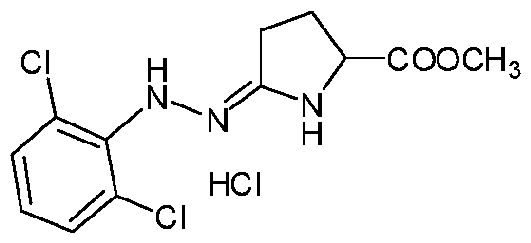
Following the general procedure methyl 5-(2-(2,6-dichlorophenyl)hydrazono)pyrrolidine-2- carboxylate hydrochloride was obtained through the reaction of methyl 5-methoxy-3,4-dihydro-2H- pyrrole-2-carboxylate (1.0 g, 6.4 mmol) and (2,6-dichlorophenyl)hydrazine hydrochloride (1.35 g, 6.4 mmol), in 30 mL EtOH. The mixture was stirred at 50° for 3 h. The crude product was obtained by the evaporation of left solvent. The obtained mixture was washed with ethanol, affording an off- white solid (1 .3 g, 60 % yield),
m.p. 189-190°C.
1H NMR (400 MHz, DMSO-d6): d 12.12 (bs, 1 H, NH), 10.60 (s, 1 H, NH), 8.13 (s, 1 H, NH), 7.49 (m, 2H, CHAr), 7.17 (m, 1 H, CHAr), 4.72 (bs, 1 H, CH), 3.73 (s, 3H, CH3), 2.94 (t, J = 6.75 Hz, 2H, CHZ), 2.57 (m, 1 H, CHZ), 2.25 (bs, 1 H, CHZ).
13C{1H}NMR ( 100 MHz, DMSO-d6): 171 .3 (C,y), 170.4 (C,y), 138.6 (C,y), 129.9 (2CHAr), 126.8 (CHAr), 126.2 (2C|V), 60.3 (CH), 53.0 (CH3), 28.2 (CHZ), 25.8 (CHZ).
IR v (cm'1): 3202, 2950, 1748, 1695, 1567, 1449, 1204, 1096.
Example 42. (E)-Methyl 5-(2-(4-chlorophenyl)hydrazono)pyrrolidine-2-carboxylate
hydrochloride - 42
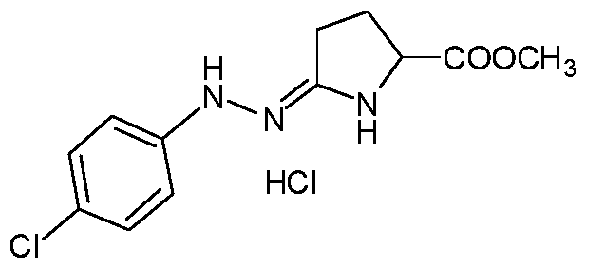
Following the general procedure methyl 5-(2-(3-chlorophenyl)hydrazono)pyrrolidine-2-carboxylate hydrochloride was obtained through the reaction of methyl 5-methoxy-3,4-dihydro-2H-pyrrole-2- carboxylate (1 g, 6.4 mmol) and (4-chlorophenyl)hydrazine hydrochloride (1 .2 g, 6.4 mmol), in 30 mL EtOH. The mixture was stirred at 50° for 3 h. The crude product was obtained by the evaporation of left solvent. The obtained mixture was washed with ethanol, affording an off-white solid (1.36 g, 70% yield).
m.p. 227-228 °C.
1H NMR (400 MHz, DMSO-d6): d 11.95 (bs, 1 H, NH), 10.51 (s, 1 H, NH), 8.97 (s, 1 H, NH), 7.32 (dd, J = 8.65 Hz, J = 1.92 Hz, 2H, CHAr), 6.91 (dd, J = 8.65 Hz, J = 1 .92 Hz, 2H, CHAr), 4.64 (q, J = 4.3 Hz,
1 H, CH), 3.74 (s, 3H, CH3), 3.07 (t, J = 8.74 Hz, 2H, C H2), 2.61 -2.51 (m, 1 H, CH2), 2.32-2.25 (m, 1 H,
C H2).
13C{1H}NMR (100 MHz, DMSO-d6): 171.4 (C,v), 170.8 (C,v), 145.0 (C,v), 128.7 (2 CHAr), 124.4 (C!V), 115.1 (2CHAr), 59.6 (CH), 52.5 (CH3), 27.6 (CH2), 25.1 (CH2).
IR v (cm'1): 3159, 2953, 1755, 1693, 1489, 1270, 1253, 1093.
Example 43. (E)-Methyl 5-(2-(4-methoxyphenyl)hydrazono)pyrrolidine-2-carboxylate hydrochloride - 43

Following the general procedure methyl 5-(2-(4-methoxyphenyl)hydrazono)pyrrolidine-2-carboxylate hydrochloride was obtained through the reaction of methyl 5-methoxy-3,4-dihydro-2H-pyrrole-2- carboxylate (0.5 g, 3.2 mmol) and (4-methoxyphenyl)hydrazine hydrochloride (0.55 g, 3.2 mmol), in 30 mL EtOH. The mixture was stirred at 50° for 3 h. The crude product was obtained by the evaporation of left solvent. The obtained mixture was washed with ethanol, affording an off-white solid (0.74 g, 78 % yield),
m.p. 197-198 C.
1H NMR (400 MHz, DMSO-d6): d 1 1 .91 (bs, 1 H, NH), 10.35 (s, 1 H, N H), 8.53 (s, 1 H, N H), 6.85 (d, J = 1.6 Hz, 4H, CHAr), 4.61 (q, J = 4.4 Hz, 1 H, CH), 3.71 (s, 3H, CH3), 3.73 (s, 3H, CH3), 3.06 (t, J = 8.2 Hz, 2H, CHz), 2.66-2.49 (m, 1 H, CH2), 2.32-2.18 (m, 1 H, CH2).
13C{1H}NMR (100 MHz, DMSO-d6): 171.0 (C=0), 170.9 (Civ), 154.1 (C,v), 139.5 (C v), 115.3 (2CHAr), 114.4 (2CHAr), 59.4 (CH), 55.2 (CH3), 52.5 (CH3), 27.5 (CH2), 25.2 (CH2).
IR v (cm 1): 3173, 2950, 2861 , 1749, 1689, 1510, 1238, 1 177, 1031.
Example 44. (E)-Methyl 5-(2-(4-fluorophenyl)hydrazono)pyrrolidine-2-carboxylate hydrochloride - 44

Following the general procedure methyl 5-(2-(4-fluorophenyl)hydrazono)pyrrolidine-2-carboxylate hydrochloride was obtained through the reaction of methyl 5-methoxy-3,4-dihydro-2H-pyrrole-2- carboxylate (1.0 g, 6.4 mmol) and (4-fluorophenyl)hydrazine hydrochloride (1.0 g, 6.4 mmol), in 30 mL EtOH. The mixture was stirred at 50° for 3 h. The crude product was obtained by the evaporation of left solvent. The obtained mixture was washed with ethanol, affording an off-white solid (1.5 g, 80 % yield),
m.p. 217-218 C.
1H NMR (400 MHz, DMSO-d6): d 12.12 (s, 1 H, N H), 10.45 (s, 1 H, N H), 8.90 (s, 1 H, N H), 7.12 (t, J = 8.4 Hz, 2H, CHAr), 6.92 (d, J = 2.4 Hz, 2H, CHAr), 4.63 (t, J = 2.4 Hz, 1 H, CH), 3.71 (s, 3H, CH3), 3.05 (d, J = 6.4 Hz, 2H, CH2), 2.64 (m, 1 H, C H2), 2.24 (d, J = 6.8 Hz, 1 H, C H2).
13C{1H}NMR ( 100 MHz, DMSO-d6): 171.8 (Cv), 170.7 (C,v), 157.6 (d, C,v, JC-F = 235.4 Hz), 143.0 (C,v), 116.0 (d, CHAr, JC-F = 22.0 Hz), 1 15.6 (d, CHAr, JC-F = 8.3 Hz), 60.0 (CH), 53.0 (CH3), 28.1 (CHz), 25.7 (CH2).
IR v (cm'1): 3178, 2957, 2864, 1737, 1687, 1507, 1278, 1214.
Example 45. Methyl 5-(2-(4-cyanophenyl)hydrazono)pyrrolidine-2-carboxylate hydrochloride - 45

Ratio conformer 1 / conformer 2: 90/10
Following the general procedure methyl 5-(2-(4-cyanophenyl)hydrazono)pyrrolidine-2-carboxylate hydrochloride was obtained through the reaction of methyl 5-methoxy-3,4-dihydro-2H-pyrrole-2- carboxylate (0.5 g, 3.2 mmol) and 4-hydrazinylbenzonitrile hydrochloride (0.5 g, 3.2 mmol), in 30 mL EtOH. The mixture was stirred at 50° for 3 h. The crude product was obtained by the evaporation of left solvent. The obtained mixture was washed with ethanol, affording an off-white solid (0.56 g, 60 % yield),
m.p. 221 -222 °C.
1H NMR (400 MHz, DMSO-d6): d 12.10 (s, 1 H, HCl, conformers 1 + 2), 10.63 (s, 1 H, NH, conformer 1 ), 9.72 (s, 1 H, NH, conformer 2), 9.70 (s, 1 H, NH, conformer 1 ), 9.15 (s, 1 H, NH, conformer 2), 7.70 (d, J = 8.0 Hz, 2H, CHAr, conformers 1 + 2), 7.06 (d, J = 8.0 Hz, 2H, CHAr, conformer 2), 6.99 (d, J = 8.0 Hz, 2H, CHAr, conformer 1 ), 6.99 (dd, J = 9.6, 4.4 Hz, 1 H, CH, conformer 2), 4.65 (dd, J = 9.6, 4.4 Hz, 1 H, CH, conformer 1 ), 3.74 (s, 3H, CH3, conformer 2), 3.71 (s, 3H, C H3, conformer 1 ), 3.08 (t, J = 8.0 Hz, 2H, CH2, conformers 1 + 2), 2.55-2.63 (m, 1 H, C H2, conformers 1 + 2), 2.21 -2.29 (m, 1 H, CH2, conformers 1 + 2).
13C{1H}NMR (100 MHz, DMSO-d6): d 171.7 (C=0), 170.8 (C=N), 150.1 (C,v), 133.6 (2CHAr), 119.5 (C,v), 113.2 (2CHAr), 101 .8 ( ), 59.9 (CH3), 52.6 (CH), 27.9 (CH2), 25.1 (CH2).
IR v (cnv1): 2996, 2963, 2218, 1751 , 1681 , 1609, 1519, 1217, 1175.
Example 46. Methyl 5-(2-(4-nitrophenyl)hydrazono)pyrrolidine-2-carboxylate hydrochloride - 46

Following the general procedure, methyl 5-(2-(4-nitrophenyl)hydrazono)pyrrolidine-2-carboxylate hydrochloride was obtained through the reaction of methyl 5-methoxy-3,4-dihydro-2H-pyrrole-2- carboxylate (0.5 g, 3.2 mmol) and (4-nitrophenyl)hydrazine (0.49 g, 3.2 mmol), in 30 mL EtOH. The
mixture was stirred at 50° for 3 h and the precipitate was filtered off. The obtained solid was washed with ethanol, affording the wanted compound as a red solid (0.5 g, 57 % yield),
m.p. 204-205 °C.
1H NMR (400 MHz, DMSO-d6): d 10.64 (bs, 1 H, N H), 9.59 (s, 1 H, CHAr), 8.64 (dd, J = 4.8 Hz, J = 1.2 HZ, 1 H, CHAr), 8.17 (d, J = 8.0 Hz, 1 H, CHAr), 7.46 (dd, J = 8.0 Hz, J = 4.4 Hz, 1 H, CHAr), 4.34 (m, 1 H, C H), 3.68 (s, 3H, CH3), 2.56-2.50 (m, 2H, CH2), 2.35-2.29 (m, 1 H, CH2), 2.07-2.00 (m, 1 H, CH2). 13C{1H}NMR (100 MHz, DMSO-d6): 173.3 (C,v), 171.8 (C,v), 161 .5 (C,v), 159.6 (C,v), 151.4 (CHAr), 149.0 (CHAr), 135.4 (CHAr), 123.6 (CHAr), 58.6 (CH), 52.5 (CH3), 28.3 (CH2), 26.1 (CH2).
IR v (cm'1): 3507, 3253, 1740, 1667, 1591 , 1460, 1310, 1228.
Example 47. (E)-Methyl 5-(2-(p-tolyl)hydrazono)pyrrolidine-2-carboxylate hydrochloride - 47

Following the general procedure methyl 5-(2-(p-tolyl)hydrazono)pyrrolidine-2-carboxylate hydrochloride was obtained through the reaction of methyl 5-methoxy-3,4-dihydro-2H-pyrrole-2- carboxylate (1 g, 6.4 mmol) and p-tolylhydrazine hydrochloride (1 g, 6.4 mmol), in 30 mL EtOH. The mixture was stirred at 50° for 3 h. The crude product was obtained by the evaporation of left solvent. The obtained mixture was washed with ethanol, affording an off-white solid (1.54 g, 85 % yield), m.p. 204-205 °C.
1H NMR (400 MHz, DMSO-d6): d 1 1 .91 (bs, 1 H, NH), 10.36 (s, 1 H, NH), 8.69 (s, 1 H, NH), 7.03 (d, J = 8.4 Hz, 2 H, CHAr), 6.79 (d, J = 8.4 Hz, 2 H, CHAr), 4.61 (q, J = 4.4 Hz, 1 H, CH), 3.73 (s, 3H, CH3), 3.03 (t, J = 7.0 Hz, 2H, CH2), 2.66-2.49 (m, 1 H, CH2), 2.32-2.25 (m, 1 H, CH2), 2.25 (s, 3H, CH3). 13C{1H}NMR (100 MHz, DMSO-d6): 171.0 (C v), 170.9 (C,v), 143.6 (C,v), 129.6 (C,v), 129.3 (2CHAr), 113.7 (2CHAr), 59.4 (CH), 52.5 (CH3), 27.5 (CH2), 25.2 (CH2), 20.1 (CH3).
IR v (cm'1): 3168, 2947, 1745, 1692, 1513, 1276, 1211.
Example 48. Methyl 5-(2-(pyridin-4-yl)hydrazono)pyrrolidine-2-carboxylate hydrochloride - 48

Following the general procedure methyl 5-(2-(4-(pyridin-4-yl)hydrazono)pyrrolidine-2-carboxylate hydrochloride was obtained through the reaction of methyl 5-methoxy-3,4-dihydro-2H-pyrrole-2- carboxylate (1.0 g, 6.4 mmol) and 4-hydrazinylpyridine hydrochloride (0.92 g, 6.4 mmol), in 30 mL EtOH. The mixture was stirred at 50° for 3 h. The crude product was obtained by the evaporation of left solvent. The obtained mixture was washed with ethanol, affording an off-white solid (1.05 g, 60 % yield),
m.p. 185-186 °C.
1H NMR (400 MHz, DMSO-d6): d 12.05 (br s, 1 H, HCl), 10.42 (br s, 1 H, NH), 9.10 (s, 1 H, N H), 7.18 (t, J = 8.6 Hz, 1 H, CHAr), 7.07 (s, 2H, CHAr), 6.88 (d, J = 8.0 Hz, 1 H, CHAr), 4.64 (dd, J = 8.8, 6.8 Hz,
1 H, CH), 3.72 (s, 3H, OC H3), 3.01 -3.07 (m, 2H, C H2), 2.52-2.62 (m, 1 H, CH2), 2.22-2.25 (m, 1 H, CH2).
13C{1H}NMR (100 MHz, DMSO-d6): d 171.0 (C=0), 148.0 (C=N), 131.0 (CHAr), 123.2 (C,v), 122.2 (CHAr), 115.6 (CHAr), 112.5 (CHAr), 59.7 (CH), 52.6 (CH3), 27.7 (CH2), 25.2 (CH2).
IR v (cm 1): 3162, 2951 , 2858, 1749, 1689, 1594, 1475, 1271 , 1212.
Example 49. Methyl 5-(2-(pyridin-2-yl)hydrazono)pyrrolidine-2-carboxylate - 49

Following the general procedure methyl 5-(2-(pyridin-2-yl)hydrazono)pyrrolidine-2-carboxylate was obtained through the reaction of methyl 5-methoxy-3,4-dihydro-2H-pyrrole-2-carboxylate (1 g, 6.4 mmol) and 2-hydrazinylpyridine (0.92 g, 6.4 mmol), in 30 mL EtOH. The mixture was stirred at 50° for 3 h. The crude product was obtained by the evaporation of left solvent. The obtained mixture was washed with ethanol, affording an off-white solid (0.64 g, 37 % yield),
m.p. 185-186 C.
1H NMR (400 MHz, DMSO-d6): d 12.06 (bs, 1 H, NH), 10.41 (s, 1 H, NH), 9.10 (s, 1 H, NH), 7.23 (t, J = 6.75 Hz, 1 H, CHAr), 7.07 (m, 2H, CHAr), 6.89 (d, J = 6.75 Hz, 1 H, CHAr), 4.64 (d, J = 5.05 Hz, 1 H, CH), 3.71 (s, 3H, CH3), 3.05 (t, J = 7.0 Hz, 2H, CH2), 2.62-2.49 (m, 1 H, CH2), 2.24 (m, 1 H, CH2). 13C{1H}NMR (100 MHz, DMSO-d6): 171 .4 (C,v), 148.4 (Civ), 131.4 (CHAr), 123.6 (Civ), 122.7 (CHAr), 116.0 (CHAr), 113.0 (CHAr), 60.1 (CH), 53.0 (CH3), 28.2 (CH2), 25.7 (CH2).
IR v (cm 1): 3162, 2951 , 2858, 1749, 1689, 1594, 1475, 1271 , 1212.
Example 50. 1 -(4-Chlorophenyl)-2-cycloheptylidenehydrazine - 50

1 -(4-Chlorophenyl)-2-cydoheptylidenehydrazine was obtained from reaction of cycloheptanone (0.31 g, 2.8 mmol) and 4-chlorophenylhydrazine hydrochloride (0.5, 2.8 mmol) in presence of sodium methoxide 30% (0.5 mL, 2.8 mmol), which were dissolved in toluene. The reaction was stirred at reflux during 3h, in a Dean-Stark apparatus. The mixture was then filtered. The toluene was then evaporated under vacuum and the crude was left to crystalize at room temperature. Crystals was then was washed with cold heptane (2x 15mL) and filtered, affording the compound as red oil (210.5 mg, 32%).
1H NMR (400 MHz, DMSO-d6): d 1 1.50 (s, 1 H, NH, conformer 2) 8.69 (s, 1 H, NH, conformer 1 ), 7.73 (d, J = 8.5 Hz, 2H, CHAr, conformer 2), 7.60 (d, J = 8.4 Hz, 2H, CHAr, conformer 2), 7.15 (d, J = 8.8 Hz, 2H, CHAr, conformer 1 ), 7.06 (d, J = 8.4 Hz, 2H, CHAr, conformer 1 ), 2.40 (m, 4H, C H2 x2,
conformer 1 ), 1 .86 (m, 6H, 3C H2, conformer 2), 1 .69 (m, 2H, CH2, conformer 1 ), 1 .54 (m, 6H, 3C H2, conformer 1 ).
IR v (cm 1): 3341 , 2928, 2857, 1688, 1599, 1493, 1456, 1246.
Example 51. 1 -Cydopentylidene-2-phenylhydrazine - 51
 Ratio conformed /conformer 2: 91 /09
1 -Cydopentylidene-2-phenylhydrazine was obtained from reaction of cyclopentanone (0.39 g, 4.6 mmol) and phenylhydrazine (0.5, 4.6 mmol) which were dissolved in toluene. The reaction was stirred at reflux during 3h, in a Dean-Stark apparatus. The toluene was then evaporated under vacuum and the crude was left to crystalize at room temperature. Crystals was then was washed with cold heptane (2x 15mL) and filtered, affording the compound as brown oil (142.4 mg, 18%).
Ή NMR (400 MHz, DMSO-d6): d 1 1 .8 (s, 1 H, N H, conformer 2), 8.45 (s, 1 H, N H, conformer 1 ), 7.72 (m, 2H, CHAr, conformer 2), 7.54 (m, 3H, CHAr, conformer 2), 7.13 (t, J = 7.4 Hz, 2H, CHAr, conformer 1 ), 7.02 (d, J = 7.4 Hz, 2H, CHAr, conformer 1 ), 6.65 (t, J = 7.4 Hz, 1 H, CHAr, conformer 1 ), 2.34 (t, J = 7.3 Hz, 2H, CH2, conformer 1 ), 2.29 (t, J = 7.3 Hz, 2H, 2C H2, conformer 1 ), 1.99-2.09 (m, 4H, 2C H2, conformer 2), 1.83-1.93 (m, 4H, 2C H2, conformer 2), 1 .78 (quint, J = 6.7 Hz, 2H, CH2, conformer 1 ), 1.67 (quint, J = 6.7 Hz, 2H, CH2, conformed ).
IR v (cm 1 ): 3323, 2961 , 2870, 1724, 1601 , 1499, 1258, 1206.
Example 52. 1 -Cyclohexylidene-2-phenylhydrazine - 52

1 -Cyclohexylidene-2-phenylhydrazine was obtained from reaction of cyclohexanone (0.45 g, 4.6 mmol) and phenylhydrazine (0.5, 4.6 mmol) which were dissolved in toluene. The reaction was stirred at reflux during 3h, in a Dean-Stark apparatus. The toluene was then evaporated under vacuum and the crude was left to crystalize at room temperature. Crystals was then was washed with cold heptane (2x 15mL) and filtered, affording the compound as brown solid (326.7 mg, 38%).
m.p. 53-54 " C
1H NMR (400 MHz, DMSO-d6): d 8.78 (br s, 1 H, NH) 7.12 (t, J = 7.8 Hz, 2H, ArH), 7.01 (d, J = 7.6 Hz,
2H, ArH), 6.64 (t, J = 7.2 Hz, 1 H, ArH), 2.39 (s, 2H, CH2), 2.25 (t, J = 5.2 Hz, 2H, CH2), 1.59 (s, 6H
C H2 X3).
13C{1H}NMR (100 MHz, DMSO-d6): d 149.0 (Civ), 146.8 (Civ), 128.6 (2CHAr), 117.7 (CHAr), 112.1 (2CHAr), 35.0 (CH2), 27.0 (CH2), 25.9 (CHZ), 25.5 (CHZ), 25.4 (CHZ).
IR v (cm 1): 3281 , 2932, 2860, 1701 , 1599, 1495, 1433, 1238, 1225, 1111.
Example 53. 1 -Cycloheptylidene-2-phenylhydrazine - 53

1 -Cydoheptylidene-2-phenylhydrazine was obtained from reaction of cycloheptanone (0.5 g, 4.6 mmol) and phenylhydrazine (0.52, 4.6 mmol) which were dissolved in toluene. The reaction was stirred at reflux during 3h, in a Dean-Stark apparatus. The toluene was then evaporated under vacuum and the crude was left to crystalize at room temperature. Crystals was then was washed with cold heptane (2x 15mL) and filtered, affording the compound as brown solid (835.3 mg, 89%).
m.p. 71 -72 " C
1H NMR (400 MHz, DMSO-d6): 5 8.49 (br s, 1 H, N H), 7.12 (t, J = 7.2 Hz, 2H, ArH), 7.05 (d, J = 7.2 Hz, 2H, ArH), 6.65 (t, J = 7.2 Hz, 1 H, ArH), 2.41 (t, J = 6.0 Hz, 4H, CH2x2), 1 .70 (s, 2H, C H2), 1 .55 (s, 6H, CH2 X3).
13C{1H}NMR (100 MHz, DMSO-d6): 5 151.6 (C,v), 146.7 (C,v), 128.6 (2CHAr), 117.9 (CHAr), 112.4 (2CHAr), 36.6(CHZ), 30.2 (CHZ), 30.1 (CHZ), 30.1 (CHZ), 27.9 (CHZ), 24.2 (CHZ).
IR v (cm'1): 3331 , 2913, 2853, 1599, 1499, 1418, 1310, 1240.
4) Antimicrobial activity
Activity assay
A sampling of the products of the present invention were tested for their activity against Acinetobacter baumannii (A. baumannii) as well as against the following bacteria: Staphylococcus aureus (S. aureus), Klebsiella pneumoniae (K. pneumoniae), Escherichia coli (E. coli), and Pseudomonas aeruginosia (P. aeruginosa). The title compound 1 was also tested against the following fungi/yeasts: Candida albicans (C. albicans) and Cryptococcus neoformans (C. neoformans).
Determination of MIC and MBC
The minimum inhibitory concentration (MIC) for Acinetobacter baumannii (LMG 1025, ATCC 17978), was determined using the colorimetric resazurine microtitre assay (REMA). Briefly, ampules of frozen bacterial stocks were thawed, and bacteria diluted into Cation Adjusted Mueller Hinton Broth (CAMHB, Difco), to a final working concentration (OD600, optical density at 600 nm, of 0.0003 for A. baumannii). Working bacterial cultures were then added to the wells of a 96-well plate using a repeater pipette (100 pL in all wells, except first column with 200 pL). To the wells of the first column of the plate (containing the 200 pL of culture), 2 pL of test compound was added at a concentration of 10 mg/mL in DMSO, giving a final concentration of 100 pg/mL (lower concentrations were used for more potent compounds). Eleven serial 1 -in-2 dilutions were then made down the plate by transferring 100 pL between wells. The last column of the plate remained without compound as control. Plates were then incubated at 37 ° C for 5 hrs. To evaluate bacterial viability, 10 pL of 0.025% resazurin was added to the wells and let to incubate for up to 2 hours. Bacterial resazurin turnover to fluorescent resorufin was measured by fluorescence (Ex, 530 nm, Em: 590 nm). The MIC was defined as the
concentration of compound that prevented the turnover of resazurin (less than 10 % resazurin turnover compared to the non-treated control).
Cytotoxicity assay
HepG2 cells (human hepatocellular cell line, ATCC HB-8065) were obtained from the American Type Culture Collection (ATCC, Rockville, MD, USA) and maintained in Dulbecco’s modified Eagle’s Medium (DMEM, Thermo Fisher Scientific, Waltham, MA, USA) supplemented with 10% heat-inactivated fetal bovine serum (FBS, Thermo Fisher Scientific) in a humidified atmosphere of 5% C02, 95% air at 37°C. HepG2 cells were seeded at a density of 2500 cells/well on a 96-well plate in 100 ml of DMEM without red phenol supplemented with 10% FBS. Cells were allowed to attach overnight. Thereafter, 1 mL of two-fold serial dilutions of 10Ox compound in DMSO were added to the cell culture (final concentration 100 mg/ml to 0.4 mg/ml). As a positive control, 1 mM staurosporine was used (final concentration, Biaffin, Kassel, Germany).
Plates were incubated for 3 days (37°C 5% C02) before the addition of 10 ml of 0.04% resazurin (Thermo Fisher Scientific). After 4h of culture, the fluorescence of the resazurin metabolite resofurin was determined (excitation, 530 nm; emission, 590 nm; gain, 850) using FLUOstar OPTIMA microplate reader (BMG Labtech, Ortenberg, Germany). Cytotoxicity was evaluated as a concentration of compound that prevented 50% of resazurin turnover (Cytotoxic IC ) compared to staurosporine.
As shown in Table of results 1 , compounds according to the present invention are highly effective antibacterial against A. baumannii. Particularly the MIC values obtained in the assays were lower than 5 pg/mL for most of the tested compounds. The majority of compounds indeed exhibited MIC values lower than 1 pg/ml.
Table of results 1


Nd = not determinated
Selectivity:
As shown in Table 2, the title compound 20 exhibits a high selectivity towards Acinetobacter baumannii, being inactive against the other bacterial or fungal/yeast strains tested.
Table 2.

Claims
1. A compound of following general formula (I):
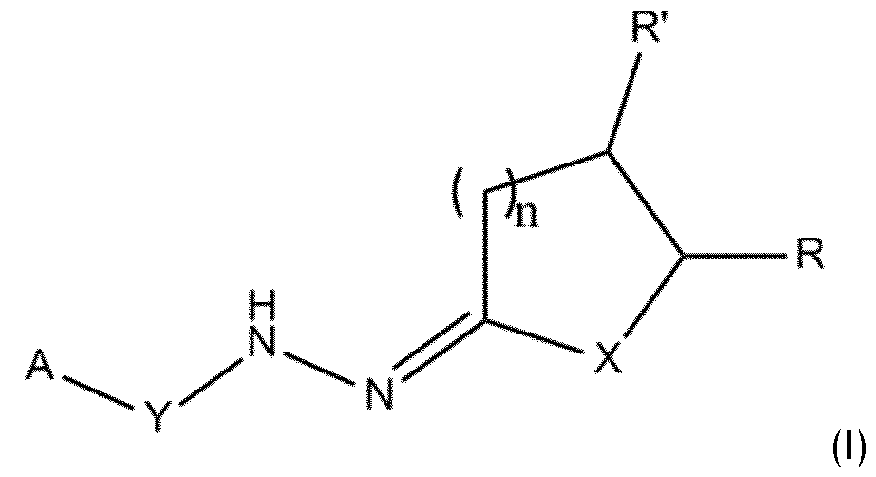
• A is a group selected from (Ci -Cio)alkyl, (C3-Cio)cycloalkyl, aryl or heteroaryl; said (Ci -Cio)alkyl group being optionally substituted with one or several groups selected from halo, oxo, -CF3, -CN, - R7, -COR8, -CONR7R8, -
 said (C3-C,0)cycloalkyl group being optionally substituted with one or several groups selected from halo, oxo, (Ci -C6)alkyl, - CF3, -CN, -NOz, -NO", -OR7, -NRZRS, -NR7NRSR9, -NR7C0R8, -NR7C02R8, -NR7S(0)2R8, C02R7, -C0R8, - CONRzRs, -CO(NR7R8)2, -C0NR7NR8R9, -SR7, -S(0)2R7, -OCOR7, -OCONR7R8, and -0S(0)2R7; and said aryl or heteroaryl group being optionally substituted with one or several groups selected from halo, (Cr C6)alkyl, -CF3, -CN, -N02, -NO", -0R7, -NR7R8, -NR7COR8, -NR7C02R8, -NR7S(0)2R8, -NR7NR8R9, - CONR7NR8R9, -C02R7, -COR8, -C0NR7RS, -C0(NR7R8)2, -SR7, -S(0)2R7, -0C0R7, -OCONR7R8, and -0S(0)2R7;
• X is -NRr, -S-, -0- or -CH2-;
• n is 1 , 2 or 3;
• Y is a single bond, -CO-, -S02- or -(CH2)m- with m = 1 -10;
• R and R’ are, independently of one another, hydrogen atom, halo, oxo, (Ci -Cejalkyl, -CF3, -CN, - N02, -NO", -OR7, -NR7R8, -NR7NR8R9, -NR7COR8, -NR7C02R8, -NR7S(0)2R8, C02R7, -COR8, -CONR7R8, - CO(NR7R8)Z, -CONR7NR8R9, -SR7, -S(0)2R7, -OCOR7, -OCONR7RS, or -0S(0)2R7;
• Ri is a hydrogen atom or a (Ci -C10)alkyl group being optionally substituted with one or several groups selected from halo, oxo, -CF3, -CN, -N02, -NO", -OR7, -NR7R8, -NR7NR8R9, -NR7COR8, -NR7C02R8, -NR7S(0)2RS, COZR7, -CORS, -CONR7R8, -CO(NR7RS)2, -CONR7NR8R9, -SR7, -S(0)ZR7, -OCOR7, -OCONR7R8, and -0S(0)ZR7; and
• each R7 to R9 are, independently of one another, hydrogen atom, halo, (CrC6)alkyl or halofCr C&)alkyl;
for use for preventing and/or treating disorders associated to Adnetobacter baumannii.
2. The compound for use according to claim 1 , wherein Y is a single bond.
3. The compound for use according to claim 1 or 2, wherein X is -NRr, Ri being a hydrogen atom or a (CrCio)alkyl, preferably a hydrogen atom or a (Ci -C6)alkyl, more preferably a hydrogen atom.
4. The compound for use according to any one of claims 1 to 3, being of the following general formula (II) or (II I):

or a pharmaceutically acceptable salt and/or solvate thereof, wherein:
• Ri is a hydrogen atom or a (Ct -Cio)alkyl, preferably a hydrogen atom or a (Ci -C6)alkyl, more preferably a hydrogen atom; and
• A, R and R’ are as defined in claim 1 .
5. The compound for use according to any one of claims 1 to 4, wherein A is a group selected from aryl or heteroaryl, said group being optionally substituted with one or several groups selected from halo, (Ci -C6)alkyl, -CF3, -CN, -N02, -NO+, -OR7, -NR7R8, -NR7COR8, -NR7C02R8, -NR7S(0)2R8, - NR7NR8R9, -CONR7NRSR9, -C02R7, -CORS, -CONR7RS, -CO(NR7R8)Z, -SR7, -S(0)2R7, -OCOR7, -OCONR7R8, and -0S(0)2R7; R7 to R9 being as defined in claim 1 .
6. The compound for use according to any one of claims 1 to 5, wherein A is a group selected from aryl or 5-6-membered heteroaryl, said group being optionally substituted with one or several groups selected from halo, (Ci -C6>alkyl, -CF3, -CN, -N02, -NO+, -OR7, -NR7R8, -NR7C0R8, -NR7C02R8, - NR7S(0)ZR8, -NR7NR8R9, -CONR7NR8R9, -C0ZR7, -CORS, -CONR7R8, -CO(NR7R8)2, -SR?, -S(0)2R7, -0C0R7, - OCONR7R8, and -0S(0)2R7; R7 to R9 being as defined in claim 1 .
7. The compound for use according to any one of claims 1 to 6, wherein A is of the following formula (At ):

wherein R2 to Re are, independently of one another, hydrogen atom, halo, -CF3, -CN, NO÷, -N02, -OR7, -NR7R8, -NR7C0R8, -NR7C02R8, -NR7S(0)2R8, -NR7NR8R9, -C0NR7NR8R9, -C02R7, -COR8, -C0NR7R8, -
CO(NR7R8)2, -SR7, -S(0)2R7, -OCOR7, -OCONR7R8, -0S(0)2R7, or (Ci-Ce)alkyl; R7 to R? being as defined in claim 1 .
8. The compound for use according to claim 7, wherein one or two R2 to R¾ are, independently of one another, halo, -CF3, -CN, NCT, -NOz, -OR7, -NR7R8, -NR7COR8, -NR7C02R8, -NR7S(0)2R8, -NR7NR8R9, -CONR7NR8R9, -CO2R7, -CORs, -CONR7R8, -CO(NR7RS)2, -SR?, -S(0)2R7, -OCOR7, -OCONR7R8, -0S(0)2R7, or (Ct-Cijalkyl, preferably halo, -CF3, -CN, -OR7, -NR7R8, NO÷, -NO2, or (Ci-C6>alkyl; the others R2 to R¾ being hydrogen atoms; and wherein R7 to R9 are as defined in claim 1 .
9. The compound for use according to any one of claims 1 to 8, wherein R and R’ are, independently of one another, hydrogen atom, -F, -N02, -CF3 or -Cl.
10. The compound for use according to any one of claims 1 to 8, wherein R and R’ are hydrogen atom.
11. The compound for use according to claim 1 , wherein it is selected from the group:

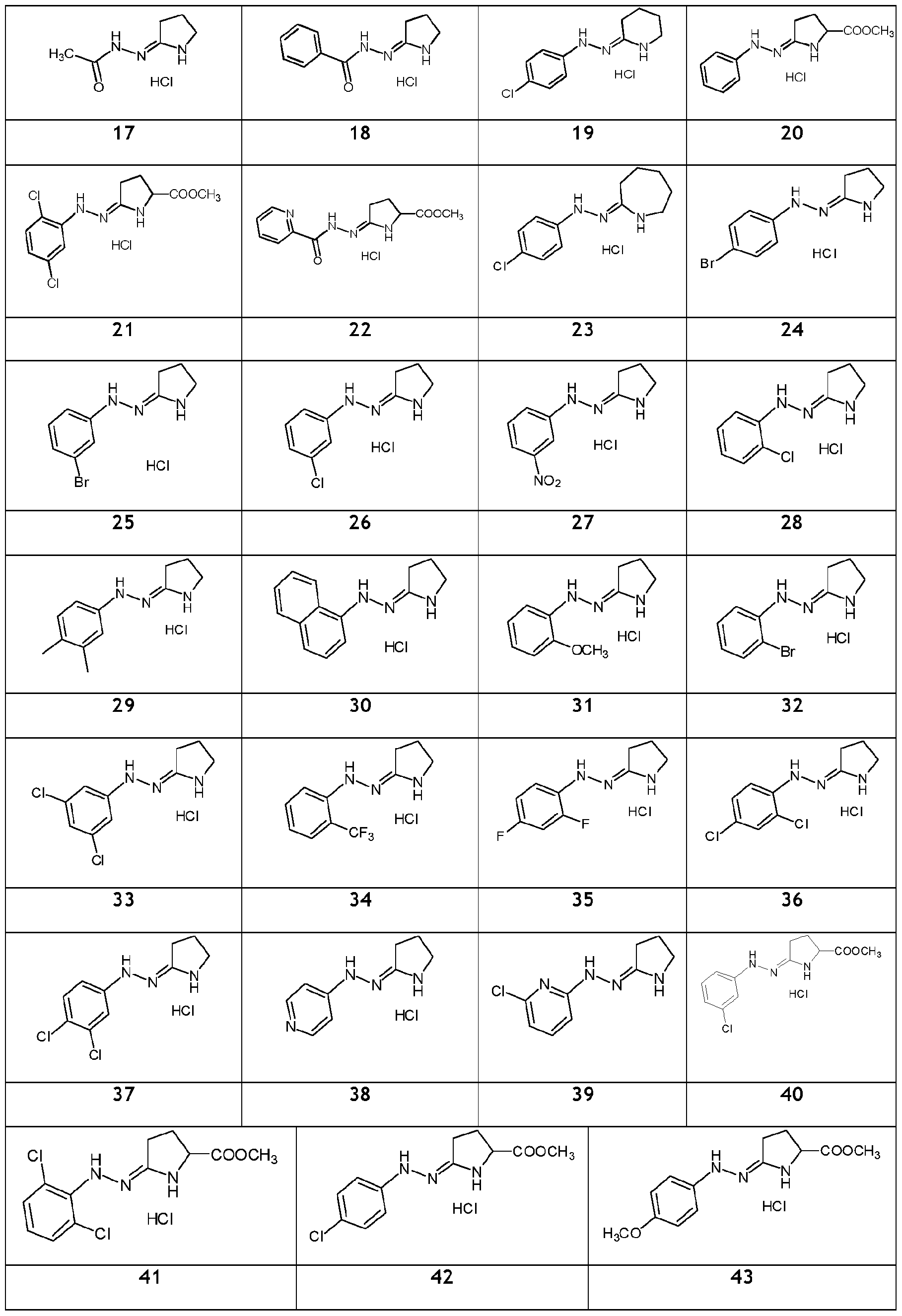
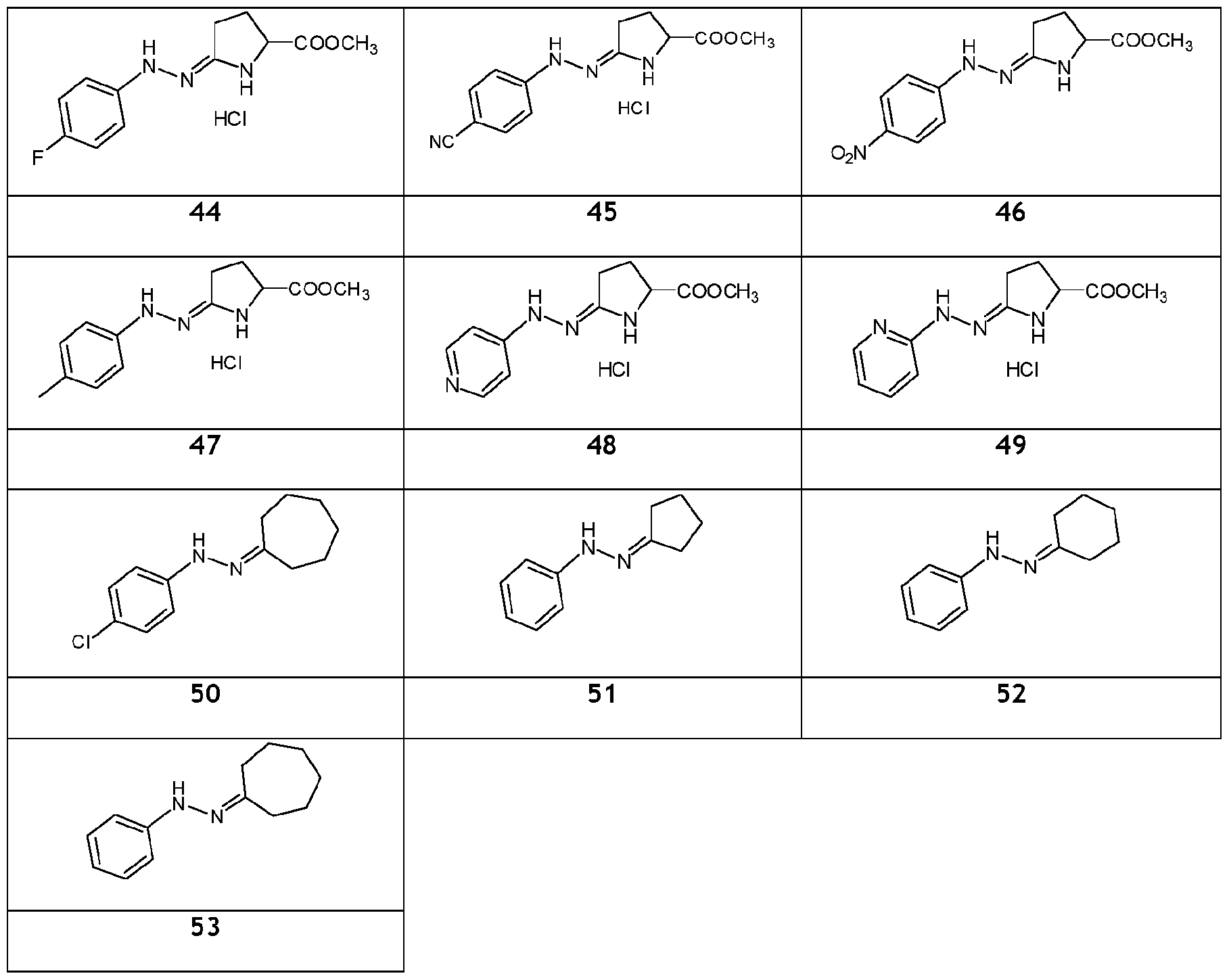
12. The compound for use according to claim 1 , wherein the disorders associated to Acinetobacter baumannii are in particular bacteremia, septic shock, ventilator-associated pneumonia, extensive soft tissue necrosis, and rapidly progressive systemic infections.
13. A pharmaceutical composition comprising at least one compound according to any one of claims 1 to 11 and at least one pharmaceutically acceptable excipient, for use for preventing and/or the treating disorders associated to Acinetobacter baumannii.
14. The pharmaceutical composition for use according to claim 13, wherein the disorders associated to Acinetobacter baumannii are bacteremia, septic shock, ventilator-associated pneumonia, extensive soft tissue necrosis, and rapidly progressive systemic infections.
15. A pharmaceutical composition comprising:
(i) at least one compound of formula (I) according to any one of claims 1 to 1 1 , and
(ii) at least one other active ingredient, that can be used for preventing and/or treating disorders associated to Acinetobacter baumannii,
for use for preventing and/or treating disorders associated to Acinetobacter baumannii.
Applications Claiming Priority (2)
| Application Number | Priority Date | Filing Date | Title |
|---|---|---|---|
| EP19305201.6 | 2019-02-19 | ||
| EP19305201 | 2019-02-19 |
Publications (1)
| Publication Number | Publication Date |
|---|---|
| WO2020169683A1 true WO2020169683A1 (en) | 2020-08-27 |
Family
ID=65657417
Family Applications (1)
| Application Number | Title | Priority Date | Filing Date |
|---|---|---|---|
| PCT/EP2020/054393 Ceased WO2020169683A1 (en) | 2019-02-19 | 2020-02-19 | Hydrazonopyrrolidine derivatives for use in preventing and/or treating disorders associated to acinetobacter baumannii |
Country Status (1)
| Country | Link |
|---|---|
| WO (1) | WO2020169683A1 (en) |
Cited By (1)
| Publication number | Priority date | Publication date | Assignee | Title |
|---|---|---|---|---|
| CN121044983A (en) * | 2025-07-04 | 2025-12-02 | 山东大学 | A myxococcal compound, its preparation method and application |
Citations (2)
| Publication number | Priority date | Publication date | Assignee | Title |
|---|---|---|---|---|
| WO2016016291A1 (en) * | 2014-07-30 | 2016-02-04 | Ferrer Internacional, S.A. | Arylhydrazides containing a 2-pyridone moiety as selective antibacterial agents |
| WO2018020004A1 (en) * | 2016-07-29 | 2018-02-01 | Abac Therapeutics, S.L | 2-pyrrolidine phenylhydrazides antibacterial agents |
-
2020
- 2020-02-19 WO PCT/EP2020/054393 patent/WO2020169683A1/en not_active Ceased
Patent Citations (2)
| Publication number | Priority date | Publication date | Assignee | Title |
|---|---|---|---|---|
| WO2016016291A1 (en) * | 2014-07-30 | 2016-02-04 | Ferrer Internacional, S.A. | Arylhydrazides containing a 2-pyridone moiety as selective antibacterial agents |
| WO2018020004A1 (en) * | 2016-07-29 | 2018-02-01 | Abac Therapeutics, S.L | 2-pyrrolidine phenylhydrazides antibacterial agents |
Non-Patent Citations (10)
| Title |
|---|
| FASSEUR ET AL., J. HETEROCYCL. CHEM., vol. 29, 1992, pages 1285 |
| HILBIG, SABINE ET AL: "Zur Chemie und antibiotischen Aktivität des Carbolegerlings (Agaricus xanthoderma)", ANGEWANDTE CHEMIE, vol. 97, no. 12, December 1985 (1985-12-01), pages 1063 - 1064, XP002793048, ISSN: 0044-8249, DOI: 10.1002/ange.19850971222 * |
| KALOUSTIANKHOURI, TETRAHEDRON LETTERS, vol. 22, no. 5, 1981, pages 413 - 16 |
| MAHATTHANANCHAI AND BODE IN CHEMICAL SCIENCE, vol. 3, no. 1, 2012, pages 192 - 197 |
| MAHATTHANANCHAIBODE, CHEMICAL SCIENCE, vol. 3, no. 1, 2012, pages 192 - 197 |
| MATSUMOTO, YOHEI ET AL., CHEMISTRY - A EUROPEAN JOURNAL, vol. 24, no. 23, 2018, pages 6062 - 6066 |
| PEREIRA DE SÁ NÍVEA ET AL: "Thiazole compounds with activity againstCryptococcus gattiiandCryptococcus neoformans in vitro", EUROPEAN JOURNAL OF MEDICINAL CHEMISTRY, ELSEVIER, AMSTERDAM, NL, vol. 102, 17 July 2015 (2015-07-17), pages 233 - 242, XP029267389, ISSN: 0223-5234, DOI: 10.1016/J.EJMECH.2015.07.032 * |
| ROMANOV-MICHAILIDIS, ORGANIC LETTERS, vol. 14, no. 18, 2012, pages 4906 - 4909 |
| SCHANN, JOURNAL OF MEDICINAL CHEMISTRY, vol. 44, 2001, pages 1588 - 1593 |
| SHRIDHAR, D. R. ET AL: "Synthesis and biological activity of some new hydrazones, hydrazides and bicyclic triazoles derived from 2-thiazoline, 1-pyrroline and 2H-5,6-dihydro-1,4-oxazine", INDIAN JOURNAL OF CHEMISTRY, SECTION B: ORGANIC CHEMISTRY INCLUDING MEDICINAL CHEMISTRY , 20B(2), 132-4 CODEN: IJSBDB; ISSN: 0376-4699, 1981, XP009514693 * |
Cited By (1)
| Publication number | Priority date | Publication date | Assignee | Title |
|---|---|---|---|---|
| CN121044983A (en) * | 2025-07-04 | 2025-12-02 | 山东大学 | A myxococcal compound, its preparation method and application |
Similar Documents
| Publication | Publication Date | Title |
|---|---|---|
| JP7337883B2 (en) | Small molecule inhibitors of lactate dehydrogenase and methods of use thereof | |
| RU2576662C2 (en) | Antiinfective compounds | |
| JP4805916B2 (en) | Compounds, compositions and methods | |
| RU2734760C2 (en) | Anti-infectious compounds | |
| WO2020169682A1 (en) | Hydrazide derivatives and their specific use as antibacterial agents by controlling acinetobacter baumannii bacterium | |
| US20090098218A1 (en) | Tetracyclic Lactame Derivatives | |
| IL195113A (en) | Aryl substituted pyridinone and pyridazinone derivatives, pharmaceutical compositions comprising them and use thereof as inhibitors of poly(adp-ribose)polymerase (parp) | |
| CA2474168A1 (en) | 11-beta-hydroxysteroid dehydrogenase 1 inhibitors useful for the treatment of diabetes, obesity and dyslipidemia | |
| AU2009246424A1 (en) | Glucagon receptor antagonists, compositions, and methods for their use | |
| WO2007055418A1 (en) | Aza-substituted spiro derivative | |
| FR2974088A1 (en) | TRI- AND TETRACYCLIC PYRAZOLO [3,4-B] PYRIDINE COMPOUNDS AS ANTI-CANCER AGENTS | |
| CN105814050A (en) | Pyrazolopyridine derivatives as modulators of TNF activity | |
| JP2022529311A (en) | TYK2 pseudokinase ligand | |
| KR20130140868A (en) | Isoxazole derivatives useful as antibaterial agents | |
| KR102731925B1 (en) | Multicyclic compounds as farnesoid X receptor modulators | |
| JP2024116307A (en) | Nitrogen-containing heterocyclic amide compounds and their medical uses | |
| JP2010536842A (en) | Quinolin-4-one and 4-oxodihydrocinnoline derivatives as poly (ADP-ribose) polymerase (PARP) inhibitors | |
| KR20130046436A (en) | Cyclic n,n'-diarylthioureas and n,n'-diarylureas as androgen receptor antagonists, anti-cancer agent, method for producing and using same | |
| CN109071548A (en) | It can be used for treating the pyrroles's benzimidazole derivative or its analog of especially cancer | |
| TW200914457A (en) | Pyrimidodiazepinone derivative | |
| US7820674B2 (en) | Aminomethyl beta-secretase inhibitors for the treatment of alzheimer's disease | |
| EP2078009B1 (en) | New fluorene derivatives, compositions containing the same and use thereof as inhibitors of the protein chaperone hsp 90 | |
| KR20110028445A (en) | Condensed pyrazine compounds useful for the treatment of degenerative and inflammatory diseases | |
| RS59787B1 (en) | Novel heterocyclic compound, method for preparing the same, and pharmaceutical composition comprising the same | |
| JP2010501641A (en) | 1H-pyrrolo [2,3-B] pyridine derivatives useful as HSP90 inhibitors |
Legal Events
| Date | Code | Title | Description |
|---|---|---|---|
| 121 | Ep: the epo has been informed by wipo that ep was designated in this application |
Ref document number: 20705369 Country of ref document: EP Kind code of ref document: A1 |
|
| NENP | Non-entry into the national phase |
Ref country code: DE |
|
| 122 | Ep: pct application non-entry in european phase |
Ref document number: 20705369 Country of ref document: EP Kind code of ref document: A1 |