WO2020169682A1 - Hydrazide derivatives and their specific use as antibacterial agents by controlling acinetobacter baumannii bacterium - Google Patents
Hydrazide derivatives and their specific use as antibacterial agents by controlling acinetobacter baumannii bacterium Download PDFInfo
- Publication number
- WO2020169682A1 WO2020169682A1 PCT/EP2020/054392 EP2020054392W WO2020169682A1 WO 2020169682 A1 WO2020169682 A1 WO 2020169682A1 EP 2020054392 W EP2020054392 W EP 2020054392W WO 2020169682 A1 WO2020169682 A1 WO 2020169682A1
- Authority
- WO
- WIPO (PCT)
- Prior art keywords
- conformer
- char
- mmol
- alkyl
- cor
- Prior art date
- Legal status (The legal status is an assumption and is not a legal conclusion. Google has not performed a legal analysis and makes no representation as to the accuracy of the status listed.)
- Ceased
Links
- COEGXAPJDNZUPJ-UHFFFAOYSA-N COCCOC(NNc1ccccc1)=[U] Chemical compound COCCOC(NNc1ccccc1)=[U] COEGXAPJDNZUPJ-UHFFFAOYSA-N 0.000 description 1
- BBHIJHYGMGQPIE-UHFFFAOYSA-N O=C(Cc1c[s]cc1)NNc1ccccc1 Chemical compound O=C(Cc1c[s]cc1)NNc1ccccc1 BBHIJHYGMGQPIE-UHFFFAOYSA-N 0.000 description 1
- IAZAUSSUAOBMAY-UHFFFAOYSA-N O=C(NNc1ccccc1)Oc1ccccc1 Chemical compound O=C(NNc1ccccc1)Oc1ccccc1 IAZAUSSUAOBMAY-UHFFFAOYSA-N 0.000 description 1
- YCLQKBNVDCEFLF-UHFFFAOYSA-N O=C(c(ccc(Cl)c1)c1Cl)NNc1ccccc1 Chemical compound O=C(c(ccc(Cl)c1)c1Cl)NNc1ccccc1 YCLQKBNVDCEFLF-UHFFFAOYSA-N 0.000 description 1
- CFESKFBDPRMZCS-UHFFFAOYSA-N O=C(c1ccccn1)NNc1ccccc1 Chemical compound O=C(c1ccccn1)NNc1ccccc1 CFESKFBDPRMZCS-UHFFFAOYSA-N 0.000 description 1
- CTBGPPCIEMLCOL-UHFFFAOYSA-N O=S(c1cc(C(F)(F)F)ccc1)(NNc1ccccc1)=O Chemical compound O=S(c1cc(C(F)(F)F)ccc1)(NNc1ccccc1)=O CTBGPPCIEMLCOL-UHFFFAOYSA-N 0.000 description 1
Classifications
-
- C—CHEMISTRY; METALLURGY
- C07—ORGANIC CHEMISTRY
- C07D—HETEROCYCLIC COMPOUNDS
- C07D207/00—Heterocyclic compounds containing five-membered rings not condensed with other rings, with one nitrogen atom as the only ring hetero atom
- C07D207/02—Heterocyclic compounds containing five-membered rings not condensed with other rings, with one nitrogen atom as the only ring hetero atom with only hydrogen or carbon atoms directly attached to the ring nitrogen atom
- C07D207/18—Heterocyclic compounds containing five-membered rings not condensed with other rings, with one nitrogen atom as the only ring hetero atom with only hydrogen or carbon atoms directly attached to the ring nitrogen atom having one double bond between ring members or between a ring member and a non-ring member
- C07D207/22—Heterocyclic compounds containing five-membered rings not condensed with other rings, with one nitrogen atom as the only ring hetero atom with only hydrogen or carbon atoms directly attached to the ring nitrogen atom having one double bond between ring members or between a ring member and a non-ring member with hetero atoms or with carbon atoms having three bonds to hetero atoms with at the most one bond to halogen, e.g. ester or nitrile radicals, directly attached to ring carbon atoms
- C07D207/24—Oxygen or sulfur atoms
- C07D207/26—2-Pyrrolidones
- C07D207/273—2-Pyrrolidones with hetero atoms or with carbon atoms having three bonds to hetero atoms with at the most one bond to halogen, e.g. ester or nitrile radicals, directly attached to other ring carbon atoms
- C07D207/277—Carbon atoms having three bonds to hetero atoms with at the most one bond to halogen, e.g. ester or nitrile radicals
-
- C—CHEMISTRY; METALLURGY
- C07—ORGANIC CHEMISTRY
- C07C—ACYCLIC OR CARBOCYCLIC COMPOUNDS
- C07C243/00—Compounds containing chains of nitrogen atoms singly-bound to each other, e.g. hydrazines, triazanes
- C07C243/24—Hydrazines having nitrogen atoms of hydrazine groups acylated by carboxylic acids
- C07C243/36—Hydrazines having nitrogen atoms of hydrazine groups acylated by carboxylic acids with acylating carboxyl groups bound to carbon atoms of rings other than six-membered aromatic rings
-
- C—CHEMISTRY; METALLURGY
- C07—ORGANIC CHEMISTRY
- C07C—ACYCLIC OR CARBOCYCLIC COMPOUNDS
- C07C243/00—Compounds containing chains of nitrogen atoms singly-bound to each other, e.g. hydrazines, triazanes
- C07C243/24—Hydrazines having nitrogen atoms of hydrazine groups acylated by carboxylic acids
- C07C243/38—Hydrazines having nitrogen atoms of hydrazine groups acylated by carboxylic acids with acylating carboxyl groups bound to carbon atoms of six-membered aromatic rings
-
- C—CHEMISTRY; METALLURGY
- C07—ORGANIC CHEMISTRY
- C07C—ACYCLIC OR CARBOCYCLIC COMPOUNDS
- C07C281/00—Derivatives of carbonic acid containing functional groups covered by groups C07C269/00 - C07C279/00 in which at least one nitrogen atom of these functional groups is further bound to another nitrogen atom not being part of a nitro or nitroso group
- C07C281/02—Compounds containing any of the groups, e.g. carbazates
-
- C—CHEMISTRY; METALLURGY
- C07—ORGANIC CHEMISTRY
- C07C—ACYCLIC OR CARBOCYCLIC COMPOUNDS
- C07C311/00—Amides of sulfonic acids, i.e. compounds having singly-bound oxygen atoms of sulfo groups replaced by nitrogen atoms, not being part of nitro or nitroso groups
- C07C311/01—Sulfonamides having sulfur atoms of sulfonamide groups bound to acyclic carbon atoms
- C07C311/02—Sulfonamides having sulfur atoms of sulfonamide groups bound to acyclic carbon atoms of an acyclic saturated carbon skeleton
-
- C—CHEMISTRY; METALLURGY
- C07—ORGANIC CHEMISTRY
- C07C—ACYCLIC OR CARBOCYCLIC COMPOUNDS
- C07C311/00—Amides of sulfonic acids, i.e. compounds having singly-bound oxygen atoms of sulfo groups replaced by nitrogen atoms, not being part of nitro or nitroso groups
- C07C311/01—Sulfonamides having sulfur atoms of sulfonamide groups bound to acyclic carbon atoms
- C07C311/10—Sulfonamides having sulfur atoms of sulfonamide groups bound to acyclic carbon atoms of a saturated carbon skeleton containing rings
-
- C—CHEMISTRY; METALLURGY
- C07—ORGANIC CHEMISTRY
- C07C—ACYCLIC OR CARBOCYCLIC COMPOUNDS
- C07C311/00—Amides of sulfonic acids, i.e. compounds having singly-bound oxygen atoms of sulfo groups replaced by nitrogen atoms, not being part of nitro or nitroso groups
- C07C311/15—Sulfonamides having sulfur atoms of sulfonamide groups bound to carbon atoms of six-membered aromatic rings
-
- C—CHEMISTRY; METALLURGY
- C07—ORGANIC CHEMISTRY
- C07D—HETEROCYCLIC COMPOUNDS
- C07D207/00—Heterocyclic compounds containing five-membered rings not condensed with other rings, with one nitrogen atom as the only ring hetero atom
- C07D207/02—Heterocyclic compounds containing five-membered rings not condensed with other rings, with one nitrogen atom as the only ring hetero atom with only hydrogen or carbon atoms directly attached to the ring nitrogen atom
- C07D207/04—Heterocyclic compounds containing five-membered rings not condensed with other rings, with one nitrogen atom as the only ring hetero atom with only hydrogen or carbon atoms directly attached to the ring nitrogen atom having no double bonds between ring members or between ring members and non-ring members
- C07D207/08—Heterocyclic compounds containing five-membered rings not condensed with other rings, with one nitrogen atom as the only ring hetero atom with only hydrogen or carbon atoms directly attached to the ring nitrogen atom having no double bonds between ring members or between ring members and non-ring members with hydrocarbon radicals, substituted by hetero atoms, attached to ring carbon atoms
-
- C—CHEMISTRY; METALLURGY
- C07—ORGANIC CHEMISTRY
- C07D—HETEROCYCLIC COMPOUNDS
- C07D213/00—Heterocyclic compounds containing six-membered rings, not condensed with other rings, with one nitrogen atom as the only ring hetero atom and three or more double bonds between ring members or between ring members and non-ring members
- C07D213/02—Heterocyclic compounds containing six-membered rings, not condensed with other rings, with one nitrogen atom as the only ring hetero atom and three or more double bonds between ring members or between ring members and non-ring members having three double bonds between ring members or between ring members and non-ring members
- C07D213/04—Heterocyclic compounds containing six-membered rings, not condensed with other rings, with one nitrogen atom as the only ring hetero atom and three or more double bonds between ring members or between ring members and non-ring members having three double bonds between ring members or between ring members and non-ring members having no bond between the ring nitrogen atom and a non-ring member or having only hydrogen or carbon atoms directly attached to the ring nitrogen atom
- C07D213/24—Heterocyclic compounds containing six-membered rings, not condensed with other rings, with one nitrogen atom as the only ring hetero atom and three or more double bonds between ring members or between ring members and non-ring members having three double bonds between ring members or between ring members and non-ring members having no bond between the ring nitrogen atom and a non-ring member or having only hydrogen or carbon atoms directly attached to the ring nitrogen atom with substituted hydrocarbon radicals attached to ring carbon atoms
- C07D213/54—Radicals substituted by carbon atoms having three bonds to hetero atoms with at the most one bond to halogen, e.g. ester or nitrile radicals
-
- C—CHEMISTRY; METALLURGY
- C07—ORGANIC CHEMISTRY
- C07C—ACYCLIC OR CARBOCYCLIC COMPOUNDS
- C07C2602/00—Systems containing two condensed rings
- C07C2602/36—Systems containing two condensed rings the rings having more than two atoms in common
- C07C2602/42—Systems containing two condensed rings the rings having more than two atoms in common the bicyclo ring system containing seven carbon atoms
-
- C—CHEMISTRY; METALLURGY
- C07—ORGANIC CHEMISTRY
- C07C—ACYCLIC OR CARBOCYCLIC COMPOUNDS
- C07C2603/00—Systems containing at least three condensed rings
- C07C2603/02—Ortho- or ortho- and peri-condensed systems
- C07C2603/04—Ortho- or ortho- and peri-condensed systems containing three rings
- C07C2603/22—Ortho- or ortho- and peri-condensed systems containing three rings containing only six-membered rings
- C07C2603/24—Anthracenes; Hydrogenated anthracenes
-
- C—CHEMISTRY; METALLURGY
- C07—ORGANIC CHEMISTRY
- C07C—ACYCLIC OR CARBOCYCLIC COMPOUNDS
- C07C2603/00—Systems containing at least three condensed rings
- C07C2603/56—Ring systems containing bridged rings
- C07C2603/58—Ring systems containing bridged rings containing three rings
- C07C2603/70—Ring systems containing bridged rings containing three rings containing only six-membered rings
- C07C2603/74—Adamantanes
Definitions
- the invention relates to hydrazide derivatives compounds, and their use as a drug, in particular as antibacterial agent, particularly for preventing and/or treating disorders associated to Adnetobacter baumannii.
- the present invention also relates to pharmaceutical compositions containing said compounds and the process for preparing said compounds.
- Adnetobacter Bacteria of the genus Adnetobacter are found in many natural environments (soil, water, plants, etc. ) and are part of the normal skin flora of humans and animals. They are also isolated from oral, nasopharyngeal or faecal flora and may be present in food.
- Adnetobacter baumannii (AB) is a Gram-negative coccobacillus, a commensal of the skin, especially its moist regions, and of the digestive tract. Like Pseudomonas, Adnetobacter is mainly responsible for nosocomial infections, especially in immune-depressed patients.
- Adnetobacter baumannii The associated pathologies are sepsis, pneumopathy, meningitis, endocarditis, abscess, wound superinfection, urinary tract infection.
- the main species involved is Adnetobacter baumannii.
- Adnetobacter is strictly aerobic, oxidase negative and catalase positive.
- the use of glucose via the oxidative pathway is common but may be absent.
- Adnetobacter baumannii has emerged as one of the most problematic pathogens in healthcare facilities. It is involved in 2% to 4% of nosocomial infections in the EU and the USA. Its capacity for long-term survival in hospitals, combined with the emergence of resistance, potentiates its ability for nosocomial spread. This pathogen generally targets the most vulnerable patients. Nosocomial pneumonia is the most common infection. Recently, however, bacteraemia and infections of the skin, the soft tissue, the urinary tract or the central nervous system have emerged as highly problematic for certain institutions.
- the main antibiotics used to treat it are carbapenems, ampicillin in combination with sulbactam, tigecycline, aminoglycosides and colistin.
- 61 % of Adnetobacter baumannii strains are resistant to carbapenems and 65% have combined resistance to at least 3 classes among carbapenems, ampicillin/sulbactam, aminoglycosides, cephalosporins, fluoroquinolones and piperacillin.
- the mortality rate for multidrug-resistant A. baumannii nosocomial infections is 25%, while the overall mortality rate for nosocomial infections is 0.9%.
- the reference antibiotics are cephalosporinases as first-line treatment, with a high failure rate due to the resistances observed.
- the antibiogram of A. baumannii infection must be broad and complete in order to choose the best therapeutic approach.
- Colistin a polypeptide antibiotic of the polymyxin family, often remains the drug used as a last resort against resistant strains.
- certain multidrug-resistant strains with colistin resistance have recently been described.
- a second strategy aims to increase the sensitivity of bacterial strains to known antibiotics.
- a third strategy is to discover new compounds capable of selectively controlling the bacterium Adnetobacter baumannii.
- the inventors have discovered new compounds with antibacterial properties that are specific to the multidrug-resistant bacterium Adnetobacter baumannii.
- the compounds of the invention are therefore capable of selectively controlling the bacterium Adnetobacter baumannii.
- a first object of the invention is a compound of the following general formula (I):
- A is Ai, A 2 , A 3 , A 4 , A 5 , A ⁇ , A 7 , A S , A 9 or A 10 , or is a group selected from hydrogen atom, (C Cio)alkyl, (C 3 -Cio)cycloalkyl, aryl, or heteroaryl, said (C Cio)alkyl group being optionally substituted with one or several groups selected from halo, oxo, -CF 3 , -CN, -NO 2 , -NO + , -OR 7 , -NR 7 R 8 , -NR 7 NR 8 R 9 , -NR 7 COR 8 , -NR7CO2R8, -NR 7 S(0) 2 R8, CO2R7, -CORs, -CONR7R8, -CO(NR 7 RS)2, -CONR 7 NR 8 R 9 , -SR?, -S(0) 2 R 7 , -OCOR7, -OCONR 7 R
- B and B’ are identical or different, preferably identical, and are each selected from Bi, (C3- Cio)cycloalkyl, or heteroaryl, said (C3-Cio)cycloalkyl group being optionally substituted with one or several groups selected from halo, oxo, (Ci -C fi jalkyl, -CF3, -CN, -NO2, -NO + , -OR 7 , -NR 7 R 8 , -NR 7 NR 8 R 9 ,
- X and Xi are identical or different, preferably identical, and are each selected from a single bond, -CO-, -CS-, -CN-, or -SO2-;
- Ri and R are identical or different, preferably identical, and are each selected from hydrogen atom, (Ci -C 6 )alkyl, or aryl;
- R2 to R 6 are, independently of one another, hydrogen atom, halo, -CF3, -CN, NO + , -NO2, -OR 7 , - NR 7 R 8 , -NR 7 COR 8 , -NR 7 C0 2 R 8 , -NR 7 S(0) 2 R 8 , -NR 7 NR 8 R 9 , -CONR 7 NR 8 R 9 , -CO 2 R 7 , -COR 8 , -CONR 7 R 8 , - CO(NR 7 R 8 ) 2 , -SR ? , -S(0) 2 R 7 , -OCOR 7 , -0C0NR 7 R 8 , -0S(0) 2 R 7 , or (C C 6 )alkyl;
- each R 7 , Re, R 9 , Rn and R12 are, independently of one another, hydrogen atom, halo, (Ci-C 6 >alkyl or halo(Ci-C 6 )alkyl;
- R10 is aryl or (Ci-C 6 )alkylaryl, said aryl or (Ci-C 6 )alkylaryl being optionally substituted with one or several groups selected from halo, (Ci -C 6 )alkyl, -CF3, -CN, -NO2, -NO + , -OR 7 , -NR 7 R 8 , -NR 7 COR 8 , -
- the first object of the invention is a compound of following general formula
- A is Ai, A2, A3, or A4, or is a group selected from (CrCio)alkyl, (C3-Cio)cycloalkyl, or heteroaryl, said (C Cio)alkyl group being optionally substituted with one or several groups selected from halo, oxo, -CF 3 , -CN, -NO2, -NO + , -OR7, -NR7R8, -NR 7 NR 8 R 9 , -NR 7 C0R 8 , -NR 7 C0 2 R 8 , -NR 7 S(0) 2 R 8 , CO 2 R 7 , - CORs, -CONR7R8, -CO(NR 7 R 8 )2, -CONR 7 NR 8 R 9 , -SR 7 , -S(0) 2 R 7 , -0C0R 7 , -0C0NR 7 R 8 , and -0S(0) 2 R 7 , said (C3-Cio)cycloal
- -S(0) 2 R 7 , -0C0R 7 , -0C0NR 7 R 8 , and - 0S(0) 2 R 7 and said heteroaryl group being optionally substituted with one or several groups selected from halo, (Ci -C 6 )alkyl, -CF 3 , -CN, -N0 2 , -NO + , -OR 7 , -NR 7 R 8 , -NR 7 COR 8 , -NR 7 C0 2 R 8 , -NR 7 S(0) 2 R 8 , - NR 7 NR 8 R 9 , -C0NR 7 NR 8 R 9 , -C0 2 R 7 , -CORS, -C0NR 7 R 8 , -CO(NR 7 R 8 ) 2 , -SR ? , -S(0) 2 R 7 , -0C0R 7 , -0C0NR 7 R 8 , and -0S(0) 2 R 7 ;
- B is selected from Bi or heteroaryl, said heteroaryl group being optionally substituted with one or several groups selected from halo, (Ci -C 6 )alkyl, -CF 3 , -CN, -N0 2 , -NO + , -OR 7 , -NR 7 R 8 , -NR 7 COR 8 , - NR 7 C0 2 R 8 , -NR 7 S(0) 2 R 8 , -NR 7 NR 8 R 9 , -C0NR 7 NR 8 R 9 , -C0 2 R 7 , -CORS, -C0NR 7 R 8 , -CO(NR 7 R 8 ) 2 , -SR ? , - S(0) 2 R 7 , -0C0R 7 , -0C0NR 7 R 8 , and -0S(0) 2 R 7 ; and
- Y is a single bond, -0-, or -CH 2 - ;
- Ri is selected from hydrogen atom, (Ci -C 6 )alkyl, or aryl;
- R 2 to R 6 are, independently of one another, hydrogen atom, halo, -CF 3 , -CN, NO + , -N0 2 , -OR 7 , - NR 7 R 8 , -NR 7 C0R 8 , -NR 7 C0 2 R 8 , -NR 7 S(0) 2 R 8 , -NR 7 NR 8 R 9 , -C0NR 7 NR 8 R 9 , -C0 2 R 7 , -CORS, -CONR 7 R 8 , - CO(NR 7 RS) 2 , -SR?, -S(0) 2 R 7 , -0C0R 7 , -OCONR 7 RS, -0S(0) 2 R 7 , or (C t -C 6 )alkyl;
- each R 7 , Re, and R 9 are, independently of one another, hydrogen atom, halo, (Ci -C & )alkyl or halo(Ci -C 6 )alkyl;
- R10 is aryl or (Ci -C 6 )alkylaryl, said aryl or (Ci -C 6 )alkylaryl being optionally substituted with one or several groups selected from halo, (Ci -Csjalkyl, -CF 3 , -CN, -N0 2 , -NO + , -OR 7 , -NR 7 R 8 , -NR 7 COR 8 , - NR 7 C0 2 RS, -NR 7 S(0) 2 RS, -NR 7 NRSR 9 , -CONR 7 NRSR 9 , -C0 2 R 7 , -CORS, -CONR 7 R 8 , -CO(NR 7 R 8 ) 2 , -SR?, - S(0) 2 R 7 , -0C0R 7 , -0C0NR 7 R 8 , and -0S(0) 2 R 7 .
- Another object of the invention is a pharmaceutical composition comprising at least one compound of formula ( I) of the invention and at least one pharmaceutically acceptable excipient. Another object of the invention relates to the compound of formula (I) of the invention or a pharmaceutical composition comprising said compound of formula (I), for use as drug.
- Another object of the invention relates to the compound of formula (I) of the invention or a pharmaceutical composition comprising said compound of formula (I), for use for preventing and/or treating disorders associated to Adnetobacter baumannii.
- Another object of the invention relates to a process for preparing a compound according the invention, comprising a step of reacting a compound of formula (II), (I ) or (II”):
- the term“pharmaceutically acceptable” is intended to mean what is useful to the preparation of a pharmaceutical composition, and what is generally safe and non-toxic, for a pharmaceutical use.
- pharmaceutically acceptable salt or solvate is intended to mean, in the framework of the present invention, a salt or solvate of a compound which is pharmaceutically acceptable, as defined above, and which possesses the pharmacological activity of the corresponding compound.
- pharmaceutically acceptable salts comprise:
- Acceptable organic bases comprise diethanolamine, ethanolamine, N-methylglucamine, triethanolamine, tromethamine and the like.
- Acceptable inorganic bases comprise aluminium hydroxide, calcium hydroxide, potassium hydroxide, sodium carbonate and sodium hydroxide.
- Acceptable solvates for the therapeutic use of the compounds of the present invention include conventional solvates such as those formed during the last step of the preparation of the compounds of the invention due to the presence of solvents.
- solvates due to the presence of water these solvates are also called hydrates) or ethanol.
- (Ci-Cio)alkyl refers to a straight or branched saturated hydrocarbon chain containing from 1 to 10 carbon atoms including, but not limited to, methyl, ethyl, n-propyl, iso-propyl, n-butyl, iso-butyl, sec-butyl, tert-butyl, n-pentyl, iso-pentyl, sec- pentyl, tert-pentyl, n-hexyl, iso-hexyl, sec-hexyl, tert-hexyl, n-heptyl, n-octyl, n-nonyl, n-decyl, and the like.
- (Ci-C 6 )alkyl refers to a straight or branched saturated hydrocarbon chain containing from 1 to 6 carbon atoms including, but not limited to, methyl, ethyl, n-propyl, iso-propyl, n-butyl, iso-butyl, sec-butyl, t-butyl, n-pentyl, iso-pentyl, sec- pentyl, tert-pentyl, n-hexyl, iso-hexyl, sec-hexyl, tert-hexyl, and the like.
- (C3-Cio)cycloalkyl refers to a hydrocarbon monocycle, bicycle or tricycle (i.e. comprising fused rings), each cycle having having 3 to 6 carbon atoms including, but not limited to, cyclopropyl, cyclopentyl, cyclohexyl, decahydronaphtyl, indenyl, indanyl, adamantyl and the like.
- aryl refers to an aromatic hydrocarbon group comprising preferably 6 to 10 carbon atoms and comprising one or more, notably 1 or 2, fused rings, such as, for example, a phenyl or naphtyl group.
- fused rings such as, for example, a phenyl or naphtyl group.
- it will be a phenyl group.
- (Ci-C 6 )alkylaryl refers to an aryl group as defined above, bound to the molecule via a (Ci -Csjalkyl group as defined above.
- heteroaryl refers an aromatic hydrocarbon monocycle or bicycle (i.e. comprising fused rings), each cycle having advantageously 5 or 6 members, notably 6 members, and 1 to 4, notably 1 or 2, carbon atoms having each been replaced with a heteroatom such as a nitrogen, sulfur or oxygen atom, preferably nitrogen or oxygen atom.
- a heteroaryl can be notably thiophene, furan, pyrrole, imidazole, pyrazole, oxazole, isoxazole, thiazole, isothiazole, triazoles (1 ,2,3-triazole and 1 ,2,4-triazole), benzofuran, indole, benzothiophene, benzimidazole, indazole, benzoxazole, benzisoxazole, benzothiazole, benzisothiazole, pyridine, pyrimidine, pyridazine, pyrazine, triazine, quinoline, isoquinoline, quinoxaline, quinazoline, etc.
- heteroaryl refers to a heteroaryl as defined above having 5 or 6 atoms in the ring(s).
- halogen refers to a fluorine, bromine, chlorine or iodine atom.
- stereoisomers is intended to designate diastereoisomers or enantiomers. These are therefore optical isomers. Stereoisomers which are not mirror images of one another are thus designated as “diastereoisomers,” and stereoisomers which are non- superimposable mirror images are designated as“enantiomers”.
- a first object of the invention is a compound of formula (I):
- A is Ai, A2, A3, A 4 , A 5 , Ab, A 7 , As, A9 or A10, or is a group selected from hydrogen atom, (CrCio)alkyl, (C3-Cio)cycloalkyl, aryl, or heteroaryl, said (CrCio)alkyl group being optionally substituted with one or several groups selected from halo, oxo, -CF3, -CN, - NOz, -NO + , -OR7, -NR 7 RS, -NR 7 NR 8 R 9 , -NR7COR8, -NR7CO2R8, -NR 7 S(0) 2 R 8 , CO2R7, -C0R 8 , -CONR7R8, - CO(NR 7 R 8 )2, -CONR 7 NR 8 R 9 , -SR7, -S(0) 2 R 7 , -OCOR7, -OCONR7R8,
- R 10 is an aryl or a (Ci -C fi jalkylaryl, said aryl or (Ci -Cejalkylaryl being optionally substituted with one or several groups selected from halo, (Ci -Cejalkyl, -CF 3 , -CN, - NOz, -NO + , -OR7, -NR7R8, -NR7COR8, -NR7CO2R8, -NR 7 S(0) 2 R 8 , -NR 7 NRSR 9 , -CONR 7 NR 8 R 9 , -CO2R7, -CORs, - CONR7R8, -CO(NR7Re)2, -SR7, -S(0)2R7, -OCOR7, -OCONR7R8, and -0S(0)2R7.
- R10 is a phenyl or (Ci-C 6 >alkylphenyl that is optionally substituted with one or several groups selected from halo, (CrC 6 )alkyl, -CF 3 , -CN, -N0 2 , -NO + , -OR7, -NR 7 R 8 , -NR 7 COR 8 , -NR7CO 2 R8, -NR 7 S(0) 2 R8, -NR 7 NR 8 R 9 , -CONR 7 NR 8 R 9 , -CO2R7, -CORs, -CONR7R8, -CO(NR 7 RS)2, -SR?, -S(0) 2 R 7 , -OCOR7, -OCONR 7 R 8 , and - 0S(0) 2 R 7 .
- R 10 is a phenyl or (Ci-C 6 >alkylphenyl that is non-substituted.
- Rn and R 12 are, independently of one another, hydrogen atom, halo, (Ci -Csjalkyl or halo(Ci-C 6 )alkyl, preferably hydrogen atom or (Ci -Csjalkyl.
- R and Xi are as defined above or in the following paragraphs related to B’, R and Xi respectively.
- B’ is identical to B
- R is identical to Ri
- Xi is identical to X.
- A is Ai, A 2 , A 3 , A 4 , or A 9 or is a group selected from (CrCio)alkyl, aryl, or heteroaryl, said (C Cio)alkyl group being optionally substituted with one or several groups selected from halo, oxo, -CF 3 , -CN, -N0 2 , -NCT, -OR7, -NR 7 R 8 , -NR 7 NR 8 R 9 , -NR 7 COR 8 , -NR 7 C0 2 R 8 , -NR 7 S(0) 2 R 8 , CO 2 R7, -CORs, -CONR 7 R 8 , -CO(NR 7 R 8 ) 2 , -CONR 7 NR 8 R 9 , -SR7, -S(0) 2 R 7 , -OCOR7, -OCONR 7 R 8 , and - 0S(0) 2 R 7 , and said aryl or heteroaryl group
- A is Ai, A 2 , A 3 , A 4 , or A 9 , or is a group selected from (Ci-C 6 )alkyl, phenyl, or 5-6-membered heteroaryl; said phenyl or 5-6-membered heteroaryl group being optionally substituted with one or several groups selected from halo, (Ci -C fi jalkyl, -CF 3 , -CN, -N0 2 , -NO + , -OR 7 , -NR 7 R 8 , - NR 7 COR 8 , -NR 7 C0 2 R 8 , -NR 7 S(0) 2 R 8 , -NR 7 NR 8 R 9 , -CONR 7 NR 8 R 9 , -C0 2 R 7 , -COR 8 , -C0NR 7 R 8 , -CO(NR 7 R 8 ) 2 , - SR 7 , -S(0) 2 R 7 , -0COR 8
- A is Ai, A 2 , A 3 , or A 4 , or is a group selected from (CrCio)alkyl, (C 3 - Cio)cycloalkyl, or heteroaryl, said (C Cio)alkyl group being optionally substituted with one or several groups selected from halo, oxo, -CF 3 , -CN, -N0 2 , -NO + , -OR 7 , -NR 7 R 8 , -NR 7 NR 8 R 9 , -NR 7 COR 8 , -NR 7 C0 2 R 8 , -NR 7 S(0) 2 R 8 , CO 2 R 7 , -COR 8 , -CONR 7 R 8 , -CO(NR 7 R 8 ) 2 , -CONR 7 NR 8 R 9 , -SR 7 , -S(0) 2 R 7 , -OCOR 7 , -0C0NR 7 R 8 , and -0S(0)
- A is Ai, A 2 , A 3 , or A 4 , or is a group selected from (CrCio)alkyl, (C 3 - C 6 )cycloalkyl, or 5-6-membered heteroaryl, said (C Cio)alkyl group being optionally substituted with one or several groups selected from halo, oxo, -CF 3 , -CN, -N0 2 , -NO + , -OR 7 , -NR 7 R 8 , -NR 7 NR 8 R 9 , -
- A is Ai, A 2 , A 3 , or A 4 , or is a group selected from (CrCio)alkyl, (C 3 - C 6 )cycloalkyl, or 5-6-membered heteroaryl, said (C Cio)alkyl group being optionally substituted with one or several groups selected from halo, oxo, -CF 3 , -CN, -N0 2 , -NO + , -OR 7 , -NR 7 R 8 , -NR 7 NR 8 R 9 , -
- said heteroaryl comprises 1 or 2 nitrogen or oxygen atom.
- said heteroaryl is selected from pyrrole, furan, thiophene, indole, benzofuran, benzothiophene, pyridine, quinolone, isoquinoline, isothiazole, thiazole, pyrilium, thiapyrilium, pyrazole, isoxazole, imidazole or oxazole, more advantageously pyridine, imidazole, isoquinoline.
- B is selected from Bi, (C3-Cio)cycloalkyl, or heteroaryl, said (C3-Cio)cycloalkyl group being optionally substituted with one or several groups selected from halo, oxo, (Ci-C 6 )alkyl, -CF 3 , -CN, -N0 2 , -NCT, -OR 7 , -NR 7 R 8 , -NR 7 NR 8 R 9 , -NR 7 COR 8 , -NR 7 C0 2 R 8 , -NR 7 S(0) 2 R 8 , -C0 2 R 7 , -CORS, -C0NR 7 R 8 , -CO(NR 7 R 8 ) 2 , -C0NR 7 NR 8 R 9 , -SR ?
- B is selected from Bi or heteroaryl, said heteroaryl group being optionally substituted with one or several groups selected from halo, (Ci -C 6 )alkyl, -CF3, -CN, -N0 2 , -NO + , -OR 7 , - NR 7 R 8 , -NR 7 C0R 8 , -NR 7 C0 2 R 8 , -NR 7 S(0) 2 R 8 , -NR 7 NR 8 R 9 , -C0NR 7 NR 8 R 9 , -C0 2 R 7 , -COR 8 , -C0NR 7 R 8 , - CO(NR 7 R 8 ) 2 , -SR ? , -S(0) 2 R 7 , -0C0R 7 , -0C0NR 7 R 8 , and -0S(0) 2 R 7 ; and Bi and R 2 to R 9 are as defined previously.
- B is selected from B1 , pyridinyl, pyrrolyl, or isoquinolinyl, more advantageously B1 , pyridinyl, or isoquinolinyl; said heteroaryl group being optionally substituted with one or several groups selected from halo, (Ci -C 6 )alkyl, -CF3, -CN, -N0 2 , -NO + , -OR 7 , -NR 7 R 8 , -NR 7 COR 8 ,
- R 2 to R 3 ⁇ 4 being as defined previously. More advantageously, R 2 to R 6 are hydrogen atoms or one or two R 2 to R 3 ⁇ 4 are, independently of one another, halo, -CF3, -CN, NO + , -NO 2 , -OR 7 , -NR 7 R 8 , -NR 7 C0R 8 , -NR 7 C0 2 R 8 , -NR 7 S(0) 2 R 8 , -NR 7 NR 8 R 9 , -CONR 7 NR 8 R 9 , -C0 2 R 7 , -COR 8 , - CONR 7 R 8 , -CO(NR 7 R 8 ) 2 , -SR ?
- R 2 to R 3 ⁇ 4 are hydrogen atoms or one or two R 2 to R 3 ⁇ 4 are, independently of one another, halo, -CF3, -CN, -OR 7 , -NR 7 R 8 , -NR 7 COR 8 , -NR 7 C0 2 R 8 , -NR 7 S(0) 2 R 8 , C0 2 R 7 , -CORS, -C0NR 7 R 8 , -CO(NR 7 R 8 ) 2 , -SR ?
- B’ is selected from Bi, (C3-Cio)cycloalkyl, or heteroaryl, said (C3-Cio)cycloalkyl group being optionally substituted with one or several groups selected from halo, oxo, (Ci-C 6 )alkyl, -CF 3 , -CN, -N0 2 , -NCT, -OR 7 , -NR 7 R 8 , -NR 7 NR 8 R 9 , -NR 7 COR 8 , -NR 7 C0 2 R 8 , -NR 7 S(0) 2 R 8 , -CO2R7, -CORs, -CONR7R8, -CO(NR 7 R 8 )2, -CONR 7 NR 8 R 9 , -SR 7 , -S(0) 2 R 7 , -OCOR7, -OCONR 7 R 8 , and - 0S(0) 2 R 7 , and said heteroaryl group being optionally substitute
- B’ is Bi, with R2 to R 6 being as defined previously. More advantageously, R2 to R 6 are hydrogen atoms or one or two R2 to R 6 are, independently of one another, halo, -CF 3 , -CN, NO + , -NO 2 , -OR 7 , -NR 7 R 8 , -NR 7 C0R 8 , -NR 7 C0 2 R 8 , -NR 7 S(0) 2 R 8 , -NR 7 NR 8 R 9 , -C0NR 7 NR 8 R 9 , -CO 2 R 7 , -COR 8 , - CONR7RS, -CO(NR7RS) 2 , -SR7, -S(0) 2 R7, -OCOR7, -OCONR7RS, -0S(0) 2 R 7 , or ( Ci -C 8 )alky l; the others R2 to R 6 being hydrogen atoms.
- R2 to R 6 are hydrogen atoms or one or two R2 to R 6 are, independently of one another, halo, -CF 3 , -CN, -OR 7 , -NR 7 R 8 , -NR 7 COR 8 , -NR 7 C0 2 R 8 , -NR 7 S(0) 2 R 8 , CO2R7, -CORs, -CONR7R8, -CO(NR 7 R 8 )2, -SR7, -S(0) 2 R 7 , -OCOR7, -OCONR 7 R 8 , -0S(0) 2 R 7 , NO + , -N0 2 , or (C t - C 6 >alkyl, preferably halo, -CF 3 , -CN, -OR 7 , -NR 7 R 8 , NO + , -NO 2 , or (Ci -C & )alkyl; the others R2 to R 3 ⁇ 4 being hydrogen atoms.
- B’ is identical to B.
- X is a single bond, -CO-, -CS-, -CN-, or -SO2-.
- X is a single bond, -CO- or -SO2. More advantageously, X is -CO- or -SO2, in particular X is -CO-.
- X is advantageously -CO-.
- Xi is a single bond, -CO-, -CS-, -CN-, or -SO2-.
- Xi is a single bond, -CO- or -SO2. More advantageously, Xi is -CO- or -SO2, in particular Xi is -CO-.
- Xi is identical to X.
- Y is a single bond, -0-, or -CH2-. More advantageously, Y is a single bond or -0-, preferably Y is a single bond.
- Ri is selected from hydrogen atom, (Ci -C 6 )alkyl, or aryl.
- Ri is selected from hydrogen atom, (Ci-C3)alkyl, or phenyl. More advantageously, Ri is selected from hydrogen atom or phenyl, preferably, Ri is a hydrogen atom.
- R is selected from hydrogen atom, (Ci -Csjalkyl, or aryl.
- R is selected from hydrogen atom, (Ci-C3)alkyl, or phenyl.
- RI A is selected from hydrogen atom or phenyl, preferably, R is a hydrogen atom.
- R is identical to Ri .
- A is as defined above; • B and B’ are identical or different, preferably identical, and are Bi; Bi being as defined above with R2 to R 6 being all hydrogen atoms or one or two R2 to R 3 ⁇ 4 being, independently of one another, halo, -CF 3 , -CN, NO", -N0 2 , -OR7, -NR 7 R 8 , -NR 7 C0R 8 , -NR 7 C0 2 R 8 , -NR 7 S(0) 2 R 8 , -NR 7 NR 8 R 9 , -C0NR 7 NR 8 R 9 , -C0 2 R 7 , -COR S , -CONR 7 R 8 , -CO(NR 7 R 8 ) 2 , -SR ?
- X and Xi are identical or different, preferably identical, and each are a single bond, -CO- or - SO2, preferably -CO- or -SO2;
- Y is a single bond or -0-, preferably -0-;
- Ri and R are identical or different, preferably identical, and are each selected from hydrogen atom, (Ci-C3)alkyl, or phenyl.
- B is Bi; Bi being as defined above and R2 to R 3 ⁇ 4 are all hydrogen atoms or one or two R2 to R 3 ⁇ 4 are, independently of one another, halo, -CF3, -CN, NO + , -NO2, -OR 7 , -NR 7 R 8 , -NR 7 COR 8 , -NR 7 C0 2 R 8 , - NR 7 S(0) 2 R 8 , -NR 7 NR 8 R 9 , -CONR 7 NR 8 R 9 , -COZR 7 , -COR S , -C0NR 7 R 8 , -CO(NR 7 R 8 ) 2 , -SR ?
- X is a single bond, -CO- or -SO2, preferably -CO- or -SO2;
- Y is a single bond or -0-, preferably -0-;
- Ri is selected from hydrogen atom, (Ci-C3)alkyl, or phenyl, preferably an hydrogen atom;
- B is Bi; Bi being as defined above and R2 to R 3 ⁇ 4 are all hydrogen atoms or one or two R2 to R 3 ⁇ 4 are, independently of one another, halo, -CF3, -CN, NO + , -NO2, -OR 7 , -NR 7 R 8 , -NR 7 COR 8 , -NR 7 C0 2 R 8 , - NR 7 S(0) 2 R 8 , -NR 7 NR 8 R 9 , -CONR 7 NR 8 R 9 , -COZR 7 , -COR S , -C0NR 7 R 8 , -CO(NR 7 R 8 ) 2 , -SR ?
- Ri is an hydrogen atom
- A is Ai , A 2 , A3, A4, or A9, or is a group selected from (Ci -Csjalkyl, phenyl, or 5-6-membered heteroaryl; said phenyl group being optionally substituted with one or several groups selected from halo, (Ci -C 6 )alkyl, -CF 3 , -CN, -N0 2 , -NCT, -OR 7 , -NR 7 R 8 , -NR 7 COR 8 , -NR 7 C0 2 R 8 , -NR 7 S(0) 2 R 8 , -NR 7 NR 8 R 9 , -CONR 7 NR 8 R 9 , -C0 2 R 7 , -CORS, -C0NR 7 R 8 , -CO(NR 7 R 8 ) 2 , -SR ? , -S(0) 2 R 7 , -0C0R 7 , -CO(NR 7 R 8 ) 2 ,
- B and B’ are identical or different, preferably identical, and are Bi ; Bi being as defined above and R 2 to R 3 ⁇ 4 are all hydrogen atoms or one or two R 2 to R 3 ⁇ 4 are, independently of one another, halo, -CF 3 , -CN, NO + , -NO 2 , -OR 7 , -NR 7 R 8 , -NR 7 C0R 8 , -NR 7 C0 2 R 8 , -NR 7 S(0) 2 R 8 , -NR 7 NR 8 R 9 , -C0NR 7 NR 8 R 9 , - C0 2 R 7 , -CORS, -C0NR 7 R 8 , -CO(NR 7 R 8 ) 2 , -SR ?
- X and Xi are identical or different, preferably identical, and are each a single bond, -CO- or - S0 2 , preferably -CO- or -S0 2 ;
- Y is a single bond or -0-, preferably -0-;
- Ri and R are identical or different, preferably identical, and are selected from hydrogen atom, (Ci -C 3 )alkyl, or phenyl.
- A is Ai , A 2 , A3, A4, or A 9 , or is a group selected from (Ci -C 6 )alkyl, phenyl, or 5-6-membered heteroaryl; said phenyl group being optionally substituted with one or several groups selected from halo, (CrC 6 )alkyl, -CF 3 , -CN, -N0 2 , -NCT, -OR 7 , -NR 7 R 8 , -NR 7 COR 8 , -NR 7 C0 2 R 8 , -NR 7 S(0) 2 R 8 , -NR 7 NR 8 R 9 , -CONR 7 NR 8 R 9 , -C0 2 R 7 , -CORS, -C0NR 7 R 8 , -CO(NR 7 R 8 ) 2 , -SR ? , -S(0) 2 R 7 , -0C0R 7 , -0C0NR 7 R 8 , -0
- B is Bi ; Bi being as defined above and R 2 to R 6 are all hydrogen atoms or one or two R 2 to R 6 are, independently of one another, halo, -CF 3 , -CN, NO + , -N0 2 , -OR 7 , -NR 7 R 8 , -NR 7 COR 8 , -NR 7 C0 2 R 8 , - NR 7 S(0) 2 R 8 , -NR 7 NR 8 R 9 , -C0NR 7 NR 8 R 9 , -C0 2 R 7 , -CORS, -C0NR 7 R 8 , -CO(NR 7 R 8 ) 2 , -SR?, -S(0) 2 R 7 , -0C0R 7 , -OCONR 7 RS, -0S(0) 2 R 7 , or (Ci -C 8 )alkyl; the others R 2 to R 6 being hydrogen atoms;
- X is a single bond, -CO- or -S0 2 , preferably -CO- or -S0 2 ;
- Y is a single bond or -0-, preferably -0-;
- Ri is selected from hydrogen atom, (Ci -C 3 )alkyl, or phenyl, preferably an hydrogen atom;
- A is Ai , A 2 , A3, A4, or A 9 , or is a group selected from (Ci -C 6 )alkyl, phenyl, or 5-6-membered heteroaryl; said phenyl group being optionally substituted with one or several groups selected from halo, (Ci -C 6 )alkyl, -CF 3 , -CN, -N0 2 , -NO + , -OR 7 , -NR 7 R 8 , -NR 7 COR 8 , -NR 7 C0 2 R 8 , -NR 7 S(0) 2 R 8 , -NR 7 NR 8 R 9 , -CONR 7 NR 8 R 9 , -C0 2 R 7 , -CORS, -C0NR 7 R 8 , -C0(NR 7 R 8 ) 2 , -SR ?
- Ai to A4, A 9 and R 7 to R10 are as defined above; • B is Bi; Bi being as defined above and R 2 to R 6 are all hydrogen atoms or one or two R 2 to R 6 are, independently of one another, halo, -CF 3 , -CN, NO + , -NO 2 , -OR 7 , -NR 7 R 8 , -NR 7 COR 8 , -NR 7 CO 2 R 8 , - NR 7 S(0) 2 R 8 , -NR 7 NR 8 R 9 , -CONR 7 NR 8 R 9 , -CO2R7, -CORs, -CONR7R8, -CO(NR 7 R 8 )2, -SR 7 , -S(0) 2 R 7 , -OCOR7, -OCONR 7 R 8 , -
- Ri is an hydrogen atom
- A is Ai, A 2 , A 3 , or A 4 , or is a group selected from (CrCio)alkyl, (C 3 -Cio)cycloalkyl, or heteroaryl, said (CrCio)alkyl group being optionally substituted with one or several groups selected from halo, oxo, -CF 3 , -CN, -NO2, -NO + , -OR7, -NR 7 R 8 , -NR 7 NR 8 R 9 , -NR 7 COR 8 , -NR 7 C0 2 R 8 , -NR 7 S(0) 2 R 8 , CO2R7, - CORs, -CONR7R8, -CO(NR 7 R 8 )2, -CONR 7 NR 8 R 9 , -SR?, -S(0) 2 R 7 , -OCOR7, -OCONR7R8, and -0S(0) 2 R 7 , said (C 3 -Cio)
- B is Bi or pyridinyl or isoquinolinyl; Bi being as defined above with R 2 to R 6 being all hydrogen atoms or one or two R 2 to R 3 ⁇ 4 being, independently of one another, halo, -CF 3 , -CN, NO + , -NO 2 , -OR 7 , -NR 7 R 8 , -NR 7 CORS, -NR7CO2R8, -NR 7 S(0) 2 R 8 , -NR 7 NRSR 9 , -CONR 7 NRSR 9 , -CO2R7, -CORs, -CONR 7 R 8 , - CO(NR7R8> 2 , -SR7, -S(0) 2 R7, -OCOR7, -OCONR7R8, -0S(0) 2 R 7 , or (Ci -Cs)alkyl; the others R 2 to R3 ⁇ 4 being hydrogen atoms; and pyridinyl or isoquinolinyl being
- Ri is selected from hydrogen atom, (Ci-C 3 )alkyl, or phenyl.
- A is Ai, A 2 , A 3 , or A 4 , or is a group selected from (CrCio)alkyl, (C 3 -Cio)cycloalkyl, or heteroaryl, said (C Cio)alkyl group being optionally substituted with one or several groups selected from halo, oxo, -CF 3 , -CN, -N0 2 , -NCT, -OR 7 , -NR 7 R 8 , -NR 7 NR 8 R 9 , -NR 7 COR 8 , -NR 7 C0 2 R 8 , -NR 7 S(0) 2 R 8 , C0 2 R 7 , - COR 8 , -C0NR 7 R 8 , -C0(NR 7 R 8 ) 2 , -C0NR 7 NR 8 R 9 , -SR ?
- B is Bi; Bi being as defined above and R 2 to R 3 ⁇ 4 are all hydrogen atoms or one or two R 2 to R 3 ⁇ 4 are, independently of one another, halo, -CF3, -CN, N0 + , -N0 2 , -0R 7 , -NR 7 R 8 , -NR 7 COR 8 , -NR 7 C0 2 R 8 , -
- Ri is selected from hydrogen atom, (Ci-C3)alkyl, or phenyl, preferably an hydrogen atom.
- A is Ai, A 2 , A3, or A4, or is a group selected from (CrCio)alkyl, (C3-Cio)cycloalkyl, or heteroaryl, said (C Cio)alkyl group being optionally substituted with one or several groups selected from halo, oxo, -CF 3 , -CN, -N0 2 , -N0 + , -0R 7 , -NR 7 R 8 , -NR 7 NR 8 R 9 , -NR 7 C0R 8 , -NR 7 C0 2 R 8 , -NR 7 S(0) 2 R 8 , C0 2 R 7 , - CORs, -CONR 7 R 8 , -CO(NR 7 R 8 ) 2 , -C0NR 7 NR 8 R 9 , -SR ?
- B is Bi; Bi being as defined above and R 2 to R 6 are all hydrogen atoms or one or two R 2 to R 6 are, independently of one another, halo, -CF3, -CN, N0 + , -N0 2 , -0R 7 , -NR 7 R 8 , -NR 7 COR 8 , -NR 7 C0 2 R 8 , - NR 7 S(0) 2 R 8 , -NR 7 NR 8 R 9 , -C0NR 7 NR 8 R 9 , -C0 2 R 7 , -CORS, -C0NR 7 R 8 , -C0(NR 7 R 8 ) 2 , -SR?, -S(0) 2 R 7 , -0C0R 7 , -0C0NR 7 RS, -0S(0) 2 R 7 , or (Ci -C 8 )alkyl; the others R 2 to R 6 being hydrogen atoms;
- Ri is an hydrogen atom.
- A is Ai, A 2 , A3, A4, or is a group selected from (CrCio)alkyl or 5-6-membered heteroaryl; said 5-6 or 10-membered heteroaryl group being optionally substituted with one or several groups selected from halo, (Ci-C 6 )alkyl, -CF 3 , -CN, -N0 2 , -NCT, -OR 7 , -NR 7 R 8 , -NR 7 COR 8 , -NR 7 C0 2 R 8 , -NR 7 S(0) 2 R 8 , - NR 7 NR 8 R 9 , -C0NR 7 NR 8 R 9 , -C0 2 R 7 , -COR S , -C0NR 7 R 8 , -C0(NR 7 R 8 ) 2 , -SR ? , -S(0) 2 R 7 , -0C0R 7 , -0C0NR 7 R 8 , -0S(0)
- B is Bi; Bi being as defined above and R 2 to R 3 ⁇ 4 are all hydrogen atoms or one or two R 2 to R 3 ⁇ 4 are, independently of one another, halo, -CF3, -CN, NO + , -N0 2 , -OR 7 , -NR 7 R 8 , -NR 7 COR 8 , -NR 7 C0 2 R 8 , -
- Ri is selected from hydrogen atom, (Ci-C3)alkyl, or phenyl, preferably an hydrogen atom.
- A is Ai, A 2 , A3, A4, or is a group selected from (CrCio)alkyl or 5-6-membered heteroaryl; said 5-6 or 10-membered heteroaryl group being optionally substituted with one or several groups selected from halo, (Ci-C 6 )alkyl, -CF 3 , -CN, -N0 2 , -NCT, -OR 7 , -NR 7 R 8 , -NR 7 COR 8 , -NR 7 C0 2 R 8 , -NR 7 S(0) 2 R 8 , - NR 7 NR 8 R 9 , -CONR 7 NR 8 R 9 , -CO 2 R 7 , -COR 8 , -CONR 7 R 8 , -CO(NR 7 R 8 ) 2 , -SR 7 , -S(0) 2 R 7 , -0C0R 7 , -0C0NR 7 R 8 , -0S(0) 2 R 7 ;
- B is Bi; Bi being as defined above and R 2 to R 3 ⁇ 4 are all hydrogen atoms or one or two R 2 to R 3 ⁇ 4 are, independently of one another, halo, -CF3, -CN, NO + , -N0 2 , -OR 7 , -NR 7 R 8 , -NR 7 COR 8 , -NR 7 C0 2 R 8 , -
- Ri is selected from hydrogen atom, (Ci-C3)alkyl, or phenyl, preferably an hydrogen atom.
- each R 7 , Re, and R 9 are, independently of one another, hydrogen atom, halo, (Ci -Csjalkyl or halo(Ci-C 6 )alkyl.
- the compound of the invention can be advantageously in the form of a pharmaceutically acceptable salt, such as a salt selected from the group of hydrochloric, hydrobromic, sulfuric, nitric and phosphoric acid and the like; or formed with organic acids such as acetic, benzenesulfonic, fumaric, glucoheptonic, gluconic, glutamic, glycolic, hydroxynaphtoic, 2-hydroxyethanesulfonic, lactic, maleic, malic, mandelic, methanesulfonic, muconic, 2-naphtalenesulfonic, propionic, succinic, dibenzoyl-L-tartaric, tartaric, p-toluenesulfonic, trimethylacetic, and trifluoroacetic acid and the like.
- a pharmaceutically acceptable salt such as a salt selected from the group of hydrochloric, hydrobromic, sulfuric, nitric and phosphoric acid and the like; or formed with organic
- the compound according to the present invention can be in particular selected from the compounds 1 to 74, advantageously from compounds 1 to 20, 24, 39 and 53 to 74, preferably from compounds 1 -1 1 , 13-20, 24, 39, 53 to 74, more preferably from compounds 2-9, 1 1 , 14-16, 18-20, 24, 39, 53, 64-66, 69-70 and 72-74 of the examples below and the pharmaceutically acceptable salts and solvates thereof.
- the compound according to the present invention can be in particular selected from the compounds 1 to 52, preferably from compounds 1 -1 1 , 13-21 , 23-48 and 50-52, more preferably from compounds 2-9, 1 1 , 14-16, 18-20, 24-39, 46-47 and 52, more preferably from compounds 2,4-5 and 38-39, of the examples below and the pharmaceutically acceptable salts and solvates thereof.
- the present invention also pertains to a process for preparing a compound of formula (I) as defined previously comprising a step of reacting a compound of formula (II), (I ) or (II”):
- said step is carried out with the couple dicyclohexylcarbodiimide (DCC)/ 4- dimethylaminopyridine (DMAP), preferably with a ratio of DCC/DMAP of 1 /0.1 .
- DCC dicyclohexylcarbodiimide
- DMAP 4- dimethylaminopyridine
- Other activating conditions may be employed for example with the couples EDCI, HCl/DMAP, EDCI/HOBt, DCC/HATU, EDCI/HATU or DCC/HOBt.
- the pyrrolidine-based carbohydrazide derivatives of the invention (such as compounds 1 - 1 7) and other carbohydrazide derivatives of the invention (such as compounds 18-26) are obtained thanks route A or B as defined below. Examples of route A and B are presented in Scheme 1 below.
- Route A is a two-steps process based on modification of carboxylic acid A-COOH (II).
- the carboxylic acid (II) is advantageously methylated, for example by action of ZrCU in MeOH in presence of molecular sieves 3A at reflux to give methyl ester A-COOCH 3 (I ) in quantitative yield after 24 hours (Route A, step 1 ).
- the obtained methyl ester derivatives (I IA) are then advantageously submitted to hydrazinolysis with free hydrazine derivatives B-NH-NHRi (III), advantageously in presence of an acid catalyst, preferably PTSA or ZrCU to afford carbohydrazides derivatives compounds of the invention (Route A, step 2).
- carbohydrazides derivatives compounds of the invention is advantageously based on the coupling of carboxylic acid derivatives A-COOH (II) with hydrazine derivatives B-NH-NHRi (III).
- any activating agent known from the skilled in the art could be employed.
- EDCI, DCC, HBtU, HATU or HOBt could be used with good results.
- any suitable protecting group could be employed.
- Reactants (II) and (III) are suitably reacted in presence of a coupling agent and in the presence of a base.
- Suitable bases included, but are not limited to triethylamine (TEA), W,W-diisopropylamine (DIPEA), 4- dimethylaminopyridine (DMAP) or mixtures thereof.
- the coupling reaction can take place in an inert organic solvent, such as methylene chloride (DCM), tetrahydrofuran (THF), diethyl ether (EtzO), alcohols, ketones, dimethylformamide (DMF) or any suitable organic inert solvent.
- DCM methylene chloride
- THF tetrahydrofuran
- EtzO diethyl ether
- alcohols ketones
- dimethylformamide (DMF) dimethylformamide
- Preferred solvents are DCM and THF.
- the preferred method for carrying out the coupling reaction involves the use of DCC/DMAP in DCM or THF at room temperature.
- the carbohydrazide link could be obtained by the coupling of acyl chloride derivatives A-COCl (II’) as described in Scheme 2 (Route C).
- compounds (II’) could be obtained from corresponding compounds (II), for example by action of thionyl chloride (SOCb) or oxalyl chloride in a solvent such as toluene under inert atmosphere.
- Compounds (IG) are then coupled with hydrazine derivatives B-NH-NHRi (III), advantageously in presence of a base.
- Suitable bases could be, but are not limited to, triethylamine (TEA), N,N-diisopropylamine (DIPEA) or pyridine.
- An inert organic solvent could be added to allow the reaction such as ethers (dioxane, THF, diethyl ether, methyl tetrahydropyrane (MTHP)), dichloromethane (DCM) or aromatics such as toluene or xylene.
- ethers dioxane, THF, diethyl ether, methyl tetrahydropyrane (MTHP)
- DCM dichloromethane
- aromatics such as toluene or xylene.
- the preferred reaction involves the use of pyridine as base and solvent. If needed, THF may be used to dissolve reactant (II’).
- pyridinium chloride created during the coupling, is then eliminated by addition of water to the reaction medium. It is notable that di-acyl chloride derivatives could allow the formation of dimers of carbohydrazides derivatives compounds of the invention (such as compounds 25 and 26) such as depicted in Scheme 3 (Route D).
- sulfonohydrazide derivatives compounds of the invention are advantageously obtained by coupling of the sulfonyl chloride derivatives A-(SOz)-Cl (II”) or from the sulfonic acid derivatives, for example after activation, as presented in scheme 4 Route E).
- the same protocol than in route C could be employed to carry out the reaction.
- the preferred method involves the use of an excess of base in neat conditions or in presence of an inert organic solvent. Suitable bases could be, but are not limited to, triethylamine (TEA), N,N-diisopropylamine (DIPEA) or pyridine.
- Solvents could be ethers (dioxane, THF, diethyl ether, methyl tetrahydropyrane (MTHP)), dichloromethane (DCM) or aromatics such as toluene or xylene.
- ethers dioxane, THF, diethyl ether, methyl tetrahydropyrane (MTHP)
- DCM dichloromethane
- aromatics such as toluene or xylene.
- the preferred reaction involves the use of pyridine as base and solvent.
- pyridinium chloride created during the coupling, is then eliminated by addition of water to the reaction medium.
- the invention also relates to the compounds of general formula (I) as defined above for use as a drug.
- the invention also relates to the compounds of general formula (I) as defined above for use as antibacterial agent, advantageously for preventing and/or treating disorders associated to Adnetobacter baumannii.
- the present invention also relates to a method for preventing and/or treating disorders associated to Adnetobacter baumannii, comprising the administration to a person in need thereof of an effective dose of a compound of formula (I) as defined above.
- the present invention also relates to the use of a compound of formula (I) as defined above, for the manufacture of a drug for preventing and/or treating disorders associated to Adnetobacter baumannii.
- the disorders associated to the human Adnetobacter baumannii may be in particular bacteremia, septic shock, ventilator-associated pneumonia, extensive soft tissue necrosis, and rapidly progressive systemic infections that ultimately lead to multi-organ failure and death are prone to occur in severely immunocompromised hosts.
- Said rapidly progressive systemic infections may be in particular pneumonia; bronchiolitis; tracheobronchitis; suppurative infection (eg abscesses) in any organ system, including the lungs, urinary tract, skin and soft tissues; bacteremia; septic shock; meningitis (primarily after neurosurgical procedures), cellulitis, or phlebitis in patients with an indwelling venous catheter; ocular infections; native or prosthetic valve endocarditis; osteomyelitis; septic arthritis; or pancreatic and liver abscesses.
- the invention also relates to a pharmaceutical composition
- a pharmaceutical composition comprising a compound of formula (I) of the invention as disclosed above as active ingredient, in particular as antibacterial agent, and a pharmaceutically acceptable excipient.
- compositions according to the invention may be formulated notably for topical administration, oral administration or for injection, wherein said compositions are intended for mammals, including humans.
- the pharmaceutical composition can be administered orally by means of tablets and gelatin capsules.
- a solid composition When a solid composition is prepared in the form of tablets, the main active ingredient is mixed with a pharmaceutical vehicle such as gelatin, starch, lactose, magnesium stearate, talc, gum arabic and the like.
- the tablets may be coated with sucrose or with other suitable materials, or they may be treated in such a way that they have a prolonged or delayed activity and they continuously release a predetermined amount of active principle.
- a preparation in gelatin capsules may be obtained by mixing the active ingredient with a diluent and pouring the mixture obtained into soft or hard gelatin capsules.
- aqueous suspensions, isotonic saline solutions or sterile and injectable solutions which contain pharmacologically compatible dispersing agents and/or wetting agents are used.
- compositions according to the invention may also be administered topically by all the means and in particular cream, gel, stick or serum.
- the active ingredient may be administered in unit dosage forms of administration, in mixture with standard pharmaceutical carriers, to animals or to humans.
- compositions according to the invention may further comprise at least one other active ingredient, such as one other antibacterial agent, advantageously one other active ingredient that can be used for preventing and/or treating disorders associated to Adnetobacter baumannii.
- active ingredient such as one other antibacterial agent, advantageously one other active ingredient that can be used for preventing and/or treating disorders associated to Adnetobacter baumannii.
- the present invention thus also relates to a pharmaceutical composition
- a pharmaceutical composition comprising:
- At least one other active ingredient such as one other active ingredient that can be used for preventing and/or treating disorders associated to Adnetobacter baumannii.
- the other ingredient (ii) can be selected from any antibiotic compound currently used to prevent and/or treat disorders associated to Adnetobacter baumannii such as penicillins, cephalosporins, trimethoprim-sulfamethoxazole, fluoroquinolones, aminoglycosides, carbapenems, colistin, and polymyxins.
- antibiotic compound currently used to prevent and/or treat disorders associated to Adnetobacter baumannii such as penicillins, cephalosporins, trimethoprim-sulfamethoxazole, fluoroquinolones, aminoglycosides, carbapenems, colistin, and polymyxins.
- the present invention is directed to the pharmaceutical composition as defined above for use for preventing and/or treating disorders associated to Adnetobacter baumannii.
- the present invention also relates to a method for preventing and/or treating disorders associated to Adnetobacter baumannii, comprising the administration to a person in need thereof of an effective dose of the pharmaceutical composition as defined above.
- the present invention also relates to the use of the pharmaceutical composition as defined above, for the manufacture of a drug for preventing and/or treating disorders associated to Adnetobacter baumannii.
- Adnetobacter baumannii may be in particular bacteremia, septic shock, ventilator-associated pneumonia, extensive soft tissue necrosis, and rapidly progressive systemic infections that ultimately lead to multi-organ failure and death are prone to occur in severely immunocompromised hosts.
- Said rapidly progressive systemic infections may be in particular pneumonia; bronchiolitis; tracheobronchitis; suppurative infection (eg abscesses) in any organ system, including the lungs, urinary tract, skin and soft tissues; bacteremia; septic shock; meningitis (primarily after neurosurgical procedures), cellulitis, or phlebitis in patients with an indwelling venous catheter; ocular infections; native or prosthetic valve endocarditis; osteomyelitis; septic arthritis; or pancreatic and liver abscesses.
- the subject in need thereof is a mammal, in particular an animal or the human.
- the subject in need thereof is the human.
- DMSO dimethyl sulfoxide Starting materials are commercially available and were used without further purification. Melting points were measured on a MPA 100 OptiMelt® apparatus. Nuclear magnetic resonance (NMR) spectra were acquired at 400 MHz for 1 H NMR, 100 MHz for 13 C NMR and 376 MHz for 19 F NMR on a Varian 400- MR spectrometer, at 25 ° C. Chemical shifts (d) are quoted in parts per million (ppm) and are referenced to TMS as an internal standard. Coupling constants (J) are quoted in hertz. Comparisons with known or reported compounds and 2D methods (HMBC and HSQC experiments) have been used to confirm the NMR peak assignments.
- the compounds are obtained preferably from one of the main routes described (Route A, B, C, D or E defined above). Some specific compounds have been generated by designed protocols which will be described in due course.
- the carbohydrazide derivatives compounds of the invention are generally obtained as a mixture of the two following isomers, the conformer 1 being the major species.
- Ratio conformer 1 /conformer 2 91 / 09
- 5-oxo-N’-phenylpyrrolidine-2-carbohydrazide was obtained through the hydrazinolysis reaction of methyl-pyroglutamate (2 g, 13.9 mmol) and phenylhydrazine (1 .5 g, 13.9 mmol), in the presence of a catalytic amount of PTSA, 5% (0.24 g). The mixture was stirred at 80° for 24 h. The precipitate was then washed with ethanol affording 1 as a white solid (2.0 g, 66 % yield),
- N'-(4-chlorophenyl)-5-oxopyrrolidine-2-carbohydrazide was obtained from the coupling reaction of 5-oxopyrrolidine-2-carboxylic acid (2 g, 15.5 mmol), (4- chlorophenyl)hydrazine hydrochloride (2.75 g, 15.5 mmol) which at first was released in situ in a presence of sodium methanoate (3.5 mL, 30% aqueous methanolic solution), in presence of dicyclohexyl carbodiimide (3.2 g, 15.5 mmol) and dimethylaminopyridine (0.19 g, 1 .55 mmol) which were dissolved in 100 mL of methylene chloride.
- N'-(4-fluorophenyl)-5-oxopyrrolidine-2-carbohydrazide was obtained from the coupling reaction of 5-oxopyrrolidine-2-carboxylic acid (2 g, 15.5 mmol), (4- fluorophenyl)hydrazine hydrochloride (2.5 g, 15.5 mmol) which at first was released in situ in a presence of sodium methanoate (3.5 mL, 30% aqueous methanolic solution), in presence of dicyclohexyl carbodiimide (3.2 g, 15.5 mmol) and dimethylaminopyridine (0.19 g, 1.55 mmol) which were dissolved in 100 mL of methylene chloride.
- N'-(4-bromophenyl)-5-oxopyrrolidine-2-carbohydrazide was obtained from the coupling reaction of 5-oxopyrrolidine-2-carboxylic acid (2 g, 15.5 mmol), (4- bromophenyl)hydrazine hydrochloride (3.5 g, 15.5 mmol) which at first was released in situ in a presence of sodium methanoate (3.5 mL, 30% aqueous methanolic solution), in presence of dicyclohexyl carbodiimide (3.2 g, 15.5 mmol) and dimethylaminopyridine (0.19 g, 1.55 mmol) which were dissolved in 100 mL of methylene chloride.
- N'-(4-iodophenyl)-5-oxopyrrolidine-2-carbohydrazide was obtained through the hydrazinolysis reaction of methyl- pyroglutamate (0.62 g, 4.2 mmol) and (4- iodophenyl)hydrazine (1 g, 4.2 mmol), in the presence of a catalytic amount of PTSA, 5% (0.08 g). The mixture was stirred at 80 °C for 24 h. The precipitate was then washed with ethanol affording 5 as a white solid (0.32 g, 20% yield),
- 5-oxo-N'-(p-tolyl)pyrrolidine-2-carbohydrazide was obtained from the coupling reaction of 5-oxopyrrolidine-2-carboxylic acid (2 g, 15.5 mmol) and p- tolylhydrazine hydrochloride (2.45 g, 15.5 mmol) which at first was released in situ in a presence of sodium methanoate (3.5 mL, 30% aqueous methanolic solution), in presence of dicyclohexyl carbodiimide (3.2 g, 15.5 mmol) and dimethylaminopyridine (0.19 g, 1.55 mmol) which were dissolved in 100 mL of methylene chloride.
- N'-(4-methoxyphenyl)-5-oxopyrrolidine-2-carbohydrazide was obtained from the coupling reaction of 5-oxopyrrolidine-2-carboxylic acid (2 g, 15.5 mmol), (4- methoxyphenyl)hydrazine hydrochloride (2.7 g, 15.5 mmol) which at first was released in situ in a presence of sodium methanoate (3.5 mL, 30% aqueous methanolic solution), in presence of dicyclohexyl carbodiimide (3.2 g, 15.5 mmol) and dimethylaminopyridine (0.19 g, 1 .55 mmol) which were dissolved in 100 mL of methylene chloride.
- 5-oxo-N'-(perfluorophenyl)pyrrolidine-2-carbohydrazide was obtained from the coupling reaction of 5-oxopyrrolidine-2-carboxylic acid (2 g, 15.5 mmol), (perfluorophenyl)hydrazine hydrochloride (3.6 g, 15.5 mmol) which at first was released in situ in a presence of sodium methanoate (3.5 mL, 30% aqueous methanolic solution), in presence of dicyclohexyl carbodiimide (3.2 g, 15.5 mmol) and dimethylaminopyridine (0.19 g, 1 .55 mmol) which were dissolved in 100 mL of methylene chloride.
- 5-oxo-N'-(4-(trifluoromethyl)phenyl)pyrrolidine-2- carbohydrazide was obtained from the coupling reaction of 5-oxopyrrolidine-2-carboxylic acid (0.73 g, 5.6 mmol), (4-(trifluoromethyl)phenyl)hydrazine (0.99 g, 5.6 mmol), in presence of dicyclohexyl carbodiimide (1.1 g, 5.5 mmol) and dimethylaminopyridine (0.06 g, 1 .55 mmol) which were dissolved in 50 mL of methylene chloride. The mixture was stirred at room temperature for 24 h, under nitrogen atmosphere.
- 5-oxo-N'-(2-(trifluoromethyl)phenyl)pyrrolidine-2- carbohydrazide was obtained from the coupling reaction of 5-oxopyrrolidine-2-carboxylic acid (0.73 g, 5.6 mmol), (2-(trifluoromethyl)phenyl)hydrazine (0.99 g, 5.6 mmol), in presence of dicyclohexyl carbodiimide (1 .1 g, 5.5 mmol) and dimethylaminopyridine (0.06 g, 1 .55 mmol) which were dissolved in 50 mL of methylene chloride. The mixture was stirred at room temperature for 24 h, under nitrogen atmosphere.
- 5-oxo-N'-(m-tolyl)pyrrolidine-2-carbohydrazide was obtained from the coupling reaction of 5-oxopyrrolidine-2-carboxylic acid (2 g, 15.5 mmol), m- tolylhydrazine hydrochloride (2.45 g, 15.5 mmol) which at first was released in situ in a presence of sodium methanoate (3.5 mL, 30% aqueous methanolic solution), in presence of dicyclohexyl carbodiimide (3.2 g, 15.5 mmol) and dimethylaminopyridine (0.19 g, 1.55 mmol) which were dissolved in 100 mL of methylene chloride.
- N'-(2,4-dichlorophenyl)-5-oxopyrrolidine-2-carbohydrazide was obtained from the coupling reaction of 5-oxopyrrolidine-2-carboxylic acid (2 g, 15.5 mmol), (2,4- dichlorophenyl)hydrazine hydrochloride (3.3 g, 15.5 mmol) which at first was released in situ in a presence of sodium methanoate (3.5 mL, 30% aqueous methanolic solution), in presence of dicyclohexyl carbodiimide (3.2 g, 15.5 mmol) and dimethylaminopyridine (0.19 g, 1 .55 mmol) which were dissolved in 100 mL of methylene chloride.
- N'-(4-cyanophenyl)-5-oxopyrrolidine-2-carbohydrazide was obtained from the coupling reaction of 5-oxopyrrolidine-2-carboxylic acid (2 g, 15.5 mmol), 4- hydrazinylbenzonitrile hydrochloride (2.62 g, 15.5 mmol) which at first was released in situ in a presence of sodium methanoate (3.5 mL, 30% aqueous methanolic solution), in presence of dicyclohexyl carbodiimide (3.2 g, 15.5 mmol) and dimethylaminopyridine (0.19 g, 1 .55 mmol) which were dissolved in 100 mL of methylene chloride.
- Ratio conformer 1 /conformer 2 86/14
- 1 -benzyl-5-oxo-N'-phenylpyrrolidine-2-carbohydrazide was obtained from the coupling reaction of 1 -benzyl-5-oxopyrrolidine-2-carboxylic acid (2 g, 15.5 mmol), phenylhydrazine (1 .7 g, 15.5 mmol) in presence of dicyclohexyl carbodiimide (3.2 g, 15.5 mmol) and dimethylaminopyridine (0.19 g, 1 .55 mmol) which were dissolved in 100 mL of methylene chloride. The mixture was stirred at room temperature for 24 h, under nitrogen atmosphere.
- Ratio conformer 1 /conformer 2 93/07
- 5-oxo-N,N', 1 -triphenylpyrrolidine-2-carbohydrazide was obtained through the alkylation reaction of 5-oxo-N'-phenylpyrrolidine-2-carbohydrazide (2 g, 9.1 mmol), and iodobenzene (1 .85 g, 9.1 mmol), in presence of Cul (0.08 g, 0.45 mmol), Cs 2 C03 (5.9 g, 18.1 mmol), and dimethylethylenediamine (0.8 g, 9.1 mmol) in 50 mL THF. The mixture was stirred at room temperature for 12 h. The crude product which was purified via flash column chromatography with a gradual amount of acetate/heptane (0: 100 v/v) affording compound 17 as a white solid (0.67 g, 20% yield),
- N’-phenylpyrrolidine-2-carbohydrazide was obtained through the hydrazinolysis reaction methyl pyrrolidine-2-carboxylate (2 g, 15.5 mmol), phenylhydrazine (1 .7 g, 15.5 mmol), in the presence of a catalytic amount of PTSA, 5% (0.24 g). The mixture was stirred at 80 ° C for 12 h. The precipitate was then washed with ethanol affording 18 as a white solid (1.3 g, 40 % yield),
- the product is obtained as a sole isomer.
- N'-phenyl-1 H-imidazole-2-carbohydrazide was obtained from the coupling reaction of 1 H-imidazole-2-carboxylic acid (1 g, 8.9 mmol), phenylhydrazine (0.96 g, 8.9 mmol), in presence of dicyclohexyl carbodiimide (1 .83 g, 8.9 mmol) and dimethylaminopyridine (0.22 g, 8.9 mmol) were dissolved in 50 mL of methylene chloride. The mixture was stirred at room temperature for 24 h.
- 5-oxo-N'-phenyltetrahydrofuran-2-carbohydrazide was obtained from the coupling reaction of 5-oxotetrahydrofuran-2-carboxylic acid (2.02 g, 15.5 mmol), phenylhydrazine (1.7 g, 15.5 mmol), in presence of dicyclohexyl carbodiimide (3.1 g, 15.4 mmol) and dimethylaminopyridine (0.18 g, 1.55 mmol) which were dissolved in 100 mL of methylene chloride. The mixture was stirred at room temperature for 24 h, under nitrogen atmosphere. The precipitated dicyclohexylurea was filtered.
- N'-phenyl-2-(thiophen-3-yl)acetohydrazide was obtained from the coupling reaction of 2-(thiophen-3-yl)acetic acid (2.18 g, 15.4 mmol), phenylhydrazine (1 .7 g, 15.5 mmol), in presence of dicyclohexyl carbodiimide (3.1 g, 15.4 mmol) and dimethylaminopyridine (0.18 g, 1 .55 mmol) which were dissolved in 100 mL of methylene chloride. The mixture was stirred at room temperature for 24 h, under nitrogen atmosphere. The precipitated dicyclohexylurea was filtered.
- N’-phenylanthracene-9-carbohydrazide was obtained from the coupling reaction of anthracene-9-carboxylic acid (3.42 g, 15.4 mmol), phenylhydrazine (1.7 g, 15.5 mmol), in presence of dicyclohexyl carbodiimide (3.1 g, 15.4 mmol) and dimethylaminopyridine (0.18 g, 1 .55 mmol) which were dissolved in 100 mL of methylene chloride. The mixture was stirred at room temperature for 24 h, under nitrogen atmosphere. The precipitated dicyclohexylurea was filtered.
- (3r,5r,7r)-N'-phenyladamantane-1 -carbohydrazide was obtained from the coupling reaction of (3r,5r,7r)-adamantane-1 -carboxylic acid (2.77 g, 15.4 mmol), phenylhydrazine (1 .7 g, 15.5 mmol), in presence of dicyclohexyl carbodiimide (3.1 g, 15.4 mmol) and dimethylaminopyridine (0.18 g, 1 .55 mmol) which were dissolved in 100 mL of methylene chloride. The mixture was stirred at room temperature for 24 h, under nitrogen atmosphere.
- the product was obtained as a sole conformer.
- N'-phenylpicolinohydrazide was obtained through the hydrazinolysis reaction of methyl picolinate (2 g, 15.4 mmol) with phenylhydrazine (1 .6 g, 14 mmol), in the presence of a catalytic amount of PTSA, 5% (0.24 g). The mixture was stirred at 80° for 12 h. The crude product was purified via flash column chromatography (methanol/chloroform 2: 10 v/v) affording compound 24 as a white solid (1 .8 g, 60% yield),
- the product is obtained as a mixture of 4 conformers.
- Ratio conformer 1 /conformer 2/conformer 3/ conformer 4 73/13/12/02
- N ⁇ ,N'4-diphenylsuccinohydrazide was obtained through the coupling between succinyl dichloride (1.55 g, 10 mmol), and phenylhydrazine (2.70 g, 25 mmol). Phenylhydrazine is dissolved in pyridine (10 mL) and cooled at 5°C with an ice bath. Then, succinyl dichloride is added dropwise at 5°C. After completion of the addition, the medium is warmed to room temperature and stirred during 2 hours. After 2 hours, water (50 mL) is added and a precipitate appeared. The insoluble is filtered off and washed by diethyl ether (3x20 mL) and dried. N ⁇ ,N'4-diphenylsuccinohydrazide 25 is obtained as a white solid (2.53 g, 85% yield),
- Ratio conformer 1 /conformer 2/conformer 3/ conformer 4 70/07/10/13
- N ⁇ ,N'8-diphenyloctanedihydrazide was obtained through the coupling between octanedioyl dichloride (2.11 g, 10 mmol), and phenylhydrazine (2.70 g, 25 mmol). Phenylhydrazine is dissolved in pyridine (10 mL) and cooled at 5°C with an ice bath. Then, octanedioyl dichloride is added dropwise at 5°C. After completion of the addition, the medium is warmed to room temperature and stirred during 2 hours. After 2 hours, water (50 mL) is added and a precipitate appeared.
- N ⁇ ,N'8-diphenyloctanedihydrazide 26 is obtained as a white solid (3.08 g, 87% yield),
- the product is obtained as a sole isomer.
- 4-trifluoromethyl-N'-phenylbenzohydrazide was obtained from the coupling reaction of 4-trifluoromethylbenzoyl chloride (3.12 g, 15 mmol) and phenylhydrazine (1.78 g, 16.5 mmol), in presence of pyridine (2.65 mL, 33 mmol). Phenylhydrazine is solubilized in pyridine in a 50 mL flask and cooled at 5 ° C with an ice bath. In parallel, 4- trifluoromethylbenzoyl chloride is dissolved in 5 mL of THF.
- acyl chloride solution is then added dropwise at 5 °C to the phenylhydrazine solution. After addition, the temperature is allowed to warm to room temperature and the medium is stirred during 2 hours. Pyridinium chloride gradually appeared in the medium. After completion of the reaction, water (30 mL) is added, pyridinium chloride dissolved and 4-trifluoromethyl-N'-phenylbenzohydrazide precipitated. The precipitate is filtered, washed by diethylether (3x10 mL) and dried. Compound 27 is obtained as a white solid (2.85 g, 68% yield).
- the product is obtained as a sole conformer.
- 4-nitro-N'-phenylbenzohydrazide was obtained from the coupling reaction of 4-nitrobenzoyl chloride (2.78 g, 15 mmol) and phenylhydrazine (1 .78 g, 16.5 mmol), in presence of pyridine (2.65 mL, 33 mmol). Phenylhydrazine is solubilized in pyridine in a 50 mL flask and cooled at 5 ° C with an ice bath. In parallel, 4-nitrobenzoyl chloride is dissolved in 5 mL of THF. The acyl chloride solution is then added dropwise at 5 °C to the phenylhydrazine solution.
- 2-fluoro-N'-phenylbenzohydrazide was obtained from the coupling reaction of 2-fluorobenzoyl chloride (2.37 g, 15 mmol) and phenylhydrazine (1 .78 g, 16.5 mmol), in presence of pyridine (2.65 mL, 33 mmol). Phenylhydrazine is solubilized in pyridine in a 50 mL flask and cooled at 5 ° C with an ice bath. In parallel, 2-fluorobenzoyl chloride is dissolved in 5 mL of THF. The acyl chloride solution is then added dropwise at 5 °C to the phenylhydrazine solution.
- 2,4-dichloro-N'-phenylbenzohydrazide was obtained from the coupling reaction of 2,4-dichlorobenzoyl chloride (3.14 g, 15 mmol) and phenylhydrazine (1.78 g, 16.5 mmol), in presence of pyridine (2.65 mL, 33 mmol). Phenylhydrazine is solubilized in pyridine in a 50 mL flask and cooled at 5°C with an ice bath. In parallel, 2,4-dichlorobenzoyl chloride is dissolved in 5 mL of THF.
- acyl chloride solution is then added dropwise at 5°C to the phenylhydrazine solution. After addition, the temperature is allowed to warm to room temperature and the medium is stirred during 2 hours. Pyridinium chloride gradually appeared in the medium. After completion of the reaction, water (30 mL) is added, pyridinium chloride dissolved and 2,4-dichloro-N'- phenylbenzohydrazide precipitated. The precipitate is filtered, washed by diethylether (3x10 mL) and dried. Compound 30 is obtained as a white solid (3.45 g, 82% yield),
- Example 31 N'-phenylfuran-2-carbohydrazide (31 ) The product is obtained as a sole conformer.
- N’-phenylfuran-2-carbohydrazide was obtained from the coupling reaction of furan-2-carbonyl chloride (1.96 g, 15 mmol) and phenylhydrazine (1.78 g, 16.5 mmol), in presence of pyridine (2.65 mL, 33 mmol). Phenylhydrazine is solubilized in pyridine in a 50 mL flask and cooled at 5°C with an ice bath. In parallel, furan-2-carbonyl chloride is dissolved in 5 mL of THF. The acyl chloride solution is then added dropwise at 5° C to the phenylhydrazine solution.
- 4-bromo-3-methyl-N'-phenylbenzohydrazide was obtained from the coupling reaction of 4-bromo-3-methylbenzoyl chloride (3.50 g, 15 mmol) and phenylhydrazine (1.78 g, 16.5 mmol), in presence of pyridine (2.65 mL, 33 mmol). Phenylhydrazine is solubilized in pyridine in a 50 mL flask and cooled at 5°C with an ice bath. In parallel, 4-bromo-3- methylbenzoyl chloride is dissolved in 5 mL of THF.
- acyl chloride solution is then added dropwise at 5°C to the phenylhydrazine solution. After addition, the temperature is allowed to warm to room temperature and the medium is stirred during 2 hours. Pyridinium chloride gradually appeared in the medium. After completion of the reaction, water (30 mL) is added, pyridinium chloride dissolved and 4-bromo-3-methyl-N'-phenylbenzohydrazide precipitated. The precipitate is filtered, washed by diethylether (3x10 mL) and dried. Compound 32 is obtained as a white solid (3.80 g, 83% yield), m.p. 185-186°C
- Example 33 3-nitro-N'-phenylbenzohydrazide (33) The compound is obtained as a sole conformer.
- 3-nitro-N'-phenylbenzohydrazide was obtained from the coupling reaction of 3-nitrobenzoyl chloride (2.78 g, 15 mmol) and phenylhydrazine (1.78 g, 16.5 mmol), in presence of pyridine (2.65 mL, 33 mmol). Phenylhydrazine is solubilized in pyridine in a 50 mL flask and cooled at 5°C with an ice bath. In parallel, 3-nitrobenzoyl chloride is dissolved in 5 mL of THF. The acyl chloride solution is then added dropwise at 5°C to the phenylhydrazine solution.
- 2-chloro-4-fluoro-N'-phenylbenzohydrazide was obtained from the coupling reaction of 2-chloro-4-fluorobenzoyl chloride (2.89 g, 15 mmol) and phenylhydrazine (1 .78 g, 16.5 mmol), in presence of pyridine (2.65 mL, 33 mmol). Phenylhydrazine is solubilized in pyridine in a 50 mL flask and cooled at 5 ° C with an ice bath. In parallel, 2-chloro-4- fluorobenzoyl chloride is dissolved in 5 mL of THF.
- acyl chloride solution is then added dropwise at 5 ° C to the phenylhydrazine solution. After addition, the temperature is allowed to warm to room temperature and the medium is stirred during 2 hours. Pyridinium chloride gradually appeared in the medium. After completion of the reaction, water (30 mL) is added, pyridinium chloride dissolved and 2-chloro-4-fluoro-N'-phenylbenzohydrazide precipitated. The precipitate is filtered, washed by diethylether (3x10 mL) and dried. Compound 34 is obtained as a white solid (2.66 g, 67% yield), m.p. 159-160° C
- 4-chloro-N'-phenylbenzohydrazide was obtained from the coupling reaction of 4-chlorobenzoyl chloride (2.62 g, 15 mmol) and phenylhydrazine (1 .78 g, 16.5 mmol), in presence of pyridine (2.65 mL, 33 mmol). Phenylhydrazine is solubilized in pyridine in a 50 mL flask and cooled at 5 ° C with an ice bath.
- 4-chlorobenzoyl chloride is dissolved in 5 mL of THF. The acyl chloride solution is then added dropwise at 5 °C to the phenylhydrazine solution.
- 2,4- difluoro-N'-phenylbenzohydrazide was obtained from the coupling reaction of 2,4- difluorobenzoyl chloride (2.64 g, 15 mmol) and phenylhydrazine (1 .78 g, 16.5 mmol), in presence of pyridine (2.65 mL, 33 mmol). Phenylhydrazine is solubilized in pyridine in a 50 mL flask and cooled at 5 ° C with an ice bath. In parallel, 2,4-fluorobenzoyl chloride is dissolved in 5 mL of THF.
- acyl chloride solution is then added dropwise at 5 ° C to the phenylhydrazine solution. After addition, the temperature is allowed to warm to room temperature and the medium is stirred during 2 hours. Pyridinium chloride gradually appeared in the medium. After completion of the reaction, water (30 mL) is added, pyridinium chloride dissolved and 2,4-difluoro-N'- phenylbenzohydrazide precipitated. The precipitate is filtered, washed by diethylether (3x10 mL) and dried. Compound 36 is obtained as a white solid (2.82 g, 76% yield),
- 3-chloro-4-fluoro-N'-phenylbenzohydrazide was obtained from the coupling reaction of 3-chloro-4-fluorobenzoyl chloride (2.89 g, 15 mmol) and phenylhydrazine (1.78 g, 16.5 mmol), in presence of pyridine (2.65 mL, 33 mmol). Phenylhydrazine is solubilized in pyridine in a 50 mL flask and cooled at 5°C with an ice bath. In parallel, 3-chloro-4- fluorobenzoyl chloride is dissolved in 5 mL of THF.
- acyl chloride solution is then added dropwise at 5°C to the phenylhydrazine solution. After addition, the temperature is allowed to warm to room temperature and the medium is stirred during 2 hours. Pyridinium chloride gradually appeared in the medium. After completion of the reaction, water (30 mL) is added, pyridinium chloride dissolved and 3-chloro-4-fluoro-N'-phenylbenzohydrazide precipitated. The precipitate is filtered, washed by diethylether (3x10 mL) and dried. Compound 37 is obtained as an off-white solid (2.78 g, 70% yield), m.p. 162-163 °C
- Example 38 4-chloro-N'-(4-chlorophenyl) benzohydrazide (38) The product is obtained as a sole conformer.
- 4-chloro-N'-(4-chlorophenyl) benzohydrazide was obtained from the coupling reaction of 4-chlorobenzoyl chloride (2.62 g, 15 mmol) and 4-chlorophenylhydrazine hydrochloride (2.95 g, 16.5 mmol), in presence of pyridine (5.3 mL, 66 mmol).
- 4- Chlorophenylhydrazine hydrochloride is solubilized in an excess of pyridine in a 50 mL flask and cooled at 5°C with an ice bath.
- 4-chlorobenzoyl chloride is dissolved in 5 mL of THF.
- the acyl chloride solution is then added dropwise at 5°C to the 4-chlorophenylhydrazine hydrochloride solution. After addition, the temperature is allowed to warm to room temperature and the medium is stirred during 2 hours. Pyridinium chloride gradually appeared in the medium. After completion of the reaction, water (30 mL) is added, pyridinium chloride dissolved and 4-chloro-N'-(4-chlorophenyl) benzohydrazide precipitated. The precipitate is filtered, washed by diethylether (3x10 mL) and dried. Compound 38 is obtained as a white solid (1.66 g, 45% yield).
- N'-(4-chlorophenyl)furan-2-carbohydrazide was obtained from the coupling reaction of furan-2-carbonyl chloride (1.96 g, 15 mmol) and 4- chlorophenylhydrazine hydrochloride (2.95 g, 16.5 mmol), in presence of pyridine (5.3 mL, 66 mmol).
- 4-Chlorophenylhydrazine hydrochloride is solubilized in an excess of pyridine in a 50 mL flask and cooled at 5°C with an ice bath.
- furan-2-carbonyl chloride is dissolved in 5 mL of THF.
- acyl chloride solution is then added dropwise at 5°C to the 4-chlorophenylhydrazine hydrochloride solution. After addition, the temperature is allowed to warm to room temperature and the medium is stirred during 2 hours. Pyridinium chloride gradually appeared in the medium. After completion of the reaction, water (30 mL) is added, pyridinium chloride dissolved and N'-(4-chlorophenyl)furan-2- carbohydrazide precipitated. The precipitate is filtered, washed by diethylether (3x10 mL) and dried. Compound 39 is obtained as a white solid (1.66 g, 47% yield).
- Example 40 N'-phenylbenzene sulfonohydrazide (40) The product is obtained as a sole conformer.
- N'-phenylbenzene sulfonohydrazide was obtained from the coupling reaction of benzenesulfonyl chloride (1.96 g, 15 mmol) and phenylhydrazine (1.78 g, 16.5 mmol), in presence of pyridine (2.65 mL, 33 mmol). Phenylhydrazine is solubilized in pyridine in a 50 mL flask and cooled at 5°C with an ice bath. Benzenesulfonyl chloride is then added dropwise at 5°C to the phenylhydrazine solution. After addition, the temperature is allowed to warm to room temperature and the medium is stirred during 2 hours.
- Example 41 4-chloro-N'-phenylbenzene sulfonohydrazide (41 ) The product is obtained as a sole conformer.
- Example 42 4-methyl-N'-phenylbenzenesulfonohydrazide (42) The product is obtained as a main conformer (>97%)
- 4-methyl-N'-phenylbenzene sulfonohydrazide was obtained from the coupling reaction of 4-methylbenzenesulfonyl chloride (2.86 g, 15 mmol) and phenylhydrazine (1 .78 g, 16.5 mmol), in presence of pyridine (2.65 mL, 33 mmol). Phenylhydrazine is solubilized in pyridine in a 50 mL flask and cooled at 5 ° C with an ice bath. 4-Methylbenzenesulfonyl chloride, dissolved in 5 mL of THF, is then added dropwise at 5 °C to the phenylhydrazine solution.
- Example 43 N'-phenylnaphthalene-2-sulfonohydrazide (43) The product is obtained as a sole conformer.
- N’-phenylnaphthalene-2-sulfonohydrazide was obtained from the coupling reaction of naphthalene-2-sulfonyl chloride (3.40 g, 15 mmol) and phenylhydrazine (1 .78 g, 16.5 mmol), in presence of pyridine (2.65 mL, 33 mmol). Phenylhydrazine is solubilized in pyridine in a 50 mL flask and cooled at 5 °C with an ice bath.
- Example 44 4-pentyl-N'-phenylbenzene sulfonohydrazide (44) The product is obtained as a sole product.
- 4-pentyl-N'-phenylbenzene sulfonohydrazide was obtained from the coupling reaction of 4-pentylbenzenesulfonyl chloride (3.70 g, 15 mmol) and phenylhydrazine (1.78 g, 16.5 mmol), in presence of pyridine (2.65 mL, 33 mmol). Phenylhydrazine is solubilized in pyridine in a 50 mL flask and cooled at 5 ° C with an ice bath.
- the product was obtained as a main conformer.
- W'-phenylquinoline-8-sulfonohydrazide was obtained from the coupling reaction of quinoline-8-sulfonyl chloride (3.41 g, 15 mmol) and phenylhydrazine (1 .78 g, 16.5 mmol), in presence of pyridine (2.65 mL, 33 mmol). Phenylhydrazine is solubilized in pyridine in a 50 mL flask and cooled at 5 ° C with an ice bath. Quinoline-8-sulfonyl chloride, dissolved in 5 mL of THF, is then added dropwise at 5° C to the phenylhydrazine solution.
- Example 46 N’-phenylbutane-1 -sulfonohydrazide (46) The product is obtained as a sole conformer (>98%).
- N’-phenylbutane-1 -sulfonohydrazide was obtained from the coupling reaction of butane- 1 -sulfonyl chloride (2.35 g, 15 mmol) and phenylhydrazine (1.78 g, 16.5 mmol), in presence of pyridine (2.65 mL, 33 mmol). Phenylhydrazine is solubilized in pyridine in a 50 mL flask and cooled at 5°C with an ice bath. Butane- 1 -sulfonyl chloride, dissolved in 5 mL of THF, is then added dropwise at 5°C to the phenylhydrazine solution.
- Example 47 4-chloro-N'-(4-chlorophenyl)benzene sulfonohydrazide (47) The product is obtained as a sole conformer.
- N'-(4-chlorophenyl)furan-2-carbohydrazide was obtained from the coupling reaction of 4-chlorobenzenesulfonyl chloride (3.16 g, 15 mmol) and 4- chlorophenylhydrazine hydrochloride (2.95 g, 16.5 mmol), in presence of pyridine (5.3 mL, 66 mmol).
- 4-Chlorophenylhydrazine hydrochloride is solubilized in an excess of pyridine in a 50 mL flask and cooled at 5°C with an ice bath.
- 4-chlorobenzenesulfonyl chloride is dissolved in 5 mL of THF.
- acyl chloride solution is then added dropwise at 5°C to the 4-chlorophenylhydrazine hydrochloride solution. After addition, the temperature is allowed to warm to room temperature and the medium is stirred during 2 hours. Pyridinium chloride gradually appeared in the medium. After completion of the reaction, water (30 mL) is added, pyridinium chloride dissolved and N'-(4- chlorophenyl)furan-2-carbohydrazide precipitated. The precipitate is filtered, washed by diethyl ether (3x10 mL) and dried. Compound 47 is obtained as a white solid (2.85 g, 60% yield), m.p. 152-153 °C
- Example 48 3-trifluoromethyl-N'-phenylbenzenesulfonohydrazide (48) The product was obtained as a major conformer (>97%).
- 3-trifluoromethyl-N'-phenylbenzene sulfonohydrazide was obtained from the coupling reaction of 3-(trifluoromethyl)benzene-1 -sulfonyl chloride (3.67 g, 15 mmol) and phenylhydrazine (1.78 g, 16.5 mmol), in presence of pyridine (2.65 mL, 33 mmol). Phenylhydrazine is solubilized in pyridine in a 50 mL flask and cooled at 5°C with an ice bath.
- Example 49 2,4-difluoro-N'-phenylbenzenesulfonohydrazide (49) The product is obtained as a sole conformer.
- 2,4-difluoro-N'-phenylbenzenesulfonohydrazide was obtained from the coupling reaction of 2,4-difluorobenzene-1 -sulfonyl chloride (3.67 g, 15 mmol) and phenylhydrazine (1.78 g, 16.5 mmol), in presence of pyridine (2.65 mL, 33 mmol). Phenylhydrazine is solubilized in pyridine in a 50 mL flask and cooled at 5°C with an ice bath.
- Example 50 1 -(( 1 R,4R)-7,7-dimethyl-2-oxobicydo[2.2.1 ]heptan-1 -yl)-N'-phenylmethane sulfonohydrazide (50)
- Phenyl hydrazine is solubilized in pyridine in a 50 mL flask and cooled at 5 ° C with an ice bath.
- 2,4- ((1 R,4R)-7,7-Dimethyl-2-oxobicyclo[2.2.1 ]heptan-1 -yl)methanesulfonyl chloride [Camphor-sulfonyl chloride], dissolved in 5 mL of THF, is then added dropwise at 5 °C to the phenylhydrazine solution. After addition, the temperature is allowed to warm to room temperature and the medium is stirred during 2 hours. Pyridinium chloride gradually appeared in the medium.
- phenyl 2-phenyl hydrazinecarboxylate was obtained from the coupling reaction of phenyl carbonochloridate (2.35 g, 15 mmol) and phenylhydrazine (1.78 g, 16.5 mmol), in presence of pyridine (2.65 mL, 33 mmol). Phenylhydrazine is solubilized in pyridine in a 50 mL flask and cooled at 5°C with an ice bath. Phenyl carbonochloridate is then added dropwise at 5°C to the phenylhydrazine solution. After addition, the temperature is allowed to warm to room temperature and the medium is stirred during 2 hours.
- methyl 2-phenyl hydrazinecarboxylate was obtained from the coupling reaction of methyl carbonochloridate (1.42 g, 15 mmol) and phenylhydrazine (1.78 g, 16.5 mmol), in presence of pyridine (2.65 mL, 33 mmol). Phenylhydrazine is solubilized in pyridine in a 50 mL flask and cooled at 5°C with an ice bath. Methyl carbonochloridate is then added dropwise at 5°C to the phenylhydrazine solution. After addition, the temperature is allowed to warm to room temperature and the medium is stirred during 2 hours. Pyridinium chloride gradually appeared in the medium.
- N'-(4-chlorophenyl)picolinohydrazide was obtained from the coupling reaction of pyridine-2-carboxylic acid (1 g, 8.0 mmol), 4-chlorophenylhydrazine hydrochloride (1 ,45 g, 8.0 mmol), which at first was released in situ by sodium methanoate (1.75 mL, 30% aqueous methanolic solution), in presence of triethylamine (1.64 g, 16.0 mmol), 1 -ethyl-3-(3- dimethylaminopropyl)carbodiimide hydrochloride (1.71 g, 8.9 mmol) and dimethylaminopyridine (0.20 g, 1.6 mmol) which were dissolved in 50 mL of methylene chloride.
- 5-oxo-N'-(pyridin-2-yl)pyrrolidine-2-carbohydrazide was obtained from the coupling reaction of 5-oxopyrrolidine-2-carboxylic acid (1 g, 7.7 mmol), 2- hydrazinopyridine (0.85 g, 7.7 mmol) in presence of 1 -ethyl-3-(3-dimethylaminopropyl)carbodiimide hydrochloride (1.63 g, 8.5 mmol) and dimethylaminopyridine (0.19 g, 1.55 mmol) which were dissolved in 100 mL of methylene chloride. The mixture was stirred at room temperature for 24 h, under nitrogen atmosphere.
- the product is obtained mainly as a sole conformer (>97%)
- W'-(5-bromopyridin-2-yl)-5-oxopyrrolidine-2-carbohydrazide was obtained from the coupling reaction of 5-oxopyrrolidine-2-carboxylic acid (0.52 g, 4.0 mmol), 5-bromo-2-hydrazinopyridine (0.75 g, 4.0 mmol) in presence of 1 -ethyl-3-(3-dimethylaminopropyl) carbodiimide hydrochloride (0.84 g, 4.4 mmol) and dimethylaminopyridine (0.098 g, 0.8 mmol) which were dissolved in 100 mL of methylene chloride.
- Example 56 N'-(5-bromopyridin-2-yl)-5-oxopyrrolidine-2-carbohydrazide (56) The product is obtained mainly as a sole conformer (>97%)
- N'-(6-bromopyridin-2-yl)-5-oxopyrrolidine-2- carbohydrazide was obtained from the coupling reaction of 5-oxopyrrolidine-2-carboxylic acid (0.52 g, 4.0 mmol), 6-bromo-2-hydrazinopyridine (0.75 g, 4.0 mmol) in presence of 1 -ethyl-3-(3- dimethylaminopropyl)carbodiimide hydrochloride (0.84 g, 4.4 mmol) and dimethylaminopyridine (0.098 g, 0.8 mmol) which were dissolved in 100 mL of methylene chloride.
- N'-(3,5-dichlorophenyl)-5-oxopyrrolidine-2-carbohydrazide was obtained from the coupling reaction of 5-oxopyrrolidine-2-carboxylic acid (1 g, 7.7 mmol), (3,5- dichlorophenyl)hydrazine hydrochloride (1 .65 g, 7.7 mmol) which at first was released in situ by sodium methanoate (1 .75 mL, 30% aqueous methanolic solution), in presence of N,N- diisopropylethylamine (2 g, 15.5 mmol) and 3-[bis(dimethylamino)methyliumyl]-3H-benzotriazol-1 - oxide hexafluorophosphate (2.94 g, 7.7 mmol) which were dissolved in 50 mL of methylene chloride.
- N’-(6-chloropyridin-2-yl)-5-oxopyrrolidine-2-carbohydrazide was obtained from the coupling reaction of 5-oxopyrrolidine-2-carboxylic acid (1 .35 g, 10.0 mmol), 6-chloro-2-hydrazinopyridine (1 .5 g, 10.0 mmol) in presence of 1 -ethyl-3-(3-dimethylaminopropyl) carbodiimide hydrochloride (2.2 g, 12.0 mmol) and dimethylaminopyridine (0.26 g, 2.1 mmol) which were dissolved in 50 mL of methylene chloride.
- 5-oxo-N’-(quinolin-2-yl)pyrrolidine-2-carbohydrazide was obtained from the coupling reaction of 5-oxopyrrolidine-2-carboxylic acid (0.41 g, 3.1 mmol), 2- hydrazinoquinoline (0.5 g, 3.1 mmol) in presence of 1 -ethyl-3-(3-dimethylaminopropyl)carbodiimide hydrochloride (0.66 g, 3.5 mmol) and dimethylaminopyridine (0.077 g, 0.6 mmol) which were dissolved in 50 mL of methylene chloride. The mixture was stirred at room temperature for 24 h, under nitrogen atmosphere.
- W'-(2,4-difluorophenyl)-5-oxopyrrolidine-2-carbohydrazide was obtained from the coupling reaction of 5-oxopyrrolidine-2-carboxylic acid (1 g, 7.7 mmol), 2,4- difluorophenylhydrazine hydrochloride (1.40 g, 7.7 mmol), which at first was released in situ in a presence of sodium methanoate (1.75 mL, 30% aqueous methanolic solution), in presence of 1 -ethyl- 3-(3-dimethylaminopropyl)carbodiimide hydrochloride (1.63 g, 8.5 mmol) and dimethylaminopyridine (0.19 g, 15.5 mmol) which were dissolved in 50 mL of methylene chloride.
- N'-(2-(trifluoromethyl)phenyl)-5-oxopyrrolidine-2- carbohydrazide was obtained from the coupling reaction of 5-oxopyrrolidine-2-carboxylic acid (0.61 g, 4.7 mmol), 2-(trifluoromethyl)phenylhydrazine hydrochloride (1 g, 4.7 mmol), which at first was released in situ in a presence of sodium methanoate (1 mL, 30% aqueous methanolic solution), in presence of 1 -ethyl-3-(3-dimethylaminopropyl)carbodiimide hydrochloride (0.99 g, 5.2 mmol) and dimethylaminopyridine (0.12 g, 0.94 mmol) which were dissolved in 50 mL of methylene chloride.
- N’-(2,4-dichlorophenyl)-5-oxopyrrolidine-2-carbohydrazide was obtained from the coupling reaction of 5-oxopyrrolidine-2-carboxylic acid (1 g, 7.7 mmol), 2,4- dichlorophenylhydrazine hydrochloride (1 ,65 g, 7.7 mmol), which at first was released in situ by sodium methanoate (1 .75 mL, 30% aqueous methanolic solution), in presence of N,N- diisopropylethylamine (2 g, 15.5 mmol) and 3-[bis(dimethylamino)methyliumyl]-3H-benzotriazol-1 - oxide hexafluorophosphate (2.94 g, 7.7 mmol) which were dissolved in 50 mL of methylene chloride.
- N'-(3,4-dimethylphenyl)-5-oxopyrrolidine-2-carbohydrazide was obtained from the coupling reaction of 5-oxopyrrolidine-2-carboxylic acid (0.75 g, 5.8 mmol), 3,4-dimethylphenylhydrazine hydrochloride (1 g, 5.8 mmol), which at first was released in situ by sodium methanoate (1.15 mL, 30% aqueous methanolic solution), in presence of 1 -ethyl-3-(3- dimethylaminopropyl)carbodiimide hydrochloride (1.22 g, 6.4 mmol) and dimethylaminopyridine (0.14 g, 1.2 mmol) which were dissolved in 50 mL of methylene chloride.
- isobutyl 2-(4-chlorophenyl)hydrazinecarboxylate was obtained from the coupling reaction of isobutyl carbonochloridate (2.05 g, 15 mmol) and 4- chlorophenylhydrazine hydrochloride (2.96 g, 16.5 mmol), in presence of pyridine (2.65 mL, 33 mmol). Phenylhydrazine is solubilized in pyridine in a 50 mL flask and cooled at 5°C with an ice bath. Isobutyl carbonochloridate is then added dropwise at 5°C to the 4-chlorophenylhydrazine solution.
- Example 65 N'-(4-chlorophenyl)nicotinohydrazide (65) The product is obtained mainly as a sole conformer (>97%)
- N’-(4-chlorophenyl)nicotinohydrazide was obtained from the coupling reaction of nicotinic acid hydrochloride (1 g, 5.6 mmol) and 4-chlorophenylhydrazine hydrochloride (1 g, 5.6 mmol), which were dissolved in 25 mL of pyridine. The mixture was stirred at room temperature for 24 h, under nitrogen atmosphere. Water is added to the mixture and the organic layer was recovered and dried on magnesium sulfate. The solution was concentrated to a crude product which was purified via flash column chromatography (methanol/methylene chloride 00/100 to 10/90) affording compound 65 as a white solid (0.20 g, 14% yield),
- Example 66 N'-(4-chlorophenyl)isonicotinohydrazide (66) The product is obtained mainly as a sole conformer (>97%)
- N’-(4-chlorophenyl)isonicotinohydrazide was obtained from the coupling reaction of isonicotinic acid (1 g, 5.6 mmol) and 4-chlorophenylhydrazine hydrochloride (1 g, 5.6 mmol), which were dissolved in 25 mL of pyridine. The mixture was stirred at room temperature for 24 h, under nitrogen atmosphere. Water is added to the mixture and the organic layer was recovered and dried on magnesium sulfate. The solution was concentrated to a crude product which was purified via flash column chromatography (methanol/methylene chloride 00/100 to 10/90) affording compound 66 as a white solid (0.206 g, 15% yield),
- N'-(4-chlorophenyl)quinoline-2-carbohydrazide was obtained from the coupling reaction of quinaldoyl chloride (1 g, 5.2 mmol) and 4-chlorophenyl hydrazine hydrochloride (0.93 g, 5.2 mmol), which were dissolved in 25 mL of pyridine. The mixture was stirred at room temperature for 24 h, under nitrogen atmosphere. Water is added to the mixture and the organic layer was recovered and dried on magnesium sulfate. The solution was concentrated to a crude product which was purified via flash column chromatography (ethyl acetate/n-heptane 00/100 to 100/00) affording compound 67 as a white solid (0.205 g, 13% yield).
- 2,2,2-trichloroethyl 2-phenylhydrazinecarboxylate was obtained from the coupling reaction of 2,2,2-trichloroethyl carbonochloridate (3.20 g, 15 mmol) and phenylhydrazine (1.78 g, 16.5 mmol), in presence of pyridine (2.65 mL, 33 mmol). Phenylhydrazine is solubilized in pyridine in a 50 mL flask and cooled at 5°C with an ice bath. 2,2,2-Trichloroethyl carbonochloridate is then added dropwise at 5°C to the phenylhydrazine solution.
- isobutyl 2-phenylhydrazinecarboxylate was obtained from the coupling reaction of isobutyl carbonochloridate (2.05 g, 15 mmol) and phenylhydrazine (1 .78 g, 16.5 mmol), in presence of pyridine (2.65 mL, 33 mmol). Phenylhydrazine is solubilized in pyridine in a 50 mL flask and cooled at 5 ° C with an ice bath. Isobutyl carbonochloridate is then added dropwise at 5 ° C to the phenylhydrazine solution. After addition, the temperature is allowed to warm to room temperature and the medium is stirred during 2 hours.
- 2-methoxyethyl 2-phenylhydrazinecarboxylate was obtained from the coupling reaction of 2-methoxyethyl carbonochloridate (2.08 g, 15 mmol) and phenylhydrazine (1 .78 g, 16.5 mmol), in presence of pyridine (2.65 mL, 33 mmol). Phenylhydrazine is solubilized in pyridine in a 50 mL flask and cooled at 5 ° C with an ice bath. 2-Methoxyethyl carbonochloridate is then added dropwise at 5° C to the phenylhydrazine solution.
- (2S,5R)-2-isopropyl-5-methylcyclohexyl 2-phenylhydrazine carboxylate was obtained from the coupling reaction of (2S,5R)-2-isopropyl-5-methylcyclohexyl carbonochloridate (3.27 g, 15 mmol) and phenylhydrazine (1 .78 g, 16.5 mmol), in presence of pyridine (2.65 mL, 33 mmol). Phenylhydrazine is solubilized in pyridine in a 50 mL flask and cooled at 5 ° C with an ice bath.
- (2S,5R)-2-lsopropyl-5-methylcyclohexyl carbonochloridate is then added dropwise at 5° C to the phenylhydrazine solution. After addition, the temperature is allowed to warm to room temperature and the medium is stirred during 2 hours. Pyridinium chloride gradually appeared in the medium. After completion of the reaction, water (30 mL) is added, pyridinium chloride dissolved and (2S,5R)-2-isopropyl-5-methylcyclohexyl 2-phenylhydrazinecarboxylate precipitated. The precipitate is filtered, washed by diethylether (3x10 mL) and dried. Compound 71 is obtained as an off-white solid (3.48 g, 80% yield),
- Example 72 Methyl 2-(4-chlorophenyl)hydrazinecarboxylate (72) The product is obtained mainly as a sole conformer (>97%)
- methyl 2-(4-chlorophenyl)hydrazinecarboxylate was obtained from the coupling reaction of methyl carbonochloridate (1 .41 g, 15 mmol) and 4- chlorophenyl hydrazine hydrochloride (2.96 g, 16.5 mmol), in presence of pyridine (2.65 mL, 33 mmol).
- 4-Chlorophenylhydrazine hydrochloride is solubilized in pyridine in a 50 mL flask and cooled at 5 ° C with an ice bath. Methyl carbonochloridate is then added dropwise at 5 °C to the 4- chlorophenylhydrazine solution.
- (2S,5R)-2-isopropyl-5-methylcyclohexyl 2-(4- chlorophenyl)hydrazinecarboxylate was obtained from the coupling reaction of (2S,5R)-2-isopropyl-5- methylcyclohexyl carbonochloridate (3.27 g, 15 mmol) and 4-chlorophenylhydrazine hydrochoride (2.95 g, 16.5 mmol), in presence of pyridine (2.65 mL, 33 mmol).
- 4-Chlorophenylhydrazine hydrochloride is solubilized in pyridine in a 50 mL flask and cooled at 5 ° C with an ice bath.
- (2S,5R)- 2-lsopropyl-5-methylcyclohexyl carbonochloridate is then added dropwise at 5 °C to the phenylhydrazine solution. After addition, the temperature is allowed to warm to room temperature and the medium is stirred during 2 hours. Pyridinium chloride gradually appeared in the medium. After completion of the reaction, water (30 mL) is added, pyridinium chloride dissolved and (2S,5R)- 2-isopropyl-5-methylcyclohexyl-2-(4-chlorophenyl)hydrazinecarboxylate precipitated. The precipitate is filtered, washed by diethylether (3x10 mL) and dried. Compound 73 is obtained as an off-white solid (3.88 g, 80% yield),
- 2-ethylhexyl 2-phenylhydrazinecarboxylate was obtained from the coupling reaction of 2-ethylhexyl carbonochloridate (2.89 g, 15 mmol) and phenylhydrazine (1 .78 g, 16.5 mmol), in presence of pyridine (2.65 mL, 33 mmol). Phenylhydrazine is solubilized in pyridine in a 50 mL flask and cooled at 5 ° C with an ice bath. 2-Ethylhexyl carbonochloridate is then added dropwise at 5 °C to the phenylhydrazine solution.
- Adnetobacter baumannii A sampling of the products of the present invention were tested for their activity against Adnetobacter baumannii (A. baumannii) as well as against the following bacteria: Staphylococcus aureus (S. aureus), Klebsiella pneumoniae (K. pneumoniae), Streptococcus pneumoniae (S. pneumoniae), Escherichia coli (E. coli), and Pseudomonas aeruginosia (P. aeruginosa).
- the title compound 1 was also tested against the following fungi/yeasts: Candida albicans (C. albicans), Cryptococcus neoformans (C. neoformans), Geotrichum candidum (G. candidum), Alternaria alternata (A.
- CAMHB Cation Adjusted Mueller Hinton Broth
- Working bacterial cultures were then added to the wells of a 96- well plate using a repeater pipette (100 pL in all wells, except first column with 200 pL). To the wells of the first column the plate (containing the 200 pL of culture), 2 pL of test compound was added at a concentration of 10 mg/mL in DMSO, giving a final concentration of 100 pg/mL (lower concentrations were used for more potent compounds).
- M. tuberculosis H37Rv was diluted to a working solution at OD600 of 0.0004, in Middlebrook 7H9 media supplemented with 10% OADC, 0.2% glycerol and 0.05% tween 80.
- M. tuberculosis H37Rv was incubated in the presence of compounds for 7 days, before exposure to resazurin for 16 hrs.
- Pseudomonas aeruginosa PA01 (LMG 12228/ ATCC 15692) MIC was determination using OD600 as a marker of bacterial growth, rather than resazurin.
- Pseudomonas aeruginosa PA01 was diluted to a working solution at OD600 of 0.0001 , in CAMHB.
- Pseudomonas aeruginosa PA01 was incubated in the presence of compounds for 24 hrs, before spectrophotometric evaluating of cell growth by measuring the absorbance at 600 nm.
- HepG2 cells human hepatocellular cell line, ATCC HB-8065
- ATCC American Type Culture Collection
- DMEM Dulbecco’s modified Eagle’s Medium
- FBS heat-inactivated fetal bovine serum
- HepG2 cells were seeded at a density of 2500 cells/well on a 96-well plate in 100 pi of DMEM without red phenol supplemented with 10% FBS. Cells were allowed to attach overnight.
- the compounds showed a very good selectivity for A. baumannii, since they are virtually inactive against the other bacteria, fungi or yeast tested.
- the LC/MS/MS method used is defined by the following parameters: equipment: Waters® Acquity 1-Class / Xevo TQD; column Waters® Acquity BEH C18, 50*2.1 mm, 1 ,7pm (40° C); eluent A: ammonium acetate 10mM or H 2 O 0, 1 %HCOOH; eluent B: CH 3 CN 0, 1 % HCOOH; volum of injection 1 pL; flow rate: 600pL/min.
- the applied gradient was: 0-0.2 min 98% A, 2% B; 2.0-2.5 min 2% A, 98% B, 2.6- 4.0 min 98% A, 2% B.
- the compounds tested were found highly stable in this assay, with percentages remaining in the mouse plasma after 40 minutes superior at 90%. These data are relevant for the use of the compounds in the present invention as drugs, since a long stability in plasma is desirable to obtain good pharmacokinetic exposure of the drug and to maintain the activity in-vivo and is therefore significant in order to achieve a good therapeutic antibacterial efficacy.
Landscapes
- Chemical & Material Sciences (AREA)
- Organic Chemistry (AREA)
- Pharmaceuticals Containing Other Organic And Inorganic Compounds (AREA)
Abstract
The present invention relates to compounds of the following general formula (I): or a pharmaceutically acceptable salt and/or solvate thereof, their use as a drug, in particular as antibacterial agent, notablyforpreventingand/or treating disorders associated to Acinetobacter
baumannii. The present invention also relates to pharmaceutical compositions containing said compoundsand the process for preparing said compounds.
Description
HYDRAZIDE DERIVATIVES AND THEIR SPECIFIC USE AS ANTIBACTERIAL AGENTS BY CONTROLLING
ACINETOBACTER BAUMANNII BACTERIUM
FIELD OF THE INVENTION
The invention relates to hydrazide derivatives compounds, and their use as a drug, in particular as antibacterial agent, particularly for preventing and/or treating disorders associated to Adnetobacter baumannii. The present invention also relates to pharmaceutical compositions containing said compounds and the process for preparing said compounds.
BACKGROUND OF THE INVENTION
Today, bacterial resistance to antibiotics is a serious global public health problem which is advancing very rapidly. Despite the mobilization of the World Health Organization (WHO), the number of victims (mortality, morbidity) continues to increase, with increasingly pessimistic forecasts. Faced with the emergency, it is possible to act at different levels, including the discovery of new therapies: although antibiotic resistance is advancing at an alarming rate, it is a fact that no antibiotic with a new mechanism of action has been developed in the past 20 years. Given the situation, it is therefore essential to develop new classes of antibiotics. On 27 February 2017, WHO published the first catalogue listing the 12 families of bacteria that pose the greatest threat to humanity ever identified. These data show that the bacterium Adnetobacter baumannii is a genuine threat to populations and that new compounds are urgently needed to fight this threat.
Bacteria of the genus Adnetobacter are found in many natural environments (soil, water, plants, etc. ) and are part of the normal skin flora of humans and animals. They are also isolated from oral, nasopharyngeal or faecal flora and may be present in food. Adnetobacter baumannii (AB) is a Gram-negative coccobacillus, a commensal of the skin, especially its moist regions, and of the digestive tract. Like Pseudomonas, Adnetobacter is mainly responsible for nosocomial infections, especially in immune-depressed patients. The associated pathologies are sepsis, pneumopathy, meningitis, endocarditis, abscess, wound superinfection, urinary tract infection. The main species involved is Adnetobacter baumannii. Adnetobacter is strictly aerobic, oxidase negative and catalase positive. The use of glucose via the oxidative pathway is common but may be absent.
Adnetobacter baumannii has emerged as one of the most problematic pathogens in healthcare facilities. It is involved in 2% to 4% of nosocomial infections in the EU and the USA. Its capacity for long-term survival in hospitals, combined with the emergence of resistance, potentiates its ability for nosocomial spread. This pathogen generally targets the most vulnerable patients. Nosocomial pneumonia is the most common infection. Recently, however, bacteraemia and infections of the skin, the soft tissue, the urinary tract or the central nervous system have emerged as highly problematic for certain institutions.
The existence of strains resistant to all antibiotics used in human therapy places A. baumannii among the organisms that threaten the current therapeutic arsenal. Given the number and diversity of resistance determinants identified in this bacterium, the choice of molecules during empirical treatment is a genuine challenge. Carbapenems have long been considered the treatment of choice for Adnetobacter infections. Today, the clinical utility of this class is threatened by the emergence
of resistance, fostered by its increasing use in connection with the emergence of multidrug-resistant Enterobacteriaceae. Currently, combinations of molecules and/or the use of older antibiotics such as colistin are often the only options. The main antibiotics used to treat it are carbapenems, ampicillin in combination with sulbactam, tigecycline, aminoglycosides and colistin. In the USA, 61 % of Adnetobacter baumannii strains are resistant to carbapenems and 65% have combined resistance to at least 3 classes among carbapenems, ampicillin/sulbactam, aminoglycosides, cephalosporins, fluoroquinolones and piperacillin. The mortality rate for multidrug-resistant A. baumannii nosocomial infections is 25%, while the overall mortality rate for nosocomial infections is 0.9%.
With regard to A. Baumannii, the diversity of resistance mechanisms developed is impressive: inactivation enzymes, efflux pumps, impermeability, target modifications. The same applies to genetic factors (mutations, acquisition of transposons, plasmids, integrons, promoter insertion sequence, etc. ). At the origin of these processes is an ability to integrate genetic material from relatively genetically similar species. One of the most striking examples is the diversity of enzymes conferring resistance to carbapenems. These resistances are particularly worrying because, since the emergence of cephalosporinase-hyperproducing strains in the 1990s, carbapenems have been the reference antibiotics for Adnetobacter infections. The concomitant emergence of resistance to fluoroquinolones and to aminosides has given this bacterium the status of multidrug-resistant bacteria, or MDRB. It is therefore urgent to look for new alternatives in the fight against this bacterium.
Knowledge of the bacterium A. baumannii is relatively limited and impedes the discovery of new compounds with a specific mode of action. Therefore, compounds capable of specifically targeting A. baumannii to the detriment of other bacteria, fungi and yeasts have two significant advantages: 1 ) they limit the development of cross-resistance; 2) they have a particular mode of action that may lead to the discovery of a new biological target.
To date, the reference antibiotics are cephalosporinases as first-line treatment, with a high failure rate due to the resistances observed. The antibiogram of A. baumannii infection must be broad and complete in order to choose the best therapeutic approach. Colistin, a polypeptide antibiotic of the polymyxin family, often remains the drug used as a last resort against resistant strains. Unfortunately, certain multidrug-resistant strains with colistin resistance have recently been described.
One of the alternatives studied is the use of combinations of known antibiotics in the hope of a synergistic effect on resistant bacterial strains. However, this approach shows limitations in the choice of possible combinations and the long-term applicability of this strategy.
A second strategy aims to increase the sensitivity of bacterial strains to known antibiotics.
A third strategy is to discover new compounds capable of selectively controlling the bacterium Adnetobacter baumannii.
Thus, there is a need for new compounds capable of selectively controlling the bacterium Adnetobacter baumannii.
SUMMARY OF THE INVENTION
The inventors have discovered new compounds with antibacterial properties that are specific to the multidrug-resistant bacterium Adnetobacter baumannii. The compounds of the invention are therefore capable of selectively controlling the bacterium Adnetobacter baumannii.
A first object of the invention is a compound of the following general formula (I):

or a pharmaceutically acceptable salt and/or solvate thereof, wherein:
• A is Ai, A2, A3, A4, A5, Aή, A7, AS, A9 or A10, or is a group selected from hydrogen atom, (C Cio)alkyl, (C3-Cio)cycloalkyl, aryl, or heteroaryl, said (C Cio)alkyl group being optionally substituted with one or several groups selected from halo, oxo, -CF3, -CN, -NO2, -NO+, -OR7, -NR7R8, -NR7NR8R9, -NR7COR8, -NR7CO2R8, -NR7S(0)2R8, CO2R7, -CORs, -CONR7R8, -CO(NR7RS)2, -CONR7NR8R9, -SR?, -S(0)2R7, -OCOR7, -OCONR7R8, and -0S(0)2R7, said (C3-Cio)cycloalkyl group being optionally substituted with one or several groups selected from halo, oxo, (Ci -Csjalkyl, -CF3, -CN, -NO2, -NO+, -OR7, -NR7R8, -NR7NR8R9, -NR7COR8, -NR7CO2R8, -NR7S(0)2R8, CO2R7, -CORs, -CONR7R8, -CO(NR7RS)2, -CONR7NR8R9, -SR7, - S(0)2R7, -OCOR7, -OCONR7R8, and -0S(0)2R7, and said aryl or heteroaryl group being optionally substituted with one or several groups selected from halo, (Ci -Csjalkyl, -CF3, -CN, -NO2, -NO+, -OR7, -NR7RS, -NR7COR8, -NR7CO2R8, -NR7S(0)2R8, -NR7NR8R9, -CONR7NR8R9, -CO2R7, -CORs, -CONR7R8, - CO(NR7RS)2, -SR7, -S(0)2R7, -OCOR7, -OCONR7R8, and -0S(0)2R7; and :
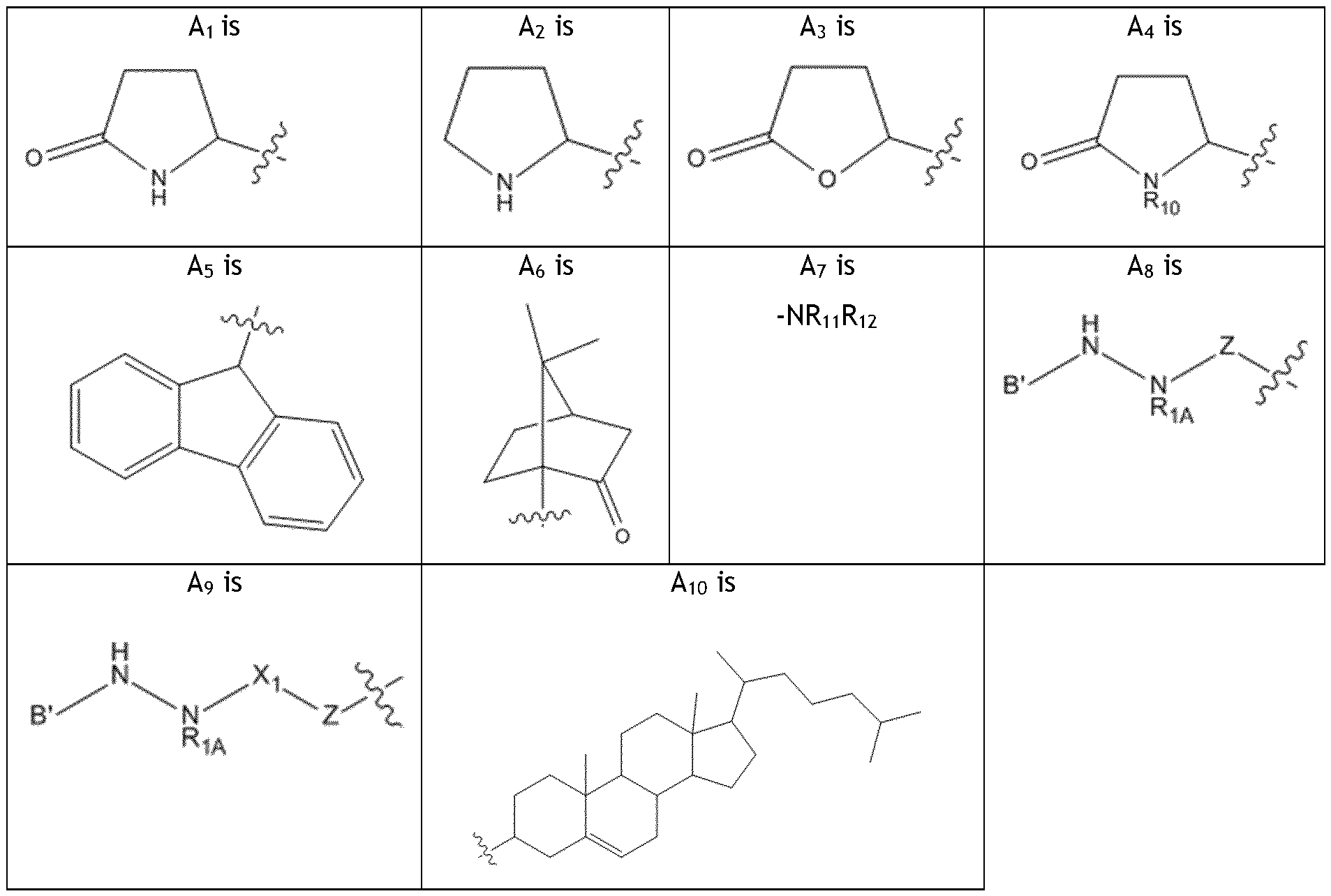
-NR7COR8, -NR7CO2R8, -NR7S(0)2R8, -CO2R7, -COR8, -CONR7R8, -CO(NR7R8)2, -CONR7NR8R9, -SR7, -
S(0)2R7, -0C0R7, -0C0NR7R8, and -0S(0)2R7, and said heteroaryl group being optionally substituted with one or several groups selected from halo, (Ci -Cfijalkyl, -CF3, -CN, -NO2, -NO+, -OR7, -NR7R8, - NR7COR8, -NR7C02R8, -NR7S(0)2R8, -NR7NR8R9, -CONR7NR8R9, -CO2R7, -COR8, -C0NR7R8, -CO(NR7R8)2, - SR7, -S(0)2R7, -0C0R7, -0C0NR7R8, and -0S(0)2R7; and

o Bi is
X and Xi are identical or different, preferably identical, and are each selected from a single bond, -CO-, -CS-, -CN-, or -SO2-;
• Y is a single bond, -0-, or -(CH2)n- with n = 1 -10;
• Z is -C(CH2)- or -(CH2)n- with n = 0-10;
• Ri and R are identical or different, preferably identical, and are each selected from hydrogen atom, (Ci -C6)alkyl, or aryl;
• R2 to R6 are, independently of one another, hydrogen atom, halo, -CF3, -CN, NO+, -NO2, -OR7, - NR7R8, -NR7COR8, -NR7C02R8, -NR7S(0)2R8, -NR7NR8R9, -CONR7NR8R9, -CO2R7, -COR8, -CONR7R8, - CO(NR7R8)2, -SR?, -S(0)2R7, -OCOR7, -0C0NR7R8, -0S(0)2R7, or (C C6)alkyl;
• each R7, Re, R9, Rn and R12 are, independently of one another, hydrogen atom, halo, (Ci-C6>alkyl or halo(Ci-C6)alkyl; and
• R10 is aryl or (Ci-C6)alkylaryl, said aryl or (Ci-C6)alkylaryl being optionally substituted with one or several groups selected from halo, (Ci -C6)alkyl, -CF3, -CN, -NO2, -NO+, -OR7, -NR7R8, -NR7COR8, -
NR7CO2R8, -NR7S(0)2R8, -NR7NR8R9, -CONR7NR8R9, -CO2R7, -COR8, -CONR7R8, -CO(NR7R8)2, -SR7, -
S(0)ZR7, -0C0R7, -OCONR7R8, and -0S(0)2R7.
Advantageously, the first object of the invention is a compound of following general formula

or a pharmaceutically acceptable salt and/or solvate thereof, wherein:
• A is Ai, A2, A3, or A4, or is a group selected from (CrCio)alkyl, (C3-Cio)cycloalkyl, or heteroaryl, said (C Cio)alkyl group being optionally substituted with one or several groups selected from halo, oxo, -CF3, -CN, -NO2, -NO+, -OR7, -NR7R8, -NR7NR8R9, -NR7C0R8, -NR7C02R8, -NR7S(0)2R8, CO2R7, -
CORs, -CONR7R8, -CO(NR7R8)2, -CONR7NR8R9, -SR7, -S(0)2R7, -0C0R7, -0C0NR7R8, and -0S(0)2R7, said (C3-Cio)cycloalkyl group being optionally substituted with one or several groups selected from halo, oxo, (Ci -C6)alkyl, -CF3, -CN, -N02, -NO+, -OR7, -NR7R8, -NR7NR8R9, -NR7COR8, -NR7C02R8, -NR7S(0)2R8, C02R7, -CORS, -C0NR7R8, -C0(NR7R8)2, -C0NR7NR8R9, -SR?, -S(0)2R7, -0C0R7, -0C0NR7R8, and - 0S(0)2R7, and said heteroaryl group being optionally substituted with one or several groups selected from halo, (Ci -C6)alkyl, -CF3, -CN, -N02, -NO+, -OR7, -NR7R8, -NR7COR8, -NR7C02R8, -NR7S(0)2R8, - NR7NR8R9, -C0NR7NR8R9, -C02R7, -CORS, -C0NR7R8, -CO(NR7R8)2, -SR?, -S(0)2R7, -0C0R7, -0C0NR7R8, and -0S(0)2R7; and :

• B is selected from Bi or heteroaryl, said heteroaryl group being optionally substituted with one or several groups selected from halo, (Ci -C6)alkyl, -CF3, -CN, -N02, -NO+, -OR7, -NR7R8, -NR7COR8, - NR7C02R8, -NR7S(0)2R8, -NR7NR8R9, -C0NR7NR8R9, -C02R7, -CORS, -C0NR7R8, -CO(NR7R8)2, -SR?, - S(0)2R7, -0C0R7, -0C0NR7R8, and -0S(0)2R7; and

• X is -CO-;
• Y is a single bond, -0-, or -CH2- ;
• Ri is selected from hydrogen atom, (Ci -C6)alkyl, or aryl;
• R2 to R6 are, independently of one another, hydrogen atom, halo, -CF3, -CN, NO+, -N02, -OR7, - NR7R8, -NR7C0R8, -NR7C02R8, -NR7S(0)2R8, -NR7NR8R9, -C0NR7NR8R9, -C02R7, -CORS, -CONR7R8, - CO(NR7RS)2, -SR?, -S(0)2R7, -0C0R7, -OCONR7RS, -0S(0)2R7, or (Ct -C6)alkyl;
• each R7, Re, and R9 are, independently of one another, hydrogen atom, halo, (Ci -C&)alkyl or halo(Ci -C6)alkyl; and
• R10 is aryl or (Ci -C6)alkylaryl, said aryl or (Ci -C6)alkylaryl being optionally substituted with one or several groups selected from halo, (Ci -Csjalkyl, -CF3, -CN, -N02, -NO+, -OR7, -NR7R8, -NR7COR8, - NR7C02RS, -NR7S(0)2RS, -NR7NRSR9, -CONR7NRSR9, -C02R7, -CORS, -CONR7R8, -CO(NR7R8)2, -SR?, - S(0)2R7, -0C0R7, -0C0NR7R8, and -0S(0)2R7.
Another object of the invention is a pharmaceutical composition comprising at least one compound of formula ( I) of the invention and at least one pharmaceutically acceptable excipient.
Another object of the invention relates to the compound of formula (I) of the invention or a pharmaceutical composition comprising said compound of formula (I), for use as drug.
Another object of the invention relates to the compound of formula (I) of the invention or a pharmaceutical composition comprising said compound of formula (I), for use for preventing and/or treating disorders associated to Adnetobacter baumannii.
Another object of the invention relates to a process for preparing a compound according the invention, comprising a step of reacting a compound of formula (II), (I ) or (II”):
A-COOH (II) A-COCl (IP) A-(S02)-CI (II”) with a compound of formula (III):
B-NH-NHRi (III),
wherein A, B and Ri are as defined above.
DETAILED DESCRIPTION OF THE INVENTION
Definitions
For the purpose of the invention, the term“pharmaceutically acceptable” is intended to mean what is useful to the preparation of a pharmaceutical composition, and what is generally safe and non-toxic, for a pharmaceutical use.
The term“pharmaceutically acceptable salt or solvate” is intended to mean, in the framework of the present invention, a salt or solvate of a compound which is pharmaceutically acceptable, as defined above, and which possesses the pharmacological activity of the corresponding compound. The pharmaceutically acceptable salts comprise:
(1 ) acid addition salts formed with inorganic acids such as hydrochloric, hydrobromic, sulfuric, nitric and phosphoric acid and the like; or formed with organic acids such as acetic, benzenesulfonic, fumaric, glucoheptonic, gluconic, glutamic, glycolic, hydroxynaphtoic, 2-hydroxyethanesulfonic, lactic, maleic, malic, mandelic, methanesulfonic, muconic, 2-naphtalenesulfonic, propionic, succinic, dibenzoyl-L-tartaric, tartaric, p-toluenesulfonic, trimethylacetic, and trifluoroacetic acid and the like, and
(2) base addition salts formed when an acid proton present in the compound is either replaced by a metal ion, such as an alkali metal ion, an alkaline-earth metal ion, or an aluminium ion; or coordinated with an organic or inorganic base. Acceptable organic bases comprise diethanolamine, ethanolamine, N-methylglucamine, triethanolamine, tromethamine and the like. Acceptable inorganic bases comprise aluminium hydroxide, calcium hydroxide, potassium hydroxide, sodium carbonate and sodium hydroxide.
Acceptable solvates for the therapeutic use of the compounds of the present invention include conventional solvates such as those formed during the last step of the preparation of the compounds of the invention due to the presence of solvents. As an example, mention may be made of solvates due to the presence of water (these solvates are also called hydrates) or ethanol.
The terms“(Ci-Cio)alkyl”, as used in the present invention, refers to a straight or branched saturated hydrocarbon chain containing from 1 to 10 carbon atoms including, but not limited to, methyl, ethyl, n-propyl, iso-propyl, n-butyl, iso-butyl, sec-butyl, tert-butyl, n-pentyl, iso-pentyl, sec- pentyl, tert-pentyl, n-hexyl, iso-hexyl, sec-hexyl, tert-hexyl, n-heptyl, n-octyl, n-nonyl, n-decyl, and the like.
The terms“(Ci-C6)alkyl”, as used in the present invention, refers to a straight or branched saturated hydrocarbon chain containing from 1 to 6 carbon atoms including, but not limited to, methyl, ethyl, n-propyl, iso-propyl, n-butyl, iso-butyl, sec-butyl, t-butyl, n-pentyl, iso-pentyl, sec- pentyl, tert-pentyl, n-hexyl, iso-hexyl, sec-hexyl, tert-hexyl, and the like.
The term “(C3-Cio)cycloalkyl”, as used in the present invention, refers to a hydrocarbon monocycle, bicycle or tricycle (i.e. comprising fused rings), each cycle having having 3 to 6 carbon atoms including, but not limited to, cyclopropyl, cyclopentyl, cyclohexyl, decahydronaphtyl, indenyl, indanyl, adamantyl and the like.
The term“aryl”, as used in the present invention, refers to an aromatic hydrocarbon group comprising preferably 6 to 10 carbon atoms and comprising one or more, notably 1 or 2, fused rings, such as, for example, a phenyl or naphtyl group. Advantageously, it will be a phenyl group.
The term“(Ci-C6)alkylaryl”, as used in the present invention, refers to an aryl group as defined above, bound to the molecule via a (Ci -Csjalkyl group as defined above.
The term “heteroaryl” as used in the present invention refers an aromatic hydrocarbon monocycle or bicycle (i.e. comprising fused rings), each cycle having advantageously 5 or 6 members, notably 6 members, and 1 to 4, notably 1 or 2, carbon atoms having each been replaced with a heteroatom such as a nitrogen, sulfur or oxygen atom, preferably nitrogen or oxygen atom.
A heteroaryl can be notably thiophene, furan, pyrrole, imidazole, pyrazole, oxazole, isoxazole, thiazole, isothiazole, triazoles (1 ,2,3-triazole and 1 ,2,4-triazole), benzofuran, indole, benzothiophene, benzimidazole, indazole, benzoxazole, benzisoxazole, benzothiazole, benzisothiazole, pyridine, pyrimidine, pyridazine, pyrazine, triazine, quinoline, isoquinoline, quinoxaline, quinazoline, etc.
The term“5- or 6-membered heteroaryl" as used in the present invention, refers to a heteroaryl as defined above having 5 or 6 atoms in the ring(s).
The term“halogen” or“halo”, as used in the present invention, refers to a fluorine, bromine, chlorine or iodine atom.
Within the meaning of this invention,“stereoisomers” is intended to designate diastereoisomers or enantiomers. These are therefore optical isomers. Stereoisomers which are not mirror images of one another are thus designated as “diastereoisomers,” and stereoisomers which are non- superimposable mirror images are designated as“enantiomers”.
Within the meaning of this invention, “conformers” is intended to designate a form of stereoisomers in which the isomers can be interconverted just by rotations about formally single bonds.
Compounds of the invention
A first object of the invention is a compound of formula (I):

or a pharmaceutically acceptable salt and/or solvate thereof, wherein A, B, X, Y and Ri are as defined above.
In the compound of the invention, A is Ai, A2, A3, A4, A5, Ab, A7, As, A9 or A10, or is a group selected from hydrogen atom, (CrCio)alkyl, (C3-Cio)cycloalkyl, aryl, or heteroaryl, said (CrCio)alkyl group being optionally substituted with one or several groups selected from halo, oxo, -CF3, -CN, - NOz, -NO+, -OR7, -NR7RS, -NR7NR8R9, -NR7COR8, -NR7CO2R8, -NR7S(0)2R8, CO2R7, -C0R8, -CONR7R8, - CO(NR7R8)2, -CONR7NR8R9, -SR7, -S(0)2R7, -OCOR7, -OCONR7R8, and -0S(0)2R7, said (C3-Cio)cycloalkyl group being optionally substituted with one or several groups selected from halo, oxo, (Ci -Cejalkyl, - CF3, -CN, -NOz, -NO+, -OR7, -NR7R8, -NR7NR8R9, -NR7COR8, -NR7C02R8, -NR7S(0)2R8, CO2R7, -CORs, - CONR7R8, -CO(NR7R8)2, -CONR7NR8R9, -SR7, -S(0)2R7, -OCOR7, -OCONR7R8, and -0S(0)2R7, and said aryl or heteroaryl group being optionally substituted with one or several groups selected from halo, (Ci- C6)alkyl, -CF3, -CN, -N02, -NO+, -OR7, -NR7R8, -NR7COR8, -NR7C02R8, -NR7S(0)2R8, -NR7NR8R9, - CONR7NR8R9, -CO2R7, -CORs, -CONR7R8, -CO(NR7R8)2, -SR?, -S(0)2R7, -OCOR7, -OCONR7R8, -0S(0)2R7; A, to A10 being as defined above.
Advantageously, when A is A4, R10 is an aryl or a (Ci -Cfijalkylaryl, said aryl or (Ci -Cejalkylaryl being optionally substituted with one or several groups selected from halo, (Ci -Cejalkyl, -CF3, -CN, - NOz, -NO+, -OR7, -NR7R8, -NR7COR8, -NR7CO2R8, -NR7S(0)2R8, -NR7NRSR9, -CONR7NR8R9, -CO2R7, -CORs, - CONR7R8, -CO(NR7Re)2, -SR7, -S(0)2R7, -OCOR7, -OCONR7R8, and -0S(0)2R7. More advantageously, R10 is a phenyl or (Ci-C6>alkylphenyl that is optionally substituted with one or several groups selected from halo, (CrC6)alkyl, -CF3, -CN, -N02, -NO+, -OR7, -NR7R8, -NR7COR8, -NR7CO2R8, -NR7S(0)2R8, -NR7NR8R9, -CONR7NR8R9, -CO2R7, -CORs, -CONR7R8, -CO(NR7RS)2, -SR?, -S(0)2R7, -OCOR7, -OCONR7R8, and - 0S(0)2R7. More advantageously, R10 is a phenyl or (Ci-C6>alkylphenyl that is non-substituted.
Advantageously, when A is A7, Rn and R12 are, independently of one another, hydrogen atom, halo, (Ci -Csjalkyl or halo(Ci-C6)alkyl, preferably hydrogen atom or (Ci -Csjalkyl.
Advantageously, when A is A8 or A9, B’, R and Xi are as defined above or in the following paragraphs related to B’, R and Xi respectively. Preferably, B’ is identical to B, R is identical to Ri, and Xi is identical to X. Furthermore, Z is -CfCF )- or -(Ch jn- with n = 0-10, preferably Z is -(Ch jn- with n = 0-10, in particular n = 0-6.
Advantageously, A is Ai, A2, A3, A4, or A9 or is a group selected from (CrCio)alkyl, aryl, or heteroaryl, said (C Cio)alkyl group being optionally substituted with one or several groups selected from halo, oxo, -CF3, -CN, -N02, -NCT, -OR7, -NR7R8, -NR7NR8R9, -NR7COR8, -NR7C02R8, -NR7S(0)2R8, CO2R7, -CORs, -CONR7R8, -CO(NR7R8)2, -CONR7NR8R9, -SR7, -S(0)2R7, -OCOR7, -OCONR7R8, and - 0S(0)2R7, and said aryl or heteroaryl group being optionally substituted with one or several groups selected from halo, (Ci -Cfijalkyl, -CF3, -CN, -NO2, -NO+, -OR7, -NR7R8, -NR7COR8, -NR7C02R8, -
NR7S(0)2R8, -NR7NR8R9, -C0NR7NR8R9, -C02R7, -CORfs, -C0NR7R8, -C0(NR7R8)2, -SR?, -S(0)2R7, -OCOR7, - OCONR7R8, -0S(0)2R7; wherein Ai to A4, A9 and R7 to R10 are as defined above.
Advantageously, A is Ai, A2, A3, A4, or A9, or is a group selected from (Ci-C6)alkyl, phenyl, or 5-6-membered heteroaryl; said phenyl or 5-6-membered heteroaryl group being optionally substituted with one or several groups selected from halo, (Ci -Cfijalkyl, -CF3, -CN, -N02, -NO+, -OR7, -NR7R8, - NR7COR8, -NR7C02R8, -NR7S(0)2R8, -NR7NR8R9, -CONR7NR8R9, -C02R7, -COR8, -C0NR7R8, -CO(NR7R8)2, - SR7, -S(0)2R7, -0C0R7, -0C0NR7R8, -0S(0)2R7; wherein Ai to A4, A9 and R7 to R10 are as defined above.
More advantageously, A is Ai, A2, A3, or A4, or is a group selected from (CrCio)alkyl, (C3- Cio)cycloalkyl, or heteroaryl, said (C Cio)alkyl group being optionally substituted with one or several groups selected from halo, oxo, -CF3, -CN, -N02, -NO+, -OR7, -NR7R8, -NR7NR8R9, -NR7COR8, -NR7C02R8, -NR7S(0)2R8, CO2R7, -COR8, -CONR7R8, -CO(NR7R8)2, -CONR7NR8R9, -SR7, -S(0)2R7, -OCOR7, -0C0NR7R8, and -0S(0)2R7, said (C3-Cio)cycloalkyl group being optionally substituted with one or several groups selected from halo, oxo, (Ci -C6)alkyl, -CF3, -CN, -N02, -NO+, -OR7, -NR7R8, -NR7NR8R9, -NR7COR8, -
NR7CO2R8, -NR7S(0)2R8, CO2R7, -COR8, -CONR7R8, -CO(NR7R8)2, -CONR7NR8R9, -SR7, -S(0)2R7, -0C0R7, -
OCONR7R8, and -0S(0)2R7, and said heteroaryl group being optionally substituted with one or several groups selected from halo, (Ci -C6)alkyl, -CF3, -CN, -N02, -NO+, -OR7, -NR7R8, -NR7COR8, -NR7C02R8, -
NR7S(0)2R8, -NR7NR8R9, -CONR7NR8R9, -CO2R7, -COR8, -CONR7R8, -CO(NR7R8)2, -SR7, -S(0)2R7, -0C0R7, -
OCONR7R8, and -0S(0)2R7; R7 to R9 being as defined previously.
More advantageously, A is Ai, A2, A3, or A4, or is a group selected from (CrCio)alkyl, (C3- C6)cycloalkyl, or 5-6-membered heteroaryl, said (C Cio)alkyl group being optionally substituted with one or several groups selected from halo, oxo, -CF3, -CN, -N02, -NO+, -OR7, -NR7R8, -NR7NR8R9, -
NR7COR8, -NR7CO2R8, -NR7S(0)2R8, CO2R7, -COR8, -CONR7R8, -CO(NR7R8)2, -CONR7NR8R9, -SR7, -S(0)2R7,
-OCOR7, -0C0NR7R8, and -0S(0)2R7, said (C3-C6)cycloalkyl group being optionally substituted with one or several groups selected from halo, oxo, (Ci -C6)alkyl, -CF3, -CN, -N02, -NO+, -OR7, -NR7R8, -NR7NR8R9,
-NR7COR8, -NR7CO2R8, -NR7S(0)2R8, CO2R7, -COR8, -CONR7R8, -CO(NR7R8)2, -CONR7NR8R9, -SR7, -S(0)2R7,
-OCOR7, -0C0NR7R8, and -0S(0)2R7, and said 5-6 or 10-membered heteroaryl group being optionally substituted with one or several groups selected from halo, (Ci -C6)alkyl, -CF3, -CN, -N02, -NO+, -OR7, - NR7R8, -NR7COR8, -NR7C02R8, -NR7S(0)2R8, -NR7NR8R9, -C0NR7NR8R9, -CO2R7, -COR8, -C0NR7R8, - CO(NR7R8)2, -SR?, -S(0)2R7, -0C0R7, -0C0NR7R8, and -0S(0)2R7; R7 to R9 being as defined previously.
More advantageously, A is Ai, A2, A3, or A4, or is a group selected from (CrCio)alkyl, (C3- C6)cycloalkyl, or 5-6-membered heteroaryl, said (C Cio)alkyl group being optionally substituted with one or several groups selected from halo, oxo, -CF3, -CN, -N02, -NO+, -OR7, -NR7R8, -NR7NR8R9, -
NR7COR8, -NR7CO2R8, -NR7S(0)2R8, CO2R7, -COR8, -CONR7R8, -CO(NR7R8)2, -CONR7NR8R9, -SR7, -S(0)2R7,
-OCOR7, -0C0NR7R8, and -0S(0)2R7, said (C3-C6)cycloalkyl group being optionally substituted with one or several groups selected from halo, oxo, (Ci -C6)alkyl, -CF3, -CN, -N02, -NO+, -OR7, -NR7R8, -NR7NR8R9,
-NR7COR8, -NR7CO2R8, -NR7S(0)2R8, CO2R7, -COR8, -CONR7R8, -CO(NR7R8)2, -CONR7NR8R9, -SR7, -S(0)2R7,
-OCOR7, -0C0NR7R8, and -0S(0)2R7, and said 5-6 or 10-membered heteroaryl group being optionally substituted with one or several groups selected from halo, (Ci -C6)alkyl, -CF3, -CN, -N02, -NO+, -OR7, -
NR7R8, -NR7COR8, -NR7C02R8, -NR7S(0)2R8, -NR7NR8R9, -CONR7NR8R9, -CO2R7, -COR8, -CONR7R8, - CO(NR7R8)2, -SR?, -S(0)2R7, -0C0R7, -0C0NR7R8, and -0S(0)2R7; R7 to R9 being as defined previously.
Advantageously, when A is a 5-6-membered heteroaryl, said heteroaryl comprises 1 or 2 nitrogen or oxygen atom. Advantageously, said heteroaryl is selected from pyrrole, furan, thiophene, indole, benzofuran, benzothiophene, pyridine, quinolone, isoquinoline, isothiazole, thiazole, pyrilium, thiapyrilium, pyrazole, isoxazole, imidazole or oxazole, more advantageously pyridine, imidazole, isoquinoline.
In the compound of the invention, B is selected from Bi, (C3-Cio)cycloalkyl, or heteroaryl, said (C3-Cio)cycloalkyl group being optionally substituted with one or several groups selected from halo, oxo, (Ci-C6)alkyl, -CF3, -CN, -N02, -NCT, -OR7, -NR7R8, -NR7NR8R9, -NR7COR8, -NR7C02R8, -NR7S(0)2R8, -C02R7, -CORS, -C0NR7R8, -CO(NR7R8)2, -C0NR7NR8R9, -SR?, -S(0)2R7, -0C0R7, -OCONR7R8, and - 0S(0)2R7, and said heteroaryl group being optionally substituted with one or several groups selected from halo, (Ci-C6)alkyl, -CF3, -CN, -N02, -NCT, -OR7, -NR7R8, -NR7COR8, -NR7C02R8, -NR7S(0)2R8, - NR7NR8R9, -CONR7NR8R9, -CO2R7, -COR8, -CONR7R8, -CO(NR7R8)2, -SR7, -S(0)2R7, -0C0R7, -0C0NR7R8, and -0S(0)2R7; and Bi is as defined previously, with R2 to R¾ also defined previously.
Advantageously, B is selected from Bi or heteroaryl, said heteroaryl group being optionally substituted with one or several groups selected from halo, (Ci -C6)alkyl, -CF3, -CN, -N02, -NO+, -OR7, - NR7R8, -NR7C0R8, -NR7C02R8, -NR7S(0)2R8, -NR7NR8R9, -C0NR7NR8R9, -C02R7, -COR8, -C0NR7R8, - CO(NR7R8)2, -SR?, -S(0)2R7, -0C0R7, -0C0NR7R8, and -0S(0)2R7; and Bi and R2 to R9 are as defined previously.
Advantageously, B is selected from B1 , pyridinyl, pyrrolyl, or isoquinolinyl, more advantageously B1 , pyridinyl, or isoquinolinyl; said heteroaryl group being optionally substituted with one or several groups selected from halo, (Ci -C6)alkyl, -CF3, -CN, -N02, -NO+, -OR7, -NR7R8, -NR7COR8,
-NR7CO2R8, -NR7S(0)2R8, -NR7NR8R9, -CONR7NR8R9, -CO2R7, -COR8, -CONR7R8, -CO(NR7R8)2, -SR7, -
S(0)2R7, -0C0R7, -0C0NR7R8, and -0S(0)2R7; and Bi and R2 to R9 are as defined previously.
Advantageously, B is Bi, with R2 to R¾ being as defined previously. More advantageously, R2 to R6 are hydrogen atoms or one or two R2 to R¾ are, independently of one another, halo, -CF3, -CN, NO+, -NO2, -OR7, -NR7R8, -NR7C0R8, -NR7C02R8, -NR7S(0)2R8, -NR7NR8R9, -CONR7NR8R9, -C02R7, -COR8, - CONR7R8, -CO(NR7R8)2, -SR?, -S(0)2R7, -0C0R7, -0C0NR7R8, -0S(0)2R7, or ( Ci -C8 )alky l; the others R2 to R6 being hydrogen atoms. More advantageously, R2 to R¾ are hydrogen atoms or one or two R2 to R¾ are, independently of one another, halo, -CF3, -CN, -OR7, -NR7R8, -NR7COR8, -NR7C02R8, -NR7S(0)2R8, C02R7, -CORS, -C0NR7R8, -CO(NR7R8)2, -SR?, -S(0)2R7, -0C0R7, -0C0NR7R8, -0S(0)2R7, NCT, -N02, or (Ci- C6>alkyl, preferably halo, -CF3, -CN, -OR7, -NR7R8, NO+, -N02, or (Ci -C8)alkyl; the others R2 to R¾ being hydrogen atoms.
In the compound of the invention, B’ is selected from Bi, (C3-Cio)cycloalkyl, or heteroaryl, said (C3-Cio)cycloalkyl group being optionally substituted with one or several groups selected from halo, oxo, (Ci-C6)alkyl, -CF3, -CN, -N02, -NCT, -OR7, -NR7R8, -NR7NR8R9, -NR7COR8, -NR7C02R8, -NR7S(0)2R8,
-CO2R7, -CORs, -CONR7R8, -CO(NR7R8)2, -CONR7NR8R9, -SR7, -S(0)2R7, -OCOR7, -OCONR7R8, and - 0S(0)2R7, and said heteroaryl group being optionally substituted with one or several groups selected from halo, (Ci-C6)alkyl, -CF3, -CN, -N02, -NO+, -OR7, -NR7R8, -NR7COR8, -NR7C02R8, -NR7S(0)2R8, - NR7NR8R9, -C0NR7NR8R9, -CO2R7, -CORs, -CONR7R8, -CO(NR7R8)2, -SR7, -S(0)2R7, -OCOR7, -OCONR7R8, and -0S(0)2R7; and Bi is as defined previously, with R2 to R6 also defined previously.
Advantageously, B’ is Bi, with R2 to R6 being as defined previously. More advantageously, R2 to R6 are hydrogen atoms or one or two R2 to R6 are, independently of one another, halo, -CF3, -CN, NO+, -NO2, -OR7, -NR7R8, -NR7C0R8, -NR7C02R8, -NR7S(0)2R8, -NR7NR8R9, -C0NR7NR8R9, -CO2R7, -COR8, - CONR7RS, -CO(NR7RS)2, -SR7, -S(0)2R7, -OCOR7, -OCONR7RS, -0S(0)2R7, or ( Ci -C8 )alky l; the others R2 to R6 being hydrogen atoms. More advantageously, R2 to R6 are hydrogen atoms or one or two R2 to R6 are, independently of one another, halo, -CF3, -CN, -OR7, -NR7R8, -NR7COR8, -NR7C02R8, -NR7S(0)2R8, CO2R7, -CORs, -CONR7R8, -CO(NR7R8)2, -SR7, -S(0)2R7, -OCOR7, -OCONR7R8, -0S(0)2R7, NO+, -N02, or (Ct- C6>alkyl, preferably halo, -CF3, -CN, -OR7, -NR7R8, NO+, -NO2, or (Ci -C&)alkyl; the others R2 to R¾ being hydrogen atoms.
Advantageously, B’ is identical to B.
In the compound of the invention, X is a single bond, -CO-, -CS-, -CN-, or -SO2-. Advantageously, X is a single bond, -CO- or -SO2. More advantageously, X is -CO- or -SO2, in particular X is -CO-.
According to the invention, X is advantageously -CO-.
In the compound of the invention, Xi is a single bond, -CO-, -CS-, -CN-, or -SO2-. Advantageously, Xi is a single bond, -CO- or -SO2. More advantageously, Xi is -CO- or -SO2, in particular Xi is -CO-.
Advantageously, Xi is identical to X.
In the compound of the invention, Y is a single bond, -0-, or -(CH2)n- with n = 1 -10. Advantageously, Y is a single bond, -0-, or -(CH2)n- with n = 1 -6, preferably 1 -3. Advantageously, Y is a single bond, -0-, or -CH2-. More advantageously, Y is a single bond or -0-, preferably Y is a single bond.
In the compound of the invention, Ri is selected from hydrogen atom, (Ci -C6)alkyl, or aryl. Advantageously, Ri is selected from hydrogen atom, (Ci-C3)alkyl, or phenyl. More advantageously, Ri is selected from hydrogen atom or phenyl, preferably, Ri is a hydrogen atom.
In the compound of the invention, R is selected from hydrogen atom, (Ci -Csjalkyl, or aryl. Advantageously, R is selected from hydrogen atom, (Ci-C3)alkyl, or phenyl. More advantageously, RIA is selected from hydrogen atom or phenyl, preferably, R is a hydrogen atom.
Advantageously, R is identical to Ri .
Advantageously, in the compound of formula (I):
• A is as defined above;
• B and B’ are identical or different, preferably identical, and are Bi; Bi being as defined above with R2 to R6 being all hydrogen atoms or one or two R2 to R¾ being, independently of one another, halo, -CF3, -CN, NO", -N02, -OR7, -NR7R8, -NR7C0R8, -NR7C02R8, -NR7S(0)2R8, -NR7NR8R9, -C0NR7NR8R9, -C02R7, -CORS, -CONR7R8, -CO(NR7R8)2, -SR?, -S(0)2R7, -0C0R7, -OCONR7R8, -0S(0)2R7, or (CrC6)alkyl; the others R2 to R¾ being hydrogen atoms;
• X and Xi are identical or different, preferably identical, and each are a single bond, -CO- or - SO2, preferably -CO- or -SO2;
• Y is a single bond or -0-, preferably -0-;
• Z is -(CH2)n- with n = 0-10;
• Ri and R are identical or different, preferably identical, and are each selected from hydrogen atom, (Ci-C3)alkyl, or phenyl.
Advantageously, in the compound of formula (I):
• A is as defined above;
• B is Bi; Bi being as defined above and R2 to R¾ are all hydrogen atoms or one or two R2 to R¾ are, independently of one another, halo, -CF3, -CN, NO+, -NO2, -OR7, -NR7R8, -NR7COR8, -NR7C02R8, - NR7S(0)2R8, -NR7NR8R9, -CONR7NR8R9, -COZR7, -CORS, -C0NR7R8, -CO(NR7R8)2, -SR?, -S(0)2R7, -0C0R7, -OCONR7R8, -0S(0)2R7, or (Ci -C8)alkyl; the others R2 to R¾ being hydrogen atoms;
• B’, if any, is identical to B;
• X is a single bond, -CO- or -SO2, preferably -CO- or -SO2;
• Xi, if any, is identical to X;
• Y is a single bond or -0-, preferably -0-;
• Z, if any, is -(CH2)n- with n = 0-10;
• Ri is selected from hydrogen atom, (Ci-C3)alkyl, or phenyl, preferably an hydrogen atom; and
• RIA, if any, is identical to Ri .
Advantageously, in the compound of formula (I):
• A is as defined above;
• B is Bi; Bi being as defined above and R2 to R¾ are all hydrogen atoms or one or two R2 to R¾ are, independently of one another, halo, -CF3, -CN, NO+, -NO2, -OR7, -NR7R8, -NR7COR8, -NR7C02R8, - NR7S(0)2R8, -NR7NR8R9, -CONR7NR8R9, -COZR7, -CORS, -C0NR7R8, -CO(NR7R8)2, -SR?, -S(0)2R7, -0C0R7, -OCONR7R8, -0S(0)2R7, or (Ci -C8)alkyl; the others R2 to R6 being hydrogen atoms;
• B’, if any, is identical to B;
• X is -CO- or -SO2;
• Xi, if any, is identical to X;
• Y is -0-;
• Z, if any, is -(CH2)n- with n = 0-10;
• Ri is an hydrogen atom; and
• RIA, if any, is identical to Ri .
Advantageously, in the compound of formula (I):
• A is Ai , A2, A3, A4, or A9, or is a group selected from (Ci -Csjalkyl, phenyl, or 5-6-membered heteroaryl; said phenyl group being optionally substituted with one or several groups selected from halo, (Ci -C6)alkyl, -CF3, -CN, -N02, -NCT, -OR7, -NR7R8, -NR7COR8, -NR7C02R8, -NR7S(0)2R8, -NR7NR8R9, -CONR7NR8R9, -C02R7, -CORS, -C0NR7R8, -CO(NR7R8)2, -SR?, -S(0)2R7, -0C0R7, -0C0NR7R8, -0S(0)2R7; wherein Ai to A4, A9 and R7 to R10 are as defined above;
• B and B’ are identical or different, preferably identical, and are Bi ; Bi being as defined above and R2 to R¾ are all hydrogen atoms or one or two R2 to R¾ are, independently of one another, halo, -CF3, -CN, NO+, -NO2, -OR7, -NR7R8, -NR7C0R8, -NR7C02R8, -NR7S(0)2R8, -NR7NR8R9, -C0NR7NR8R9, - C02R7, -CORS, -C0NR7R8, -CO(NR7R8)2, -SR?, -S(0)2R7, -OCOR7, -0C0NR7R8, -0S(0)2R7, or (CrC6)alkyl; the others R2 to R¾ being hydrogen atoms;
• X and Xi are identical or different, preferably identical, and are each a single bond, -CO- or - S02, preferably -CO- or -S02;
• Y is a single bond or -0-, preferably -0-;
• Z is -(CH2)n- with n = 0-10;
• Ri and R are identical or different, preferably identical, and are selected from hydrogen atom, (Ci -C3)alkyl, or phenyl.
Advantageously, in the compound of formula (I ):
• A is Ai , A2, A3, A4, or A9, or is a group selected from (Ci -C6)alkyl, phenyl, or 5-6-membered heteroaryl; said phenyl group being optionally substituted with one or several groups selected from halo, (CrC6)alkyl, -CF3, -CN, -N02, -NCT, -OR7, -NR7R8, -NR7COR8, -NR7C02R8, -NR7S(0)2R8, -NR7NR8R9, -CONR7NR8R9, -C02R7, -CORS, -C0NR7R8, -CO(NR7R8)2, -SR?, -S(0)2R7, -0C0R7, -0C0NR7R8, -0S(0)2R7; wherein Ai to A4, A9 and R7 to R10 are as defined above;
• B is Bi ; Bi being as defined above and R2 to R6 are all hydrogen atoms or one or two R2 to R6 are, independently of one another, halo, -CF3, -CN, NO+, -N02, -OR7, -NR7R8, -NR7COR8, -NR7C02R8, - NR7S(0)2R8, -NR7NR8R9, -C0NR7NR8R9, -C02R7, -CORS, -C0NR7R8, -CO(NR7R8)2, -SR?, -S(0)2R7, -0C0R7, -OCONR7RS, -0S(0)2R7, or (Ci -C8)alkyl; the others R2 to R6 being hydrogen atoms;
• B’, if any, is identical to B;
• X is a single bond, -CO- or -S02, preferably -CO- or -S02;
• Xi , if any, is identical to X;
• Y is a single bond or -0-, preferably -0-;
• Z, if any, is -(CH2)n- with n = 0-10;
• Ri is selected from hydrogen atom, (Ci -C3)alkyl, or phenyl, preferably an hydrogen atom; and
• RIA, if any, is identical to Ri .
Advantageously, in the compound of formula (I ):
• A is Ai , A2, A3, A4, or A9, or is a group selected from (Ci -C6)alkyl, phenyl, or 5-6-membered heteroaryl; said phenyl group being optionally substituted with one or several groups selected from halo, (Ci -C6)alkyl, -CF3, -CN, -N02, -NO+, -OR7, -NR7R8, -NR7COR8, -NR7C02R8, -NR7S(0)2R8, -NR7NR8R9, -CONR7NR8R9, -C02R7, -CORS, -C0NR7R8, -C0(NR7R8)2, -SR?, -S(0)2R7, -0C0R7, -0C0NR7R8, -0S(0)2R7; wherein Ai to A4, A9 and R7 to R10 are as defined above;
• B is Bi; Bi being as defined above and R2 to R6 are all hydrogen atoms or one or two R2 to R6 are, independently of one another, halo, -CF3, -CN, NO+, -NO2, -OR7, -NR7R8, -NR7COR8, -NR7CO2R8, - NR7S(0)2R8, -NR7NR8R9, -CONR7NR8R9, -CO2R7, -CORs, -CONR7R8, -CO(NR7R8)2, -SR7, -S(0)2R7, -OCOR7, -OCONR7R8, -0S(0)2R7, or (Ci -C6)alkyl; the others R2 to R¾ being hydrogen atoms;
• B’, if any, is identical to B;
• X is -CO- or -SO2;
• Xi, if any, is identical to X;
• Y is -0-;
• Z, if any, is -(CH2)n- with n = 0-10;
• Ri is an hydrogen atom; and
• RIA, if any, is identical to Ri.
More advantageously, in the compound of formula (I):
• A is Ai, A2, A3, or A4, or is a group selected from (CrCio)alkyl, (C3-Cio)cycloalkyl, or heteroaryl, said (CrCio)alkyl group being optionally substituted with one or several groups selected from halo, oxo, -CF3, -CN, -NO2, -NO+, -OR7, -NR7R8, -NR7NR8R9, -NR7COR8, -NR7C02R8, -NR7S(0)2R8, CO2R7, - CORs, -CONR7R8, -CO(NR7R8)2, -CONR7NR8R9, -SR?, -S(0)2R7, -OCOR7, -OCONR7R8, and -0S(0)2R7, said (C3-Cio)cycloalkyl group being optionally substituted with one or several groups selected from halo, oxo, (Ci-C6)alkyl, -CF3, -CN, -N02, -NCT, -OR7, -NR7R8, -NR7NR8R9, -NR7COR8, -NR7C02R8, -NR7S(0)2R8, CO2R7, -CORs, -CONR7R8, -CO(NR7RS)2, -CONR7NR8R9, -SR?, -S(0)2R7, -OCOR7, -OCONR7R8, and - 0S(0)2R7, and said heteroaryl group being optionally substituted with one or several groups selected from halo, (Ci-C6)alkyl, -CF3, -CN, -N02, -NCT, -OR7, -NR7R8, -NR7COR8, -NR7CO2R8, -NR7S(0)2R8, - NR7NR8R9, -CONR7NR8R9, -CO2R7, -CORs, -CONR7R8, -CO(NR7R8)2, -SR7, -S(0)2R7, -OCOR7, -OCONR7R8, and -0S(0)2R7;
• B is Bi or pyridinyl or isoquinolinyl; Bi being as defined above with R2 to R6 being all hydrogen atoms or one or two R2 to R¾ being, independently of one another, halo, -CF3, -CN, NO+, -NO2, -OR7, -NR7R8, -NR7CORS, -NR7CO2R8, -NR7S(0)2R8, -NR7NRSR9, -CONR7NRSR9, -CO2R7, -CORs, -CONR7R8, - CO(NR7R8>2, -SR7, -S(0)2R7, -OCOR7, -OCONR7R8, -0S(0)2R7, or (Ci -Cs)alkyl; the others R2 to R¾ being hydrogen atoms; and pyridinyl or isoquinolinyl being optionally substituted with one or several groups selected from halo, (Ci -Csjalkyl, -CF3, -CN, -NO2, -NO+, -OR7, -NR7R8, -NR7COR8, -NR7CO2R8, - NR7S(0)2R8, -NR7NRSR9, -CONR7NRSR9, -CO2R7, -CORs, -CONR7R8, -CO(NR7R8)2, -SR7, -S(0)2R7, -OCOR7, -OCONR7R8, and -0S(0)2R7
• X is -CO-;
• Y is a single bond or -0-; and
• Ri is selected from hydrogen atom, (Ci-C3)alkyl, or phenyl.
More advantageously, in the compound of formula (I):
• A is Ai, A2, A3, or A4, or is a group selected from (CrCio)alkyl, (C3-Cio)cycloalkyl, or heteroaryl, said (C Cio)alkyl group being optionally substituted with one or several groups selected from halo,
oxo, -CF3, -CN, -N02, -NCT, -OR7, -NR7R8, -NR7NR8R9, -NR7COR8, -NR7C02R8, -NR7S(0)2R8, C02R7, - COR8, -C0NR7R8, -C0(NR7R8)2, -C0NR7NR8R9, -SR?, -S(0)2R7, -0C0R7, -0C0NR7R8, and -0S(0)2R7, said (C3-Cio)cycloalkyl group being optionally substituted with one or several groups selected from halo, oxo, (Ci-C6)alkyl, -CF3, -CN, -N02, -N0+, -0R7, -NR7R8, -NR7NR8R9, -NR7COR8, -NR7C02R8, -NR7S(0)2R8, C02R7, -CORS, -C0NR7R8, -CO(NR7R8)2, -CONR7NR8R9, -SR?, -S(0)2R7, -0C0R7, -0C0NR7R8, and - 0S(0)2R7, and said heteroaryl group being optionally substituted with one or several groups selected from halo, (Ci-C6)alkyl, -CF3, -CN, -N02, -NCT, -0R7, -NR7R8, -NR7COR8, -NR7C02R8, -NR7S(0)2R8, - NR7NR8R9, -CONR7NR8R9, -CO2R7, -COR8, -CONR7R8, -CO(NR7R8)2, -SR7, -S(0)2R7, -0C0R7, -0C0NR7R8, and -0S(0)2R7;
• B is Bi; Bi being as defined above and R2 to R¾ are all hydrogen atoms or one or two R2 to R¾ are, independently of one another, halo, -CF3, -CN, N0+, -N02, -0R7, -NR7R8, -NR7COR8, -NR7C02R8, -
NR7S(0)2R8, -NR7NR8R9, -CONR7NR8R9, -CO2R7, -COR8, -CONR7R8, -CO(NR7R8)2, -SR7, -S(0)2R7, -0C0R7,
-OCONR7R8, -0S(0)2R7, or (Ci -C8)alkyl; the others R2 to R¾ being hydrogen atoms;
• X is -CO-;
• Y is a single bond or -0-; and
• Ri is selected from hydrogen atom, (Ci-C3)alkyl, or phenyl, preferably an hydrogen atom.
More advantageously, in the compound of formula (I):
• A is Ai, A2, A3, or A4, or is a group selected from (CrCio)alkyl, (C3-Cio)cycloalkyl, or heteroaryl, said (C Cio)alkyl group being optionally substituted with one or several groups selected from halo, oxo, -CF3, -CN, -N02, -N0+, -0R7, -NR7R8, -NR7NR8R9, -NR7C0R8, -NR7C02R8, -NR7S(0)2R8, C02R7, - CORs, -CONR7R8, -CO(NR7R8)2, -C0NR7NR8R9, -SR?, -S(0)2R7, -0C0R7, -0C0NR7R8, and -0S(0)2R7, said (C3-Cio)cycloalkyl group being optionally substituted with one or several groups selected from halo, oxo, (CrC6)alkyl, -CF3, -CN, -N02, -N0+, -0R7, -NR7R8, -NR7NR8R9, -NR7COR8, -NR7C02R8, -NR7S(0)2R8, C02R7, -CORS, -C0NR7R8, -CO(NR7R8)2, -C0NR7NR8R9, -SR?, -S(0)2R7, -0C0R7, -0C0NR7R8, and - 0S(0)2R7, and said heteroaryl group being optionally substituted with one or several groups selected from halo, (Ci-C6)alkyl, -CF3, -CN, -N02, -N0+, -0R7, -NR7R8, -NR7COR8, -NR7C02R8, -NR7S(0)2R8, - NR7NR8R9, -C0NR7NR8R9, -C02R7, -CORS, -C0NR7R8, -CO(NR7R8)2, -SR?, -S(0)2R7, -0C0R7, -0C0NR7R8, and -0S(0)2R7;
• B is Bi; Bi being as defined above and R2 to R6 are all hydrogen atoms or one or two R2 to R6 are, independently of one another, halo, -CF3, -CN, N0+, -N02, -0R7, -NR7R8, -NR7COR8, -NR7C02R8, - NR7S(0)2R8, -NR7NR8R9, -C0NR7NR8R9, -C02R7, -CORS, -C0NR7R8, -C0(NR7R8)2, -SR?, -S(0)2R7, -0C0R7, -0C0NR7RS, -0S(0)2R7, or (Ci -C8)alkyl; the others R2 to R6 being hydrogen atoms;
• X is -CO-;
• Y is a single bond or -0-; and
• Ri is an hydrogen atom.
More advantageously, in the compound of formula (I):
• A is Ai, A2, A3, A4, or is a group selected from (CrCio)alkyl or 5-6-membered heteroaryl; said 5-6 or 10-membered heteroaryl group being optionally substituted with one or several groups selected
from halo, (Ci-C6)alkyl, -CF3, -CN, -N02, -NCT, -OR7, -NR7R8, -NR7COR8, -NR7C02R8, -NR7S(0)2R8, - NR7NR8R9, -C0NR7NR8R9, -C02R7, -CORS, -C0NR7R8, -C0(NR7R8)2, -SR?, -S(0)2R7, -0C0R7, -0C0NR7R8, -0S(0)2R7;
• B is Bi; Bi being as defined above and R2 to R¾ are all hydrogen atoms or one or two R2 to R¾ are, independently of one another, halo, -CF3, -CN, NO+, -N02, -OR7, -NR7R8, -NR7COR8, -NR7C02R8, -
NR7S(0)2R8, -NR7NR8R9, -CONR7NR8R9, -CO2R7, -COR8, -CONR7R8, -CO(NR7R8)2, -SR7, -S(0)2R7, -0C0R7,
-OCONR7R8, -0S(0)2R7, or (Ci -Cfijalkyl; the others R2 to R¾ being hydrogen atoms;
• X is -CO-;
• Y is a single bond or -0-; and
• Ri is selected from hydrogen atom, (Ci-C3)alkyl, or phenyl, preferably an hydrogen atom.
More advantageously, in the compound of formula (I):
• A is Ai, A2, A3, A4, or is a group selected from (CrCio)alkyl or 5-6-membered heteroaryl; said 5-6 or 10-membered heteroaryl group being optionally substituted with one or several groups selected from halo, (Ci-C6)alkyl, -CF3, -CN, -N02, -NCT, -OR7, -NR7R8, -NR7COR8, -NR7C02R8, -NR7S(0)2R8, - NR7NR8R9, -CONR7NR8R9, -CO2R7, -COR8, -CONR7R8, -CO(NR7R8)2, -SR7, -S(0)2R7, -0C0R7, -0C0NR7R8, -0S(0)2R7;
• B is Bi; Bi being as defined above and R2 to R¾ are all hydrogen atoms or one or two R2 to R¾ are, independently of one another, halo, -CF3, -CN, NO+, -N02, -OR7, -NR7R8, -NR7COR8, -NR7C02R8, -
NR7S(0)2R8, -NR7NR8R9, -CONR7NR8R9, -CO2R7, -COR8, -CONR7R8, -CO(NR7R8)2, -SR7, -S(0)2R7, -0C0R7,
-OCONR7R8, -0S(0)2R7, or (Ci -C8)alkyl; the others R2 to R¾ being hydrogen atoms;
• X is -CO-;
• Y is a single bond or -0-; and
• Ri is selected from hydrogen atom, (Ci-C3)alkyl, or phenyl, preferably an hydrogen atom.
More advantageously, in the compound of formula (I):
• A is Ai, A2, A3, A4, or is a group selected from (CrCio)alkyl or 5-6-membered heteroaryl; said 5-6 or 10-membered heteroaryl group being optionally substituted with one or several groups selected from halo, (Ci-C6)alkyl, -CF3, -CN, -N02, -NCT, -OR7, -NR7R8, -NR7COR8, -NR7C02R8, -NR7S(0)2R8, - NR7NR8R9, -CONR7NR8R9, -CO2R7, -COR8, -CONR7R8, -CO(NR7R8)2, -SR7, -S(0)2R7, -0C0R7, -0C0NR7R8, -0S(0)2R7;
• B is Bi; Bi being as defined above and R2 to R¾ are all hydrogen atoms or one or two R2 to R¾ are, independently of one another, halo, -CF3, -CN, NO+, -N02, -OR7, -NR7R8, -NR7COR8, -NR7C02R8, -
NR7S(0)2R8, -NR7NR8R9, -CONR7NR8R9, -CO2R7, -COR8, -CONR7R8, -CO(NR7R8)2, -SR7, -S(0)2R7, -0C0R7,
-OCONR7R8, -0S(0)2R7, or (Ci -C8)alkyl; the others R2 to R¾ being hydrogen atoms;
• X is -CO-;
• Y is a single bond or -0-; and
• Ri is selected from hydrogen atom, (Ci-C3)alkyl, or phenyl, preferably an hydrogen atom.
In all the definitions recited above, each R7, Re, and R9 are, independently of one another, hydrogen atom, halo, (Ci -Csjalkyl or halo(Ci-C6)alkyl.
The compound of the invention can be advantageously in the form of a pharmaceutically acceptable salt, such as a salt selected from the group of hydrochloric, hydrobromic, sulfuric, nitric and phosphoric acid and the like; or formed with organic acids such as acetic, benzenesulfonic, fumaric, glucoheptonic, gluconic, glutamic, glycolic, hydroxynaphtoic, 2-hydroxyethanesulfonic, lactic, maleic, malic, mandelic, methanesulfonic, muconic, 2-naphtalenesulfonic, propionic, succinic, dibenzoyl-L-tartaric, tartaric, p-toluenesulfonic, trimethylacetic, and trifluoroacetic acid and the like. Advantageously, the compound of the invention is in the form of hydrochloride salt.
The compound according to the present invention can be in particular selected from the compounds 1 to 74, advantageously from compounds 1 to 20, 24, 39 and 53 to 74, preferably from compounds 1 -1 1 , 13-20, 24, 39, 53 to 74, more preferably from compounds 2-9, 1 1 , 14-16, 18-20, 24, 39, 53, 64-66, 69-70 and 72-74 of the examples below and the pharmaceutically acceptable salts and solvates thereof.
The compound according to the present invention can be in particular selected from the compounds 1 to 52, preferably from compounds 1 -1 1 , 13-21 , 23-48 and 50-52, more preferably from compounds 2-9, 1 1 , 14-16, 18-20, 24-39, 46-47 and 52, more preferably from compounds 2,4-5 and 38-39, of the examples below and the pharmaceutically acceptable salts and solvates thereof.
Method for preparing the compounds of the invention
The present invention also pertains to a process for preparing a compound of formula (I) as defined previously comprising a step of reacting a compound of formula (II), (I ) or (II”):
A-COOH (II) A-COCl (II’) A-(S02)-CI (II”) with a compound of formula (III):
B-NH-NHR1 (III),
wherein A, B and Ri are as defined above.
Advantageously, said step is carried out with the couple dicyclohexylcarbodiimide (DCC)/ 4- dimethylaminopyridine (DMAP), preferably with a ratio of DCC/DMAP of 1 /0.1 . Other activating conditions may be employed for example with the couples EDCI, HCl/DMAP, EDCI/HOBt, DCC/HATU, EDCI/HATU or DCC/HOBt.
Advantageously, the pyrrolidine-based carbohydrazide derivatives of the invention (such as compounds 1 - 1 7) and other carbohydrazide derivatives of the invention (such as compounds 18-26) are obtained thanks route A or B as defined below. Examples of route A and B are presented in Scheme 1 below.
Route A is a two-steps process based on modification of carboxylic acid A-COOH (II). The carboxylic acid (II) is advantageously methylated, for example by action of ZrCU in MeOH in presence of molecular sieves 3A at reflux to give methyl ester A-COOCH3 (I ) in quantitative yield after 24
hours (Route A, step 1 ). The obtained methyl ester derivatives (I IA) are then advantageously submitted to hydrazinolysis with free hydrazine derivatives B-NH-NHRi (III), advantageously in presence of an acid catalyst, preferably PTSA or ZrCU to afford carbohydrazides derivatives compounds of the invention (Route A, step 2).
An alternative route to carbohydrazides derivatives compounds of the invention is advantageously based on the coupling of carboxylic acid derivatives A-COOH (II) with hydrazine derivatives B-NH-NHRi (III). Advantageously, for realizing this coupling, any activating agent known from the skilled in the art could be employed. For example, EDCI, DCC, HBtU, HATU or HOBt could be used with good results. If needed, any suitable protecting group could be employed. Reactants (II) and (III) are suitably reacted in presence of a coupling agent and in the presence of a base. Suitable bases included, but are not limited to triethylamine (TEA), W,W-diisopropylamine (DIPEA), 4- dimethylaminopyridine (DMAP) or mixtures thereof. The coupling reaction can take place in an inert organic solvent, such as methylene chloride (DCM), tetrahydrofuran (THF), diethyl ether (EtzO), alcohols, ketones, dimethylformamide (DMF) or any suitable organic inert solvent. Preferred solvents are DCM and THF. The preferred method for carrying out the coupling reaction involves the use of DCC/DMAP in DCM or THF at room temperature.
Route A

Scheme 1. Synthetic routes to carbohydrazides derivatives compounds of the invention.
In another embodiment, the carbohydrazide link could be obtained by the coupling of acyl chloride derivatives A-COCl (II’) as described in Scheme 2 (Route C).
Route C

Scheme 2.
As it is well known for the skilled in the art, compounds (II’) could be obtained from corresponding compounds (II), for example by action of thionyl chloride (SOCb) or oxalyl chloride in a solvent such as toluene under inert atmosphere. Compounds (IG) are then coupled with hydrazine derivatives B-NH-NHRi (III), advantageously in presence of a base. Suitable bases could be, but are not limited to, triethylamine (TEA), N,N-diisopropylamine (DIPEA) or pyridine. An inert organic solvent could be added to allow the reaction such as ethers (dioxane, THF, diethyl ether, methyl
tetrahydropyrane (MTHP)), dichloromethane (DCM) or aromatics such as toluene or xylene. The preferred reaction involves the use of pyridine as base and solvent. If needed, THF may be used to dissolve reactant (II’). Advantageously, pyridinium chloride, created during the coupling, is then eliminated by addition of water to the reaction medium. It is notable that di-acyl chloride derivatives could allow the formation of dimers of carbohydrazides derivatives compounds of the invention (such as compounds 25 and 26) such as depicted in Scheme 3 (Route D). For these particular compounds, an excess of base is advantageously required to complete the reaction.
Route D

Scheme 3. Synthesis of hydrazide dimers
In another embodiment, sulfonohydrazide derivatives compounds of the invention are advantageously obtained by coupling of the sulfonyl chloride derivatives A-(SOz)-Cl (II”) or from the sulfonic acid derivatives, for example after activation, as presented in scheme 4 Route E). The same protocol than in route C could be employed to carry out the reaction. The preferred method involves the use of an excess of base in neat conditions or in presence of an inert organic solvent. Suitable bases could be, but are not limited to, triethylamine (TEA), N,N-diisopropylamine (DIPEA) or pyridine. Solvents could be ethers (dioxane, THF, diethyl ether, methyl tetrahydropyrane (MTHP)), dichloromethane (DCM) or aromatics such as toluene or xylene. The preferred reaction involves the use of pyridine as base and solvent. Advantageously, pyridinium chloride, created during the coupling, is then eliminated by addition of water to the reaction medium.
Route E

Scheme 4. Synthesis of target sulfohydrazides
It will be appreciated that while some preferred conditions are herein disclosed for carrying out the processes, such as temperature, reagents, or solvents, for example, it will be matter of routine for the skilled in the art to adjust such conditions to each particular case to achieve optimized results and obtain the targeted products or intermediates.
Pharmaceutical use and pharmaceutical composition
The invention also relates to the compounds of general formula (I) as defined above for use as a drug.
The invention also relates to the compounds of general formula (I) as defined above for use as antibacterial agent, advantageously for preventing and/or treating disorders associated to Adnetobacter baumannii.
The present invention also relates to a method for preventing and/or treating disorders associated to Adnetobacter baumannii, comprising the administration to a person in need thereof of an effective dose of a compound of formula (I) as defined above.
The present invention also relates to the use of a compound of formula (I) as defined above, for the manufacture of a drug for preventing and/or treating disorders associated to Adnetobacter baumannii.
The disorders associated to the human Adnetobacter baumannii may be in particular bacteremia, septic shock, ventilator-associated pneumonia, extensive soft tissue necrosis, and rapidly progressive systemic infections that ultimately lead to multi-organ failure and death are prone to occur in severely immunocompromised hosts. Said rapidly progressive systemic infections may be in particular pneumonia; bronchiolitis; tracheobronchitis; suppurative infection (eg abscesses) in any organ system, including the lungs, urinary tract, skin and soft tissues; bacteremia; septic shock; meningitis (primarily after neurosurgical procedures), cellulitis, or phlebitis in patients with an indwelling venous catheter; ocular infections; native or prosthetic valve endocarditis; osteomyelitis; septic arthritis; or pancreatic and liver abscesses.
The invention also relates to a pharmaceutical composition comprising a compound of formula (I) of the invention as disclosed above as active ingredient, in particular as antibacterial agent, and a pharmaceutically acceptable excipient.
The pharmaceutical compositions according to the invention may be formulated notably for topical administration, oral administration or for injection, wherein said compositions are intended for mammals, including humans. The pharmaceutical composition can be administered orally by means of tablets and gelatin capsules.
When a solid composition is prepared in the form of tablets, the main active ingredient is mixed with a pharmaceutical vehicle such as gelatin, starch, lactose, magnesium stearate, talc, gum arabic and the like. The tablets may be coated with sucrose or with other suitable materials, or they may be treated in such a way that they have a prolonged or delayed activity and they continuously release a predetermined amount of active principle. A preparation in gelatin capsules may be obtained by mixing the active ingredient with a diluent and pouring the mixture obtained into soft or hard gelatin capsules.
For administration by injection, aqueous suspensions, isotonic saline solutions or sterile and injectable solutions which contain pharmacologically compatible dispersing agents and/or wetting agents are used.
The pharmaceutical compositions according to the invention may also be administered topically by all the means and in particular cream, gel, stick or serum.
The active ingredient may be administered in unit dosage forms of administration, in mixture with standard pharmaceutical carriers, to animals or to humans.
The pharmaceutical compositions according to the invention may further comprise at least one other active ingredient, such as one other antibacterial agent, advantageously one other active ingredient that can be used for preventing and/or treating disorders associated to Adnetobacter baumannii.
The present invention thus also relates to a pharmaceutical composition comprising:
(i) at least one compound of formula (I) as defined above, and
(ii) at least one other active ingredient, such as one other active ingredient that can be used for preventing and/or treating disorders associated to Adnetobacter baumannii.
Advantageously, the other ingredient (ii) can be selected from any antibiotic compound currently used to prevent and/or treat disorders associated to Adnetobacter baumannii such as penicillins, cephalosporins, trimethoprim-sulfamethoxazole, fluoroquinolones, aminoglycosides, carbapenems, colistin, and polymyxins.
According to one particular embodiment, the present invention is directed to the pharmaceutical composition as defined above for use for preventing and/or treating disorders associated to Adnetobacter baumannii.
The present invention also relates to a method for preventing and/or treating disorders associated to Adnetobacter baumannii, comprising the administration to a person in need thereof of an effective dose of the pharmaceutical composition as defined above.
The present invention also relates to the use of the pharmaceutical composition as defined above, for the manufacture of a drug for preventing and/or treating disorders associated to Adnetobacter baumannii.
The disorders associated to Adnetobacter baumannii may be in particular bacteremia, septic shock, ventilator-associated pneumonia, extensive soft tissue necrosis, and rapidly progressive systemic infections that ultimately lead to multi-organ failure and death are prone to occur in severely immunocompromised hosts. Said rapidly progressive systemic infections may be in particular pneumonia; bronchiolitis; tracheobronchitis; suppurative infection (eg abscesses) in any organ system, including the lungs, urinary tract, skin and soft tissues; bacteremia; septic shock; meningitis (primarily after neurosurgical procedures), cellulitis, or phlebitis in patients with an indwelling venous catheter; ocular infections; native or prosthetic valve endocarditis; osteomyelitis; septic arthritis; or pancreatic and liver abscesses.
In a particular embodiment, the subject in need thereof is a mammal, in particular an animal or the human.
In a particular and preferred embodiment, the subject in need thereof is the human.
The invention is further illustrated by the following non-limitative examples.
EXAMPLES
) Table of compounds


2) Synthesis of the compounds according to the invention:
General methods Abbreviations
TEA: triethylamine
THF: tetrahydrofuran
DCM: dichloromethane
EtOH: ethanol
TLC: thin layer chromatography
EtzO: diethyl ether
DMSO: dimethyl sulfoxide
Starting materials are commercially available and were used without further purification. Melting points were measured on a MPA 100 OptiMelt® apparatus. Nuclear magnetic resonance (NMR) spectra were acquired at 400 MHz for 1H NMR, 100 MHz for 13C NMR and 376 MHz for 19F NMR on a Varian 400- MR spectrometer, at 25 ° C. Chemical shifts (d) are quoted in parts per million (ppm) and are referenced to TMS as an internal standard. Coupling constants (J) are quoted in hertz. Comparisons with known or reported compounds and 2D methods (HMBC and HSQC experiments) have been used to confirm the NMR peak assignments. Organic solutions have been concentrated under reduced pressure using a Biichi rotary evaporator. Column chromatography was performed with a CombiFlash Rf Compani on (Teledyne-lsco System) using RediSep packed columns. IR spectra were recorded on a Varian 640-IR FT-IR Spectrometer. Elemental analyses (C, H, N, S) of new compounds were determined on a Thermo Electron apparatus by‘Pole Chimie Moleculaire-Welience’, Faculte de Sciences Mirande, Universite de Bourgogne, Dijon, France. Yield refers to the isolated analytically pure material.
Description of the compounds 1 -74
The following examples are provided by way of illustration and should not be construed as limiting the present invention.
The compounds are obtained preferably from one of the main routes described (Route A, B, C, D or E defined above). Some specific compounds have been generated by designed protocols which will be described in due course. The carbohydrazide derivatives compounds of the invention are generally obtained as a mixture of the two following isomers, the conformer 1 being the major species.
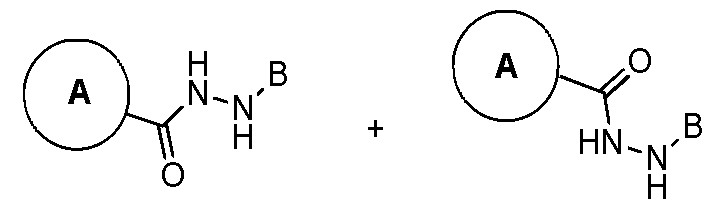
Conformer 1 Conformer 2
Example 1. 5-oxo-N’-phenylpyrrolidine-2-carbohydrazide ( 1 )

Following the general procedure for route A, 5-oxo-N’-phenylpyrrolidine-2-carbohydrazide was obtained through the hydrazinolysis reaction of methyl-pyroglutamate (2 g, 13.9 mmol) and phenylhydrazine (1 .5 g, 13.9 mmol), in the presence of a catalytic amount of PTSA, 5% (0.24 g). The mixture was stirred at 80° for 24 h. The precipitate was then washed with ethanol affording 1 as a white solid (2.0 g, 66 % yield),
m.p. 191 -192 ° C
1H NMR (400 MHz, DMSO-d6): d 9.83 (d, J = 2.4 Hz, 1 H, NH, conformer 1 ), 9.16 (s, 1 H, NH, conformer 2), 7.91 (s, 1 H, NH, conformer 1 + 2), 7.73 (d, J = 2.4 Hz, 1 H, NH, conformer 1 ), 7.63 (s, 1 H, NH, conformer 2), 7.21 (t, J = 8.3 Hz, 2H, CHAr, conformer 2), 7.13 (t, J = 8.3 Hz, 2H, CHAr, conformer
1 ), 6.75 (d, J = 8.3 Hz, 3H, CHAr, conformer 2), 6.75 (d, J = 8.3 Hz, 3H, CHAr, conformer 1 ), 4.36 (q, J = 4.3 Hz, 1 H, CH, conformer 2), 4.11 (q, J = 4.3 Hz, 1 H, CH, conformer 1 ), 2.32 (m, 1 H, CH2, conformers 1 +2), 2.19-2.03 (m, 2H, CH2, conformers 1 +2), 1.95 (m, 1 H, CH2, conformers 1 +2).
13C{1H}NMR (100 MHz, DMSO-d6): d 177.7 (C=0), 172.6 (C=0), 149.5 (C,v), 129.1 (2CHAr), 1 19.0 (CHAr), 1 12.6 (2CHAr), 54.8 (CH), 29.7 (CH2), 25.6 (CH2).
IR v (cm 1): 3249, 1646, 1460, 1290, 1241 .
Example 2. N’-(4-chlorophenyl)-5-oxopyrrolidine-2-carbohydrazide (2)
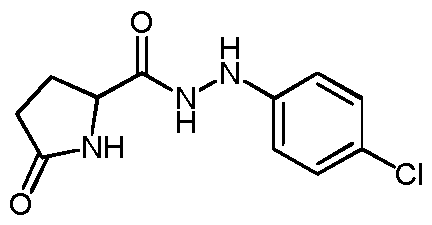 Ratio conformer 1 /conformer 2: 92/08
Following the general procedure Route B, N'-(4-chlorophenyl)-5-oxopyrrolidine-2-carbohydrazide was obtained from the coupling reaction of 5-oxopyrrolidine-2-carboxylic acid (2 g, 15.5 mmol), (4- chlorophenyl)hydrazine hydrochloride (2.75 g, 15.5 mmol) which at first was released in situ in a presence of sodium methanoate (3.5 mL, 30% aqueous methanolic solution), in presence of dicyclohexyl carbodiimide (3.2 g, 15.5 mmol) and dimethylaminopyridine (0.19 g, 1 .55 mmol) which were dissolved in 100 mL of methylene chloride. The mixture was stirred at room temperature for 24 h, under nitrogen atmosphere. The precipitated dicyclohexylurea was filtered. After washing with methylene chloride, the solution was concentrated to a crude product which was purified via flash column chromatography (methanol/chloroform 2: 10 v/v) affording compound 2 as a white solid (0.78 g, 20% yield),
m.p. 234-235 ° C
1H NMR (400 MHz, DMSO-d6): d 9.89 (d, J = 2.7 Hz, 1 H, NH, conformer 1 ), 9.21 (s, 1 H, NH, conformer 2), 8.1 1 (s, 1 H, NH, conformer 2), 7.94 (s, 1 H, NH, conformer 1 ), 7.92 (d, J = 2.7 Hz, 1 H, NH, conformer 1 ), 7.62 (s, 1 H, NH, conformer 2), 7.24 (d, J = 8.5 Hz, 2H, CHAr, conformer 2), 7.16 (d, J = 8.5 Hz, 2H, CHAr, conformer 1 ), 6.71 (d, J = 8.5 Hz, 2H, CHAr, conformers 1 +2), 4.36 (q, J = 4.1 Hz, 1 H, C H, conformer 2), 4.08 (q, J = 4.1 Hz, 1 H, C H, conformer 1 ), 2.30 (m, 1 H, CH2, conformers 1 +2), 2.18-2.1 1 (m, 2H, CH2, conformers 1 +2), 1 .92 (m, 1 H, CH2, conformers 1 +2).
13C{1H}NMR (100 MHz, DMSO-cU): 177.2 (C=0), 172.1 (C=0), 148.0 (Civ), 128.4 (2CHAr), 121 .8 (C,v), 1 13.6 (2CHAr), 54.2 (CH), 29.1 (CH2), 25.0 (CH2).
IR v (cm'1): 3276, 3098, 3032, 1664, 1645, 1490, 1267, 1224, 1087.
Example 3. N’-(4-fluorophenyl)-5-oxopyrrolidine-2-carbohydrazide (3)
 Ratio conformer 1 /conformer 2: 91 /09
Following the general procedure Route B, N'-(4-fluorophenyl)-5-oxopyrrolidine-2-carbohydrazide was obtained from the coupling reaction of 5-oxopyrrolidine-2-carboxylic acid (2 g, 15.5 mmol), (4- fluorophenyl)hydrazine hydrochloride (2.5 g, 15.5 mmol) which at first was released in situ in a
presence of sodium methanoate (3.5 mL, 30% aqueous methanolic solution), in presence of dicyclohexyl carbodiimide (3.2 g, 15.5 mmol) and dimethylaminopyridine (0.19 g, 1.55 mmol) which were dissolved in 100 mL of methylene chloride. The mixture was stirred at room temperature for 24 h, under nitrogen atmosphere. The precipitated dicyclohexylurea was filtered. After washing with methylene chloride, the solution was concentrated to a crude product which was purified via flash column chromatography (methanol/chloroform 2:10 v/v) affording compound 3 as a white solid (0.85 g, 23% yield),
m.p. 221 -222 °C
1H NMR (400 MHz, DMSO-d6): d 9.86 (d, J = 2.9 Hz, 1 H, NH, conformer 1 ), 9.19 (s, 1 H, NH, conformer 2), 7.90 (s, 1 H, NH, conformers 1 +2), 7.72 (d, J = 2.9 Hz, 1 H, NH, conformer 1 ), 7.55 (s, 1 H, NH, conformer 2), 7.08 (t, J = 9.0 Hz, 2H, CHAr, conformer 2), 6.98 (t, J = 9.0 Hz, 2H, CHAr, conformer 1 ), 6.73 (q, J = 4.8 Hz, 2H, CHAr, conformers 1 +2), 4.30 (q, J = 4.3 Hz, 1 H, C H, conformer 2), 4.09 (q, J = 4.3 Hz, 1 H, C H, conformer 1 ), 2.33 (m, 1 H, Chh, conformers 1 +2), 2.19-2.11 (m, 2H, Chh, conformers 1 +2), 1.91 (m, 1 H, CHi, conformers 1 +2).
13C{1H}NMR (100 MHz, DMSO-cU): 177.7 (C=0), 172.6 (C=0), 156.3 (d, C,v, J = 232 Hz, C-F), 146.1 (Civ, J = 2.2 Hz), 115.5 (d, 2CHAr, J = 24.0 Hz), 113.8 (d, 2CHAr, J = 6.9 Hz), 54.8 (CH), 29.7 (CH2), 25.5 (CHz).
IR v (cm'1): 3331 , 3273, 1687, 1654, 1648, 1506, 1269, 1207, 826.
Example 4. N’-(4-bromophenyl)-5-oxopyrrolidine-2-carbohydrazide (4)
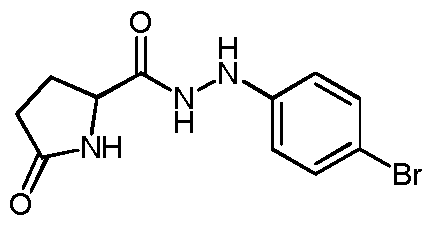 Ratio conformer 1 /conformer 2: 93/07 Following the general procedure Route B, N'-(4-bromophenyl)-5-oxopyrrolidine-2-carbohydrazide was obtained from the coupling reaction of 5-oxopyrrolidine-2-carboxylic acid (2 g, 15.5 mmol), (4- bromophenyl)hydrazine hydrochloride (3.5 g, 15.5 mmol) which at first was released in situ in a presence of sodium methanoate (3.5 mL, 30% aqueous methanolic solution), in presence of dicyclohexyl carbodiimide (3.2 g, 15.5 mmol) and dimethylaminopyridine (0.19 g, 1.55 mmol) which were dissolved in 100 mL of methylene chloride. The mixture was stirred at room temperature for 24 h, under nitrogen atmosphere. The precipitated dicyclohexylurea was filtered. After washing with methylene chloride, the solution was concentrated to a crude product which was purified via flash column chromatography (methanol/chloroform 2:10 v/v) affording compound 4 as a white solid (0.82 g, 18% yield),
m.p. 212-213 ° C
1H NMR (400 MHz, DMSO-d6): d 9.89 (d, J = 2.9 Hz, 1 H, NH, conformer 1 ), 9.18 (s, 1 H, NH, conformer 2), 8.67 (s, 1 H, NH, conformer 2), 7.95 (d, J = 2.9 Hz, 1 H, NH, conformer 1 ), 7.91 (s, 1 H, NH, conformer 1 ), 7.59 (s, 1 H, NH, conformer 2), 7.33 (d, J = 8.7 Hz, 2H, CHAr, conformer 2), 7.29 (d, J = 8.7 Hz, 2H, CHAr, conformer 1 ), 6.67 (d, J = 8.7 Hz, 2H, CHAr, conformers 1 +2), 4.30 (q, J = 3.8 Hz, 1 H, C H, conformer 2), 4.05 (q, J = 3.8 Hz, 1 H, C H, conformer 1 ), 2.33 (m, 1 H, CHi, conformers 1 +2), 2.19-2.13 (m, 2H, CHi, conformers 1 +2), 1.90 (m, 1 H, CHi, conformers 1 +2).
13C{1H}NMR (100 MHz, DMSO-d6): 177.7 (C=0), 172.6 (C=0), 148.9 (C,v), 131.7 (2CHAr), 114.6 (2CHAr), 109.8 (C,v), 54.8 (CH), 29.7 (CH2), 25.5 (CH2).
IR v (cm'1): 3278, 3097, 2901 , 1672, 1666, 1487, 1266, 1225, 1071.
Example 5. N'-(4-iodophenyl)-5-oxopyrrolidine-2-carbohydrazide (5)
 Ratio conformer 1 /conformer 2: 90/10
Following the general procedure Route A, N'-(4-iodophenyl)-5-oxopyrrolidine-2-carbohydrazide was obtained through the hydrazinolysis reaction of methyl- pyroglutamate (0.62 g, 4.2 mmol) and (4- iodophenyl)hydrazine (1 g, 4.2 mmol), in the presence of a catalytic amount of PTSA, 5% (0.08 g). The mixture was stirred at 80 °C for 24 h. The precipitate was then washed with ethanol affording 5 as a white solid (0.32 g, 20% yield),
m.p. 187-188 C
1H NMR (400 MHz, DMSO-d6): d 9.88 (d, J = 2.7 Hz, 1 H, NH, conformer 1 ), 9.21 (s, 1 H, NH, conformer 2), 8.10 (s, 1 H, NH, conformer 2), 7.96 (d, J = 3.4 Hz, 1 H, NH, conformer 1 ), 7.90 (s, 1 H, NH, conformer 1 ), 7.16 (s, 1 H, NH, conformer 2), 7.51 (d, J = 9.1 Hz, 2H, CHAr, conformer 2), 7.43 (d, J = 9.1 Hz, 2H, CHAr, conformer 1 ), 7.10 (d, J = 9.1 Hz, 2H, CHAr, conformer 2), 6.57 (d, J = 9.1 Hz, 2H, CHAr, conformer 1 ), 4.18 (m, 1 H, C H, conformer 2), 4.08 (q, J = 4.5 Hz, 1 H, C H, conformer 1 ), 2.32 (m, 1 H, CH2, conformers 1 +2), 2.19-2.08 (m, 2H, CH2, conformers 1 +2), 1.90 (m, 1 H, CH2, conformers 1 +2).
13C{1H}NMR (100 MHz, DMSO-d6): 177.7 (C=0), 172.6 (C=0), 149.4 (C,v), 137.5 (2CHAr), 115.2 (2CHAr), 80.3 (C,v), 54.8 (CH), 29.7 (CH2), 25.5 (CH2).
IR v (cm'1): 3205, 2960, 1667, 1654, 1483, 1260, 1060.
Example 6. N'-(4-toluyl)-5-oxopyrrolidine-2-carbohydrazide (6)
 Ratio conformer 1 /conformer 2: 90/10
Following the general procedure Route B, 5-oxo-N'-(p-tolyl)pyrrolidine-2-carbohydrazide was obtained from the coupling reaction of 5-oxopyrrolidine-2-carboxylic acid (2 g, 15.5 mmol) and p- tolylhydrazine hydrochloride (2.45 g, 15.5 mmol) which at first was released in situ in a presence of sodium methanoate (3.5 mL, 30% aqueous methanolic solution), in presence of dicyclohexyl carbodiimide (3.2 g, 15.5 mmol) and dimethylaminopyridine (0.19 g, 1.55 mmol) which were dissolved in 100 mL of methylene chloride. The mixture was stirred at room temperature for 24 h, under nitrogen atmosphere. The precipitated dicyclohexylurea was filtered. After washing with methylene chloride, the solution was concentrated to a crude product which was purified via flash column chromatography (methanol/chloroform 2: 10 v/v) affording compound 6 as a white solid (0.9 g, 25% yield).
m.p. 228-229 C
1H NMR (400 MHz, DMSO-cU): d 9.80 (d, J = 4.3 Hz, 1 H, NH, conformer 1 ), 9.11 (s, 1 H, NH, conformer 2), 7.90 (s, 1 H, NH, conformer 1 ), 7.71 (s, 1 H, NH, conformer 2), 7.61 (s, 1 H, NH, conformer 2), 7.56 (d, J = 3.1 Hz, 1 H, NH, conformer 1 ), 7.02 (d, J = 8.1 Hz, 2H, CHAr, conformer 2), 6.95 (d, J = 8.1 Hz, 2H, CHAr, conformer 1 ), 6.64 (d, J = 8.1 Hz, 2H, CHAr, conformers 1 +2), 4.37 (q, J = 4.4 Hz, 1 H, C H, conformer 2), 4.08 (q, J = 4.4 Hz, 1 H, C H, conformer 1 ), 2.30 (m, 1 H, CH2, conformers 1 +2), 2.18- 2.13 (m, 2H, CH2, conformers 1 +2), 2.16 (s, 3H, CH3, conformers 1 +2), 1 .88 (m, 1 H, CH2, conformers 1 +2).
13C{1H}NMR (100 MHz, DMSO-cU): 177.7 (C=0, conformer 1 ), 176.9 (C=0, conformer 2), 172.5 (C=0, conformers 1 +2), 147.2 (Civ, conformer 1 ), 146.5 (Civ, conformer 2), 129.8 (2 CHAr, conformer 2), 129.5 (2 CHAr, conformer 1 ), 128.4 (Civ, conformer 2), 127.6 (Civ, conformer 1 ), 1 12.9 (2 CHAr, conformers 1 +2), 54.8 (CH, conformer 1 ), 52.7 (CH, conformer 2), 29.7 (CH2, conformers 1 +2), 25.3 (CH2, conformers 1 +2 ), 20.60 (CH3, conformers 1 +2).
IR v (cm'1): 3283, 2986, 1659, 151 1 , 1285, 1232, 813.
Example 7. N'-(4-methoxyphenyl)-5-oxopyrrolidine-2-carbohydrazide (7)
 Ratio conformer 1 /conformer 2: 90/10
Following the general procedure Route B, N'-(4-methoxyphenyl)-5-oxopyrrolidine-2-carbohydrazide was obtained from the coupling reaction of 5-oxopyrrolidine-2-carboxylic acid (2 g, 15.5 mmol), (4- methoxyphenyl)hydrazine hydrochloride (2.7 g, 15.5 mmol) which at first was released in situ in a presence of sodium methanoate (3.5 mL, 30% aqueous methanolic solution), in presence of dicyclohexyl carbodiimide (3.2 g, 15.5 mmol) and dimethylaminopyridine (0.19 g, 1 .55 mmol) which were dissolved in 100 mL of methylene chloride. The mixture was stirred at room temperature for 24 h, under nitrogen atmosphere. The precipitated dicyclohexylurea was filtered. After washing with methylene chloride, the solution was concentrated to a crude product which was purified via flash column chromatography (methanol/chloroform 2: 10 v/v) affording compound 7 as a white solid (1.35 g, 35% yield),
m.p. 141 -142 ° C
1H NMR (400 MHz, DMSO-d6): d 9.80 (d, J = 3.3 Hz, 1 H, NH, conformer 1 ), 9.05 (s, 1 H, NH, conformer 2), 7.89 (s, 1 H, NH, conformer 1 ), 7.56 (s, 1 H, NH, conformer 2), 7.41 (d, J = 3.3 Hz, 1 H, NH, conformers 1 +2), 6.78 (d, J = 9.1 Hz, 2H, CHAr, conformer 2), 6.77 (d, J = 9.1 Hz, 2H, CHAr, conformer
1 ), 6.67 (d, J = 9.1 Hz, 2H, CHAr, conformers 1 +2), 4.39 (q, J = 4.3 Hz, 1 H, C H, conformer 2), 4.08 (q, J = 4.3 Hz, 1 H, C H, conformer 1 ), 3.70 (s, 3H, OCH3, conformer 2), 3.65 (s, 3H, OCH3, conformer
2), 2.30 (m, 1 H, CH2, conformers 1 +2), 2.18-2.13 (m, 2H, CH2, conformers 1 +2), 1 .89 (m, 1 H, CH2, conformers 1 +2).
13C{1H}NMR (100 MHz, DMSO-cU): 177.2 (C=0, conformer 1 ), 176.3 (C=0, conformer 2), 171 .9 (C=0, conformers 1 +2), 153.0 (Civ, conformer 2), 152.6 (Civ, conformer 1 ), 142.8 (Civ, conformer 1 ), 142.1 (Civ, conformer 2), 1 14.3 (2CHAr, conformer 2), 114.1 (2CHAr, conformer 1 ), 1 13.6 (2CHAr, conformer
1 ), 1 13.5 (2CHAr, conformer 2), 55.2 (CH2, conformers 1 +2), 54.2 (CH3, conformer 1 ), 52.2 (CH3, conformer 2), 29.1 (CH2, conformer 1 ), 29.0 (CH2, conformer 2), 25.0 (CH2, conformer 1 ), 24.8 (CH2, conformer 2).
IR v (cm'1): 3200, 3085, 2832, 1696, 1659, 1508, 1248, 1216, 1031 , 833.
Example 8. N'-(4-nitrophenyl)-5-oxopyrrolidine-2-carbohydrazide (8)
o Ratio conformer 1 /conformer 2: 95/05 Following the general procedure Route A, N’-(4-nitrophenyl)-5-oxopyrrolidine-2-carbohydrazide was obtained through the hydrazinolysis reaction of methyl- pyroglutamate (2 g, 13.9 mmol) and (4- nitrophenyl)hydrazine (2.4 g, 13.9 mmol), in the presence of a catalytic amount of PTSA, 5% (0.24 g). The mixture was stirred at 80° for 24 h. The precipitate was then washed with ethanol, affording 8 as a white solid (2.1 g, 57 % yield),
m.p. 261 -262 ° C
1H NMR (400 MHz, DMSO-d6): d 10.2 (s, 1 H, NH, conformer 1 ), 9.48 (s, 1 H, NH, conformer 2), 9.13 (s, 1 H, NH, conformer 2), 9.10-9.08 (s, 1 H, NH, conformers 1 +2), 8.10 (d, J = 9.4 Hz, 2H, CHAr, conformer 2), 8.06 (d, J = 9.4 Hz, 2H, CHAr, conformer 1 ), 7.95 (s, 1 H, NH, conformer 1 ), 6.80 (d, J = 9.4 Hz, 2H, CHAr, conformer 2), 6.79 (d, J = 9.4 Hz, 2H, CHAr, conformer 1 ), 4.14 (q, J = 5.3 Hz, 1 H, C H, conformers 1 +2), 2.29 (m, 1 H, CH2, conformers 1 +2), 2.22-2.15 (m, 2H, CH2, conformers 1 +2), 1 .91 (m, 1 H, CH2, conformers 1 +2).
13C{1H}NMR (100 MHz, DMSO-d6): 177.2 (C=0), 172.2 (C=0), 154.6 (C,v), 138.0 (C,v), 125.7 (2CHAr), 1 10.5 (2CHAr), 54.3 (CH), 29.1 (CH2), 25.0 (CH2).
IR v (cm’1): 3320, 3195, 2970, 1692, 1656, 1593, 1480, 1328, 1228, 832.
Example 9. N'-(2,5-difluorophenyl)-5-oxopyrrolidine-2-carbohydrazide (9)
 Ratio conformer 1 /conformer 2: 95/05 Following the general procedure Route A, N'-(2,5-difluorophenyl)-5-oxopyrrolidine-2-carbohydrazide was obtained through the hydrazinolysis reaction of methyl- pyroglutamate (2 g, 13.9 mmol) and (2,5- difluorophenyl)hydrazine (2.0 g, 13.9 mmol), in the presence of a catalytic amount of PTSA, 5% (0.24 g). The mixture was stirred at 80° for 24 h. The precipitate was then washed with ethanol affording 9 as a white solid (1 .4 g, 40 % yield),
m.p. 214-215 ° C
1H NMR (400 MHz, DMSO-d6): d 9.96 (d, J = 3.1 Hz, 1 H, NH, conformer 1 ), 9.25 (s, 1 H, NH, conformer 2), 8.31 (s, 1 H, NH, conformer 2), 8.01 (s, 1 H, NH, conformer 1 ), 7.96 (s, 1 H, NH, conformer 1 ), 7.62 (s, 1 H, NH, conformer 2), 7.09 (m, 1 H, CHAr, conformers 1 +2), 6.59 (m, 1 H, CHAr, conformers 1 +2), 6.49 (m, 1 H, CHAr, conformers 1 +2), 4.36 (q, J = 4.4 Hz, 1 H, CH, conformer 2), 4.10 (q, J = 4.4 Hz,
1 H, CH, conformer 1 ), 2.32 (m, 1 H, CH2, conformers 1 +2), 2.18-2.13 (m, 2H, CH2, conformers 1 +2), 1 .97 (m, 1 H, CH2, conformers 1 +2).
13C{1H}NMR (100 MHz, DMSO-d6): 177.7 (C=0), 172.7 (C=0), 159.4 (d, C,v, J = 239 Hz), 146.6 (dd, C,v , J = 239 Hz, J = 2.3 Hz), 138.7 (dd, C,v, J = 13 Hz, J = 10.3 Hz), 1 16.1 (dd, CHAr, J =20.5 Hz, J = 10.7 Hz), 104.2 (dd, CHAr, J = 25 Hz, J = 8.5 Hz), 100.5 (dd, CHAr, J = 29 Hz, J = 3.8 Hz), 54.8 (CH), 29.7 (CH2), 25.4 (CH2).
IR v (cm'1): 3310, 3268, 3019, 1677, 1656, 1632, 1510, 1266, 1 184, 846.
Example 10. N'-(perfluorophenyl)-5-oxopyrrolidine-2-carbohydrazide (10)
 Ratio conformer 1 /conformer 2: 93/07
Following the general procedure Route B, 5-oxo-N'-(perfluorophenyl)pyrrolidine-2-carbohydrazide was obtained from the coupling reaction of 5-oxopyrrolidine-2-carboxylic acid (2 g, 15.5 mmol), (perfluorophenyl)hydrazine hydrochloride (3.6 g, 15.5 mmol) which at first was released in situ in a presence of sodium methanoate (3.5 mL, 30% aqueous methanolic solution), in presence of dicyclohexyl carbodiimide (3.2 g, 15.5 mmol) and dimethylaminopyridine (0.19 g, 1 .55 mmol) which were dissolved in 100 mL of methylene chloride. The mixture was stirred at room temperature for 24 h, under nitrogen atmosphere. The precipitated dicyclohexylurea was filtered. After washing with methylene chloride, the solution was concentrated to a crude product which was purified via flash column chromatography (methanol/chloroform 2: 10 v/v) affording compound 10 as a white solid (1.2 g, 25% yield),
m.p. 218-219 ° C
1H NMR (400 MHz, DMSO-d6): d 10.25 (s, 1 H, NH, conformer 1 ), 9.42 (s, 1 H, NH, conformed), 8.25 (s, 1 H, NH, conformer 2), 8.02 (s, 1 H, NH, conformer 1 ), 7.85 (s, 1 H, NH, conformer 1 ), 7.77 (s, 1 H, NH, conformer 2), 4.37 (bs, 1 H, C H, conformer 2), 4.04 (q, J = 3.6 Hz, 1 H, C H, conformer 1 ), 2.23 (m, 1 H, Chk, conformers 1 +2), 2.15-2.08 (m, 2H, Chk, conformers 1 +2), 1.85 (m, 1 H, Chk, conformers 1 +2).
13C{1H}NMR (100 MHz, DMSO-cU): 177.8 (C=0), 172.8 (C=0), 139.1 (m, 2C,v), 136.7 (m, 2C,V, ), 135.5 (tt, Civ, J = 13.6 Hz, J = 3.7 Hz), 133.1 (tt, C,v, J = 13.7 Hz, J = 4.4 Hz), 124.9 (td, C,v, J = 11 .3 Hz, J = 3.0 Hz), 54.4 (CH), 29.5 (CH2), 25.5 (CH2).
IR v (cm'1): 3277, 3210, 3023, 1684, 1661 , 1523, 1275, 1010, 963.
Example 1 1 . N'-(4-trifluoromethylphenyl)-5-oxopyrrolidine-2-carbohydrazide (1 1 )
 Ratio conformer 1 /conformer 2: 94/06
Following the general procedure Route B, 5-oxo-N'-(4-(trifluoromethyl)phenyl)pyrrolidine-2- carbohydrazide was obtained from the coupling reaction of 5-oxopyrrolidine-2-carboxylic acid (0.73
g, 5.6 mmol), (4-(trifluoromethyl)phenyl)hydrazine (0.99 g, 5.6 mmol), in presence of dicyclohexyl carbodiimide (1.1 g, 5.5 mmol) and dimethylaminopyridine (0.06 g, 1 .55 mmol) which were dissolved in 50 mL of methylene chloride. The mixture was stirred at room temperature for 24 h, under nitrogen atmosphere. The precipitated dicyclohexylurea was filtered. After washing with methylene chloride, the solution was concentrated to a crude product which was purified via flash column chromatography (methanol/chloroform 2: 10 v/v) affording compound 1 1 as a white solid (0.32 g, 20% yield), m.p. 101 -102 ° C
1H NMR (400 MHz, DMSO-d6): d 10.0 (s, 1 H, NH, conformer 1 ), 9.34 (s, 1 H, NH, conformer 2), 8.54 (s, 1 H, NH, conformer 2), 8.40 (s, 1 H, NH, conformer 1 ), 7.93 (s, 1 H, NH, conformer 1 ), 7.66 (s, 1 H, NH, conformer 2), 7.53 (d, J = 8.3 Hz, 2H, CHAr, conformer 2), 7.46 (d, J = 8.3 Hz, 2H, CHAr, conformer 1 ), 6.82 (d, J = 8.3 Hz, 2H, CHAr, conformers 1 +2), 4.33 (bs, 1 H, C H, conformer 2), 4.12 (q, J = 4.5 Hz, 1 H, C H, conformer 1 ), 2.31 (m, 1 H, CH2, conformers 1 +2), 2.23-2.13 (m, 2H, CH2, conformers 1 +2), 1 .88 (m, 1 H, CH2, conformers 1 +2).
13C{1H}NMR (100 MHz, DMSO-cU): 177.7 (C=0), 172.7 (C=0), 152.7 (C,v), 126.6 (q, 2CHAr, J = 3.9 Hz), 124.4 (q, Civ, J = 270 Hz), 1 19.2 (2CHAr), 1 18.7 (q, C,v, J = 32 Hz), 54.8 (CH), 29.7 (CH2), 25.6 (CH2). IR v (cm'1): 3354, 3279, 3033, 2946, 1652, 1617, 1332, 1099, 1067.
Example 12. N'-(2-trifluoromethylphenyl)-5-oxopyrrolidine-2-carbohydrazide (12)

Following the general procedure Route B, 5-oxo-N'-(2-(trifluoromethyl)phenyl)pyrrolidine-2- carbohydrazide was obtained from the coupling reaction of 5-oxopyrrolidine-2-carboxylic acid (0.73 g, 5.6 mmol), (2-(trifluoromethyl)phenyl)hydrazine (0.99 g, 5.6 mmol), in presence of dicyclohexyl carbodiimide (1 .1 g, 5.5 mmol) and dimethylaminopyridine (0.06 g, 1 .55 mmol) which were dissolved in 50 mL of methylene chloride. The mixture was stirred at room temperature for 24 h, under nitrogen atmosphere. The precipitated dicyclohexylurea was filtered. After washing with methylene chloride, the solution was concentrated to a crude product which was purified via flash column chromatography (methanol/chloroform 2: 10 v/v) affording compound 12 as a white solid (0.40 g, 25% yield), m.p. 150-151 ° C
1H NMR (400 MHz, DMSO-d6): d 10.1 (s, 1 H, NH, conformer 1 ), 9.36 (s, 1 H, NH, conformer 2), 7.980 (s, 1 H, NH, conformer 2), 7.93 (s, 1 H, NH, conformer 1 ), 7.65 (s, 1 H, NH, conformer 2), 7.48 (m, 3H, CHAr+NH, conformers 1 +2), 7.02 (d, J = 8.2 Hz, 1 H, CHAr, conformer 2), 6.98 (d, J = 8.2 Hz, 1 H, CHAr, conformer 1 ), 6.88 (t, J = 8.2 Hz, 1 H, CHAr, conformers 1 +2), 4.30 (q, J = 4.3 Hz, 1 H, CH, conformer 2), 4.13 (q, J = 4.3 Hz, 1 H, CH, conformer 1 ), 2.33 (m, 1 H, CH2, conformers 1 +2), 2.19- 2.1 1 (m, 2H, C Hi, conformers 1 +2), 1.91 (m, 1 H, CH2, conformers 1 +2).
13C{1H}NMR (100 MHz, DMSO-cU): 177.8 (C=0), 172.6 (C=0), 146.4 (q, C,v, J = 1 .7 Hz), 133.8 (s, CHAr), 126.5 (q, Civ, J =5.3 Hz), 125.0 (q, C,v, J = 271 Hz), 1 18.7 (s, CHAr), 1 13.5 (s, CHAr), 54.8 (CH), 29.6 (CH2), 25.3 (CH2).
IR v (cm'1): 3288, 3058, 2951 , 1655, 1632, 1312, 1064.
Example 13. N'-(3-tolyl)-5-oxopyrrolidine-2-carbohydrazide (13)
 Ratio conformer 1 /conformer 2: 90/10
Following the general procedure Route B, 5-oxo-N'-(m-tolyl)pyrrolidine-2-carbohydrazide was obtained from the coupling reaction of 5-oxopyrrolidine-2-carboxylic acid (2 g, 15.5 mmol), m- tolylhydrazine hydrochloride (2.45 g, 15.5 mmol) which at first was released in situ in a presence of sodium methanoate (3.5 mL, 30% aqueous methanolic solution), in presence of dicyclohexyl carbodiimide (3.2 g, 15.5 mmol) and dimethylaminopyridine (0.19 g, 1.55 mmol) which were dissolved in 100 mL of methylene chloride. The mixture was stirred at room temperature for 24 h, under nitrogen atmosphere. The precipitated dicyclohexylurea was filtered. After washing with methylene chloride, the solution was concentrated to a crude product which was purified via flash column chromatography (methanol/chloroform 2:10 v/v) affording compound 13 as a white solid (1.1 g, 30% yield).
m.p. 168-169°C
1H NMR (400 MHz, DMSO-d6): d 9.80 (d, J = 4.7 Hz, 1 H, NH, conformer 1 ), 9.12 (s, 1 H, NH, conformer 2), 7.92 (s, 1 H, NH, conformer 1 ), 7.84 (s, 1 H, NH, conformer 2), 7.65 (d, J = 2.7 Hz, 1 H, NH, conformer 1 ), 7.62 (s, 1 H, NH, conformer 2), 7.07 (t, J = 7.8 Hz, 1 H, CHAr, conformer 2), 7.03 (t, J = 7.8 Hz, 1 H, CHAr, conformer 1 ), 6.52 (d, J = 7.8 Hz, 1 H, CHAr, conformer 2), 6.51 (m, 3 H, CHAr, conformers 1 +2), 4.37 (q, J = 4.2 Hz, 1 H, C H, conformer 2), 4.09 (qd, J = 4.4, 0.8 Hz, 1 H, C H, conformer 1 ), 2.29 (m, 1 H, CHi, conformers 1 +2), 2.22-2.12 (m, 2H, CHi, conformers 1 +2), 2.20 (s, 3H, CH3, conformers 1 +2), 1.88 (m, 1 H, CH2, conformers 1 +2).
13C{1H}NMR (100 MHz, DMSO-cU): 177.2 (C=0, conformer 1 ), 176.3 (C=0, conformer 2), 172.0 (C=0, conformers 1 +2), 149.0 (Civ, conformer 1 ), 148.3 (Civ, conformer 2), 138.1 (Civ, conformer 2), 137.7 (Civ, conformer 1 ), 128.8 (CHAr, conformer 2), 128.5 (CHAr, conformer 1 ), 120.1 (CHAr, conformer 2), 119.3 (CHAr, conformer 1 ), 112.7 (CHAr, conformers 1 +2), 109.4 (CHAr, conformers 1 +2), 54.2 (CH, conformer 1 ), 52.2 (CH, conformer 2), 29.1 (CH2, conformer 1 ), 29.0 (CH2, conformer 2), 25.1 (CH2, conformer 1 ), 24.7 (CH2, conformer 2), 21.2 (CH3, conformers 1 +2).
IR v (cm'1): 3298, 3206, 1697, 1664, 1597, 1259, 1087.
Example 14. N'-(2,4-dichlorophenyl)-5-oxopyrrolidine-2-carbohydrazide (14)
 Ratio conformer 1 /conformer 2: 95/05 Following the general procedure Route B, N'-(2,4-dichlorophenyl)-5-oxopyrrolidine-2-carbohydrazide was obtained from the coupling reaction of 5-oxopyrrolidine-2-carboxylic acid (2 g, 15.5 mmol), (2,4- dichlorophenyl)hydrazine hydrochloride (3.3 g, 15.5 mmol) which at first was released in situ in a presence of sodium methanoate (3.5 mL, 30% aqueous methanolic solution), in presence of
dicyclohexyl carbodiimide (3.2 g, 15.5 mmol) and dimethylaminopyridine (0.19 g, 1 .55 mmol) which were dissolved in 100 mL of methylene chloride. The mixture was stirred at room temperature for 24 h, under nitrogen atmosphere. The precipitated dicyclohexylurea was filtered. After washing with methylene chloride, the solution was concentrated to a crude product which was purified via flash column chromatography (methanol/chloroform 2: 10 v/v) affording compound 14 as a white solid (1 .12 g, 27% yield),
m.p. 221 -222 ° C
1H NMR (400 MHz, DMSO-d6): d 10.02 (s, 1 H, NH, conformer 1 ), 9.31 (s, 1 H, NH, conformer 2), 8.16 (s, 1 H, NH, conformer 2), 7.92 (s, 1 H, NH, conformer 1 ), 7.66 (s, 1 H, NH, conformers 1 +2), 7.42 (s, 1 H, CHAr, conformer 2), 7.41 (s, 1 H, CHAr, conformer 1 ), 7.24 (bs, 1 H, CHAr, conformer 2), 7.22 (d, J = 9.2 Hz, 1 H, CHAr, conformer 1 ), 6.82 (bs, 1 H, CHAr, conformer 2), 6.79 (d, J = 9.2 Hz, 1 H, CHAr, conformer 1 ), 4.29 (bs, 1 H, CH, conformer 2), 4.1 1 (bs, 1 H, CH, conformer 1 ), 2.32 (m, 1 H, CH2, conformers 1 +2), 2.20-1 .92 (m, 2H, CH2, conformers 1 +2), 1.98 (m, 1 H, CH2, conformers 1 +2).
13C{1H}NMR (100 MHz, DMSO-cU): 177.7 (C=0), 172.7 (C=0), 144.1 (C,v), 128.8 (CHAr), 128.1 (CHAr), 122.4 (Civ), 1 18.0 (C,v), 1 14.4 (CHAr), 54.8 (CH), 29.6 (CH2), 25.4 (CH2).
IR v (cm'1): 3313, 3230, 2970, 1679, 1654, 1492, 1271 , 1095, 802.
Example 1 5. N'-(4-cyanophenyl)-5-oxopyrrolidine-2-carbohydrazide (1 5)
 Ratio conformer 1 /conformer 2: 95/05 Following the general procedure Route B, N'-(4-cyanophenyl)-5-oxopyrrolidine-2-carbohydrazide was obtained from the coupling reaction of 5-oxopyrrolidine-2-carboxylic acid (2 g, 15.5 mmol), 4- hydrazinylbenzonitrile hydrochloride (2.62 g, 15.5 mmol) which at first was released in situ in a presence of sodium methanoate (3.5 mL, 30% aqueous methanolic solution), in presence of dicyclohexyl carbodiimide (3.2 g, 15.5 mmol) and dimethylaminopyridine (0.19 g, 1 .55 mmol) which were dissolved in 100 mL of methylene chloride. The mixture was stirred at room temperature for 24 h, under nitrogen atmosphere. The precipitated dicyclohexylurea was filtered. After washing with methylene chloride, the solution was concentrated to a crude product which was purified via flash column chromatography (methanol/chloroform 2: 10 v/v) affording compound 15 as a white solid (1 .13 g, 30% yield),
m.p. 250-251 ° C
1H NMR (400 MHz, DMSO-d6): d 10.05 (s, 1 H, NH, conformer 1 ), 9.4 (s, 1 H, NH, conformer 2), 8.76 (s, 1 H, NH, conformer 2), 8.64 (s, 1 H, NH, conformer 1 ), 7.93 (s, 1 H, NH, conformers 1 +2), 7.64 (d, J = 8.6 Hz, 2H, CHAr, conformer 2), 7.56 (d, J = 8.6 Hz, 2H, CHAr, conformer 1 ), 6.79 (d, J = 8.6 Hz, 2H, CHAr, conformer 2), 6.78 (d, J = 8.6 Hz, 2H, CHAr, conformer 1 ), 4.30 (bs, 1 H, C H, conformer 2), 4.12 (q, J = 3.7 Hz, 1 H, C H, conformer 1 ), 2.34 (m, 1 H, CH2, conformers 1 +2), 2.20-1 .90 (m, 2H, CH2, conformers 1 +2), 1.97 (m, 1 H, CH2, conformers 1 +2).
13C{1H}NMR (100 MHz, DMSO-cU): 177.2 (C=0), 172.2 (C=0), 152.5 (Civ), 133.3 (2CHAr), 1 19.9 (C,v), 1 1 1 .6 (2CHAr), 98.9 (C,v), 54.3 (CH), 29.1 (CH2), 25.0 (CH2).
IR v (cm'1): 3333, 3295, 3216, 2970, 2212, 1695, 1657, 1607, 1503, 1229, 822.
Example 16. 1 -benzyl-5-oxo-N'-phenylpyrrolidine-2-carbohydrazide (16)

Following the general procedure Route B, 1 -benzyl-5-oxo-N'-phenylpyrrolidine-2-carbohydrazide was obtained from the coupling reaction of 1 -benzyl-5-oxopyrrolidine-2-carboxylic acid (2 g, 15.5 mmol), phenylhydrazine (1 .7 g, 15.5 mmol) in presence of dicyclohexyl carbodiimide (3.2 g, 15.5 mmol) and dimethylaminopyridine (0.19 g, 1 .55 mmol) which were dissolved in 100 mL of methylene chloride. The mixture was stirred at room temperature for 24 h, under nitrogen atmosphere. The precipitated dicyclohexylurea was filtered. After washing with methylene chloride, the solution was concentrated to a crude product which was purified via flash column chromatography (methanol/chloroform 2: 10 v/v) affording compound 16 as a white solid (0.98 g, 21 % yield),
m.p. 176-177 C
1H NMR (400 MHz, DMSO-d6): d 9.94 (s, 1 H, NH, conformer 1 ), 9.27 (s, 1 H, NH, conformer 2), 7.87 (s, 1 H, NH, conformer 2), 7.81 (d, J = 2.8 Hz, 1 H, NH, conformer 1 ), 7.38-7.1 1 (m, 6H, CH, conformers 1 +2), 6.73-6.64 (m, 4H, CH, conformers 1 +2), 4.93 (d, J = 15.6 Hz, 1 H, CH2, conformers 1 +2), 4.24 (m, 1 H, CH, conformer 2), 4.02 (m, 1 H, CH, conformer 1 ), 3.76 (d, J = 15.6 Hz, 1 H, CH2, conformer 2), 3.76 (d, J = 15.6 Hz, 1 H, CH2, conformer 1 ), 2.38-2.20 (m, 3H, CH2, conformers 1 +2), 1 .92-1 .85 (m, 1 H, CH2, conformers 1 +2).
13C{1H}NMR (100 MHz, DMSO-cU): conformer 1 : 175.2 (C=0), 171 .3 (C=0), 149.4 (C,v), 136.8 (C,v), 129.2 (2CHAr), 129.1 (2CHAr), 128.1 (2CHAr), 127.1 (CHAr), 1 19.2 (CHAr), 1 12.5 (2CHAr), 55.9 (CH),
44.8 (CHz), 29.7 (CH2), 23.3 (CH2).
13C{1H}NMR (100 MHz, DMSO-cU): conformer 2 : 175.5 (C=0), 175.3 (C=0), 148.6 (C,v), 136.9 (C,v), 129.4 (2CHAr), 129.0 (2CHAr), 128.4 (2CHAr), 127.7 (CHAr), 1 19.9 (CHAr), 1 12.7 (2CHAr), 58.0 (CH),
44.9 (CHz), 29.6 (CH2), 23.0 (CH2).
IR v (cm'1): 3271 , 1692, 1656, 1600, 1494, 1417, 752, 703.
Example 1 7. 5-oxo-N,N', 1 -triphenylpyrrolidine-2-carbohydrazide (17)

5-oxo-N,N', 1 -triphenylpyrrolidine-2-carbohydrazide was obtained through the alkylation reaction of 5-oxo-N'-phenylpyrrolidine-2-carbohydrazide (2 g, 9.1 mmol), and iodobenzene (1 .85 g, 9.1 mmol), in presence of Cul (0.08 g, 0.45 mmol), Cs2C03 (5.9 g, 18.1 mmol), and dimethylethylenediamine (0.8 g, 9.1 mmol) in 50 mL THF. The mixture was stirred at room temperature for 12 h. The crude product
which was purified via flash column chromatography with a gradual amount of acetate/heptane (0: 100 v/v) affording compound 17 as a white solid (0.67 g, 20% yield),
m.p. 188-189 ° C
1H NMR (400 MHz, DMSO-d6): d 1 1 .01 (s, 1 H, NH, conformer 1 ), 10.43 (s, 1 H, NH, conformer 2), 7.52 (t, J = 7.4 Hz, 2H, CHAr, conformers 1 +2), 7.41 (t, J = 7.4 Hz, 2H, CHAr, conformers 1 +2), 7.21 (t, J = 7.4 Hz, 6H, CHAr, conformers 1 +2), 6.96 (t, J = 7.4 Hz, 1 H, CHAr, conformers 1 +2), 6.88 (d, J = 7.4 Hz, 4H, CHAr, conformers 1 +2), 5.39 (q, J = 4.4 Hz, 1 H, CH, conformer 2), 4.91 (q, J = 4.4 Hz, 1 H, CH, conformer 1 ), 2.61 (m, 2 H, CH2, conformers 1 +2), 2.02 (m, 1 H, CH2, conformers 1 +2).
13C{1H}NMR (100 MHz, DMSO-d6): 174.4 (C=0), 170.9 (C=0), 145.7 (2C,V), 138.7 (C,v), 129.9 (4CHAr), 129.1 (3CHAr), 125.4 (CH), 122.7 (CHAr), 122.0 (3CHAr), 1 18.9 (3CHAr), 60.7 (CH), 31 .2 (CH2), 22.7 (CHz).
IR v (cm'1): 3202, 3035, 1706, 1671 , 1493, 1205, 746.
Example 18. N'-phenylpyrrolidine-2-carbohydrazide (18)
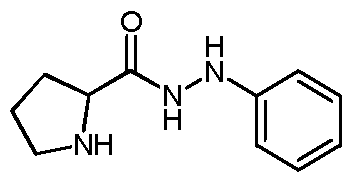 Ratio conformer 1 /conformer 2: 94/06
Following the general procedure Route A, N’-phenylpyrrolidine-2-carbohydrazide was obtained through the hydrazinolysis reaction methyl pyrrolidine-2-carboxylate (2 g, 15.5 mmol), phenylhydrazine (1 .7 g, 15.5 mmol), in the presence of a catalytic amount of PTSA, 5% (0.24 g). The mixture was stirred at 80 ° C for 12 h. The precipitate was then washed with ethanol affording 18 as a white solid (1.3 g, 40 % yield),
m.p. 148-149 ° C
1H NMR (400 MHz, DMSO-d6): d 9.56 (s, 1 H, NH, conformer 1 ), 9.16 (s, 1 H, NH, conformer 2), 7.89 (s, 1 H, NH, conformer 2), 7.63 (s, 1 H, NH, conformer 1 ), 7.12 (t, J = 9.5 Hz, 2H, CHAr, conformer 2), 7.1 1 (t, J = 9.5 Hz, 2H, CHAr, conformer 1 ), 6.67 (d, J = 9.5 Hz, 3H, CHAr, conformers 1 +2), 3.63 (q, J = 5.9 Hz, 1 H, CH, conformer 2), 3.60 (q, J = 5.9 Hz, 1 H, CH, conformer 1 ), 2.89-2.80 (m, 3 H, CH2, conformers 1 +2), 1 .91 (m, 1 H, CH2, conformers 1 +2), 1 .72-1 .63 (m, 3H, CH2, conformers 1 +2). 13C{1H}NMR (100 MHz, DMSO-cU): 174.4 (C=0), 149.8 (C,v), 129.1 (2CHAr), 1 18.8 (CHAr), 1 12.5 (2CHAr), 59.8 (CH), 47.30 (CH2), 30.9 (CH2), 26.2 (CH2).
IR v (cm'1): 3216, 2871 , 1676, 1603, 1493, 1087, 752.
Example 1 9. N'-phenyl-1 H-imidazole-2-carbohydrazide (1 9)

The product is obtained as a sole isomer.
Following the general procedure Route B, N'-phenyl-1 H-imidazole-2-carbohydrazide was obtained from the coupling reaction of 1 H-imidazole-2-carboxylic acid (1 g, 8.9 mmol), phenylhydrazine (0.96 g, 8.9 mmol), in presence of dicyclohexyl carbodiimide (1 .83 g, 8.9 mmol) and dimethylaminopyridine
(0.22 g, 8.9 mmol) were dissolved in 50 mL of methylene chloride. The mixture was stirred at room temperature for 24 h. After filtering and washing (methylene chloride) of the precipitated dicyclohexylurea, the solution was concentrated to a crude product which was purified via flash column chromatography (methanol/chloroform 2:10 v/v) affording compound 19 as a white solid (0.27 g, 14% yield).
m.p. 243-244 °C
1H NMR (400 MHz, DMSO-cU): d 13.09 (s, 1 H, N H), 10.26 (d, J = 2.9 Hz, 1 H, N H), 7.85 (d, J = 2.9 Hz,
1 H, NH), 7.32 (d, J = 2.9 Hz, 1 H, CH), 7.15 (m, 3H, CHAr), 6.71 (d, J = 7.7 Hz, 2H, CHAr), 6.67 (s, 1 H
C H).
13C{1H}NMR (100 MHz, DMSO-d6): 158.4 (C=0), 149.1 (Civ), 139.7 (Civ), 128.9 (CH), 128.5 (2CHAr), 119.9 (CH), 118.3 (CHAr), 112.0 (2CHAr).
IR v (cm'1): 3316, 3119, 3026, 2920, 1640, 1530, 1439, 1124, 880.
Example 20. 5-oxo-N'-phenyltetrahydrofuran-2-carbohydrazide (20)

Following the general procedure Route B, 5-oxo-N'-phenyltetrahydrofuran-2-carbohydrazide was obtained from the coupling reaction of 5-oxotetrahydrofuran-2-carboxylic acid (2.02 g, 15.5 mmol), phenylhydrazine (1.7 g, 15.5 mmol), in presence of dicyclohexyl carbodiimide (3.1 g, 15.4 mmol) and dimethylaminopyridine (0.18 g, 1.55 mmol) which were dissolved in 100 mL of methylene chloride. The mixture was stirred at room temperature for 24 h, under nitrogen atmosphere. The precipitated dicyclohexylurea was filtered. After washing with methylene chloride, the solution was concentrated to a crude product which was purified via flash column chromatography with a gradual amount of acetate /heptane (0:100 v/v) affording compound 20 as a white solid (0.85 g, 25% yield), m.p. 113-114 C
1H NMR (400 MHz, DMSO-d6): d 10.10 (s, 1 H, NH, conformer 1 ), 9.42 (s, 1 H, NH, conformed), 8.01 (s, 1 H, NH, conformer 2), 7.82 (s, 1 H, NH, conformer 1 ), 7.22 (t, J = 8.4 Hz, 2H, CHAr, conformer 2), 7.23 (t, J = 8.4 Hz, 2H, CHAr, conformer 1 ), 6.76 (d, J = 8.4 Hz, 3H, CHAr, conformers 1 +2), 5.21 (t, J = 7.5 Hz, 1 H, CH, conformer 2), 4.99 (t, J = 7.5 Hz, 1 H, CH, conformer 1 ), 2.56 (m, 3H, Chh, conformers 1 +2), 2.19-2.14 (m, 1 H, CHi, conformers 1 +2).
13C{1H}NMR (100 MHz, DMSO-cU): 177.7 (C=0, conformer 2), 177.3 (C=0, conformer 1 ), 174.0 (C=0, conformer 2), 169.6 (C=0, conformer 1 ), 149.2 (Civ, conformer 1 ), 148.6 (Civ, conformer 2), 129.5 (2CHAr, conformer 2), 129.2 (2CHAr, conformer 1 ), 120.2 (CHAr, conformer 2), 119.2 (CHAr, conformer 1 ), 112.8 (2CHAr, conformer 2), 112.6 2CHAr, conformer 1 ), 76.3 (CH, conformer 1 ), 76.1 (CH, conformer 2), 27.5 (CH2, conformer 1 ), 27.1 (CH2, conformer 2), 25.9 (CH2, conformers 1 +2).
IR v (cm'1): 3291 , 3228, 1765, 1651 , 1600, 1484, 1161 , 1058, 758.
Example 21. N'-phenyl-2-(thiophen-3-yl)acetohydrazide (21 )
 Ratio conformer 1 /conformer 2: 90/10
Following the general procedure Route B, N'-phenyl-2-(thiophen-3-yl)acetohydrazide was obtained from the coupling reaction of 2-(thiophen-3-yl)acetic acid (2.18 g, 15.4 mmol), phenylhydrazine (1 .7 g, 15.5 mmol), in presence of dicyclohexyl carbodiimide (3.1 g, 15.4 mmol) and dimethylaminopyridine (0.18 g, 1 .55 mmol) which were dissolved in 100 mL of methylene chloride. The mixture was stirred at room temperature for 24 h, under nitrogen atmosphere. The precipitated dicyclohexylurea was filtered. After washing with methylene chloride, the solution was concentrated to a crude product which was purified via flash column chromatography with a gradual amount of acetate /heptane (0: 100 v/v) affording compound 21 as a slighty pink solid (1.28 g, 36% yield), m.p. 123-124° C
1H NMR (400 MHz, DMSO-d6): d 9.85 (d, J = 3.2 Hz, 1 H, NH, conformer 1 ), 9.12 (s, 1 H, NH, conformer 2), 8.00 (s, 1 H, NH, conformer 2), 7.73 (d, J = 3.2 Hz, 1 H, NH, conformer 1 ), 7.35 (dd, J = 8.8 Hz, J = 2.0 Hz, 1 H, C H, conformer 1 ), 7.30 (dd, J = 8.8 Hz, J = 2.0 Hz, 1 H, C H, conformer 2), 7.16 (t, J = 8.0 Hz, 2H, CHAr, conformer 2), 7.07 (t, J = 8.0 Hz, 2H, CHAr, conformer 1 ), 6.95-6.85 (m, 2H, C H, conformers 1 +2), 6.80-6.60 (m, 3H, C H, conformers 1 +2), 3.74 (s, 2H, CH2, conformer 2), 3.70 (s, 2H, CH2, conformer 1 ).
13C{1H}NMR ( 100 MHz, DMSO-cU): conformer 1 169.4 (C=0), 149.6 (C,v), 137.5 (C,v), 129.1 (2CHAr), 127.1 (CH), 126.7 (CH), 125.4 (CH), 1 18.9 (CH), 1 12.5 (2CHAr), 35.2 (CH2).
IR v (cm'1): 3326, 3286, 3091 , 2926, 2849, 1664, 1637, 1570, 1495, 756, 689.
Example 22. N'-phenylanthracene-9-carbohydrazide (22)

Following the general procedure Route B, N’-phenylanthracene-9-carbohydrazide was obtained from the coupling reaction of anthracene-9-carboxylic acid (3.42 g, 15.4 mmol), phenylhydrazine (1.7 g, 15.5 mmol), in presence of dicyclohexyl carbodiimide (3.1 g, 15.4 mmol) and dimethylaminopyridine (0.18 g, 1 .55 mmol) which were dissolved in 100 mL of methylene chloride. The mixture was stirred at room temperature for 24 h, under nitrogen atmosphere. The precipitated dicyclohexylurea was filtered. After washing with methylene chloride, the solution was concentrated to a crude product which was purified via flash column chromatography with a gradual amount of acetate/heptane (0: 100 v/v) affording compound 22 as a brown solid (1 .01 g, 21 % yield),
m.p. 125-126 ° C
1H NMR (400 MHz, DMSO-d6): d 8.42 (s, 1 H, NH), 8.10-8.00 (m, 7H, NH + CHAr), 7.46-7.40 (m, 4H, CHAr), 6.63-6.59 (m, 4H, CH).
13C{1H}NMR (100 MHz, DMSO-cU): 155.1 (C=0), 147.2 (C,v), 137.9 (C,v), 135.0 (2C,V), 131 .3 (2CHAr), 128.4 (2CHAr), 127.2 (2CHAr), 126.7 (CH), 125.6 (2CHAr), 125.6 (2CHAr), 125.4 (CH), 107.2 (2CHAr).
IR v (cm'1): 2928, 1641 , 1579, 1538, 1380, 1313, 1214, 802, 737.
Example 23. (3r,5r,7r)-N'-phenyladamantane-1 -carbohydrazide (23)

Following the general procedure Route B, (3r,5r,7r)-N'-phenyladamantane-1 -carbohydrazide was obtained from the coupling reaction of (3r,5r,7r)-adamantane-1 -carboxylic acid (2.77 g, 15.4 mmol), phenylhydrazine (1 .7 g, 15.5 mmol), in presence of dicyclohexyl carbodiimide (3.1 g, 15.4 mmol) and dimethylaminopyridine (0.18 g, 1 .55 mmol) which were dissolved in 100 mL of methylene chloride. The mixture was stirred at room temperature for 24 h, under nitrogen atmosphere. The precipitated dicyclohexylurea was filtered. After washing with methylene chloride, the solution was concentrated to a crude product which was purified via flash column chromatography with a gradual amount of acetate /heptane (0: 100 v/v) affording compound 23 as a off-white solid (1 .74 g, 42% yield), m.p. 166-167 ° C
1H NMR (400 MHz, DMSO-d6): d 7.75 (d, J = 3.6 Hz, 1 H, NH), 7.20 (t, J = 7.6 Hz, 2H, CHAr), 6.88 (t, J = 7.6 Hz, 1 H, CHAr), 6.79 (d, J = 7.6 Hz, 2H, CHAr), 6.22 (d, J = 4.4 Hz, 1 H, NH), 2.05-1 .91 (m, 9H, 3C H + 3CHz), 1 .75-1 .68 (m, 6H, 3CH2).
13C{1H}NMR (100 MHz, DMSO-cU): 176.9 (C=0), 150.3 (C,v), 129.0 (2CHAr), 1 18.7 (CH), 1 12.5 (2CHAr), 38.9 (3CH2), 36.5 (3CH2), 33.8 (C,v), 28.0 (3CH).
IR v (cm'1): 3338, 3272, 2900, 2847, 1630, 1598, 1492, 1448, 1237, 742, 689.
Example 24. N'-phenylpicolinohydrazide (24)

The product was obtained as a sole conformer.
Following the general procedure Route A, N'-phenylpicolinohydrazide was obtained through the hydrazinolysis reaction of methyl picolinate (2 g, 15.4 mmol) with phenylhydrazine (1 .6 g, 14 mmol), in the presence of a catalytic amount of PTSA, 5% (0.24 g). The mixture was stirred at 80° for 12 h. The crude product was purified via flash column chromatography (methanol/chloroform 2: 10 v/v) affording compound 24 as a white solid (1 .8 g, 60% yield),
m.p. 186-187 ° C
1H NMR (400 MHz, DMSO-d6): d 10.55 (s, 1 H, NH), 8.70 (d, J = 5.7 Hz, 1 H, CHAr), 8.04 (m, 2H, CHAr), 7.91 (s, 1 H, NH), 7.64 (t, J = 7.4 Hz, 1 H, CHAr), 7.15 (t, J = 7.4 Hz, 2H, CHAr), 6.78 (d, J = 7.4 Hz, 2H, CHAr), 6.69 (t, J = 7.4 Hz, 1 H, CHAr).
13C{1H}NMR (100 MHz, DMSO-d6): 164.4 (C=0), 150.2 (C,v), 149.7 (C,v), 149.1 (CHAr), 146.4 (CHAr), 138.2 (CHAr), 129.1 (2CHAr), 127.2 (CHAr), 122.7 (CHAr), 119.0 (CHAr), 1 12.8 (CHAr).
IR v (cm-1): 3219, 3013, 1656, 1493, 1465, 1242, 743.
Example 25. NΊ ,N'4-diphenylsucdnohydrazide (25)

The product is obtained as a mixture of 4 conformers.
Ratio conformer 1 /conformer 2/conformer 3/ conformer 4 : 73/13/12/02
Route D. NΊ ,N'4-diphenylsuccinohydrazide was obtained through the coupling between succinyl dichloride (1.55 g, 10 mmol), and phenylhydrazine (2.70 g, 25 mmol). Phenylhydrazine is dissolved in pyridine (10 mL) and cooled at 5°C with an ice bath. Then, succinyl dichloride is added dropwise at 5°C. After completion of the addition, the medium is warmed to room temperature and stirred during 2 hours. After 2 hours, water (50 mL) is added and a precipitate appeared. The insoluble is filtered off and washed by diethyl ether (3x20 mL) and dried. NΊ ,N'4-diphenylsuccinohydrazide 25 is obtained as a white solid (2.53 g, 85% yield),
m.p. 216-217 C
1H NMR (400 MHz, DMSO-d6): d 9.60 (d, J = 2.0 Hz, 2H, NH, conformer 1 ), 9.54 (s, 2H, NH, conformer 2), 8.95 (s, 2H, NH, conformer 3), 8.84 (s, 2H, NH, conformer 4), 7.86 (s, 2 H, NH, conformer 2), 7.61 (d, J = 2.0 Hz, 2H, NH, conformer 1 +4), 7.57 (s, 2H, NH, conformer 3), 7.13-7.05 (m, 4 H, CHAr, conformers 1 +2+3+4), 6.70-6.63 (m, 6H, CHAr, conformers 1 +2+3+4), 2.50-2.34 (m, 4 H, ICHi, conformers 1 +2+3+4).
13C{1H}NMR (100 MHz, DMSO-cU): conformer 1. 171.5 (C=0), 149.8 (Civ), 129.1 (2CHAr), 118.7 (CHAr), 112.5 (2CHAr), 28.9 (2CHZ).
IR v (cm 1): 3284, 3215, 3088, 3028, 1654, 1631 , 1603, 1495, 1343, 965, 755, 696.
Example 26. NΊ ,N'8-diphenyloctanedihydrazide (26)

The product is obtained as a mixture of 4 conformers
Ratio conformer 1 /conformer 2/conformer 3/ conformer 4 : 70/07/10/13
Route D. NΊ ,N'8-diphenyloctanedihydrazide was obtained through the coupling between octanedioyl dichloride (2.11 g, 10 mmol), and phenylhydrazine (2.70 g, 25 mmol). Phenylhydrazine is dissolved in pyridine (10 mL) and cooled at 5°C with an ice bath. Then, octanedioyl dichloride is added dropwise at 5°C. After completion of the addition, the medium is warmed to room temperature and stirred during 2 hours. After 2 hours, water (50 mL) is added and a precipitate appeared. The insoluble is filtered off and washed by diethyl ether (3x20 mL) and dried. NΊ ,N'8-diphenyloctanedihydrazide 26 is obtained as a white solid (3.08 g, 87% yield),
m.p. 200-201 °C
1H NMR (400 MHz, DMSO-d6): d 9.58 (s, 2H, NH, conformer 1 ), 9.57 (s, 2H, NH, conformer 2), 8.85 (s, 2H, NH, conformer 3), 8.69 (s, 2H, NH, conformer 4), 8.00-7.09 (m, 6 H, 2NH + CHAr, conformers 1 +2+3+4), 6.70-6.60 (m, 6H, CHAr, conformers 1 +2+3+4), 2.20-2.10 (m, 4 H, ICHi, conformers
1 +2+3+4), 1 .60-1 .52 (m, 4 H, ICHi, conformers 1 +2+3+4). 1 .35-1 .25 (m, 4 H, ICHi, conformers 1 +2+3+4).
13C{1H}NMR (100 MHz, DMSO-cU): conformer 1 . 172.5 (C=0), 149.9 (Civ), 129.1 (2CHAr), 1 18.8 (CHAr), 112.5 (2CHAr), 33.7 (2CHZ), 29.1 (2CHZ), 25.6 (2CHZ).
IR v (cnr1 ): 3290, 3038, 2923, 2848, 1662, 1635, 1602, 1496, 931 , 748, 688.
Example 27. 4-trifluoromethyl-N'-phenylbenzohydrazide (27)

The product is obtained as a sole isomer.
Following the general procedure Route C, 4-trifluoromethyl-N'-phenylbenzohydrazide was obtained from the coupling reaction of 4-trifluoromethylbenzoyl chloride (3.12 g, 15 mmol) and phenylhydrazine (1.78 g, 16.5 mmol), in presence of pyridine (2.65 mL, 33 mmol). Phenylhydrazine is solubilized in pyridine in a 50 mL flask and cooled at 5 ° C with an ice bath. In parallel, 4- trifluoromethylbenzoyl chloride is dissolved in 5 mL of THF. The acyl chloride solution is then added dropwise at 5 °C to the phenylhydrazine solution. After addition, the temperature is allowed to warm to room temperature and the medium is stirred during 2 hours. Pyridinium chloride gradually appeared in the medium. After completion of the reaction, water (30 mL) is added, pyridinium chloride dissolved and 4-trifluoromethyl-N'-phenylbenzohydrazide precipitated. The precipitate is filtered, washed by diethylether (3x10 mL) and dried. Compound 27 is obtained as a white solid (2.85 g, 68% yield).
m.p. 193-194 C
1H NMR (400 MHz, DMSO-d6): d 10.58 (s, 1 H, N H), 8.1 1 (d, J = 7.6 Hz, 2H, CHAr), 8.00 (bs, 1 H, NH), 7.89 (d, J = 8.4 Hz, 2 H, CHAr), 7.18-7.14 (m, 2H, CHAr), 6.80 (m, 2H, CHAr), 6.73 (t, J = 7.6 Hz, 1 H, CHAr).
13C{1H}NMR (100 MHz, DMSO-cU): 165.7 (C=0), 149.7 (C,v), 137.3 (C,v), 131 .9 (q, C,v, J = 33 Hz), 129.7 (2CHAr), 129.2 (2CH), 125.9 (q, CH, J = 3.8 Hz), 125.7 (q, C,v, J = 274 Hz, CF3), 1 19.2 (CH), 1 12.8 (2CHAr).
IR v (cm'1): 3240, 1650, 1599, 1537, 1493, 1315, 1 165, 1 125, 1070.
Example 28. 4-nitro-N'-phenylbenzohydrazide (28)

The product is obtained as a sole conformer.
Following the general procedure Route C, 4-nitro-N'-phenylbenzohydrazide was obtained from the coupling reaction of 4-nitrobenzoyl chloride (2.78 g, 15 mmol) and phenylhydrazine (1 .78 g, 16.5 mmol), in presence of pyridine (2.65 mL, 33 mmol). Phenylhydrazine is solubilized in pyridine in a 50 mL flask and cooled at 5 ° C with an ice bath. In parallel, 4-nitrobenzoyl chloride is dissolved in 5 mL of THF. The acyl chloride solution is then added dropwise at 5 °C to the phenylhydrazine solution.
After addition, the temperature is allowed to warm to room temperature and the medium is stirred during 2 hours. Pyridinium chloride gradually appeared in the medium. After completion of the reaction, water (30 mL) is added, pyridinium chloride dissolved and 4-nitro-N'-phenylbenzohydrazide precipitated. The precipitate is filtered, washed by diethylether (3x10 mL) and dried. Compound 28 is obtained as an orange solid (3.62 g, 94% yield),
m.p. 142-143 ° C
1H NMR (400 MHz, DMSO-d6): d 10.69 (s, 1 H, N H), 8.35 (d, 2 H, J = 9.2 Hz, CHAr), 8.16 (d, 2 H, J = 8.4 Hz, CHAr), 8.03 (s, H, NH), 7.17 (t, J = 8.4 Hz, 2H, CHAr), 6.82 (d, J = 8.4 Hz, 2H, CHAr), 6.74 (t, J = 7.6 Hz, 1 H, CHAr).
13C{1H}NMR (100 MHz, DMSO-cU): 165.2 (C=0), 149.7 (C,v), 149.5 (C,v), 139.1 (C,v), 129.3 (2CHAr), 129.2 (2CHAr), 124.1 (2CHAr), 119.3 (CH), 1 12.8 (2CHAr).
IR v (cm'1): 3285, 1635, 1597, 1545, 1342, 871 , 726, 692.
Example 29. 2-fluoro-N'-phenylbenzohydrazide (29)
 Ratio conformer 1 /conformer 2: 94/06
Following the general procedure Route C, 2-fluoro-N'-phenylbenzohydrazide was obtained from the coupling reaction of 2-fluorobenzoyl chloride (2.37 g, 15 mmol) and phenylhydrazine (1 .78 g, 16.5 mmol), in presence of pyridine (2.65 mL, 33 mmol). Phenylhydrazine is solubilized in pyridine in a 50 mL flask and cooled at 5 ° C with an ice bath. In parallel, 2-fluorobenzoyl chloride is dissolved in 5 mL of THF. The acyl chloride solution is then added dropwise at 5 °C to the phenylhydrazine solution. After addition, the temperature is allowed to warm to room temperature and the medium is stirred during 2 hours. Pyridinium chloride gradually appeared in the medium. After completion of the reaction, water (30 mL) is added, pyridinium chloride dissolved and 2-fluoro-N'-phenylbenzohydrazide precipitated. The precipitate is filtered, washed by hexanes (3x10 mL) and dried. Compound 29 is obtained as a white solid (3.10 g, 90% yield),
m.p. 135-136 C
1H NMR (400 MHz, DMSO-d6): d 10.13 (s, 1 H, NH, conformer 1 ), 9.61 (s, 1 H, NH, conformer 2), 8.78 (d, 2 H, J = 8.0, CHAr, conformer 2), 8.31 (t, 1 H, J = 8.0, CHAr, conformer 2), 7.92 (s, 1 H, NH, conformer 2), 782 (t, 2H, J = 7.6 Hz, CHAr, conformer 2), 7.60 (td, 1 H, J = 7.2 Hz, J = 1 .6 Hz, CHAr, conformer 1 ), 7.57-7.51 (m, 1 H, CHAr, conformer 1 ), 7.32-7.26 (m, 2H, CHAr, conformer 1 ), 7.16- 7.11 (tt, 2H, J = 7.8, J = 2.0 Hz, CHAr, conformer 1 ), 7.10 (t, J = 8.0 Hz, 2H, CHAr, conformer 2), 6.78 (dd, J = 8.4 Hz, J = 0.8 Hz, 2H, CHAr, conformer 1 ), 6.70 (tt, J = 7.6 Hz, J = 1 .2 Hz, 1 H, CHAr, conformer 1 ), 6.66 (t, J = 7.6 Hz, 1 H, CHAr, conformer 2).
13C{1H}NMR (100 MHz, DMSO-cU): 164.5 (C=0), 159.6 (d, C,v, J = 248 Hz, C-F), 149.5 (C,v), 133.1 (d, CH, J = 8.4 Hz), 130.4 (d, CH, J = 3.8 Hz), 129.2 (2CHAr), 125.0 (d, CH, J = 3.8 Hz), 123.4 (d, C,v, J = 15.9 Hz), 1 19.1 (CH), 1 16.7 (d, CH, J = 21 .3 Hz), 112.8 (2CHAr).
IR v (cm'1): 3350, 3265, 1637, 1602, 1479, 1300, 1268, 1217, 1101 , 754.
Example 30. 2,4-dichloro-N'-phenylbenzohydrazide (30)
 Ratio conformer 1 /conformer 2: 91 /09
Following the general procedure Route C, 2,4-dichloro-N'-phenylbenzohydrazide was obtained from the coupling reaction of 2,4-dichlorobenzoyl chloride (3.14 g, 15 mmol) and phenylhydrazine (1.78 g, 16.5 mmol), in presence of pyridine (2.65 mL, 33 mmol). Phenylhydrazine is solubilized in pyridine in a 50 mL flask and cooled at 5°C with an ice bath. In parallel, 2,4-dichlorobenzoyl chloride is dissolved in 5 mL of THF. The acyl chloride solution is then added dropwise at 5°C to the phenylhydrazine solution. After addition, the temperature is allowed to warm to room temperature and the medium is stirred during 2 hours. Pyridinium chloride gradually appeared in the medium. After completion of the reaction, water (30 mL) is added, pyridinium chloride dissolved and 2,4-dichloro-N'- phenylbenzohydrazide precipitated. The precipitate is filtered, washed by diethylether (3x10 mL) and dried. Compound 30 is obtained as a white solid (3.45 g, 82% yield),
m.p. 182-183 C
1H NMR (400 MHz, DMSO-d6): d 10.21 (s, 1 H, NH, conformer 1 ), 9.73 (s, 1 H, NH, conformed), 8.85 (s, 1 H, NH, conformer 2), 8.00 (bs, 1 H, NH, conformer 1 ), 7.89 (s, 1 H, conformer 2), 7.72 (d, J = 2.0 Hz, 1 H, conformer 2), 7.57-7.50 (m, 2 H, CHAr, conformer 1 ), 7.35-7.30 (m, 2H, CHAr, conformer 2), 7.16-7.08 (m, 2H, CHAr, conformer 1 + 2), 6.81 (d, 2 H, J = 7.2 Hz, CHAr, conformer 1 ), 6.70 (td, J = 8.0 Hz, J = 1.2 Hz, 3H, CHAr, conformer 1 + 2).
13C{1H}NMR (100 MHz, DMSO-cU) (all peaks are doubled): 165.8 (C=0), 149.4 (C,v), 135.5 (C,v), 134.4 (Civ), 131.9 (C,v), 130.9 (2CHAr), 129.7 (CH), 129.1 (2CHAr), 127.8 (CH), 119.1 (CH), 112.7 (2CHAr). IR v (cm'1): 3286, 1625, 1602, 1497, 1105, 840, 742, 693.
Example 31. N'-phenylfuran-2-carbohydrazide (31 )
 The product is obtained as a sole conformer.
Following the general procedure Route C, N’-phenylfuran-2-carbohydrazide was obtained from the coupling reaction of furan-2-carbonyl chloride (1.96 g, 15 mmol) and phenylhydrazine (1.78 g, 16.5 mmol), in presence of pyridine (2.65 mL, 33 mmol). Phenylhydrazine is solubilized in pyridine in a 50 mL flask and cooled at 5°C with an ice bath. In parallel, furan-2-carbonyl chloride is dissolved in 5 mL of THF. The acyl chloride solution is then added dropwise at 5° C to the phenylhydrazine solution. After addition, the temperature is allowed to warm to room temperature and the medium is stirred during 2 hours. Pyridinium chloride gradually appeared in the medium. After completion of the reaction, water (30 mL) is added, pyridinium chloride dissolved and N’-phenylfuran-2-carbohydrazide precipitated. The precipitate is filtered, washed by diethylether (3x10 mL) and dried. Compound 31 is obtained as a white solid (2.03 g, 67% yield),
m.p. 141 -142°C
1H NMR (400 MHz, DMSO-d6): d 10.25 (s, 1 H, NH), 8.83 (s, 1 H, NH), 7.89 (d, J = 1.2 Hz, 1 H, CHAr), 7.24 (d, 1 H, J = 3.6 Hz, CHAr), 7.14 (t, J = 8.0 Hz, 2H, CHAr), 6.75-6.65 (m, 4H, CHAr).
13C{1H}NMR (100 MHz, DMSO-d6): 158.4 (C=0), 149.7 (C,v), 147.0 (C,v), 146.0 (CH), 129.2 (2CHAr), 119.0 (CH), 114.4 (CH), 112.6 (2CHAr), 112.2 (CH).
IR v (cm'1): 3372, 3290, 1632, 1583, 1488, 1308, 1019, 747, 574.
Example 32. 4-bromo-3-methyl-N'-phenylbenzohydrazide (32)
o
 The product is obtained as a sole conformer.
Following the general procedure Route C, 4-bromo-3-methyl-N'-phenylbenzohydrazide was obtained from the coupling reaction of 4-bromo-3-methylbenzoyl chloride (3.50 g, 15 mmol) and phenylhydrazine (1.78 g, 16.5 mmol), in presence of pyridine (2.65 mL, 33 mmol). Phenylhydrazine is solubilized in pyridine in a 50 mL flask and cooled at 5°C with an ice bath. In parallel, 4-bromo-3- methylbenzoyl chloride is dissolved in 5 mL of THF. The acyl chloride solution is then added dropwise at 5°C to the phenylhydrazine solution. After addition, the temperature is allowed to warm to room temperature and the medium is stirred during 2 hours. Pyridinium chloride gradually appeared in the medium. After completion of the reaction, water (30 mL) is added, pyridinium chloride dissolved and 4-bromo-3-methyl-N'-phenylbenzohydrazide precipitated. The precipitate is filtered, washed by diethylether (3x10 mL) and dried. Compound 32 is obtained as a white solid (3.80 g, 83% yield), m.p. 185-186°C
1H NMR (400 MHz, DMSO-d6): d 10.37 (s, 1 H, NH), 7.89 (d, J = 2.0 Hz, 1 H, NH), 7.72 (d, 2 H, J = 8.0 Hz, CHAr), 7.66 (dd, J = 8.0 Hz, J = 2.0 Hz, 1 H, CHAr), 7.15 (dd, J = 8.8 Hz, J = 1.2 Hz, 2H, CHAr), 6.77 (dd, J = 8.8 Hz, J = 1.2 Hz, 2H, CHAr), 6.72 (t, 1 H, J = 7.2 Hz, CHAr), 2.41 (s, 3H, CH3).
13C{1H}NMR (100 MHz, DMSO-cU): 166.0 (C=0), 149.8 (C,v), 138.1 (C,v), 132.8 (C,v), 132.7 (CH), 130.3 (CH), 129.2 (2CHAr), 128.2 (C,v), 127.0 (CH), 119.1 (CH), 112.7 (2CHAr), 22.9 (CH3).
IR v (cm'1): 3354, 3270, 1635, 1598, 1493, 1246, 1024, 821 , 756, 582.
Example 33. 3-nitro-N'-phenylbenzohydrazide (33)
 The compound is obtained as a sole conformer.
Following the general procedure Route C, 3-nitro-N'-phenylbenzohydrazide was obtained from the coupling reaction of 3-nitrobenzoyl chloride (2.78 g, 15 mmol) and phenylhydrazine (1.78 g, 16.5 mmol), in presence of pyridine (2.65 mL, 33 mmol). Phenylhydrazine is solubilized in pyridine in a 50 mL flask and cooled at 5°C with an ice bath. In parallel, 3-nitrobenzoyl chloride is dissolved in 5 mL of THF. The acyl chloride solution is then added dropwise at 5°C to the phenylhydrazine solution. After addition, the temperature is allowed to warm to room temperature and the medium is stirred during 2 hours. Pyridinium chloride gradually appeared in the medium. After completion of the reaction, water (30 mL) is added, pyridinium chloride dissolved and 3-nitro-N'-phenylbenzohydrazide precipitated. The precipitate is filtered, washed by diethylether (3x10 mL) and dried. Compound 33 is obtained as a yellow solid (2.84 g, 74% yield),
m.p. 123-125°C
1H NMR (400 MHz, DMSO-cU): d 10.74 (s, 1 H, N H), 8.74 (s, 1 H, N H), 8.43 (d, J = 8.0 Hz, 1 H, CHAr), 8.37 (d, J = 8.0 Hz, 1 H, CHAr), 7.83 (t, J = 8.0 Hz, 2H, CHAr), 7.17 (t, J = 8.0 Hz, 2H, CHAr), 6.82 (d, J = 8.0 Hz, d, 2H, CHAr), 6.75 (t, J = 7.6 Hz, 1 H, CHAr).
13C{1H}NMR (100 MHz, DMSO-d6): 164.8 (C=0), 149.5 (Civ), 148.3 (Civ), 134.8 (Civ), 134.1 (CH), 130.8 (CH), 129.2 (2CHAr), 126.7 (CH), 122.5 (CH), 1 19.3 (Civ), 1 12.8 (2CHAr).
IR v (cm'1): 3382, 3288, 1633, 1600, 1523, 1498, 1345, 1297, 719.
Example 34. 2-chloro-4-fluoro-N'-phenylbenzohydrazide (34)

Following the general procedure Route C, 2-chloro-4-fluoro-N'-phenylbenzohydrazide was obtained from the coupling reaction of 2-chloro-4-fluorobenzoyl chloride (2.89 g, 15 mmol) and phenylhydrazine (1 .78 g, 16.5 mmol), in presence of pyridine (2.65 mL, 33 mmol). Phenylhydrazine is solubilized in pyridine in a 50 mL flask and cooled at 5 ° C with an ice bath. In parallel, 2-chloro-4- fluorobenzoyl chloride is dissolved in 5 mL of THF. The acyl chloride solution is then added dropwise at 5 ° C to the phenylhydrazine solution. After addition, the temperature is allowed to warm to room temperature and the medium is stirred during 2 hours. Pyridinium chloride gradually appeared in the medium. After completion of the reaction, water (30 mL) is added, pyridinium chloride dissolved and 2-chloro-4-fluoro-N'-phenylbenzohydrazide precipitated. The precipitate is filtered, washed by diethylether (3x10 mL) and dried. Compound 34 is obtained as a white solid (2.66 g, 67% yield), m.p. 159-160° C
1H NMR (400 MHz, DMSO-d6): d 10.2 (d, J = 2.8 Hz, 1 H, NH, conformer 1 ), 9.71 (s, 1 H, NH, conformer 2), 8.58 (d, 2H, CHAr, conformer 2), 8.00 (d, J = 3.2 Hz, 1 H, NH, conformer 1 ), 7.91 (s, 1 H, NH, conformer 2), 7.78 (tt, J = 7.6 Hz, J = 2,0 Hz, 1 H, CHAr, conformer 1 ), 7.62 (td, J = 8.4 Hz, J = 6.0 Hz, 1 H, CHAr, conformer 1 ), 7.58 (dd, J = 8.8 Hz, J = 2.4 Hz, 1 H, CHAr, conformer 1 ), 7.44-7.37 (m, 3H, CHAr, conformer 2), 7.34 (td, J = 8.0 Hz, J = 2.4 Hz, 1 H, CHAr, conformer 1 ), 7.15 (td, J = 8.0 Hz, J = 2.0 Hz, 2H, CHAr, conformer 1 ), 715-7.11 (m, 3H, CHAr, conformer 2), 6.84 (d, J = 8.2 Hz, 2H, CHAr, conformer 1 ), 6.81 -6.73 (m, 2H, CHAr, conformer 2), 6.73 (td, J = 8.4 Hz, J = 2.0 Hz, 1 H, CHAr, conformer 2).
13C{1H}NMR (100 MHz, DMSO-cU): 166.0 (C=0), 162.8 (d, C,v, J = 250 Hz, CF), 149.4 (C,v), 132.3 (d, Civ, J = 3 Hz), 132.3 (d, C,v, J = 1 1 Hz), 131 .8 (d, CH, J = 10 Hz), 129.2 (2CHAr), 119.1 (CH), 1 17.7 (d, CH, J = 26 Hz), 1 15.0 (d, CH, J = 21 Hz), 1 12.7 (2CHAr).
IR v (cm'1): 3231 , 1651 , 1599, 1439, 1269, 1043, 929, 855, 758, 686.
Example 35. 4-chloro-N'-phenylbenzohydrazide (35)
o
 The product is obtained as a sole conformer.
Following the general procedure Route C, 4-chloro-N'-phenylbenzohydrazide was obtained from the coupling reaction of 4-chlorobenzoyl chloride (2.62 g, 15 mmol) and phenylhydrazine (1 .78 g, 16.5
mmol), in presence of pyridine (2.65 mL, 33 mmol). Phenylhydrazine is solubilized in pyridine in a 50 mL flask and cooled at 5 ° C with an ice bath. In parallel, 4-chlorobenzoyl chloride is dissolved in 5 mL of THF. The acyl chloride solution is then added dropwise at 5 °C to the phenylhydrazine solution. After addition, the temperature is allowed to warm to room temperature and the medium is stirred during 2 hours. Pyridinium chloride gradually appeared in the medium. After completion of the reaction, water (30 mL) is added, pyridinium chloride dissolved and 4-chloro-N'-phenylbenzohydrazide precipitated. The precipitate is filtered, washed by diethylether (3x10 mL) and dried. Compound 35 is obtained as a white solid (3.7 g, 100% yield),
m.p. 189-190° C
1H NMR (400 MHz, DMSO-d6): d 10.43 (s, 1 H, N H), 7.95-7.92 (m, 3 H, NH + CHAr), 7.59 (dd, J = 6.4 Hz, J = 1 .6 Hz, 2 H, CHAr), 7.15 (t, J = 8.0 Hz, 2H, CHAr), 6.78 (d, J = 7.6 Hz, 2H, CHAr), 6.72 (t, J = 8.0 Hz, 1 H, CHAr).
13C{1H}NMR (100 MHz, DMSO-cU): 165.8 (C=0), 149.8 (C,v), 136.9 (C,v), 132.2 (C,v), 129.7 (2CHAr), 129.2 (2CHAr), 129.0 (2CHAr), 1 19.1 (CH), 1 12.8 (2CHAr).
IR v (cm'1): 3346, 3233, 1646, 1590, 664.
Example 36. 2,4-difluoro-N'-phenylbenzohydrazide (36)
F O
 The product is obtained as a sole conformer.
Following the general procedure Route C, 2,4- difluoro-N'-phenylbenzohydrazide was obtained from the coupling reaction of 2,4- difluorobenzoyl chloride (2.64 g, 15 mmol) and phenylhydrazine (1 .78 g, 16.5 mmol), in presence of pyridine (2.65 mL, 33 mmol). Phenylhydrazine is solubilized in pyridine in a 50 mL flask and cooled at 5 ° C with an ice bath. In parallel, 2,4-fluorobenzoyl chloride is dissolved in 5 mL of THF. The acyl chloride solution is then added dropwise at 5 ° C to the phenylhydrazine solution. After addition, the temperature is allowed to warm to room temperature and the medium is stirred during 2 hours. Pyridinium chloride gradually appeared in the medium. After completion of the reaction, water (30 mL) is added, pyridinium chloride dissolved and 2,4-difluoro-N'- phenylbenzohydrazide precipitated. The precipitate is filtered, washed by diethylether (3x10 mL) and dried. Compound 36 is obtained as a white solid (2.82 g, 76% yield),
m.p. 173-174° C
1H NMR (400 MHz, DMSO-d6): d 10.18 (s, 1 H, N H), 7.98 (s, 1 H, N H), 7.72 (q, J = 7.8 Hz, 1 H, CHAr), 7.40 (t, J = 7.8, 1 H, CHAr), 7.23-7.15 (m, 3H, CHAr), 6.80 (d, J = 8.0 Hz, 2H, CHAr), 6.73 (t, J = 7.8
Hz, 1 H, CHAr).
13C{1H}NMR (100 MHz, DMSO-cU): 163.7 (d, C,v, J = 2.3 Hz, C=0), 164.0 (dd, C,v, J = 248 Hz, J = 12.1 Hz, CF), 160.7 (dd, C,v, J = 250 Hz, J = 12.9 Hz, C-F), 149.5 (C,v), 132.2 (dd, CH, J = 10.7, J = 5.4 Hz), 129.2 (2CHAr), 120.0 (dd, CH, J = 15.9 Hz, J = 3.8 Hz), 119.2 (CH), 1 12.7 (2CHAr), 112.4 (dd, CH, J =
21 .3 Hz, J = 3.8 Hz), 105.1 (t, CH, J = 26.5 Hz).
IR v (cm'1): 3343, 3280, 1637, 1605, 1495, 1270, 1099, 972, 855, 692.
Example 37. 3-chloro-4-fluoro-N'-phenylbenzohydrazide (37)
• FX- ^T1·1! ^)The product is obtained as a sole conformer.
Following the general procedure Route C, 3-chloro-4-fluoro-N'-phenylbenzohydrazide was obtained from the coupling reaction of 3-chloro-4-fluorobenzoyl chloride (2.89 g, 15 mmol) and phenylhydrazine (1.78 g, 16.5 mmol), in presence of pyridine (2.65 mL, 33 mmol). Phenylhydrazine is solubilized in pyridine in a 50 mL flask and cooled at 5°C with an ice bath. In parallel, 3-chloro-4- fluorobenzoyl chloride is dissolved in 5 mL of THF. The acyl chloride solution is then added dropwise at 5°C to the phenylhydrazine solution. After addition, the temperature is allowed to warm to room temperature and the medium is stirred during 2 hours. Pyridinium chloride gradually appeared in the medium. After completion of the reaction, water (30 mL) is added, pyridinium chloride dissolved and 3-chloro-4-fluoro-N'-phenylbenzohydrazide precipitated. The precipitate is filtered, washed by diethylether (3x10 mL) and dried. Compound 37 is obtained as an off-white solid (2.78 g, 70% yield), m.p. 162-163 °C
1H NMR (400 MHz, DMSO-d6): d 10.49 (s, 1 H, N H), 8.14 (d, J = 7 Hz, 1 H, CHAr), 7.95 (bs, 1 H, N H), 7.58 (t, J = 8.6 Hz, 2 H, CHAr), 7.15 (t, J = 7.6 Hz, 2H, CHAr), 6.79 (d, J = 7.6 Hz, 2H, CHAr), 6.71 (t, J = 7.0 Hz, 1 H, CHAr).
13C{1H}NMR (100 MHz, DMSO-cU): 164.5 (C=0), 159.6 (d, C,v, J = 250 Hz, C-F), 149.7 (C,v), 131.0 (d, CH, J = 3.8 Hz), 130.2 (Civ), 129.8 (2CHAr), 129.1 (d, CH, J = 8.4 Hz), 120.3 (d, C,v, J = 17.5 Hz), 119.2 (CH), 117.6 (d, CH, J = 21.4 Hz), 112.8 (2CHAr).
IR v (cm'1): 3247, 3022, 1644, 1597, 1487, 1263, 762, 689.
Example 38. 4-chloro-N'-(4-chlorophenyl) benzohydrazide (38)
 The product is obtained as a sole conformer.
Following the general procedure Route C, 4-chloro-N'-(4-chlorophenyl) benzohydrazide was obtained from the coupling reaction of 4-chlorobenzoyl chloride (2.62 g, 15 mmol) and 4-chlorophenylhydrazine hydrochloride (2.95 g, 16.5 mmol), in presence of pyridine (5.3 mL, 66 mmol). 4- Chlorophenylhydrazine hydrochloride is solubilized in an excess of pyridine in a 50 mL flask and cooled at 5°C with an ice bath. In parallel, 4-chlorobenzoyl chloride is dissolved in 5 mL of THF. The acyl chloride solution is then added dropwise at 5°C to the 4-chlorophenylhydrazine hydrochloride solution. After addition, the temperature is allowed to warm to room temperature and the medium is stirred during 2 hours. Pyridinium chloride gradually appeared in the medium. After completion of the reaction, water (30 mL) is added, pyridinium chloride dissolved and 4-chloro-N'-(4-chlorophenyl) benzohydrazide precipitated. The precipitate is filtered, washed by diethylether (3x10 mL) and dried. Compound 38 is obtained as a white solid (1.66 g, 45% yield).
m.p. 186-187 ° C
1H NMR (400 MHz, DMSO-d6): d 10.48 (s, 1 H, N H), 8.13 (bs, 1 H, N H), 7.93 (d, J = 8.8 Hz, 2H, CHAr), 7.59 (d, J = 8.4 Hz, 2H, CHAr), 7.18 (d, J = 8.8 Hz, 2H, CHAr), 6.78 (d, J = 8.8 Hz, 2H, CHAr).
13C{1H}NMR (100 MHz, DMSO-d6): 165.7 (C=0), 148.8 (C,v), 137.0 (C,v), 132.0 (C,v), 129.7 (2CHAr), 129.0 (2CHAr), 128.9 (2CHAr), 122.4 (C,v), 114.2 (2CHAr).
IR v (cm'1): 3348, 3214, 1643, 1487, 1330, 1093, 823, 659.
Example 39. N'-(4-chlorophenyl)furan-2-carbohydrazide (39)
o
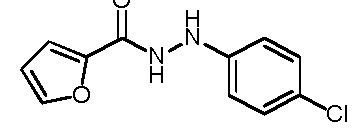 The product is obtained as a sole conformer.
Following the general procedure Route C, N'-(4-chlorophenyl)furan-2-carbohydrazide was obtained from the coupling reaction of furan-2-carbonyl chloride (1.96 g, 15 mmol) and 4- chlorophenylhydrazine hydrochloride (2.95 g, 16.5 mmol), in presence of pyridine (5.3 mL, 66 mmol). 4-Chlorophenylhydrazine hydrochloride is solubilized in an excess of pyridine in a 50 mL flask and cooled at 5°C with an ice bath. In parallel, furan-2-carbonyl chloride is dissolved in 5 mL of THF. The acyl chloride solution is then added dropwise at 5°C to the 4-chlorophenylhydrazine hydrochloride solution. After addition, the temperature is allowed to warm to room temperature and the medium is stirred during 2 hours. Pyridinium chloride gradually appeared in the medium. After completion of the reaction, water (30 mL) is added, pyridinium chloride dissolved and N'-(4-chlorophenyl)furan-2- carbohydrazide precipitated. The precipitate is filtered, washed by diethylether (3x10 mL) and dried. Compound 39 is obtained as a white solid (1.66 g, 47% yield).
m.p. 138-139°C
1H NMR (400 MHz, DMSO-d6): d 10.30 (s, 1 H, NH), 8.07 (bs, 1 H, NH), 7.89 (d, J = 1.6 Hz, 1 H, CHAr)
7.23 (d, J = 7.6 Hz, 1 H, CHAr), 7.18 (m, 2H, CHAr), 6.74 (m, 2H, CHAr), 6.67 (dd, J = 3.6 Hz, J = 1.6
Hz, 1 H, CHAr).
13C{1H}NMR (100 MHz, DMSO-d6): 158.4 (C=0), 148.7 (C,v), 146.8 (C,v), 146.1 (CH), 129.0 (2CHAr), 122.3 (Civ), 114.6 (CH), 114.1 (2CHAr), 112.6 (CH).
IR v (cm'1): 3297, 1668, 1628, 1586, 1528, 1485, 824, 753, 590.
Example 40. N'-phenylbenzene sulfonohydrazide (40)
 The product is obtained as a sole conformer.
Following the general procedure Route E, N'-phenylbenzene sulfonohydrazide was obtained from the coupling reaction of benzenesulfonyl chloride (1.96 g, 15 mmol) and phenylhydrazine (1.78 g, 16.5 mmol), in presence of pyridine (2.65 mL, 33 mmol). Phenylhydrazine is solubilized in pyridine in a 50 mL flask and cooled at 5°C with an ice bath. Benzenesulfonyl chloride is then added dropwise at 5°C to the phenylhydrazine solution. After addition, the temperature is allowed to warm to room temperature and the medium is stirred during 2 hours. Pyridinium chloride gradually appeared in the medium. After completion of the reaction, water (30 mL) is added, pyridinium chloride dissolved and N'-phenylbenzene sulfonohydrazide precipitated. The precipitate is filtered, washed by diethylether (3x10 mL) and dried. Compound 40 is obtained as an off-white solid (2.98 g, 80% yield),
m.p. 155-156°C
1H NMR (400 MHz, DMSO-d6): d 9.55 (s, 1 H, N H), 7.84 (t, J = 1 .6 Hz, 2H, CHAr), 7.82-7.58 (m, 4 H, NH + CHAr), 7.07 (td, J = 8.4 Hz, J = 2.0 Hz, 2 H, CHAr), 6.78 (dd, J = 7.6 Hz, J = 1 .2 Hz, 2H, CHAr), 6.60 (t, J = 8.0 Hz, 1 H, CHAr).
13C{1H}NMR ( 100 MHz, DMSO-cU): 149.0 (C,v), 139.6 (C,v), 133.2 (CH), 129.5 (2CHAr), 128.9 (2CHAr), 127.9 (2CHAr), 1 19.4 (CH), 1 13.1 (2CHAr).
IR v (cm'1): 3325, 3263, 1602, 1500, 1444, 1328, 1 156, 1088, 886, 729, 685.
Example 41 . 4-chloro-N'-phenylbenzene sulfonohydrazide (41 )
 The product is obtained as a sole conformer.
Following the general procedure Route E, 4-chloro-N'-phenylbenzene sulfonohydrazide was obtained from the coupling reaction of 4-chlorobenzenesulfonyl chloride (3.16 g, 15 mmol) and phenylhydrazine (1.78 g, 16.5 mmol), in presence of pyridine (2.65 mL, 33 mmol). Phenylhydrazine is solubilized in pyridine in a 50 mL flask and cooled at 5 ° C with an ice bath. 4-Chlorobenzenesulfonyl chloride, dissolved in 5 mL of THF, is then added dropwise at 5 °C to the phenylhydrazine solution. After addition, the temperature is allowed to warm to room temperature and the medium is stirred during 2 hours. Pyridinium chloride gradually appeared in the medium. After completion of the reaction, water (30 mL) is added, pyridinium chloride dissolved and 4-chloro-N'-phenylbenzene sulfonohydrazide precipitated. The precipitate is filtered, washed by diethylether (3x10 mL) and dried. Compound 41 is obtained as an off-white solid (3.26 g, 77% yield),
m.p. 154-155 ° C
1H NMR (400 MHz, DMSO-d6): d 9.63 (s, 1 H, N H), 7.83 (d, J = 8.2 Hz, 2H, CHAr), 7.69 (d, J = 8.2 Hz, 2H, CHAr), 7.66 (bs, 1 H, N H), 7.09 (t, J = 8.2 Hz, 2H, CHAr), 6.77 (dd, J = 7.6 Hz, J = 2.4 Hz, 2H, CHAr), 6.70 (t, J = 7.0 Hz, 1 H, CHAr).
13C{1H}NMR (100 MHz, DMSO-cU): 148.9 (Civ), 138.3 (C,v), 138.2 (Civ), 129.9 (2CHAr), 129.7 (2CHAr), 129.0 (2CHAr), 1 19.5 (CH), 1 13.1 (2CHAr).
IR v (cm'1): 3342, 3247, 1602, 1493, 1401 , 1325, 1163, 1084, 752.
Example 42. 4-methyl-N'-phenylbenzenesulfonohydrazide (42)
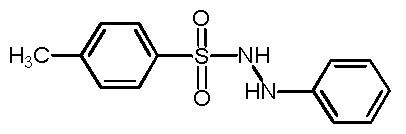 The product is obtained as a main conformer (>97%)
Following the general procedure Route E, 4-methyl-N'-phenylbenzene sulfonohydrazide was obtained from the coupling reaction of 4-methylbenzenesulfonyl chloride (2.86 g, 15 mmol) and phenylhydrazine (1 .78 g, 16.5 mmol), in presence of pyridine (2.65 mL, 33 mmol). Phenylhydrazine is solubilized in pyridine in a 50 mL flask and cooled at 5 ° C with an ice bath. 4-Methylbenzenesulfonyl chloride, dissolved in 5 mL of THF, is then added dropwise at 5 °C to the phenylhydrazine solution. After addition, the temperature is allowed to warm to room temperature and the medium is stirred during 2 hours. Pyridinium chloride gradually appeared in the medium. After completion of the reaction, water (30 mL) is added, pyridinium chloride dissolved and 4-methyl-N'-phenylbenzene
sulfonohydrazide precipitated. The precipitate is filtered, washed by diethyl ether (3x10 mL) and dried. Compound 42 is obtained as an off-white solid (3.73 g, 95% yield),
m.p. 155-156 ° C
1H NMR (400 MHz, DMSO-d6): d 9.45 (s, 1 H, N H), 7.71 (dd, J = 8.0 Hz, J = 2.0 Hz, 2H, CHAr), 7.57 (s, 1 H, N H), 7.40 (d, J = 8.0 Hz, 2H, CHAr), 7.08 (td, J = 7.8 Hz, J = 2.0 Hz, 2H, CHAr), 6.79 (dd, J = 8.0 Hz, 2H, CHAr), 6.66 (t, J = 8.0 Hz, 1 H, CHAr), 2.39 (s, 3H, CH3).
13C{1H}NMR (100 MHz, DMSO-cU): 149.1 (Civ), 143.5 (C,v), 136.7 (Civ), 130.0 (2CHAr), 128.9 (2CHAr), 128.0 (2CHAr), 119.3 (CH), 1 13.2 (2CHAr), 21 .4 (CH3).
IR v (cm'1): 3312, 3238, 1604, 1494, 1320, 1 155, 1088, 883, 812, 755, 658, 550.
Example 43. N'-phenylnaphthalene-2-sulfonohydrazide (43)
 The product is obtained as a sole conformer.
Following the general procedure Route E, N’-phenylnaphthalene-2-sulfonohydrazide was obtained from the coupling reaction of naphthalene-2-sulfonyl chloride (3.40 g, 15 mmol) and phenylhydrazine (1 .78 g, 16.5 mmol), in presence of pyridine (2.65 mL, 33 mmol). Phenylhydrazine is solubilized in pyridine in a 50 mL flask and cooled at 5 °C with an ice bath. Naphthalene-2-sulfonyl chloride, dissolved in 5 mL of THF, is then added dropwise at 5 °C to the phenylhydrazine solution. After addition, the temperature is allowed to warm to room temperature and the medium is stirred during 2 hours. Pyridinium chloride gradually appeared in the medium. After completion of the reaction, water (30 mL) is added, pyridinium chloride dissolved and N’-phenylnaphthalene-2-sulfonohydrazide precipitated. The precipitate is filtered, washed by diethyl ether (3x10 mL) and dried. Compound 43 is obtained as an yellowish solid (1.88 g, 42% yield),
m.p. 144-145 ° C
1H NMR (400 MHz, DMSO-d6): d 9.62 (s, 1 H, N H), 8.48 (s, 1 H, N H), 8.16 (t, J = 8.0 Hz, 2 H, CHAr), 8.05 (d, J = 8.0 Hz, 1 H, CHAr), 7.87 (dd, J = 8.4 Hz, J = 5.8 Hz, 1 H, CHAr), 7.73-7.62 (m, 3H, CHAr), 709-7.05 (m, 2H, CHAr), 6.82-6.79 (dd, J = 8.4 Hz, J = 1 .2 Hz, 2H, CHAr), 6.67 (t, J = 8.0 Hz, 1 H, CHAr).
13C{1H}NMR ( 100 MHz, DMSO-cU): 149.1 (C,v), 136.5 (C,v), 134.9 (CH), 132.2 (C,v), 129.7 (CH), 129.6 (CH), 129.3 (CH), 129.2 (CH), 128.2 (2CHAr), 127.9 (CH), 123.4 (CH), 1 19.4 (C,v), 1 13.1 (2CHAr).
IR v (cm'1): 3321 , 3268, 3175, 1604, 1497, 1320, 1 149, 746.
Example 44. 4-pentyl-N'-phenylbenzene sulfonohydrazide (44)
 The product is obtained as a sole product.
Following the general procedure Route E, 4-pentyl-N'-phenylbenzene sulfonohydrazide was obtained from the coupling reaction of 4-pentylbenzenesulfonyl chloride (3.70 g, 15 mmol) and phenylhydrazine (1.78 g, 16.5 mmol), in presence of pyridine (2.65 mL, 33 mmol). Phenylhydrazine is solubilized in pyridine in a 50 mL flask and cooled at 5 ° C with an ice bath. 4-Pentylbenzenesulfonyl
chloride, dissolved in 5 mL of THF, is then added dropwise at 5 °C to the phenylhydrazine solution. After addition, the temperature is allowed to warm to room temperature and the medium is stirred during 2 hours. Pyridinium chloride gradually appeared in the medium. After completion of the reaction, water (30 mL) is added, pyridinium chloride dissolved and 4-pentyl-N'-phenylbenzene sulfonohydrazide precipitated. The precipitate is filtered, washed by diethyl ether (3x10 mL) and dried. Compound 44 is obtained as an off-white solid (2.62 g, 55% yield),
m.p. 126-127 C
1H NMR (400 MHz, DMSO-d6): d 9.45 (s, 1 H, N H), 7.73 (d, J = 8.0 Hz, 2H, CHAr), 7.61 (s, 1 H, N H), 7.41 (d, J = 8.0 Hz, 2H, CHAr), 7.06 (t, J = 8.0 Hz, 2H, CHAr), 6.76 (dd, J = 8.0 Hz, J = 2.0 Hz, 2H, CHAr), 6.66 (t, J = 8.0 Hz, 1 H, CHAr), 2.65 (t, J = 7.9 Hz, 2H, CH2), 1 .59 (m, 2H, CH2), 1 .28 (m, 2H, CHz), 0.87 (t, J = 7.8 Hz, 3H, CH3).
13C{1H}NMR (100 MHz, DMSO-cU): 149.1 (Civ), 148.2 (C,v), 137.0 (Civ), 129.3 (2CHAr), 128.8 (2CHAr), 127.9 (2CHAr), 119.3 (CH), 1 13.1 (2CHAr), 35.3 (CH2), 31 .2 (CH2), 30.7 (CH2), 22.3 (CH2), 14.3 (CH3). IR v (cm'1): 3319, 3241 , 2923, 2849, 1603, 1494, 1330, 1 157, 1092, 753, 694, 587.
Example 45. N'-phenylquinoline-8-sulfonohydrazide (45)

Following the general procedure Route E, W'-phenylquinoline-8-sulfonohydrazide was obtained from the coupling reaction of quinoline-8-sulfonyl chloride (3.41 g, 15 mmol) and phenylhydrazine (1 .78 g, 16.5 mmol), in presence of pyridine (2.65 mL, 33 mmol). Phenylhydrazine is solubilized in pyridine in a 50 mL flask and cooled at 5 ° C with an ice bath. Quinoline-8-sulfonyl chloride, dissolved in 5 mL of THF, is then added dropwise at 5° C to the phenylhydrazine solution. After addition, the temperature is allowed to warm to room temperature and the medium is stirred during 2 hours. Pyridinium chloride gradually appeared in the medium. After completion of the reaction, water (30 mL) is added, pyridinium chloride dissolved and N’-phenylquinoline-8-sulfonohydrazide precipitated. The precipitate is filtered, washed by diethyl ether (3x10 mL) and dried. Compound 45 is obtained as an yellowish solid (2.47 g, 55% yield).
m.p. 156-157 C
1H NMR (400 MHz, DMSO-d6): d 9.21 (s, 1 H, N H), 9.15 (dd, J = 4.4 Hz, J = 1 .6 Hz, 1 H, CHAr), 8.60 (dd, J = 4.4 Hz, J = 1.6 Hz, 1 H, CHAr), 8.35 (dd, J = 7.6 Hz, J = 1.2 Hz, 1 H, CHAr), 7.78 (m, 2H, CHAr), 7.69 (s, 1 H, N H), 7.08 (t, J = 7.6 Hz, 2H, CHAr), 6.84 (d, J = 7.6 Hz, 2H, CHAr), 6.68 (t, J = 7.6 Hz, 1 H, CHAr).
13C{1H}NMR ( 100 MHz, DMSO-cU): 152.0 (CH), 149.4 (CH), 143.4 (C,v), 137.6 (C,v), 136.1 (C,v), 134.5 (CH), 132.6 (CH), 129.1 (C,v), 128.8 (2CHAr), 126.2 (CH), 123.0 (CH), 1 19.2 (CH), 1 13.3 (2CHAr).
IR v (cm'1): 3271 , 1600, 1496, 1325, 1 166, 1 144, 767, 595.
Example 46. N’-phenylbutane-1 -sulfonohydrazide (46)
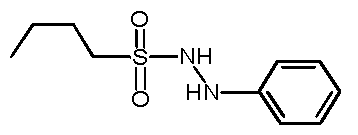 The product is obtained as a sole conformer (>98%).
Following the general procedure Route E, N’-phenylbutane-1 -sulfonohydrazide was obtained from the coupling reaction of butane- 1 -sulfonyl chloride (2.35 g, 15 mmol) and phenylhydrazine (1.78 g, 16.5 mmol), in presence of pyridine (2.65 mL, 33 mmol). Phenylhydrazine is solubilized in pyridine in a 50 mL flask and cooled at 5°C with an ice bath. Butane- 1 -sulfonyl chloride, dissolved in 5 mL of THF, is then added dropwise at 5°C to the phenylhydrazine solution. After addition, the temperature is allowed to warm to room temperature and the medium is stirred during 2 hours. Pyridinium chloride gradually appeared in the medium. After completion of the reaction, water (30 mL) is added, pyridinium chloride dissolved and N’-phenylbutane-1 -sulfonohydrazide precipitated. The precipitate is filtered, washed by diethyl ether (3x10 mL) and dried. Compound 46 is obtained as an off-white solid (0.79 g, 23% yield),
m.p. 132-133 °C
1H NMR (400 MHz, DMSO-d6): d 8.97 (s, 1 H, N H), 7.85 (s, 1 H, N H), 7.15 (t, J = 7.6 Hz, 2H, CHAr), 6.88 (dd, J = 7.6 Hz, J = 1.2 Hz, 2H, CHAr), 6.72 (t, J = 7.6 Hz, 1 H, CHAr), 3.06 (t, J = 8.0, 2H, CH2), 1.70-1.64 (m, 2H, CH2), 1.43-1.37 (m, 2H, CH2), 0.90 (t, J = 7.6 Hz, 3H, CH3).
13C{1H}NMR (100 MHz, DMSO-cU): 149.2 (C,v), 129.1 (2CHAr), 119.3 (CH), 113.0 (2CHAr), 49.3 (CH2); 25.3 (CH2), 21.4 (CH2), 14.0 (CH3).
IR v (cm'1): 3346, 3203, 2955, 2872, 1603, 1496, 1298, 1128, 742, 690.
Example 47. 4-chloro-N'-(4-chlorophenyl)benzene sulfonohydrazide (47)
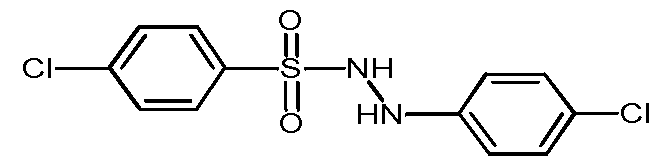 The product is obtained as a sole conformer.
Following the general procedure Route C, N'-(4-chlorophenyl)furan-2-carbohydrazide was obtained from the coupling reaction of 4-chlorobenzenesulfonyl chloride (3.16 g, 15 mmol) and 4- chlorophenylhydrazine hydrochloride (2.95 g, 16.5 mmol), in presence of pyridine (5.3 mL, 66 mmol). 4-Chlorophenylhydrazine hydrochloride is solubilized in an excess of pyridine in a 50 mL flask and cooled at 5°C with an ice bath. In parallel, 4-chlorobenzenesulfonyl chloride is dissolved in 5 mL of THF. The acyl chloride solution is then added dropwise at 5°C to the 4-chlorophenylhydrazine hydrochloride solution. After addition, the temperature is allowed to warm to room temperature and the medium is stirred during 2 hours. Pyridinium chloride gradually appeared in the medium. After completion of the reaction, water (30 mL) is added, pyridinium chloride dissolved and N'-(4- chlorophenyl)furan-2-carbohydrazide precipitated. The precipitate is filtered, washed by diethyl ether (3x10 mL) and dried. Compound 47 is obtained as a white solid (2.85 g, 60% yield), m.p. 152-153 °C
1H NMR (400 MHz, DMSO-d6): d 9.72 (s, 1 H, N H), 7.84-7.81 (m, 3 H, NH + CHAr), 7.70 (d, J = 8.8 Hz, 2H, CHAr), 7.14 (d, J = 8.8 Hz, 2H, CHAr), 6.79 (d, J = 7.6 Hz, 2H, CHAr).
13C{1H}NMR (100 MHz, DMSO-cU): 147.9 (Civ), 138.3 (C,v), 138.1 (Civ), 129.9 (2CHAr), 129.8 (2CHAr), 128.8 (2CHAr), 122.8 (C,v), 114.6 (2CHAr).
IR v (cm'1): 3340, 3250, 3089, 1598, 1508, 1488, 1324, 1161 , 1081 , 821 , 751 , 612, 549.
Example 48. 3-trifluoromethyl-N'-phenylbenzenesulfonohydrazide (48)
 The product was obtained as a major conformer (>97%).
Following the general procedure Route E, 3-trifluoromethyl-N'-phenylbenzene sulfonohydrazide was obtained from the coupling reaction of 3-(trifluoromethyl)benzene-1 -sulfonyl chloride (3.67 g, 15 mmol) and phenylhydrazine (1.78 g, 16.5 mmol), in presence of pyridine (2.65 mL, 33 mmol). Phenylhydrazine is solubilized in pyridine in a 50 mL flask and cooled at 5°C with an ice bath. 3- (Trifluoromethyl)benzene-l -sulfonyl chloride, dissolved in 5 mL of THF, is then added dropwise at 5°C to the phenylhydrazine solution. After addition, the temperature is allowed to warm to room temperature and the medium is stirred during 2 hours. Pyridinium chloride gradually appeared in the medium. After completion of the reaction, water (30 mL) is added, pyridinium chloride dissolved and 3-trifluoromethyl-N'-phenylbenzene sulfonohydrazide precipitated. The precipitate is filtered, washed by diethyl ether (3x10 mL) and dried. Compound 48 is obtained as a light brown solid (2.75 g, 58% yield),
m.p. 147-148 °C
1H NMR (400 MHz, DMSO-d6): d 9.80 (d, J = 1.6 Hz, 1 H, NH), 8.14 (d, J = 8.0 Hz, 1 H, CHAr), 8.09 (d, J = 8.0 Hz, 1 H, CHAr), 7.87 (t, J = 8.0 Hz, 1 H, CHAr), 7.76 (d, J = 1.6 Hz, 1 H, NH), 7.09 (t, J = 8.0 Hz, 2H, CHAr), 6.78 (d, J = 8.0 Hz, 2H, CHAr), 6.68 (t, J = 8.0 Hz, 1 H, CHAr).
13C{1H}NMR (100 MHz, DMSO-cU): 148.7 (C,v), 140.7 (CH), 132.1 (C,v), 131.8 (CH), 130.7 (q, C,v, J = 33 Hz), 130.7 (q, CH, J = 4.7 Hz), 129.0 (2CHAr), 124.5 (q, C,v, J = 111 Hz), 124.4 (q, CH, J = 5.5 Hz), 119.7 (CH), 113.2 (2CHAr).
IR v (cm'1): 3329, 3203, 1606, 1498, 1326, 1155, 1131 , 1070, 690.
Example 49. 2,4-difluoro-N'-phenylbenzenesulfonohydrazide (49)
 The product is obtained as a sole conformer.
Following the general procedure Route E, 2,4-difluoro-N'-phenylbenzenesulfonohydrazide was obtained from the coupling reaction of 2,4-difluorobenzene-1 -sulfonyl chloride (3.67 g, 15 mmol) and phenylhydrazine (1.78 g, 16.5 mmol), in presence of pyridine (2.65 mL, 33 mmol). Phenylhydrazine is solubilized in pyridine in a 50 mL flask and cooled at 5°C with an ice bath. 2,4-Difluorobenzene-1 - sulfonyl chloride, dissolved in 5 mL of THF, is then added dropwise at 5°C to the phenylhydrazine solution. After addition, the temperature is allowed to warm to room temperature and the medium is stirred during 2 hours. Pyridinium chloride gradually appeared in the medium. After completion of the reaction, water (30 mL) is added, pyridinium chloride dissolved and 2,4-difluoro-N'- phenylbenzenesulfonohydrazide precipitated. The precipitate is filtered, washed by diethyl ether (3x10 mL) and dried. Compound 49 is obtained as a light brown solid (2.17 g, 51% yield).
m.p. 163-164° C
1H NMR (400 MHz, DMSO-cU): d 9.87 (s, 1 H, NH), 7.81 (s, 1 H, NH), 7.85 (dd, J = 6.0 Hz, J = 8.4 Hz, 1 H, CHAr), 7.56 (ddd, J = 8.0 Hz, J = 6.0 Hz, J = 2.0 Hz, 1 H, CHAr), 7.26 (td, J = 8.8 Hz, J = 2.4 Hz, 1 H, CHAr), 7.1 1 -7.07 (m, 2H, CHAr), 6.78 (dd, J = 8.8 Hz, J = 0.8 Hz, 2H, CHAr), 6.69 (td, J = 8.4 Hz, J = 1 .2 Hz, 1 H, CHAr).
13C{1H}NMR (100 MHz, DMSO-cU): 165.7 (dd, C,v, J = 256 Hz, J = 13 Hz, CF), 159.8 (dd, C,v, J = 256 Hz, J = 13 Hz, CF), 149.7 (C,v), 133.6 (d, CH, J = 10 Hz), 129.0 (2CHAr), 123.9 (dd, CH, J = 14 Hz, J = 3.8 Hz), 119.5 (CH), 1 12.9 (2CHAr), 112.6 (dd, CH, J = 22 Hz, J = 3.8 Hz), 106.4 (t, CH, J = 26.7 Hz). IR v (cm'1): 3334, 3234, 3102, 1600, 1488, 1335, 1 168, 1072, 968, 859, 751 , 691 , 547.
Example 50. 1 -(( 1 R,4R)-7,7-dimethyl-2-oxobicydo[2.2.1 ]heptan-1 -yl)-N'-phenylmethane sulfonohydrazide (50)

Following the general procedure Route E, 1 -((1 R,4R)-7,7-dimethyl-2-oxobicyclo[2.2.1 ]heptan-1 -yl)- N'-phenylmethane sulfonohydrazide was obtained from the coupling reaction of 2,4-((1 R,4R)-7,7- Dimethyl-2-oxobicyclo[2.2.1 ]heptan-1 -yl)methanesulfonyl chloride [Camphor-sulfonyl chloride] (3.76 g, 15 mmol) and phenylhydrazine (1 .78 g, 16.5 mmol), in presence of pyridine (2.65 mL, 33 mmol). Phenyl hydrazine is solubilized in pyridine in a 50 mL flask and cooled at 5 ° C with an ice bath. 2,4- ((1 R,4R)-7,7-Dimethyl-2-oxobicyclo[2.2.1 ]heptan-1 -yl)methanesulfonyl chloride [Camphor-sulfonyl chloride], dissolved in 5 mL of THF, is then added dropwise at 5 °C to the phenylhydrazine solution. After addition, the temperature is allowed to warm to room temperature and the medium is stirred during 2 hours. Pyridinium chloride gradually appeared in the medium. After completion of the reaction, water (30 mL) is added, pyridinium chloride dissolved and 1 -((1 R,4R)-7,7-dimethyl-2- oxobicyclo[2.2.1 ]heptan-1 -yl)-N'-phenylmethane sulfonohydrazide precipitated. The precipitate is filtered, washed by diethyl ether (3x10 mL) and dried. Compound 50 is obtained as a light brown solid (4.20 g, 87% yield),
m.p. 153-154° C
1H NMR (400 MHz, DMSO-d6): d 8.99 (s, 1 H, NH), 7.91 (s, 1 H, NH), 7.16 (t, J = 8.4 Hz, 2H, CHAr), 6.89 (d, J = 8.4 Hz, 2H, CHAr), 6.73 (t, J = 7.6 Hz, 1 H, CHAr), 3.47 (d, J = 14.8 Hz, 1 H, CH2), 3.01 (d, J = 1 1 .2 Hz, 1 H, CHz), 2.39-2.32 (m, 2H), 2.06 (t, J = 4.8 Hz, 1 H), 1 .96-1 .91 (m, 2H), 1 .54-1 .49 (m,
1 H), 1 .43-1 .39 (m, 1 H), 1 ,05 (s, 3H, CH3), 0.81 (s, 3H, CH3).
13C{1H}NMR (100 MHz, DMSO-cU): 215.2 (C=0), 149.1 (C,v), 129.1 (2CHAr), 1 19.4 (CH), 1 13.1 (2CHAr),
58.4 (CHz), 48.0 (CH2), 46.7 (CH2), 42.5 (CH2), 26.7 (CH2), 25.1 (CH2), 20.0 (CH3), 19.8 (CH3).
IR v (cm'1): 3346, 3204, 2970, 1745, 1603, 1331 , 1144, 754, 557.
Example 51 . phenyl 2-phenyl hydrazinecarboxylate (51 )
 Ratio conformer 1 /conformer 2: 91 /09
Following the general procedure Route C, phenyl 2-phenyl hydrazinecarboxylate was obtained from the coupling reaction of phenyl carbonochloridate (2.35 g, 15 mmol) and phenylhydrazine (1.78 g, 16.5 mmol), in presence of pyridine (2.65 mL, 33 mmol). Phenylhydrazine is solubilized in pyridine in a 50 mL flask and cooled at 5°C with an ice bath. Phenyl carbonochloridate is then added dropwise at 5°C to the phenylhydrazine solution. After addition, the temperature is allowed to warm to room temperature and the medium is stirred during 2 hours. Pyridinium chloride gradually appeared in the medium. After completion of the reaction, water (30 mL) is added, pyridinium chloride dissolved and phenyl 2-phenyl hydrazinecarboxylate precipitated. The precipitate is filtered, washed by diethyl ether (3x10 mL) and dried. Compound 51 is obtained as an off-white solid (0.513 g, 15% yield), m.p. 114-115 C
1H NMR (400 MHz, DMSO-d6): d 9.63 (s, 1 H, NH, conformer 1 ), 9.63 (s, 1 H, NH, conformer 2), 7.96 (s, 1 H, 1 NH, conformer 2), 7.84 (s, 1 H, NH, conformer 1 ), 7.40 (m, 2H, CHAr, conformer 1 + 2), 7.25- 7.13 (m, 5H, CHAr, conformer 1 + 2), 6.77-6.71 (m, 3H, CHAr).
13C{1H}NMR (100 MHz, DMSO-cU): 155.6 (C=0), 151.2 (C,v), 149.4 (C,v), 129.8 (2CHAr), 129.3 (2CHAr), 125.7 (CH), 122.1 (2CHAr), 119.1 (2CHAR), 112.3 (CH).
IR v (cm'1): 3380, 3225, 1721 , 1606, 1481 , 1236, 1191 , 1029, 747, 696, 631.
Example 52. Methyl 2-phenyl hydrazinecarboxylate (52)
o
 The product is obtained mainly as a sole conformer (>90%)
Following the general procedure Route C, methyl 2-phenyl hydrazinecarboxylate was obtained from the coupling reaction of methyl carbonochloridate (1.42 g, 15 mmol) and phenylhydrazine (1.78 g, 16.5 mmol), in presence of pyridine (2.65 mL, 33 mmol). Phenylhydrazine is solubilized in pyridine in a 50 mL flask and cooled at 5°C with an ice bath. Methyl carbonochloridate is then added dropwise at 5°C to the phenylhydrazine solution. After addition, the temperature is allowed to warm to room temperature and the medium is stirred during 2 hours. Pyridinium chloride gradually appeared in the medium. After completion of the reaction, water (30 mL) is added, pyridinium chloride dissolved and methyl 2-phenyl hydrazinecarboxylate precipitated. The precipitate is filtered, washed by diethylether (3x10 mL) and dried. Compound 52 is obtained as an off-white solid (0.673 g, 27% yield), m.p. 119-121 C
1H NMR (400 MHz, DMSO-d6): d 9.02 (s, 1 H, NH), 7.63 (s, 1 H, NH), 7.13 (t, J = 8.8 Hz, 2 H, CHAr), 6.67 (m, 3H, CHAr), 3.59 (s, 3H, CH3).
13C{1H}NMR (100 MHz, DMSO-cU): 157.8 (C=0), 149.8 (C,v), 129.2 (2CHAr), 118.7 (2CHAr), 112.2 (CH), 52.1 (CH3).
IR v (cm'1): 3290, 3038, 2923, 2848, 1662, 1635, 1602, 1496, 931 , 748, 688.
Example 53. N'-(4-chlorophenyl)picolinohydrazide (53)
o
 The product is obtained mainly as a sole conformer (>97%)
Following the general procedure Route B, N'-(4-chlorophenyl)picolinohydrazide was obtained from the coupling reaction of pyridine-2-carboxylic acid (1 g, 8.0 mmol), 4-chlorophenylhydrazine hydrochloride (1 ,45 g, 8.0 mmol), which at first was released in situ by sodium methanoate (1.75 mL, 30% aqueous methanolic solution), in presence of triethylamine (1.64 g, 16.0 mmol), 1 -ethyl-3-(3- dimethylaminopropyl)carbodiimide hydrochloride (1.71 g, 8.9 mmol) and dimethylaminopyridine (0.20 g, 1.6 mmol) which were dissolved in 50 mL of methylene chloride. The mixture was stirred at room temperature for 48 h, under nitrogen atmosphere. The precipitated was filtered. After washing with methylene chloride, the solution was concentrated to a crude product which was purified via flash column chromatography (methanol/methylene chloride 00/100 to 10/90) affording compound 53 as a white solid (0.143 g, 7% yield),
m.p. 145-146 °C
1H NMR (400 MHz, DMSO-d6): d 10.61 (d, J = 2.9 Hz, 1 H, N H) 8.60 (dd, J = 4.8, 1.2 Hz, 1 H, CHAr), 8.09 (d, J = 2.4 Hz, 1 H, N H), 8.02 (d, J = 3.8 Hz, 2H, 2CHAr), 7.65 (qd, J = 5.0, 1.2 Hz, 1 H, CHAr), 7.17 (d, J = 8.3 Hz, 2H, 2CHAr),6.75 (d, J = 8.3 Hz, 2H, 2CHAr).
13C{1H}NMR (100 MHz, DMSO-cU): d 164.0 (C=0), 149.6 (C,v), 148.7 (CHAr), 148.2 (C,v), 137.8 (CHAr), 128.5 (2CHAr), 126.9 (CHAr), 122.3 (CHAr), 121.8 (C,v), 113.8 (2CHAr).
IR v (cm-1): 3287, 1678, 1591 , 1489, 1462, 1429.
Example 54. 5-oxo-N'-(pyridin-2-yl)pyrrolidine-2-carbohydrazide (54)

Following the general procedure Route B, 5-oxo-N'-(pyridin-2-yl)pyrrolidine-2-carbohydrazide was obtained from the coupling reaction of 5-oxopyrrolidine-2-carboxylic acid (1 g, 7.7 mmol), 2- hydrazinopyridine (0.85 g, 7.7 mmol) in presence of 1 -ethyl-3-(3-dimethylaminopropyl)carbodiimide hydrochloride (1.63 g, 8.5 mmol) and dimethylaminopyridine (0.19 g, 1.55 mmol) which were dissolved in 100 mL of methylene chloride. The mixture was stirred at room temperature for 24 h, under nitrogen atmosphere. The precipitated was filtered and washed with methylene chloride (2x 10 mL) and diethyl ether (20 mL). The compound was then recrystallized in ethanol, affording compound 54 as a white solid (0.73 g, 43% yield),
m.p. 192-194 °C
1H NMR (400 MHz, DMSO-d6): d 9.90 (d, J = 2.0 Hz, 1 H, NH, conformer 1 ), 9.21 (s, 1 H, NH, conformer 2), 8.52 (s, 1 H, NH, conformer 2), 8.31 (d, J = 2.0 Hz, 1 H, NH, conformer 1 ), 8.11 (d, J = 4.8 Hz, 1 H, CHAr, conformer 2), 8.04 (d, J = 6.8 Hz, 1 H, CHAr, conformer 1 ), 7.90 (s, 1 H, NH, conformer 1 ), 7.65 (s, 1 H, NH, conformer 2), 7.60 (ddd, J = 8.4, 6.5, 1.9 Hz, 1 H, CHAr, conformer 2), 7.51 (ddd, J = 8.8,
7.2, 2.0 Hz, 1 H, CHAr, conformer 1 ), 6.78 (dd, J = 7.0, 4.8 Hz, 1 H, CHAr, conformer 2), 6.69 (dd, J = 7.1 , 5.1 Hz, CHAr, conformer 1 ), 6.64 (d, J = 8.4 Hz, 1 H, CHAr, conformer 2), 6.59 (d, J = 8.4 Hz, 1 H, CHAr, conformer 1 ), 4.34 (dd, J = 8.4, 4.4 Hz, 1 H, CH, conformer 2), 4.1 1 (dd, J = 8.4, 4.4 Hz, 1 H, CH, conformer 1 ), 2.29-2.34 (m, 1 H, CH2, conformer 1 +2), 2.21 -2.10 (m, 2H, CH2, conformer 1 +2), 1 .98-2.03 (m, 1 H, CH2, conformer 1 +2).
13C{1H}NMR (100 MHz, DMSO-d6): d 177.4 (Civ), 172.2 (C,v), 159.6 (C,v), 147.5 (CHAr), 137.42 (CHAr), 1 14.6 (CHAr), 106.4 (CHAr), 54.3 (CH), 29.2 (CH2), 25.2 (CH2).
IR v (cm-1): 3069, 1670, 1601 , 1263, 1439, 1506.
Example 55. N'-(5-bromopyridin-2-yl)-5-oxopyrrolidine-2-carbohydrazide (55)
p -a. The product is obtained mainly as a sole conformer (>97%)
Following the general procedure Route B, W'-(5-bromopyridin-2-yl)-5-oxopyrrolidine-2-carbohydrazide was obtained from the coupling reaction of 5-oxopyrrolidine-2-carboxylic acid (0.52 g, 4.0 mmol), 5-bromo-2-hydrazinopyridine (0.75 g, 4.0 mmol) in presence of 1 -ethyl-3-(3-dimethylaminopropyl) carbodiimide hydrochloride (0.84 g, 4.4 mmol) and dimethylaminopyridine (0.098 g, 0.8 mmol) which were dissolved in 100 mL of methylene chloride. The mixture was stirred at room temperature for 20 h, under nitrogen atmosphere. The precipitated was filtered and washed with methylene chloride (3x 10 mL) and diethyl ether (10 mL), affording compound 55 as a white solid (0.76 g, 64% yield), m.p. 210-21 1 ° C
1H NMR (400 MHz, DMSO-d6): d 9.97 (s, 1 H, NH), 8.61 (s, 1 H, NH), 8.12 (d, J = 2.4 Hz, 1 H, CHAr), 7.89 (s, 1 H, NH), 7.68 (dd, J = 8.4, 2.4 Hz, 1 H, CHAr), 6.58 (d, J = 9.2 Hz, 1 H, CHAr), 4.10 (dd, J = 8.8, 3.2 Hz, 1 H, C H), 2.29-2.34 (1 m, 1 H, CH2), 2.1 1 -2.19 (m, 2H, CH2), 1 .97-2.01 (m, 1 H, CH2). 13C{1H}NMR (100 MHz, DMSO-cU): d 177.4 (C=0), 172.2 (C=0), 158.4 (C,v), 147.8 (CHAr) 139.7 (C,v), 108.5 (CHAr), 108.1 (CHAr), 54.3 (CH), 29.2 (CH2), 25.1 (CH2).
IR v (cm-1): 3258, 1668, 1591 , 1460, 1373.
Example 56. N'-(5-bromopyridin-2-yl)-5-oxopyrrolidine-2-carbohydrazide (56)
 The product is obtained mainly as a sole conformer (>97%)
Following the general procedure Route B, N'-(6-bromopyridin-2-yl)-5-oxopyrrolidine-2- carbohydrazidewas obtained from the coupling reaction of 5-oxopyrrolidine-2-carboxylic acid (0.52 g, 4.0 mmol), 6-bromo-2-hydrazinopyridine (0.75 g, 4.0 mmol) in presence of 1 -ethyl-3-(3- dimethylaminopropyl)carbodiimide hydrochloride (0.84 g, 4.4 mmol) and dimethylaminopyridine (0.098 g, 0.8 mmol) which were dissolved in 100 mL of methylene chloride. The mixture was stirred at room temperature for 24 h, under nitrogen atmosphere. The precipitated was filtered and washed with methylene chloride (3x 10 mL) and diethyl ether (10 mL). The compound was then recrystallized in ethanol, affording compound 56 as a white solid (0.69 g, 57% yield).
m.p. 231 -232 ° C
1H NMR (400 MHz, DMSO-d6): d 9.99 (s, 1 H, NH), 8.80 (s, 1 H, NH), 7.90 (s, 1 H, NH), 7.45 (t, J = 8.0 Hz, 1 H, CHAr), 6.88 (d, J = 8.0 Hz, 1 H, CHAr), 6.57 (d, J = 8.0 Hz, 1 H, CHAr), 4.10 (d, J = 5.2 Hz, 1 H, CH), 2.01 -2.39 (m, 4H, CH2CH2).
13C{1H}NMR (100 MHz, DMSO-d6): d 177.5 (C=0), 172.04 (C=0), 159,9 (C,v), 140,4 (CHAr), 139,3 (Civ), 1 17, 1 (CHAr), 105,2 (CHAr), 54,3 (CH), 29,2 (CH2), 25,2 (CH2).
IR v (cm-1): 3235, 1674, 1597, 1447, 1261 .
Example 57. N'-(3,5-dichlorophenyl)-5-oxopyrrolidine-2-carbohydrazide (57)
 Ratio conformer 1 /conformer 2: 95/05
Following the general procedure Route B, N'-(3,5-dichlorophenyl)-5-oxopyrrolidine-2-carbohydrazide was obtained from the coupling reaction of 5-oxopyrrolidine-2-carboxylic acid (1 g, 7.7 mmol), (3,5- dichlorophenyl)hydrazine hydrochloride (1 .65 g, 7.7 mmol) which at first was released in situ by sodium methanoate (1 .75 mL, 30% aqueous methanolic solution), in presence of N,N- diisopropylethylamine (2 g, 15.5 mmol) and 3-[bis(dimethylamino)methyliumyl]-3H-benzotriazol-1 - oxide hexafluorophosphate (2.94 g, 7.7 mmol) which were dissolved in 50 mL of methylene chloride. The mixture was stirred at room temperature for 24 h, under nitrogen atmosphere. The precipitated dicyclohexylurea was filtered and washed with methylene chloride (3x 10mL), affording compound 57 as a white solid (0.591 g, 27% yield),
m.p. 177-178 ° C
1H NMR (400 MHz, DMSO-d6): d 10.15 (s, 1 H, NH, conformer 1 ), 9.33 (s, 1 H, NH, conformer 2), 8.37 (s, 1 H, NH, conformer 1 ), 8.00 (s, 1 H, NH, conformer 1 ), 7.63 (s, 1 H, NH, conformer 2), 7.35 (s, 1 H, NH, conformer 2), 6.91 (t, J = 2.1 Hz, 1 H, CHAr, conformer 2), 6.81 (t, J = 1 .8 Hz, 1 H, CHAr, conformer 1 ), 6.72 (d, J = 1 .8 Hz, 2H, 2CHAr, conformer 2), 6.69 (d, J = 1 .8 Hz, 2H, 2CHAr, conformer 1 ), 4.30 (m, 1 H, CH, conformer 2), 4.14 (dd, J = 8.4, 4.4 Hz, 1 H, CH, conformer 1 ), 2.30-2.34 (m, 1 H, CH, conformers 1 +2), 2.10-2.20 (m, 2H, C H2, conformers 1 +2), 1 .90-1 .94 (m, 1 H, CH2, conformers 1 +2). 13C{1H}NMR (100 MHz, DMSO-cU): d 177.3 (C=0), 172.3 (C=0), 151 .6 (2C,V), 134.4 (CHAr), 1 17.19 (C,v), 1 10.2 (2CHAr), 54.3 (CH), 29.3 (CH2), 25.0 (CH2).
IR v (cm-1): 3264, 1680, 1655, 1587, 1578, 1535, 1409, 1279, 1252.
Example 58. N'-(6-chloropyridin-2-yl)-5-oxopyrrolidine-2-carbohydrazide (58)
 Ratio conformer 1 /conformer 2: 95/05
Following the general procedure Route B, N’-(6-chloropyridin-2-yl)-5-oxopyrrolidine-2-carbohydrazide was obtained from the coupling reaction of 5-oxopyrrolidine-2-carboxylic acid (1 .35 g, 10.0 mmol), 6-chloro-2-hydrazinopyridine (1 .5 g, 10.0 mmol) in presence of 1 -ethyl-3-(3-dimethylaminopropyl) carbodiimide hydrochloride (2.2 g, 12.0 mmol) and dimethylaminopyridine (0.26 g, 2.1 mmol) which were dissolved in 50 mL of methylene chloride. The mixture was stirred at room temperature for 20
h, under nitrogen atmosphere. The precipitated was filtered and washed with methylene chloride (3x 15 mL) and diethyl ether (2x 10 mL). The compound was then recrystallized in ethanol, affording compound 58 as a white solid (1 .75 g, 68% yield),
m.p. 244-245 ° C
1H NMR (400 MHz, DMSO-cU): d 9.99 (s, 1 H, NH, conformer 1 ), 9.34 (s, 1 H, NH, conformer 2), 8.95 (s, 1 H, NH, conformer 2), 8.78 (s, 1 H, NH, conformer 1 ), 7.90 (s, 1 H, NH, conformer 1 ), 7.66 (s, 1 H, NH, conformer 2), 7.64 (t, J = 8.0 Hz, 1 H, CHAr, conformer 2), 7.55 (t, J = 8.1 Hz, 1 H, CHAr, conformer 1 ), 6.84 (d, J = 8.0 Hz, 1 H, CHAr, conformer 2), 6.74 (d, J = 8.4 Hz, 1 H, CHAr, conformer 1 ), 6.60 (d, J = 8.4 Hz, 1 H, CHAr, conformer 2), 6.54 (d, J = 8.4 Hz, 1 H, CHAr, conformer 1 ), 4.31 (dd, J = 8.4 Hz, 1 H, CH, conformer 2), 4.10 (dd, J = 8.8, 4.0 Hz, 1 H, CH, conformer 1 ), 2.45-2.52 (m, 1 H, CH2, conformers 1 +2), 2.12-2.33 (m, 2H, C hh, conformers 1 +2), 2.04-2.08 (m, 1 H, CH2, conformer 1 ), 1 .91 - 1 .97 (m, 1 H, CH2, conformer 2).
13C{1H}NMR (100 MHz, DMSO-d6): d 177.4 (C=0) 172.4 (C=0) 159.8 (C,v), 148.3 (C,v), 140.6 (CHAr), 1 13.3 (CHAr), 104.9 (CHAr), 54.3 (CH), 29.2 (CHz), 25.2 (CHz).
IR v (cm-1): 3221 , 1674, 1599, 1452, 1263.
Example 59. 5-oxo-N'-(quinolin-2-yl)pyrrolidine-2-carbohydrazide (59)
 Ratio conformer 1 /conformer 2: 95/05
Following the general procedure Route B, 5-oxo-N’-(quinolin-2-yl)pyrrolidine-2-carbohydrazide was obtained from the coupling reaction of 5-oxopyrrolidine-2-carboxylic acid (0.41 g, 3.1 mmol), 2- hydrazinoquinoline (0.5 g, 3.1 mmol) in presence of 1 -ethyl-3-(3-dimethylaminopropyl)carbodiimide hydrochloride (0.66 g, 3.5 mmol) and dimethylaminopyridine (0.077 g, 0.6 mmol) which were dissolved in 50 mL of methylene chloride. The mixture was stirred at room temperature for 24 h, under nitrogen atmosphere. The precipitated was filtered and washed with methylene chloride (2x 15 mL) and diethyl ether (10 mL). The compound was then recrystallized in ethanol, affording compound 59 as a white solid (0.155 g, 18% yield),
m.p. 202-203 ° C
1H NMR (400 MHz, DMSO-d6): d 10.06 (s, 1 H, NH, conformer 1 ), 9.33 (s, 1 H, NH, conformer 2), 9.02 (s, 1 H, NH, conformer 2), 8.90 (s, 1 H, NH, conformer 1 ), 8.08 (d, J = 9.1 Hz, 1 H, CHAr, conformer 2), 8.00 (d, J = 9.1 Hz, 1 H, CHAr, conformer 1 ), 7.90 (s, 1 H, NH, conformers 1 +2), 7.73 (d, J = 7.9 Hz, 1 H, CHAr, conformer 2), 7.69 (d, J = 7.9 Hz, 1 H, CHAr, conformer 1 ), 7.53 (s, 1 H, CHAr, conformers 1 +2), 7.51 (dd, J = 4.5, 1 .4 Hz, 1 H, CHAr, conformers 1 +2), 7.23 (ddd, J = 8.2, 5.9, 2.4 Hz, 1 H, CHAr, conformers 1 +2), 6.88 (d, J = 9.0 Hz, 1 H, CHAr, conformers 1 +2), 4.34 (dd, J = 7.1 , 3.3 Hz, 1 H, C H, conformer 2), 4.16 (dd, J = 8.9, 2.3 Hz, 1 H, C H, conformer 1 ), 2,31 -2,39 (m, 1 H, CHz, conformers 1 +2), 2.1 1 -2.21 (m, 3H, CH2CH2, conformers 1 +2).
13C{1H}NMR (100 MHz, DMSO-cU): d 177.5 (C=0) 172.4 (C=0), 157.3 (C,v), 147.0 (Civ), 137.3 (CHAr), 129.4 (CHAr), 127.6 (CHAr), 125.9 (CHAr), 123.9 (CHAr), 122.4 (CHAr), 1 10.4 (C,v), 54.4 (CH), 29.2 (CHz), 25.3 (CHz).
IR v (cm-1): 3183, 2934, 1672, 1609, 1510, 1427, 1352, 1269.
Example 60. N'-(2,4-difluorophenyl)-5-oxopyrrolidine-2-carbohydrazide (60)
o
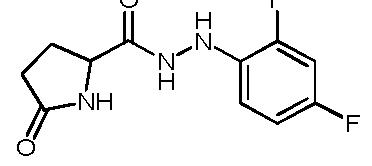 Ratio conformer 1 /conformer 2: 93/07
Following the general procedure Route B, W'-(2,4-difluorophenyl)-5-oxopyrrolidine-2-carbohydrazide was obtained from the coupling reaction of 5-oxopyrrolidine-2-carboxylic acid (1 g, 7.7 mmol), 2,4- difluorophenylhydrazine hydrochloride (1.40 g, 7.7 mmol), which at first was released in situ in a presence of sodium methanoate (1.75 mL, 30% aqueous methanolic solution), in presence of 1 -ethyl- 3-(3-dimethylaminopropyl)carbodiimide hydrochloride (1.63 g, 8.5 mmol) and dimethylaminopyridine (0.19 g, 15.5 mmol) which were dissolved in 50 mL of methylene chloride. The mixture was stirred at room temperature for 20 h, under nitrogen atmosphere. The precipitated was filtered. After washing with methylene chloride, the solution was concentrated to a crude product which was purified via flash column chromatography (ethyl acetate/n-heptane 00/100 to 100/00) affording compound 60 as a white solid (0.60 g, 30% yield),
m.p. 159-161 °C
1H NMR (400 MHz, DMSO-de): d 9.93 (br s, 1 H, NH, conformer 1 ) 9.20 (br s, 1 H, NH, conformer 2), 7.96 (br s, 1 H, NH, conformer 2), 7.93 (br s, 1 H, NH, conformer 1 ), 7.65 (br s, 1 H, NH, conformer 2), 7.62 (br s, 1 H, NH, conformer 1 ), 7.19 (ddd, J = 11.8, 9.1 , 2.9 Hz, 1 H, CHAr, conformer 2), 7.13 (ddd, J = 11.7, 8.9, 2.7 Hz, 1 H, CHAr, conformer 1 ), 6.98 (td, J = 9.0, 2.2 Hz, 1 H, CHAr, conformer 2), 6.89 (td, J = 8.9, 2.6 Hz, 1 H, CHAr, conformer 1 ), 6.82 (m, 1 H, CHAr, conformers 1 +2), 4.40 (dd, J = 8.4, 4.3 Hz, 1 H, C H, conformer 2), 4.11 (dd, J = 8.6, 4.3 Hz, 1 H, C H, conformer 1 ), 2.27-2.36 (m, 1 H, C H2, conformers 1 +2), 2.09-2.23 (m, 2H, C H2, conformers 1 +2), 1.92-2.00 (m, 1 H, CH2, conformers 1 +2). 13C{1H}NMR (100 MHz, DMSO-cU): d 177.4 (C=0), 172.4 (C=0), 154.9 (dd, C,v, J = 237.5 Hz, J = 12.2 Hz), 149.6 (dd, C,v, J = 242.8 Hz, J = 12.2 Hz), 133.5 (dd, C,v, J = 11.1 Hz, J = 3.2 Hz), 114.2 (dd, CHAr, J = 9.0 Hz, J = 4.7 Hz), 110.7 (dd, CHAr, J = 22.6 Hz, J = 4.1 Hz), 103.7 (dd, CHAr, J = 25.7 Hz, J = 22.2 Hz), 54.4 (CH), 29.1 (CH2), 25.1 (CH2).
IR v (cm-1): 3221 , 1666, 1504, 1261 , 1198.
Example 61. N'-((2-trifluoromethyl)phenyl)-5-oxopyrrolidine-2-carbohydrazide (61 )

Following the general procedure Route B, N'-(2-(trifluoromethyl)phenyl)-5-oxopyrrolidine-2- carbohydrazide was obtained from the coupling reaction of 5-oxopyrrolidine-2-carboxylic acid (0.61 g, 4.7 mmol), 2-(trifluoromethyl)phenylhydrazine hydrochloride (1 g, 4.7 mmol), which at first was released in situ in a presence of sodium methanoate (1 mL, 30% aqueous methanolic solution), in presence of 1 -ethyl-3-(3-dimethylaminopropyl)carbodiimide hydrochloride (0.99 g, 5.2 mmol) and dimethylaminopyridine (0.12 g, 0.94 mmol) which were dissolved in 50 mL of methylene chloride. The mixture was stirred at room temperature for 24 h, under nitrogen atmosphere. The precipitated was filtered. After washing with methylene chloride, the solution was concentrated to a crude product
which was purified via flash column chromatography (ethyl acetate/n-heptane 00/100 to 100/00) affording compound 61 as a white solid (0.34 g, 25% yield),
m.p. 167-168 ° C
1H NMR (400 MHz, DMSO-de): d 10.06 (br s, 1 H, NH, conformer 1 ) 9.33 (br s, 1 H, NH, conformer 2), 7.94 (br s, 1 H, NH, conformer 2), 7.94 (br s, 1 H, NH, conformer 1 ), 7.62 (br s, 1 H, NH, conformer 2), 7.48-7.52 (m, 3H, 3CHAr, conformer 2), 7.40-7.46 (m, 3H, 2CHAr, NH conformer 1 ), 7.00 (d, J = 8.4 Hz, 1 H, CHAr, conformer 2), 6.94 (d, J = 8.4 Hz, 1 H, CHAr, conformer 1 ), 6.85 (t, J = 7.5 Hz, 1 H, CHAr, conformer 1 ), 4.20 (m, 1 H, C H, conformer 2), 4.14 (dd, J = 8.9, 4.4 Hz, 1 H, C H, conformer 1 ), 2.30-2.34 (m, 1 H, CH2, conformers 1 +2), 2.14-2.07 (m, 2H, CH2, conformers 1 +2), 2.02-2.07 (m, 1 H, CH2, conformers 1 +2).
13C{1H}NMR (100 MHz, DMSO-cU): d 170.3 (C=0 x2), 143.3 (d, CHAr, J = 1 .5 Hz), 133.7 (CHAr), 125.6 (q, Civ, J = 5.6 Hz), 124.2 (q, CF3, J = 273.4 Hz), 120.2 (CHAr), 1 14.1 (CHAr), 1 13.2 (q, C,v, J = 30.6 Hz), 47.2 (CH), 28.9 (CH2), 20.6 (CH2).
IR v (cm'1): 3277, 1690, 1612, 1321 , 1275, 1 105.
Example 62. N'-(2,4-dichlorophenyl)-5-oxopyrrolidine-2-carbohydrazide (62)
o
 The product is obtained mainly as a sole conformer (>97%)
Following the general procedure Route B, N’-(2,4-dichlorophenyl)-5-oxopyrrolidine-2-carbohydrazide was obtained from the coupling reaction of 5-oxopyrrolidine-2-carboxylic acid (1 g, 7.7 mmol), 2,4- dichlorophenylhydrazine hydrochloride (1 ,65 g, 7.7 mmol), which at first was released in situ by sodium methanoate (1 .75 mL, 30% aqueous methanolic solution), in presence of N,N- diisopropylethylamine (2 g, 15.5 mmol) and 3-[bis(dimethylamino)methyliumyl]-3H-benzotriazol-1 - oxide hexafluorophosphate (2.94 g, 7.7 mmol) which were dissolved in 50 mL of methylene chloride. The mixture was stirred at room temperature for 24 h, under nitrogen atmosphere. The precipitated was filtered and washed with methylene chloride (2x 15 mL). The compound was then recrystallized in ethanol, affording compound 62 as a white solid (0.71 g, 32% yield),
m.p. 221 -222 ° C
1H NMR (400 MHz, DMSO-d6): d 10.03 (d, J = 2.0 Hz, 1 H, NH), 7.92 (s, 1 H, NH), 7.66 (d, J = 1 .5 Hz, 1 H, NH), 7.42 (d, J = 2.3 Hz, 1 H, CHAr), 7.21 (dd, J = 8.6, 2.3 Hz, 1 H, CHAr), 6.79 (d, J = 9.0 Hz, 1 H, CHAr), 4.1 1 (dd, J = 8.3, 4.0 Hz, 1 H, CH), 2.28-2.37 (m, 1 H, CH2), 2.09-2.20 (m, 2H, CH2), 1 .94-2.02 (m, 1 H, C Hz).
13C{1H}NMR (100 MHz, DMSO-d6): d 177.3 (C=0), 172.3 (C=0), 149.4 (C,v), 131 .3 (C,v), 130.6 (CHAr), 1 19.4 (Civ), 1 13.1 (CHAr), 1 12.6 (CHAr), 54.4 (CH), 29.3 (CH2), 25.1 (CH2).
IR v (cm-1): 3235, 1657, 1593, 1472, 1267.
Example 63. N'-(3,4-dimethylphenyl)-5-oxopyrrolidine-2-carbohydrazide (63)
o
 Ratio conformer 1 /conformer 2: 90/10
Following the general procedure Route B, N'-(3,4-dimethylphenyl)-5-oxopyrrolidine-2-carbohydrazide was obtained from the coupling reaction of 5-oxopyrrolidine-2-carboxylic acid (0.75 g, 5.8 mmol), 3,4-dimethylphenylhydrazine hydrochloride (1 g, 5.8 mmol), which at first was released in situ by sodium methanoate (1.15 mL, 30% aqueous methanolic solution), in presence of 1 -ethyl-3-(3- dimethylaminopropyl)carbodiimide hydrochloride (1.22 g, 6.4 mmol) and dimethylaminopyridine (0.14 g, 1.2 mmol) which were dissolved in 50 mL of methylene chloride. The mixture was stirred at room temperature for 24 h, under nitrogen atmosphere. The precipitated was filtered. After washing with methylene chloride, the solution was concentrated to a crude product which was purified via flash column chromatography (methanol/methylene chloride 00/100 to 10/90) affording compound 63 as a white solid (0.65 g, 45% yield),
m.p. 172-173 °C
1H NMR (400 MHz, DMSO-d6): d 9.77 (d, J = 3.1 Hz, 1 H, N H, conformer 1 ), 9.09 (s, 1 H, N H, conformer 2), 7,92 (s, 1 H, NH, conformer 1 ), 7.68 (s, 1 H, NH, conformer 2), 7.62 (s, 1 H, NH, conformer 2), 7.47 (d, J = 3.2 Hz, 1 H, NH, conformer 1 ), 6.95 (d, J = 8.4 Hz, 1 H CHAr, conformer 2), 6.89 (d, J = 8.4 Hz, 1 H, CHAr, conformer 1 ), 6.54 (d, J = 2.6 Hz, 1 H, CHAr, conformers 1 +2), 6.46 (dd, J = 8.4, 2.9 Hz, 1 H, CHAr, conformers 1 +2), 4.37 (dd, J = 8.4, 4.5 Hz, 1 H, C H, conformer 2), 4.09 (dd, J = 8.7, 4.5 Hz, 1 H, C H, conformer 1 ), 2.26-2.36 (m, 1 H, CH2, conformer 1 ), 2.13 (s, 3H, CH , conformers 1 +2), 2.09 (s, 3H, CH , conformers 1 +2), 2.09-2.22 (m, 2H, CH2, conformers 1 +2), 1.89-1.97 (m, 1 H, CH2, conformers 1 +2).
13C{1H}NMR (100 MHz, DMSO-cU): d 177.4 (C=0), 172.1 (C=0), 147.1 (CHAr), 136.2 (CHAr), 129.6 (CHAr), 126.1 (C,v), 113.9 (C,v), 109.9 (C,v), 54.4 (CH), 29.3 (CH2), 25.2 (CH2), 19.7 (CH3), 18.5 (CH3). IR v (cm'1): 3211 , 1697, 1663, 1493, 1258.
Example 64. Isobutyl 2-(4-chlorophenyl)hydrazinecarboxylate (64)
o
 The product is obtained mainly as a sole conformer (>97%)
Following the general procedure Route C, isobutyl 2-(4-chlorophenyl)hydrazinecarboxylate was obtained from the coupling reaction of isobutyl carbonochloridate (2.05 g, 15 mmol) and 4- chlorophenylhydrazine hydrochloride (2.96 g, 16.5 mmol), in presence of pyridine (2.65 mL, 33 mmol). Phenylhydrazine is solubilized in pyridine in a 50 mL flask and cooled at 5°C with an ice bath. Isobutyl carbonochloridate is then added dropwise at 5°C to the 4-chlorophenylhydrazine solution. After addition, the temperature is allowed to warm to room temperature and the medium is stirred during 2 hours. Pyridinium chloride gradually appeared in the medium. After completion of the reaction, water (30 mL) is added, pyridinium chloride dissolved and isobutyl 2-(4-chlorophenyl)hydrazine carboxylate precipitated. The precipitate is filtered, washed by diethylether (3x10 mL) and dried. Compound 64 is obtained as an off-white solid (2.54 g, 70% yield).
m.p. 75-76 C
1H NMR (400 MHz, DMSO-d6): d 9.08 (s, 1 H, NH), 7.82 (s, 1 H, NH), 7.16 (d, J = 8.1 Hz, 2 H, CHAr)
6.66 (d, J = 8.1 Hz, 2H, CHAr), 3.80 (d, 2H, CH2), 1.87 (m, 1 H, C H), 0.90-0.7 (m, 6H, 2C H3).
13C{1H}NMR (100 MHz, DMSO-cU): 157.4 (C=0), 148.9 (C,v), 128.9 (2CHAr), 1 13.6 (C,v), 1 13.6 (2CH), 70.6 (CHz), 28.1 (CH), 19.2 (2CH3).
IR v (cm-1): 3327, 2961 , 2876, 1682, 1595, 1510, 1487, 1474, 1279, 1248, 1 171 .
Example 65. N'-(4-chlorophenyl)nicotinohydrazide (65)
 The product is obtained mainly as a sole conformer (>97%)
Following the general procedure Route B, N’-(4-chlorophenyl)nicotinohydrazide was obtained from the coupling reaction of nicotinic acid hydrochloride (1 g, 5.6 mmol) and 4-chlorophenylhydrazine hydrochloride (1 g, 5.6 mmol), which were dissolved in 25 mL of pyridine. The mixture was stirred at room temperature for 24 h, under nitrogen atmosphere. Water is added to the mixture and the organic layer was recovered and dried on magnesium sulfate. The solution was concentrated to a crude product which was purified via flash column chromatography (methanol/methylene chloride 00/100 to 10/90) affording compound 65 as a white solid (0.20 g, 14% yield),
m.p. 159-160 ° C
1H NMR (400 MHz, DMSO-d6): d 10.59 (d, J = 2.0 Hz, 1 H, NH), 9.08 (d, J = 1 .6 Hz, 1 H, CHAr), 8.76 (dd, J = 4.7, 1 .6 Hz, 1 H, CHAr), 8.26 (dt, J = 7.7, 1.4 Hz, 1 H, CHAr), 8.19 (d, J = 2.4 Hz, 1 H, NH), 7.55 (dd, J = 7.7, 4.7 Hz, 1 H, CHAr), 7.20 (d, J = 8.9 Hz, 2H, 2CHAr), 6.82 (d, J = 8.9 Hz, 2H, 2CHAr). 13C{1H}NMR (100 MHz, DMSO-cU): d 165.0 (C=0), 152.4 (C,v), 148.4 (CHAr), 148.2 (C,v), 135.1 (CHAr), 128.6 (2CHAr), 128.5 (CHAr), 123.7 (CHAr), 122.1 (C,v), 1 13.9 (2CHAr).
IR v (cm-1): 3215, 2986, 1639, 1593, 1516, 1477, 1420, 1250.
Example 66. N'-(4-chlorophenyl)isonicotinohydrazide (66)
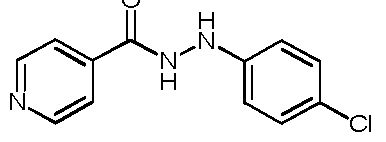 The product is obtained mainly as a sole conformer (>97%)
Following the general procedure Route B, N’-(4-chlorophenyl)isonicotinohydrazide was obtained from the coupling reaction of isonicotinic acid (1 g, 5.6 mmol) and 4-chlorophenylhydrazine hydrochloride (1 g, 5.6 mmol), which were dissolved in 25 mL of pyridine. The mixture was stirred at room temperature for 24 h, under nitrogen atmosphere. Water is added to the mixture and the organic layer was recovered and dried on magnesium sulfate. The solution was concentrated to a crude product which was purified via flash column chromatography (methanol/methylene chloride 00/100 to 10/90) affording compound 66 as a white solid (0.206 g, 15% yield),
m.p. 154-155 ° C
1H NMR (400 MHz, DMSO-d6): d 10.68 (d, J = 2.6 Hz, 1 H, NH), 8.77 (d, J = 6.1 Hz, 2H, 2CHAr), 8.21
(d, J = 2.7 Hz, 1 H, NH), 7.82 (d, J = 6.0 Hz, 2H, 2CHAr), 7.20 (d, J = 9.0 Hz, 2H, 2CHAr), 6.80 (d, J = 9.1 Hz, 2H, 2CHAr).
13C{1H}NMR (100 MHz, DMSO-cU): d 164.8 (C=0), 150.6 (C,v), 150.4 (CHAr), 148.0 (C,v), 139.8 (C,v), 128.6 (2CHAr), 122.8 (CHAr), 122.2 (CHAr), 121 .3 (CHAr), 1 13.9 (2CHAr).
IR v (cm-1): 3165, 2976, 1755, 1645, 1518, 1485, 1414, 1244.
Example 67. N'-(4-chlorophenyl)quinoline-2-carbohydrazide (67)
o
 The product is obtained mainly as a sole conformer (>97%)
Following the general procedure Route C, N'-(4-chlorophenyl)quinoline-2-carbohydrazide was obtained from the coupling reaction of quinaldoyl chloride (1 g, 5.2 mmol) and 4-chlorophenyl hydrazine hydrochloride (0.93 g, 5.2 mmol), which were dissolved in 25 mL of pyridine. The mixture was stirred at room temperature for 24 h, under nitrogen atmosphere. Water is added to the mixture and the organic layer was recovered and dried on magnesium sulfate. The solution was concentrated to a crude product which was purified via flash column chromatography (ethyl acetate/n-heptane 00/100 to 100/00) affording compound 67 as a white solid (0.205 g, 13% yield).
m.p. 190-191 °C
1H NMR (400 MHz, DMSO-cU): d 10.77 (d, J = 2.6 Hz, 1 H, NH) 8.59 (d, J = 8.2 Hz, 1 H, CHAr), 8.18 (d
J = 3.1 Hz, 1 H, NH), 8.17 (d, J = 8.0 Hz, 1 H, CHAr), 8.11 (d, J = 8.8 Hz, 2H, 2CHAr), 7.90 (t, J = 8.0
Hz, 1 H, CHAr), 7.75 (t, J = 8.0 Hz, 1 H, CHAr), 7.19 (d, J = 8.8 Hz, 2H, 2CHAr), 6.81 (d, J = 8.8 Hz, 2H, 2CHAr).
13C{1H}NMR (100 MHz, DMSO-cU): d 164.3 (C=0), 149.8 (C,v), 148.2 (C,v), 146.1 (C,v), 137.9 (CHAr), 130.6 (CHAr), 129,4 (CHAr), 128.9 (C,v), 128.5 (2CHAr), 128.3 (C,v), 128.1 (CHAr), 121.9 (CHAr), 118.9 (CHAr), 113.8 (2CHAr).
IR v (cm'1): 3339, 3208, 1701 , 1672, 1533, 1489.
Example 68. 2,2,2-Trichloroethyl 2-phenylhydrazinecarboxylate (68)
 Ratio conformer 1 /conformer 2: 90/10
Following the general procedure Route C, 2,2,2-trichloroethyl 2-phenylhydrazinecarboxylate was obtained from the coupling reaction of 2,2,2-trichloroethyl carbonochloridate (3.20 g, 15 mmol) and phenylhydrazine (1.78 g, 16.5 mmol), in presence of pyridine (2.65 mL, 33 mmol). Phenylhydrazine is solubilized in pyridine in a 50 mL flask and cooled at 5°C with an ice bath. 2,2,2-Trichloroethyl carbonochloridate is then added dropwise at 5°C to the phenylhydrazine solution. After addition, the temperature is allowed to warm to room temperature and the medium is stirred during 2 hours. Pyridinium chloride gradually appeared in the medium. After completion of the reaction, water (30 mL) is added, pyridinium chloride dissolved and 2,2,2-trichloroethyl 2-phenylhydrazinecarboxylate precipitated. The precipitate is filtered, washed by diethylether (3x10 mL) and dried. Compound 68 is obtained as an orange solid (2.05 g, 49% yield),
m.p. 108-109 °C
1H NMR (400 MHz, DMSO-d6): d 9.56 (s, 1 H, NH, conformer 1 ), 9.05 (s, 1 H, NH, conformer 2), 7.80 (s, 1 H, NH, conformer 1 ), 7.38 (s, 1 H, NH, conformer 2), 7.10 (t, J = 8.8 Hz, 2 H, CHAr, conformers 1 +2), 6.65 (m, 3H, CHAr, conformers 1 +2), 4.84 (s, 2H, CH2, conformer 1 ), 4.79 (s, 2H, CH2, conformer 2).
13C{1H}NMR (100 MHz, DMSO-d6): 155.8 (C=0), 149.3 (C,v), 129.2 (2CHAr), 1 19.0 (CHAr), 1 12.2 (2CHAr), 96.6 (C,v), 73.9 (CH2).
IR v (cm'1): 3308, 171 1 , 1603, 1495, 1231 , 1 186.
Example 69. Isobutyl 2-phenylhydrazinecarboxylate (69)
o
 Ratio conformer 1 /conformer 2: 90/10
Following the general procedure Route C, isobutyl 2-phenylhydrazinecarboxylate was obtained from the coupling reaction of isobutyl carbonochloridate (2.05 g, 15 mmol) and phenylhydrazine (1 .78 g, 16.5 mmol), in presence of pyridine (2.65 mL, 33 mmol). Phenylhydrazine is solubilized in pyridine in a 50 mL flask and cooled at 5 ° C with an ice bath. Isobutyl carbonochloridate is then added dropwise at 5 ° C to the phenylhydrazine solution. After addition, the temperature is allowed to warm to room temperature and the medium is stirred during 2 hours. Pyridinium chloride gradually appeared in the medium. After completion of the reaction, water (30 mL) is added, pyridinium chloride dissolved and isobutyl 2-phenylhydrazinecarboxylate precipitated. The precipitate is filtered, washed by diethylether (3x10 mL) and dried. Compound 69 is obtained as an off-white solid (2.1 g, 69% yield), m.p. 67-68 ° C
1H NMR (400 MHz, DMSO-d6): d 9.00 (s, 1 H, N H, conformer 1 ), 8.81 (s, 1 H, N H, conformer 2), 7.61 (s, 1 H, NH, conformers 1 +2), 7.13 (t, J = 7.8 Hz, 2H, CHAr, conformers 1 +2), 6.67 (m, 3H, CHAr, conformers 1 +2), 3.79 (bs, 2H, CH2, conformers 1 +2), 1 .94 (m, 1 H, C H, conformers 1 +2), 0.90 (m, 6H, 2CH3, conformers 1 +2).
13C{1H}NMR (100 MHz, DMSO-cU): 157.5 (C=0), 149.9 (C,v), 129.1 (2CHAr), 1 18.7 (CHAr), 1 12.1 (2CHAr), 70.5 (CH), 28.1 (CH2), 19.2 (2CH3).
IR v (cm'1): 3366, 3265, 2961 , 1703, 1603, 1535, 1493, 1462, 1288, 1231 , 1 184.
Example 70. 2-Methoxyethyl 2-phenylhydrazinecarboxylate (70)
 Ratio conformer 1 /conformer 2: 90/10
Following the general procedure Route C, 2-methoxyethyl 2-phenylhydrazinecarboxylate was obtained from the coupling reaction of 2-methoxyethyl carbonochloridate (2.08 g, 15 mmol) and phenylhydrazine (1 .78 g, 16.5 mmol), in presence of pyridine (2.65 mL, 33 mmol). Phenylhydrazine is solubilized in pyridine in a 50 mL flask and cooled at 5 ° C with an ice bath. 2-Methoxyethyl carbonochloridate is then added dropwise at 5° C to the phenylhydrazine solution. After addition, the temperature is allowed to warm to room temperature and the medium is stirred during 2 hours. Pyridinium chloride gradually appeared in the medium. After completion of the reaction, water (30 mL) is added, pyridinium chloride dissolved and 2-methoxyethyl 2-phenylhydrazinecarboxylate precipitated. The precipitate is filtered, washed by diethylether (3x10 mL) and dried. Compound 70 is obtained as an off-white solid (2.61 g, 83% yield),
m.p. 89-90 C
1H NMR (400 MHz, DMSO-d6): d 9.05 (s, 1 H, N H, conformer 1 ), 8.61 (s, 1 H, N H, conformer 2), 7.60 (s, 1 H, NH, conformers 1 +2), 7.33 (t, J = 7.8 Hz, 2 H, CHAr, conformer 2), 7.14 (t, J = 7.8 Hz, 2 H, CHAr, conformer 1 ), 6.63 (m, 3H, CHAr, conformers 1 +2), 4.17 (m, 2H, CH2, conformer 2), 4.10 (m, 2H, CH2, conformer 1 ), 3.48 (m, 2H, C H2, conformers 1 +2), 3.23 (s, 3H, CH , conformer 1 ), 3.21 (s, 3H, CH , conformer 2).
13C{1H}NMR (100 MHz, DMSO-cU): 157.3 (C=0), 149.8 (C,v), 129.1 (2CHAr), 1 18.7 (CHAr), 1 12.2 (2CHAr), 70.6 (CH2), 63.8 (CH2), 58.4 (CH3).
IR v (cm'1): 3341 , 3256, 2938, 1707, 1603, 1495, 1234, 1 186, 1 123.
Example 71 . (2S, 5R)-2-lsopropyl-5-methylcyclohexyl 2-phenylhydrazinecarboxylate (71 )

Following the general procedure Route C, (2S,5R)-2-isopropyl-5-methylcyclohexyl 2-phenylhydrazine carboxylate was obtained from the coupling reaction of (2S,5R)-2-isopropyl-5-methylcyclohexyl carbonochloridate (3.27 g, 15 mmol) and phenylhydrazine (1 .78 g, 16.5 mmol), in presence of pyridine (2.65 mL, 33 mmol). Phenylhydrazine is solubilized in pyridine in a 50 mL flask and cooled at 5 ° C with an ice bath. (2S,5R)-2-lsopropyl-5-methylcyclohexyl carbonochloridate is then added dropwise at 5° C to the phenylhydrazine solution. After addition, the temperature is allowed to warm to room temperature and the medium is stirred during 2 hours. Pyridinium chloride gradually appeared in the medium. After completion of the reaction, water (30 mL) is added, pyridinium chloride dissolved and (2S,5R)-2-isopropyl-5-methylcyclohexyl 2-phenylhydrazinecarboxylate precipitated. The precipitate is filtered, washed by diethylether (3x10 mL) and dried. Compound 71 is obtained as an off-white solid (3.48 g, 80% yield),
m.p. 122-123 ° C
1H NMR (400 MHz, DMSO-d6): d 8.90 (bs, 1 H, NH, conformer 1 ), 8.49 (s, 1 H, NH, conformer 2), 7.55 (s, 1 H, NH, conformers 1 +2), 7.09 (t, J = 7.8 Hz, 2 H, CHAr, conformers 1 +2), 6.61 (m, 3H, CHAr, conformers 1 +2), 4.41 (bt, 1 H, C H, conformers 1 +2), 1 .93-1 .80 (m, 2H, C HmenthVi, conformers 1 +2), 1 .60-1 .30 (m, 4H, C Hmenthyi, conformers 1 +2), 1 .00-0.60 (m, 12H, C Hmenthyi, conformers 1 +2).
13C{1H}NMR (100 MHz, DMSO-cU): 157.2 (C=0), 149.9 (C,v), 129.1 (2CHAr), 1 18.6 (CHAr), 1 12.2 (2CHAr), 74.1 (CH), 47.3 (CH), 41 .7 (CH2), 34.2 (CH2), 31 .3 (CH), 26.3 (CH), 23.5 (CH2), 22.4 (CH3), 21 .0 (CH3), 16.8 (CH3).
IR v (cm'1): 3331 , 2955, 2922, 2870, 2847, 1694, 1601 , 1487, 1273, 1223, 1 169.
Example 72. Methyl 2-(4-chlorophenyl)hydrazinecarboxylate (72)
 The product is obtained mainly as a sole conformer (>97%)
Following the general procedure Route C, methyl 2-(4-chlorophenyl)hydrazinecarboxylate was obtained from the coupling reaction of methyl carbonochloridate (1 .41 g, 15 mmol) and 4- chlorophenyl hydrazine hydrochloride (2.96 g, 16.5 mmol), in presence of pyridine (2.65 mL, 33 mmol). 4-Chlorophenylhydrazine hydrochloride is solubilized in pyridine in a 50 mL flask and cooled
at 5 ° C with an ice bath. Methyl carbonochloridate is then added dropwise at 5 °C to the 4- chlorophenylhydrazine solution. After addition, the temperature is allowed to warm to room temperature and the medium is stirred during 2 hours. Pyridinium chloride gradually appeared in the medium. After completion of the reaction, water (30 mL) is added, pyridinium chloride dissolved and methyl 2-(4-chlorophenyl)hydrazinecarboxylate precipitated. The precipitate is filtered, washed by diethylether (3x10 mL) and dried. Compound 72 is obtained as an off-white solid (2.46 g, 82% yield), m.p. 100-101 C
1H NMR (400 MHz, DMSO-d6): d 9.10 (s, 1 H, NH), 7.85 (s, 1 H, NH), 7.16 (d, J = 8.8 Hz, 2 H, CHAr), 6.66 (d, J = 8.2 Hz, 2 H, CHAr), 3.59 (s, 3H, CH3).
13C{1H}NMR (100 MHz, DMSO-cU): 157.7 (C=0), 148.8 (C,v), 129.0 (2CHAr), 122.0 (C,v), 1 13.6 (2CHAr), 52.2 (CH3).
IR v (cm'1): 3314, 3223, 1713, 1688, 1599, 1560, 1489, 1283, 1283, 1242, 1 171 .
Example 73. (2S,5R)-2-lsopropyl-5-methylcyclohexyl 2-(4-chlorophenyl)hydrazinecarboxylate (73)
 Ratio conformer 1 /conformer 2: 80/20
Following the general procedure Route C, (2S,5R)-2-isopropyl-5-methylcyclohexyl 2-(4- chlorophenyl)hydrazinecarboxylate was obtained from the coupling reaction of (2S,5R)-2-isopropyl-5- methylcyclohexyl carbonochloridate (3.27 g, 15 mmol) and 4-chlorophenylhydrazine hydrochoride (2.95 g, 16.5 mmol), in presence of pyridine (2.65 mL, 33 mmol). 4-Chlorophenylhydrazine hydrochloride is solubilized in pyridine in a 50 mL flask and cooled at 5 ° C with an ice bath. (2S,5R)- 2-lsopropyl-5-methylcyclohexyl carbonochloridate is then added dropwise at 5 °C to the phenylhydrazine solution. After addition, the temperature is allowed to warm to room temperature and the medium is stirred during 2 hours. Pyridinium chloride gradually appeared in the medium. After completion of the reaction, water (30 mL) is added, pyridinium chloride dissolved and (2S,5R)- 2-isopropyl-5-methylcyclohexyl-2-(4-chlorophenyl)hydrazinecarboxylate precipitated. The precipitate is filtered, washed by diethylether (3x10 mL) and dried. Compound 73 is obtained as an off-white solid (3.88 g, 80% yield),
m.p. 121 -122 ° C
1H NMR (400 MHz, DMSO-d6): d 9.01 (bs, 1 H, N H, conformer 1 ), 8.61 (s, 1 H, N H, conformer 2), 7.84 (s, 1 H, NH, conformers 1 +2), 7.16 (d, J = 8.8 Hz, 2H, CHAr, conformers 1 +2), 6.63 (d, J = 8.4 Hz, 2H, CHAr, conformers 1 +2), 4.45 (bt, 1 H, C H, conformers 1 +2), 1 .94-1 .86 (m, 2H, C HmenthVi, conformers 1 +2), 1 .62 (m, 2H, C Hwenthyi, conformers 1 +2), 1 .42-1.33 (m, 2H, C Hwenthyi, conformers 1 +2), 1.04-0.64 (m, 12H, C Hmenthyi, conformers 1 +2).
13C{1H}NMR (100 MHz, DMSO-cU): 157.1 (C=0), 148.9 (C,v), 128.9 (2CHAr), 121 .9 (C,v), 1 13.5 (2CHAr), 74.2 (CH), 47.3 (CH), 41 .6 (CH2), 34.2 (CH2), 31 .3 (CH), 26.3 (CH), 23.5 (CH2), 22.3 (CH3), 20.9 (CH3),
16.7 (CH3).
IR v (cm'1): 3324, 2951 , 2918, 2870, 2847, 1694, 1489, 1277, 1234, 1 171 .
Example 74. 2-ethylhexyl 2-phenylhydrazinecarboxylate (74)
 Ratio conformer 1 /conformer 2: 85/15
Following the general procedure Route C, 2-ethylhexyl 2-phenylhydrazinecarboxylate was obtained from the coupling reaction of 2-ethylhexyl carbonochloridate (2.89 g, 15 mmol) and phenylhydrazine (1 .78 g, 16.5 mmol), in presence of pyridine (2.65 mL, 33 mmol). Phenylhydrazine is solubilized in pyridine in a 50 mL flask and cooled at 5 ° C with an ice bath. 2-Ethylhexyl carbonochloridate is then added dropwise at 5 °C to the phenylhydrazine solution. After addition, the temperature is allowed to warm to room temperature and the medium is stirred during 2 hours. Pyridinium chloride gradually appeared in the medium. After completion of the reaction, water (30 mL) is added, pyridinium chloride dissolved and 2-ethylhexyl 2-phenylhydrazinecarboxylate is extracted by diethylether (3x10 mL). The ethereal phase is concentrated and purified by flash chromatography. Compound 74 is obtained as an orange oil (2.89 g, 73% yield).
1H NMR (400 MHz, DMSO-d6): d 8.95 (bs, 1 H, N H, conformer 1 ), 8.57 (s, 1 H, N H, conformer 2), 7.58 (s, 1 H, NH, conformers 1 +2), 7.09 (t, J = 7.8 Hz, 2 H, CHAr, conformers 1 +2), 6.62 (m, 3H, CHAr, conformers 1 +2), 3.95 (m, 2H, C/-/2, conformers 1 +2), 1 .50-0.67 (m, 15H, CHethyihexyi, conformers 1 +2). 13C{1H}NMR (100 MHz, DMSO-cU): 157.6 (C=0), 149.9 (Civ), 129.1 (2CHAr), 1 18.7 (CHAr), 1 12.1 (2CHAr), 66.7 (CH2), 39.1 (CH), 30.2 (CH2), 28.8 (CH2), 23.6 (CH2), 22.9 (CH2), 14.3 (CH3), 1 1 .3 (CH3). IR v (cm'1): 3314, 2961 , 2928, 2860, 1707, 1603, 1497, 1460, 1281 , 1227, 1 177.
3) Antimicrobial activity and cytotoxicity Activity assay
A sampling of the products of the present invention were tested for their activity against Adnetobacter baumannii (A. baumannii) as well as against the following bacteria: Staphylococcus aureus (S. aureus), Klebsiella pneumoniae (K. pneumoniae), Streptococcus pneumoniae (S. pneumoniae), Escherichia coli (E. coli), and Pseudomonas aeruginosia (P. aeruginosa). The title compound 1 was also tested against the following fungi/yeasts: Candida albicans (C. albicans), Cryptococcus neoformans (C. neoformans), Geotrichum candidum (G. candidum), Alternaria alternata (A. alternata), Aspergillus oryzae (A. oryzae), Saccharomyces cerevisiae (S. cerevisiae), Penicillium variotii (P. variotii) and Cladosporium cladosporiodes (C. cladosporiodes).
Determination of MIC and MBC
The minimum inhibitory concentration (MIC) for Adnetobacter baumannii LMG 1025, ATCC 17978), Escherichia coli (BW25113: CGSC#: 7636). Staphylococcus aureus (SH1000), Streptococcus pneumoniae (LMG 14545/ ATCC33400), and Klebsiella pneumoniae (LMG 2095/ ATCC 13883) was determined using the colorimetric resazurine microtitre assay (REMA). Briefly, ampules of frozen bacterial stocks were thawed, and bacteria diluted into Cation Adjusted Mueller Hinton Broth (CAMHB, Difco), to a final working concentration (OD600, optical density at 600 nm, of 0.0003 for
A. baumannii, OD600 of 0.0002 for E. coli, OD600 of 0.0006 for S. aureus, and OD600 of 0.001 for S. pneumoniae and K. pneumoniae). Working bacterial cultures were then added to the wells of a 96- well plate using a repeater pipette (100 pL in all wells, except first column with 200 pL). To the wells of the first column the plate (containing the 200 pL of culture), 2 pL of test compound was added at a concentration of 10 mg/mL in DMSO, giving a final concentration of 100 pg/mL (lower concentrations were used for more potent compounds). Eleven serial 1 -in-2 dilutions were then made down the plate by transferring 100 pL between wells. The last column of the plate remained without compound as control. Plates were then incubated at 37 °C (with 5% CO2 for S. pneumonia) for 5 hrs. To evaluate bacterial viability, 10 pL of 0.025% resazurin was added to the wells and left to incubate for up to 2 hours. Bacterial resazurin turnover to fluorescent resorufin was measured by fluorescence (Ex, 530 nm, Em: 590 nm). The MIC was defined as the concentration of compound that prevented the turnover of resazurin (less than 10 % resazurin turnover compared to the non-treated control).
For . tuberculosis MIC determination the experiment were performed as above with the following changes. M. tuberculosis H37Rv was diluted to a working solution at OD600 of 0.0004, in Middlebrook 7H9 media supplemented with 10% OADC, 0.2% glycerol and 0.05% tween 80. M. tuberculosis H37Rv was incubated in the presence of compounds for 7 days, before exposure to resazurin for 16 hrs.
For Pseudomonas aeruginosa PA01 (LMG 12228/ ATCC 15692) MIC was determination using OD600 as a marker of bacterial growth, rather than resazurin. Pseudomonas aeruginosa PA01 was diluted to a working solution at OD600 of 0.0001 , in CAMHB. Pseudomonas aeruginosa PA01 was incubated in the presence of compounds for 24 hrs, before spectrophotometric evaluating of cell growth by measuring the absorbance at 600 nm.
Cytotoxicity assay
HepG2 cells (human hepatocellular cell line, ATCC HB-8065) were obtained from the American Type Culture Collection (ATCC, Rockville, MD, USA) and maintained in Dulbecco’s modified Eagle’s Medium (DMEM, Thermo Fisher Scientific, Waltham, MA, USA) supplemented with 10% heat-inactivated fetal bovine serum (FBS, Thermo Fisher Scientific) in a humidified atmosphere of 5% CO2, 95% air at 37 ° C. HepG2 cells were seeded at a density of 2500 cells/well on a 96-well plate in 100 pi of DMEM without red phenol supplemented with 10% FBS. Cells were allowed to attach overnight. Thereafter, 1 pL of two-fold serial dilutions of 100x compound in DMSO were added to the cell culture (final concentration 100 pg/ml to 0.4 pg/ml). As a positive control, 1 pM staurosporine was used (final concentration, Biaffin, Kassel, Germany).
Plates were incubated for 3 days (37° C 5% CO2) before the addition of 10 pi of 0.04% resazurin (Thermo Fisher Scientific). After 4h of culture, the fluorescence of the resazurin metabolite resofurin was determined (excitation, 530 nm; emission, 590 nm; gain, 850) using FLUOstar OPTIMA microplate reader (BMG Labtech, Ortenberg, Germany). Cytotoxicity was evaluated as a concentration of compound that prevented 50% of resazurin turnover (Cytotoxic IC50) compared to staurosporine.
Table of results 1


As shown in Table of results 1 , compounds according to the present invention are highly effective antibacterial against A. baumannii. Particularly the MIC values obtained in the assays were lower than 5 pg/mL for all the tested compounds. The majority of compounds indeed exhibited MIC values lower than 1 pg/ml.
5) Specificity of the antibacterial activity
As shown in Tables 2 and 3, the compounds showed a very good selectivity for A. baumannii, since they are virtually inactive against the other bacteria, fungi or yeast tested.
Table 2.


Table 3.

6) In vitro stability in mouse plasma
Compounds 1 , 2, 7 from the present invention were tested for their stability in mouse plasma (pool of male mice (CD-1 ) microsomes, 20 mg/mL BD Gentest™, reference 452701 , batch number 5345001 ), by LC-MS/MS detection. The concentration of the tested compounds in the assays was 1 mM and the % remaining of each compound was calculated at the following time points: 0, 5, 10, 20, 31 , 40 minutes.
Protocol:
• Reference: Propranolol (Positive control)
• Concentration in the assays : 1 pM
• Vehicule : 1 % methanol
The tested compounds and the reference are incubated in duplicate (reaction volume of 0.5 mL) with the microsomes at 37° C in a phosphate buffer 50 mM, pH = 7.4 in presence of MgCh (5mM), NADP (1 mM), glucose-6-phosphate dehydrogenase (0.4U/mL) and glucose-6-phosphate (5mM).
The estimation of the intrinsic clearance Clint is done by sampling of an aliquot of 50pL at different time points (0, 5, 10, 20, 31 , 40 minutes) and following by addition of 4 volumes of methanol containing the internal standard to stop the reaction. The sample is then centrifugated at 100000g, 4° C and the supernatant fractions are maintained at 4° C and analyzed immediately. Controls (t = 0 and 40 minutes) are done in triplicate by incubation of denaturated microsomes in methanol in presence of the internal standard.
The LC/MS/MS method used is defined by the following parameters: equipment: Waters® Acquity 1-Class / Xevo TQD; column Waters® Acquity BEH C18, 50*2.1 mm, 1 ,7pm (40° C); eluent A: ammonium acetate 10mM or H2O 0, 1 %HCOOH; eluent B: CH3CN 0, 1 % HCOOH; volum of injection 1 pL; flow rate: 600pL/min. The applied gradient was: 0-0.2 min 98% A, 2% B; 2.0-2.5 min 2% A, 98% B, 2.6- 4.0 min 98% A, 2% B.
The compounds tested were found highly stable in this assay, with percentages remaining in the mouse plasma after 40 minutes superior at 90%. These data are relevant for the use of the
compounds in the present invention as drugs, since a long stability in plasma is desirable to obtain good pharmacokinetic exposure of the drug and to maintain the activity in-vivo and is therefore significant in order to achieve a good therapeutic antibacterial efficacy.
Claims
1. A compound of following general formula (I):

or a pharmaceutically acceptable salt and/or solvate thereof, wherein:
• A is Ai, A2, A3, or A4, or is a group selected from (CrCio)alkyl, (C3-Cio)cycloalkyl, or heteroaryl, said (CrCio)alkyl group being optionally substituted with one or several groups selected from halo, oxo, -CF3, -CN, -NO2, -NO+, -OR7, -NR7R8, -NR7NR8R9, -NR7COR8, -NR7C02R8, -NR7S(0)2R8, CO2R7, - CORs, -CONR7R8, -CO(NR7R8)2, -CONR7NR8R9, -SR?, -S(0)2R7, -OCOR7, -OCONR7R8, and -0S(0)2R7, said (C3-Cio)cycloalkyl group being optionally substituted with one or several groups selected from halo, oxo, (CrC6)alkyl, -CF3, -CN, -N02, -NO+, -OR7, -NR7R8, -NR7NR8R9, -NR7COR8, -NR7C02R8, -NR7S(0)2R8, CO2R7, -CORs, -CONR7R8, -CO(NR7RS)2, -CONR7NR8R9, -SR?, -S(0)2R7, -OCOR7, -OCONR7R8, and - 0S(0)2R7, and said heteroaryl group being optionally substituted with one or several groups selected from halo, (Ci-C6)alkyl, -CF3, -CN, -N02, -NO+, -OR7, -NR7R8, -NR7COR8, -NR7CO2R8, -NR7S(0)2R8, - NR7NR8R9, -CONR7NR8R9, -CO2R7, -CORs, -CONR7R8, -CO(NR7R8)2, -SR7, -S(0)2R7, -OCOR7, -OCONR7R8, and -0S(0)2R7; and :

• B is selected from Bi or heteroaryl, said heteroaryl group being optionally substituted with one or several groups selected from halo, (Ci-C6)alkyl, -CF3, -CN, -NO2, -NO+, -OR7, -NR7R8, -NR7COR8, - NR7CO2R8, -NR7S(0)2R8, -NR7NR8R9, -CONR7NR8R9, -CO2R7, -CORs, -CONR7R8, -CO(NR7R8)2, -SR7, - S(0)2R7, -OCOR7, -OCONR7R8, and -0S(0)2R7; and

• X is -CO-;
• Y is a single bond, -0-, or -CH2- ;
• Ri is selected from hydrogen atom, (Ci-C6)alkyl, or aryl;
• R2 to R6 are, independently of one another, hydrogen atom, halo, -CF3, -CN, NO+, -N02, -OR7, - NR7R8, -NR7C0R8, -NR7C02R8, -NR7S(0)2R8, -NR7NR8R9, -C0NR7NR8R9, -C02R7, -COR8, -C0NR7R8, - CO(NR7R8)2, -SR?, -S(0)2R7, -0C0R7, -0C0NR7R8, -0S(0)2R7, or (Ct -C6)alkyl;
• each R7, Re, and R9 are, independently of one another, hydrogen atom, halo, (Ci -C8)alkyl or halo(Ci -C6)alkyl; and
• R10 is aryl or (Ci -C6)alkylaryl, said aryl or (Ci -C6)alkylaryl being optionally substituted with one or several groups selected from halo, (Ci -C6)alkyl, -CF3, -CN, -N02, -NO+, -OR7, -NR7R8, -NR7COR8, -
NR7CO2R8, -NR7S(0)2R8, -NR7NR8R9, -CONR7NR8R9, -CO2R7, -COR8, -CONR7R8, -CO(NR7R8)2, -SR7, -
S(0)2R7, -OCOR7, -0C0NR7R8, and -0S(0)2R7.
2. The compound according to claim 1 , wherein B is Bi , pyridinyl, pyrrolyl, or isoquinolinyl, said pyridinyl, pyrrolyl, or isoquinolinyl being optionally substituted with one or several groups selected from halo, (Ci -C6)alkyl, -CF3, -CN, -N02, -NCT, -OR7, -NR7R8, -NR7COR8, -NR7C02R8, -NR7S(0)2R8, - NR7NR8R9, -CONR7NR8R9, -CO2R7, -COR8, -CONR7R8, -CO(NR7R8)2, -SR7, -S(0)2R7, -0C0R7, -OCONR7R8, and -0S(0)2R7; R7 to R9 being as defined in claim 1 .
3. The compound according to claim 1 or 2, wherein B is Bi, Bi being as defined in claim 1 .
4. The compound according to any one of claims 1 to 3, wherein Y is a single bond or -0-.
5. The compound according to any one of claims 1 to 4, wherein A is Ai , A2, A3, A4, or is a group selected from (CrCio)alkyl, or 5-6 or 10-membered heteroaryl; said 5-6 or 10-membered heteroaryl group being optionally substituted with one or several groups selected from halo, (Ci -C6)alkyl, -CF3, - CN, -N02, -NCT, -OR7, -NR7R8, -NR7COR8, -NR7C02R8, -NR7S(0)2R8, -NR7NR8R9, -CONR7NR8R9, -C02R7, - CORs, -CONR7R8, -CO(NR7R8)2, -SR?, -S(0)2R7, -0C0R7, -0C0NR7R8, and -0S(0)2R7; wherein Ai to A4, A9 and R7 to R10 are as defined in claim 1 .
6. The compound according to any one of claims 1 to 4, wherein A is Ai or A2; wherein Ai and A2 are as defined in claim 1 .
7. The compound according to anyone of claims 1 to 6, wherein Ri is hydrogen atom, (Ci -C3>alkyl or phenyl, advantageously hydrogen atom.
8. The compound according to any one of claims 1 to 7, wherein B is Bi and R2 to R¾ are hydrogen atoms, or B is Bi and one or two R2 to R¾ are, independently of one another, halo, -CF3, -CN, -OR7, -
NR7R8, -NR7COR8, -NR7CO2R8, -NR7S(0)2R8, CO2R7, -COR8, -CONR7R8, -CO(NR7R8)2, -SR7, -S(0)2R7, -
OCOR7, -0C0NR7R8, -0S(0)2R7, NO+, -N02, or (Ci -Cfijalkyl, preferably halo, -CF3, -CN, -OR7, -NR7R8, NO+, -N02, or (Ci -C8)alkyl; the others R2 to R¾ being hydrogen atoms; and wherein R7 to R9 are as defined in claim 1 .
9. The compound according to claim 1 , wherein it is selected from the group:


or a pharmaceutically acceptable salt and/or solvate thereof.
10. The compound according to any one of claims 1 to 9, for use as a drug.
1 1 . The compound according to any one of claims 1 to 9, for use as antibacterial agent, advantageously for preventing and/or treating disorders associated to Adnetobacter baumannii.
12. A pharmaceutical composition comprising at least one compound according to any one of claims 1 to 9 and at least one pharmaceutically acceptable excipient.
13. A pharmaceutical composition comprising at least one compound according to any one of claims 1 to 9 as an antibacterial agent, and at least one pharmaceutically acceptable excipient, for use for preventing and/or treating disorders associated to Adnetobacter baumannii.
14. A pharmaceutical composition comprising:
(i) at least one compound of formula (I) as defined above, and
(ii) at least one other active ingredient, such as one other active ingredient that can be used for preventing and/or treating disorders associated to Adnetobacter baumannii.
15. A process for preparing a compound according to any one of claims 1 to 9, comprising a step of reacting a compound of formula (II), (I ) or (II”):
A-COOH (II) A-COCl (IP) A-(S02)-CI (II”) with a compound of formula (III):
B-NH-NHRi (III),
wherein A, B and Ri are as defined in claim 1.
Applications Claiming Priority (2)
| Application Number | Priority Date | Filing Date | Title |
|---|---|---|---|
| EP19305200.8 | 2019-02-19 | ||
| EP19305200 | 2019-02-19 |
Publications (1)
| Publication Number | Publication Date |
|---|---|
| WO2020169682A1 true WO2020169682A1 (en) | 2020-08-27 |
Family
ID=65657416
Family Applications (1)
| Application Number | Title | Priority Date | Filing Date |
|---|---|---|---|
| PCT/EP2020/054392 Ceased WO2020169682A1 (en) | 2019-02-19 | 2020-02-19 | Hydrazide derivatives and their specific use as antibacterial agents by controlling acinetobacter baumannii bacterium |
Country Status (1)
| Country | Link |
|---|---|
| WO (1) | WO2020169682A1 (en) |
Cited By (7)
| Publication number | Priority date | Publication date | Assignee | Title |
|---|---|---|---|---|
| US11351149B2 (en) | 2020-09-03 | 2022-06-07 | Pfizer Inc. | Nitrile-containing antiviral compounds |
| CN114621121A (en) * | 2022-03-17 | 2022-06-14 | 南京林业大学 | Preparation method of camphor sulfonyl hydrazine compound, product and application thereof |
| US20220235057A1 (en) * | 2019-05-14 | 2022-07-28 | Nanjing Tech University | Cyclic formyl and cyclic ketone compounds, preparation method therefor, and pharmaceutical use |
| CN115108978A (en) * | 2022-07-01 | 2022-09-27 | 西北农林科技大学 | Pyridine formyl hydrazine plant antifungal drugs |
| CN116903496A (en) * | 2023-05-31 | 2023-10-20 | 南京林业大学 | Preparation method and application of phenylhydrazinoformate menthyl ester compounds |
| US20240425464A1 (en) * | 2023-06-14 | 2024-12-26 | University Of Kentucky Research Foundation | Substituted Monohydrazides as Potent Antifungal Agents |
| US12577240B2 (en) | 2020-07-11 | 2026-03-17 | Pfizer Inc. | Antiviral heteroaryl ketone derivatives |
Citations (3)
| Publication number | Priority date | Publication date | Assignee | Title |
|---|---|---|---|---|
| WO2016016291A1 (en) * | 2014-07-30 | 2016-02-04 | Ferrer Internacional, S.A. | Arylhydrazides containing a 2-pyridone moiety as selective antibacterial agents |
| WO2017222466A1 (en) * | 2016-06-23 | 2017-12-28 | Bioimics Ab | Anti-infective heterocyclic compounds and uses thereof |
| WO2018020004A1 (en) * | 2016-07-29 | 2018-02-01 | Abac Therapeutics, S.L | 2-pyrrolidine phenylhydrazides antibacterial agents |
-
2020
- 2020-02-19 WO PCT/EP2020/054392 patent/WO2020169682A1/en not_active Ceased
Patent Citations (3)
| Publication number | Priority date | Publication date | Assignee | Title |
|---|---|---|---|---|
| WO2016016291A1 (en) * | 2014-07-30 | 2016-02-04 | Ferrer Internacional, S.A. | Arylhydrazides containing a 2-pyridone moiety as selective antibacterial agents |
| WO2017222466A1 (en) * | 2016-06-23 | 2017-12-28 | Bioimics Ab | Anti-infective heterocyclic compounds and uses thereof |
| WO2018020004A1 (en) * | 2016-07-29 | 2018-02-01 | Abac Therapeutics, S.L | 2-pyrrolidine phenylhydrazides antibacterial agents |
Non-Patent Citations (1)
| Title |
|---|
| BOCK, HANS ET AL.: "Azo-Verbindungen, VIII. Substituenten-Effekte bei Phenylazo-carbonsäure-Derivaten und ihre Interpretation durchHückel-MO-Rechnungen", CHEMISCHE BERICHTE, vol. 99, 1 July 2014 (2014-07-01), pages 3337 - 3349, XP002791226 * |
Cited By (12)
| Publication number | Priority date | Publication date | Assignee | Title |
|---|---|---|---|---|
| US20220235057A1 (en) * | 2019-05-14 | 2022-07-28 | Nanjing Tech University | Cyclic formyl and cyclic ketone compounds, preparation method therefor, and pharmaceutical use |
| US12577240B2 (en) | 2020-07-11 | 2026-03-17 | Pfizer Inc. | Antiviral heteroaryl ketone derivatives |
| US11351149B2 (en) | 2020-09-03 | 2022-06-07 | Pfizer Inc. | Nitrile-containing antiviral compounds |
| US11452711B2 (en) | 2020-09-03 | 2022-09-27 | Pfizer Inc. | Nitrile-containing antiviral compounds |
| US11541034B2 (en) | 2020-09-03 | 2023-01-03 | Pfizer Inc. | Nitrile-containing antiviral compounds |
| CN114621121A (en) * | 2022-03-17 | 2022-06-14 | 南京林业大学 | Preparation method of camphor sulfonyl hydrazine compound, product and application thereof |
| CN114621121B (en) * | 2022-03-17 | 2024-03-29 | 南京林业大学 | Preparation method of camphorsulfonyl hydrazides compound, camphorsulfonyl hydrazides compound product and application of camphorsulfonyl hydrazides compound product |
| CN115108978A (en) * | 2022-07-01 | 2022-09-27 | 西北农林科技大学 | Pyridine formyl hydrazine plant antifungal drugs |
| CN115108978B (en) * | 2022-07-01 | 2024-05-24 | 西北农林科技大学 | A class of picolinyl hydrazide plant antifungal drugs |
| CN116903496A (en) * | 2023-05-31 | 2023-10-20 | 南京林业大学 | Preparation method and application of phenylhydrazinoformate menthyl ester compounds |
| CN116903496B (en) * | 2023-05-31 | 2025-05-23 | 南京林业大学 | Preparation method and application of a class of phenylhydrazine carboxylic acid menthyl ester compounds |
| US20240425464A1 (en) * | 2023-06-14 | 2024-12-26 | University Of Kentucky Research Foundation | Substituted Monohydrazides as Potent Antifungal Agents |
Similar Documents
| Publication | Publication Date | Title |
|---|---|---|
| JP4805916B2 (en) | Compounds, compositions and methods | |
| Padmavathi et al. | Synthesis and antimicrobial activity of novel sulfone-linked bis heterocycles | |
| Holla et al. | Studies on some N-bridged heterocycles derived from bis-[4-amino-5-mercapto-1, 2, 4-triazol-3-yl] alkanes | |
| Xu et al. | Synthesis and bioevaluation of pyrazole-benzimidazolone hybrids as novel human 4-Hydroxyphenylpyruvate dioxygenase inhibitors | |
| RS56244B1 (en) | NEW MACROCYCLES AS FACTOR XIA INHIBITORS | |
| Reddyrajula et al. | Structural modification of zolpidem led to potent antimicrobial activity in imidazo [1, 2-a] pyridine/pyrimidine-1, 2, 3-triazoles | |
| WO2005077948A1 (en) | Fungicidal heterocyclic compounds | |
| JP2016508487A (en) | Metalloenzyme inhibitor compounds | |
| KR20120047211A (en) | Compounds which selectively modulate the cb2 receptor | |
| Thore et al. | Synthesis and pharmacological evaluation of 5-methyl-2-phenylthiazole-4-substituted heteroazoles as a potential anti-inflammatory and analgesic agents | |
| AU2022330020B2 (en) | 17-beta-hydroxysteroid dehydrogenase type 13 inhibitors and methods of use thereof | |
| CN112601745B (en) | Azaaryl amide derivative and preparation method and application thereof | |
| Rostovskii et al. | Azirine-containing dipeptides and depsipeptides: synthesis, transformations and antibacterial activity | |
| TW202304865A (en) | Inhibitors of nlrp3 inflammasome | |
| Shi et al. | Zirconium triflate-catalyzed reactions of indole, 1-methylindole, and pyrrole with α, β-unsaturated ketone | |
| EP2976341A1 (en) | Acyclic cyanoethylpyrazolo pyridones as janus kinase inhibitors | |
| Fu et al. | Design, synthesis and biological evaluation of monobactams as antibacterial agents against gram-negative bacteria | |
| EP1951719A2 (en) | Certain chemical entities, compositions, and methods | |
| Yang et al. | Design, synthesis and biological evaluation of novel hydroxamic acid based histone deacetylase 6 selective inhibitors bearing phenylpyrazol scaffold as surface recognition motif | |
| TW200914457A (en) | Pyrimidodiazepinone derivative | |
| Taggi et al. | Tubulin modulating antifungal and antiproliferative pyrazinone derivatives | |
| WO2005085245A1 (en) | Pyrrolopyridine-2-carboxylic acid hydrazides | |
| Juddhawala et al. | Synthesis and antibacterial evaluation of (5Z)-5-[(2-piperidinequinoline-3-yl) methyl]-2-chloroquinoline derivatives: Docking study on substituted N-alkylation and binding mechanisms with E. Coli PDF enzyme | |
| Padmavathi et al. | Synthesis and bioassay of a new class of heterocycles pyrrolyl oxadiazoles/thiadiazoles/triazoles | |
| WO2020169683A1 (en) | Hydrazonopyrrolidine derivatives for use in preventing and/or treating disorders associated to acinetobacter baumannii |
Legal Events
| Date | Code | Title | Description |
|---|---|---|---|
| 121 | Ep: the epo has been informed by wipo that ep was designated in this application |
Ref document number: 20707035 Country of ref document: EP Kind code of ref document: A1 |
|
| NENP | Non-entry into the national phase |
Ref country code: DE |
|
| 122 | Ep: pct application non-entry in european phase |
Ref document number: 20707035 Country of ref document: EP Kind code of ref document: A1 |