WO2020168282A1 - Detection of human leukocyte antigen-a*32:01 in connection with determining drug reaction with eosinophilia and systemic symptoms (dress) and methods of treating bacterial infection in a subject with vancomycin-induced dress - Google Patents
Detection of human leukocyte antigen-a*32:01 in connection with determining drug reaction with eosinophilia and systemic symptoms (dress) and methods of treating bacterial infection in a subject with vancomycin-induced dress Download PDFInfo
- Publication number
- WO2020168282A1 WO2020168282A1 PCT/US2020/018420 US2020018420W WO2020168282A1 WO 2020168282 A1 WO2020168282 A1 WO 2020168282A1 US 2020018420 W US2020018420 W US 2020018420W WO 2020168282 A1 WO2020168282 A1 WO 2020168282A1
- Authority
- WO
- WIPO (PCT)
- Prior art keywords
- hla
- vancomycin
- dress
- subject
- sample
- Prior art date
- Legal status (The legal status is an assumption and is not a legal conclusion. Google has not performed a legal analysis and makes no representation as to the accuracy of the status listed.)
- Ceased
Links
Classifications
-
- C—CHEMISTRY; METALLURGY
- C07—ORGANIC CHEMISTRY
- C07K—PEPTIDES
- C07K14/00—Peptides having more than 20 amino acids; Gastrins; Somatostatins; Melanotropins; Derivatives thereof
- C07K14/435—Peptides having more than 20 amino acids; Gastrins; Somatostatins; Melanotropins; Derivatives thereof from animals; from humans
- C07K14/705—Receptors; Cell surface antigens; Cell surface determinants
- C07K14/70503—Immunoglobulin superfamily
- C07K14/70539—MHC-molecules, e.g. HLA-molecules
-
- G—PHYSICS
- G01—MEASURING; TESTING
- G01N—INVESTIGATING OR ANALYSING MATERIALS BY DETERMINING THEIR CHEMICAL OR PHYSICAL PROPERTIES
- G01N33/00—Investigating or analysing materials by specific methods not covered by groups G01N1/00 - G01N31/00
- G01N33/48—Biological material, e.g. blood, urine; Haemocytometers
- G01N33/50—Chemical analysis of biological material, e.g. blood, urine; Testing involving biospecific ligand binding methods; Immunological testing
- G01N33/53—Immunoassay; Biospecific binding assay; Materials therefor
- G01N33/569—Immunoassay; Biospecific binding assay; Materials therefor for microorganisms, e.g. protozoa, bacteria, viruses
- G01N33/56966—Animal cells
- G01N33/56977—HLA or MHC typing
-
- G—PHYSICS
- G01—MEASURING; TESTING
- G01N—INVESTIGATING OR ANALYSING MATERIALS BY DETERMINING THEIR CHEMICAL OR PHYSICAL PROPERTIES
- G01N2333/00—Assays involving biological materials from specific organisms or of a specific nature
- G01N2333/435—Assays involving biological materials from specific organisms or of a specific nature from animals; from humans
- G01N2333/705—Assays involving receptors, cell surface antigens or cell surface determinants
- G01N2333/70503—Immunoglobulin superfamily, e.g. VCAMs, PECAM, LFA-3
- G01N2333/70539—MHC-molecules, e.g. HLA-molecules
-
- G—PHYSICS
- G01—MEASURING; TESTING
- G01N—INVESTIGATING OR ANALYSING MATERIALS BY DETERMINING THEIR CHEMICAL OR PHYSICAL PROPERTIES
- G01N2800/00—Detection or diagnosis of diseases
- G01N2800/24—Immunology or allergic disorders
Definitions
- Vancomycin is a widely used antibiotic of global importance for the treatment of serious, deep-seated, antibiotic-resistant Gram-positive infections such as methicillin-resistant Staphylococcus aureus which require prolonged treatment courses. Vancomycin is associated with infusional pruritus and rash (“red man syndrome”) which is managed by slow infusion and anti-histamines. However, vancomycin is also a very common antibiotic-related cause of a life- threatening delayed T-cell mediated reaction known as drug reaction with eosinophilia and systemic symptoms (DRESS) 1 .
- DRESS systemic symptoms
- DRESS otherwise known as drug-induced hypersensitivity syndrome, typically develops 2-8 weeks after drug initiation and presents with fever, a widespread rash, facial edema, white cell abnormalities, and involvement of internal organs such as the liver, kidneys, heart and lungs 2 .
- the mortality of DRESS is as high as 10% and long-term morbidity such as autoimmune disease has been described up to 4 years following acute disease 3,4 .
- DRESS develops in the setting of combination antibiotics, all treatment is stopped and future exposure to all concurrently-dosed antibiotics is contraindicated due to the associated risks of morbidity and mortality if DRESS reoccurs.
- Vancomycin is a glycopeptide antibiotic. All glycopeptide antibiotics contain a heptapeptide core structure and they inhibit bacterial cell wall synthesis by preventing transglycosylation and transpeptidation through binding to the C-terminal D-alanyl-D-alanine (D-Ala-D-Ala) and inhibiting the terminal phase of peptidoglycan synthesis. 50 Because of the similarities in chemical structure of glycopeptide antibiotics, cross-reactivity should be considered when treating patients who have had a previous hypersensitivity reaction to vancomycin or other drugs in the same class.
- the presently-disclosed subject matter includes a method of detecting a human leukocyte antigen (HLA)-A*32:01 allele in a subject, which involves obtaining a biological sample from the subject, and detecting whether HLA-A*32:01 is present in the sample to determine whether the subject is at risk for developing or has vancomycin-induced drug reaction with eosinophilia and systemic symptoms (DRESS) when HLA-A*32:01 is present in the sample.
- HLA human leukocyte antigen
- the presently-disclosed subject matter also includes a method of identifying risk of developing vancomycin-induced DRESS in a subject, which involves obtaining a biological sample from the subject, and detecting whether HLA-A*32:01 is present.
- the subject has a bacterial infection.
- the bacteria is an antibiotic-resistant gram-positive bacteria.
- the bacteria is methicillin-resistant Staphylococcus aureus.
- the biological sample is from a subject suspected of having DRESS.
- the subject is receiving combination antibiotic treatment that includes vancomycin.
- the subject is diagnosed as having vancomycin-induced DRESS when the presence of HLA-A*32:01 in the sample is detected.
- the method also involves administering to the diagnosed subject an antibiotic treatment that excludes vancomycin.
- the biological sample is from a subject in need of treatment with an antibiotic.
- the method also includes identifying the subject as being at risk for developing vancomycin DRESS when the presence of HLA-A*32:01 in the sample is detected.
- the method involves administering an antibiotic that is not vancomycin to the identified subject.
- the method involves administering an antibiotic that is not a glycopeptide antibiotic to the identified subject. In some embodiments, the method involves administering an antibiotic that is not vancomycin, teicoplanin, or telavancin to the identified subject. In some embodiments, the method involves administering dalbavancin to the identified subject.
- sequenced-based typing is conducted to determine whether HLA-A*32:01 is present in the sample.
- SNP2HLA is used to determine whether HLA-A*32:01 is present in the sample.
- Some embodiments of the method also involve using an IFN-i Enzyme-Linked ImmuneSpot assay.
- a polymerase chain reaction assay is used to determine whether HLA-A*32:01 is present in the sample.
- some embodiments of the method involve using allele-specific polymerase chain reaction (AS-PCR).
- qPCR quantitative polymerase chain reaction
- a primer mix containing a primer specific for HLA-A*32 allele containing a primer specific for HLA-A*32 allele.
- the primer specific for HLA-A*32 is HLA 32-88F (SEQ ID NO: 1).
- the method also involves using a second primer specific for HLA-A*32 that is HLA032R2 (SEQ ID NO: 2).
- the method also involves using a primer targeting a housekeeping gene.
- the housekeeping gene is galactosylceramidase (GALC).
- the primer targeting GALC is GALc-F (SEQ ID NO: 3).
- the method also involves using a second primer targeting GALC that is GALc-R (SEQ ID NO:
- the presently-disclosed subject matter also includes a kit comprising a primer specific for HLA-A*32.
- the kit includes HLA-A*32 is HLA 32-88F (SEQ ID NO: 1) and HLA-A*32 that is HLA032R2 (SEQ ID NO: 2).
- the kit also includes GALc-F (SEQ ID NO: 3) and GALc-R (SEQ ID NO: 4).
- FIG. 1A-1B HLA-A*32:01 is strongly associated with vancomycin DRESS.
- FIG. 1B IFN-g release ELISpot results after 18-hour stimulation with vancomycin at concentrations of 250 mg/mL (grey) or 500 mg/mL (black) using peripheral blood mononuclear cells from vancomycin DRESS patients.
- PBMCs peripheral blood mononuclear cells
- vancomycin at concentrations of 5 mg/mL and 50 mg/mL and exhibited a dose-dependent response (data not shown).
- the figure was generated using GraphPad Prism 7.0a Macintosh Version, GraphPad Software, La Jolla California USA, graphpad.com. Legend: Vane, vancomycin; HLA, human leukocyte antigen; DRESS, drug reaction with eosinophilia and systemic symptoms; ELISpot, Enzyme-Linked ImmunoSpot assay; ns, not significant; SFU, spot-forming units; IM-ADR, immune-mediated adverse drug reaction.
- Figure 3A-3E Vancomycin skin testing, acute DRESS skin eruption and skin biopsy histology.
- Figures 3 A and B Vancomycin intradermal testing (IDT) results in patient 18 approximately 6.5 months after developing vancomycin DRESS and control C51, an HLA- A*32:01 positive, vancomycin-naive healthy donor. IDT was performed on the volar forearm of the skin with 0.02 mL of vancomycin at concentrations of 0.05, 0.5, 5 and 50 mg/mL. The positive histamine and negative saline controls worked as expected.
- Vancomycin produced a strong immediate histamine response at 20 minutes in both control C51 and patient 18, but only patient 18 with a history of HLA-A*32:01 positive DRESS developed a concentration dependent induration of the skin at 48 hours at the 0.5, 5 and 50 mg/ml concentrations.
- Figure 3C A representative example of the skin eruption from patient 18 during acute vancomycin DRESS. She had a diffuse morbilliform exanthema with facial involvement and facial edema (not shown).
- Figure 3D Hematoxylin and eosin staining of punch biopsies of skin from patient 18.
- Acute DRESS histology from a skin biopsy taken three days following onset of symptoms (upper panel) and skin test histology from the 5 mg/ml vancomycin positive intradermal skin test at 48 hours (lower panels) demonstrate papillary dermal edema, epidermal spongiosis and a dense lymphocytic infiltrate. The skin test histology mirrors the results from the acute biopsy.
- Figure 3E Immunohistochemistry of T-cell subsets from acute DRESS and positive skin test biopsies from patient 18. Healthy skin is shown for comparison (upper panel).
- CD4 and CD8 positive cells There was no discemable difference in the distribution of CD4 and CD8 positive cells in the dermal infiltrate between the acute (middle panel) and skin test (lower panel) biopsies.
- the number of intraepidermal CD8 positive cells was substantially higher in the acute biopsy.
- dermal FOXP3+, regulatory T cells were present in the skin test biopsy, but absent in the acute biopsy.
- patient 18 had negative IDT to levofloxacin (not shown) and was successfully rechallenged with levofloxacin, a drug that, at the time of reaction, was administered with vancomycin.
- Vancomycin is shown as sticks, white for carbon, blue for nitrogen, red for oxygen. Vancomycin atoms that mediate intermolecular contacts with D-Ala-D-Ala (in PDB 1FVM) are shown in cyan. A homology model of HLA-A*32:01 is shown in yellow as a ribbon diagram.
- FIG. 5A and 5B Vancomycin IFN-g release ELISpot results
- Figure 5A IFN-g release ELISpot results after overnight stimulation with vancomycin at concentrations of 250 mg/mL (grey) or 500 mg/mL (black) using peripheral blood mononuclear cells (PBMCs) from vancomycin DRESS patients.
- PBMCs peripheral blood mononuclear cells
- Controls included cells from vancomycin-naive, HLA-A*32:01 positive healthy donors (C47, C49 - C50) including the son of case patient 18 (C49) and the vancomycin skin test negative control (C50), an HLA-A*32:01 positive individual tolerant of 4 weeks of vancomycin (C48), patients who had developed a non-DRESS immune-mediated adverse reaction to vancomycin (C51 - C55) and non-HLA matched healthy donors (C56 - C59). None of the controls released IFN-g in response to vancomycin stimulation. Patient and control PBMCs were also stimulated with vancomycin at concentrations of 5 mg/mL and 50 mg/mL and exhibited a dose-dependent response (data not shown).
- ELISpot results from the first blood draw are plotted. Means of the replicates are plotted. Error bars indicate standard deviations of the mean after background subtraction. Positive results are those above the dotted line intersecting the y-axis at 50 SFU/million cells.
- Figure 5B Vancomycin DRESS patients 9, 18 and 20 had multiple blood draws at time points distant from the initial reaction with repeat positive results. Counting from the start of DRESS symptoms, sample time points were at one month, two months, seven months and four years for patient 9, seven months and ten months for patient 18, twelve days and three months for patient 20, and two months, three months and six months for patient 21.
- FIG. 1 IFN-g release ELISpot results using peripheral blood mononuclear cells from DRESS patients after overnight stimulation with all medications taken concurrently with vancomycin. All drugs were tested at mg/mL concentrations. Counting from the start of DRESS symptoms, sample time points were at one month, two months, seven months and four years for patient 9, seven months and ten months for patient 18, twelve days and three months for patient 20, and three months and six months for patient 21. Cells from Patient 21 who did not respond to vancomycin stimulation and does not carry the HLA-A*32:01 risk allele had a strong response to rifampin stimulation.
- Figure 8 Binding sites and properties of HLA-A*32:01 primers. Sequences from IMGT/HLA database were aligned with HLA-A*01 :01 :01 using CLC Genomics Workbench 9. Identical bases to the reference sequence (HLA-A*01 :01 :01) are represented as dots.
- HLA032R2 GAGCGCGATCCGCAGGC (SEQ ID NO: 2) is also shown, but this one does not target HLA-A*29:02. This assay ensures amplification of HLA-A*32 allele only.
- Figures 9A-9D AS-PCR results.
- GALC-F and GALC-R primers were used to amplify the internal control housekeeping gene in a multiplexed reaction.
- PCR products were run on a 1% agarose gel containing 0.2 mg/ml ethidium bromide at 115V for 30 minutes.
- HLA-A*32:01 positive samples showed two bands of 157-bp (HLA-A*32:01 product) and 352-bp (GALC product).
- Non-HLA-A*32 samples showed only one band of 352-bp (GALC product).
- Figure 9B Tm peaks for the ULA-A*32:01 allele were clearly separate from the and GALC Tm peak following melt curve analysis.
- Figures 9C and 9D Melting peaks and curves for a subset of the 458 samples tested in a real-time PCR with Power Up SYBR Green are shown.
- HLA-A*32:01-positive samples showed double Tm peaks at 88.5°C ⁇ 0.0 °C (mean ⁇ standard error of the mean; range: 88.50°C-88.50°C) for the ULA-A*32:01 allele and 76.05°C ⁇ 0.03 °C (mean ⁇ standard error of the mean; range: 76.00°C -76.50°C) for GALC.
- Non-HLA-A*32 allele samples showed a single Tm peak at 76.07°C ⁇ 0.01 °C (mean ⁇ standard error of the mean; range 75.50°C-76.50°C) for GALC.
- FIG. 10 Chemical structures of vancomycin, telavancin, teicoplanin and dalbavancin. Vancomycin and teicoplanin are the first generation of clinically important glycopeptide antibiotics. Dalbavancin is a semisynthetic lipoglycopeptide which is a derivative of the teicoplanin-like A40926. Telavancin is a newer semisynthetic lipoglycopeptide, a derivative of vancomycin.
- FIG. 11 IFN-g release ELISpot results using PBMCs from 15 potential vancomycin DRESS patients after 20 hours of incubation with vancomycin, teicoplanin, dalbavancin, and telavancin (Telavancin stimulation was tested on 11 cases). Means of the triplicates are plotted. Error bars indicate interquartile range of the median ELISpot results from all cases after background subtraction. A positive response was defined as >50 SFU/million cells after background removal.
- PBMCs from Patient ID 2 did respond to ex vivo vancomycin stimulation also had a positive response to rifampin at 5 mg/mL. However, PBMCs from Patient 13 and other healthy donors did not respond to rifampin stimulation. No other patient samples tested released IFN-g in response to stimulation from any other medication. Means of the triplicates are plotted. Error bars indicate interquartile range of the median ELISpot results from all cases after background subtraction. A positive response was defined as >50 SFU/million cells after background removal. Legend: Patient ID, patient identification; SFU, spot-forming units.
- SEQ ID NO: 1 is HLA 32-88F (GACGACACGCAGTTCGTGCGGTT+T, LNA).
- SEQ ID NO: 2 is HLA-A*32 that is HLA032R2 (GAGCGCGATCCGCAGGC, STD).
- SEQ ID NO: 3 is GALC-F: TTACCCAGAGCCCTATCGTTCT.
- SEQ ID NO: 4 is GALC-R: GTCTGCCCATCACCACCTATT.
- the presently-disclosed subject matter is based, in part, on the inventors’ discovery that carriage of the HLA-A*32:01 allele is strongly associated with the development of vancomycin DRESS, and can be used to help preempt and implicate vancomycin as the casual drug for DRESS to improve the safety and efficacy of antibiotic treatment.
- HLA typing is done by serological or sequence-specific typing methods such as PCR amplification with use of sequence-specific oligonucleotide probes (SSO) or sequence-based typing (SBT) techniques.
- SSO sequence-specific oligonucleotide probes
- SBT sequence-based typing
- HLA typing by SBT is able to resolve HLA alleles with high resolution but is comparatively expensive, requires specialized DNA sequencing equipment and a skilled operator for analysis, and is time-consuming to prepare and analyze results.
- AS-PCR allele-specific polymerase chain reaction
- the presently-disclosed subject matter is also based, in part, on the inventors’ discovery that immunological cross-reactivity is demonstratable between vancomycin, teicoplanin and telavancin in patients with clinically and immunologically defined HLA- A*32:01 restricted vancomycin DRESS, while dalbavancin, a derivative of teicoplanin, showed little to no cross-reactivity highlighting it as the safest alternate glycopeptide.
- the presently-disclosed subject matter includes methods and kits for use in detecting human leukocyte antigen-A*32:01 (HLA-A*32:01) in connection with diagnosing and/or predicting risk of vancomycin-induced drug reaction with eosinophilia and systemic symptoms (DRESS).
- the presently-disclosed subject matter further includes methods for identifying risk of developing and/or diagnosing vancomycin DRESS in a subject.
- the presently-disclosed subject matter further includes methods for identifying risk of developing and/or diagnosing vancomycin DRESS in a subject and treating the subject for a bacterial infection.
- the method involves obtaining a biological sample from the subject and detecting whether HLA-A*32:01 is present in the sample.
- “predicting a risk” of a condition does not refer to the ability to predict the course or outcome with 100% accuracy, or even that a given course or outcome is predictably more or less likely to occur based on the presence, absence or levels of a panel of markers.
- “predicting a risk” refers to identifying a probability that a certain course or outcome will occur; that is, that a course or outcome is more likely to occur in a subject exhibiting a given condition, when compared to those individuals not exhibiting the condition.
- the subject has a bacterial infection.
- a bacterial infection can include, for example, an infection with an antibiotic-resistant gram-positive bacteria or methicillin-resistant Staphylococcus aureus.
- infections are commonly treated with vancomycin and, as will be appreciated by the skilled artisan, it is particularly useful to predict or diagnose vancomycin DRESS prior to initiation of a treatment or combination treatment that employs vancomycin, so that alternate antibiotic treatment options can be identified and used.
- the biological sample being tested is from a subject in need of treatment with an antibiotic.
- the subject could be one who has been diagnosed with a bacterial infection, but who has not yet received antibiotic treatment.
- a sample from the subject could be tested and the subject could be identified as being at risk of developing vancomycin-induced DRESS when the presence of HLA-A*32:01 in the sample is detected.
- an antibiotic treatment can be selected to exclude vancomycin.
- vancomycin can be considered as part of the antibiotic treatment strategy.
- the biological sample is from a subject suspected of having DRESS.
- the subject could be receiving treatment, such as a combination antibiotic treatment, that includes vancomycin and could be displaying symptoms that are potentially- indicative of DRESS.
- a sample from the subject could be tested and the subject could be diagnosed as having vancomycin-induced DRESS when the presence of HLA-A*32:01 in the sample is detected.
- antibiotic treatment could be adapted to exclude vancomycin.
- Detecting and determining whether HLA-A*32:01 is present in the sample can be conducted using various techniques. For example, in some embodiments, sequence-based typing can be used. In some embodiments, SNP2HLA is used to determine whether HLA-A*32:01 is present in the sample.
- a polymerase chain reaction assay is used to determine whether HLA-A*32:01 is present in the sample.
- AS-PCR allele-specific polymerase chain reaction
- qPCR quantitative polymerase chain reaction
- the detection method can involve use of a primer mix including a primer specific for HLA-A*32 allele.
- a primer mix including a primer specific for HLA-A*32 allele.
- HLA-A*32 is HLA 32-88F
- the primer mix can also include a primer targeting a housekeeping gene.
- the housekeeping gene could be galactosylceramidase (GALC), and the primer specific for GALC could include one or both of GALc-F: TTACCCAGAGCCCTATCGTTCT (SEQ ID NO: 3) and GALC that is GALc-R: GTCTGCCCATCACCACCTATT (SEQ ID NO: 4).
- an IFN-x Enzyme-Linked ImmuneSpot assay in addition to determining whether HLA- A*32:01 is present in the sample, an IFN-x Enzyme-Linked ImmuneSpot assay can be conducted.
- kits containing reagents and/or tools useful for detecting whether HLA-A*32:01 is present in the sample includes kits containing reagents and/or tools useful for detecting whether HLA-A*32:01 is present in the sample.
- the kit includes a primer specific for HLA-A*32.
- the kit can include HLA 32-88F (GACGACACGCAGTTCGTGCGGTT+T, LNA (SEQ ID NO: 1)) and/or HLA-A*32 that is HLA032R2 (GAGCGCGATCCGCAGGC, STD (SEQ ID NO: 2)).
- the kit can also include a primer specific for a housekeeping gene.
- the kit can include GALc-F: TTACCCAGAGCCCTATCGTTCT (SEQ ID NO: 3) and/or GALc-R:
- nucleotides and polypeptides disclosed herein are included in publicly-available databases, such as GENBANK ® and SWISSPROT. Information including sequences and other information related to such nucleotides and polypeptides included in such publicly-available databases are expressly incorporated by reference. Unless otherwise indicated or apparent the references to such publicly-available databases are references to the most recent version of the database as of the filing date of this Application.
- the present application can“comprise” (open ended) or“consist essentially of’ the components of the present invention as well as other ingredients or elements described herein.
- the term“about,” when referring to a value or to an amount of mass, weight, time, volume, concentration or percentage is meant to encompass variations of in some embodiments ⁇ 10%, in some embodiments ⁇ 5%, in some embodiments ⁇ 1%, in some embodiments ⁇ 0.5%, in some embodiments ⁇ 0.1%, in some embodiments ⁇ 0.01%, and in some embodiments ⁇ 0.001% from the specified amount, as such variations are appropriate to perform the disclosed method.
- ranges can be expressed as from“about” one particular value, and/or to“about” another particular value. It is also understood that there are a number of values disclosed herein, and that each value is also herein disclosed as“about” that particular value in addition to the value itself. For example, if the value“10” is disclosed, then“about 10” is also disclosed. It is also understood that each unit between two particular units are also disclosed.
- an optionally variant portion means that the portion is variant or non-variant.
- Saliva and blood were routinely collected from prospective patients, processed and stored as repositories of DNA, peripheral blood mononuclear cells (PBMCs) and plasma.
- Patients >17 years of age who were diagnosed with DRESS with vancomycin identified as a primary implicated drug, a corresponding Naranjo adverse drug reaction score of >5 (probable adverse drug reaction), a RegiSCAR score of >4 (probable DRESS) and available DNA or genotyping were included in the study 5,6 .
- HLA Human leukocyte antigen
- High resolution four digit HLA A B C DP DR DQ typing was performed using either sequence-based typing on 454FLX or Illumina Miseq 7,8 or imputed from SNP data from
- DRESS is an immune-mediated reaction and vancomycin is renally cleared
- patient immunosuppression chronic renal failure and end stage renal failure with dialysis were documented as potential covariates.
- ADR latency defined as the length of time from initiation of vancomycin to symptom onset, as well as any concurrent antimicrobials were documented. Analyses were carried out by Fisher’s exact tests, logistic and Cox regression as appropriate in R version 3.4.3.
- Intradermal skin testing (IDT) with 0.05, 0.5, 5 and 50 mg/mL of sterile pharmacy grade vancomycin was performed with readings at 20 minutes, 24 and 48 hours on two patients: patient 18, a prospectively enrolled patient who had experienced probable vancomycin DRESS 6.5 months earlier and C51, an HLA-A*32:01 positive, vancomycin-naive healthy control.
- patient 18 histopathology was examined from the acute DRESS reaction and from a biopsy of the positive 5 mg/ml vancomycin delayed IDT. Formalin-fixed, paraffin-embedded skin biopsies were sectioned at 5 pm intervals.
- HLA-A*32:01 Molecular Docking of Vancomycin with HLA-A*32:01
- Sequences of HLA-A*32:01 and HLA-A*29:02 were obtained from the HLA/IGMT database (http://www.ebi.ac.uk/ipd/imgt/hla/allele.html).
- An atomic homology model for HLA- A*32:01 was generated with SWISS-MODELLER 13 based on the most closely related crystal structure, PDB 6EI2, 92 % identical.
- the peptide from the crystal structure of 6EI2 was positioned into the antigen binding cleft of the HLA-A*32:01 model using SSM in the COOT program package, then mutated to
- RLYGKSLYSF a peptide eluted from HLA-A*32:01 14 .
- the peptide/HLA-A*32:01 complex model was then geometry minimized using PHENIX 15 .
- Vancomycin was docked into the HLA-A*32:01 model with AutoDock Vina 16 .
- the scoring grid dimensions were 40 c 40 c 40 A, centered on a site corresponding to the Ca of the fifth peptide amino acid (P5). Vancomycin was docked with exhaustiveness set to 40. The top nine scoring orientations were output and compared.
- PyMol was used to generate molecular graphics (The PyMOL Molecular Graphics System, Version 1.8 Schrodinger, LLC.).
- Table B Additional hypersensitivity syndrome characteristics for vancomycin DRESS cases.
- the length of the steroid tapers ranged from 4 weeks to >6 months. Data in quotes were taken directly from the electronic health records when laboratory values or medication records were not available. Where relevant creatinine values have been converted from umol/L to mg/dL. Legend: Y, yes; N, No; BSA, body surface area; U, Unknown.
- the HLA-A*32:01 allele carriage rate was 6.30% which is similar to that of other cohorts of predominant European ancestry 17 . Carriage of HLA-A*32:01 in the BioVU cohort was more prevalent in European Americans (6.78%) than African American populations (2.78%).
- Table 5A Demographics and HLA risk allele carriage for vancomycin ELISpot negative patients who developed non-DRESS adverse reactions to vancomycin.
- ID patient identification
- AGE age at tome of vancomycin treatment
- HLA human leukocyte antigen
- F female
- M male
- W Caucasian.
- Vancomycin intradermal testing produced strong immediate histamine responses at 20 minutes in both HLA-A*32:01 positive individuals who were tested, but only the patient with a history of DRESS developed a delayed positive IDT with dermal induration and erythema at vancomycin concentrations of 0.5, 5 and 50 mg/mL recorded 24 and 48 hours after drug placement ( Figure 3 A and 3B).
- patient 18 had negative immediate testing, delayed IDT and oral challenge to levofloxacin which had been co-administered with
- Vancomycin was predicted to bind antigen binding cleft residues in HLA-A*32:01 that differ between closely related alleles not associated with vancomycin induced DRESS, such as HLA-A*29:02 (polymorphic differences shown in magenta in Figure 4). Since the on-target mechanism of action for vancomycin is binding D-Ala-D-Ala in the bacterial cell wall, the potential of vancomycin to bind consecutive alanine residues in HLA-A*32:01 was explored. Molecular docking suggests that vancomycin is not likely to bind consecutive alanine residues (L isomers) in HLA-A*32:01.
- the top scoring molecular docking orientation shows that the vancomycin atoms contacting D-Ala-D-Ala were predicted to bind HLA-A*32:01 in the central region of the cleft normally occupied by the central positions in peptide backbone (shown in cyan in Figure 4).
- HLA-A*32:01 typing may be more appropriate following initiation of vancomycin, when bacterial culture information is available, and in patients destined to receive longer or multiple treatment courses to identify those that could be at risk for vancomycin DRESS. This would be facilitated through the development of a single allele assay for HLA-A*32:01, similar to approaches developed for HLA-B*57:01 and HLA-B* 15:02, which are now widely available through commercial laboratories with short turnaround times.
- Vancomycin has been associated with other ADRs including linear IgA bullous dermatosis, fixed drug eruption, acute generalized exanthematous pustulosis, and Stevens- Johnson syndrome/toxic epidermal necrolysis 1,24 .
- Ten (10) individuals with non-DRESS vancomycin immune-mediated adverse drug reactions were enrolled in the broader drug hypersensitivity studies. Only 1/10 is HLA-A*32:01 positive which suggests that this association is specific for vancomycin DRESS and that HLA screening would not prevent other
- vancomycin DRESS is an HLA Class I-restricted, CD8+ T-cell mediated process.
- HLA-B*57: 01 -restricted abacavir hypersensitivity reaction immunologically- confirmed hypersensitivity can occur as early as 1.5 days of first dosing suggesting that a pre existing memory T-cell response may be mechanistic 8 .
- vancomycin DRESS in ours and other studies is characterized by a long latency period (median 21 days) 25 .
- HLA- A*32:01 positive individuals who have not been exposed to vancomycin were observed to have negative responses to vancomycin by both in vivo (intradermal challenge) and ex vivo (IFNy ELISpot) assessments. These data might suggest that vancomycin DRESS pathogenesis is dependent upon a naive T-cell response requiring CD4+ T-cell help. Vancomycin is a large glycopeptide and is excreted unchanged in the urine.
- vancomycin DRESS patients with complex and life-threatening infections commonly receive vancomycin dosed concurrently with beta-lactams or fluoroquinolone antibiotics as was noted in 21/23 (91%) of the cases. This often leads to patients with DRESS being labeled as allergic to all of these antibiotic classes, which significantly restricts current and future treatment options. In those found to be HLA-A*32:01 positive, vancomycin treatment could either be rationalized where therapeutically appropriate or continued under close clinical observation and laboratory monitoring with discontinuation of vancomycin at the first sign of early DRESS symptoms.
- HLA-A*32:01 testing could be combined with adjunctive testing such as IFNy ELISpot to vancomycin and other co administered drugs to improve drug causality assessment.
- Primers were designed within the exon 2 of HLA A locus. HLA-A sequences from IMGT/HLA database were aligned with HLA- A*01 :01 :01 using CLCGenomics Workbench 9.0.1 (Qiagen, USA). Primers were designed to specifically amplify HLA-A*32 alleles (Fig. 1). HLA-A*32 AS-PCR was performed using a combination of a locked nucleic acid (LNA) forward primer with a standard reverse primer. The LNA primer was designed to be locked at the T nucleotide and thus to uniquely target HLA- A*32 alleles, yielding a 157-bp product.
- LNA locked nucleic acid
- the real-time PCR reaction contained 2ul (50 ng) of total DNA, IX Power Up SYBR Green Master Mix (Thermo Fisher Scientific, Australia), 250 nM of each HLA-A*32 specific primer, and 50 nM of each GALC primer in a 10-m1 final volume.
- the master mix was dispensed on a 96 or 384-well qPCR plate using the Mantis® Liquid Handler (Formulatrix®, Massachusetts, USA) by using a high-volume chip. DNA samples were stamped on a 96- or 384-well qPCR plate straight from the DNA storage plates using the Biomek® FXP liquid handler (Beckman Coulter, Australia)
- the real-time PCR was performed in 96-well or 384 well optical plates on Bio- Rad CFX96/384 qPCR machine (Bio-Rad, Australia) using the following cycling conditions: Initial denaturation at 96°C for 6 min to allow polymerase activation, followed by 35 cycles at 96°C for 30 seconds and 62°C for 1 minute. This was followed by a melting curve cycle from 65°C to 95°C with 0.5°C increment for 5 seconds.
- the conditions of the PCR such as primer concentrations and cycling conditions, were optimized to enable a clear separation of both HLA-A*32 specific Tm peak compared to the internal control Tm peak during melt curve analysis.
- a standard AS-PCR was performed using the same reactions conditions as for the real-time PCR.
- the standard AS-PCR was performed in 96-well half skirt PCR plates (AXYGEN Scientific, Australia) on the Bio-Rad Cl 000 thermocycler (Bio-Rad Laboratories, Australia).
- PCR products were analyzed by electrophoresis on a 1% agarose gel containing 0.2 mg/ml ethidium bromide and run at 115V for 30 minutes at room temperature. The gel was visualized by a transilluminator (ChemiDoc XRS+, Bio-Rad, Australia).
- HLA-A*32:01 typing assay 458 samples previously typed using American Society for Histocompatibility and Immunogenetics (ASHI) accredited sequence- based high-resolution, full allelic HLA typing were analyzed using the real-time PCR with Power Up SYBR Green master mix. All thirty samples out of the 458 samples were accurately identified as positive for HLA-A*32:01 allele.
- ASHI American Society for Histocompatibility and Immunogenetics
- HLA-A*32:01-positive samples showed two peaks at 88.5°C ⁇ 0.0 °C (mean ⁇ standard error of the mean; range: 88.50°C- 88.50°C) for the HLA-A*32:01 allele and 76.05°C ⁇ 0.03 °C (mean ⁇ standard error of the mean; range: 76.00°C-76.50°C) for GALC.
- HLA-A*32:01 positive samples showed two bands of 157-bp (HLA-A*32:01) and 352-bp (GALC).
- Non-HLA-A*32 samples showed only one band of 352-bp (GALC) (Fig. 2).
- No product was detectable for the non-template negative controls.
- the sensitivity and specificity of this assay for HLA-A*32:01 allele in these 458 DNA samples were 100% (95% Cl: 88.43-100%) and 100% (95% Cl: 99.14-100%) respectively (Table 9).
- the HLA-A*32:01 allele was specifically amplified in a real-time PCR.
- the assay was both 100% sensitive and specific making it safe and appropriate for clinical use.
- Amplification of low-level nonspecific products in real-time PCR has been previously reported. The formation of these nonspecific products can be influenced by annealing temperature, primer concentration, magnesium concentration, and DNA inputs 39 . In this optimized assay, no evidence of non-specific amplification was detected. It is also worth noting that in the experiments a LNA primer that specifically target the HLA-A*32 allele was used. The incorporation of a LNA primer into oligonucleotide primers provides an increase of specific binding strength for target DNA amplification 40 . A commercial optimized real-time PCR master mix (Power Up SYBR Green master mix) was used, which is reported to be formulated for maximum specificity and reproducibility. The detection range for template DNA in the assay was between 10 ng to 100 ng. However, the assay optimal DNA concentration was between 25 ng and 50 ng.
- HLA-A*32 alleles other than HLA-A*32:01 are associated with vancomycin DRESS or whether there are associations between other HLA alleles and vancomycin DRESS in those of non-European ancestry. This will be important to clarify as for previous
- HLA-B*58:01, HLA-B*57:03 and HLA-B*57:02 which differ by as few as 2 amino acids in the antigen binding cleft are not associated with abacavir hypersensitivity 8 .
- HLA-A*32:01 has a leucine at position 156 which is a key peptide binding residue which differs from the glutamine at 156 for HLA-A*32:02 and HLA-A*32:03 (IPD-IMGT/HALA database; www.ebi .ac.uk/cgi- bin/ipd/imgt/hla/align.cgi; last accessed on 4 January 2019). It is also worth noting that this assay was able to exclude closely related non-HLA-A*32 alleles.
- High resolution HLA typing is performed by direct sequencing of HLA class I and class II sequences.
- sequence-based typing SBT
- SBT sequence-based typing
- SSO sequence-specific oligonucleotide probes
- this AS-PCR is a fast and reliable method for typing the HLA- A*32:01 allele.
- This assay demonstrates the sensitivity and specificity needed for the assignment of the HLA-A*32:01 allele but caution that these assay characteristics may not be maintained with any modification to the method.
- IFN-g release in response to overnight incubation with the implicated drugs was performed by ELISpot assay )3420-2H; Mabtech, Sweden( in triplicate from thawed PBMCs )rested ovemight( and included negative )unstimulated( and positive )anti-CD3 Mabtech antibody, staphylococcal enterotoxin B, and/or cytomegalovirus pp65( controls.
- Control PBMCs from glycopeptide unexposed HLA-A*32:01 positive and negative individuals were also used.
- PBMCs from 15 (100%) vancomycin DRESS cases exhibited a positive IFN-g ELISpot response to vancomycin in a dose dependent manner (50 mg/mL: median SFU/million cells [IQR], 54.17 [27.50 - 112.08] and 500 mg/mL: median [IQR], 122.99 [77.50 - 177.92]) ( Figure 11, Table 12). All vancomycin IFN-g ELISpot positive patients had a clear negative IFN- g ELISpot response to both concentrations of dalbavancin (50 mg/mL: median [IQR], 8.33 [0.00 - 11.25] and 500 mg/mL: median [IQR], -0.83 [-5.00 - 3.75]).
- PBMCs from 13/15 DRESS cases exhibited a negative IFN-g ELISpot response to teicoplanin (50 mg/mL: median [IQR], 10.00 [0.08 - 17.50] and 500 mg/mL: median [IQR], 15.00 [1.67 - 31.25]).
- PBMCs from 2/15 cases showed a positive response to teicoplanin.
- PBMCs from 6/9 vancomycin DRESS cases showed a negative IFN-y ELISpot to telavancin (50 mg/mL: median [IQR], 8.30 [0.83 - 42.10] and 500 mg/mL: median [IQR], 21.67 [2.48 - 64.60]).
- Vancomycin is the most commonly used antibiotic and implicated in up to 40% of antibiotic-related DRESS cases.
- HLA-A*32:01 has recently been reported as a genetic risk factor for vancomycin-induced DRESS in the European population, within which the allelic prevalence is approximately 6.8%. 31 Due to the high prevalence of the risk allele, the high incidence of vancomycin-induced DRESS and the potential cross-reactive risk with dalbavancin given its extremely long half-life of 14 days, the detection of cross-reactivity to alternative glycopeptide antibiotics is very important for reducing the future risk of DRESS and providing patients with future therapeutic options.
- Dalbavancin is a semisynthetic lipoglycopeptide, a derivative of the teicoplanin analogue A40926, and differs from vancomycin through a structural modification of the lipophilic side chain which enhances its binding affinity to the cell membrane and prolongs its half-life. 50
- telavancin is a direct semi-synthetic derivative of vancomycin and that dalbavancin is a semi-synthetic
- dalbavancin In addition to the long lipophilic side chain of dalbavancin that extends its half-life and improves affinity for the D-Ala-D-Ala target, dalbavancin lacks the acetylglucosamine group of teicoplanin.
- both ex vivo IFN-g ELISpot assay or skin tests in combination with HLA typing can be performed to risk-stratify patients with a history of previous vancomycin DRESS syndrome for potential risk of cross reactivity between vancomycin, teicoplanin, and telavancin to aid in making decisions for future treatment.
- the shared class II haplotype amongst two patients with cross-reactivity between vancomycin, teicoplanin and dalbavancin and virtual docking of these drugs to HLA- DQA1*01 :01 and HLA-DQB 1*05:03 suggest a novel mechanism for cross-reactivity following sensitization that deserves further exploration.
- HLA-A*32:01 restricted CD8+ T cells may recognize the neoepitope created by teicoplanin/telavancin HLA class II restricted CD4+ T cells.
- Rapin N Hoof I. Lund O, Nielsen M. MHC motif viewer immunogene tics. 2008;60:759-65.
- HLA-B*5701 hypersensitivity conferred by HLA-B*5701 and a haplotypic Hsp70-Hom variant. Proc Natl Acad Pci USA. 2004; 101(12):4180-5.
- Nguyen DV Vidal C
- Chu HC Chu HC
- Do NT Tran TT
- Le HT Fulton RB
- Li J, Fernando SL Validation of a Novel Real-Time PCR Assay for Detection of HLA-B*15:02 Allele for Prevention of Carbamazepine - Induced Stevens- Johnson Syndrome/Toxic Epidermal Necrolysis in Individuals of Asian Ancestry.
- Van Bambeke F Lipoglycopeptide Antibacterial Agents in Gram-Positive Infections: A Comparative Review. Drugs. 2015;75(18):2073-95.
Landscapes
- Health & Medical Sciences (AREA)
- Life Sciences & Earth Sciences (AREA)
- Immunology (AREA)
- Chemical & Material Sciences (AREA)
- Engineering & Computer Science (AREA)
- Cell Biology (AREA)
- Molecular Biology (AREA)
- Biomedical Technology (AREA)
- Hematology (AREA)
- Urology & Nephrology (AREA)
- General Health & Medical Sciences (AREA)
- Zoology (AREA)
- Biochemistry (AREA)
- Medicinal Chemistry (AREA)
- Physics & Mathematics (AREA)
- General Physics & Mathematics (AREA)
- Microbiology (AREA)
- Tropical Medicine & Parasitology (AREA)
- Analytical Chemistry (AREA)
- Biotechnology (AREA)
- Virology (AREA)
- Food Science & Technology (AREA)
- Pathology (AREA)
- Organic Chemistry (AREA)
- Toxicology (AREA)
- Gastroenterology & Hepatology (AREA)
- Biophysics (AREA)
- Genetics & Genomics (AREA)
- Proteomics, Peptides & Aminoacids (AREA)
- Measuring Or Testing Involving Enzymes Or Micro-Organisms (AREA)
Abstract
Methods of detecting a human leukocyte antigen (HLA)-A*32:01 allele in a subject as disclosed are useful, for example, to determine whether the subject is at risk for developing or has vancomycin-induced drug reaction with eosinophilia and systemic symptoms (DRESS). Methods of treating bacterial infection in a subject with vancomycin-induced DRESS are also disclosed.
Description
DETECTION OF HUMAN LEUKOCYTE ANTIGEN-A* 32:01 IN CONNECTION WITH DETERMINING DRUG REACTION WITH EOSINOPHILIA AND SYSTEMIC SYMPTOMS (DRESS) AND METHODS OF TREATING BACTERIAL INFECTION IN
A SUBJECT WITH VANCOMYCIN-INDUCED DRESS
RELATED APPLICATIONS
[0001] This application claims priority from U.S. Provisional Application Serial No.
62/805,717 filed February 14, 2019, the entire disclosure of which is incorporated herein by this reference.
GOVERNMENT INTEREST
[0002] This invention was made with government support under grant numbers
1P50GM115305-01, F30AI131780, and T32GM7347, R21AI139021, R34AI136815, and R01 HG010863-01 awarded by the National Institutes of Health. The government has certain rights in the invention.
INTRODUCTION
[0003] Vancomycin is a widely used antibiotic of global importance for the treatment of serious, deep-seated, antibiotic-resistant Gram-positive infections such as methicillin-resistant Staphylococcus aureus which require prolonged treatment courses. Vancomycin is associated with infusional pruritus and rash (“red man syndrome”) which is managed by slow infusion and anti-histamines. However, vancomycin is also a very common antibiotic-related cause of a life- threatening delayed T-cell mediated reaction known as drug reaction with eosinophilia and systemic symptoms (DRESS)1.
[0004] DRESS, otherwise known as drug-induced hypersensitivity syndrome, typically develops 2-8 weeks after drug initiation and presents with fever, a widespread rash, facial edema, white cell abnormalities, and involvement of internal organs such as the liver, kidneys, heart and lungs2. The mortality of DRESS is as high as 10% and long-term morbidity such as autoimmune disease has been described up to 4 years following acute disease3,4. When DRESS develops in the setting of combination antibiotics, all treatment is stopped and future exposure to
all concurrently-dosed antibiotics is contraindicated due to the associated risks of morbidity and mortality if DRESS reoccurs.
[0005] Vancomycin is a glycopeptide antibiotic. All glycopeptide antibiotics contain a heptapeptide core structure and they inhibit bacterial cell wall synthesis by preventing transglycosylation and transpeptidation through binding to the C-terminal D-alanyl-D-alanine (D-Ala-D-Ala) and inhibiting the terminal phase of peptidoglycan synthesis.50 Because of the similarities in chemical structure of glycopeptide antibiotics, cross-reactivity should be considered when treating patients who have had a previous hypersensitivity reaction to vancomycin or other drugs in the same class.
[0006] Published case reports suggest a risk for cross-reactivity between vancomycin and teicoplanin.51’ 52, 53 However, this remains controversial as some patients presenting with teicoplanin-induced DRESS showed subsequent tolerability to vancomycin,52 and patients with teicoplanin-induced DRESS confirmed by positive intradermal skin test had a negative skin test to vancomycin.54 A recent report described a patient with an immediate reaction to vancomycin who showed subsequent tolerability to dalbavancin.55 However with this report, it is unclear that this represented a true immune-mediated reactions since vancomycin causes non-IgE mediated mast cell activation which with rapid infusion of vancomycin can be severe and true anaphylaxis is very uncommon.56 There is currently no data on immunological cross-reactivity amongst structure sharing glycopeptide and lipoglycopeptide antibiotics with regards to DRESS which is the most common severe delayed reaction associated with vancomycin.
[0007] The ability to more definitively diagnose DRESS associated with vancomycin may allow patients not only to avoid the current and future risk of vancomycin exposure, or exposure to other drugs in the same class, but also to continue or resume therapy with other falsely implicated antibiotics.
SUMMARY
[0008] The presently-disclosed subject matter meets some or all of the above-identified needs, as will become evident to those of ordinary skill in the art after a study of information provided in this document.
[0009] This Summary describes several embodiments of the presently-disclosed subject matter, and in many cases lists variations and permutations of these embodiments. This
Summary is merely exemplary of the numerous and varied embodiments. Mention of one or more representative features of a given embodiment is likewise exemplary. Such an
embodiment can typically exist with or without the feature(s) mentioned; likewise, those features can be applied to other embodiments of the presently-disclosed subject matter, whether listed in this Summary or not. To avoid excessive repetition, this Summary does not list or suggest all possible combinations of such features.
[0010] The presently-disclosed subject matter includes a method of detecting a human leukocyte antigen (HLA)-A*32:01 allele in a subject, which involves obtaining a biological sample from the subject, and detecting whether HLA-A*32:01 is present in the sample to determine whether the subject is at risk for developing or has vancomycin-induced drug reaction with eosinophilia and systemic symptoms (DRESS) when HLA-A*32:01 is present in the sample.
[0011] The presently-disclosed subject matter also includes a method of identifying risk of developing vancomycin-induced DRESS in a subject, which involves obtaining a biological sample from the subject, and detecting whether HLA-A*32:01 is present. In some embodiments in the sample using a primer mix containing one or both of HLA 32-88F (SEQ ID NO: 1) and HLA032R2 (SEQ ID NO: 2).
[0012] In some embodiments of the method, the subject has a bacterial infection. For example, in some embodiments, the bacteria is an antibiotic-resistant gram-positive bacteria. In some embodiments, the bacteria is methicillin-resistant Staphylococcus aureus.
[0013] In some embodiments of the method, the biological sample is from a subject suspected of having DRESS. In some embodiments, the subject is receiving combination antibiotic treatment that includes vancomycin. In some embodiments, the subject is diagnosed as having vancomycin-induced DRESS when the presence of HLA-A*32:01 in the sample is detected. In this regard, in some embodiments, the method also involves administering to the diagnosed subject an antibiotic treatment that excludes vancomycin.
[0014] In some embodiments of the method, the biological sample is from a subject in need of treatment with an antibiotic. In this regard, in some embodiments the method also includes identifying the subject as being at risk for developing vancomycin DRESS when the presence of HLA-A*32:01 in the sample is detected. In some embodiments, the method involves administering an antibiotic that is not vancomycin to the identified subject. In some
embodiments, the method involves administering an antibiotic that is not a glycopeptide antibiotic to the identified subject. In some embodiments, the method involves administering an antibiotic that is not vancomycin, teicoplanin, or telavancin to the identified subject. In some embodiments, the method involves administering dalbavancin to the identified subject.
[0015] In some embodiments of the method, sequenced-based typing is conducted to determine whether HLA-A*32:01 is present in the sample. In some embodiments of the method, SNP2HLA is used to determine whether HLA-A*32:01 is present in the sample. Some embodiments of the method also involve using an IFN-i Enzyme-Linked ImmuneSpot assay. In some embodiments of the method, a polymerase chain reaction assay is used to determine whether HLA-A*32:01 is present in the sample. In this regard, some embodiments of the method involve using allele-specific polymerase chain reaction (AS-PCR). Some embodiments of the method involve using quantitative polymerase chain reaction (qPCR).
[0016] In some embodiments of the method involving use of a polymerase chain reaction assay, a primer mix containing a primer specific for HLA-A*32 allele. In some embodiments, the primer specific for HLA-A*32 is HLA 32-88F (SEQ ID NO: 1). In some embodiments, the method also involves using a second primer specific for HLA-A*32 that is HLA032R2 (SEQ ID NO: 2). In some embodiments, the method also involves using a primer targeting a housekeeping gene. In some embodiments, the housekeeping gene is galactosylceramidase (GALC). In some embodiments, the primer targeting GALC is GALc-F (SEQ ID NO: 3). In some embodiments, the method also involves using a second primer targeting GALC that is GALc-R (SEQ ID NO:
4)·
[0017] The presently-disclosed subject matter also includes a kit comprising a primer specific for HLA-A*32. In some embodiments, the kit includes HLA-A*32 is HLA 32-88F
(SEQ ID NO: 1) and HLA-A*32 that is HLA032R2 (SEQ ID NO: 2). In some embodiments, the kit also includes GALc-F (SEQ ID NO: 3) and GALc-R (SEQ ID NO: 4).
BRIEF DESCRIPTION OF THE DRAWINGS
[0018] The novel features of the invention are set forth with particularity in the appended claims. A better understanding of the features and advantages of the present invention will be obtained by reference to the following detailed description that sets forth illustrative
embodiments, in which the principles of the invention are used, and the accompanying drawings of which:
[0019] Figure 1A-1B. HLA-A*32:01 is strongly associated with vancomycin DRESS.
19/23 (83%) DRESS cases carried HLA-A*32:01 compared with 0/46 (0%) of the matched vancomycin tolerant controls (p=lxl0 8, conditional logistic). If analyses is restricted to immunologically confirmed cases, then 11/12 (92%) vancomycin ELISpot positive patients carried HLA-A*32:01 compared with 0/24 (0%) of the BioVU matched controls (p=9xl0 7, conditional logistic). HLA-A*32:01 carriage in all identified vancomycin DRESS cases and immunologically confirmed cases was also very significantly overrepresented compared to HLA-A*32:01 carriage in the entire BioVU cohort (p=2xl0 16 and p=2=7xl0 13 respectively, exact binomial tests). There was no significant difference in HLA-A*32:01 carriage between the vancomycin tolerant populations and the BioVU cohort (p=0.12 for all controls, p=0.40 for controls matched to immunologically confirmed cases, exact binomial tests). Additionally, there was no significant difference in HLA-A*32:01 carriage between the immunologically confirmed vancomycin DRESS cases and those that were not immunologically confirmed (p=0.32, Fisher’s exact test). All analyses shown included Bonferroni correction for multiple comparisons. Figure IB. IFN-g release ELISpot results after 18-hour stimulation with vancomycin at concentrations of 250 mg/mL (grey) or 500 mg/mL (black) using peripheral blood mononuclear cells from vancomycin DRESS patients. Controls included cells from vancomycin-naive, HLA-A*32:01 positive healthy donors (n = 3) including the son of case patient 18 and the vancomycin skin test negative control C51, an HLA-A*32:01 positive individual tolerant of 4 weeks of vancomycin (n = 1), patients who had developed a non-DRESS immune-mediated adverse reaction to vancomycin (n = 5) and non-HLA matched healthy donors (n = 4). Means of the replicates are
plotted. In patients with multiple blood draws at time points distant from the reaction, ELISpot results from the first blood draw are plotted. 12/14 (85.7%) DRESS cases had a positive vancomycin ELISpot compared to none of the controls (p=0.005 (DRESS vs. HLA-A-32:01 positive controls), p=0.002 (DRESS vs. non-DRESS ADRs), p=0.005 (DRESS vs. non-HLA matched healthy donors)). Positive results are those above the dotted line intersecting the y-axis at 50 SFU/million cells. Differences in proportion of positive responses between groups were assessed using Fisher’s exact tests. Patient and control peripheral blood mononuclear cells (PBMCs) were also stimulated with vancomycin at concentrations of 5 mg/mL and 50 mg/mL and exhibited a dose-dependent response (data not shown). The figure was generated using GraphPad Prism 7.0a Macintosh Version, GraphPad Software, La Jolla California USA, graphpad.com. Legend: Vane, vancomycin; HLA, human leukocyte antigen; DRESS, drug reaction with eosinophilia and systemic symptoms; ELISpot, Enzyme-Linked ImmunoSpot assay; ns, not significant; SFU, spot-forming units; IM-ADR, immune-mediated adverse drug reaction.
[0020] Figure 2. Kaplan-Meier estimates of time to DRESS or possible DRESS
development during vancomycin treatment stratified by carriage of HLA-A*32:01. Cases of DRESS occurred in HLA-A*32:01 positive subjects between 1 and 4 weeks after starting vancomycin but not in HLA-A*32:01 negative subjects. The estimated risk of DRESS prior to 4 weeks of treatment was 19.2% in those carrying the HLA-A*32:01 allele.
[0021] Figure 3A-3E. Vancomycin skin testing, acute DRESS skin eruption and skin biopsy histology. Figures 3 A and B. Vancomycin intradermal testing (IDT) results in patient 18 approximately 6.5 months after developing vancomycin DRESS and control C51, an HLA- A*32:01 positive, vancomycin-naive healthy donor. IDT was performed on the volar forearm of the skin with 0.02 mL of vancomycin at concentrations of 0.05, 0.5, 5 and 50 mg/mL. The positive histamine and negative saline controls worked as expected. Vancomycin produced a strong immediate histamine response at 20 minutes in both control C51 and patient 18, but only patient 18 with a history of HLA-A*32:01 positive DRESS developed a concentration dependent induration of the skin at 48 hours at the 0.5, 5 and 50 mg/ml concentrations. Figure 3C. A representative example of the skin eruption from patient 18 during acute vancomycin DRESS. She had a diffuse morbilliform exanthema with facial involvement and facial edema (not
shown). Figure 3D. Hematoxylin and eosin staining of punch biopsies of skin from patient 18. Acute DRESS histology from a skin biopsy taken three days following onset of symptoms (upper panel) and skin test histology from the 5 mg/ml vancomycin positive intradermal skin test at 48 hours (lower panels) demonstrate papillary dermal edema, epidermal spongiosis and a dense lymphocytic infiltrate. The skin test histology mirrors the results from the acute biopsy. Figure 3E. Immunohistochemistry of T-cell subsets from acute DRESS and positive skin test biopsies from patient 18. Healthy skin is shown for comparison (upper panel). There was no discemable difference in the distribution of CD4 and CD8 positive cells in the dermal infiltrate between the acute (middle panel) and skin test (lower panel) biopsies. The number of intraepidermal CD8 positive cells was substantially higher in the acute biopsy. There was no appreciable exocytosis of CD4 T cells in the acute biopsy or CD4 or CD8 T cells in the biopsy from vancomycin IDT. Notably, dermal FOXP3+, regulatory T cells were present in the skin test biopsy, but absent in the acute biopsy. Additionally, patient 18 had negative IDT to levofloxacin (not shown) and was successfully rechallenged with levofloxacin, a drug that, at the time of reaction, was administered with vancomycin.
[0022] Figure 4. Molecular docking prediction of vancomycin binding HLA-A*32:01.
Vancomycin is shown as sticks, white for carbon, blue for nitrogen, red for oxygen. Vancomycin atoms that mediate intermolecular contacts with D-Ala-D-Ala (in PDB 1FVM) are shown in cyan. A homology model of HLA-A*32:01 is shown in yellow as a ribbon diagram.
Polymorphic positions that distinguish the associated HLA-A*32:01 allele from the closely related HLA-A*29:02 allele are shown in magenta. Intermolecular contacts between vancomycin and HLA-A*32:01 predicted by molecular docking are shown as black dashes.
[0023] Figure 5A and 5B. Vancomycin IFN-g release ELISpot results Figure 5A. IFN-g release ELISpot results after overnight stimulation with vancomycin at concentrations of 250 mg/mL (grey) or 500 mg/mL (black) using peripheral blood mononuclear cells (PBMCs) from vancomycin DRESS patients. Controls included cells from vancomycin-naive, HLA-A*32:01 positive healthy donors (C47, C49 - C50) including the son of case patient 18 (C49) and the vancomycin skin test negative control (C50), an HLA-A*32:01 positive individual tolerant of 4 weeks of vancomycin (C48), patients who had developed a non-DRESS immune-mediated adverse reaction to vancomycin (C51 - C55) and non-HLA matched healthy donors (C56 -
C59). None of the controls released IFN-g in response to vancomycin stimulation. Patient and control PBMCs were also stimulated with vancomycin at concentrations of 5 mg/mL and 50 mg/mL and exhibited a dose-dependent response (data not shown). In patients with multiple blood draws at time points distant from the reaction, ELISpot results from the first blood draw are plotted. Means of the replicates are plotted. Error bars indicate standard deviations of the mean after background subtraction. Positive results are those above the dotted line intersecting the y-axis at 50 SFU/million cells. Figure 5B. Vancomycin DRESS patients 9, 18 and 20 had multiple blood draws at time points distant from the initial reaction with repeat positive results. Counting from the start of DRESS symptoms, sample time points were at one month, two months, seven months and four years for patient 9, seven months and ten months for patient 18, twelve days and three months for patient 20, and two months, three months and six months for patient 21. Blood from time point 2 on patient 9 was drawn during steroid treatment, which likely dampened the ELISpot response. Patient 21 does not carry HLA-A*32:01 and had a persistently negative vancomycin ELISpot. Means of the replicates are plotted. Positive results are those above the dotted line intersecting the y-axis at 50 SFU/million cells. The figure was generated using GraphPad Prism 7.0a Macintosh Version, GraphPad Software, La Jolla
California USA, graphpad.com. Legend: Patient ID, patient identification; SFU, spot-forming units.
[0024] Figure 6. IFN-g release ELISpot results using peripheral blood mononuclear cells from DRESS patients after overnight stimulation with all medications taken concurrently with vancomycin. All drugs were tested at mg/mL concentrations. Counting from the start of DRESS symptoms, sample time points were at one month, two months, seven months and four years for patient 9, seven months and ten months for patient 18, twelve days and three months for patient 20, and three months and six months for patient 21. Cells from Patient 21 who did not respond to vancomycin stimulation and does not carry the HLA-A*32:01 risk allele had a strong response to rifampin stimulation. Cells from Patient 17 who does carry the risk allele and did respond to ex vivo vancomycin stimulation also had a positive response to rifampin. However, cells from Patient 4 and other healthy donors did not respond to rifampin stimulation. No other patient samples tested released IFN-g in response to stimulation from any other medication. Means of the replicates are plotted. Error bars indicate standard deviations of the mean after background
subtraction. Positive results are those above the dotted line intersecting the y-axis at 50
SFU/million cells. The figure was generated using GraphPad Prism 7.0a Macintosh Version, GraphPad Software, La Jolla California USA, graphpad.com. Legend: Patient ID, patient identification; SFU, spot-forming units.
[0025] Figure 7A and 7B. Summary of vancomycin-exposed BioVU Cohort. None of the factors including age, longest treatment length, sex, race and overall adverse drug reaction rate differed significantly between the HLA-A*32:01 positive and HLA-A*32:01 negative groups (t- tests or Fisher exact tests as appropriate). In a joint logistic regression with vancomycin DRESS as response, none of the other factors including age, treatment length, sex and race were significant individually (p>0.4) or jointly (p=0.95) after adjusting for HLA-A*32:01, nor did they abrogate the significance of HLA-A*32:01 (p=0.00014, all based on likelihood ratio tests). 3/13 vancomycin DRESS cases overlapped with the previously identified BioVU cases (Patients 1, 6 and 7 from Table 1). Figure 7B. The maximal treatment periods were similar for HLA- A*32:01 negative patients and HLA-A*32:01 positive patients who did not develop DRESS.
[0026] Figure 8: Binding sites and properties of HLA-A*32:01 primers. Sequences from IMGT/HLA database were aligned with HLA-A*01 :01 :01 using CLC Genomics Workbench 9. Identical bases to the reference sequence (HLA-A*01 :01 :01) are represented as dots. The LNA Primer: HLA 32-88F: ACACGCAGTTCGTGCGGTT+T (SEQ ID NO: 1) is locked at the T position which is unique to HLA-A*32 alleles as well as HLA-A*29:02. The reverse primer: HLA032R2:GAGCGCGATCCGCAGGC (SEQ ID NO: 2) is also shown, but this one does not target HLA-A*29:02. This assay ensures amplification of HLA-A*32 allele only.
[0027] Figures 9A-9D: AS-PCR results. Figure 9A: HLA-A*32:01 -positive (n=5) and non- HLA-A*32 (n=5) samples were amplified by polymerase chain reaction (PCR) using the following validated primers: HLA 32-88F forward primer and HLA032R2 reverse primer to amplify the HLA-A*32 allele. GALC-F and GALC-R primers were used to amplify the internal control housekeeping gene in a multiplexed reaction. PCR products were run on a 1% agarose gel containing 0.2 mg/ml ethidium bromide at 115V for 30 minutes. The gel was visualized by a transilluminator (ChemiDoc XRS+, Bio-Rad, Australia). HLA-A*32:01 positive samples showed two bands of 157-bp (HLA-A*32:01 product) and 352-bp (GALC product). Non-HLA-A*32
samples showed only one band of 352-bp (GALC product). Figure 9B: Tm peaks for the ULA-A*32:01 allele were clearly separate from the and GALC Tm peak following melt curve analysis. Figures 9C and 9D: Melting peaks and curves for a subset of the 458 samples tested in a real-time PCR with Power Up SYBR Green are shown. HLA-A*32:01-positive samples (n=30) showed double Tm peaks at 88.5°C ± 0.0 °C (mean ± standard error of the mean; range: 88.50°C-88.50°C) for the ULA-A*32:01 allele and 76.05°C ± 0.03 °C (mean ± standard error of the mean; range: 76.00°C -76.50°C) for GALC. Non-HLA-A*32 allele samples showed a single Tm peak at 76.07°C ± 0.01 °C (mean ± standard error of the mean; range 75.50°C-76.50°C) for GALC.
[0028] Figure 10: Chemical structures of vancomycin, telavancin, teicoplanin and dalbavancin. Vancomycin and teicoplanin are the first generation of clinically important glycopeptide antibiotics. Dalbavancin is a semisynthetic lipoglycopeptide which is a derivative of the teicoplanin-like A40926. Telavancin is a newer semisynthetic lipoglycopeptide, a derivative of vancomycin.
[0029] Figure 11. IFN-g release ELISpot results using PBMCs from 15 potential vancomycin DRESS patients after 20 hours of incubation with vancomycin, teicoplanin, dalbavancin, and telavancin (Telavancin stimulation was tested on 11 cases). Means of the triplicates are plotted. Error bars indicate interquartile range of the median ELISpot results from all cases after background subtraction. A positive response was defined as >50 SFU/million cells after background removal. Two patients (Patient ID 8 and 15) showed cross-reactivity between vancomycin, teicoplanin and telavancin and one patient (Patient ID 7) showed potential cross reactivity between vancomycin and telavancin at 500 mg/mL (see Table 12 for details).
[0030] Figure 12. Intradermal skin testing results. Patient ID 15 was skin tested
intradermally to both vancomycin and teicoplanin approximately 6 months after vancomycin DRESS and showed positive responses to both vancomycin and teicoplanin. The skin testing results of Patient ID 15 were consistent with the IFN-g ELISpot response to both drugs. Patient ID 9 showed positive delayed intradermal testing and IFN-g ELISpot to vancomycin but negative IFN-g ELISpot and intradermal testing to teicoplanin. Legend: ID, patient identification; Pen G, Penicillin G; PPL, Penicilloyl-polylysine; MDM, Minor determinant mixture.
[0031] Figure 13. IFN-g release ELISpot results using peripheral blood mononuclear cells from DRESS patients after overnight stimulation with all medications taken concurrently with vancomycin. All drugs were tested at mg/mL concentrations. PBMCs from Patient ID 2 did respond to ex vivo vancomycin stimulation also had a positive response to rifampin at 5 mg/mL. However, PBMCs from Patient 13 and other healthy donors did not respond to rifampin stimulation. No other patient samples tested released IFN-g in response to stimulation from any other medication. Means of the triplicates are plotted. Error bars indicate interquartile range of the median ELISpot results from all cases after background subtraction. A positive response was defined as >50 SFU/million cells after background removal. Legend: Patient ID, patient identification; SFU, spot-forming units.
BRIEF DESCRIPTION OF THE SEQUENCE LISTING
[0032] SEQ ID NO: 1 is HLA 32-88F (GACGACACGCAGTTCGTGCGGTT+T, LNA).
[0033] SEQ ID NO: 2 is HLA-A*32 that is HLA032R2 (GAGCGCGATCCGCAGGC, STD).
[0034] SEQ ID NO: 3 is GALC-F: TTACCCAGAGCCCTATCGTTCT.
[0035] SEQ ID NO: 4 is GALC-R: GTCTGCCCATCACCACCTATT.
DESCRIPTION OF EXEMPLARY EMBODIMENTS
[0036] The details of one or more embodiments of the presently-disclosed subject matter are set forth in this document. Modifications to embodiments described in this document, and other embodiments, will be evident to those of ordinary skill in the art after a study of the information provided in this document. The information provided in this document, and particularly the specific details of the described exemplary embodiments, is provided primarily for clearness of understanding and no unnecessary limitations are to be understood therefrom. In case of conflict, the specification of this document, including definitions, will control.
[0037] The presently-disclosed subject matter is based, in part, on the inventors’ discovery that carriage of the HLA-A*32:01 allele is strongly associated with the development of
vancomycin DRESS, and can be used to help preempt and implicate vancomycin as the casual drug for DRESS to improve the safety and efficacy of antibiotic treatment.
[0038] The presently-disclosed subject matter is also based, in part, on the inventors’ discovery and design of a unique assay for improved accuracy, ease, and cost associated with HLA typing. Conventional HLA typing is done by serological or sequence-specific typing methods such as PCR amplification with use of sequence-specific oligonucleotide probes (SSO) or sequence-based typing (SBT) techniques. Standard serological approaches lack specificity, as commercially-available monoclonal antibodies cross-react with different HLA alleles 36. HLA typing using SSO sometimes results in low resolution products that are unable to resolve some HLA alleles 37. HLA typing by SBT is able to resolve HLA alleles with high resolution but is comparatively expensive, requires specialized DNA sequencing equipment and a skilled operator for analysis, and is time-consuming to prepare and analyze results. Disclosed herein is a simple and fast PCR assay that uses allele-specific polymerase chain reaction (AS-PCR). This AS-PCR method is less susceptible to laboratory and analysis errors, and is easier and less expensive to implement as a clinical test for presence and absence of carriage of HLA-A*32:01.
[0039] The presently-disclosed subject matter is also based, in part, on the inventors’ discovery that immunological cross-reactivity is demonstratable between vancomycin, teicoplanin and telavancin in patients with clinically and immunologically defined HLA- A*32:01 restricted vancomycin DRESS, while dalbavancin, a derivative of teicoplanin, showed little to no cross-reactivity highlighting it as the safest alternate glycopeptide.
[0040] The presently-disclosed subject matter includes methods and kits for use in detecting human leukocyte antigen-A*32:01 (HLA-A*32:01) in connection with diagnosing and/or predicting risk of vancomycin-induced drug reaction with eosinophilia and systemic symptoms (DRESS). The presently-disclosed subject matter further includes methods for identifying risk of developing and/or diagnosing vancomycin DRESS in a subject. The presently-disclosed subject matter further includes methods for identifying risk of developing and/or diagnosing vancomycin DRESS in a subject and treating the subject for a bacterial infection. In some
embodiments, the method involves obtaining a biological sample from the subject and detecting whether HLA-A*32:01 is present in the sample.
[0041] As will be recognized by the skilled artisan,“predicting a risk” of a condition does not refer to the ability to predict the course or outcome with 100% accuracy, or even that a given course or outcome is predictably more or less likely to occur based on the presence, absence or levels of a panel of markers. Instead, the skilled artisan will understand that the term“predicting a risk” refers to identifying a probability that a certain course or outcome will occur; that is, that a course or outcome is more likely to occur in a subject exhibiting a given condition, when compared to those individuals not exhibiting the condition.
[0042] In some embodiments the subject has a bacterial infection. Such a bacterial infection can include, for example, an infection with an antibiotic-resistant gram-positive bacteria or methicillin-resistant Staphylococcus aureus. Such infections are commonly treated with vancomycin and, as will be appreciated by the skilled artisan, it is particularly useful to predict or diagnose vancomycin DRESS prior to initiation of a treatment or combination treatment that employs vancomycin, so that alternate antibiotic treatment options can be identified and used.
[0043] In some embodiments, the biological sample being tested is from a subject in need of treatment with an antibiotic. For example, the subject could be one who has been diagnosed with a bacterial infection, but who has not yet received antibiotic treatment. In this regard, a sample from the subject could be tested and the subject could be identified as being at risk of developing vancomycin-induced DRESS when the presence of HLA-A*32:01 in the sample is detected. With such a diagnosis, an antibiotic treatment can be selected to exclude vancomycin. However, if HLA-A*32:01 is not detected in the sample, vancomycin can be considered as part of the antibiotic treatment strategy.
[0044] In some embodiments, the biological sample is from a subject suspected of having DRESS. For example, the subject could be receiving treatment, such as a combination antibiotic treatment, that includes vancomycin and could be displaying symptoms that are potentially- indicative of DRESS. In this regard, a sample from the subject could be tested and the subject could be diagnosed as having vancomycin-induced DRESS when the presence of HLA-A*32:01
in the sample is detected. With such a diagnosis, antibiotic treatment could be adapted to exclude vancomycin.
[0045] Detecting and determining whether HLA-A*32:01 is present in the sample can be conducted using various techniques. For example, in some embodiments, sequence-based typing can be used. In some embodiments, SNP2HLA is used to determine whether HLA-A*32:01 is present in the sample.
[0046] In other embodiments, a polymerase chain reaction assay is used to determine whether HLA-A*32:01 is present in the sample. For example, in some embodiments, allele- specific polymerase chain reaction (AS-PCR) can be used, or quantitative polymerase chain reaction (qPCR) can be used.
[0047] The detection method can involve use of a primer mix including a primer specific for HLA-A*32 allele. For example, one or both of HLA-A*32 is HLA 32-88F
(GACGACACGCAGTTCGTGCGGTT+T, LNA (SEQ ID NO: 1) and HLA032R2
(GAGCGCGATCCGCAGGC, STD (SEQ ID NO: 2)) can be used.
[0048] The primer mix can also include a primer targeting a housekeeping gene. For example, the housekeeping gene could be galactosylceramidase (GALC), and the primer specific for GALC could include one or both of GALc-F: TTACCCAGAGCCCTATCGTTCT (SEQ ID NO: 3) and GALC that is GALc-R: GTCTGCCCATCACCACCTATT (SEQ ID NO: 4).
[0049] In some embodiments of the method, in addition to determining whether HLA- A*32:01 is present in the sample, an IFN-x Enzyme-Linked ImmuneSpot assay can be conducted.
[0050] The presently-disclosed subject matter includes kits containing reagents and/or tools useful for detecting whether HLA-A*32:01 is present in the sample. In some embodiments, the kit includes a primer specific for HLA-A*32. For example, the kit can include HLA 32-88F (GACGACACGCAGTTCGTGCGGTT+T, LNA (SEQ ID NO: 1)) and/or HLA-A*32 that is HLA032R2 (GAGCGCGATCCGCAGGC, STD (SEQ ID NO: 2)). In some embodiments, the kit can also include a primer specific for a housekeeping gene. For example, the kit can include
GALc-F: TTACCCAGAGCCCTATCGTTCT (SEQ ID NO: 3) and/or GALc-R:
GTCTGCCCATCACCACCTATT (SEQ ID NO: 4).
[0051] While the terms used herein are believed to be well understood by those of ordinary skill in the art, certain definitions are set forth to facilitate explanation of the presently-disclosed subject matter.
[0052] Unless defined otherwise, all technical and scientific terms used herein have the same meaning as is commonly understood by one of skill in the art to which the invention(s) belong.
[0053] All patents, patent applications, published applications and publications, GenBank sequences, databases, websites and other published materials referred to throughout the entire disclosure herein, unless noted otherwise, are incorporated by reference in their entirety.
[0054] Where reference is made to a URL or other such identifier or address, it understood that such identifiers can change and particular information on the internet can come and go, but equivalent information can be found by searching the internet. Reference thereto evidences the availability and public dissemination of such information.
[0055] As used herein, the abbreviations for any protective groups, amino acids and other compounds, are, unless indicated otherwise, in accord with their common usage, recognized abbreviations, or the IUPAC-IUB Commission on Biochemical Nomenclature (see, Biochem. (1972) 11(9): 1726-1732).
[0056] Although any methods, devices, and materials similar or equivalent to those described herein can be used in the practice or testing of the presently-disclosed subject matter, representative methods, devices, and materials are described herein.
[0057] In certain instances, nucleotides and polypeptides disclosed herein are included in publicly-available databases, such as GENBANK® and SWISSPROT. Information including sequences and other information related to such nucleotides and polypeptides included in such publicly-available databases are expressly incorporated by reference. Unless otherwise indicated or apparent the references to such publicly-available databases are references to the most recent version of the database as of the filing date of this Application.
[0058] The present application can“comprise” (open ended) or“consist essentially of’ the components of the present invention as well as other ingredients or elements described herein.
As used herein,“comprising” is open ended and means the elements recited, or their equivalent in structure or function, plus any other element or elements which are not recited. The terms “having” and“including” are also to be construed as open ended unless the context suggests otherwise.
[0059] Following long-standing patent law convention, the terms“a”,“an”, and“the” refer to“one or more” when used in this application, including the claims. Thus, for example, reference to“a cell” includes a plurality of such cells, and so forth.
[0060] Unless otherwise indicated, all numbers expressing quantities of ingredients, properties such as reaction conditions, and so forth used in the specification and claims are to be understood as being modified in all instances by the term“about”. Accordingly, unless indicated to the contrary, the numerical parameters set forth in this specification and claims are approximations that can vary depending upon the desired properties sought to be obtained by the presently-disclosed subject matter.
[0061] As used herein, the term“about,” when referring to a value or to an amount of mass, weight, time, volume, concentration or percentage is meant to encompass variations of in some embodiments ±10%, in some embodiments ±5%, in some embodiments ±1%, in some embodiments ±0.5%, in some embodiments ±0.1%, in some embodiments ±0.01%, and in some embodiments ±0.001% from the specified amount, as such variations are appropriate to perform the disclosed method.
[0062] As used herein, ranges can be expressed as from“about” one particular value, and/or to“about” another particular value. It is also understood that there are a number of values disclosed herein, and that each value is also herein disclosed as“about” that particular value in addition to the value itself. For example, if the value“10” is disclosed, then“about 10” is also disclosed. It is also understood that each unit between two particular units are also disclosed.
For example, if 10 and 15 are disclosed, then 11, 12, 13, and 14 are also disclosed.
[0063] As used herein,“optional” or“optionally” means that the subsequently described event or circumstance does or does not occur and that the description includes instances where said event or circumstance occurs and instances where it does not. For example, an optionally variant portion means that the portion is variant or non-variant.
[0064] The presently-disclosed subject matter is further illustrated by the following specific but non-limiting examples. The following examples may include compilations of data that are representative of data gathered at various times during the course of development and experimentation related to the present invention.
EXAMPLES
[0065] Example 1:
[0066] Vancomycin DRESS cases
[0067] Retrospective patients were detected using Vanderbilt’s BioVU repository, a deidentified electronic health record (EHR) database linked to a DNA biobank in operation since February 7, 2007. Prospective patients with potential DRESS were enrolled to confirm genetic findings from the BioVU analysis using vancomycin-specific immunological studies to support clinical diagnoses. All patients prospectively enrolled from participating centers provided written or electronic consent. Institutional review board (IRB) approvals were in place for the BioVU study and for all sites contributing to the prospective study (Vanderbilt University Medical Center in Nashville (Tennessee, USA), Austin Health, Peter MacCallum Cancer Centre, and Alfred Health in Melbourne (Victoria, Australia), Fiona Stanley Hospital and Royal Perth Hospital in Perth (Western Australia, Australia)). Saliva and blood were routinely collected from prospective patients, processed and stored as repositories of DNA, peripheral blood mononuclear cells (PBMCs) and plasma. Patients >17 years of age who were diagnosed with DRESS with vancomycin identified as a primary implicated drug, a corresponding Naranjo adverse drug reaction score of >5 (probable adverse drug reaction), a RegiSCAR score of >4 (probable DRESS) and available DNA or genotyping were included in the study5,6.
[0068] Vancomycin tolerant controls
[0069] Controls from the BioVU genotyped cohort (n=54,249) were defined as individuals who tolerated intravenous vancomycin for greater than 5 weeks and had at least five vancomycin therapeutic trough levels over the treatment period recorded in the Vanderbilt EHR. 297/54,249 individuals were prescribed at least 5 weeks of vancomycin treatment. Using this subset, controls were matched 2: 1 with cases on sex, race and age within five years. Vancomycin tolerance and length of treatment was verified by manual review of the EHR by a reviewer blinded to the HLA results. Additional controls for vancomycin ELISpot assays were recruited from the Vanderbilt IRB-approved studies to investigate drug responses in individuals with a broad range of immune-mediated adverse drug reactions and healthy volunteers.
[0070] Human leukocyte antigen (HLA) typing
[0071] High resolution four digit HLA A B C DP DR DQ typing was performed using either sequence-based typing on 454FLX or Illumina Miseq7,8 or imputed from SNP data from
HumanExome BeadChip and GWAS platforms by Expanded Multi-Ethnic Genotyping Array (MEGAex, Illumina), HumanOmni-Quad, HumanOmni5-Quad and Human660W-Quad using SNP2HLA as previously described9. Imputation for HLA-A*32:01 using SNP2HLA has a reported accuracy of 99.46%9. Associations between DRESS and carriage of HLA- A/B/C/DRBl/DQAl/DQBl/DPBl alleles at the 4-digit level were assessed by conditional logistic regression to accommodate the matching. Analyses were carried out in R version 3.4.3. (R Core Team (2017)). R: A language and environment for statistical computing. R Foundation for Statistical Computing, Vienna, Austria. R-project.org/).
[0072] Enzyme-Linked ImmunoSpot (ELISpot) assays
[0073] Overnight IFN-g ELISpot assays were performed in triplicate (Mabtech Kit 3420-2H) as previously described10-12 using negative (unstimulated) and positive (anti-CD3 Mabtech antibody and/or SEB) controls. PBMCs plated at 200,000 cells per well were incubated with pharmacy stock vancomycin and other implicated drugs at concentrations representative of peak serum concentrations (Cmax) as well as 10-fold higher and 10-fold lower than Cmax. A positive response was defined as >50 spot forming units (SFU)/million cells after background removal10-
12
[0074] Time-to-Event Analysis of Vancomycin-Exposed BioVU Cohort
[0075] In the BioVU cohort of 54,249 patients with available genotyping, 137 patients were identified as HLA-A*32:01 positive and 1,672 who did not carry HLA-A*32:01 and for whom at least two weeks of intravenous vancomycin treatment was intended. 137 of the 1,672 HLA- A*32:01 negative individuals were randomly selected to serve as an equal-sized control group. The deidentified EHRs of the 274 patients in both sub-cohorts were reviewed during the period of vancomycin exposure to determine patient sex, race, age, longest treatment period, development of an adverse drug reaction (ADR) and specifically, the development of possible DRESS. Since DRESS is an immune-mediated reaction and vancomycin is renally cleared, patient immunosuppression, chronic renal failure and end stage renal failure with dialysis were documented as potential covariates. ADR latency, defined as the length of time from initiation of vancomycin to symptom onset, as well as any concurrent antimicrobials were documented. Analyses were carried out by Fisher’s exact tests, logistic and Cox regression as appropriate in R version 3.4.3.
[0076] Skin Testing and Histopathology
[0077] Intradermal skin testing (IDT) with 0.05, 0.5, 5 and 50 mg/mL of sterile pharmacy grade vancomycin was performed with readings at 20 minutes, 24 and 48 hours on two patients: patient 18, a prospectively enrolled patient who had experienced probable vancomycin DRESS 6.5 months earlier and C51, an HLA-A*32:01 positive, vancomycin-naive healthy control. For patient 18, histopathology was examined from the acute DRESS reaction and from a biopsy of the positive 5 mg/ml vancomycin delayed IDT. Formalin-fixed, paraffin-embedded skin biopsies were sectioned at 5 pm intervals. Slides were deparaffmized and stained with hematoxylin and eosin (H&E). For the immunohistochemistry (IHC), slides were placed on the Leica Bond Max IHC stainer and deparaffmized. Slides were incubated with anti-FOXP3 (Cat.14-4777-82, eBioscience, Inc.) for one hour at a 1 : 100 dilution, Ready-To-Use anti-CD4 (PA0427, Leica) for one hour, or Ready-To-Use anti-CD8 (MM39-10, StatLab) for 15 mins. The Bond Polymer Refine detection system was used for visualization. A dermatopathologist scored all slides.
[0078] Molecular Docking of Vancomycin with HLA-A*32:01
[0079] Sequences of HLA-A*32:01 and HLA-A*29:02 were obtained from the HLA/IGMT database (http://www.ebi.ac.uk/ipd/imgt/hla/allele.html). An atomic homology model for HLA- A*32:01 was generated with SWISS-MODELLER13 based on the most closely related crystal structure, PDB 6EI2, 92 % identical. To generate a peptide/HLA-A*32:01 complex model, the peptide from the crystal structure of 6EI2 was positioned into the antigen binding cleft of the HLA-A*32:01 model using SSM in the COOT program package, then mutated to
RLYGKSLYSF, a peptide eluted from HLA-A*32:0114. The peptide/HLA-A*32:01 complex model was then geometry minimized using PHENIX15.
[0080] Vancomycin was docked into the HLA-A*32:01 model with AutoDock Vina16. The scoring grid dimensions were 40 c 40 c 40 A, centered on a site corresponding to the Ca of the fifth peptide amino acid (P5). Vancomycin was docked with exhaustiveness set to 40. The top nine scoring orientations were output and compared. PyMol was used to generate molecular graphics (The PyMOL Molecular Graphics System, Version 1.8 Schrodinger, LLC.).
[0081] RESULTS
[0082] Baseline demographics
[0083] Twenty-three individuals were identified that met inclusion criteria for clinically diagnosed vancomycin-associated DRESS in the study including 15 prospectively recruited patients (7 from Vanderbilt University Medical Center in Nashville, 5 from Melbourne, and 3 from Perth) and 8 retrospectively ascertained individuals from Vanderbilt’s BioVU repository (Tables 1 A and IB) . The patient cohort was primarily of European ancestry and included 9 women and 14 men from 17 to 76 years of age who developed DRESS between 2004 and 2018. All patients had Naranjo adverse drug reaction scores of 8 to 10 (probable or definite adverse drug reaction) and RegiSCAR scores of 4 to 7 (probable or definite DRESS). 21/23 (91%) patients were being treated with other antibiotics concurrently with vancomycin. The median latency period from vancomycin initiation to the first symptoms of DRESS was 21 days (mean, 22.9 days; range, 14 - 50 days) (Table 1 A). Age, race and sex matching was successful (Table 6) and indications for vancomycin treatment were similar between cases and controls (Tables 1 A and 6). Similar to the DRESS cases who had a median vancomycin trough of 16 mg/mL (mean,
17.2 mg/ ; range, 3-44 mg/ ; n = 116), the tolerant controls had a median vancomycin trough of 18 mg/mL (mean, 19.6 mg/mL; range, 2-86 mg/mL; n = 644).


Table B. Additional hypersensitivity syndrome characteristics for vancomycin DRESS cases.
The length of the steroid tapers ranged from 4 weeks to >6 months. Data in quotes were taken directly from the electronic health records when laboratory values or medication records were not available. Where relevant creatinine values have been converted from umol/L to mg/dL. Legend: Y, yes; N, No; BSA, body surface area; U, Unknown.


[0085] The HLA-A*32:01 allele was carried by 19/23 (86%) DRESS cases compared with 0/46 (0%) of the matched vancomycin tolerant controls (p=lxl0 8, conditional logistic with Bonferroni multiple comparisons correction) (Tables 1, 6, 7 and 8 and Figure 1A). In a larger BioVU cohort of DNA samples from 54,249 Vanderbilt patients, the HLA-A*32:01 allele carriage rate was 6.30% which is similar to that of other cohorts of predominant European ancestry17. Carriage of HLA-A*32:01 in the BioVU cohort was more prevalent in European Americans (6.78%) than African American populations (2.78%).


Table 5A. Demographics and HLA risk allele carriage for vancomycin ELISpot negative patients who developed non-DRESS adverse reactions to vancomycin. Legend: ID, patient
identification; AGE, age at tome of vancomycin treatment; HLA, human leukocyte antigen; F, female; M, male; W, Caucasian.

[0086] IFN-g ELISpot Responses in DRESS
[0087] IFN-g ELISpot assays were performed on all prospectively enrolled cases for which cryopreserved PBMCs were available (14/15). PBMCs from 12/14 (86%) DRESS cases had a positive IFN-g ELISpot response to vancomycin (Figures IB and 5 A). Analyses restricted to immunologically confirmed cases and matched controls, revealed that 11/12 (92%) IFN-g ELISpot positive patients carried HLA-A*32:01 compared with 0/24 (0%) of the matched controls (p=9xl0 7, conditional logistic) (Figure 1 A). Three IFN-g ELISpot positive patients had multiple blood draws at time points distant from the initial reaction with repeat positive results (Figure 5B). In Patient 4, a positive IFN-g ELISpot to vancomycin was demonstrated 9 years after the initial DRESS reaction. In samples with sufficient cell numbers, PBMCs were routinely tested against all other concurrently administered medications potentially implicated in DRESS development (Figure 6). Notably, patient 21, one of the two patients with a negative vancomycin IFN-g ELISpot, is HLA-A*32:01 negative and demonstrated a reproducible positive IFN-g ELISpot to rifampin stimulation leading us to conclude that her DRESS syndrome was associated with rifampin. Thirteen controls were tested concurrently with cases and none demonstrated a positive vancomycin IFN-g ELISpot (Figures IB and 5A).
[0088] Time to DRESS Analysis of the Vancomycin-Exposed BioVU Cohort
[0089] While at least two weeks of vancomycin was intended in all patients, 22/137 (16%) HLA-A*32:01 positive and 18/137 (13%) HLA-A*32:01 negative patients completed <1 week of vancomycin therapy. Possible and definitive DRESS cases in the HLA-A*32:01 carriers occurred one week to four weeks after starting vancomycin and the estimated probability of developing DRESS was 19.2% at four weeks (Figures 2 and 4). In comparison, none of the 119 HLA-A*32:01 negative individuals who were exposed to at least one week of uninterrupted vancomycin treatment developed DRESS or symptoms suggestive of DRESS (p=6xl0 5). The median time to DRESS symptoms after vancomycin initiation was 18 days in this cohort.
Development of non-DRESS ADRs did not differ between risk allele positive and negative groups (p=0.35). Within the HLA-A*32:01 positive group, when considered jointly by logistic regression with DRESS as outcome, hemodialysis (p=0.03) and immunosuppression (p=0.04) were both protective factors against DRESS development. Among the DRESS cases, 2/13 (15%) had either hemodialysis or immunosuppression compared with 64/124 (52%) carrying HLA- A*32:01 who tolerated vancomycin (p=0.02). Notably, 18 HLA-A*32:01 positive individuals tolerated vancomycin for >5 weeks. This demonstrates that not all HLA-A*32:01 positive individuals will develop DRESS after prolonged vancomycin treatment.
[0090] Skin testing, oral rechallenge, and skin histology results
[0091] Vancomycin intradermal testing (IDT) produced strong immediate histamine responses at 20 minutes in both HLA-A*32:01 positive individuals who were tested, but only the patient with a history of DRESS developed a delayed positive IDT with dermal induration and erythema at vancomycin concentrations of 0.5, 5 and 50 mg/mL recorded 24 and 48 hours after drug placement (Figure 3 A and 3B). In addition, patient 18 had negative immediate testing, delayed IDT and oral challenge to levofloxacin which had been co-administered with
vancomycin. H&E staining from skin biopsies obtained from patient 18 from the acute DRESS reaction and the 5 mg/ml vancomycin positive IDT skin test showed the papillary dermal edema, epidermal spongiosis and dense lymphocytic infiltrate classically seen in DRESS histology (Figure 3C and 3D). Immunohistochemistry of these same biopsies showed no appreciable difference in the distribution of CD4 and CD8 positive cells in the dermal infiltrate between the
acute and skin test biopsies. The acute biopsy did, however, demonstrate a substantially higher number of intraepidermal CD8+ T cells when compared to the skin test biopsy. Conversely, dermal FOXP3+ T regulatory cells were present in the skin test biopsy but absent in the acute biopsy (Figure 3E).
[0092] Molecular Docking of Vancomycin with HLA-A*32:01
[0093] Molecular docking was used to estimate potential interactions between vancomycin and HLA-A*32:01. A homology model of peptide/HLA-A*32:01 complex was generated based on the most similar solved structure (PDB 6EI2, HLA-A68, 92 % identical) and used AutoDock Vina to predict binding orientations and scores. Vancomycin was not predicted to bind HLA- A*32:01 with high affinity when peptide occupied the antigen binding cleft (AG=-7.3 kcal/mole) (RLYGKSLYSF, corresponding to a peptide eluted from HLA-A*32:01). However, vancomycin was predicted to bind the antigen binding cleft of HLA-A*32:01 with higher affinity in the absence of peptide, AG=-7 7 kcal/mole (Figure 4). These data suggest that vancomycin has the potential to bind within the antigen binding cleft of HLA-A*32:01 in the absence of peptides that conform to the canonical HLA-A*32:01 binding motif (9mer PI K or R, RW F, I or L)18.
[0094] Vancomycin was predicted to bind antigen binding cleft residues in HLA-A*32:01 that differ between closely related alleles not associated with vancomycin induced DRESS, such as HLA-A*29:02 (polymorphic differences shown in magenta in Figure 4). Since the on-target mechanism of action for vancomycin is binding D-Ala-D-Ala in the bacterial cell wall, the potential of vancomycin to bind consecutive alanine residues in HLA-A*32:01 was explored. Molecular docking suggests that vancomycin is not likely to bind consecutive alanine residues (L isomers) in HLA-A*32:01. The top scoring molecular docking orientation shows that the vancomycin atoms contacting D-Ala-D-Ala were predicted to bind HLA-A*32:01 in the central region of the cleft normally occupied by the central positions in peptide backbone (shown in cyan in Figure 4).
[0095] DISCUSSION
[0096] The international implementation of routine preprescription screening for HLA- B*57:01 has eliminated abacavir hypersensitivity as a clinical entity and has paved the way for
the translation of other HLA screening strategies for the prevention of drug hypersensitivity reactions into clinical practice7-8, 19-20. Similar to the discovery of abacavir and HLA-B*57:01, the study highlights the utility of using large clinical databases and prospectively defined cases in combination with adjunctive immunological information to define genetic associations with a specific clinical phenotype7-8, 21. Since vancomycin is frequently prescribed empirically in an urgent manner for acute life-threatening infections, unlike previous models that suggest HLA screening prior to intended prescription of a drug, use of HLA-A*32:01 typing may be more appropriate following initiation of vancomycin, when bacterial culture information is available, and in patients destined to receive longer or multiple treatment courses to identify those that could be at risk for vancomycin DRESS. This would be facilitated through the development of a single allele assay for HLA-A*32:01, similar to approaches developed for HLA-B*57:01 and HLA-B* 15:02, which are now widely available through commercial laboratories with short turnaround times. Since the cohort was of predominantly European ancestry, further studies will be needed to exclude the possibility that HLA alleles other than HLA-A*32:01 are associated with vancomycin DRESS in other ethnic groups. The time-to-event analysis suggests that the risk of DRESS approaches 20% at four weeks of therapy in those carrying HLA-A*32:01, but those tolerant to vancomycin at 4 weeks are likely at low risk of DRESS thereafter (Figures 2 and 4).
[0097] Ex vivo and in vivo diagnostic approaches such as IFNy ELISpot assays and IDT warrant further study for their sensitivity, specificity and safety for vancomycin and concurrently administered medications22. In patient 18, evidence of a localized DRESS reaction on histopathology from a positive IDT biopsy demonstrates that the immunopathology of the acute reaction can be recapitulated in the skin following disease recovery. Consistent with previous studies showing that the ratio of FOXP3+ T cells to overall CD3+ T cells in acute DRESS skin positively correlates with longer times from start of symptoms to skin biopsy, an increase is FOXP3+ regulatory T cells was observed in the dermis of recovery phase skin following intradermal vancomycin administration (Figure 3E)23. This also suggests that regulatory T cells may reside in the skin weeks to months following acute DRESS.
[0098] Vancomycin has been associated with other ADRs including linear IgA bullous dermatosis, fixed drug eruption, acute generalized exanthematous pustulosis, and Stevens-
Johnson syndrome/toxic epidermal necrolysis1,24. Ten (10) individuals with non-DRESS vancomycin immune-mediated adverse drug reactions were enrolled in the broader drug hypersensitivity studies. Only 1/10 is HLA-A*32:01 positive which suggests that this association is specific for vancomycin DRESS and that HLA screening would not prevent other
vancomycin-induced delayed hypersensitivity reactions.
[0099] Although the specific mechanism of vancomycin DRESS is unknown, the data may provide clues to the immunopathogenesis of this syndrome. The strong association with HLA- A*32:01 supports that vancomycin DRESS is an HLA Class I-restricted, CD8+ T-cell mediated process. For the HLA-B*57: 01 -restricted abacavir hypersensitivity reaction, immunologically- confirmed hypersensitivity can occur as early as 1.5 days of first dosing suggesting that a pre existing memory T-cell response may be mechanistic8. In contrast, vancomycin DRESS in ours and other studies is characterized by a long latency period (median 21 days)25. Further, HLA- A*32:01 positive individuals who have not been exposed to vancomycin were observed to have negative responses to vancomycin by both in vivo (intradermal challenge) and ex vivo (IFNy ELISpot) assessments. These data might suggest that vancomycin DRESS pathogenesis is dependent upon a naive T-cell response requiring CD4+ T-cell help. Vancomycin is a large glycopeptide and is excreted unchanged in the urine. Unlike abacavir which has been shown to alter the repertoire of self-peptides presented to T cells in HLA-B*57:01 positive individuals26- 27, the model suggests that vancomycin may bind within the antigen binding cleft of HLA- A*32:01 in the absence of peptides that conform to the canonical HLA-A*32:01 binding motif (Figure 4).
[00100] Currently, the use of HLA testing in clinical practice has been limited to preprescription screening strategies. This discovery of a strong association between HLA- A*32:01 and one of the most serious immunologically-mediated reactions associated with a commonly used antibiotic, vancomycin, raises the possibility that HLA testing could be used as a diagnostic risk stratification tool after initiation of vancomycin treatment but prior to
development of vancomycin DRESS. Patients with complex and life-threatening infections commonly receive vancomycin dosed concurrently with beta-lactams or fluoroquinolone antibiotics as was noted in 21/23 (91%) of the cases. This often leads to patients with DRESS being labeled as allergic to all of these antibiotic classes, which significantly restricts current and
future treatment options. In those found to be HLA-A*32:01 positive, vancomycin treatment could either be rationalized where therapeutically appropriate or continued under close clinical observation and laboratory monitoring with discontinuation of vancomycin at the first sign of early DRESS symptoms. Alternatively, for those who develop possible vancomycin-induced DRESS or who have a known history suggestive of vancomycin DRESS, HLA-A*32:01 testing could be combined with adjunctive testing such as IFNy ELISpot to vancomycin and other co administered drugs to improve drug causality assessment. These strategies have the immediate potential to improve patient care by improving drug safety, increasing short-term drug efficacy and reducing future constriction of antibiotic choices.
[00101] MATERIALS & METHODS
[00102] DNA Samples. For this study, 458 DNA samples drawn from the
BioVU/VESPA cohort 38 were analyzed by AS-PCR/melting curve. These DNA samples had previously undergone high resolution, full allelic HLA typing by next generation sequencing and in depth genotyping with structured race assignment 9. DNA sample identity was blinded to the operator at the time of the validation of the assay. The DNA samples were of good quality with a mean DNA concentration of 50 ng/ul and a 260/280 ratio over 1.7. For this assay, the DNA concentration of samples were normalized to a concentration of 25 ng/ul with sterile deionized water (Sigma, Cat# W3500). The study sample contained a good representation of the HLA-A*32:01 allele (n=30) with a broad range of HLA-A*32-closely related alleles as listed in Table 6
Table 6. HLA genotypes of samples eliminated by the present assay (HLA-A*32:01 AS- PCR)

[00103] Primers. Primers (shown in Table 7) were designed within the exon 2 of HLA A locus. HLA-A sequences from IMGT/HLA database were aligned with HLA- A*01 :01 :01 using CLCGenomics Workbench 9.0.1 (Qiagen, USA). Primers were designed to specifically amplify HLA-A*32 alleles (Fig. 1). HLA-A*32 AS-PCR was performed using a combination of a locked nucleic acid (LNA) forward primer with a standard reverse primer. The LNA primer was designed to be locked at the T nucleotide and thus to uniquely target HLA- A*32 alleles, yielding a 157-bp product. Internal control primers were designed to amplify the highly conserved housekeeping gene galactosylceramidase (GALC), yielding a 352-bp product.
Table 7. Primer sequences for HLA typing of HLA-A*32:01 allele.

[00104] Allele-Specific PCR for Detection of HLA-A*32:01. The real-time PCR reaction contained 2ul (50 ng) of total DNA, IX Power Up SYBR Green Master Mix (Thermo Fisher Scientific, Australia), 250 nM of each HLA-A*32 specific primer, and 50 nM of each GALC primer in a 10-m1 final volume. The master mix was dispensed on a 96 or 384-well qPCR plate using the Mantis® Liquid Handler (Formulatrix®, Massachusetts, USA) by using a high-volume chip. DNA samples were stamped on a 96- or 384-well qPCR plate straight from the DNA storage plates using the Biomek® FXP liquid handler (Beckman Coulter, Australia)
[00105] The real-time PCR was performed in 96-well or 384 well optical plates on Bio- Rad CFX96/384 qPCR machine (Bio-Rad, Australia) using the following cycling conditions: Initial denaturation at 96°C for 6 min to allow polymerase activation, followed by 35 cycles at 96°C for 30 seconds and 62°C for 1 minute. This was followed by a melting curve cycle from 65°C to 95°C with 0.5°C increment for 5 seconds. The conditions of the PCR, such as primer concentrations and cycling conditions, were optimized to enable a clear separation of both HLA-A*32 specific Tm peak compared to the internal control Tm peak during melt curve analysis.
[00106] A standard AS-PCR was performed using the same reactions conditions as for the real-time PCR. The standard AS-PCR was performed in 96-well half skirt PCR plates (AXYGEN Scientific, Australia) on the Bio-Rad Cl 000 thermocycler (Bio-Rad Laboratories, Australia). PCR products were analyzed by electrophoresis on a 1% agarose gel containing 0.2
mg/ml ethidium bromide and run at 115V for 30 minutes at room temperature. The gel was visualized by a transilluminator (ChemiDoc XRS+, Bio-Rad, Australia).
[00107] Data Analysis. Raw real-time PCR data were analyzed using CFX Manager Software 3.0 (Bio-Rad, Australia). Statistical analyses for validation studies to calculate sensitivity, specificity, and confidence intervals were performed using GraphPad Prism 5.02 for Windows (GraphPad Software Inc., San Diego, California, USA).
[00108] RESULTS
[00109] To validate this HLA-A*32:01 typing assay, 458 samples previously typed using American Society for Histocompatibility and Immunogenetics (ASHI) accredited sequence- based high-resolution, full allelic HLA typing were analyzed using the real-time PCR with Power Up SYBR Green master mix. All thirty samples out of the 458 samples were accurately identified as positive for HLA-A*32:01 allele.
[00110] Samples were called positive or negative for HLA-A*32:01 based on the presence or absence the HLA-A*32:01 specific melt peaks. HLA-A*32:01-positive samples (n=30) showed two peaks at 88.5°C ± 0.0 °C (mean ± standard error of the mean; range: 88.50°C- 88.50°C) for the HLA-A*32:01 allele and 76.05°C ± 0.03 °C (mean ± standard error of the mean; range: 76.00°C-76.50°C) for GALC. The other 428 non-HLA-A*32 samples showed a single peak at 76.07°C ± 0.01°C (mean ± standard error of the mean; range: 75.50°C-76.50°C) for GALC (Fig. 2). No melting curves were detectable for the non-template negative controls (Table 8)
Table 8. Melting curve analysis of HLA-A*32:01 and GALC amplicons.
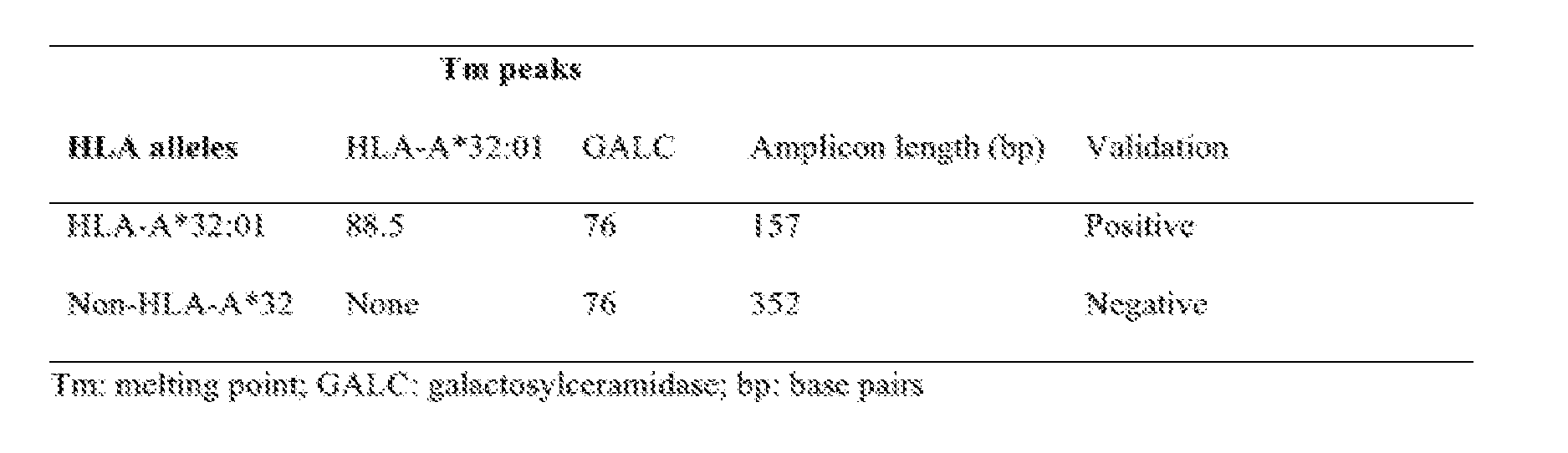
electrophoresis. HLA-A*32:01 positive samples showed two bands of 157-bp (HLA-A*32:01) and 352-bp (GALC). Non-HLA-A*32 samples showed only one band of 352-bp (GALC) (Fig. 2). No product was detectable for the non-template negative controls. Thus, the sensitivity and specificity of this assay for HLA-A*32:01 allele in these 458 DNA samples were 100% (95% Cl: 88.43-100%) and 100% (95% Cl: 99.14-100%) respectively (Table 9).
Table 9. Comparison of the present assay with SBT.

Negative 0 428 428
Total 30 428 458
[00112] DISCUSSION
[00113] This study describes a simple, fast, and inexpensive PCR assay that utilizes AS- PCR with melt curve analysis for the detection of HLA-A*32:01 allele. By using a
combination of primers that included a LNA forward primer, the HLA-A*32:01 allele was specifically amplified in a real-time PCR. The assay was both 100% sensitive and specific making it safe and appropriate for clinical use.
[00114] Amplification of low-level nonspecific products in real-time PCR has been previously reported. The formation of these nonspecific products can be influenced by annealing temperature, primer concentration, magnesium concentration, and DNA inputs 39. In this optimized assay, no evidence of non-specific amplification was detected. It is also worth noting that in the experiments a LNA primer that specifically target the HLA-A*32 allele was used. The incorporation of a LNA primer into oligonucleotide primers provides an increase of
specific binding strength for target DNA amplification 40. A commercial optimized real-time PCR master mix (Power Up SYBR Green master mix) was used, which is reported to be formulated for maximum specificity and reproducibility. The detection range for template DNA in the assay was between 10 ng to 100 ng. However, the assay optimal DNA concentration was between 25 ng and 50 ng.
[00115] The specificity of the assay was assessed for only the HLA-A*32:01 allele. Given the low frequency of other HLA-A*32 alleles (e.g. A*32:02, A*32:03) especially in those of European ancestry 41 (www.allelefrequencies.net, last accessed on 15 January 2019), there were not other non-HLA-A*32:01 alleles identified from the biorepository of samples primarily from those of European ancestry. Notably, across the entire Vanderbilt BioVU cohort with imputed HLA typing (N=65,638), the only HLA-A*32 allele imputed was HLA- A*32:01. European ancestry represented 85% of this cohort. Furthermore, it is currently unknown whether HLA-A*32 alleles other than HLA-A*32:01 are associated with vancomycin DRESS or whether there are associations between other HLA alleles and vancomycin DRESS in those of non-European ancestry. This will be important to clarify as for previous
associations between drug hypersensitivity and HLA alleles such as abacavir and HLA- B*57:01, an allele also primarily represented in those of European ancestry, the association was specific for HLA-B*57: 01 and to-date HLA-B *57:01 screening has a 100% negative predictive value for abacavir hypersensitivity. Alleles such as HLA-B*58:01, HLA-B*57:03 and HLA-B*57:02 which differ by as few as 2 amino acids in the antigen binding cleft are not associated with abacavir hypersensitivity 8. HLA-A*32:01 has a leucine at position 156 which is a key peptide binding residue which differs from the glutamine at 156 for HLA-A*32:02 and HLA-A*32:03 (IPD-IMGT/HALA database; www.ebi .ac.uk/cgi- bin/ipd/imgt/hla/align.cgi; last accessed on 4 January 2019). It is also worth noting that this assay was able to exclude closely related non-HLA-A*32 alleles.
[00116] High resolution HLA typing is performed by direct sequencing of HLA class I and class II sequences. Although sequence-based typing (SBT) remains the gold standard for HLA typing, it is significantly more expensive, requires significant expertise and labor and has a longer turnaround time compared to this assay in terms of time, cost and labor and remains the domain of specialty immunogenetics and transplant laboratories. SBT also requires
sophisticated equipment, highly-trained staff, and a robust informatics and quality assurance infrastructure which might not be available in most of clinical settings. HLA typing by hybridization of PCR amplicon with sequence-specific oligonucleotide probes (SSO) is an alternative method, but this method shows low resolution typing 42.
[00117] The assay described here appears to give both specificity and sensitivity of 100%, with the advantage of being very fast and less costly compared to other HLA typing methods. The flexible methodology means that this could be set-up in a variety of specialty
immunogenetics or non-specialty laboratory settings that have access to a PCR platform that can perform melting curve analysis. Those settings without qPCR platform can use the standard AS-PCR followed by agarose gel electrophoresis. Limited testing was conducted on a standard PCR machine with the Power Up SYBR green master mix followed by agarose gel electrophoresis analysis and gel visualization. It was also found that this assay can be successfully adapted in settings which do not have qPCR platform.
[00118] The considerable reduction of operator manual handling of post PCR amplicon and manipulation of results also reduce the potential risk of sample mix- up as well as contamination. Where testing a large number of samples is needed, the use of robotic liquid handling system for transferring master mixes and DNA samples could provide some benefits in reducing turnaround time and human errors. In cases where unusual melt curves are found due to poor purity of DNA or operator technical error, samples should be further evaluated by using conventional PCR genotyping or SBT or by obtaining another sample. However, such cases were not encountered during the validation experiments.
[00119] Currently single allele assays exist or have been published for HLA-B*57:01, HLA-B* 15:02, HLA-B*58:01 and HLA-A*31:01 43 7 Most of these single allele assays have been advocated as a pre-prescription screening strategy with specific drugs and specific populations 48, 49.
[00120] The study is therefore novel in both reporting both a new single-allele test specific for HLA-A*32:01 and also in proposing a new use approach to pharmacogenetic testing that is practical and convenient for both the clinician and the laboratory. Based on a prevalence of HLA-A*32:01 in a population of predominant European ancestry of 6.8% and
estimates from the published paper that approximately 20% of those carrying HLA- A*32:01 exposed to vancomycin for at least 2 weeks will develop vancomycin DRESS, it can be estimated that 75 patients would need to be tested for HLA-A*32:01 to prevent one case of DRESS. Given the low cost and relative convenience of testing in this clinical context and the severe implications of DRESS, this number needed to test should be sufficient to justify testing from a cost-effectiveness standpoint in most populations with carriage frequencies of HLA-A*32:01 similar to ours. Furthermore, it would also be feasible, to use this rapid turn-around single-allele assay turnaround, as an ancillary diagnostic test in patients who have developed DRESS on multiple antibiotics including vancomycin.
[00121] In conclusion, this AS-PCR is a fast and reliable method for typing the HLA- A*32:01 allele. This assay demonstrates the sensitivity and specificity needed for the assignment of the HLA-A*32:01 allele but caution that these assay characteristics may not be maintained with any modification to the method.
[00122] Example 2
[00123] Utilizing a population of patients with HLA-A*32:01 positive vancomycin DRESS (vancomycin IFN-g release Enzyme-Linked ImmunoSpot (ELISpot) Assay positive and RegiSCAR >4), the immunological cross-reactivity amongst four glycopeptide antibiotics was examined, including vancomycin, teicoplanin, dalbavancin, and telavancin in patients.1 The chemical structures of vancomycin, telavancin, teicoplanin and dalbavancin are shown in Figure 10
[00124] Adults 18 years or older with a probable diagnosis of vancomycin DRESS defined by a corresponding Naranjo adverse drug reaction (ADR) score of >5 (probable ADR), a RegiSCAR score of >4 (probable DRESS) and who carried HLA-A*32:01 were recruited through drug allergy clinics and inpatient facilities at participating institutions (Vanderbilt University Medical Center in Nashville, Tennessee; Austin Health, Peter MacCallum Cancer Centre, Fiona Stanley Hospital and Royal Perth Hospital in Perth, Western Australia, Australia). All patients provided written or electronic informed consent. Saliva and blood were collected, processed, and stored as repositories of DNA, peripheral blood mononuclear cells (PBMCs), and plasma.
[00125] IFN-g release in response to overnight incubation with the implicated drugs was performed by ELISpot assay )3420-2H; Mabtech, Stockholm, Sweden( in triplicate from thawed PBMCs )rested ovemight( and included negative )unstimulated( and positive )anti-CD3 Mabtech antibody, staphylococcal enterotoxin B, and/or cytomegalovirus pp65( controls. Control PBMCs from glycopeptide unexposed HLA-A*32:01 positive and negative individuals were also used. PBMCs plated at 200,000 cells/well were incubated with vancomycin, teicoplanin, dalbavancin, telavancin and other implicated drugs at concentrations representative of maximum serum concentrations, as well as those 10-fold higher and 10-fold lower (Figure 11). A positive response was defined as more than 50 spot-forming units (SFU)/million cells after background removal as per previous definitions.12 High-resolution 4-digit HLA- A, HLA-B, HLA-C, HLA- DP, HLA-DR, and HLA-DQ typing was performed by using sequence-based typing with previously published protocols.31
[00126] Fifteen patients who met the clinical inclusion criteria for vancomycin-induced DRESS syndrome were enrolled into this study. These patients were primary European ancestry and included 10 women and 5 men from 26 to 76 of age. The median latency period from vancomycin initiation to the first symptoms of DRESS was 21 days (interquartile range (IQR), 15.5-26.5 days). The demographics, clinical characteristics, and DRESS history are described in Table 10. Full HLA typing of all cases are presented in Table 11.


[00127] PBMCs from 15 (100%) vancomycin DRESS cases exhibited a positive IFN-g ELISpot response to vancomycin in a dose dependent manner (50 mg/mL: median SFU/million cells [IQR], 54.17 [27.50 - 112.08] and 500 mg/mL: median [IQR], 122.99 [77.50 - 177.92]) (Figure 11, Table 12). All vancomycin IFN-g ELISpot positive patients had a clear negative IFN- g ELISpot response to both concentrations of dalbavancin (50 mg/mL: median [IQR], 8.33 [0.00 - 11.25] and 500 mg/mL: median [IQR], -0.83 [-5.00 - 3.75]). PBMCs from 13/15 DRESS cases
exhibited a negative IFN-g ELISpot response to teicoplanin (50 mg/mL: median [IQR], 10.00 [0.08 - 17.50] and 500 mg/mL: median [IQR], 15.00 [1.67 - 31.25]). PBMCs from 2/15 cases showed a positive response to teicoplanin. Moreover, PBMCs from 6/9 vancomycin DRESS cases showed a negative IFN-y ELISpot to telavancin (50 mg/mL: median [IQR], 8.30 [0.83 - 42.10] and 500 mg/mL: median [IQR], 21.67 [2.48 - 64.60]). There were three cases that demonstrated a positive IFN-y ELISpot response to telavancin with 2/3 of these overlapping with the two cases who had a positive IFN-y ELISpot response to both vancomycin and teicoplanin. One dually positive patient (Patient ID 15, Table 12) was intradermally skin tested to both vancomycin and teicoplanin and showed positive responses to both glycopeptides (Figure 12) which was not seen in glycopeptide unexposed controls (n 5) and 3 patients (Patient ID 9, 10, and 1 1) with HLA-A*32:01 positive vancomycin DRESS who showed positive delayed intradermal testing and IFN-y ELISpot to vancomycin but negative IFN-y ELISpot and intradermal testing to teicoplanin. Patients ID 1,3 and 5 also tolerated ingestion challenges with concurrently administered medications.

[00128] In samples with sufficient cell number, PBMCs were tested against other concurrently administered medications potentially implicated in DRESS development. PBMCs from Patient ID 2 who did respond to ex vivo vancomycin stimulation also had a positive response to rifampin at only 5 mg/mL No other patient samples tested released IFN-g in response to stimulation from any other potentially implicated medication. (Figure 13).
Additionally, IFN-g ELISpot was also performed on PBMCs from non-HLA-matched healthy donors (n=5) and a HLA-A*32:01 positive vancomycin naive control (n=l); all exhibiting a negative response to all four drugs (data not shown).
[00129] Vancomycin is the most commonly used antibiotic and implicated in up to 40% of antibiotic-related DRESS cases. HLA-A*32:01 has recently been reported as a genetic risk factor for vancomycin-induced DRESS in the European population, within which the allelic prevalence is approximately 6.8%.31 Due to the high prevalence of the risk allele, the high
incidence of vancomycin-induced DRESS and the potential cross-reactive risk with dalbavancin given its extremely long half-life of 14 days, the detection of cross-reactivity to alternative glycopeptide antibiotics is very important for reducing the future risk of DRESS and providing patients with future therapeutic options. The study is reassuring in demonstrating that 100% of vancomycin DRESS cases with IFN-g ELISpot responses showed a negative IFN-g ELISpot response to dalbavancin, suggesting no or very low cross-reactivity between vancomycin and dalbavancin. Dalbavancin is a semisynthetic lipoglycopeptide, a derivative of the teicoplanin analogue A40926, and differs from vancomycin through a structural modification of the lipophilic side chain which enhances its binding affinity to the cell membrane and prolongs its half-life.50
[00130] On the other hand, approximately 87 % (13/15) and 67% (6/9) of vancomycin DRESS cases showed no cross-reactivity to teicoplanin and telavancin, respectively.
Interestingly, 13% (2/15) of vancomycin DRESS cases demonstrated immunological cross reactivity to teicoplanin, and telavancin using ELISpot, confirmed in part by a positive intradermal skin test to teicoplanin in the one patient where this was performed (telavancin not available in clinical formulation for skin testing). It should be noted that telavancin is a direct semi-synthetic derivative of vancomycin and that dalbavancin is a semi-synthetic
lipoglycopeptide derived from a glycopeptide structure more similar to teicoplanin. In addition to the long lipophilic side chain of dalbavancin that extends its half-life and improves affinity for the D-Ala-D-Ala target, dalbavancin lacks the acetylglucosamine group of teicoplanin.
Intriguingly the two patients (Patient ID 8, 15) with shared ex vivo cross-reactivity amongst vancomycin, teicoplanin and telavancin share the same class II HLA haplotype which was distinct from the 13 patients who did not show ex vivo cross-reactivity with teicoplanin and telavancin.
[00131] Molecular docking suggests potential binding interactions between vancomycin, teicoplanin and telavancin and the class II HLA-DQA1 *01 :01 and HLA-DQB 1*05:03 molecules in HLA-A*32:01 postive patients who have experienced vancomycin DRESS. These data suggest possible mechanisms including recognition of drug/class II HLA complexes by CD8 T cells matured by positive selection by HLA-A*32:01. The clinical phenotype in these cases with prior vancomycin DRESS and ex vivo cross-reactivity to teicoplanin and telavancin and positive
delayed intradermal skin testing in the one patient performed could also be DRESS and so based on this a rechallenge to either teicoplanin or telavancin would not be ethical.
[00132] This study is the first evidence that elucidates a potential immunological cross reactivity pattern amongst teicoplanin and newer glycopeptide antibiotics in patients with previous DRESS induced by vancomycin. Although this is reassuring, particularly for the use of the long half-life lipoglycopeptide dalbavancin, clinicians should be aware of the low but detectable risk of cross-reactivity in particular amongst teicoplanin, telavancin and vancomycin in the HLA-A*32:01 restricted setting applicable to DRESS but also potentially other severe delayed reactions in teicoplanin- or telavancin-treated patients. Ideally both ex vivo IFN-g ELISpot assay or skin tests in combination with HLA typing can be performed to risk-stratify patients with a history of previous vancomycin DRESS syndrome for potential risk of cross reactivity between vancomycin, teicoplanin, and telavancin to aid in making decisions for future treatment. The shared class II haplotype amongst two patients with cross-reactivity between vancomycin, teicoplanin and dalbavancin and virtual docking of these drugs to HLA- DQA1*01 :01 and HLA-DQB 1*05:03 suggest a novel mechanism for cross-reactivity following sensitization that deserves further exploration.
[00133] Conclusions: Immunological cross-reactivity is demonstratable between vancomycin, teicoplanin and telavancin in patients with clinically and immunologically defined HLA-A*32:01 restricted vancomycin DRESS. Dalbavancin, a derivative of teicoplanin, showed little to no cross-reactivity highlighting it as the safest alternate glycopeptide. 22% of patients who demonstrated immunological cross-reactivity between vancomycin, teicoplanin, and telavancin shared a class II HLA haplotype, and drug class II structural modeling suggest a unique mechanism whereby HLA-A*32:01 restricted CD8+ T cells may recognize the neoepitope created by teicoplanin/telavancin HLA class II restricted CD4+ T cells.
[00134] All publications, patents, and patent applications mentioned in this specification are herein incorporated by reference to the same extent as if each individual publication, patent, or patent application was specifically and individually indicated to be incorporated by reference, including the references set forth in the following list:
REFERENCES
1. Lin YF, Yang CH, Sindy H, et al. Severe cutaneous adverse reactions related to systemic antibiotics. Clin Infect Dis. 2014;58(10): 1377-85.
2. Pavlos R, Mallal S, Phillips E. HLA and pharmacogenetics of drug
hypersensitivity. Pharmacogenomics. 2012; 13(11): 1285-1306.
3. Ghislain PD, Roujeau JC. Treatment of severe drug reactions: Stevens- Johnson syndrome, toxic epidermal necrolysis and hypersensitivity syndrome. Dermatol Online
J. 2002;8(1):5.
4. Aota N, Shiohara T. Viral connection between drug rashes and autoimmune diseases: how autoimmune responses are generated after resolution of drug rashes. Autoimmun Rev. 2009;8: 488-94.
5. Naranjo CA, Busto U, Sellers EM, et al. A method for estimating the probability of adverse drug reactions. Clin Pharmacol Ther. 1981;30:239-45.
6. Kardaun SH, Sekula P, Val eyrie- Allanore L, et al. Drug reaction with
eosinophilia and systemic symptoms (DRESS): an original multisystem adverse drug reaction. Results from the prospective RegiSCAR study. Br J Dermatol. 2013; 169(5): 1071-80.
7. Mallal S, Nolan D, Witt C, et al. Association between presence of HLA-B*5701, HLA-DR7, and HLA-DQ3 and hypersensitivity to HIV-1 reverse-transcriptase inhibitor abacavir. Lancet. 2002; 359:727-32.
8. Mallal S, Phillips E, Carosi G, et al. HLA-B*5701 screening for hypersensitivity to abacavir. N Engl JMed. 2008;358:568-79.
9. Karnes JH, Shaffer CM, Bastarache L, et al. Comparison of HLA allelic imputation programs. PLoS ONE. 2017;12(2):e0172444. doi: 10.1371/joumal. pone.0172444.
10. Keane NM, Roberts SG, Almeida CA, et al. High-avidity, high-IFNy-producing CD8 T-cell responses following immune selection during HIV-1 infection. Immunol Cell Biol. 2012;90(2):224-34.
11. Keane NM, Pavlos RK, McKinnon E, et al. HLA Class I restricted CD8+ and Class II restricted CD4+ T cells are implicated in the pathogenesis of nevirapine
hypersensitivity. AIDS. 2014;28(13): 1891-901.
12. Trubiano J, Strautins K, Redwood AJ, et al. The combined utility of ex vivo enzyme linked immunospot (ELISpot) and in vivo skin testing in patients with antibiotic- associated severe cutaneous adverse reactions. J Allergy Clin Immunol Pract. 2018;6(4):1287- 96.
13. Bordolo L, Kiefer F, Arnold K, Benkert P, Battey J, Schwede T. Protein structure homology modeling using SWISS-MODEL workspace. Nat Protoc. 2009;4: 1-13.
14. Emsley P, Lohkamp B, Scott WG, Cowtan K. Features and development of Coot. Acta Crystallogr D Biol Crystallogr. 2010;66:486-501.
15. Adams PD, Afonine PV, Bunkoczi G, et al. PHENIX: a comprehensive Python- based system for macromolecular structure solution. Acta Cryst. 2010;D66:213-21.
16. Trott O, Olson AJ. AutoDock Vina: improving the speed and accuracy of docking with a new scoring function, efficient optimization, and multithreading. J Comput Chem.
2010;31(2):455-61.
17. Gragert L, Madbouly A, Freeman J, Maiers M. Six-locus high resolution HLA haplotype frequencies derived from mixed-resolution DNA typing for the entire US donor registry. Hum Immunol. 2013;74(10): 1313-20.
18. Rapin N, Hoof I. Lund O, Nielsen M. MHC motif viewer immunogene tics. 2008;60:759-65.
19. Chung WH, Hung SI, Hong HS, et al. Medical genetics: a marker for Stevens- Johnson syndrome. Nature. 2004;428(6982):486.
20. Hetherington S, Hughes AR, Mosteller M, et al. Genetic variations in HLA-B region and hypersensitivity reactions to abacavir. Lancet. 2002;359: 1121-22.
21. Martin AM, Nolan D, Gaudieri S, et al. Predisposition to abacavir
hypersensitivity conferred by HLA-B*5701 and a haplotypic Hsp70-Hom variant. Proc Natl Acad Pci USA. 2004; 101(12):4180-5.
22. Empedrad R, Darter AL, Earl HS, Gruchalla RS. Nonirritating intradermal skin test concentrations for commonly prescribed antibiotics. J Allergy Clin Immunol.
2003;111(3):629-30.
23. Morito H, Ogawa K, Fukumoto T, et al. Increased ratio of FoxP3+ regulatory T cells/CD3+ T cells in skin lesions in drug induced hypersensitivity syndrome/drug rash with eosinophilia and systemic symptoms. Clin Exp Dermatol. 2014;39(3):284-91.
24. Baden LA, Apovian C, Imber MJ, Dover JS. Vancomycin-Induced Linear IgA Bullous Dermatosis. Arch Dermatol. 1988; 124(8): 1186-88.
25. Minhas JS, Wickner PG, Long AA, Baneiji A, Blumenthal KG. Immune- mediated reactions to vancomycin: A systematic case review and analysis. Ann Allergy Asthma Immunol. 2016; 116(6): 544-53.
26. Ostrov DA, Grant BJ, Pompeu YA, et al. Drug hypersensitivity caused by alteration of the MHC-presented self-peptide repertoire. Proc Natl Acad Sci USA.
2012;109:9959-64.
27. Illing PT, Vivian JP, Dudek NL, et al. Immune self-reactivity triggered by drug- modified HLA-peptide repertoire. Nature. 2012;486(7404):554-8.
28. Redwood AJ, Pavlos RK, White KD, Phillips EJ: HLAs: Key Regulators of T-cell- Mediated Drug Hypersensitivity. HLA 2018, 91 :3-16.
29. White KD, Chung WH, Hung SI, Mallal S, Phillips EJ: Evolving Models of the Immunopathogenesis of T-cell-Mediated Drug Allergy: The Role of Host, Pathogens, and Drug Response. J Allergy Clin Immunol 2015, 136:219-234; quiz 235.
30. Paul S, Weiskopf D, Angelo MA, Sidney J, Peters B, Sette A: HLA Class I Alleles Are Associated with Peptide-Binding Repertoires of Different Size, Affinity, and Immunogenicity. J Immunol 2013, 191 :5831-5839.
31. Konvinse KC, Trubiano JA, Pavlos R, James I, Shaffer CM, Bejan CA, Pilkinton MA, Rosenbach M, Zwerner JP, Williams KB, Jack Bourke J, Martinez P, Rwandamuriye F, Chopra A, Watson M, Mallal SA, Redwood A, White KD, Phillips EJ: HLA-A*32:01 Is Strongly Associated with Vancomycin-Induced Drug Reaction with Eosinophilia and Systemic Symptoms. J Allergy Clin Immunol 2019.
32. Blumenthal KG, Peter JG, Trubiano JA, Phillips EJ: Antibiotic Allergy. Lancet 2019, 393: 183-198.
33. Husain Z, Reddy BY, Schwartz RA: DRESS Syndrome: Part I. Clinical Perspectives. J Am Acad Dermatol 2013, 68:693 e691-614; quiz 706-698.
34. Pavlos R, Mallal S, Ostrov D, Buus S, Metushi I, Peters B, Phillips E: T Cell- Mediated Hypersensitivity Reactions to Drugs. Annu Rev Med 2015, 66:439-454.
35. Cacoub P, Musette P, Descamps V, Meyer O, Speirs C, Finzi L, Roujeau JC: The DRESS Syndrome: A Literature Review. Am J Med 2011, 124:588-597.
36. Carapito R, Radosavljevic M, Bahram S: Next-Generation Sequencing of the HLA Locus: Methods and Impacts on HLA Typing, Population Genetics and Disease Association Studies. Hum Immunol 2016, 77: 1016-1023.
37. Sayer D, Whidborne R, Brestovac B, Trimboli F, Witt C, Christiansen F: HLA- Drbl DNA Sequencing Based Typing: An Approach Suitable for High Throughput Typing Including Unrelated Bone Marrow Registry Donors. Tissue Antigens 2001, 57:46-54.
38. Roden DM, Pulley JM, Basford MA, Bernard GR, Clayton EW, Balser JR, Masys DR: Development of a Large-Scale De-Identified DNA Biobank to Enable Personalized Medicine. Clin Pharmacol Ther 2008, 84:362-369.
39. Ruiz-Villalba A, van Pelt-Verkuil E, Gunst QD, Ruijter JM, van den Hoff MJ: Amplification of Nonspecific Products in Quantitative Polymerase Chain Reactions (qPCR). Biomol Detect Quantif 2017, 14:7-18.
40. Ballantyne KN, van Oorschot RA, Mitchell RJ: Locked Nucleic Acids in PCR Primers Increase Sensitivity and Performance. Genomics 2008, 91 :301-305.
41. Cao K, Hollenbach J, Shi XJ, Shi WX, Chopek M, Fernandez -Vina MA: Analysis of the Frequencies of HLA-a, B, and C Alleles and Haplotypes in the Five Major Ethnic Groups of the United States Reveals High Levels of Diversity in These Loci and Contrasting Distribution Patterns in These Populations. Hum Immunol 2001, 62: 1009-1030.
42. Dunn PP: Human Leucocyte Antigen Typing: Techniques and Technology, a Critical Appraisal. Int J Immunogenet 2011, 38:463-473.
43. Nguyen DV, Vida C, Chu HC, Fulton R, Li J, Fernando SL: Validation of a Rapid, Robust, Inexpensive Screening Method for Detecting the HLA-B*58:01 Allele in the Prevention of All opurinol -Induced Severe Cutaneous Adverse Reactions. Allergy Asthma Immunol Res 2017, 9:79-84.
44. Nguyen DV, Vidal C, Chu HC, Do NT, Tran TT, Le HT, Fulton RB, Li J, Fernando SL: Validation of a Novel Real-Time PCR Assay for Detection of HLA-B*15:02 Allele for Prevention of Carbamazepine - Induced Stevens- Johnson Syndrome/Toxic Epidermal Necrolysis in Individuals of Asian Ancestry. Hum Immunol 2016, 77: 1140-1146.
45. Uchiyama K, Kubota F, Ariyoshi N, Matsumoto J, Ishii I, Kitada M: Development of a Simple Method for Detection of the HLA-A*31 :01 Allele. Drug Metab Pharmacokinet 2013, 28:435-438.
46. Chen P, Lin JJ, Lu CS, Ong CT, Hsieh PF, Yang CC, Tai CT, Wu SL, Lu CH, Hsu YC, Yu HY, Ro LS, Lu CT, Chu CC, Tsai JJ, Su YH, Lan SH, Sung SF, Lin SY, Chuang HP, Huang LC, Chen YJ, Tsai PJ, Liao HT, Lin YH, Chen CH, Chung WH, Hung SI, Wu JY, Chang CF, Chen L, Chen YT, Shen CY, Taiwan SJSC: Carbamazepine-Induced Toxic Effects and HLA- B*1502 Screening in Taiwan. N Engl J Med 2011, 364: 1126-1133.
47. Hammond E, Mamotte C, Nolan D, Mallal S: HLA-B*5701 Typing: Evaluation of an Allele-Specific Polymerase Chain Reaction Melting Assay. Tissue Antigens 2007, 70:58-61.
48. Phillips EJ, Mallal SA: Pharmacogenetics of Drug Hypersensitivity. Pharmacogenomics 2010, 11 :973-987.
49. Ferrell PB, Jr., McLeod HL: Carbamazepine, HLA-B*1502 and Risk of Stevens- Johnson Syndrome and Toxic Epidermal Necrolysis: US FDA Recommendations. Pharmacogenomics 2008, 9: 1543-1546.
50. Van Bambeke F. Lipoglycopeptide Antibacterial Agents in Gram-Positive Infections: A Comparative Review. Drugs. 2015;75(18):2073-95.
51. Kwon HS, Chang YS, Jeong YY, Lee SM, Song WJ, Kim HB, et al. A case of hypersensitivity syndrome to both vancomycin and teicoplanin. J Korean Med Sci. 2006;21(6): 1108-10.
52. Lye D, Athan E, OBrien D. Teicoplanin hypersensitivity syndrome. Int J Antimicrob Agents. 2007;29(4):476-8.
53. Miyazu D, Kodama N, Yamashita D, Tanaka H, Inoue S, Imakyure O, et al. DRESS Syndrome Caused by Cross-reactivity Between Vancomycin and Subsequent Teicoplanin Administration: A Case Report. Am J Case Rep. 2016;17:625-31.
54. Ben Romdhane H, Chadli Z, Ben Fredj N, Chaabane A, Boughattas NA, Aouam K. Teicoplanin-induced DRESS syndrome: The importance of skin tests. Med Mai Infect. 2018;48(4):291-3.
55. Ishizuka KT, Tran TK, Ayars AG, Chau AS, Chan JD. Graded Dalbavancin Challenge in a Patient with Severe Vancomycin Hypersensitivity Reaction. Clin Infect Dis. 2019.
56. Zhang T, Che D, Liu R, Han S, Wang N, Zhan Y, et al. Typical antimicrobials induce mast cell degranulation and anaphylactoid reactions via MRGPRX2 and its murine homologue MRGPRB2. Eur J Immunol. 2017;47(11): 1949-58.
[00135] It will be understood that various details of the presently disclosed subject matter can be changed without departing from the scope of the subject matter disclosed herein.
Furthermore, the foregoing description is for the purpose of illustration only, and not for the purpose of limitation.
Claims
1. A method of detecting a human leukocyte antigen (HLA)-A*32:01 allele in a subject, comprising:
(a) obtaining a biological sample from the subject;
(b) detecting whether HLA-A*32:01 is present in the sample to determine whether the subject is at risk for developing or has vancomycin-induced drug reaction with eosinophilia and systemic symptoms (DRESS) when HLA-A*32:01 is present in the sample.
2. The method of claim 1, wherein the subject has a bacterial infection.
3. The method of claim 2, wherein the bacteria is an antibiotic-resistant gram positive bacteria.
4. The method of claim 3, wherein the bacteria is methicillin-resistant
Staphylococcus aureus.
5. The method of claim 1, wherein the biological sample is from a subject suspected of having DRESS.
6. The method of claim 5, wherein the subject is receiving combination antibiotic treatment that includes vancomycin.
7. The method of claim 6, wherein the subject is diagnosed as having
vancomycin-induced DRESS when the presence of HLA-A*32:01 in the sample is detected.
8. The method of claim 7, further comprising administering to the diagnosed subject an antibiotic treatment that excludes vancomycin.
9. The method of claim 1, wherein the biological sample is from a subject in need of treatment with an antibiotic.
10. The method of claim 9, and further comprising identifying the subject as being at risk for developing vancomycin DRESS when the presence of HLA-A*32:01 in the sample is detected.
11. The method of claim 10, further comprising administering an antibiotic that is not vancomycin to the identified subject.
12. The method of claim 10, further comprising administering an antibiotic that is not a gly copeptide antibiotic to the identified subject.
13. The method of claim 10, further comprising administering an antibiotic that is not vancomycin, teicoplanin, or telavancin to the identified subject.
14. The method of claim 10, further comprising administering dalbavancin to the identified subject.
15. The method of claim 1, wherein sequenced-based typing is conducted to determine whether HLA-A*32:01 is present in the sample.
16. The method of claim 1, wherein SNP2HLA is used to determine whether HLA-A*32:01 is present in the sample.
17. The method of claim 1, and further comprising using an IFN-i Enzyme- Linked ImmuneSpot assay.
18. The method of claim 1, wherein a polymerase chain reaction assay is used to determine whether HLA-A*32:01 is present in the sample.
19. The method of claim 18, using allele-specific polymerase chain reaction (AS-
PCR).
20. The method of claim 18, using quantitative polymerase chain reaction (qPCR).
21. The method of claim 18, further comprising using a primer mix containing a primer specific for HLA-A*32 allele.
22. The method of claim 21, wherein the primer specific for HLA-A*32 is HLA 32-88F (SEQ ID NO: 1).
23. The method of claim 22, and further using a second primer specific for HLA- A*32 that is HLA032R2 (SEQ ID NO: 2).
24. The method of claim 23, and further using a primer targeting a housekeeping gene.
25. The method of claim 24, wherein the housekeeping gene is
galactosylceramidase (GALC).
26. The method of claim 25, wherein the primer targeting GALC is GALc-F (SEQ ID NO: 3).
27. The method of claim 26, and further using a second primer targeting GALC that is GALc-R (SEQ ID NO: 4).
28. A kit comprising a primer specific for HLA-A*32.
29. The kit of claim 28, comprising HLA-A*32 is HLA 32-88F (SEQ ID NO: 1) and HLA-A*32 that is HLA032R2 (SEQ ID NO: 2).
30. The kit of claim 29, and further comprising GALc-F (SEQ ID NO: 3), and GALc-R (SEQ ID NO: 4).
31. A method of identifying risk of developing vancomycin-induced drug reaction with eosinophilia and systemic symptoms (DRESS) in a subject, comprising:
(a) obtaining a biological sample from the subject; and
(b) detecting whether HLA-A*32:01 is present in the sample using a primer mix containing one or both of HLA 32-88F (SEQ ID NO: 1) and HLA032R2 (SEQ ID NO: 2)·
32. A method of diagnosing vancomycin DRESS in a subject and treating the subject for a bacterial infection, comprising:
(a) obtaining a biological sample from the subject;
(b) detecting whether HLA-A*32:01 is present in the sample;
(c) diagnosing the subject with, or being at risk of developing, vancomycin DRESS when the presence of HLA-A*32:01 in the sample is detected; and
(d) administering an antibiotic that is not vancomycin to the diagnosed subject.
Priority Applications (1)
| Application Number | Priority Date | Filing Date | Title |
|---|---|---|---|
| US17/427,887 US12276663B2 (en) | 2019-02-14 | 2020-02-14 | Detection of human leukocyte antigen-A*32:01 in connection with determining drug reaction with eosinophilia and systemic symptoms (DRESS) and methods of treating bacterial infection in a subject with vancomycin-induced DRESS |
Applications Claiming Priority (2)
| Application Number | Priority Date | Filing Date | Title |
|---|---|---|---|
| US201962805717P | 2019-02-14 | 2019-02-14 | |
| US62/805,717 | 2019-02-14 |
Publications (2)
| Publication Number | Publication Date |
|---|---|
| WO2020168282A1 true WO2020168282A1 (en) | 2020-08-20 |
| WO2020168282A9 WO2020168282A9 (en) | 2020-09-10 |
Family
ID=72044625
Family Applications (1)
| Application Number | Title | Priority Date | Filing Date |
|---|---|---|---|
| PCT/US2020/018420 Ceased WO2020168282A1 (en) | 2019-02-14 | 2020-02-14 | Detection of human leukocyte antigen-a*32:01 in connection with determining drug reaction with eosinophilia and systemic symptoms (dress) and methods of treating bacterial infection in a subject with vancomycin-induced dress |
Country Status (2)
| Country | Link |
|---|---|
| US (1) | US12276663B2 (en) |
| WO (1) | WO2020168282A1 (en) |
Citations (4)
| Publication number | Priority date | Publication date | Assignee | Title |
|---|---|---|---|---|
| US7858319B2 (en) * | 2001-08-21 | 2010-12-28 | Smithkline Beecham Corporation | Method of screening for drug hypersensitivity reaction |
| US20120135418A1 (en) * | 2009-06-05 | 2012-05-31 | Catholic University Industry Academic Cooperation Foundation | Automatic Detection Kit for Detecting HLA Alleles Using Real-Time Polymerase Chain Reaction |
| WO2012083240A2 (en) * | 2010-12-16 | 2012-06-21 | Dana-Farber Cancer Institute, Inc. | Oligonucleotide array for tissue typing |
| WO2018232316A1 (en) * | 2017-06-16 | 2018-12-20 | The Johns Hopkins University | Compositions and methods for treating g protein coupled receptor mediated conditions |
-
2020
- 2020-02-14 WO PCT/US2020/018420 patent/WO2020168282A1/en not_active Ceased
- 2020-02-14 US US17/427,887 patent/US12276663B2/en active Active
Patent Citations (4)
| Publication number | Priority date | Publication date | Assignee | Title |
|---|---|---|---|---|
| US7858319B2 (en) * | 2001-08-21 | 2010-12-28 | Smithkline Beecham Corporation | Method of screening for drug hypersensitivity reaction |
| US20120135418A1 (en) * | 2009-06-05 | 2012-05-31 | Catholic University Industry Academic Cooperation Foundation | Automatic Detection Kit for Detecting HLA Alleles Using Real-Time Polymerase Chain Reaction |
| WO2012083240A2 (en) * | 2010-12-16 | 2012-06-21 | Dana-Farber Cancer Institute, Inc. | Oligonucleotide array for tissue typing |
| WO2018232316A1 (en) * | 2017-06-16 | 2018-12-20 | The Johns Hopkins University | Compositions and methods for treating g protein coupled receptor mediated conditions |
Non-Patent Citations (4)
| Title |
|---|
| ALFIREVIC ET AL.: "Drug Induced Hypersensitivity and the HLA Complex", PHARMACEUTICALS, vol. 4, no. 1, 23 December 2010 (2010-12-23), pages 69 - 90, XP055731185 * |
| KONVINSE ET AL.: "HLA-A*32:01 is strongly associated with vancomycin-induced drug reaction with eosinophilia and systemic symptoms", THE JOURNAL OF ALLERGY AND CLINICAL IMMUNOLOGY, vol. 144, no. 1, 16 February 2019 (2019-02-16), pages 183 - 192, XP085726295, DOI: 10.1016/j.jaci.2019.01.045 * |
| PARK ET AL.: "HLA Allele Frequencies in 5802 Korean s: Varied Allele Types Associated with SJS/TEN According to Culprit Drugs", YONSEI MEDICAL JOURNAL, vol. 57, no. 1, 30 November 2015 (2015-11-30), pages 118 - 126, XP055731190 * |
| ROY ET AL.: "Vancomycin-induced Drug Reaction with Eosinophilia and Systemic Symptoms (DRESS) Syndrome Masquerading as Elusive Sepsis", CASE REPORTS IN IMMUNOLOGY, vol. 2019, 10 April 2019 (2019-04-10), pages 1 - 5, XP055731196 * |
Also Published As
| Publication number | Publication date |
|---|---|
| WO2020168282A9 (en) | 2020-09-10 |
| US20220107316A1 (en) | 2022-04-07 |
| US12276663B2 (en) | 2025-04-15 |
Similar Documents
| Publication | Publication Date | Title |
|---|---|---|
| Konvinse et al. | HLA-A* 32: 01 is strongly associated with vancomycin-induced drug reaction with eosinophilia and systemic symptoms | |
| Sugimori et al. | Roles of DRB1∗ 1501 and DRB1∗ 1502 in the pathogenesis of aplastic anemia | |
| KR102386134B1 (en) | High resolution allele identification | |
| Betensky et al. | Clonal evolution and clinical significance of copy number neutral loss of heterozygosity of chromosome arm 6p in acquired aplastic anemia | |
| Bonaccorsi-Riani et al. | Molecular characterization of acute cellular rejection occurring during intentional immunosuppression withdrawal in liver transplantation | |
| Cohen et al. | Association of the MIC-A gene and HLA-B51 with Behcet's disease in Arabs and non-Ashkenazi Jews in Israel | |
| CN102534001B (en) | Warfarin individual anticoagulant pharmacogenomics detection kit suitable for Chinese population | |
| Rwandamuriye et al. | A rapid allele-specific assay for HLA-A* 32: 01 to identify patients at risk for vancomycin-induced drug reaction with eosinophilia and systemic symptoms | |
| JP2025061120A (en) | Human genetic markers associated with response to therapy targeting Clostridium difficile toxin B - Patent Application 20070123333 | |
| Asensi et al. | IL-1β (+ 3954C/T) polymorphism could protect human immunodeficiency virus (HIV)-infected patients on highly active antiretroviral treatment (HAART) against lipodystrophic syndrome | |
| CN110564844A (en) | Kit for predicting warfarin bleeding risk based on SNP marker CYP4F2rs3093168 | |
| Park et al. | HLA-DRB1 is associated with cefaclor-induced immediate hypersensitivity | |
| Jiang et al. | Role of HLA class I and II alleles in susceptibility to ankylosing spondylitis in Chinese Han | |
| US12276663B2 (en) | Detection of human leukocyte antigen-A*32:01 in connection with determining drug reaction with eosinophilia and systemic symptoms (DRESS) and methods of treating bacterial infection in a subject with vancomycin-induced DRESS | |
| Ozyilmaz et al. | Early prediction of sarcoidosis prognosis with HLA typing: A 5 year follow-up study | |
| Inamo et al. | Spatial transcriptomics reveals immune-stromal crosstalk within the synovium of patients with juvenile idiopathic arthritis | |
| Wang et al. | Association of genetic variants of insulin degrading enzyme with metabolic features in women with polycystic ovary syndrome | |
| EP4463866A1 (en) | Method of human leukocyte antigen loss of heterozygosity detection in liquid biopsies | |
| WO2018107388A1 (en) | Human genetic markers associated with response to treatments that target clostridium difficile toxin b | |
| Choshi | The immunopathogenic mechanism of severe cutaneous adverse reactions to first line anti-tuberculosis drugs | |
| KR20180019125A (en) | Methods for treating primary focal segmental glomerulosclerosis | |
| Tsai | HLA-Cw1 and Psoriasis | |
| JP2014170012A (en) | Use of myelin basic protein as a novel genetic factor for rheumatoid arthritis | |
| Raja et al. | Analysis of Genetic Diversity of Envelope Genes Obtained from Patients of HIV Positive. | |
| Nathalang et al. | Genomic analysis of KEL* 03 and KEL* 04 alleles among Thai blood donors |
Legal Events
| Date | Code | Title | Description |
|---|---|---|---|
| 121 | Ep: the epo has been informed by wipo that ep was designated in this application |
Ref document number: 20755902 Country of ref document: EP Kind code of ref document: A1 |
|
| NENP | Non-entry into the national phase |
Ref country code: DE |
|
| 122 | Ep: pct application non-entry in european phase |
Ref document number: 20755902 Country of ref document: EP Kind code of ref document: A1 |
|
| WWG | Wipo information: grant in national office |
Ref document number: 17427887 Country of ref document: US |