WO2020164912A1 - A process for the purification of fluorinated olefins - Google Patents
A process for the purification of fluorinated olefins Download PDFInfo
- Publication number
- WO2020164912A1 WO2020164912A1 PCT/EP2020/052144 EP2020052144W WO2020164912A1 WO 2020164912 A1 WO2020164912 A1 WO 2020164912A1 EP 2020052144 W EP2020052144 W EP 2020052144W WO 2020164912 A1 WO2020164912 A1 WO 2020164912A1
- Authority
- WO
- WIPO (PCT)
- Prior art keywords
- equal
- butadiene
- hexafluoro
- process according
- adsorbents
- Prior art date
- Legal status (The legal status is an assumption and is not a legal conclusion. Google has not performed a legal analysis and makes no representation as to the accuracy of the status listed.)
- Ceased
Links
Classifications
-
- C—CHEMISTRY; METALLURGY
- C07—ORGANIC CHEMISTRY
- C07C—ACYCLIC OR CARBOCYCLIC COMPOUNDS
- C07C17/00—Preparation of halogenated hydrocarbons
- C07C17/38—Separation; Purification; Stabilisation; Use of additives
- C07C17/389—Separation; Purification; Stabilisation; Use of additives by adsorption on solids
Definitions
- the present invention relates to a process for the purification of fluorinated olefins, such as, especially, hexafluoro- 1,3 -butadiene, using adsorbents with a large average pore size.
- Hexafluoro- 1,3 -butadiene is a colorless, gaseous unsaturated fluorocarbon with an alternating double bond. It is an etchant showing very high performance for plasma, ion beam, or sputter etching in semiconductor devices
- Hexafluoro- 1,3 -butadiene is an environmentally compatible gas. Hexafluoro- 1,3- butadiene is marketed by Solvay under the brand name Sifren® 46.
- EP1329442A1 describes a process for the purification of hexafluoro- 1,3-butadiene using certain adsorbents with low average pore diameter, particularly molecular sieve 5 A, since the hexafluoro- 1,3-butadiene is apparently excluded from the adsorbent while the impurities are adsorbed and thus, avoiding deleterious decomposition reactions from occurring.
- one objective of the present invention is to propose an improved process for the purification of hexafluoro- 1,3- butadiene.
- the process of the present invention advantageously lead to a more economical cleaning process, an improved purity, a reduced time of the overall purification process and/or uses cheaper and more readily available adsorbents.
- a first aspect of the present invention concerns a process for the purification of hexafluoro- 1,3 -butadiene comprising a step wherein a gaseous mixture comprising hexafluoro- 1,3 -butadiene is contacted with at least two different adsorbents to purify said gas mixture, wherein the at least two different adsorbents each have an average pore size of above 6 A, as measured by nitrogen adsorption porosimetry.
- Figure 1 shows a flow diagram of an apparatus for performing the process according to the present invention.
- Suitable adsorbents include molecular sieves, preferably aluminosilica like zeolites, silica gel, alumina, activated carbon, ceramic membranes and metal- organic frameworks.
- the gaseous mixture to be purified may contain various impurities in admixture with the hexafluoro- 1,3 -butadiene.
- impurities may include water, alcohols, especially isopropanol, hydrohalogenocarbons, especially hydrofluorocarbons. Said impurities may come from the formation of
- the final purity of the hexafluoro- 1,3 -butadiene achieved by the process according to the invention is equal to greater than 99.9% by volume, preferably equal to greater than 99.95% by volume, more preferably equal to greater than 99.98% by volume, and most preferably equal to greater than 99.99% by volume.
- the total amount of hydrohalogenocarbons potentially remaining in the purified hexafluoro- 1,3 -butadiene may be lower or equal to 500 ppmv, in particular lower or equal to 300 ppmv, in particular lower or equal to 200 ppmv, in particular lower or equal to 180 ppmv, in particular lower or equal to 160 ppmv, in particular lower or equal to 140 ppmv, in particular lower or equal to 120 ppmv.
- the total amount of hydrohalogenocarbons potentially remaining in the purified hexafluoro- 1,3 -butadiene may be equal to greater than 1 ppmv, in particular equal to greater than 10 ppmv, in particular equal to greater than 50 ppmv.
- the total amount of alcohols potentially remaining in the purified hexafluoro- 1,3 -butadiene may be lower or equal to 5 ppmv, in particular lower or equal to 4 ppmv, in particular lower or equal to 3 ppmv, in particular lower or equal to 2 ppmv, in particular lower or equal to 1 ppmv.
- the minimum content of the alcohol type impurities potentially present in the purified hexafluoro- 1,3- butadiene may be within the limits of detection of the measurement device used.
- the amount of organic impurities potentially remaining in the purified hexafluoro- 1,3 -butadiene can be measured by conventional methods known by the skilled person, such as gas chromatography and mass spectroscopy.
- the at least two different adsorbents each have an average pore size of above 6 A, preferably above 8 A, more preferably above 10 A. Also preferably, the at least two different adsorbents each have an average pore size of equal to or below 100 A, more preferably equal to or below 80 A, most preferably equal to or below 50 A. Preferably, at least one of the at least two adsorbents has an average pore size of equal to or above 10 A, more preferably equal to or above 15 A, more preferably equal to or above 20 A.
- the average pore size can be measured by conventional methods known by the skilled person, such as nitrogen adsorption porosimetry.
- At least one adsorbent used is silica gel, more preferably silica gel with an average pore size of 10 to 100 A, more preferably 15 to 50 A, moste preferably between 10 and 20 A.
- a very suitable silica gel includes the Tixosil® range from Solvay as well as SYLOBEAD® SG B125 supplied by Grace.
- At least one of the at least two different adsorbents is a zeolite, preferably the zeolite is a gmelinit, mordenite, SAPO-40, ZSM-10 or molecular sieve 13X, specifically molecular sieve 13X.
- the at least two different adsorbents include at least one zeolite and at least one silica gel, most preferably two adsorbents, one zeolite and one silica gel, are used in the process.
- the gaseous mixture is first purified with the silica gel and subsequently purified with the zeolite.
- This implementation of the process is especially preferred because a) the zeolite and the silica gel remove different impurity species and b) the silica gel used in the first purification stage is able to remove certain impurities which were found to be decomposed in the second stage on the zeolite.
- the process is conducted at an initial pressure of equal to or above 100 mbar (abs.) and equal to or below 2000 mbar (abs.).
- the process is conducted at an initial temperature of equal to or above 5°C and equal to or below 40°C.
- initial as used herein is intended to denote that temperature and pressure of the gaseous mixture before coming into contact with the first of the at least two adsorbents.
- the flow rate of the gaseous mixture through the adsorbents is set to equal to or above 2 g/min and equal to or below 200 g/min.
- the at least two different adsorbents are present in different zones in the same adsorber cartridge.
- only one adsorber cartridge is used in the purification process and the at least two adsorbents are located within the one cartridge in different zones, preferably in subsequent zones allowing the gaseous mixture to be in contact with one adsorbent after the other.
- the adsorbents that are used in the present invention are present in different adsorber cartridges, so that the gaseous mixture can be brought into contact with the adsorbents one after the other and the adsorbents can be regenerated individually.
- At least one of the adsorbents used can be pre-treated before being contacted with the gaseous mixture.
- a usual pre-treatment step can comprise keeping the adsorbent at an elevated temperature, preferably between 150 and 400°C, more preferably from 250 to 350°C, and optionally under reduced pressure.
- this pre treatment leads to a decline in the amount of impurities formed by decomposition when the gaseous mixture is being brought into contact with the pre-treated adsorbent.
- the skilled person knows the suitable conditions for the pre-treatment of a given adsorbent, i.e. the choice of temperature, pressure and time the adsorbent has to be treated so as to achieve removal of moisture and/or adsorbed gases.
- hexafluoro- 1,3 -butadiene purified according to the present invention can be used neat. However, it is often desired to use the hexafluoro- 1,3- butadiene of the present invention as an admixture with other fluorinated etching gases to control the carbon/fluoro ratio of the gas mixture. Additionally, mixtures with suitable inert gases like nitrogen, argon or xenon or with oxygen might be desired.
- a further aspect of the present invention is a process for the production of a gas mixture according to the present invention, comprising the process for the purification of hexafluoro- 1,3 -butadiene described above and subsequently, mixing the purified hexafluoro- 1,3 -butadiene with a further gas selected from the group consisting of an inert gas, oxygen and another fluorinated etching gas as well as the gas mixture formed in such a process.
- the inventive gas mixtures can easily be prepared by condensing or pressing the desired amounts of hexafluoro- 1,3 -butadiene and any other desired gas into a pressure bottle.
- the invention concerns a process for the production of a semiconductor material, a solar panel, a flat panel or a microelectromechanical system, or a process for cleaning the chamber of an apparatus used for semiconductor manufacturing using the hexafluoro- 1,3 -butadiene purified according to this invention or the gas mixture according to this invention.
- the preferred use is in the production of a microelectromechanical system.
- Figure 1 shows a suitable apparatus for the process of the present invention.
- Initial tank Cl contains the crude hexafluoro- 1,3 -butadiene. The amount of hexafluoro- 1,3 -butadiene in tank Cl can be measured by means of a balance.
- Final tank C2 is submersed in a cooling bath at -78 °C (mix of dry ice and acetone).
- Stainless steel tube A1 contains the adsorbent beds. It has an internal diameter of 18 mm and a length of 406 mm. It is double jacketed and connected to a cooling bath for being able to cool down the bed in case of an exothermic reaction inside. Pressure and temperature of the gaseous mixture before and after tube A1 are measured. All piping is made of stainless steel.
- All adsorbents are pre-treated in an oven under argon flow at 250 to 350°C overnight followed by cooling to room temperature. Afterwards they are directly loaded into tube Alor stored under dry conditions for later usage.
- tube A1 is charged with the required adsorbents, it is installed in the apparatus and the tightness of the apparatus is checked under vacuum.
- tank Cl is charged with 100 g to 500 g of crude hexafluoro-1, 3-butadiene.
- the pressure in tank Cl is usually in the range from 1.70 bar to 2.04 bar (abs.).
- the crude hexafluoro- 1,3 -butadiene is then allowed to pass through tube A1 and the thus purified hexafluoro- 1,3 -butadiene is collected by condensation in final tank C2.
- the flow is manually controlled from 5 g/min to 7 g/min by adjusting needle valves VI, V2 and V3 accordingly.
- tank C2 After all crude hexafluoro- 1,3-butadiene has been passed through tube Al, tank C2 is isolated by closing valve V4 and then allowed to warm to room temperature.
- a sample of the purified hexafluoro- 1,3 -butadiene in tank C2 is analysed and the analysis results are compared to those of the crude hexafluoro- 1,3- butadiene.
- the following example shall explain the invention in further details, but is not intended to limit the scope of the invention.
- Example 1 Purification of hexafluoro-1, 3-butadiene using a combination of silica gel and molecular sieve 13X zeolite
- tube A1 was first charged with 30.3 g silica gel
- tube A1 was charged with two separate adsorber beds, a first bed with silica gel and a subsequent bed with the zeolite.
- an initial amount of 160 g hexafluoro-1, 3 -butadiene was purified at a flow rate of 5.0 g/1 a pressure measured at pressure gauge P2 of 100 mbar (abs.) and a temperature of 23 °C measured at thermocouple T2.
Landscapes
- Chemical & Material Sciences (AREA)
- Organic Chemistry (AREA)
- Organic Low-Molecular-Weight Compounds And Preparation Thereof (AREA)
- Solid-Sorbent Or Filter-Aiding Compositions (AREA)
- Separation Of Gases By Adsorption (AREA)
Abstract
The present invention relates to a process for the purification of fluorinated olefins using adsorbents with a large average pore size.
Description
A PROCESS FOR THE PURIFICATION OF FLUORINATED OLEFINS
The present invention relates to a process for the purification of fluorinated olefins, such as, especially, hexafluoro- 1,3 -butadiene, using adsorbents with a large average pore size.
Hexafluoro- 1,3 -butadiene is a colorless, gaseous unsaturated fluorocarbon with an alternating double bond. It is an etchant showing very high performance for plasma, ion beam, or sputter etching in semiconductor devices
manufacturing. Due to its short atmospheric lifetime (< lday), its negligible global warming potential, and its inertness to the stratospheric ozone layer, hexafluoro- 1,3 -butadiene is an environmentally compatible gas. Hexafluoro- 1,3- butadiene is marketed by Solvay under the brand name Sifren® 46.
Hexafluoro- 1,3 -butadiene employed in the semiconductor industry must be of extremely high purity. To this end, EP1329442A1 describes a process for the purification of hexafluoro- 1,3-butadiene using certain adsorbents with low average pore diameter, particularly molecular sieve 5 A, since the hexafluoro- 1,3-butadiene is apparently excluded from the adsorbent while the impurities are adsorbed and thus, avoiding deleterious decomposition reactions from occurring.
However, there is still a need for improved processes for the purification of hexafluoro- 1,3 -butadiene. Consequently, one objective of the present invention is to propose an improved process for the purification of hexafluoro- 1,3- butadiene. The process of the present invention advantageously lead to a more economical cleaning process, an improved purity, a reduced time of the overall purification process and/or uses cheaper and more readily available adsorbents.
These and other objectives are achieved by the process according to the present invention. The present inventors have surprisingly found that these objectives can be achieved by using at least two different adsorbents of relatively high average pore size.
Accordingly, a first aspect of the present invention concerns a process for the purification of hexafluoro- 1,3 -butadiene comprising a step wherein a gaseous mixture comprising hexafluoro- 1,3 -butadiene is contacted with at least two different adsorbents to purify said gas mixture, wherein the at least two different adsorbents each have an average pore size of above 6 A, as measured by nitrogen adsorption porosimetry.
Figure 1 shows a flow diagram of an apparatus for performing the process according to the present invention.
Suitable adsorbents include molecular sieves, preferably aluminosilica like zeolites, silica gel, alumina, activated carbon, ceramic membranes and metal- organic frameworks.
The gaseous mixture to be purified may contain various impurities in admixture with the hexafluoro- 1,3 -butadiene. Such impurities may include water, alcohols, especially isopropanol, hydrohalogenocarbons, especially hydrofluorocarbons. Said impurities may come from the formation of
byproducts, from residual solvents, unreacted starting materials and/or partially unreacted starting materials.
The final purity of the hexafluoro- 1,3 -butadiene achieved by the process according to the invention is equal to greater than 99.9% by volume, preferably equal to greater than 99.95% by volume, more preferably equal to greater than 99.98% by volume, and most preferably equal to greater than 99.99% by volume.
The total amount of hydrohalogenocarbons potentially remaining in the purified hexafluoro- 1,3 -butadiene may be lower or equal to 500 ppmv, in particular lower or equal to 300 ppmv, in particular lower or equal to 200 ppmv, in particular lower or equal to 180 ppmv, in particular lower or equal to 160 ppmv, in particular lower or equal to 140 ppmv, in particular lower or equal to 120 ppmv. The total amount of hydrohalogenocarbons potentially remaining in the purified hexafluoro- 1,3 -butadiene may be equal to greater than 1 ppmv, in particular equal to greater than 10 ppmv, in particular equal to greater than 50 ppmv.
The total amount of alcohols potentially remaining in the purified hexafluoro- 1,3 -butadiene may be lower or equal to 5 ppmv, in particular lower or equal to 4 ppmv, in particular lower or equal to 3 ppmv, in particular lower or equal to 2 ppmv, in particular lower or equal to 1 ppmv. The minimum content of the alcohol type impurities potentially present in the purified hexafluoro- 1,3- butadiene may be within the limits of detection of the measurement device used.
The amount of organic impurities potentially remaining in the purified hexafluoro- 1,3 -butadiene can be measured by conventional methods known by the skilled person, such as gas chromatography and mass spectroscopy.
The at least two different adsorbents each have an average pore size of above 6 A, preferably above 8 A, more preferably above 10 A. Also preferably, the at least two different adsorbents each have an average pore size of equal to or
below 100 A, more preferably equal to or below 80 A, most preferably equal to or below 50 A. Preferably, at least one of the at least two adsorbents has an average pore size of equal to or above 10 A, more preferably equal to or above 15 A, more preferably equal to or above 20 A. The average pore size can be measured by conventional methods known by the skilled person, such as nitrogen adsorption porosimetry.
Preferably, at least one adsorbent used is silica gel, more preferably silica gel with an average pore size of 10 to 100 A, more preferably 15 to 50 A, moste preferably between 10 and 20 A. A very suitable silica gel includes the Tixosil® range from Solvay as well as SYLOBEAD® SG B125 supplied by Grace.
Also preferably, at least one of the at least two different adsorbents is a zeolite, preferably the zeolite is a gmelinit, mordenite, SAPO-40, ZSM-10 or molecular sieve 13X, specifically molecular sieve 13X.
In a more preferred embodiment, the at least two different adsorbents include at least one zeolite and at least one silica gel, most preferably two adsorbents, one zeolite and one silica gel, are used in the process.
Advantageously, the gaseous mixture is first purified with the silica gel and subsequently purified with the zeolite. This implementation of the process is especially preferred because a) the zeolite and the silica gel remove different impurity species and b) the silica gel used in the first purification stage is able to remove certain impurities which were found to be decomposed in the second stage on the zeolite.
Preferably, the process is conducted at an initial pressure of equal to or above 100 mbar (abs.) and equal to or below 2000 mbar (abs.).
Also preferably, the process is conducted at an initial temperature of equal to or above 5°C and equal to or below 40°C.
The term“initial” as used herein is intended to denote that temperature and pressure of the gaseous mixture before coming into contact with the first of the at least two adsorbents.
Also preferably, the flow rate of the gaseous mixture through the adsorbents is set to equal to or above 2 g/min and equal to or below 200 g/min.
In a preferred embodiment, the at least two different adsorbents are present in different zones in the same adsorber cartridge. Thus, only one adsorber cartridge is used in the purification process and the at least two adsorbents are located within the one cartridge in different zones, preferably in subsequent
zones allowing the gaseous mixture to be in contact with one adsorbent after the other.
In another preferred embodiment, the adsorbents that are used in the present invention are present in different adsorber cartridges, so that the gaseous mixture can be brought into contact with the adsorbents one after the other and the adsorbents can be regenerated individually.
Advantageously, at least one of the adsorbents used can be pre-treated before being contacted with the gaseous mixture. A usual pre-treatment step can comprise keeping the adsorbent at an elevated temperature, preferably between 150 and 400°C, more preferably from 250 to 350°C, and optionally under reduced pressure. Without being bound by any theory, it is believed that this pre treatment leads to a decline in the amount of impurities formed by decomposition when the gaseous mixture is being brought into contact with the pre-treated adsorbent. The skilled person knows the suitable conditions for the pre-treatment of a given adsorbent, i.e. the choice of temperature, pressure and time the adsorbent has to be treated so as to achieve removal of moisture and/or adsorbed gases.
The hexafluoro- 1,3 -butadiene purified according to the present invention can be used neat. However, it is often desired to use the hexafluoro- 1,3- butadiene of the present invention as an admixture with other fluorinated etching gases to control the carbon/fluoro ratio of the gas mixture. Additionally, mixtures with suitable inert gases like nitrogen, argon or xenon or with oxygen might be desired.
Accordingly, a further aspect of the present invention is a process for the production of a gas mixture according to the present invention, comprising the process for the purification of hexafluoro- 1,3 -butadiene described above and subsequently, mixing the purified hexafluoro- 1,3 -butadiene with a further gas selected from the group consisting of an inert gas, oxygen and another fluorinated etching gas as well as the gas mixture formed in such a process.
The inventive gas mixtures can easily be prepared by condensing or pressing the desired amounts of hexafluoro- 1,3 -butadiene and any other desired gas into a pressure bottle.
Furthermore, the invention concerns a process for the production of a semiconductor material, a solar panel, a flat panel or a microelectromechanical system, or a process for cleaning the chamber of an apparatus used for semiconductor manufacturing using the hexafluoro- 1,3 -butadiene purified
according to this invention or the gas mixture according to this invention. The preferred use is in the production of a microelectromechanical system.
Should the disclosure of any patents, patent applications, and publications which are incorporated herein by reference conflict with the description of the present application to the extent that it may render a term unclear, the present description shall take precedence.
Figure 1 shows a suitable apparatus for the process of the present invention. Initial tank Cl contains the crude hexafluoro- 1,3 -butadiene. The amount of hexafluoro- 1,3 -butadiene in tank Cl can be measured by means of a balance. Final tank C2 is submersed in a cooling bath at -78 °C (mix of dry ice and acetone). Stainless steel tube A1 contains the adsorbent beds. It has an internal diameter of 18 mm and a length of 406 mm. It is double jacketed and connected to a cooling bath for being able to cool down the bed in case of an exothermic reaction inside. Pressure and temperature of the gaseous mixture before and after tube A1 are measured. All piping is made of stainless steel.
The following describes a typical sequence of the inventive process using the apparatus as shown in figure 1.
All adsorbents are pre-treated in an oven under argon flow at 250 to 350°C overnight followed by cooling to room temperature. Afterwards they are directly loaded into tube Alor stored under dry conditions for later usage.
Once tube A1 is charged with the required adsorbents, it is installed in the apparatus and the tightness of the apparatus is checked under vacuum.
Afterwards, final tank C2 is submersed into the cooling bath and tank Cl is charged with 100 g to 500 g of crude hexafluoro-1, 3-butadiene. The pressure in tank Cl is usually in the range from 1.70 bar to 2.04 bar (abs.).
The crude hexafluoro- 1,3 -butadiene is then allowed to pass through tube A1 and the thus purified hexafluoro- 1,3 -butadiene is collected by condensation in final tank C2. The flow is manually controlled from 5 g/min to 7 g/min by adjusting needle valves VI, V2 and V3 accordingly.
After all crude hexafluoro- 1,3-butadiene has been passed through tube Al, tank C2 is isolated by closing valve V4 and then allowed to warm to room temperature.
A sample of the purified hexafluoro- 1,3 -butadiene in tank C2 is analysed and the analysis results are compared to those of the crude hexafluoro- 1,3- butadiene.
The following example shall explain the invention in further details, but is not intended to limit the scope of the invention.
Example 1 : Purification of hexafluoro-1, 3-butadiene using a combination of silica gel and molecular sieve 13X zeolite
For this trial, tube A1 was first charged with 30.3 g silica gel
(SYLOBEAD® SG B125 supplied by Grace, average pore size of 18 A), which was pre-treated under a stream of argon overnight at 350 °C, at the end of tube A1 which comes first into contact with the gaseous mixture. Afterwards, the rest of tube A1 was charged with 38.2 g of the zeolite molecular sieve 13X
(AxSorb™ 913 supplied by Axens, average pore size of 10 A), which was pre treated at 260 °C overnight, at the end of the tube A1 facing final tank C2. Thus, tube A1 was charged with two separate adsorber beds, a first bed with silica gel and a subsequent bed with the zeolite. Following the typical procedure described above, an initial amount of 160 g hexafluoro-1, 3 -butadiene was purified at a flow rate of 5.0 g/1 a pressure measured at pressure gauge P2 of 100 mbar (abs.) and a temperature of 23 °C measured at thermocouple T2.
The results of the analyses of the crude hexafluoro-1, 3 -butadiene from tank Cl and the purified hexafluoro-1, 3 -butadiene from tank C2 are shown in table 1.
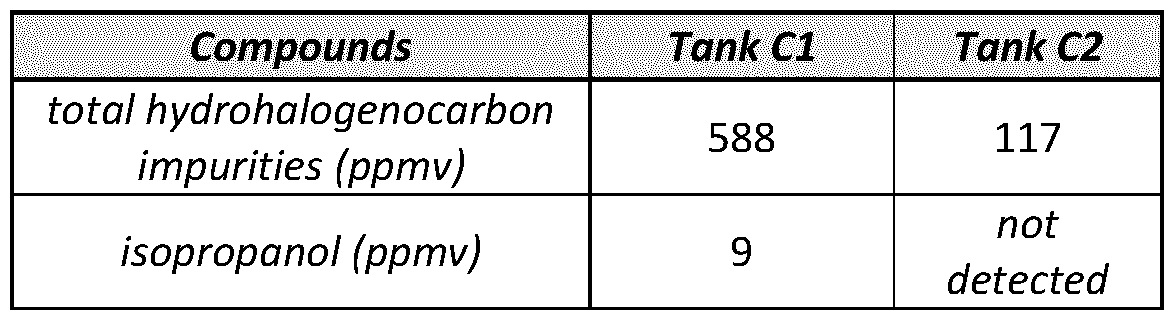
Table 1 : Analysis results
Claims
1. A process for the purification of hexafluoro- 1,3 -butadiene comprising a step wherein a gaseous mixture comprising hexafluoro- 1,3 -butadiene is contacted with at least two different adsorbents to purify said gas mixture, wherein the at least two different adsorbents each have an average pore size of above 6 A.
2. The process according to claim 1 wherein the at least two different adsorbents each have an average pore size of above 6 A and equal to or lower than 100 A.
3. The process according to claim 1 or 2 wherein at least one of the at least two different adsorbents is silica gel, preferably a silica gel with an average pore size of 10 to 50 A.
4. The process according to any one of the aforementioned claims wherein at least one of the at least two different adsorbents is a zeolite, preferably a molecular sieve 13X zeolite.
5. The process according to any one of the aforementioned claims wherein the at least two different adsorbents comprise one zeolite and one silica gel.
6. The process according to claim 5 wherein the gaseous mixture is first purified with the silica gel and subsequently purified with the zeolite.
7. The process according to any one of the aforementioned claims wherein the gaseous mixture is contacted with the at least two different adsorbents at an initial pressure of equal to or above 100 mbar (abs.) and equal to or below 2000 mbar (abs.).
8. The process of any one of the aforementioned claims wherein the gaseous mixture is contacted with the at least two different adsorbents at an initial temperature of equal to or above 5°C and equal to or below 40°C.
9. The process according to any one of the aforementioned claims wherein the gaseous mixture is contacted with the at least two different
adsorbents at a flow rate of equal to or above 2 g/min and equal to or below 200 g/min.
10. The process according to any one of the aforementioned claims wherein the at least two different adsorbents are present in different zones in the same adsorber cartridge.
11. The proces according to any one of claim 1 to 9 wherein the at least two different adsorbents are present in two different adsorber cartridges.
12. The process according to any one of the aforementioned claims wherein at least one of the adsorbents is pre-treated before being contacted with the gaseous mixture.
13. A process for the production of a gas mixture comprising the process according to any one of the aforementioned claims and subsequently, mixing the purified hexafluoro- 1,3 -butadiene with a further gas selected from the group consisting of an inert gas, oxygen and another fluorinated etching gas.
14. A gas mixture comprising hexafluoro- 1,3 -butadiene and at least one further gas selected from the group consisting of an inert gas, oxygen and another fluorinated etching gas.
15. A process for the production of a semiconductor material, a solar panel, a flat panel or a microelectromechanical system, or a process for cleaning the chamber of an apparatus used for semiconductor manufacturing, using the hexafluoro- 1,3 -butadiene purified according to any of the claims 1 to 12 or the gas mixture according to claim 14.
Priority Applications (1)
| Application Number | Priority Date | Filing Date | Title |
|---|---|---|---|
| CN202080007712.XA CN113227023A (en) | 2019-02-11 | 2020-01-29 | Process for purifying fluorinated olefins |
Applications Claiming Priority (2)
| Application Number | Priority Date | Filing Date | Title |
|---|---|---|---|
| EP19156412.9 | 2019-02-11 | ||
| EP19156412.9A EP3693353A1 (en) | 2019-02-11 | 2019-02-11 | A process for the purification of fluorinated olefins |
Publications (1)
| Publication Number | Publication Date |
|---|---|
| WO2020164912A1 true WO2020164912A1 (en) | 2020-08-20 |
Family
ID=65408945
Family Applications (1)
| Application Number | Title | Priority Date | Filing Date |
|---|---|---|---|
| PCT/EP2020/052144 Ceased WO2020164912A1 (en) | 2019-02-11 | 2020-01-29 | A process for the purification of fluorinated olefins |
Country Status (3)
| Country | Link |
|---|---|
| EP (1) | EP3693353A1 (en) |
| CN (1) | CN113227023A (en) |
| WO (1) | WO2020164912A1 (en) |
Cited By (3)
| Publication number | Priority date | Publication date | Assignee | Title |
|---|---|---|---|---|
| CN112266318A (en) * | 2020-11-20 | 2021-01-26 | 苏州金宏气体股份有限公司 | Method for purifying hexafluoro-1, 3-butadiene in grading manner |
| WO2022069435A1 (en) | 2020-10-02 | 2022-04-07 | Solvay Sa | A process for the purification of fluorinated olefins |
| WO2022069434A1 (en) | 2020-10-02 | 2022-04-07 | Solvay Sa | A process for the purification of fluorinated olefins in gas phase |
Families Citing this family (1)
| Publication number | Priority date | Publication date | Assignee | Title |
|---|---|---|---|---|
| CN114878749A (en) * | 2022-05-09 | 2022-08-09 | 南京理工大学北方研究院 | Alkene thing purity detection device for pharmaceutical chemicals |
Citations (6)
| Publication number | Priority date | Publication date | Assignee | Title |
|---|---|---|---|---|
| US5417742A (en) * | 1993-12-03 | 1995-05-23 | The Boc Group, Inc. | Removal of perfluorocarbons from gas streams |
| WO2001083412A2 (en) * | 2000-04-28 | 2001-11-08 | Showa Denko K. K. | Method for purification of tetrafluoromethane and use thereof |
| US6403491B1 (en) * | 2000-11-01 | 2002-06-11 | Applied Materials, Inc. | Etch method using a dielectric etch chamber with expanded process window |
| EP1329442A1 (en) | 2002-01-16 | 2003-07-23 | Air Products And Chemicals, Inc. | Purification of hexafluoro-1,3-butadiene |
| CN108276246A (en) * | 2018-02-08 | 2018-07-13 | 浙江博瑞电子科技有限公司 | A kind of method that hexachlorobutadiene is refined |
| CN108623432A (en) * | 2018-06-19 | 2018-10-09 | 宇极(廊坊)新材料有限公司 | A kind of technique that high-purity hexafluoro-1,3-butadiene is prepared using absorption-low temperature rectification method |
Family Cites Families (1)
| Publication number | Priority date | Publication date | Assignee | Title |
|---|---|---|---|---|
| CN109180424B (en) * | 2017-12-29 | 2021-02-19 | 中船重工(邯郸)派瑞特种气体有限公司 | Purification method and purification device of hexafluorobutadiene |
-
2019
- 2019-02-11 EP EP19156412.9A patent/EP3693353A1/en not_active Withdrawn
-
2020
- 2020-01-29 CN CN202080007712.XA patent/CN113227023A/en active Pending
- 2020-01-29 WO PCT/EP2020/052144 patent/WO2020164912A1/en not_active Ceased
Patent Citations (6)
| Publication number | Priority date | Publication date | Assignee | Title |
|---|---|---|---|---|
| US5417742A (en) * | 1993-12-03 | 1995-05-23 | The Boc Group, Inc. | Removal of perfluorocarbons from gas streams |
| WO2001083412A2 (en) * | 2000-04-28 | 2001-11-08 | Showa Denko K. K. | Method for purification of tetrafluoromethane and use thereof |
| US6403491B1 (en) * | 2000-11-01 | 2002-06-11 | Applied Materials, Inc. | Etch method using a dielectric etch chamber with expanded process window |
| EP1329442A1 (en) | 2002-01-16 | 2003-07-23 | Air Products And Chemicals, Inc. | Purification of hexafluoro-1,3-butadiene |
| CN108276246A (en) * | 2018-02-08 | 2018-07-13 | 浙江博瑞电子科技有限公司 | A kind of method that hexachlorobutadiene is refined |
| CN108623432A (en) * | 2018-06-19 | 2018-10-09 | 宇极(廊坊)新材料有限公司 | A kind of technique that high-purity hexafluoro-1,3-butadiene is prepared using absorption-low temperature rectification method |
Cited By (5)
| Publication number | Priority date | Publication date | Assignee | Title |
|---|---|---|---|---|
| WO2022069435A1 (en) | 2020-10-02 | 2022-04-07 | Solvay Sa | A process for the purification of fluorinated olefins |
| WO2022069434A1 (en) | 2020-10-02 | 2022-04-07 | Solvay Sa | A process for the purification of fluorinated olefins in gas phase |
| CN116323525A (en) * | 2020-10-02 | 2023-06-23 | 索尔维公司 | Process for purifying fluorinated olefins in the gas phase |
| CN116348439A (en) * | 2020-10-02 | 2023-06-27 | 索尔维公司 | Process for purifying fluorinated olefins |
| CN112266318A (en) * | 2020-11-20 | 2021-01-26 | 苏州金宏气体股份有限公司 | Method for purifying hexafluoro-1, 3-butadiene in grading manner |
Also Published As
| Publication number | Publication date |
|---|---|
| EP3693353A1 (en) | 2020-08-12 |
| CN113227023A (en) | 2021-08-06 |
Similar Documents
| Publication | Publication Date | Title |
|---|---|---|
| EP3693353A1 (en) | A process for the purification of fluorinated olefins | |
| EP2303819B1 (en) | Process for the purification of 2,3,3,3-tetrafluoro-1-propene (hfo-1234yf) | |
| JP3866663B2 (en) | Hexafluoro-1,3-butadiene purification method | |
| TWI816959B (en) | Purification method of hexafluorobutadiene | |
| JP6203654B2 (en) | Hydrogen chloride purification method and hydrogen chloride purification apparatus | |
| US20250269315A1 (en) | A process for the purification of fluorinated olefins in gas phase | |
| JP7628627B2 (en) | Selective adsorption of halocarbon impurities containing Cl, Br and I in fluorocarbons or hydrofluorocarbons using metal oxide supported sorbents - Patent Application 20070233633 | |
| JP6298676B2 (en) | Hydrogen chloride purification method | |
| JPH0692879A (en) | Method for purifying pentafluoroethane | |
| US20240025825A1 (en) | A process for the purification of fluorinated olefins | |
| CN102101822B (en) | Liquid phase purification method for 1,1- difluoroethane | |
| JP4820596B2 (en) | Nitric oxide purification method | |
| WO2016075033A1 (en) | Process for removing a small-molecule contaminant from a chlorine compound stream | |
| RU2789056C1 (en) | Method for purifying hexafluorobutadiene | |
| EP2876099B1 (en) | Norbornadiene purification method |
Legal Events
| Date | Code | Title | Description |
|---|---|---|---|
| 121 | Ep: the epo has been informed by wipo that ep was designated in this application |
Ref document number: 20702121 Country of ref document: EP Kind code of ref document: A1 |
|
| NENP | Non-entry into the national phase |
Ref country code: DE |
|
| 122 | Ep: pct application non-entry in european phase |
Ref document number: 20702121 Country of ref document: EP Kind code of ref document: A1 |