WO2020162512A1 - テトラフルオロエチレン重合体の製造方法及び組成物 - Google Patents
テトラフルオロエチレン重合体の製造方法及び組成物 Download PDFInfo
- Publication number
- WO2020162512A1 WO2020162512A1 PCT/JP2020/004426 JP2020004426W WO2020162512A1 WO 2020162512 A1 WO2020162512 A1 WO 2020162512A1 JP 2020004426 W JP2020004426 W JP 2020004426W WO 2020162512 A1 WO2020162512 A1 WO 2020162512A1
- Authority
- WO
- WIPO (PCT)
- Prior art keywords
- group
- carbon atoms
- polymer
- acid
- preferable
- Prior art date
- Legal status (The legal status is an assumption and is not a legal conclusion. Google has not performed a legal analysis and makes no representation as to the accuracy of the status listed.)
- Ceased
Links
- 0 CC(C)(*)NCC=* Chemical compound CC(C)(*)NCC=* 0.000 description 2
Classifications
-
- C—CHEMISTRY; METALLURGY
- C08—ORGANIC MACROMOLECULAR COMPOUNDS; THEIR PREPARATION OR CHEMICAL WORKING-UP; COMPOSITIONS BASED THEREON
- C08F—MACROMOLECULAR COMPOUNDS OBTAINED BY REACTIONS ONLY INVOLVING CARBON-TO-CARBON UNSATURATED BONDS
- C08F14/00—Homopolymers and copolymers of compounds having one or more unsaturated aliphatic radicals, each having only one carbon-to-carbon double bond, and at least one being terminated by a halogen
- C08F14/18—Monomers containing fluorine
- C08F14/26—Tetrafluoroethene
-
- C—CHEMISTRY; METALLURGY
- C08—ORGANIC MACROMOLECULAR COMPOUNDS; THEIR PREPARATION OR CHEMICAL WORKING-UP; COMPOSITIONS BASED THEREON
- C08F—MACROMOLECULAR COMPOUNDS OBTAINED BY REACTIONS ONLY INVOLVING CARBON-TO-CARBON UNSATURATED BONDS
- C08F2/00—Processes of polymerisation
- C08F2/44—Polymerisation in the presence of compounding ingredients, e.g. plasticisers, dyestuffs, fillers
-
- C—CHEMISTRY; METALLURGY
- C08—ORGANIC MACROMOLECULAR COMPOUNDS; THEIR PREPARATION OR CHEMICAL WORKING-UP; COMPOSITIONS BASED THEREON
- C08L—COMPOSITIONS OF MACROMOLECULAR COMPOUNDS
- C08L27/00—Compositions of homopolymers or copolymers of compounds having one or more unsaturated aliphatic radicals, each having only one carbon-to-carbon double bond, and at least one being terminated by a halogen; Compositions of derivatives of such polymers
- C08L27/02—Compositions of homopolymers or copolymers of compounds having one or more unsaturated aliphatic radicals, each having only one carbon-to-carbon double bond, and at least one being terminated by a halogen; Compositions of derivatives of such polymers not modified by chemical after-treatment
- C08L27/12—Compositions of homopolymers or copolymers of compounds having one or more unsaturated aliphatic radicals, each having only one carbon-to-carbon double bond, and at least one being terminated by a halogen; Compositions of derivatives of such polymers not modified by chemical after-treatment containing fluorine atoms
- C08L27/18—Homopolymers or copolymers or tetrafluoroethene
-
- C—CHEMISTRY; METALLURGY
- C08—ORGANIC MACROMOLECULAR COMPOUNDS; THEIR PREPARATION OR CHEMICAL WORKING-UP; COMPOSITIONS BASED THEREON
- C08L—COMPOSITIONS OF MACROMOLECULAR COMPOUNDS
- C08L33/00—Compositions of homopolymers or copolymers of compounds having one or more unsaturated aliphatic radicals, each having only one carbon-to-carbon double bond, and only one being terminated by only one carboxyl radical, or of salts, anhydrides, esters, amides, imides or nitriles thereof; Compositions of derivatives of such polymers
- C08L33/02—Homopolymers or copolymers of acids; Metal or ammonium salts thereof
-
- C—CHEMISTRY; METALLURGY
- C08—ORGANIC MACROMOLECULAR COMPOUNDS; THEIR PREPARATION OR CHEMICAL WORKING-UP; COMPOSITIONS BASED THEREON
- C08L—COMPOSITIONS OF MACROMOLECULAR COMPOUNDS
- C08L41/00—Compositions of homopolymers or copolymers of compounds having one or more unsaturated aliphatic radicals, each having only one carbon-to-carbon double bond, and at least one being terminated by a bond to sulfur or by a heterocyclic ring containing sulfur; Compositions of derivatives of such polymers
-
- C—CHEMISTRY; METALLURGY
- C08—ORGANIC MACROMOLECULAR COMPOUNDS; THEIR PREPARATION OR CHEMICAL WORKING-UP; COMPOSITIONS BASED THEREON
- C08L—COMPOSITIONS OF MACROMOLECULAR COMPOUNDS
- C08L43/00—Compositions of homopolymers or copolymers of compounds having one or more unsaturated aliphatic radicals, each having only one carbon-to-carbon double bond, and containing boron, silicon, phosphorus, selenium, tellurium or a metal; Compositions of derivatives of such polymers
- C08L43/02—Homopolymers or copolymers of monomers containing phosphorus
Definitions
- the present disclosure relates to methods and compositions for making tetrafluoroethylene polymers.
- Patent Document 1 discloses a method for producing a polymer in an aqueous reaction medium, which comprises (a) at least one radical initiator, at least one non-fluorinated surfactant, and at least one monomer. Forming an aqueous emulsion; and (b) initiating the polymerization of the monomers: wherein the non-fluorinated surfactant is selected from the group consisting of polyvinylphosphonic acid, polyacrylic acid, polyvinylsulfonic acid and salts thereof. Manufacturing methods are described.
- Patent Document 2 is a method for producing a fluoropolymer, which comprises a step of polymerizing tetrafluoroethylene and vinylidene fluoride in the presence of a surfactant and an aqueous medium, wherein the surfactant comprises the following (A) to The production method is described in which it is at least one selected from the group consisting of (F).
- Surfactant (A) Formula: CX 2 ⁇ CFCF 2 —O—(CF(CF 3 )CF 2 O) n —CF(CF 3 )—Y (In the formula, each X is the same or different and represents F or H.
- n 0 or an integer of 1 to 10
- Y is —SO 3 M or —COOM
- M is H, NH 4 or an alkali metal
- a fluorine-containing anionic surfactant having 7 or less carbon atoms (excluding the fluorine-containing allyl ether compound).
- Surfactant (B) Group consisting of linear 1-alkanesulfonic acid having 7 to 20 carbon atoms, linear 2-alkanesulfonic acid having 7 to 20 carbon atoms, linear 1,2-alkanedisulfonic acid having 7 to 20 carbon atoms and salts thereof At least one alkanesulfonic acid or salt thereof selected from At least one non-fluorinated surfactant surfactant (D) selected from the group consisting of polyvinylphosphonic acid, polyacrylic acid, polyvinylsulfonic acid and salts thereof.
- E At least one surfactant selected from the group consisting of a non-fluorinated surfactant and a fluorinated surfactant having a molecular weight of less than 400, and a functional fluoropoly containing a fluoropolyoxyalkylene chain and a functional group.
- Ether surfactant F
- the present disclosure provides a novel manufacturing method capable of manufacturing a tetrafluoroethylene polymer.
- the present disclosure is a method for producing a tetrafluoroethylene polymer containing 40 mol% or more of polymerized units based on tetrafluoroethylene, and a step of polymerizing tetrafluoroethylene in an aqueous medium in the presence of the polymer (A).
- a method for producing a tetrafluoroethylene polymer which is at least one selected from the group consisting of salts thereof.
- the polymer (A) is preferably a polymer containing polymerized units based on (meth)acrylic acid or a salt thereof. Further, the content of the polymer units based on (meth)acrylic acid in the polymer containing polymer units based on (meth)acrylic acid is preferably 50 mol% or more.
- the amount of the polymer (A) is preferably 0.0001 to 10 mass% with respect to the aqueous medium.
- the step (I) is preferably a step performed in the presence of a redox initiator.
- the step (I) is a step of obtaining particles containing polymerized units based on tetrafluoroethylene, and the production method of the present disclosure further includes tetrafluoroethylene in an aqueous medium containing the particles obtained in step (I). It is preferable to include the step (II) of polymerizing
- the step (I) is preferably a step of obtaining an aqueous dispersion having a particle concentration of 20% by mass or less.
- the step (II) is preferably a step performed in the presence of an oil-soluble radical polymerization initiator or a water-soluble radical polymerization initiator.
- the tetrafluoroethylene polymer is preferably a perfluoropolymer, more preferably polytetrafluoroethylene, and further preferably modified polytetrafluoroethylene.
- step (I) or step (II) is preferably carried out substantially in the absence of a fluorinated surfactant.
- the above step (I) is preferably performed in the presence of a hydrocarbon surfactant.
- the hydrocarbon surfactant is preferably a carboxylic acid ammonium salt.
- the present disclosure also includes a tetrafluoroethylene polymer containing 40 mol% or more of polymer units based on tetrafluoroethylene, and a polymer (A), wherein the polymer (A) is vinylphosphonic acid, vinylsulfonic acid, And a polymer containing polymerized units based on (meth)acrylic acid, and at least one selected from the group consisting of salts thereof.
- the polymer (A) is preferably a polymer containing polymer units based on (meth)acrylic acid or a salt thereof.
- the content of the polymer unit based on (meth)acrylic acid in the polymer containing the polymer unit based on (meth)acrylic acid is preferably 50 mol% or more.
- the content of the polymer (A) is preferably 10% by mass or less based on the tetrafluoroethylene polymer.
- the tetrafluoroethylene polymer is preferably a perfluoropolymer, more preferably polytetrafluoroethylene, and further preferably modified polytetrafluoroethylene.
- composition of the present disclosure preferably has a standard specific gravity of 2.280 or less.
- composition of the present disclosure preferably contains substantially no fluorine-containing surfactant.
- composition of the present disclosure is preferably a powder.
- the production method of the present disclosure is a novel method capable of producing a tetrafluoroethylene polymer.
- the "organic group” means a group containing one or more carbon atoms, or a group formed by removing one hydrogen atom from an organic compound.
- Examples of the “organic group” are An alkyl group which may have one or more substituents, An alkenyl group which may have one or more substituents, An alkynyl group which may have one or more substituents, A cycloalkyl group which may have one or more substituents, A cycloalkenyl group which may have one or more substituents, A cycloalkadienyl group which may have one or more substituents, An aryl group which may have one or more substituents, An aralkyl group which may have one or more substituents, A non-aromatic heterocyclic group which may have one or more substituents, A heteroaryl group which may have one or more substituents, Cyano group, Formyl group, RaO-, RaCO-, RaSO 2 ⁇ , RaC
- an alkyl group which may have one or more substituents is preferable.
- the "substituent” means a substitutable group. Examples of the "substituent” include an aliphatic group, an aromatic group, a heterocyclic group, an acyl group, an acyloxy group, an acylamino group, an aliphatic oxy group, an aromatic oxy group, a heterocyclic oxy group, an aliphatic oxycarbonyl group.
- the above aliphatic group may be saturated or unsaturated, and may be a hydroxy group, an aliphatic oxy group, a carbamoyl group, an aliphatic oxycarbonyl group, an aliphatic thio group, an amino group, an aliphatic amino group. It may have an acylamino group, a carbamoylamino group, or the like.
- the aliphatic group include alkyl groups having a total carbon number of 1 to 8, preferably 1 to 4, such as methyl group, ethyl group, vinyl group, cyclohexyl group, carbamoylmethyl group and the like.
- aromatic group examples include a nitro group, a halogen atom, an aliphatic oxy group, a carbamoyl group, an aliphatic oxycarbonyl group, an aliphatic thio group, an amino group, an aliphatic amino group, an acylamino group and a carbamoylamino group. You may have.
- the aromatic group is an aryl group having 6 to 12 carbon atoms, preferably 6 to 10 total carbon atoms, for example, phenyl group, 4-nitrophenyl group, 4-acetylaminophenyl group, 4-methanesulfonylphenyl group. Etc.
- the heterocyclic group has a halogen atom, a hydroxy group, an aliphatic oxy group, a carbamoyl group, an aliphatic oxycarbonyl group, an aliphatic thio group, an amino group, an aliphatic amino group, an acylamino group, a carbamoylamino group, etc. May be.
- the heterocyclic group include a 5- to 6-membered heterocyclic ring having 2 to 12 and preferably 2 to 10 carbon atoms in total, such as 2-tetrahydrofuryl group and 2-pyrimidyl group.
- the acyl group is an aliphatic carbonyl group, an arylcarbonyl group, a heterocyclic carbonyl group, a hydroxy group, a halogen atom, an aromatic group, an aliphatic oxy group, a carbamoyl group, an aliphatic oxycarbonyl group, an aliphatic thio group, an amino group. It may have an aliphatic amino group, an acylamino group, a carbamoylamino group, or the like.
- acyl group examples include an acyl group having a total of 2 to 8 carbon atoms, preferably 2 to 4 carbon atoms, such as an acetyl group, a propanoyl group, a benzoyl group and a 3-pyridinecarbonyl group.
- the acylamino group may have an aliphatic group, an aromatic group, a heterocyclic group, etc., and has, for example, an acetylamino group, a benzoylamino group, a 2-pyridinecarbonylamino group, a propanoylamino group, etc. May be.
- the above-mentioned acylamino group is an acylamino group having 2 to 12 carbon atoms, preferably 2 to 8 carbon atoms, an alkylcarbonylamino group having 2 to 8 carbon atoms in total, such as acetylamino group, benzoylamino group, 2-pyridinecarbonylamino group. Group, a propanoylamino group and the like.
- the aliphatic oxycarbonyl group may be saturated or unsaturated, and may be a hydroxy group, an aliphatic oxy group, a carbamoyl group, an aliphatic oxycarbonyl group, an aliphatic thio group, an amino group, an aliphatic group. It may have an amino group, an acylamino group, a carbamoylamino group, or the like.
- Examples of the aliphatic oxycarbonyl group include alkoxycarbonyl groups having 2 to 8 and preferably 2 to 4 carbon atoms, such as methoxycarbonyl group, ethoxycarbonyl group and (t)-butoxycarbonyl group.
- the carbamoyl group may have an aliphatic group, an aromatic group, a heterocyclic group or the like.
- an unsubstituted carbamoyl group an alkylcarbamoyl group having a total carbon number of 2 to 9, preferably an unsubstituted carbamoyl group, an alkylcarbamoyl group having a total carbon number of 2 to 5, for example, an N-methylcarbamoyl group, Examples thereof include N,N-dimethylcarbamoyl group and N-phenylcarbamoyl group.
- the aliphatic sulfonyl group may be saturated or unsaturated, and is also a hydroxy group, an aromatic group, an aliphatic oxy group, a carbamoyl group, an aliphatic oxycarbonyl group, an aliphatic thio group, an amino group. It may have an aliphatic amino group, an acylamino group, a carbamoylamino group, or the like.
- Examples of the aliphatic sulfonyl group include an alkylsulfonyl group having 1 to 6 total carbon atoms, preferably 1 to 4 total carbon atoms, for example, a methanesulfonyl group.
- the aromatic sulfonyl group has a hydroxy group, an aliphatic group, an aliphatic oxy group, a carbamoyl group, an aliphatic oxycarbonyl group, an aliphatic thio group, an amino group, an aliphatic amino group, an acylamino group, a carbamoylamino group and the like. You may have.
- Examples of the aromatic sulfonyl group include arylsulfonyl groups having 6 to 10 carbon atoms in total, such as a benzenesulfonyl group.
- the amino group may have an aliphatic group, an aromatic group, a heterocyclic group, or the like.
- the acylamino group may have, for example, an acetylamino group, a benzoylamino group, a 2-pyridinecarbonylamino group, a propanoylamino group, or the like.
- the above-mentioned acylamino group is an acylamino group having a total of 2 to 12 carbon atoms, preferably a total of 2 to 8 carbon atoms, and more preferably an alkylcarbonylamino group having a total of 2 to 8 carbon atoms such as acetylamino group and benzoylamino.
- 2-pyridinecarbonylamino group, propanoylamino group and the like are examples of the alkylcarbonylamino group having a total of 2 to 8 carbon atoms.
- the aliphatic sulfonamide group, aromatic sulfonamide group, and heterocyclic sulfonamide group may be, for example, a methanesulfonamide group, a benzenesulfonamide group, a 2-pyridinesulfonamide group, or the like.
- the sulfamoyl group may have an aliphatic group, an aromatic group, a heterocyclic group, or the like.
- Examples of the sulfamoyl group include a sulfamoyl group, an alkylsulfamoyl group having 1 to 9 carbon atoms in total, a dialkylsulfamoyl group having 2 to 10 carbon atoms in total, and an arylsulfamoyl group having 7 to 13 carbon atoms in total.
- a heterocyclic sulfamoyl group having 2 to 12 carbon atoms more preferably a sulfamoyl group, an alkylsulfamoyl group having 1 to 7 carbon atoms, a dialkylsulfamoyl group having 3 to 6 carbon atoms, or a total carbon atom
- the aliphatic oxy group may be saturated or unsaturated, and may have a methoxy group, an ethoxy group, an i-propyloxy group, a cyclohexyloxy group, a methoxyethoxy group, or the like.
- Examples of the aliphatic oxy group include an alkoxy group having 1 to 8 carbon atoms, preferably 1 to 6 carbon atoms, such as a methoxy group, an ethoxy group, an i-propyloxy group, a cyclohexyloxy group and a methoxyethoxy group.
- the aromatic amino group and heterocyclic amino group are an aliphatic group, an aliphatic oxy group, a halogen atom, a carbamoyl group, a heterocyclic group condensed with the aryl group, an aliphatic oxycarbonyl group, preferably a total number of carbon atoms.
- the aliphatic thio group may be saturated or unsaturated, and is an alkylthio group having a total carbon number of 1 to 8, more preferably a total carbon number of 1 to 6, such as methylthio group and ethylthio group. , Carbamoylmethylthio group, t-butylthio group and the like.
- the carbamoylamino group may have an aliphatic group, an aryl group, a heterocyclic group or the like.
- Examples of the carbamoylamino group include a carbamoylamino group, an alkylcarbamoylamino group having a total of 2 to 9 carbon atoms, a dialkylcarbamoylamino group having a total of 3 to 10 carbon atoms, an arylcarbamoylamino group having a total of 7 to 13 carbon atoms, Heterocyclic carbamoylamino group having 3 to 12 carbon atoms, preferably carbamoylamino group, alkylcarbamoylamino group having 2 to 7 carbon atoms, dialkylcarbamoylamino group having 3 to 6 carbon atoms, total carbon atom number 7-11 arylcarbamoylamino group, heterocyclic carbamoylamino group having 3-10 total carbon atoms, for
- a method for producing a tetrafluoroethylene (hereinafter also referred to as “TFE”) polymer of the present disclosure is a method for producing a TFE polymer containing 40 mol% or more of TFE-based polymerized units, wherein the polymer (A) Step (I) of polymerizing TFE in an aqueous medium in the presence of
- the polymer (A) is a polymer containing a polymerized unit based on at least one selected from the group consisting of vinylphosphonic acid, vinylsulfonic acid, and (meth)acrylic acid, and a salt thereof. It is at least one selected.
- the production method of the present disclosure uses the specific polymer (A) to produce a TFE polymer containing 40 mol% or more of TFE-based polymerized units without using a fluorine-containing surfactant. You can Moreover, the number of particles of the TFE polymer produced in the aqueous dispersion obtained by the production can be increased. Further, the yield of TFE polymer can be increased.
- the polymer (A) may be any one of vinylphosphonic acid, vinylphosphonate, vinylsulfonic acid, vinylsulfonate, (meth)acrylic acid, and a polymer unit based on (meth)acrylic acid. Good.
- the polymer (A) has a total content of polymer units based on vinylphosphonic acid, vinylphosphonate, vinylsulfonic acid, vinylsulfonate, (meth)acrylic acid and (meth)acrylic acid, It is preferably 50 mol% or more, more preferably 60 mol% or more, still more preferably 70 mol% or more, and further 80 mol% or more with respect to all polymerized units of (A).
- the total content of the polymerized units may be the total content of polymerized units based on vinylphosphonic acid and vinylphosphonate, or the total content of polymerized units based on vinylsulfonic acid and vinylsulfonate. It may be the total content of polymerized units based on (meth)acrylic acid and (meth)acrylic acid salt. Moreover, the said polymer (A) may contain the polymer unit based on the other monomer mentioned later.
- Examples of the polymer (A) include a polymer containing a polymer unit based on vinylphosphonic acid or a salt thereof, a polymer containing a polymer unit based on vinylsulfonic acid or a salt thereof, and a polymer unit based on (meth)acrylic acid. And a salt thereof, or the like.
- the polymer (A) is preferably a polymer containing polymerized units based on (meth)acrylic acid or a salt thereof.
- the polymer or a salt thereof containing a polymer unit based on (meth)acrylic acid contains a polymer unit based on at least one selected from the group consisting of acrylic acid, acrylic acid salt, methacrylic acid, and methacrylate. It is a polymer or a salt thereof and may contain polymerized units based on other monomers.
- polyacrylic acid a homopolymer of acrylic acid or a salt thereof
- polymethacrylic acid a homopolymer of methacrylic acid or a salt thereof
- a polymer of acrylic acid and methacrylic acid a polymer of acrylic acid and methacrylic acid.
- Polymer of acrylic acid and other monomer or salt thereof (5) Polymer of methacrylic acid and other monomer or salt thereof
- Acrylic acid and methacrylic acid and other Examples thereof include polymers with monomers or salts thereof.
- the polymer salt may be any salt in which at least one H of —COOH contained in a polymer unit based on acrylic acid or methacrylic acid is replaced with a cation, and all H may be replaced with cations. Alternatively, a part of H may be replaced with a cation.
- Examples of the other monomer include methyl acrylate, ethyl acrylate, butyl acrylate, 2-ethylhexyl acrylate, isobutyl acrylate, 2-methoxyethyl acrylate, 2-hydroxyethyl acrylate, cyclohexyl acrylate and dimethylaminoethyl acrylate.
- the polymer containing a polymerized unit based on (meth)acrylic acid or a salt thereof has the following general formula (A1): -[CH 2 CH(COOM)]- (A1) (Wherein, M represents, H, a metal atom, NR 7 4, which may imidazolium substituted, which may have an optionally substituted pyridinium or substituted phosphonium, R 7 is H or an organic group, which may be the same or different, and any two of them may be bonded to each other to form a ring), and The following general formula (A2): -[CH 2 C(CH 3 )(COOM)]- (A2) (Wherein, M represents, H, a metal atom, NR 7 4, which may imidazolium substituted, which may have an optionally substituted pyridinium or substituted phosphonium, R 7 is H or an organic group, which may be the same or different.
- any two of them may be bonded to each other to form a ring.). It preferably contains at least one polymerized unit.
- R 7 an alkyl group is preferable.
- R 7 the H or C 1-10 organic group is preferable, the H or C 1-4 organic group is more preferable, and the H or C 1-4 alkyl group is further preferable.
- the metal atom include monovalent and divalent metal atoms, alkali metal (group 1), alkaline earth metal (group 2) and the like, with Na, K or Li being preferred.
- the polymer containing a polymer unit based on (meth)acrylic acid or a salt thereof is selected from the group consisting of a polymer unit represented by the general formula (A1) and a polymer unit represented by the general formula (A2). It may contain at least one type of polymerized unit, and may further contain a polymerized unit based on the other monomer.
- the polymer containing a polymerized unit based on (meth)acrylic acid or a salt thereof preferably has a content of polymerized units based on (meth)acrylic acid and a salt thereof of 50 mol% or more.
- the content of polymerized units based on (meth)acrylic acid and salts thereof is more preferably 60 mol% or more, further preferably 70 mol% or more, still more preferably 80 mol% or more, particularly preferably 90 mol% or more. , 100 mol% is particularly preferred.
- the number average molecular weight of the polymer (A) is preferably 0.1 ⁇ 10 4 or more, more preferably 0.2 ⁇ 10 4 or more, further preferably 0.3 ⁇ 10 4 or more, and 0.4 ⁇ 10 4
- the above is particularly preferable, and 0.5 ⁇ 10 4 or more is particularly preferable.
- 1.0 ⁇ 10 8 or less is preferable, 5.0 ⁇ 10 7 or less is more preferable, 3.0 ⁇ 10 7 or less is further preferable, and 1.0 ⁇ 10 7 or less is particularly preferable. If the number average molecular weight is too low, the stability of the aqueous solution may become insufficient. If the number average molecular weight is too high, the polymer (A) may be partially precipitated, precipitated, clouded, or insolubilized due to storage or addition of other additives.
- the weight average molecular weight of the polymer (A) is preferably 0.2 ⁇ 10 4 or more, more preferably 0.4 ⁇ 10 4 or more, further preferably 0.6 ⁇ 10 4 or more, and 0.8 ⁇ 10 4
- the above is particularly preferable. Further, it is preferably 2.0 ⁇ 10 8 or less, more preferably 1.0 ⁇ 10 8 or less, further preferably 6.0 ⁇ 10 7 or less, particularly preferably 2.0 ⁇ 10 7 or less. If the weight average molecular weight is too low, the stability of the aqueous solution may be insufficient. If the weight average molecular weight is too high, the polymer (A) may be partially precipitated, precipitated, clouded, or insolubilized due to storage or addition of other additives.
- the number average molecular weight and the weight average molecular weight are values measured using a gel permeation chromatograph GPC.
- a gel permeation chromatograph GPC (Agilent 1260 Infinity II), a differential refractive index detector RI as a detector, a column of TSKgei GMPWXL 1 and a G3000PWXL 1 ( ⁇ 7.8 mm ⁇ 30 cm, manufactured by Tosoh Corporation).
- the solvent is 0.1 M Tris (0.1 M KCl, pH 9)/acetonitrile (8/2, vol/vol)
- the flow rate is 0.5 ml/min
- the column temperature is 28°C.
- the sample concentration at the time of implantation is 2.0 mg/ml.
- PEO Polyethylene oxide
- PEG polyethylene glycol
- the polymer (A) is water-soluble and exhibits a thickening property showing a dispersing ability, a chelating ability and a fluidity.
- the polymer (A) can be produced by a conventionally known method. Moreover, a commercial item can be used.
- specific examples of the polymer (A) include Eleminol MBN-2 (manufactured by Sanyo Kasei Co., Ltd.), Aron series (manufactured by Toagosei Co., Ltd.), AQUARIC L series (manufactured by Nippon Shokubai Co., Ltd.). , Viscoat (manufactured by Showa Denko KK) and the like. It can also be purchased from Fuji Film Wako Pure Chemical Industries, Ltd.
- the production method of the present disclosure includes the step (I) of polymerizing TFE in an aqueous medium in the presence of the polymer (A).
- the polymerization temperature and the polymerization pressure in the step (I) are appropriately determined depending on the type of the polymer (A) used, the molecular weight of the target TFE polymer, and the reaction rate.
- the polymerization temperature is preferably 10 to 150°C.
- the polymerization temperature is more preferably 30°C or higher, still more preferably 50°C or higher. Further, 120°C or lower is more preferable, and 100°C or lower is further preferable.
- the polymerization pressure is preferably 0.05 to 10 MPaG.
- the polymerization pressure is more preferably 0.3 MPaG or higher, further preferably 0.5 MPaG or higher, further preferably 5.0 MPaG or lower, and further preferably 3.0 MPaG or lower.
- 1.0 MPaG or more is preferable, 1.2 MPaG or more is more preferable, 1.5 MPaG or more is further preferable, 1.8 MPaG or more is further more preferable, 2.0 MPaG or more is particularly preferable. ..
- the lower limit of the amount of the polymer (A) used is preferably 0.0001% by mass, more preferably 0.001% by mass, and further preferably 0.01% by mass with respect to the aqueous medium. %, particularly preferably 0.1% by mass.
- the upper limit of the amount of the polymer (A) used is preferably 10% by mass, more preferably 5% by mass, further preferably 3% by mass, particularly preferably 2% by mass, based on the aqueous medium.
- the above-mentioned polymer (A) may be added to the reactor all at once before the start of polymerization, or may be added all at once after the start of polymerization, or may be added in multiple portions during the polymerization. Or may be added continuously during the polymerization.
- the amount of the polymer (A) at the start of polymerization is preferably 1 mass ppm or more based on the aqueous medium.
- the amount of the polymer (A) at the start of polymerization is preferably 10 mass ppm or more, more preferably 50 mass ppm or more, still more preferably 100 mass ppm or more, still more preferably 200 mass ppm or more.
- the upper limit is not particularly limited, for example, 100,000 mass ppm is preferable, and 50,000 mass ppm is more preferable.
- an aqueous dispersion liquid having a smaller average primary particle size and more excellent stability can be obtained.
- the step (I) may include a step of continuously adding the polymer (A).
- To continuously add the polymer (A) means, for example, to add the polymer (A) not in a lump, but over time and continuously or in a divided manner.
- the production method of the present disclosure can be efficiently carried out by using at least one kind of the polymer (A).
- two or more kinds of the polymer (A) may be used at the same time, or the step (I) may remain in a volatile material or a molded product made of the TFE polymer. If so, a surfactant may be used at the same time.
- the surfactant the hydrocarbon-based surfactant described below can be used.
- the polymerization reactor is charged with an aqueous medium, the polymer (A), TFE, and, if necessary, a monomer other than TFE, other additives, etc., and the contents of the reactor are charged. It can be carried out by stirring and maintaining the reactor at a predetermined polymerization temperature, and then adding a predetermined amount of a polymerization initiator to start the polymerization reaction. After the initiation of the polymerization reaction, TFE, a monomer other than TFE, a polymerization initiator, a chain transfer agent, the above-mentioned surfactant and the like may be additionally added depending on the purpose. You may add the said polymer (A) after a polymerization reaction starts.
- the polymerization initiator is not particularly limited as long as it can generate radicals in the above-mentioned polymerization temperature range, and known oil-soluble and/or water-soluble polymerization initiators can be used. Furthermore, the polymerization can be initiated as a redox in combination with a reducing agent or the like. The concentration of the polymerization initiator is appropriately determined depending on the type of monomer, the molecular weight of the target TFE polymer and the reaction rate.
- an oil-soluble radical polymerization initiator a water-soluble radical polymerization initiator or a redox initiator can be used.
- the oil-soluble radical polymerization initiator may be a known oil-soluble peroxide, for example, dialkyl peroxycarbonates such as diisopropyl peroxydicarbonate and disec-butyl peroxydicarbonate, t-butyl peroxycarbonate.
- dialkyl peroxycarbonates such as diisopropyl peroxydicarbonate and disec-butyl peroxydicarbonate, t-butyl peroxycarbonate.
- Peroxyesters such as isobutyrate and t-butylperoxypivalate, dialkylperoxides such as dit-butylperoxide and the like, di( ⁇ -hydro-dodecafluorohexanoyl)peroxide and di ( ⁇ -hydro-tetradecafluoroheptanoyl)peroxide, di( ⁇ -hydro-hexadecafluorononanoyl)peroxide, di(perfluorobutyryl)peroxide, di(perfluorovaleryl)peroxide, di (Perfluorohexanoyl)peroxide, di(perfluoroheptanoyl)peroxide, di(perfluorooctanoyl)peroxide, di(perfluorononanoyl)peroxide, di( ⁇ -chloro-hexafluorobutyryl) Peroxide, di( ⁇ -chloro-hexafluorobuty
- the water-soluble radical polymerization initiator may be a known water-soluble peroxide, and examples thereof include ammonium salts such as persulfate and percarbonate, potassium salts, sodium salts, organic peroxides such as disuccinic acid peroxide and diglutaric acid peroxide. Examples thereof include oxides, t-butyl permaleate and t-butyl hydroperoxide.
- a reducing agent such as sulfites may also be included together, and the amount thereof may be 0.1 to 20 times that of the peroxide.
- the polymerization initiator it is preferable to use a redox initiator in which an oxidizing agent and a reducing agent are combined. Therefore, it is preferable that the step (I) is a step performed in the presence of a redox initiator.
- persulfates such as ammonium persulfate and potassium persulfate; organic peroxides such as disuccinic acid peroxide and diglutaric acid peroxide; permanganate, ammonium permanganate, and alkali metal salts of permanganate, Permanganates such as alkaline earth metal salts of permanganates; manganese triacetate (C 6 H 9 MnO 6 ); cerium (IV) salts such as ammonium cerium nitrate and ammonium cerium sulfate; bromic acid, ammonium bromate, bromic acid And alkali metal salts of bromic acid, such as alkaline earth metal salts of bromic acid, and salts thereof.
- potassium permanganate is preferable.
- the reducing agent include dicarboxylic acids such as oxalic acid, malonic acid, succinic acid, and glutaric acid or salts thereof; bromic acid or salts thereof; diimines; and the like.
- dicarboxylic acid or its salt oxalic acid or its salt is preferable.
- bromic acid or a salt thereof potassium bromate is preferable.
- a copper salt and an iron salt to the combination of redox initiators.
- the copper salt include copper (II) sulfate
- the iron salt include iron (II) sulfate.
- the oxidizing agent is permanganic acid or a salt thereof, persulfate, manganese triacetate, cerium (IV) salt, or bromic acid or a salt thereof, and the reducing agent is a dicarboxylic acid or The salt or diimine is preferable. More preferably, the oxidizing agent is permanganic acid or its salt, persulfate, or bromic acid or its salt, and the reducing agent is dicarboxylic acid or its salt.
- the above combination is more preferably a combination of permanganic acid or a salt thereof and a dicarboxylic acid or a salt thereof, and particularly preferably a combination of potassium permanganate and oxalic acid.
- redox initiator examples include potassium permanganate/oxalic acid, potassium permanganate/ammonium oxalate, manganese triacetate/oxalic acid, manganese triacetate/ammonium oxalate, ammonium cerium nitrate/oxalic acid, ammonium cerium nitrate/ Combinations of ammonium oxalate and the like can be mentioned, with potassium permanganate/oxalic acid being particularly preferred.
- a redox initiator either the oxidizing agent or the reducing agent may be charged in the polymerization tank in advance, and then the other may be continuously or intermittently added to initiate the polymerization.
- potassium permanganate/oxalic acid when potassium permanganate/oxalic acid is used, it is preferable to charge oxalic acid into a polymerization tank and continuously add potassium permanganate thereto.
- potassium permanganate/oxalic acid means a combination of potassium permanganate and oxalic acid. The same applies to other compounds.
- the redox initiator By using the redox initiator in the above step (I), it is possible to increase the number of particles of the TFE polymer produced in the aqueous dispersion. Also, the yield of the TFE polymer can be increased.
- the redox initiator those described above can be used.
- the oxidizing agent and the reducing agent may be added all at once at the initial stage of polymerization, or the reducing agent may be added all at once at the initial stage of polymerization, and the oxidizing agent may be continuously added, The oxidizing agent may be added all at once at the initial stage of the polymerization, and the reducing agent may be continuously added, or both the oxidizing agent and the reducing agent may be continuously added.
- the amount of the polymerization initiator to be added is not particularly limited, but an amount (for example, several ppm vs. water concentration) at which the polymerization rate does not markedly decrease (eg, several ppm vs. water concentration) is collectively or sequentially or continuously at the initial stage of the polymerization. It may be added.
- the upper limit is a range in which the reaction temperature may be raised while removing heat from the polymerization reaction heat, and a more preferable upper limit is a range in which the polymerization reaction heat can be removed from the device surface.
- TFE and TFE may be polymerized.
- TFE and a fluoromonomer other than TFE may be polymerized
- TFE and a non-fluorine-containing monomer may be polymerized
- TFE and TFE may be polymerized.
- a fluoromonomer other than TFE and a non-fluorine-containing monomer may be polymerized.
- fluoromonomer other than TFE may be used as long as it can be copolymerized with TFE, and one having at least one double bond is preferable.
- fluoromonomers other than TFE include hexafluoropropylene [HFP], chlorotrifluoroethylene [CTFE], vinyl fluoride, vinylidene fluoride [VDF], trifluoroethylene, fluoroalkyl vinyl ether, fluoroalkyl ethylene, fluoroalkyl allyl.
- CF 2 CF-ORf 111
- Rf 111 represents a perfluoro organic group.
- Rf 121 is a perfluoroalkyl group having 1 to 5 carbon atoms
- General formula (130): CF 2 CFOCF 2 ORf 131 (In the formula, Rf 131 is a linear or branched perfluoroalkyl group having 1 to 6 carbon atoms, a cyclic perfluoroalkyl group having 5 to 6 carbon atoms, and 2 to 6 carbon atoms containing 1 to 3 oxygen atoms.
- CF 2 CFO (CF 2 CF (Y 141) O) m (CF 2) n F
- Y 141 represents a fluorine atom or a trifluoromethyl group
- m is an integer of 1 to 4
- n is an integer of 1 to 4.
- Y 151 represents a fluorine atom, a chlorine atom, a —SO 2 F group or a perfluoroalkyl group.
- the perfluoroalkyl group may contain an etheric oxygen and a —SO 2 F group. , And represents an integer of 0 to 3.
- the n Y 151 may be the same or different, Y 152 represents a fluorine atom, a chlorine atom or a —SO 2 F group, and m represents It represents an integer of 1 to 5.
- the m Y 152 may be the same or different, and A 151 represents —SO 2 X 151 , —COZ 151 or —POZ 152 Z 153 .
- X 151 represents F, Cl, Br, I, —OR 151 or —NR 152 R 153.
- Z 151 , Z 152 and Z 153 are the same or different and represent —NR 154 R 155 or —OR 156 .
- R 151 , R 152 , R 153 , R 154 , R 155 and R 156 are the same or different and represent H, ammonium, an alkali metal, an alkyl group optionally containing a fluorine atom, an aryl group or a sulfonyl-containing group. It is preferable that it is at least 1 sort(s) selected from the group which consists of a fluoromonomer represented by.
- the “perfluoroorganic group” means an organic group in which all hydrogen atoms bonded to carbon atoms are replaced with fluorine atoms.
- the perfluoro organic group may have ether oxygen.
- Examples of the fluoromonomer represented by the general formula (110) include fluoromonomers in which Rf 111 is a perfluoroalkyl group having 1 to 10 carbon atoms.
- the carbon number of the perfluoroalkyl group is preferably 1-5.
- Examples of the perfluoro organic group in the general formula (110) include a perfluoromethyl group, a perfluoroethyl group, a perfluoropropyl group, a perfluorobutyl group, a perfluoropentyl group and a perfluorohexyl group.
- Rf 111 is a perfluoro(alkoxyalkyl) group having 4 to 9 carbon atoms, and Rf 111 is the following formula:
- Rf 111 is a group represented by the following formula:
- n an integer of 1 to 4
- CF 2 CF-ORf 161
- Rf 161 represents a perfluoroalkyl group having 1 to 10 carbon atoms.
- a fluoromonomer represented by the formula is preferable.
- Rf 161 is preferably a perfluoroalkyl group having 1 to 5 carbon atoms.
- the fluoroalkyl vinyl ether is preferably at least one selected from the group consisting of fluoromonomers represented by the general formulas (160), (130) and (140).
- the fluoromonomer represented by the general formula (160) is preferably at least one selected from the group consisting of perfluoro(methyl vinyl ether), perfluoro(ethyl vinyl ether), and perfluoro(propyl vinyl ether), At least one selected from the group consisting of fluoro (methyl vinyl ether) and perfluoro (propyl vinyl ether) is more preferable.
- the fluoromonomer represented by the general formula (130) is selected from the group consisting of CF 2 ⁇ CFOCF 2 OCF 3 , CF 2 ⁇ CFOCF 2 OCF 2 CF 3 , and CF 2 ⁇ CFOCF 2 OCF 2 CF 2 OCF 3. It is preferable that it is at least one kind.
- fluoromonomer represented by the general formula (140) examples include CF 2 ⁇ CFOCF 2 CF(CF 3 )O(CF 2 ) 3 F and CF 2 ⁇ CFO(CF 2 CF(CF 3 )O) 2 (CF 2 ) 3 F and CF 2 ⁇ CFO(CF 2 CF(CF 3 )O) 2 (CF 2 ) 2 F are preferably at least one selected from the group consisting of:
- fluoromonomer represented by the general formula (100) a fluoromonomer in which Rf 101 is a linear fluoroalkyl group is preferable, and a fluoromonomer in which Rf 101 is a linear perfluoroalkyl group is more preferable.
- Rf 101 preferably has 1 to 6 carbon atoms.
- Rf 111 of the general formula (240 as a .Rf 111 is the same as Rf 111 of the general formula (110), perfluoro alkoxyalkyl group perfluoroalkyl group or a C1-C10 1 to 10 carbon atoms
- the fluoroalkyl allyl ether represented by the general formula (240) is preferably CF 2 ⁇ CF—CF 2 —O—CF 3 , CF 2 ⁇ CF—CF 2 —O—C 2 F 5 , CF 2 ⁇ CF. At least one selected from the group consisting of —CF 2 —O—C 3 F 7 and CF 2 ⁇ CF—CF 2 —O—C 4 F 9 is preferred, and CF 2 ⁇ CF—CF 2 —O—.
- CF 2 ⁇ CF—CF 2 —O—CF 2 CF 2 CF 3 is more preferred.
- fluorinated vinyl heterocyclic compound a compound represented by the general formula (230): (In the formula, X 231 and X 232 are independently F, Cl, a methoxy group, or a fluorinated methoxy group, and Y 231 is a formula Y 232 or a formula Y 233 .
- Z 231 and Z 232 are independently F or a fluorinated alkyl group having 1 to 3 carbon atoms.
- CX 181 2 CX 182 -R f 181 CHR 181 X 183
- X 181 and X 182 are independently a hydrogen atom, a fluorine atom or CH 3
- R f 181 is a fluoroalkylene group, a perfluoroalkylene group, a fluoro(poly)oxyalkylene group or a perfluoro(poly).
- R 181 is a hydrogen atom or CH 3
- X 183 is an iodine atom or a bromine atom.
- General formula (190): CX 191 2 CX 192 -R f 191 X 193
- X 191 and X 192 are independently a hydrogen atom, a fluorine atom or CH 3
- R f 191 is a fluoroalkylene group, a perfluoroalkylene group, a fluoropolyoxyalkylene group or a perfluoropolyoxyalkylene group
- X 193 is an iodine atom or a bromine atom
- General formula (200): CF 2 CFO(CF 2 CF(CF 3 )O) m (CF 2 ) n- X 201 (In the formula, m is an integer of 0 to 5, n is an integer of 1 to 3, X 201 is a cyano group
- Z 221 is a straight chain or a branched chain.
- C1-C18 alkylene group which may have an oxygen atom, C3-C18 cycloalkylene group, at least partially fluorinated C1-C10 alkylene group or oxyalkylene Group or -(Q) p -CF 2 O-(CF 2 CF 2 O) m (CF 2 O) n -CF 2 -(Q) p-
- Q is an alkylene group or an oxyalkylene group.
- p is 0 or 1.
- m/n is 0.2 to 5.
- the molecular weight is 500 to 10000 (par). It is a fluoropolyoxyalkylene group. It is preferably at least one selected from the group consisting of monomers represented by
- X 183 and X 193 are preferably iodine atoms.
- R f 181 and R f 191 are preferably perfluoroalkylene groups having 1 to 5 carbon atoms.
- R 181 is preferably a hydrogen atom.
- X 201 is preferably a cyano group, an alkoxycarbonyl group, an iodine atom, a bromine atom, or —CH 2 I.
- X 211 is preferably a cyano group, an alkoxycarbonyl group, an iodine atom, a bromine atom, or —CH 2 OH.
- Examples of the monomer that provides the crosslinking site include CF 2 ⁇ CFOCF 2 CF(CF 3 )OCF 2 CF 2 CN, CF 2 ⁇ CFOCF 2 CF(CF 3 )OCF 2 CF 2 COOH, CF 2 ⁇ CFOCF 2 CF(CF 3 ).
- non-fluorine-containing monomer examples include a hydrocarbon-based monomer having reactivity with the TFE.
- hydrocarbon-based monomer examples include alkenes such as ethylene, propylene, butylene and isobutylene; alkyl vinyl ethers such as ethyl vinyl ether, propyl vinyl ether, butyl vinyl ether, isobutyl vinyl ether and cyclohexyl vinyl ether; vinyl acetate, vinyl propionate, n.
- Vinyl esters such as vinyl, vinyl hydroxypropioate, vinyl hydroxybutyrate, vinyl hydroxyvalerate, vinyl hydroxyisobutyrate, vinyl hydroxycyclohexanecarboxylate; ethyl allyl ether, propyl allyl ether, butyl allyl ether, isobutyl allyl ether, Alkyl allyl ethers such as cyclohexyl allyl ether; alkyl allyl esters such as ethyl allyl ester, propyl allyl ester, butyl allyl ester, isobutyl allyl ester, cyclohexyl allyl ester and the like.
- the non-fluorine-containing monomer may also be a functional group-containing hydrocarbon-based monomer (excluding a monomer that provides a crosslinking site).
- the functional group-containing hydrocarbon monomer include hydroxyalkyl vinyl ethers such as hydroxyethyl vinyl ether, hydroxypropyl vinyl ether, hydroxybutyl vinyl ether, hydroxyisobutyl vinyl ether, and hydroxycyclohexyl vinyl ether; itaconic acid, succinic acid, succinic anhydride, and fumaric acid.
- Fluorine-free monomers having carboxyl groups such as acids, fumaric acid anhydride, crotonic acid, maleic acid, maleic anhydride, perfluorobutenoic acid; fluorine-free monomers having glycidyl groups such as glycidyl vinyl ether and glycidyl allyl ether; aminoalkyl Fluorine-free monomers having an amino group such as vinyl ether and aminoalkyl allyl ether; fluorine-free monomers having an amide group such as (meth)acrylamide and methylol acrylamide.
- Monomers other than the above TFE may be appropriately selected according to the desired TFE polymer, and those other than those exemplified above can be used.
- the TFE polymer is polytetrafluoroethylene
- a modified monomer described below can be used, and a melt-processable fluororesin described below and a monomer contained in a fluororubber can also be used.
- desired TFE polymer particles can be obtained by polymerizing TFE and, if necessary, one or more fluoromonomers and fluorine-free monomers other than TFE. ..
- the TFE polymer obtained by the production method of the present disclosure will be described in detail later.
- the aqueous medium is a reaction medium in which polymerization is performed and means a liquid containing water.
- the aqueous medium is not particularly limited as long as it contains water, and water, for example, a fluorine-free organic solvent such as alcohol, ether, and ketone, and/or a fluorine-containing organic solvent having a boiling point of 40° C. or lower. May be included.
- the step (I) is preferably a step of polymerizing tetrafluoroethylene in the substantial absence of a fluorine-containing surfactant.
- a fluorine-containing surfactant has been used for the polymerization of the TFE polymer, but the production method of the present disclosure uses the above-mentioned polymer (A) so that the fluorine-containing surfactant is not used.
- a TFE polymer can be obtained.
- “substantially in the absence of a fluorinated surfactant” means that the fluorinated surfactant is 10 mass ppm or less with respect to the aqueous medium, and preferably 1 mass ppm or less. Is more preferably 100 mass ppb or less, still more preferably 10 mass ppb or less, still more preferably 1 mass ppb or less.
- fluorine-containing surfactant examples include anionic fluorine-containing surfactant.
- the anionic fluorine-containing surfactant may be, for example, a surfactant containing a fluorine atom having a total carbon number of 20 or less in the portion excluding the anionic group.
- the above-mentioned fluorine-containing surfactant may also be a surfactant containing fluorine having a molecular weight of the anionic portion of 1,000 or less, more preferably 800 or less, and further preferably 600 or less.
- the "anionic portion” means the portion of the fluorine-containing surfactant excluding the cation. For example, in the case of F(CF 2 ) n1 COOM represented by the formula (I) described later, it is the “F(CF 2 ) n1 COO” portion.
- fluorine-containing surfactant examples include fluorine-containing surfactants having a LogPOW of 3.5 or less.
- the Log POW is a partition coefficient between 1-octanol and water, and Log P [wherein P is the octanol in the octanol/water (1:1) mixed solution containing the fluorine-containing surfactant in phase separation).
- P is the octanol in the octanol/water (1:1) mixed solution containing the fluorine-containing surfactant in phase separation.
- HPLC a calibration curve of each elution time and a known octanol/water partition coefficient is prepared, and based on this calibration curve, it is calculated from the elution time of HPLC in the sample solution.
- fluorine-containing surfactant examples include US Patent Application Publication No. 2007/0015864, US Patent Application Publication No. 2007/0015866, US Patent Application Publication No. 2007/0015866, and US Patents. Published Application No. 2007/0276103, United States Patent Application Publication No. 2007/0117914, United States Patent Application Publication No. 2007/142541, United States Patent Application Publication No. 2008/0015319, United States Patent No. 3250808.
- anionic fluorine-containing surfactant As the anionic fluorine-containing surfactant, the following general formula (N 0 ): X n0- Rf n0- Y 0 (N 0 ) (In the formula, X n0 is H, Cl or and F. Rf n0 has a carbon number of 3 to 20, and is a chain, branched chain or ring, and part or all of H is substituted with F. Is an alkylene group, which may contain one or more ether bonds, and some of H may be substituted with Cl. Y 0 is an anionic group.) Are listed. The anionic group of Y 0 may be —COOM, —SO 2 M, or —SO 3 M, or —COOM or —SO 3 M.
- M is H, a metal atom, NR 7 4 , imidazolium which may have a substituent, pyridinium which may have a substituent or phosphonium which may have a substituent, and R 7 Is H or an organic group.
- the metal atom include alkali metals (group 1), alkaline earth metals (group 2), and the like, and examples thereof include Na, K, and Li.
- R 7 may be an H or C 1-10 organic group, an H or C 1-4 organic group, or an H or C 1-4 alkyl group.
- M may be H, a metal atom or NR 7 4 and may be H, an alkali metal (Group 1), an alkaline earth metal (Group 2) or NR 7 4 , H, Na, K, Li or It may be NH 4 .
- Rf n0 may have 50% or more of H replaced with fluorine.
- Examples of the compound represented by the general formula (N 0 ) include The following general formula (N 1 ): X n0- (CF 2 ) m1- Y 0 (N 1 ) (In the formula, X n0 is H, Cl and F, m 1 is an integer of 3 to 15, and Y 0 is as defined above.), a compound represented by the following general formula (N 2 ): Rf n1 —O—(CF(CF 3 )CF 2 O) m2 CFX n1 —Y 0 (N 2 ) (In the formula, Rf n1 is a perfluoroalkyl group having 1 to 5 carbon atoms, m2 is an integer of 0 to 3, X n1 is F or CF 3 , and Y 0 is as defined above.
- Rf n2 is a partially or fully fluorinated alkyl group which may contain an ether bond having 1 to 13 carbon atoms
- m3 is an integer of 1 to 3
- Rf n3 is a linear chain.
- Y 0 is as defined above
- N 4 a compound represented by the following general formula (N 4 ).
- Rf n4 is a linear or branched partially or completely fluorinated alkyl group which may contain an ether bond having 1 to 12 carbon atoms, and Y n1 and Y n2 are the same or different.
- X n2 , X n3, and X n4 may be the same or different, and may be H, F, or a linear or branched part or complete which may contain an ether bond having 1 to 6 carbon atoms.
- Rf n5 is a linear or branched partially or completely fluorinated alkylene group which may contain an ether bond having 1 to 3 carbon atoms, and Lf is a linking group.
- Y 0 are as defined above, provided that the total carbon number of X n2 , X n3 , X n4 and Rf n5 is 18 or less.
- the compound represented by the above general formula (N 0 ) is more specifically a perfluorocarboxylic acid (I) represented by the following general formula (I), and ⁇ -H represented by the following general formula (II).
- the perfluorocarboxylic acid (I) is represented by the following general formula (I) F(CF 2 ) n1 COOM (I) (Wherein, n1 is 3 is an integer of ⁇ 14, M is H, a metal atom, NR 7 4, which may imidazolium substituted, pyridinium which may have a substituent or It is a phosphonium which may have a substituent, and R 7 is represented by H or an organic group.).
- ⁇ -H perfluorocarboxylic acid (II) is represented by the following general formula (II) H(CF 2 ) n2 COOM (II) (In the formula, n2 is an integer of 4 to 15 and M is as defined above.).
- the perfluoropolyethercarboxylic acid (III) has the following general formula (III) Rf 1 -O-(CF(CF 3 )CF 2 O) n3 CF(CF 3 )COOM (III) (In the formula, Rf 1 is a perfluoroalkyl group having 1 to 5 carbon atoms, n3 is an integer of 0 to 3, and M is as defined above.). ..
- the perfluoroalkylalkylenecarboxylic acid (IV) has the following general formula (IV) Rf 2 (CH 2 ) n4 Rf 3 COOM (IV) (In the formula, Rf 2 is a perfluoroalkyl group having 1 to 5 carbon atoms, Rf 3 is a linear or branched perfluoroalkylene group having 1 to 3 carbon atoms, and n4 is 1 to 3 It is an integer, and M is as defined above.).
- the alkoxyfluorocarboxylic acid (V) has the following general formula (V): Rf 4 -O-CY 1 Y 2 CF 2 -COOM (V) (In the formula, Rf 4 is a linear or branched partially or fully fluorinated alkyl group which may contain an ether bond having 1 to 12 carbon atoms, and Y 1 and Y 2 are the same or different. , H or F, and M is as defined above.).
- the perfluoroalkyl sulfonic acid (VI) has the following general formula (VI) F(CF 2 ) n5 SO 3 M (VI) (In the formula, n5 is an integer of 3 to 14, and M is as defined above.).
- ⁇ -H perfluorosulfonic acid has the following general formula (VII) H(CF 2 ) n6 SO 3 M (VII) (In the formula, n6 is an integer of 4 to 14, and M is as defined above.).
- the perfluoroalkylalkylene sulfonic acid (VIII) has the following general formula (VIII) Rf 5 (CH 2 ) n7 SO 3 M (VIII) (In the formula, Rf 5 is a perfluoroalkyl group having 1 to 13 carbon atoms, n7 is an integer of 1 to 3, and M is as defined above.). ..
- the alkylalkylenecarboxylic acid (IX) has the following general formula (IX) Rf 6 (CH 2 ) n8 COOM (IX) (In the formula, Rf 6 is a linear or branched partially or fully fluorinated alkyl group which may contain an ether bond having 1 to 13 carbon atoms, and n8 is an integer of 1 to 3, M is as defined above.).
- the fluorocarboxylic acid (X) is represented by the following general formula (X) Rf 7 -O-Rf 8 -O-CF 2 -COOM (X) (In the formula, Rf 7 is a linear or branched partially or fully fluorinated alkyl group which may contain an ether bond having 1 to 6 carbon atoms, and Rf 8 is 1 to 6 carbon atoms. It is a linear or branched partially or fully fluorinated alkyl group, and M is as defined above.).
- the above alkoxyfluorosulfonic acid (XI) has the following general formula (XI) Rf 9 -O-CY 1 Y 2 CF 2 -SO 3 M (XI) (In the formula, Rf 9 is a partially or completely fluorinated alkyl group which may have a linear or branched chain and may contain an ether bond having 1 to 12 carbon atoms, and Y 1 and Y 2 are the same or different and each is H or F, and M is as defined above.).
- the compound (XII) has the following general formula (XII):
- X 1 , X 2 and X 3 may be the same or different, and may be a linear or branched partial or fully fluorinated group which may contain H, F and an ether bond having 1 to 6 carbon atoms.
- Rf 10 is a perfluoroalkylene group having 1 to 3 carbon atoms
- L is a linking group
- Y 0 is an anionic group.
- Y 0 may be —COOM, —SO 2 M, or —SO 3 M, —SO 3 M, or COOM, where M is as defined above.
- Examples of L include a single bond, a partially or fully fluorinated alkylene group which may contain an ether bond having 1 to 10 carbon atoms.
- the compound (XIII) has the following general formula (XIII): Rf 11 —O—(CF 2 CF(CF 3 )O) n9 (CF 2 O) n10 CF 2 COOM (XIII) (In the formula, Rf 11 is a fluoroalkyl group having 1 to 5 carbon atoms including chlorine, n9 is an integer of 0 to 3, n10 is an integer of 0 to 3, and M is defined as above. It is represented by.). As the compound (XIII), CF 2 ClO(CF 2 CF(CF 3 )O) n9 (CF 2 O) n10 CF 2 COONH 4 (mixture having an average molecular weight of 750, wherein n 9 and n 10 are as defined above). There is).
- anionic fluorine-containing surfactant examples include a carboxylic acid-based fluorine-containing surfactant and a sulfonic acid-based fluorine-containing surfactant.
- the step (I) may be a step of polymerizing TFE to produce a TFE polymer having a content of polymerized units based on TFE of 40 mol% or more.
- the step (I) is also preferably a step of obtaining particles containing polymerized units based on TFE, and in that case, the production method of the present disclosure further includes an aqueous medium containing the particles obtained in step (I). It is preferable that the step (II) of polymerizing TFE is included therein.
- a TFE polymer having a content of polymerized units based on TFE of 40 mol% or more can be obtained.
- Increasing the number of TFE polymer particles by obtaining the particles in step (I) as described above and then polymerizing tetrafluoroethylene in an aqueous medium containing the particles obtained in step (I). Therefore, the yield can be increased.
- the step (II) may be performed using the aqueous dispersion liquid containing the particles obtained in the step (I) as it is.
- the step (II) may be performed by diluting or concentrating the aqueous dispersion liquid containing the particles obtained in the step (I).
- the above-mentioned dilution or concentration may be carried out as it is in the reactor, or the aqueous dispersion containing the particles obtained in step (I) may be recovered from the reactor. Therefore, the production method of the present disclosure may further include a step of collecting the aqueous dispersion containing the particles obtained in the step (I) after the step (I) and before the step (II). ..
- the step of adjusting the temperature of the aqueous dispersion containing the particles obtained in the step (I) to less than 50°C, less than 30°C or less than 10°C is included. But it's okay.
- the stirring can be stopped once, and then the stirring can be restarted to continuously perform the step (II).
- the stirring is stopped in some cases, the pressure in the reactor is changed, the stirring is restarted, and then the stirring is continued. Step (II) can be performed.
- the step (I) in order to change the monomer composition ratio of the reactor, after the step (I), the pressure of the reactor is depressurized to atmospheric pressure, and after charging each monomer into the reactor, the step (II) is continuously performed. May be. After the step (I), the polymerization temperature can be changed and the step (II) can be carried out subsequently.
- the production method of the present disclosure includes the step (II), it is particularly preferable to use a redox initiator in the step (I).
- the number of particles of the above particles can be increased by using a redox initiator.
- the step (I) is preferably a step of obtaining an aqueous dispersion having a particle concentration (solid content concentration) of 20.0% by mass or less. ..
- the solid content concentration is more preferably 15.0 mass% or less, still more preferably 10.0 mass% or less, still more preferably 8.0 mass% or less, and particularly preferably 5.0 mass%. % Or less.
- the solid content concentration is preferably 0.1% by mass or more, more preferably 0.3% by mass or more, further preferably 0.5% by mass or more, even more preferably 0.8% by mass or more, 1.0 A mass% or more is particularly preferable, and a mass% or more is particularly preferable.
- the particles are particles containing polymerized units based on TFE.
- the particles may have a TFE-based polymerized unit content of less than 40 mol% relative to all polymerized units constituting the polymer contained in the particles, but the TFE-based polymerized unit content may be 40 mol% or less. It is preferable to include the above.
- the content of polymerized units based on TFE is more preferably 50 mol% or more, more preferably 60 mol% or more, further preferably 70 mol% or more, further preferably 80 mol% or more, and 90 mol% or more. Are particularly preferred.
- the particles preferably contain 60 mol% or less of polymerized units based on a monomer other than TFE with respect to all polymerized units constituting the polymer contained in the particles.
- the content of polymerized units based on monomers other than TFE is preferably 50 mol% or less, more preferably 40 mol% or less, further preferably 30 mol% or less, further preferably 20 mol% or less, and 10 mol% or less. Very particularly preferred.
- the particles may have the same monomer composition ratio as that of (I) non-melt-processible fluororesin, (II) melt-processable fluororesin, (III) fluororubber, etc. described later.
- the above particles may be polytetrafluoroethylene in which the polymerized units based on TFE are 99.0 mass% or more and the polymerized units based on a monomer (modified monomer) other than TFE is 1.0 mass% or less. Particularly preferred.
- the polytetrafluoroethylene (PTFE) may be low molecular weight PTFE or high molecular weight PTFE. The low molecular weight PTFE and the high molecular weight PTFE will be described later.
- the above particles preferably have an average primary particle diameter of 300 nm or less, more preferably 200 nm or less, still more preferably 150 nm or less.
- the average primary particle diameter is preferably 0.1 nm or more, more preferably 1.0 nm or more, and further preferably 3.0 nm or more.
- the average primary particle diameter is measured by the dynamic light scattering method. The average primary particle diameter was adjusted to a fluoropolymer solid content concentration of about 1.0 mass% to prepare a fluoropolymer aqueous dispersion, which was used at 25° C. and a total of 70 times using ELSZ-1000S (manufactured by Otsuka Electronics Co., Ltd.). To measure.
- the refractive index of the solvent (water) is 1.3328, and the viscosity of the solvent (water) is 0.8878 mPa ⁇ s.
- the step (II) is a step of polymerizing TFE in an aqueous medium containing the particles.
- the step (II) may be a method in which only TFE is polymerized, and if it is a polymerization method capable of making the content of the polymerized units based on TFE of the TFE polymer produced to be 40 mol% or more, TFE is , TFE and at least one selected from the group consisting of fluoromonomers and non-fluorine-containing monomers.
- the fluoromonomer other than TFE and the non-fluorine-containing monomer the monomers described in step (I) can be appropriately used.
- the above-mentioned aqueous medium is a reaction medium for carrying out polymerization and means a liquid containing water.
- the aqueous medium is not particularly limited as long as it contains water, and water, for example, a fluorine-free organic solvent such as alcohol, ether, and ketone, and/or a fluorine-containing organic solvent having a boiling point of 40° C. or lower. May be included.
- the aqueous medium in step (II) preferably contains the aqueous medium contained in the aqueous dispersion containing the particles obtained in step (I).
- other aqueous medium may be added.
- the polymerization temperature and the polymerization pressure in the step (II) are appropriately determined depending on the kind of the monomer used, the molecular weight of the target TFE polymer and the reaction rate.
- the polymerization temperature is preferably 10 to 150°C.
- the polymerization temperature is more preferably 30°C or higher, still more preferably 50°C or higher. Further, 120°C or lower is more preferable, and 100°C or lower is further preferable.
- the polymerization pressure is preferably 0.05 to 10 MPaG.
- the polymerization pressure is more preferably 0.3 MPaG or higher, further preferably 0.5 MPaG or higher, further preferably 5.0 MPaG or lower, and further preferably 3.0 MPaG or lower. Particularly, from the viewpoint of improving the yield, 1.0 MPaG or more is preferable, and 2.0 MPaG or more is more preferable.
- the step (II) may be performed in the presence of the polymer (A) or in the absence of the polymer (A).
- the step (I) or the step (II) is preferably a step of polymerizing TFE in an aqueous medium containing the particles in the presence of a surfactant.
- the amount of the surfactant is preferably 0.0001 to 15% by mass based on the aqueous medium.
- a more preferable lower limit is 0.001% by mass, and a more preferable upper limit is 1% by mass. If it is less than 0.0001% by mass, the dispersing force may be insufficient, and if it exceeds 15% by mass, the effect commensurate with the added amount cannot be obtained.
- the amount of the surfactant added is appropriately determined depending on the type of the monomer used, the molecular weight of the target TFE polymer and the like.
- the above-mentioned surfactant may be added to the reaction vessel all at once before the start of polymerization, may be added all at once after the start of polymerization, or may be added in multiple portions during polymerization. Alternatively, it may be added continuously during the polymerization.
- the step (I) or step (II) preferably includes a step of continuously adding a surfactant.
- a surfactant continuously means, for example, to add the surfactant not all at once but with time and without interruption or division.
- the amount of the surfactant at the start of the polymerization is preferably 1 mass ppb or more with respect to the aqueous medium.
- the amount of the surfactant at the start of polymerization is preferably 10 mass ppb or more, more preferably 50 mass ppb or more, still more preferably 100 mass ppb or more, still more preferably 200 mass ppb or more. ..
- the upper limit is not particularly limited, for example, 100,000 mass ppm is preferable, and 50,000 mass ppm is more preferable.
- the amount of the surfactant at the start of polymerization is within the above range, an aqueous dispersion having a smaller average primary particle size and more excellent stability can be obtained. Also, the aspect ratio of the primary particles can be made smaller.
- the surfactant when the concentration of the TFE polymer formed in the aqueous medium is 5.0% by mass or less, the surfactant is added. It is preferred to start adding to the aqueous medium.
- the surfactant is more preferably started to be added when the concentration is 3.0% by mass or less, further preferably 2.0% by mass or less, and 1.5% by mass or less. It is even more preferable to start addition at a certain time, and it is particularly preferable to start addition at a content of 1.0% by mass or less.
- the addition when the above concentration is less than 0.60% by mass, more preferably to start the addition when it is 0.50% by mass or less, and the addition when it is 0.36% by mass or less. It is more preferable to start adding, when it is 0.30 mass% or less, it is more preferable to start adding, and when it is 0.20 mass% or less, it is particularly preferable to start adding, and 0.10 mass% It is particularly preferred to start adding when: Further, it is preferable to start the addition together with the initiation of the polymerization in the step (I) or the step (II). The above concentrations are based on the total of the aqueous medium and the TFE polymer.
- aqueous dispersion having a smaller average primary particle size and more excellent stability it is possible to obtain an aqueous dispersion having a smaller amount of uncoagulated polymer and more excellent stability. Also, an aqueous dispersion having a smaller amount of uncoagulated polymer can be obtained. Furthermore, the aspect ratio of the primary particles can be made smaller.
- the amount of the surfactant added is preferably 0.01 to 10% by mass with respect to 100% by mass of the aqueous medium.
- a more preferred lower limit is 0.05% by mass
- a still more preferred lower limit is 0.1% by mass
- a more preferred upper limit is 5% by mass
- a still more preferred upper limit is 1% by mass.
- an aqueous solution containing a hydrocarbon surfactant may be added.
- the pH of the aqueous solution containing the hydrocarbon surfactant is preferably 5.0 or higher, more preferably 6.0 or higher, and 6.5 or higher since the TFE polymer obtained tends to have a high molecular weight. Is more preferable, 7.0 or more is still more preferable, 7.5 or more is particularly preferable, and 8.0 or more is particularly preferable.
- the upper limit of pH is not particularly limited, but may be 12.0 or less, or 11.0 or less.
- the pH of the aqueous solution is preferably adjusted by adding aqueous ammonia to the aqueous solution containing the hydrocarbon surfactant.
- the surfactant examples include a fluorine-containing surfactant and a hydrocarbon-based surfactant, but are not limited as long as the TFE polymer can be obtained.
- the fluorine-containing surfactant examples include those exemplified in the above step (I).
- the hydrocarbon surfactant has a hydrophilic portion and a hydrophobic portion on the same molecule. These may be cationic, nonionic or anionic.
- the hydrocarbon-based surfactant is preferably a cationic hydrocarbon-based surfactant or an anionic hydrocarbon-based surfactant, more preferably an anionic hydrocarbon-based surfactant.
- Cationic hydrocarbon surfactants usually have a positively charged hydrophilic moiety such as an alkylated ammonium halide such as an alkylated ammonium bromide and a hydrophobic moiety such as a long chain fatty acid.
- the anionic hydrocarbon surfactant usually has a hydrophilic portion such as a carboxylate salt, a sulfonate salt or a sulfate salt, and a hydrophobic portion which is a long chain hydrocarbon portion such as alkyl.
- Nonionic hydrocarbon surfactants usually do not contain charged groups and have a hydrophobic moiety that is a long chain hydrocarbon.
- the hydrophilic portion of the nonionic hydrocarbon surfactant contains a water-soluble functional group such as a chain of ethylene ether derived from polymerization with ethylene oxide.
- nonionic hydrocarbon-based surfactants Polyoxyethylene alkyl ether, polyoxyethylene alkylphenyl ether, polyoxyethylene alkyl ester, sorbitan alkyl ester, polyoxyethylene sorbitan alkyl ester, glycerol ester and their derivatives.
- polyoxyethylene alkyl ethers polyoxyethylene lauryl ether, polyoxyethylene cetyl ether, polyoxyethylene stearyl ether, polyoxyethylene oleyl ether, polyoxyethylene behenyl ether and the like.
- polyoxyethylene alkyl phenyl ethers polyoxyethylene nonyl phenyl ether, polyoxyethylene octyl phenyl ether and the like.
- polyoxyethylene alkyl ester polyethylene glycol monolaurate, polyethylene glycol monooleate, polyethylene glycol monostearate and the like.
- sorbitan alkyl ester polyoxyethylene sorbitan monolaurate, polyoxyethylene sorbitan monopalmitate, polyoxyethylene sorbitan monostearate, polyoxyethylene sorbitan monooleate and the like.
- polyoxyethylene sorbitan alkyl ester polyoxyethylene sorbitan monolaurate, polyoxyethylene sorbitan monopalmitate, polyoxyethylene sorbitan monostearate and the like.
- glycerol ester glycerol monomyristate, glycerol monostearate, glycerol monooleate and the like.
- polyoxyethylene alkylamine polyoxyethylene alkylphenyl-formaldehyde condensate, polyoxyethylene alkyl ether phosphate and the like.
- the ethers and esters may have an HLB value of 10-18.
- nonionic hydrocarbon surfactant examples include Triton (registered trademark) X series (X15, X45, X100, etc.), Tergitol (registered trademark) 15-S series, and Tergitol (registered trademark) TMN manufactured by Dow Chemical Company. Series (TMN-6, TMN-10, TMN-100 etc.), Tergitol (registered trademark) L series, BASF Pluronic (registered trademark) R series (31R1, 17R2, 10R5, 25R4 (m-22, n... 23), T-Det series (A138), Iconol (registered trademark) TDA series (TDA-6, TDA-9, TDA-10) and the like.
- anionic hydrocarbon-based surfactant examples include Versatic (registered trademark) 10 of Resolution Performance Products, and Avane S series (S-70, S-74, etc.) manufactured by BASF.
- anionic hydrocarbon-based surfactant examples include RLM (wherein R is a linear or branched alkyl group having 1 or more carbon atoms which may have a substituent, or a substituted group). It is a cyclic alkyl group having 3 or more carbon atoms which may have a group, and when it has 3 or more carbon atoms, it may include a monovalent or divalent heterocycle, or may form a ring.
- RLM wherein R is a linear or branched alkyl group having 1 or more carbon atoms which may have a substituent, or a substituted group. It is a cyclic alkyl group having 3 or more carbon atoms which may have a group, and when it has 3 or more carbon atoms, it may include a monovalent or divalent heterocycle, or may form a ring.
- L is, -ArSO 3 -, -SO 3 - , -SO 4 -, - PO 3 - or -COO - a and, M is, H, a metal atom, NR 7 4, which may have a substituent Imidazolium, pyridinium which may have a substituent or phosphonium which may have a substituent, R 7 is H or an organic group, which may be the same or different, and any two of them are mutually different. They may combine with each other to form a ring.
- —ArSO 3 — is an aryl sulfonate.
- CH 3 —(CH 2 ) n —LM represented by lauric acid, lauryl sulfate (dodecyl sulfate), and the like (wherein, n is an integer of 6 to 17; L and L M is the same as above).
- a mixture of R is an alkyl group having 12 to 16 carbon atoms and LM is a sulfate can also be used.
- the anionic hydrocarbon-based surfactant include R 6 (-LM) 2 (wherein R 6 is a linear or branched alkylene which may have a substituent and has 1 or more carbon atoms).
- which may be .L is, -ArSO 3 -, -SO 3 - , -SO 4 -, - PO 3 - or -COO - a and, M is, H, a metal atom, NR 7 4, have a substituent
- Optionally substituted imidazolium, optionally substituted pyridinium or optionally substituted phosphonium, R 7 is H or an organic group, which may be the same or different, Two of them may combine with each other to form a ring.
- ArSO 3 — is an aryl sulfonate.
- anionic hydrocarbon surfactant examples include R 8 (-LM) 3 (in the formula, R 8 is a linear or branched alkylidyne having 1 or more carbon atoms which may have a substituent). Group or a cyclic alkylidyne group having 3 or more carbon atoms which may have a substituent, and when the number of carbon atoms is 3 or more, it may include a monovalent or divalent heterocycle, or forms a ring.
- R 7 is H or an organic group, which may be the same or different, Two of them may combine with each other to form a ring.
- —ArSO 3 — is an aryl sulfonate.
- R 7 is preferably H or an alkyl group, more preferably H or an alkyl group having 1 to 10 carbon atoms, further preferably H or an alkyl group having 1 to 4 carbon atoms.
- siloxane hydrocarbon-based surfactant a siloxane hydrocarbon-based surfactant can also be used.
- examples of the siloxane hydrocarbon surfactant include Silicone Surfactants, R.S. M. Hill, Marcel Dekker, Inc. , ISBN: 0-8247-00104.
- the structure of siloxane hydrocarbon-based surfactants includes distinct hydrophobic and hydrophilic moieties.
- the hydrophobic portion comprises one or more dihydrocarbylsiloxane units, where the substituents on the silicone atom are wholly hydrocarbon.
- siloxane hydrocarbon-based surfactants are considered to be hydrocarbon-based surfactants in the sense that the carbon atoms of the hydrocarbyl group can be completely replaced by hydrogen atoms when they can be replaced by halogens such as fluorine. It is also possible, ie the monovalent substituent on the carbon atom of the hydrocarbyl group is hydrogen.
- the hydrophilic portion of the siloxane hydrocarbon surfactant is sulfate, sulfonate, phosphonate, phosphate ester, carboxylate, carbonate, sulfosuccinate, taurate (as free acid, salt or ester), phosphine oxide, betaine, betaine. It may include one or more polar moieties containing ionic groups such as copolyols, quaternary ammonium salts and the like. The ionic hydrophobic portion may also include ionically functionalized siloxane grafts.
- siloxane hydrocarbon surfactants examples include polydimethylsiloxane-graft-(meth)acrylic acid salts, polydimethylsiloxane-graft-polyacrylate salts, and polydimethylsiloxane-grafted quaternary amines. ..
- the polar portion of the hydrophilic portion of the siloxane hydrocarbon surfactant is polyethylene oxide (PEO), and mixed polyethers such as polyethylene oxide/propylene oxide polyether (PEO/PPO); monosaccharides and disaccharides; and It may include nonionic groups formed by water-soluble heterocycles such as pyrrolidinone.
- the ratio of ethylene oxide to propylene oxide (EO/PO) can be varied in the mixed polyethylene oxide/propylene oxide polyether.
- the hydrophilic portion of the siloxane hydrocarbon-based surfactant may also include a combination of ionic and nonionic moieties.
- Such moieties include, for example, ionically end-functionalized or randomly functionalized polyethers or polyols.
- Preferred for carrying out the manufacturing method of the present disclosure is a siloxane having a nonionic portion, that is, a nonionic siloxane hydrocarbon-based surfactant.
- the arrangement of the hydrophobic and hydrophilic parts of the structure of the siloxane hydrocarbon-based surfactant is determined by the diblock polymer (AB), triblock polymer (ABA) (where “B” represents the siloxane part of the molecule), Alternatively, it may take the form of a multi-block polymer. Alternatively, the siloxane surfactant may include a graft polymer.
- Siloxane hydrocarbon surfactants are also disclosed in US Pat. No. 6,841,616.
- siloxane-based anionic hydrocarbon surfactant examples include Lubrizol Advanced Materials, Inc. From Noveon® Consumer Specialties, SilSense TM PE-100 Silicone, SilSense TM CA-1 Silicone, and the like.
- anionic hydrocarbon-based surfactant also include sulfosuccinate surfactant Lankropol (registered trademark) K8300 of Akzo Nobel Surface Chemistry LLC.
- sulfosuccinate hydrocarbon-based surfactant include sulfosuccinic acid diisodecyl Na salt, (Clariant's Emulsogen (registered trademark) SB10), sulfosuccinate diisotridecyl Na salt (Cesapinia Chemicals' Polyrol (registered trademark) TR/LNA), and the like.
- hydrocarbon-based surfactant examples include Omniva Solutions, Inc.
- PolyFox (registered trademark) surfactants PolyFox TM PF-156A, PolyFox TM PF-136A, etc.
- PolyFox TM PF-156A examples of the hydrocarbon-based surfactant
- PolyFox TM PF-136A examples of the hydrocarbon-based surfactant
- hydrocarbon-based surfactant examples include Omniva Solutions, Inc.
- PolyFox (registered trademark) surfactants PolyFox TM PF-156A, PolyFox TM PF-136A, etc.
- the hydrocarbon surfactant is preferably an anionic hydrocarbon surfactant.
- anionic hydrocarbon-based surfactant the above-mentioned ones can be adopted, but for example, the following anionic hydrocarbon-based surfactant can be preferably adopted.
- anionic hydrocarbon-based surfactant examples include the following formula ( ⁇ ): R 100 -COOM ( ⁇ ) (Wherein, R 100 is a is .M monovalent organic group containing 1 or more carbon atoms, H, a metal atom, NR 101 4, good imidazolium be substituted, substituted Is a pyridinium which may have a group or a phosphonium which may have a substituent, R 101 is H or an organic group, which may be the same or different. Can be mentioned.
- the organic group of R 101 is preferably an alkyl group.
- R 101 is preferably H or an organic group having 1 to 10 carbon atoms, more preferably H or an organic group having 1 to 4 carbon atoms, and further preferably H or an alkyl group having 1 to 4 carbon atoms.
- the carbon number of R 100 is preferably 2 or more, and more preferably 3 or more.
- the carbon number of R 100 is preferably 29 or less, more preferably 23 or less.
- the metal atom of M include an alkali metal (group 1) and an alkaline earth metal (group 2), and Na, K or Li is preferable.
- the M, H, a metal atom or NR 101 4 are preferable, H, an alkali metal (Group 1), alkaline earth metal (Group 2) or NR 101 4, more preferably, H, Na, K, Li or NH 4 Is more preferred, Na, K or NH 4 is even more preferred, Na or NH 4 is particularly preferred, and NH 4 is most preferred.
- Examples of the compound ( ⁇ ) include R 102 —COOM (wherein R 102 is a linear or branched alkyl group, alkenyl group, alkylene group having 1 or more carbon atoms which may have a substituent)
- R 102 is a linear or branched alkyl group, alkenyl group, alkylene group having 1 or more carbon atoms which may have a substituent
- the compound ( ⁇ ) may not contain a carbonyl group (excluding the carbonyl group in the carboxyl group).
- the hydrocarbon-containing surfactant containing no carbonyl group include the following formula (A): R 103 -COO-M (A) (In the formula, R 103 is an alkyl group, an alkenyl group, an alkylene group, or an alkenylene group having 6 to 17 carbon atoms, which may contain an ether bond.
- M is H, a metal atom, or NR.
- R 101 4 imidazolium which may have a substituent, pyridinium which may have a substituent, or phosphonium which may have a substituent, R 101 is the same or different,
- a compound represented by H or an organic group is preferably exemplified.
- R 103 is preferably an alkyl group or an alkenyl group (these may include an ether group).
- the alkyl group or alkenyl group for R 103 may be linear or branched.
- the carbon number of R 103 is not limited, but is, for example, 2 to 29.
- R 103 When the alkyl group is linear, R 103 preferably has 3 to 29 carbon atoms, and more preferably 5 to 23 carbon atoms. When the alkyl group is branched, the carbon number of R 103 is preferably 5 to 35, and more preferably 11 to 23. When the alkenyl group is linear, R 103 preferably has 2 to 29 carbon atoms, and more preferably 9 to 23 carbon atoms. When the alkenyl group is branched, R 103 preferably has 4 to 29 carbon atoms, and more preferably 9 to 23 carbon atoms.
- alkyl group and alkenyl group examples include a methyl group, an ethyl group, an isobutyl group, a t-butyl group, a vinyl group and the like.
- the compound ( ⁇ ) may be either a carboxylic acid or a carboxylic acid salt, but is preferably a carboxylic acid salt, more preferably an ammonium carboxylic acid salt.
- Examples of the compound ( ⁇ ) (carboxylic acid type hydrocarbon surfactant) include butyric acid, valeric acid, caproic acid, enanthic acid, caprylic acid, pelargonic acid, capric acid, lauric acid, myristic acid, pentadecyl acid.
- At least one selected from the group consisting of lauric acid, capric acid, myristic acid, pentadecyl acid, palmitic acid, and salts thereof is preferable.
- the salt include a hydrogen atom of a carboxyl group, a metal atom of the formula M described above, NR 101 4 , an imidazolium which may have a substituent, a pyridinium which may have a substituent, or a substituent.
- Examples thereof include phosphonium that may be contained, but are not particularly limited.
- surfactant ( ⁇ ) (carboxylic acid type hydrocarbon-based surfactant) particles having a small average primary particle size can be obtained by polymerization, and a large number of particles are generated during the polymerization to efficiently generate Since tetrafluoroethylene can be produced, lauric acid, capric acid, myristic acid, pentadecyl acid, palmitic acid, and at least one selected from the group consisting of these salts are preferable, and lauric acid and its salts are more preferable, Salts of lauric acid are particularly preferable, and sodium laurate and ammonium laurate are most preferable.
- R 1 ⁇ R 5 represents H or a monovalent substituent, provided that one of R 1 and R 3, at least one of the general formula: a group represented by -Y-R 6, R 2 At least one of R 5 and R 5 represents a group represented by the general formula: —XA, or a group represented by the general formula: —Y—R 6 .
- X is the same or different at each occurrence and is a divalent linking group or a bond;
- A is the same or different at each occurrence and is —COOM, —SO 3 M or —OSO 3 M (M is H, a metal atom, NR 7 4 , an imidazolium which may have a substituent, a substituent Optionally substituted pyridinium or optionally substituted phosphonium, R 7 is H or an organic group);
- Y is the same or different at each occurrence and is selected from the group consisting of —S( ⁇ O) 2 —, —O—, —COO—, —OCO—, —CONR 8 — and —NR 8 CO—.
- R 8 is H or an organic group
- R 6 is the same or different in each occurrence and is an alkyl group having 1 or more carbon atoms, which may contain at least one selected from the group consisting of a carbonyl group, an ester group, an amide group and a sulfonyl group between carbon atoms.
- the surfactant (hereinafter, also referred to as the surfactant (1)) represented by (4) is preferably exemplified.
- the surfactant (1) will be described.
- R 1 to R 5 represent H or a monovalent substituent, provided that at least one of R 1 and R 3 is a group represented by the general formula: —Y—R 6 , R 2 and At least one of R 5 represents a group represented by the general formula: —XA, or a group represented by the general formula: —Y—R 6 . Any two of R 1 to R 5 may be bonded to each other to form a ring.
- alkyl group as R 1 may have include a halogen atom, a linear or branched alkyl group having 1 to 10 carbon atoms, or a cyclic alkyl group having 3 to 10 carbon atoms, A hydroxy group is preferable, and a methyl group and an ethyl group are particularly preferable.
- the alkyl group as R 1 preferably contains no carbonyl group.
- 75% or less of hydrogen atoms bonded to carbon atoms may be replaced by halogen atoms, 50% or less may be replaced by halogen atoms, and 25% or less may be replaced by halogen atoms.
- it is preferably a non-halogenated alkyl group containing no halogen atom such as a fluorine atom and a chlorine atom.
- the alkyl groups preferably do not have any substituents.
- a linear or branched alkyl group having 1 to 10 carbon atoms which may have a substituent or a cyclic alkyl group having 3 to 10 carbon atoms which may have a substituent is preferable. More preferred is a linear or branched alkyl group having 1 to 10 carbon atoms that does not contain a carbonyl group, or a cyclic alkyl group having 3 to 10 carbon atoms that does not contain a carbonyl group, and the number of carbon atoms having no substituent.
- a straight-chain or branched-chain alkyl group having 1 to 10 is more preferable, a straight-chain or branched-chain alkyl group having 1 to 3 carbon atoms having no substituent is further more preferable, and a methyl group (—CH 3 ) or an ethyl group (—C 2 H 5 ) is particularly preferred, and a methyl group (—CH 3 ) is most preferred.
- the monovalent substituent includes a group represented by the general formula: —Y—R 6 , a group represented by the general formula: —XA, —H, and a C 1-20 optionally having a substituent.
- An alkyl group, —NH 2 , —NHR 9 (R 9 is an organic group), —OH, —COOR 9 (R 9 is an organic group) or —OR 9 (R 9 is an organic group) is preferable.
- the alkyl group preferably has 1 to 10 carbon atoms.
- a C 1-10 alkyl group or a C 1-10 alkylcarbonyl group is preferable, and a C 1-4 alkyl group or a C 1-4 alkylcarbonyl group is more preferable.
- X is the same or different at each occurrence and represents a divalent linking group or a bond.
- R 6 does not contain any of a carbonyl group, an ester group, an amide group and a sulfonyl group
- X is a divalent group containing at least one selected from the group consisting of a carbonyl group, an ester group, an amide group and a sulfonyl group.
- the linking group is preferably.
- X is —CO—, —S( ⁇ O) 2 —, —O—, —COO—, —OCO—, —S( ⁇ O) 2 —O—, —O—S( ⁇ O) 2 — ,
- a divalent linking group containing at least one bond selected from the group consisting of —CONR 8 — and —NR 8 CO—, a C 1-10 alkylene group, or a bond is preferred.
- R 8 represents H or an organic group.
- the organic group for R 8 is preferably an alkyl group.
- R 8 is preferably an H or C 1-10 organic group, more preferably an H or C 1-4 organic group, even more preferably an H or C 1-4 alkyl group, even more preferably an H group.
- A is the same or different at each occurrence and is —COOM, —SO 3 M or —OSO 3 M (M is H, a metal atom, NR 7 4 or an optionally substituted imidazolium. , Optionally substituted pyridinium or optionally substituted phosphonium, R 7 is H or an organic group, and four R 7's may be the same or different. .. In the general formula (1), it is one of the preferable embodiments that A is —COOM.
- the organic group for R 7 is preferably an alkyl group.
- R 7 is preferably an H or C 1-10 organic group, more preferably an H or C 1-4 organic group, and even more preferably an H or C 1-4 alkyl group.
- the metal atom include alkali metals (group 1), alkaline earth metals (group 2) and the like, with Na, K or Li being preferred.
- H a metal atom or NR 7 4 is preferable, H, an alkali metal (group 1), an alkaline earth metal (group 2) or NR 7 4 is more preferable, and H, Na, K, Li or NH 4 is used. Is more preferable, Na, K or NH 4 is still more preferable, Na or NH 4 is particularly preferable, and NH 4 is the most preferable.
- Y is the same or different at each occurrence and is selected from the group consisting of —S( ⁇ O) 2 —, —O—, —COO—, —OCO—, —CONR 8 — and —NR 8 CO—.
- R 8 represents H or an organic group.
- Y is preferably a divalent linking group selected from the group consisting of a bond, —O—, —COO—, —OCO—, —CONR 8 — and —NR 8 CO—, and a bond, —COO— And a divalent linking group selected from the group consisting of —OCO— is more preferred.
- the organic group for R 8 is preferably an alkyl group.
- R 8 is preferably an H or C 1-10 organic group, more preferably an H or C 1-4 organic group, even more preferably an H or C 1-4 alkyl group, even more preferably an H group.
- R 6 is the same or different at each occurrence and may have at least one selected from the group consisting of a carbonyl group, an ester group, an amide group and a sulfonyl group, which may have 1 or more carbon atoms between carbon atoms. Represents an alkyl group.
- the carbon number of the organic group of R 6 is preferably 1 or more, preferably 20 or less, more preferably 2 to 20, and further preferably 2 to 10.
- the alkyl group of R 6 contains at least one kind selected from the group consisting of a carbonyl group, an ester group, an amide group and a sulfonyl group between carbon-carbon atoms. However, these groups are not contained at both ends of the above alkyl group.
- the alkyl group for R 6 75% or less of hydrogen atoms bonded to carbon atoms may be substituted with halogen atoms, 50% or less may be substituted with halogen atoms, and 25% or less are halogen atoms.
- it may be substituted with, it is preferably a non-halogenated alkyl group containing no halogen atom such as a fluorine atom and a chlorine atom.
- R 6 A group represented by the general formula: -R 10 -CO-R 11 , A group represented by the general formula: —R 10 —COO—R 11 , General formula: a group represented by —R 11 , A group represented by the general formula: -R 10 -NR 8 CO-R 11 , or A group represented by the general formula: —R 10 —CONR 8 —R 11 , (In the formula, R 8 represents H or an organic group, R 10 is an alkylene group, and R 11 is an alkyl group which may have a substituent). As R 6 , a group represented by the general formula: —R 10 —CO—R 11 is more preferred.
- the organic group for R 8 is preferably an alkyl group.
- R 8 is preferably an H or C 1-10 organic group, more preferably an H or C 1-4 organic group, even more preferably an H or C 1-4 alkyl group, even more preferably an H group.
- the carbon number of the alkylene group of R 10 is preferably 1 or more, more preferably 3 or more, preferably 20 or less, more preferably 12 or less, further preferably 10 or less, and particularly preferably 8 or less.
- the alkylene group represented by R 10 preferably has 1 to 20 carbon atoms, more preferably has 1 to 10 carbon atoms, and further preferably has 3 to 10 carbon atoms.
- the alkyl group of R 11 may have 1 to 20 carbon atoms, preferably 1 to 15, more preferably 1 to 12, further preferably 1 to 10, further preferably 1 to 8, and 1 to 6 Particularly preferred, 1 to 3 is even more preferred, 1 or 2 is particularly preferred, and 1 is most preferred.
- the alkyl group for R 11 is preferably composed of only primary carbon, secondary carbon and tertiary carbon, and particularly preferably composed of only primary carbon and secondary carbon. That is, R 11 is preferably a methyl group, an ethyl group, an n-propyl group, or an isopropyl group, and most preferably a methyl group.
- R 2 and R 5 are a group represented by the general formula: —XA, and A is —COOM, which is also a preferred embodiment. is there.
- the surfactant (1) is preferably a compound represented by the general formula (1-1), a compound represented by the general formula (1-2) or a compound represented by the general formula (1-3), The compound represented by 1-1) or the compound represented by the general formula (1-2) is more preferable.
- -X-A includes -COOM, -R 12 COOM, -SO 3 M, -OSO 3 M, -R 12 SO 3 M, -R 12 OSO 3 M, -OCO-R 12 -COOM, -OCO-R 12 -SO 3 M, -OCO-R 12 -OSO 3 M -COO-R 12 -COOM, -COO-R 12 -SO 3 M, -COO-R 12 -OSO 3 M, -CONR 8 -R 12 -COOM, -CONR 8 -R 12 -SO 3 M, -CONR 8 -R 12 -OSO 3 M, -NR 8 CO-R 12 -COOM, -NR 8 CO-R 12 -SO 3 M, -NR 8 CO-R 12 -SO 3 M, -NR 8 CO-R 12 -SO 3 M, -NR 8 CO-R 12 -SO 3 M, -NR 8 CO-R 12 -SO 3 M,
- R 12 is a C 1-10 alkylene group.) is preferable.
- the alkylene group for R 12 75% or less of hydrogen atoms bonded to carbon atoms may be substituted with halogen atoms, 50% or less may be substituted with halogen atoms, and 25% or less are halogen atoms.
- it may be substituted with, it is preferably a non-halogenated alkylene group containing no halogen atom such as a fluorine atom and a chlorine atom.
- Examples of the group represented by the general formula: —Y—R 6 include A group represented by the general formula: -R 10 -CO-R 11 , General formula: a group represented by —OCO—R 10 —CO—R 11 , A group represented by the general formula: —COO—R 10 —CO—R 11 , A group represented by the general formula: -OCO-R 10 -COO-R 11 , A group represented by the general formula: —COO—R 11 , A group represented by the general formula: -NR 8 CO-R 10 -CO-R 11 , or The group represented by the general formula: —CONR 8 —R 10 —NR 8 CO—R 11 (wherein R 8 , R 10 and R 11 are as described above) is preferred.
- R 4 and R 5 are preferably independently H or a C 1-4 alkyl group.
- 75% or less of hydrogen atoms bonded to carbon atoms may be substituted with halogen atoms, 50% or less may be substituted with halogen atoms, and 25% or less.
- H or a C 1-20 alkyl group which may have a substituent is preferable, and H or a C 1-20 alkyl group which does not have a substituent is preferable. Is more preferable, and H is still more preferable.
- H is still more preferable.
- 75% or less of hydrogen atoms bonded to carbon atoms may be replaced by halogen atoms, 50% or less may be replaced by halogen atoms, and 25% or less are halogen atoms.
- it may be substituted with, it is preferably a non-halogenated alkyl group containing no halogen atom such as a fluorine atom and a chlorine atom.
- H, OH or substituted preferably an alkyl group optionally C 1-20 also has no H, OH or a substituent C 1- 20 alkyl groups are more preferred, and H or OH is even more preferred.
- H or OH is even more preferred.
- 75% or less of hydrogen atoms bonded to carbon atoms may be replaced by halogen atoms, 50% or less may be replaced by halogen atoms, and 25% or less are halogen atoms.
- it may be substituted with, it is preferably a non-halogenated alkyl group containing no halogen atom such as a fluorine atom and a chlorine atom.
- hydrocarbon-based surfactant examples include the following formula (1-0A): (In the formula, R 1A to R 5A are H, a monovalent hydrocarbon group which may contain an ester group between carbon-carbon atoms, or a group represented by the general formula: —X A —A. , R 2A and at least one of R 5A each represent a group represented by the general formula: —X A —A.
- X A is the same or different at each occurrence and is a divalent hydrocarbon group or a bond; A is the same or different at each occurrence, and is —COOM (M is H, a metal atom, NR 7 4 , an imidazolium which may have a substituent, a pyridinium which may have a substituent or a substituent).
- M is H, a metal atom, NR 7 4 , an imidazolium which may have a substituent, a pyridinium which may have a substituent or a substituent).
- a phosphonium which may have a group, R 7 is H or an organic group); Any two of R 1A to R 5A may combine with each other to form a ring.
- the surfactant (1-0A) and the like shown in () are also included.
- the monovalent hydrocarbon group which may contain an ester group between the carbon-carbon atoms preferably has 1 to 50 carbon atoms, and 5 to 20 carbon atoms. Is more preferable. Any two of R 1A to R 5A may combine with each other to form a ring.
- the monovalent hydrocarbon group which may contain an ester group between the carbon-carbon atoms an alkyl group is preferable.
- the divalent hydrocarbon group preferably has 1 to 50 carbon atoms, and more preferably 5 to 20 carbon atoms. Examples of the divalent hydrocarbon group include an alkylene group and an alkanediyl group, and an alkylene group is preferable.
- R 2A and R 5A are a group represented by the above general formula: —X A —A
- R 2A is the above general formula: —X A —.
- the group represented by A is more preferable.
- R 2A is a group represented by the general formula: —X A —A, and R 1A , R 3A , R 4A and R 5A are H. Is.
- X A is preferably a bond or an alkylene group having 1 to 5 carbon atoms.
- R 2A is a group represented by the general formula: —X A —A
- R 1A and R 3A are represented by —Y A —R 6.
- a group, Y A is the same or different at each occurrence and is —COO—, —OCO—, or a bond
- R 6 is the same or different at each occurrence and is an alkyl group having 1 or more carbon atoms. It is an aspect. In this case, it is preferable that R 4A and R 5A are H.
- hydrocarbon-based surfactant represented by the general formula (1-0A) examples include glutaric acid or a salt thereof, adipic acid or a salt thereof, pimelic acid or a salt thereof, suberic acid or a salt thereof, azelaic acid or a salt thereof. Examples thereof include salts, sebacic acid or salts thereof.
- the aliphatic carboxylic acid type hydrocarbon-based surfactant represented by the general formula (1-0A) may be a two-chain, two-hydrophilic group-type synthetic surfactant, for example, a Gemini type surfactant. Examples thereof include Geminisurf (Chukyo Yushi Co., Ltd.), Gemsurf ⁇ 142 (C12 lauryl group), Gemsurf ⁇ 102 (C10), Gemsurf ⁇ 182 (C14) and the like.
- hydrocarbon-based surfactant examples include a hydrocarbon-based surfactant having one or more carbonyl groups (excluding the carbonyl group in the carboxyl group).
- the hydrocarbon-based surfactant having at least one carbonyl group is represented by the formula: RX (wherein R is a carbonyl group A fluorine-free organic group having 1 to 2000 carbon atoms (excluding a carbonyl group), wherein X is —OSO 3 X 1 , —COOX 1 or —SO 3 X 1 (X 1 is H, a metal atoms, NR 1 4, which may imidazolium substituted, have a substituent a good phosphonium optionally having also good pyridinium or a substituent, R 1 is H or an organic radical And may be the same or different.))).
- RX wherein R is a carbonyl group A fluorine-free organic group having 1 to 2000 carbon atoms (excluding a carbonyl group), wherein X is —OSO 3 X 1 , —COOX 1 or —SO 3 X 1 (X 1 is H, a metal atoms, NR 1 4, which may imidazol
- the carbon number of R is preferably 500 or less, more preferably 100 or less, still more preferably 50 or less, still more preferably 30 or less.
- the hydrocarbon-based surfactant has the following formula (a): (In the formula, R 1a is a linear or branched alkyl group having 1 or more carbon atoms or a cyclic alkyl group having 3 or more carbon atoms, and a hydrogen atom bonded to a carbon atom is a hydroxy group or an ester bond. It may be substituted with a monovalent organic group containing, and may contain a carbonyl group when the carbon number is 2 or more, and may contain a monovalent or divalent heterocycle when the carbon number is 3 or more.
- R 2a and R 3a are independently a single bond or a divalent linking group .
- R 1a, R 2a and R 3a are 6 or more carbon atoms in total .
- X a Is H, a metal atom, NR 4a 4 , imidazolium which may have a substituent, pyridinium which may have a substituent or phosphonium which may have a substituent, and R 4a represents H or an organic group, which may be the same or different.
- R 1a , R 2a and R 3a may be bonded to each other to form a ring.
- A the following formula (b): (In the formula, R 1b is a linear or branched alkyl group having 1 or more carbon atoms which may have a substituent, or a cyclic alkyl group having 3 or more carbon atoms which may have a substituent.
- R 2b and R 4b are independently H or a substituent
- R 3b is Is an alkylene group having 1 to 10 carbon atoms which may have a substituent
- n is an integer of 1 or more
- p and q are independently an integer of 0 or more
- X b is H.
- a metal atom, NR 5b 4 an imidazolium which may have a substituent, a pyridinium which may have a substituent or a phosphonium which may have a substituent
- R 5b is H or an organic group.
- R 1b , R 2b , R 3b and R 4b may be bonded to each other to form a ring
- L is a single bond,- CO 2 -B-*, -OCO-B-*, -CONR 6b -B-*, -NR 6b CO-B-*, or -CO- (however, -CO 2 -B-, -OCO-B -, -CONR 6b -B-, excluding a carbonyl group contained in -NR 6 CO-B-), and B is a single bond or an alkylene group having 1 to 10 carbon atoms which may have a substituent.
- R 6b is H or an optionally substituted alkyl group having 1 to 4 carbon atoms, and * represents a side bonded to —OSO 3 X b in the formula).
- R 2c and R 3c are independently a single bond or a divalent linking group .
- R 1c, R 2c and R 3c are 5 or more total carbon atoms .
- a c Is —COOX c or —SO 3 X c (X c is H, a metal atom, NR 4c 4 , an imidazolium which may have a substituent, a pyridinium which may have a substituent, or a substituent
- R 4c is H or an organic group and may be the same or different.) Any one of R 1c , R 2c and R 3c is bonded to each other.
- R 1d is a linear or branched alkyl group having 1 or more carbon atoms which may have a substituent, or a cyclic alkyl group having 3 or more carbon atoms which may have a substituent.
- R 2d and R 4d are independently H or a substituent
- R 3d is Is an alkylene group having 1 to 10 carbon atoms which may have a substituent
- n is an integer of 1 or more
- p and q are independently an integer of 0 or more
- a d is ⁇ SO 3 X d or —COOX d
- X d is H, a metal atom, NR 5d 4 , an optionally substituted imidazolium, an optionally substituted pyridinium or an optionally substituted group
- R 5d is H or an organic group, and may be the same or different.
- R 1d , R 2d , R 3d and R 4d are any two bonded to each other.
- L is a single bond, -CO 2 -B-*, -OCO-B-*, -CONR 6d -B-*, -NR 6d CO-B-*, or , -CO- (however, excluding the carbonyl group contained in -CO 2 -B-, -OCO-B-, -CONR 6d -B-, -NR 6d CO-B-), and B is a single bond. Or, it is an alkylene group having 1 to 10 carbon atoms which may have a substituent, and R 6d is H or an alkyl group having 1 to 4 carbon atoms which may have a substituent. More preferably, at least one selected from the group consisting of the surfactants (d) represented by the formula (i.e., the side binding to A d in the formula).
- the surfactant (a) will be described.
- R 1a is a linear or branched alkyl group having 1 or more carbon atoms or a cyclic alkyl group having 3 or more carbon atoms.
- the alkyl group may include a carbonyl group (—C( ⁇ O)—) between two carbon atoms.
- the carbonyl group may be contained at the end of the alkyl group. That is, an acyl group such as an acetyl group represented by CH 3 —C( ⁇ O)— is also included in the above alkyl group.
- the above-mentioned alkyl group may include a monovalent or divalent heterocycle when the number of carbon atoms is 3 or more, or may form a ring.
- the heterocycle is preferably an unsaturated heterocycle, more preferably an oxygen-containing unsaturated heterocycle, and examples thereof include a furan ring.
- a divalent heterocycle may be inserted between two carbon atoms, or the divalent heterocycle may be positioned at the terminal and bonded to —C( ⁇ O)—.
- a monovalent heterocycle may be located at the end of the alkyl group.
- the “carbon number” of the alkyl group includes the number of carbon atoms constituting the carbonyl group and the number of carbon atoms constituting the heterocycle.
- the group represented by CH 3 -C( O)-has 2 carbon atoms.
- a hydrogen atom bonded to a carbon atom may be substituted with a functional group, for example, a hydroxy group (—OH) or a monovalent organic group containing an ester bond may be substituted, It is preferably not substituted by any functional group.
- the monovalent organic group containing an ester bond include groups represented by the formula: —O—C( ⁇ O)—R 101a (in the formula, R 101a is an alkyl group).
- R 101a is an alkyl group.
- 75% or less of hydrogen atoms bonded to carbon atoms may be replaced by halogen atoms, 50% or less may be replaced by halogen atoms, and 25% or less may be replaced by halogen atoms.
- it is preferably a non-halogenated alkyl group containing no halogen atom such as a fluorine atom and a chlorine atom.
- R 2a and R 3a are independently a single bond or a divalent linking group. It is preferable that R 2a and R 3a each independently represent a single bond, a linear or branched alkylene group having 1 or more carbon atoms, or a cyclic alkylene group having 3 or more carbon atoms.
- the alkylene group forming R 2a and R 3a preferably does not contain a carbonyl group.
- a hydrogen atom bonded to a carbon atom may be substituted with a functional group, for example, a hydroxy group (—OH) or a monovalent organic group containing an ester bond may be substituted, It is preferably not substituted by any functional group.
- the monovalent organic group containing an ester bond include groups represented by the formula: —O—C( ⁇ O)—R 102a (in the formula, R 102a is an alkyl group).
- R 102a is an alkyl group.
- 75% or less of hydrogen atoms bonded to carbon atoms may be replaced by halogen atoms, 50% or less may be replaced by halogen atoms, and 25% or less may be replaced by halogen atoms.
- it is preferably a non-halogenated alkylene group containing no halogen atom such as a fluorine atom or a chlorine atom.
- R 1a , R 2a and R 3a have a total of 6 or more carbon atoms.
- the total number of carbon atoms is preferably 8 or more, more preferably 9 or more, further preferably 10 or more, preferably 20 or less, more preferably 18 or less, and further preferably 15 or less. Any two of R 1a , R 2a and R 3a may be bonded to each other to form a ring.
- X a may be H, a metal atom, NR 4a 4 , an imidazolium which may have a substituent, a pyridinium which may have a substituent, or a substituent which may have a substituent.
- a good phosphonium and R 4a is H or an organic group.
- the four R 4a may be the same or different.
- R 4a H or an organic group having 1 to 10 carbon atoms is preferable, and H or an organic group having 1 to 4 carbon atoms is more preferable.
- the metal atom include monovalent and divalent metal atoms, alkali metal (group 1), alkaline earth metal (group 2) and the like, with Na, K or Li being preferred.
- H alkali metal (group 1), alkaline earth metal (group 2) or NR 4a 4 is preferable, and H, Na, K, Li or NH 4 is more preferable because it is easily dissolved in water. Further since the easily soluble in water, Na, K or NH 4 are more preferred, particularly preferably Na or NH 4 is, since removal is easy, NH 4 being the most preferred.
- X a is NH 4
- the solubility of the above-mentioned surfactant in an aqueous medium is excellent, and at the same time, metal components are less likely to remain in PTFE or the final product.
- R 1a is a linear or branched alkyl group having 1 to 8 carbon atoms that does not contain a carbonyl group, a cyclic alkyl group having 3 to 8 carbon atoms that does not contain a carbonyl group, and a carbonyl group having 1 to 10 carbon atoms.
- R 1a the following formula: (In the formula, n 11a is an integer of 0 to 10, R 11a is a linear or branched alkyl group having 1 to 5 carbon atoms or a cyclic alkyl group having 3 to 5 carbon atoms, and R 11a Is an alkylene group having a carbon number of 0 to 3.
- R 12a may be the same or different, and is more preferable.
- n 11a an integer of 0 to 5 is preferable, an integer of 0 to 3 is more preferable, and an integer of 1 to 3 is further preferable.
- the alkyl group as R 11a preferably contains no carbonyl group.
- the above alkyl group as R 11a may have a hydrogen atom bonded to a carbon atom substituted with a functional group, for example, a hydroxy group (—OH) or a monovalent organic group containing an ester bond. However, it is preferably not substituted by any functional group.
- a functional group for example, a hydroxy group (—OH) or a monovalent organic group containing an ester bond.
- —OH hydroxy group
- R 103a is an alkyl group
- alkyl group as R 11a 75% or less of hydrogen atoms bonded to carbon atoms may be replaced by halogen atoms, 50% or less may be replaced by halogen atoms, and 25% or less may be halogen. Although it may be substituted with an atom, it is preferably a non-halogenated alkyl group containing no halogen atom such as a fluorine atom and a chlorine atom.
- R 12a is an alkylene group having 0 to 3 carbon atoms.
- the carbon number is preferably 1 to 3.
- the alkylene group as R 12a may be linear or branched.
- the alkylene group as R 12a preferably contains no carbonyl group.
- R 12a is more preferably an ethylene group (—C 2 H 4 —) or a propylene group (—C 3 H 6 —).
- a hydrogen atom bonded to a carbon atom may be substituted with a functional group, for example, a hydroxy group (—OH) or a monovalent organic group containing an ester bond. However, it is preferably not substituted by any functional group.
- Examples of the monovalent organic group containing an ester bond include groups represented by the formula: —O—C( ⁇ O)—R 104a (in the formula, R 104a is an alkyl group).
- R 104a is an alkyl group.
- 75% or less of hydrogen atoms bonded to carbon atoms may be replaced by halogen atoms, 50% or less may be replaced by halogen atoms, and 25% or less are halogens.
- it may be substituted with an atom, it is preferably a non-halogenated alkylene group containing no halogen atom such as a fluorine atom and a chlorine atom.
- R 2a and R 3a independently, a carbonyl group-free alkylene group having 1 or more carbon atoms is preferable, a carbonyl group-free alkylene group having 1 to 3 carbon atoms is more preferable, and an ethylene group (—C 2 H 4 ⁇ ) or a propylene group (—C 3 H 6 —) is more preferable.
- R 1b represents a linear or branched alkyl group having 1 or more carbon atoms which may have a substituent, or a cyclic alkyl group having 3 or more carbon atoms which may have a substituent. It is a base.
- the alkyl group may include a monovalent or divalent heterocycle, or may form a ring.
- the heterocycle is preferably an unsaturated heterocycle, more preferably an oxygen-containing unsaturated heterocycle, and examples thereof include a furan ring.
- a divalent heterocycle may be inserted between two carbon atoms, or the divalent heterocycle may be positioned at the terminal and bonded to —C( ⁇ O)—,
- a monovalent heterocycle may be located at the end of the alkyl group.
- the “carbon number” of the alkyl group also includes the number of carbon atoms constituting the heterocycle.
- Examples of the substituent which the alkyl group as R 1b may have include a halogen atom, a linear or branched alkyl group having 1 to 10 carbon atoms, or a cyclic alkyl group having 3 to 10 carbon atoms, A hydroxy group is preferable, and a methyl group and an ethyl group are particularly preferable.
- the alkyl group as R 1b preferably contains no carbonyl group.
- 75% or less of hydrogen atoms bonded to carbon atoms may be replaced by halogen atoms, 50% or less may be replaced by halogen atoms, and 25% or less may be replaced by halogen atoms.
- it is preferably a non-halogenated alkyl group containing no halogen atom such as a fluorine atom and a chlorine atom.
- the alkyl groups preferably do not have any substituents.
- R 1b is preferably a linear or branched alkyl group having 1 to 10 carbon atoms which may have a substituent or a cyclic alkyl group having 3 to 10 carbon atoms which may have a substituent. More preferred is a linear or branched alkyl group having 1 to 10 carbon atoms that does not contain a carbonyl group, or a cyclic alkyl group having 3 to 10 carbon atoms that does not contain a carbonyl group, and the number of carbon atoms having no substituent.
- a straight-chain or branched-chain alkyl group having 1 to 10 is more preferable, a straight-chain or branched-chain alkyl group having 1 to 3 carbon atoms, which does not have a substituent, is further more preferable, and a methyl group (—CH 3 ) or an ethyl group (—C 2 H 5 ) is particularly preferable, and a methyl group (—CH 3 ) is most preferable.
- R 2b and R 4b are independently H or a substituent.
- the plurality of R 2b and R 4b may be the same or different.
- R 2b and R 4b is preferably a halogen atom, a linear or branched alkyl group having 1 to 10 carbon atoms, a cyclic alkyl group having 3 to 10 carbon atoms, or a hydroxy group, and methyl group.
- a group and an ethyl group are particularly preferable.
- the alkyl group as R 2b and R 4b preferably contains no carbonyl group.
- 75% or less of hydrogen atoms bonded to carbon atoms may be replaced by halogen atoms, 50% or less may be replaced by halogen atoms, and 25% or less may be replaced by halogen atoms.
- it is preferably a non-halogenated alkyl group containing no halogen atom such as a fluorine atom and a chlorine atom.
- the alkyl groups preferably do not have any substituents.
- the alkyl group as R 2b and R 4b is a linear or branched alkyl group having 1 to 10 carbon atoms which does not contain a carbonyl group, or a cyclic alkyl group having 3 to 10 carbon atoms which does not contain a carbonyl group. Is preferred, and a linear or branched alkyl group having 1 to 10 carbon atoms that does not contain a carbonyl group is more preferred, and a linear or branched alkyl group having 1 to 3 carbon atoms that does not have a substituent. Is more preferable, and a methyl group (—CH 3 ) or an ethyl group (—C 2 H 5 ) is particularly preferable.
- R 2b and R 4b independently, a linear or branched alkyl group having 1 to 10 carbon atoms which does not contain H or a carbonyl group is preferable, and H or 1 to 3 carbon atoms having no substituent. Is more preferably a linear or branched alkyl group, and even more preferably H, a methyl group (—CH 3 ) or an ethyl group (—C 2 H 5 ), and particularly preferably H.
- R 3b is an alkylene group having 1 to 10 carbon atoms which may have a substituent. When a plurality of R 3b's are present, they may be the same or different.
- the alkylene group preferably contains no carbonyl group.
- 75% or less of hydrogen atoms bonded to carbon atoms may be replaced by halogen atoms, 50% or less may be replaced by halogen atoms, and 25% or less may be replaced by halogen atoms.
- it is preferably a non-halogenated alkyl group containing no halogen atom such as a fluorine atom and a chlorine atom.
- the alkylene group preferably does not have any substituents.
- alkylene group examples include a linear or branched alkylene group having 1 to 10 carbon atoms which may have a substituent or a cyclic alkylene group having 3 to 10 carbon atoms which may have a substituent.
- a linear or branched alkylene group having 1 to 10 carbon atoms which does not contain a carbonyl group or a cyclic alkylene group having 3 to 10 carbon atoms which does not contain a carbonyl group is preferable, and a carbon number having no substituents.
- a linear or branched alkylene group of 1 to 10 is more preferable, and a methylene group (—CH 2 —), an ethylene group (—C 2 H 4 —), an isopropylene group (—CH(CH 3 )CH 2 -) or a propylene group (-C 3 H 6 -) is more preferable.
- R 1b , R 2b , R 3b and R 4b may be bonded to each other to form a ring, but it is preferable that they do not form a ring.
- n is an integer of 1 or more.
- an integer of 1 to 40 is preferable, an integer of 1 to 30 is more preferable, an integer of 5 to 25 is further preferable, and an integer of 5 to 9 and 11 to 25 are particularly preferable.
- p and q are each independently an integer of 0 or more.
- p an integer of 0 to 10 is preferable, and 0 or 1 is more preferable.
- q an integer of 0 to 10 is preferable, and an integer of 0 to 5 is more preferable.
- n, p and q is preferably an integer of 5 or more. More preferably, the sum of n, p and q is an integer of 8 or more. The sum of n, p and q is also preferably an integer of 60 or less, more preferably an integer of 50 or less, still more preferably an integer of 40 or less.
- X b may be H, a metal atom, NR 5b 4 , an imidazolium which may have a substituent, a pyridinium which may have a substituent, or a substituent which may have a substituent.
- a good phosphonium and R 5b is H or an organic group.
- the four R 5b may be the same or different.
- R 5b H or an organic group having 1 to 10 carbon atoms is preferable, and H or an organic group having 1 to 4 carbon atoms is more preferable.
- the metal atom include monovalent and divalent metal atoms, alkali metal (group 1), alkaline earth metal (group 2) and the like, with Na, K or Li being preferred.
- X b may be a metal atom or NR 5b 4 (R 5b is as described above).
- R 5b is as described above.
- H alkali metal (group 1), alkaline earth metal (group 2) or NR 5b 4 is preferable, and H, Na, K, Li or NH 4 is more preferable because it is easily dissolved in water.
- Na, K or NH 4 are more preferred, particularly preferably Na or NH 4 is, since removal is easy, NH 4 being the most preferred.
- X b is NH 4
- the solubility of the above-mentioned surfactant in an aqueous medium is excellent, and at the same time, metal components are less likely to remain in PTFE or the final product.
- L is a single bond, -CO 2 -B-*, -OCO-B-*, -CONR 6b -B-*, -NR 6b CO-B-*, or -CO-( Provided that it does not include a carbonyl group contained in —CO 2 —B—, —OCO—B—, —CONR 6b —B—, and —NR 6 CO—B—), and B has a single bond or a substituent. It may be an alkylene group having 1 to 10 carbon atoms, and R 6b is H or an alkyl group having 1 to 4 carbon atoms, which may have a substituent. More preferably, the alkylene group has 1 to 5 carbon atoms. Further, R 6 is more preferably H or a methyl group. * Indicates the side bound to —OSO 3 X b in the formula.
- L is preferably a single bond.
- the surfactant (b) preferably has an integrated value of all peak intensities observed in the chemical shift region of 2.0 to 5.0 ppm in the 1 H-NMR spectrum of 10% or more.
- the surfactant (b) preferably has an integrated value of all peak intensities observed in the chemical shift region of 2.0 to 5.0 ppm within the above range.
- the surfactant preferably has a ketone structure in the molecule.
- the integrated value is more preferably 15 or more, preferably 95 or less, more preferably 80 or less, still more preferably 70 or less.
- the above integrated value is measured in a heavy water solvent at room temperature. Heavy water is set to 4.79 ppm.
- the surfactant (c) will be described.
- R 1c is a linear or branched alkyl group having 1 or more carbon atoms or a cyclic alkyl group having 3 or more carbon atoms.
- the alkyl group may include a carbonyl group (—C( ⁇ O)—) between two carbon atoms.
- the carbonyl group may be contained at the end of the alkyl group. That is, an acyl group such as an acetyl group represented by CH 3 —C( ⁇ O)— is also included in the above alkyl group.
- the above-mentioned alkyl group may include a monovalent or divalent heterocycle when the number of carbon atoms is 3 or more, or may form a ring.
- the heterocycle is preferably an unsaturated heterocycle, more preferably an oxygen-containing unsaturated heterocycle, and examples thereof include a furan ring.
- a divalent heterocycle may be inserted between two carbon atoms, or the divalent heterocycle may be positioned at the terminal and bonded to —C( ⁇ O)—, A monovalent heterocycle may be located at the end of the alkyl group.
- the “carbon number” of the alkyl group includes the number of carbon atoms constituting the carbonyl group and the number of carbon atoms constituting the heterocycle.
- the group represented by CH 3 -C( O)-has 2 carbon atoms.
- a hydrogen atom bonded to a carbon atom may be substituted with a functional group, for example, a hydroxy group (—OH) or a monovalent organic group containing an ester bond may be substituted, It is preferably not substituted by any functional group.
- the monovalent organic group containing an ester bond include groups represented by the formula: —O—C( ⁇ O)—R 101c (in the formula, R 101c is an alkyl group).
- R 101c is an alkyl group.
- 75% or less of hydrogen atoms bonded to carbon atoms may be replaced by halogen atoms, 50% or less may be replaced by halogen atoms, and 25% or less may be replaced by halogen atoms.
- it is preferably a non-halogenated alkyl group containing no halogen atom such as a fluorine atom and a chlorine atom.
- R 2c and R 3c are independently a single bond or a divalent linking group. It is preferable that R 2c and R 3c are independently a single bond or a linear or branched alkylene group having 1 or more carbon atoms or a cyclic alkylene group having 3 or more carbon atoms. The alkylene group forming R 2c and R 3c preferably does not contain a carbonyl group.
- a hydrogen atom bonded to a carbon atom may be substituted with a functional group, for example, a hydroxy group (—OH) or a monovalent organic group containing an ester bond may be substituted, It is preferably not substituted by any functional group.
- the monovalent organic group containing an ester bond include groups represented by the formula: —O—C( ⁇ O)—R 102c (in the formula, R 102c is an alkyl group).
- R 102c is an alkyl group.
- 75% or less of hydrogen atoms bonded to carbon atoms may be replaced by halogen atoms, 50% or less may be replaced by halogen atoms, and 25% or less may be replaced by halogen atoms.
- it is preferably a non-halogenated alkylene group containing no halogen atom such as a fluorine atom or a chlorine atom.
- R 1c , R 2c and R 3c each have 5 or more carbon atoms in total.
- the total number of carbon atoms is preferably 7 or more, more preferably 9 or more, preferably 20 or less, more preferably 18 or less, still more preferably 15 or less. Any two of R 1c , R 2c and R 3c may be bonded to each other to form a ring.
- a c is —COOX c or —SO 3 X c
- X c is H, a metal atom, NR 4c 4 , an imidazolium which may have a substituent, a substituent Is a pyridinium which may have or a phosphonium which may have a substituent
- R 4c is H or an organic group, which may be the same or different.
- R 4c H or an organic group having 1 to 10 carbon atoms is preferable, and H or an organic group having 1 to 4 carbon atoms is more preferable.
- the metal atom examples include monovalent and divalent metal atoms, alkali metal (group 1), alkaline earth metal (group 2) and the like, with Na, K or Li being preferred.
- X c H, alkali metal (group 1), alkaline earth metal (group 2) or NR 4c 4 is preferable, and H, Na, K, Li or NH 4 is more preferable because it is easily dissolved in water.
- Na, K or NH 4 is more preferable because it is more soluble in water, Na or NH 4 is particularly preferable, and NH 4 is most preferable because it is easy to remove.
- X c is NH 4
- the solubility of the above-mentioned surfactant in an aqueous medium is excellent, and the metal component does not easily remain in PTFE or the final product.
- R 1c is a linear or branched alkyl group having 1 to 8 carbon atoms which does not contain a carbonyl group, a cyclic alkyl group having 3 to 8 carbon atoms which does not contain a carbonyl group, and a carbonyl group having 1 to 10 carbon atoms.
- R 1c the following formula: (In the formula, n 11c is an integer of 0 to 10, R 11c is a linear or branched alkyl group having 1 to 5 carbon atoms or a cyclic alkyl group having 3 to 5 carbon atoms, and R 12c Is an alkylene group having a carbon number of 0 to 3. When n 11c is an integer of 2 to 10, R 12c may be the same or different, and is more preferable.
- n 11c an integer of 0 to 5 is preferable, an integer of 0 to 3 is more preferable, and an integer of 1 to 3 is further preferable.
- the alkyl group as R 11c preferably contains no carbonyl group.
- the above alkyl group as R 11c may have a hydrogen atom bonded to a carbon atom substituted with a functional group, for example, a hydroxy group (—OH) or a monovalent organic group containing an ester bond. However, it is preferably not substituted by any functional group.
- a functional group for example, a hydroxy group (—OH) or a monovalent organic group containing an ester bond.
- the monovalent organic group containing an ester bond include groups represented by the formula: —O—C( ⁇ O)—R 103c (in the formula, R 103c is an alkyl group).
- alkyl group as R 11c 75% or less of hydrogen atoms bonded to carbon atoms may be replaced by halogen atoms, 50% or less may be replaced by halogen atoms, and 25% or less are halogens. Although it may be substituted with an atom, it is preferably a non-halogenated alkyl group containing no halogen atom such as a fluorine atom and a chlorine atom.
- R 12c is an alkylene group having 0 to 3 carbon atoms.
- the carbon number is preferably 1 to 3.
- the alkylene group as R 12c may be linear or branched.
- the alkylene group as R 12c preferably contains no carbonyl group.
- an ethylene group (—C 2 H 4 —) or a propylene group (—C 3 H 6 —) is more preferable.
- the above alkylene group as R 12c may have a hydrogen atom bonded to a carbon atom substituted with a functional group, for example, a hydroxy group (—OH) or a monovalent organic group containing an ester bond. However, it is preferably not substituted by any functional group.
- Examples of the monovalent organic group containing an ester bond include groups represented by the formula: —O—C( ⁇ O)—R 104c (in the formula, R 104c is an alkyl group).
- R 104c is an alkyl group.
- 75% or less of hydrogen atoms bonded to carbon atoms may be replaced by halogen atoms, 50% or less may be replaced by halogen atoms, and 25% or less are halogens.
- it may be substituted with an atom, it is preferably a non-halogenated alkylene group containing no halogen atom such as a fluorine atom and a chlorine atom.
- R 2c and R 3c independently, an alkylene group having 1 or more carbon atoms containing no carbonyl group is preferable, an alkylene group having 1 to 3 carbon atoms containing no carbonyl group is more preferable, and an ethylene group (—C 2 H 4 ⁇ ) or a propylene group (—C 3 H 6 —) is more preferable.
- the surfactant (d) will be described.
- R 1d is a linear or branched alkyl group having 1 or more carbon atoms which may have a substituent, or a cyclic alkyl group having 3 or more carbon atoms which may have a substituent. It is a base. When the number of carbon atoms is 3 or more, the alkyl group may include a monovalent or divalent heterocycle, or may form a ring.
- the heterocycle is preferably an unsaturated heterocycle, more preferably an oxygen-containing unsaturated heterocycle, and examples thereof include a furan ring.
- a divalent heterocycle may be inserted between two carbon atoms, or the divalent heterocycle may be positioned at the terminal and bonded to —C( ⁇ O)—,
- a monovalent heterocycle may be located at the end of the alkyl group.
- the “carbon number” of the alkyl group also includes the number of carbon atoms constituting the heterocycle.
- Examples of the substituent which the alkyl group as R 1d may have include a halogen atom, a linear or branched alkyl group having 1 to 10 carbon atoms, or a cyclic alkyl group having 3 to 10 carbon atoms, A hydroxy group is preferable, and a methyl group and an ethyl group are particularly preferable.
- the alkyl group as R 1d preferably contains no carbonyl group.
- 75% or less of hydrogen atoms bonded to carbon atoms may be replaced by halogen atoms, 50% or less may be replaced by halogen atoms, and 25% or less may be replaced by halogen atoms.
- it is preferably a non-halogenated alkyl group containing no halogen atom such as a fluorine atom and a chlorine atom.
- the alkyl groups preferably do not have any substituents.
- R 1d is preferably a linear or branched alkyl group having 1 to 10 carbon atoms which may have a substituent or a cyclic alkyl group having 3 to 10 carbon atoms which may have a substituent. More preferred is a linear or branched alkyl group having 1 to 10 carbon atoms that does not contain a carbonyl group, or a cyclic alkyl group having 3 to 10 carbon atoms that does not contain a carbonyl group, and the number of carbon atoms having no substituent.
- a straight-chain or branched-chain alkyl group having 1 to 10 is more preferable, a straight-chain or branched-chain alkyl group having 1 to 3 carbon atoms, which does not have a substituent, is further more preferable, and a methyl group (—CH 3 ) or an ethyl group (—C 2 H 5 ) is particularly preferred, and a methyl group (—CH 3 ) is most preferred.
- R 2d and R 4d are independently H or a substituent.
- the plurality of R 2d and R 4d may be the same or different.
- the substituent as R 2d and R 4d is preferably a halogen atom, a linear or branched alkyl group having 1 to 10 carbon atoms, a cyclic alkyl group having 3 to 10 carbon atoms, or a hydroxy group.
- a group and an ethyl group are particularly preferable.
- the alkyl group as R 2d and R 4d preferably contains no carbonyl group.
- 75% or less of hydrogen atoms bonded to carbon atoms may be replaced by halogen atoms, 50% or less may be replaced by halogen atoms, and 25% or less may be replaced by halogen atoms.
- it is preferably a non-halogenated alkyl group containing no halogen atom such as a fluorine atom and a chlorine atom.
- the alkyl groups preferably do not have any substituents.
- the alkyl group as R 2d and R 4d is a linear or branched alkyl group having 1 to 10 carbon atoms which does not contain a carbonyl group, or a cyclic alkyl group having 3 to 10 carbon atoms which does not contain a carbonyl group. Is preferred, and a linear or branched alkyl group having 1 to 10 carbon atoms that does not contain a carbonyl group is more preferred, and a linear or branched alkyl group having 1 to 3 carbon atoms that does not have a substituent. Is more preferable, and a methyl group (—CH 3 ) or an ethyl group (—C 2 H 5 ) is particularly preferable.
- R 2d and R 4d independently, a linear or branched alkyl group having 1 to 10 carbon atoms which does not contain H or a carbonyl group is preferable, and H or 1 to 3 carbon atoms having no substituent. Is more preferably a linear or branched alkyl group, and even more preferably H, a methyl group (—CH 3 ) or an ethyl group (—C 2 H 5 ), and particularly preferably H.
- R 3d is an alkylene group having 1 to 10 carbon atoms which may have a substituent. When a plurality of R 3d's are present, they may be the same or different.
- the alkylene group preferably contains no carbonyl group.
- 75% or less of hydrogen atoms bonded to carbon atoms may be replaced by halogen atoms, 50% or less may be replaced by halogen atoms, and 25% or less may be replaced by halogen atoms.
- it is preferably a non-halogenated alkyl group containing no halogen atom such as a fluorine atom and a chlorine atom.
- the alkylene group preferably does not have any substituents.
- alkylene group examples include a linear or branched alkylene group having 1 to 10 carbon atoms which may have a substituent or a cyclic alkylene group having 3 to 10 carbon atoms which may have a substituent.
- a linear or branched alkylene group having 1 to 10 carbon atoms which does not contain a carbonyl group or a cyclic alkylene group having 3 to 10 carbon atoms which does not contain a carbonyl group is preferable, and a carbon number having no substituents.
- a linear or branched alkylene group of 1 to 10 is more preferable, and a methylene group (—CH 2 —), an ethylene group (—C 2 H 4 —), an isopropylene group (—CH(CH 3 )CH 2 -) or a propylene group (-C 3 H 6 -) is more preferable.
- R 1d , R 2d , R 3d and R 4d may be bonded to each other to form a ring.
- n is an integer of 1 or more. As n, an integer of 1 to 40 is preferable, an integer of 1 to 30 is more preferable, and an integer of 5 to 25 is further preferable.
- p and q are each independently an integer of 0 or more.
- p an integer of 0 to 10 is preferable, and 0 or 1 is more preferable.
- q an integer of 0 to 10 is preferable, and an integer of 0 to 5 is more preferable.
- n, p and q is preferably an integer of 6 or more. More preferably, the sum of n, p and q is an integer of 8 or more. The sum of n, p and q is also preferably an integer of 60 or less, more preferably an integer of 50 or less, still more preferably an integer of 40 or less.
- a d has —SO 3 X d or —COOX d
- X d has H, a metal atom, NR 5d 4 , an optionally substituted imidazolium, and a substituent.
- R 5d is H or an organic group, which may be the same or different.
- R 5d H or an organic group having 1 to 10 carbon atoms is preferable, and H or an organic group having 1 to 4 carbon atoms is more preferable.
- the metal atom include monovalent and divalent metal atoms, alkali metal (group 1), alkaline earth metal (group 2) and the like, with Na, K or Li being preferred.
- X d may be a metal atom or NR 5d 4 (R 5d is as described above).
- R 5d is as described above.
- H alkali metal (group 1), alkaline earth metal (group 2) or NR 5d 4 is preferable, and H, Na, K, Li or NH 4 is more preferable because it is easily dissolved in water.
- Na, K or NH 4 is more preferable because it is more soluble in water, Na or NH 4 is particularly preferable, and NH 4 is most preferable because it is easy to remove.
- X d is NH 4
- the solubility of the above-mentioned surfactant in an aqueous medium is excellent, and the metal component does not easily remain in PTFE or the final product.
- L is a single bond, -CO 2 -B-*, -OCO-B-*, -CONR 6d -B-*, -NR 6d CO-B-*, or -CO-( Provided that it does not include a carbonyl group contained in -CO 2 -B-, -OCO-B-, -CONR 6d -B-, -NR 6d CO-B-), and B has a single bond or a substituent. It may be an alkylene group having 1 to 10 carbon atoms, and R 6d is H or an alkyl group having 1 to 4 carbon atoms, which may have a substituent. More preferably, the alkylene group has 1 to 5 carbon atoms. In addition, R 6d is more preferably H or a methyl group. * Indicates the side that binds to A d in the formula.
- L is preferably a single bond.
- the above surfactant preferably has an integrated value of all peak intensities observed in the chemical shift region of 2.0 to 5.0 ppm of 10 or more.
- the above surfactant preferably has an integrated value of all peak intensities observed in the chemical shift region of 2.0 to 5.0 ppm within the above range.
- the surfactant preferably has a ketone structure in the molecule.
- the integrated value is more preferably 15 or more, preferably 95 or less, more preferably 80 or less, still more preferably 70 or less.
- the above integrated value is measured in a heavy water solvent at room temperature. Heavy water is set to 4.79 ppm.
- a hydrocarbon-based surfactant obtained by subjecting the above-mentioned hydrocarbon-based surfactant to radical treatment or oxidation treatment can also be used.
- the radical treatment may be a treatment for generating radicals in the hydrocarbon-based surfactant, and, for example, deionized water and a hydrocarbon-based surfactant are added to the reactor, and the reactor is hermetically closed. After replacing the inside with nitrogen and heating/pressurizing the reactor, charging a polymerization initiator, stirring for a certain period of time, depressurizing the reactor to atmospheric pressure, and cooling.
- the oxidation treatment is a treatment in which an oxidizing agent is added to the hydrocarbon surfactant.
- the oxidizing agent examples include oxygen, ozone, hydrogen peroxide solution, manganese (IV) oxide, potassium permanganate, potassium dichromate, nitric acid, and sulfur dioxide.
- the radical treatment or the oxidation treatment may be performed in an aqueous solution whose pH is adjusted.
- the pH of the aqueous solution for performing radical treatment or oxidation treatment is preferably less than 7, and the pH of the aqueous solution can be adjusted using, for example, sulfuric acid, nitric acid, hydrochloric acid or the like.
- a polymerization reactor is charged with an aqueous dispersion containing the particles, TFE, an aqueous medium as necessary, a monomer other than TFE, a surfactant, and other additives to prepare a reactor.
- This can be done by stirring the contents and maintaining the reactor at a predetermined polymerization temperature, and then adding a predetermined amount of a polymerization initiator to start the polymerization reaction.
- a monomer, a polymerization initiator, a chain transfer agent, the above-mentioned surfactant and the like may be additionally added depending on the purpose. You may add the said surfactant after a polymerization reaction starts.
- the polymerization initiator is not particularly limited as long as it can generate radicals within the above-mentioned polymerization temperature range, and known oil-soluble and/or water-soluble polymerization initiators can be used. Furthermore, the polymerization can be initiated as a redox in combination with a reducing agent or the like. The concentration of the polymerization initiator is appropriately determined depending on the type of monomer, the molecular weight of the target TFE polymer and the reaction rate. As the polymerization initiator, it is preferable to use an oil-soluble radical polymerization initiator or a water-soluble radical polymerization initiator.
- the step (II) is preferably a step performed in the presence of an oil-soluble radical polymerization initiator or a water-soluble radical polymerization initiator.
- an oil-soluble radical polymerization initiator or a water-soluble radical polymerization initiator it is preferable to use the above-mentioned oil-soluble peroxide or water-soluble peroxide as the polymerization initiator.
- the step (II) is preferably a step of polymerizing TFE in the substantial absence of a fluorine-containing surfactant.
- “Substantially in the absence of a fluorine-containing surfactant” means that the fluorine-containing surfactant is 10 mass ppm or less with respect to the TFE polymer obtained by polymerization, and preferably 1 mass ppm. Or less, more preferably 100 mass ppb or less, still more preferably 10 mass ppb or less, still more preferably 1 mass ppb or less.
- step (I) or step (II) may be a step of polymerizing in the presence of a nucleating agent.
- the nucleating agent may be used only in step (I), may be used only in step (II), or may be used in both step (I) and step (II).
- the nucleating agent is preferably at least one selected from the group consisting of fluoropolyethers, nonionic surfactants, and chain transfer agents.
- the fluoropolyether itself provides a polymerization site and can serve as a nucleation site.
- perfluoropolyether is preferable.
- the fluoropolyether preferably has repeating units represented by the formulas (1a) to (1d).
- (—CFCF 3 —CF 2 —O—) n (1a) (—CF 2 —CF 2 —CF 2 —O—) n (1b) (—CF 2 —CF 2 —O—) n —(—CF 2 —O—) m
- (1c) (—CF 2 —CFCF 3 —O—) n —(—CF 2 —O—) m (1d)
- m and n are integers of 1 or more.
- the fluoropolyether is preferably a fluoropolyether acid or a salt thereof, and the fluoropolyether acid is preferably a carboxylic acid, a sulfonic acid, a sulfonamide, or a phosphonic acid, and more preferably a carboxylic acid. preferable.
- the fluoropolyether acids or salts thereof the salts of fluoropolyether acids are preferred, the ammonium salts of fluoropolyether acids are more preferred, and the ammonium salts of fluoropolyethercarboxylic acids are even more preferred.
- the fluoropolyether acids or salts thereof can have any chain structure in which the oxygen atoms in the main chain of the molecule are separated by saturated fluorocarbon groups having 1 to 3 carbon atoms. More than one type of fluorocarbon group may be present in the molecule.
- the above fluoropolyether acid or salt thereof has the following formula: CF 3 --CF 2 --CF 2 --O(--CFCF 3 --CF 2 --O--) n CFCF 3 --COOH, CF 3 --CF 2 --CF 2 --O(--CF 2 --CF 2 --CF 2 --O-- ) N —CF 2 —CF 2 COOH, or HOOC—CF 2 —O(—CF 2 —CF 2 —O—) n —(—CF 2 —O—) m CF 2 COOH (wherein m and n are the same as above).
- the compound represented by or a salt thereof is preferred.
- fluoropolyethers can have carboxylic acid groups or salts thereof at one or both ends.
- fluoropolyethers may have sulfonic acid or phosphonic acid groups or salts thereof at one or both ends.
- fluoropolyethers having acid functional groups on both ends may have different groups on each end.
- the other end of the molecule is usually perfluorinated, but may contain hydrogen or chlorine atoms.
- Fluoropolyethers having acid groups at one or both ends have at least 2 ether oxygens, preferably at least 4 ether oxygens, and even more preferably at least 6 ether oxygens.
- at least one of the fluorocarbon groups separating the ether oxygen more preferably at least two of such fluorocarbon groups, has 2 or 3 carbon atoms. Even more preferably, at least 50% of the fluorocarbon groups that separate the ether oxygen have 2 or 3 carbon atoms.
- the fluoropolyether has a total of at least 15 carbon atoms, eg a preferred minimum value for n or n+m in the above repeating unit structure is at least 5.
- More than one fluoropolyether having acid groups at one or both ends can be used in the method according to the present disclosure.
- the fluoropolyether may contain multiple compounds at various ratios within the molecular weight range relative to the average molecular weight. ..
- the fluoropolyether preferably has a number average molecular weight of 800 g/mol or more. Since the fluoropolyether may be difficult to disperse in an aqueous medium, the number average molecular weight is preferably less than 6000 g/mol.
- the fluoropolyether preferably has a number average molecular weight of 800 to 3500 g/mol, more preferably 1000 to 2500 g/mol.
- the amount of the fluoropolyether is preferably 5 to 3000 mass ppm, more preferably 5 to 2000 mass ppm, more preferably 10 mass ppm and still more preferably 100 mass ppm with respect to the aqueous medium. It is mass ppm.
- nonionic surfactants themselves provide a polymerization site, and by chain transfer of radicals in the initial stage, they can serve as nucleation sites by giving many low molecular weight fluoropolymers.
- nonionic surfactant examples include the above-mentioned nonionic surfactants, and it is preferable that the nonionic surfactant does not contain fluorine.
- ether type nonionic surfactants such as polyoxyethylene alkylphenyl ether, polyoxyethylene alkyl ether, and polyoxyethylene alkylene alkyl ether; polyoxyethylene derivatives such as ethylene oxide/propylene oxide block copolymers; sorbitan fatty acid Ester, polyoxyethylene sorbitan fatty acid ester, polyoxyethylene sorbitol fatty acid ester, glycerin fatty acid ester, polyoxyethylene fatty acid ester and other ester type nonionic surfactants; polyoxyethylene alkylamine, alkyl alkanolamide and other amine-based non-ionic surfactants Ionic surfactants; and the like.
- the hydrophobic group may be any of an alkylphenol group, a linear alkyl group and a branched alkyl group.
- nonionic surfactant examples include the following general formula (i) R 3 -OA 1 -H (i) (In the formula, R 3 is a linear or branched primary or secondary alkyl group having 8 to 18 carbon atoms, and A 1 is a polyoxyalkylene chain.) Can be mentioned.
- the carbon number of R 3 is preferably 10 to 16, and more preferably 12 to 16. When the carbon number of R 3 is 18 or less, good dispersion stability of the aqueous dispersion can be easily obtained. Further, when the carbon number of R 3 exceeds 18, the flow temperature is high and it is difficult to handle. When the carbon number of R 3 is less than 8, the surface tension of the aqueous dispersion becomes high, and the permeability and wettability are likely to decrease.
- the polyoxyalkylene chain may be composed of oxyethylene and oxypropylene.
- a polyoxyalkylene chain having an average number of repeating oxyethylene groups of 5 to 20 and an average number of repeating oxypropylene groups of 0 to 2, which is a hydrophilic group.
- the number of oxyethylene units can include either the broad or narrow unimodal distribution normally provided, or the broader or bimodal distribution obtained by blending.
- the average number of repeating oxypropylene groups is more than 0, the oxyethylene groups and oxypropylene groups in the polyoxyalkylene chain may be arranged in blocks or randomly.
- a polyoxyalkylene chain composed of an average number of repeating oxyethylene groups of 7 to 12 and an average number of repeating oxypropylene groups of 0 to 2 is preferable.
- a 1 has an oxypropylene group of 0.5 to 1.5 on average, low foaming property is good, which is preferable.
- R 3 is (R′)(R′′)HC—, where R′ and R′′ are the same or different straight chain, branched chain or cyclic alkyl groups. And the total amount of carbon atoms is at least 5, preferably 7 to 17. Preferably, at least one of R'or R'' is a branched or cyclic hydrocarbon group.
- nonionic surfactant examples include C 13 H 27 —O—(C 2 H 4 O) 10 —H, C 12 H 25 —O—(C 2 H 4 O) 10 —H, C. 10 H 21 CH(CH 3 )CH 2 --O--(C 2 H 4 O) 9 --H, C 13 H 27 --O--(C 2 H 4 O) 9 --(CH(CH 3 )CH 2 O) —H, C 16 H 33 —O—(C 2 H 4 O) 10 —H, HC(C 5 H 11 )(C 7 H 15 )—O—(C 2 H 4 O) 9 —H and the like.
- nonionic surfactants include Genapol X080 (product name, manufactured by Clariant), Neugen TDS series (manufactured by Daiichi Kogyo Seiyaku Co., Ltd.) such as Neugen TDS-80 (trade name), Leocall TD-90 (trade name) as an example, Leocall TD series (Lion Corporation), Lionol (registered trademark) TD series (Lion Corporation), T-Det A138 (trade name) as an example T-Det A Examples include series (manufactured by Harcros Chemicals), Tartor (registered trademark) 15S series (manufactured by Dow Chemical).
- the nonionic surfactant is an ethoxylate of 2,6,8-trimethyl-4-nonanol having an average of about 4 to about 18 ethylene oxide units, and an average of about 6 to about 12 ethylene oxide units. Also preferred is the ethoxylate of 6,8-trimethyl-4-nonanol, or a mixture thereof.
- This type of nonionic surfactant is also commercially available, for example, as TERGITOL TMN-6, TERGITOL TMN-10, and TERGITOL TMN-100X (both product names, manufactured by Dow Chemical Co.).
- the hydrophobic group of the nonionic surfactant may be any of an alkylphenol group, a linear alkyl group and a branched alkyl group.
- the nonionic surfactant the following general formula (ii) R 4 —C 6 H 4 —OA 2 —H (ii)
- R 4 is a linear or branched primary or secondary alkyl group having 4 to 12 carbon atoms
- a 2 is a polyoxyalkylene chain.
- examples thereof include ethylene alkyl phenyl ether type nonionic compounds.
- Specific examples of the polyoxyethylene alkylphenyl ether-based nonionic compound include Triton X-100 (trade name, manufactured by Dow Chemical Co.).
- nonionic surfactant also include polyol compounds. Specific examples thereof include those described in International Publication No. 2011/014715.
- Typical examples of the polyol compound include compounds having one or more sugar units as a polyol unit. The sugar unit may be modified to contain at least one long chain. Suitable polyol compounds containing at least one long chain moiety include, for example, alkyl glycosides, modified alkyl glycosides, sugar esters, and combinations thereof.
- Sugars include, but are not limited to, monosaccharides, oligosaccharides, and sorbitans. Monosaccharides include pentoses and hexoses.
- Typical examples of monosaccharides include ribose, glucose, galactose, mannose, fructose, arabinose and xylose.
- Oligosaccharides include oligomers of 2-10 identical or different monosaccharides. Examples of oligosaccharides include, but are not limited to, saccharose, maltose, lactose, raffinose, and isomaltose.
- sugars suitable for use as the polyol compound are five-membered rings of four carbon atoms and one heteroatom (typically oxygen or sulfur but preferably oxygen). Or a cyclic compound containing a 6-membered ring of 5 carbon atoms and one hetero atom as described above, preferably an oxygen atom. They further contain at least 2 or at least 3 hydroxy groups (—OH groups) attached to carbon ring atoms.
- the sugar is the hydrogen atom of a hydroxy group (and/or hydroxyalkyl group) attached to a carbon ring atom such that an ether or ester bond is created between the long chain residue and the sugar moiety. One or more of these are modified in that they are replaced by long chain residues.
- the sugar-based polyol may contain one sugar unit or a plurality of sugar units.
- the sugar unit or sugar units may be modified with long chain moieties as described above.
- Specific examples of sugar-based polyol compounds include glycosides, sugar esters, sorbitan esters, and mixtures and combinations thereof.
- a preferred class of polyol compounds are alkyl or modified alkyl glucosides. These types of surfactants contain at least one glucose moiety. (Wherein x represents 0, 1, 2, 3, 4, or 5 and R 1 and R 2 independently represent H or a long chain unit containing at least 6 carbon atoms. With the proviso that at least one of R 1 and R 2 is not H). Typical examples of R 1 and R 2 include aliphatic alcohol residues.
- Examples of the aliphatic alcohol include hexanol, heptanol, octanol, nonanol, decanol, undecanol, dodecanol (lauryl alcohol), tetradecanol, hexadecanol (cetyl alcohol), heptadecanol, octadecanol (stearyl alcohol), Eicosanoic acid, and combinations thereof.
- the above formula represents a particular example of an alkyl polyglucoside representing a pyranose form of glucose, other sugars or sugars of the same sugar but different enantiomers or diastereomers may be used. To be understood.
- Alkyl glucosides are available, for example, by acid-catalyzed reactions of glucose, starch, or n-butyl glucosides with fatty alcohols, which typically yield a mixture of different alkyl glucosides (Alkylpolyglycylside, Romppp. , Lexikon Chemie, Version 2.0, Stuttgart/New York, Georg Thieme Verlag, 1999).
- Examples of the aliphatic alcohol include hexanol, heptanol, octanol, nonanol, decanol, undecanol, dodecanol (lauryl alcohol), tetradecanol, hexadecanol (cetyl alcohol), heptadecanol, octadecanol (stearyl alcohol), Eicosanoic acid, and combinations thereof.
- Alkyl glucosides are also commercially available from Cognis GmbH, Dusseldorf, Germany under the tradenames GLUCOPON or DISPONIL.
- nonionic surfactants include difunctional block copolymers supplied by BASF as Pluronic® R series, and tridecyl alcohol alkoxylates supplied by BASF as Iconol® TDA series. Can be mentioned.
- the nonionic surfactant is at least selected from the group consisting of a nonionic surfactant represented by the general formula (i) and a nonionic surfactant represented by the general formula (ii).
- a nonionic surfactant represented by the general formula (i) is preferable, and the nonionic surfactant represented by the general formula (i) is more preferable.
- the nonionic surfactant preferably does not contain an aromatic moiety.
- the amount of the nonionic surfactant is preferably 0.1 to 0.0000001 mass% with respect to the aqueous medium, and more preferably 0.01 to 0.000001 mass %.
- the chain transfer agent can become a nucleation site by providing a large number of low molecular weight fluoropolymers by initial chain transfer of radicals.
- chain transfer agent examples include esters such as dimethyl malonate, diethyl malonate, methyl acetate, ethyl acetate, butyl acetate, and dimethyl succinate, as well as isopentane, methane, ethane, propane, isobutane, methanol, ethanol, isopropanol. , Acetone, various mercaptans, various halogenated hydrocarbons such as carbon tetrachloride, and cyclohexane.
- Examples of the polymerization method using a bromine compound or iodine compound include a method of polymerizing a fluoromonomer in an aqueous medium in the presence of a bromine compound or iodine compound in a substantially oxygen-free state ( Iodine transfer polymerization method).
- Typical examples of the bromine compound or iodine compound used include, for example, the general formula: R a I x Br y (In the formula, x and y are each an integer of 0 to 2 and satisfy 1 ⁇ x+y ⁇ 2, and R a is a saturated or unsaturated fluorohydrocarbon group having 1 to 16 carbon atoms or chlorofluoro. A hydrocarbon group or a hydrocarbon group having 1 to 3 carbon atoms, which may contain an oxygen atom).
- a bromine compound or an iodine compound iodine or bromine is introduced into the polymer and functions as a crosslinking point.
- bromine compound or iodine compound examples include 1,3-diiodoperfluoropropane, 2-iodoperfluoropropane, 1,3-diiodo-2-chloroperfluoropropane, 1,4-diiodoperfluorobutane, 1 ,5-diiodo-2,4-dichloroperfluoropentane, 1,6-diiodoperfluorohexane, 1,8-diiodoperfluorooctane, 1,12-diiodoperfluorododecane, 1,16-diiodine perfluoro hexadecane, diiodomethane, 1,2-diiodoethane, 1,3-diiodo -n- propane, CF 2 Br 2, BrCF 2 CF 2 Br, CF 3 CFBrCF 2 Br, CFClBr 2, BrCF 2 CFC
- At least one selected from the group consisting of alkanes and alcohols is preferable from the viewpoints of polymerization reactivity, crosslinking reactivity, availability, and the like.
- the alkane preferably has 1 to 6 carbon atoms, more preferably 1 to 5 carbon atoms.
- the alcohol preferably has 1 to 5 carbon atoms, and more preferably 1 to 4 carbon atoms.
- the chain transfer agent at least one selected from the group consisting of methane, ethane, propane, isobutane, methanol, ethanol, and isopropanol is particularly preferable.
- the amount of the chain transfer agent is preferably 0.001 to 10000 mass ppm with respect to the aqueous medium.
- the amount of the chain transfer agent is more preferably 0.01 mass ppm or more, further preferably 0.05 mass ppm or more, particularly preferably 0.1 mass ppm or more, with respect to the aqueous medium.
- 1000 mass ppm or less is more preferable with respect to an aqueous medium, 500 mass ppm or less is still more preferable, and 100 mass ppm or less is especially preferable.
- the nucleating agent is added in an aqueous medium before the polymerization reaction is started or before the concentration of the TFE polymer in the aqueous dispersion reaches 5.0% by mass as the polymerization reaction proceeds. Is preferably added to.
- the nucleating agent may be added before the initiation of the polymerization, may be added at the same time as the initiation of the polymerization, or may be added during the period in which the nuclei of TFE polymer particles are formed after the initiation of the polymerization. Good.
- the time for adding the nucleating agent is before the initiation of the polymerization or before the progress of the polymerization reaction and the concentration of the TFE polymer in the aqueous dispersion reaches 5.0% by mass, preferably before the initiation of the polymerization or TFE.
- the concentration of the polymer reaches 3.0% by mass, more preferably before the initiation of polymerization or before the concentration of the TFE polymer reaches 1.0% by mass, further preferably before initiation of the polymerization or TFE polymer.
- the concentration reaches 0.5% by mass, and particularly preferably before or at the same time as the initiation of polymerization.
- the amount of the nucleating agent to be added can generate more particles at the time of polymerization, and further, primary particles having a smaller average primary particle diameter can be obtained, and therefore, with respect to the obtained TFE polymer, It is preferably 0.001 to 5000 mass ppm.
- the lower limit of the amount of the nucleating agent is 0.01 mass ppm, 0.05 mass ppm, and 0.1 mass ppm in the preferred order.
- the upper limit of the amount of the nucleating agent is 2000 mass ppm, 1000 mass ppm, 500 mass ppm, 100 mass ppm, 50 mass ppm, and 10 mass ppm in the order of preference.
- an additive can be used in order to stabilize each compound.
- the additive include a buffer, a pH adjuster, a stabilizing aid, and a dispersion stabilizer.
- paraffin wax paraffin wax, fluorinated oil, fluorinated solvent, silicone oil and the like are preferable.
- the stabilizing aids may be used alone or in combination of two or more. Paraffin wax is more preferable as the stabilizing aid.
- the paraffin wax may be liquid, semi-solid or solid at room temperature, but saturated hydrocarbon having 12 or more carbon atoms is preferable.
- the melting point of paraffin wax is usually preferably 40 to 65°C, more preferably 50 to 65°C.
- the amount of the stabilizing aid used is preferably 0.1 to 12% by mass, more preferably 0.1 to 8% by mass, based on the mass of the aqueous medium used. It is desirable that the stabilizing aid is sufficiently hydrophobic so that it is completely separated from the TFE polymer dispersion after polymerization of the TFE polymer and does not become a contaminant component.
- the TFE polymer obtained by the production method of the present disclosure contains 40 mol% or more of polymerized units based on TFE with respect to all polymerized units of the TFE polymer.
- the content of polymerized units based on TFE is preferably 50 mol% or more, more preferably 60 mol% or more, further preferably 70 mol% or more, further preferably 80 mol% or more, particularly preferably 90 mol% or more. ..
- the TFE polymer contains 60 mol% or less of polymerized units based on monomers other than TFE with respect to all polymerized units of the TFE polymer.
- the TFE-based polymerized unit is preferably 50 mol% or less, more preferably 40 mol% or less, further preferably 30 mol% or less, still more preferably 20 mol% or less, and particularly preferably 10 mol% or less.
- each monomer unit constituting the TFE polymer is appropriately combined with NMR, FT-IR, elemental analysis, fluorescent X-ray analysis, and other known methods depending on the kind of the monomer. This can be calculated.
- the content of each monomer unit constituting the TFE polymer can also be calculated from the addition amount of the monomer used for the polymerization.
- the TFE polymer may be a TFE homopolymer or a copolymer of TFE and a monomer other than TFE.
- the TFE polymer may be a fluororesin or fluororubber, but is preferably a fluororesin.
- TFE for example, (1) TFE, (2) one or more fluorine-containing monomers other than TFE having 2 to 8 carbon atoms, in particular VDF, HFP or CTFE, and (3) a copolymer of other monomers. It may be a polymer.
- the other monomer (3) include fluoro(alkyl vinyl ether) having an alkyl group having 1 to 5 carbon atoms, particularly 1 to 3 carbon atoms; fluorodioxole; perfluoroalkylethylene; ⁇ - Hydroperfluoroolefins; perfluoroallyl ether and the like.
- the TFE polymer may also be (1) TFE, (2) a copolymer with one or more fluorine-free monomers.
- the non-fluorine-containing monomer include alkenes such as ethylene and propylene; vinyl esters; vinyl ethers.
- the TFE polymer is also a copolymer of TFE, one or more fluorine-containing monomers having 2 to 8 carbon atoms, and one or more fluorine-free monomers. Good.
- TFE polymer examples include (1) TFE and (2) a copolymer containing VDF-based polymerized units; (1) TFE, (2) VDF, and (3) 2 to 8 carbon atoms. And (4) a copolymer containing polymerized units based on a fluoroolefin (particularly HFP or CTFE) other than VDF; (1) TFE, (2) VDF, (3) TFE having 2 to 8 carbon atoms, and Includes polymerized units based on fluoroolefins other than VDF (particularly HFP or CTFE), and (4) perfluoro(alkyl vinyl ether) having an alkyl group having 1 to 5 carbon atoms (particularly 1 to 3 carbon atoms). It may be a copolymer or the like.
- TFE polymer examples include (1) TFE, (2) CTFE, (3) one or more TFE having 2 to 8 carbon atoms and fluoroolefin other than CTFE, particularly HFP, and (4) ) It may be a copolymer composed of perfluoro(alkyl vinyl ether) having an alkyl group having 1 to 5 carbon atoms, particularly 1 to 3 carbon atoms.
- the TFE polymer may also be (1) TFE, (2) CTFE, and (3) a copolymer with one or more fluorine-free monomers. Examples thereof include alkenes such as ethylene and propylene; vinyl esters; vinyl ethers and the like.
- the TFE polymer produced by the production method of the present disclosure may be glassy, plastic or elastomeric. These are amorphous or partially crystalline and can be subjected to compression firing processing, melt processing or non-melt processing.
- TFE polymer tetrafluoroethylene polymer
- ethylene/TFE co-polymer ethylene/TFE co-polymer
- the electrolyte polymer precursor is (III) fluororubber as TFE/propylene copolymer, TFE/propylene/third monomer copolymer (the third monomer is VDF, HFP, CTFE, fluoroalkyl vinyl ethers, etc.), A copolymer composed of TFE and fluoroalkyl vinyl ethers; and a thermoplastic elastomer such as a VDF/TFE/HFP copolymer can be suitably produced.
- a TFE polymer having a fluorine substitution rate calculated by the following formula of 50% or more is more preferable, a TFE polymer having a fluorine substitution rate of more than 50% is further preferable, and the fluorine substitution rate is 55%.
- % Or more TFE polymer more preferably TFE polymer having a fluorine substitution rate of 60% or more, still more preferably TFE polymer having a fluorine substitution rate of 75% or more, and a fluorine substitution rate of 60% or more.
- a TFE polymer of 80% or more is particularly preferable, and a TFE polymer having a fluorine substitution rate of 90 to 100%, that is, a perfluoropolymer is most preferable.
- a TFE polymer having a fluorine substitution rate of 95 to 100% is more preferable, PTFE, FEP or PFA is further preferable, and PTFE is particularly preferable.
- TFE polymerization is usually performed at a polymerization temperature of 10 to 150° C. and a polymerization pressure of 0.05 to 5 MPaG.
- the polymerization temperature is more preferably 30°C or higher, still more preferably 50°C or higher.
- 120°C or lower is more preferable, and 100°C or lower is further preferable.
- the polymerization pressure is more preferably 0.3 MPaG or higher, further preferably 0.5 MPaG or higher, further preferably 5.0 MPaG or lower, and further preferably 3.0 MPaG or lower.
- 1.0 MPaG or more is preferable, 1.2 MPaG or more is more preferable, 1.5 MPaG or more is further preferable, and 2.0 MPaG or more is more preferable.
- pure water is charged into a pressure-resistant reaction vessel equipped with a stirrer, deoxidized, TFE is charged, the temperature is adjusted to a predetermined temperature, and a polymerization initiator is added to start the reaction.
- additional TFE is continuously or intermittently added so as to maintain the initial pressure.
- TFE may be added continuously or intermittently so that the pressure does not drop.
- the TFE polymer is polytetrafluoroethylene (PTFE)
- PTFE polytetrafluoroethylene
- modified PTFE includes not only a TFE homopolymer but also a copolymer of TFE and a modified monomer, which is non-melt processable (hereinafter referred to as “modified PTFE”). It is a concept.
- the content of polymerized units based on the modified monomer of the modified PTFE (hereinafter, also referred to as “modified monomer unit”) is in the range of 0.00001 to 1.0 mass% with respect to the total polymerized units of PTFE. preferable. As a minimum of content of a modification monomer unit, 0.0001 mass% is more preferred, 0.001 mass% is still more preferred, and 0.005 mass% is still more preferred.
- the upper limit of the content of the modified monomer unit is 0.90% by mass, 0.50% by mass, 0.40% by mass, 0.30% by mass, 0.20% by mass, 0.15% by mass, 0.10% by mass. % By mass and 0.05% by mass.
- the modified monomer unit means a part of the molecular structure of PTFE, which is derived from the modified monomer.
- each monomer unit constituting PTFE can be calculated by appropriately combining NMR, FT-IR, elemental analysis, and fluorescent X-ray analysis depending on the type of monomer. Further, the content of each monomer unit constituting PTFE can also be calculated from the addition amount of the modified monomer used for the polymerization.
- the modifying monomer is not particularly limited as long as it can be copolymerized with TFE, and includes a fluoromonomer and a non-fluoromonomer.
- non-fluoromonomer examples include methyl acrylate, methyl methacrylate, ethyl acrylate, ethyl methacrylate, propyl acrylate, propyl methacrylate butyl acrylate, butyl methacrylate, hexyl methacrylate, cyclohexyl methacrylate, vinyl methacrylate, vinyl acetate, acrylic acid, methacrylic acid, acrylonitrile. , Methacrylonitrile, ethyl vinyl ether, cyclohexyl vinyl ether and the like. Among them, butyl methacrylate, vinyl acetate and acrylic acid are preferable as the non-fluoromonomer.
- fluoromonomers examples include perhaloolefins such as HFP, CTFE, and perfluorovinyl ether; fluoro(alkyl vinyl ether) having an alkyl group having 1 to 5 carbon atoms, particularly 1 to 3 carbon atoms; fluorodioxole, etc.
- Cyclic fluorinated monomers of; perhaloalkylethylenes such as (perfluoroalkyl)ethylene; ⁇ -hydroperhaloolefins; hydrogen-containing fluoroolefins such as trifluoroethylene and vinylidene fluoride [VDF]; perfluoro Allyl ether and the like can be mentioned.
- the modifying monomer can be initially batch-added or continuously or intermittently dividedly added depending on the purpose and the supply of TFE.
- perfluorovinyl ether is not particularly limited and includes, for example, the following general formula (A): CF 2 ⁇ CF—ORf (A) (In the formula, Rf represents a perfluoro organic group.) and the like.
- Rf represents a perfluoro organic group.
- perfluoroorganic group means an organic group in which all hydrogen atoms bonded to carbon atoms are replaced with fluorine atoms.
- the perfluoro organic group may have ether oxygen.
- perfluorovinyl ether examples include perfluoro(alkyl vinyl ether) [PAVE] in which Rf is a perfluoroalkyl group having 1 to 10 carbon atoms in the general formula (A).
- the carbon number of the perfluoroalkyl group is preferably 1-5.
- Examples of the perfluoroalkyl group in PAVE include a perfluoromethyl group, a perfluoroethyl group, a perfluoropropyl group, a perfluorobutyl group, a perfluoropentyl group, and a perfluorohexyl group.
- perfluorovinyl ether further includes those represented by the general formula (A) in which Rf is a perfluoro(alkoxyalkyl) group having 4 to 9 carbon atoms, and Rf is the following formula:
- Rf is a group represented by the following formula:
- n an integer of 1 to 4
- perfluorovinyl ether at least one selected from the group consisting of perfluoro(methyl vinyl ether) (PMVE), perfluoro(ethyl vinyl ether) (PEVE) and perfluoro(propyl vinyl ether) (PPVE) is preferable, and PMVE is More preferable.
- the (perfluoroalkyl)ethylene (PFAE) is not particularly limited, and examples thereof include (perfluorobutyl)ethylene (PFBE) and (perfluorohexyl)ethylene.
- perfluoroallyl ether for example, General formula: CF 2 ⁇ CF—CF 2 —ORf (In the formula, Rf represents a perfluoro organic group.).
- Rf in the general formula is the same as Rf in the general formula (A).
- Rf a perfluoroalkyl group having 1 to 10 carbon atoms or a perfluoroalkoxyalkyl group having 1 to 10 carbon atoms is preferable.
- a comonomer (3) having a monomer reactivity ratio of 0.1 to 8 is also preferably exemplified.
- PTFE particles having a small particle diameter can be obtained, and an aqueous dispersion having high dispersion stability can be obtained.
- the monomer reactivity ratio in the copolymerization with TFE is the rate constant when the growing radical reacts with TFE when the growing radical is less than the repeating unit based on TFE. It is the value divided by the rate constant when reacting. The lower this value, the higher the reactivity of the comonomer with TFE.
- the monomer reactivity ratio can be calculated from the Feynman-Loss formula by determining the composition in the produced polymer immediately after initiation by copolymerizing TFE and a comonomer.
- the copolymerization was carried out by using 3600 g of deionized degassed water, 1000 mass ppm of ammonium perfluorooctanoate and 100 g of paraffin wax in a stainless steel autoclave having an internal volume of 6.0 L under a pressure of 0. It is carried out at 78 MPaG and a temperature of 70°C. 0.05 g, 0.1 g, 0.2 g, 0.5 g, and 1.0 g of comonomer were added to the reactor, respectively, and 0.072 g of ammonium persulfate (20 mass ppm of water) was added, and the polymerization pressure was 0.78 MPaG. TFE is continuously supplied to maintain the temperature.
- the stirring is stopped and the reactor is depressurized to atmospheric pressure. After cooling, the paraffin wax is separated to obtain an aqueous dispersion containing the produced polymer. The aqueous dispersion is stirred to coagulate the resulting polymer and dried at 150°C.
- the composition in the obtained polymer is calculated by appropriately combining NMR, FT-IR, elemental analysis, and fluorescent X-ray analysis depending on the type of monomer.
- the comonomer (3) having a monomer reactivity ratio of 0.1 to 8 is preferably at least one selected from the group consisting of comonomers represented by the formulas (3a) to (3d).
- CH 2 CH-Rf 1 (3a) (In the formula, Rf 1 is a perfluoroalkyl group having 1 to 10 carbon atoms.)
- CF 2 CF-O-Rf 2 (3b) (In the formula, Rf 2 is a perfluoroalkyl group having 1 to 2 carbon atoms.)
- X 3 and X 4 are F, Cl or a methoxy group, and Y is the formula Y1 or Y2.
- the content of the comonomer (3) unit is preferably in the range of 0.00001 to 1.0 mass% with respect to the total polymerized units of PTFE.
- the lower limit is more preferably 0.0001% by mass, further preferably 0.001% by mass, and further preferably 0.005% by mass.
- As the upper limit in order of preference, 0.90% by mass, 0.50% by mass, 0.40% by mass, 0.30% by mass, 0.20% by mass, 0.15% by mass, 0.10% by mass, 0 0.08% by mass, 0.05% by mass, and 0.01% by mass.
- the average primary particle size is small, the aspect ratio of the primary particles is small, and it is possible to obtain an aqueous dispersion having excellent stability, and therefore hexafluoropropylene, chlorotrifluoroethylene, vinylidene fluoride, fluoro ( Alkyl vinyl ether), (perfluoroalkyl)ethylene, ethylene, and at least one selected from the group consisting of modified monomers having a functional group capable of reacting by radical polymerization and a hydrophilic group are preferable.
- modified monomers having a functional group capable of reacting by radical polymerization and a hydrophilic group are preferable.
- the modified monomer preferably contains at least one selected from the group consisting of hexafluoropropylene, perfluoro(alkyl vinyl ether) and (perfluoroalkyl)ethylene. More preferably, it is selected from the group consisting of hexafluoropropylene, perfluoro(methyl vinyl ether), perfluoro(propyl vinyl ether), (perfluorobutyl)ethylene, (perfluorohexyl)ethylene, and (perfluorooctyl)ethylene. It is to contain at least one kind.
- the total amount of the above-mentioned hexafluoropropylene unit, perfluoro(alkyl vinyl ether) unit and (perfluoroalkyl)ethylene unit is in the range of 0.00001 to 1.0 mass% with respect to the total polymerized units of PTFE. preferable. As a minimum of the above-mentioned total quantity, 0.0001 mass% is more preferred, 0.001 mass% is still more preferred, and 0.005 mass% is still more preferred.
- 0.90% by mass 0.50% by mass, 0.40% by mass, 0.30% by mass, 0.20% by mass, 0.15% by mass, 0.10% by mass, 0 0.08% by mass, 0.05% by mass, and 0.01% by mass.
- modified monomer contains a modified monomer having a functional group capable of reacting by radical polymerization and a hydrophilic group (hereinafter referred to as “modified monomer (A)”).
- modified monomer (A) a modified monomer having a functional group capable of reacting by radical polymerization and a hydrophilic group
- modified monomer (A) makes it possible to obtain PTFE particles having a small primary particle diameter and an aqueous dispersion having high dispersion stability. Moreover, the aspect ratio of the primary particles can be reduced.
- the amount of the modified monomer (A) used is preferably more than the amount corresponding to 0.1 mass ppm of the aqueous medium, more preferably more than 0.5 mass ppm, and 1.0 The amount is more preferably more than mass ppm, further preferably 5 mass ppm or more, still more preferably 10 mass ppm or more. If the amount of the modified monomer (A) used is too small, the resulting PTFE may not have a small average primary particle diameter.
- the amount of the modified monomer (A) used may be in the above range, but the upper limit can be set to 5000 mass ppm, for example. Further, in the above production method, the modifying monomer (A) may be added to the system during the reaction in order to improve the stability of the aqueous dispersion during or after the reaction.
- the modified monomer (A) Since the modified monomer (A) has high water solubility, even if the unreacted modified monomer (A) remains in the aqueous dispersion, it can be easily removed in the concentration step or the coagulation/washing step.
- the above modified monomer (A) is incorporated into the produced polymer during the polymerization process, but the concentration itself of the modified monomer (A) in the polymerization system is low, and the amount incorporated into the polymer is small, so the heat resistance of PTFE decreases. There is no problem of bleaching or coloring after firing.
- hydrophilic group in the modified monomer (A) examples include —NH 2 , —PO 3 M, —P(O)(OM) 2 , —OPO 3 M, —OP(O)(OM) 2 and —SO. 3 M, —OSO 3 M, —COOM (in each formula, M is H, a metal atom, NR 7 4 , imidazolium which may have a substituent, pyridinium which may have a substituent, or Phosphonium optionally having a substituent and R 7 are H or an organic group and may be the same or different. Any two may be bonded to each other to form a ring. Can be mentioned.
- R 7 is preferably an H or C 1-10 organic group, more preferably an H or C 1-4 organic group, and even more preferably an H or C 1-4 alkyl group.
- the metal atom include monovalent and divalent metal atoms, alkali metal (group 1), alkaline earth metal (group 2) and the like, with Na, K or Li being preferred.
- Examples of the “functional group capable of reacting by radical polymerization” in the modified monomer (A) include groups having an ethylenically unsaturated bond such as vinyl group and allyl group.
- the modified monomer (A) Since the modified monomer (A) has a functional group capable of reacting by radical polymerization, when used in the above polymerization, it reacts with TFE in the early stage of the polymerization reaction and has a hydrophilic group derived from the modified monomer (A) and is stable. It is presumed that particles with high property are formed. Therefore, it is considered that the number of particles increases when the polymerization is performed in the presence of the modified monomer (A).
- one kind of the modified monomer (A) may be present, or two or more kinds thereof may be present.
- a compound having an unsaturated bond can be used as the modifying monomer (A).
- hydrophilic group examples include —NH 2 , —PO 3 M, —P(O)(OM) 2 , —OPO 3 M, —OP(O)(OM) 2 , —SO 3 M, —OSO 3 M, in -COOM (each formula, M represents, H, a metal atom, NR 7 4, which may imidazolium substituted, have good pyridinium or substituted group which may have a substituent Phosphonium and R 7 which may be present are H or an organic group and may be the same or different. Any two of them may be bonded to each other to form a ring).
- —SO 3 M or —COOM is preferable.
- R 7 is preferably an H or C 1-10 organic group, more preferably an H or C 1-4 organic group, and even more preferably an H or C 1-4 alkyl group.
- the metal atom include monovalent and divalent metal atoms, alkali metal (group 1), alkaline earth metal (group 2) and the like, with Na, K or Li being preferred.
- the above R a is a linking group.
- the “linking group” refers to a divalent linking group.
- the linking group may be a single bond and preferably contains at least one carbon atom, and the number of carbon atoms may be 2 or more, 4 or more, and 8 or more. It may be 10 or more, or 20 or more.
- the upper limit is not limited, but may be, for example, 100 or less, and may be 50 or less.
- the linking group may be linear or branched, cyclic or acyclic structure, saturated or unsaturated, substituted or unsubstituted, and optionally one or more selected from the group consisting of sulfur, oxygen, and nitrogen.
- the linking group does not contain a carbon atom and may be a catenary heteroatom such as oxygen, sulfur or nitrogen.
- R a is preferably a catenary hetero atom such as oxygen, sulfur, or nitrogen, or a divalent organic group.
- R a is a divalent organic group
- the hydrogen atom bonded to the carbon atom may be replaced with a halogen other than fluorine, such as chlorine, and may or may not contain a double bond.
- R a may be chain-like or branched, and may be cyclic or acyclic.
- R a may also include a functional group (eg, ester, ether, ketone, amine, halide, etc.).
- R a may also be a non-fluorine divalent organic group or a partially fluorinated or perfluorinated divalent organic group.
- R a is —(C ⁇ O)—, —(C ⁇ O)—O—, or a hydrocarbon group having 1 to 100 carbon atoms, which may contain an ether bond and may contain a carbonyl group. Is preferred, and in the hydrocarbon group, part or all of the hydrogen atoms bonded to carbon atoms may be replaced by fluorine.
- R a is preferably —(CH 2 ) a —, —(CF 2 ) a —, —O—(CF 2 ) a —, —(CF 2 ) a —O—(CF 2 ) b —, —O.
- a, b, c and d are independently at least 1 or more.
- a, b, c and d may independently be 2 or more, 3 or more, 4 or more, 10 or more, 20 or more.
- the upper limits of a, b, c and d are 100, for example.
- X 6 is each independently H, F or CF 3
- e is an integer of 0 to 3
- f is an integer of 0 to 3
- g is 0 or 1
- h is A divalent group represented by the formula (r2): —(C ⁇ O) h —(O) i —CF 2 —O—(CX 7 2 ) e —(O) g — (r2)
- X 7 are each independently H, F or CF 3
- e is an integer of 0 to 3
- g is 0 or 1
- h is 0 or 1
- X 7 are each independently H, F or CF 3
- e is an integer of 0 to 3
- g is 0 or 1
- h 0 or 1
- i 0 or is 1
- Z 1 and Z 2 are each independently, also preferably a divalent group represented by F or CF is 3
- the formula (t2) Z 1 and Z 2
- one F It is more preferable that the other is CF 3 .
- the compound represented by the general formula (4) has a C—F bond and does not have a C—H bond, except for the hydrophilic group (Y 3 ). That is, in the general formula (4), it is preferable that X i , X j , and X k are all F, and R a is a perfluoroalkylene group having 1 or more carbon atoms, and the above perfluoroalkylene group is , May be chain-like or branched, may be cyclic or acyclic, and may contain at least one catenary heteroatom. The carbon number of the perfluoroalkylene group may be 2 to 20 or 4 to 18.
- the compound represented by the general formula (4) may be partially fluorinated. That is, the compound represented by the general formula (4) has at least one hydrogen atom bonded to a carbon atom and at least one fluorine atom bonded to a carbon atom, except for the hydrophilic group (Y 3 ). Is also preferable.
- the compound represented by the general formula (4) is also preferably a compound represented by the following formula (4a).
- CF 2 CF-O-Rf 0 -Y 3 (4a)
- Y 3 is a hydrophilic group
- Rf 0 is perfluorinated, and may be a chain or branched, cyclic or acyclic structure, saturated or unsaturated, substituted or unsubstituted
- a perfluorinated divalent linking group optionally containing one or more heteroatoms selected from the group consisting of sulfur, oxygen, and nitrogen.
- the compound represented by the general formula (4) is also preferably a compound represented by the following formula (4b).
- CH 2 CH-O-Rf 0 -Y 3 (4b)
- Y 3 is a hydrophilic group
- Rf 0 is a perfluorinated divalent linking group defined by the formula (4a).
- Y 3 is —OSO 3 M.
- Y 3 is —SO 3 M.
- M is the same as above.
- Y 3 is —COOM.
- Y 3 is —OPO 3 M or —OP(O)(OM) 2 as one of the preferable forms.
- Y 3 is —PO 3 M or —P(O)(OM) 2 as one of the preferable forms.
- M is the formula CF 2 ⁇ CF(OCF 2 CF 2 P(O)(OM) 2 ) 2
- M
- Examples of the compound represented by the general formula (4) include the following general formula (5):
- CX 2 CY(-CZ 2 -O-Rf-Y 3 ) (5)
- X is the same or different, and is -H or -F
- Y is -H, -F, an alkyl group or a fluorine-containing alkyl group
- Z is the same or different, -H and -F.
- CX 2 CY(-Rf-Y 3 ) (7)
- X is the same or different and is -H or -F
- Y is -H, -F, an alkyl group or a fluorine-containing alkyl group
- Rf is a fluorine-containing alkylene group having 1 to 40 carbon atoms.
- a fluorine-containing alkylene group having an ether bond having 2 to 100 carbon atoms, Y 3 is the same as the above), and at least one selected from the group consisting of Preferably.
- the above-mentioned fluorine-containing alkylene group having an ether bond having 2 to 100 carbon atoms is an alkylene group which does not include a structure in which an oxygen atom is a terminal and which contains an ether bond between carbon atoms.
- X is —H or —F.
- X may be both -F, or at least one may be -H.
- one may be -F and the other may be -H, or both may be -H.
- Y is —H, —F, an alkyl group or a fluorine-containing alkyl group.
- the alkyl group is an alkyl group that does not contain a fluorine atom and may have 1 or more carbon atoms.
- the alkyl group preferably has 6 or less carbon atoms, more preferably 4 or less carbon atoms, and even more preferably 3 or less carbon atoms.
- the above-mentioned fluorine-containing alkyl group is an alkyl group containing at least one fluorine atom, and may have one or more carbon atoms.
- the fluorine-containing alkyl group preferably has 6 or less carbon atoms, more preferably 4 or less carbon atoms, and even more preferably 3 or less carbon atoms.
- Y —H, —F or —CF 3 is preferable, and —F is more preferable.
- Z is the same or different and is -H, -F, an alkyl group or a fluoroalkyl group.
- the alkyl group is an alkyl group that does not contain a fluorine atom and may have 1 or more carbon atoms.
- the alkyl group preferably has 6 or less carbon atoms, more preferably 4 or less carbon atoms, and even more preferably 3 or less carbon atoms.
- the above-mentioned fluorine-containing alkyl group is an alkyl group containing at least one fluorine atom, and may have one or more carbon atoms.
- the fluorine-containing alkyl group preferably has 6 or less carbon atoms, more preferably 4 or less carbon atoms, and even more preferably 3 or less carbon atoms.
- Z —H, —F or —CF 3 is preferable, and —F is more preferable.
- At least one of X, Y and Z preferably contains a fluorine atom.
- X can be -H and Y and Z can be -F.
- Rf is a fluorine-containing alkylene group having 1 to 40 carbon atoms or a fluorine-containing alkylene group having 2 to 100 carbon atoms and having an ether bond.
- the fluorine-containing alkylene group preferably has 2 or more carbon atoms. Further, it is preferably 30 or less, more preferably 20 or less, still more preferably 10 or less.
- fluorinated alkylene group -CF 2 -, - CH 2 CF 2 -, - CF 2 CF 2 -, - CF 2 CH 2 -, - CF 2 CF 2 CH 2 -, - CF (CF 3) - , -CF (CF 3) CF 2 -, - CF (CF 3) CH 2 - and the like.
- the fluorine-containing alkylene group is preferably a perfluoroalkylene group.
- the fluorine-containing alkylene group having an ether bond preferably has 3 or more carbon atoms. Further, the number of carbon atoms of the fluorine-containing alkylene group having an ether bond is preferably 60 or less, more preferably 30 or less, still more preferably 12 or less.
- Examples of the fluorine-containing alkylene group having an ether bond include those represented by the following formula: (Wherein Z 1 is F or CF 3 ; Z 2 and Z 3 are H or F, respectively; Z 4 is H, F or CF 3 ; p1+q1+r1 is an integer of 1 to 10; s1 is 0 or 1; It is also preferably a divalent group represented by (integer of 5).
- fluorine-containing alkylene group having an ether bond examples include —CF(CF 3 )CF 2 —O—CF(CF 3 )— and —(CF(CF 3 )CF 2 —O) n —CF(CF 3 )- (in the formula, n is an integer of 1 to 10), -CF(CF 3 )CF 2 -O-CF(CF 3 )CH 2 -, -(CF(CF 3 )CF 2 -O) n- CF(CF 3 )CH 2 — (where n is an integer of 1 to 10), —CH 2 CF 2 CF 2 O—CH 2 CF 2 CH 2 —, —CF 2 CF 2 CF 2 O—CF 2 CF 2- , —CF 2 CF 2 CF 2 O—CF 2 CF 2 CH 2 —, —CF 2 CF 2 O—CF 2 —, —CF 2 CF 2 O—CF 2 CH 2 — and the like.
- Y 3 is —COOM, —SO 3 M or —OSO 3 M
- M is H, a metal atom, NR 7 4 , an optionally substituted imidazolium, a substituent
- Pyridinium which may have a group or phosphonium which may have a substituent
- R 7 is H or an organic group, and may be the same or different. It may form a ring).
- An alkyl group is preferred as the organic group for R 7 .
- R 7 is preferably an H or C 1-10 organic group, more preferably an H or C 1-4 organic group, and even more preferably an H or C 1-4 alkyl group.
- the metal atom examples include alkali metals (group 1), alkaline earth metals (group 2) and the like, with Na, K or Li being preferred.
- M —H, a metal atom or —NR 7 4 is preferable, —H, an alkali metal (Group 1), an alkaline earth metal (Group 2) or —NR 7 4 is more preferable, —H, —Na , -K, -Li or -NH 4 are more preferable, -Na, preferably from -K or -NH 4 further particularly preferred -Na or -NH 4, -NH 4 is most preferred.
- Y 3 , -COOM or -SO 3 M is preferable, and -COOM is more preferable.
- the monomer represented by the general formula (5) is preferably the monomer (5a) represented by the following general formula (5a).
- CH 2 CF(-CF 2 -O-Rf-Y 3 ) (5a) (In the formula, Rf and Y 3 are the same as above.)
- Z 1 is F or CF 3 ;
- Z 2 and Z 3 are each H or F;
- Z 4 is H, F or CF 3 ;
- p1+q1+r1 is an integer of 0 to 10;
- s1 is 0 or 1
- t1 is 0.
- An integer of ⁇ 5 Y 3 is the same as above, provided that when Z 3 and Z 4 are both H, a monomer represented by p1+q1+r1+s1 is not 0). More specifically,
- the monomer represented by the general formula (5) is preferably the monomer (5b) represented by the following general formula (5b).
- CX 2 2 CFCF 2 —O—(CF(CF 3 )CF 2 O) n5 —CF(CF 3 )—Y 3 (5b)
- each X 2 is the same and represents F or H.
- n5 represents 0 or an integer of 1 to 10, and
- Y 3 is the same as the above definition.
- n5 is preferably 0 or an integer of 1 to 5 from the viewpoint of stability of the obtained aqueous dispersion, more preferably 0, 1 or 2, and 0 or 1 Is more preferable.
- Y 3 is preferably —COOM from the viewpoint of obtaining appropriate water solubility and stability of the aqueous dispersion, and M is less likely to remain as an impurity, and the heat resistance of the obtained molded article is improved.
- H or NH 4 is preferable.
- Examples of the monomer represented by the above formula (5b) include CH 2 ⁇ CFCF 2 OCF(CF 3 )COOM, CH 2 ⁇ CFCF 2 OCF(CF 3 )CF 2 OCF(CF 3 )COOM (in the formula) , M is the same as the above definition).
- examples of the monomer represented by the general formula (5) include a monomer represented by the following general formula (5c).
- CF 2 CFCF 2 -O-Rf-Y 3 (5c) (In the formula, Rf and Y 3 are the same as above)
- X is —H or —F.
- X may be both -F, or at least one may be -H.
- one may be -F and the other may be -H, or both may be -H.
- Y is —H, —F, an alkyl group or a fluorine-containing alkyl group.
- the alkyl group is an alkyl group that does not contain a fluorine atom and may have 1 or more carbon atoms.
- the alkyl group preferably has 6 or less carbon atoms, more preferably 4 or less carbon atoms, and even more preferably 3 or less carbon atoms.
- the above-mentioned fluorine-containing alkyl group is an alkyl group containing at least one fluorine atom, and may have one or more carbon atoms.
- the fluorine-containing alkyl group preferably has 6 or less carbon atoms, more preferably 4 or less carbon atoms, and even more preferably 3 or less carbon atoms.
- Y —H, —F or —CF 3 is preferable, and —F is more preferable.
- At least one of X and Y preferably contains a fluorine atom.
- X can be -H and Y and Z can be -F.
- Rf is a fluorine-containing alkylene group having 1 to 40 carbon atoms or a fluorine-containing alkylene group having 2 to 100 carbon atoms and having an ether bond.
- the fluorine-containing alkylene group preferably has 2 or more carbon atoms. Further, the number of carbon atoms of the fluorine-containing alkylene group is preferably 30 or less, more preferably 20 or less, still more preferably 10 or less.
- fluorinated alkylene group -CF 2 -, - CH 2 CF 2 -, - CF 2 CF 2 -, - CF 2 CH 2 -, - CF 2 CF 2 CH 2 -, - CF (CF 3) - , -CF (CF 3) CF 2 -, - CF (CF 3) CH 2 - and the like.
- the fluorine-containing alkylene group is preferably a perfluoroalkylene group.
- Y 3 is —COOM, —SO 3 M or —OSO 3 M
- M is H, a metal atom, NR 7 4 , an imidazolium which may have a substituent, a substituent
- Pyridinium which may have a group or phosphonium which may have a substituent
- R 7 is H or an organic group, and may be the same or different. It may form a ring).
- An alkyl group is preferred as the organic group for R 7 .
- R 7 is preferably an H or C 1-10 organic group, more preferably an H or C 1-4 organic group, and even more preferably an H or C 1-4 alkyl group.
- the metal atom examples include alkali metals (group 1), alkaline earth metals (group 2) and the like, with Na, K or Li being preferred.
- M —H, a metal atom or —NR 7 4 is preferable, —H, an alkali metal (Group 1), an alkaline earth metal (Group 2) or —NR 7 4 is more preferable, —H, —Na , -K, -Li or -NH 4 are more preferable, -Na, preferably from -K or -NH 4 further particularly preferred -Na or -NH 4, -NH 4 is most preferred.
- Y 3 , -COOM or -SO 3 M is preferable, and -COOM is more preferable.
- the monomer represented by the general formula (6) is selected from the group consisting of monomers represented by the following general formulas (6a), (6b), (6c), (6d) and (6e). At least one kind is preferable.
- CF 2 CF-O-(CF 2 ) n1- Y 3 (6a) (In the formula, n1 represents an integer of 1 to 10, and Y 3 is the same as the above definition.)
- CF 2 ⁇ CF—O—(CF 2 C(CF 3 )F) n2 —Y 3 (6b) In the formula, n2 represents an integer of 1 to 5, and Y 3 is the same as the above definition.)
- CF 2 CF-O-(CFX 1 ) n3- Y 3 (6c) (In the formula, X 1 represents F or CF 3 , n3 represents an integer of 1 to 10, and Y 3 is the same as the above definition.) CF 2 ⁇ CF—O—(CF 2 CFX 1 O) n4 —(CF 2 )
- n1 is preferably an integer of 5 or less, and more preferably an integer of 2 or less.
- the above Y 3 is preferably —COOM from the viewpoint of obtaining appropriate water solubility and stability of the aqueous dispersion, and M is less likely to remain as an impurity and the heat resistance of the obtained molded body is improved.
- H or NH 4 is preferred.
- Examples of the monomer represented by the above formula (6a) include CF 2 ⁇ CF—O—CF 2 COOM, CF 2 ⁇ CF(OCF 2 CF 2 COOM), and CF 2 ⁇ CF(OCF 2 CF 2 CF). 2 COOM) (wherein M is the same as defined above).
- n2 is preferably an integer of 3 or less from the viewpoint of stability of the obtained aqueous dispersion
- Y 3 is an appropriate water solubility and stability of the aqueous dispersion.
- —COOM is preferable
- M is preferably H or NH 4 in that it hardly remains as an impurity and the heat resistance of the obtained molded body is improved.
- n3 is preferably 5 or less integer in terms of water-soluble
- the Y 3 is in that the stability of the proper water solubility and an aqueous dispersion is obtained
- M is preferably H or NH 4 in terms of improving dispersion stability.
- X 1 is preferably —CF 3 in terms of stability of the aqueous dispersion
- n 4 is preferably an integer of 5 or less in terms of water solubility
- the above Y 3 is preferably —COOM from the viewpoint of obtaining appropriate water solubility and stability of the aqueous dispersion
- the above M is preferably H or NH 4 .
- n5 is preferably 5 or less integer in terms of water-soluble
- the Y 3 are in that excellent sedimentation stability of the proper water solubility and composition are obtained - COOM is preferable
- M is preferably H or NH 4 .
- Rf is preferably a fluorine-containing alkylene group having 1 to 40 carbon atoms.
- at least one of X and Y preferably contains a fluorine atom.
- Y 3 is preferably —SO 3 M or —COOM
- M is H, a metal atom, NR 7 4 , an imidazolium which may have a substituent, a pyridinium which may have a substituent, or It is preferably phosphonium which may have a substituent.
- R 7 represents H or an organic group.
- n1 is preferably an integer of 5 or less, and more preferably an integer of 2 or less.
- the above Y 3 is preferably —COOM from the viewpoint of obtaining appropriate water solubility and stability of the aqueous dispersion, and M is less likely to remain as an impurity and the heat resistance of the obtained molded body is improved.
- H or NH 4 is preferred.
- Examples of the perfluorovinylalkyl compound represented by the above formula (7a) include CF 2 ⁇ CFCF 2 COOM (wherein M is the same as the above definition).
- n2 is preferably an integer of 3 or less from the viewpoint of stability of the obtained aqueous dispersion
- Y 3 is an appropriate water solubility and stability of the aqueous dispersion.
- —COOM is preferable
- M is preferably H or NH 4 because it hardly remains as an impurity and the heat resistance of the obtained molded body is improved.
- the modified monomer preferably contains the modified monomer (A), and includes the general formula (5a), the general formula (5c), the general formula (6a), the general formula (6b), the general formula (6c), and the general formula. It preferably contains at least one selected from the group consisting of the compound represented by (6d), and more preferably contains the compound represented by the general formula (5a) or the general formula (5c).
- the content of the polymerized units based on the modified monomer (A) is in the range of 0.00001 to 1.0 mass% with respect to the total polymerized units of PTFE. It is preferable.
- the lower limit is more preferably 0.0001% by mass, further preferably 0.001% by mass, and particularly preferably 0.005% by mass.
- As the upper limit in order of preference, 0.90% by mass, 0.50% by mass, 0.40% by mass, 0.30% by mass, 0.20% by mass, 0.15% by mass, 0.10% by mass, 0 0.08% by mass, 0.05% by mass, and 0.01% by mass.
- the modified monomer content in the modified PTFE may usually be in the range of 0.001 to 2.0 mol %.
- the lower limit of the content of the modified monomer is more preferably 0.01 mol%, further preferably 0.05 mol%.
- the upper limit of the modified monomer content is more preferably 1.0 mol%, further preferably 0.5 mol%, particularly preferably 0.3 mol%.
- chain transfer agents In the production of PTFE, known chain transfer agents can be used, and examples thereof include saturated hydrocarbons such as methane, ethane, propane and butane, halogenated hydrocarbons such as chloromethane, dichloromethane and difluoroethane, and methanol. , Ethanol, alcohols such as isopropanol, hydrogen, etc., but those in a gaseous state at room temperature and atmospheric pressure are preferable.
- the chain transfer agent is usually used in an amount of 1 to 10000 mass ppm, preferably 1 to 5000 mass ppm, based on the total amount of TFE supplied.
- a saturated hydrocarbon having 12 or more carbon atoms which is substantially inactive in the reaction and becomes liquid under the above reaction conditions is further added as a dispersion stabilizer of the reaction system to 100 parts by mass of the aqueous medium. It is also possible to use 2 to 10 parts by weight. Further, ammonium carbonate, ammonium phosphate or the like may be added as a buffering agent for adjusting the pH during the reaction.
- an aqueous dispersion having a solid content concentration of 1.0 to 70% by mass and an average primary particle diameter of 50 to 500 nm can be obtained.
- the aqueous dispersion contains the polymer (A) and PTFE. Further, by using the polymer (A), an aqueous dispersion having particles of PTFE having an average primary particle diameter of 0.5 ⁇ m or less can be obtained.
- the lower limit of the solid content concentration is preferably 5% by mass, more preferably 8% by mass.
- the upper limit is not particularly limited, but may be 40% by mass or 35% by mass.
- the lower limit of the average primary particle size is preferably 100 nm, more preferably 150 nm.
- the upper limit is preferably 400 nm, more preferably 350 nm.
- the average primary particle diameter can be measured by a dynamic light scattering method. The average primary particle diameter was adjusted to a solid content concentration of about 1.0% by mass to prepare an aqueous dispersion, which was subjected to dynamic light scattering at 25° C. and the solvent (water) had a refractive index of 1.3328. The viscosity of the solvent (water) can be measured at 0.8878 mPa ⁇ s and 70 times in total.
- ELSZ-1000S manufactured by Otsuka Electronics Co., Ltd.
- the aqueous dispersion of PTFE obtained by the above-mentioned polymerization is also stabilized by adding a nonionic surfactant and further concentrated, and as a composition containing various organic or inorganic fillers depending on the purpose. It is also preferably used for the purpose.
- the above composition has a non-adhesive property and a low friction coefficient by being coated on a base material made of metal or ceramics, and has excellent gloss, smoothness, abrasion resistance, weather resistance and heat resistance. It is suitable for coating rolls and cooking utensils, impregnating glass cloth, etc.
- the organosol may include the PTFE and an organic solvent, and as the organic solvent, an ether solvent, a ketone solvent, an alcohol solvent, an amide solvent, an ester solvent, an aliphatic hydrocarbon solvent, an aromatic solvent. Hydrocarbon-based solvents and halogenated hydrocarbon-based solvents are mentioned, and N-methyl-2-pyrrolidone, dimethylacetamide and the like can be preferably used.
- the above-mentioned organosol can be prepared, for example, by the method described in International Publication No. 2012/002038.
- Fine powder can be produced by coagulating the above aqueous dispersion.
- the aqueous dispersion of PTFE can be used for various purposes as fine powder after coagulation, washing and drying.
- the aqueous dispersion obtained by polymerization of polymer latex or the like is usually added with water to a polymer concentration of 5 to 20% by mass (10 to 20% by mass). After diluting so as to adjust the pH to neutral or alkaline in some cases, stirring is performed more vigorously than stirring during the reaction in a vessel equipped with a stirrer.
- the above coagulation may be performed while adding a water-soluble organic compound such as methanol or acetone, an inorganic salt such as potassium nitrate or ammonium carbonate, or an inorganic acid such as hydrochloric acid, sulfuric acid or nitric acid as a coagulant.
- a water-soluble organic compound such as methanol or acetone
- an inorganic salt such as potassium nitrate or ammonium carbonate
- an inorganic acid such as hydrochloric acid, sulfuric acid or nitric acid
- the unaggregated PTFE concentration in the wastewater generated by the aggregation is preferably low, more preferably less than 0.4% by mass, and particularly preferably less than 0.3% by mass.
- a pigment for coloring or various fillers for improving mechanical properties are added to the pigment-containing or filler-containing PTFE in which the pigments or the fillers are uniformly mixed. You can get fine powder.
- the wet powder obtained by coagulating the aqueous dispersion of PTFE is usually dried by applying a means such as vacuum, high frequency, hot air, etc., while keeping the wet powder not to flow so much, preferably in a stationary state. Perform using. Friction between powders, especially at high temperatures, generally has an unfavorable effect on fine powder type PTFE. This is because the particles made of this kind of PTFE have the property of easily fibrillating due to a small shearing force and losing the original stable particle structure state.
- the drying is performed at a drying temperature of 10 to 300° C., preferably 100 to 300° C. (more preferably 100 to 250° C.).
- the drying temperature may be 200°C or lower.
- the obtained PTFE fine powder is preferable for molding, and suitable applications include hydraulic systems for aircraft and automobiles, tubes for fuel systems, etc., flexible hoses for chemicals, steam, etc., wire coating applications, etc. ..
- the above PTFE aqueous dispersion or the above PTFE fine powder is also preferable to use as a processing aid.
- a processing aid by mixing the above aqueous dispersion or the above fine powder with a host polymer or the like, the melt strength at the time of melt processing of the host polymer is improved, and the mechanical strength of the obtained polymer, electrical characteristics, It is possible to improve the flammability, the drip prevention property at the time of combustion, and the slidability.
- the aqueous dispersion of PTFE or the PTFE fine powder is used as a processing aid after being combined with a resin other than PTFE.
- the above aqueous dispersion or fine powder is a raw material for PTFE described in, for example, JP-A No. 11-49912, US Pat. No. 5,804,654, JP-A No. 11-29679, and JP-A No. 2003-2980. Is suitable as Processing aids using the above aqueous dispersion or fine powder are not inferior to the processing aids described in the above publications.
- the aqueous dispersion of PTFE is mixed with an aqueous dispersion of a melt-processable fluororesin and coagulated to form a co-coagulated powder.
- the co-coagulated powder is suitable as a processing aid.
- melt-processable fluororesin examples include FEP, PFA, TFE/perfluoroallyl ether copolymer, ETFE, ethylene/TFE/HFP copolymer [EFEP], and among them, FEP is preferable.
- the aqueous dispersion contains the melt-processable fluororesin.
- the melt-processible fluororesin include FEP, PFA, TFE/perfluoroallyl ether copolymer, ETFE and EFEP.
- the aqueous dispersion containing the melt-processible fluororesin can be used as a paint. Since the melt-processible fluororesin can sufficiently fuse the particles of the TFE polymer to each other, it is possible to improve the film-forming property and provide the resulting coating with gloss.
- the fluorine-free resin to which the co-coagulated powder is added may be in powder form, pellet form, or emulsion form.
- the addition is preferably carried out by applying a shearing force by a known method such as extrusion kneading or roll kneading from the viewpoint of sufficiently mixing the respective resins.
- PTFE aqueous dispersion As a dust suppression treatment agent.
- a method for suppressing dust of a dust-generating substance by mixing the dust-suppressing agent with a dust-generating substance and subjecting the mixture to compression-shearing at a temperature of 20 to 200° C. to fibrillate the TFE polymer.
- it can be used in the methods of Japanese Patent No. 2827152 and Japanese Patent No. 2538783.
- the above-mentioned PTFE aqueous dispersion can be suitably used, for example, in the dust suppression treatment agent composition described in WO 2007/004250, and also in the dust suppression treatment method described in WO 2007/000812. It can be preferably used.
- the above dust control agent is suitably used for dust control in the fields of building materials, soil stabilizers, solidifying materials, fertilizers, landfill disposal of incinerated ash and harmful substances, explosion-proof fields, cosmetics fields and the like.
- the dispersion spinning method is a method in which an aqueous dispersion of PTFE and an aqueous dispersion of a matrix polymer are mixed, the mixture is extruded to form an intermediate fiber structure, and the intermediate fiber structure is fired. By doing so, the matrix polymer is decomposed and the PTFE particles are sintered to obtain PTFE fibers.
- a low molecular weight PTFE can also be produced using the polymer (A).
- the low-molecular-weight PTFE may be produced by polymerization, or the high-molecular-weight PTFE obtained by the polymerization may be produced by lowering the molecular weight by a known method (pyrolysis, radiation decomposition, etc.).
- Low molecular weight PTFE with a molecular weight of 600,000 or less also called PTFE micropowder
- PTFE micropowder has excellent chemical stability, extremely low surface energy, and fibrillation does not easily occur, improving the slipperiness and the surface texture of the coating film. It is suitable as an additive for the purpose of producing plastics, inks, cosmetics, paints, greases, office automation equipment members, toners, and the like (see, for example, JP-A-10-147617).
- the low molecular weight PTFE obtained by the above polymerization is used as a powder, it can be made into powder particles by coagulating the above aqueous dispersion.
- high molecular weight PTFE means PTFE having non-melt processability and fibrillation property.
- low molecular weight PTFE means PTFE having melt processability and not fibrillation property.
- the above non-melt processability means the property that the melt flow rate cannot be measured at a temperature higher than the crystallization melting point according to ASTM D1238 and D2116.
- paste extrusion which is a typical method for molding "high molecular weight PTFE powder” which is a powder made from a polymer of TFE.
- high molecular weight PTFE powder which is a powder made from a polymer of TFE.
- paste extrusion is possible because high molecular weight PTFE has a fibrillation property.
- unfired molded product obtained by paste extrusion does not have substantial strength or elongation, for example, when it breaks when stretched at 0%, it can be considered that it has no fibrillation property.
- the high molecular weight PTFE preferably has a standard specific gravity (SSG) of 2.130 to 2.280.
- the standard specific gravity is measured by a water displacement method according to ASTM D792 using a sample molded according to ASTM D4895-89.
- “high molecular weight” means that the standard specific gravity is within the above range.
- the low molecular weight PTFE has a melt viscosity at 380° C. of 1 ⁇ 10 2 to 7 ⁇ 10 5 Pa ⁇ s.
- “low molecular weight” means that the melt viscosity is within the above range.
- the high molecular weight PTFE has a much higher melt viscosity than the low molecular weight PTFE, and it is difficult to measure the accurate melt viscosity.
- the melt viscosity of the low molecular weight PTFE can be measured, it is difficult to obtain a molded product that can be used to measure the standard specific gravity from the low molecular weight PTFE, and it is difficult to measure its accurate standard specific gravity. Is. Therefore, in the present disclosure, the standard specific gravity is adopted as the index of the molecular weight of the high molecular weight PTFE, and the melt viscosity is adopted as the index of the molecular weight of the low molecular weight PTFE. It should be noted that there is no known measurement method for directly specifying the molecular weight of both the high molecular weight PTFE and the low molecular weight PTFE.
- the high molecular weight PTFE preferably has a peak temperature of 333 to 347°C, more preferably 335 to 345°C.
- the low molecular weight PTFE has a peak temperature of preferably 322 to 333°C, more preferably 324 to 332°C.
- the above-mentioned peak temperature is the temperature corresponding to the maximum value in the heat of fusion curve when PTFE is heated to a temperature of 300° C. or higher and has no history of heating at a rate of 10° C./min using a differential scanning calorimeter [DSC].
- the peak temperature is a differential value obtained by increasing the temperature of PTFE, which has no history of being heated to a temperature of 300° C. or higher, at 10° C./min using TG/DTA (differential thermogravimetric simultaneous measurement device) It can be specified as the temperature corresponding to the maximum value appearing on the heat (DTA) curve.
- TG/DTA differential thermogravimetric simultaneous measurement device
- the high-molecular-weight PTFE has a melting heat curve of 333 to 347° C. when the temperature of the PTFE having no history of heating to 300° C. or higher is increased at a rate of 10° C./min using a differential scanning calorimeter [DSC]. It is preferable that at least one peak appears in the above range, and the heat of fusion at 290 to 350° C. calculated from the heat of fusion curve is 62 mJ/mg or more.
- An unfired tape (green tape) can be obtained from the PTFE fine powder obtained by using the polymer (A).
- the polymer (A), by-products by-produced from the polymer (A), residual monomers and the like are recovered from the wastewater generated by the coagulation or washing and/or the offgas generated in the drying step. Then, by refining, the polymer (A), by-products by-produced from the polymer (A), residual monomers and the like may be reused.
- the method of collecting and purifying is not particularly limited, but a known method can be used. For example, it can be implemented by the method described in Japanese Patent Publication No. 2011-520020.
- FEP polymerization is preferably carried out at a polymerization temperature of 10 to 150° C. and a polymerization pressure of 0.3 to 6.0 MPaG.
- the above-mentioned FEP may be one further modified by using perfluoro(alkyl vinyl ether)s as the third component within a range of 0.1 to 2% by mass based on all monomers.
- the polymer (A) can be used in the range of use in the production method of the present disclosure, but is usually added in an amount of 0.0001 to 10 mass% with respect to the aqueous medium.
- cyclohexane methanol, ethanol, propanol, ethane, propane, butane, pentane, hexane, carbon tetrachloride, chloroform, methylene chloride, methyl chloride or the like as a chain transfer agent, and pH.
- the buffering agent it is preferable to use ammonium carbonate, disodium hydrogen phosphate or the like.
- the FEP aqueous dispersion obtained by the production method of the present disclosure may be subjected to post-treatment such as concentration, if necessary, dried, powdered, and then melt-extruded to form pellets.
- the aqueous medium in the aqueous FEP dispersion may contain an additive such as a nonionic surfactant, if necessary, but contains a water-soluble organic solvent such as a water-soluble alcohol. It does not need to include a water-soluble organic solvent.
- melt extrusion can be performed by appropriately setting the extrusion conditions as long as the extrusion conditions can generally be pelletized.
- the obtained FEP may have an end group such as —CF 3 or —CF 2 H on at least one site of the polymer main chain and the polymer side chain.
- the content of thermally unstable groups such as —COOH, —CH 2 OH, —COF, —CF ⁇ CF—, —CONH 2 and —COOCH 3 (hereinafter referred to as “unstable end group”) is low, Preferably not.
- the unstable terminal group is chemically unstable, it not only lowers the heat resistance of the resin but also increases the attenuation of the obtained electric wire.
- the polymer at the end of the polymerization may be produced so that the total number of unstable terminal groups and —CF 2 H terminal groups is 50 or less per 1 ⁇ 10 6 carbon atoms.
- the number of carbon atoms is preferably less than 20 per 1 ⁇ 10 6 carbon atoms, more preferably 5 or less.
- the unstable terminal group and the —CF 2 H terminal group do not exist, and all may be —CF 3 terminal groups.
- Unstable end groups and -CF 2 H end groups can be converted to -CF 3 end groups by fluorination treatment and stabilized.
- the fluorination treatment method is not particularly limited, and examples thereof include a method in which the polymer is exposed to a fluorine radical source that generates a fluorine radical under the fluorination treatment conditions.
- the fluorine radical source a fluorine gas and, CoF 3, AgF 2, UF 6, OF 2, N 2 F 2, CF 3 OF, and halogen fluoride, for example, IF 5, ClF 3 and the like.
- the method of directly contacting the fluorine gas with the FEP obtained by the production method of the present disclosure is preferable, and the contact is performed using a diluted fluorine gas having a fluorine gas concentration of 10 to 50% by mass in terms of reaction control.
- the diluted fluorine gas can be obtained by diluting fluorine gas with an inert gas such as nitrogen gas or argon gas.
- the fluorine gas treatment can be performed at a temperature of 100 to 250° C., for example. The treatment temperature is not limited to the above range and can be set appropriately according to the situation.
- the fluorine gas treatment is preferably performed by continuously or intermittently supplying diluted fluorine gas into the reactor.
- the fluorination treatment may be dry powder after polymerization or melt-extruded pellets.
- the FEP obtained by the production method of the present disclosure has good moldability and is unlikely to cause molding defects, and also has good heat resistance, chemical resistance, solvent resistance, insulating properties, electrical characteristics, and the like.
- the method for producing the FEP powder is a method in which the FEP obtained by the above-described production method of the present disclosure is dried and powdered to obtain a powder.
- the powder may be fluorinated.
- the above-mentioned method for producing a fluorinated powder is a method for obtaining a fluorinated powder by fluorinating by supplying fluorine gas to the powder obtained by the above-described method for producing a powder.
- the method for producing the FEP pellets is a method for obtaining pellets by pelletizing the FEP obtained by the above-described production method of the present disclosure.
- the pellets may be fluorinated.
- the above-mentioned method for producing fluorinated pellets is a method for obtaining fluorinated pellets by supplying fluorine gas to the pellets obtained by the above-described pellet production method to fluorinate.
- this FEP can be applied to the production of various molded products such as electric wires, foamed electric wires, cables, coating materials such as wires, tubes, films, sheets, and filaments.
- the TFE/perfluoro(alkyl vinyl ether) copolymer such as PFA and MFA and the TFE/perfluoroallyl ether copolymer are usually polymerized at a polymerization temperature of 10 to 100° C. It is preferable to carry out at a pressure of 0.3 to 6.0 MPaG.
- the perfluoro(alkyl vinyl ether) it is preferable to use one represented by the formula: CF 2 ⁇ CFORf 4 (wherein Rf 4 is a perfluoroalkyl group having 1 to 6 carbon atoms).
- the perfluoroallyl ether it is preferable to use one represented by the formula: CF 2 ⁇ CFCF 2 ORf 4 (wherein Rf 4 is a perfluoroalkyl group having 1 to 6 carbon atoms).
- the polymer (A) can be used in the range of use in the production method of the present disclosure, but Preferably, it is added in an amount of 0.0001 to 10 mass% with respect to the aqueous medium.
- TFE/perfluoro(alkyl vinyl ether) copolymer and the TFE/perfluoroallyl ether copolymer as a chain transfer agent, cyclohexane, methanol, ethanol, propanol, propane, butane, pentane, hexane, carbon tetrachloride, Chloroform, methylene chloride, methyl chloride, methane, ethane and the like are preferably used, and ammonium carbonate, disodium hydrogen phosphate and the like are preferably used as the pH buffer.
- the aqueous medium in the above aqueous dispersion may contain an additive such as a nonionic surfactant, if necessary, but contains a water-soluble organic solvent such as a water-soluble alcohol. It does not need to include a water-soluble organic solvent.
- melt extrusion can be performed by appropriately setting the extrusion conditions as long as the extrusion conditions can generally be pelletized.
- the above copolymer is preferably subjected to a fluorine gas treatment for the purpose of improving its heat resistance and further enhancing the chemical liquid permeation suppression effect of the molded product.
- Fluorine gas treatment is performed by bringing fluorine gas into contact with a chemical liquid permeation suppressant. However, since the reaction with fluorine is extremely exothermic, it is preferable to dilute fluorine with an inert gas such as nitrogen.
- the amount of fluorine in the fluorine gas/inert gas mixture is 1 to 100% by mass, preferably 10 to 25% by mass.
- the treatment temperature is 150 to 250° C., preferably 200 to 250° C., and the fluorine gas treatment time is 3 to 16 hours, preferably 4 to 12 hours.
- the gas pressure for the fluorine gas treatment is in the range of 1 to 10 atm, but atmospheric pressure is preferably used. If the reactor is used at atmospheric pressure, the fluorine gas/inert gas mixture may be passed continuously through the reactor. As a result, the unstable terminal of the above-mentioned copolymer is converted into the -CF 3 terminal and becomes thermally stable.
- molding methods such as compression molding, transfer molding, extrusion molding, injection molding, blow molding and the like can be applied similarly to conventional PFA.
- examples of the molded product include a sheet, a film, a packing, a round bar, a square bar, a pipe, a tube, a round tank, a square tank, a tank, and a wafer.
- a nonionic surfactant is appropriately added to an aqueous dispersion of a TFE/perfluoro(alkyl vinyl ether) copolymer such as PFA or MFA and a TFE/perfluoroallyl ether copolymer, and if necessary, a polyionic surfactant is added.
- a primer composition can be obtained by dissolving or dispersing ether sulfone, polyamide imide and/or polyimide, and metal powder in an organic solvent. This primer composition is applied to a metal surface, the melt-processable fluororesin composition is applied on the primer layer thus formed, and the fluorine to the metal surface is formed by baking the melt-processable fluororesin composition layer together with the primer layer. It can also be used in a resin coating method.
- the polymerization of ETFE is preferably performed at a polymerization temperature of 10 to 100° C. and a polymerization pressure of 0.3 to 2.0 MPaG.
- the ETFE may be one obtained by further modifying the ETFE by using a third monomer within a range of 0 to 20% by mass based on all monomers.
- TFE:ethylene:third monomer (63 to 94):(27 to 2):(1 to 10).
- the third monomer include perfluorobutylethylene, 3,3,4,4,5,5,6,6,7,7,8,8,8-tridecafluorooct-1-ene, and 2,3.
- the above-mentioned polymer (A) can be used in the range of use in the production method of the present disclosure, but it is usually added in an amount of 0.0001 to 10% by mass relative to the aqueous medium.
- ETFE polymerization it is preferable to use cyclohexane, methanol, ethanol, propanol, ethane, propane, butane, pentane, hexane, carbon tetrachloride, chloroform, methylene chloride, methyl chloride and the like as a chain transfer agent.
- the aqueous dispersion of ETFE obtained by the production method of the present disclosure may be subjected to post-treatment such as concentration, if necessary, dried, powdered, and then melt-extruded to form pellets.
- the aqueous medium in the above aqueous dispersion may contain an additive such as a nonionic surfactant, if necessary, but contains a water-soluble organic solvent such as a water-soluble alcohol. It does not need to include a water-soluble organic solvent.
- melt extrusion can be performed by appropriately setting the extrusion conditions as long as the extrusion conditions can generally be pelletized.
- the ETFE sheet can be extruded into a sheet. That is, the ETFE powder or pellets can be melted, continuously extruded from a die, and cooled to obtain a sheet-shaped molded product. Additives may be added to ETFE.
- additives can be appropriately used as the additive. Specific examples thereof include an ultraviolet absorber, a light stabilizer, an antioxidant, an infrared absorber, a flame retardant, a flame retardant filler, an organic pigment, an inorganic pigment and a dye. From the viewpoint of excellent weather resistance, inorganic additives are preferable.
- the content of the additive in the ETFE sheet is preferably 20% by mass or less, and particularly preferably 10% by mass or less, based on the total mass of the ETFE sheet.
- the ETFE sheet Since the ETFE sheet has excellent mechanical strength and appearance, it is a membrane material (roofing material, ceiling material, outer wall material, inner wall material, coating material, etc.) for a membrane structure building (exercise facility, gardening facility, atrium, etc.). ) Is suitable.
- membrane materials for membrane-structured buildings for example, board materials for outdoor use (soundproof walls, windbreak fences, overtopping fences, garage canopies, shopping malls, pedestrian walls, roofing materials), glass shatterproof film, heat and water resistance Sheets, building materials, etc.
- Non-combustible transparent partitions road reinforcement, interiors (lighting, wall surfaces, brands, etc.), exteriors (tents, signs, etc.), life and leisure equipment (fishing rods, rackets, golf clubs, projection screens, etc.), automotive materials (covers) , Damping materials, bodies, etc.), aircraft materials, ship materials, exterior appliances, tanks, container inner walls, filters, construction film materials, electronic materials (printed circuit boards, wiring boards, insulating films, release films, etc.), solar cells It is useful as a surface material for modules, a mirror protection material for solar power generation, and a surface material for solar water heaters.
- An electrolyte polymer precursor can also be manufactured using the manufacturing method of the present disclosure.
- the polymerization of the electrolyte polymer precursor is preferably performed at a polymerization temperature of 10 to 100° C. and a polymerization pressure of 0.1 to 2.0 MPaG.
- the electrolyte polymer precursor is made of a vinyl ether monomer as shown below and can be converted into an ion exchange polymer through hydrolysis treatment.
- the vinyl ether monomer used for the electrolyte polymer precursor General formula (150): CF 2 ⁇ CF—O—(CF 2 CFY 151 —O) n —(CFY 152 ) m —A 151
- Y 151 represents a fluorine atom, a chlorine atom, a —SO 2 F group or a perfluoroalkyl group.
- the perfluoroalkyl group may contain an etheric oxygen and a —SO 2 F group.
- Y 151 may be the same or different, Y 152 represents a fluorine atom, a chlorine atom or a —SO 2 F group, and m is It represents an integer of 1 to 5.
- the m Y 152 may be the same or different, and A 151 represents —SO 2 X 151 , —COZ 151 or —POZ 152 Z 153 .
- X 151 represents F, Cl, Br, I, —OR 151 or —NR 152 R 153.
- Z 151 , Z 152 and Z 153 are the same or different and represent —NR 154 R 155 or —OR 156 .
- R 151 , R 152 , R 153 , R 154 , R 155 and R 156 are the same or different and represent H, ammonium, an alkali metal, an alkyl group which may contain a fluorine atom, an aryl group or a sulfonyl-containing group. .) can be mentioned.
- the electrolyte polymer precursor may be modified with a third monomer within a range of 0 to 20% by mass of all monomers.
- the third monomer include polyfunctional monomers such as CTFE, vinylidene fluoride, perfluoroalkyl vinyl ether, and divinylbenzene.
- the electrolyte polymer precursor obtained in this manner is, for example, formed into a film, then hydrolyzed with an alkaline solution, and treated with a mineral acid to form a polymer electrolyte membrane, such as a fuel cell, an electrolytic device, and a redox flow battery.
- an electrolyte polymer dispersion liquid can be obtained by performing hydrolysis with an alkaline solution while maintaining the dispersion state of the electrolyte polymer precursor. Subsequently, by heating to 120° C. or higher in a pressure vessel, for example, it can be dissolved in a water/alcohol mixed solvent and made into a solution state.
- the solution thus obtained can be used, for example, as a binder for an electrode, or can be used in an antifouling coating film, an organic actuator or the like by forming a cast film by combining with various additives.
- the polymerization temperature of the TFE/VDF copolymer is not particularly limited and may be 0 to 100°C.
- the polymerization pressure is appropriately determined according to other polymerization conditions such as the polymerization temperature, but it may be usually 0 to 9.8 MPaG.
- the TFE/VDF copolymer may be one which is further modified with a third monomer within a range of 0 to 50 mol% of all monomers.
- TFE:ethylene:third monomer (40 to 85):(10 to 59.9):(0.1 to 10).
- the third monomer may be a fluorine-free ethylenic monomer.
- the fluorine-free ethylenic monomer is preferably selected from ethylenic monomers having 6 or less carbon atoms from the viewpoint of maintaining heat resistance and chemical resistance.
- examples thereof include sulfonic acid, acrylic acid and methacrylic acid.
- the polymer (A) in the polymerization of TFE/VDF copolymer, can be used in the range of use in the production method of the present disclosure, but usually in an amount of 0.0001 to 5 mass% with respect to the aqueous medium. Added.
- the TFE/VDF copolymer obtained by the polymerization may be subjected to amidation treatment by bringing it into contact with aqueous ammonia, ammonia gas or a nitrogen compound capable of producing ammonia.
- the TFE/VDF copolymer obtained by the above-mentioned method is also preferably used as a raw material for obtaining the TFE/VDF copolymer fiber by the spin-drawing method.
- the above-mentioned spinning/drawing method means that TFE/VDF copolymer is melt-spun, cooled and solidified to obtain an unstretched yarn, and then the unstretched yarn is run in a heating tubular body and stretched to stretch the TFE. /VDF copolymer fiber.
- the TFE/VDF copolymer may be dissolved in an organic solvent to obtain a solution of the TFE/VDF copolymer.
- organic solvent include nitrogen-containing organic solvents such as N-methyl-2-pyrrolidone, N,N-dimethylacetamide, and dimethylformamide; ketone-based solvents such as acetone, methyl ethyl ketone, cyclohexanone, and methyl isobutyl ketone; ethyl acetate.
- Ester solvents such as butyl acetate; ether solvents such as tetrahydrofuran and dioxane; and general-purpose organic solvents having a low boiling point such as mixed solvents thereof.
- the above solution can be used as a binder for batteries.
- an aqueous dispersion of the above TFE/VDF copolymer on a porous substrate made of a polyolefin resin and use it as a composite porous membrane. It is also preferable to disperse the inorganic particles and/or the organic particles in the aqueous dispersion and coat it on a porous substrate to use as a composite porous membrane.
- the composite porous membrane thus obtained can be used as a separator of a lithium secondary battery.
- the melt-processable fluororesin powder can be suitably used as a powder coating material.
- a powder coating material composed of the melt-processable fluororesin powder is applied to the substrate, a film having a smooth surface can be obtained.
- the melt-processable fluororesin powder having an average particle size of 1 ⁇ m or more and less than 100 ⁇ m is particularly suitable as a powder coating used for electrostatic coating, and the melt-processable fluororesin powder having an average particle size of 100 ⁇ m or more and 1000 ⁇ m or less is In particular, it is suitable as a powder coating used for rotational coating or rotational molding.
- the melt-fabricable fluororesin powder can be produced by a method of obtaining a powder by drying and pulverizing the melt-fabricable fluororesin obtained by the above-described production method of the present disclosure.
- the manufacturing method for manufacturing the melt-processable fluororesin powder is also one of the manufacturing methods of the present disclosure.
- thermoplastic elastomer when a thermoplastic elastomer is produced as the above-mentioned fluororubber, as disclosed in WO 00/01741, TFE polymer particles are once synthesized at a high concentration and then diluted to carry out further polymerization. It is also possible to use a method in which the final polymerization rate can be increased by carrying out the polymerization.
- Polymerization of the above-mentioned fluororubber is appropriately selected from the viewpoints of physical properties of the desired polymer and control of polymerization rate, but the polymerization temperature is usually -20 to 200°C, preferably 5 to 150°C, and the polymerization pressure is usually 0. It is carried out at 5 to 10 MPaG, preferably 1 to 7 MPaG. Further, the pH in the polymerization medium is usually preferably maintained at 2.5 to 13 by a known method or the like using a pH adjuster described later.
- Examples of the monomer used for polymerizing the fluororubber include TFE and a fluorine-containing ethylenically unsaturated monomer other than TFE.
- Examples of the fluorine-containing ethylenically unsaturated monomer other than TFE include vinylidene fluoride, trifluoropropene, pentafluoropropene, hexafluorobutene and octafluorobutene. Among them, hexafluoropropene is particularly suitable due to the properties of the elastomer obtained when it blocks the crystal growth of the polymer.
- fluorine-containing ethylenically unsaturated monomer other than TFE examples include trifluoroethylene and CTFE, and use of a fluorine-containing monomer having one or more chlorine and/or bromine substituents.
- fluorine-containing monomer having one or more chlorine and/or bromine substituents examples include trifluoroethylene and CTFE, and use of a fluorine-containing monomer having one or more chlorine and/or bromine substituents.
- the above-mentioned polymer (A) can be used in the range of use in the production method of the present disclosure, but it is usually added in an amount of 0.0001 to 20% by mass relative to the aqueous medium. It is preferably 10% by mass or less, and more preferably 2% by mass or less.
- a known inorganic radical polymerization initiator can be used as a polymerization initiator.
- the inorganic radical polymerization initiator conventionally known water-soluble inorganic peroxides, for example, sodium, potassium and ammonium persulfates, perphosphates, perborates, percarbonates or permanganates are particularly preferable. It is useful.
- the radical polymerization initiator is further a reducing agent such as sodium, potassium or ammonium sulfite, bisulfite, metabisulfite, hyposulfite, thiosulfate, phosphite or hypophosphite. Or by a metal compound that is easily oxidized, such as a ferrous salt, cuprous salt or silver salt.
- a preferred inorganic radical polymerization initiator is ammonium persulfate, more preferably for use in redox systems.
- the addition concentration of the above-mentioned polymerization initiator is appropriately determined depending on the molecular weight of the target TFE polymer and the polymerization reaction rate, but is 0.0001 to 10% by mass, preferably 0.01% with respect to 100% by mass of the total amount of the monomers. Set to an amount of up to 5% by mass.
- the chain transfer agent in the polymerization of the fluororubber, known ones can be used, but hydrocarbons, esters, ethers, alcohols, ketones, chlorine compounds, carbonates and the like can be used, and in the thermoplastic elastomer, , Hydrocarbons, esters, ethers, alcohols, chlorine compounds, iodine compounds and the like can be used.
- acetone and isopropyl alcohol are preferable, and in the polymerization of the thermoplastic elastomer, isopentane, diethyl malonate, and ethyl acetate are preferable from the viewpoint that the reaction rate is less likely to decrease, and I(CF 2 ) 4 I and I(CF 2 ) 6 I, ICH 2 I and other diiodine compounds are preferable from the viewpoint that they can be iodinated at the polymer terminal and can be used as a reactive polymer.
- the amount of the chain transfer agent used is usually 0.5 ⁇ 10 ⁇ 3 to 5 ⁇ 10 ⁇ 3 mol %, preferably 1.0 ⁇ 10 ⁇ 3 to 3.5 ⁇ 10 with respect to the total amount of the monomers supplied. It is preferably ⁇ 3 mol %.
- Paraffin wax or the like can be preferably used as a stabilizer in the above-mentioned fluororubber polymerization, and phosphate, sodium hydroxide, potassium hydroxide or the like can be preferably used as a pH adjuster in the polymerization of the thermoplastic elastomer. ..
- the fluororubber obtained by the production method of the present disclosure has a solid content concentration of 1.0 to 40 mass% and an average particle diameter of 0.03 to 1 ⁇ m, preferably 0.05 to 0.5 ⁇ m at the time of completion of polymerization.
- the number average molecular weight is 1,000 to 2,000,000.
- the fluororubber obtained by the production method of the present disclosure may be added to a dispersion stabilizer such as a hydrocarbon surfactant, if necessary, to be concentrated to obtain a dispersion suitable for rubber molding. it can.
- the dispersion is treated by adjusting pH, coagulating, heating and the like. Each process is performed as follows.
- the coagulation is performed by adding an alkaline earth metal salt.
- alkaline earth metal salt examples include nitrates, chlorates and acetates of calcium or magnesium.
- Either of the pH adjustment and the coagulation may be performed first, but it is preferable to adjust the pH first.
- washing with the same volume of water as the fluororubber is carried out to remove impurities such as a small amount of buffer solution and salt present in the fluororubber, and drying is performed. Drying is usually performed in a drying oven at a high temperature at about 70 to 200° C. while circulating air.
- the fluororubber may be a partially fluorinated rubber or a perfluororubber.
- partially fluorinated rubber examples include tetrafluoroethylene (TFE)/propylene (Pr)-based fluororubber, tetrafluoroethylene (TFE)/propylene/vinylidene fluoride (VdF)-based fluororubber, and the like. Of these, tetrafluoroethylene/propylene fluororubber is preferable.
- the tetrafluoroethylene/propylene fluororubber is preferably a copolymer composed of 45 to 70 mol% of tetrafluoroethylene, 55 to 30 mol% of propylene, and 0 to 5 mol% of a fluoromonomer which gives a crosslinking site. ..
- the fluororubber may be perfluororubber.
- the perfluororubber include perfluororubber containing TFE, such as TFE/fluoromonomer copolymer represented by the general formula (160), (130) or (140) and TFE/general formula (160), (130). ) Or (140), and at least one selected from the group consisting of fluoromonomers/monomer copolymers providing a crosslinking site. ..
- TFE/PMVE copolymer its composition is preferably 45 to 90/10 to 55 (mol %), more preferably 55 to 80/20 to 45, and further preferably 55 to 70/30 to 45.
- TFE/PMVE/monomer copolymer providing a crosslinking site
- it is preferably 45 to 89.9/10 to 54.9/0.01 to 4 (mol %), and more preferably 55 to 77. It is 9/20 to 49.9/0.1 to 3.5, and more preferably 55 to 69.8/30 to 44.8/0.2 to 3.
- TFE/fluoromonomer copolymer represented by the general formula (160), (130) or (140) having 4 to 12 carbon atoms it is preferably 50 to 90/10 to 50 (mol %). , More preferably 60 to 88/12 to 40, and further preferably 65 to 85/15 to 35.
- TFE/a fluoromonomer represented by the general formula (160), (130) or (140) having 4 to 12 carbon atoms/a monomer copolymer providing a crosslinking site preferably 50 to 89.9/10. To 49.9/0.01 to 4 (mol %), more preferably 60 to 87.9/12 to 39.9/0.1 to 3.5, and still more preferably 65 to 84. 8/15 to 34.8/0.2 to 3.
- composition is out of the above range, the property as a rubber elastic body is lost and the property tends to be close to that of a resin.
- perfluoro rubber examples include TFE/fluoromonomer represented by the general formula (140)/fluoromonomer copolymer giving a crosslinking site, TFE/perfluorovinyl ether copolymer represented by the general formula (140), and TFE.
- TFE/fluoromonomer represented by the general formula (140)/fluoromonomer copolymer giving a crosslinking site examples include TFE/fluoromonomer represented by the general formula (140)/fluoromonomer copolymer giving a crosslinking site, TFE/perfluorovinyl ether copolymer represented by the general formula (140), and TFE.
- perfluoro rubber examples include the perfluoro rubbers described in International Publication No. 97/24381, Japanese Patent Publication No. 61-57324, Japanese Patent Publication No. 4-81608 and Japanese Patent Publication No. 513961. You can
- the fluororubber preferably has a glass transition temperature of ⁇ 70° C. or higher, more preferably ⁇ 60° C. or higher, and further preferably ⁇ 50° C. or higher, from the viewpoint of excellent compression set at high temperatures. .. Further, from the viewpoint of good cold resistance, it is preferably 5° C. or lower, more preferably 0° C. or lower, and further preferably ⁇ 3° C. or lower.
- the glass transition temperature is obtained by using a differential scanning calorimeter (manufactured by METTLER TOLEDO, DSC822e) to obtain a DSC curve by heating 10 mg of the sample at 10° C./min, and the base before and after the second-order transition of the DSC curve. It can be obtained as the temperature indicating the midpoint of the two intersections of the line extension and the tangent at the inflection point of the DSC curve.
- the fluororubber preferably has a Mooney viscosity ML (1+20) at 170° C. of 30 or more, more preferably 40 or more, and further preferably 50 or more. From the viewpoint of good workability, it is preferably 150 or less, more preferably 120 or less, still more preferably 110 or less.
- the above-mentioned fluororubber preferably has a Mooney viscosity ML(1+20) at 140° C. of 30 or more, more preferably 40 or more, and further preferably 50 or more. Further, from the viewpoint of good workability, it is preferably 180 or less, more preferably 150 or less, and further preferably 110 or less.
- the above-mentioned fluororubber preferably has a Mooney viscosity ML (1+10) at 100° C. of 10 or more, more preferably 20 or more, and further preferably 30 or more. Further, from the viewpoint of good workability, it is preferably 120 or less, more preferably 100 or less, and further preferably 80 or less.
- the Mooney viscosity can be measured according to JIS K6300 at 170° C. or 140° C. and 100° C. using a Mooney viscometer MV2000E type manufactured by ALPHA TECHNOLOGIES.
- the fluorororubber obtained by the production method of the present disclosure may be in any form as long as it is obtained from the above polymerization, may be an aqueous dispersion after polymerization, or may be an aqueous dispersion after polymerization. Can also be used as a gum or crumb obtained by coagulation, drying, etc. according to a conventionally known method.
- the polymer (A) used in the production method of the present disclosure can improve the stability of the aqueous dispersion, and as described above, an initiator such as an organic peroxide, an iodine or bromine compound, etc. It is more preferably used in a polymerization method in which a poorly water-soluble substance such as a chain transfer agent is added.
- the gum is a small granular mass made of fluororubber, and the crumb is a result of the fluororubber being unable to maintain a small granular shape as a gum at room temperature and being fused with each other. It is in the form of an irregular lump.
- the fluororubber can be processed into a fluororubber composition by adding a curing agent, a filler and the like.
- curing agent examples include polyol, polyamine, organic peroxide, organic tin, bis(aminophenol)tetraamine, and bis(thioaminophenol).
- the above-mentioned fluororubber composition is composed of the above-mentioned fluororubber, it does not substantially contain an emulsifier and is excellent in that it is easily crosslinked during molding.
- a fluororubber molded article can be obtained by molding using the fluororubber.
- the molding method is not particularly limited, and may be a known method using the above-mentioned curing agent.
- the fluororubber molded product is suitable as a seal, a gasket, an electric wire coating, a hose, a tube, a laminate, an accessory, and the like, and is particularly suitable for a semiconductor manufacturing device component, an automobile component, and the like.
- An aqueous TFE polymer dispersion can be obtained by the method for producing a TFE polymer according to the present disclosure.
- the solid content concentration of the TFE polymer aqueous dispersion is not limited, but may be, for example, 1.0 to 70% by mass.
- the solid content concentration is preferably more than 5.0% by mass, more preferably 8.0% by mass or more, further preferably more than 8.0% by mass, still more preferably 10.0% by mass or more. Further, it may be more than 10.0% by mass, more than 15.0% by mass, and more than 20.0% by mass. Moreover, 60.0 mass% or less is preferable and 50.0 mass% or less is more preferable.
- the solid content concentration is the solid content concentration of the aqueous dispersion obtained in the step (I), and the step (I) and the step (II) described above are performed. In that case, the solid content concentration is the solid content concentration of the aqueous dispersion obtained in step (II).
- the above aqueous dispersion may be concentrated or dispersion-stabilized to be a dispersion, or may be powder or other solid matter obtained by subjecting to coagulation or aggregation and collecting and drying.
- the application of the TFE polymer aqueous dispersion is not particularly limited, and the aqueous dispersion may be applied as it is, coating by coating on a substrate, drying, and then firing if necessary; nonwoven fabric, resin molded product After impregnation with a porous support such as, and drying, impregnation comprising preferably firing; coating on a substrate such as glass and drying, and then immersing in water as necessary to peel off the substrate Examples include cast film forming methods including obtaining a thin film, and examples of these applications include aqueous dispersion type paints, electrode binders, electrode water repellents, and the like.
- the aqueous dispersion is an aqueous dispersion obtained by carrying out the above-mentioned polymerization, a dispersion obtained by concentrating or dispersion-stabilizing the aqueous dispersion, and a powder made of a fluoropolymer at the interface. It may be any of those dispersed in an aqueous medium in the presence of an activator.
- the aqueous dispersion obtained by the above-mentioned polymerization is anion-exchange resin or anion-exchange resin and cation-exchange resin in the presence of (I) a nonionic surfactant.
- Aqueous dispersions can be produced.
- the nonionic surfactant is not particularly limited, but those described below can be used.
- the anion exchange resin is not particularly limited, but known ones can be used.
- a known method can be used as the method of contacting with the anion exchange resin.
- the aqueous dispersion obtained by the above-mentioned polymerization is subjected to the step (I), and the aqueous dispersion obtained in the step (I) is subjected to the step (II) to produce a purified aqueous dispersion.
- a liquid can be produced. It is also possible to carry out step (II) without carrying out step (I) to produce a purified aqueous dispersion. Further, the step (I) and the step (II) can be repeated, or can be combined.
- anion exchange resin for example, -N as a functional group + X - (CH 3) 3 group (. X is representing Cl or OH) strongly basic anion exchange resin having a, -N + X -
- Known examples include strong basic anion exchange resins having a (CH 3 ) 3 (C 2 H 4 OH) group (X is the same as above).
- those described in International Publication No. 99/62858, International Publication No. 03/020836, International Publication No. 2004/078836, International Publication No. 2013/027850, International Publication No. 2014/084399, and the like. are listed.
- the cation exchange resin is not particularly limited, and examples thereof include a strongly acidic cation exchange resin having a —SO 3 — group as a functional group, a weak acidic cation exchange resin having a —COO ⁇ group as a functional group, and the like. Among them, strong acid cation exchange resins are preferable, and H + -type strong acid cation exchange resins are more preferable, from the viewpoint of removal efficiency.
- the above “mixed bed consisting of cation exchange resin and anion exchange resin” is not particularly limited, and when both are packed in the same column, when both are packed in different columns, both are It includes the case where it is dispersed in an aqueous dispersion.
- a known method is adopted as the above-mentioned concentration method. Specific examples thereof include those described in International Publication No. 2007/046482 and International Publication No. 2014/084399. Examples thereof include phase separation, centrifugal sedimentation, cloud point concentration, electric concentration, electrophoresis, filtration treatment using ultrafiltration, filtration treatment using a reverse osmosis membrane (RO membrane), and nanofiltration treatment.
- the above concentration can concentrate the fluoropolymer concentration to 30 to 70% by mass depending on the application.
- the stability of the dispersion may be impaired by concentration, but in that case, a dispersion stabilizer may be added. As the dispersion stabilizer, the nonionic surfactants and various other surfactants may be added.
- the nonionic surfactant is the same as the nonionic surfactant exemplified as the above nucleating agent, and the above nonionic surfactant can be appropriately adopted.
- the cloud point of the surfactant is a measure of the solubility of the surfactant in water.
- the surfactant used in the aqueous dispersion has a cloud point of about 30°C to about 90°C, preferably about 35°C to about 85°C.
- the total amount of the dispersion stabilizer is 0.5 to 20% by mass based on the solid content of the dispersion. If it is less than 0.5% by mass, the dispersion stability may be inferior, and if it exceeds 20% by mass, there is no dispersion effect commensurate with the amount present, which is not practical.
- the more preferable lower limit of the dispersion stabilizer is 2% by mass, and the more preferable upper limit thereof is 12% by mass.
- the aqueous dispersion obtained by carrying out the above-mentioned polymerization may also be subjected to dispersion stabilization treatment without concentration depending on the application to prepare an aqueous dispersion having a long pot life.
- dispersion stabilizer used include the same ones as described above.
- aqueous dispersion is not particularly limited, and the aqueous dispersion may be applied as it is, such as coating by coating on a substrate, drying, and then firing if necessary; such as nonwoven fabrics and resin molded articles. Impregnation consisting of impregnating a porous support and drying, and then preferably firing; coating on a substrate such as glass and drying, and then immersing in water as necessary to peel the substrate to form a thin film. Examples of the application include a water-dispersible coating, a tent film, a conveyor belt, a printed circuit board (CCL), a binder for electrodes, a water repellent for electrodes, and the like. ..
- aqueous dispersion is prepared by blending a known pigment, a thickener, a dispersant, a defoaming agent, an antifreezing agent, a film-forming aid, or other compounding agent, or by further compounding another polymer compound. Then, it can be used as a water-based coating material. Further, as an additive application, it can be used for a binder, a binder application, a compound application such as an anti-drip agent, which suppresses the dropping of the active material of the electrode.
- An anionic surfactant may be preferably contained for the purpose of adjusting the viscosity of the aqueous dispersion or for the purpose of improving the miscibility of the pigment, the filler and the like.
- the anionic surfactant can be appropriately added within a range where there is no problem in economic and environmental aspects.
- anionic surfactant examples include a non-fluorinated anionic surfactant and a fluorinated anionic surfactant, but a non-fluorinated non-fluorinated anionic surfactant, that is, an anionic hydrocarbon-based interface Activators are preferred.
- the type is not particularly limited as long as it is a known anionic surfactant, and for example, the anionic surfactants described in International Publication No. 2013/146950 and International Publication No. 2013/1466947.
- Agents can be used. Examples thereof include those having a saturated or unsaturated aliphatic chain having 6 to 40 carbon atoms, preferably 8 to 20 carbon atoms, and more preferably 9 to 13 carbon atoms.
- the saturated or unsaturated aliphatic chain may be linear or branched, and may have a cyclic structure.
- the hydrocarbon may be aromatic or may have an aromatic group.
- the hydrocarbon may have a hetero atom such as oxygen, nitrogen or sulfur.
- anionic surfactant examples include alkyl sulfonate, alkyl sulfate, alkyl aryl sulfate and salts thereof; aliphatic (carboxylic) acid and salts thereof; phosphoric acid alkyl ester, phosphoric acid alkyl aryl ester or salts thereof; and the like.
- alkyl sulfonates, alkyl sulfates, aliphatic carboxylic acids or salts thereof are preferable.
- alkyl sulfate or its salt ammonium lauryl sulfate, sodium lauryl sulfate and the like are preferable.
- succinic acid, decanoic acid, undecanoic acid, undecenoic acid, lauric acid, hydrododecanoic acid, or salts thereof are preferable.
- the addition amount of the anionic surfactant depends on the types of the anionic surfactant and other compounding agents, but is preferably 10 to 5000 mass ppm with respect to the mass of the solid content of the fluoropolymer.
- the lower limit of the amount of the anionic surfactant added is more preferably 50 mass ppm or more, further preferably 100 mass ppm or more. If the amount added is too small, the effect of adjusting the viscosity will be poor.
- the upper limit of the amount of the anionic surfactant added is more preferably 3000 mass ppm or less, further preferably 2000 mass ppm or less. If the amount added is too large, the mechanical stability and storage stability of the aqueous dispersion may be impaired.
- aqueous dispersion for example, methyl cellulose, alumina sol, polyvinyl alcohol, carboxylated vinyl polymer and the like can be blended in addition to the anionic surfactant.
- a pH adjusting agent such as aqueous ammonia may be added.
- the above aqueous dispersion may contain, if necessary, other water-soluble polymer compounds within a range that does not impair the characteristics of the aqueous dispersion.
- the other water-soluble polymer compound is not particularly limited, and examples thereof include polyethylene oxide (dispersion stabilizer), polyethylene glycol (dispersion stabilizer), polyvinylpyrrolidone (dispersion stabilizer), phenol resin, urea resin, epoxy resin, Examples thereof include melamine resin, polyester resin, polyether resin, acrylic silicone resin, silicone resin, silicone polyester resin and polyurethane resin.
- a preservative such as isothiazolone-based, azole-based, pronopol, chlorothalonil, methylsulfonyltetrachloropyrrolidine, carbentadim, fluorophorbet, sodium diacetate and diiodomethylparatolylsulfone may be contained.
- the production method of the present disclosure further includes a step of recovering the TFE polymer aqueous dispersion obtained by the above method, a step of aggregating the TFE polymer in the TFE polymer aqueous dispersion, and an agglomerated TFE polymer. And the step of drying the recovered TFE polymer at 10 to 300° C., and a production method including at least one step. By including such a step, a TFE polymer powder can be obtained.
- a powder can be produced by aggregating the TFE polymer contained in the above aqueous dispersion.
- the aqueous dispersion of the TFE polymer can be used for various purposes as powder after undergoing aggregation, washing and drying.
- the aqueous dispersion obtained by polymerization of polymer latex or the like is usually diluted with water to a polymer concentration of 10 to 20% by mass, In some cases, the pH is adjusted to neutral or alkaline, and then the reaction is performed in a vessel equipped with a stirrer while stirring more vigorously than during the reaction.
- the aggregation may be performed while adding a water-soluble organic compound such as methanol or acetone, an inorganic salt such as potassium nitrate or ammonium carbonate, or an inorganic acid such as hydrochloric acid, sulfuric acid or nitric acid as a coagulant.
- a water-soluble organic compound such as methanol or acetone
- an inorganic salt such as potassium nitrate or ammonium carbonate
- an inorganic acid such as hydrochloric acid, sulfuric acid or nitric acid as a coagulant.
- the agglomeration may be continuously performed using an in-line mixer or the like.
- the TFE polymer aqueous dispersion obtained by the production method of the present disclosure preferably has an average primary particle diameter of TFE polymer particles of 100 to 500 nm, more preferably 150 to 450 nm, and further preferably 200 to 400 nm.
- the stability of the TFE polymer aqueous dispersion is improved.
- the TFE polymer aqueous dispersion is concentrated, or the TFE polymer particles are aggregated by applying stirring shearing force to the TFE polymer aqueous dispersion to obtain a TFE polymer fine powder. Since it takes time and effort, the production efficiency is often impaired.
- the average primary particle diameter of the TFE polymer particles is large, the stability of the TFE polymer aqueous dispersion is lowered, and the amount of aggregates during the polymerization is increased, which is disadvantageous in terms of productivity.
- the stability of the TFE polymer aqueous dispersion is excellent to the extent that the subsequent processability and moldability are not deteriorated, and the molded product is excellent in heat resistance and the like. Etc. are easily obtained.
- the TFE polymer aqueous dispersion used for coagulation and stirring (hereinafter referred to as TFE polymer dispersion for coagulation) preferably has a TFE polymer solid content concentration of 10 to 25% by mass.
- the solid content of TFE polymer is preferably 10 to 22% by mass, more preferably 10 to 20% by mass.
- the TFE polymer solid content concentration in the TFE polymer aqueous dispersion for coagulation is high.
- the TFE polymer solid content concentration in the TFE polymer aqueous dispersion for coagulation is high, the degree of association of the primary particles of the TFE polymer is increased, and the primary particles of the TFE polymer are closely aggregated/aggregated to be granulated. ..
- the TFE polymer solid content concentration of the TFE polymer aqueous dispersion for coagulation is less than 10% by mass, the aggregation density of the primary particles of the TFE polymer tends to be sparse, and a TFE polymer fine powder having a high bulk density is obtained. Hard to get.
- the TFE polymer solid content concentration in the TFE polymer aqueous dispersion for coagulation is too high, the amount of unaggregated TFE polymer increases and the concentration of unaggregated TFE polymer solids in the aggregated wastewater increases. ..
- concentration of the non-agglomerated TFE polymer solids in the coagulation wastewater is high, cost and labor are required for pipe clogging and wastewater treatment.
- yield of TFE polymer fine powder decreases.
- the unaggregated TFE polymer solid content concentration in the coagulation wastewater is preferably low from the viewpoint of the productivity of the TFE polymer fine powder, more preferably less than 0.4% by mass, and further less than 0.3% by mass.
- TFE polymer solid content concentration of the TFE polymer aqueous dispersion for coagulation exceeds 25% by mass, it is difficult to reduce the unaggregated TFE polymer solid content concentration of the coagulation wastewater to less than 0.4% by mass. is there.
- the TFE polymer solid content concentration in the TFE polymer aqueous dispersion obtained in the above step (II) is approximately 10 to 45% by mass. Therefore, when the TFE polymer solid content concentration is high, water content such as water A diluent solvent is added to adjust to 10 to 25% by mass.
- the TFE polymer aqueous dispersion is used as it is as a coagulating TFE polymer aqueous dispersion. be able to.
- a pigment-containing or filler-containing TFE polymer in which pigments or fillers are uniformly mixed by adding a pigment for coloring or various fillers for improving mechanical properties before or during the aggregation. Powder can be obtained.
- the wet powder obtained by aggregating the TFE polymer is usually dried using a means such as vacuum, high frequency, hot air or the like while keeping the wet powder in a state where it does not flow so much, preferably in a stationary state. .. Friction between powders, especially at high temperatures, generally has an unfavorable effect on fine powder TFE polymers. This is because, for example, when the TFE polymer is PTFE, the particles made of PTFE easily fibrillate even with a small shearing force.
- the drying can be performed at a drying temperature of 10 to 300°C, preferably 100 to 300°C (more preferably 100 to 250°C).
- the TFE polymer powder preferably has an average particle size (average secondary particle size) of 100 to 2000 ⁇ m.
- the lower limit of the average secondary particle diameter is more preferably 200 ⁇ m or more, further preferably 300 ⁇ m or more.
- the upper limit of the average secondary particle diameter is preferably 1000 ⁇ m or less, more preferably 800 ⁇ m or less, and particularly preferably 700 ⁇ m or less.
- the average particle diameter is a value measured according to JIS K6891.
- the TFE polymer powder (particularly PTFE powder) is preferable for molding, and suitable applications include hydraulic systems such as aircraft and automobiles, tubes for fuel systems, etc., flexible hoses for chemicals, steam, etc., electric wires. Examples include coating applications. It can also be used as a binder for batteries and a dustproofing application.
- the present disclosure also provides a composition comprising a TFE polymer containing 40 mol% or more of polymerized units based on tetrafluoroethylene and a polymer (A).
- the TFE polymer containing 40 mol% or more of the polymer units based on tetrafluoroethylene and the polymer (A) include the TFE polymer containing 40 mol% or more of the polymer units based on tetrafluoroethylene described in the production method of the present disclosure. It is the same as the polymer and the polymer (A).
- the composition of the present disclosure may be an aqueous TFE polymer dispersion obtained by the production method of the present disclosure described above, or may be a powder.
- the content of the polymer (A) is preferably 0.00000001% by mass or more and 10% by mass or less based on the TFE polymer.
- the lower limit of the content of the polymer (A) is more preferably 0.0000001% by mass, more preferably 0.000001% by mass, and 0.00001% by mass with respect to the TFE polymer. Particularly preferred.
- the upper limit value is more preferably 5% by mass, still more preferably 1% by mass, particularly preferably 0.5% by mass, particularly preferably 0.1% by mass, particularly preferably 0.05% by mass, and 0.01% by mass. Mass% is most preferred.
- the total amount of the TFE polymer containing 40 mol% or more of the polymer units based on tetrafluoroethylene and the polymer (A) is preferably 90% by mass or more, and 99% by mass or more. Is more preferable, and it is still more preferable that it is substantially 100% by mass.
- a fluorine-containing surfactant is contained.
- a fluorinated surfactant when the composition is an aqueous dispersion, the viscosity of the composition is appropriately adjusted, while maintaining excellent dispersion stability of the composition, pigments, fillers, etc. It is possible to improve the miscibility.
- the composition of the present disclosure preferably contains substantially no fluorine-containing surfactant.
- “substantially free of a fluorine-containing surfactant” means that the fluorine-containing surfactant is 10 mass ppm or less based on the fluoropolymer.
- the content of the fluorinated surfactant is preferably 1 mass ppm or less, more preferably 100 mass ppb or less, still more preferably 10 mass ppb or less, still more preferably 1 mass ppb or less.
- the fluorine-containing surfactant is below the detection limit as measured by liquid chromatography-mass spectrometry (LC/MS/MS).
- the amount of the above-mentioned fluorine-containing surfactant can be quantified by a known method. For example, it can be quantified by LC/MS/MS analysis.
- the obtained aqueous dispersion, powder, molded product, pellets, or a molded product is a finely divided fluoropolymer, and the pelletized finely divided fluoropolymer is extracted into an organic solvent of methanol, and the extracted liquid is subjected to LC/MS.
- Molecular weight information is extracted from the /MS spectrum to confirm agreement with the structural formula of the candidate surfactant.
- an aqueous solution having a concentration of 5 levels or more of the confirmed surfactant is prepared, and LC/MS/MS analysis of each concentration is performed to prepare a calibration curve with the area area.
- the obtained aqueous dispersion, powder, or powder obtained by crushing a molded body is subjected to Soxhlet extraction with methanol, and the extract can be quantitatively measured by performing LC/MS/MS analysis.
- the content of the fluorinated surfactant can be measured, for example, by adding methanol to the composition, performing extraction, and performing LC/MS/MS analysis on the obtained extract.
- soxhlet extraction, ultrasonic treatment, or the like may be performed.
- molecular weight information is extracted to confirm agreement with the structural formula of the fluorine-containing surfactant that is a candidate.
- an aqueous solution containing 5 or more levels of the confirmed fluorine-containing surfactant was prepared, and LC/MS/MS analysis was performed on the aqueous solution of each content to determine the content and the area area for the content. Plot the relationship and draw a calibration curve.
- the area area of the LC/MS/MS chromatogram of the fluorosurfactant in the extract can be converted into the content of the fluorosurfactant.
- the above-mentioned fluorine-containing surfactant is the same as that exemplified in the manufacturing method of the present disclosure described above.
- it may be a surfactant containing a fluorine atom having a total carbon number of 20 or less in the portion excluding the anionic group, and the molecular weight of the anionic portion is 1000 or less, more preferably 800 or less, further preferably 600 or less fluorine.
- a PPO having a Log POW of 3.5 or less may be used.
- the fluorine-containing surfactant include the compounds represented by the general formula (N 0 ), specifically, the compounds represented by the general formula (N 1 ) and the general formula (N 2 ).
- the standard specific gravity (SSG) of the composition of the present disclosure is preferably 2.280 or less.
- the upper limit of the standard specific gravity is preferably 2.250, more preferably 2.230, even more preferably 2.200 or less, particularly preferably 2.195, and more preferably 2.190 or less.
- the lower limit of the standard specific gravity is not limited, but is 2.130, for example.
- the standard specific gravity is measured by a water displacement method according to ASTM D 792 using a sample molded according to ASTM D 4895-89.
- composition of the present disclosure can be appropriately adopted for the uses described for the above-mentioned various TFE polymers.
- the average primary particle size was measured by the dynamic light scattering method.
- a fluoropolymer aqueous dispersion having a fluoropolymer solid content concentration of about 1.0% by mass was prepared and measured using ELSZ-1000S (manufactured by Otsuka Electronics Co., Ltd.) at 25° C. and 70 times in total.
- the refractive index of the solvent (water) was 1.3328, and the viscosity of the solvent (water) was 0.8878 mPa ⁇ s.
- Standard specific gravity Using a sample molded according to ASTM D 4895-89, it was measured by a water displacement method according to ASTM D 792.
- Peak Temperature Regarding the PTFE powders obtained in Examples a melting heat curve was drawn at a temperature rising rate of 10° C./min using a differential scanning calorimeter [DSC], and the maximum value of the peak appearing in the melting heat curve was drawn. The temperature corresponding to was taken as the peak temperature of PTFE.
- Solid Content Concentration of PTFE Aqueous Dispersion 1 g of the PTFE aqueous dispersion was dried in a blast dryer at 150° C. for 60 minutes, and the mass ratio of the heating residue to the mass (1 g) of the aqueous dispersion was expressed as a percentage. The value represented by is adopted.
- Molecular weight measurement of polyacrylic acid Using a gel permeation chromatograph GPC (Agilent 1260 Infinity II), a differential refractive index detector RI was used as a detector, a column was one TSKgei GMPW XL, and one G3000PW XL ( ⁇ 7.8 mm ⁇ 30 cm, Tosoh Corporation), the solvent was 0.1 M Tris (0.1 M KCl, pH 9)/acetonitrile (8/2, vol/vol), the flow rate was 0.5 ml/min, and the column temperature was 28°C. The sample concentration at the time of implantation was 2.0 mg/ml. Polyethylene oxide (PEO) and polyethylene glycol (PEG) were used as standard samples. The molecular weight was measured using PEO for the high molecular weight standard (number average molecular weight of 2.0 ⁇ 10 4 or more) and PEG for the low molecular weight standard (number average molecular weight of less than 2.0 ⁇ 10 4 ).
- PEO polyethylene oxide
- the PTFE aqueous dispersion diluted to have an aspect ratio solid content concentration of about 1% by mass was observed by a scanning electron microscope (SEM), and image processing was performed on 200 or more randomly extracted particles to determine their long diameters. It was calculated from the average of the ratio of the minor axis.
- TTII Thermal instability index
- 0.1% mass reduction temperature About 10 mg of powder with no history of heating to a temperature of 300°C or higher is precisely weighed, stored in a dedicated aluminum pan, and measured using TG/DTA (differential thermogravimetric simultaneous measurement device). To do.
- the 0.1% mass reduction temperature is a temperature corresponding to the point where the aluminum pan is heated in the temperature range of 25° C. to 600° C. under the condition of 10° C./min in the air atmosphere and the weight is reduced by 0.1 mass%.
- the 1.0% mass reduction temperature is a temperature corresponding to the point where the aluminum pan is heated in the air atmosphere in the temperature range from 25° C. to 600° C. under the condition of 10° C./min and the weight is reduced by 1.0 mass %.
- HFP content HFP content, the thin-film disk prepared by press-molding a PTFE powder, 0 a thin film disk from infrared absorbance measured FT-IR, the ratio of the absorbance at the absorbance / 935cm -1 in 982 cm -1. It was calculated by multiplying by 3.
- Example 1 In a SUS reactor with an internal volume of 6 L equipped with a stirrer, 3600 g of deionized degassed water, 180 g of paraffin wax, 0.500 g of oxalic acid, and 1.08 g of sodium polyacrylate (number average molecular weight of 0.6 ⁇ 10 4 , the weight average molecular weight was 0.9 ⁇ 10 4 ) was added, the reactor was sealed, the system was replaced with nitrogen, and oxygen was removed. The reactor was heated to 70° C., TFE was charged into the reactor, and the internal pressure of the reactor was 2.76 MPaG. Polymerization was started immediately by continuously charging a 1.0 mass% aqueous potassium permanganate solution into the reactor.
- TFE was charged so that the reaction pressure was constant at 2.76 MPaG.
- 150 g of TFE had been charged, the stirring was stopped and the reactor was depressurized to atmospheric pressure.
- 32.9 g of an aqueous potassium permanganate solution was charged.
- the contents were taken out of the reactor and, after cooling, the paraffin wax was separated to obtain a PTFE aqueous dispersion.
- the solid content concentration of the obtained PTFE aqueous dispersion was 4.2% by mass, and the average primary particle diameter was 92 nm.
- the 0.1% mass reduction temperature was 301°C and the 1.0% mass reduction temperature was 450°C.
- the peak temperature determined by DSC was 329°C. From this, it was found that low molecular weight PTFE was obtained.
- Example 2 1763 g of deionized degassed water, 90 g of paraffin wax, and 38.6 g of the PTFE aqueous dispersion of Example 1 were added to a reactor made of SUS having an internal volume of 3 L and equipped with a stirrer, and the reactor was hermetically closed. Was replaced with nitrogen to remove oxygen. The reactor was heated to 85° C., TFE was charged into the reactor, and the internal pressure of the reactor was 2.70 MPaG. As a polymerization initiator, 0.5724 g of disuccinic acid peroxide was charged. TFE was charged so that the reaction pressure was constant at 2.70 MPaG.
- a 2.0 mass% aqueous solution of disuccinic acid peroxide was continuously charged into the reactor.
- 12.0 g of sodium dodecylsulfate, 0.05 g of iron(II) sulfate heptahydrate, 0.02 g of 95% concentration of sulfuric acid were dissolved in 288 g of deionized water and stirred to obtain a uniform aqueous solution A. Obtained.
- the aqueous solution A was continuously charged into the reactor. When 200 g of TFE had been charged, stirring was stopped and the reactor was depressurized to atmospheric pressure.
- aqueous solution A 24.2 g of aqueous solution A and 37.5 g of disuccinic acid peroxide aqueous solution were charged. The contents were taken out of the reactor and, after cooling, the paraffin wax was separated to obtain a PTFE aqueous dispersion.
- the solid content concentration of the obtained PTFE aqueous dispersion was 9.9% by mass, and the average primary particle diameter was 351 nm.
- the obtained PTFE aqueous dispersion was coagulated under high speed stirring conditions. The coagulated wet powder was dried at 210° C. for 18 hours.
- the obtained PTFE powder had an SSG of 2.179 and a thermal instability index (TII) of 49.
- the 0.1% mass reduction temperature was 422°C and the 1.0% mass reduction temperature was 492°C.
- the peak temperature determined by DSC was 338°C.
- the aspect ratio was 1.58.
- Example 3 In a SUS reactor with an internal volume of 3 L equipped with a stirrer, 1800 g of deionized degassed water, 90 g of paraffin wax, 0.25 g of oxalic acid, and 0.54 g of sodium polyacrylate (number average molecular weight of 0.6 ⁇ 10 4 , the weight average molecular weight was 0.9 ⁇ 10 4 ) was added, the reactor was sealed, the system was replaced with nitrogen, and oxygen was removed. The temperature of the reactor was raised to 70° C., 6.6 g of HFP was charged, and TFE was further charged into the reactor to bring the internal pressure of the reactor to 2.70 MPaG.
- Polymerization was started immediately by continuously charging a 1.0 mass% aqueous potassium permanganate solution into the reactor. TFE was charged so that the reaction pressure was constant at 2.70 MPaG. When 45 g of TFE had been charged, the stirring was stopped and the reactor was depressurized to atmospheric pressure. By the end of the reaction, 16.5 g of an aqueous potassium permanganate solution was charged. The contents were taken out of the reactor and, after cooling, the paraffin wax was separated to obtain a PTFE aqueous dispersion.
- the solid content concentration of the obtained PTFE aqueous dispersion was 2.4% by mass, and the average primary particle diameter was 46 nm.
- the 0.1% mass reduction temperature was 298°C, and the 1.0% mass reduction temperature was 377°C.
- the peak temperature was 326°C.
- the amount of HFP modification was 0.12% by mass. From this, it was found that low molecular weight PTFE was obtained.
- Example 4 In an SUS reactor with an internal volume of 3 L equipped with a stirrer, 1760 g of deionized degassed water, 90 g of paraffin wax, and 0.273 g of polyacrylic acid (number average molecular weight 0.7 ⁇ 10 4 , weight average molecular weight: 1.2 ⁇ 10 4 ) was added, and a small amount of aqueous ammonia was added to adjust the pH to 10.1. The reactor was sealed, the system was replaced with nitrogen, and oxygen was removed. The temperature of the reactor was raised to 70° C., 1.8 g of HFP and 0.25 g of ammonium oxalate dissolved in 40 g of deionized water were charged, and TFE was charged into the reactor.
- the internal pressure of was set to 2.70 MPaG. Polymerization was immediately initiated by continuously charging a 0.5 mass% aqueous potassium permanganate solution into the reactor. TFE was charged so that the reaction pressure was constant at 2.70 MPaG. When 60 g of TFE had been charged, stirring was stopped and the reactor was depressurized to atmospheric pressure. By the end of the reaction, 39.0 g of potassium permanganate aqueous solution was charged. The contents were taken out of the reactor and, after cooling, the paraffin wax was separated to obtain a PTFE aqueous dispersion.
- the solid content concentration of the obtained PTFE aqueous dispersion was 3.2% by mass, and the average primary particle diameter was 139 nm.
- the 0.1% mass reduction temperature was 293°C and the 1.0% mass reduction temperature was 404°C.
- the peak temperature was 329°C.
- the amount of HFP modification was 0.05% by mass. From this, it was found that low molecular weight PTFE was obtained.
- Example 5 In a SUS reactor with an internal volume of 3 L equipped with a stirrer, 1760 g of deionized degassed water, 90 g of paraffin wax, and 0.546 g of ammonium polyacrylate (number average molecular weight 0.6 ⁇ 10 4 , weight average molecular weight Was added 1.0 ⁇ 10 4 ), the reactor was sealed, the system was replaced with nitrogen, and oxygen was removed. The reactor was heated to 70° C., 1.7 g of HFP and 0.25 g of ammonium oxalate dissolved in 40 g of deionized water were charged, and TFE was further charged into the reactor. The internal pressure of was set to 2.70 MPaG.
- Polymerization was immediately initiated by continuously charging a 0.5 mass% aqueous potassium permanganate solution into the reactor.
- TFE was charged so that the reaction pressure was constant at 2.70 MPaG.
- stirring was stopped and the reactor was depressurized to atmospheric pressure.
- 40.8 g of an aqueous potassium permanganate solution was charged.
- the contents were taken out of the reactor and, after cooling, the paraffin wax was separated to obtain a PTFE aqueous dispersion.
- the solid content concentration of the obtained PTFE aqueous dispersion was 4.7% by mass, and the average primary particle diameter was 165 nm.
- the 0.1% mass reduction temperature was 300°C, and the 1.0% mass reduction temperature was 426°C.
- the peak temperature was 330°C.
- the HFP modification amount was 0.04% by mass. From this, it was found that low molecular weight PTFE was obtained.
- Example 6 In an SUS reactor with an internal volume of 3 L equipped with a stirrer, 1760 g of deionized degassed water, 90 g of paraffin wax, and 0.273 g of sodium polyacrylate (number average molecular weight: 0.6 ⁇ 10 4 , weight average) The molecular weight was 0.9 ⁇ 10 4 ) and the reactor was sealed and the system was replaced with nitrogen to remove oxygen. The reactor was heated to 70° C., charged with an aqueous solution of 1.8 g of HFP and 0.5 g of ammonium oxalate dissolved in 40 g of deionized water, and further charged with TFE into the reactor. The internal pressure of was set to 2.70 MPaG.
- the coagulated wet powder was dried at 210° C. for 18 hours.
- the obtained PTFE powder had an SSG of 2.184 and a thermal instability index (TII) of 46.
- the HFP modification amount was 0.01% by mass.
- the 0.1% mass reduction temperature was 344°C, and the 1.0% mass reduction temperature was 489°C.
- the peak temperature was 343°C.
Landscapes
- Chemical & Material Sciences (AREA)
- Health & Medical Sciences (AREA)
- Chemical Kinetics & Catalysis (AREA)
- Medicinal Chemistry (AREA)
- Polymers & Plastics (AREA)
- Organic Chemistry (AREA)
- Addition Polymer Or Copolymer, Post-Treatments, Or Chemical Modifications (AREA)
- Polymerisation Methods In General (AREA)
- Polymerization Catalysts (AREA)
- Graft Or Block Polymers (AREA)
- Compositions Of Macromolecular Compounds (AREA)
Abstract
テトラフルオロエチレンに基づく重合単位を40モル%以上含むテトラフルオロエチレン重合体を製造する方法であって、重合体(A)の存在下、水性媒体中でテトラフルオロエチレンを重合する工程(I)を含み、前記重合体(A)は、ビニルホスホン酸、ビニルスルホン酸、及び、(メタ)アクリル酸からなる群より選択される少なくとも1種に基づく重合単位を含む重合体、並びに、その塩からなる群より選択される少なくとも1種であることを特徴とするテトラフルオロエチレン重合体の製造方法を提供する。
Description
本開示は、テトラフルオロエチレン重合体の製造方法及び組成物に関する。
乳化重合によりテトラフルオロエチレン重合体を製造する場合、含フッ素アニオン界面活性剤が使用されてきたが、近年、非フッ素化界面活性剤を用いた重合方法も提案されている。
特許文献1には、水性反応媒体中でのポリマーの製造方法であって、(a)少なくとも1種のラジカル開始剤と少なくとも1種の非フッ素化界面活性剤と少なくとも1種のモノマーとを含む水性エマルションを形成させ;そして(b)前記モノマーの重合を開始させる:ことを含み、前記非フッ素化界面活性剤がポリビニルホスホン酸、ポリアクリル酸、ポリビニルスルホン酸及びそれらの塩より成る群から選択される製造方法が記載されている。
特許文献2には、界面活性剤及び水性媒体の存在下でテトラフルオロエチレン及びビニリデンフルオライドを重合する工程を含むフルオロポリマーの製造方法であって、前記界面活性剤は、次の(A)~(F)からなる群より選択される少なくとも1種であることを特徴とする製造方法が記載されている。
界面活性剤(A)
式:CX2=CFCF2-O-(CF(CF3)CF2O)n-CF(CF3)-Y
(式中、各Xは、同一又は異なって、F又はHを表す。nは、0又は1~10の整数を表し、Yは、-SO3M又は-COOMを表し、Mは、H、NH4又はアルカリ金属を表す。)で表される含フッ素アリルエーテル化合物、及び、炭素数が7以下の含フッ素アニオン性界面活性剤(但し、前記含フッ素アリルエーテル化合物を除く)
界面活性剤(B)
炭素数7~20の線状1-アルカンスルホン酸、炭素数7~20の線状2-アルカンスルホン酸、炭素数7~20の線状1,2-アルカンジスルホン酸及びそれらの塩からなる群より選択される少なくとも1種のアルカンスルホン酸又はその塩
界面活性剤(C)
ポリビニルホスホン酸、ポリアクリル酸、ポリビニルスルホン酸及びそれらの塩からなる群より選択される少なくとも1種の非フッ素化界面活性剤
界面活性剤(D)
-CH2CH2O-及び-CH2CH2CH2O-からなる群より選択される少なくとも1種の反復ユニットを有し、反復ユニット数が2~100である界面活性剤
界面活性剤(E)
非フッ素化界面活性剤及び分子量が400未満であるフッ素化界面活性剤からなる群より選択される少なくとも1種の界面活性剤、及び、フルオロポリオキシアルキレン鎖と官能基とを含む官能性フルオロポリエーテル
界面活性剤(F)
不活性化された炭化水素含有界面活性剤
界面活性剤(A)
式:CX2=CFCF2-O-(CF(CF3)CF2O)n-CF(CF3)-Y
(式中、各Xは、同一又は異なって、F又はHを表す。nは、0又は1~10の整数を表し、Yは、-SO3M又は-COOMを表し、Mは、H、NH4又はアルカリ金属を表す。)で表される含フッ素アリルエーテル化合物、及び、炭素数が7以下の含フッ素アニオン性界面活性剤(但し、前記含フッ素アリルエーテル化合物を除く)
界面活性剤(B)
炭素数7~20の線状1-アルカンスルホン酸、炭素数7~20の線状2-アルカンスルホン酸、炭素数7~20の線状1,2-アルカンジスルホン酸及びそれらの塩からなる群より選択される少なくとも1種のアルカンスルホン酸又はその塩
界面活性剤(C)
ポリビニルホスホン酸、ポリアクリル酸、ポリビニルスルホン酸及びそれらの塩からなる群より選択される少なくとも1種の非フッ素化界面活性剤
界面活性剤(D)
-CH2CH2O-及び-CH2CH2CH2O-からなる群より選択される少なくとも1種の反復ユニットを有し、反復ユニット数が2~100である界面活性剤
界面活性剤(E)
非フッ素化界面活性剤及び分子量が400未満であるフッ素化界面活性剤からなる群より選択される少なくとも1種の界面活性剤、及び、フルオロポリオキシアルキレン鎖と官能基とを含む官能性フルオロポリエーテル
界面活性剤(F)
不活性化された炭化水素含有界面活性剤
本開示は、テトラフルオロエチレン重合体を製造することができる新規な製造方法を提供する。
本開示は、テトラフルオロエチレンに基づく重合単位を40モル%以上含むテトラフルオロエチレン重合体を製造する方法であって、重合体(A)の存在下、水性媒体中でテトラフルオロエチレンを重合する工程(I)を含み、上記重合体(A)は、ビニルホスホン酸、ビニルスルホン酸、及び、(メタ)アクリル酸からなる群より選択される少なくとも1種に基づく重合単位を含む重合体、並びに、その塩からなる群より選択される少なくとも1種であることを特徴とするテトラフルオロエチレン重合体の製造方法を提供する。
上記重合体(A)は、(メタ)アクリル酸に基づく重合単位を含む重合体又はその塩であることが好ましい。また、上記(メタ)アクリル酸に基づく重合単位を含む重合体は、(メタ)アクリル酸に基づく重合単位の含有量が50モル%以上であることが好ましい。
上記工程(I)は、重合体(A)の量が、水性媒体に対して、0.0001~10質量%であることが好ましい。
上記工程(I)は、レドックス開始剤の存在下で行う工程であることが好ましい。上記工程(I)は、テトラフルオロエチレンに基づく重合単位を含む粒子を得る工程であり、本開示の製造方法は、更に、工程(I)で得られた粒子を含む水性媒体中でテトラフルオロエチレンを重合する工程(II)を含むことが好ましい。
上記工程(I)は、上記粒子の濃度が20質量%以下の水性分散液を得る工程であることが好ましい。
上記工程(II)は、油溶性ラジカル重合開始剤又は水溶性ラジカル重合開始剤の存在下で行う工程であることが好ましい。
上記工程(I)は、レドックス開始剤の存在下で行う工程であることが好ましい。上記工程(I)は、テトラフルオロエチレンに基づく重合単位を含む粒子を得る工程であり、本開示の製造方法は、更に、工程(I)で得られた粒子を含む水性媒体中でテトラフルオロエチレンを重合する工程(II)を含むことが好ましい。
上記工程(I)は、上記粒子の濃度が20質量%以下の水性分散液を得る工程であることが好ましい。
上記工程(II)は、油溶性ラジカル重合開始剤又は水溶性ラジカル重合開始剤の存在下で行う工程であることが好ましい。
上記テトラフルオロエチレン重合体は、パーフルオロポリマーであることが好ましく、ポリテトラフルオロエチレンであることがより好ましく、変性ポリテトラフルオロエチレンがさらに好ましい。
上記工程(I)又は工程(II)は、実質的に含フッ素界面活性剤の非存在下で行うことが好ましい。
上記工程(I)は、炭化水素系界面活性剤の存在下で行うことが好ましい。
炭化水素系界面活性剤は、カルボン酸アンモニウム塩であることが好ましい。
上記工程(I)において、炭化水素系界面活性剤を含有するpHが5.0以上である水溶液を添加することが好ましい。
上記工程(I)は、炭化水素系界面活性剤の存在下で行うことが好ましい。
炭化水素系界面活性剤は、カルボン酸アンモニウム塩であることが好ましい。
上記工程(I)において、炭化水素系界面活性剤を含有するpHが5.0以上である水溶液を添加することが好ましい。
本開示はまた、テトラフルオロエチレンに基づく重合単位を40モル%以上含むテトラフルオロエチレン重合体と、重合体(A)とを含み、該重合体(A)は、ビニルホスホン酸、ビニルスルホン酸、及び、(メタ)アクリル酸に基づく重合単位を含む重合体、並びに、その塩からなる群より選択される少なくとも1種であることを特徴とする組成物を提供する。
上記重合体(A)は、(メタ)アクリル酸に基づく重合単位を含む重合体又はその塩であることが好ましい。上記(メタ)アクリル酸に基づく重合単位を含む重合体は、(メタ)アクリル酸に基づく重合単位の含有量が50モル%以上であることが好ましい。
本開示の組成物において、上記重合体(A)の含有量は、上記テトラフルオロエチレン重合体に対して、10質量%以下であることが好ましい。
上記重合体(A)は、(メタ)アクリル酸に基づく重合単位を含む重合体又はその塩であることが好ましい。上記(メタ)アクリル酸に基づく重合単位を含む重合体は、(メタ)アクリル酸に基づく重合単位の含有量が50モル%以上であることが好ましい。
本開示の組成物において、上記重合体(A)の含有量は、上記テトラフルオロエチレン重合体に対して、10質量%以下であることが好ましい。
上記テトラフルオロエチレン重合体は、パーフルオロポリマーであることが好ましく、ポリテトラフルオロエチレンであることがより好ましく、変性ポリテトラフルオロエチレンがさらに好ましい。
本開示の組成物は、標準比重が2.280以下であることが好ましい。
本開示の組成物は、含フッ素界面活性剤を実質的に含まないことが好ましい。
本開示の組成物は、粉末であることが好ましい。
本開示の製造方法は、テトラフルオロエチレン重合体を製造することができる新規な方法である。
本明細書中、特に断りのない限り、「有機基」は、1個以上の炭素原子を含有する基、又は有機化合物から1個の水素原子を除去して形成される基を意味する。
当該「有機基」の例は、
1個以上の置換基を有していてもよいアルキル基、
1個以上の置換基を有していてもよいアルケニル基、
1個以上の置換基を有していてもよいアルキニル基、
1個以上の置換基を有していてもよいシクロアルキル基、
1個以上の置換基を有していてもよいシクロアルケニル基、
1個以上の置換基を有していてもよいシクロアルカジエニル基、
1個以上の置換基を有していてもよいアリール基、
1個以上の置換基を有していてもよいアラルキル基、
1個以上の置換基を有していてもよい非芳香族複素環基、
1個以上の置換基を有していてもよいヘテロアリール基、
シアノ基、
ホルミル基、
RaO-、
RaCO-、
RaSO2-、
RaCOO-、
RaNRaCO-、
RaCONRa-、
RaOCO-、及び
RaOSO2-
(これらの式中、Raは、独立して、
1個以上の置換基を有していてもよいアルキル基、
1個以上の置換基を有していてもよいアルケニル基、
1個以上の置換基を有していてもよいアルキニル基、
1個以上の置換基を有していてもよいシクロアルキル基、
1個以上の置換基を有していてもよいシクロアルケニル基、
1個以上の置換基を有していてもよいシクロアルカジエニル基、
1個以上の置換基を有していてもよいアリール基、
1個以上の置換基を有していてもよいアラルキル基、
1個以上の置換基を有していてもよい非芳香族複素環基、又は
1個以上の置換基を有していてもよいヘテロアリール基である)
を包含する。
上記有機基としては、1個以上の置換基を有していてもよいアルキル基が好ましい。
本明細書中、特に断りのない限り、「置換基」は、置換可能な基を意味する。当該「置換基」の例は、脂肪族基、芳香族基、ヘテロ環基、アシル基、アシルオキシ基、アシルアミノ基、脂肪族オキシ基、芳香族オキシ基、ヘテロ環オキシ基、脂肪族オキシカルボニル基、芳香族オキシカルボニル基、ヘテロ環オキシカルボニル基、カルバモイル基、脂肪族スルホニル基、芳香族スルホニル基、ヘテロ環スルホニル基、脂肪族スルホニルオキシ基、芳香族スルホニルオキシ基、ヘテロ環スルホニルオキシ基、スルファモイル基、脂肪族スルホンアミド基、芳香族スルホンアミド基、ヘテロ環スルホンアミド基、アミノ基、脂肪族アミノ基、芳香族アミノ基、ヘテロ環アミノ基、脂肪族オキシカルボニルアミノ基、芳香族オキシカルボニルアミノ基、ヘテロ環オキシカルボニルアミノ基、脂肪族スルフィニル基、芳香族スルフィニル基、脂肪族チオ基、芳香族チオ基、ヒドロキシ基、シアノ基、スルホ基、カルボキシ基、脂肪族オキシアミノ基、芳香族オキシアミノ基、カルバモイルアミノ基、スルファモイルアミノ基、ハロゲン原子、スルファモイルカルバモイル基、カルバモイルスルファモイル基、ジ脂肪族オキシホスフィニル基、又は、ジ芳香族オキシホスフィニル基を包含する。
当該「有機基」の例は、
1個以上の置換基を有していてもよいアルキル基、
1個以上の置換基を有していてもよいアルケニル基、
1個以上の置換基を有していてもよいアルキニル基、
1個以上の置換基を有していてもよいシクロアルキル基、
1個以上の置換基を有していてもよいシクロアルケニル基、
1個以上の置換基を有していてもよいシクロアルカジエニル基、
1個以上の置換基を有していてもよいアリール基、
1個以上の置換基を有していてもよいアラルキル基、
1個以上の置換基を有していてもよい非芳香族複素環基、
1個以上の置換基を有していてもよいヘテロアリール基、
シアノ基、
ホルミル基、
RaO-、
RaCO-、
RaSO2-、
RaCOO-、
RaNRaCO-、
RaCONRa-、
RaOCO-、及び
RaOSO2-
(これらの式中、Raは、独立して、
1個以上の置換基を有していてもよいアルキル基、
1個以上の置換基を有していてもよいアルケニル基、
1個以上の置換基を有していてもよいアルキニル基、
1個以上の置換基を有していてもよいシクロアルキル基、
1個以上の置換基を有していてもよいシクロアルケニル基、
1個以上の置換基を有していてもよいシクロアルカジエニル基、
1個以上の置換基を有していてもよいアリール基、
1個以上の置換基を有していてもよいアラルキル基、
1個以上の置換基を有していてもよい非芳香族複素環基、又は
1個以上の置換基を有していてもよいヘテロアリール基である)
を包含する。
上記有機基としては、1個以上の置換基を有していてもよいアルキル基が好ましい。
本明細書中、特に断りのない限り、「置換基」は、置換可能な基を意味する。当該「置換基」の例は、脂肪族基、芳香族基、ヘテロ環基、アシル基、アシルオキシ基、アシルアミノ基、脂肪族オキシ基、芳香族オキシ基、ヘテロ環オキシ基、脂肪族オキシカルボニル基、芳香族オキシカルボニル基、ヘテロ環オキシカルボニル基、カルバモイル基、脂肪族スルホニル基、芳香族スルホニル基、ヘテロ環スルホニル基、脂肪族スルホニルオキシ基、芳香族スルホニルオキシ基、ヘテロ環スルホニルオキシ基、スルファモイル基、脂肪族スルホンアミド基、芳香族スルホンアミド基、ヘテロ環スルホンアミド基、アミノ基、脂肪族アミノ基、芳香族アミノ基、ヘテロ環アミノ基、脂肪族オキシカルボニルアミノ基、芳香族オキシカルボニルアミノ基、ヘテロ環オキシカルボニルアミノ基、脂肪族スルフィニル基、芳香族スルフィニル基、脂肪族チオ基、芳香族チオ基、ヒドロキシ基、シアノ基、スルホ基、カルボキシ基、脂肪族オキシアミノ基、芳香族オキシアミノ基、カルバモイルアミノ基、スルファモイルアミノ基、ハロゲン原子、スルファモイルカルバモイル基、カルバモイルスルファモイル基、ジ脂肪族オキシホスフィニル基、又は、ジ芳香族オキシホスフィニル基を包含する。
上記脂肪族基は、飽和であっても不飽和であってもよく、また、ヒドロキシ基、脂肪族オキシ基、カルバモイル基、脂肪族オキシカルボニル基、脂肪族チオ基、アミノ基、脂肪族アミノ基、アシルアミノ基、カルバモイルアミノ基等を有していてもよい。上記脂肪族基としては、総炭素原子数1~8、好ましくは1~4のアルキル基、例えば、メチル基、エチル基、ビニル基、シクロヘキシル基、カルバモイルメチル基等が挙げられる。
上記芳香族基は、例えば、ニトロ基、ハロゲン原子、脂肪族オキシ基、カルバモイル基、脂肪族オキシカルボニル基、脂肪族チオ基、アミノ基、脂肪族アミノ基、アシルアミノ基、カルバモイルアミノ基等を有していてもよい。上記芳香族基としては、炭素数6~12、好ましくは総炭素原子数6~10のアリール基、例えば、フェニル基、4-ニトロフェニル基、4-アセチルアミノフェニル基、4-メタンスルホニルフェニル基等が挙げられる。
上記ヘテロ環基は、ハロゲン原子、ヒドロキシ基、脂肪族オキシ基、カルバモイル基、脂肪族オキシカルボニル基、脂肪族チオ基、アミノ基、脂肪族アミノ基、アシルアミノ基、カルバモイルアミノ基等を有していてもよい。上記ヘテロ環基としては、総炭素原子数2~12、好ましくは2~10の5~6員ヘテロ環、例えば2-テトラヒドロフリル基、2-ピリミジル基等が挙げられる。
上記アシル基は、脂肪族カルボニル基、アリールカルボニル基、ヘテロ環カルボニル基、ヒドロキシ基、ハロゲン原子、芳香族基、脂肪族オキシ基、カルバモイル基、脂肪族オキシカルボニル基、脂肪族チオ基、アミノ基、脂肪族アミノ基、アシルアミノ基、カルバモイルアミノ基等を有していてもよい。上記アシル基としては、総炭素原子数2~8、好ましくは2~4のアシル基、例えばアセチル基、プロパノイル基、ベンゾイル基、3-ピリジンカルボニル基等が挙げられる。
上記アシルアミノ基は、脂肪族基、芳香族基、ヘテロ環基等を有していてもよく、例えば、アセチルアミノ基、ベンゾイルアミノ基、2-ピリジンカルボニルアミノ基、プロパノイルアミノ基等を有していてもよい。上記アシルアミノ基としては、総炭素原子数2~12、好ましくは2~8のアシルアミノ基、総炭素原子数2~8のアルキルカルボニルアミノ基、例えばアセチルアミノ基、ベンゾイルアミノ基、2-ピリジンカルボニルアミノ基、プロパノイルアミノ基等が挙げられる。
上記脂肪族オキシカルボニル基は、飽和であっても不飽和であってもよく、また、ヒドロキシ基、脂肪族オキシ基、カルバモイル基、脂肪族オキシカルボニル基、脂肪族チオ基、アミノ基、脂肪族アミノ基、アシルアミノ基、カルバモイルアミノ基等を有していてもよい。上記脂肪族オキシカルボニル基としては、総炭素原子数2~8、好ましくは2~4のアルコキシカルボニル基、例えばメトキシカルボニル基、エトキシカルボニル基、(t)-ブトキシカルボニル基等が挙げられる。
上記カルバモイル基は、脂肪族基、芳香族基、ヘテロ環基等を有していてもよい。上記カルバモイル基としては、無置換のカルバモイル基、総炭素数2~9のアルキルカルバモイル基、好ましくは無置換のカルバモイル基、総炭素原子数2~5のアルキルカルバモイル基、例えばN-メチルカルバモイル基、N,N-ジメチルカルバモイル基、N-フェニルカルバモイル基等が挙げられる。
上記脂肪族スルホニル基は、飽和であっても不飽和であってもよく、また、ヒドロキシ基、芳香族基、脂肪族オキシ基、カルバモイル基、脂肪族オキシカルボニル基、脂肪族チオ基、アミノ基、脂肪族アミノ基、アシルアミノ基、カルバモイルアミノ基等を有していてもよい。上記脂肪族スルホニル基としては、総炭素原子数1~6、好ましくは総炭素原子数1~4のアルキルスルホニル基、例えばメタンスルホニル基等が挙げられる。
上記芳香族スルホニル基は、ヒドロキシ基、脂肪族基、脂肪族オキシ基、カルバモイル基、脂肪族オキシカルボニル基、脂肪族チオ基、アミノ基、脂肪族アミノ基、アシルアミノ基、カルバモイルアミノ基等を有していてもよい。上記芳香族スルホニル基としては、総炭素原子数6~10のアリールスルホニル基、例えばベンゼンスルホニル基等が挙げられる。
上記アミノ基は、脂肪族基、芳香族基、ヘテロ環基等を有していてもよい。
上記アシルアミノ基は、例えば、アセチルアミノ基、ベンゾイルアミノ基、2-ピリジンカルボニルアミノ基、プロパノイルアミノ基等を有していてもよい。上記アシルアミノ基としては、総炭素原子数2~12、好ましくは総炭素原子数2~8のアシルアミノ基、より好ましくは総炭素原子数2~8のアルキルカルボニルアミノ基、例えばアセチルアミノ基、ベンゾイルアミノ基、2-ピリジンカルボニルアミノ基、プロパノイルアミノ基等が挙げられる。
上記脂肪族スルホンアミド基、芳香族スルホンアミド基、ヘテロ環スルホンアミド基は、例えば、メタンスルホンアミド基、ベンゼンスルホンアミド基、2-ピリジンスルホンアミド基等であってもよい。
上記スルファモイル基は、脂肪族基、芳香族基、ヘテロ環基等を有していてもよい。上記スルファモイル基としては、スルファモイル基、総炭素原子数1~9のアルキルスルファモイル基、総炭素原子数2~10のジアルキルスルファモイル基、総炭素原子数7~13のアリールスルファモイル基、総炭素原子数2~12のヘテロ環スルファモイル基、より好ましくはスルファモイル基、総炭素原子数1~7のアルキルスルファモイル基、総炭素原子数3~6のジアルキルスルファモイル基、総炭素原子数6~11のアリールスルファモイル基、総炭素原子数2~10のヘテロ環スルファモイル基、例えば、スルファモイル基、メチルスルファモイル基、N,N-ジメチルスルファモイル基、フェニルスルファモイル基、4-ピリジンスルファモイル基等が挙げられる。
上記脂肪族オキシ基は、飽和であっても不飽和であってもよく、また、メトキシ基、エトキシ基、i-プロピルオキシ基、シクロヘキシルオキシ基、メトキシエトキシ基等を有していてもよい。上記脂肪族オキシ基としては、総炭素原子数1~8、好ましくは1~6のアルコキシ基、例えばメトキシ基、エトキシ基、i-プロピルオキシ基、シクロヘキシルオキシ基、メトキシエトキシ基等が挙げられる。
上記芳香族アミノ基、ヘテロ環アミノ基は、脂肪族基、脂肪族オキシ基、ハロゲン原子、カルバモイル基、該アリール基と縮環したヘテロ環基、脂肪族オキシカルボニル基、好ましくは総炭素原子数1~4の脂肪族基、総炭素原子数1~4の脂肪族オキシ基、ハロゲン原子、総炭素原子数1~4のカルバモイル基、ニトロ基、総炭素原子数2~4の脂肪族オキシカルボニル基を有していてもよい。
上記脂肪族チオ基は、飽和であっても不飽和であってもよく、また、総炭素原子数1~8、より好ましくは総炭素原子数1~6のアルキルチオ基、例えばメチルチオ基、エチルチオ基、カルバモイルメチルチオ基、t-ブチルチオ基等が挙げられる。
上記カルバモイルアミノ基は、脂肪族基、アリール基、ヘテロ環基等を有していてもよい。上記カルバモイルアミノ基としては、カルバモイルアミノ基、総炭素原子数2~9のアルキルカルバモイルアミノ基、総炭素原子数3~10のジアルキルカルバモイルアミノ基、総炭素原子数7~13のアリールカルバモイルアミノ基、総炭素原子数3~12のヘテロ環カルバモイルアミノ基、好ましくはカルバモイルアミノ基、総炭素原子数2~7のアルキルカルバモイルアミノ基、総炭素原子数3~6のジアルキルカルバモイルアミノ基、総炭素原子数7~11のアリールカルバモイルアミノ基、総炭素原子数3~10のヘテロ環カルバモイルアミノ基、例えば、カルバモイルアミノ基、メチルカルバモイルアミノ基、N,N-ジメチルカルバモイルアミノ基、フェニルカルバモイルアミノ基、4-ピリジンカルバモイルアミノ基等が挙げられる。
以下、本開示の具体的な実施形態について詳細に説明するが、本開示は、以下の実施形態に限定されるものではない。
本開示のテトラフルオロエチレン(以下「TFE」とも記載する)重合体の製造方法は、TFEに基づく重合単位を40モル%以上含むTFE重合体を製造する方法であって、上記重合体(A)の存在下、水性媒体中でTFEを重合する工程(I)を含む。
上記重合体(A)は、ビニルホスホン酸、ビニルスルホン酸、及び、(メタ)アクリル酸からなる群より選択される少なくとも1種に基づく重合単位を含む重合体、並びに、その塩からなる群より選択される少なくとも1種である。本開示の製造方法は、上記特定の重合体(A)を用いることで、含フッ素界面活性剤を使用しなくても、TFEに基づく重合単位を40モル%以上含むTFE重合体を製造することができる。また、製造により得られる水性分散液中に生成されるTFE重合体の粒子数を増加させることができる。更に、TFE重合体の得量を高くすることもできる。
上記重合体(A)は、ビニルホスホン酸、ビニルホスホン酸塩、ビニルスルホン酸、ビニルスルホン酸塩、(メタ)アクリル酸、及び、(メタ)アクリル酸塩に基づく重合単位のいずれかを含めばよい。
上記重合体(A)は、ビニルホスホン酸、ビニルホスホン酸塩、ビニルスルホン酸、ビニルスルホン酸塩、(メタ)アクリル酸及び(メタ)アクリル酸塩に基づく重合単位の合計含有量が、重合体(A)の全重合単位に対して、50モル%以上であることが好ましく、60モル%以上であることがより好ましく、70モル%以上であることが更に好ましく、80モル%以上であることが更により好ましく、90モル%以上であることが殊更に好ましく、100モル%であることが特に好ましい。上記重合単位の合計含有量は、ビニルホスホン酸及びビニルホスホン酸塩に基づく重合単位の合計含有量であってもよいし、ビニルスルホン酸及びビニルスルホン酸塩に基づく重合単位の合計含有量であってもよいし、(メタ)アクリル酸及び(メタ)アクリル酸塩に基づく重合単位の合計含有量であってもよい。また、上記重合体(A)は、後述する他のモノマーに基づく重合単位を含んでいてもよい。
上記重合体(A)は、ビニルホスホン酸、ビニルホスホン酸塩、ビニルスルホン酸、ビニルスルホン酸塩、(メタ)アクリル酸及び(メタ)アクリル酸塩に基づく重合単位の合計含有量が、重合体(A)の全重合単位に対して、50モル%以上であることが好ましく、60モル%以上であることがより好ましく、70モル%以上であることが更に好ましく、80モル%以上であることが更により好ましく、90モル%以上であることが殊更に好ましく、100モル%であることが特に好ましい。上記重合単位の合計含有量は、ビニルホスホン酸及びビニルホスホン酸塩に基づく重合単位の合計含有量であってもよいし、ビニルスルホン酸及びビニルスルホン酸塩に基づく重合単位の合計含有量であってもよいし、(メタ)アクリル酸及び(メタ)アクリル酸塩に基づく重合単位の合計含有量であってもよい。また、上記重合体(A)は、後述する他のモノマーに基づく重合単位を含んでいてもよい。
上記重合体(A)としては、例えば、ビニルホスホン酸に基づく重合単位を含む重合体又はその塩、ビニルスルホン酸に基づく重合単位を含む重合体又はその塩、(メタ)アクリル酸に基づく重合単位を含む重合体又はその塩等が挙げられる。
上記重合体(A)は、TFE重合体の粒子数を増加させ、得量を高くする観点から、(メタ)アクリル酸に基づく重合単位を含む重合体又はその塩であることが好ましい。上記(メタ)アクリル酸に基づく重合単位を含む重合体又はその塩は、アクリル酸、アクリル酸塩、メタクリル酸、及び、メタクリル酸塩からなる群より選択される少なくとも1種に基づく重合単位を含む重合体又はその塩であり、他のモノマーに基づく重合単位を含んでいてもよい。具体的には、(1)ポリアクリル酸(アクリル酸のホモポリマー)又はその塩、(2)ポリメタクリル酸(メタクリル酸のホモポリマー)又はその塩、(3)アクリル酸とメタクリル酸との重合体又はその塩、(4)アクリル酸と他のモノマーとの重合体又はその塩、(5)メタクリル酸と他のモノマーとの重合体又はその塩、(6)アクリル酸とメタクリル酸と他のモノマーとの重合体又はその塩、等が挙げられる。
なお、上記重合体の塩は、アクリル酸又はメタクリル酸に基づく重合単位が有する-COOHの少なくとも1つのHがカチオンに置換されたものであればよく、全てのHがカチオンに置換されていてもよいし、一部のHのみがカチオンに置換されていてもよい。
なお、上記重合体の塩は、アクリル酸又はメタクリル酸に基づく重合単位が有する-COOHの少なくとも1つのHがカチオンに置換されたものであればよく、全てのHがカチオンに置換されていてもよいし、一部のHのみがカチオンに置換されていてもよい。
上記他のモノマーとしては、アクリル酸メチル、アクリル酸エチル、アクリル酸ブチル、アクリル酸2-エチルヘキシル、アクリル酸イソブチル、2-メトキシエチルアクリレート、2-ヒドロキシエチルアクリレート、シクロヘキシルアクリレート、ジメチルアミノエチルアクリレート等のアクリル酸エステル;エチレン;スチレン;マレイン酸等が挙げられる。
上記(メタ)アクリル酸に基づく重合単位を含む重合体又はその塩は、下記一般式(A1):
-[CH2CH(COOM)]- (A1)
(式中、Mは、H、金属原子、NR7 4、置換基を有していてもよいイミダゾリウム、置換基を有していてもよいピリジニウム又は置換基を有していてもよいホスホニウム、R7は、H又は有機基であり、同一でも異なっていてもよい。いずれか2つがお互いに結合して、環を形成してもよい。)で示される重合単位、及び、
下記一般式(A2):
-[CH2C(CH3)(COOM)]- (A2)
(式中、Mは、H、金属原子、NR7 4、置換基を有していてもよいイミダゾリウム、置換基を有していてもよいピリジニウム又は置換基を有していてもよいホスホニウム、R7は、H又は有機基であり、同一でも異なっていてもよい。いずれか2つがお互いに結合して、環を形成してもよい。)で示される重合単位からなる群より選択される少なくとも1種の重合単位を含むことが好ましい。
R7としては、アルキル基が好ましい。上記R7としては、H又はC1-10の有機基が好ましく、H又はC1-4の有機基がより好ましく、H又はC1-4のアルキル基が更に好ましい。
上記金属原子としては、1、2価の金属原子が挙げられ、アルカリ金属(1族)、アルカリ土類金属(2族)等が挙げられ、Na、K又はLiが好ましい。
上記(メタ)アクリル酸に基づく重合単位を含む重合体又はその塩は、上記一般式(A1)で示される重合単位、及び、一般式(A2)で示される重合単位からなる群より選択される少なくとも1種の重合単位を含み、更に、上記他のモノマーに基づく重合単位を含んでもよい。
-[CH2CH(COOM)]- (A1)
(式中、Mは、H、金属原子、NR7 4、置換基を有していてもよいイミダゾリウム、置換基を有していてもよいピリジニウム又は置換基を有していてもよいホスホニウム、R7は、H又は有機基であり、同一でも異なっていてもよい。いずれか2つがお互いに結合して、環を形成してもよい。)で示される重合単位、及び、
下記一般式(A2):
-[CH2C(CH3)(COOM)]- (A2)
(式中、Mは、H、金属原子、NR7 4、置換基を有していてもよいイミダゾリウム、置換基を有していてもよいピリジニウム又は置換基を有していてもよいホスホニウム、R7は、H又は有機基であり、同一でも異なっていてもよい。いずれか2つがお互いに結合して、環を形成してもよい。)で示される重合単位からなる群より選択される少なくとも1種の重合単位を含むことが好ましい。
R7としては、アルキル基が好ましい。上記R7としては、H又はC1-10の有機基が好ましく、H又はC1-4の有機基がより好ましく、H又はC1-4のアルキル基が更に好ましい。
上記金属原子としては、1、2価の金属原子が挙げられ、アルカリ金属(1族)、アルカリ土類金属(2族)等が挙げられ、Na、K又はLiが好ましい。
上記(メタ)アクリル酸に基づく重合単位を含む重合体又はその塩は、上記一般式(A1)で示される重合単位、及び、一般式(A2)で示される重合単位からなる群より選択される少なくとも1種の重合単位を含み、更に、上記他のモノマーに基づく重合単位を含んでもよい。
上記(メタ)アクリル酸に基づく重合単位を含む重合体又はその塩は、(メタ)アクリル酸及びその塩に基づく重合単位の含有量が50モル%以上であることが好ましい。(メタ)アクリル酸及びその塩に基づく重合単位の含有量は、60モル%以上がより好ましく、70モル%以上が更に好ましく、80モル%以上が更により好ましく、90モル%以上が殊更に好ましく、100モル%が特に好ましい。
上記重合体(A)の数平均分子量は、0.1×10⁴以上が好ましく、0.2×10⁴以上がより好ましく、0.3×10⁴以上が更に好ましく、0.4×10⁴以上が特に好ましく、0.5×10⁴以上が殊更に好ましい。また、1.0×10⁸以下が好ましく、5.0×10⁷以下がより好ましく、3.0×10⁷以下が更に好ましく、1.0×10⁷以下が特に好ましい。数平均分子量が低すぎると、水溶液の安定性が不十分となるおそれがある。数平均分子量が高すぎると、保存や他の添加物の添加により、重合体(A)が部分的に沈降、析出または白濁、不溶化してしまうおそれがある。
上記重合体(A)の重量平均分子量は、0.2×10⁴以上が好ましく、0.4×10⁴以上がより好ましく、0.6×10⁴以上が更に好ましく、0.8×10⁴以上が特に好ましい。また、2.0×10⁸以下が好ましく、1.0×10⁸以下がより好ましく、6.0×10⁷以下が更に好ましく、2.0×10⁷以下が特に好ましい。重量平均分子量が低すぎると、水溶液の安定性が不十分となるおそれがある。重量平均分子量が高すぎると、保存や他の添加物の添加により、重合体(A)が部分的に沈降、析出または白濁、不溶化してしまうおそれがある。
上記数平均分子量及び重量平均分子量は、ゲル浸透クロマトグラフGPCを用いて測定する値である。
具体的には、ゲル浸透クロマトグラフGPC(Agilent 1260 Infinity II)を用いて、検出器として示差屈折率検出器 RI、カラムはTSKgei GMPWXL 1本、G3000PWXL 1本(φ7.8mm×30cm、東ソー社製)、溶媒は0.1M Tris(0.1M KCl,pH9)/アセトニトリル(8/2,vol/vol)、流速0.5ml/min、カラム温度を28℃とする。打ち込み時のサンプル濃度を2.0mg/mlとする。標準試料として、ポリエチレンオキサイド(PEO)又はポリエチレングリコール(PEG)を用いる。高分子量領域の標品(数平均分子量2.0×104以上)ではPEOを、低分子量領域の標品(数平均分子量2.0×104未満)ではPEGを用いて分子量を算出することができる。
具体的には、ゲル浸透クロマトグラフGPC(Agilent 1260 Infinity II)を用いて、検出器として示差屈折率検出器 RI、カラムはTSKgei GMPWXL 1本、G3000PWXL 1本(φ7.8mm×30cm、東ソー社製)、溶媒は0.1M Tris(0.1M KCl,pH9)/アセトニトリル(8/2,vol/vol)、流速0.5ml/min、カラム温度を28℃とする。打ち込み時のサンプル濃度を2.0mg/mlとする。標準試料として、ポリエチレンオキサイド(PEO)又はポリエチレングリコール(PEG)を用いる。高分子量領域の標品(数平均分子量2.0×104以上)ではPEOを、低分子量領域の標品(数平均分子量2.0×104未満)ではPEGを用いて分子量を算出することができる。
上記重合体(A)は、水溶性であり、分散能、キレート能、流動性を示す増粘性を示すことが好ましい。
上記重合体(A)は従来公知の方法により製造することができる。また、市販品を用いることができる。特に、上記重合体(A)の具体例としては、エレミノール MBN-2(三洋化成(株)製)、アロンシリーズ(東亜合成(株)製)、アクアリックLシリーズ((株)日本触媒製)、ビスコート(昭和電工(株)製)等が挙げられる。また、富士フィルム和光純薬(株)より購入することもできる。
本開示の製造方法は、重合体(A)の存在下に、水性媒体中でTFEを重合する工程(I)を含む。
上記工程(I)における重合温度、重合圧力は、使用する重合体(A)の種類、目的とするTFE重合体の分子量、反応速度によって適宜決定される。
例えば、重合温度が10~150℃であることが好ましい。重合温度は、30℃以上がより好ましく、50℃以上が更に好ましい。また、120℃以下がより好ましく、100℃以下が更に好ましい。
また、重合圧力が0.05~10MPaGであることが好ましい。重合圧力は、0.3MPaG以上がより好ましく、0.5MPaG以上が更に好ましく、また、5.0MPaG以下がより好ましく、3.0MPaG以下が更に好ましい。特に、得量を向上させる観点からは、1.0MPaG以上が好ましく、1.2MPaG以上がより好ましく、1.5MPaG以上が更に好ましく、1.8MPaG以上が更により好ましく、2.0MPaG以上が特に好ましい。
上記工程(I)における重合温度、重合圧力は、使用する重合体(A)の種類、目的とするTFE重合体の分子量、反応速度によって適宜決定される。
例えば、重合温度が10~150℃であることが好ましい。重合温度は、30℃以上がより好ましく、50℃以上が更に好ましい。また、120℃以下がより好ましく、100℃以下が更に好ましい。
また、重合圧力が0.05~10MPaGであることが好ましい。重合圧力は、0.3MPaG以上がより好ましく、0.5MPaG以上が更に好ましく、また、5.0MPaG以下がより好ましく、3.0MPaG以下が更に好ましい。特に、得量を向上させる観点からは、1.0MPaG以上が好ましく、1.2MPaG以上がより好ましく、1.5MPaG以上が更に好ましく、1.8MPaG以上が更により好ましく、2.0MPaG以上が特に好ましい。
上記工程(I)において、上記重合体(A)の使用量の下限は、水性媒体に対して、好ましくは0.0001質量%、より好ましくは0.001質量%、更に好ましくは0.01質量%、特に好ましくは0.1質量%である。上記重合体(A)の使用量の上限は、水性媒体に対して、好ましくは10質量%、より好ましくは5質量%、更に好ましくは3質量%、特に好ましくは2質量%である。
上記重合体(A)は、重合開始前に一括して反応器中に添加してもよいし、重合開始後に一括して添加してもよいし、重合中に複数回に分割して添加してもよいし、また、重合中に連続的に添加してもよい。
上記工程(I)において、重合開始時の重合体(A)の量は、水性媒体に対して1質量ppm以上であることが好ましい。重合開始時の重合体(A)の量は、好ましくは10質量ppm以上であり、より好ましくは50質量ppm以上であり、更に好ましくは100質量ppm以上であり、更により好ましくは200質量ppm以上である。上限は特に限定されないが、例えば、100000質量ppmであることが好ましく、50000質量ppmであることがより好ましい。重合開始時の重合体(A)の量は、上記範囲であることによって、より平均一次粒子径が小さく、より安定性に優れる水性分散液を得ることができる。
上記重合は、反応器中のTFE等が重合体になり、反応器中の圧力降下が起こる時に開始したということができる。米国特許第3,391,099号明細書(Punderson)には、重合プロセスの2つの別個の段階、まず、核形成部位としてのポリマー核の形成、および次に、確立された粒子の重合を含む成長段階からなる、水性媒体中のテトラフルオロエチレンの分散重合が開示されている。なお、重合は通常、重合されるモノマーと重合開始剤との両方が反応器に充填された時に開始される。なお、本開示では、核形成部位の形成に関する添加剤を核形成剤とする。
上記工程(I)は、重合体(A)を連続的に添加する工程を含んでもよい。重合体(A)を連続的に添加するとは、例えば、重合体(A)を一括ではなく、経時的に、かつ、間断なく又は分割して、添加することである。上記工程を含むことによって、より平均一次粒子径が小さく、より安定性に優れる水性分散液を得ることができる。
本開示の製造方法は、上記重合体(A)を少なくとも1種用いることによって、効率よく実施することが可能である。また、上記工程(I)は、上記重合体(A)を2種以上同時に用いて製造してもよいし、揮発性を有するもの又は上記TFE重合体からなる成形体等に残存してもよいものであれば、界面活性剤を同時に使用してもよい。界面活性剤としては、後述する炭化水素系界面活性剤を用いることができる。
上記工程(I)は、重合反応器に、水性媒体、上記重合体(A)、TFE、及び、必要に応じて、TFE以外のモノマー、他の添加剤等を仕込み、反応器の内容物を撹拌し、そして反応器を所定の重合温度に保持し、次に所定量の重合開始剤を加え、重合反応を開始することにより行うことができる。重合反応開始後に、目的に応じて、TFE、TFE以外のモノマー、重合開始剤、連鎖移動剤及び上記界面活性剤等を追加添加してもよい。上記重合体(A)を重合反応が開始した後に添加してもよい。
上記重合開始剤としては、上記重合温度範囲でラジカルを発生しうるものであれば特に限定されず、公知の油溶性及び/又は水溶性の重合開始剤を使用することができる。更に、還元剤等と組み合わせてレドックスとして重合を開始することもできる。上記重合開始剤の濃度は、モノマーの種類、目的とするTFE重合体の分子量、反応速度によって適宜決定される。
上記重合開始剤としては、油溶性ラジカル重合開始剤、水溶性ラジカル重合開始剤又はレドックス開始剤を使用できる。
油溶性ラジカル重合開始剤としては、公知の油溶性の過酸化物であってよく、たとえばジイソプロピルパーオキシジカーボネート、ジsec-ブチルパーオキシジカーボネートなどのジアルキルパーオキシカーボネート類、t-ブチルパーオキシイソブチレート、t-ブチルパーオキシピバレートなどのパーオキシエステル類、ジt-ブチルパーオキサイドなどのジアルキルパーオキサイド類などが、また、ジ(ω-ハイドロ-ドデカフルオロヘキサノイル)パーオキサイド、ジ(ω-ハイドロ-テトラデカフルオロヘプタノイル)パーオキサイド、ジ(ω-ハイドロ-ヘキサデカフルオロノナノイル)パーオキサイド、ジ(パーフルオロブチリル)パーオキサイド、ジ(パーフルオロバレリル)パーオキサイド、ジ(パーフルオロヘキサノイル)パーオキサイド、ジ(パーフルオロヘプタノイル)パーオキサイド、ジ(パーフルオロオクタノイル)パーオキサイド、ジ(パーフルオロノナノイル)パーオキサイド、ジ(ω-クロロ-ヘキサフルオロブチリル)パーオキサイド、ジ(ω-クロロ-デカフルオロヘキサノイル)パーオキサイド、ジ(ω-クロロ-テトラデカフルオロオクタノイル)パーオキサイド、ω-ハイドロ-ドデカフルオロヘプタノイル-ω-ハイドロヘキサデカフルオロノナノイル-パーオキサイド、ω-クロロ-ヘキサフルオロブチリル-ω-クロ-デカフルオロヘキサノイル-パーオキサイド、ω-ハイドロドデカフルオロヘプタノイル-パーフルオロブチリル-パーオキサイド、ジ(ジクロロペンタフルオロブタノイル)パーオキサイド、ジ(トリクロロオクタフルオロヘキサノイル)パーオキサイド、ジ(テトラクロロウンデカフルオロオクタノイル)パーオキサイド、ジ(ペンタクロロテトラデカフルオロデカノイル)パーオキサイド、ジ(ウンデカクロロドトリアコンタフルオロドコサノイル)パーオキサイドのジ[パーフロロ(またはフルオロクロロ)アシル]パーオキサイド類などが代表的なものとしてあげられる。
水溶性ラジカル重合開始剤としては、公知の水溶性過酸化物であってよく、たとえば、過硫酸、過炭酸などのアンモニウム塩、カリウム塩、ナトリウム塩、ジコハク酸パーオキシド、ジグルタル酸パーオキシド等の有機過酸化物、t-ブチルパーマレエート、t-ブチルハイドロパーオキサイドなどがあげられる。サルファイト類のような還元剤も併せて含んでもよく、その使用量は過酸化物に対して0.1~20倍であってよい。
重合開始剤としては、酸化剤と還元剤を組み合わせるレドックス開始剤を用いるのが好ましい。従って、上記工程(I)は、更に、レドックス開始剤の存在下で行う工程であることが好ましい。
酸化剤としては、過硫酸アンモニウム、過硫酸カリウム等の過硫酸塩;ジコハク酸パーオキサイド、ジグルタル酸パーオキサイド等の有機過酸化物;過マンガン酸、過マンガン酸アンモニウム、過マンガン酸のアルカリ金属塩、過マンガン酸のアルカリ土類金属塩等の過マンガン酸塩;三酢酸マンガン(C6H9MnO6);セリウム硝酸アンモニウム、セリウム硫酸アンモニウム等のセリウム(IV)塩;臭素酸、臭素酸アンモニウム、臭素酸のアルカリ金属塩、臭素酸のアルカリ土類金属塩等の臭素酸又はその塩等が挙げられる。上記過マンガン酸塩としては、過マンガン酸カリウムが好ましい。
還元剤としては、シュウ酸、マロン酸、コハク酸、グルタル酸等のジカルボン酸又はその塩;臭素酸又はその塩;ジイミン;等が挙げられる。ジカルボン酸又はその塩としては、シュウ酸又はその塩が好ましい。臭素酸又はその塩としては、臭素酸カリウムが好ましい。
開始剤の分解速度を上げるため、レドックス開始剤の組み合わせには、銅塩、鉄塩を加えることも好ましい。銅塩としては、硫酸銅(II)、鉄塩としては硫酸鉄(II)が挙げられる。
上記レドックス開始剤としては、酸化剤が、過マンガン酸酸又はその塩、過硫酸塩、三酢酸マンガン、セリウム(IV)塩、若しくは、臭素酸又はその塩であり、還元剤が、ジカルボン酸又はその塩、若しくは、ジイミンであることが好ましい。
より好ましくは、酸化剤が、過マンガン酸酸又はその塩、過硫酸塩、若しくは、臭素酸又はその塩であり、還元剤が、ジカルボン酸又はその塩である。
上記組合せとしては、酸化還元電位の観点から、過マンガン酸又はその塩と、ジカルボン酸又はその塩との組合せがより好ましく、過マンガン酸カリウムと、シュウ酸との組合せが特に好ましい。
酸化剤としては、過硫酸アンモニウム、過硫酸カリウム等の過硫酸塩;ジコハク酸パーオキサイド、ジグルタル酸パーオキサイド等の有機過酸化物;過マンガン酸、過マンガン酸アンモニウム、過マンガン酸のアルカリ金属塩、過マンガン酸のアルカリ土類金属塩等の過マンガン酸塩;三酢酸マンガン(C6H9MnO6);セリウム硝酸アンモニウム、セリウム硫酸アンモニウム等のセリウム(IV)塩;臭素酸、臭素酸アンモニウム、臭素酸のアルカリ金属塩、臭素酸のアルカリ土類金属塩等の臭素酸又はその塩等が挙げられる。上記過マンガン酸塩としては、過マンガン酸カリウムが好ましい。
還元剤としては、シュウ酸、マロン酸、コハク酸、グルタル酸等のジカルボン酸又はその塩;臭素酸又はその塩;ジイミン;等が挙げられる。ジカルボン酸又はその塩としては、シュウ酸又はその塩が好ましい。臭素酸又はその塩としては、臭素酸カリウムが好ましい。
開始剤の分解速度を上げるため、レドックス開始剤の組み合わせには、銅塩、鉄塩を加えることも好ましい。銅塩としては、硫酸銅(II)、鉄塩としては硫酸鉄(II)が挙げられる。
上記レドックス開始剤としては、酸化剤が、過マンガン酸酸又はその塩、過硫酸塩、三酢酸マンガン、セリウム(IV)塩、若しくは、臭素酸又はその塩であり、還元剤が、ジカルボン酸又はその塩、若しくは、ジイミンであることが好ましい。
より好ましくは、酸化剤が、過マンガン酸酸又はその塩、過硫酸塩、若しくは、臭素酸又はその塩であり、還元剤が、ジカルボン酸又はその塩である。
上記組合せとしては、酸化還元電位の観点から、過マンガン酸又はその塩と、ジカルボン酸又はその塩との組合せがより好ましく、過マンガン酸カリウムと、シュウ酸との組合せが特に好ましい。
上記レドックス開始剤としては、例えば、過マンガン酸カリウム/シュウ酸、過マンガン酸カリウム/シュウ酸アンモニウム、三酢酸マンガン/シュウ酸、三酢酸マンガン/シュウ酸アンモニウム、セリウム硝酸アンモニウム/シュウ酸、セリウム硝酸アンモニウム/シュウ酸アンモニウム等の組合せが挙げられ、過マンガン酸カリウム/シュウ酸が特に好ましい。
レドックス開始剤を用いる場合は、酸化剤又は還元剤のいずれかをあらかじめ重合槽に仕込み、ついでもう一方を連続的又は断続的に加えて重合を開始させてもよい。例えば、過マンガン酸カリウム/シュウ酸を用いる場合、重合槽にシュウ酸を仕込み、そこへ過マンガン酸カリウムを連続的に添加することが好ましい。
なお、本明細書のレドックス開始剤において、「過マンガン酸カリウム/シュウ酸」と記載した場合、過マンガン酸カリウムとシュウ酸との組合せを意味する。他の化合物においても同じである。
レドックス開始剤を用いる場合は、酸化剤又は還元剤のいずれかをあらかじめ重合槽に仕込み、ついでもう一方を連続的又は断続的に加えて重合を開始させてもよい。例えば、過マンガン酸カリウム/シュウ酸を用いる場合、重合槽にシュウ酸を仕込み、そこへ過マンガン酸カリウムを連続的に添加することが好ましい。
なお、本明細書のレドックス開始剤において、「過マンガン酸カリウム/シュウ酸」と記載した場合、過マンガン酸カリウムとシュウ酸との組合せを意味する。他の化合物においても同じである。
上記工程(I)でレドックス開始剤を用いることによって、水性分散液中に生成されるTFE重合体の粒子数を多くすることができる。また、TFE重合体の得量を高くすることもできる。レドックス開始剤としては上述したものを使用できる。
レドックス開始剤を使用する場合、重合初期に酸化剤と還元剤を一括で添加してもよいし、重合初期に還元剤を一括で添加し、酸化剤を連続して添加してもよいし、重合初期に酸化剤を一括で添加し、還元剤を連続して添加してもよいし、酸化剤と還元剤の両方を連続して添加してもよい。
レドックス開始剤を使用する場合、重合初期に酸化剤と還元剤を一括で添加してもよいし、重合初期に還元剤を一括で添加し、酸化剤を連続して添加してもよいし、重合初期に酸化剤を一括で添加し、還元剤を連続して添加してもよいし、酸化剤と還元剤の両方を連続して添加してもよい。
重合開始剤の添加量は、特に限定はないが、重合速度が著しく低下しない程度の量(たとえば、数ppm対水濃度)以上を重合の初期に一括して、または逐次的に、または連続して添加すればよい。上限は、装置面から重合反応熱で除熱を行いながら、反応温度を上昇させてもよい範囲であり、より好ましい上限は、装置面から重合反応熱を除熱できる範囲である。
上記工程(I)は、TFEのみを重合してもよいし、TFEとTFE以外のフルオロモノマーとを重合してもよいし、TFEとフッ素非含有モノマーとを重合してもよいし、TFEとTFE以外のフルオロモノマーとフッ素非含有モノマーとを重合してもよい。
上記TFE以外のフルオロモノマーとしては、TFEと共重合可能なものであればよく、二重結合を少なくとも1つ有するものが好ましい。上記TFE以外のフルオロモノマーとしては、ヘキサフルオロプロピレン[HFP]、クロロトリフルオロエチレン[CTFE]、フッ化ビニル、フッ化ビニリデン[VDF]、トリフルオロエチレン、フルオロアルキルビニルエーテル、フルオロアルキルエチレン、フルオロアルキルアリルエーテル、トリフルオロプロピレン、ペンタフルオロプロピレン、トリフルオロブテン、テトラフルオロイソブテン、ヘキサフルオロイソブテン、一般式(100):CHX101=CX102Rf101(式中、X101およびX102は、一方がHであり、他方がFであり、Rf101は炭素数1~12の直鎖又は分岐したフルオロアルキル基)で表されるフルオロモノマー、フッ素化ビニルヘテロ環状体、及び、架橋部位を与えるモノマーからなる群より選択される少なくとも1種であることが好ましい。
上記フルオロアルキルビニルエーテルとしては、例えば、
一般式(110):CF2=CF-ORf111
(式中、Rf111は、パーフルオロ有機基を表す。)で表されるフルオロモノマー、
一般式(120):CF2=CF-OCH2-Rf121
(式中、Rf121は、炭素数1~5のパーフルオロアルキル基)で表されるフルオロモノマー、
一般式(130):CF2=CFOCF2ORf131
(式中、Rf131は炭素数1~6の直鎖又は分岐状パーフルオロアルキル基、炭素数5~6の環式パーフルオロアルキル基、1~3個の酸素原子を含む炭素数2~6の直鎖又は分岐状パーフルオロオキシアルキル基である。)で表されるフルオロモノマー、
一般式(140):CF2=CFO(CF2CF(Y141)O)m(CF2)nF
(式中、Y141はフッ素原子又はトリフルオロメチル基を表す。mは1~4の整数である。nは1~4の整数である。)で表されるフルオロモノマー、及び、
一般式(150):CF2=CF-O-(CF2CFY151-O)n-(CFY152)m-A151
(式中、Y151は、フッ素原子、塩素原子、-SO2F基又はパーフルオロアルキル基を表す。パーフルオロアルキル基は、エーテル性の酸素及び-SO2F基を含んでもよい。nは、0~3の整数を表す。n個のY151は、同一であってもよいし異なっていてもよい。Y152は、フッ素原子、塩素原子又は-SO2F基を表す。mは、1~5の整数を表す。m個のY152は、同一であってもよいし異なっていてもよい。A151は、-SO2X151、-COZ151又は-POZ152Z153を表す。X151は、F、Cl、Br、I、-OR151又は-NR152R153を表す。Z151、Z152及びZ153は、同一又は異なって、-NR154R155又は-OR156を表す。R151、R152、R153、R154、R155及びR156は、同一又は異なって、H、アンモニウム、アルカリ金属、フッ素原子を含んでも良いアルキル基、アリール基、若しくはスルホニル含有基を表す。)で表されるフルオロモノマー
からなる群より選択される少なくとも1種であることが好ましい。
一般式(110):CF2=CF-ORf111
(式中、Rf111は、パーフルオロ有機基を表す。)で表されるフルオロモノマー、
一般式(120):CF2=CF-OCH2-Rf121
(式中、Rf121は、炭素数1~5のパーフルオロアルキル基)で表されるフルオロモノマー、
一般式(130):CF2=CFOCF2ORf131
(式中、Rf131は炭素数1~6の直鎖又は分岐状パーフルオロアルキル基、炭素数5~6の環式パーフルオロアルキル基、1~3個の酸素原子を含む炭素数2~6の直鎖又は分岐状パーフルオロオキシアルキル基である。)で表されるフルオロモノマー、
一般式(140):CF2=CFO(CF2CF(Y141)O)m(CF2)nF
(式中、Y141はフッ素原子又はトリフルオロメチル基を表す。mは1~4の整数である。nは1~4の整数である。)で表されるフルオロモノマー、及び、
一般式(150):CF2=CF-O-(CF2CFY151-O)n-(CFY152)m-A151
(式中、Y151は、フッ素原子、塩素原子、-SO2F基又はパーフルオロアルキル基を表す。パーフルオロアルキル基は、エーテル性の酸素及び-SO2F基を含んでもよい。nは、0~3の整数を表す。n個のY151は、同一であってもよいし異なっていてもよい。Y152は、フッ素原子、塩素原子又は-SO2F基を表す。mは、1~5の整数を表す。m個のY152は、同一であってもよいし異なっていてもよい。A151は、-SO2X151、-COZ151又は-POZ152Z153を表す。X151は、F、Cl、Br、I、-OR151又は-NR152R153を表す。Z151、Z152及びZ153は、同一又は異なって、-NR154R155又は-OR156を表す。R151、R152、R153、R154、R155及びR156は、同一又は異なって、H、アンモニウム、アルカリ金属、フッ素原子を含んでも良いアルキル基、アリール基、若しくはスルホニル含有基を表す。)で表されるフルオロモノマー
からなる群より選択される少なくとも1種であることが好ましい。
本明細書において、上記「パーフルオロ有機基」とは、炭素原子に結合する水素原子が全てフッ素原子に置換されてなる有機基を意味する。上記パーフルオロ有機基は、エーテル酸素を有していてもよい。
一般式(110)で表されるフルオロモノマーとしては、Rf111が炭素数1~10のパーフルオロアルキル基であるフルオロモノマーが挙げられる。上記パーフルオロアルキル基の炭素数は、好ましくは1~5である。
一般式(110)におけるパーフルオロ有機基としては、例えば、パーフルオロメチル基、パーフルオロエチル基、パーフルオロプロピル基、パーフルオロブチル基、パーフルオロペンチル基、パーフルオロヘキシル基等が挙げられる。
一般式(110)で表されるフルオロモノマーとしては、更に、上記一般式(110)において、Rf111が炭素数4~9のパーフルオロ(アルコキシアルキル)基であるもの、Rf111が下記式:
一般式(110)で表されるフルオロモノマーとしては、更に、上記一般式(110)において、Rf111が炭素数4~9のパーフルオロ(アルコキシアルキル)基であるもの、Rf111が下記式:
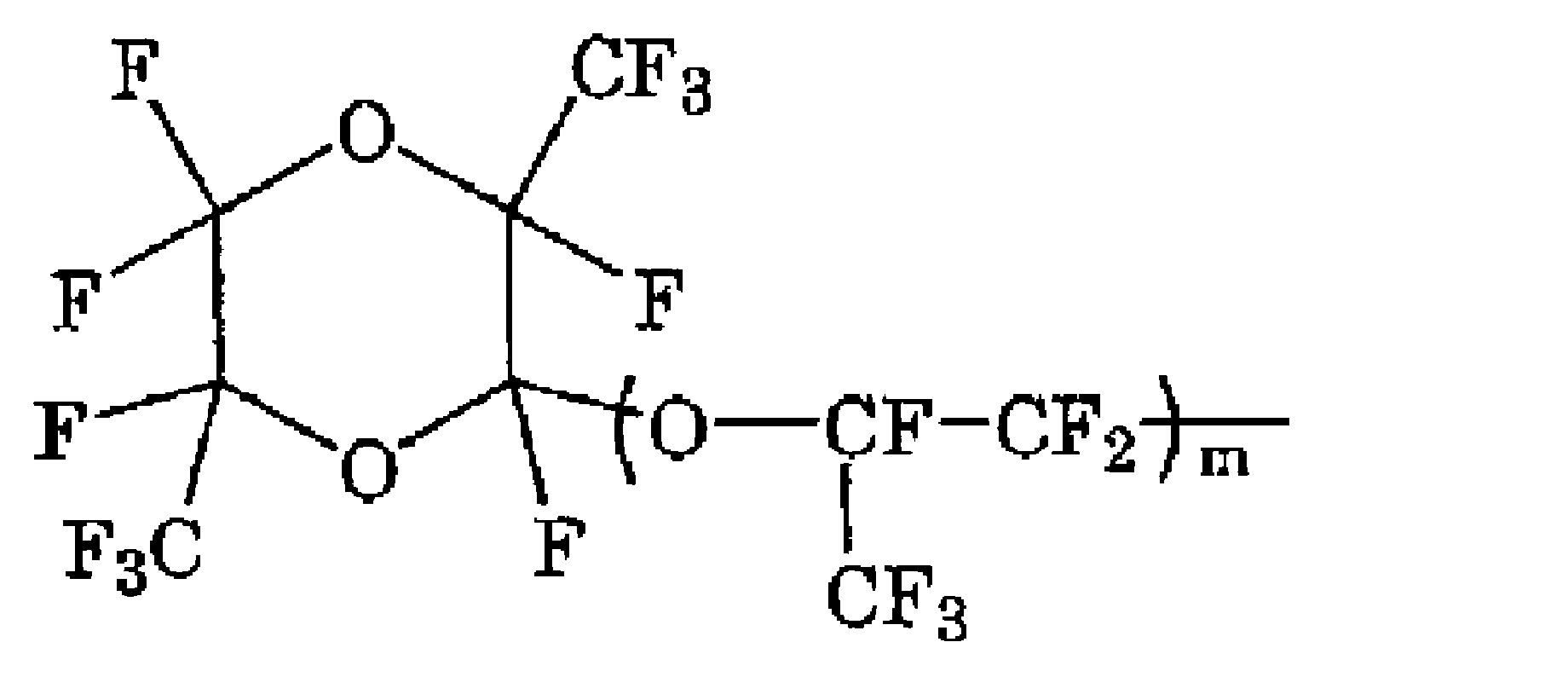
(式中、mは、0又は1~4の整数を表す。)で表される基であるもの、Rf111が下記式:
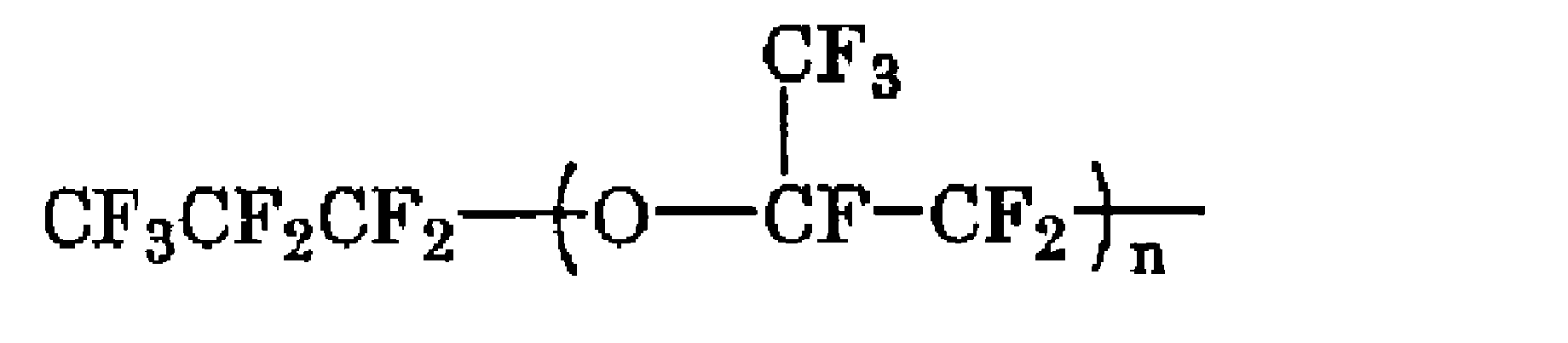
(式中、nは、1~4の整数を表す。)で表される基であるもの等が挙げられる。
一般式(110)で表されるフルオロモノマーとしては、なかでも、
一般式(160):CF2=CF-ORf161
(式中、Rf161は、炭素数1~10のパーフルオロアルキル基を表す。)で表されるフルオロモノマーが好ましい。Rf161は、炭素数が1~5のパーフルオロアルキル基であることが好ましい。
一般式(160):CF2=CF-ORf161
(式中、Rf161は、炭素数1~10のパーフルオロアルキル基を表す。)で表されるフルオロモノマーが好ましい。Rf161は、炭素数が1~5のパーフルオロアルキル基であることが好ましい。
フルオロアルキルビニルエーテルとしては、一般式(160)、(130)及び(140)で表されるフルオロモノマーからなる群より選択される少なくとも1種であることが好ましい。
一般式(160)で表されるフルオロモノマーとしては、パーフルオロ(メチルビニルエーテル)、パーフルオロ(エチルビニルエーテル)、及び、パーフルオロ(プロピルビニルエーテル)からなる群より選択される少なくとも1種が好ましく、パーフルオロ(メチルビニルエーテル)、及び、パーフルオロ(プロピルビニルエーテル)からなる群より選択される少なくとも1種がより好ましい。
一般式(130)で表されるフルオロモノマーとしては、CF2=CFOCF2OCF3、CF2=CFOCF2OCF2CF3、及び、CF2=CFOCF2OCF2CF2OCF3からなる群より選択される少なくとも1種であることが好ましい。
一般式(140)で表されるフルオロモノマーとしては、CF2=CFOCF2CF(CF3)O(CF2)3F、CF2=CFO(CF2CF(CF3)O)2(CF2)3F、及び、CF2=CFO(CF2CF(CF3)O)2(CF2)2Fからなる群より選択される少なくとも1種であることが好ましい。
一般式(150)で表されるフルオロモノマーとしては、CF2=CFOCF2CF2SO2F、CF2=CFOCF2CF(CF3)OCF2CF2SO2F、CF2=CFOCF2CF(CF2CF2SO2F)OCF2CF2SO2F及びCF2=CFOCF2CF(SO2F)2からなる群より選択される少なくとも1種が好ましい。
一般式(100)で表されるフルオロモノマーとしては、Rf101が直鎖のフルオロアルキル基であるフルオロモノマーが好ましく、Rf101が直鎖のパーフルオロアルキル基であるフルオロモノマーがより好ましい。Rf101の炭素数は1~6であることが好ましい。一般式(100)で表されるフルオロモノマーとしては、CH2=CFCF3、CH2=CFCF2CF3、CH2=CFCF2CF2CF3、CH2=CFCF2CF2CF2H、CH2=CFCF2CF2CF2CF3、CHF=CHCF3(E体)、CHF=CHCF3(Z体)等が挙げられ、なかでも、CH2=CFCF3で示される2,3,3,3-テトラフルオロプロピレンが好ましい。
フルオロアルキルエチレンとしては、
一般式(170):CH2=CH-(CF2)n-X171
(式中、X171はH又はFであり、nは3~10の整数である。)で表されるフルオロアルキルエチレンが好ましく、CH2=CH-C4F9、及び、CH2=CH-C6F13からなる群より選択される少なくとも1種であることがより好ましい。
一般式(170):CH2=CH-(CF2)n-X171
(式中、X171はH又はFであり、nは3~10の整数である。)で表されるフルオロアルキルエチレンが好ましく、CH2=CH-C4F9、及び、CH2=CH-C6F13からなる群より選択される少なくとも1種であることがより好ましい。
上記フルオロアルキルアリルエーテルとしては、例えば、
一般式(240):CF2=CF-CF2-ORf111
(式中、Rf111は、パーフルオロ有機基を表す。)で表されるフルオロモノマーが挙げられる。
一般式(240):CF2=CF-CF2-ORf111
(式中、Rf111は、パーフルオロ有機基を表す。)で表されるフルオロモノマーが挙げられる。
一般式(240のRf111は、一般式(110)のRf111と同じである。Rf111としては、炭素数1~10のパーフルオロアルキル基または炭素数1~10のパーフルオロアルコキシアルキル基が好ましい。一般式(240)で表されるフルオロアルキルアリルエーテルとしては、CF2=CF-CF2-O-CF3、CF2=CF-CF2-O-C2F5、CF2=CF-CF2-O-C3F7、及び、CF2=CF-CF2-O-C4F9からなる群より選択される少なくとも1種が好ましく、CF2=CF-CF2-O-C2F5、CF2=CF-CF2-O-C3F7、及び、CF2=CF-CF2-O-C4F9からなる群より選択される少なくとも1種がより好ましく、CF2=CF-CF2-O-CF2CF2CF3がさらに好ましい。
上記フッ素化ビニルヘテロ環状体としては、一般式(230):
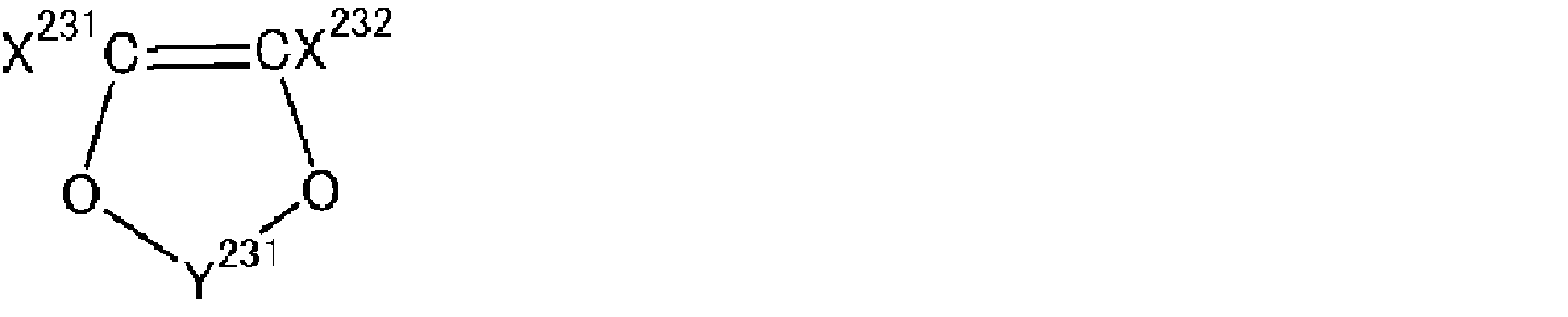
(式中、X231及びX232は、独立に、F、Cl、メトキシ基又はフッ素化メトキシ基であり、Y231は式Y232又は式Y233である。
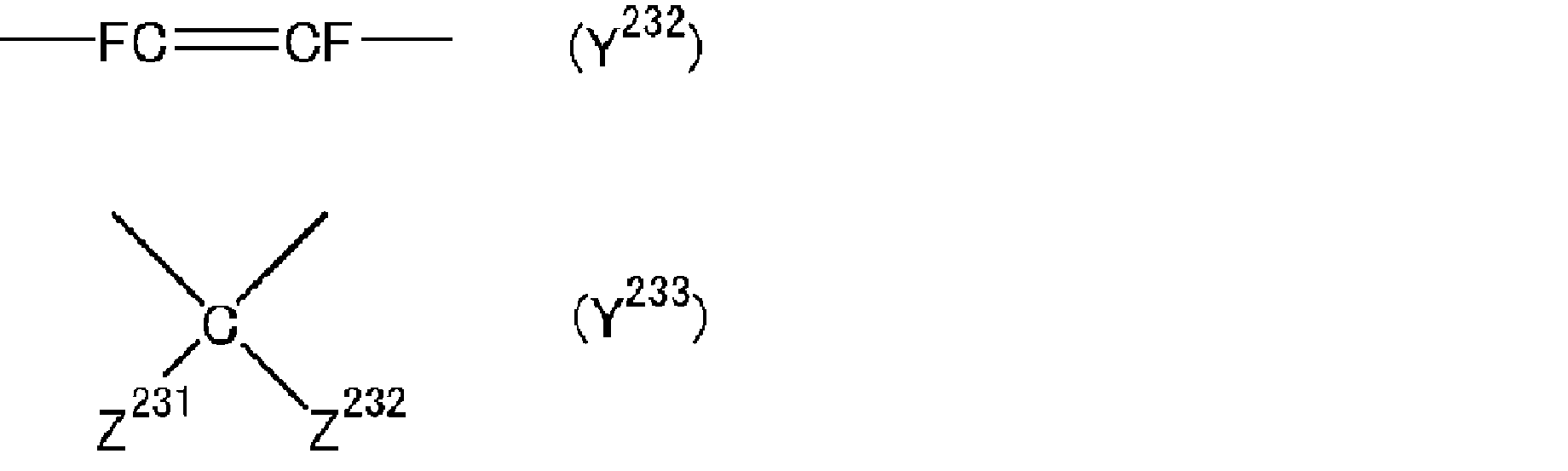
架橋部位を与えるモノマーとしては、
一般式(180):CX181 2=CX182-Rf 181CHR181X183
(式中、X181及びX182は、独立に、水素原子、フッ素原子又はCH3、Rf 181は、フルオロアルキレン基、パーフルオロアルキレン基、フルオロ(ポリ)オキシアルキレン基又はパーフルオロ(ポリ)オキシアルキレン基、R181は、水素原子又はCH3、X183は、ヨウ素原子又は臭素原子である。)で表されるフルオロモノマー、
一般式(190):CX191 2=CX192-Rf 191X193
(式中、X191及びX192は、独立に、水素原子、フッ素原子又はCH3、Rf 191は、フルオロアルキレン基、パーフルオロアルキレン基、フルオロポリオキシアルキレン基又はパーフルオロポリオキシアルキレン基、X193は、ヨウ素原子又は臭素原子である。)で表されるフルオロモノマー、
一般式(200):CF2=CFO(CF2CF(CF3)O)m(CF2)n-X201
(式中、mは0~5の整数、nは1~3の整数、X201は、シアノ基、カルボキシル基、アルコキシカルボニル基、ヨウ素原子、臭素原子、又は、-CH2Iである。)で表されるフルオロモノマー、及び、
一般式(210):CH2=CFCF2O(CF(CF3)CF2O)m(CF(CF3))n-X211
(式中、mは0~5の整数、nは1~3の整数、X211は、シアノ基、カルボキシル基、アルコキシカルボニル基、ヨウ素原子、臭素原子、又は-CH2OHである。)で表されるフルオロモノマー、及び、
一般式(220):CR221R222=CR223-Z221-CR224=CR225R226
(式中、R221、R222、R223、R224、R225及びR226は、同一又は異なって、水素原子又は炭素数1~5のアルキル基である。Z221は、直鎖又は分岐状で酸素原子を有していてもよい、炭素数1~18のアルキレン基、炭素数3~18のシクロアルキレン基、少なくとも部分的にフッ素化している炭素数1~10のアルキレン基若しくはオキシアルキレン基、又は、
-(Q)p-CF2O-(CF2CF2O)m(CF2O)n-CF2-(Q)p-
(式中、Qはアルキレン基またはオキシアルキレン基である。pは0または1である。m/nが0.2~5である。)で表され、分子量が500~10000である(パー)フルオロポリオキシアルキレン基である。)で表されるモノマー
からなる群より選択される少なくとも1種であることが好ましい。
一般式(180):CX181 2=CX182-Rf 181CHR181X183
(式中、X181及びX182は、独立に、水素原子、フッ素原子又はCH3、Rf 181は、フルオロアルキレン基、パーフルオロアルキレン基、フルオロ(ポリ)オキシアルキレン基又はパーフルオロ(ポリ)オキシアルキレン基、R181は、水素原子又はCH3、X183は、ヨウ素原子又は臭素原子である。)で表されるフルオロモノマー、
一般式(190):CX191 2=CX192-Rf 191X193
(式中、X191及びX192は、独立に、水素原子、フッ素原子又はCH3、Rf 191は、フルオロアルキレン基、パーフルオロアルキレン基、フルオロポリオキシアルキレン基又はパーフルオロポリオキシアルキレン基、X193は、ヨウ素原子又は臭素原子である。)で表されるフルオロモノマー、
一般式(200):CF2=CFO(CF2CF(CF3)O)m(CF2)n-X201
(式中、mは0~5の整数、nは1~3の整数、X201は、シアノ基、カルボキシル基、アルコキシカルボニル基、ヨウ素原子、臭素原子、又は、-CH2Iである。)で表されるフルオロモノマー、及び、
一般式(210):CH2=CFCF2O(CF(CF3)CF2O)m(CF(CF3))n-X211
(式中、mは0~5の整数、nは1~3の整数、X211は、シアノ基、カルボキシル基、アルコキシカルボニル基、ヨウ素原子、臭素原子、又は-CH2OHである。)で表されるフルオロモノマー、及び、
一般式(220):CR221R222=CR223-Z221-CR224=CR225R226
(式中、R221、R222、R223、R224、R225及びR226は、同一又は異なって、水素原子又は炭素数1~5のアルキル基である。Z221は、直鎖又は分岐状で酸素原子を有していてもよい、炭素数1~18のアルキレン基、炭素数3~18のシクロアルキレン基、少なくとも部分的にフッ素化している炭素数1~10のアルキレン基若しくはオキシアルキレン基、又は、
-(Q)p-CF2O-(CF2CF2O)m(CF2O)n-CF2-(Q)p-
(式中、Qはアルキレン基またはオキシアルキレン基である。pは0または1である。m/nが0.2~5である。)で表され、分子量が500~10000である(パー)フルオロポリオキシアルキレン基である。)で表されるモノマー
からなる群より選択される少なくとも1種であることが好ましい。
X183及びX193は、ヨウ素原子であることが好ましい。Rf
181及びRf
191は炭素数が1~5のパーフルオロアルキレン基であることが好ましい。R181は、水素原子であることが好ましい。X201は、シアノ基、アルコキシカルボニル基、ヨウ素原子、臭素原子、又は、-CH2Iであることが好ましい。X211は、シアノ基、アルコキシカルボニル基、ヨウ素原子、臭素原子、又は-CH2OHであることが好ましい。
架橋部位を与えるモノマーとしては、CF2=CFOCF2CF(CF3)OCF2CF2CN、CF2=CFOCF2CF(CF3)OCF2CF2COOH、CF2=CFOCF2CF(CF3)OCF2CF2CH2I、CF2=CFOCF2CF2CH2I、CH2=CFCF2OCF(CF3)CF2OCF(CF3)CN、CH2=CFCF2OCF(CF3)CF2OCF(CF3)COOH、CH2=CFCF2OCF(CF3)CF2OCF(CF3)CH2OH、CH2=CHCF2CF2I、CH2=CH(CF2)2CH=CH2、CH2=CH(CF2)6CH=CH2、及び、CF2=CFO(CF2)5CNからなる群より選択される少なくとも1種であることが好ましく、CF2=CFOCF2CF(CF3)OCF2CF2CN及びCF2=CFOCF2CF2CH2Iからなる群より選択される少なくとも1種であることがより好ましい。
上記フッ素非含有モノマーとしては、上記TFEと反応性を有する炭化水素系モノマー等が挙げられる。上記炭化水素系モノマーとしては、例えば、エチレン、プロピレン、ブチレン、イソブチレン等のアルケン類;エチルビニルエーテル、プロピルビニルエーテル、ブチルビニルエーテル、イソブチルビニルエーテル、シクロヘキシルビニルエーテル等のアルキルビニルエーテル類;酢酸ビニル、プロピオン酸ビニル、n-酪酸ビニル、イソ酪酸ビニル、吉草酸ビニル、ピバリン酸ビニル、カプロン酸ビニル、カプリル酸ビニル、カプリン酸ビニル、バーサチック酸ビニル、ラウリン酸ビニル、ミリスチン酸ビニル、パルミチン酸ビニル、ステアリン酸ビニル、安息香酸ビニル、パラ-t-ブチル安息香酸ビニル、シクロヘキサンカルボン酸ビニル、モノクロル酢酸ビニル、アジピン酸ビニル、アクリル酸ビニル、メタクリル酸ビニル、クロトン酸ビニル、ソルビン酸ビニル、桂皮酸ビニル、ウンデシレン酸ビニル、ヒドロキシ酢酸ビニル、ヒドロキシプロピオイン酸ビニル、ヒドロキシ酪酸ビニル、ヒドロキシ吉草酸ビニル、ヒドロキシイソ酪酸ビニル、ヒドロキシシクロヘキサンカルボン酸ビニル等のビニルエステル類;エチルアリルエーテル、プロピルアリルエーテル、ブチルアリルエーテル、イソブチルアリルエーテル、シクロヘキシルアリルエーテル等のアルキルアリルエーテル類;エチルアリルエステル、プロピルアリルエステル、ブチルアリルエステル、イソブチルアリルエステル、シクロヘキシルアリルエステル等のアルキルアリルエステル類等が挙げられる。
上記フッ素非含有モノマーとしては、また、官能基含有炭化水素系モノマー(但し、架橋部位を与えるモノマーを除く)であってもよい。上記官能基含有炭化水素系モノマーとしては、例えば、ヒドロキシエチルビニルエーテル、ヒドロキシプロピルビニルエーテル、ヒドロキシブチルビニルエーテル、ヒドロキシイソブチルビニルエーテル、ヒドロキシシクロヘキシルビニルエーテル等のヒドロキシアルキルビニルエーテル類;イタコン酸、コハク酸、無水コハク酸、フマル酸、無水フマル酸、クロトン酸、マレイン酸、無水マレイン酸、パーフルオロブテン酸等のカルボキシル基を有するフッ素非含有モノマー;グリシジルビニルエーテル、グリシジルアリルエーテル等のグリシジル基を有するフッ素非含有モノマー;アミノアルキルビニルエーテル、アミノアルキルアリルエーテル等のアミノ基を有するフッ素非含有モノマー;(メタ)アクリルアミド、メチロールアクリルアミド等のアミド基を有するフッ素非含有モノマー等が挙げられる。
上記TFE以外のモノマーは所望するTFE重合体にあわせて適宜選択すればよく、上記で例示したもの以外を使用することができる。
例えば、TFE重合体がポリテトラフルオロエチレンである場合、後述する変性モノマーを用いることができるし、後述する溶融加工性フッ素樹脂、フッ素ゴムに含まれるモノマーも使用できる。
例えば、TFE重合体がポリテトラフルオロエチレンである場合、後述する変性モノマーを用いることができるし、後述する溶融加工性フッ素樹脂、フッ素ゴムに含まれるモノマーも使用できる。
上記工程(I)において、TFEと、必要に応じて上記TFE以外のフルオロモノマー及びフッ素非含有モノマーの1種又は2種以上を重合することにより、所望のTFE重合体の粒子を得ることができる。
本開示の製造方法で得られるTFE重合体については後で詳述する。
本開示の製造方法で得られるTFE重合体については後で詳述する。
上記水性媒体は、重合を行わせる反応媒体であって、水を含む液体を意味する。上記水性媒体は、水を含むものであれば特に限定されず、水と、例えば、アルコール、エーテル、ケトン等のフッ素非含有有機溶媒、及び/又は、沸点が40℃以下であるフッ素含有有機溶媒とを含むものであってもよい。
上記工程(I)は、実質的に含フッ素界面活性剤の非存在下に、テトラフルオロエチレンを重合するものであることが好ましい。
従来、TFE重合体の重合には含フッ素界面活性剤が使用されてきたが、本開示の製造方法は、上記重合体(A)を用いることによって、含フッ素界面活性剤を使用しなくてもTFE重合体を得ることができる。
本明細書において「実質的に含フッ素界面活性剤の非存在下に」とは、水性媒体に対して含フッ素界面活性剤が10質量ppm以下であることを意味し、好ましくは1質量ppm以下であり、より好ましくは100質量ppb以下であり、更に好ましくは10質量ppb以下であり、更により好ましくは1質量ppb以下である。
従来、TFE重合体の重合には含フッ素界面活性剤が使用されてきたが、本開示の製造方法は、上記重合体(A)を用いることによって、含フッ素界面活性剤を使用しなくてもTFE重合体を得ることができる。
本明細書において「実質的に含フッ素界面活性剤の非存在下に」とは、水性媒体に対して含フッ素界面活性剤が10質量ppm以下であることを意味し、好ましくは1質量ppm以下であり、より好ましくは100質量ppb以下であり、更に好ましくは10質量ppb以下であり、更により好ましくは1質量ppb以下である。
上記含フッ素界面活性剤としては、アニオン性含フッ素界面活性剤等が挙げられる。
上記アニオン性含フッ素界面活性剤は、例えば、アニオン性基を除く部分の総炭素数が20以下のフッ素原子を含む界面活性剤であってよい。
上記アニオン性含フッ素界面活性剤は、例えば、アニオン性基を除く部分の総炭素数が20以下のフッ素原子を含む界面活性剤であってよい。
上記含フッ素界面活性剤としてはまた、アニオン性部分の分子量が1000以下、より好ましくは800以下、さらに好ましくは600以下のフッ素を含む界面活性剤であってよい。
なお、上記「アニオン性部分」は、上記含フッ素界面活性剤のカチオンを除く部分を意味する。例えば、後述する式(I)で表されるF(CF2)n1COOMの場合には、「F(CF2)n1COO」の部分である。
なお、上記「アニオン性部分」は、上記含フッ素界面活性剤のカチオンを除く部分を意味する。例えば、後述する式(I)で表されるF(CF2)n1COOMの場合には、「F(CF2)n1COO」の部分である。
上記含フッ素界面活性剤としてはまた、LogPOWが3.5以下の含フッ素界面活性剤が挙げられる。上記LogPOWは、1-オクタノールと水との分配係数であり、LogP[式中、Pは、含フッ素界面活性剤を含有するオクタノール/水(1:1)混合液が相分離した際のオクタノール中の含フッ素界面活性剤濃度/水中の含フッ素界面活性剤濃度比を表す]で表されるものである。
上記LogPOWは、カラム;TOSOH ODS-120Tカラム(φ4.6mm×250mm、東ソー(株)製)、溶離液;アセトニトリル/0.6質量%HClO4水=1/1(vol/vol%)、流速;1.0ml/分、サンプル量;300μL、カラム温度;40℃、検出光;UV210nmの条件で、既知のオクタノール/水分配係数を有する標準物質(ヘプタン酸、オクタン酸、ノナン酸及びデカン酸)についてHPLCを行い、各溶出時間と既知のオクタノール/水分配係数との検量線を作成し、この検量線に基づき、試料液におけるHPLCの溶出時間から算出する。
上記LogPOWは、カラム;TOSOH ODS-120Tカラム(φ4.6mm×250mm、東ソー(株)製)、溶離液;アセトニトリル/0.6質量%HClO4水=1/1(vol/vol%)、流速;1.0ml/分、サンプル量;300μL、カラム温度;40℃、検出光;UV210nmの条件で、既知のオクタノール/水分配係数を有する標準物質(ヘプタン酸、オクタン酸、ノナン酸及びデカン酸)についてHPLCを行い、各溶出時間と既知のオクタノール/水分配係数との検量線を作成し、この検量線に基づき、試料液におけるHPLCの溶出時間から算出する。
上記含フッ素界面活性剤として具体的には、米国特許出願公開第2007/0015864号明細書、米国特許出願公開第2007/0015865号明細書、米国特許出願公開第2007/0015866号明細書、米国特許出願公開第2007/0276103号明細書、米国特許出願公開第2007/0117914号明細書、米国特許出願公開第2007/142541号明細書、米国特許出願公開第2008/0015319号明細書、米国特許第3250808号明細書、米国特許第3271341号明細書、特開2003-119204号公報、国際公開第2005/042593号、国際公開第2008/060461号、国際公開第2007/046377号、国際公開第2007/119526号、国際公開第2007/046482号、国際公開第2007/046345号、米国特許出願公開第2014/0228531号、国際公開第2013/189824号、国際公開第2013/189826号に記載されたもの等が挙げられる。
上記アニオン性含フッ素界面活性剤としては、下記一般式(N0):
Xn0-Rfn0-Y0 (N0)
(式中、Xn0は、H、Cl又は及びFである。Rfn0は、炭素数3~20で、鎖状、分枝鎖状または環状で、一部または全てのHがFにより置換されたアルキレン基であり、該アルキレン基は1つ以上のエーテル結合を含んでもよく、一部のHがClにより置換されていてもよい。Y0はアニオン性基である。)で表される化合物が挙げられる。
Y0のアニオン性基は、-COOM、-SO2M、又は、-SO3Mであってよく、-COOM、又は、-SO3Mであってよい。
Mは、H、金属原子、NR7 4、置換基を有していてもよいイミダゾリウム、置換基を有していてもよいピリジニウム又は置換基を有していてもよいホスホニウムであり、R7は、H又は有機基である。
上記金属原子としては、アルカリ金属(1族)、アルカリ土類金属(2族)等が挙げられ、例えば、Na、K又はLiである。
R7としては、H又はC1-10の有機基であってよく、H又はC1-4の有機基であってよく、H又はC1-4のアルキル基であってよい。
Mは、H、金属原子又はNR7 4であってよく、H、アルカリ金属(1族)、アルカリ土類金属(2族)又はNR7 4であってよく、H、Na、K、Li又はNH4であってよい。
上記Rfn0は、Hの50%以上がフッ素に置換されているものであってよい。
Xn0-Rfn0-Y0 (N0)
(式中、Xn0は、H、Cl又は及びFである。Rfn0は、炭素数3~20で、鎖状、分枝鎖状または環状で、一部または全てのHがFにより置換されたアルキレン基であり、該アルキレン基は1つ以上のエーテル結合を含んでもよく、一部のHがClにより置換されていてもよい。Y0はアニオン性基である。)で表される化合物が挙げられる。
Y0のアニオン性基は、-COOM、-SO2M、又は、-SO3Mであってよく、-COOM、又は、-SO3Mであってよい。
Mは、H、金属原子、NR7 4、置換基を有していてもよいイミダゾリウム、置換基を有していてもよいピリジニウム又は置換基を有していてもよいホスホニウムであり、R7は、H又は有機基である。
上記金属原子としては、アルカリ金属(1族)、アルカリ土類金属(2族)等が挙げられ、例えば、Na、K又はLiである。
R7としては、H又はC1-10の有機基であってよく、H又はC1-4の有機基であってよく、H又はC1-4のアルキル基であってよい。
Mは、H、金属原子又はNR7 4であってよく、H、アルカリ金属(1族)、アルカリ土類金属(2族)又はNR7 4であってよく、H、Na、K、Li又はNH4であってよい。
上記Rfn0は、Hの50%以上がフッ素に置換されているものであってよい。
上記一般式(N0)で表される化合物としては、
下記一般式(N1):
Xn0-(CF2)m1-Y0 (N1)
(式中、Xn0は、H、Cl及びFであり、m1は3~15の整数であり、Y0は、上記定義したものである。)で表される化合物、下記一般式(N2):
Rfn1-O-(CF(CF3)CF2O)m2CFXn1-Y0 (N2)
(式中、Rfn1は、炭素数1~5のパーフルオロアルキル基であり、m2は、0~3の整数であり、Xn1は、F又はCF3であり、Y0は、上記定義したものである。)で表される化合物、下記一般式(N3):
Rfn2(CH2)m3-(Rfn3)q-Y0 (N3)
(式中、Rfn2は、炭素数1~13のエーテル結合を含み得る、部分または完全フッ素化されたアルキル基であり、m3は、1~3の整数であり、Rfn3は、直鎖状又は分岐状の炭素数1~3のパーフルオロアルキレン基であり、qは0又は1であり、Y0は、上記定義したものである。)で表される化合物、下記一般式(N4):
Rfn4-O-(CYn1Yn2)pCF2-Y0 (N4)
(式中、Rfn4は、炭素数1~12のエーテル結合を含み得る直鎖状または分枝鎖状の部分または完全フッ素化されたアルキル基であり、Yn1及びYn2は、同一若しくは異なって、H又はFであり、pは0又は1であり、Y0は、上記定義したものである。)で表される化合物、及び、一般式(N5):

(式中、Xn2、Xn3及びXn4は、同一若しくは異なってもよく、H、F、又は、炭素数1~6のエーテル結合を含んでよい直鎖状または分岐鎖状の部分または完全フッ素化されたアルキル基である。Rfn5は、炭素数1~3のエーテル結合を含み得る直鎖状または分岐鎖状の部分または完全フッ素化されたアルキレン基であり、Lは連結基であり、Y0は、上記定義したものである。但し、Xn2、Xn3、Xn4及びRfn5の合計炭素数は18以下である。)で表される化合物が挙げられる。
下記一般式(N1):
Xn0-(CF2)m1-Y0 (N1)
(式中、Xn0は、H、Cl及びFであり、m1は3~15の整数であり、Y0は、上記定義したものである。)で表される化合物、下記一般式(N2):
Rfn1-O-(CF(CF3)CF2O)m2CFXn1-Y0 (N2)
(式中、Rfn1は、炭素数1~5のパーフルオロアルキル基であり、m2は、0~3の整数であり、Xn1は、F又はCF3であり、Y0は、上記定義したものである。)で表される化合物、下記一般式(N3):
Rfn2(CH2)m3-(Rfn3)q-Y0 (N3)
(式中、Rfn2は、炭素数1~13のエーテル結合を含み得る、部分または完全フッ素化されたアルキル基であり、m3は、1~3の整数であり、Rfn3は、直鎖状又は分岐状の炭素数1~3のパーフルオロアルキレン基であり、qは0又は1であり、Y0は、上記定義したものである。)で表される化合物、下記一般式(N4):
Rfn4-O-(CYn1Yn2)pCF2-Y0 (N4)
(式中、Rfn4は、炭素数1~12のエーテル結合を含み得る直鎖状または分枝鎖状の部分または完全フッ素化されたアルキル基であり、Yn1及びYn2は、同一若しくは異なって、H又はFであり、pは0又は1であり、Y0は、上記定義したものである。)で表される化合物、及び、一般式(N5):
上記一般式(N0)で表される化合物としてより具体的には、下記一般式(I)で表されるパーフルオロカルボン酸(I)、下記一般式(II)で表されるω-Hパーフルオロカルボン酸(II)、下記一般式(III)で表されるパーフルオロポリエーテルカルボン酸(III)、下記一般式(IV)で表されるパーフルオロアルキルアルキレンカルボン酸(IV)、下記一般式(V)で表されるパーフルオロアルコキシフルオロカルボン酸(V)、下記一般式(VI)で表されるパーフルオロアルキルスルホン酸(VI)、下記一般式(VII)で表されるω-Hパーフルオロスルホン酸(VII)、下記一般式(VIII)で表されるパーフルオロアルキルアルキレンスルホン酸(VIII)、下記一般式(IX)で表されるアルキルアルキレンカルボン酸(IX)、下記一般式(X)で表されるフルオロカルボン酸(X)、下記一般式(XI)で表されるアルコキシフルオロスルホン酸(XI)、下記一般式(XII)で表される化合物(XII)、下記一般式(XIII)で表される化合物(XIII)などが挙げられる。
上記パーフルオロカルボン酸(I)は、下記一般式(I)
F(CF2)n1COOM (I)
(式中、n1は、3~14の整数であり、Mは、H、金属原子、NR7 4、置換基を有していてもよいイミダゾリウム、置換基を有していてもよいピリジニウム又は置換基を有していてもよいホスホニウムであり、R7は、H又は有機基である。)で表されるものである。
F(CF2)n1COOM (I)
(式中、n1は、3~14の整数であり、Mは、H、金属原子、NR7 4、置換基を有していてもよいイミダゾリウム、置換基を有していてもよいピリジニウム又は置換基を有していてもよいホスホニウムであり、R7は、H又は有機基である。)で表されるものである。
上記ω-Hパーフルオロカルボン酸(II)は、下記一般式(II)
H(CF2)n2COOM (II)
(式中、n2は、4~15の整数であり、Mは、上記定義したものである。)で表されるものである。
H(CF2)n2COOM (II)
(式中、n2は、4~15の整数であり、Mは、上記定義したものである。)で表されるものである。
上記パーフルオロポリエーテルカルボン酸(III)は、下記一般式(III)
Rf1-O-(CF(CF3)CF2O)n3CF(CF3)COOM (III)
(式中、Rf1は、炭素数1~5のパーフルオロアルキル基であり、n3は、0~3の整数であり、Mは、上記定義したものである。)で表されるものである。
Rf1-O-(CF(CF3)CF2O)n3CF(CF3)COOM (III)
(式中、Rf1は、炭素数1~5のパーフルオロアルキル基であり、n3は、0~3の整数であり、Mは、上記定義したものである。)で表されるものである。
上記パーフルオロアルキルアルキレンカルボン酸(IV)は、下記一般式(IV)
Rf2(CH2)n4Rf3COOM (IV)
(式中、Rf2は、炭素数1~5のパーフルオロアルキル基であり、Rf3は、直鎖状又は分岐状の炭素数1~3のパーフルオロアルキレン基、n4は、1~3の整数であり、Mは、上記定義したものである。)で表されるものである。
Rf2(CH2)n4Rf3COOM (IV)
(式中、Rf2は、炭素数1~5のパーフルオロアルキル基であり、Rf3は、直鎖状又は分岐状の炭素数1~3のパーフルオロアルキレン基、n4は、1~3の整数であり、Mは、上記定義したものである。)で表されるものである。
上記アルコキシフルオロカルボン酸(V)は、下記一般式(V)
Rf4-O-CY1Y2CF2-COOM (V)
(式中、Rf4は、炭素数1~12のエーテル結合を含み得る直鎖状または分枝鎖状の部分または完全フッ素化されたアルキル基であり、Y1及びY2は、同一若しくは異なって、H又はFであり、Mは、上記定義したものである。)で表されるものである。
Rf4-O-CY1Y2CF2-COOM (V)
(式中、Rf4は、炭素数1~12のエーテル結合を含み得る直鎖状または分枝鎖状の部分または完全フッ素化されたアルキル基であり、Y1及びY2は、同一若しくは異なって、H又はFであり、Mは、上記定義したものである。)で表されるものである。
上記パーフルオロアルキルスルホン酸(VI)は、下記一般式(VI)
F(CF2)n5SO3M (VI)
(式中、n5は、3~14の整数であり、Mは、上記定義したものである。)で表されるものである。
F(CF2)n5SO3M (VI)
(式中、n5は、3~14の整数であり、Mは、上記定義したものである。)で表されるものである。
上記ω-Hパーフルオロスルホン酸(VII)は、下記一般式(VII)
H(CF2)n6SO3M (VII)
(式中、n6は、4~14の整数であり、Mは、上記定義したものである。)で表されるものである。
H(CF2)n6SO3M (VII)
(式中、n6は、4~14の整数であり、Mは、上記定義したものである。)で表されるものである。
上記パーフルオロアルキルアルキレンスルホン酸(VIII)は、下記一般式(VIII)
Rf5(CH2)n7SO3M (VIII)
(式中、Rf5は、炭素数1~13のパーフルオロアルキル基であり、n7は、1~3の整数であり、Mは、上記定義したものである。)で表されるものである。
Rf5(CH2)n7SO3M (VIII)
(式中、Rf5は、炭素数1~13のパーフルオロアルキル基であり、n7は、1~3の整数であり、Mは、上記定義したものである。)で表されるものである。
上記アルキルアルキレンカルボン酸(IX)は、下記一般式(IX)
Rf6(CH2)n8COOM (IX)
(式中、Rf6は、炭素数1~13のエーテル結合を含み得る直鎖状または分岐鎖状の部分または完全フッ素化されたアルキル基であり、n8は、1~3の整数であり、Mは、上記定義したものである。)で表されるものである。
Rf6(CH2)n8COOM (IX)
(式中、Rf6は、炭素数1~13のエーテル結合を含み得る直鎖状または分岐鎖状の部分または完全フッ素化されたアルキル基であり、n8は、1~3の整数であり、Mは、上記定義したものである。)で表されるものである。
上記フルオロカルボン酸(X)は、下記一般式(X)
Rf7-O-Rf8-O-CF2-COOM (X)
(式中、Rf7は、炭素数1~6のエーテル結合を含み得る直鎖状または分枝鎖状の部分または完全フッ素化されたアルキル基であり、Rf8は、炭素数1~6の直鎖状または分枝鎖状の部分または完全フッ素化されたアルキル基であり、Mは、上記定義したものである。)で表されるものである。
Rf7-O-Rf8-O-CF2-COOM (X)
(式中、Rf7は、炭素数1~6のエーテル結合を含み得る直鎖状または分枝鎖状の部分または完全フッ素化されたアルキル基であり、Rf8は、炭素数1~6の直鎖状または分枝鎖状の部分または完全フッ素化されたアルキル基であり、Mは、上記定義したものである。)で表されるものである。
上記アルコキシフルオロスルホン酸(XI)は、下記一般式(XI)
Rf9-O-CY1Y2CF2-SO3M (XI)
(式中、Rf9は、炭素数1~12のエーテル結合を含み得る直鎖状または分枝鎖状であって、塩素を含んでもよい、部分または完全フッ素化されたアルキル基であり、Y1及びY2は、同一若しくは異なって、H又はFであり、Mは、上記定義したものである。)で表されるものである。
Rf9-O-CY1Y2CF2-SO3M (XI)
(式中、Rf9は、炭素数1~12のエーテル結合を含み得る直鎖状または分枝鎖状であって、塩素を含んでもよい、部分または完全フッ素化されたアルキル基であり、Y1及びY2は、同一若しくは異なって、H又はFであり、Mは、上記定義したものである。)で表されるものである。
上記化合物(XII)は、下記一般式(XII):

(式中、X1、X2及びX3は、同一若しくは異なってもよく、H、F及び炭素数1~6のエーテル結合を含み得る直鎖状または分岐鎖状の部分または完全フッ素化されたアルキル基であり、Rf10は、炭素数1~3のパーフルオロアルキレン基であり、Lは連結基であり、Y0はアニオン性基である。)で表されるものである。
Y0は、-COOM、-SO2M、又は、-SO3Mであってよく、-SO3M、又は、COOMであってよい(式中、Mは上記定義したものである。)。
Lとしては、例えば、単結合、炭素数1~10のエーテル結合を含みうる部分又は完全フッ素化されたアルキレン基が挙げられる。
Y0は、-COOM、-SO2M、又は、-SO3Mであってよく、-SO3M、又は、COOMであってよい(式中、Mは上記定義したものである。)。
Lとしては、例えば、単結合、炭素数1~10のエーテル結合を含みうる部分又は完全フッ素化されたアルキレン基が挙げられる。
上記化合物(XIII)は、下記一般式(XIII):
Rf11-O-(CF2CF(CF3)O)n9(CF2O)n10CF2COOM (XIII)
(式中、Rf11は、塩素を含む炭素数1~5のフルオロアルキル基であり、n9は、0~3の整数であり、n10は、0~3の整数であり、Mは、上記定義したものである。)で表されるものである。化合物(XIII)としては、CF2ClO(CF2CF(CF3)O)n9(CF2O)n10CF2COONH4(平均分子量750の混合物、式中、n9およびn10は上記定義したものである。)が挙げられる。
Rf11-O-(CF2CF(CF3)O)n9(CF2O)n10CF2COOM (XIII)
(式中、Rf11は、塩素を含む炭素数1~5のフルオロアルキル基であり、n9は、0~3の整数であり、n10は、0~3の整数であり、Mは、上記定義したものである。)で表されるものである。化合物(XIII)としては、CF2ClO(CF2CF(CF3)O)n9(CF2O)n10CF2COONH4(平均分子量750の混合物、式中、n9およびn10は上記定義したものである。)が挙げられる。
上記アニオン性含フッ素界面活性剤としては、カルボン酸系含フッ素界面活性剤、スルホン酸系含フッ素界面活性剤等が挙げられる。
上記工程(I)は、TFEを重合して、TFEに基づく重合単位の含有量が40モル%以上であるTFE重合体を製造するものであってもよい。
上記工程(I)はまた、TFEに基づく重合単位を含む粒子を得る工程であることが好ましく、その場合、本開示の製造方法は、更に、工程(I)で得られた粒子を含む水性媒体中でTFEを重合する工程(II)を含むことが好ましい。上記工程(II)によってTFEに基づく重合単位の含有量が40モル%以上であるTFE重合体を得ることができる。
上記のように上記工程(I)で前記粒子を得て、その後、工程(I)で得られた粒子を含む水性媒体中でテトラフルオロエチレンを重合することによって、TFE重合体の粒子数を増加させ、得量を大きくすることができる。
上記のように上記工程(I)で前記粒子を得て、その後、工程(I)で得られた粒子を含む水性媒体中でテトラフルオロエチレンを重合することによって、TFE重合体の粒子数を増加させ、得量を大きくすることができる。
本開示の製造方法が上記工程(II)を含む場合、上記工程(I)で得られた粒子を含む水性分散液をそのまま用いて工程(II)を行ってもよい。
また、工程(I)で得られた粒子を含む水性分散液を希釈又は濃縮して工程(II)を行ってもよい。上記希釈又は濃縮は、反応器中でそのまま行ってもよいし、工程(I)で得られた粒子を含む水性分散液を反応器から回収して行ってもよい。従って、本開示の製造方法は、上記工程(I)の後、上記工程(II)の前に、更に、工程(I)で得られた粒子を含む水性分散液を回収する工程を含んでもよい。
また、工程(I)の後、工程(II)の前に、工程(I)で得られた粒子を含む水性分散液の温度を50℃未満、30℃未満又は10℃未満にする工程を含んでもよい。
工程(I)と工程(II)とを連続的に行う場合、工程(I)の後、一旦攪拌を停止し、その後、攪拌を再開させて引き続き工程(II)を行なうことができる。
また、工程(I)と工程(II)とを連続的に行う場合、工程(I)の後、場合によって攪拌を停止し、反応器内の圧力を変化させて、攪拌を再開させて、引き続き工程(II)を行なうことができる。
また、反応器のモノマー組成比を変えるために、工程(I)の後に、反応器の圧力を大気圧まで脱圧し、反応器に各々のモノマーを仕込んだのちに、引き続き工程(II)を行ってもよい。工程(I)の後、重合温度を変えて、引き続き工程(II)を行なうことができる。
また、工程(I)で得られた粒子を含む水性分散液を希釈又は濃縮して工程(II)を行ってもよい。上記希釈又は濃縮は、反応器中でそのまま行ってもよいし、工程(I)で得られた粒子を含む水性分散液を反応器から回収して行ってもよい。従って、本開示の製造方法は、上記工程(I)の後、上記工程(II)の前に、更に、工程(I)で得られた粒子を含む水性分散液を回収する工程を含んでもよい。
また、工程(I)の後、工程(II)の前に、工程(I)で得られた粒子を含む水性分散液の温度を50℃未満、30℃未満又は10℃未満にする工程を含んでもよい。
工程(I)と工程(II)とを連続的に行う場合、工程(I)の後、一旦攪拌を停止し、その後、攪拌を再開させて引き続き工程(II)を行なうことができる。
また、工程(I)と工程(II)とを連続的に行う場合、工程(I)の後、場合によって攪拌を停止し、反応器内の圧力を変化させて、攪拌を再開させて、引き続き工程(II)を行なうことができる。
また、反応器のモノマー組成比を変えるために、工程(I)の後に、反応器の圧力を大気圧まで脱圧し、反応器に各々のモノマーを仕込んだのちに、引き続き工程(II)を行ってもよい。工程(I)の後、重合温度を変えて、引き続き工程(II)を行なうことができる。
本開示の製造方法が上記工程(II)を含む場合、上記工程(I)ではレドックス開始剤を使用することが特に好ましい。レドックス開始剤を用いることで上記粒子の粒子数を増加させることができる。
工程(I)と工程(II)とを連続的に行う場合、工程(I)でレドックス開始剤の仕込みを止めた後に、工程(II)の重合開始剤を仕込むことで連続的に製造することができる。
工程(I)と工程(II)とを連続的に行う場合、工程(I)でレドックス開始剤の仕込みを止めた後に、工程(II)の重合開始剤を仕込むことで連続的に製造することができる。
本開示の製造方法が上記工程(II)を含む場合、上記工程(I)は、上記粒子の濃度(固形分濃度)が20.0質量%以下の水性分散液を得る工程であることが好ましい。上記固形分濃度は、より好ましくは15.0質量%以下であり、更に好ましくは10.0質量%以下であり、更により好ましくは8.0質量%以下であり、特に好ましくは5.0質量%以下である。また、上記固形分濃度は0.1質量%以上が好ましく、0.3質量%以上がより好ましく、0.5質量%以上が更に好ましく、0.8質量%以上が更により好ましく、1.0質量%以上が殊更に好ましく、1.5質量%以上が特に好ましい。
上記粒子は、TFEに基づく重合単位を含む粒子である。上記粒子は、上記粒子に含まれる重合体を構成する全重合単位に対して、TFEに基づく重合単位の含有量が40モル%未満であってもよいが、TFEに基づく重合単位を40モル%以上含むことが好ましい。TFEに基づく重合単位の含有量は、50モル%以上であることがより好ましく、60モル%以上がより好ましく、70モル%以上が更に好ましく、80モル%以上が更により好ましく、90モル%以上が殊更に好ましい。
上記粒子は、上記粒子に含まれる重合体を構成する全重合単位に対して、TFE以外のモノマーに基づく重合単位を60モル%以下含むことが好ましい。TFE以外のモノマーに基づく重合単位の含有量は、50モル%以下が好ましく、40モル%以下がより好ましく、30モル%以下が更に好ましく、20モル%以下が更により好ましく、10モル%以下が殊更に好ましい。
上記粒子は、後述する、(I)非溶融加工性フッ素樹脂、(II)溶融加工性フッ素樹脂、(III)フッ素ゴム等と同様の単量体組成比を有していてもよい。
また、上記粒子は、TFEに基づく重合単位が99.0質量%以上であり、TFE以外のモノマー(変性モノマー)に基づく重合単位が1.0質量%以下であるポリテトラフルオロエチレンであることが特に好ましい。ポリテトラフルオロエチレン(PTFE)は、低分子量PTFEであってもよいし、高分子量PTFEであってもよい。低分子量PTFEおよび高分子量PTFEについては後述する。
上記粒子は、平均一次粒子径が300nm以下であることが好ましく、より好ましくは200nm以下であり、更に好ましくは150nm以下である。また、上記平均一次粒子径は、0.1nm以上が好ましく、より好ましくは1.0nm以上であり、更に好ましくは3.0nm以上である。
上記平均一次粒子径は、動的光散乱法により測定される。平均一次粒子径は、フルオロポリマー固形分濃度約1.0質量%に調整したフルオロポリマー水性分散液を作成し、ELSZ-1000S(大塚電子株式会社製)を使用して25℃、積算70回にて測定する。溶媒(水)の屈折率は1.3328、溶媒(水)の粘度は0.8878mPa・sとする。
上記平均一次粒子径は、動的光散乱法により測定される。平均一次粒子径は、フルオロポリマー固形分濃度約1.0質量%に調整したフルオロポリマー水性分散液を作成し、ELSZ-1000S(大塚電子株式会社製)を使用して25℃、積算70回にて測定する。溶媒(水)の屈折率は1.3328、溶媒(水)の粘度は0.8878mPa・sとする。
上記工程(II)は、上記粒子を含む水性媒体中でTFEを重合する工程である。上記工程(II)は、TFEのみを重合するものであってもよいし、製造されるTFE重合体のTFEに基づく重合単位の含有量を40モル%以上にできる重合方法であれば、TFEと、TFE以外のフルオロモノマー及びフッ素非含有モノマーからなる群から選択される少なくとも1種とを重合するものであってもよい。TFE以外のフルオロモノマー及びフッ素非含有モノマーとしては、工程(I)において記載したモノマーを適宜使用することができる。
上記水性媒体は、重合を行わせる反応媒体であって、水を含む液体を意味する。上記水性媒体は、水を含むものであれば特に限定されず、水と、例えば、アルコール、エーテル、ケトン等のフッ素非含有有機溶媒、及び/又は、沸点が40℃以下であるフッ素含有有機溶媒とを含むものであってもよい。
上記工程(II)における水性媒体は、工程(I)で得られた上記粒子を含む水性分散液に含まれる水性媒体を含むことが好ましい。上記粒子を含む水性分散液に含まれる水性媒体に加えて、他の水性媒体を加えてもよい。
上記工程(II)における水性媒体は、工程(I)で得られた上記粒子を含む水性分散液に含まれる水性媒体を含むことが好ましい。上記粒子を含む水性分散液に含まれる水性媒体に加えて、他の水性媒体を加えてもよい。
上記工程(II)における重合温度、重合圧力は、使用するモノマーの種類、目的とするTFE重合体の分子量、反応速度によって適宜決定される。
例えば、重合温度が10~150℃であることが好ましい。重合温度は、30℃以上がより好ましく、50℃以上が更に好ましい。また、120℃以下がより好ましく、100℃以下が更に好ましい。
また、重合圧力が0.05~10MPaGであることが好ましい。重合圧力は、0.3MPaG以上がより好ましく、0.5MPaG以上が更に好ましく、また、5.0MPaG以下がより好ましく、3.0MPaG以下が更に好ましい。
特に、得量を向上させる観点からは、1.0MPaG以上が好ましく、2.0MPaG以上がより好ましい。
例えば、重合温度が10~150℃であることが好ましい。重合温度は、30℃以上がより好ましく、50℃以上が更に好ましい。また、120℃以下がより好ましく、100℃以下が更に好ましい。
また、重合圧力が0.05~10MPaGであることが好ましい。重合圧力は、0.3MPaG以上がより好ましく、0.5MPaG以上が更に好ましく、また、5.0MPaG以下がより好ましく、3.0MPaG以下が更に好ましい。
特に、得量を向上させる観点からは、1.0MPaG以上が好ましく、2.0MPaG以上がより好ましい。
上記工程(II)は、重合体(A)の存在下で行ってもよいし、重合体(A)の非存在下で行ってもよい。
上記工程(I)または工程(II)は、界面活性剤の存在下、上記粒子を含む水性媒体中でTFEを重合する工程であることが好ましい。
上記工程(I)または工程(II)は、界面活性剤の量が、水性媒体に対して0.0001~15質量%であることが好ましい。より好ましい下限は0.001質量%であり、より好ましい上限は1質量%である。0.0001質量%未満であると、分散力が不充分となるおそれがあり、15質量%を超えると、添加量に見合った効果が得られない。上記界面活性剤の添加量は、使用するモノマーの種類、目的とするTFE重合体の分子量等によって適宜決定される。
上記界面活性剤は、重合開始前に一括して反応容器中に添加してもよいし、重合開始後に一括して添加してもよいし、重合中に複数回に分割して添加してもよいし、また、重合中に連続的に添加してもよい。
上記界面活性剤は、重合開始前に一括して反応容器中に添加してもよいし、重合開始後に一括して添加してもよいし、重合中に複数回に分割して添加してもよいし、また、重合中に連続的に添加してもよい。
上記工程(I)または工程(II)は、界面活性剤を連続的に添加する工程を含むことが好ましい。界面活性剤を連続的に添加するとは、例えば、界面活性剤を一括ではなく、経時的に、かつ、間断なく又は分割して、添加することである。上記連続的に添加する工程を含むことによって、より平均一次粒子径が小さく、より安定性に優れる水性分散液を得ることができる。
上記工程(I)または工程(II)において、重合開始時の界面活性剤の量は、水性媒体に対して1質量ppb以上であることが好ましい。重合開始時の界面活性剤の量は、好ましくは10質量ppb以上であり、より好ましくは50質量ppb以上であり、更に好ましくは100質量ppb以上であり、更により好ましくは200質量ppb以上である。上限は特に限定されないが、例えば、100000質量ppmであることが好ましく、50000質量ppmであることがより好ましい。重合開始時の界面活性剤の量は、上記範囲であることによって、より平均一次粒子径が小さく、より安定性に優れる水性分散液を得ることができる。また、一次粒子のアスペクト比をより小さくすることもできる。
上記工程(I)または工程(II)の界面活性剤を連続的に添加する工程において、水性媒体中に形成されるTFE重合体の濃度が5.0質量%以下であるときに、界面活性剤を水性媒体中に添加し始めることが好ましい。上記界面活性剤は、上記濃度が3.0質量%以下である時に添加し始めることがより好ましく、2.0質量%以下である時に添加し始めることが更に好ましく、1.5質量%以下である時に添加し始めることが更により好ましく、1.0質量%以下である時に添加し始めることが特に好ましい。また、上記濃度が0.60質量%未満である時に添加し始めることが好ましく、0.50質量%以下であるときに添加し始めることがより好ましく、0.36質量%以下であるときに添加し始めることが更に好ましく、0.30質量%以下であるときに添加し始めることが更により好ましく、0.20質量%以下であるときに添加し始めることが殊更に好ましく、0.10質量%以下であるときに添加し始めることが特に好ましい。また、工程(I)または工程(II)の重合開始とともに、添加し始めることが好ましい。上記濃度は、水性媒体及びTFE重合体の合計に対する濃度である。
上記工程を含むことによって、より平均一次粒子径が小さく、より安定性に優れる水性分散液を得ることができる。また、未凝析ポリマー量がより少ない水性分散液を得ることができる。更に、一次粒子のアスペクト比をより小さくすることもできる。
上記工程を含むことによって、より平均一次粒子径が小さく、より安定性に優れる水性分散液を得ることができる。また、未凝析ポリマー量がより少ない水性分散液を得ることができる。更に、一次粒子のアスペクト比をより小さくすることもできる。
上記界面活性剤を連続的に添加する工程において、上記界面活性剤の添加量は、水性媒体100質量%に対して0.01~10質量%であることが好ましい。より好ましい下限は0.05質量%であり、更に好ましい下限は0.1質量%であり、より好ましい上限は5質量%であり、更に好ましい上限は1質量%である。
工程(I)または工程(II)において、炭化水素系界面活性剤を含有する水溶液を添加してもよい。炭化水素系界面活性剤を含有する水溶液のpHとしては、得られるTFE重合体の分子量が高くなる傾向があることから、5.0以上が好ましく、6.0以上がより好ましく、6.5以上が更に好ましく、7.0以上が更により好ましく、7.5以上が殊更に好ましく、8.0以上が特に好ましい。また、pHの上限は特に限定されないが、12.0以下であってよく、また、11.0以下であってもよい。水溶液のpHの調整は、好適には、炭化水素系界面活性剤を含有する水溶液に対して、アンモニア水を水溶液に添加することにより行われる。
上記界面活性剤としては、含フッ素界面活性剤、炭化水素系界面活性剤等が挙げられるが、上記TFE重合体を得ることができるものであれば限定されるものではない。含フッ素界面活性剤としては、上記工程(I)で例示したものが挙げられる。
上記炭化水素系界面活性剤は、同じ分子上に親水性部分及び疎水性部分を有する。これらは、カチオン性、非イオン性又はアニオン性であってよい。上記炭化水素系界面活性剤は、カチオン性炭化水素系界面活性剤又はアニオン性炭化水素系界面活性剤が好ましく、アニオン性炭化水素系界面活性剤がより好ましい。
カチオン性炭化水素系界面活性剤は、通常、アルキル化臭化アンモニウムなどのアルキル化ハロゲン化アンモニウムなどの正に帯電した親水性部分と、長鎖脂肪酸などの疎水性部分を有する。
アニオン性炭化水素系界面活性剤は、通常、カルボン酸塩、スルホン酸塩又は硫酸塩などの親水性部分と、アルキルなどの長鎖炭化水素部分である疎水性部分とを有する。
非イオン性炭化水素系界面活性剤は、通常、帯電した基を含まず、長鎖炭化水素である疎水性部分を有する。非イオン性炭化水素系界面活性剤の親水性部分は、エチレンオキシドとの重合から誘導されるエチレンエーテルの鎖などの水溶性官能基を含む。
非イオン性炭化水素系界面活性剤の例
ポリオキシエチレンアルキルエーテル、ポリオキシエチレンアルキルフェニルエーテル、ポリオキシエチレンアルキルエステル、ソルビタンアルキルエステル、ポリオキシエチレンソルビタンアルキルエステル、グリセロールエステル、それらの誘導体。
ポリオキシエチレンアルキルエーテル、ポリオキシエチレンアルキルフェニルエーテル、ポリオキシエチレンアルキルエステル、ソルビタンアルキルエステル、ポリオキシエチレンソルビタンアルキルエステル、グリセロールエステル、それらの誘導体。
ポリオキシエチレンアルキルエーテルの具体例:ポリオキシエチレンラウリルエーテル、ポリオキシエチレンセチルエーテル、ポリオキシエチレンステアリルエーテル、ポリオキシエチレンオレイルエーテル、ポリオキシエチレンベヘニルエーテル等。
ポリオキシエチレンアルキルフェニルエーテルの具体例:ポリオキシエチレンノニルフェニルエーテル、ポリオキシエチレンオクチルフェニルエーテル等。
ポリオキシエチレンアルキルエステルの具体例:ポリエチレングリコールモノラウリレート、ポリエチレングリコールモノオレエート、ポリエチレングリコールモノステアレート等。
ソルビタンアルキルエステルの具体例:ポリオキシエチレンソルビタンモノラウリレート、ポリオキシエチレンソルビタンモノパルミテート、ポリオキシエチレンソルビタンモノステアレート、ポリオキシエチレンソルビタンモノオレエート等。
ポリオキシエチレンソルビタンアルキルエステルの具体例:ポリオキシエチレンソルビタンモノラウリレート、ポリオキシエチレンソルビタンモノパルミテート、ポリオキシエチレンソルビタンモノステアレート等。
グリセロールエステルの具体例:モノミリスチン酸グリセロール、モノステアリン酸グリセロール、モノオレイン酸グリセロール等。
上記誘導体の具体例:ポリオキシエチレンアルキルアミン、ポリオキシエチレンアルキルフェニル-ホルムアルデヒド凝縮物、ポリオキシエチレンアルキルエーテルホスフェート等。
上記エーテル及びエステルは、10~18のHLB値を有してよい。
非イオン性炭化水素系界面活性剤としては、ダウ・ケミカル社製のTriton(登録商標)Xシリーズ(X15、X45、X100等)、Tergitol(登録商標)15-Sシリーズ、Tergitol(登録商標)TMNシリーズ(TMN-6、TMN-10、TMN-100等)、Tergitol(登録商標)Lシリーズ、BASF社製のPluronic(登録商標)Rシリーズ(31R1、17R2、10R5、25R4(m~22、n~23)、T-Detシリーズ(A138)、Iconol(登録商標)TDAシリーズ(TDA-6、TDA-9、TDA-10)等が挙げられる。
アニオン性炭化水素系界面活性剤としては、Resolution Performance ProductsのVersatic(登録商標)10、BASF社製のAvanel Sシリーズ(S-70、S-74等)等が挙げられる。
アニオン性炭化水素系界面活性剤としては、R-L-M(式中、Rが、置換基を有してもよい炭素数1以上の直鎖状若しくは分岐鎖状のアルキル基、又は、置換基を有してもよい炭素数3以上の環状のアルキル基であり、炭素数が3以上の場合は1価又は2価の複素環を含んでもよいし、環を形成していてもよい。Lが、-ArSO3
-、-SO3
-、-SO4-、-PO3
-又は-COO-であり、Mは、H、金属原子、NR7
4、置換基を有していてもよいイミダゾリウム、置換基を有していてもよいピリジニウム又は置換基を有していてもよいホスホニウム、R7は、H又は有機基であり、同一でも異なっていてもよく、いずれか2つがお互いに結合して、環を形成してもよい。-ArSO3
-は、アリールスルホン酸塩である。)によって表されるアニオン性界面活性剤も挙げられる。
具体的には、ラウリル酸、ラウリル硫酸(ドデシル硫酸)などに代表されるようなCH3-(CH2)n-L-M(式中、nが、6~17の整数である。L及びMが、上記と同じ)によって表されるものが挙げられる。Rが、12~16個の炭素原子を有するアルキル基であり、L-Mが、硫酸塩であるものの混合物も使用できる。
アニオン性炭化水素系界面活性剤としては、R6(-L-M)2(式中、R6が、置換基を有してもよい炭素数1以上の直鎖状若しくは分岐鎖状のアルキレン基、又は、置換基を有してもよい炭素数3以上の環状のアルキレン基であり、炭素数が3以上の場合は1価又は2価の複素環を含んでもよいし、環を形成していてもよい。Lが、-ArSO3 -、-SO3 -、-SO4-、-PO3 -又は-COO-であり、Mは、H、金属原子、NR7 4、置換基を有していてもよいイミダゾリウム、置換基を有していてもよいピリジニウム又は置換基を有していてもよいホスホニウム、R7は、H又は有機基であり、同一でも異なっていてもよく、いずれか2つがお互いに結合して、環を形成してもよい。-ArSO3 -は、アリールスルホン酸塩である。)によって表されるアニオン性界面活性剤も挙げられる。
アニオン性炭化水素系界面活性剤としては、R8(-L-M)3(式中、R8が、置換基を有してもよい炭素数1以上の直鎖状若しくは分岐鎖状のアルキリジン基、又は、置換基を有してもよい炭素数3以上の環状のアルキリジン基であり、炭素数が3以上の場合は1価又は2価の複素環を含んでもよいし、環を形成していてもよい。Lが、-ArSO3 -、-SO3 -、-SO4-、-PO3 -又は-COO-であり、Mは、H、金属原子、NR7 4、置換基を有していてもよいイミダゾリウム、置換基を有していてもよいピリジニウム又は置換基を有していてもよいホスホニウム、R7は、H又は有機基であり、同一でも異なっていてもよく、いずれか2つがお互いに結合して、環を形成してもよい。-ArSO3 -は、アリールスルホン酸塩である。)によって表されるアニオン性界面活性剤も挙げられる。
R7としては、H又はアルキル基が好ましく、H又は炭素数1~10のアルキル基がより好ましく、H又は炭素数1~4のアルキル基が更に好ましい。
具体的には、ラウリル酸、ラウリル硫酸(ドデシル硫酸)などに代表されるようなCH3-(CH2)n-L-M(式中、nが、6~17の整数である。L及びMが、上記と同じ)によって表されるものが挙げられる。Rが、12~16個の炭素原子を有するアルキル基であり、L-Mが、硫酸塩であるものの混合物も使用できる。
アニオン性炭化水素系界面活性剤としては、R6(-L-M)2(式中、R6が、置換基を有してもよい炭素数1以上の直鎖状若しくは分岐鎖状のアルキレン基、又は、置換基を有してもよい炭素数3以上の環状のアルキレン基であり、炭素数が3以上の場合は1価又は2価の複素環を含んでもよいし、環を形成していてもよい。Lが、-ArSO3 -、-SO3 -、-SO4-、-PO3 -又は-COO-であり、Mは、H、金属原子、NR7 4、置換基を有していてもよいイミダゾリウム、置換基を有していてもよいピリジニウム又は置換基を有していてもよいホスホニウム、R7は、H又は有機基であり、同一でも異なっていてもよく、いずれか2つがお互いに結合して、環を形成してもよい。-ArSO3 -は、アリールスルホン酸塩である。)によって表されるアニオン性界面活性剤も挙げられる。
アニオン性炭化水素系界面活性剤としては、R8(-L-M)3(式中、R8が、置換基を有してもよい炭素数1以上の直鎖状若しくは分岐鎖状のアルキリジン基、又は、置換基を有してもよい炭素数3以上の環状のアルキリジン基であり、炭素数が3以上の場合は1価又は2価の複素環を含んでもよいし、環を形成していてもよい。Lが、-ArSO3 -、-SO3 -、-SO4-、-PO3 -又は-COO-であり、Mは、H、金属原子、NR7 4、置換基を有していてもよいイミダゾリウム、置換基を有していてもよいピリジニウム又は置換基を有していてもよいホスホニウム、R7は、H又は有機基であり、同一でも異なっていてもよく、いずれか2つがお互いに結合して、環を形成してもよい。-ArSO3 -は、アリールスルホン酸塩である。)によって表されるアニオン性界面活性剤も挙げられる。
R7としては、H又はアルキル基が好ましく、H又は炭素数1~10のアルキル基がより好ましく、H又は炭素数1~4のアルキル基が更に好ましい。
炭化水素系界面活性剤としては、シロキサン炭化水素系界面活性剤も挙げられる。シロキサン炭化水素系界面活性剤としては、Silicone Surfactants,R.M.Hill,Marcel Dekker,Inc.,ISBN:0-8247-00104に記載されているものが挙げられる。シロキサン炭化水素系界面活性剤の構造は、明確な疎水性部分及び親水性部分を含む。疎水性部分は、1つ以上のジヒドロカルビルシロキサン単位を含み、ここで、シリコーン原子上の置換基が、完全に炭化水素である。
ヒドロカルビル基の炭素原子が、フッ素などのハロゲンによって置換され得る場合に、水素原子によって完全に置換されるという意味では、これらのシロキサン炭化水素系界面活性剤は、炭化水素系界面活性剤とみなすこともでき、すなわち、ヒドロカルビル基の炭素原子上の一価置換基は水素である。
ヒドロカルビル基の炭素原子が、フッ素などのハロゲンによって置換され得る場合に、水素原子によって完全に置換されるという意味では、これらのシロキサン炭化水素系界面活性剤は、炭化水素系界面活性剤とみなすこともでき、すなわち、ヒドロカルビル基の炭素原子上の一価置換基は水素である。
シロキサン炭化水素系界面活性剤の親水性部分は、スルフェート、スルホネート、ホスホネート、リン酸エステル、カルボキシレート、カーボネート、スルホサクシネート、タウレート(遊離酸、塩又はエステルとしての)、ホスフィンオキシド、ベタイン、ベタインコポリオール、第4級アンモニウム塩などのイオン性基を含む1つ以上の極性部分を含んでもよい。イオン性疎水性部分は、イオン的に官能化されたシロキサングラフトも含み得る。
このようなシロキサン炭化水素系界面活性剤としては、例えば、ポリジメチルシロキサン-グラフト-(メタ)アクリル酸塩、ポリジメチルシロキサン-グラフト-ポリアクリレート塩及びポリジメチルシロキサングラフト化第4級アミンが挙げられる。
シロキサン炭化水素系界面活性剤の親水性部分の極性部分は、ポリエチレンオキシド(PEO)、及び混合されたポリエチレンオキシド/プロピレンオキシドポリエーテル(PEO/PPO)などのポリエーテル;単糖類及び二糖類;及びピロリジノンなどの水溶性複素環によって形成される非イオン性基を含み得る。エチレンオキシド対プロピレンオキシド(EO/PO)の比率は、混合されたポリエチレンオキシド/プロピレンオキシドポリエーテルにおいて変化され得る。
このようなシロキサン炭化水素系界面活性剤としては、例えば、ポリジメチルシロキサン-グラフト-(メタ)アクリル酸塩、ポリジメチルシロキサン-グラフト-ポリアクリレート塩及びポリジメチルシロキサングラフト化第4級アミンが挙げられる。
シロキサン炭化水素系界面活性剤の親水性部分の極性部分は、ポリエチレンオキシド(PEO)、及び混合されたポリエチレンオキシド/プロピレンオキシドポリエーテル(PEO/PPO)などのポリエーテル;単糖類及び二糖類;及びピロリジノンなどの水溶性複素環によって形成される非イオン性基を含み得る。エチレンオキシド対プロピレンオキシド(EO/PO)の比率は、混合されたポリエチレンオキシド/プロピレンオキシドポリエーテルにおいて変化され得る。
シロキサン炭化水素系界面活性剤の親水性部分は、イオン性部分と非イオン性部分との組合せも含み得る。このような部分としては、例えば、イオン的に末端官能化された又はランダムに官能化されたポリエーテル又はポリオールが挙げられる。本開示の製造方法の実施に好ましいのは、非イオン性部分を有するシロキサン、すなわち、非イオン性シロキサン炭化水素系界面活性剤である。
シロキサン炭化水素系界面活性剤の構造の疎水性及び親水性部分の配置は、ジブロックポリマー(AB)、トリブロックポリマー(ABA)(ここで、「B」は、分子のシロキサン部分を表す)、又はマルチブロックポリマーの形態をとってもよい。あるいは、シロキサン界面活性剤は、グラフトポリマーを含んでいてもよい。
シロキサン炭化水素系界面活性剤については、米国特許第6,841,616号明細書にも開示されている。
シロキサンベースのアニオン性炭化水素系界面活性剤としては、Lubrizol Advanced Materials,Inc.のNoveon(登録商標)Consumer Specialtiesから入手可能なSilSenseTMPE-100シリコーン、SilSenseTMCA-1シリコーン等が挙げられる。
アニオン性炭化水素系界面活性剤としては、Akzo Nobel Surface Chemistry LLCのスルホサクシネート界面活性剤Lankropol(登録商標)K8300等も挙げられる。
スルホサクシネート炭化水素系界面活性剤としては、スルホコハク酸ジイソデシルNa塩、(ClariantのEmulsogen(登録商標)SB10)、スルホコハク酸ジイソトリデシルNa塩(Cesapinia ChemicalsのPolirol(登録商標)TR/LNA)等が挙げられる。
スルホサクシネート炭化水素系界面活性剤としては、スルホコハク酸ジイソデシルNa塩、(ClariantのEmulsogen(登録商標)SB10)、スルホコハク酸ジイソトリデシルNa塩(Cesapinia ChemicalsのPolirol(登録商標)TR/LNA)等が挙げられる。
炭化水素系界面活性剤としては、Omnova Solutions,Inc.のPolyFox(登録商標)界面活性剤(PolyFoxTMPF-156A、PolyFoxTMPF-136A等)も挙げられる。
上記炭化水素系界面活性剤としては、アニオン性炭化水素系界面活性剤であることが好ましい。アニオン性炭化水素系界面活性剤としては上述したものを採用できるが、例えば、下記のアニオン性炭化水素系界面活性剤を好適に採用できる。
上記アニオン性炭化水素系界面活性剤としては、例えば、下記式(α):
R100-COOM (α)
(式中、R100は、1個以上の炭素原子を含有する1価の有機基である。Mは、H、金属原子、NR101 4、置換基を有していてもよいイミダゾリウム、置換基を有していてもよいピリジニウム又は置換基を有していてもよいホスホニウムであり、R101はH又は有機基であり、同一でも異なっていてもよい。)で示される化合物(α)が挙げられる。R101の有機基としてはアルキル基が好ましい。R101としてはH又は炭素数1~10の有機基が好ましく、H又は炭素数1~4の有機基がより好ましく、H又は炭素数1~4のアルキル基が更に好ましい。
界面活性能の観点から、R100の炭素数は2個以上が好ましく、3個以上がより好ましい。また、水溶性の観点から、R100の炭素数は、29個以下であることが好ましく、23個以下がより好ましい。
上記Mの金属原子としては、アルカリ金属(1族)、アルカリ土類金属(2族)等が挙げられ、Na、K又はLiが好ましい。Mとしては、H、金属原子又はNR101 4が好ましく、H、アルカリ金属(1族)、アルカリ土類金属(2族)又はNR101 4がより好ましく、H、Na、K、Li又はNH4が更に好ましく、Na、K又はNH4が更により好ましく、Na又はNH4が特に好ましく、NH4が最も好ましい。
R100-COOM (α)
(式中、R100は、1個以上の炭素原子を含有する1価の有機基である。Mは、H、金属原子、NR101 4、置換基を有していてもよいイミダゾリウム、置換基を有していてもよいピリジニウム又は置換基を有していてもよいホスホニウムであり、R101はH又は有機基であり、同一でも異なっていてもよい。)で示される化合物(α)が挙げられる。R101の有機基としてはアルキル基が好ましい。R101としてはH又は炭素数1~10の有機基が好ましく、H又は炭素数1~4の有機基がより好ましく、H又は炭素数1~4のアルキル基が更に好ましい。
界面活性能の観点から、R100の炭素数は2個以上が好ましく、3個以上がより好ましい。また、水溶性の観点から、R100の炭素数は、29個以下であることが好ましく、23個以下がより好ましい。
上記Mの金属原子としては、アルカリ金属(1族)、アルカリ土類金属(2族)等が挙げられ、Na、K又はLiが好ましい。Mとしては、H、金属原子又はNR101 4が好ましく、H、アルカリ金属(1族)、アルカリ土類金属(2族)又はNR101 4がより好ましく、H、Na、K、Li又はNH4が更に好ましく、Na、K又はNH4が更により好ましく、Na又はNH4が特に好ましく、NH4が最も好ましい。
上記化合物(α)としては、R102-COOM(式中、R102が、置換基を有してもよい炭素数1以上の直鎖状若しくは分岐鎖状のアルキル基、アルケニル基、アルキレン基又はアルケニレン基、若しくは、置換基を有してもよい炭素数3以上の環状のアルキル基、アルケニル基、アルキレン基又はアルケニレン基であり、これらはエーテル結合を含んでもよい。炭素数が3以上の場合は1価又は2価の複素環を含んでもよいし、環を形成してもよい。Mは上記と同じ。)によって表されるアニオン性界面活性剤も挙げられる。具体的には、CH3-(CH2)n-COOM(式中、nが、2~28の整数である。Mは上記と同じ)によって表されるものが挙げられる。
上記化合物(α)は、乳化安定性の観点で、カルボニル基(但し、カルボキシル基中のカルボニル基を除く)を含まないものであってもよい。
上記カルボニル基を含まない炭化水素含有界面活性剤としては、例えば、下記式(A):
R103-COO-M (A)
(式中、R103は、6~17個の炭素原子を含有するアルキル基、アルケニル基、アルキレン基又はアルケニレン基であり、これらはエーテル結合を含んでもよい。Mは、H、金属原子、NR101 4、置換基を有していてもよいイミダゾリウム、置換基を有していてもよいピリジニウム、又は、置換基を有していてもよいホスホニウムである。R101は、同一又は異なって、H又は有機基である。)で表される化合物が好ましく例示される。
上記式(A)において、R103は、アルキル基又はアルケニル基(これらはエーテル基を含んでいてもよい)であることが好ましい。上記R103におけるアルキル基又はアルケニル基は、直鎖状でも分岐状でもよい。上記R103の炭素数は限定されないが、例えば、2~29である。
上記カルボニル基を含まない炭化水素含有界面活性剤としては、例えば、下記式(A):
R103-COO-M (A)
(式中、R103は、6~17個の炭素原子を含有するアルキル基、アルケニル基、アルキレン基又はアルケニレン基であり、これらはエーテル結合を含んでもよい。Mは、H、金属原子、NR101 4、置換基を有していてもよいイミダゾリウム、置換基を有していてもよいピリジニウム、又は、置換基を有していてもよいホスホニウムである。R101は、同一又は異なって、H又は有機基である。)で表される化合物が好ましく例示される。
上記式(A)において、R103は、アルキル基又はアルケニル基(これらはエーテル基を含んでいてもよい)であることが好ましい。上記R103におけるアルキル基又はアルケニル基は、直鎖状でも分岐状でもよい。上記R103の炭素数は限定されないが、例えば、2~29である。
上記アルキル基が直鎖状である場合、R103の炭素数は3~29であることが好ましく、5~23であることがより好ましい。上記アルキル基が分岐状である場合、R103の炭素数は5~35であることが好ましく、11~23であることがより好ましい。
上記アルケニル基が直鎖状である場合、R103の炭素数は2~29であることが好ましく、9~23であることがより好ましい。上記アルケニル基が分岐状である場合、R103の炭素数は4~29であることが好ましく、9~23であることがより好ましい。
上記アルケニル基が直鎖状である場合、R103の炭素数は2~29であることが好ましく、9~23であることがより好ましい。上記アルケニル基が分岐状である場合、R103の炭素数は4~29であることが好ましく、9~23であることがより好ましい。
上記アルキル基及びアルケニル基としては、例えば、メチル基、エチル基、イソブチル基、t-ブチル基、ビニル基等が挙げられる。
上記化合物(α)(カルボン酸型炭化水素系界面活性剤)は、カルボン酸およびカルボン酸塩のいずれであってもよいが、カルボン酸塩が好ましく、カルボン酸アンモニウム塩がより好ましい。
上記化合物(α)(カルボン酸型炭化水素系界面活性剤)としては、例えば、ブチル酸、バレリアン酸、カプロン酸、エナント酸、カプリル酸、ペラルゴン酸、カプリン酸、ラウリン酸、ミリスチン酸、ペンタデシル酸、パルミチン酸、パルミトレイン酸、マルガリン酸、ステアリン酸、オレイン酸、バクセン酸、リノール酸、(9,12,15)-リノレン酸、(6,9,12)リノレン酸、エレオステアリン酸、アラキジン酸、8、11-エイコサジエン酸、ミード酸、アラキドン酸、ベヘン酸、リグノセリン酸、ネルボン酸、セロチン酸、モンタン酸、メリシン酸、クロトン酸、ミリストレイン酸、パルミトレイン酸、サピエン酸、オレイン酸、エライジン酸、バクセン酸、ガドレイン酸、エイコセン酸、エルカ酸、ネルボン酸、リノール酸、エイコサジエン酸、ドコサジエン酸、リノレン酸、ピノレン酸、α-エレオステアリン酸、β-エレオステアリン酸、ミード酸、ジホモ-γ-リノレン酸、エイコサトリエン酸、ステアリドン酸、アラキドン酸、エイコサテトラエン酸、アドレン酸、ボセオペンタエン酸、エイコサペンタエン酸、オズボンド酸、イワシ酸、テトラコサペンタエン酸、ドコサヘキサエン酸、ニシン酸、及びこれらの塩が挙げられる。
特に、ラウリン酸、カプリン酸、ミリスチン酸、ペンタデシル酸、パルミチン酸、及び、これらの塩からなる群より選択される少なくとも1種が好ましい。
上記塩としては、カルボキシル基の水素が上述した式Mの金属原子、NR101 4、置換基を有していてもよいイミダゾリウム、置換基を有していてもよいピリジニウム、又は、置換基を有していてもよいホスホニウムであるものが挙げられるが特に限定されない。
上記界面活性剤(α)(カルボン酸型炭化水素系界面活性剤)としては、重合により平均一次粒子径の小さい粒子が得られ、また、重合の際に多数の粒子を発生させ、効率よくポリテトラフルオロエチレンを製造できることから、ラウリン酸、カプリン酸、ミリスチン酸、ペンタデシル酸、パルミチン酸、及び、これらの塩からなる群より選択される少なくとも1種が好ましく、ラウリン酸及びその塩がさらに好ましく、ラウリン酸の塩が特に好ましく、ラウリン酸ナトリウム、ラウリン酸アンモニウムが最も好ましい。
上記化合物(α)(カルボン酸型炭化水素系界面活性剤)としては、例えば、ブチル酸、バレリアン酸、カプロン酸、エナント酸、カプリル酸、ペラルゴン酸、カプリン酸、ラウリン酸、ミリスチン酸、ペンタデシル酸、パルミチン酸、パルミトレイン酸、マルガリン酸、ステアリン酸、オレイン酸、バクセン酸、リノール酸、(9,12,15)-リノレン酸、(6,9,12)リノレン酸、エレオステアリン酸、アラキジン酸、8、11-エイコサジエン酸、ミード酸、アラキドン酸、ベヘン酸、リグノセリン酸、ネルボン酸、セロチン酸、モンタン酸、メリシン酸、クロトン酸、ミリストレイン酸、パルミトレイン酸、サピエン酸、オレイン酸、エライジン酸、バクセン酸、ガドレイン酸、エイコセン酸、エルカ酸、ネルボン酸、リノール酸、エイコサジエン酸、ドコサジエン酸、リノレン酸、ピノレン酸、α-エレオステアリン酸、β-エレオステアリン酸、ミード酸、ジホモ-γ-リノレン酸、エイコサトリエン酸、ステアリドン酸、アラキドン酸、エイコサテトラエン酸、アドレン酸、ボセオペンタエン酸、エイコサペンタエン酸、オズボンド酸、イワシ酸、テトラコサペンタエン酸、ドコサヘキサエン酸、ニシン酸、及びこれらの塩が挙げられる。
特に、ラウリン酸、カプリン酸、ミリスチン酸、ペンタデシル酸、パルミチン酸、及び、これらの塩からなる群より選択される少なくとも1種が好ましい。
上記塩としては、カルボキシル基の水素が上述した式Mの金属原子、NR101 4、置換基を有していてもよいイミダゾリウム、置換基を有していてもよいピリジニウム、又は、置換基を有していてもよいホスホニウムであるものが挙げられるが特に限定されない。
上記界面活性剤(α)(カルボン酸型炭化水素系界面活性剤)としては、重合により平均一次粒子径の小さい粒子が得られ、また、重合の際に多数の粒子を発生させ、効率よくポリテトラフルオロエチレンを製造できることから、ラウリン酸、カプリン酸、ミリスチン酸、ペンタデシル酸、パルミチン酸、及び、これらの塩からなる群より選択される少なくとも1種が好ましく、ラウリン酸及びその塩がさらに好ましく、ラウリン酸の塩が特に好ましく、ラウリン酸ナトリウム、ラウリン酸アンモニウムが最も好ましい。
上記炭化水素系界面活性剤としては、下記一般式(1):
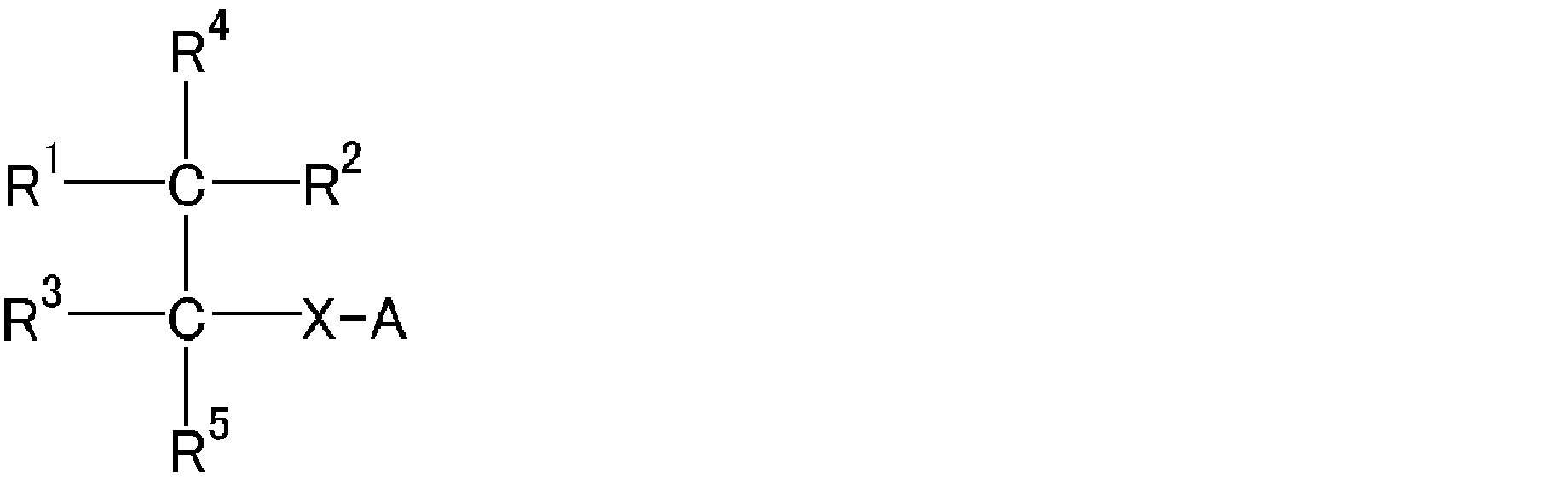
(式中、R1~R5はH又は一価の置換基を表し、但し、R1及びR3のうち、少なくとも1つは、一般式:-Y-R6で示される基、R2及びR5のうち、少なくとも1つは、一般式:-X-Aで示される基、又は、一般式:-Y-R6で示される基を表す。
また、Xは、各出現において同一又は異なって、2価の連結基、又は、結合手;
Aは、各出現において同一又は異なって、-COOM、-SO3M又は-OSO3M(Mは、H、金属原子、NR7 4、置換基を有していてもよいイミダゾリウム、置換基を有していてもよいピリジニウム又は置換基を有していてもよいホスホニウム、R7は、H又は有機基);
Yは、各出現において同一又は異なって、-S(=O)2-、-O-、-COO-、-OCO-、-CONR8-及び-NR8CO-からなる群より選択される2価の連結基、又は、結合手、R8はH又は有機基;
R6は、各出現において同一又は異なって、カルボニル基、エステル基、アミド基及びスルホニル基からなる群より選択される少なくとも1種を炭素-炭素原子間に含んでもよい炭素数1以上のアルキル基;
を表す。
R1~R5のうち、いずれか2つがお互いに結合して、環を形成してもよい。)で示される界面活性剤(以下、界面活性剤(1)ともいう)が好ましく例示される。
また、Xは、各出現において同一又は異なって、2価の連結基、又は、結合手;
Aは、各出現において同一又は異なって、-COOM、-SO3M又は-OSO3M(Mは、H、金属原子、NR7 4、置換基を有していてもよいイミダゾリウム、置換基を有していてもよいピリジニウム又は置換基を有していてもよいホスホニウム、R7は、H又は有機基);
Yは、各出現において同一又は異なって、-S(=O)2-、-O-、-COO-、-OCO-、-CONR8-及び-NR8CO-からなる群より選択される2価の連結基、又は、結合手、R8はH又は有機基;
R6は、各出現において同一又は異なって、カルボニル基、エステル基、アミド基及びスルホニル基からなる群より選択される少なくとも1種を炭素-炭素原子間に含んでもよい炭素数1以上のアルキル基;
を表す。
R1~R5のうち、いずれか2つがお互いに結合して、環を形成してもよい。)で示される界面活性剤(以下、界面活性剤(1)ともいう)が好ましく例示される。
界面活性剤(1)について説明する。
式中、R1~R5はH又は一価の置換基を表し、但し、R1及びR3のうち、少なくとも1つは、一般式:-Y-R6で示される基、R2及びR5のうち、少なくとも1つは、一般式:-X-Aで示される基、又は、一般式:-Y-R6で示される基を表す。R1~R5のうち、いずれか2つがお互いに結合して、環を形成してもよい。
R1としての上記アルキル基が有してもよい上記置換基としては、ハロゲン原子、炭素数1~10の直鎖状若しくは分岐鎖状のアルキル基又は炭素数3~10の環状のアルキル基、ヒドロキシ基が好ましく、メチル基、エチル基が特に好ましい。
R1としての上記アルキル基は、カルボニル基を含まないことが好ましい。
上記アルキル基は、炭素原子に結合した水素原子の75%以下がハロゲン原子により置換されていてもよく、50%以下がハロゲン原子により置換されていてもよく、25%以下がハロゲン原子により置換されていてもよいが、フッ素原子、塩素原子等のハロゲン原子を含まない非ハロゲン化アルキル基であることが好ましい。
上記アルキル基は、如何なる置換基も有していないことが好ましい。
上記アルキル基は、炭素原子に結合した水素原子の75%以下がハロゲン原子により置換されていてもよく、50%以下がハロゲン原子により置換されていてもよく、25%以下がハロゲン原子により置換されていてもよいが、フッ素原子、塩素原子等のハロゲン原子を含まない非ハロゲン化アルキル基であることが好ましい。
上記アルキル基は、如何なる置換基も有していないことが好ましい。
R1としては、置換基を有してもよい炭素数1~10の直鎖状若しくは分岐鎖状のアルキル基又は置換基を有してもよい炭素数3~10の環状のアルキル基が好ましく、カルボニル基を含まない炭素数1~10の直鎖状若しくは分岐鎖状のアルキル基又はカルボニル基を含まない炭素数3~10の環状のアルキル基がより好ましく、置換基を有さない炭素数1~10の直鎖状又は分岐鎖状のアルキル基が更に好ましく、置換基を有さない炭素数1~3の直鎖状又は分岐鎖状のアルキル基が更により好ましく、メチル基(-CH3)又はエチル基(-C2H5)が特に好ましく、メチル基(-CH3)が最も好ましい。
一価の置換基としては、一般式:-Y-R6で示される基、一般式:-X-Aで示される基、-H、置換基を有していてもよいC1-20のアルキル基、-NH2、-NHR9(R9は有機基)、-OH、-COOR9(R9は有機基)又は-OR9(R9は有機基)が好ましい。上記アルキル基の炭素数は1~10が好ましい。
R9としては、C1-10のアルキル基又はC1-10のアルキルカルボニル基が好ましく、C1-4のアルキル基又はC1-4のアルキルカルボニル基がより好ましい。
式中、Xは、各出現において同一又は異なって、2価の連結基、又は、結合手を表す。
R6がカルボニル基、エステル基、アミド基及びスルホニル基のいずれをも含まない場合は、Xはカルボニル基、エステル基、アミド基及びスルホニル基からなる群より選択される少なくとも1種を含む2価の連結基であることが好ましい。
R6がカルボニル基、エステル基、アミド基及びスルホニル基のいずれをも含まない場合は、Xはカルボニル基、エステル基、アミド基及びスルホニル基からなる群より選択される少なくとも1種を含む2価の連結基であることが好ましい。
Xとしては、-CO-、-S(=O)2-、-O-、-COO-、-OCO-、-S(=O)2-O-、-O-S(=O)2-、-CONR8-及び-NR8CO-からなる群より選択される少なくとも1種の結合を含む2価の連結基、C1-10のアルキレン基、又は、結合手が好ましい。R8はH又は有機基を表す。
R8における有機基としてはアルキル基が好ましい。R8としては、H又はC1-10の有機基が好ましく、H又はC1-4の有機基がより好ましく、H又はC1-4のアルキル基が更に好ましく、Hが更により好ましい。
式中、Aは、各出現において同一又は異なって、-COOM、-SO3M又は-OSO3M(Mは、H、金属原子、NR7
4、置換基を有していてもよいイミダゾリウム、置換基を有していてもよいピリジニウム又は置換基を有していてもよいホスホニウム、R7はH又は有機基である。4つのR7は、同一でも異なっていてもよい。)を表す。一般式(1)において、Aは-COOMであることが好適な態様の一つである。
R7における有機基としてはアルキル基が好ましい。R7としては、H又はC1-10の有機基が好ましく、H又はC1-4の有機基がより好ましく、H又はC1-4のアルキル基が更に好ましい。
上記金属原子としては、アルカリ金属(1族)、アルカリ土類金属(2族)等が挙げられ、Na、K又はLiが好ましい。
上記金属原子としては、アルカリ金属(1族)、アルカリ土類金属(2族)等が挙げられ、Na、K又はLiが好ましい。
Mとしては、H、金属原子又はNR7
4が好ましく、H、アルカリ金属(1族)、アルカリ土類金属(2族)又はNR7
4がより好ましく、H、Na、K、Li又はNH4が更に好ましく、Na、K又はNH4が更により好ましく、Na又はNH4が特に好ましく、NH4が最も好ましい。
式中、Yは、各出現において同一又は異なって、-S(=O)2-、-O-、-COO-、-OCO-、-CONR8-及び-NR8CO-からなる群より選択される2価の連結基、又は、結合手、R8はH又は有機基を表す。
Yとしては、結合手、-O-、-COO-、-OCO-、-CONR8-及び-NR8CO-からなる群より選択される2価の連結基が好ましく、結合手、-COO-及び-OCO-からなる群より選択される2価の連結基がより好ましい。
R8における有機基としてはアルキル基が好ましい。R8としては、H又はC1-10の有機基が好ましく、H又はC1-4の有機基がより好ましく、H又はC1-4のアルキル基が更に好ましく、Hが更により好ましい。
式中、R6は、各出現において同一又は異なって、カルボニル基、エステル基、アミド基及びスルホニル基からなる群より選択される少なくとも1種を炭素-炭素原子間に含んでもよい炭素数1以上のアルキル基を表す。上記R6の有機基の炭素数は、1以上が好ましく、20以下が好ましく、2~20がより好ましく、2~10がさらに好ましい。
R6のアルキル基は、炭素数が2以上である場合、炭素-炭素原子間にカルボニル基、エステル基、アミド基及びスルホニル基からなる群より選択される少なくとも1種を1又は2以上含むことができるが、上記アルキル基の両末端にこれらの基を含まない。上記R6のアルキル基は、炭素原子に結合した水素原子の75%以下がハロゲン原子により置換されていてもよく、50%以下がハロゲン原子により置換されていてもよく、25%以下がハロゲン原子により置換されていてもよいが、フッ素原子、塩素原子等のハロゲン原子を含まない非ハロゲン化アルキル基であることが好ましい。
R6としては、
一般式:-R10-CO-R11で示される基、
一般式:-R10-COO-R11で示される基、
一般式:-R11で示される基、
一般式:-R10-NR8CO-R11で示される基、又は、
一般式:-R10-CONR8-R11で示される基、
(式中、R8はH又は有機基を表す。R10はアルキレン基、R11は置換基を有してもよいアルキル基)が好ましい。
R6としては、一般式:-R10-CO-R11で示される基がより好ましい。
一般式:-R10-CO-R11で示される基、
一般式:-R10-COO-R11で示される基、
一般式:-R11で示される基、
一般式:-R10-NR8CO-R11で示される基、又は、
一般式:-R10-CONR8-R11で示される基、
(式中、R8はH又は有機基を表す。R10はアルキレン基、R11は置換基を有してもよいアルキル基)が好ましい。
R6としては、一般式:-R10-CO-R11で示される基がより好ましい。
R8における有機基としてはアルキル基が好ましい。R8としては、H又はC1-10の有機基が好ましく、H又はC1-4の有機基がより好ましく、H又はC1-4のアルキル基が更に好ましく、Hが更により好ましい。
R10のアルキレン基の炭素数は、1以上が好ましく、3以上がより好ましく、20以下が好ましく、12以下がより好ましく、10以下が更に好ましく、8以下が特に好ましい。また、R10のアルキレン基の炭素数は、1~20が好ましく、1~10がより好ましく、3~10が更に好ましい。
R11のアルキル基の炭素数は、1~20であってよく、1~15が好ましく、1~12がより好ましく、1~10が更に好ましく、1~8が更により好ましく、1~6が殊更好ましく、1~3が尚更に好ましく、1又は2が特に好ましく、1が最も好ましい。また、上記R11のアルキル基は、1級炭素、2級炭素、3級炭素のみで構成されていることが好ましく、1級炭素、2級炭素のみで構成されるのが特に好ましい。すなわち、R11としては、メチル基、エチル基、n-プロピル基、イソプロピル基が好ましく、特にメチル基が最も好ましい。
一般式(1)において、R2及びR5のうち、少なくとも1つは、一般式:-X-Aで示される基であり、該Aは-COOMであることも好適な態様の一つである。
界面活性剤(1)としては、一般式(1-1)で示される化合物、一般式(1-2)で示される化合物又は一般式(1-3)で示される化合物が好ましく、一般式(1-1)で示される化合物又は一般式(1-2)で示される化合物がより好ましい。
一般式(1-1):

(式中、R3~R6、X、A及びYは、上記のとおり。)
一般式(1-2):

(式中、R4~R6、X、A及びYは、上記のとおり。)
一般式(1-3):
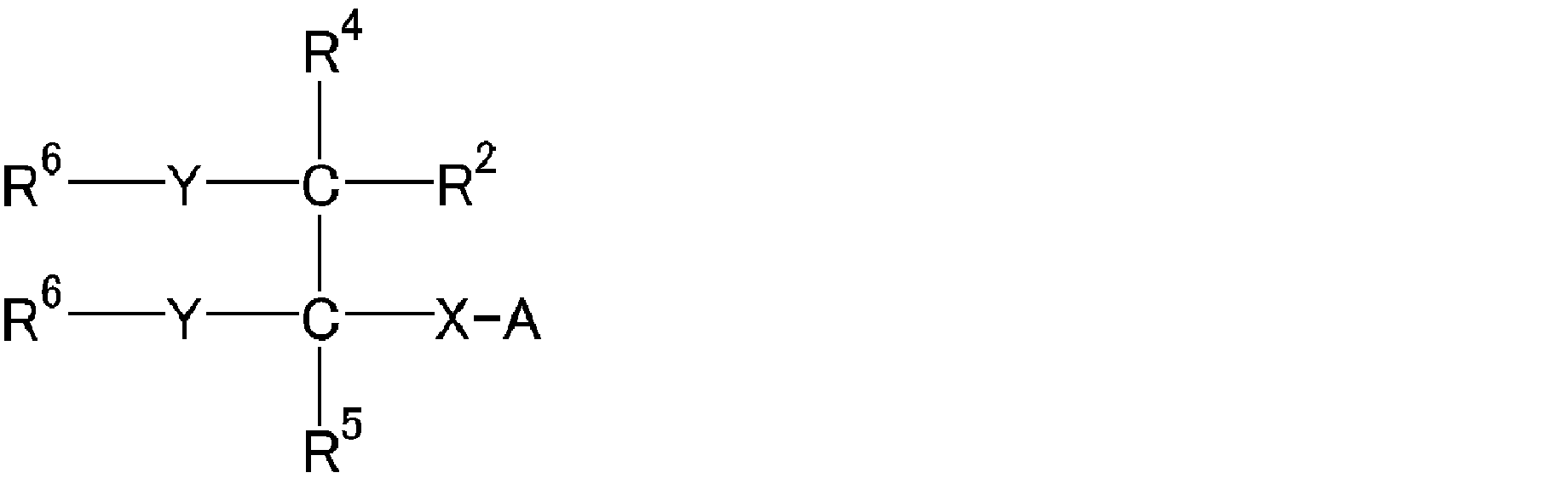
(式中、R2、R4~R6、X、A及びYは、上記のとおり。)
一般式:-X-Aで示される基としては、
-COOM、
-R12COOM、
-SO3M、
-OSO3M、-R12SO3M、
-R12OSO3M、
-OCO-R12-COOM、
-OCO-R12-SO3M、
-OCO-R12-OSO3M
-COO-R12-COOM、
-COO-R12-SO3M、
-COO-R12-OSO3M、
-CONR8-R12-COOM、
-CONR8-R12-SO3M、
-CONR8-R12-OSO3M、
-NR8CO-R12-COOM、
-NR8CO-R12-SO3M、
-NR8CO-R12-OSO3M、
-OS(=O)2-R12-COOM、
-OS(=O)2-R12-SO3M、又は
-OS(=O)2-R12-OSO3M
(式中、R8及びMは、上記のとおり。R12はC1-10のアルキレン基。)が好ましい。
上記R12のアルキレン基は、炭素原子に結合した水素原子の75%以下がハロゲン原子により置換されていてもよく、50%以下がハロゲン原子により置換されていてもよく、25%以下がハロゲン原子により置換されていてもよいが、フッ素原子、塩素原子等のハロゲン原子を含まない非ハロゲン化アルキレン基であることが好ましい。
-COOM、
-R12COOM、
-SO3M、
-OSO3M、-R12SO3M、
-R12OSO3M、
-OCO-R12-COOM、
-OCO-R12-SO3M、
-OCO-R12-OSO3M
-COO-R12-COOM、
-COO-R12-SO3M、
-COO-R12-OSO3M、
-CONR8-R12-COOM、
-CONR8-R12-SO3M、
-CONR8-R12-OSO3M、
-NR8CO-R12-COOM、
-NR8CO-R12-SO3M、
-NR8CO-R12-OSO3M、
-OS(=O)2-R12-COOM、
-OS(=O)2-R12-SO3M、又は
-OS(=O)2-R12-OSO3M
(式中、R8及びMは、上記のとおり。R12はC1-10のアルキレン基。)が好ましい。
上記R12のアルキレン基は、炭素原子に結合した水素原子の75%以下がハロゲン原子により置換されていてもよく、50%以下がハロゲン原子により置換されていてもよく、25%以下がハロゲン原子により置換されていてもよいが、フッ素原子、塩素原子等のハロゲン原子を含まない非ハロゲン化アルキレン基であることが好ましい。
一般式:-Y-R6で示される基としては、
一般式:-R10-CO-R11で示される基、
一般式:-OCO-R10-CO-R11で示される基、
一般式:-COO-R10-CO-R11で示される基、
一般式:-OCO-R10-COO-R11で示される基、
一般式:-COO-R11で示される基、
一般式:-NR8CO-R10-CO-R11で示される基、又は、
一般式:-CONR8-R10-NR8CO-R11で示される基
(式中、R8、R10及びR11は上記のとおり。)が好ましい。
一般式:-R10-CO-R11で示される基、
一般式:-OCO-R10-CO-R11で示される基、
一般式:-COO-R10-CO-R11で示される基、
一般式:-OCO-R10-COO-R11で示される基、
一般式:-COO-R11で示される基、
一般式:-NR8CO-R10-CO-R11で示される基、又は、
一般式:-CONR8-R10-NR8CO-R11で示される基
(式中、R8、R10及びR11は上記のとおり。)が好ましい。
式中、R4及びR5としては、独立に、H又はC1-4のアルキル基が好ましい。
上記R4及びR5のアルキル基は、炭素原子に結合した水素原子の75%以下がハロゲン原子により置換されていてもよく、50%以下がハロゲン原子により置換されていてもよく、25%以下がハロゲン原子により置換されていてもよいが、フッ素原子、塩素原子等のハロゲン原子を含まない非ハロゲン化アルキル基であることが好ましい。
上記R4及びR5のアルキル基は、炭素原子に結合した水素原子の75%以下がハロゲン原子により置換されていてもよく、50%以下がハロゲン原子により置換されていてもよく、25%以下がハロゲン原子により置換されていてもよいが、フッ素原子、塩素原子等のハロゲン原子を含まない非ハロゲン化アルキル基であることが好ましい。
一般式(1-1)におけるR3としては、H又は置換基を有していてもよいC1-20のアルキル基が好ましく、H又は置換基を有していないC1-20のアルキル基がより好ましく、Hが更に好ましい。
上記R3のアルキル基は、炭素原子に結合した水素原子の75%以下がハロゲン原子により置換されていてもよく、50%以下がハロゲン原子により置換されていてもよく、25%以下がハロゲン原子により置換されていてもよいが、フッ素原子、塩素原子等のハロゲン原子を含まない非ハロゲン化アルキル基であることが好ましい。
上記R3のアルキル基は、炭素原子に結合した水素原子の75%以下がハロゲン原子により置換されていてもよく、50%以下がハロゲン原子により置換されていてもよく、25%以下がハロゲン原子により置換されていてもよいが、フッ素原子、塩素原子等のハロゲン原子を含まない非ハロゲン化アルキル基であることが好ましい。
一般式(1-3)におけるR2としては、H、OH又は置換基を有していてもよいC1-20のアルキル基が好ましく、H、OH又は置換基を有していないC1-20のアルキル基がより好ましく、H又はOHが更に好ましい。
上記R2のアルキル基は、炭素原子に結合した水素原子の75%以下がハロゲン原子により置換されていてもよく、50%以下がハロゲン原子により置換されていてもよく、25%以下がハロゲン原子により置換されていてもよいが、フッ素原子、塩素原子等のハロゲン原子を含まない非ハロゲン化アルキル基であることが好ましい。
上記R2のアルキル基は、炭素原子に結合した水素原子の75%以下がハロゲン原子により置換されていてもよく、50%以下がハロゲン原子により置換されていてもよく、25%以下がハロゲン原子により置換されていてもよいが、フッ素原子、塩素原子等のハロゲン原子を含まない非ハロゲン化アルキル基であることが好ましい。
上記炭化水素系界面活性剤としては、下記式(1-0A):
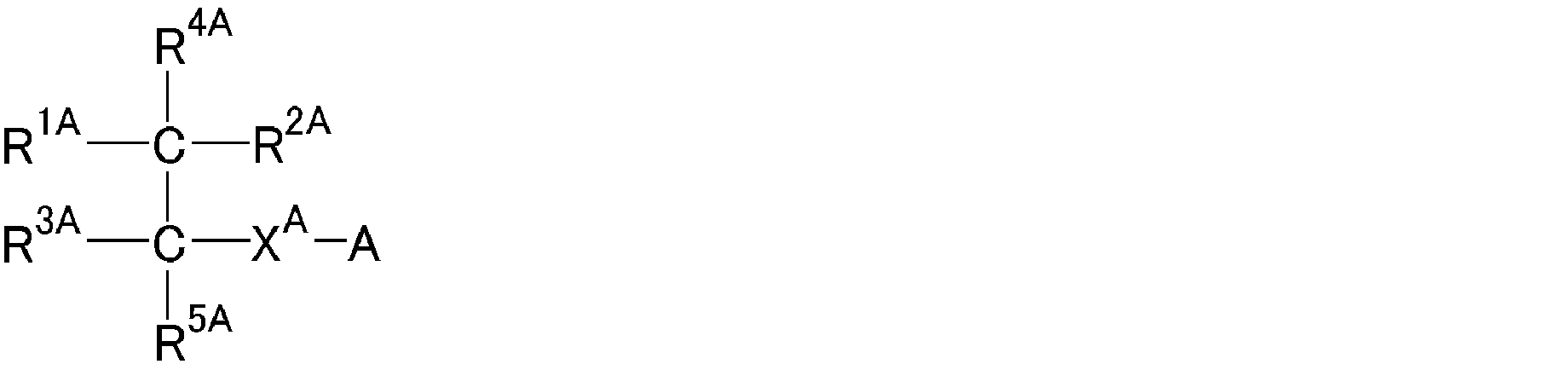
(式中、R1A~R5Aは、H、炭素-炭素原子間にエステル基を含んでもよい1価の炭化水素基、又は、一般式:-XA-Aで示される基である。但し、R2A及びR5Aの少なくとも1つは、一般式:-XA-Aで示される基を表す。
XAは、各出現において同一又は異なって、2価の炭化水素基、又は、結合手;
Aは、各出現において同一又は異なって、-COOM(Mは、H、金属原子、NR7 4、置換基を有していてもよいイミダゾリウム、置換基を有していてもよいピリジニウム又は置換基を有していてもよいホスホニウム、R7は、H又は有機基);
R1A~R5Aのうち、いずれか2つがお互いに結合して、環を形成してもよい。)で示される界面活性剤(1-0A)等も挙げられる。
XAは、各出現において同一又は異なって、2価の炭化水素基、又は、結合手;
Aは、各出現において同一又は異なって、-COOM(Mは、H、金属原子、NR7 4、置換基を有していてもよいイミダゾリウム、置換基を有していてもよいピリジニウム又は置換基を有していてもよいホスホニウム、R7は、H又は有機基);
R1A~R5Aのうち、いずれか2つがお互いに結合して、環を形成してもよい。)で示される界面活性剤(1-0A)等も挙げられる。
一般式(1-0A)中、R1A~R5Aにおいて、炭素-炭素原子間にエステル基を含んでもよい1価の炭化水素基の炭素数は1~50であることが好ましく、5~20であることがより好ましい。R1A~R5Aのうち、いずれか2つがお互いに結合して、環を形成してもよい。上記炭素-炭素原子間にエステル基を含んでもよい1価の炭化水素基としては、アルキル基が好ましい。
式中、XAにおいて、2価の炭化水素基の炭素数は1~50であることが好ましく、5~20であることがより好ましい。上記2価の炭化水素基としては、アルキレン基、アルカンジイル基等が挙げられ、アルキレン基が好ましい。
式中、XAにおいて、2価の炭化水素基の炭素数は1~50であることが好ましく、5~20であることがより好ましい。上記2価の炭化水素基としては、アルキレン基、アルカンジイル基等が挙げられ、アルキレン基が好ましい。
一般式(1-0A)中、R2A及びR5Aのいずれか1つが、上記一般式:-XA-Aで示される基であることが好ましく、R2Aが上記一般式:-XA-Aで示される基であることがより好ましい。
一般式(1-0A)中、好適な態様としては、R2Aが、一般式:-XA-Aで示される基であり、R1A、R3A、R4A及びR5AがHである態様である。この場合、XAは結合手又は炭素数1~5のアルキレン基であることが好ましい。
一般式(1-0A)中、好適な態様としてはまた、R2Aが、一般式:-XA-Aで示される基であり、R1A及びR3Aが-YA-R6で示される基であり、YAは、各出現において同一又は異なって、-COO-、-OCO-、又は、結合手であり、R6は各出現において同一又は異なって、炭素数1以上のアルキル基である態様である。この場合、R4A及びR5AがHであることが好ましい。
一般式(1-0A)で表される炭化水素系界面活性剤としては、例えば、グルタル酸又はその塩、アジピン酸又はその塩、ピメリン酸又はその塩、スベリン酸又はその塩、アゼライン酸又はその塩、セバシン酸又はその塩等が挙げられる。
また、一般式(1-0A)で表される脂肪族型のカルボン酸型炭化水素系界面活性剤は2鎖2親水基型合成界面活性剤であってもよく、例えば、ジェミニ型界面活性剤として、ジェミニサ-フ(中京油脂株式会社)、Gemsurf α142(炭素数12 ラウリル基)、Gemsurf α102(炭素数10)、Gemsurf α182(炭素数14)等が挙げられる。
また、一般式(1-0A)で表される脂肪族型のカルボン酸型炭化水素系界面活性剤は2鎖2親水基型合成界面活性剤であってもよく、例えば、ジェミニ型界面活性剤として、ジェミニサ-フ(中京油脂株式会社)、Gemsurf α142(炭素数12 ラウリル基)、Gemsurf α102(炭素数10)、Gemsurf α182(炭素数14)等が挙げられる。
上記炭化水素系界面活性剤としては、また、カルボニル基(但し、カルボキシル基中のカルボニル基を除く)を1つ以上有する炭化水素系界面活性剤も挙げられる。
上記カルボニル基(但し、カルボキシル基中のカルボニル基を除く)を1つ以上有する炭化水素系界面活性剤としては、式:R-X(式中、Rは、カルボニル基(但し、カルボキシル基中のカルボニル基を除く)を1つ以上有する炭素数1~2000のフッ素非含有有機基であり、Xは、-OSO3X1、-COOX1又は-SO3X1(X1は、H、金属原子、NR1
4、置換基を有していてもよいイミダゾリウム、置換基を有していてもよいピリジニウム又は置換基を有していてもよいホスホニウムであり、R1はH又は有機基であり、同一でも異なっていてもよい。))で示される界面活性剤が好ましい。Rは、炭素数が500以下であることが好ましく、100以下であることがより好ましく、50以下であることが更に好ましく、30以下であることが更により好ましい。
上記炭化水素系界面活性剤としては、下記式(a):

(式中、R1aは、炭素数1以上の直鎖状若しくは分岐鎖状のアルキル基又は炭素数3以上の環状のアルキル基であり、炭素原子に結合した水素原子がヒドロキシ基又はエステル結合を含む1価の有機基により置換されていてもよく、炭素数が2以上の場合はカルボニル基を含んでもよく、炭素数が3以上の場合は1価又は2価の複素環を含んでも環を形成していてもよい。R2a及びR3aは、独立に、単結合又は2価の連結基である。R1a、R2a及びR3aは、炭素数が合計で6以上である。Xaは、H、金属原子、NR4a
4、置換基を有していてもよいイミダゾリウム、置換基を有していてもよいピリジニウム又は置換基を有していてもよいホスホニウムであり、R4aはH又は有機基であり、同一でも異なっていてもよい。R1a、R2a及びR3aは、いずれか2つがお互いに結合して、環を形成してもよい。)で示される界面活性剤(a)、下記式(b):

(式中、R1bは、置換基を有してもよい炭素数1以上の直鎖状若しくは分岐鎖状のアルキル基又は置換基を有してもよい炭素数3以上の環状のアルキル基であり、炭素数が3以上の場合は1価又は2価の複素環を含んでも環を形成していてもよい。R2b及びR4bは、独立に、H又は置換基である。R3bは、置換基を有してもよい炭素数1~10のアルキレン基である。nは、1以上の整数である。p及びqは、独立に、0以上の整数である。Xbは、H、金属原子、NR5b
4、置換基を有していてもよいイミダゾリウム、置換基を有していてもよいピリジニウム又は置換基を有していてもよいホスホニウムであり、R5bはH又は有機基であり、同一でも異なっていてもよい。R1b、R2b、R3b及びR4bは、いずれか2つがお互いに結合して、環を形成してもよい。Lは、単結合、-CO2-B-*、-OCO-B-*、-CONR6b-B-*、-NR6bCO-B-*、又は、-CO-(但し、-CO2-B-、-OCO-B-、-CONR6b-B-、-NR6CO-B-に含まれるカルボニル基を除く。)であり、Bは単結合もしくは置換基を有してもよい炭素数1から10のアルキレン基であり、R6bは、H又は置換基を有していてもよい、炭素数1~4のアルキル基である。*は、式中の-OSO3Xbに結合する側を指す。)で示される界面活性剤(b)、下記式(c):

(式中、R1cは、炭素数1以上の直鎖状若しくは分岐鎖状のアルキル基又は炭素数3以上の環状のアルキル基であり、炭素原子に結合した水素原子がヒドロキシ基又はエステル結合を含む1価の有機基により置換されていてもよく、炭素数が2以上の場合はカルボニル基を含んでもよく、炭素数が3以上の場合は1価又は2価の複素環を含んでも環を形成していてもよい。R2c及びR3cは、独立に、単結合又は2価の連結基である。R1c、R2c及びR3cは、炭素数が合計で5以上である。Acは、-COOXc又は-SO3Xc(Xcは、H、金属原子、NR4c
4、置換基を有していてもよいイミダゾリウム、置換基を有していてもよいピリジニウム又は置換基を有していてもよいホスホニウムであり、R4cはH又は有機基であり、同一でも異なっていてもよい。)である。R1c、R2c及びR3cは、いずれか2つがお互いに結合して、環を形成してもよい。)で示される界面活性剤(c)、及び、下記式(d):

(式中、R1dは、置換基を有してもよい炭素数1以上の直鎖状若しくは分岐鎖状のアルキル基又は置換基を有してもよい炭素数3以上の環状のアルキル基であり、炭素数が3以上の場合は1価又は2価の複素環を含んでも環を形成していてもよい。R2d及びR4dは、独立に、H又は置換基である。R3dは、置換基を有してもよい炭素数1~10のアルキレン基である。nは、1以上の整数である。p及びqは、独立に、0以上の整数である。Adは、-SO3Xd又は-COOXd(Xdは、H、金属原子、NR5d
4、置換基を有していてもよいイミダゾリウム、置換基を有していてもよいピリジニウム又は置換基を有していてもよいホスホニウムであり、R5dはH又は有機基であり、同一でも異なっていてもよい。)である。R1d、R2d、R3d及びR4dは、いずれか2つがお互いに結合して、環を形成してもよい。Lは、単結合、-CO2-B-*、-OCO-B-*、-CONR6d-B-*、-NR6dCO-B-*、又は、-CO-(但し、-CO2-B-、-OCO-B-、-CONR6d-B-、-NR6dCO-B-に含まれるカルボニル基を除く。)であり、Bは単結合もしくは置換基を有してもよい炭素数1から10のアルキレン基であり、R6dは、H又は置換基を有していてもよい、炭素数1~4のアルキル基である。*は、式中のAdに結合する側を指す。)で示される界面活性剤(d)からなる群より選択される少なくとも1種がより好ましい。
上記炭化水素系界面活性剤としては、下記式(a):
界面活性剤(a)について説明する。
式(a)中、R1aは、炭素数1以上の直鎖状若しくは分岐鎖状のアルキル基又は炭素数3以上の環状のアルキル基である。
上記アルキル基は、炭素数が3以上の場合、2つの炭素原子間にカルボニル基(-C(=O)-)を含んでもよい。また、上記アルキル基は、炭素数が2以上の場合、上記アルキル基の末端に上記カルボニル基を含むこともできる。すなわち、CH3-C(=O)-で示されるアセチル基等のアシル基も、上記アルキル基に含まれる。
また、上記アルキル基は、炭素数が3以上の場合は1価又は2価の複素環を含むこともできるし、環を形成することもできる。上記複素環としては、不飽和複素環が好ましく、含酸素不飽和複素環がより好ましく、例えば、フラン環等が挙げられる。R1aにおいて、2価の複素環が2つの炭素原子間に挿入されていてもよいし、2価の複素環が末端に位置して-C(=O)-と結合してもよいし、1価の複素環が上記アルキル基の末端に位置してもよい。
上記アルキル基は、炭素数が3以上の場合、2つの炭素原子間にカルボニル基(-C(=O)-)を含んでもよい。また、上記アルキル基は、炭素数が2以上の場合、上記アルキル基の末端に上記カルボニル基を含むこともできる。すなわち、CH3-C(=O)-で示されるアセチル基等のアシル基も、上記アルキル基に含まれる。
また、上記アルキル基は、炭素数が3以上の場合は1価又は2価の複素環を含むこともできるし、環を形成することもできる。上記複素環としては、不飽和複素環が好ましく、含酸素不飽和複素環がより好ましく、例えば、フラン環等が挙げられる。R1aにおいて、2価の複素環が2つの炭素原子間に挿入されていてもよいし、2価の複素環が末端に位置して-C(=O)-と結合してもよいし、1価の複素環が上記アルキル基の末端に位置してもよい。
なお、本明細書において、上記アルキル基の「炭素数」には、カルボニル基を構成する炭素原子の数及び上記複素環を構成する炭素原子の数も含めるものとする。例えば、CH3-C(=O)-CH2-で示される基は炭素数が3であり、CH3-C(=O)-C2H4-C(=O)-C2H4-で示される基は炭素数が7であり、CH3-C(=O)-で示される基は炭素数が2である。
上記アルキル基は、炭素原子に結合した水素原子が官能基により置換されていてもよく、例えば、ヒドロキシ基(-OH)又はエステル結合を含む1価の有機基により置換されていてもよいが、如何なる官能基によっても置換されていないことが好ましい。
上記エステル結合を含む1価の有機基としては、式:-O-C(=O)-R101a(式中、R101aはアルキル基)で示される基が挙げられる。
上記アルキル基は、炭素原子に結合した水素原子の75%以下がハロゲン原子により置換されていてもよく、50%以下がハロゲン原子により置換されていてもよく、25%以下がハロゲン原子により置換されていてもよいが、フッ素原子、塩素原子等のハロゲン原子を含まない非ハロゲン化アルキル基であることが好ましい。
上記エステル結合を含む1価の有機基としては、式:-O-C(=O)-R101a(式中、R101aはアルキル基)で示される基が挙げられる。
上記アルキル基は、炭素原子に結合した水素原子の75%以下がハロゲン原子により置換されていてもよく、50%以下がハロゲン原子により置換されていてもよく、25%以下がハロゲン原子により置換されていてもよいが、フッ素原子、塩素原子等のハロゲン原子を含まない非ハロゲン化アルキル基であることが好ましい。
式中、R2a及びR3aは、独立に、単結合又は2価の連結基である。
R2a及びR3aは、独立に、単結合又は炭素数1以上の直鎖状若しくは分岐鎖状のアルキレン基又は炭素数3以上の環状のアルキレン基であることが好ましい。
R2a及びR3aを構成する上記アルキレン基は、カルボニル基を含まないことが好ましい。
R2a及びR3aは、独立に、単結合又は炭素数1以上の直鎖状若しくは分岐鎖状のアルキレン基又は炭素数3以上の環状のアルキレン基であることが好ましい。
R2a及びR3aを構成する上記アルキレン基は、カルボニル基を含まないことが好ましい。
上記アルキレン基は、炭素原子に結合した水素原子が官能基により置換されていてもよく、例えば、ヒドロキシ基(-OH)又はエステル結合を含む1価の有機基により置換されていてもよいが、如何なる官能基によっても置換されていないことが好ましい。
上記エステル結合を含む1価の有機基としては、式:-O-C(=O)-R102a(式中、R102aはアルキル基)で示される基が挙げられる。
上記アルキレン基は、炭素原子に結合した水素原子の75%以下がハロゲン原子により置換されていてもよく、50%以下がハロゲン原子により置換されていてもよく、25%以下がハロゲン原子により置換されていてもよいが、フッ素原子、塩素原子等のハロゲン原子を含まない非ハロゲン化アルキレン基であることが好ましい。
上記エステル結合を含む1価の有機基としては、式:-O-C(=O)-R102a(式中、R102aはアルキル基)で示される基が挙げられる。
上記アルキレン基は、炭素原子に結合した水素原子の75%以下がハロゲン原子により置換されていてもよく、50%以下がハロゲン原子により置換されていてもよく、25%以下がハロゲン原子により置換されていてもよいが、フッ素原子、塩素原子等のハロゲン原子を含まない非ハロゲン化アルキレン基であることが好ましい。
R1a、R2a及びR3aは、炭素数が合計で6以上である。合計の炭素数としては、8以上が好ましく、9以上がより好ましく、10以上が更に好ましく、20以下が好ましく、18以下がより好ましく、15以下が更に好ましい。
R1a、R2a及びR3aは、いずれか2つがお互いに結合して、環を形成してもよい。
R1a、R2a及びR3aは、いずれか2つがお互いに結合して、環を形成してもよい。
式(a)中、Xaは、H、金属原子、NR4a
4、置換基を有していてもよいイミダゾリウム、置換基を有していてもよいピリジニウム又は置換基を有していてもよいホスホニウムであり、R4aはH又は有機基である。4つのR4aは、同一でも異なっていてもよい。R4aとしては、H又は炭素数1~10の有機基が好ましく、H又は炭素数1~4の有機基がより好ましい。上記金属原子としては、1、2価の金属原子が挙げられ、アルカリ金属(1族)、アルカリ土類金属(2族)等が挙げられ、Na、K又はLiが好ましい。Xaとしては、H、アルカリ金属(1族)、アルカリ土類金属(2族)又はNR4a
4が好ましく、水に溶解しやすいことから、H、Na、K、Li又はNH4がより好ましく、水に更に溶解しやすいことから、Na、K又はNH4が更に好ましく、Na又はNH4が特に好ましく、除去が容易であることから、NH4が最も好ましい。XaがNH4であると、上記界面活性剤の水性媒体への溶解性が優れるとともに、PTFE中又は最終製品中に金属成分が残留しにくい。
R1aとしては、カルボニル基を含まない炭素数1~8の直鎖状若しくは分岐鎖状のアルキル基、カルボニル基を含まない炭素数3~8の環状のアルキル基、1~10個のカルボニル基を含む炭素数2~45の直鎖状若しくは分岐鎖状のアルキル基、カルボニル基を含む炭素数3~45の環状のアルキル基、又は、炭素数が3~45の1価又は2価の複素環を含むアルキル基が好ましい。
また、R1aとしては、下記式:

(式中、n11aは0~10の整数であり、R11aは炭素数1~5の直鎖状若しくは分岐鎖状のアルキル基又は炭素数3~5の環状のアルキル基であり、R12aは炭素数0~3のアルキレン基である。n11aが2~10の整数である場合、R12aは各々同じであっても異なっていてもよい。)で示される基がより好ましい。
n11aとしては、0~5の整数が好ましく、0~3の整数がより好ましく、1~3の整数が更に好ましい。
R11aとしての上記アルキル基は、カルボニル基を含まないことが好ましい。
R11aとしての上記アルキル基は、炭素原子に結合した水素原子が官能基により置換されていてもよく、例えば、ヒドロキシ基(-OH)又はエステル結合を含む1価の有機基により置換されていてもよいが、如何なる官能基によっても置換されていないことが好ましい。
上記エステル結合を含む1価の有機基としては、式:-O-C(=O)-R103a(式中、R103aはアルキル基)で示される基が挙げられる。
R11aとしての上記アルキル基は、炭素原子に結合した水素原子の75%以下がハロゲン原子により置換されていてもよく、50%以下がハロゲン原子により置換されていてもよく、25%以下がハロゲン原子により置換されていてもよいが、フッ素原子、塩素原子等のハロゲン原子を含まない非ハロゲン化アルキル基であることが好ましい。
R11aとしての上記アルキル基は、炭素原子に結合した水素原子が官能基により置換されていてもよく、例えば、ヒドロキシ基(-OH)又はエステル結合を含む1価の有機基により置換されていてもよいが、如何なる官能基によっても置換されていないことが好ましい。
上記エステル結合を含む1価の有機基としては、式:-O-C(=O)-R103a(式中、R103aはアルキル基)で示される基が挙げられる。
R11aとしての上記アルキル基は、炭素原子に結合した水素原子の75%以下がハロゲン原子により置換されていてもよく、50%以下がハロゲン原子により置換されていてもよく、25%以下がハロゲン原子により置換されていてもよいが、フッ素原子、塩素原子等のハロゲン原子を含まない非ハロゲン化アルキル基であることが好ましい。
R12aは炭素数0~3のアルキレン基である。上記炭素数は1~3が好ましい。
R12aとしての上記アルキレン基は、直鎖状又は分岐鎖状であってよい。
R12aとしての上記アルキレン基は、カルボニル基を含まないことが好ましい。R12aとしては、エチレン基(-C2H4-)又はプロピレン基(-C3H6-)がより好ましい。
R12aとしての上記アルキレン基は、炭素原子に結合した水素原子が官能基により置換されていてもよく、例えば、ヒドロキシ基(-OH)又はエステル結合を含む1価の有機基により置換されていてもよいが、如何なる官能基によっても置換されていないことが好ましい。
上記エステル結合を含む1価の有機基としては、式:-O-C(=O)-R104a(式中、R104aはアルキル基)で示される基が挙げられる。
R12aとしての上記アルキレン基は、炭素原子に結合した水素原子の75%以下がハロゲン原子により置換されていてもよく、50%以下がハロゲン原子により置換されていてもよく、25%以下がハロゲン原子により置換されていてもよいが、フッ素原子、塩素原子等のハロゲン原子を含まない非ハロゲン化アルキレン基であることが好ましい。
R12aとしての上記アルキレン基は、直鎖状又は分岐鎖状であってよい。
R12aとしての上記アルキレン基は、カルボニル基を含まないことが好ましい。R12aとしては、エチレン基(-C2H4-)又はプロピレン基(-C3H6-)がより好ましい。
R12aとしての上記アルキレン基は、炭素原子に結合した水素原子が官能基により置換されていてもよく、例えば、ヒドロキシ基(-OH)又はエステル結合を含む1価の有機基により置換されていてもよいが、如何なる官能基によっても置換されていないことが好ましい。
上記エステル結合を含む1価の有機基としては、式:-O-C(=O)-R104a(式中、R104aはアルキル基)で示される基が挙げられる。
R12aとしての上記アルキレン基は、炭素原子に結合した水素原子の75%以下がハロゲン原子により置換されていてもよく、50%以下がハロゲン原子により置換されていてもよく、25%以下がハロゲン原子により置換されていてもよいが、フッ素原子、塩素原子等のハロゲン原子を含まない非ハロゲン化アルキレン基であることが好ましい。
R2a及びR3aとしては、独立に、カルボニル基を含まない炭素数1以上のアルキレン基が好ましく、カルボニル基を含まない炭素数1~3のアルキレン基がより好ましく、エチレン基(-C2H4-)又はプロピレン基(-C3H6-)が更に好ましい。
次に界面活性剤(b)について説明する。
式(b)中、R1bは、置換基を有してもよい炭素数1以上の直鎖状若しくは分岐鎖状のアルキル基又は置換基を有してもよい炭素数3以上の環状のアルキル基である。
上記アルキル基は、炭素数が3以上の場合は1価又は2価の複素環を含むこともできるし、環を形成することもできる。上記複素環としては、不飽和複素環が好ましく、含酸素不飽和複素環がより好ましく、例えば、フラン環等が挙げられる。R1bにおいて、2価の複素環が2つの炭素原子間に挿入されていてもよいし、2価の複素環が末端に位置して-C(=O)-と結合してもよいし、1価の複素環が上記アルキル基の末端に位置してもよい。
上記アルキル基は、炭素数が3以上の場合は1価又は2価の複素環を含むこともできるし、環を形成することもできる。上記複素環としては、不飽和複素環が好ましく、含酸素不飽和複素環がより好ましく、例えば、フラン環等が挙げられる。R1bにおいて、2価の複素環が2つの炭素原子間に挿入されていてもよいし、2価の複素環が末端に位置して-C(=O)-と結合してもよいし、1価の複素環が上記アルキル基の末端に位置してもよい。
なお、本明細書において、上記アルキル基の「炭素数」には、上記複素環を構成する炭素原子の数も含めるものとする。
R1bとしての上記アルキル基が有してもよい上記置換基としては、ハロゲン原子、炭素数1~10の直鎖状若しくは分岐鎖状のアルキル基又は炭素数3~10の環状のアルキル基、ヒドロキシ基が好ましく、メチル基、エチル基が特に好ましい。
R1bとしての上記アルキル基は、カルボニル基を含まないことが好ましい。
上記アルキル基は、炭素原子に結合した水素原子の75%以下がハロゲン原子により置換されていてもよく、50%以下がハロゲン原子により置換されていてもよく、25%以下がハロゲン原子により置換されていてもよいが、フッ素原子、塩素原子等のハロゲン原子を含まない非ハロゲン化アルキル基であることが好ましい。
上記アルキル基は、如何なる置換基も有していないことが好ましい。
上記アルキル基は、炭素原子に結合した水素原子の75%以下がハロゲン原子により置換されていてもよく、50%以下がハロゲン原子により置換されていてもよく、25%以下がハロゲン原子により置換されていてもよいが、フッ素原子、塩素原子等のハロゲン原子を含まない非ハロゲン化アルキル基であることが好ましい。
上記アルキル基は、如何なる置換基も有していないことが好ましい。
R1bとしては、置換基を有してもよい炭素数1~10の直鎖状若しくは分岐鎖状のアルキル基又は置換基を有してもよい炭素数3~10の環状のアルキル基が好ましく、カルボニル基を含まない炭素数1~10の直鎖状若しくは分岐鎖状のアルキル基又はカルボニル基を含まない炭素数3~10の環状のアルキル基がより好ましく、置換基を有さない炭素数1~10の直鎖状又は分岐鎖状のアルキル基が更に好ましく、置換基を有さない炭素数1~3の直鎖状又は分岐鎖状のアルキル基が更により好ましく、メチル基(-CH3)又はエチル基(-C2H5)が特に好ましく、メチル基(-CH3)が最も好ましい。
式(b)中、R2b及びR4bは、独立に、H又は置換基である。複数個のR2b及びR4bは、それぞれ同一でも異なっていてもよい。
R2b及びR4bとしての上記置換基としては、ハロゲン原子、炭素数1~10の直鎖状若しくは分岐鎖状のアルキル基又は炭素数3~10の環状のアルキル基、ヒドロキシ基が好ましく、メチル基、エチル基が特に好ましい。
R2b及びR4bとしての上記アルキル基は、カルボニル基を含まないことが好ましい。上記アルキル基は、炭素原子に結合した水素原子の75%以下がハロゲン原子により置換されていてもよく、50%以下がハロゲン原子により置換されていてもよく、25%以下がハロゲン原子により置換されていてもよいが、フッ素原子、塩素原子等のハロゲン原子を含まない非ハロゲン化アルキル基であることが好ましい。
上記アルキル基は、如何なる置換基も有していないことが好ましい。
上記アルキル基は、如何なる置換基も有していないことが好ましい。
R2b及びR4bとしての上記アルキル基としては、カルボニル基を含まない炭素数1~10の直鎖状若しくは分岐鎖状のアルキル基又はカルボニル基を含まない炭素数3~10の環状のアルキル基が好ましく、カルボニル基を含まない炭素数1~10の直鎖状又は分岐鎖状のアルキル基がより好ましく、置換基を有さない炭素数1~3の直鎖状又は分岐鎖状のアルキル基が更に好ましく、メチル基(-CH3)又はエチル基(-C2H5)が特に好ましい。
R2b及びR4bとしては、独立に、H又はカルボニル基を含まない炭素数1~10の直鎖状若しくは分岐鎖状のアルキル基が好ましく、H又は置換基を有さない炭素数1~3の直鎖状若しくは分岐鎖状のアルキル基がより好ましく、H、メチル基(-CH3)又はエチル基(-C2H5)が更により好ましく、Hが特に好ましい。
式(b)中、R3bは、置換基を有してもよい炭素数1~10のアルキレン基である。R3bは、複数個存在する場合、同一でも異なっていてもよい。
上記アルキレン基は、カルボニル基を含まないことが好ましい。
上記アルキレン基は、炭素原子に結合した水素原子の75%以下がハロゲン原子により置換されていてもよく、50%以下がハロゲン原子により置換されていてもよく、25%以下がハロゲン原子により置換されていてもよいが、フッ素原子、塩素原子等のハロゲン原子を含まない非ハロゲン化アルキル基であることが好ましい。
上記アルキレン基は、如何なる置換基も有していないことが好ましい。
上記アルキレン基は、炭素原子に結合した水素原子の75%以下がハロゲン原子により置換されていてもよく、50%以下がハロゲン原子により置換されていてもよく、25%以下がハロゲン原子により置換されていてもよいが、フッ素原子、塩素原子等のハロゲン原子を含まない非ハロゲン化アルキル基であることが好ましい。
上記アルキレン基は、如何なる置換基も有していないことが好ましい。
上記アルキレン基としては、置換基を有してもよい炭素数1~10の直鎖状若しくは分岐鎖状のアルキレン基又は置換基を有してもよい炭素数3~10の環状のアルキレン基が好ましく、カルボニル基を含まない炭素数1~10の直鎖状若しくは分岐鎖状のアルキレン基又はカルボニル基を含まない炭素数3~10の環状のアルキレン基が好ましく、置換基を有さない炭素数1~10の直鎖状又は分岐鎖状のアルキレン基がより好ましく、メチレン基(-CH2-)、エチレン基(-C2H4-)、イソプロピレン基(-CH(CH3)CH2-)又はプロピレン基(-C3H6-)が更に好ましい。
R1b、R2b、R3b及びR4bは、いずれか2つがお互いに結合して、環を形成してもよいが、環を形成していないことが好ましい。
式(b)中、nは、1以上の整数である。nとしては、1~40の整数が好ましく、1~30の整数がより好ましく、5~25の整数が更に好ましく、5~9、11~25の整数が特に好ましい。
式(b)中、p及びqは、独立に、0以上の整数である。pとしては、0~10の整数が好ましく、0又は1がより好ましい。qとしては、0~10の整数が好ましく、0~5の整数がより好ましい。
n、p及びqは、合計が5以上の整数であることが好ましい。n、p及びqの合計は8以上の整数であることがより好ましい。n、p及びqの合計はまた、60以下の整数であることが好ましく、50以下の整数であることがより好ましく、40以下の整数であることが更に好ましい。
式(b)中、Xbは、H、金属原子、NR5b
4、置換基を有していてもよいイミダゾリウム、置換基を有していてもよいピリジニウム又は置換基を有していてもよいホスホニウムであり、R5bはH又は有機基である。4つのR5bは、同一でも異なっていてもよい。R5bとしては、H又は炭素数1~10の有機基が好ましく、H又は炭素数1~4の有機基がより好ましい。上記金属原子としては、1、2価の金属原子が挙げられ、アルカリ金属(1族)、アルカリ土類金属(2族)等が挙げられ、Na、K又はLiが好ましい。Xbは金属原子又はNR5b
4(R5bは上記のとおり)であってよい。
Xbとしては、H、アルカリ金属(1族)、アルカリ土類金属(2族)又はNR5b 4が好ましく、水に溶解しやすいことから、H、Na、K、Li又はNH4がより好ましく、水に更に溶解しやすいことから、Na、K又はNH4が更に好ましく、Na又はNH4が特に好ましく、除去が容易であることから、NH4が最も好ましい。XbがNH4であると、上記界面活性剤の水性媒体への溶解性が優れるとともに、PTFE中又は最終製品中に金属成分が残留しにくい。
Xbとしては、H、アルカリ金属(1族)、アルカリ土類金属(2族)又はNR5b 4が好ましく、水に溶解しやすいことから、H、Na、K、Li又はNH4がより好ましく、水に更に溶解しやすいことから、Na、K又はNH4が更に好ましく、Na又はNH4が特に好ましく、除去が容易であることから、NH4が最も好ましい。XbがNH4であると、上記界面活性剤の水性媒体への溶解性が優れるとともに、PTFE中又は最終製品中に金属成分が残留しにくい。
式(b)中、Lは、単結合、-CO2-B-*、-OCO-B-*、-CONR6b-B-*、-NR6bCO-B-*、又は、-CO-(但し、-CO2-B-、-OCO-B-、-CONR6b-B-、-NR6CO-B-に含まれるカルボニル基を除く。)であり、Bは単結合もしくは置換基を有してもよい炭素数1~10のアルキレン基であり、R6bは、H又は置換基を有していてもよい、炭素数1~4のアルキル基である。上記アルキレン基は、炭素数が1~5であることがより好ましい。また、上記R6は、H又はメチル基であることがより好ましい。*は、式中の-OSO3Xbに結合する側を指す。
Lは単結合であることが好ましい。
界面活性剤(b)としては、下記式:

(式中、R1b、R2b、L、n及びXbは、上記のとおり。)で示される化合物が好ましい。
上記界面活性剤(b)は、1H-NMRスペクトルにおいて、ケミカルシフト2.0~5.0ppmの領域に観測される全ピーク強度の積分値が10%以上であることが好ましい。
上記界面活性剤(b)は、1H-NMRスペクトルにおいて、ケミカルシフト2.0~5.0ppmの領域に観測される全ピーク強度の積分値が上記範囲内にあることが好ましい。この場合、上記界面活性剤は分子中にケトン構造を有することが好ましい。
上記界面活性剤(b)において、上記積分値は、15以上がより好ましく、95以下が好ましく、80以下がより好ましく、70以下が更に好ましい。
上記積分値は、重水溶媒にて室温下に測定する。重水を4.79ppmとする。
界面活性剤(c)について説明する。
式(c)中、R1cは、炭素数1以上の直鎖状若しくは分岐鎖状のアルキル基又は炭素数3以上の環状のアルキル基である。
上記アルキル基は、炭素数が3以上の場合、2つの炭素原子間にカルボニル基(-C(=O)-)を含んでもよい。また、上記アルキル基は、炭素数が2以上の場合、上記アルキル基の末端に上記カルボニル基を含むこともできる。すなわち、CH3-C(=O)-で示されるアセチル基等のアシル基も、上記アルキル基に含まれる。
また、上記アルキル基は、炭素数が3以上の場合は1価又は2価の複素環を含むこともできるし、環を形成することもできる。上記複素環としては、不飽和複素環が好ましく、含酸素不飽和複素環がより好ましく、例えば、フラン環等が挙げられる。R1cにおいて、2価の複素環が2つの炭素原子間に挿入されていてもよいし、2価の複素環が末端に位置して-C(=O)-と結合してもよいし、1価の複素環が上記アルキル基の末端に位置してもよい。
上記アルキル基は、炭素数が3以上の場合、2つの炭素原子間にカルボニル基(-C(=O)-)を含んでもよい。また、上記アルキル基は、炭素数が2以上の場合、上記アルキル基の末端に上記カルボニル基を含むこともできる。すなわち、CH3-C(=O)-で示されるアセチル基等のアシル基も、上記アルキル基に含まれる。
また、上記アルキル基は、炭素数が3以上の場合は1価又は2価の複素環を含むこともできるし、環を形成することもできる。上記複素環としては、不飽和複素環が好ましく、含酸素不飽和複素環がより好ましく、例えば、フラン環等が挙げられる。R1cにおいて、2価の複素環が2つの炭素原子間に挿入されていてもよいし、2価の複素環が末端に位置して-C(=O)-と結合してもよいし、1価の複素環が上記アルキル基の末端に位置してもよい。
なお、本明細書において、上記アルキル基の「炭素数」には、カルボニル基を構成する炭素原子の数及び上記複素環を構成する炭素原子の数も含めるものとする。例えば、CH3-C(=O)-CH2-で示される基は炭素数が3であり、CH3-C(=O)-C2H4-C(=O)-C2H4-で示される基は炭素数が7であり、CH3-C(=O)-で示される基は炭素数が2である。
上記アルキル基は、炭素原子に結合した水素原子が官能基により置換されていてもよく、例えば、ヒドロキシ基(-OH)又はエステル結合を含む1価の有機基により置換されていてもよいが、如何なる官能基によっても置換されていないことが好ましい。
上記エステル結合を含む1価の有機基としては、式:-O-C(=O)-R101c(式中、R101cはアルキル基)で示される基が挙げられる。
上記アルキル基は、炭素原子に結合した水素原子の75%以下がハロゲン原子により置換されていてもよく、50%以下がハロゲン原子により置換されていてもよく、25%以下がハロゲン原子により置換されていてもよいが、フッ素原子、塩素原子等のハロゲン原子を含まない非ハロゲン化アルキル基であることが好ましい。
上記エステル結合を含む1価の有機基としては、式:-O-C(=O)-R101c(式中、R101cはアルキル基)で示される基が挙げられる。
上記アルキル基は、炭素原子に結合した水素原子の75%以下がハロゲン原子により置換されていてもよく、50%以下がハロゲン原子により置換されていてもよく、25%以下がハロゲン原子により置換されていてもよいが、フッ素原子、塩素原子等のハロゲン原子を含まない非ハロゲン化アルキル基であることが好ましい。
式(c)中、R2c及びR3cは、独立に、単結合又は2価の連結基である。
R2c及びR3cは、独立に、単結合又は炭素数1以上の直鎖状又は分岐鎖状のアルキレン基又は炭素数3以上の環状のアルキレン基であることが好ましい。
R2c及びR3cを構成する上記アルキレン基は、カルボニル基を含まないことが好ましい。
R2c及びR3cは、独立に、単結合又は炭素数1以上の直鎖状又は分岐鎖状のアルキレン基又は炭素数3以上の環状のアルキレン基であることが好ましい。
R2c及びR3cを構成する上記アルキレン基は、カルボニル基を含まないことが好ましい。
上記アルキレン基は、炭素原子に結合した水素原子が官能基により置換されていてもよく、例えば、ヒドロキシ基(-OH)又はエステル結合を含む1価の有機基により置換されていてもよいが、如何なる官能基によっても置換されていないことが好ましい。
上記エステル結合を含む1価の有機基としては、式:-O-C(=O)-R102c(式中、R102cはアルキル基)で示される基が挙げられる。
上記アルキレン基は、炭素原子に結合した水素原子の75%以下がハロゲン原子により置換されていてもよく、50%以下がハロゲン原子により置換されていてもよく、25%以下がハロゲン原子により置換されていてもよいが、フッ素原子、塩素原子等のハロゲン原子を含まない非ハロゲン化アルキレン基であることが好ましい。
上記エステル結合を含む1価の有機基としては、式:-O-C(=O)-R102c(式中、R102cはアルキル基)で示される基が挙げられる。
上記アルキレン基は、炭素原子に結合した水素原子の75%以下がハロゲン原子により置換されていてもよく、50%以下がハロゲン原子により置換されていてもよく、25%以下がハロゲン原子により置換されていてもよいが、フッ素原子、塩素原子等のハロゲン原子を含まない非ハロゲン化アルキレン基であることが好ましい。
R1c、R2c及びR3cは、炭素数が合計で5以上である。合計の炭素数としては、7以上が好ましく、9以上がより好ましく、20以下が好ましく、18以下がより好ましく、15以下が更に好ましい。
R1c、R2c及びR3cは、いずれか2つがお互いに結合して、環を形成してもよい。
R1c、R2c及びR3cは、いずれか2つがお互いに結合して、環を形成してもよい。
式(c)中、式中、Acは、-COOXc又は-SO3Xc(Xcは、H、金属原子、NR4c
4、置換基を有していてもよいイミダゾリウム、置換基を有していてもよいピリジニウム又は置換基を有していてもよいホスホニウムであり、R4cはH又は有機基であり、同一でも異なっていてもよい。)である。R4cとしては、H又は炭素数1~10の有機基が好ましく、H又は炭素数1~4の有機基がより好ましい。上記金属原子としては、1、2価の金属原子が挙げられ、アルカリ金属(1族)、アルカリ土類金属(2族)等が挙げられ、Na、K又はLiが好ましい。
Xcとしては、H、アルカリ金属(1族)、アルカリ土類金属(2族)又はNR4c 4が好ましく、水に溶解しやすいことから、H、Na、K、Li又はNH4がより好ましく、水に更に溶解しやすいことから、Na、K又はNH4が更に好ましく、Na又はNH4が特に好ましく、除去が容易であることから、NH4が最も好ましい。XcがNH4であると、上記界面活性剤の水性媒体への溶解性が優れるとともに、PTFE中又は最終製品中に金属成分が残留しにくい。
Xcとしては、H、アルカリ金属(1族)、アルカリ土類金属(2族)又はNR4c 4が好ましく、水に溶解しやすいことから、H、Na、K、Li又はNH4がより好ましく、水に更に溶解しやすいことから、Na、K又はNH4が更に好ましく、Na又はNH4が特に好ましく、除去が容易であることから、NH4が最も好ましい。XcがNH4であると、上記界面活性剤の水性媒体への溶解性が優れるとともに、PTFE中又は最終製品中に金属成分が残留しにくい。
R1cとしては、カルボニル基を含まない炭素数1~8の直鎖状若しくは分岐鎖状のアルキル基、カルボニル基を含まない炭素数3~8の環状のアルキル基、1~10個のカルボニル基を含む炭素数2~45の直鎖状若しくは分岐鎖状のアルキル基、カルボニル基を含む炭素数3~45の環状のアルキル基、又は、炭素数が3~45の1価又は2価の複素環を含むアルキル基が好ましい。
また、R1cとしては、下記式:

(式中、n11cは0~10の整数であり、R11cは炭素数1~5の直鎖状又は分岐鎖状のアルキル基又は炭素数3~5の環状のアルキル基であり、R12cは炭素数0~3のアルキレン基である。n11cが2~10の整数である場合、R12cは各々同じであっても異なっていてもよい。)で示される基がより好ましい。
n11cとしては、0~5の整数が好ましく、0~3の整数がより好ましく、1~3の整数が更に好ましい。
R11cとしての上記アルキル基は、カルボニル基を含まないことが好ましい。
R11cとしての上記アルキル基は、炭素原子に結合した水素原子が官能基により置換されていてもよく、例えば、ヒドロキシ基(-OH)又はエステル結合を含む1価の有機基により置換されていてもよいが、如何なる官能基によっても置換されていないことが好ましい。
上記エステル結合を含む1価の有機基としては、式:-O-C(=O)-R103c(式中、R103cはアルキル基)で示される基が挙げられる。
R11cとしての上記アルキル基は、炭素原子に結合した水素原子の75%以下がハロゲン原子により置換されていてもよく、50%以下がハロゲン原子により置換されていてもよく、25%以下がハロゲン原子により置換されていてもよいが、フッ素原子、塩素原子等のハロゲン原子を含まない非ハロゲン化アルキル基であることが好ましい。
R11cとしての上記アルキル基は、炭素原子に結合した水素原子が官能基により置換されていてもよく、例えば、ヒドロキシ基(-OH)又はエステル結合を含む1価の有機基により置換されていてもよいが、如何なる官能基によっても置換されていないことが好ましい。
上記エステル結合を含む1価の有機基としては、式:-O-C(=O)-R103c(式中、R103cはアルキル基)で示される基が挙げられる。
R11cとしての上記アルキル基は、炭素原子に結合した水素原子の75%以下がハロゲン原子により置換されていてもよく、50%以下がハロゲン原子により置換されていてもよく、25%以下がハロゲン原子により置換されていてもよいが、フッ素原子、塩素原子等のハロゲン原子を含まない非ハロゲン化アルキル基であることが好ましい。
R12cは炭素数0~3のアルキレン基である。上記炭素数は1~3が好ましい。
R12cとしての上記アルキレン基は、直鎖状又は分岐鎖状であってよい。
R12cとしての上記アルキレン基は、カルボニル基を含まないことが好ましい。R12cとしては、エチレン基(-C2H4-)又はプロピレン基(-C3H6-)がより好ましい。
R12cとしての上記アルキレン基は、炭素原子に結合した水素原子が官能基により置換されていてもよく、例えば、ヒドロキシ基(-OH)又はエステル結合を含む1価の有機基により置換されていてもよいが、如何なる官能基によっても置換されていないことが好ましい。
上記エステル結合を含む1価の有機基としては、式:-O-C(=O)-R104c(式中、R104cはアルキル基)で示される基が挙げられる。
R12cとしての上記アルキレン基は、炭素原子に結合した水素原子の75%以下がハロゲン原子により置換されていてもよく、50%以下がハロゲン原子により置換されていてもよく、25%以下がハロゲン原子により置換されていてもよいが、フッ素原子、塩素原子等のハロゲン原子を含まない非ハロゲン化アルキレン基であることが好ましい。
R12cとしての上記アルキレン基は、直鎖状又は分岐鎖状であってよい。
R12cとしての上記アルキレン基は、カルボニル基を含まないことが好ましい。R12cとしては、エチレン基(-C2H4-)又はプロピレン基(-C3H6-)がより好ましい。
R12cとしての上記アルキレン基は、炭素原子に結合した水素原子が官能基により置換されていてもよく、例えば、ヒドロキシ基(-OH)又はエステル結合を含む1価の有機基により置換されていてもよいが、如何なる官能基によっても置換されていないことが好ましい。
上記エステル結合を含む1価の有機基としては、式:-O-C(=O)-R104c(式中、R104cはアルキル基)で示される基が挙げられる。
R12cとしての上記アルキレン基は、炭素原子に結合した水素原子の75%以下がハロゲン原子により置換されていてもよく、50%以下がハロゲン原子により置換されていてもよく、25%以下がハロゲン原子により置換されていてもよいが、フッ素原子、塩素原子等のハロゲン原子を含まない非ハロゲン化アルキレン基であることが好ましい。
R2c及びR3cとしては、独立に、カルボニル基を含まない炭素数1以上のアルキレン基が好ましく、カルボニル基を含まない炭素数1~3のアルキレン基がより好ましく、エチレン基(-C2H4-)又はプロピレン基(-C3H6-)が更に好ましい。
界面活性剤(d)について説明する。
式(d)中、R1dは、置換基を有してもよい炭素数1以上の直鎖状若しくは分岐鎖状のアルキル基又は置換基を有してもよい炭素数3以上の環状のアルキル基である。
上記アルキル基は、炭素数が3以上の場合は1価又は2価の複素環を含むこともできるし、環を形成することもできる。上記複素環としては、不飽和複素環が好ましく、含酸素不飽和複素環がより好ましく、例えば、フラン環等が挙げられる。R1dにおいて、2価の複素環が2つの炭素原子間に挿入されていてもよいし、2価の複素環が末端に位置して-C(=O)-と結合してもよいし、1価の複素環が上記アルキル基の末端に位置してもよい。
上記アルキル基は、炭素数が3以上の場合は1価又は2価の複素環を含むこともできるし、環を形成することもできる。上記複素環としては、不飽和複素環が好ましく、含酸素不飽和複素環がより好ましく、例えば、フラン環等が挙げられる。R1dにおいて、2価の複素環が2つの炭素原子間に挿入されていてもよいし、2価の複素環が末端に位置して-C(=O)-と結合してもよいし、1価の複素環が上記アルキル基の末端に位置してもよい。
なお、本明細書において、上記アルキル基の「炭素数」には、上記複素環を構成する炭素原子の数も含めるものとする。
R1dとしての上記アルキル基が有してもよい上記置換基としては、ハロゲン原子、炭素数1~10の直鎖状若しくは分岐鎖状のアルキル基又は炭素数3~10の環状のアルキル基、ヒドロキシ基が好ましく、メチル基、エチル基が特に好ましい。
R1dとしての上記アルキル基は、カルボニル基を含まないことが好ましい。
上記アルキル基は、炭素原子に結合した水素原子の75%以下がハロゲン原子により置換されていてもよく、50%以下がハロゲン原子により置換されていてもよく、25%以下がハロゲン原子により置換されていてもよいが、フッ素原子、塩素原子等のハロゲン原子を含まない非ハロゲン化アルキル基であることが好ましい。
上記アルキル基は、如何なる置換基も有していないことが好ましい。
上記アルキル基は、炭素原子に結合した水素原子の75%以下がハロゲン原子により置換されていてもよく、50%以下がハロゲン原子により置換されていてもよく、25%以下がハロゲン原子により置換されていてもよいが、フッ素原子、塩素原子等のハロゲン原子を含まない非ハロゲン化アルキル基であることが好ましい。
上記アルキル基は、如何なる置換基も有していないことが好ましい。
R1dとしては、置換基を有してもよい炭素数1~10の直鎖状若しくは分岐鎖状のアルキル基又は置換基を有してもよい炭素数3~10の環状のアルキル基が好ましく、カルボニル基を含まない炭素数1~10の直鎖状若しくは分岐鎖状のアルキル基又はカルボニル基を含まない炭素数3~10の環状のアルキル基がより好ましく、置換基を有さない炭素数1~10の直鎖状又は分岐鎖状のアルキル基が更に好ましく、置換基を有さない炭素数1~3の直鎖状又は分岐鎖状のアルキル基が更により好ましく、メチル基(-CH3)又はエチル基(-C2H5)が特に好ましく、メチル基(-CH3)が最も好ましい。
式(d)中、R2d及びR4dは、独立に、H又は置換基である。複数個のR2d及びR4dは、それぞれ同一でも異なっていてもよい。
R2d及びR4dとしての上記置換基としては、ハロゲン原子、炭素数1~10の直鎖状若しくは分岐鎖状のアルキル基又は炭素数3~10の環状のアルキル基、ヒドロキシ基が好ましく、メチル基、エチル基が特に好ましい。
R2d及びR4dとしての上記アルキル基は、カルボニル基を含まないことが好ましい。上記アルキル基は、炭素原子に結合した水素原子の75%以下がハロゲン原子により置換されていてもよく、50%以下がハロゲン原子により置換されていてもよく、25%以下がハロゲン原子により置換されていてもよいが、フッ素原子、塩素原子等のハロゲン原子を含まない非ハロゲン化アルキル基であることが好ましい。
上記アルキル基は、如何なる置換基も有していないことが好ましい。
上記アルキル基は、如何なる置換基も有していないことが好ましい。
R2d及びR4dとしての上記アルキル基としては、カルボニル基を含まない炭素数1~10の直鎖状若しくは分岐鎖状のアルキル基又はカルボニル基を含まない炭素数3~10の環状のアルキル基が好ましく、カルボニル基を含まない炭素数1~10の直鎖状又は分岐鎖状のアルキル基がより好ましく、置換基を有さない炭素数1~3の直鎖状又は分岐鎖状のアルキル基が更に好ましく、メチル基(-CH3)又はエチル基(-C2H5)が特に好ましい。
R2d及びR4dとしては、独立に、H又はカルボニル基を含まない炭素数1~10の直鎖状若しくは分岐鎖状のアルキル基が好ましく、H又は置換基を有さない炭素数1~3の直鎖状若しくは分岐鎖状のアルキル基がより好ましく、H、メチル基(-CH3)又はエチル基(-C2H5)が更により好ましく、Hが特に好ましい。
式(d)中、R3dは、置換基を有してもよい炭素数1~10のアルキレン基である。R3dは、複数個存在する場合、同一でも異なっていてもよい。
上記アルキレン基は、カルボニル基を含まないことが好ましい。
上記アルキレン基は、炭素原子に結合した水素原子の75%以下がハロゲン原子により置換されていてもよく、50%以下がハロゲン原子により置換されていてもよく、25%以下がハロゲン原子により置換されていてもよいが、フッ素原子、塩素原子等のハロゲン原子を含まない非ハロゲン化アルキル基であることが好ましい。
上記アルキレン基は、如何なる置換基も有していないことが好ましい。
上記アルキレン基は、炭素原子に結合した水素原子の75%以下がハロゲン原子により置換されていてもよく、50%以下がハロゲン原子により置換されていてもよく、25%以下がハロゲン原子により置換されていてもよいが、フッ素原子、塩素原子等のハロゲン原子を含まない非ハロゲン化アルキル基であることが好ましい。
上記アルキレン基は、如何なる置換基も有していないことが好ましい。
上記アルキレン基としては、置換基を有してもよい炭素数1~10の直鎖状若しくは分岐鎖状のアルキレン基又は置換基を有してもよい炭素数3~10の環状のアルキレン基が好ましく、カルボニル基を含まない炭素数1~10の直鎖状若しくは分岐鎖状のアルキレン基又はカルボニル基を含まない炭素数3~10の環状のアルキレン基が好ましく、置換基を有さない炭素数1~10の直鎖状又は分岐鎖状のアルキレン基がより好ましく、メチレン基(-CH2-)、エチレン基(-C2H4-)、イソプロピレン基(-CH(CH3)CH2-)又はプロピレン基(-C3H6-)が更に好ましい。
R1d、R2d、R3d及びR4dは、いずれか2つがお互いに結合して、環を形成してもよい。
式(d)中、nは、1以上の整数である。nとしては、1~40の整数が好ましく、1~30の整数がより好ましく、5~25の整数が更に好ましい。
式(d)中、p及びqは、独立に、0以上の整数である。pとしては、0~10の整数が好ましく、0又は1がより好ましい。qとしては、0~10の整数が好ましく、0~5の整数がより好ましい。
n、p及びqは、合計が6以上の整数であることが好ましい。n、p及びqの合計は8以上の整数であることがより好ましい。n、p及びqの合計はまた、60以下の整数であることが好ましく、50以下の整数であることがより好ましく、40以下の整数であることが更に好ましい。
式(d)中、Adは、-SO3Xd又は-COOXd(Xdは、H、金属原子、NR5d
4、置換基を有していてもよいイミダゾリウム、置換基を有していてもよいピリジニウム又は置換基を有していてもよいホスホニウムであり、R5dはH又は有機基であり、同一でも異なっていてもよい。)である。R5dとしては、H又は炭素数1~10の有機基が好ましく、H又は炭素数1~4の有機基がより好ましい。上記金属原子としては、1、2価の金属原子が挙げられ、アルカリ金属(1族)、アルカリ土類金属(2族)等が挙げられ、Na、K又はLiが好ましい。Xdは金属原子又はNR5d
4(R5dは上記のとおり)であってよい。
Xdとしては、H、アルカリ金属(1族)、アルカリ土類金属(2族)又はNR5d 4が好ましく、水に溶解しやすいことから、H、Na、K、Li又はNH4がより好ましく、水に更に溶解しやすいことから、Na、K又はNH4が更に好ましく、Na又はNH4が特に好ましく、除去が容易であることから、NH4が最も好ましい。XdがNH4であると、上記界面活性剤の水性媒体への溶解性が優れるとともに、PTFE中又は最終製品中に金属成分が残留しにくい。
Xdとしては、H、アルカリ金属(1族)、アルカリ土類金属(2族)又はNR5d 4が好ましく、水に溶解しやすいことから、H、Na、K、Li又はNH4がより好ましく、水に更に溶解しやすいことから、Na、K又はNH4が更に好ましく、Na又はNH4が特に好ましく、除去が容易であることから、NH4が最も好ましい。XdがNH4であると、上記界面活性剤の水性媒体への溶解性が優れるとともに、PTFE中又は最終製品中に金属成分が残留しにくい。
式(d)中、Lは、単結合、-CO2-B-*、-OCO-B-*、-CONR6d-B-*、-NR6dCO-B-*、又は、-CO-(但し、-CO2-B-、-OCO-B-、-CONR6d-B-、-NR6dCO-B-に含まれるカルボニル基を除く。)であり、Bは単結合もしくは置換基を有してもよい炭素数1~10のアルキレン基であり、R6dは、H又は置換基を有していてもよい、炭素数1~4のアルキル基である。上記アルキレン基は、炭素数が1~5であることがより好ましい。また、上記R6dは、H又はメチル基であることがより好ましい。*は、式中のAdに結合する側を指す。
Lは単結合であることが好ましい。
上記界面活性剤は、1H-NMRスペクトルにおいて、ケミカルシフト2.0~5.0ppmの領域に観測される全ピーク強度の積分値が10以上であることが好ましい。
上記界面活性剤は、1H-NMRスペクトルにおいて、ケミカルシフト2.0~5.0ppmの領域に観測される全ピーク強度の積分値が上記範囲内にあることが好ましい。この場合、上記界面活性剤は分子中にケトン構造を有することが好ましい。
上記界面活性剤において、上記積分値は、15以上がより好ましく、95以下が好ましく、80以下がより好ましく、70以下が更に好ましい。
上記積分値は、重水溶媒にて室温下に測定する。重水を4.79ppmとする。
上記炭化水素系界面活性剤にラジカル処理又は酸化処理を行った炭化水素系界面活性剤も使用できる。
上記ラジカル処理とは、上記炭化水素系界面活性剤にラジカルを発生させる処理であればよく、例えば、反応器に、脱イオン水、炭化水素系界面活性剤を加え、反応器を密閉し、系内を窒素で置換し、反応器を昇温・昇圧した後、重合開始剤を仕込み、一定時間撹拌した後、反応器を大気圧になるまで脱圧を行い、冷却を行う処理である。上記酸化処理とは、炭化水素系界面活性剤に酸化剤を添加させる処理である。酸化剤としては、例えば、酸素、オゾン、過酸化水素水、酸化マンガン(IV)、過マンガン酸カリウム、二クロム酸カリウム、硝酸、二酸化硫黄などが挙げられる。ラジカル処理または酸化処理を促進するために、ラジカル処理または酸化処理をpHが調整された水溶液中で行ってもよい。ラジカル処理または酸化処理を行うための水溶液のpHは7未満であることが好ましく、たとえば、硫酸、硝酸、塩酸などを用いて、水溶液のpHを調整できる。
上記ラジカル処理とは、上記炭化水素系界面活性剤にラジカルを発生させる処理であればよく、例えば、反応器に、脱イオン水、炭化水素系界面活性剤を加え、反応器を密閉し、系内を窒素で置換し、反応器を昇温・昇圧した後、重合開始剤を仕込み、一定時間撹拌した後、反応器を大気圧になるまで脱圧を行い、冷却を行う処理である。上記酸化処理とは、炭化水素系界面活性剤に酸化剤を添加させる処理である。酸化剤としては、例えば、酸素、オゾン、過酸化水素水、酸化マンガン(IV)、過マンガン酸カリウム、二クロム酸カリウム、硝酸、二酸化硫黄などが挙げられる。ラジカル処理または酸化処理を促進するために、ラジカル処理または酸化処理をpHが調整された水溶液中で行ってもよい。ラジカル処理または酸化処理を行うための水溶液のpHは7未満であることが好ましく、たとえば、硫酸、硝酸、塩酸などを用いて、水溶液のpHを調整できる。
上記工程(II)は、例えば、重合反応器に、上記粒子を含む水性分散液、TFE、必要に応じて水性媒体、TFE以外のモノマー、界面活性剤、他の添加剤を仕込み、反応器の内容物を撹拌し、そして反応器を所定の重合温度に保持し、次に所定量の重合開始剤を加え、重合反応を開始することにより行うことができる。重合反応開始後に、目的に応じて、モノマー、重合開始剤、連鎖移動剤及び上記界面活性剤等を追加添加してもよい。上記界面活性剤を重合反応が開始した後に添加してもよい。
上記重合開始剤としては、上記重合温度範囲でラジカルを発生しうるものであれば特に限定されず、公知の油溶性及び/又は水溶性の重合開始剤を使用することができる。更に、還元剤等と組み合わせてレドックスとして重合を開始することもできる。上記重合開始剤の濃度は、モノマーの種類、目的とするTFE重合体の分子量、反応速度によって適宜決定される。
上記重合開始剤としては、油溶性ラジカル重合開始剤又は水溶性ラジカル重合開始剤を使用することが好ましい。上記工程(II)は、油溶性ラジカル重合開始剤又は水溶性ラジカル重合開始剤の存在下で行う工程であることが好ましい。特に、重合開始剤として上述した油溶性の過酸化物又は水溶性過酸化物を使用することが好ましい。
上記重合開始剤としては、上記重合温度範囲でラジカルを発生しうるものであれば特に限定されず、公知の油溶性及び/又は水溶性の重合開始剤を使用することができる。更に、還元剤等と組み合わせてレドックスとして重合を開始することもできる。上記重合開始剤の濃度は、モノマーの種類、目的とするTFE重合体の分子量、反応速度によって適宜決定される。
上記重合開始剤としては、油溶性ラジカル重合開始剤又は水溶性ラジカル重合開始剤を使用することが好ましい。上記工程(II)は、油溶性ラジカル重合開始剤又は水溶性ラジカル重合開始剤の存在下で行う工程であることが好ましい。特に、重合開始剤として上述した油溶性の過酸化物又は水溶性過酸化物を使用することが好ましい。
上記工程(II)は、実質的に含フッ素界面活性剤の非存在下に、TFEを重合するものであることが好ましい。「実質的に含フッ素界面活性剤の非存在下に」とは、重合で得られるTFE重合体に対して含フッ素界面活性剤が10質量ppm以下であることを意味し、好ましくは1質量ppm以下であり、より好ましくは100質量ppb以下であり、更に好ましくは10質量ppb以下であり、更により好ましくは1質量ppb以下である。
上記工程(I)又は工程(II)は、更に核形成剤の存在下に重合するものであってもよい。核形成剤は工程(I)のみで使用してもよいし、工程(II)のみで使用してもよいし、工程(I)及び工程(II)の両方で使用してもよい。
上記核形成剤としては、例えば、フルオロポリエーテル、非イオン性界面活性剤、及び、連鎖移動剤からなる群より選択される少なくとも1種であることが好ましい。
上記フルオロポリエーテルは、それ自体が重合場を提供し、核形成部位となることができる。
上記フルオロポリエーテルとしては、パーフルオロポリエーテルが好ましい。
上記フルオロポリエーテルは、式(1a)~(1d)で表される繰り返し単位を有するものであることが好ましい。
(-CFCF3-CF2-O-)n (1a)
(-CF2-CF2-CF2-O-)n (1b)
(-CF2-CF2-O-)n-(-CF2-O-)m (1c)
(-CF2-CFCF3-O-)n-(-CF2-O-)m (1d)
(式(1a)~(1d)中、m及びnは1以上の整数である。)
(-CFCF3-CF2-O-)n (1a)
(-CF2-CF2-CF2-O-)n (1b)
(-CF2-CF2-O-)n-(-CF2-O-)m (1c)
(-CF2-CFCF3-O-)n-(-CF2-O-)m (1d)
(式(1a)~(1d)中、m及びnは1以上の整数である。)
上記フルオロポリエーテルとしては、フルオロポリエーテル酸又はその塩が好ましく、上記フルオロポリエーテル酸は、カルボン酸、スルホン酸、スルホンアミド、又は、ホスホン酸であることが好ましく、カルボン酸であることがより好ましい。フルオロポリエーテル酸又はその塩のなかでも、フルオロポリエーテル酸の塩が好ましく、フルオロポリエーテル酸のアンモニウム塩がより好ましく、フルオロポリエーテルカルボン酸のアンモニウム塩が更に好ましい。
上記フルオロポリエーテル酸又はその塩は、分子の主鎖中の酸素原子が、1~3個の炭素原子を有する飽和フルオロカーボン基により分離されているいずれかの鎖構造を有することが可能である。2種以上のタイプのフルオロカーボン基が分子中に存在し得る。
上記フルオロポリエーテル酸又はその塩としては、下記式:
CF3-CF2-CF2-O(-CFCF3-CF2-O-)nCFCF3-COOH、CF3-CF2-CF2-O(-CF2-CF2-CF2-O-)n-CF2-CF2COOH、又は、
HOOC-CF2-O(-CF2-CF2-O-)n-(-CF2-O-)mCF2COOH(式中、m及びnは前記と同じ。)
で表わされる化合物又はそれらの塩であることが好ましい。
CF3-CF2-CF2-O(-CFCF3-CF2-O-)nCFCF3-COOH、CF3-CF2-CF2-O(-CF2-CF2-CF2-O-)n-CF2-CF2COOH、又は、
HOOC-CF2-O(-CF2-CF2-O-)n-(-CF2-O-)mCF2COOH(式中、m及びnは前記と同じ。)
で表わされる化合物又はそれらの塩であることが好ましい。
これらの構造は、J.Appl.Polymer Sci.、57、797(1995年)においてKasaiにより検討されている。ここに開示されているとおり、このようなフルオロポリエーテルは、一端または両端に、カルボン酸基またはその塩を有することが可能である。同様に、このようなフルオロポリエーテルは、一端または両端に、スルホン酸またはホスホン酸基またはその塩を有し得る。加えて、両端に酸官能基を有するフルオロポリエーテルは、異なる基を各端部に有し得る。単官能性フルオロポリエーテルについて、分子の他端は通常は過フッ素化されているが、水素または塩素原子を含有していてもよい。
一端または両端に酸基を有するフルオロポリエーテルは、少なくとも2つのエーテル酸素、好ましくは少なくとも4つのエーテル酸素、およびさらにより好ましくは少なくとも6つのエーテル酸素を有する。好ましくは、エーテル酸素を分離するフルオロカーボン基の少なくとも1つ、より好ましくはこのようなフルオロカーボン基の少なくとも2つは、2または3個の炭素原子を有する。さらにより好ましくは、エーテル酸素を分離するフルオロカーボン基の少なくとも50%が2または3個の炭素原子を有する。また、好ましくは、フルオロポリエーテルは合計で少なくとも15個の炭素原子を有し、例えば、上記の繰り返し単位構造中のnまたはn+mの好ましい最小値は、少なくとも5である。酸基を一端または両端に有する2種以上のフルオロポリエーテルを、本開示による方法において用いることが可能である。典型的には、単一種の特定のフルオロポリエーテル化合物の製造において特別な注意が払われない限り、フルオロポリエーテルは、平均分子量に対する分子量範囲内の様々な割合で複数種の化合物を含有し得る。
上記フルオロポリエーテルは、数平均分子量が800g/mol以上であることが好ましい。フルオロポリエーテルは、水性媒体中への分散が困難であるおそれがあることから、数平均分子量が6000g/mol未満であることが好ましい。フルオロポリエーテルは、数平均分子量が800~3500g/molであることがより好ましく、1000~2500g/molであることが更に好ましい。
上記フルオロポリエーテルの量は、水性媒体に対して5~3000質量ppmであることが好ましく、5~2000質量ppmであることがより好ましく、さらに好ましい下限は10質量ppm、さらに好ましい上限は、100質量ppmである。
上記非イオン性界面活性剤は、それ自体が重合場を提供し、更に、初期にラジカルを連鎖移動することによって、多くの低分子量フルオロポリマーを与えることにより核形成部位となることができる。
上記核形成剤としての非イオン性界面活性剤としては、上述した非イオン性界面活性剤が挙げられ、フッ素を含有しない非イオン性界面活性剤であることが好ましい。例えば、ポリオキシエチレンアルキルフェニルエーテル、ポリオキシエチレンアルキルエーテル、ポリオキシエチレンアルキレンアルキルエーテル等のエーテル型非イオン性界面活性剤;エチレンオキサイド/プロピレンオキサイドブロック共重合体等のポリオキシエチレン誘導体;ソルビタン脂肪酸エステル、ポリオキシエチレンソルビタン脂肪酸エステル、ポリオキシエチレンソルビトール脂肪酸エステル、グリセリン脂肪酸エステル、ポリオキシエチレン脂肪酸エステル等のエステル型非イオン性界面活性剤;ポリオキシエチレンアルキルアミン、アルキルアルカノールアミド等のアミン系非イオン性界面活性剤;等が挙げられる。
上記非イオン性界面活性剤において、その疎水基は、アルキルフェノール基、直鎖アルキル基及び分岐アルキル基の何れであってもよい。
上記非イオン性界面活性剤としては、例えば、下記一般式(i)
R3-O-A1-H (i)
(式中、R3は、炭素数8~18の直鎖状若しくは分岐鎖状の1級又は2級アルキル基であり、A1は、ポリオキシアルキレン鎖である。)により表される化合物が挙げられる。R3の炭素数は10~16が好ましく、12~16がより好ましい。R3の炭素数が18以下であると水性分散液の良好な分散安定性が得られやすい。またR3の炭素数が18を超えると流動温度が高いため取扱い難い。R3の炭素数が8より小さいと水性分散液の表面張力が高くなり、浸透性やぬれ性が低下しやすい。
R3-O-A1-H (i)
(式中、R3は、炭素数8~18の直鎖状若しくは分岐鎖状の1級又は2級アルキル基であり、A1は、ポリオキシアルキレン鎖である。)により表される化合物が挙げられる。R3の炭素数は10~16が好ましく、12~16がより好ましい。R3の炭素数が18以下であると水性分散液の良好な分散安定性が得られやすい。またR3の炭素数が18を超えると流動温度が高いため取扱い難い。R3の炭素数が8より小さいと水性分散液の表面張力が高くなり、浸透性やぬれ性が低下しやすい。
ポリオキシアルキレン鎖はオキシエチレンとオキシプロピレンとからなるものであってもよい。オキシエチレン基の平均繰り返し数5~20およびオキシプロピレン基の平均繰り返し数0~2からなるポリオキシアルキレン鎖であり、親水基である。オキシエチレン単位数は、通常提供される広いまたは狭い単峰性分布、またはブレンドすることによって得られるより広いまたは二峰性分布のいずれかを含み得る。オキシプロピレン基の平均繰り返し数が0超の場合、ポリオキシアルキレン鎖におけるオキシエチレン基とオキシプロピレン基はブロック状に配列しても、ランダム状に配列してもよい。
水性分散液の粘度および安定性の点からは、オキシエチレン基の平均繰り返し数7~12およびオキシプロピレン基の平均繰り返し数0~2より構成されるポリオキシアルキレン鎖が好ましい。特にA1がオキシプロピレン基を平均して0.5~1.5有すると低起泡性が良好であり好ましい。
水性分散液の粘度および安定性の点からは、オキシエチレン基の平均繰り返し数7~12およびオキシプロピレン基の平均繰り返し数0~2より構成されるポリオキシアルキレン鎖が好ましい。特にA1がオキシプロピレン基を平均して0.5~1.5有すると低起泡性が良好であり好ましい。
より好ましくは、R3は、(R’)(R’’)HC-であり、ここで、R’及びR’’は、同じか又は異なる直鎖、分岐鎖、又は環式のアルキル基であり、炭素原子の合計量は、少なくとも5個、好ましくは7~17個である。好ましくは、R’またはR’’のうちの少なくとも一つは、分岐状または環状炭化水素基である。
上記非イオン性界面活性剤の具体例としては、C13H27-O-(C2H4O)10-H、C12H25-O-(C2H4O)10-H、C10H21CH(CH3)CH2-O-(C2H4O)9-H、C13H27-O-(C2H4O)9-(CH(CH3)CH2O)-H、C16H33-O-(C2H4O)10-H、HC(C5H11)(C7H15)-O-(C2H4O)9-H等が挙げられる。上記非イオン性界面活性剤の市販品としては、例えば、Genapol X080(製品名、クラリアント社製)、ノイゲンTDS-80(商品名)を例とするノイゲンTDSシリーズ(第一工業製薬社製)、レオコールTD-90(商品名)を例とするレオコールTDシリーズ(ライオン社製)、ライオノール(登録商標)TDシリーズ(ライオン社製)、T-Det A138(商品名)を例とするT-Det Aシリーズ(Harcros Chemicals社製)、タージトール(登録商標)15Sシリーズ(ダウ・ケミカル社製)等が挙げられる。
上記非イオン性界面活性剤は、平均約4~約18個のエチレンオキシド単位を有する2,6,8-トリメチル-4-ノナノールのエトキシレート、平均約6~約12個のエチレンオキシド単位を有する2,6,8-トリメチル-4-ノナノールのエトキシレート、またはその混合物であることも好ましい。この種類の非イオン性界面活性剤は、例えば、TERGITOL TMN-6、TERGITOL TMN-10、及びTERGITOL TMN-100X(いずれも製品名、ダウ・ケミカル社製)としても市販されている。
また、非イオン性界面活性剤の疎水基は、アルキルフェノール基、直鎖アルキル基及び分岐アルキル基の何れかであってもよい。
例えば、非イオン性界面活性剤としては、下記一般式(ii)
R4-C6H4-O-A2-H (ii)
(式中、R4は、炭素数4~12の直鎖状又は分岐鎖状の1級若しくは2級のアルキル基であり、A2は、ポリオキシアルキレン鎖である。)で示されるポリオキシエチレンアルキルフェニルエーテル系非イオン性化合物が挙げられる。上記ポリオキシエチレンアルキルフェニルエーテル系非イオン性化合物として具体的には、トライトンX-100(商品名、ダウ・ケミカル社製)等が挙げられる。
例えば、非イオン性界面活性剤としては、下記一般式(ii)
R4-C6H4-O-A2-H (ii)
(式中、R4は、炭素数4~12の直鎖状又は分岐鎖状の1級若しくは2級のアルキル基であり、A2は、ポリオキシアルキレン鎖である。)で示されるポリオキシエチレンアルキルフェニルエーテル系非イオン性化合物が挙げられる。上記ポリオキシエチレンアルキルフェニルエーテル系非イオン性化合物として具体的には、トライトンX-100(商品名、ダウ・ケミカル社製)等が挙げられる。
上記非イオン性界面活性剤としてはポリオール化合物も挙げられる。具体的には、国際公開第2011/014715号に記載されたもの等が挙げられる。
ポリオール化合物の典型例としては、ポリオール単位として1個以上の糖単位を有する化合物が挙げられる。糖単位は、少なくとも1個の長鎖を含有するように変性されてもよい。少なくとも1つの長鎖部分を含有する好適なポリオール化合物としては、例えば、アルキルグリコシド、変性アルキルグリコシド、糖エステル、及びこれらの組み合わせが挙げられる。糖としては、単糖、オリゴ糖、及びソルビタンが挙げられるが、これらに限定されない。単糖としては、五炭糖及び六炭糖が挙げられる。単糖の典型例としては、リボース、グルコース、ガラクトース、マンノース、フルクトース、アラビノース、キシロースが挙げられる。オリゴ糖としては、2~10個の同一又は異なる単糖のオリゴマーが挙げられる。オリゴ糖の例としては、サッカロース、マルトース、ラクトース、ラフィノース、及びイソマルトースが挙げられるが、これらに限定されない。
ポリオール化合物の典型例としては、ポリオール単位として1個以上の糖単位を有する化合物が挙げられる。糖単位は、少なくとも1個の長鎖を含有するように変性されてもよい。少なくとも1つの長鎖部分を含有する好適なポリオール化合物としては、例えば、アルキルグリコシド、変性アルキルグリコシド、糖エステル、及びこれらの組み合わせが挙げられる。糖としては、単糖、オリゴ糖、及びソルビタンが挙げられるが、これらに限定されない。単糖としては、五炭糖及び六炭糖が挙げられる。単糖の典型例としては、リボース、グルコース、ガラクトース、マンノース、フルクトース、アラビノース、キシロースが挙げられる。オリゴ糖としては、2~10個の同一又は異なる単糖のオリゴマーが挙げられる。オリゴ糖の例としては、サッカロース、マルトース、ラクトース、ラフィノース、及びイソマルトースが挙げられるが、これらに限定されない。
典型的に、ポリオール化合物として使用するのに好適な糖としては、4個の炭素原子と1個のヘテロ原子(典型的に、酸素又は硫黄であるが、好ましくは酸素原子)との五員環を含有する環状化合物、又は5個の炭素原子と上述のような1個のヘテロ原子、好ましくは酸素原子との六員環を含有する環状化合物が挙げられる。これらは、炭素環原子に結合している少なくとも2個の又は少なくとも3個のヒドロキシ基(-OH基)を更に含有する。典型的に、糖は、エーテル又はエステル結合が長鎖残基と糖部分との間に作製されるように、炭素環原子に結合しているヒドロキシ基(及び/又はヒドロキシアルキル基)の水素原子のうちの1個以上が、長鎖残基によって置換されているという点で変性されている。
糖系ポリオールは、1個の糖単位又は複数の糖単位を含有してもよい。1個の糖単位又は複数の糖単位は、上述のような長鎖部分で変性されてもよい。糖系ポリオール化合物の特定の例としては、グリコシド、糖エステル、ソルビタンエステル、並びにこれらの混合物及び組み合わせが挙げられる。
糖系ポリオールは、1個の糖単位又は複数の糖単位を含有してもよい。1個の糖単位又は複数の糖単位は、上述のような長鎖部分で変性されてもよい。糖系ポリオール化合物の特定の例としては、グリコシド、糖エステル、ソルビタンエステル、並びにこれらの混合物及び組み合わせが挙げられる。
ポリオール化合物の好ましい種類は、アルキル又は変性アルキルグルコシドである。これらの種類の界面活性剤は、少なくとも1個のグルコース部分を含有する。

(式中、xは、0、1、2、3、4、又は5を表し、R1及びR2は、独立して、H又は少なくとも6個の炭素原子を含有する長鎖単位を表すが、但しR1及びR2のうちの少なくとも1個はHではない)によって表される化合物が挙げられる。R1及びR2の典型例としては、脂肪族アルコール残基が挙げられる。脂肪族アルコールの例としては、ヘキサノール、ヘプタノール、オクタノール、ノナノール、デカノール、ウンデカノール、ドデカノール(ラウリルアルコール)、テトラデカノール、ヘキサデカノール(セチルアルコール)、ヘプタデカノール、オクタデカノール(ステアリルアルコール)、エイコサン酸、及びこれらの組み合わせ挙げられる。
上記の式は、ピラノース形態のグルコースを示すアルキルポリグルコシドの特定の例を表すが、他の糖又は同じ糖であるが異なる鏡像異性体又はジアステレオマー形態である糖を用いてもよいことが理解される。
アルキルグルコシドは、例えば、グルコース、デンプン、又はn-ブチルグルコシドと脂肪族アルコールとの酸触媒反応によって入手可能であり、これからは、典型例に、様々なアルキルグルコシドの混合物が得られる(Alkylpolygylcoside,Rompp,Lexikon Chemie,Version 2.0,Stuttgart/New York,Georg Thieme Verlag,1999)。脂肪族アルコールの例としては、ヘキサノール、ヘプタノール、オクタノール、ノナノール、デカノール、ウンデカノール、ドデカノール(ラウリルアルコール)、テトラデカノール、ヘキサデカノール(セチルアルコール)、ヘプタデカノール、オクタデカノール(ステアリルアルコール)、エイコサン酸、及びこれらの組み合わせ挙げられる。また、アルキルグルコシドは、Cognis GmbH,Dusseldorf,Germanyから商品名GLUCOPON又はDISPONILとして市販されている。
上記の式は、ピラノース形態のグルコースを示すアルキルポリグルコシドの特定の例を表すが、他の糖又は同じ糖であるが異なる鏡像異性体又はジアステレオマー形態である糖を用いてもよいことが理解される。
アルキルグルコシドは、例えば、グルコース、デンプン、又はn-ブチルグルコシドと脂肪族アルコールとの酸触媒反応によって入手可能であり、これからは、典型例に、様々なアルキルグルコシドの混合物が得られる(Alkylpolygylcoside,Rompp,Lexikon Chemie,Version 2.0,Stuttgart/New York,Georg Thieme Verlag,1999)。脂肪族アルコールの例としては、ヘキサノール、ヘプタノール、オクタノール、ノナノール、デカノール、ウンデカノール、ドデカノール(ラウリルアルコール)、テトラデカノール、ヘキサデカノール(セチルアルコール)、ヘプタデカノール、オクタデカノール(ステアリルアルコール)、エイコサン酸、及びこれらの組み合わせ挙げられる。また、アルキルグルコシドは、Cognis GmbH,Dusseldorf,Germanyから商品名GLUCOPON又はDISPONILとして市販されている。
その他の非イオン性界面活性剤として、BASF社からPluronic(登録商標)Rシリーズとして供給される二官能基ブロックコポリマー、BASF社からIconol(登録商標)TDAシリーズとして供給されるトリデシルアルコールアルコキシレートが挙げられる。
非イオン性界面活性剤としては、一般式(i)で表される非イオン性界面活性剤、及び、一般式(ii)で表される非イオン性界面活性剤からなる群より選択される少なくとも1種が好ましく、一般式(i)で表される非イオン性界面活性剤がより好ましい。
上記非イオン性界面活性剤としては、好ましくは芳香族部分を含まないものである。
上記非イオン性界面活性剤の量は、水性媒体に対して0.1~0.0000001質量%であることが好ましく、0.01~0.000001質量%であることがより好ましい。
上記連鎖移動剤は、初期にラジカルを連鎖移動することによって、多くの低分子量フルオロポリマーを与えることにより核形成部位となることができる。
上記連鎖移動剤としては、たとえばマロン酸ジメチル、マロン酸ジエチル、酢酸メチル、酢酸エチル、酢酸ブチル、コハク酸ジメチルなどのエステル類のほか、イソペンタン、メタン、エタン、プロパン、イソブタン、メタノール、エタノール、イソプロパノール、アセトン、各種メルカプタン、四塩化炭素などの各種ハロゲン化炭化水素、シクロヘキサンなどがあげられる。
連鎖移動剤として臭素化合物又はヨウ素化合物を使用してもよい。臭素化合物又はヨウ素化合物を使用して行う重合方法としては、たとえば、実質的に無酸素状態で、臭素化合物又はヨウ素化合物の存在下に、水性媒体中でフルオロモノマーの重合を行う方法があげられる(ヨウ素移動重合法)。使用する臭素化合物又はヨウ素化合物の代表例としては、たとえば、一般式:
RaIxBry
(式中、xおよびyはそれぞれ0~2の整数であり、かつ1≦x+y≦2を満たすものであり、Raは炭素数1~16の飽和もしくは不飽和のフルオロ炭化水素基またはクロロフルオロ炭化水素基、または炭素数1~3の炭化水素基であり、酸素原子を含んでいてもよい)で表される化合物があげられる。臭素化合物又はヨウ素化合物を使用することによって、ヨウ素または臭素が重合体に導入され、架橋点として機能する。
RaIxBry
(式中、xおよびyはそれぞれ0~2の整数であり、かつ1≦x+y≦2を満たすものであり、Raは炭素数1~16の飽和もしくは不飽和のフルオロ炭化水素基またはクロロフルオロ炭化水素基、または炭素数1~3の炭化水素基であり、酸素原子を含んでいてもよい)で表される化合物があげられる。臭素化合物又はヨウ素化合物を使用することによって、ヨウ素または臭素が重合体に導入され、架橋点として機能する。
臭素化合物又はヨウ素化合物としては、たとえば1,3-ジヨードパーフルオロプロパン、2-ヨードパーフルオロプロパン、1,3-ジヨード-2-クロロパーフルオロプロパン、1,4-ジヨードパーフルオロブタン、1,5-ジヨード-2,4-ジクロロパーフルオロペンタン、1,6-ジヨードパーフルオロヘキサン、1,8-ジヨードパーフルオロオクタン、1,12-ジヨードパーフルオロドデカン、1,16-ジヨードパーフルオロヘキサデカン、ジヨードメタン、1,2-ジヨードエタン、1,3-ジヨード-n-プロパン、CF2Br2、BrCF2CF2Br、CF3CFBrCF2Br、CFClBr2、BrCF2CFClBr、CFBrClCFClBr、BrCF2CF2CF2Br、BrCF2CFBrOCF3、1-ブロモ-2-ヨードパーフルオロエタン、1-ブロモ-3-ヨードパーフルオロプロパン、1-ブロモ-4-ヨードパーフルオロブタン、2-ブロモ-3-ヨードパーフルオロブタン、3-ブロモ-4-ヨードパーフルオロブテン-1、2-ブロモ-4-ヨードパーフルオロブテン-1、ベンゼンのモノヨードモノブロモ置換体、ジヨードモノブロモ置換体、ならびに(2-ヨードエチル)および(2-ブロモエチル)置換体などがあげられ、これらの化合物は、単独で使用してもよく、相互に組み合わせて使用することもできる。
これらのなかでも、重合反応性、架橋反応性、入手容易性などの点から、アルカン及びアルコールからなる群より選択される少なくとも1種が好ましい。アルカンの炭素数は、1~6が好ましく、1~5がより好ましい。またアルコールは、炭素数1~5が好ましく、1~4がより好ましい。連鎖移動剤としては、特に、メタン、エタン、プロパン、イソブタン、メタノール、エタノール、及び、イソプロパノールからなる群より選択される少なくとも1種が好ましい。
上記連鎖移動剤の量は、水性媒体に対して0.001~10000質量ppmが好ましい。上記連鎖移動剤の量は、水性媒体に対して0.01質量ppm以上がより好ましく、0.05質量ppm以上が更に好ましく、0.1質量ppm以上が特に好ましい。また、水性媒体に対して1000質量ppm以下がより好ましく、500質量ppm以下が更に好ましく、100質量ppm以下が特に好ましい。
上記重合工程においては、重合反応を開始する前に、または、重合反応が進行して水性分散液中のTFE重合体の濃度が5.0質量%に達する前に、核形成剤を水性媒体中に添加することが好ましい。重合初期に核形成剤を添加することによって、重合時に一層多くの粒子を発生させることができ、さらには、平均一次粒子径およびアスペクト比がより一層小さい一次粒子が得られる。すなわち、核形成剤は、重合開始前に添加してもよいし、重合開始と同時に添加してもよいし、重合を開始した後、TFE重合体粒子の核が形成される期間に添加してもよい。
核形成剤を添加する時機は、重合開始前、または、重合反応が進行して水性分散液中のTFE重合体の濃度が5.0質量%に達する前であり、好ましくは重合開始前またはTFE重合体の濃度が3.0質量%に達する前であり、より好ましくは重合開始前またはTFE重合体の濃度が1.0質量%に達する前であり、さらに好ましくは重合開始前またはTFE重合体の濃度が0.5質量%に達する前であり、特に好ましくは重合開始前または重合開始と同時である。
添加する核形成剤の量は、重合時に一層多くの粒子を発生させることができ、さらには、平均一次粒子径がより一層小さい一次粒子が得られることから、得られるTFE重合体に対して、好ましくは0.001~5000質量ppmである。核形成剤の量の下限としては、好ましい順に、0.01質量ppm、0.05質量ppm、0.1質量ppmである。核形成剤の量の上限としては、好ましい順に、2000質量ppm、1000質量ppm、500質量ppm、100質量ppm、50質量ppm、10質量ppmである。
また、上記工程(I)及び工程(II)では、各化合物を安定化するため添加剤を使用することができる。上記添加剤としては、緩衝剤、pH調整剤、安定化助剤、分散安定剤などが挙げられる。
安定化助剤としては、パラフィンワックス、フッ素系オイル、フッ素系溶剤、シリコーンオイルなどが好ましい。安定化助剤は、1種単独で又は2種以上を組み合わせて用いてもよい。安定化助剤としては、パラフィンワックスがより好ましい。パラフィンワックスとしては、室温で液体でも、半固体でも、固体であってもよいが、炭素数12以上の飽和炭化水素が好ましい。パラフィンワックスの融点は、通常40~65℃が好ましく、50~65℃がより好ましい。
安定化助剤の使用量は、使用する水性媒体の質量基準で0.1~12質量%が好ましく、0.1~8質量%がより好ましい。安定化助剤は十分に疎水的で、TFE重合体の重合後にTFE重合体分散液と完全に分離されて、コンタミ成分とならないことが望ましい。
本開示の製造方法で得られる上記TFE重合体は、TFE重合体の全重合単位に対して、TFEに基づく重合単位を40モル%以上含む。TFEに基づく重合単位の含有量は、50モル%以上が好ましく、60モル%以上がより好ましく、70モル%以上が更に好ましく、80モル%以上が更により好ましく、90モル%以上が殊更に好ましい。
上記TFE重合体は、TFE重合体の全重合単位に対して、TFE以外のモノマーに基づく重合単位を60モル%以下含む。TFEに基づく重合単位は、50モル%以下が好ましく、40モル%以下がより好ましく、30モル%以下が更に好ましく、20モル%以下が更により好ましく、10モル%以下が殊更に好ましい。
上記TFE重合体は、TFE重合体の全重合単位に対して、TFE以外のモノマーに基づく重合単位を60モル%以下含む。TFEに基づく重合単位は、50モル%以下が好ましく、40モル%以下がより好ましく、30モル%以下が更に好ましく、20モル%以下が更により好ましく、10モル%以下が殊更に好ましい。
本明細書において、TFE重合体を構成する各単量体単位の含有量は、単量体の種類によって、NMR、FT-IR、元素分析、蛍光X線分析、その他の公知の方法を適宜組み合わせることで算出できる。
また、TFE重合体を構成する各単量体単位の含有量は、重合に用いた単量体の添加量から計算により求めることもできる。
また、TFE重合体を構成する各単量体単位の含有量は、重合に用いた単量体の添加量から計算により求めることもできる。
以下、本開示の製造方法で得られるTFE重合体についてより詳細に説明する。
上記TFE重合体は、TFE単独重合体であってもよいし、TFEとTFE以外のモノマーとの共重合体であってよい。
TFE重合体はまた、フッ素樹脂であってもよいし、フッ素ゴムであってもよいが、フッ素樹脂であることが好ましい。
TFE重合体はまた、フッ素樹脂であってもよいし、フッ素ゴムであってもよいが、フッ素樹脂であることが好ましい。
例えば、(1)TFE、(2)炭素原子2~8個を有する1つ又は2つ以上のTFE以外のフッ素含有モノマー、特にVDF、HFP若しくはCTFE、及び、(3)その他のモノマーからなる共重合体であってもよい。上記(3)その他のモノマーとしては、例えば、炭素原子1~5個、特に炭素原子1~3個を有するアルキル基を持つフルオロ(アルキルビニルエーテル);フルオロジオキソール;パーフルオロアルキルエチレン;ω-ヒドロパーフルオロオレフィン;パーフルオロアリルエーテル等が挙げられる。
上記TFE重合体としてはまた、(1)TFE、(2)1つ又は2つ以上のフッ素非含有モノマーとの共重合体であってもよい。上記フッ素非含有モノマーとしては、例えば、エチレン、プロピレン等のアルケン類;ビニルエステル類;ビニルエーテル類が挙げられる。TFE重合体としては、また、TFEと、炭素原子2~8個を有する1つ又は2つ以上のフッ素含有モノマーと、1つ又は2つ以上のフッ素非含有モノマーとの共重合体であってもよい。
上記TFE重合体としては、(1)TFE、及び、(2)VDFに基づく重合単位を含む共重合体;(1)TFE、(2)VDF、及び、(3)炭素原子2~8個を有するTFE及び(4)VDF以外のフルオロオレフィン(特にHFP若しくはCTFE)に基づく重合単位を含む共重合体;(1)TFE、(2)VDF、(3)炭素原子2~8個を有するTFE及びVDF以外のフルオロオレフィン(特にHFP若しくはCTFE)、及び、(4)炭素原子1~5個(特に炭素原子1~3個)を有するアルキル基を持つパーフルオロ(アルキルビニルエーテル)に基づく重合単位を含む共重合体等であってもよい。
上記TFE重合体としては、(1)TFE、(2)CTFE、(3)炭素原子2~8個を有する1つ又は2つ以上のTFE及びCTFE以外のフルオロオレフィン、特にHFP、及び、(4)炭素原子1~5個、特に炭素原子1~3個を有するアルキル基を持つパーフルオロ(アルキルビニルエーテル)からなる共重合体であってもよい。
上記TFE重合体としてはまた、(1)TFE、(2)CTFE、及び、(3)1つ又は2つ以上のフッ素非含有モノマーとの共重合体であってもよく、上記フッ素非含有モノマーとしては、エチレン、プロピレン等のアルケン類;ビニルエステル類;ビニルエーテル類等が挙げられる。
上記TFE重合体としてはまた、(1)TFE、(2)CTFE、及び、(3)1つ又は2つ以上のフッ素非含有モノマーとの共重合体であってもよく、上記フッ素非含有モノマーとしては、エチレン、プロピレン等のアルケン類;ビニルエステル類;ビニルエーテル類等が挙げられる。
本開示の製造方法により製造されるTFE重合体は、ガラス状、可塑性又はエラストマー性であり得る。これらのものは非晶性又は部分的に結晶性であり、圧縮焼成加工、溶融加工又は非溶融加工に供することができる。
本開示の製造方法では、例えば、(I)非溶融加工性フッ素樹脂として、テトラフルオロエチレン重合体[TFE重合体(PTFE)]が、(II)溶融加工性フッ素樹脂として、エチレン/TFE共重合体[ETFE]、TFE/HFP共重合体[FEP]、TFE/パーフルオロ(アルキルビニルエーテル)共重合体[PFA、MFA等]、TFE/パーフルオロアリルエーテル共重合体、TFE/VDF共重合体、電解質ポリマー前駆体が、(III)フッ素ゴムとして、TFE/プロピレン共重合体、TFE/プロピレン/第3モノマー共重合体(上記第3モノマーは、VDF、HFP、CTFE、フルオロアルキルビニルエーテル類等)、TFEとフルオロアルキルビニルエーテル類とからなる共重合体;及び、VDF/TFE/HFP共重合体等の熱可塑性エラストマー等が好適に製造されうる。
上記TFE重合体としては、下記式により算出されるフッ素置換率が50%以上のTFE重合体がより好ましく、上記フッ素置換率が50%を超えるTFE重合体が更に好ましく、上記フッ素置換率が55%以上のTFE重合体が更により好ましく、上記フッ素置換率が60%以上のTFE重合体が更により好ましく、上記フッ素置換率が75%以上のTFE重合体が更により好ましく、上記フッ素置換率が80%以上のTFE重合体が特に好ましく、上記フッ素置換率が90~100%のTFE重合体、すなわちパーフルオロポリマーが最も好ましい。
(式)
フッ素置換率(%)=(TFE重合体を構成する炭素原子に結合するフッ素原子の個数)/((TFE重合体を構成する炭素原子に結合する水素原子の個数)+(TFE重合体を構成する炭素原子に結合するフッ素原子及び塩素原子の個数))×100
(式)
フッ素置換率(%)=(TFE重合体を構成する炭素原子に結合するフッ素原子の個数)/((TFE重合体を構成する炭素原子に結合する水素原子の個数)+(TFE重合体を構成する炭素原子に結合するフッ素原子及び塩素原子の個数))×100
上記パーフルオロポリマーとしては、上記フッ素置換率が95~100%のTFE重合体がより好ましく、PTFE、FEP、又は、PFAが更に好ましく、PTFEが特に好ましい。
本開示の製造方法により好適に製造される上述の(I)非溶融加工性フッ素樹脂、(II)溶融加工性フッ素樹脂及び(III)フッ素ゴムは、以下の態様で製造することが好ましい。
(I)非溶融加工性フッ素樹脂(ポリテトラフルオロエチレン)
本開示の製造方法において、TFEの重合は、通常、重合温度10~150℃、重合圧力0.05~5MPaGにて行われる。例えば、重合温度は、30℃以上がより好ましく、50℃以上が更に好ましい。また、120℃以下がより好ましく、100℃以下が更に好ましい。また、重合圧力は、0.3MPaG以上がより好ましく、0.5MPaG以上が更に好ましく、また、5.0MPaG以下がより好ましく、3.0MPaG以下が更に好ましい。特に、フルオロポリマーの得量を向上させる観点からは、1.0MPaG以上が好ましく、1.2MPaG以上がより好ましく、1.5MPaG以上が更に好ましく、2.0MPaG以上がより好ましい。
本開示の製造方法において、TFEの重合は、通常、重合温度10~150℃、重合圧力0.05~5MPaGにて行われる。例えば、重合温度は、30℃以上がより好ましく、50℃以上が更に好ましい。また、120℃以下がより好ましく、100℃以下が更に好ましい。また、重合圧力は、0.3MPaG以上がより好ましく、0.5MPaG以上が更に好ましく、また、5.0MPaG以下がより好ましく、3.0MPaG以下が更に好ましい。特に、フルオロポリマーの得量を向上させる観点からは、1.0MPaG以上が好ましく、1.2MPaG以上がより好ましく、1.5MPaG以上が更に好ましく、2.0MPaG以上がより好ましい。
一の態様において、上記重合は、攪拌機を備えた耐圧の反応容器に純水を仕込み、脱酸素後、TFEを仕込み、所定の温度にし、重合開始剤を添加して反応を開始する。反応の進行とともに圧力が低下する場合は、初期圧力を維持するように、追加のTFEを連続的又は間欠的に追加供給する。所定量のTFEを供給した時点で、供給を停止し、反応容器内のTFEをパージし、温度を室温に戻して反応を終了する。圧力が低下しないように、追加のTFEを連続的又は間欠的に追加供給してもよい。
上記TFE重合体がポリテトラフルオロエチレン(PTFE)である場合、TFEに加えて、従来知られている各種変性モノマーを併用することもできる。本明細書において、上記PTFEは、TFE単独重合体のみならず、TFEと変性モノマーとの共重合体であって、非溶融加工性であるもの(以下、「変性PTFE」という。)をも含む概念である。
変性PTFEの変性モノマーに基づく重合単位(以下「変性モノマー単位」とも記載する)の含有量としては、PTFEの全重合単位に対して、0.00001~1.0質量%の範囲であることが好ましい。変性モノマー単位の含有量の下限としては、0.0001質量%がより好ましく、0.001質量%が更に好ましく、0.005質量%が更により好ましい。変性モノマー単位の含有量の上限としては、0.90質量%、0.50質量%、0.40質量%、0.30質量%、0.20質量%、0.15質量%、0.10質量%、0.05質量%である。本開示において、上記変性モノマー単位とは、PTFEの分子構造の一部分であって変性モノマーに由来する部分を意味する。
本開示において、PTFEを構成する各単量体単位の含有量は、NMR、FT-IR、元素分析、蛍光X線分析を単量体の種類によって適宜組み合わせることで算出できる。また、PTFEを構成する各単量体単位の含有量は、重合に用いた変性モノマーの添加量から計算により求めることもできる。
上記変性モノマーとしては、TFEとの共重合が可能なものであれば特に限定されず、フルオロモノマーおよび非フルオロモノマーが挙げられる。
非フルオロモノマーとしては、特に限定されず、一般式:
CH2=CRQ1-LRQ2
(式中、RQ1は、水素原子またはアルキル基を表す。Lは、単結合、-CO-O-*、-O-CO-*または-O-を表す。*はRQ2との結合位置を表す。RQ2は、水素原子、アルキル基またはニトリル基を表す。)で表されるモノマーが挙げられる。
CH2=CRQ1-LRQ2
(式中、RQ1は、水素原子またはアルキル基を表す。Lは、単結合、-CO-O-*、-O-CO-*または-O-を表す。*はRQ2との結合位置を表す。RQ2は、水素原子、アルキル基またはニトリル基を表す。)で表されるモノマーが挙げられる。
非フルオロモノマーとしては、例えば、メチルアクリレート、メチルメタクリレート、エチルアクリレート、エチルメタクリレート、プロピルアクリレート、プロピルメタクリレートブチルアクリレート、ブチルメタクリレート、ヘキシルメタクリレート、シクロヘキシルメタクリレート、ビニルメタクリレート、酢酸ビニル、アクリル酸、メタクリル酸、アクリロニトリル、メタクリロニトリル、エチルビニルエーテル、シクロヘキシルビニルエーテルなどが挙げられる。非フルオロモノマーとしては、なかでも、ブチルメタクリレート、酢酸ビニル、アクリル酸が好ましい。
フルオロモノマーとして、例えば、HFP、CTFE、パーフルオロビニルエーテル等のパーハロオレフィン;炭素原子1~5個、特に炭素原子1~3個を有するアルキル基を持つフルオロ(アルキルビニルエーテル);フルオロジオキソール等の環式のフッ素化された単量体;(パーフルオロアルキル)エチレン等のパーハロアルキルエチレン;ω-ヒドロパーハロオレフィン;トリフルオロエチレン、フッ化ビニリデン〔VDF〕等の水素含有フルオロオレフィン;パーフルオロアリルエーテル等が挙げられる。変性モノマーの供給は、目的や、TFEの供給に応じて、初期一括添加、又は、連続的若しくは間欠的に分割添加を行うことができる。
上記パーフルオロビニルエーテルとしては特に限定されず、例えば、下記一般式(A):CF2=CF-ORf (A)
(式中、Rfは、パーフルオロ有機基を表す。)で表されるパーフルオロ不飽和化合物等が挙げられる。本明細書において、上記「パーフルオロ有機基」とは、炭素原子に結合する水素原子が全てフッ素原子に置換されてなる有機基を意味する。上記パーフルオロ有機基は、エーテル酸素を有していてもよい。
(式中、Rfは、パーフルオロ有機基を表す。)で表されるパーフルオロ不飽和化合物等が挙げられる。本明細書において、上記「パーフルオロ有機基」とは、炭素原子に結合する水素原子が全てフッ素原子に置換されてなる有機基を意味する。上記パーフルオロ有機基は、エーテル酸素を有していてもよい。
上記パーフルオロビニルエーテルとしては、例えば、上記一般式(A)において、Rfが炭素数1~10のパーフルオロアルキル基であるパーフルオロ(アルキルビニルエーテル)〔PAVE〕が挙げられる。上記パーフルオロアルキル基の炭素数は、好ましくは1~5である。
上記PAVEにおけるパーフルオロアルキル基としては、例えば、パーフルオロメチル基、パーフルオロエチル基、パーフルオロプロピル基、パーフルオロブチル基、パーフルオロペンチル基、パーフルオロヘキシル基等が挙げられる。
上記パーフルオロビニルエーテルとしては、更に、上記一般式(A)において、Rfが炭素数4~9のパーフルオロ(アルコキシアルキル)基であるもの、Rfが下記式:

(式中、mは、0又は1~4の整数を表す。)で表される基であるもの、Rfが下記式:

(式中、nは、1~4の整数を表す。)で表される基であるもの等が挙げられる。
水素含有フルオロオレフィンとしては、CH2=CF2、CFH=CH2、CFH=CF2、CF2=CFCF3、CH2=CFCF3、CH2=CHCF3、CHF=CHCF3(E体)、CHF=CHCF3(Z体)などが挙げられる。
パーフルオロビニルエーテルとしては、パーフルオロ(メチルビニルエーテル)(PMVE)、パーフルオロ(エチルビニルエーテル)(PEVE)及びパーフルオロ(プロピルビニルエーテル)(PPVE)からなる群より選択される少なくとも1種が好ましく、PMVEがより好ましい。
(パーフルオロアルキル)エチレン(PFAE)としては特に限定されず、例えば、(パーフルオロブチル)エチレン(PFBE)、(パーフルオロヘキシル)エチレン等が挙げられる。
パーフルオロアリルエーテルとしては、例えば、
一般式:CF2=CF-CF2-ORf
(式中、Rfは、パーフルオロ有機基を表す。)で表されるフルオロモノマーが挙げられる。
一般式:CF2=CF-CF2-ORf
(式中、Rfは、パーフルオロ有機基を表す。)で表されるフルオロモノマーが挙げられる。
上記一般式のRfは、一般式(A)のRfと同じである。Rfとしては、炭素数1~10のパーフルオロアルキル基または炭素数1~10のパーフルオロアルコキシアルキル基が好ましい。パーフルオロアリルエーテルとしては、CF2=CF-CF2-O-CF3、CF2=CF-CF2-O-C2F5、CF2=CF-CF2-O-C3F7、及び、CF2=CF-CF2-O-C4F9からなる群より選択される少なくとも1種が好ましく、CF2=CF-CF2-O-C2F5、CF2=CF-CF2-O-C3F7、及び、CF2=CF-CF2-O-C4F9からなる群より選択される少なくとも1種がより好ましく、CF2=CF-CF2-O-CF2CF2CF3がさらに好ましい。
上記変性モノマーとしては、モノマー反応性比が0.1~8であるコモノマー(3)も好ましく例示される。コモノマー(3)を存在させることによって、粒子径が小さいPTFE粒子を得ることができ、分散安定性の高い水性分散液を得ることができる。
ここで、TFEとの共重合におけるモノマー反応性比とは、成長ラジカルがTFEに基づく繰り返し単位未満であるときに、該成長ラジカルがTFEと反応する場合の速度定数を、該成長ラジカルがコモノマーと反応する場合の速度定数で除した値である。この値が低いほど、コモノマーがTFEと高反応性であることを表す。モノマー反応性比は、TFEとコモノマーとを共重合して開始直後の生成ポリマー中の組成を求め、ファインマン-ロスの式より算出できる。
上記共重合は、内容積6.0Lのステンレス製オートクレーブに3600gの脱イオン脱気水、上記水に対して1000質量ppmのパーフルオロオクタン酸アンモニウム、100gのパラフィンワックスを使用して、圧力0.78MPaG、温度70℃で実施する。0.05g、0.1g、0.2g、0.5g、1.0gのコモノマーをそれぞれ反応器に加え、0.072gの過硫酸アンモニウム(対水20質量ppm)を加えて、重合圧力0.78MPaGを維持させるため、TFEを連続的に供給する。TFE仕込量が1000gに到達したとき、撹拌を停止して、反応器が大気圧になるまで脱圧を行なう。冷却後、パラフィンワックスを分離することにより、生成ポリマーを含む水性分散液が得られる。上記水性分散液を撹拌して生成ポリマーを凝析させ、150℃で乾燥させる。得られた生成ポリマー中の組成を、NMR、FT-IR、元素分析、蛍光X線分析をモノマーの種類によって適宜組み合わせることで算出する。
モノマー反応性比が0.1~8であるコモノマー(3)としては、式(3a)~(3d)で表されるコモノマーからなる群より選択される少なくとも1種であることが好ましい。
CH2=CH-Rf1 (3a)
(式中、Rf1は炭素数が1~10のパーフルオロアルキル基である。)
CF2=CF-O-Rf2 (3b)
(式中、Rf2は炭素数が1~2のパーフルオロアルキル基である。)
CF2=CF-O-(CF2)nCF=CF2 (3c)
(式中、nは1又は2である。)
CH2=CH-Rf1 (3a)
(式中、Rf1は炭素数が1~10のパーフルオロアルキル基である。)
CF2=CF-O-Rf2 (3b)
(式中、Rf2は炭素数が1~2のパーフルオロアルキル基である。)
CF2=CF-O-(CF2)nCF=CF2 (3c)
(式中、nは1又は2である。)


コモノマー(3)単位の含有量は、PTFEの全重合単位に対して0.00001~1.0質量%の範囲であることが好ましい。下限としては、0.0001質量%がより好ましく、0.001質量%が更に好ましく、0.005質量%が更により好ましい。上限としては、好ましい順に、0.90質量%、0.50質量%、0.40質量%、0.30質量%、0.20質量%、0.15質量%、0.10質量%、0.08質量%、0.05質量%、0.01質量%である。
上記変性モノマーとしては、平均一次粒子径が小さく、一次粒子のアスペクト比が小さく、安定性に優れる水性分散液を得ることができることから、ヘキサフルオロプロピレン、クロロトリフルオロエチレン、フッ化ビニリデン、フルオロ(アルキルビニルエーテル)、(パーフルオロアルキル)エチレン、エチレン、及び、ラジカル重合で反応可能な官能基と親水基とを有する変性モノマーからなる群より選択される少なくとも1種が好ましい。上記変性モノマーを使用することで、より平均一次粒子径が小さく、一次粒子のアスペクト比が小さく、分散安定性に優れるPTFEの水性分散液を得ることができる。
上記変性モノマーは、TFEとの反応性の観点からは、ヘキサフルオロプロピレン、パーフルオロ(アルキルビニルエーテル)及び(パーフルオロアルキル)エチレンからなる群より選択される少なくとも1種を含むことが好ましい。
より好ましくは、ヘキサフルオロプロピレン、パーフルオロ(メチルビニルエーテル)、パーフルオロ(プロピルビニルエーテル)、(パーフルオロブチル)エチレン、(パーフルオロヘキシル)エチレン、及び、(パーフルオロオクチル)エチレンからなる群より選択される少なくとも1種を含むことである。
上記ヘキサフルオロプロピレン単位、パーフルオロ(アルキルビニルエーテル)単位及び(パーフルオロアルキル)エチレン単位の合計量は、PTFEの全重合単位に対して、0.00001~1.0質量%の範囲であることが好ましい。上記合計量の下限としては、0.0001質量%がより好ましく、0.001質量%が更に好ましく、0.005質量%が更に好ましい。上限としては、好ましい順に、0.90質量%、0.50質量%、0.40質量%、0.30質量%、0.20質量%、0.15質量%、0.10質量%、0.08質量%、0.05質量%、0.01質量%である。
より好ましくは、ヘキサフルオロプロピレン、パーフルオロ(メチルビニルエーテル)、パーフルオロ(プロピルビニルエーテル)、(パーフルオロブチル)エチレン、(パーフルオロヘキシル)エチレン、及び、(パーフルオロオクチル)エチレンからなる群より選択される少なくとも1種を含むことである。
上記ヘキサフルオロプロピレン単位、パーフルオロ(アルキルビニルエーテル)単位及び(パーフルオロアルキル)エチレン単位の合計量は、PTFEの全重合単位に対して、0.00001~1.0質量%の範囲であることが好ましい。上記合計量の下限としては、0.0001質量%がより好ましく、0.001質量%が更に好ましく、0.005質量%が更に好ましい。上限としては、好ましい順に、0.90質量%、0.50質量%、0.40質量%、0.30質量%、0.20質量%、0.15質量%、0.10質量%、0.08質量%、0.05質量%、0.01質量%である。
上記変性モノマーは、ラジカル重合で反応可能な官能基と親水基とを有する変性モノマー(以下「変性モノマー(A)」と記載する。)を含むことも好ましい。
上記変性モノマー(A)を存在させることによって、一次粒子径が小さいPTFE粒子を得ることができ、分散安定性の高い水性分散液を得ることができる。また、一次粒子のアスペクト比を小さくすることができる。
上記変性モノマー(A)の使用量は、水性媒体の0.1質量ppmに相当する量を超える量であることが好ましく、0.5質量ppmを超える量であることがより好ましく、1.0質量ppmを超える量であることが更に好ましく、5質量ppm以上であることが更により好ましく、10質量ppm以上であることが特に好ましい。上記変性モノマー(A)の使用量が少なすぎると、得られるPTFEの平均一次粒子径が小さくならないおそれがある。
上記変性モノマー(A)の使用量は、上記範囲であればよいが、例えば、上限を5000質量ppmとすることができる。また、上記製造方法では、反応中または反応後の水性分散液の安定性を向上させるために、反応途中で変性モノマー(A)を系中に追加してもよい。
上記変性モノマー(A)の使用量は、上記範囲であればよいが、例えば、上限を5000質量ppmとすることができる。また、上記製造方法では、反応中または反応後の水性分散液の安定性を向上させるために、反応途中で変性モノマー(A)を系中に追加してもよい。
上記変性モノマー(A)は水溶性が高いので、未反応の変性モノマー(A)が水性分散液中に残存したとしても、濃縮工程、あるいは凝析・洗浄工程での除去は容易である。
上記変性モノマー(A)は、重合の過程で生成ポリマー中に取り込まれるが、重合系中の変性モノマー(A)の濃度そのものが低く、ポリマーに取り込まれる量が少ないため、PTFEの耐熱性が低下したり焼成後に着色したりする問題はない。
上記変性モノマー(A)における親水基としては、例えば、-NH2、-PO3M、-P(O)(OM)2、-OPO3M、-OP(O)(OM)2、-SO3M、-OSO3M、-COOM(各式において、Mは、H、金属原子、NR7
4、置換基を有していてもよいイミダゾリウム、置換基を有していてもよいピリジニウム又は置換基を有していてもよいホスホニウム、R7は、H又は有機基であり、同一でも異なっていてもよい。いずれか2つがお互いに結合して、環を形成してもよい。)が挙げられる。上記親水基としては、なかでも、-SO3M又は-COOMが好ましい。R7の有機基としてはアルキル基が好ましい。R7としては、H又はC1-10の有機基が好ましく、H又はC1-4の有機基がより好ましく、H又はC1-4のアルキル基が更に好ましい。
上記金属原子としては、1、2価の金属原子が挙げられ、アルカリ金属(1族)、アルカリ土類金属(2族)等が挙げられ、Na、K又はLiが好ましい。
上記金属原子としては、1、2価の金属原子が挙げられ、アルカリ金属(1族)、アルカリ土類金属(2族)等が挙げられ、Na、K又はLiが好ましい。
上記変性モノマー(A)における「ラジカル重合で反応可能な官能基」としては、例えば、ビニル基、アリル基等のエチレン性不飽和結合を有する基が挙げられる。エチレン性不飽和結合を有する基は、下記式:
CXeXg=CXfR-
(式中、Xe、Xf及びXgは、それぞれ独立して、F、Cl、H、CF3、CF2H、CFH2、又は、CH3であり;Rは連結基である。)で示すことができる。Rの連結基としては後述するRaとしての連結基が挙げられる。好ましくは-CH=CH2、-CF=CH2、-CH=CF2、-CF=CF2、-CH2-CH=CH2、-CF2-CF=CH2、-CF2-CF=CF2、-(C=O)-CH=CH2、-(C=O)-CF=CH2、-(C=O)-CH=CF2、-(C=O)-CF=CF2、-(C=O)-C(CH3)=CH2、-(C=O)-C(CF3)=CH2、-(C=O)-C(CH3)=CF2、-(C=O)-C(CF3)=CF2、-O-CH2-CH=CH2、-O-CF2-CF=CH2、-O-CH2-CH=CF2、-O-CF2-CF=CF2等の不飽和結合を有する基が挙げられる。
CXeXg=CXfR-
(式中、Xe、Xf及びXgは、それぞれ独立して、F、Cl、H、CF3、CF2H、CFH2、又は、CH3であり;Rは連結基である。)で示すことができる。Rの連結基としては後述するRaとしての連結基が挙げられる。好ましくは-CH=CH2、-CF=CH2、-CH=CF2、-CF=CF2、-CH2-CH=CH2、-CF2-CF=CH2、-CF2-CF=CF2、-(C=O)-CH=CH2、-(C=O)-CF=CH2、-(C=O)-CH=CF2、-(C=O)-CF=CF2、-(C=O)-C(CH3)=CH2、-(C=O)-C(CF3)=CH2、-(C=O)-C(CH3)=CF2、-(C=O)-C(CF3)=CF2、-O-CH2-CH=CH2、-O-CF2-CF=CH2、-O-CH2-CH=CF2、-O-CF2-CF=CF2等の不飽和結合を有する基が挙げられる。
上記変性モノマー(A)は、ラジカル重合で反応可能な官能基を有するので、上記重合において使用すると、重合反応初期にTFEと反応し、上記変性モノマー(A)に由来する親水基を有し安定性が高い粒子が形成されると推測される。このため、上記変性モノマー(A)の存在下に重合を行うと、粒子数が多くなると考えられる。
上記重合は、上記変性モノマー(A)を1種存在させるものであってもよいし、2種以上存在させるものであってもよい。
上記重合において、上記変性モノマー(A)として、不飽和結合を有する化合物を使用することができる。
変性モノマー(A)は、一般式(4):
CXiXk=CXjRa-(CZ1Z2)k-Y3 (4)
(式中、Xi、Xj及びXkは、それぞれ独立して、F、Cl、H又はCF3であり;Y3は、親水基であり;Raは連結基であり;Z1及びZ2は、それぞれ独立して、H、F又はCF3であり、kは0又は1である)で表される化合物が好ましい。
上記親水基としては、例えば、-NH2、-PO3M、-P(O)(OM)2、-OPO3M、-OP(O)(OM)2、-SO3M、-OSO3M、-COOM(各式において、Mは、H、金属原子、NR7 4、置換基を有していてもよいイミダゾリウム、置換基を有していてもよいピリジニウム又は置換基を有していてもよいホスホニウム、R7は、H又は有機基であり、同一でも異なっていてもよい。いずれか2つがお互いに結合して、環を形成してもよい。)が挙げられる。上記親水基としては、なかでも、-SO3M又は-COOMが好ましい。R7の有機基としてはアルキル基が好ましい。R7としては、H又はC1-10の有機基が好ましく、H又はC1-4の有機基がより好ましく、H又はC1-4のアルキル基が更に好ましい。
上記金属原子としては、1、2価の金属原子が挙げられ、アルカリ金属(1族)、アルカリ土類金属(2族)等が挙げられ、Na、K又はLiが好ましい。
上記変性モノマー(A)を用いることによって、より平均一次粒子径が小さく、より安定性に優れる水性分散液を得ることができる。また、一次粒子のアスペクト比をより小さくすることもできる。
CXiXk=CXjRa-(CZ1Z2)k-Y3 (4)
(式中、Xi、Xj及びXkは、それぞれ独立して、F、Cl、H又はCF3であり;Y3は、親水基であり;Raは連結基であり;Z1及びZ2は、それぞれ独立して、H、F又はCF3であり、kは0又は1である)で表される化合物が好ましい。
上記親水基としては、例えば、-NH2、-PO3M、-P(O)(OM)2、-OPO3M、-OP(O)(OM)2、-SO3M、-OSO3M、-COOM(各式において、Mは、H、金属原子、NR7 4、置換基を有していてもよいイミダゾリウム、置換基を有していてもよいピリジニウム又は置換基を有していてもよいホスホニウム、R7は、H又は有機基であり、同一でも異なっていてもよい。いずれか2つがお互いに結合して、環を形成してもよい。)が挙げられる。上記親水基としては、なかでも、-SO3M又は-COOMが好ましい。R7の有機基としてはアルキル基が好ましい。R7としては、H又はC1-10の有機基が好ましく、H又はC1-4の有機基がより好ましく、H又はC1-4のアルキル基が更に好ましい。
上記金属原子としては、1、2価の金属原子が挙げられ、アルカリ金属(1族)、アルカリ土類金属(2族)等が挙げられ、Na、K又はLiが好ましい。
上記変性モノマー(A)を用いることによって、より平均一次粒子径が小さく、より安定性に優れる水性分散液を得ることができる。また、一次粒子のアスペクト比をより小さくすることもできる。
上記Raは、連結基である。本明細書において「連結基」は、二価連結基を指す。連結基は、単結合であってもよく、少なくとも1個の炭素原子を含むことが好ましく、炭素原子の数は、2以上であってよく、4以上であってよく、8以上であってよく、10以上であってよく、20以上であってもよい。上限は限定されないが、例えば、100以下であってよく、50以下であってよい。
上記連結基は、鎖状又は分岐状、環状又は非環状構造、飽和又は不飽和、置換又は非置換であってよく、所望により硫黄、酸素、及び窒素からなる群から選択される1つ以上のヘテロ原子を含み、所望によりエステル、アミド、スルホンアミド、カルボニル、カーボネート、ウレタン、尿素及びカルバメートからなる群から選択される1つ以上の官能基を含んでよい。上記連結基は、炭素原子を含まず、酸素、硫黄又は窒素等のカテナリーヘテロ原子であってもよい。
上記連結基は、鎖状又は分岐状、環状又は非環状構造、飽和又は不飽和、置換又は非置換であってよく、所望により硫黄、酸素、及び窒素からなる群から選択される1つ以上のヘテロ原子を含み、所望によりエステル、アミド、スルホンアミド、カルボニル、カーボネート、ウレタン、尿素及びカルバメートからなる群から選択される1つ以上の官能基を含んでよい。上記連結基は、炭素原子を含まず、酸素、硫黄又は窒素等のカテナリーヘテロ原子であってもよい。
上記Raは、例えば、酸素、硫黄、窒素等のカテナリーヘテロ原子、又は、2価の有機基であることが好ましい。
Raが2価の有機基である場合、炭素原子に結合する水素原子は、フッ素以外のハロゲン、例えば塩素等で置き換えられてもよく、二重結合を含んでも含まなくてもよい。また、Raは、鎖状及び分岐状のいずれでもよく、環状及び非環状のいずれでもよい。また、Raは、官能基(例えば、エステル、エーテル、ケトン、アミン、ハロゲン化物等)を含んでもよい。
Raはまた、非フッ素の2価の有機基であってもよいし、部分フッ素化又は過フッ素化された2価の有機基であってもよい。
Raとしては、例えば、炭素原子にフッ素原子が結合していない炭化水素基、炭素原子に結合する水素原子の一部がフッ素原子で置換された炭化水素基、炭素原子に結合する水素原子の全てがフッ素原子で置換された炭化水素基、-(C=O)-、-(C=O)-O-、又は、-(C=O)-を含有する炭化水素基であってもよく、これらは酸素原子を含んでいてもよく、二重結合を含んでいてもよく、官能基を含んでいてもよい。
Raが2価の有機基である場合、炭素原子に結合する水素原子は、フッ素以外のハロゲン、例えば塩素等で置き換えられてもよく、二重結合を含んでも含まなくてもよい。また、Raは、鎖状及び分岐状のいずれでもよく、環状及び非環状のいずれでもよい。また、Raは、官能基(例えば、エステル、エーテル、ケトン、アミン、ハロゲン化物等)を含んでもよい。
Raはまた、非フッ素の2価の有機基であってもよいし、部分フッ素化又は過フッ素化された2価の有機基であってもよい。
Raとしては、例えば、炭素原子にフッ素原子が結合していない炭化水素基、炭素原子に結合する水素原子の一部がフッ素原子で置換された炭化水素基、炭素原子に結合する水素原子の全てがフッ素原子で置換された炭化水素基、-(C=O)-、-(C=O)-O-、又は、-(C=O)-を含有する炭化水素基であってもよく、これらは酸素原子を含んでいてもよく、二重結合を含んでいてもよく、官能基を含んでいてもよい。
Raは、-(C=O)-、-(C=O)-O-、又は、エーテル結合を含んでいてもよく、カルボニル基を含んでいてもよい炭素数1~100の炭化水素基であることが好ましく、該炭化水素基は、炭素原子に結合する水素原子の一部又は全部がフッ素に置換されていてもよい。
Raとして好ましくは、-(CH2)a-、-(CF2)a-、-O-(CF2)a-、-(CF2)a-O-(CF2)b-、-O(CF2)a-O-(CF2)b-、-(CF2)a-[O-(CF2)b]c-、-O(CF2)a-[O-(CF2)b]c-、-[(CF2)a-O]b-[(CF2)c-O]d-、-O[(CF2)a-O]b-[(CF2)c-O]d-、-O-[CF2CF(CF3)O]a-(CF2)b-、-(C=O)-、-(C=O)-O-、-(C=O)-(CH2)a-、-(C=O)-(CF2)a-、-(C=O)-O-(CH2)a-、-(C=O)-O-(CF2)a-、-(C=O)-[(CH2)a-O]b-、-(C=O)-[(CF2)a-O]b-、-(C=O)-O[(CH2)a-O]b-、-(C=O)-O[(CF2)a-O]b-、-(C=O)-O[(CH2)a-O]b-(CH2)c-、-(C=O)-O[(CF2)a-O]b-(CF2)c-、-(C=O)-(CH2)a-O-(CH2)b-、-(C=O)-(CF2)a-O-(CF2)b-、-(C=O)-O-(CH2)a-O-(CH2)b-、-(C=O)-O-(CF2)a-O-(CF2)b-、-(C=O)-O-C6H4-、及び、これらの組み合わせから選択される少なくとも1種である。
式中、a、b、c及びdは独立して少なくとも1以上である。a、b、c及びdは独立して、2以上であってよく、3以上であってよく、4以上であってよく、10以上であってよく、20以上であってよい。a、b、c及びdの上限は、例えば、100である。
Raとして好ましくは、-(CH2)a-、-(CF2)a-、-O-(CF2)a-、-(CF2)a-O-(CF2)b-、-O(CF2)a-O-(CF2)b-、-(CF2)a-[O-(CF2)b]c-、-O(CF2)a-[O-(CF2)b]c-、-[(CF2)a-O]b-[(CF2)c-O]d-、-O[(CF2)a-O]b-[(CF2)c-O]d-、-O-[CF2CF(CF3)O]a-(CF2)b-、-(C=O)-、-(C=O)-O-、-(C=O)-(CH2)a-、-(C=O)-(CF2)a-、-(C=O)-O-(CH2)a-、-(C=O)-O-(CF2)a-、-(C=O)-[(CH2)a-O]b-、-(C=O)-[(CF2)a-O]b-、-(C=O)-O[(CH2)a-O]b-、-(C=O)-O[(CF2)a-O]b-、-(C=O)-O[(CH2)a-O]b-(CH2)c-、-(C=O)-O[(CF2)a-O]b-(CF2)c-、-(C=O)-(CH2)a-O-(CH2)b-、-(C=O)-(CF2)a-O-(CF2)b-、-(C=O)-O-(CH2)a-O-(CH2)b-、-(C=O)-O-(CF2)a-O-(CF2)b-、-(C=O)-O-C6H4-、及び、これらの組み合わせから選択される少なくとも1種である。
式中、a、b、c及びdは独立して少なくとも1以上である。a、b、c及びdは独立して、2以上であってよく、3以上であってよく、4以上であってよく、10以上であってよく、20以上であってよい。a、b、c及びdの上限は、例えば、100である。
Raとして好適な具体例としては、-CF2-O-、-CF2-O-CF2-、-CF2-O-CH2-、-CF2-O-CH2CF2-、-CF2-O-CF2CF2-、-CF2-O-CF2CH2-、-CF2-O-CF2CF2CH2-、-CF2-O-CF(CF3)-、-CF2-O-CF(CF3)CF2-、-CF2-O-CF(CF3)CF2-O-、-CF2-O-CF(CF3)CH2-、-(C=O)-、-(C=O)-O-、-(C=O)-(CH2)-、-(C=O)-(CF2)-、-(C=O)-O-(CH2)-、-(C=O)-O-(CF2)-、-(C=O)-[(CH2)2-O]n-、-(C=O)-[(CF2)2-O]n-、-(C=O)-O[(CH2)2-O]n-、-(C=O)-O[(CF2)2-O]n-、-(C=O)-O[(CH2)2-O]n-(CH2)-、-(C=O)-O[(CF2)2-O]n-(CF2)-、-(C=O)-(CH2)2-O-(CH2)-、-(C=O)-(CF2)2-O-(CF2)-、-(C=O)-O-(CH2)2-O-(CH2)-、-(C=O)-O-(CF2)2-O-(CF2)-、-(C=O)-O-C6H4-等が挙げられる。中でも、上記Raは、具体的には、-CF2-O-、-CF2-O-CF2-、-CF2-O-CF2CF2-、-CF2-O-CF(CF3)-、-CF2-O-CF(CF3)CF2-、-CF2-O-CF(CF3)CF2-O-、-(C=O)-、-(C=O)-O-、-(C=O)-(CH2)-、-(C=O)-O-(CH2)-、-(C=O)-O[(CH2)2-O]n-、-(C=O)-O[(CH2)2-O]n-(CH2)-、-(C=O)-(CH2)2-O-(CH2)-、又は、-(C=O)-O-C6H4-が好ましい。
上記式中、nは1~10の整数である。
上記式中、nは1~10の整数である。
上記一般式(4)における-Ra-(CZ1Z2)k-としては、-CF2-O-CF2-、-CF2-O-CF(CF3)-、-CF2-O-C(CF3)2-、-CF2-O-CF2-CF2-、-CF2-O-CF2-CF(CF3)-、-CF2-O-CF2-C(CF3)2-、-CF2-O-CF2CF2-CF2-、-CF2-O-CF2CF2-CF(CF3)-、-CF2-O-CF2CF2-C(CF3)2-、-CF2-O-CF(CF3)-CF2-、-CF2-O-CF(CF3)-CF(CF3)-、-CF2-O-CF(CF3)-C(CF3)2-、-CF2-O-CF(CF3)-CF2-、-CF2-O-CF(CF3)-CF(CF3)-、-CF2-O-CF(CF3)-C(CF3)2-、-CF2-O-CF(CF3)CF2-CF2-、-CF2-O-CF(CF3)CF2-CF(CF3)-、-CF2-O-CF(CF3)CF2-C(CF3)2-、-CF2-O-CF(CF3)CF2-O-CF2-、-CF2-O-CF(CF3)CF2-O-CF(CF3)-、-CF2-O-CF(CF3)CF2-O-C(CF3)2-、-(C=O)-、-(C=O)-O-、-(C=O)-(CH2)-、-(C=O)-(CF2)-、-(C=O)-O-(CH2)-、-(C=O)-O-(CF2)-、-(C=O)-[(CH2)2-O]n-(CH2)-、-(C=O)-[(CF2)2-O]n-(CF2)-、-(C=O)-[(CH2)2-O]n-(CH2)-(CH2)-、-(C=O)-[(CF2)2-O]n-(CF2)-(CF2)-、-(C=O)-O[(CH2)2-O]n-(CF2)-、-(C=O)-O[(CH2)2-O]n-(CH2)-(CH2)-、-(C=O)-O[(CF2)2-O]n-(CF2)-、-(C=O)-O[(CF2)2-O]n-(CF2)-(CF2)-、-(C=O)-(CH2)2-O-(CH2)-(CH2)-、-(C=O)-(CF2)2-O-(CF2)-(CF2)-、-(C=O)-O-(CH2)2-O-(CH2)-(CH2)-、-(C=O)-O-(CF2)2-O-(CF2)-(CF2)-、-(C=O)-O-(CH2)2-O-(CH2)-C(CF3)2-、-(C=O)-O-(CF2)2-O-(CF2)-C(CF3)2-、又は、-(C=O)-O-C6H4-C(CF3)2-が好ましく、-CF2-O-CF(CF3)-、-CF2-O-CF2-CF(CF3)-、-CF2-O-CF2CF2-CF(CF3)-、-CF2-O-CF(CF3)-CF(CF3)-、-CF2-O-CF(CF3)CF2-CF(CF3)-、-CF2-O-CF(CF3)CF2-O-CF(CF3)-、-(C=O)-、-(C=O)-O-(CH2)-、-(C=O)-O-(CH2)-(CH2)-、-(C=O)-O[(CH2)2-O]n-(CH2)-(CH2)-、-(C=O)-O-(CH2)2-O-(CH2)-C(CF3)2-、又は、-(C=O)-O-C6H4-C(CF3)2-がより好ましい。
上記式中、nは1~10の整数である。
上記式中、nは1~10の整数である。
一般式(4)で表される化合物の具体例としては、
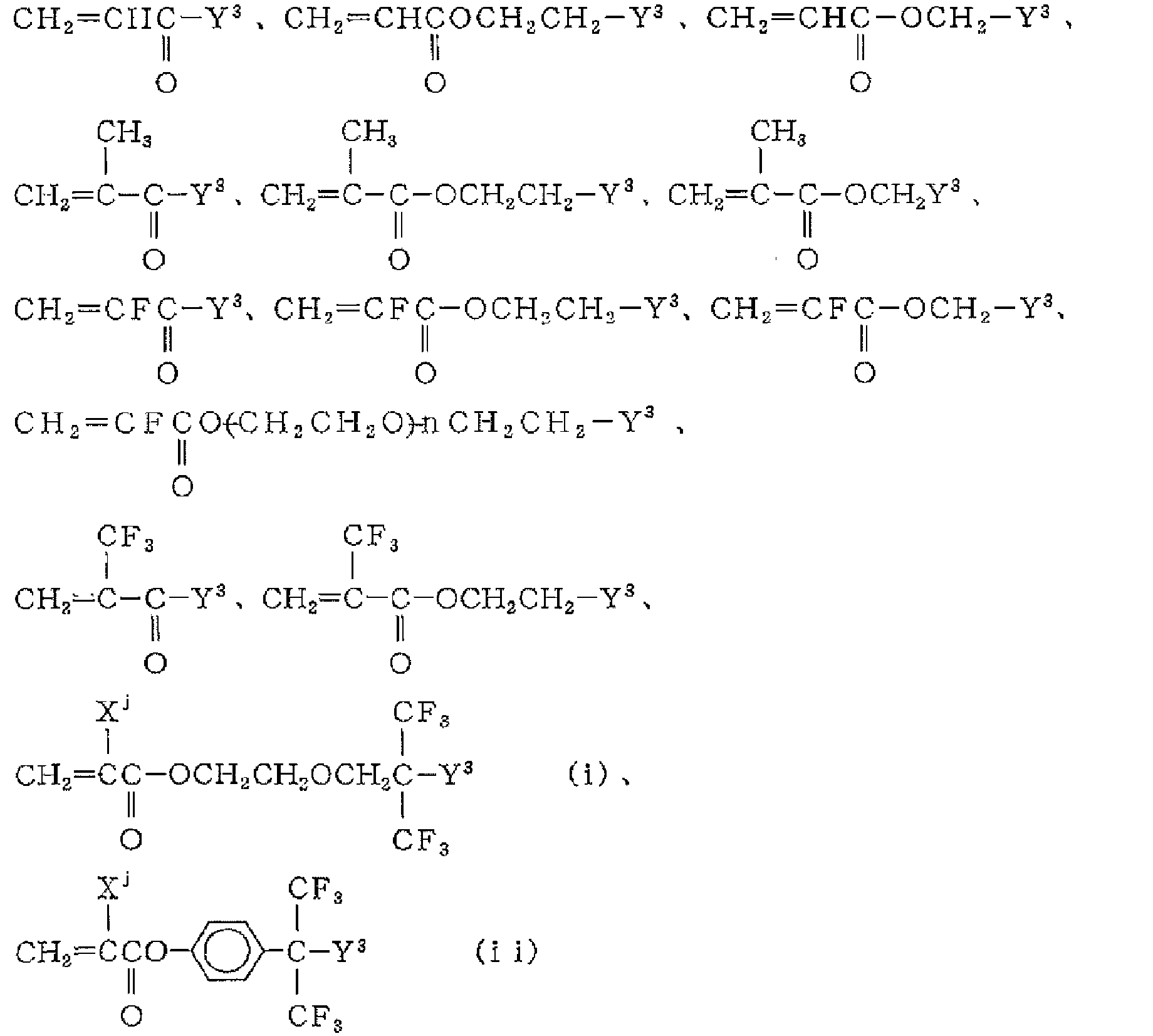
(式中、Xj及びY3は上記と同じ。nは1~10の整数である。)等が挙げられる。
Raとしては、下記一般式(r1):
-(C=O)h-(O)i-CF2-O-(CX6 2)e-{O-CF(CF3)}f-(O)g- (r1)
(式中、X6はそれぞれ独立してH、F又はCF3であり、eは0~3の整数であり、fは0~3の整数であり、gは0又は1であり、hは0又は1であり、iは0又は1である)で表される2価の基が好ましく、下記一般式(r2):
-(C=O)h-(O)i-CF2-O-(CX7 2)e-(O)g- (r2)(式中、X7はそれぞれ独立してH、F又はCF3であり、eは0~3の整数であり、gは0又は1であり、hは0又は1であり、iは0又は1である。)で表される2価の基も好ましい。
-(C=O)h-(O)i-CF2-O-(CX6 2)e-{O-CF(CF3)}f-(O)g- (r1)
(式中、X6はそれぞれ独立してH、F又はCF3であり、eは0~3の整数であり、fは0~3の整数であり、gは0又は1であり、hは0又は1であり、iは0又は1である)で表される2価の基が好ましく、下記一般式(r2):
-(C=O)h-(O)i-CF2-O-(CX7 2)e-(O)g- (r2)(式中、X7はそれぞれ独立してH、F又はCF3であり、eは0~3の整数であり、gは0又は1であり、hは0又は1であり、iは0又は1である。)で表される2価の基も好ましい。
上記一般式(4)の-Ra-(CZ1Z2)k-としてはまた、下記式(t1):
-(C=O)h-(O)i-CF2-O-(CX6 2)e-{O-CF(CF3)}f-(O)g-CZ1Z2- (t1)
(式中、X6はそれぞれ独立してH、F又はCF3であり、eは0~3の整数であり、fは0~3の整数であり、gは0又は1であり、hは0又は1であり、iは0又は1であり、Z1及びZ2は、それぞれ独立して、F又はCF3である)で表される2価の基も好ましく、式(t1)において、Z1及びZ2は、一方がFで他方がCF3であることがより好ましい。
また、上記一般式(4)において、-Ra-(CZ1Z2)k-としては、下記式(t2):
-(C=O)h-(O)i-CF2-O-(CX7 2)e-(O)g-CZ1Z2- (t2)
(式中、X7はそれぞれ独立してH、F又はCF3であり、eは0~3の整数であり、gは0又は1であり、hは0又は1であり、iは0又は1であり、Z1及びZ2は、それぞれ独立して、F又はCF3である)で表される2価の基も好ましく、式(t2)において、Z1及びZ2は、一方がFで他方がCF3であることがより好ましい。
-(C=O)h-(O)i-CF2-O-(CX6 2)e-{O-CF(CF3)}f-(O)g-CZ1Z2- (t1)
(式中、X6はそれぞれ独立してH、F又はCF3であり、eは0~3の整数であり、fは0~3の整数であり、gは0又は1であり、hは0又は1であり、iは0又は1であり、Z1及びZ2は、それぞれ独立して、F又はCF3である)で表される2価の基も好ましく、式(t1)において、Z1及びZ2は、一方がFで他方がCF3であることがより好ましい。
また、上記一般式(4)において、-Ra-(CZ1Z2)k-としては、下記式(t2):
-(C=O)h-(O)i-CF2-O-(CX7 2)e-(O)g-CZ1Z2- (t2)
(式中、X7はそれぞれ独立してH、F又はCF3であり、eは0~3の整数であり、gは0又は1であり、hは0又は1であり、iは0又は1であり、Z1及びZ2は、それぞれ独立して、F又はCF3である)で表される2価の基も好ましく、式(t2)において、Z1及びZ2は、一方がFで他方がCF3であることがより好ましい。
一般式(4)で表される化合物は、親水基(Y3)を除いて、C-F結合を有し、C-H結合を有していないことも好ましい。すなわち、一般式(4)において、Xi、Xj、及びXkの全てがFであり、Raは炭素数が1以上のパーフルオロアルキレン基であることが好ましく、上記パーフルオロアルキレン基は、鎖状及び分岐状のいずれでもよく、環状及び非環状のいずれでもよく、少なくとも1つのカテナリーヘテロ原子を含んでもよい。上記パーフルオロアルキレン基の炭素数は、2~20であってよく、4~18であってもよい。
一般式(4)で表される化合物は、部分フッ素化されたものであってもよい。すなわち、一般式(4)で表される化合物は、親水基(Y3)を除いて、炭素原子に結合した少なくとも1つの水素原子を有し、炭素原子に結合した少なくとも1つのフッ素原子を有することも好ましい。
一般式(4)で表される化合物は、下記式(4a)で示される化合物であることも好ましい。
CF2=CF-O-Rf0-Y3 (4a)
(式中、Y3は親水基であり、Rf0は、過フッ素化されており、鎖状又は分岐状、環状又は非環状構造、飽和又は不飽和、置換又は非置換であってもよく、硫黄、酸素、及び窒素からなる群から選択される1つ以上のヘテロ原子を任意追加的に含有する過フッ素化二価連結基である。)
CF2=CF-O-Rf0-Y3 (4a)
(式中、Y3は親水基であり、Rf0は、過フッ素化されており、鎖状又は分岐状、環状又は非環状構造、飽和又は不飽和、置換又は非置換であってもよく、硫黄、酸素、及び窒素からなる群から選択される1つ以上のヘテロ原子を任意追加的に含有する過フッ素化二価連結基である。)
一般式(4)で表される化合物は、下記式(4b)で示される化合物であることも好ましい。
CH2=CH-O-Rf0-Y3 (4b)
(式中、Y3は親水基であり、Rf0は式(4a)で定義される過フッ素化二価連結基である。)
CH2=CH-O-Rf0-Y3 (4b)
(式中、Y3は親水基であり、Rf0は式(4a)で定義される過フッ素化二価連結基である。)
一般式(4)において、Y3は-OSO3Mであることが好ましい形態の一つである。Y3が-OSO3Mである場合、一般式(4)で表される化合物としては、CF2=CF(OCF2CF2CH2OSO3M)、CH2=CH((CF2)4CH2OSO3M)、CF2=CF(O(CF2)4CH2OSO3M)、CF2=CF(OCF2CF(CF3)CH2OSO3M)、CF2=CF(OCF2CF(CF3)OCF2CF2CH2OSO3M)、CH2=CH((CF2)4CH2OSO3M)、CF2=CF(OCF2CF2SO2N(CH3)CH2CH2OSO3M)、CH2=CH(CF2CF2CH2OSO3M)、CF2=CF(OCF2CF2CF2CF2SO2N(CH3)CH2CH2OSO3M)、CH2=CH(CF2CF2CH2OSO3M)等が挙げられる。上記式中、Mは上記と同じである。
一般式(4)において、Y3は-SO3Mであることも好ましい形態の一つである。Y3が-SO3Mである場合、一般式(4)で表される化合物としては、CF2=CF(OCF2CF2SO3M)、CF2=CF(O(CF2)4SO3M)、CF2=CF(OCF2CF(CF3)SO3M)、CF2=CF(OCF2CF(CF3)OCF2CF2SO3M)、CH2=CH(CF2CF2SO3M)、CF2=CF(OCF2CF(CF3)OCF2CF2CF2CF2SO3M)、CH2=CH((CF2)4SO3M)、CH2=CH(CF2CF2SO3M)、CH2=CH((CF2)3SO3M)等が挙げられる。上記式中、Mは上記と同じである。
一般式(4)において、Y3は-COOMであることも好ましい形態の一つである。Y3が-COOMである場合、一般式(4)で表される化合物としては、CF2=CF(OCF2CF2COOM)、CF2=CF(OCF2CF2CF2COOM)、CF2=CF(O(CF2)5COOM)、CF2=CF(OCF2CF(CF3)COOM)、CF2=CF(OCF2CF(CF3)O(CF2)nCOOM)(nは1より大きい)、CH2=CH(CF2CF2COOM)、CH2=CH((CF2)4COOM)、CH2=CH(CF2CF2COOM)、CH2=CH((CF2)3COOM)、CF2=CF(OCF2CF2SO2NR’CH2COOM)、CF2=CF(O(CF2)4SO2NR’CH2COOM)、CF2=CF(OCF2CF(CF3)SO2NR’CH2COOM)、CF2=CF(OCF2CF(CF3)OCF2CF2SO2NR’CH2COOM)、CH2=CH(CF2CF2SO2NR’CH2COOM)、CF2=CF(OCF2CF(CF3)OCF2CF2CF2CF2SO2NR’CH2COOM)、CH2=CH((CF2)4SO2NR’CH2COOM)、CH2=CH(CF2CF2SO2NR’CH2COOM)、CH2=CH((CF2)3SO2NR’CH2COOM)等が挙げられる。上記式中、R’はH又はC1-4アルキル基であり、Mは上記と同じである。
一般式(4)において、Y3は-OPO3Mまたは-OP(O)(OM)2であることも好ましい形態の一つである。Y3が-OPO3Mまたは-OP(O)(OM)2である場合、一般式(4)で表される化合物としては、CF2=CF(OCF2CF2CH2OP(O)(OM)2)、CF2=CF(O(CF2)4CH2OP(O)(OM)2)、CF2=CF(OCF2CF(CF3)CH2OP(O)(OM)2)、CF2=CF(OCF2CF(CF3)OCF2CF2CH2OP(O)(OM)2)、CF2=CF(OCF2CF2SO2N(CH3)CH2CH2OP(O)(OM)2)、CF2=CF(OCF2CF2CF2CF2SO2N(CH3)CH2CH2OP(O)(OM)2)、CH2=CH(CF2CF2CH2OP(O)(OM)2、CH2=CH((CF2)4CH2OP(O)(OM)2)、CH2=CH(CF2CF2CH2OP(O)(OM)2)、CH2=CH((CF2)3CH2OP(O)(OM)2)等が挙げられる。上記式中、Mは上記と同じである。
一般式(4)において、Y3は-PO3Mまたは-P(O)(OM)2であることも好ましい形態の一つである。Y3が-PO3Mまたは-P(O)(OM)2である場合、一般式(4)で表される化合物としては、CF2=CF(OCF2CF2P(O)(OM)2)、CF2=CF(O(CF2)4P(O)(OM)2)、CF2=CF(OCF2CF(CF3)P(O)(OM)2)、CF2=CF(OCF2CF(CF3)OCF2CF2P(O)(OM)2)、CH2=CH(CF2CF2P(O)(OM)2)、CH2=CH((CF2)4P(O)(OM)2)、CH2=CH(CF2CF2P(O)(OM)2)、CH2=CH((CF2)3P(O)(OM)2)が挙げられ、式中、Mは上記と同じである。
上記一般式(4)で表される化合物としては、下記一般式(5):
CX2=CY(-CZ2-O-Rf-Y3) (5)
(式中、Xは、同一又は異なって、-H又は-Fであり、Yは-H、-F、アルキル基又は含フッ素アルキル基であり、Zは、同一又は異なって、-H、-F、アルキル基又は含フッ素アルキル基である。Rfは炭素数1~40の含フッ素アルキレン基、又は、炭素数2~100のエーテル結合を有する含フッ素アルキレン基である。Y3は、前記と同じ。)で表される単量体、下記一般式(6):
CX2=CY(-O-Rf-Y3) (6)
(式中、Xは、同一又は異なって、-H又は-Fであり、Yは-H、-F、アルキル基又は含フッ素アルキル基であり、Rfは炭素数1~40の含フッ素アルキレン基、又は、炭素数2~100のエーテル結合を有する含フッ素アルキレン基である。Y3は、前記と同じである。)で表される単量体、及び、下記一般式(7):
CX2=CY(-Rf-Y3) (7)
(式中、Xは、同一又は異なって、-H又は-Fであり、Yは-H、-F、アルキル基又は含フッ素アルキル基であり、Rfは炭素数1~40の含フッ素アルキレン基、又は、炭素数2~100のエーテル結合を有する含フッ素アルキレン基である。Y3は、前記と同じである。)で表される単量体、からなる群より選択される少なくとも1種であることが好ましい。
なお、上記炭素数2~100のエーテル結合を有する含フッ素アルキレン基は、酸素原子が末端である構造を含まず、炭素炭素間にエーテル結合を含んでいるアルキレン基である。
CX2=CY(-CZ2-O-Rf-Y3) (5)
(式中、Xは、同一又は異なって、-H又は-Fであり、Yは-H、-F、アルキル基又は含フッ素アルキル基であり、Zは、同一又は異なって、-H、-F、アルキル基又は含フッ素アルキル基である。Rfは炭素数1~40の含フッ素アルキレン基、又は、炭素数2~100のエーテル結合を有する含フッ素アルキレン基である。Y3は、前記と同じ。)で表される単量体、下記一般式(6):
CX2=CY(-O-Rf-Y3) (6)
(式中、Xは、同一又は異なって、-H又は-Fであり、Yは-H、-F、アルキル基又は含フッ素アルキル基であり、Rfは炭素数1~40の含フッ素アルキレン基、又は、炭素数2~100のエーテル結合を有する含フッ素アルキレン基である。Y3は、前記と同じである。)で表される単量体、及び、下記一般式(7):
CX2=CY(-Rf-Y3) (7)
(式中、Xは、同一又は異なって、-H又は-Fであり、Yは-H、-F、アルキル基又は含フッ素アルキル基であり、Rfは炭素数1~40の含フッ素アルキレン基、又は、炭素数2~100のエーテル結合を有する含フッ素アルキレン基である。Y3は、前記と同じである。)で表される単量体、からなる群より選択される少なくとも1種であることが好ましい。
なお、上記炭素数2~100のエーテル結合を有する含フッ素アルキレン基は、酸素原子が末端である構造を含まず、炭素炭素間にエーテル結合を含んでいるアルキレン基である。
上記一般式(5)において、Xは-H又は-Fである。Xは、両方が-Fであってもよいし、少なくとも1つが-Hであってよい。例えば、片方が-Fで他方が-Hであってもよいし、両方が-Hであってもよい。
上記一般式(5)において、Yは-H、-F、アルキル基又は含フッ素アルキル基である。
上記アルキル基は、フッ素原子を含有しないアルキル基であり、炭素数は1以上であればよい。上記アルキル基の炭素数は6以下が好ましく、4以下がより好ましく、3以下が更に好ましい。
上記含フッ素アルキル基は、フッ素原子を少なくとも1つ含有するアルキル基であり、炭素数は1以上であればよい。上記含フッ素アルキル基の炭素数は6以下が好ましく、4以下がより好ましく、3以下が更に好ましい。
上記Yとしては、-H、-F又は-CF3が好ましく、-Fがより好ましい。
上記アルキル基は、フッ素原子を含有しないアルキル基であり、炭素数は1以上であればよい。上記アルキル基の炭素数は6以下が好ましく、4以下がより好ましく、3以下が更に好ましい。
上記含フッ素アルキル基は、フッ素原子を少なくとも1つ含有するアルキル基であり、炭素数は1以上であればよい。上記含フッ素アルキル基の炭素数は6以下が好ましく、4以下がより好ましく、3以下が更に好ましい。
上記Yとしては、-H、-F又は-CF3が好ましく、-Fがより好ましい。
上記一般式(5)において、Zは、同一又は異なって、-H、-F、アルキル基又はフルオロアルキル基である。
上記アルキル基は、フッ素原子を含有しないアルキル基であり、炭素数は1以上であればよい。上記アルキル基の炭素数は6以下が好ましく、4以下がより好ましく、3以下が更に好ましい。
上記含フッ素アルキル基は、フッ素原子を少なくとも1つ含有するアルキル基であり、炭素数は1以上であればよい。上記含フッ素アルキル基の炭素数は6以下が好ましく、4以下がより好ましく、3以下が更に好ましい。
上記Zとしては、-H、-F又は-CF3が好ましく、-Fがより好ましい。
上記アルキル基は、フッ素原子を含有しないアルキル基であり、炭素数は1以上であればよい。上記アルキル基の炭素数は6以下が好ましく、4以下がより好ましく、3以下が更に好ましい。
上記含フッ素アルキル基は、フッ素原子を少なくとも1つ含有するアルキル基であり、炭素数は1以上であればよい。上記含フッ素アルキル基の炭素数は6以下が好ましく、4以下がより好ましく、3以下が更に好ましい。
上記Zとしては、-H、-F又は-CF3が好ましく、-Fがより好ましい。
上記一般式(5)において、上記X、Y及びZの少なくとも1つはフッ素原子を含むことが好ましい。例えば、Xが-Hであり、Y及びZが-Fであってよい。
上記一般式(5)において、上記Rfは炭素数1~40の含フッ素アルキレン基、又は、炭素数2~100のエーテル結合を有する含フッ素アルキレン基である。
上記含フッ素アルキレン基の炭素数は2以上が好ましい。また、30以下が好ましく、20以下がより好ましく、10以下が更に好ましい。上記含フッ素アルキレン基としては、-CF2-、-CH2CF2-、-CF2CF2-、-CF2CH2-、-CF2CF2CH2-、-CF(CF3)-、-CF(CF3)CF2-、-CF(CF3)CH2-等が挙げられる。上記含フッ素アルキレン基は、パーフルオロアルキレン基であることが好ましい。
上記含フッ素アルキレン基の炭素数は2以上が好ましい。また、30以下が好ましく、20以下がより好ましく、10以下が更に好ましい。上記含フッ素アルキレン基としては、-CF2-、-CH2CF2-、-CF2CF2-、-CF2CH2-、-CF2CF2CH2-、-CF(CF3)-、-CF(CF3)CF2-、-CF(CF3)CH2-等が挙げられる。上記含フッ素アルキレン基は、パーフルオロアルキレン基であることが好ましい。
上記エーテル結合を有する含フッ素アルキレン基の炭素数は3以上が好ましい。また、エーテル結合を有する含フッ素アルキレン基の炭素数は、60以下が好ましく、30以下がより好ましく、12以下が更に好ましい。
エーテル結合を有する含フッ素アルキレン基としては、例えば、下記式:

(式中、Z1はFまたはCF3;Z2及びZ3はそれぞれHまたはF;Z4はH、FまたはCF3;p1+q1+r1が1~10の整数;s1は0または1;t1は0~5の整数)で表される2価の基であることも好ましい。
上記エーテル結合を有する含フッ素アルキレン基として具体的には、-CF(CF3)CF2-O-CF(CF3)-、-(CF(CF3)CF2-O)n-CF(CF3)-(式中、nは1~10の整数)、-CF(CF3)CF2-O-CF(CF3)CH2-、-(CF(CF3)CF2-O)n-CF(CF3)CH2-(式中、nは1~10の整数)、-CH2CF2CF2O-CH2CF2CH2-、-CF2CF2CF2O-CF2CF2-、-CF2CF2CF2O-CF2CF2CH2-、-CF2CF2O-CF2-、-CF2CF2O-CF2CH2-等が挙げられる。上記エーテル結合を有する含フッ素アルキレン基は、パーフルオロアルキレン基であることが好ましい。
エーテル結合を有する含フッ素アルキレン基としては、例えば、下記式:
上記エーテル結合を有する含フッ素アルキレン基として具体的には、-CF(CF3)CF2-O-CF(CF3)-、-(CF(CF3)CF2-O)n-CF(CF3)-(式中、nは1~10の整数)、-CF(CF3)CF2-O-CF(CF3)CH2-、-(CF(CF3)CF2-O)n-CF(CF3)CH2-(式中、nは1~10の整数)、-CH2CF2CF2O-CH2CF2CH2-、-CF2CF2CF2O-CF2CF2-、-CF2CF2CF2O-CF2CF2CH2-、-CF2CF2O-CF2-、-CF2CF2O-CF2CH2-等が挙げられる。上記エーテル結合を有する含フッ素アルキレン基は、パーフルオロアルキレン基であることが好ましい。
上記一般式(5)において、Y3は、-COOM、-SO3M又は-OSO3M(Mは、H、金属原子、NR7
4、置換基を有していてもよいイミダゾリウム、置換基を有していてもよいピリジニウム又は置換基を有していてもよいホスホニウム、R7は、H又は有機基であり、同一でも異なっていてもよい。いずれか2つがお互いに結合して、環を形成してもよい。)であることが好ましい。
R7の有機基としてはアルキル基が好ましい。R7としては、H又はC1-10の有機基が好ましく、H又はC1-4の有機基がより好ましく、H又はC1-4のアルキル基が更に好ましい。
上記金属原子としては、アルカリ金属(1族)、アルカリ土類金属(2族)等が挙げられ、Na、K又はLiが好ましい。
上記Mとしては、-H、金属原子又は-NR7 4が好ましく、-H、アルカリ金属(1族)、アルカリ土類金属(2族)又は-NR7 4がより好ましく、-H、-Na、-K、-Li又は-NH4が更に好ましく、-Na、-K又は-NH4が更により好ましく、-Na又は-NH4が特に好ましく、-NH4が最も好ましい。
上記Y3としては、-COOM又は-SO3Mが好ましく、-COOMがより好ましい。
R7の有機基としてはアルキル基が好ましい。R7としては、H又はC1-10の有機基が好ましく、H又はC1-4の有機基がより好ましく、H又はC1-4のアルキル基が更に好ましい。
上記金属原子としては、アルカリ金属(1族)、アルカリ土類金属(2族)等が挙げられ、Na、K又はLiが好ましい。
上記Mとしては、-H、金属原子又は-NR7 4が好ましく、-H、アルカリ金属(1族)、アルカリ土類金属(2族)又は-NR7 4がより好ましく、-H、-Na、-K、-Li又は-NH4が更に好ましく、-Na、-K又は-NH4が更により好ましく、-Na又は-NH4が特に好ましく、-NH4が最も好ましい。
上記Y3としては、-COOM又は-SO3Mが好ましく、-COOMがより好ましい。
一般式(5)で表される単量体は、下記一般式(5a)で表される単量体(5a)であることが好ましい。
CH2=CF(-CF2-O-Rf-Y3) (5a)
(式中、Rf及びY3は前記と同じ。)
CH2=CF(-CF2-O-Rf-Y3) (5a)
(式中、Rf及びY3は前記と同じ。)
一般式(5a)で表される単量体として具体的には、下記式

(式中、Z1はFまたはCF3;Z2及びZ3はそれぞれHまたはF;Z4はH、FまたはCF3;p1+q1+r1が0~10の整数;s1は0または1;t1は0~5の整数、Y3は前記と同じ。ただし、Z3及びZ4がともにHの場合、p1+q1+r1+s1が0でない)で表される単量体が挙げられる。より具体的には、
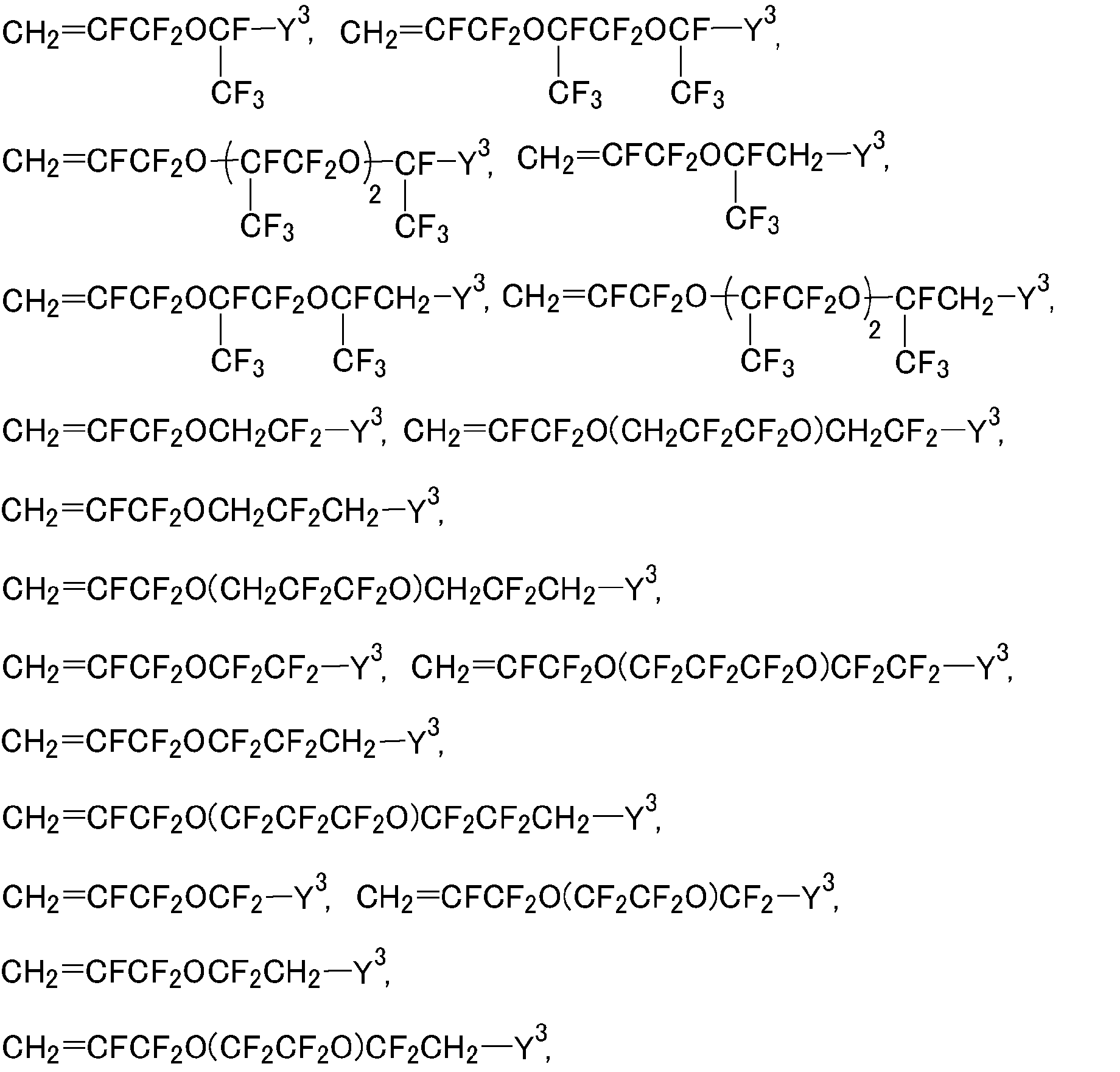
などが好ましく挙げられ、なかでも
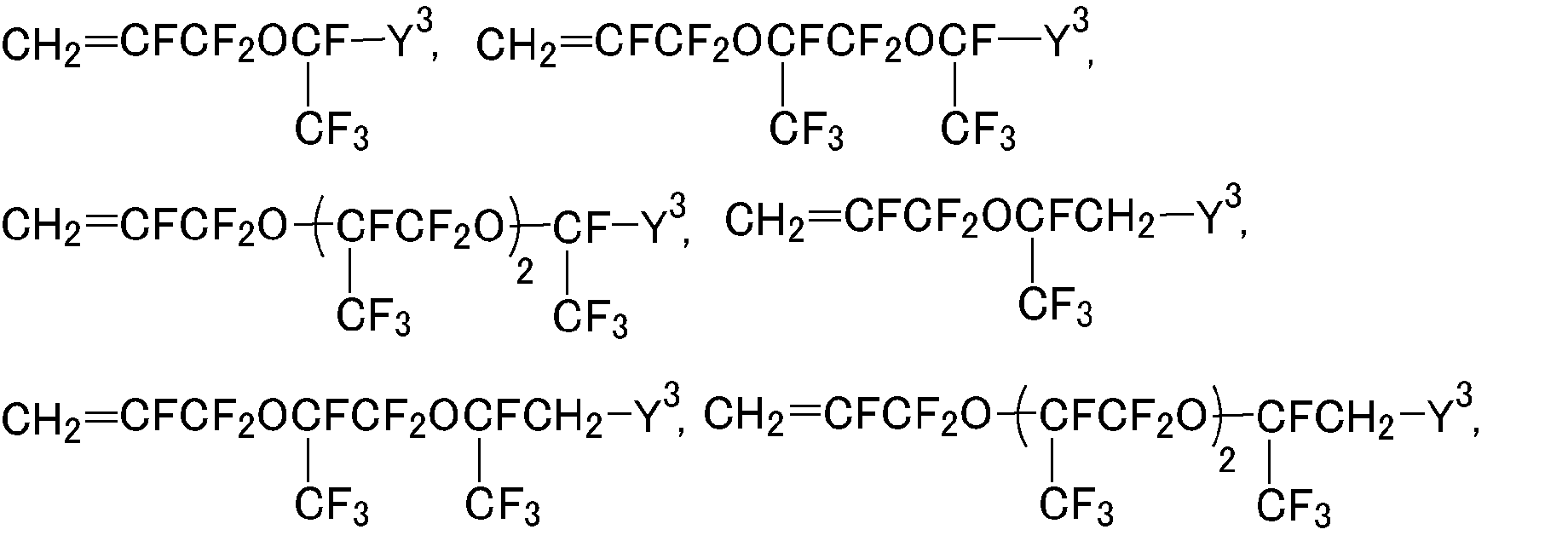
であることが好ましい。
上記一般式(5a)で表される単量体としては、式(5a)中のY3が-COOMであることが好ましく、特に、CH2=CFCF2OCF(CF3)COOM、及び、CH2=CFCF2OCF(CF3)CF2OCF(CF3)COOM(式中、Mは上記定義と同じ。)からなる群より選択される少なくとも1種が好ましく、CH2=CFCF2OCF(CF3)COOMがより好ましい。
一般式(5)で表される単量体は、下記一般式(5b)で表される単量体(5b)であることが好ましい。
CX2 2=CFCF2-O-(CF(CF3)CF2O)n5-CF(CF3)-Y3
(5b)
(式中、各X2は、同一であり、F又はHを表す。n5は、0又は1~10の整数を表し、Y3は、前記定義と同じ。)
CX2 2=CFCF2-O-(CF(CF3)CF2O)n5-CF(CF3)-Y3
(5b)
(式中、各X2は、同一であり、F又はHを表す。n5は、0又は1~10の整数を表し、Y3は、前記定義と同じ。)
上記式(5b)において、上記n5は、得られる水性分散液の安定性の点で0又は1~5の整数であることが好ましく、0、1又は2であることがより好ましく、0又は1であることが更に好ましい。上記Y3は、適度な水溶性と水性分散液の安定性が得られる点で-COOMであることが好ましく、上記Mは、不純物として残留しにくく、得られた成形体の耐熱性が向上する点で、H又はNH4であることが好ましい。
上記式(5b)で表される単量体としては、例えば、CH2=CFCF2OCF(CF3)COOM、CH2=CFCF2OCF(CF3)CF2OCF(CF3)COOM(式中、Mは上記定義と同じ。)が挙げられる。
また、一般式(5)で表される単量体としては、下記一般式(5c)で表される単量体等も挙げられる。
CF2=CFCF2-O-Rf-Y3 (5c)
(式中、Rf及びY3は上記と同じ)
(式中、Rf及びY3は上記と同じ)
より具体的には、

等が挙げられる。
上記一般式(6)において、Xは-H又は-Fである。Xは、両方が-Fであってもよいし、少なくとも1つが-Hであってよい。例えば、片方が-Fで他方が-Hであってもよいし、両方が-Hであってもよい。
上記一般式(6)において、Yは-H、-F、アルキル基又は含フッ素アルキル基である。
上記アルキル基は、フッ素原子を含有しないアルキル基であり、炭素数は1以上であればよい。上記アルキル基の炭素数は6以下が好ましく、4以下がより好ましく、3以下が更に好ましい。
上記含フッ素アルキル基は、フッ素原子を少なくとも1つ含有するアルキル基であり、炭素数は1以上であればよい。上記含フッ素アルキル基の炭素数は6以下が好ましく、4以下がより好ましく、3以下が更に好ましい。
上記Yとしては、-H、-F又は-CF3が好ましく、-Fがより好ましい。
上記アルキル基は、フッ素原子を含有しないアルキル基であり、炭素数は1以上であればよい。上記アルキル基の炭素数は6以下が好ましく、4以下がより好ましく、3以下が更に好ましい。
上記含フッ素アルキル基は、フッ素原子を少なくとも1つ含有するアルキル基であり、炭素数は1以上であればよい。上記含フッ素アルキル基の炭素数は6以下が好ましく、4以下がより好ましく、3以下が更に好ましい。
上記Yとしては、-H、-F又は-CF3が好ましく、-Fがより好ましい。
上記一般式(6)において、上記X及びYの少なくとも1つはフッ素原子を含むことが好ましい。例えば、Xが-Hであり、Y及びZが-Fであってよい。
上記一般式(6)において、上記Rfは炭素数1~40の含フッ素アルキレン基、又は、炭素数2~100のエーテル結合を有する含フッ素アルキレン基である。
上記含フッ素アルキレン基の炭素数は2以上が好ましい。また、含フッ素アルキレン基の炭素数は、30以下が好ましく、20以下がより好ましく、10以下が更に好ましい。上記含フッ素アルキレン基としては、-CF2-、-CH2CF2-、-CF2CF2-、-CF2CH2-、-CF2CF2CH2-、-CF(CF3)-、-CF(CF3)CF2-、-CF(CF3)CH2-等が挙げられる。上記含フッ素アルキレン基は、パーフルオロアルキレン基であることが好ましい。
上記含フッ素アルキレン基の炭素数は2以上が好ましい。また、含フッ素アルキレン基の炭素数は、30以下が好ましく、20以下がより好ましく、10以下が更に好ましい。上記含フッ素アルキレン基としては、-CF2-、-CH2CF2-、-CF2CF2-、-CF2CH2-、-CF2CF2CH2-、-CF(CF3)-、-CF(CF3)CF2-、-CF(CF3)CH2-等が挙げられる。上記含フッ素アルキレン基は、パーフルオロアルキレン基であることが好ましい。
上記一般式(6)において、Y3は、-COOM、-SO3M又は-OSO3M(Mは、H、金属原子、NR7
4、置換基を有していてもよいイミダゾリウム、置換基を有していてもよいピリジニウム又は置換基を有していてもよいホスホニウム、R7は、H又は有機基であり、同一でも異なっていてもよい。いずれか2つがお互いに結合して、環を形成してもよい。)であることが好ましい。
R7の有機基としてはアルキル基が好ましい。R7としては、H又はC1-10の有機基が好ましく、H又はC1-4の有機基がより好ましく、H又はC1-4のアルキル基が更に好ましい。
上記金属原子としては、アルカリ金属(1族)、アルカリ土類金属(2族)等が挙げられ、Na、K又はLiが好ましい。
上記Mとしては、-H、金属原子又は-NR7 4が好ましく、-H、アルカリ金属(1族)、アルカリ土類金属(2族)又は-NR7 4がより好ましく、-H、-Na、-K、-Li又は-NH4が更に好ましく、-Na、-K又は-NH4が更により好ましく、-Na又は-NH4が特に好ましく、-NH4が最も好ましい。
上記Y3としては、-COOM又は-SO3Mが好ましく、-COOMがより好ましい。
R7の有機基としてはアルキル基が好ましい。R7としては、H又はC1-10の有機基が好ましく、H又はC1-4の有機基がより好ましく、H又はC1-4のアルキル基が更に好ましい。
上記金属原子としては、アルカリ金属(1族)、アルカリ土類金属(2族)等が挙げられ、Na、K又はLiが好ましい。
上記Mとしては、-H、金属原子又は-NR7 4が好ましく、-H、アルカリ金属(1族)、アルカリ土類金属(2族)又は-NR7 4がより好ましく、-H、-Na、-K、-Li又は-NH4が更に好ましく、-Na、-K又は-NH4が更により好ましく、-Na又は-NH4が特に好ましく、-NH4が最も好ましい。
上記Y3としては、-COOM又は-SO3Mが好ましく、-COOMがより好ましい。
上記一般式(6)で表される単量体は、下記一般式(6a)、(6b)、(6c)、(6d)及び(6e)で表される単量体からなる群より選択される少なくとも1種が好ましい。
CF2=CF-O-(CF2)n1-Y3 (6a)
(式中、n1は、1~10の整数を表し、Y3は、前記定義と同じ。)
CF2=CF-O-(CF2C(CF3)F)n2-Y3 (6b)
(式中、n2は、1~5の整数を表し、Y3は、前記定義と同じ。)
CF2=CF-O-(CFX1)n3-Y3 (6c)
(式中、X1は、F又はCF3を表し、n3は、1~10の整数を表し、Y3は、前記定義と同じ。)
CF2=CF-O-(CF2CFX1O)n4-(CF2)n6-Y3 (6d)
(式中、n4は、1~10の整数を表し、n6は、1~3の整数を表し、Y3及びX1は、前記定義と同じ。)
CF2=CF-O-(CF2CF2CFX1O)n5-CF2CF2CF2-Y3 (6e)
(式中、n5は、0~10の整数を表し、Y3及びX1は、前記定義と同じ。)
CF2=CF-O-(CF2)n1-Y3 (6a)
(式中、n1は、1~10の整数を表し、Y3は、前記定義と同じ。)
CF2=CF-O-(CF2C(CF3)F)n2-Y3 (6b)
(式中、n2は、1~5の整数を表し、Y3は、前記定義と同じ。)
CF2=CF-O-(CFX1)n3-Y3 (6c)
(式中、X1は、F又はCF3を表し、n3は、1~10の整数を表し、Y3は、前記定義と同じ。)
CF2=CF-O-(CF2CFX1O)n4-(CF2)n6-Y3 (6d)
(式中、n4は、1~10の整数を表し、n6は、1~3の整数を表し、Y3及びX1は、前記定義と同じ。)
CF2=CF-O-(CF2CF2CFX1O)n5-CF2CF2CF2-Y3 (6e)
(式中、n5は、0~10の整数を表し、Y3及びX1は、前記定義と同じ。)
上記式(6a)において、上記n1は、5以下の整数であることが好ましく、2以下の整数であることがより好ましい。上記Y3は、適度な水溶性及び水性分散液の安定性を得られる点で、-COOMであることが好ましく、Mは、不純物として残留しにくく、得られる成形体の耐熱性が向上する点で、H又はNH4であることが好ましい。
上記式(6a)で表される単量体としては、例えば、CF2=CF-O-CF2COOM、CF2=CF(OCF2CF2COOM)、CF2=CF(OCF2CF2CF2COOM)(式中、Mは上記定義と同じ。)が挙げられる。
上記式(6b)において、上記n2は、得られる水性分散液の安定性の点で、3以下の整数であることが好ましく、Y3は、適度な水溶性及び水性分散液の安定性が得られる点で、-COOMであることが好ましく、Mは、不純物として残留しにくく、得られる成形体の耐熱性が向上する点で、H又はNH4であることが好ましい。
上記式(6c)において、上記n3は、水溶性の点で5以下の整数であることが好ましく、上記Y3は、適度な水溶性及び水性分散液の安定性が得られる点で、-COOMであることが好ましく、上記Mは、分散安定性がよくなる点で、H又はNH4であることが好ましい。
上記式(6d)において、上記X1は、水性分散液の安定性の点で、-CF3であることが好ましく、上記n4は、水溶性の点で5以下の整数であることが好ましく、上記Y3は、適度な水溶性と水性分散液の安定性が得られる点で-COOMであることが好ましく、上記Mは、H又はNH4であることが好ましい。
上記式(6d)で表される単量体としては、例えば、CF2=CFOCF2CF(CF3)OCF2CF2COOM、CF2=CFOCF2CF(CF3)OCF2COOM、CF2=CFOCF2CF(CF3)OCF2CF2CF2OOM(式中、Mは、H、NH4又はアルカリ金属を表す。)が挙げられる。
一般式(6e)において、上記n5は、水溶性の点で5以下の整数であることが好ましく、上記Y3は、適度な水溶性と組成物の優れた沈降安定性が得られる点で-COOMであることが好ましく、上記Mは、H又はNH4であることが好ましい。
一般式(6e)で表される単量体としては、例えば、CF2=CFOCF2CF2CF2COOM(式中、Mは、H、NH4又はアルカリ金属を表す。)が挙げられる。
上記一般式(7)において、Rfは、炭素数1~40の含フッ素アルキレン基であることが好ましい。一般式(7)において、X及びYの少なくとも1つはフッ素原子を含むことが好ましい。
上記一般式(7)で表される単量体は、下記一般式(7a):
CF2=CF-(CF2)n1-Y3 (7a)
(式中、n1は、1~10の整数を表し、Y3は、前記定義と同じ。)で表される単量体、及び、下記一般式(7b):
CF2=CF-(CF2C(CF3)F)n2-Y3 (7b)
(式中、n2は、1~5の整数を表し、Y3は、前記定義と同じ。)で表される単量体からなる群より選択される少なくとも1種が好ましい。
上記Y3は、-SO3M又は-COOMが好ましく、Mは、H、金属原子、NR7 4、置換基を有していてもよいイミダゾリウム、置換基を有していてもよいピリジニウム又は置換基を有していてもよいホスホニウムであることが好ましい。上記R7は、H又は有機基を表す。
CF2=CF-(CF2)n1-Y3 (7a)
(式中、n1は、1~10の整数を表し、Y3は、前記定義と同じ。)で表される単量体、及び、下記一般式(7b):
CF2=CF-(CF2C(CF3)F)n2-Y3 (7b)
(式中、n2は、1~5の整数を表し、Y3は、前記定義と同じ。)で表される単量体からなる群より選択される少なくとも1種が好ましい。
上記Y3は、-SO3M又は-COOMが好ましく、Mは、H、金属原子、NR7 4、置換基を有していてもよいイミダゾリウム、置換基を有していてもよいピリジニウム又は置換基を有していてもよいホスホニウムであることが好ましい。上記R7は、H又は有機基を表す。
上記式(7a)において、上記n1は、5以下の整数であることが好ましく、2以下の整数であることがより好ましい。上記Y3は、適度な水溶性及び水性分散液の安定性を得られる点で、-COOMであることが好ましく、Mは、不純物として残留しにくく、得られる成形体の耐熱性が向上する点で、H又はNH4であることが好ましい。
上記式(7a)で表されるパーフルオロビニルアルキル化合物としては、例えば、CF2=CFCF2COOM(式中、Mは上記定義と同じ。)が挙げられる。
上記式(7a)で表されるパーフルオロビニルアルキル化合物としては、例えば、CF2=CFCF2COOM(式中、Mは上記定義と同じ。)が挙げられる。
上記式(7b)において、上記n2は、得られる水性分散液の安定性の点で、3以下の整数であることが好ましく、Y3は、適度な水溶性及び水性分散液の安定性が得られる点で、-COOMであることが好ましく、Mは、不純物として残留しにくく、得られる成形体の耐熱性が向上する点で、H又はNH4であることが好ましい。
上記変性モノマーは、変性モノマー(A)を含むことが好ましく、一般式(5a)、一般式(5c)、一般式(6a)、一般式(6b)、一般式(6c)、及び、一般式(6d)で表される化合物からなる群より選択される少なくとも1種を含むことが好ましく、一般式(5a)または一般式(5c)で表される化合物を含むことがより好ましい。
上記変性モノマーが上記変性モノマー(A)を含む場合、変性モノマー(A)に基づく重合単位の含有量は、PTFEの全重合単位に対して、0.00001~1.0質量%の範囲であることが好ましい。下限としては、0.0001質量%がより好ましく、0.001質量%がさらに好ましく、0.005質量%が特に好ましい。上限としては、好ましい順に、0.90質量%、0.50質量%、0.40質量%、0.30質量%、0.20質量%、0.15質量%、0.10質量%、0.08質量%、0.05質量%、0.01質量%である。
変性PTFE中の変性モノマー含有率は、通常、0.001~2.0モル%の範囲であってもよい。変性モノマー含有率の下限値は、より好ましくは0.01モル%、更に好ましくは0.05モル%である。変性モノマー含有率の上限は、より好ましくは1.0モル%、更に好まくは0.5モル%、特に好ましくは0.3モル%である。
上記PTFEの製造において、連鎖移動剤としては、公知のものが使用できるが、例えば、メタン、エタン、プロパン、ブタン等の飽和炭化水素、クロロメタン、ジクロロメタン、ジフルオロエタン等のハロゲン化炭化水素類、メタノール、エタノール、イソプロパノール等のアルコール類、水素等が挙げられるが、常温常圧で気体状態のものが好ましい。
上記連鎖移動剤の使用量は、通常、供給されるTFE全量に対して、1~10000質量ppmであり、好ましくは1~5000質量ppmである。
上記PTFEの製造において、更に、反応系の分散安定剤として、実質的に反応に不活性であって、上記反応条件で液状となる炭素数が12以上の飽和炭化水素を、水性媒体100質量部に対して2~10質量部で使用することもできる。また、反応中のpHを調整するための緩衝剤として、炭酸アンモニウム、リン酸アンモニウム等を添加してもよい。
上記PTFEの重合が終了した時点で、固形分濃度が1.0~70質量%、平均一次粒子径が50~500nmの水性分散液を得ることができる。上記水性分散液は、上記重合体(A)、及び、PTFEを含有する。また、上記重合体(A)を使用することによって0.5μm以下の平均一次粒子径のPTFEからなる粒子を有する水性分散液を得ることができる。
上記固形分濃度の下限は5質量%が好ましく、8質量%がより好ましい。上限は特に限定されないが40質量%であってもよく、35質量%であってもよい。
上記平均一次粒子径の下限は100nmが好ましく、150nmがより好ましい。上限は400nmが好ましく、350nmがより好ましい。
上記平均一次粒子径は、動的光散乱法により測定することができる。上記平均一次粒子径は、固形分濃度約1.0質量%に調整した水性分散液を作成し、動的光散乱法を使用して、25℃、溶媒(水)の屈折率は1.3328、溶媒(水)の粘度は0.8878mPa・s、積算70回にて測定できる。動的光散乱法としては、例えばELSZ-1000S(大塚電子社製)が使用できる。
上記固形分濃度の下限は5質量%が好ましく、8質量%がより好ましい。上限は特に限定されないが40質量%であってもよく、35質量%であってもよい。
上記平均一次粒子径の下限は100nmが好ましく、150nmがより好ましい。上限は400nmが好ましく、350nmがより好ましい。
上記平均一次粒子径は、動的光散乱法により測定することができる。上記平均一次粒子径は、固形分濃度約1.0質量%に調整した水性分散液を作成し、動的光散乱法を使用して、25℃、溶媒(水)の屈折率は1.3328、溶媒(水)の粘度は0.8878mPa・s、積算70回にて測定できる。動的光散乱法としては、例えばELSZ-1000S(大塚電子社製)が使用できる。
上記重合により得られたPTFEの水性分散液は、また、非イオン性界面活性剤を加えることにより、安定化して更に濃縮し、目的に応じ、有機又は無機の充填剤を加えた組成物として各種用途に使用することも好ましい。上記組成物は、金属又はセラッミクスからなる基材上に被覆することにより、非粘着性と低摩擦係数を有し、光沢や平滑性、耐摩耗性、耐候性及び耐熱性に優れた塗膜表面とすることができ、ロールや調理器具等の塗装、ガラスクロスの含浸加工等に適している。
上記水性分散液からPTFEのオルガノゾルを調製することもできる。上記オルガノゾルは、上記PTFE及び有機溶剤を含むことができ、上記有機溶剤としては、エーテル系溶媒、ケトン系溶剤、アルコール系溶剤、アミド系溶剤、エステル系溶剤、脂肪族炭化水素系溶剤、芳香族炭化水素系溶剤、ハロゲン化炭化水素系溶剤が挙げられ、N-メチル-2-ピロリドン、ジメチルアセトアミド等を好適に使用できる。上記オルガノゾルの調製は、例えば、国際公開第2012/002038号に記載の方法により実施できる。
上記水性分散液を凝析することによりファインパウダーを製造できる。上記PTFEの水性分散液は、凝析、洗浄、乾燥を経てファインパウダーとして各種用途に使用することができる。上記PTFEの水性分散液に対して凝析を行う場合、通常、ポリマーラテックス等の重合により得た水性分散液を、水を用いて5~20質量%(10~20質量%)のポリマー濃度になるように希釈し、場合によっては、pHを中性又はアルカリ性に調整した後、撹拌機付きの容器中で反応中の撹拌よりも激しく撹拌して行う。上記凝析は、メタノール、アセトン等の水溶性有機化合物、硝酸カリウム、炭酸アンモニウム等の無機塩や、塩酸、硫酸、硝酸等の無機酸等を凝析剤として添加しながら撹拌を行ってもよい。上記凝析は、また、インラインミキサー等を使用して連続的に行ってもよい。
上記凝集により生じる排水中の未凝集の上記PTFE濃度は、生産性の観点から低いことが好ましく、0.4質量%未満がより好ましく、0.3質量%未満が特に好ましい。
上記凝析前や凝析中に、着色のための顔料や機械的性質を改良するための各種充填剤を添加することにより、顔料や充填剤が均一に混合した顔料入り又は充填剤入りのPTFEファインパウダーを得ることができる。
上記PTFEの水性分散液を凝析して得られた湿潤粉末の乾燥は、通常、上記湿潤粉末をあまり流動させない状態、好ましくは静置の状態を保ちながら、真空、高周波、熱風等の手段を用いて行う。粉末同士の、特に高温での摩擦は、一般にファインパウダー型のPTFEに好ましくない影響を与える。これは、この種のPTFEからなる粒子が小さな剪断力によっても簡単にフィブリル化して、元の安定な粒子構造の状態を失う性質を持っているからである。
上記乾燥は、10~300℃、好ましくは100~300℃(より好ましくは100~250℃)の乾燥温度で行う。乾燥温度は200℃以下でもよい。
得られるPTFEファインパウダーは、成形用として好ましく、好適な用途としては、航空機及び自動車等の油圧系、燃料系のチューブ等が挙げられ、薬液、蒸気等のフレキシブルホース、電線被覆用途等が挙げられる。
上記PTFEの水性分散液又は上記PTFEファインパウダーは、加工助剤として使用することも好ましい。加工助剤として使用する場合、上記水性分散液又は上記ファインパウダーをホストポリマー等に混合することにより、ホストポリマー溶融加工時の溶融強度向上や、得られたポリマーの機械的強度、電気特性、難燃性、燃焼時の滴下防止性、摺動性を向上することができる。
上記PTFEの水性分散液又は上記PTFEファインパウダーは、電池用結着剤、防塵用途として使用することも好ましい。
上記PTFEの水性分散液又は上記PTFEファインパウダーは、また、PTFE以外の樹脂と複合させてから加工助剤として使用することも好ましい。上記水性分散液又は上記ファインパウダーは、例えば、特開平11-49912号公報、米国特許第5804654号明細書、特開平11-29679号公報、特開2003-2980号公報に記載されたPTFEの原料として好適である。上記水性分散液又は上記ファインパウダーを使用した加工助剤は、上記各刊行物に記載された加工助剤に比べてもなんら劣るものではない。
上記PTFEの水性分散液は、溶融加工性フッ素樹脂の水性分散液と混合して凝析させることにより、共凝析粉末とすることも好ましい。上記共凝析粉末は、加工助剤として好適である。
上記溶融加工性フッ素樹脂としては、例えば、FEP、PFA、TFE/パーフルオロアリルエーテル共重合体、ETFE、エチレン/TFE/HFP共重合体[EFEP]等が挙げられるが、中でもFEPが好ましい。
上記水性分散液は、上記溶融加工性フッ素樹脂を含むことも好ましい。上記溶融加工性フッ素樹脂としては、例えば、FEP、PFA、TFE/パーフルオロアリルエーテル共重合体、ETFE、EFEP等が挙げられる。上記溶融加工性フッ素樹脂を含む上記水性分散液は、塗料として使用できる。上記溶融加工性フッ素樹脂は、上記TFE重合体の粒子同士を充分に融着させることができるので、造膜性を向上させ、得られる被膜に光沢を出すことができる。
上記共凝析粉末を添加するフッ素非含有樹脂は、パウダー状であってもよいし、ペレット状であってもよいし、エマルションであってもよい。上記添加は、各樹脂を充分に混合する点で、押出混練、ロール混練等の公知の方法により剪断力を与えながら行うことが好ましい。
上記PTFEの水性分散液は、塵埃抑制処理剤として使用することも好ましい。上記塵埃抑制処理剤は、発塵性物質と混合し、該混合物に20~200℃の温度で圧縮-せん断作用を施すことによりTFE重合体をフィブリル化して発塵性物質の塵埃を抑制する方法、例えば特許第2827152号公報、特許第2538783号公報等の方法において、用いることができる。
上記PTFEの水性分散液は、例えば、国際公開第2007/004250号に記載の塵埃抑制処理剤組成物に好適に用いることができ、国際公開第2007/000812号に記載の塵埃抑制処理方法にも好適に用いることができる。
上記PTFEの水性分散液は、例えば、国際公開第2007/004250号に記載の塵埃抑制処理剤組成物に好適に用いることができ、国際公開第2007/000812号に記載の塵埃抑制処理方法にも好適に用いることができる。
上記塵埃抑制処理剤は、建材分野、土壌安定材分野、固化材分野、肥料分野、焼却灰及び有害物質の埋立処分分野、防爆分野、化粧品分野等の塵埃抑制処理に好適に用いられる。
上記PTFEの水性分散液は、分散紡糸法(Dispersion Spinning method)によりPTFE繊維を得る原料として使用することも好ましい。上記分散紡糸法とは、上記PTFEの水性分散液とマトリックス高分子の水性分散液とを混合し、当該混合物を押出加工して中間体繊維構造物を形成し、該中間体繊維構造物を焼成することによって上記マトリックス高分子を分解及びPTFE粒子の焼結を行ってPTFE繊維を得る方法である。
上記重合体(A)を用いて、低分子量PTFEを製造することもできる。
低分子量PTFEは、重合により製造しても良いし、重合で得られた高分子量PTFEを公知の方法(熱分解、放射線照射分解等)で低分子量化して製造することもできる。
低分子量PTFEは、重合により製造しても良いし、重合で得られた高分子量PTFEを公知の方法(熱分解、放射線照射分解等)で低分子量化して製造することもできる。
分子量60万以下の低分子量PTFE(PTFEマイクロパウダーとも呼ばれる)は、化学的安定性に優れ、表面エネルギーが極めて低いことに加え、フィブリル化が生じにくいので、滑り性や塗膜表面の質感を向上させることなどを目的とした添加剤として、プラスチック、インク、化粧品、塗料、グリース、オフィスオートメーション機器部材、トナー等の製造に好適である(例えば、特開平10-147617号公報参照。)。
また、更に連鎖移動剤の存在下、水性媒体中に重合開始剤及び上記重合体(A)を分散させ、TFE、又は、TFEと共重合し得るモノマーとTFEを重合させることによって、低分子量PTFEを得てもよい。
上記重合により得られる低分子量PTFEを粉末として用いる場合、上記水性分散液を凝析させることで粉末粒子とすることができる。
本開示において、高分子量PTFEとは、非溶融加工性及びフィブリル化性を有するPTFEを意味する。他方、低分子量PTFEとは、溶融加工性を有し、フィブリル化性を有しないPTFEを意味する。
上記非溶融加工性とは、ASTM D 1238及びD 2116に準拠して、結晶化融点より高い温度でメルトフローレートを測定できない性質を意味する。
フィブリル化性の有無は、TFEの重合体から作られた粉末である「高分子量PTFE粉末」を成形する代表的な方法である「ペースト押出し」で判断できる。通常、ペースト押出しが可能であるのは、高分子量のPTFEがフィブリル化性を有するからである。ペースト押出しで得られた未焼成の成形物に実質的な強度や伸びがない場合、例えば伸びが0%で引っ張ると切れるような場合はフィブリル化性がないとみなすことができる。
上記高分子量PTFEは、標準比重(SSG)が2.130~2.280であることが好ましい。上記標準比重は、ASTM D 4895-89に準拠して成形されたサンプルを用い、ASTM D 792に準拠した水置換法により測定する。本開示において、「高分子量」とは、上記標準比重が上記の範囲内にあることを意味する。
上記低分子量PTFEは、380℃における溶融粘度が1×10²~7×10⁵Pa・sである。本開示において、「低分子量」とは、上記溶融粘度が上記の範囲内にあることを意味する。
上記高分子量PTFEは、上記低分子量PTFEよりも溶融粘度が極めて高く、その正確な溶融粘度を測定することは困難である。他方、上記低分子量PTFEの溶融粘度は測定可能であるが、上記低分子量PTFEからは、標準比重の測定に使用可能な成形品を得ることが難しく、その正確な標準比重を測定することが困難である。従って、本開示では、上記高分子量PTFEの分子量の指標として、標準比重を採用し、上記低分子量PTFEの分子量の指標として、溶融粘度を採用する。なお、上記高分子量PTFE及び上記低分子量PTFEのいずれについても、直接に分子量を特定できる測定方法は知られていない。
上記高分子量PTFEは、ピーク温度が333~347℃であることが好ましく、335~345℃であることがより好ましい。上記低分子量PTFEは、ピーク温度が322~333℃であることが好ましく、324~332℃であることがより好ましい。上記ピーク温度は、300℃以上の温度に加熱した履歴がないPTFEについて示差走査熱量計〔DSC〕を用いて10℃/分の速度で昇温したときの融解熱曲線における極大値に対応する温度である。また、ピーク温度は、TG/DTA(示差熱熱重量同時測定装置)を用いて、300℃以上の温度に加熱した履歴のないPTFEを10℃/分の条件で昇温させることにより得られる示差熱(DTA)曲線に現れる極大値に対応する温度として、特定できる。
上記高分子量PTFEは、300℃以上の温度に加熱した履歴がないPTFEについて示差走査熱量計〔DSC〕を用いて10℃/分の速度で昇温したときの融解熱曲線において、333~347℃の範囲に少なくとも1つ以上のピークが現れ、上記融解熱曲線から算出される290~350℃の融解熱量が62mJ/mg以上であることが好ましい。
上記重合体(A)を用いて得られたPTFEファインパウダーから、未焼成テープ(生テープ)を得ることもできる。
上記凝析、または、洗浄により発生した排水、及び/又は、乾燥工程で発生するオフガスから、上記重合体(A)、上記重合体(A)から副生する副生成物、残留モノマー等を回収し、精製することにより、上記重合体(A)、上記重合体(A)から副生する副生成物、残留モノマー等を再利用してもよい。上記回収、及び、精製を行う方法としては特に限定されるものではないが、公知の方法により行うことができる。例えば、特表2011-520020号公報に記載の方法により、実施可能である。
(II)溶融加工性フッ素樹脂
(1)本開示の製造方法において、FEPの重合は、重合温度10~150℃、重合圧力0.3~6.0MPaGにて行うことが好ましい。
(1)本開示の製造方法において、FEPの重合は、重合温度10~150℃、重合圧力0.3~6.0MPaGにて行うことが好ましい。
FEPの好ましい単量体組成(質量%)は、TFE:HFP=(60~95):(5~40)、より好ましくは(85~92):(8~15)である。上記FEPとしては、また、更に第3成分としてパーフルオロ(アルキルビニルエーテル)類を用い、全単量体の0.1~2質量%である範囲内で変性させたものであってもよい。
上記FEPの重合において、上記重合体(A)は、本開示の製造方法における使用範囲で用いることができるが、通常、水性媒体に対して0.0001~10質量%の量を添加する。
上記FEPの重合において、連鎖移動剤としては、シクロヘキサン、メタノール、エタノール、プロパノール、エタン、プロパン、ブタン、ペンタン、ヘキサン、四塩化炭素、クロロホルム、塩化メチレン、塩化メチル等を使用することが好ましく、pH緩衝剤としては、炭酸アンモニウム、燐酸水素二ナトリウム等を使用することが好ましい。
本開示の製造方法で得られるFEPの水性分散液を必要に応じて濃縮等の後処理した後、乾燥、粉末にし、次いで溶融押出することによってペレットにしても良い。FEPの水性分散液中の水性媒体は、必要に応じて非イオン性界面活性剤などの添加剤を含むものであってもよいが、水溶性アルコール等の水溶性有機溶媒を含むものであってもよいし、水溶性有機溶媒を含まないものであってもよい。
また、溶融押出は、一般にペレット化可能な押出条件であれば、押出条件を適宜設定して行うことができる。
本開示の製造方法では、得られるFEPが、ポリマー主鎖及びポリマー側鎖の少なくとも一方の部位に、-CF3、-CF2H等の末端基を有しているものであってよいが、-COOH、-CH2OH、-COF、-CF=CF-、-CONH2、-COOCH3等の熱的に不安定な基(以下「不安定末端基」という)は含有量が低いか、ないことが好ましい。
上記不安定末端基は、化学的に不安定であることから、樹脂の耐熱性を低下させるだけでなく、得られた電線の減衰量が増大する原因となる。
本開示の製造方法では、重合終了時のポリマーを、不安定末端基と-CF2H末端基とを合計した数が炭素数1×10⁶個当たり50個以下となるように製造することが好ましい。より好ましくは炭素原子1×10⁶個あたり20個未満であることが好ましく、さらに好ましくは5個以下であることが好ましい。上記不安定末端基および-CF2H末端基が存在せず全て-CF3末端基であってもよい。
不安定末端基および-CF2H末端基はフッ素化処理により-CF3末端基に変換させて安定化させることができる。フッ素化処理方法は特に限定されないが、重合体を、フッ素化処理条件下にてフッ素ラジカルを発生するフッ素ラジカル源にさらす方法を挙げることができる。上記フッ素ラジカル源としては、フッ素ガスや、CoF3、AgF2、UF6、OF2、N2F2、CF3OF、及び、フッ化ハロゲン、例えば、IF5、ClF3等が挙げられる。なかでも、フッ素ガスと本開示の製造方法によって得られるFEPを直接接触させる方法が好ましく、上記接触は、反応制御の点で、フッ素ガス濃度10~50質量%の希釈フッ素ガスを用いて行うことが好ましい。上記希釈フッ素ガスは、窒素ガス、アルゴンガス等の不活性ガスでフッ素ガスを希釈することにより得ることができる。上記フッ素ガス処理は、例えば、100~250℃の温度で行うことができる。なお、処理温度は、先の範囲に限定されることなく、状況に応じて適宜設定することができる。上記フッ素ガス処理は、希釈フッ素ガスを連続的又は間欠的に反応器内に供給して行うことが好ましい。このフッ素化処理は重合後の乾燥粉末でも溶融押出したペレットでもよい。
本開示の製造方法で得られるFEPは、成形性がよく、成形不良が生じにくいことに加え、良好な耐熱性、耐薬品性、耐溶剤性、絶縁性、電気特性等を有する。
上記FEPの粉末の製造方法は、上述した本開示の製造方法で得られたFEPを乾燥させて粉体化することによって粉末を得る方法である。
上記粉末は、フッ素化されていてもよい。上記のフッ素化された粉末の製造方法は、上述した粉末の製造方法で得られた粉末にフッ素ガスを供給することでフッ素化させることによってフッ素化された粉末を得る方法である。
上記FEPのペレットの製造方法は、上述した本開示の製造方法で得られたFEPをペレット化することによってペレットを得る方法である。
上記ペレットは、フッ素化されていてもよい。上記のフッ素化されたペレットの製造方法は、上述したペレットの製造方法で得られたペレットにフッ素ガスを供給することでフッ素化させることによってフッ素化されたペレットを得る方法である。
このため、このFEPは、例えば、電線、発泡電線、ケーブル、ワイヤ等の被覆材、チューブ、フィルム、シート、フィラメント等の種々の成形品の製造に供することができる。
(2)本開示の製造方法において、PFA、MFA等のTFE/パーフルオロ(アルキルビニルエーテル)共重合体およびTFE/パーフルオロアリルエーテル共重合体の重合は、通常、重合温度10~100℃、重合圧力0.3~6.0MPaGで行うことが好ましい。
TFE/パーフルオロ(アルキルビニルエーテル)共重合体の好ましい単量体組成(モル%)は、TFE:パーフルオロ(アルキルビニルエーテル)=(90~99.7):(0.3~10)、より好ましくは(97~99):(1~3)である。上記パーフルオロ(アルキルビニルエーテル)としては、式:CF2=CFORf4(式中、Rf4は炭素数1~6のパーフルオロアルキル基)で表されるものを使用することが好ましい。
TFE/パーフルオロアリルエーテル共重合体の好ましい単量体組成(モル%)は、TFE:パーフルオロアリルエーテル=(90~99.7):(0.3~10)、より好ましくは(97~99):(1~3)である。上記パーフルオロアリルエーテルとしては、式:CF2=CFCF2ORf4(式中、Rf4は炭素数1~6のパーフルオロアルキル基)で表されるものを使用することが好ましい。
上記TFE/パーフルオロ(アルキルビニルエーテル)共重合体およびTFE/パーフルオロアリルエーテル共重合体の重合において、上記重合体(A)は、本開示の製造方法における使用範囲で用いることができるが、通常、水性媒体に対して0.0001~10質量%の量で添加することが好ましい。
上記TFE/パーフルオロ(アルキルビニルエーテル)共重合体およびTFE/パーフルオロアリルエーテル共重合体の重合において、連鎖移動剤としてシクロヘキサン、メタノール、エタノール、プロパノール、プロパン、ブタン、ペンタン、ヘキサン、四塩化炭素、クロロホルム、塩化メチレン、塩化メチル、メタン、エタン等を使用することが好ましく、pH緩衝剤として、炭酸アンモニウム、燐酸水素二ナトリウム等を使用することが好ましい。
本開示の製造方法で得られるPFA、MFA等のTFE/パーフルオロ(アルキルビニルエーテル)共重合体およびTFE/パーフルオロアリルエーテル共重合体の水性分散液を必要に応じて濃縮等の後処理した後、乾燥、粉末にし、次いで溶融押出することによってペレットにしても良い。上記の水性分散液中の水性媒体は、必要に応じて非イオン性界面活性剤などの添加剤を含むものであってもよいが、水溶性アルコール等の水溶性有機溶媒を含むものであってもよいし、水溶性有機溶媒を含まないものであってもよい。
また、溶融押出は、一般にペレット化可能な押出条件であれば、押出条件を適宜設定して行うことができる。
上記の共重合体は、その耐熱性を向上させ、さらに成形品の薬液透過抑制効果をさらに強化する目的でフッ素ガス処理を施すことが好ましい。
フッ素ガス処理は、フッ素ガスを薬液透過抑制剤に接触させることにより行なう。しかし、フッ素との反応は非常に発熱性であるから、フッ素を窒素のような不活性ガスで希釈することが好適である。フッ素ガス/不活性ガス混合物中のフッ素量は1~100質量%、好ましくは10~25質量%である。処理温度は150~250℃、好ましくは200~250℃であり、フッ素ガス処理時間は3~16時間、好ましくは4~12時間である。フッ素ガス処理のガス圧は1~10気圧の範囲であるが、好ましくは大気圧が使用される。反応器を大気圧で用いる場合、フッ素ガス/不活性ガス混合物を反応器中へ連続的に通過させればよい。その結果、上記共重合体の不安定な末端は-CF3末端に転化され、熱的に安定となる。
上記共重合体およびその組成物の成形方法としては、従来のPFAと同様に圧縮成形、トランスファ成形、押出成形、射出成形、ブロー成形などの成形法が適用できる。
このような成形法により所望の成形品を得ることができるが、成形品の例をあげると、シート、フィルム、パッキン、丸棒、角棒、パイプ、チューブ、丸槽、角槽、タンク、ウェハーキャリア、ウェハーボックス、ビーカー、フィルターハウジング、流量計、ポンプ、バルブ、コック、コネクター、ナット、電線、耐熱電線などがある。
これらのうち、特に薬液の不透過性が要求される各種の化学反応装置、半導体製造装置、さらには酸系またはアルカリ系の薬液供給装置などに使用するチューブ、パイプ、タンク、コネクターなどに好適に使用できる。
更に、PFA、MFA等のTFE/パーフルオロ(アルキルビニルエーテル)共重合体およびTFE/パーフルオロアリルエーテル共重合体の水性分散液に、非イオン性界面活性剤を適宜加え、必要に応じて、ポリエーテルスルホン、ポリアミドイミドおよび/またはポリイミド、並びに金属粉末を、有機溶媒中に溶解または分散させることで、プライマー組成物を得ることができる。このプライマー組成物を金属表面に施し、かくして形成されたプライマー層上に溶融加工性フッ素樹脂組成物を施し、プライマー層と共に溶融加工性フッ素樹脂組成物層を焼成することからなる金属表面へのフッ素樹脂の被覆方法にも用いることができる。
(3)本開示の製造方法において、ETFEの重合は、重合温度10~100℃、重合圧力0.3~2.0MPaGで行うことが好ましい。
ETFEの好ましい単量体組成(モル%)は、TFE:エチレン=(50~99):(50~1)である。上記ETFEとしては、また、更に第3モノマーを用い、全単量体の0~20質量%である範囲内で変性させたものであってもよい。好ましくは、TFE:エチレン:第3モノマー=(63~94):(27~2):(1~10)である。上記第3モノマーとしては、パーフルオロブチルエチレン、3,3,4,4,5,5,6,6,7,7,8,8,8-トリデカフルオロオクタ-1-エン、2,3,3,4,4,5,5-ヘプタフルオロ-1-ペンテン(CH2=CFCF2CF2CF2H)、2-トリフルオロメチル-3,3,3-トリフルオロプロペン((CF3)2C=CH2)が好ましい。
上記ETFEの重合において、上記重合体(A)は、本開示の製造方法における使用範囲で用いることができるが、通常、水性媒体に対して0.0001~10質量%の量で添加する。
上記ETFEの重合において、連鎖移動剤として、シクロヘキサン、メタノール、エタノール、プロパノール、エタン、プロパン、ブタン、ペンタン、ヘキサン、四塩化炭素、クロロホルム、塩化メチレン、塩化メチル等を使用することが好ましい。
本開示の製造方法で得られるETFEの水性分散液を必要に応じて濃縮等の後処理した後、乾燥、粉末にし、次いで溶融押出することによってペレットにしても良い。上記の水性分散液中の水性媒体は、必要に応じて非イオン性界面活性剤などの添加剤を含むものであってもよいが、水溶性アルコール等の水溶性有機溶媒を含むものであってもよいし、水溶性有機溶媒を含まないものであってもよい。
また、溶融押出は、一般にペレット化可能な押出条件であれば、押出条件を適宜設定して行うことができる。
上記ETFEのシートは、押出成形してシートにすることができる。すなわち、ETFE粉末、またはペレットを溶融させ、ダイから連続的に押し出し、冷却して得られるシート状の成形品にすることができる。ETFEには添加剤が添加されていてもよい。
添加剤としては、公知のものを適宜用いることができる。具体例としては、紫外線吸収剤、光安定剤、酸化防止剤、赤外線吸収剤、難燃剤、難燃フィラー、有機顔料、無機顔料、染料等が挙げられる。耐候性が優れる点からは無機系添加剤が好ましい。
上記ETFEのシートにおける添加剤の含有量は、ETFEのシートの総質量に対し、20質量%以下が好ましく、10質量%以下が特に好ましい。
上記ETFEのシートにおける添加剤の含有量は、ETFEのシートの総質量に対し、20質量%以下が好ましく、10質量%以下が特に好ましい。
上記ETFEのシートは、機械的強度および外観に優れることから、膜構造建築物(運動施設、園芸施設、アトリウム等)用の膜材(屋根材、天井材、外壁材、内壁材、被覆材等)として好適である。
また、膜構造建築物の膜材だけではなく、たとえば、屋外使用板材(防音壁、防風フェンス、越波柵、車庫天蓋、ショッピングモール、歩行路壁、屋根材)、ガラス飛散防止フィルム、耐熱・耐水シート、建材等(テント倉庫のテント材、日よけ用膜材、明かり取り用の部分屋根材、ガラスに替わる窓材、防炎仕切り用膜材、カーテン、外壁補強、防水膜、防煙膜、不燃透明仕切り、道路補強、インテリア(照明、壁面、ブランド等)、エクステリア(テント、看板等)等)、生活レジャー用品(釣りざお、ラケット、ゴルフクラブ、映写幕等)、自動車用材料(幌、制振材、ボディ等)、航空機材料、船舶材料、家電外装、タンク、容器内壁、フィルタ、工事用膜材、電子材料(プリント基板、配線基板、絶縁膜、離型膜等)、太陽電池モジュールの表面材料、太陽熱発電用のミラー保護材、ソーラー温水器の表面材等に有用である。
また、膜構造建築物の膜材だけではなく、たとえば、屋外使用板材(防音壁、防風フェンス、越波柵、車庫天蓋、ショッピングモール、歩行路壁、屋根材)、ガラス飛散防止フィルム、耐熱・耐水シート、建材等(テント倉庫のテント材、日よけ用膜材、明かり取り用の部分屋根材、ガラスに替わる窓材、防炎仕切り用膜材、カーテン、外壁補強、防水膜、防煙膜、不燃透明仕切り、道路補強、インテリア(照明、壁面、ブランド等)、エクステリア(テント、看板等)等)、生活レジャー用品(釣りざお、ラケット、ゴルフクラブ、映写幕等)、自動車用材料(幌、制振材、ボディ等)、航空機材料、船舶材料、家電外装、タンク、容器内壁、フィルタ、工事用膜材、電子材料(プリント基板、配線基板、絶縁膜、離型膜等)、太陽電池モジュールの表面材料、太陽熱発電用のミラー保護材、ソーラー温水器の表面材等に有用である。
(4)本開示の製造方法を使用して、電解質ポリマー前駆体を製造することもできる。本開示の製造方法において、電解質ポリマー前駆体の重合は、重合温度10~100℃、重合圧力0.1~2.0MPaGで行うことが好ましい。電解質ポリマー前駆体とは、下記に示すようなビニルエーテルモノマーからなり、加水分解処理を経てイオン交換性ポリマーに変換しうるものである。
電解質ポリマー前駆体に用いられるビニルエーテルモノマーとしては、
一般式(150):CF2=CF-O-(CF2CFY151-O)n-(CFY152)m-A151
(式中、Y151は、フッ素原子、塩素原子、-SO2F基又はパーフルオロアルキル基を表す。パーフルオロアルキル基は、エーテル性の酸素及び-SO2F基を含んでもよい。nは、0~3の整数を表す。n個のY151は、同一であってもよいし異なっていてもよい。Y152は、フッ素原子、塩素原子又は-SO2F基を表す。mは、1~5の整数を表す。m個のY152は、同一であってもよいし異なっていてもよい。A151は、-SO2X151、-COZ151又は-POZ152Z153を表す。X151は、F、Cl、Br、I、-OR151又は-NR152R153を表す。Z151、Z152及びZ153は、同一又は異なって、-NR154R155又は-OR156を表す。R151、R152、R153、R154、R155及びR156は、同一又は異なって、H、アンモニウム、アルカリ金属、フッ素原子を含んでも良いアルキル基、アリール基、若しくはスルホニル含有基を表す。)で表されるフルオロモノマーを挙げることができる。電解質ポリマー前駆体の好ましい単量体組成(モル%)は、TFE:ビニルエーテル=(50~99):(50~1)であり、より好ましくは、TFE:ビニルエーテル=(50~93):(50~7)である。
一般式(150):CF2=CF-O-(CF2CFY151-O)n-(CFY152)m-A151
(式中、Y151は、フッ素原子、塩素原子、-SO2F基又はパーフルオロアルキル基を表す。パーフルオロアルキル基は、エーテル性の酸素及び-SO2F基を含んでもよい。nは、0~3の整数を表す。n個のY151は、同一であってもよいし異なっていてもよい。Y152は、フッ素原子、塩素原子又は-SO2F基を表す。mは、1~5の整数を表す。m個のY152は、同一であってもよいし異なっていてもよい。A151は、-SO2X151、-COZ151又は-POZ152Z153を表す。X151は、F、Cl、Br、I、-OR151又は-NR152R153を表す。Z151、Z152及びZ153は、同一又は異なって、-NR154R155又は-OR156を表す。R151、R152、R153、R154、R155及びR156は、同一又は異なって、H、アンモニウム、アルカリ金属、フッ素原子を含んでも良いアルキル基、アリール基、若しくはスルホニル含有基を表す。)で表されるフルオロモノマーを挙げることができる。電解質ポリマー前駆体の好ましい単量体組成(モル%)は、TFE:ビニルエーテル=(50~99):(50~1)であり、より好ましくは、TFE:ビニルエーテル=(50~93):(50~7)である。
上記電解質ポリマー前駆体は、全単量体の0~20質量%である範囲内で第3モノマーで変性させたものであってもよい。第3モノマーとしては、CTFE、フッ化ビニリデン、パーフルオロアルキルビニルエーテル、ジビニルベンゼン等の多官能モノマー等を挙げることができる。
このようにして得られた電解質ポリマー前駆体は、例えば膜状に成形した後、アルカリ溶液による加水分解及び、鉱酸による処理を経て、高分子電解質膜として燃料電池や電解装置及びレドックスフロー電池等に使用することができる。
また、電解質ポリマー前駆体の分散状態を維持したまま、アルカリ溶液による加水分解を施すことにより電解質ポリマー分散液を得ることができる。
引き続き、加圧容器内で、120℃以上に加熱することで、例えば、水/アルコール混合溶媒に溶解させ、溶液状態にすることが出来る。
このようにして得られた溶液は、例えば電極のバインダーとして使用したり、種々の添加剤と複合してキャスト製膜し、例えば防汚塗膜や有機アクチュエーター等に使用することができる。
また、電解質ポリマー前駆体の分散状態を維持したまま、アルカリ溶液による加水分解を施すことにより電解質ポリマー分散液を得ることができる。
引き続き、加圧容器内で、120℃以上に加熱することで、例えば、水/アルコール混合溶媒に溶解させ、溶液状態にすることが出来る。
このようにして得られた溶液は、例えば電極のバインダーとして使用したり、種々の添加剤と複合してキャスト製膜し、例えば防汚塗膜や有機アクチュエーター等に使用することができる。
(5)TFE/VDF共重合体
本開示の製造方法において、TFE/VDF共重合体の重合温度としては特に限定されず、0~100℃であってよい。重合圧力は、重合温度等の他の重合条件に応じて適宜定められるが、通常、0~9.8MPaGであってよい。
本開示の製造方法において、TFE/VDF共重合体の重合温度としては特に限定されず、0~100℃であってよい。重合圧力は、重合温度等の他の重合条件に応じて適宜定められるが、通常、0~9.8MPaGであってよい。
TFE/VDF共重合体の好ましい単量体組成(モル%)は、TFE:VDF=(40~90):(60~10)である。TFE/VDF共重合体としては、また、更に第3モノマーを用い、全単量体の0~50モル%である範囲内で変性させたものであってもよい。好ましくは、TFE:エチレン:第3モノマー=(40~85):(10~59.9):(0.1~10)である。
上記第3モノマーとしては、
式: CX11X12=CX13(CX14X15)n11X16
(式中、X11~X16は同一または異なってH、F又はClを表し、n11は0~8の整数を表す。但し、TFE及びVDFを除く。)で示されるモノマー、又は、
式: CX21X22=CX23-O(CX24X25)n21X26
(式中、X21~X26は同一または異なってH、F又はClを表し、n21は0~8の整数を表す。)で示されるモノマーが好ましい。
式: CX11X12=CX13(CX14X15)n11X16
(式中、X11~X16は同一または異なってH、F又はClを表し、n11は0~8の整数を表す。但し、TFE及びVDFを除く。)で示されるモノマー、又は、
式: CX21X22=CX23-O(CX24X25)n21X26
(式中、X21~X26は同一または異なってH、F又はClを表し、n21は0~8の整数を表す。)で示されるモノマーが好ましい。
また、第3モノマーはフッ素非含有エチレン性単量体でもよい。上記フッ素非含有エチレン性単量体は、耐熱性や耐薬品性を維持する点で、炭素数6以下のエチレン性単量体から選ばれることが好ましい。例えば、エチレン、プロピレン、1-ブテン、2-ブテン、塩化ビニル、塩化ビニリデン、アルキルビニルエーテル(メチルビニルエーテル、エチルビニルエーテル、プロピルビニルエーテルなど)、マレイン酸、イタコン酸、3-ブテン酸、4-ペンテン酸ビニルスルホン酸、アクリル酸、メタクリル酸などが挙げられる。
TFE/VDF共重合体の重合において、上記重合体(A)は、本開示の製造方法における使用範囲で用いることができるが、通常、水性媒体に対して0.0001~5質量%の量で添加する。
重合により得られたTFE/VDF共重合体を、アンモニア水、アンモニアガス又はアンモニアを生成しうる窒素化合物と接触させることによりアミド化処理してもよい。
上述した方法により得たTFE/VDF共重合体は、紡糸延伸方法によりTFE/VDF共重合体繊維を得る原料として使用することも好ましい。上記紡糸延伸方法とは、TFE/VDF共重合体を溶融紡糸してから冷却固化して未延伸糸を得た後、該未延伸糸を加熱筒状体中に走行させて延伸することによりTFE/VDF共重合体繊維を得る方法である。
上記TFE/VDF共重合体を、有機溶剤に溶解させて、上記TFE/VDF共重合体の溶液を得ることもできる。上記有機溶剤としては、例えば、N-メチル-2-ピロリドン、N,N-ジメチルアセトアミド、ジメチルホルムアミド等の含窒素系有機溶剤;アセトン、メチルエチルケトン、シクロヘキサノン、メチルイソブチルケトン等のケトン系溶剤;酢酸エチル、酢酸ブチル等のエステル系溶剤;テトラヒドロフラン、ジオキサン等のエーテル系溶剤;更に、それらの混合溶剤等の低沸点の汎用有機溶剤を挙げることができる。上記溶液は、電池用結着剤として使用できる。
上記TFE/VDF共重合体の水性分散液をポリオレフィン樹脂からなる多孔性基材上にコーティングし複合多孔膜として使用することも好ましい。水性分散液に無機粒子、及びまたは有機系粒子を分散させ、多孔性基材上にコーティングし複合多孔膜として使用することも好ましい。このようにして得られた複合多孔膜はリチウム二次電池のセパレーターなどの使用することができる。
上記溶融加工性フッ素樹脂の粉末は、粉体塗料として好適に利用できる。上記溶融加工性フッ素樹脂粉末からなる粉体塗料を基材に適用すると、表面が平滑な皮膜を得ることができる。平均粒子径が1μm以上100μm未満である溶融加工性フッ素樹脂粉末は、特に静電塗装に使用する粉体塗料として好適であり、平均粒子径が100μm以上1000μm以下である溶融加工性フッ素樹脂粉末は、特に回転塗装又は回転成形に使用する粉体塗料として好適である。
上記溶融加工性フッ素樹脂粉末は、上述した本開示の製造方法で得られた溶融加工性フッ素樹脂を乾燥させて粉体化することによって粉末を得る方法により製造できる。上記溶融加工性フッ素樹脂粉末を製造するための製造方法も本開示の製造方法の一つである。
(III)フッ素ゴム
本開示の製造方法において、上記フッ素ゴムの重合は、攪拌機を備えた耐圧の反応容器に純水及び上記重合体(A)を仕込み、脱酸素後、モノマーを仕込み、所定の温度にし、重合開始剤を添加して、反応を開始する。反応の進行とともに圧力が低下するので、初期圧力を維持するように、追加のモノマーを連続的又は間欠的に追加供給する。所定量のモノマーを供給した時点で、供給を停止し、反応容器内のモノマーをパージし、温度を室温に戻して反応を終了する。この場合、ポリマーラテックスを連続的に反応容器より取り出すことができる。
本開示の製造方法において、上記フッ素ゴムの重合は、攪拌機を備えた耐圧の反応容器に純水及び上記重合体(A)を仕込み、脱酸素後、モノマーを仕込み、所定の温度にし、重合開始剤を添加して、反応を開始する。反応の進行とともに圧力が低下するので、初期圧力を維持するように、追加のモノマーを連続的又は間欠的に追加供給する。所定量のモノマーを供給した時点で、供給を停止し、反応容器内のモノマーをパージし、温度を室温に戻して反応を終了する。この場合、ポリマーラテックスを連続的に反応容器より取り出すことができる。
特に、上記フッ素ゴムとして、熱可塑性エラストマーを製造する場合、国際公開第00/01741号に開示されているように、一旦TFE重合体粒子を高い上記濃度で合成してから希釈して更に重合を行うことで、通常の重合に比べて、最終的な重合速度を速くできる方法を使用することも可能である。
上記フッ素ゴムの重合は、目的とするポリマーの物性、重合速度制御の観点から適宜条件を選択するが、重合温度は通常-20~200℃、好ましくは5~150℃、重合圧力は通常0.5~10MPaG、好ましくは1~7MPaGにて行われる。また、重合媒体中のpHは、公知の方法等により、後述するpH調整剤等を用いて、通常2.5~13に維持することが好ましい。
上記フッ素ゴムの重合に用いるモノマーとしては、TFE及びTFE以外の含フッ素エチレン性不飽和モノマーが挙げられる。上記TFE以外の含フッ素エチレン性不飽和モノマーとしては、フッ化ビニリデン、トリフルオロプロペン、ペンタフルオロプロペン、へキサフルオロブテン、オクタフルオロブテンが挙げられる。なかでも、へキサフルオロプロペンは、それが重合体の結晶成長を遮断した場合に得られるエラストマーの特性のために特に好適である。上記TFE以外の含フッ素エチレン性不飽和モノマーとしては、また、トリフルオロエチレン、CTFE等が挙げられるし、1種若しくは2種以上の塩素及び/又は臭素置換基をもった含フッ素モノマーを用いることもできる。パーフルオロ(アルキルビニルエーテル)、例えばパーフルオロ(メチルビニルエーテル)も用いることができる。
上記フッ素ゴムの重合において、上記重合体(A)は、本開示の製造方法における使用範囲で用いることができるが、通常、水性媒体に対して0.0001~20質量%の量で添加する。好ましくは10質量%以下であり、より好ましくは2質量%以下である。
上記フッ素ゴムの重合において、重合開始剤としては、公知の無機ラジカル重合開始剤を使用することができる。上記無機ラジカル重合開始剤としては、従来公知の水溶性無機過酸化物、例えば、ナトリウム、カリウム及びアンモニウムの過硫酸塩、過リン酸塩、過硼酸塩、過炭素塩又は過マンガン酸塩が特に有用である。上記ラジカル重合開始剤は、更に、還元剤、例えば、ナトリウム、カリウム又はアンモニウムの亜硫酸塩、重亜硫酸塩、メタ重亜硫酸塩、ハイポ亜硫酸塩、チオ硫酸塩、亜リン酸塩若しくはハイポ亜リン酸塩により、又は、容易に酸化される金属化合物、例えば第一鉄塩、第一銅塩若しくは銀塩により、更に活性化することができる。好適な無機ラジカル重合開始剤は、過硫酸アンモニウムであり、レドックス系において使用することが、より好ましい。
上記重合開始剤の添加濃度は、目的とするTFE重合体の分子量や、重合反応速度によって適宜決定されるが、モノマー全量100質量%に対して0.0001~10質量%、好ましくは0.01~5質量%の量に設定する。
上記フッ素ゴムの重合において、連鎖移動剤としては、公知のものを使用することができるが、炭化水素、エステル、エーテル、アルコール、ケトン、塩素化合物、カーボネート等を用いることができ、熱可塑性エラストマーでは、炭化水素、エステル、エーテル、アルコール、塩素化合物、ヨウ素化合物等を用いることができる。なかでも、アセトン、イソプロピルアルコールが好ましく、熱可塑性エラストマーの重合では、イソペンタン、マロン酸ジエチル及び酢酸エチルは、反応速度が低下しにくいという観点から好ましく、I(CF2)4I、I(CF2)6I、ICH2I等のジヨウ素化合物は、ポリマー末端のヨウ素化が可能で、反応性ポリマーとして使用できる観点から好ましい。
上記連鎖移動剤の使用量は、供給されるモノマー全量に対して、通常0.5×10⁻³~5×10⁻³モル%、好ましくは1.0×10⁻³~3.5×10⁻³モル%であることが好ましい。
上記フッ素ゴムの重合において、安定剤としてパラフィンワックス等を好ましく用いることができ、熱可塑性エラストマーの重合では、pH調整剤として、リン酸塩、水酸化ナトリウム、水酸化カリウム等を好ましく用いることができる。
本開示の製造方法によって得られるフッ素ゴムは、重合が終了した時点で、固形分濃度が1.0~40質量%、平均粒子径が0.03~1μm、好ましくは0.05~0.5μm、数平均分子量が1,000~2,000,000のものである。
本開示の製造方法によって得られるフッ素ゴムは、必要に応じて、炭化水素系界面活性剤等の分散安定剤の添加、濃縮等をすることにより、ゴム成形加工に適したディスパージョンにすることができる。上記ディスパージョンは、pH調節、凝固、加熱等を行い処理される。各処理は次のように行われる。
上記pH調節は、硝酸、硫酸、塩酸若しくはリン酸等の鉱酸、及び/又は、炭素数5以下でpK=4.2以下のカルボン酸等を加え、pHを2以下とすることからなる。
上記凝固は、アルカリ土類金属塩を添加することにより行われる。上記アルカリ土類金属塩としては、カルシウム又はマグネシウムの硝酸塩、塩素酸塩及び酢酸塩が挙げられる。
上記pH調節及び上記凝固は、いずれを先に行ってもよいが、先にpH調節を行うことが好ましい。
各操作の後、フッ素ゴムと同容量の水で洗浄を行い、フッ素ゴム内に存在する少量の緩衝液や塩等の不純物を除去し、乾燥を行う。乾燥は、通常、乾燥炉内で、高温下、空気を循環させながら、約70~200℃で行われる。
上記フッ素ゴムとしては、部分フッ素化ゴムであってもよいし、パーフルオロゴムであってもよい。
部分フッ素化ゴムとしては、テトラフルオロエチレン(TFE)/プロピレン(Pr)系フッ素ゴム、テトラフルオロエチレン(TFE)/プロピレン/ビニリデンフルオライド(VdF)系フッ素ゴム等が挙げられる。なかでも、テトラフルオロエチレン/プロピレン系フッ素ゴムが好ましい。
上記テトラフルオロエチレン/プロピレン系フッ素ゴムは、テトラフルオロエチレン45~70モル%、プロピレン55~30モル%、及び、架橋部位を与えるフルオロモノマー0~5モル%からなる共重合体であることが好ましい。
上記フッ素ゴムは、パーフルオロゴムであってもよい。上記パーフルオロゴムとしては、TFEを含むパーフルオロゴム、例えばTFE/一般式(160)、(130)又は(140)で表されるフルオロモノマー共重合体及びTFE/一般式(160)、(130)又は(140)で表されるフルオロモノマー/架橋部位を与えるモノマー共重合体からなる群より選択される少なくとも1種が好ましい。
その組成は、TFE/PMVE共重合体の場合、好ましくは、45~90/10~55(モル%)であり、より好ましくは、55~80/20~45であり、更に好ましくは、55~70/30~45である。
TFE/PMVE/架橋部位を与えるモノマー共重合体の場合、好ましくは、45~89.9/10~54.9/0.01~4(モル%)であり、より好ましくは、55~77.9/20~49.9/0.1~3.5であり、更に好ましくは、55~69.8/30~44.8/0.2~3である。
TFE/炭素数が4~12の一般式(160)、(130)又は(140)で表されるフルオロモノマー共重合体の場合、好ましくは、50~90/10~50(モル%)であり、より好ましくは、60~88/12~40であり、更に好ましくは、65~85/15~35である。
TFE/炭素数が4~12の一般式(160)、(130)又は(140)で表されるフルオロモノマー/架橋部位を与えるモノマー共重合体の場合、好ましくは、50~89.9/10~49.9/0.01~4(モル%)であり、より好ましくは、60~87.9/12~39.9/0.1~3.5であり、更に好ましくは、65~84.8/15~34.8/0.2~3である。
これらの組成の範囲を外れると、ゴム弾性体としての性質が失われ、樹脂に近い性質となる傾向がある。
上記パーフルオロゴムとしては、TFE/一般式(140)で表されるフルオロモノマー/架橋部位を与えるフルオロモノマー共重合体、TFE/一般式(140)で表されるパーフルオロビニルエーテル共重合体、TFE/一般式(160)で表されるフルオロモノマー共重合体、及び、TFE/一般式(160)で表されるフルオロモノマー/架橋部位を与えるモノマー共重合体からなる群より選択される少なくとも1種であることが好ましい。
上記パーフルオロゴムとしては、国際公開第97/24381号、特公昭61-57324号公報、特公平4-81608号公報、特公平5-13961号公報等に記載されているパーフルオロゴムも挙げることができる。
上記フッ素ゴムは、高温における圧縮永久歪みに優れる点から、ガラス転移温度が-70℃以上であることが好ましく、-60℃以上であることがより好ましく、-50℃以上であることが更に好ましい。また、耐寒性が良好であるという点から、5℃以下であることが好ましく、0℃以下であることがより好ましく、-3℃以下であることが更に好ましい。
上記ガラス転移温度は、示差走査熱量計(メトラー・トレド社製、DSC822e)を用い、試料10mgを10℃/minで昇温することによりDSC曲線を得て、DSC曲線の二次転移前後のベースラインの延長線と、DSC曲線の変曲点における接線との2つの交点の中点を示す温度として求めることができる。
上記フッ素ゴムは、耐熱性が良好な点で、170℃におけるムーニー粘度ML(1+20)が30以上であることが好ましく、40以上であることがより好ましく、50以上であることが更に好ましい。また、加工性が良好な点で、150以下であることが好ましく、120以下であることがより好ましく、110以下であることが更に好ましい。
上記フッ素ゴムは、耐熱性が良好な点で、140℃におけるムーニー粘度ML(1+20)が30以上であることが好ましく、40以上であることがより好ましく、50以上であることが更に好ましい。また、加工性が良好な点で、180以下であることが好ましく、150以下であることがより好ましく、110以下であることが更に好ましい。
上記フッ素ゴムは、耐熱性が良好な点で、100℃におけるムーニー粘度ML(1+10)が10以上であることが好ましく、20以上であることがより好ましく、30以上であることが更に好ましい。また、加工性が良好な点で、120以下であることが好ましく、100以下であることがより好ましく、80以下であることが更に好ましい。
上記ムーニー粘度は、ALPHA TECHNOLOGIES社製 ムーニー粘度計MV2000E型を用いて、170℃又は140℃、100℃において、JIS K6300に従い測定することができる。
本開示の製造方法により得られるフッ素ゴムは、上記重合から得られるものであれば何れの形態にあってもよく、重合上がりの水性分散液であってもよいし、上記重合上がりの水性分散液から従来公知の方法で凝析、乾燥等することにより得られるガム(gum)又はクラム(crumb)として使用することもできる。本開示の製造方法で用いる重合体(A)は水性分散液の安定性を向上させることが可能であり、上記のように重合途中で有機パーオキサイドのような開始剤、ヨウ素または臭素化合物のような連鎖移動剤など難水溶性物質を添加する重合方法においてより好ましく使用される。
上記ガム(gum)は、フッ素ゴムからなる粒状の小さな塊であり、上記クラム(crumb)とは、フッ素ゴムが、室温でガムとして小粒状の形を保つことができず互いに融着した結果、不定形な塊状の形態となったものである。
上記フッ素ゴムは、硬化剤、充填剤等を加え、フッ素ゴム組成物に加工することができる。
上記硬化剤としては、ポリオール、ポリアミン、有機過酸化物、有機スズ、ビス(アミノフェノール)テトラアミン、又は、ビス(チオアミノフェノール)等が挙げられる。
上記フッ素ゴム組成物は、上述のフッ素ゴムからなるものであるので、乳化剤を実質的に含有せず、成形加工時に架橋し易い点で優れている。
上記フッ素ゴムを用いて成形加工することによりフッ素ゴム成形体を得ることができる。上記成形加工する方法としては、特に限定されず、上述の硬化剤を用いて行う公知の方法が挙げられる。
上記フッ素ゴム成形体は、シール、ガスケット、電線被覆、ホース、チューブ、積層体、アクセサリー等として好適であり、特に半導体製造装置用部品、自動車部品、等に好適である。
本開示のTFE重合体の製造方法によりTFE重合体水性分散液を得ることができる。
TFE重合体水性分散液の固形分濃度は限定されないが、例えば、1.0~70質量%であってよい。上記固形分濃度は、5.0質量%超が好ましく、8.0質量%以上がより好ましく、8.0質量%超が更に好ましく、10.0質量%以上が更により好ましい。また、10.0質量%超であってよく、15.0質量%超であってよく、20.0質量%超であってよい。また、60.0質量%以下が好ましく、50.0質量%以下がより好ましい。
本開示の製造方法において、付着量は、最終的に得られたTFE重合体に対して、3.0質量%以下が好ましく、2.0質量%以下がより好ましく、1.0質量%以下がより好ましく、0.8質量%以下が更に好ましく、0.7質量%以下が更により好ましく、0.6質量%以下が特に好ましい。なお、上述した工程(II)を実施しない場合、上記固形分濃度は、工程(I)で得られた水性分散液の固形分濃度であり、上述した工程(I)及び工程(II)を実施する場合、上記固形分濃度は、工程(II)で得られた水性分散液の固形分濃度である。
上記水性分散液は、濃縮するか又は分散安定化処理してディスパージョンとしてもよいし、凝析又は凝集に供して回収し乾燥して得られる粉末その他の固形物としてもよい。
TFE重合体水性分散液の用途としては特に限定されず、水性分散液のまま適用するものとして、基材上に塗布し乾燥した後必要に応じて焼成することよりなる塗装;不織布、樹脂成形品等の多孔性支持体を含浸させ乾燥した後、好ましくは焼成することよりなる含浸;ガラス等の基材上に塗布し乾燥した後、必要に応じて水中に浸漬し、基材を剥離して薄膜を得ることよりなるキャスト製膜等が挙げられ、これら適用例としては、水性分散型塗料、電極用結着剤、電極用撥水剤等が挙げられる。
TFE重合体水性分散液の固形分濃度は限定されないが、例えば、1.0~70質量%であってよい。上記固形分濃度は、5.0質量%超が好ましく、8.0質量%以上がより好ましく、8.0質量%超が更に好ましく、10.0質量%以上が更により好ましい。また、10.0質量%超であってよく、15.0質量%超であってよく、20.0質量%超であってよい。また、60.0質量%以下が好ましく、50.0質量%以下がより好ましい。
本開示の製造方法において、付着量は、最終的に得られたTFE重合体に対して、3.0質量%以下が好ましく、2.0質量%以下がより好ましく、1.0質量%以下がより好ましく、0.8質量%以下が更に好ましく、0.7質量%以下が更により好ましく、0.6質量%以下が特に好ましい。なお、上述した工程(II)を実施しない場合、上記固形分濃度は、工程(I)で得られた水性分散液の固形分濃度であり、上述した工程(I)及び工程(II)を実施する場合、上記固形分濃度は、工程(II)で得られた水性分散液の固形分濃度である。
上記水性分散液は、濃縮するか又は分散安定化処理してディスパージョンとしてもよいし、凝析又は凝集に供して回収し乾燥して得られる粉末その他の固形物としてもよい。
TFE重合体水性分散液の用途としては特に限定されず、水性分散液のまま適用するものとして、基材上に塗布し乾燥した後必要に応じて焼成することよりなる塗装;不織布、樹脂成形品等の多孔性支持体を含浸させ乾燥した後、好ましくは焼成することよりなる含浸;ガラス等の基材上に塗布し乾燥した後、必要に応じて水中に浸漬し、基材を剥離して薄膜を得ることよりなるキャスト製膜等が挙げられ、これら適用例としては、水性分散型塗料、電極用結着剤、電極用撥水剤等が挙げられる。
上記水性分散液は、上述した重合を行うことにより得られる水性分散液、この水性分散液を濃縮するか又は分散安定化処理して得られるディスパージョン、及び、フルオロポリマーからなる粉末を、上記界面活性剤の存在下に水性媒体に分散させたものの何れであってもよい。
上記水性分散液を製造する方法としてはまた、上記重合により得られた水性分散液を、(I)非イオン性界面活性剤の存在下に、陰イオン交換樹脂又は陰イオン交換樹脂及び陽イオン交換樹脂を含む混床と接触させる工程(I)、及び/又は、(II)固形分濃度が水性分散液100質量%に対して30~70質量%となるように濃縮する工程(II)により精製水性分散液を製造することができる。
非イオン性界面活性剤は、特に限定されるものではないが、後述のものを用いることができる。上記陰イオン交換樹脂は、特に限定されるものではないが、公知のものを用いることができる。また、上記陰イオン交換樹脂と接触させる方法は、公知の方法を用いることができる。
上記水性分散液を製造する方法としては、上記重合より得られた水性分散液に工程(I)を行ない、工程(I)で得られた水性分散液に工程(II)を行なって精製水性分散液を製造することができる。また、工程(I)を行なわずに、工程(II)を行ない精製水性分散液を製造することもできる。また、工程(I)及び工程(II)を繰り返し行うこともできるし、組み合わせることも可能である。
非イオン性界面活性剤は、特に限定されるものではないが、後述のものを用いることができる。上記陰イオン交換樹脂は、特に限定されるものではないが、公知のものを用いることができる。また、上記陰イオン交換樹脂と接触させる方法は、公知の方法を用いることができる。
上記水性分散液を製造する方法としては、上記重合より得られた水性分散液に工程(I)を行ない、工程(I)で得られた水性分散液に工程(II)を行なって精製水性分散液を製造することができる。また、工程(I)を行なわずに、工程(II)を行ない精製水性分散液を製造することもできる。また、工程(I)及び工程(II)を繰り返し行うこともできるし、組み合わせることも可能である。
上記陰イオン交換樹脂としては、例えば、官能基として-N+X-(CH3)3基(Xは、Cl又はOHを表す。)を有する強塩基性陰イオン交換樹脂、-N+X-(CH3)3(C2H4OH)基(Xは、上記と同じ。)を有する強塩基性陰イオン交換樹脂等、公知のものが挙げられる。具体的には、国際公開第99/62858号、国際公開第03/020836号、国際公開第2004/078836号、国際公開第2013/027850号、国際公開第2014/084399号に記載されたもの等が挙げられる。
上記陽イオン交換樹脂としては特に限定されず、例えば、官能基として-SO3
-基を有する強酸性陽イオン交換樹脂、官能基として-COO-基を有する弱酸性陽イオン交換樹脂等、公知のものが挙げられるが、なかでも、除去効率の観点から、強酸性陽イオン交換樹脂が好ましく、H+型の強酸性陽イオン交換樹脂がより好ましい。
上記「陽イオン交換樹脂と陰イオン交換樹脂とからなる混床」としては特に限定されず、両者が同一のカラムに充填されている場合、両者がそれぞれ異なるカラムに充填されている場合、両者が水性分散液に分散している場合等を含むものである。
上記濃縮の方法としては公知の方法が採用される。具体的には、国際公開第2007/046482号、国際公開第2014/084399号に記載されたもの等が挙げられる。例えば相分離、遠心沈降、曇点濃縮、電気濃縮、電気泳動、限外ろ過を用いた濾過処理、逆浸透膜(RO膜)を用いた濾過処理、ナノ濾過処理等が挙げられる。上記濃縮は、用途に応じて、フルオロポリマー濃度を30~70質量%に濃縮することができる。濃縮によりディスパージョンの安定性が損なわれることがあるが、その場合は更に分散安定剤を添加してもよい。
上記分散安定剤としては、上記非イオン性界面活性剤や、その他の各種の界面活性剤を添加してもよい。
上記分散安定剤としては、上記非イオン性界面活性剤や、その他の各種の界面活性剤を添加してもよい。
上記非イオン性界面活性剤としては、上述した核形成剤として例示した非イオン性界面活性剤と同じであり、上述した非イオン性界面活性剤を適宜採用できる。
上記界面活性剤の曇点は、水への界面活性剤の溶解性の尺度である。上記水性分散液中で使用される界面活性剤は、曇点約30℃~約90℃、好ましくは約35℃~約85℃を有する。
上記界面活性剤の曇点は、水への界面活性剤の溶解性の尺度である。上記水性分散液中で使用される界面活性剤は、曇点約30℃~約90℃、好ましくは約35℃~約85℃を有する。
上記分散安定剤の総量は、上記ディスパージョンの固形分に対し0.5~20質量%の濃度である。0.5質量%未満であると、分散安定性に劣る場合があり、20質量%を超えると、存在量に見合った分散効果がなく実用的でない。上記分散安定剤のより好ましい下限は2質量%であり、より好ましい上限は12質量%である。
上記の濃縮操作によって、上記界面活性剤を除去してもよい。
上記重合を行うことにより得られた水性分散液は、また、用途によっては濃縮せずに分散安定化処理して、ポットライフの長い水性分散液に調製することもできる。使用する分散安定剤としては上記と同じものを挙げることができる。
上記水性分散液の用途としては特に限定されず、水性分散液のまま適用するものとして、基材上に塗布し乾燥した後必要に応じて焼成することよりなる塗装;不織布、樹脂成形品等の多孔性支持体を含浸させ乾燥した後、好ましくは焼成することよりなる含浸;ガラス等の基材上に塗布し乾燥した後、必要に応じて水中に浸漬し、基材を剥離して薄膜を得ることよりなるキャスト製膜等が挙げられ、これら適用例としては、水性分散型塗料、テント膜、コンベアベルト、プリント基板(CCL)、電極用結着剤、電極用撥水剤等が挙げられる。
上記水性分散液は、公知の顔料、増粘剤、分散剤、消泡剤、凍結防止剤、成膜助剤等の配合剤を配合することにより、又は、更に他の高分子化合物を複合して、コーティング用水性塗料として用いることができる。
また添加剤用途として、電極の活物質の脱落を抑える結着剤、バインダー用途、ドリップ防止剤などのコンパウンド用途等に用いることができる。
また添加剤用途として、電極の活物質の脱落を抑える結着剤、バインダー用途、ドリップ防止剤などのコンパウンド用途等に用いることができる。
上記水性分散液の粘度を調整する目的で、あるいは顔料、フィラーなどの混和性改良の目的で、アニオン性界面活性剤を好ましく含むことができる。アニオン性界面活性剤は、経済面、環境面で問題のない範囲で適宜添加することができる。
上記アニオン性界面活性剤としては、非フッ素化アニオン性界面活性剤や含フッ素アニオン性界面活性剤が挙げられるが、フッ素を含まない非フッ素化アニオン性界面活性剤、即ちアニオン性炭化水素系界面活性剤が好ましい。
粘度を調整する目的の場合、公知のアニオン性界面活性剤であれば種類は特に限定されないが、例えば国際公開第2013/146950号や国際公開第2013/146947号に記載されているアニオン性界面活性剤を用いることができる。例えば、炭素数6~40、好ましくは炭素数8~20、より好ましくは炭素数9~13の飽和又は不飽和の脂肪族鎖を有するものが挙げられる。上記飽和又は不飽和の脂肪族鎖は、直鎖又は分岐鎖の何れであってもよく、環状構造を有するものであってもよい。上記炭化水素は、芳香族性であってもよいし、芳香族基を有するものであってもよい。上記炭化水素は、酸素、窒素、硫黄等のヘテロ原子を有するものであってもよい。
アニオン性界面活性剤としては、アルキルスルホネート、アルキルサルフェート、アルキルアリールサルフェート及びそれらの塩;脂肪族(カルボン)酸及びその塩;リン酸アルキルエステル、リン酸アルキルアリールエステル又はそれらの塩;等が挙げられるが、中でも、アルキルスルホネート、アルキルサルフェート、脂肪族カルボン酸またはそれらの塩が好ましい。
アルキルサルフェートまたはその塩としては、ラウリル硫酸アンモニウム、またはラウリル硫酸ナトリウム等が好ましい。
脂肪族カルボン酸またはその塩としては、コハク酸、デカン酸、ウンデカン酸、ウンデセン酸、ラウリン酸、ハイドロドデカン酸、またはそれらの塩が好ましい。
アニオン性界面活性剤としては、アルキルスルホネート、アルキルサルフェート、アルキルアリールサルフェート及びそれらの塩;脂肪族(カルボン)酸及びその塩;リン酸アルキルエステル、リン酸アルキルアリールエステル又はそれらの塩;等が挙げられるが、中でも、アルキルスルホネート、アルキルサルフェート、脂肪族カルボン酸またはそれらの塩が好ましい。
アルキルサルフェートまたはその塩としては、ラウリル硫酸アンモニウム、またはラウリル硫酸ナトリウム等が好ましい。
脂肪族カルボン酸またはその塩としては、コハク酸、デカン酸、ウンデカン酸、ウンデセン酸、ラウリン酸、ハイドロドデカン酸、またはそれらの塩が好ましい。
アニオン性界面活性剤の添加量は、アニオン性界面活性剤やその他配合剤の種類にもよるが、フルオロポリマーの固形分質量に対して10~5000質量ppmであることが好ましい。
アニオン性界面活性剤の添加量の下限としては、50質量ppm以上がより好ましく、100質量ppm以上が更に好ましい。添加量が少なすぎると、粘度調整効果が乏しい。
アニオン性界面活性剤の添加量の上限としては、3000質量ppm以下がより好ましく、2000質量ppm以下が更に好ましい。添加量が多すぎると水性分散液の機械的安定性、貯蔵安定性が損なわれることがある。
アニオン性界面活性剤の添加量の下限としては、50質量ppm以上がより好ましく、100質量ppm以上が更に好ましい。添加量が少なすぎると、粘度調整効果が乏しい。
アニオン性界面活性剤の添加量の上限としては、3000質量ppm以下がより好ましく、2000質量ppm以下が更に好ましい。添加量が多すぎると水性分散液の機械的安定性、貯蔵安定性が損なわれることがある。
上記水性分散液の粘度を調整する目的で、アニオン性界面活性剤以外に、例えば、メチルセルロース、アルミナゾル、ポリビニルアルコール、カルボキシル化ビニルポリマー等を配合することもできる。
上記水性分散液のpHを調整する目的で、アンモニア水などのpH調整剤を配合することもできる。
上記水性分散液のpHを調整する目的で、アンモニア水などのpH調整剤を配合することもできる。
上記水性分散液に、必要に応じ、水性分散液の特徴を損なわない範囲でその他の水溶性高分子化合物を含有するものであってもよい。
上記その他の水溶性高分子化合物としては特に限定されず、例えば、ポリエチレンオキサイド(分散安定剤)、ポリエチレングリコール(分散安定剤)、ポリビニルピロリドン(分散安定剤)、フェノール樹脂、尿素樹脂、エポキシ樹脂、メラミン樹脂、ポリエステル樹脂、ポリエーテル樹脂、アクリルシリコーン樹脂、シリコーン樹脂、シリコーンポリエステル樹脂、ポリウレタン樹脂等が挙げられる。更に、イソチアゾロン系、アゾール系、プロノポール、クロロタロニル、メチルスルホニルテトラクロルピロジン、カルベンタジム、フルオロフォルベット、二酢酸ナトリウム、ジヨードメチルパラトリルスルホンなどの防腐剤を含有してもよい。
上記その他の水溶性高分子化合物としては特に限定されず、例えば、ポリエチレンオキサイド(分散安定剤)、ポリエチレングリコール(分散安定剤)、ポリビニルピロリドン(分散安定剤)、フェノール樹脂、尿素樹脂、エポキシ樹脂、メラミン樹脂、ポリエステル樹脂、ポリエーテル樹脂、アクリルシリコーン樹脂、シリコーン樹脂、シリコーンポリエステル樹脂、ポリウレタン樹脂等が挙げられる。更に、イソチアゾロン系、アゾール系、プロノポール、クロロタロニル、メチルスルホニルテトラクロルピロジン、カルベンタジム、フルオロフォルベット、二酢酸ナトリウム、ジヨードメチルパラトリルスルホンなどの防腐剤を含有してもよい。
本開示の製造方法は、更に、上述の方法で得られたTFE重合体水性分散液を回収する工程、TFE重合体水性分散液中のTFE重合体を凝集させる工程、凝集したTFE重合体を回収する工程、及び、回収したTFE重合体を10~300℃で乾燥させる工程のうち、少なくとも1つの工程を含む製造方法で好適に得ることができる。このような工程を含むことにより、TFE重合体粉末を得ることができる。
上記水性分散液に含まれるTFE重合体を凝集させることにより粉末を製造できる。上記TFE重合体の水性分散液は、凝集、洗浄、乾燥を経て粉末として各種用途に使用することができる。上記TFE重合体の水性分散液に対して凝集を行う場合、通常、ポリマーラテックス等の重合により得た水性分散液を、水を用いて10~20質量%のポリマー濃度になるように希釈し、場合によっては、pHを中性又はアルカリ性に調整した後、撹拌機付きの容器中で反応中の撹拌よりも激しく撹拌して行う。上記凝集は、メタノール、アセトン等の水溶性有機化合物、硝酸カリウム、炭酸アンモニウム等の無機塩や、塩酸、硫酸、硝酸等の無機酸等を凝析剤として添加しながら撹拌を行ってもよい。上記凝集は、また、インラインミキサー等を使用して連続的に行ってもよい。
本開示の製造方法によって得られるTFE重合体水性分散液は、TFE重合体粒子の平均一次粒子径が100~500nmであることが好ましく、150~450nmがより好ましく、200~400nmが更に好ましい。
TFE重合体粒子の平均一次粒子径が小さいと、TFE重合体水性分散液の安定性は向上する。しかしながら、安定化し過ぎると、TFE重合体水性分散液の濃縮や、TFE重合体水性分散液に攪拌剪断力を加えてTFE重合体粒子を凝集し、TFE重合体ファインパウダーを得る際に、時間や手間を要するので、生産効率が損なわれることが多い。また、TFE重合体粒子の平均一次粒子径が大きいと、TFE重合体水性分散液の安定性が低下し、重合中での凝集物の量が増して生産性上不利であること、重合後にTFE重合体水性分散液を濃縮する際に、濃縮槽での多量の凝集物が発生すること、濃縮液の沈降安定性が損なわれて保存安定性が低下すること、TFE重合体水性分散液に攪拌剪断力を加えてTFE重合体粒子を凝集し、TFE重合体ファインパウダーを得る際に、重合槽から凝集槽に至る前に多量の凝集物が発生して配管が閉塞すること、及び、歩留まりが大幅に低下することなど、製造上多くの問題が生じるおそれがある。TFE重合体粒子の平均一次粒子径が上記範囲内であれば、TFE重合体水性分散液の安定性はその後の加工性や成形性等が低下しない程度に優れ、耐熱性等に優れた成形品等が得られ易い。
本開示において、凝析撹拌に用いるTFE重合体水性分散液(以下、凝析用TFE重合体分散液という)は、TFE重合体固形分濃度が10~25質量%であることが好ましい。TFE重合体固形分濃度は、10~22質量%が好ましく、10~20質量%がより好ましい。TFE重合体ファインパウダーの嵩密度を高めるには、凝析用TFE重合体水性分散液中のTFE重合体固形分濃度が高いことが好ましい。凝析用TFE重合体水性分散液中のTFE重合体固形分濃度が高いと、TFE重合体の一次粒子の会合度合いが高まり、TFE重合体の一次粒子が密に会合・凝集して造粒する。凝析用TFE重合体水性分散液のTFE重合体固形分濃度が10質量%未満であると、TFE重合体の一次粒子の凝集密度が疎になり易く、嵩密度の高いTFE重合体ファインパウダーが得られ難い。一方、凝析用TFE重合体水性分散液中のTFE重合体固形分濃度が高すぎると、未凝集のTFE重合体が増大し、凝集排水中の未凝集のTFE重合体固形分濃度が増加する。凝析排水中の未凝集のTFE重合体固形分濃度が高いと、配管閉塞や、排水処理にコストや手間がかかる。また、TFE重合体ファインパウダーの収率が低下する。凝析排水中の未凝集のTFE重合体固形分濃度は、TFE重合体ファインパウダーの生産性の観点から低いことが好ましく、0.4質量%未満がより好ましく、0.3質量%未満が更に好ましく、0.2質量%未満が特に好ましい。凝析用TFE重合体水性分散液のTFE重合体固形分濃度が25質量%を超えると、凝析排水の未凝集のTFE重合体固形分濃度を0.4質量%未満にすることが困難である。
なお、上記工程(II)で得られるTFE重合体水性分散液中のTFE重合体固形分濃度は、およそ10~45質量%であるので、TFE重合体固形分濃度が高い場合は、水等の希釈溶媒を添加して10~25質量%に調整する。また、重合後のTFE重合体水性分散液中のTFE重合体固形分濃度が10~25質量%である場合は、TFE重合体水性分散液を、そのまま凝析用TFE重合体水性分散液として用いることができる。
なお、上記工程(II)で得られるTFE重合体水性分散液中のTFE重合体固形分濃度は、およそ10~45質量%であるので、TFE重合体固形分濃度が高い場合は、水等の希釈溶媒を添加して10~25質量%に調整する。また、重合後のTFE重合体水性分散液中のTFE重合体固形分濃度が10~25質量%である場合は、TFE重合体水性分散液を、そのまま凝析用TFE重合体水性分散液として用いることができる。
上記凝集前や凝集中に、着色のための顔料や機械的性質を改良するための各種充填剤を添加することにより、顔料や充填剤が均一に混合した顔料入り又は充填剤入りのTFE重合体の粉末を得ることができる。
上記TFE重合体を凝集して得られた湿潤粉末の乾燥は、通常、上記湿潤粉末をあまり流動させない状態、好ましくは静置の状態を保ちながら、真空、高周波、熱風等の手段を用いて行う。粉末同士の、特に高温での摩擦は、一般にファインパウダー型のTFE重合体に好ましくない影響を与える。例えば、TFE重合体がPTFEである場合、PTFEからなる粒子が小さな剪断力によっても簡単にフィブリル化するためである。上記乾燥は、10~300℃、好ましくは100~300℃(より好ましくは100~250℃)の乾燥温度で行うことができる。
上記TFE重合体粉末は、平均粒子径(平均二次粒子径)が100~2000μmであることが好ましい。平均二次粒子径の下限は、200μm以上であることがより好ましく、300μm以上であることが更に好ましい。平均二次粒子径の上限は1000μm以下であることが好ましく、800μm以下であることが更に好ましく、700μm以下が特に好ましい。上記平均粒子径は、JIS K 6891に準拠して測定した値である。
上記TFE重合体粉末(特に、PTFE粉末)は、成形用として好ましく、好適な用途としては、航空機及び自動車等の油圧系、燃料系のチューブ等が挙げられ、薬液、蒸気等のフレキシブルホース、電線被覆用途等が挙げられる。また、電池用結着剤、防塵用途としても使用できる。
本開示はまた、テトラフルオロエチレンに基づく重合単位を40モル%以上含むTFE重合体と、重合体(A)を含むことを特徴とする組成物を提供する。
上記テトラフルオロエチレンに基づく重合単位を40モル%以上含むTFE重合体及び上記重合体(A)としては、本開示の製造方法において記載したテトラフルオロエチレンに基づく重合単位を40モル%以上含むTFE重合体及び重合体(A)と同じである。
本開示の組成物は、上述した本開示の製造方法で得られるTFE重合体水性分散液であってもよいし、粉末であってもよい。
上記テトラフルオロエチレンに基づく重合単位を40モル%以上含むTFE重合体及び上記重合体(A)としては、本開示の製造方法において記載したテトラフルオロエチレンに基づく重合単位を40モル%以上含むTFE重合体及び重合体(A)と同じである。
本開示の組成物は、上述した本開示の製造方法で得られるTFE重合体水性分散液であってもよいし、粉末であってもよい。
本開示の組成物は、重合体(A)の含有量が上記TFE重合体に対して0.00000001質量%以上であることが好ましく、また、10質量%以下であることが好ましい。本開示の組成物において、重合体(A)の含有量の下限は、上記TFE重合体に対して0.0000001質量%がより好ましく、0.000001質量%が更に好ましく、0.00001質量%が特に好ましい。上限値は、5質量%が更に好ましく、1質量%が更により好ましく、0.5質量%が殊更に好ましく、0.1質量%が特に好ましく、0.05質量%が特に好ましく、0.01質量%が最も好ましい。
本開示の組成物は、テトラフルオロエチレンに基づく重合単位を40モル%以上含むTFE重合体と重合体(A)の合計量が90質量%以上であることが好ましく、99質量%以上であることがより好ましく、実質的に100質量%であることが更に好ましい。
本開示の組成物の一実施形態においては、含フッ素界面活性剤を含有する。含フッ素界面活性剤を用いることによって、組成物が水性分散液である場合は、組成物の優れた分散安定性を維持したまま、組成物の粘度を適切に調整したり、顔料、フィラーなどの混和性を向上させたりすることができる。
本開示の組成物は、含フッ素界面活性剤を実質的に含まないことが好ましい。本開示において、「含フッ素界面活性剤を実質的に含まない」とは、フルオロポリマーに対して含フッ素界面活性剤が10質量ppm以下であることを意味する。含フッ素界面活性剤の含有量は、好ましくは1質量ppm以下であり、より好ましくは100質量ppb以下であり、更により好ましくは10質量ppb以下であり、更により好ましくは1質量ppb以下であり、特に好ましくは、液体クロマトグラフィー-質量分析法(LC/MS/MS)による測定による、含フッ素界面活性剤が検出限界以下である。
上記含フッ素界面活性剤量は、公知な方法で定量できる。例えば、LC/MS/MS分析にて定量することが出来る。まず、得られた水性分散液、粉末、成形体、ペレット、又は成形体を微細化されたフルオロポリマー、ペレットを微細化されたフルオロポリマーをメタノールの有機溶剤に抽出し、抽出液をLC/MS/MSスペクトルから、分子量情報を抜出し、候補となる界面活性剤の構造式との一致を確認する。
その後、確認された界面活性剤を5水準以上の濃度の水溶液を作成し、それぞれの濃度のLC/MS/MS分析を行ない、エリア面積との検量線を作成する。
得られた水性分散液、粉末、又は成形体を粉砕した粉末をメタノールにてソックスレー抽出を行ない、抽出液をLC/MS/MS分析を行なうことで定量測定することが出来る。
上記含フッ素界面活性剤量は、公知な方法で定量できる。例えば、LC/MS/MS分析にて定量することが出来る。まず、得られた水性分散液、粉末、成形体、ペレット、又は成形体を微細化されたフルオロポリマー、ペレットを微細化されたフルオロポリマーをメタノールの有機溶剤に抽出し、抽出液をLC/MS/MSスペクトルから、分子量情報を抜出し、候補となる界面活性剤の構造式との一致を確認する。
その後、確認された界面活性剤を5水準以上の濃度の水溶液を作成し、それぞれの濃度のLC/MS/MS分析を行ない、エリア面積との検量線を作成する。
得られた水性分散液、粉末、又は成形体を粉砕した粉末をメタノールにてソックスレー抽出を行ない、抽出液をLC/MS/MS分析を行なうことで定量測定することが出来る。
すなわち、含フッ素界面活性剤の含有量は、たとえば、組成物にメタノールを加え、抽出を行ない、得られた抽出液をLC/MS/MS分析することにより測定できる。
さらに抽出効率を高めるために、ソックスレー抽出、超音波処理等による処理を行ってもよい。
得られたLC/MS/MSスペクトルから、分子量情報を抜出し、候補となる含フッ素界面活性剤の構造式との一致を確認する。
その後、確認された含フッ素界面活性剤の5水準以上の含有量の水溶液を作製し、それぞれの含有量の水溶液のLC/MS/MS分析を行ない、含有量と、その含有量に対するエリア面積と関係をプロットし、検量線を描く。
そして、検量線を用いて、抽出液中の含フッ素界面活性剤のLC/MS/MSクロマトグラムのエリア面積を、含フッ素界面活性剤の含有量に換算することができる。
さらに抽出効率を高めるために、ソックスレー抽出、超音波処理等による処理を行ってもよい。
得られたLC/MS/MSスペクトルから、分子量情報を抜出し、候補となる含フッ素界面活性剤の構造式との一致を確認する。
その後、確認された含フッ素界面活性剤の5水準以上の含有量の水溶液を作製し、それぞれの含有量の水溶液のLC/MS/MS分析を行ない、含有量と、その含有量に対するエリア面積と関係をプロットし、検量線を描く。
そして、検量線を用いて、抽出液中の含フッ素界面活性剤のLC/MS/MSクロマトグラムのエリア面積を、含フッ素界面活性剤の含有量に換算することができる。
上記含フッ素界面活性剤としては、上述した本開示の製造方法において例示したものと同じである。例えば、アニオン性基を除く部分の総炭素数が20以下のフッ素原子を含む界面活性剤であってよく、アニオン性部分の分子量が1000以下、より好ましくは800以下、さらに好ましくは600以下のフッ素を含む界面活性剤であってよく、LogPOWが3.5以下の含フッ素界面活性剤であってよい。
上記含フッ素界面活性剤としては、上記一般式(N0)で表される化合物が挙げられ、具体的には、一般式(N1)で表される化合物、一般式(N2)で表される化合物、一般式(N3)で表される化合物、一般式(N4)で表される化合物、及び、一般式(N5)で表される化合物が挙げられる。より具体的には、一般式(I)で表されるパーフルオロカルボン酸(I)、一般式(II)で表されるω-Hパーフルオロカルボン酸(II)、一般式(III)で表されるパーフルオロポリエーテルカルボン酸(III)、一般式(IV)で表されるパーフルオロアルキルアルキレンカルボン酸(IV)、一般式(V)で表されるパーフルオロアルコキシフルオロカルボン酸(V)、一般式(VI)で表されるパーフルオロアルキルスルホン酸(VI)、一般式(VII)で表されるω-Hパーフルオロスルホン酸(VII)、一般式(VIII)で表されるパーフルオロアルキルアルキレンスルホン酸(VIII)、一般式(IX)で表されるアルキルアルキレンカルボン酸(IX)、一般式(X)で表されるフルオロカルボン酸(X)、一般式(XI)で表されるアルコキシフルオロスルホン酸(XI)、一般式(XII)で表される化合物(XII)、一般式(XIII)で表される化合物(XIII)が挙げられる。
上記含フッ素界面活性剤としては、上記一般式(N0)で表される化合物が挙げられ、具体的には、一般式(N1)で表される化合物、一般式(N2)で表される化合物、一般式(N3)で表される化合物、一般式(N4)で表される化合物、及び、一般式(N5)で表される化合物が挙げられる。より具体的には、一般式(I)で表されるパーフルオロカルボン酸(I)、一般式(II)で表されるω-Hパーフルオロカルボン酸(II)、一般式(III)で表されるパーフルオロポリエーテルカルボン酸(III)、一般式(IV)で表されるパーフルオロアルキルアルキレンカルボン酸(IV)、一般式(V)で表されるパーフルオロアルコキシフルオロカルボン酸(V)、一般式(VI)で表されるパーフルオロアルキルスルホン酸(VI)、一般式(VII)で表されるω-Hパーフルオロスルホン酸(VII)、一般式(VIII)で表されるパーフルオロアルキルアルキレンスルホン酸(VIII)、一般式(IX)で表されるアルキルアルキレンカルボン酸(IX)、一般式(X)で表されるフルオロカルボン酸(X)、一般式(XI)で表されるアルコキシフルオロスルホン酸(XI)、一般式(XII)で表される化合物(XII)、一般式(XIII)で表される化合物(XIII)が挙げられる。
本開示の組成物は、標準比重(SSG)は2.280以下が好ましい。標準比重の上限は、2.250がより好ましく、2.230が更に好ましく、2.200以下が更により好ましく、2.195が殊更に好ましく、2.190以下がより好ましい。標準比重の下限は限定されないが、例えば、2.130である。
上記標準比重は、ASTM D 4895-89に準拠して成形されたサンプルを用い、ASTM D 792に準拠した水置換法により測定する。
上記標準比重は、ASTM D 4895-89に準拠して成形されたサンプルを用い、ASTM D 792に準拠した水置換法により測定する。
本開示の組成物は上述した各種TFE重合体について記載した用途に適宜採用できる。
以上、実施形態を説明したが、特許請求の範囲の趣旨および範囲から逸脱することなく、形態や詳細の多様な変更が可能なことが理解されるであろう。
つぎに本開示を実施例をあげて説明するが、本開示はかかる実施例のみに限定されるものではない。
実施例の各数値は以下の方法により測定した。
平均一次粒子径
動的光散乱法により測定した。フルオロポリマー固形分濃度約1.0質量%に調整したフルオロポリマー水性分散液を作成し、ELSZ-1000S(大塚電子株式会社製)を使用して25℃、積算70回にて測定した。溶媒(水)の屈折率は1.3328、溶媒(水)の粘度は0.8878mPa・sとした。
動的光散乱法により測定した。フルオロポリマー固形分濃度約1.0質量%に調整したフルオロポリマー水性分散液を作成し、ELSZ-1000S(大塚電子株式会社製)を使用して25℃、積算70回にて測定した。溶媒(水)の屈折率は1.3328、溶媒(水)の粘度は0.8878mPa・sとした。
標準比重(SSG)
ASTM D 4895-89に準拠して成形されたサンプルを用い、ASTM D 792に準拠した水置換法により測定した。
ASTM D 4895-89に準拠して成形されたサンプルを用い、ASTM D 792に準拠した水置換法により測定した。
ピーク温度
実施例により得られたPTFE粉末について、示差走査熱量計〔DSC〕を用いて、昇温速度10℃/分の条件にて融解熱曲線を描き、上記融解熱曲線に現れるピークの極大値に対応する温度をPTFEのピーク温度とした。
実施例により得られたPTFE粉末について、示差走査熱量計〔DSC〕を用いて、昇温速度10℃/分の条件にて融解熱曲線を描き、上記融解熱曲線に現れるピークの極大値に対応する温度をPTFEのピーク温度とした。
PTFE水性分散液の固形分濃度
PTFE水性分散液1gを、送風乾燥機中で150℃、60分の条件で乾燥し、水性分散液の質量(1g)に対する、加熱残分の質量の割合を百分率で表した値を採用する。
PTFE水性分散液1gを、送風乾燥機中で150℃、60分の条件で乾燥し、水性分散液の質量(1g)に対する、加熱残分の質量の割合を百分率で表した値を採用する。
ポリアクリル酸の分子量測定
ゲル浸透クロマトグラフGPC(Agilent 1260 Infinity II)を用いて、検出器として示差屈折率検出器 RI、カラムはTSKgei GMPWXL 1本、G3000PWXL 1本(φ7.8mm×30cm、東ソー社製)、溶媒は0.1M Tris(0.1M KCl,pH9)/アセトニトリル(8/2,vol/vol)、流速0.5ml/min、カラム温度を28℃とした。打ち込み時のサンプル濃度を2.0mg/mlとした。標準試料として、ポリエチレンオキサイド(PEO)、ポリエチレングリコール(PEG)を用いた。高分子量領域の標品(数平均分子量2.0×104以上)ではPEOを、低分子量領域の標品(数平均分子量2.0×104未満)ではPEGを用いて分子量を測定した。
ゲル浸透クロマトグラフGPC(Agilent 1260 Infinity II)を用いて、検出器として示差屈折率検出器 RI、カラムはTSKgei GMPWXL 1本、G3000PWXL 1本(φ7.8mm×30cm、東ソー社製)、溶媒は0.1M Tris(0.1M KCl,pH9)/アセトニトリル(8/2,vol/vol)、流速0.5ml/min、カラム温度を28℃とした。打ち込み時のサンプル濃度を2.0mg/mlとした。標準試料として、ポリエチレンオキサイド(PEO)、ポリエチレングリコール(PEG)を用いた。高分子量領域の標品(数平均分子量2.0×104以上)ではPEOを、低分子量領域の標品(数平均分子量2.0×104未満)ではPEGを用いて分子量を測定した。
アスペクト比
固形分濃度が約1質量%となるように希釈したPTFE水性分散液を走査電子顕微鏡(SEM)で観察し、無作為に抽出した200個以上の粒子について画像処理を行い、その長径と短径の比の平均より求めた。
固形分濃度が約1質量%となるように希釈したPTFE水性分散液を走査電子顕微鏡(SEM)で観察し、無作為に抽出した200個以上の粒子について画像処理を行い、その長径と短径の比の平均より求めた。
熱不安定指数(TII)
ASTM D 4895-89に準拠して測定した。
ASTM D 4895-89に準拠して測定した。
0.1%質量減少温度
300℃以上の温度に加熱した履歴のない粉末約10mgを精秤し、専用のアルミパンに収納してTG/DTA(示差熱熱重量同時測定装置)を用いて測定する。0.1%質量減少温度は、アルミパンを大気雰囲気下、25℃から600℃までの温度範囲を10℃/分の条件で昇温させ、0.1mass%の重量減少した点に対応する温度とする。
300℃以上の温度に加熱した履歴のない粉末約10mgを精秤し、専用のアルミパンに収納してTG/DTA(示差熱熱重量同時測定装置)を用いて測定する。0.1%質量減少温度は、アルミパンを大気雰囲気下、25℃から600℃までの温度範囲を10℃/分の条件で昇温させ、0.1mass%の重量減少した点に対応する温度とする。
1.0%質量減少温度
300℃以上の温度に加熱した履歴のない粉末約10mgを精秤し、専用のアルミパンに収納してTG/DTA(示差熱熱重量同時測定装置)を用いて測定する。1.0%質量減少温度は、アルミパンを大気雰囲気下、25℃から600℃までの温度範囲を10℃/分の条件で昇温させ、1.0mass%の重量減少した点に対応する温度とする。
300℃以上の温度に加熱した履歴のない粉末約10mgを精秤し、専用のアルミパンに収納してTG/DTA(示差熱熱重量同時測定装置)を用いて測定する。1.0%質量減少温度は、アルミパンを大気雰囲気下、25℃から600℃までの温度範囲を10℃/分の条件で昇温させ、1.0mass%の重量減少した点に対応する温度とする。
HFP含有量
HFP含有量は、PTFE粉末をプレス成形することで薄膜ディスクを作成し、薄膜ディスクをFT-IR測定した赤外線吸光度から、982cm-1における吸光度/935cm-1における吸光度の比に0.3を乗じて求めた。
HFP含有量は、PTFE粉末をプレス成形することで薄膜ディスクを作成し、薄膜ディスクをFT-IR測定した赤外線吸光度から、982cm-1における吸光度/935cm-1における吸光度の比に0.3を乗じて求めた。
実施例1
内容積6Lの攪拌機付きSUS製の反応器に、3600gの脱イオン脱気水、180gのパラフィンワックス、0.500gのシュウ酸、及び1.08gのポリアクリル酸ナトリウム(数平均分子量は0.6×10⁴、重量平均分子量は0.9×10⁴)を加え、反応器を密閉し、系内を窒素で置換を行い、酸素を取り除いた。反応器を70℃に昇温し、TFEを反応器に充填して、反応器の内圧を2.76MPaGにした。1.0質量%濃度の過マンガン酸カリウム水溶液を反応器に連続的に仕込むことで、直ちに重合が開始した。反応圧力を2.76MPaG一定となるようにTFEを仕込んだ。150gのTFEを仕込んだ時に、攪拌を停止し、反応器が大気圧になるまで脱圧を行なった。反応終了までに32.9gの過マンガン酸カリウム水溶液を仕込んだ。内容物を反応器より取り出して、冷却後、パラフィンワックスを分離し、PTFE水性分散液を得た。
得られたPTFE水性分散液の固形分濃度は、4.2質量%であり、平均一次粒子径は92nmであった。0.1%質量減少温度は、301℃、1.0%質量減少温度は、450℃であった。DSCより求めたピーク温度は、329℃であった。これより低分子量PTFEが得られたことが分かった。
内容積6Lの攪拌機付きSUS製の反応器に、3600gの脱イオン脱気水、180gのパラフィンワックス、0.500gのシュウ酸、及び1.08gのポリアクリル酸ナトリウム(数平均分子量は0.6×10⁴、重量平均分子量は0.9×10⁴)を加え、反応器を密閉し、系内を窒素で置換を行い、酸素を取り除いた。反応器を70℃に昇温し、TFEを反応器に充填して、反応器の内圧を2.76MPaGにした。1.0質量%濃度の過マンガン酸カリウム水溶液を反応器に連続的に仕込むことで、直ちに重合が開始した。反応圧力を2.76MPaG一定となるようにTFEを仕込んだ。150gのTFEを仕込んだ時に、攪拌を停止し、反応器が大気圧になるまで脱圧を行なった。反応終了までに32.9gの過マンガン酸カリウム水溶液を仕込んだ。内容物を反応器より取り出して、冷却後、パラフィンワックスを分離し、PTFE水性分散液を得た。
得られたPTFE水性分散液の固形分濃度は、4.2質量%であり、平均一次粒子径は92nmであった。0.1%質量減少温度は、301℃、1.0%質量減少温度は、450℃であった。DSCより求めたピーク温度は、329℃であった。これより低分子量PTFEが得られたことが分かった。
実施例2
内容積3Lの撹拌機付きSUS製の反応器に、1763gの脱イオン脱気水、90gのパラフィンワックス、38.6gの実施例1のPTFE水性分散液を加え、反応器を密閉し、系内を窒素で置換を行い、酸素を取り除いた。反応器を85℃に昇温し、TFEを反応器に充填して、反応器の内圧を2.70MPaGにした。重合開始剤として、0.5724gのジコハク酸パーオキサイドを仕込んだ。反応圧力を2.70MPaG一定となるようにTFEを仕込んだ。直ちに、2.0質量%濃度のジコハク酸パーオキサイド水溶液を連続的に反応器に仕込んだ。12.0gのドデシル硫酸ナトリウム、0.05gの硫酸鉄(II)7水和物、0.02gの濃度95%の硫酸を288gの脱イオン水に溶解し、攪拌を行ない、均一な水溶液Aを得た。開始剤を仕込んだ後、直ちにこの水溶液Aを連続的に反応器に仕込んだ。200gのTFEを仕込んだ時に、攪拌を停止し、反応器が大気圧になるまで脱圧した。反応終了までに24.2gの水溶液Aと37.5gのジコハク酸パーオキサイド水溶液を仕込んだ。内容物を反応器より取り出して、冷却後、パラフィンワックスを分離し、PTFE水性分散液を得た。
得られたPTFE水性分散液の固形分濃度は、9.9質量%であり、平均一次粒子径は351nmであった。
得られたPTFE水性分散液を高速攪拌条件下で凝固させた。凝固した湿潤粉末を210℃で18時間乾燥した。得られたPTFE粉末のSSGは、2.179、熱不安定指数(TII)は49であった。0.1%質量減少温度は、422℃、1.0%質量減少温度は、492℃であった。DSCより求めたピーク温度は、338℃であった。アスペクト比は、1.58であった。
内容積3Lの撹拌機付きSUS製の反応器に、1763gの脱イオン脱気水、90gのパラフィンワックス、38.6gの実施例1のPTFE水性分散液を加え、反応器を密閉し、系内を窒素で置換を行い、酸素を取り除いた。反応器を85℃に昇温し、TFEを反応器に充填して、反応器の内圧を2.70MPaGにした。重合開始剤として、0.5724gのジコハク酸パーオキサイドを仕込んだ。反応圧力を2.70MPaG一定となるようにTFEを仕込んだ。直ちに、2.0質量%濃度のジコハク酸パーオキサイド水溶液を連続的に反応器に仕込んだ。12.0gのドデシル硫酸ナトリウム、0.05gの硫酸鉄(II)7水和物、0.02gの濃度95%の硫酸を288gの脱イオン水に溶解し、攪拌を行ない、均一な水溶液Aを得た。開始剤を仕込んだ後、直ちにこの水溶液Aを連続的に反応器に仕込んだ。200gのTFEを仕込んだ時に、攪拌を停止し、反応器が大気圧になるまで脱圧した。反応終了までに24.2gの水溶液Aと37.5gのジコハク酸パーオキサイド水溶液を仕込んだ。内容物を反応器より取り出して、冷却後、パラフィンワックスを分離し、PTFE水性分散液を得た。
得られたPTFE水性分散液の固形分濃度は、9.9質量%であり、平均一次粒子径は351nmであった。
得られたPTFE水性分散液を高速攪拌条件下で凝固させた。凝固した湿潤粉末を210℃で18時間乾燥した。得られたPTFE粉末のSSGは、2.179、熱不安定指数(TII)は49であった。0.1%質量減少温度は、422℃、1.0%質量減少温度は、492℃であった。DSCより求めたピーク温度は、338℃であった。アスペクト比は、1.58であった。
実施例3
内容積3Lの攪拌機付きSUS製の反応器に、1800gの脱イオン脱気水、90gのパラフィンワックス、0.25gのシュウ酸、及び0.54gのポリアクリル酸ナトリウム(数平均分子量は0.6×10⁴、重量平均分子量は0.9×10⁴)を加え、反応器を密閉し、系内を窒素で置換を行い、酸素を取り除いた。反応器を70℃に昇温し、HFPを6.6g仕込み、更にTFEを反応器に充填して、反応器の内圧を2.70MPaGにした。1.0質量%濃度の過マンガン酸カリウム水溶液を反応器に連続的に仕込むことで、直ちに重合が開始した。反応圧力を2.70MPaG一定となるようにTFEを仕込んだ。45gのTFEを仕込んだ時に、攪拌を停止し、反応器が大気圧になるまで脱圧を行なった。反応終了までに16.5gの過マンガン酸カリウム水溶液を仕込んだ。内容物を反応器より取り出して、冷却後、パラフィンワックスを分離し、PTFE水性分散液を得た。
内容積3Lの攪拌機付きSUS製の反応器に、1800gの脱イオン脱気水、90gのパラフィンワックス、0.25gのシュウ酸、及び0.54gのポリアクリル酸ナトリウム(数平均分子量は0.6×10⁴、重量平均分子量は0.9×10⁴)を加え、反応器を密閉し、系内を窒素で置換を行い、酸素を取り除いた。反応器を70℃に昇温し、HFPを6.6g仕込み、更にTFEを反応器に充填して、反応器の内圧を2.70MPaGにした。1.0質量%濃度の過マンガン酸カリウム水溶液を反応器に連続的に仕込むことで、直ちに重合が開始した。反応圧力を2.70MPaG一定となるようにTFEを仕込んだ。45gのTFEを仕込んだ時に、攪拌を停止し、反応器が大気圧になるまで脱圧を行なった。反応終了までに16.5gの過マンガン酸カリウム水溶液を仕込んだ。内容物を反応器より取り出して、冷却後、パラフィンワックスを分離し、PTFE水性分散液を得た。
得られたPTFE水性分散液の固形分濃度は、2.4質量%であり、平均一次粒子径は46nmであった。0.1%質量減少温度は、298℃、1.0%質量減少温度は、377℃であった。ピーク温度は、326℃であった。HFP変性量は、0.12質量%であった。これより低分子量PTFEが得られたことが分かった。
実施例4
内容積3Lの攪拌機付きSUS製の反応器に、1760gの脱イオン脱気水、90gのパラフィンワックス、及び0.273gのポリアクリル酸(数平均分子量は0.7×10⁴、重量平均分子量は1.2×10⁴)を加え、pHを10.1になるように少量のアンモニア水を加えた。反応器を密閉し、系内を窒素で置換を行い、酸素を取り除いた。反応器を70℃に昇温し、1.8gのHFPと、0.25gのシュウ酸アンモニウムを40gの脱イオン水に溶解させた水溶液を仕込み、更にTFEを反応器に充填して、反応器の内圧を2.70MPaGにした。0.5質量%濃度の過マンガン酸カリウム水溶液を反応器に連続的に仕込むことで、直ちに重合が開始した。反応圧力を2.70MPaG一定となるようにTFEを仕込んだ。60gのTFEを仕込んだ時に、攪拌を停止し、反応器が大気圧になるまで脱圧を行なった。反応終了までに39.0gの過マンガン酸カリウム水溶液を仕込んだ。内容物を反応器より取り出して、冷却後、パラフィンワックスを分離し、PTFE水性分散液を得た。
内容積3Lの攪拌機付きSUS製の反応器に、1760gの脱イオン脱気水、90gのパラフィンワックス、及び0.273gのポリアクリル酸(数平均分子量は0.7×10⁴、重量平均分子量は1.2×10⁴)を加え、pHを10.1になるように少量のアンモニア水を加えた。反応器を密閉し、系内を窒素で置換を行い、酸素を取り除いた。反応器を70℃に昇温し、1.8gのHFPと、0.25gのシュウ酸アンモニウムを40gの脱イオン水に溶解させた水溶液を仕込み、更にTFEを反応器に充填して、反応器の内圧を2.70MPaGにした。0.5質量%濃度の過マンガン酸カリウム水溶液を反応器に連続的に仕込むことで、直ちに重合が開始した。反応圧力を2.70MPaG一定となるようにTFEを仕込んだ。60gのTFEを仕込んだ時に、攪拌を停止し、反応器が大気圧になるまで脱圧を行なった。反応終了までに39.0gの過マンガン酸カリウム水溶液を仕込んだ。内容物を反応器より取り出して、冷却後、パラフィンワックスを分離し、PTFE水性分散液を得た。
得られたPTFE水性分散液の固形分濃度は、3.2質量%であり、平均一次粒子径は139nmであった。0.1%質量減少温度は、293℃、1.0%質量減少温度は、404℃であった。ピーク温度は、329℃であった。HFP変性量は、0.05質量%であった。これより低分子量PTFEが得られたことが分かった。
実施例5
内容積3Lの攪拌機付きSUS製の反応器に、1760gの脱イオン脱気水、90gのパラフィンワックス、及び0.546gのポリアクリル酸アンモニウム(数平均分子量は0.6×10⁴、重量平均分子量は1.0×10⁴)を加え、反応器を密閉し、系内を窒素で置換を行い、酸素を取り除いた。反応器を70℃に昇温し、1.7gのHFPと、0.25gのシュウ酸アンモニウムを40gの脱イオン水に溶解させた水溶液を仕込み、更にTFEを反応器に充填して、反応器の内圧を2.70MPaGにした。0.5質量%濃度の過マンガン酸カリウム水溶液を反応器に連続的に仕込むことで、直ちに重合が開始した。反応圧力を2.70MPaG一定となるようにTFEを仕込んだ。90gのTFEを仕込んだ時に、攪拌を停止し、反応器が大気圧になるまで脱圧を行なった。反応終了までに40.8gの過マンガン酸カリウム水溶液を仕込んだ。内容物を反応器より取り出して、冷却後、パラフィンワックスを分離し、PTFE水性分散液を得た。
得られたPTFE水性分散液の固形分濃度は、4.7質量%であり、平均一次粒子径は165nmであった。0.1%質量減少温度は、300℃、1.0%質量減少温度は、426℃であった。ピーク温度は、330℃であった。HFP変性量は、0.04質量%であった。これより低分子量PTFEが得られたことが分かった。
内容積3Lの攪拌機付きSUS製の反応器に、1760gの脱イオン脱気水、90gのパラフィンワックス、及び0.546gのポリアクリル酸アンモニウム(数平均分子量は0.6×10⁴、重量平均分子量は1.0×10⁴)を加え、反応器を密閉し、系内を窒素で置換を行い、酸素を取り除いた。反応器を70℃に昇温し、1.7gのHFPと、0.25gのシュウ酸アンモニウムを40gの脱イオン水に溶解させた水溶液を仕込み、更にTFEを反応器に充填して、反応器の内圧を2.70MPaGにした。0.5質量%濃度の過マンガン酸カリウム水溶液を反応器に連続的に仕込むことで、直ちに重合が開始した。反応圧力を2.70MPaG一定となるようにTFEを仕込んだ。90gのTFEを仕込んだ時に、攪拌を停止し、反応器が大気圧になるまで脱圧を行なった。反応終了までに40.8gの過マンガン酸カリウム水溶液を仕込んだ。内容物を反応器より取り出して、冷却後、パラフィンワックスを分離し、PTFE水性分散液を得た。
得られたPTFE水性分散液の固形分濃度は、4.7質量%であり、平均一次粒子径は165nmであった。0.1%質量減少温度は、300℃、1.0%質量減少温度は、426℃であった。ピーク温度は、330℃であった。HFP変性量は、0.04質量%であった。これより低分子量PTFEが得られたことが分かった。
実施例6
内容積3Lの撹拌機付きSUS製の反応器に、1760gの脱イオン脱気水、90gのパラフィンワックス、及び0.273gのポリアクリル酸ナトリウム(数平均分子量は0.6×104、重量平均分子量は0.9×10⁴)を加え反応器を密閉し、系内を窒素で置換を行い、酸素を取り除いた。反応器を70℃に昇温し、1.8gのHFPと、0.5gのシュウ酸アンモニウムを40gの脱イオン水に溶解させた水溶液を仕込み、更にTFEを反応器に充填して、反応器の内圧を2.70MPaGにした。0.5質量%濃度の過マンガン酸カリウム水溶液を反応器に連続的に仕込むことで、直ちに重合が開始した。反応圧力を2.70MPaG一定となるようにTFEを仕込んだ。64gのTFEを仕込んだ時に、撹拌を停止して反応器を大気圧になるまで脱圧した。その後TFEを充填して、反応器の内圧を2.70MPaGにし、撹拌を再開した。6.9gのラウリン酸、142gの脱イオン水と9.7gの10質量%アンモニア水溶液を溶解し、撹拌を行ない、均一な水溶液Bを得た。攪拌を再開し、直ちに水溶液Bを連続的に反応器に仕込んだ。640gのTFEを仕込んだ時に撹拌を停止し、反応器が大気圧になるまで脱圧した。反応終了までに55gの過マンガン酸カリウム水溶液と、41gの水溶液Bを仕込んだ。内容物を反応器より取り出して、冷却後、パラフィンワックスを分離し、PTFE水性分散液を得た。
得られたPTFE水性分散液の固形分濃度は、25.2質量%であり、平均一次粒子径は237nmであった。PTFE水性分散液中のPTFE粒子のアスペクト比は、1.18であった。
得られたPTFE水性分散液を高速攪拌条件下で凝固させた。凝固した湿潤粉末を210℃で18時間乾燥した。得られたPTFE粉末のSSGは、2.184、熱不安定指数(TII)は46であった。HFP変性量は、0.01質量%であった。
0.1%質量減少温度は、344℃、1.0%質量減少温度は、489℃であった。ピーク温度は、343℃であった。
内容積3Lの撹拌機付きSUS製の反応器に、1760gの脱イオン脱気水、90gのパラフィンワックス、及び0.273gのポリアクリル酸ナトリウム(数平均分子量は0.6×104、重量平均分子量は0.9×10⁴)を加え反応器を密閉し、系内を窒素で置換を行い、酸素を取り除いた。反応器を70℃に昇温し、1.8gのHFPと、0.5gのシュウ酸アンモニウムを40gの脱イオン水に溶解させた水溶液を仕込み、更にTFEを反応器に充填して、反応器の内圧を2.70MPaGにした。0.5質量%濃度の過マンガン酸カリウム水溶液を反応器に連続的に仕込むことで、直ちに重合が開始した。反応圧力を2.70MPaG一定となるようにTFEを仕込んだ。64gのTFEを仕込んだ時に、撹拌を停止して反応器を大気圧になるまで脱圧した。その後TFEを充填して、反応器の内圧を2.70MPaGにし、撹拌を再開した。6.9gのラウリン酸、142gの脱イオン水と9.7gの10質量%アンモニア水溶液を溶解し、撹拌を行ない、均一な水溶液Bを得た。攪拌を再開し、直ちに水溶液Bを連続的に反応器に仕込んだ。640gのTFEを仕込んだ時に撹拌を停止し、反応器が大気圧になるまで脱圧した。反応終了までに55gの過マンガン酸カリウム水溶液と、41gの水溶液Bを仕込んだ。内容物を反応器より取り出して、冷却後、パラフィンワックスを分離し、PTFE水性分散液を得た。
得られたPTFE水性分散液の固形分濃度は、25.2質量%であり、平均一次粒子径は237nmであった。PTFE水性分散液中のPTFE粒子のアスペクト比は、1.18であった。
得られたPTFE水性分散液を高速攪拌条件下で凝固させた。凝固した湿潤粉末を210℃で18時間乾燥した。得られたPTFE粉末のSSGは、2.184、熱不安定指数(TII)は46であった。HFP変性量は、0.01質量%であった。
0.1%質量減少温度は、344℃、1.0%質量減少温度は、489℃であった。ピーク温度は、343℃であった。
Claims (26)
- テトラフルオロエチレンに基づく重合単位を40モル%以上含むテトラフルオロエチレン重合体を製造する方法であって、
重合体(A)の存在下、水性媒体中でテトラフルオロエチレンを重合する工程(I)を含み、
前記重合体(A)は、ビニルホスホン酸、ビニルスルホン酸、及び、(メタ)アクリル酸からなる群より選択される少なくとも1種に基づく重合単位を含む重合体、並びに、その塩からなる群より選択される少なくとも1種である
ことを特徴とするテトラフルオロエチレン重合体の製造方法。 - 前記重合体(A)は、(メタ)アクリル酸に基づく重合単位を含む重合体又はその塩である請求項1記載の製造方法。
- 前記(メタ)アクリル酸に基づく重合単位を含む重合体は、(メタ)アクリル酸に基づく重合単位の含有量が50モル%以上である請求項1又は2記載の製造方法。
- 前記工程(I)は、前記重合体(A)の量が、水性媒体に対して、0.0001~10質量%である請求項1~3のいずれかに記載の製造方法。
- 前記工程(I)は、レドックス開始剤の存在下で行う工程である請求項1~4のいずれかに記載の製造方法。
- 前記工程(I)は、実質的に含フッ素界面活性剤の非存在下で行う請求項1~5のいずれかに記載の製造方法。
- 前記工程(I)は、炭化水素系界面活性剤の存在下で行う請求項1~6のいずれかに記載の製造方法。
- 炭化水素系界面活性剤は、カルボン酸アンモニウム塩である請求項7に記載の製造方法。
- 前記工程(I)において、炭化水素系界面活性剤を含有するpHが5.0以上である水溶液を添加する請求項1~7のいずれかに記載の製造方法。
- 前記工程(I)は、テトラフルオロエチレンに基づく重合単位を含む粒子を得る工程であり、
更に、前記工程(I)で得られた粒子を含む水性媒体中でテトラフルオロエチレンを重合する工程(II)を含む請求項1~9のいずれかに記載の製造方法。 - 前記工程(I)は、前記粒子の濃度が20質量%以下の水性分散液を得る工程である請求項10記載の製造方法。
- 前記工程(II)は、油溶性ラジカル重合開始剤又は水溶性ラジカル重合開始剤の存在下で行う工程である請求項10又は11記載の製造方法。
- 前記工程(II)は、実質的に含フッ素界面活性剤の非存在下で行う請求項10~12のいずれかに記載の製造方法。
- 前記テトラフルオロエチレン重合体は、パーフルオロポリマーである請求項1~13のいずれかに記載の製造方法。
- 前記テトラフルオロエチレン重合体は、ポリテトラフルオロエチレンである請求項1~14のいずれかに記載の製造方法。
- 前記テトラフルオロエチレン重合体は、変性ポリテトラフルオロエチレンである請求項1~15のいずれかに記載の製造方法。
- テトラフルオロエチレンに基づく重合単位を40モル%以上含むテトラフルオロエチレン重合体と、重合体(A)とを含み、
前記重合体(A)は、ビニルホスホン酸、ビニルスルホン酸、及び、(メタ)アクリル酸に基づく重合単位を含む重合体、並びに、その塩からなる群より選択される少なくとも1種である
ことを特徴とする組成物。 - 前記重合体(A)は、(メタ)アクリル酸に基づく重合単位を含む重合体又はその塩である請求項17記載の組成物。
- 前記(メタ)アクリル酸に基づく重合単位を含む重合体は、前記(メタ)アクリル酸に基づく重合単位の含有量が50モル%以上である請求項17又は18記載の組成物。
- 前記重合体(A)の含有量は、前記テトラフルオロエチレン重合体に対して、10質量%以下である請求項17~19のいずれかに記載の組成物。
- 前記テトラフルオロエチレン重合体は、パーフルオロポリマーである請求項17~20のいずれかに記載の組成物。
- 前記テトラフルオロエチレン重合体は、ポリテトラフルオロエチレンである請求項17~21のいずれかに記載の組成物。
- 前記テトラフルオロエチレン重合体は、変性ポリテトラフルオロエチレンである請求項17~22のいずれかに記載の組成物。
- 標準比重が2.280以下である請求項17~23のいずれかに記載の組成物。
- 含フッ素界面活性剤を実質的に含まない請求項17~24のいずれかに記載の組成物。
- 粉末である請求項17~25のいずれかに記載の組成物。
Priority Applications (2)
| Application Number | Priority Date | Filing Date | Title |
|---|---|---|---|
| JP2020571244A JP7299513B2 (ja) | 2019-02-05 | 2020-02-05 | テトラフルオロエチレン重合体の製造方法及び組成物 |
| JP2023025439A JP7583305B2 (ja) | 2019-02-05 | 2023-02-21 | テトラフルオロエチレン重合体の製造方法及び組成物 |
Applications Claiming Priority (2)
| Application Number | Priority Date | Filing Date | Title |
|---|---|---|---|
| JP2019-018910 | 2019-02-05 | ||
| JP2019018910 | 2019-02-05 |
Publications (1)
| Publication Number | Publication Date |
|---|---|
| WO2020162512A1 true WO2020162512A1 (ja) | 2020-08-13 |
Family
ID=71947230
Family Applications (1)
| Application Number | Title | Priority Date | Filing Date |
|---|---|---|---|
| PCT/JP2020/004426 Ceased WO2020162512A1 (ja) | 2019-02-05 | 2020-02-05 | テトラフルオロエチレン重合体の製造方法及び組成物 |
Country Status (2)
| Country | Link |
|---|---|
| JP (2) | JP7299513B2 (ja) |
| WO (1) | WO2020162512A1 (ja) |
Cited By (2)
| Publication number | Priority date | Publication date | Assignee | Title |
|---|---|---|---|---|
| WO2024034674A1 (ja) * | 2022-08-10 | 2024-02-15 | ダイキン工業株式会社 | 電気化学デバイス用バインダー用ポリテトラフルオロエチレン、電気化学デバイス用バインダー、電極合剤、電極、及び、二次電池 |
| WO2025033551A1 (ja) * | 2023-08-10 | 2025-02-13 | Agc株式会社 | 水系分散液、及び積層体の製造方法 |
Families Citing this family (2)
| Publication number | Priority date | Publication date | Assignee | Title |
|---|---|---|---|---|
| WO2020162512A1 (ja) * | 2019-02-05 | 2020-08-13 | ダイキン工業株式会社 | テトラフルオロエチレン重合体の製造方法及び組成物 |
| JP7831708B1 (ja) * | 2024-06-19 | 2026-03-17 | Agc株式会社 | 分散液の製造方法、及び水性分散液の製造方法 |
Citations (4)
| Publication number | Priority date | Publication date | Assignee | Title |
|---|---|---|---|---|
| JPH07503756A (ja) * | 1992-05-01 | 1995-04-20 | イー・アイ・デユポン・ドウ・ヌムール・アンド・カンパニー | 酸含有率の高いアクリルポリマーを用いたフルオロポリマー分散液の濃縮 |
| JP2003012717A (ja) * | 2001-04-26 | 2003-01-15 | Daikin Ind Ltd | 含フッ素共重合体粒子の製造法および粉体塗料用組成物 |
| JP2005523964A (ja) * | 2002-04-23 | 2005-08-11 | ラウレル プロダクツ,エルエルシー | フルオロポリマーを処理する方法、およびその生成物 |
| JP2009504841A (ja) * | 2005-08-08 | 2009-02-05 | アーケマ・インコーポレイテッド | 非フッ素化界面活性剤を用いたフルオロポリマーの重合 |
Family Cites Families (1)
| Publication number | Priority date | Publication date | Assignee | Title |
|---|---|---|---|---|
| WO2020162512A1 (ja) * | 2019-02-05 | 2020-08-13 | ダイキン工業株式会社 | テトラフルオロエチレン重合体の製造方法及び組成物 |
-
2020
- 2020-02-05 WO PCT/JP2020/004426 patent/WO2020162512A1/ja not_active Ceased
- 2020-02-05 JP JP2020571244A patent/JP7299513B2/ja active Active
-
2023
- 2023-02-21 JP JP2023025439A patent/JP7583305B2/ja active Active
Patent Citations (4)
| Publication number | Priority date | Publication date | Assignee | Title |
|---|---|---|---|---|
| JPH07503756A (ja) * | 1992-05-01 | 1995-04-20 | イー・アイ・デユポン・ドウ・ヌムール・アンド・カンパニー | 酸含有率の高いアクリルポリマーを用いたフルオロポリマー分散液の濃縮 |
| JP2003012717A (ja) * | 2001-04-26 | 2003-01-15 | Daikin Ind Ltd | 含フッ素共重合体粒子の製造法および粉体塗料用組成物 |
| JP2005523964A (ja) * | 2002-04-23 | 2005-08-11 | ラウレル プロダクツ,エルエルシー | フルオロポリマーを処理する方法、およびその生成物 |
| JP2009504841A (ja) * | 2005-08-08 | 2009-02-05 | アーケマ・インコーポレイテッド | 非フッ素化界面活性剤を用いたフルオロポリマーの重合 |
Cited By (3)
| Publication number | Priority date | Publication date | Assignee | Title |
|---|---|---|---|---|
| WO2024034674A1 (ja) * | 2022-08-10 | 2024-02-15 | ダイキン工業株式会社 | 電気化学デバイス用バインダー用ポリテトラフルオロエチレン、電気化学デバイス用バインダー、電極合剤、電極、及び、二次電池 |
| JP2024025769A (ja) * | 2022-08-10 | 2024-02-26 | ダイキン工業株式会社 | 電気化学デバイス用バインダー用ポリテトラフルオロエチレン、電気化学デバイス用バインダー、電極合剤、電極、及び、二次電池 |
| WO2025033551A1 (ja) * | 2023-08-10 | 2025-02-13 | Agc株式会社 | 水系分散液、及び積層体の製造方法 |
Also Published As
| Publication number | Publication date |
|---|---|
| JP7583305B2 (ja) | 2024-11-14 |
| JP2023062152A (ja) | 2023-05-02 |
| JP7299513B2 (ja) | 2023-06-28 |
| JPWO2020162512A1 (ja) | 2021-12-02 |
Similar Documents
| Publication | Publication Date | Title |
|---|---|---|
| JP7623608B2 (ja) | フルオロポリマーの製造方法 | |
| JP7719404B2 (ja) | フルオロポリマーの製造方法、ポリテトラフルオロエチレンの製造方法、パーフルオロエラストマーの製造方法および組成物 | |
| JP7791447B2 (ja) | フルオロポリマーの製造方法 | |
| JP7583305B2 (ja) | テトラフルオロエチレン重合体の製造方法及び組成物 | |
| JP7560758B2 (ja) | フルオロポリマーの製造方法、ポリテトラフルオロエチレン組成物及びポリテトラフルオロエチレン粉末 | |
| JP7518435B2 (ja) | フルオロポリマー水性分散液の製造方法及びフルオロポリマー水性分散液 | |
| US12503560B2 (en) | Method for producing fluoropolymer powder | |
| WO2022191286A1 (ja) | フルオロポリマー水性分散液の製造方法 | |
| WO2023277139A1 (ja) | フルオロポリマー組成物の製造方法およびフルオロポリマー組成物 | |
| JP7564452B2 (ja) | フルオロポリマー水性分散液の製造方法 | |
| WO2023210819A1 (ja) | フルオロポリマーの製造方法 | |
| JP7648942B2 (ja) | フッ素樹脂の製造方法、フッ素樹脂および水性分散液 | |
| JP7791483B2 (ja) | フルオロポリマーの製造方法および組成物 |
Legal Events
| Date | Code | Title | Description |
|---|---|---|---|
| 121 | Ep: the epo has been informed by wipo that ep was designated in this application |
Ref document number: 20752721 Country of ref document: EP Kind code of ref document: A1 |
|
| ENP | Entry into the national phase |
Ref document number: 2020571244 Country of ref document: JP Kind code of ref document: A |
|
| NENP | Non-entry into the national phase |
Ref country code: DE |
|
| 122 | Ep: pct application non-entry in european phase |
Ref document number: 20752721 Country of ref document: EP Kind code of ref document: A1 |