WO2020156022A1 - Methods for enantioselective preparation of chiral tetraarylmethanes - Google Patents
Methods for enantioselective preparation of chiral tetraarylmethanes Download PDFInfo
- Publication number
- WO2020156022A1 WO2020156022A1 PCT/CN2020/070124 CN2020070124W WO2020156022A1 WO 2020156022 A1 WO2020156022 A1 WO 2020156022A1 CN 2020070124 W CN2020070124 W CN 2020070124W WO 2020156022 A1 WO2020156022 A1 WO 2020156022A1
- Authority
- WO
- WIPO (PCT)
- Prior art keywords
- aryl
- heteroaryl
- heterocycloalkyl
- cycloalkyl
- alkyl
- Prior art date
- Legal status (The legal status is an assumption and is not a legal conclusion. Google has not performed a legal analysis and makes no representation as to the accuracy of the status listed.)
- Ceased
Links
- 0 **C(*)(OC1C(*)(*)O2)O[C@]1C(*)(*)OP2(O)=* Chemical compound **C(*)(OC1C(*)(*)O2)O[C@]1C(*)(*)OP2(O)=* 0.000 description 13
- JCBHCKICLDITTQ-UMSFTDKQSA-N CCc1ccc([C@](c([nH]c2c3cccc2)c3-c2ccccc2)(c2ccccc2)c(cccc2)c2OC)[nH]1 Chemical compound CCc1ccc([C@](c([nH]c2c3cccc2)c3-c2ccccc2)(c2ccccc2)c(cccc2)c2OC)[nH]1 JCBHCKICLDITTQ-UMSFTDKQSA-N 0.000 description 1
- UNSQVUOSUBGZFE-XIFFEERXSA-N COc1ccccc1[C@@](c1ccc[nH]1)(c([nH]c1c2cccc1)c2-c1ccccc1)c(cc1)cc2c1OCO2 Chemical compound COc1ccccc1[C@@](c1ccc[nH]1)(c([nH]c1c2cccc1)c2-c1ccccc1)c(cc1)cc2c1OCO2 UNSQVUOSUBGZFE-XIFFEERXSA-N 0.000 description 1
Images


Classifications
-
- C—CHEMISTRY; METALLURGY
- C07—ORGANIC CHEMISTRY
- C07D—HETEROCYCLIC COMPOUNDS
- C07D207/00—Heterocyclic compounds containing five-membered rings not condensed with other rings, with one nitrogen atom as the only ring hetero atom
- C07D207/02—Heterocyclic compounds containing five-membered rings not condensed with other rings, with one nitrogen atom as the only ring hetero atom with only hydrogen or carbon atoms directly attached to the ring nitrogen atom
- C07D207/30—Heterocyclic compounds containing five-membered rings not condensed with other rings, with one nitrogen atom as the only ring hetero atom with only hydrogen or carbon atoms directly attached to the ring nitrogen atom having two double bonds between ring members or between ring members and non-ring members
- C07D207/32—Heterocyclic compounds containing five-membered rings not condensed with other rings, with one nitrogen atom as the only ring hetero atom with only hydrogen or carbon atoms directly attached to the ring nitrogen atom having two double bonds between ring members or between ring members and non-ring members with only hydrogen atoms, hydrocarbon or substituted hydrocarbon radicals, directly attached to ring carbon atoms
- C07D207/33—Heterocyclic compounds containing five-membered rings not condensed with other rings, with one nitrogen atom as the only ring hetero atom with only hydrogen or carbon atoms directly attached to the ring nitrogen atom having two double bonds between ring members or between ring members and non-ring members with only hydrogen atoms, hydrocarbon or substituted hydrocarbon radicals, directly attached to ring carbon atoms with substituted hydrocarbon radicals, directly attached to ring carbon atoms
- C07D207/333—Radicals substituted by oxygen or sulfur atoms
-
- C—CHEMISTRY; METALLURGY
- C07—ORGANIC CHEMISTRY
- C07B—GENERAL METHODS OF ORGANIC CHEMISTRY; APPARATUS THEREFOR
- C07B53/00—Asymmetric syntheses
-
- B—PERFORMING OPERATIONS; TRANSPORTING
- B01—PHYSICAL OR CHEMICAL PROCESSES OR APPARATUS IN GENERAL
- B01J—CHEMICAL OR PHYSICAL PROCESSES, e.g. CATALYSIS OR COLLOID CHEMISTRY; THEIR RELEVANT APPARATUS
- B01J31/00—Catalysts comprising hydrides, coordination complexes or organic compounds
- B01J31/02—Catalysts comprising hydrides, coordination complexes or organic compounds containing organic compounds or metal hydrides
- B01J31/0234—Nitrogen-, phosphorus-, arsenic- or antimony-containing compounds
- B01J31/0255—Phosphorus containing compounds
- B01J31/0257—Phosphorus acids or phosphorus acid esters
- B01J31/0258—Phosphoric acid mono-, di- or triesters ((RO)(R'O)2P=O), i.e. R= C, R'= C, H
-
- C—CHEMISTRY; METALLURGY
- C07—ORGANIC CHEMISTRY
- C07D—HETEROCYCLIC COMPOUNDS
- C07D207/00—Heterocyclic compounds containing five-membered rings not condensed with other rings, with one nitrogen atom as the only ring hetero atom
- C07D207/02—Heterocyclic compounds containing five-membered rings not condensed with other rings, with one nitrogen atom as the only ring hetero atom with only hydrogen or carbon atoms directly attached to the ring nitrogen atom
- C07D207/30—Heterocyclic compounds containing five-membered rings not condensed with other rings, with one nitrogen atom as the only ring hetero atom with only hydrogen or carbon atoms directly attached to the ring nitrogen atom having two double bonds between ring members or between ring members and non-ring members
- C07D207/32—Heterocyclic compounds containing five-membered rings not condensed with other rings, with one nitrogen atom as the only ring hetero atom with only hydrogen or carbon atoms directly attached to the ring nitrogen atom having two double bonds between ring members or between ring members and non-ring members with only hydrogen atoms, hydrocarbon or substituted hydrocarbon radicals, directly attached to ring carbon atoms
-
- C—CHEMISTRY; METALLURGY
- C07—ORGANIC CHEMISTRY
- C07D—HETEROCYCLIC COMPOUNDS
- C07D207/00—Heterocyclic compounds containing five-membered rings not condensed with other rings, with one nitrogen atom as the only ring hetero atom
- C07D207/02—Heterocyclic compounds containing five-membered rings not condensed with other rings, with one nitrogen atom as the only ring hetero atom with only hydrogen or carbon atoms directly attached to the ring nitrogen atom
- C07D207/30—Heterocyclic compounds containing five-membered rings not condensed with other rings, with one nitrogen atom as the only ring hetero atom with only hydrogen or carbon atoms directly attached to the ring nitrogen atom having two double bonds between ring members or between ring members and non-ring members
- C07D207/32—Heterocyclic compounds containing five-membered rings not condensed with other rings, with one nitrogen atom as the only ring hetero atom with only hydrogen or carbon atoms directly attached to the ring nitrogen atom having two double bonds between ring members or between ring members and non-ring members with only hydrogen atoms, hydrocarbon or substituted hydrocarbon radicals, directly attached to ring carbon atoms
- C07D207/33—Heterocyclic compounds containing five-membered rings not condensed with other rings, with one nitrogen atom as the only ring hetero atom with only hydrogen or carbon atoms directly attached to the ring nitrogen atom having two double bonds between ring members or between ring members and non-ring members with only hydrogen atoms, hydrocarbon or substituted hydrocarbon radicals, directly attached to ring carbon atoms with substituted hydrocarbon radicals, directly attached to ring carbon atoms
- C07D207/335—Radicals substituted by nitrogen atoms not forming part of a nitro radical
-
- C—CHEMISTRY; METALLURGY
- C07—ORGANIC CHEMISTRY
- C07D—HETEROCYCLIC COMPOUNDS
- C07D209/00—Heterocyclic compounds containing five-membered rings, condensed with other rings, with one nitrogen atom as the only ring hetero atom
- C07D209/02—Heterocyclic compounds containing five-membered rings, condensed with other rings, with one nitrogen atom as the only ring hetero atom condensed with one carbocyclic ring
- C07D209/04—Indoles; Hydrogenated indoles
- C07D209/08—Indoles; Hydrogenated indoles with only hydrogen atoms or radicals containing only hydrogen and carbon atoms, directly attached to carbon atoms of the hetero ring
-
- C—CHEMISTRY; METALLURGY
- C07—ORGANIC CHEMISTRY
- C07D—HETEROCYCLIC COMPOUNDS
- C07D403/00—Heterocyclic compounds containing two or more hetero rings, having nitrogen atoms as the only ring hetero atoms, not provided for by group C07D401/00
- C07D403/02—Heterocyclic compounds containing two or more hetero rings, having nitrogen atoms as the only ring hetero atoms, not provided for by group C07D401/00 containing two hetero rings
- C07D403/06—Heterocyclic compounds containing two or more hetero rings, having nitrogen atoms as the only ring hetero atoms, not provided for by group C07D401/00 containing two hetero rings linked by a carbon chain containing only aliphatic carbon atoms
-
- C—CHEMISTRY; METALLURGY
- C07—ORGANIC CHEMISTRY
- C07D—HETEROCYCLIC COMPOUNDS
- C07D405/00—Heterocyclic compounds containing both one or more hetero rings having oxygen atoms as the only ring hetero atoms, and one or more rings having nitrogen as the only ring hetero atom
- C07D405/02—Heterocyclic compounds containing both one or more hetero rings having oxygen atoms as the only ring hetero atoms, and one or more rings having nitrogen as the only ring hetero atom containing two hetero rings
- C07D405/06—Heterocyclic compounds containing both one or more hetero rings having oxygen atoms as the only ring hetero atoms, and one or more rings having nitrogen as the only ring hetero atom containing two hetero rings linked by a carbon chain containing only aliphatic carbon atoms
-
- C—CHEMISTRY; METALLURGY
- C07—ORGANIC CHEMISTRY
- C07D—HETEROCYCLIC COMPOUNDS
- C07D409/00—Heterocyclic compounds containing two or more hetero rings, at least one ring having sulfur atoms as the only ring hetero atoms
- C07D409/02—Heterocyclic compounds containing two or more hetero rings, at least one ring having sulfur atoms as the only ring hetero atoms containing two hetero rings
- C07D409/06—Heterocyclic compounds containing two or more hetero rings, at least one ring having sulfur atoms as the only ring hetero atoms containing two hetero rings linked by a carbon chain containing only aliphatic carbon atoms
-
- C—CHEMISTRY; METALLURGY
- C07—ORGANIC CHEMISTRY
- C07D—HETEROCYCLIC COMPOUNDS
- C07D409/00—Heterocyclic compounds containing two or more hetero rings, at least one ring having sulfur atoms as the only ring hetero atoms
- C07D409/14—Heterocyclic compounds containing two or more hetero rings, at least one ring having sulfur atoms as the only ring hetero atoms containing three or more hetero rings
-
- C—CHEMISTRY; METALLURGY
- C07—ORGANIC CHEMISTRY
- C07D—HETEROCYCLIC COMPOUNDS
- C07D413/00—Heterocyclic compounds containing two or more hetero rings, at least one ring having nitrogen and oxygen atoms as the only ring hetero atoms
- C07D413/14—Heterocyclic compounds containing two or more hetero rings, at least one ring having nitrogen and oxygen atoms as the only ring hetero atoms containing three or more hetero rings
-
- C—CHEMISTRY; METALLURGY
- C07—ORGANIC CHEMISTRY
- C07D—HETEROCYCLIC COMPOUNDS
- C07D417/00—Heterocyclic compounds containing two or more hetero rings, at least one ring having nitrogen and sulfur atoms as the only ring hetero atoms, not provided for by group C07D415/00
- C07D417/02—Heterocyclic compounds containing two or more hetero rings, at least one ring having nitrogen and sulfur atoms as the only ring hetero atoms, not provided for by group C07D415/00 containing two hetero rings
- C07D417/06—Heterocyclic compounds containing two or more hetero rings, at least one ring having nitrogen and sulfur atoms as the only ring hetero atoms, not provided for by group C07D415/00 containing two hetero rings linked by a carbon chain containing only aliphatic carbon atoms
-
- C—CHEMISTRY; METALLURGY
- C07—ORGANIC CHEMISTRY
- C07D—HETEROCYCLIC COMPOUNDS
- C07D417/00—Heterocyclic compounds containing two or more hetero rings, at least one ring having nitrogen and sulfur atoms as the only ring hetero atoms, not provided for by group C07D415/00
- C07D417/14—Heterocyclic compounds containing two or more hetero rings, at least one ring having nitrogen and sulfur atoms as the only ring hetero atoms, not provided for by group C07D415/00 containing three or more hetero rings
-
- B—PERFORMING OPERATIONS; TRANSPORTING
- B01—PHYSICAL OR CHEMICAL PROCESSES OR APPARATUS IN GENERAL
- B01J—CHEMICAL OR PHYSICAL PROCESSES, e.g. CATALYSIS OR COLLOID CHEMISTRY; THEIR RELEVANT APPARATUS
- B01J2531/00—Additional information regarding catalytic systems classified in B01J31/00
- B01J2531/02—Compositional aspects of complexes used, e.g. polynuclearity
- B01J2531/0261—Complexes comprising ligands with non-tetrahedral chirality
- B01J2531/0266—Axially chiral or atropisomeric ligands, e.g. bulky biaryls such as donor-substituted binaphthalenes, e.g. "BINAP" or "BINOL"
Definitions
- the present disclosure generally relates to the area of organic synthesis. More particularly, the present disclosures relates to methods useful for the enantioselective preparation of chiral tetraarylmethanes.
- Tetraarylmethanes have attracted increasing attention in the fields of organic materials, pharmaceuticals, life sciences and supramolecular chemistry due to their applications, including optoelectronic devices, functional material frameworks, drug delivery, pharmaceuticals, and protein translocation detection.
- each of Ar 1 , Ar 2 , Ar 3 , Ar 4 is independently aryl or heteroaryl;
- each of m and n is independently selected from 1, 2, 3, or 4;
- Ar 1 is aryl or heteroaryl
- Ar 2 is a heteroaryl
- R 3 is selected from the group consisting of hydrogen, alkyl, haloalkyl, perhaloalkyl, alkene, alkyne, cycloalkyl, heterocycloalkyl, aryl, araalkyl, and heteroaryl; and
- R 4 for each instance is independently selected from the group consisting of hydrogen, alkyl, haloalkyl, perhaloalkyl, alkene, alkyne, cycloalkyl, heterocycloalkyl, aryl, araalkyl, and heteroaryl; or two instances of R 4 taken together with the nitrogen to which they are attached form a 3-6 membered heterocycloalkyl; or one instance of R 3 and one instance of R 4 taken together with the atoms to which they are attached form a 4-6 membered heterocycloalkyl; and the method comprises:
- chiral acid is a chiral phosphoric acid.
- Q is O, S, or NSO 2 R 16 ;
- Z is O, S, or Se
- each of R 5 and R 5’ is independently hydrogen, alkyl, haloalkyl, perhaloalkyl, cycloalkyl, heterocycloalkyl, aryl, araalkyl, heteroaryl, halide, or triarylsilane;
- each of R 6 and R 6’ is independently hydrogen, alkyl, haloalkyl, perhaloalkyl, cycloalkyl, heterocycloalkyl, aryl, araalkyl, heteroaryl, halide, or trialkylsilane;
- each of R 7 and R 7’ is independently alkyl, haloalkyl, perhaloalkyl, cycloalkyl, heterocycloalkyl, aryl, araalkyl, heteroaryl, halide, or trialkylsilane; or R 6’ and R 7’ taken together with the carbons to which they are attached form 5-6 membered cycloalkyl or 6 membered aryl and R 6 and R 7 taken together with the carbons to which they are attached form 5-6 membered cycloalkyl or 6 membered aryl;
- each of R 14 and R 14’ is independently hydrogen, alkyl, haloalkyl, perhaloalkyl, cycloalkyl, heterocycloalkyl, aryl, araalkyl, heteroaryl, halide, or trialkylsilane;
- each of R 15 and R 15’ is independently hydrogen, alkyl, haloalkyl, perhaloalkyl, cycloalkyl, heterocycloalkyl, aryl, araalkyl, heteroaryl, halide, or trialkylsilane;
- R 16 is alkyl or aryl.
- R 8 is alkyl, cycloalkyl, or aryl.
- R 8 is isopropyl, cyclohexyl, or phenyl.
- n 0, 1, 2, or 3;
- p 0, 1, 2, or 3;
- q 0, 1, or 2;
- Ar 1 is selected from the group consisting of:
- X is NR 11 , O, S, or Se
- t 0, 1, 2, or 3;
- Y is NR 13 , O, S, or Se
- Y is NR 13 ;
- R 13 is hydrogen, alkyl, haloalkyl, perhaloalkyl, alkene, alkyne, cycloalkyl, heterocycloalkyl, aryl, araalkyl, or heteroaryl.
- n 0, 1, 2, or 3;
- p 0, 1, 2, or 3;
- q 0, 1, or 2;
- Ar 1 is selected from the group consisting of:
- X is S or NR 11 ;
- R 10 is selected from the group consisting of alkyl, haloalkyl, perhaloalkyl, cycloalkyl, heterocycloalkyl, aryl, araalkyl, heteroaryl, and halide; and
- R 11 is hydrogen, alkyl, haloalkyl, perhaloalkyl, alkene, alkyne, cycloalkyl, heterocycloalkyl, aryl, araalkyl, or heteroaryl;
- heteroaromatic nucleophile is represented by the Formula IV:
- t 0, 1, 2, or 3;
- Y is NR 13 ;
- R 13 is hydrogen, alkyl, haloalkyl, perhaloalkyl, alkene, alkyne, cycloalkyl, heterocycloalkyl, aryl, araalkyl, or heteroaryl.
- Ar 1 is selected from the group consisting of:
- p is 0 or 1;
- q is 0 or 1
- R 10 is aryl; and the heteroaromatic nucleophile is selected from:
- t is 0 or 1
- each of R 5 and R 5’ is alkyl, aryl, or triarylsilane.
- R 5 is 2, 4, 6- (iPr) 3 C 6 H 2 -, 2, 4, 6-Cy 3 C 6 H 2 -, 1-napthyl, 9-anthryl, 9-phenanthryl, 1-pyrene, or 2, 6-iPr 2 -6- (9-anthryl) .
- a fourteenth embodiment provided herein is the method of the first aspect, wherein the step of contacting a compound of Formula II with a heteroaromatic nucleophile in the presence of a chiral acid occurs in a solvent selected from the group consisting of chlorobenzene, PhCF 3 , PhF, CCl 4 , CH 2 Cl 2 (DCM) , CHCl 3 , PhMe, and ClCH 2 CH 2 Cl (DCE) .
- a solvent selected from the group consisting of chlorobenzene, PhCF 3 , PhF, CCl 4 , CH 2 Cl 2 (DCM) , CHCl 3 , PhMe, and ClCH 2 CH 2 Cl (DCE) .
- chiral acid is present at a mole concentration of between 0.1%and 25%relative to the compound of Formula II.
- a sixteenth embodiment provided herein is the method of the first aspect, wherein the step of contacting a compound of Formula II with a heteroaromatic nucleophile in the presence of a chiral acid occurs at a temperature between -30°C and 40°C.
- tetraarylmethane having Formula I is prepared with an enantiomeric excess (ee) between 40 to 99.9%.
- Figure 1A depicts an exemplary enantioselective electrophilic aromatic substitution reaction in accordance with certain embodiments of the methods described herein.
- Figure 1B depicts the chemical structures of exemplary chiral acids useful as catalysts in accordance with certain embodiments of the methods described herein.
- Figure 2 depicts experimental results obtained from screening chiral acids in a model electrophilic aromatic substitution reaction with 4- (hydroxy (2-methoxyphenyl) (phenyl) methyl) phenol in accordance with certain embodiments of the methods described herein.
- Figure 3 depicts experimental results obtained from screening chiral phosphoric acids in a model electrophilic aromatic substitution reaction with 4- (hydroxy (2-methoxyphenyl) (phenyl) methyl) phenol in accordance with certain embodiments of the methods described herein.
- Figure 4 depicts experimental results obtained from screening solvents acids in a model electrophilic aromatic substitution reaction with 4- (hydroxy (2-methoxyphenyl) (phenyl) methyl) phenol in accordance with certain embodiments of the methods described herein.
- Figure 5 depicts experimental results obtained from screening temperature in a model electrophilic aromatic substitution reaction with 4- (hydroxy (2-methoxyphenyl) (phenyl) methyl) phenol in accordance with certain embodiments of the methods described herein.
- Figure 6 depicts experimental results obtained from screening chiral acid catalyst loading in a model electrophilic aromatic substitution reaction with 4- (hydroxy (2-methoxyphenyl) (phenyl) methyl) phenol in accordance with certain embodiments of the methods described herein.
- Figure 7 depicts experimental results obtained from screening chiral acids in a model electrophilic aromatic substitution reaction with (2-methoxyphenyl) (phenyl) (3-phenyl-1H-indol-2-yl) methanol in accordance with certain embodiments of the methods described herein.
- Figure 8 depicts experimental results obtained from screening solvents in a model electrophilic aromatic substitution reaction with (2-methoxyphenyl) (phenyl) (3-phenyl-1H-indol-2-yl) methanol in accordance with certain embodiments of the methods described herein.
- Figure 9 depicts experimental results obtained from screening temperature in a model electrophilic aromatic substitution reaction with (2-methoxyphenyl) (phenyl) (3-phenyl-1H-indol-2-yl) methanol in accordance with certain embodiments of the methods described herein.
- Figure 10 depicts experimental results obtained from screening catalyst loading in a model electrophilic aromatic substitution reaction with (2-methoxyphenyl) (phenyl) (3-phenyl-1H-indol-2-yl) methanol in accordance with certain embodiments of the methods described herein.
- Figure 11 depicts experimental results obtained from screening temperature in a model electrophilic aromatic substitution reaction with (2-methoxyphenyl) (phenyl) (3-phenyl-1H-indol-2-yl) methanol in accordance with certain embodiments of the methods described herein.
- Figure 12 depicts experimental results obtained from screening 4- (hydroxy (Ar 3 ) (Ar 4 ) methyl) phenol substrates in electrophilic aromatic substitution reactions with heteroaromatic nucleophiles with in accordance with certain embodiments of the methods described herein.
- Figure 13 depicts experimental results obtained from screening (Ar 3 ) (Ar 4 ) (3-phenyl-1H-indol-2-yl) methanol substrates in electrophilic aromatic substitution reactions with heteroaromatic nucleophiles with in accordance with certain embodiments of the methods described herein.
- compositions of the present teachings can also consist essentially of, or consist of, the recited components, and that the processes of the present teachings can also consist essentially of, or consist of, the recited process steps.
- halo or halogen refers to fluoro, chloro, bromo, and iodo.
- alkyl refers to a straight-chain or branched saturated hydrocarbon group.
- alkyl groups include methyl (Me) , ethyl (Et) , propyl (e.g., n-propyl and z'-propyl) , butyl (e.g., n-butyl, z'-butyl, sec-butyl, tert-butyl) , pentyl groups (e.g., n-pentyl, z'-pentyl, -pentyl) , hexyl groups, and the like.
- an alkyl group can have 1 to 40 carbon atoms (i.e., C 1 -C 40 alkyl group) , for example, 1-30 carbon atoms (i.e., C 1 -C 30 alkyl group) .
- an alkyl group can have 1 to 6 carbon atoms, and can be referred to as a "lower alkyl group. " Examples of lower alkyl groups include methyl, ethyl, propyl (e.g., n-propyl and z'-propyl) , and butyl groups (e.g., n-butyl, z'-butyl, sec-butyl, tert-butyl) .
- alkyl groups can be substituted as described herein.
- An alkyl group is generally not substituted with another alkyl group, an alkenyl group, or an alkynyl group.
- aralkyl is art-recognized and refers to an alkyl group substituted with an aryl group (e.g., an aromatic or heteroaromatic group) .
- cycloalkyl by itself or as part of another substituent means, unless otherwise stated, a monocyclic hydrocarbon having between 3-12 carbon atoms in the ring system and includes hydrogen, straight chain, branched chain, and/or cyclic substituents.
- exemplary cycloalkyls include cyclopropyl, cyclobutyl, cyclopentyl, cyclohexyl, cycloheptyl, and the like.
- alkenyl refers to a straight-chain or branched alkyl group having one or more carbon-carbon double bonds.
- alkenyl groups include ethenyl, propenyl, butenyl, pentenyl, hexenyl, butadienyl, pentadienyl, hexadienyl groups, and the like.
- the one or more carbon-carbon double bonds can be internal (such as in 2-butene) or terminal (such as in 1-butene) .
- an alkenyl group can have 2 to 40 carbon atoms (i.e., C 2 -C 40 alkenyl group) , for example, 2 to 20 carbon atoms (i.e., C 2 -C 20 alkenyl group) .
- alkenyl groups can be substituted as described herein.
- An alkenyl group is generally not substituted with another alkenyl group, an alkyl group, or an alkynyl group.
- a "fused ring” or a “fused ring moiety” refers to a polycyclic ring system having at least two rings where at least one of the rings is aromatic and such aromatic ring (carbocyclic or heterocyclic) has a bond in common with at least one other ring that can be aromatic or non-aromatic, and carbocyclic or heterocyclic.
- aromatic ring or heterocyclic
- These polycyclic ring systems can be highly p-conjugated and optionally substituted as described herein.
- heteroatom refers to an atom of any element other than carbon or hydrogen and includes, for example, nitrogen, oxygen, silicon, sulfur, phosphorus, and selenium.
- aryl refers to an aromatic monocyclic hydrocarbon ring system or a polycyclic ring system in which two or more aromatic hydrocarbon rings are fused (i.e., having a bond in common with) together or at least one aromatic monocyclic hydrocarbon ring is fused to one or more cycloalkyl and/or cycloheteroalkyl rings.
- An aryl group can have 6 to 24 carbon atoms in its ring system (e.g., C 6 -C 24 aryl group) , which can include multiple fused rings.
- a polycyclic aryl group can have 8 to 24 carbon atoms. Any suitable ring position of the aryl group can be covalently linked to the defined chemical structure.
- aryl groups having only aromatic carbocyclic ring include phenyl, 1-naphthyl (bicyclic) , 2-naphthyl (bicyclic) , anthracenyl (tricyclic) , phenanthrenyl (tricyclic) , pentacenyl (pentacyclic) , and like groups.
- polycyclic ring systems in which at least one aromatic carbocyclic ring is fused to one or more cycloalkyl and/or cycloheteroalkyl rings include, among others, benzo derivatives of cyclopentane (i.e., an indanyl group, which is a 5, 6-bicyclic cycloalkyl/aromatic ring system) , cyclohexane (i.e., a tetrahydronaphthyl group, which is a 6, 6-bicyclic cycloalkyl/aromatic ring system) , imidazoline (i.e., a benzimidazolinyl group, which is a 5, 6-bicyclic cycloheteroalkyl/aromatic ring system) , and pyran (i.e., a chromenyl group, which is a 6, 6-bicyclic cycloheteroalkyl/aromatic ring system) .
- aryl groups include benzodioxanyl, benzodioxolyl, chromanyl, indolinyl groups, and the like. In some embodiments, aryl groups can be optionally substituted as described herein.
- the aryl ring may be substituted at one or more positions with such substituents as described herein, as for example, halogen, alkyl, aralkyl, alkenyl, alkynyl, cycloalkyl, hydroxyl, amino, nitro, sulfhydryl, imino, amido, phosphonate, phosphinate, carbonyl, carboxyl, silyl, ether, alkylthio, sulfonyl, ketone, aldehyde, ester, a heterocyclyl, an aromatic or heteroaromatic moiety, -CF 3 , -CN, or the like.
- substituents as described herein, as for example, halogen, alkyl, aralkyl, alkenyl, alkynyl, cycloalkyl, hydroxyl, amino, nitro, sulfhydryl, imino, amido, phosphonate, phosphinate, carbonyl,
- an aryl group can have one or more halogen substituents, and can be referred to as a "haloaryl” group.
- Perhaloaryl groups i.e., aryl groups where all of the hydrogen atoms are replaced with halogen atoms (e.g., -C 6 F 5 ) , are included within the definition of "haloaryl. "
- an aryl group is substituted with another aryl group and can be referred to as a biaryl group. Each of the aryl groups in the biaryl group can be optionally substituted as disclosed herein.
- heteroaryl refers to an aromatic monocyclic ring system containing at least one ring heteroatom selected from oxygen (O) , nitrogen (N) , sulfur (S) , silicon (Si) , and selenium (Se) or a polycyclic ring system where at least one of the rings present in the ring system is aromatic and contains at least one ring heteroatom.
- Polycyclic heteroaryl groups include those having two or more heteroaryl rings fused together, as well as those having at least one monocyclic heteroaryl ring fused to one or more aromatic carbocyclic rings, non-aromatic carbocyclic rings, and/or non-aromatic cycloheteroalkyl rings.
- a heteroaryl group as a whole, can have, for example, 5 to 24 ring atoms and contain 1-5 ring heteroatoms (i.e., 5-20 membered heteroaryl group) .
- the heteroaryl group can be attached to the defined chemical structure at any heteroatom or carbon atom that results in a stable structure. Generally, heteroaryl rings do not contain O-O, S-S, or S-O bonds. However, one or more N or S atoms in a heteroaryl group can be oxidized (e.g., pyridine Noxide thiophene S-oxide, thiophene S, S-dioxide) .
- heteroaryl groups include, for example, the 5-or 6-membered monocyclic and 5-6 bicyclic ring systems shown below: where T is O, S, NH, N-alkyl, N-aryl, N- (arylalkyl) (e.g., N-benzyl) , SiH 2 , SiH (alkyl) , Si (alkyl) 2 , SiH (arylalkyl) , Si (arylalkyl) 2 , or Si (alkyl) (arylalkyl) .
- T is O, S, NH, N-alkyl, N-aryl, N- (arylalkyl) (e.g., N-benzyl) , SiH 2 , SiH (alkyl) , Si (alkyl) 2 , SiH (arylalkyl) , Si (arylalkyl) 2 , or Si (alkyl) (arylalkyl) .
- heteroaryl rings examples include pyrrolyl, furyl, thienyl, pyridyl, pyrimidyl, pyridazinyl, pyrazinyl, triazolyl, tetrazolyl, pyrazolyl, imidazolyl, isothiazolyl, thiazolyl, thiadiazolyl, isoxazolyl, oxazolyl, oxadiazolyl, indolyl, isoindolyl, benzofuryl, benzothienyl, quinolyl, 2-methylquinolyl, isoquinolyl, quinoxalyl, quinazolyl, benzotriazolyl, benzimidazolyl, benzothiazolyl, benzisothiazolyl, benzisoxazolyl, benzoxadiazolyl, benzoxazolyl, cinnolinyl, lH-indazolyl, 2H-indazo
- heteroaryl groups include 4, 5, 6, 7-tetrahydroindolyl, tetrahydroquinolinyl, benzothienopyridinyl, benzofuropyridinyl groups, and the like.
- heteroaryl groups can be optionally substituted as described herein.
- the heterocyclic ring may be substituted at one or more positions with such substituents as described herein, as for example, halogen, alkyl, aralkyl, alkenyl, alkynyl, cycloalkyl, hydroxyl, amino, nitro, sulfhydryl, imino, amido, phosphonate, phosphinate, carbonyl, carboxyl, silyl, ether, alkylthio, sulfonyl, ketone, aldehyde, ester, a heterocyclyl, an aromatic or heteroaromatic moiety, -CF 3 , -CN, or the like.
- substituents as described herein, as for example, halogen, alkyl, aralkyl, alkenyl, alkynyl, cycloalkyl, hydroxyl, amino, nitro, sulfhydryl, imino, amido, phosphonate, phosphinate, carbonyl,
- optionally substituted refers to a chemical group, such as alkyl, cycloalkyl, aryl, heteroaryl, and the like, wherein one or more hydrogen may be replaced with a with a substituent as described herein, for example, halogen, azide, alkyl, aralkyl, alkenyl, alkynyl, cycloalkyl, hydroxyl, alkoxyl, amino, nitro, sulfhydryl, imino, amido, phosphonate, phosphinate, carbonyl, carboxyl, silyl, ether, alkylthio, sulfonyl, sulfonamido, ketone, aldehyde, ester, heterocyclyl, aromatic or heteroaromatic moieties, -CF 3 , -CN, or the like
- C 1-6 alkyl is specifically intended to individually disclose C 1 , C 2 , C 3 , C 4 , C 5 , C 6 , C 1 -C 6 , C 1 -C 5 , C 1 -C 4 , C 1 -C 3 , C 1 -C 2 , C 2 -C 6 , C 2 -C 5 , C 2 -C 4 , C 2 -C 3 , C 3 -C 6 , C 3 -C 5 , C 3 -C 4 , C 4 -C 6 , C 4 -C 5 , and C 5 -C 6 alkyl.
- an integer in the range of 0 to 40 is specifically intended to individually disclose 0, 1, 2, 3, 4, 5, 6, 7, 8, 9, 10, 11, 12, 13, 14, 15, 16, 17, 18, 19, 20, 21, 22, 23, 24, 25, 26, 27, 28, 29, 30, 31, 32, 33, 34, 35, 36, 37, 38, 39, and 40
- an integer in the range of 1 to 20 is specifically intended to individually disclose 1, 2, 3, 4, 5, 6, 7, 8, 9, 10, 11, 12, 13, 14, 15, 16, 17, 18, 19, and 20.
- Additional examples include that the phrase “optionally substituted with 1-4 substituents” is specifically intended to individually disclose a chemical group that can include 0, 1, 2, 3, 4, 0-4, 0-3, 0-2, 0-1, 1-4, 1-3, 1-2, 2-4, 2-3, and 3-4 substituents.
- Enantiomers are a pair of stereoisomers that are non-superimposable mirror images of each other.
- a mixture of a pair of enantiomers in equal proportions can be known as a “racemic” mixture.
- the term “ (+/-) " is used to designate a racemic mixture where appropriate.
- the absolute stereochemistry can be specified according to the Cahn-Ingold-Prelog R-S system. When a compound is an enantiomer, the stereochemistry at each chiral carbon and/or axis of chirality can be specified by either R or S.
- Resolved compounds whose absolute configuration is unknown can be designated (+) or (-) depending on the direction (dextro-or levorotatory) which they rotate plane polarized light at the wavelength of the sodium D line.
- Certain compounds described herein can contain one or more asymmetric centers and/or axis of chirality and can thus give rise to enantiomers, diastereomers, and other stereoisomeric forms that can be defined, in terms of absolute stereochemistry at each asymmetric atom or axis of chirality, as (R) -or (S) -.
- the present compounds and methods are meant to include all such possible isomers, including substantially enantiopure forms and intermediate mixtures.
- Optically active (R) -and (S) -isomers can be prepared, for example, using chiral synthons or chiral reagents, or resolved using conventional techniques.
- enantiomeric excess or “%enantiomeric excess” of a composition can be calculated using the equation shown below.
- compositions containing 90%of one enantiomer and 10%of the other enantiomer is said to have an enantiomeric excess of 80%.
- Some compositions described herein contain an enantiomeric excess of at least about 1%, about 5%, about 10%, about 20%, about 30%, about 40%, about 50%, about 75%, about 90%, about 95%, about 99%, or greater of the S enantiomer.
- the compositions contain an enantiomeric excess of the S enantiomer over the R enantiomer.
- compositions described herein contain an enantiomeric excess of at least about 1%, about 5%, about 10%, about 20%, about 30%, about 40%, about 50%, about 75%, about 90%, about 95%, about 99%, or greater of the R enantiomer.
- the compositions contain an enantiomeric excess of the R enantiomer over the S enantiomer.
- an enantiomer can, in some embodiments, be provided substantially free of the corresponding enantiomer, and can also be referred to as "optically enriched, " “enantiomerically enriched, “ “enantiomerically pure” , “substantially enantiopure” and “non-racemic, “ as used interchangeably herein.
- optically enriched e.g., optical density polyethylene glycol
- enantiomerically enriched e.g., enantiomerically pure
- an enantiomerically enriched preparation of the S enantiomer means a preparation of the compound having greater than about 50%by weight of the S enantiomer relative to the total weight of the preparation (e.g., total weight of S and R isomers) , such as at least about 75%by weight, further such as at least about 80%by weight.
- the enrichment can be much greater than about 80%by weight, providing a "substantially enantiomerically enriched, " “substantially enantiomerically pure” or a “substantially non-racemic” preparation, which refers to preparations of compositions which have at least about 70%by weight of one enantiomer relative to the total weight of the preparation, such as at as at least about 75%by weight, such as at as at least about 80%by weight, such as at as at least about 85%by weight, such as at least about 90%by weight, and such as at least about 95%by weight.
- the compound provided herein is made up of at least about 90%by weight of one enantiomer. In other embodiments, the compound is made up of at least about 95%, about 98%, or about 99%by weight of one enantiomer.
- the compound is a racemic mixture of (S) -and (R) isomers.
- provided herein is a mixture of compounds wherein individual compounds of the mixture exist predominately in an (S) -or (R) -isomeric configuration.
- the compound mixture has an (S) -enantiomeric excess of greater than about 10%, greater than about 20%, greater than about 30%, greater than about 40%, greater than about 50%, greater than about 55%, greater than about 60%, greater than about 65%, greater than about 70%, greater than about 75%, greater than about 80%, greater than about 85%, greater than about 90%, greater than about 95%, greater than about 96%, greater than about 97%, greater than about 98%, or greater than about 99%.
- the compound mixture has an (S) -enantiomeric excess of about 55%, about 60%, about 65%, about 70%, about 75%, about 80%, about 85%, about 90%, about 95%, about 96%, about 97%, about 98%, about 99%, or about 99.5%, or more.
- the compound mixture has an (S) -enantiomeric excess of about 55%to about 99.5%, about 60%to about 99.5%, about 65%to about 99.5%, about 70%to about 99.5%, about 75%to about 99.5%, about 80%to about 99.5%, about 85%to about 99.5%, about 90%to about 99.5%, about 95%to about 99.5%, about 96%to about 99.5%, about 97%to about 99.5%, about 98%to about 99.5%, or about 99%to about 99.5%, or more than about 99.5%.
- the compound mixture has an (R) -enantiomeric excess of greater than about 10%, greater than about 20%, greater than about 30%, greater than about 40%, greater than about 50%, greater than about 55%, greater than about 60%, greater than about 65%, greater than about 70%, greater than about 75%, greater than about 80%, greater than about 85%, greater than about 90%, greater than about 95%, greater than about 96%, greater than about 97%, greater than about 98%, or greater than about 99%.
- the compound mixture has an (R) -enantiomeric excess of about 55%, about 60%, about 65%, about 70%, about 75%, about 80%, about 85%, about 90%, about 95%, about 96%, about 97%, about 98%, about 99%, or about 99.5%, or more.
- the compound mixture has an (R) -enantiomeric excess of about 55%to about 99.5%, about 60%to about 99.5%, about 65%to about 99.5%, about 70%to about 99.5%, about 75%to about 99.5%, about 80%to about 99.5%, about 85%to about 99.5%, about 90%to about 99.5%, about 95%to about 99.5%, about 96%to about 99.5%, about 97%to about 99.5%, about 98%to about 99.5%, or about 99%to about 99.5%, or more than about 99.5%.
- each of Ar 1 , Ar 2 , Ar 3 , Ar 4 is independently aryl or heteroaryl;
- the compound of Formula I prepared according to the methods described herein is chiral, i.e., the structure of Ar 1 ⁇ Ar 2 ⁇ Ar 3 ⁇ Ar 4 and is in optically enriched form.
- the electrophilic aromatic substitution reaction is believed to proceed through a triaryl methane carbocation, the compound of Formula II can be in racemic or enantiomerically enriched form.
- Ar 1 , Ar 3 , and Ar 4 are selected from the group consisting of optionally substituted phenyl, optionally substituted furyl, optionally substituted pyrrolyl, optionally substituted pyrazolyl, optionally substituted thienyl, optionally substituted indolyl, optionally substituted imidazyl, optionally substituted thiazolyl, optionally substituted isothiazolyl, optionally substituted oxazolyl, optionally substituted isooxazolyl, optionally substituted benzofuranyl, optionally substituted indolyl, optionally substituted isoindolyl, optionally substituted benzothiophenyl, optionally substituted 1, 3-benzodioxolyl, optionally substituted benzopyrazolyl, optionally substituted benzoimidazyl, optionally substituted benzothiazolyl, optionally substituted benzoisothiazolyl, optionally substituted benzooxazolyl, optionallyl, optionally
- Ar 1 , Ar 3 , and Ar 4 are selected from the group consisting of optionally substituted phenyl, optionally substituted furyl, optionally substituted pyrrolyl, optionally substituted pyrazolyl, optionally substituted thienyl, optionally substituted indolyl, optionally substituted imidazyl, optionally substituted thiazolyl, optionally substituted isothiazolyl, optionally substituted oxazolyl, optionally substituted isooxazolyl, optionally substituted benzofuranyl, optionally substituted indolyl, optionally substituted isoindolyl, optionally substituted benzothiophenyl, optionally substituted 1, 3-benzodioxolyl, optionally substituted benzopyrazolyl, optionally substituted benzoimidazyl, optionally substituted benzothiazolyl, optionally substituted benzoisothiazolyl, optionally substituted benzooxazolyl, optionallyl, optionally
- the tetraarylmethane of Formula I has Formula Ia:
- each of m and n is independently selected from 1, 2, 3, or 4;
- Ar 1 is aryl or heteroaryl
- Ar 2 is a heteroaryl
- R 3 is selected from the group consisting of hydrogen, alkyl, haloalkyl, perhaloalkyl, alkene, alkyne, cycloalkyl, heterocycloalkyl, aryl, araalkyl, and heteroaryl; and
- R 4 for each instance is independently selected from the group consisting of hydrogen, alkyl, haloalkyl, perhaloalkyl, alkene, alkyne, cycloalkyl, heterocycloalkyl, aryl, araalkyl, and heteroaryl; or two instances of R 4 taken together with the nitrogen to which they are attached form a 3-6 membered heterocycloalkyl; or one instance of R 3 and one instance of R 4 taken together with the atoms to which they are attached form a 4-6 membered heterocycloalkyl; and the method comprises:
- the reaction of the compound of Formula II proceeds through a triaryl methane carbocation like intermediate, which reacts with the heteroaromatic nucleophile in an electrophilic aromatic substitution reaction.
- aryl and heteroaryl substituents that tend to stabilize the triaryl methane carbocation intermediate can improve the yield of the electrophilic aromatic substitution reaction.
- more electron rich heteroaromatic nucleophiles can improve the yield of the electrophilic aromatic substitution reaction.
- one, two, or three moieties selected from the group of Ar 1 , Ar 2 , and Ar 3 in the compound of Formula II include at least one electron donating substituent.
- the electron donating substituent is covalently attached to at least one atom present in the aromatic rings of one or more of Ar 1 , Ar 2 , and Ar 3 of Formula II that is ⁇ -conjugated to the triaryl methane carbocation intermediate.
- Ar 3 is an optionally substituted phenyl moiety
- the electron donating substituent is covalently attached at least at one site selected from the ortho position (s) and the para position of the phenyl moiety as depicted below:
- the compound of Formula IIa can be represented by a structure selected from:
- n 0, 1, 2, or 3;
- n 1, 2, 3, or 4;
- p 0, 1, 2, or 3;
- q 0, 1, or 2;
- Ar 1 is selected from the group consisting of:
- X is NR 11 , O, S, or Se
- the heteroaromatic nucleophile can be a compound represented by the Formula IV:
- t is 0, 1, 2, or 3;
- Y is NR 13 , O, S, or Se
- t is 1 or 2;
- Y is NH;
- R 12 is hydrogen, alkyl, haloalkyl, perhaloalkyl, alkene, alkyne, cycloalkyl, heterocycloalkyl, aryl, araalkyl, heteroaryl; or two instances of R 12 taken together with the carbons to which they are attached form a 5-6 membered cycloalkyl or cycloalkylene.
- the heteroaromatic nucleophile is selected from the group consisting of optionally substituted pyrrole, optionally substituted 2-alkylpyrrole, optionally substituted 3-alkylpyrrole, optionally substituted 2-arylpyrrole, optionally substituted 3-arylpyrrole, optionally substituted tetrahydro-1H-indole, optionally substituted 4, 7-dihydro-1H-indole, optionally substituted furan, optionally substituted thiophene, optionally substituted selenophene, optionally substituted benzothiophene, optionally substituted benzene, optionally substituted phenol, optionally substituted naphthol and optionally substituted thiophenol.
- one or more equivalents of the heteroaromatic nucleophile can be used relative to the compound of Formula II.
- the compound of Formula II can be used in excess.
- the 1 to 10, 1 to 7, 1 to 5, 1 to 4, 1 to 3, 1 to 2 or 1 to 1.5, or 1 to 1.1 equivalents relative to the compound of Formula II is used.
- the chiral acid used in the methods described herein can be any chiral acid.
- the selection of the chiral acid is well within the skill of a person skilled in the art and generally depends on the structure of the desired product and target yield and ee.
- the experimental results depicted in Figure 2 show the results of screening different chiral acids in the methods described herein.
- the observed ee and yield of screened chiral acids can be optimized by screening structurally related chiral acids to further improve yield and/or ee. For example, the yield and ee of entry 3 was improved when the structurally related analog entry 4 was tested.
- the chiral acid is a chiral phosphoric acid.
- the chiral phosphoric acid can be a C 2 symmetrical chiral phosphoric acid.
- the chiral phosphoric acid is represented by the Formula IIIa, Formula IIIb, Formula IIIc or Formula IIId:
- Q is O, S, or NSO 2 R 16 ;
- Z is O, S, or Se
- each of R 5 and R 5’ is independently hydrogen, alkyl, haloalkyl, perhaloalkyl, cycloalkyl, heterocycloalkyl, aryl, araalkyl, heteroaryl, halide, or triarylsilane;
- each of R 6 and R 6’ is independently hydrogen, alkyl, haloalkyl, perhaloalkyl, cycloalkyl, heterocycloalkyl, aryl, araalkyl, heteroaryl, halide, or trialkylsilane;
- each of R 7 and R 7’ is independently alkyl, haloalkyl, perhaloalkyl, cycloalkyl, heterocycloalkyl, aryl, araalkyl, heteroaryl, halide, or trialkylsilane; or R 6’ and R 7’ taken together with the carbons to which they are attached form 5-6 membered cycloalkyl or 6 membered aryl and R 6 and R 7 taken together with the carbons to which they are attached form 5-6 membered cycloalkyl or 6 membered aryl;
- each of R 14 and R 14’ is independently hydrogen, alkyl, haloalkyl, perhaloalkyl, cycloalkyl, heterocycloalkyl, aryl, araalkyl, heteroaryl, halide, or trialkylsilane;
- each of R 15 and R 15’ is independently hydrogen, alkyl, haloalkyl, perhaloalkyl, cycloalkyl, heterocycloalkyl, aryl, araalkyl, heteroaryl, halide, or trialkylsilane;
- R 16 is alkyl or aryl.
- the chiral phosphoric acid is represented by the Formula IIIa or Formula IIIb:
- Z is O
- each of R 5 and R 5’ is independently hydrogen, alkyl, haloalkyl, perhaloalkyl, cycloalkyl, heterocycloalkyl, aryl, araalkyl, heteroaryl, halide, or triarylsilane;
- each of R 6 and R 6’ is independently hydrogen, alkyl, haloalkyl, perhaloalkyl, cycloalkyl, heterocycloalkyl, aryl, araalkyl, heteroaryl, halide, or trialkylsilane;
- each of R 7 and R 7’ is independently alkyl, haloalkyl, perhaloalkyl, cycloalkyl, heterocycloalkyl, aryl, araalkyl, heteroaryl, halide, or trialkylsilane; or R 6’ and R 7’ taken together with the carbons to which they are attached form 5-6 membered cycloalkyl or 6 membered aryl and R 6 and R 7 taken together with the carbons to which they are attached form 5-6 membered cycloalkyl or 6 membered aryl.
- the chiral phosphoric acid has the structure:
- p 1, 2, 3, or 4;
- R 8 is hydrogen, alkyl, haloalkyl, perhaloalkyl, cycloalkyl, heterocycloalkyl, aryl, halide, and triarylsilane.
- the chiral phosphoric acid has the structure:
- p 1, 2, 3, or 4;
- R 8 is alkyl, cycloalkyl, or aryl.
- the chiral acid is typically optically enriched.
- the chiral acid has an ee of 50%or greater, 60%or greater, 70%or greater, 80%or greater, 90%or greater, 95%or greater, 97%or greater, 98%or greater, 99%or greater.
- the chiral acid has an ee of between 90%and 99.9%, 95%and 99.9%, or 98%and 99.9%.
- the chiral acid can be present in the reaction at between 0.5 to 20 mol%relative to the compound of Formula II. In certain embodiments, the chiral acid is present in the reaction at between 0.5 to 15 mol%, 1 to 15 mol%, 2.5 to 15 mol%, 5 to 15 mol%, or 5 to 10 mol%relative to the compound of Formula II.
- Non-polar and polar aprotic solvents can be used in the methods described herein.
- the solvent is selected from aromatic solvents, haloaromatic solvents, ethers, ketones, haloalkanes, perhaloalkanes, and combinations thereof.
- Exemplary solvent include, but are not limited to benzene, toluene, chlorobenzene, trifluoromethylbenzene, diethyl ether, dimethoxyethane, tetrahydrofun, tetrahydropyran, dioxane, tert-butyl methylether, dichloromethane, chloroform, 1, 2-dichloroethane, carbontetrachloride, and combinations thereof.
- Figure 4 and Figure 8 show that high yields and ee can be obtained in haloalkane solvents, such as dichloromethane and 1, 2-dichloroethane.
- the optimal temperature for conducting the method described herein can be any reaction temperature above -60°C.
- the reaction temperature is between -40°C and 60°C, -40°C and 50°C, -30°C and 50°C, -30°C and 40°C, -20°C and 40°C, -20°C and 30°C, -20°C and 25°C, -10°C and 25°C, -10°C and 22°C, or 0°C and 22°C.
- the reaction temperature is 22°C or below.
- the ee of the compound of Formula I is 20%to 99.9%, 30%to 99.9%, 40%to 99.9%, 40%to 99.5%, 40%to 98%, 50%to 98%, 60%to 98%, 70%to 98%, 75%to 98%, 80%to 98%, 80%to 96%, 85%to 98%, 90%to 98%, or 90%to 97%. In certain embodiments, the ee of the compound of Formula I is greater than 40%, greater than 50%, greater than 60%, greater than 70%, greater than 80%, greater than 90%, greater than 95%, or greater than 97%.
- the methods described herein are able to prepare the compound of Formula I in yields of 30%to 98%or even higher. As demonstrated by the screening data presented in Figures 2-11, the methods described herein can be further optimized to increase yields and ee for specific compounds of Formula I using conventional methods well known in the art.
- the ee of the compound of Formula I prepared according to the methods described herein can optionally be increased using any method known in the art, such as by recrystallization, chiral chromatography, or formation of diastereomers and separation using conventional analytical techniques (e.g., column chromatography, crystallization, etc) .
- the method described herein provides an efficient means for preparing a wide array of chiral tetraarylmethanes of Formula I. These compounds can optionally be transformed to other useful compounds by using straightforward synthetic reactions, such as alkylation, oxidation and bromination. The enantiomeric excess of the compound of Formula I can generally remain intact without erosion from subsequent synthetic steps.
- Flash column chromatography was performed over silica gel (200-300 mesh) purchased from Qindao Puke Co., China. All air or moisture sensitive reactions were conducted oven-dried glassware under a nitrogen atmosphere using anhydrous solvents. Anhydrous solvents were purified by the solvent purification system. Chemicals were purchased from commercial suppliers and used without further purification unless otherwise stated. 1 H, 13 C, 19 F, and 31 P NMR spectra were collected on a Bruker AV 400 MHz NMR spectrometer using residue solvent peaks as an internal standard ( 1 H NMR: acetone-d 6 at 2.05 ppm; 13 C NMR: acetone-d 6 at 29.84 ppm) .
- Optical rotations were measured on JASCO P-2000 polarimeter with [ ⁇ ] D values reported in degrees; concentration (c) is in 10 mg/mL.
- concentration (c) is in 10 mg/mL.
- the enantiomeric excess values were determined by chiral HPLC using an Agilent 1200 LC instrument with Daicel AD-H, IC-H, AS-H, or OD-H columns.
- IR thin film 3427, 3387, 3054, 2981, 2862, 1603, 1261, 1210, 1179, 737, 700 cm -1 .
- the crude product was dissolved in anhydrous DCM (8 mL) .
- DDQ 38 mg, 0.175 mmol, 1.1 equiv.
- the reaction mixture was stirred at room temperature for 3 h.
- the reaction mixture was diluted with DCM (15 mL) .
- the pure sample of major product 5v for characterization was obtained by purifying through an achiral HPLC column.
- the analysis data for the major product 5v is as below.
Landscapes
- Chemical & Material Sciences (AREA)
- Organic Chemistry (AREA)
- Engineering & Computer Science (AREA)
- Materials Engineering (AREA)
- Chemical Kinetics & Catalysis (AREA)
- Nitrogen Condensed Heterocyclic Rings (AREA)
- Organic Low-Molecular-Weight Compounds And Preparation Thereof (AREA)
- Heterocyclic Carbon Compounds Containing A Hetero Ring Having Nitrogen And Oxygen As The Only Ring Hetero Atoms (AREA)
Abstract
Provided herein are enantioselective organocatalytic methods for preparing chiral tetraaryl methanes.
Description
CROSS-REFERENCE TO RELATED APPLICATIONS
This application claims the benefit of priority of United States Provisional Application Number 62/918,404, filed on January 29, 2019, the contents of which being hereby incorporated by reference in their entirety for all purposes.
TECHNEICAL FIELD
The present disclosure generally relates to the area of organic synthesis. More particularly, the present disclosures relates to methods useful for the enantioselective preparation of chiral tetraarylmethanes.
BACKRGOUND
Tetraarylmethanes have attracted increasing attention in the fields of organic materials, pharmaceuticals, life sciences and supramolecular chemistry due to their applications, including optoelectronic devices, functional material frameworks, drug delivery, pharmaceuticals, and protein translocation detection.
Currently, there is no direct method for catalytic asymmetric construction of chiral tetraarylmethanes. Conventional methods require preparation of chiral tetraarylmethanes as a racemic mixture and separation of the enantiomers, which results in loss of the undesired enantiomer and purification steps. Catalytic enantioselective preparation of tetraarylmethanes has remained as an unmet, but highly desirable goal in synthetic organic chemistry. There thus exists a need for an enantioselective catalytic method for producing chiral tetraarylmethanes that overcomes the challenges described above.
SUMMARY
Provided herein are methods for preparing structurally diverse tetraarylmethanes in high yield and enantiomeric excess (ee) utilizing an organo-catalytic enantioselective electrophilic aromatic substitution reaction.
In a first aspect, provided herein is an enantioselective method for preparing a tetraarylmethane having Formula I:


wherein each of Ar
1, Ar
2, Ar
3, Ar
4 is independently aryl or heteroaryl;
the method comprising:
contacting a compound of Formula II:

with a heteroaromatic nucleophile in the presence of a chiral
 acid under conditions that facilitate an electrophilic aromatic substitution reaction thereby forming the compound of Formula I, wherein the compound of Formula I is chiral.
In a first embodiment, provided herein is the method of the first aspect, wherein the tetraarylmethane has Formula Ia:

wherein
each of m and n is independently selected from 1, 2, 3, or 4;
Ar
1 is aryl or heteroaryl;
Ar
2 is a heteroaryl;
R
1 and R
2 are each independently selected from the group consisting of hydrogen, alkyl, haloalkyl, perhaloalkyl, alkene, alkyne, cycloalkyl, heterocycloalkyl, aryl, araalkyl, heteroaryl, halide, cyanide, nitro, azide, -OR
3, -OSi (R
3)
3, -O (C=O) R
3, - (C=O) OR
3, -O (C=O) OR
3, - (C=O) R
3, -N (R
4)
2, -N (R
4) (C=O) R
3, - (C=O) N (R
4)
2, -N (R
4) (C=O) N (R
4)
2, -N (R
4) (C=O) OR
3, -O (C=O) N (R
4)
2, -SR
3, - (S=O) R
3, -SO
2R
3, -SO
2N (R
4)
2, -N (R
4) SO
2R
3, -SeR
3, -P (R
3)
3, -P (OR
3)
3, and - (P=O) (OR
3)
3; or two instances of R
1 taken together with the carbons to which they are attached form a 5-6 membered cycloalkyl, heterocycloalkyl, aryl, or heteroaryl; or two instances of R
2 taken together with the carbons to which they are attached form a 5-6 membered cycloalkyl, heterocycloalkyl, aryl, or heteroaryl;
R
3 is selected from the group consisting of hydrogen, alkyl, haloalkyl, perhaloalkyl, alkene, alkyne, cycloalkyl, heterocycloalkyl, aryl, araalkyl, and heteroaryl; and
R
4 for each instance is independently selected from the group consisting of hydrogen, alkyl, haloalkyl, perhaloalkyl, alkene, alkyne, cycloalkyl, heterocycloalkyl, aryl, araalkyl, and heteroaryl; or two instances of R
4 taken together with the nitrogen to which they are attached form a 3-6 membered heterocycloalkyl; or one instance of R
3 and one instance of R
4 taken together with the atoms to which they are attached form a 4-6 membered heterocycloalkyl; and the method comprises:
contacting a compound of Formula IIa:

with a heteroaromatic nucleophile in the presence of a chiral
 acid under conditions that facilitate an electrophilic aromatic substitution reaction thereby forming the compound of Formula Ia.
In a second embodiment, provided herein is the method of the first aspect, wherein the chiral
 acid is a chiral phosphoric acid.
In a third embodiment, provided herein is the method of the second embodiment of the first aspect, wherein the chiral phosphoric acid is represented by the Formula IIIa, Formula IIIb, Formula IIIc or Formula IIId:


wherein Q is O, S, or NSO
2R
16;
Z is O, S, or Se;
each of R
5 and R
5’ is independently hydrogen, alkyl, haloalkyl, perhaloalkyl, cycloalkyl, heterocycloalkyl, aryl, araalkyl, heteroaryl, halide, or triarylsilane;
each of R
6 and R
6’ is independently hydrogen, alkyl, haloalkyl, perhaloalkyl, cycloalkyl, heterocycloalkyl, aryl, araalkyl, heteroaryl, halide, or trialkylsilane;
each of R
7 and R
7’ is independently alkyl, haloalkyl, perhaloalkyl, cycloalkyl, heterocycloalkyl, aryl, araalkyl, heteroaryl, halide, or trialkylsilane; or R
6’ and R
7’ taken together with the carbons to which they are attached form 5-6 membered cycloalkyl or 6 membered aryl and R
6 and R
7 taken together with the carbons to which they are attached form 5-6 membered cycloalkyl or 6 membered aryl;
each of R
14 and R
14’ is independently hydrogen, alkyl, haloalkyl, perhaloalkyl, cycloalkyl, heterocycloalkyl, aryl, araalkyl, heteroaryl, halide, or trialkylsilane;
each of R
15 and R
15’ is independently hydrogen, alkyl, haloalkyl, perhaloalkyl, cycloalkyl, heterocycloalkyl, aryl, araalkyl, heteroaryl, halide, or trialkylsilane; and
R
16 is alkyl or aryl.
In a fourth embodiment, provided herein is the method of the third embodiment of the first aspect, wherein the chiral phosphoric is represented by the Formula IIIe:

wherein R
8 is alkyl, cycloalkyl, or aryl.
In a fifth embodiment, provided herein is the method of the fourth embodiment of the first aspect, wherein R
8 is isopropyl, cyclohexyl, or phenyl.
In a sixth embodiment, provided herein is the method of the first embodiment of the first aspect, wherein the compound of Formula IIa is represented by a structure selected from:

wherein m is 0, 1, 2, or 3;
p is 0, 1, 2, or 3;
q is 0, 1, or 2;
Ar
1 is selected from the group consisting of:

X is NR
11, O, S, or Se;
R
1’ is selected from the group consisting of -OR
3, -OSi (R
3)
3, -O (C=O) R
3, -O (C=O) OR
3, -N (R
4)
2, -N (R
4) (C=O) R
3, -N (R
4) (C=O) N (R
4)
2, -N (R
4) (C=O) OR
3, -O (C=O) N (R
4)
2, -SR
3, -N (R
4) SO
2R
3, -SeR
3, -P (R
3)
3, and -P (OR
3)
3; or R
1’ and one instance of R
1 taken together with the carbons to which they are attached form a 5-6 membered cycloalkyl, heterocycloalkyl, aryl, or heteroaryl;
each R
9 is independently selected from the group consisting of hydrogen, alkyl, haloalkyl, perhaloalkyl, alkene, alkyne, cycloalkyl, heterocycloalkyl, aryl, araalkyl, heteroaryl, halide, cyanide, nitro, azide, -OR
3, -OSi (R
3)
3, -O (C=O) R
3, - (C=O) OR
3, -O (C=O) OR
3, - (C=O) R
3, -N (R
4)
2, -N (R
4) (C=O) R
3, - (C=O) N (R
4)
2, -N (R
4) (C=O) N (R
4)
2, -N (R
4) (C=O) OR
3, -O (C=O) N (R
4)
2, -SR
3, - (S=O) R
3, -SO
2R
3, -SO
2N (R
4)
2, -N (R
4) SO
2R
3, -SeR
3, -P (R
3)
3, -P (OR
3)
3, and - (P=O) (OR
3)
3;
R
9’ is selected from the group consisting of -OR
3, -OSi (R
3)
3, -O (C=O) R
3, -O (C=O) OR
3, -N (R
4)
2, -N (R
4) (C=O) R
3, -N (R
4) (C=O) N (R
4)
2, -N (R
4) (C=O) OR
3, -O (C=O) N (R
4)
2, -SR
3, -N (R
4) SO
2R
3, -SeR
3, -P (R
3)
3, and -P (OR
3)
3; or two instances of R
9’ taken together with the carbons to which they are attached form a 5-6 membered cycloalkyl, heterocycloalkyl, aryl, or heteroaryl; and
R
10 is selected from the group consisting of alkyl, haloalkyl, perhaloalkyl, alkene, alkyne, cycloalkyl, heterocycloalkyl, aryl, araalkyl, heteroaryl, halide, -OR
3, -OSi (R
3)
3, -O (C=O) R
3, -O (C=O) OR
3, -N (R
4)
2, -N (R
4) (C=O) R
3, -N (R
4) (C=O) N (R
4)
2, -N (R
4) (C=O) OR
3, -O (C=O) N (R
4)
2, -SR
3, -N (R
4) SO
2R
3, or -SeR
3; and
R
11 is hydrogen, alkyl, haloalkyl, perhaloalkyl, alkene, alkyne, cycloalkyl, heterocycloalkyl, aryl, araalkyl, heteroaryl, - (C=O) OR
3, - (C=O) R
3, - (C=O) N (R
4)
2, -SO
2R
3, or -SO
2N (R
4)
2.
In a seventh embodiment, provided herein is the method of the sixth embodiment of the first aspect, wherein Ar
1 is selected from the group consisting of:

In an eighth embodiment, provided herein is the method of the first embodiment of the first aspect, wherein the heteroaromatic nucleophile is represented by the Formula IV:

wherein
t is 0, 1, 2, or 3;
Y is NR
13, O, S, or Se;
each R
12 is independently selected from the group consisting of hydrogen, alkyl, haloalkyl, perhaloalkyl, alkene, alkyne, cycloalkyl, heterocycloalkyl, aryl, araalkyl, heteroaryl, halide, cyanide, nitro, azide, -OR
3, -OSi (R
3)
3, -O (C=O) R
3, - (C=O) OR
3, -O (C=O) OR
3, - (C=O) R
3, -N (R
4)
2, -N (R
4) (C=O) R
3, - (C=O) N (R
4)
2, -N (R
4) (C=O) N (R
4)
2, -N (R
4) (C=O) OR
3, -O (C=O) N (R
4)
2, -SR
3, - (S=O) R
3, -SO
2R
3, -SO
2N (R
4)
2, -N (R
4) SO
2R
3, -SeR
3, -P (R
3)
3, -P (OR
3)
3, and - (P=O) (OR
3)
3; or two instances of R
12 taken together with the carbons to which they are attached form a 5-6 membered cycloalkyl, heterocycloalkyl, aryl, or heteroaryl; and
R
13 is hydrogen, alkyl, haloalkyl, perhaloalkyl, alkene, alkyne, cycloalkyl, heterocycloalkyl, aryl, araalkyl, heteroaryl, - (C=O) OR
3, - (C=O) R
3, - (C=O) N (R
4)
2, -SO
2R
3, or -SO
2N (R
4)
2.
In a ninth embodiment, provided herein is the method of the eighth embodiment of the first aspect, wherein Y is NR
13;
each R
12 is independently selected from the group consisting of hydrogen, alkyl, haloalkyl, perhaloalkyl, alkene, alkyne, cycloalkyl, heterocycloalkyl, aryl, araalkyl, heteroaryl, halide, cyanide, nitro, azide, -OR
3, -OSi (R
3)
3, -O (C=O) R
3, - O (C=O) OR
3, -N (R
4)
2, -N (R
4) (C=O) R
3-N (R
4) (C=O) N (R
4)
2, -N (R
4) (C=O) OR
3, -O (C=O) N (R
4)
2, -SR
3, -SO
2N (R
4)
2, -N (R
4) SO
2R
3, and -SeR
3; or two instances of R
12 taken together with the carbons to which they are attached form a 6 membered cycloalkyl or aryl; and
R
13 is hydrogen, alkyl, haloalkyl, perhaloalkyl, alkene, alkyne, cycloalkyl, heterocycloalkyl, aryl, araalkyl, or heteroaryl.
In a tenth embodiment, provided herein is the method of the first embodiment of the first aspect, wherein the compound of Formula IIa is represented by a structure selected from:

wherein
m is 0, 1, 2, or 3;
p is 0, 1, 2, or 3;
q is 0, 1, or 2;
Ar
1 is selected from the group consisting of:

X is S or NR
11;
R
1’ is selected from the group consisting of -OR
3, -OSi (R
3)
3, -O (C=O) R
3, -O (C=O) OR
3, -N (R
4)
2, -N (R
4) (C=O) R
3, -N (R
4) (C=O) N (R
4)
2, -N (R
4) (C=O) OR
3, -O (C=O) N (R
4)
2, -SR
3, -N (R
4) SO
2R
3, -SeR
3, -P (R
3)
3, and -P (OR
3)
3; or R
1’ and one instance of R
1 taken together with the carbons to which they are attached form a 5-6 membered cycloalkyl, heterocycloalkyl, aryl, or heteroaryl;
each R
9 is independently selected from the group consisting of hydrogen, alkyl, haloalkyl, perhaloalkyl, alkene, alkyne, cycloalkyl, heterocycloalkyl, aryl, araalkyl, heteroaryl, halide, cyanide, nitro, azide, -OR
3, -OSi (R
3)
3, -O (C=O) R
3, - (C=O) OR
3, - O (C=O) OR
3, - (C=O) R
3, -N (R
4)
2, -N (R
4) (C=O) R
3, - (C=O) N (R
4)
2, -N (R
4) (C=O) N (R
4)
2, -N (R
4) (C=O) OR
3, -O (C=O) N (R
4)
2, -SR
3, - (S=O) R
3, -SO
2R
3, -SO
2N (R
4)
2, -N (R
4) SO
2R
3, -SeR
3, -P (R
3)
3, -P (OR
3)
3, and - (P=O) (OR
3)
3;
R
9’ is selected from the group consisting of -OR
3, -OSi (R
3)
3, -O (C=O) R
3, -O (C=O) OR
3, -N (R
4)
2, -N (R
4) (C=O) R
3, -N (R
4) (C=O) N (R
4)
2, -N (R
4) (C=O) OR
3, -O (C=O) N (R
4)
2, -SR
3, -N (R
4) SO
2R
3, -SeR
3, -P (R
3)
3, and -P (OR
3)
3; or two instances of R
9’ taken together with the carbons to which they are attached form a 5-6 membered cycloalkyl, heterocycloalkyl, aryl, or heteroaryl; and
R
10 is selected from the group consisting of alkyl, haloalkyl, perhaloalkyl, cycloalkyl, heterocycloalkyl, aryl, araalkyl, heteroaryl, and halide; and
R
11 is hydrogen, alkyl, haloalkyl, perhaloalkyl, alkene, alkyne, cycloalkyl, heterocycloalkyl, aryl, araalkyl, or heteroaryl; and
the heteroaromatic nucleophile is represented by the Formula IV:

wherein
t is 0, 1, 2, or 3;
Y is NR
13;
each R
12 is independently selected from the group consisting of hydrogen, alkyl, haloalkyl, perhaloalkyl, alkene, alkyne, cycloalkyl, heterocycloalkyl, aryl, araalkyl, heteroaryl, halide, azide, -OR
3, -OSi (R
3)
3, -O (C=O) R
3, -O (C=O) OR
3, -N (R
4)
2, -N (R
4) (C=O) R
3, -N (R
4) (C=O) N (R
4)
2, -N (R
4) (C=O) OR
3, -O (C=O) N (R
4)
2, -SR
3, -N (R
4) SO
2R
3, -SeR
3, -P (R
3)
3, and -P (OR
3)
3; or two instances of R
12 taken together with the carbons to which they are attached form a 5-6 membered cycloalkyl, heterocycloalkyl, aryl, or heteroaryl; and
R
13 is hydrogen, alkyl, haloalkyl, perhaloalkyl, alkene, alkyne, cycloalkyl, heterocycloalkyl, aryl, araalkyl, or heteroaryl.
In an eleventh embodiment, provided herein is the method of the tenth embodiment of the first aspect, wherein m is 0 or 1; R
1’ is -OR
3, -OSi (R
3)
3, -O (C=O) R
3, -O (C=O) OR
3, or -O (C=O) N (R
4)
2;
Ar
1 is selected from the group consisting of:

wherein
p is 0 or 1;
q is 0 or 1;
R
9’ is selected from the group consisting of -OR
3, -OSi (R
3)
3, -O (C=O) R
3, -O (C=O) OR
3, or -O (C=O) N (R
4)
2; and
R
10 is aryl; and the heteroaromatic nucleophile is selected from:

wherein t is 0 or 1; and
each R
12 is independently selected from the group consisting of hydrogen, alkyl, haloalkyl, perhaloalkyl, alkene, alkyne, cycloalkyl, heterocycloalkyl, aryl, araalkyl, heteroaryl, halide, azide, -OR
3, -OSi (R
3)
3, -O (C=O) R
3, -O (C=O) OR
3, -N (R
4)
2, -N (R
4) (C=O) R
3, -N (R
4) (C=O) N (R
4)
2, -N (R
4) (C=O) OR
3, -O (C=O) N (R
4)
2, -SR
3, -N (R
4) SO
2R
3, -SeR
3, -P (R
3)
3, and -P (OR
3)
3; or two instances of R
12 taken together with the carbons to which they are attached form a 5-6 membered cycloalkyl, heterocycloalkyl, aryl, or heteroaryl.
In a twelfth embodiment, provided herein is the method of the eleventh embodiment of the first aspect, wherein the chiral
 acid is represented by the Formula IIIf or Formula IIIg:

wherein each of R
5 and R
5’ is alkyl, aryl, or triarylsilane.
In a thirteenth embodiment, provided herein is the method of the twelfth embodiment of the first aspect, wherein R
5 is 2, 4, 6- (iPr)
3C
6H
2-, 2, 4, 6-Cy
3C
6H
2-, 1-napthyl, 9-anthryl, 9-phenanthryl, 1-pyrene, or 2, 6-iPr
2-6- (9-anthryl) .
In a fourteenth embodiment, provided herein is the method of the first aspect, wherein the step of contacting a compound of Formula II with a heteroaromatic nucleophile in the presence of a chiral
 acid occurs in a solvent selected from the group consisting of chlorobenzene, PhCF
3, PhF, CCl
4, CH
2Cl
2 (DCM) , CHCl
3, PhMe, and ClCH
2CH
2Cl (DCE) .
acid occurs in a solvent selected from the group consisting of chlorobenzene, PhCF
3, PhF, CCl
4, CH
2Cl
2 (DCM) , CHCl
3, PhMe, and ClCH
2CH
2Cl (DCE) .
In a fifteenth embodiment, provided herein is the method of the first aspect, wherein the chiral
 acid is present at a mole concentration of between 0.1%and 25%relative to the compound of Formula II.
In a sixteenth embodiment, provided herein is the method of the first aspect, wherein the step of contacting a compound of Formula II with a heteroaromatic nucleophile in the presence of a chiral
 acid occurs at a temperature between -30℃ and 40℃.
In a seventeenth embodiment, provided herein is the method of the first aspect, wherein the tetraarylmethane having Formula I is prepared with an enantiomeric excess (ee) between 40 to 99.9%.
In an eighteenth embodiment, provided herein is the method of the ninth embodiment of the first aspect, wherein the tetraarylmethane having Formula I is prepared with an ee of 80 to 97%
In a nineteenth embodiment, provided herein is the method of the first aspect, wherein the compound of Formula II is a racemic mixture.
BRIEF DESCRIPTION OF DRAWINGS
The above and other objects and features of the present disclosure will become apparent from the following description of the disclosure, when taken in conjunction with the accompanying drawings, in which:
Figure 1A depicts an exemplary enantioselective electrophilic aromatic substitution reaction in accordance with certain embodiments of the methods described herein.
Figure 1B depicts the chemical structures of exemplary chiral
 acids useful as catalysts in accordance with certain embodiments of the methods described herein.
Figure 2 depicts experimental results obtained from screening chiral
 acids in a model electrophilic aromatic substitution reaction with 4- (hydroxy (2-methoxyphenyl) (phenyl) methyl) phenol in accordance with certain embodiments of the methods described herein.
Figure 3 depicts experimental results obtained from screening chiral phosphoric acids in a model electrophilic aromatic substitution reaction with 4- (hydroxy (2-methoxyphenyl) (phenyl) methyl) phenol in accordance with certain embodiments of the methods described herein.
Figure 4 depicts experimental results obtained from screening solvents acids in a model electrophilic aromatic substitution reaction with 4- (hydroxy (2-methoxyphenyl) (phenyl) methyl) phenol in accordance with certain embodiments of the methods described herein.
Figure 5 depicts experimental results obtained from screening temperature in a model electrophilic aromatic substitution reaction with 4- (hydroxy (2-methoxyphenyl) (phenyl) methyl) phenol in accordance with certain embodiments of the methods described herein.
Figure 6 depicts experimental results obtained from screening chiral
 acid catalyst loading in a model electrophilic aromatic substitution reaction with 4- (hydroxy (2-methoxyphenyl) (phenyl) methyl) phenol in accordance with certain embodiments of the methods described herein.
Figure 7 depicts experimental results obtained from screening chiral
 acids in a model electrophilic aromatic substitution reaction with (2-methoxyphenyl) (phenyl) (3-phenyl-1H-indol-2-yl) methanol in accordance with certain embodiments of the methods described herein.
Figure 8 depicts experimental results obtained from screening solvents in a model electrophilic aromatic substitution reaction with (2-methoxyphenyl) (phenyl) (3-phenyl-1H-indol-2-yl) methanol in accordance with certain embodiments of the methods described herein.
Figure 9 depicts experimental results obtained from screening temperature in a model electrophilic aromatic substitution reaction with (2-methoxyphenyl) (phenyl) (3-phenyl-1H-indol-2-yl) methanol in accordance with certain embodiments of the methods described herein.
Figure 10 depicts experimental results obtained from screening catalyst loading in a model electrophilic aromatic substitution reaction with (2-methoxyphenyl) (phenyl) (3-phenyl-1H-indol-2-yl) methanol in accordance with certain embodiments of the methods described herein.
Figure 11 depicts experimental results obtained from screening temperature in a model electrophilic aromatic substitution reaction with (2-methoxyphenyl) (phenyl) (3-phenyl-1H-indol-2-yl) methanol in accordance with certain embodiments of the methods described herein.
Figure 12 depicts experimental results obtained from screening 4- (hydroxy (Ar
3) (Ar
4) methyl) phenol substrates in electrophilic aromatic substitution reactions with heteroaromatic nucleophiles with in accordance with certain embodiments of the methods described herein.
Figure 13 depicts experimental results obtained from screening (Ar
3) (Ar
4) (3-phenyl-1H-indol-2-yl) methanol substrates in electrophilic aromatic substitution reactions with heteroaromatic nucleophiles with in accordance with certain embodiments of the methods described herein.
Definitions
Throughout the application, where compositions are described as having, including, or comprising specific components, or where processes are described as having, including, or comprising specific process steps, it is contemplated that compositions of the present teachings can also consist essentially of, or consist of, the recited components, and that the processes of the present teachings can also consist essentially of, or consist of, the recited process steps.
In the application, where an element or component is said to be included in and/or selected from a list of recited elements or components, it should be understood that the element or component can be any one of the recited elements or components, or the element or component can be selected from a group consisting of two or more of the recited elements or components. Further, it should be understood that elements and/or features of a composition, an apparatus, or a method described herein can be combined in a variety of ways without departing from the spirit and scope of the present teachings, whether explicit or implicit herein
The use of the terms "include, " "includes" , "including, " "have, " "has, " or "having" should be generally understood as open-ended and non-limiting unless specifically stated otherwise.
The use of the singular herein includes the plural (and vice versa) unless specifically stated otherwise. In addition, where the use of the term "about" is before a quantitative value, the present teachings also include the specific quantitative value itself, unless specifically stated otherwise. As used herein, the term "about" refers to a ±10%, ±7%, ±5%, ±3%, ±1%, or ±0% variation from the nominal value unless otherwise indicated or inferred.
It should be understood that the order of steps or order for performing certain actions is immaterial so long as the present teachings remain operable. Moreover, two or more steps or actions may be conducted simultaneously.
As used herein, "halo" or "halogen" refers to fluoro, chloro, bromo, and iodo.
As used herein, "alkyl" refers to a straight-chain or branched saturated hydrocarbon group. Examples of alkyl groups include methyl (Me) , ethyl (Et) , propyl (e.g., n-propyl and z'-propyl) , butyl (e.g., n-butyl, z'-butyl, sec-butyl, tert-butyl) , pentyl groups (e.g., n-pentyl, z'-pentyl, -pentyl) , hexyl groups, and the like. In various embodiments, an alkyl group can have 1 to 40 carbon atoms (i.e., C
1-C
40 alkyl group) , for example, 1-30 carbon atoms (i.e., C
1-C
30 alkyl group) . In some embodiments, an alkyl group can have 1 to 6 carbon atoms, and can be referred to as a "lower alkyl group. " Examples of lower alkyl groups include methyl, ethyl, propyl (e.g., n-propyl and z'-propyl) , and butyl groups (e.g., n-butyl, z'-butyl, sec-butyl, tert-butyl) . In some embodiments, alkyl groups can be substituted as described herein. An alkyl group is generally not substituted with another alkyl group, an alkenyl group, or an alkynyl group.
The term "aralkyl" is art-recognized and refers to an alkyl group substituted with an aryl group (e.g., an aromatic or heteroaromatic group) .
As used herein, "cycloalkyl" by itself or as part of another substituent means, unless otherwise stated, a monocyclic hydrocarbon having between 3-12 carbon atoms in the ring system and includes hydrogen, straight chain, branched chain, and/or cyclic substituents. Exemplary cycloalkyls include cyclopropyl, cyclobutyl, cyclopentyl, cyclohexyl, cycloheptyl, and the like.
As used herein, "alkenyl" refers to a straight-chain or branched alkyl group having one or more carbon-carbon double bonds. Examples of alkenyl groups include ethenyl, propenyl, butenyl, pentenyl, hexenyl, butadienyl, pentadienyl, hexadienyl groups, and the like. The one or more carbon-carbon double bonds can be internal (such as in 2-butene) or terminal (such as in 1-butene) . In various embodiments, an alkenyl group can have 2 to 40 carbon atoms (i.e., C
2-C
40 alkenyl group) , for example, 2 to 20 carbon atoms (i.e., C
2-C
20 alkenyl group) . In some embodiments, alkenyl groups can be substituted as described herein. An alkenyl group is generally not substituted with another alkenyl group, an alkyl group, or an alkynyl group.
As used herein, a "fused ring" or a "fused ring moiety" refers to a polycyclic ring system having at least two rings where at least one of the rings is aromatic and such aromatic ring (carbocyclic or heterocyclic) has a bond in common with at least one other ring that can be aromatic or non-aromatic, and carbocyclic or heterocyclic. These polycyclic ring systems can be highly p-conjugated and optionally substituted as described herein.
As used herein, "heteroatom" refers to an atom of any element other than carbon or hydrogen and includes, for example, nitrogen, oxygen, silicon, sulfur, phosphorus, and selenium.
As used herein, "aryl" refers to an aromatic monocyclic hydrocarbon ring system or a polycyclic ring system in which two or more aromatic hydrocarbon rings are fused (i.e., having a bond in common with) together or at least one aromatic monocyclic hydrocarbon ring is fused to one or more cycloalkyl and/or cycloheteroalkyl rings. An aryl group can have 6 to 24 carbon atoms in its ring system (e.g., C
6-C
24 aryl group) , which can include multiple fused rings. In some embodiments, a polycyclic aryl group can have 8 to 24 carbon atoms. Any suitable ring position of the aryl group can be covalently linked to the defined chemical structure. Examples of aryl groups having only aromatic carbocyclic ring (s) include phenyl, 1-naphthyl (bicyclic) , 2-naphthyl (bicyclic) , anthracenyl (tricyclic) , phenanthrenyl (tricyclic) , pentacenyl (pentacyclic) , and like groups. Examples of polycyclic ring systems in which at least one aromatic carbocyclic ring is fused to one or more cycloalkyl and/or cycloheteroalkyl rings include, among others, benzo derivatives of cyclopentane (i.e., an indanyl group, which is a 5, 6-bicyclic cycloalkyl/aromatic ring system) , cyclohexane (i.e., a tetrahydronaphthyl group, which is a 6, 6-bicyclic cycloalkyl/aromatic ring system) , imidazoline (i.e., a benzimidazolinyl group, which is a 5, 6-bicyclic cycloheteroalkyl/aromatic ring system) , and pyran (i.e., a chromenyl group, which is a 6, 6-bicyclic cycloheteroalkyl/aromatic ring system) . Other examples of aryl groups include benzodioxanyl, benzodioxolyl, chromanyl, indolinyl groups, and the like. In some embodiments, aryl groups can be optionally substituted as described herein. The aryl ring may be substituted at one or more positions with such substituents as described herein, as for example, halogen, alkyl, aralkyl, alkenyl, alkynyl, cycloalkyl, hydroxyl, amino, nitro, sulfhydryl, imino, amido, phosphonate, phosphinate, carbonyl, carboxyl, silyl, ether, alkylthio, sulfonyl, ketone, aldehyde, ester, a heterocyclyl, an aromatic or heteroaromatic moiety, -CF
3, -CN, or the like. In some embodiments, an aryl group can have one or more halogen substituents, and can be referred to as a "haloaryl" group. Perhaloaryl groups, i.e., aryl groups where all of the hydrogen atoms are replaced with halogen atoms (e.g., -C
6F
5) , are included within the definition of "haloaryl. " In certain embodiments, an aryl group is substituted with another aryl group and can be referred to as a biaryl group. Each of the aryl groups in the biaryl group can be optionally substituted as disclosed herein.
As used herein, "heteroaryl" refers to an aromatic monocyclic ring system containing at least one ring heteroatom selected from oxygen (O) , nitrogen (N) , sulfur (S) , silicon (Si) , and selenium (Se) or a polycyclic ring system where at least one of the rings present in the ring system is aromatic and contains at least one ring heteroatom. Polycyclic heteroaryl groups include those having two or more heteroaryl rings fused together, as well as those having at least one monocyclic heteroaryl ring fused to one or more aromatic carbocyclic rings, non-aromatic carbocyclic rings, and/or non-aromatic cycloheteroalkyl rings. A heteroaryl group, as a whole, can have, for example, 5 to 24 ring atoms and contain 1-5 ring heteroatoms (i.e., 5-20 membered heteroaryl group) . The heteroaryl group can be attached to the defined chemical structure at any heteroatom or carbon atom that results in a stable structure. Generally, heteroaryl rings do not contain O-O, S-S, or S-O bonds. However, one or more N or S atoms in a heteroaryl group can be oxidized (e.g., pyridine Noxide thiophene S-oxide, thiophene S, S-dioxide) . Examples of heteroaryl groups include, for example, the 5-or 6-membered monocyclic and 5-6 bicyclic ring systems shown below: where T is O, S, NH, N-alkyl, N-aryl, N- (arylalkyl) (e.g., N-benzyl) , SiH
2, SiH (alkyl) , Si (alkyl)
2, SiH (arylalkyl) , Si (arylalkyl)
2, or Si (alkyl) (arylalkyl) . Examples of such heteroaryl rings include pyrrolyl, furyl, thienyl, pyridyl, pyrimidyl, pyridazinyl, pyrazinyl, triazolyl, tetrazolyl, pyrazolyl, imidazolyl, isothiazolyl, thiazolyl, thiadiazolyl, isoxazolyl, oxazolyl, oxadiazolyl, indolyl, isoindolyl, benzofuryl, benzothienyl, quinolyl, 2-methylquinolyl, isoquinolyl, quinoxalyl, quinazolyl, benzotriazolyl, benzimidazolyl, benzothiazolyl, benzisothiazolyl, benzisoxazolyl, benzoxadiazolyl, benzoxazolyl, cinnolinyl, lH-indazolyl, 2H-indazolyl, indolizinyl, isobenzofuyl, naphthyridinyl, phthalazinyl, pteridinyl, purinyl, oxazolopyridinyl, thiazolopyridinyl, imidazopyridinyl, furopyridinyl, thienopyridinyl, pyridopyrimidinyl, pyridopyrazinyl, pyridopyridazinyl, thienothiazolyl, thienoxazolyl, thienoimidazolyl groups, and the like. Further examples of heteroaryl groups include 4, 5, 6, 7-tetrahydroindolyl, tetrahydroquinolinyl, benzothienopyridinyl, benzofuropyridinyl groups, and the like. In some embodiments, heteroaryl groups can be optionally substituted as described herein. The heterocyclic ring may be substituted at one or more positions with such substituents as described herein, as for example, halogen, alkyl, aralkyl, alkenyl, alkynyl, cycloalkyl, hydroxyl, amino, nitro, sulfhydryl, imino, amido, phosphonate, phosphinate, carbonyl, carboxyl, silyl, ether, alkylthio, sulfonyl, ketone, aldehyde, ester, a heterocyclyl, an aromatic or heteroaromatic moiety, -CF
3, -CN, or the like.
The term "optionally substituted" refers to a chemical group, such as alkyl, cycloalkyl, aryl, heteroaryl, and the like, wherein one or more hydrogen may be replaced with a with a substituent as described herein, for example, halogen, azide, alkyl, aralkyl, alkenyl, alkynyl, cycloalkyl, hydroxyl, alkoxyl, amino, nitro, sulfhydryl, imino, amido, phosphonate, phosphinate, carbonyl, carboxyl, silyl, ether, alkylthio, sulfonyl, sulfonamido, ketone, aldehyde, ester, heterocyclyl, aromatic or heteroaromatic moieties, -CF
3, -CN, or the like
The representation
 as used herein in connection to chemical a group or moiety is intended to represent the covalent bond that the aforementioned chemical group or moiety is covalently bonded to another chemical group or moiety.
At various places in the present specification, substituents of compounds are disclosed in groups or in ranges. It is specifically intended that the description include each and every individual sub-combination of the members of such groups and ranges. For example, the term “C
1-6 alkyl” is specifically intended to individually disclose C
1, C
2, C
3, C
4, C
5, C
6, C
1-C
6, C
1-C
5, C
1-C
4, C
1-C
3, C
1-C
2, C
2-C
6, C
2-C
5, C
2-C
4, C
2-C
3, C
3-C
6, C
3-C
5, C
3-C
4, C
4-C
6, C
4-C
5, and C
5-C
6 alkyl. By way of other examples, an integer in the range of 0 to 40 is specifically intended to individually disclose 0, 1, 2, 3, 4, 5, 6, 7, 8, 9, 10, 11, 12, 13, 14, 15, 16, 17, 18, 19, 20, 21, 22, 23, 24, 25, 26, 27, 28, 29, 30, 31, 32, 33, 34, 35, 36, 37, 38, 39, and 40, and an integer in the range of 1 to 20 is specifically intended to individually disclose 1, 2, 3, 4, 5, 6, 7, 8, 9, 10, 11, 12, 13, 14, 15, 16, 17, 18, 19, and 20. Additional examples include that the phrase “optionally substituted with 1-4 substituents” is specifically intended to individually disclose a chemical group that can include 0, 1, 2, 3, 4, 0-4, 0-3, 0-2, 0-1, 1-4, 1-3, 1-2, 2-4, 2-3, and 3-4 substituents.
"Enantiomers" are a pair of stereoisomers that are non-superimposable mirror images of each other. A mixture of a pair of enantiomers in equal proportions can be known as a "racemic" mixture. The term " (+/-) " is used to designate a racemic mixture where appropriate. The absolute stereochemistry can be specified according to the Cahn-Ingold-Prelog R-S system. When a compound is an enantiomer, the stereochemistry at each chiral carbon and/or axis of chirality can be specified by either R or S. Resolved compounds whose absolute configuration is unknown can be designated (+) or (-) depending on the direction (dextro-or levorotatory) which they rotate plane polarized light at the wavelength of the sodium D line. Certain compounds described herein can contain one or more asymmetric centers and/or axis of chirality and can thus give rise to enantiomers, diastereomers, and other stereoisomeric forms that can be defined, in terms of absolute stereochemistry at each asymmetric atom or axis of chirality, as (R) -or (S) -. The present compounds and methods are meant to include all such possible isomers, including substantially enantiopure forms and intermediate mixtures. Optically active (R) -and (S) -isomers can be prepared, for example, using chiral synthons or chiral reagents, or resolved using conventional techniques.
The "enantiomeric excess" or "%enantiomeric excess" of a composition can be calculated using the equation shown below. In the example shown below, a composition contains 90%of one enantiomer, e.g., an S enantiomer, and 10%of the other enantiomer, e.g., an R enantiomer. ee= (90-10) /100=80%.
Thus, a composition containing 90%of one enantiomer and 10%of the other enantiomer is said to have an enantiomeric excess of 80%. Some compositions described herein contain an enantiomeric excess of at least about 1%, about 5%, about 10%, about 20%, about 30%, about 40%, about 50%, about 75%, about 90%, about 95%, about 99%, or greater of the S enantiomer. In other words, the compositions contain an enantiomeric excess of the S enantiomer over the R enantiomer. In other embodiments, some compositions described herein contain an enantiomeric excess of at least about 1%, about 5%, about 10%, about 20%, about 30%, about 40%, about 50%, about 75%, about 90%, about 95%, about 99%, or greater of the R enantiomer. In other words, the compositions contain an enantiomeric excess of the R enantiomer over the S enantiomer.
For instance, an enantiomer can, in some embodiments, be provided substantially free of the corresponding enantiomer, and can also be referred to as "optically enriched, " "enantiomerically enriched, " "enantiomerically pure" , "substantially enantiopure" and "non-racemic, " as used interchangeably herein. These terms refer to compositions in which the amount of one enantiomer is greater than the amount of that one enantiomer in a control mixture of the racemic composition (e.g., greater than 1: 1 by weight) . For example, an enantiomerically enriched preparation of the S enantiomer, means a preparation of the compound having greater than about 50%by weight of the S enantiomer relative to the total weight of the preparation (e.g., total weight of S and R isomers) , such as at least about 75%by weight, further such as at least about 80%by weight. In some embodiments, the enrichment can be much greater than about 80%by weight, providing a "substantially enantiomerically enriched, " "substantially enantiomerically pure" or a "substantially non-racemic" preparation, which refers to preparations of compositions which have at least about 70%by weight of one enantiomer relative to the total weight of the preparation, such as at as at least about 75%by weight, such as at as at least about 80%by weight, such as at as at least about 85%by weight, such as at least about 90%by weight, and such as at least about 95%by weight. In certain embodiments, the compound provided herein is made up of at least about 90%by weight of one enantiomer. In other embodiments, the compound is made up of at least about 95%, about 98%, or about 99%by weight of one enantiomer.
In some embodiments, the compound is a racemic mixture of (S) -and (R) isomers. In other embodiments, provided herein is a mixture of compounds wherein individual compounds of the mixture exist predominately in an (S) -or (R) -isomeric configuration. For example, in some embodiments, the compound mixture has an (S) -enantiomeric excess of greater than about 10%, greater than about 20%, greater than about 30%, greater than about 40%, greater than about 50%, greater than about 55%, greater than about 60%, greater than about 65%, greater than about 70%, greater than about 75%, greater than about 80%, greater than about 85%, greater than about 90%, greater than about 95%, greater than about 96%, greater than about 97%, greater than about 98%, or greater than about 99%. In some embodiments, the compound mixture has an (S) -enantiomeric excess of about 55%, about 60%, about 65%, about 70%, about 75%, about 80%, about 85%, about 90%, about 95%, about 96%, about 97%, about 98%, about 99%, or about 99.5%, or more. In some embodiments, the compound mixture has an (S) -enantiomeric excess of about 55%to about 99.5%, about 60%to about 99.5%, about 65%to about 99.5%, about 70%to about 99.5%, about 75%to about 99.5%, about 80%to about 99.5%, about 85%to about 99.5%, about 90%to about 99.5%, about 95%to about 99.5%, about 96%to about 99.5%, about 97%to about 99.5%, about 98%to about 99.5%, or about 99%to about 99.5%, or more than about 99.5%.
In other embodiments, the compound mixture has an (R) -enantiomeric excess of greater than about 10%, greater than about 20%, greater than about 30%, greater than about 40%, greater than about 50%, greater than about 55%, greater than about 60%, greater than about 65%, greater than about 70%, greater than about 75%, greater than about 80%, greater than about 85%, greater than about 90%, greater than about 95%, greater than about 96%, greater than about 97%, greater than about 98%, or greater than about 99%. In some embodiments, the compound mixture has an (R) -enantiomeric excess of about 55%, about 60%, about 65%, about 70%, about 75%, about 80%, about 85%, about 90%, about 95%, about 96%, about 97%, about 98%, about 99%, or about 99.5%, or more. In some embodiments, the compound mixture has an (R) -enantiomeric excess of about 55%to about 99.5%, about 60%to about 99.5%, about 65%to about 99.5%, about 70%to about 99.5%, about 75%to about 99.5%, about 80%to about 99.5%, about 85%to about 99.5%, about 90%to about 99.5%, about 95%to about 99.5%, about 96%to about 99.5%, about 97%to about 99.5%, about 98%to about 99.5%, or about 99%to about 99.5%, or more than about 99.5%.
Provided herein is an enantioselective method for preparing a tetraarylmethane having Formula I:

wherein each of Ar
1, Ar
2, Ar
3, Ar
4 is independently aryl or heteroaryl;
the method comprising:
contacting a compound of Formula II:


with a heteroaromatic nucleophile in the presence of a chiral
 acid under conditions that facilitate an electrophilic aromatic substitution reaction of the heteroaromatic nucleophile thereby forming the compound of Formula I. In certain embodiments, the compound of Formula I prepared according to the methods described herein is chiral, i.e., the structure of Ar
1≠ Ar
2 ≠ Ar
3 ≠ Ar
4 and is in optically enriched form. Advantageously, as the electrophilic aromatic substitution reaction is believed to proceed through a triaryl methane carbocation, the compound of Formula II can be in racemic or enantiomerically enriched form.
acid under conditions that facilitate an electrophilic aromatic substitution reaction of the heteroaromatic nucleophile thereby forming the compound of Formula I. In certain embodiments, the compound of Formula I prepared according to the methods described herein is chiral, i.e., the structure of Ar
1≠ Ar
2 ≠ Ar
3 ≠ Ar
4 and is in optically enriched form. Advantageously, as the electrophilic aromatic substitution reaction is believed to proceed through a triaryl methane carbocation, the compound of Formula II can be in racemic or enantiomerically enriched form.
In certain embodiments, Ar
1, Ar
3, and Ar
4 are selected from the group consisting of optionally substituted phenyl, optionally substituted furyl, optionally substituted pyrrolyl, optionally substituted pyrazolyl, optionally substituted thienyl, optionally substituted indolyl, optionally substituted imidazyl, optionally substituted thiazolyl, optionally substituted isothiazolyl, optionally substituted oxazolyl, optionally substituted isooxazolyl, optionally substituted benzofuranyl, optionally substituted indolyl, optionally substituted isoindolyl, optionally substituted benzothiophenyl, optionally substituted 1, 3-benzodioxolyl, optionally substituted benzopyrazolyl, optionally substituted benzoimidazyl, optionally substituted benzothiazolyl, optionally substituted benzoisothiazolyl, optionally substituted benzooxazolyl, optionally substituted benzoisooxazolyl, optionally substituted napthyl, substituted anthracenyl, optionally substituted phenoaxazinyl, optionally substituted phenothiazinyl, optionally substituted isoquinolyl, optionally substituted quinoxalyl, optionally substituted quinazolyl, optionally substituted benzotriazolyl, optionally substituted benzimidazolyl, optionally substituted benzothiazolyl, optionally substituted benzisothiazolyl, optionally substituted benzisoxazolyl, optionally substituted benzoxadiazolyl, cinnolinyl, optionally substituted lH-indazolyl, optionally substituted 2H-indazolyl, optionally substituted indolizinyl, optionally substituted isobenzofuyl, optionally substituted naphthyridinyl, optionally substituted phthalazinyl, optionally substituted pteridinyl, optionally substituted purinyl, optionally substituted oxazolopyridinyl, optionally substituted thiazolopyridinyl, optionally substituted imidazopyridinyl, optionally substituted furopyridinyl, optionally substituted thienopyridinyl, optionally substituted pyridopyrimidinyl, optionally substituted pyridopyrazinyl, optionally substituted pyridopyridazinyl, optionally substituted thienothiazolyl, optionally substituted thienoxazolyl, optionally substituted pyridine, optionally substituted quinoline, optionally substituted pyrimidine, optionally substituted pyrazine, optionally substituted pyridazine, optionally substituted pyrine, and the like.
In certain embodiments, Ar
1, Ar
3, and Ar
4 are selected from the group consisting of optionally substituted phenyl, optionally substituted furyl, optionally substituted pyrrolyl, optionally substituted pyrazolyl, optionally substituted thienyl, optionally substituted indolyl, optionally substituted imidazyl, optionally substituted thiazolyl, optionally substituted isothiazolyl, optionally substituted oxazolyl, optionally substituted isooxazolyl, optionally substituted benzofuranyl, optionally substituted indolyl, optionally substituted isoindolyl, optionally substituted benzothiophenyl, optionally substituted 1, 3-benzodioxolyl, optionally substituted benzopyrazolyl, optionally substituted benzoimidazyl, optionally substituted benzothiazolyl, optionally substituted benzoisothiazolyl, optionally substituted benzooxazolyl, optionally substituted benzoisooxazolyl, optionally substituted napthyl, substituted anthracenyl, optionally substituted phenoaxazinyl, and optionally substituted phenothiazinyl.
In certain embodiments, the tetraarylmethane of Formula I has Formula Ia:

wherein
each of m and n is independently selected from 1, 2, 3, or 4;
Ar
1 is aryl or heteroaryl;
Ar
2 is a heteroaryl;
R
1 and R
2 are each independently selected from the group consisting of hydrogen, alkyl, haloalkyl, perhaloalkyl, alkene, alkyne, cycloalkyl, heterocycloalkyl, aryl, araalkyl, heteroaryl, halide, cyanide, nitro, azide, -OR
3, -OSi (R
3)
3, -O (C=O) R
3, - (C=O) OR
3, -O (C=O) OR
3, - (C=O) R
3, -N (R
4)
2, -N (R
4) (C=O) R
3, - (C=O) N (R
4)
2, - N (R
4) (C=O) N (R
4)
2, -N (R
4) (C=O) OR
3, -O (C=O) N (R
4)
2, -SR
3, - (S=O) R
3, -SO
2R
3, -SO
2N (R
4)
2, -N (R
4) SO
2R
3, -SeR
3, -P (R
3)
3, -P (OR
3)
3, and - (P=O) (OR
3)
3; or two instances of R
1 taken together with the carbons to which they are attached form a 5-6 membered cycloalkyl, heterocycloalkyl, aryl, or heteroaryl; or two instances of R
2 taken together with the carbons to which they are attached form a 5-6 membered cycloalkyl, heterocycloalkyl, aryl, or heteroaryl;
R
3 is selected from the group consisting of hydrogen, alkyl, haloalkyl, perhaloalkyl, alkene, alkyne, cycloalkyl, heterocycloalkyl, aryl, araalkyl, and heteroaryl; and
R
4 for each instance is independently selected from the group consisting of hydrogen, alkyl, haloalkyl, perhaloalkyl, alkene, alkyne, cycloalkyl, heterocycloalkyl, aryl, araalkyl, and heteroaryl; or two instances of R
4 taken together with the nitrogen to which they are attached form a 3-6 membered heterocycloalkyl; or one instance of R
3 and one instance of R
4 taken together with the atoms to which they are attached form a 4-6 membered heterocycloalkyl; and the method comprises:
contacting a compound of Formula IIa:

with a heteroaromatic nucleophile in the presence of a chiral
 acid under conditions that facilitate an electrophilic aromatic substitution reaction thereby forming the compound of Formula Ia.
Without wishing to be bound by theory, it is believed that the reaction of the compound of Formula II proceeds through a triaryl methane carbocation like intermediate, which reacts with the heteroaromatic nucleophile in an electrophilic aromatic substitution reaction. Thus, aryl and heteroaryl substituents that tend to stabilize the triaryl methane carbocation intermediate can improve the yield of the electrophilic aromatic substitution reaction. Likewise, more electron rich heteroaromatic nucleophiles can improve the yield of the electrophilic aromatic substitution reaction. In certain embodiments, one, two, or three moieties selected from the group of Ar
1, Ar
2, and Ar
3 in the compound of Formula II include at least one electron donating substituent. Exemplary electron donating substituents include, but are not limited to, -OR
3, -OSi (R
3)
3, -O (C=O) R
3, -O (C=O) OR
3, -N (R
4)
2, -N (R
4) (C=O) R
3, -N (R
4) (C=N (R
4) ) R
3, -N (R
4) (C=O) N (R
4)
2, -N (R
4) (C= N (R
4) ) N (R
4)
2, -N (R
4) (C=O) OR
3, -O (C=O) N (R
4)
2, -SR
3, -N (R
4) SO
2R
3, -SeR
3, -P (R
3)
3, -P (OR
3)
3, -S (C=S) R
3, -S (C=S) SR
3, -N (R
4) (C=S) R
3, -N (R
4) (C=S) N (R
4)
2, -N (R
4) (C=S) SR
3, and -S (C=S) N (R
4)
2, wherein R
3 is selected from the group consisting of hydrogen, alkyl, haloalkyl, perhaloalkyl, alkene, alkyne, cycloalkyl, heterocycloalkyl, aryl, araalkyl, and heteroaryl; and R
4 for each instance is independently selected from the group consisting of hydrogen, alkyl, haloalkyl, perhaloalkyl, alkene, alkyne, cycloalkyl, heterocycloalkyl, aryl, araalkyl, and heteroaryl; or two instances of R
4 taken together with the nitrogen to which they are attached form a 3-6 membered heterocycloalkyl; or one instance of R
3 and one instance of R
4 taken together with the atoms to which they are attached form a 4-6 membered heterocycloalkyl.
In certain embodiments, the electron donating substituent is covalently attached to at least one atom present in the aromatic rings of one or more of Ar
1, Ar
2, and Ar
3 of Formula II that is π-conjugated to the triaryl methane carbocation intermediate. For example, when Ar
3 is an optionally substituted phenyl moiety, when the electron donating substituent is covalently attached at least at one site selected from the ortho position (s) and the para position of the phenyl moiety as depicted below:

it is π-conjugated to the triaryl methane carbocation intermediate.
In such embodiments, the compound of Formula IIa can be represented by a structure selected from:

wherein m is 0, 1, 2, or 3;
n is 1, 2, 3, or 4;
p is 0, 1, 2, or 3;
q is 0, 1, or 2;
Ar
1 is selected from the group consisting of:

X is NR
11, O, S, or Se;
R
1 and R
2 are each independently selected from the group consisting of hydrogen, alkyl, haloalkyl, perhaloalkyl, alkene, alkyne, cycloalkyl, heterocycloalkyl, aryl, araalkyl, heteroaryl, halide, cyanide, nitro, azide, -OR
3, -OSi (R
3)
3, -O (C=O) R
3, - (C=O) OR
3, -O (C=O) OR
3, - (C=O) R
3, -N (R
4)
2, -N (R
4) (C=O) R
3, - (C=O) N (R
4)
2, -N (R
4) (C=O) N (R
4)
2, -N (R
4) (C=O) OR
3, -O (C=O) N (R
4)
2, -SR
3, - (S=O) R
3, -SO
2R
3, -SO
2N (R
4)
2, -N (R
4) SO
2R
3, -SeR
3, -P (R
3)
3, -P (OR
3)
3, and - (P=O) (OR
3)
3; or two instances of R
1 taken together with the carbons to which they are attached form a 5-6 membered cycloalkyl, heterocycloalkyl, aryl, or heteroaryl; or two instances of R
2 taken together with the carbons to which they are attached form a 5-6 membered cycloalkyl, heterocycloalkyl, aryl, or heteroaryl;
R
1’ is selected from the group consisting of -OR
3, -OSi (R
3)
3, -O (C=O) R
3, -O (C=O) OR
3, -N (R
4)
2, -N (R
4) (C=O) R
3, -N (R
4) (C=O) N (R
4)
2, -N (R
4) (C=O) OR
3, -O (C=O) N (R
4)
2, -SR
3, -N (R
4) SO
2R
3, -SeR
3, -P (R
3)
3, and -P (OR
3)
3; or R
1’ and one instance of R
1 taken together with the carbons to which they are attached form a 5-6 membered cycloalkyl, heterocycloalkyl, aryl, or heteroaryl;
each R
9 is independently selected from the group consisting of hydrogen, alkyl, haloalkyl, perhaloalkyl, alkene, alkyne, cycloalkyl, heterocycloalkyl, aryl, araalkyl, heteroaryl, halide, cyanide, nitro, azide, -OR
3, -OSi (R
3)
3, -O (C=O) R
3, - (C=O) OR
3, -O (C=O) OR
3, - (C=O) R
3, -N (R
4)
2, -N (R
4) (C=O) R
3, - (C=O) N (R
4)
2, - N (R
4) (C=O) N (R
4)
2, -N (R
4) (C=O) OR
3, -O (C=O) N (R
4)
2, -SR
3, - (S=O) R
3, -SO
2R
3, -SO
2N (R
4)
2, -N (R
4) SO
2R
3, -SeR
3, -P (R
3)
3, -P (OR
3)
3, and - (P=O) (OR
3)
3;
R
9’ is selected from the group consisting of -OR
3, -OSi (R
3)
3, -O (C=O) R
3, -O (C=O) OR
3, -N (R
4)
2, -N (R
4) (C=O) R
3, -N (R
4) (C=O) N (R
4)
2, -N (R
4) (C=O) OR
3, -O (C=O) N (R
4)
2, -SR
3, -N (R
4) SO
2R
3, -SeR
3, -P (R
3)
3, and -P (OR
3)
3; or two instances of R
9’ taken together with the carbons to which they are attached form a 5-6 membered cycloalkyl, heterocycloalkyl, aryl, or heteroaryl; and
R
10 is selected from the group consisting of alkyl, haloalkyl, perhaloalkyl, alkene, alkyne, cycloalkyl, heterocycloalkyl, aryl, araalkyl, heteroaryl, halide, -OR
3, -OSi (R
3)
3, -O (C=O) R
3, -O (C=O) OR
3, -N (R
4)
2, -N (R
4) (C=O) R
3, -N (R
4) (C=O) N (R
4)
2, -N (R
4) (C=O) OR
3, -O (C=O) N (R
4)
2, -SR
3, -N (R
4) SO
2R
3, or -SeR
3; and
R
11 is hydrogen, alkyl, haloalkyl, perhaloalkyl, alkene, alkyne, cycloalkyl, heterocycloalkyl, aryl, araalkyl, heteroaryl, - (C=O) OR
3, - (C=O) R
3, - (C=O) N (R
4)
2, -SO
2R
3, or -SO
2N (R
4)
2.
The heteroaromatic nucleophile can be a compound represented by the Formula IV:

wherein t is 0, 1, 2, or 3;
Y is NR
13, O, S, or Se;
each R
12 is independently selected from the group consisting of hydrogen, alkyl, haloalkyl, perhaloalkyl, alkene, alkyne, cycloalkyl, heterocycloalkyl, aryl, araalkyl, heteroaryl, halide, cyanide, nitro, azide, -OR
3, -OSi (R
3)
3, -O (C=O) R
3, - (C=O) OR
3, -O (C=O) OR
3, - (C=O) R
3, -N (R
4)
2, -N (R
4) (C=O) R
3, - (C=O) N (R
4)
2, -N (R
4) (C=O) N (R
4)
2, -N (R
4) (C=O) OR
3, -O (C=O) N (R
4)
2, -SR
3, - (S=O) R
3, -SO
2R
3, -SO
2N (R
4)
2, -N (R
4) SO
2R
3, -SeR
3, -P (R
3)
3, -P (OR
3)
3, and - (P=O) (OR
3)
3; or two instances of R
12 taken together with the carbons to which they are attached form a 5-6 membered cycloalkyl, cycloalkylene, heterocycloalkyl, aryl, or heteroaryl; and
R
13 is hydrogen, alkyl, haloalkyl, perhaloalkyl, alkene, alkyne, cycloalkyl, heterocycloalkyl, aryl, araalkyl, heteroaryl, - (C=O) OR
3, - (C=O) R
3, - (C=O) N (R
4)
2, -SO
2R
3, or -SO
2N (R
4)
2.
In certain embodiments, t is 1 or 2; Y is NH; R
12 is hydrogen, alkyl, haloalkyl, perhaloalkyl, alkene, alkyne, cycloalkyl, heterocycloalkyl, aryl, araalkyl, heteroaryl; or two instances of R
12 taken together with the carbons to which they are attached form a 5-6 membered cycloalkyl or cycloalkylene.
In certain embodiments, the heteroaromatic nucleophile is selected from the group consisting of optionally substituted pyrrole, optionally substituted 2-alkylpyrrole, optionally substituted 3-alkylpyrrole, optionally substituted 2-arylpyrrole, optionally substituted 3-arylpyrrole, optionally substituted tetrahydro-1H-indole, optionally substituted 4, 7-dihydro-1H-indole, optionally substituted furan, optionally substituted thiophene, optionally substituted selenophene, optionally substituted benzothiophene, optionally substituted benzene, optionally substituted phenol, optionally substituted naphthol and optionally substituted thiophenol.
Typically, one or more equivalents of the heteroaromatic nucleophile can be used relative to the compound of Formula II. However, in instances in which the heteroaromatic nucleophile is costly or only available in small amounts, the compound of Formula II can be used in excess. In certain embodiments, the 1 to 10, 1 to 7, 1 to 5, 1 to 4, 1 to 3, 1 to 2 or 1 to 1.5, or 1 to 1.1 equivalents relative to the compound of Formula II is used.
The chiral
 acid used in the methods described herein can be any chiral
 acid. The selection of the chiral
 acid is well within the skill of a person skilled in the art and generally depends on the structure of the desired product and target yield and ee. The experimental results depicted in Figure 2 show the results of screening different chiral
 acids in the methods described herein. The observed ee and yield of screened chiral
 acids can be optimized by screening structurally related chiral
 acids to further improve yield and/or ee. For example, the yield and ee of
 entry 3 was improved when the structurally related analog entry 4 was tested.
In certain embodiments, the chiral
 acid is a chiral phosphoric acid. The chiral phosphoric acid can be a C
2 symmetrical chiral phosphoric acid. In certain embodiments, the chiral phosphoric acid is represented by the Formula IIIa, Formula IIIb, Formula IIIc or Formula IIId:
acid is a chiral phosphoric acid. The chiral phosphoric acid can be a C
2 symmetrical chiral phosphoric acid. In certain embodiments, the chiral phosphoric acid is represented by the Formula IIIa, Formula IIIb, Formula IIIc or Formula IIId:

wherein Q is O, S, or NSO
2R
16;
Z is O, S, or Se;
each of R
5 and R
5’ is independently hydrogen, alkyl, haloalkyl, perhaloalkyl, cycloalkyl, heterocycloalkyl, aryl, araalkyl, heteroaryl, halide, or triarylsilane;
each of R
6 and R
6’ is independently hydrogen, alkyl, haloalkyl, perhaloalkyl, cycloalkyl, heterocycloalkyl, aryl, araalkyl, heteroaryl, halide, or trialkylsilane;
each of R
7 and R
7’ is independently alkyl, haloalkyl, perhaloalkyl, cycloalkyl, heterocycloalkyl, aryl, araalkyl, heteroaryl, halide, or trialkylsilane; or R
6’ and R
7’ taken together with the carbons to which they are attached form 5-6 membered cycloalkyl or 6 membered aryl and R
6 and R
7 taken together with the carbons to which they are attached form 5-6 membered cycloalkyl or 6 membered aryl;
each of R
14 and R
14’ is independently hydrogen, alkyl, haloalkyl, perhaloalkyl, cycloalkyl, heterocycloalkyl, aryl, araalkyl, heteroaryl, halide, or trialkylsilane;
each of R
15 and R
15’ is independently hydrogen, alkyl, haloalkyl, perhaloalkyl, cycloalkyl, heterocycloalkyl, aryl, araalkyl, heteroaryl, halide, or trialkylsilane; and
R
16 is alkyl or aryl.
In certain embodiments, the chiral phosphoric acid is represented by the Formula IIIa or Formula IIIb:

wherein Q is O;
Z is O;
each of R
5 and R
5’ is independently hydrogen, alkyl, haloalkyl, perhaloalkyl, cycloalkyl, heterocycloalkyl, aryl, araalkyl, heteroaryl, halide, or triarylsilane;
each of R
6 and R
6’ is independently hydrogen, alkyl, haloalkyl, perhaloalkyl, cycloalkyl, heterocycloalkyl, aryl, araalkyl, heteroaryl, halide, or trialkylsilane; and
each of R
7 and R
7’ is independently alkyl, haloalkyl, perhaloalkyl, cycloalkyl, heterocycloalkyl, aryl, araalkyl, heteroaryl, halide, or trialkylsilane; or R
6’ and R
7’ taken together with the carbons to which they are attached form 5-6 membered cycloalkyl or 6 membered aryl and R
6 and R
7 taken together with the carbons to which they are attached form 5-6 membered cycloalkyl or 6 membered aryl.
In certain embodiments, the chiral phosphoric acid has the structure:

wherein
p is 1, 2, 3, or 4; and
R
8 is hydrogen, alkyl, haloalkyl, perhaloalkyl, cycloalkyl, heterocycloalkyl, aryl, halide, and triarylsilane.
In certain embodiments, the chiral phosphoric acid has the structure:

wherein
p is 1, 2, 3, or 4; and
R
8 is alkyl, cycloalkyl, or aryl.
The chiral
 acid is typically optically enriched. In certain embodiments, the chiral
 acid has an ee of 50%or greater, 60%or greater, 70%or greater, 80%or greater, 90%or greater, 95%or greater, 97%or greater, 98%or greater, 99%or greater. In certain embodiments, the chiral
 acid has an ee of between 90%and 99.9%, 95%and 99.9%, or 98%and 99.9%.
The yield and ee of various chiral phosphoric acids of Formula IIIa or Formula IIIb are shown in Figure 3 and Figure 7. In all cases, the ee of the compound of Formula 1 is good to excellent.
The chiral
 acid can be present in the reaction at between 0.5 to 20 mol%relative to the compound of Formula II. In certain embodiments, the chiral
 acid is present in the reaction at between 0.5 to 15 mol%, 1 to 15 mol%, 2.5 to 15 mol%, 5 to 15 mol%, or 5 to 10 mol%relative to the compound of Formula II.
Non-polar and polar aprotic solvents can be used in the methods described herein. In certain embodiments, the solvent is selected from aromatic solvents, haloaromatic solvents, ethers, ketones, haloalkanes, perhaloalkanes, and combinations thereof. Exemplary solvent include, but are not limited to benzene, toluene, chlorobenzene, trifluoromethylbenzene, diethyl ether, dimethoxyethane, tetrahydrofun, tetrahydropyran, dioxane, tert-butyl methylether, dichloromethane, chloroform, 1, 2-dichloroethane, carbontetrachloride, and combinations thereof. Figure 4 and Figure 8 show that high yields and ee can be obtained in haloalkane solvents, such as dichloromethane and 1, 2-dichloroethane.
Depending on the structure of the compound of Formula II, the heteraromatic nucleophile, and the desired ee/yield, the optimal temperature for conducting the method described herein can be any reaction temperature above -60℃. In certain embodiments, the reaction temperature is between -40℃ and 60℃, -40℃ and 50℃, -30℃ and 50℃, -30℃ and 40℃, -20℃ and 40℃, -20℃ and 30℃, -20℃ and 25℃, -10℃ and 25℃, -10℃ and 22℃, or 0℃ and 22℃. In certain embodiments, the reaction temperature is 22℃ or below.
The experimental results in Figures 11 and 12 demonstrate the broad range of structurally and electronically diverse substituents that are tolerated on the compound of Formula II and afford the compound of Formula I in excellent yield and ee. Depending on the enantiomer of the chiral
 acid utilized to catalyse the electrophilic aromatic substitution reaction either the (R) or the (S) enantiomer of the compound of Formula I can be selectively obtained. The compound of Formula I can be prepared with an enantiomeric excess (ee) of between 10%to 99.9%. In certain embodiments, the ee of the compound of Formula I is 20%to 99.9%, 30%to 99.9%, 40%to 99.9%, 40%to 99.5%, 40%to 98%, 50%to 98%, 60%to 98%, 70%to 98%, 75%to 98%, 80%to 98%, 80%to 96%, 85%to 98%, 90%to 98%, or 90%to 97%. In certain embodiments, the ee of the compound of Formula I is greater than 40%, greater than 50%, greater than 60%, greater than 70%, greater than 80%, greater than 90%, greater than 95%, or greater than 97%.
The methods described herein are able to prepare the compound of Formula I in yields of 30%to 98%or even higher. As demonstrated by the screening data presented in Figures 2-11, the methods described herein can be further optimized to increase yields and ee for specific compounds of Formula I using conventional methods well known in the art.
The ee of the compound of Formula I prepared according to the methods described herein can optionally be increased using any method known in the art, such as by recrystallization, chiral chromatography, or formation of diastereomers and separation using conventional analytical techniques (e.g., column chromatography, crystallization, etc) .
The methods described herein can also be conducted with racemic or achiral
 acids. In such instances, the compound of Formula I would be prepared in racemic form.
The method described herein provides an efficient means for preparing a wide array of chiral tetraarylmethanes of Formula I. These compounds can optionally be transformed to other useful compounds by using straightforward synthetic reactions, such as alkylation, oxidation and bromination. The enantiomeric excess of the compound of Formula I can generally remain intact without erosion from subsequent synthetic steps.
EXAMPLES
Flash column chromatography was performed over silica gel (200-300 mesh) purchased from Qindao Puke Co., China. All air or moisture sensitive reactions were conducted oven-dried glassware under a nitrogen atmosphere using anhydrous solvents. Anhydrous solvents were purified by the
 solvent purification system. Chemicals were purchased from commercial suppliers and used without further purification unless otherwise stated.
1H,
13C,
19F, and
31P NMR spectra were collected on a Bruker AV 400 MHz NMR spectrometer using residue solvent peaks as an internal standard (
1H NMR: acetone-d
6 at 2.05 ppm;
13C NMR: acetone-d
6 at 29.84 ppm) . Data for
1H NMR are recorded as follows: chemical shift (δ, ppm) , multiplicity (s = singlet; d = doublet; t = triplet; q = quarter; p = pentet; sept = septet; m = multiplet; br = broad) , coupling constant (Hz) , integration. Mass spectra were collected on an Agilent GC/MS 5975C system, a MALDI Micro MX mass spectrometer, or an API QSTAR XL System. IR spectra were recorded on Bruker TENSOR 27 spectrometer and reported in terms of frequency of absorption (cm
-1) . Optical rotations were measured on JASCO P-2000 polarimeter with [α]
D values reported in degrees; concentration (c) is in 10 mg/mL. The enantiomeric excess values were determined by chiral HPLC using an Agilent 1200 LC instrument with Daicel
solvent purification system. Chemicals were purchased from commercial suppliers and used without further purification unless otherwise stated.
1H,
13C,
19F, and
31P NMR spectra were collected on a Bruker AV 400 MHz NMR spectrometer using residue solvent peaks as an internal standard (
1H NMR: acetone-d
6 at 2.05 ppm;
13C NMR: acetone-d
6 at 29.84 ppm) . Data for
1H NMR are recorded as follows: chemical shift (δ, ppm) , multiplicity (s = singlet; d = doublet; t = triplet; q = quarter; p = pentet; sept = septet; m = multiplet; br = broad) , coupling constant (Hz) , integration. Mass spectra were collected on an Agilent GC/MS 5975C system, a MALDI Micro MX mass spectrometer, or an API QSTAR XL System. IR spectra were recorded on Bruker TENSOR 27 spectrometer and reported in terms of frequency of absorption (cm
-1) . Optical rotations were measured on JASCO P-2000 polarimeter with [α]
D values reported in degrees; concentration (c) is in 10 mg/mL. The enantiomeric excess values were determined by chiral HPLC using an Agilent 1200 LC instrument with Daicel
 AD-H, IC-H, AS-H, or
 OD-H columns.

General Procedure: To a mixture of triarylmethanol II (0.2 mmol) and heterocyclic arenes (III) (0.2-0.4 mmol) in DCE (3.6 mL) , the catalyst (R) -BINOL-2, 4, 6-Cy
3C
6H
2-OH (5-15 mol%) in DCE (0.4 mL) was added and then stirred for 48 h at a particular temperature. The progress was monitored by thin layer chromatography. Upon completion (time is specified in each case) , the mixture was directly subjected to silica gel flash chromatography to give the pure product.

(R) -4- ( (2-Methoxyphenyl) (5-methyl-1H-pyrrol-2-yl) (phenyl) methyl) phenol (Ia) was prepared as colorless oil from 4- (hydroxy (2-methoxyphenyl) (phenyl) methyl) phenol (61.2 mg, 0.2 mmol) and 2-methylpyrrole (32.4 mg, 0.4 mmol) according to the General Procedure (eluent: hexanes/EtOAc = 15: 1 to 10: 1) in 97%yield (71.7 mg, 96%ee) .
[α]
D
26: +6.9 (c = 1.0, CHCl
3) . HPLC analysis of the product: Daicel CHIRALPAK IC column; 3%i-PrOH in hexanes; 1.0 mL/min; retention times: 9.7 min (major) , 11.1 min (minor) .
1H NMR (400 MHz, acetone-d
6) δ 8.78 (s, 1H) , 8.22 (s, 1H) , 7.29 –7.25 (m, 1H) , 7.22 –7.12 (m, 5H) , 7.00 –6.85 (m, 5H) , 6.71 (d, J = 8.7 Hz, 2H) , 5.70 –5.63 (m, 1H) , 5.58 –5.60 (m, 1H) , 3.17 (s, 3H) , 2.13 (s, 3H) .
13C NMR (100 MHz, acetone-d
6) δ 158.8, 156.0, 146.9, 137.6, 136.6, 136.5, 132.1, 130.8, 130.5, 129.1, 127.8, 127.5, 126.2, 121.0, 114.4, 114.0, 110.4, 105.3, 59.1, 55.5, 13.1.
IR (thin film) 3446, 3384, 3056, 2983, 2839, 1588, 1247, 1039, 733, 700 cm
-1.
HRMS (CI+) Calcd for C
25H
23NO
2 (M
+) : 369.1729, Found: 369.1725.
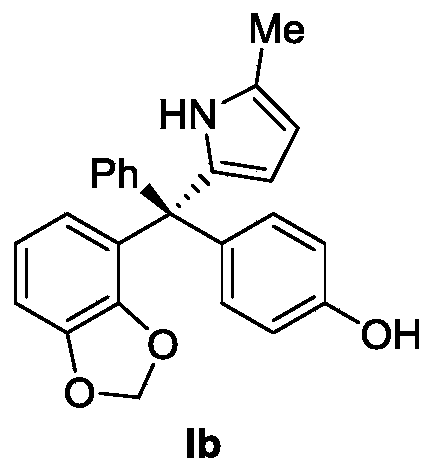
(R) -4- (Benzo [d] [1, 3] dioxol-4-yl (5-methyl-1H-pyrrol-2-yl) (phenyl) methyl) phenol (Ib) was prepared as colorless oil from 4- (benzo [d] [1, 3] dioxol-4-yl (hydroxy) (phenyl) methyl) -phenol (64.0 mg, 0.2 mmol) and 2-methylpyrrole (32.4 mg, 0.4 mmol) according to the General Procedure (eluent: hexanes/EtOAc = 15: 1 to 10: 1) in 94%yield (72.1 mg, 78%ee) .
[α]
D
26: +4.5 (c = 1.0, CHCl
3) . HPLC analysis of the product: Daicel CHIRALPAK AD-H column; 3%i-PrOH in hexanes; 1.0 mL/min; retention times: 38.9 min (major) , 40.8 min (minor) .
1H NMR (400 MHz, acetone-d
6) δ 9.08 (s, 1H) , 8.30 (s, 1H) , 7.26–7.13 (m, 5H) , 6.94 (d, J = 8.4 Hz, 2H) , 6.81 (d, J = 8.4 Hz, 1H) , 6.77 –6.71 (m, 3H) , 6.55 (d, J = 8.0, 1H) , 5.72 –5.59 (m, 4H) , 2.16 (s, 3H) .
13C NMR (100 MHz, acetone-d
6) δ 156.5, 148.6, 146.3, 146.1, 136.3, 135.0, 131.9, 131.2, 130.7, 128.1, 128.0, 126.9, 123.5, 121.8, 114.8, 110.7, 108.3, 105.45, 100.8, 58.2, 13.1.
IR (thin film) 3440, 3416, 3052, 2975, 2885, 1589, 1440, 1259, 733 cm
-1.
HRMS (LD+) Calcd for C
25H
21NO
3 (M
+) : 383.1521, Found: 383.1519.

(R) -2- ( (4-Hydroxyphenyl) (5-methyl-1H-pyrrol-2-yl) (phenyl) methyl) phenol (Ic) was prepared as colorless oil from 2- (hydroxy (4-hydroxyphenyl) (phenyl) methyl) phenol (58.4 mg, 0.2 mmol) and 2-methylpyrrole (32.4 mg, 0.4 mmol) according to the General Procedure (at -20 ℃) (eluent: hexanes/EtOAc = 15: 1 to 10: 1) in 94%yield (66.6 mg, 88%ee) .
[α]
D
26: +4.3 (c = 1.0, CHCl
3) . HPLC analysis of the product: Daicel CHIRALPAK IC-H column; 5%i-PrOH in hexanes; 1.0 mL/min; retention times: 7.5 min (mionr) , 9.6 min (major) .
1H NMR (400 MHz, acetone-d
6) δ 9.39 (s, 1H) , 8.34 (br, 1H) , 7.27 –7.12 (m, 6H) , 6.94 (d, J = 8.4 Hz, 2H) , 6.86 (d, J = 7.7 Hz, 1H) , 6.79 –6.73 (m, 4H) , 6.39 (br, 1H) , 5.87 –5.80 (m, 1H) , 5.77 –5.71 (m, 1H) , 2.17 (s, 3H) .
13C NMR (100 MHz, acetone-d
6) δ 156.7, 156.6, 146.4, 136.5, 134.3, 133.3, 132.2, 131.1, 130.9, 130.0, 129.4, 128.1, 127.0, 120.1, 117.8, 115.0, 110.7, 105.8, 58.4, 13.1.
IR (thin film) 3427, 3387, 3054, 2981, 2862, 1603, 1261, 1210, 1179, 737, 700 cm
-1.
HRMS (CI+) Calcd for C
24H
21NO
2 (M
+) : 355.1572, Found: 355.1581.

(R) -N- (2- ( (4-Hydroxyphenyl) (5-methyl-1H-pyrrol-2-yl) (phenyl) methyl) -phenyl) naphtha ene-1-sulfonamide (Id) was prepared as colorless oil from N- (2- (hydroxy (4-hydroxyphenyl) (phenyl) methyl) phenyl) naphthalene-1-sulfonamide (96.2 mg, 0.2 mmol) and 2-methylpyrrole (32.4 mg, 0.4 mmol) according to the General Procedure (using 15 mol%of catalyst (29.8 mg, 0.03 mmol) , DCM as solvent, at room temperature) (eluent: hexanes/EtOAc = 15: 1 to 10: 1) in 85%yield (92.9 mg, 95%ee) .
[α]
D
26: +4.5 (c = 1.0, CHCl
3) . HPLC analysis of the product: Daicel CHIRALPAK IC column; 30%i-PrOH in hexanes; 1.0 mL/min; retention times: 12.4 min (major) , 15.1 min (minor) .
1H NMR (400 MHz, acetone-d
6) δ 9.42 (s, 1H) , 8.50 (s, 1H) , 8.24 (d, J = 7.3 Hz, 1H) , 8.19 (d, J = 8.2 Hz, 1H) , 8.07 –7.98 (m, 2H) , 7.67 –7.61 (m, 3H, ) , 7.46 (s, 1H) , 7.30 –7.24 (m, 3H) , 7.15 –7.09 (m, 4H) , 6.93 –6.88 (m, 4H) , 6.74 (d, J = 8.5 Hz, 2H) , 6.19-6.11 (m, 1H) , 6.00-5.94 (m, 1H) , 2.13 (s, 3H) .
13C NMR (100 MHz, acetone-d
6) δ 156.9, 145.9, 138.9, 138.2, 136.2, 135.2, 135.1, 134.5, 133.3, 132.2, 131.7, 131.2, 130.9, 129.7, 129.3, 129.1, 128.7, 128.6, 128.4, 127.7, 127.4, 125.3, 125.2, 123.2, 118.9, 115.3, 111.0, 106.4, 59.0, 13.2.
IR (thin film) 3435, 3376, 3057, 2925, 2851, 1589, 1264, 743, 700 cm
-1.
HRMS (LD+) Calcd for C
34H
28N
2O
3S (M
+) : 544.1821, Found: 544.1840.

(R) -4- ( (2- (Butylthio) phenyl) (5-methyl-1H-pyrrol-2-yl) (phenyl) methyl) phenol (Ie) was prepared as colorless oil from 4- ( (2- (butylthio) phenyl) (hydroxy) (phenyl) methyl) phenol (72.8 mg, 0.2 mmol) and 2-methylpyrrole (32.4 mg, 0.4 mmol) according to the General Procedure (at room temperature) (eluent: hexanes/EtOAc = 15: 1 to 10: 1) in 90%yield (76.5 mg, 81%ee) .
[α]
D
26: +7.1 (c = 1.0, CHCl
3) . HPLC analysis of the product: Daicel CHIRALPAK IC column; 3%i-PrOH in hexanes; 1.0 mL/min; retention times: 8.3 min (major) , 9.7 min (minor) .
1H NMR (400 MHz, acetone-d
6) δ 8.74 (s, 1H) , 8.28 (s, 1H) , 7.46 (d, J = 7.5 Hz, 1H) , 7.26 –7.16 (m, 6H) , 7.11 (t, J = 7.8 Hz, 1H) , 6.99 –6.94 (m, 3H) , 6.71 (d, J = 8.6 Hz, 2H) , 5.68 –5.64 (m, 1H) , 5.61 –5.56 (m, 1H) , 2.37 (t, J = 6.9 Hz, 2H) , 2.13 (s, 3H) , 1.22 –1.10 (m, 4H) , 0.76 (t, J = 6.9 Hz, 3H) .
13C NMR (100 MHz, acetone-d
6) δ 156.3, 148.5, 146.2, 140.7, 136.5, 136.2, 132.9, 132.6, 131.4, 131.2, 128.2, 128.0, 127.7, 126.5, 126.1, 114.6, 111.1, 105.6, 61.0, 35.6, 31.5, 22.7, 13.9, 13.1.
IR (thin film) 3444, 3386, 3052, 2957, 2927, 2865, 1587, 1262, 1175, 735, 700 cm
-1.
HRMS (LD+) Calcd for C
28H
29NOS (M
+) : 427.1970, Found: 427.1982.

(R) -4- ( (2-Fluoro-4-methoxyphenyl) (5-methyl-1H-pyrrol-2-yl) (phenyl) methy) phenol (If) was prepared as colorless oil from 4- ( (2-fluoro-4- methoxyphenyl) (hydroxy) (phenyl) methyl) phenol (64.8 mg, 0.2 mmol) and 2-methylpyrrole (32.4 mg, 0.4 mmol) according to the General Procedure (eluent: hexanes/EtOAc = 15: 1 to 10: 1) in 93%yield (80.6 mg, 91%ee) .
[α]
D
26: +1.5 (c = 1.0, CHCl
3) . HPLC analysis of the product: Daicel CHIRALPAK OD-H column; 5%i-PrOH in hexanes; 1.0 mL/min; retention times: 19.1 min (major) , 24.2 min (minor) .
1H NMR (400 MHz, acetone-d
6) δ 8.97 (s, 1H) , 8.31 (s, 1H) , 7.27 –7.16 (m, 5H) , 6.96 –6.91 (m, 3H) , 6.74 (d, J = 8.8 Hz, 2H) , 6.67 (dd, J
1 = 12.9, J
2 = 2.6 Hz, 1H) , 6.61 (dd, J
1 = 12.9, J
2 = 2.7 Hz, 1H) , 5.68 –5.65 (m, 2H) , 3.79 (s, 3H) , 2.15 (m, 3H) .
13C NMR (100 MHz, acetone-d
6) δ 163.3 (d, J = 247.6 Hz) , 162.1 (d, J = 11.0 Hz) , 156.5, 146.5, 136.5, 135.3, 131.8 (d, J = 5.7 Hz) , 131.7, 130.3, 128.3, 128.0, 127.9 (d, J = 11.3 Hz) , 126.8, 114.9, 110.3, 109.4 (d, J = 2.6 Hz) , 105.5, 103.0 (d, J = 26.5 Hz) , 57.8, 55.8, 13.1.
19F NMR (376 MHz, acetone-d
6) δ -97.8.
IR (thin film) 3446, 3054, 2932, 1616, 1261, 824, 733 cm
-1.
HRMS (CI+) Calcd for C
25H
22FNO
2 (M
+) : 387.1635, Found: 387.1624.

(S) -4- ( (4-fluorophenyl) (2-methoxyphenyl) (5-methyl-1H-pyrrol-2-yl) methyl) phenol (Ig) was prepared as colorless oil from 4- ( (4-fluorophenyl) (hydroxy) (2-methoxyphenyl) methyl) phenol (62.8 mg, 0.2 mmol) and 2-methylpyrrole (32.4 mg, 0.4 mmol) according to the General Procedure (eluent: hexanes/EtOAc = 15: 1 to 10: 1) in 93%yield (72.1 mg, 92%ee) .
[α]
D
26: +6.9 (c = 1.0, CHCl
3) . HPLC analysis of the product: Daicel CHIRALPAK IC-H column; 3%i-PrOH in hexanes; 1.0 mL/min; retention times: 8.7 min (major) , 9.8 min (minor) .
1H NMR (400 MHz, acetone-d
6) δ 8.84 (s, 1H) , 8.27 (s, 1H) , 7.30 –7.25 (m, 1H) , 7.18 –7.14 (m, 2H) , 7.00 –6.90 (m, 6H) , 6.88 (td, J
1 = 7.6, J
2 = 1.0 Hz, 1H) , 6.72 (d, J = 8.8 Hz, 2H) , 5.66 (t, J = 2.4 Hz, 1H) , 5.58 (t, J = 3.0 Hz, 1H) , 3.21 (s, 3H) , 2.13 (s, 3H) .
13C NMR (100 MHz, acetone-d
6) δ 161.6 (d, J = 240.1 Hz) , 158.7, 156.1, 142.8 (d, J = 3.3 Hz) , 137.4, 136.4, 132.2 (d, J = 6.7 Hz) , 131.9, 130.7, 129.3, 128.0, 121.0, 114.5, 114.0 (d, J = 21.0 Hz) , 113.8, 110.4, 105.4, 58.5, 55.4, 13.1.
19F NMR (376 MHz, acetone-d
6) δ -118.1.
IR (thin film) 3447, 3053, 2980, 2936, 1593, 1476, 1261, 1020, 733 cm
-1.
HRMS (CI+) Calcd for C
25H
22NFO
2 (M
+) : 387.1635, Found: 387.1638.

(S) -4- ( (2-Methoxyphenyl) (4-methoxyphenyl) (5-methyl-1H-pyrrol-2-yl) methyl) phenol (Ih) was prepared as colorless oil from 4- (hydroxy (2-methoxyphenyl) (4-methoxyphenyl) methyl) phenol (67.2 mg, 0.2 mmol) and 2-methylpyrrole (32.4 mg, 0.4 mmol) according to the General Procedure (using 15 mol%of catalyst (at room temperature) (eluent: hexanes/EtOAc = 15: 1 to 10: 1) in 94%yield (74.7 mg, 83%ee) .
[α]
D
26: +1.7 (c = 1.0, CHCl
3) . HPLC analysis of the product: Daicel CHIRALPAK IC-H column; 5%i-PrOH in hexanes; 1.0 mL/min; retention times: 8.7 min (major) , 10.1 min (minor) .
1H NMR (400 MHz, acetone-d
6) δ 8.76 (s, 1H) , 8.19 (s, 1H) , 7.26 (t, J = 7.9 Hz, 1H) , 7.04 (d, J = 8.4 Hz, 2H) , 6.92 –6.92 (m, 4H) , 6.86 (t, J = 7.4 Hz, 1H) , 6.77 (d, J = 8.7 Hz, 2H) , 6.69 (d, J = 8.2 Hz, 2H) , 5.68 –5.61 (m, 1H) , 5.68 –5.54 (m, 1H) , 3.75 (s, 3H) , 3.20 (s, 3H) , 2.13 (s, 3H) .
13C NMR (100 MHz, acetone-d
6) δ 158.9, 158.4, 155.9, 138.7, 137.9, 137.3, 136.9, 131.8, 131.7, 130.7, 129.1, 127.6, 121.0, 114.4, 114.0, 112.8, 110.2, 105.3, 58.4, 55.6, 55.3, 13.1.
IR (thin film) 3445, 3389, 3050, 2838, 1590, 1249, 1176, 1031, 821, 735 cm
-1.
HRMS (LD+) Calcd for C
26H
25NO
3 (M
+) : 399.1834, Found: 399.1827.

(S) -4- ( (2-Methoxyphenyl) (5-methyl-1H-pyrrol-2-yl) (naphthalen-2-yl) methyl) phenol (Ii) was prepared as colorless oil from 4- (hydroxy (2-methoxyphenyl) (naphthalen-2-yl) methyl) phenol (71.2 mg, 0.2 mmol) and 2-methylpyrrole (32.4 mg, 0.4 mmol) according to the General Procedure (eluent: hexanes/EtOAc = 15: 1 to 10: 1) in 92%yield (88.7 mg, 93%ee) .
[α]
D
26: +11.8 (c = 1.0, CHCl
3) . HPLC analysis of the product: Daicel CHIRALPAK IC-H column; 3%i-PrOH in hexanes; 1.0 mL/min; retention times: 11.7 min (major) , 13.3 min (minor) .
1H NMR (400 MHz, acetone-d
6) δ 8.90 (s, 1H) , 8.25 (s, 1H) , 7.83 (d, J = 7.3 Hz, 1H) , 7.72 –7.64 (m, 3H) , 7.45 –7.28 (m, 4H) , 7.09 –7.03 (m, 3H) , 6.96 –6.89 (m, 2H) , 6.74 (d, J = 8.6 Hz, 2H) , 5.73 –5.65 (m, 2H) , 3.16 (s, 3H) , 2.13 (s, 3H) .
13C NMR (100 MHz, acetone-d
6) δ 159.0, 156.1, 144.0, 137.4, 136.9, 136.3, 133.9, 132.8, 132.0, 130.9, 130.4, 129.3, 128.9, 128.4, 128.0, 128.0, 126.4, 126.31, 126.22, 121.1, 114.5, 114.0, 110.5, 105.5, 59.2, 55.5, 13.1.
IR (thin film) 3441, 3380, 3052, 2836, 1588, 1243, 734, 698 cm
-1.
HRMS (LD+) Calcd for C
29H
25NO
2 (M
+) : 419.1885, Found: 419.1883.

(R) -4- ( (2-Methoxyphenyl) (5-methyl-1H-pyrrol-2-yl) (thiophen-3-yl) methyl) phenol (Ij) was prepared as colorless oil from 4- (hydroxy (2-methoxyphenyl) (thiophen-3-yl) methyl) phenol (62.4 mg, 0.2 mmol) and 2-methylpyrrole (32.4 mg, 0.4 mmol) according to the General Procedure (at 40 ℃) (eluent: hexanes/EtOAc = 15: 1 to 10: 1) in 87%yield (65.5 mg, 87%ee) .
[α]
D
26: +10.3 (c = 1.0, CHCl
3) . HPLC analysis of the product: Daicel CHIRALPAK AD-H column; 5%i-PrOH in hexanes; 1.0 mL/min; retention times: 12.9 min (major) , 14.8 min (minor) .
1H NMR (400 MHz, acetone-d
6) δ 8.87 (s, 1H) , 8.20 (s, 1H) , 7.29 –7.24 (m, 2H) , 6.97 –6.92 (m, 3H) , 6.86 –6.81 (m, 3H) , 6.78 (d, J = 5.0 Hz, 1H) , 6.69 (d, J =8.6 Hz, 2H) , 5.66 –5.61 (m, 1H) , 5.55 (t, J = 2.9 Hz, 1H) , 3.27 (s, 3H) , 2.14 (s, 3H) .
13C NMR (100 MHz, acetone-d
6) δ 159.0, 156.1, 148.2, 137.6, 137.6, 135.9, 131.3, 131.0, 130.4, 129.2, 127.5, 123.8, 123.3, 121.0, 114.6, 114.1, 109.7, 105.5, 56.1, 55.7, 13.1.
IR (thin film) 3443, 3393, 3049, 2837, 1587, 1251, 1175, 733, 703 cm
-1.
HRMS (LD+) Calcd for C
23H
21NO
2S (M
+) : 375.1298, Found: 375.1311.

(R) -4- ( (2-Methoxyphenyl) (phenyl) (4, 5, 6, 7-tetrahydro-1H-indol-2-yl) methyl) phenol (Ik) was prepared as colorless oil from 4- (hydroxy (2-methoxyphenyl) (phenyl) methyl) phenol (61.2mg, 0.2 mmol) and 4, 5, 6, 7-tetrahydro-1H-indole (48.4 mg, 0.4 mmol) according to the General Procedure (eluent: hexanes/EtOAc = 15: 1 to 10: 1) in 92%yield (75.1 mg, 83%ee) .
[α]
D
26: +0.8 (c = 1.0, CHCl
3) . HPLC analysis of the product: Daicel CHIRALPAK IC-H column; 3%i-PrOH in hexanes; 1.0 mL/min; retention times: 8.3 min (major) , 9.3 min (minor) .
1H NMR (400 MHz, acetone-d
6) δ 8.47 (s, 1H) , 8.23 (s, 1H) , 7.28 –7.21 (m, 6H) , 7.03 –6.85 (m, 5H) , 6.70 (d, J = 8.2 Hz, 2H) , 5.46 (s, 1H) , 3.16 (s, 3H) , 2.45 (t, J = 5.9 Hz, 2H) , 2.40 (t, J = 5.7 Hz, 2H) , 1.72 –1.69 (m, 4H) .
13C NMR (100 MHz, acetone-d
6) δ 158.9, 156.0, 146.9, 137.9, 136.6, 136.1, 132.1, 130.8, 130.5, 129.1, 127.5, 127.0, 126.1, 121.0, 115.5, 114.4, 114.0, 109.7, 59.1, 55.5, 24.8, 24.3, 23.7, 23.4.
IR (thin film) 3447, 3402, 3054, 2844, 1598, 1241, 1174, 733, 700 cm
-1.
HRMS (LD+) Calcd for C
28H
27NO
2 (M
+) : 409.2042, Found: 409.2054.

(R) -4- ( (2-Methoxyphenyl) (phenyl) (5-phenyl-1H-pyrrol-2-yl) methyl) phenol (Il) was prepared as colorless oil from 4- (hydroxy (2-methoxyphenyl) (phenyl) methyl) phenol (61.2mg, 0.2 mmol) and 2-phenylpyrrole (57.2 mg, 0.4 mmol) according to the General Procedure (eluent: hexanes/EtOAc =15: 1 to 10: 1) in 98%yield (84.9 mg, 81%ee) .
[α]
D
26: +8.8 (c = 1.0, CHCl
3) . HPLC analysis of the product: Daicel CHIRALPAK OD-H column; 5%i-PrOH in hexanes; 1.0 mL/min; retention times: 11.2 min (minor) , 12.2 min (major) .
1H NMR (400 MHz, acetone-d
6) δ 9.50 (s, 1H) , 8.32 (s, 1H) , 7.49 (d, J = 7.8 Hz, 2H) , 7.32 –7.19 (m, 8H) , 7.13 –7.07 (m, 2H) , 7.02 –7.00 (m, 3H) , 6.90 (t, J =7.6 Hz, 1H) , 6.77 (d, J = 8.6 Hz, 2H) , 6.46 (t, J = 2.9 Hz, 1H) , 5.86 (t, J = 2.8 Hz, 1H) , 3.25 (s, 3H) .
13C NMR (100 MHz, acetone-d
6) δ 158.8, 156.2, 146.7, 139.8, 136.9, 136.4, 134.1, 132.3, 132.1, 131.0, 130.5, 129.4, 129.3, 127.7, 126.5, 126.1, 124.2, 121.2, 114.6, 114.3, 112.6, 105.8, 59.3, 55.7.
IR (thin film) 3449, 3366, 3054, 2836, 1600, 1254, 732, 697 cm
-1.
HRMS (LD+) Calcd for C
30H
25NO
2 (M
+) : 431.1885, Found: 431.1876

(R) -4- ( (2-Methoxyphenyl) (phenyl) (1H-pyrrol-2-yl) methyl) phenol (Im) was prepared as colorless oil from 4- (hydroxy (2-methoxyphenyl) (phenyl) methyl) phenol (61.2mg, 0.2 mmol) and pyrrole (67.0 mg, 1.0 mmol, 5 equiv. ) according to the General Procedure (eluent: hexanes/EtOAc = 15: 1 to 10: 1) in 94%yield (66.8 mg, >99%ee) .
[α]
D
26: +3.6 (c = 1.0, CHCl
3) . HPLC analysis of the product: Daicel CHIRALPAK IC-H column; 2%i-PrOH in hexanes; 1.0 mL/min; retention times: 12.8 min (major >99%) .
1H NMR (400 MHz, acetone-d
6) δ 9.06 (s, 1H) , 8.26 (s, 1H) , 7.30 –7.13 (m, 6H) , 6.96 –6.85 (m, 5H) , 6.72 –6.68 (m, 3H) , 6.03 –5.93 (m, 1H) , 5.82 –5.71 (m, 1H) , 3.19 (s, 3H) .
13C NMR (100 MHz, acetone-d
6) δ 158.9, 156.1, 146.9, 137.9, 137.4, 136.7, 132.0, 130.7, 130.5, 129.3, 127.6, 126.3, 121.0, 118.1, 114.5, 114.0, 110.2, 107.3, 59.1, 55.5.
IR (thin film) 3447, 3055, 2835, 1598, 1241, 1176, 731 cm
-1.
HRMS (LD+) Calcd for C
24H
21NO
2 (M
+) : 355.1572, Found: 355.1556.

(R) -4- ( (4, 7-Dihydro-1H-indol-2-yl) (2-methoxyphenyl) (phenyl) methyl) phenol (In) was prepared as colorless foam solid from 4- (hydroxy (2-methoxyphenyl) (phenyl) methyl) phenol (61.2mg, 0.2 mmol) and 4, 7-dihydro-1H-indole (47.6 mg, 0.4 mmol, 2 equiv. ) according to the General Procedure (eluent: hexanes/EtOAc = 15: 1 to 10: 1) in 86%yield (70.4 mg, 86%ee) .
[α]
D
26: +2.2 (c = 1.0, CHCl
3) . HPLC analysis of the product: Daicel CHIRALPAK IC-H column; 3%i-PrOH in hexanes; 1.0 mL/min; retention times: 9.0 min (minor) , 10.7 min (major) .
1H NMR (400 MHz, acetone-d
6) δ 8.66 (s, 1H) , 8.21 (s, 1H) , 7.29 –7.14 (m, 6H) , 7.02 –6.86 (m, 5H) , 6.72 –6.69 (m, 2H) , 5.85-5.82 (m, 1H) , 5.79-5.76 (m, 1H) , 5.53 –5.52 (m, 1H) , 3.15 –3.10 (m, 4H) , 3.17 (s, 3H) .
13C NMR (100 MHz, acetone-d
6) δ 158.9, 156.1, 146.9, 137.7, 137.0, 136.6, 132.1, 130.8, 130.5, 129.2, 127.6, 126.5, 126.2, 124.32, 124.27, 121.0, 114.4, 114.0, 112.7, 108.9, 59.2, 55.5, 25.6, 24.7.
IR (thin film) 3447, 3405, 2831, 1696, 1599, 1255, 1175, 1108, 820, 731 cm
-1.
HRMS (CI+) Calcd for C
28H
25NO
2 (M
+) : 407.1885, Found: 407.1888.

(R) -2- ( (2-Methoxyphenyl) (4-methoxyphenyl) (phenyl) methyl) -1H-indole Io) . To a solution of In (61.1 mg, 0.15 mmol, 1.0 equiv. ) in acetone (4 mL) was sequentially added MeI (64.4 mg, 0.45 mmol, 3.0 equiv. ) and K
2CO
3 (104 mg, 0.75 mmol, 5.0 equiv. ) at room temperature. The reaction mixture was stirred at room temperature for 24 h and filtered through a short pad of silica gel, which was washed with Et
2O. The filtrate was concentrated under reduced pressure. The crude product was dissolved in anhydrous DCM (8 mL) . DDQ (38 mg, 0.175 mmol, 1.1 equiv. ) was added in one portion. The reaction mixture was stirred at room temperature for 3 h. The reaction mixture was diluted with DCM (15 mL) . Then it was washed with an aqueous solution of the solution of NaOH (15 mL, 10%wt. ) and water (2×15 mL) , and dried over Na
2SO
4. After that, the reaction mixture was concentrated under reduced pressure and purified by silica gel chromatography to afford the desired product (eluent: hexanes/EtOAc = 15: 1 to 10: 1) in 81%yield for two steps (51.2 mg, 86%ee) .
[α]
D
26: -1.5 (c = 1.0, CHCl
3) . HPLC analysis of the product: Daicel CHIRALPAK OD-H column; 3%i-PrOH in hexanes; 1.0 mL/min; retention times: 10.3 min (minor) , 11.1 min (major) .
1H NMR (400 MHz, acetone-d
6) δ 9.46 (s, 1H) , 7.46 (d, J = 7.7 Hz, 1H) , 7.28 –7.18 (m, 6H) , 7.09 (d, J = 8.9 Hz, 2H) , 7.03 –6.88 (m, 5H) , 6.82 (d, J = 8.9 Hz, 2H) , 6.34 (s, 1H) , 3.77 (s, 3H) , 3.20 (s, 3H) .
13C NMR (100 MHz, acetone-d
6) δ 159.0, 158.8, 146.0, 145.5, 137.7, 137.2, 136.1, 132.2, 130.81, 130.75, 129.7, 128.7, 127.9, 126.7, 121.7, 121.2, 120.7, 119.8, 114.0, 113.2, 111.8, 104.3, 59.6, 55.5, 55.4.
IR (thin film) 3448, 3053, 2836, 1592, 1290, 1105, 799, 731 cm
-1.
HRMS (CI+) Calcd for C
29H
25NO
2 (M)
+: 419.1885 Found: 419.1886.

At room temperature, to an oven-dried 4-mL vial charged with a solution of tertiary alcohol 4 (0.2 mmol) and pyrrole 2 (0.4 mmol) in DCE (0.8 mL) was slowly added a solution of catalyst (R) -BINOL-2, 4, 6-Cy
3C
6H
2-OH (14.9 mg, 0.015 mmol, 7.5 mol%) in DCE (0.2 mL) . The reaction mixture was stirred at the same temperature for 24 h. Next, Na
2CO
3 (212 mg, 2.0 mmol) was added. The mixture was stirred for 10 min and concentrated under reduced pressure. The residue was purified by silica gel chromatography to afford the desired product.
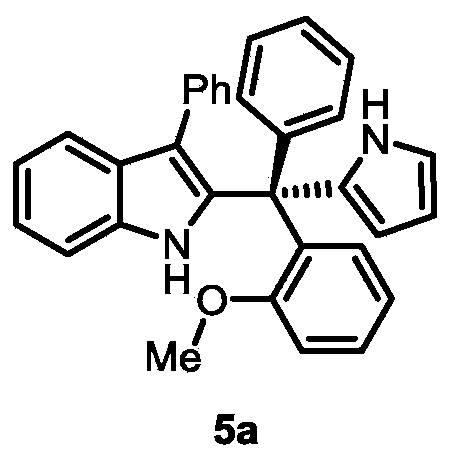
(S) -2- ( (2-Methoxyphenyl) (phenyl) (1H-pyrrol-2-yl) methyl) -3-phenyl-1H-indole (5a) was prepared as white foam from 4- (hydroxy (2-methoxyphenyl) (phenyl) methyl) phenol (81.3 mg, 0.2 mmol) and pyrrole (26.8 mg, 0.4 mmol) according to the General Procedure E (eluent: hexanes/EtOAc = 20: 1 → 15: 1) in 96%yield (87.0 mg, 96%ee) .
[α]
D
26: +0.5 (c = 1.0, CHCl
3) . HPLC analysis of the product: Daicel CHIRALPAK AD-H column; 5%i-PrOH in hexanes; 1.0 mL/min; retention times: 8.1 min (minor) , 18.0 min (major) .
1H NMR (400 MHz, acetone-d
6) δ 9.42 (s, 1H) , 9.32 (s, 1H) , 7.41 (d, J = 8.1 Hz, 1H) , 7.26 (d, J = 8.0 Hz, 1H) , 7.24 –7.06 (m, 7H) , 7.02 –6.86 (m, 7H) , 6.78 (td, J
1 = 7.6 Hz, J
2 = 1.2 Hz, 1H) , 6.70 (dd, J
1 = 8.2 Hz, J
2 = 1.2 Hz, 1H) , 6.64 (td, J
1 = 2.7 Hz, J
2 = 1.6 Hz, 1H) , 5.98 (dt, J
1 = 3.5 Hz, J
2 = 2.6 Hz, 1H) , 5.84 (ddd, J
1 = 3.4 Hz, J
2 = 2.7 Hz, J
3 = 1.6 Hz, 1H) , 3.19 (s, 3H) .
13C NMR (100 MHz, acetone-d
6) δ 158.6, 145.0, 137.6, 136.7, 135.5, 135.4, 135.0, 131.2, 130.9 (2C) , 130.6, 129.6, 127.7, 127.5, 126.8, 125.7, 122.1, 120.7, 119.8, 119.6, 118.1, 116.3, 113.4, 111.8, 110.4, 107.8, 56.1, 55.5.
IR (thin film) 3412, 3055, 3008, 2935, 1591, 1543, 1245, 1089, 1022, 1089, 1022, 801, 745, 702 cm
-1.
HRMS (LD+) Calcd for C
32H
26N
2O (M
+) : 454.2045, Found: 454.2052.

(S) -2- ( (2- (Benzyloxy) phenyl) (phenyl) (1H-pyrrol-2-yl) methyl) -3-phenyl-1H-indole (5b) was prepared as white foam from (2- (benzyloxy) phenyl) (phenyl) (3-phenyl-1H-indol-2-yl) methanol (96.2 mg, 0.2 mmol) and pyrrole (26.8 mg, 0.4 mmol) according to the General Procedure E (eluent: hexanes/EtOAc = 20: 1 → 15: 1) in 81%yield (85.8 mg, 91%ee) .
[α]
D
26: -2.2 (c = 1.0, CHCl
3) . HPLC analysis of the product: Daicel CHIRALPAK AD-H column; 10%i-PrOH in hexanes; 1.0 mL/min; retention times: 5.5 min (minor) , 9.0 min (major) .
1H NMR (400 MHz, acetone-d
6) δ 9.42 (s, 1H) , 9.35 (s, 1H) , 7.37 (dd, J
1 =8.1 Hz, J
2 = 2.1 Hz, 1H) , 7.25 –7.23 (m, 3H) , 7.19 –6.92 (m, 13H) , 6.89 –6.81 (m, 2H) , 6.83 –6.66 (m, 4H) , 6.63 –6.54 (m, 1H) , 5.96 –5.94 (m, 1H) , 5.83 –5.81 (m, 1H) , 4.72 (d, J = 12.0 Hz, 1H) , 4.57 (d, J = 12.1 Hz, 1H) .
13C NMR (100 MHz, acetone-d
6) δ 157.5, 144.8, 137.8, 137.5, 136.7, 135.6, 135.5, 134.5 131.3, 131.2, 131.0, 130.9, 129.6, 128.6, 127.9, 127.8, 127.6, 126.9, 125.8, 122.2, 120.8, 119.9, 119.6, 118.2, 116.2, 113.6, 111.9, 110.6, 107.9, 107.8 70.2, 56.3.
IR (thin film) 3414, 3054, 2961, 2926, 1591, 1485, 1447, 1292, 1230, 1093, 1019, 853, 737, 700 cm
-1.
HRMS (LD+) Calcd for C
38H
30N
2O (M
+) : 530.2358, Found: 530.2350.

(S) -2- ( (2-Isopropoxyphenyl) (phenyl) (1H-pyrrol-2-yl) methyl) -3-phenyl-1H-indole (5c) was prepared as white foam from (2-isopropoxyphenyl) (phenyl) (3-phenyl-1H-indol-2-yl) methanol (86.7 mg, 0.2 mmol) and pyrrole (26.8 mg, 0.4 mmol) according to the General Procedure E (eluent: hexanes/EtOAc = 20: 1 → 15: 1) in 92%yield (88.9 mg, 92%ee) .
[α]
D
26: -9.4 (c = 1.0, CHCl
3) . HPLC analysis of the product: Daicel CHIRALPAK AD-H column; 10%i-PrOH in hexanes; 1.0 mL/min; retention times: 7.0 min (minor) , 15.0 min (major) .
1H NMR (400 MHz, acetone-d
6) δ 9.47 (s, 1H) , 9.28 (s, 1H) , 7.42 (d, J = 8.1 Hz, 1H) , 7.34 –7.05 (m, 8H) , 7.02 –6.87 (m, 7H) , 6.73 (t, J = 7.6 Hz, 2H) , 6.61 (td, J
1 = 2.7 Hz, J
2 = 1.6 Hz, 1H) , 5.95 (q, J = 2.8 Hz, 1H) , 5.81 (td, J
1 = 3.1 Hz, J
2 = 1.6 Hz, 1H) , 4.35 (hept, J = 6.0 Hz, 1H) , 0.83 (d, J = 6.0 Hz, 3H) , 0.63 (d, J = 5.9 Hz, 3H) .
13C NMR (100 MHz, acetone-d
6) δ 156.0, 144.9, 138.0, 136.8, 135.4, 135.3, 135.0, 131.4, 131.2, 130.9, 130.9, 129.4, 127.6, 127.6, 126.7, 125.7, 122.1, 119.8, 119.7, 119.6, 117.9, 116.2, 113.0, 111.8, 110.6, 107.8, 68.6, 56.3, 21.6, 20.9.
IR (thin film) 3445, 3417, 3056, 2976, 2929, 1592, 1483, 1449, 1289, 1242, 1118, 952, 751, 705 cm
-1.
HRMS (LD+) Calcd for C
34H
30N
2O (M
+) : 482.2358, Found: 482.2339.

(S) -2- ( (2- (Methoxymethoxy) phenyl) (phenyl) (1H-pyrrol-2-yl) methyl) -3-phenyl-1H-indole (5d) was prepared as white foam from (2- (methoxymethoxy) phenyl) (phenyl) (3-phenyl-1H-indol-2-yl) methanol (87.1 mg, 0.2 mmol) and pyrrole (26.8 mg, 0.4 mmol) according to the General Procedure E (eluent: hexanes/EtOAc = 20: 1 → 15: 1) in 78%yield (75.9 mg, 97%ee) .
[α]
D
26: -1.9 (c = 1.0, CHCl
3) . HPLC analysis of the product: Daicel CHIRALPAK AD-H column; 10%i-PrOH in hexanes; 1.0 mL/min; retention times: 4.5 min (minor) , 12.0 min (major) .
1H NMR (400 MHz, acetone-d
6) δ 9.47 (s, 1H) , 9.32 (s, 1H) , 7.41 (d, J = 8.1 Hz, 1H) , 7.26 –7.19 (m, 3H) , 7.17 –7.04 (m, 5H) , 7.01 –6.78 (m, 9H) , 6.64 –6.64 (m, 1H) , 5.99 –5.96 (m, 1H) , 5.86 –5.83 (m, 1H) , 4.51 (d, J = 6.9 Hz, 1H) , 4.45 (d, J = 6.9 Hz, 1H) , 2.81 (s, 3H) .
13C NMR (100 MHz, acetone-d
6) δ 156.7, 145.0, 137.5, 136.7, 135.6, 135.5, 135.3, 131.3, 131.0, 130.9, 130.7, 129.6, 127.8, 127.6, 126.8, 125.8, 122.2, 121.6, 119.9, 119.6, 118.3, 116.4, 115.6, 111.9, 110.4, 107.9, 94.78, 56.3, 55.6.
IR (thin film) 3443, 3054, 2954, 2933, 1592, 1484, 1234, 1153, 1078, 996, 917, 737, 705 cm
-1.
HRMS (LD+) Calcd for C
33H
28N
2O
2 (M
+) : 484.2151, Found: 484.2168.

(S) -2- ( (2, 4-Dimethoxyphenyl) (phenyl) (1H-pyrrol-2-yl) methyl) -3-phenyl-1H-indole (5e) was prepared as white foam from (2, 4-dimethoxyphenyl) (phenyl) (3-phenyl-1H-indol-2-yl) methanol (87.0 mg, 0.2 mmol) and pyrrole (26.8 mg, 0.4 mmol) according to the General Procedure E (eluent: hexanes/EtOAc = 20: 1 → 15: 1) in 94%yield (91.3 mg, 96%ee) .
[α]
D
26: -4.6 (c = 1.0, CHCl
3) . HPLC analysis of the product: Daicel CHIRALPAK AD-H column; 10%i-PrOH in hexanes; 1.0 mL/min; retention times: 6.7 min (minor) , 14.6 min (major) .
1H NMR (400 MHz, CD
2Cl
2) δ 8.45 (s, 1H) , 8.42 (s, 1H) , 7.38 (d, J = 7.9 Hz, 1H) , 7.32 (d, J = 8.1 Hz, 1H) , 7.23 –7.14 (m, 6H) , 7.10 –7.00 (m, 4H) , 6.92 –6.89 (m, 3H) , 6.61 –6.59 (m, 1H) , , 6.36 –6.33 (m, 2H) , 6.13 –6.10 (m, 1H) , 5.91–5.00 (m, 1H) , 3.78 (s, 3H) , 3.33 (s, 3H) .
13C NMR (100 MHz, CD
2Cl
2) δ 161.0, 158.9, 144.3, 137.6, 135.7, 135.6, 134.3, 131.8, 130.8, 130.5, 130.4, 127.8, 127.4, 126.9, 126.0, 125.6, 122.2, 120.0, 119.6, 117.0, 115.8, 111.0, 109.9, 108.3, 104.5, 100.7, 55.9, 55.7, 55.2.
IR (thin film) 3434, 3410, 3052, 2926, 2843, 1606, 1493, 1451, 1414, 1301, 1260, 1030, 735, 701 cm
-1.
HRMS (LD+) Calcd for C
33H
28N
2O
2 (M
+) : 484.2151, Found: 484.2163.

(S) -3-Phenyl-2- (phenyl (1H-pyrrol-2-yl) (2- (trifluoromethoxy) phenyl) methyl) -1H-indole (5f) was prepared as white foam from phenyl (3-phenyl-1H-indol-2-yl) (2- (trifluoromethoxy) phenyl) methanol (91.9 mg, 0.2 mmol) and pyrrole (26.8 mg, 0.4 mmol) according to the General Procedure E (7.5 mol%catalyst) (eluent: hexanes/EtOAc = 20: 1 → 15: 1) in 85%yield (86.5 mg, 94%ee) .
[α]
D
26: +14.1 (c = 1.0, CHCl
3) . HPLC analysis of the product: Daicel CHIRALPAK AD-H column; 10%i-PrOH in hexanes; 1.0 mL/min; retention times: 4.0 min (minor) , 11.8 min (major) .
1H NMR (400 MHz, acetone-d
6) δ 9.58 (s, 1H) , 9.45 (s, 1H) , 7.43 (d, J = 8.2 Hz, 1H) , 7.27 –7.04 (m, 10H) , 7.01 –6.93 (m, 4H) , 6.89 –6.86 (m, 3H) , 6.73 –6.71 (m, 1H) , 6.03 –6.01 (m, 1H) , 5.90 –5.88 (m, 1H) .
13C NMR (100 MHz, acetone-d
6) δ 149.2, 144.2, 136.8, 136.3, 136.1, 135.8, 134.4, 131.9, 131.4, 130.9, 130.4, 123.0, 128.2, 127.7, 127.2, 126.0, 125.7, 122.6, 120.7 (q, J = 255.9 Hz) , 120.0, 119.8, 119.1, 117.8 (q, J = 2.2 Hz) , 117.2, 112.0, 110.7, 108.1, 56.1.
19F NMR (376 MHz, acetone-d
6) δ -56.3.
IR (thin film) 3445, 3055, 1487, 1449, 1251, 1212, 1160, 898, 739, 704 cm
-1.
HRMS (LD+) Calcd for C
32H
23F
3N
2O (M
+) : 508.1762, Found: 508.1745.

(S) -2- ( (2-Fluoro-4-methoxyphenyl) (phenyl) (1H-pyrrol-2-yl) methyl) -3-phenyl-1H-indole (5g) was prepared as white foam from (2-fluoro-4-methoxyphenyl) (phenyl) (3-phenyl-1H-indol-2-yl) methanol (84.7 mg, 0.2 mmol) and pyrrole (26.8 mg, 0.4 mmol) according to the General Procedure E (eluent: hexanes/EtOAc = 20: 1 → 15: 1) in 95%yield (89.9 mg, 92%ee) .
[α]
D
26: +12.4 (c = 1.0, CHCl
3) . HPLC analysis of the product: Daicel CHIRALPAK AD-H column; 7%i-PrOH in hexanes; 1.0 mL/min; retention times: 24.4 min (minor) , 25.4 min (major) .
1H NMR (400 MHz, acetone-d
6) δ 9.49 (s, 1H) , 9.47 –9.42 (m, 1H) , 7.41 (d, J = 8.2 Hz, 1H) , 7.23 –7.15 (m, 6H) , 7.12 –7.08 (m, 1H) , 7.03 –6.94 (m, 4H) , 6.93 –6.88 (m, 2H) , 6.83 (t, J = 9.0 Hz, 1H) , 6.70 –6.68 (m, 1H) , 6.54 (dd, J
1 = 8.9, J
2 = 2.6 Hz, 1H) , 6.26 (dd, J
1 = 13.0, J
2 = 2.6 Hz, 1H) , 6.02 –6.00 (m, 1H) , 5.92 –5.90 (m, 1H) , 3.72 (s, 3H) .
13C NMR (100 MHz, acetone-d
6) δ 162.2 (d, J = 247.5 Hz) , 161.5 (d, J = 10.0 Hz) , 144.8, 136.8, 136.4, 135.7, 134.8, 131.7 (d, J = 5.3 Hz) , 131.4, 130.9, 130.4, 128.3, 127.7, 127.4, 125.9, 125.6 (d, J = 12.3 Hz) , 122.5, 120.0, 119.8, 118.8, 116.9, 112.0, 110.4 (d, J = 2.0 Hz) , 109.5 (d, J = 2.7 Hz) , 108.0, 103.0 (d, J = 26.4 Hz) , 55.8, 54.8.
19F NMR (376 MHz, acetone-d
6) δ -100.4.
IR (thin film) 4039, 3054, 3024, 2962, 1617, 1578, 1497, 1450, 1306, 1260, 1158, 740, 706 cm
-1.
HRMS (LD+) Calcd for C
32H
25FN
2O (M
+) : 472.1951, Found: 472.1943.

(S) -2- ( (2-Methoxyphenyl) (phenyl) (1H-pyrrol-2-yl) methyl) -5-methyl-3-phenyl-1H-indole (5h) was prepared as white foam from (2-methoxyphenyl) (6-methyl-3-phenyl-1H-indol-2-yl) (phenyl) methanol (83.9 mg, 0.2 mmol) and pyrrole (26.8 mg, 0.4 mmol) according to the General Procedure E (eluent: hexanes/EtOAc =20:1 → 15: 1) in 67%yield (62.6 mg, 94%ee) .
[α]
D
26: +0.8 (c = 1.0, CHCl
3) . HPLC analysis of the product: Daicel CHIRALPAK AD-H column; 10%i-PrOH in hexanes; 1.0 mL/min; retention times: 7.4 min (minor) , 10.9 min (major) .
1H NMR (400 MHz, acetone-d
6) δ 9.29 (s, 1H) , 9.27 (s, 1H) , 7.28 (d, J = 8.2 Hz, 1H) , 7.21 –7.08 (m, 6H) , 7.00 (s, 1H) , 6.97 –6.83 (m, 7H) , 6.76 (td, J
1 = 7.6 Hz, J
2 = 1.2 Hz, 1H) , 6.71 (dd, J
1 = 8.2 Hz, J
2 = 1.2 Hz, 1H) , 6.63 –6.61 (m, 1H) , 5.95 (dt, J
1 = 3.4 Hz, J
2 = 2.5 Hz, 1H) , 5.79 (dd, J
1 = 3.3 Hz, J
2 = 1.6 Hz, 1H) , 3.19 (s, 3H) , 2.32 (s, 3H) .
13C NMR (100 MHz, acetone-d
6) δ 158.7, 145.1, 137.8, 136.9, 135.64, 135.1, 133.9, 131.3, 131.2, 131.0, 130.7, 129.7, 128.6, 127.7, 127.6, 126.8, 125.7, 123.7, 120.8, 119.2, 118.1, 115.9, 113.5, 111.6, 110.4, 107.8, 56.2, 55.5, 21.6.
IR (thin film) 3442, 3421, 3051, 3023, 2961, 1591, 1543, 1250, 1088, 1021, 797, 733, 702 cm
-1.
HRMS (LD+) Calcd for C
33H
28N
2O (M
+) : 468.2202, Found: 468.2214.

(S) -5-Methoxy-2- ( (2-methoxyphenyl) (phenyl) (1H-pyrrol-2-yl) methyl) -3-phenyl-1H-indole (5i) was prepared as white foam from (6-methoxy-3-phenyl-1H-indol-2-yl) (2-methoxyphenyl) (phenyl) methanol (87.1 mg, 0.2 mmol) and pyrrole (26.8 mg, 0.4 mmol) according to the General Procedure E (using 4 mL of DCM, 36 h) (eluent: hexanes/EtOAc = 20: 1 → 15: 1) in 78%yield (75.8 mg, 96%ee) .
[α]
D
26: -1.5 (c = 1.0, CHCl
3) . HPLC analysis of the product: Daicel CHIRALPAK AD-H column; 10%i-PrOH in hexanes; 1.0 mL/min; retention times: 8.1 min (minor) , 13.8 min (major) .
1H NMR (400 MHz, acetone-d
6) δ 9.28 (s, 1H) , 9.24 (s, 1H) , 7.30 (d, J = 8.5 Hz, 1H) , 7.21 –7.08 (m, 6H) , 6.99 –6.93 (m, 4H) , 6.89 –6.83 (m, 2H) , 6.79 –6.71 (m 4H) , 6.63 –6.61 (m, 1H) , 5.97 –5.95 (m, 1H) , 5.85 –5.73 (m, 1H) , 3.67 (s, 3H) , 3.20 (s, 3H) .
13C NMR (100 MHz, acetone-d
6) δ 158.7, 155.1, 145.0, 138.5, 136.9, 135.6, 135.1, 131.2 (2C) , 131.0, 130.7, 130.6, 129.7, 127.72, 127.69, 126.8, 125.8, 120.8, 118.1, 116.1, 113.5, 112.6, 112.3, 110.4, 107.9, 101.5, 56.3, 55.8, 55.6.
IR (thin film) 3442, 3054, 2942, 2832, 1589, 1482, 1443, 1255, 1150, 1027, 799, 738, 706 cm
-1.
HRMS (LD+) Calcd for C
33H
28N
2O
2 (M
+) : 484.2151, Found: 484.2138.

(S) -5-Fluoro-2- ( (2-methoxyphenyl) (phenyl) (1H-pyrrol-2-yl) methyl) -3-phenyl-1H-indole (5j) was prepared as white foam from (6-fluoro-3-phenyl-1H-indol-2-yl) (2-methoxyphenyl) (phenyl) methanol (84.7 mg, 0.2 mmol) and pyrrole (26.8 mg, 0.4 mmol) according to the General Procedure E (using 4 mL of DCM, 36 h) (eluent: hexanes/EtOAc = 20: 1 → 15: 1) in 68%yield (63.8 mg, 95%ee) .
[α]
D
26: -3.2 (c = 1.0, CHCl
3) . HPLC analysis of the product: Daicel CHIRALPAK AD-H column; 10%i-PrOH in hexanes; 1.0 mL/min; retention times: 6.6 min (minor) , 8.3 min (major) .
1H NMR (400 MHz, CD
2Cl
2) δ 8.48 (s, 1H) , 8.39 (s, 1H) , 7.28 –7.14 (m, 7H) , 7.01 –6.97 (m, 5H) , 6.91 (td, J
1 =9.1 Hz, J
2 = 2.5 Hz, 1H) , 6.84 –6.77 (m, 4H) , 6.60 –6.58 (m, 1H) , 6.09 –6.07 (m, 1H) , 5.86 –5.82 (m, 1H) , 3.31 (s, 3H) .
13C NMR (100 MHz, CD
2Cl
2) δ 158.5 (d, J = 231.9 Hz) , 158.1, 143.6, 139.4, 135.1 (d, J = 14.6 Hz) , 133.3, 131.0, 130.8, 130.6, 130.4, 129.5, 127.8, 127.6, 127.1, 125.9, 121.0, 117.2, 116.1 (d, J = 4.7 Hz) , 113.4, 111.8 (d, J = 9.6 Hz) , 110.4, 110.1, 108.4, 108.1, 104.3 (d, J = 23.8 Hz) , 103.9, 56.0, 55.8.
19F NMR (376 MHz, CD
2Cl
2) δ -128.6.
IR (thin film) 3439, 3411, 2054, 2935, 2834, 1588, 1481, 1440, 1249, 1102, 1022, 907, 857, 751, 704 cm
-1.
HRMS (LD+) Calcd for C
32H
25FN
2O (M
+) : 472.1951, Found: 472.1963.

(S) -2- ( (2-Methoxyphenyl) (1H-pyrrol-2-yl) (p-tolyl) methyl) -3-phenyl-1H-indole (5k) was prepared as white foam from (2-methoxyphenyl) (3-phenyl-1H-indol-2-yl) (p-tolyl) methanol (81.9 mg, 0.2 mmol) and pyrrole (26.8 mg, 0.4 mmol) according to the General Procedure E (eluent: hexanes/EtOAc = 20: 1 → 15: 1) in 96%yield (90.2 mg, 92%ee) .
[α]
D
26: -1.5 (c = 1.0, CHCl
3) . HPLC analysis of the product: Daicel CHIRALPAK AD-H column; 10%i-PrOH in hexanes; 1.0 mL/min; retention times: 5.3 min (minor) , 11.4 min (major) .
1H NMR (400 MHz, acetone-d
6) δ 9.38 (s, 1H) , 9.29 (s, 1H) , 7.40 (d, J = 8.0 Hz, 1H) , 7.27 (d, J = 8.0 Hz, 1H) , 7.17 –6.85 (m, 13H) , 6.79 –6.75 (m, 1H) , 6.71 (d, J = 2.8 Hz, 1H) , 6.65 –6.59 (m, 1H) , 5.99 (d, J = 8.0 Hz, 1H) , 5.84 –5.87 (m, 1H) , 3.21 (s, 3H) , 2.26 (s, 3H) .
13C NMR (100 MHz, acetone-d
6) δ 158.7 141.9, 137.9, 136.7 136.0, 135.7, 135.4, 134.9, 131.2, 130.9, 130.7 (2C) , 129.5, 128.4, 127.5, 125.6, 122.0, 120.7, 119.8, 119.5, 118.0, 116.0, 113.4, 111.8, 110.3, 107.8, 55.8, 55.5, 21.0.
IR (thin film) 3436, 3423, 3051, 3019, 2961, 2929, 2590, 1484, 1251, 1180, 1092, 1021, 804, 740, 704 cm
-1.
HRMS (LD+) Calcd for C
33H
28N
2O (M
+) : 468.2202, Found: 468.2213.

(S) -2- ( (2-Methoxyphenyl) (4-methoxyphenyl) (1H-pyrrol-2-yl) methyl) -3-phenyl-1H-indole (5l) was prepared as white foam from (2-methoxyphenyl) (4-methoxyphenyl) (3-phenyl-1H-indol-2-yl) methanol (87.1 mg, 0.2 mmol) and pyrrole (26.8 mg, 0.4 mmol) according to the General Procedure E (eluent: hexanes/EtOAc = 20: 1 → 15: 1) in 78%yield (75.7 mg, 86%ee) .
[α]
D
26: -1.5 (c = 1.0, CHCl
3) . HPLC analysis of the product: Daicel CHIRALPAK OD-H column; 5%i-PrOH in hexanes; 1.0 mL/min; retention times: 7.9 min (minor) , 9.3 min (major) .
1H NMR (400 MHz, acetone-d
6) δ 9.37 (s, 1H) , 9.29 (s, 1H) , 7.40 (d, J = 8.1 Hz, 1H) , 7.29 –7.03 (m, 5H) , 7.03 –6.83 (m, 7H) , 6.80 –6.57 (m, 5H) , 5.98 –5.96 (m, 1H) , 5.83 –5.81 (m, 1H) , 3.72 (s, 3H) , 3.23 (s, 3H) .
13C NMR (100 MHz, acetone) δ 158.8, 158.7, 138.2, 136.8, 136.7, 136.0, 135.4, 135.1, 131.9, 131.3, 130.91, 130.88, 129.6, 127.6, 125.7, 122.1, 120.8, 119.8, 119.5, 118.0, 115.9, 113.4, 113.0, 111.8, 110.3, 107.8, 55.6, 55.5, 55.4.
IR (thin film) 3435, 3413, 3049, 2958, 2835, 1595, 1452, 1245, 1177, 1095, 1024, 800, 729, 703 cm
-1.
HRMS (LD+) Calcd for C
33H
28N
2O
2 (M
+) : 484.2151, Found: 484.2168.

(S) -2- ( (2-Methoxyphenyl) (4- (methylthio) phenyl) (1H-pyrrol-2-yl) methyl) -3-phenyl-1H-indole (5m) was prepared as white foam from (2-methoxyphenyl) (4- (methylthio) phenyl) (3-phenyl-1H-indol-2-yl) methanol (90.2 mg, 0.2 mmol) and pyrrole (26.8 mg, 0.4 mmol) according to the General Procedure E (using 4 mL of DCM, 36 h) (eluent: hexanes/EtOAc = 20: 1 → 15: 1) in 71%yield (70.9 mg, 83%ee) .
[α]
D
26: -4.8 (c = 1.0, CHCl
3) . HPLC analysis of the product: Daicel CHIRALPAK AD-H column; 10%i-PrOH in hexanes; 1.0 mL/min; retention times: 6.3 min (minor) , 10.8 min (major) .
1H NMR (400 MHz, Acetone-d
6) δ 9.40 (s, 1H) , 9.32 (s, 1H) , 7.40 (d, J = 8.1 Hz, 1H) , 7.23 –7.16 (m, 2H) , 7.10 –7.06 (m, 3H) , 7.03 –6.84 (m, 9H) , 6.79 (t, J =7.6 Hz, 1H) , 6.74 (d, J = 8.1 Hz, 1H) , 6.67 –6.62 (m, 1H) , 5.99 –5.96 (m, 1H) , 5.84 –5.82 (m, 1H) , 3.23 (s, 3H) , 2.42 (s, 3H) .
13C NMR (100 MHz, Acetone) δ 158.7, 141.6, 137.8, 136.82, 136.77, 135.6, 135.5, 134.9, 131.4, 131.3, 131.0, 130.9, 129.7, 127.6, 125.8, 125.7, 122.2, 120.9, 119.9, 119.6, 118.2, 116.2, 113.5, 111.9, 110.4, 107.9, 55.9, 55.6, 15.6.
IR (thin film) 3437, 3051, 2927, 2834, 1590, 1485, 1450, 1250, 1023, 812, 739, 708 cm
-1.
HRMS (LD+) Calcd for C
33H
28N
2OS (M
+) : 500.1922, Found: 500.1904.

(S) -2- ( (4-Fluorophenyl) (2-methoxyphenyl) (1H-pyrrol-2-yl) methyl) -3-phenyl-1H-indole (5n) was prepared as white foam from (4-fluorophenyl) (2-methoxyphenyl) (3-phenyl-1H-indol-2-yl) methanol (84.7 mg, 0.2 mmol) and pyrrole (26.8 mg, 0.4 mmol) according to the General Procedure E (using 4 mL of DCM, 36 h) (eluent: hexanes/EtOAc = 20: 1 → 15: 1) in 68%yield (63.8 mg, 95%ee) .
[α]
D
26: +7.4 (c = 1.0, CHCl
3) . HPLC analysis of the product: Daicel CHIRALPAK AD-H column; 10%i-PrOH in hexanes; 1.0 mL/min; retention times: 6.6 min (minor) , 14.5 min (major) .
1H NMR (400 MHz, acetone-d
6) δ 9.45 (s, 1H) , 9.38 (s, 1H) , 7.40 (d, J = 8.1 Hz, 1H) , 7.24 –7.13 (m, 4H) , 7.11 –7.06 (m, 1H) , 7.00 –6.90 (m, 5H) , 6.88 –6.73 (m, 6H) , 6.67 –6.65 (m, 1H) , 6.00 –5.97 (m, 1H) , 5.83 –5.81 (m, 1H) , 3.23 (s, 3H) .
13C NMR (100 MHz, acetone-d
6) δ 161.9 (d, J = 241.7 Hz) , 158.6, 140.5 (d, J = 3.3 Hz) , 137.6, 136.7, 135.6, 135.5, 135.1, 132.5 (d, J = 7.9 Hz) , 131.3, 130.9, 130.8, 129.9, 127.7, 125.8, 122.3, 120.9, 119.9, 119.7, 118.4, 116.4, 114.0 (d, J = 21.0 Hz) , 113.5, 111.9, 110.3, 107.9, 55.8, 55.5.
19F NMR (376 MHz, acetone-d
6) δ -119.1.
IR (thin film) 3441, 3415, 3052, 2934, 2837, 1595, 1494, 1236, 1164, 1098, 1023, 821, 741, 706 cm
-1.
HRMS (LD+) Calcd for C
32H
25FN
2O (M
+) : 472.1951, Found: 472.1971.

(S) -2- ( (2-Methoxyphenyl) (1H-pyrrol-2-yl) (4- (trifluoromethyl) phenyl) methyl) -3-phenyl-1H-indole (5o) was prepared as white foam from (2-methoxyphenyl) (3-phenyl-1H-indol-2-yl) (4- (trifluoromethyl) phenyl) methanol (94.7 mg, 0.2 mmol) and pyrrole (26.8 mg, 0.4 mmol) according to the General Procedure E (under 40 ℃, 36 h) (eluent: hexanes/EtOAc = 20: 1 → 15: 1) in 85%yield (84.1 mg, 83%ee) .
[α]
D
26: +14.5 (c = 1.0, CHCl
3) . HPLC analysis of the product: Daicel CHIRALPAK AD-H column; 10%i-PrOH in hexanes; 1.0 mL/min; retention times: 4.0 min (minor) , 6.2 min (major) .
1H NMR (400 MHz, acetone-d
6) δ 9.54 (s, 1H) , 9.50 (s, 1H) , 7.41 (d, J = 8.1 Hz, 1H) , 7.38 –7.33 (m, 4H) , 7.27 –7.19 (m, 2H) , 7.13 –7.09 (m, 1H) , 7.01 –6.95 (m, 5H) , 6.90 –6.83 (m, 3H) , 6.78 (d, J = 8.2 Hz, 1H) , 6.72 –6.69 (m, 1H) , 6.05 –6.00 (m, 1H) , 5.86 –5.84 (m, 1H) , 3.22 (s, 3H) .
13C NMR (100 MHz, acetone-d
6) δ 158.4, 148.8, 136.9, 136.6, 135.5, 135.0, 134.8, 131.33, 131.32, 130.90, 130.89, 130.1, 128.2 (q, J = 31.6 Hz) , 127.7, 126.0, 125.5 (q, J = 269.6 Hz) , 124.2 (q, J = 3.9 Hz) , 122.4, 121.1, 120.0, 119.7, 118.7, 116.8, 113.5, 111.9, 110.4, 108.1, 56.3, 55.4.
19F NMR (376 MHz, acetone-d
6) δ -62.6.
IR (thin film) 3436, 3416, 3054, 2961, 2837, 1590, 1483, 1324, 1164, 1116, 1018, 801, 737, 705 cm
-1.
HRMS (LD+) Calcd for C
33H
25F
3N
2O (M
+) : 522.1919, Found: 522.1934.

(S) -2- ( (2-Methoxyphenyl) (3-methoxyphenyl) (1H-pyrrol-2-yl) methyl) -3-phenyl-1H-indole (5p) was prepared as white foam from (2-methoxyphenyl) (3-methoxyphenyl) (3-phenyl-1H-indol-2-yl) methanol (87.1 mg, 0.2 mmol) and pyrrole (26.8 mg, 0.4 mmol) according to the General Procedure E (eluent: hexanes/EtOAc =20:1 → 15: 1) in 90%yield (87.5 mg, 96%ee) .
[α]
D
26: +6.5 (c = 1.0, CHCl
3) . HPLC analysis of the product: Daicel CHIRALPAK AD-H column; 10%i-PrOH in hexanes; 1.0 mL/min; retention times: 5.5 min (minor) , 9.1 min (major) .
1H NMR (400 MHz, Acetone-d
6) δ 9.43 (s, 1H) , 9.31 (s, 1H) , 7.41 (d, J = 8.1 Hz, 1H) , 7.28 –7.25 (m, 1H) , 7.20 –7.14 (m, 1H) , 7.11 –6.90 (m, 9H) , 6.83 –6.67 (m, 5H) , 6.64 –6.62 (m, 1H) , 5.99 –5.97 (m, 1H) , 5.88 –5.86 (m, 1H) , 3.60 (s, 3H) , 3.22 (s, 3H) .
13C NMR (100 MHz, Acetone) δ 159.7, 158.8, 146.5, 137.7, 136.7, 135.4, 135.3, 134.9, 131.2, 130.94, 130.87, 129.7, 128.6, 127.6, 125.7, 123.3, 122.2, 120.9, 119.9, 119.6, 118.0, 117.3, 116.2, 113.4, 111.85, 111.78, 110.4, 107.9, 56.2, 55.6, 55.2.
IR (thin film) 3437, 3052, 2939, 2834, 1593, 1483, 1244, 1178, 1028, 799, 739, 704 cm
-1.
HRMS (LD+) Calcd for C
33H
28N
2O
2 (M
+) : 484.2151, Found: 484.2170.

(S) -2- (Benzo [d] [1, 3] dioxol-5-yl (2-methoxyphenyl) (1H-pyrrol-2-yl) methyl) -3-phenyl-1H-indole (5q) was prepared as white foam from benzo [d] [1, 3] dioxol-5-yl (2-methoxyphenyl) (3-phenyl-1H-indol-2-yl) methanol (89.9 mg, 0.2 mmol) and pyrrole (26.8 mg, 0.4 mmol) according to the General Procedure E (eluent: hexanes/EtOAc = 20: 1 → 15: 1) in 90%yield (90.0 mg, 94%ee) .
[α]
D
26: +10.8 (c = 1.0, CHCl
3) . HPLC analysis of the product: Daicel CHIRALPAK AD-H column; 10%i-PrOH in hexanes; 1.0 mL/min; retention times: 6.6 min (minor) , 15.1 min (major) .
1H NMR (400 MHz, acetone-d
6) δ 9.44 (s, 1H) , 9.35 (s, 1H) , 7.40 (d, J = 8.1, 1H) , 7.24 –7.15 (m, 2H) , 7.10 –7.06 (m, 1H) , 7.02 –6.86 (m, 7H) , 6.82 –6.75 (m, 2H) , 6.68 –6.62 (m, 2H) , 6.57 –6.54 (m, 2H) , 5.99 –5.96 (m, 1H) , 5.86 –5.83 (m, 3H) , 3.27 (s, 3H) .
13C NMR (100 MHz, acetone-d
6) δ 158.8, 147.5, 146.6, 138.5, 138.1, 136.9, 135.7, 135.4, 135.1, 131.2, 130.92, 130.90, 129.7, 127.6, 125.7, 124.1, 122.2, 120.9, 119.9, 119.6, 118.1, 116.2, 113.6, 111.9, 111.8, 110.3, 107.9, 107.3, 101.7, 56.1, 55.7.
IR (thin film) 3437, 3052, 2890, 2836, 1592, 1485, 1428, 1238, 1034, 934, 809, 737, 708 cm
-1.
HRMS (LD+) Calcd for C
33H
26N
2O
3 (M
+) : 498.1943, Found: 498.1919.

(S) -2- ( (2-Methoxyphenyl) (naphthalen-2-yl) (1H-pyrrol-2-yl) methyl) -3-phenyl-1H-indole (5r) was prepared as white foam from (2-methoxyphenyl) (naphthalen-2-yl) (3-phenyl-1H-indol-2-yl) methanol (91.1 mg, 0.2 mmol) and pyrrole (26.8 mg, 0.4 mmol) according to the General Procedure E (using 4 mL of DCM, 36 h) (eluent: hexanes/EtOAc = 20: 1 → 15: 1) in 70%yield (70.6 mg, 95%ee) .
[α]
D
26: -15.0 (c = 1.0, CHCl
3) . HPLC analysis of the product: Daicel CHIRALPAK AD-H column; 10%i-PrOH in hexanes; 1.0 mL/min; retention times: 5.3 min (minor) , 10.5 min (major) .
1H NMR (400 MHz, acetone-d
6) δ 9.52 (s, 1H) , 9.40 (s, 1H) , 7.78 (d, J = 7.8 Hz, 1H) , 7.74 (s, 1H) , 7.64 (d, J = 8.0 Hz, 1H) , 7.60 (d, J = 8.7 Hz, 1H) , 7.45 –7.34 (m, 3H) , 7.32 –7.16 (m, 3H) , 7.11 –7.08 (m, 1H) , 7.00 –6.96 (m, 2H) , 6.94 –6.73 (m, 7H) , 6.69 –6.64 (m, 1H) , 6.02 –5.98 (m, 1H) , 5.89 –5.87 (m, 1H) , 3.18 (s, 3H) .
13C NMR (100 MHz, acetone-d
6) δ 158.9, 142.7, 137.8, 136.8, 135.6, 135.5, 134.8, 133.7, 133.0, 131.3, 131.1, 131.0, 129.82, 129.80, 129.2, 129.0, 128.0, 127.6, 126.8, 126.4, 126.3, 125.8, 122.1, 120.9, 119.9, 119.6, 118.3, 116.2, 113.5, 112.0, 110.5, 108.0, 56.3, 55.6.
IR (thin film) 3434, 3051, 2963, 2936, 1592, 1485, 1425, 1251, 1177, 1097, 1023, 809, 739, 706 cm
-1.
HRMS (LD+) Calcd for C
36H
28N
2O (M
+) : 504.2202, Found: 504.2191.

(R) -2- ( (2-Methoxyphenyl) (1H-pyrrol-2-yl) (thiophen-3-yl) methyl) -3-phenyl-1H-indole (5s) was prepared as white foam from (2-methoxyphenyl) (3-phenyl-1H-indol-2-yl) (thiophen-3-yl) methanol (82.3 mg, 0.2 mmol) and pyrrole (26.8 mg, 0.4 mmol) according to the General Procedure E (eluent: hexanes/EtOAc = 20: 1 → 15: 1) in 31%yield (28.3 mg, 95%ee) .
[α]
D
26: -12.9 (c = 1.0, CHCl
3) . HPLC analysis of the product: Daicel CHIRALPAK AD-H column; 10%i-PrOH in hexanes; 1.0 mL/min; retention times: 6.3 min (minor) , 13.0 min (major) .
1H NMR (400 MHz, acetone-d
6) δ9.38 (s, 1H) , 9.37 (s, 1H) , 7.40 (d, J = 8.1 Hz, 1H) , 7.24 (d, J = 8.0 Hz, 1H) , 7.17 –7.12 (m, 2H) , 7.09 –7.05 (m, 1H) , 7.00 –6.85 (m, 8H) , 6.80 –6.69 (m, 3H) , 6.64 –6.62 (m, 1H) , 5.96 (q, J = 2.8 Hz, 1H) , 5.81 –5.79 (m, 1H) , 3.29 (s, 3H) .
13C NMR (100 MHz, acetone-d
6) δ 158.8, 145.8, 138.1, 136.7, 135.51, 135.46, 134.6, 131.2, 131.0, 130.9, 130.5, 129.7, 127.7, 125.8, 124.5, 124.2, 122.1, 120.8, 119.9, 119.6, 118.1, 115.4, 113.3, 111.9, 109.7, 107.9, 55.7, 53.1.
IR (thin film) 3417, 3051, 2927, 2841, 1590, 1544, 1481, 1425, 1290, 1242, 1095, 1025, 847, 801, 737, 704 cm
-1.
HRMS (LD+) Calcd for C
30H
24N
2OS (M
+) : 460.1609, Found: 460.1605.

(S) -2- ( (2-Methoxyphenyl) (5-methyl-1H-pyrrol-2-yl) (phenyl) methyl) -3-phenyl-1H-indole (5t) was prepared as white foam from (2-methoxyphenyl) (phenyl) (3-phenyl-1H-indol-2-yl) methanol (89.2 mg, 0.22 mmol) and 2-methylpyrrole (16.2 mg, 0.2 mmol) according to the General Procedure E (using 4 mL of DCM, 24 h) (eluent: hexanes/EtOAc = 20: 1 → 15: 1) in 95%yield (89.3 mg, 88%ee) .
[α]
D
26: -14.8 (c = 1.0, CHCl
3) . HPLC analysis of the product: Daicel CHIRALPAK OD-H column; 3%i-PrOH in hexanes; 1.0 mL/min; retention times: 5.5 min (minor) , 6.3 min (major) .
1H NMR (400 MHz, acetone-d
6) δ 9.45 (s, 1H) , 8.99 (s, 1H) , 7.39 (d, J = 8.1 Hz, 1H) , 7.31 –7.07 (m, 8H) , 7.02 –6.95 (m, 7H) , 6.84 –6.74 (m, 2H) , 5.61 –5.57 (m, 2H) , 3.20 (s, 3H) , 2.05 (s, 3H) .
13C NMR (100 MHz, acetone-d
6) δ 158.6, 145.6, 137.8, 136.7, 135.7, 135.5, 133.3, 131.09, 131.07, 130.8, 130.4, 129.6, 127.72, 127.69, 127.5, 126.7, 125.7, 122.12, 120.9, 119.8, 119.7, 116.3, 113.7, 111.8, 110.9, 105.7, 56.2, 55.6, 13.1.
IR (thin film) 3439, 3411, 3054, 2932, 2790, 1588, 1484, 1248, 1178, 1106, 1021, 743, 698 cm
-1.
HRMS (LD+) Calcd for C
33H
28N
2O (M
+) : 468.2202, Found: 468.2213.

(S) -2- ( (5-Ethyl-1H-pyrrol-2-yl) (2-methoxyphenyl) (phenyl) methyl) -3-phenyl-1H-indole (5u) was prepared as white foam from (2-methoxyphenyl) (phenyl) (3-phenyl-1H-indol-2-yl) methanol (89.2 mg, 0.22 mmol) and 2-ethylpyrrole (19.0 mg, 0.2 mmol) according to the General Procedure E (using 4 mL of DCM, 36 h) (eluent: hexanes/EtOAc = 20: 1 → 15: 1) in 93%yield (89.7 mg, 84%ee) .
[α]
D
26: -11.9 (c = 1.0, CHCl
3) . HPLC analysis of the product: Daicel CHIRALPAK AD-H column; 3%i-PrOH in hexanes; 1.0 mL/min; retention times: 4.8 min (minor) , 5.7 min (major) .
1H NMR (400 MHz, acetone-d
6) δ 9.44 (s, 1H) , 9.00 (s, 1H) , 7.39 (d, J = 8.1 Hz, 1H) , 7.29 (d, J = 7.9 Hz, 1H) , 7.22 –7.06 (m, 7H) , 7.03 –6.91 (m, 7H) , 6.84 –6.74 (m, 2H) , 5.61 (s, 2H) , 3.21 (s, 3H) , 2.43 (q, J = 7.6 Hz, 2H) , 1.10 (t, J = 7.5 Hz, 3H) .
13C NMR (100 MHz, acetone-d
6) δ 158.6, 145.6, 137.9, 136.7, 135.8, 135.5, 134.4, 133.2, 131.1 (2C) , 130.8, 130.4, 129.6, 127.7, 127.5, 126.8, 125.7, 122.1, 120.9, 119.8, 119.7, 116.3, 113.7, 111.8, 110.8, 103.8, 56.3, 55.6, 21.2, 14.2.
IR (thin film) 3442, 3416, 3053, 2966, 2932, 2883, 1589, 1451, 1250, 1177, 1107, 1023, 740, 700 cm
-1.
HRMS (LD+) Calcd for C
34H
30N
2O (M
+) : 482.2358, Found: 482.2339.

(S) -2- ( (2-Methoxyphenyl) (4-methyl-1H-pyrrol-2-yl) (phenyl) methyl) -3-phenyl-1H-indole (5v) and (R) -2- ( (2-methoxyphenyl) (3-methyl-1H-pyrrol-2-yl) (phenyl) methyl) -3-phenyl-1H-indole (5v’ ) were prepared as white foam from (2-methoxyphenyl) (phenyl) (3-phenyl-1H-indol-2-yl) methanol (89.2 mg, 0.22 mmol) and 3-methylpyrrole (32.4 mg, 0.4 mmol) according to the General Procedure E (using 4 mL of DCM, 36 h) (eluent: hexanes/EtOAc = 20: 1 → 15: 1) in 90%yield (84.4 mg, 5v/5v’ = 6.7/1) .
The pure sample of major product 5v for characterization was obtained by purifying through an achiral HPLC column. The analysis data for the major product 5v is as below.
[α]
D
26: -4.4 (c = 1.0, CHCl
3) . HPLC analysis of the product: Daicel CHIRALPAK AD-H column; 5%i-PrOH in hexanes; 1.0 mL/min; retention times: 6.1 min (minor) , 11.0 min (major) .
1H NMR (400 MHz, acetone-d
6) δ 9.43 (s, 1H) , 8.95 (s, 1H) , 7.39 (d, J = 8.1 Hz, 1H) , 7.25 –7.04 (m, 9H) , 6.97 –6.93 (m, 5H) , 6.88 –6.82 (m, 2H) , 6.78 (d, J = 7.6 Hz, 1H) , 6.69 (d, J = 8.1 Hz, 1H) , 6.37 (s, 1H) , 5.61 (s, 1H) , 3.18 (s, 3H) , 1.95 (s, 3H) .
13C NMR (100 MHz, acetone-d
6) δ 158.7, 145.2, 137.8, 136.8, 135.5, 135.6, 135.2, 131.3, 131.00, 130.96, 130.7, 129.7, 127.7, 127.5, 126.8, 125.7, 122.1, 120.8, 119.8, 119.6, 117.7, 116.3, 116.2, 113.5, 112.3, 111.9, 56.3, 55.5, 12.3.
IR (thin film) 3416, 3053, 2927, 2867, 2542, 1589, 1483, 1449, 1242, 1178, 1110, 1023, 980, 803, 738, 698 cm
-1.
HRMS (LD+) Calcd for C
33H
28N
2O (M
+) : 4.2202, Found: 468.2205.
Synthesis of the Triarylmethyl Alcohol Substrates
General Procedure A
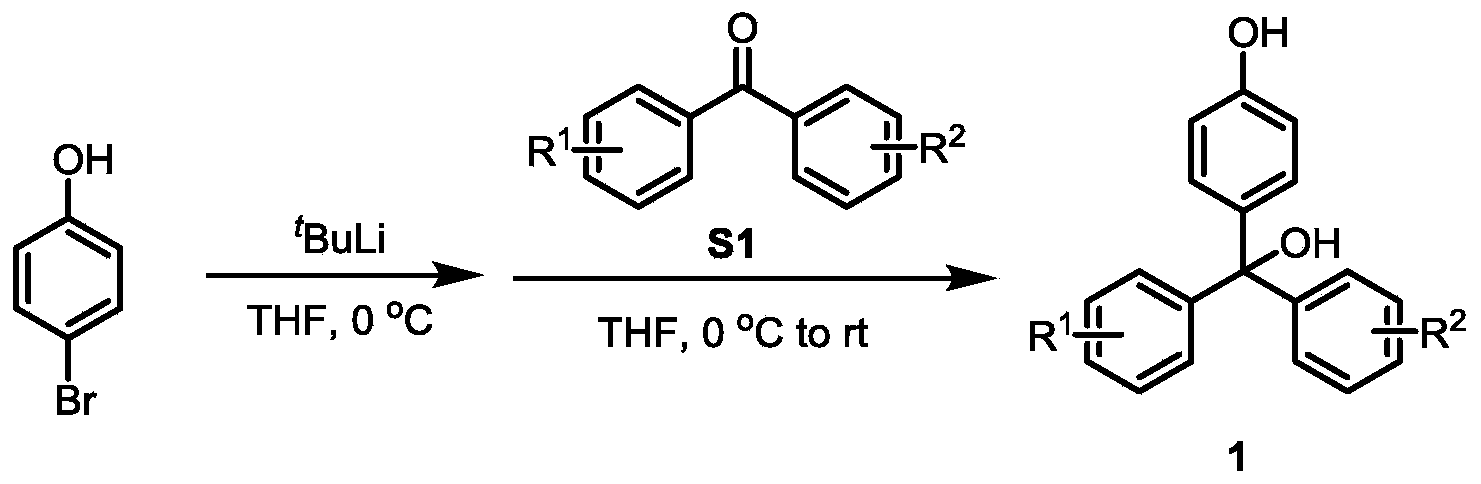
At 0 ℃, to a stirred solution of 4-bromophenol (0.78 g, 4.5 mmol) in THF (30 mL) was slowly added tert-butyllithium (1.6 M in pentane, 9.3 mL, 14.9 mmol) . The resulting mixture was kept stirring at 0 ℃ for 2 h. Next, a solution of S1 (3 mmol) (Ip, H. -W.; Ng, C. -F.; Chow, H. -F.; Kuck, D.J. Am. Chem. Soc. 2016, 138, 13778 13781. Ma, S.; Liu, J.X.; Li, S.H.; Chen, B.; Cheng, J.J.; Kuang, J.Q.; Liu, Y.; Wan, B. Q.; Wang, Y.L.; Ye, J.T.; Yu, Q.; Yuan, W.M.; Yu, S.C. Adv. Synth. Catal. 2011, 353, 1005-1017) in THF (10 mL) was added and the reaction mixture was kept stirring overnight. A saturated aqueous solution of NH
4Cl was added to quench the reaction. The reaction mixture was extracted with EtOAc (3 × 30 mL) . The combined organic layers were dried over anhydrous Na
2SO
4, filtered, and concentrated. The residue was purified by silica gel flash chromatography to afford the pure tertiary alcohol 1.
General Procedure B

At 0 ℃, to a stirred solution of 4-bromophenol (1.30 g, 7.5 mmol) in THF (50 mL) was slowly added tert-butyllithium (1.6 M in pentane, 15.5 mL, 24.8 mmol) . The resulting mixture was kept stirring at 0 ℃ for 2 h. After that, a solution of S2 (3 mmol) (Soldi, C.; Lamb, K.N.; Squitieri, R.A.; Gonzalez-
 M.; Maso, D.; M.J.; Shaw, J.T.J. Am. Chem. Soc. 2014, 136, 15142-15145. ) in THF (10 mL) was added and the reaction mixture was kept stirring overnight. A saturated aqueous solution of NH
4Cl was added to quench the reaction. The reaction mixture was extracted with EtOAc (3 × 30 mL) . The combined organic layers were dried over anhydrous Na
2SO
4, filtered, and concentrated. The residue was purified by silica gel flash chromatography to afford the pure
M.; Maso, D.; M.J.; Shaw, J.T.J. Am. Chem. Soc. 2014, 136, 15142-15145. ) in THF (10 mL) was added and the reaction mixture was kept stirring overnight. A saturated aqueous solution of NH
4Cl was added to quench the reaction. The reaction mixture was extracted with EtOAc (3 × 30 mL) . The combined organic layers were dried over anhydrous Na
2SO
4, filtered, and concentrated. The residue was purified by silica gel flash chromatography to afford the pure tertiary alcohol 1.
General Procedure C

At 0 ℃, to a stirred solution of S3 (2 mmol) (Katritzky, A.R; Lue, P.; Chen, Y.X.J. Org. Chem. 1990, 55, 3688-3691) in THF (20 mL) was slowly added tert-butyllithium (1.6 M in pentane, 1.3 mL, 2.1 mmol) . The resulting mixture was kept stirring at 0 ℃ for 0.5 h. After that, a solution of S2 (2 mmol) in THF (10 mL) was added and the reaction mixture was kept stirring at room temperature overnight. A saturated aqueous NH
4Cl solution was added to quench the reaction. The reaction mixture was extracted with EtOAc three times (3 × 30 mL) . The combined organic layers were dried over anhydrous Na
2SO
4, filtered, and concentrated. The residue was purified by silica gel flash chromatography to afford the pure tertiary alcohol 4’.
To a solution of 4’ in THF (3 mL) and ethanol (3 mL) was added NaBH
4 (2.2 mmol) . The reaction mixture was heated to reflux for 3 h before it was cooled to room temperature. A saturated aqueous solution of NH
4Cl was added to quench the reaction. The reaction mixture was extracted with EtOAc three times (3 × 20 mL) . The combined organic layers were dried over anhydrous Na
2SO
4, filtered, and concentrated. The residue was purified by silica gel flash chromatography to afford the pure tertiary alcohol 4.
Claims (20)
- An enantioselective method for preparing a tetraarylmethane having Formula I:
 wherein each of Ar 1, Ar 2, Ar 3, Ar 4 is independently aryl or heteroaryl;the method comprising:contacting a compound of Formula II:
 with a heteroaromatic nucleophile in the presence of a chiralacid under conditions that facilitate an electrophilic aromatic substitution reaction thereby forming the compound of Formula I, wherein the compound of Formula I is chiral.
- The method of claim 1, wherein the tetraarylmethane has Formula Ia:
 whereineach of m and n is independently selected from 1, 2, 3, or 4;Ar 1 is aryl or heteroaryl;Ar 2 is a heteroaryl;R 1 and R 2 are each independently selected from the group consisting of hydrogen, alkyl, haloalkyl, perhaloalkyl, alkene, alkyne, cycloalkyl, heterocycloalkyl, aryl, araalkyl, heteroaryl, halide, cyanide, nitro, azide, -OR 3, -OSi (R 3) 3, -O (C=O) R 3, - (C=O) OR 3, -O (C=O) OR 3, - (C=O) R 3, -N (R 4) 2, -N (R 4) (C=O) R 3, - (C=O) N (R 4) 2, - N (R 4) (C=O) N (R 4) 2, -N (R 4) (C=O) OR 3, -O (C=O) N (R 4) 2, -SR 3, - (S=O) R 3, -SO 2R 3, -SO 2N (R 4) 2, -N (R 4) SO 2R 3, -SeR 3, -P (R 3) 3, -P (OR 3) 3, and - (P=O) (OR 3) 3; or two instances of R 1 taken together with the carbons to which they are attached form a 5-6 membered cycloalkyl, heterocycloalkyl, aryl, or heteroaryl; or two instances of R 2 taken together with the carbons to which they are attached form a 5-6 membered cycloalkyl, heterocycloalkyl, aryl, or heteroaryl;R 3 is selected from the group consisting of hydrogen, alkyl, haloalkyl, perhaloalkyl, alkene, alkyne, cycloalkyl, heterocycloalkyl, aryl, araalkyl, and heteroaryl; andR 4 for each instance is independently selected from the group consisting of hydrogen, alkyl, haloalkyl, perhaloalkyl, alkene, alkyne, cycloalkyl, heterocycloalkyl, aryl, araalkyl, and heteroaryl; or two instances of R 4 taken together with the nitrogen to which they are attached form a 3-6 membered heterocycloalkyl; or one instance of R 3 and one instance of R 4 taken together with the atoms to which they are attached form a 4-6 membered heterocycloalkyl; and the method comprises:contacting a compound of Formula IIa:
 with a heteroaromatic nucleophile in the presence of a chiralacid under conditions that facilitate an electrophilic aromatic substitution reaction thereby forming the compound of Formula Ia.
- The method of claim 2, wherein the chiralacid is a chiral phosphoric acid.

- The method of claim 3, wherein the chiral phosphoric acid is represented by the Formula IIIa, Formula IIIb, Formula IIIc or Formula IIId:
 whereinQ is O, S, or NSO 2R 16;Z is O, S, or Se;each of R 5 and R 5’ is independently hydrogen, alkyl, haloalkyl, perhaloalkyl, cycloalkyl, heterocycloalkyl, aryl, araalkyl, heteroaryl, halide, or triarylsilane;each of R 6 and R 6’ is independently hydrogen, alkyl, haloalkyl, perhaloalkyl, cycloalkyl, heterocycloalkyl, aryl, araalkyl, heteroaryl, halide, or trialkylsilane;each of R 7 and R 7’ is independently alkyl, haloalkyl, perhaloalkyl, cycloalkyl, heterocycloalkyl, aryl, araalkyl, heteroaryl, halide, or trialkylsilane; or R 6’ and R 7’ taken together with the carbons to which they are attached form 5-6 membered cycloalkyl or 6 membered aryl and R 6 and R 7 taken together with the carbons to which they are attached form 5-6 membered cycloalkyl or 6 membered aryl;each of R 14 and R 14’ is independently hydrogen, alkyl, haloalkyl, perhaloalkyl, cycloalkyl, heterocycloalkyl, aryl, araalkyl, heteroaryl, halide, or trialkylsilane;each of R 15 and R 15’ is independently hydrogen, alkyl, haloalkyl, perhaloalkyl, cycloalkyl, heterocycloalkyl, aryl, araalkyl, heteroaryl, halide, or trialkylsilane; andR 16 is alkyl or aryl.
 - The method of claim 4, wherein the chiral phosphoric is represented by the Formula IIIe:
 wherein R 8 is alkyl, cycloalkyl, or aryl.
 - The method of claim 5, wherein R 8 is isopropyl, cyclohexyl, or phenyl.
- The method of claim 2, wherein the compound of Formula IIa is represented by a structure selected from:
 whereinm is 0, 1, 2, or 3;p is 0, 1, 2, or 3;q is 0, 1, or 2;Ar 1 is selected from the group consisting of:
 X is NR 11, O, S, or Se;R 1’ is selected from the group consisting of -OR 3, -OSi (R 3) 3, -O (C=O) R 3, -O (C=O) OR 3, -N (R 4) 2, -N (R 4) (C=O) R 3, -N (R 4) (C=O) N (R 4) 2, -N (R 4) (C=O) OR 3, -O (C=O) N (R 4) 2, -SR 3, -N (R 4) SO 2R 3, -SeR 3, -P (R 3) 3, and -P (OR 3) 3; or R 1’ and one instance of R 1 taken together with the carbons to which they are attached form a 5-6 membered cycloalkyl, heterocycloalkyl, aryl, or heteroaryl;each R 9 is independently selected from the group consisting of hydrogen, alkyl, haloalkyl, perhaloalkyl, alkene, alkyne, cycloalkyl, heterocycloalkyl, aryl, araalkyl, heteroaryl, halide, cyanide, nitro, azide, -OR 3, -OSi (R 3) 3, -O (C=O) R 3, - (C=O) OR 3, -O (C=O) OR 3, - (C=O) R 3, -N (R 4) 2, -N (R 4) (C=O) R 3, - (C=O) N (R 4) 2, -N (R 4) (C=O) N (R 4) 2, -N (R 4) (C=O) OR 3, -O (C=O) N (R 4) 2, -SR 3, - (S=O) R 3, -SO 2R 3, -SO 2N (R 4) 2, -N (R 4) SO 2R 3, -SeR 3, -P (R 3) 3, -P (OR 3) 3, and - (P=O) (OR 3) 3;R 9’ is selected from the group consisting of -OR 3, -OSi (R 3) 3, -O (C=O) R 3, -O (C=O) OR 3, -N (R 4) 2, -N (R 4) (C=O) R 3, -N (R 4) (C=O) N (R 4) 2, -N (R 4) (C=O) OR 3, -O (C=O) N (R 4) 2, -SR 3, -N (R 4) SO 2R 3, -SeR 3, -P (R 3) 3, and -P (OR 3) 3; or two instances of R 9’ taken together with the carbons to which they are attached form a 5-6 membered cycloalkyl, heterocycloalkyl, aryl, or heteroaryl; andR 10 is selected from the group consisting of alkyl, haloalkyl, perhaloalkyl, alkene, alkyne, cycloalkyl, heterocycloalkyl, aryl, araalkyl, heteroaryl, halide, -OR 3, -OSi (R 3) 3, -O (C=O) R 3, -O (C=O) OR 3, -N (R 4) 2, -N (R 4) (C=O) R 3, -N (R 4) (C=O) N (R 4) 2, -N (R 4) (C=O) OR 3, -O (C=O) N (R 4) 2, -SR 3, -N (R 4) SO 2R 3, or -SeR 3; andR 11 is hydrogen, alkyl, haloalkyl, perhaloalkyl, alkene, alkyne, cycloalkyl, heterocycloalkyl, aryl, araalkyl, heteroaryl, - (C=O) OR 3, - (C=O) R 3, - (C=O) N (R 4) 2, -SO 2R 3, or -SO 2N (R 4) 2.
 - The method of claim 7, wherein Ar 1 is selected from the group consisting of:

- The method of claim 2, wherein the heteroaromatic nucleophile is represented by the Formula IV:
 whereint is 0, 1, 2, or 3;Y is NR 13, O, S, or Se;each R 12 is independently selected from the group consisting of hydrogen, alkyl, haloalkyl, perhaloalkyl, alkene, alkyne, cycloalkyl, heterocycloalkyl, aryl, araalkyl, heteroaryl, halide, cyanide, nitro, azide, -OR 3, -OSi (R 3) 3, -O (C=O) R 3, - (C=O) OR 3, -O (C=O) OR 3, - (C=O) R 3, -N (R 4) 2, -N (R 4) (C=O) R 3, - (C=O) N (R 4) 2, -N (R 4) (C=O) N (R 4) 2, -N (R 4) (C=O) OR 3, -O (C=O) N (R 4) 2, -SR 3, - (S=O) R 3, -SO 2R 3, -SO 2N (R 4) 2, -N (R 4) SO 2R 3, -SeR 3, -P (R 3) 3, -P (OR 3) 3, and - (P=O) (OR 3) 3; or two instances of R 12 taken together with the carbons to which they are attached form a 5-6 membered cycloalkyl, heterocycloalkyl, aryl, or heteroaryl; andR 13 is hydrogen, alkyl, haloalkyl, perhaloalkyl, alkene, alkyne, cycloalkyl, heterocycloalkyl, aryl, araalkyl, heteroaryl, - (C=O) OR 3, - (C=O) R 3, - (C=O) N (R 4) 2, -SO 2R 3, or -SO 2N (R 4) 2.
 - The method of claim 9, wherein Y is NR 13;each R 12 is independently selected from the group consisting of hydrogen, alkyl, haloalkyl, perhaloalkyl, alkene, alkyne, cycloalkyl, heterocycloalkyl, aryl, araalkyl, heteroaryl, halide, cyanide, nitro, azide, -OR 3, -OSi (R 3) 3, -O (C=O) R 3, -O (C=O) OR 3, -N (R 4) 2, -N (R 4) (C=O) R 3-N (R 4) (C=O) N (R 4) 2, -N (R 4) (C=O) OR 3, -O (C=O) N (R 4) 2, -SR 3, -SO 2N (R 4) 2, -N (R 4) SO 2R 3, and -SeR 3; or two instances of R 12 taken together with the carbons to which they are attached form a 6 membered cycloalkyl or aryl; andR 13 is hydrogen, alkyl, haloalkyl, perhaloalkyl, alkene, alkyne, cycloalkyl, heterocycloalkyl, aryl, araalkyl, or heteroaryl.
- The method of claim 2, wherein the compound of Formula IIa is represented by a structure selected from:
 whereinm is 0, 1, 2, or 3;p is 0, 1, 2, or 3;q is 0, 1, or 2;Ar 1 is selected from the group consisting of:
 X is S or NR 11;R 1’ is selected from the group consisting of -OR 3, -OSi (R 3) 3, -O (C=O) R 3, -O (C=O) OR 3, -N (R 4) 2, -N (R 4) (C=O) R 3, -N (R 4) (C=O) N (R 4) 2, -N (R 4) (C=O) OR 3, -O (C=O) N (R 4) 2, -SR 3, -N (R 4) SO 2R 3, -SeR 3, -P (R 3) 3, and -P (OR 3) 3; or R 1’ and one instance of R 1 taken together with the carbons to which they are attached form a 5-6 membered cycloalkyl, heterocycloalkyl, aryl, or heteroaryl;each R 9 is independently selected from the group consisting of hydrogen, alkyl, haloalkyl, perhaloalkyl, alkene, alkyne, cycloalkyl, heterocycloalkyl, aryl, araalkyl, heteroaryl, halide, cyanide, nitro, azide, -OR 3, -OSi (R 3) 3, -O (C=O) R 3, - (C=O) OR 3, -O (C=O) OR 3, - (C=O) R 3, -N (R 4) 2, -N (R 4) (C=O) R 3, - (C=O) N (R 4) 2, -N (R 4) (C=O) N (R 4) 2, -N (R 4) (C=O) OR 3, -O (C=O) N (R 4) 2, -SR 3, - (S=O) R 3, -SO 2R 3, -SO 2N (R 4) 2, -N (R 4) SO 2R 3, -SeR 3, -P (R 3) 3, -P (OR 3) 3, and - (P=O) (OR 3) 3;R 9’ is selected from the group consisting of -OR 3, -OSi (R 3) 3, -O (C=O) R 3, -O (C=O) OR 3, -N (R 4) 2, -N (R 4) (C=O) R 3, -N (R 4) (C=O) N (R 4) 2, -N (R 4) (C=O) OR 3, -O (C=O) N (R 4) 2, -SR 3, -N (R 4) SO 2R 3, -SeR 3, -P (R 3) 3, and -P (OR 3) 3; or two instances of R 9’ taken together with the carbons to which they are attached form a 5-6 membered cycloalkyl, heterocycloalkyl, aryl, or heteroaryl; andR 10 is selected from the group consisting of alkyl, haloalkyl, perhaloalkyl, cycloalkyl, heterocycloalkyl, aryl, araalkyl, heteroaryl, and halide; andR 11 is hydrogen, alkyl, haloalkyl, perhaloalkyl, alkene, alkyne, cycloalkyl, heterocycloalkyl, aryl, araalkyl, or heteroaryl; andthe heteroaromatic nucleophile is represented by the Formula IV:
 whereint is 0, 1, 2, or 3;Y is NR 13;each R 12 is independently selected from the group consisting of hydrogen, alkyl, haloalkyl, perhaloalkyl, alkene, alkyne, cycloalkyl, heterocycloalkyl, aryl, araalkyl, heteroaryl, halide, azide, -OR 3, -OSi (R 3) 3, -O (C=O) R 3, -O (C=O) OR 3, -N (R 4) 2, -N (R 4) (C=O) R 3, -N (R 4) (C=O) N (R 4) 2, -N (R 4) (C=O) OR 3, -O (C=O) N (R 4) 2, -SR 3, -N (R 4) SO 2R 3, -SeR 3, -P (R 3) 3, and -P (OR 3) 3; or two instances of R 12 taken together with the carbons to which they are attached form a 5-6 membered cycloalkyl, heterocycloalkyl, aryl, or heteroaryl; andR 13 is hydrogen, alkyl, haloalkyl, perhaloalkyl, alkene, alkyne, cycloalkyl, heterocycloalkyl, aryl, araalkyl, or heteroaryl.
 - The method of claim 11, wherein m is 0 or 1; R 1’ is -OR 3, -OSi (R 3) 3, -O (C=O) R 3, -O (C=O) OR 3, or -O (C=O) N (R 4) 2;Ar 1 is selected from the group consisting of:
 whereinp is 0 or 1;q is 0 or 1;R 9’ is selected from the group consisting of -OR 3, -OSi (R 3) 3, -O (C=O) R 3, -O (C=O) OR 3, or -O (C=O) N (R 4) 2;and R 10 is aryl; andthe heteroaromatic nucleophile is selected from:
 whereint is 0 or 1; andeach R 12 is independently selected from the group consisting of hydrogen, alkyl, haloalkyl, perhaloalkyl, alkene, alkyne, cycloalkyl, heterocycloalkyl, aryl, araalkyl, heteroaryl, halide, azide, -OR 3, -OSi (R 3) 3, -O (C=O) R 3, -O (C=O) OR 3, -N (R 4) 2, -N (R 4) (C=O) R 3, -N (R 4) (C=O) N (R 4) 2, -N (R 4) (C=O) OR 3, -O (C=O) N (R 4) 2, -SR 3, -N (R 4) SO 2R 3, -SeR 3, -P (R 3) 3, and -P (OR 3) 3; or two instances of R 12 taken together with the carbons to which they are attached form a 5-6 membered cycloalkyl, heterocycloalkyl, aryl, or heteroaryl.
 - The method of claim 12, wherein the chiralacid is represented by the Formula IIIf or Formula IIIg:


 wherein each of R 5 and R 5’ is alkyl, aryl, or triarylsilane.
 - The method of claim 13, wherein R 5 is 2, 4, 6- (iPr) 3C 6H 2-, 2, 4, 6-Cy 3C 6H 2-, 1-napthyl, 9-anthryl, 9-phenanthryl, 1-pyrene, or 2, 6-iPr 2-6- (9-anthryl) .
- The method of claim 1, wherein the step of contacting a compound of Formula II with a heteroaromatic nucleophile in the presence of a chiralacid occurs in a solvent selected from the group consisting of chlorobenzene, PhCF 3, PhF, CCl 4, CH 2Cl 2 (DCM) , CHCl 3, PhMe, and ClCH 2CH 2Cl (DCE) .

- The method of claim 1, wherein the chiralacid is present at a mole concentration of between 0.1%and 25%relative to the compound of Formula II.

- The method of claim 1, wherein the step of contacting a compound of Formula II with a heteroaromatic nucleophile in the presence of a chiralacid occurs at a temperature between -30℃ and 40℃.

- The method of claim 1, wherein the tetraarylmethane having Formula I is prepared with an enantiomeric excess (ee) between 40 to 99.9%.
- The method of claim 10, wherein the tetraarylmethane having Formula I is prepared with an ee of 80 to 97%
- The method of claim 1, wherein the compound of Formula II is a racemic mixture.
Priority Applications (2)
| Application Number | Priority Date | Filing Date | Title |
|---|---|---|---|
| US17/424,220 US12338193B2 (en) | 2019-01-29 | 2020-01-02 | Methods for enantioselective preparation of chiral tetraarylmethanes |
| CN202080008861.8A CN113302172B (en) | 2019-01-29 | 2020-01-02 | Enantioselective preparation method of chiral tetraarylmethane |
Applications Claiming Priority (2)
| Application Number | Priority Date | Filing Date | Title |
|---|---|---|---|
| US201962918404P | 2019-01-29 | 2019-01-29 | |
| US62/918,404 | 2019-01-29 |
Publications (1)
| Publication Number | Publication Date |
|---|---|
| WO2020156022A1 true WO2020156022A1 (en) | 2020-08-06 |
Family
ID=71840637
Family Applications (1)
| Application Number | Title | Priority Date | Filing Date |
|---|---|---|---|
| PCT/CN2020/070124 Ceased WO2020156022A1 (en) | 2019-01-29 | 2020-01-02 | Methods for enantioselective preparation of chiral tetraarylmethanes |
Country Status (3)
| Country | Link |
|---|---|
| US (1) | US12338193B2 (en) |
| CN (1) | CN113302172B (en) |
| WO (1) | WO2020156022A1 (en) |
Cited By (1)
| Publication number | Priority date | Publication date | Assignee | Title |
|---|---|---|---|---|
| CN112494484A (en) * | 2020-12-14 | 2021-03-16 | 香港科技大学深圳研究院 | Application of chiral tetraaryl substituted methane |
Families Citing this family (2)
| Publication number | Priority date | Publication date | Assignee | Title |
|---|---|---|---|---|
| CN119504713B (en) * | 2024-11-25 | 2026-04-17 | 江苏师范大学 | Tetraarylmethane compound with indole and pyrrole skeletons and synthesis method thereof |
| CN120247882B (en) * | 2025-04-01 | 2025-09-19 | 徐州市第一人民医院 | A nitrogen heterocycle-derived polyarylmethane antitumor compound and its synthesis method |
-
2020
- 2020-01-02 US US17/424,220 patent/US12338193B2/en active Active
- 2020-01-02 WO PCT/CN2020/070124 patent/WO2020156022A1/en not_active Ceased
- 2020-01-02 CN CN202080008861.8A patent/CN113302172B/en active Active
Non-Patent Citations (2)
| Title |
|---|
| ZHAOBIN WANG, YUK FAI WONG, JIANWEI SUN: "Catalytic Asymmetric 16-Conjugate Addition of para-Quinone Methides: Formation of All-Carbon Quaternary Stereocenters", ANGEWANDTE CHEMIE, vol. 127, no. 46, 22 September 2015 (2015-09-22), pages 13915 - 13918, XP055724090, ISSN: 0044-8249, DOI: 10.1002/ange.201506701 * |
| ZHU, MINGHUA: "Research of Enantioselective Synthesis of Triarylmethanes by Biaxially Chiral Imidodiphosphoric Acids Catalyzed Friedel–Crafts Reactions", DOCTORAL DISSERTATIONS, no. 8, 15 August 2016 (2016-08-15), CN, pages 1 - 186, XP009522406 * |
Cited By (2)
| Publication number | Priority date | Publication date | Assignee | Title |
|---|---|---|---|---|
| CN112494484A (en) * | 2020-12-14 | 2021-03-16 | 香港科技大学深圳研究院 | Application of chiral tetraaryl substituted methane |
| CN112494484B (en) * | 2020-12-14 | 2023-09-08 | 香港科技大学深圳研究院 | Applications of Chiral Tetraaryl Substituted Methanes |
Also Published As
| Publication number | Publication date |
|---|---|
| CN113302172B (en) | 2023-12-01 |
| US12338193B2 (en) | 2025-06-24 |
| US20220112138A1 (en) | 2022-04-14 |
| CN113302172A (en) | 2021-08-24 |
Similar Documents
| Publication | Publication Date | Title |
|---|---|---|
| JP7654642B2 (en) | Catalytic Cannabinoid Processes and Precursors | |
| WO2020156022A1 (en) | Methods for enantioselective preparation of chiral tetraarylmethanes | |
| CN114981235A (en) | Cannabinoid derivatives, precursors and uses | |
| CN111116474B (en) | Chiral amine-urea compound based on spiroindane skeleton and preparation method and application thereof | |
| CN110452150A (en) | A kind of axial chiral indole-naphthalene compound and preparation method thereof | |
| CN112694376A (en) | Kinetic resolution method of allyl tertiary alcohol catalyzed by chiral phosphoric acid | |
| Janus et al. | Chiral protic imidazolium salts with a (−)-menthol fragment in the cation: synthesis, properties and use in the Diels–Alder reaction | |
| Li et al. | Polyoxometalate-based ionic liquids: efficient reversible phase transformation-type catalysts for thiolation of alcohols to construct C–S bonds | |
| CN104804006A (en) | Method for synthesizing chiral Tr*ger's base derivatives | |
| CN101967075B (en) | Method for synthesizing terminal alkyne compound by using 3-aryl-2,3-dibromopropionic acid | |
| CN108727241A (en) | A kind of cup [4] thiocarbamide cyclohexanediamine derivative and its method for being catalyzed asymmetric Michael addition reaction | |
| CN109232184B (en) | Method for improving optical purity of L-isopulegol through chiral resolution | |
| CN116217426B (en) | Method for synthesizing S-fluorobutyric acid amide from (R)-2-sulfonylbutyric acid alkyl ester | |
| CN118580171A (en) | A kind of oxetane trichloroacetimidate and its preparation method and application | |
| CN111229312B (en) | A kind of solvent-free catalyst and its preparation method and application | |
| KR101199178B1 (en) | Method for the preparation of chiral beta-fluoroalkylated carbonyl compounds using chiral catalyst | |
| CN114163313A (en) | Method for selectively synthesizing EZ-stilbene by coupling aryl diazonium salt and cinnamic acid under catalysis of ruthenium | |
| CN112851456A (en) | Method for preparing olefin compound under alkaline condition | |
| CN116135835B (en) | A method for preparing chiral 3-acetoxymethyl-2,2-dimethylcyclopropanecarboxylate | |
| Zhang et al. | Enantioselective fluorination of β-keto esters using a PEG-bound urea-containing chiral quaternary ammonium salt catalyst | |
| CN112876376B (en) | Synthesis method of allyl aryl compound | |
| CN118993865A (en) | Chemical resolution method of spiroindenedione compound | |
| CN121226250A (en) | A method for synthesizing an axially chiral isoquinoline naphthalene ligand catalyst | |
| CN117800981A (en) | A kind of preparation method of chiral dihydroquinolone compounds | |
| CN121591613A (en) | A method for preparing a polysubstituted benzylamine derivative and the compound thereof. |
Legal Events
| Date | Code | Title | Description |
|---|---|---|---|
| 121 | Ep: the epo has been informed by wipo that ep was designated in this application |
Ref document number: 20748189 Country of ref document: EP Kind code of ref document: A1 |
|
| NENP | Non-entry into the national phase |
Ref country code: DE |
|
| 122 | Ep: pct application non-entry in european phase |
Ref document number: 20748189 Country of ref document: EP Kind code of ref document: A1 |
|
| WWG | Wipo information: grant in national office |
Ref document number: 17424220 Country of ref document: US |