WO2020150993A1 - 一种击球类运动的计分系统及计分方法 - Google Patents
一种击球类运动的计分系统及计分方法 Download PDFInfo
- Publication number
- WO2020150993A1 WO2020150993A1 PCT/CN2019/073140 CN2019073140W WO2020150993A1 WO 2020150993 A1 WO2020150993 A1 WO 2020150993A1 CN 2019073140 W CN2019073140 W CN 2019073140W WO 2020150993 A1 WO2020150993 A1 WO 2020150993A1
- Authority
- WO
- WIPO (PCT)
- Prior art keywords
- ball
- scoring
- sports
- collision
- sound
- Prior art date
- Legal status (The legal status is an assumption and is not a legal conclusion. Google has not performed a legal analysis and makes no representation as to the accuracy of the status listed.)
- Ceased
Links
Images

Classifications
-
- A—HUMAN NECESSITIES
- A63—SPORTS; GAMES; AMUSEMENTS
- A63B—APPARATUS FOR PHYSICAL TRAINING, GYMNASTICS, SWIMMING, CLIMBING, OR FENCING; BALL GAMES; TRAINING EQUIPMENT
- A63B71/00—Games or sports accessories not covered in groups A63B1/00 - A63B69/00
- A63B71/06—Indicating or scoring devices for games or players, or for other sports activities
Definitions
- the invention relates to the field of sound information processing, in particular to a scoring system and a scoring method for ball hitting sports.
- batting sports are internationally recognized sports, such as table tennis.
- the basic rules of the game are to separate the two ends of the table, and then the two sides take turns to serve to the opponent to receive back.
- the serve must touch one's own side in sequence
- To return the ball to the opponent’s table wait for the table tennis ball to touch your table before returning the table tennis to the opponent’s table. If your side fails to hit the table tennis back to the opponent’s table, it will be considered as a loss for the opponent to score a point.
- there are other rules in the table tennis game For example, if the serve is completed by touching the net, it needs to be re-sent. The two sides take turns to serve five goals.
- Party B must win by two points before winning. Since the aforementioned table tennis only needs to set up a net with a proper height between the two tabletops, and then the players each hold a racket to match the table tennis, the space required is not large, and the competition is It's a high level of sports value and fun, so it has been widely loved by the public.
- the scoring of table tennis is mainly performed by a number of referees visually observing the game process, and then scoring the results of visual observations.
- the above-mentioned table tennis scoring method has been followed for a long time. Although this method is feasible, it requires manpower. There are many, and the objectivity of artificial judgment is still insufficient. Especially in ordinary practice, there is often the problem of lack of referees. At this time, the players can only score by themselves. This scoring method is likely to affect the game due to subjective judgments. Actually, if you use the scoreboard to score, it takes time to record with the players and interrupts the game, so it is not ideal. If you score based on memory, it will be troublesome and easy to cause such shortcomings as forgetting and miscalculation.
- the trajectory of the sphere is mainly recorded by a video camera.
- This recording method is expensive and requires image processing technology to obtain the trajectory of the ball, which requires a lot of calculation. Therefore, there is an urgent need for an accurate and convenient scoring scheme for batting sports.
- the present invention proposes an acoustic-based method and system for recording and scoring ball hitting movement tracks.
- the present invention uses a microphone array to realize the location of the ball launch collision sound to record the trajectory and scoring of the ball.
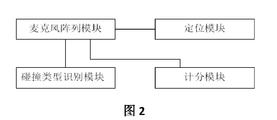
- a scoring system for batting sports including:
- Microphone array module It has two or more microphones, used to collect and record the sound signals of the ball colliding with different planes in ball sports;
- Positioning module According to the sound signal collected by the microphone array, extract the time difference and the angle of arrival of the sound signal to different microphones, so as to locate the ball in real time;
- Collision type recognition module used to identify the type of collision between the ball and the plane through the classification method
- Scoring module According to the rules and collision type recognition of batting sports and the position of the ball, score the game process.
- the sound signal is the sound of hitting the ball, the sound of colliding with the tabletop, and/or the sound of colliding with the ground.
- the microphone array is two microphones on a smart phone, and the recording start time of the microphone array is controlled by programming to obtain sound data of multiple channels.
- the positioning module reduces the noise of the recorded sound signal, filters the environmental noise, and only retains the impulse sound when the ball collides with different planes.
- the positioning module tracks the movement trajectory of the ball by recording the position of the collision point.
- the classification method is a SVM or DNN machine learning algorithm.
- S1 Place the microphone array in the center of the court, start the system, and the microphone array starts to collect and record the sound signals of the ball colliding with different planes in ball sports;
- S2 Process each fixed-length recording data acquired while recording, including:
- S2.1 Perform noise reduction on the recorded sound signal, filter environmental noise, and only retain the pulse data when the ball collides with different planes;
- the collision type recognition module uses machine learning classification algorithms to classify the segmented pulse data to identify different collision planes
- Scoring module Score the game process according to the rules and collision type recognition of batting sports and the position of the ball.
- the positioning module tracks the movement trajectory of the ball by recording the position of the collision point.
- the present invention uses the characteristics of different time differences between collision sounds to reach the microphone array to propose a scoring system, and uses an improved algorithm and correction module to more accurately locate the ball;
- the processing process of the sound signal in the present invention firstly performs denoising processing on the sound signal at the receiving end, and positioning by positioning models such as AoA and TDOA to achieve more accurate positioning. Therefore, the present invention can meet the requirements of accurate positioning of the trajectory of the ball hitting movement, and the positioning accuracy is high.
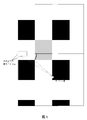
- Fig. 1 is a schematic diagram of a scoring system and method for ball hitting sports of the present invention
- FIG. 2 is a block diagram of the scoring system of the present invention.
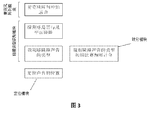
- FIG. 3 is a flow chart of the scoring method of the present invention.
- Figure 4 is a schematic diagram of the AOA positioning algorithm.
- a scoring system for batting sports includes:
- Microphone array module It has two or more microphones to collect and record the sound signals of the ball colliding with different planes in ball sports; the sound signals are the sound of hitting the ball, the sound of colliding with the table and/or the ball The sound of collision with the ground; the distance between the above two or more microphones is a known quantity.
- the microphone array is two microphones on the smart phone, and the recording start time of the microphone array is controlled by programming to obtain sound data of multiple channels.
- Positioning module According to the sound signal collected by the microphone array, the time difference and angle of arrival of the sound signal to different microphones are extracted, so as to locate the ball in real time; the positioning module reduces the noise of the recorded sound signal, filters the environmental noise, and only keeps the ball Impulsive sound when colliding with different planes.
- the positioning module calculates the angle of arrival and the time of arrival according to the time difference of the sound when the ball collides with the face to each microphone in the microphone array, and then confirms the location of the collision point, and tracks the position of the collision point by recording The trajectory of the ball.
- TDOA Time Difference of Arrival
- time difference of arrival measures the time difference between a mobile terminal and different sending ends to estimate the distance to different terminals for positioning. Since there is no need to detect the signal transmission time, the system's requirements for time synchronization are greatly reduced.
- the coordinates of the point MS are (x, y, 0), which is the case of two-dimensional positioning on the ground.
- the unknown node obtains the direction of arrival of the wireless signal at the transmitter of the reference node through an antenna array or other receiving device, and calculates the relative direction angle between nodes to obtain the location information of the unknown node. It is defined that the angle between the direction vector projected from the transmitting end on the receiving plane to the receiving end and the x axis is the direction angle, and the angle between the direction vector from the receiving end to the transmitting end and the z axis is the elevation angle.
- the position coordinates (x, y) of the unknown node can be obtained according to the above two formulas.
- Collision type recognition module It is used to identify the type of collision between the ball and the plane through the classification method; the CFAR segmentation algorithm is used to segment the starting point and the end point of the pulse data generated when the ball collides with different planes, and the sound of the ball colliding with different planes is collected through a large number of Samples are used as training data sets and test data sets, and artificial neural networks are used for training and classification of classification models. Artificial Neural Networks (Artificial Neural Network, or ANN) are currently popular classification methods. It abstracts the human brain neuron network from the perspective of information processing, establishes a certain simple model, and forms different networks according to different connection methods. In engineering and academia, it is often referred to as neural network or quasi-neural network.
- a neural network is a computing model, which is composed of a large number of nodes (or neurons) interconnected. Each node represents a specific output function, called an activation function. Each connection between two nodes represents a weighted value for the signal passing through the connection, called the weight, which is equivalent to the memory of an artificial neural network.
- the artificial neural network can automatically mark the characteristics of the data. Then generate a suitable classification model for practical applications.
- Scoring module According to the rules and collision type recognition of batting sports and the position of the ball, score the game process.
- table tennis in table tennis, the ball falls off the table and collides with the floor, it is determined that the round is over, and the scorer is recorded according to the rules.
- a scoring method for batting sports includes the following steps:
- S1 Place the microphone array in the center of the court, start the system, and the microphone array starts to collect and record the sound signals of the ball colliding with different planes in ball sports;
- S2 Process each fixed-length recording data acquired while recording, including:
- S2.1 Perform noise reduction on the recorded sound signal, filter environmental noise, and only retain the pulse data when the ball collides with different planes;
- the collision type recognition module uses machine learning classification algorithms to classify the segmented pulse data to identify different collision planes
- Scoring module Score the game process according to the rules and collision type recognition of batting sports and the position of the ball.
- the positioning module tracks the movement trajectory of the ball by recording the position of the collision point.
Landscapes
- Health & Medical Sciences (AREA)
- General Health & Medical Sciences (AREA)
- Physical Education & Sports Medicine (AREA)
- Circuit For Audible Band Transducer (AREA)
Abstract
Description


Claims (8)
- 一种击球类运动计分系统,其特征在于,包括:麦克风阵列模块:具有两个或两个以上的麦克风,用于采集在球类运动中球与不同平面碰撞的声音信号并录音;定位模块:根据麦克风阵列采集到的声音信号,提取声音信号到达不同麦克风的时间差及到达角度,从而对球进行实时定位;碰撞类型识别模块:通过分类法用于识别球与平面的碰撞类型;计分模块:根据击球类运动的规则和碰撞类型识别及球的位置对比赛过程进行计分。
- 如权利要求1所述的计分系统,其特征在于:声音信号为击球声球、球与桌面碰撞的声音和/或球与地面碰撞的声音。
- 如权利要求1所述的计分系统,其特征在于:所述的麦克风阵列为智能手机上的两个麦克风,通过编程控制麦克风阵列的录音开始时间,得到多个声道的声音数据。
- 如权利要求1所述的计分系统,其特征在于:定位模块对录制到的声音信号进行降噪,过滤环境噪音,只保留球与不同平面碰撞时的脉冲数据。
- 如权利要求1所述的计分系统,其特征在于:定位模块通过记录碰撞点的位置跟踪球的运动轨迹。
- 如权利要求1所述的计分系统,其特征在于:所述分类法为SVM或DNN机器学习算法。
- 一种击球类运动计分方法,其特征在于,包括以下步骤:S1:将麦克风阵列摆放到球场正中央,启动系统,麦克风阵列开始采集在球类运动中球与不同平面碰撞的声音信号并录音;S2:录音的同时对每获取到的固定长度的录音数据进行处理,包括:S2.1:对录制到的声音信号进行降噪,过滤环境噪音,只保留球与不同平面碰撞时的脉冲数据;S2.2:使用CFAR分割算法分割出球与不同平面碰撞时产生的脉冲数据;S2.3:碰撞类型识别模块对分割出的脉冲数据使用机器学习分类算法进行分类,识别不同的碰撞平面;S3:计分模块:根据击球类运动的规则和碰撞类型识别及球的位置对比赛过程进行计分。
- 如权利要求1所述的计分方法,其特征在于:定位模块通过记录碰撞点的位置跟踪球的运动轨迹。
Priority Applications (1)
| Application Number | Priority Date | Filing Date | Title |
|---|---|---|---|
| PCT/CN2019/073140 WO2020150993A1 (zh) | 2019-01-25 | 2019-01-25 | 一种击球类运动的计分系统及计分方法 |
Applications Claiming Priority (1)
| Application Number | Priority Date | Filing Date | Title |
|---|---|---|---|
| PCT/CN2019/073140 WO2020150993A1 (zh) | 2019-01-25 | 2019-01-25 | 一种击球类运动的计分系统及计分方法 |
Publications (1)
| Publication Number | Publication Date |
|---|---|
| WO2020150993A1 true WO2020150993A1 (zh) | 2020-07-30 |
Family
ID=71735971
Family Applications (1)
| Application Number | Title | Priority Date | Filing Date |
|---|---|---|---|
| PCT/CN2019/073140 Ceased WO2020150993A1 (zh) | 2019-01-25 | 2019-01-25 | 一种击球类运动的计分系统及计分方法 |
Country Status (1)
| Country | Link |
|---|---|
| WO (1) | WO2020150993A1 (zh) |
Cited By (2)
| Publication number | Priority date | Publication date | Assignee | Title |
|---|---|---|---|---|
| CN116380050A (zh) * | 2023-04-17 | 2023-07-04 | 上海创屹科技有限公司 | 乒乓球的落点区域检测方法、回合计算方法及乒乓球桌 |
| CN121785216A (zh) * | 2026-03-06 | 2026-04-03 | 天津科技大学 | 一种地掷球比赛系统的控制方法 |
Citations (4)
| Publication number | Priority date | Publication date | Assignee | Title |
|---|---|---|---|---|
| CN103888580A (zh) * | 2014-03-31 | 2014-06-25 | 宇龙计算机通信科技(深圳)有限公司 | 一种终端录音过程中降噪处理方法及终端 |
| US9084057B2 (en) * | 2011-10-19 | 2015-07-14 | Marcos de Azambuja Turqueti | Compact acoustic mirror array system and method |
| CN106226740A (zh) * | 2016-08-04 | 2016-12-14 | 北京地平线信息技术有限公司 | 远场声源定位系统和方法 |
| CN109164414A (zh) * | 2018-09-07 | 2019-01-08 | 深圳市天博智科技有限公司 | 基于麦克风阵列的定位方法、装置和存储介质 |
-
2019
- 2019-01-25 WO PCT/CN2019/073140 patent/WO2020150993A1/zh not_active Ceased
Patent Citations (4)
| Publication number | Priority date | Publication date | Assignee | Title |
|---|---|---|---|---|
| US9084057B2 (en) * | 2011-10-19 | 2015-07-14 | Marcos de Azambuja Turqueti | Compact acoustic mirror array system and method |
| CN103888580A (zh) * | 2014-03-31 | 2014-06-25 | 宇龙计算机通信科技(深圳)有限公司 | 一种终端录音过程中降噪处理方法及终端 |
| CN106226740A (zh) * | 2016-08-04 | 2016-12-14 | 北京地平线信息技术有限公司 | 远场声源定位系统和方法 |
| CN109164414A (zh) * | 2018-09-07 | 2019-01-08 | 深圳市天博智科技有限公司 | 基于麦克风阵列的定位方法、装置和存储介质 |
Cited By (2)
| Publication number | Priority date | Publication date | Assignee | Title |
|---|---|---|---|---|
| CN116380050A (zh) * | 2023-04-17 | 2023-07-04 | 上海创屹科技有限公司 | 乒乓球的落点区域检测方法、回合计算方法及乒乓球桌 |
| CN121785216A (zh) * | 2026-03-06 | 2026-04-03 | 天津科技大学 | 一种地掷球比赛系统的控制方法 |
Similar Documents
| Publication | Publication Date | Title |
|---|---|---|
| KR101565739B1 (ko) | 공류운동의 동작식별방법, 장치와 동작보조설비 | |
| CN115624735B (zh) | 一种用于球类运动的辅助训练系统和工作方法 | |
| CN107982899B (zh) | 一种羽毛球比赛数据记录管理系统 | |
| CN107392939A (zh) | 基于体感技术的室内运动观测装置、方法及存储介质 | |
| CN107050803A (zh) | 一种羽毛球训练监控评估系统 | |
| KR102226623B1 (ko) | 실내 스포츠를 위한 카메라를 이용한 운동량 산출 시스템 | |
| CN111184994B (zh) | 击球训练方法、终端设备及存储介质 | |
| CN108671505B (zh) | 一种羽毛球运动辅助系统及其控制方法 | |
| JP2020500489A (ja) | ゴルフ競技を撮影するためのカメラシステムおよびその方法 | |
| CN109663325B (zh) | 一种击球类运动的计分系统及计分方法 | |
| CN115188078A (zh) | 一种基于语音交互和姿态估计的乒乓球智能动作训练方法 | |
| CN116688473A (zh) | 拳击比赛评判方法及电子设备 | |
| CN108905182B (zh) | 一种智能眼镜和台球摄像定位瞄准方法 | |
| CN102944180B (zh) | 一种基于图像处理的乒乓球抛球高度检测系统及方法 | |
| CN118675102A (zh) | 一种基于视觉技术判断羽毛球击球训练的方法及装置 | |
| CN113209597A (zh) | 一种线下台球击球辅助方法、装置、终端及存储介质 | |
| CN110929595A (zh) | 一种基于人工智能的有球无球训练或娱乐系统及方法 | |
| CN120586364A (zh) | 基于ai智能识别的台球桌响袋及球杆打感精准反馈系统 | |
| CN119810925A (zh) | 一种计算机视觉的匹克球运动员动作分析方法 | |
| CN114788951A (zh) | 手持运动分析系统与方法 | |
| CN105879350A (zh) | 一种高尔夫球评分方法及其系统 | |
| CN112007340B (zh) | 基于加速度传感器的乒乓球比赛裁判和球员训练系统及方法 | |
| CN107823864A (zh) | 一种基于运动轨迹的乒乓球对局发球识别系统及方法 | |
| CN116994330A (zh) | 一种基于机器视觉的排球运动战术分析方法 | |
| CN114022821A (zh) | 高远球的动作评估方法、装置、电子设备及可读介质 |
Legal Events
| Date | Code | Title | Description |
|---|---|---|---|
| 121 | Ep: the epo has been informed by wipo that ep was designated in this application |
Ref document number: 19911942 Country of ref document: EP Kind code of ref document: A1 |
|
| NENP | Non-entry into the national phase |
Ref country code: DE |
|
| 122 | Ep: pct application non-entry in european phase |
Ref document number: 19911942 Country of ref document: EP Kind code of ref document: A1 |
|
| 32PN | Ep: public notification in the ep bulletin as address of the adressee cannot be established |
Free format text: NOTING OF LOSS OF RIGHTS PURSUANT TO RULE 112(1) EPC (EPO FORM 1205A DATED 10/11/2021) |
|
| 122 | Ep: pct application non-entry in european phase |
Ref document number: 19911942 Country of ref document: EP Kind code of ref document: A1 |