WO2020146695A1 - Method of stabilzing an admixture component, a stabilized admixture for cementitous compositions, cementitious composition, cementitious structures and methods of making the same - Google Patents
Method of stabilzing an admixture component, a stabilized admixture for cementitous compositions, cementitious composition, cementitious structures and methods of making the same Download PDFInfo
- Publication number
- WO2020146695A1 WO2020146695A1 PCT/US2020/013016 US2020013016W WO2020146695A1 WO 2020146695 A1 WO2020146695 A1 WO 2020146695A1 US 2020013016 W US2020013016 W US 2020013016W WO 2020146695 A1 WO2020146695 A1 WO 2020146695A1
- Authority
- WO
- WIPO (PCT)
- Prior art keywords
- admixture
- thickener
- cementitious
- composition
- particles
- Prior art date
- Legal status (The legal status is an assumption and is not a legal conclusion. Google has not performed a legal analysis and makes no representation as to the accuracy of the status listed.)
- Ceased
Links
Classifications
-
- C—CHEMISTRY; METALLURGY
- C04—CEMENTS; CONCRETE; ARTIFICIAL STONE; CERAMICS; REFRACTORIES
- C04B—LIME, MAGNESIA; SLAG; CEMENTS; COMPOSITIONS THEREOF, e.g. MORTARS, CONCRETE OR LIKE BUILDING MATERIALS; ARTIFICIAL STONE; CERAMICS; REFRACTORIES; TREATMENT OF NATURAL STONE
- C04B28/00—Compositions of mortars, concrete or artificial stone, containing inorganic binders or the reaction product of an inorganic and an organic binder, e.g. polycarboxylate cements
- C04B28/02—Compositions of mortars, concrete or artificial stone, containing inorganic binders or the reaction product of an inorganic and an organic binder, e.g. polycarboxylate cements containing hydraulic cements other than calcium sulfates
-
- C—CHEMISTRY; METALLURGY
- C04—CEMENTS; CONCRETE; ARTIFICIAL STONE; CERAMICS; REFRACTORIES
- C04B—LIME, MAGNESIA; SLAG; CEMENTS; COMPOSITIONS THEREOF, e.g. MORTARS, CONCRETE OR LIKE BUILDING MATERIALS; ARTIFICIAL STONE; CERAMICS; REFRACTORIES; TREATMENT OF NATURAL STONE
- C04B40/00—Processes, in general, for influencing or modifying the properties of mortars, concrete or artificial stone compositions, e.g. their setting or hardening ability
- C04B40/0028—Aspects relating to the mixing step of the mortar preparation
- C04B40/0039—Premixtures of ingredients
-
- C—CHEMISTRY; METALLURGY
- C04—CEMENTS; CONCRETE; ARTIFICIAL STONE; CERAMICS; REFRACTORIES
- C04B—LIME, MAGNESIA; SLAG; CEMENTS; COMPOSITIONS THEREOF, e.g. MORTARS, CONCRETE OR LIKE BUILDING MATERIALS; ARTIFICIAL STONE; CERAMICS; REFRACTORIES; TREATMENT OF NATURAL STONE
- C04B14/00—Use of inorganic materials as fillers, e.g. pigments, for mortars, concrete or artificial stone; Treatment of inorganic materials specially adapted to enhance their filling properties in mortars, concrete or artificial stone
- C04B14/02—Granular materials, e.g. microballoons
- C04B14/04—Silica-rich materials; Silicates
- C04B14/06—Quartz; Sand
- C04B14/062—Microsilica, e.g. colloïdal silica
-
- C—CHEMISTRY; METALLURGY
- C04—CEMENTS; CONCRETE; ARTIFICIAL STONE; CERAMICS; REFRACTORIES
- C04B—LIME, MAGNESIA; SLAG; CEMENTS; COMPOSITIONS THEREOF, e.g. MORTARS, CONCRETE OR LIKE BUILDING MATERIALS; ARTIFICIAL STONE; CERAMICS; REFRACTORIES; TREATMENT OF NATURAL STONE
- C04B24/00—Use of organic materials as active ingredients for mortars, concrete or artificial stone, e.g. plasticisers
- C04B24/16—Sulfur-containing compounds
- C04B24/161—Macromolecular compounds comprising sulfonate or sulfate groups
- C04B24/163—Macromolecular compounds comprising sulfonate or sulfate groups obtained by reactions only involving carbon-to-carbon unsaturated bonds
-
- C—CHEMISTRY; METALLURGY
- C04—CEMENTS; CONCRETE; ARTIFICIAL STONE; CERAMICS; REFRACTORIES
- C04B—LIME, MAGNESIA; SLAG; CEMENTS; COMPOSITIONS THEREOF, e.g. MORTARS, CONCRETE OR LIKE BUILDING MATERIALS; ARTIFICIAL STONE; CERAMICS; REFRACTORIES; TREATMENT OF NATURAL STONE
- C04B2103/00—Function or property of ingredients for mortars, concrete or artificial stone
- C04B2103/0045—Polymers chosen for their physico-chemical characteristics
- C04B2103/0062—Cross-linked polymers
-
- C—CHEMISTRY; METALLURGY
- C04—CEMENTS; CONCRETE; ARTIFICIAL STONE; CERAMICS; REFRACTORIES
- C04B—LIME, MAGNESIA; SLAG; CEMENTS; COMPOSITIONS THEREOF, e.g. MORTARS, CONCRETE OR LIKE BUILDING MATERIALS; ARTIFICIAL STONE; CERAMICS; REFRACTORIES; TREATMENT OF NATURAL STONE
- C04B2103/00—Function or property of ingredients for mortars, concrete or artificial stone
- C04B2103/0068—Ingredients with a function or property not provided for elsewhere in C04B2103/00
- C04B2103/0082—Segregation-preventing agents; Sedimentation-preventing agents
-
- C—CHEMISTRY; METALLURGY
- C04—CEMENTS; CONCRETE; ARTIFICIAL STONE; CERAMICS; REFRACTORIES
- C04B—LIME, MAGNESIA; SLAG; CEMENTS; COMPOSITIONS THEREOF, e.g. MORTARS, CONCRETE OR LIKE BUILDING MATERIALS; ARTIFICIAL STONE; CERAMICS; REFRACTORIES; TREATMENT OF NATURAL STONE
- C04B2103/00—Function or property of ingredients for mortars, concrete or artificial stone
- C04B2103/44—Thickening, gelling or viscosity increasing agents
-
- Y—GENERAL TAGGING OF NEW TECHNOLOGICAL DEVELOPMENTS; GENERAL TAGGING OF CROSS-SECTIONAL TECHNOLOGIES SPANNING OVER SEVERAL SECTIONS OF THE IPC; TECHNICAL SUBJECTS COVERED BY FORMER USPC CROSS-REFERENCE ART COLLECTIONS [XRACs] AND DIGESTS
- Y02—TECHNOLOGIES OR APPLICATIONS FOR MITIGATION OR ADAPTATION AGAINST CLIMATE CHANGE
- Y02W—CLIMATE CHANGE MITIGATION TECHNOLOGIES RELATED TO WASTEWATER TREATMENT OR WASTE MANAGEMENT
- Y02W30/00—Technologies for solid waste management
- Y02W30/50—Reuse, recycling or recovery technologies
- Y02W30/91—Use of waste materials as fillers for mortars or concrete
Definitions
- the present disclosure is directed to a method of stabilizing admixture components, a stabilized admixture composition for cementitious compositions, cementitious compositions including the stabilized admixture composition, a method of making the cementitious composition with the stabilized admixture composition, and a hardened cementitious structure prepared from the cementitious composition including the stabilized admixture composition.
- the present disclosure is more particularly directed to a method of stabilizing particulate admixture components, an admixture composition for cementitious compositions comprising a stabilized particulate admixture component, cementitious compositions including the admixture composition comprising the stabilized particulate admixture component, a method of making the cementitious composition with the admixture composition, and a hardened cementitious structure prepared from the cementitious composition including the admixture composition.
- Concrete compositions are prepared from a mixture of hydraulic cement (for example, Portland cement), mineral aggregate and water.
- the aggregate used to prepare concrete compositions typically includes a blend of fine aggregate such as sand and coarse aggregate such as stone (for example, crushed limestone).
- Chemical admixtures and additives are often added to concrete compositions to impart desired performance properties to the concrete composition.
- ASTM C 125-68 “Standard Definitions of Terms Relating to Concrete and Concrete Aggregates,” defines an admixture as a material other than water, aggregates, and Portland cement that is used as an ingredient of concrete and is added to the batch immediately before or during its mixing.
- Certain admixture components may be provided as particles, either hollow or solid particles.
- the manufacture, transport and storage of particle admixture components typically results in agglomeration of particles.
- the agglomeration of the particles of solid hinders the ability of the particulates to maximize their intended function, or impart the desired performance property, on the concrete composition to which it is added.
- particulate mineral admixture components for example, have certain disadvantages.
- Undensified silica fume is dusty and moisture sensitive.
- Densified silica fume exhibits low pozzolanic reactivity and is moisture sensitive.
- Densified silica fume is produced by treating silica fume to increase its bulk density up about 400 kg/m 3 to about 720 kg/m 3 .
- Densification is usually accomplished through an air-densification process involving tumbling of the silica fume powder in a storage silo. The air-densification process is carried out by blowing compressed air from the bottom of the silo causing the silica fume particles to tumble within the silo. As the silica fume particles tumble they agglomerate together.
- Densified silica fume also requires large storage silos.
- the use of colloidal suspension of silica fume results in difficulty in controlling the water content in concrete compositions and inaccuracy in silica dosage due to sedimentation/settling.
- Colloidal suspension are stored in large dispensing tanks that require continuous agitation to maintain the silica fume particle in suspension.
- admixtures compositions having stabilized active particulate additives that are more effective in imparting the desired performance property to the cementitious composition to which it is added, which possess workable rheology that enable easy dispensing of the admixture composition to a cementitious composition, do not appreciably alter the rheology of the cementitious composition to which it is added, and which achieve a higher loading of the active particulate additive within a given volume of admixture.
- a particulate additive for cementitious compositions that is stabilized against particle agglomeration by a polymer thickener.
- an admixture composition for cementitious compositions that comprises a particulate additive for cementitious compositions that is stabilized against particle agglomeration by a polymer thickener, and wherein the admixture composition is stabilized against physical separation by the polymer thickener.
- a method for making an aqueous admixture composition for cementitious compositions comprising (i) combining together particles of an additive for cementitious compositions, a polymer thickener, and water to form a mixture, and (ii) activating the thickening of the polymer thickener, wherein said particles of said additive are stabilized against agglomeration, and the admixture composition is stabilized against physical separation, by said activated polymer thickener.
- a method for making an aqueous admixture composition for cementitious compositions comprising (i) combining together particles of an additive for cementitious compositions, a polymer thickener having acid groups, and water to form a mixture, and (ii) neutralizing at a least a portion of the acid groups of the polymer thickener to activate the thickening of the thickener, wherein said particles of said additive are stabilized against agglomeration, and the admixture composition is stabilized against physical separation, by said activated polymer thickener.
- an admixture composition for cementitious compositions prepared by the method comprising (i) combining together particles of an additive for cementitious compositions, a polymer thickener, and water to form a mixture, and (ii) activating the thickening of the polymer thickener, wherein said particles of said additive are stabilized against agglomeration, and the admixture composition is stabilized against physical separation, by said activated polymer thickener.
- an admixture composition for cementitious compositions prepared by the method comprising (i) combining together particles of an additive for cementitious compositions, a polymer thickener having acid groups, and water to form a mixture, and (ii) neutralizing at a least a portion of the acid groups of the polymer thickener to activate the thickening of the thickener, wherein said particles of said additive are stabilized against agglomeration, and the admixture composition is stabilized against physical separation, by said activated polymer thickener.
- a cementitious composition comprising (i) a hydraulic cementitious binder, (ii) mineral aggregate, (iii) an admixture composition comprising particles of an additive stabilized against agglomeration by a polymer thickener, and (iv) water, and wherein the admixture composition is stabilized against physical separation.
- a cementitious composition comprising (i) a hydraulic cementitious binder, (ii) mineral aggregate, (iii) admixture composition for cementitious compositions prepared by the method comprising (iii)(a) combining together particles of an additive for cementitious compositions, a polymer thickener, and water to form a mixture and (iii)(b) activating the thickening of the polymer thickener, wherein said particles of said additive are stabilized against agglomeration, and the admixture composition is stabilized against physical separation, by said activated polymer thickener, and (iv) water.
- a cementitious composition comprising (i) a hydraulic cementitious binder, (ii) mineral aggregate, (iii) admixture composition for cementitious compositions prepared by the method comprising (iii)(a) combining together particles of an additive for cementitious compositions, a polymer thickener having acid groups, and water to form a mixture and (iii)(b) neutralizing at a least a portion of the acid groups of the polymer thickener to activate the thickening of the thickener, wherein said particles of said additive are stabilized against agglomeration, and the admixture composition is stabilized against physical separation, by said activated polymer thickener, and (iv) water.
- a method of preparing a cementitious structure comprising (i) preparing a cementitious composition comprising (a) hydraulic cementitious binder, (b) mineral aggregate, (c) an admixture composition for cementitious compositions prepared by the method comprising (c)(1) combining together particles of an additive for cementitious compositions, a polymer thickener, and water to form a mixture and (c)(2) activating the thickening of the polymer thickener, wherein said particles of said additive are stabilized against agglomeration, and the admixture composition is stabilized against physical separation, by said activated polymer thickener, and (d) water, (ii) placing the prepared cementitious composition at a desired location, and (iii) allowing the cementitious composition to harden.
- a method of preparing a cementitious structure comprising (i) preparing a cementitious composition comprising (a) hydraulic cementitious binder, (b) mineral aggregate, (c) an admixture composition for cementitious compositions prepared by the method comprising (c)(1) combining together particles of an additive for cementitious compositions, a polymer thickener having acid groups, and water to form a mixture and (c)(2) neutralizing at a least a portion of the acid groups of the polymer thickener to activate the thickening of the thickener, wherein said particles of said additive are stabilized against agglomeration, and the admixture composition is stabilized against physical separation, by said activated polymer thickener, and (d) water, (ii) placing the prepared cementitious composition at a desired location, and (iii) allowing the cementitious composition to harden.
- the use of the admixture composition prepared by the method comprising (i) combining together particles of an additive for cementitious compositions, a polymer thickener, and water to form a mixture and (ii) activating the thickening of the polymer thickener, wherein said particles of said additive are stabilized against agglomeration, and the admixture composition is stabilized against physical separation, by said activated polymer thickener, for the preparation of a cementitious composition.
- the use of the admixture composition prepared by the method comprising (i) combining together particles of an additive for cementitious compositions, a polymer thickener having acid groups, and water to form a mixture and (ii) neutralizing at a least a portion of the acid groups of the polymer thickener to activate the thickening of the thickener, wherein said particles of said additive are stabilized against agglomeration, and the admixture composition is stabilized against physical separation, by said activated polymer thickener, for the preparation of a cementitious composition.
- the use of the admixture composition prepared by the method comprising (i) combining together particles of an additive for cementitious compositions, a polymer thickener, and water to form a mixture and (ii) activating the thickening of the polymer thickener, wherein said particles of said additive are stabilized against agglomeration, and the admixture composition is stabilized against physical separation, by said activated polymer thickener, for the preparation of a hardened cementitious structure.
- the use of the admixture composition prepared by the method comprising (i) combining together particles of an additive for cementitious compositions, a polymer thickener having acid groups, and water to form a mixture and (ii) neutralizing at a least a portion of the acid groups of the polymer thickener to activate the thickening of the thickener, wherein said particles of said additive are stabilized against agglomeration, and the admixture composition is stabilized against physical separation, by said activated polymer thickener, for the preparation of a hardened cementitious structure.
- FIGURE 1 is a graph showing percent expansion of mortar bar samples as a function of reactive borosilicate aggregate content.
- FIGURES 2A and 2B are photomicrographs showing agglomeration of densified silica fume powder.
- FIGURE 3 is a photomicrograph of the presently disclosed aqueous admixture slurry comprising stabilized particulate additive for cementitious compositions.
- FIGURE 4 is a graph showing percent expansion of mortar bar samples as a function of the amount of colloidal silica added to the mortar mix.
- FIGURE 5 is a graph showing percent expansion of mortar bar samples as a function of the amount of densified silica fume powder added to the mortar mix.
- FIGURE 6 is a graph showing percent expansion of mortar bar samples prepared with a mortar mix including the presently disclosed aqueous admixture slurry of stabilized zirconia silica fume.
- FIGURE 7 is a graph showing percent expansion of mortar bar samples as a function of the amount of stabilized zirconia silica fume added to the mortar mix.
- FIGURE 8 is another graph showing percent expansion of mortar bar samples as a function of the amount of stabilized zirconia silica fume added to the mortar mix.
- FIGURE 9 is a graph depicting the comparison of the ASR-mitigating effects of stabilized zirconia silica fume and densified silica fume powder as evidenced by percent expansion of mortar bar samples.
- a liquid admixture for cementitious compositions that comprises particulate additives that are stabilized against agglomeration and which is stabilized against physical separation.
- the admixture for cementitious compositions comprises a mixture of a particulate admixture component, a thickener to thicken the liquid admixture, and to stabilize the particulate admixture component against particle agglomeration and to stabilize the liquid admixture itself from physical separation, and water.
- the stabilization of the particulate admixture component within a liquid admixture may be achieved by the thickening of an organic polymer thickener.
- the thickening effect of may be triggered by an activating agent for the thickener.
- the thickening effect may be triggered by a change in the pH of the liquid admixture containing the particulate additive and the organic polymer thickener.
- the change in pH of the liquid admixture may be achieved through the neutralization of acid groups on the organic polymer thickener.
- neutralization as used in this Specification means a degree of deprotonation of acid groups of the organic polymer thickener.
- Deprotonation of acid groups of the organic polymer thickener may be partial deprotonation where less than all of the acid groups of the organic polymer thickener are deprotonated, or full deprotonation all of the acid groups carried on the organic polymer thickener are deprotonated.
- an effective amount of an activating agent for the thickener such as an acid neutralizing agent, is added to the mixture of particulate admixture component, thickener and water, to adjust the pH of the mixture.
- an activating agent for the thickener such as an acid neutralizing agent
- the adjustment of the pH of the mixture activates the thickener and results in thickening of the liquid admixture.
- the combination of the particulate admixture component with a thickener and acid neutralizing agent provides a liquid admixture for cementitious compositions where the particulate component is dispersed within the admixture and is stabilized against agglomeration of particles.
- the thickener activating agent may be an agent that either decreases or increases the pH of the liquid admixture to activate the thickening of the organic polymer thickener. It should be noted that the activating agent may be capable of adjusting the pH from an acidic pH to an alkaline pH, or from an alkaline pH to an acidic pH. The activating agent may also be capable of adjusting the pH of the liquid admixture having an acidic pH from a more acid pH to a less acidic pH, or from a less acidic pH to a more acidic pH, while maintaining the pH of the liquid admixture within the acidic pH range.
- the activating agent may also be capable of adjusting the pH of the liquid admixture having an alkaline pH from a more alkaline pH to less alkaline pH, or from a less alkaline pH to a more alkaline pH, while maintaining the pH of the liquid admixture within the alkaline pH range.
- the acid neutralizing agent is an agent that is effective in increasing the pH of the mixture by neutralizing acid groups on the thickener present in the mixture to achieve a thickening effect.
- an effective amount of an acid neutralizing agent is added to the mixture of particulate admixture component, thickener, and water to increase the pH of the mixture to activate the thickener. The increase in the pH of the mixture activates the thickener and results in thickening of the mixture.
- the combination of the alkali-silica reaction mitigating additive with a thickener and acid neutralizing agent provides a liquid admixture for cementitious compositions where the particulate admixture component is dispersed in the admixture and is stabilized against agglomeration.
- the phrase“stabilized against agglomeration” means that the particles of the particulate admixture component agglomerate less in the presence of the activated thickener as compared to the absence of the thickener.
- the particles stabilized against agglomeration may agglomerate at least about 5 percent less than particles that have not been stabilized against agglomeration.
- the particles stabilized against agglomeration may agglomerate at least about 10 percent less than particles that have not been stabilized against agglomeration.
- the particles stabilized against agglomeration may agglomerate at least about 25 percent less than particles that have not been stabilized against agglomeration.
- the particles stabilized against agglomeration may agglomerate at least about 50 percent less than particles that have not been stabilized against agglomeration.
- the particles stabilized against agglomeration may agglomerate at least about 75 percent less than particles that have not been stabilized against agglomeration.
- the particles stabilized against agglomeration may agglomerate at least about 85 percent less than particles that have not been stabilized against agglomeration.
- the particles stabilized against agglomeration may agglomerate at least about 95 percent less than particles that have not been stabilized against agglomeration.
- the phrase“stabilized against physical separation” means that the liquid admixture containing particles of the particulate admixture component exhibit less physical separation of the particles of particulate admixture component from the liquid phase of the liquid admixture in the presence of the activated thickener as compared to the absence of the thickener.
- the liquid admixture containing a plurality of particles particulate admixture component are stabilized against agglomeration exhibits at least about 95 percent less physical separation of the particles of particulate admixture component from the liquid phase of the liquid admixture in the presence of the activated thickener as compared to the absence of the thickener.
- the liquid admixture containing a plurality of the particles of particulate admixture component are stabilized against agglomeration exhibits at least about 85 percent less physical separation of the particles of particulate admixture component from the liquid phase of the liquid admixture in the presence of the activated thickener as compared to the absence of the thickener.
- the liquid admixture containing a plurality of the particles of particulate admixture component are stabilized against agglomeration exhibits at least about 75 percent less physical separation of the particles of particulate admixture component from the liquid phase of the liquid admixture in the presence of the activated thickener as compared to the absence of the thickener.
- the liquid admixture containing a plurality of the particles of particulate admixture component are stabilized against agglomeration exhibits at least about 50 percent less physical separation of the particles of particulate admixture component from the liquid phase of the liquid admixture in the presence of the activated thickener as compared to the absence of the thickener.
- the liquid admixture containing a plurality of the particles of particulate admixture component are stabilized against agglomeration exhibits at least about 25 percent less physical separation of the particles of the particles of particulate admixture component from the liquid phase of the liquid admixture in the presence of the activated thickener as compared to the absence of the thickener.
- the liquid admixture containing a plurality of the particles of particulate admixture component are stabilized against agglomeration exhibits at least about 10 percent less physical separation of the particles of particulate admixture component from the liquid phase of the liquid admixture in the presence of the activated thickener as compared to the absence of the thickener.
- the liquid admixture containing a plurality of the particles of particulate admixture component are stabilized against agglomeration exhibits at least about 5 percent less physical separation of the particles of particulate admixture component from the liquid phase of the liquid admixture in the presence of the activated thickener as compared to the absence of the thickener.
- the particulate admixture component may be selected from mineral additives and microspheres.
- the microspheres may include inorganic microsphere such as glass microspheres.
- the microspheres may also include organic polymer microspheres.
- the microspheres may be either hollow or solid microspheres. According to certain embodiments, the microspheres may include a blend of both glass microspheres and organic polymer microspheres.
- the expandable polymeric microspheres may be comprised of a polymer that is at least one of polyethylene, polypropylene, polymethyl methacrylate, poly-o-chlorostyrene, polyvinyl chloride, polyvinylidene chloride, polyacrylonitrile, polymethacrylonitrile, polystyrene, and copolymers thereof, such as copolymers of vinylidene chloride-acrylonitrile, polyacrylonitrile- copolymethacrylonitrile, polyvinylidene chloride-polyacrylonitrile, or vinyl chloride-vinylidene chloride, and the like.
- the wall may be flexible, such that it moves in response to pressure.
- the material from which the microspheres are to be made may be flexible, and, in certain embodiments, resistant to the alkaline environment of cementitious compositions.
- suitable expandable polymeric microspheres are available from Eka Chemicals Inc., an Akzo Nobel company (Duluth, GA), under the trade name EXPANCEL®.
- the particulate admixture component of the liquid admixture comprises an amorphous silica fume.
- the particulate admixture component of the liquid admixture comprises an alkali- silica reaction mitigating amount of amorphous zirconia silica fume.
- Zirconia silica fume is a fine amorphous particulate material prepared from zircon sand (zirconium silicate, chemical formula ZrSiO 4 ).
- Zircon sand typically comprises about 67 weight percent zirconia (zirconium dioxide, chemical formula ZrO 2 ) and about 33% silica (silicon dioxide, chemical formula SiO 2 ).
- the zircon sand is subjected to a fusion process in an electric arc furnace to recover zirconium oxide (ZrO 2 ).
- zirconia silica fume is separated from the zircon sand and collected as a particulate.
- the chemical composition of the zirconia silica fume is greater than about 80 weight percent silica, greater than 0 to about 15 weight percent zirconia, and 0 to about 5 weight percent impurities. According to other illustrative embodiments, the chemical composition of the zirconia silica fume is greater than about 85 weight percent silica, greater than 0 to about 10 weight percent zirconia, and 0 to about 5 weight percent impurities. According to other illustrative embodiments, the chemical composition of the zirconia silica fume is greater than about 86 weight percent silica, greater than 0 to about 9 weight percent zirconia, and 0 to about 5 weight percent impurities.
- the chemical composition of the zirconia silica fume is greater than about 87 weight percent silica, greater than 0 to about 8 weight percent zirconia, and 0 to about 5 weight percent impurities. According to other illustrative embodiments, the chemical composition of the zirconia silica fume is greater than about 88 weight percent silica, greater than 0 to about 7 weight percent zirconia, and 0 to about 5 weight percent impurities. According to other illustrative embodiments, the chemical composition of the zirconia silica fume is greater than about 89 weight percent silica, greater than 0 to about 9 weight percent zirconia, and 0 to about 5 weight percent impurities.
- the chemical composition of the zirconia silica fume is greater than about 90 weight percent silica, greater than 0 to about 5 weight percent zirconia, and 0 to about 5 weight percent impurities.
- the amounts of silica, zirconia and impurities present is based on the total weight of the zirconia silica fume.
- the chemical composition of the zirconia silica fume is (i) about 80 to about 90 weight percent silica, (ii) about 1 to about 10 weight percent, or about 2 to about 10 weight percent, or about 3 to about 10 weight percent, or about 4 to about 10 weight percent, or about 5 to about 10 weight percent, or about 6 to about 10 weight percent, or about 7 to about 10 weight percent, or about 8 to about 10 weight percent, or about 9 to about 10 weight percent zirconia, and (iii) 0 to about 5 weight percent impurities.
- the amounts of silica, zirconia and impurities present is based on the total weight of the zirconia silica fume.
- the chemical composition of the zirconia silica fume is (i) about 85 weight percent or greater silica, (ii) about 1 to about 10 weight percent, or about 2 to about 10 weight percent, or about 3 to about 10 weight percent, or about 4 to about 10 weight percent, or about 5 to about 10 weight percent, or about 6 to about 10 weight percent, or about 7 to about 10 weight percent, or about 8 to about 10 weight percent, or about 9 to about 10 weight percent zirconia, and (iii) 0 to about 5 weight percent impurities.
- the amounts of silica, zirconia and impurities present is based on the total weight of the zirconia silica fume.
- the impurities may be calcia (calcium oxide, chemical formula CaO), alumina (aluminum oxide, chemical formula AI2O3), iron oxide and mixtures of these impurities.
- the chemical composition of the zirconia silica fume is greater than about 85 weight percent silica, greater than 0 to about 10 weight percent zirconia, and 0 to about 5 weight percent impurities comprising calcia and alumina.
- the chemical composition of the zirconia silica fume is greater than about 85 weight percent silica, greater than 0 to about 10 weight percent zirconia, and 0 to about 4 weight percent calcia impurity, and greater than 0 to about 1 weight percent alumina impurity. According to other illustrative embodiments, the chemical composition of the zirconia silica fume is greater than about 88 weight percent silica, greater than 0 to about 9 weight percent zirconia, and 0 to about 2.5 weight percent calcia impurity and greater than 0 to about 0.5 weight percent alumina impurity. The amounts of silica, zirconia and impurities present is based on the total weight of the zirconia silica fume.
- the chemical composition of the zirconia silica fume is (i) about 90 to about 99 weight percent silica, (ii) about 1 to about 10 weight percent zirconia, and (iii) less than about 0.25 weight percent calcia.
- the amounts of silica, zirconia and calcia present is based on the total weight of the zirconia silica fume.
- the chemical composition of the zirconia silica fume is (i) about 80 to about 86 weight percent silica, (ii) about 1 to about 10 weight percent zirconia, and (iii) about 1 to about 5 weight percent calcia.
- the amounts of silica, zirconia and calcia present is based on the total weight of the zirconia silica fume.
- the chemical composition of the zirconia silica fume is greater than about 90 weight percent silica, greater than 5 to about 10 weight percent zirconia and 0 to about 5 weight percent impurities wherein the impurities include less than 0.5 weight percent calcia. According to other illustrative embodiments, the chemical composition of the zirconia silica fume is greater than about 90 weight percent silica, greater than 5 to about 10 weight percent zirconia and 0 to about 5 weight percent impurities wherein the impurities include less than 0.25 weight percent calcia.
- the chemical composition of the zirconia silica fume is greater than about 90 weight percent silica, greater than 5 to about 10 weight percent zirconia and 0 to about 5 weight percent impurities wherein the impurities include less than 0.125 weight percent calcia.
- the amounts of silica, zirconia and calcia present is based on the total weight of the zirconia silica fume.
- the particles of zirconia silica fume may exhibit a certain granularity, narrow particle size distribution and a large surface area.
- the particles of zirconia silica fume exhibit a particle size distribution (d50) of 10mm or less.
- the particles of zirconia silica fume exhibit a particle size distribution (d50) of 6mm, or 5mm, or 4mm, or 3 mm, or 2mm, or 1 mm.
- a particle size distribution d50 of no greater than 6mm is optimal for particle dispersion within an aqueous slurry admixture for mitigation of the alkali-silica reaction.
- the particles of zirconia silica fume may exhibit a BET surface area in the range of about 1 to about 30 m 2 /g, about 10 to about 30 m 2 /g, about 10 to about 25 m 2 /g, about 15 to about 25 m 2 /g, about 10 to about 15 m 2 /g, about 1 to about 20 m 2 /g, about 5 to about 20 m 2 /g, about 10 to about 20 m 2 /g, about 12 to about 20 m 2 /g, or about 15 to about 20 m 2 /g.
- Particularly useful zirconia silica fume particles have a measured BET surface area in the range of about 12 to about 20 m 2 /g.
- the crystalline structure of the particles of zirconia silica fume may me monoclinic, tetragonal or cubic.
- suitable zirconia silica fume for use in the present admixture composition, cementitious composition and methods are commercially available from Henan Superior Abrasives Import and Export Co., Ltd. (Zhengzhou, Henan, China), Luoyang Ruowen Trading Co., Ltd. (Hongshan Township, Xigong District, Luoyang Henan, China), Saint-Gobain Research (China) Co., Ltd. (Min Hang Development Zone, Shanghai, China), TAM Ceramics, LLC (Niagara Falls, New York, USA), and Washington Mills Tonawanda, Inc. (Tonawanda, New York, USA).
- the particles of the particulate admixture component are stabilized against agglomeration within the aqueous liquid slurry admixture, and the liquid admixture itself is stabilized against physical separation, through a combination of a plurality of particles of the particulate admixture component and an activated polymeric thickener.
- the polymeric thickener may be activated through pH adjustment with the pH adjusting agent.
- the pH adjusting agent may comprise an acid neutralizing agent to neutralize at least a portion of the acid groups of the polymer thickener.
- the thickeners for the admixture comprise organic polymer thickeners. Suitable organic polymer thickeners for the admixture composition may include cross-linked acrylic polymer thickeners, alkali soluble emulsion polymer thickeners and associative polymer thickeners.
- suitable commercially available cross- linked acrylic polymers include CARBOPOL ETD-2691, CARBOPOL EZ-2 and CARBOPOL EZ-5 commercially available from The Lubrizol Corporation (Cleveland, Ohio, USA). These cross-linked poly(acrylic) acid polymers thicken through absorption of water following activation by pH neutralization.
- CARBOPOL ETD-2619, CARBOPOL EZ-2 and CARBOPOL EZ-5 are cross-linked poly(acrylic acid) polymers that are easily dispersed in aqueous systems, and provide solution thickening upon neutralization ( ie , an increase in pH) and shear-thinning rheology properties to enable dispensing or pumping of finished products.
- suitable commercially available alkali soluble emulsion polymer thickeners include ACRYSOL ASE-60 and ACRYSOL ASE-1000 commercially available from The Dow Chemical Company (Midland, Michigan, USA). These thickeners are copolymers of an acid and an ester. According to certain embodiments, these organic thickeners are copolymers of methacrylic acid and alkyl acrylate ester. According to yet further embodiments, these organic thickeners are copolymers of methacrylic acid and ethyl acrylate ester. The copolymer may have a 50:50 ratio of methacrylic acid to ethyl acrylate ester.
- the methacrylic acid is soluble in water, while the ethyl acrylate ester is insoluble in water.
- These alkali-soluble/swellable emulsion polymers are generally insoluble at low pH and soluble at high pH. At low pH these emulsion thickeners are not soluble in water and do not impart any thickening to the admixture composition. Upon pH neutralization these alkali-soluble polymer emulsions become soluble and clear, and thickening of the admixture composition occurs.
- Both ACRYSOL ASE-60 and ACRYSOL ASE-1000 are supplied as a low viscosity, low pH aqueous emulsions.
- the thickening of the admixture composition is triggered by a change from low pH to high pH (ie, pH-triggered thickeners).
- the alkali-soluble emulsion polymer thickeners may be activated (ie, “triggered”) at about pH 8.
- Both ACRYSOL ASE-60 and ACRYSOL ASE-1000 are non- cellulosic, acid-containing cross-linked acrylic emulsion polymers. Upon acid neutralization with a base, the emulsion thickeners impart thickening to the admixture composition through swelling of the emulsion particles.
- Associative thickeners are polymers that are modified to contain hydrophobic groups.
- the associative thickeners impart thickening through both pH-activated (ie, pH-triggered) water absorption and through association of hydrophobic groups.
- the hydrophobic groups of the associative thickeners interact with each other and with other components in the admixture composition to create a three-dimensional polymer network within the admixture composition.
- the three-dimensional network restricts the motion of components within the admixture which results in thickening.
- suitable commercially available associative polymer thickeners include CARBOPOL ETD 2623, CARBOPOL EZ-3 and CARBOPOL EZ-4 commercially available from The Lubrizol Corporation (Cleveland, Ohio, USA) and ACRYSOL TT-615 commercially available from The Dow Chemical Company (Midland, Michigan, USA).
- the acid neutralizing agent is added to the mixture of the particulate admixture component and the polymeric thickener to raise the pH of the admixture to a pH where the thickening action of the thickener of the liquid admixture begins, starts, or otherwise commences.
- the acid neutralizing agent is any alkali or base substance or combination of substances that react with an acid to neutralize it.
- the acid neutralizing agent comprises one or more alkaline earth hydroxides.
- the alkaline metal hydroxide comprises calcium hydroxide or magnesium hydroxide.
- the acid neutralizing agent comprises one or more alkali metal hydroxides.
- the alkali metal hydroxide comprises sodium hydroxide or potassium hydroxide.
- the admixture composition contains the particles of the particulate admixture component, the polymeric thickener and water, and has an initial pH which is sufficient to achieve activation of the polymer thickener and thickening of the liquid admixture without the addition of a pH adjusting agent.
- the initial pH of the liquid admixture requires that the pH be adjusted to activate the thickening effect of the thickener.
- the admixture composition containing may have an initial pH in the range of about 4 to about 7.
- the acid neutralizing agent is added in an amount sufficient to increase the initial pH of the mixture of about 5 to about 7, to a more alkaline pH in the range of about 5 to about 13.
- the acid neutralizing agent is added to the mixture in an amount sufficient to increase the initial pH of the mixture of about 5 to about 7, to a more alkaline pH in the range of about 8 to about 12.
- the acid neutralizing agent is added to the mixture in an amount sufficient to increase the initial pH of the mixture of about 6 to about 7, to a more alkaline pH in the range of about 8 to about 12. According to certain illustrative embodiments, the acid neutralizing agent is added to the mixture in an amount sufficient to increase the initial pH of the mixture of about 5 to about 7, to a more alkaline pH in the range of about 8 to about 1 1. According to certain illustrative embodiments, the acid neutralizing agent is added to the mixture in an amount sufficient to increase the initial pH of the mixture of about 5 to about 7, to a more alkaline pH in the range of about 8 to about 10
- the admixture composition of the present disclosure comprises from about 0.5 to about 80 weight percent of the particulate admixture component, from about 0.02 to about 5 weight percent of the thickener (solids basis), from about 10 to about 98 weight percent water, and from greater than 0 to about 4 weight percent (solids basis) of the add neutralizing agent.
- the method of making the admixture comprises combining together a desired amount of particulate admixture component, a thickener for the particles of particulate admixture component, and water to form an aqueous mixture.
- the method may involve dispersing the particulate admixture component in a suitable amount of water to form an aqueous dispersion.
- the organic polymer thickener is added to the dispersion, and the pH of the mixture is adjusted by the addition of an acid neutralizing agent.
- a cementitious composition comprising the disclosed admixture is further disclosed.
- the cementitious composition comprises a hydraulic cementitious binder, one or more mineral aggregates, the presently disclosed stabilized admixture, and a sufficient amount of water to hydrate the hydraulic binder of the cementitious composition.
- cement refers to any hydraulic cement.
- Hydraulic cements are materials that set and harden in the presence of water. Suitable non-limiting examples of hydraulic cements include Portland cement, masonry cement, alumina cement, refractory cement, magnesia cements, such as a magnesium phosphate cement, a magnesium potassium phosphate cement, calcium aluminate cement, calcium sulfoaluminate cement, calcium sulfate hemi-hydrate cement, oil well cement, ground granulated blast furnace slag, natural cement, hydraulic hydrated lime, and mixtures thereof.
- magnesia cements such as a magnesium phosphate cement, a magnesium potassium phosphate cement, calcium aluminate cement, calcium sulfoaluminate cement, calcium sulfate hemi-hydrate cement, oil well cement, ground granulated blast furnace slag, natural cement, hydraulic hydrated lime, and mixtures thereof.
- Portland cement as used in the trade, means a hydraulic cement produced by pulverizing clinker, comprising of hydraulic calcium silicates, calcium aluminates, and calcium ferroaluminates, with one or more of the forms of calcium sulfate as an interground addition.
- Portland cements according to ASTM Cl 50 are classified as types I, II, III, IV, or V.
- the cementitious composition may also include any cement admixture or additive including set accelerators, set retarders, air entraining agents, air detraining agents, corrosion inhibitors, dispersants, pigments, plasticizers, super plasticizers, wetting agents, water repellants, fibers, dampproofmg agent, gas formers, permeability reducers, pumping aids, fungicidal admixtures, germicidal admixtures, insecticidal admixtures, bonding admixtures, strength enhancing agents, shrinkage reducing agents, aggregates, pozzolans, and mixtures thereof.
- any cement admixture or additive including set accelerators, set retarders, air entraining agents, air detraining agents, corrosion inhibitors, dispersants, pigments, plasticizers, super plasticizers, wetting agents, water repellants, fibers, dampproofmg agent, gas formers, permeability reducers, pumping aids, fungicidal admixtures, germicidal admixtures, insectici
- dispersant as used throughout this specification includes, among others, polycarboxylate dispersants.
- Polycarboxylate dispersants refer to dispersants having a carbon backbone with pendant side chains, wherein at least a portion of the side chains are attached to the backbone through a carboxyl group, an ether group, an amide group or an imide group.
- dispersant is also meant to include those chemicals that also function as a plasticizer, water reducers, high range water reducers, fluidizer, antiflocculating agent, or superplasticizer for cementitious compositions.
- suitable dispersants include polycarboxylates (including polycarboxylate ethers), lignosulfonates (calcium lignosulfonates, sodium lignosulfonates and the like), salts of sulfonated naphthalene sulfonate condensates, salts of sulfonated melamine sulfonate condensates, beta naphthalene sulfonates, sulfonated melamine formaldehyde condensates, naphthalene sulfonate formaldehyde condensate resins, polyaspartates, oligomeric dispersants and mixtures thereof.
- air entrainer includes any chemical that will entrain air in cementitious compositions. Air entrainers can also reduce the surface tension of a composition at low concentration. Air-entraining admixtures are used to purposely entrain microscopic air bubbles into concrete. Air-entrainment dramatically improves the durability of concrete exposed to moisture during cycles of freezing and thawing. In addition, entrained air greatly improves a concrete's resistance to surface scaling caused by chemical deicers. Air entrainment also increases the workability of fresh concrete while eliminating or reducing segregation and bleeding.
- suitable air entrainers include salts of wood resin, certain synthetic detergents, salts of sulfonated lignin, salts of petroleum acids, salts of proteinaceous material, fatty and resinous acids and their salts, alkylbenzene sulfonates, salts of sulfonated hydrocarbons and mixtures thereof.
- Set retarder admixtures are used to retard, delay, or slow the rate of setting of concrete.
- Set retarders can be added to the concrete mix upon initial batching or sometime after the hydration process has begun.
- Set retarders are used to offset the accelerating effect of hot weather on the setting of concrete, or delay the initial set of concrete or grout when difficult conditions of placement occur, or problems of delivery to the job site, or to allow time for special finishing processes or to aid in the reclamation of concrete left over at the end of the work day.
- suitable set retarders include lignosulfonates, hydroxylated carboxylic acids, lignin, borax, gluconic, tartaric and other organic acids and their corresponding salts, phosphonates, certain carbohydrates and mixtures thereof may be used as a set retarder.
- Air detrainers are used to decrease the air content in the mixture of concrete.
- suitable air detrainers include tributyl phosphate, dibutyl phthalate, octyl alcohol, water-insoluble esters of carbonic and boric acid, silicones and mixtures thereof.
- Bonding agents may be added to Portland cement compositions to increase the bond strength between old and new concrete.
- suitable bonding agents include organic materials such as rubber, polyvinyl chloride, polyvinyl acetate, acrylics, styrene butadiene copolymers, other powdered polymers and mixtures thereof.
- Corrosion inhibitors may be included in the cementitious compositions to protect embedded reinforcing steel from corrosion.
- the high alkaline nature of the concrete causes a passive and non-corroding protective oxide film to form on the steel.
- carbonari on or the presence of chloride ions from deicers or seawater can destroy or penetrate the film and result in corrosion.
- Corrosion-inhibiting admixtures chemically mitigate this corrosion reaction.
- suitable corrosion inhibitors include calcium nitrite, sodium nitrite, sodium benzoate, certain phosphates or fluorosilicates, fluoroaluminates, amines, fatty esters, and mixtures thereof.
- Dampproofmg agents may be included in the cementitious compositions reduce the permeability of concrete that have low cement contents, high water-cement ratios, or a deficiency of fines in the aggregate.
- the dampproofmg agents retard moisture penetration into dry concrete.
- dampproofmg agent include certain soaps, stearates, petroleum products and mixtures thereof.
- Gas formers may be included in cementitious compositions to cause a slight expansion prior to hardening.
- the amount of expansion is dependent upon the amount of gas-forming material used and the temperature of the fresh cementitious mixture.
- suitable gas-forming agent include aluminum powder, and mixtures thereof.
- Reinforcing fibers may be distributed throughout an unhardened concrete mixture. Upon hardening of the mixture, this concrete is referred to as fiber-reinforced concrete.
- the cementitious mixture may include inorganic fibers, organic fibers, and blends of these types of fibers.
- suitable reinforcing fibers that may be included in the zirconium fibers, metal fibers, metal alloy fibers (eg, steel fibers), fiberglass, polyethylene, polypropylene, fibers nylon fibers, polyester fibers, rayon fibers, high-strength aramid fibers and mixtures thereof.
- Fungicidal, germicidal, and insecticidal admixtures may be included in the cementitious compositions to control bacterial and fungal growth on or in the hardened cementitious structure.
- the admixture composition of the present disclosure comprises particulate admixture component, thickener, water, and a dispersant for cementitious compositions.
- the dispersant for cementitious compositions may comprise a polycarboxylate dispersant.
- the dispersant for cementitious compositions comprises a polycarboxylate ether dispersant.
- the method of making the cementitious composition comprises mixing together a hydraulic cementitious binder, one or more mineral aggregates, the presently disclosed stabilized admixture, and water in a sufficient amount to hydrate the hydraulic cementitious binder in the composition.
- the method of making the cementitious composition comprises mixing together a hydraulic cementitious binder, a fine aggregate comprising silica sand, a coarse aggregate comprising crushed stone, the presently disclosed admixture, and further water in a sufficient amount to hydrate the hydraulic cementitious binder in the composition.
- the method of making the cementitious composition comprises mixing together a hydraulic cementitious binder, one or more mineral aggregates, the presently disclosed admixture, further water in a sufficient amount to hydrate the hydraulic cementitious binder in the composition, and one or more additional admixture components.
- Also disclosed is a method for making a hardened cementitious form or structure comprising mixing together (i) a hydraulic cementitious binder, (ii) one or more mineral aggregates, (iii) the presently disclosed admixture, and (iv) further water to hydrate the hydraulic cementitious binder to form a cementitious mixture.
- the cementitious mixture is then placed at a selected location and to cure or harden to form a hardened cementitious structure.
- the term“about” used in connection with a value is inclusive of the stated value and has the meaning dictated by the context.
- the term“about” includes at least the degree of error associated with the measurement of the particular value.
- One of ordinary skill in the art would understand the term“about” is used herein to mean that an amount of“about” of a recited value results the desired degree of effectiveness in the compositions and/or methods of the present disclosure.
- the metes and bounds of the term“about” with respect to the value of a percentage, amount or quantity of any component in an embodiment can be determined by varying the value, determining the effectiveness of the compositions for each value, and determining the range of values that produce compositions with the desired degree of effectiveness in accordance with the present disclosure.
- the term“about” is further used to reflect the possibility that a composition may contain trace components of other materials that do not alter the effectiveness of the composition.
- admixture compositions and methods of making the admixture compositions, cementitious compositions and method of the making the admixture and cementitious composition.
- Stabilized admixture compositions of either particulate polymeric microspheres or zirconia silica fume were prepared for illustration.
- the ASR-mitigating activity of the stabilized zirconia silica fume was analyzed in mortar compositions.
- the illustrative examples should not be construed as limiting the admixture composition, the cementitious composition incorporating the admixture composition, or the methods of making or using the admixture composition in any manner.
- Samples of mortar compositions were placed into suitable molds for preparing the mortar bar specimens.
- the molds were maintained in a molding environment having a temperature in the range of 20°C to about 27.5°C and a relative humidity of not less than 50% for a period of about 24 hours.
- the mortar bar specimen were removed from the molds and placed in storage containers.
- the storage containers were immersed with tap water having a temperature of 23°C ⁇ 2°C.
- the storage containers were sealed and placed in an over or water bath at 80°C ⁇ 2°C for a period of 24 hours.
- the samples were removed from the storage containers and dried with a towel.
- the zero reading of teach mortar bar specimen is measured and recorded.
- the mortar bar specimens are then placed into a container and immersed in IN NaOH.
- the container is sealed and placed into an over or water bath at 80°C ⁇ 2°C. Subsequent readings of the mortar bar specimens are taken periodically for 14 days. The difference between the subsequent readings and the zero readings represent the expansion of the mortar bar specimens during a given time period.
- Mortar bars were prepared and tested for expansion as a result of the alkali-silica reaction in accordance with ASTM 0260-14 for a period of 14 days. Expansion readings were taken at 0, 3, 5, 7, 10, 12 and 14 days. The results of the mortar mix design study are shown in FIGURE 1. The greatest amount of expansion occurred in mortar bar test specimens prepared with mortar mix compositions including about 25 weight percent borosilicate aggregate. Therefore, 25 weight percent borosilicate coarse aggregate was selected as the pessimum amount of aggregate to produce the greatest amount of expansion in the mortar bar specimens. A study was carried out to measure the effect of a colloidal silica sol as an alkali-silica reaction mitigation additive on the expansion of mortar bars.
- the colloidal silica sol used was comprised of 30 weight percent pure silica (S1O2) (16 percent by volume) and 70 weight percent water (84 percent by volume).
- the density of the colloidal silica sol was 1.2 g/cm 3 and the pH was about 10.
- the average particle diameter size of the pure silica particles was 7 nm.
- the mortar bar mixtures evaluated are set forth in Table 2 below.
- FIGURES 2A and 2B are photomicrographs showing significant agglomeration of the densified silica fume. The results of the study are shown in FIGURE 5.
- the inclusion of greater than 0 to about 6.5% by weight of cement (% cwt) (Examples 04-06) of densified silica fume results in an increase in expansion of the mortar bar specimens as compared to a mortar bar specimen prepared from a mix composition without inclusion of densified silica fume (Example 03).
- a decrease in expansion of the mortar bars occur only with the inclusion of 8% and 10% (% cwt).
- FIGURE 3 is a photomicrograph showing the thickened and stabilized zirconia silica fume slurry admixture. The results of the study are shown in FIGURE 6.
- FIGURE 7 shows the results of the study as a function of the dosage amount of the ASR mitigating admixture.
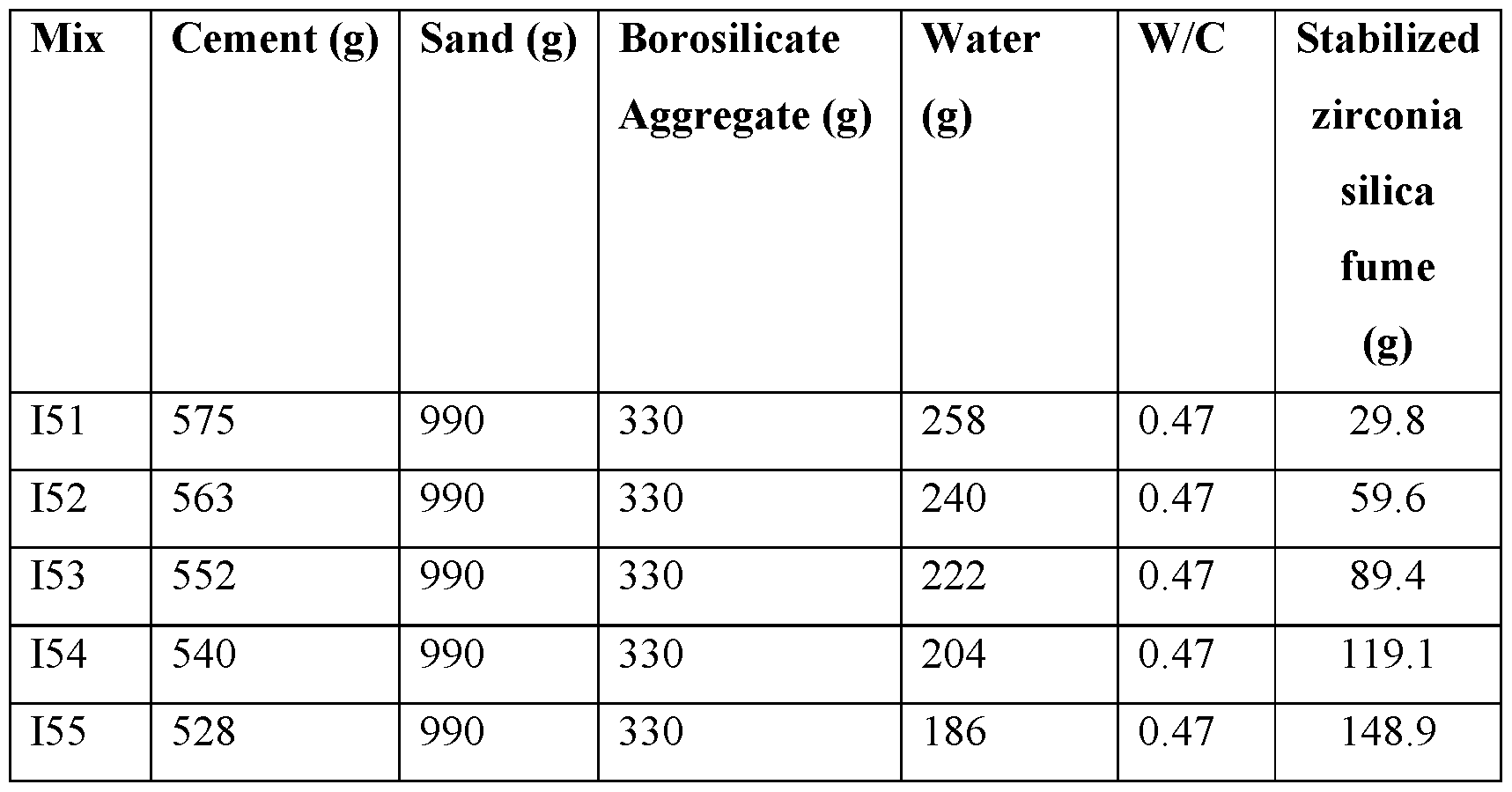
- the mortar bar mixtures of Table 7 were prepared using the ASR mitigating admixture of
- Mortar bars were prepared and tested for expansion as a result of the alkali-silica reaction in accordance with ASTM 0260-14 for a period of 14 days. Expansion readings were taken at 0, 3, 5, 7, 10, 12 and 14 days. The results of the study are shown in FIGURE 8, which reports the results as a function of the dosage amount of the stabilized admixture.
- FIGURE 9 depicts a comparison of densified silica fume powder and a stabilized slurry admixture of zirconia silica fume on mitigation of the potential alkali-silica reaction.
- Mortar bars were prepared and tested in accordance with ASTM C1260-14.
- inventive admixture comprising an aqueous slurry of stabilized zirconia silica fume mitigates the alkali-silica reaction between the cement pore solution and reactive aggregates at a dosage amount as low as 2% cwt, and the ASR-mitigating effect of the inventive admixture slurry of stabilized zirconia silica fume continues to improve at dosage amounts ranging from 2% to 10% cwt.
- the use of powdered densified silica fume results in expansion of mortar bars at dosage amounts of 2% cwt. and 4% cwt. results in an increase in mortar bar expansion due to the alkali-silica reaction.
- densified silica fume powder does not have any ASR-mitigating effect at the dosage amounts of 2% and 4% cwt.
- Mortar bar samples prepared with a dosage amount of 6% cwt. of the inventive admixture slurry of stabilized zirconia silica fume exhibit less than 5% expansion when tested in accordance with ASTM C 1260- 14, while mortar bars prepared with the amount of densified silica fume powder exhibit an expansion of 15%.
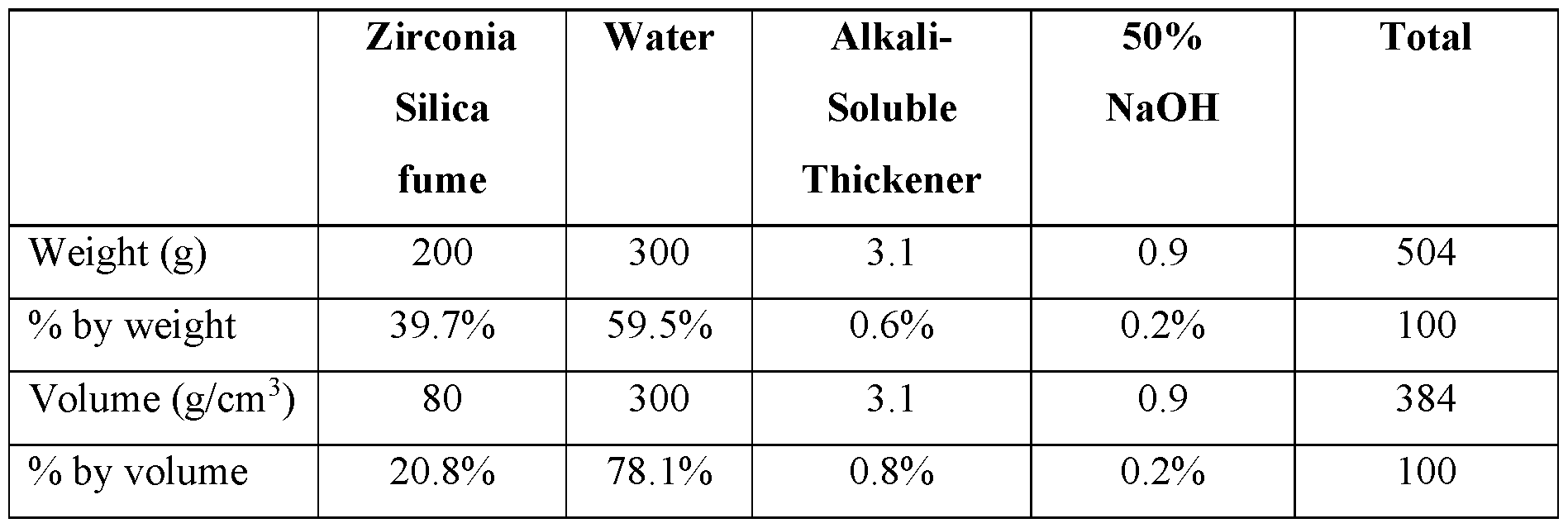
- a stabilized zirconia silica fume slurry admixture was prepared in accordance with the composition of Table 8 below.
- the zirconia silica fume used in the admixture composition was obtained from Washington Mills.
- the admixture was thickened with an alkali-soluble polyacrylate thickener and pH adjustment with 50% NaOH. TABLE 8
- a stabilized zirconia silica fume slurry admixture was prepared in accordance with the composition of Table 10 below.
- the zirconia silica fume used in the admixture composition was obtained from Washington Mills.
- the admixture was thickened with an alkali-soluble polyacrylate thickener and pH adjustment with 50% NaOH. TABLE 10
- the mortar bar mixtures of Table 11 were prepared using the ASR mitigating admixture of
- a stabilized zirconia silica fume slurry admixture was prepared in accordance with the composition of Table 12 below.
- the zirconia silica fume used in the admixture composition was obtained from TAM Ceramics LLC.
- the admixture was thickened with an alkali-soluble polyacrylate thickener and pH adjustment with 50% NaOH.
- the mortar bar mixtures of Table 13 were prepared using the ASR mitigating admixture of
- a stabilized zirconia silica fume slurry as an alkali-silica reaction mitigation admixture was prepared in accordance with the composition of Table 14 below.
- the zirconia silica fume used in the admixture composition was obtained from TAM Ceramics LLC.
- the admixture was thickened with an alkali-soluble polyacrylate thickener and pH adjustment with 50% NaOH.
- the mortar bar mixtures of Table 15 were prepared using the stabilized admixture of Table
- a stabilized zirconia silica fume slurry admixture was prepared in accordance with the composition of Table 16 below.
- the zirconia silica fume used in the admixture composition was obtained from TAM Ceramics LLC.
- the admixture was thickened with an alkali-soluble polyacrylate thickener and pH adjustment with 50% NaOH.
- the mortar bar mixtures of Table 17 were prepared using the stabilized admixture of Table
- a stabilized zirconia silica fume slurry admixture was prepared in accordance with the composition of Table 18 below.
- the zirconia silica fume used in the admixture composition was obtained from Saint-Gobain.
- the admixture was thickened with an alkali-soluble polyacrylate thickener and pH adjustment with 50% NaOH. TABLE 18
- a stabilized zirconia silica fume slurry admixture was prepared in accordance with the composition of Table 20 below.
- the zirconia silica fume used in the admixture composition was obtained from Ruowen.
- the admixture was thickened with an alkali-soluble polyacrylate thickener and pH adjustment with 50% NaOH. TABLE 20
- the mortar bar mixtures of Table 21 were prepared using the stabilized admixture of Table
- the admixture of Table 22A includes 20.6% by volume of the zirconia silica fume and 77.4% by volume of water.
- the admixture of Table 22B includes 49.6% by volume zirconia silica fume and 46% by volume water.
- the results shown in Table 23 indicate that the inclusion of 1.9% by volume of a polycarboxylate ether dispersant solution in the admixture of Table 22B allows inclusion of over two times the amount of zirconia silica fume in the same volume while still maintaining a flowable and workable admixture that can be easily dispensed into a cementitious composition.
- the compositions of the stabilized zirconia silica fume slurry admixtures are set forth in Tables 24A and 24B below.
- the zirconia silica fume of the admixture of Table 24A was obtained from TAM Ceramics, LLC.
- the zirconia silica fume of the admixture of Table 24B was obtained from Saint- Gobain Research (China) Co., Ltd.
- the admixture of Table 24A includes 20.6% by volume of the zirconia silica fume from TAM Ceramics and 77.4% by volume of water.
- the admixture of Table 24B includes 33.3% by volume zirconia silica fume from Saint-Gobain and 65% by volume water.
- the results shown in Table 25 indicate that the use of zirconia silica fume obtained from Saint-Gobain results in an admixture viscosity that is more than 50% less at 100, 50 and 20 RPM the admixture prepared with zirconia silica fume obtained from TAM Ceramics, LLC.
- Dispersant polycarboxylate ether type dispersant.
- Thickener substituted alkyl cellulose type polymer.
- Thickened and stabilized admixture compositions were prepared microsphere dispersions of Table 26.
- the desired type and amount of thickener was added to the microsphere dispersion with continuous mechanical stirring at a rate of about 450 RPM.
- the desired amount of the 50% solution of NaOH was slowly added with increasing mixing speed to 700 RPM to neutralize acid functionality of the thickener and to bring the pH of the mixture to above pH 8.
Landscapes
- Chemical & Material Sciences (AREA)
- Engineering & Computer Science (AREA)
- Ceramic Engineering (AREA)
- Materials Engineering (AREA)
- Structural Engineering (AREA)
- Organic Chemistry (AREA)
- Chemical Kinetics & Catalysis (AREA)
- Civil Engineering (AREA)
- Inorganic Chemistry (AREA)
- Curing Cements, Concrete, And Artificial Stone (AREA)
- Compositions Of Macromolecular Compounds (AREA)
Abstract
Description









Claims
Priority Applications (3)
| Application Number | Priority Date | Filing Date | Title |
|---|---|---|---|
| MX2021008337A MX2021008337A (en) | 2019-01-10 | 2020-01-10 | METHOD FOR STABILIZING A MIXTURE COMPONENT, A STABILIZED MIXTURE FOR CEMENT-BASED COMPOSITIONS, CEMENT-BASED COMPOSITION, CEMENT-BASED STRUCTURES AND METHODS FOR MAKING THEM. |
| CA3125969A CA3125969C (en) | 2019-01-10 | 2020-01-10 | Method of stabilzing an admixture component, a stabilized admixture for cementitous compositions, cementitious composition, cementitious structures and methods of making the same |
| US17/420,880 US12351526B2 (en) | 2019-01-10 | 2020-01-10 | Method of stabilizing an admixture component, a stabilized admixture for cementitious compositions, cementitious composition, cementitious structures and methods of making the same |
Applications Claiming Priority (2)
| Application Number | Priority Date | Filing Date | Title |
|---|---|---|---|
| US201962790796P | 2019-01-10 | 2019-01-10 | |
| US62/790,796 | 2019-01-10 |
Publications (1)
| Publication Number | Publication Date |
|---|---|
| WO2020146695A1 true WO2020146695A1 (en) | 2020-07-16 |
Family
ID=69469226
Family Applications (1)
| Application Number | Title | Priority Date | Filing Date |
|---|---|---|---|
| PCT/US2020/013016 Ceased WO2020146695A1 (en) | 2019-01-10 | 2020-01-10 | Method of stabilzing an admixture component, a stabilized admixture for cementitous compositions, cementitious composition, cementitious structures and methods of making the same |
Country Status (3)
| Country | Link |
|---|---|
| US (1) | US12351526B2 (en) |
| MX (1) | MX2021008337A (en) |
| WO (1) | WO2020146695A1 (en) |
Citations (1)
| Publication number | Priority date | Publication date | Assignee | Title |
|---|---|---|---|---|
| EP0263606A2 (en) * | 1986-09-29 | 1988-04-13 | W.R. Grace & Co.-Conn. | Silica fume slurry |
Family Cites Families (3)
| Publication number | Priority date | Publication date | Assignee | Title |
|---|---|---|---|---|
| US7147978B2 (en) * | 2001-10-26 | 2006-12-12 | Samsung Electronics Co., Ltd. | Electrophotographic photoreceptors with novel overcoats |
| US7732032B2 (en) * | 2004-12-30 | 2010-06-08 | United States Gypsum Company | Lightweight, fiber-reinforced cementitious panels |
| EP3486291B1 (en) * | 2016-07-13 | 2022-12-07 | Kansai Paint Co., Ltd | Effect pigment dispersion |
-
2020
- 2020-01-10 MX MX2021008337A patent/MX2021008337A/en unknown
- 2020-01-10 US US17/420,880 patent/US12351526B2/en active Active
- 2020-01-10 WO PCT/US2020/013016 patent/WO2020146695A1/en not_active Ceased
Patent Citations (1)
| Publication number | Priority date | Publication date | Assignee | Title |
|---|---|---|---|---|
| EP0263606A2 (en) * | 1986-09-29 | 1988-04-13 | W.R. Grace & Co.-Conn. | Silica fume slurry |
Non-Patent Citations (1)
| Title |
|---|
| DOW: "ACRYSOL(TM) Rheology Modifiers", 30 October 2013 (2013-10-30), XP055681999, Retrieved from the Internet <URL:http://msdssearch.dow.com/PublishedLiteratureDOWCOM/dh_08f8/0901b803808f8b0d.pdf?filepath=coatings/pdfs/noreg/> [retrieved on 20200401] * |
Also Published As
| Publication number | Publication date |
|---|---|
| CA3125969A1 (en) | 2020-07-16 |
| MX2021008337A (en) | 2021-08-05 |
| US12351526B2 (en) | 2025-07-08 |
| US20220098120A1 (en) | 2022-03-31 |
Similar Documents
| Publication | Publication Date | Title |
|---|---|---|
| US7648575B2 (en) | Providing freezing and thawing resistance to cementitious compositions | |
| JP5237633B2 (en) | Freeze-thaw resistant equipment for cementitious compositions | |
| AU2002336384B2 (en) | Micro-granulose particulates | |
| JP5762415B2 (en) | Curing accelerator composition containing phosphorylated polycondensate | |
| ES2931056T3 (en) | Accelerator additive for hydraulic compositions | |
| JP2008502564A5 (en) | ||
| AU2002336384A1 (en) | Micro-granulose particulates | |
| CN1968908B (en) | Antifreeze-thaw damage cement wet casting composition and preparation method thereof | |
| WO2020146738A1 (en) | Additive and admixture for cementitous compositions, cementitious compositions, cementitious structures and methods of making the same | |
| WO2006133855A2 (en) | Method of delivery of agents providing freezing and thawing resistance to cementitious compositions | |
| JP2025530984A (en) | concrete admixture | |
| EP2367770B1 (en) | Powder to reduce shrinkage of minerally binding materials | |
| RU2163578C1 (en) | Self-leveling building mixture | |
| CA3125969C (en) | Method of stabilzing an admixture component, a stabilized admixture for cementitous compositions, cementitious composition, cementitious structures and methods of making the same | |
| US12351526B2 (en) | Method of stabilizing an admixture component, a stabilized admixture for cementitious compositions, cementitious composition, cementitious structures and methods of making the same | |
| WO2025202862A1 (en) | Admixture for cementitious compositions, cementitious compositions, cementitious structures and methods of making the same | |
| JP2025538337A (en) | Accelerators for mineral binder compositions |
Legal Events
| Date | Code | Title | Description |
|---|---|---|---|
| 121 | Ep: the epo has been informed by wipo that ep was designated in this application |
Ref document number: 20703891 Country of ref document: EP Kind code of ref document: A1 |
|
| ENP | Entry into the national phase |
Ref document number: 3125969 Country of ref document: CA |
|
| WWE | Wipo information: entry into national phase |
Ref document number: MX/A/2021/008337 Country of ref document: MX |
|
| NENP | Non-entry into the national phase |
Ref country code: DE |
|
| WWP | Wipo information: published in national office |
Ref document number: MX/A/2021/008337 Country of ref document: MX |
|
| 122 | Ep: pct application non-entry in european phase |
Ref document number: 20703891 Country of ref document: EP Kind code of ref document: A1 |
|
| WWG | Wipo information: grant in national office |
Ref document number: 17420880 Country of ref document: US |
|
| WWG | Wipo information: grant in national office |
Ref document number: MX/A/2021/008337 Country of ref document: MX |