WO2020126707A1 - Savoury composition - Google Patents
Savoury composition Download PDFInfo
- Publication number
- WO2020126707A1 WO2020126707A1 PCT/EP2019/084522 EP2019084522W WO2020126707A1 WO 2020126707 A1 WO2020126707 A1 WO 2020126707A1 EP 2019084522 W EP2019084522 W EP 2019084522W WO 2020126707 A1 WO2020126707 A1 WO 2020126707A1
- Authority
- WO
- WIPO (PCT)
- Prior art keywords
- savoury
- composition
- savoury composition
- starch
- maize endosperm
- Prior art date
- Legal status (The legal status is an assumption and is not a legal conclusion. Google has not performed a legal analysis and makes no representation as to the accuracy of the status listed.)
- Ceased
Links
Classifications
-
- A—HUMAN NECESSITIES
- A23—FOODS OR FOODSTUFFS; TREATMENT THEREOF, NOT COVERED BY OTHER CLASSES
- A23L—FOODS, FOODSTUFFS OR NON-ALCOHOLIC BEVERAGES, NOT OTHERWISE PROVIDED FOR; PREPARATION OR TREATMENT THEREOF
- A23L29/00—Foods or foodstuffs containing additives; Preparation or treatment thereof
- A23L29/20—Foods or foodstuffs containing additives; Preparation or treatment thereof containing gelling or thickening agents
- A23L29/206—Foods or foodstuffs containing additives; Preparation or treatment thereof containing gelling or thickening agents of vegetable origin
- A23L29/212—Starch; Modified starch; Starch derivatives, e.g. esters or ethers
-
- A—HUMAN NECESSITIES
- A23—FOODS OR FOODSTUFFS; TREATMENT THEREOF, NOT COVERED BY OTHER CLASSES
- A23L—FOODS, FOODSTUFFS OR NON-ALCOHOLIC BEVERAGES, NOT OTHERWISE PROVIDED FOR; PREPARATION OR TREATMENT THEREOF
- A23L23/00—Soups; Sauces; Preparation or treatment thereof
- A23L23/10—Soup concentrates, e.g. powders or cakes
-
- A—HUMAN NECESSITIES
- A23—FOODS OR FOODSTUFFS; TREATMENT THEREOF, NOT COVERED BY OTHER CLASSES
- A23P—SHAPING OR WORKING OF FOODSTUFFS, NOT FULLY COVERED BY A SINGLE OTHER SUBCLASS
- A23P10/00—Shaping or working of foodstuffs characterised by the products
- A23P10/20—Agglomerating; Granulating; Tabletting
-
- A—HUMAN NECESSITIES
- A23—FOODS OR FOODSTUFFS; TREATMENT THEREOF, NOT COVERED BY OTHER CLASSES
- A23P—SHAPING OR WORKING OF FOODSTUFFS, NOT FULLY COVERED BY A SINGLE OTHER SUBCLASS
- A23P10/00—Shaping or working of foodstuffs characterised by the products
- A23P10/20—Agglomerating; Granulating; Tabletting
- A23P10/28—Tabletting; Making food bars by compression of a dry powdered mixture
-
- A—HUMAN NECESSITIES
- A23—FOODS OR FOODSTUFFS; TREATMENT THEREOF, NOT COVERED BY OTHER CLASSES
- A23P—SHAPING OR WORKING OF FOODSTUFFS, NOT FULLY COVERED BY A SINGLE OTHER SUBCLASS
- A23P30/00—Shaping or working of foodstuffs characterised by the process or apparatus
- A23P30/30—Puffing or expanding
Definitions
- the present invention relates to a granular savoury composition comprising puffed maize endosperm.
- the invention also relates to a method for preparing such a composition, and to a method of preparing a savoury dish with said savoury composition.
- Instant bouillon is commonly used as a base for e.g. bouillon or soups.
- a seasoning aid the consumer appreciates a form of the bouillon concentrate that is easier to sprinkle on a dish.
- powder and granules may be more suitable. They share the advantage that they are easier to dispense in portions to a dish than a cube.
- Powdered bouillon may show a limited flowability, e.g. due to its physical state, a problem which may increase over time. This may be a problem both during storage and during the production process.
- a powder When dispensed during cooking, for example to a steaming dish, a powder may clot together or stick to the packaging material.
- WO 2008086918 relates to a process to produce a concentrate in the form of particles for preparing bouillon, soups, sauces, gravies or for use as a seasoning by a) preparing a mixture of at least two of the selected from salt, monosodiumglutamate, sugar, starch fat, b) preparing particles from said mixture, at least 80% wt. of the particles having a dimension of coarser than 2 mm as determined by sieve analysis, c) grinding said particles to give particles with a particle dimension between 200 [mu]m and 2 mm as determined by sieve analysis, d. optionally removing particles below a dimension of from 200 [mu]m as determined by sieve analysis, wherein step (b) is effected by one of the processes comprising granulation, agglomeration, extrusion or a combination thereof.
- WO2011069885 relates to a granular savoury food concentrate.
- Example 1 thereof shows a composition comprising 42 wt.% salt, 27 wt.% starch, 7 wt.% sugar, 10 wt.% yeast extract, 14 wt.% flavours and spices and 5.1 wt.% water that has good granulation.
- Granulated savoury compositions according to the prior art have the disadvantage that constant stirring is required to dissolve the granules in hot water. Often a starchy residue remains, which consumers perceive as undesirable.
- the inventors have unexpectedly found that the dissolution properties of a savoury composition can be improved by including 0.1-20 wt.% of puffed maize endosperm particles.
- a savoury composition comprising, by weight of dry matter of the total composition:
- savoury taste-giving ingredients selected from glutamate, 5’- ribonucleotides, sucrose, glucose, fructose, lactic acid, citric acid and combinations thereof;
- starch component selected from flour, native starch, pregelatinised starch, maltodextrin, modified starch and combinations thereof; wherein a) to e) together preferably constitute at least 55 wt.% of the savoury composition,
- the present invention relates to a method for preparing the granulated food product described above, comprising steps of:
- particles of puffed maize endosperm preferably having an average particle size of less than 3 mm and preferably having a bulk density of 30 - 100 g/L;
- the edible salt that is used in accordance with the present invention is selected from sodium chloride, potassium chloride and combinations thereof.
- sodium chloride represents at least 5 wt.%, more preferably at least 10 wt.% and most preferably at least 20 wt.% of said edible salt.
- the edible salt which is employed in accordance with the invention preferably has a mass weighted average diameter in the range of 10-2000 pm, more preferably in the range of 100-1200 pm, and most preferably in the range of 200-800 pm.
- At least 80 wt.% of the edible salt has a particle size in the range of 10-2000 pm. Even more preferably at least 80 wt.% of the edible salt has a particle size in the range of 50-1500 pm. Most preferably, at least 80 wt.% of the edible salt has a particle size in the range of 100-1000 pm.
- the savoury composition preferably contains 1-80 wt.%, more preferably at least 2.5- 70 wt.%, even more preferably 5-65 wt.% and most preferably 10-60 wt.% of edible salt selected from sodium chloride, potassium chloride and combinations thereof. Most preferably, the edible salt is sodium chloride.
- the combination of edible salt and the one or more particulate ingredients preferably constitutes at least 50 wt.%, preferably at least 60 wt.% of the composition. Most preferably the combination of edible salt and the one or more particulate ingredients constitutes 50-90 wt.% of the savoury composition.
- the savoury composition may suitably contain a variety of other edible ingredients, as described elsewhere herein.
- the composition preferably comprises, by weight of the composition, 3-25 wt.%, preferably 5-20 wt.%, of the savoury taste giving ingredients, selected from glutamate, 5’-ribonucleotides, sucrose, glucose, fructose, lactic acid, citric acid and combinations thereof.
- the savoury taste giving ingredients selected from glutamate, 5’-ribonucleotides, sucrose, glucose, fructose, lactic acid, citric acid and combinations thereof.
- the one or more savoury taste giving ingredients employed in the present process typically have a mass weighted average diameter of at least 10 pm, more preferably of 15-3000 pm and more preferably of 20-2000 p , even more preferably 30-1000 pm and most preferably 40-500 pm.
- Sucrose, glucose and fructose are preferably present in the savoury composition in a total amount of 0 to 10 wt.%, more preferably 1 to 4 wt.%, even more preferably 1.5 to 2.5 wt.%, based on the weight of the savoury composition.
- Glutamate for example monosodium glutamate, is preferably present in the savoury composition in an amount of 0 to 25 wt.%, more preferably 5 to 20 wt.%, even more preferably 10 to 20 wt.%, based on the weight of the savoury composition.
- edible acids selected from the group of lactic acid, citric acid and combinations thereof, are present in the composition in an amount of 0 to 10 wt.%, more preferably 1 to 4 wt.%, even more preferably 1.5 to 2.5 wt.%, based on the weight of the savoury composition.
- the savoury taste ingredients may be added as such or as part of a complex ingredient mixture. It is understood that any savoury taste-giving compound can be added as such or as part of more complex food ingredients like yeast extract; hydrolysed proteins of vegetables-, soy-, fish-, or meat-origin, malt extract, beef flavourings, onion flavouring, liquid or dissolvable extracts or compositions selected from the group consisting of meat, fish, crustaceans, herbs, fruit, vegetable and mixtures thereof.
- one or more of the savoury taste giving ingredients are provided by ingredients selected from the group consisting of yeast extract, hydrolysed vegetable protein, dry meat extract, dry spices, herbs and mixtures thereof
- the savoury composition according to the invention preferably comprises 0 to 5 wt.%, more preferably 0.1 to 1 wt.%, or even 0.5 to 2 wt.%, dry meat extract, based on the weight of the savoury composition.
- the savoury composition comprises yeast extracts and/or hydrolysed vegetable protein.
- the savoury composition comprises 0 to 5 wt.% more preferably 0.1 to 3 wt.%, most preferably 0.5 to 2 wt.% yeast extracts and/or hydrolysed vegetable protein, by weight of the savoury composition.
- the total amount of edible salt and savoury taste giving ingredients in the savoury composition is preferably 20 to 90 wt.%, preferably 30 to 80 wt.%, even more preferably 40 to 70 wt.%, based on the weight of the savoury composition. It is especially preferred that the total amount edible salt and savoury taste giving ingredients in the savoury composition is higher than that of the other non-fat ingredients, like fillers, flavour ingredients and water.
- the composition comprises 2 to 10 wt.% of water, more preferably 4-8 wt.% water.
- the savoury composition typically contains less than 9 wt.% water. More preferably, the composition contains 1-8 wt.% water. Most preferably, the composition contains 2-7 wt.% water.
- the water content in the savoury composition can be measured by any standard method including drying the savoury composition and comparing the weight before and after drying.
- the savoury composition according to the invention preferably has a water activity of less than 0.65, more preferably less than 0.5, even more preferably less than 0.4, more preferably less than 0.3 and preferably more than 0.15.
- Maize is cultivated around the world.
- the fruits or maize cobs contain the seeds of the maize, known as maize kernels.
- Maize kernels have a typical shape and structure, which typically includes a germ, endosperm and pericarp.
- the endosperm tissue of maize is particularly rich in starches, typically amylase and amylopectin. In addition, it has a relatively high fibre content.
- the pericarp (hull) of maize kernels is relatively strong and water-impermeable
- the particles of puffed maize endosperm can be suitably obtained by puffing of maize endosperm, followed by milling or other methods of size reduction.
- puffing as used herein also encompasses popping of maize endosperm. If for example popped popcorn is comminuted, the resulting mixture of particles may include germ, endosperm and pericarp, but most of the volume and weight will usually be constituted by the expanded endosperm.
- fractionation is conveniently carried out by sieving, which is a well-known technique.
- the particle size distribution of the particles of puffed endosperm material used in the present invention can also conveniently be analysed by sieving. It is preferred that such analysis is carried out following the sieving method described in the Examples section below.
- the maize endosperm requires a high starch content.
- the maize endosperm has a starch content of at least 50 wt.%, more preferably of at least 60. wt.% and most preferably of at least 70 wt.%, by weight of dry matter.
- a process of puffing can for example be done, by pre-cooking and drying the maize kernels, followed by a heating step (e.g. frying in oil).
- the maize kernels can for example be puffed by explosion/gun puffing, where the raw or pre-cooked maize kernels are placed in a sealed drum that is rotated and heated from the outside until a certain pressure is obtained, the lid is released and all maize kernels puff at the same time, and escape the drum via the lid, and are collected in a bag where water vapour can escape.
- Maize kernels comprise a water impermeable hull, which keeps the water inside the seed during heating, are suitable for popping. Popping is an (almost) explosive form of puffing, in which heating of the maize kernels causes starch gelatinization and pressure build-up due to steam formation until the hull bursts and the maize kernels explosively expands to form a foamy structure.
- the particles of puffed maize endosperm are preferably obtained from puffed popcorn, more preferably from popped popcorn. Certain maize cultivars have been specifically bred for their suitability to be popped, including for instance Zea mays var. everta. Therefore, the particles of puffed maize endosperm are most preferably sourced from Zea mays var. everta. Preferably, at least 80 wt.%, more preferably at least 90 wt.% of the starch within the puffed maize endosperm is gelatinized.
- the puffed maize endosperm particles preferably have a bulk density that falls within the range of 5-220 g/l.
- the puffed maize endosperm particles have a bulk density that falls within the range of 15-190 g/l, most preferably a bulk density that falls within the range of 30-170 g/l.
- the puffed maize endosperm has a bulk density in the range of 25 to 100 g/L, more preferably between 35 to 80 g/L, even more preferably between 45 to 60 g/L .
- At least 80 wt.% of the particles of the puffed maize endosperm have an average particle size of less than 2.0 mm, preferably wherein the at least 80 wt.% of the particles of the puffed maize endosperm have an average particle size of less than 1.5 mm.
- the composition preferably comprises 1-20 wt.%, by weight of the composition, of oil, preferably 2-15 wt.%, more preferably 5-10 wt.%, of oil.
- the composition preferably has a density of 0.8 to 1.6 kg/I, at 20°C.
- the density is 1.1 to 1.5 kg/I, at 20°C, more preferably 1.2 to 1.4 kg/I, at 20°C.
- the combination of edible salt and the one or more particulate ingredients constitutes at least 60 wt.% of the savoury composition, preferably wherein the combination of a) -e) constitutes at least 75 % of the savoury composition.
- the composition comprises vegetable matter selected from vegetables, herbs, spices and combinations thereof.
- This vegetable matter is preferably applied in the form of leaves, slices, florets, dices or other pieces.
- the savoury composition preferably comprises 0 to 30 wt.%, more preferably 0 to 20 wt.% and even more preferably 1 to 10 wt.% by dry weight of the total composition of such vegetable matter selected from vegetables, herbs, spices and combinations thereof.
- sources of vegetable matter include parsley, dill, basil, chives, sage, rosemary, thyme, oregano, leek, onion, mushrooms, broccoli, cauliflower, tomato, courgette, asparagus, bell pepper, egg plant, cucumber, carrot and coconut flesh.
- the savoury composition preferably contains a starch component selected from flour native starch, pregelatinised starch, maltodextrin, modified starch and combinations thereof.
- the starch component is preferably present in the savoury composition in a concentration of 3-20 wt.%, more preferably of 4-18 wt.% and most preferably of 5-15 wt.%.
- the starch component is preferably selected from native starch, maltodextrin, pregelatinised starch and combinations thereof. Even more preferably, the starch component is selected from native starch, pregelatinised starch and combinations thereof. Most preferably, the starch component is native starch.
- the starch component typically has a mass weighted mean diameter in the range of 5-200 pm, more preferably of 10-100 pm, most preferably of 12-60 pm.
- the savoury composition comprises 0-5 wt.% starch component, preferably 0-2 wt.% starch component. In other words, preferably, the savoury composition is essentially free from starch components.
- fat and“fat” encompass fats that are liquid at ambient temperature as well as fats that are solid or semi-solid at ambient temperature. Thus,‘fat’ and‘oil’ are used interchangeably unless specified otherwise.
- a fat component as used herein may be a mixture of a liquid oil and a solid fat. Where applicable the prefix‘liquid’ or‘solid’ is added to indicate if the fat or oil is liquid or solid at ambient temperature as understood by the person skilled in the art.
- the solid fat content at a given temperature (for example the N20 at 20°C) can suitably be determined using ISO 8292-1 (2012) - Determination of solid fat content by pulsed NMR.
- the savoury composition comprises 1-50 wt.%, preferably 5-45 wt.%, even more preferably 10-40 wt.% fat component.
- the edible oil is edible vegetable oil, as these typically comprise a relatively large amount of unsaturated glycerides.
- sources of conventional edible oils and fats include coconut oil, palm kernel oil, palm oil (and fractions thereof including palm olein and palm stearin), marine oils (including fish oil), lard, tallow fat, butter fat, chicken oil, soybean oil, safflower oil, cotton seed oil, rapeseed oil, linseed oil, sesame oil, poppy seed oil, corn oil (maize oil), sunflower oil, peanut oil, rice bran oil, olive oil, algae oil, shea fat, and alanblackia and blends thereof.
- algae oils are considered vegetable oils.
- Meat fats such as chicken and or beef fat may also be present in the savoury compositions according to the invention.
- the edible oil is selected from soybean oil, sunflower oil, rapeseed oil, corn oil (maize oil), olive oil, linseed oil, palm olein and fractions and combinations thereof, and even more preferably from sunflower oil, rapeseed oil, olive oil and linseed oil.
- the total fat content of the savoury composition is 10-30 wt.%, more preferably 10-35 wt.%, even more preferably 10-20 wt.%.
- the SAFA content of the fat that is employed to prepare the fat containing powder mixture preferably does not exceed 60% by weight of the total amount of fatty acids. More preferably, said SAFA content does not exceed 40 wt.%, most preferably it does not exceed 20 wt.%.
- Fat in the present invention include oils and fats that are solid or liquid between 20 and 70 °C.
- the total fat preferably present in an amount as indicated in the paragraph here above, preferably has a solid fat content at 20 °C (N20) of 0 to 80 wt.%, preferably 5 to 50 wt.%, more preferably 10 to 40 wt.%, based on the weight of the fat.
- the total fat preferably has a solid fat content at 30 °C (N30) of 1 to 60 wt.%, more 3 to 55 wt.%, even more preferably 10 to 50 wt.%, based on the weight of the fat.
- composition of the invention comprises preferably 2 to 40 wt.%, more preferably 5 to 30 wt.%, even more preferably 7 to 20 wt.% and most preferably 10 to 15 wt.% of solid fat at 20 °C (N20), based on the weight of the savoury composition.
- the melting point of the fat is preferably in the range of 20 to 70°C, more preferably in the range of 25 to 65°C, even more preferably in the range of 30 to 60 °C, most preferably in the range of 35 to 50°C.
- the melting point is considered the lowest temperature at which the solids level according to ISO 8292 1 D 2008 is below 0.5%.
- the composition preferably comprises 20 to 50 wt.%, preferably 25 to 45 wt.%, even more preferably 30 to 40 wt.%, most preferably 35 to 38 wt.% of palm oil component, having N20 of at least 60% and N30 of at least 40%.
- the savoury composition is a granulate as defined herein having a mass weighted average diameter in the range of 0.1-5 mm, said granulate comprising the following components:
- wt.% is by weight of dry matter of the total composition.
- the savoury composition is a granulate as defined herein having a mass weighted average diameter in the range of 0.1-5 mm, said granulate comprising the following components:
- wt.% is by weight of dry matter of the total composition.
- the granulate preferably has a mass weighted average diameter in the range of 0.2-2 mm, most preferably in the range of 0.25-1.5 mm.
- the product of the invention is in granulated form, where the average granule size is 0.5 mm to 5.0 mm in either length or diameter. If the granule size is more than 5.0 mm in length or diameter, the granule becomes brittle and easily broken or crumbled during transportation and/or storage. Additionally, granules that are two large need more time to dissolve in water. On the other hand, the granules should not be too small, preferably having a length or diameter not less than 0.5 mm. Granules that are too small tend to conglomerate in water and are hard to fully dissolve in water even with stirring. In addition, fine granules have strong hygroscopicity.
- the granules of the invention have an average size of 1.2 mm to 3.5 mm in either length or diameter.
- a product having a uniform granule size is preferred, for optimum dissolvability and flowability.
- a second aspect of the invention relates to a method for preparing the granulated food product described above, comprising steps of:
- particles of puffed maize endosperm preferably having an average particle size of less than 3 mm and preferably having a bulk density of 30 - 100 g/L;
- the puffed maize endosperm is combined with an edible salt, a fat component, water and/or a starch component.
- the granulation method may any one selected from sifting, high shear granulation, fluidized bed granulation, extrusion-spheronization granulation, spray drying granulation, tablet compression, and roller compaction.
- the granulation process generates granules having a length or diameter of between 0.5 to 5 mm. As mentioned above, granules that are too large or too small are problematic.
- the granulation method uses high shear granulators, high speed mixer granulators, extruders or fluidized bed granulators.
- the granulation method is preferably a wet granulation method.
- the skilled person is aware of the technique of wet-granulation. During wet- granulation, ingredients are partly dissolved in the added water. The resulting moisty mixture is shaped by pressing it through a sieve, and the resulting granules are dried.
- the invention relates to a process, wherein the granulation is conducted by a low pressure radial extrusion system such as a basket extruder of.
- a low pressure radial extrusion system such as a basket extruder of.
- the partly dissolved ingredients re-crystallize, in this way resulting in binding of the ingredients and therefore coherency and texture of the granule granulation, the resulting granules may have the shape of small sticks.
- the process of the present invention further comprises a milling step.
- the milling step is conducted after drying step.
- the processes described above may be carried out at ambient temperatures.
- the temperature for milling, mixing and/or granulating is in the range from -10 to 65 °C, preferably from -5 to 60 °C, more preferably -5 to 20 °C.
- the granular savoury composition is subjected to a drying step.
- the drying conditions are not critical, but must enable the water content in the finished product to be reduced. Drying is preferably done up to a water activity (Aw) of lower than 0.87, preferably of between 0.2 and 0.5, most preferably of between 0.2 and 0.3.
- the drying temperature can vary within a suitable range. For example, if the drying temperature is relatively high, the drying duration should be relatively short so that the temperature inside the granules will not adversely affect the taste of the composition. Excessive drying below about 0.5 % may be detrimental to flavour and cause texture degradation. Conventional drying techniques including air drying, air convection drying, fluidized bed drying, vacuum drying, freeze drying, solar drying and the like. Although the process can be carried out in batch form, it is preferred that the process be continuous so that, as is customary in production facilities, speed throughput speed is maximised.
- the drying step is conducted at a temperature of from 50°C to 160 °C, preferably of from 60°C to 130°C most preferably between 70°C and 100°C.
- the granular savoury composition according to the invention is preferably packaged.
- the invention relates to a process according to the invention, wherein the process further comprises a step of packaging the resulting granular savoury composition in a packaging selected from the group consisting of: a jar, a dispenser, a mill, a sachet, a pouch and a container.
- the granules of the present invention are preferably used in preparing savoury meals. It has been surprisingly found that granules according to the invention leave less residue (undissolved composition) than those of the prior art.
- the present invention relates to a method of preparing a savoury dish, wherein 1-10 parts by weight of the savoury composition as defined herein is added to 10-100 parts by weight hot water and stirred for at least 1 minute.
- the present invention relates to the use of the granular savoury composition of the present invention for the preparation of at least one of the group consisting of: a bouillon, soup, sauce, and a gravy.
- the granular savoury composition is diluted in an aqueous solution, preferably hot water.
- the invention further relates to the use of a savoury composition of the invention as a seasoning.
- the granules of the invention may be sprinkled or poured on a dish or a meal during cooking or before or during consumption.
- a representative puffed maize endosperm sample / savoury taste giving ingredient / plant or vegetal matter sample is sieved on a sieving machine through a series of sieves (20cm) assembled according to increasing nominal aperture size from bottom to top, equipped with receiver (bottom) and lid.
- Commercially available test sieves are used with appropriate nominal aperture size. Suitable nominal aperture sizes are given in DIN ISO 3310-1 :1990 or ISO 565:1990. For each measurement, 100 gram of sample material is weighted with an accuracy of 0.1 gram into the sieve at the top of the nest.
- the water content and corresponding dry matter content of the savoury composition used herein was determined by the following method, wherein the dry matter content is the residual mass after drying the sample expressed as %.
- 5 g (with 0.1 mg accuracy) of sample material is weighed into a pre-dried, tared pan containing about 60g of pre-dried sea sand and mixed well.
- the pan with the sample is dried for 6 hours in a vacuum oven at 0.1 bar and 72°C. After 6 hours the pan is placed in a desiccator and allowed to cool down to ambient temperature (30-45 min). Then, it is weighed (with 0.1 mg accuracy). Duplicate determinations of each sample are carried out.
- Water content is calculated by dividing the measured amount of water (mg) by the sample amount (mg) and multiplying by 100.
- the lower limit of quantification is 0.01 g / 100g for homogeneous samples.
- the bulk density of the particles was measured according to method DIN ISO 697:1981-03. Measurement equipment“Schutt Whymessgerat SMG 697” (Powtec Machinen und Engineering GmbH, Remscheid, Germany.
- Puffed maize was obtained from Pesika Kornergut GmbH (Germany). The puffed maize was comminuted by milling to a particle size of ⁇ 3mm using a Solia Type M 30 (screen 334) and subjecting the thus milled puffed maize to a milling process using a Bauerffle: Probat Baumeisternuhle ULD - VA. mill with different screen sizes (0,5mm, 0,8mm, 1 ,0mm, 1 ,5mm)
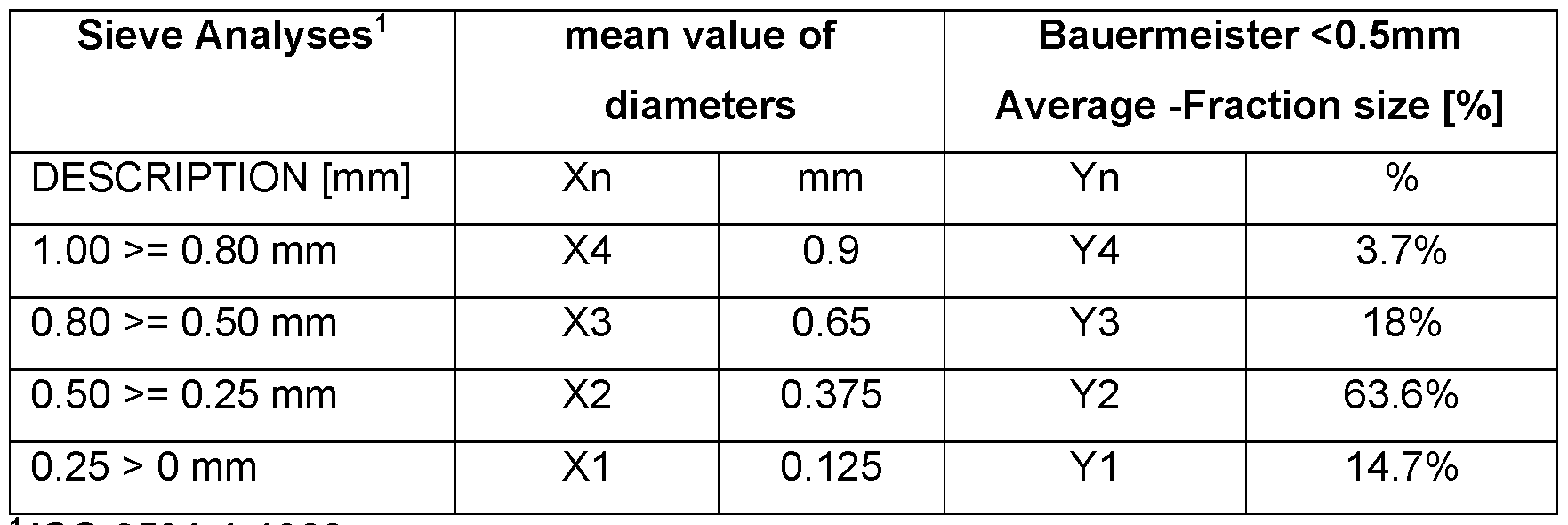
- the resulting powder was analysed on particle size distribution by the following method: 25 gram aliquots through a stack of stainless steel sieves (apertures 1.0 mm, 0.8, 0.5, 0.25 0.125 and 1.5 mm respectively), using a vibratory sieve shaker (type AS200 digit, Retsch Gmbh & Co., Haan, Germany) pre-set at 60 Hz for 5 minutes. The powder fraction on each sieve was determined.
- the average particle size was calculated as the sum of the results of mean value of diameters (of sieve pore) multiplied by the corresponding percentage of fraction as shown in equation 1 below:
- the average particle size calculated from table 1 below is 0.407 m .
- Table one shows particle distribution of a sample generated by above mentioned milling process while using 0.5mm sieve in Bauermeister mill.
- a compacted asparagus soup was prepared according to the recipe in Table 2.
- the soup according to A was also prepared with puffed maize endosperm particles (see Table 3). Briefly, the dry ingredients were mixed and combined with the liquid ingredients to provide a wet powder mix.
- the wet powder mix was compacted using a Bepex Roller Compactor. The screw speed was 40 rpm, the drum speed was 1- rpm and the pressure was 20 kN. Table 2
- soup product (comparative example A and samples 1-4), were added to 500 ml_ cold water, heated up to boiling (1.5 minutes) and simmered for 2.5 minutes. The samples were stirred with a whisk 5 times, each time for 30 seconds. The soup was passed over a sieve and the amount of residue in the sieve weighed.
- Particles pass sieve having 1.5 mm mesh
- Compacted tomato soups were prepared according to the base recipe in Table 4. For samples 5 and 6, 1 and 3 wt.% puffed maize endosperm particles were added to the base mix respectively. Comparative example (B) did not contain puffed maize endosperm particles.
- the soup according to B was also prepared with puffed maize endosperm particles (see Table 3). Briefly, the dry ingredients were mixed and combined with the liquid ingredients to provide a wet powder mix. The wet powder mix was compacted using a Bepex Roller Compactor. The screw speed was 40 rpm, the drum speed was 1- rpm and the pressure was 20 kN.
- soup product (comparative example A and samples 1-4), were added to 500 ml_ cold water, heated up to boiling (1.5 minutes) and simmered for 2.5 minutes. The samples were stirred with a whisk 5 times, each time for 30 seconds. The soup was passed over a sieve and the amount of residue in the sieve weighed. Table 5
- the base soup mix of Table 4 was formulated with 10 wt.% puffed maize endosperm particles and 10 wt.% extruded potato starch (Aeromyl - Sudstarke GmbH).
- a granulated chicken soup was prepared with ingredients as show in Table 7. The dry ingredients are mixed with water to give a wet powder mix. The wet powder mix is then granulated and sieved. The process was carried out using BX300 with a 4 arm rotor with a basket temperature of less than 70 °C and a granulation temperature of less than 40 °C. A drum dryer was used at 90-95 °C. After the drum drier the granules passed through a sieve having 3 mm openings.
- 1 includes chicken flavouring, yeast, herbs & spices
- sample 10 contained 5 wt.%, based on total weight of the sample, puffed maize endosperm.
- Sample 9 and 10 were subjected to dissolution and conductivity tests. Dissolution was measured by conductivity measurement during the dissolution of a sample. With the dissolving of ionic constituents of the sample like e.g. NaCI, MSG etc. the conductivity increases until the sample is completely dissolved. At that point no further increase in conductivity can be observed. The results are given in sec.
- Sample 9 or 10 (28g) was added to hot de-mineralised water (1000 ml) of 92°C. The conductivity during dissolving of the sample was measured until no further increase was observed. Conductivity measurement were performed with InoLab 740/ Level 3 active multifunction box with standard-conductivity cell TetraCon R 325. Data acquisition and processing are done with help of Software Multilab® Pilot V5.03.
Landscapes
- Chemical & Material Sciences (AREA)
- Life Sciences & Earth Sciences (AREA)
- Engineering & Computer Science (AREA)
- Food Science & Technology (AREA)
- Polymers & Plastics (AREA)
- Health & Medical Sciences (AREA)
- Nutrition Science (AREA)
- Dispersion Chemistry (AREA)
- Seeds, Soups, And Other Foods (AREA)
Abstract
The present invention relates to a savoury composition in the form of a granulate, a method of making such composition and to the use of such a composition preparing a soup or boullion.
Description
SAVOURY COMPOSITION
FIELD OF THE INVENTION
The present invention relates to a granular savoury composition comprising puffed maize endosperm. The invention also relates to a method for preparing such a composition, and to a method of preparing a savoury dish with said savoury composition.
BACKGROUND TO THE INVENTION
Instant bouillon is commonly used as a base for e.g. bouillon or soups. For use as a seasoning aid, the consumer appreciates a form of the bouillon concentrate that is easier to sprinkle on a dish. In this respect, powder and granules may be more suitable. They share the advantage that they are easier to dispense in portions to a dish than a cube. Powdered bouillon, however, may show a limited flowability, e.g. due to its physical state, a problem which may increase over time. This may be a problem both during storage and during the production process. When dispensed during cooking, for example to a steaming dish, a powder may clot together or stick to the packaging material. These effects negatively affect the appeal to the consumer, rendering granulated bouillon the preference of choice for many purposes
WO 2008086918 relates to a process to produce a concentrate in the form of particles for preparing bouillon, soups, sauces, gravies or for use as a seasoning by a) preparing a mixture of at least two of the selected from salt, monosodiumglutamate, sugar, starch fat, b) preparing particles from said mixture, at least 80% wt. of the particles having a dimension of coarser than 2 mm as determined by sieve analysis, c) grinding said particles to give particles with a particle dimension between 200 [mu]m and 2 mm as determined by sieve analysis, d. optionally removing particles below a dimension of from 200 [mu]m as determined by sieve analysis, wherein step (b) is effected by one of the processes comprising granulation, agglomeration, extrusion or a combination thereof.
WO2011069885 relates to a granular savoury food concentrate. Example 1 thereof shows a composition comprising 42 wt.% salt, 27 wt.% starch, 7 wt.% sugar, 10 wt.%
yeast extract, 14 wt.% flavours and spices and 5.1 wt.% water that has good granulation.
Granulated savoury compositions according to the prior art have the disadvantage that constant stirring is required to dissolve the granules in hot water. Often a starchy residue remains, which consumers perceive as undesirable.
There is a need to provide granular savoury compositions having improved dissolution properties.
DEFINITION OF THE INVENTION
The inventors have unexpectedly found that the dissolution properties of a savoury composition can be improved by including 0.1-20 wt.% of puffed maize endosperm particles.
Accordingly, there is provided a savoury composition comprising, by weight of dry matter of the total composition:
a) 0 to 85 wt.% of an edible salt selected from sodium chloride, potassium chloride and combinations thereof;
b) 1 to 50 wt.% of savoury taste-giving ingredients selected from glutamate, 5’- ribonucleotides, sucrose, glucose, fructose, lactic acid, citric acid and combinations thereof;
c) 0 to 10 wt. % of water;
d) 0.1-20 wt.% puffed maize endosperm, wherein at least 80 wt.% of the particles of the puffed maize endosperm have an average particle size of less than 3.0 mm,
e) 1 to 45 wt.% of vegetable matter selected from vegetables, herbs, spices and combinations thereof;
f) 0 to 75 wt.% of starch component selected from flour, native starch, pregelatinised starch, maltodextrin, modified starch and combinations thereof; wherein a) to e) together preferably constitute at least 55 wt.% of the savoury composition,
wherein the savoury composition is a granulate having a mass weighted average diameter in the range of 0.1-5 mm.
In a second aspect, the present invention relates to a method for preparing the granulated food product described above, comprising steps of:
i) providing particles of puffed maize endosperm preferably having an average particle size of less than 3 mm and preferably having a bulk density of 30 - 100 g/L;
ii) combining puffed maize endosperm with, savoury taste-giving ingredients, vegetable matter and optionally other food ingredients to provide a particulate savoury composition mix,
iii) granulating the savoury composition mix to provide a granulate, savoury composition.
DETAILED DESCRIPTION OF THE INVENTION The word‘comprising’ as used herein is intended to mean‘including’ but not necessarily ‘consisting of or‘composed of. In other words, the listed steps or options need not be exhaustive.
Unless specified otherwise, numerical ranges expressed in the format‘from x to y’ or ‘x-y’ are understood to include x and y. When for a specific feature multiple preferred ranges are described in the format‘from x to y’ or‘x-y’, it is understood that all ranges combining the different endpoints are also contemplated. For the purpose of the invention ambient temperature is defined as a temperature of about 20°C. Unless indicated otherwise, weight percentages (wt.%) are based on the total weight of the composition.
All ratios by weight as specified herein relate to weight ratios by dry weight of the respective powders.
Edible salt
The edible salt that is used in accordance with the present invention is selected from sodium chloride, potassium chloride and combinations thereof. Preferably, sodium
chloride represents at least 5 wt.%, more preferably at least 10 wt.% and most preferably at least 20 wt.% of said edible salt.
The edible salt which is employed in accordance with the invention preferably has a mass weighted average diameter in the range of 10-2000 pm, more preferably in the range of 100-1200 pm, and most preferably in the range of 200-800 pm.
Typically, at least 80 wt.% of the edible salt has a particle size in the range of 10-2000 pm. Even more preferably at least 80 wt.% of the edible salt has a particle size in the range of 50-1500 pm. Most preferably, at least 80 wt.% of the edible salt has a particle size in the range of 100-1000 pm.
The savoury composition preferably contains 1-80 wt.%, more preferably at least 2.5- 70 wt.%, even more preferably 5-65 wt.% and most preferably 10-60 wt.% of edible salt selected from sodium chloride, potassium chloride and combinations thereof. Most preferably, the edible salt is sodium chloride.
The combination of edible salt and the one or more particulate ingredients preferably constitutes at least 50 wt.%, preferably at least 60 wt.% of the composition. Most preferably the combination of edible salt and the one or more particulate ingredients constitutes 50-90 wt.% of the savoury composition.
Besides edible salt, the savoury composition may suitably contain a variety of other edible ingredients, as described elsewhere herein.
Savoury taste giving ingredients
The composition preferably comprises, by weight of the composition, 3-25 wt.%, preferably 5-20 wt.%, of the savoury taste giving ingredients, selected from glutamate, 5’-ribonucleotides, sucrose, glucose, fructose, lactic acid, citric acid and combinations thereof.
The one or more savoury taste giving ingredients employed in the present process typically have a mass weighted average diameter of at least 10 pm, more preferably of
15-3000 pm and more preferably of 20-2000 p , even more preferably 30-1000 pm and most preferably 40-500 pm.
Sucrose, glucose and fructose are preferably present in the savoury composition in a total amount of 0 to 10 wt.%, more preferably 1 to 4 wt.%, even more preferably 1.5 to 2.5 wt.%, based on the weight of the savoury composition.
Glutamate, for example monosodium glutamate, is preferably present in the savoury composition in an amount of 0 to 25 wt.%, more preferably 5 to 20 wt.%, even more preferably 10 to 20 wt.%, based on the weight of the savoury composition.
Preferably, edible acids selected from the group of lactic acid, citric acid and combinations thereof, are present in the composition in an amount of 0 to 10 wt.%, more preferably 1 to 4 wt.%, even more preferably 1.5 to 2.5 wt.%, based on the weight of the savoury composition.
The savoury taste ingredients may be added as such or as part of a complex ingredient mixture. It is understood that any savoury taste-giving compound can be added as such or as part of more complex food ingredients like yeast extract; hydrolysed proteins of vegetables-, soy-, fish-, or meat-origin, malt extract, beef flavourings, onion flavouring, liquid or dissolvable extracts or compositions selected from the group consisting of meat, fish, crustaceans, herbs, fruit, vegetable and mixtures thereof.
Preferably, one or more of the savoury taste giving ingredients are provided by ingredients selected from the group consisting of yeast extract, hydrolysed vegetable protein, dry meat extract, dry spices, herbs and mixtures thereof
The savoury composition according to the invention preferably comprises 0 to 5 wt.%, more preferably 0.1 to 1 wt.%, or even 0.5 to 2 wt.%, dry meat extract, based on the weight of the savoury composition.
Preferably, the savoury composition comprises yeast extracts and/or hydrolysed vegetable protein. Preferably, the savoury composition comprises 0 to 5 wt.% more preferably 0.1 to 3 wt.%, most preferably 0.5 to 2 wt.% yeast extracts and/or hydrolysed vegetable protein, by weight of the savoury composition.
The total amount of edible salt and savoury taste giving ingredients in the savoury composition is preferably 20 to 90 wt.%, preferably 30 to 80 wt.%, even more preferably 40 to 70 wt.%, based on the weight of the savoury composition. It is especially preferred that the total amount edible salt and savoury taste giving ingredients in the savoury composition is higher than that of the other non-fat ingredients, like fillers, flavour ingredients and water.
Water
Preferably the composition comprises 2 to 10 wt.% of water, more preferably 4-8 wt.% water. The savoury composition typically contains less than 9 wt.% water. More preferably, the composition contains 1-8 wt.% water. Most preferably, the composition contains 2-7 wt.% water. The water content in the savoury composition can be measured by any standard method including drying the savoury composition and comparing the weight before and after drying.
The savoury composition according to the invention preferably has a water activity of less than 0.65, more preferably less than 0.5, even more preferably less than 0.4, more preferably less than 0.3 and preferably more than 0.15.
Puffed maize endosperm particles
Maize is cultivated around the world. The fruits or maize cobs contain the seeds of the maize, known as maize kernels. Maize kernels have a typical shape and structure, which typically includes a germ, endosperm and pericarp. The endosperm tissue of maize is particularly rich in starches, typically amylase and amylopectin. In addition, it has a relatively high fibre content. The pericarp (hull) of maize kernels is relatively strong and water-impermeable
The particles of puffed maize endosperm can be suitably obtained by puffing of maize endosperm, followed by milling or other methods of size reduction. The term“puffing” as used herein also encompasses popping of maize endosperm. If for example popped popcorn is comminuted, the resulting mixture of particles may include germ, endosperm
and pericarp, but most of the volume and weight will usually be constituted by the expanded endosperm.
Depending on the comminution method, it may be desirable to fractionate the ground material, in order to obtain a particulate material with a suitable size distribution. Such fractionation is conveniently carried out by sieving, which is a well-known technique.
The particle size distribution of the particles of puffed endosperm material used in the present invention can also conveniently be analysed by sieving. It is preferred that such analysis is carried out following the sieving method described in the Examples section below.
Puffing of maize endosperm requires a high starch content. Preferably, the maize endosperm has a starch content of at least 50 wt.%, more preferably of at least 60. wt.% and most preferably of at least 70 wt.%, by weight of dry matter.
A process of puffing can for example be done, by pre-cooking and drying the maize kernels, followed by a heating step (e.g. frying in oil). Alternatively, the maize kernels can for example be puffed by explosion/gun puffing, where the raw or pre-cooked maize kernels are placed in a sealed drum that is rotated and heated from the outside until a certain pressure is obtained, the lid is released and all maize kernels puff at the same time, and escape the drum via the lid, and are collected in a bag where water vapour can escape.
Maize kernels comprise a water impermeable hull, which keeps the water inside the seed during heating, are suitable for popping. Popping is an (almost) explosive form of puffing, in which heating of the maize kernels causes starch gelatinization and pressure build-up due to steam formation until the hull bursts and the maize kernels explosively expands to form a foamy structure.
The particles of puffed maize endosperm are preferably obtained from puffed popcorn, more preferably from popped popcorn. Certain maize cultivars have been specifically bred for their suitability to be popped, including for instance Zea mays var. everta. Therefore, the particles of puffed maize endosperm are most preferably sourced from Zea mays var. everta.
Preferably, at least 80 wt.%, more preferably at least 90 wt.% of the starch within the puffed maize endosperm is gelatinized. The puffed maize endosperm particles preferably have a bulk density that falls within the range of 5-220 g/l. More preferably, the puffed maize endosperm particles have a bulk density that falls within the range of 15-190 g/l, most preferably a bulk density that falls within the range of 30-170 g/l. Preferably, the puffed maize endosperm has a bulk density in the range of 25 to 100 g/L, more preferably between 35 to 80 g/L, even more preferably between 45 to 60 g/L .
Preferably, at least 80 wt.% of the particles of the puffed maize endosperm have an average particle size of less than 2.0 mm, preferably wherein the at least 80 wt.% of the particles of the puffed maize endosperm have an average particle size of less than 1.5 mm.
The composition preferably comprises 1-20 wt.%, by weight of the composition, of oil, preferably 2-15 wt.%, more preferably 5-10 wt.%, of oil. The composition preferably has a density of 0.8 to 1.6 kg/I, at 20°C. Preferably, the density is 1.1 to 1.5 kg/I, at 20°C, more preferably 1.2 to 1.4 kg/I, at 20°C.
Preferably, the combination of edible salt and the one or more particulate ingredients constitutes at least 60 wt.% of the savoury composition, preferably wherein the combination of a) -e) constitutes at least 75 % of the savoury composition.
Vegetable matter
Preferably, the composition comprises vegetable matter selected from vegetables, herbs, spices and combinations thereof. This vegetable matter is preferably applied in the form of leaves, slices, florets, dices or other pieces. Thus, the savoury composition preferably comprises 0 to 30 wt.%, more preferably 0 to 20 wt.% and even more preferably 1 to 10 wt.% by dry weight of the total composition of such vegetable matter selected from vegetables, herbs, spices and combinations thereof. Examples of sources of vegetable matter include parsley, dill, basil, chives, sage, rosemary, thyme,
oregano, leek, onion, mushrooms, broccoli, cauliflower, tomato, courgette, asparagus, bell pepper, egg plant, cucumber, carrot and coconut flesh.
Starch component
The savoury composition preferably contains a starch component selected from flour native starch, pregelatinised starch, maltodextrin, modified starch and combinations thereof. The starch component is preferably present in the savoury composition in a concentration of 3-20 wt.%, more preferably of 4-18 wt.% and most preferably of 5-15 wt.%. The starch component is preferably selected from native starch, maltodextrin, pregelatinised starch and combinations thereof. Even more preferably, the starch component is selected from native starch, pregelatinised starch and combinations thereof. Most preferably, the starch component is native starch. The starch component typically has a mass weighted mean diameter in the range of 5-200 pm, more preferably of 10-100 pm, most preferably of 12-60 pm.
The savoury composition comprises 0-5 wt.% starch component, preferably 0-2 wt.% starch component. In other words, preferably, the savoury composition is essentially free from starch components.
Fat component
The terms“oil” and“fat” encompass fats that are liquid at ambient temperature as well as fats that are solid or semi-solid at ambient temperature. Thus,‘fat’ and‘oil’ are used interchangeably unless specified otherwise. A fat component as used herein may be a mixture of a liquid oil and a solid fat. Where applicable the prefix‘liquid’ or‘solid’ is added to indicate if the fat or oil is liquid or solid at ambient temperature as understood by the person skilled in the art. The solid fat content at a given temperature (for example the N20 at 20°C) can suitably be determined using ISO 8292-1 (2012) - Determination of solid fat content by pulsed NMR.
The savoury composition comprises 1-50 wt.%, preferably 5-45 wt.%, even more preferably 10-40 wt.% fat component. In general, it is preferred that the edible oil is edible vegetable oil, as these typically comprise a relatively large amount of unsaturated glycerides. Examples of sources of
conventional edible oils and fats include coconut oil, palm kernel oil, palm oil (and fractions thereof including palm olein and palm stearin), marine oils (including fish oil), lard, tallow fat, butter fat, chicken oil, soybean oil, safflower oil, cotton seed oil, rapeseed oil, linseed oil, sesame oil, poppy seed oil, corn oil (maize oil), sunflower oil, peanut oil, rice bran oil, olive oil, algae oil, shea fat, and alanblackia and blends thereof. For the purpose of this invention, algae oils are considered vegetable oils. Meat fats such as chicken and or beef fat may also be present in the savoury compositions according to the invention.
More preferably, the edible oil is selected from soybean oil, sunflower oil, rapeseed oil, corn oil (maize oil), olive oil, linseed oil, palm olein and fractions and combinations thereof, and even more preferably from sunflower oil, rapeseed oil, olive oil and linseed oil.
Preferably, the total fat content of the savoury composition is 10-30 wt.%, more preferably 10-35 wt.%, even more preferably 10-20 wt.%.
The SAFA content of the fat that is employed to prepare the fat containing powder mixture preferably does not exceed 60% by weight of the total amount of fatty acids. More preferably, said SAFA content does not exceed 40 wt.%, most preferably it does not exceed 20 wt.%.
Fat in the present invention include oils and fats that are solid or liquid between 20 and 70 °C. The total fat, preferably present in an amount as indicated in the paragraph here above, preferably has a solid fat content at 20 °C (N20) of 0 to 80 wt.%, preferably 5 to 50 wt.%, more preferably 10 to 40 wt.%, based on the weight of the fat. The total fat preferably has a solid fat content at 30 °C (N30) of 1 to 60 wt.%, more 3 to 55 wt.%, even more preferably 10 to 50 wt.%, based on the weight of the fat.
The composition of the invention comprises preferably 2 to 40 wt.%, more preferably 5 to 30 wt.%, even more preferably 7 to 20 wt.% and most preferably 10 to 15 wt.% of solid fat at 20 °C (N20), based on the weight of the savoury composition.
The melting point of the fat is preferably in the range of 20 to 70°C, more preferably in the range of 25 to 65°C, even more preferably in the range of 30 to 60 °C, most
preferably in the range of 35 to 50°C. The melting point is considered the lowest temperature at which the solids level according to ISO 8292 1 D 2008 is below 0.5%.
The composition preferably comprises 20 to 50 wt.%, preferably 25 to 45 wt.%, even more preferably 30 to 40 wt.%, most preferably 35 to 38 wt.% of palm oil component, having N20 of at least 60% and N30 of at least 40%.
Preferably, the savoury composition is a granulate as defined herein having a mass weighted average diameter in the range of 0.1-5 mm, said granulate comprising the following components:
a) 35-85 wt.%, preferably 40-75 wt.% of edible salt;
b) 3-20 wt.%, preferably 4-15 wt.% fat;
c) 2-20 wt.%, preferably 5-15 wt.% of the savoury taste-giving ingredients;
wherein the wt.% is by weight of dry matter of the total composition.
Preferably, the savoury composition is a granulate as defined herein having a mass weighted average diameter in the range of 0.1-5 mm, said granulate comprising the following components:
a) 0-50 wt.%, preferably 2-40 wt.% of edible salt;
b) 3-20 wt.%, preferably 4-15 wt.% fat;
c) 2-20 wt.%, preferably 5-15 wt.% of the savoury taste-giving ingredients;
wherein the wt.% is by weight of dry matter of the total composition.
The granulate preferably has a mass weighted average diameter in the range of 0.2-2 mm, most preferably in the range of 0.25-1.5 mm.
The product of the invention is in granulated form, where the average granule size is 0.5 mm to 5.0 mm in either length or diameter. If the granule size is more than 5.0 mm in length or diameter, the granule becomes brittle and easily broken or crumbled during transportation and/or storage. Additionally, granules that are two large need more time to dissolve in water. On the other hand, the granules should not be too small, preferably having a length or diameter not less than 0.5 mm. Granules that are too small tend to conglomerate in water and are hard to fully dissolve in water even with stirring. In addition, fine granules have strong hygroscopicity. Thus, a powdery product will absorb moisture from the air and become hydrated, resulting in deterioration of the product and
a shorter shelf-life. Preferably, the granules of the invention have an average size of 1.2 mm to 3.5 mm in either length or diameter. Although not critical, a product having a uniform granule size is preferred, for optimum dissolvability and flowability.
A second aspect of the invention relates to a method for preparing the granulated food product described above, comprising steps of:
i) providing particles of puffed maize endosperm preferably having an average particle size of less than 3 mm and preferably having a bulk density of 30 - 100 g/L;
ii) combining puffed maize endosperm with savoury taste-giving ingredients, vegetable matter and optionally other food ingredients to provide a particulate savoury composition mix,
iii) granulating the savoury composition mix to provide a granulate, savoury composition.
The amounts and preferred embodiments given for the savoury composition defined herein apply mutatis mutandis to the embodiments of the process as defined herein.
Preferably, the puffed maize endosperm is combined with an edible salt, a fat component, water and/or a starch component.
The granulation method may any one selected from sifting, high shear granulation, fluidized bed granulation, extrusion-spheronization granulation, spray drying granulation, tablet compression, and roller compaction. The granulation process generates granules having a length or diameter of between 0.5 to 5 mm. As mentioned above, granules that are too large or too small are problematic.
Preferably, the granulation method uses high shear granulators, high speed mixer granulators, extruders or fluidized bed granulators. In other words, the granulation method is preferably a wet granulation method. The skilled person is aware of the technique of wet-granulation. During wet- granulation, ingredients are partly dissolved in the added water. The resulting moisty mixture is shaped by pressing it through a sieve, and the resulting granules are dried.
Preferably, the invention relates to a process, wherein the granulation is conducted by
a low pressure radial extrusion system such as a basket extruder of. During drying, the partly dissolved ingredients re-crystallize, in this way resulting in binding of the ingredients and therefore coherency and texture of the granule granulation, the resulting granules may have the shape of small sticks.
Optionally, the process of the present invention further comprises a milling step. Preferably, the milling step is conducted after drying step.
The processes described above may be carried out at ambient temperatures. Typically, the temperature for milling, mixing and/or granulating is in the range from -10 to 65 °C, preferably from -5 to 60 °C, more preferably -5 to 20 °C.
Preferably, the granular savoury composition is subjected to a drying step. The drying conditions are not critical, but must enable the water content in the finished product to be reduced. Drying is preferably done up to a water activity (Aw) of lower than 0.87, preferably of between 0.2 and 0.5, most preferably of between 0.2 and 0.3.
The drying temperature can vary within a suitable range. For example, if the drying temperature is relatively high, the drying duration should be relatively short so that the temperature inside the granules will not adversely affect the taste of the composition. Excessive drying below about 0.5 % may be detrimental to flavour and cause texture degradation. Conventional drying techniques including air drying, air convection drying, fluidized bed drying, vacuum drying, freeze drying, solar drying and the like. Although the process can be carried out in batch form, it is preferred that the process be continuous so that, as is customary in production facilities, speed throughput speed is maximised.
Preferably, the drying step is conducted at a temperature of from 50°C to 160 °C, preferably of from 60°C to 130°C most preferably between 70°C and 100°C.
The granular savoury composition according to the invention is preferably packaged. Hence the invention relates to a process according to the invention, wherein the process further comprises a step of packaging the resulting granular savoury composition in a packaging selected from the group consisting of: a jar, a dispenser, a mill, a sachet, a pouch and a container.
The granules of the present invention are preferably used in preparing savoury meals. It has been surprisingly found that granules according to the invention leave less residue (undissolved composition) than those of the prior art.
In another aspect, the present invention relates to a method of preparing a savoury dish, wherein 1-10 parts by weight of the savoury composition as defined herein is added to 10-100 parts by weight hot water and stirred for at least 1 minute. In a further aspect, the present invention relates to the use of the granular savoury composition of the present invention for the preparation of at least one of the group consisting of: a bouillon, soup, sauce, and a gravy. To this end, the granular savoury composition is diluted in an aqueous solution, preferably hot water. The invention further relates to the use of a savoury composition of the invention as a seasoning. The granules of the invention may be sprinkled or poured on a dish or a meal during cooking or before or during consumption.
Examples General methods
Determination of particle size
A representative puffed maize endosperm sample / savoury taste giving ingredient / plant or vegetal matter sample is sieved on a sieving machine through a series of sieves (20cm) assembled according to increasing nominal aperture size from bottom to top, equipped with receiver (bottom) and lid. Commercially available test sieves are used with appropriate nominal aperture size. Suitable nominal aperture sizes are given in DIN ISO 3310-1 :1990 or ISO 565:1990. For each measurement, 100 gram of sample material is weighted with an accuracy of 0.1 gram into the sieve at the top of the nest. After putting the lid on the nest of the sieves it is transferred onto the laboratory sieving machine (vibratory screening machine) and sieved for 10 minutes (amplitude 2mm; sieving aid: two stainless steel balls). After completion of the 10 minutes, the retained fraction of each sieve is weighed on an analytical balance to an accuracy of 0.1g. Each sieve charge is calculated as percentage of mass to one decimal place by dividing the residue (g) by the sample amount (100g) and multiplying by 100.
Determination of dry matter content
The water content and corresponding dry matter content of the savoury composition used herein was determined by the following method, wherein the dry matter content is the residual mass after drying the sample expressed as %. For each measurement, 5 g (with 0.1 mg accuracy) of sample material is weighed into a pre-dried, tared pan containing about 60g of pre-dried sea sand and mixed well. The pan with the sample is dried for 6 hours in a vacuum oven at 0.1 bar and 72°C. After 6 hours the pan is placed in a desiccator and allowed to cool down to ambient temperature (30-45 min). Then, it is weighed (with 0.1 mg accuracy). Duplicate determinations of each sample are carried out. Water content, given in percent with two decimal places, is calculated by dividing the measured amount of water (mg) by the sample amount (mg) and multiplying by 100. The lower limit of quantification is 0.01 g / 100g for homogeneous samples. The method uncertainty (95%, k=2) for the determination of the water content of is 1 ,2% relative.
Bulk density determination:
The bulk density of the particles was measured according to method DIN ISO 697:1981-03. Measurement equipment“Schuttdichtemessgerat SMG 697” (Powtec Machinen und Engineering GmbH, Remscheid, Germany.
Example 1
Preparation of particles of puffed maize endosperm
Puffed maize was obtained from Pesika Kornergut GmbH (Germany). The puffed maize was comminuted by milling to a particle size of < 3mm using a Solia Type M 30 (screen 334) and subjecting the thus milled puffed maize to a milling process using a Bauermeister: Probat Baumeisternuhle ULD - VA. mill with different screen sizes (0,5mm, 0,8mm, 1 ,0mm, 1 ,5mm)
Particle size of puffed maize endosperm calculation
The resulting powder was analysed on particle size distribution by the following method: 25 gram aliquots through a stack of stainless steel sieves (apertures 1.0 mm, 0.8, 0.5, 0.25 0.125 and 1.5 mm respectively), using a vibratory sieve shaker (type AS200 digit,
Retsch Gmbh & Co., Haan, Germany) pre-set at 60 Hz for 5 minutes. The powder fraction on each sieve was determined.
The average particle size was calculated as the sum of the results of mean value of diameters (of sieve pore) multiplied by the corresponding percentage of fraction as shown in equation 1 below:

The average particle size calculated from table 1 below is 0.407 m .
Table one shows particle distribution of a sample generated by above mentioned milling process while using 0.5mm sieve in Bauermeister mill.
Table 1
1 ISO 2591-1 :1988 Example 2
A compacted asparagus soup was prepared according to the recipe in Table 2. The soup according to A was also prepared with puffed maize endosperm particles (see Table 3). Briefly, the dry ingredients were mixed and combined with the liquid ingredients to provide a wet powder mix. The wet powder mix was compacted using a Bepex Roller Compactor. The screw speed was 40 rpm, the drum speed was 1- rpm and the pressure was 20 kN.
Table 2

50 g of soup product (comparative example A and samples 1-4), were added to 500 ml_ cold water, heated up to boiling (1.5 minutes) and simmered for 2.5 minutes. The samples were stirred with a whisk 5 times, each time for 30 seconds. The soup was passed over a sieve and the amount of residue in the sieve weighed.
Table 3

Example 3
Compacted tomato soups were prepared according to the base recipe in Table 4. For samples 5 and 6, 1 and 3 wt.% puffed maize endosperm particles were added to the base mix respectively. Comparative example (B) did not contain puffed maize endosperm particles.
The soup according to B was also prepared with puffed maize endosperm particles (see Table 3). Briefly, the dry ingredients were mixed and combined with the liquid ingredients to provide a wet powder mix. The wet powder mix was compacted using a Bepex Roller Compactor. The screw speed was 40 rpm, the drum speed was 1- rpm and the pressure was 20 kN.
Table 4


Example 4
The base soup mix of Table 4 was formulated with 10 wt.% puffed maize endosperm particles and 10 wt.% extruded potato starch (Aeromyl - Sudstarke GmbH).
Table 6 Comparison of soup comprising puffed maize endosperm vs. extruded potato starch

Example 5
A granulated chicken soup was prepared with ingredients as show in Table 7. The dry ingredients are mixed with water to give a wet powder mix. The wet powder mix is then granulated and sieved. The process was carried out using BX300 with a 4 arm rotor with a basket temperature of less than 70 °C and a granulation temperature of less than 40 °C. A drum dryer was used at 90-95 °C. After the drum drier the granules passed through a sieve having 3 mm openings.
Table 7

1 includes chicken flavouring, yeast, herbs & spices
Two samples were prepared using the base recipe of T able 7 - sample 9 did not contain puffed maize endosperm and sample 10 contained 5 wt.%, based on total weight of the sample, puffed maize endosperm.
Table 8

Sample 9 or 10 (28g) was added to hot de-mineralised water (1000 ml) of 92°C. The conductivity during dissolving of the sample was measured until no further increase was observed. Conductivity measurement were performed with InoLab 740/ Level 3 active multifunction box with standard-conductivity cell TetraCon R 325. Data acquisition and processing are done with help of Software Multilab® Pilot V5.03.
The results are shown in Table 9.
Table 9

Claims
1. Savoury composition comprising, by weight of dry matter of the total composition:
a) 0 to 85 wt.% of an edible salt selected from sodium chloride, potassium chloride and combinations thereof;
b) 1 to 50 wt.% of savoury taste-giving ingredients selected from glutamate, 5’-ribonucleotides, sucrose, glucose, fructose, lactic acid, citric acid and combinations thereof;
c) 0 to 10 wt. % of water;
d) 0.1-20 wt.% puffed maize endosperm, wherein at least 80 wt.% of the particles of the puffed maize endosperm have an average particle size of less than 3.0 mm,
e) 1 to 45 wt.% of vegetable matter selected from vegetables, herbs, spices and combinations thereof;
f) 0 to 75 wt.% of starch component selected from flour, native starch, pregelatinised starch, maltodextrin, modified starch and combinations thereof;
wherein a) to e) together preferably constitute at least 55 wt.% of the savoury composition,
wherein the savoury composition is a granulate having a mass weighted average diameter in the range of 0.1-5 mm.
2. Savoury composition according to claim 1 , wherein the composition comprises a fat component.
3. Savoury composition according to claim 1 or 2, wherein savoury composition comprises 1-50 wt.%, preferably 5-45 wt.%, even more preferably 10-40 wt.% fat component.
4. Savoury composition according to any of the preceding claims, wherein at least 80 wt.% of the particles of the puffed maize endosperm have an average particle size of less than 2.0 mm, preferably wherein the at least 80 wt.% of the particles of the puffed maize endosperm have an average particle size of less than 1.5 mm.
5. Savoury composition according to any of the preceding claims, wherein the savoury composition is a dry savoury composition selected from the group consisting of compacted soups, granulated soups, instant soup and, granulated bouillon, powdered bouillon.
6. Savoury composition according to any of the preceding claims, wherein the composition is a granulate preferably having a mass weighted average diameter in the range of 0.2-2 mm, most preferably in the range of 0.25-1.5 mm.
7. Savoury composition according to any of the preceding claims, wherein the composition comprises 5-60 wt.%, preferably 10-50 wt.% starch component.
8. Savoury composition according to any of claims 1 to 6, wherein the composition comprises 0-5 wt.% starch component, preferably 0-2 wt.% starch component.
9. Savoury composition according to any of the preceding claims, wherein a) to e) together preferably constitute at least 65 wt.% of the savoury composition, more preferably 75 wt.% of the savoury composition.
10. Savoury composition according to any one of the preceding claims, wherein the composition comprises:
a) 10 to 65 wt.% of an edible salt selected from sodium chloride, potassium chloride and combinations thereof;
b) 3 to 25 wt.% of savoury taste-giving ingredients selected from glutamate, 5’- ribonucleotides, sucrose, glucose, fructose, lactic acid, citric acid and combinations thereof;
c) 1 to 8 wt.% of water;
d) 0.1-20 wt.% puffed maize endosperm, wherein at least 80 wt.% of the particles of the puffed maize endosperm have an average particle size of less than 3.0 mm,
e) 1 to 20 wt.% of vegetable matter selected from vegetables, herbs, spices and combinations thereof;
f) 5 to 20 wt.% of starch component selected from flour, native starch, pregelatinised starch, maltodextrin, modified starch and combinations thereof.
11. Method of preparing a savoury composition according to any one of the preceding claims, comprising the steps of:
i) providing particles of puffed maize endosperm preferably having an average particle size of less than 3 mm and preferably having a bulk density of 30 - 100 g/L;
ii) combining puffed maize endosperm with savoury taste-giving ingredients, vegetable matter and optionally other food ingredients to provide a particulate savoury composition mix,
iii) granulating the savoury composition mix to provide a granulate, savoury composition.
12. Method according to claim 10, wherein the granulating step is carried out by a method selected from the group consisting of sifting, high shear granulation, fluidized bed granulation, extrusion-spheronization granulation, spray drying granulation, tablet compression, and roller compaction.
13. Method according to claim 10 or 11 , wherein the puffed maize endosperm has an average particle size of less than 2, preferably less than 1.5 mm.
14. Method according to any of claims 10-12, comprising iv) a drying step, preferably wherein the drying step is conducted at a temperature of from 50°C to 160 °C, preferably of from 60°C to 130°C most preferably between 70°C and 100°C.
15. Method of preparing a savoury dish, wherein 1-10 parts by weight of the savoury composition according to any of claims 1-10 is added to 10-100 parts by weight hot water and stirred for at least 1 minute.
16. Use of a composition according to any of claims 1-9 for preparing a soup or bouillon.
Applications Claiming Priority (2)
| Application Number | Priority Date | Filing Date | Title |
|---|---|---|---|
| EP18214756.1 | 2018-12-20 | ||
| EP18214756 | 2018-12-20 |
Publications (1)
| Publication Number | Publication Date |
|---|---|
| WO2020126707A1 true WO2020126707A1 (en) | 2020-06-25 |
Family
ID=65013462
Family Applications (1)
| Application Number | Title | Priority Date | Filing Date |
|---|---|---|---|
| PCT/EP2019/084522 Ceased WO2020126707A1 (en) | 2018-12-20 | 2019-12-10 | Savoury composition |
Country Status (1)
| Country | Link |
|---|---|
| WO (1) | WO2020126707A1 (en) |
Cited By (1)
| Publication number | Priority date | Publication date | Assignee | Title |
|---|---|---|---|---|
| JP2022183790A (en) * | 2021-05-31 | 2022-12-13 | ハウス食品株式会社 | Fluid food |
Citations (8)
| Publication number | Priority date | Publication date | Assignee | Title |
|---|---|---|---|---|
| US4060645A (en) * | 1974-12-17 | 1977-11-29 | Societe D'assistance Technique Pour Produits Nestle S.A. | Dehydrated food product |
| WO2008086918A1 (en) | 2007-01-17 | 2008-07-24 | Unilever N.V. | Particulate composition for preparing bouillon, soups, sauces, gravies or for use as a seasoning |
| WO2010046038A1 (en) * | 2008-10-22 | 2010-04-29 | Cargill, Incorporated | Puffed starch material |
| WO2011069885A1 (en) | 2009-12-11 | 2011-06-16 | Unilever Nv | Granular savoury food concentrate |
| WO2012119765A1 (en) * | 2011-03-09 | 2012-09-13 | Cargill, Incorporated | A powdered acid-loaded carrier material |
| WO2017032685A1 (en) * | 2015-08-25 | 2017-03-02 | Unilever N.V. | A shaped savoury concentrate article |
| WO2017171553A1 (en) * | 2016-03-31 | 2017-10-05 | Granupure B.V. | Granules |
| WO2018192753A1 (en) * | 2017-04-18 | 2018-10-25 | Unilever N.V. | A savoury concentrate |
-
2019
- 2019-12-10 WO PCT/EP2019/084522 patent/WO2020126707A1/en not_active Ceased
Patent Citations (8)
| Publication number | Priority date | Publication date | Assignee | Title |
|---|---|---|---|---|
| US4060645A (en) * | 1974-12-17 | 1977-11-29 | Societe D'assistance Technique Pour Produits Nestle S.A. | Dehydrated food product |
| WO2008086918A1 (en) | 2007-01-17 | 2008-07-24 | Unilever N.V. | Particulate composition for preparing bouillon, soups, sauces, gravies or for use as a seasoning |
| WO2010046038A1 (en) * | 2008-10-22 | 2010-04-29 | Cargill, Incorporated | Puffed starch material |
| WO2011069885A1 (en) | 2009-12-11 | 2011-06-16 | Unilever Nv | Granular savoury food concentrate |
| WO2012119765A1 (en) * | 2011-03-09 | 2012-09-13 | Cargill, Incorporated | A powdered acid-loaded carrier material |
| WO2017032685A1 (en) * | 2015-08-25 | 2017-03-02 | Unilever N.V. | A shaped savoury concentrate article |
| WO2017171553A1 (en) * | 2016-03-31 | 2017-10-05 | Granupure B.V. | Granules |
| WO2018192753A1 (en) * | 2017-04-18 | 2018-10-25 | Unilever N.V. | A savoury concentrate |
Cited By (2)
| Publication number | Priority date | Publication date | Assignee | Title |
|---|---|---|---|---|
| JP2022183790A (en) * | 2021-05-31 | 2022-12-13 | ハウス食品株式会社 | Fluid food |
| JP7811445B2 (en) | 2021-05-31 | 2026-02-05 | ハウス食品株式会社 | Liquid food |
Similar Documents
| Publication | Publication Date | Title |
|---|---|---|
| RU2436418C2 (en) | Broth pill and/or seasoning pill containing fibres of cereals, vegetables and/or fruit | |
| RU2721537C2 (en) | Culinary tablet with seasonings or broth tablet | |
| JP6055677B2 (en) | Food topping material, sprinkle containing the same, and method for producing food topping material | |
| EP1965662B1 (en) | Solid concentrate for broths, bouillons, soups, sauces, (side)dishes, garnishing or seasoning and process for preparing the same | |
| KR20150079658A (en) | Food product made from plant parts containing starch and method for the production of said food product | |
| AU2018254645B2 (en) | A savoury concentrate | |
| EP3471560A1 (en) | Savoury concentrate comprising mulberry fruit material | |
| BR112020017948A2 (en) | PROCESS TO PREPARE A BRUSH TABLET | |
| JP5864580B2 (en) | Freeze-dried soy sauce and seasoning containing soy sauce | |
| CN111565574A (en) | Plant protein based structurant | |
| JP2017012148A (en) | Topping agent for food containing ingredients, method for suppressing separation of topping agent raw material and improving adhesion of ingredients | |
| WO2020126707A1 (en) | Savoury composition | |
| AU2017377408A1 (en) | Savoury concentrate | |
| CN111867395A (en) | Method for preparing soup slices | |
| EP3897202B1 (en) | Savoury seasoning composition | |
| JP7264762B2 (en) | Seasoning mix with vegetables | |
| JP6126774B2 (en) | Onion-derived dry food | |
| JP7305944B2 (en) | Powdered soup and its manufacturing method | |
| CN113194744B (en) | Savory combination | |
| KR102785141B1 (en) | Seasoning with enhanced cohesion and crispness | |
| JP2020108360A (en) | Cereal grain powder-contained food and method of producing the same | |
| JP2008029242A (en) | Method for producing cooked food | |
| JP7325086B2 (en) | Method for producing porous granules | |
| JP2016101110A (en) | Dried seasoning for salad, and salad using the same | |
| EP3669670A1 (en) | Savoury composition |
Legal Events
| Date | Code | Title | Description |
|---|---|---|---|
| 121 | Ep: the epo has been informed by wipo that ep was designated in this application |
Ref document number: 19816344 Country of ref document: EP Kind code of ref document: A1 |
|
| NENP | Non-entry into the national phase |
Ref country code: DE |
|
| 122 | Ep: pct application non-entry in european phase |
Ref document number: 19816344 Country of ref document: EP Kind code of ref document: A1 |