WO2020125604A1 - 数据传输方法、装置、设备及存储介质 - Google Patents
数据传输方法、装置、设备及存储介质 Download PDFInfo
- Publication number
- WO2020125604A1 WO2020125604A1 PCT/CN2019/125848 CN2019125848W WO2020125604A1 WO 2020125604 A1 WO2020125604 A1 WO 2020125604A1 CN 2019125848 W CN2019125848 W CN 2019125848W WO 2020125604 A1 WO2020125604 A1 WO 2020125604A1
- Authority
- WO
- WIPO (PCT)
- Prior art keywords
- terminal
- session connection
- video images
- target splicing
- target
- Prior art date
- Legal status (The legal status is an assumption and is not a legal conclusion. Google has not performed a legal analysis and makes no representation as to the accuracy of the status listed.)
- Ceased
Links
Images




Classifications
-
- H—ELECTRICITY
- H04—ELECTRIC COMMUNICATION TECHNIQUE
- H04N—PICTORIAL COMMUNICATION, e.g. TELEVISION
- H04N7/00—Television systems
- H04N7/18—Closed-circuit television [CCTV] systems, i.e. systems in which the video signal is not broadcast
- H04N7/181—Closed-circuit television [CCTV] systems, i.e. systems in which the video signal is not broadcast for receiving images from a plurality of remote sources
-
- G—PHYSICS
- G06—COMPUTING OR CALCULATING; COUNTING
- G06T—IMAGE DATA PROCESSING OR GENERATION, IN GENERAL
- G06T3/00—Geometric image transformations in the plane of the image
- G06T3/40—Scaling of whole images or parts thereof, e.g. expanding or contracting
-
- G—PHYSICS
- G06—COMPUTING OR CALCULATING; COUNTING
- G06T—IMAGE DATA PROCESSING OR GENERATION, IN GENERAL
- G06T3/00—Geometric image transformations in the plane of the image
- G06T3/40—Scaling of whole images or parts thereof, e.g. expanding or contracting
- G06T3/4038—Image mosaicing, e.g. composing plane images from plane sub-images
-
- H—ELECTRICITY
- H04—ELECTRIC COMMUNICATION TECHNIQUE
- H04L—TRANSMISSION OF DIGITAL INFORMATION, e.g. TELEGRAPHIC COMMUNICATION
- H04L65/00—Network arrangements, protocols or services for supporting real-time applications in data packet communication
- H04L65/1066—Session management
-
- H—ELECTRICITY
- H04—ELECTRIC COMMUNICATION TECHNIQUE
- H04L—TRANSMISSION OF DIGITAL INFORMATION, e.g. TELEGRAPHIC COMMUNICATION
- H04L65/00—Network arrangements, protocols or services for supporting real-time applications in data packet communication
- H04L65/60—Network streaming of media packets
- H04L65/65—Network streaming protocols, e.g. real-time transport protocol [RTP] or real-time control protocol [RTCP]
-
- H—ELECTRICITY
- H04—ELECTRIC COMMUNICATION TECHNIQUE
- H04L—TRANSMISSION OF DIGITAL INFORMATION, e.g. TELEGRAPHIC COMMUNICATION
- H04L67/00—Network arrangements or protocols for supporting network services or applications
- H04L67/14—Session management
- H04L67/141—Setup of application sessions
-
- H—ELECTRICITY
- H04—ELECTRIC COMMUNICATION TECHNIQUE
- H04N—PICTORIAL COMMUNICATION, e.g. TELEVISION
- H04N5/00—Details of television systems
- H04N5/222—Studio circuitry; Studio devices; Studio equipment
- H04N5/262—Studio circuits, e.g. for mixing, switching-over, change of character of image, other special effects ; Cameras specially adapted for the electronic generation of special effects
- H04N5/265—Mixing
-
- H—ELECTRICITY
- H04—ELECTRIC COMMUNICATION TECHNIQUE
- H04N—PICTORIAL COMMUNICATION, e.g. TELEVISION
- H04N7/00—Television systems
- H04N7/18—Closed-circuit television [CCTV] systems, i.e. systems in which the video signal is not broadcast
Definitions
- Embodiments of the present application relate to the field of network technology, and in particular, to a data transmission method, device, device, and storage medium.
- some camera devices may be equipped with multiple cameras, and the multiple cameras can be used to shoot different angles of a scene at the same time point to obtain multiple video images at different angles.
- a multi-angle spliced video image corresponding to the time point can be obtained, for example, a 360-degree panorama, so that as the shooting time increases, multiple angles can be obtained.
- Video of stitched video images may be obtained.
- the camera device when it is necessary to send video captured by a camera device equipped with multiple cameras to a terminal for display, the camera device generally shoots multiple images obtained by the multiple cameras at each time point based on the stitching parameters The video image is stitched to obtain the stitched video image corresponding to each time point. After that, the spliced video image corresponding to each time point is sent to the terminal for display by the terminal.
- the camera device needs hardware support to stitch multiple video images, the hardware requirements for the camera device configuration are high, and the hardware cost is high. Even some current hardware may not support higher resolution video images. Stitching processing.
- the embodiments of the present application provide a data transmission method, device, device, and storage medium, which can solve the problem of high hardware cost caused by the splicing processing of video images by the camera device, and even the problem that some hardware cannot be supported.
- the technical solution is as follows:
- a data transmission method which is applied to a camera device configured with a plurality of cameras for shooting different shooting angles.
- the method includes:
- the target splicing parameter is used for splicing video images captured by the multiple cameras at the same time point;
- the target splicing parameter and the video images captured by the multiple cameras are sent to the terminal.
- the sending the target splicing parameter and the video images captured by the multiple cameras to the terminal through a session connection with the terminal includes:
- Establishing a session connection with the terminal in establishing a session connection with the terminal, by establishing a session connection protocol of the session connection, sending the target splicing parameter to the terminal, and based on A preset data transmission protocol is used to send video images captured by the multiple cameras to the terminal through a session connection established with the terminal.
- sending the target splicing parameter to the terminal through a session connection protocol that establishes the session connection includes:
- the session connection protocol includes the session description protocol SDP
- a media description attribute is defined in the SDP
- the sending a video image captured by the multiple cameras to the terminal based on a preset data transmission protocol through a session connection established with the terminal includes:
- the synchronously processed video image is sent to the terminal through the session connection established with the terminal.
- a session connection with the terminal is established, based on the preset data transmission protocol, through the session connection established with the terminal, the target splicing parameters and the multiple cameras are captured
- the video image is sent to the terminal.
- the target splicing parameter and the video images captured by the multiple cameras are sent to the terminal, include:
- the preset data transmission protocol is the RTP protocol
- the RTP data packet after the addition process is sent to the terminal through the session connection established with the terminal.
- the adding the target splicing parameter to the target field of the header of the RTP data packet includes:
- the method further includes:
- the field in the header of the RTP data packet used to indicate whether the padding field is empty is set to a first value, and the first value is used to indicate that the padding field is not empty.
- the method further includes:
- the field in the header of the RTP data packet used to indicate whether the extended field is empty is set to a second value, and the second value is used to indicate that the extended field is not empty.
- a data transmission device configured in a camera device configured with a plurality of cameras for shooting different shooting angles.
- the device includes:
- the receiving module is used to receive the data request from the terminal;
- An obtaining module configured to obtain a target splicing parameter based on the data request, and the target splicing parameter is used for splicing video images captured by the multiple cameras at the same time point;
- the sending module is configured to send the target splicing parameter and the video images captured by the multiple cameras to the terminal through a session connection with the terminal.
- the sending module is used to:
- Establishing a session connection with the terminal in establishing a session connection with the terminal, by establishing a session connection protocol of the session connection, sending the target splicing parameter to the terminal, and based on A preset data transmission protocol is used to send video images captured by the multiple cameras to the terminal through a session connection established with the terminal.
- the sending module is used to:
- the session connection protocol includes the session description protocol SDP
- a media description attribute is defined in the SDP
- the sending module is used to:
- the synchronously processed video image is sent to the terminal through the session connection established with the terminal.
- the sending module is also used to:
- the sending module is used to:
- the preset data transmission protocol is the RTP protocol
- the RTP data packet after the addition process is sent to the terminal through the session connection established with the terminal.
- the sending module is used to:
- the sending module is used to:
- the field in the header of the RTP data packet used to indicate whether the padding field is empty is set to a first value, and the first value is used to indicate that the padding field is not empty.
- the sending module is used to:
- the field in the header of the RTP data packet used to indicate whether the extended field is empty is set to a second value, and the second value is used to indicate that the extended field is not empty.
- a computer-readable storage medium on which instructions are stored, and when the instructions are executed by a processor, the data transmission method according to the first aspect described above is implemented.
- a computer program product containing instructions, which when executed on a computer, causes the computer to execute the data transmission method described in the first aspect above.
- a device includes a processor, a communication interface, a memory, and a communication bus.
- the processor, the communication interface, and the memory communicate with each other through the communication bus.
- the memory is used to store a computer program, and the processor is used to execute the program stored on the memory to implement the data transmission method described in the first aspect.
- the target splicing parameter is used for splicing video images captured by multiple cameras at the same time point.
- the target stitching parameters and the video images captured by multiple cameras are sent to the terminal, so that the terminal performs stitching processing on multiple video images corresponding to each same time point based on the target stitching parameters. In this way, it avoids the need for the camera device to perform the stitching process, and solves the problems that the hardware requirements of the camera device are relatively high, and some hardware cannot even support the high-resolution video image stitching process.
- Fig. 1 is a schematic diagram of an implementation environment according to an exemplary embodiment
- Fig. 2 is a flow chart showing a data transmission method according to an exemplary embodiment
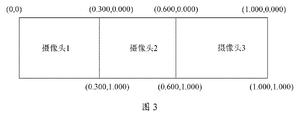
- Fig. 3 is a schematic diagram of stitching and displaying video images according to an exemplary embodiment
- Fig. 4 is a frame diagram of a data transmission method according to an exemplary embodiment
- Fig. 5 is a flow chart showing a method for data transmission according to another exemplary embodiment
- Fig. 6 is a schematic diagram of a header of an RTP data packet according to an exemplary embodiment
- Fig. 7 is a schematic diagram of a header of an RTP data packet according to another exemplary embodiment
- Fig. 8 is a schematic structural diagram of a data transmission device according to an exemplary embodiment
- Fig. 9 is a schematic structural diagram of a data transmission device according to another exemplary embodiment.
- a multi-angle video image such as a panoramic image
- a multi-camera integrated camera device for multi-angle shooting
- multiple video images obtained by the multiple cameras at the same time point can be captured
- Perform stitching processing to obtain multi-angle video images corresponding to each time point, and then display the stitched video images, for example, send them to the terminal for display.
- the video image is generally spliced by the camera device to obtain the spliced video image, and then encoded and transmitted to the terminal for display.
- the camera device cuts and splices the stitched video image, and then synthesizes a composite stream for transmission to the terminal.
- the parameters of the multiple video images used in the stitching process are consistent, for example, the parameter includes information such as resolution and frame rate, and thus, the stitching process of the video image is limited.
- the camera device may also establish multiple data transmission channels with the terminal to send video images captured by multiple cameras to the terminal through the multiple data transmission channels.
- the video streams transmitted by multiple data transmission channels are managed synchronously, and multiple video images obtained after synchronization can be spliced according to a certain strategy to obtain spliced video images corresponding to each time point.
- the terminal is added Management burden.
- the data loss of a certain data transmission channel occurs during video image transmission, it may cause terminal synchronization errors.
- the embodiments of the present application provide a data transmission method, which can solve the above-mentioned problems.
- a data transmission method which can solve the above-mentioned problems.
- FIG. 1 is a schematic diagram of an implementation environment according to an exemplary embodiment.
- the implementation environment includes a camera device 110 and a terminal 120, and a connection may be established between the camera device 110 and the terminal 120 through a wired network or a wireless network.
- the camera device 110 may be used to implement the data transmission method provided by the embodiments of the present application.
- the camera device 110 is configured with a plurality of cameras, and can shoot different shooting angles of a scene through the plurality of cameras.
- the camera device 110 is a camera device integrating multiple cameras.
- the terminal 120 can be used to display video images. Further, the terminal 120 can also be used to store video images sent by the camera device 110, for example, the video images can be stored in a file format. In some embodiments, the terminal 120 may be a mobile phone, a tablet computer, a desktop computer, a notebook computer, a portable computer, etc., which is not limited in the embodiments of the present application.
- the data transmission method provided by the embodiments of the present application will be described in detail with reference to the accompanying drawings.
- the target splicing parameters used for video image splicing processing can be transmitted to the terminal in different ways.
- the following embodiments shown in FIG. 2 and FIG. 5 The data transmission method is introduced in detail.
- Fig. 2 is a flowchart of a data transmission method according to an exemplary embodiment.
- the data transmission method may be applied to the implementation environment shown in Fig. 1 above.
- the data transmission method may include the following implementation steps:
- Step 201 Receive a data request from the terminal.
- the camera device can shoot different shooting angles through the configured multiple cameras to obtain video images at different angles. Moreover, in the implementation, the multiple cameras simultaneously perform shooting operations, that is, the multiple cameras shoot different shooting angles at the same time point to obtain multiple video images corresponding to each time point. Further, the camera device may store video images captured by the multiple cameras at each time point, and store a shooting time stamp corresponding to each video image.
- the terminal may send a data request to the camera device, and the data request is used to instruct the camera device to send the video image to the terminal.
- the terminal may send the data request to the camera device after receiving the data request instruction.
- the data request instruction can be triggered by a user, and the user can be triggered by a preset operation.
- the preset operation may include a click operation, a slide operation, a shake operation, etc., which is not limited in the embodiment of the present application.
- the terminal may provide a video display interface, and the video display interface may provide a data request option and an address input box.
- the user can enter the address information of the camera device where the video is to be obtained in the address input box, for example, the address information may be URL (Uniform Resource Locator) information of the camera device.
- the address information may be URL (Uniform Resource Locator) information of the camera device.
- the user can click the data request option to trigger the data request instruction.
- the data request instruction carries the address information.
- the terminal After receiving the data request instruction, the terminal sends a data request to the corresponding camera device based on the address information.
- Step 202 Request a target splicing parameter based on the data, and the target splicing parameter is used for splicing video images captured by the multiple cameras at the same time point.
- the camera device After receiving the data request, the camera device obtains the target splicing parameters.
- the target stitching parameters include but are not limited to the number of images to be stitched, video image track information, position information of each video image, internal parameters and external parameters of the camera device. When the number and shooting orientation of the multiple cameras are unchanged, the target splicing parameters will not change.
- the number of images to be spliced is used to indicate how many video images to be spliced at each same time point.
- the number of images to be stitched can be understood as the number of multiple cameras configured by the camera device.
- the above-mentioned video image track information includes track information corresponding to each video image in a data packet of multiple video images corresponding to each same time point, that is, based on the video image track information, each video image can be determined from the data packet.
- the video images captured by a camera, wherein the data packet can be used to transmit at least multiple video images corresponding to each same time point.
- the splicing order between multiple video images corresponding to each same time point can be determined based on the location information of each video image, that is, in multiple video images corresponding to each same time point, each The position information of the video image can be used to indicate its splicing position in the multiple video images.
- the position information of each video image may include the upper left vertex pixel coordinates and the lower right vertex pixel coordinates of each video image.
- the pixel coordinate of the upper left vertex of a video image A is (0,0), and the pixel coordinate of the lower right vertex is (0.300,1.000), and the video images taken at the same time as the video image also include video image B and video Image C
- the pixel coordinate of the upper left vertex of the video image B is (0.300,0.000)
- the pixel coordinate of the lower right vertex is (0.600, 1.000)
- the pixel coordinate of the upper left vertex of the video image C is (0.600,0.000)
- the pixel coordinates are (1.000, 1.000).
- the stitching position of the video image A is before the video image B
- the stitching position of the video image B is before the video image C.
- the stitching sequence is shown in FIG. 3.
- the 3D pixel coordinates can be converted into 2D pixel coordinates before the stitching processing.
- the perspective transformation formula may be used to transform the 3D pixel coordinates into 2D pixel coordinates based on the internal and external parameters of the camera device, for example, so that the converted 2D pixel coordinates may include vertex pixel coordinates.
- the internal reference of the above-mentioned imaging device refers to description information of multiple cameras of the imaging device, for example, the description information includes focal length and the like.
- the external parameter of the camera device refers to the orientation information of multiple cameras, that is, it can be used to indicate the shooting orientation of each camera in the multiple cameras.
- Step 203 Establish a session connection with the terminal, and in the process of establishing a session connection with the terminal, send the target splicing parameter to the terminal by establishing a session connection protocol of the session connection.
- the target splicing parameters and the video images captured by the multiple cameras may be sent to the terminal through a session connection with the terminal, to The terminal performs stitching processing on the video image based on the target stitching parameters.
- the target splicing parameter can be sent to the terminal by establishing the session connection protocol of the session connection, that is, before sending the video image to the terminal, Send the target splicing parameter to the terminal.
- a specific implementation of sending the target splicing parameter to the terminal through a session connection protocol for establishing the session connection may include: when the session When the connection protocol includes SDP (Session Description Protocol), during the establishment of the session connection with the terminal, the media description attribute is defined in the SDP, and the target splicing parameter is added to the media description in the SDP The text line corresponding to the attribute.
- SDP Session Description Protocol
- the session connection protocol is RTSP (Real Time Time Streaming Protocol)
- the RTSP protocol includes SDP.
- the target splicing parameter can be carried through the SDP, so that during the session establishment process, the The target splicing parameter is sent to the terminal.
- the description of the media description attribute a defined in SDP is as follows:
- the target stitching parameter can be added to the text line corresponding to the media description attribute a in the SDP.
- the text line also includes multiple correspondingly.
- the description of the multiple text lines can be as follows:
- the minimum value of the ⁇ flag> may be 0. At this time, it indicates that there is one video image corresponding to the same time point, that is, the image data to be spliced is 1, not 0.
- the attribute value corresponding to the media description attribute may be set according to a preset calculation strategy and floating-point precision.
- a intrinsic camera parameters: ⁇ fx0, fy0, Cx0, Cy0, K10, K20, P10, P20> are used to identify the internal parameters of the camera equipment.
- a extrinsic camera parameters: ⁇ RotateMatrix0 Tx0 T90 Tz0> is used to identify the external parameters of the camera device.
- the actual value needs to be determined based on the above-mentioned preset calculation strategy and floating-point precision.
- the target splicing parameters carried by the SDP can be expressed as follows:
- a camera_id:0 0x12345678//0and 0x12345678 is a pair
- a intrinsic camera parameters: 123, 5, 124, 6, 127, 8, 129, 9, 0, 10, 0, 11, 0, 12, 0, 13
- a camera_id:1 0x2233445566//1and 0x2233445566is a pair
- a intrinsic camera parameters: 123, 5, 124, 6, 127, 8, 129, 9, 0, 10, 0, 11, 0, 12, 0, 13
- a camera_id: 2 0x3344556677//2and 0x3344556677 is a pair
- a intrinsic camera parameters: 123, 5, 124, 6, 127, 8, 129, 9, 0, 10, 0, 11, 0, 12, 0, 13
- the terminal extracts the target splicing parameter from the above SDP, and thereafter, can store the target splicing parameter.
- the session connection protocol may also be UDP (User Datagram Protocol) or TCP. (Transmission Control Protocol) and other protocols, which are not limited in the embodiments of the present application.
- UDP User Datagram Protocol
- TCP Transmission Control Protocol
- Step 204 Based on the preset data transmission protocol, through the session connection established with the terminal, send the video images captured by the multiple cameras to the terminal.
- the preset data transmission protocol can be set in advance according to actual needs.
- the preset data transmission protocol may be an RTP protocol, etc., which is not limited in the embodiments of the present application.
- the camera device After the camera device sends the target splicing parameters to the terminal, it sends a video image to the terminal through the session connection established with the terminal.
- the camera device synchronizes the video images captured by the multiple cameras at the same time point, and based on the preset data transmission protocol, through the session connection established with the terminal, the synchronized multiple pictures The video image is sent to the terminal.
- the synchronization processing of the video image by the camera device described herein can be understood as a virtual source defined in the camera device, the virtual source can store multiple data streams, and the multiple data streams are the multiple cameras
- the virtual source can manage the data stream of video images generated by the multiple cameras, for example, synchronizing the video images captured by multiple cameras at the same time point.
- the parameters related to the multiple cameras can be independently set, for example, different resolutions, different frame rates, and different encoding methods can be set.
- the specific implementation of sending the synchronized video image to the terminal through the session connection established with the terminal may include: The synchronously processed video image is added to the RTP data packet payload (also called payload), and the added RTP data packet is sent to the terminal through the session connection established with the terminal.
- RTP data packet payload also called payload
- Video playback includes real-time streaming playback and file playback.
- the terminal may perform stitching processing on the video image based on the stored target stitching parameter and display the stitched image after stitching when the video needs to be played in real time.
- the video image may be stored locally for later playback.
- different file formats may be used to store the video image, for example, Use ISO (International Organization for Standardization) Base Format or MPEG-PS (Moving Pictures Experts Group-Program Stream) and MPEG-TS (Moving Picture Experts Group-Transport Stream, Moving Picture Experts Group-Transport Stream) format for storage.
- the file format of the stored video image different storage methods may be used to reasonably store the target splicing parameters.
- the file header of the file used to store video images can be extended, or a track can be added separately to store the target splicing parameters.
- a preset ID (Identification) can be used to store the target splicing parameters.
- the preset ID is used to indicate the target splicing parameters. Further, the preset ID can be based on actual needs Set in advance.
- the terminal when the video image needs to be played back, the terminal performs stitching processing on the video image based on the stored target stitching parameters, and then displays the video image obtained by the stitching processing.
- a data request from a terminal is received, and a target stitching parameter is obtained based on the data request, and the target stitching parameter is used for stitching video images captured by multiple cameras at the same time point.
- the target stitching parameters and the video images captured by multiple cameras are sent to the terminal, so that the terminal performs stitching processing on multiple video images corresponding to each same time point based on the target stitching parameters.
- it avoids the need for the camera device to perform the stitching process, and solves the problems that the hardware requirements of the camera device are relatively high, and some hardware cannot even support the high-resolution video image stitching process.
- the multiple camera devices can set different parameters, which solves the problem of limited video image splicing processing in the related art.
- the camera device before sending the video images captured by multiple cameras to the terminal, the camera device first synchronizes the obtained multiple video images, and sends the synchronized video images to the terminal through the session connection established with the terminal
- the terminal that is, the embodiment of the present application transmits multiple video images through one session connection.
- the terminal can directly perform splicing on the received synchronized video image based on the target splicing parameter, avoiding the need to establish multiple data transmission channels during the transmission process, and eliminating the need for the terminal to transmit video images on multiple data transmission channels Perform synchronization processing, so as to avoid the problem of synchronization disorder caused by the loss of transmission data of a certain data transmission channel, and thereby ensure the accuracy of video stitching.
- Fig. 5 is a flowchart illustrating a data transmission method according to another exemplary embodiment. This embodiment is illustrated by applying the data transmission method to the implementation environment shown in Fig. 1.
- the data transmission method may include the following Implementation steps:
- Step 501 Receive a data request from the terminal.
- step 201 in the embodiment shown in FIG. 2 above.
- Step 502 Obtain a target stitching parameter based on the data, and the target stitching parameter is used for stitching video images captured by the multiple cameras at the same time point.
- step 202 refers to step 202 in the embodiment shown in FIG. 2 above.
- Step 503 Establish a session connection with the terminal.
- the camera device may establish a session connection with the terminal based on the session connection protocol.
- the session connection protocol may be the RTSP protocol, or may also be the TCP or UDP protocol, which is not limited in the embodiments of the present application.
- Step 504 Based on the preset data transmission protocol, through the session connection established with the terminal, send the target splicing parameter and the video images captured by the multiple cameras to the terminal.
- the target splicing parameters and the video images captured by the multiple cameras may be sent to the terminal through a session connection with the terminal, to The terminal performs stitching processing on the video image based on the target stitching parameters.
- the target splicing parameter may be carried in the data packet transmitting the video image, and the target splicing parameter and the video image are sent to the terminal together through the established session connection with the terminal.
- the target splicing parameter is added to the target field of the header of the RTP data packet, and the video images captured by the multiple cameras are added to the RTP In the payload of the data packet, the RTP data packet after the addition process is sent to the terminal through the session connection established with the terminal.
- the camera device may add the target splicing parameter in the target field of the header of the first RTP data packet sent to the terminal.
- the target splicing parameter since the target splicing parameter generally does not change, the target splicing parameter may be carried only in the header of the first RTP data packet sent to the terminal. Further, when the camera device detects that the target splicing parameter has changed, it may re-carry the changed target splicing parameter through the header of the RTP data packet.
- the video images captured by the multiple cameras at the same time point can be synchronized, and then, The synchronized video image is added to the payload of the RTP packet.
- the target splicing parameter is added to the padding field of the header of the RTP data packet. Further, a field in the header of the RTP data packet used to indicate whether the padding field is empty is set to a first value, and the first value is used for the padding field to be not empty.
- the padding field is a padding field, which is used to indicate whether the padding field is empty or not.
- the first value is "1", that is, when the P field is 1, it means
- the padding field of the header of the RTP data packet has a padding part, where the last byte of the padding part represents the length of the part, and of course, the length includes the byte itself.
- the target splicing parameter is added to the extension field of the header of the RTP data packet. Further, a field in the header of the RTP data packet used to indicate whether the extended field is empty is set to a second value, and the second value is used to indicate that the extended field is not empty.
- the second numerical value may be the same as the first numerical value.
- the second numerical value may also be "1".
- the second numerical value may also be different from the first numerical value.
- the extension field is an extension field, which is used to indicate whether the extension field is empty.
- the field is the x field, and the second value is "1", that is, when the x field is 1, it means
- the header of the RTP data packet includes an extension field.
- CC indicates the number of CSRC fields.
- M (marker bit): When the M field is set to 1, it indicates that the current RTP data packet is the last data packet of the transmitted unit.
- PT pra9load t9pe
- SN (sequence) number 16 bits, used to identify the order in which RTP data packets are sent, that is, the order that the receiving end sends to the decoder after receiving it.
- Timestamp used to identify the collection time of the content contained in the RTP data packet.
- Video playback includes real-time streaming playback and file playback.
- the terminal After receiving the RTP data packet, the terminal obtains the target splicing parameters and the synchronously processed video image.
- the video image can be spliced based on the carried target splicing parameters, and The stitched image after stitching is displayed.
- the video image may be stored locally for later playback.
- the target splicing parameters and the video image may be stored.
- video files are stored in different file formats, for example, ISO Base Format or MPEG-PS and MPEG-TS formats can be used for storage.
- the file format of the stored video image different storage methods may be used to reasonably store the target splicing parameters.
- the file header of the file used to store video images can be extended, or a track can be added separately to store the target splicing parameters.
- a preset ID may be used to store the target splicing parameter, and the preset ID is used to indicate the target splicing parameter. Further, the preset ID may be set in advance according to actual needs.
- the terminal when the video image needs to be played back, the terminal performs stitching processing on the video image based on the stored target stitching parameters, and then displays the video image obtained by the stitching processing.
- a data request from a terminal is received, and a target stitching parameter is obtained based on the data request, and the target stitching parameter is used for stitching video images captured by multiple cameras at the same time point.
- the target stitching parameters and the video images captured by multiple cameras are sent to the terminal, so that the terminal performs stitching processing on multiple video images corresponding to each same time point based on the target stitching parameters.
- it avoids the need for the camera device to perform the stitching process, and solves the problems of high hardware requirements for the camera device, and some hardware cannot even support the high-resolution video image stitching process.
- the multiple camera devices can set different parameters, which solves the problem of limited video image splicing processing in the related art.
- the camera device before sending the video images captured by multiple cameras to the terminal, the camera device first synchronizes the obtained multiple video images, and sends the synchronized video images to the terminal through the session connection established with the terminal
- the terminal that is, the embodiment of the present application transmits multiple video images through one session connection.
- the terminal can directly perform splicing on the received synchronized video image based on the target splicing parameter, avoiding the need to establish multiple data transmission channels during the transmission process, and eliminating the need for the terminal to transmit video images on multiple data transmission channels Perform synchronization processing, so as to avoid the problem of synchronization disorder caused by the loss of transmission data of a certain data transmission channel, and thereby ensure the accuracy of video stitching.
- Fig. 8 is a schematic structural diagram of a data transmission device according to an exemplary embodiment.
- the data transmission device may be implemented by software, hardware, or a combination of both.
- the data transmission device may include:
- the receiving module 810 is used to receive data requests from the terminal;
- the obtaining module 820 is used to obtain a target splicing parameter based on the data request, and the target splicing parameter is used for splicing video images captured by the multiple cameras at the same time point;
- the sending module 830 is configured to send the target splicing parameters and video images captured by the multiple cameras to the terminal through a session connection with the terminal.
- the sending module 830 is used to:
- Establishing a session connection with the terminal in establishing a session connection with the terminal, by establishing a session connection protocol of the session connection, sending the target splicing parameter to the terminal, and based on A preset data transmission protocol is used to send video images captured by the multiple cameras to the terminal through a session connection established with the terminal.
- the sending module 830 is used to:
- the session connection protocol includes the session description protocol SDP
- a media description attribute is defined in the SDP
- the sending module 830 is used to:
- the synchronously processed video image is sent to the terminal through the session connection established with the terminal.
- the sending module 830 is also used to:
- the sending module 830 is used to:
- the preset data transmission protocol is the RTP protocol
- the RTP data packet after the addition process is sent to the terminal through the session connection established with the terminal.
- the sending module 830 is used to:
- the sending module 830 is used to:
- the field in the header of the RTP data packet used to indicate whether the padding field is empty is set to a first value, and the first value is used to indicate that the padding field is not empty.
- the sending module 830 is used to:
- the field in the header of the RTP data packet used to indicate whether the extended field is empty is set to a second value, and the second value is used to indicate that the extended field is not empty.
- a data request from a terminal is received, and a target stitching parameter is obtained based on the data request, and the target stitching parameter is used for stitching video images captured by multiple cameras at the same time point.
- the target stitching parameters and the video images captured by multiple cameras are sent to the terminal, so that the terminal performs stitching processing on multiple video images corresponding to each same time point based on the target stitching parameters.
- it avoids the need for the camera device to perform the stitching process, and solves the problems that the hardware requirements of the camera device are relatively high, and some hardware cannot even support the high-resolution video image stitching process.
- the data transmission device provided in the above embodiments is only exemplified by the division of the above functional modules.
- the above functions can be allocated by different functional modules as needed That is, the internal structure of the device is divided into different functional modules to complete all or part of the functions described above.
- the data transmission device and the data transmission method embodiment provided in the above embodiments belong to the same concept. For the specific implementation process, refer to the method embodiments, and details are not described here.
- Fig. 9 is a schematic structural diagram of an imaging device according to an exemplary embodiment. Specifically:
- the imaging apparatus 900 includes a central processing unit (CPU) 901, a system memory 904 including a random access memory (RAM) 902 and a read-only memory (ROM) 903, and a system bus 905 connecting the system memory 904 and the central processing unit 901.
- the camera device 900 also includes a basic input/output system (I/O system) 906 that helps transfer information between various devices in the computer, and a mass storage device for storing the operating system 913, application programs 914, and other program modules 915 907.
- I/O system basic input/output system
- the basic input/output system 906 includes a display 908 for displaying information and an input device 909 for a user to input information, such as a mouse and a keyboard.
- the display 908 and the input device 909 are both connected to the central processing unit 901 through the input and output controller 910 connected to the system bus 905.
- the basic input/output system 906 may also include an input-output controller 910 for receiving and processing input from a number of other devices such as a keyboard, mouse, or electronic stylus.
- the input output controller 910 also provides output to a display screen, printer, or other type of output device.
- the mass storage device 907 is connected to the central processing unit 901 through a mass storage controller (not shown) connected to the system bus 905.
- the mass storage device 907 and its associated computer-readable medium provide non-volatile storage for the camera device 900. That is, the mass storage device 907 may include a computer-readable medium (not shown) such as a hard disk or CD-ROM drive.
- Computer-readable media may include computer storage media and communication media.
- Computer storage media includes volatile and nonvolatile, removable and non-removable media implemented in any method or technology for storage of information such as computer readable instructions, data structures, program modules or other data.
- Computer storage media include RAM, ROM, EPROM, EEPROM, flash memory, or other solid-state storage technologies, CD-ROM, DVD, or other optical storage, tape cassettes, magnetic tape, magnetic disk storage, or other magnetic storage devices.
- RAM random access memory
- ROM read-only memory
- EPROM Erasable programmable read-only memory
- EEPROM electrically erasable programmable read-only memory
- flash memory or other solid-state storage technologies
- CD-ROM, DVD or other optical storage
- tape cassettes magnetic tape
- magnetic disk storage or other magnetic storage devices.
- computer storage medium is not limited to the above types.
- the above-mentioned system memory 904 and mass storage device 907 may be collectively referred to as a memory.
- the camera device 900 may also be operated by a remote computer connected to the network through a network such as the Internet. That is, the camera device 900 can be connected to the network 912 through the network interface unit 911 connected to the system bus 905, or the network interface unit 911 can also be used to connect to other types of networks or remote computer systems (not shown).
- the above memory also includes one or more programs.
- One or more programs are stored in the memory and configured to be executed by the CPU.
- the one or more programs include a method for performing the data transmission provided by the embodiments of the present application.
- An embodiment of the present application further provides a non-transitory computer-readable storage medium, and when the instructions in the storage medium are executed by the processor of the imaging device, the imaging device can perform the data transmission method provided in the foregoing embodiment.
- An embodiment of the present application also provides a computer program product containing instructions, which when executed on a camera device, causes the camera device to execute the data transmission method provided by the above embodiment.
- the program may be stored in a computer-readable storage medium.
- the mentioned storage medium may be a read-only memory, a magnetic disk or an optical disk.
Landscapes
- Engineering & Computer Science (AREA)
- Multimedia (AREA)
- Signal Processing (AREA)
- Computer Networks & Wireless Communication (AREA)
- Physics & Mathematics (AREA)
- General Physics & Mathematics (AREA)
- Theoretical Computer Science (AREA)
- Business, Economics & Management (AREA)
- General Business, Economics & Management (AREA)
- Studio Devices (AREA)
- Two-Way Televisions, Distribution Of Moving Picture Or The Like (AREA)
Abstract
Description


Claims (20)
- 一种数据传输方法,其特征在于,应用于摄像设备中,所述摄像设备配置有多个摄像头,所述多个摄像头分别用于对不同拍摄角度进行拍摄,所述方法包括:接收来自终端的数据请求;基于所述数据请求获取目标拼接参数,所述目标拼接参数用于所述多个摄像头在相同时间点拍摄得到的视频图像的拼接;通过与所述终端之间的会话连接,将所述目标拼接参数和所述多个摄像头拍摄得到的视频图像发送至所述终端。
- 如权利要求1所述的方法,其特征在于,所述通过与所述终端之间的会话连接,将所述目标拼接参数和所述多个摄像头拍摄得到的视频图像发送至所述终端,包括:建立与所述终端之间的会话连接,在建立与所述终端之间的会话连接过程中,通过建立所述会话连接的会话连接协议,将所述目标拼接参数发送至所述终端,以及基于预设数据传输协议,通过与所述终端之间建立的会话连接,将所述多个摄像头拍摄得到的视频图像发送至所述终端。
- 如权利要求2所述的方法,其特征在于,所述在建立与所述终端之间的会话连接过程中,通过建立所述会话连接的会话连接协议将所述目标拼接参数发送至所述终端,包括:当所述会话连接协议包括会话描述协议SDP时,在建立与所述终端之间的会话连接过程中,在所述SDP中定义媒体描述属性;将所述目标拼接参数添加至所述SDP中所述媒体描述属性对应的文本行。
- 如权利要求2或3所述的方法,其特征在于,所述基于预设数据传输协议,通过与所述终端之间建立的会话连接,将所述多个摄像头拍摄得到的视频图像发送至所述终端,包括:将所述多个摄像头在相同时间点拍摄得到的视频图像进行同步处理;基于所述预设数据传输协议,通过与所述终端之间建立的会话连接将同步 处理后的视频图像发送至所述终端。
- 如权利要求1所述的方法,其特征在于,所述通过与所述终端之间的会话连接,将所述目标拼接参数和所述多个摄像头拍摄得到的视频图像发送至所述终端,包括:建立与所述终端之间的会话连接,基于所述预设数据传输协议,通过与所述终端之间建立的会话连接,将所述目标拼接参数和所述多个摄像头拍摄得到的视频图像发送至所述终端。
- 如权利要求5所述的方法,其特征在于,所述基于所述预设数据传输协议,通过与所述终端之间建立的会话连接,将所述目标拼接参数和所述多个摄像头拍摄得到的视频图像发送至所述终端,包括:当所述预设数据传输协议为RTP协议时,将所述目标拼接参数添加至RTP数据包的包头的目标字段中,以及将所述多个摄像头拍摄得到的视频图像添加至所述RTP数据包的负载中;通过与所述终端之间建立的会话连接,将经过添加处理后的RTP数据包发送至所述终端。
- 如权利要求6所述的方法,其特征在于,所述将所述目标拼接参数添加至RTP数据包的包头的目标字段中,包括:将所述目标拼接参数添加至所述RTP数据包的包头的填充字段中;或者,将所述目标拼接参数添加至所述RTP数据包的包头的扩展字段中。
- 如权利要求7所述的方法,其特征在于,所述将所述目标拼接参数添加至所述RTP数据包的包头的填充字段中之后,还包括:将所述RTP数据包的包头中用于指示所述填充字段是否为空的字段置为第一数值,所述第一数值用于指示所述填充字段不为空。
- 如权利要求7所述的方法,其特征在于,所述将所述目标拼接参数添加 至所述RTP数据包的包头的扩展字段中之后,还包括:将所述RTP数据包的包头中用于指示所述扩展字段是否为空的字段置为第二数值,所述第二数值用于指示所述扩展字段不为空。
- 一种数据传输装置,其特征在于,配置于摄像设备中,所述摄像设备配置有多个摄像头,用于对不同拍摄角度进行拍摄,所述装置包括:接收模块,用于接收来自终端的数据请求;获取模块,用于基于所述数据请求获取目标拼接参数,所述目标拼接参数用于所述多个摄像头在相同时间点拍摄得到的视频图像的拼接;发送模块,用于通过与所述终端之间的会话连接,将所述目标拼接参数和所述多个摄像头拍摄得到的视频图像发送至所述终端。
- 如权利要求10所述的装置,其特征在于,所述发送模块用于:建立与所述终端之间的会话连接,在建立与所述终端之间的会话连接过程中,通过建立所述会话连接的会话连接协议,将所述目标拼接参数发送至所述终端,以及基于预设数据传输协议,通过与所述终端之间建立的会话连接,将所述多个摄像头拍摄得到的视频图像发送至所述终端。
- 如权利要求11所述的装置,其特征在于,所述发送模块用于:当所述会话连接协议包括会话描述协议SDP时,在建立与所述终端之间的会话连接过程中,在所述SDP中定义媒体描述属性;将所述目标拼接参数添加至所述SDP中所述媒体描述属性对应的文本行。
- 如权利要求11或12所述的装置,其特征在于,所述发送模块用于:将所述多个摄像头在相同时间点拍摄得到的视频图像进行同步处理;基于所述预设数据传输协议,通过与所述终端之间建立的会话连接将同步处理后的视频图像发送至所述终端。
- 如权利要求10所述的装置,其特征在于,所述发送模块还用于:建立与所述终端之间的会话连接,基于所述预设数据传输协议,通过与所 述终端之间建立的会话连接,将所述目标拼接参数和所述多个摄像头拍摄得到的视频图像发送至所述终端。
- 如权利要求14所述的装置,其特征在于,所述发送模块用于:当所述预设数据传输协议为RTP协议时,将所述目标拼接参数添加至RTP数据包的包头的目标字段中,以及将所述多个摄像头拍摄得到的视频图像添加至所述RTP数据包的负载中;通过与所述终端之间建立的会话连接,将经过添加处理后的RTP数据包发送至所述终端。
- 如权利要求15所述的装置,其特征在于,所述发送模块用于:将所述目标拼接参数添加至所述RTP数据包的包头的填充字段中;或者,将所述目标拼接参数添加至所述RTP数据包的包头的扩展字段中。
- 如权利要求16所述的装置,其特征在于,所述发送模块用于:将所述RTP数据包的包头中用于指示所述填充字段是否为空的字段置为第一数值,所述第一数值用于指示所述填充字段不为空。
- 如权利要求16所述的装置,其特征在于,所述发送模块用于:将所述RTP数据包的包头中用于指示所述扩展字段是否为空的字段置为第二数值,所述第二数值用于指示所述扩展字段不为空。
- 一种设备,其特征在于,所述设备包括处理器、通信接口、存储器和通信总线,所述处理器、所述通信接口和所述存储器通过所述通信总线完成相互间的通信,所述存储器用于存放计算机程序,所述处理器用于执行所述存储器上所存放的程序,以实现权利要求1-9任一所述方法的步骤。
- 一种计算机可读存储介质,其特征在于,所述计算机可读存储介质上存储有指令,所述指令被处理器执行时实现权利要求1-9中任一项所述的数据传 输方法。
Applications Claiming Priority (2)
| Application Number | Priority Date | Filing Date | Title |
|---|---|---|---|
| CN201811547562.2 | 2018-12-18 | ||
| CN201811547562.2A CN111343415A (zh) | 2018-12-18 | 2018-12-18 | 数据传输方法及装置 |
Publications (1)
| Publication Number | Publication Date |
|---|---|
| WO2020125604A1 true WO2020125604A1 (zh) | 2020-06-25 |
Family
ID=71102042
Family Applications (1)
| Application Number | Title | Priority Date | Filing Date |
|---|---|---|---|
| PCT/CN2019/125848 Ceased WO2020125604A1 (zh) | 2018-12-18 | 2019-12-17 | 数据传输方法、装置、设备及存储介质 |
Country Status (2)
| Country | Link |
|---|---|
| CN (1) | CN111343415A (zh) |
| WO (1) | WO2020125604A1 (zh) |
Cited By (3)
| Publication number | Priority date | Publication date | Assignee | Title |
|---|---|---|---|---|
| CN113489791A (zh) * | 2021-07-07 | 2021-10-08 | 佳都科技集团股份有限公司 | 图像上传方法、图像处理方法及相关装置 |
| EP4250691A1 (en) * | 2022-03-25 | 2023-09-27 | Beijing Xiaomi Mobile Software Co., Ltd. | Image processing method and apparatus, device and storage medium |
| CN116886856A (zh) * | 2023-09-08 | 2023-10-13 | 湖北华中电力科技开发有限责任公司 | 基于视频通讯的电力应急会商方法及系统 |
Families Citing this family (4)
| Publication number | Priority date | Publication date | Assignee | Title |
|---|---|---|---|---|
| CN112351251A (zh) * | 2020-10-21 | 2021-02-09 | 深圳迈瑞生物医疗电子股份有限公司 | 图像处理系统和终端设备 |
| CN112929694B (zh) * | 2021-01-22 | 2024-01-19 | 广州方硅信息技术有限公司 | 视频拼接方法、装置、存储介质、计算机设备 |
| CN117201955B (zh) * | 2022-05-30 | 2024-09-13 | 荣耀终端有限公司 | 视频拍摄方法、装置、设备和存储介质 |
| CN115484320B (zh) * | 2022-10-27 | 2024-10-15 | 陕西思极科技有限公司 | 应用于智能识别终端群的数据传输方法及监控设备 |
Citations (5)
| Publication number | Priority date | Publication date | Assignee | Title |
|---|---|---|---|---|
| US20090182836A1 (en) * | 2008-01-16 | 2009-07-16 | Aviles Joaquin J | System and method for populating a cache using behavioral adaptive policies |
| CN101562706A (zh) * | 2009-05-22 | 2009-10-21 | 杭州华三通信技术有限公司 | 一种图像拼接方法和设备 |
| CN102457768A (zh) * | 2010-10-21 | 2012-05-16 | 华为技术有限公司 | 广告拼接处理方法和系统以及拼接器和头端设备 |
| CN105847851A (zh) * | 2016-04-19 | 2016-08-10 | 北京金山安全软件有限公司 | 全景视频直播方法、装置和系统以及视频源控制设备 |
| CN107529017A (zh) * | 2017-10-12 | 2017-12-29 | 长沙全度影像科技有限公司 | 一种全景相机的多拼接模式的系统及方法 |
Family Cites Families (7)
| Publication number | Priority date | Publication date | Assignee | Title |
|---|---|---|---|---|
| WO2011149558A2 (en) * | 2010-05-28 | 2011-12-01 | Abelow Daniel H | Reality alternate |
| CN102244680A (zh) * | 2011-07-04 | 2011-11-16 | 东华大学 | 一种基于体域传感阵列的全景视频码流生成方法 |
| CN103096018B (zh) * | 2011-11-08 | 2016-11-23 | 华为技术有限公司 | 传输信息的方法和终端 |
| CN104301677B (zh) * | 2014-10-16 | 2018-06-15 | 北京十方慧通科技有限公司 | 面向大场景的全景视频监控的方法及装置 |
| CN107872422B (zh) * | 2016-09-23 | 2020-01-10 | 杭州海康威视数字技术股份有限公司 | 一种数据传输方法、装置及电子设备 |
| CN108600616A (zh) * | 2018-04-04 | 2018-09-28 | 深圳市极酷威视科技有限公司 | 一种基于rtp帧同步的视频防抖系统和视频获取器材 |
| CN108616722B (zh) * | 2018-04-18 | 2021-02-26 | 中南大学 | 一种嵌入式高清视频采集与数据流传输系统 |
-
2018
- 2018-12-18 CN CN201811547562.2A patent/CN111343415A/zh active Pending
-
2019
- 2019-12-17 WO PCT/CN2019/125848 patent/WO2020125604A1/zh not_active Ceased
Patent Citations (5)
| Publication number | Priority date | Publication date | Assignee | Title |
|---|---|---|---|---|
| US20090182836A1 (en) * | 2008-01-16 | 2009-07-16 | Aviles Joaquin J | System and method for populating a cache using behavioral adaptive policies |
| CN101562706A (zh) * | 2009-05-22 | 2009-10-21 | 杭州华三通信技术有限公司 | 一种图像拼接方法和设备 |
| CN102457768A (zh) * | 2010-10-21 | 2012-05-16 | 华为技术有限公司 | 广告拼接处理方法和系统以及拼接器和头端设备 |
| CN105847851A (zh) * | 2016-04-19 | 2016-08-10 | 北京金山安全软件有限公司 | 全景视频直播方法、装置和系统以及视频源控制设备 |
| CN107529017A (zh) * | 2017-10-12 | 2017-12-29 | 长沙全度影像科技有限公司 | 一种全景相机的多拼接模式的系统及方法 |
Cited By (6)
| Publication number | Priority date | Publication date | Assignee | Title |
|---|---|---|---|---|
| CN113489791A (zh) * | 2021-07-07 | 2021-10-08 | 佳都科技集团股份有限公司 | 图像上传方法、图像处理方法及相关装置 |
| CN113489791B (zh) * | 2021-07-07 | 2024-05-14 | 佳都科技集团股份有限公司 | 图像上传方法、图像处理方法及相关装置 |
| EP4250691A1 (en) * | 2022-03-25 | 2023-09-27 | Beijing Xiaomi Mobile Software Co., Ltd. | Image processing method and apparatus, device and storage medium |
| US12335358B2 (en) | 2022-03-25 | 2025-06-17 | Beijing Xiaomi Mobile Software Co., Ltd. | Image processing method and apparatus, device and storage medium |
| CN116886856A (zh) * | 2023-09-08 | 2023-10-13 | 湖北华中电力科技开发有限责任公司 | 基于视频通讯的电力应急会商方法及系统 |
| CN116886856B (zh) * | 2023-09-08 | 2023-12-15 | 湖北华中电力科技开发有限责任公司 | 基于视频通讯的电力应急会商方法及系统 |
Also Published As
| Publication number | Publication date |
|---|---|
| CN111343415A (zh) | 2020-06-26 |
Similar Documents
| Publication | Publication Date | Title |
|---|---|---|
| WO2020125604A1 (zh) | 数据传输方法、装置、设备及存储介质 | |
| US11388453B2 (en) | Method for processing live-streaming interaction video and server | |
| KR102375307B1 (ko) | 가상 현실 뷰포트를 공유하기 위한 방법, 장치, 및 시스템 | |
| CN113741837B (zh) | 信息处理方法、设备、系统及存储介质 | |
| CN102595239B (zh) | 一种终端系统的多屏互动方法、装置及智能电视机 | |
| US8803991B2 (en) | Snapshot capture in video stream | |
| WO2021147702A1 (zh) | 一种视频处理方法及其装置 | |
| CN104918105B (zh) | 媒体文件的多屏播放方法、设备及系统 | |
| TW201642942A (zh) | 針對輸出裝置及網路品質的雲遊戲資料流動態調整 | |
| US12321658B2 (en) | Method for displaying conference shared screen content, apparatus, and system | |
| CN106303651A (zh) | 显示系统及显示系统的显示方法 | |
| CN109756744B (zh) | 数据处理方法、电子设备及计算机存储介质 | |
| CN110737638A (zh) | 一种数据共享方法、装置、电子设备及存储介质 | |
| US10666351B2 (en) | Methods and systems for live video broadcasting from a remote location based on an overlay of audio | |
| EP4202611A1 (en) | Rendering a virtual object in spatial alignment with a pose of an electronic device | |
| CN110944140A (zh) | 远程展示方法、远程展示系统、电子装置、存储介质 | |
| CN104038741A (zh) | 一种视频数据的投影方法 | |
| GB2567136A (en) | Moving between spatially limited video content and omnidirectional video content | |
| WO2016177257A1 (zh) | 一种数据分享的方法和装置 | |
| WO2017086355A1 (ja) | 送信装置、送信方法、受信装置、受信方法および送受信システム | |
| RU2648982C2 (ru) | Система беспроводной стыковки для аудио-видео | |
| CN116193182A (zh) | Ar内容的投屏方法、系统、电子设备和存储介质 | |
| CN103701686B (zh) | 一种远程图像实时共享方法 | |
| CN110536143A (zh) | 推流方法与电子设备 | |
| CN115861524A (zh) | 一种实现3d模型协作的视频会议系统及相关产品 |
Legal Events
| Date | Code | Title | Description |
|---|---|---|---|
| 121 | Ep: the epo has been informed by wipo that ep was designated in this application |
Ref document number: 19900850 Country of ref document: EP Kind code of ref document: A1 |
|
| NENP | Non-entry into the national phase |
Ref country code: DE |
|
| 122 | Ep: pct application non-entry in european phase |
Ref document number: 19900850 Country of ref document: EP Kind code of ref document: A1 |
|
| 32PN | Ep: public notification in the ep bulletin as address of the adressee cannot be established |
Free format text: NOTING OF LOSS OF RIGHTS PURSUANT TO RULE 112(1) EPC (EPO FORM 1205A DATED 10.08.2021) |
|
| 122 | Ep: pct application non-entry in european phase |
Ref document number: 19900850 Country of ref document: EP Kind code of ref document: A1 |