WO2020123853A1 - Production of carbon tetrachloride from natural gas - Google Patents
Production of carbon tetrachloride from natural gas Download PDFInfo
- Publication number
- WO2020123853A1 WO2020123853A1 PCT/US2019/066056 US2019066056W WO2020123853A1 WO 2020123853 A1 WO2020123853 A1 WO 2020123853A1 US 2019066056 W US2019066056 W US 2019066056W WO 2020123853 A1 WO2020123853 A1 WO 2020123853A1
- Authority
- WO
- WIPO (PCT)
- Prior art keywords
- reactor
- natural gas
- carbon tetrachloride
- diluent
- stream
- Prior art date
- Legal status (The legal status is an assumption and is not a legal conclusion. Google has not performed a legal analysis and makes no representation as to the accuracy of the status listed.)
- Ceased
Links
Classifications
-
- C—CHEMISTRY; METALLURGY
- C07—ORGANIC CHEMISTRY
- C07C—ACYCLIC OR CARBOCYCLIC COMPOUNDS
- C07C17/00—Preparation of halogenated hydrocarbons
- C07C17/093—Preparation of halogenated hydrocarbons by replacement by halogens
- C07C17/10—Preparation of halogenated hydrocarbons by replacement by halogens of hydrogen atoms
Definitions
- the present disclosure generally relates to a process for producing carbon tetrachloride from natural gas.
- Carbon tetrachloride (M4) is a commodity chemical used as a cleaning agent, a refrigerant, a fire suppressing agent, a solvent, and as a reactant in many chemical and pharmaceutical processes.
- processes for preparing carbon tetrachloride comprises forming a mixture comprising natural gas, a diluent, and a chlorinating agent in a reactor under process conditions detailed below. A product mixture comprising anhydrous HCI and carbon tetrachloride is generated.
- processes for the production of carbon tetrachloride comprising:
- Figure 1 depicts one embodiment of the processes described herein, using three columns to purify the crude product.
- Figure 2 depicts an alternate embodiment, using four columns to purify the crude product.
- Figure 3 depicts an alternate embodiment of the processes described herein, that uses three columns to purify the crude product.
- the process comprises forming a mixture comprising natural gas, a diluent, and a chlorinating agent in a reactor under conditions detailed below.
- a product mixture is generated comprising anhydrous HCI and carbon tetrachloride.
- the process commences by preparing a mixture comprising natural gas, a chlorinating agent, and a diluent in a reactor. (a) natural gas
- Non-limiting examples of these various forms of natural may be conventional natural gas,
- natural gas is a naturally occurring hydrocarbon gas mixture comprising primarily methane and commonly include varying amounts of higher alkanes. Other components in smaller percentages may be carbon dioxide, nitrogen, sulfur containing compounds such as hydrogen sulfide or methyl sulfide, helium, water, and oxygen.
- the natural gas comprises at least one sulfur containing compound, and at least some of the at least one sulfur containing compound is removed before the natural gas enters the reactor.
- the natural gas comprises methane, at least one higher alkane other than methane, and at least one sulfur containing compound, such as methane thiol.
- the natural gas comprises methane and at least one alkane other than methane.
- the natural gas comprises methane and at least two alkanes selected from the group consisting of ethane, propane, and butane (either n-butane or iso-butane).
- the natural gas comprises methane, ethane, and propane.
- the natural gas does not contain any halogenated methanes or halogenated C2-C5 hydrocarbons.
- halogenated methanes and halogenated C2-C5 hydrocarbons include chlorinated methanes and chlorinated C2-C5 hydrocarbons.
- Specific examples of chlorinated methanes include methyl chloride, methylene chloride, and chloroform, while specific examples of chlorinated C2-C5 hydrocarbons include, but are not limited to, perchloroethylene, hexachloroethane and trichloroethylene.
- the natural gas comprises at least 0.01 weight % ethane.
- the natural gas comprises ethane in at least 0.01 weight %, in at least 0.05 weight %, in at least 0.1 weight %, at least 1 weight %, or at least 2 weight %.
- the natural gas comprises at least 0.001 weight % propane.
- the natural gas comprises propane in at least 0.001 weight %, at least 0.005 weight %, at least 0.01 weight%, at least 0.05 weight %, at least 0.5 weight %, or at least 1.0 weight %.
- chlorinating agents may be utilized in the process.
- the chlorinating agent comprises chlorine gas and the natural gas is chlorinated in the gas phase.
- suitable chlorinating agents which can be used with chlorine gas may be sulfuryl chloride, thionyl chloride, oxalyl chloride, PCI 3 , PCI 5 , POCI 3, and combinations thereof.
- the chlorinating agent may further comprise an inert gas such as helium, nitrogen, or argon.
- the chlorinating agent comprises chlorine.
- the chlorinating agent is used in stoichiometric excess, relative to the natural gas. Generally, the chlorinating agent is used in at least 0.01 mole % excess relative to the natural gas. In various embodiments, the chlorinating agent is used in at least 0.1 mole % excess, at least 0.5 mole % excess, at least 1.0 mole % excess, at least 5.0 mole % excess, at least in 10.0 mole % excess, or greater than 10.0 mole % excess.
- diluents may be used in the process.
- the diluent is fed to the reactor in gas phase or liquid phase or both.
- the diluent comprises an inert gas.
- suitable diluents may be nitrogen gas, argon gas, helium gas, methyl chloride, methylene chloride, chloroform, carbon tetrachloride, perchloroethylene, or combinations thereof.
- the diluent comprises methyl chloride, methylene chloride, chloroform, carbon tetrachloride, chlorinated ethylene, perchloroethylene, or combinations thereof.
- the diluent comprises carbon tetrachloride and/or perchloroethylene.
- Carbon tetrachloride is a preferred diluent.
- at least some of the diluent is fed to the reactor as a liquid, which is then vaporized in the reactor.
- the diluent comprises carbon tetrachloride with up to 50 weight % perchloroethylene, up to 10 weight % chlorine, and up to 10 weight percent byproducts such as trichloroethylene
- the weight ratio of the diluent to the natural gas may range from 0.01 :1 to about 100: 1.
- the weight % of the diluent to the natural gas may range from 0.01 :1 to 100.0:1 , from about 0.1 :1 to about 90:1 , from about 1 : 1 to about 80:1 , from about 5:1 to about 75:1 , from about 10:1 to about 60:1 , from about 25: 1 to about 50: 1 , or from about 30: 1 to about 40: 1.
- the reactants may be introduced into the reactor in any sequential order.
- the order of introduction into the reactor may be the natural gas, followed by the diluent, and then the chlorinating agent.
- the order of addition into the reactor may be natural gas followed by the chlorinating agent, and then the diluent.
- the order of the introduction into the reactor may be the diluent, followed by the natural gas, and then the chlorinating agent.
- the order of introduction into the reactor may be the diluent, followed by the chlorinating agent, and then the natural gas.
- the chlorinating agent may be introduced initially, followed by the diluent and then the natural gas.
- the chlorinating agent may be introduced first into the reactor, followed by the natural gas, and then the diluent.
- the diluent and the natural gas are introduced into the reactor at the same time. They may be added simultaneously but separately, or they may be mixed together before entering the reactor. In an embodiment, the diluent and the natural gas are mixed together before they enter the reactor and are optionally preheated to a temperature above room temperature. In either case, the chlorinating agent may be added into the reactor before or after the introduction of the diluent and natural gas.
- the natural gas, diluent, and the chlorinating agent are added all at the same time and continuously.
- the process is conducted in gas phase as a free radical process. This process allows for a homogeneous mixture of the natural gas, diluent, and chlorinating agent, which not only improves the kinetics of the process, but also provides high selectivity of the natural gas to carbon tetrachloride.
- the above processes may be run in a batch mode, semi-batch mode, or a continuous mode, with continuous mode preferred. Additionally, the processes are conducted in a reactor that does not participate in the process. Such reactors may be made of or contain hastelloy, tantalum, refractory brick-lined, and/or a glass reactor.
- reactors In a continuous mode, various types of reactors may be utilized. Non limiting examples of these reactors may be a continuous stirred tank reactor, plug flow reactor, dumb combustor type reactor, or a stirred tank reactor. In a preferred embodiment, the reactor is a dumb combustor type reactor.
- the reactors may further comprise at least one nozzle.
- the use of a nozzle not only increases the turbulence in the reactor but also increases the mixing of the components.
- a portion of the mixture is withdrawn from the reactor and the feed mixture is pumped into the reactor through at least one nozzle, thereby creating turbulence in the gas phase and providing increased mixing.
- the temperature in the reactor is at least 400°C.
- the temperature can be controlled using at least one internal and/or external heat exchanger.
- the heat of reaction provides heating of the reaction mixture, and the temperature is controlled by varying the amount of diluent feed.
- the temperature of the reaction may be at least 400°C, more preferably at least 450°C, and even more preferably at least 500°C. In another embodiment, the temperature in the reactor is less than 600°C.
- the process may be conducted at a pressure of 0 psig to about 1000 psig so the reaction may proceed and maintain the kinetics of the process.
- the pressure of the process may be from about 0 psig to about 1000 psig, and more preferably of about 0 psig to about 200 psig.
- the pressure in the reactor is at least atmospheric pressure.
- the process produces a product mixture comprising carbon tetrachloride, perchloroethylene which is co-produced during the reaction, the diluent, unreacted chlorinating agent, a small amount of chlorinated hydrocarbons such as trichloroethylene, hexachloroethane, and anhydrous HCI.
- the anhydrous HCI generated using the disclosed processes is a commodity chemical that may be separated from the product mixture, purified and utilized in other processes or sold.
- Perchloroethylene and other chlorinated hydrocarbon by-products may be recycled as a diluent to the reactor, incinerated, or used in other processes.
- the reaction is allowed to proceed for a sufficient period of time until at least 90% of the natural gas is converted into carbon tetrachloride and other by products as determined by any method known to one skilled in the art, such as chromatography (e.g., GC-gas chromatography).
- the reaction is allowed to proceed for a sufficient period of time until at least 70%, at least 90%, at least 95%, at least 97.5%, at least 99%, at least 99.9% of the natural gas is converted.
- the reaction proceeds until at least 99% of the natural gas is converted.
- the percent selectivity to carbon tetrachloride from the natural gas is at least 60%. In various embodiments, the percent selectivity to carbon tetrachloride is equal to or greater than 60%, at least 70%, at least 80%, at least 90%, or at least 95%. In a preferred embodiment, the percent selectivity to the carbon tetrachloride from the natural gas is at least 85%.
- the duration of the reaction may range from about 1 second to about 10 minutes. In some embodiments, the duration of the reaction may range from about 1 second to about 1 minute, from about 2 seconds to about 50 seconds, from about 3 seconds to about 30 seconds, or from about 5 seconds to about 20 seconds.
- the natural gas feed to the above described process may be converted into tetrachloromethane and other by-products in at least 99.99% using excess chlorine.
- the process utilizes at least 0.1 mole % excess chlorine.
- the process temperature is maintained above 450°C and below 600°C, and a pressure of the process is maintained above 10 psig and below 200 psig.
- the next step in the process comprises separating carbon tetrachloride from the product mixture comprising carbon tetrachloride, perchloroethylene, the diluent, unreacted chlorinating agent, chloroform, chlorinated ethylene, other chlorinated hydrocarbon byproduct(s) and anhydrous HCI.
- the other chlorinated hydrocarbons may comprise mono-, dichloro-, trichloro-, tetrachloro-, and polychloro- higher alkanes and/or higher alkenes such as mono-, dichloro-, trichloro-, tetrachloro-, and polychloro- ethanes, ethylenes, propanes, propylenes higher alkenes.
- the separation process commences by transferring at least a portion of mixture from the reactor into a separator or multiple separators.
- the mixture may be cooled prior to entering the separators to recover as many useful products as possible.
- at least one separator may be a distillation column, a multistage distillation column, a membrane gas separator, cryogenic distillation, or an evaporator.
- Various distillation columns may be used in this capacity and the separation system may comprise a variety of membranes.
- a side draw column or a distillation column which provides an outlet stream from an intermediate stage or a dividing wall column (dividing wall column is a single shell, fully thermally coupled distillation column capable of separating mixtures of components into three or more high purity products) may be used as a separator. At least a portion of various product effluent streams after separation and/or at least a portion of the reaction mixture produced by the process may be optionally recycled back into the reactor to provide increased kinetics, increased efficiencies, reduced overall cost of the process, increased selectivity, increased yield of carbon tetrachloride, and/or increased mixing.
- the product stream is distilled and at least a portion of the hydrogen chloride is removed and/or at least some of the chlorinating agent is removed and optionally recycled to the reactor, and/or at least a portion of the carbon tetrachloride, perchloroethylene, or both is removed and/or at least some residual natural gas is removed and recycled to the reactor.
- the product stream is distilled and at least a portion of the carbon tetrachloride is removed.
- the product stream is distilled and at least some residual methane is removed and recycled to the reactor or purged together with light by-products and inert gas, if present.
- the product stream is cooled and distilled to remove anhydrous HCI overhead with purity of at least about 95 mole % or the HCI is absorbed into water.
- each effluent stream is enriched in the particular component of the reaction mixture. Further separations may be required to produce highly pure compounds.
- the separation system may utilize at least one simple distillation, at least one vacuum distillation, at least one fractional distillation, cryogenic distillation, membrane gas separation, or combinations thereof.
- the distillations may comprise at least one theoretical plate.
- separating the HCI from the mixture by distillation would produce at least two product effluent streams, a top stream and a bottom stream.
- the liquid bottom stream from the distillation is fed to a second distillation wherein chlorine and light by-products, inert gases or
- separating the carbon tetrachloride product may produce three product effluent streams, four product effluent streams, or more product effluent streams depending on the separation device utilized and the components in the mixture.
- the chlorinating agent such as chlorine, the natural gas and the diluent (if used) are combined in a reactor 1 , where the product stream, which comprises carbon tetrachloride, HCI, chlorinating agent and the diluent, is formed.
- the starting materials are combined before they enter the reactor, but they may be introduced independently, or in combinations thereof.
- the product mixture leaves the reactor 1 and goes to a first distillation column 2.
- One or more heat exchangers can be used to adjust the
- the heat exchanges may be of the same or different types.
- the product mixture enters distillation column 2 and anhydrous HCI is removed in overhead stream (a), which may also contain at least a portion of the lights, such as residual methane, inerts, and chlorinating agent. If desired, a portion of the HCI leaving column 2 can be returned to reactor 1 , or stream (a) can be further purified in additional equipment. Alternatively, any HCI generated using the processes described herein may be combined with water to make an aqueous acid.
- the remaining materials in the product mixture leave distillation column 2 and enter distillation column 3, where lights, such as residual methane, chlorinating agent and partially chlorinated methanes (such as methyl chloride, methylene dichloride, and chloroform) are separated from the carbon tetrachloride, perchloroethylene and the heavies.
- lights such as residual methane, chlorinating agent and partially chlorinated methanes (such as methyl chloride, methylene dichloride, and chloroform) are separated from the carbon tetrachloride, perchloroethylene and the heavies.
- the lights from column 3 are recycled to reactor 1 , but if desired, all or some of the lights may be discarded or utilized as a feed to other processes.
- the material leaving column 3 enters distillation column 4, where the carbon tetrachloride is separated from perchloroethylene and the heavies, which are typically discarded but can be used in another process.
- the chlorinating agent, the methane and the diluent enter reactor 1 and generate a product stream, which comprises carbon tetrachloride, HCI, chlorinating agent and the diluent, is formed. While no heat exchangers are shown in Figure 2, one or more may be used.
- the product stream leaves reactor 1 and enters distillation column 2, where the product stream is distilled to produce three product effluent streams, product effluent streams (a), (b), and (c).
- Product effluent stream (a) comprises residual natural gas, anhydrous HCI, methyl chloride, chlorine, and light by-products, which under the process conditions described above are removed as a gas as an overhead stream during the separation.
- Product effluent stream (b) comprising methylene chloride and chloroform may be removed as a side stream.
- Product effluent stream (c) is the bottom stream and comprises carbon tetrachloride, perchloroethylene, higher chlorinated alkanes, higher chlorinated alkenes, and heavy by-products.
- product effluent streams (a) comprising natural gas, diluent, anhydrous HCI, chlorine, methyl chloride, and light by-products.
- Product effluent stream (a) may be further purified, by distillation in distillation column 2a, thereby producing three additional product effluent streams (d), (e), and (f).
- Product effluent stream (d) obtained as an overhead stream comprises natural gas, light by-products, and inert gas.
- Product effluent stream (e), obtained as the side stream comprises the anhydrous HCI and chlorine.
- the bottom stream, product effluent stream (f) comprises methyl chloride.
- the overhead product effluent stream (d) may be further purified to produce a purified stream of natural gas.
- Product effluent stream (e) may be further purified since anhydrous hydrogen chloride is a valuable commercial material. While not shown in Figure 2, if desired, product effluent stream (a) or a portion thereof, may be recycled to reactor 1.
- product effluent streams (a) comprising natural gas, anhydrous HCI, chlorine, methyl chloride, light by-products may be further purified, by distillation in distillation column 2a, thereby producing three additional product effluent streams (d), (e), and (f).
- Product effluent stream (d) obtained as an overhead stream comprises natural gas, light by products, and inert gas.
- Product effluent stream (e), obtained as the side stream comprises the anhydrous HCI and chlorine.
- the bottom stream, product effluent stream (f) comprises methyl chloride.
- the overhead product effluent stream (d) may be further purified to produce a purified stream of natural gas.
- Product effluent stream (e) may be further purified since anhydrous hydrogen chloride is a valuable commercial material. While not shown in Figure 2, if desired, product effluent stream (a) may be recycled to reactor 1.
- Product effluent stream (b) comprising methylene chloride and chloroform may be further purified by distillation in distillation column 2c, thereby producing two additional product effluent stream, product stream (g) comprising methylene chloride and product stream (h) comprising chloroform. While not shown in Figure 2, if desired, the product effluent stream (b) may be recycled to reactor 1 or after distillation of effluent stream (b), one or more of product effluent streams (g) and (h) may be recycled to reactor 1.
- Product stream (i) comprises the product, carbon tetrachloride.
- Product stream (j) comprises
- perchloroethylene which may be obtained as a side stream.
- the bottom stream, product stream (k) comprises higher chlorinated alkanes and heavy by-products.
- product effluent stream (c) may be purified via distillation in column 2d, thereby producing two additional effluent streams,
- Product stream (I) comprises carbon tetrachloride and per chloroethylene.
- product effluent stream (m) comprises higher chlorinated alkanes, higher chlorinated alkenes, and heavy by-products.
- product effluent stream (I) comprises carbon tetrachloride with up to 50 weight % perchloroethylene, up to 10 weight % chlorine, and up to 10 weight % by products such as higher chlorinated alkanes, higher chlorinated alkenes, and other by products such as trichloroethylene.
- Product stream (I) may be further distilled to obtain purified carbon tetrachloride.
- product effluent streams may be externally recycled back into the process.
- product effluent stream (d) comprising natural gas, light by products, inert gas and chlorine
- product effluent stream (f) comprising methyl chloride
- product effluent stream (b) comprising methylene chloride and chloroform
- product effluent stream (g) comprising methylene chloride
- product effluent stream (h) comprising chloroform
- product effluent stream (i) comprising carbon tetrachloride
- product effluent stream (j) comprising perchloroethylene, or combinations thereof
- product effluent stream (i) comprising carbon tetrachloride
- product effluent stream (j) comprising perchloroethylene, or combinations thereof
- product effluent stream (c), product effluent stream (d), product effluent stream (i), product effluent stream (j) and/or product effluent stream (I) may be mixed with fresh feed (comprising non-recycled natural gas, the diluent, and the chlorinating agent comprising chlorine) before being recycled back into the reactor in batch mode or continuous mode.
- fresh feed comprising non-recycled natural gas, the diluent, and the chlorinating agent comprising chlorine
- the product effluent streams and fresh feeds may be introduced into the reactor separately or mixed together before entering the process.
- fresh feed streams may contain all or less than all of the following: natural gas, the diluent, and the chlorinating agent comprising chlorine.
- the introduction of these fresh feeds into the reactor or mixing the recycle streams with fresh feeds increases the efficiency of the process, reduces the overall cost, maintains the kinetics, maintains the reaction conversion, increase the through-put, and reduces the by-products produced by the process.
- the amounts of the product effluent streams recycled to the reactor or fresh feeds added to the reactor may be the same or different.
- One way to measure the amount of product effluent streams and/or fresh feeds being added to the reactor is to identify the mass flow of the materials.
- the product effluent stream being recycled to the reactor has a product effluent stream mass flow, while the fresh feeds being added to the reactor has a fresh feed mass flow.
- Mass flows may be measured using methods known in the art.
- the mass of the product effluent stream mass flow being recycled to the fresh feed mass flow is adjusted to not only maintain the conversion of the process but also maintain the temperature of the process.
- Product effluent stream (i) from the separator comprising carbon tetrachloride produced in the process may have a yield of at least about 10%.
- product effluent stream (i) or the bottoms from separator 4 in Figure 1 comprising carbon tetrachloride produced in the process may have a yield of at least about 20%, at least about 50%, at least about 70%, at least about 75%, at least about 80%, at least about 85%, at least about 90%, at least about 95%, or at least about 99%.
- the amount of the lights present in the reactor is not more than 25% by weight. More preferably, less than 20% by weight or 15% by weight or 10% by weight or 5% by weight or 4% by weight or 3% by weight or of lights are present in the reactor.
- FKM fundamental kinetic model
- Example 1 Preparation Carbon Tetrachloride (CTC) at 550°C and 10 %
- C and natural gas comprising of CH 4 , N 2 , ethane, and propane of 95.7%, 1.6%, 2.5%, and 0.2% by weight respectively, were fed with carbon tetrachloride diluent under the conditions and flow rates shown in Table 1. All feeds entered the reactor as gas.
- the reactor volume is such that about 3.8 seconds residence time using exit condition at 80 psig pressure.
- the reactor outlet temperature was 550°C and excess Cl 2 was 10 mole % at the outlet.
- the conversions of CH 4 , C 2 H 6 , and C 3 FI 8 were all 100% with 90.6% selectivity to CCI 4 , 7.5% selectivity to
- perchloroethylene and lesser selectivities to chloroform, hexachloroethane and trichloroethylene.
- perchloroethylene and lesser selectivities to chloroform, hexachloroethane and trichloroethylene.
- Cl 2 and natural gas comprising of CH 4 , N 2 , ethane, and propane of 95.7%, 1 .6%, 2.5%, and 0.2% by weight respectively, were fed with carbon tetrachloride diluent under the conditions and flow rates shown in Table 3. All feeds entered the reactor as gas.
- the reactor volume is such that about 3.7 seconds residence time using exit condition at 80 psig pressure.
- the reactor outlet temperature was 525°C and excess Cl 2 was 10 mole % at the outlet.
- the conversions of CH 4 , C 2 H 6 , and C 3 H 8 were all 100% with 95.2% selectivity to CCI 4 , 3.5% selectivity to
- perchloroethylene and lesser selectivities to chloroform, hexachloroethane and trichloroethylene.
- perchloroethylene and lesser selectivities to chloroform, hexachloroethane and trichloroethylene.
- Example 6 Preparation CTC at 500°C and 10 % Excess Chlorine with Liquid Diluent, scaled down and shorter residence time
- C and natural gas comprising of CH 4 , N 2 , ethane, and propane of 95.7%, 1.6%, 2.5%, and 0.2% by weight respectively, were fed with carbon tetrachloride diluent under the conditions and flow rates shown in Table 1.
Landscapes
- Chemical & Material Sciences (AREA)
- Organic Chemistry (AREA)
- Organic Low-Molecular-Weight Compounds And Preparation Thereof (AREA)
Abstract
The present invention provides processes to prepare carbon tetrachloride by the chlorination of natural gas in the presence of a diluent.
Description
PRODUCTION OF CARBON TETRACHLORIDE FROM NATURAL GAS
FIELD OF THE INVENTION
[0001 ] The present disclosure generally relates to a process for producing carbon tetrachloride from natural gas.
BACKGROUND OF THE INVENTION
[0002] Carbon tetrachloride (M4) is a commodity chemical used as a cleaning agent, a refrigerant, a fire suppressing agent, a solvent, and as a reactant in many chemical and pharmaceutical processes.
[0003] Generally, the most direct route to prepare carbon tetrachloride is through chlorination of methane through free radical chlorination. In such processes, significant amounts of the partially chlorinated compounds methyl chloride, methylene chloride and chloroform are co-produced with the carbon tetrachloride. Other processes use one or more of the intermediates (methyl chloride, methylene chloride and chloroform) as a starting material. Still other processes chlorinate a wide range of chlorinated organic starting materials to co-produce carbon tetrachloride and perchloroethylene. While these processes may produce carbon tetrachloride, they have high unit manufacturing costs, primarily due to the cost of purified methane or methanol, which is used as a starting material. Natural gas is an attractive alternative starting material that contains large amounts of methane and low amounts of C2-C4 alkane impurities.
[0004] What is needed is a low cost process to produce carbon tetrachloride from natural gas where the process produces carbon tetrachloride with high selectively.
SUMMARY OF THE INVENTION
[0005] In one aspect, disclosed herein are processes for preparing carbon tetrachloride. In general, the process comprises forming a mixture comprising natural gas, a diluent, and a chlorinating agent in a reactor under process conditions detailed below. A product mixture comprising anhydrous HCI and carbon tetrachloride is generated.
[0006] In a further aspect, disclosed herein are processes for the production of carbon tetrachloride, the processes comprising:
preparing a mixture comprising natural gas; a chlorinating agent; and a diluent; in a reactor;
chlorinating the natural gas and producing a product stream comprising carbon tetrachloride, hydrogen chloride, chlorinating agent, and the diluent; and
separating at least a portion of the carbon tetrachloride from the product stream.
[0007] Other features and iterations of the invention are described in more detail below.
BRIEF DESCRIPTION OF THE FIGURES
[0008] Figure 1 depicts one embodiment of the processes described herein, using three columns to purify the crude product.
[0009] Figure 2 depicts an alternate embodiment, using four columns to purify the crude product.
[0010] Figure 3 depicts an alternate embodiment of the processes described herein, that uses three columns to purify the crude product.
DETAILED DESCRIPTION OF THE INVENTION
[0011 ] In one aspect, disclosed herein are processes for preparing carbon tetrachloride. In general, the process comprises forming a mixture comprising natural gas, a diluent, and a chlorinating agent in a reactor under conditions detailed below. A product mixture is generated comprising anhydrous HCI and carbon tetrachloride.
(I) Mixture
[0012] The process commences by preparing a mixture comprising natural gas, a chlorinating agent, and a diluent in a reactor.
(a) natural gas
[0013] Various forms of natural gases may be used in the process. Non-limiting examples of these various forms of natural may be conventional natural gas,
unconventional natural gas, shale gas, town gas, biogas, coalbed gas, or combinations thereof. As appreciated by the skilled artisan, natural gas is a naturally occurring hydrocarbon gas mixture comprising primarily methane and commonly include varying amounts of higher alkanes. Other components in smaller percentages may be carbon dioxide, nitrogen, sulfur containing compounds such as hydrogen sulfide or methyl sulfide, helium, water, and oxygen. In one embodiment, the natural gas comprises at least one sulfur containing compound, and at least some of the at least one sulfur containing compound is removed before the natural gas enters the reactor. In another embodiment, the natural gas comprises methane, at least one higher alkane other than methane, and at least one sulfur containing compound, such as methane thiol. Before the natural gas enters the reactor, most if not all of the at least one sulfur compound can removed by means known in the art. This affords a natural gas comprising methane and at least one alkane other than methane. In an embodiment, the natural gas comprises methane and at least two alkanes selected from the group consisting of ethane, propane, and butane (either n-butane or iso-butane). In an embodiment, the natural gas comprises methane, ethane, and propane.
[0014] In a preferred embodiment, the natural gas does not contain any halogenated methanes or halogenated C2-C5 hydrocarbons. Examples of halogenated methanes and halogenated C2-C5 hydrocarbons include chlorinated methanes and chlorinated C2-C5 hydrocarbons. Specific examples of chlorinated methanes include methyl chloride, methylene chloride, and chloroform, while specific examples of chlorinated C2-C5 hydrocarbons include, but are not limited to, perchloroethylene, hexachloroethane and trichloroethylene. In some embodiments, discussed below, partially chlorinated methanes, such as methyl chloride, methylene chloride and chloroform, which are generated in the chlorination reaction, are recycled to the chlorination reactor. The components of the recycle stream are separate and distinct from the components of the natural gas.
[0015] Generally, the natural gas comprises at least 0.01 weight % ethane. In various embodiments, the natural gas comprises ethane in at least 0.01 weight %, in at least 0.05 weight %, in at least 0.1 weight %, at least 1 weight %, or at least 2 weight %.
[0016] In general, the natural gas comprises at least 0.001 weight % propane. In various embodiments, the natural gas comprises propane in at least 0.001 weight %, at least 0.005 weight %, at least 0.01 weight%, at least 0.05 weight %, at least 0.5 weight %, or at least 1.0 weight %.
(b) chlorinating agent
[0017] A variety of chlorinating agents may be utilized in the process. In all embodiments, the chlorinating agent comprises chlorine gas and the natural gas is chlorinated in the gas phase. Other non-limiting examples of suitable chlorinating agents which can be used with chlorine gas may be sulfuryl chloride, thionyl chloride, oxalyl chloride, PCI3, PCI5, POCI3, and combinations thereof. The chlorinating agent may further comprise an inert gas such as helium, nitrogen, or argon. In a preferred embodiment, the chlorinating agent comprises chlorine.
[0018] The chlorinating agent is used in stoichiometric excess, relative to the natural gas. Generally, the chlorinating agent is used in at least 0.01 mole % excess relative to the natural gas. In various embodiments, the chlorinating agent is used in at least 0.1 mole % excess, at least 0.5 mole % excess, at least 1.0 mole % excess, at least 5.0 mole % excess, at least in 10.0 mole % excess, or greater than 10.0 mole % excess.
(c). diluent
[0019] As appreciated by the skilled artisan, a number of diluents may be used in the process. The diluent is fed to the reactor in gas phase or liquid phase or both. In one embodiment, the diluent comprises an inert gas. Non-limiting examples of suitable diluents may be nitrogen gas, argon gas, helium gas, methyl chloride, methylene chloride, chloroform, carbon tetrachloride, perchloroethylene, or combinations thereof.
In an embodiment, the diluent comprises methyl chloride, methylene chloride,
chloroform, carbon tetrachloride, chlorinated ethylene, perchloroethylene, or combinations thereof. In a preferred embodiment, the diluent comprises carbon tetrachloride and/or perchloroethylene. Carbon tetrachloride is a preferred diluent. In an embodiment, at least some of the diluent is fed to the reactor as a liquid, which is then vaporized in the reactor. In another embodiment, the diluent comprises carbon tetrachloride with up to 50 weight % perchloroethylene, up to 10 weight % chlorine, and up to 10 weight percent byproducts such as trichloroethylene
[0020] Generally, the weight ratio of the diluent to the natural gas may range from 0.01 :1 to about 100: 1. In various embodiments, the weight % of the diluent to the natural gas may range from 0.01 :1 to 100.0:1 , from about 0.1 :1 to about 90:1 , from about 1 : 1 to about 80:1 , from about 5:1 to about 75:1 , from about 10:1 to about 60:1 , from about 25: 1 to about 50: 1 , or from about 30: 1 to about 40: 1.
(d). order of introduction of the reactants
[0021 ] In general, the reactants may be introduced into the reactor in any sequential order. In an embodiment, the order of introduction into the reactor may be the natural gas, followed by the diluent, and then the chlorinating agent. In another embodiment, the order of addition into the reactor may be natural gas followed by the chlorinating agent, and then the diluent. In another embodiment, the order of the introduction into the reactor may be the diluent, followed by the natural gas, and then the chlorinating agent. In still another embodiment, the order of introduction into the reactor may be the diluent, followed by the chlorinating agent, and then the natural gas. In yet another embodiment, the chlorinating agent may be introduced initially, followed by the diluent and then the natural gas. In still another embodiment, the chlorinating agent may be introduced first into the reactor, followed by the natural gas, and then the diluent.
[0022] In other embodiments, the diluent and the natural gas are introduced into the reactor at the same time. They may be added simultaneously but separately, or they may be mixed together before entering the reactor. In an embodiment, the diluent and the natural gas are mixed together before they enter the reactor and are optionally
preheated to a temperature above room temperature. In either case, the chlorinating agent may be added into the reactor before or after the introduction of the diluent and natural gas.
[0023] In a preferred embodiment, the natural gas, diluent, and the chlorinating agent are added all at the same time and continuously.
(e) reaction conditions
[0024] The process is conducted in gas phase as a free radical process. This process allows for a homogeneous mixture of the natural gas, diluent, and chlorinating agent, which not only improves the kinetics of the process, but also provides high selectivity of the natural gas to carbon tetrachloride.
[0025] The above processes may be run in a batch mode, semi-batch mode, or a continuous mode, with continuous mode preferred. Additionally, the processes are conducted in a reactor that does not participate in the process. Such reactors may be made of or contain hastelloy, tantalum, refractory brick-lined, and/or a glass reactor.
[0026] In a continuous mode, various types of reactors may be utilized. Non limiting examples of these reactors may be a continuous stirred tank reactor, plug flow reactor, dumb combustor type reactor, or a stirred tank reactor. In a preferred embodiment, the reactor is a dumb combustor type reactor.
[0027] The reactors, described above, may further comprise at least one nozzle. The use of a nozzle not only increases the turbulence in the reactor but also increases the mixing of the components. A portion of the mixture is withdrawn from the reactor and the feed mixture is pumped into the reactor through at least one nozzle, thereby creating turbulence in the gas phase and providing increased mixing. If liquid feeds are added to the reactor, they may be pumped through a spray nozzle to at least partially atomize and facilitate vaporization.
[0028] In general, the temperature in the reactor is at least 400°C. The temperature can be controlled using at least one internal and/or external heat exchanger. In a preferred embodiment, the heat of reaction provides heating of the reaction mixture, and the temperature is controlled by varying the amount of diluent
feed. In various embodiments, the temperature of the reaction may be at least 400°C, more preferably at least 450°C, and even more preferably at least 500°C. In another embodiment, the temperature in the reactor is less than 600°C.
[0029] Generally, the process may be conducted at a pressure of 0 psig to about 1000 psig so the reaction may proceed and maintain the kinetics of the process. In various embodiments, the pressure of the process may be from about 0 psig to about 1000 psig, and more preferably of about 0 psig to about 200 psig. In a preferred embodiment, the pressure in the reactor is at least atmospheric pressure.
[0030] The process, as described above, produces a product mixture comprising carbon tetrachloride, perchloroethylene which is co-produced during the reaction, the diluent, unreacted chlorinating agent, a small amount of chlorinated hydrocarbons such as trichloroethylene, hexachloroethane, and anhydrous HCI. The anhydrous HCI generated using the disclosed processes is a commodity chemical that may be separated from the product mixture, purified and utilized in other processes or sold. Perchloroethylene and other chlorinated hydrocarbon by-products may be recycled as a diluent to the reactor, incinerated, or used in other processes.
[0031 ] In general, the reaction is allowed to proceed for a sufficient period of time until at least 90% of the natural gas is converted into carbon tetrachloride and other by products as determined by any method known to one skilled in the art, such as chromatography (e.g., GC-gas chromatography). In various embodiments, the reaction is allowed to proceed for a sufficient period of time until at least 70%, at least 90%, at least 95%, at least 97.5%, at least 99%, at least 99.9% of the natural gas is converted.
In a preferred embodiment, the reaction proceeds until at least 99% of the natural gas is converted.
[0032] Generally, the percent selectivity to carbon tetrachloride from the natural gas is at least 60%. In various embodiments, the percent selectivity to carbon tetrachloride is equal to or greater than 60%, at least 70%, at least 80%, at least 90%, or at least 95%. In a preferred embodiment, the percent selectivity to the carbon tetrachloride from the natural gas is at least 85%.
[0033] In general, the duration of the reaction may range from about 1 second to about 10 minutes. In some embodiments, the duration of the reaction may range from about 1 second to about 1 minute, from about 2 seconds to about 50 seconds, from about 3 seconds to about 30 seconds, or from about 5 seconds to about 20 seconds.
[0034] In a preferred embodiment, the natural gas feed to the above described process may be converted into tetrachloromethane and other by-products in at least 99.99% using excess chlorine. In this preferred embodiment, the process utilizes at least 0.1 mole % excess chlorine. The process temperature is maintained above 450°C and below 600°C, and a pressure of the process is maintained above 10 psig and below 200 psig.
II. Separation of Carbon Tetrachloride and Recycle Streams.
[0035] The next step in the process comprises separating carbon tetrachloride from the product mixture comprising carbon tetrachloride, perchloroethylene, the diluent, unreacted chlorinating agent, chloroform, chlorinated ethylene, other chlorinated hydrocarbon byproduct(s) and anhydrous HCI. Depending on the purity of the natural gas used in the process, the other chlorinated hydrocarbons may comprise mono-, dichloro-, trichloro-, tetrachloro-, and polychloro- higher alkanes and/or higher alkenes such as mono-, dichloro-, trichloro-, tetrachloro-, and polychloro- ethanes, ethylenes, propanes, propylenes higher alkenes.
[0036] The separation process commences by transferring at least a portion of mixture from the reactor into a separator or multiple separators. As appreciated by the skilled artisan, the mixture may be cooled prior to entering the separators to recover as many useful products as possible. In various embodiments, at least one separator may be a distillation column, a multistage distillation column, a membrane gas separator, cryogenic distillation, or an evaporator. Various distillation columns may be used in this capacity and the separation system may comprise a variety of membranes. In one embodiment, a side draw column or a distillation column which provides an outlet stream from an intermediate stage or a dividing wall column (dividing wall column is a single shell, fully thermally coupled distillation column capable of separating mixtures of
components into three or more high purity products) may be used as a separator. At least a portion of various product effluent streams after separation and/or at least a portion of the reaction mixture produced by the process may be optionally recycled back into the reactor to provide increased kinetics, increased efficiencies, reduced overall cost of the process, increased selectivity, increased yield of carbon tetrachloride, and/or increased mixing.
[0037] In one embodiment, the product stream is distilled and at least a portion of the hydrogen chloride is removed and/or at least some of the chlorinating agent is removed and optionally recycled to the reactor, and/or at least a portion of the carbon tetrachloride, perchloroethylene, or both is removed and/or at least some residual natural gas is removed and recycled to the reactor. In a preferred embodiment, the product stream is distilled and at least a portion of the carbon tetrachloride is removed.
In another preferred embodiment, the product stream is distilled and at least some residual methane is removed and recycled to the reactor or purged together with light by-products and inert gas, if present. In another embodiment the product stream is cooled and distilled to remove anhydrous HCI overhead with purity of at least about 95 mole % or the HCI is absorbed into water.
[0038] As appreciated by the skilled artisan, each effluent stream, as described below, is enriched in the particular component of the reaction mixture. Further separations may be required to produce highly pure compounds.
[0039] At least a portion of the reaction mixture is cooled and then transferred into a separator. In an embodiment, the separation system may utilize at least one simple distillation, at least one vacuum distillation, at least one fractional distillation, cryogenic distillation, membrane gas separation, or combinations thereof. The distillations may comprise at least one theoretical plate.
[0040] As appreciated by the skilled artisan, separating the HCI from the mixture by distillation would produce at least two product effluent streams, a top stream and a bottom stream. In one embodiment, the liquid bottom stream from the distillation is fed to a second distillation wherein chlorine and light by-products, inert gases or
combinations thereof are stripped and removed as an overhead stream.
[0041 ] In various embodiments, separating the carbon tetrachloride product may produce three product effluent streams, four product effluent streams, or more product effluent streams depending on the separation device utilized and the components in the mixture.
[0042] In one embodiment, and as exemplified in Figure 1 , the chlorinating agent, such as chlorine, the natural gas and the diluent (if used) are combined in a reactor 1 , where the product stream, which comprises carbon tetrachloride, HCI, chlorinating agent and the diluent, is formed. As shown in Figure 1 , the starting materials are combined before they enter the reactor, but they may be introduced independently, or in combinations thereof. The product mixture leaves the reactor 1 and goes to a first distillation column 2. One or more heat exchangers can be used to adjust the
temperature of the product stream leaving reactor 1. The heat exchanges may be of the same or different types. The product mixture enters distillation column 2 and anhydrous HCI is removed in overhead stream (a), which may also contain at least a portion of the lights, such as residual methane, inerts, and chlorinating agent. If desired, a portion of the HCI leaving column 2 can be returned to reactor 1 , or stream (a) can be further purified in additional equipment. Alternatively, any HCI generated using the processes described herein may be combined with water to make an aqueous acid. The remaining materials in the product mixture leave distillation column 2 and enter distillation column 3, where lights, such as residual methane, chlorinating agent and partially chlorinated methanes (such as methyl chloride, methylene dichloride, and chloroform) are separated from the carbon tetrachloride, perchloroethylene and the heavies. In Figure 1 , the lights from column 3 are recycled to reactor 1 , but if desired, all or some of the lights may be discarded or utilized as a feed to other processes. The material leaving column 3 enters distillation column 4, where the carbon tetrachloride is separated from perchloroethylene and the heavies, which are typically discarded but can be used in another process. Any of streams (a) through (f) can be at least partially recycled to the reactor 1 as diluent or to provide increased kinetics, increased
efficiencies, reduced overall cost of the process, increased selectivity, increased yield of carbon tetrachloride, and/or increased mixing.
[0043] In another embodiment, the separation of the carbon tetrachloride from the mixture using three product effluent streams is described below.
[0044] As shown in Figure 2, the chlorinating agent, the methane and the diluent (if present) enter reactor 1 and generate a product stream, which comprises carbon tetrachloride, HCI, chlorinating agent and the diluent, is formed. While no heat exchangers are shown in Figure 2, one or more may be used. The product stream leaves reactor 1 and enters distillation column 2, where the product stream is distilled to produce three product effluent streams, product effluent streams (a), (b), and (c).
Product effluent stream (a) comprises residual natural gas, anhydrous HCI, methyl chloride, chlorine, and light by-products, which under the process conditions described above are removed as a gas as an overhead stream during the separation. Product effluent stream (b) comprising methylene chloride and chloroform may be removed as a side stream. Product effluent stream (c) is the bottom stream and comprises carbon tetrachloride, perchloroethylene, higher chlorinated alkanes, higher chlorinated alkenes, and heavy by-products.
[0045] In one embodiment when the diluent comprises an inert gas or HCI, product effluent streams (a) comprising natural gas, diluent, anhydrous HCI, chlorine, methyl chloride, and light by-products. Product effluent stream (a) may be further purified, by distillation in distillation column 2a, thereby producing three additional product effluent streams (d), (e), and (f). Product effluent stream (d) obtained as an overhead stream comprises natural gas, light by-products, and inert gas. Product effluent stream (e), obtained as the side stream comprises the anhydrous HCI and chlorine. The bottom stream, product effluent stream (f) comprises methyl chloride.
The overhead product effluent stream (d) may be further purified to produce a purified stream of natural gas. Product effluent stream (e) may be further purified since anhydrous hydrogen chloride is a valuable commercial material. While not shown in Figure 2, if desired, product effluent stream (a) or a portion thereof, may be recycled to reactor 1.
[0046] In another embodiment when the diluent comprises carbon tetrachloride, product effluent streams (a) comprising natural gas, anhydrous HCI, chlorine, methyl
chloride, light by-products may be further purified, by distillation in distillation column 2a, thereby producing three additional product effluent streams (d), (e), and (f). Product effluent stream (d) obtained as an overhead stream comprises natural gas, light by products, and inert gas. Product effluent stream (e), obtained as the side stream comprises the anhydrous HCI and chlorine. The bottom stream, product effluent stream (f) comprises methyl chloride. The overhead product effluent stream (d) may be further purified to produce a purified stream of natural gas. Product effluent stream (e) may be further purified since anhydrous hydrogen chloride is a valuable commercial material. While not shown in Figure 2, if desired, product effluent stream (a) may be recycled to reactor 1.
[0047] Product effluent stream (b) comprising methylene chloride and chloroform may be further purified by distillation in distillation column 2c, thereby producing two additional product effluent stream, product stream (g) comprising methylene chloride and product stream (h) comprising chloroform. While not shown in Figure 2, if desired, the product effluent stream (b) may be recycled to reactor 1 or after distillation of effluent stream (b), one or more of product effluent streams (g) and (h) may be recycled to reactor 1.
[0048] Product effluent stream (c) comprising carbon tetrachloride,
perchloroethylene, higher chlorinated alkanes, higher chlorinated alkenes, and heavy by-products may be further purified via distillation in distillation column 2c, thereby producing three additional product effluent streams (i), (j) and (k). Product stream (i) comprises the product, carbon tetrachloride. Product stream (j) comprises
perchloroethylene which may be obtained as a side stream. The bottom stream, product stream (k) comprises higher chlorinated alkanes and heavy by-products.
[0049] Alternatively, and as shown in Figure 3, product effluent stream (c) may be purified via distillation in column 2d, thereby producing two additional effluent streams,
(I) and (m). Product stream (I) comprises carbon tetrachloride and per chloroethylene. The bottom stream, product effluent stream (m) comprises higher chlorinated alkanes, higher chlorinated alkenes, and heavy by-products. In an embodiment, product effluent stream (I) comprises carbon tetrachloride with up to 50 weight % perchloroethylene, up
to 10 weight % chlorine, and up to 10 weight % by products such as higher chlorinated alkanes, higher chlorinated alkenes, and other by products such as trichloroethylene. Product stream (I) may be further distilled to obtain purified carbon tetrachloride.
[0050] In order to improve the efficiency of the process, various product effluent streams may be externally recycled back into the process. In various embodiments, at least a portion of the product effluent stream (d) comprising natural gas, light by products, inert gas and chlorine, product effluent stream (f) comprising methyl chloride, product effluent stream (b) comprising methylene chloride and chloroform, product effluent stream (g) comprising methylene chloride, product effluent stream (h) comprising chloroform, product effluent stream (c) comprising carbon tetrachloride, perchloroethylene, higher chlorinated alkanes, and heavy by-products, product effluent stream (i) comprising carbon tetrachloride, product effluent stream (j) comprising perchloroethylene, or combinations thereof may be recycled back into the process, as described above.
[0051 ] In another embodiment, at least a portion of product effluent stream (c), product effluent stream (d), product effluent stream (i), product effluent stream (j) and/or product effluent stream (I) may be mixed with fresh feed (comprising non-recycled natural gas, the diluent, and the chlorinating agent comprising chlorine) before being recycled back into the reactor in batch mode or continuous mode. In various
embodiments, the product effluent streams and fresh feeds may be introduced into the reactor separately or mixed together before entering the process. To be clear, fresh feed streams may contain all or less than all of the following: natural gas, the diluent, and the chlorinating agent comprising chlorine. The introduction of these fresh feeds into the reactor or mixing the recycle streams with fresh feeds increases the efficiency of the process, reduces the overall cost, maintains the kinetics, maintains the reaction conversion, increase the through-put, and reduces the by-products produced by the process. The amounts of the product effluent streams recycled to the reactor or fresh feeds added to the reactor may be the same or different. One way to measure the amount of product effluent streams and/or fresh feeds being added to the reactor is to identify the mass flow of the materials. The product effluent stream being recycled to
the reactor has a product effluent stream mass flow, while the fresh feeds being added to the reactor has a fresh feed mass flow. Mass flows may be measured using methods known in the art.
[0052] Generally, the mass of the product effluent stream mass flow being recycled to the fresh feed mass flow is adjusted to not only maintain the conversion of the process but also maintain the temperature of the process.
[0053] Product effluent stream (i) from the separator comprising carbon tetrachloride produced in the process may have a yield of at least about 10%. In various embodiments, product effluent stream (i) or the bottoms from separator 4 in Figure 1 comprising carbon tetrachloride produced in the process may have a yield of at least about 20%, at least about 50%, at least about 70%, at least about 75%, at least about 80%, at least about 85%, at least about 90%, at least about 95%, or at least about 99%.
[0054] In preferred aspects and embodiments of the processes disclosed herein, when lights comprising at least one of methyl chloride, methylene dichloride, and chloroform are recycled to the reactor, the amount of the lights present in the reactor is not more than 25% by weight. More preferably, less than 20% by weight or 15% by weight or 10% by weight or 5% by weight or 4% by weight or 3% by weight or of lights are present in the reactor.
DEFINITIONS
[0055] When introducing elements of the embodiments described herein, the articles "a", "an", "the" and "said" are intended to mean that there are one or more of the elements. The terms "comprising", "including" and "having" are intended to be inclusive and mean that there may be additional elements other than the listed elements.
[0056] Having described the invention in detail, it will be apparent that modifications and variations are possible without departing from the scope of the invention defined in the appended claims.
EXAMPLES
[0057] The following examples were generated using a fundamental kinetic model (FKM) to illustrate various embodiments of the invention. FKM is an art recognized modeling program that is routinely used to model chemical processes.
Example 1: Preparation Carbon Tetrachloride (CTC) at 550°C and 10 %
Excess Chlorine
[0058] In a jet-stirred reactor, C and natural gas comprising of CH4, N2, ethane, and propane of 95.7%, 1.6%, 2.5%, and 0.2% by weight respectively, were fed with carbon tetrachloride diluent under the conditions and flow rates shown in Table 1. All feeds entered the reactor as gas. The reactor volume is such that about 3.8 seconds residence time using exit condition at 80 psig pressure. The reactor outlet temperature was 550°C and excess Cl2 was 10 mole % at the outlet. The conversions of CH4, C2H6, and C3FI8 were all 100% with 90.6% selectivity to CCI4, 7.5% selectivity to
perchloroethylene and lesser selectivities to chloroform, hexachloroethane and trichloroethylene.
Table 1

Example 2: Preparation CTC at 500°C and 10 % Excess Chlorine
[0059] In a jet-stirred reactor, Cl2 and natural gas comprising of CH4, N2, ethane, and propane of 95.7%, 1.6%, 2.5%, and 0.2% by weight respectively, were fed with carbon tetrachloride diluent under the conditions and flow rates shown in Table 2. All feeds entered the reactor as gas. The reactor volume is such that about 3.6 seconds
residence time using exit condition at 80 psig pressure. The reactor outlet temperature was 500°C and excess Cl2 was 10 mole % at the outlet. The conversions of CH4, C2H6, and C3H8 were all 100% with 96.5% selectivity to CCU, 2.1 % selectivity to
perchloroethylene and lesser selectivities to chloroform, hexachloroethane and trichloroethylene.
Table 2
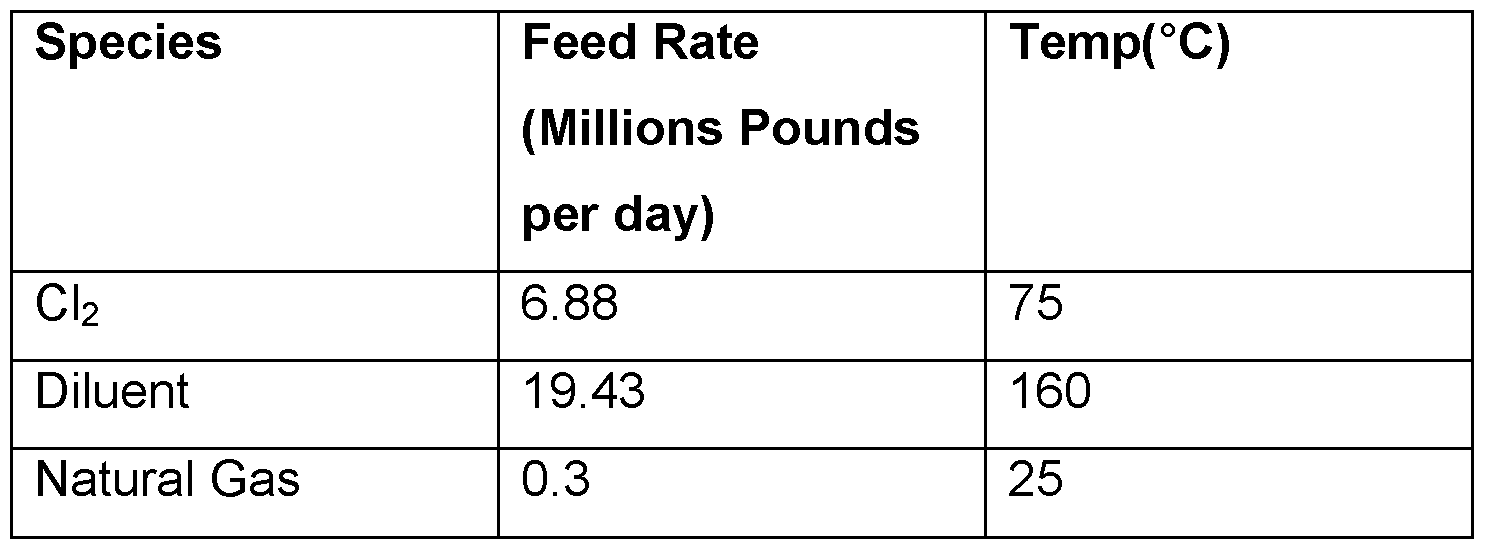
Example 3: Preparation CTC at 525°C and 10 % Excess Chlorine
[0060] In a jet-stirred reactor, Cl2 and natural gas comprising of CH4, N2, ethane, and propane of 95.7%, 1 .6%, 2.5%, and 0.2% by weight respectively, were fed with carbon tetrachloride diluent under the conditions and flow rates shown in Table 3. All feeds entered the reactor as gas. The reactor volume is such that about 3.7 seconds residence time using exit condition at 80 psig pressure. The reactor outlet temperature was 525°C and excess Cl2 was 10 mole % at the outlet. The conversions of CH4, C2H6, and C3H8 were all 100% with 95.2% selectivity to CCI4, 3.5% selectivity to
perchloroethylene and lesser selectivities to chloroform, hexachloroethane and trichloroethylene.
Table 3

[0061 ] In a jet-stirred reactor, Cl2 and natural gas comprising of CH4, N2, ethane, and propane of 95.7%, 1.6%, 2.5%, and 0.2% by weight respectively, were fed with carbon tetrachloride diluent under the conditions and flow rates shown in Table 1. All feeds entered the reactor as gas. The reactor volume is such that about 3.8 seconds residence time using exit condition at 80 psig pressure. The reactor outlet temperature was 525°C and excess Cl2 was 5 mole % at the outlet. The conversions of CH4, C2H6, and C3H8 were all 100% with 93.0% selectivity to CCI4, 5.2% selectivity to
perchloroethylene and lesser selectivities to chloroform, hexachloroethane and trichloroethylene.
Table 4

Example 5: Preparation CTC at 500°C and 10 % Excess Chlorine with Liquid Diluent
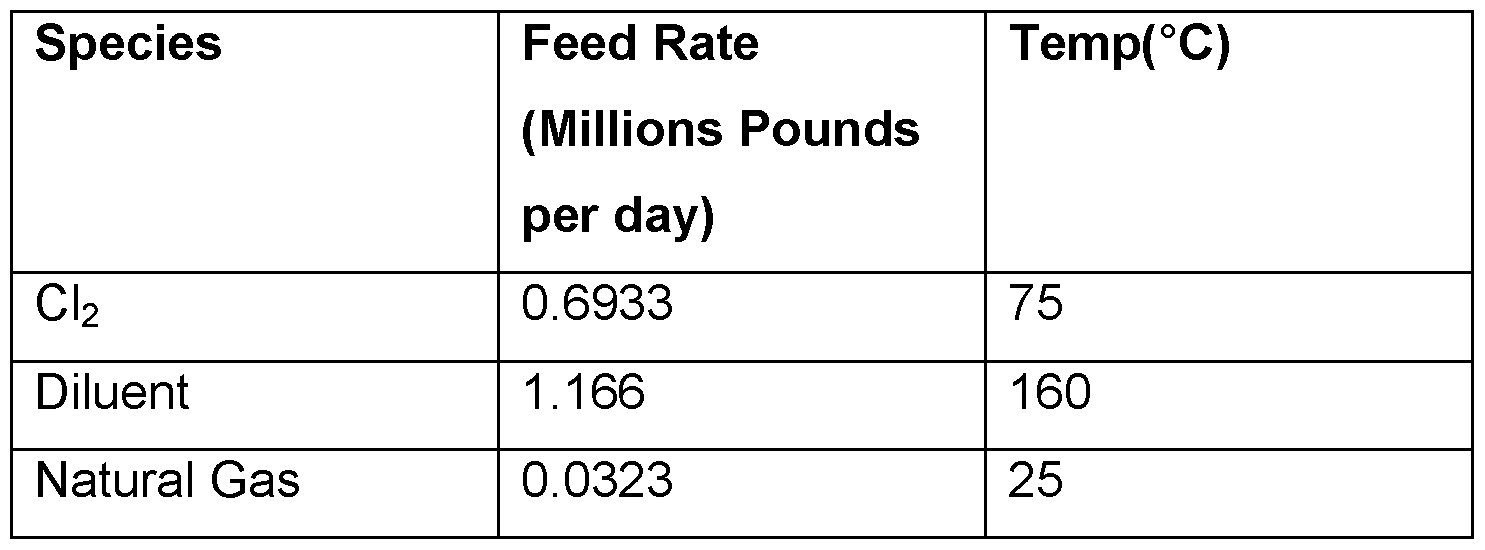
[0062] In a jet-stirred reactor, Cl2 and natural gas comprising of CH4, N2, ethane, and propane of 95.7%, 1.6%, 2.5%, and 0.2% by weight respectively, were fed with carbon tetrachloride diluent under the conditions and flow rates shown in Table 1.
All feeds entered the reactor as gas, except for diluent which entered as a liquid and was vaporized within the reactor. The reactor volume is such that about 4.7 seconds residence time using exit condition at 80 psig pressure. The reactor outlet temperature was 500°C and excess Cl2 was 10 mole % at the outlet. The conversions of CH4, C2H6, and C3H8 were all 100% with 96.7% selectivity to CCI4, 2.1 % selectivity to
perchloroethylene and lesser selectivities to chloroform, hexachloroethane and trichloroethylene.
Table 5

Example 6: Preparation CTC at 500°C and 10 % Excess Chlorine with Liquid Diluent, scaled down and shorter residence time
[0063] In a jet-stirred reactor, C and natural gas comprising of CH4, N2, ethane, and propane of 95.7%, 1.6%, 2.5%, and 0.2% by weight respectively, were fed with carbon tetrachloride diluent under the conditions and flow rates shown in Table 1.
All feeds entered the reactor as gas, except for diluent which entered as a liquid and was vaporized within the reactor. The reactor volume is such that about 2.9 seconds residence time using exit condition at 80 psig pressure. The reactor outlet temperature was 500°C and excess Cl2 was 10 mole % at the outlet. The conversions of CH4, C2H6, and C3H8 were all 100% with 96.8% selectivity to CCI4, 1.5% selectivity to
perchloroethylene and lesser selectivities to chloroform, hexachloroethane and trichloroethylene. The selectivity to hexachloroethane was lower and to trichloroethylene higher, when compared to example 5.
Table 6
Claims
1. A process for the production of carbon tetrachloride, the process comprising: preparing a mixture comprising natural gas; a chlorinating agent; and a diluent; in a reactor;
chlorinating the natural gas and producing a product stream comprising carbon tetrachloride, hydrogen chloride, chlorinating agent, and the diluent; and
separating at least a portion of the carbon tetrachloride from the product stream.
2. The process of claim 1 , wherein the natural gas comprises methane, and at least one alkane other than methane.
3. The process of any one claim 1 or 2, wherein the natural gas comprises methane and at least two alkanes selected from the group consisting of ethane, propane, and butane.
4. The process of any one claims 1 -3, wherein the natural gas comprises methane, ethane, and propane.
5. The process of any one of claims 2-4, wherein the natural gas comprises at least 0.01 weight % ethane.
6. The process of any one of claims 2-5, wherein the natural gas comprises at least 0.001 weight % of propane.
7. The process of any one of claims 1 -6, wherein the diluent is fed to the reactor in gas phase or liquid phase or both.
8. The process of any one claims 1 -7, wherein the diluent comprises an inert gas.
9. The process of any one of claims 1 -8, wherein the diluent comprises methyl chloride, methylene chloride, chloroform, chlorinated ethylene, carbon tetrachloride, perchloroethylene, or combinations thereof; with diluents comprising carbon
tetrachloride and/or perchloroethylene being preferred.
10. The process of any one of claims 1 -9, wherein the chlorinating agent comprises chlorine.
11. The process of any one of claims 1 -10, wherein the chlorinating agent is used in stoichiometric excess, relative to the natural gas, preferably at least 0.01 mole % excess relative to the natural gas.
12. The process of any one of claims 1 -11 , wherein the diluent and the natural gas are introduced into the reactor at the same time.
13. The process of any of claims 1 -12, wherein the temperature in the reactor is at least 400°C, preferably at least 450°C, more preferably at least 500°C.
14. The process of any one of claims 1 -13, wherein the diluent and the natural gas are mixed together before they enter the reactor and are optionally preheated to a temperature above room temperature.
15. The process of any one of claims 1 -14, wherein the pressure in the reactor is at least atmospheric pressure.
16. The process of claim 15, wherein the pressure ranges from about 0 psig to about 1000 psig, and preferably from about 0 psig to about 200 psig.
17. The process of any one of claims 1 -16, wherein the natural gas is chlorinated in the gas phase.
18. The process of any one of claims 1 -17, wherein the percent selectivity to carbon tetrachloride is equal to or greater than 60%, or at least 70%.
19. The process according to any one of claims 1-18, wherein the product stream is distilled and at least a portion of the hydrogen chloride is removed.
20. The process of any one of claims 1 -19, wherein the product stream is distilled and at least a portion of the carbon tetrachloride is removed.
21. The process according to claim 20, wherein the product stream is distilled and at least some residual methane is removed and recycled to the reactor or purged together with light by-products and inert gas, if present.
22. The process of any one of claims 1 -21 , wherein the reactor comprises at least one nozzle.
23. The process of any one of claims 1 -22, wherein the reactor is a continuous stirred tank reactor, plug flow reactor, dumb combustor type reactor, or a stirred tank reactor.
24. The process of any of the claims 1 -23, wherein the reactor is a dumb combustor type reactor.
25. The process of any of the claims 1 -24, wherein the natural gas is at least 90% converted and preferably at least 99% converted.
26. The process of any one of the claims 1 -25, wherein perchloroethylene is co produced in the process.
27. The process of any of the claims 1 -26, wherein the natural gas comprises at least one sulfur containing compound, and at least some of the at least one sulfur containing compound is removed before the natural gas enters the reactor.
28. The process of any of the claims 1 -27, wherein the product stream is distilled and at least some of the chlorinating agent is removed.
29. The process of claim 28, wherein at least some of the chlorinating agent is recycled to the reactor.
30. The process of any one of claims 1 -29, wherein the product stream is cooled and distilled to remove anhydrous HCI overhead with purity of at least about 95 mole % or the HCI is absorbed into water.
31. The process of claim 30 wherein the liquid bottom stream from the distillation is fed to a second distillation wherein chlorine, light by-products, inert gases or
combinations thereof are stripped and removed as an overhead stream.
32. The process of claims 1 -31 wherein at least some of the diluent is fed to the reactor as a liquid, which is then vaporized in the reactor.
33. The process of claims 1 -32 wherein the diluent comprises carbon tetrachloride with up to 50 weight % perchloroethylene, up to 10 weight % chlorine, and up to 10 weight percent byproducts such as trichloroethylene.
Applications Claiming Priority (2)
| Application Number | Priority Date | Filing Date | Title |
|---|---|---|---|
| US201862778554P | 2018-12-12 | 2018-12-12 | |
| US62/778,554 | 2018-12-12 |
Publications (1)
| Publication Number | Publication Date |
|---|---|
| WO2020123853A1 true WO2020123853A1 (en) | 2020-06-18 |
Family
ID=69143700
Family Applications (1)
| Application Number | Title | Priority Date | Filing Date |
|---|---|---|---|
| PCT/US2019/066056 Ceased WO2020123853A1 (en) | 2018-12-12 | 2019-12-12 | Production of carbon tetrachloride from natural gas |
Country Status (1)
| Country | Link |
|---|---|
| WO (1) | WO2020123853A1 (en) |
Citations (1)
| Publication number | Priority date | Publication date | Assignee | Title |
|---|---|---|---|---|
| US2857438A (en) * | 1957-01-22 | 1958-10-21 | Stauffer Chemical Co | Hydrocarbon chlorination with a liquid coolant |
-
2019
- 2019-12-12 WO PCT/US2019/066056 patent/WO2020123853A1/en not_active Ceased
Patent Citations (1)
| Publication number | Priority date | Publication date | Assignee | Title |
|---|---|---|---|---|
| US2857438A (en) * | 1957-01-22 | 1958-10-21 | Stauffer Chemical Co | Hydrocarbon chlorination with a liquid coolant |
Similar Documents
| Publication | Publication Date | Title |
|---|---|---|
| CA2860203C (en) | Process for the production of tetrachloromethane | |
| US8022231B2 (en) | Process for preparing monochloroethylene carbonate and subsequent conversion to vinylene carbonate | |
| KR101050919B1 (en) | Method for preparing 1,2,3,4-tetrachlorohexafluorobutane | |
| US9045385B2 (en) | Conversion of propane to propylene | |
| KR102886808B1 (en) | Recovery of water-free methanesulfonic acid from the bottom stream of the distillation column | |
| KR20190049863A (en) | Preparation of 2-exo- (2-methylbenzyloxy) -1-methyl-4-isopropyl-7-oxabicyclo [2.2.1] heptane | |
| CA3008291A1 (en) | Improved processes for preparing halogenated alkanes | |
| JP2003512453A (en) | Process for producing N-methylpyrrolidone using a mixture of gamma-butyl lactone and methylamine as starting material | |
| US6723877B1 (en) | Dimethylformamide synthesis via reactive distillation of methyl formate and dimethylamine | |
| WO2020123853A1 (en) | Production of carbon tetrachloride from natural gas | |
| JP2018531906A (en) | Chlorinated methane production process | |
| CN114375289B (en) | Process for preparing alkanesulphonic acids | |
| US4765876A (en) | Simultaneous production of higher chloromethanes | |
| US4073816A (en) | Process for the continuous production of monochloroalkanes | |
| US8846989B2 (en) | Method of producing alcohols | |
| KR102822546B1 (en) | Production of hydroxyethylpiperazine | |
| EP3774701A1 (en) | Method for the production of a halogenated alkene by catalyzed dehydrohalogenation of a halogenated alkane | |
| CN1037961C (en) | Chlorination method | |
| CN114315507B (en) | Process for preparing 1-chloro-3, 3, 3-trifluoropropene and/or Z-1, 3-dichloro-3, 3-difluoropropene | |
| US2776982A (en) | Production of styrene oxide | |
| WO2020041669A1 (en) | Improved process for liquid phase chlorination of chlorinated alkenes | |
| PL215800B1 (en) | Method for glycerol chloro-hydrogenation | |
| CN121698800A (en) | A method for preparing a novel fungicide, fluopyram. | |
| TW201630856A (en) | Process for the production of hydrogen chloride, ethylene and vinyl chloride from ethane | |
| JP2002348271A (en) | Method for producing cyanonorbornene |
Legal Events
| Date | Code | Title | Description |
|---|---|---|---|
| 121 | Ep: the epo has been informed by wipo that ep was designated in this application |
Ref document number: 19832816 Country of ref document: EP Kind code of ref document: A1 |
|
| NENP | Non-entry into the national phase |
Ref country code: DE |
|
| 122 | Ep: pct application non-entry in european phase |
Ref document number: 19832816 Country of ref document: EP Kind code of ref document: A1 |