WO2020123670A1 - Small molecule inhibitors of the androgen receptor activity and/or expression and uses thereof - Google Patents
Small molecule inhibitors of the androgen receptor activity and/or expression and uses thereof Download PDFInfo
- Publication number
- WO2020123670A1 WO2020123670A1 PCT/US2019/065751 US2019065751W WO2020123670A1 WO 2020123670 A1 WO2020123670 A1 WO 2020123670A1 US 2019065751 W US2019065751 W US 2019065751W WO 2020123670 A1 WO2020123670 A1 WO 2020123670A1
- Authority
- WO
- WIPO (PCT)
- Prior art keywords
- moiety
- compound
- nmr
- mhz
- methyl
- Prior art date
- Legal status (The legal status is an assumption and is not a legal conclusion. Google has not performed a legal analysis and makes no representation as to the accuracy of the status listed.)
- Ceased
Links
- 0 *C1(CCCCC1)N1CC*CC1 Chemical compound *C1(CCCCC1)N1CC*CC1 0.000 description 4
- KLLOEOPUXBJSOW-UHFFFAOYSA-N CNc1cccc(O)c1 Chemical compound CNc1cccc(O)c1 KLLOEOPUXBJSOW-UHFFFAOYSA-N 0.000 description 1
Classifications
-
- A—HUMAN NECESSITIES
- A61—MEDICAL OR VETERINARY SCIENCE; HYGIENE
- A61K—PREPARATIONS FOR MEDICAL, DENTAL OR TOILETRY PURPOSES
- A61K31/00—Medicinal preparations containing organic active ingredients
- A61K31/33—Heterocyclic compounds
- A61K31/395—Heterocyclic compounds having nitrogen as a ring hetero atom, e.g. guanethidine or rifamycins
- A61K31/495—Heterocyclic compounds having nitrogen as a ring hetero atom, e.g. guanethidine or rifamycins having six-membered rings with two or more nitrogen atoms as the only ring heteroatoms, e.g. piperazine or tetrazines
- A61K31/496—Non-condensed piperazines containing further heterocyclic rings, e.g. rifampin, thiothixene or sparfloxacin
-
- A—HUMAN NECESSITIES
- A61—MEDICAL OR VETERINARY SCIENCE; HYGIENE
- A61K—PREPARATIONS FOR MEDICAL, DENTAL OR TOILETRY PURPOSES
- A61K31/00—Medicinal preparations containing organic active ingredients
- A61K31/33—Heterocyclic compounds
- A61K31/395—Heterocyclic compounds having nitrogen as a ring hetero atom, e.g. guanethidine or rifamycins
- A61K31/435—Heterocyclic compounds having nitrogen as a ring hetero atom, e.g. guanethidine or rifamycins having six-membered rings with one nitrogen as the only ring hetero atom
- A61K31/44—Non condensed pyridines; Hydrogenated derivatives thereof
- A61K31/445—Non condensed piperidines, e.g. piperocaine
- A61K31/4523—Non condensed piperidines, e.g. piperocaine containing further heterocyclic ring systems
- A61K31/454—Non condensed piperidines, e.g. piperocaine containing further heterocyclic ring systems containing a five-membered ring with nitrogen as a ring hetero atom, e.g. pimozide, domperidone
-
- A—HUMAN NECESSITIES
- A61—MEDICAL OR VETERINARY SCIENCE; HYGIENE
- A61K—PREPARATIONS FOR MEDICAL, DENTAL OR TOILETRY PURPOSES
- A61K45/00—Medicinal preparations containing active ingredients not provided for in groups A61K31/00 - A61K41/00
- A61K45/06—Mixtures of active ingredients without chemical characterisation, e.g. antiphlogistics and cardiaca
-
- C—CHEMISTRY; METALLURGY
- C07—ORGANIC CHEMISTRY
- C07D—HETEROCYCLIC COMPOUNDS
- C07D213/00—Heterocyclic compounds containing six-membered rings, not condensed with other rings, with one nitrogen atom as the only ring hetero atom and three or more double bonds between ring members or between ring members and non-ring members
- C07D213/02—Heterocyclic compounds containing six-membered rings, not condensed with other rings, with one nitrogen atom as the only ring hetero atom and three or more double bonds between ring members or between ring members and non-ring members having three double bonds between ring members or between ring members and non-ring members
- C07D213/04—Heterocyclic compounds containing six-membered rings, not condensed with other rings, with one nitrogen atom as the only ring hetero atom and three or more double bonds between ring members or between ring members and non-ring members having three double bonds between ring members or between ring members and non-ring members having no bond between the ring nitrogen atom and a non-ring member or having only hydrogen or carbon atoms directly attached to the ring nitrogen atom
- C07D213/60—Heterocyclic compounds containing six-membered rings, not condensed with other rings, with one nitrogen atom as the only ring hetero atom and three or more double bonds between ring members or between ring members and non-ring members having three double bonds between ring members or between ring members and non-ring members having no bond between the ring nitrogen atom and a non-ring member or having only hydrogen or carbon atoms directly attached to the ring nitrogen atom with hetero atoms or with carbon atoms having three bonds to hetero atoms with at the most one bond to halogen, e.g. ester or nitrile radicals, directly attached to ring carbon atoms
- C07D213/72—Nitrogen atoms
- C07D213/74—Amino or imino radicals substituted by hydrocarbon or substituted hydrocarbon radicals
-
- C—CHEMISTRY; METALLURGY
- C07—ORGANIC CHEMISTRY
- C07D—HETEROCYCLIC COMPOUNDS
- C07D257/00—Heterocyclic compounds containing rings having four nitrogen atoms as the only ring hetero atoms
- C07D257/02—Heterocyclic compounds containing rings having four nitrogen atoms as the only ring hetero atoms not condensed with other rings
- C07D257/04—Five-membered rings
-
- C—CHEMISTRY; METALLURGY
- C07—ORGANIC CHEMISTRY
- C07D—HETEROCYCLIC COMPOUNDS
- C07D307/00—Heterocyclic compounds containing five-membered rings having one oxygen atom as the only ring hetero atom
- C07D307/77—Heterocyclic compounds containing five-membered rings having one oxygen atom as the only ring hetero atom ortho- or peri-condensed with carbocyclic rings or ring systems
- C07D307/78—Benzo [b] furans; Hydrogenated benzo [b] furans
- C07D307/79—Benzo [b] furans; Hydrogenated benzo [b] furans with only hydrogen atoms, hydrocarbon or substituted hydrocarbon radicals, directly attached to carbon atoms of the hetero ring
- C07D307/81—Radicals substituted by nitrogen atoms not forming part of a nitro radical
-
- C—CHEMISTRY; METALLURGY
- C07—ORGANIC CHEMISTRY
- C07D—HETEROCYCLIC COMPOUNDS
- C07D401/00—Heterocyclic compounds containing two or more hetero rings, having nitrogen atoms as the only ring hetero atoms, at least one ring being a six-membered ring with only one nitrogen atom
- C07D401/02—Heterocyclic compounds containing two or more hetero rings, having nitrogen atoms as the only ring hetero atoms, at least one ring being a six-membered ring with only one nitrogen atom containing two hetero rings
- C07D401/06—Heterocyclic compounds containing two or more hetero rings, having nitrogen atoms as the only ring hetero atoms, at least one ring being a six-membered ring with only one nitrogen atom containing two hetero rings linked by a carbon chain containing only aliphatic carbon atoms
-
- C—CHEMISTRY; METALLURGY
- C07—ORGANIC CHEMISTRY
- C07D—HETEROCYCLIC COMPOUNDS
- C07D401/00—Heterocyclic compounds containing two or more hetero rings, having nitrogen atoms as the only ring hetero atoms, at least one ring being a six-membered ring with only one nitrogen atom
- C07D401/02—Heterocyclic compounds containing two or more hetero rings, having nitrogen atoms as the only ring hetero atoms, at least one ring being a six-membered ring with only one nitrogen atom containing two hetero rings
- C07D401/12—Heterocyclic compounds containing two or more hetero rings, having nitrogen atoms as the only ring hetero atoms, at least one ring being a six-membered ring with only one nitrogen atom containing two hetero rings linked by a chain containing hetero atoms as chain links
-
- C—CHEMISTRY; METALLURGY
- C07—ORGANIC CHEMISTRY
- C07D—HETEROCYCLIC COMPOUNDS
- C07D401/00—Heterocyclic compounds containing two or more hetero rings, having nitrogen atoms as the only ring hetero atoms, at least one ring being a six-membered ring with only one nitrogen atom
- C07D401/14—Heterocyclic compounds containing two or more hetero rings, having nitrogen atoms as the only ring hetero atoms, at least one ring being a six-membered ring with only one nitrogen atom containing three or more hetero rings
-
- C—CHEMISTRY; METALLURGY
- C07—ORGANIC CHEMISTRY
- C07D—HETEROCYCLIC COMPOUNDS
- C07D405/00—Heterocyclic compounds containing both one or more hetero rings having oxygen atoms as the only ring hetero atoms, and one or more rings having nitrogen as the only ring hetero atom
- C07D405/02—Heterocyclic compounds containing both one or more hetero rings having oxygen atoms as the only ring hetero atoms, and one or more rings having nitrogen as the only ring hetero atom containing two hetero rings
- C07D405/06—Heterocyclic compounds containing both one or more hetero rings having oxygen atoms as the only ring hetero atoms, and one or more rings having nitrogen as the only ring hetero atom containing two hetero rings linked by a carbon chain containing only aliphatic carbon atoms
-
- C—CHEMISTRY; METALLURGY
- C07—ORGANIC CHEMISTRY
- C07D—HETEROCYCLIC COMPOUNDS
- C07D405/00—Heterocyclic compounds containing both one or more hetero rings having oxygen atoms as the only ring hetero atoms, and one or more rings having nitrogen as the only ring hetero atom
- C07D405/02—Heterocyclic compounds containing both one or more hetero rings having oxygen atoms as the only ring hetero atoms, and one or more rings having nitrogen as the only ring hetero atom containing two hetero rings
- C07D405/12—Heterocyclic compounds containing both one or more hetero rings having oxygen atoms as the only ring hetero atoms, and one or more rings having nitrogen as the only ring hetero atom containing two hetero rings linked by a chain containing hetero atoms as chain links
-
- C—CHEMISTRY; METALLURGY
- C07—ORGANIC CHEMISTRY
- C07D—HETEROCYCLIC COMPOUNDS
- C07D405/00—Heterocyclic compounds containing both one or more hetero rings having oxygen atoms as the only ring hetero atoms, and one or more rings having nitrogen as the only ring hetero atom
- C07D405/14—Heterocyclic compounds containing both one or more hetero rings having oxygen atoms as the only ring hetero atoms, and one or more rings having nitrogen as the only ring hetero atom containing three or more hetero rings
-
- C—CHEMISTRY; METALLURGY
- C07—ORGANIC CHEMISTRY
- C07D—HETEROCYCLIC COMPOUNDS
- C07D409/00—Heterocyclic compounds containing two or more hetero rings, at least one ring having sulfur atoms as the only ring hetero atoms
- C07D409/14—Heterocyclic compounds containing two or more hetero rings, at least one ring having sulfur atoms as the only ring hetero atoms containing three or more hetero rings
-
- C—CHEMISTRY; METALLURGY
- C07—ORGANIC CHEMISTRY
- C07D—HETEROCYCLIC COMPOUNDS
- C07D413/00—Heterocyclic compounds containing two or more hetero rings, at least one ring having nitrogen and oxygen atoms as the only ring hetero atoms
- C07D413/14—Heterocyclic compounds containing two or more hetero rings, at least one ring having nitrogen and oxygen atoms as the only ring hetero atoms containing three or more hetero rings
Definitions
- This invention is in the field of medicinal chemistry.
- the invention relates to a new class of small-molecules having a piperazine (or similar) structure which function as antagonists of androgen receptor activity, and their use as therapeutics for the treatment of cancer (e.g., castration-resistant prostate cancer) and other conditions characterized with androgen receptor activity and/or androgen receptor expression.
- cancer e.g., castration-resistant prostate cancer
- Prostate cancer is the most common male cancer and second leading cause of cancer-related deaths in developed countries.
- the androgen receptor (AR) is a key molecular target in the etiology and progression of the disease where the early stages of prostate cancer tumor growth are androgen dependent and respond well to androgen ablation and androgen receptor antagonists.
- CRPC castration-resistant prostate cancer
- the present invention provides a new class of small-molecules having a piperazine (or similar) structure which function as inhibitors of AR activity and/or AR expression, and their use as therapeutics for the treatment of any type of condition or cancer characterized with AR activity and/or AR expression (e.g., cancer (e.g., CRPC) (e.g., cancers resistant to Enzalutamide treatment)).
- a piperazine or similar structure which function as inhibitors of AR activity and/or AR expression
- any type of condition or cancer characterized with AR activity and/or AR expression e.g., cancer (e.g., CRPC) (e.g., cancers resistant to Enzalutamide treatment)).
- cancer e.g., CRPC
- Enzalutamide treatment e.g., cancers resistant to Enzalutamide treatment
- the present invention contemplates that exposure of animals (e.g., humans) suffering from cancer (e.g., and/or cancer related disorders) to therapeutically effective amounts of dmg(s) having a piperazine (or similar) that inhibit AR activity and/or AR expression will inhibit the growth of cancer cells or supporting cells outright and/or render such cells as a population more susceptible to the cell death-inducing activity of cancer therapeutic drugs or radiation therapies.
- the inhibition of AR activity occurs through, for example, directly binding with an AR.
- AR antagonists satisfy an unmet need for the treatment of multiple cancer types, either when administered as monotherapy to induce cell growth inhibition, apoptosis and/or cell cycle arrest in cancer cells, or when administered in a temporal relationship with additional agent(s), such as other cell death- inducing or cell cycle disrupting cancer therapeutic drugs or radiation therapies (combination therapies), so as to render a greater proportion of the cancer cells or supportive cells susceptible to executing the apoptosis program compared to the corresponding proportion of cells in an animal treated only with the cancer therapeutic drug or radiation therapy alone.
- additional agent(s) such as other cell death- inducing or cell cycle disrupting cancer therapeutic drugs or radiation therapies (combination therapies)
- combination treatment of animals with a therapeutically effective amount of a compound of the present invention and a course of an anticancer agent produces a greater tumor response and clinical benefit in such animals compared to those treated with the compound or anticancer drugs/radiation alone. Since the doses for all approved anticancer drugs and radiation treatments are known, the present invention contemplates the various combinations of them with the present compounds.
- piperazine (or similar) compounds function as antagonists of AR activity and/or AR expression, and serve as therapeutics for the treatment of cancer (e.g., CRPC) and other diseases.
- cancer e.g., CRPC
- the present invention relates to piperazine (or similar) compounds useful for inhibiting AR activity and/or AR expression, and increasing the sensitivity of cells to inducers of apoptosis and/or cell cycle arrest.
- Certain piperazine (or similar) compounds of the present invention may exist as stereoisomers including optical isomers.
- the invention includes all stereoisomers, both as pure individual stereoisomer preparations and enriched preparations of each, and both the racemic mixtures of such stereoisomers as well as the individual diastereomers and enantiomers that may be separated according to methods that are well known to those of skill in the art.
- piperazine (or similar) compounds encompassed within
- Formulas I is provided: (Formula I), including pharmaceutically acceptable salts, solvates, and/or prodrugs thereof.
- Formula I is not limited to a particular chemical moiety for X, Rl, R2, R3, and R4.
- the particular chemical moiety for X, Rl, R2, R3, and R4 independently include any chemical moiety that permits the resulting compound to inhibit AR activity and/or inhibit AR expression.
- X is Nitrogen rendering the resulting compound encompassed
- R2 and R4 are combined to form a cycloalkyl ring moiety. In some embodiments wherein R2 and R4 are combined to form a cycloalkyl ring moiety, the
- R2 and R4 are combined to form a ketone moiety rendering the
- R1 is selected from an alkyl moiety, a substituted aryl moiety, an unsubstituted aryl moiety, a substituted heterocyclyl moiety, an unsubstituted heterocyclyl moiety, and a carbonyl moiety.
- R2 is selected from hydrogen, methyl,
- R3 is selected from hydrogen, an acyclic alkyl moiety, a cyclic alkyl moiety, a substituted aryl moiety, an unsubstituted aryl moiety, an alkynyl moiety, a carbonyl moiety, a cyano moiety, a carboxylyl moiety, a carboxamide moiety, and a substituted heterocyclyl moiety, and an unsubstituted heterocyclyl moiety.
- R3 is selected from hydrogen, methyl,
- R4 is selected from hydrogen and methyl.
- the invention further provides processes for preparing any of the compounds of the present invention through following at least a portion of the techniques recited in the experimental section.
- the compounds of the invention are useful for the treatment, amelioration, or prevention of disorders characterized with AR activity and/or AR expression (e.g., cancer (e.g., CRPQ).
- disorders characterized with AR activity and/or AR expression e.g., cancer (e.g., CRPQ).
- the compounds of the invention are useful for the treatment, amelioration, or prevention of disorders, such as those responsive to induction of apoptotic cell death, e.g., disorders characterized by dysregulation of apoptosis, including hyperproliferative diseases such as cancer.
- the compounds can be used to treat, ameliorate, or prevent cancer that is characterized by resistance to cancer therapies (e.g., those cancer cells which are chemoresistant, radiation resistant, hormone resistant, and the like) (e.g., cancers resistant to Enzalutamide treatment).
- the cancer is any type of cancer characterized with AR activity and/or AR expression (e.g., cancer (e.g., CRPC)).
- the invention also provides pharmaceutical compositions comprising the compounds of the invention in a pharmaceutically acceptable carrier.
- kits comprising a compound of the invention and instructions for administering the compound to an animal.
- the kits may optionally contain other therapeutic agents, e.g., anticancer agents or apoptosis-modulating agents, e.g., therapeutic agents useful in treating any type of cancer characterized with AR activity and/or AR expression (e.g., cancer (e.g., CRPC) (e.g., cancers resistant to Enzalutamide treatment)).
- the present disclosure further provides bifunctional compounds that function to recruit endogenous proteins to an E3 Ubiquitin Ligase for degradation, and methods of using the same.
- the present disclosure provides bifunctional or proteolysis targeting chimeric (PROTAC) compounds, which find utility as modulators of targeted ubiquitination of a variety of polypeptides and other proteins, which are then degraded and/or otherwise inhibited.
- PROTAC proteolysis targeting chimeric
- the description provides methods of using an effective amount of the compounds as described herein for the treatment or amelioration of a disease condition, such as any type of cancer characterized with AR activity and/or AR expression (e.g., cancer (e.g., CRPC) (e.g., cancers resistant to a disease condition).
- a disease condition such as any type of cancer characterized with AR activity and/or AR expression (e.g., cancer (e.g., CRPC) (e.g., cancers resistant to
- the disclosure provides bifunctional or PROTAC compounds, which comprise an E3 Ubiquitin Ligase binding moiety (e.g., a ligand for an E3 Ubquitin Ligase or "ULM” group), and a moiety that binds a target protein (e.g., a protein/polypeptide targeting ligand or "PTM” group) (e.g., an AR activity and/or AR expression inhibitor) such that the target protein/polypeptide is placed in proximity to the ubiquitin ligase to effect degradation (and inhibition) of that protein (e.g., inhibit AR receptor activity and/or AR expression).
- E3 Ubiquitin Ligase binding moiety e.g., a ligand for an E3 Ubquitin Ligase or "ULM” group
- a target protein e.g., a protein/polypeptide targeting ligand or "PTM” group
- PTM protein/polypeptide targeting ligand
- the PTM is any of the compounds as described herein showing inhibitory activity against AR activity and/or AR expression.
- the ULM is a VHL, cereblon, mouse double minute 2 (MDM2), and/or inhibitor of apoptosis protein (IAP) E3 ligase binding moiety.
- MDM2 mouse double minute 2
- IAP apoptosis protein
- the structure of the bifunctional compound can be depicted as PTM-ULM.
- the bifunctional compound further comprises a chemical linker ("L").
- L a chemical linker
- the structure of the bifunctional compound can be depicted as PTM-L-ULM, where PTM is a protein/polypeptide targeting moiety (e.g., any of the compounds as described herein showing inhibitory activity against AR activity and/or AR expression), L is a linker, and ULM is a VHL, cereblon, MDM2, or IAP E3 ligase binding moiety binding moiety.
- the linker group is optionally substituted (poly)ethyleneglycol having between 1 and about 100 ethylene glycol units, between about 1 and about 50 ethylene glycol units, between 1 and about 25 ethylene glycol units, between about 1 and 10 ethylene glycol units, between 1 and about 8 ethylene glycol units and 1 and 6 ethylene glycol units, between 2 and 4 ethylene glycol units, or optionally substituted alkyl groups interdispersed with optionally substituted, O, N, S, P or Si atoms.
- the linker is substituted with an aryl, phenyl, benzyl, alkyl, alkylene, or heterocycle group.
- the linker may be asymmetric or symmetrical.
- the linker is a substituted or unsubstituted polyethylene glycol group ranging in size from about 1 to about 12 ethylene glycol units, between 1 and about 10 ethylene glycol units, about 2 about 6 ethylene glycol units, between about 2 and 5 ethylene glycol units, between about 2 and 4 ethylene glycol units.
- the ULM group and PTM group may be covalently linked to the linker group through any group which is appropriate and stable to the chemistry of the linker.
- the linker is independently covalently bonded to the ULM group and the PTM group in certain embodiments through an amide, ester, thioester, keto group, carbamate (urethane), carbon or ether, each of which groups may be inserted anywhere on the ULM group and PTM group to provide maximum binding of the ULM group on the ubiquitin ligase and the PTM group on the target protein to be degraded.
- the PTM group is a ULM group
- the target protein for degradation may be the ubiquitin ligase itself.
- the linker may be linked to an optionally substituted alkyl, alkylene, alkene or alkyne group, an aryl group or a heterocyclic group on the ULM and/or PTM groups.
- the compounds as described herein comprise multiple ULMs, multiple PTMs, multiple chemical linkers, or any combinations thereof.
- the present invention provides a method of
- ubiquitinating/degrading AR receptor activity and/or AR expression in a cell comprising administering a bifunctional compound as described herein comprising an ULM and a PTM, in certain embodiments linked through a linker moiety, as otherwise described herein, wherein the ULM is coupled to the PTM and wherein the ULM recognizes a ubiquitin pathway protein and the PTM recognizes the target protein such that degradation of the target protein occurs when the target protein is placed in proximity to the ubiquitin ligase, thus resulting in degradation/inhibition of the effects of the target protein and the control of protein levels.
- the control of protein levels afforded by the present invention provides treatment of a disease state or condition, which is modulated through the target protein by lowering the level of that protein in the cells of a patient.
- the compounds of the present invention can be manipulated to serve as imaging agents (see, e.g., Kranz M, et ak, Molecules. 2018 Mar 20;23(3); Sadeghzadeh M, et ak, Ann Nucl Med. 2017 May;31(4):335-346; Baum E, et ak, J Nucl Med. 2017 Jun;58(6):982-988; Yang D, et ak, Mol Pharm. 2017 Mar 6;14(3):770-780).
- imaging agents see, e.g., Kranz M, et ak, Molecules. 2018 Mar 20;23(3); Sadeghzadeh M, et ak, Ann Nucl Med. 2017 May;31(4):335-346; Baum E, et ak, J Nucl Med. 2017 Jun;58(6):982-988; Yang D, et ak, Mol Pharm. 2017 Mar 6;14(3):770-780).
- anticancer agent refers to any therapeutic agents (e.g., chemotherapeutic compounds and/or molecular therapeutic compounds), antisense therapies, radiation therapies, or surgical interventions, used in the treatment of hyperproliferative diseases such as cancer (e.g., in mammals, e.g.., in humans).
- therapeutic agents e.g., chemotherapeutic compounds and/or molecular therapeutic compounds
- antisense therapies e.g., radiation therapies, or surgical interventions, used in the treatment of hyperproliferative diseases such as cancer (e.g., in mammals, e.g.., in humans).
- prodrug refers to a pharmacologically inactive derivative of a parent“drug” molecule that requires biotransformation (e.g., either spontaneous or enzymatic) within the target physiological system to release, or to convert (e.g.,
- Prodrugs are designed to overcome problems associated with stability, water solubility, toxicity, lack of specificity, or limited bioavailability.
- Exemplary prodrugs comprise an active drug molecule itself and a chemical masking group (e.g. , a group that reversibly suppresses the activity of the drug).
- Some prodrugs are variations or derivatives of compounds that have groups cleavable under metabolic conditions. Prodrugs can be readily prepared from the parent compounds using methods known in the art, such as those described in A Textbook of Drug Design and Development, Krogsgaard-Larsen and H.
- Bundgaard eds.
- Gordon & Breach 1991, particularly Chapter 5: "Design and Applications of Prodrugs”; Design of Prodrugs, H. Bundgaard (ed.), Elsevier, 1985; Prodrugs: Topical and Ocular Drug Delivery, K. B. Sloan (ed.), Marcel Dekker, 1998; Methods in Enzymology, K. Widder et al. (eds.),
- prodrugs become pharmaceutically active in vivo or in vitro when they undergo solvolysis under physiological conditions or undergo enzymatic degradation or other biochemical transformation (e.g. , phosphorylation, hydrogenation, dehydrogenation, glycosylation).
- Prodrugs often offer advantages of water solubility, tissue compatibility, or delayed release in the mammalian organism. ( See e.g. , Bundgard, Design of Prodrugs, pp. 7- 9, 21-24, Elsevier, Amsterdam (1985); and Silverman, The Organic Chemistry of Drug Design and Drug Action, pp. 352-401, Academic Press, San Diego, CA (1992)).
- Common prodrugs include acid derivatives such as esters prepared by reaction of parent acids with a suitable alcohol (e.g., a lower alkanol) or esters prepared by reaction of parent alcohol with a suitable carboxylic acid, (e.g., an amino acid), amides prepared by reaction of the parent acid compound with an amine, basic groups reacted to form an acylated base derivative (e.g., a lower alkylamide), or phosphorus-containing derivatives, e.g., phosphate, phosphonate, and phosphoramidate esters, including cyclic phosphate, phosphonate, and phosphoramidate (see, e.g., US Patent Application Publication No. US 2007/0249564 Al; herein incorporated by reference in its entirety).
- a suitable alcohol e.g., a lower alkanol
- salts of the compounds of the present invention refers to any salt (e.g., obtained by reaction with an acid or a base) of a compound of the present invention that is physiologically tolerated in the target animal (e.g., a mammal). Salts of the compounds of the present invention may be derived from inorganic or organic acids and bases.
- acids include, but are not limited to, hydrochloric, hydrobromic, sulfuric, nitric, perchloric, fumaric, maleic, phosphoric, glycolic, lactic, salicylic, succinic, toluene-p- sulfonic, tartaric, acetic, citric, methanesulfonic, ethanesulfonic, formic, benzoic, malonic, sulfonic, naphthalene-2-sulfonic, benzenesulfonic acid, and the like.
- Other acids such as oxalic, while not in themselves pharmaceutically acceptable, may be employed in the preparation of salts useful as intermediates in obtaining the compounds of the invention and their
- bases include, but are not limited to, alkali metal (e.g., sodium) hydroxides, alkaline earth metal (e.g., magnesium) hydroxides, ammonia, and compounds of formula NWU, wherein W is C I alkyl, and the like.
- salts include, but are not limited to: acetate, adipate, alginate, aspartate, benzoate, benzenesulfonate, bisulfate, butyrate, citrate, camphorate, camphorsulfonate, cyclopentanepropionate, digluconate, dodecylsulfate, ethanesulfonate, fumarate,
- flucoheptanoate glycerophosphate, hemisulfate, heptanoate, hexanoate, chloride, bromide, iodide, 2-hydroxyethanesulfonate, lactate, maleate, mesylate, methanesulfonate,
- salts include anions of the compounds of the present invention compounded with a suitable cation such as Na + , NH4 + , and NWT (wherein W is a C I alkyl group), and the like.
- a suitable cation such as Na + , NH4 + , and NWT (wherein W is a C I alkyl group), and the like.
- salts of the compounds of the present invention are contemplated as being pharmaceutically acceptable.
- salts of acids and bases that are non-pharmaceutically acceptable may also find use, for example, in the preparation or purification of a pharmaceutically acceptable compound.
- solvate refers to the physical association of a compound of the invention with one or more solvent molecules, whether organic or inorganic. This physical association often includes hydrogen bonding. In certain instances, the solvate is capable of isolation, for example, when one or more solvate molecules are incorporated in the crystal lattice of the crystalline solid. "Solvate” encompasses both solution-phase and isolable solvates. Exemplary solvates include hydrates, ethanolates, and methanolates.
- a therapeutically effective amount refers to that amount of the therapeutic agent sufficient to result in amelioration of one or more symptoms of a disorder, or prevent advancement of a disorder, or cause regression of the disorder.
- a therapeutically effective amount will refer to the amount of a therapeutic agent that decreases the rate of tumor growth, decreases tumor mass, decreases the number of metastases, increases time to tumor progression, or increases survival time by at least 5%, at least 10%, at least 15%, at least 20%, at least 25%, at least 30%, at least 35%, at least 40%, at least 45%, at least 50%, at least 55%, at least 60%, at least 65%, at least 70%, at least 75%, at least 80%, at least 85%, at least 90%, at least 95%, or at least 100%.
- sensitize and“sensitizing,” as used herein, refer to making, through the administration of a first agent (e.g., a piperazine (or similar) compound of the invention), an animal or a cell within an animal more susceptible, or more responsive, to the biological effects (e.g. , promotion or retardation of an aspect of cellular function including, but not limited to, cell division, cell growth, proliferation, invasion, angiogenesis, necrosis, or apoptosis) of a second agent.
- a first agent e.g., a piperazine (or similar) compound of the invention
- the sensitizing effect of a first agent on a target cell can be measured as the difference in the intended biological effect (e.g., promotion or retardation of an aspect of cellular function including, but not limited to, cell growth, proliferation, invasion, angiogenesis, or apoptosis) observed upon the administration of a second agent with and without administration of the first agent.
- the intended biological effect e.g., promotion or retardation of an aspect of cellular function including, but not limited to, cell growth, proliferation, invasion, angiogenesis, or apoptosis
- the response of the sensitized cell can be increased by at least about 10%, at least about 20%, at least about 30%, at least about 40%, at least about 50%, at least about 60%, at least about 70%, at least about 80%, at least about 90%, at least about 100%, at least about 150%, at least about 200%, at least about 250%, at least 300%, at least about 350%, at least about 400%, at least about 450%, or at least about 500% over the response in the absence of the first agent.
- Dysregulation of apoptosis refers to any aberration in the ability of (e.g., predisposition) a cell to undergo cell death via apoptosis.
- Dysregulation of apoptosis is associated with or induced by a variety of conditions, non-limiting examples of which include, autoimmune disorders (e.g., systemic lupus erythematosus, rheumatoid arthritis, graft-versus-host disease, myasthenia gravis, or Sjogren's syndrome), chronic inflammatory conditions (e.g., psoriasis, asthma or Crohn's disease), hyperproliferative disorders (e.g., tumors, B cell lymphomas, or T cell lymphomas), viral infections (e.g., herpes, papilloma, or HIV), and other conditions such as osteoarthritis and atherosclerosis.
- autoimmune disorders e.g., systemic lupus erythematosus,
- hyperproliferative disease refers to any condition in which a localized population of proliferating cells in an animal is not governed by the usual limitations of normal growth.
- hyperproliferative disorders include tumors, neoplasms, lymphomas and the like.
- a neoplasm is said to be benign if it does not undergo invasion or metastasis and malignant if it does either of these.
- A“metastatic” cell means that the cell can invade and destroy neighboring body structures.
- Hyperplasia is a form of cell proliferation involving an increase in cell number in a tissue or organ without significant alteration in structure or function.
- Metaplasia is a form of controlled cell growth in which one type of fully differentiated cell substitutes for another type of differentiated cell.
- autoimmune disorder refers to any condition in which an organism produces antibodies or immune cells which recognize the organism's own molecules, cells or tissues.
- Non-limiting examples of autoimmune disorders include autoimmune hemolytic anemia, autoimmune hepatitis, Berger’s disease or IgA nephropathy, celiac sprue, chronic fatigue syndrome, Crohn’s disease, dermatomyositis, fibromyalgia, graft versus host disease, Grave’s disease,
- Hashimoto s thyroiditis, idiopathic thrombocytopenia purpura, lichen planus, multiple sclerosis, myasthenia gravis, psoriasis, rheumatic fever, rheumatic arthritis, scleroderma, Sjogren's syndrome, systemic lupus erythematosus, type 1 diabetes, ulcerative colitis, vitiligo, and the like.
- neoplastic disease refers to any abnormal growth of cells being either benign (non-cancerous) or malignant (cancerous).
- normal cell refers to a cell that is not undergoing abnormal growth or division. Normal cells are non-cancerous and are not part of any hyperproliferative disease or disorder.
- anti-neoplastic agent refers to any compound that retards the proliferation, growth, or spread of a targeted (e.g. , malignant) neoplasm.
- prevention refers to a decrease in the occurrence of pathological cells (e.g., hyperproliferative or neoplastic cells) in an animal.
- the prevention may be complete, e.g., the total absence of pathological cells in a subject.
- the prevention may also be partial, such that the occurrence of pathological cells in a subject is less than that which would have occurred without the present invention.
- pharmaceutically acceptable carrier or “pharmaceutically acceptable vehicle” encompasses any of the standard pharmaceutical carriers, solvents, surfactants, or vehicles. Suitable pharmaceutically acceptable vehicles include aqueous vehicles and nonaqueous vehicles. Standard pharmaceutical carriers and their formulations are described in Remington's Pharmaceutical Sciences, Mack Publishing Co., Easton, PA, 19th ed. 1995.
- the present invention provides a new class of small-molecules having a piperazine (or similar) structure which function as inhibitors of AR activity and/or AR expression, and their use as therapeutics for the treatment of any type of condition or cancer characterized with AR activity and/or AR expression (e.g., cancer (e.g., CRPC) (e.g., cancers resistant to Enzalutamide treatment)).
- a piperazine or similar structure which function as inhibitors of AR activity and/or AR expression
- any type of condition or cancer characterized with AR activity and/or AR expression e.g., cancer (e.g., CRPC) (e.g., cancers resistant to Enzalutamide treatment)).
- cancer e.g., CRPC
- Enzalutamide treatment e.g., cancers resistant to Enzalutamide treatment
- piperazine (or similar) compounds encompassed within
- Formula I are provided: (Formula I), including pharmaceutically acceptable salts, solvates, and/or prodrugs thereof.
- Formula I is not limited to a particular chemical moiety for X, Rl, R2, R3, and R4.
- the particular chemical moiety for X, Rl, R2, R3, and R4 independently include any chemical moiety that permits the resulting compound to inhibit AR activity and/or inhibit AR expression.
- X is Nitrogen rendering the resulting compound encompassed
- X is C-H rendering the resulting compound encompassed
- R2 and R4 are combined to form a cycloalkyl ring moiety. In some embodiments wherein R2 and R4 are combined to form a cycloalkyl ring moiety, the
- R2 and R4 are combined to form a ketone moiety rendering the
- R1 is selected from an alkyl moiety, a substituted aryl moiety, an unsubstituted aryl moiety, a substituted heterocyclyl moiety, an unsubstituted heterocyclyl moiety, and a carbonyl moiety.
- R1 is selected from
- R2 is selected from hydrogen, methyl,
- R3 is selected from hydrogen, an acyclic alkyl moiety, a cyclic alkyl moiety, a substituted aryl moiety, an unsubstituted aryl moiety, an alkynyl moiety, a carbonyl moiety, a cyano moiety, a carboxylyl moiety, a carboxamide moiety, and a substituted heterocyclyl moiety, and an unsubstituted heterocyclyl moiety.
- R3 is selected from hydrogen, methyl,
- R4 is selected from hydrogen and methyl.
- An important aspect of the present invention is that compounds of the invention induce cell cycle arrest and/or apoptosis and also potentiate the induction of cell cycle arrest and/or apoptosis either alone or in response to additional apoptosis induction signals.
- these compounds sensitize cells to induction of cell cycle arrest and/or apoptosis, including cells that are resistant to such inducing stimuli.
- the AR activity inhibitors and/or AR expression inhibitors of the present invention e.g., piperazine (or similar) compounds
- the inhibitors can be used to induce apoptosis in cells comprising AR activity.
- compositions and methods of the present invention are used to treat diseased cells, tissues, organs, or pathological conditions and/or disease states in an animal (e.g., a mammalian patient including, but not limited to, humans and veterinary animals).
- an animal e.g., a mammalian patient including, but not limited to, humans and veterinary animals.
- various diseases and pathologies are amenable to treatment or prophylaxis using the present methods and compositions.
- a non-limiting exemplary list of these diseases and conditions includes, but is not limited to, any type of cancer characterized with AR activity and/or AR expression (e.g., cancer (e.g., CRPC) (e.g., cancers resistant to Enzalutamide treatment)) including but not limited to pancreatic cancer, breast cancer, prostate cancer, lymphoma, skin cancer, colon cancer, melanoma, malignant melanoma, ovarian cancer, brain cancer, primary brain carcinoma, head and neck cancer, glioma, glioblastoma, liver cancer, bladder cancer, non-small cell lung cancer, head or neck carcinoma, breast carcinoma, ovarian carcinoma, lung carcinoma, small-cell lung carcinoma, Wilms' tumor, cervical carcinoma, testicular carcinoma, bladder carcinoma, pancreatic carcinoma, stomach carcinoma, colon carcinoma, prostatic carcinoma, genitourinary carcinoma, thyroid carcinoma, esophageal carcinoma, myeloma, multiple myeloma, adrenal carcinoma, renal cell carcinoma, endometrial carcinoma
- T and B cell mediated autoimmune diseases T and B cell mediated autoimmune diseases; inflammatory diseases; infections; hyperproliferative diseases; AIDS; degenerative conditions, vascular diseases, and the like.
- the cancer cells being treated are metastatic. In other embodiments, the cancer cells being treated are resistant to anticancer agents (e.g., Enzalutamide). In other words, Enzalutamide). In other words, Enzalutamide.
- the disorder is any disorder having cells having AR activity and/or AR expression.
- Some embodiments of the present invention provide methods for administering an effective amount of a compound of the invention and at least one additional therapeutic agent (including, but not limited to, chemotherapeutic antineoplastics, apoptosis-modulating agents, antimicrobials, antivirals, antifungals, and anti-inflammatory agents) and/or therapeutic technique (e.g., surgical intervention, and/or radiotherapies).
- additional therapeutic agent including, but not limited to, chemotherapeutic antineoplastics, apoptosis-modulating agents, antimicrobials, antivirals, antifungals, and anti-inflammatory agents
- therapeutic technique e.g., surgical intervention, and/or radiotherapies.
- the additional therapeutic agent(s) is an anticancer agent.
- suitable anticancer agents are contemplated for use in the methods of the present invention. Indeed, the present invention contemplates, but is not limited to, administration of numerous anticancer agents such as: agents that induce apoptosis; polynucleotides (e.g., anti- sense, ribozymes, siRNA); polypeptides (e.g., enzymes and antibodies); biological mimetics; alkaloids; alkylating agents; antitumor antibiotics; antimetabolites; hormones; platinum compounds; monoclonal or polyclonal antibodies (e.g., antibodies conjugated with anticancer drugs, toxins, defensins), toxins; radionuclides; biological response modifiers (e.g., interferons (e.g., IFN-a) and interleukins (e.g., IL-2)); adoptive immunotherapy agents; hematopoietic growth factors; agents that induce tumor necrosis, a
- anticancer agents comprise agents that induce or stimulate apoptosis.
- Agents that induce apoptosis include, but are not limited to, radiation (e.g., X-rays, gamma rays, UV); tumor necrosis factor (TNF)-related factors (e.g., TNF family receptor proteins, TNF family ligands, TRAIL, antibodies to TRAIL-R1 or TRAIL-R2); kinase inhibitors (e.g.
- epidermal growth factor receptor (EGFR) kinase inhibitor vascular growth factor receptor (VGFR) kinase inhibitor, fibroblast growth factor receptor (FGFR) kinase inhibitor, platelet-derived growth factor receptor (PDGFR) kinase inhibitor, and Bcr-Abl kinase inhibitors (such as GLEEVEC)); antisense molecules; antibodies (e.g., HERCEPTIN, RITUXAN, ZEVALIN, and AVASTIN); anti-estrogens (e.g.
- anti androgens e.g., flutamide, bicalutamide, finasteride, aminoglutethamide, ketoconazole, and corticosteroids
- cyclooxygenase 2 (COX- 2) inhibitors e.g., celecoxib, meloxicam, NS-398, and non-steroidal anti-inflammatory drugs (NSAIDs)
- anti-inflammatory drugs e.g., butazolidin, DECADRON, DELTASONE, dexamethasone, dexamethasone intensol, DEXONE, HEXADROL, hydroxychloroquine, METICORTEN, ORADEXON, ORASONE, oxyphenbutazone, PEDIAPRED, phenylbutazone, PLAQUENIL, prednisolone, prednisone, PRELONE, and TANDEARIL); and cancer chemotherapeutic drugs (e.g., irinotecan
- compositions and methods of the present invention provide a compound of the invention and at least one anti-hyperproliferative or antineoplastic agent selected from alkylating agents, antimetabolites, and natural products (e.g., herbs and other plant and/or animal derived compounds).
- at least one anti-hyperproliferative or antineoplastic agent selected from alkylating agents, antimetabolites, and natural products (e.g., herbs and other plant and/or animal derived compounds).
- Alkylating agents suitable for use in the present compositions and methods include, but are not limited to: 1) nitrogen mustards (e.g., mechlorethamine, cyclophosphamide, ifosfamide, melphalan (L-sarcolysin); and chlorambucil); 2) ethylenimines and methylmelamines (e.g., hexamethylmelamine and thiotepa); 3) alkyl sulfonates (e.g., busulfan); 4) nitrosoureas (e.g., carmustine (BCNU); lomustine (CCNU); semustine (methyl- CCNU); and streptozocin (streptozotocin)); and 5) triazenes (e.g., dacarbazine (DTIC;
- nitrogen mustards e.g., mechlorethamine, cyclophosphamide, ifosfamide, melphalan (L
- antimetabolites suitable for use in the present compositions and methods include, but are not limited to: 1) folic acid analogs (e.g., methotrexate
- amethopterin (amethopterin)); 2) pyrimidine analogs (e.g., fluorouracil (5-fluorouracil; 5-FU), floxuridine (fluorode-oxyuridine; FudR), and cytarabine (cytosine arabinoside)); and 3) purine analogs (e.g., mercaptopurine (6-mercaptopurine; 6-MP), thioguanine (6-thioguanine; TG), and pentostatin (2’ -deoxycoformycin)) .
- fluorouracil (5-fluorouracil; 5-FU
- floxuridine fluorode-oxyuridine
- FudR fluorode-oxyuridine
- cytarabine cytosine arabinoside
- purine analogs e.g., mercaptopurine (6-mercaptopurine; 6-MP), thioguanine (6-thioguanine; TG), and pentostatin (2
- chemotherapeutic agents suitable for use in the compositions and methods of the present invention include, but are not limited to: 1) vinca alkaloids (e.g., vinblastine (VLB), vincristine); 2) epipodophyllotoxins (e.g., etoposide and teniposide); 3) antibiotics (e.g., dactinomycin (actinomycin D), daunorubicin (daunomycin; rubidomycin), doxorubicin, bleomycin, plicamycin (mithramycin), and mitomycin
- vinca alkaloids e.g., vinblastine (VLB), vincristine
- epipodophyllotoxins e.g., etoposide and teniposide
- antibiotics e.g., dactinomycin (actinomycin D), daunorubicin (daunomycin; rubidomycin), doxorubicin, bleomycin, plicamycin
- mitomycin C (mitomycin C)); 4) enzymes (e.g., L-asparaginase); 5) biological response modifiers (e.g., interferon-alfa); 6) platinum coordinating complexes (e.g., cisplatin (cis-DDP) and carboplatin); 7) anthracenediones (e.g., mitoxantrone); 8) substituted ureas (e.g.
- hydroxyurea methylhydrazine derivatives (e.g., procarbazine (N-methylhydrazine; MIH)); 10) adrenocortical suppressants (e.g., mitotane (o,p’-DDD) and aminoglutethimide); 11) adrenocorticosteroids (e.g., prednisone); 12) progestins (e.g., hydroxyprogesterone caproate, medroxyprogesterone acetate, and megestrol acetate); 13) estrogens (e.g., diethylstilbestrol and ethinyl estradiol); 14) antiestrogens (e.g., tamoxifen); 15) androgens (e.g., testosterone propionate and fluoxymesterone); 16) antiandrogens (e.g., flutamide): and 17) gonadotropin-releasing hormone analogs (e.g., proc
- any oncolytic agent that is routinely used in a cancer therapy context finds use in the compositions and methods of the present invention.
- the U.S. Food and Drug Administration maintains a formulary of oncolytic agents approved for use in the United States. International counterpart agencies to the U.S.F.D.A. maintain similar formularies.
- Table 1 provides a list of exemplary antineoplastic agents approved for use in the U.S. Those skilled in the art will appreciate that the“product labels” required on all U.S. approved chemotherapeutics describe approved indications, dosing information, toxicity data, and the like, for the exemplary agents.
- Table 1 provides a list of exemplary antineoplastic agents approved for use in the U.S. Those skilled in the art will appreciate that the“product labels” required on all U.S. approved chemotherapeutics describe approved indications, dosing information, toxicity data, and the like, for the exemplary agents.
- Anticancer agents further include compounds which have been identified to have anticancer activity. Examples include, but are not limited to, 3-AP, 12-0- tetradecanoylphorbol- 13 -acetate, 17AAG, 852A, ABI-007, ABR-217620, ABT-751, ADI- PEG 20, AE-941, AG-013736, AGRO100, alanosine, AMG 706, antibody G250, antineoplastons, AP23573, apaziquone, APC8015, atiprimod, ATN-161, atrasenten, azacitidine, BB-10901, BCX-1777, bevacizumab, BG00001, bicalutamide, BMS 247550, bortezomib, bryostatin-1, buserelin, calcitriol, CCI-779, CDB-2914, cefixime, cetuximab, CG0070, cilengitide, clofarabine, combreta
- anticancer agents and other therapeutic agents those skilled in the art are referred to any number of instructive manuals including, but not limited to, the Physician's Desk Reference and to Goodman and Gilman's "Pharmaceutical Basis of Therapeutics" tenth edition, Eds. Hardman et al, 2002.
- the present invention provides methods for administering a compound of the invention with radiation therapy.
- the invention is not limited by the types, amounts, or delivery and administration systems used to deliver the therapeutic dose of radiation to an animal.
- the animal may receive photon radiotherapy, particle beam radiation therapy, other types of radiotherapies, and combinations thereof.
- the radiation is delivered to the animal using a linear accelerator.
- the radiation is delivered using a gamma knife.
- the source of radiation can be external or internal to the animal.
- External radiation therapy is most common and involves directing a beam of high-energy radiation to a tumor site through the skin using, for instance, a linear accelerator. While the beam of radiation is localized to the tumor site, it is nearly impossible to avoid exposure of normal, healthy tissue. However, external radiation is usually well tolerated by animals.
- Internal radiation therapy involves implanting a radiation-emitting source, such as beads, wires, pellets, capsules, particles, and the like, inside the body at or near the tumor site including the use of delivery systems that specifically target cancer cells (e.g., using particles attached to cancer cell binding ligands). Such implants can be removed following treatment, or left in the body inactive.
- Types of internal radiation therapy include, but are not limited to, brachytherapy, interstitial irradiation, intracavity irradiation, radioimmunotherapy, and the like.
- the animal may optionally receive radiosensitizers (e.g. , metronidazole,
- misonidazole intra-arterial Budr, intravenous iododeoxyuridine (IudR), nitroimidazole, 5- substituted-4-nitroimidazoles, 2H-isoindolediones, [[(2-bromoethyl)-amino]methyl]-nitro- lH-imidazole-1 -ethanol, nitroaniline derivatives, DNA-affinic hypoxia selective cytotoxins, halogenated DNA ligand, 1,2,4 benzotriazine oxides, 2-nitroimidazole derivatives, fluorine- containing nitroazole derivatives, benzamide, nicotinamide, acridine-intercalator, 5- thiotretrazole derivative, 3-nitro- 1,2, 4-triazole, 4,5-dinitroimidazole derivative, hydroxylated texaphrins, cisplatin, mitomycin, tiripazamine, nitrosourea, mercaptopurine,
- Radiosensitizers enhance the killing of tumor cells. Radioprotectors protect healthy tissue from the harmful effects of radiation.
- Radiotherapy any type of radiation can be administered to an animal, so long as the dose of radiation is tolerated by the animal without unacceptable negative side-effects.
- Suitable types of radiotherapy include, for example, ionizing (electromagnetic) radiotherapy (e.g., X-rays or gamma rays) or particle beam radiation therapy (e.g., high linear energy radiation).
- Ionizing radiation is defined as radiation comprising particles or photons that have sufficient energy to produce ionization, i.e., gain or loss of electrons (as described in, for example, U.S. 5,770,581 incorporated herein by reference in its entirety).
- the effects of radiation can be at least partially controlled by the clinician.
- the dose of radiation is fractionated for maximal target cell exposure and reduced toxicity.
- the total dose of radiation administered to an animal is about .01 Gray (Gy) to about 100 Gy.
- about 10 Gy to about 65 Gy e.g., about 15 Gy, 20 Gy, 25 Gy, 30 Gy, 35 Gy, 40 Gy, 45 Gy, 50 Gy, 55 Gy, or 60 Gy
- a complete dose of radiation can be administered over the course of one day, the total dose is ideally fractionated and
- radiotherapy is administered over the course of at least about 3 days, e.g., at least 5, 7, 10, 14, 17, 21, 25, 28, 32, 35, 38, 42, 46, 52, or 56 days (about 1-8 weeks).
- a daily dose of radiation will comprise approximately 1-5 Gy (e.g., about 1 Gy, 1.5 Gy, 1.8 Gy, 2 Gy, 2.5 Gy, 2.8 Gy, 3 Gy, 3.2 Gy, 3.5 Gy, 3.8 Gy, 4 Gy, 4.2 Gy, or 4.5 Gy), or 1-2 Gy (e.g., 1.5-2 Gy).
- the daily dose of radiation should be sufficient to induce destruction of the targeted cells.
- radiation is not administered every day, thereby allowing the animal to rest and the effects of the therapy to be realized.
- radiation desirably is administered on 5 consecutive days, and not administered on 2 days, for each week of treatment, thereby allowing 2 days of rest per week.
- radiation can be administered 1 day/week, 2 days/week, 3 days/week, 4 days/week, 5 days/week, 6 days/week, or all 7 days/week, depending on the animal’s responsiveness and any potential side effects.
- Radiation therapy can be initiated at any time in the therapeutic period. In one embodiment, radiation is initiated in week 1 or week 2, and is administered for the remaining duration of the therapeutic period.
- radiation is administered in weeks 1-6 or in weeks 2-6 of a therapeutic period comprising 6 weeks for treating, for instance, a solid tumor.
- radiation is administered in weeks 1-5 or weeks 2-5 of a therapeutic period comprising 5 weeks.
- Antimicrobial therapeutic agents may also be used as therapeutic agents in the present invention. Any agent that can kill, inhibit, or otherwise attenuate the function of microbial organisms may be used, as well as any agent contemplated to have such activities.
- Antimicrobial agents include, but are not limited to, natural and synthetic antibiotics, antibodies, inhibitory proteins (e.g. , defensins), antisense nucleic acids, membrane disruptive agents and the like, used alone or in combination. Indeed, any type of antibiotic may be used including, but not limited to, antibacterial agents, antiviral agents, antifungal agents, and the like.
- a compound of the invention and one or more therapeutic agents or anticancer agents are administered to an animal under one or more of the following conditions: at different periodicities, at different durations, at different concentrations, by different administration routes, etc.
- the compound is administered prior to the therapeutic or anticancer agent, e.g., 0.5, 1, 2, 3, 4, 5, 10, 12, or 18 hours, 1, 2, 3, 4, 5, or 6 days, or 1, 2, 3, or 4 weeks prior to the administration of the therapeutic or anticancer agent.
- the compound is administered after the therapeutic or anticancer agent, e.g., 0.5, 1, 2, 3, 4, 5, 10, 12, or 18 hours, 1, 2, 3, 4, 5, or 6 days, or 1, 2, 3, or 4 weeks after the administration of the anticancer agent.
- the compound and the therapeutic or anticancer agent are administered concurrently but on different schedules, e.g., the compound is administered daily while the therapeutic or anticancer agent is administered once a week, once every two weeks, once every three weeks, or once every four weeks.
- the compound is administered once a week while the therapeutic or anticancer agent is administered daily, once a week, once every two weeks, once every three weeks, or once every four weeks.
- compositions within the scope of this invention include all compositions wherein the compounds of the present invention are contained in an amount which is effective to achieve its intended purpose. While individual needs vary, determination of optimal ranges of effective amounts of each component is within the skill of the art.
- the compounds may be administered to mammals, e.g. humans, orally at a dose of 0.0025 to 50 mg/kg, or an equivalent amount of the pharmaceutically acceptable salt thereof, per day of the body weight of the mammal being treated for disorders responsive to induction of apoptosis. In one embodiment, about 0.01 to about 25 mg/kg is orally administered to treat, ameliorate, or prevent such disorders.
- the dose is generally about one-half of the oral dose.
- a suitable intramuscular dose would be about 0.0025 to about 25 mg/kg, or from about 0.01 to about 5 mg/kg.
- the unit oral dose may comprise from about 0.01 to about 1000 mg, for example, about 0.1 to about 100 mg of the compound.
- the unit dose may be administered one or more times daily as one or more tablets or capsules each containing from about 0.1 to about 10 mg, conveniently about 0.25 to 50 mg of the compound or its solvates.
- the compound may be present at a concentration of about 0.01 to 100 mg per gram of carrier. In a one embodiment, the compound is present at a concentration of about 0.07-1.0 mg/ml, for example, about 0.1-0.5 mg/ml, and in one embodiment, about 0.4 mg/ml.
- the compounds of the invention may be administered as part of a pharmaceutical preparation containing suitable pharmaceutically acceptable carriers comprising excipients and auxiliaries which facilitate processing of the compounds into preparations which can be used pharmaceutically.
- suitable pharmaceutically acceptable carriers comprising excipients and auxiliaries which facilitate processing of the compounds into preparations which can be used pharmaceutically.
- the preparations particularly those preparations which can be administered orally or topically and which can be used for one type of administration, such as tablets, dragees, slow release lozenges and capsules, mouth rinses and mouth washes, gels, liquid suspensions, hair rinses, hair gels, shampoos and also preparations which can be administered rectally, such as suppositories, as well as suitable solutions for administration by intravenous infusion, injection, topically or orally, contain from about 0.01 to 99 percent, in one embodiment from about 0.25 to 75 percent of active compound(s), together with the excipient.
- compositions of the invention may be administered to any patient which may experience the beneficial effects of the compounds of the invention.
- mammals e.g., humans, although the invention is not intended to be so limited.
- Other patients include veterinary animals (cows, sheep, pigs, horses, dogs, cats and the like).
- the compounds and pharmaceutical compositions thereof may be administered by any means that achieve their intended purpose.
- administration may be by parenteral, subcutaneous, intravenous, intramuscular, intraperitoneal, transdermal, buccal, intrathecal, intracranial, intranasal or topical routes.
- administration may be by the oral route.
- the dosage administered will be dependent upon the age, health, and weight of the recipient, kind of concurrent treatment, if any, frequency of treatment, and the nature of the effect desired.
- compositions of the present invention are manufactured in a manner which is itself known, for example, by means of conventional mixing, granulating, dragee-making, dissolving, or lyophilizing processes.
- pharmaceutical preparations for oral use can be obtained by combining the active compounds with solid excipients, optionally grinding the resulting mixture and processing the mixture of granules, after adding suitable auxiliaries, if desired or necessary, to obtain tablets or dragee cores.
- Suitable excipients are, in particular, fillers such as saccharides, for example lactose or sucrose, mannitol or sorbitol, cellulose preparations and/or calcium phosphates, for example tricalcium phosphate or calcium hydrogen phosphate, as well as binders such as starch paste, using, for example, maize starch, wheat starch, rice starch, potato starch, gelatin, tragacanth, methyl cellulose, hydroxypropylmethylcellulose, sodium carboxymethylcellulose, and/or polyvinyl pyrrolidone.
- fillers such as saccharides, for example lactose or sucrose, mannitol or sorbitol, cellulose preparations and/or calcium phosphates, for example tricalcium phosphate or calcium hydrogen phosphate, as well as binders such as starch paste, using, for example, maize starch, wheat starch, rice starch, potato starch, gelatin, tragacanth, methyl cellulose,
- disintegrating agents may be added such as the above- mentioned starches and also carboxymethyl-starch, cross-linked polyvinyl pyrrolidone, agar, or alginic acid or a salt thereof, such as sodium alginate.
- Auxiliaries are, above all, flow regulating agents and lubricants, for example, silica, talc, stearic acid or salts thereof, such as magnesium stearate or calcium stearate, and/or polyethylene glycol.
- Dragee cores are provided with suitable coatings which, if desired, are resistant to gastric juices.
- concentrated saccharide solutions may be used, which may optionally contain gum arabic, talc, polyvinyl pyrrolidone, polyethylene glycol and/or titanium dioxide, lacquer solutions and suitable organic solvents or solvent mixtures.
- suitable cellulose preparations such as acetylcellulose phthalate or hydroxypropylmethyl-cellulose phthalate, are used.
- Dye stuffs or pigments may be added to the tablets or dragee coatings, for example, for identification or in order to characterize combinations of active compound doses.
- Other pharmaceutical preparations which can be used orally include push-fit capsules made of gelatin, as well as soft, sealed capsules made of gelatin and a plasticizer such as glycerol or sorbitol.
- the push-fit capsules can contain the active compounds in the form of granules which may be mixed with fillers such as lactose, binders such as starches, and/or lubricants such as talc or magnesium stearate and, optionally, stabilizers.
- the active compounds are in one embodiment dissolved or suspended in suitable liquids, such as fatty oils, or liquid paraffin.
- stabilizers may be added.
- Possible pharmaceutical preparations which can be used rectally include, for example, suppositories, which consist of a combination of one or more of the active compounds with a suppository base.
- Suitable suppository bases are, for example, natural or synthetic triglycerides, or paraffin hydrocarbons.
- gelatin rectal capsules which consist of a combination of the active compounds with a base.
- Possible base materials include, for example, liquid triglycerides, polyethylene glycols, or paraffin hydrocarbons.
- Suitable formulations for parenteral administration include aqueous solutions of the active compounds in water-soluble form, for example, water-soluble salts and alkaline solutions.
- suspensions of the active compounds as appropriate oily injection suspensions may be administered.
- Suitable lipophilic solvents or vehicles include fatty oils, for example, sesame oil, or synthetic fatty acid esters, for example, ethyl oleate or triglycerides or polyethylene glycol-400.
- Aqueous injection suspensions may contain substances which increase the viscosity of the suspension include, for example, sodium carboxymethyl cellulose, sorbitol, and/or dextran.
- the suspension may also contain stabilizers.
- the topical compositions of this invention are formulated in one embodiment as oils, creams, lotions, ointments and the like by choice of appropriate carriers.
- Suitable carriers include vegetable or mineral oils, white petrolatum (white soft paraffin), branched chain fats or oils, animal fats and high molecular weight alcohol (greater than C12).
- the carriers may be those in which the active ingredient is soluble.
- Emulsifiers, stabilizers, humectants and antioxidants may also be included as well as agents imparting color or fragrance, if desired.
- transdermal penetration enhancers can be employed in these topical formulations. Examples of such enhancers can be found in U.S. Pat. Nos. 3,989,816 and 4,444,762; each herein incorporated by reference in its entirety.
- Ointments may be formulated by mixing a solution of the active ingredient in a vegetable oil such as almond oil with warm soft paraffin and allowing the mixture to cool.
- a vegetable oil such as almond oil
- a typical example of such an ointment is one which includes about 30% almond oil and about 70% white soft paraffin by weight.
- Lotions may be conveniently prepared by dissolving the active ingredient, in a suitable high molecular weight alcohol such as propylene glycol or polyethylene glycol.
- Tables II, III and IV show % inhibition against AR activity at 10 pm within a
- Hie residure was was purified by Teledyne Isco CombiF!ash Rf (hexane/ EtOAc 20-100%) to afford 73.
- H NMR 400 MHz, CDCL
- CDCh d 155.0, 154.1, 144.0, 132.0, 129.4, 128.2, 123.9, 122.6, 120.7, 118.9, 111.3, 110.8, 105.8, 62.2, 55.3, 52.8, 52.8.
- CDCI3 d 156.7, 154.5, 152.0, 151.2, 134.0, 127.9, 126.9, 126.3, 124.5, 123.0, 121.4, 120.5, 111.3, 110.2, 108.7, 62.0, 58.7, 55.2, 52.7, 48.8, 34.8, 32.5, 31.9, 29.9. l-(benzofuran-2-yl(l-butyl-lH-tetrazol-5-yl)methyl)-4-(2-methoxyphenyl)piperidine
Landscapes
- Chemical & Material Sciences (AREA)
- Organic Chemistry (AREA)
- Health & Medical Sciences (AREA)
- Medicinal Chemistry (AREA)
- Pharmacology & Pharmacy (AREA)
- Epidemiology (AREA)
- Life Sciences & Earth Sciences (AREA)
- Animal Behavior & Ethology (AREA)
- General Health & Medical Sciences (AREA)
- Public Health (AREA)
- Veterinary Medicine (AREA)
- Pharmaceuticals Containing Other Organic And Inorganic Compounds (AREA)
Abstract
This invention is in the field of medicinal chemistry. In particular, the invention relates to a new class of small-molecules having a piperazine (or similar) structure which function as antagonists of androgen receptor activity, and their use as therapeutics for the treatment of cancer (e.g., castration-resistant prostate cancer) and other conditions characterized with androgen receptor activity and/or androgen receptor expression.
Description
SMALL MOLECULE INHIBITORS OF THE ANDROGEN RECEPTOR ACTIVITY AND/OR EXPRESSION AND USES THEREOF
STATEMENT REGARDING FEDERALLY SPONSORED RESEARCH OR DEVELOPMENT
This invention was made with government support under Grant No. MH090878 awarded by NIH. The government has certain rights in the invention.
FIELD OF THE INVENTION
This invention is in the field of medicinal chemistry. In particular, the invention relates to a new class of small-molecules having a piperazine (or similar) structure which function as antagonists of androgen receptor activity, and their use as therapeutics for the treatment of cancer (e.g., castration-resistant prostate cancer) and other conditions characterized with androgen receptor activity and/or androgen receptor expression.
INTRODUCTION
Prostate cancer is the most common male cancer and second leading cause of cancer- related deaths in developed countries. The androgen receptor (AR) is a key molecular target in the etiology and progression of the disease where the early stages of prostate cancer tumor growth are androgen dependent and respond well to androgen ablation and androgen receptor antagonists. However, castration-resistant prostate cancer (CRPC) typically develops in 1-2 years after androgen deprivation therapy and AR antagonist administration· Despite promising results from the recently approved second generation AR antagonist enzalutamide, which is now solidly the first line treatment (median survival rate + 5 months relative to placebo, see both PREVAIL and AFFIRM studies), CRPC remains a largely unmet medical with less than a 15% 5 -year survival rate and resistance to Enzalutamide is already emerging due to already identified one-point mutations in the ligand binding domain (LBD).
Improved strategies and related methods are needed for treating CRPC and other conditions related to AR activity and/or AR expression.
The present invention addresses this need.
SUMMARY OF THE INVENTION
Experiments conducted during the course of developing embodiments for the present invention developed a new class of small-molecules having a piperazine (or similar) structure which function as antagonists of AR activity. Indeed, such experiments resulted in the synthesis of small molecule androgen receptor antagonists with promising biological profiles as demonstrated in an FP binding assay and a GeneBlazer functional assay. Moreover, such small molecule androgen receptor antagonists demonstrated anti-proliferative activity against LNCaP cell growth. Several of the small molecule androgen receptor antagonists were shown to be differentiated from Enzalutamide, in that they are 4-8 fold more active in LNCAP prostate-specific cell viability studies thereby representing a significant improvement.
As such, the present invention provides a new class of small-molecules having a piperazine (or similar) structure which function as inhibitors of AR activity and/or AR expression, and their use as therapeutics for the treatment of any type of condition or cancer characterized with AR activity and/or AR expression (e.g., cancer (e.g., CRPC) (e.g., cancers resistant to Enzalutamide treatment)).
Accordingly, the present invention contemplates that exposure of animals (e.g., humans) suffering from cancer (e.g., and/or cancer related disorders) to therapeutically effective amounts of dmg(s) having a piperazine (or similar) that inhibit AR activity and/or AR expression will inhibit the growth of cancer cells or supporting cells outright and/or render such cells as a population more susceptible to the cell death-inducing activity of cancer therapeutic drugs or radiation therapies. In some embodiments, the inhibition of AR activity occurs through, for example, directly binding with an AR. The present invention
contemplates that such AR antagonists satisfy an unmet need for the treatment of multiple cancer types, either when administered as monotherapy to induce cell growth inhibition, apoptosis and/or cell cycle arrest in cancer cells, or when administered in a temporal relationship with additional agent(s), such as other cell death- inducing or cell cycle disrupting cancer therapeutic drugs or radiation therapies (combination therapies), so as to render a greater proportion of the cancer cells or supportive cells susceptible to executing the apoptosis program compared to the corresponding proportion of cells in an animal treated only with the cancer therapeutic drug or radiation therapy alone.
In certain embodiments of the invention, combination treatment of animals with a therapeutically effective amount of a compound of the present invention and a course of an anticancer agent produces a greater tumor response and clinical benefit in such animals
compared to those treated with the compound or anticancer drugs/radiation alone. Since the doses for all approved anticancer drugs and radiation treatments are known, the present invention contemplates the various combinations of them with the present compounds.
The Applicants have found that certain piperazine (or similar) compounds function as antagonists of AR activity and/or AR expression, and serve as therapeutics for the treatment of cancer (e.g., CRPC) and other diseases. Thus, the present invention relates to piperazine (or similar) compounds useful for inhibiting AR activity and/or AR expression, and increasing the sensitivity of cells to inducers of apoptosis and/or cell cycle arrest.
Certain piperazine (or similar) compounds of the present invention may exist as stereoisomers including optical isomers. The invention includes all stereoisomers, both as pure individual stereoisomer preparations and enriched preparations of each, and both the racemic mixtures of such stereoisomers as well as the individual diastereomers and enantiomers that may be separated according to methods that are well known to those of skill in the art.
In a particular embodiment, piperazine (or similar) compounds encompassed within
Formulas I is provided:
 (Formula I), including pharmaceutically acceptable salts, solvates, and/or prodrugs thereof.
Formula I is not limited to a particular chemical moiety for X, Rl, R2, R3, and R4. In some embodiments, the particular chemical moiety for X, Rl, R2, R3, and R4 independently include any chemical moiety that permits the resulting compound to inhibit AR activity and/or inhibit AR expression.
In some embodiments, X is Nitrogen rendering the resulting compound encompassed
within Formula II:
 (Formula II).
In some embodiments, X is C-H rendering the resulting compound encompassed
(Formula II).
In some embodiments, X is C-H rendering the resulting compound encompassed
within Formula I
 (Formula III).
In some embodiments, R2 and R4 are combined to form a cycloalkyl ring moiety. In some embodiments wherein R2 and R4 are combined to form a cycloalkyl ring moiety, the
resulting compound is encompassed within Formula IV :
 (Formula IV).
In some embodiments wherein R2 and R4 are combined to form a cycloalkyl ring
moiety, the resulting compound is encompassed within Formula

(Formula V).
In some embodiments, R2 and R4 are combined to form a ketone moiety rendering the
resulting compound encompassed within Formula VI:
 (Formula VI).
In some embodiments, R1 is selected from an alkyl moiety, a substituted aryl moiety, an unsubstituted aryl moiety, a substituted heterocyclyl moiety, an unsubstituted heterocyclyl moiety, and a carbonyl moiety.


an unsubstituted aryl moiety, a substituted heterocyclyl moiety, and an unsubstituted heterocyclyl moiety.
In some embodiments, R2 is selected from hydrogen, methyl,


In some embodiments, R3 is selected from hydrogen, an acyclic alkyl moiety, a cyclic alkyl moiety, a substituted aryl moiety, an unsubstituted aryl moiety, an alkynyl moiety, a carbonyl moiety, a cyano moiety, a carboxylyl moiety, a carboxamide moiety, and a substituted heterocyclyl moiety, and an unsubstituted heterocyclyl moiety.
, n II
In some embodiments, R3 is selected from hydrogen, methyl,


In some embodiments, R4 is selected from hydrogen and methyl.
In some embodiments, compounds shown in Tables II, III and IV and the compounds shown in Example III are contemplated for Formula I.
The invention further provides processes for preparing any of the compounds of the present invention through following at least a portion of the techniques recited in the experimental section.
The compounds of the invention are useful for the treatment, amelioration, or prevention of disorders characterized with AR activity and/or AR expression (e.g., cancer (e.g., CRPQ).
The compounds of the invention are useful for the treatment, amelioration, or prevention of disorders, such as those responsive to induction of apoptotic cell death, e.g., disorders characterized by dysregulation of apoptosis, including hyperproliferative diseases such as cancer. In certain embodiments, the compounds can be used to treat, ameliorate, or prevent cancer that is characterized by resistance to cancer therapies (e.g., those cancer cells which are chemoresistant, radiation resistant, hormone resistant, and the like) (e.g., cancers resistant to Enzalutamide treatment). In certain embodiments, the cancer is any type of cancer characterized with AR activity and/or AR expression (e.g., cancer (e.g., CRPC)).
The invention also provides pharmaceutical compositions comprising the compounds of the invention in a pharmaceutically acceptable carrier.
The invention also provides kits comprising a compound of the invention and instructions for administering the compound to an animal. The kits may optionally contain other therapeutic agents, e.g., anticancer agents or apoptosis-modulating agents, e.g.,
therapeutic agents useful in treating any type of cancer characterized with AR activity and/or AR expression (e.g., cancer (e.g., CRPC) (e.g., cancers resistant to Enzalutamide treatment)).
The present disclosure further provides bifunctional compounds that function to recruit endogenous proteins to an E3 Ubiquitin Ligase for degradation, and methods of using the same. In particular, the present disclosure provides bifunctional or proteolysis targeting chimeric (PROTAC) compounds, which find utility as modulators of targeted ubiquitination of a variety of polypeptides and other proteins, which are then degraded and/or otherwise inhibited. An exemplary advantage of the compounds provided herein is that a broad range of pharmacological activities is possible, consistent with the degradation/inhibition of targeted polypeptides from virtually any protein class or family. In addition, the description provides methods of using an effective amount of the compounds as described herein for the treatment or amelioration of a disease condition, such as any type of cancer characterized with AR activity and/or AR expression (e.g., cancer (e.g., CRPC) (e.g., cancers resistant to
Enzalutamide treatment)).
In an additional aspect, the disclosure provides bifunctional or PROTAC compounds, which comprise an E3 Ubiquitin Ligase binding moiety (e.g., a ligand for an E3 Ubquitin Ligase or "ULM" group), and a moiety that binds a target protein (e.g., a protein/polypeptide targeting ligand or "PTM" group) (e.g., an AR activity and/or AR expression inhibitor) such that the target protein/polypeptide is placed in proximity to the ubiquitin ligase to effect degradation (and inhibition) of that protein (e.g., inhibit AR receptor activity and/or AR expression). In certain embodiments, the PTM is any of the compounds as described herein showing inhibitory activity against AR activity and/or AR expression. In some embodiments, the ULM is a VHL, cereblon, mouse double minute 2 (MDM2), and/or inhibitor of apoptosis protein (IAP) E3 ligase binding moiety. For example, the structure of the bifunctional compound can be depicted as PTM-ULM.
The respective positions of the PTM and ULM moieties, as well as their number as illustrated herein, is provided by way of example only and is not intended to limit the compounds in any way. As would be understood by the skilled artisan, the bifunctional compounds as described herein can be synthesized such that the number and position of the respective functional moieties can be varied as desired.
In certain embodiments, the bifunctional compound further comprises a chemical linker ("L"). In this example, the structure of the bifunctional compound can be depicted as PTM-L-ULM, where PTM is a protein/polypeptide targeting moiety (e.g., any of the
compounds as described herein showing inhibitory activity against AR activity and/or AR expression), L is a linker, and ULM is a VHL, cereblon, MDM2, or IAP E3 ligase binding moiety binding moiety.
Such embodiments are not limited to a specific type of linker. In some embodiments, the linker group is optionally substituted (poly)ethyleneglycol having between 1 and about 100 ethylene glycol units, between about 1 and about 50 ethylene glycol units, between 1 and about 25 ethylene glycol units, between about 1 and 10 ethylene glycol units, between 1 and about 8 ethylene glycol units and 1 and 6 ethylene glycol units, between 2 and 4 ethylene glycol units, or optionally substituted alkyl groups interdispersed with optionally substituted, O, N, S, P or Si atoms. In certain embodiments, the linker is substituted with an aryl, phenyl, benzyl, alkyl, alkylene, or heterocycle group. In certain embodiments, the linker may be asymmetric or symmetrical. In some embodiments, the linker is a substituted or unsubstituted polyethylene glycol group ranging in size from about 1 to about 12 ethylene glycol units, between 1 and about 10 ethylene glycol units, about 2 about 6 ethylene glycol units, between about 2 and 5 ethylene glycol units, between about 2 and 4 ethylene glycol units.
The ULM group and PTM group may be covalently linked to the linker group through any group which is appropriate and stable to the chemistry of the linker. In exemplary aspects of the present invention, the linker is independently covalently bonded to the ULM group and the PTM group in certain embodiments through an amide, ester, thioester, keto group, carbamate (urethane), carbon or ether, each of which groups may be inserted anywhere on the ULM group and PTM group to provide maximum binding of the ULM group on the ubiquitin ligase and the PTM group on the target protein to be degraded. In certain aspects where the PTM group is a ULM group, the target protein for degradation may be the ubiquitin ligase itself. In certain exemplary aspects, the linker may be linked to an optionally substituted alkyl, alkylene, alkene or alkyne group, an aryl group or a heterocyclic group on the ULM and/or PTM groups.
In certain embodiments, the compounds as described herein comprise multiple ULMs, multiple PTMs, multiple chemical linkers, or any combinations thereof.
In some embodiments, the present invention provides a method of
ubiquitinating/degrading AR receptor activity and/or AR expression in a cell comprising administering a bifunctional compound as described herein comprising an ULM and a PTM, in certain embodiments linked through a linker moiety, as otherwise described herein, wherein the ULM is coupled to the PTM and wherein the ULM recognizes a ubiquitin
pathway protein and the PTM recognizes the target protein such that degradation of the target protein occurs when the target protein is placed in proximity to the ubiquitin ligase, thus resulting in degradation/inhibition of the effects of the target protein and the control of protein levels. The control of protein levels afforded by the present invention provides treatment of a disease state or condition, which is modulated through the target protein by lowering the level of that protein in the cells of a patient.
In certain embodiments, the compounds of the present invention (e.g., the compounds shown in Tables II, III and IV and Example III) can be manipulated to serve as imaging agents (see, e.g., Kranz M, et ak, Molecules. 2018 Mar 20;23(3); Sadeghzadeh M, et ak, Ann Nucl Med. 2017 May;31(4):335-346; Baum E, et ak, J Nucl Med. 2017 Jun;58(6):982-988; Yang D, et ak, Mol Pharm. 2017 Mar 6;14(3):770-780).
DEFINITIONS
The term“anticancer agent” as used herein, refer to any therapeutic agents (e.g., chemotherapeutic compounds and/or molecular therapeutic compounds), antisense therapies, radiation therapies, or surgical interventions, used in the treatment of hyperproliferative diseases such as cancer (e.g., in mammals, e.g.., in humans).
The term“prodrug” as used herein, refers to a pharmacologically inactive derivative of a parent“drug” molecule that requires biotransformation (e.g., either spontaneous or enzymatic) within the target physiological system to release, or to convert (e.g.,
enzymatically, physiologically, mechanically, electromagnetically) the prodrug into the active drug. Prodrugs are designed to overcome problems associated with stability, water solubility, toxicity, lack of specificity, or limited bioavailability. Exemplary prodrugs comprise an active drug molecule itself and a chemical masking group (e.g. , a group that reversibly suppresses the activity of the drug). Some prodrugs are variations or derivatives of compounds that have groups cleavable under metabolic conditions. Prodrugs can be readily prepared from the parent compounds using methods known in the art, such as those described in A Textbook of Drug Design and Development, Krogsgaard-Larsen and H. Bundgaard (eds.), Gordon & Breach, 1991, particularly Chapter 5: "Design and Applications of Prodrugs"; Design of Prodrugs, H. Bundgaard (ed.), Elsevier, 1985; Prodrugs: Topical and Ocular Drug Delivery, K. B. Sloan (ed.), Marcel Dekker, 1998; Methods in Enzymology, K. Widder et al. (eds.),
Vol. 42, Academic Press, 1985, particularly pp. 309-396; Burger's Medicinal Chemistry and
Drug Discovery, 5th Ed., M. Wolff (ed.), John Wiley & Sons, 1995, particularly Vol. 1 and pp. 172-178 and pp. 949-982; Pro-Drugs as Novel Delivery Systems, T. Higuchi and V. Stella (eds.), Am. Chem. Soc., 1975; and Bioreversible Carriers in Drug Design, E. B. Roche (ed.), Elsevier, 1987.
Exemplary prodrugs become pharmaceutically active in vivo or in vitro when they undergo solvolysis under physiological conditions or undergo enzymatic degradation or other biochemical transformation (e.g. , phosphorylation, hydrogenation, dehydrogenation, glycosylation). Prodrugs often offer advantages of water solubility, tissue compatibility, or delayed release in the mammalian organism. ( See e.g. , Bundgard, Design of Prodrugs, pp. 7- 9, 21-24, Elsevier, Amsterdam (1985); and Silverman, The Organic Chemistry of Drug Design and Drug Action, pp. 352-401, Academic Press, San Diego, CA (1992)). Common prodrugs include acid derivatives such as esters prepared by reaction of parent acids with a suitable alcohol (e.g., a lower alkanol) or esters prepared by reaction of parent alcohol with a suitable carboxylic acid, (e.g., an amino acid), amides prepared by reaction of the parent acid compound with an amine, basic groups reacted to form an acylated base derivative (e.g., a lower alkylamide), or phosphorus-containing derivatives, e.g., phosphate, phosphonate, and phosphoramidate esters, including cyclic phosphate, phosphonate, and phosphoramidate (see, e.g., US Patent Application Publication No. US 2007/0249564 Al; herein incorporated by reference in its entirety).
The term“pharmaceutically acceptable salt” as used herein, refers to any salt (e.g., obtained by reaction with an acid or a base) of a compound of the present invention that is physiologically tolerated in the target animal (e.g., a mammal). Salts of the compounds of the present invention may be derived from inorganic or organic acids and bases. Examples of acids include, but are not limited to, hydrochloric, hydrobromic, sulfuric, nitric, perchloric, fumaric, maleic, phosphoric, glycolic, lactic, salicylic, succinic, toluene-p- sulfonic, tartaric, acetic, citric, methanesulfonic, ethanesulfonic, formic, benzoic, malonic, sulfonic, naphthalene-2-sulfonic, benzenesulfonic acid, and the like. Other acids, such as oxalic, while not in themselves pharmaceutically acceptable, may be employed in the preparation of salts useful as intermediates in obtaining the compounds of the invention and their
pharmaceutically acceptable acid addition salts.
Examples of bases include, but are not limited to, alkali metal (e.g., sodium) hydroxides, alkaline earth metal (e.g., magnesium) hydroxides, ammonia, and compounds of formula NWU, wherein W is CI alkyl, and the like.
Examples of salts include, but are not limited to: acetate, adipate, alginate, aspartate, benzoate, benzenesulfonate, bisulfate, butyrate, citrate, camphorate, camphorsulfonate, cyclopentanepropionate, digluconate, dodecylsulfate, ethanesulfonate, fumarate,
flucoheptanoate, glycerophosphate, hemisulfate, heptanoate, hexanoate, chloride, bromide, iodide, 2-hydroxyethanesulfonate, lactate, maleate, mesylate, methanesulfonate,
2-naphthalenesulfonate, nicotinate, oxalate, palmoate, pectinate, persulfate, phenylpropionate, picrate, pivalate, propionate, succinate, tartrate, thiocyanate, tosylate, undecanoate, and the like. Other examples of salts include anions of the compounds of the present invention compounded with a suitable cation such as Na+, NH4+, and NWT (wherein W is a CI alkyl group), and the like. For therapeutic use, salts of the compounds of the present invention are contemplated as being pharmaceutically acceptable. However, salts of acids and bases that are non-pharmaceutically acceptable may also find use, for example, in the preparation or purification of a pharmaceutically acceptable compound.
The term "solvate" as used herein, refers to the physical association of a compound of the invention with one or more solvent molecules, whether organic or inorganic. This physical association often includes hydrogen bonding. In certain instances, the solvate is capable of isolation, for example, when one or more solvate molecules are incorporated in the crystal lattice of the crystalline solid. "Solvate" encompasses both solution-phase and isolable solvates. Exemplary solvates include hydrates, ethanolates, and methanolates.
The term“therapeutically effective amount,” as used herein, refers to that amount of the therapeutic agent sufficient to result in amelioration of one or more symptoms of a disorder, or prevent advancement of a disorder, or cause regression of the disorder. For example, with respect to the treatment of cancer, in one embodiment, a therapeutically effective amount will refer to the amount of a therapeutic agent that decreases the rate of tumor growth, decreases tumor mass, decreases the number of metastases, increases time to tumor progression, or increases survival time by at least 5%, at least 10%, at least 15%, at least 20%, at least 25%, at least 30%, at least 35%, at least 40%, at least 45%, at least 50%, at least 55%, at least 60%, at least 65%, at least 70%, at least 75%, at least 80%, at least 85%, at least 90%, at least 95%, or at least 100%.
The terms“sensitize” and“sensitizing,” as used herein, refer to making, through the administration of a first agent (e.g., a piperazine (or similar) compound of the invention), an animal or a cell within an animal more susceptible, or more responsive, to the biological effects (e.g. , promotion or retardation of an aspect of cellular function including, but not
limited to, cell division, cell growth, proliferation, invasion, angiogenesis, necrosis, or apoptosis) of a second agent. The sensitizing effect of a first agent on a target cell can be measured as the difference in the intended biological effect (e.g., promotion or retardation of an aspect of cellular function including, but not limited to, cell growth, proliferation, invasion, angiogenesis, or apoptosis) observed upon the administration of a second agent with and without administration of the first agent. The response of the sensitized cell can be increased by at least about 10%, at least about 20%, at least about 30%, at least about 40%, at least about 50%, at least about 60%, at least about 70%, at least about 80%, at least about 90%, at least about 100%, at least about 150%, at least about 200%, at least about 250%, at least 300%, at least about 350%, at least about 400%, at least about 450%, or at least about 500% over the response in the absence of the first agent.
The term "dysregulation of apoptosis," as used herein, refers to any aberration in the ability of (e.g., predisposition) a cell to undergo cell death via apoptosis. Dysregulation of apoptosis is associated with or induced by a variety of conditions, non-limiting examples of which include, autoimmune disorders (e.g., systemic lupus erythematosus, rheumatoid arthritis, graft-versus-host disease, myasthenia gravis, or Sjogren's syndrome), chronic inflammatory conditions (e.g., psoriasis, asthma or Crohn's disease), hyperproliferative disorders (e.g., tumors, B cell lymphomas, or T cell lymphomas), viral infections (e.g., herpes, papilloma, or HIV), and other conditions such as osteoarthritis and atherosclerosis.
The term“hyperproliferative disease,” as used herein, refers to any condition in which a localized population of proliferating cells in an animal is not governed by the usual limitations of normal growth. Examples of hyperproliferative disorders include tumors, neoplasms, lymphomas and the like. A neoplasm is said to be benign if it does not undergo invasion or metastasis and malignant if it does either of these. A“metastatic” cell means that the cell can invade and destroy neighboring body structures. Hyperplasia is a form of cell proliferation involving an increase in cell number in a tissue or organ without significant alteration in structure or function. Metaplasia is a form of controlled cell growth in which one type of fully differentiated cell substitutes for another type of differentiated cell.
The pathological growth of activated lymphoid cells often results in an autoimmune disorder or a chronic inflammatory condition. As used herein, the term“autoimmune disorder” refers to any condition in which an organism produces antibodies or immune cells which recognize the organism's own molecules, cells or tissues. Non-limiting examples of autoimmune disorders include autoimmune hemolytic anemia, autoimmune hepatitis,
Berger’s disease or IgA nephropathy, celiac sprue, chronic fatigue syndrome, Crohn’s disease, dermatomyositis, fibromyalgia, graft versus host disease, Grave’s disease,
Hashimoto’s thyroiditis, idiopathic thrombocytopenia purpura, lichen planus, multiple sclerosis, myasthenia gravis, psoriasis, rheumatic fever, rheumatic arthritis, scleroderma, Sjogren's syndrome, systemic lupus erythematosus, type 1 diabetes, ulcerative colitis, vitiligo, and the like.
The term“neoplastic disease,” as used herein, refers to any abnormal growth of cells being either benign (non-cancerous) or malignant (cancerous).
The term "normal cell," as used herein, refers to a cell that is not undergoing abnormal growth or division. Normal cells are non-cancerous and are not part of any hyperproliferative disease or disorder.
The term“anti-neoplastic agent,” as used herein, refers to any compound that retards the proliferation, growth, or spread of a targeted (e.g. , malignant) neoplasm.
The terms“prevent,”“preventing,” and“prevention,” as used herein, refer to a decrease in the occurrence of pathological cells (e.g., hyperproliferative or neoplastic cells) in an animal. The prevention may be complete, e.g., the total absence of pathological cells in a subject. The prevention may also be partial, such that the occurrence of pathological cells in a subject is less than that which would have occurred without the present invention.
The term "pharmaceutically acceptable carrier" or "pharmaceutically acceptable vehicle" encompasses any of the standard pharmaceutical carriers, solvents, surfactants, or vehicles. Suitable pharmaceutically acceptable vehicles include aqueous vehicles and nonaqueous vehicles. Standard pharmaceutical carriers and their formulations are described in Remington's Pharmaceutical Sciences, Mack Publishing Co., Easton, PA, 19th ed. 1995.
DETAILED DESCRIPTION OF THE INVENTION
Experiments conducted during the course of developing embodiments for the present invention developed a new class of small-molecules having a piperazine (or similar) structure which function as antagonists of AR activity. Indeed, such experiments resulted in the synthesis of small molecule androgen receptor antagonists with promising biological profiles as demonstrated in an FP binding assay, a GeneBlazer functional assay. Moreover, such small molecule androgen receptor antagonists demonstrated anti-proliferative activity against LNCaP cell growth. Several of the small molecule androgen receptor antagonists were shown
to be differentiated from Enzalutamide, in that they are 4-8 fold more active in LNCAP prostate-specific cell viability studies thereby representing a significant improvement.
As such, the present invention provides a new class of small-molecules having a piperazine (or similar) structure which function as inhibitors of AR activity and/or AR expression, and their use as therapeutics for the treatment of any type of condition or cancer characterized with AR activity and/or AR expression (e.g., cancer (e.g., CRPC) (e.g., cancers resistant to Enzalutamide treatment)).
In a particular embodiment, piperazine (or similar) compounds encompassed within
Formula I are provided:
 (Formula I), including pharmaceutically acceptable salts, solvates, and/or prodrugs thereof.
Formula I is not limited to a particular chemical moiety for X, Rl, R2, R3, and R4. In some embodiments, the particular chemical moiety for X, Rl, R2, R3, and R4 independently include any chemical moiety that permits the resulting compound to inhibit AR activity and/or inhibit AR expression.
In some embodiments, X is Nitrogen rendering the resulting compound encompassed
within Formula II:
 (Formula II).
In some embodiments, X is C-H rendering the resulting compound encompassed
within Formula III:
 (Formula III).
In some embodiments, R2 and R4 are combined to form a cycloalkyl ring moiety. In some embodiments wherein R2 and R4 are combined to form a cycloalkyl ring moiety, the
(Formula III).
In some embodiments, R2 and R4 are combined to form a cycloalkyl ring moiety. In some embodiments wherein R2 and R4 are combined to form a cycloalkyl ring moiety, the
resulting compound is encompassed within Formula IV :
 (Formula IV).
In some embodiments wherein R2 and R4 are combined to form a cycloalkyl ring
moiety, the resulting compound is encompassed within Formula

(Formula V).
In some embodiments, R2 and R4 are combined to form a ketone moiety rendering the
resulting compound encompassed within Formula VI:
 (Formula VI).
In some embodiments, R1 is selected from an alkyl moiety, a substituted aryl moiety, an unsubstituted aryl moiety, a substituted heterocyclyl moiety, an unsubstituted heterocyclyl moiety, and a carbonyl moiety.
In some embodiments, R1 is selected from


an unsubstituted aryl moiety, a substituted heterocyclyl moiety, and an unsubstituted heterocyclyl moiety.
In some embodiments, R2 is selected from hydrogen, methyl,


In some embodiments, R3 is selected from hydrogen, an acyclic alkyl moiety, a cyclic alkyl moiety, a substituted aryl moiety, an unsubstituted aryl moiety, an alkynyl moiety, a carbonyl moiety, a cyano moiety, a carboxylyl moiety, a carboxamide moiety, and a substituted heterocyclyl moiety, and an unsubstituted heterocyclyl moiety.
, n II
In some embodiments, R3 is selected from hydrogen, methyl,


In some embodiments, R4 is selected from hydrogen and methyl.
In some embodiments, compounds shown in Tables II, III and IV and the compounds shown in Example III are contemplated for Formula I.
An important aspect of the present invention is that compounds of the invention induce cell cycle arrest and/or apoptosis and also potentiate the induction of cell cycle arrest and/or apoptosis either alone or in response to additional apoptosis induction signals.
Therefore, it is contemplated that these compounds sensitize cells to induction of cell cycle arrest and/or apoptosis, including cells that are resistant to such inducing stimuli. The AR activity inhibitors and/or AR expression inhibitors of the present invention (e.g., piperazine (or similar) compounds) can be used to induce apoptosis in any disorder that can be treated, ameliorated, or prevented by the induction of apoptosis. In one embodiment, the inhibitors can be used to induce apoptosis in cells comprising AR activity.
In some embodiments, the compositions and methods of the present invention are used to treat diseased cells, tissues, organs, or pathological conditions and/or disease states in an animal (e.g., a mammalian patient including, but not limited to, humans and veterinary animals). In this regard, various diseases and pathologies are amenable to treatment or prophylaxis using the present methods and compositions. A non-limiting exemplary list of these diseases and conditions includes, but is not limited to, any type of cancer characterized with AR activity and/or AR expression (e.g., cancer (e.g., CRPC) (e.g., cancers resistant to Enzalutamide treatment)) including but not limited to pancreatic cancer, breast cancer, prostate cancer, lymphoma, skin cancer, colon cancer, melanoma, malignant melanoma, ovarian cancer, brain cancer, primary brain carcinoma, head and neck cancer, glioma,
glioblastoma, liver cancer, bladder cancer, non-small cell lung cancer, head or neck carcinoma, breast carcinoma, ovarian carcinoma, lung carcinoma, small-cell lung carcinoma, Wilms' tumor, cervical carcinoma, testicular carcinoma, bladder carcinoma, pancreatic carcinoma, stomach carcinoma, colon carcinoma, prostatic carcinoma, genitourinary carcinoma, thyroid carcinoma, esophageal carcinoma, myeloma, multiple myeloma, adrenal carcinoma, renal cell carcinoma, endometrial carcinoma, adrenal cortex carcinoma, malignant pancreatic insulinoma, malignant carcinoid carcinoma, choriocarcinoma, mycosis fungoides, malignant hypercalcemia, cervical hyperplasia, leukemia, acute lymphocytic leukemia, chronic lymphocytic leukemia, acute myelogenous leukemia, chronic myelogenous leukemia, chronic granulocytic leukemia, acute granulocytic leukemia, hairy cell leukemia,
neuroblastoma, rhabdomyosarcoma, Kaposi's sarcoma, polycythemia vera, essential thrombocytosis, Hodgkin's disease, non-Hodgkin's lymphoma, soft-tissue sarcoma, osteogenic sarcoma, primary macroglobulinemia, and retinoblastoma, and the like, T and B cell mediated autoimmune diseases; inflammatory diseases; infections; hyperproliferative diseases; AIDS; degenerative conditions, vascular diseases, and the like. In some
embodiments, the cancer cells being treated are metastatic. In other embodiments, the cancer cells being treated are resistant to anticancer agents (e.g., Enzalutamide). In other
embodiments, the disorder is any disorder having cells having AR activity and/or AR expression.
Some embodiments of the present invention provide methods for administering an effective amount of a compound of the invention and at least one additional therapeutic agent (including, but not limited to, chemotherapeutic antineoplastics, apoptosis-modulating agents, antimicrobials, antivirals, antifungals, and anti-inflammatory agents) and/or therapeutic technique (e.g., surgical intervention, and/or radiotherapies).
In a particular embodiment, the additional therapeutic agent(s) is an anticancer agent. A number of suitable anticancer agents are contemplated for use in the methods of the present invention. Indeed, the present invention contemplates, but is not limited to, administration of numerous anticancer agents such as: agents that induce apoptosis; polynucleotides (e.g., anti- sense, ribozymes, siRNA); polypeptides (e.g., enzymes and antibodies); biological mimetics; alkaloids; alkylating agents; antitumor antibiotics; antimetabolites; hormones; platinum compounds; monoclonal or polyclonal antibodies (e.g., antibodies conjugated with anticancer drugs, toxins, defensins), toxins; radionuclides; biological response modifiers (e.g., interferons (e.g., IFN-a) and interleukins (e.g., IL-2)); adoptive immunotherapy agents;
hematopoietic growth factors; agents that induce tumor cell differentiation (e.g., all-trans- retinoic acid); gene therapy reagents (e.g., antisense therapy reagents and nucleotides); tumor vaccines; angiogenesis inhibitors; proteosome inhibitors: NF-KB modulators; anti-CDK compounds; HD AC inhibitors; and the like. Numerous other examples of chemotherapeutic compounds and anticancer therapies suitable for co-administration with the disclosed compounds are known to those skilled in the art.
In certain embodiments, anticancer agents comprise agents that induce or stimulate apoptosis. Agents that induce apoptosis include, but are not limited to, radiation (e.g., X-rays, gamma rays, UV); tumor necrosis factor (TNF)-related factors (e.g., TNF family receptor proteins, TNF family ligands, TRAIL, antibodies to TRAIL-R1 or TRAIL-R2); kinase inhibitors (e.g. , epidermal growth factor receptor (EGFR) kinase inhibitor, vascular growth factor receptor (VGFR) kinase inhibitor, fibroblast growth factor receptor (FGFR) kinase inhibitor, platelet-derived growth factor receptor (PDGFR) kinase inhibitor, and Bcr-Abl kinase inhibitors (such as GLEEVEC)); antisense molecules; antibodies (e.g., HERCEPTIN, RITUXAN, ZEVALIN, and AVASTIN); anti-estrogens (e.g. , raloxifene and tamoxifen); anti androgens (e.g., flutamide, bicalutamide, finasteride, aminoglutethamide, ketoconazole, and corticosteroids); cyclooxygenase 2 (COX- 2) inhibitors (e.g., celecoxib, meloxicam, NS-398, and non-steroidal anti-inflammatory drugs (NSAIDs)); anti-inflammatory drugs (e.g., butazolidin, DECADRON, DELTASONE, dexamethasone, dexamethasone intensol, DEXONE, HEXADROL, hydroxychloroquine, METICORTEN, ORADEXON, ORASONE, oxyphenbutazone, PEDIAPRED, phenylbutazone, PLAQUENIL, prednisolone, prednisone, PRELONE, and TANDEARIL); and cancer chemotherapeutic drugs (e.g., irinotecan (CAMPTOSAR), CPT-11, fludarabine (FLUDARA), dacarbazine (DTIC), dexamethasone, mitoxantrone, MYLOTARG, VP- 16, cisplatin, carboplatin, oxaliplatin, 5-FU, doxorubicin, gemcitabine, bortezomib, gefitinib, bevacizumab, TAXOTERE or TAXOL); cellular signaling molecules; ceramides and cytokines; staurosporine, and the like.
In still other embodiments, the compositions and methods of the present invention provide a compound of the invention and at least one anti-hyperproliferative or antineoplastic agent selected from alkylating agents, antimetabolites, and natural products (e.g., herbs and other plant and/or animal derived compounds).
Alkylating agents suitable for use in the present compositions and methods include, but are not limited to: 1) nitrogen mustards (e.g., mechlorethamine, cyclophosphamide, ifosfamide, melphalan (L-sarcolysin); and chlorambucil); 2) ethylenimines and
methylmelamines (e.g., hexamethylmelamine and thiotepa); 3) alkyl sulfonates (e.g., busulfan); 4) nitrosoureas (e.g., carmustine (BCNU); lomustine (CCNU); semustine (methyl- CCNU); and streptozocin (streptozotocin)); and 5) triazenes (e.g., dacarbazine (DTIC;
dimethyltriazenoimid-azolecarboxamide).
In some embodiments, antimetabolites suitable for use in the present compositions and methods include, but are not limited to: 1) folic acid analogs (e.g., methotrexate
(amethopterin)); 2) pyrimidine analogs (e.g., fluorouracil (5-fluorouracil; 5-FU), floxuridine (fluorode-oxyuridine; FudR), and cytarabine (cytosine arabinoside)); and 3) purine analogs (e.g., mercaptopurine (6-mercaptopurine; 6-MP), thioguanine (6-thioguanine; TG), and pentostatin (2’ -deoxycoformycin)) .
In still further embodiments, chemotherapeutic agents suitable for use in the compositions and methods of the present invention include, but are not limited to: 1) vinca alkaloids (e.g., vinblastine (VLB), vincristine); 2) epipodophyllotoxins (e.g., etoposide and teniposide); 3) antibiotics (e.g., dactinomycin (actinomycin D), daunorubicin (daunomycin; rubidomycin), doxorubicin, bleomycin, plicamycin (mithramycin), and mitomycin
(mitomycin C)); 4) enzymes (e.g., L-asparaginase); 5) biological response modifiers (e.g., interferon-alfa); 6) platinum coordinating complexes (e.g., cisplatin (cis-DDP) and carboplatin); 7) anthracenediones (e.g., mitoxantrone); 8) substituted ureas (e.g. , hydroxyurea); 9) methylhydrazine derivatives (e.g., procarbazine (N-methylhydrazine; MIH)); 10) adrenocortical suppressants (e.g., mitotane (o,p’-DDD) and aminoglutethimide); 11) adrenocorticosteroids (e.g., prednisone); 12) progestins (e.g., hydroxyprogesterone caproate, medroxyprogesterone acetate, and megestrol acetate); 13) estrogens (e.g., diethylstilbestrol and ethinyl estradiol); 14) antiestrogens (e.g., tamoxifen); 15) androgens (e.g., testosterone propionate and fluoxymesterone); 16) antiandrogens (e.g., flutamide): and 17) gonadotropin-releasing hormone analogs (e.g., leuprolide).
Any oncolytic agent that is routinely used in a cancer therapy context finds use in the compositions and methods of the present invention. For example, the U.S. Food and Drug Administration maintains a formulary of oncolytic agents approved for use in the United States. International counterpart agencies to the U.S.F.D.A. maintain similar formularies. Table 1 provides a list of exemplary antineoplastic agents approved for use in the U.S. Those skilled in the art will appreciate that the“product labels” required on all U.S. approved chemotherapeutics describe approved indications, dosing information, toxicity data, and the like, for the exemplary agents.
Table 1


Anticancer agents further include compounds which have been identified to have anticancer activity. Examples include, but are not limited to, 3-AP, 12-0- tetradecanoylphorbol- 13 -acetate, 17AAG, 852A, ABI-007, ABR-217620, ABT-751, ADI- PEG 20, AE-941, AG-013736, AGRO100, alanosine, AMG 706, antibody G250, antineoplastons, AP23573, apaziquone, APC8015, atiprimod, ATN-161, atrasenten, azacitidine, BB-10901, BCX-1777, bevacizumab, BG00001, bicalutamide, BMS 247550, bortezomib, bryostatin-1, buserelin, calcitriol, CCI-779, CDB-2914, cefixime, cetuximab, CG0070, cilengitide, clofarabine, combretastatin A4 phosphate, CP-675,206, CP-724,714, CpG 7909, curcumin, decitabine, DENSPM, doxercalciferol, E7070, E7389, ecteinascidin 743, efaproxiral, eflomithine, EKB-569, enzastaurin, erlotinib, exisulind, fenretinide, flavopiridol, fludarabine, flutamide, fotemustine, FR901228, G17DT, galiximab, gefitinib, genistein, glufosfamide, GTI-2040, histrelin, HKI-272, homoharringtonine, HSPPC-96, hul4.18-interleukin-2 fusion protein, HuMax-CD4, iloprost, imiquimod, infliximab, interleukin- 12, IPI-504, irofulven, ixabepilone, lapatinib, lenalidomide, lestaurtinib, leuprolide, LMB-9 immunotoxin, lonafamib, luniliximab, mafosfamide, MB07133, MDX- 010, MLN2704, monoclonal antibody 3F8, monoclonal antibody J591, motexafin, MS-275, MVA-MUC1-IL2, nilutamide, nitrocamptothecin, nolatrexed dihydrochloride, nolvadex, NS- 9, 06-benzylguanine, oblimersen sodium, ONYX-015, oregovomab, OSI-774, panitumumab, paraplatin, PD-0325901, pemetrexed, PHY906, pioglitazone, pirfenidone, pixantrone, PS- 341, PSC 833, PXD101, pyrazoloacridine, R115777, RAD001, ranpimase, rebeccamycin analogue, rhuAngiostatin protein, rhuMab 2C4, rosiglitazone, rubitecan, S-l, S-8184, satraplatin, SB-, 15992, SGN-0010, SGN-40, sorafenib, SR31747A, ST1571, SU011248, suberoylanilide hydroxamic acid, suramin, talabostat, talampanel, tariquidar, temsirolimus, TGFa-PE38 immunotoxin, thalidomide, thymalfasin, tipifarnib, tirapazamine, TLK286, trabectedin, trimetrexate glucuronate, TroVax, UCN-1, valproic acid, vinflunine,
VNP40101M, volociximab, vorinostat, VX-680, ZD 1839, ZD6474, zileuton, and zosuquidar trihydrochloride.
For a more detailed description of anticancer agents and other therapeutic agents, those skilled in the art are referred to any number of instructive manuals including, but not limited to, the Physician's Desk Reference and to Goodman and Gilman's "Pharmaceutical Basis of Therapeutics" tenth edition, Eds. Hardman et al, 2002.
The present invention provides methods for administering a compound of the invention with radiation therapy. The invention is not limited by the types, amounts, or delivery and administration systems used to deliver the therapeutic dose of radiation to an animal. For example, the animal may receive photon radiotherapy, particle beam radiation therapy, other types of radiotherapies, and combinations thereof. In some embodiments, the radiation is delivered to the animal using a linear accelerator. In still other embodiments, the radiation is delivered using a gamma knife.
The source of radiation can be external or internal to the animal. External radiation therapy is most common and involves directing a beam of high-energy radiation to a tumor site through the skin using, for instance, a linear accelerator. While the beam of radiation is localized to the tumor site, it is nearly impossible to avoid exposure of normal, healthy tissue. However, external radiation is usually well tolerated by animals. Internal radiation therapy involves implanting a radiation-emitting source, such as beads, wires, pellets, capsules, particles, and the like, inside the body at or near the tumor site including the use of delivery systems that specifically target cancer cells (e.g., using particles attached to cancer cell binding ligands). Such implants can be removed following treatment, or left in the body inactive. Types of internal radiation therapy include, but are not limited to, brachytherapy, interstitial irradiation, intracavity irradiation, radioimmunotherapy, and the like.
The animal may optionally receive radiosensitizers (e.g. , metronidazole,
misonidazole, intra-arterial Budr, intravenous iododeoxyuridine (IudR), nitroimidazole, 5- substituted-4-nitroimidazoles, 2H-isoindolediones, [[(2-bromoethyl)-amino]methyl]-nitro- lH-imidazole-1 -ethanol, nitroaniline derivatives, DNA-affinic hypoxia selective cytotoxins, halogenated DNA ligand, 1,2,4 benzotriazine oxides, 2-nitroimidazole derivatives, fluorine- containing nitroazole derivatives, benzamide, nicotinamide, acridine-intercalator, 5- thiotretrazole derivative, 3-nitro- 1,2, 4-triazole, 4,5-dinitroimidazole derivative, hydroxylated texaphrins, cisplatin, mitomycin, tiripazamine, nitrosourea, mercaptopurine, methotrexate, fluorouracil, bleomycin, vincristine, carboplatin, epirubicin, doxorubicin, cyclophosphamide,
vindesine, etoposide, paclitaxel, heat (hyperthermia), and the like), radioprotectors (e.g. , cysteamine, aminoalkyl dihydrogen phosphorothioates, amifostine (WR 2721), IL-1, IL-6, and the like). Radiosensitizers enhance the killing of tumor cells. Radioprotectors protect healthy tissue from the harmful effects of radiation.
Any type of radiation can be administered to an animal, so long as the dose of radiation is tolerated by the animal without unacceptable negative side-effects. Suitable types of radiotherapy include, for example, ionizing (electromagnetic) radiotherapy (e.g., X-rays or gamma rays) or particle beam radiation therapy (e.g., high linear energy radiation). Ionizing radiation is defined as radiation comprising particles or photons that have sufficient energy to produce ionization, i.e., gain or loss of electrons (as described in, for example, U.S. 5,770,581 incorporated herein by reference in its entirety). The effects of radiation can be at least partially controlled by the clinician. In one embodiment, the dose of radiation is fractionated for maximal target cell exposure and reduced toxicity.
In one embodiment, the total dose of radiation administered to an animal is about .01 Gray (Gy) to about 100 Gy. In another embodiment, about 10 Gy to about 65 Gy (e.g., about 15 Gy, 20 Gy, 25 Gy, 30 Gy, 35 Gy, 40 Gy, 45 Gy, 50 Gy, 55 Gy, or 60 Gy) are administered over the course of treatment. While in some embodiments a complete dose of radiation can be administered over the course of one day, the total dose is ideally fractionated and
administered over several days. Desirably, radiotherapy is administered over the course of at least about 3 days, e.g., at least 5, 7, 10, 14, 17, 21, 25, 28, 32, 35, 38, 42, 46, 52, or 56 days (about 1-8 weeks). Accordingly, a daily dose of radiation will comprise approximately 1-5 Gy (e.g., about 1 Gy, 1.5 Gy, 1.8 Gy, 2 Gy, 2.5 Gy, 2.8 Gy, 3 Gy, 3.2 Gy, 3.5 Gy, 3.8 Gy, 4 Gy, 4.2 Gy, or 4.5 Gy), or 1-2 Gy (e.g., 1.5-2 Gy). The daily dose of radiation should be sufficient to induce destruction of the targeted cells. If stretched over a period, in one embodiment, radiation is not administered every day, thereby allowing the animal to rest and the effects of the therapy to be realized. For example, radiation desirably is administered on 5 consecutive days, and not administered on 2 days, for each week of treatment, thereby allowing 2 days of rest per week. However, radiation can be administered 1 day/week, 2 days/week, 3 days/week, 4 days/week, 5 days/week, 6 days/week, or all 7 days/week, depending on the animal’s responsiveness and any potential side effects. Radiation therapy can be initiated at any time in the therapeutic period. In one embodiment, radiation is initiated in week 1 or week 2, and is administered for the remaining duration of the therapeutic period. For example, radiation is administered in weeks 1-6 or in weeks 2-6 of a therapeutic period
comprising 6 weeks for treating, for instance, a solid tumor. Alternatively, radiation is administered in weeks 1-5 or weeks 2-5 of a therapeutic period comprising 5 weeks. These exemplary radiotherapy administration schedules are not intended, however, to limit the present invention.
Antimicrobial therapeutic agents may also be used as therapeutic agents in the present invention. Any agent that can kill, inhibit, or otherwise attenuate the function of microbial organisms may be used, as well as any agent contemplated to have such activities.
Antimicrobial agents include, but are not limited to, natural and synthetic antibiotics, antibodies, inhibitory proteins (e.g. , defensins), antisense nucleic acids, membrane disruptive agents and the like, used alone or in combination. Indeed, any type of antibiotic may be used including, but not limited to, antibacterial agents, antiviral agents, antifungal agents, and the like.
In some embodiments of the present invention, a compound of the invention and one or more therapeutic agents or anticancer agents are administered to an animal under one or more of the following conditions: at different periodicities, at different durations, at different concentrations, by different administration routes, etc. In some embodiments, the compound is administered prior to the therapeutic or anticancer agent, e.g., 0.5, 1, 2, 3, 4, 5, 10, 12, or 18 hours, 1, 2, 3, 4, 5, or 6 days, or 1, 2, 3, or 4 weeks prior to the administration of the therapeutic or anticancer agent. In some embodiments, the compound is administered after the therapeutic or anticancer agent, e.g., 0.5, 1, 2, 3, 4, 5, 10, 12, or 18 hours, 1, 2, 3, 4, 5, or 6 days, or 1, 2, 3, or 4 weeks after the administration of the anticancer agent. In some embodiments, the compound and the therapeutic or anticancer agent are administered concurrently but on different schedules, e.g., the compound is administered daily while the therapeutic or anticancer agent is administered once a week, once every two weeks, once every three weeks, or once every four weeks. In other embodiments, the compound is administered once a week while the therapeutic or anticancer agent is administered daily, once a week, once every two weeks, once every three weeks, or once every four weeks.
Compositions within the scope of this invention include all compositions wherein the compounds of the present invention are contained in an amount which is effective to achieve its intended purpose. While individual needs vary, determination of optimal ranges of effective amounts of each component is within the skill of the art. Typically, the compounds may be administered to mammals, e.g. humans, orally at a dose of 0.0025 to 50 mg/kg, or an equivalent amount of the pharmaceutically acceptable salt thereof, per day of the body weight
of the mammal being treated for disorders responsive to induction of apoptosis. In one embodiment, about 0.01 to about 25 mg/kg is orally administered to treat, ameliorate, or prevent such disorders. For intramuscular injection, the dose is generally about one-half of the oral dose. For example, a suitable intramuscular dose would be about 0.0025 to about 25 mg/kg, or from about 0.01 to about 5 mg/kg.
The unit oral dose may comprise from about 0.01 to about 1000 mg, for example, about 0.1 to about 100 mg of the compound. The unit dose may be administered one or more times daily as one or more tablets or capsules each containing from about 0.1 to about 10 mg, conveniently about 0.25 to 50 mg of the compound or its solvates.
In a topical formulation, the compound may be present at a concentration of about 0.01 to 100 mg per gram of carrier. In a one embodiment, the compound is present at a concentration of about 0.07-1.0 mg/ml, for example, about 0.1-0.5 mg/ml, and in one embodiment, about 0.4 mg/ml.
In addition to administering the compound as a raw chemical, the compounds of the invention may be administered as part of a pharmaceutical preparation containing suitable pharmaceutically acceptable carriers comprising excipients and auxiliaries which facilitate processing of the compounds into preparations which can be used pharmaceutically. The preparations, particularly those preparations which can be administered orally or topically and which can be used for one type of administration, such as tablets, dragees, slow release lozenges and capsules, mouth rinses and mouth washes, gels, liquid suspensions, hair rinses, hair gels, shampoos and also preparations which can be administered rectally, such as suppositories, as well as suitable solutions for administration by intravenous infusion, injection, topically or orally, contain from about 0.01 to 99 percent, in one embodiment from about 0.25 to 75 percent of active compound(s), together with the excipient.
The pharmaceutical compositions of the invention may be administered to any patient which may experience the beneficial effects of the compounds of the invention. Foremost among such patients are mammals, e.g., humans, although the invention is not intended to be so limited. Other patients include veterinary animals (cows, sheep, pigs, horses, dogs, cats and the like).
The compounds and pharmaceutical compositions thereof may be administered by any means that achieve their intended purpose. For example, administration may be by parenteral, subcutaneous, intravenous, intramuscular, intraperitoneal, transdermal, buccal, intrathecal, intracranial, intranasal or topical routes. Alternatively, or concurrently, administration may be
by the oral route. The dosage administered will be dependent upon the age, health, and weight of the recipient, kind of concurrent treatment, if any, frequency of treatment, and the nature of the effect desired.
The pharmaceutical preparations of the present invention are manufactured in a manner which is itself known, for example, by means of conventional mixing, granulating, dragee-making, dissolving, or lyophilizing processes. Thus, pharmaceutical preparations for oral use can be obtained by combining the active compounds with solid excipients, optionally grinding the resulting mixture and processing the mixture of granules, after adding suitable auxiliaries, if desired or necessary, to obtain tablets or dragee cores.
Suitable excipients are, in particular, fillers such as saccharides, for example lactose or sucrose, mannitol or sorbitol, cellulose preparations and/or calcium phosphates, for example tricalcium phosphate or calcium hydrogen phosphate, as well as binders such as starch paste, using, for example, maize starch, wheat starch, rice starch, potato starch, gelatin, tragacanth, methyl cellulose, hydroxypropylmethylcellulose, sodium carboxymethylcellulose, and/or polyvinyl pyrrolidone. If desired, disintegrating agents may be added such as the above- mentioned starches and also carboxymethyl-starch, cross-linked polyvinyl pyrrolidone, agar, or alginic acid or a salt thereof, such as sodium alginate. Auxiliaries are, above all, flow regulating agents and lubricants, for example, silica, talc, stearic acid or salts thereof, such as magnesium stearate or calcium stearate, and/or polyethylene glycol. Dragee cores are provided with suitable coatings which, if desired, are resistant to gastric juices. For this purpose, concentrated saccharide solutions may be used, which may optionally contain gum arabic, talc, polyvinyl pyrrolidone, polyethylene glycol and/or titanium dioxide, lacquer solutions and suitable organic solvents or solvent mixtures. In order to produce coatings resistant to gastric juices, solutions of suitable cellulose preparations such as acetylcellulose phthalate or hydroxypropylmethyl-cellulose phthalate, are used. Dye stuffs or pigments may be added to the tablets or dragee coatings, for example, for identification or in order to characterize combinations of active compound doses.
Other pharmaceutical preparations which can be used orally include push-fit capsules made of gelatin, as well as soft, sealed capsules made of gelatin and a plasticizer such as glycerol or sorbitol. The push-fit capsules can contain the active compounds in the form of granules which may be mixed with fillers such as lactose, binders such as starches, and/or lubricants such as talc or magnesium stearate and, optionally, stabilizers. In soft capsules, the
active compounds are in one embodiment dissolved or suspended in suitable liquids, such as fatty oils, or liquid paraffin. In addition, stabilizers may be added.
Possible pharmaceutical preparations which can be used rectally include, for example, suppositories, which consist of a combination of one or more of the active compounds with a suppository base. Suitable suppository bases are, for example, natural or synthetic triglycerides, or paraffin hydrocarbons. In addition, it is also possible to use gelatin rectal capsules which consist of a combination of the active compounds with a base. Possible base materials include, for example, liquid triglycerides, polyethylene glycols, or paraffin hydrocarbons.
Suitable formulations for parenteral administration include aqueous solutions of the active compounds in water-soluble form, for example, water-soluble salts and alkaline solutions. In addition, suspensions of the active compounds as appropriate oily injection suspensions may be administered. Suitable lipophilic solvents or vehicles include fatty oils, for example, sesame oil, or synthetic fatty acid esters, for example, ethyl oleate or triglycerides or polyethylene glycol-400. Aqueous injection suspensions may contain substances which increase the viscosity of the suspension include, for example, sodium carboxymethyl cellulose, sorbitol, and/or dextran. Optionally, the suspension may also contain stabilizers.
The topical compositions of this invention are formulated in one embodiment as oils, creams, lotions, ointments and the like by choice of appropriate carriers. Suitable carriers include vegetable or mineral oils, white petrolatum (white soft paraffin), branched chain fats or oils, animal fats and high molecular weight alcohol (greater than C12). The carriers may be those in which the active ingredient is soluble. Emulsifiers, stabilizers, humectants and antioxidants may also be included as well as agents imparting color or fragrance, if desired. Additionally, transdermal penetration enhancers can be employed in these topical formulations. Examples of such enhancers can be found in U.S. Pat. Nos. 3,989,816 and 4,444,762; each herein incorporated by reference in its entirety.
Ointments may be formulated by mixing a solution of the active ingredient in a vegetable oil such as almond oil with warm soft paraffin and allowing the mixture to cool. A typical example of such an ointment is one which includes about 30% almond oil and about 70% white soft paraffin by weight. Lotions may be conveniently prepared by dissolving the active ingredient, in a suitable high molecular weight alcohol such as propylene glycol or polyethylene glycol.
One of ordinary skill in the art will readily recognize that the foregoing represents merely a detailed description of certain preferred embodiments of the present invention. Various modifications and alterations of the compositions and methods described above can readily be achieved using expertise available in the art and are within the scope of the invention.
EXAMPLES
The following examples are illustrative, but not limiting, of the compounds, compositions, and methods of the present invention. Other suitable modifications and adaptations of the variety of conditions and parameters normally encountered in clinical therapy and which are obvious to those skilled in the art are within the spirit and scope of the invention.
Example I.
Tables II, III and IV show % inhibition against AR activity at 10 pm within a
GeneBlazer assay, and IC50 values (nM) in GeneBlazer assay.
Table II.


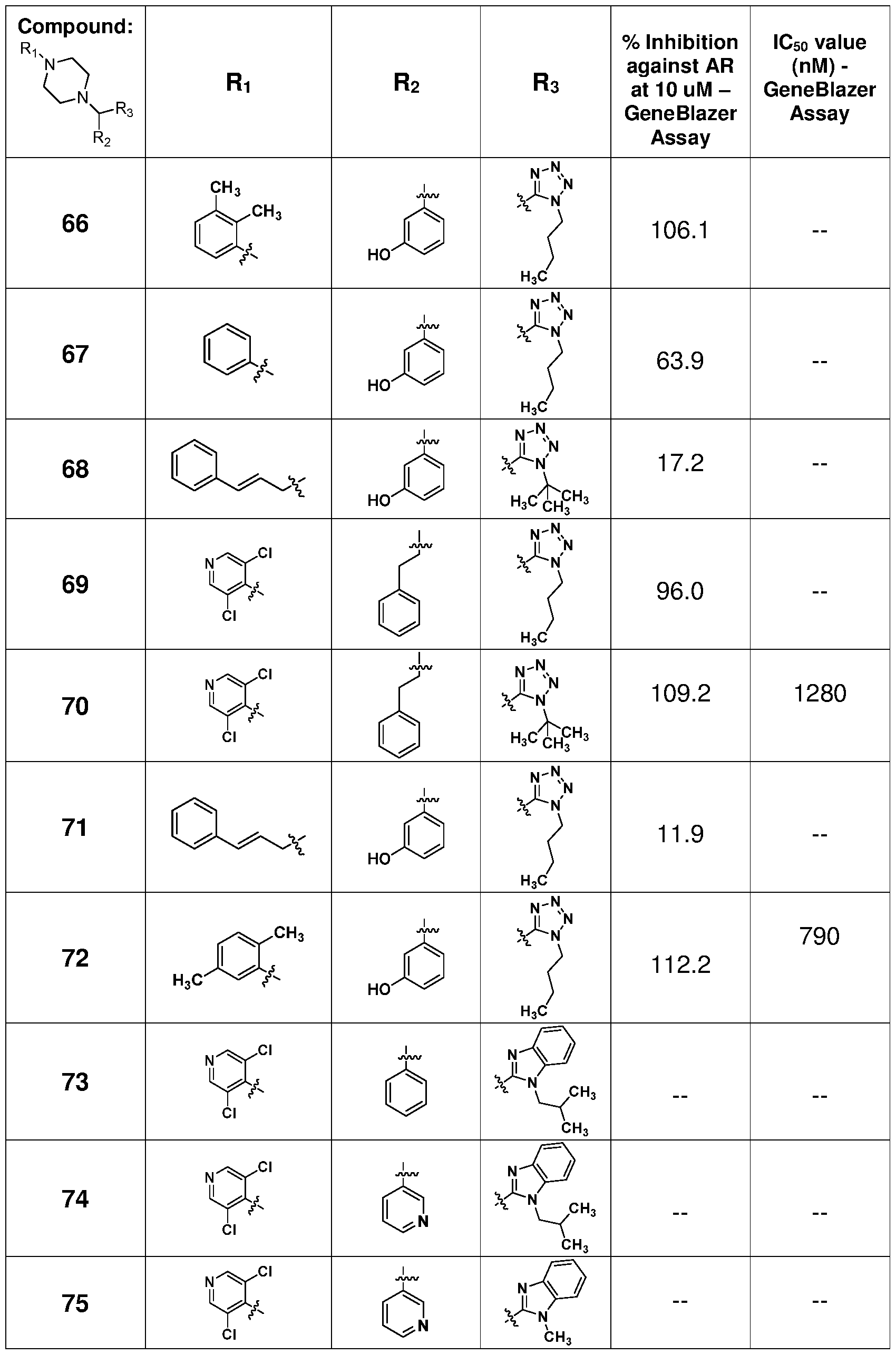


Table III.

 Table IV.

Example II.
This example describes the general procedures for the synthesis of compounds of the following formulas I, II, and III.

Scheme 1. Synthesis of tetrazoles 1 including via one-step TMSN3-Ugi reaction.

Scheme 3. Synthesis of tertiary amines 3 via reductive amination

Scheme 6. Synthesis of 1 ,3,4-oxadiazoles 6. Example III.
This example demonstrates synthetic and characterization data for several of the compounds of the present invention.
3-((l-butyl-lH-tetrazol-5-yl)(4-(3,5-dichloropyridin-4-yl)piperazin-l-yl)methyl)phenol
A mixture of l-(3,5-dichloropyridin-4-yl)piperazine (116 mg, 0.5 mmol), azidotrimethylsilane (66.2 uL, 0.5 mmol), 1-isocyanobutane (52.6 uL, 0.5 mmol) and 3-hydroxybenzaldehyde (61.1 mg, 0.5 mmol) in MeOH (2 mL) was stirred at rt for 16h. The reaction solvent was removed and the crude product was purified with silica gel chromatography (eluent, ethyl acetate:
 hexanes = 0 to 50%) to afford 1 (100 mg, 43.3%). 1 H NMR (400 MHz,
CDCb) d 8.34 - 8.25 (m, 2H), 7.30 - 7.18 (m, 1H), 6.90 (ddd, J = 24.4,
19.5, 11.9 Hz, 2H), 4.89 (s, 1H), 4.30 (t, J = 7.5 Hz, 2H), 3.46 - 3.22 (m, 4H), 2.74 (dd, J =
8.5, 5.4 Hz, 2H), 2.54 (dd, 7 = 8.9, 5.1 Hz, 2H), 1.79 - 1.63 (m, 2H), 1.43 - 1.25 (m, 2H), 0.91 (t, J = 7.4 Hz, 3H). 13C NMR (100 MHz, CDCI3) d 157.6, 154.3, 151.1, 148.8, 135.9, 130.1, 128.3, 120.2, 116.6, 115.7, 65.3, 52.0, 49.9, 47.5, 31.2, 19.7, 13.4.
l-(benzofuran-2-yl(l-(tert-butyl)-lH-tetrazol-5-yl)methyl)-4-(3,5-dichloropyridin-4- yl)piperazine (2)
The synthetic procedure of 2 was similar to that of 1. 1 H NMR (400 MHz, CDCI3) d 8.32 - 8.29 (m, 1H), 7.61 - 7.55 (m, 1H), 7.55 - 7.49 (m, 1H), 7.36 - 7·29 (m 1H), 7·27 - 7·23 (m 1H), 7·00 - 6·85 (m 1H), 5.81 - 5.58 (m, 1H)’ 3·43 - 3·31 (m’ 4H 3·06 (dt, 7 = 10.1, 4.5 Hz, 2H), 2.87 - 2.70 (m, 2H), 1.80 (d, 7 = 2.1 1H NMR (400 MHz, CDC13) d 8.32 - 8.29 (s, 2H), 7.61 - 7.55 (m, 1H), 7.55 - 7.49 (m, 1H), 7.36 - 7.29 (m, 1H), 7.27 - 7.23 (m, 1H), 7.00 - 6.85 (m, 1H), 5.81 - 5.58 (m, 1H), 3.43 - 3.31 (m, 4H), 3.06 (dt, 7 = 10.1, 4.5 Hz, 2H), 2.87 - 2.70 (m, 2H), 1.80 (d, 7 = 2.1 Hz, 9H). 13C NMR
 b) d 154.7, 151.7, 150.9, 150.8, 149.1, 128.3, 127.7, 124.8, 123.1, 121.5, 111.3, 109.0, 61.8, 58.7, 50.5, 50.2, 30.1.
4-((l-butyl-lH-tetrazol-5-yl)(4-(3,5-dichloropyridin-4-yl)piperazin-l- yl)methyl)quinoline (3)
The synthetic procedure of 3 was similar to that of 1. 1 H NMR (400 MHz, CDCb) d 9.02 - 8.92 (m, 1H), 8.45 (t, 7 = 7.1 Hz, 1H), 8.36 - 8.30 (m, 1H), 8.22 - 8.15 (m, 1H), 7.83 - 7.75 (m, 1H), 7.71 - 7.60 (m, 2H), 7.26 (d, 7 = 1.7 Hz, 1H), 5.92 (d, 7 = 14.0 Hz, 1H), 4.24 (tt, 7 = 12.3, 3.7 Hz, 2H), 3.53 - 3.29 (m, 4H), 3.01 - 2.86 (m, 2H), 2.68 - 2.50 (m, 2H), 1.73 - 1.61 (m,
1H), 1.60 - 1.47 (m, 1H), 1.34 - 1.12 (m, 2H), 0.84 (t, 7 = 7.4 Hz, 3H). 13C

NMR (100 MHz, CDCb) d 152.2, 150.7, 149.6, 149.2, 148.8, 140.3, 130.5, 130.0, 128.4, 127.7, 126.4, 123.2, 120.5, 60.4, 51.7, 50.0, 47.6, 31.1, 19.6, 13.3.
l-((l-butyl-lH-tetrazol-5-yl)(phenyl)methyl)-4-(3,5-dichloropyridin-4-yl)piperazine (4)
The synthetic procedure of 4 was similar to that of 1. 1 H NMR (400 MHz, CDCb) d 8.32 (s, 1H), 7.48 - 7.32 (m, 3H), 5.00 (s, 1H), 4.32 (t, 7 = 7.5 Hz, 1H), 3.41 (t, 7 = 4.8 Hz, 3H), 2.77 (dt, 7 = 10.2, 4.8 Hz, 1H), 2.53 (dt,
7= 10.4, 4.8 Hz, 1H), 1.77 - 1.66 (m, 1H), 1.32 (dqd, 7= 16.1, 7.3, 1.6 Hz, 1H), 0.91 (t, 7 = 7.4 Hz, 2H). 13C NMR (100 MHz, CDCb) d 153.9, 150.9,
 149.1, 134.7, 128.9, 128.8, 128.8, 128.3, 65.2, 51.7, 50.0, 47.3, 31.3, 19.7,
13.4.
l-((l-butyl-lH-tetrazol-5-yl)methyl)-4-(3,5-dichloropyridin-4-yl)piperazine (5)
The synthetic procedure of 5 was similar to that of 1. 1H NMR (400 MHz, CDCb) d 8.34 (s, 1H), 4.50 - 4.44 (m, 2H), 3.91 (s, 2H), 3.39 - 3.32 (m, 3H), 2.68 - 2.62 (m, 3H), 2.01 - 1.92 (m, 2H), 1.48 - 1.38 (m, 2H). 13C NMR (100 MHz, CDCb) d 151.3, 150.8, 149.1, 128.5, 53.6, 50.9, 49.8, 47.4, 31.5, 19.7, 13.8, 13.5.

1 -(1 -( 1 -butyl- lH-tetrazol-5-yl)ethyl)-4-(3,5 -dichloropyridin-4-yl)piper azine (6)
The synthetic procedure of 6 was similar to that of 1. 1 H NMR (400 MHz, CDCb) d 8.34 (d, 7 = 0.4 Hz, 1H), 4.55 - 4.36 (m, 2H), 4.22 - 4.12 (m, 1H), 3.40 - 3.24 (m, 4H), 2.78 - 2.59 (m, 3H), 2.04 - 1.93 (m, 2H), 1.61 (d, 7 = 6.9 Hz, 2H), 1.53 - 1.36 (m, 2H), 1.01 (t, 7 = 7.4 Hz, 2H). 13C NMR (100 MHz, CDCb) d 154.9, 150.9, 149.2, 128.5, 54.6, 50.1, 49.3, 47.5, 31.6, 19.9, 13.5, 11.4.

The synthetic procedure of 7 was similar to that of 1. 1 H NMR (400 MHz, CDCb) d 8.32 (d, J = 0.4 Hz, 2H), 7.29 (t, J = 8.2 Hz, 1H), 7.04 - 7.00 (m, 2H), 6.87 (ddd, J = 8.3, 2.4, 1.1 Hz, 1H), 4.95 (s, 1H), 4.32 (t, J = 7.6 Hz, 2H), 3.41 (t, J = 4.8 Hz, 5H), 2.77 (dt, J = 10.2, 4.7 Hz, 2H), 2.52 (dt, 7= 10.7, 5.1 Hz, 2H), 1.81 - 1.60 (m, 3H), 1.38 - 1.28 (m, 2H), 0.92 (t, J = 7.4 Hz, 3H). 13C NMR (100 MHz, CDCh) d 160.1, 153.9, 150.9, 149.1, 136.4, 129.9, 128.3, 120.9, 114.4, 114.1, 65.2, 55.3,
 51.9, 50.0, 47.4, 31.3, 19.7, 13.4.
l-((l-butyl-lH-tetrazol-5-yl)(3-fluorophenyl)methyl)-4-(3,5-dichloropyridin-4- yl)piperazine (8)
The synthetic procedure of 8 was similar to that of 1. 1 H NMR (400 MHZ, CDCh) d 8.33 (s, 1H), 7.36 (td, J = 8.0, 5.8 Hz, 1H), 7.28 - 7.21 (m, 2H), 7.06 (tdd, J = 8.3, 2.6, 1.0 Hz, 1H), 5.03 (s, 1H), 4.35 (t, J = 7.7 Hz, 1H), 3.41 (t, J = 4.8 Hz, 3H), 2.76 (dt, J = 10.7, 5.1 Hz, 1H),
2.52 (dt, J = 10.2, 4.8 Hz, 1H), 1.75 (ddtd, J = 20.6, 13.8, 6.8, 1.3 Hz, 1H), 1.43 - 1.27 (m, 1H), 0.93 (t, J = 7.3 Hz, 2H). 13C NMR (100 MHz, CDCh) d 164.1, 153.3, 150.8, 149.1, 137.3, 137.2, 130.5, 130.4, 128.3,
 124.5, 124.4, 116.0, 115.8, 115.8, 115.6, 76.6, 64.5, 64.4, 51.6, 49.9,
47.4, 31.4, 19.7, 13.4.
l-((l-(tert-butyl)-lH-tetrazol-5-yl)(thiophen-2-yl)methyl)-4-(3,5-dichloropyridin-4- yl)piperazine (9)
The synthetic procedure of 9 was similar to that of 1. 1 H NMR (400 MHz, CDCh) d 8.30 (s, 2H), 8.30 (s, 2H), 8.30 (s, 2H), 7.37 (dd, J= 5.1, 1.2 Hz, 1H), 7.37 (dd, J= 5.1, 1.2 Hz, 1H), 7.40 - 7.24 (m, 2H), 7.27 (s, 1H), 6.97 (dd, J = 5.1, 3.6 Hz, 1H), 6.97 (dd, J = 5.1, 3.6 Hz, 1H), 7.01 - 6.90 (m, 2H), 6.93 (ddd, J = 3.5, 1.3, 0.6 Hz, 1H), 5.71 - 5.65 (m, 1H), 5.70 - 5.67
(m, 1H), 5.71 - 5.65 (m, 1H), 3.41 - 3.33 (m, 4H), 3.62 - 3.13 (m, 5H),
 3.42 - 3.31 (m, 4H), 3.01 - 2.88 (m, 2H), 2.98 - 2.91 (m, 2H), 2.98 - 2.90
(m, 2H), 2.66 (ddd, J = 7.0, 5.7, 3.0 Hz, 2H), 2.66 (ddd, J = 7.0, 5.7, 3.0 Hz, 2H), 2.66 (ddd, J = 7.0, 5.7, 3.0 Hz, 2H), 1.78 (s, 9H), 1.78 (s, 9H), 1.78 (s, 9H). 13C NMR (100 MHz, CDCh) d 153.4, 150.9, 149.1, 137.3, 128.7, 128.2, 127.1, 126.4, 61.6, 60.1, 50.3, 50.2, 30.2.
l-((l-butyl-lH-tetrazol-5-yl)(thiophen-2-yl)methyl)-4-(3,5-dichloropyridin-4- yl)piperazine (10)
The synthetic procedure of 10 was similar to that of 1. 1 H NMR (400 MHz, CDCh) d 8.40 - 8.23 (m, 2H), 8.34 - 8.29 (m, 1H), 7.37 (dd, 7 = 5.1, 1.2 Hz, 1H), 7.37 (dd, J = 5.1, 1.2 Hz, 1H), 7.07 (ddd, J = 3.4, 1.4, 0.7 Hz, 1H), 7.07 (ddd, J = 3.4, 1.4, 0.7 Hz, 1H), 7.01 (dd, J = 5.1, 3.5 Hz, 1H), 7.01 (dd, J = 5.1, 3.5 Hz, 1H), 5.42 - 5.37 (m, 1H), 5.42 - 5.37 (m, 1H), 4.52 - 4.38 (m, 2H), 4.50 - 4.38 (m, 2H), 3.39 (t, J = 4.8 Hz, 4H), 3.39 (t, J = 4.8 Hz, 4H), 2.86 - 2.77 (m, 2H), 2.85 - 2.78 (m, 2H),
 2.64 - 2.55 (m, 2H), 2.63 - 2.56 (m, 2H), 1.93 - 1.84 (m, 2H), 1.93 -
1.84 (m, 2H), 1.46 - 1.35 (m, 2H), 1.46 - 1.35 (m, 2H), 0.97 (t, J = 7.4 Hz, 3H), 0.97 (t, J =
7.4 Hz, 3H). 13C NMR (100 MHz, CDCh) d 153.2, 150.8, 149.1, 136.8, 128.3, 128.3, 126.8,
109.9, 60.0, 51.0, 50.0, 47.7, 31.5, 19.8, 13.5.
l-(benzo[d][l,3]dioxol-5-yl(l-butyl-lH-tetrazol-5-yl)methyl)-4-(3,5-dichloropyridin-4- yljpipcrazinc (11)
The synthetic procedure of 11 was similar to that of 1. 1 H NMR (400 MHz, CDCh) d 8.32 (s, 1H), 7.02 (d, 7 = 1.7 Hz, 1H), 6.86 (dd, 7 = 8.1, .8 Hz, 1H), 6.78 (d, 7 = 8.0 Hz, 1H), 6.01 - 5.96 (m, 1H), 4.87 (s, 1H), .36 - 4.28 (m, 1H), 3.40 (t, 7 = 4.8 Hz, 3H), 2.74 (dt, 7 = 10.4, 4.8 Hz, H), 2.56 - 2.48 (m, 1H), 1.84 - 1.72 (m, 1H), 1.35 (dd, 7 = 7.3, 1.1 Hz, H), 0.94 (t, 7 = 7.4 Hz, 2H). 13C NMR (100 MHz, CDCh) d 154.0, 50.9, 149.1, 148.3, 148.0, 128.4, 128.3, 122.4, 108.9, 108.2, 101.4, 4.9, 51.6, 50.0, 47.3, 31.4, 19.7, 13.5.
5-((l-butyl-lH-tetrazol-5-yl)(4-(3,5-dichloropyridin-4-yl)piperazin- l-yl)methyl)-lH-indole (12)
The synthetic procedure of 12 was similar to that of 1. 1 H NMR (400 MHz, CDCI3) d 8.42 (s, 1H), 8.42 (s, 1H), 8.31 (s, 2H), 8.31 (s, 2H), 7.70 - 7.64 (m, 1H), 7.69 - 7.66 (m, 1H), 7.39 (dt, 7 = 8.4, 0.8 Hz, 1H), 7.39 (dt, 7 = 8.4, 0.8 Hz, 1H), 7.29 - 7.24 (m, 3H), 7.29 - 7.24 (m, 3H), 6.54 (ddd, 7 = 3.1, 2.0, 0.9 Hz, 1H), 6.54 (ddd, 7 = 3.1, 2.0, 0.9 Hz, 1H), 5.03 (s, 1H), 5.03 (s, 1H), 4.34 - 4.24 (m, 2H), 4.32 - 4.25 (m, 2H), 3.42 (t, 7 = 4.8 Hz, 4H), 3.42 (t, 7 = 4.8 Hz, 4H), 2.83 - 2.75 (m, 2H), 2.85 - 2.73 (m, 2H), 2.59 (ddd, 7 = 15.7, 7.2, 3.9 Hz, 2H), 2.59 (ddd, 7 = 15.7, 7.2, 3.9 Hz, 2H), 1.73 - 1.64 (m, 2H), 1.68 (dddd, 7 = 8.9, 7.7, 6.5, 1.9 Hz, 2H), 1.36 - 1.24 (m, 2H), 1.36 - 1.25 .4 Hz, 3H), 0.86 (t, 7 = 7.4 Hz, 3H). 13C NMR (100 MHz, CDCh) d 5.7, 128.2, 127.9, 126.1, 125.3, 122.6, 121.1, 111.6, 102.8, 65.9, 51.9, 13.4.
idin-4-yl)piperazin-l-yl)(l-isopropyl-lH-tetrazol-5-
The synthetic procedure of 15 was similar to that of 1. 1 H NMR (400 MHz, CDCh) d 8.48 - 8.34 (m, 1H), 8.30 (s, 2H), 7.24 (t, 7 = 7.9 Hz, 1H), 7.09 - 7.02 (m, 1H), 6.96 (d, 7 = 7.7 Hz, 1H), 6.88 (ddd, 7 = 8.2, 2.5, 0.8 Hz, 1H), 5.03 - 4.82 (m, 2H), 3.52 - 3.26 (m, 4H), 2.86 - 2.71 (m, 2H), 2.61 - 2.44 (m, 2H), 1.43 (dd, 7= 19.0, 6.6 Hz, 6H). 13C NMR (100 MHz, CDCh) d 157.6, 153.5, 151.1, 148.9, 136.2, 130.1, 128.3,
119.9, 116.5, 115.6, 65.5, 52.2, 51.2, 49.9, 22.6, 22.5, 22.3.
3-((l-(tert-butyl)-lH-tetrazol-5-yl)(4-(3,5-dichloropyridin-4- yl)piperazin- l-yl)methyl)phenol (16)
synthetic procedure of 16 was similar to that of 1. 1 H NMR (400 MHz, Ch) d 8.28 (s, 1H), 7.93 (s, 1H), 7.22 (t, 7 = 7.9 Hz, 1H), 7.02 - 6.99 1H), 6.93 (dt, 7 = 7.8, 1.2 Hz, 1H), 6.86 (ddd, 7 = 8.2, 2.5, 1.0 Hz, 1H), 0 (s, 1H), 3.31 (dddd, 7 = 36.0, 12.3, 6.8, 2.9 Hz, 3H), 2.66 (dddd, 7 = 4, 10.3, 6.5, 2.8 Hz, 3H), 1.71 (s, 6H). 13C NMR (100 MHz, CDCh) d .2, 154.6, 151.1, 148.9, 136.3, 129.7, 128.2, 121.4, 116.4, 116.3, 109.9,
 7. 61.8. 51.5. 50.1. 30.2, 30.2.
3-((l-cyclopentyl-lH-tetrazol-5-yl)(4-(3,5-dichloropyridin-4-yl)piperazin-l- yl)methyl)phenol (17)
7. 61.8. 51.5. 50.1. 30.2, 30.2.
3-((l-cyclopentyl-lH-tetrazol-5-yl)(4-(3,5-dichloropyridin-4-yl)piperazin-l- yl)methyl)phenol (17)
The synthetic procedure of 17 was similar to that of 1. 1 H NMR (400 MHz,
CDCI3) d 8.30 (s, 1H), 7.81 (s, 1H), 7.24 (t, 7 = 7.9 Hz, 1H), 7.04 - 7.01 (m, 1H), 6.96 (dt, 7 = 7.7, 1.2 Hz, 1H), 6.86 (ddd, 7 = 8.2, 2.5, 0.9 Hz, 1H), 5.04 (qd, 7 = 7.3, 5.2 Hz, 1H), 4.94 (s, 1H), 3.44 - 3.29 (m, 2H), 2.75 (ddd, 7 = 10.2, 6.4, 3.1 Hz, 1H), 2.53 (ddd, 7 = 10.7, 6.5, 3.7 Hz, 1H), 2.11 - 1.63 (m, 6H). 13C
 NMR (100 MHz, CDCh) d 163.4, 157.3, 153.9, 151.0, 148.9, 136.4, 130.1, M wi 4743910 128.3, 120.1, 116.4, 115.6, 103.8, 65.6, 59.3, 52.1, 49.9, 33.5, 33.2, 24.7, 24.6,
12.8.
3-((l-cyclohexyl-lH-tetrazol-5-yl)(4-(3,5-dichloropyridin-4-yl)piperazin-l- yl)methyl)phenol (18)
The synthetic procedure of 18 was similar to that of 1. 1 H NMR (400 MHz,
CDCh) d 8.30 (s, 1H), 7.96 (s, OH), 7.26 - 7.22 (m, 1H), 7.06 - 7.02 (m, 1H), 6.97 (dt, 7 = 7.7, 1.2 Hz, 1H), 6.86 (ddd, 7 = 8.2, 2.5, 0.9 Hz, 1H), 4.91 (s,
1H), 4.47 (ddt, 7 = 11.7, 7.8, 3.9 Hz, 1H), 3.45 - 3.29 (m, 2H), 2.81 - 2.71 (m, 1H), 2.53 (ddd, 7= 11.2, 6.3, 3.2 Hz, 1H), 1.99 - 1.22 (m, 7H). 13C NMR (100 MHz, CDCh) d 157.5, 153.5, 151.0, 149.0, 136.4, 130.1, 128.4, 120.0, 116.5,
 115.5, 85.1, 65.5, 58.3, 52.2, 49.9, 32.8, 32.6, 25.4, 25.3, 24.7.
3-((l-benzyl-lH-tetrazol-5-yl)(4-(3,5-dichloropyridin-4-yl)piperazin-l-yl)methyl)phenol
The synthetic procedure of 19 was similar to that of 1. 1 H NMR (400 MHz, CDCh) d 8.27 (s, 2H), 7.38 - 7.31 (m, 3H), 7.23 - 7.16 (m, 2H), 7.14 - 7.09 (m, 2H), 6.92 (t, 7 = 2.0 Hz, 1H), 6.84 (dd, 7 = 8.1, 2.3 Hz, 2H), 5.73 - 5.64 (m, 1H), 5.39 (d, 7 = 15.5 Hz, 1H), 4.74 (s, 1H), 3.32 - 3.18 (m, 4H), 2.54 (ddd, 7 = 10.2, 6.3, 3.3 Hz, 2H), 2.40 (ddd, 7 = 10.4, 5.9, 3.2 Hz, 2H). 13C NMR (100 MHz, CDCh) d 157.0, 154.7, 151.0, 148.9, 135.5, 133.1, 130.0,
 129.1, 128.9, 128.2, 127.4, 120.8, 116.4, 115.7, 65.0, 51.6, 51.2, 49.8.
3-((4-(3,5-dichloropyridin-4-yl)piperazin-l-yl)(l-(2,6-dimethylphenyl)-lH-tetrazol-5- yl)methyl)phenol (20)
The synthetic procedure of 20 was similar to that of 1. 1 H NMR (400 MHz, CDCh) d 8.27 (s, 7 = 0.9 Hz, 2H), 7.40 (t, 7 = 7.6 Hz, 1H), 7.28 (d, 7 = 1.4 Hz, OH), 7.12 - 7.04 (m, 2H), 6.84 (ddd, 7 = 8.3, 2.5, 1.0 Hz, 1H), 6.39 (d, 7 = 7.3 Hz, 1H), 4.23 (s, 1H), 3.43 - 3.17 (m, 3H), 2.73 - 2.50 (m, 2H), 2.04 (s, 2H), 1.19 (s, 2H). 13C NMR (100 MHz, CDCh) d 156.1, 151.0, 148.9, 137.2, 135.7, 134.6, 131.3, 131.1, 129.8, 129.0, 128.6, 128.3, 121.2, 116.8, 115.5, 65.9, 52.3, 49.8, 17.6, 16.6.

A mixture of l-(3,5-dichloropyridin-4-yl)piperazine (232 mg, 1.0 mmol), 1-isocyanobutane (83 mg, 1.000 mmol) and 3-hydroxybenzaldehyde (122 mg, 1.000 mmol) in DCM (1 mL) in the presence of phenylphosphinic acid (0.4 mmol) was stirred at room temperature for 16 h. The reaction solvent was removed and the crude product was purified with silica gel
 chromatography (eluent, ethy acetate: hexanes= 0 to 50%) to afford 21 (80 mg, 18.29 % yield). lH NMR (400 MHz, CDCb) d 8.24 (s, 2H), 7.25 - 7.13 (m, 1H), 6.94 - 6.81 (m, 2H), 6.80 - 6.71 (m, 1H), 5.52 (s, 1H), 4.94 (d, J = 2.8 Hz, 1H), 3.81 (s, 1H), 3.56 - 3.12 (m, 4H), 2.57 (s, 2H), 1.88 - 1.12 (m, 6H), 0.92 (dt, J = 16.4, 7.2 Hz,
3H). 13C NMR (100 MHz, CDCb) d 149.1, 130.0, 129.8, 128.4, 119.7, 118.2, 116.0, 74.0, 52.2, 39.4, 37.9, 31.5, 20.1, 19.9, 13.7.
3-((4-(3,5-dichloropyridin-4-yl)piperazin-l-yl)methyl)phenol (22)
o r 0H A mixture of l-(3,5-dichloropyridin-4-yl)piperazine (122 mg, 0.5 mmol) and 3-hydroxybenzaldehyde (67.2 mg, 0.550 mmol) was stirred at rt for lh. The reaction solvent was removed in vacuo and re-dissovled in
Cl 22 MeOH (3 mL), followed by the addition of sodium borohydride (18.92
C16H17CI2N3O O mg, 0.500 mmol). The resulting mixture was stirred at rt for another 2h.
The reaction solvent was removed in vacuo and dissolved in ethyl acetate (10 mL), washed with water (10 mL) and brine (10 mL). The organic layer was dried over MgSCL, evaporated in vacuo to get the crude product. The crude product was purified with silica gel chromatography to obtain 22 (65 mg, 38.4 % yield). 1 H NMR (400 MHz, CDCb) d
8.89 (s, 1H), 8.31 (d, J = 10.5 Hz, 1H), 7.11 (t, J = 7.8 Hz, 1H), 6.80 (dd, J = 9.4, 8.5 Hz, 2H), 6.72 - 6.65 (m, 1H), 4.50 (d, J = 15.5 Hz, 1H), 3.49 (s, 2H), 3.43 - 3.31 (m, 4H), 2.58 (dd, J = 4.8, 3.2 Hz, 4H). 13C NMR (100 MHz, CDCb) d 156.1, 150.1, 147.8, 142.4, 138.4, 127.7, 126.9, 118.7, 116.2, 114.7, 113.0, 62.7, 61.7, 52.3, 48.8.
l-(benzofuran-2-ylmethyl)-4-(3,5-dichloropyridin-4-yl)piperazine (23)
The synthetic procedure of 23 was similar to that of 22. 1 H NMR (400 MHz, CDCb) d 8.41 - 8.26 (m, 2H), 7.60 - 7.44 (m, 2H), 7.30 - 7.19 (m, 2H), 6.65 (s, 1H), 3.78 (s, 2H), 3.53 - 3.34 (m, 4H), 2.72 (d, J = 3.9 Hz, 4H). 13C NMR (100 MHz, CDCb) d 155.1, 151.2, 149.1, 128.3,
 128.1, 124.0, 122.7, 120.7, 111.3, 105.9, 55.7, 53.5, 49.8.
3-((l-butyl-lH-tetrazol-5-yl)(4-(2,6-dichlorophenyl)piperazin-l-yl)methyl)phenol (25)
The synthetic procedure of 25 was similar to that of 1. 1 H NMR (400 MHz,
CDCb) d 9.93 (s, 1H), 7.42 (d, J = 2.0 Hz, 1H), 7.25 - 7.22 (m, 1H), 7.12 - 7.09 (m, 1H), 7.03 - 6.97 (m, 1H), 6.97 - 6.92 (m, 1H), 6.90 - 6.85 (m, 1H), 6.32 (brs, 1H), 4.86 (d, J = 19.0 Hz, 1H), 4.45 - 4.30 (m, 2H), 3.30 - 3.13 (m, 4H), 2.77 - 2.64 (m, 2H), 2.55 - 2.43 (m, 2H), 1.84 - 1.68 (m, 2H), 1.43 - 1.31 (m, 2H), 1.01 - 0.88 (m, 3H). 13C NMR (100 MHz,
 CDCb) d 193.2, 157.0, 138.0, 135.0, 130.4, 129.0, 123.0, 122.2, 114.8, 66.0, 52.5, 48.9, 47.6, 31.2, 19.7, 13.5.
3-((l-butyl-lH-tetrazol-5-yl)(4-(pyridin-4-yl)piperazin-l-yl)methyl)phenol (27)
CDCb) d 193.2, 157.0, 138.0, 135.0, 130.4, 129.0, 123.0, 122.2, 114.8, 66.0, 52.5, 48.9, 47.6, 31.2, 19.7, 13.5.
3-((l-butyl-lH-tetrazol-5-yl)(4-(pyridin-4-yl)piperazin-l-yl)methyl)phenol (27)
The synthetic procedure of 27 was similar to that of 1. *H NMR (400 MHz, ifc-DMSO) d 9.54 (s, 1H), 8.19 - 7.91 (m, 2H), 7.18 - 7.02 (m, 1H), 6.88 - 6.75 (m, 2H), 6.74 - 6.62 (m, 3H), 5.19 (s, 1H), 4.46 - 4.27 (m, 2H), 3.34 - 3.18 (m, 4H), 2.66 - 2.50 (m, 2H), 2.45 - 2.28 (m, 2H), 1.69 - 1.39 (m, 2H), 1.31 - 1.01 (m, 2H), 0.74 (t, J= 7.4 Hz, 3H). 13C NMR (100 MHz, ifc-DMSO) d 157.94, 154.77, 154.53, 150.24, 136.80, 129.92, 120.07, 116.19, 115.83, 108.78, 62.49, 49.82, 47.03, 45.95, 31.41, 19.43, 13.76.

l-(benzofuran-2-yl(l-butyl-lH-tetrazol-5-yl)methyl)-4-(3,5-dichloropyridin-4- yl)piperazine (28)
The synthetic procedure of 28 was similar to that of 1. 1 H NMR (400 MHz, CDCh) d 8.32 (s, 2H), 7.62 - 7.57 (m, 1H), 7.48 (d, J = 8.2 Hz, 1H), 7.38 - 7.31 (m, 1H), 7.29 - 7.24 (m, 1H), 7.00 (s, 1H), 5.39 (s, 1H), 4.67 (dd, J = 14.7, 7.2 Hz, 2H), 3.39 (t, J = 4.8 Hz, 4H), 2.90 - 2.77 (m, 2H), 2.74 - 2.56 (m, 2H), 2.00 (td, J = 14.9, 7.4 Hz, 2H), 1.49 (dd, J = 15.1, 7.5 Hz, 2H), 1.01 (t, J = 7.4 Hz, 3H). 13C NMR (100 MHz, CDCh) d 149.1, 125.1, 123.4, 121.5, 111.3, 108.8, 59.1, 51.3, 49.9, 48.1, 31.7, 19.9, 13.6.

4-((l-(tert-butyl)-lH-tetrazol-5-yl)(4-(3,5-dichloropyridin-4-yl)piperazin-l- yl)methyl)quinoline (29)
The synthetic procedure of 29 was similar to that of 1. 1 H NMR (400 MHz, CDCb) d 8.83 (d, J = 4.5 Hz, 1H), 8.50 (d, J = 7.9 Hz, 1H), 8.29 (s, 2H), 8.22 (d, J = 8.4 Hz, 1H), 7.86 - 7.79 (m, 1H), 7.78 - 7.70 (m, 1H), 7.04 (d, J= 4.5 Hz, 1H), 6.39 (s, 1H), 3.34 (p, 7 = 6.6 Hz, 2H), 3.27 - 3.16 (m, 4H), 2.76 - 2.65 (m, 2H), 1.60 (s, 9H). 13C NMR (100 MHz, CDCh) d 152.2, 150.9, 149.8, 149.1, 148.8, 140.8, 130.6, 129.7, 128.2, 127.6, 126·6’ 123·5’ 122-! 61.4, 60.3, 50.6, 49.9, 30.2.

l-((l-butyl-lH-tetrazol-5-yl)(pyridin-4-yl)methyl)-4-(3,5-dichloropyridin-4- yl)piperazine (30)
The synthetic procedure of 30 was similar to that of 1. 1 H NMR (400 MHz, CDCh) d 8.76 - 8.60 (m, 2H), 8.45 - 8.21 (m, 2H), 7.45 (dd, J = 4.5, 1.5 Hz, 2H), 5.07 (s, 1H), 4.51 - 4.32 (m, 2H), 3.53 - 3.34 (m, 4H), 2.87 - 2.70 (m, 2H), 2.59 - 2.48 (m, 2H), 1.91 - 1.72 (m, 2H), 1.47 - 1.28 (m, 2H), 0.97 (dt, J= 14.7, 7.4 Hz, 3H). 13C NMR (100 MHz, CDCh) d 152.3, 150.7,
 150.4, 149.2, 143.4, 128.4, 123.7, 63.7, 51.3, 49.9, 47.6, 31.4, 19.7, 13.4. l-((l-(tert-butyl)-lH-tetrazol-5-yl)(pyridin-4-yl)methyl)-4-(3,5-dichloropyridin-4- yl)piperazine (31)
The synthetic procedure of 31 was similar to that of 1. 1 H NMR (400 MHz, CDCh) d 8.74 - 8.60 (m, 2H), 8.39 - 8.26 (m, 2H), 7.42 (dd, J = 4.5, 1.6 Hz, 2H), 5.39 (s, 1H), 3.44 - 3.26 (m, 5H), 2.99 - 2.83 (m, 2H), 2.65 - 2.56 (m, 2H), 1.76 (s, 9H). 13C NMR (100 MHz, CDCh) d 152.6, 150.8, 150.2, 149.1, 143.9, 128.3, 124.4, 64.1, 61.7, 50.7, 50.2, 30.4.

The synthetic procedure of 32 was similar to that of 1. 1 H NMR (400 MHZ,CDC13) d 8.31 (s, 2H), 7.40 - 7.34 (m, 2H), 6.93 - 6.88 (m, 2H), 4.92 (s, 1H), 4.34 - 4.27 (m, 2H), 3.81 (s, 3H), 3.40 (t, 7 = 4.8 Hz, 4H), 2.74 (dt, 7 = 10.1, 4.6 Hz, 2H), 2.53 (dt, 7 = 10.3, 4.7 Hz, 2H), 1.80 - 1.69 (m, 2H), 1.39 - 1.27 (m, 2H), 0.92 (t, 7 = 7.4 Hz, 2H). 13C NMR (100 MHz, CDC13) d 159.8,
 154.2, 150.9, 149.1, 130.0, 128.3, 126.5, 114.2, 64.6, 55.3, 51.6, 50.0, 47.3,
31.3, 19.7, 13.4.
l-((l-(tert-butyl)-lH-tetrazol-5-yl)(4-methoxyphenyl)methyl)-4-(3,5-dichloropyridin-4- yl)piperazine (33)
The synthetic procedure of 33 was similar to that of 1. 1 H NMR (400 MHz, CDCh) d 8.29 (s,
2H), 7.40 - 7.34 (m, 2H), 6.90 - 6.85 (m, 2H), 5.24 (s, 1H), 3.80 (s, 3H), 3.41 - 3.30 (m, 4H), 2.82 (dt, 7 = 9.6, 4.4 Hz, 2H), 2.61 - 2.54 (m, 2H), 1.70 (s, 9H). 13C NMR (100 MHz, CDCh) d 159.7, 154.4, 151.0, 149.1, 130.9, 128.2, 127.0, 113.9, 65.0, 61.3, 55.2, 51.1, 50.2, 30.2.

4-((l-butyl-lH-tetrazol-5-yl)(4-(3,5-dichloropyridin-4-yl)piperazin-l- yl)methyl)benzonitrile (34)
The synthetic procedure of 34 was similar to that of 1. 1 H NMR (400 MHZ, CDCI3) d 8.33 (s, 1H), 7.74 - 7.64 (m, 4H), 5.09 (s, 1H), 4.38 (t, 7 = 7.5 Hz, 2H), 3.39 (t, 7 = 4.8 Hz, 4H), 2.71 (dt, 7 = 10.1, 4.7 Hz, 2H), 2.53 (dt, 7 = 10.2, 4.7 Hz, 2H), 1.91 - 1.73 (m, 2H), 1.36 (dqd, 7 = 14.1, 7.3, 1.4 Hz, 2H), 0.95 (t, 7 = 7.4 Hz, 3H). 13C NMR (100 MHz, CDCI3) d 152.6, 150.6, 149.2, 139.8, 132.6, 129.7, 128.4, 118.0, 112.9, 109.9, 64.3, 51.3, 49.9, 47.5, 31.5, 19.7, 13.4.
4-((l-(tert-butyl)-lH-tetrazol-5-yl)(4-(3,5-dichloropyridin-4- yl)piperazin-l-yl)methyl)benzonitrile (35)
re of 35 was similar to that of 1. 1 H NMR (400 MHz, CDCI3) d 8.31 (s, ), 7.71 - 7.62 (m, 4H), 5.44 - 5.41 (s, 1H), 3.37 - 3.31 (t, 7 = 4.8 Hz, ), 2.88 - 2.81 (m, 2H), 2.61 - 2.54 (m, 2H), 1.77 - 1.73 (s, 9H). 13C NMR 0 MHz, CDCh) d 152.9, 150.8, 149.1, 140.5, 132.4, 130.4, 128.3, 118.1, 2.7, 110.0, 64.6, 50.8, 50.2, 30.4.
 l-((l-butyl-lH-tetrazol-5-yl)(4-fluorophenyl)methyl)-4-(3,5- dichloropyridin-4- yl)piperazine (36)
The synthetic procedure of 36 was similar to that of 1. 1 H NMR (400 MHz, CDC13) d 8.32 (s,
2H), 7.51 - 7.44 (m, 2H), 7.13 - 7.05 (m, 2H), 4.98 (s, 1H), 4.34 (t, 7 = 7.5 Hz, 2H), 3.40 (t, 7 = 4.8 Hz, 4H), 1.84 - 1.69 (m, 2H), 1.40 - 1.28 (m, 2H), 0.93 (t, 7 = 7.4 Hz, 3H). 13C NMR (100 MHz, CDCI3) d 161.5, 153.7, 150.8, 149.1, 130.6, 130.6, 130.4, 130.4, 128.3, 116.0, 115.8, 109.9, 64.3, 51.5, 49.9, 47.4, 31.4, 19.7, 13.4.
 l-((l-(tert-butyl)-lH-tetrazol-5-yl)(4-fluorophenyl)methyl)-4-(3,5-dichloropyridin-4- yl)piperazine (37)
The synthetic procedure of 37 was similar to that of 1. 1 H NMR (400 MHz, CDCI3) d 8.30 (s, 2H), 7.49 - 7.44 (m,2H), 7.09 - 7.03 (m, 2H), 5.31 (s, 1H), 3.39 - 3.30 (m, 4H), 2.86 - 2.78 (m, 2H), 2.61 - 2.53 (m, 2H), 1.72 (s, 9H). 13C NMR (100 MHz, CDCI3) d 163.9, 161.4, 154.0, 151. 0, 149.1 , 131.5, 130.9, 128.2, 115.7, 115.5, 110.0, 64.6, 61.4, 51.0, 50.2, 30.3.

l-((l-butyl-lH-tetrazol-5-yl)(naphthalen-l-yl)methyl)-4-(3,5-dichloropyridin-4- yl)piperazine (38)
The synthetic procedure of 38 was similar to that of 1. 1 H NMR (400 MHz, CDCh) d 8.55 - 44 (d, J= 8.3 Hz, 1H), 8.39 - 8.27 (s, 2H), 7.96 - 7.82 (ddd, J = 9.3, 8.2, 3 Hz, 2H), 7.73 - 7.39 (m, 4H), 5.92 - 5.77 (s, 1H), 4.28 - 4.03 (ddd, J 10.4, 8.4, 6.6 Hz, 2H), 3.58 - 3.26 (ddd, 7 = 14.8, 6.6, 2.9 Hz, 4H), 3.04 2.85 (t, J = 7.3 Hz, 2H), 2.72 - 2.54 (d, J = 7.3 Hz, 2H), 1.65 - 1.36 (m, H), 1.29 - 1.07 (dt, J = 7.4, 6.4 Hz, 2H), 0.91 - 0.65 (m, 3H). 13C NMR 00 MHz, CDCh) d 153.5, 150.9, 149.1, 134.1, 131.4, 130.5, 129.7, 28.9, 128.2, 127.0, 126.7, 126.2, 124.9, 123.3, 61.5, 51.7, 50.2, 47.4, -tetrazol-5-yl)(naphthalen-l-yl)methyl)-4-(3,5-dichloropyridin-4- ure of 39 was similar to that of 1. 1 H NMR (400 MHz, CDCh) d 8.49 - 5 (m, 1H), 8.34 - 8.20 (s, 2H), 7.95 - 7.89 (m, 1H), 7.86 - 7.82 (m, 1H), 1 - 7.65 (ddd, J= 8.5, 6.9, 1.4 Hz, 1H), 7.61 - 7.55 (ddd, J = 8.1, 6.8, 1.1 1H), 7.37 - 7.32 (dd, J = 8.2, 7.2 Hz, 1H), 7.08 - 7.03 (m, 1H), 6.39 - 6 (s, 1H), 3.37 - 3.29 (m, 2H), 3.24 - 3.16 (m, 4H), 2.79 - 2.71 (m, 2H), 8 - 1.52 (s, 9H). 13C NMR (100 MHz, CDCh) d 153.5, 151.1, 149.1, .1, 131.6, 131.3, 129.5, 128.9, 128.1, 126.9, 126.1, 124.8, 123.6, 109.9, 2, 61.1, 50.8, 49.7, 30.0.
zol-5-yl)(naphthalen-2-yl)methyl)-4-(3,5-dichloropyridin-4-
The synthetic procedure of 40 was similar to that of 1. 1 H NMR (400 MHz, CDCh) d 8.41 - 8.18 (s, 2H), 7.95 - 7.78 (m, 4H), 7.66 - 7.60 (dd, J= 8.5, 1.8 Hz, 1H), 7.57 - 7.48 (m, 2H), 5.21 - 5.13 (s, 1H), 4.42 - 4.29 (td, J = 7.6, 1.7 Hz, 2H), 3.51 - 3.34 (t, J = 4.8 Hz, 4H), 2.87 -
2.78 (dt, J = 9.7, 4.6 Hz, 2H), 2.66 - 2.55 (dd, J = 10.6, 5.1 Hz, 2H),
1.79 - 1.65 (m, 2H), 1.38 - 1.24 (m, 2H), 0.94 - 0.78 (t, J = 7.4 Hz,
 3H). 13C NMR (100 MHz, CDCh) d 153.9, 150.9, 149.1, 133.2, 133.0,
132.3, 128.9, 128.3, 128.1, 127.9, 127.7, 126.8, 126.7, 125.9, 109.9,
65.3, 51.8, 50.0, 47.4, 31.3, 19.7, 13.4.
l-((l-(tert-butyl)-lH-tetrazol-5-yl)(naphthalen-2-yl)methyl)-4-(3,5-dichloropyridin-4- yl)piperazine (41)
The synthetic procedure of 41 was similar to that of 1. 1 H NMR (400 MHz, CDCb) d 8.29 (s, 2H), 7.89 - 7.78 (m, 3H), 7.77 - 7.71 (dt, 7 = 4.4, 2.2 Hz, 2H), 7.53 - 7.47 (m, 2H), 5.51 (s, 1H), 3.39 - 3.32 (t, 7 = 4.8 Hz, 4H), 2.94 - 2.87 (dd, 7 = 10.4, 5.1 Hz, 2H), 2.68 - 2.61 (m, 2H), 1.72 (s, 9H). 13C NMR (100 MHz, CDCb) d 154.1, 151.0, 149.1, 133.1, 132.9, 132.8, 128.9, 128.6, 128.2, 128.1, 127.6, 127.0, 126.7, 126.5, 65.5, 61.4, 51.1, 50.3, 30.3.
l)-lH-tetrazol-5-yl)-3-phenylallyl)-4-(3,5-dichloropyridin-4- e synthetic procedure of 43 was similar to that of 1. ¾ NMR (400 MHz, DCb) d 8.36 - 8.23 (m, 2H), 7.54 - 7.41 (m, 1H), 7.41 - 7.21 (m, 4H), 4 - 6.80 (m, 1H), 6.66 - 6.47 (m, 1H), 4.88 - 4.69 (m, 1H), 3.47 - 3.21 , 4H), 2.92 - 2.68 (m, 4H), 1.96 - 1.77 (s, 9H). 13C NMR (100 MHz, DCb) d 153.5, 150.9, 149.1, 135.7, 128.7, 128.6, 126.8, 122.8, 63.1, 62.1,
 .4, 49.7, 29.9.
2-((l-butyl-lH-tetrazol-5-yl)(4-(3,5-dichloropyridin-4-yl)piperazin-l-yl)methyl)-lH- indole (46)
The synthetic procedure of 46 was similar to that of 1. *H NMR (400 MHz, CDCb) d 9.57 (s, 1H), 8.30 (s, 2H), 7.60 (dd, 7 = 7.9, 0.6 Hz, 1H), 7.43 (dd, 7 = 8.2, 0.8 Hz, 1H), 7.23 (ddd, 7 = 8.2, 7.1, 1.2 Hz, 1H), 7.12 (td, 7 = 7.6, 0.9 Hz, 1H), 6.52 (d, 7 = 1.4 Hz, 1H), 5.20 (s, 1H), 4.45 (t, 7 = 7.4 Hz, 2H), 3.42 - 3.25 (m, 4H), 2.88 - 2.50 (m, 5H), 2.02 - 1.91 (m, 2H), 1.42 (dd, 7 = 15.1, 7.5 Hz, 2H), 0.99 (t, 7 = 7.4 Hz, 3H). 13C NMR (100 MHz, CDCI3) d 152.8, 150.8, 149.1,
 136.6, 129.8, 128.4, 127.3, 122.8, 120.6, 120.1, 111.5, 104.2, 60.3, 57.8, 50.7, 49.9, 47.5, 31.6, 21.0, 19.7, 14.2, 13.5.
2-((l-(tert-butyl)-lH-tetrazol-5-yl)(4-(3,5-dichloropyridin-4-yl)piperazin-l-yl)methyl)- lH-indole (47)
The synthetic procedure of 47 was similar to that of 1. 1 H NMR (400 MHz, CDCb) d 9.59 (d, 7 = 28.3 Hz, 1H), 8.46 - 8.16 (s, 2H), 7.56 (dd, 7 = 17.7, 6.7 Hz, 1H), 7.40 (t, 7 = 10.0 Hz, 1H), 7.30 - 7.17 (m, 1H), 7.17 - 7.06 (m, 1H), 6.49 (s, 1H), 5.49 (s, 1H), 3.49 - 3.24 (m, 2.92 - 2.73 (m, 2H), 2.69 - 2.49 (m, 2H), 1.84 (d, 7
 = 0.8 Hz,
9H). 13C NMR (100 MHz, CDCb) d 153.1, 150.8, 149.1, 136.7,
130.3, 128.35, 127.2, 122.7, 120.5, 120.0, 111.5, 104.3, 62.0, 58.8, 50.7, 50.1, 30.2.
l-((l-butyl-lH-tetrazol-5-yl)(5-methylfuran-2-yl)methyl)-4-(3,5-dichloropyridin-4- yl)piperazine (48)
The synthetic procedure of 48 was similar to that of 1. 1 H NMR (400 MHz, CDCh) d 8.33 (s, 2H), 6.40 (d, J = 3.1 Hz, 1H), 5.98 (s, 1H), 4.59 (ddd, J = 8.6, 6.4, 1.5 Hz, 2H), 3.37 (t, J = 4.8 Hz, 4H), 2.73 - 2.65 (m, 2H), 2.52 (dt, J = 10.4, 4.8 Hz, 2H), 2.30 (s, 3H), 2.01 - 1.91 (m, 2H), 1.52 - 1.41 (m, 2H), 1.01 (t, 7 = 7.4 Hz, 3H). 13C NMR (100
 MHz, CDCh) d 153.2, 152.4, 150.8, 149.2, 145.5, 128.4, 112.6, 106.7,
58.9, 51.3, 49.9, 48.0, 31.6, 19.9, 13.6, 13.6.
l-((l-(tert-butyl)-lH-tetrazol-5-yl)(5-methylfuran-2-yl)methyl)-4-(3,5-dichloropyridin- 4-yl)piperazine (49)
The synthetic procedure of 49 was similar to that of 1. 1 H NMR (400 MHz, CDCh) d 8.30 (s, 2H), 6.34 (s, 1H), 5.97 (s, 1H), 5.43 (s, 1H), 3.43 - 3.31 (m, 4H), 2.97 - 2.89 (m, 2H), 2.73 - 2.63 (m, 2H), 2.31 (s, 3H), 1.76 (s, 9H). 13C NMR (100 MHz, CDCh) d 152.6, 152.3, 151.0, 149.1, 146.1, 128.2, 112.9, 106.7, 61.6, 58.5, 50.5, 50.2, 30.0, 13.7.
 l-(3,5-dichloropyridin-4-yl)-4-(furan-2-yl(l-isopropyl-lH-tetrazol-5- yl)methyl)piperazine (50)
The synthetic procedure of 50 was similar to that of 1. 1 H NMR (400 MHz, CDCh) d 8.33 (s, 2H), 7.45 (s, 1H), 6.60 - 6.53 (dd, J = 3.3, 0.8 Hz, 1H), 6.45 - 6.36 (dd, J = 3.3, 1.9 Hz, 1H), 5.50 - 5.35 (d, J = 6.7 Hz, 1H), 5.25 (s, 1H), 3.45 - 3.31 (m, 4H), 2.67-2.64 (m, 2H), 2.53-2.51 (m, 2H), 1.65 (d, J= 6.8 Hz, 3H), 1.60 (d, J= 6.4 Hz, 3H). 13C NMR (100 MHz, CDCh) d 151.4, 150.8, 149.2, 147.6, 143.2,
 128.3, 111.8, 110.8, 59.0, 51.6, 51.5, 49.9, 22.9, 22.8.
4-((4-(3,5-dichloropyridin-4-yl)piperazin-l-yl)(l-isopropyl-lH-tetrazol-5- yl)methyl)quinoline (51)
The synthetic procedure of 51 was similar to that of 1. 1 H NMR (400 MHz’ CDCh) d 9.00 - 8.94 (d, J = 4.5 Hz, 1H), 8.52 - 8.43 (m, 1H), 8.38 - 8.30 (s, 2H), 8.21 - 8.12 (m, 1H), 7.83 - 7.73 (m, 1H), 7.72 - 7.62 (m, 2H), 5.96 - 5.91 (s, 1H), 4.97 - 4.80 (t, J = 6.7 Hz, 1H), 3.54 - 3.33 (m, 4H), 3.06 - 2.89 (m, 2H), 2.62 - 2.51 (m, 2H), 1.70 - 1.63
 (d, J = 6.7 Hz, 1H), 1.50 - 1.43 (d, J = 6.6 Hz, 3H), 1.28 - 1.21 (d, J = 6.7 Hz, 3H). 13C NMR (100 MHz, CDCh) d 218.3, 151.3, 150.7, 149.8, 149.2, 149.1, 148.9,
140.4, 130.6, 129.9, 128.4, 127.6, 126.3, 123.3, 120.2, 60.6, 51.9, 51.3, 50.0, 22.7, 22.5.
l-(3,5-dichloropyridin-4-yl)-4-(l-(l-isopropyl-lH-tetrazol-5-yl)pentyl)piperazine (52) synthetic procedure of 52 was similar to that of 1. 1 H NMR (400 z, CDCb) d 8.33 (s, 2H), 4.98 - 4.83 (td, 7 = 6.7, 1.1 Hz, 1H), 3.96 - 7 (ddd, 7 = 10.2, 4.6, 1.1 Hz, 1H), 3.38 - 3.25 (dt, 7 = 6.5, 3.4 Hz, 4H), 0 - 2.69 (m, 2H), 2.68 - 2.57 (m, 2H), 2.18 - 1.98 (m, 3H), 1.72 - 1.64 , 7 = 6.7, 1.1 Hz, 3H), 1.65 - 1.56 (m, 2H), 1.43 - 1.30 (m, 2H), 1.25 .14 (m, 2H), 0.94 - 0.83 (m, 3H). 13C NMR (100 MHz, CDCh) d 153.0, , 50.6, 50.3, 49.8, 28.9, 27.0, 22.9, 22.7, 22.5, 22.5, 13.8, 13.8.
ichloropyridin-4-yl)piperazin-l-yl)(3-hydroxyphenyl)methyl)-lH- 3)
The synthetic procedure of 53 was similar to that of 1. 1 H NMR (400 MHz, CDCh) d 9.21 (s, 1H), 8.34 - 8.24 (s, 2H), 7.14 (dt, 7 = 8.7, 6.2 Hz, 1H), 6.87 - 6.72 (m, 2H), 5.07 (s, 1H), 3.73 (s, 3H), 3.40 - 3.27 (m, 4H), 3.16 (s, 2H), 2.75 - 2.63 (m, 2H), 2.58 - 2.49 (m, 2H). 13C NMR (100 MHz, CDCh) d 164.8, 156.5, 153.8, 149.5, 147.7, 133.7, 128.3, 126.9, 118.5, 114.8, 114.7, 63.2, 51.7, 49.9, 48.7, 47.1. -5-yl)(4-(4-fluorophenyl)piperazin-l-yl)methyl)phenol (54)
The synthetic procedure of 54 was similar to that of 1. 1 H NMR (400 MHZ,CDC1 ) d 8.07 (s, 1H), 7.21 (dd, 7 = 9.9, 5.9 Hz, 1H), 7.04 - 6.99 (m, 1H), 6.97 - 6.89 (m, 3H), 6.87 (ddd, 7 = 8.2, 2.4, 0.8 Hz, 1H), 6.81 (ddd, 7 = 6.9, 5.2, 3.1 Hz, 2H), 4.86 (s, 1H), 4.38 - 4.19 (m, 2H), 3.24 - 2.98 (m, 4H), 2.80 - 2.68 (m, 2H), 2.52 (dd, 7 = 9.2, 5.0 Hz, 2H), 1.80 - 1.59 (m, 2H), 1.40 - 1.23 (m, 2H), 0.88 (t, 7 = (100 MHz, CDCh) d 158.4, 157.3, 157.3, 156.1, 154.4, 154.4, 147.5, 0.2, 117.9, 117.8, 116.6, 115.7, 115.6, 115.4, 65.1, 51.3, 50.0, 47.6, -5-yl)(4-(2,6-dimethylphenyl)piperazin-l-yl)methyl)phenol (55)
The synthetic procedure of 55 was similar to that of 1. 1 H NMR (400 MHz, ifc-DMSO) d 9.80 (s, 1H), 7.47 (t, 7 = 7.8 Hz, 1H), 7.32 - 7.14 (m, 5H), 7.02 (ddd, 7 = 8.1, 2.4, 0.8 Hz, 1H), 5.52 (s, 1H), 4.77 (td, 7 = 7.4, 1.7 Hz, 2H), 3.30 (t, 7 = 4.3 Hz, 4H), 2.98 - 2.86 (m, 2H), 2.77 - 2.68 (m, 2H), 2.53 (d, 7 = 7.7 Hz, 6H), 2.05 - 1.87 (m, 2H),
 1.54 (ddd, 7 = 14.9, 7.5, 2.3 Hz, 2H), 1.14 (t, 7 = 7.4 Hz, 3H). 13C NMR (100 MHz, ifc-DMSO) d 157.8, 154.7, 148.2, 137.1, 136.5, 129.8, 129.2, 125.2, 120.2, 116.2, 115.6, 63.1, 51.7, 49.8, 47.0, 31.5, 19.7, 19.5, 13.8.
tert-butyl 4-((l-butyl-lH-tetrazol-5-yl)(3-hydroxyphenyl)methyl)piperazine-l- carboxylate (56)
1.54 (ddd, 7 = 14.9, 7.5, 2.3 Hz, 2H), 1.14 (t, 7 = 7.4 Hz, 3H). 13C NMR (100 MHz, ifc-DMSO) d 157.8, 154.7, 148.2, 137.1, 136.5, 129.8, 129.2, 125.2, 120.2, 116.2, 115.6, 63.1, 51.7, 49.8, 47.0, 31.5, 19.7, 19.5, 13.8.
tert-butyl 4-((l-butyl-lH-tetrazol-5-yl)(3-hydroxyphenyl)methyl)piperazine-l- carboxylate (56)
I 9 The synthetic procedure of 56 was similar to that of 1. 1 H NMR (400
A0 AN^ N-N MHZ,CDC1 ) d 8.06 (s, 1H), 7.24 - 7.16 (m, 1H), 6.95 - 6.92 (m,
Y^N'N 5 1H), 6.87 (dd, 7 = 7.9, 2.1 Hz, 2H), 4.82 (s, 1H), 4.32 - 4.19 (m, 2H), cOeOs O 3·58 3·33 (m’ 4H)’ 2·67 - 2·50 2H)’ 2·42 - 2·29 (m· 2H)’ L76
MW: 416 52 A - 1.60 (m, 2H), 1.45 (s, 9H), 1.36 - 1.20 (m, 2H), 0.88 (t, 7 = 7.4 Hz,
HO 3H). 13C NMR (100 MHz, CDC1 ) d 157.4, 154.7, 154.2, 135.6,
130.0, 120.2, 116.5, 115.6, 80.1, 65.0, 51.0, 47.5, 31.1, 28.3, 19.6, 13.4.
benzyl 4-((l-butyl-lH-tetrazol-5-yl)(3-hydroxyphenyl)methyl)piperazine-l-carboxylate (57) 1

(t, 7 = 7.4 Hz, 3H). 13C NMR (100 MHz, CDCT) d 157.2, 154.5, 152.2, 140.7, 135.9, 129.9, 123.2, 120.9, 120.3, 118.2, 116.4, 115.9, 111.1, 65.4, 55.3, 51.6, 50.4, 47.5, 31.2, 19.7, 13.4.
3-((l-butyl-lH-tetrazol-5-yl)(4-(3-(trifluoromethyl)pyridin-2-yl)piperazin-l- yl)methyl)phenol (60)
The synthetic procedure of 60 was similar to that of 1.

3-((l-butyl-lH-tetrazol-5-yl)(4-(3-chloro-5-(trifluoromethyl)pyridin-2-yl)piperazin-l- yl)methyl)phenol (61)
The synthetic procedure of 61 was similar to that of 1. 1 H NMR (400 MHz, ifc-DMSO) d 9.49 (s, 1H), 8.51 (dd, 7 = 1.9, 0.8 Hz, 1H), 8.13 (d, 7= 2.1 Hz, 1H), 7.16 (t, 7= 7.8 Hz, 1H), 6.98 - 6.80 (m, 2H), 6.78 - 6.63 (m, 1H), 5.28 (s, 1H), 4.42 (td, 7 = 7.3, 2.0 Hz, 2H), 3.44 (t, 7
 = 4.5 Hz, 4H), 2.77 - 2.61 (m, 2H), 2.59 - 2.49 (m, 2H), 1.61 (dd, 7
= 14.9, 7.7 Hz, 2H), 1.19 (ddd, 7 = 11.4, 7.3, 3.3 Hz, 2H), 0.80 (t, 7
= 7.4 Hz, 3H). 13C NMR (100 MHz, ifc-DMSO) d 159.8, 157.8, 154.4, 136.6, 129.8, 120.4, 120.2, 116.3, 115.8, 62.5, 49.9, 48.7, 47.0, 31.4, 19.4, 13.7.
3-((l-butyl-lH-tetrazol-5-yl)(4-(pyridin-2-yl)piperazin-l-yl)methyl)phenol (62)
The synthetic procedure of 62 was similar to that of 1. 1 H NMR (400 MHz, ifc-DMSO) d 9.50 (s, 1H), 8.24 - 7.97 (m, 1H), 7.47 (ddd, 7 = 8.9, 7.1, 2.0 Hz, 1H), 7.29 - 7.11 (m, 1H), 6.98 - 6.83 (m, 2H), 6.82 - 6.67 (m, 2H), 6.59 (dd, 7 = 6.8, 5.0 Hz, 1H), 5.21 (s, 1H), 4.50 - 4.35 (m, 2H), 3.46 (t, 7 = 4.9 Hz, 4H), 2.71 - 2.55
 (m, 2H), 2.45 - 2.32 (m, 2H), 1.81 - 1.52 (m, 2H), 1.36 - 1.07 (m,
2H), 0.80 (t, 7 = 7.4 Hz, 3H). 13C NMR (100 MHz, ifc-DMSO) d 159.2, 157.8, 154.6, 147.9, 137.9, 136.9, 129.8, 120.1, 116.2, 115.7, 113.4, 107.5, 62.7, 50.1, 47.0, 45.1, 31.4, 19.4, 13.7.
l-(4-(4-((l-butyl-lH-tetrazol-5-yl)(3-hydroxyphenyl)methyl)piperazin-l- yl)phenyl)ethanone (63)
The synthetic procedure of 63 was similar to that of 1. 1 H NMR (400
MHz, CDCb) d 8.09 (t, 7 = 19.1 Hz, 1H), 7.97 - 7.74 (m, 2H), 7.26 - 7.19 (m, 1H), 7.07 - 7.01 (m, 1H), 6.90 (dd, 7 = 8.0, 2.1 Hz, 2H),
6.78 (t, 7 = 5.9 Hz, 2H), 4.89 (s, 1H), 4.30 (dd, 7 = 27.7, 20.2 Hz, 2H), 3.48 - 3.22 (m, 4H), 2.87 - 2.69 (m, 2H), 2.66 - 2.43 (m, 5H), 1.80 - 1.57 (m, 2H), 1.38 - 1.18 (m, 2H), 0.87 (t, 7 = 7.4 Hz, 3H).
 13C NMR (100 MHz, CDCh) d 197.1, 157.4, 154.1, 153.9, 135.6, 130.4, 130.1, 127.5, 120.2, 116.6, 115.6, 113.3, 64.9, 50.9, 47.5, 47.1, 31.1, 26.1, 19.6, 13.4.
l-(l-((l-butyl-lH-tetrazol-5-yl)(3-hydroxyphenyl)methyl)piperidin-4-yl)-lH- benzo[d]imidazol-2(3H)-one (64)
13C NMR (100 MHz, CDCh) d 197.1, 157.4, 154.1, 153.9, 135.6, 130.4, 130.1, 127.5, 120.2, 116.6, 115.6, 113.3, 64.9, 50.9, 47.5, 47.1, 31.1, 26.1, 19.6, 13.4.
l-(l-((l-butyl-lH-tetrazol-5-yl)(3-hydroxyphenyl)methyl)piperidin-4-yl)-lH- benzo[d]imidazol-2(3H)-one (64)
The synthetic procedure of 64 was similar to that of 1. ¾ NMR (400
 (E)-3-((l-(tert-butyl)-lH-tetrazol-5-yl)(4-cinnamylpiperazin-l-yl)methyl)phenol (68)
1

(m, 2H), 0.86 (t, J = 7.4 Hz, 3H). 13C NMR (100 MHz, CDCh) d 157.3, 154.3, 136.5, 135.3, 134.0, 129.9, 128.4, 127.6, 126.3, 124.9, 120.0, 116.5,
116.1, 64.8, 60.5, 52.7, 50.6, 47.4, 31.1, 19.6, 13.4.
3-((l-butyl-lH-tetrazol-5-yl)(4-(2,5-dimethylphenyl)piperazin-l-yl)methyl)phenol (72)
The synthetic procedure of 72 was similar to that of 1. 1 H NMR (400 MHz, CDCb) d 7.86 (d, J = 18.9 Hz, 1H), 7.35 - 7.19 (m, 1H), 7.10 - 6.94 (m, 3H), 6.89 (dd, J = 8.1, 2.4 Hz, 1H), 6.77 (d, J = 10.1 Hz, 2H), 4.89 (s, 1H), 4.40 - 4.25 (m, 2H), 3.05 - 2.78 (m, 4H), 2.56 (t, J = 56.0 Hz, 4H), 2.23 (d, J = 42.4 Hz, 6H), 1.83
 - 1.61 (m, 2H), 1.42 - 1.21 (m, 2H), 0.91 (t, J = 7.4 Hz, 3H). 13C
NMR (100 MHz, CDCI3) d 157.3, 154.5, 150.8, 136.1, 136.0, 130.8, 130.0, 129.3, 123.9, 120.3, 119.7, 116.5, 115.8, 65.4, 52.1, 51.4, 47.6, 31.1, 21.1, 19.7, 17.3, 13.4.
2-((4-(3,5-dichloropyridin-4-yl)piperazin-l-yl)(phenyl)methyl)-l-isobutyl-lH- benzo[d]imidazole (73)
A mixture of l-(3,5-dichloropyridin-4-yl)piperazine (116 mg, 0.5 mmol), 2-(lV-Boc-amino)-phenyl-isocyanide (109 mg, O.SOmmol) and benzaldehyde (53 mg, 0.5 mmol) in DCM (1 mL) in the presence of phenylphosphinic acid (0.4 mmol) was stirred at room temperature for 16 h. The reaction solvent was removed under reduced pressure. The
 residue was dissolved in 10% TFA/DCE (2mL) and heated under microwave irradiation at 100 °C for 10 min. After the microwave vial was cooled to room temperature, the solvent was diluted with EtOAc (15mL) and washed with saturated Na?.C03 (lOmL). The organic layer was dried over MgSCL and concentrated to obtain the benzimidazole intermediate. The intermediate was dissolved in DMF (1 mL) and was further treated with sodium hydride (24 mg, 1.0 mmol) and isopropyl bromide (137 mg, 1.0 mmol). The reaction mixture was stirred at rt for 4hr. The reaction solution was neutralized with IN HC1 (1 mL), washed with DCM (5 mL) and brine (5 mL). The organic layer was dried over MgSOn evaporated in vacuo. Hie residure was was purified by Teledyne Isco CombiF!ash Rf (hexane/ EtOAc 20-100%) to afford 73. H NMR (400 MHz, CDCL) d 8.42 - 8.21 (s, 2H), 7.95 - 7.80 (m, 1H), 7.64 - 7.55 (m, 2H), 7.38 - 7.27 (m, 4H), 7.26 - 7.20 (m, 2H), 4.80 (s, 1H), 4.01 - 3.82 (m, 2H), 3.55 - 3.35 (m, 4H), 2.66 (m, 4H), 1.28 (m, 1H), 0.97 - 0.87 (m, 6H). ;C NMR (100 MHz, CDCL) d 151.4, 149.1, 135.2, 129.4, 128.6, 128.2, 128.1 , 122.3, 121.9, 120.1, 110.0, 68.3, 52.4, 51.1, 50.0, 29.3, 20.2.
2-((4-(3,5-dkh!oropyrsdin-4-yI)plperazm-l-yI)(pyrMisi-3-y!)methy!)-l-isobtity!-lH- benzo[d]imidazole (74)
The synthetic procedure of 74 was similar to that of 73. H NMR (400 MHz, CDCL) d 8.84 - 8.71 (s, 1H), 8.61 - 8.48 (m, 1H), 8.35
- 8.26 (m, 2H), 8.22 - 8.13 (m, 1H), 7.94 - 7.82 (m, 1H), 7.38 - 7.31 (m, 2H), 7.31 - 7.24 (m, 2H), 4.91 (s, 1H), 4.15 - 3.93 (m, 2H), 3.54
- 3.34 (m, 4H), 2.68 (m, 4H), 1.31 - 1.22 (m,lH), 1.03 - 0.81 (m, 6H). 13C NMR (100 MHz, CDCL) d 151.0, 150.1, 149.6, 149.1,
 137.6, 135.2, 128.2, 123.9, 122.8, 122.3, 120.1, 110.1, 64.8, 51.9,
51.2, 49.9, 29.6, 20.4, 20.3.
2-((4-(3,5-dichloropyridin-4-yl)piperazin-l-yl)(pyridin-3-yl)methyl)-l-methyl-lH- benzo[d]imidazole (75)
The synthetic procedure of 75 was similar to that of 73. 1 H NMR (400 MHz, CDCI3) d 8.92 - 8.78 (m, 1H), 8.59 - 8.50 (m, 1H), 8.39 - 8.25 (s, 2H), 8.08 - 7.99 (m, 1H), 7.83 - 7.75 (m, 1H), 7.35 - 7.21 (m, 4H), 5.03 (s, 1H), 3.92 (s, 3H), 3.52 - 3.36 (m, 4H), 2.90 - 2.55 (m, 4H). 13C NMR (100 MHz, CDCI3) d 151.8, 150.9, 149.8, 149.4, 149.0, 142.1, 136.9, 136.0, 132.6, 128.2, 123.8, 122.9, 122.3, 119.9, 109.2, 66.8, 52.1, 50.0, 30.3.
-tetrazol-5-yl)propan-2-yl)-4-(3,5-dichloropyridin-4-yl)piperazine synthetic procedure of 76 was similar to that of 1. 1 H NMR (400 MHz, Cb) d 8.33 (s, 2H), 3.42 - 3.26 (m, 4H), 2.76 - 2.57 (m, 4H), 1.91 (s, , 1.68 (s, 6H). 13C NMR (100 MHz, CDCh) d 159.8, 150.8, 149.1, .2, 64.5, 59.3, 50.0, 46.7, 31.4, 24.0.

l-(l-(l-(tert-butyl)-lH-tetrazol-5-yl)cyclohexyl)-4-(3,5-dichloropyridin-4-yl)piperazine
(77)
The synthetic procedure of 77 was similar to that of 1. 1 H NMR (400 MHz, CDCI3) d 8.31 (s,
2H), 3.25 (m, 4H), 2.66 (m, 4H), 1.88 (s, 9H), 1.86 - 1.80 (m, 4H), 1.78 - 1.69 (m, 2H), 1.64 (m, 2H), 1.31 - 1.11 (m, 2H). 13C NMR (100 MHz, CDCI3) d 157.2, 150.8, 149.1, 128.2, 64.9, 62.5, 62.1, 50.4, 46.4, 38.5, 31.9, 30.6, 25.7, 24.7, 23.3, 21.0.

l-((l-(tert-butyl)-lH-tetrazol-5-yl)(3-methoxyphenyl)methyl)-4-(3-chloro-5- (trifluoromethyl)pyridin-2-yl)piperazine (78)
The synthetic procedure of 78 was similar to that of 1. 1 H NMR (400 MHz, CDCI3) d 8.40 - 8.31 (m, 1H), 7.69 (t, J = 9.6 Hz, 1H), 7.29 - 7.22 (m, 1H), 7.07 (s, 1H), 6.98 (t, J = 10.3 Hz, 1H), 6.87 (dd, J = 8.1, 2.3 Hz, 1H), 5.36 - 5.25 (s, 1H), 3.80 (s, 3H), 3.52 (t, J = 4.8 Hz, 4H), 2.99 - 2.78 (m, 2H), 2.69 - 2.53 (m, 2H), 1.78 - 1.65 (s, 9H).
 13C NMR (100 MHz, CDCI3) d 159.5, 142.9, 129.3, 122.2, 115.6,
114.1, 65.1, 55.3, 50.2, 48.3, 30.4.
4-((l-(tert-butyl)-lH-tetrazol-5-yl)(4-(3-chloro-5-(trifluoromethyl)pyridin-2- yl)piperazin-l-yl)methyl)quinoline (79)

The synthetic procedure of 80 was similar to that of 1. 1 H NMR
 N_N (400 MHz, CDCb) d 7.31 - 7.23 (m, 1H), 7.10 (dd, J = 11.7, 9.7
N A
k/N Hz, 1H), 7.01 (t, J = 7.9 Hz, 2H), 6.90 - 6.84 (m, 1H), 6.82 - 6.74
(m, 2H), 5.29 - 5.23 (s, 1H), 3.81 (s, 3H), 2.91 (dd, J = 6.0, 3.7 Hz,
80 / 4H), 2.85 (dd, J = 10·9’ 3.4 Hz, 2H), 2.68 - 2.54 (m, 2H), 1.72 (s,
 9H). 13C NMR (100 MHz, CDCb) d 159.7, 154.3, 151.1, 136.8, MW: 434.58
136.0, 130.7, 129.4, 129.3, 123.7, 122.1, 119.7, 115.3, 114.0, 77.3, 77.0, 76.7, 65.3, 61.4, 55.3, 51.8, 51.1, 30.3, 21.1, 17.4.
4-((l-(tert-butyl)-lH-tetrazol-5-yl)(4-(2,5-dimethylphenyl)piperazin-l- yl)methyl)quinoline (81)
The synthetic procedure of 81 was similar to that of 1. 1 H NMR (400 MHZ, CDCb) d 8.83 (t, J = 5.2 Hz, 1H), 8.56 - 8.47 (m, 1H), 8.25 - 8.15 (m, 1H), 7.81 (ddd, J = 8.4, 6.9, 1.3 Hz, 1H), 7.73 (ddd, J = 8.3,
6.9, 1.3 Hz, 1H), 7.08 (d, J = 4.5 Hz, 1H), 7.02 (d, J = 7.5 Hz, 1H), 6.75 (d, J = 2.3 Hz, 1H), 6.39 (s, 1H), 5.35 - 5.22 (s, 1H), 3.32 - 3.15 (m, 4H), 2.92 - 2.82 (m, 2H), 2.81 - 2.61 (m, 4H), 2.25 (s, 3H), 2.20 C NMR (100 MHz, CDCb) d 152.4, 151.1, 149.8, 148.8, 141.0, 135.9, 9.4, 127.4, 126.7, 123.7, 123.6, 122.1, 119.7, 61.3, 60.1, 52.2, 30.2, in-4-yl)piperazin-l-yl)-2-(3-methoxyphenyl)acetic acid (82)
mixture of l-(3,5-dichloropyridin-4-yl)piperazine (2.5g, 10.77 mmol), (3-methoxymethyl)boronic acid (1.637g, 10.77), and 2- xoacetic acid (1.439 mL, 12.92 mmol) in DCM (10 ml) was stirred at oom temperature for 16h. The reaction solution was evaporated in acuo to the dryness. The residure was dissolved in isopropyl lcohol/chloroform (1/3, 50 mL) and washed with water (50 ml). The rganic layer was dried over MgSCb, evaporated in vacuo and purified graphy (eluent, MeOH: ethyl acetate = 0 to 20%) to afford 82 (1.7g, NMR (400 MHz, CDCb) d 10.51 (brs, 1H), 8.32 (s, 2H), 7.21 (t, 7 = ), 7.08 (d, 7 = 7.6 Hz, 1H), 6.85 (dd, 7 = 8.2, 2.1 Hz, 1H), 4.42 (s, 1H), 3 (m, 4H), 3.17 - 2.85 (m, 4H). 13C NMR (100 MHz, CDCb) d 160.0, .9, 128.4, 121.4 115.0, 114.1, 74.7, 55.1, 51.5, 48.5.
in-4-yl)piperazin-l-yl)-2-(3-methoxyphenyl)acetonitrile (83) mixture of l-(3,5-dichloropyridin-4-yl)piperazine(232 mg, 1.0 mol), trimethylsilanecarbonitrile (0.15 ml, 1.2 mmol), 3- ethoxybenzaldehyde (0.122 ml, 1.0 mmol), and lithium perchlorate 13 mg, 2.0 mmol) in THF (10 ml) was stirred at room temperature for 6h. The reaction solution was diluted with ethyl acetate (10 ml), ashed with water (10 ml) and brine (10 ml). The organic layer was
 ried over MgSCL, evaporated in vacuo to get the crude product. The crude product was purified with silica gel flash column (eluent, ethyl acetate: hexanes = 0 to
50%) to afford 83 (215 mg, 0.57 mmol, 57%). ¾ NMR (400 MHz, CDCb) d 8.45 - 8.24 (m, 2H), 7.39 - 7.31 (m, 1H), 7.20 - 7.15 (m, 1H), 7.14 - 7.10 (m, 1H), 6.98 - 6.90 (m, 1H), 4.89
(s, 1H), 3.86 - 3.83 (m, 4H), 3.52 - 3.23 (m, 4H), 2.93 - 2.67 (m, 4H). 13C NMR (100 MHz, CDCh) d 160.0, 148.9, 129.7, 119.7, 118.8, 115.6, 114.3, 113.3, 111.8, 62.3, 55.3, 50.0.
2-(4-(3,5-dichloropyridin-4-yl)piperazin-l-yl)-2-(3-methoxyphenyl)ethanol (84)
A mixture of 2-(4-(3,5-dichloropyridin-4-yl)piperazin-l-yl)-2-(3-methoxyphenyl)acetic acid (AR082, 6.3 g, 15.9 mmol) and lithium aluminium hydride (15.9 ml, 15.9 mmol, 1.0 M in THF) was stirred at room temperature for 16h. The reaction solvent was removed and recharged with ethyl acetate (100 ml), washed with 10% NaOH (100 ml), and brine (100 ml). The organic layer was dried over MgSCri, evaporated in vacuo to obtain the crude product. The crude product was purified with silica gel chromatography to afford 2-(4- (3,5-dichloropyridin-4-yl)piperazin-l-yl)-2-(3-
 methoxyphenyl)ethanol (84, 1.54g, 4.03 mmol, 25.3%) as a colorless oil. lH NMR (400 MHzCDCh) d 8.37 - 8.20 (s, 1H), 7.37 - 7.25 (t, J = 7.9 Hz, 1H), 6.92 - 6.84 (ddd, J = 8.2, 2.5, 0.9 Hz, 1H), 6.87 - 6.80 (dt, J = 7.5, 1.3 Hz, 1H), 6.82 - 6.76 (dd, J = 2.5, 1.5 Hz, 1H), 4.04 - 3.89 (dd, J = 10.8, 8.6 Hz, 1H), 3.87 - 3.79 (s, 3H), 3.80 - 3.70 (dd, J = 10.8, 5.1 Hz, 1H), 3.72 - 3.62 (dd, J = 8.6, 5.1 Hz, 1H), 3.46 - 3.32 (m, 4H), 2.78 - 2.42 (m, 4H). 13C NMR (100 MHz, CDCh) d 159.6, 151.0, 149.1, 129.4, 128.2, 121.1, 114.9, 112.8, 70.4, 60.7, 55.2, 50.4, 50.1.
l-(benzofuran-2-yl(l-(tert-butyl)-lH-tetrazol-5-yl)methyl)-4-(3-chloro-5- (trifluoromethyl)pyridin-2-yl)piperazine (86)
The synthetic procedure of 86 was similar to that of 1. 1 H NMR (400 MHz, CDCb) d 8.46 - 8.21 (m, 1H), 7.83 - 7.62 (d, J = 2.2 Hz, 1H), 7.61 - 7.54 (m, 1H), 7.53 - 7.47 (m, 1H), 7.35 - 7.29 (m, 1H), 7.28 - 7·22 (m’ 1H)’ 6·97 (s’ 1H)’ 5·69 (s’ 1H)’ 3·63 3·41 (m’ 4H)’ 3·15 2.97 (t, J = 6.2 Hz, 2H), 2.91 - 2.67 (m, 2H), 1.95 - 1.70 (s, 9H). 13C NMR (100 MHz, CDCI3) d 159.6, 154.8, 151.8, 150.4, 142.8, 135.6, 127.8, 125.1, 123.2, 121.3, 120.7, 111.4, 109.0, 61.9, 58.3, 49.6, 48.5,
 29.8.
29.8.
l-(benzofuran-2-yl(l-butyl-lH-tetrazol-5-yl)methyl)-4-(3-chloro-5- (trifluoromethyl)pyridin-2-yl)piperazine (87)
The synthetic procedure of 87 was similar to that of 1. ¾ NMR
XX 35 (400 MHz, CDCI3) d 8.51 - 8.28 (dd, J = 2.2, 1.1 Hz, 1H), 7.87
P X 'N - 7.69 (d, J = 2.1 Hz, 1H), 7.65 - 7.53 (dd, J = 7.4, 1.2 Hz,
1H), 7.53 - 7.43 (m, 1H), 7.38 - 7.28 (td, J = 8.3, 7.8, 1.4 Hz, 1H), 7.31 - 7.23 (m, 1H), 7.05 - 6.98 (d, J = 0.9 Hz, 1H), 5.45
87 CJ° - 5: .33 (s, 1H), 4.72 - 4.56 (t, J = 7.5 Hz, 2H), 3.64 - 3.48 (dd,
C24H25CIF3N7O /— \ 40 J = 6.2, 3.1 Hz, 4H), 2.89 - 2.75 (d, J = 5.4 Hz, 2H), 2.73 -
MW: 519.95 2.58 (t, J = 5.7 Hz, 2H), 2.04 - 1.92 (m, 2H), 1.53 - 1.40 (m,
2H), 1.07 - 0.92 (t, 7 = 7.4 Hz, 3H). 13C NMR (100 MHz, CDCh) d 159.5, 154.9, 151.7, 149.8, 142.9, 136.0, 136.0, 127.5, 125.1, 123.3, 121.5, 120.9, 120.1, 111.3, 108.8, 58.9, 50.5, 48.1, 31.6, 19.9, 13.6.
l-(benzofuran-2-yl(l-(tert-butyl)-lH-tetrazol-5-yl)methyl)-4-(2- methoxyphenyl)piperazine (88)
The synthetic procedure of 88 was similar to that of 1. 1 H NMR (400 MHZ, CDCh) d 7.62 - 7.51 (ddd, J = 7.7, 1.4, 0.7 Hz, 1H), 7.53 - 7.45 (dlh J = 8·3’ °·9 HZ’ 1H)’ 7·33 - 1 1 (m’ 1H)’ 7·26 - 7·20 (m’ 1H)’ 7·04 - 7.01 (m, 1H), 7.01 - 6.94 (m, 1H), 6.92 - 6.86 (dd, 7 = 4.8, 1.1 Hz, 2H), 6.85 - 6.79 (d, J = 8.0 Hz, 1H), 5.63 (s, 1H), 3.8 (s, 3H), 3.17 - 2.99 (m, 6H), 2.93 - 2.76 (m, 2H), 1.8 (s, 9H). 13C NMR (100 MHz, CDC13) d
154.6, 152.1, 151.8, 150.6, 140.9, 127.9, 124.6, 123.0, 123.0, 121.4, 111.0, 109.0, 77.2, 61.9, 58.4, 55.2, 50.7, 50.0, 30.0.
l-butyl-lH-tetrazol-5-yl)methyl)-4-(2-methoxyphenyl)piperazine ure of 89 was similar to that of 1. 1 H NMR (400 MHz, CDCh) d 7.65 - 7.43 (m, 1H), 7.35 - 7.28 (ddd, 7 = 8.4, 7.3, 1.4 Hz, 1H), 7.27 - 7.22 (m, 1H), 7.04 - 7.02 (d, J = 0.9 Hz, 1H), 7.02 - 6.96 (m, 1H), 6.94 - 6.88 (m, 2H), 6.87 - 6.82 (d, J = 8.0 Hz, 1H), 5.40 - 5.33 (s, 1H), 4.72 - 4.63 (td, J= 7.3, 2.5 Hz, 2H), 3.86 - 3.77 (s, 3H), 3.21 - 2.98 (brs, 4H),
2.93 - 2.60 (m, 4H), 2.09 - 1.91 (m, 2H), 1.56 - 1.41 (m, 2H), 1.05 - 0.94 (t, J = 7.4 Hz, 3H). 13C NMR (100 MHz, CDCh) d 154.9, 152.1, 151.9, X50.1, 140.7, 127.6, 124.9, 123.2, 123.2, 121.4, 120.9, 118.0,
 .3, 111.1, 108.6, 59.0, 55.3, 51.0, 50.5, 48.1, 31.6, 19.9, 13.6. l-(benzofuran-2-yl(l-(tert-butyl)-lH-tetrazol-5-yl)methyl)-4-(2,6- dimethylphenyl)piperazine (90)
The synthetic procedure of 90 was similar to that of 1. 1 H NMR (400 MHz, CDCh) d 7.61 - 7.56 (m, 2H), 7.55 - 7.49 (dq, J = 8.2, 0.9 Hz, 2H), 7.35 - 7.29 (ddd, J = 8.3, 7.3, 1.4 Hz, 2H), 7.28 - 7.22 (m, 3H), 6.98 - 6.89 (m, 8H)’ 5·72 - 5·60 (s’ 2H)’ 3·18 - 3·05 (t’ / = 4·8 Hz’ 9H)’ 3·01 - 2·89 (dt’ J = 10.1, 4.4 Hz, 4H), 2.81 - 2.67 (dt, J = 10.0, 4.7 Hz, 4H), 2.34 - 2.21 (s, 13H), 1.89 - 1.79 (m, 1H). 13C NMR (100 MHz, CDCh) d 154.7, 147.9,
 136.9, 128.9, 127.9, 125.1, 124.6, 123.0, 121.5, 111.3, 108.8, 61.9, 58.9,
51.2, 49.7, 30.1, 19.6.
l-(benzofuran-2-yl(l-butyl-lH-tetrazol-5-yl)methyl)-4-(2,6-dimethylphenyl)piperazine
The synthetic procedure of 91 was similar to that of 1. 1 H NMR (400 MHZ, CDCh) d 7.63 - 7.56 (m, 1H), 7.53 - 7.45 (dd, J = 8.2, 1.1 Hz, 1H), 7.40 - 7.29 (ddd, J = 8.2, 7.2, 1.4 Hz, 1H), 7.29 - 7.22 (m, 1H), 7.04 - 6.90 (m, 4H), 5.41 - 5.33 (s, 1H), 4.80 - 4.61 (m, 2H), 3.23 - 3.05 (t, J = 4.8 Hz, 4H), 2.80 - 2.48 (ddt, 7 = 59.7, 10.3, 4.4 Hz, 4H), 2.35 - 2.19 (s, 6H), 2.12 - 1.92 (m, 2H), 1.59 - 1.42 (m, 2H), 1.07 - 0.95 (t, J

= 7.4 Hz, 3H). 13C NMR (100 MHz, CDCh) d 154.9, 152.0, 150.4,
147.7, 136.8, 128.9, 127.5, 125.3, 124.9, 123.2, 121.5, 111.3, 108.4, 77.2, 59.5, 52.1, 49.5, 48.1, 31.7, 20.0, 19.6, 13.6.
l-(benzofuran-2-yl(l-(tert-butyl)-lH-tetrazol-5-yl)methyl)-4-(3- (trifluoromethyl)pyridin-2-yl)piperazine (92)
1

l-(benzofuran-2-yl(l-(tert-butyl)-lH-tetrazol-5-yl)methyl)-4-(2,5- dimethylphenyl)piperazine (96)
The synthetic procedure of 96 was similar to that of 1. 1 H NMR (400 MHz, CDCh) d 7.65 - 7.56 (ddd, 7 = 7.6, 1.5, 0.7 Hz, 1H), 7.56 - 7.48 (dq, 7 = 8.3, 0.9 Hz, 1H), 7.35 - 7.29 (ddd, 7 = 8.3, 7.3, 1.4 Hz, 1H), 7.28 - 7.22 (m, 1H), 7.04 - 6.96 (m, 2H), 6.81 - 6.74 (m, 2H),
5.82 - 5.55 (s, 1H), 3.07 - 2.96 (m, 2H), 2.96 - 2.86 (m, 4H), 2.84 - 2.74 (m, 2H), 2.41 - 2.22 (s, 3H), 2.22 - 2.13 (s, 3H), 1.86 - 1.76 (s, 9H). 13C NMR (100 MHz, CDCh) d 154.6, 151.8, 150.9, 150.9, 136.0, 130.8, 129.3, 127.9, 124.7, 123.8, 123.0, 121.5, 119.6, 111.3, 4, 51.8, 50.2, 30.0, 21.1, 17.4.
butyl-lH-tetrazol-5-yl)methyl)-4-(2,5-dimethylphenyl)piperazine
The synthetic procedure of 97 was similar to that of 1. 1 H NMR (400 MHz’ CDCl3) 5 7·62 - 7·56 m’ 1H)> 7·51 - 7·45 m’ 1H)> 1 1 - 129 (m, 1H), 7.29 - 7.23 (m, 1H), 7.07 - 6.99 (m, 2H), 6.83 - 6.77 (td, 7 = 4.2, 1.8 Hz, 2H), 5.43 - 5.32 (s, 1H), 4.78 - 4.60 (m, 2H), 3.04 - 2.86 (m, 4H), 2.84 - 2.71 (dt, 7 = 9.9, 4.9 Hz, 2H), 2.70 - 2.56 (dd, 7
 = 10.2, 5.1 Hz, 2H), 2.34 - 2.26 (s, 3H), 2.25 - 2.16 (s, 3H), 2.08 -
1.92 (m, 2H), 1.58 - 1.43 (h, 7 = 7.4 Hz, 2H), 1.07 - 0.96 (t, 7 = 7.4 Hz, 3H). 13C NMR (100 MHz, CDCh) d 154.9, 151.9, 150.7, 150.2, 136.0, 130.9, 129.3, 127.5, 125.0, 124.0, 123.3, 121.5, 119.6, 111.3, 108.5, 59.1, 51.6, 51.3, 48.1, 31.6, 21.1, 19.9, 17.4, 13.6.
l-(l-(benzofuran-2-yl(l-(tert-butyl)-lH-tetrazol-5-yl)methyl)piperidin-4-yl)-lH- benzo[d]imidazol-2(3H)-one (98)
The synthetic procedure of 98 was similar to that of 1. 1 H NMR (400 MHz, CDCh) d 7.84 -
7.72 (s, 1H), 7.69 - 7.56 (dt, 7 = 7.6, 1.1 Hz, 1H), 7.56 - 7.50 (dq, / = 8.3, 0.9 Hz, 1H), 7.38 - 7.30 (ddd, 7 = 8.3, 7.3, 1.4 Hz, 1H), 7.30 - 7.22 (m, 1H), 7.13 - 7.04 (dd, 7 = 6.0, 2.9 Hz, 1H), 7.03 - 6.91 (m,
4H), 5.79 - 5.72 (s, 1H), 4.29 - 4.03 (tt, 7 = 12.0, 4.0 Hz, 1H), 3.28 - 3.19 (d, 7 = 11.6 Hz, 1H), 3.19 - 3.11 (m, 2H), 2.94 - 2.80 (m, 1H), 2.57 - 2.33 (m, 3H), 1.86 (s, 9H), 1.83-1.73 (m, 1H). 13C NMR (100
 MHz, CDCh) d 153.4, 153.2, 150.7, 150.1, 128.1, 127.4, 126.5, 123.6, 122. 0, 120.2, 119.5, 119.3, 110.2, 108.1, 107.5, 107.4, 61.0, 56.9, 49.1, 46.4, 39.6, 38.9, 28.7, 28.63, 27.9.
l-(l-(benzofuran-2-yl(l-butyl-lH-tetrazol-5-yl)methyl)piperidin-4-yl)-lH- benzo[d]imidazol-2(3H)-one (99)
MHz, CDCh) d 153.4, 153.2, 150.7, 150.1, 128.1, 127.4, 126.5, 123.6, 122. 0, 120.2, 119.5, 119.3, 110.2, 108.1, 107.5, 107.4, 61.0, 56.9, 49.1, 46.4, 39.6, 38.9, 28.7, 28.63, 27.9.
l-(l-(benzofuran-2-yl(l-butyl-lH-tetrazol-5-yl)methyl)piperidin-4-yl)-lH- benzo[d]imidazol-2(3H)-one (99)
The synthetic procedure of 99 was similar to that of 1. 1 H NMR (400 MHz, CDCb) d 10.37 (brs, NH), 7.64 - 7.56 (d, J = 7.6 Hz, 1H), 7.53 - 7.46 (d, J = 8.2 Hz, 1H), 7.38 - 7.30 (m, 1H), 7.30 - 7.23 (t, J = 7.5 Hz, 1H), 7.18 - 7.08 (m, 2H), 7.08 - 6.99 (dd, J = 6.2, 3.0 Hz, 3H), 5.40 (s, 1H), 4.81 - 4.53 (m, 2H), 4.45 - 4.19 (m, 1H), 3.21 - 2.96 (d, J = 11.4 Hz, 2H), 2.75 - 2.63 (m, 1H), 2.61 - 2.42 (m, 2H), 2.40 - 2.28 (m, 1H), 2.11 - 1.96 (m, 2H), 1.94 - 1.76 (m, 1H), 1.62
 - 1.41 (q, J = 7.5 Hz, 2H), 1.11 - 0.97 (t, J = 7.3 Hz, 3H). 13C NMR
(100 MHz, CDCb) d 155.2, 154.8, 152.0, 150.1, 129.0, 128.1, 127.5, 125.0, 123.3, 121.5, 121.3, 120.9, 111.3, 109.9, 109.0, 108.6, 58.6, 52.1, 50.4, 49.1, 48.0, 31.7, 29.4, 29.0, 20.0, 13.6.
l-(benzofuran-2-yl(l-benzyl-lH-tetrazol-5-yl)methyl)-4-(3,5-dichloropyridin-4- yl)piperazine (100)
The synthetic procedure of 100 was similar to that of 1. 1 H NMR (400 MHz, CDCb) d 8.29 (s, 2H), 7.59 - 7.53 (m, 1H), 7.42 - 7.29 (m, 4H), 7.29 - 7.21 (m, 4H), 6.95 - 6.93 (d, 7 = 0.9 Hz, 1H), 6.10 - 5.80 (m, 2H), 5.37 - 5.11 (s, 1H), 3.31 - 3.04 (m, 4H), 2.80 - 2.31 (m, 4H). 13C NMR (100 MHz, CDCb) d 154.9, 152.3, 150.7, 149.6, 149.1, 133.7, 129.0, 128.7, 128.3, 127.5, 127.4, 125.0,
 123.3, 121.5, 111.3, 108.8, 77.3, 77.0, 76.7, 59.1, 51.7, 51.2, 49.7.
2-(benzofuran-2-yl)-2-(4-(3,5-dichloropyridin-4-yl)piperazin-l-yl)acetamide (102)
A mixture of l-(3,5-dichloropyridin-4-yl)piperazine (1.29 g, 5.56 mmol), benzofuran-2-ylboronic acid (0.900 g, 5.56 mmol) and 2- oxoacetic acid (0.411 g, 5.56 mmol) in DCM (10 ml) was stirred at rt for 16h. The reaction solvent was removed to get the crude product. Without purification, the crude porduct was dissolved in DCM (10 ml) and DMF (1 ml), 2,2-dimethoxyethanamine (0.584 g, 5.56 mmol), N,N-

dimethylpyridin-4-amine (0.679 g, 5.56 mmol), and Nl- ((ethylimino)methylene)-N3,N3-dimethylpropane-l, 3-diamine (1.122 g, 7.23 mmol) were added to the solution. The reaction mixture was stirred at rt for 16h. The reaction mixture was extracted with water (10 ml) and brine (10 ml), dried over MgSCU, evaporated in vacuo to get the crude product. The crude product was purified with silica gel chromatography (eluent, ethyl acetate: hexanes = 0 to 100%) to afford 2-(benzofuran-2-yl)-2-(4-(3,5-dichloropyridin-4- yl)piperazin-l-yl)-N-(2,2-dimethoxyethyl)acetamide (1 g, 2.027 mmol, 36.5 % yield) as an yellowish oil for the next step reaction. A mixture of 2-(benzofuran-2-yl)-2-(4-(3,5- dichloropyridin-4-yl)piperazin-l-yl)-N-(2,2-dimethoxyethyl)acetamide (0.78g, 1.581 mmol) and ammonium acetate (1.219 g, 15.81 mmol) in acetic acid (10 ml) was heated at 140°C for 40 min under microwave irradiation. The reaction solvent was removed in vacuo and the residue was dissolved in ethyl acetate (20 mL), washed with saturated sodium bicarbonate (20 mL) and brine (20 ml). The organic layer was dried over MgSCU, evaporated in vacuo to obtain the crude product. The crude product was further purified with silica gel chromatorgaphy (eluent, ethyl acetate: hexanes = 0 to 100%) to afford 2-(benzofuran-2-yl)-2-(4-(3,5- dichloropyridin-4-yl)piperazin-l-yl)acetamide (135mg, 0.333 mmol, 21.07 % yield).
l-(benzofuran-2-yl(l-(tert-butyl)-lH-tetrazol-5-yl)methyl)-4-(4- methoxyphenyl)piperazine (103)
The synthetic procedure of 103 was similar to that of 1. 1 H NMR (400 MHz, CDCb) d 7.64 - 7.43 (m, 2H), 7.36 - 7.17 (m, 2H), 7.06 - 6.95 (d, J = 0.9 Hz, 1H), 6.89 - 6.76 (m, 4H), 5.71 - 5.61 (s, 1H), 3.74 (s, 2H), 3.12 - 3.05 (m,4H), 3.06 - 2.99 (m, 2H), 2.89 - 2.74 (m, 2H), 1.89 - 1.68 (s, 9H). 13C NMR (100 MHz, CDCb) d 154.6, 153.9, 151.7, 150.6, 145.4, 127·8’ 124·7’ 123·0’ 121·4’ 1 18·3’ 114·3’ m·3’ 109·0’ 62·0’ 58·3’ 55.5, 50.9, 49.9, 30.0. tyl-lH-tetrazol-5-yl)methyl)-4-(4-methoxyphenyl)piperazine
The synthetic procedure of 104 was similar to that of 1. 1 H NMR (400 MHz, CDCb) d 7.69 - 7.54 (m, 1H), 7.52 - 7.41 (dd, J = 8.2, 1.0 Hz, 1H), 7.37 - 7.16 (m, 2H), 7.08 - 6.96 (d, J = 0.9 Hz, 1H), 6.90 - 6.74 (m, 4H), 5.44 - 5.33 (s, 1H), 4.71 - 4.57 (t, J = 7.6 Hz, 2H), 3.81 - 3.70 (s, 3H), 3.18 - 3.00 (t, J = 4.9 Hz, 4H), 2.88 - 2.74 (t, J = 5.6 Hz, 2H), 2.72 - 2.59 (dd, J = 10.7, 5.5 Hz, 2H), 2.03 - 1.90 (t, J = 7.6 Hz, 2H), 1.54 - 1.37 (m, 2H), 1.08 - 0.90 (t, J = 7.4 Hz, z, CDCb) d 154.9, 154.0, 151.9, 150.0, 145.2, 127.5, 125.0, 123.3, 3, 108.6, 58.9, 55.5, 50.8, 50.7, 48.1, 31.6, 19.9, 13.6.
rt-butyl)-lH-tetrazol-5-yl)methyl)-4-benzylpiperazine (105)
The synthetic procedure of 105 was similar to that of 1. 1 H NMR (400 MHz, CDCb) d 7.57 - 7.52 (dt, J = 7.5, 0.9 Hz, 1H), 7.50 - 7.45 (m, 1H), 7.34 - 7.18 (m, 7H), 7.00 - 6.95 (d, J = 0.8 Hz, 1H), 5.57 (s, 1H), 3.47 - 3.42 (d, J = 3.9 Hz, 2H), 2.93 - 2.80 (dt, J =
10.0, 4.5 Hz, 2H), 2.74 - 2.60 (dt, J = 10.8, 4.2 Hz, 2H), 2.54 - 2.39

(brs, 4H), 1.86 - 1.68 (s, 9H). 13C NMR (100 MHz, CDCb) d 154.5, 151.8, 150.7, 137.8, 129.2, 129.1, 128.1, 127.9, 127.0, 124.6, 123.0, 121.4, 111.2, 108.9, 62.8, 61.9, 58.2, 53.1, 29.9.
l-(benzofuran-2-yl(l-butyl-lH-tetrazol-5-yl)methyl)-4-benzylpiperazine (106)
The synthetic procedure of 106 was similar to that of 1. 1 H NMR U'Ό ί y) (400 MHz, CDCb) d 7.59 - 7.52 (ddd, 7= 7.6, 1.5, 0.8 Hz, 1H), 7.48 ^ ^N ^Ao>-/ _ 7.41 (dq, J = 8.1, 0.9 Hz, 1H), 7.34 - 7.19 (m, 7H), 6.99 - 6.94 (d,
-106 J = 0.8 Hz, 1H), 5.8 (s, 1H), 4.70 - 4.57 (m, 2H), 3.50 - 3.47 (d, J =
C25H30N6O N'I',N^ - 1.1 Hz, 2H), 2.73 - 2.57 (m, 2H), 2.57 - 2.33 (m, 6H), 2.02 - 1.87
MW: 430.55 N_N (m, 2H), 1.56 - 1.38 (m, 2H), 1.06 - 0.93 (t, J = 7.4 Hz, 3H). 13C
NMR (100 MHz, CDCb) d 154.8, 151.9, 150.1, 137.6, 129.2, 129.0, 128.2, 128.1, 127.5, 127.1, 124.8, 123.2, 121.4, 111.2, 108.4, 62.8, 58.8, 52.9, 48.0, 31.5, 19.9, 13.6.
l-(benzofuran-2-yl(l-(tert-butyl)-lH-tetrazol-5-yl)methyl)-4-(2,5- dimethylphenyl)piperidine (107)

C27H33N5O 2.30 (d, 7 = 11.0 Hz, 1H), 2.31 - 2.25 (s, 3H), 2.24 - 2.18 (s, 3H),
MW: 443.58 \_ 10 1.88 - 1.79 (s, 9H), 1.79 - 1.74 (m, 2H), 1.74 - 1.66 (dt, 7 = 8.9,
4.3 Hz,2H). 13C NMR (100 MHz, CDCb) d 154.6, 151.9, 151.2, 143.5, 135.4, 132.0, 130.2, 127.9, 126.5, 126.1, 124.6, 123.0, 121.4, 111.3, 108.8, 61.9, 58.7, 52.6, 49.0, 37.8, 33.1, 32.5, 30.0, 21.1, 18.8.
l-(benzofuran-2-yl(l-butyl-lH-tetrazol-5-yl)methyl)-4-(2,5-dimethylphenyl)piperidine (108)
Th th ti d f 108 i il t th t f 1 1 H
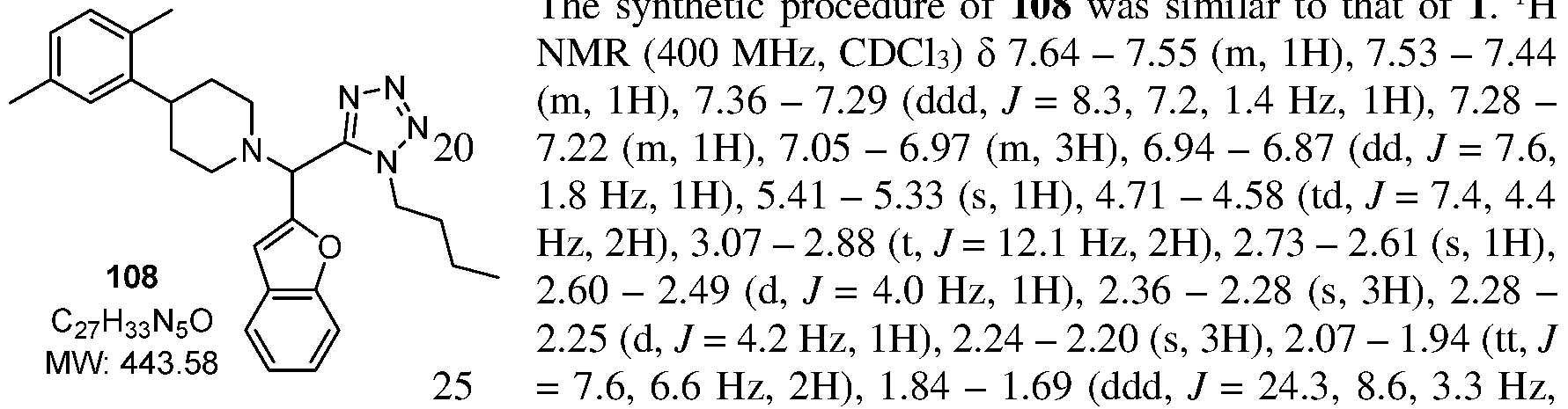
4H), 1.57 - 1.44 (m, 2H), 1.08 - 0.99 (t, 7 = 7.4 Hz, 3H). 13C NMR (100 MHz, CDCb) d 154.8,
152.1, 150.5, 143.2, 135.5, 132.0, 130.3, 127.6, 126.6, 126.0, 124.8, 123.2, 121.4, 111.3, 108.3, 59.1, 53.2, 50.3, 48.0, 37.7, 32.8, 32.4, 31.7, 21.1, 19.9, 18.8, 13.6.
4-((4-(benzofuran-2-yl(l-(tert-butyl)-lH-tetrazol-5-yl)methyl)piperazin-l- yl)methyl)benzonitrile (109)
The synthetic procedure of 109 was similar to that of 1. ¾ NMR (400 MHz, CDCb) d 7.59 - 7.56 (t, 7 = 1.5 Hz, 1H), 7.56 - 7.53 (m, 2H), 7.52 - 7.45 (dq, 7 = 8.3, 0.9 Hz, 1H), 7.43 - 7.36 (m, 2H), 7.34 - 7.28 (ddd, 7 = 8.4, 7.2, 1.4 Hz, 1H), 7.26 - 7.21 (m, 1H), 7.00 - 6.92 (m, 1H), 5.71 - 5.52 (s, 1H), 3.59 - 3.40 (m, 2H), 3.02 - 2.81 (dt, 7 = 10.4, 4.8 Hz, 2H), 2.76 - 2.58 (m, 2H),
 2.54 - 2.41 (d, 7 = 6.1 Hz, 4H), 1.84 - 1.71 (s, 9H). 13C NMR
(100 MHz, CDCb) d 154.6, 151.7, 150.6, 143.9, 132.0, 129.4, 127.8, 124.7, 123.0, 121.4, 118.9, 111.3, 110.8, 108.9, 62.1, 61.9, 58.2, 53.1, 49.4, 30.0.
4-((4-(benzofuran-2-yl(l-butyl-lH-tetrazol-5-yl)methyl)piperazin-l- yl)methyl)benzonitrile (110)
110 N=N . The synthetic procedure of 110 was similar to that of 1. 1 H NMR
 (400 MHz, CDCb) d 7.60 - 7.57 (d, 7= 1.4 Hz, 1H), 7.57 - 7.55 MW: 455 55 (t, 7 = 1.6 Hz, 2H), 7.48 - 7.43 (m, 1H), 7.42 - 7.40 (s, 1H), 7.40
NC— ,0.
- 7.37 (s, 1H), 7.34 - 7.28 (ddd, 7 = 8.4, 7.2, 1.4 Hz, 1H), 7.27 -
'OcO

1H), 4.66 - 4.50 (m, 2H), 3.64 - 3.45 (s, 2H), 2.77 - 2.62 (dt, 7
= 9.2, 4.0 Hz, 2H), 2.58 - 2.41 (m, 6H), 2.01 - 1.89 (m, 2H), 1.57 - 1.37 (m, 2H), 1.05 - 0.90 (t, J = 7.4 Hz, 3H). 13C NMR (100 MHz, CDC13) d 154.8, 151.8, 150.0, 143.7, 132.1, 129.4, 127.5, 124.9, 123.2, 121.4, 118.8, 111.2, 110.9, 108.5, 62.1, 58.7, 52.9, 50.6, 48.0, 31.5, 19.9, 13.6.
4-((4-((l-(tert-butyl)-lH-tetrazol-5-yl)methyl)piperazin-l-yl)methyl)benzonitrile (111)
The synthetic procedure of 111 was similar to that of 1. 1 H NMR

112 2H), 6.68 - 6.50 (s, 1H), 3.82 - 3.65 (s, 2H), 3.65 - 3.49
C 21 H21 N3O 20 (s, 2H), 2.78 - 2.47 (m, 8H). 13C NMR (100 MHz,
MW: 331.41
CDCh) d 155.0, 154.1, 144.0, 132.0, 129.4, 128.2, 123.9, 122.6, 120.7, 118.9, 111.3, 110.8, 105.8, 62.2, 55.3, 52.8, 52.8.
l-(benzofuran-2-yl(l-(tert-butyl)-lH-tetrazol-5-yl)methyl)-4-(2- methoxyphenyl)piperidine (113)
The synthetic procedure of 113 was similar to that of 1. 1 H NMR (400
MHz, CDCI3) d 7.62 - 7.56 (m, 1H), 7.54 - 7.49 (m, 1H), 7.34 - 7.28 (ddd, J = 8.2, 7.3, 1.4 Hz, 1H), 7.27 - 7.22 (m, 1H), 7.19 - 7.11 (m, 2H), 7.00 - 6.96 (s, 1H), 6.94 - 6.86 (td, J = 7.5, 1.2 Hz, 1H), 6.85 -
 6.77 (d, J = 8.0 Hz, 1H), 5.68 - 5.63 (s, 1H), 3.80 - 3.72 (s, 3H), 3.16 c H 1 N n M - 3·00 (m’ 2H)’ 2·95 - 211 (m’ 2H)’ 2M - 232 (td’ 11-5, 2.8 Hz, MW- 445 56 1H), 1.87 - 1.80 (s, 9H), 1.78 - 1.56 (m, 4H). 13C NMR (100 MHz,
CDCI3) d 156.7, 154.5, 152.0, 151.2, 134.0, 127.9, 126.9, 126.3, 124.5, 123.0, 121.4, 120.5, 111.3, 110.2, 108.7, 62.0, 58.7, 55.2, 52.7, 48.8, 34.8, 32.5, 31.9, 29.9. l-(benzofuran-2-yl(l-butyl-lH-tetrazol-5-yl)methyl)-4-(2-methoxyphenyl)piperidine
(114)
The synthetic procedure of 114 was similar to that of 1. 1 H NMR (400 MHz, CDCI3) d 7.63 - 7.55 (ddd, J = 7.7, 1.6, 0.7 Hz, 1H), 7.53 - 7.44 (dq, J = 8.2, 0.9 Hz, 1H), 7.35 - 7.28 (m, 1H), 7.28 - 7.22 (m, 1H), 7.20 - 7.12 (m, 2H), 7.02 - 6.99 (d, J = 1.2 Hz, 1H), 6.94 - 6.89
(td, 7 = 7.5, 1.1 Hz, 1H), 6.86 - 6.81 (dd, J = 8.1, 1.1 Hz, 1H), 5.40 - 5.32 (s, 1H), 4.76 - 4.56 (m, 2H), 3.83 - 3.74 (s, 3H), 3.00 - 2.85 (tt, J = 11.7, 3.6 Hz, 2H), 2.62 - 2.48 (td, J = 11.7, 2.6 Hz, 1H), 2.33 -
 2.20 (td, J = 11.5, 2.9 Hz, 1H), 2.07 - 1.93 (tt, J = 7.6, 6.6 Hz, 2H),
1.91 - 1.82 (m, 1H), 1.82 - 1.63 (m, 4H), 1.55 - 1.43 (m, 2H), 1.05 - 0.98 (t, J = 7.4 Hz, 3H). 13C NMR (100 MHz, CDC13) d 156.7, 154.8, 152.2, 150.6, 133.7, 127.6, 127.0, 126.2, 124.8, 123.1, 121.4, 120.5, 111.2, 110.3, 108.3, 59.2, 55.2, 53.2, 50.3, 48.0, 34.8, 32.2, 31.7, 31.6, 19.9, 13.6.
4-(4-(benzofuran-2-yl(l-(tert-butyl)-lH-tetrazol-5-yl)methyl)piperazin-l-yl)phenol (115)
Th th ti d f 115 i il t th t f 1 1 H NMR
 62.0, 58.6, 55.3, 52.2, 48.6, 41.3, 34.0, 33.5, 29.7.
l-(benzofuran-2-yl(l-butyl-lH-tetrazol-5-yl)methyl)-4-(4-methoxyphenyl)piperidine
(120)
5 The synthetic procedure of 120 was similar to that of 1.

¾ NMR (400 MHz, CDCb) d 8.36 - 8.22 (s, 2H), 8.21 - 8.16 (s, 1H), 7.61 - 7.55 (m, 1H), 7.49 - 7.43 (m, 1H), 7.33 - 7.27 (ddd, J = 8.2, 5.8, 1.4 Hz, 1H), 7.27 - 7.20 (m, 1H), 7.02 - 6.98 (d, J = 0.9 Hz, 1H), 5.40
- 5.16 (s, 1H), 4.45 - 4.23 (m, 2H), 3.47 - 3.31 (q, J = 4.7 Hz, 4H), 2.87
- 2.74 (dt, J = 10.3, 4.8 Hz, 2H), 2.69 - 2.59 (dt, J = 10.5, 4.7 Hz, 2H), 1.97 - 1.76 (ddd, 7 = 13.0, 9.2, 7.6 Hz, 2H), 1.61 - 1.40 (m, 2H), 1.09 - 0.95 (t, J = 7.4 Hz, 3H). 13C NMR (100 MHz, CDC13) 154.8, 151.4,
 150.9, 149.1, 128.3, 127.7, 124.6, 123.1, 121.4, 111.2, 108.2, 77.3, 77.0,
76.6, 60.5, 51.3, 50.1, 44.8, 32.7, 20.0, 13.6.
l-(benzofuran-2-yl(l-benzyl-lH-l,2,3-triazol-4-yl)methyl)-4-(3,5-dichloropyridin-4- yljpiperazine (125)
N^ci 15 ¾ NMR (400 MHz, CDCb) d 8.35 - 8.22 (s, 2H), 7.70 - 7.63 (s, JC l H)’ 7·55 - 7·45 (m> 2H 7·43 - 7·32 (m> 3H)’ 7·31 - 7·16 (m> a
 6.78 - 6.67 (d, J = 0.9 Hz, 1H), 5.66 - 5.39 (m, 2H), 3.51 - 3.248H (m
4H), 2.80 - 2.56 (m, 4H).13C NMR (100 MHz, CDCb) d 155.0, }° 126 154.4, 151.0, 149.1, 134.4, 129.1, 128.8, 128.0, 127.8, 124.2, 122.9,
O CMW245¾° 122·8’ 12L0’ m·4’ 106·4’ 77·3’ 77·0’ 76·7’ 6L0’ 54·3’ 51·4’ 50·0·
Having now fully described the invention, it will be understood by those of skill in the art that the same can be performed within a wide and equivalent range of conditions, formulations, and other parameters without affecting the scope of the invention or any embodiment thereof. All patents, patent applications and publications cited herein are fully incorporated by reference herein in their entirety.
INCORPORATION BY REFERENCE
The entire disclosure of each of the patent documents and scientific articles referred to herein is incorporated by reference for all purposes.
EQUIVALENTS
The invention may be embodied in other specific forms without departing from the spirit or essential characteristics thereof. The foregoing embodiments are therefore to be considered in all respects illustrative rather than limiting the invention described herein.
Scope of the invention is thus indicated by the appended claims rather than by the foregoing description, and all changes that come within the meaning and range of equivalency of the claims are intended to be embraced therein.
Claims
1. A compound described by Formula I
 (Formula I), including pharmaceutically acceptable salts, solvates, and/or prodrugs thereof; wherein X, Rl, R2, R3, and R4 independently include any chemical moiety that permits the resulting compound to inhibit AR activity and/or inhibit AR expression.
2. The compound of Claim 1, wherein X is Nitrogen rendering the resulting compound
encompassed within Formula II:

3. The compound of Claim 1, wherein X is C-H rendering the resulting compound
encompassed within Formula III:

4. The compound of Claim 1, wherein R2 and R4 are combined to form either a cycloalkyl ring moiety or a ketone moiety.
5. The compound of Claim 4,
wherein the resulting compound is encompassed within Formula

wherein the resulting compound is encompassed within Formula VI:
 (Formula VI).
6. The compound of Claim 1, wherein R1 is selected from an alkyl moiety, a substituted aryl moiety, an unsubstituted aryl moiety, a substituted heterocyclyl moiety, an unsubstituted heterocyclyl moiety, and a carbonyl moiety.
7. The compound of Claim 1, wherein R1 is selected from


8. The compound of Claim 1, wherein R2 is selected from an alkyl moiety, a substituted aryl moiety, an unsubstituted aryl moiety, a substituted heterocyclyl moiety, and an unsubstituted heterocyclyl moiety.
9. The compound of Claim 1 , wherein R2 is selected from hydrogen, methyl,


10. The compound of Claim 1, wherein R3 is selected from hydrogen, an acyclic alkyl moiety, a cyclic alkyl moiety, a substituted aryl moiety, an unsubstituted aryl moiety, an alkynyl moiety, a carbonyl moiety, a cyano moiety, a carboxylyl moiety, a carboxamide moiety, and a substituted heterocyclyl moiety, and an unsubstituted heterocyclyl moiety.
11. The compound of Claim 1, wherein R3 is selected from hydrogen, methyl,


12. The compound of Claim 1, wherein R4 is selected from hydrogen and methyl.
13. A compound selected from Tables II, III, and IV, or a pharmaceutically acceptable salt, solvate, or prodrug thereof, and a pharmaceutically acceptable carrier.
14. A compound selected from the group consisting of:


15. The compound of Claim 1, Claim 13 or Claim 14, wherein the compound is comprised within a pharmaceutical composition.
16. A method of treating, ameliorating, or preventing a disease or condition characterized with AR activity and/or AR expression, comprising administering to a patient a
therapeutically effective amount of the pharmaceutical composition of Claim 15.
17. The method of claim 16, wherein the disease or condition is a hyperproliferative disease or condition.
18. The method of claim 17, wherein said hyperproliferative disease is any type of cancer characterized with AR activity and/or AR expression.
19. The method of claim 18, wherein the cancer is CRPC.
20. The method of claim 18, wherein the cancer is any type of cancer resistant to Enzalutamide treatment.
21. The method of claim 16, wherein the patient is a human patient.
22. The method of claim 16, further comprising administering to said patient one or more anticancer agents, wherein said anticancer agent one or more of a chemotherapeutic agent, and radiation therapy.
23. A kit comprising a compound of Claim 1, Claim 13 or Claim 14 and instructions for administering said compound to a patient having a disease or condition characterized with AR activity and/or AR expression.
Priority Applications (1)
| Application Number | Priority Date | Filing Date | Title |
|---|---|---|---|
| US17/413,139 US12521386B2 (en) | 2018-12-11 | 2019-12-11 | Small molecule inhibitors of the androgen receptor activity and/or expression and uses thereof |
Applications Claiming Priority (2)
| Application Number | Priority Date | Filing Date | Title |
|---|---|---|---|
| US201862778139P | 2018-12-11 | 2018-12-11 | |
| US62/778,139 | 2018-12-11 |
Publications (1)
| Publication Number | Publication Date |
|---|---|
| WO2020123670A1 true WO2020123670A1 (en) | 2020-06-18 |
Family
ID=71076671
Family Applications (1)
| Application Number | Title | Priority Date | Filing Date |
|---|---|---|---|
| PCT/US2019/065751 Ceased WO2020123670A1 (en) | 2018-12-11 | 2019-12-11 | Small molecule inhibitors of the androgen receptor activity and/or expression and uses thereof |
Country Status (2)
| Country | Link |
|---|---|
| US (1) | US12521386B2 (en) |
| WO (1) | WO2020123670A1 (en) |
Citations (4)
| Publication number | Priority date | Publication date | Assignee | Title |
|---|---|---|---|---|
| US20040009969A1 (en) * | 2001-11-23 | 2004-01-15 | Schering Ag | Piperazine derivatives that destabilize androgen receptors |
| US20100016279A1 (en) * | 2007-12-21 | 2010-01-21 | Astrazeneca Ab | Bicyclic derivatives for use in the treatment of androgen receptor associated conditions-155 |
| US20140350015A1 (en) * | 2008-10-06 | 2014-11-27 | Cancer Research Technology Limited | Pyridine and pyrimidine based compounds as wnt signaling pathway inhibitors for the treatment of cancer |
| WO2017165822A1 (en) * | 2016-03-24 | 2017-09-28 | University Of Pittsburgh - Of The Commonwealth System Of Higher Education | Small molecule inhibitor of the nuclear translocation of androgen receptor for the treatment of castration-resistant prostate cancer |
Family Cites Families (4)
| Publication number | Priority date | Publication date | Assignee | Title |
|---|---|---|---|---|
| US3989816A (en) | 1975-06-19 | 1976-11-02 | Nelson Research & Development Company | Vehicle composition containing 1-substituted azacycloheptan-2-ones |
| US4444762A (en) | 1980-04-04 | 1984-04-24 | Nelson Research & Development Company | Vehicle composition containing 1-substituted azacyclopentan-2-ones |
| US6605712B1 (en) | 1990-12-20 | 2003-08-12 | Arch Development Corporation | Gene transcription and ionizing radiation: methods and compositions |
| US7205404B1 (en) | 1999-03-05 | 2007-04-17 | Metabasis Therapeutics, Inc. | Phosphorus-containing prodrugs |
-
2019
- 2019-12-11 US US17/413,139 patent/US12521386B2/en active Active
- 2019-12-11 WO PCT/US2019/065751 patent/WO2020123670A1/en not_active Ceased
Patent Citations (4)
| Publication number | Priority date | Publication date | Assignee | Title |
|---|---|---|---|---|
| US20040009969A1 (en) * | 2001-11-23 | 2004-01-15 | Schering Ag | Piperazine derivatives that destabilize androgen receptors |
| US20100016279A1 (en) * | 2007-12-21 | 2010-01-21 | Astrazeneca Ab | Bicyclic derivatives for use in the treatment of androgen receptor associated conditions-155 |
| US20140350015A1 (en) * | 2008-10-06 | 2014-11-27 | Cancer Research Technology Limited | Pyridine and pyrimidine based compounds as wnt signaling pathway inhibitors for the treatment of cancer |
| WO2017165822A1 (en) * | 2016-03-24 | 2017-09-28 | University Of Pittsburgh - Of The Commonwealth System Of Higher Education | Small molecule inhibitor of the nuclear translocation of androgen receptor for the treatment of castration-resistant prostate cancer |
Non-Patent Citations (1)
| Title |
|---|
| DATABASE Pubchem 11 July 2005 (2005-07-11), "1-[(1-Tert-butyltetrazol-5-yl)methyl]-4-(4-methoxyphenyl)piperazine | C17H26N6O", XP055718544, Database accession no. CID 1438459 * |
Also Published As
| Publication number | Publication date |
|---|---|
| US12521386B2 (en) | 2026-01-13 |
| US20220062278A1 (en) | 2022-03-03 |
Similar Documents
| Publication | Publication Date | Title |
|---|---|---|
| KR102599945B1 (en) | Mdm2 inhibitors and therapeutic methods using the same | |
| JP6251301B2 (en) | Spiro-oxindole MDM2 antagonist | |
| CN102712650B (en) | Spiro-indolinone MDM2 antagonist | |
| WO2015153959A2 (en) | Small molecule inhibitors of mcl-1 and uses thereof | |
| EA016145B1 (en) | New small molecule inhibitors of mdm2 and the uses thereof | |
| WO2012065022A2 (en) | Spiro-oxindole mdm2 antagonists | |
| EP2831067A1 (en) | Small molecule inhibitors of mcl-1 and uses thereof | |
| WO2016187544A1 (en) | Compositions and methods for treating and preventing cancer | |
| JP2008533039A (en) | Anti-apoptotic Bcl-2 family member chromen-4-one inhibitors and uses thereof | |
| WO2020132459A1 (en) | Quinolinyl-pyrazine-carboxamide compounds and uses thereof | |
| WO2020112846A1 (en) | Small molecule modulators of sigma-1 and sigma-2 receptors and uses thereof | |
| WO2017223086A1 (en) | Small molecule inhibitors of aldh and uses thereof | |
| WO2022169834A2 (en) | Small molecule inhibitors of grp78 and uses thereof | |
| US20230133958A1 (en) | Compounds useful in modulating egfr and pi3k | |
| US12521386B2 (en) | Small molecule inhibitors of the androgen receptor activity and/or expression and uses thereof | |
| WO2020160175A1 (en) | Quindoline compounds and uses thereof | |
| CN113710241B (en) | Substituted bicyclic and tetracyclic quinones and related methods of use | |
| WO2016172218A1 (en) | Small molecule inhibitors of mcl-1 and uses thereof | |
| HK40064288A (en) | Substituted bicyclic and tetracyclic quinones and related methods of use | |
| JP2024511801A (en) | (furopyrimidin-4-yl)piperazine compounds and their uses |
Legal Events
| Date | Code | Title | Description |
|---|---|---|---|
| 121 | Ep: the epo has been informed by wipo that ep was designated in this application |
Ref document number: 19894841 Country of ref document: EP Kind code of ref document: A1 |
|
| NENP | Non-entry into the national phase |
Ref country code: DE |
|
| 122 | Ep: pct application non-entry in european phase |
Ref document number: 19894841 Country of ref document: EP Kind code of ref document: A1 |
|
| WWG | Wipo information: grant in national office |
Ref document number: 17413139 Country of ref document: US |